2.1. Preliminaries: The GHF-MCDA Model
The GHF-MCDA model [
17,
21] is a hierarchical fuzzy-based MCDA model aimed at assigning to each subzone into which an urban area is divided a score related to the degree to which it meets a set of criteria.
Let A = {a
1, a
2, …, a
m} be the set of alternatives given by the urban m subzones. Let r
1, r
2, …, r
n be a set of n criteria, where the criterion r
k is expressed as a linguistic label of the fuzzy set:
and
denotes the membership degree assigned to the i
th alternative in meeting the k
th criterion.
To the k
th criterion is assigned a weight α
k called the
Coefficient of Relative Significance (for short, CRS) [
22]; it denotes the relevance of the k
th criterion in selecting the best alternative. The value of α
k ranges in [0, 1], and the following constraint holds:
To determine α
k, the Saaty’s AHP pairwise comparison matrix is used. Let
B be the pairwise comparison nxn matrix where b
kj gives the relevance of the criterion r
k with respect to the criterion r
j. The values that can be assigned to b
kj are shown in
Table 1. The conjugate elements b
jk are set to 1/b
kj, and the diagonal elements b
kk are set to 1.
The CRS value α
k of the k
th criterion is given by:
where w
k is the kth component of the normalized eigenvector
w corresponds to the greatest eigenvalue solution of the characteristic equation:
The fuzzy set R is assigned to criterion r, placed at the root of the criteria hierarchy, where:
The membership degree of the ith alternative to the fuzzy set R is given by:
It constitutes the score assigned to the ith alternative.
In GHF-MCDA, each criterion is decomposed into a hierarchy of sub-criteria. Let
be the kth criterion at the level h and let
be its n
k sub-criteria at the level h+1. The fuzzy set assigned to
is given by:
and the membership degree of the i
th alternative to R
k(h) is given by
To a criterion in a leaf node, the expert assigns a fuzzy set given by a triangular fuzzy number (TFN) [
23] built on the numerical domain of a numerical index used to evaluate how much the subzone meets the criterion; a TFN is easily created by setting three domain values (α, β, γ), with α ≤ β ≤ γ, which allows the construction of a triangular membership function of the form
Two other types of TFNs used in [
17] in describing the fuzzy sets of the sub-criteria at the nodes are the semi-trapezoidal fuzzy sets Right function (R-function) and Left function (L-function).
An R-function is defined by two numbers, α and β, with α ≤ β. It is generally used to create the first fuzzy set in the fuzzy partition of a numerical domain and is given by:
An L-function is defined by two numbers, α and β, with α ≤ β. It is generally used to create the last fuzzy set in the fuzzy partition of a numerical domain and is given by:
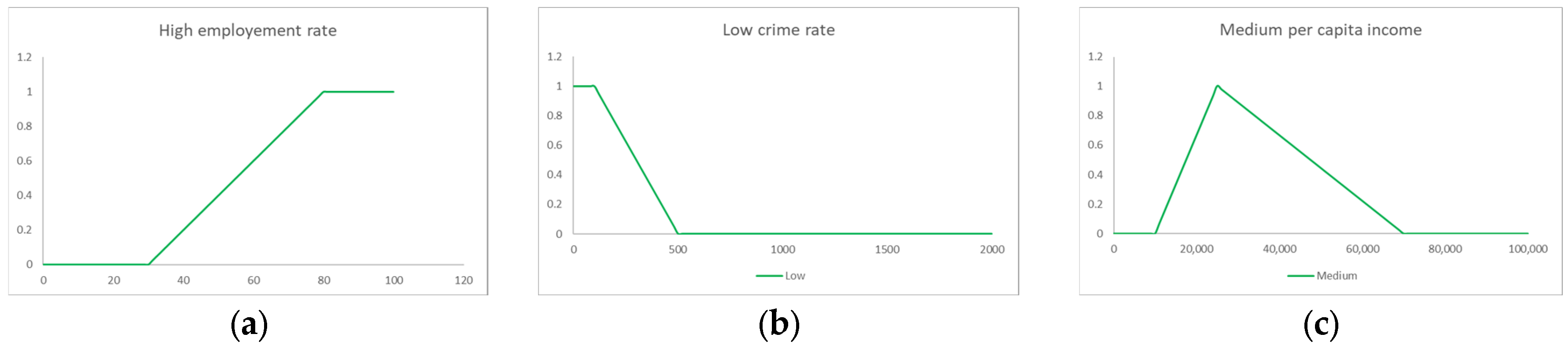
To illustrate the process, a simple model is considered in which a root criterion is broken down into 3 leaf sub-criteria. Let’s define the root criterion r called good livability. It is hierarchically broken down into three leaf sub-criteria r1, r2 and r3, called, respectively: high employment rate, low crime rate, and medium per capita income.
Suppose we consider the first two sub-criteria, high employment rate, and low crime rat equally important, and the third, medium per capita income, slightly more important than the other two. Saaty’s pairwise comparison matrix is given by:
The fuzzy set R
1 high employment rate is created on the domain of an index that measures the percentage of employed people in relation to all employable residents in the subzone, ranging from 0 to 100. It is given by the following L-function TFN:
The fuzzy set R
2 low crime rate is created on the measure of the number of crime events detected in the last year, ranging from 0 to 2000. It is given by the following R-function TFN:
The fuzzy set of
medium per capita income is created on the measure of the annual average of the per capita income of the citizens, ranging from 0 to 100,000 €. It is given by the following TFN:
The three fuzzy sets, created as triangular numbers, are shown in
Figure 2.
For each alternative, after acquiring the values of the criteria indexes in the leaf nodes, GHF-MCDA determines the membership degrees of the corresponding fuzzy sets and, subsequently, assigns the membership degrees of the fuzzy sets corresponding to the hierarchically superior criteria generated using Formula (6).
In the example, the leaf nodes are represented by the three sub-criteria r1, r2, and r3. Let the values of the three indices recorded for the ith subzone ai be: employment rate = 58%, crime rate = 301, and per capita income = 35,000 €. Subsequently, the values of the membership degree of the three fuzzy sets are: , , and .
To determine the CRS’s of each of the three sub-criteria, the characteristic eigenvalue Equation (4) is solved, using the pairwise comparison matrix in
Table 2; the CRS’s of the three sub-criteria are constituted by the normalized components of the eigenvector corresponding to the largest eigenvalue.
The greatest eigenvalue is given by = λ = 3 and the corresponding eigenvector is v = (½, ½, 1). Its normalized value is: (0.25, 0.25, and 0.50).
Then, the CRS’s of the three sub-criteria are, respectively, α1 = 0.75, α2 = 0.75, and α3 = 1.5.
Using (6), is obtained the membership degree to the fuzzy set R, assigned to the criterion r. It is given by . It is the score assigned to the ith alternative in satisfying the criterion.
The GHF-MCDA method is implemented in two phases. In the first phase the domain expert creates the hierarchical structure of criteria, assigning the fuzzy sets to each leaf sub-criterion. Algorithm 1 is structured in pseudocode in this phase. For each leaf sub-criterion, the expert defines the numerical index used to evaluate the adherence to the sub-criterion and create as a fuzzy number the corresponding fuzzy set. For each other criterion, the eigenvalue solutions of the characteristic Equation (4) are found, and the eigenvectors of the greatest eigenvalue are determined; then the CRS assigned to the child nodes are calculated by (3).
| Algorithm 1: Create Hierarchical Structure of criteria |
| Input: Set of n criteria |
| Output: Hierarchical structure of criteria |
| Set the n criteria r1, r2, …, rk, …, rn at the first level in the hierarchy |
| Construct the L-levels hierarchical model of the criteria |
| For l = L to 1 |
| | For each criterion r(l)k at the lth level |
| | | If r(l)k is a leaf node then |
| | | | Define the numerical index used to evaluate the adherence to the sub-criterion |
| | | | Create the fuzzy set R(l)k on the domain of the numerical index |
| | | Else |
| | | | Create the AHP pairwise comparison matrix of the child nodes |
| | | | Find the eigenvalues of the characteristic Equation (4) |
| | | | Compute the normalized eigenvectors of the greatest eigenvalue |
| | | | Compute the Coefficient of Relative Significance (CRS) of the child nodes by (3) |
| | | End if |
| | Next node |
| Next l |
In the next phase, after partitioning the study area into subzones, the values of the indices associated with each leaf node are calculated for each subzone. Subsequently, for each subzone, the GHF-MCDA method, starting from the leaf nodes, determines the membership degrees to the fuzzy sets in each node based on the membership degrees to the fuzzy sets in its subnodes, using Formula (5). The suitability of the ith subzone is given by the membership degree of the subzone to the fuzzy set assigned to the radix criterion .
The algorithm will end when the membership degree to the fuzzy set of the root node, which constitutes the suitability level of the subzone, has been determined for all the subzones. The GHF-MCDA method is schematized in pseudocode in Algorithm 2.
| Algorithm 2: GHF-MCDA method | |
| Input: Spatial dataset with the subzones of the study area | |
| Output: Array s[] containing the suitability of each subzone | |
| For i = 2 to m | |
| | s[i]:= 0 //initialization of the suitability value of the ith subzone |
| | Compute the membership degrees to the fuzzy sets in the leaf nodes |
| | For l = L to 1 |
| | | For each node r(l)k at the lth level | |
| | | | If r(l)k is a leaf node | |
| | | | | Compute the value of the numerical index assigned to the node | |
| | | | | Compute the membership degrees to the fuzzy set assigned to the node | |
| | | | Else | |
| | | | | Compute the membership degree by (7) | |
| | | | End if | |
| | | Next r(l)k | |
| | Next l | |
| | s[i]:= | |
| Next i | |
| Return s[] | |
2.2. The Proposed Framework and Its Application to Assess the Impacts of Heatwave During Pandemics
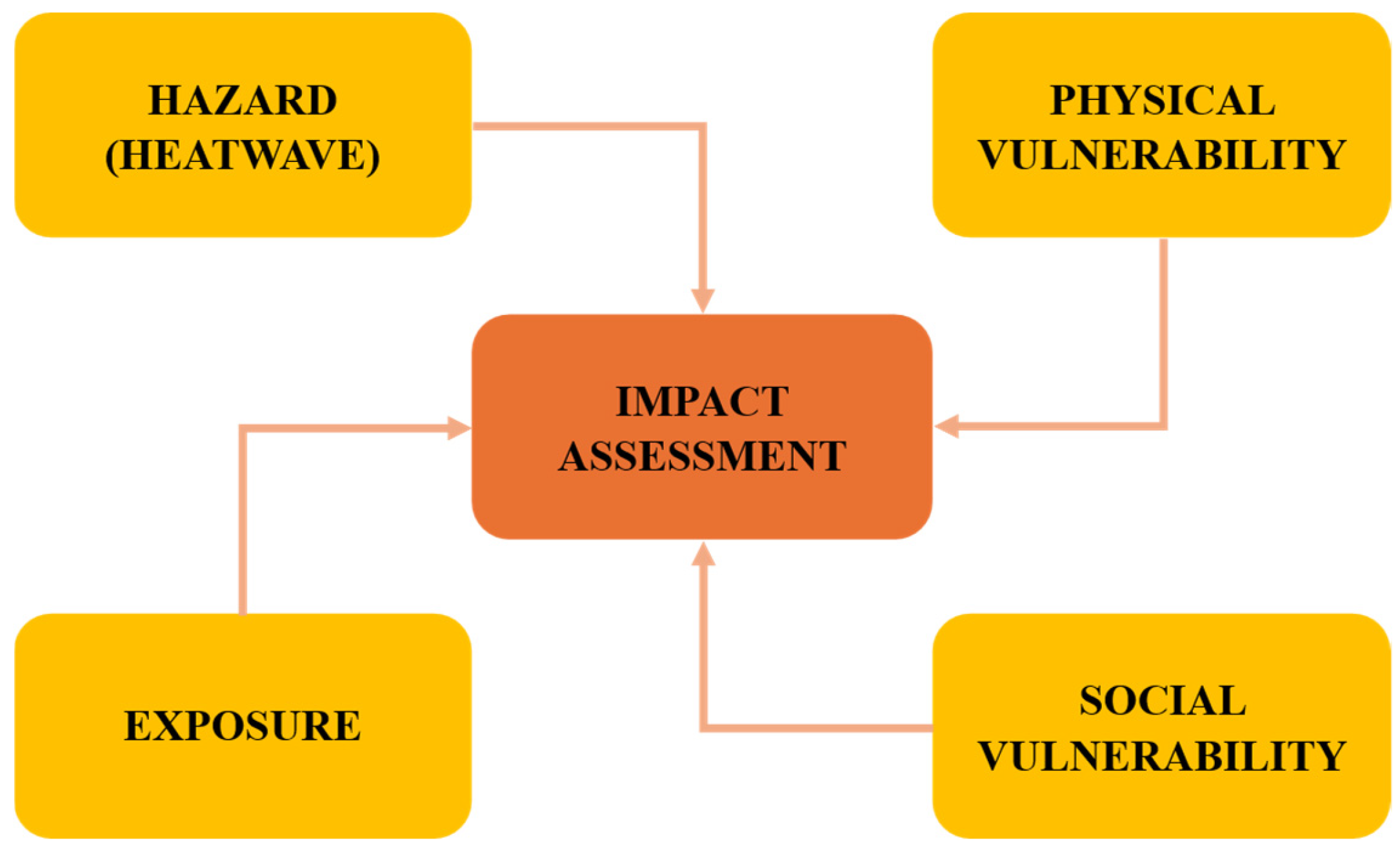
The proposed framework aims to estimate the worsening of impacts/risks generated by heatwaves in the presence of pandemic scenarios. The GHF-MCDA model is applied to evaluate the impacts generated by heatwave phenomena both during normal times (normal scenario) and during a pandemic emergency (pandemic scenario).
To simulate the effect of the pandemic, variations are made to the values of the pairwise comparisons between the criteria, which will generate variations in the CRSs assigned to the criteria.
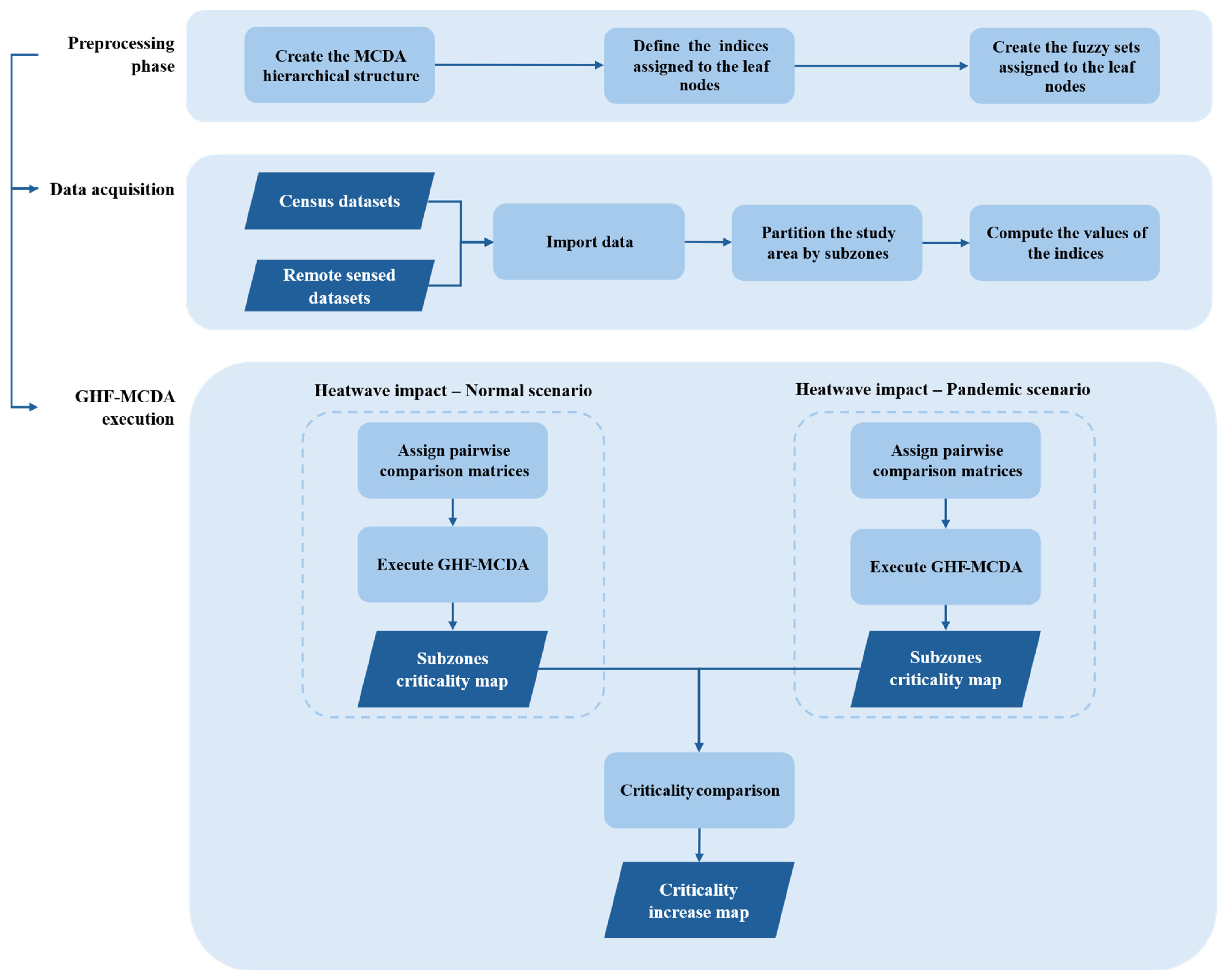
The flow diagram in
Figure 2 schematizes the framework.
In the preprocessing phase, the MCDA hierarchical structure is created to assess the impact/risk of a heatwave phenomenon in the normal and pandemic scenario. In this phase the indices assigned to the leaf nodes and the fuzzy sets are defined.
During the data acquisition phase, the data extracted from the census and remote-sensed datasets are imported; then, the study area is partitioned into subzones, and the values of the indices are calculated by subzone.
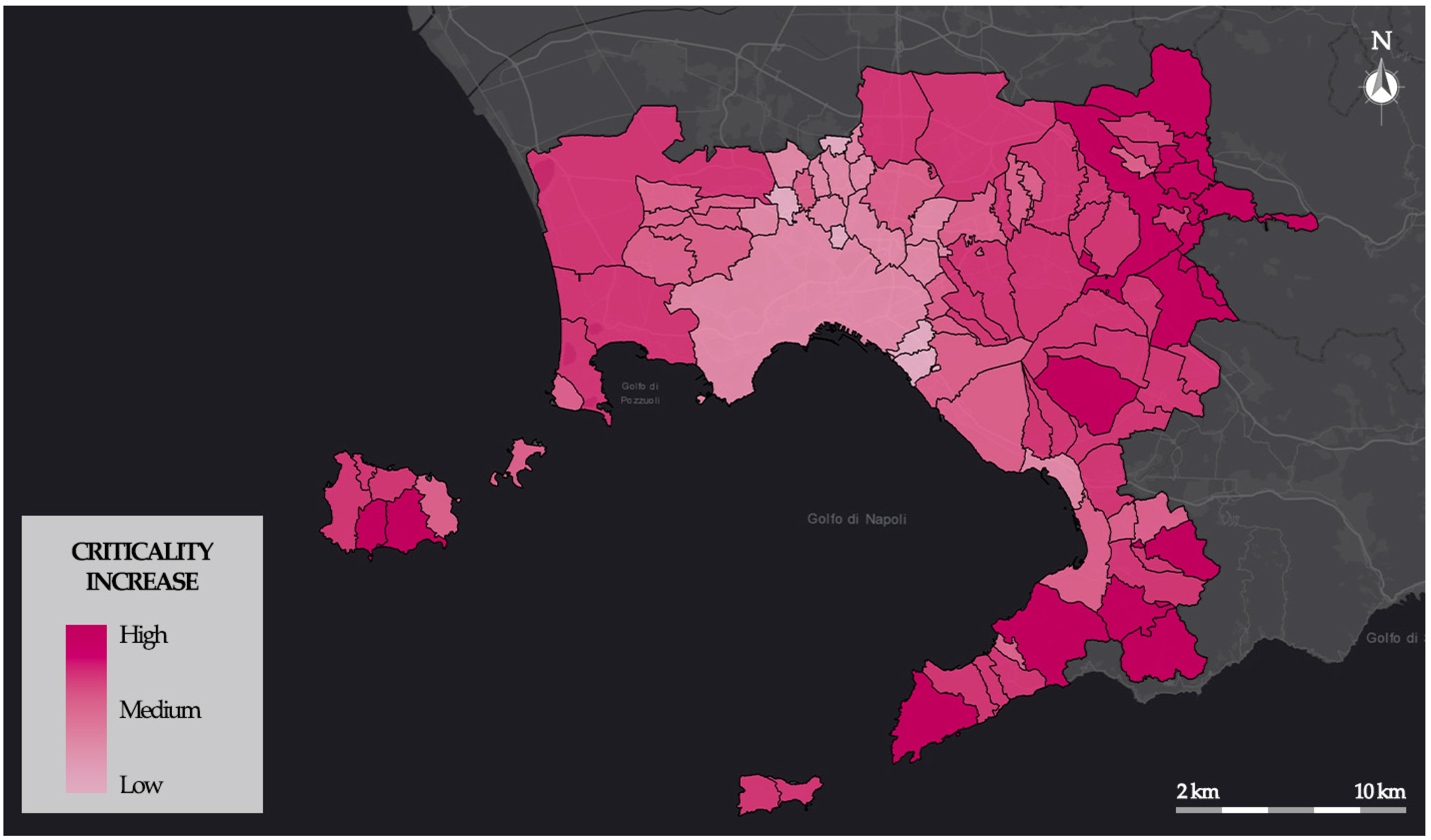
In the next phase, for each of the two scenarios, normal and pandemic, the pairwise comparison matrices between criteria are defined, and the GHF-MCDA method is executed, where the suitability assigned to each subzone represents the criticality of the subzone in the presence of the hazard scenario. Finally, the resultant criticality maps are compared, and the criticality increase map is created, showing in which subzones the criticality assessed in the normal scenario is significantly increased in the pandemic scenario.
The criticality increase map allows us to analyze in which subzones the risks/impacts have significantly worsened due to the presence of the pandemic. If CN
i is the criticality of the ith subzone assigned in the normal scenario and CPi is the criticality of the ith subzone assigned in the pandemic scenario, then the criticality increase in the ith subzone is given by the formula:
It expresses as a percentage the increase in the criticality of the sub-zone in the new pandemic scenario.
The framework in
Figure 3 is applied to assess the impact/risks of urban subzones during heat waves.
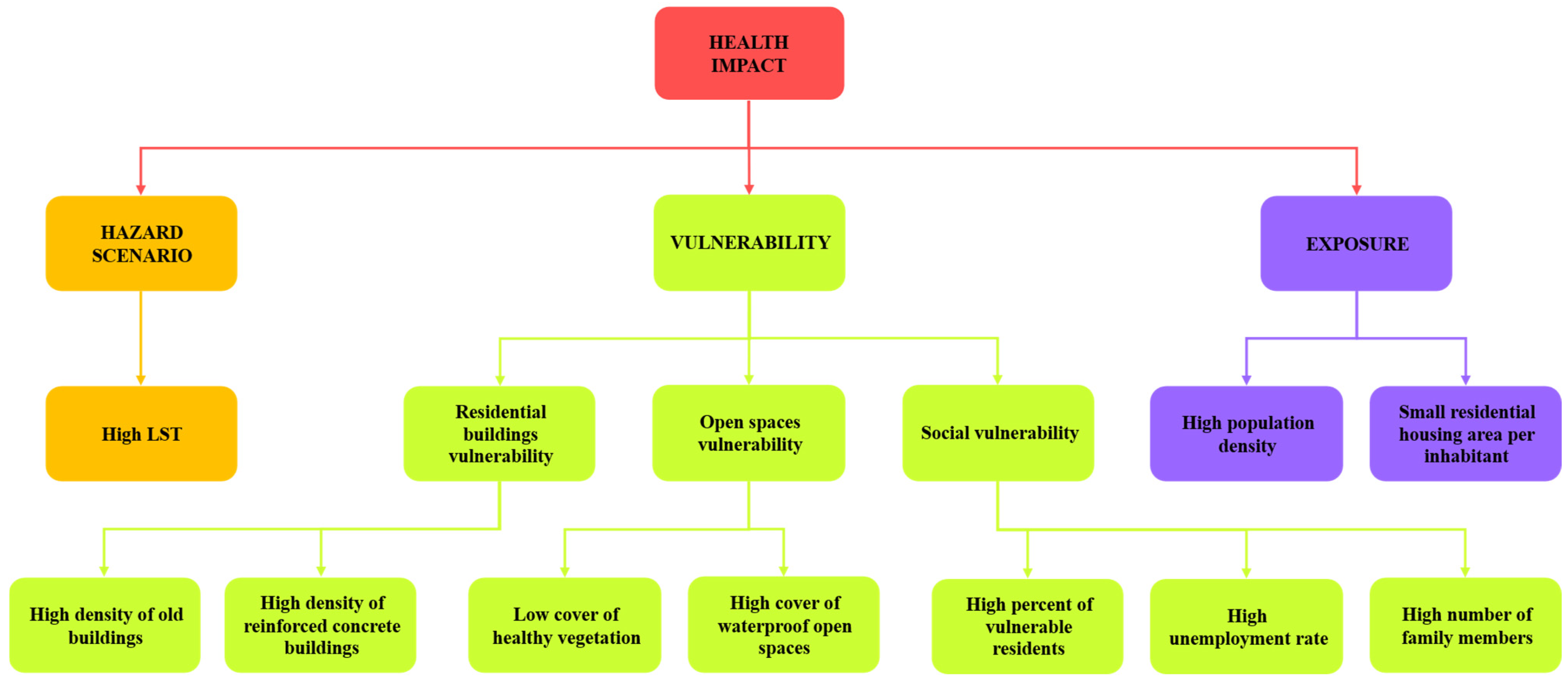
Figure 4 shows the hierarchical structure of the criteria. The radix node is the health impact generated by a heatwave hazard scenario. The criticality values CN
i and CP
i provide the impact on the health of the residents in the ith subzone in the presence of the normal and the pandemic scenarios, respectively.
The hazard scenario is evaluated by measuring the Land Surface Temperature (LST), a satellite measure of the soil temperature, and calculating the mean LST in the subzone.
The exposure is evaluated by measuring both the population living in the subzone and the population density.
The vulnerability is partitioned in the vulnerability of the physical element’s residential buildings and open spaces and in the social vulnerability. The residential buildings’ vulnerability is evaluated by considering the density of old buildings and the density of reinforced concrete buildings. Open space vulnerability is evaluated by considering the coverage of healthy vegetation and of waterproof soil; these two measures are obtained by the satellite Normalized Difference Vegetation Index (NDVI). Social vulnerability is evaluated by measuring the percentage of vulnerable residents and the unemployment and homeless rates.
In
Table 3, for each leaf sub-criterion is described the index related to the criterion and the source used to calculate the index.
The pairwise comparison matrices between sub-criteria refer to a normal scenario are reported in
Table 4,
Table 5,
Table 6,
Table 7,
Table 8 and
Table 9. The pairwise comparisons were constructed based on the assessments performed by an expert in climate risk issues in urban settlements. The expert is a long-standing domain expert, with in-depth knowledge of the issues relating to climate and environmental risks in urban agglomerations. He used the framework as a user, setting TFNs at the nodes and scoring the pairwise comparison matrices for the normal and pandemic scenarios.
The expert was asked to review the pairwise comparison matrices to see what changes to make in a heatwave pandemic scenario.
The following tables show the revised pairwise comparison matrices in a pandemic scenario.
The pairwise comparison matrix of the radix criterion, health impact, has not undergone any changes. Instead, the pairwise comparison matrix of the criterion exposure is changed (
Table 10). The expert believed that in a pandemic scenario, the residential housing area per inhabitant is a slightly more significant indicator than the population density. In bold are shown the modified scores.
In the pairwise comparison matrix of the criterion vulnerability the expert believed that in a pandemic scenario, the social vulnerability is of equal or slightly more significant than the building vulnerability and is slightly more important than the open space vulnerability (
Table 11).
The pairwise comparison matrices of the criteria residential building vulnerability and Open space vulnerability have not undergone any changes. Instead, the pairwise comparison matrix of the criterion social vulnerability is changed (
Table 12). The expert believed that in a pandemic scenario, the percentage of vulnerable residents is more significant than the unemployment rate and the homeless rate (
Table 12). This assessment is motivated by the fact that, in times of pandemic emergency, young children and the elderly are particularly vulnerable compared to other segments of the resident population.
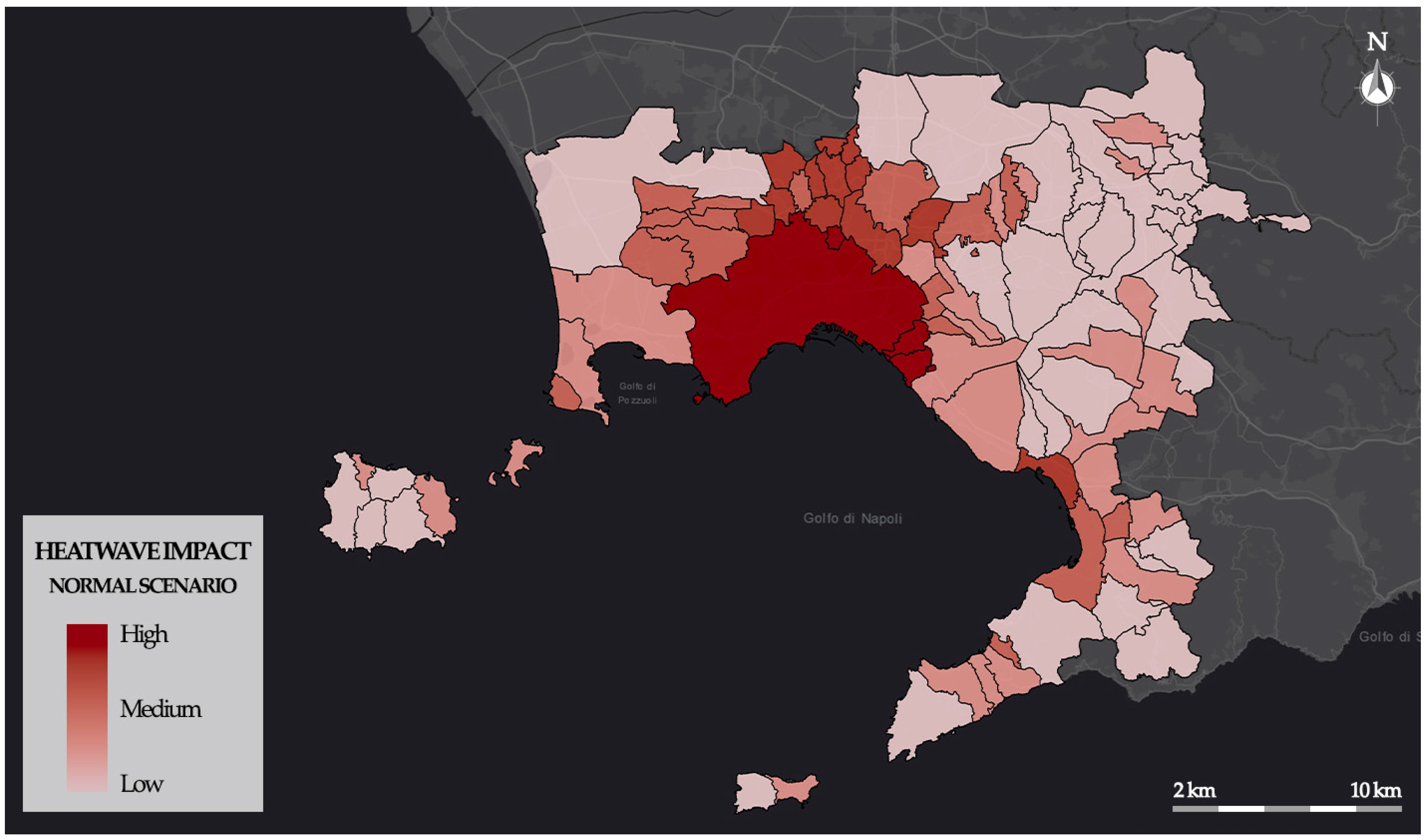
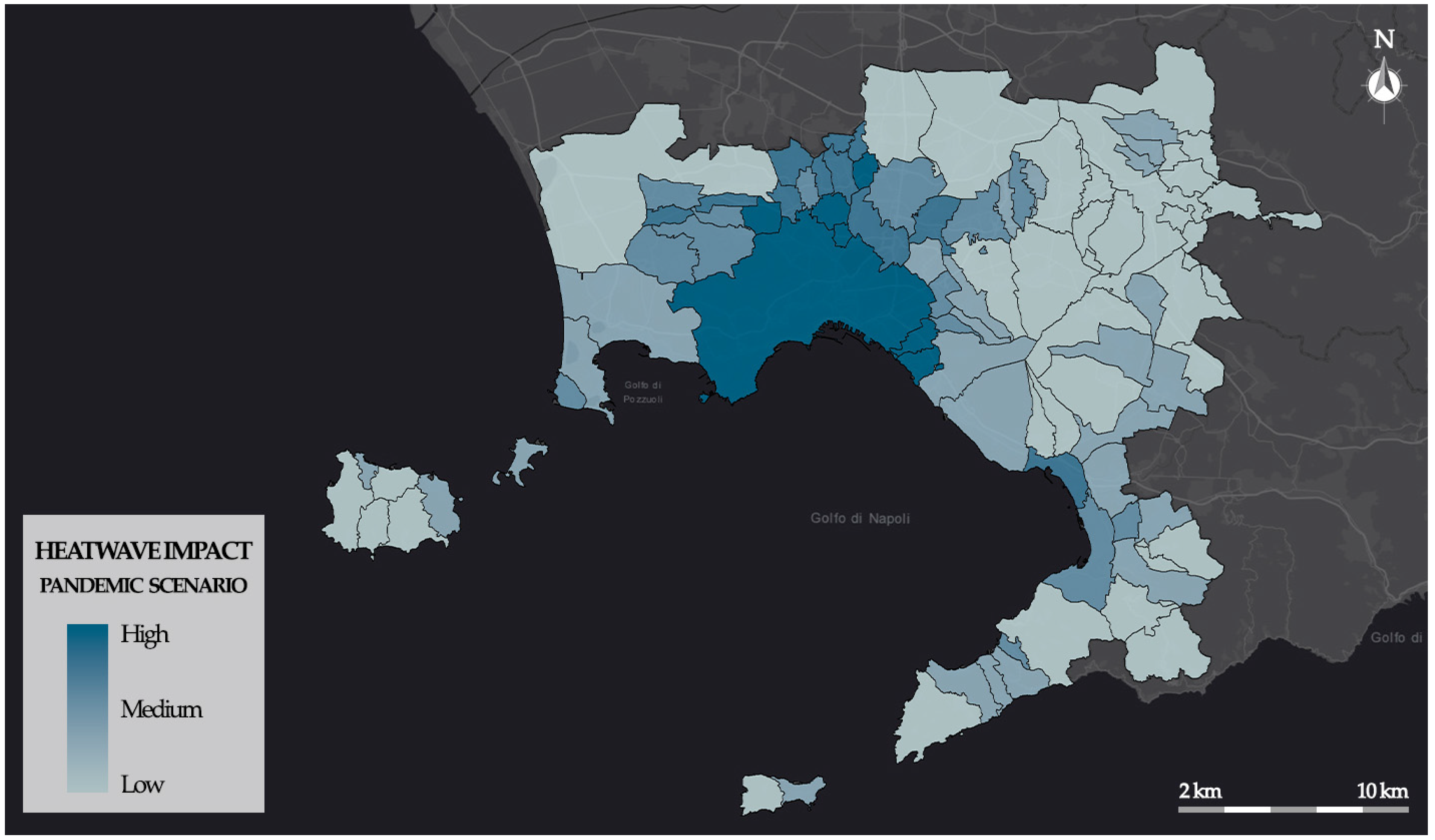
The GHF-MCDA algorithm is run twice, once for the normal scenario and once for the pandemic scenario. The result of the GHF-MCDA algorithm is a criticality thematic map showing the spatial distribution by subzone of the criticality in the range [0, 1]. The criticality increase map is obtained by comparing the criticality values obtained for the two scenarios.




 ,
,