1. Introduction
Vehicular Ad Hoc Networks (VANETs) have become a key component of modern Intelligent Transportation Systems (ITS), enabling Vehicle-to-Vehicle (V2V) and Vehicle-to-Infrastructure (V2I) communications to improve road safety and traffic efficiency [
1]. Recent developments in VANET technologies have expanded the possibilities for developing applications dedicated to remote monitoring, traffic management, and safety enhancement through Vehicle-to-Everything (V2X) communications [
2]. These advances leverage IEEE 802.11p protocol frequency channels and 5G connectivity to support real-time data exchange critical for ITS applications [
3]. However, despite these technological advances, traffic congestion and road accidents continue to become major challenges worldwide. The World Health Organization reports approximately 1.19 million road traffic deaths annually (estimate for 2021) [
4].
Driver stress has emerged as a critical factor in transportation safety, with research demonstrating its significant impact on driving performance, reaction time, and decision-making ability. Naturalistic-driving studies report odds ratios of up to approximately ten for certain high-stress states [
5], indicating that stressed drivers face substantially elevated crash and near-crash risks. Investigations into multimodal driver stress detection have revealed that stress is among the 10 leading causes of fatal crashes, emphasizing the urgent need for reliable, real-time stress monitoring systems integrated in vehicular networks [
6]. Furthermore, driver monitoring systems have gained increasing attention as effective countermeasures for detecting and mitigating hazardous driver states before accidents occur [
7].
Various approaches have been proposed to detect driver stress, ranging from physiological monitoring using Heart Rate Variability (HRV) and Galvanic Skin Response (GSR) [
8,
9] to behavioral analysis through steering wheel patterns [
10] and vehicle context dynamics [
11]. Fuzzy Logic (FL)-based systems have demonstrated promising results due to their ability to handle imprecise data, with some Type-1 Fuzzy Logic Systems (T1FLS) achieving up to 99% accuracy in controlled settings [
12]. Machine Learning (ML) and Deep Learning (DL) approaches have also shown strong performance, with multimodal convolutional neural networks achieving accuracies exceeding 95% by combining short-term physiological signals [
13]. However, most existing systems have limitations in handling the uncertainty and variation inherent in real-world driving environments. Traditional binary classification approaches and T1FLS often fail to adequately model the complex relationships between multiple stress indicators and their varying degrees of uncertainty for different drivers and driving conditions. The gap between laboratory accuracy (often exceeding 90%) and real-world performance (typically 70–85%) highlights the need for more robust uncertainty modeling approaches [
6].
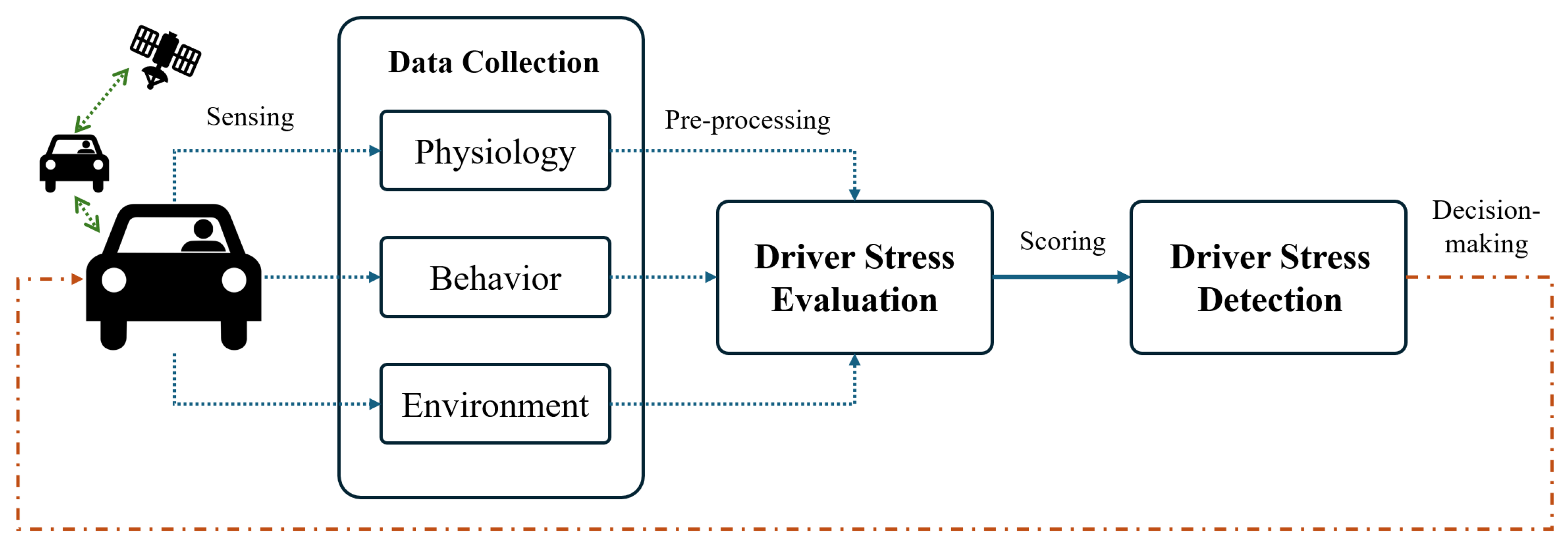
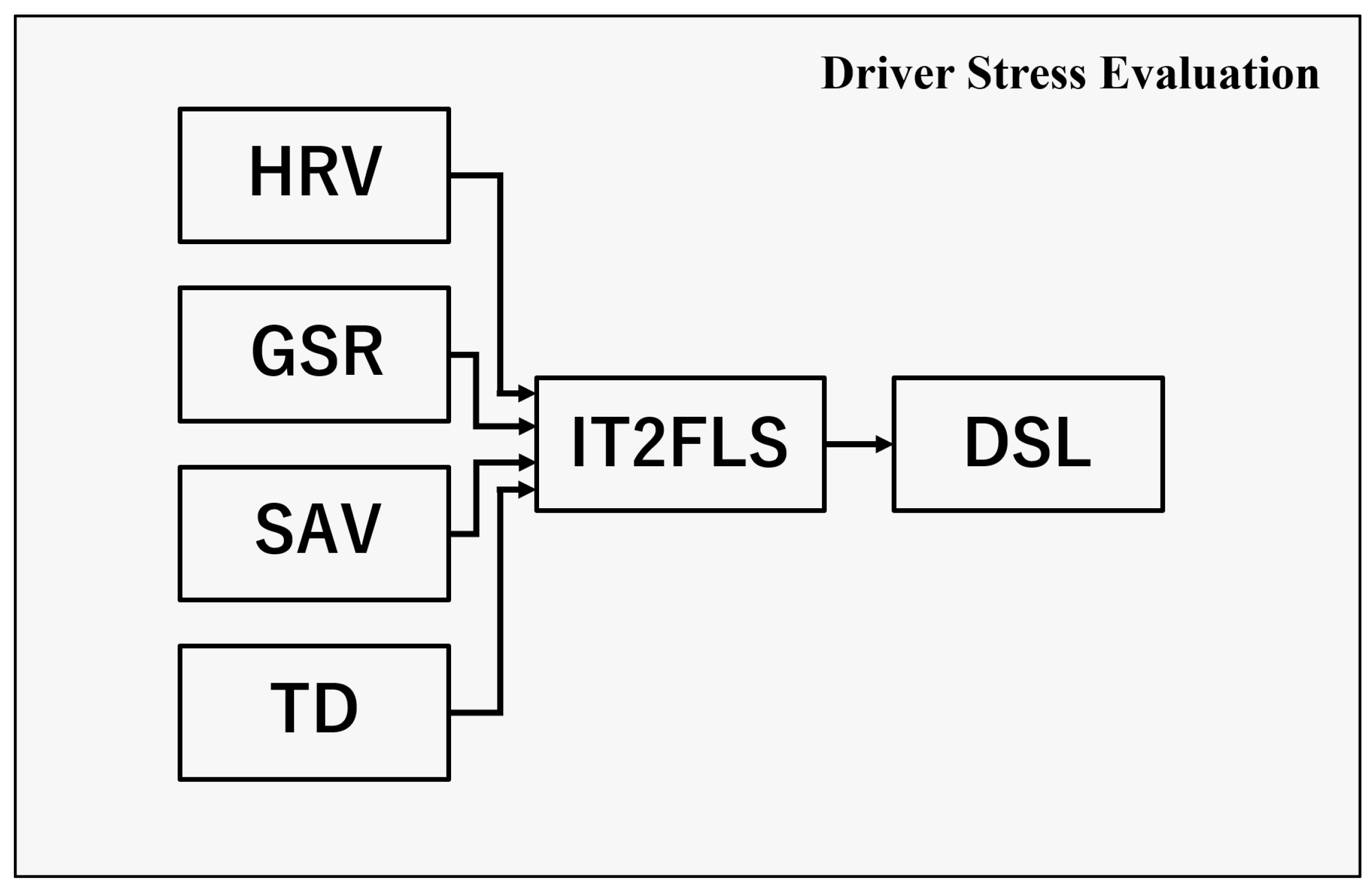
This paper introduces a Fuzzy-based Driver Stress Detection System (FDSDS) using an Interval Type-2 Fuzzy Logic System (IT2FLS) for stress evaluation in VANET environments. The proposed system considers four parameters: HRV, GSR, Steering Angle Variation (SAV), and Traffic Density (TD). By using IT2FLS, our system addresses the limitations of existing approaches by handling uncertainty and providing more reliable stress detection under varying driving conditions. To the best of our knowledge, there is not any other approach that combines these three categories of characteristics: physiological, behavioral, and environmental.
The contributions of this paper are as follows.
We propose an IT2FLS-based framework that integrates physiological, behavioral, and environmental parameters for driver stress detection.
We show the effectiveness of the proposed IT2FLS architecture in capturing the synergistic effects of combining HRV and GSR as physiological indicators with SAV and TD data available through VANET communications.
We provide detailed simulation results showing the system’s performance under different driving scenarios and driver stress level.
The remainder of this paper is organized as follows.
Section 2 reviews related work in driver stress detection and FL applications.
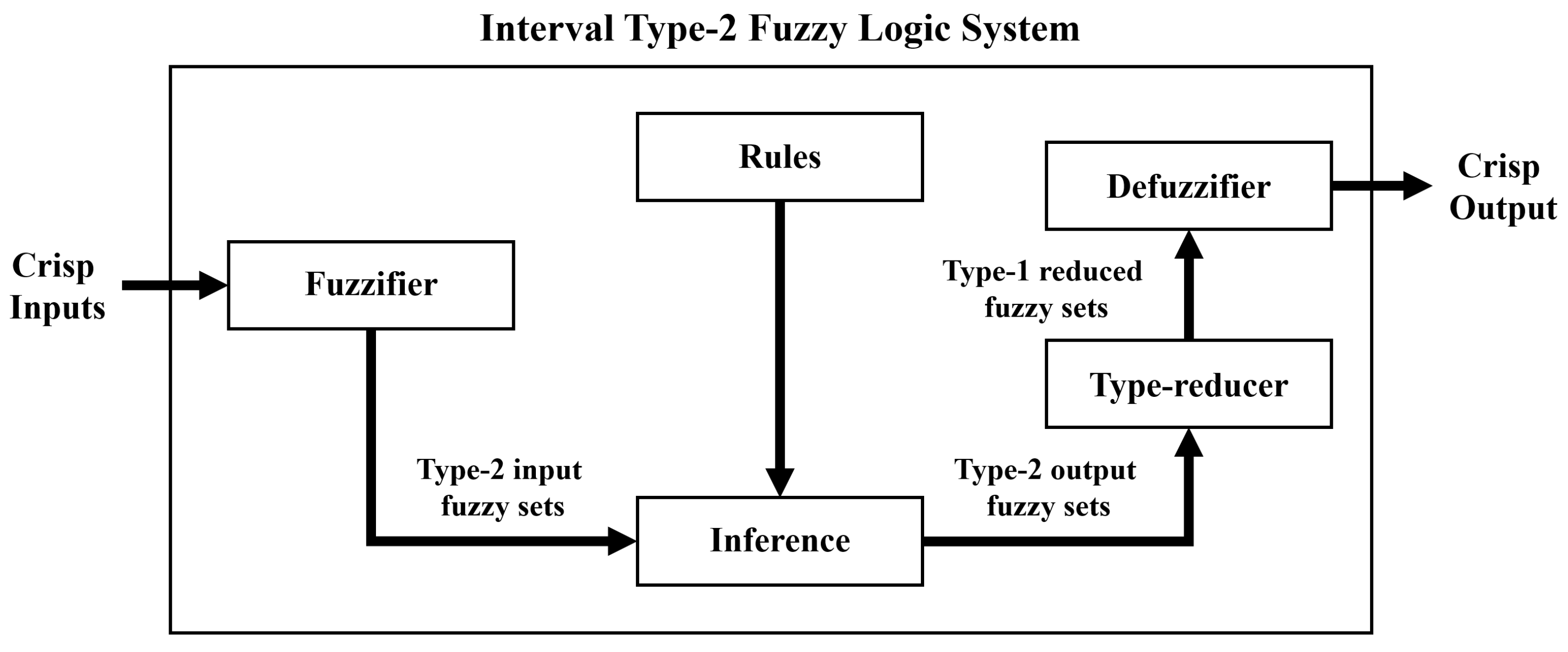
Section 3 provides an overview of FL principles, particularly IT2FLS.
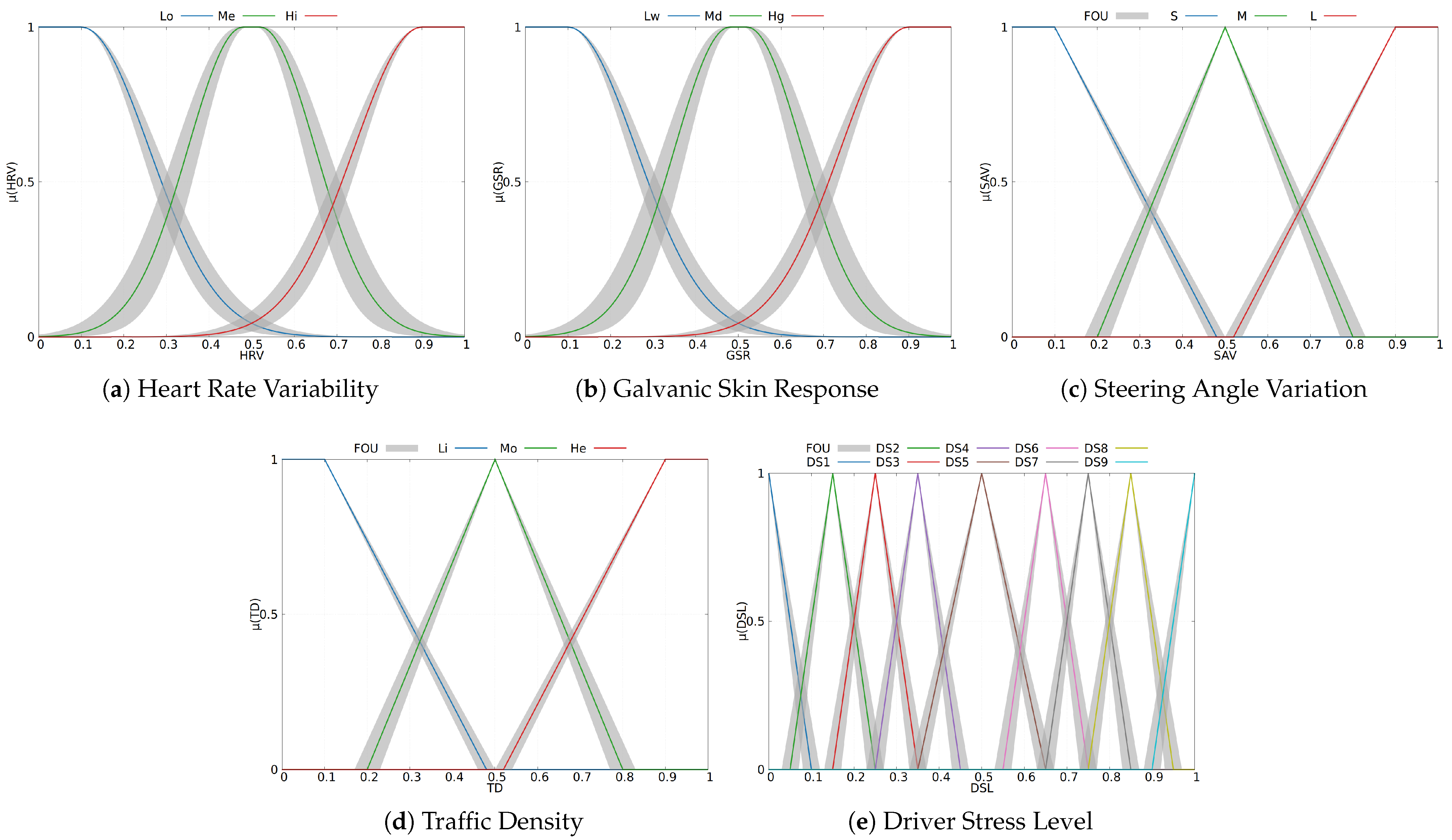
Section 4 details the proposed FDSDS and implementation.
Section 5 presents simulation results and performance evaluation. Finally,
Section 6 concludes the paper and discusses future research directions.
2. Related Work
Physiological approaches for driver stress detection have received considerable attention due to their direct connection with Autonomic Nervous System (ANS) responses. Rastgoo et al. [
6] conducted a comprehensive critical review of techniques for multimodal driver stress detection. They show that stress is among 10 leading causes of fatal crashes. Healey and Picard [
8] used multiple physiological signals, achieving 97% accuracy by combining Electrocardiography (ECG), Electromyography (EMG), GSR, and respiration data. However, their approach requires extensive sensor arrays that may be impractical for everyday driving scenarios. More recently, Liu et al. [
9] and Castaldo et al. [
14] investigated ultra-short HRV analysis (30–180 s) for stress detection. They showed that a good accuracy is achievable with ≤3 min windows, which improves real-time applicability.
Vehicle-based measurements offer non-intrusive alternatives for stress detection. Balters et al. [
10] proposed a novel steering-wheel-based approach using signals from an unmodified steering wheel to detect driver stress. While achieving approximately 77% accuracy with minimal sensor requirements, this method alone cannot capture the full complexity of stress responses. Warnecke et al. [
15] advanced this approach by attaching printed, flexible polyurethane ECG electrodes to the steering wheel, enabling ECG-based Heart Rate (HR) monitoring for approximately 45.62% of driving time. Other studies utilizing acceleration patterns, brake pressure, and lane-change trajectory have shown promising results. However, they depend heavily on driving conditions and individual driving styles [
11].
Multimodal sensor fusion approaches have demonstrated superior performance compared to single-modality methods. Rigas et al. [
16] detected driver stress events in real time by fusing 10 s physiological features with driving-event cues in Bayesian networks. They improved the accuracy from 82% (physiology only) to 96% with event information and online adaptation. Memar and Mokaribolhassan [
17], by using a single foot GSR amplitude feature with an Analysis of Variance (ANOVA)-based statistical classifier, achieved 95.83% accuracy for three-level stress classification. Iqbal et al. [
18] presented a wrist-worn Photoplethysmogram (PPG)-based pilot study and the Stress-Predict dataset collected under laboratory protocols, highlighting the need and challenges for wearable continuous stress monitoring. Can et al. [
19] conducted real-life, continuous stress detection with wrist-worn sensors and underscored the difficulty of maintaining accuracy in unconstrained settings.
ML/DL approaches can be used for stress classification. Rastgoo et al. [
20] developed a Convolutional Neural Network (CNN)–Long Short-Term Memory (LSTM)-based multimodal fusion model that fuses ECG, vehicle data, and contextual information. They achieved 92.8% average accuracy and outperformed traditional ML methods with handcrafted features. Lee et al. [
13] proposed a multimodal CNN that uses continuous recurrence-plot representations of short-term (10–30 s) foot and hand GSR and HR signals, achieving 95.67% accuracy for two-class stress classification. Amin et al. [
21] combined CNN and hybrid CNN–LSTM fusion models with a fuzzy-based approach for evaluation, demonstrating automatic feature extraction capabilities of DL. These approaches, while achieving high accuracy in controlled environments, often require substantial computational resources and large training datasets, which may limit their applicability in resource-constrained VANET environments.
FL systems have been applied for stress detection due to their ability to handle imprecise and uncertain data while maintaining interpretability. De Santos Sierra et al. [
12] achieved very high accuracy (99.5%) using T1FLS with GSR and HR data. However, T1FLS is limited in its ability to model uncertainty in Membership Functions (MFs). Recent advances in Type-2 FL, particularly IT2FLS, offer improved capabilities for handling higher-order uncertainties [
22]. Li et al. [
23] introduced a Type-2 fuzzy LSTM that improves long-term traffic prediction accuracy and interpretability under uncertainty. Unlike DL approaches that require extensive training data and lack interpretability, FL systems can incorporate expert knowledge directly through rule bases and provide transparent decision-making processes.
The integration of stress detection systems with VANETs presents unique opportunities and challenges. While VANET infrastructure can provide real-time TD information and enable V2V stress alerts, existing studies have not fully used this potential. Most current approaches focus on either physiological monitoring or vehicle dynamics alone. Thus, they miss the synergistic benefits of utilizing multiple data sources within the VANET framework.
Despite these advances, the following limitations remain in current approaches.
Lack of comprehensive integration between physiological and environmental factors.
Limited handling of uncertainty in multi-parameter fusion.
Limited use of VANET capabilities for stress detection.
Absence of standardized evaluation frameworks for real-world deployment.
Trade-off between accuracy and computational complexity for real-time applications.
This paper addresses these gaps by proposing an IT2FLS-based system that integrates multiple stress indicators while using VANET infrastructure to improve detection accuracy and practical applicability.
Table 1 provides a summary of existing research in driver stress detection, highlighting the methodologies, advantages, and limitations of various approaches.
Author Contributions
Conceptualization, S.H., P.K., Y.L., M.I., K.M. and L.B.; methodology, S.H.; software, S.H., P.K., Y.L. and L.B.; validation, S.H.; formal analysis, S.H., M.I. and K.M.; investigation, S.H., M.I., K.M. and L.B.; resources, S.H. and L.B.; data curation, S.H.; writing—original draft preparation, S.H.; writing—review and editing, L.B.; visualization, S.H.; supervision, L.B. All authors have read and agreed to the published version of the manuscript.
Funding
This research was funded by Japan Society for the Promotion of Science (JSPS), grant number 25KJ2239.
Institutional Review Board Statement
Not applicable.
Informed Consent Statement
Not applicable.
Data Availability Statement
The data presented in this study are available upon request from the corresponding author due to privacy and ownership considerations.
Conflicts of Interest
The authors declare no conflicts of interest.
Abbreviations
The following abbreviations are used in this manuscript:
| VANET | Vehicular Ad Hoc Network |
| V2V | Vehicle-to-Vehicle |
| V2I | Vehicle-to-Infrastructure |
| V2X | Vehicle-to-Everything |
| FL | Fuzzy Logic |
| T1FLS | Type-1 Fuzzy Logic System |
| IT2FLS | Interval Type-2 Fuzzy Logic System |
| FDSDS | Fuzzy-based Driver Stress Detection System |
| HRV | Heart Rate Variability |
| GSR | Galvanic Skin Response |
| SAV | Steering Angle Variation |
| TD | Traffic Density |
| DSL | Driver Stress Level |
| MF | Membership Function |
| FOU | Footprint Of Uncertainty |
| FRB | Fuzzy Rule Base |
References
- Dutta, A.; Campoverde, L.M.S.; Tropea, M.; Rango, F.D. A Comprehensive Review of Recent Developments in VANET for Traffic, Safety & Remote Monitoring Applications. J. Netw. Syst. Manag. 2024, 32, 79. [Google Scholar] [CrossRef]
- Zhang, X.; Li, J.; Zhou, J.; Zhang, S.; Wang, J.; Yuan, Y.; Liu, J.; Li, J. Vehicle-to-Everything Communication in Intelligent Connected Vehicles: A Survey and Taxonomy. Automot. Innov. 2025, 8, 13–45. [Google Scholar] [CrossRef]
- Gillani, M.; Niaz, H.A.; Farooq, M.U.; Ullah, A. Data collection protocols for VANETs: A survey. Complex Intell. Syst. 2022, 8, 2593–2622. [Google Scholar] [CrossRef]
- Global Status Report on Road Safety 2023. Available online: https://www.who.int/teams/social-determinants-of-health/safety-and-mobility/global-status-report-on-road-safety-2023 (accessed on 11 October 2025).
- Dingus, T.A.; Guo, F.; Lee, S.; Antin, J.F.; Perez, M.; Buchanan-King, M.; Hankey, J.M. Driver crash risk factors and prevalence evaluation using naturalistic driving data. Proc. Natl. Acad. Sci. USA 2016, 113, 2636–2641. [Google Scholar] [CrossRef]
- Rastgoo, M.N.; Nakisa, B.; Rakotonirainy, A.; Chandran, V.; Tjondronegoro, D. A Critical Review of Proactive Detection of Driver Stress Levels Based on Multimodal Measurements. ACM Comput. Surv. 2018, 51, 88. [Google Scholar] [CrossRef]
- Ayas, S.; Donmez, B.; Tang, X. Drowsiness Mitigation Through Driver State Monitoring Systems: A Scoping Review. Hum. Factors 2024, 66, 2218–2243. [Google Scholar] [CrossRef]
- Healey, J.A.; Picard, R.W. Detecting Stress During Real-World Driving Tasks Using Physiological Sensors. IEEE Trans. Intell. Transp. Syst. 2005, 6, 156–166. [Google Scholar] [CrossRef]
- Liu, K.; Jiao, Y.; Du, C.; Zhang, X.; Chen, X.; Xu, F.; Jiang, C. Driver Stress Detection Using Ultra-Short-Term HRV Analysis under Real World Driving Conditions. Entropy 2023, 25, 194. [Google Scholar] [CrossRef]
- Balters, S.; Gowda, N.; Ordoñez, F.; Paredes, P.E. Individualized stress detection using an unmodified car steering wheel. Sci. Rep. 2021, 11, 20646. [Google Scholar] [CrossRef]
- Miyajima, C.; Angkititrakul, P.; Takeda, K. Behavior Signal Processing for Vehicle Applications. Apsipa Annu. Summit Conf. (APSIPA ASC) 2013, 2, e2. [Google Scholar] [CrossRef]
- De Santos Sierra, A.; Sánchez Ávila, C.; Guerra Casanova, J.; Bailador del Pozo, G. A Stress-Detection System Based on Physiological Signals and Fuzzy Logic. IEEE Trans. Ind. Electron. 2011, 58, 4857–4865. [Google Scholar] [CrossRef]
- Lee, J.; Lee, H.; Shin, M. Driving Stress Detection Using Multimodal Convolutional Neural Networks with Nonlinear Representation of Short-Term Physiological Signals. Sensors 2021, 21, 2381. [Google Scholar] [CrossRef]
- Castaldo, R.; Montesinos, L.; Melillo, P.; James, C.; Pecchia, L. Ultra-short term HRV features as surrogates of short term HRV: A case study on mental stress detection in real life. BMC Med Inform. Decis. Mak. 2019, 19, 12. [Google Scholar] [CrossRef]
- Warnecke, J.M.; Ganapathy, N.; Koch, E.; Dietzel, A.; Flormann, M.; Henze, R.; Deserno, T.M. Printed and Flexible ECG Electrodes Attached to the Steering Wheel for Continuous Health Monitoring during Driving. Sensors 2022, 22, 4198. [Google Scholar] [CrossRef] [PubMed]
- Rigas, G.; Goletsis, Y.; Fotiadis, D.I. Real-Time Driver’s Stress Event Detection. IEEE Trans. Intell. Transp. Syst. 2012, 13, 221–234. [Google Scholar] [CrossRef]
- Memar, M.; Mokaribolhassan, A. Stress level classification using statistical analysis of skin conductance signal while driving. SN Appl. Sci. 2021, 3, 64. [Google Scholar] [CrossRef]
- Iqbal, T.; Simpkin, A.; Roshan, D.; Glynn, N.; Killilea, J.; Walsh, J.; Molloy, G.; Ganly, S.; Ryman, H.; Coen, E.; et al. Stress Monitoring Using Wearable Sensors: A Pilot Study and Stress-Predict Dataset. Sensors 2022, 22, 8135. [Google Scholar] [CrossRef]
- Can, Y.; Chalabianloo, N.; Ekiz, D.; Ersoy, C. Continuous Stress Detection Using Wearable Sensors in Real Life: Algorithmic Programming Contest Case Study. Sensors 2019, 19, 1849. [Google Scholar] [CrossRef]
- Rastgoo, M.N.; Nakisa, B.; Maire, F.; Rakotonirainy, A.; Chandran, V. Automatic driver stress level classification using multimodal deep learning. Expert Syst. Appl. 2019, 138, 112793. [Google Scholar] [CrossRef]
- Amin, M.; Ullah, K.; Asif, M.; Shah, H.; Mehmood, A.; Khan, M.A. Real-World Driver Stress Recognition and Diagnosis Based on Multimodal Deep Learning and Fuzzy EDAS Approaches. Diagnostics 2023, 13, 1897. [Google Scholar] [CrossRef] [PubMed]
- Köklü, A.; Güven, Y.; Kumbasar, T. Odyssey of Interval Type-2 Fuzzy Logic Systems: Learning Strategies for Uncertainty Quantification. IEEE Trans. Fuzzy Syst. 2025, 33, 468–478. [Google Scholar] [CrossRef]
- Li, R.; Hu, Y.; Liang, Q. T2F-LSTM Method for Long-Term Traffic Volume Prediction. IEEE Trans. Fuzzy Syst. 2020, 28, 3256–3264. [Google Scholar] [CrossRef]
- Zadeh, L.A. Fuzzy Sets. Inf. Control 1965, 8, 338–353. [Google Scholar] [CrossRef]
- Kim, H.G.; Cheon, E.J.; Bai, D.S.; Lee, Y.H.; Koo, B.H. Stress and Heart Rate Variability: A Meta-Analysis and Review of the Literature. Psychiatry Investig. 2018, 15, 235–245. [Google Scholar] [CrossRef]
- Thielmann, B.; Hartung, J.; Böckelmann, I. Objective Assessment of Mental Stress in Individuals with Different Levels of Effort Reward Imbalance or Overcommitment Using Heart Rate Variability: A Systematic Review. Syst. Rev. 2022, 11, 48. [Google Scholar] [CrossRef]
- Amin, R.; Faghih, R.T. Physiological Characterization of Electrodermal Activity Enables Scalable Near Real-Time Autonomic Nervous System Activation Inference. PLoS Comput. Biol. 2022, 18, e1010275. [Google Scholar] [CrossRef]
- Posada-Quintero, H.F.; Florian, J.P.; Orjuela-Cañón, A.D.; Chon, K.H. Electrodermal Activity Is Sensitive to Cognitive Stress under Water. Front. Physiol. 2018, 8, 1128. [Google Scholar] [CrossRef]
- Klimek, A.; Mannheim, I.; Schouten, G.; Wouters, E.J.M.; Peeters, M.W.H. Wearables Measuring Electrodermal Activity to Assess Perceived Stress in Care: A Scoping Review. Acta Neuropsychiatr. 2023, 37, e19. [Google Scholar] [CrossRef]
- Kountouriotis, G.K.; Spyridakos, P.; Carsten, O.M.J.; Merat, N. Identifying Cognitive Distraction Using Steering Wheel Reversal Rates. Accid. Anal. Prev. 2016, 96, 39–45. [Google Scholar] [CrossRef]
- Lanatà, A.; Valenza, G.; Greco, A.; Gentili, C.; Bartolozzi, R.; Bucchi, F.; Frendo, F.; Scilingo, E. How the Autonomic Nervous System and Driving Style Change With Incremental Stressing Conditions During Simulated Driving. IEEE Trans. Intell. Transp. Syst. 2015, 16, 1505–1517. [Google Scholar] [CrossRef]
- Li, Z.; Li, S.E.; Li, R.; Cheng, B.; Shi, J. Online Detection of Driver Fatigue Using Steering Wheel Angles for Real Driving Conditions. Sensors 2017, 17, 495. [Google Scholar] [CrossRef]
- Bitkina, O.V.; Kim, J.; Park, J.; Park, J.; Kim, H.K. Identifying Traffic Context Using Driving Stress: A Longitudinal Preliminary Case Study. Sensors 2019, 19, 2152. [Google Scholar] [CrossRef]
- Miller, E.E.; Boyle, L.N. Variations in Road Conditions on Driver Stress: Insights from an On-road Study. Proc. Hum. Factors Ergon. Soc. Annu. Meet. 2013, 57, 1864–1868. [Google Scholar] [CrossRef]
- Welch, K.C.; Harnett, C.; Lee, Y.C. A Review on Measuring Affect with Practical Sensors to Monitor Driver Behavior. Safety 2019, 5, 72. [Google Scholar] [CrossRef]
- Bernardi, L.; Wdowczyk-Szulc, J.; Valenti, C.; Castoldi, S.; Passino, C.; Spadacini, G.; Sleight, P. Effects of Controlled Breathing, Mental Activity and Mental Stress with or without Verbalization on Heart Rate Variability. J. Am. Coll. Cardiol. 2000, 35, 1462–1469. [Google Scholar] [CrossRef]
- Grassmann, M.; Vlemincx, E.; von Leupoldt, A.; Van den Bergh, O. Respiratory Changes in Response to Cognitive Load: A Systematic Review. Neural Plast. 2016, 2016, 8146809. [Google Scholar] [CrossRef]
- Wang, Y.; Yuan, G.; Fu, X. Driver’s Head Pose and Gaze Zone Estimation Based on Multi-Zone Templates Registration and Multi-Frame Point Cloud Fusion. Sensors 2022, 22, 3154. [Google Scholar] [CrossRef]
- Thwe, P.P.; Yamamoto, T.; Sato, H.; Morikawa, T. Analysis of Driving Stress on Various Roadway Conditions in Myanmar by using Heart Rate Variability. Asian Transp. Stud. 2017, 4, 663–679. [Google Scholar] [CrossRef]
- Salai, M.; Vassányi, I.; Kósa, I. Stress Detection Using Low Cost Heart Rate Sensors. J. Healthc. Eng. 2016, 2016, 5136705. [Google Scholar] [CrossRef]
- Fajrin, H.; Sasmeri, S.; Prilia, L.R.; Untara, B. Design of stress detector with fuzzy logic method (GSR and heart rate parameters). Indones. J. Electr. Eng. Comput. Sci. 2025, 37, 56–68. [Google Scholar] [CrossRef]
- Villarejo, M.V.; Zapirain, B.G.; Zorrilla, A.M. A Stress Sensor Based on Galvanic Skin Response (GSR) Controlled by ZigBee. Sensors 2012, 12, 6075–6101. [Google Scholar] [CrossRef]
- Yeong, D.J.; Velasco-Hernandez, G.; Barry, J.; Walsh, J. Sensor and Sensor Fusion Technology in Autonomous Vehicles: A Review. Sensors 2021, 21, 2140. [Google Scholar] [CrossRef]
- Inaba, T.; Sakamoto, S.; Oda, T.; Barolli, L.; Takizawa, M. A New FACS for Cellular Wireless Networks Considering QoS: A Comparison Study of FuzzyC with MATLAB. In Proceedings of the 2015 18th International Conference on Network-Based Information Systems, Taipei, Taiwan, 2–4 September 2015; pp. 338–344. [Google Scholar] [CrossRef]
- Mendel, J.M.; John, R.I.; Liu, F. Interval Type-2 Fuzzy Logic Systems Made Simple. IEEE Trans. Fuzzy Syst. 2006, 14, 808–821. [Google Scholar] [CrossRef]
- Liang, Q.; Mendel, J.M. Interval Type-2 Fuzzy Logic Systems: Theory and Design. IEEE Trans. Fuzzy Syst. 2000, 8, 535–550. [Google Scholar] [CrossRef]
- Mattioli, V.; Davoli, L.; Belli, L.; Gambetta, S.; Carnevali, L.; Sgoifo, A.; Raheli, R.; Ferrari, G. IoT-Based Assessment of a Driver’s Stress Level. Sensors 2024, 24, 5479. [Google Scholar] [CrossRef]
- Zontone, P.; Affanni, A.; Piras, A.; Rinaldo, R. Exploring Physiological Signal Responses to Traffic-Related Stress in Simulated Driving. Sensors 2022, 22, 939. [Google Scholar] [CrossRef]
- Wu, D.; Mendel, J.M. Enhanced Karnik-Mendel Algorithms. IEEE Trans. Fuzzy Syst. 2009, 17, 923–934. [Google Scholar] [CrossRef]
- El-Nagar, A.M.; El-Bardini, M. Practical Implementation for the Interval Type-2 Fuzzy PID Controller Using a Low Cost Microcontroller. Ain Shams Eng. J. 2014, 5, 475–487. [Google Scholar] [CrossRef]
| Disclaimer/Publisher’s Note: The statements, opinions and data contained in all publications are solely those of the individual author(s) and contributor(s) and not of MDPI and/or the editor(s). MDPI and/or the editor(s) disclaim responsibility for any injury to people or property resulting from any ideas, methods, instructions or products referred to in the content. |




 ,
,