Identity Management Systems: A Comprehensive Review
Abstract
1. Introduction
1.1. Contributions
- We present a chronological review of IDMSs’ involvement, tracing their progression from traditional centralized and federated models to emerging blockchain-based architectures.
- We propose a detailed taxonomy of blockchain-based IDMSs, classifying contemporary solutions according to their application domains, including general-purpose systems, electronic healthcare, academic credentialing, the Internet of Things (IoT), energy trading, and real-world deployment platforms.
- We further investigate potential security threats that affect DIDMSs throughout the entire identity lifecycle, focusing on impersonation attacks, repudiation attacks, data integrity attacks, linkability attacks, and quantum attacks.
- Building upon recent blockchain privacy and security technologies and evaluating multi-domain applications and practical deployments, we propose robust technical approaches and outline specific future research directions and technological pathways for blockchain-based IDMS development.
1.2. Organization
2. Methodology
2.1. Search Strategy
2.2. Inclusion Criteria
2.3. Data Analysis Framework
3. Preliminaries
3.1. Blockchain Fundamentals
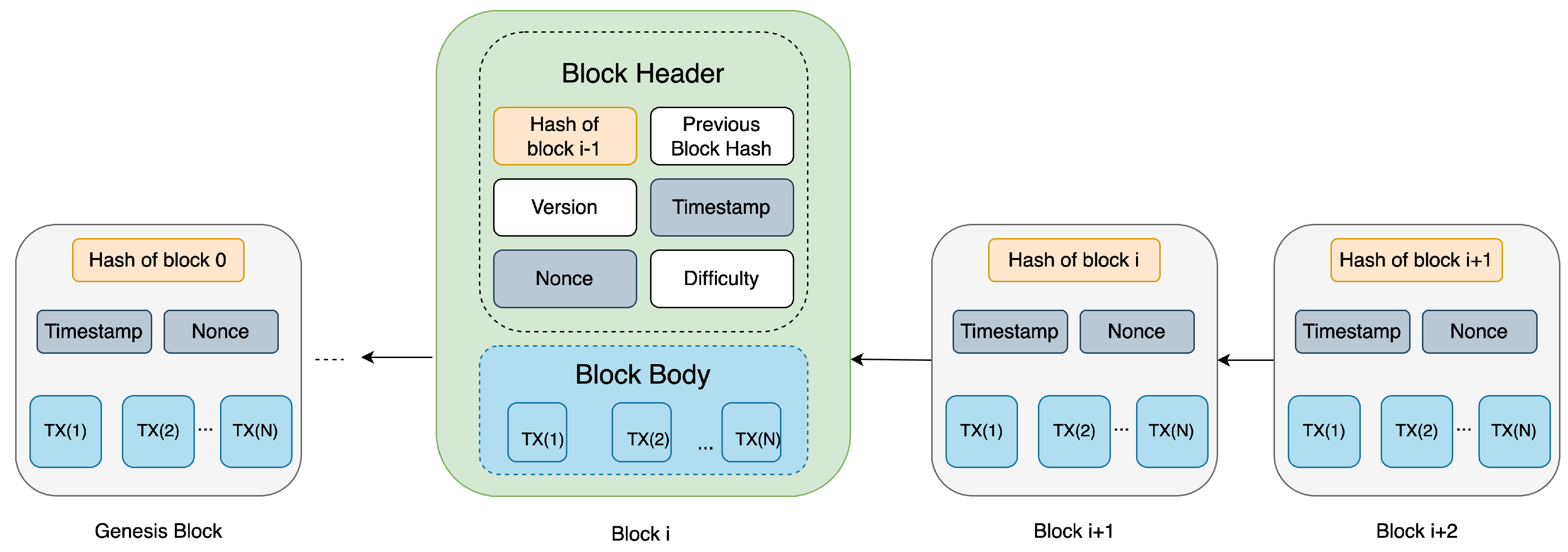
- Block Hash: The unique identifier of the current block, generated by performing a cryptographic hash computation on all fields in the block header, such as version number, timestamp, and difficulty. This ensures the block’s uniqueness. As part of the chain structure, the block hash links blocks together. Even a minor change in block content results in a completely different hash value.
- Previous Block Hash: The hash value of the preceding block, linking the current block to the previous one. This creates the chain structure of the blockchain, ensuring the sequential order of blocks and the immutability of data.
- Version: Indicates the protocol or format version used by the block. This ensures that nodes in the network can correctly interpret the block data. The version is updated when block structures or protocols evolve.
- Timestamp: Records the block creation time, typically in Unix timestamp format. It establishes the chronological order of blocks and serves as a time reference for nodes in the network.
- Nonce: A random number used in the proof-of-work consensus mechanism. Miners adjust the nonce value to meet the mining difficulty conditions, such as ensuring the hash value starts with a specific number of leading zeros.
- Difficulty: Represents the computational difficulty required to generate a block, often expressed as the target hash condition. Difficulty dynamically adjusts according to the network’s computational power, ensuring a stable interval between block generations.
3.2. Decentralized Identifiers (DIDs)
3.3. Verifiable Credentials (VCs)
- Verifiability: Allowing any verifier to independently validate the credential’s authenticity.
- Immutability: Ensured through robust cryptographic signatures.
- Privacy Protection: Enabled via selective disclosure mechanisms.
- Offline Verification: Supported by public key cryptography, removing the necessity for real-time issuer interactions.
- Revocability: Maintained through issuer-published revocation lists or status registries.
3.4. Hyperledger
3.5. Zero-Knowledge Proof (ZKP)
3.6. Elliptic Curve Cryptography (ECC)
4. Overview of IDMS Development
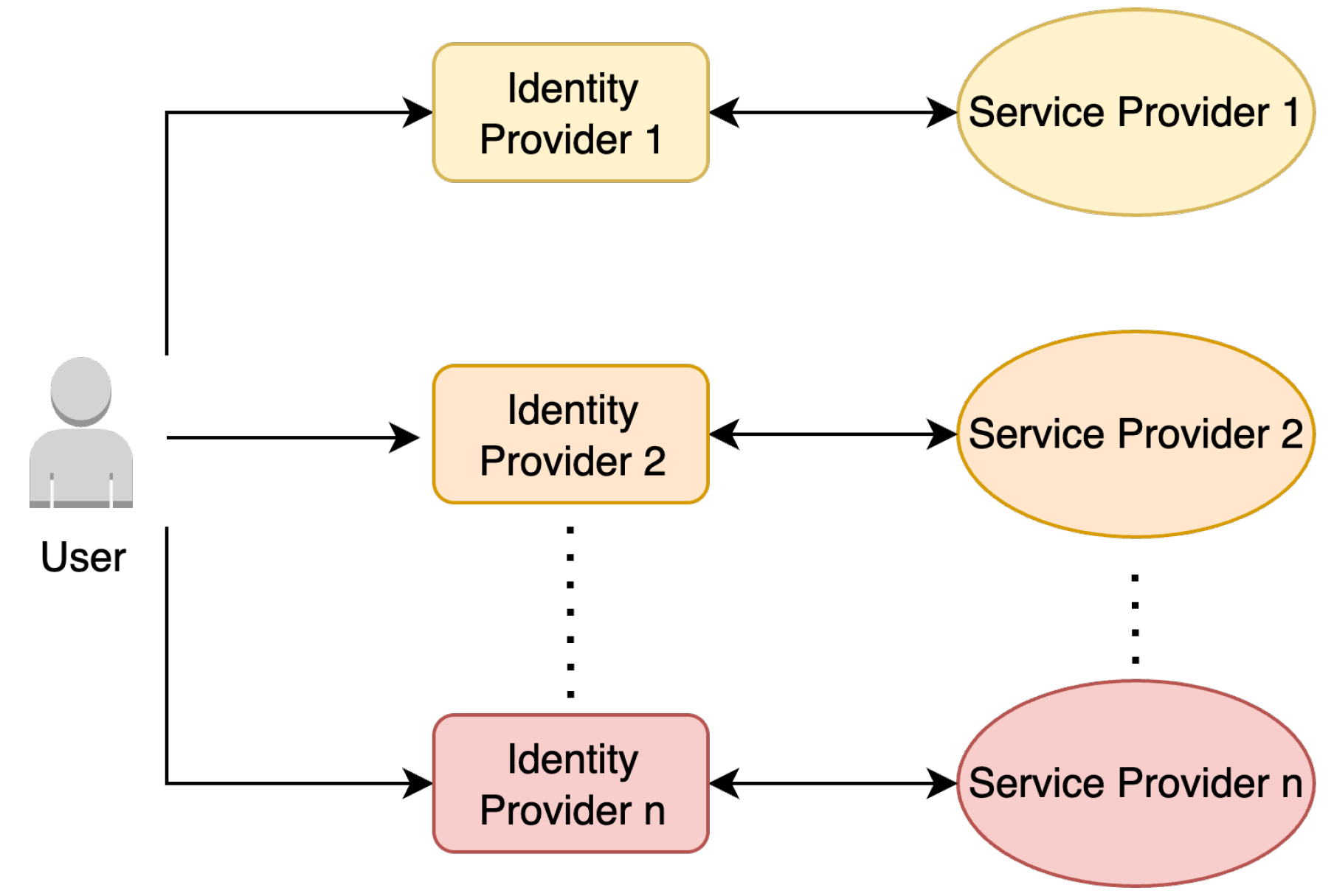
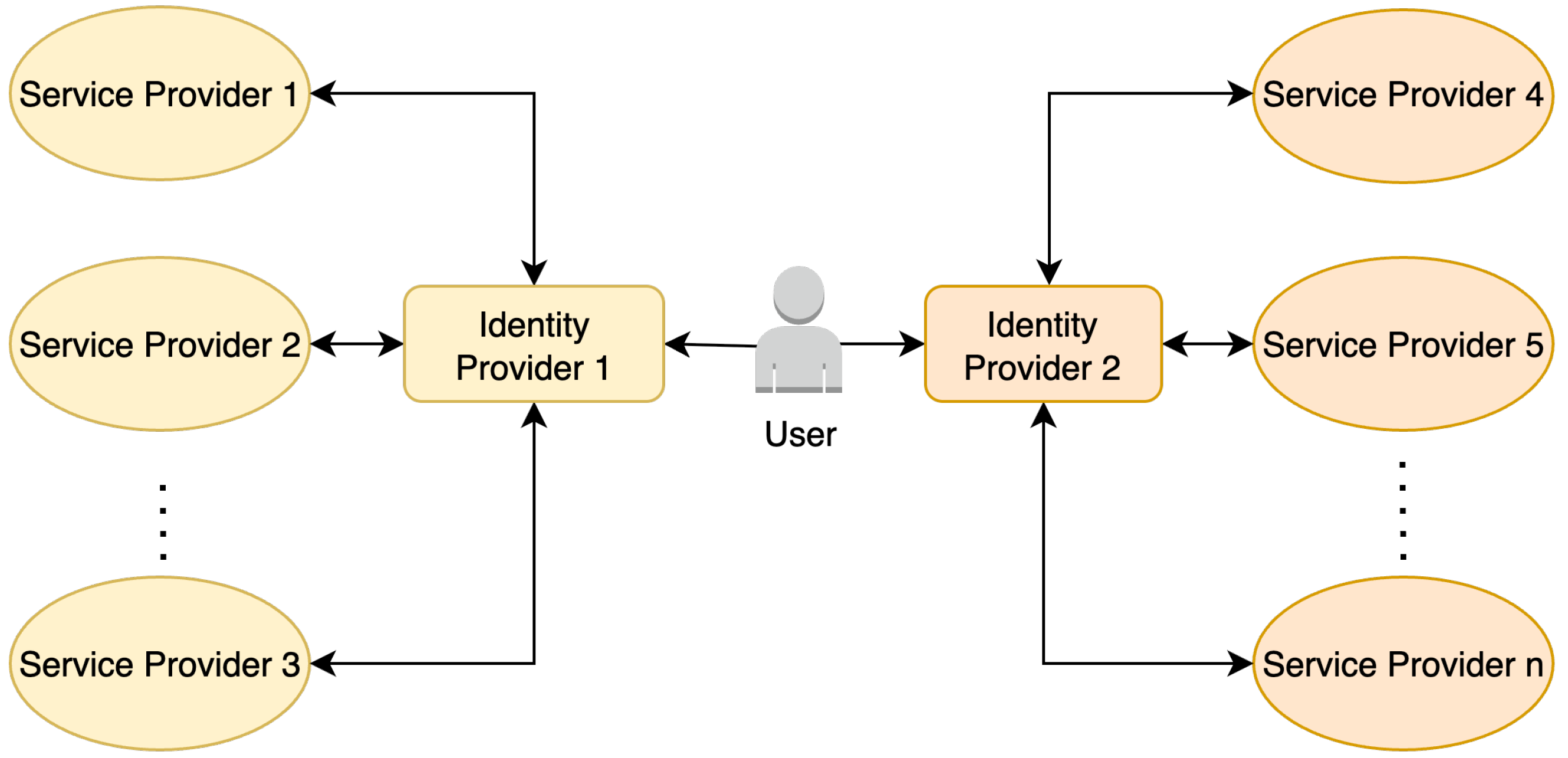
- Users: They are clients of both the service provider (SP) and the identity provider (IdP). To access services, users must possess valid identities. Users can represent public organizations, individuals, or virtual entities and are uniquely identified by their identifiers.
- Service Providers (SPs): They deliver services to users within the IDMS. Examples include online shopping platforms or healthcare record management systems.
- Identity Providers (IdPs): They are the cornerstone of the IDMS. The IdP acts as a trusted entity responsible for registering user identities, verifying their authenticity, and storing identity data. Furthermore, the IdP handles user authentication requests from service providers, ensuring secure and reliable identity management.
4.1. Traditional Centralized IDMSs
- Single Point of Failure (SPOF): Centralized IDMSs often rely on a central server or database to store all identity data and perform authentication [1,2,24,25]. If the central system encounters an issue, the entire identity management system becomes non-operational [2,24]. This can lead to resource inaccessibility and business disruptions, which are particularly critical for banking and government services.
- Data Breaches: Centralized IDMSs store all identity data in a central database, making it a prime target for cyberattacks [2,24,25]. Additionally, such systems often run on legacy software with significant SPOF vulnerabilities [25]. If the system is compromised, sensitive information can be stolen or exposed, resulting in severe security and privacy risks [2,24,25].
- Lack of Interoperability: Centralized IDMS systems are often isolated, making it difficult to share or exchange identity data across platforms or organizations [1,2,24,25,26]. Users are forced to register and maintain separate accounts for various systems—such as email, social media, and banking—resulting in a poor user experience, commonly referred to as “password fatigue.” This lack of interoperability also hampers organizational collaboration due to the inability to unify identity management and verification [2,24].
4.2. Federated IDMSs
- Lack of Flexible Registration and Verification Mechanisms: The current systems lack robust mechanisms for verifying the validity and ownership of identifiers, such as social security numbers or passports. This deficiency hampers the system’s ability to authenticate users with high accuracy.
- Vulnerability to Identity Theft: Federated IDMSs fail to effectively prevent dishonest individuals from registering fake identifiers or impersonating other users, posing a significant threat of identity theft. Additionally, existing strong authentication methods lack flexibility and granular control, and the reuse of the same credentials increases the risk of credential compromise.
- Inconsistent Updates Across Systems: Federated IDMSs struggle to maintain consistency across systems when identifiers are updated. For instance, when a user changes their email address or phone number, other systems that rely on these data may not synchronize the updates, leading to discrepancies.
- Inefficient Revocation Mechanisms: The current systems often lack practical and efficient mechanisms for identity revocation. Temporary credentials may simplify the revocation process but require frequent re-authentication, which can degrade the user experience.
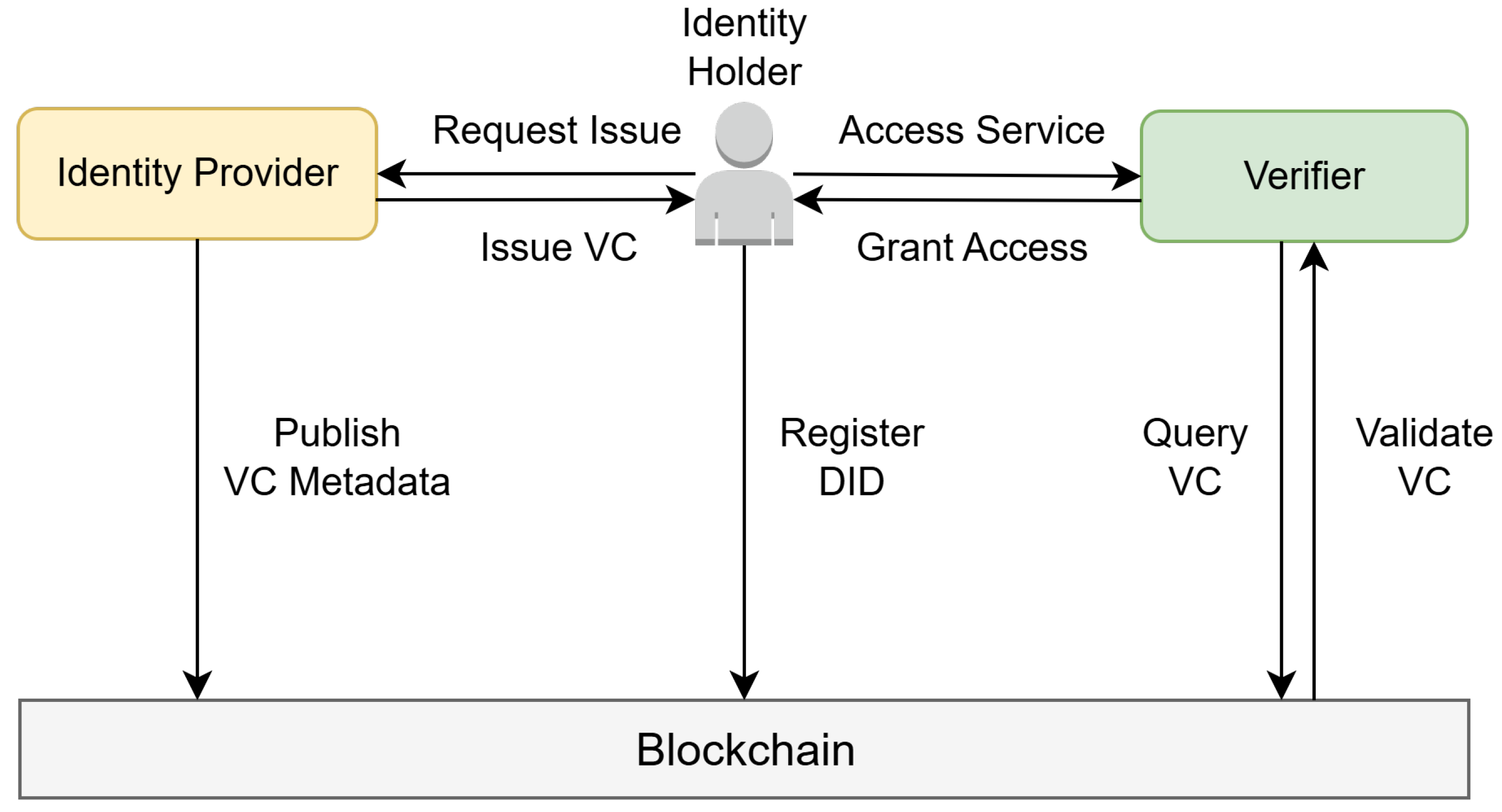
4.3. Decentralized IDMSs
5. Generic Decentralized IDMS Solutions
5.1. Selective Disclosure
5.2. Interoperability
5.3. Revocation Support
5.4. Quantum Resistance
| Ref. | Selective Disclosure | Interoperability | Revocation Support | Quantum Resistance |
|---|---|---|---|---|
| [62] | ✓ | ✓ | ✓ | × |
| [63] | ✓ | ✓ | ✓ | × |
| [64] | ✓ | ✓ | ✓ | × |
| [65] | ✓ | ✓ | × | × |
| [66] | ✓ | × | × | × |
| [67] | ✓ | ✓ | × | × |
| [68] | ✓ | ✓ | ✓ | × |
| [78] | × | × | ✓ | × |
| [69] | ✓ | × | ✓ | ✓ |
| [70] | ✓ | ✓ | × | × |
| [71] | ✓ | ✓ | ✓ | × |
| [72] | ✓ | ✓ | ✓ | × |
| [73] | ✓ | ✓ | ✓ | × |
| [74] | ✓ | × | × | × |
| [75] | ✓ | × | ✓ | × |
| [76] | ✓ | ✓ | ✓ | × |
| [77] | ✓ | ✓ | ✓ | × |
6. Applications of IDMSs
6.1. Electronic Healthcare
6.2. Academic Credentials
6.3. Internet of Things (IoT)
6.4. Energy Trading
6.5. Real-World IDMS Platforms
- Kiva Protocol is an electronic KYC (eKYC) and financial inclusion solution built on decentralized identifiers (DIDs) and VCs [86]. It utilizes a Hyperledger Indy-based distributed ledger network for storing DIDs, associated public keys, credential schemas, and revocation registries [86]. Users can store their DIDs and credentials using the Identity Owner Edge Agent, and third-party financial service providers can employ the Verifier System to conduct rapid identity verification without storing sensitive user information [86]. By incorporating guardianship mechanisms, Kiva Protocol enables individuals who lack digital identity management capabilities to access decentralized identity services [86]. Additionally, it enhances eKYC processes through the use of zero-knowledge proofs (ZKPs) [52], reducing the need for financial institutions to store excessive personal data while expanding the accessibility of identity verification services. Currently, Kiva Protocol has been adopted in areas such as cross-institutional identity sharing and digital credit records, contributing to the development of secure and inclusive financial services.
- Blockstack offers identity management, data storage, and name resolution services to support decentralized applications without the need for centralized servers [87]. It employs a three-layer architecture, consisting of the Blockchain Layer, Peer Network Layer, and Storage Layer, to achieve secure and scalable decentralized computing [87]. In the Blockchain Layer, Blockstack does not store large quantities of data directly on the blockchain. Instead, it operates Virtualchain, a virtual blockchain running on top of the Bitcoin blockchain, leveraging Bitcoin’s security to record immutable metadata without introducing additional computational overhead [87]. This design also allows for blockchain migration, ensuring flexibility in the long term [87]. The Peer Network Layer utilizes the Atlas Network, a decentralized name resolution and data indexing network, to store and resolve name data, index pointers that reference user data storage locations, and globally distribute Zone Files to ensure data integrity and availability [87]. In the Storage Layer, Blockstack uses Gaia, a decentralized storage system that gives users control over their data by allowing them to select their own storage providers while maintaining a decentralized infrastructure [87].
- IDChain is a decentralized identity management system that combines blockchain with artificial intelligence (AI) to ensure secure and transparent authentication for individuals, enterprises, and government institutions [88]. It combats identity theft by integrating advanced cryptographic techniques with AI-driven fraud detection [88]. Users undergo a two-factor authentication process to generate a unique decentralized identifier (DID), while a multi-party Trust Network assigns a trust score based on confirmations from various entities [88]. Smart contracts on the Solana blockchain execute all identity verification transactions, and the decentralized IDWallet enables users to selectively disclose identity attributes—using zero-knowledge proofs (ZKPs) [52] to enhance privacy. An AI-powered fraud prevention module further strengthens security by detecting identity forgery and suspicious activities through biometric and geolocation data [88].
- reclaimID enables users to autonomously create, manage, and share their digital identity data by storing them within a decentralized naming infrastructure and applying attribute-based encryption mechanisms that enforce fine-grained access control [89]. The system performs identity resolution through encrypted namespaces and distributed hash tables, and includes a standards-based authentication service to enable seamless integration with existing applications [89]. Enhanced by non-interactive zero-knowledge proofs [52] for additional privacy, reclaimID eliminates centralized intermediaries and reduces exposure risks [89].
- ShoCard allows users to retain full control over their digital identities while enabling secure verification processes for various organizations, including enterprises, financial institutions, and the travel industry [90]. Users store their identity data on mobile devices and authenticate through the ShoCard app, which collects and securely hashes official documents and biometric data; only the encrypted hash is recorded on the blockchain to preserve privacy [90]. In the certification phase, third-party entities such as banks and government agencies issue verifiable credentials on-chain, facilitating processes like KYC compliance and credit verification [90]. During authentication, users initiate verification via mechanisms such as QR codes or Bluetooth, while smart contracts manage access control and record transactions for transparency and auditability. Built on a hybrid public–private blockchain model that incorporates sidechains for high-throughput transaction processing, ShoCard ensures both immutability and efficient performance [90].
- Sovrin, built on Hyperledger Indy, integrates Decentralized Public Key Infrastructure (DPKI) and zero-knowledge proofs (ZKPs) [52] to provide a globally trusted identity service [91]. Sovrin adopts a layered network architecture to ensure efficient and secure identity management [91]. The Sovrin distributed ledger stores decentralized identifiers (DIDs), public keys, credential schemas, and revocation registries, serving as a foundation for identity verification [91]. The Sovrin cloud agents facilitate decentralized identity resolution and credential storage, while the edge layer employs decentralized identity wallets that use end-to-end encryption to protect identity data [91]. When identity verification is required, users can selectively disclose only the necessary information through the Sovrin Wallet and sign transactions securely [91].
- uPort is a [34] solution built on Ethereum [92]. It employs a set of smart contracts, including the Proxy Contract for acting as the user’s core identifier and forwarding transactions, the Controller Contract for managing access control and enabling controller replacement, the Recovery Quorum Contract for identity recovery, and the Registry Contract for maintaining identity-to-data mappings in a decentralized storage network [92]. User identity data are stored in a decentralized manner on IPFS in the form of JSON Web Tokens (JWTs) [93], while the hash values of these data records are stored on the Ethereum blockchain to ensure data integrity [92]. Additionally, uPort supports selective disclosure, enabling users to share only specific pieces of identity information as needed [92].
7. Security Analysis of Blockchain-Based IDMSs
- Impersonation Attacks refer to scenarios where an attacker masquerades as a legitimate identity holder, issuer, or verifier to perform unauthorized identity-related actions [94]. Attackers can employ various techniques to launch such attacks, including forging fake VCs or self-claiming false attributes to deceive service providers [94]. In more severe cases, attackers may compromise issuer privileges to illegally issue or revoke VCs [94]. Many existing studies have addressed this threat by implementing strict access control mechanisms and multi-party verification processes [3,4,5,6,7,8,9,10,11,12,15,16,17,18,19,20,21,22,23,51,62,63,65,66,67,68,69,73,75,78,95,96]. For example, Sy et al. [10] utilized a permissioned Hyperledger Fabric network to ensure that only registered and authorized nodes are allowed to create VCs. Similarly, Reza et al. [9] proposed a multi-layered verification process for issuing education-related VCs, where teachers upload grades, academic supervisors perform cross-verification, management servers handle processing, and blockchain consensus nodes execute the final recording to ensure rigorous auditing at every stage.
- Repudiation Attacks are denial attacks which occur when a user or system component repudiates identity-related actions they have performed, thereby evading responsibility or gaining undue benefits [94]. For example, a user may sign an electronic contract with their identity and immediately deregister that identity from the blockchain, making it impossible for the other party to later verify the identity’s validity. Existing research has demonstrated effective defense mechanisms against denial attacks by employing various signature schemes combined with the traceability features of blockchain technology [3,4,5,6,7,8,9,10,11,12,15,16,17,18,19,20,21,22,23,51,62,63,65,66,67,68,69,73,75,78,95,96]. Ismail et al. [15] proposed an IDMS in which all operations, such as identity registration, authentication, and communication requests, are signed with the sender’s private key to ensure non-repudiation. These signatures, in conjunction with corresponding public keys, enable post-event verification of both the source and content of the action, ensuring non-repudiation [15]. Similarly, Tcydenova et al. [20] introduced a multi-party signing mechanism, requiring multiple entities to co-sign the same access control transaction. Only after reaching a predefined threshold does the blockchain smart contract permit the device to transmit data [20]. Moreover, all authorization actions are immutably recorded on-chain, providing verifiable evidence of every access authorization decision [20].
- Data Integrity Attacks refer to the unauthorized modification, tampering, or fabrication of identity data [94]. One of the most common forms of this attack involves altering the attribute values within an already issued VC, thereby creating false service eligibility information [94]. Typical examples include modifying educational qualifications, such as changing a high school degree to a Ph.D., or altering age information to bypass restrictions for minors. Existing research has adopted digital signatures and strict access control mechanisms to prevent unauthorized modifications to VCs [3,4,5,6,7,8,9,10,11,12,15,16,17,18,19,20,21,22,23,51,62,63,65,66,67,68,69,73,75,78,95,96]. Kilthau et al. [23] proposed a verification process in which verifiers check the VC’s digital signature and ensure that the issuer information matches, effectively preventing malicious tampering. Srivastava et al. [63] designed a VC issuance process that requires multiple participants to collaboratively generate and manage the signing private key. As a result, modifying VC content would require compromising multiple entities to obtain their respective private key shares; otherwise, forged signatures would fail verification [63].
- Linkability Attacks happen in the case that users conceal their real identities, but service providers can still link multiple credentials or repeated access activities to the same user across different contexts through repeated credential presentations, leading to what is known as a linkability attack [47]. Specifically, if a user repeatedly uses the same decentralized identifier (DID) across multiple service providers, these providers can aggregate activity records from different contexts to build behavioral profiles, even without knowing the user’s true identity [47]. Moreover, multiple service providers may collude by sharing verification log data, further enhancing cross-domain linkage of user activities. Existing research primarily mitigates this threat by adopting variable identity identifiers to prevent exposure of the same identity across multiple scenarios, often combined with selective disclosure techniques to ensure that different authentication contexts reveal different sets of information [4,6,12,22,23,51,62,63,65,67,68,69,95]. In the approach proposed by Torongo et al. [6], a new DID is dynamically created for each one-to-one communication session, rather than relying on a single global identifier. As a result, even if the same user establishes multiple connections with different service providers, external observers and service providers cannot correlate these interactions based on DID, since each session utilizes a distinct identifier.
- Quantum Attacks are attacks launched by quantum computers. Since most current blockchain systems rely on pre-quantum cryptography, they remain vulnerable in the face of quantum computing advancements [80]. Shor’s algorithm can efficiently break public key identity systems deployed on blockchains within a reasonable time frame, potentially enabling attackers to forge signatures of universities, students, or verifiers, leading to identity impersonation and fraudulent transactions [80]. Grover’s algorithm significantly accelerates hash collision searches, increasing the risk of undetected block data tampering, such as falsifying educational records or transaction logs [80]. It is anticipated that within the next two decades, quantum computers will reach the capability to break mainstream public key cryptographic algorithms [80]. However, existing research offers limited defense mechanisms against quantum attacks. Shrivas et al. [11] proposed replacing conventional cryptographic algorithms in Hyperledger Fabric with post-quantum cryptographic schemes, such as lattice-based cryptography [80], to enhance resistance against quantum threats.
8. Discussion and Future Work
8.1. Integrated System
8.2. Standards-Based Interoperability
8.3. Security Countermeasures
8.4. Economic and Social Implications
9. Conclusions
Author Contributions
Funding
Institutional Review Board Statement
Informed Consent Statement
Data Availability Statement
Acknowledgments
Conflicts of Interest
References
- Cao, Y.; Yang, L. A survey of Identity Management technology. In Proceedings of the 2010 IEEE International Conference on Information Theory and Information Security, Beijing, China, 17–19 December 2010; pp. 287–293. [Google Scholar] [CrossRef] [Scilit]
- Goel, A.; Rahulamathavan, Y. A Comparative Survey of Centralised and Decentralised Identity Management Systems: Analysing Scalability, Security, and Feasibility. Future Internet 2024, 17, 1. [Google Scholar] [CrossRef] [Scilit]
- Xiang, X.; Wang, M.; Fan, W. A permissioned blockchain-based identity management and user authentication scheme for e-health systems. IEEE Access 2020, 8, 171771–171783. [Google Scholar] [CrossRef] [Scilit]
- Harrell, D.T.; Usman, M.; Hanson, L.; Abdul-Moheeth, M.; Desai, I.; Shriram, J.; de Oliveira, E.; Bautista, J.R.; Meyer, E.T.; Khurshid, A. Technical design and development of a self-sovereign identity management platform for patient-centric health care using blockchain technology. Blockchain Healthc. Today 2022, 5, 10–30953. [Google Scholar]
- Javed, I.T.; Alharbi, F.; Bellaj, B.; Margaria, T.; Crespi, N.; Qureshi, K.N. Health-ID: A blockchain-based decentralized identity management for remote healthcare. Healthcare 2021, 9, 712. [Google Scholar] [CrossRef] [Scilit] [PubMed]
- Torongo, A.A.; Toorani, M. Blockchain-based Decentralized Identity Management for Healthcare Systems. arXiv 2023, arXiv:2307.16239. [Google Scholar] [CrossRef] [Scilit]
- Saragih, T.K.; Tanuwijaya, E.; Wang, G. The Use of Blockchain for Digital Identity Management in Healthcare. In Proceedings of the 2022 10th International Conference on Cyber and IT Service Management (CITSM), Yogyakarta, Indonesia, 20–21 September 2022; IEEE: Piscataway, NJ, USA, 2022; pp. 1–6. [Google Scholar]
- Mikula, T.; Jacobsen, R.H. Identity and access management with blockchain in electronic healthcare records. In Proceedings of the 2018 21st Euromicro Conference on Digital System Design (DSD), Prague, Czech Republic, 29–31 August 2018; IEEE: Piscataway, NJ, USA, 2018; pp. 699–706. [Google Scholar]
- Reza, M.S.; Biswas, S.; Alghamdi, A.; Alrizq, M.; Bairagi, A.K.; Masud, M. ACC: Blockchain Based Trusted Management of Academic Credentials. In Proceedings of the 2021 IEEE International Symposium on Smart Electronic Systems (iSES), Jaipur, India, 18–22 December 2021; IEEE: Piscataway, NJ, USA, 2021; pp. 438–443. [Google Scholar]
- Sy, M.P.M.; Marasigan, R.I.; Festijo, E.D. EduCredPH: Towards a Permissioned Blockchain Network for Educational Credentials Verification System. In Proceedings of the 2024 12th International Conference on Information and Education Technology (ICIET), Yamaguchi, Japan, 18–20 March 2024; IEEE: Piscataway, NJ, USA, 2024; pp. 434–439. [Google Scholar]
- Shrivas, M.K.; Kachhwaha, S.; Bhansali, A.; Singh, S.V. Quantum-resistant university credentials verification system on blockchain. In Proceedings of the 2022 IEEE Nigeria 4th International Conference on Disruptive Technologies for Sustainable Development (NIGERCON), Lagos, Nigeria, 5–7 April 2022; IEEE: Piscataway, NJ, USA, 2022; pp. 1–6. [Google Scholar]
- Lux, Z.A.; Thatmann, D.; Zickau, S.; Beierle, F. Distributed-ledger-based authentication with decentralized identifiers and verifiable credentials. In Proceedings of the 2020 2nd Conference on Blockchain Research & Applications for Innovative Networks and Services (BRAINS), Paris, France, 28–30 September 2020; IEEE: Piscataway, NJ, USA, 2020; pp. 71–78. [Google Scholar]
- Li, Z.Z.; Wang, H.; Gasevic, D.; Yu, J.; Liu, J.K. Enhancing blockchain adoption through tailored software engineering: An industrial-grounded study in education credentialing. Distrib. Ledger Technol. Res. Pract. 2023, 2, 1–24. [Google Scholar] [CrossRef] [Scilit]
- Li, Z.Z.; Zhang, X.; Cui, H.; Zhao, J.; Chen, X. BDEC: Enhancing Learning Credibility via Post-quantum Digital Credentials. In Proceedings of the International Conference on Provable Security, Gold Coast, Australia, 25–27 September 2024; Springer: Berlin/Heidelberg, Germany, 2024; pp. 45–64. [Google Scholar]
- Ismail, S.; Dawoud, D.; Reza, H. Towards a lightweight identity management and secure authentication for IoT using blockchain. In Proceedings of the 2022 IEEE World AI IoT Congress (AIIoT), Seattle, WA, USA, 6–9 June 2022; IEEE: Piscataway, NJ, USA, 2022; pp. 077–083. [Google Scholar]
- Katta, S.; Alrawashdeh, K.; Adebayo, J.; Tulasi, M.; Dokka, M. Blockchain-Based Distributed Hybrid Cloud Identity Management for Securing IoT Devices in the Cloud. In Proceedings of the NAECON 2023-IEEE National Aerospace and Electronics Conference, Dayton, ON, USA, 28–31 August 2023; IEEE: Piscataway, NJ, USA, 2023; pp. 67–72. [Google Scholar]
- Mukhandi, M.; Damião, F.; Granjal, J.; Vilela, J.P. Blockchain-based device identity management with consensus authentication for IoT devices. In Proceedings of the 2022 IEEE 19th Annual Consumer Communications & Networking Conference (CCNC), Las Vegas, NV, USA, 8–11 January 2022; IEEE: Piscataway, NJ, USA, 2022; pp. 433–436. [Google Scholar]
- Giaretta, A.; Pepe, S.; Dragoni, N. UniquID: A quest to reconcile identity access management and the IoT. In Proceedings of the Software Technology: Methods and Tools: 51st International Conference, TOOLS 2019, Innopolis, Russia, 15–17 October 2019; Springer: Berlin/Heidelberg, Germany, 2019. Proceedings 51. pp. 237–251. [Google Scholar]
- Vallois, V.; Mehaoua, A.; Amziani, M. Blockchain-based identity and access management in industrial IoT systems. In Proceedings of the 2021 IFIP/IEEE International Symposium on Integrated Network Management (IM), Bordeaux, France, 17–21 May 2021; IEEE: Piscataway, NJ, USA, 2021; pp. 623–627. [Google Scholar]
- Tcydenova, E.; Seok, B.; Cho, M.; Lee, C. Decentralized Access Control for Internet of Things Using Decentralized Identifiers and Multi-signature Smart Contracts. In Proceedings of the 2022 International Conference on Platform Technology and Service (PlatCon), Jeju, Republic of Korea, 24–26 August 2022; IEEE: Piscataway, NJ, USA, 2022; pp. 66–70. [Google Scholar]
- Cali, U.; Dynge, M.F.; Ferdous, M.S.; Halden, U. Improved Resilience of Local Energy Markets using Blockchain Technology and Self-Sovereign Identity. In Proceedings of the 2022 IEEE 1st Global Emerging Technology Blockchain Forum: Blockchain & Beyond (iGETblockchain), Virtual, 7–9 November 2022; IEEE: Piscataway, NJ, USA, 2022; pp. 1–5. [Google Scholar]
- Volkmann, M.; Tripathi, S.S.; Kaven, S.; Frank, C.; Skwarek, V. Privacy in local energy markets: A framework for a self-sovereign identity based P2P-trading authentication system. In Proceedings of the 2023 IEEE 21st International Conference on Industrial Informatics (INDIN), Lemgo, Germany, 17–20 July 2023; IEEE: Piscataway, NJ, USA, 2023; pp. 1–7. [Google Scholar]
- Kilthau, M.; Asman, M.; Karmann, A.; Suriyamoorthy, G.; Beck, J.P.; Regener, V.; Derksen, C.; Loose, N.; Volkmann, M.; Tripathi, S.; et al. Integrating peer-to-peer energy trading and flexibility market with self-sovereign identity for decentralized energy dispatch and congestion management. IEEE Access 2023, 11, 145395–145420. [Google Scholar] [CrossRef] [Scilit]
- Lesavre, L.; Varin, P.; Mell, P.; Davidson, M.; Shook, J. A taxonomic approach to understanding emerging blockchain identity management systems. arXiv 2019, arXiv:1908.00929. [Google Scholar]
- Hansen, M.; Berlich, P.; Camenisch, J.; Clauß, S.; Pfitzmann, A.; Waidner, M. Privacy-enhancing identity management. Inf. Secur. Tech. Rep. 2004, 9, 35–44. [Google Scholar] [CrossRef] [Scilit]
- Torres, J.; Nogueira, M.; Pujolle, G. A survey on identity management for the future network. IEEE Commun. Surv. Tutors. 2012, 15, 787–802. [Google Scholar] [CrossRef] [Scilit]
- Liu, L.; Gao, J. Research on Trusted Federated Identity Management and Its Application. In Proceedings of the 2009 First International Workshop on Education Technology and Computer Science, Wuhan, China, 7–8 March 2009; IEEE: Piscataway, NJ, USA, 2009; Volume 3, pp. 438–442. [Google Scholar]
- Jensen, J. Federated identity management challenges. In Proceedings of the 2012 Seventh International Conference on Availability, Reliability and Security, Prague, Czech Republic, 20–24 August 2012; IEEE: Piscataway, NJ, USA, 2012; pp. 230–235. [Google Scholar]
- Malik, A.A.; Anwar, H.; Shibli, M.A. Federated identity management (FIM): Challenges and opportunities. In Proceedings of the 2015 Conference on Information Assurance and Cyber Security (CIACS), Rawalpindi, Pakistan, 17–19 December 2015; IEEE: Piscataway, NJ, USA, 2015; pp. 75–82. [Google Scholar]
- Bertino, E.; Paci, F.; Shang, N. Keynote 2: Digital Identity Protection—Concepts and Issues. In Proceedings of the 2009 International Conference on Availability, Reliability and Security, Fukuoka, Japan, 16–19 March 2009; pp. lxix–lxxviii. [Google Scholar] [CrossRef] [Scilit]
- Saraswathi, R.V.; Swathi, M.V.V.; Punwatkar, S.M.; Konduru, S.; Sami, M.A. A Survey on Blockchain-Based Certificate Authentication System: From Traditional to Digital. In Proceedings of the 2024 4th International Conference on Ubiquitous Computing and Intelligent Information Systems (ICUIS), Bali, Indonesia, 9–11 January 2024; IEEE: Piscataway, NJ, USA, 2024; pp. 1417–1422. [Google Scholar]
- Yan, Z.; Zhao, X.; Liu, Y.; Luo, X.R. Blockchain-driven decentralized identity management: An interdisciplinary review and research agenda. Inf. Manag. 2024, 61, 104026. [Google Scholar] [CrossRef] [Scilit]
- Cui, H.; Whitty, M.; Miyaji, A.; Li, Z. A Blockchain-Based Digital Identity Management System via Decentralized Anonymous Credentials. In Proceedings of the 6th ACM International Symposium on Blockchain and Secure Critical Infrastructure, Hong Kong, China, 27–30 May 2024; pp. 1–11. [Google Scholar]
- Gilani, K.; Bertin, E.; Hatin, J.; Crespi, N. A survey on blockchain-based identity management and decentralized privacy for personal data. In Proceedings of the 2020 2nd Conference on Blockchain Research & Applications for Innovative Networks and Services (BRAINS), Paris, France, 28–30 September 2020; IEEE: Piscataway, NJ, USA, 2020; pp. 97–101. [Google Scholar]
- W3C Working Group; Caceres, M.; Gonzalez-Zuniga, D.; Kruisselbrink, M.; Watson, L.; Smith, M.; Wu, X.; Abed, M.; Agarwal, S.; Agoston, S.; et al. Use Cases and Requirements for Decentralized Identifiers; W3C: Cambridge, MA, USA, 2021. [Google Scholar]
- Reed, D.; Sporny, M.; Longley, D.; Allen, C.; Grant, R.; Sabadello, M.; Holt, J. Decentralized identifiers (dids) v1. 0. Draft Community Group Rep. 2020. Available online: https://www.w3.org/TR/did-1.0/ (accessed on 15 June 2025).
- Liu, Y.; He, D.; Obaidat, M.S.; Kumar, N.; Khan, M.K.; Choo, K.K.R. Blockchain-based identity management systems: A review. J. Netw. Comput. Appl. 2020, 166, 102731. [Google Scholar] [CrossRef] [Scilit]
- Kaneriya, J.; Patel, H. A comparative survey on blockchain based self sovereign identity system. In Proceedings of the 2020 3rd International Conference on Intelligent Sustainable Systems (ICISS), Thoothukudi, India, 3–5 December 2020; IEEE: Piscataway, NJ, USA, 2020; pp. 1150–1155. [Google Scholar]
- Alamri, B.; Crowley, K.; Richardson, I. Blockchain-based identity management systems in health IoT: A systematic review. IEEE Access 2022, 10, 59612–59629. [Google Scholar] [CrossRef] [Scilit]
- Raut, R.; Gourshettiwar, P.; Thakre, G. A Review on the Role of Blockchain Technology for Decentralized Identity Management: A Future Without Passwords. In Proceedings of the 2025 4th International Conference on Sentiment Analysis and Deep Learning (ICSADL), Mumbai, India, 21–23 February 2025; IEEE: Piscataway, NJ, USA, 2025; pp. 453–459. [Google Scholar]
- Hariharasudan, V.; Quraishi, S.J. A Review on Blockchain Based Identity Management System. In Proceedings of the 2022 3rd International Conference on Intelligent Engineering and Management (ICIEM), London, UK, 18–20 May 2022; IEEE: Piscataway, NJ, USA, 2022; pp. 735–740. [Google Scholar]
- Mishra, V.; Mishra, M.P. PRISMA for review of management literature—Method, merits, and limitations—An academic review. In Advancing Methodologies of Conducting Literature Review in Management Domain; Emerald Publishing Limited: Leeds, UK, 2023; pp. 125–136. [Google Scholar] [CrossRef] [Scilit]
- Ghaffari, F.; Gilani, K.; Bertin, E.; Crespi, N. Identity and access management using distributed ledger technology: A survey. Int. J. Netw. Manag. 2022, 32, e2180. [Google Scholar] [CrossRef] [Scilit]
- Bernabe, J.B.; Canovas, J.L.; Hernandez-Ramos, J.L.; Moreno, R.T.; Skarmeta, A. Privacy-preserving solutions for blockchain: Review and challenges. IEEE Access 2019, 7, 164908–164940. [Google Scholar] [CrossRef] [Scilit]
- Nakamoto, S.; Bitcoin, A. A peer-to-peer electronic cash system. Bitcoin 2008, 4, 15. [Google Scholar]
- Lashkari, B.; Musilek, P. A comprehensive review of blockchain consensus mechanisms. IEEE Access 2021, 9, 43620–43652. [Google Scholar] [CrossRef] [Scilit]
- Mazzocca, C.; Acar, A.; Uluagac, S.; Montanari, R.; Bellavista, P.; Conti, M. A survey on decentralized identifiers and verifiable credentials. arXiv 2024, arXiv:2402.02455. [Google Scholar] [CrossRef] [Scilit]
- Kim, K.H.; Lim, S.; Hwang, D.Y.; Kim, K.H. Analysis on the Privacy of DID Service Properties in the DID Document. In Proceedings of the 2021 International Conference on Information Networking (ICOIN), Jeju Island, Republic of Korea, 13–16 January 2021; IEEE: Piscataway, NJ, USA, 2021; pp. 745–748. [Google Scholar]
- Wang, X.; Qiu, W.; Zeng, L.; Wang, H.; Yao, Y.; He, D. A credible transfer method of cross-chain assets based on DID and VC. In Proceedings of the 2021 IEEE 4th International Conference on Information Systems and Computer Aided Education (ICISCAE), Dalian, China, 24–26 September 2021; IEEE: Piscataway, NJ, USA, 2021; pp. 238–242. [Google Scholar]
- Aggarwal, S.; Kumar, N. Hyperledger. In Advances in Computers; Elsevier: Amsterdam, The Netherlands, 2021; Volume 121, pp. 323–343. [Google Scholar]
- Raipurkar, A.R.; Bobde, S.; Tripahi, A.; Sahu, M. Digital Identity System Using Blockchain-based Self Sovereign Identity & Zero Knowledge Proof. In Proceedings of the 2023 OITS International Conference on Information Technology (OCIT), Raipur, India, 18–20 December 2023; IEEE: Piscataway, NJ, USA, 2023; pp. 611–616. [Google Scholar]
- Hasan, J. Overview and applications of zero knowledge proof (ZKP). Int. J. Comput. Sci. Netw. 2019, 8, 2277–5420. [Google Scholar]
- Prabu, M.; Shanmugalakshmi, R. A comparative and overview analysis of elliptic curve cryptography over finite fields. In Proceedings of the 2009 International Conference on Information and Multimedia Technology, Jeju Island, Republic of Korea, 16–18 December 2009; IEEE: Piscataway, NJ, USA, 2009; pp. 495–499. [Google Scholar]
- Windley, P.J. Digital Identity: Unmasking Identity Management Architecture (IMA); O’Reilly Media, Inc.: Sebastopol, CA, USA, 2005. [Google Scholar]
- Koshutanski, H.; Ion, M.; Telesca, L. Distributed Identity Management Model for Digital Ecosystems. In Proceedings of the International Conference on Emerging Security Information, Systems, and Technologies (SECUREWARE 2007), Valencia, Spain, 14–20 October 2007; pp. 132–138. [Google Scholar] [CrossRef] [Scilit]
- Mühle, A.; Grüner, A.; Gayvoronskaya, T.; Meinel, C. A survey on essential components of a self-sovereign identity. Comput. Sci. Rev. 2018, 30, 80–86. [Google Scholar] [CrossRef] [Scilit]
- Howes, T.A. The Lightweight Directory Access Protocol: X. 500 Lite. Technical Report, Center for Information Technology Integration. 1995. Available online: https://deepblue.lib.umich.edu/handle/2027.42/107938?show=full (accessed on 15 June 2025).
- Kemp, J.; Aarts, R.; Bone, N.; Castellanos-Zamora, D.; Crom, E.J.M.; Telecom, F.; Kannappan, L.; Lindsay-Stewart, A.; Maeda, K.; DoCoMo, N.; et al. Liberty ID-FF Implementation Guidelines. 2004. Available online: https://docs.oracle.com/cd/E19462-01/819-4674/admba/index.html (accessed on 30 May 2025).
- Arias Cabarcos, P.; Almenárez, F.; Gómez Mármol, F.; Marín, A. To federate or not to federate: A reputation-based mechanism to dynamize cooperation in identity management. Wirel. Pers. Commun. 2014, 75, 1769–1786. [Google Scholar] [CrossRef] [Scilit]
- Aldosary, M.; Alqahtani, N. A survey on federated identity management systems limitation and solutions. Int. J. Netw. Secur. Its Appl. 2021, 13, 43–59. [Google Scholar] [CrossRef] [Scilit]
- The Path to Self-Sovereign Identity. 2016. Available online: https://www.lifewithalacrity.com/article/the-path-to-self-soverereign-identity/ (accessed on 10 May 2025).
- Song, Z.; Yu, Y. The digital identity management system model based on blockchain. In Proceedings of the 2022 International Conference on Blockchain Technology and Information Security (ICBCTIS), Huzhou, China, 15–17 July 2022; IEEE: Piscataway, NJ, USA, 2022; pp. 131–137. [Google Scholar]
- Srivastava, S.; Agarwal, D.; Chaurasia, B. Secure Decentralized Identity Management using Blockchain. In Proceedings of the 2023 IEEE 22nd International Conference on Trust, Security and Privacy in Computing and Communications (TrustCom), Exeter, UK, 1–3 November 2023; IEEE: Piscataway, NJ, USA, 2023; pp. 1355–1360. [Google Scholar]
- Chen, R.; Shu, F.; Huang, S.; Huang, L.; Liu, H.; Liu, J.; Lei, K. BIdM: A blockchain-enabled cross-domain identity management system. J. Commun. Inf. Netw. 2021, 6, 44–58. [Google Scholar] [CrossRef] [Scilit]
- Kersic, V.; Vidovic, U.; Vrecko, A.; Domajnko, M.; Turkanovic, M. Orchestrating digital wallets for on-and off-chain decentralized identity management. IEEE Access 2023, 11, 78135–78151. [Google Scholar] [CrossRef] [Scilit]
- Rede, P.; Iyer, S.; Sharma, S.; Deshmukh, S. Blockchain Based Identity Management System Using Cryptography and Steganography. In Proceedings of the 2023 International Conference on Information Technology (ICIT), Amman, Jordan, 11–12 October 2023; IEEE: Piscataway, NJ, USA, 2023; pp. 173–177. [Google Scholar]
- Zecchini, M.; Sober, M.; Schulte, S.; Vitaletti, A. Building a cross-chain identity: A self-sovereign identity-based framework. In Proceedings of the 2023 IEEE International Conference on Decentralized Applications and Infrastructures (DAPPS), Athens, Greece, 17–20 July 2023; IEEE: Piscataway, NJ, USA, 2023; pp. 149–156. [Google Scholar]
- Hao, J.; Gao, J.; Xiang, P.; Zhang, J.; Chen, Z.; Hu, H.; Chen, Z. TDID: Transparent and Efficient Decentralized Identity Management with Blockchain. In Proceedings of the 2023 IEEE International Conference on Systems, Man, and Cybernetics (SMC), Honolulu, HI, USA, 1–4 October 2023; IEEE: Piscataway, NJ, USA, 2023; pp. 1752–1759. [Google Scholar]
- Srinivas, V.; Jha, A.K.; Ganesh, G.; Nitish, V.; Jadon, S. Decentralized User Identity Management using Blockchain. In Proceedings of the 2023 2nd International Conference on Vision Towards Emerging Trends in Communication and Networking Technologies (ViTECoN), Vellore, India, 4–5 May 2023; IEEE: Piscataway, NJ, USA, 2023; pp. 1–6. [Google Scholar]
- Peng, Z.; Deng, J.; Gao, S.; Cui, H.; Xiao, B. vDID: Blockchain-Enabled Verifiable Decentralized Identity Management for Web 3.0. In Proceedings of the 2024 IEEE/ACM 32nd International Symposium on Quality of Service (IWQoS), Osaka, Japan, 17–19 June 2024; IEEE: Piscataway, NJ, USA, 2024; pp. 1–2. [Google Scholar]
- Yin, J.; Xiao, Y.; Chen, Q.; Lim, Y.; Liu, X.; Pei, Q.; Zhou, J. DP-DID: A Dynamic and Proactive Decentralized Identity System. IEEE Trans. Inf. Forensics Secur. 2025, 20, 4999–5014. [Google Scholar] [CrossRef] [Scilit]
- Kim, J.; Choi, M.; Lee, C.; Woo, J.; Hong, J.W.K. Service Applicable Blockchain-based Self-Sovereign Identity Management System. In Proceedings of the 2023 IEEE International Conference on Blockchain and Cryptocurrency (ICBC), Dubai, United Arab Emirates, 1–5 May 2023; IEEE: Piscataway, NJ, USA, 2023; pp. 1–5. [Google Scholar]
- Gilani, K.; Ghaffari, F.; Bertin, E.; Crespi, N. Self-sovereign identity management framework using smart contracts. In Proceedings of the NOMS 2022–2022 IEEE/IFIP Network Operations and Management Symposium, Budapest, Hungary, 25–29 April 2022; IEEE: Piscataway, NJ, USA, 2022; pp. 1–7. [Google Scholar]
- Gupta, S.; Bairwa, A.K.; Kushwaha, S.S.; Joshi, S. Decentralized identity management system using the amalgamation of blockchain technology. In Proceedings of the 2023 3rd International Conference on Intelligent Communication and Computational Techniques (ICCT), Jaipur, India, 1–2 December 2023; IEEE: Piscataway, NJ, USA, 2023; pp. 1–6. [Google Scholar]
- Bhattacharjee, P.; Prakash, C.; Gairola, S.; Lala, S.S.; Mukherjee, P. DigiBlock: Digital Self-sovereign Identity on Distributed Ledger based on Blockchain. In Proceedings of the 2022 International Conference on Advancements in Smart, Secure and Intelligent Computing (ASSIC), Bhubaneswar, India, 23–24 December 2022; IEEE: Piscataway, NJ, USA, 2022; pp. 1–7. [Google Scholar]
- Terzi, S.; Savvaidis, C.; Sersemis, A.; Votis, K.; Tzovaras, D. Decentralizing identity management and vehicle rights delegation through self-sovereign identities and blockchain. In Proceedings of the 2021 IEEE 45th Annual Computers, Software, and Applications Conference (COMPSAC), Madrid, Spain, 12–16 July 2021; IEEE: Piscataway, NJ, USA, 2021; pp. 1217–1223. [Google Scholar]
- N’Goran, K.R.; Tetchueng, J.L.; Kermarrec, Y.; Brou, A.P.B.; Asseu, O. Blockchain-based Identity and Access Management in a Community Cloud. In Proceedings of the 2023 International Conference on Software, Telecommunications and Computer Networks (SoftCOM), Split, Croatia, 21–23 September 2023; IEEE: Piscataway, NJ, USA, 2023; pp. 1–6. [Google Scholar]
- Thorve, A.; Shirole, M.; Jain, P.; Santhumayor, C.; Sarode, S. Decentralized identity management using blockchain. In Proceedings of the 2022 4th International Conference on Advances in Computing, Communication Control and Networking (ICAC3N), Mumbai, India, 16–17 December 2022; IEEE: Piscataway, NJ, USA, 2022; pp. 1985–1991. [Google Scholar]
- Sakimura, N.; Bradley, J.; Jones, M.; De Medeiros, B.; Mortimore, C. OpenID Connect Core 1.0 incorporating errata set 1. Openid Found. Specif. 2014, 335. Available online: https://openid.net/specs/openid-connect-core-1_0-errata1.html (accessed on 30 April 2025).
- Fernandez-Carames, T.M.; Fraga-Lamas, P. Towards post-quantum blockchain: A review on blockchain cryptography resistant to quantum computing attacks. IEEE Access 2020, 8, 21091–21116. [Google Scholar] [CrossRef] [Scilit]
- Franqueira, V.; Wieringa, R. Role-based access control in retrospect. Computer 2012, 45, 81–88. [Google Scholar] [CrossRef] [Scilit]
- Hu, V.C.; Kuhn, D.R.; Ferraiolo, D.F.; Voas, J. Attribute-based access control. Computer 2015, 48, 85–88. [Google Scholar] [CrossRef] [Scilit]
- Xiong, R.; Ren, W.; Hao, X.; He, J.; Choo, K.K.R. Bdim: A blockchain-based decentralized identity management scheme for large scale internet of things. IEEE Internet Things J. 2023, 10, 22581–22590. [Google Scholar] [CrossRef] [Scilit]
- Bai, J.; Zhu, S.; Ji, H. Blockchain based decentralized and proactive caching strategy in mobile edge computing environment. Sensors 2024, 24, 2279. [Google Scholar] [CrossRef] [Scilit] [PubMed]
- Davie, M.; Gisolfi, D.; Hardman, D.; Jordan, J.; O’Donnell, D.; Reed, D. The trust over ip stack. IEEE Commun. Stand. Mag. 2019, 3, 46–51. [Google Scholar] [CrossRef] [Scilit]
- Kiva Protocol Technical White paper. Technical Report. 2021. Available online: https://assets.ctfassets.net/j0p9a6ql0rn7/3jnqTBAv3MYA0ByuYC8eYr/211c7bd152a397899481b0b3ef99ab6b/Kiva_Protocol_-_Technical_White_Paper_-_June_2021.pdf (accessed on 15 May 2025).
- Ali, M.; Shea, R.; Nelson, J.; Freedman, M.J.; Blockstack. Blockstack: A New Internet for Decentralized Applications. Technical Report, 2017. Available online: https://pdos.csail.mit.edu/6.824/papers/blockstack-2017.pdf (accessed on 19 April 2025).
- Pecson, L. IDChain: Decentralized Identity Verification on Blockchain. Technical Report, IDChain.com. 2024. Available online: https://idchain.com/IDChain_Whitepaper.pdf (accessed on 15 April 2025).
- Schanzenbach, M.; Bramm, G.; Schütte, J. reclaimID: Secure, self-sovereign identities using name systems and attribute-based encryption. In Proceedings of the 2018 17th IEEE International Conference on Trust, Security and Privacy in Computing and Communications/12th IEEE International Conference on Big Data Science And Engineering (TrustCom/BigDataSE), New York, NY, USA, 1–3 August 2018; IEEE: Piscataway, NJ, USA, 2018; pp. 946–957. [Google Scholar]
- ShoCard, I. Identity Management Verified Using the Blockchain: Validate Once, Identify Everywhere. ShoCard with ShoCoin Tokens Whitepaper. Technical Report. 2018. Available online: https://coinpaprika.com/storage/cdn/whitepapers/448345.pdf (accessed on 15 May 2025).
- Foundation, S. SoVRINTM: A protocol and token for Self-Sovereign Identity and Decentralized Trust. Technical Report, 2018. Available online: https://sovrin.org/library/sovrin-protocol-and-token-white-paper/ (accessed on 24 June 2025).
- Lundkvist, C.; Heck, R.; Torstensson, J.; Mitton, Z.; Sena, M. Uport: A Platform for Self-Sovereign Identity. 2017, 128, p. 214. Available online: https://tranzilla.ru/media/uploads/ajax/2707/d355/04f3/1d78/b345/fe9d/e70e/c709/cbb6/a02d/8beb/58bf/7053/22f9/5907/b923/whitepaper.pdf (accessed on 25 June 2025).
- Jones, M.; Bradley, J.; Sakimura, N. Rfc 7519: Json Web Token (jwt). 2015. Available online: https://datatracker.ietf.org/doc/html/rfc7519 (accessed on 20 June 2025).
- Grüner, A.; Mühle, A.; Lockenvitz, N.; Meinel, C. Analyzing and comparing the security of self-sovereign identity management systems through threat modeling. Int. J. Inf. Secur. 2023, 22, 1231–1248. [Google Scholar] [CrossRef] [Scilit]
- Grüner, A.; Mühle, A.; Gayvoronskaya, T.; Meinel, C. A quantifiable trust model for blockchain-based identity management. In Proceedings of the 2018 IEEE International Conference on Internet of Things (iThings) and IEEE Green Computing and Communications (GreenCom) and IEEE Cyber, Physical and Social Computing (CPSCom) and IEEE Smart Data (SmartData), Halifax, NS, Canada, 30 July–3 August 2018; IEEE: Piscataway, NJ, USA, 2018; pp. 1475–1482. [Google Scholar]
- Nehra, V.; Aakarsh, M.; Khanna, H.; Jindal, N. Decentralized Digital Identity Verification System Using Blockchain Technology. In Proceedings of the 2024 4th International Conference on Innovative Practices in Technology and Management (ICIPTM), Greater Noida, India, 7–8 March 2024; IEEE: Piscataway, NJ, USA, 2024; pp. 1–6. [Google Scholar]


| Abbreviation | Definition |
|---|---|
| IDMS | Identity management system |
| DIDMS | Decentralized identity management system |
| SSI | Self-sovereign identity |
| DID | Decentralized identifier (W3C standard) |
| VC | Verifiable credential (W3C standard) |
| Ref. | Selective Disclosure | Interoperability | Revocation Support | Quantum Resistance |
|---|---|---|---|---|
| PBBIMUA [3] | × | × | ✓ | × |
| MediLinker [4] | ✓ | ✓ | ✓ | × |
| Health-ID [5] | ✓ | ✓ | ✓ | × |
| BDIMHS [6] | ✓ | ✓ | ✓ | × |
| Saragih et al. [7] | × | ✓ | × | × |
| Mikula et al. [8] | × | × | ✓ | × |
| Ref. | Selective Disclosure | Interoperability | Revocation Support | Quantum Resistance |
|---|---|---|---|---|
| Lux et al. [12] | ✓ | ✓ | ✓ | × |
| Reza et al. [9] | × | × | ✓ | × |
| EduCredPH [10] | × | × | ✓ | × |
| Shrivas et al. [11] | ✓ | ✓ | ✓ | ✓ |
| BDEC [14] | ✓ | ✓ | ✓ | ✓ |
| Ref. | Selective Disclosure | Interoperability | Revocation Support | Quantum Resistance |
|---|---|---|---|---|
| Ismail et al. [15] | × | ✓ | ✓ | × |
| Katta et al. [16] | × | ✓ | ✓ | × |
| Mukhandi et al. [17] | × | × | ✓ | × |
| UniquID [18] | ✓ | ✓ | ✓ | × |
| Vallois et al. [19] | × | ✓ | ✓ | × |
| Tcydenova et al. [20] | × | ✓ | ✓ | × |
| BDIM [83] | × | ✓ | ✓ | × |
| Bai et al. [84] | × | ✓ | × | × |
| Ref. | Selective Disclosure | Interoperability | Revocation Support | Quantum Resistance |
|---|---|---|---|---|
| [21] | ✓ | ✓ | ✓ | × |
| [22] | ✓ | ✓ | ✓ | × |
| [23] | ✓ | ✓ | ✓ | × |
| Ref. | Selective Disclosure | Interoperability | Revocation Support | Quantum Resistance |
|---|---|---|---|---|
| [86] | ✓ | ✓ | ✓ | × |
| [87] | × | × | ✓ | × |
| [88] | × | ✓ | × | × |
| [89] | ✓ | ✓ | ✓ | × |
| [90] | ✓ | ✓ | × | × |
| [91] | ✓ | ✓ | ✓ | × |
| [92] | ✓ | ✓ | ✓ | × |
| Threat Type | References |
|---|---|
| Impersonation Attack | [3,4,5,6,7,8,9,10,11,12,15,16,17,18,19,20,21,22,23,51,62,63,65,66,67,68,69,73,75,78,95,96] |
| Repudiation Attack | [3,4,5,6,7,8,9,10,11,12,15,16,17,18,19,20,21,22,23,51,62,63,65,66,67,68,69,73,75,78,95,96] |
| Data Integrity Attack | [3,4,5,6,7,8,9,10,11,12,15,16,17,18,19,20,21,22,23,51,62,63,65,66,67,68,69,73,75,78,95,96] |
| Linkability Attack | [4,6,12,22,23,51,62,63,65,67,68,69,95] |
| Quantum Attack | [11,14] |
Disclaimer/Publisher’s Note: The statements, opinions and data contained in all publications are solely those of the individual author(s) and contributor(s) and not of MDPI and/or the editor(s). MDPI and/or the editor(s) disclaim responsibility for any injury to people or property resulting from any ideas, methods, instructions or products referred to in the content. |
© 2025 by the authors. Licensee MDPI, Basel, Switzerland. This article is an open access article distributed under the terms and conditions of the Creative Commons Attribution (CC BY) license (https://creativecommons.org/licenses/by/4.0/).
Share and Cite
Feng, Z.; Li, Z.; Cui, H.; Whitty, M.T. Identity Management Systems: A Comprehensive Review. Information 2025, 16, 778. https://doi.org/10.3390/info16090778
Feng Z, Li Z, Cui H, Whitty MT. Identity Management Systems: A Comprehensive Review. Information. 2025; 16(9):778. https://doi.org/10.3390/info16090778
Chicago/Turabian StyleFeng, Zhengze, Ziyi Li, Hui Cui, and Monica T. Whitty. 2025. "Identity Management Systems: A Comprehensive Review" Information 16, no. 9: 778. https://doi.org/10.3390/info16090778
APA StyleFeng, Z., Li, Z., Cui, H., & Whitty, M. T. (2025). Identity Management Systems: A Comprehensive Review. Information, 16(9), 778. https://doi.org/10.3390/info16090778