Article

Polarization Characteristics of an Alkaline Water Electrolyzer Under Marine Sloshing Conditions

1
College of Shipping and Maritime, Zhejiang Ocean University, Zhoushan 316022, China
2
Zhejiang Provincial Collaborative Innovation Center for Clean Energy Technology and Equipment in Marine Vessels, Zhoushan 316022, China
3
Jurong Energy (Xinjiang) Co., Ltd., Urumqi 841603, China
4
Zhoushan Yuchen Electric Power Engineering Co., Ltd., Zhoushan 316000, China
*
Authors to whom correspondence should be addressed.
J. Mar. Sci. Eng. 2026, 14(7), 660; https://doi.org/10.3390/jmse14070660
Submission received: 10 March 2026 / Revised: 27 March 2026 / Accepted: 27 March 2026 / Published: 31 March 2026

Abstract

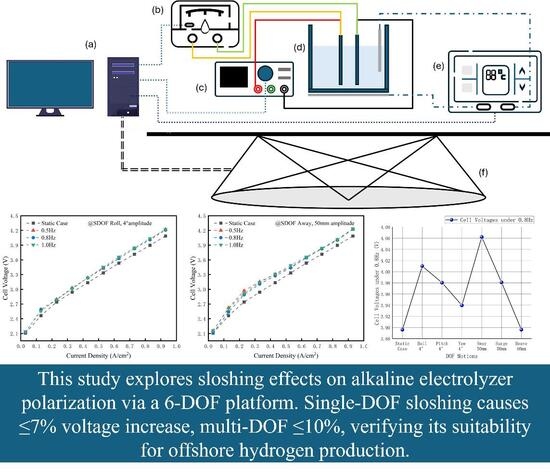
Marine hydrogen production systems deployed on ships and floating platforms are inevitably subjected to complex multi-degree-of-freedom motions induced by waves and wind, which may influence electrolyzer performance. However, experimental investigations under realistic marine motion conditions remain limited. In this study, a laboratory-scale alkaline water electrolyzer was installed on a six-degree-of-freedom (6-DOF) motion platform to experimentally investigate the influence of marine sloshing on polarization characteristics. The experimental design focuses on the fluctuation of cell polarization behavior under dynamic conditions using a single-cell configuration. Typical single-degree-of-freedom (SDOF) and coupled multi-degree-of-freedom (MDOF) motions were reproduced to simulate representative marine operating environments. The results show that sloshing motion leads to a moderate increase in cell voltage compared with static conditions. Under SDOF conditions, the voltage increase remains within 7%, with sway and roll identified as the dominant disturbance modes. Under coupled MDOF conditions, the voltage increase is further amplified but remains below 10.2% even under 6-DOF motion. The results also reveal that the effect of coupled motions is nonlinearly weaker than the linear superposition of individual motions. This study provides experimental evidence that alkaline electrolyzers can maintain stable operation under realistic marine dynamic conditions. These deviations correspond to limited efficiency losses and remain within typical engineering tolerances, suggesting that marine motion has a manageable impact on electrolyzer performance and offers practical guidance for offshore system design and control.

Graphical Abstract

1. Introduction

With the continuous growth of global energy demand and the increasing severity of climate change, the transition toward clean and low-carbon energy systems has become a global consensus. Hydrogen energy, characterized by abundant availability and clean utilization, is widely regarded as a key energy carrier for achieving carbon neutrality goals. With the large-scale integration of renewable energy sources, water electrolysis technologies provide an effective approach for converting intermittent renewable electricity, such as wind and solar energy, into hydrogen. This conversion enables large-scale energy storage and long-distance energy transportation while simultaneously mitigating the curtailment of renewable power generation. Among various renewable hydrogen production pathways, offshore hydrogen production based on wind power (Power-to-Hydrogen) has recently attracted increasing attention as a promising strategy for integrated offshore energy utilization [1,2,3,4,5,6].
Among the available water electrolysis technologies, alkaline water electrolysis (AWE) is currently considered one of the most suitable solutions for offshore hydrogen production due to its technological maturity, relatively low cost, and suitability for large-scale hydrogen generation [7,8,9]. In recent years, numerous studies have been conducted to improve the performance and efficiency of AWE systems. For example, Bai et al. investigated the operational feasibility region and multi-objective optimization of alkaline electrolyzers under fluctuating power input conditions, revealing the effects of temperature fields, gas crossover rates, and polarization characteristics on system performance [10]. Wang et al. established a multiphysics coupling model incorporating electric field, flow field, and concentration field to analyze the influence of temperature and pressure on electrolysis efficiency and voltage requirements [11]. Barco-Burgos et al. experimentally studied electrode temperature distribution and bubble dynamics, demonstrating their impact on electrolysis efficiency [12]. Furthermore, comparative studies between alkaline water electrolysis and proton exchange membrane (PEM) electrolysis indicate that AWE has advantages in terms of cost control and long-term continuous operation stability [13]. In addition, previous investigations have confirmed that key components of AWE systems exhibit acceptable durability under marine atmospheric conditions such as salt spray exposure [14]. With the advancement of offshore hydrogen production technologies, the deployment of electrolysis systems on ships or floating platforms has gradually become an important engineering scenario. For instance, Liu et al. conducted in situ seawater electrolysis experiments on a floating platform under real ocean wave conditions, demonstrating the feasibility of electrolysis systems operating in complex marine environments [15].
Despite these important advances in electrolyzer materials, system optimization, and multiphysics modeling, most existing studies mainly focus on steady-state operation or fluctuating power input conditions [16,17,18,19]. Relatively limited attention has been paid to the dynamic effects induced by platform motion in marine environments. In practical offshore applications, hydrogen production systems are typically installed on ships or floating platforms. Under the combined action of ocean waves, wind loads, and currents, these platforms inevitably experience multi-degree-of-freedom motions, including roll, pitch, and translational motions. Such dynamic movements may influence the internal flow field of the electrolyte and potentially affect gas bubble behavior near the electrode surfaces. Consequently, these effects may lead to fluctuations in polarization characteristics, increased energy consumption, and even reduced operational stability of the electrolyzer. Therefore, investigating the influence of marine sloshing motions on electrolyzer performance is essential for evaluating the engineering feasibility of offshore hydrogen production systems. However, experimental studies on the operational characteristics of alkaline water electrolyzers under marine sloshing conditions remain scarce.
To address this research gap, the present study develops a sloshing experimental system for an alkaline water electrolyzer based on a six-degree-of-freedom motion platform. The platform can reproduce typical motion modes encountered in marine environments. Polarization performance experiments are conducted under static conditions, single-degree-of-freedom (SDOF) sloshing conditions, and multi-degree-of-freedom (MDOF) coupled motion conditions. By systematically varying sloshing amplitudes and excitation frequencies, the effects of different motion modes on polarization curves and cell voltage are analyzed. In addition, the nonlinear superposition characteristics of voltage variations under coupled multi-degree-of-freedom motions are further investigated. The findings of this study provide experimental insights and theoretical references for the engineering design and operational stability assessment of offshore floating hydrogen production systems.
The main contributions of this study are summarized as follows:
  • A six-degree-of-freedom sloshing experimental platform is developed to establish a polarization performance testing methodology for alkaline water electrolyzers under marine dynamic environments, enabling experimental simulation of typical ship and floating platform motions.
  • Through single-degree-of-freedom sloshing experiments, the effects of six typical motion modes on polarization curves and cell voltage are systematically analyzed, identifying roll and sway as the dominant disturbance modes.
  • Multi-degree-of-freedom coupled experiments reveal the nonlinear superposition characteristics of sloshing-induced voltage variations and quantitatively demonstrate that the voltage increase remains within 10% under representative marine motion conditions.

2. Materials and Methods

2.1. Electrolyzer Configuration

In this study, an alkaline water electrolyzer was used to investigate the influence of sloshing amplitude and frequency on polarization characteristics. In alkaline water electrolysis, water molecules are decomposed into hydrogen and oxygen under an applied potential difference. A typical alkaline electrolyzer consists of three main components: an alkaline electrolyte solution, electrodes (anode and cathode), and a diaphragm or membrane that prevents the mixing of the generated gases.
When a DC power supply is applied across the electrodes, electrochemical reactions occur at the electrode surfaces. The electrochemical half-reactions involved in alkaline water electrolysis at a standard temperature of 298.15 K are expressed as follows [5]:
Cathode reaction:
2 H 2 O ( l ) + 2 e H 2 ( g ) + 2 O H ( a q )
Anode reaction:
2 O H ( a q ) H 2 O ( l ) + 1 2 O 2 ( g ) + 2 e
Overall reaction:
2 H 2 O 2 H 2 + O 2
Under standard conditions (298.15 K and 1 atm), the reversible voltage required for water electrolysis is 1.23 V. Under isothermal conditions, the theoretical decomposition voltage is approximately 1.48 V. However, in practical electrolysis systems, the operating voltage is typically higher than the theoretical value due to activation overpotentials and ohmic losses within the electrolyzer.
The reversible cell voltage can be determined using the Gibbs free energy change (ΔG), Faraday constant (F = 96,485 C mol−1), and the number of transferred electrons (z), as shown in Equation (4). The actual cell voltage can be expressed as the sum of reversible voltage, overpotentials, and ohmic resistances, as presented in Equation (5) [12,14].
V r e v = G z · F
V c e l l = V r e v + V a c t c + V a c t a + I ( R c + R a + R e l e c t + R m e m )
where V a c t c   and V a c t a represent the cathodic and anodic activation overpotentials, respectively, while R c , R a , R e l e c t , and R m e m denote the resistances of the cathode, anode, electrolyte, and membrane. As the total internal resistance increases, the operating cell voltage increases accordingly, resulting in higher electrical energy consumption.

2.2. Experimental Setup

A laboratory-scale alkaline water electrolyzer with a single-cell configuration was used in this study. The system was designed to focus on the variation in overall cell polarization performance under dynamic conditions, rather than detailed electrochemical characterization. Polarization curves were selected as the primary evaluation metric because they directly reflect overall cell energy consumption and operational performance under dynamic conditions, which is the main concern for engineering applications.
A two-electrode configuration was adopted without a reference electrode. This configuration is commonly used for evaluating overall cell performance in engineering-scale electrolyzers, where the focus is on the total cell voltage rather than individual electrode potentials. In this study, a simplified cell configuration was employed without a diaphragm or membrane. The objective is to investigate the influence of dynamic motion on overall cell polarization behavior under controlled conditions, rather than to replicate a fully industrial alkaline electrolyzer structure. This simplified configuration allows clearer observation of voltage fluctuations induced by sloshing effects.
The electrolyzer cell body, electrode plates, and electrolyte solution were provided by Yileka Electrochemical Technology Co., Ltd., Suzhou, China. The cell was fabricated from polymethyl methacrylate (PMMA) with dimensions of 160 mm × 95 mm × 125 mm. Stainless steel (SS304) plates were used as both anode and cathode electrodes, with an effective reaction area of 100 cm2. The electrolyte used in this study was a 20 wt% sodium carbonate (Na2CO3) aqueous solution (analytical grade) [20]. Compared with commonly used KOH electrolytes, Na2CO3 offers lower corrosiveness and improved operational safety, which is particularly important for sloshing experiments under dynamic conditions. Compared with conventional KOH electrolytes, Na2CO3 is less corrosive and easier to handle, which is advantageous for experiments under dynamic sloshing conditions and for potential offshore applications. Although the absolute cell voltage may differ slightly due to electrolyte properties, the relative trends observed under dynamic motion are expected to remain comparable.
The power supply system consisted of a programmable DC power source (NICE-POWER KUAIQU, Shenzhen, China) operated in constant-current mode (0–30 V, 0–10 A). The cell voltage was measured using a digital multimeter with an accuracy of ±0.5%.
The electrolyzer was mounted on a six-degree-of-freedom motion platform (Wuhan Mute Technology Co., Ltd., Wuhan, China), which served as the core device for simulating marine dynamic conditions. The platform is capable of reproducing roll, pitch, yaw, sway, surge, and heave motions. A temperature control and monitoring system (Tianjin JikeXingze Technology Co., Ltd., Tianjin, China) was used to maintain stable experimental conditions.
The entire experimental system consisted of the electrolyzer, power supply unit, measurement instruments, temperature control system, and motion platform, enabling controlled investigation of the influence of marine sloshing on cell polarization behavior.
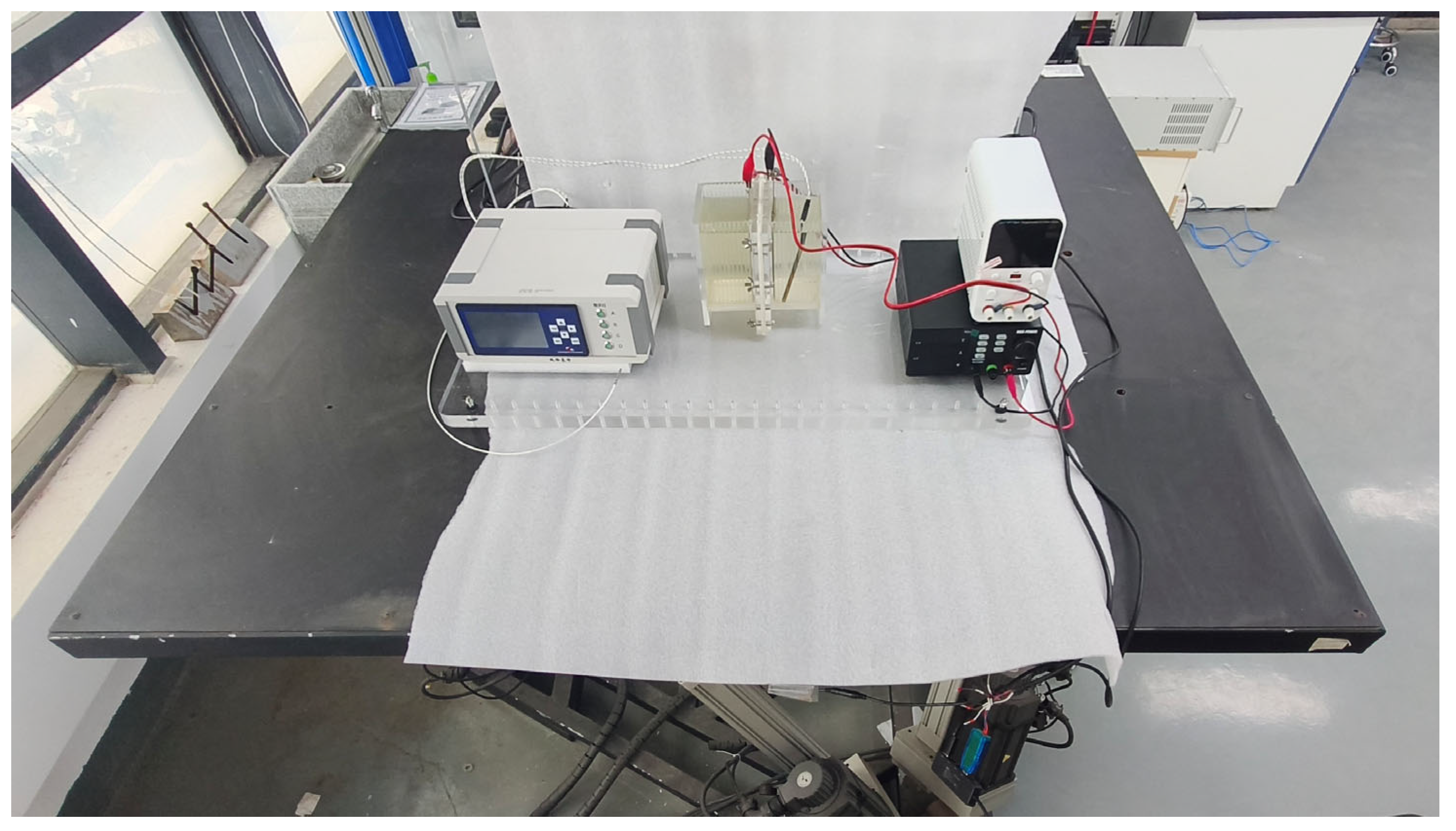
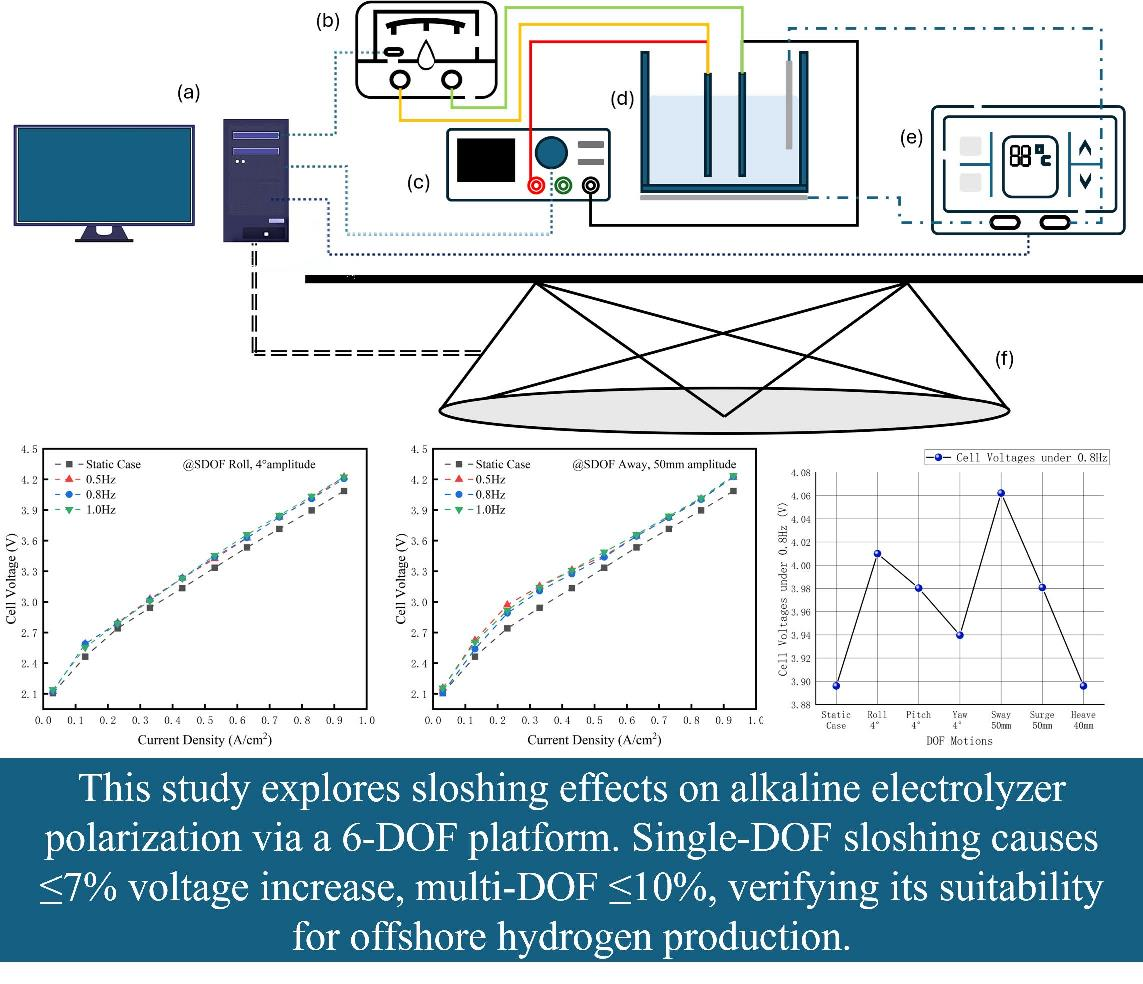
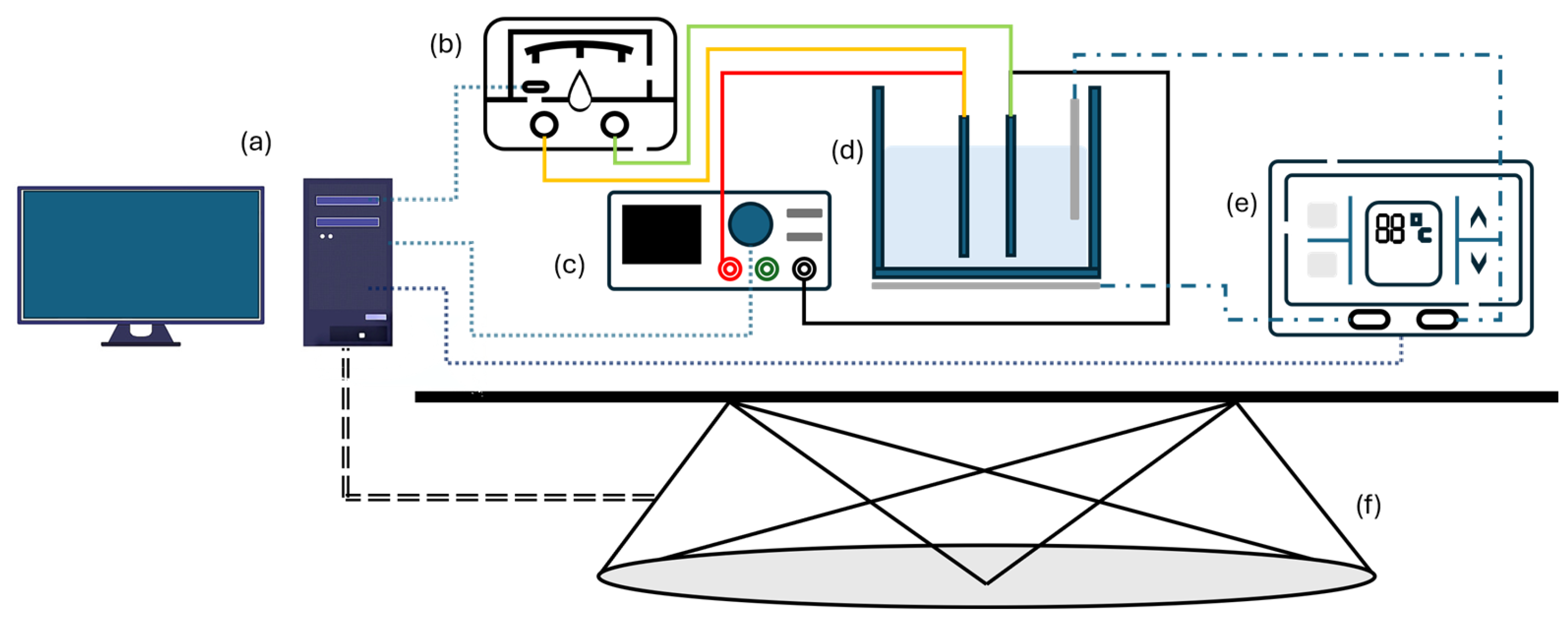
A schematic diagram of the experimental setup is shown in Figure 1, and a photograph of the actual setup is presented in Figure 2. The experimental system consisted of a host computer control terminal, a digital multimeter, a programmable DC power supply, the electrolyzer cell, a temperature monitoring unit, and a six-degree-of-freedom motion platform.
The six-degree-of-freedom motion platform served as the core experimental device in this study. It can reproduce typical ship and offshore platform motion modes, including roll, pitch, yaw, sway, surge, and heave. The motion parameters of the platform were carefully calibrated, and the corresponding motion range, velocity, and acceleration are summarized in Table 1. By fixing the electrolyzer at the center of the motion platform, symmetrical excitation conditions could be ensured, enabling controlled investigation of the influence of sloshing motion on electrolyzer performance [21,22].

2.3. Motion Conditions and Experimental Design

Offshore platforms are subjected to complex six-degree-of-freedom (6-DOF) motions under the combined effects of ocean waves, wind loads, and currents [23]. Conducting experiments directly under fully coupled 6-DOF motion conditions would make it difficult to isolate the influence of individual motion modes and significantly increase the complexity of the experimental design. Therefore, a stepwise approach was adopted in this study.
In offshore engineering applications, platform motions can generally be classified into constrained and fully coupled motion conditions. Three-degree-of-freedom (3-DOF) motion, typically including pitch, surge, and heave, is commonly used to represent moored floating platforms such as offshore wind turbines, where horizontal motions are partially restricted. In contrast, six-degree-of-freedom (6-DOF) motion more comprehensively represents the dynamic behavior of ships and floating production storage and offloading (FPSO) units, where both rotational and translational motions are fully coupled.
In this study, the 3-DOF condition is used as a simplified reference scenario to represent constrained platform motion, while the 6-DOF condition is adopted to simulate realistic marine environments. This stepwise design enables both isolation of individual motion effects and evaluation of coupled motion influences under practical operating conditions.
First, the complex platform motions were decomposed into single-degree-of-freedom (SDOF) motion conditions, including roll, pitch, yaw, sway, surge, and heave. After evaluating the effects of individual motion modes, additional experiments were conducted under multi-degree-of-freedom coupled motion conditions to investigate their combined effects on electrolyzer polarization performance.
The selection of appropriate excitation amplitudes and frequencies is essential when investigating sloshing-induced phenomena. From a hydrodynamic perspective, resonance may occur when the excitation frequency approaches the natural frequency of the liquid system, leading to a significant amplification of the free surface motion and potentially affecting system stability [24,25].
To identify representative excitation conditions, the natural sloshing frequencies of the electrolyte inside the rectangular cell were estimated using the theoretical model proposed by Faltinsen in Equation (6) [26]:
f n = 1 2 n g π L tan h ( n π h L )
where f n is the natural frequency of the nth sloshing mode, h is the liquid depth, L is the characteristic length of the tank in the excitation direction, g is gravitational acceleration (9.81 m∙s−2), and n represents the mode number.
Based on the geometrical dimensions of the electrolyzer (160 mm × 95 mm) and the measured liquid height, the first three natural frequencies were estimated. Considering that the electrolyte used in this study was a 20 wt% Na2CO3 solution with a density approximately 14% higher than that of pure water, a correction was applied to account for the density effect on sloshing dynamics [27]. The corrected natural frequencies were approximately 0.848 Hz, 1.225 Hz, and 1.499 Hz.
Accordingly, three representative excitation frequencies were selected in the SDOF experiments: 0.5 Hz (low-frequency region, significantly below the natural frequency); 0.8 Hz (near-resonance region); 1.0 Hz (high-frequency region).
The motion amplitudes were selected based on typical motion amplitudes observed for medium-sized ships under sea state 4 conditions in the South China Sea. The SDOF experimental conditions are summarized in Table 2.
To further investigate the influence of coupled platform motions, two representative multi-degree-of-freedom motion scenarios were designed. The first scenario represents a typical three-degree-of-freedom motion condition for floating offshore platforms, including pitch, surge, and heave. The second scenario represents a six-degree-of-freedom motion condition typical for ship operations, including roll, pitch, yaw, sway, surge, and heave. These motion parameters were selected based on reported motion characteristics of LNG carriers and offshore supply vessels [28,29,30]. The experimental conditions for multi-degree-of-freedom coupled motion are summarized in Table 3. The selected amplitudes represent typical ranges reported for marine vessels and offshore platforms under moderate operating conditions. These values are treated as representative peak amplitudes rather than statistically derived parameters such as RMS values. The purpose of this study is to provide controlled and comparable motion inputs for evaluating the influence of sloshing, rather than to reproduce exact sea state statistics.

2.4. Data Acquisition and Processing

During the experiments, the electrolyzer was operated under constant-current mode. The current density was gradually increased from 0 to 1 A·cm−2 with a step size of 0.1 A·cm−2. Each current step was maintained for 5 min to allow the system to reach a quasi-steady state. The cell voltage signal was recorded continuously at a sampling frequency of 1 Hz. For each current density level, the average voltage value over the final 30 s of the measurement period was used to construct the polarization curve [31].
To ensure data reliability, each experimental condition was repeated three times independently. The experimental results were considered acceptable when the relative standard deviation of the measured voltage was less than 3% for single-degree-of-freedom conditions and less than 5% for multi-degree-of-freedom conditions.
After each experimental run, the electrolyzer was allowed to remain in a static state for 60 min to eliminate residual flow disturbances caused by previous motion conditions. In addition, visual observation through the transparent cell walls was conducted to qualitatively assess the influence of sloshing motion on bubble behavior and internal flow patterns. It should be noted that these observations are purely qualitative, and no quantitative measurement of bubble size, distribution, or dynamics was performed.

3. Results and Discussion

3.1. Effect of Single-Degree-of-Freedom Oscillation on Polarization Performance of Alkaline Electrolyzers

3.1.1. Effect of Rotational Motion on Polarization Curves

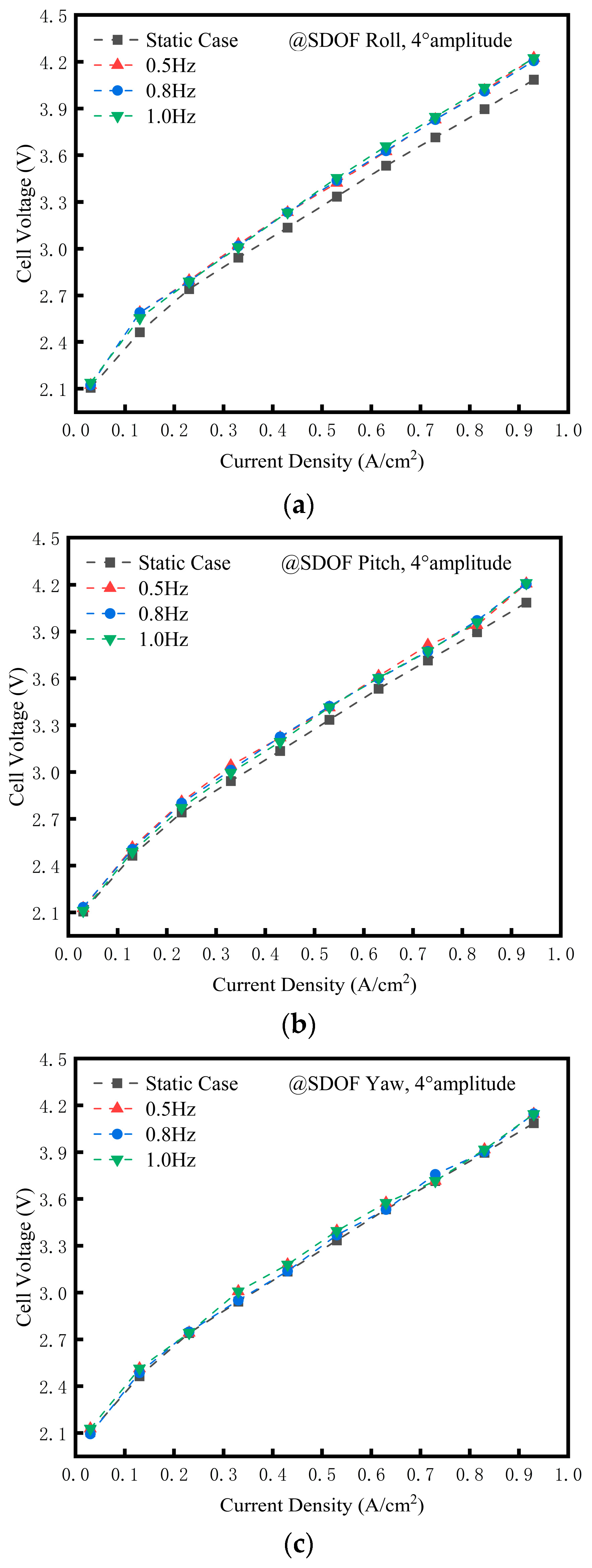
Figure 3 compares the polarization curves of the electrolyzer under static conditions and three rotational sloshing motions, namely roll, pitch, and yaw. Rotational motion refers to the rotation of the system around the three principal axes (x, y, and z). For the electrolyzer installed in the platform center, the roll motion acts approximately parallel to the electrode plates, while pitch motion induces a disturbance perpendicular to the electrode surface. In contrast, yaw motion tends to induce a rotational flow pattern inside the electrolyte, which may cause local liquid circulation within the cell.
As shown in Figure 3, the polarization curves under rotational motions exhibit trends similar to those under the static condition, indicating that the fundamental electrochemical behavior of the electrolyzer is not influenced by rotational excitation. Nevertheless, a slight increase in cell voltage can be observed across the entire current density range under roll motion. At a current density of 1 A·cm−2, the measured voltage reaches 4.223 V, compared with 4.086 V under the static condition, corresponding to an increase of approximately 3.35%.
In comparison, the voltage deviations caused by pitch and yaw motions remain relatively small, with increases of approximately 3% and 1.5%, respectively. Although rotational motions are generally considered among the most critical dynamic motions affecting ship safety—particularly roll motion—the present results suggest that their influence on the polarization characteristics of the alkaline electrolyzer remains limited within the investigated operating range.

3.1.2. Effect of Translational Motion on Polarization Curves

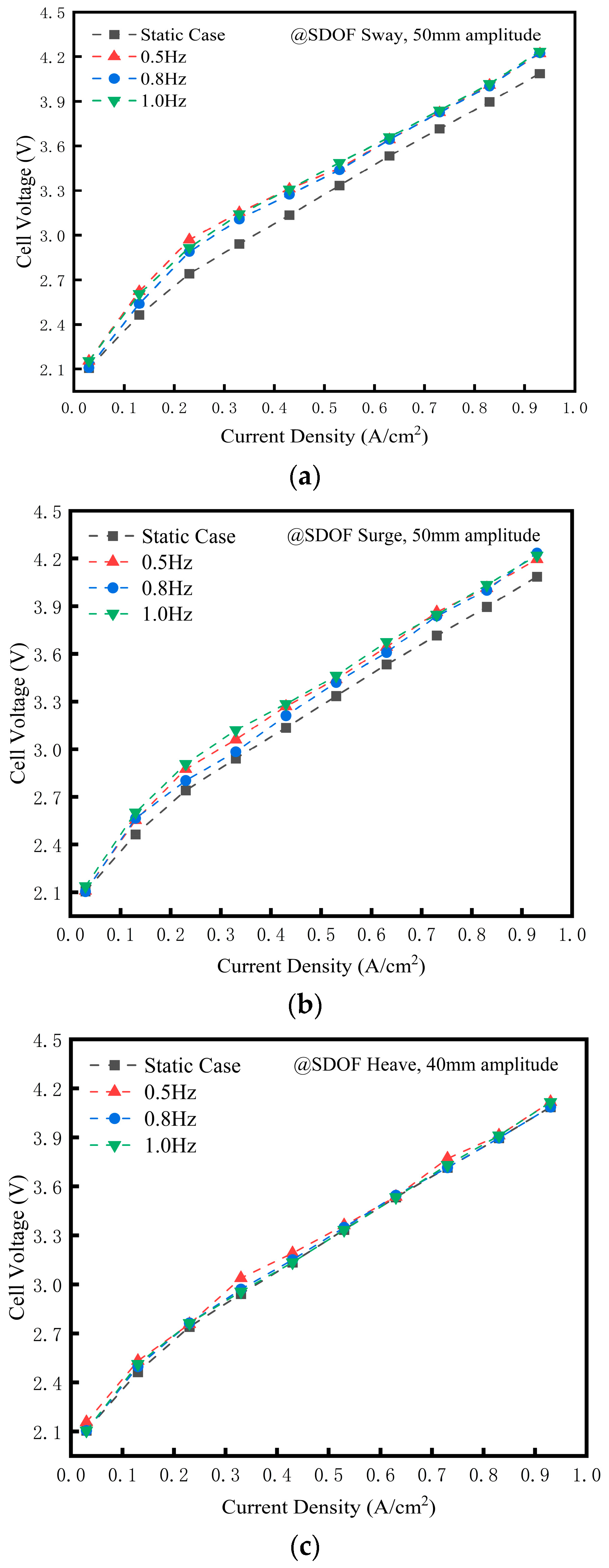
Figure 4 presents a comparison of the polarization curves under translational sloshing motions, including sway, surge, and heave. Unlike rotational motions, translational motions correspond to linear movements of the platform along the three principal axes. These motions may induce periodic fluid acceleration inside the electrolyte, potentially leading to liquid accumulation against the cell walls and stronger internal fluid circulation.
Under the experimental configuration used in this study, sway motion generates fluid movement parallel to the electrode surface, whereas surge motion induces disturbances perpendicular to the electrode plates. Heave motion corresponds to vertical oscillation of the entire electrolyzer, resulting primarily in a uniform upward and downward movement of the electrolyte.
Compared with rotational motions, translational motions exhibit a more pronounced influence on polarization behavior. Among the three translational modes, sway motion shows the most pronounced influence on the polarization curve. In the medium current density region, the maximum voltage deviation reaches approximately 4.8%. Although this represents the largest deviation among the investigated translational motions, the corresponding change in electrolysis power is only about 0.5 W, which remains significantly below the commonly accepted engineering tolerance threshold of approximately 10%.
Surge motion shows a certain degree of frequency dependence. Higher excitation frequencies tend to produce larger voltage deviations, while lower frequencies result in relatively minor changes. In contrast, the effect of heave motion is negligible across the entire current density range, and almost no observable deviation from the static polarization curve can be detected. This observation suggests that vertical oscillatory motion has a minimal influence on the electrochemical processes occurring at the electrode surfaces.
Overall, the experimental results indicate that translational motions—particularly sway—have a slightly stronger impact on electrolyzer performance than rotational motions, although the overall influence remains relatively small.

3.2. Influence of Sloshing Frequency on the Cell Voltage Under Single-Degree-of-Freedom Motions

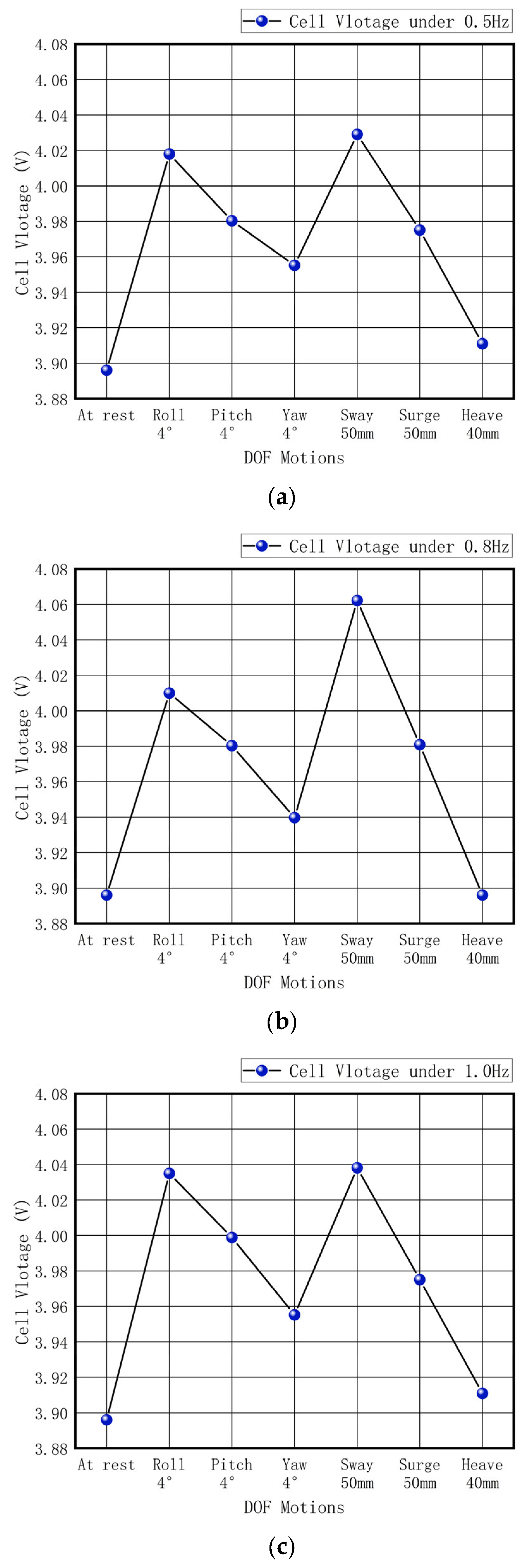
To further investigate the influence of excitation frequency, the cell voltage response was examined under a constant current of 8.5 A. This approach eliminates the influence of current fluctuations and allows the direct evaluation of voltage variations induced by sloshing motions. Three representative frequencies (0.5 Hz, 0.8 Hz, and 1.0 Hz) were selected to represent typical low-frequency marine motion conditions.
As shown in Figure 5a, under the 0.5 Hz condition, all single-degree-of-freedom motion modes result in slightly higher cell voltages compared with the static case. None of the motion conditions produce voltages lower than those observed in the static state. Among the investigated motions, sway motion produces the largest voltage increase, followed by roll motion. The voltage deviations associated with pitch, yaw, and heave motions remain relatively small and close to the static condition.
Under the near-resonance condition of 0.8 Hz (Figure 5b), the voltage fluctuations become more pronounced. Although the overall ranking of the motion modes remains similar to that observed at 0.5 Hz, the magnitude of voltage deviation increases. This observation suggests that near-resonant excitation may enhance internal fluid motion within the electrolyte, thereby intensifying the disturbance effects on the electrochemical system.
When the excitation frequency is further increased to 1.0 Hz (Figure 5c), the voltage deviations decrease slightly compared with those observed under the near-resonant condition. The relative influence of different motion modes remains consistent, with sway motion producing the largest disturbance and roll motion ranking second. These results indicate that the strongest disturbance occurs near the natural sloshing frequency, while higher-frequency excitation does not necessarily lead to further amplification of voltage fluctuations.
Overall, the results reveal that translational motions (excluding heave) generally produce stronger disturbances to cell voltage than rotational motions under identical excitation frequencies.

3.3. Influence of Multi-Degree-of-Freedom Coupled Motions

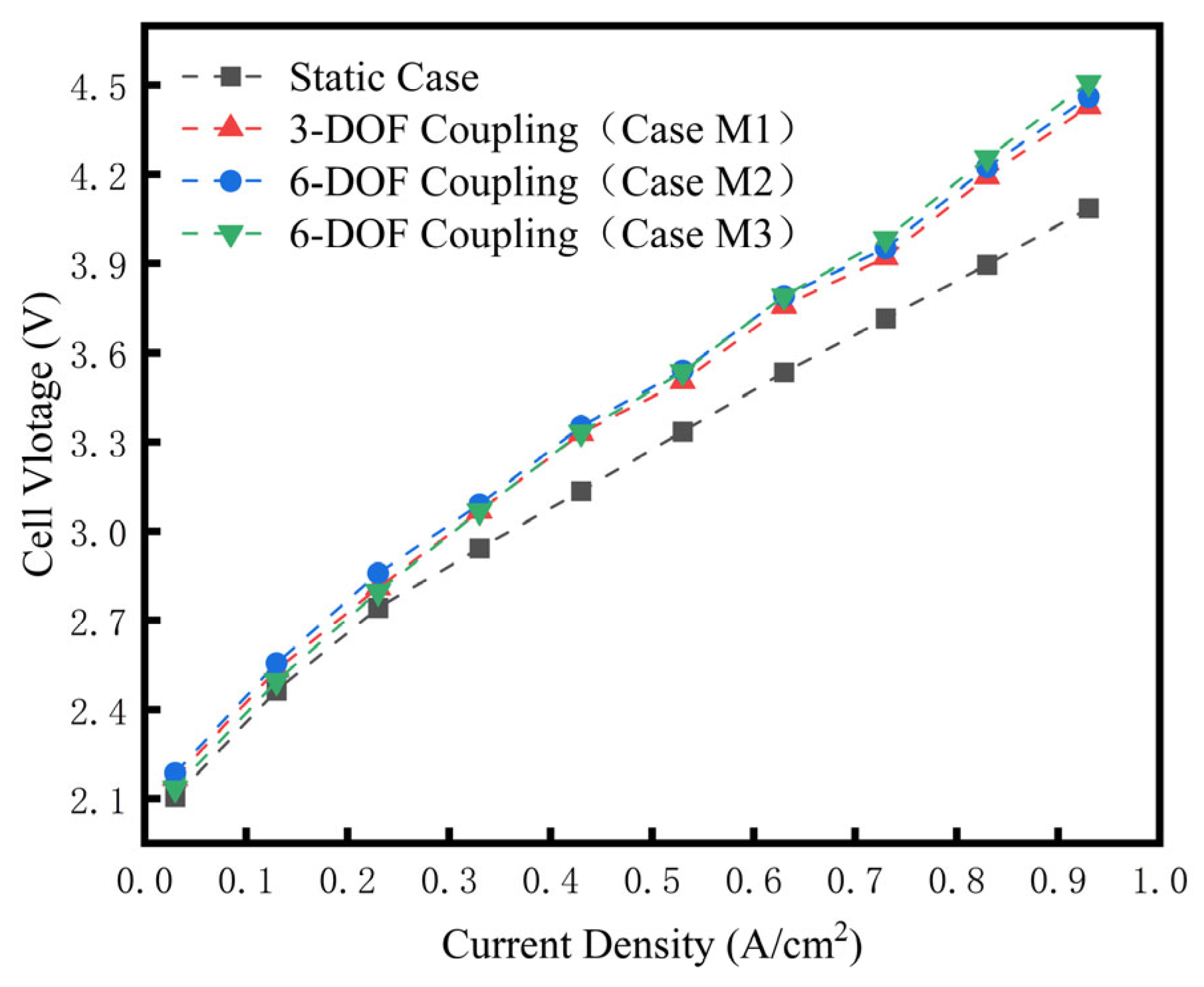
To evaluate the combined effects of multiple motion modes, polarization curves under static conditions, three-degree-of-freedom (3-DOF) motions, and six-degree-of-freedom (6-DOF) motions were compared, as illustrated in Figure 6.
All polarization curves exhibit the typical electrochemical behavior of alkaline electrolysis, with the cell voltage increasing gradually as the current density increases. The curves remain nearly parallel across the tested current density range (0–1 A·cm−2), indicating that the external motion excitation does not fundamentally alter the electrochemical reaction mechanism.
At a current density of 1 A·cm−2, the measured cell voltage under static conditions is 4.086 V. Under the three-degree-of-freedom coupled motion condition (M1), the voltage increases to 4.428 V, corresponding to a relative increase of approximately 8.4%. Under the six-degree-of-freedom motion condition (M2), the voltage further increases to 4.460 V, corresponding to an increase of approximately 9.2%. A similar trend is observed for the M3 condition, where the voltage increase reaches approximately 10.2%. Compared with the 3-DOF condition, the 6-DOF motion introduces additional coupling between rotational and translational disturbances. However, the relatively limited increase in cell voltage suggests that the system response is governed by nonlinear interactions rather than a simple superposition of motion effects.
This comparison further demonstrates that the use of 6-DOF motion is necessary to capture the coupled effects of realistic marine dynamics, which cannot be fully represented by simplified 3-DOF motion conditions. However, the relatively limited difference between 3-DOF and 6-DOF results suggest that the electrolyzer exhibits a certain degree of robustness under complex motion environments. This finding is important for engineering applications, as it indicates that simplified motion models may be sufficient for preliminary analysis, while full 6-DOF conditions are required for accurate performance evaluation under realistic marine scenarios.
Although the six-degree-of-freedom condition introduces more complex multi-axis excitations, the voltage increase does not rise dramatically compared with the three-degree-of-freedom condition. The polarization curves under these two conditions appear nearly overlapping, particularly in the medium and high current density regions (above approximately 0.6 A·cm−2).
To further analyze the nonlinear characteristics of multi-degree-of-freedom coupling, the voltage increase observed under the M1 and M2 conditions was compared with the linear superposition of voltage deviations obtained from the corresponding single-degree-of-freedom motions. The comparison results are summarized in Table 4.
The results show that the measured voltage increase under coupled motion conditions is consistently lower than the sum of the voltage increases from individual motion modes. For example, the actual voltage increase under the M1 condition is 8.4%, while the linear superposition of the corresponding SDOF cases reaches 9.2%. Similarly, for the M2 condition, the measured voltage increase is 9.2%, whereas the linear sum of individual motion effects reaches 17.93%.
These results indicate that the influence of coupled sloshing motions on the electrolyzer voltage does not follow a simple linear superposition rule. Instead, a clear nonlinear interaction effect exists among the different motion modes, likely due to the complex internal flow interactions induced by multi-directional platform motions.

3.4. Mechanistic Interpretation of Sloshing-Induced Polarization Variation

Based on qualitative visual observations, changes in bubble behavior near the electrode surface may influence local reaction conditions, which may contribute to the observed increase in cell voltage.
First, platform motion can induce periodic acceleration of the electrolyte, which alters the internal flow structure of the liquid phase inside the cell. Under translational motions such as sway and surge, the electrolyte experiences horizontal inertial forces, resulting in enhanced liquid circulation along the electrode surfaces. This flow disturbance may temporarily modify the transport behavior of gas bubbles generated during electrolysis.
Second, sloshing motion may influence the effective electrolyte distribution inside the cell. Under rotational motions such as roll and pitch, the liquid surface becomes inclined, leading to small variations in local electrolyte thickness along the electrode plates. Such variations may alter the ionic conduction pathways and slightly increase the effective ohmic resistance of the electrolyte layer.
Third, the coupling of multiple motion modes can introduce complex internal flow patterns that differ from the simple superposition of single-degree-of-freedom disturbances. The experimental results show that the voltage increase under multi-degree-of-freedom conditions is smaller than the linear sum of individual motion effects. This phenomenon suggests that competing flow patterns generated by different motion modes may partially offset each other, thereby limiting the overall disturbance intensity within the electrolyte.
Another important factor influencing the magnitude of sloshing-induced disturbances is the physical property of the electrolyte. In the present experiments, a 20 wt% Na2CO3 solution was used, which has a dynamic viscosity of approximately 1.8 mPa·s at 25 °C. This value is significantly higher than that of pure water and slightly higher than that of typical KOH electrolytes. Higher viscosity enhances internal viscous dissipation, which can suppress the amplitude of free-surface sloshing and dampen the resulting flow disturbances. It should be noted that although Na2CO3 exhibits slightly higher viscosity than KOH, which may influence electrolyte flow behavior, the present results primarily reflect the relative impact of dynamic motion. Therefore, the qualitative trends observed in this study are expected to be applicable to conventional alkaline water electrolysis systems. Consequently, the hydrodynamic effects induced by platform motion remain relatively limited, resulting in moderate voltage variations.
Overall, the experimental observations suggest that marine sloshing primarily affects electrolyzer performance through hydrodynamic disturbances that influence electrolyte distribution and bubble behavior. These interpretations are based on qualitative observations and are used to support the understanding of the experimental results.

4. Conclusions

In this study, an experimental investigation was conducted to evaluate the influence of marine sloshing motions on the polarization performance of an alkaline water electrolyzer. A six-degree-of-freedom motion platform was employed to simulate typical dynamic conditions encountered by ships and floating offshore platforms. Based on the experimental results, the following conclusions can be drawn.
  • Under single-degree-of-freedom motion conditions, all investigated motion modes lead to a slight increase in electrolyzer voltage compared with the static condition. The voltage deviation remains within 7% across the tested current density range. Among the investigated motions, roll and sway exhibit the most pronounced influence on polarization behavior, with maximum voltage deviations of approximately 3.35% and 4.8%, respectively.
  • Under multi-degree-of-freedom coupled motion conditions, the voltage increase becomes slightly larger due to the combined disturbance effects of multiple motion modes. Nevertheless, even under the most complex six-degree-of-freedom condition, the voltage increase does not exceed 10%, indicating that the alkaline electrolyzer maintains acceptable operational stability under representative marine dynamic environments.
  • The influence of coupled sloshing motions exhibits clear nonlinear characteristics. The measured voltage increase under multi-degree-of-freedom conditions is consistently lower than the linear superposition of individual motion effects, indicating that complex hydrodynamic interactions occur within the electrolyte under coupled motions.
Overall, the experimental results demonstrate that alkaline water electrolyzers exhibit good operational adaptability under typical marine sloshing conditions. The findings of this study provide experimental support for the application of alkaline electrolysis technology in offshore hydrogen production systems and offer useful guidance for the engineering design of floating hydrogen production platforms.
From an engineering perspective, the observed voltage variations under representative motion conditions remain within acceptable operational limits, suggesting that marine-induced sloshing is unlikely to significantly affect system efficiency or durability in practical offshore applications. However, under more severe sea states or in large-scale electrolyzers with longer flow paths, amplified hydrodynamic effects may occur. Therefore, further investigation under extreme conditions and scale-up scenarios is necessary to ensure robust system design.

Author Contributions

Conceptualization, W.W., R.L. and Y.L.; methodology, Z.Z.; validation, Y.L.; formal analysis, Z.Z.; investigation, Z.Z. and Y.L.; resources, W.W.; data curation, Z.Z.; writing—original draft preparation, Z.Z.; writing—review and editing, W.W. and Y.L.; visualization, R.L.; supervision, R.L.; funding acquisition, Y.L. All authors have read and agreed to the published version of the manuscript.

Funding

This research was funded by the Zhoushan Municipal Key Industrial Science and Technology Project (No. 2024C03009), the Provincial Teaching Reform Project for Engineering Education (Second Batch of Postgraduate Programs during the 14th Five-Year Plan) (No. JGGC2024024), and the Zhejiang Ocean University Interdisciplinary Project (No. ZJJC202507). The APC was funded by Zhejiang Ocean University.

Data Availability Statement

The original contributions presented in this study are included in the article. Further inquiries can be directed to the corresponding authors.

Acknowledgments

The authors would like to thank Wu for his support and guidance. Thanks to the laboratory of Zhejiang Ocean University for providing the support of the six-degree-of-freedom motion platform. The authors would also like to thank Jurong Energy Co., Ltd. and Zhoushan Yuchen Electric Power Engineering Co., Ltd. for their financial and technical support. I also sincerely thank the reviewers and editors for their constructive comments.

Conflicts of Interest

Author Rongsheng Lin was employed by the company Jurong Energy (Xinjiang) Co., Ltd. Author Youfei Liu was employed by the company Zhoushan Yuchen Electric Power Engineering Co., Ltd. The companies were not involved in the study design, data collection, analysis, interpretation, writing, or publication decision. The remaining authors declare that the research was conducted in the absence of any commercial or financial relationships that could be construed as a potential conflict of interest.

Abbreviations

The following abbreviations are used in this manuscript:
VCell voltage (V)
ICurrent (A)
fSloshing frequency (Hz)
ΔVVoltage increment (V)
AWEAlkaline water electrolysis
ηOverpotential
DOFDegree of freedom
SDOFSingle-degree-of-freedom
MDOFMulti-degree-of-freedom
RMSRoot mean square
FPSOFloating Production Storage and Offloading
Na2CO3Sodium carbonate
KOHPotassium hydroxide
PMMAPolymethyl methacrylate
SS304Stainless steel 304

References

  1. Zhang, Z.; Song, L.J. Progress, challenges, and future prospects of water electrolysis for hydrogen production. Chin. J. Eng. 2025, 47, 282–295. [Google Scholar] [CrossRef]
  2. Zheng, B.; Bai, Z.; Yuan, Y.; Hu, W. Wind-PV complementary hydrogen production system with multi-type electrolysis coordination and capacity optimization. Proc. CSEE 2022, 42, 8486–8496. [Google Scholar] [CrossRef]
  3. Guo, X.; Chen, X.; Chen, X.; Sherman, P.; Wen, J.; McElroy, M. Grid integration feasibility and investment planning of offshore wind power under carbon-neutral transition in China. Nat. Commun. 2023, 14, 2447. [Google Scholar] [CrossRef] [PubMed]
  4. Hu, W.; Li, X.; Tang, C.; Zhang, S.; Liu, X.; Li, W.; Xue, L.; Zhou, X.; Du, P.; Zhang, Y.; et al. Materials design and system innovation for direct and indirect seawater electrolysis. ACS Nano 2023, 17, 22227–22239. [Google Scholar] [CrossRef] [PubMed]
  5. Yu, T.; Ma, M.; Wang, J.; Bai, X.; Wang, S.; Tian, B.; Pan, X. Influence of membrane perforation in alkaline electrolytic cells on HTO. Sci. Rep. 2025, 15, 20770. [Google Scholar] [CrossRef]
  6. Ma, L.L.; Qin, W.W.; Wang, H.R.; Xuan, J.D.; Zha, D.S.; Zhong, C.; Sun, X.Q.; Shen, X.Y.; Xie, C.C.; Feng, T.T. Study on carbon emission and reduction benefits of wind power and photovoltaic hydrogen production projects based on life cycle. Mod. Chem. Ind. 2026, 46, 240–246. [Google Scholar] [CrossRef]
  7. Qu, X.Y.; Li, Q.S.; Yu, Q.Y.; Li, S. Thermodynamic analysis and optimization design of alkaline water electrolysis system for offshore wind power. Chin. J. Ship Res. 2024, 19, 82–91. [Google Scholar] [CrossRef]
  8. Liu, S.; Zhang, Z.; Dastafkan, K.; Shen, Y.; Zhao, C.; Wang, M. Yttrium-doped NiMo–MoO2 heterostructure electrocatalysts for hydrogen production from alkaline seawater. Nat. Commun. 2025, 16, 773. [Google Scholar] [CrossRef]
  9. Yang, F.Q.; Yan, R.G.; Sun, H.X.; Lei, Z.; Liu, B. Feasible operating region analysis and multi-objective optimization of alkaline water electrolysis for hydrogen production under fluctuating conditions. Trans. China Electrotech. Soc. 2025, 1–14. [Google Scholar] [CrossRef]
  10. Bai, J.K.; Li, P.X.; Qiao, D.W. Current status and prospects of water electrolysis for hydrogen production. Mod. Chem. Ind. 2023, 43, 63–65. [Google Scholar] [CrossRef]
  11. Wang, R.D.; Li, J.H.; Wei, S.Y. Operating characteristics of alkaline water electrolyzer based on multi-physics coupling model. High Volt. Eng. 2024, 50, 3209–3220. [Google Scholar] [CrossRef]
  12. Barco-Burgos, J.; Sánchez, J.; Montiel, V. Thermal analysis of alkaline water electrolysis cells: Influence of electrode spacing on temperature and efficiency. J. Power Sources 2020, 478, 228763. [Google Scholar] [CrossRef]
  13. Wang, J.; Yang, J.; Feng, Y.; Hua, J.; Chen, Z.; Liao, M.; Zhang, J.; Qin, J. Comparative experimental study of alkaline and proton exchange membrane water electrolysis for green hydrogen production. Appl. Energy 2025, 379, 124936. [Google Scholar] [CrossRef]
  14. Amores, E.; Botana, F.J.; Escudero, M. Effects of the marine atmosphere on the components of an alkaline water electrolysis cell for hydrogen production. Results Eng. 2021, 11, 100235. [Google Scholar] [CrossRef]
  15. Liu, T.; Zhao, Z.; Tang, W.; Chen, Y.; Lan, C.; Zhu, L.; Jiang, W.; Wu, Y.; Wang, Y.; Yang, Z.; et al. In-situ direct seawater electrolysis using floating platform in ocean with uncontrollable wave motion. Nat. Commun. 2024, 15, 5305. [Google Scholar] [CrossRef]
  16. Chang, S.H.; Rajuli, M.F. An overview of pure hydrogen production via electrolysis and hydrolysis. Int. J. Hydrogen Energy 2024, 84, 521–538. [Google Scholar] [CrossRef]
  17. Campo Schneider, L.P.; Dhrioua, M.; Ullmer, D.; Egert, F.; Wiggenhauser, H.J.; Ghotia, K.; Kawerau, N.; Grilli, D.; Razmjooei, F.; Ansar, S.A. Advancements in hydrogen production using alkaline electrolysis systems: A short review on experimental and simulation studies. Curr. Opin. Electrochem. 2024, 47, 101552. [Google Scholar] [CrossRef]
  18. Niblett, D.; Delpisheh, M.; Shanmugam, R.; Mamlouk, M. Review of next generation hydrogen production from offshore wind using water electrolysis. J. Power Sources 2024, 592, 233904. [Google Scholar] [CrossRef]
  19. Xiong, H.Y.; Zhu, Z.X.; Gao, X.; Fan, C.-M.; Luan, H.-B.; Li, B. Optimization of alkaline water electrolyzer using expanded mesh as bipolar plate flow channel structure. J. Electrochem. 2024, 30, 28–41. [Google Scholar] [CrossRef]
  20. Jin, Y.D.; Li, Y.; Yang, C.; Kan, A. Modeling and impact analysis of multi-physics transmission in marine PEMEC under ocean dynamic loads. J. Shanghai Marit. Univ. 2025, 46, 128–135. [Google Scholar] [CrossRef]
  21. Genç, Ş.; Ayas, N. Upgrading hydrogen production rate and energy efficiency of alkaline water electrolysis under effect of magnetic field. Int. J. Hydrogen Energy 2025, 98, 820–832. [Google Scholar] [CrossRef]
  22. Zhang, H.; Xin, Z.; Xu, S.; Zhou, X.; Guedes Soares, C. Numerical study on the physical mechanisms of non-bottom mounted baffles to suppress liquid tank sloshing. Ocean Eng. 2024, 304, 117859. [Google Scholar] [CrossRef]
  23. Kovendhan, K.; Kang, H.; Youn, J.S.; Choi, H.W.; Kim-Joon, J. Alternative cost-effective electrodes for hydrogen production in saline water condition. Int. J. Hydrogen Energy 2019, 44, 5090–5098. [Google Scholar] [CrossRef]
  24. Guze, S.; Wawrzynski, W.; Wilczynski, P. Determination of parameters describing the risk areas of ships chaotic rolling on the example of LNG carrier and OSV vessel. J. Mar. Sci. Eng. 2020, 8, 91. [Google Scholar] [CrossRef]
  25. Liu, D.X.; Ma, R.J.; Cai, W.J.; Lu, T.Z. Experimental study on three-dimensional rotational sloshing of free surface in vertical cylindrical tank. J. Shanghai Jiaotong Univ. 2024, 58, 1665–1673. [Google Scholar] [CrossRef]
  26. Faltinsen, O.M.; Timokha, A.N. Sloshing; Cambridge University Press: Cambridge, UK, 2009. [Google Scholar]
  27. Brown, E.; Jaeger, H.M. Shear thickening in concentrated suspensions: Phenomenology, mechanisms and relations to jamming. Rep. Prog. Phys. 2014, 77, 046602. [Google Scholar] [CrossRef]
  28. Shi, Z.; Gao, Z.; Wang, W.; Zheng, Z. Multi-degree-of-freedom motions and effect on rolling dynamics of damaged ship in oblique waves. Ocean Eng. 2024, 313, 119518. [Google Scholar] [CrossRef]
  29. Silva, K.M.; Maki, K.J. Data-driven system identification of 6-DoF ship motion in waves with neural networks. Appl. Ocean Res. 2022, 125, 103222. [Google Scholar] [CrossRef]
  30. Yu, Y.; Dam, T.P.; Son, H.; Ha, K. Study on the motion characteristics of 10 MW superconducting floating offshore wind turbine considering second-order wave effect. Energies 2021, 14, 6070. [Google Scholar] [CrossRef]
  31. Zhao, Z.Y.; Wang, P.F.; Huang, D.J.; Wu, J.; Jiao, S.; Zhao, Y.; Chen, Y. Simulation study on the effect of stretched mesh flow channel structure on flow and electrochemical characteristics of alkaline water electrolyzer. Chin. J. Eng. 2026, 48, 671–685. [Google Scholar] [CrossRef]
Figure 1. Schematic diagram of the experimental setup: Different line styles indicate different functions: solid lines represent electrical connections (power supply and measurement circuits), dashed lines represent control and data transmission signals, and dotted lines indicate temperature monitoring and control. (a) Host computer operation terminal; (b) Digital multimeter; (c) Programmable DC power supply; (d) Electrolyzer; (e) Temperature control and monitoring unit; (f) Six-degree-of-freedom sloshing platform.
Jmse 14 00660 g001
Figure 2. Picture of the experimental setup.
Jmse 14 00660 g002
Figure 3. Comparison of cell voltage–current density curves under rotational motion (S1 condition) and static condition (S0 condition): (a) Single roll motion with an amplitude of 4°; (b) Single pitch motion with an amplitude of 4°; (c) Single yaw motion with an amplitude of 4°. The symbol “@” indicates data obtained under the corresponding motion condition.
Jmse 14 00660 g003
Figure 4. Comparison of cell voltage–current density curves under translational motion (S2 condition) and static condition (S0 condition): (a) Single sway motion with an amplitude of 50 mm; (b) Single surge motion with an amplitude of 50 mm; (c) Single heave motion with an amplitude of 40 mm. The symbol “@” indicates data obtained under the corresponding motion condition.
Jmse 14 00660 g004
Figure 5. Cell voltage variation under single-degree-of-freedom motions at different excitation frequencies: (a) Sloshing frequency of 0.5 Hz; (b) Sloshing frequency of 0.8 Hz; (c) Sloshing frequency of 1.0 Hz.
Jmse 14 00660 g005
Figure 6. Polarization curves under coupled multi-degree-of-freedom motions.
Jmse 14 00660 g006
Table 1. Motion parameters of the six-degree-of-freedom sloshing platform.
Motion ManoeuvreRangeVelocityAcceleration
Pitch±15°30 °/s50 °/s2
Roll±15°30 °/s50 °/s2
Yaw±18°30 °/s50 °/s2
Sway±0.19 m0.3 m/s0.3 g
Surge±0.19 m0.3 m/s0.3 g
Heave±0.16 m0.3 m/s0.3 g
Table 2. Single-degree-of-freedom modal motion parameter settings.
Operating ConditionMotion TypeMotion ModeAmplitudeFrequency (Hz)Description
S0/At rest//Control group
S1Rotational motionRoll, Pitch, Yaw0.5, 0.8, 1.0Rotational motion about coordinate axes
S2Translational motionSway, Surge, Heave50 mm, (40 mm for heave)0.5, 0.8, 1.0Forward and backward movement along the coordinate axis
Table 3. Parameter settings for the multi-degree-of-freedom motion experimental group.
Operating ConditionMotion TypeMotion ModeAmplitudeFrequency (Hz)Description
S0/At rest//Control group
M1Three-degree-of-freedom oscillationPitch, Surge, Heave50 mm, 40 mm, 4.8°0.8Equivalent motion of floating platform
M2Six-degree-of-freedom heaveSurge, Sway, Heave, Roll, Pitch, Yaw190 mm, 190 mm, 10 mm, 6°, 4°, 3°0.05, 0.06, 0.02, 0.02, 0.02, 0.08Ship Equivalent Motion Simulation
M360 mm, 80 mm, 10 mm, 3°, 5°, 2°0.2, 0.18, 0.05, 0.3, 0.2, 0.13
Table 4. Comparison of voltage increase between coupled multi-degree-of-freedom motions and linear superposition of single-degree-of-freedom motions.
Operating ConditionVoltage Increase (Comparison with Rest Mode)RollPitchYawSwaySurgeHeaveLinear Superposition of Voltage Amplitude Increase
S00.0%///////
M18.4%/3.48%//4.21%1.51%9.2%
M29.2%3.06%1.95%1.67%4.16%5.14%1.95%17.93%
Disclaimer/Publisher’s Note: The statements, opinions and data contained in all publications are solely those of the individual author(s) and contributor(s) and not of MDPI and/or the editor(s). MDPI and/or the editor(s) disclaim responsibility for any injury to people or property resulting from any ideas, methods, instructions or products referred to in the content.