A Global Optimization Framework for Energy Efficiency of Wing–Diesel Hybrid Ships Under Distinct Sail-Statuses Based on Improved Deep Q-Network and D*Lite Algorithm

 ,
,
Abstract
1. Introduction
1.1. Background
1.2. Literature Review
1.2.1. Research on Weather Routing Approaches
1.2.2. Research on Wind-Assisted Propulsive Force in Optimizing Energy Efficiency
1.2.3. Research on Global Optimization Algorithms
- (1)
- These approaches are designed to create a path-search graph and to identify an energy efficiency optimal method [17]. A fuel-optimal path design method is developed based on the D*Lite algorithm, leveraging Automatic Identification System data and Simple Recurrent Units, in [18]. The issue of low-carbon global planning is formulated as an optimization issue, proposing an approach based on the hybrid A* algorithm to jointly determine fuel-optimal paths, in [19]. A detailed assessment of inherent fuel efficiency characteristics is provided to ice-strengthened vessel designs to enhance arctic ship navigation fuel efficiency for economic and environmental gains in [20].
- (2)
- Research efforts have also been directed towards applying intelligent algorithms to the problem of ship energy efficiency optimization. A comprehensive framework is developed for automated machine learning approaches to optimize global energy efficiency using AIS data, incorporating the sequential steps of route planning algorithms and pattern extraction, in [21]. An objective function is formulated using a multi-scenario collaborative optimization framework, which transforms the global energy efficiency planning issues of a VLCC into a problem with multiple optimization criteria, in [22]. An analysis technique is introduced using big data, designed to proactively mitigate the risk of inaccuracy in fuel consumption prediction, in [23]. A Deep Q-Network serves as the approach foundation for implementing a reward–penalty mechanism that considers both designated navigable zones and restricted areas for the energy efficiency of the entire voyage between ports in [24]. According to these studies, intelligent algorithms are characterized by their strong adaptability and ability to acquire strategies through learning.
1.3. Gaps and Contribution
- (1)
- The global path planning of wing–diesel hybrid ships involves dynamic obstacles, real-time meteorological changes, and risk areas, which requires an algorithm with incremental replanning and high computational efficiency. The D*Lite algorithm is a reverse incremental dynamic search method naturally suitable for dynamic environments, making it the optimal choice for global safe path generation.
- (2)
- The energy efficiency decision-making under different sail statuses is a high-dimensional sequential decision problem with strong nonlinearity, which cannot be well handled by traditional optimization or rule-based methods. Our improved DQN based on deep reinforcement learning can adaptively learn optimal strategies through environmental interaction, matching the requirements of sail-status-aware dynamic control.
- (3)
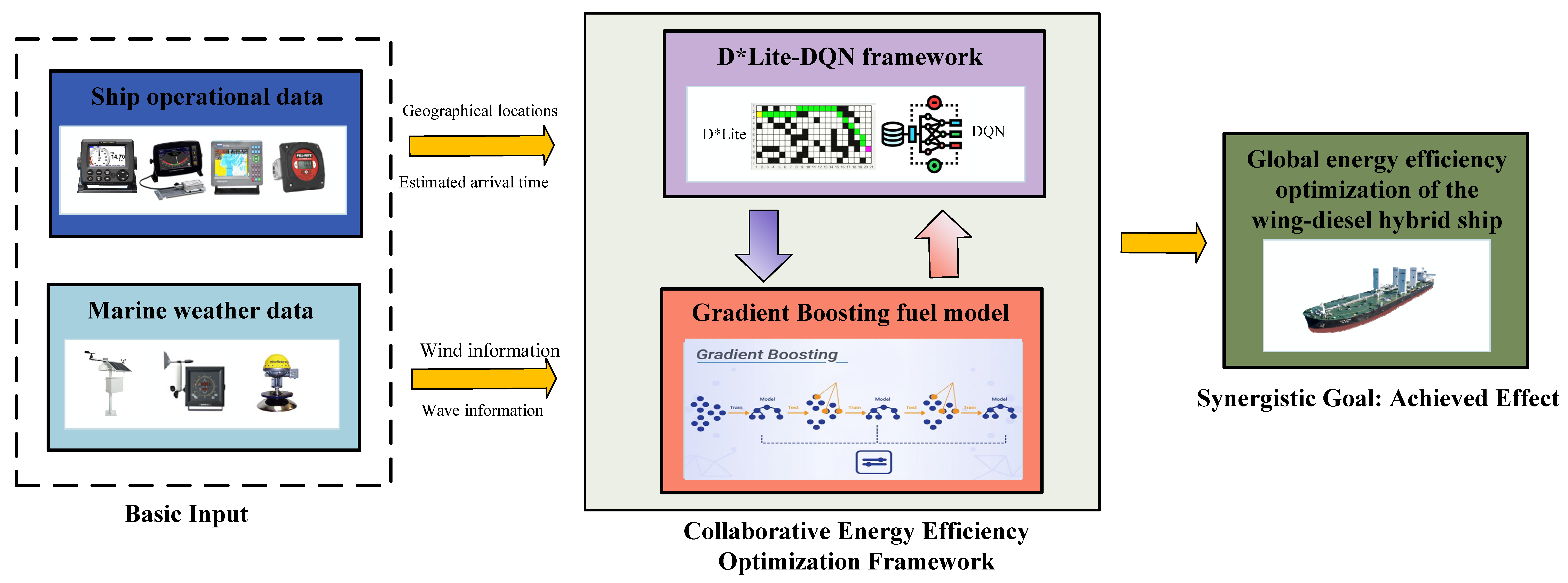
- The combination of D*Lite and DQN is complementary and synergistic: D*Lite provides stable global safety constraints, while DQN performs local adaptive energy efficiency optimization within the safe corridor. This hybrid structure overcomes the weaknesses of single algorithms—such as the insufficient decision-making adaptability of graph search methods and a lack of global safety guarantees in single DQNs.
2. Materials and Methods
2.1. Materials
2.1.1. Ship and Wing-Sail Parameters
2.1.2. Data Sources
- (1)
- Ship operational data
- (2)
- Meteorological and hydrological data
- (3)
- Piracy risk data
2.1.3. Target Sea Area Demarcation
2.2. Data Preprocessing
- (1)
- Abnormal data cleaning
- (2)
- Spatiotemporal interpolation
- (3)
- Relative wind parameter calculation
2.3. Fuel Consumption Prediction Model Based on Gradient Boosting Algorithm
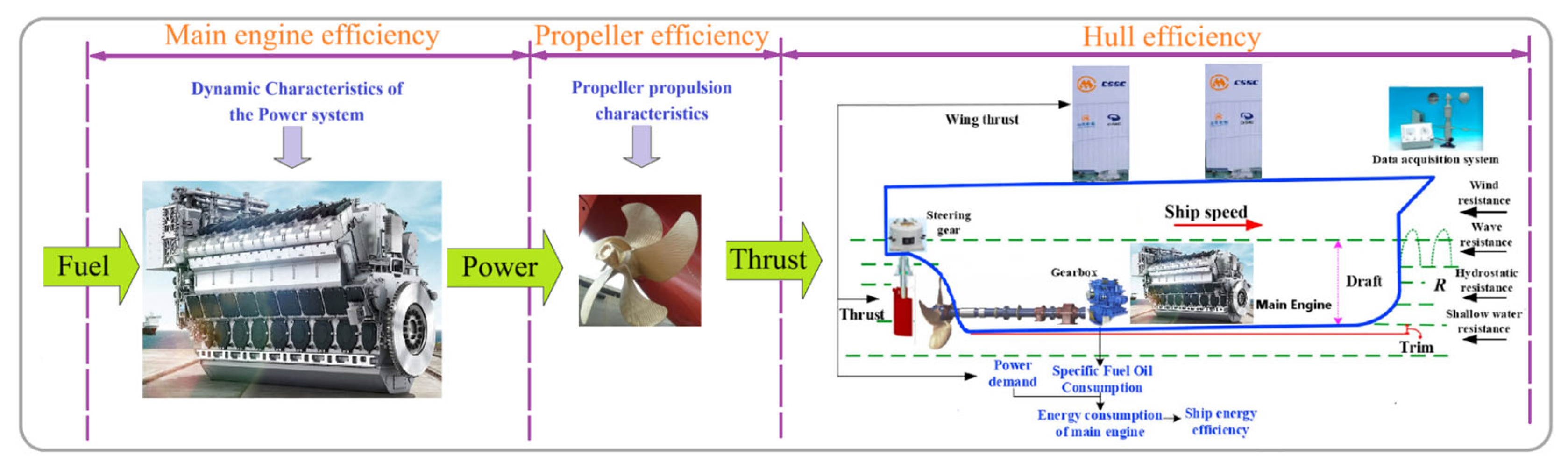
2.3.1. Wind-Assisted Diesel Power System
2.3.2. Model Principle
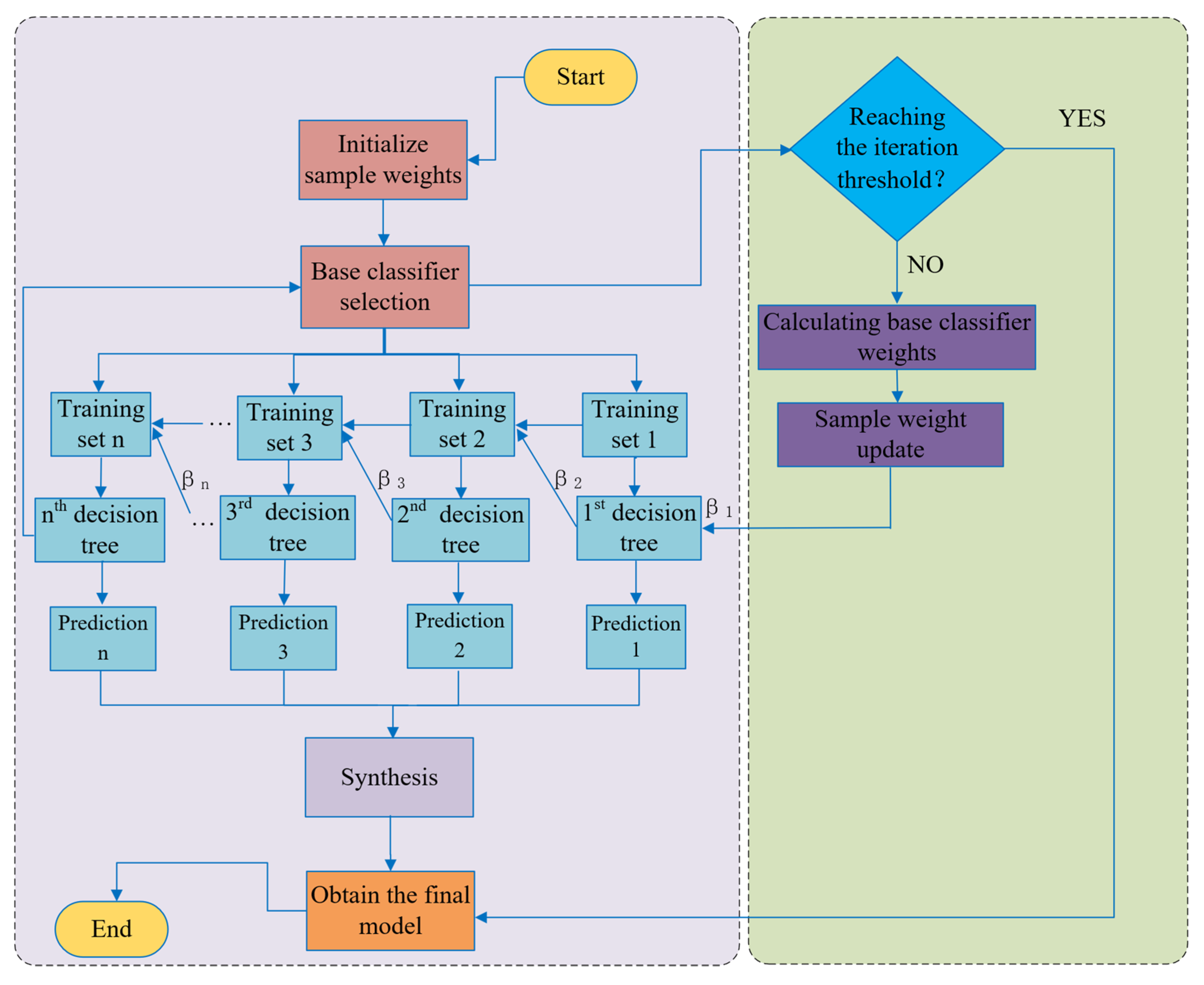
2.3.3. Model Training
- (1)
- Training data preprocessing
- (2)
- Hyperparameter setting of the gradient boosting algorithm
- (3)
- Initialization of training set weight distribution
- (4)
- Iterative training of weak learners
- (5)
- Ensemble of strong learners
2.3.4. Model Performance Verification
2.4. Optimization Algorithm Framework
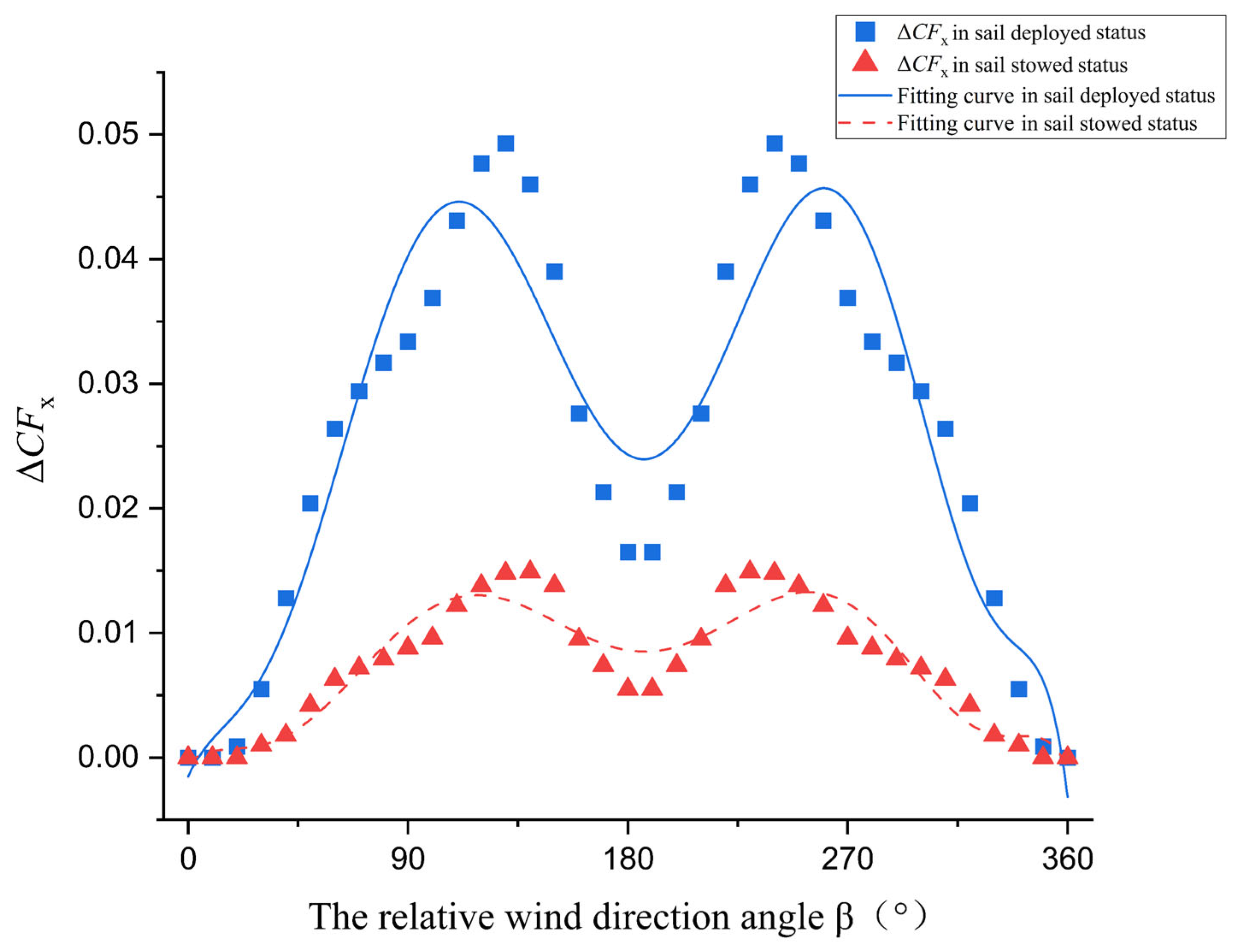
2.4.1. Wing-Sail Operational Status Definition
- (1)
- Sail-deployed status
- (2)
- Sail-stowed status
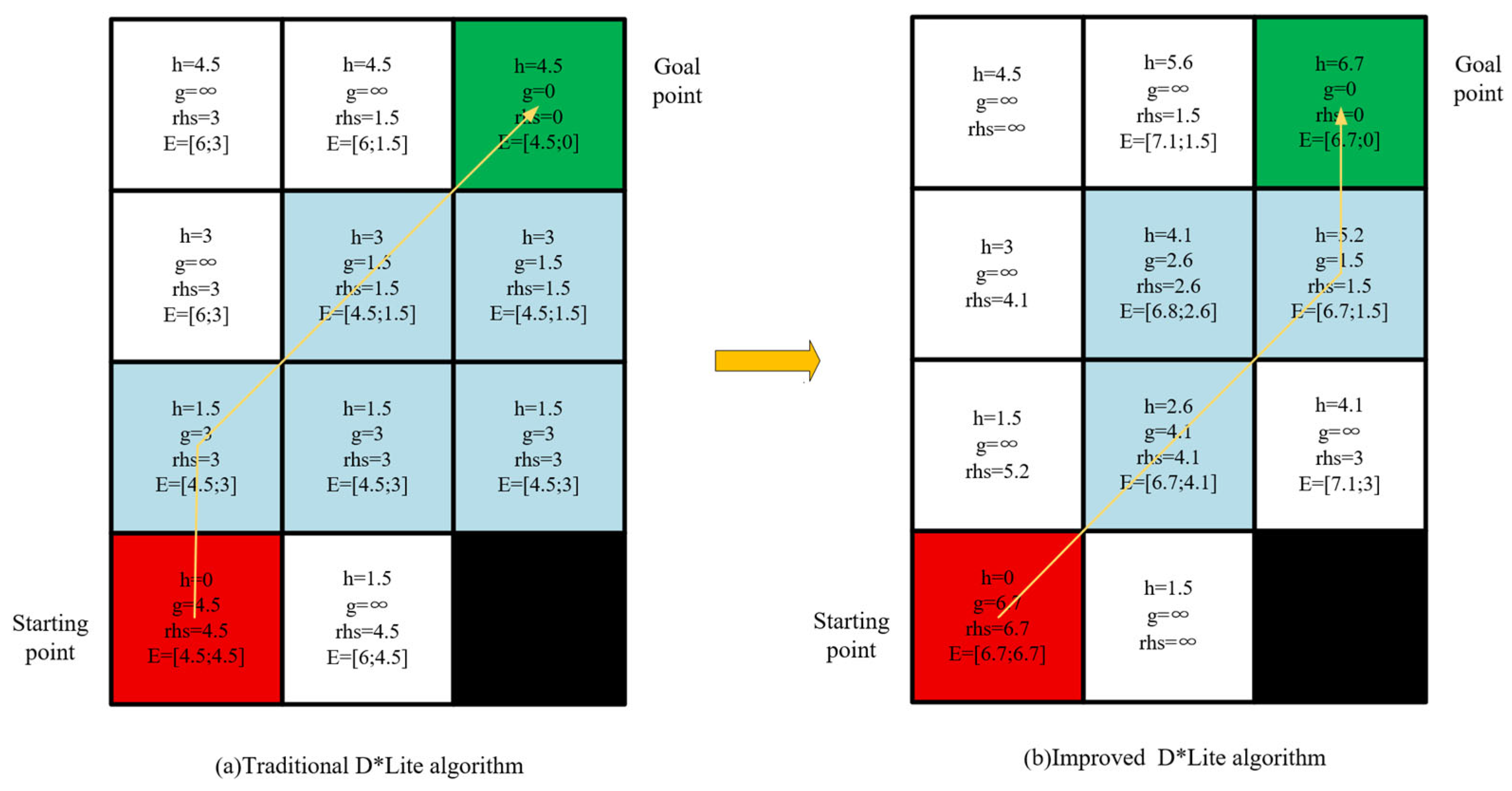
2.4.2. Improved D*Lite Algorithm for Global Safe Path Planning
- (1)
- Cost function optimization
- (2)
- Incremental replanning mechanism
- (3)
- Node expansion optimization
2.4.3. Improved DQN Algorithm for Dynamic Adaptive Decision-Making
- (1)
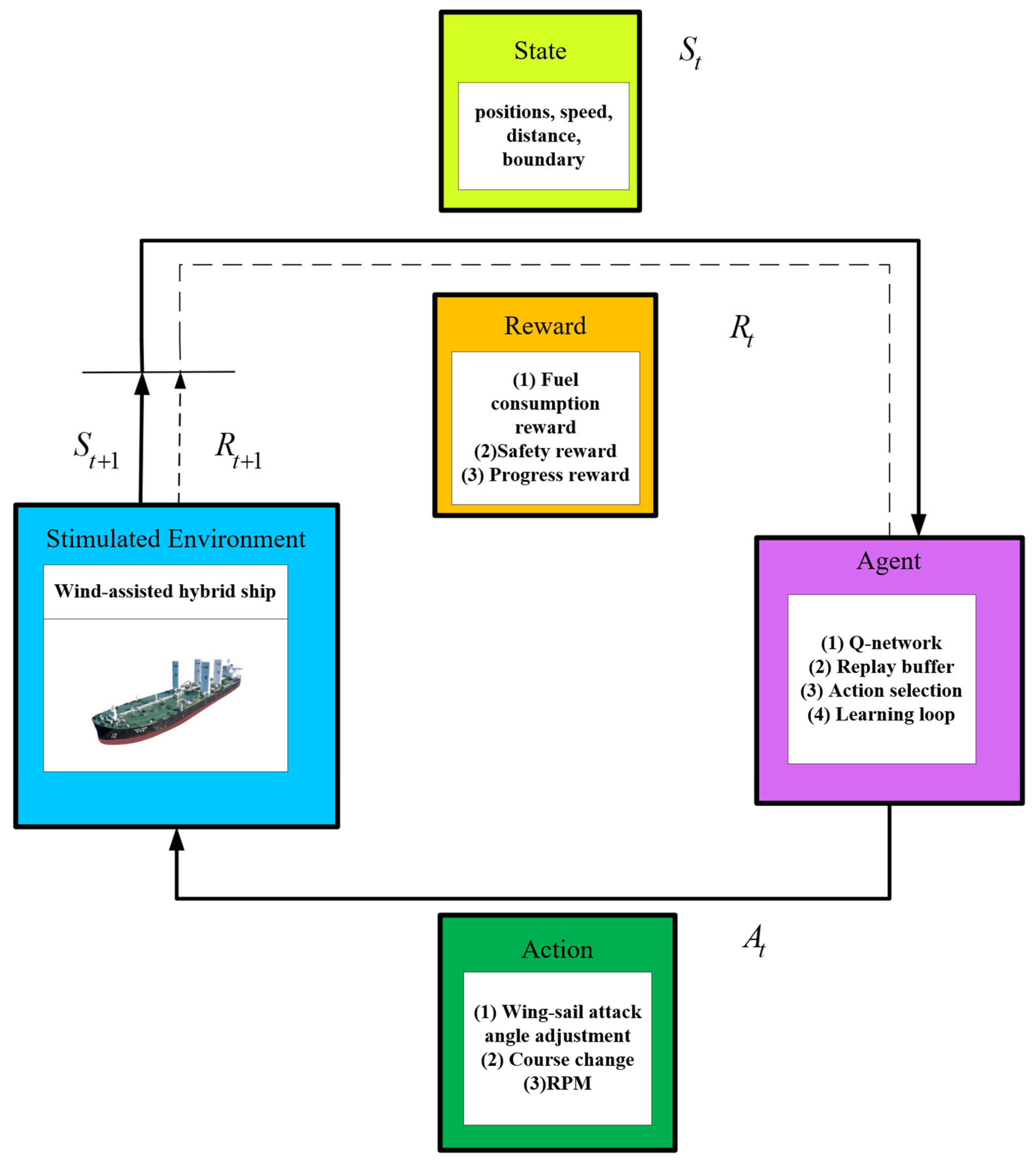
- State and action space definition
- (2)
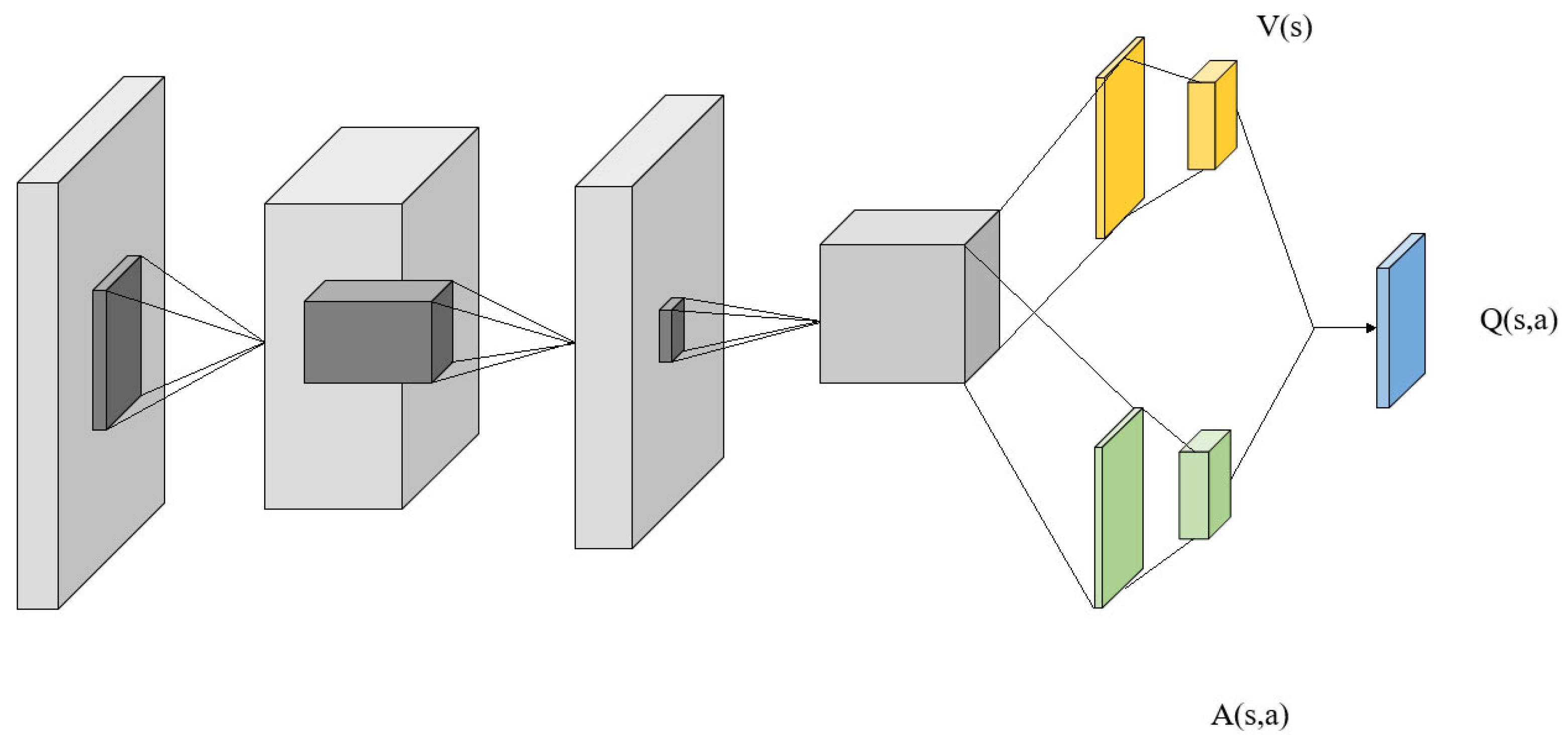
- DQN Improvements
- (3)
- Sail Status-Aware Differentiated Reward Function
- Fuel reward function,
- Progress reward,
- Safety reward function,
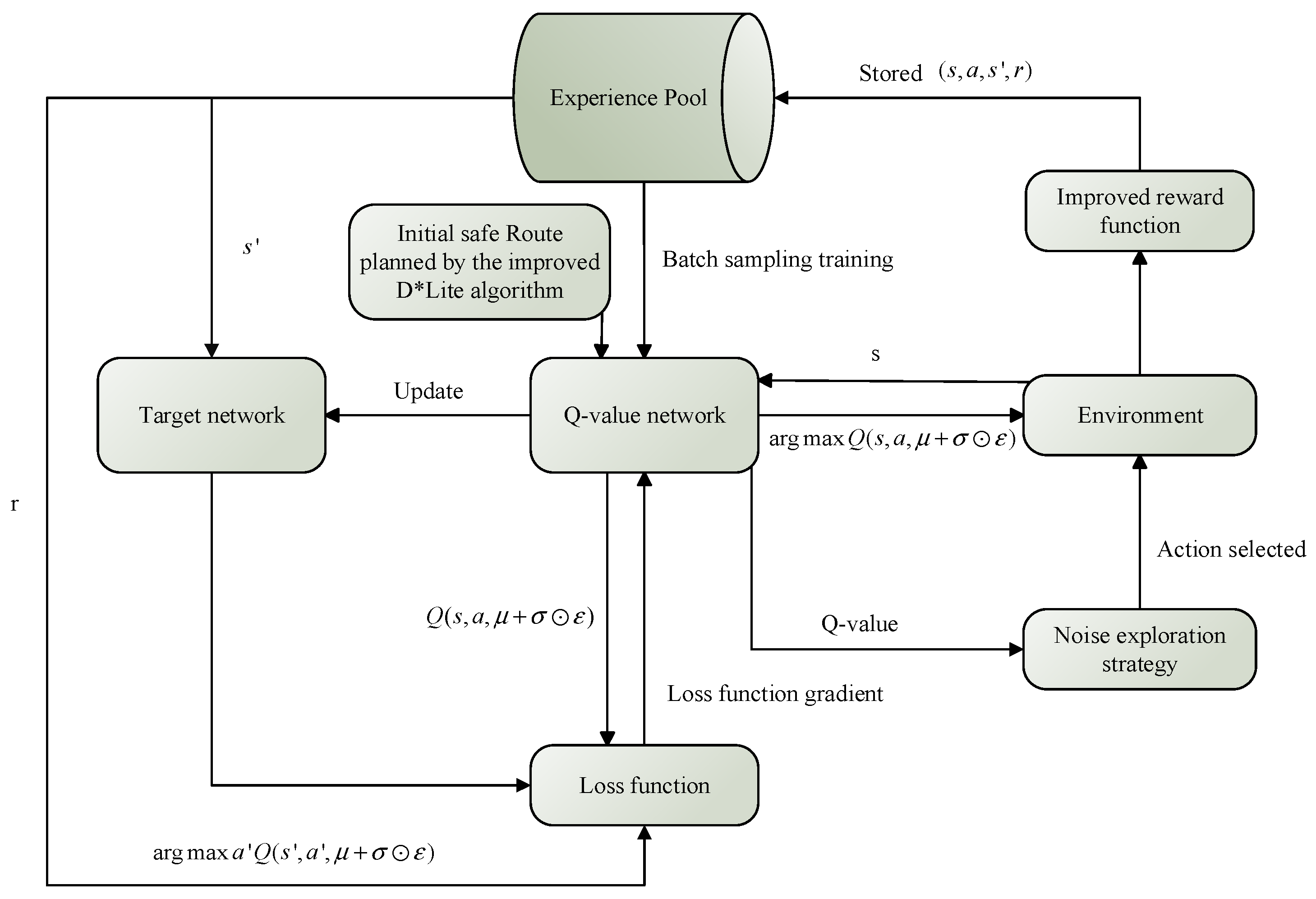
2.4.4. Integration of D*Lite and DQN Algorithm
- (1)
- Initialization
- (2)
- Real-time collaborative optimization
- (3)
- Experience update and network training
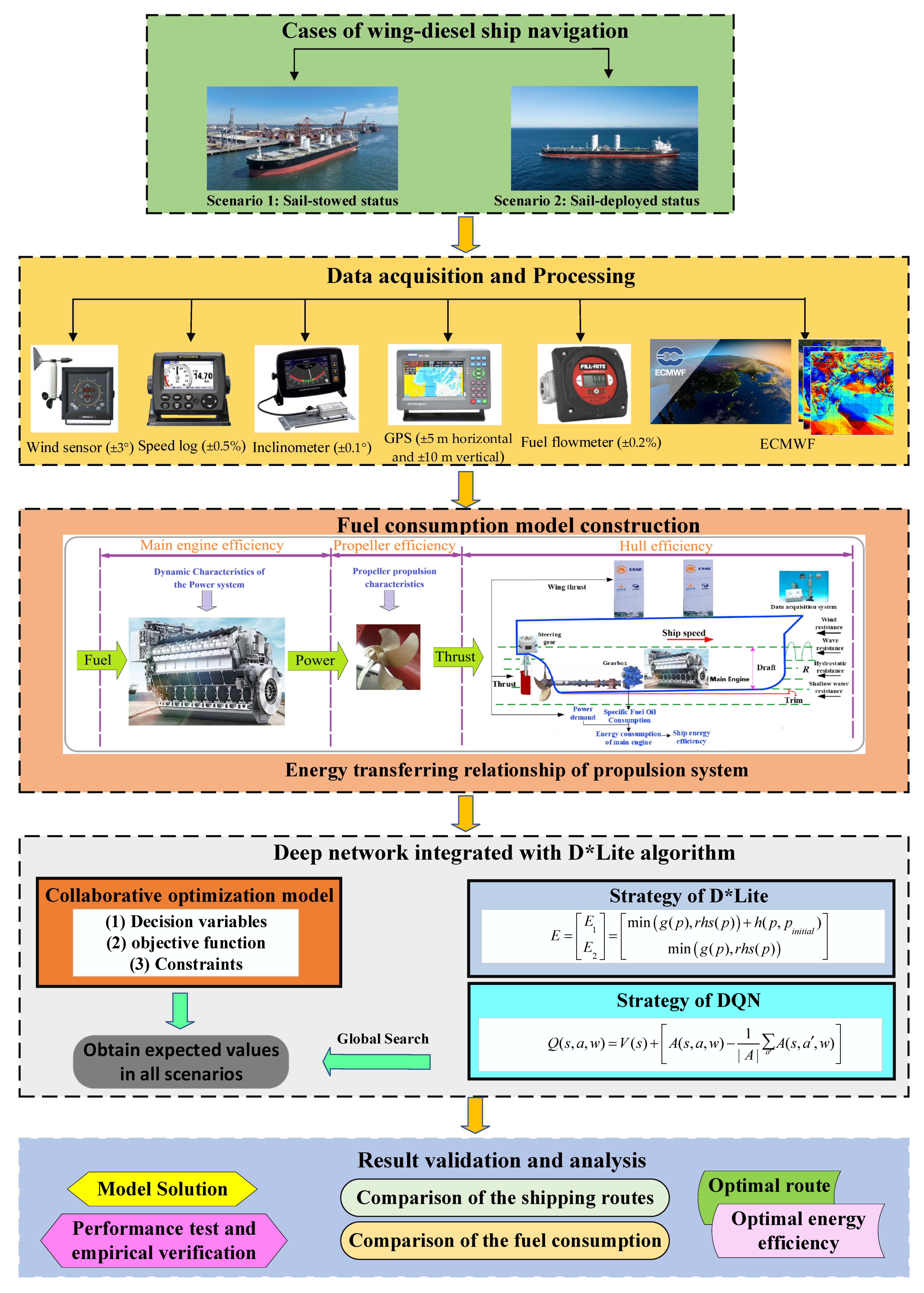
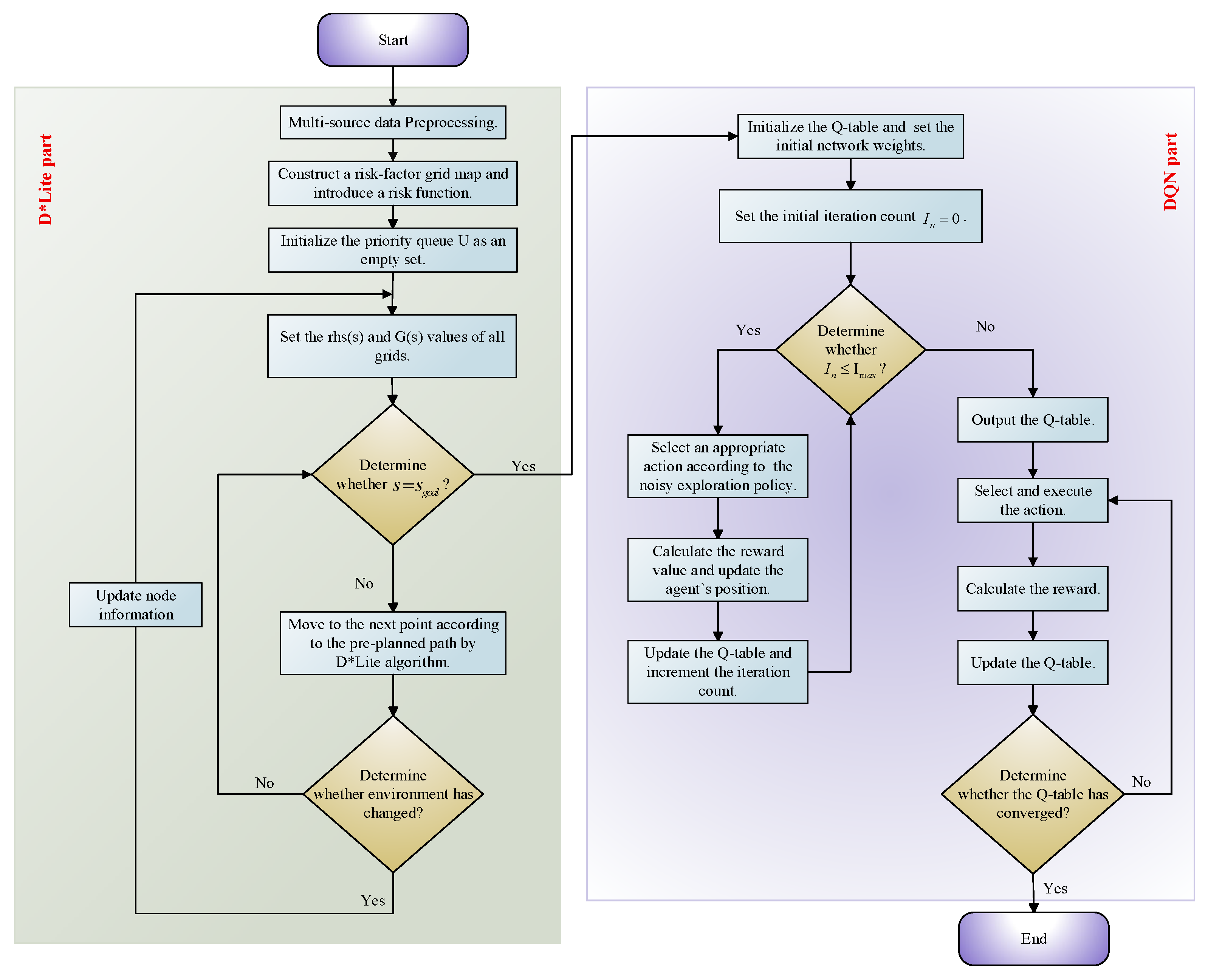
2.4.5. Algorithm Flow Design
- (1)
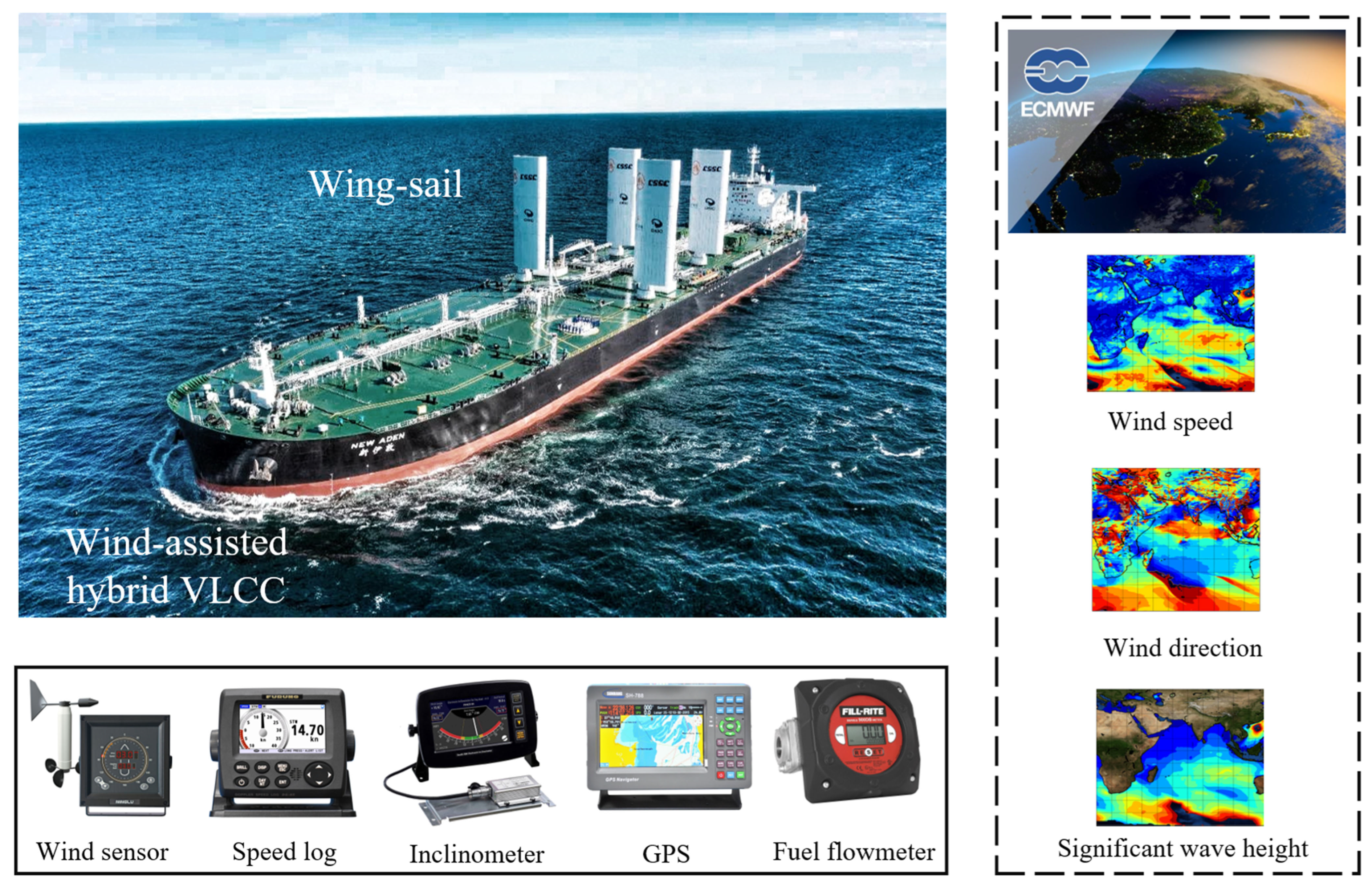
- A comprehensive set of multi-source data is leveraged, including ship performance metrics, wing-sail parameters, diesel engine specifications, and dynamic meteorological and hydrological conditions, which are loaded and subjected to preprocessing. The fuel consumption prediction model is subsequently initialized based on this curated data, serving as the cornerstone for evaluation in the ensuing optimization framework.
- (2)
- We construct a risk-factor grid map and introduce a risk function. We initialize the priority queue U as an empty set. We set the required heuristic value and actual cost from the current node to the target node, , of all grids to infinity. Specifically, we set the value of the goal node, , to 0, calculate the key value of based on the evaluation function (), and insert into the priority queue .
- (3)
- For the expansion nodes of the current node, we calculate the values derived from the key value of nodes in the priority queue and insert these expansion nodes into the priority queue . We pop the node with the smallest value from and designate it as the new current node. We repeat this node expansion and selection process until the start node is reached. On this basis, we compute the pre-planned path to initially generate a feasible navigation path.
- (4)
- After moving to the next waypoint according to the pre-planned path generated by the D*Lite algorithm, we check whether the environment has changed. The environment change is determined by synchronizing external data sources to refresh the navigability state, , of the grid map, to show that grids occupied by new obstacles or assessed as high-risk indicate an environment change.
- (5)
- Based on the initial safe path generated in Steps (2) to (4), we initialize the weights of the dueling DQN rather than a traditional Q-table. Specifically, we substitute the initial safe path’s reward, , to determine the initial Q-values of the dueling network.
- (6)
- We set the initial iteration count: . We compare whether the iteration count, , exceeds the maximum allowed iterations per cycle, :
- (7)
- We select an appropriate action using the noisy exploration strategy. The selected action must comply with the ship’s physical maneuvering constraints, and we calculate the comprehensive reward value, using the state-dependent reward function.
- (8)
- When , we output the current Q-values of the dueling network and check for convergence. Convergence is determined by whether the fluctuation of Q-values across consecutive iterations is below a preset threshold:
- (9)
- We update the experience pool using prioritized experience replay:
- (10)
- The algorithm concludes by defining the optimal navigation policy. This policy is constructed such that for any state, , it selects the action, , that maximizes the Q-value function. The resulting policy can, therefore, generate optimal paths that dynamically balance the contributions of wing-sail thrust and diesel engine power while ensuring navigation safety.
3. Results
- (1)
- DQN hyperparameter analysis: When the discount factor, , varied within 0.90–0.99, the fluctuation of the algorithm convergence steps was less than 8%, and the fuel consumption optimization rate remained stable at 4.8–5.02%. When the learning rate, , was adjusted within 0.003–0.01, the algorithm maintained good convergence; while the convergence speed slowed down when , there was no significant decline in the optimization effect. These results confirm that the DQN hyperparameters have strong robustness within a reasonable range.
- (2)
- D*Lite hyperparameter analysis: When the risk weight coefficient, , varied within 0.2–0.5, the planning efficiency of the global safe path did not decrease significantly, and the fluctuation of the fuel consumption optimization rate was only ±0.3%. This verifies the rationality of the design of the risk-aware cost function, and the adjustment of hyperparameters will not have a significant impact on the core optimization effect of the algorithm.
3.1. Fuel Consumption Prediction Model Performance
3.2. Route Optimization Results
- (1)
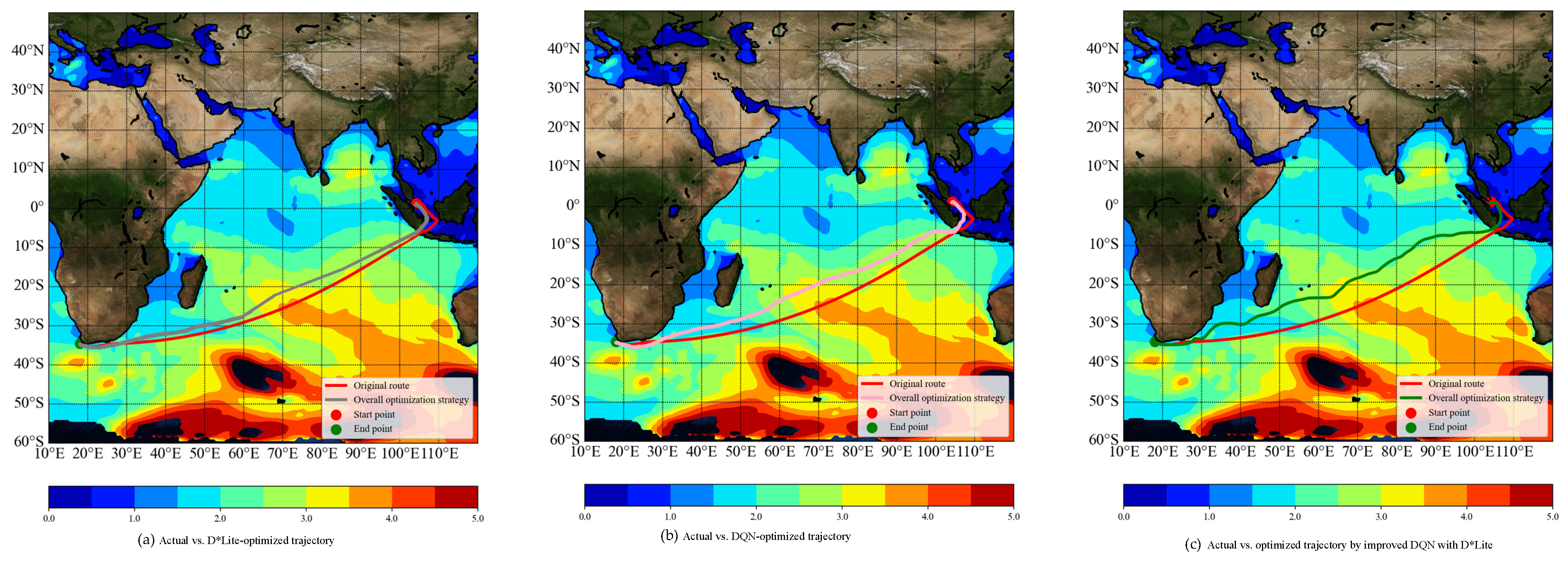
- Actual ship route: The real operational AIS trajectory and fuel consumption data of the target ship on the corresponding route (actual voyage data, with a sampling interval of 10 min), as the practical engineering baseline.
- (2)
- Traditional D*Lite algorithm optimized route: The algorithm is set with the same cost function and environmental constraints as the improved version, only removing the incremental replanning mechanism and risk-aware weight design, as the single global path planning baseline.
- (3)
- Traditional DQN algorithm optimized route: The algorithm retains the basic network structure and training parameters, removing the dueling network, noisy exploration, prioritized experience replay and sail status-aware reward function, as the single local decision-making baseline.
3.3. Sail Status-Aware Optimization Performance
4. Discussion
4.1. Analysis of Optimization Performance
- (1)
- Improved D*Lite algorithm with incremental replanning
- (2)
- Improved DQN with sail status awareness
- (3)
- Gradient boosting-based fuel consumption prediction model
4.2. Comparison with Existing Studies
- (1)
- Global collaborative optimization
- (2)
- Sail status-aware differentiation
- (3)
- High computational efficiency and real-time performance
5. Conclusions
- (1)
- Superior optimization performance: The proposed framework achieves a 5.02% reduction in total fuel consumption, a 140.66-ton reduction in CO2 emissions, and a 7.50% improvement in EEOI compared with the actual ship route, confirming its significant energy efficiency and carbon reduction effects. The slight increase in voyage distance and time is a reasonable trade-off for safety and wind energy utilization.
- (2)
- Effective sail status-aware adaptation: The framework dynamically adjusts optimization objectives, reward function weights, and action selection strategies based on wing-sail operational statuses (sail-deployed and sail-stowed). In the sail-deployed status, it maximizes wind energy utilization to minimize fuel consumption; in the sail-stowed status, it prioritizes navigation safety and maneuverability while balancing fuel economy. This design fully aligns with the physical characteristics of wing–diesel hybrid ships and the dynamic changes of the marine environment.
- (3)
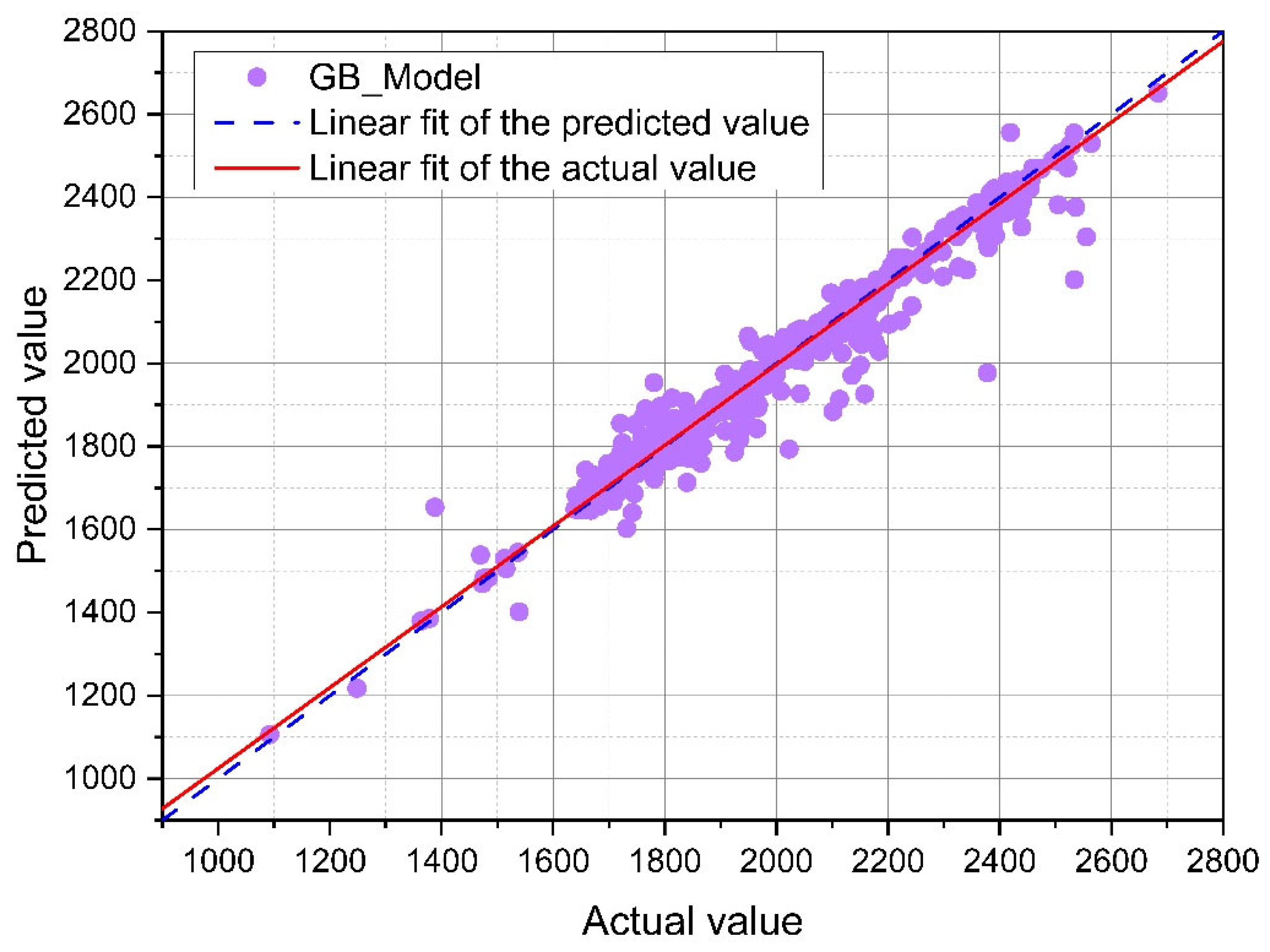
- Reliable fuel consumption prediction: The gradient boosting-based fuel consumption prediction model achieves high prediction accuracy (RMSE = 20.9994, MAE = 7.0864), accurately capturing the nonlinear correlation between ship operational parameters, environmental factors, and fuel consumption. The embedding of the model into the DQN’s reward function provides a reliable quantitative basis for energy efficiency assessment and optimization.
- (4)
- Practical technical value: The proposed framework provides an effective technical solution for the dynamic energy efficiency optimization of wing–diesel hybrid ships, and its real-time performance and adaptability make it suitable for practical maritime operations. It also provides a reference for the design of wind-assisted ship systems and the formulation of maritime emission reduction policies, promoting the sustainable development of the shipping industry.
Author Contributions
Funding
Data Availability Statement
Conflicts of Interest
References
- Wang, K.; Wang, Y.P.; Liang, H.Z.; Jing, Z.S.; Cong, L.H.; Ma, R.Q.; Huang, L.Z. Ship energy efficiency optimization considering the influences of multiple complex navigational environments: A review. Mar. Pollut. Bull. 2025, 216, 117976. [Google Scholar] [CrossRef] [PubMed]
- Dui, H.; Zheng, X.; Wu, S. Resilience analysis of maritime transportation systems based on importance measures. Reliab. Eng. Syst. Saf. 2021, 209, 107461. [Google Scholar] [CrossRef]
- Kawasaki, T.; Lau, Y. Exploring potential cruisers behavior based on a preference model: The Japanese cruise market. Marit. Bus. Rev. 2020, 5, 391–407. [Google Scholar] [CrossRef]
- Dulebenets, M. A Minimizing the Total Liner Shipping Route Service Costs via Application of an Efficient Collaborative Agreement. IEEE Trans. Intell. Transp. Syst. 2018, 20, 123–136. [Google Scholar] [CrossRef]
- International Maritime Organization. Initial IMO Strategy on Reduction of GHG Emissions from Ships. Available online: https://wwwcdn.imo.org/localresources/en/OurWork/Environment/Documents/Resolution%20MEPC.304%2872%29_E.pdf (accessed on 21 March 2026).
- Liang, H.Z.; Wang, K.; Liu, X.; Xing, H.; Li, Z.W.; Jing, Z.S.; Wang, Y.P.; Cao, J.L. A novel fuel consumption optimization strategy for the wind-assisted hybrid power ship considering sea conditions. Energy 2026, 347, 140343. [Google Scholar] [CrossRef]
- Yuan, Y.; Wang, J.; Yan, X.; Li, Q.; Long, T. A design and experimental investigation of a large-scale solar energy/diesel generator powered hybrid ship. Energy 2018, 165, 965–978. [Google Scholar] [CrossRef]
- Hsieh, T.H.; Li, Y.Z.; Wang, S.Z.; Liu, W.; Sun, Z. Ship ocean voyage weather routing optimization method based on weather clustering. Appl. Ocean Res. 2025, 165, 104799. [Google Scholar] [CrossRef]
- Borén, C.; Castells-Sanabra, M.; Grifoll, M. Ship emissions reduction using weather ship routing optimisation. Proc. Inst. Mech. Eng. Part M-J. Eng. Marit. Environ. 2022, 236, 856–867. [Google Scholar] [CrossRef]
- Pennino, S.; Gaglione, S.; Innac, A.; Piscopo, V.; Scamardella, A. Development of a New Ship Adaptive Weather Routing Model Based on Seakeeping Analysis and Optimization. J. Mar. Sci. Eng. 2022, 8, 270. [Google Scholar] [CrossRef]
- Sun, W.Y.; Tang, S.Y.; Liu, X.Y.; Zhou, S.A.; Wei, J.F. An Improved Ship Weather Routing Framework for CII Reduction Accounting for Wind-Assisted Rotors. J. Mar. Sci. Eng. 2022, 10, 1979. [Google Scholar] [CrossRef]
- Formosa, W.; Sant, T.; Muscat-Fenech, C.D.; Figari, M. Wind-Assisted Ship Propulsion of a Series 60 Ship Using a Static Kite Sail. J. Mar. Sci. Eng. 2023, 11, 117. [Google Scholar] [CrossRef]
- Ballini, F.; Olcer, A.I.; Brandt, J.; Neumann, D. Health costs and economic impact of wind assisted ship propulsion. Ocean Eng. 2017, 146, 477–485. [Google Scholar] [CrossRef]
- Bentin, M.; Zastrau, D.; Schlaak, M.; Freye, D.; Elsner, R.; Kotzur, S. A new routing optimization tool-influence of wind and waves on fuel consumption of ships with and without wind assisted ship propulsion systems. Transp. Res. Procedia 2016, 14, 153–162. [Google Scholar] [CrossRef]
- Lindstad, E.; Stokke, T.; Alteskjær, A.; Borgen, H.; Sandaas, I. Ship of the future—A slender dry-bulker with wind assisted propulsion. Marit. Transp. Res. 2022, 3, 100055. [Google Scholar] [CrossRef]
- Li, Y.K.; Qiao, C.F. A route optimization method based on simulated annealing algorithm for wind-assisted ships. In Proceedings of the 2019 5th International Conference on Energy Materials and Environment Engineering, Kuala Lumpur, Malaysia, 12–14 April 2019; Volume 295, p. 042074. [Google Scholar] [CrossRef]
- Jeong, S.; Kim, T.W. Generating a path-search graph based on ship-trajectory data: Route search via dynamic programming for autonomous ships. Ocean Eng. 2023, 283, 114503. [Google Scholar] [CrossRef]
- Zhang, D.H.; Zhang, Y.J.; Zhang, C. Data mining approach for automatic ship-route design for coastal seas using AIS trajectory clustering analysis. Ocean Eng. 2021, 236, 109535. [Google Scholar] [CrossRef]
- Lee, S.M.; Roh, M.I.; Kim, K.S.; Jung, H.; Park, J.J. Method for a simultaneous determination of the path and the speed for ship route planning problems. Ocean Eng. 2018, 157, 301–312. [Google Scholar] [CrossRef]
- Zhang, C.; Zhang, D.; Zhang, M.Y.; Mao, W.G. Data-driven ship energy efficiency analysis and optimization model for route planning in ice-covered Arctic waters. Ocean Eng. 2019, 186, 106071. [Google Scholar] [CrossRef]
- Li, H.H.; Yang, Z.L. Incorporation of AIS data-based machine learning into unsupervised route planning for maritime autonomous surface ships. J. Transp. Res. Part E Logist. Transp. Rev. 2023, 176, 103171. [Google Scholar] [CrossRef]
- Shu, Y.Q.; Zhu, Y.J.; Xu, F.; Gan, L.X.; Lee, P.T.W.; Yin, J.C.; Chen, J.H. Path planning for ships assisted by the icebreaker in ice-covered waters in the Northern Sea Route based on optimal control. Ocean Eng. 2023, 267, 113182. [Google Scholar] [CrossRef]
- Zhang, M.Y.; Kujala, P.; Musharraf, M.; Zhang, J.F.; Hirdaris, S. A machine learning method for the prediction of ship motion trajectories in real operational conditions. Ocean Eng. 2022, 283, 114905. [Google Scholar] [CrossRef]
- Lee, H.T.; Kim, M.K. Optimal path planning for a ship in coastal waters with deep Q network. Ocean Eng. 2024, 307, 118193. [Google Scholar] [CrossRef]
- Pan, W.; Xie, X.L.; He, P.; Bao, T.T.; Li, M. An automatic route design algorithm for intelligent ships based on a novel environment modeling method. Ocean Eng. 2021, 237, 109603. [Google Scholar] [CrossRef]
- Zhan, Y.; Zhang, H.J.; Li, J.H.; Li, G. Prediction Method for Ocean Wave Height Based on Stacking Ensemble Learning Model. J. Mar. Sci. Eng. 2022, 10, 1150. [Google Scholar] [CrossRef]
- Kastrisios, C.; Pilikou, M. Nautical cartography competences and their effect to the realisation of a worldwide Electronic Navigational Charts database, the performance of ECDIS and the fulfilment of IMO chart carriage requirements. Mar. Policy 2017, 75, 29–37. [Google Scholar] [CrossRef]
- Nuñez, A.; Wakulicz, J.; Kong, F.H.; González-Cantos, A.; Fitch, R. Risk-aware stochastic ship routing using constrained continuous belief tree search. Ocean Eng. 2024, 314, 119581. [Google Scholar] [CrossRef]
- Yang, Y.; Shao, Z.P.; Hu, Y.; Mei, Q.; Pan, J.C.; Song, R.X.; Wang, P. Geographical spatial analysis and risk prediction based on machine learning for maritime traffic accidents: A case study of Fujian Sea area. Ocean Eng. 2022, 266, 113106. [Google Scholar] [CrossRef]
- Li, Y.K.; Yang, F.; Zhang, X.Y.; Yu, D.Y.; Yang, X.F. Improved D* Lite Algorithm for Ship Route Planning. J. Mar. Sci. Eng. 2024, 12, 1554. [Google Scholar] [CrossRef]
- Xu, W.F.; Zhu, X.; Gao, X.R.; Li, X.Y.; Cao, J.P.; Ren, X.L.; Shao, C.C. Manipulation-Compliant Artificial Potential Field and Deep Q-Network: Large Ships Path Planning Based on Deep Reinforcement Learning and Artificial Potential Field. J. Mar. Sci. Eng. 2024, 12, 1334. [Google Scholar] [CrossRef]
- Zhou, L.Q.; Jin, J.G.; Gao, Y.L.; Iris, C.; Bektaş, T.; Chen, J.H. Techno-economic optimization for containership green transition under net-zero emission target: A predict-then-optimize framework. Transp. Res. Part E Logist. Transp. Rev. 2026, 209, 104731. [Google Scholar] [CrossRef]
- Zhang, R.; Huang, L.Z.; Peng, G.S.; Ma, R.Q.; Wang, K.; Tian, F.; Song, Q.S. A novel method of desynchronized operating sails for ship wind-assisted propulsion system. Ocean Eng. 2023, 288, 115964. [Google Scholar] [CrossRef]
- Wang, K.; Guo, X.; Zhao, J.H.; Ma, R.Q.; Huang, L.Z.; Tian, F.; Dong, S.Y.; Zhang, P.; Liu, C.L.; Wang, Z. An integrated collaborative decision-making method for optimizing energy consumption of sail-assisted ships towards low-carbon shipping. Ocean Eng. 2022, 266, 112810. [Google Scholar] [CrossRef]
- Le, T.T.; Sharma, P.; Pham, N.D.K.; Le, D.T.N.; Le, V.V.; Osman, S.M.; Rowinski, L.; Tran, V.D. Development of comprehensive models for precise prognostics of ship fuel consumption. J. Mar. Eng. Technol. 2024, 23, 451–465. [Google Scholar] [CrossRef]
- Lan, T.; Huang, L.Z.; Cao, J.L.; Ma, R.Q.; Zhao, H.Y.; Ruan, Z.; Wu, J.Y.; Li, X.W.; Wang, K. A pioneering approach for improving ship operational energy efficiency: The quantitative application of deep learning interpretable results. Appl. Energy 2025, 400, 126554. [Google Scholar] [CrossRef]
- Du, Y.; Chen, Y.; Li, X.; Schönborn, A.; Sun, Z. Data fusion and machine learning for ship fuel efficiency modeling: Part II–Voyage report data, AIS data and meteorological data. Commun. Transp. Res. 2022, 2, 100073. [Google Scholar] [CrossRef]
- Ma, W.H.; Han, Y.Y.; Tang, H.; Ma, D.F.; Zheng, H.R.; Zhang, Y. Ship route planning based on intelligent mapping swarm optimization. J. Comput. Ind. Eng. 2023, 176, 108920. [Google Scholar] [CrossRef]
- Wang, C.; Huang, L.Z.; Ma, R.Q.; Wang, K.; Sheng, J.L.; Ruan, Z.; Hua, Y.; Zhang, R. A novel cooperative optimization method of course and speed for wing-diesel hybrid ship based on improved A* algorithm. Ocean Eng. 2024, 302, 117669. [Google Scholar] [CrossRef]



| Sample Time | Latitude (°) | Longitude (°) | Sailing Speed (Knot) | Course | … | Characteristic Wave Height (m) | Wave Direction (°) | Relative Wave Direction (°) |
|---|---|---|---|---|---|---|---|---|
| 22 October 2022 8:20 | 1.32 | 104.16 | 13.35 | 160.50 | … | 0.153 | 332.99 | 172.49 |
| 22 October 2022 8:30 | 1.31 | 104.16 | 13.23 | 142.35 | … | 0.154 | 331.25 | 188.89 |
| 22 October 2022 8:40 | 1.30 | 104.16 | 13.13 | 140.30 | … | 0.156 | 334.96 | 194.66 |
| … | … | … | … | … | … | … | … | … |
| 9 November 2022 16:10 | −34.55 | 18.06 | 13.70 | 334.82 | … | 2.697 | 224.08 | −110.74 |
| 9 November 2022 16:20 | −34.51 | 18.04 | 13.80 | 337.98 | … | 2.711 | 223.92 | −114.06 |
| 9 November 2022 16:30 | −34.48 | 18.02 | 13.85 | 337.05 | … | 2.726 | 223.76 | −113.28 |
| Sample Time | Latitude (°) | Longitude (°) | Sailing Speed (Knot) | Course | Wind Velocity (m/s) | Wind Direction (°) | Relative Wind Velocity (m/s) | Relative Wind Direction (°) |
|---|---|---|---|---|---|---|---|---|
| 22 October 2022 8:20 | 1.32 | 104.16 | 13.35 | 160.50 | 3.95 | 279.06 | 8.37 | 122.20 |
| 22 October 2022 8:30 | 1.31 | 104.16 | 13.23 | 142.35 | 3.96 | 279.55 | 8.96 | 108.68 |
| 22 October 2022 8:40 | 1.30 | 104.16 | 13.13 | 140.30 | 3.94 | 280.54 | 8.31 | 101.00 |
| … | … | … | … | … | … | … | … | … |
| 9 November 2022 16:10 | −34.55 | 18.06 | 13.70 | 334.82 | 6.44 | 203.54 | 11.42 | 83.98 |
| 9 November 2022 16:20 | −34.51 | 18.04 | 13.80 | 337.98 | 6.45 | 201.70 | 13.54 | 60.84 |
| 9 November 2022 16:30 | −34.48 | 18.02 | 13.85 | 337.05 | 6.46 | 199.92 | 12.40 | 58.11 |
| Features | Unit |
|---|---|
| Ship speed | |
| Significant height of wind waves | |
| Wave direction | |
| Relative wave direction | |
| Relative wind direction | |
| Relative wind speed |
| 100 | 0.03 | 8 | 0.85 | 5 |
| Sai Status | Environmental Threshold | Shipping Scenario | Duration Requirement |
|---|---|---|---|
| Sail-deployed status | Open waters | ||
| Sail-stowed status | Departure/Berthing, Restricted waters, Piracy-prone areas | Instant trigger |
| Model | RMSE | MAE | R2 |
|---|---|---|---|
| Gradient Boosting | 21.0 | 0.987 |
| Shipping Route | Voyage Distance (n Mile) | Sailing Time (h) | Sailing Fuel Consumption (t) |
|---|---|---|---|
| Actual ship route | 5464.56 | 440.26 | 944.98 |
| Optimized route by D*Lite | 5503.4 | 450.33 | 921.47 |
| Optimized route by DQN | 5560.37 | 457.71 | 905.21 |
| Optimized route by D*Lite with DQN | 5612.91 | 467.29 | 899.81 |
Disclaimer/Publisher’s Note: The statements, opinions and data contained in all publications are solely those of the individual author(s) and contributor(s) and not of MDPI and/or the editor(s). MDPI and/or the editor(s) disclaim responsibility for any injury to people or property resulting from any ideas, methods, instructions or products referred to in the content. |
© 2026 by the authors. Licensee MDPI, Basel, Switzerland. This article is an open access article distributed under the terms and conditions of the Creative Commons Attribution (CC BY) license.
Share and Cite
Wang, C.; Huang, L.; Li, X.; Ma, R.; Cao, J.; Zhang, R.; Zhao, H. A Global Optimization Framework for Energy Efficiency of Wing–Diesel Hybrid Ships Under Distinct Sail-Statuses Based on Improved Deep Q-Network and D*Lite Algorithm. J. Mar. Sci. Eng. 2026, 14, 657. https://doi.org/10.3390/jmse14070657
Wang C, Huang L, Li X, Ma R, Cao J, Zhang R, Zhao H. A Global Optimization Framework for Energy Efficiency of Wing–Diesel Hybrid Ships Under Distinct Sail-Statuses Based on Improved Deep Q-Network and D*Lite Algorithm. Journal of Marine Science and Engineering. 2026; 14(7):657. https://doi.org/10.3390/jmse14070657
Chicago/Turabian StyleWang, Cong, Lianzhong Huang, Xiaowu Li, Ranqi Ma, Jianlin Cao, Rui Zhang, and Haoyang Zhao. 2026. "A Global Optimization Framework for Energy Efficiency of Wing–Diesel Hybrid Ships Under Distinct Sail-Statuses Based on Improved Deep Q-Network and D*Lite Algorithm" Journal of Marine Science and Engineering 14, no. 7: 657. https://doi.org/10.3390/jmse14070657
APA StyleWang, C., Huang, L., Li, X., Ma, R., Cao, J., Zhang, R., & Zhao, H. (2026). A Global Optimization Framework for Energy Efficiency of Wing–Diesel Hybrid Ships Under Distinct Sail-Statuses Based on Improved Deep Q-Network and D*Lite Algorithm. Journal of Marine Science and Engineering, 14(7), 657. https://doi.org/10.3390/jmse14070657