Article

An MMC-Based Fracture Failure Assessment Framework for In-Service X80 Pipelines with Circumferential Cracks Under Combined Loads


1
Shanghai Engineering Research Center of Marine Renewable Energy, College of Engineering Science and Technology, Shanghai Ocean University, Shanghai 201306, China
2
College of Civil Engineering and Architecture, Zhejiang University, Hangzhou 310058, China
3
Ordos Carbon Neutralization Research and Application Co., Ltd., Ordos 017000, China
4
Inner Mongolia Western Natural Gas Co., Ltd., Ordos 017004, China
5
Guangdong OPR Hydrogen Energy Technology Co., Ltd., Foshan 528200, China
*
Author to whom correspondence should be addressed.
J. Mar. Sci. Eng. 2026, 14(7), 659; https://doi.org/10.3390/jmse14070659
Submission received: 2 March 2026 / Revised: 27 March 2026 / Accepted: 30 March 2026 / Published: 31 March 2026
(This article belongs to the Section Ocean Engineering)

Abstract

In marine renewable energy applications, offshore steel pipelines are subjected to complex combined loads during installation and operation, leading to significant plastic deformation and potential catastrophic fracture. To accurately characterize pipeline fracture failure, this study develops an enhanced failure assessment framework based on the Modified Mohr–Coulomb (MMC) criterion, integrating experimental parameter evaluation with numerical simulation for in-service offshore pipelines. The key parameters of the MMC model were determined directly from in-service pipeline samples to account for operational degradation. First, the plastic parameters were obtained by fitting the Swift hardening law to uniaxial tensile tests. Fracture parameters were then calibrated using a suite of five notched tensile specimens. Mesh sensitivity was analyzed using CT experiments to establish a suitable mesh size for the MMC-based damage model, enabling precise characterization of crack evolution from initiation to final tearing. Unlike prior applications, this framework is employed to investigate the response of X80 pipelines under combined tension, bending, and external pressure loading. Three-dimensional finite element models were developed to systematically analyze the stress–strain response, moment–curvature behavior, and evolution of hoop stress distribution. Results show that while the failure stress remains relatively stable under varying external pressure, both the critical strain and critical curvature increase markedly with pressure, by up to 20.9%. They also reveal a pronounced hierarchy in the influence of crack geometry on the failure behavior. Crack depth dominates failure sensitivity, affecting critical strain and pressure response far more than crack width or length. The reduction in failure stress for deep cracks under 12 MPa external pressure is over three times greater than for shallow cracks. In contrast, variations in crack length exert the most negligible influence on failure characteristics, with observed discrepancies of less than 6%. Overall, this research provides a high-precision failure prediction framework for in-service pipelines by quantitatively analyzing failure behavior under combined loads. It effectively characterizes failure evolution paths that differ from design conditions and dynamically tracks the residual fracture resistance after time-dependent degradation, offering a fundamental reference for the reliability assessment of pipelines in complex marine environments.

1. Introduction

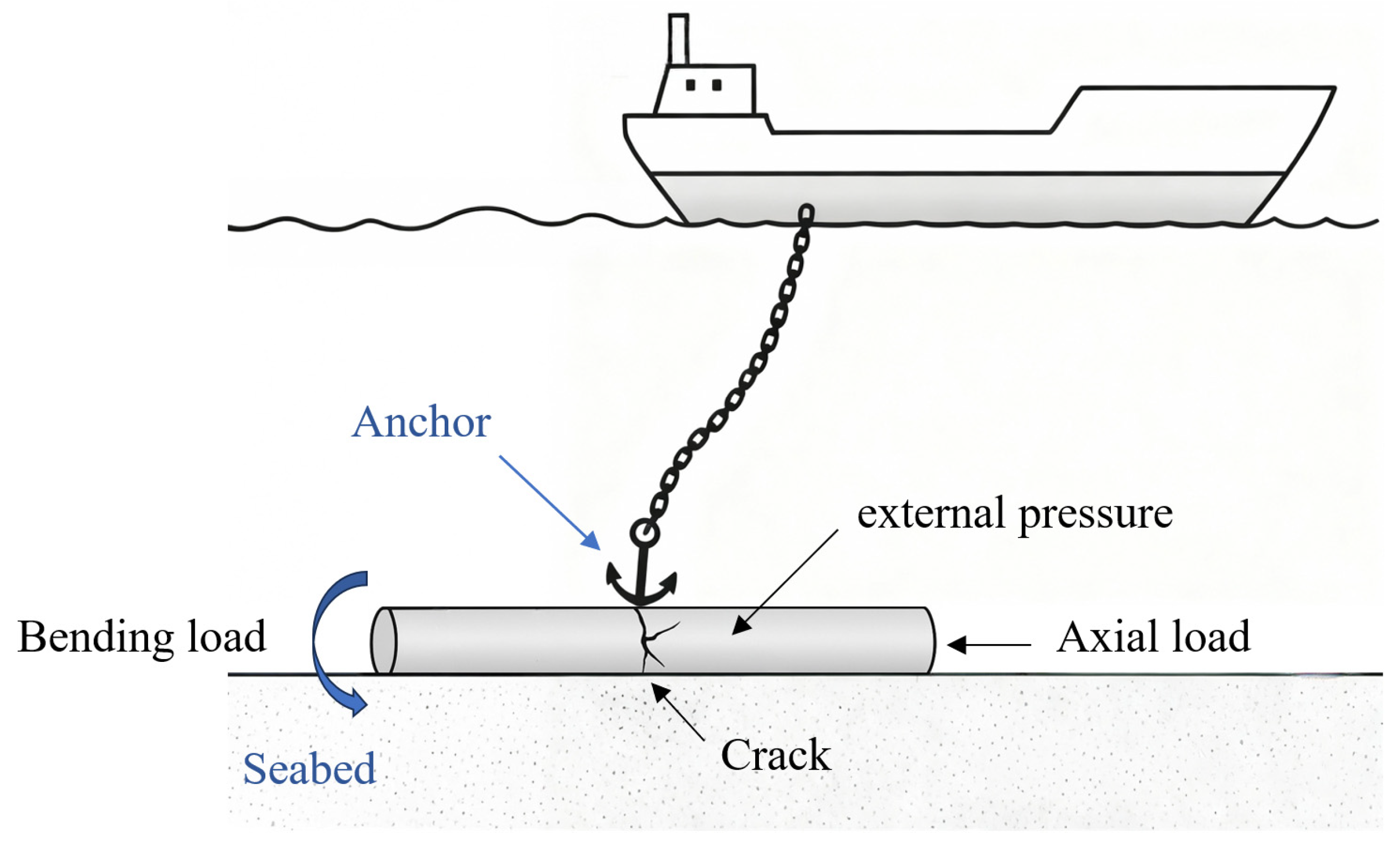
Global energy demand and marine resource development have led to the extensive deployment of subsea pipelines in deep-sea environments. However, these systems face severe reliability challenges due to high hydrostatic pressure, corrosive media, and complex hydrodynamic forces. In regions of stress concentration, exposure to chloride ions can trigger stress corrosion cracking, which often propagates undetected until catastrophic failure. Additionally, mechanical threats, such as high-energy anchor impacts and trawling operations, account for approximately 30% to 40% of total offshore pipeline failures [1]. These incidents result in localized cracking and accelerate structural fatigue. Furthermore, geological activities like submarine landslides and seismic events can induce large-scale deformations, including buckling and rupture [2]. These multifaceted risks necessitate advanced monitoring and protective strategies to ensure long-term structural integrity. A schematic of anchor impact and environmental loads acting on offshore pipelines is shown in Figure 1.
The safe operation of offshore pipelines requires effective assessment of crack-like defects. The following lists various forms of degradation in high-strength steel pipes, as well as recent advancements in pipeline integrity assessment. Through full-scale hydrostatic burst testing, Qi et al. [3] evaluated the predictive accuracy of the ASME B31G and PCORRC criteria regarding the residual strength of defective X52 steel pipelines. In a related study, Schell, C. A et al. [4] examined the role of Strain-Based Design and Assessment (SBDA) as an emerging pipeline design standard for risk evaluation. Okyere, M. S [5] developed an internal corrosion risk prediction framework for wet sour gas pipeline systems based on CFD to assess pipeline and structural integrity. Wu et al. [6] investigated the corrosion behavior, corrosion modeling, and mechanical property degradation laws of Q235 welded steel pipes after 25 years of service in an industrial atmospheric environment. To elucidate the hydrogen-induced buckling failure mechanism of subsea hydrogen-blended natural gas pipelines, Cao et al. [7] combined experimental and numerical simulations to propose a safety assessment method accounting for initial imperfections. Meniconi et al. [8,9] demonstrated the effectiveness of transient testing techniques for subsea pipeline fault detection by combining field test data with 1D numerical and analytical models used for transient pressure signal analysis. Furthermore, they discussed the selection of pressure wave generation maneuvers, field test preparation procedures, and methods to ensure pressure stability prior to transient testing, thereby laying the foundation for subsequent fault detection.
Given that subsea pipelines are susceptible to significant deformation and external influences, fracture response is often characterized using parameters such as CTOD (Crack Tip Opening Displacement) and the J-integral (energy release rate). These single-parameter methods describe crack behavior during initiation and stable growth and are used to evaluate the unstable fracture of ductile materials [10]. It should be noted that the conventional J-integral is applicable only to a stationary crack prior to the onset of propagation [11]. To address this limitation, Paris et al. [12] proposed the J–R curve method for characterizing unstable crack growth, thereby overcoming the static constraints of conventional fracture mechanics. With advances in computational mechanics and experimental techniques, J-integral is poised to play a more prominent role in multiscale and multiphysics fracture analyses. Iranmehr et al. [13] combined the extended finite element method with cohesive segment analysis to demonstrate the constraint-dependent nature of fracture behavior. Furthermore, Zhao et al. [14] proposed a strain-based J-integral formulation that can efficiently evaluate the crack driving force at the pipeline crack front, particularly under conditions of large axial deformation. In the above studies on fracture response, researchers primarily focused on conventional fracture criteria.
Gurson models [15] remain the most prevalent within the framework of coupled fracture criteria. While the original model relies on void volume fraction to describe damage, the subsequent GTN model by Tvergaard and Needleman [16] introduced an adjusted yield condition to capture void coalescence and material failure. Nevertheless, the GTN model struggles with shear-dominated deformation—where non-spherical void growth occurs—restricting its accuracy in low stress triaxiality regimes. Efforts by Nahshon and Hutchinson [17] and Nielsen and Tvergaard [18] have mitigated these issues by introducing or limiting shear components based on the triaxiality level. Additionally, Hu et al. [19] introduced an improved GTNZ model to better capture fracture under high triaxiality and high Lode parameter conditions. However, practical implementation faces two primary obstacles. The GTN framework requires the calibration of multiple physical and semi-empirical parameters, which is a complex process [20]. Furthermore, when implemented as subroutines in FEA, the need to solve nonlinear equations at each integration point per increment leads to high computational costs and frequent numerical convergence issues [21].
Unlike coupled fracture criteria, uncoupled models are primarily phenomenological, offering analytical simplicity and fewer material parameters. These features streamline calibration and finite element implementation, significantly reducing computational costs. Bai and Wierzbicki [22] introduced the Modified Mohr–Coulomb (MMC) fracture criterion, which had previously been utilized as a decoupled method for rock and soil materials. The MMC criterion captures variations in fracture strain resulting from small changes in stress triaxiality and predicts fracture strain through stress functions defined on the stress triaxiality plane. Wu et al. [23] validated the MMC model using experimental data from AA 2024-T351 and additive manufactured Ti6Al-4V alloys. Their findings demonstrated that the MMC criterion is particularly suitable for plane stress states and can accurately predict fracture initiation. Similarly, Sarzosa et al. [24] employed the MMC criterion to characterize the ductile fracture response of girth welds in corrosion-resistant Inconel 625 pipelines, reporting a strong correlation between numerical and experimental results. Ji et al. [25] also adopted the MMC model to investigate the fracture behavior of 6061-T5 aluminum alloy under complex loading, further confirming the reliability of this criterion. Beyond the MMC model, several other uncoupled fracture models are widely utilized. Park [26] used the damage indicator framework of the Hosford–Coulomb (HC) model to characterize damage accumulation and fracture behavior, demonstrating its accuracy in predicting fracture initiation under ultra-low cycle fatigue and complex loading. Gao [27] proposed an uncoupled ductile fracture criterion (DFC) that accounts for void evolution to predict the ductile fracture of AMed Ti-6Al-4V. The MMC-based framework developed in this study demonstrates competitive, and in some cases superior, accuracy relative to other mainstream damage models, as evidenced by prior comparative research. Comparative studies have further elucidated the performance of the MMC criterion relative to other damage models. Han et al. [28] evaluated the GTN model against two uncoupled criteria, namely the MMC and the Extended Rice–Tracey (ERT) models, using X80 pipeline steel. While all three models yielded similar results, the MMC criterion provided superior crack-shape resolution. Through predicting the mechanical performance of X80 pipelines with dents under complex stress states, Su et al. [29] conducted a comparative study of three macroscopic uncoupled criteria. The results indicated that the MMC criterion demonstrates superior robustness and applicability for the evaluation of pipeline denting. Finally, Bai, Y. and Wierzbicki, T. [30] calibrated and evaluated 16 fracture models using TRIP 780 steel and 2024-T351 aluminum alloy. Their findings revealed that the MMC criterion achieved the third-smallest average error for the aluminum alloy and the smallest average error for the TRIP 780 steel, proving that the predictive accuracy of the MMC criterion is among the top tier of mainstream fracture models.
In comparing the MMC criterion with pipeline design codes, Saneian et al. [31] noted that traditional standards, such as BS 7910 and R6, are primarily applicable to elastic responses and small plastic strains. In contrast, the MMC criterion is better equipped to handle fracture prediction under large plastic deformations. Standard methodologies, including ASME B31G, DNV-RP-F101, and PCORRC, are mainly based on initial design material properties and simplified defect assumptions. Conversely, the damage assessment method adopted in this study accounts for the actual mechanical properties of the material following in-service degradation. By calibrating the MMC parameters, this framework effectively incorporates material deterioration effects, providing a more reliable and computationally efficient tool for structural integrity assessment compared to traditional micromechanical models. Traditional fracture assessment methods such as the J-integral and CTOD are highly dependent on specimen geometry [32], and experimentally measured J I C values often exhibit significant size effects. Furthermore, these methods assume a state of high constraint at the crack tip and neglect the influence of shear, which can lead to an overestimation of load-carrying capacity when shear components are prominent. The MMC criterion shifts the focus from geometry-dependent global assessments to stress-state-dependent local evaluations. Unlike the coupled GTN model, which faces significant challenges in calibration and convergence due to its numerous microscopic parameters, the MMC criterion offers a more robust numerical implementation. The MMC criterion provides a mathematically continuous 3D fracture envelope that unifies pressure-sensitive and Lode-parameter-dependent mechanisms. Given these advantages, applying the MMC criterion to pipeline failure assessment and establishing a corresponding methodology for evaluating pipeline fracture response is both necessary and promising.
This study aims to overcome three key limitations in existing pipeline fracture models: (1) the absence of shear failure mechanisms; (2) insufficient accuracy in capturing fracture response under complex loading paths; and (3) difficulties in parameter calibration. Therefore, a comprehensive experimental-numerical failure assessment framework based on the MMC fracture criterion was developed for in-service X80 submarine pipelines. Rather than relying on idealized parameters from the initial design phase, this assessment framework improves evaluation accuracy by reflecting the actual state of the pipeline after service-induced evolution. While the existing literature on pipeline fracture based on the MMC criterion has predominantly focused on internal pressure loading [33,34], a significant research gap remains regarding the influence of external hydrostatic pressure in deep-sea environments. To address this deficiency, the present study develops a mechanical model that incorporates external pressure. After model validation, the framework was applied to the failure assessment of actual in-service pipelines to elucidate the mechanical influence mechanism of variations in external pressure loads. Furthermore, by varying the depth, length, and width of preset circumferential cracks, the quantitative influence of crack geometry on the residual strength of the pipeline was investigated.

2. Modified Mohr–Coulomb Failure Assessment Method

2.1. Modified Mohr–Coulomb Fracture Theory

In the present study, the MC criterion is adopted to describe fracture initiation within the stress space. Fracture is considered to occur on a given plane when the combined effect of normal and shear stresses attains a critical threshold, expressed as [35]:
m a x τ + c 1 σ n = c 2
Among these parameters, the material constants c 1 and c 2 represent the internal friction coefficient and the shear resistance, respectively. τ refers to the shear stress acting on the fracture plane, while σ n denotes the normal stress acting on the same plane. In the specific case where c 1 is equal to zero, the Mohr–Coulomb (MC) criterion degrades into the maximum shear stress criterion.
The MC criterion can be expressed in terms of the equivalent stress ( σ ¯ ), the Lode angle ( θ ), and the stress triaxiality ( η ).
σ ¯ = c 2 1 + c 1 2 3 cos π 6 θ + c 1 η + 1 3 sin π 6 θ 1
A surface is defined by this fracture envelope within the normalized stress invariant space, which corresponds to the spherical stress coordinate system. Structures capable of sustaining substantial plastic deformation prior to failure should be designed on the basis of critical strains rather than critical stresses. The critical fracture strain can be predicted using the MMC criterion. Bai and Wierzbicki [35] reformulated the stress-based MC criterion into a mixed strain–stress invariant criterion, and the stress state is uniquely defined by the stress triaxiality ( η ) and the normalized Lode angle parameter ( θ ¯ ), enabling the failure surface to be formulated as a function of both ( θ ¯ ) and ( η ), which expressed as follows:
ε f = A c 2 1 c η η η × c θ s + 3 2     3 c θ a x c θ s sec θ ¯ π 6 1 1   +   c 1 2 3 cos θ ¯ π + c 1 η + 1 3 sin θ ¯ π 6 1 n
In total, eight parameters ( A , n , c η , η o , c θ s , c θ c , c 1 , c 2 ) need to be determined, but only two of them require calibration from fracture tests. Here, A and n are strain-hardening parameters, c η , η o , c θ s and c θ c   are parameters to describe both the pressure dependence and Lode angle dependence of the material plasticity. The pressure-dependent term of the yield function ( c η ) is deactivated because of its influence on stress triaxiality parallels that of c 1 . According to the definition in Equation (4), under the condition where the pipeline is primarily subjected to tensile loading, the normalized Lode angle ranges from 0 to 1. Accordingly, c θ s can be redefined as the parameter c 3 , allowing the MMC fracture criterion to be expressed in Equation (5):
c θ a x = 1 for   θ ¯ 0 c θ c for   θ ¯ < 0
ε ¯ f = A c 2 3 2 3 1 c 3 sec π 6 θ ¯ 1 + c 3 c 1 η + 1 3 sin π 6 θ ¯ + 1 + c 1 2 3 cos π 6 θ ¯ 1 n
The Mohr–Coulomb model has been extensively utilized to describe the ductile fracture behavior of diverse materials under various experimental conditions. During plastic forming, the stress tensor σ ¯ is employed to describe the stress state at an arbitrary point. The stress triaxiality ( η ) and the normalized Lode angle ( θ ¯ ) can be determined.
η = σ m σ ¯
θ ¯ = 1 2 π cos 1 27 J 3 2 σ ¯ 3
where σ ¯ , σ m and J 3 are Von Mises stress, the mean stress, and the third invariant of the deviatoric stress, respectively. These can be computed using the provided equations:
σ m = p = 1 3 σ 1 + σ 2 + σ 3
σ ¯ = q = 3 J 2 = 1 2 σ 1 σ 2 2 + σ 2 σ 3 2 + σ 3 σ 1 2
J 3 = σ 1 σ m σ 2 σ m σ 3 σ m
where q , p , and J 2 are the equivalent von Mises stress, the hydrostatic pressure, and the second invariant of the deviatoric stress tensor, respectively. The mean stress ( σ m ) is considered positive in tension, whereas the hydrostatic pressure is defined as positive in compression. The three principal stresses of the stress tensor are denoted by σ 1 , σ 2 , and σ 3 , with the ordering σ 1 > σ 2 > σ 3 .
By relating the equivalent stress to strain through the material’s strain-hardening function, the relationship between the coordinates ( φ ) and the stress triaxiality ( η ) is obtained:
η = σ m σ ¯ = 2 3 tan φ
Bao and Wierzbicki [36] explained how the Lode angle parameter, which ranges from 0 to π/3 and is used to describe the loading direction, can be derived from the invariants of the deviatoric stress tensor. Hence, the normalized Lode angle ( θ ¯ ) and the third deviatoric stress invariant ( ξ ) were between −1 and 1. The normalized Lode angle ( θ ¯ ) can also be defined as:
θ ¯ = 1 6 θ π = 1 2 π cos 1 ξ
The relationship between the normalized third deviatoric stress invariant ( ξ ) and the Lode angle ( θ ) is as follows:
ξ = cos 3 θ = cos π 2 1 θ ¯ = 27 2 η η 2 1 3
From this, the inherent relationship between stress triaxiality and the normalized Lode angle can be derived.
In the uncoupled damage model, the evolution of material damage is defined as follows:
D ε ¯ p = 0 ε ¯ p d ε ¯ p ε ^ f η , θ ¯
Since the stress invariants η and θ ¯ are simultaneously functions of the equivalent plastic strain ( ε ¯ p ) and the fracture strain ( ε ¯ f ), when ( ε ¯ p = ε ¯ f ), the ductility limit is reached, resulting in D ε ¯ P = 1 and indicating failure of the material element.

2.2. Key Parameters of the MMC Model

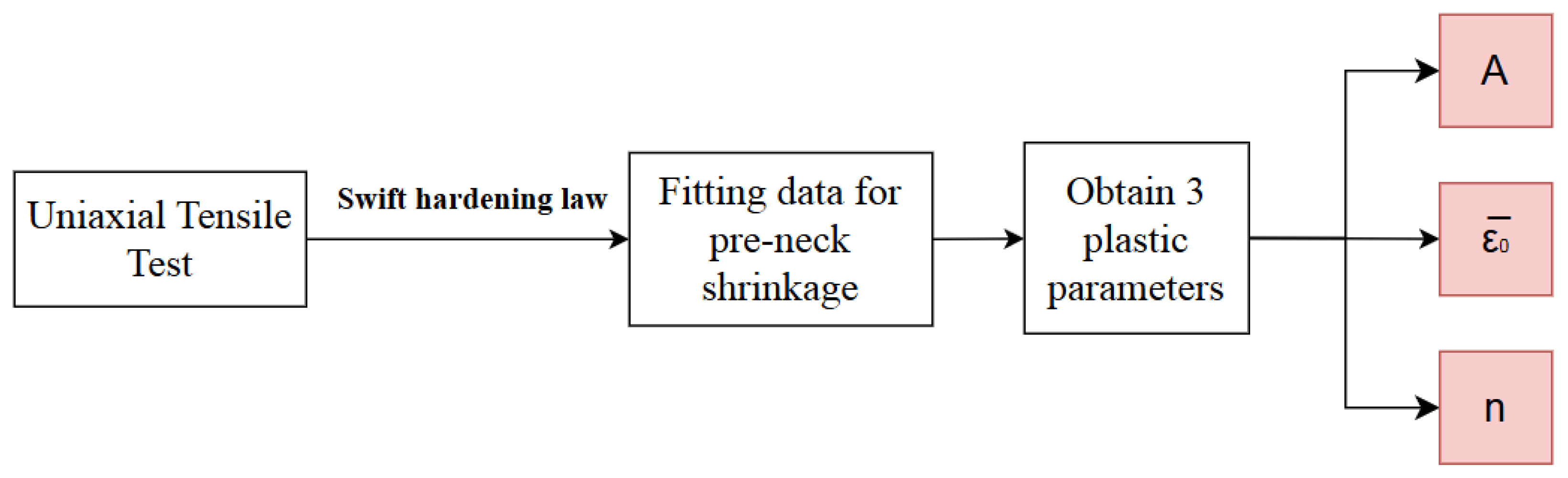
The calibration and validation of the MMC model parameters ( A , n , ε ¯ 0 , c 1 , c 2 , c 3 ) were achieved through a coordinated experimental suite. The experiment involved uniaxial tension to extract the constitutive plastic parameters A , n and ε ¯ 0 . Considering the anisotropy of the metallic microstructure, tensile tests on flat specimens are conducted along three different orientations. The process of determining the plastic parameters of the pipe through uniaxial tensile testing is illustrated in Figure 2.
Accordingly, the conventional J2 flow theory is adopted to describe the plastic behavior of the steel material. The relationship before necking is fitted using the Swift hardening law [37], where A , n and ε 0 are material constants.
k = A ( ε 0 + ε ¯ p ) n
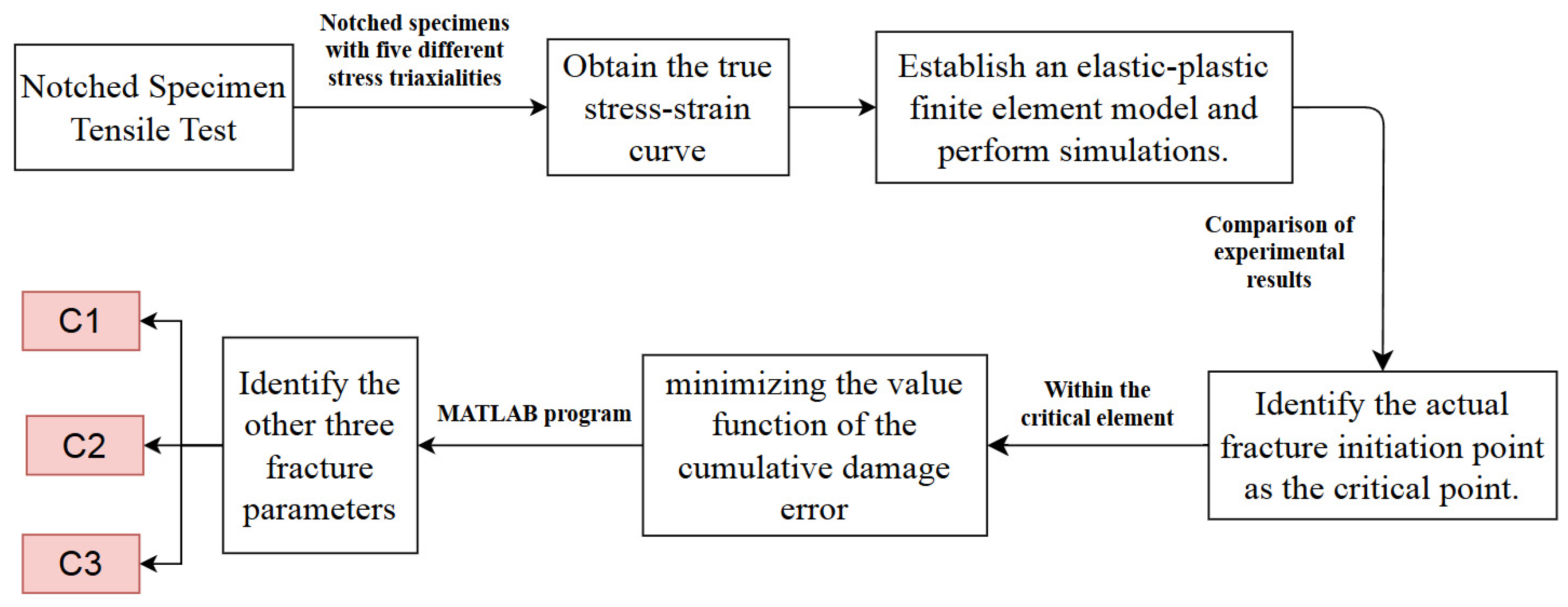
The fracture parameters c 1 , c 2 and c 3 are determined through notched specimen tests, as illustrated in Figure 3. To calibrate the fracture properties across a wide range of stress states, specimens with distinct geometries are employed. Specifically, flat specimens are designed to achieve low stress triaxiality, while round bar specimens are used to attain high stress triaxiality. The stress triaxialities of the notched round bar specimens were calculated using Bridgman’s equation [38]
η = 1 3 + 2 ln 1 + a 2 R
where R is the radius of notch and a is the radius of round bar. Each of the five tensile tests was repeated three times to ensure reliability and repeatability of the results.
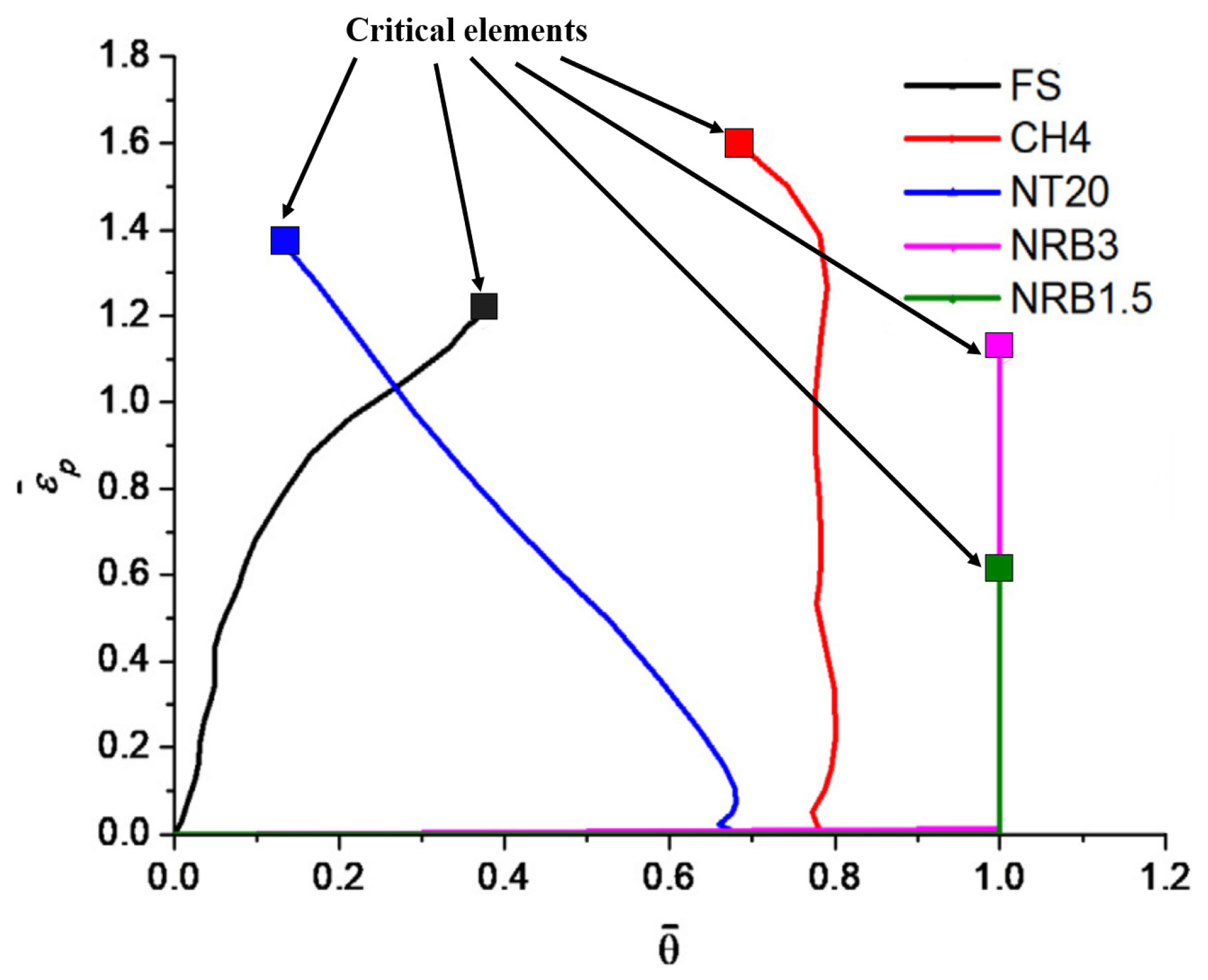
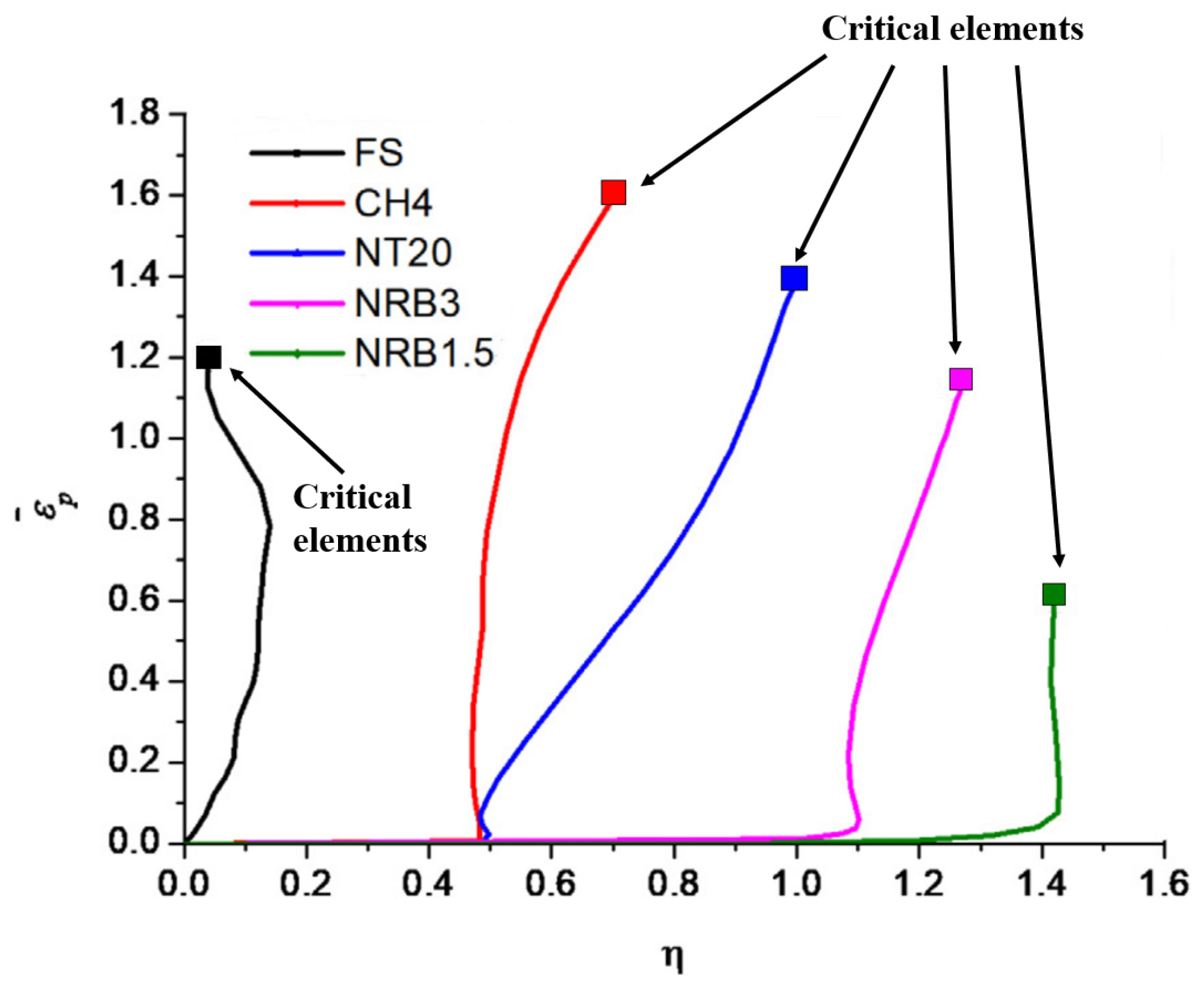
To this end, three-dimensional elastic-plastic finite element models are constructed accordingly. In numerical simulations, the stress–strain relationship is compared with experimental data to determine the failure point. The critical displacement is defined as the average displacement of three specimens at the moment when the load experiences a sudden drop. The variation curves of equivalent plastic strain ( ε ¯ p ) with stress triaxiality ( η = η ε ¯ p ) and Lode angle parameter ( θ ¯ = θ ¯ ε ¯ p ) within critical elements can be obtained.
The incremental damage variable can be calculated by (dD = d ε ¯ p / ε ¯ f η , θ ¯ ). During the entire loading process, the damage increment variable d D can be expressed as the integral d D . The average least squares error (LSE) between d D and the constant value of 1 can be calculated for five distinct specimens. A smaller average LSE of this function indicates better agreement with experimental data. The parameter set is optimized by minimizing the cumulative damage error function. Consequently, parameter calibration constitutes an optimization task, with the primary objective expressed as:
f x = 1 N i = 1 N d D 1 2 = 1 N i = 1 N 0 ε ¯ f d ε ¯ p ε ¯ f η , θ ¯ 1 2 , x = a r g m i n f x
where N denotes the number of tests employed for calibration. The compiled code employs the quasi-Newton method to minimize this unconstrained multivariable objective function, thereby obtaining the optimized parameters that characterize the material properties of in-service pipelines.
The required parameters (A, ε ¯ 0 , n c 1 , c 2 , c 3 ) for the Modified Mohr–Coulomb model were fully determined through experiments conducted on both sheet and round bar specimens.

3. Fracture Behavior Analysis of X80 Pipeline with Circumferential Cracks

3.1. Geometric Dimensions of X80 Pipeline

According to the research on X65 pipeline steel fracture by Xu et al. [39] based on the MMC criterion, a comparison between pipe model experiments and numerical simulations regarding crack initiation sites, propagation paths, and fracture morphologies demonstrates that the MMC damage model can accurately predict the fracture modes of X65 steel under various notch geometries. Hence, the Modified Mohr–Coulomb criterion is adopted in this study to examine the fracture behavior of X80 pipes in service. According to the method given in this paper for obtaining MMC key parameters, a series of uniaxial tensile tests were performed to calibrate the constitutive parameters of the in-service pipeline material. These key parameters were subsequently integrated into a high-fidelity finite element model to simulate the pipeline’s response under multiaxial loading conditions, including combined tension, bending, and external pressure. A comprehensive analysis of stress–strain evolution, moment–curvature characteristics, and hoop stress distribution was conducted to elucidate the fracture mechanisms of the in-service X80 pipeline.
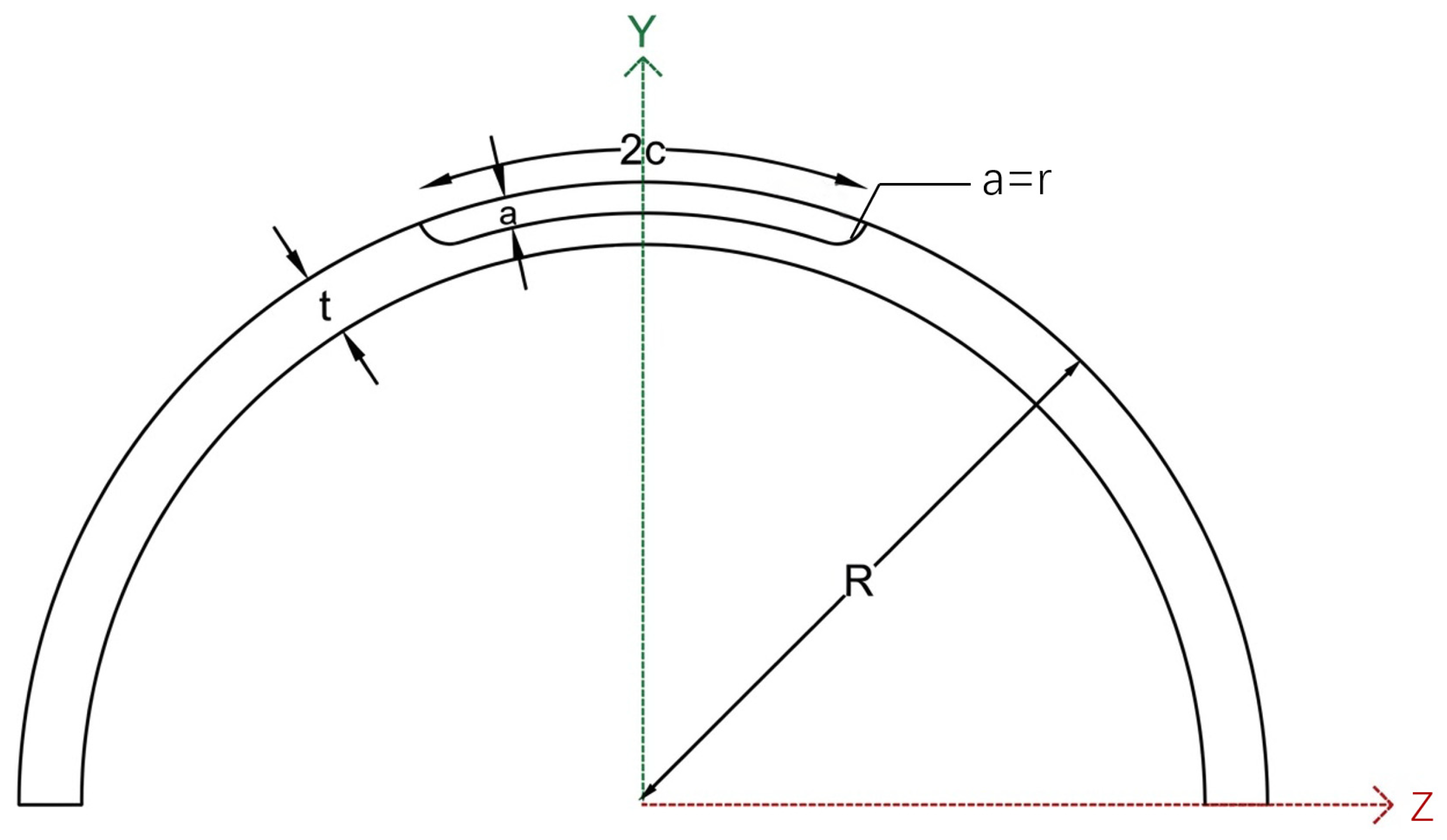
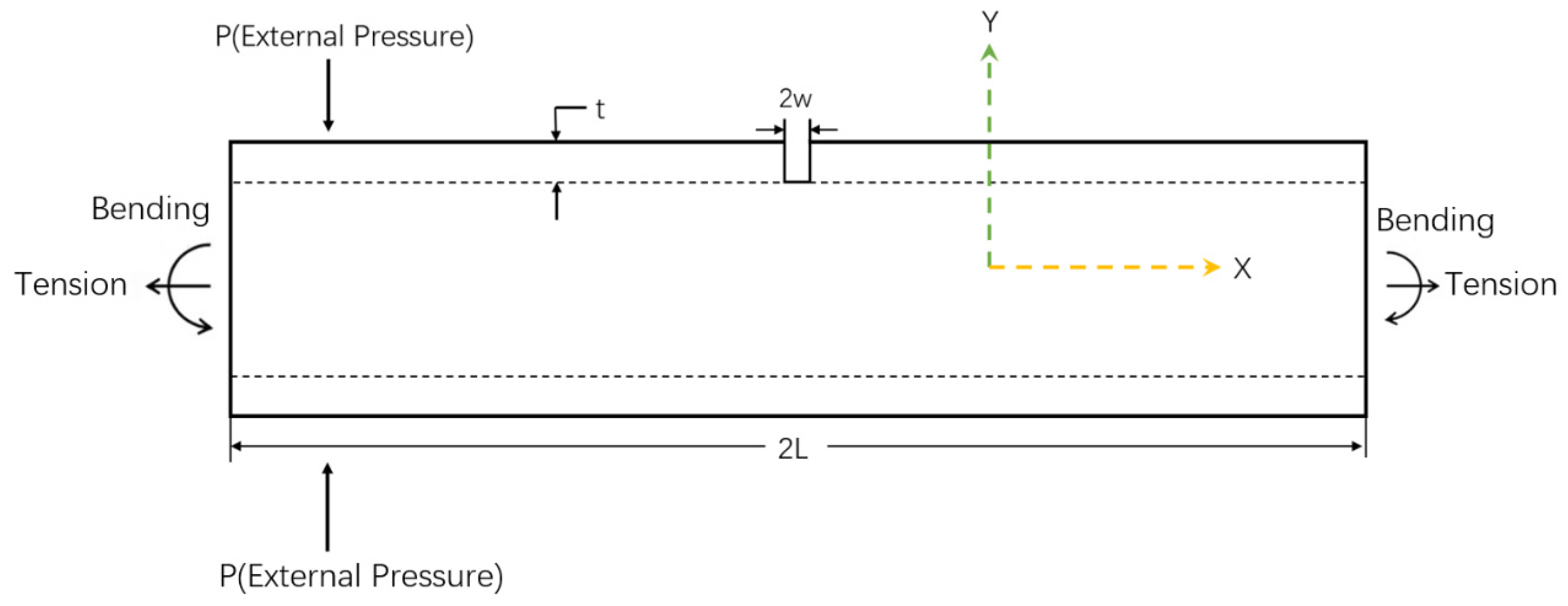
The geometrical parameters of the pipeline model and observed cracks are defined as follows: the pipeline’s outer diameter, length and wall thickness are denoted by D, 2L and t; and the crack depth, length, width and radius at the edge are denoted by a, c, 2w and r respectively. Cross-sectional and longitudinal views of the in-service X80 pipeline model containing a crack are shown in Figure 4 and Figure 5, respectively. Bending moment and axial displacement were applied at both ends of the pipeline, while a uniform external pressure determined by the operational sea depth is applied to its outer surface.
Although subsea pipelines often exhibit highly irregular crack morphologies due to complex loading, the API 579-1/ASME FFS-1 standard [40] provides protocols for the equivalent representation of inclined or interacting cracks as a single axial-normal crack. Given that the peak stress concentration is localized at the crack tip, the crack depth and length were taken as uniformly distributed along the pipeline, with the radius of the crack-tip curvature set equal to the crack depth, and the geometric symmetry of the crack was maintained about all three principal axes [40]. The comprehensive geometric dimensions and initial crack parameters are summarized in Table 1.

3.2. Key Parameters Calibration of MMC Model for X80 Pipeline

Here, it delineates the experimental procedures for calibrating the six critical parameters (A, ε 0 , n, c 1 , c 2 , c 3 ) of the MMC model. A uniaxial tensile test was performed on a flat specimen, and the results were fitted to obtain the plasticity parameters of the material, as shown in Table 2 below.
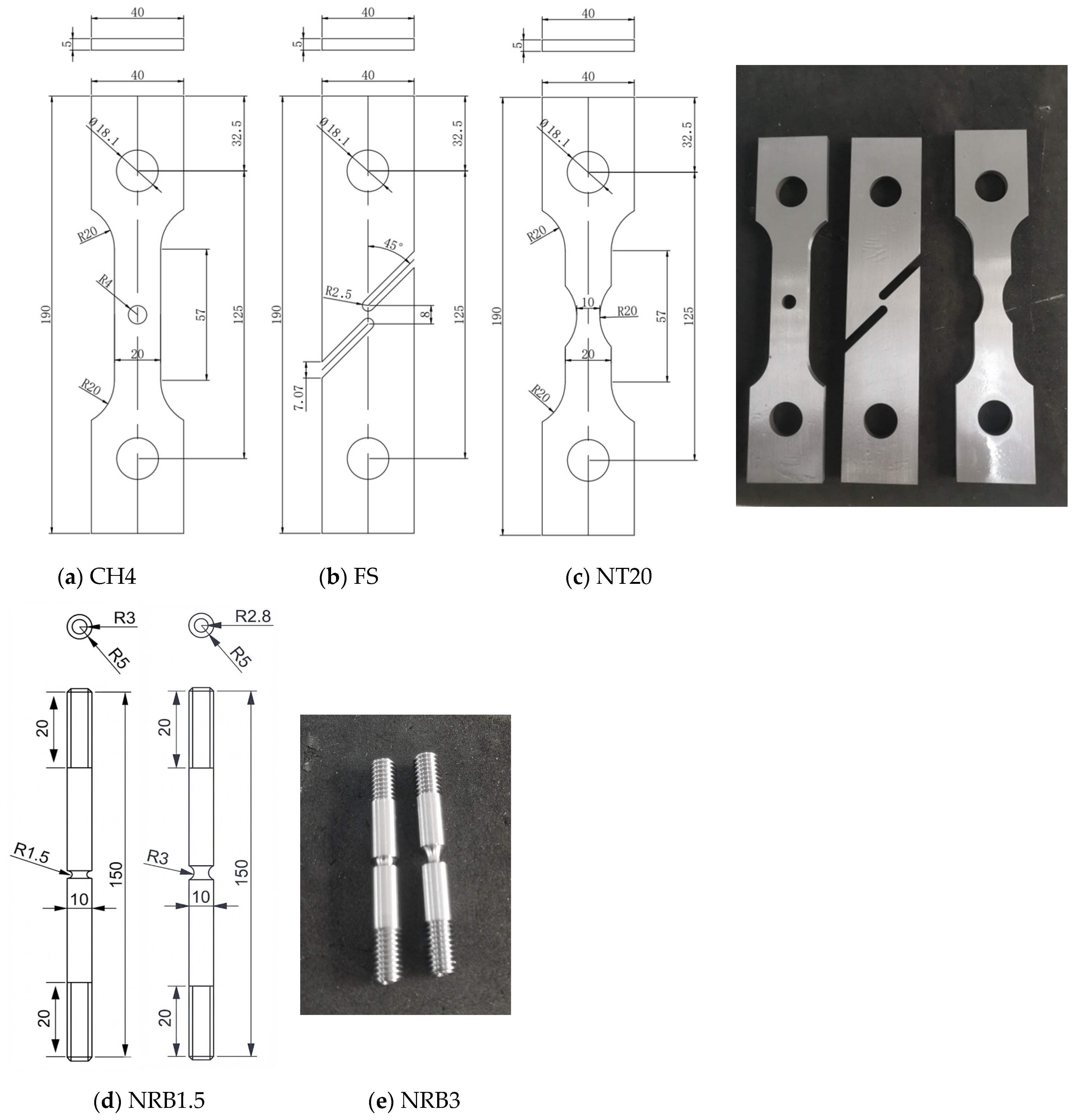
Based on the methodology presented in this paper for obtaining the MMC key parameters ( c 1 , c 2 , c 3 ), three types of rectangular plate specimens and two types of bar specimens were extracted from the in-service X80 pipeline steel for the notched specimen experiments. Specifically, the test set comprised five types of specimens, as shown in Figure 6: a flat specimen (FS) with almost zero stress triaxiality, a central-hole tensile specimen with a 4 mm hole radius (CH4), a flat notched tensile specimen with a 20 mm notch radius (NT20), and two round bar notched specimens with notch radii of 1.5 mm (NRB1.5) and 3 mm (NRB3), respectively.
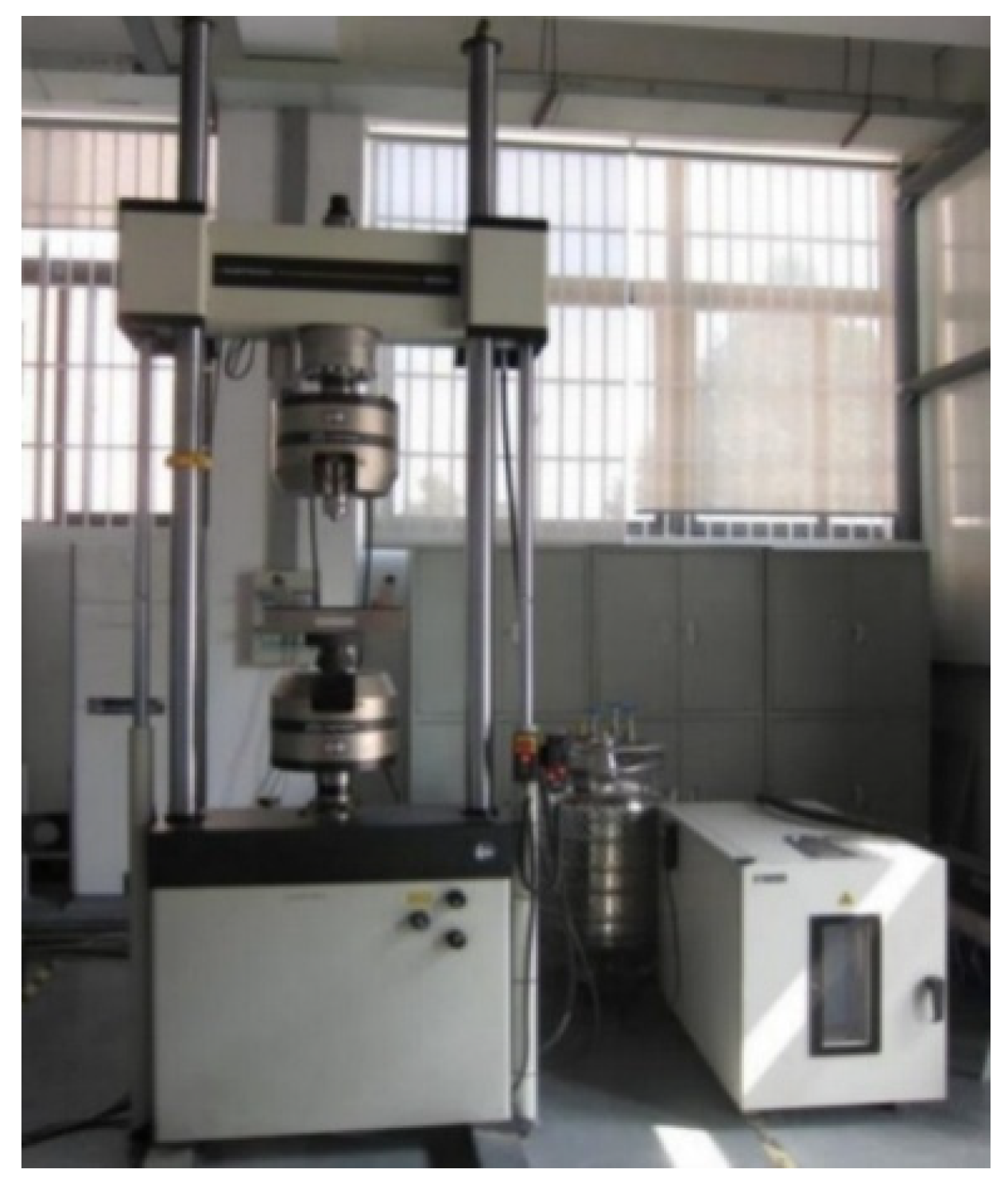
The layout of slow strain rate tensile test equipment is shown in Figure 7. The tensile strain rate of the specimens is set to 0.5 mm/min. To ensure statistical reliability and reproducibility, each of the five notched tensile test configurations was performed in triplicate.
Experimental results indicate that under large-strain regimes, specimens extracted from three orthogonal orientations exhibit negligible variation in their macroscopic stress response. Consequently, the X80 steel is characterized as an isotropic material in the present analysis. The constitutive parameters (A = 865.38 MPa, ε0 = 0.02 and n = 0.095) were determined by fitting the tensile test data using the method illustrated in Figure 2 in conjunction with Equation (15). And according to Equation (15), the stress triaxialities of the notched round bar specimens NRB1.5 and NRB3 were calculated, yielding η values of 1.314 and 0.875.
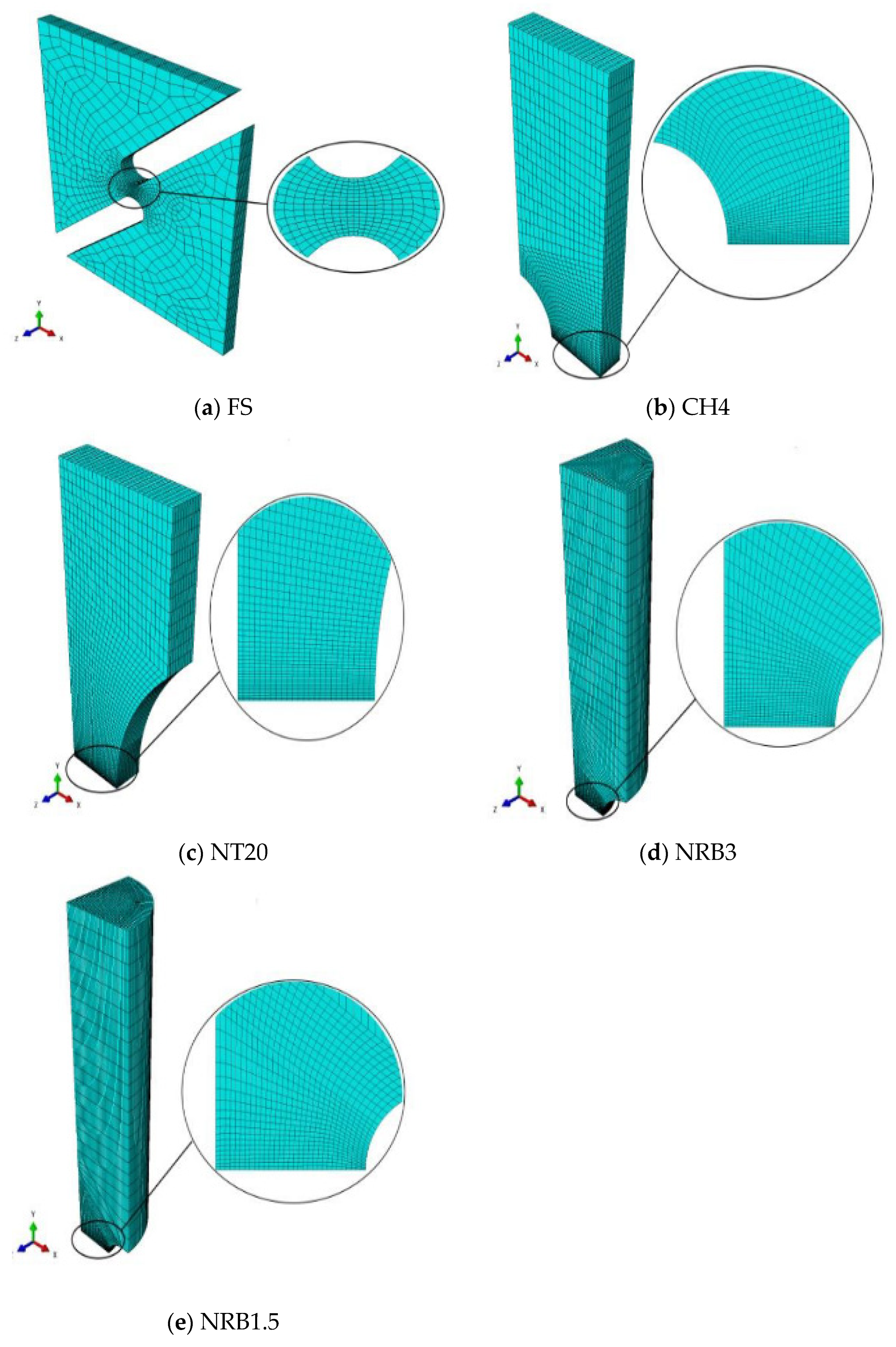
Following the procedure outlined in Figure 3, a numerical model of the notched specimen (Figure 8) was developed to facilitate comparison with the experimental results. The calibration was performed in ABAQUS 6.14 using eight-node linear brick elements with reduced integration (C3D8R). For the FSs specimen (Figure 8a), a half-model was constructed by leveraging its structural symmetry, with ZSYMM boundary conditions applied. To balance computational accuracy and efficiency, the mesh was locally refined in the central region of the specimen. For the CH4, NT20, NRB3, and NRB1.5 specimens (Figure 8b–e), the geometry was further simplified into one-eighth models, with XSYMM, YSYMM, and ZSYMM constraints imposed on the respective planes of symmetry. The bottom of the model was fixed, while a displacement load was applied to the top along the Y-axis. During the calibration of the uncoupled models, only a damage-free elasto-plastic constitutive model was employed. Following the methodology of Paredes et al. [41], which demonstrates that mesh size effects on structural response exhibit convergence, the mesh size in the notch regions of the CH4, NT20, and FSs specimens was set to 0.2 mm. For the NRB3 and NRB1.5 specimens, a finer mesh of 0.1 mm was adopted to ensure that all models satisfied the convergence requirements.
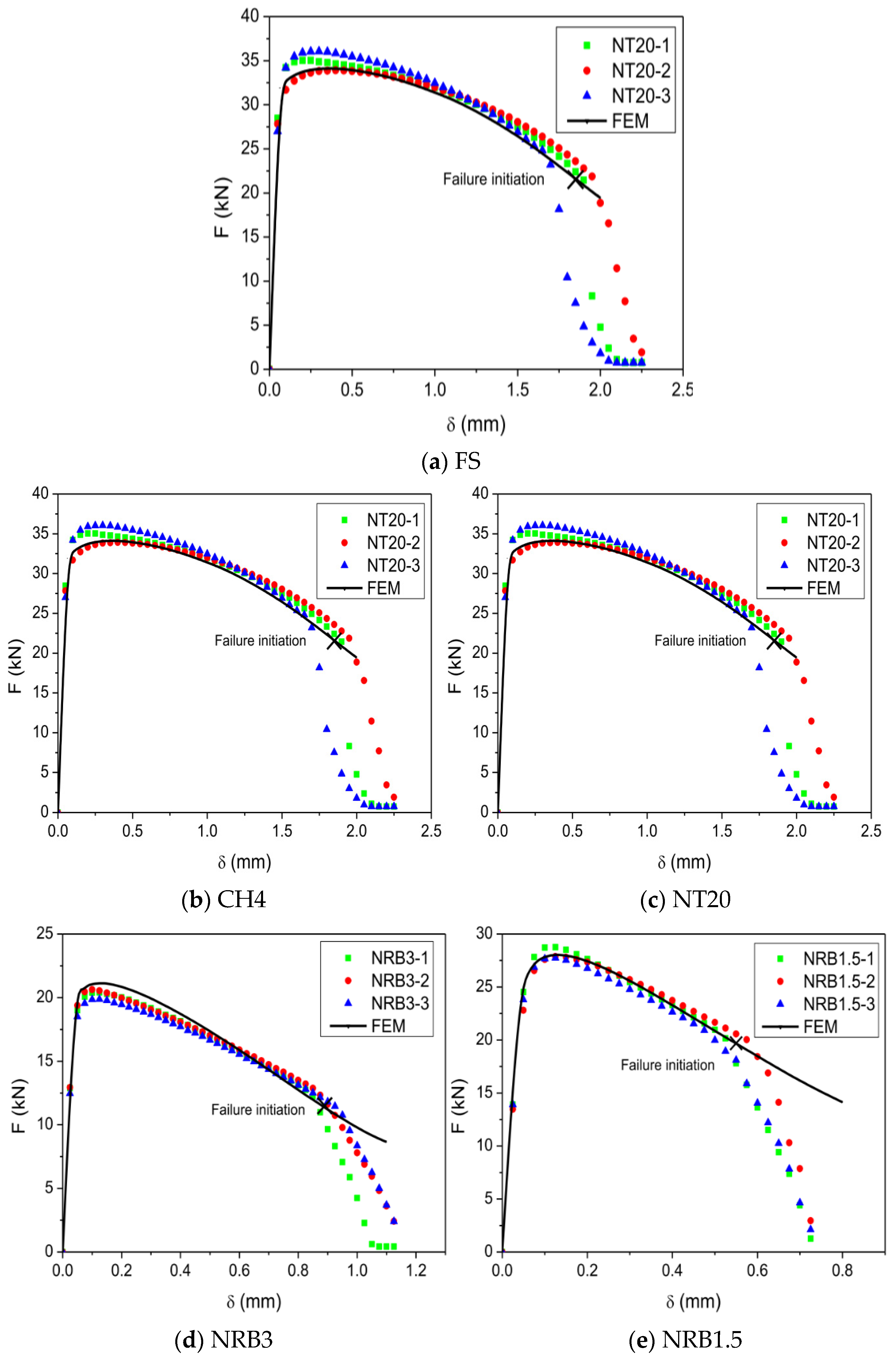
A comparison between the FE predictions and the experimental load–displacement (δ) responses in Figure 9 demonstrates that the numerical accuracy aligns with the anticipated objectives. The inherent scatter observed in the experimental data objectively reflects the microscopic heterogeneity of the pipe samples and the stochastic errors associated with the testing machine’s control system. Across the simulations of five representative specimen types, the maximum deviation in the predicted load was approximately 3%. By correlating the numerical results with experimental curves, the point of fracture initiation was precisely identified. In this study, the critical displacement is defined as the average displacement of three parallel specimens at the moment of a sharp load drop.
Figure 10 and Figure 11 illustrate the evolutionary data of stress triaxiality, the Lode angle parameter, and equivalent plastic strain within this critical displacement range for the five calibration tests.
By combining the experimental and numerical results according to Figure 3, the fracture parameters ( c 1 , c 2 , c 3 ) are obtained by substituting the loading data into Equation (17) for optimization, as summarized in Table 3. All six parameters of the MMC model (A, ε 0 , n, c 1 , c 2 , c 3 ) have been determined fracture behavior analysis.

3.3. CT Tensile Test

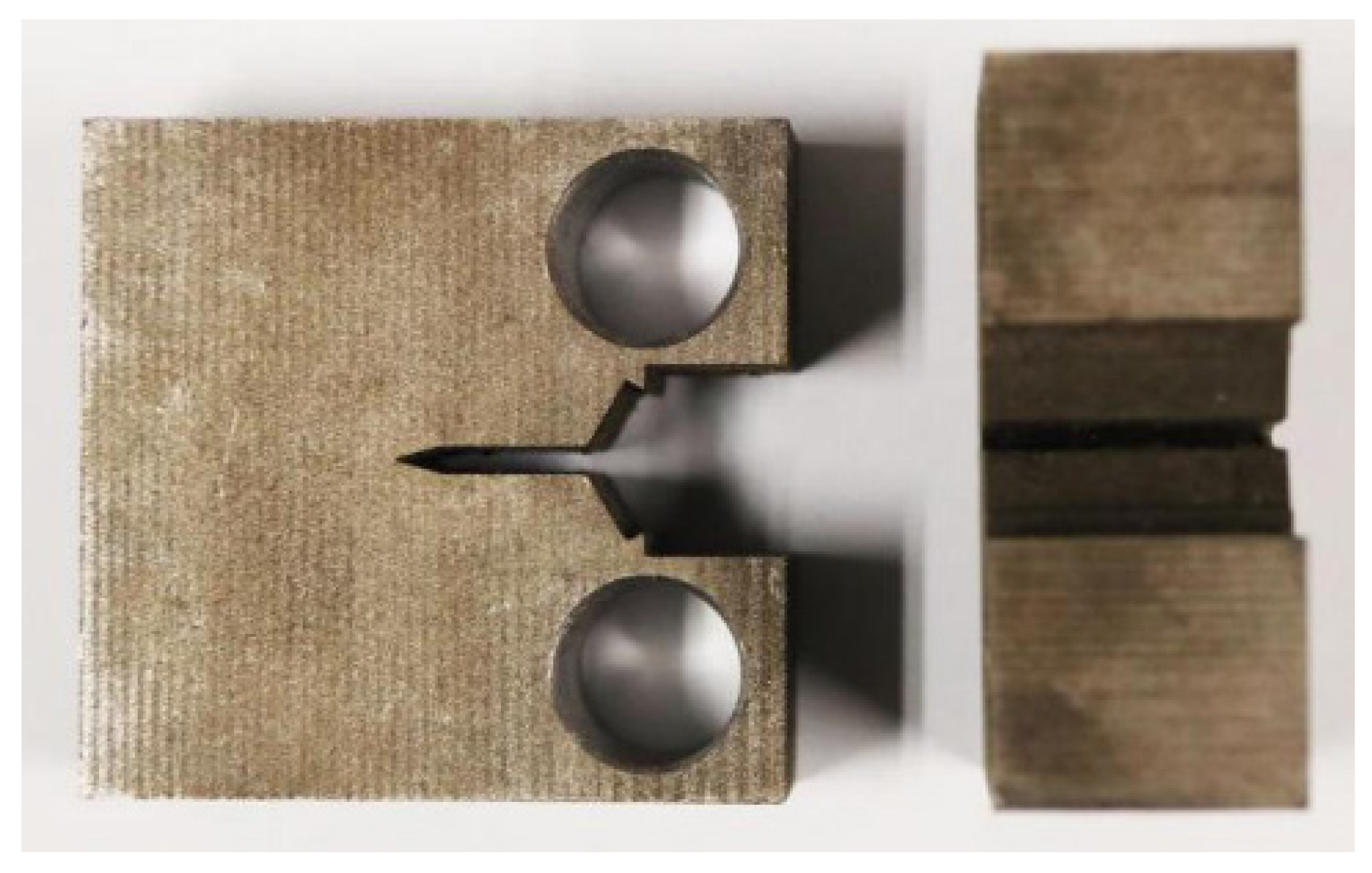
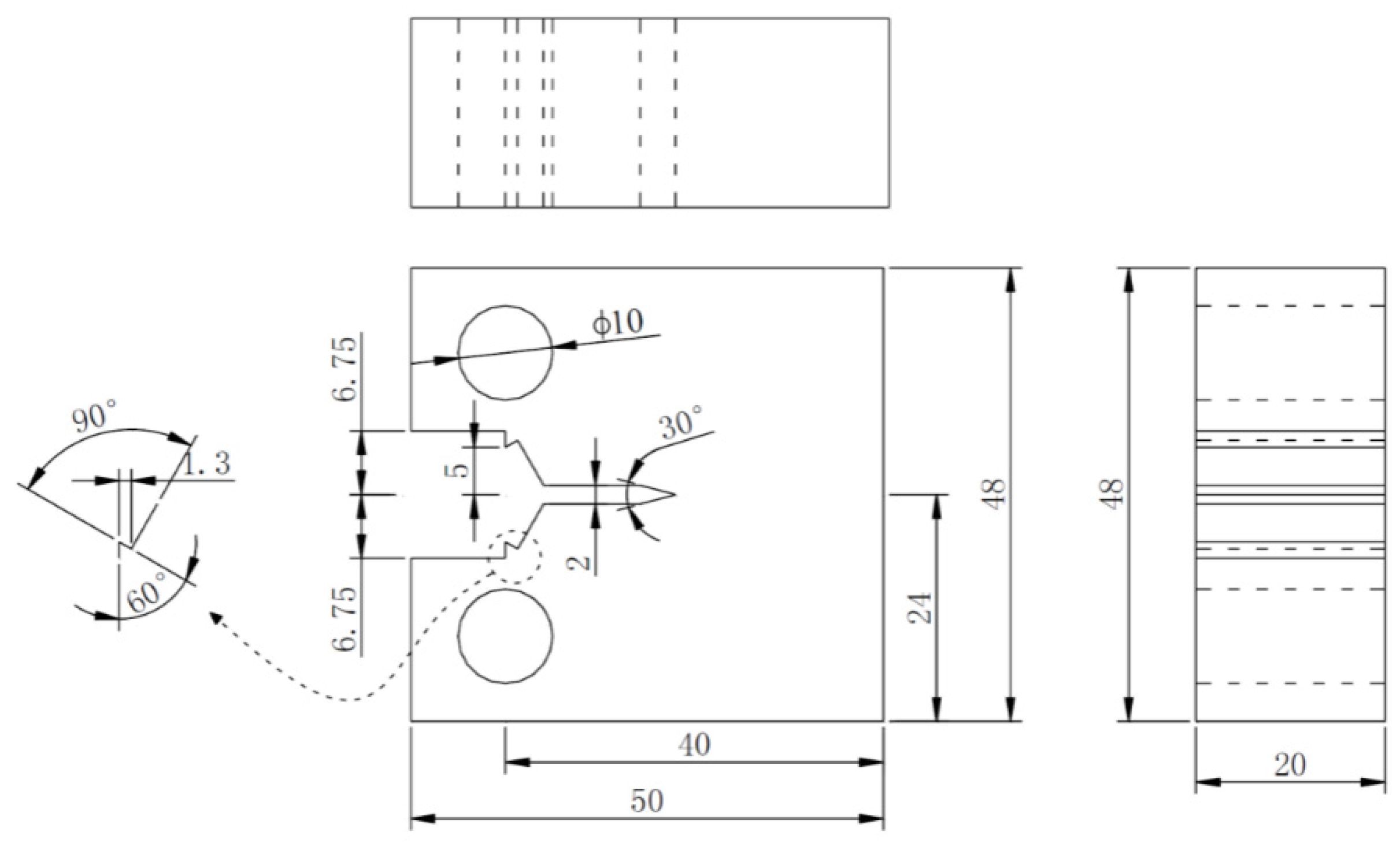
To determine the optimal mesh size, Compact Tension (CT) tests were conducted. The physical specimens are displayed in Figure 12. During the testing process, a load cell was utilized for real-time monitoring of the tensile load, while the crack mouth opening displacement (CMOD) was simultaneously recorded using a clip-on extensometer. The loading rate was set at 0.5 mm/min. Detailed geometric dimensions of the specimen are provided in Figure 13, with an initial effective width-to-thickness ratio ( W / B ) of 2 and an initial fatigue pre-crack length of 18 mm. As the load increased, significant opening displacement was observed at the specimen notch. With continuous loading, the crack front propagated outward, eventually leading to the global fracture and failure of the specimen.
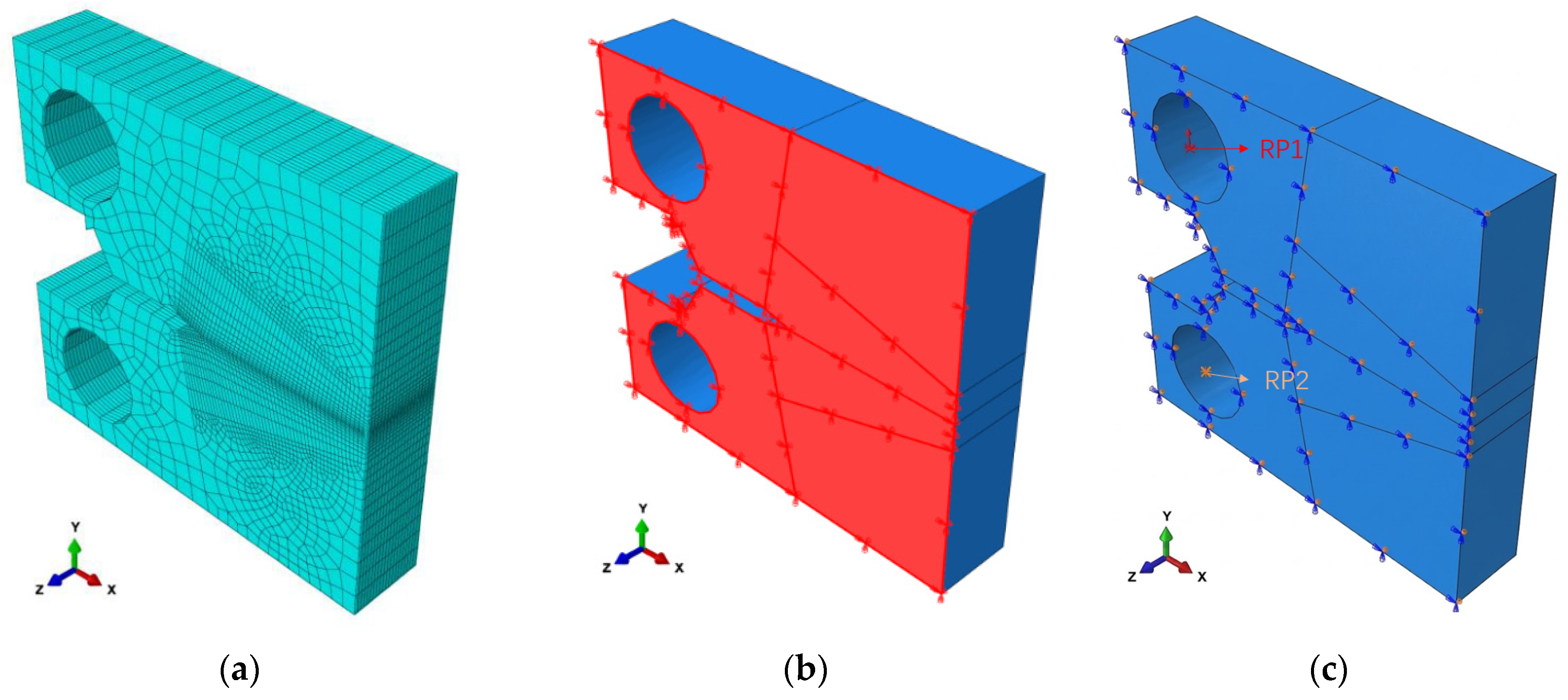
A three-dimensional finite element model was developed in ABAQUS using a 1:1 scale. Taking advantage of the structural symmetry, only one-half of the specimen was modeled along the thickness direction to improve computational efficiency. The model was discretized using eight-node linear brick, reduced integration elements (C3D8R). To capture the high stress gradients, a refined mesh was employed at the notch and along the anticipated crack propagation path, while a coarser mesh with gradually increasing element sizes was applied in other regions. The maximum element size was approximately 2.5 mm, with specific meshing details illustrated in Figure 14a. As shown in Figure 14b, due to the half-model configuration, a symmetry boundary condition (ZSYMM) was imposed on the mid-plane along the thickness direction. To simulate the loading process of the Compact Tension (CT) specimen, two reference points (RP-1 and RP-2) were established at the centers of the loading holes. These reference points were linked to the inner surfaces of the corresponding circular holes through kinematic coupling. During the simulation, reference point RP-2 remained fixed, while RP-1 was subjected to displacement loading along the positive Y-axis. The specific loading conditions are illustrated in Figure 14c.
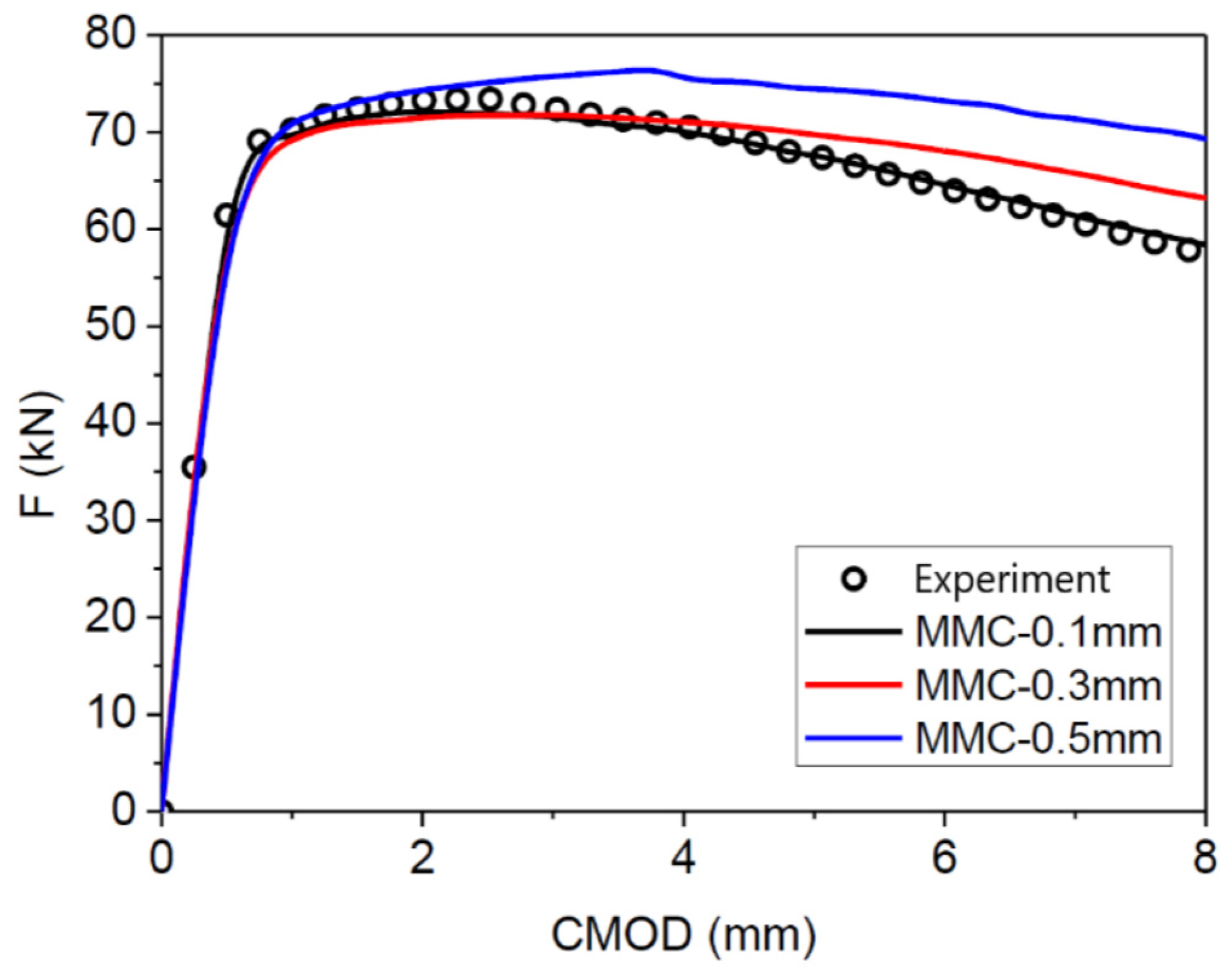
In damage models utilizing element deletion, the mesh size significantly impacts numerical results as it dictates the energy dissipation during element failure. Research shows that larger mesh sizes increase the energy release rate per crack increment, artificially flattening the fracture resistance (R-curve). To address this, the mesh size is treated as a characteristic material parameter. Our strategy employs equal element dimensions along the thickness and propagation directions, while doubling the density perpendicular to the cracking plane (using a 1:2 aspect ratio) to capture high stress gradients at the crack tip. As shown in Figure 15, load responses across different mesh sizes are identical before a CMOD of 1 mm, indicating the pre-initiation phase. Beyond this point, finer meshes exhibit a more pronounced load drop, capturing initiation with higher sensitivity. Optimal correlation with experimental data was achieved at a mesh size of 0.1 mm, which is defined as the characteristic length for this damage model.
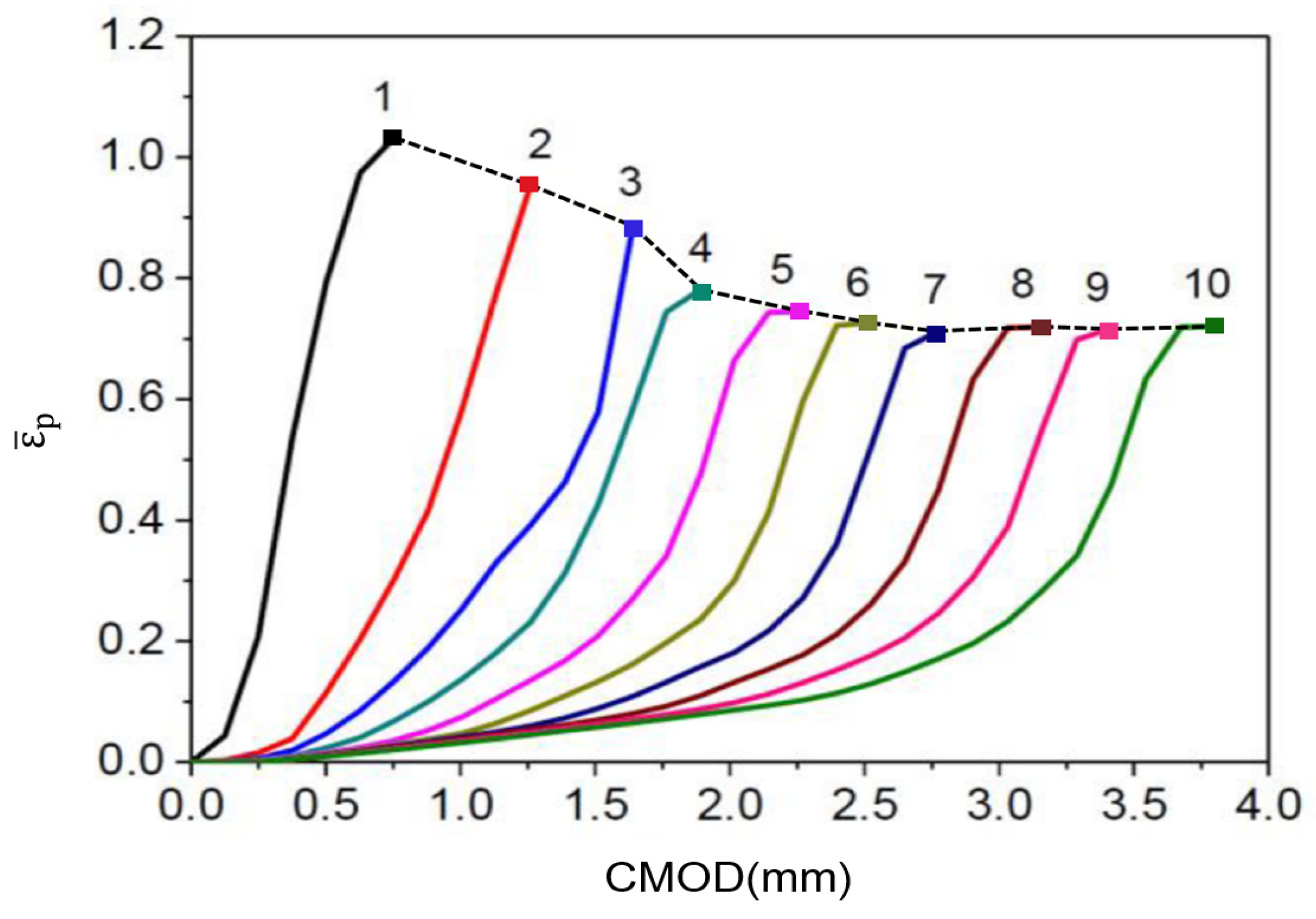
Figure 16 illustrates the evolution of fracture parameters for 10 typical elements along the crack propagation direction. The first element in the figure is located at the initial crack tip, with subsequent elements spaced at 0.5 mm intervals, covering an evolution zone of 5 mm from the crack tip. The results in Figure 16 indicate that the equivalent plastic strain at failure exhibits a decreasing trend from element 1 to element 3 and reaches a saturation state starting from element 4. This demonstrates that the model can accurately characterize the physical transition of the crack from initiation to stable propagation.

3.4. Fracture Behavior Analysis of In-Service X80 Pipeline

3.4.1. Numerical Integration Process

Based on the proposed method flow above, key MMC parameters different from those at the beginning of the design can be obtained for the ductile fracture characteristics of X80 pipeline during service. Here, the numerical analysis was conducted using the ABAQUS 6.14/Explicit solver. Material evolution in nonlinear solid mechanics is governed by rate-form constitutive equations, necessitating numerical integration to solve for stress states over discrete time steps t n , t n + 1 . The fully implicit return mapping algorithm based on Backward Euler integration serves as the standard framework for implementing advanced constitutive models such as the MMC criterion. By transforming the stress update into a constrained nonlinear optimization problem, the radial return algorithm, coupled with an uncoupled damage model, follows the key steps summarized below.
Step 1: Check material properties and initialize the stress tensor, strain tensor, and internal variables at t = 0.
σ = σ t = 0 , ε = ε t = 0 , ε ¯ p = ε p , t = 0 , D = D t = 0
Step 2: Examine the internal variable σ t , ε t , ε ¯ p , t , D t and the strain increment Δ ε for the start time t of the increment step.
Step 3: The formula for calculating the test stress in the initial stage of the incremental step is:
σ t + Δ t t r i a l = σ t + C : Δ ε
Step 4: Calculate the yield function.
Φ = Φ q t + Δ t t r i a l , ε ¯ p , t
If Φ < 0 , the current state is purely elastic. Modifications to stress and internal variables are required.
Therefore, return to step 2 and input a new incremental step. If Φ 0 , the current state is elastoplastic, then proceed to step 5 to iteratively calculate the plastic response.
Step 5: In VUMAT, solve the following residual vector to zero using the Newton–Raphson iteration:
Φ = σ ¯ σ y ε ¯ p = q t + Δ t t r i a l 3 μ Δ ε ¯ p , t + Δ t σ y ε ¯ p , t + Δ ε ¯ p , t + Δ t = 0
Step 6: Update the internal variables using the plastic strain increment Δ ε ¯ p , t + Δ t calculated iteratively in Step 5.
ε ¯ p , t + Δ t = ε ¯ p , t + Δ ε ¯ p , t + Δ t
σ t + Δ t = σ t + Δ t t r i a l C : Δ ε p , t + Δ t
Step 7: Calculate and update the damage variables for the MMC fracture criterion.
ε ¯ f , t + Δ t = A c 2 3 2 3 1 c 3 sec π 6 θ ¯ 1 + c 3 c 1 η + 1 3 s i n π 6 θ ¯ + 1 + c 1 2 3 cos π 6 θ ¯ 1 n
Update the current damage variable.
D t + Δ t = D t + Δ D t + Δ t = D t + Δ ε ¯ p , t + Δ t ε ¯ f , t + Δ t
If the variable D t + Δ t 1 is corrupted, delete the cell and return to step 2.
The numerical algorithm was encoded within a VUMAT framework. Plastic properties (A, ε 0 , n), were incorporated as material inputs. Simultaneously, the MMC fracture parameters ( c 1 , c 2 , c 3 ) were invoked at each integration point to calculate the instantaneous fracture strain based on the local stress state.

3.4.2. Numerical Simulation Setting

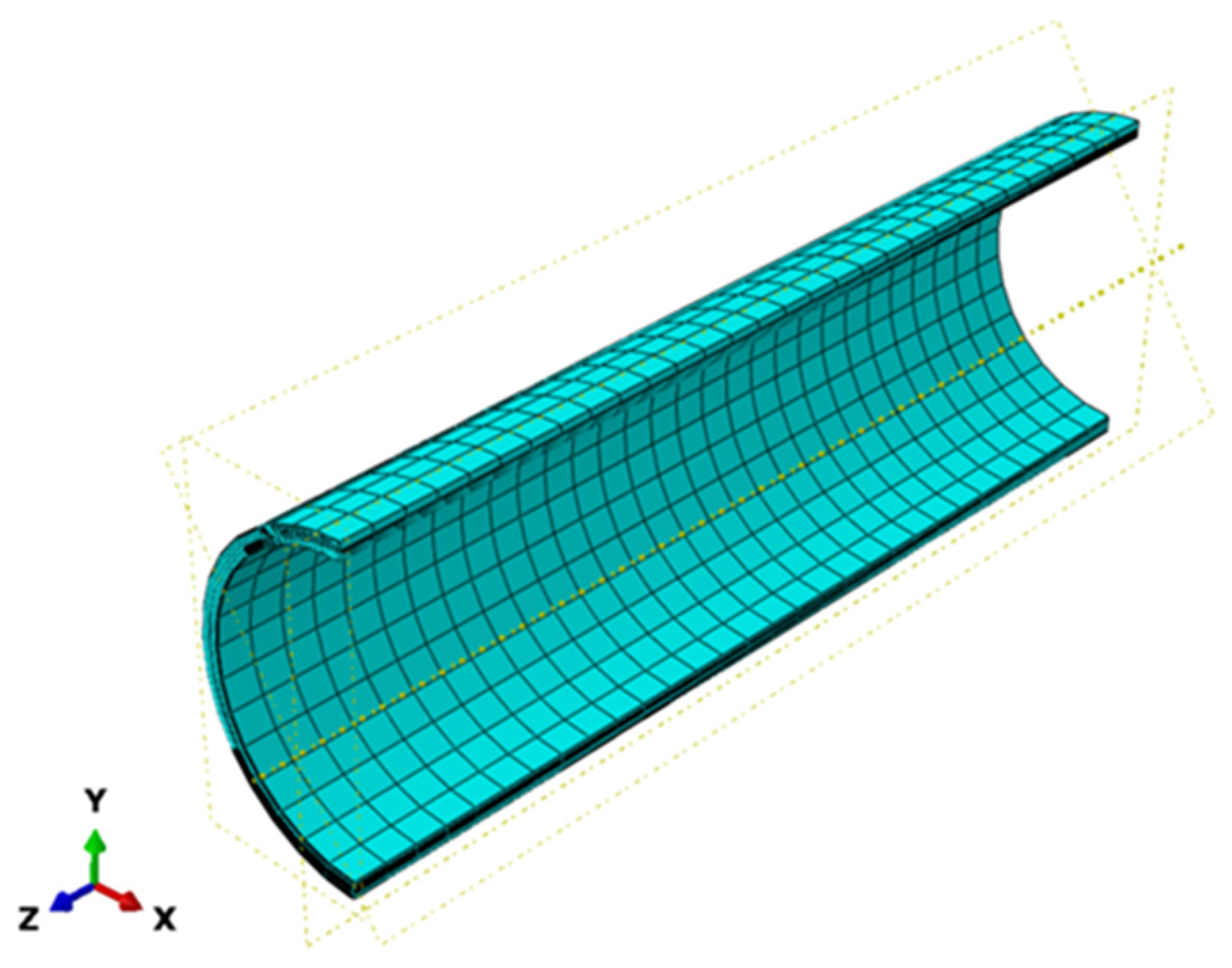
Crack initiation and propagation were simulated using an element-deletion technique. When the cumulative damage in an element reaches the critical threshold defined by Equation (14), the element’s stiffness is reduced to zero and it is removed from the mesh. Consequently, its curvature, bending moment, and hoop stress are set to zero. Finally, post-processing of the FEM results was conducted to extract and analyze the required parametric variations. Based on the pipeline schematic presented in Section 3.1, a quarter-symmetry model (as illustrated in Figure 17) was utilized for the analysis by leveraging both geometric and loading symmetries. The pipeline was modeled using eight-node linear brick elements with reduced integration (C3D8R). To balance numerical convergence and computational efficiency, a non-uniform mesh was applied along both the circumferential and longitudinal directions, with increased mesh density near the crack region to accurately capture localized stress–strain gradients. Following the mesh sensitivity analysis, an element size of 0.1 mm was maintained at the crack front.
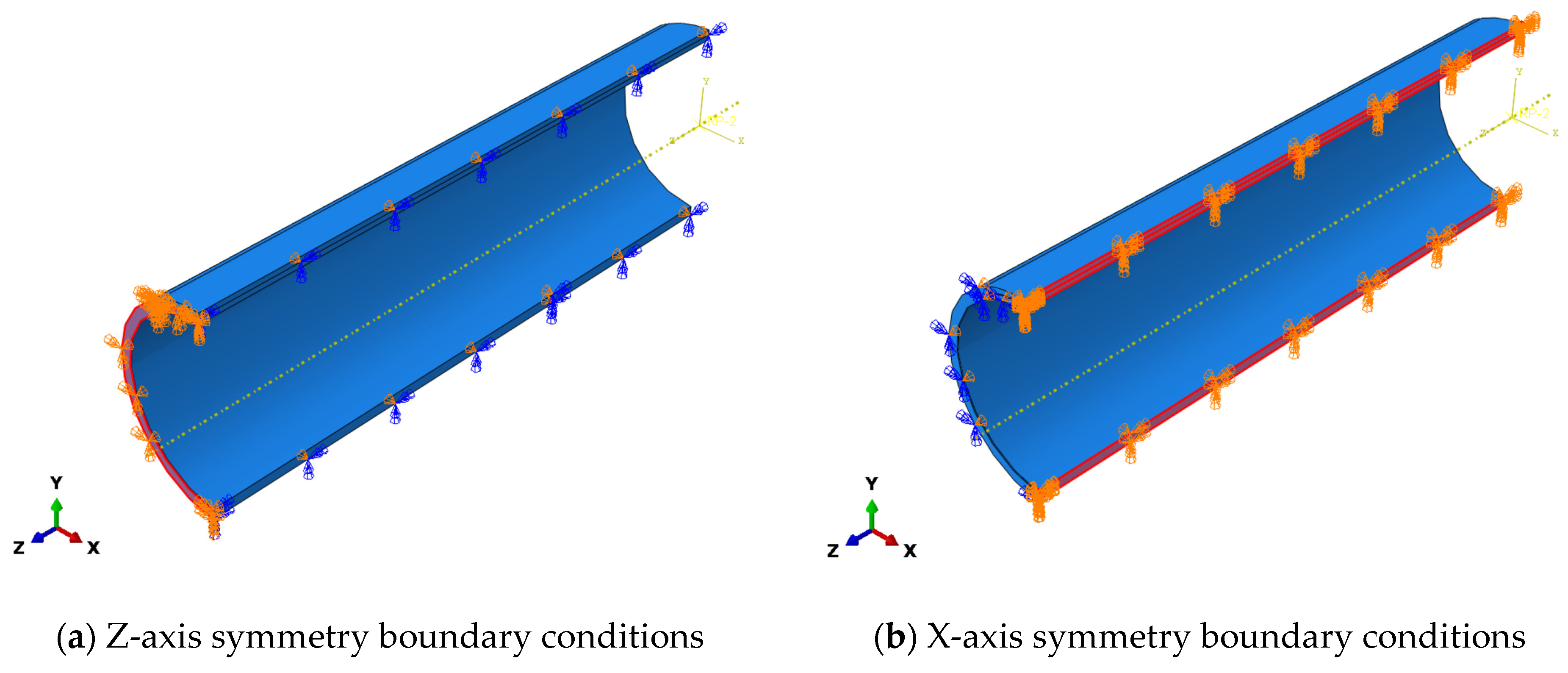
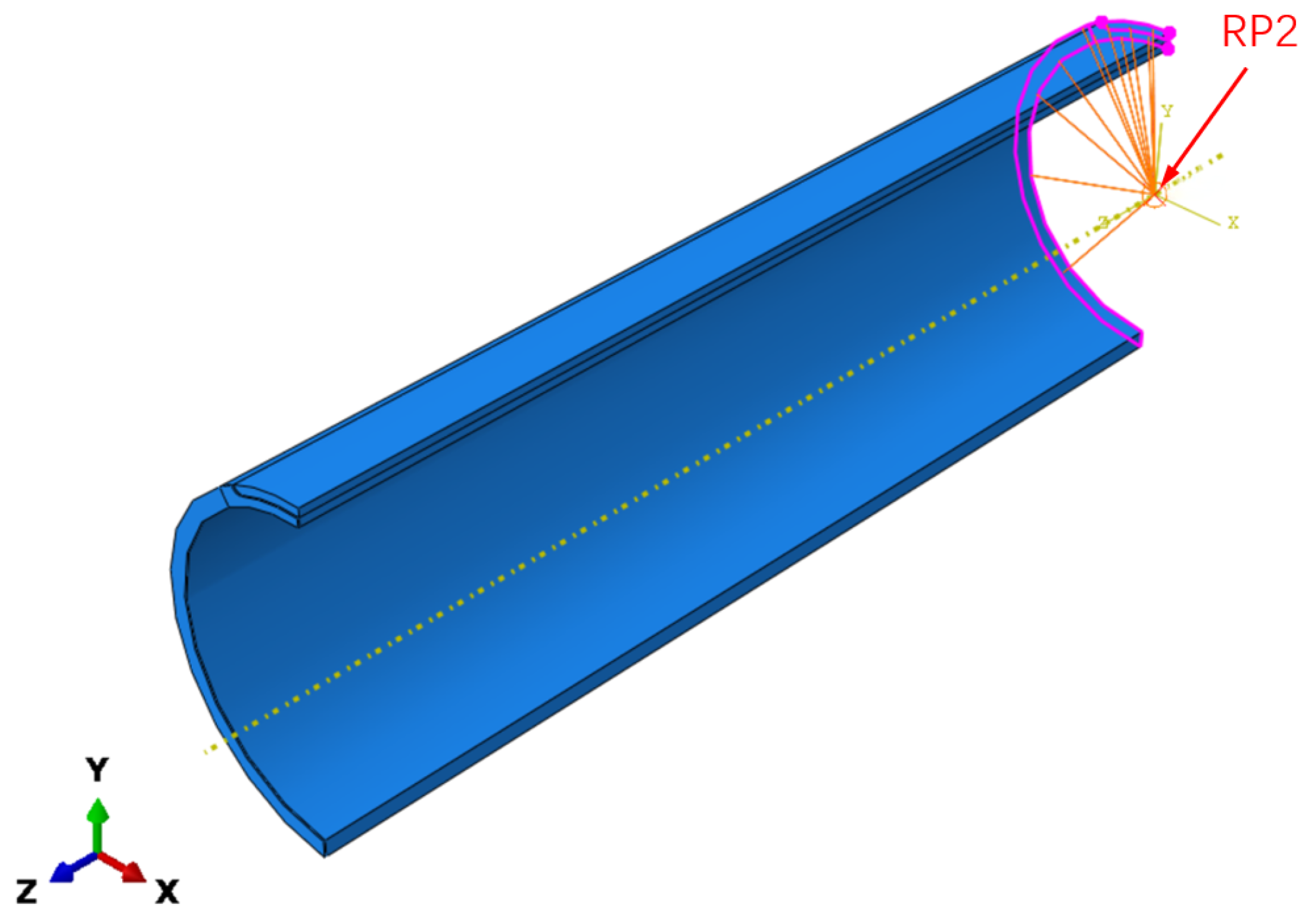
As illustrated in Figure 18, an axial symmetry boundary condition (ZSYMM) was applied to the left end face (cracked section) along the Z-axis, as shown in Figure 18a. For the top and bottom pipe edges, X-axis symmetry boundary conditions (XSYMM) were prescribed, as depicted in Figure 18b. Furthermore, a reference point (RP-2) was defined at the center of the non-defective end (un-cracked section) along pipe edge, as shown in Figure 19. To effectively manage the boundary conditions, a kinematic coupling was established between this end face and the reference point for all degrees of freedom. It can be observed that all DOFs of the reference point are constrained, except for the translation along the Z-axis. This setup ensures that the right end face remains planar under the applied load while allowing for free cross-sectional deformation. The displacement ( Δ L ) and rotation angle ( θ ) at the reference point were recorded, with curvature derived from the rotation angle to facilitate the analysis of pipeline mechanical performance. The curvature ( k ) and strain ( ε ) of the pipeline can be expressed as:
k = θ L
ε = Δ L L
In this study, a tri-axial loading regime was applied incrementally and concurrently to the pipeline. Given that pure external pressure often triggers structural instability (buckling) prior to material failure, which would obfuscate the intrinsic fracture characteristics, the model employed a combined tension-bending loading scheme. This was achieved by imposing a prescribed longitudinal strain-to-curvature ratio (ε/κ = 0.5 m) at the uncracked terminal of the pipeline. This specific loading combination has been validated to effectively mitigate buckling interference, thereby ensuring that the fracture response remains the dominant failure mode throughout the simulation.

3.4.3. Mechanical Response and Failure Analysis Under Combined Loading

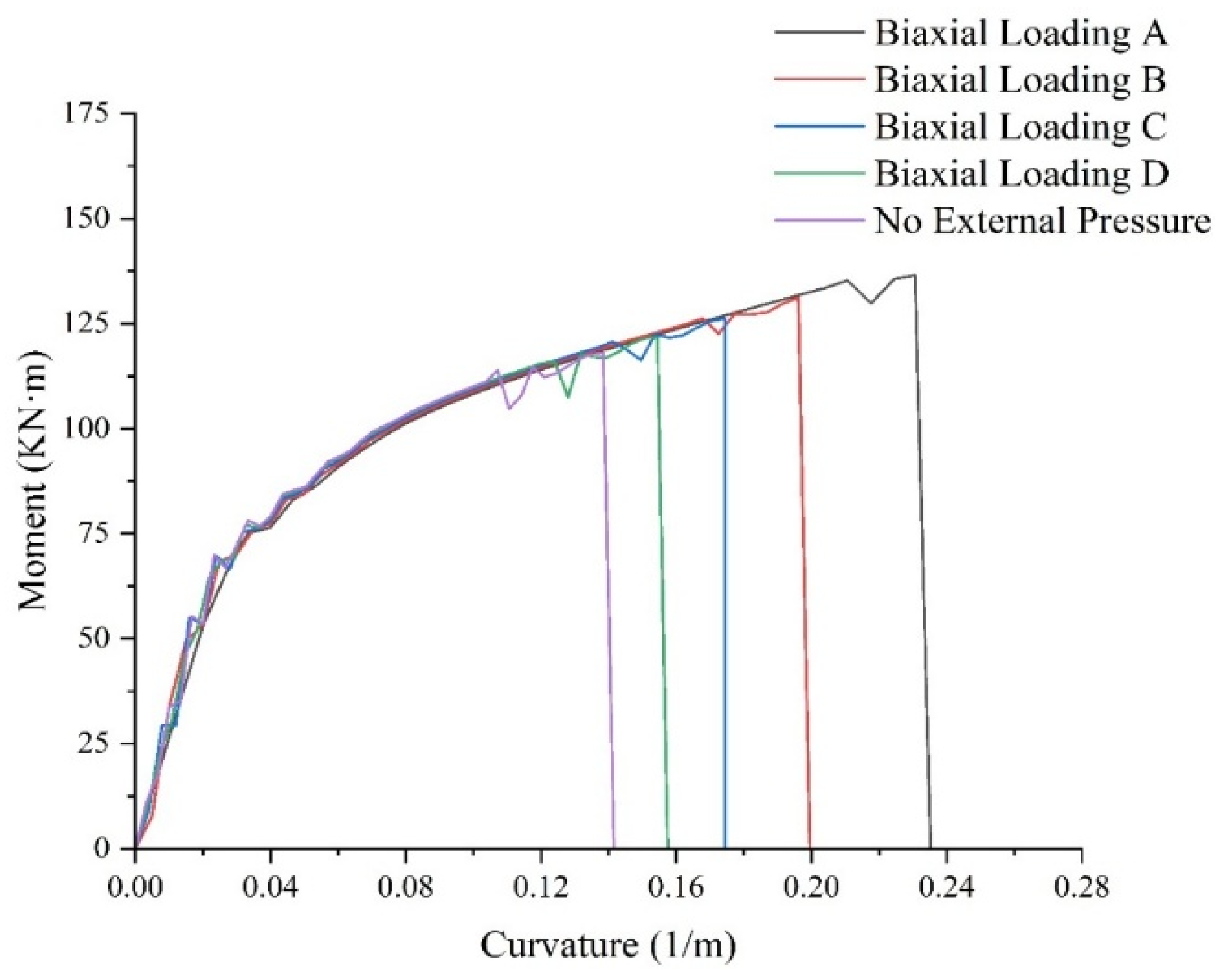
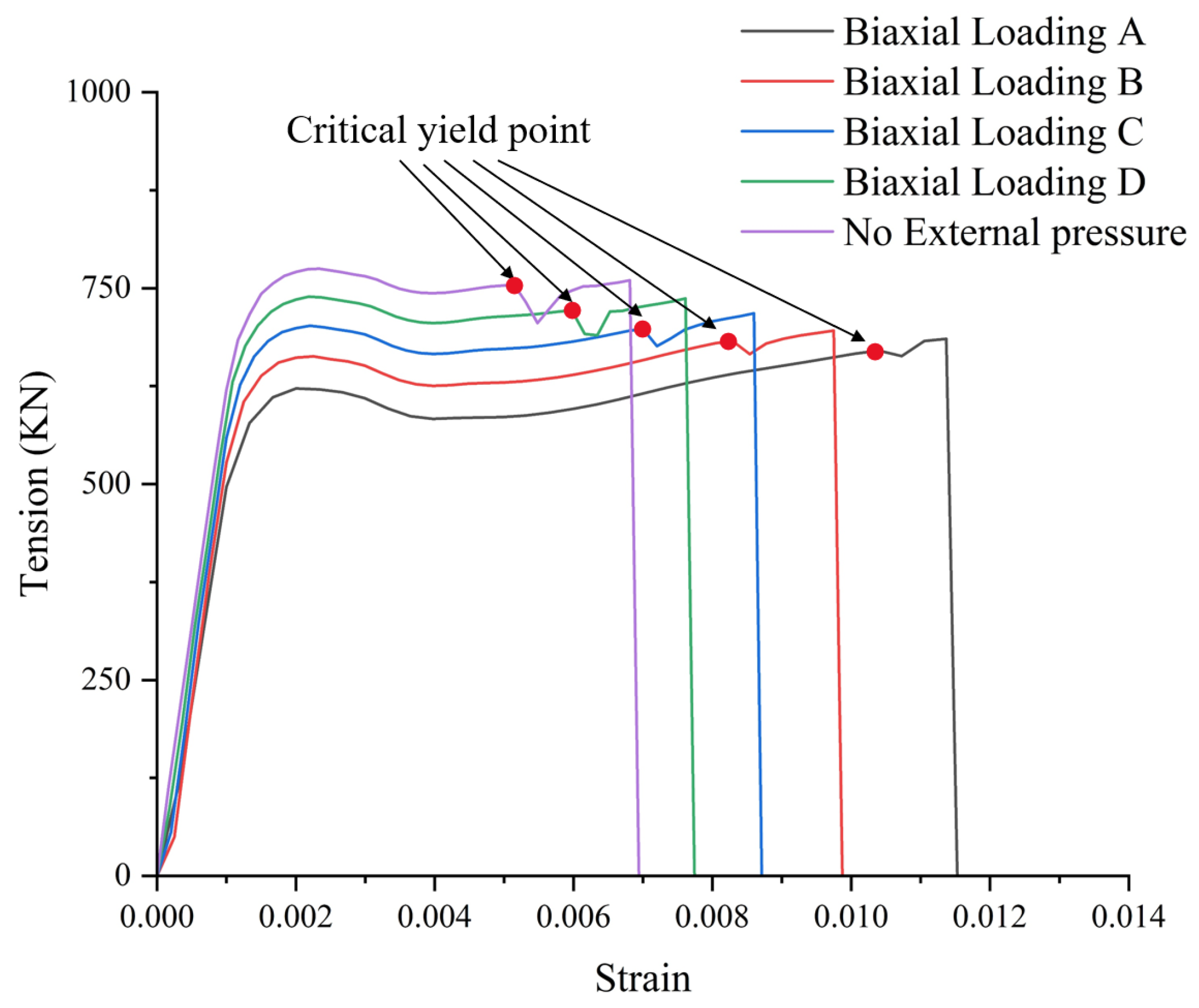
With curvature and displacement loading held constant (ε/κ = 0.5 m), the axial tensile displacement was set to 80 mm and the pipe curvature was set to 0.16. Meanwhile, external pressure was varied from 0 to 12 MPa to examine the effect of multiaxial stress states on mechanical performance. Five main loading cases were considered: Loading A (12 MPa), Loading B (9 MPa), Loading C (6 MPa), Loading D (3 MPa), and no external pressure loading case. The mechanical response of the X80 pipeline under these different loading conditions is compared in Figure 20, Figure 21, Figure 22 and Figure 23.
During the initial elastic phase, the load–response curves for all test conditions nearly overlapped, indicating that the elastic regime remained largely unaffected under the constant combined tension-bending load. Upon entering the plastic regime, however, the curves diverged significantly. With increasing external pressure, the axial tension required to initiate plasticity decreased. When the critical burst pressure was reached, the pipe wall underwent rapid damage and subsequent fracture. These observations lead to the conclusion that higher external pressure results in increased fracture strain and curvature, a downward shift in the yield point on the stress–strain curve, and a prolonged duration in the plastic region.
The tensile load-strain relationship for the X80 pipeline under the defined loading is illustrated in Figure 20. In the elastic regime, the tensile load increased linearly and rapidly with strain. Then the response transitioned to a plastic regime characterized by a substantially reduced hardening rate, where further strain increments produced only minor increases in load. Just prior to fracture initiation, a slight load drop followed by rapid recovery was observed that a phenomenon attributable to local stress redistribution at the crack tip as the material reached its critical yield point. This can be attributed to the local stress redistribution at the crack tip upon reaching the critical yield point. Ultimately, the pipeline attained its ultimate tensile strength (UTS), coinciding with a complete loss of structural integrity, an abrupt drop in both tensile load and bending moment, and the macroscopic propagation of circumferential cracks.
As demonstrated in Figure 21, the level of external pressure significantly influenced the stability of the flexural response. Specifically, higher external pressure suppressed oscillations in the bending moment within the elastic regime, resulting in a more stabilized load-bearing profile.
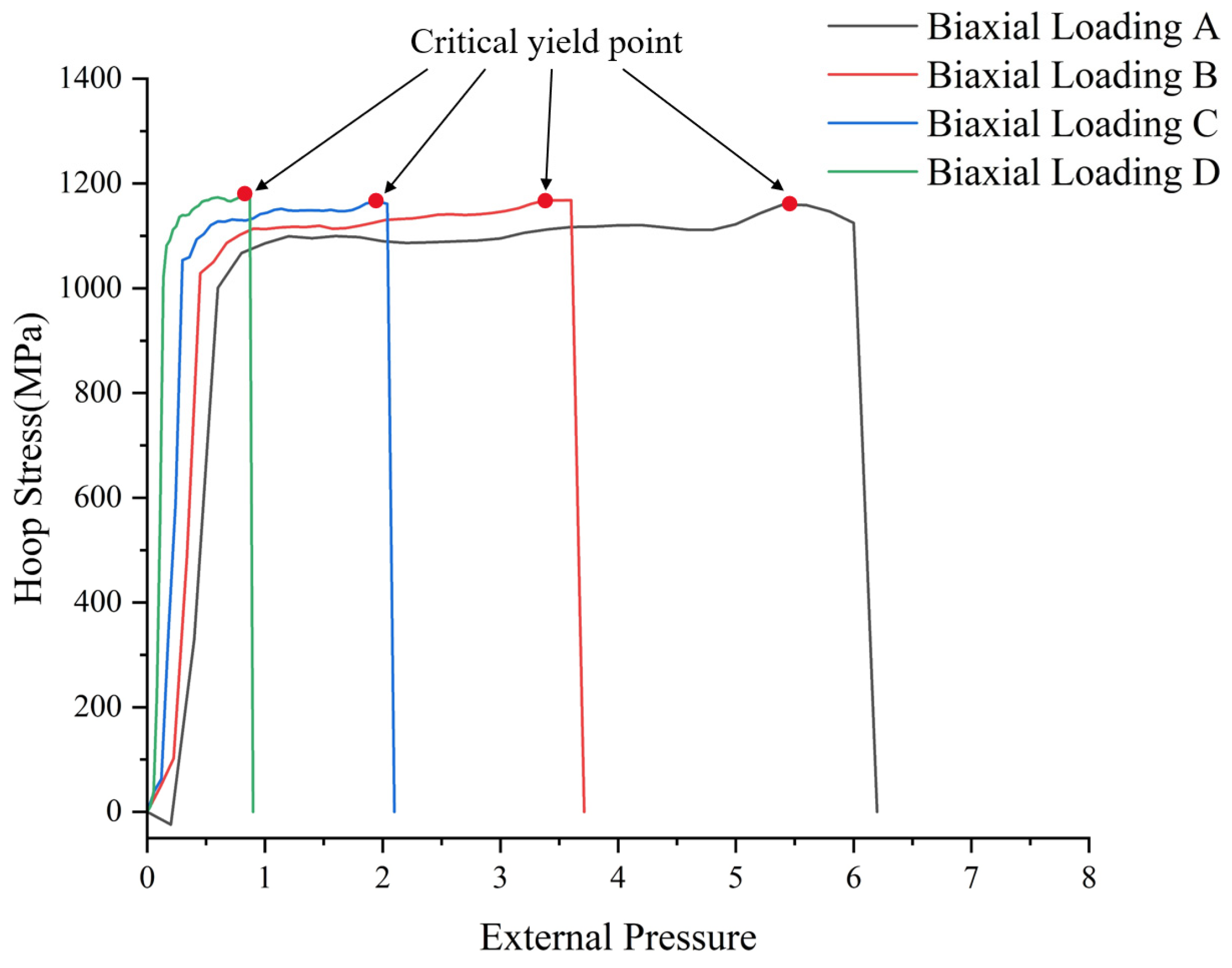
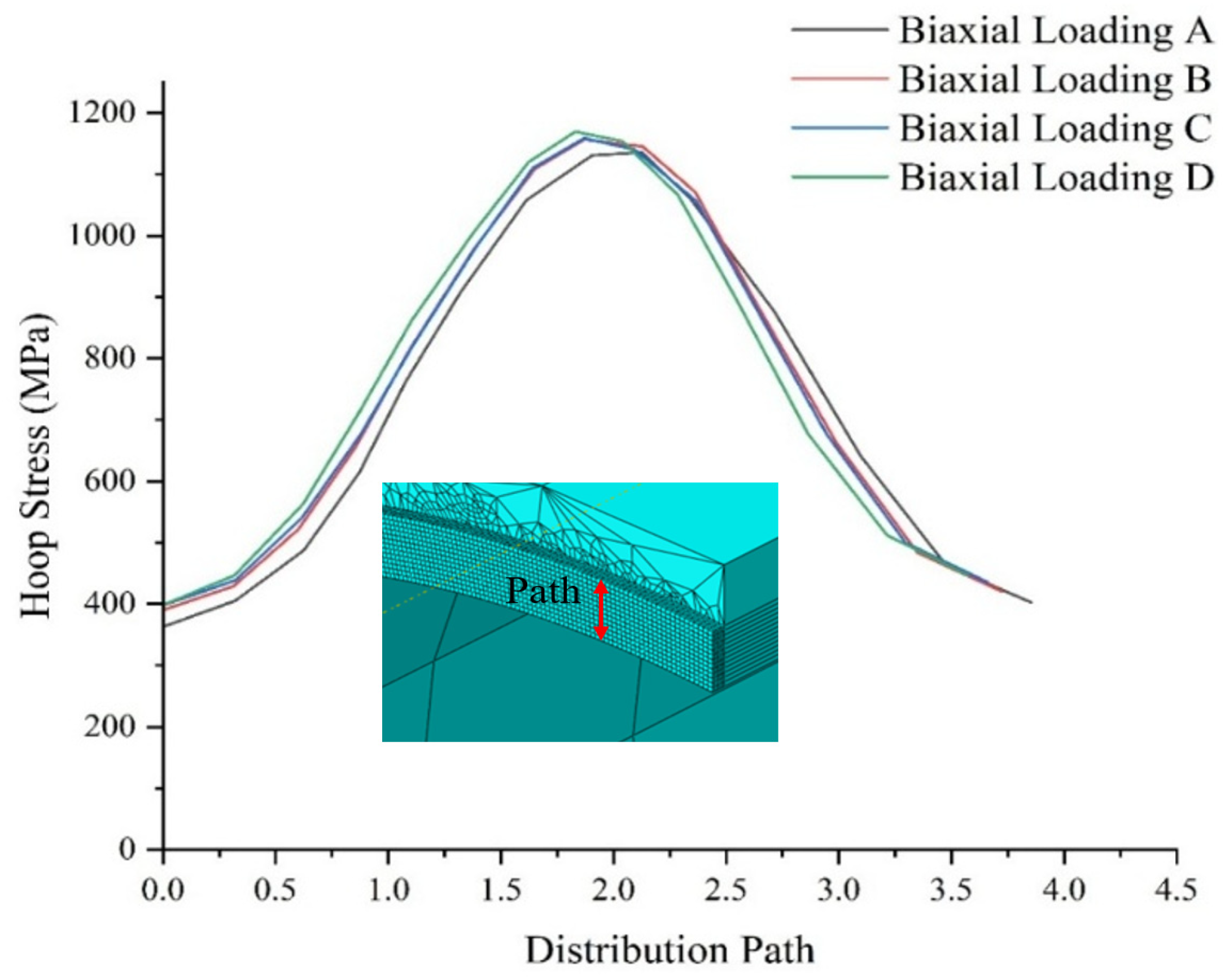
Analysis of the hoop stress behavior provides further insight into the plastic deformation mechanics. The fractured pipeline section was selected as a representative region for monitoring. Figure 22 illustrates the evolution of hoop stress with respect to external pressure up to the fractured pipeline section. The critical yield points are identified when the hoop stress reach their peak values. Owing to the compressive effect of the applied external pressure, the initial rise in hoop stress is relatively gradual. Thereafter, the hoop stress increases rapidly before rising more moderately until the section ultimately fails. The hoop stress distribution at the yield stage, presented in Figure 23, exhibits similar profiles and peak magnitudes across all loading conditions.
The crack failure process initiates when the pipeline section begins to fail at the critical yield point, even without additional strain or external pressure. The critical yield point could be considered as the starting point of pipeline cross-section failure and as a mechanical engineering criterion for pipeline fracture failure. The precise values of these critical points are presented in Table 4. As the external pressure increases from zero to Combined Load D, the critical strain and critical curvature increased by 12.6% and 12.4%, respectively. From Load D to C, these increments rose to 17.4% and 17.6%; from Load C to B, they further reached 18.5% and 18.8%; and finally, from Load B to A, the gains peaked at 20.6% and 20.9%. These results demonstrate that both the critical strain and the bending rate exhibit an accelerating upward trend in response to increasing external pressure. It is observed that the yield stress ( σ y ) undergoes a marginal reduction as the external pressure load increases, but the stress in the yield zone remains basically stable.
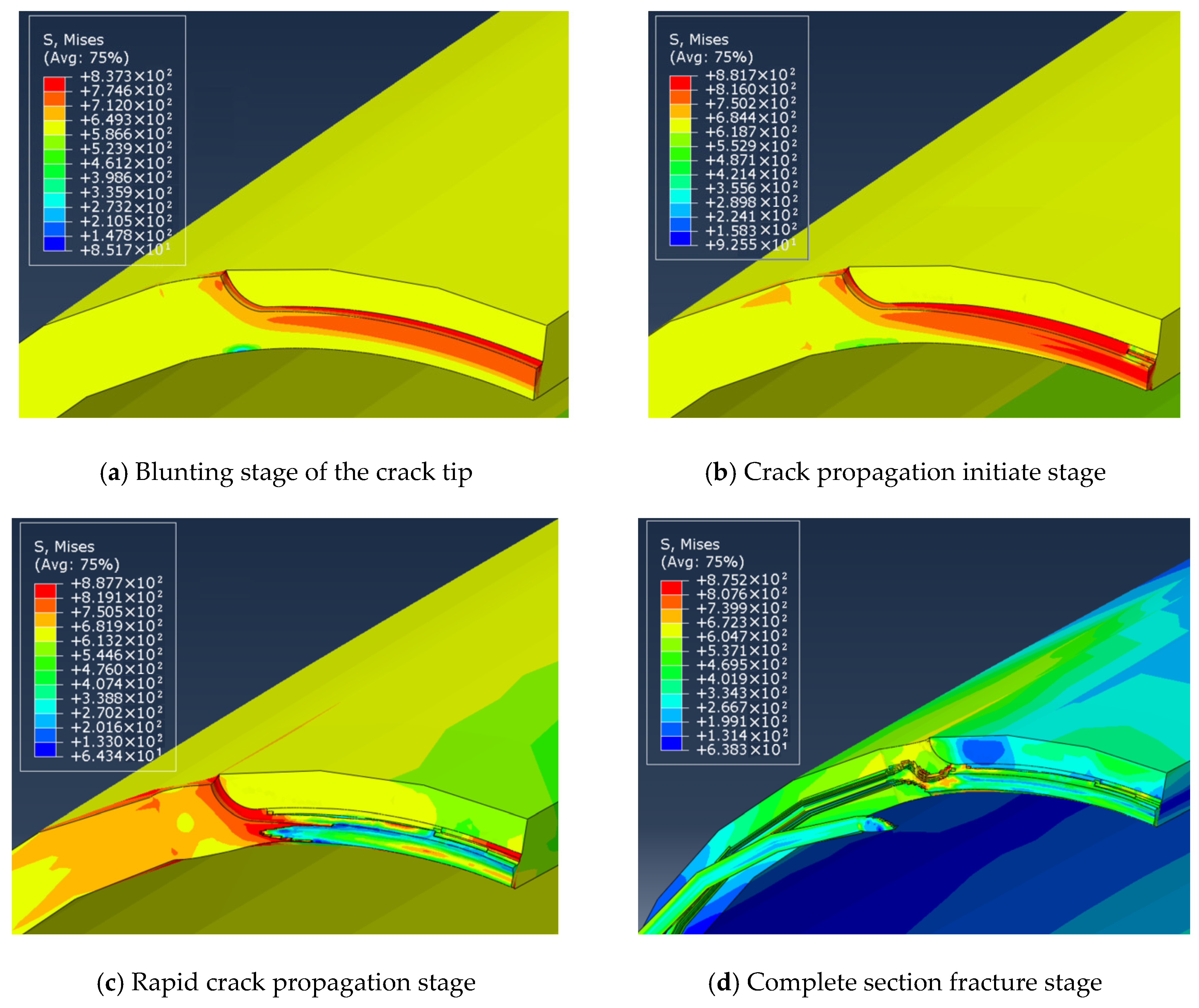
Taking Loading A (12 MPa) as a representative case, the stress distributions within the pipeline at four distinct stages of the fracture process are illustrated in Figure 24. As depicted in Figure 24a, a pronounced crack tip blunting phenomenon is observed prior to the ultimate structural failure, indicating that significant strain energy dissipation is required to sustain crack growth. Crack propagation initiates near the crack front once the local stress state exceeds the critical yield point, marking the onset of pipeline section failure as shown in Figure 24b. Subsequently, a rapid crack propagation stage is entered as shown in Figure 24c, eventually culminating in complete section fracture and total failure of the pipeline as shown in Figure 24d.
By integrating experimental assessment of key parameters with numerical analysis methods for in-service X80 pipelines, the distinct failure processes of subsea pipelines, which differ from their initial design states, can be effectively characterized by the Modified Mohr-Coulomb failure assessment method proposed in this study. This integrated approach captures key aspects such as the evolution of stress–strain states, moment–curvature responses, and hoop stress distributions. Moreover, it enables an effective evaluation of the residual fracture resistance after time-dependent material degradation, offering fundamental insights into the reliability of subsea pipelines under complex loading conditions.

4. Sensitivity Analysis of Crack Size

To facilitate crack size studies and sensitivity analysis, dimensionless ratios are adopted to define the crack parameters [41]. Specifically, the depth-to-thickness ratio a/t is applied within the range 0.2 < a/t < 0.8. In addition to crack length and depth, the initial crack width induced by stress corrosion is also examined parametrically. As the critical strain and critical curvature exhibit analogous trends with respect to external loading, only the critical strain response for different crack sizes is evaluated in this section. The analysis mainly focuses on the mechanical behavior of the pipeline during crack propagation.

4.1. Influence of Varying Crack Depth

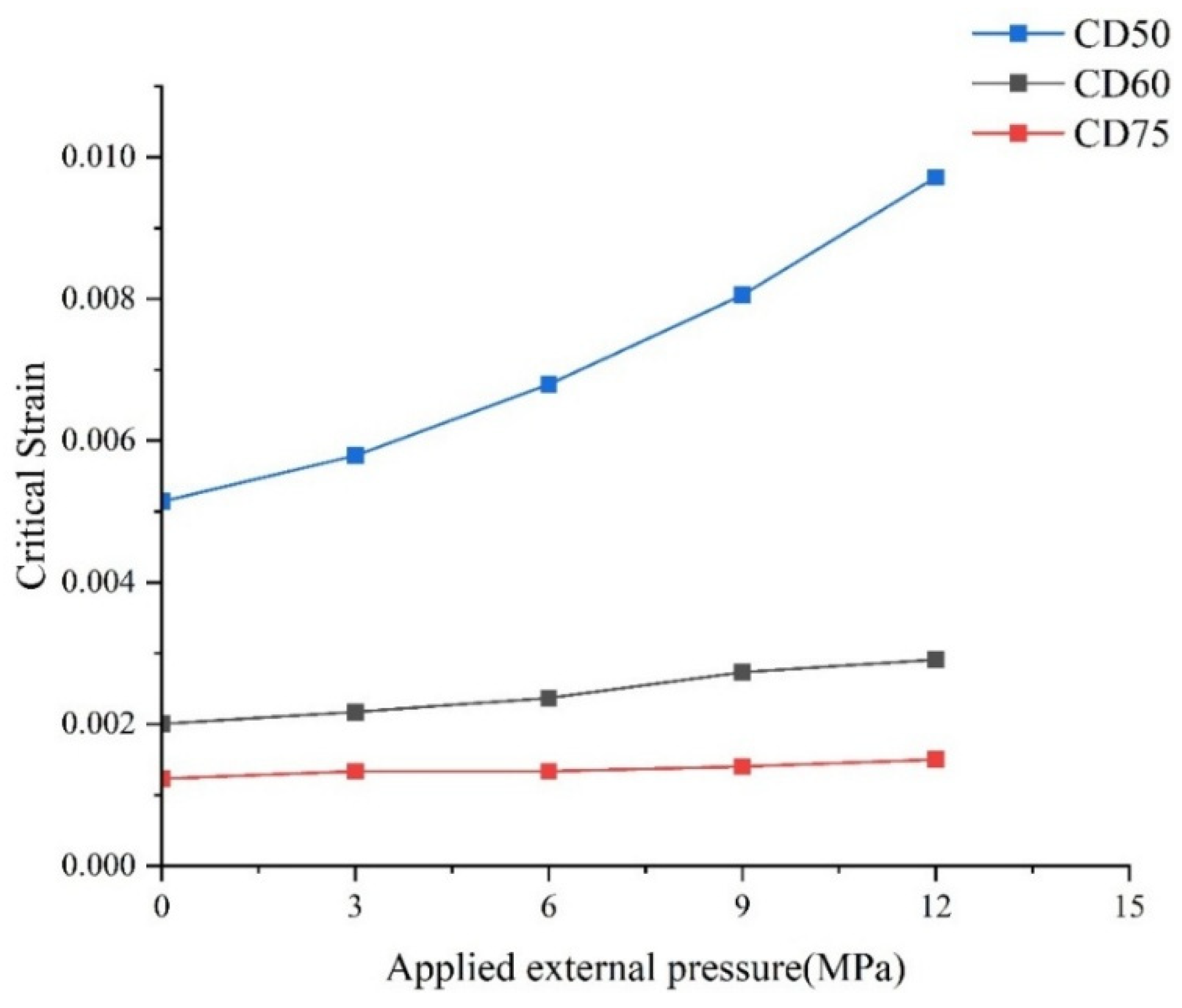
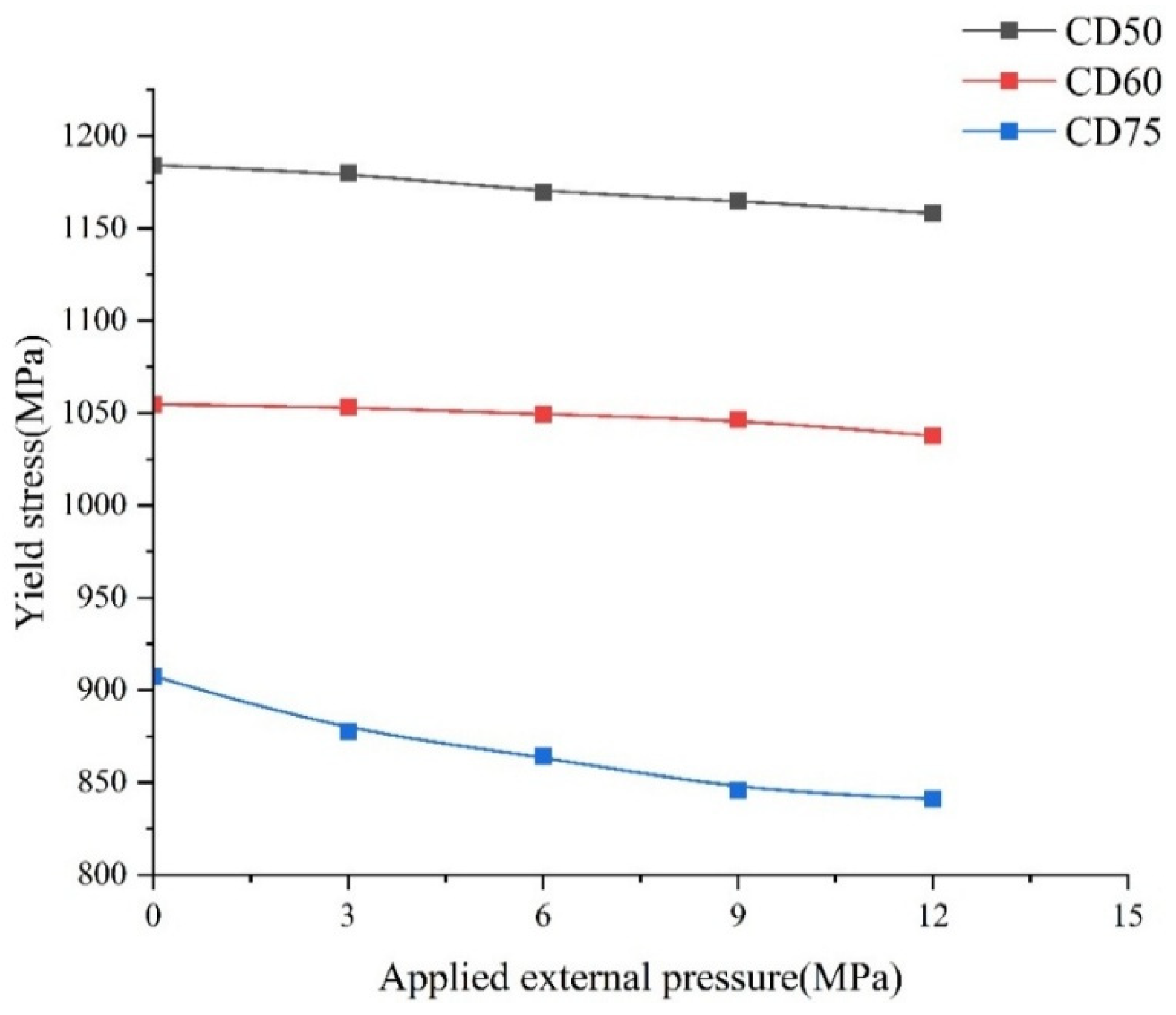
To prevent buckling in the pipeline model, three crack depths exceeding half the wall thickness were selected, corresponding to a/t = 0.50, 0.60, and 0.75. All other crack characteristics remained identical across specimens (2cD = 0.15, w/L = 1/600). Figure 25 and Figure 26 illustrate the variations in critical strain and yield stress, respectively, as functions of external pressure load for these three distinct crack depths. The labels of CD50, CD60 and CD75 denote a/t = 0.50, 0.60, and 0.75, respectively.
As shown in Figure 25, as the external pressure increased from 0 to 12 MPa, the critical strain exhibited varying increments depending on crack depth. An 88.9% increase was observed for the CD50 model, whereas the increments for the CD60 and CD75 models were substantially lower at 45.3% and 22.1%, respectively. This indicates that for a given crack depth, the critical strain increases with external pressure, but the rate of increase gradually diminishes as the crack depth grows. Furthermore, increasing the crack depth reduces the critical axial strain, although the magnitude of this reduction also decreases for deeper cracks. For instance, under an external pressure of 3 MPa, the critical strain decreased by 62.5% when transitioning from CD50 to CD60, and by a further 38.6% from CD60 to CD75. As illustrated in Figure 26, the yield stress declines continuously with increasing crack depth. At shallower crack depths (CD50), an increase in external pressure to 12 MPa leads to only a marginal 2.4% reduction in yield stress. In contrast, for deeper cracks (CD75), raising the external pressure to 12 MPa leads to only a marginal 2.4% reduction in yield stress. In contrast, for deeper cracks (CD75), the same increase in external pressure amplifies the decline to 7.3%. These findings demonstrate that crack depth profoundly influences the mechanical responses of the pipeline, as well as their respective sensitivities to external pressure. This observed trend is highly consistent with previous experimental findings and existing literature. Specifically, Wang et al. [42] studied the effects of hydrogen pressure and stress variations on fatigue crack propagation rate, concluding that crack depth propagation directly determines the critical point at which the pipeline transitions from “stable growth” to “unstable fracture.” Furthermore, González-Arévalo [43] also found, through finite element analysis, that crack depth is a critical parameter for estimating the failure pressure of pipelines.

4.2. Influence of Varying Crack Length

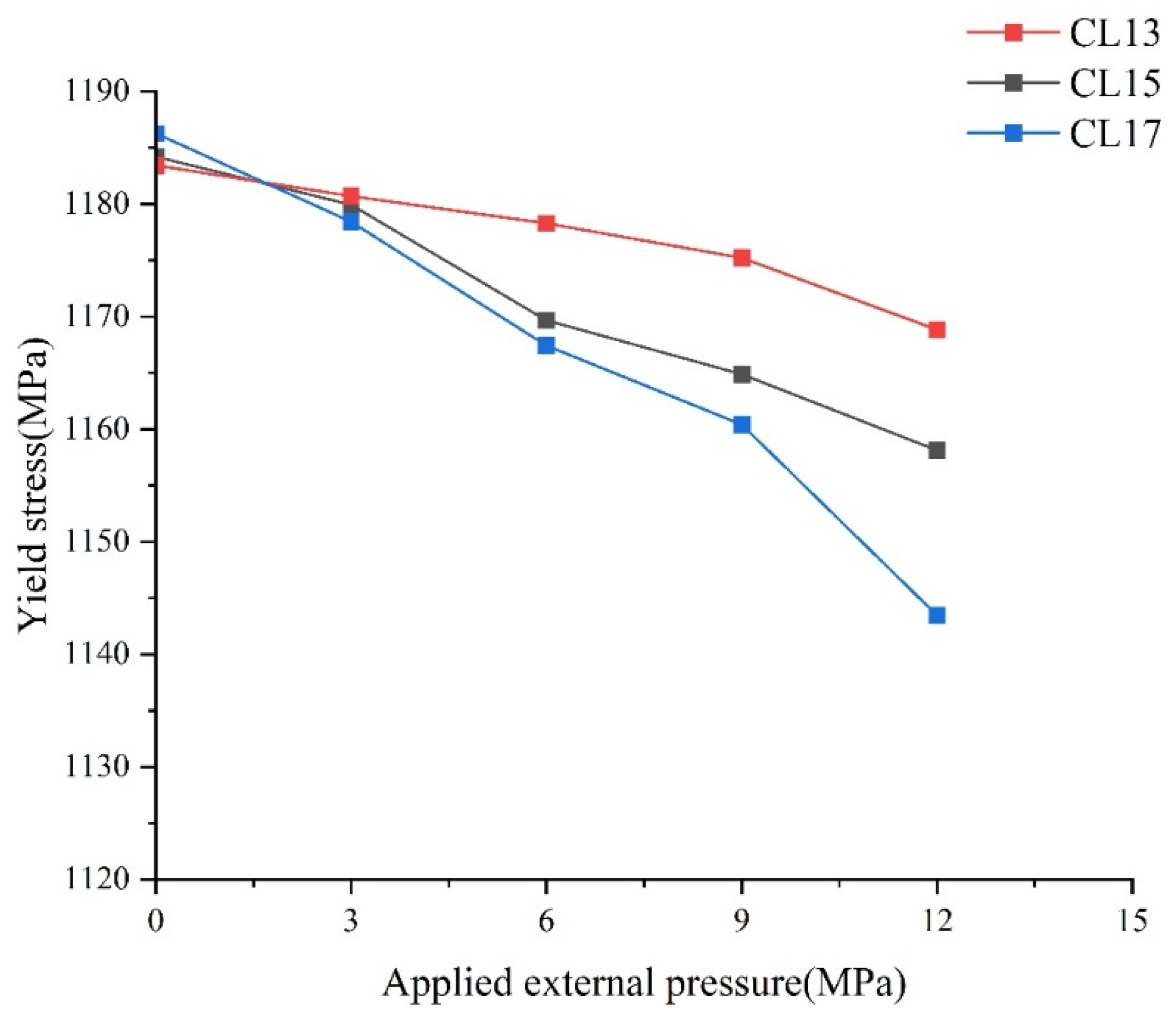
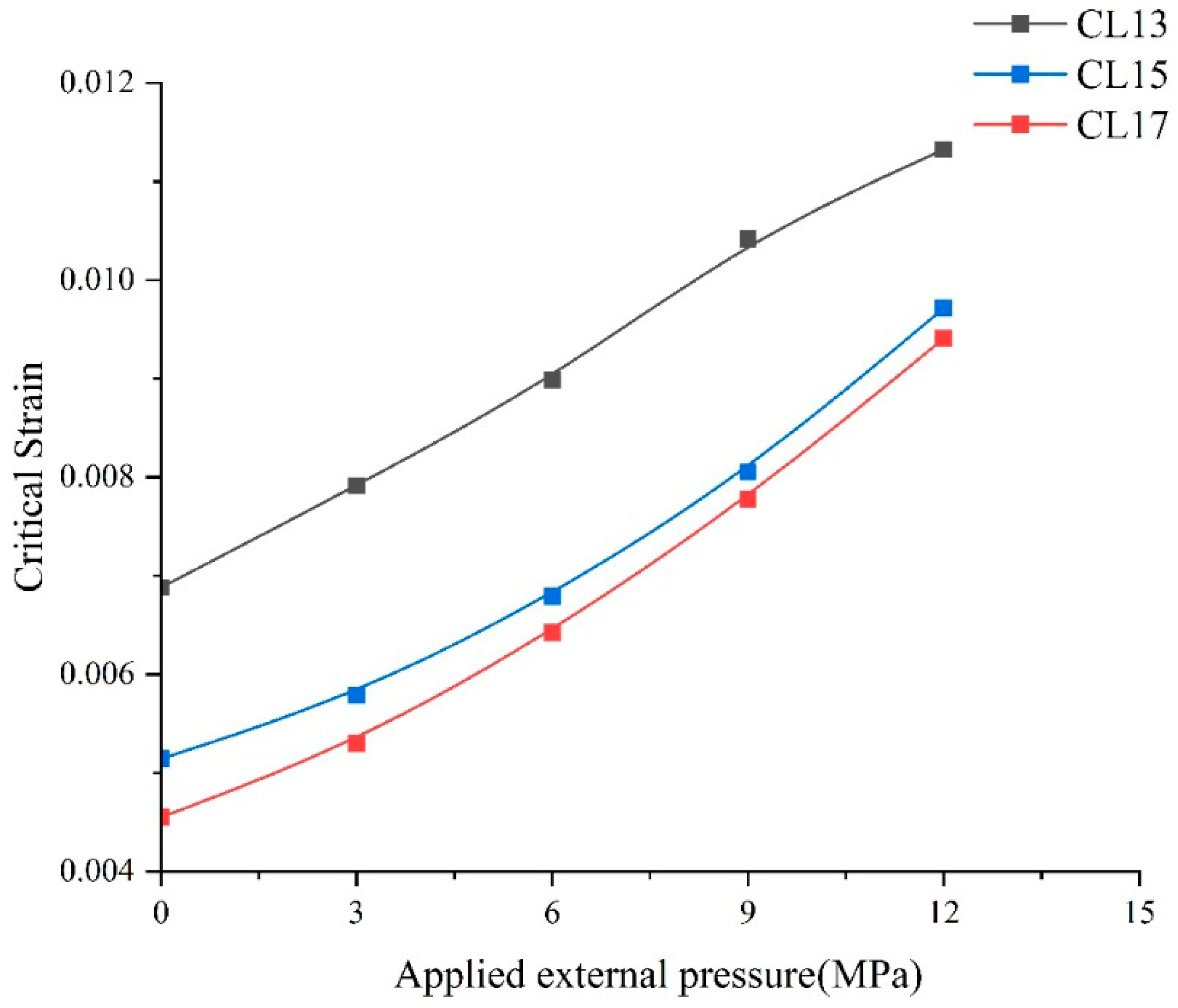
Three crack lengths were selected for analysis, corresponding to 2c/πD = 0.13, 0.15, and 0.17. All other specimen characteristics remained constant with a/t = 0.50 and w/L = 1/600. The variations in critical strain and yield stress as functions of external pressure load for these three crack lengths are presented in Figure 27 and Figure 28, respectively. The labels of CL13, CL15, and CL17 denote the test specimens with 2c/πD values of 0.13, 0.15, and 0.17.
As shown in Figure 27, the critical axial strain exhibits a decreasing trend with increasing crack length. However, the rate of this reduction becomes less pronounced at larger crack lengths. For example, under an external pressure load of 3 MPa, the critical strain decreased by 26.8% when the crack length increased from CL13 to CL15, whereas the reduction dropped to only 8.4% from CL15 to CL17. As depicted in Figure 28, the yield stress displays a downward trend as external pressure rises from 0 to 12 MPa, decreasing by 1.2% for model CL13, 2.2% for CL15, and 3.6% for CL17. Compared to the variations observed with different crack depths, the differences in yield stress across varying crack lengths are considerably smaller. Under low external pressure, yield stress remains nearly constant regardless of crack length. As pressure increases, however, pipes with longer cracks exhibit a relatively sharper decline in yield stress. These results indicate that crack length exerts a moderate influence on the pipeline’s critical strain, while also having an effect on the pressure sensitivity of its yield stress.

4.3. Influence of Varying Crack Width

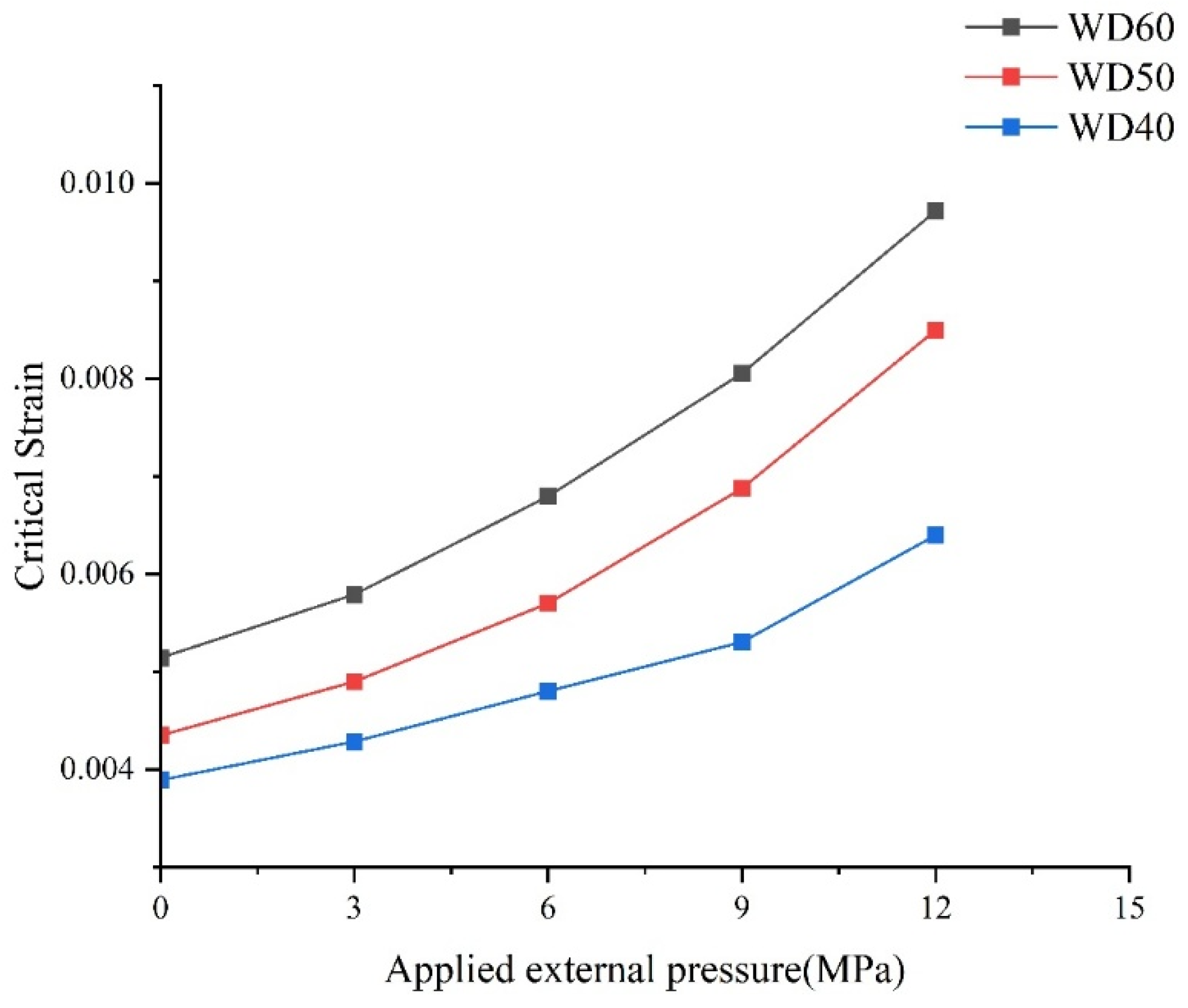
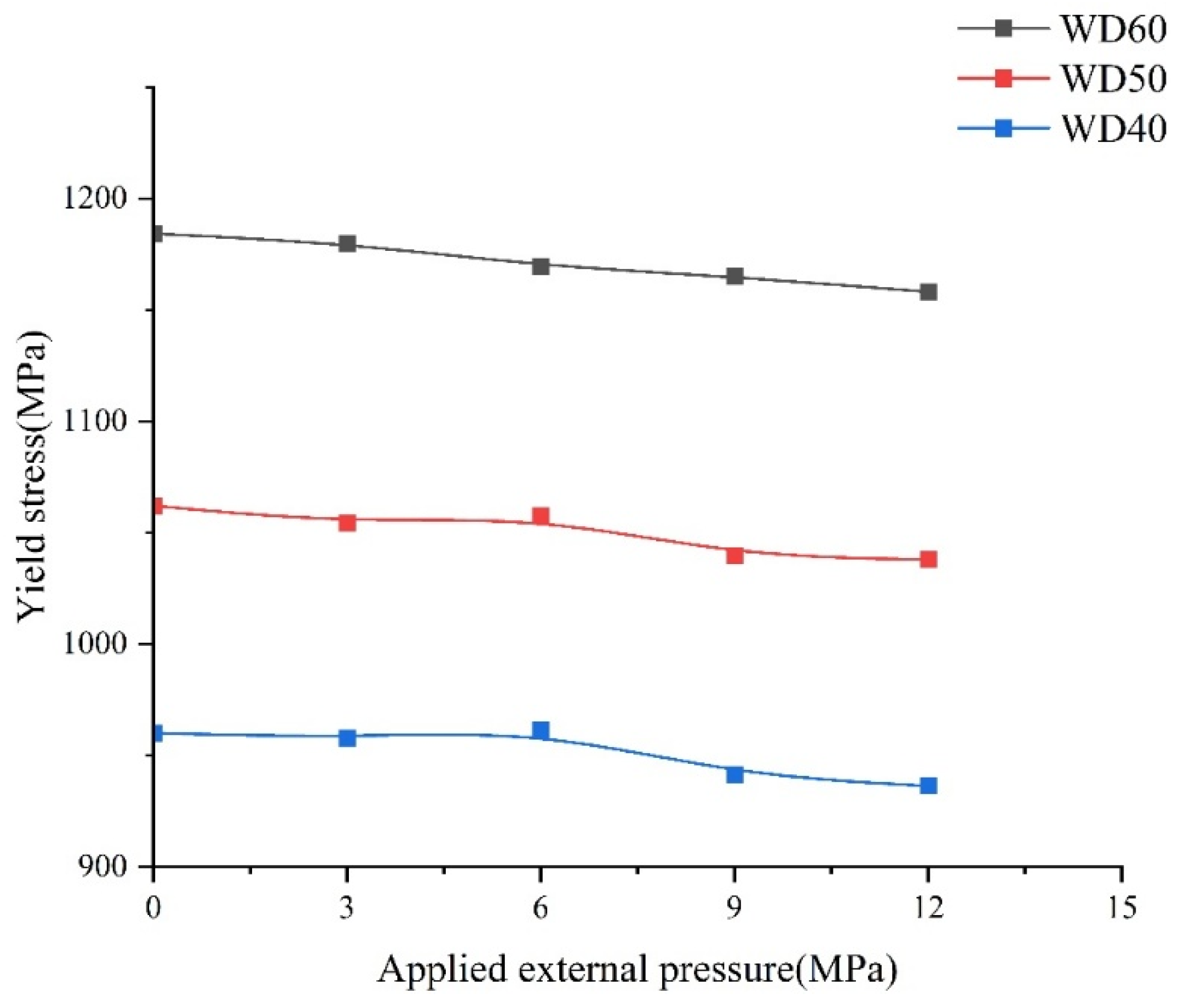
To evaluate the performance of the pipeline model under varying crack widths, three crack width ratios were selected for analysis, corresponding to w/L = 1/600, 1/500, and 1/400. The crack characteristics for all other specimens remained consistent with 2c/πD = 0.15 and a/t = 0.50. Figure 29 and Figure 30 illustrate the variation curves of critical strain and yield stress, respectively, as a function of external pressure load under three different crack widths. The labels WD60, WD50, and WD40 denote the test specimens with w/L ratios of 1/600, 1/500, and 1/400.
As shown in Figure 29, when the external pressure increases from 0 to 12 MPa, the critical strain shows significant yet varied enhancement. It increases by 88.9% for model WD60 and 95.4% for WD50, while the increase is limited to 39.2% for model CD75. Under constant external pressure, the critical axial strain decreases continuously as the crack width increases. Although critical strain rises with increasing external pressure, the rate of this increase diminishes as the crack width expands. As illustrated in Figure 30, yield stress decreases only marginally and fairly uniformly across different crack widths as external pressure rises from 0 to 12 MPa where reductions of 2.4% for WD60, 2.2% for WD50, and 2.5% for WD40 are observed. Meanwhile, the average yield stress of model WD60 is 10.4% lower than that of WD50, which in turn is 9.4% lower than that of WD40. A consistent and substantial reduction in yield stress occurs with increasing crack width, indicating a steady degradation of the pipeline’s load-bearing capacity. These results demonstrate that crack width significantly influences the mechanical responses of the pipeline and also modulates the pressure sensitivity of the critical strain.

5. Conclusions

This study establishes a comprehensive experimental-numerical evaluation framework based on the MMC criterion to systematically investigate the fracture failure behavior of in-service X80 submarine pipelines under combined tension, bending, and external pressure loading. Grounded in the precise calibration of the actual mechanical properties of in-service pipe materials and the validation of high-fidelity finite element models, this paper reveals the evolution patterns of pipelines from localized damage to macroscopic failure within complex marine environments. Furthermore, it quantifies the influence of external hydrostatic pressure and crack geometric characteristics on the structural residual load-bearing capacity. The three main conclusions are as follows:
(1)
An integrated experimental-numerical failure assessment framework, grounded in the MMC criterion, was developed for in-service X80 subsea pipelines. This approach effectively characterizes failure processes that deviate from the original design state and provides a reliable evaluation of residual fracture resistance after time-dependent material degradation, offering fundamental insights into pipeline reliability under complex loading.
(2)
Analysis of the mechanical response of X80 pipeline steel under different external pressure loads confirms that while the failure stress remains essentially stable across varying external pressures, both the critical strain and critical curvature exhibit a marked accelerating upward trend as external pressure increases, with a maximum increase of 20.9%. This indicates that in a marine environment, when a pipeline contains a crack caused by, for example, a ship anchor impact, an increase in external pressure (corresponding to greater water depth) can actually make the pipeline less prone to entering a failure state, provided that the pressure does not induce buckling instability. Moreover, the asymmetric sensitivity observed in the stress–strain response demonstrates that strain monitoring offers higher physical resolution and a more sensitive failure detection capability compared to conventional stress monitoring. Therefore, in engineering practice, it is advisable to prioritize the deployment of high-precision strain sensors. By monitoring abnormal fluctuations in the strain field in real time, it is possible to capture early and more reliably the precursor signals indicating that the pipeline is entering an unstable failure stage, thereby providing effective early warning and ensuring the safe operation of subsea pipelines.
(3)
To analyze the influence of crack depth, length, and width on pipeline models more effectively, this study investigates the sensitivity of key crack dimensional parameters. Generally, crack dimensions are negatively correlated with the load-bearing capacity of the pipeline. Specifically, the reduction in failure stress for deep cracks (CD75) under a pressure of 12 MPa is more than three times that of shallow cracks (CD50), whereas variations in crack length exert the most marginal influence on failure characteristics, with a difference of less than 6%. These findings indicate a significant hierarchy in the impact of crack geometry on the failure behavior of X80 pipelines. Crack depth is the primary factor determining failure sensitivity, as its influence on critical strain and pressure fluctuations far exceeds that of crack width and length.
By quantitatively analyzing the fracture behavior of subsea pipelines under combined tension-bending-pressure loading, this study provides a high-precision predictive model for in-service pipelines in complex marine environments, such as those subject to anchor impact or geohazards. The established thresholds for critical strain, critical curvature, and yield stress define a clear safe operating envelope for offshore engineering. Based on the identified sensitivity hierarchy, engineers can rapidly identify high-risk defects from measured crack depth, length, and width, supporting informed decision-making in structural integrity management.

Author Contributions

Conceptualization, Y.C. and Y.B.; Methodology, Y.C., M.S. and D.X.; Software, Y.W.; Validation, M.S., F.L. and R.N.; Formal analysis, M.S. and F.L.; Investigation, Y.W. and D.X.; Resources, M.S., J.Y., F.L., R.N. and D.X.; Data curation, Y.W., J.Y., F.L. and R.N.; Writing—original draft, Y.W.; Writing—review & editing, Y.C.; Visualization, Y.W., J.Y., R.N. and D.X.; Supervision, J.Y., F.L. and Y.B.; Project administration, Y.C. and Y.B.; Funding acquisition, Y.C. and Y.B. All authors have read and agreed to the published version of the manuscript.

Funding

This research was support by the National Natural Science Foundation of China (Grant No. 52571299), the Natural Science Foundation of Shanghai (Grant No. 25ZR1401160) and the Science and Technology Special Project of Ordos, China (Grant No. ZD20232309).

Data Availability Statement

The data used to support the findings of this study are included in the article.

Conflicts of Interest

Author Jiangong Yang was employed by the company Ordos Carbon Neutralization Research and Application Co., Ltd. Authors Feng Liu, Rihan Na and Donghai Xie were employed by the company Inner Mongolia Western Natural Gas Co., Ltd. Author Yong Bai was employed by the company Guangdong OPR Hydrogen Energy Technology Co., Ltd. The remaining authors declare that the research was conducted in the absence of any commercial or financial relationships that could be construed as a potential conflict of interest.

References

  1. Gao, P.; Duan, M.; Gao, Q.; Jia, X.; Huang, J. A prediction method for anchor penetration depth in clays. Ships Offshore Struct. 2016, 11, 782–789. [Google Scholar] [CrossRef]
  2. Jiang, F.; Zhao, E. Damage mechanism and failure risk analysis of offshore pipelines subjected to impact loads from falling object, considering the soil variability. Mar. Struct. 2024, 93, 103544. [Google Scholar] [CrossRef]
  3. Qi, C.; Li, T.; Liu, C.; Gao, J.; Du, X.; Ren, Q.; Jia, W. Experiments and evaluation on residual strength of X52 steel pipe with various internal defects. Front. Energy Res. 2023, 10, 1046900. [Google Scholar] [CrossRef]
  4. Schell, C.A.; Lever, E.; Groth, K.M. Strain-based design and assessment for pipeline integrity management: A review of applications and gaps. Int. J. Press. Vessel. Pip. 2023, 204, 104973. [Google Scholar] [CrossRef]
  5. Okyere, M.S. Assessment of internal corrosion risk in wet sour gas pipeline systems utilizing computational fluid dynamics: A predictive framework for evaluating pipeline and structural integrity, with a case study of the Kashagan 28-inch offshore pipeline. J. Eng. Appl. Sci. 2025, 72, 250. [Google Scholar] [CrossRef]
  6. Wu, H.; Luo, Y.; Zhou, G. Corrosion behaviors and mechanical properties of Q235 steel pipes collapsing due to corrosion after 25-year service in urban industrial atmospheric environment. Constr. Build. Mater. 2023, 395, 132342. [Google Scholar] [CrossRef]
  7. Cao, Y.; Liu, X.; Yang, J.; Wang, D.; Bai, Y.; Wang, F. Hydrogen-induced buckling degradation response of subsea defective hydrogen mixed transmission natural gas pipeline. Ocean Eng. 2025, 321, 120325. [Google Scholar] [CrossRef]
  8. Meniconi, S.; Brunone, B.; Tirello, L.; Rubin, A.; Cifrodelli, M.; Capponi, C. Transient tests for checking the Trieste subsea pipeline: Diving into fault detection. J. Mar. Sci. Eng. 2024, 12, 391. [Google Scholar] [CrossRef]
  9. Meniconi, S.; Brunone, B.; Tirello, L.; Rubin, A.; Cifrodelli, M.; Capponi, C. Transient tests for checking the Trieste subsea pipeline: Toward field tests. J. Mar. Sci. Eng. 2024, 12, 374. [Google Scholar] [CrossRef]
  10. Hutchinson, J.W. Fundamentals of the phenomenological theory of nonlinear fracture mechanics. J. Appl. Mech. Trans. ASME 1983, 50, 1042–1051. [Google Scholar] [CrossRef]
  11. Hutchinson, J. Singular behaviour at the end of a tensile crack in a hardening material. J. Mech. Phys. Solids 1968, 16, 13–31. [Google Scholar] [CrossRef]
  12. Paris, P.; Tada, H.; Zahoor, A.; Ernst, H. The theory of instability of the tearing mode of elastic-plastic crack growth. In Elastic-Plastic Fracture; ASTM International: West Conshohocken, PA, USA, 1979. [Google Scholar] [CrossRef]
  13. Iranmehr, A.; Kheirkhah, M.; Li, H.; Hanna, B.; Lamborn, L.; Hemmati, A.; Adeeb, S.; Hogan, J. Numerical investigation of constraint-dependent crack growth in X70 pipeline steel using XFEM-based cohesive segments approach with surface strain-based J-integral evaluation. Theor. Appl. Fract. Mech. 2025, 140, 105175. [Google Scholar] [CrossRef]
  14. Zhao, D.; Gao, W.; Zhao, K.; Zheng, H.; Chen, J.; Yu, J.; Zheng, Z. A strain-based J-integral formulation for an internal circumferential surface crack of pipeline under inner pressure and large axial deformation. Int. J. Press. Vessel. Pip. 2024, 212, 105316. [Google Scholar] [CrossRef]
  15. Tvergaard, V. Material failure by void growth to coalescence. Adv. Appl. Mech. 1989, 27, 83–151. [Google Scholar] [CrossRef]
  16. Tvergaard, V.; Needleman, A. Analysis of the cup-cone fracture in a round tensile bar. Acta Metall. 1984, 32, 157–169. [Google Scholar] [CrossRef]
  17. Nahshon, K.; Hutchinson, J. Modification of the Gurson model for shear failure. Eur. J. Mech. A/Solids 2008, 27, 1–17. [Google Scholar] [CrossRef]
  18. Nielsen, K.L.; Tvergaard, V. Ductile shear failure or plug failure of spot welds modelled by modified Gurson model. Eng. Fract. Mech. 2010, 77, 1031–1047. [Google Scholar] [CrossRef]
  19. Hu, Y.C.; Xi, F.; Liu, F.; Tan, Y.H. Shear-modified GTN model revisited: Ductile fracture prediction in mild steel. J. Constr. Steel Res. 2025, 235, 109874. [Google Scholar] [CrossRef]
  20. Mahmoud, M.A.S.; Renner, D.; Khosravani, A.; Kalidindi, S.R. Sequential Bayesian Inference of the GTN damage model using multimodal experimental data. Acta Mater. 2026, 306, 121902. [Google Scholar] [CrossRef]
  21. Bergo, S.; Morin, D.; Hopperstad, O.S. Numerical implementation of a non-local GTN model for explicit FE simulation of ductile damage and fracture. Int. J. Solids Struct. 2021, 219, 134–150. [Google Scholar] [CrossRef]
  22. Bai, Y.; Wierzbicki, T. A new model of metal plasticity and fracture with pressure and Lode dependence. Int. J. Plast. 2008, 24, 1071–1096. [Google Scholar] [CrossRef]
  23. Wu, K.; Sun, Y.; Xiao, W.; Yang, J. A strain components-based Mohr–Coulomb fracture criterion for proportional loading. Eng. Fract. Mech. 2024, 307, 110283. [Google Scholar] [CrossRef]
  24. Sarzosa, D.F.; Paredes, M.; Savioli, R.; Ruggieri, C.; Leite, L.G.; da Silva, N.S.; Garmbis, A.G. Experimental and numerical study on the ductile fracture response of X65 girth-welded joint made of Inconel 625 alloy. Theor. Appl. Fract. Mech. 2022, 121, 103533. [Google Scholar] [CrossRef]
  25. Ji, C.; Li, Z.; Liu, J. Development of an improved MMC-based fracture criterion characterizing the anisotropic and strain rate-dependent behavior of 6061-T5 aluminum alloy. Mech. Mater. 2020, 150, 103598. [Google Scholar] [CrossRef]
  26. Park, S.J. Application of ductile fracture model for the prediction of low cycle fatigue in structural steel. Eng. Fract. Mech. 2023, 289, 109469. [Google Scholar] [CrossRef]
  27. Gao, B.; Huang, W.; Wang, S.; Liu, Z.; Chen, X.; Su, S. Uncoupled ductile fracture criterion motivated by micromechanisms: Modeling and experiments. Eng. Fract. Mech. 2025, 313, 110659. [Google Scholar] [CrossRef]
  28. Han, P.; Cheng, P.; Yuan, S.; Bai, Y. Characterization of ductile fracture criterion for API X80 pipeline steel based on a phenomenological approach. Thin-Walled Struct. 2021, 164, 107254. [Google Scholar] [CrossRef]
  29. Su, Z.; Wu, Y.; Du, Z.; Wang, J. Towards reliable failure prediction of dented X80 pipelines: A comparative study of uncoupled ductile fracture models. Ocean Eng. 2025, 341, 122583. [Google Scholar] [CrossRef]
  30. Bai, Y.; Wierzbicki, T. A comparative study of three groups of ductile fracture loci in the 3D space. Eng. Fract. Mech. 2015, 135, 147–167. [Google Scholar] [CrossRef]
  31. Saneian, M.; Han, P.; Jin, S.; Bai, Y. Fracture response of steel pipelines under combined tension and torsion. Thin-Walled Struct. 2020, 154, 106870. [Google Scholar] [CrossRef]
  32. Wang, Y.; Wang, W.; Zhang, B.; Li, C.Q. A review on mixed mode fracture of metals. Eng. Fract. Mech. 2020, 235, 107126. [Google Scholar] [CrossRef]
  33. Keim, V.; Paredes, M.; Nonn, A.; Münstermann, S. FSI-simulation of ductile fracture propagation and arrest in pipelines: Comparison with existing data of full-scale burst tests. Int. J. Press. Vessel. Pip. 2020, 182, 104067. [Google Scholar] [CrossRef]
  34. Gong, B.; Wan, X.; Huo, X.; Liu, Y.; Deng, C.; Wang, D.; Dai, L. Development of a strain-based fracture assessment approach for X80 steel pipe welded girth by modified Mohr-Coulomb model. Int. J. Press. Vessel. Pip. 2023, 206, 105056. [Google Scholar] [CrossRef]
  35. Bai, Y.; Wierzbicki, T. Application of extended Mohr–Coulomb criterion to ductile fracture. Int. J. Fract. 2010, 161, 1–20. [Google Scholar] [CrossRef]
  36. Bao, Y.; Wierzbicki, T. On fracture locus in the equivalent strain and stress triaxiality space. Int. J. Mech. Sci. 2004, 46, 81–98. [Google Scholar] [CrossRef]
  37. Swift, H. Plastic instability under plane stress. J. Mech. Phys. Solids 1952, 1, 1–18. [Google Scholar] [CrossRef]
  38. Hancock, J.W.; Mackenzie, A.C. On the mechanisms of ductile failure in high-strength steels subjected to multi-axial stress-states. J. Mech. Phys. Solids 1976, 24, 147–160. [Google Scholar] [CrossRef]
  39. Xu, Y.; Liu, X.; Cao, L.; Chen, J.; Wu, G.; Zhen, Y.; Cao, Y. Ductile fracture behavior of X65 pipeline steel under different stress states. Eng. Fail. Anal. 2025, 186, 110449. [Google Scholar] [CrossRef]
  40. Osage, D.A.; Dong, P.; Spring, D. Fatigue assessment of welded joints in API 579-1/ASME FFS-1 2016—Existing methods and new developments. Procedia Eng. 2018, 213, 497–538. [Google Scholar] [CrossRef]
  41. Yuan, K.; Dong, K.; Fang, Q. General point load weight function of stress intensity factors for external circumferential surface cracks in pipes. Ocean Eng. 2024, 308, 118263. [Google Scholar] [CrossRef]
  42. Wang, A.; Wang, B.; Jiang, R.; Nie, R.; Cui, G.; Liu, J.; Zhang, Y.; Zhang, H.; Xing, X. Experimental study on hydrogen-induced crack propagation of X80 steel under alternating pressure fluctuations. Materials 2025, 18, 947. [Google Scholar] [CrossRef] [PubMed]
  43. González-Arévalo, N.E.; Díaz-Cruz, M.; Velázquez, J.C.; Cervantes-Tobón, A.; Carrillo, X.; García-Núñez, S.J.; Rosado-Carrasco, J. Failure pressure estimation for cracked aged and unaged pipelines using finite element method. Results Eng. 2025, 26, 104621. [Google Scholar] [CrossRef]
Figure 1. A schematic of anchor impact and environmental loads acting on offshore pipelines.
Jmse 14 00659 g001
Figure 2. Process of the uniaxial tensile tests.
Jmse 14 00659 g002
Figure 3. Flowchart for obtaining fracture parameters via notch testing.
Jmse 14 00659 g003
Figure 4. Cross-section of pipe and observed crack.
Jmse 14 00659 g004
Figure 5. Lateral section of pipe and observed crack.
Jmse 14 00659 g005
Figure 6. Schematic diagrams and physical images of the five notched specimen geometries (mm).
Jmse 14 00659 g006
Figure 7. The layout of slow strain rate tensile test equipment.
Jmse 14 00659 g007
Figure 8. Models and meshes of five types of notched specimens.
Jmse 14 00659 g008
Figure 9. The critical displacement of the specimens.
Jmse 14 00659 g009
Figure 10. Stress triaxiality vs. equivalent plastic strain.
Jmse 14 00659 g010
Figure 11. Lode angle parameter vs. equivalent plastic strain.
Jmse 14 00659 g011
Figure 12. Compact tension specimen.
Jmse 14 00659 g012
Figure 13. Dimension details of the compact tension specimen.
Jmse 14 00659 g013
Figure 14. (a) Mesh details of CT models. (b) Boundary conditions of CT model. (c) Loading conditions of CT model.
Jmse 14 00659 g014
Figure 15. The mesh analysis of the MMC model.
Jmse 14 00659 g015
Figure 16. Equivalent plastic strain–CMOD relationship in CT tensile tests.
Jmse 14 00659 g016
Figure 17. Quarter model for numerical simulation of X80 pipelines.
Jmse 14 00659 g017
Figure 18. Pipeline boundary conditions.
Jmse 14 00659 g018
Figure 19. Motion coupling of reference points.
Jmse 14 00659 g019
Figure 20. The strain–tension relationship of in-service X80 pipeline.
Jmse 14 00659 g020
Figure 21. The curvature–moment relationship of in-service X80 pipeline.
Jmse 14 00659 g021
Figure 22. The Hoop stress–external pressure relationship of in-service X80 pipeline.
Jmse 14 00659 g022
Figure 23. Hoop stress profile through the crack zone thickness at critical yield.
Jmse 14 00659 g023
Figure 24. The evolution of fracture in a pipeline model.
Jmse 14 00659 g024
Figure 25. Critical strains vs. external pressure loads under varying crack depths.
Jmse 14 00659 g025
Figure 26. Yield stress vs. external pressure loads under varying crack depths.
Jmse 14 00659 g026
Figure 27. Critical strains vs. external pressure loads under varying crack lengths.
Jmse 14 00659 g027
Figure 28. Yield stress vs. external pressure loads under varying crack lengths.
Jmse 14 00659 g028
Figure 29. Critical strains vs. external pressure loads under varying crack widths.
Jmse 14 00659 g029
Figure 30. Yield stress vs. external pressure loads under varying crack widths.
Jmse 14 00659 g030
Table 1. Overall dimensions of the pipe and initial crack.
Pipe Size ParametersL (mm)D (mm)t (mm)
60020020
Initial crack parametersa/t (depth)2c/πD (length)w/L (width)
0.50.151/600
Table 2. Plasticity parameters of the optimized MMC model.
Plasticity ParametersA (MPa) ε 0 n
865.380.020.095
Table 3. Fracture parameters of the optimized MMC model.
Fracture ParametersC1C2C3
0.02911.84970.8867
Table 4. Parameter values at the critical yield point under varying external pressures.
Loading TypeStrainCurvature (1/m)Yield Stress (MPa)
A0.0097170.1969321158.13
B0.0080550.1628781164.89
C0.0067960.1370811169.68
D0.005790.1166241179.94
No pressure0.0051430.1036611186.21
Disclaimer/Publisher’s Note: The statements, opinions and data contained in all publications are solely those of the individual author(s) and contributor(s) and not of MDPI and/or the editor(s). MDPI and/or the editor(s) disclaim responsibility for any injury to people or property resulting from any ideas, methods, instructions or products referred to in the content.