1. Introduction
The continuous pursuit of lighter, stronger, and more cost-efficient ship structures has become a central theme in modern naval architecture, driven by increasingly stringent environmental regulations, fuel-efficiency targets, and lifecycle cost considerations. In large commercial vessels, stiffened plate structures form the primary load-carrying components of hulls, decks, and bulkheads, and their structural performance is governed not only by material strength but also by buckling stability and post-buckling behavior. As ship structures become thinner and more optimized, their sensitivity to geometric imperfections and nonlinear collapse phenomena increases, making classical linear design approaches progressively less reliable.
Traditionally, built-in angle stiffeners have been widely used in shipbuilding due to their simplicity, availability, and well-established design rules. However, bulb-type stiffeners have recently attracted growing interest as an alternative because of their superior sectional efficiency and favorable fabrication characteristics. From a purely elastic viewpoint, both stiffener types can be designed to provide similar bending and buckling resistance when equivalent sectional properties are applied. Nevertheless, real ship structures do not fail in the elastic regime but through complex nonlinear mechanisms involving local buckling, material yielding, and stiffness degradation. Therefore, it is no longer sufficient to compare stiffener concepts solely based on linear buckling factors or sectional properties; their true structural merit must be assessed in the context of imperfection-sensitive nonlinear ultimate strength.
The necessity of this research arises from this gap between traditional rule-based equivalence and actual nonlinear structural performance. While bulb and angle stiffeners are often treated as interchangeable through equivalent section approaches, there has been limited quantitative evidence regarding how these substitutions affect ultimate strength, post-buckling stability, and weight efficiency when realistic imperfections and material nonlinearity are considered. This issue is particularly important in modern ship design, where even small reductions in structural weight can lead to significant gains in fuel efficiency, cargo capacity, and emissions reduction over the vessel’s lifetime.
The primary objective of this study is to establish a rigorous and physically consistent comparison between bulb-type and built-in angle stiffeners by evaluating their buckling and nonlinear collapse behavior under realistic loading conditions. Using a two-stage numerical framework consisting of eigenvalue buckling analysis and imperfection-based nonlinear strength analysis, this work aims to determine whether bulb-type stiffeners can achieve equivalent or superior structural safety while offering measurable weight advantages. By embedding classification-society-based material models and imperfection definitions into high-fidelity finite element simulations, the study ensures that the results are directly applicable to practical ship design.
The main contribution of this research lies in demonstrating, within the theoretical framework of buckling and ultimate limit state mechanics, that bulb-type stiffeners provide a structurally efficient alternative to conventional angle stiffeners. The results show that although both stiffener types satisfy elastic buckling requirements, their nonlinear responses differ in terms of stiffness degradation, stress redistribution, and collapse characteristics. More importantly, the bulb-type stiffener achieves comparable ultimate strength with reduced material usage, confirming its superior weight efficiency without compromising structural safety. This finding provides a strong scientific basis for adopting bulb-type reinforcement in next-generation lightweight and high-performance ship structures.
To contextualize the present study within the historical continuum of stiffened plate analysis, it is pertinent to acknowledge the foundational theories and evolving methodologies that underpin the field. Seminal contributions, such as von Kármán’s effective width concept [
1] for post-buckling strength and Marguerre’s work [
2] on the influence of initial imperfections, established the theoretical basis for understanding plate stability. The assessment of ultimate strength progressively evolved from such analytical foundations to semi-empirical methods, notably advanced by Faulkner’s formulation [
3] for unstiffened plates, which incorporated the influence of residual stresses and imperfections. This trajectory culminated in comprehensive, multi-parameter empirical formulas developed by researchers such as Paik and his colleagues [
4], which explicitly account for plate slenderness, column slenderness, and stiffener-induced failure modes to predict the collapse strength of stiffened panels. While these studies provide indispensable predictive tools and insights into specific behaviors, the rapid advancement of computational power has since enabled the routine application of nonlinear finite element methods (NLFEM) and geometrically and materially nonlinear imperfection analysis (GMNIA) for detailed component assessment. Building upon this rich heritage, the present study leverages a high-fidelity GMNIA framework not merely for strength prediction, but to perform a targeted, mechanics-based investigation into the nuanced trade-offs between structural performance and weight efficiency for elastically equivalent but geometrically distinct stiffener profiles—a critical design optimization question that moves beyond the traditional scope of strength hierarchy or empirical formula development. The latest major studies related to the current study are analyzed below.
Sholikhah, M. et al. [
5] investigates the buckling performance of steel stiffened panels under compressive loads using nonlinear finite element analysis. The research evaluates three common stiffener types—Flat (I), Angle (L), and Tee (T) bars—revealing a clear performance hierarchy. Results show that Tee bar stiffeners provide the highest ultimate strength, increasing maximum load capacity by 15.90% compared to Flat bars, while Angle bars offer an 8.25% increase. The findings confirm that stiffener geometry significantly influences buckling resistance, providing critical insights for optimizing marine and thin-walled structural designs.
Kim, D.K. et al. [
6] proposes a simplified empirical formula to predict the ultimate compressive strength of unstiffened steel plates, a fundamental element in marine structures. The method modifies the classical elastic buckling strength equation by introducing a correction factor that accounts for initial geometric imperfections and material yield strength. Developed and validated using a large NLFEM database, the formula demonstrates high accuracy of 0.99. It provides a practical and reliable tool for engineers to perform ultimate limit state (ULS) assessments more accurately than traditional elastic-based or complex empirical methods, directly supporting safety and optimized design in shipbuilding and offshore engineering.
Saad-Eldeen, S. et al. [
7] experimentally investigates the compressive behavior of stiffened steel plates used in shipbuilding, focusing on the influence of two fillet welding configurations—continuous welding and intermittent chain welding—and varying base plate thicknesses (6 mm, 8 mm, and 10 mm). The aim was to evaluate the ultimate compressive capacity, collapse modes, and energy absorption characteristics of these structures. The research provides valuable experimental data for optimizing welding configurations in marine structural design, balancing strength, material use, and fabrication efficiency.
Kim, D.K. et al. [
8] develops a refined empirical formulation to predict the ultimate compressive strength of stiffened panels (including typical stiffener forms), which are key structural components in ships and offshore structures. The research utilizes a nonlinear finite element method (NLFEM) in ANSYS 2025 R1 to simulate a large NLFEM database of flat-bar-stiffened panels under longitudinal compression. The key development is an advanced empirical formula that extends beyond the traditional two-parameter approach (plate slenderness ratio
and column slenderness ratio
). It incorporates additional correction terms/coefficients beyond the conventional two-parameter form: the web slenderness ratio (hw/tw) and the moment of inertia ratio between the stiffener and the plate (Ipz/Isz). This multi-parameter approach is designed to better capture the nonlinear fluctuation of ultimate strength, particularly in the lower range of column slenderness. The proposed formulation shows excellent agreement with the finite element simulation results, achieving a high coefficient of determination (R
2 = 0.9435) in statistical validation. It demonstrates superior accuracy compared to several existing single-line empirical formulas and design codes, which tend to either overestimate or underestimate the ultimate strength. Main findings indicate that ultimate strength behavior is significantly influenced by plate slenderness. Thick plates (low
) show strong fluctuation in strength based on stiffener geometry, while thin plates (high
) exhibit a more regular, diagonally decreasing trend in strength as slenderness increases, largely governed by plate buckling.
Zhang, Q. et al. [
9] investigates the ultimate strength and failure modes of stiffened panels in ship structures. The primary aim is to establish a method for identifying different failure modes and to develop a more accurate, four-parameter ultimate strength formula that accounts for these modes. Using nonlinear finite element analysis (ANSYS), the researchers conducted a parametric study based on a benchmark bulk carrier panel model. They proposed a novel failure mode discrimination method that considers the ultimate strength trend and the stress/strain distribution at the ultimate limit state. The key outcome is the establishment of boundary functions to distinguish between three common failure modes: local plate buckling (Mode II), beam-column buckling (Mode III), and stiffener tripping (Mode V). These boundaries are defined using four key geometric and slenderness parameters: column slenderness (
), plate slenderness (
), web height-to-thickness ratio (h_w/t_w), and stiffener tripping slenderness (
). Furthermore, the study developed a refined empirical formula for predicting ultimate strength. This formula incorporates all four parameters mentioned above, moving beyond traditional two-parameter (
) formulas to better reflect the influence of stiffener-related failure, particularly tripping. The proposed formula showed excellent agreement with FE results (R
2 = 0.947) and demonstrated improved accuracy over existing formulas by Paik and Zhang when stiffener failure effects are significant.
Zhang, Q. et al. [
9] investigates the relationship between failure modes and the ultimate compressive strength of stiffened panels, which are critical components in ship hulls. The primary goal is to develop a method for identifying the governing failure mode and to create a more accurate predictive formula for ultimate strength that accounts for these distinct modes. Using nonlinear finite element analysis (ANSYS) based on a benchmark bulk carrier panel, the authors conducted a parametric study. They introduced a novel failure mode discrimination method that analyzes both the ultimate strength trend and the stress/strain distribution at collapse. In conclusion, the research provides a practical framework for quickly predicting the dominant failure mode of a stiffened panel and offers a more comprehensive and accurate formula for its ultimate compressive strength, contributing to improved safety and optimization in marine structural design.
Previous studies in the field of stiffened plate strength have established a strong foundation, primarily focusing on (1) comparing the buckling performance of common stiffener types like flat, angle, and tee bars, often ranking their ultimate capacity; (2) developing empirical formulas evolving from two-parameter to more sophisticated multi-parameter models to predict the ultimate compressive strength of unstiffened and stiffened panels; and (3) investigating the influence of specific parameters such as welding details, plate thickness, and the identification of distinct failure modes (e.g., local plate buckling, stiffener tripping). These works have significantly advanced predictive accuracy and understanding of component behavior. While prior research provides essential tools for strength prediction and insights into specific behaviors, this study distinguishes itself by addressing a critical gap at the intersection of structural equivalence, nonlinear performance, and practical design optimization. The core differentiator lies in its direct and systematic investigation of the structural and economic trade-offs between bulb-type and built-in angle stiffeners designed with equivalent sectional inertia. Unlike studies that compare stiffeners as isolated components or focus solely on strength hierarchy, this research employs a comprehensive, two-stage digital-grade finite element framework. This methodology begins with a linear eigenvalue buckling analysis to identify imperfection-sensitive modes, which are then explicitly introduced into subsequent nonlinear elastoplastic collapse simulations using 3D solid elements and classification-society-based material models. This approach ensures high fidelity in capturing the complex interactions between geometric imperfections, material yielding, and post-buckling behavior under realistic loading conditions.
The key findings reveal a significant advantage: structural equivalence in the elastic buckling regime does not guarantee equivalence in nonlinear collapse behavior. Although both stiffener types satisfy elastic buckling requirements, the nonlinear analyses uncover meaningful differences in post-buckling stiffness, stress redistribution patterns, and collapse mode localization. Most importantly, the study demonstrates that angle stiffeners can achieve ultimate strength comparable to that of their geometrically equivalent bulb counterparts, but with a measurable reduction in weight and associated lower manufacturing cost. This quantifies a decisive weight-efficiency advantage.
Consequently, the primary contribution of this work is to move beyond linear rule-based comparisons. It provides designers with a rational, industry-aligned methodology that simultaneously evaluates structural safety and weight efficiency. By demonstrating that optimal stiffener selection must be based on nonlinear structural performance, the study offers a robust scientific and practical basis for advancing lightweight, high-performance ship design and digital-twin-based optimization.
3. FE-Analysis and Results
This section details the computational framework and presents the results of the finite element analysis conducted to evaluate the nonlinear buckling and ultimate strength performance of stiffened plates reinforced with bulb-type and built-in angle stiffeners. The primary objective of the numerical study is to conduct a rigorous, mechanics-based comparison between the two stiffener types by simulating their imperfection-sensitive behavior under axial compression, moving beyond linear elastic assessments. A two-stage analytical procedure was employed, beginning with a linear eigenvalue buckling analysis to identify dominant instability modes, which were subsequently imposed as initial geometric imperfections in a full nonlinear collapse analysis. High-fidelity models were constructed using three-dimensional solid elements within MSC Nastran, incorporating nonlinear material behavior defined by classification society standards to ensure industrial relevance. The stiffeners were designed with equivalent sectional moment of inertia about the plate attachment line to isolate the influence of profile shape on structural performance. The following subsections describe the modeling methodology, boundary conditions, and a comprehensive discussion of the results, including comparisons with rule-based design code predictions.
3.1. FE-Modeling and Constraint Conditions
To accurately capture the nonlinear material response through yield initiation, plasticity progression, and ultimate collapse, an elasto-plastic constitutive model was implemented within the finite element framework. The model is based on the von Mises yield criterion and incorporates isotropic hardening, representing the typical behavior of marine-grade mild steel. The uniaxial stress–strain relationship was defined as a bilinear curve, with the elastic phase governed by Young’s modulus (E = 210,000 MPa) and the plastic phase characterized by a tangent modulus (E_t) of 2100 MPa, commencing at the specified yield strength of 235 MPa. This formulation, consistent with classification society guidelines for advanced nonlinear analysis, enables the realistic simulation of stiffness degradation and plastic collapse under compressive loading. An isotropic hardening rule was employed. This assumes that the yield surface expands uniformly in all directions in stress space as plastic strain accumulates, without translation or distortion. This rule is commonly used for monotonic loading analyses where the Bauschinger effect is less critical, such as in our ultimate strength assessment under predominantly compressive loading. The uniaxial stress–strain curve was modeled as a bilinear curve with a defined tangent modulus in the plastic region.
The material properties assigned to the stiffened plate model for the finite element analysis are detailed in
Table 2 and Poisson’s ratio is 0.3, defining the material’s linear-elastic stiffness. The shear elastic modulus is 80,769 MPa. For assessing nonlinear behavior and ultimate strength, the yield strength and tensile strength are defined as 235.0 MPa and 480.0 MPa, respectively. These properties are essential for accurately predicting the structure’s response, including elastic buckling, yield initiation, and plastic collapse under operational loads.
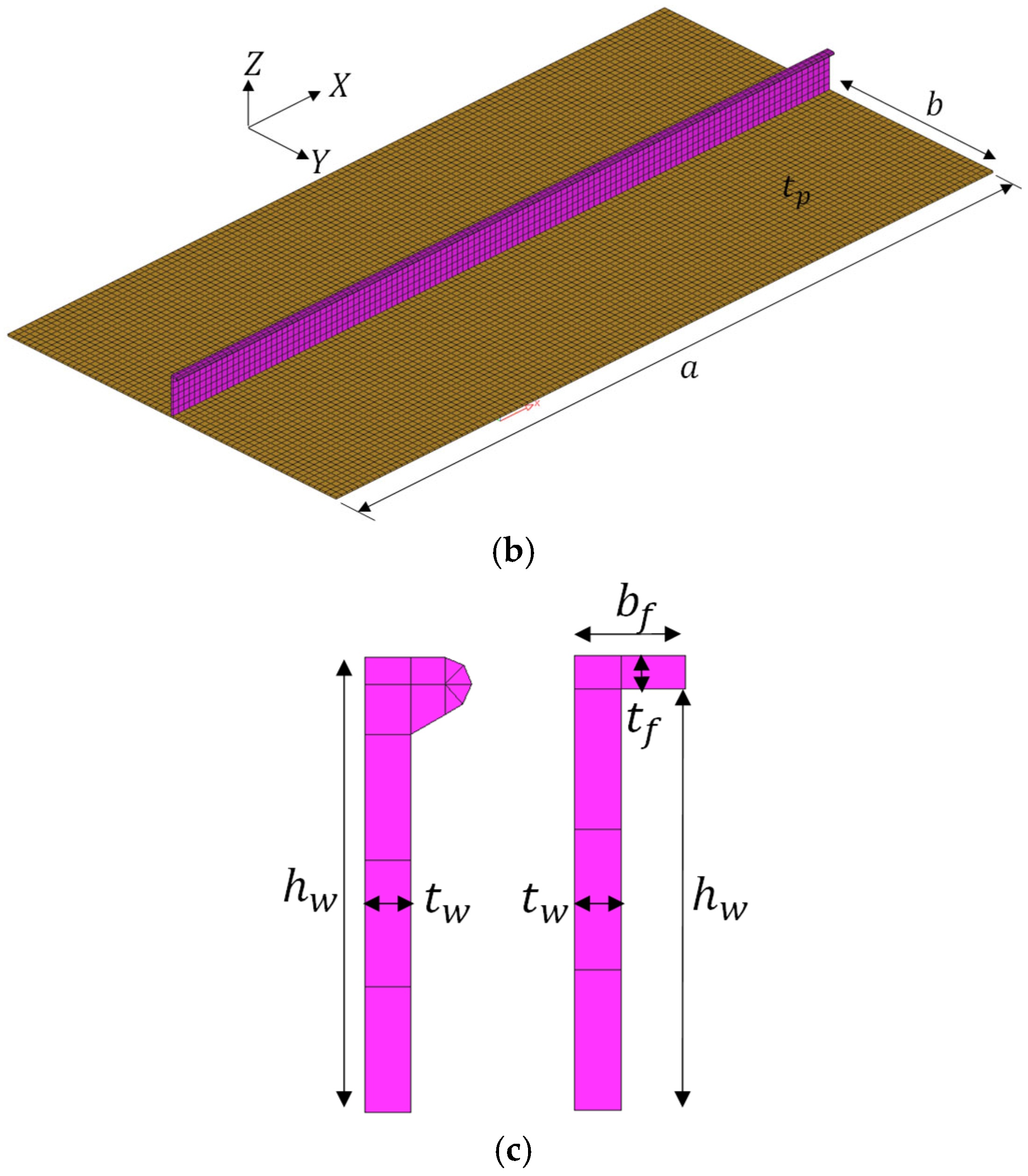
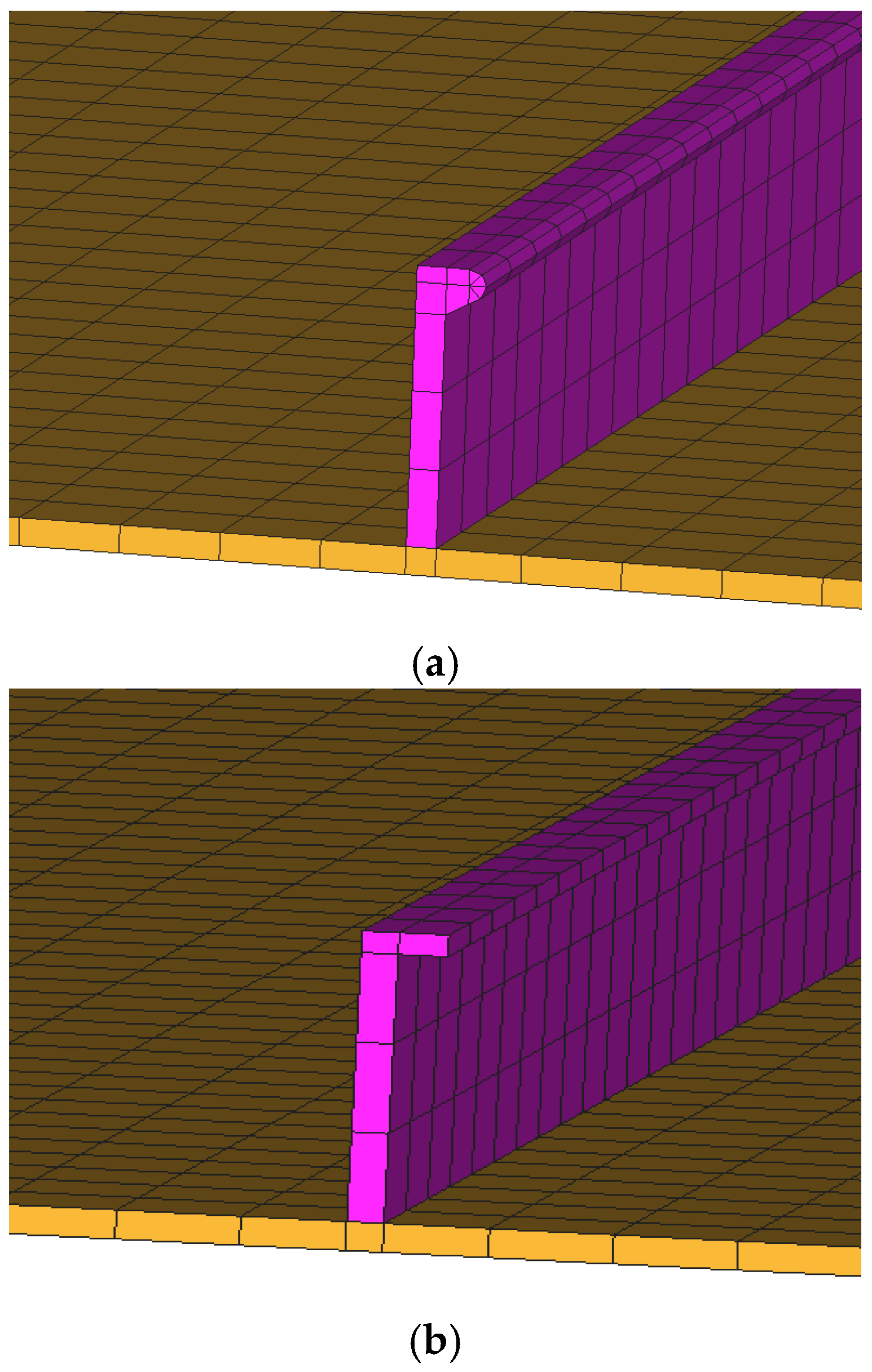
For the finite element analysis, both stiffener types were modeled using three-dimensional solid elements fully integrated with the attached plate as shown
Figure 2, allowing the local stress concentration, plate–stiffener interaction, and imperfection-sensitive nonlinear deformation modes to be captured with high fidelity under the applied loading and boundary conditions. A key aspect of our comparison between bulb and angle stiffeners is their distinct geometric profiles, particularly the rounded bulb tip versus the sharp corner of the angle. The true sectional behavior, especially under large rotations and post-buckling deformation, is influenced by this 3D geometry. Solid elements allow us to model the exact profile, ensuring that the moment of inertia, shear center location, and local buckling behavior of the stiffener web and flange are represented without the simplifying assumptions required when defining equivalent shell sections. The study emphasizes “imperfection-sensitive” behavior and interactive buckling between the plate and stiffener. These modes can involve coupled lateral deflection, web rotation, and local deformation of the stiffener’s cross-section itself (e.g., lip buckling in angles). A 3D solid model is better suited to capture these coupled three-dimensional deformation patterns without pre-defining kinematic constraints, providing a more reliable basis for extracting realistic initial imperfection shapes from the eigenvalue analysis. As stated in our methodology, we aimed for a “digital-grade” framework suitable for detailed component assessment. For high-consequence applications like jack-up rig components, where understanding the precise collapse mechanism is crucial, the additional computational expense of solid elements is justified to reduce model uncertainty associated with geometric idealization. This approach is consistent with advanced verification practices in offshore and marine engineering.
In the present study, three representative stiffener sizes were selected, and for each case, the bulb stiffener was replaced by an equivalent angle stiffener whose geometric parameters, namely the web height, web thickness, flange width, and flange thickness, were carefully adjusted so that the second moment of area about the plate attachment line was maintained at an equivalent level. As the stiffener size increased from Case 1 to Case 3, both the bulb and angle sections exhibited a proportional increase in web height and thickness in order to preserve overall bending stiffness, while the angle stiffener additionally required a progressive increase in flange width and flange thickness to compensate for the asymmetric geometry and to achieve the same flexural rigidity as that of the bulb section. This systematic dimensional scaling ensured that the comparison between bulb and angle stiffeners was mechanically consistent, allowing the observed differences in buckling behavior and nonlinear collapse response to be attributed to sectional shape and load transfer characteristics rather than to trivial differences in elastic stiffness or material volume. For the finite element analysis in this study, a numerical model of the stiffened plate was developed using a mesh of three-dimensional (3D) solid elements from MSC Nastran [
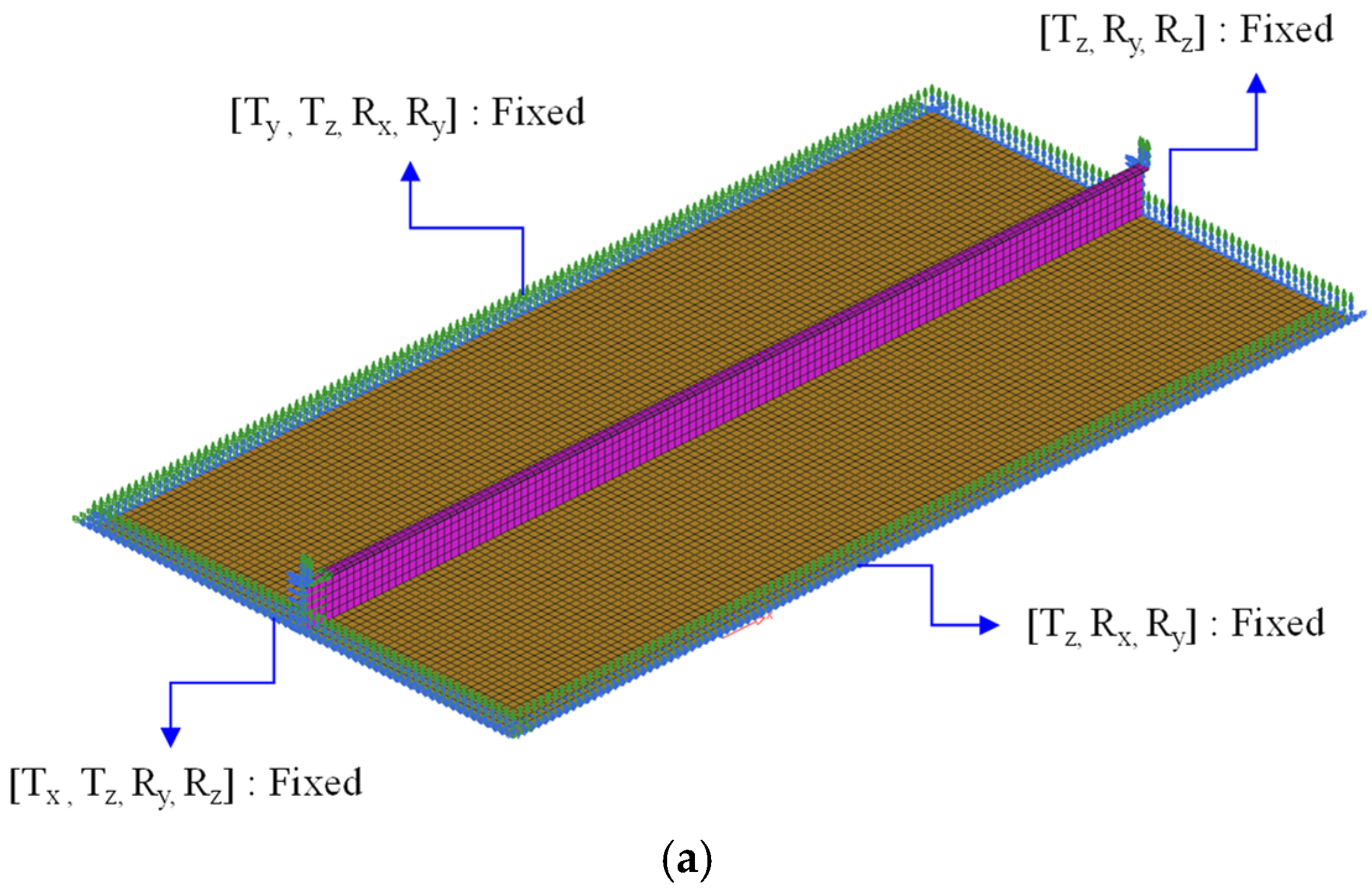
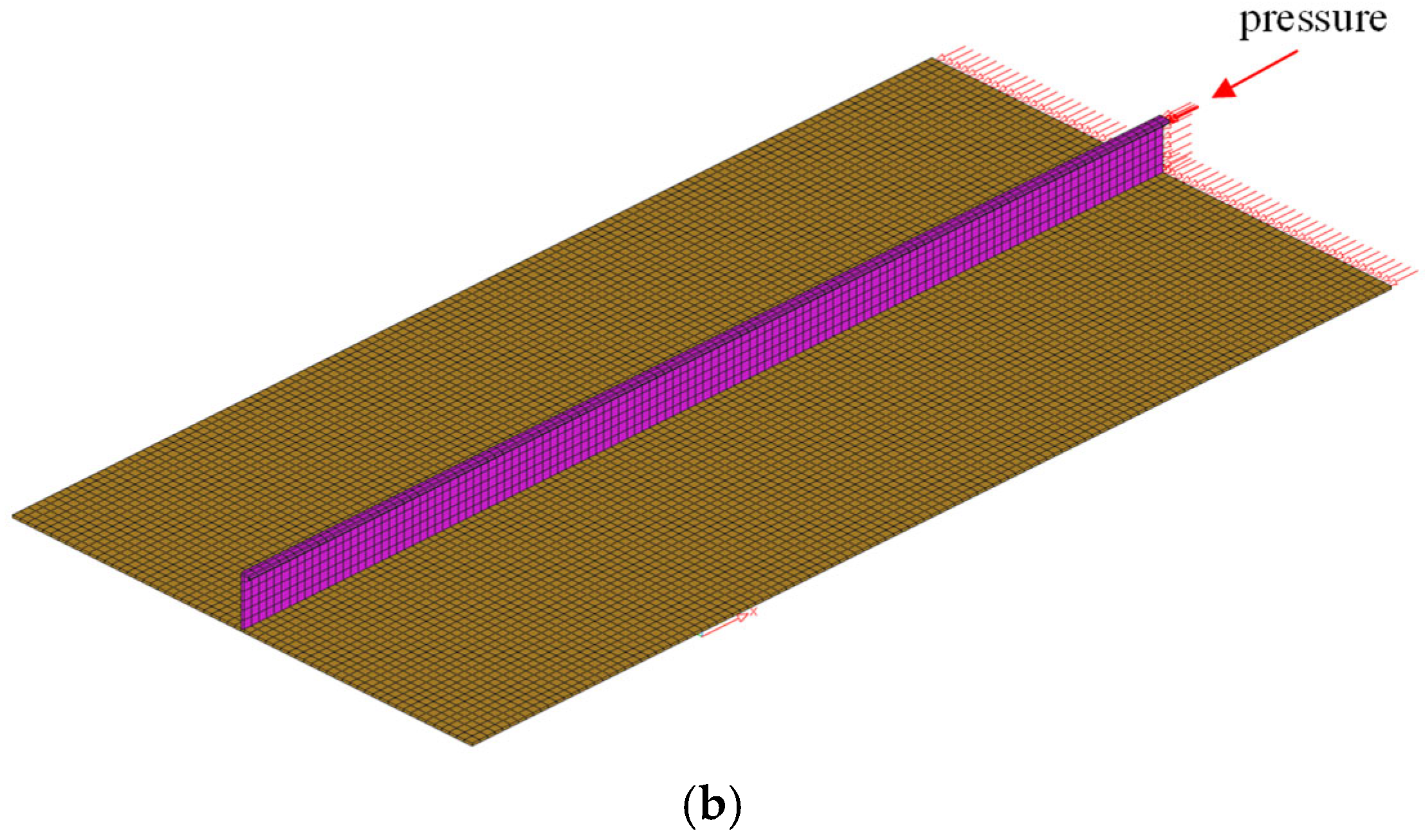
10]. Specifically, the model utilized MSC Nastran’s continuum solid elements, which are suitable for simulating solid structures undergoing complex three-dimensional stress states. These elements, such as the CHEXA (hexahedron) or CTETRA (tetrahedron) types, employ an isoparametric formulation and provide full displacement and stress output with six degrees of freedom (three translations and three rotations) per node. This formulation accurately captures the stress and strain gradients within the plate and stiffeners, which is critical for assessing local buckling and yield behavior. The global mesh size was consistently maintained at 20 mm, resulting in a total of 9042 elements. This modeling approach with refined solid elements ensures an accurate representation of the stress distribution and local buckling behavior at the intersection of the plate and stiffeners. The boundary conditions and loading defined for this analysis model represent a constrained structural system subjected to uniform pressure as shown. The jack-up rig, the stiffened plates forming decks, bulkheads, and cantilever webs are not isolated panels. They are continuously welded to deep primary girders, transverse frames, and adjacent plates. These connections provide significant rotational restraint, far beyond that of a simple or pinned support. The chosen clamped condition (restraining rotations R_x, R_y) aims to conservatively approximate this high level of continuity and the stiff moment transfer at connections, which is characteristic of welded offshore structures, as indicated
Figure 3. The analyzed plates are subjected to axial compression, simulating load transfer in a grillage system. In such a system, the loaded edge of a plate field is typically integrated into a transverse frame or bulkhead, which restrains both in-plane displacement and out-of-plane rotation. This prevents the plate edge from rotating freely, justifying the restraint of rotations (R_x, R_y) in addition to translations. Our model isolates a representative single bay between supporting girders. The boundary conditions on the longitudinal edges (parallel to the stiffeners) simulate symmetry or continuity with adjacent bays, while the conditions on the loaded edges simulate the connection to a primary transverse support. For a panel within a continuous grillage, the most critical and realistic assumption for the supported edges is often full fixity, as it leads to higher buckling stresses and a failure mode that may transition from overall to more localized buckling, a focus of our imperfection-sensitive study. A clamped boundary condition represents a stiffer support scenario, which generally leads to higher predicted buckling loads than a simply supported condition. By using this conservative approach, we ensure that our subsequent nonlinear collapse analysis and the identified trade-offs are evaluated under demanding, yet realistic, support stiffness. This approach is also aligned with common practice in advanced ultimate strength assessments for marine structures, where the restraint from surrounding structure is acknowledged but often simplified to a fully fixed condition for the sake of a controlled and reproducible numerical experiment. In the two-stage finite element framework adopted in this study, the load conditions applied during the linear eigenvalue buckling analysis and the subsequent nonlinear collapse analysis differ in accordance with their distinct analytical objectives. In the first stage, a representative longitudinal compressive stress of 50 MPa, typical of loads encountered in jack-up rig Living Quarter structures, was applied to the stiffened plate model to perform a linear eigenvalue buckling analysis (
Figure 3b). This load level was selected to simulate realistic in-service stress conditions and to identify the dominant buckling modes that are sensitive to initial geometric imperfections.
In the second stage, for the geometrically and materially nonlinear collapse analysis (GMNIA), the loading is scaled to evaluate the ultimate limit state of the structure. Instead of the fixed 50 MPa stress, the applied compressive load is progressively increased until collapse, with the maximum load capacity determined based on the material yield strength and the sectional properties of the plate and stiffeners. This approach ensures that the full nonlinear response including yielding, post-buckling behavior, and ultimate strength is captured under a displacement-controlled or load-controlled scheme that drives the structure to its ultimate capacity.
This differentiation in load application between the two stages is methodologically consistent: the eigenvalue analysis uses a representative service load to identify imperfection shapes, while the collapse analysis applies a monotonically increasing load to assess the structural reserve and failure characteristics. Both steps are integral to the “digital-grade” assessment framework, ensuring that design evaluations account for both elastic stability and nonlinear ultimate performance under realistic boundary and loading conditions.
To ensure clarity in interpreting the results, it is essential to define the key load factors used in this two-stage analysis. In the initial linear eigenvalue buckling analysis, the computed eigenvalue buckling factor (λ) represents the multiplier by which the applied reference load must be scaled to reach the theoretical critical buckling load of the perfect, linear-elastic structure. For instance, a buckling factor of 0.45 under a 50 MPa reference load indicates an elastic buckling stress of 22.5 MPa. This factor primarily serves to identify the critical instability mode, whose shape is then used to define the initial geometric imperfection. In the subsequent nonlinear collapse analysis, the term ultimate capacity factor refers to a normalized measure of structural reserve, calculated as the ratio of the ultimate average compressive stress at collapse (σ_ult) to the material yield strength (σ_Y). This factor, often reported by design codes and advanced simulations alike, quantifies the utilization of the material’s capacity while accounting for the severe strength reductions caused by geometrical and material nonlinearities. Distinguishing between these two factors—one governing elastic instability and the other nonlinear collapse—is fundamental to understanding the transition from linear design equivalence to actual ultimate limit state performance.
3.2. Mesh Convergence and Numerical Robustness of Eigenvalue and Nonlinear Analyses
In nonlinear buckling and collapse analyses of imperfection-sensitive stiffened plates, numerical reliability is critically dependent on the adequacy of spatial discretization, as insufficient mesh resolution can lead to artificial stiffness, spurious localization, or non-physical softening in the predicted response. Therefore, prior to interpreting differences in structural behavior arising from stiffener geometry, it is essential to verify that both the elastic instability characteristics and the nonlinear equilibrium paths are free from mesh-dependent artifacts. In this context, a systematic mesh convergence study was conducted to confirm that the eigenvalue buckling factors, post-buckling stiffness degradation, and ultimate load-carrying capacity are governed by the underlying structural mechanics rather than numerical discretization. This verification step establishes the robustness of the finite element framework and provides a necessary foundation for ensuring that the comparative nonlinear results presented in the following sections reflect intrinsic differences in stiffener performance, not modeling uncertainty.
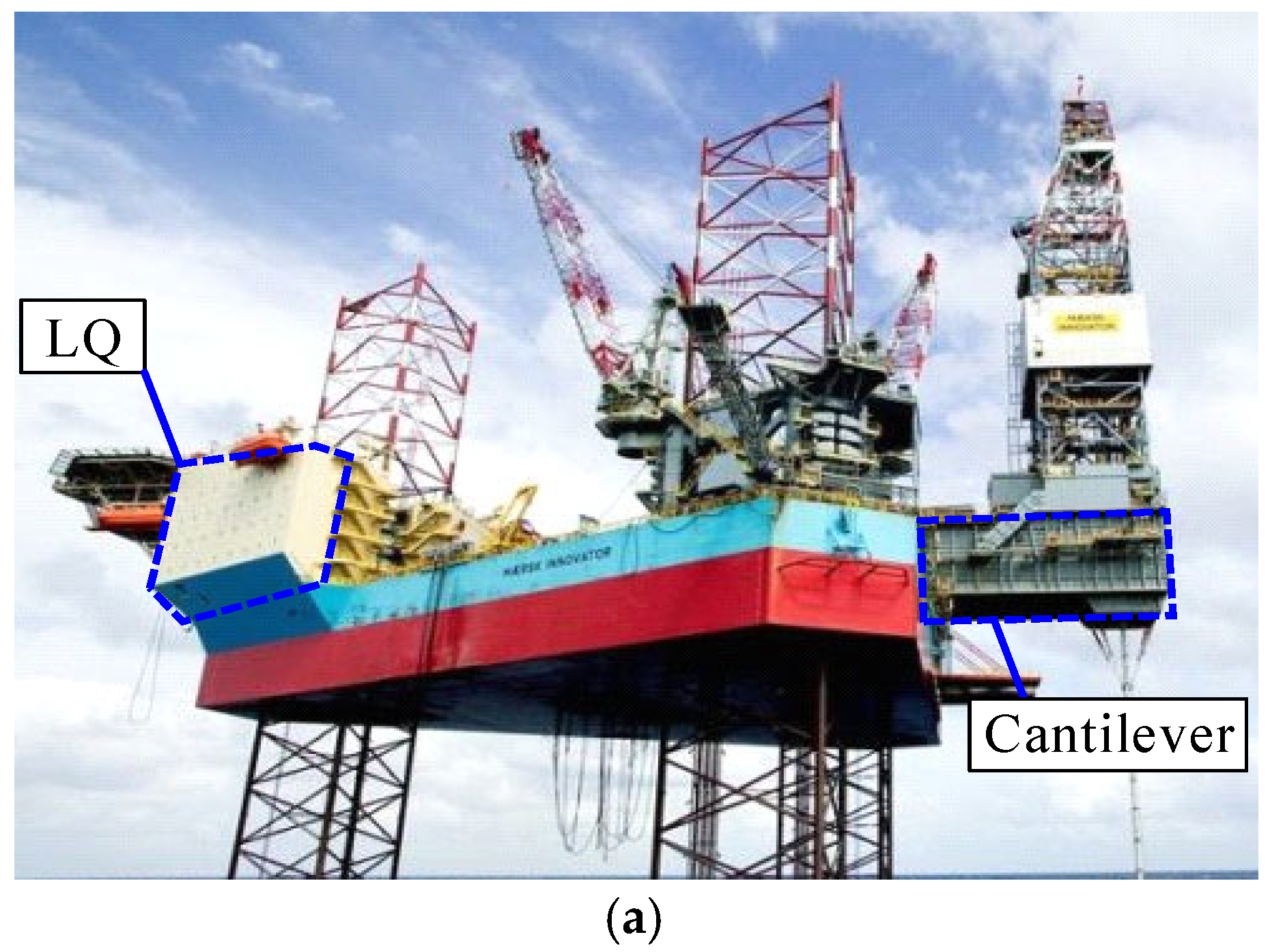
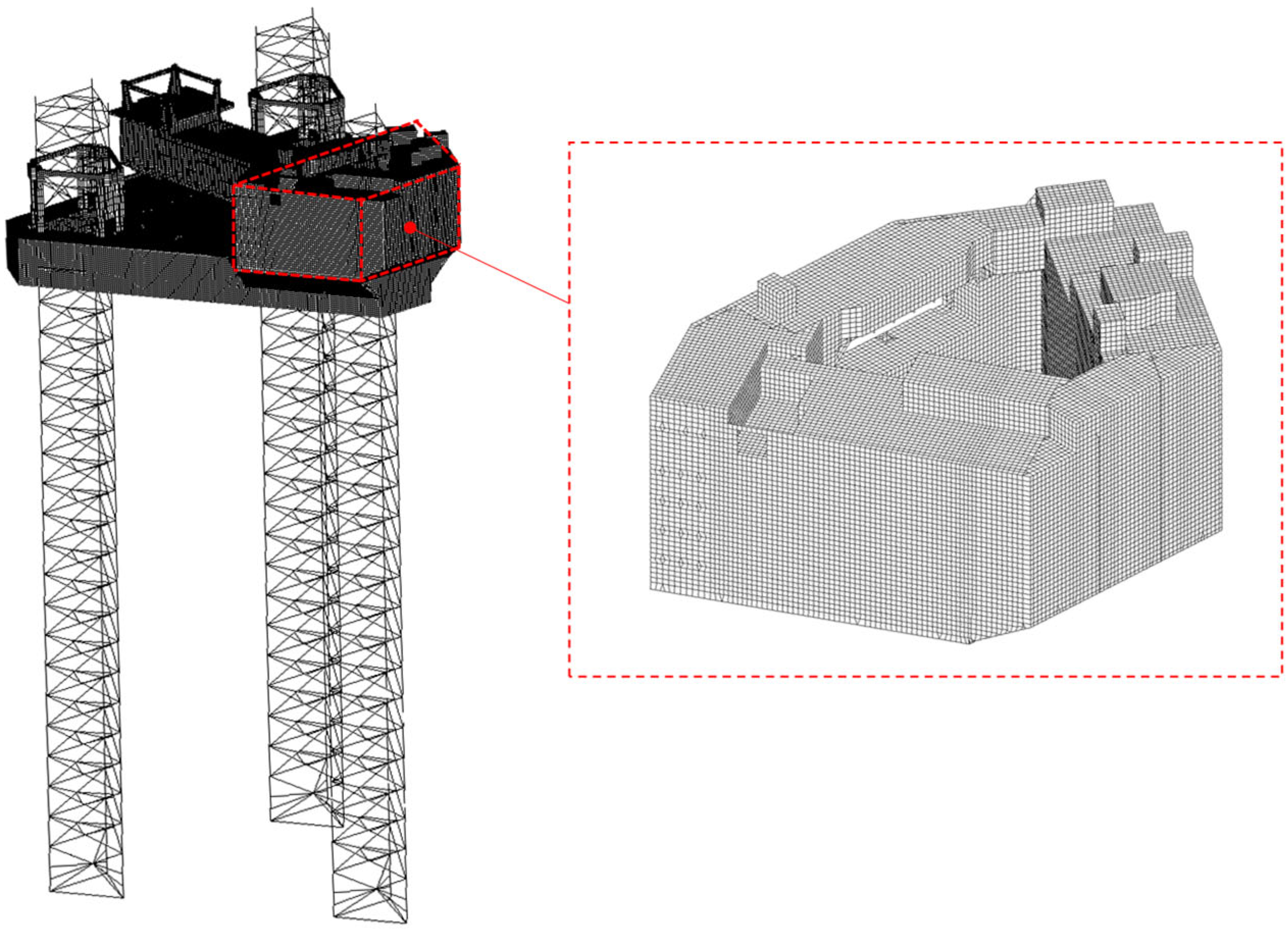
Figure 4 illustrates the finite element model of the stiffened plate structure representative of the Living Quarter (LQ) region in a jack-up rig. The model captures the realistic geometric configuration of a stiffened deck panel, including the base plate and longitudinal stiffeners, and serves as the fundamental numerical domain for both eigenvalue buckling and nonlinear collapse analyses. The use of a three-dimensional solid-element discretization enables accurate representation of local stress gradients, plate–stiffener interaction, and imperfection-sensitive deformation modes. This modeling approach is essential for evaluating nonlinear buckling and post-buckling behavior beyond the limitations of shell-based or simplified analytical formulations.
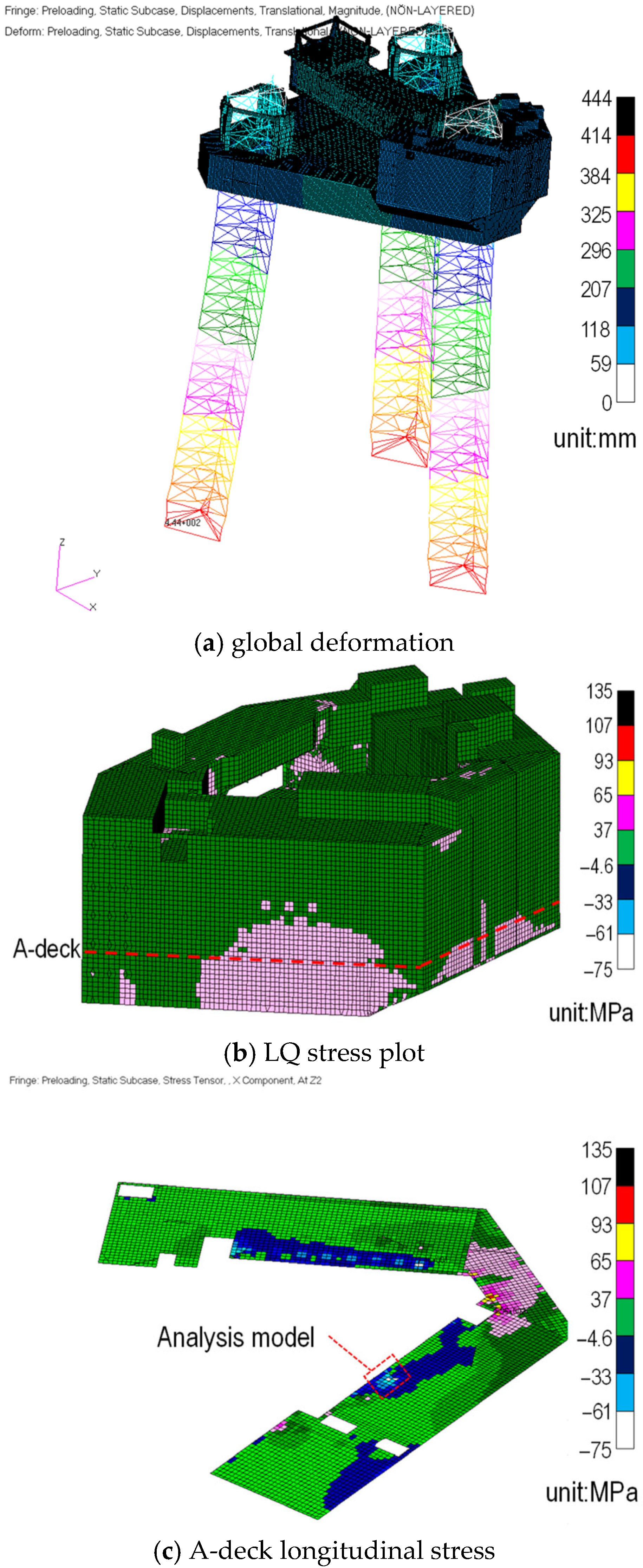
Figure 5 presents the global deformation pattern and longitudinal stress distribution of the stiffened plate under axial compression. The results demonstrate that the applied compressive load is effectively transferred along the longitudinal direction (X-axis), inducing global bending and local plate–stiffener interaction. The deformation contour reveals a coupled response between the plate panel and stiffeners, indicating that the structural behavior is governed by interactive buckling rather than isolated plate or stiffener instability. The longitudinal stress plots confirm a non-uniform stress redistribution as loading progresses, with stress concentrations developing near the stiffener–plate junctions. This behavior highlights the imperfection-sensitive nature of stiffened plates and justifies the need for subsequent nonlinear analysis to accurately capture stiffness degradation and collapse mechanisms. The reference compressive stress of 50 MPa was selected because it represents a realistic in-service longitudinal stress level acting on the A-deck stiffened plate of the Living Quarter (LQ) in a jack-up rig, where axial loads are transferred through the deck grillage under operational and environmental loading; this value therefore provides a physically meaningful stress state for extracting imperfection-sensitive buckling modes, rather than serving as an arbitrary numerical load.
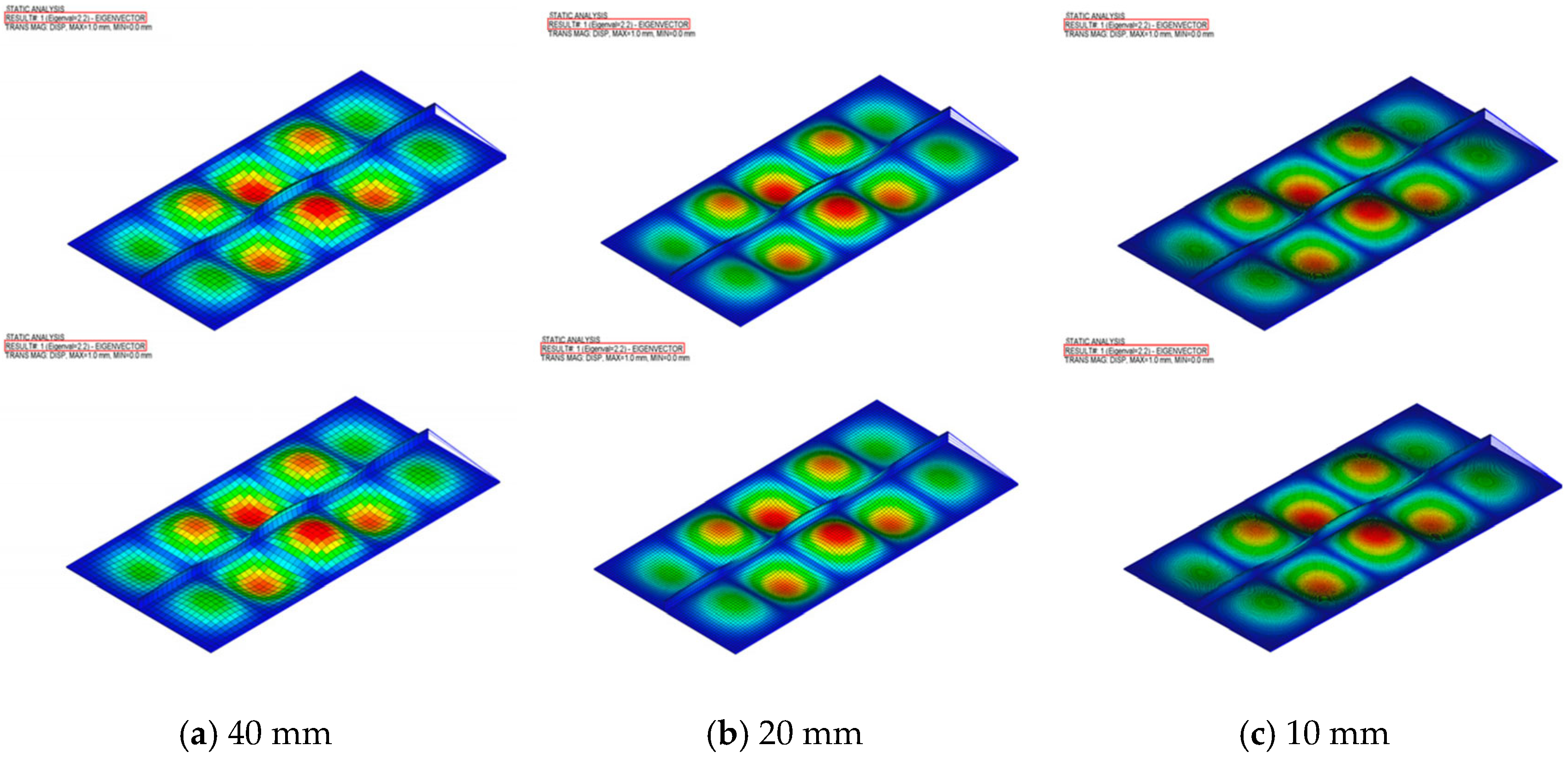
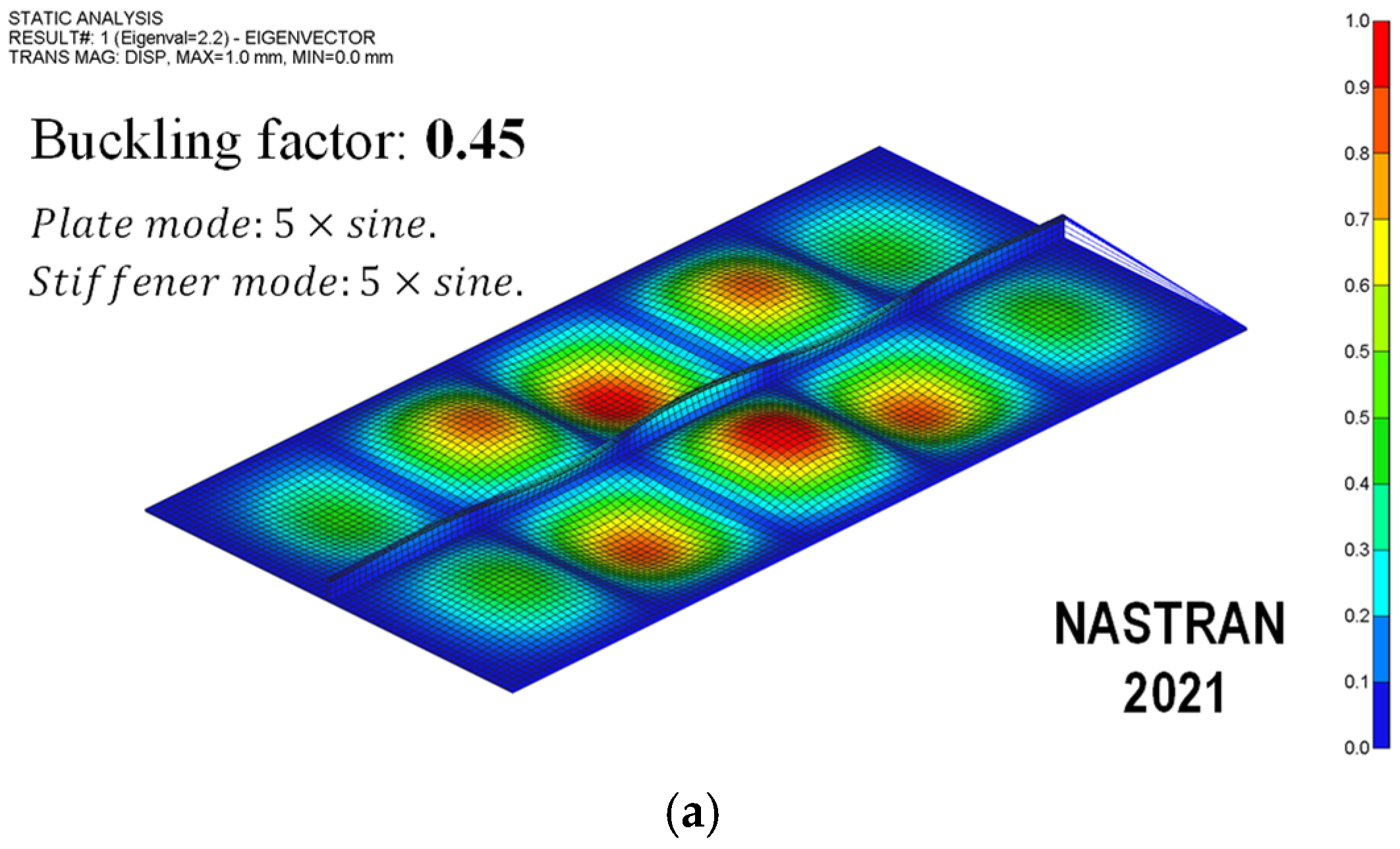
Figure 6 summarizes the mesh sensitivity study of the linear eigenvalue buckling analysis for stiffened plates reinforced with bulb and angle stiffeners. The upper part of the figure corresponds to the bulb stiffener model, while the lower part shows the angle stiffener model, each evaluated using mesh sizes of 10 mm, 20 mm, and 40 mm. The results demonstrate that the critical eigenvalue buckling factors remain essentially identical regardless of mesh refinement for both stiffener types. This mesh-independent behavior confirms that the eigenvalue buckling response is governed primarily by global structural stiffness and boundary conditions rather than numerical discretization density.
From an engineering standpoint, this consistency validates the numerical robustness of the finite element model and confirms that the selected reference mesh size provides sufficient accuracy for identifying critical buckling modes. Furthermore, the equivalence of eigenvalues across mesh sizes indicates that the extracted buckling mode shapes can be reliably used as initial geometric imperfections in subsequent geometrically and materially nonlinear imperfection analyses (GMNIA), without introducing mesh-induced bias. This result is particularly important for ensuring that the observed differences in nonlinear collapse behavior between bulb and angle stiffeners arise from true structural mechanics rather than numerical artifacts.
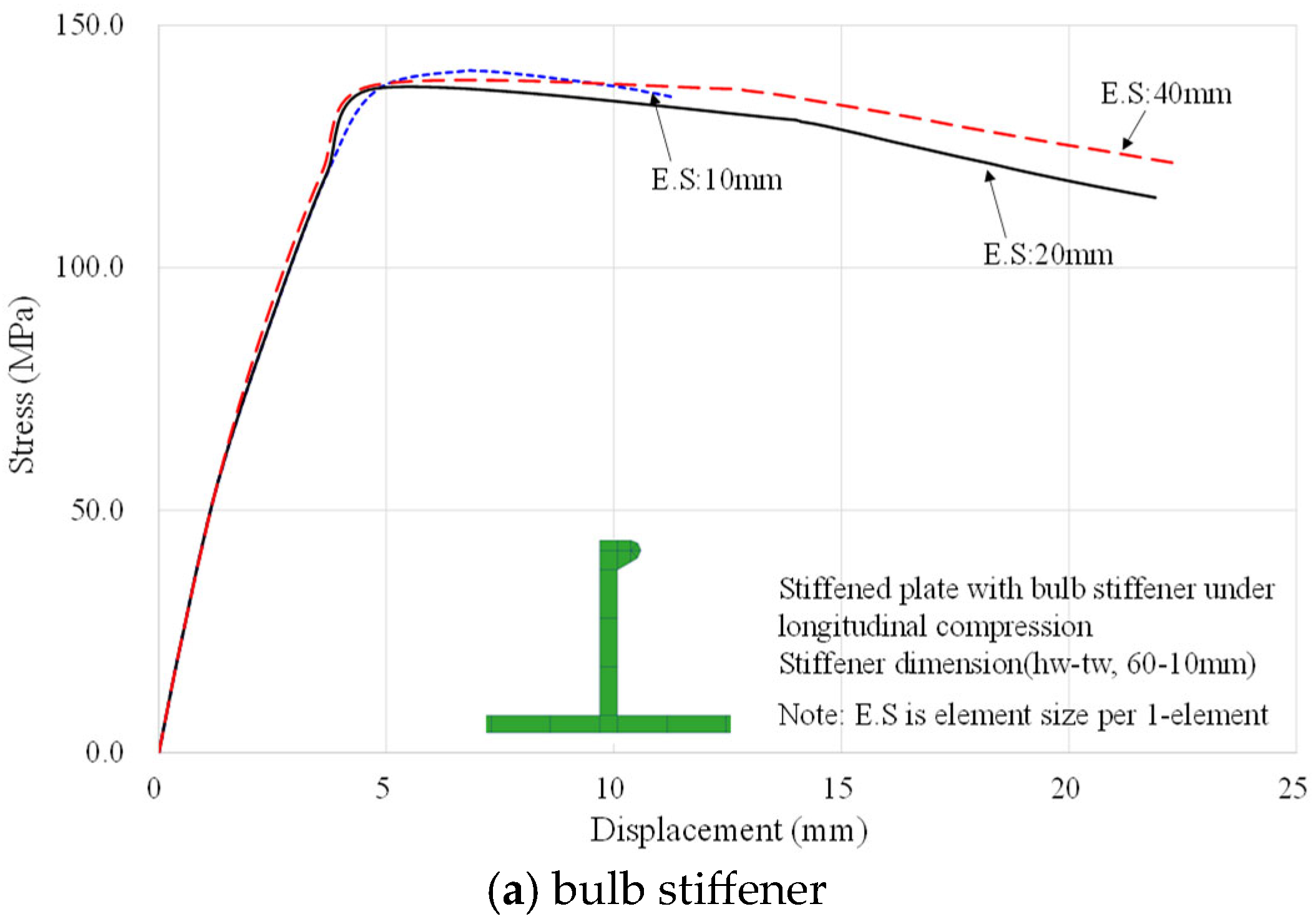
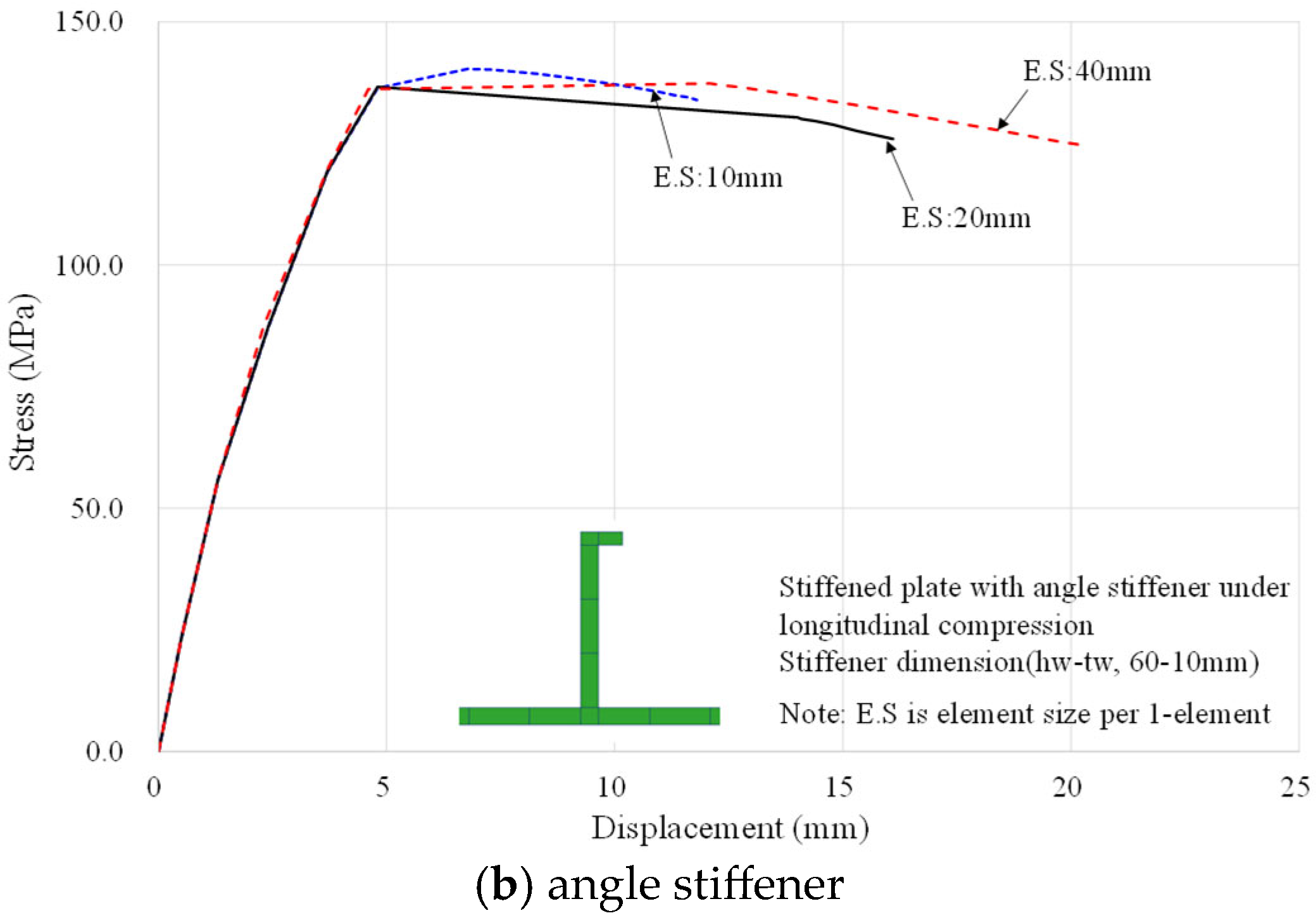
Figure 7 presents the nonlinear stress–displacement responses of the stiffened plate obtained using different mesh densities for each stiffener type. The results clearly demonstrate that the nonlinear structural response, including stiffness degradation, post-buckling behavior, and ultimate load-carrying capacity, is essentially insensitive to mesh size. This mesh-independent behavior indicates that the nonlinear collapse mechanism is governed by global structural instability and material yielding rather than by local numerical discretization effects.
From a theoretical perspective, this convergence can be explained by the fact that the governing nonlinear response is dominated by low-order deformation modes and plastic hinge formation associated with plate–stiffener interaction. Once the mesh is sufficiently fine to accurately capture the global curvature, stress redistribution, and yield propagation, further mesh refinement does not alter the fundamental equilibrium path. In particular, the use of three-dimensional solid elements ensures that through-thickness stress states and plastic strain localization are already well resolved, preventing spurious mesh-dependent softening or artificial stiffness amplification. Consequently, the absence of mesh sensitivity in the nonlinear response confirms the numerical robustness of the analysis framework and verifies that the observed differences in nonlinear behavior between stiffener types arise from intrinsic structural mechanics rather than discretization artifacts. This provides strong validation for the reliability of the nonlinear collapse results used in the comparative assessment of stiffener performance.
3.3. Results and Discussion
The initial deflection due to welding heat inevitably occurs, and the maximum size of the initial deflection was determined by applying the standard defined in the reference literature [
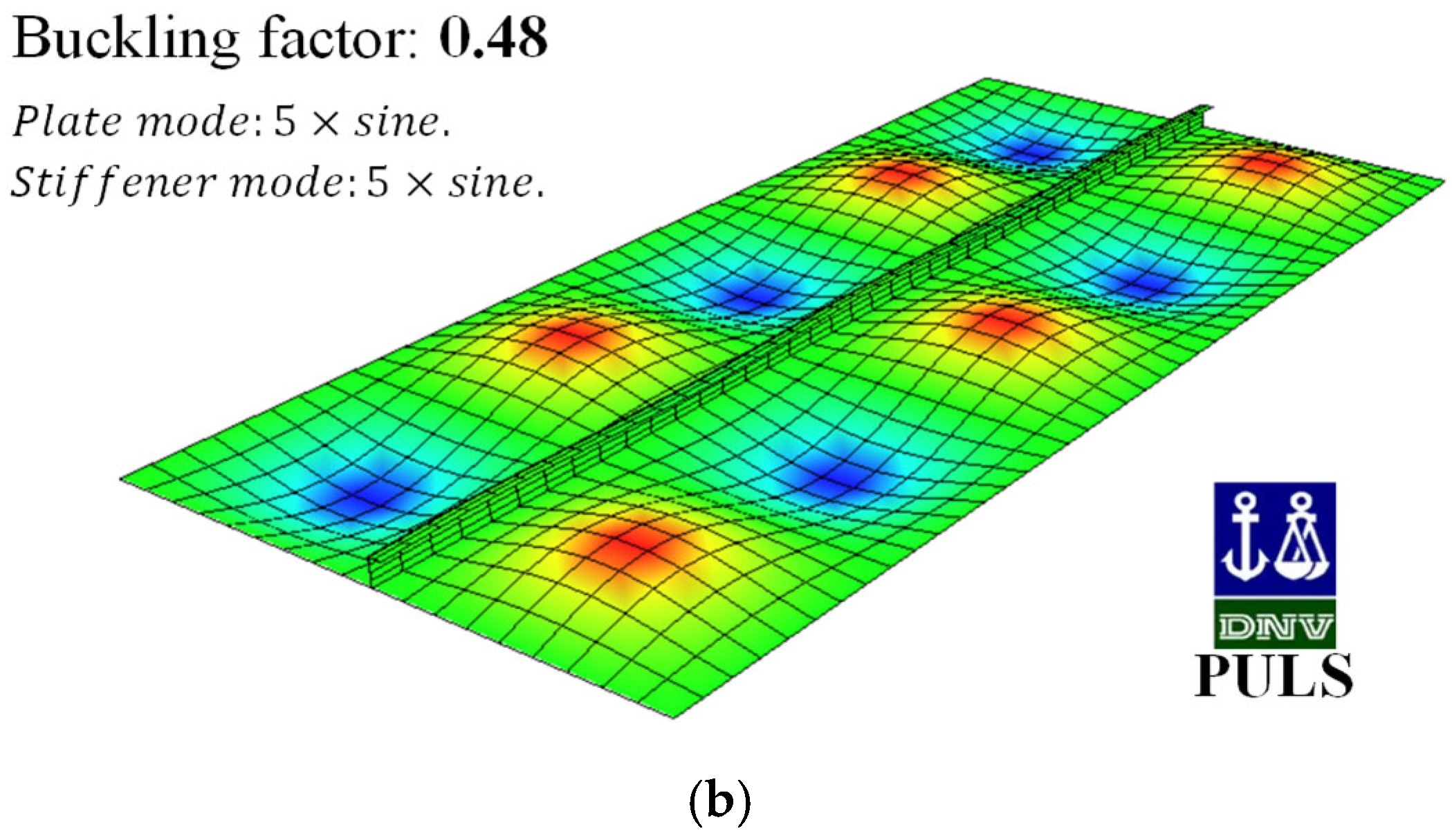
11]. The comparison of eigenvalue buckling results reveals close agreement in the predicted buckling factor (0.45 in NASTRAN vs. 0.48 in DNV PULS), indicating a consistent assessment of the critical load level as shown
Figure 8. However, a significant divergence is observed in the buckling mode shapes. DNV PULS [
12] yields a perfectly symmetric, classic sinusoidal mode (five half-waves) for both the plate and stiffener, which typically represents an idealized, simply supported boundary condition assumption.
In contrast, NASTRAN predicts a non-symmetric mode characterized by pronounced central deflection. This asymmetry strongly suggests the influence of more complex or slightly non-uniform boundary constraints or interactions in the NASTRAN model, such as localized stiffness from connections, rigid-body restraint effects, or coupling between the plate and stiffener deformations that perturb the ideal symmetric buckling pattern. This difference highlights that while both solvers concur on the magnitude of buckling resistance, the buckling mode shape is highly sensitive to the detailed modeling of boundary conditions and constraints. The NASTRAN result may represent a more physically realistic or model-specific instability mode, which is crucial for accurately defining initial geometric imperfections in subsequent nonlinear collapse analysis.
The comparative analysis of nonlinear buckling behavior in axially compressed stiffened plates, as presented in
Figure 9,
Figure 10,
Figure 11 and
Figure 12, reveals consistent and methodologically significant trends.
Figure 9,
Figure 10 and
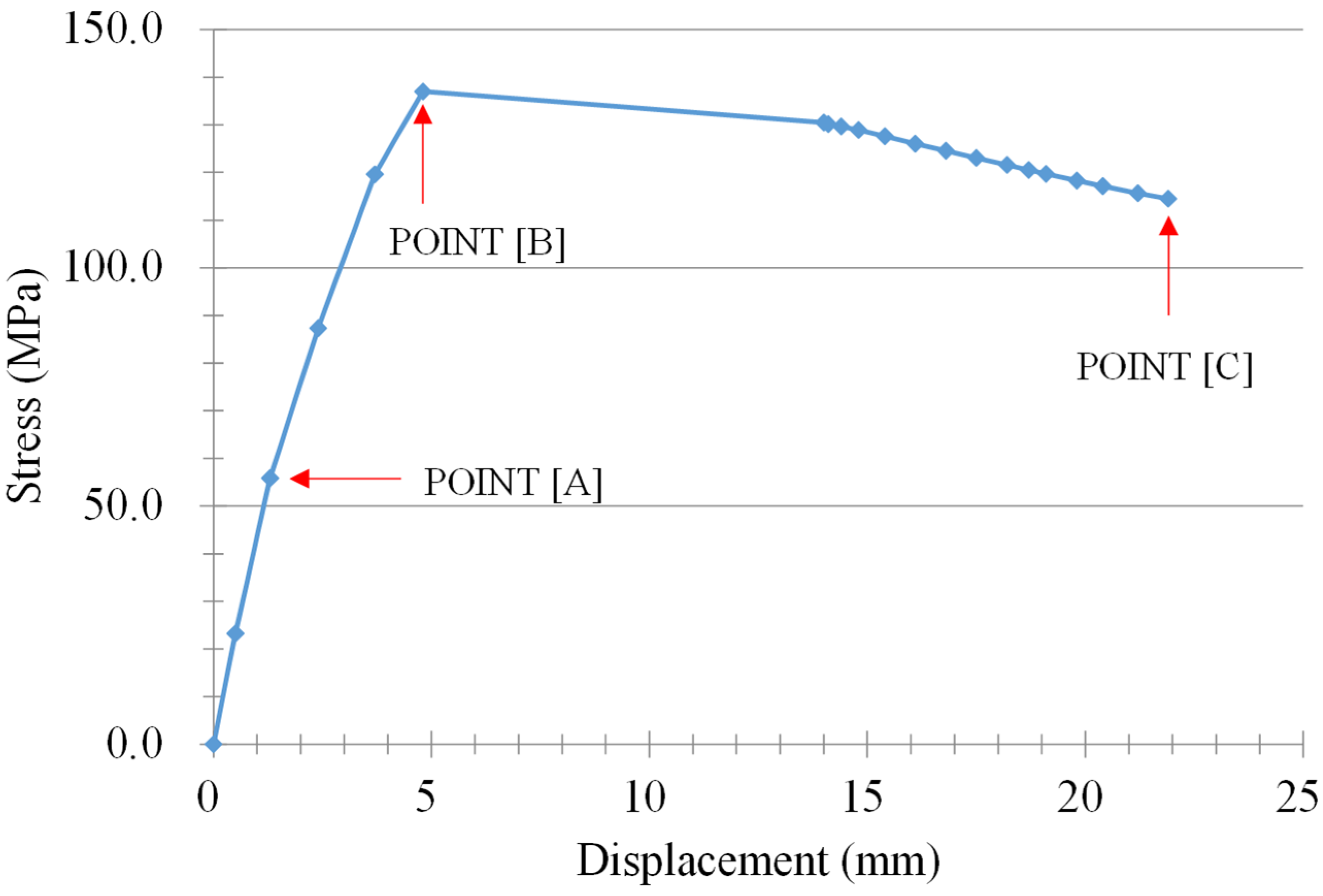
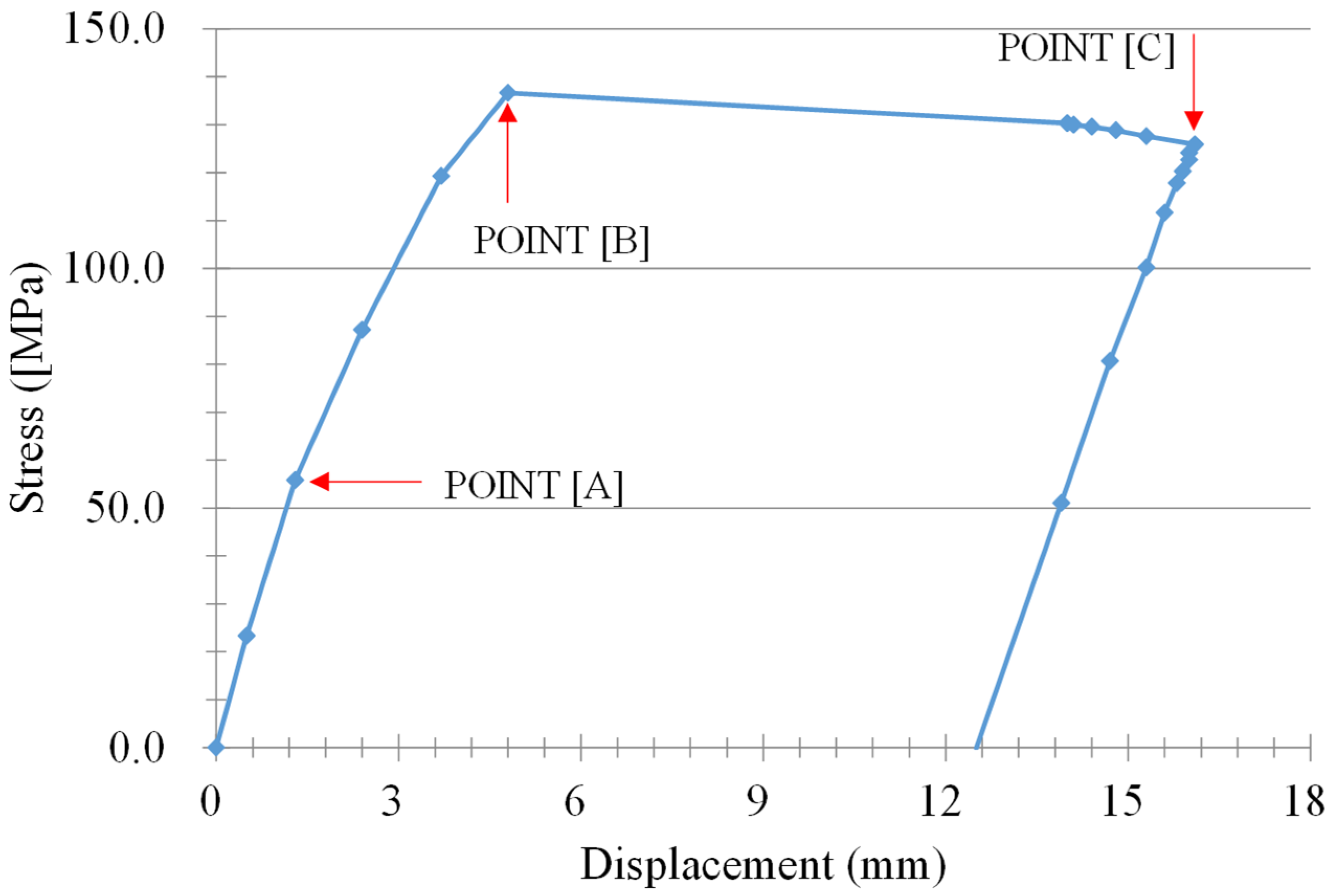
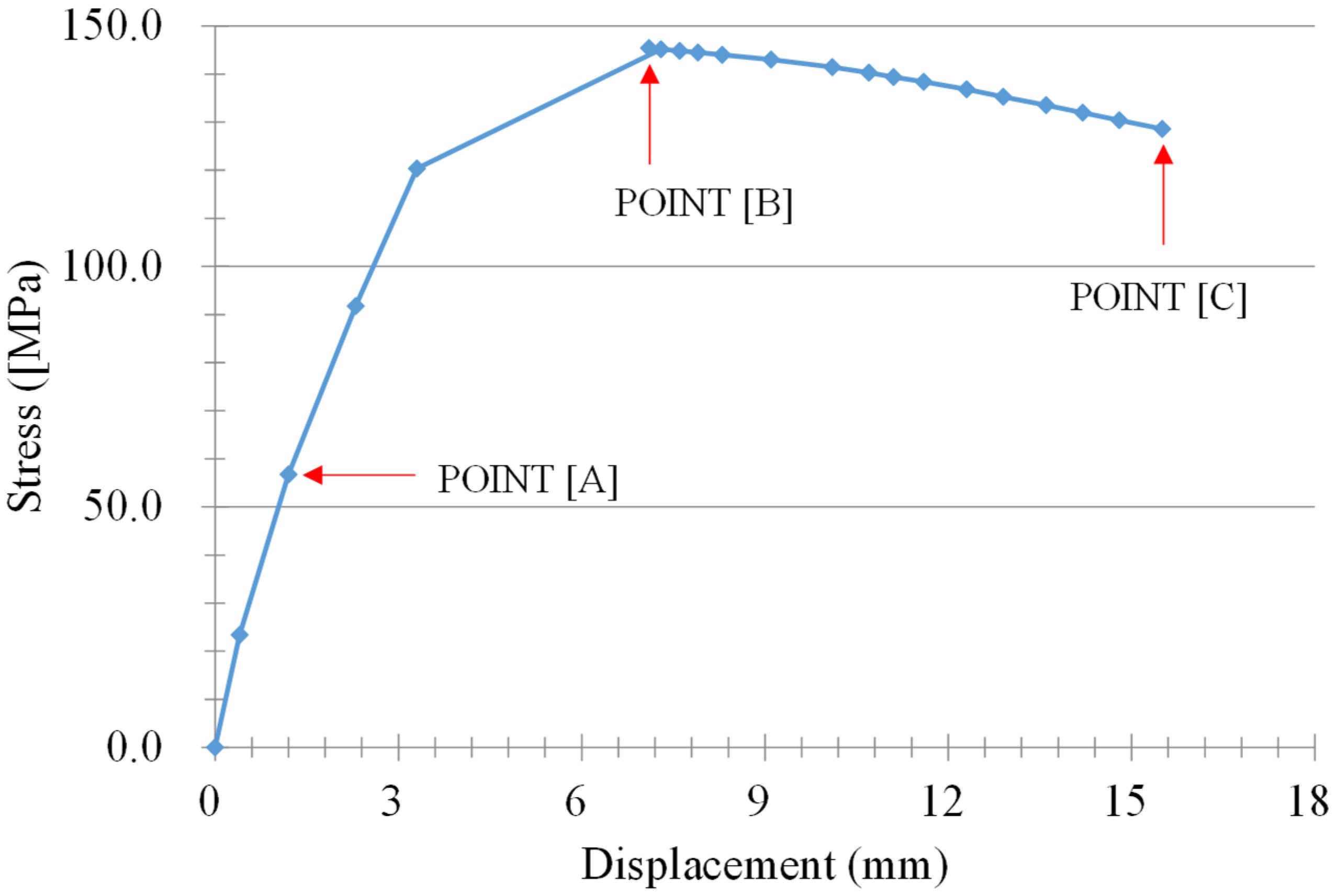
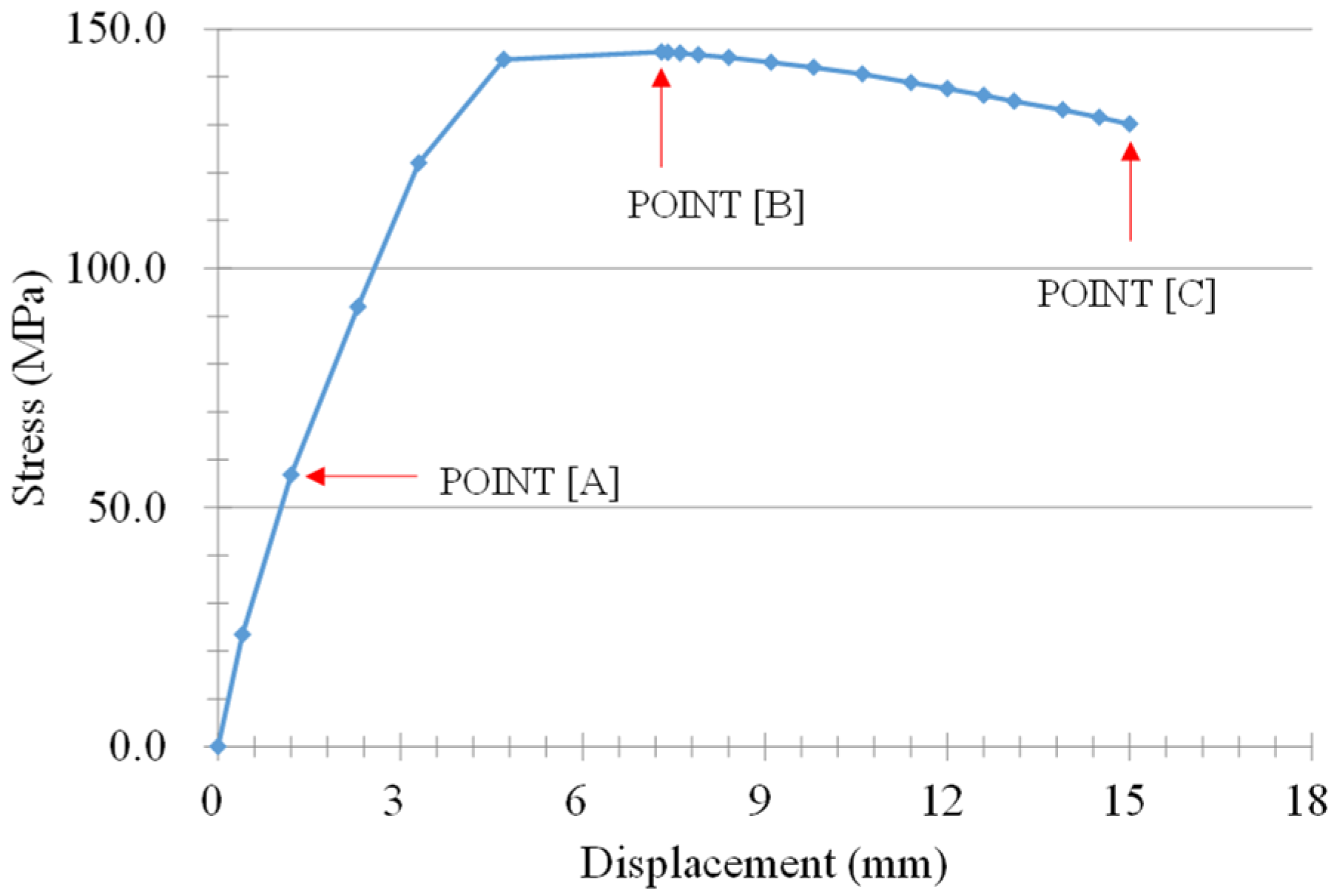
Figure 11 illustrate the characteristic stress–displacement response for plates with bulb angle and built-up angle stiffeners, respectively, demonstrating an initial linear elastic phase followed by progressive stiffness reduction and eventual attainment of ultimate capacity. This nonlinear progression indicates the onset of interactive buckling and plasticity. To provide precise interpretation of the structural response curves presented in
Figure 9,
Figure 11,
Figure 13,
Figure 14 and
Figure 15, the stress metric plotted on the vertical axis is defined as the average compressive engineering stress within the plate panel. This value is calculated as the total axial reaction force (R) at the supported edge, obtained from the nonlinear finite element analysis, divided by the nominal gross cross-sectional area of the base plate (A
0 = plate width × plate thickness). This conventional metric, which excludes the stiffener’s area to maintain a consistent baseline for panel-level comparison, characterizes the global load-carrying capacity as a function of axial shortening, with its peak defining the ultimate strength of the stiffened panel.
Crucially,
Figure 6 and
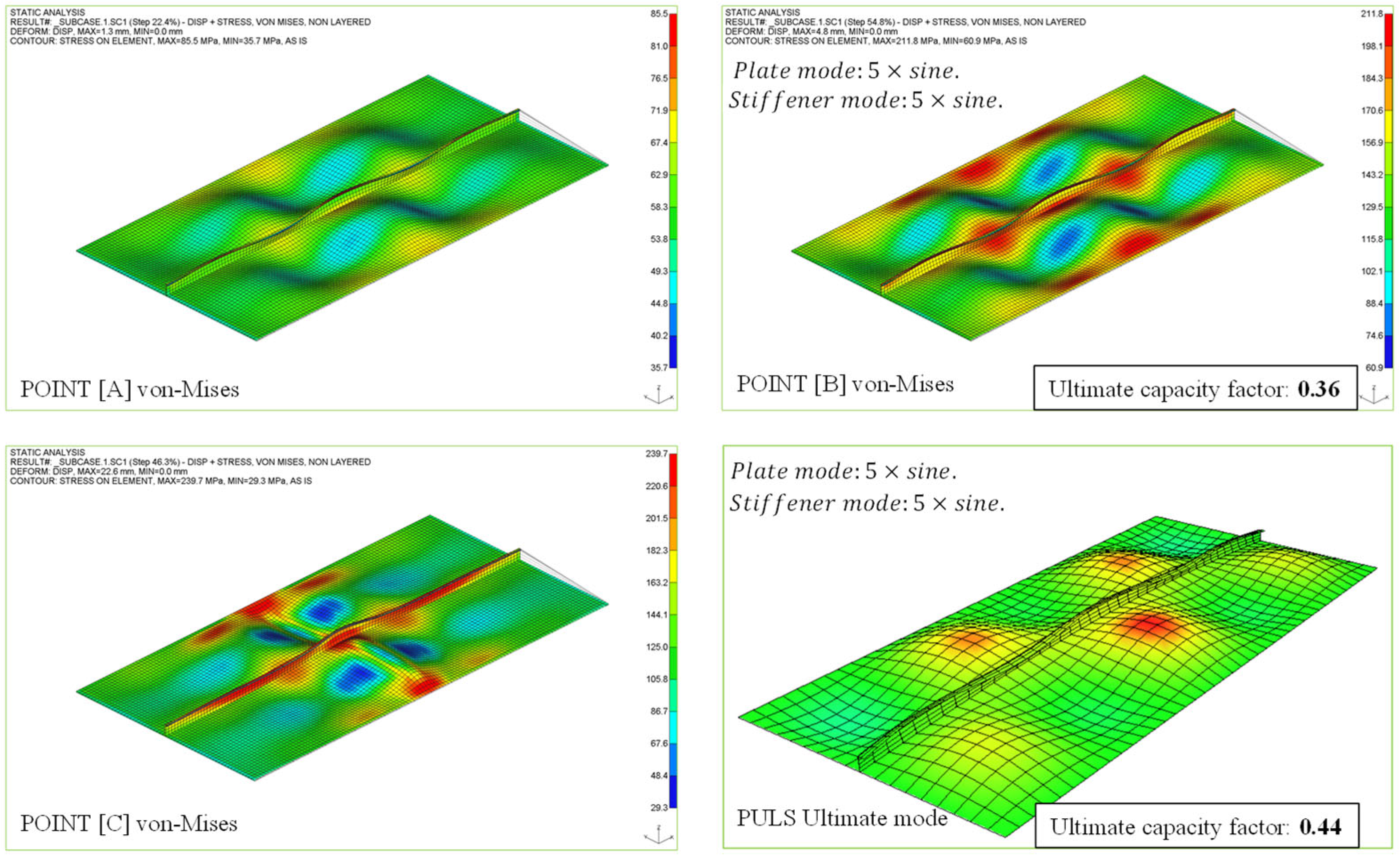
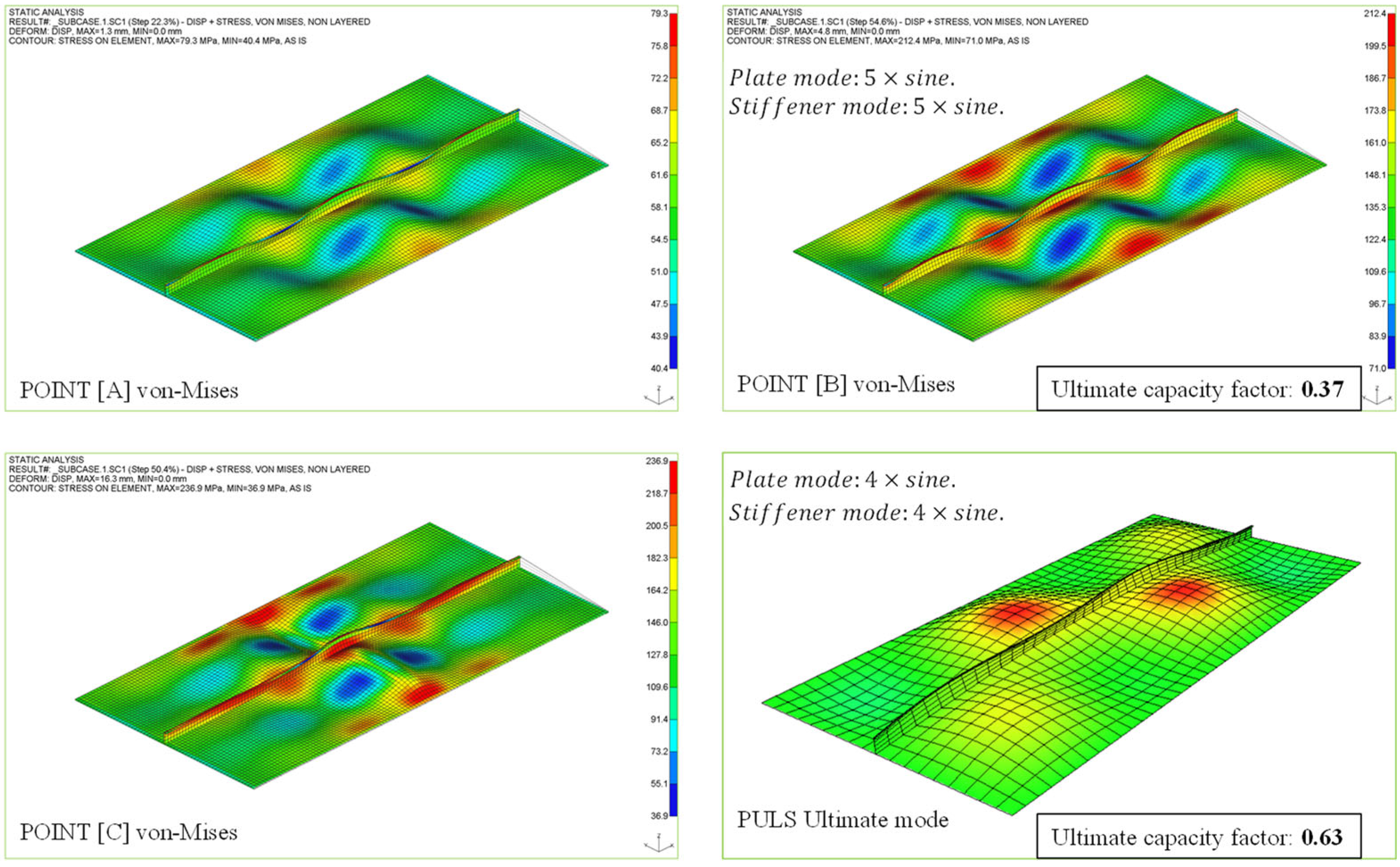
Figure 8 highlight a systematic discrepancy between the results of a high-fidelity nonlinear finite element analysis (GMNIA) performed with NASTRAN and the predictions of the rule-based tool DNV PULS. The detailed NASTRAN analysis consistently yields a higher ultimate capacity factor and, in some cases, a distinct buckling mode shape compared to the more conservative estimates from PULS.
This divergence can be attributed to fundamental differences in the underlying analytical frameworks. The NASTRAN-based GMNIA explicitly models realistic initial geometric imperfections, incorporates nonlinear material behavior including strain hardening, and captures the complex post-buckling interaction and load redistribution between the plate and stiffener. This approach is particularly sensitive to the specific failure mechanics of slender geometries. In contrast, DNV PULS [
12] employs simplified analytical formulations and generalized imperfection parameters calibrated for a broad range of structures, often assuming idealized boundary conditions and elastic-perfectly plastic material behavior. Consequently, while PULS provides a robust and conservative design check, it may not fully capture the post-buckling reserve strength and the specific, imperfection-sensitive failure mode that governs the ultimate limit state of slender stiffened panels.
Therefore, the observed higher capacity in the detailed NASTRAN analysis represents a more accurate, project-specific assessment of the true structural reserve. This comparison underscores the necessity of employing advanced geometrically and materially nonlinear imperfection analysis for the final verification and optimization of slender marine structures, where such methods can reveal significant capacity margins beyond those indicated by standardized rule-based assessments, thereby ensuring both safety and structural efficiency.
Figure 13 and
Figure 16 present a detailed comparison of the nonlinear response, collapse modes, and von Mises stress distributions of the stiffened plate reinforced with a bulb-type stiffener under axial compression, and they provide important insight into the mechanics governing imperfection-sensitive collapse.
The stress–displacement curve in
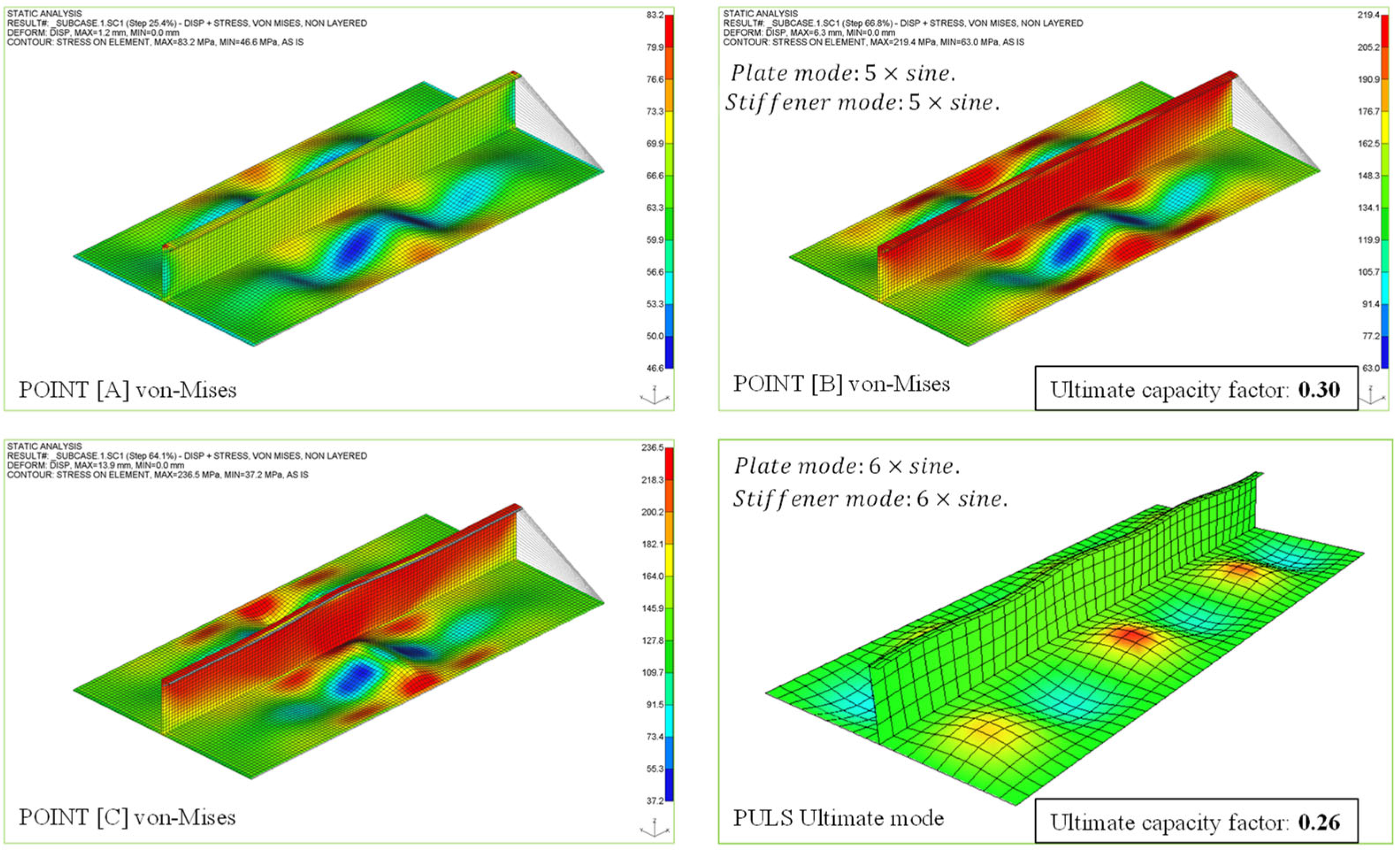
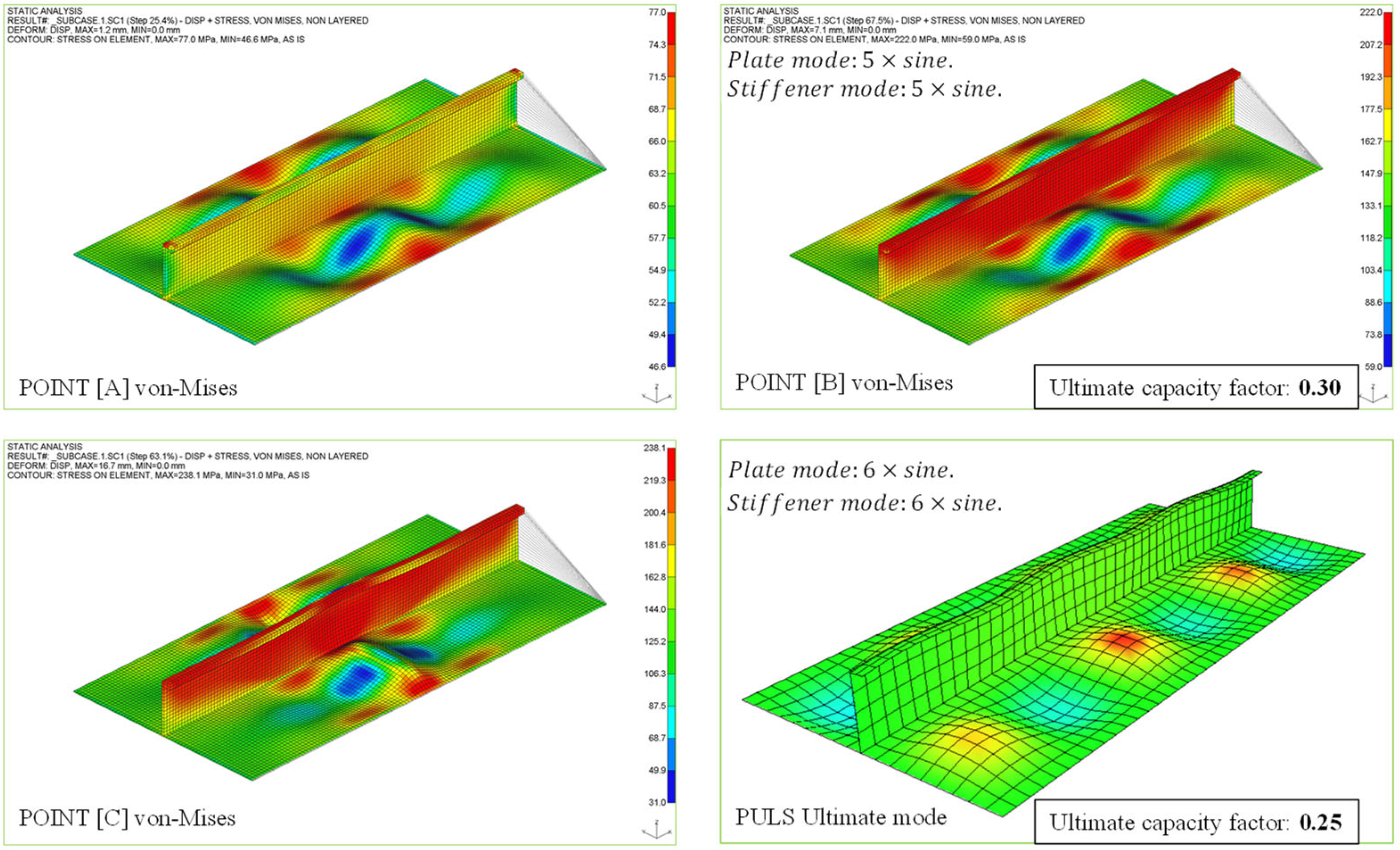
Figure 13 shows a clear transition from an initial linear elastic regime (Point A) to a nonlinear post-buckling regime (Point B), followed by gradual stiffness degradation toward the ultimate capacity state (Point C), which is characteristic of plate–stiffener systems dominated by interactive local and overall buckling. At Point A, the von Mises stress contours indicate that stresses are still distributed relatively uniformly, confirming that the response is governed primarily by elastic bending and membrane action. As the load increases to Point B, localized yielding initiates along the stiffener–plate junction and in the troughs of the buckling waves, reflecting the onset of mode interaction between the plate and stiffener. At Point C, a pronounced redistribution of stress and deformation occurs, indicating progressive plastic collapse driven by combined plate buckling and stiffener instability. The comparison with DNV PULS further highlights the role of modeling assumptions in predicting the ultimate collapse mode. While both the finite element solver and PULS identify similarly dominant half-wave patterns in the plate and stiffener, the final collapse modes differ in the number of sinusoidal waves and in the localization of plastic strains, leading to different ultimate capacity factors. This discrepancy arises because PULS employs a regularized imperfection pattern and simplified structural idealization, whereas the full nonlinear finite element analysis captures the actual three-dimensional interaction between the plate, stiffener, and plastic zones. As a result, the finite element solver tends to predict a more localized and progressive collapse mode, while PULS yields a more globalized and regular buckling pattern. From an engineering standpoint, these results demonstrate that although both approaches provide consistent trends in terms of stiffness degradation and ultimate strength level, the detailed collapse mechanisms and stress redistribution paths are solver-dependent.
This confirms that bulb-type stiffeners exhibit strong imperfection sensitivity and interactive buckling behavior, and it underscores the importance of nonlinear finite element analysis when precise prediction of collapse mode and residual strength is required for advanced structural optimization and safety-critical design.
Figure 15 presents the relationship between von Mises stress and displacement at three key points (A, B, C). The curves show a linear elastic response up to a certain displacement, after which the stress increase rate gradually declines, indicating the onset of plasticity and stiffness degradation. Point A, likely located in a high-stress region, reaches a higher stress level at a smaller displacement compared to Points B and C, suggesting localized yielding or buckling initiation. The overall response demonstrates progressive yielding and redistribution of stresses as the plate approaches its ultimate capacity.
Figure 16 compares the ultimate failure mode and capacity from a detailed nonlinear finite element analysis (“PURE ANALYSIS”) with the result from the rule-based tool DNV PULS. The detailed analysis predicts an ultimate capacity factor of 0.30 with a buckling mode characterized by five half-waves in both the plate and stiffener. In contrast, DNV PULS estimates a slightly lower capacity factor of 0.25 and a different buckling mode shape of six half-waves. This discrepancy highlights the difference between a high-fidelity nonlinear simulation, which captures complex interactions between plate yielding, stiffener tripping, and imperfection sensitivity, and a more simplified, code-prescribed assessment method. The detailed analysis suggests a marginally higher reserve strength and a distinct post-buckling deformation pattern, providing a more realistic estimate of the true collapse behavior for this specific angle stiffener design.
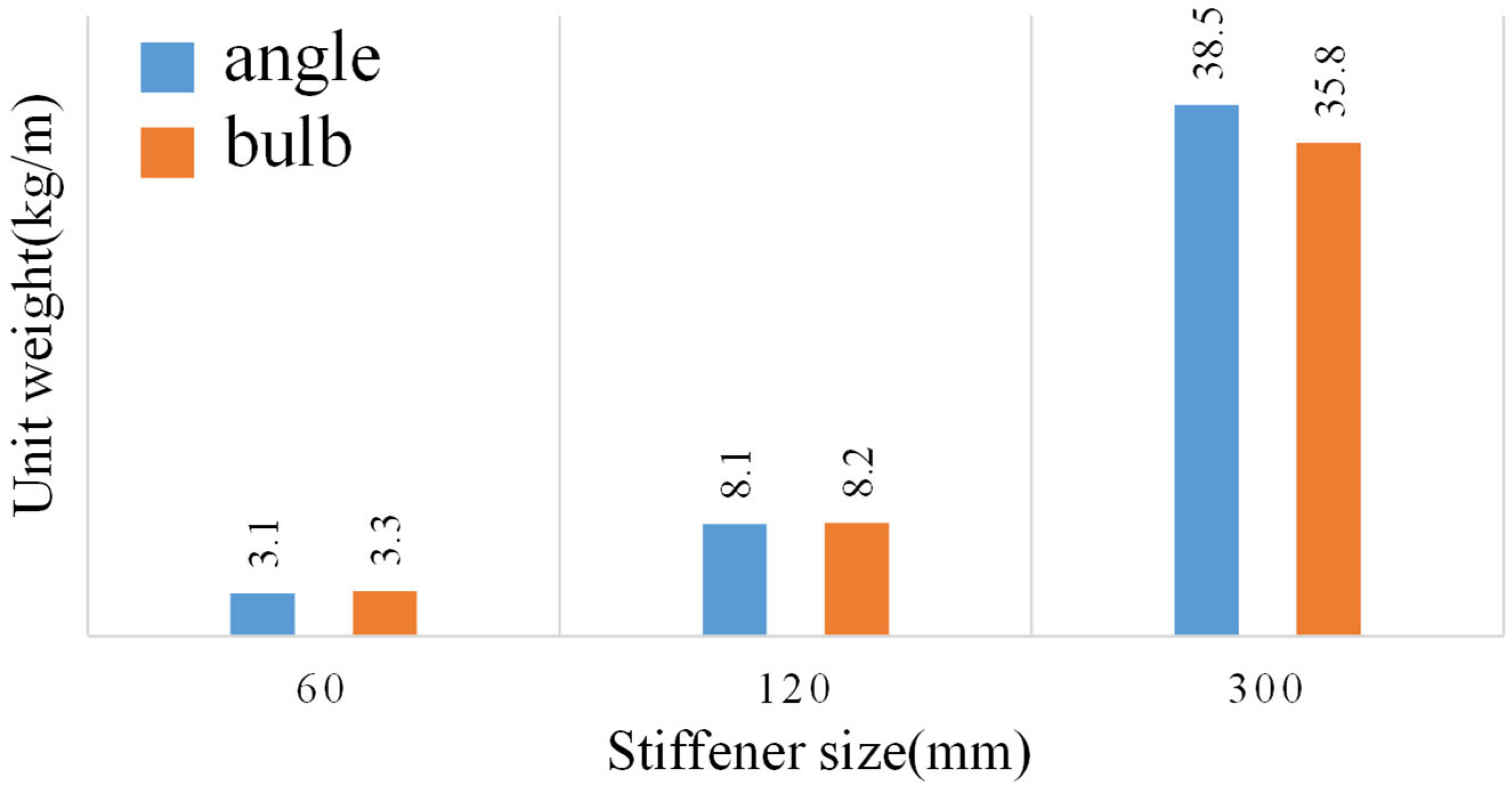
The fundamental engineering pursuit of lightweight design necessitates metrics that transcend basic strength comparisons, evaluating instead the holistic efficiency of material utilization. The comparative analysis of stiffener unit weight, culminating in
Figure 17, introduces and quantifies such a metric: structural weight efficiency. This concept is rigorously defined within the context of this study as the achievable ultimate compressive strength per unit mass of the stiffened panel system, evaluated under the realistic, imperfection-sensitive collapse regime rather than the elastic domain. This evaluation is made possible by the two-stage, high-fidelity analytical framework employed. First, the principle of equivalent sectional moment of inertia establishes a baseline of elastic equivalence between bulb and angle stiffeners, a common rule-of-thumb in preliminary design. Subsequently, the geometrically and materially nonlinear imperfection analysis (GMNIA) reveals the true divergence in their post-elastic behavior differences in post-buckling stiffness degradation, stress redistribution, and collapse mode localization, as detailed in
Section 3.2 and
Section 4. The critical finding is that despite these differing nonlinear failure mechanics, the ultimate strength (σ_ult) for both stiffener types converges to a comparable magnitude when sectional inertia is equivalent. It is against this backdrop of nonlinear performance parity that the weight comparison becomes profoundly meaningful.
Figure 13 demonstrates that the angle stiffener profile, owing to its geometric configuration, consistently possesses a lower cross-sectional area and thus lower mass than its elastically equivalent bulb counterpart. Therefore, for an equivalent ultimate limit state (ULS) capacity, the angle stiffener achieves the same structural safety margin with less material. This quantifies its superior weight efficiency, a direct and measurable trade-off emerging from the nonlinear analysis that remains invisible in linear elastic or rule-based assessments. The theoretical and practical implications of this weight-efficiency advantage are substantial. Theoretically, it demonstrates that elastic equivalence, governed solely by the second moment of area, is an insufficient proxy for true structural optimization. Optimal material distribution, which influences tripping resistance, shear center location, and interactive buckling behavior, is better captured by the angle profile for this loading condition, leading to material savings without sacrificing the ultimate load-bearing function.
Practically, this efficiency translates into direct and cascading benefits for marine structural design. A reduction in stiffener mass contributes immediately to lowering the lightweight displacement of a hull or offshore module. This primary weight saving enables significant secondary gains: enhanced deadweight cargo capacity for a given displacement, improved fuel efficiency due to reduced hull resistance and lower required propulsion power, and potentially improved stability from a lowered center of gravity. In an era dominated by stringent energy efficiency (EEDI/EEXI) and emissions regulations, such an efficiency gain is not merely an academic exercise but a critical lever for achieving environmental compliance and operational economy over a vessel’s life cycle.
Consequently, the weight-efficiency metric derived from this nonlinear performance comparison provides designers with a rational, quantitative tool for decision-making. It shifts the paradigm from selecting components based solely on code-prescribed minimums or elastic equivalence towards a performance-based optimization that simultaneously balances safety, material economy, and life-cycle operational value. This embodies the core objective of modern marine engineering: to achieve safer, more economical, and more sustainable structures through a deeper understanding of fundamental nonlinear behavior.
4. Conclusions and Future Works
This study has conducted a systematic nonlinear investigation into the structural performance of stiffened plates reinforced with bulb-type and built-in angle stiffeners designed to have equivalent elastic bending stiffness. By employing a two-stage numerical framework that integrates linear eigenvalue buckling analysis with geometrically and materially nonlinear imperfection analysis, the following conclusions can be drawn:
- (1)
Elastic equivalence does not ensure nonlinear equivalence.
Although both stiffener types exhibit similar elastic buckling characteristics when designed with equivalent sectional inertia, this equivalence does not extend to the nonlinear regime. Differences emerge in post-buckling stiffness degradation, stress redistribution, and collapse localization once geometric imperfections and material yielding are considered.
- (2)
Nonlinear analysis is essential for realistic ultimate strength assessment.
The results confirm that imperfection-sensitive nonlinear behavior governs the ultimate limit state of stiffened plates. Linear buckling criteria alone are insufficient to capture the true structural reserve or collapse mechanisms of slender marine structures.
- (3)
Angle stiffeners demonstrate superior weight efficiency.
Despite exhibiting nonlinear collapse behavior comparable to that of bulb stiffeners, angle stiffeners achieve similar ultimate strength with a lower sectional mass. This establishes a clear weight-efficiency advantage, quantified through nonlinear ultimate strength rather than elastic properties.
- (4)
High-fidelity GMNIA reveals structural reserve beyond rule-based methods.
Comparisons with DNV PULS indicate that simplified rule-based approaches tend to underestimate ultimate capacity and oversimplify collapse modes. In contrast, the detailed finite element analyses capture localized failure mechanisms and additional structural reserve, providing a more realistic assessment for design optimization.
In summary, this work demonstrates that optimal stiffener selection should be based on nonlinear, imperfection-sensitive structural performance rather than elastic equivalence alone. The findings provide a robust scientific basis for adopting angle stiffeners as a lightweight and structurally efficient alternative in advanced marine and offshore structures. The proposed methodology supports a performance-based design paradigm that simultaneously enhances safety, material economy, and life-cycle efficiency. Future research should extend this framework to combined loading conditions, cyclic and fatigue behavior, and experimental validation at the large-scale structural level.
Based on the findings and scope of this study, several avenues for future research are proposed to deepen understanding and extend applicability:
- (1)
Investigation under Combined Loads: Future studies should examine stiffened plate performance under more complex, multi-axial loading conditions (e.g., combined axial compression, in-plane bending, and shear) representative of actual global hull girder stresses.
- (2)
Dynamic and Cyclic Loading Assessment: Extending the analysis to include dynamic impact loads, fatigue assessment, and cyclic loading would provide critical insights into the long-term durability and survivability of different stiffener types under operational and extreme events.
- (3)
Comprehensive Life-Cycle Cost Analysis: A holistic techno-economic study integrating manufacturing complexity, fabrication cost, inspection requirements, and potential repair scenarios would provide a more complete picture of the total life-cycle cost benefits of angle versus bulb stiffeners.
- (4)
Optimization and Advanced Materials: The framework can be integrated with formal shape and topology optimization algorithms to discover novel, non-conventional stiffener profiles. Furthermore, investigating the use of high-strength steels or hybrid/composite materials could unlock additional weight-saving potential.
- (5)
Validation through Large-Scale Experiments: While numerical validation was performed against established codes, future work should include physical testing of full-scale or large-scale stiffened panel specimens to provide definitive experimental validation of the predicted collapse modes and ultimate strengths.