Article

Stage-Aware Reconstruction of Typhoon Inflow for Offshore Wind Turbines Using WRF and TurbSim

1
College of Engineering, Ocean University of China, Qingdao 266100, China
2
College of Mechanical and Electronic Engineering, Shandong Agriculture and Engineering University, Jinan 250100, China
*
Author to whom correspondence should be addressed.
J. Mar. Sci. Eng. 2026, 14(5), 438; https://doi.org/10.3390/jmse14050438
Submission received: 21 January 2026 / Revised: 21 February 2026 / Accepted: 24 February 2026 / Published: 26 February 2026

Abstract

Accurate typhoon inflow characterization is essential for offshore wind turbine safety in typhoon-prone regions. This study presents a physics-informed WRF–TurbSim framework that reconstructs rotor-relevant, stage-aware inflow fields for Typhoon In-Fa (2021) by mapping mesoscale stability and turbulence diagnostics into a User-Defined von Kármán model. Spectral and coherence checks confirm consistency with the imposed constraints and show pronounced regime dependence: low-frequency coherence decay remains near IEC neutral behavior, whereas high-frequency decay weakens substantially during the stable eye stage. The results suggest that neutral coherence assumptions may be unreliable in strongly stable typhoon regimes, motivating stage-aware inflow characterization for engineering applications.

1. Introduction

In recent years, offshore wind energy has undergone rapid expansion, emerging as a vital component of the global clean energy transition [1,2]. The precise characterization of typhoon wind fields is a critical prerequisite for the structural safety assessment of offshore wind turbines (OWTs), particularly as the industry expands into deeper waters with multi-megawatt floating platforms [3]. Unlike onshore structures, large-scale OWTs—with hub heights exceeding 90 m—operate within the complex atmospheric boundary layer (ABL), where wind characteristics during extreme events deviate significantly from standard design codes [4]. Recent investigations into landfalling typhoons, such as Typhoon In-Fa (2021), have highlighted that these typhoon environments exhibit strong non-stationarity, significant structural asymmetry, and site-specific vertical shear profiles, which cannot be adequately described by the stationary Gaussian assumptions or simple power-law profiles typically used in engineering practice [5,6].
Currently, wind field modeling for offshore engineering primarily relies on three approaches, each with distinct limitations [7]. Parametric models (e.g., Holland-type) are computationally efficient but often enforce axisymmetric pressure distributions, failing to reproduce the highly asymmetric wind speeds observed between the dangerous and navigable semicircles of a typhoon [8,9]. Numerical Weather Prediction (NWP) models, such as the Weather Research and Forecasting (WRF) model, provide physics-based solutions capable of resolving mesoscale environmental interactions [10,11]. However, WRF simulations are highly sensitive to physical parameterization schemes—particularly planetary boundary layer (PBL) and microphysics options—which directly dictate the accuracy of the simulated near-surface wind shear and momentum transfer [12,13]. Furthermore, mesoscale models often suffer from the “Terra Incognita” issue, where the grid resolution is too coarse to resolve the microscale turbulence required for structural dynamic analysis [12,14]. Consequently, engineering applications typically resort to stochastic turbulence simulators (e.g., TurbSim) [15]. While standardized, these tools heavily depend on user-defined inputs—such as shear exponents, turbulence intensity, and Reynolds stress tensors—which are difficult to determine accurately for complex typhoon conditions without high-fidelity meteorological data [16,17].
Although the concept of coupling mesoscale simulations with engineering turbulence models exists, a rigorous methodology for physics-informed reconstruction remains underdeveloped [8,18,19]. In the context of this study, “large-scale” refers to the synoptic environmental forcing captured by the outer WRF domains, “mesoscale” pertains to the kilometer-scale typhoon structure resolved by the inner nests, and “microscale” denotes the rotor-relevant turbulence generated by stochastic models. “Multiscale” thus describes the stage-aware workflow developed herein to bridge these regimes by transferring WRF-derived mean and stability constraints into the stochastic inflow reconstruction. Existing studies typically prioritize typhoon track prediction. This focus often comes at the expense of detailed analysis of the vertical wind structure relevant to the OWT rotor sweep area, specifically regarding its sensitivity to physics schemes [20]. Moreover, there is a lack of systematic workflows to extract de-staggered turbulent fluxes and stability parameters (e.g., Richardson number and Reynolds stresses) from track-validated WRF simulations and map them consistently into stochastic models [21]. This disconnection often leads to a reliance on empirical assumptions, which may misrepresent the actual shear and turbulence loading experienced by the turbine [22].
To address these gaps, this study proposes a comprehensive framework for reconstructing mesoscale-to-microscale wind fields, applied to the complex case of Typhoon In-Fa [23]. Instead of relying on idealized profiles, this research establishes a data-driven workflow [24,25,26,27,28]. First, a series of WRF sensitivity experiments are conducted to identify the best-performing physics configuration (among the tested options), which minimizes errors in track and intensity while accurately reproducing the asymmetric wind distribution and vertical shear characteristics of the storm. Second, based on the selected best-performing WRF simulation, key atmospheric variables—including altitude-dependent mean wind speeds, shear exponents, and Reynolds stress components—are extracted from the mesoscale output. Finally, these physics-derived parameters are integrated into a customized TurbSim interface to generate high-fidelity, three-dimensional turbulent wind fields [29].
This approach effectively bridges the gap between mesoscale atmospheric physics and engineering-scale load simulation. By incorporating the specific non-stationary evolution and vertical shear properties of Typhoon In-Fa, the generated wind fields provide a more realistic basis for the subsequent aero-hydro-servo-elastic analysis of floating offshore wind turbines. The methodology presented herein offers a reproducible pathway for reducing uncertainty in extreme load assessments for future offshore wind developments.

2. Materials and Methods

2.1. Overall Workflow for Typhoon Wind Field Reconstruction

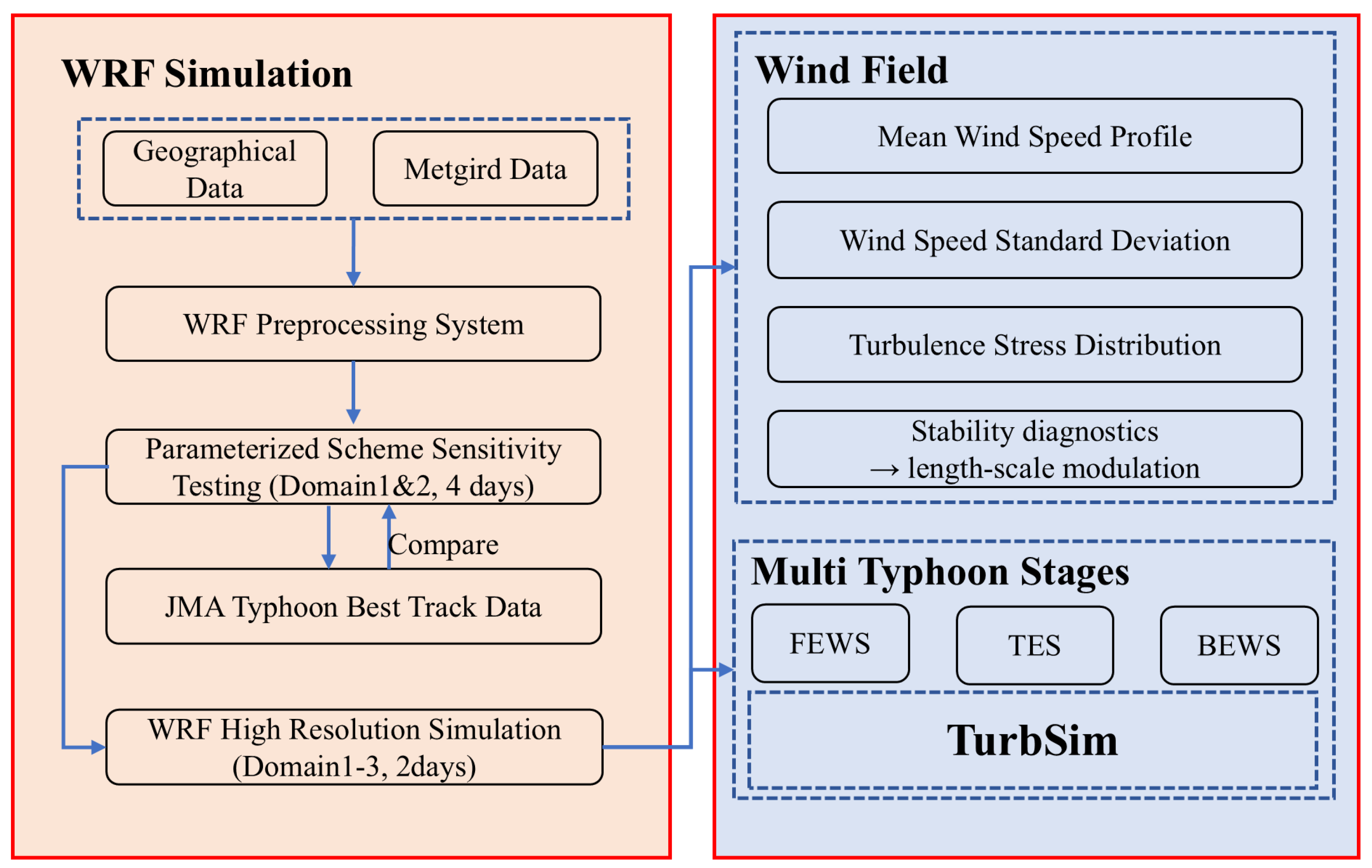
This study establishes a physics-informed simulation framework that bridges mesoscale dynamics and microscale turbulence for offshore engineering applications. As illustrated in Figure 1, the workflow couples NWP with stochastic turbulence synthesis to achieve cross-scale statistical consistency. The process begins with a WRF physics sensitivity analysis to identify a best-performing configuration that reproduces the typhoon track skill and a physically coherent boundary-layer structure. From the validated mesoscale fields, height-dependent inflow descriptors are extracted through grid de-staggering and rotor-layer diagnostics, including mean profiles, Reynolds-stress-related turbulence statistics, and the gradient Richardson number.
A key feature of the framework is the stage-dependent statistical mapping between scales. Instead of prescribing generic stability classes, the WRF-diagnosed Richardson number modulates the turbulence scale parameter and the associated integral length scales used by TurbSim under the User-Defined von Kármán (USRVKM) option. The workflow therefore does not attempt deterministic reproduction of instantaneous eddies. It generates stochastic turbulence realizations conditioned on evolving mesoscale constraints and subsequently verifies their integrity using PSD and vertical coherence diagnostics in Section 3.3.

2.2. Mesoscale Atmospheric Modeling

2.2.1. Case Study: Typhoon In-Fa

To evaluate the capability of the proposed physics-based framework, Typhoon In-Fa (2021) was selected as the specific simulation target due to its anomalous kinematic characteristics. Originating as a tropical storm on 18 July 2021, In-Fa underwent complex intensity fluctuations before making two consecutive landfalls in Zhejiang Province on 25 and 26 July. The typhoon was distinguished by an exceptionally slow translation speed, a large asymmetric wind radius, and a prolonged residence time over coastal waters. These attributes resulted in significant cumulative wind loads and non-stationary structural evolution, presenting a stringent test for reproducing the complex boundary-layer dynamics required for offshore engineering applications.

2.2.2. WRF Brief Description

To resolve the multi-scale atmospheric dynamics of Typhoon In-Fa, the Advanced Research WRF (WRF-ARW) model (Version 4.6.1) was employed. The WRF model captures various large-scale environmental factors that are critical for tropical cyclone formation and intensification, including vertical wind shear, upper-tropospheric divergence, sea surface temperature, ocean heat content, and moisture supply. By applying lateral boundary conditions and incorporating multiple physical parameterizations—cumulus convection, microphysics, radiative transfer, planetary boundary-layer dynamics, and land surface processes—WRF numerically solves the governing equations of atmospheric dynamics and thermodynamics. Specifically, the WRF-ARW solver integrates fully compressible, non-hydrostatic Euler equations in a terrain-following hydrostatic-pressure vertical coordinate system. The horizontal grid discretization follows the Arakawa-C scheme, while the time integration employs a third-order Runge–Kutta method, and spatial derivatives can be captured with second- to sixth-order accuracy. A comprehensive description of the WRF-ARW model is provided by Skamarock and Klemp [30]. These features ensure that both large- and small-scale processes relevant to typhoon development are dynamically and thermodynamically represented throughout the simulation.

2.2.3. Model Configuration and Domain Design

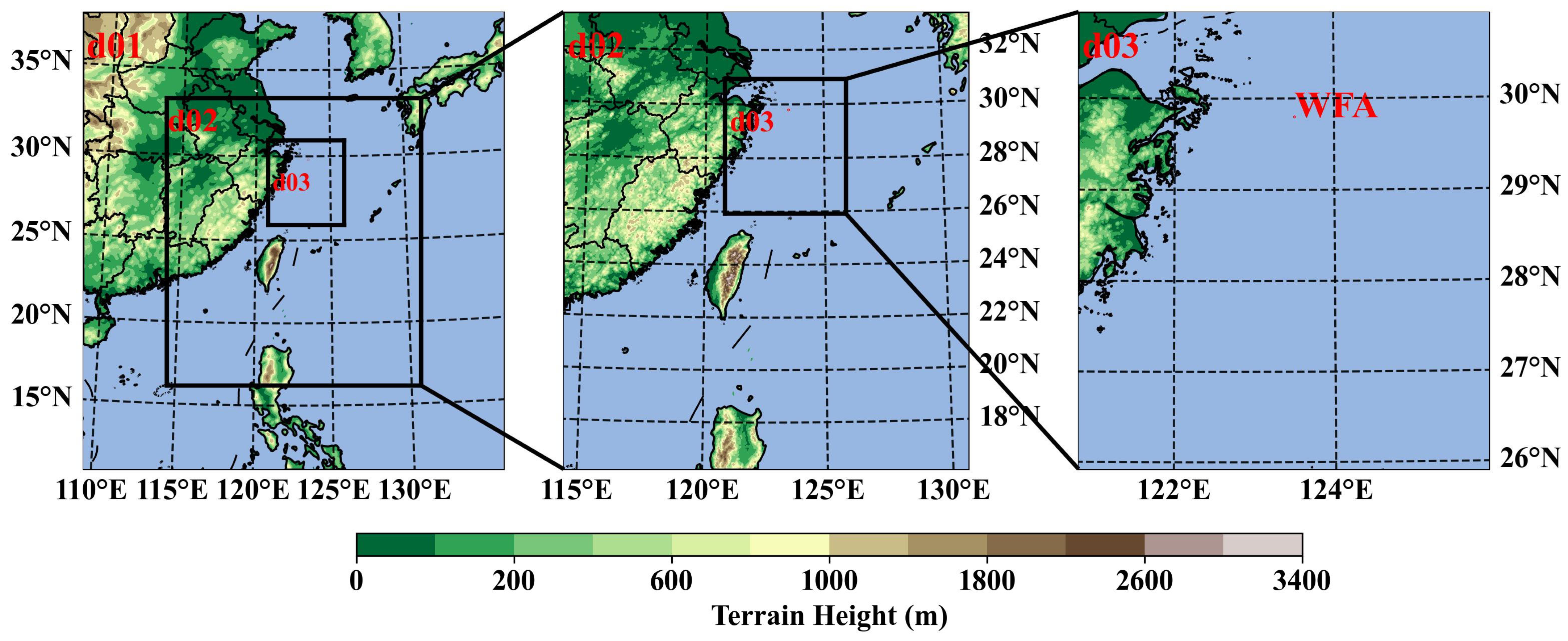
To comprehensively resolve the multi-scale atmospheric dynamics governing Typhoon In-Fa, a triple-nested domain system using two-way interaction (as shown in Figure 2) was configured. This nesting strategy facilitates bidirectional exchange of mass and momentum between grids, allowing fine-scale thermodynamic features and rainband structures captured at higher resolutions to feed back into coarser domains, thereby enhancing the overall consistency of the large-scale flow field. The outermost domain (d01) spans 307 × 334 grid points at a 9 km horizontal resolution to capture synoptic-scale environmental circulation. The intermediate domain (d02) refines the resolution to 3 km (556 × 628 points), while the innermost domain (d03) achieves a 1 km spacing (499 × 556 points) centered at 25° N, 122.5° E to explicitly resolve inner-core dynamics and near-surface turbulence in the landfall region. Vertically, 47 terrain-following sigma layers extend to 50 hPa, with densification within the planetary boundary layer to ensure accurate representation of vertical wind shear and turbulent fluxes. Initial and lateral boundary conditions were derived from NCEP Global Data Assimilation System (GDAS) FNL analysis (0.25° resolution), updated at 6 h intervals.

2.2.4. Design of Physics Sensitivity Experiments

The WRF framework represents sub-grid processes through parameterization schemes, notably turbulence, convection, and cloud microphysics. As a result, simulated typhoon evolution can be sensitive to these choices and to how well the model follows the large-scale forcing. To quantify this sensitivity, we conducted a structured set of experiments that varied four components: the planetary boundary layer (PBL), microphysics (MP), cumulus convection (Cu), and spectral nudging (implemented via the WRF FDDA option in this study). Three PBL options were considered: YSU (option 1, denoted PBL1), MYJ (option 2, denoted PBL2), and MYNN2 (option 5, denoted PBL5). The MP options included the WRF Single-Moment 6-class scheme (WSM6, option 6), the WRF Single-Moment 7-class scheme (WSM7, option 24), and the Thompson scheme (option 38). For cumulus parameterization, two schemes were selected: the Multi-Scale Kain–Fritsch scheme (option 11) and the New Tiedtke scheme (option 16). The design followed common practice in typhoon simulations and used a consistent combination matrix to isolate the impact of each physics option. All schemes were standard WRF options adopted in prior tropical cyclone studies [31,32,33,34]; the specific 36-member factorial matrix was constructed here to enable a controlled main-effect assessment under identical model settings.
To select a single mesoscale driver for subsequent coupling, track error was quantified using the direct position error (DPE). DPE at each analysis time was defined as the great-circle distance between the simulated typhoon center and the corresponding JMA best-track center location. The primary selection criterion was the mean DPE over 0–72 h with 6 h sampling.
The PBL scheme regulates air–sea exchange and near-surface mixing. It shapes the depth of the inflow layer and the strength of the low-level wind maximum, and it controls vertical transport of momentum and moisture. These factors affect surface fluxes and can influence storm intensity and inner-core structure. The MP scheme governs hydrometeor partitioning and phase changes, which determine latent heating and the distribution of diabatic forcing. This, in turn, affects precipitation patterns and rainband organization. In the outer, coarser domain, Cu parameterization is applied to represent sub-grid deep convection and its vertical transport, while it is turned off in convection-permitting domains to avoid double-counting. Spectral nudging is used to constrain the large-scale (long-wave) components toward reanalysis, reducing synoptic-scale drift while still allowing the model to develop mesoscale vortex dynamics.
Table 1 shows the 12-member YSU subset (EXP01–EXP12) of the sensitivity matrix, including all MP options considered in this study, Cu settings (outer domain only), and spectral nudging configurations. The complete sensitivity ensemble contains 36 experiments, obtained as 36   =   12   ×   3 , by repeating the same 12 MP/Cu/FDDA combinations for three PBL schemes (YSU, MYJ, and MYNN2). This design ensures that differences among experiments reflect physics choices rather than inconsistencies in the experimental design. Accordingly, EXP01–EXP12 correspond to the YSU subset shown in Table 1, whereas the same MP/Cu/FDDA matrix is repeated for PBL option 2 (MYJ) and PBL option 5 (MYNN2), which are summarized as PBL1/PBL2/PBL5 in Figure 3 and Figure 4.
A two-stage simulation strategy was adopted to balance computational efficiency with scientific rigor. During the screening phase (21–25 July 2021), all 36 sensitivity tests were conducted on the outer domains (d01 and d02) to evaluate track fidelity against Japan Meteorological Agency (JMA) best-track data during the storm’s approach and development phases. This phase aimed to identify which parameterization combinations most accurately capture typhoon kinematics and thermodynamics. Subsequently, during the high-resolution reconstruction phase (24–26 July 2021), the innermost domain (d03) was activated using the configuration selected as best-performing from the screening phase. This staged approach enables systematic evaluation of physics schemes while concentrating computational resources on the critical landfall period at the finest resolution necessary for wind field reconstruction.

2.3. Physics-Informed Wind Field Reconstruction

To connect mesoscale WRF outputs with engineering-scale inflow requirements, boundary-layer descriptors are extracted in a kinematically consistent manner and used to parameterize stability-aware turbulence synthesis in TurbSim. The objective is to retain the stage-dependent rotor-layer structure of the typhoon boundary layer in a statistically constrained sense, rather than generating a generic stationary wind field. This approach ensures that the resulting turbulence intensities and length scales reflect the evolving stability regimes identified in the mesoscale analysis.

2.3.1. Grid De-Staggering and Kinematic Consistency

WRF is formulated on a staggered Arakawa-C grid, with thermodynamic variables located at mass points and velocity components stored at offset momentum points. If wind profiles are sampled directly from raw outputs, the spatial mismatch can contaminate derived gradients, especially vertical shear and veer. This is critical for load analysis, where small biases in U / z can propagate in turbulence and fatigue estimates.
To mitigate this issue, the horizontal wind components are interpolated onto mass points using centered differencing consistent with the ARW discretization:
u m ( i , j , k ) = u ( i , j , k ) + u ( i 1 , j , k ) 2 v m ( i , j , k ) = v ( i , j , k ) + v ( i , j 1 , k ) 2  
All subsequent diagnostics are based on these collocated wind components. The scalar wind speed U and direction ϕ are then evaluated as:
U = u m 2 + v m 2 + w 2
ϕ = 270 ° tan 1 v m ¯ u m ¯ 180 ° π mod 360 °
where the overbar denotes spatial averaging within a small neighborhood surrounding the target offshore site. Bilinear interpolation to the site location is followed by averaging over a 3 × 3 grid-cell region. This filtering step effectively suppresses grid-scale numerical noise while retaining the physically meaningful gradients essential for load analysis. In this study, the reference hub height is fixed as z h u b = 90   m , which represents a typical hub-height level for utility-scale offshore wind turbines; all “hub-height” statistics reported hereafter refer to this fixed height unless otherwise noted.

2.3.2. Mesoscale-to-Microscale Turbulence Reconstruction Using WRF-Informed TurbSim

To bridge the gap between mesoscale “gray-zone” output and the high-frequency turbulence required for load analysis, the TurbSim stochastic simulator was employed using the User-Defined von Kármán (USRVKM) spectral model. Unlike standard neutral-stability formulations commonly adopted in engineering guidelines [15,35], the USRVKM framework is driven by time-varying, physics-based parameters extracted directly from the selected best-performing WRF simulation. These parameters are updated across different typhoon stages, allowing the reconstructed inflow to retain the inherently non-stationary character of the typhoon. Because TurbSim is a spectral-synthesis generator rather than a prognostic flow solver, it does not require physical initial or boundary conditions. Instead, each realization is defined by prescribed statistical constraints (mean profiles, variances, integral scales, and coherence) together with a random realization setting (e.g., a seed). The numerical setup (e.g., Δt) is kept identical across stages to isolate the effect of the WRF-informed parameters.
Within the USRVKM framework, turbulent fluctuations are synthesized by prescribing the longitudinal power spectral density following the classical von Kármán formulation [15]. The spectrum is evaluated using local atmospheric state variables interpolated from the physics-informed profiles, rather than relying on a single hub-height reference. The formulation is given by:
S u ( f ) = 4 σ u 2 L u / u ¯ ( 1 + 71 ( f L u / u ¯ ) 2 ) ( 5 / 6 )
S K ( f ) = 2 σ K 2 L u / u ¯ ( 1 + 71 ( f L u / u ¯ ) 2 ) ( 11 / 6 ) ( 1 + 189 ( f L u / u ¯ ) 2 )
where f denotes the cyclic frequency. Crucially, u ¯ , σ u , and L u represent the local time-averaged wind speed, standard deviation, and integral length scale, respectively, evaluated at each specific grid height. Among these parameters, L u directly governs the spectral shape and the location of the peak frequency, thereby controlling how turbulent energy is distributed across scales.
In TurbSim’s USRVKM implementation, the integral length scale, L u , is defined using the turbulence scale parameter Λ ( z ) through a fixed mapping [36]:
L u = 3.5 Λ ( z )
This relationship provides the interface between boundary-layer scaling and spectral synthesis. In engineering practice, the baseline, Λ o ( z ) , is commonly anchored to a neutral reference form adopted in guidelines [37],
Λ o ( z ) = 0.7 z z 60 42 z 60
where Λ o ( z ) and z are expressed in meters and Λ o ( z ) provides a height-dependent baseline turbulence length scale under neutral stratification. This assumption can become inadequate in typhoon boundary layers, where intense shear, rapid thermodynamic evolution, and stage-dependent stratification are common. A stability-aware Λ ( z ) is therefore required before L u is passed into the spectral model via Equation (4).
A key quantity for stability-aware turbulence modeling is the gradient Richardson number, computed from the collocated mean fields,
R i = g θ ¯ θ / z u m / z 2 + v m / z 2
where g is the gravitational acceleration and θ is the potential temperature. In implementation, vertical derivatives are evaluated using finite differences between adjacent analysis heights. Mid-layer averaging is applied to reduce numerical sensitivity. A negative R i indicates that buoyancy contributes to turbulence production, while a positive R i reflects buoyant suppression competing with mechanical shear.
To link turbulence intensity with the resolved flow, Reynolds stresses are diagnosed from departures from the local mean within the sampling neighborhood,
u w ¯ = ( u m u ¯ m ) ( w w ¯ ) ¯ , v w ¯ = ( v m v m ¯ ) ( w w ¯ ) ¯
and a friction velocity consistent with the resolved stress magnitude is estimated as
u = u w ¯ 2 + v w ¯ 2 1 / 4
With turbulence intensity constrained by the stress diagnostics, the reconstruction next determines the energy distribution across frequencies through the turbulence scale parameter Λ ( z ) . The neutral baseline in Equation (7) is modulated using the diagnosed R i to account for stratification effects. A critical threshold R i c r i t = 0.25 is adopted, marking the transition at which buoyancy suppression overcomes shear-driven overturning [38]. To represent the stratification variability relevant to typhoon boundary layers, the corrected Λ ( z ) is expressed as a piecewise physical mapping:
Λ ( z ) = min ( Λ o ( z ) , c z i Z i ) , R i < 0.01 Λ o ( z ) , R i 0.01 max Λ o ( z ) ( 1 + c s R i ) α , 0.3 Λ o ( z ) , 0.01 < R i < R i c r i t 0.1 Λ o ( z ) , R i c r i t R i < 1 0.05 z , R i 1
where the boundary-layer height, Z i , is derived from the WRF-diagnosed planetary boundary-layer height (PBLH). The coefficient c z i = 0.2 reflects the scaling of dominant eddies by the boundary-layer depth under convective conditions [39]. For stable stratification, the damping function ( 1 + c s R i ) α (with c s = 10 , α = 0.8 ) models the progressive reduction in eddy sizes, consistent with stable boundary-layer theory [40].
Crucially, a 30% floor is enforced to prevent an unrealistically abrupt collapse of Λ as R i approaches R i c r i t . This retains residual turbulent exchange under strongly sheared yet weakly stable conditions that are frequently encountered near typhoon eyewalls. This bounded formulation is particularly relevant during the stable eye-stage regime, where strict local-equilibrium assumptions may not hold. It provides a physically interpretable suppression of turbulence scales while avoiding pathological values in rotor-layer characterization. Consequently, for extremely stable regimes, the height-based cap 0.05 z provides a conservative residual scale consistent with observations in very stable boundary layers [41].
With Λ ( z ) determined by Equation (11), the integral scale parameter, Lu required by the USRVKM spectrum follows directly from Equation (6). The spectrum in Equations (4) and (5) is therefore evaluated using height-dependent local inputs, u ¯ , σ u , and L u , rather than a single hub-height reference. This allows the spectral peak to shift naturally with altitude, preserving the coupling between vertical shear and eddy structure that characterizes the typhoon boundary layer. The final inflow fields are generated with a temporal resolution of Δ t = 0.05 s. This corresponds to a Nyquist frequency of 10 Hz, which is consistent with the frequency ranges analyzed in this study. Each TurbSim realization has a total duration of T = 600 s.

3. Results and Discussion

3.1. Sensitivity Analysis of WRF Physics Configuration

To ensure the reliability of the subsequent microscale wind field reconstruction, it is essential to identify the best-performing WRF physics configuration that accurately reproduces the track, intensity, and boundary-layer structure of Typhoon In-Fa. A comprehensive sensitivity analysis was conducted to evaluate 36 different combinations of parameterization schemes. The simulated tracks exhibit substantial divergence as integration time increases, revealing the critical dependence of typhoon simulation on sub-grid physics representation.
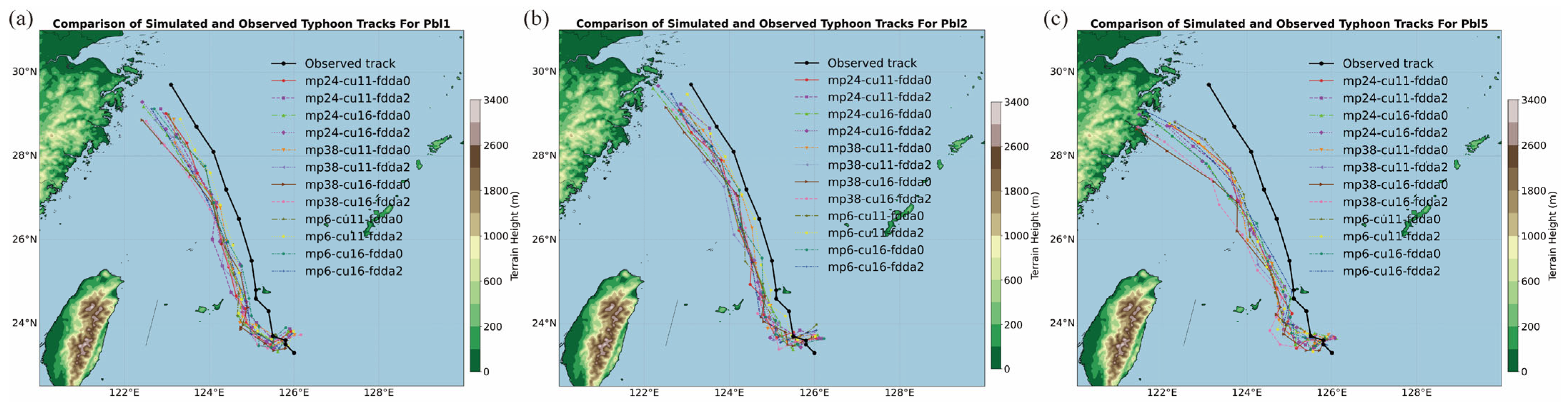
Figure 3 presents the simulated tracks from all sensitivity experiments compared against the JMA best-track dataset. For a consistent comparison, storm-center locations are diagnosed at 6 h analysis times over 0–72 h, and the plotted trajectories connect these analysis-time positions. During the initial 24 h, all configurations successfully capture the northwestward progression of In-Fa. Progressive divergence emerges beyond 36 h, with position errors exceeding 150 km by 72 h in certain configurations. This spread indicates strong sensitivity of track prediction to sub-grid physics representation, particularly for a slow-moving typhoon such as In-Fa.
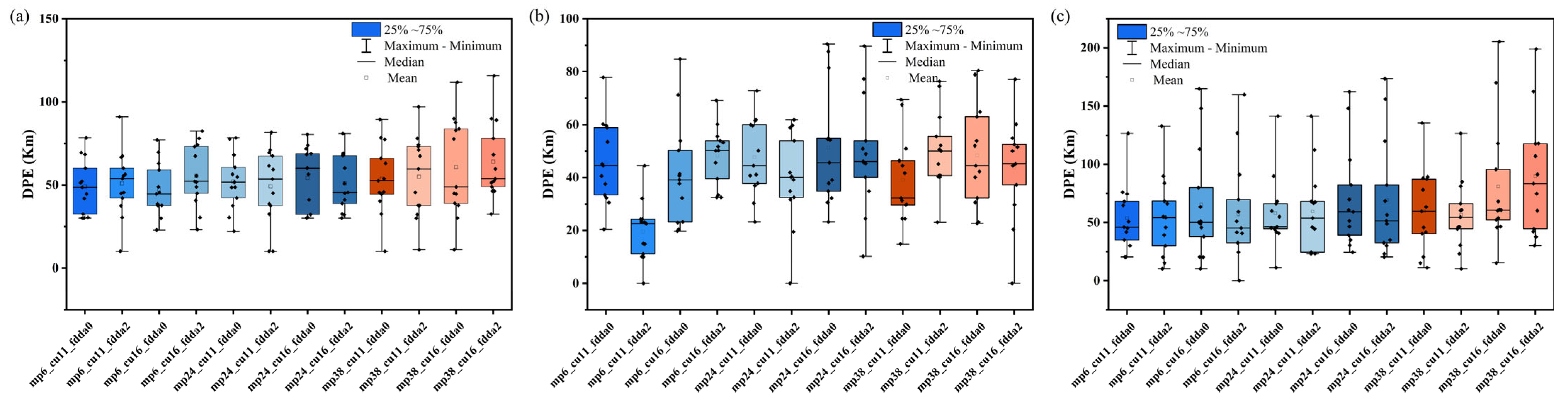
To quantify track skill, DPE is computed at each 6 h analysis time as the great-circle distance between the simulated storm center (Figure 3) and the corresponding JMA best-track center location. Figure 4 summarizes the DPE distributions for all experiments, grouped by PBL option, while Table 2 reports the main-effect contributions of each physics category by averaging over all combinations of the remaining schemes. The PBL choice produces a difference exceeding 20 km in mean DPE, which is substantially larger than the effects of microphysics, cumulus convection, or spectral nudging. PBL2 (MYJ) yields the lowest group-mean DPE (43.67 km), corresponding to an 18.9% reduction relative to the ensemble mean (53.96 km), and it exhibits the tightest spread. This value is the PBL2 mean across all MP/Cu/FDDA combinations; within PBL2, the selected best-performing configuration (MYJ–WSM6–Multi-Scale KF with spectral nudging) achieves a mean DPE of 26.9 km. The robustness suggests that the local TKE-based closure in MYJ better preserves the sharp vertical shear and weakly mixed structure typical of typhoon boundary layers, thereby maintaining a more realistic vortex–environment coupling for In-Fa.
In contrast, simulations using the YSU scheme (PBL1) show comparable performance in the early stage but tend to deviate after approximately 48 h. Several combinations—particularly those with more complex microphysics or deeper convection schemes—reach DPE values of about 100–115 km by 72 h (e.g., mp38_cu16). This behavior is consistent with YSU’s non-local mixing framework, which can enhance vertical transport and smooth the low-level wind maximum. The near-surface jet that helps anchor the cyclone center may therefore weaken, increasing susceptibility to perturbations in the large-scale flow. The broader ensemble spread in Figure 3 reflects this increased sensitivity.
The MYNN2 scheme (Pbl5) yields the lowest performance among the three PBL options. Divergence typically begins within the first 36 h, and by 72 h many experiments exhibit DPE values greater than 150 km, with the poorest combination (mp38_cu16_fdda0) exceeding 200 km. As indicated in Table 2, MYNN2 increases the mean DPE by 19.9% relative to the ensemble mean. This degradation is consistent with prior reports that MYNN-type schemes may overmix the lower troposphere under strongly convective conditions, eroding the shear and thermodynamic structure needed to sustain vortex integrity. Once the circulation becomes overly diffused, track evolution becomes increasingly affected by numerical drift rather than being controlled by synoptic-scale steering.
While the PBL parameterization dominates the track response, microphysics and cumulus schemes provide secondary but systematic modulation. The WSM6 scheme (mp6) yields the lowest mean DPE (49.10 km), representing an 8.8% improvement relative to the ensemble mean. This advantage is most evident when paired with the better-performing PBL settings, and it contributes to the best overall configuration identified in this study. Among cumulus options, the Multi-Scale Kain–Fritsch scheme (cu11) consistently outperforms the New Tiedtke scheme (cu16), reducing mean errors by about 10%. The difference likely arises from their distinct treatments of convection depth, moisture detrainment, and the resulting asymmetry of the moisture field around the vortex, which subtly alters the environmental flow impacting storm motion.
Cumulus parameterization further tunes the trajectory. The Multi-Scale Kain–Fritsch scheme (cu11) consistently outperforms the New Tiedtke option (cu16), reducing average errors by approximately 10%. This divergence stems from their contrasting treatments of shallow convection and moisture detrainment, mechanisms that subtly reshape the large-scale flow asymmetry surrounding the vortex.
Spectral nudging (FDDA) provides an important large-scale constraint. Although its impact on mean DPE is small (<1%), it reduces spurious high-frequency oscillations and tightens the ensemble spread. For a slow-moving system such as In-Fa, where steering currents are weak and numerical drift can accumulate, FDDA helps anchor the environmental field and improves the temporal coherence of track evolution.
Overall, these results suggest that track prediction for Typhoon In-Fa is governed primarily by the representation of lower-tropospheric turbulence and stratification, with microphysics and cumulus processes providing secondary modulation and spectral nudging enhancing large-scale fidelity. The MYJ–WSM6–Multi-Scale KF configuration with spectral nudging (pbl2_mp6_cu11_fdda2) consistently outperforms the other experiments. It achieves a mean DPE of 26.90 km, a median of 22.56 km, and a standard deviation of 11.31 km. It also maintains the most coherent temporal evolution and the best agreement with the JMA best-track data throughout the integration. This configuration is therefore selected as the mesoscale driver for the subsequent wind field and turbulence reconstruction.

3.2. Mesoscale Structure of Typhoon Wind Field

With the selected best-performing WRF configuration established, we characterize the mesoscale wind field in Domain 3 (1 km) and diagnose the storm structure at the target wind farm. The analysis focuses on the spatiotemporal evolution of winds, vertical shear, turbulent exchange, and thermodynamic stability. These WRF-resolved mesoscale statistics provide the physically consistent constraints required for the subsequent TurbSim-based microscale reconstruction, thereby bridging the gray-zone model output with turbine-relevant inflow conditions.
The passage of Typhoon In-Fa induces strong non-stationarity at the site. To interpret the rapid transitions in a turbine-oriented manner, the event is divided into three regimes according to the relative position between the wind farm and the vortex center. The sequence starts with the Front Eyewall Stage (FEWS), when the approaching convective ring produces peak wind speeds, enhanced vertical shear, and vigorous mixing. It then enters the Typhoon Eye Stage (TES), during which the eye vicinity is associated with subsidence warming and suppressed turbulence. Finally, the Back Eyewall Stage (BEWS) represents the rear-quadrant passage, when severe winds re-intensify while the inflow direction changes markedly. This stage-based framework is adopted throughout the paper to maintain a consistent WRF–TurbSim linkage for load-relevant inflow reconstruction.

3.2.1. Wind Field Structure in Domain 3

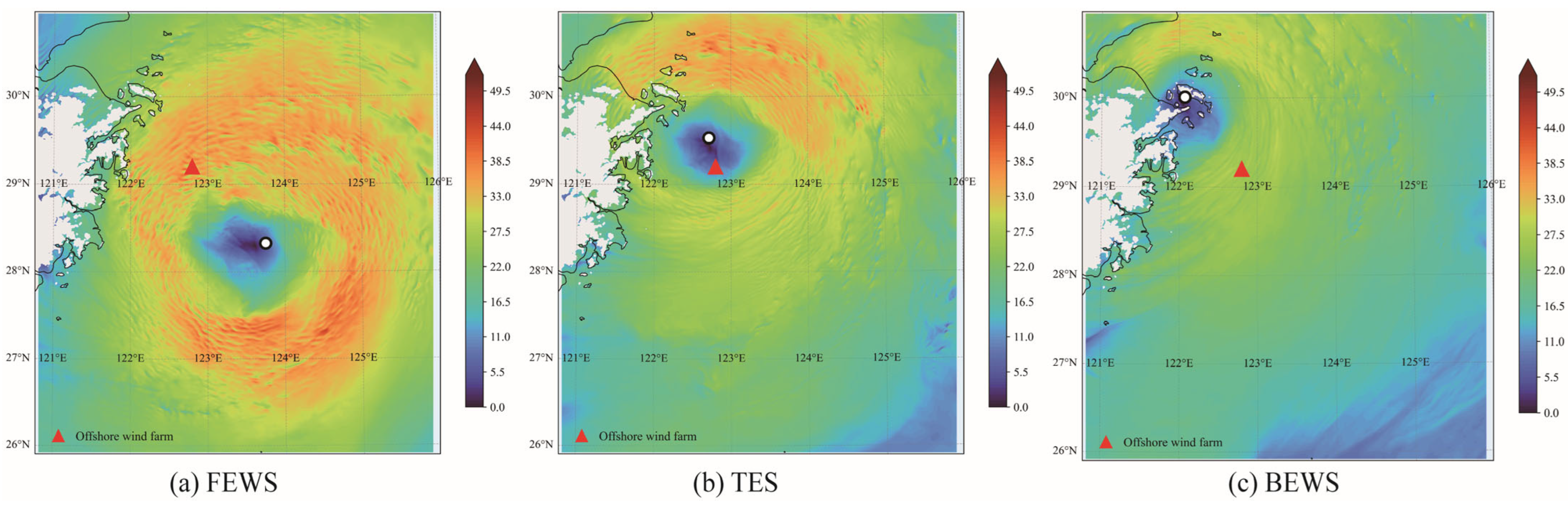
The spatial organization of the wind field at a representative hub height of 90 m exhibits marked structural differences across the three stages. Figure 5 presents horizontal distributions of wind speed over Domain 3 during representative moments of FEWS, TES, and BEWS.
During FEWS (Figure 5a), the wind farm is engulfed by the storm’s most dynamically active sector. Wind speeds dominate the domain, exceeding 35 m/s, with localized maxima approaching 40 m/s. The flow field exhibits strong azimuthal asymmetry, with peak velocities concentrated in the dangerous right-front quadrant—a consequence of superposing the cyclonic vortex circulation onto the storm’s translation vector. Consequently, the site experiences sustained extreme-intensity inflow characterized by rapid temporal variations and sharp horizontal gradients. As the system progresses to the TES (Figure 5b), the mesoscale structure undergoes a dramatic transformation. The distinct, subsidence-dominated eye becomes clearly defined. Wind speeds plummet below 15 m/s within a 10–15 km radius of the center. The eyewall–eye interface exhibits a strong mesoscale gradient, with wind speed changes exceeding 20 m/s over ~10 km in some snapshots. This sharp gradient represents an abrupt shift in aerodynamic forcing, rather than a gradual synoptic transition. In the subsequent BEWS (Figure 5c), the background flow reorganizes as the typhoon departs. High-velocity winds re-emerge, though generally with reduced intensity compared to the front quadrant. Crucially, the wind direction rotates substantially, reflecting the reversal of the vortex flow relative to the site.
The contrasts among these three spatial patterns underscore the highly non-stationary nature of typhoon core passage. Unlike synoptic-scale weather systems where transitions occur gradually over hundreds of kilometers and many hours, the eyewall–eye–eyewall sequence compresses multiple extreme dynamical regimes into spatial scales of tens of kilometers and temporal scales of several hours. This non-stationarity is precisely what motivates the later TurbSim reconstruction using time-varying, WRF-derived mesoscale constraints.

3.2.2. Temporal Evolution and Vertical Wind Profiles at the Wind Farm Location

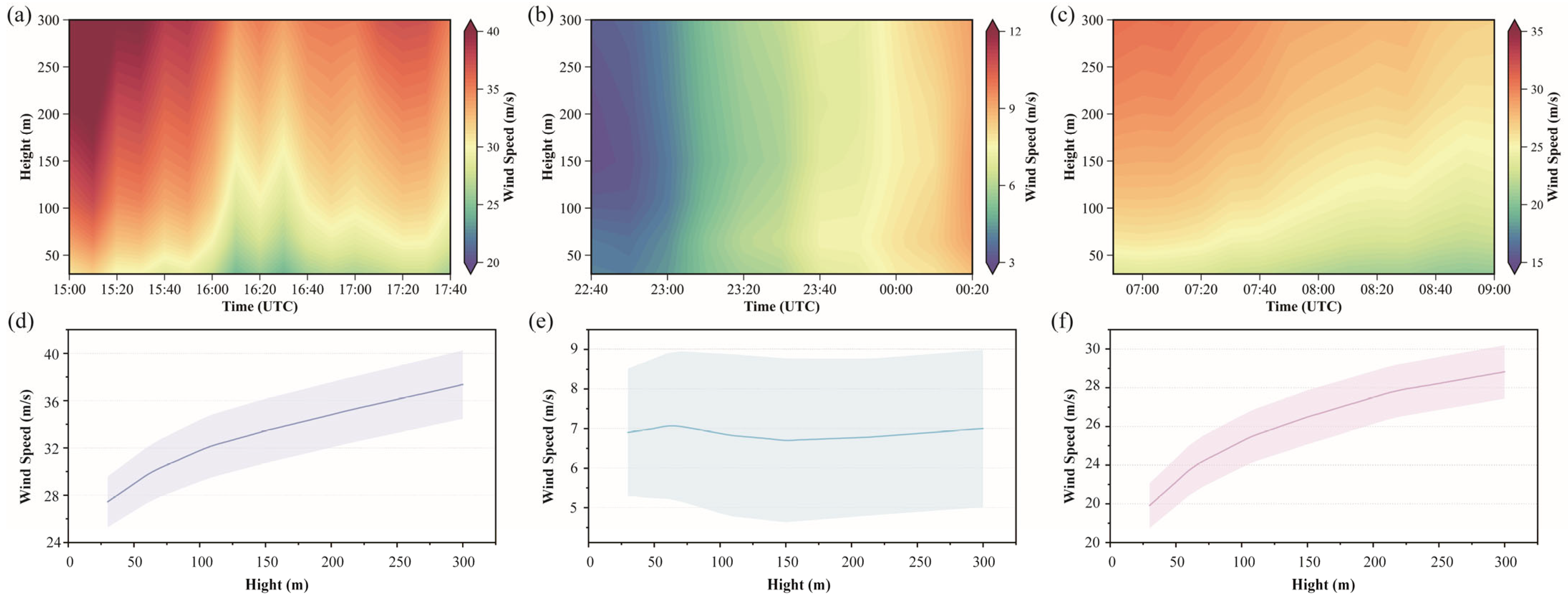
To quantify turbine-relevant inflow conditions, vertical profiles were extracted at the wind farm location throughout the simulation period. Figure 6a–c summarizes the height–time evolution of wind speed, providing a compact view of mesoscale non-stationarity across the rotor layer.
The diagram reveals distinct vertical coherence patterns. FEWS appears as a block of sustained high velocities (>30 m/s) extending uniformly throughout the 30–300 m layer. TES is characterized by a deep and sudden lull, with wind speeds dropping simultaneously across the rotor layer. This vertical coherence suggests that the eye-related calm is not confined to near-surface levels but affects the full rotor-swept region. BEWS shows wind speed recovery with more visible vertical structure than FEWS, indicating a more stratified post-eye environment.
Figure 6d–f present the mean vertical wind profiles (solid lines) and the temporal standard deviation (shading, ±1σ) for each stage. During FEWS, the mean wind increases monotonically with height, from 27.4 m/s at 30 m to 37.4 m/s at 300 m. The variability is also large, with Std = 2.16–2.89 m/s, implying a gusty and non-stationary inflow throughout the rotor layer. In TES, the mean wind drops and becomes nearly height-invariant, remaining around 6.9–7.0 m/s over 30–300 m. The vertical shear is weak. Temporal fluctuations remain non-negligible (Std ≈ 1.6–2.0 m/s), indicating that low mean speed does not necessarily imply negligible unsteadiness. In BEWS, the mean wind recovers and re-establishes vertical shear, increasing from 21.9 m/s at 30 m to 28.8 m/s at 300 m. Variability is lower than in FEWS, with Std = 1.16–1.39 m/s, suggesting a steadier but still energetic inflow on the backside.
In summary, the site experiences three distinct vertical regimes: high shear/high variability (FEWS), low speed/weak shear (TES), and moderate shear/lower variability (BEWS). These WRF-derived, stage-dependent vertical statistics are used later as boundary-condition constraints for TurbSim to reconstruct microscale turbulence consistent with the mesoscale state.

3.2.3. Atmospheric Stability and Turbulent Exchange Mechanisms

To interpret the stage-dependent wind profiles, this section examines stability and turbulence metrics that directly regulate momentum transport, including the gradient Richardson number ( R i ), Reynolds stress components, friction velocity ( u ), and turbulent kinetic energy ( T K E ). These quantities also underpin the WRF–TurbSim bridge because they constrain turbulence intensity and the stability-dependent scaling required for microscale inflow reconstruction.
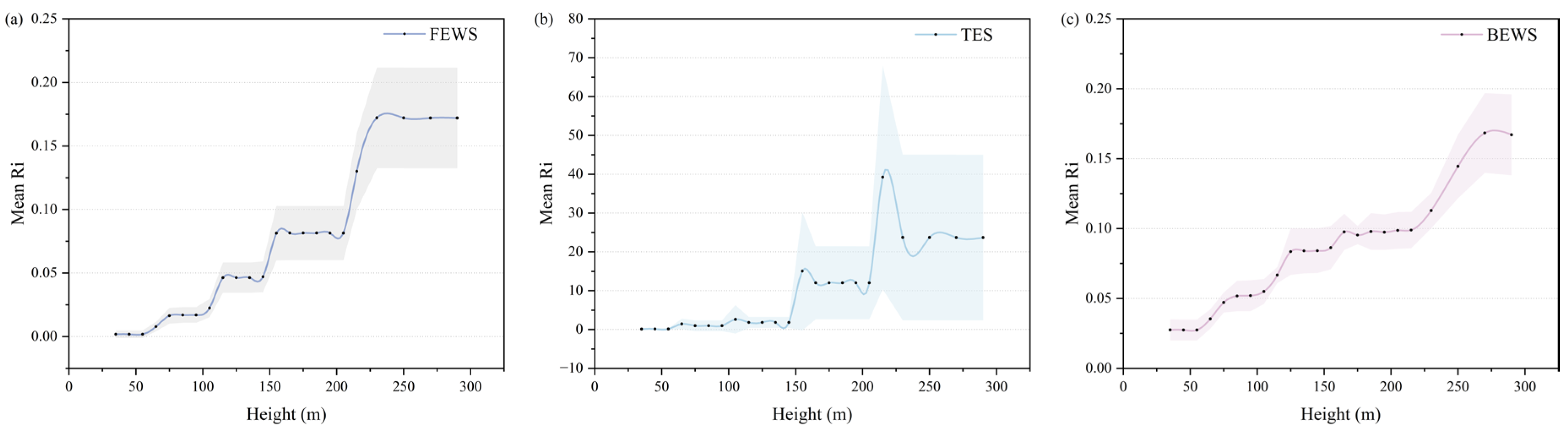
Thermodynamic stability governs vertical coupling in the boundary layer. Figure 7 shows vertical profiles of R i . During FEWS and BEWS, the flow is dominated by mechanically driven shear instability. Although R i increases with height, it remains relatively low ( R i < 0.2) through the 30–300 m layer and stays below the classical critical threshold ( R i ≈ 0.25). This indicates that strong shear overcomes stratification and sustains turbulent mixing across the rotor layer. In TES, the stability profile exhibits a pronounced two-layer structure. The lower layer remains near-neutral up to approximately 140 m, indicating weak stratification that covers the hub-height region. Above approximately 150 m,   R i increases abruptly and shows stepwise enhancement, with a primary jump to O ( 10 ) and a secondary amplification near 210 m where R i exceeds 40. Such an eye-influenced stability structure is physically consistent with established inner-core thermodynamics, in which subsidence warming in the eye promotes stable stratification and weakened turbulent exchange [42,43]. The weak stratification in the lower layer is plausibly maintained by residual air–sea fluxes and the legacy of prior eyewall mixing. Moreover, large R i values in TES can be further amplified when vertical wind shear is weak because R i becomes sensitive as   ( U / z ) 2 + ( V / z ) 2 decreases. Overall, TES is interpreted as a weakly stratified lower layer capped by an elevated stable layer, implying reduced vertical coupling between the rotor layer and the flow aloft.
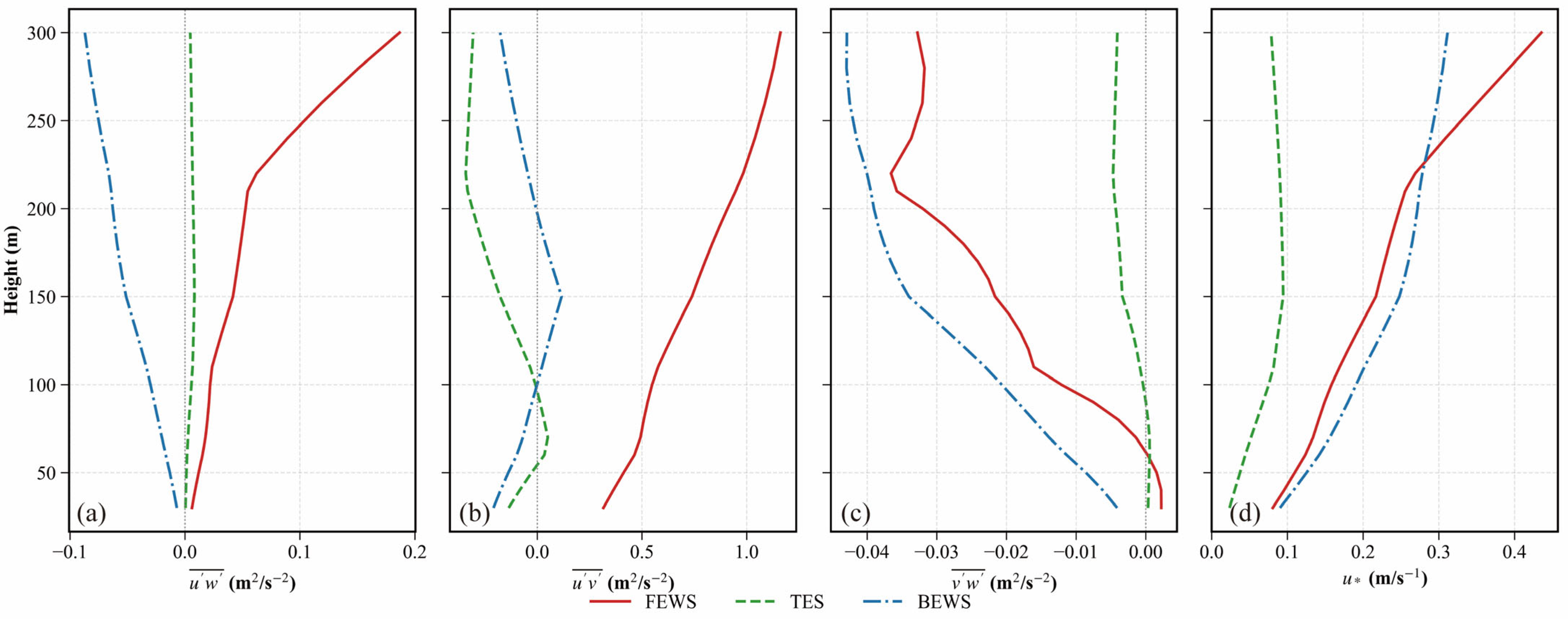
This stability contrast is reflected in momentum transport (as shown in Figure 8), but its interpretation must account for both stratification and shear. In FEWS, turbulent stresses are strong, consistent with active shear production. In TES, momentum fluxes collapse toward near-zero values through the rotor layer, indicating markedly reduced vertical coupling. This reduction is consistent with enhanced stability aloft, yet it can also be reinforced by weak vertical wind shear, since turbulent stress production diminishes when the shear term becomes small. In BEWS, stresses recover but reflect the altered inflow direction after core passage. The friction velocity, u , is used here as an integrated measure of stress magnitude. It peaks during FEWS and remains suppressed during TES, providing a compact indicator of the stage-dependent turbulence regime. Notably, lateral turbulent transport within the vortex (e.g., u v ) can be comparable to, or even exceed, vertical fluxes in the eyewall environment. Therefore, interpretation based solely on vertical fluxes can be incomplete under strong azimuthal shear.
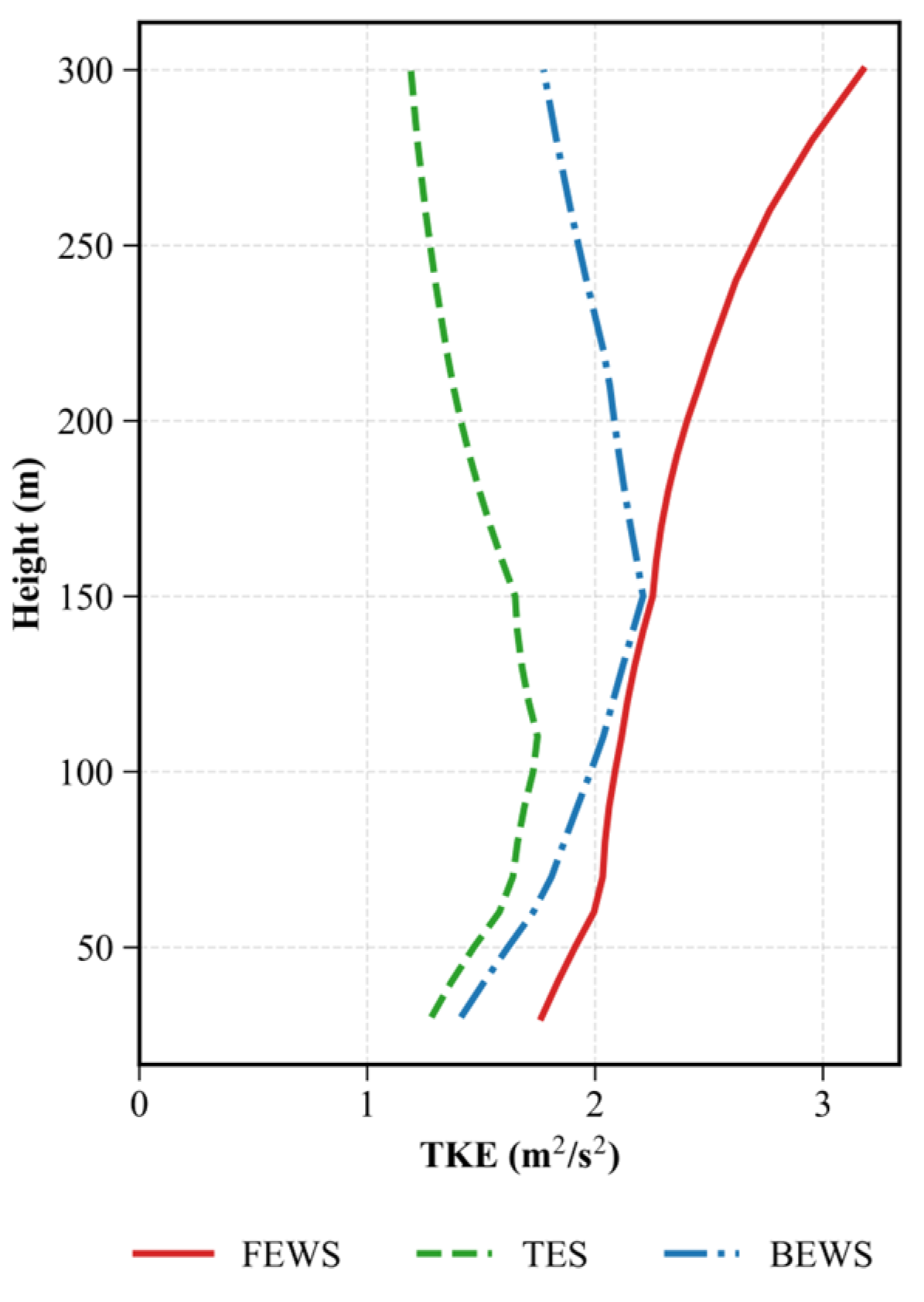
T K E further clarifies the energetic structure. As shown in Figure 9, FEWS exhibits the largest T K E and generally increases with height, consistent with deep shear production associated with the eyewall circulation. BEWS shows a recovered but more vertically confined turbulence, often with a mid-level maximum. TES maintains the lowest T K E and decreases with height, consistent with a combined effect of stability suppression and reduced shear-driven production in the eye-influenced environment. Taken together, R i , turbulent stresses, and TKE indicate three distinct turbulence regimes at the site: FEWS corresponds to a shear-production-dominated regime with deep, energetic turbulence; TES represents a suppressed-turbulence regime with weak vertical coupling; and BEWS constitutes a transitional recovery regime with more layer-confined turbulence than FEWS. Because R i can be amplified under weak-shear conditions, the TES interpretation is supported by the concurrent reduction in turbulent stresses and TKE rather than R i alone. These contrasting mesoscale regimes provide the physical basis and constraints for the subsequent WRF–TurbSim microscale inflow reconstruction. The present manuscript focuses on inflow reconstruction and diagnostic characterization; quantitative survivability or load exceedance for specific fixed or floating turbine systems requires dedicated coupled aero-hydro-servo-elastic simulations and is therefore outside the scope of this work.

3.3. Physics-Based Microscale Turbulence Reconstruction

Having characterized the mesoscale wind field structure in Domain 3 and identified the stage-dependent turbulence regimes associated with the eyewall–eye–eyewall sequence (Section 3.2), the analysis now proceeds to microscale turbulence reconstruction for load-relevant inflow characterization. The objective is to bridge the WRF-resolved mesoscale state (mean profiles, shear, and stability) with TurbSim-generated high-frequency inflow, while maintaining stage-wise statistical consistency across FEWS, TES, and BEWS. This section describes the stage-specific, physics-based parameterization strategy and evaluates whether the synthesized inflow reproduces the expected turbulence intensity, spectral characteristics, and coherence behavior.

3.3.1. Stage-Specific Parameterization and Stability Constraints

Following the physics-informed framework established in Section 2.3, microscale inflow fields were reconstructed for the FEWS, TES, and BEWS stages using TurbSim with the USRVKM spectral model. Stage-specific input parameters—including mean wind speed and direction profiles, turbulence standard deviations derived from WRF-resolved fluctuations, integral length scales, and stability constraints based on the gradient Richardson number—were extracted directly from the selected best-performing WRF simulation outputs at the wind farm location.
A critical modeling decision concerns the stability parameterization for the TES stage. As documented in Figure 7b, the TES profile shows strong vertical variability in stability, with near-neutral conditions in the lower layer and strongly stable values aloft associated with an elevated stable layer. Given that R i estimates can be disproportionately amplified under weak vertical shear, directly prescribing these extreme upper-level R i values to TurbSim risks introducing numerical artifacts and spectral distortion (or excessive damping), while providing negligible benefit for rotor-layer load characterization. Consequently, the hub-height Richardson number was adopted as the representative stability constraint for TES. This approach ensures physical relevance to the primary aerodynamic loading region while maintaining the robustness of the stochastic generation.
For the FEWS and BEWS stages, the WRF-derived parameters are applied directly without additional stability corrections. In these eyewall-associated regimes, the boundary layer remains well-coupled across the rotor span, with stability conditions generally maintaining a shear-active state characterized by a sub-critical R i . Consequently, turbulence production is dominated by mechanical shear rather than buoyancy suppression, supporting persistent vertical exchange and ensuring a physically consistent linkage between the mesoscale mean state and microscale fluctuation statistics. Under these conditions, the USRVKM-based TurbSim reconstruction can utilize the WRF-extracted hub-height constraints without modification, as the stage-dependent variance levels and correlation scales are representative of an energetically mixed inflow. Table 3 lists the hub-height (90 m) parameter sets used to constrain the TurbSim USRVKM realizations for each stage, including the mean inflow, stress-related diagnostics, and the spectral inputs ( σ u , h u b and the stability-corrected integral length scale, L u , h u b ) derived from the selected best-performing WRF output. In this framework, atmospheric stability is incorporated implicitly through the L u correction rather than being prescribed as a standalone TurbSim input. Collectively, these quantities form the mesoscale constraints that enable a consistent WRF–TurbSim bridge across the eyewall–eye–eyewall sequence.

3.3.2. Synthesized Wind Field Characteristics Under Different Typhoon Stages

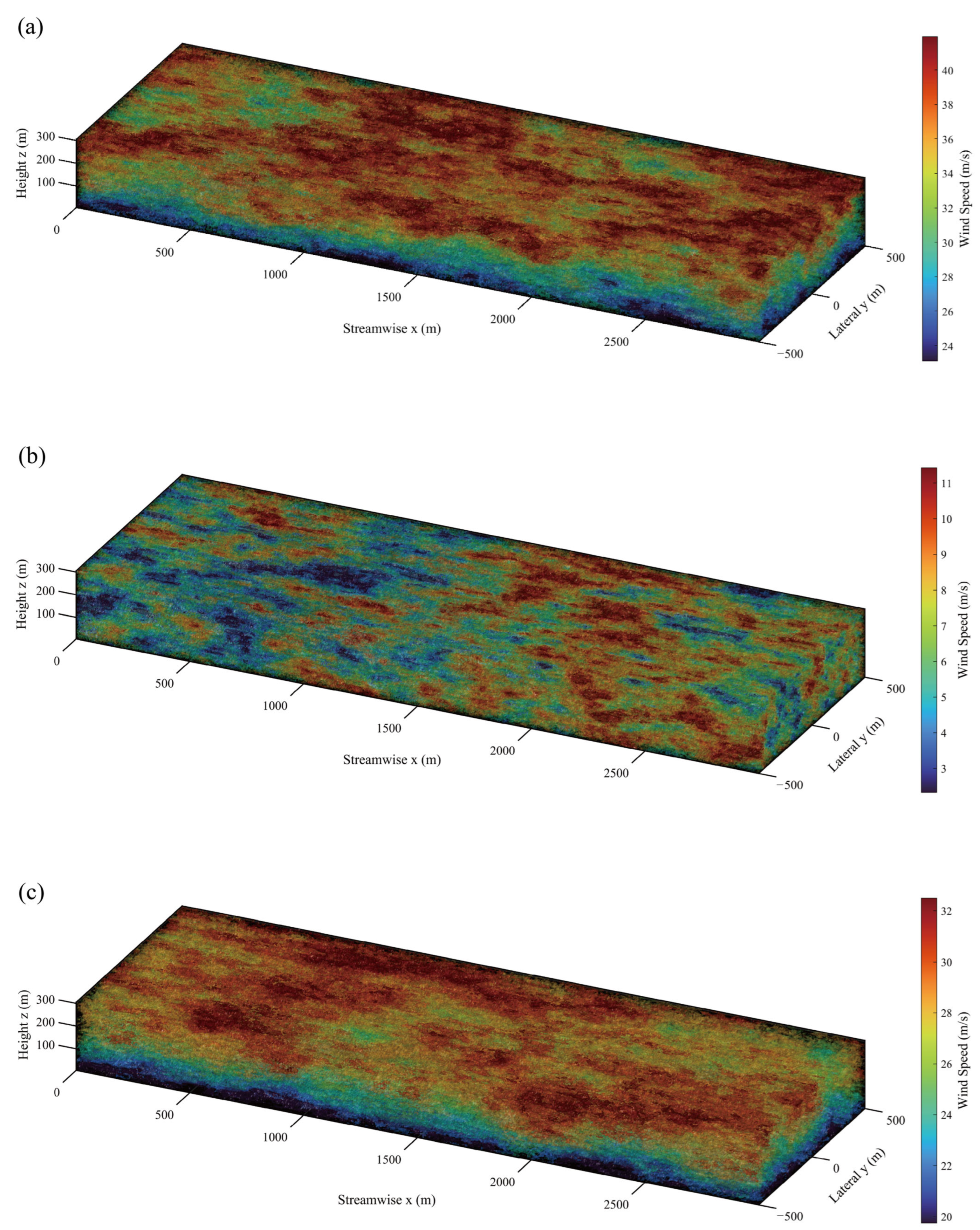
The synthesized wind fields analyzed in this section are TurbSim-generated stochastic realizations based on the USRVKM spectral model. Their purpose is to provide rotor-relevant, high-frequency inflow consistent with the stage-dependent mesoscale constraints extracted from WRF (Section 3.2, Section 3.2.1, Section 3.2.2, Section 3.2.3, Section 3.3 and Section 3.3.1). Accordingly, the following analysis interprets the spatial organization and variability of the reconstructed fields as outcomes of the imposed statistical parameters. Figure 10 illustrates instantaneous spatial realizations of wind speed over a 3000 m streamwise domain. The spatial fields were synthesized from the TurbSim time series using Taylor’s frozen-turbulence hypothesis, in which temporal fluctuations are mapped to a streamwise coordinate assuming advection by the local mean flow. Under this framework, the apparent structures primarily reflect the combined effects of the prescribed spectral shape and the stage-specific parameter set, including the turbulence variance level and correlation scales.
During FEWS, the field exhibits relatively continuous, streamwise-elongated patterns with pronounced high-wind regions embedded in lower-speed surroundings. Wind speed spans approximately 24–40 m/s. This higher degree of apparent organization is consistent with the FEWS parameter regime, where the imposed mean wind is strong and the extracted turbulence statistics yield comparatively large variance and longer integral scales. As a result, the von Kármán synthesis produces broader patches and longer correlation lengths along the streamwise direction, leading to a visually coherent texture across the rotor-relevant height range.
In contrast, during TES, the wind speed level drops significantly (approximately 3–11 m/s), and the spatial pattern becomes notably fragmented, characterized by reduced continuity and weaker large-scale organization. This morphological change should be interpreted as a consequence of the specific TES constraint set. In particular, the stability constraint (represented by R i h u b ) and the corresponding WRF-derived statistics imply suppressed eddy growth and smaller effective correlation scales within the rotor layer. Although the relative turbulence intensity is high due to the low mean wind speed, the absolute turbulence production is restricted by the stable stratification. Under such conditions, the USRVKM realization tends to exhibit smaller, patchier features with weaker spatial coherence. Importantly, these patterns do not imply specific deterministic eye dynamics; rather, they reflect the expected statistical appearance of a von Kármán field under suppressed vertical mixing and reduced length scales.
During BEWS, organized features re-emerge, but with a lower wind speed range than FEWS (approximately 20–32 m/s). The spatial texture appears partially restored in coherence relative to TES, which is consistent with a recovery of mechanically driven variability inferred from the mesoscale diagnostics. At the same time, the organization remains less pronounced than in FEWS. This pattern aligns with the stage-specific constraints, which indicate weaker turbulence levels and more limited correlation scales compared to the front eyewall regime.
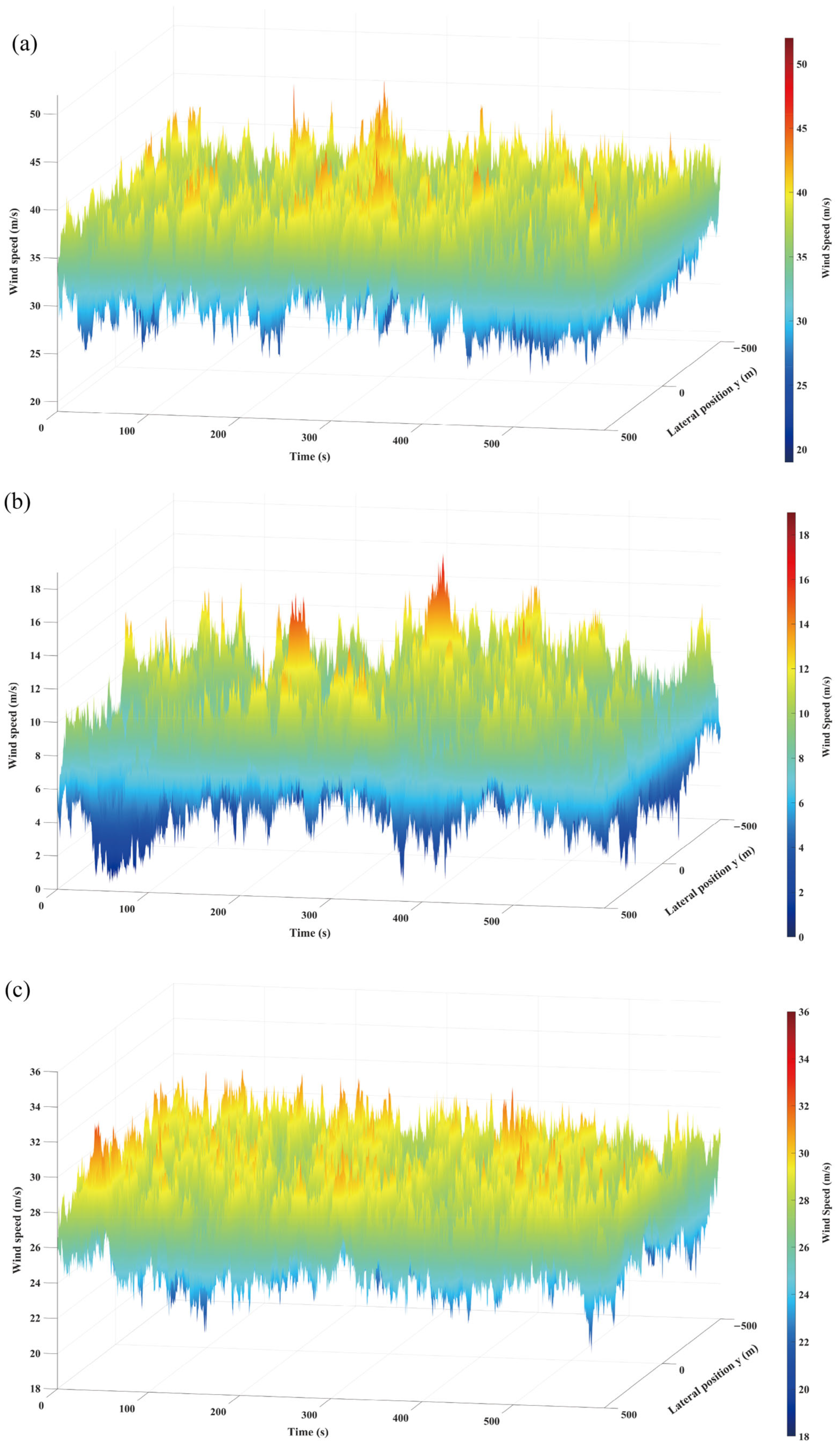
Figure 11 provides a complementary view by summarizing hub-height wind speed variability as a function of time and lateral position across the rotor plane. FEWS shows the largest variability envelope, with frequent high-amplitude excursions and a wide wind speed range. This behavior is consistent with the FEWS input set that combines strong mean wind with elevated fluctuation intensity, yielding energetic stochastic realizations across the lateral extent. TES exhibits a reduced mean state and a narrower overall wind speed range, while still showing intermittent excursions and pronounced low-frequency modulation. Within the TurbSim framework, these signatures arise from the imposed TES statistics and the finite-duration random realization. BEWS presents intermediate behavior, with moderate variability within a comparatively tighter band than FEWS, consistent with a recovery stage constrained by lower mean wind and reduced fluctuation intensity relative to the front eyewall.
Overall, Figure 10 and Figure 11 demonstrate that the TurbSim reconstructions respond systematically to the stage-dependent constraints extracted from WRF. The resulting inflow fields exhibit coherent differences in apparent spatial organization and variability across FEWS, TES, and BEWS, providing a physically consistent basis for subsequent load-relevant analyses. These results support the central objective of this study: bridging WRF-resolved mesoscale conditions and TurbSim-based microscale turbulence generation in a stage-aware manner for offshore wind engineering applications.
Quantitative comparison with standard engineering models highlights the critical limitations of conventional parameterizations in typhoon conditions. Wind shear is commonly described by the power law:
U ( z ) = U ( z r e f ) ( z z r e f ) α
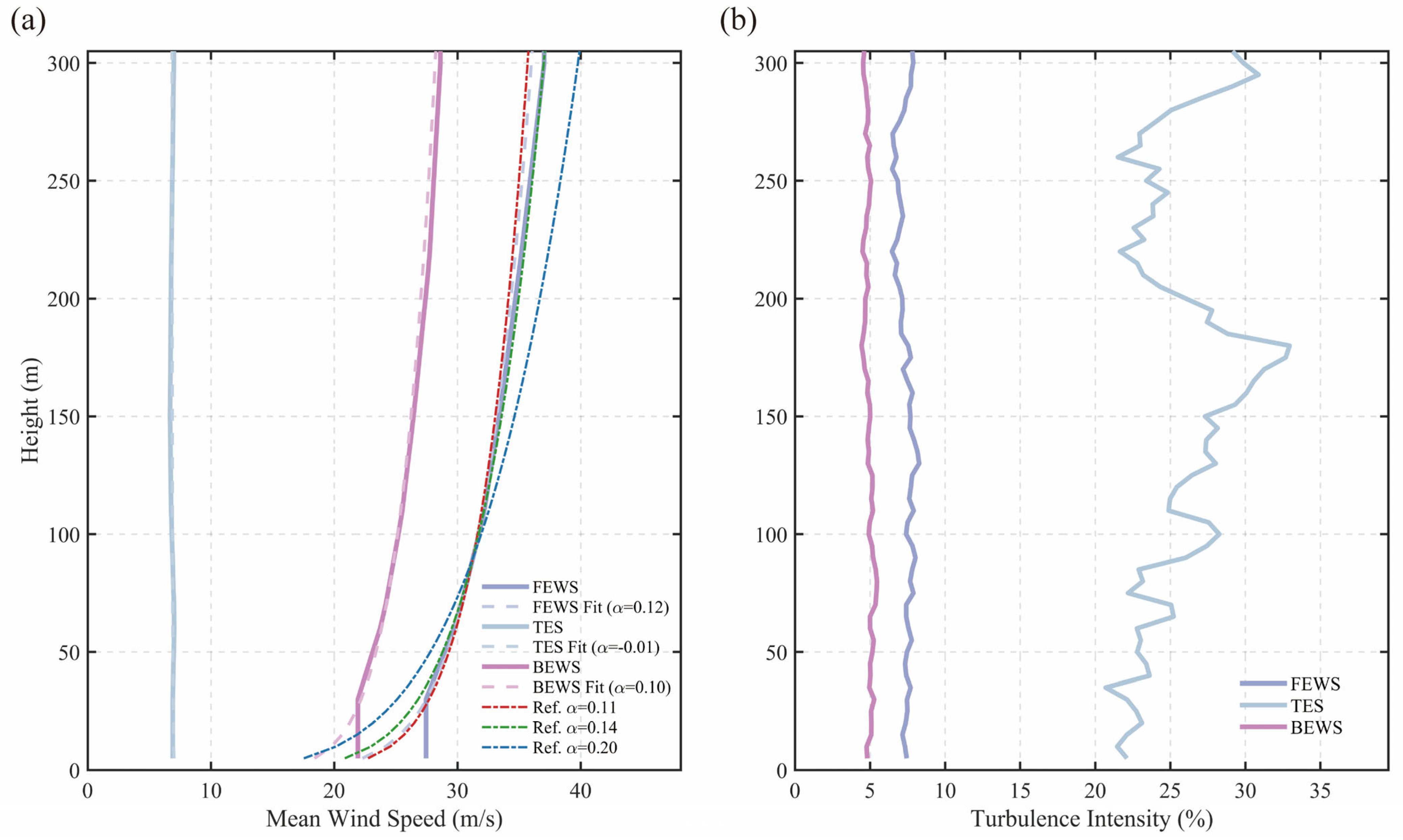
where α denotes the shear exponent. Figure 12a compares the stage-mean vertical profiles against fitted power-law curves and standard IEC reference profiles ( α =   0.11 ,   0.14 ,   0.20 ).
For FEWS, the fitted exponent ( α 0.12 ) aligns closely with the neutral IEC baseline, indicating that the shear profile shape appears “IEC-like” even though the absolute wind speeds far exceed standard design assumptions. Crucially, however, the TES profile yields a near-zero exponent ( α   0.01 ), resulting in a height-invariant structure that no positive-shear power law can reproduce. This behavior is consistent with the weakly coupled regime identified in Section 3.2.3, where reduced vertical shear and enhanced stability aloft jointly suppress vertical momentum exchange across the rotor layer. BEWS exhibits slightly weaker shear ( α   0.10 ) than FEWS, reflecting a recovery regime in which vertical mixing reactivates during storm departure, albeit at a reduced intensity relative to FEWS.
Turbulence intensity ( T I ) profiles (Figure 12b) reveal an additional layer of complexity. T I is defined as the ratio of wind speed standard deviation to the mean wind speed:
T I ( z ) = σ u ( z ) U ¯ ( z ) × 100 %
During FEWS and BEWS, T I remains at moderate levels (approximately 5–8%), broadly consistent with typical offshore assumptions. In contrast, the TES stage exhibits a ratio-amplified T I exceeding 25%, with peak values approaching 35% at certain elevations. This result should not be misinterpreted as evidence of high absolute turbulence energy. Instead, it follows directly from the T I definition: even modest absolute fluctuations can yield large T I values when the mean wind speed is substantially reduced. Physically, this indicates pronounced unsteadiness relative to a weak mean state during the eye-influenced period, consistent with the intermittency signatures observed in the TurbSim realizations. Since standard IEC formulations typically associate higher wind speeds with lower T I , they are not designed to represent this low-mean/high-relative-variability regime. From an operational perspective, such conditions may coincide with idling or parking logic triggered by low mean wind speeds, yet the elevated relative unsteadiness can still intensify control activity and fatigue-relevant variability, underscoring the need for stage-aware inflow reconstruction.

3.3.3. Spectral Characteristics and Thermodynamic Modulation of Coherence

Having characterized the bulk statistics and spatial morphology of the synthesized wind fields, the analysis now proceeds to verify their spectral integrity and vertical coherence structure. This step is essential to demonstrate that the TurbSim realizations are not only qualitatively distinct across stages, but also quantitatively consistent with the imposed USRVKM constraints derived from the WRF-extracted mesoscale state.
The spectral check is performed using the hub-height longitudinal velocity signal. The one-sided power spectral density (PSD) is defined as:
S u u ( f ) = 2 T F { u ( t ) } ( f ) 2 , 0 < f < 1 2 Δ t ,
F { u ( t ) } ( f ) = 0 T u ( t ) exp ( i 2 π f t ) d t ,
where u ( t ) = u ( t , z h ) u ( z h ) ; T is the record length; Δ t is the TurbSim sampling interval; and F { u ( t ) } ( f ) denotes the Fourier transform of the record, evaluated at cyclic frequency f .
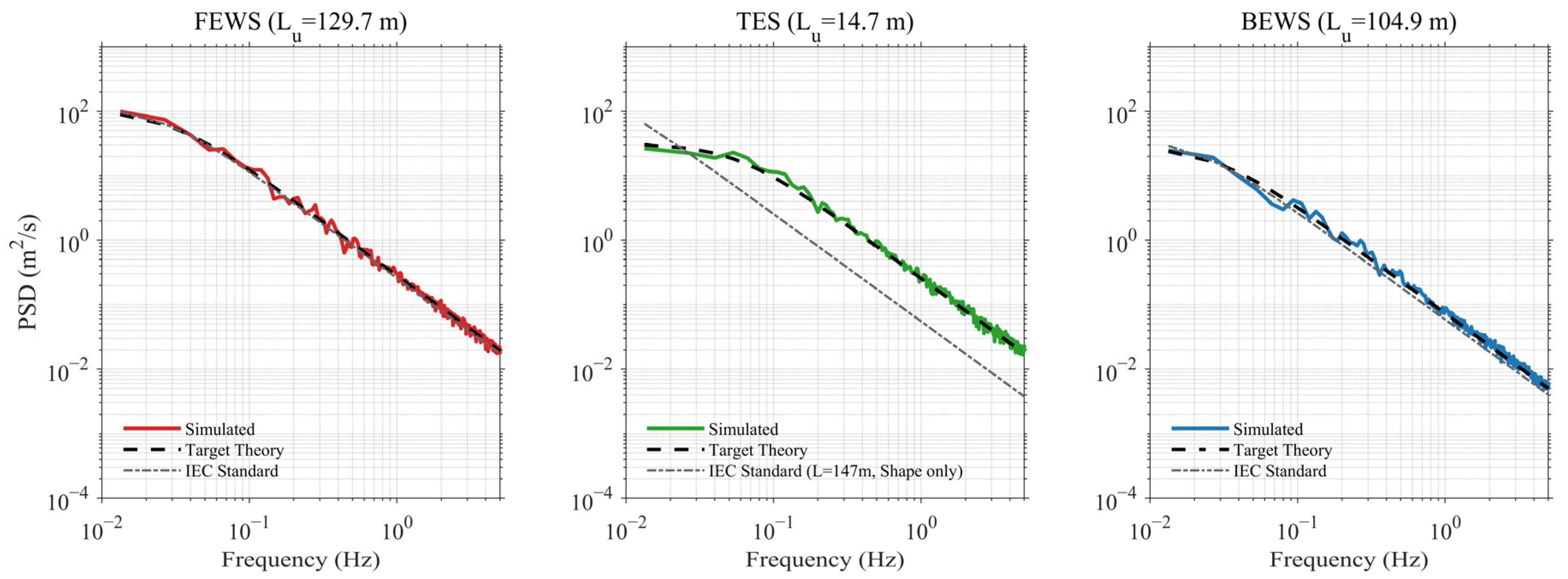
Figure 13 compares the simulated power spectral density against two von Kármán references constructed with distinct intents. The first is the target spectrum, implied by the stage-specific USRVKM inputs. It is evaluated using the same U and σ u   as the realization, together with the stage-specific integral length scale, L u , used in TurbSim. This curve serves as a direct consistency test of the stochastic generator. The second is an IEC neutral baseline included for context. It is plotted using the same U and σ u to preserve the variance level, but with a fixed neutral length scale, L I E C = 147   m . This “shape-only” baseline isolates how variations in L u shift the spectral energy distribution without confounding the comparison by changing the total turbulence energy.
Across FEWS, TES, and BEWS, the simulated PSD shows satisfactory agreement with the target spectrum over the resolved band (approximately 10 2 –5 Hz). The roll-off through the mid-to-high frequency range is accurately captured, confirming that the spectra behave consistently across stages. The key stage dependence is manifested in the corner-frequency location, which is governed by L u . In FEWS and BEWS, the stage-specific L u values ( 129.7 m and 104.9 m at hub height, respectively) are of the same order as the neutral baseline. Consequently, the IEC baseline remains relatively close to the target curve, and the spectral shapes differ only moderately. In contrast, TES is fundamentally different. The prescribed hub-height length scale is drastically reduced ( L u 14.7 m), shifting energy toward higher frequencies and producing a clear separation from the neutral baseline. This divergence is an expected outcome of the imposed TES constraint set and does not indicate a model deficiency. Rather, the relevant criterion is the agreement with the target curve, which confirms that the TES realization faithfully follows the intended USRVKM spectral structure under a strongly reduced correlation scale.
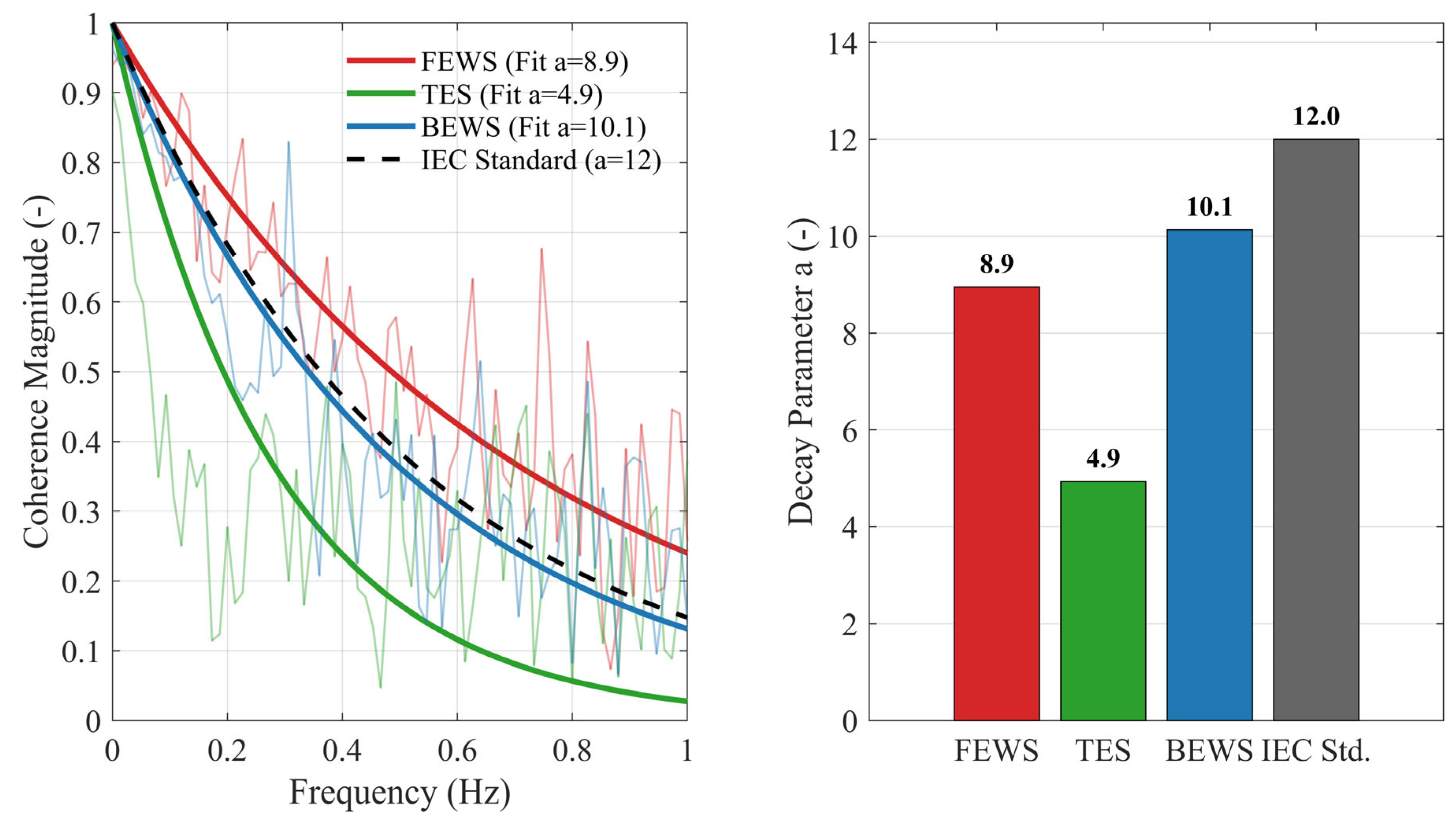
Vertical coherence is subsequently evaluated, as it governs how fluctuations are correlated across the rotor span. Figure 14 presents the coherence magnitude between 90 m and 95 m as a function of frequency for FEWS, TES, and BEWS. An exponential decay model is fitted to each coherence curve to obtain an effective decay parameter, a , consistent with common engineering practices and IEC-style formulations. Specifically, the fitted form is
Coh ( f , Δ z ) = exp a f Δ z U ¯ ,
where f is the cyclic frequency (Hz), Δ z is the vertical separation, U   is the mean wind speed at the reference height, and a is treated as a diagnostic descriptor of the generated field rather than a fixed input constant.
The fitted curves reproduce the overall decay trends well, enabling a compact comparison across stages. Table 4 summarizes the results. The full-band fit yields a full 8.95 for FEWS and a full 10.12 for BEWS. These values fall within a plausible range relative to neutral references, indicating broadly comparable decorrelation behavior in the two eyewall-associated regimes. TES, however, is distinct, yielding a full 4.93 , which implies substantially slower coherence decay over the same rotor-relevant separation. Within the present framework, this result should be interpreted as a statistical consequence of the TES constraint set and the resulting spectral character, rather than a deterministic signature of eye-scale dynamics.
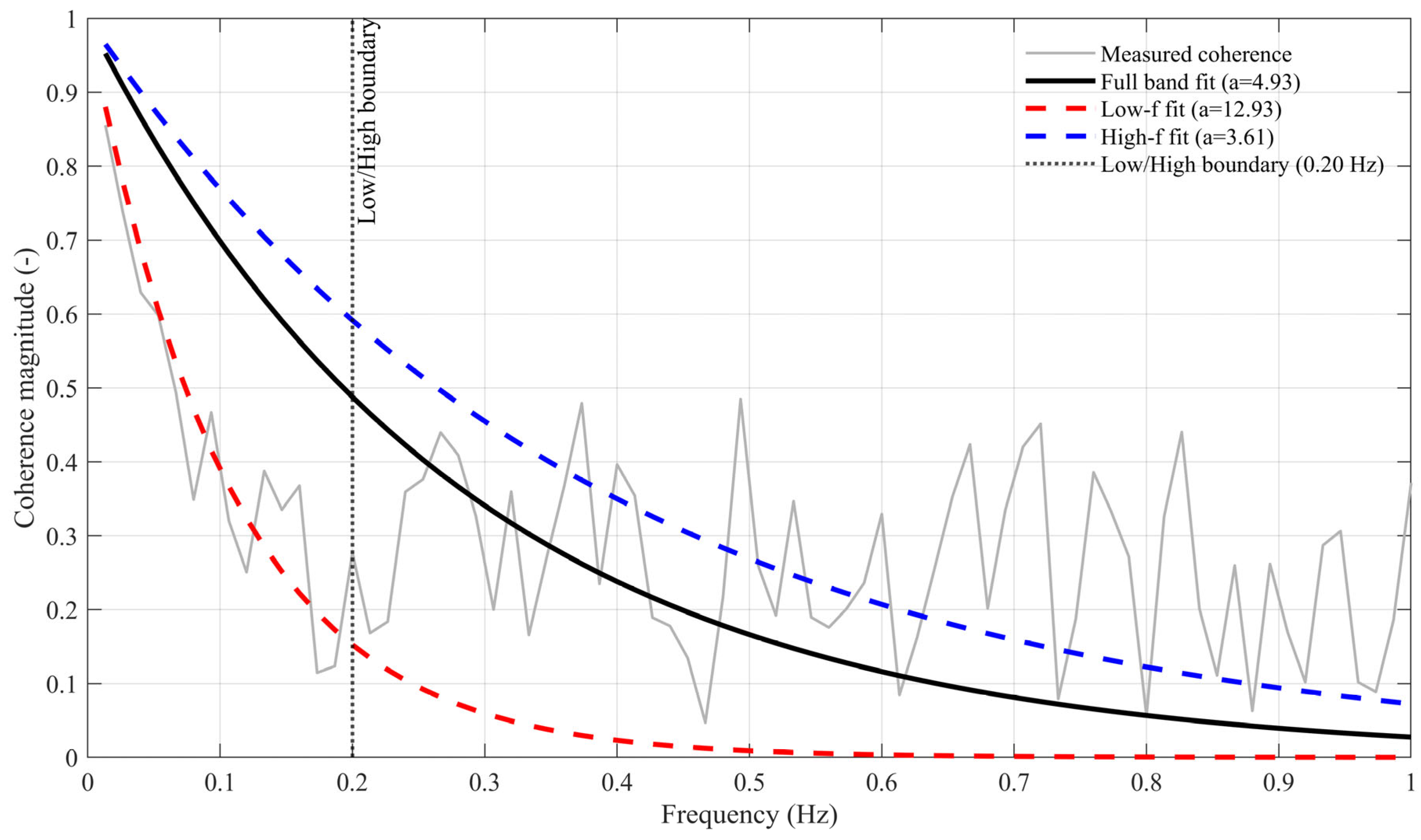
To clarify the origin of the TES deviation, the coherence decay is further decomposed into low-frequency (0.01–0.2 Hz) and high-frequency (0.2–1.0 Hz) bands, as shown in Figure 15. A consistent pattern emerges: the low-frequency decay parameters are nearly stage-invariant, with a low 12.4 (FEWS), 12.9 (TES), and 12.7 (BEWS). This indicates that the large-scale, low-frequency coherence behavior remains similar across stages within the TurbSim realizations. The regime dependence is concentrated in the high-frequency band. FEWS and BEWS retain a high 8.8 and 9.9, respectively. TES collapses to a high 3.6 . The implication is specific: the TES anomaly is not a uniform shift of coherence at all scales but is primarily a high-frequency effect, indicating that the small-scale fluctuations exhibit unusually strong vertical coherence in the TES realization compared to the eyewall stages.
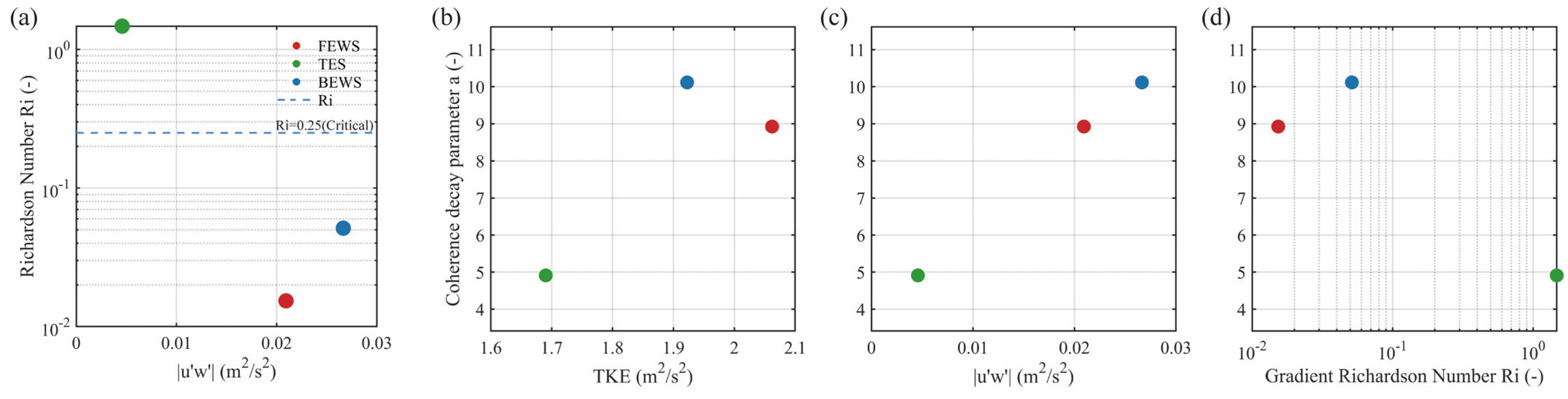
The coherence results can be contextualized using the mesoscale diagnostics established in Section 3.2.3 and the stability parameterization described in Section 3.3.1. TES represents a regime where the hub-height stability constraint is strongly stable ( R i hub 1.47 ), and WRF diagnostics indicate a near-collapse of vertical momentum transport through the rotor layer. In contrast, FEWS and BEWS remain in a shear-active regime characterized by much smaller R i values and sustained turbulent exchange. Figure 16 summarizes this linkage by comparing the fitted coherence decay parameters against stability and turbulence indicators. Specifically, the TES cluster is defined by high stability and suppressed momentum transport, coinciding with the smallest coherence decay parameters, particularly in the high-frequency band. Conversely, the shear-dominated FEWS and BEWS regimes cluster in the lower-stability region and display significantly larger a values.
While this correspondence represents a statistical consistency inherent to the spectral synthesis rather than a proof of dynamic causality, it confirms that the stage-aware constraints derived from WRF clearly translate into distinct, regime-specific coherence behaviors. In this context, the dispersion of individual points within each regime reflects the expected stochastic variability of the TurbSim realizations and local mesoscale sampling, rather than a discrepancy between the WRF forcing and the turbulent reconstruction.
From an offshore wind engineering perspective, this distinction is critical because coherence governs load correlation across the rotor. A smaller a implies that fluctuations remain more synchronized across height, which can increase the simultaneity of aerodynamic forcing even when bulk turbulence energy is not high. The TES regime is therefore not only a low-wind interval in mean terms but also a regime characterized by an atypical coherence structure relative to neutral assumptions. Taken together, Figure 13, Figure 14 and Figure 15 and Table 4 confirm that the TurbSim realizations are spectrally consistent with the imposed constraints, while Figure 14, Figure 15 and Figure 16 demonstrate that vertical coherence is strongly stage-dependent under the WRF-informed parameter sets. This combination provides the needed quantitative basis for using these inflows in subsequent load-relevant analyses under a stage-aware WRF–TurbSim bridging framework.

4. Conclusions

This work presents a stage-aware WRF–TurbSim framework for typhoon inflow reconstruction that is conditioned on mesoscale physics rather than neutral, stationary assumptions. A 36-member WRF physics ensemble for Typhoon In-Fa (2021) shows that track skill is most sensitive to the representation of the PBL. The MYJ scheme (PBL2) yields the lowest group-mean DPE of 43.67 km, corresponding to an 18.9% reduction relative to the ensemble mean (53.96 km). Within PBL2, the selected best-performing configuration (MYJ–WSM6–Multi-Scale KF with spectral nudging) achieves a mean DPE of 26.9 km, providing the mesoscale driver for subsequent reconstruction.
Microscale inflows are generated using the USRVKM spectral model with stage-dependent parameters extracted directly from the selected WRF simulation. Stability effects are incorporated through a Richardson-number-informed modulation of turbulence length scales. At hub height, the diagnosed integral length scale differs substantially across stages, with L u 129.7 m (FEWS), 14.7 m (TES), and 104.9 m (BEWS), leading to systematic stage-dependent spectral shape differences relative to an IEC-neutral reference ( L I E C = 147 m). Coherence diagnostics confirm that stage dependence concentrates at high frequencies. The low-frequency decay parameter is nearly stage-invariant ( a l o w 12.4 –12.9), whereas the high-frequency decay collapses during TES ( a h i g h 3.61 ) compared with FEWS ( 8.81 ) and BEWS ( 9.93 ). This indicates an eye-stage regime in which rotor-span correlation departs from neutral-coherence expectations.
Overall, the framework demonstrates that stage-dependent mesoscale regimes resolved by WRF can be transferred into statistically consistent microscale inflow characteristics, providing a transparent and testable basis for engineering-oriented typhoon inflow characterization. The present manuscript focuses on inflow reconstruction and diagnostic characterization. Quantitative survivability, ultimate load exceedance, and platform-specific response for fixed or floating systems require dedicated coupled aero-hydro-servo-elastic simulations and are therefore outside the scope of this work.

Author Contributions

Writing—original draft, investigation, visualization, software, methodology, formal analysis, data curation, conceptualization, J.W.; writing—review and editing, methodology, L.Z.; writing—review and editing, L.X.; writing—review and editing, conceptualization, Q.L.; methodology, writing—review and editing, funding acquisition, supervision, Y.X. All authors have read and agreed to the published version of the manuscript.

Funding

The study was supported by the Offshore Wind Power Intelligent Measurement and Control Research Centre and Laboratory Construction at the Ocean University of China (Grant No. 861901013159).

Data Availability Statement

Data will be made available on request.

Conflicts of Interest

The authors declare that they have no known competing financial interests or personal relationships that could have appeared to influence the work reported in this paper.

Abbreviations

The following abbreviations are used in this manuscript:
OWTsOffshore wind turbines
ABLAtmospheric boundary layer
WRFWeather Research and Forecasting
NWPNumerical Weather Prediction
WRF-ARWAdvanced Research WRF
PBLPlanetary boundary layer
WSMWRF single-moment microphysics scheme
FDDAFour-Dimensional Data Assimilation
PBLHPlanetary boundary-layer Height
GDASGlobal Data Assimilation System
WFAWind farm A
MPMicrophysics
CuCumulus convection
JMAJapan Meteorological Agency
USRVKMUser-Defined von Kármán
DPEDirect position error
FEWSFront Eyewall Stage
TESTyphoon Eye Stage
BEWSBack Eyewall Stage
PSDPower spectral density

References

  1. Wang, Y.; Yang, Q.; Li, T.; Hong, X. Feasibility of Typhoon Models and Wind Power Spectra on Response Analysis of Parked Wind Turbines. J. Wind Eng. Ind. Aerodyn. 2023, 242, 105579. [Google Scholar] [CrossRef]
  2. Davis, S.J.; Lewis, N.S.; Shaner, M.; Aggarwal, S.; Arent, D.; Azevedo, I.L.; Benson, S.M.; Bradley, T.; Brouwer, J.; Chiang, Y.-M.; et al. Net-Zero Emissions Energy Systems. Science 2018, 360, eaas9793. [Google Scholar] [CrossRef] [PubMed]
  3. Yang, Q.; Liu, Y.; Wu, S.; Yu, M.; Xie, J.; Xue, X. Super Typhoon Impact on the Dynamic Behavior of Floating Offshore Wind Turbine Drivetrains: A Comprehensive Study. Ocean Eng. 2024, 312, 119084. [Google Scholar] [CrossRef]
  4. Li, J.; Li, Z.; Jiang, Y.; Tang, Y. Typhoon Resistance Analysis of Offshore Wind Turbines: A Review. Atmosphere 2022, 13, 451. [Google Scholar] [CrossRef]
  5. Rao, C.; Chen, G.; Ran, L. Effects of Typhoon In-Fa (2021) and the Western Pacific Subtropical High on an Extreme Heavy Rainfall Event in Central China. J. Geophys. Res. Atmos. 2023, 128, e2022JD037924. [Google Scholar] [CrossRef]
  6. Lu, Y.; Li, Y.; Tang, J.; Gao, Z. Typhoon In-Fa (2021) near Surface Wind Field Characteristics Based on Lidar Observations. J. Geophys. Res. Atmos. 2025, 130, e2024JD043184. [Google Scholar] [CrossRef]
  7. Zhang, B.; Li, X.; Wang, L.; Gao, Y.; Zhang, B.; Li, X.; Wang, L.; Gao, Y. Numerical Simulation of Typhoon Waves in an Offshore Wind Farm Area of the South China Sea. J. Mar. Sci. Eng. 2025, 13, 451. [Google Scholar] [CrossRef]
  8. Li, T.; Zhang, X.; Tang, S.; Qu, H.; Yang, Y.; Li, L.; Li, Y. A Meso- to Micro-Scale Coupled Model under Typhoon Conditions Considering Vortex Structure and Coriolis Effect for Wind Farms. J. Wind Eng. Ind. Aerodyn. 2024, 254, 105922. [Google Scholar] [CrossRef]
  9. Branlard, E.; Jonkman, J.; Platt, A.; Thedin, R.; Martínez-Tossas, L.A.; Kretschmer, M. Development and Verification of an Improved Wake-Added Turbulence Model in FAST.Farm. J. Phys. Conf. Ser. 2024, 2767, 092036. [Google Scholar] [CrossRef]
  10. Wang, S.; Ke, S.; Zhao, Y.; Yun, Y.; Zhang, W.; Yang, J.; Ren, H. Research on Hydrodynamics of Foundation Structure of Offshore Wind Turbine under Typhoon-Wave-Current Coupling. Adv. Struct. Eng. 2022, 25, 2558–2576. [Google Scholar] [CrossRef]
  11. Fu, H.; Wang, Y.; Xie, Y.; Luo, C.; Shang, S.; He, Z.; Wei, G.; Fu, H.; Wang, Y.; Xie, Y.; et al. Super Typhoons Simulation: A Comparison of WRF and Empirical Parameterized Models for High Wind Speeds. Appl. Sci. 2025, 15, 776. [Google Scholar] [CrossRef]
  12. Haupt, S.E.; Kosović, B.; Berg, L.K.; Kaul, C.M.; Churchfield, M.; Mirocha, J.; Allaerts, D.; Brummet, T.; Davis, S.; DeCastro, A.; et al. Lessons Learned in Coupling Atmospheric Models across Scales for Onshore and Offshore Wind Energy. Wind Energy Sci. 2023, 8, 1251–1275. [Google Scholar] [CrossRef]
  13. Yang, C.; Li, J.; Yang, C.; Li, J. Assessment of FY-3D SST Data on Typhoon in-Fa Simulation. Atmosphere 2023, 14, 101. [Google Scholar] [CrossRef]
  14. Sanz Rodrigo, J.; Chávez Arroyo, R.A.; Moriarty, P.; Churchfield, M.; Kosović, B.; Réthoré, P.-E.; Hansen, K.S.; Hahmann, A.; Mirocha, J.D.; Rife, D. Mesoscale to Microscale Wind Farm Flow Modeling and Evaluation. WIREs Energy Environ. 2017, 6, e214. [Google Scholar] [CrossRef]
  15. Jonkman, B.J. Turbsim User’s Guide v2. 00.00; National Renewable Energy Laboratory: Golden, CO, USA, 2014. [Google Scholar]
  16. Eusebi, R.; Vecchi, G.A.; Lai, C.-Y.; Tong, M. Realistic Tropical Cyclone Wind and Pressure Fields Can Be Reconstructed from Sparse Data Using Deep Learning. Commun. Earth Environ. 2024, 5, 8. [Google Scholar] [CrossRef]
  17. Sanchez Gomez, M.; Lundquist, J.K.; Deskos, G.; Arwade, S.R.; Myers, A.T.; Hajjar, J.F. Wind Fields in Category 1–3 Tropical Cyclones Are Not Fully Represented in Wind Turbine Design Standards. JGR Atmos. 2023, 128, e2023JD039233. [Google Scholar] [CrossRef]
  18. Durán, P.; Meißner, C.; Rutledge, K.; Fonseca, R.; Martin-Torres, J.; Adaramola, M.S. Meso-Microscale Coupling for Wind Resource Assessment Using Averaged Atmospheric Stability Conditions. Meteorol. Z. 2019, 28, 273–291. [Google Scholar] [CrossRef]
  19. Fang, G.; Zhao, L.; Cao, S.; Ge, Y.; Pang, W. A Novel Analytical Model for Wind Field Simulation Under Typhoon Boundary Layer Considering Multi-Field Correlation and Height-Dependency. J. Wind Eng. Ind. Aerodyn. 2018, 175, 77–89. [Google Scholar] [CrossRef]
  20. Wang, H.; Ke, S.T.; Wang, T.G.; Kareem, A.; Hu, L.; Ge, Y.J. Multi-Stage Typhoon-Induced Wind Effects on Offshore Wind Turbines Using a Data-Driven Wind Speed Field Model. Renew. Energy 2022, 188, 765–777. [Google Scholar] [CrossRef]
  21. Hu, F.; Li, Q. Reconstruction of Tropical Cyclone Boundary Layer Wind Field Using Physics-Informed Machine Learning. Phys. Fluids 2024, 36, 116608. [Google Scholar] [CrossRef]
  22. Huang, X.; Wang, N. An Adaptive Nested Dynamic Downscaling Strategy of Wind-Field for Real-Time Risk Forecast of Power Transmission Systems during Tropical Cyclones. Reliab. Eng. Syst. Saf. 2024, 242, 109731. [Google Scholar] [CrossRef]
  23. Ko, M.-Y.; Lu, N.-Y. High-Fidelity Simulation Study of Real Typhoon Event in Taiwan Using WRF-LES Coupled Model. J. Mar. Sci. Technol. 2025, 30, 408–431. [Google Scholar] [CrossRef]
  24. Zhang, X.; Zhang, T.; Ke, S.; He, H.; Zhang, R.; Miao, Y.; Liang, T.; Zhang, X.; Zhang, T.; Ke, S.; et al. Physics-Informed Deep Learning for 3D Wind Field Retrieval of Open-Ocean Typhoons. Remote Sens. 2025, 17, 3825. [Google Scholar] [CrossRef]
  25. Wen, Y.; Xu, X.; Waseda, T.; Lin, P. Energy Flux Variations and Safety Assessment of Offshore Wind and Wave Resources during Typhoons in the Northern South China Sea. Ocean Eng. 2024, 302, 117683. [Google Scholar] [CrossRef]
  26. Deng, L.; Xue, L.; Huang, W.; Wu, W.; Thompson, G.; Gao, W.; Sarkadi, N.; Geresdi, I. A Numerical Investigation of Aerosol Effect on Cloud Microphysics in an Idealized Tropical Cyclone Using the WRF Piggybacking Framework. Atmos. Res. 2024, 304, 107422. [Google Scholar] [CrossRef]
  27. Temel, O.; Bricteux, L.; Van Beeck, J. Coupled WRF-OpenFOAM Study of Wind Flow over Complex Terrain. J. Wind Eng. Ind. Aerodyn. 2018, 174, 152–169. [Google Scholar] [CrossRef]
  28. Zhang, Z.; Bakhoday-Paskyabi, M.; Schito, P.; Reuder, J.; Zasso, A. Wind Farm Inflow Wind Simulation Based on Mesoscale and Microscale Coupling. J. Phys. Conf. Ser. 2022, 2265, 022044. [Google Scholar] [CrossRef]
  29. Müller, S. Typhoon Wind and Turbulence Structure, and Its Impact on Wind Energy Application; DTU Wind and Energy Systems: Rokilde, Denmark, 2025. [Google Scholar]
  30. Skamarock, W.C.; Klemp, J.B. A Time-Split Nonhydrostatic Atmospheric Model for Weather Research and Forecasting Applications. J. Comput. Phys. 2008, 227, 3465–3485. [Google Scholar] [CrossRef]
  31. Delfino, R.J.; Bagtasa, G.; Hodges, K.; Vidale, P.L. Sensitivity of Simulating Typhoon Haiyan (2013) Using WRF: The Role of Cumulus Convection, Surface Flux Parameterizations, Spectral Nudging, and Initial and Boundary Conditions. Nat. Hazards Earth Syst. Sci. 2022, 22, 3285–3307. [Google Scholar] [CrossRef]
  32. Hsu, L.-H.; Su, S.-H.; Kuo, H.-C. A Numerical Study of the Sensitivity of Typhoon Track and Convection Structure to Cloud Microphysics. J. Geophys. Res. Atmos. 2021, 126, e2020JD034390. [Google Scholar] [CrossRef]
  33. Park, J.; Moon, J.; Cho, W.; Cha, D.-H.; Lee, M.-I.; Chang, E.-C.; Kim, J.; Park, S.-H.; An, J. Sensitivity of Real-Time Forecast for Typhoons around Korea to Cumulus and Cloud Microphysics Schemes. J. Geophys. Res. Atmos. 2023, 128, e2022JD036709. [Google Scholar] [CrossRef]
  34. Cha, D.-H.; Jin, C.-S.; Lee, D.-K.; Kuo, Y.-H. Impact of Intermittent Spectral Nudging on Regional Climate Simulation Using Weather Research and Forecasting Model. J. Geophys. Res. Atmos. 2011, 116. [Google Scholar] [CrossRef]
  35. IEC 61400-3-2:2019; Wind Energy Generation Systems-Part 3–2: Design Requirements for Floating Offshore Wind Turbines. International Electrotechnical Commission: Geneva, Switzerland, 2019.
  36. IEC 61400-3-1:2019; Wind Energy Generation Systems-Part 3-1: Design Requirements for Fixed Offshore Wind Turbines. International Electrotechnical Commission: Geneva, Switzerland, 2019.
  37. IEC 61400-1:2019; Wind Energy Generation Systems-Part 1: Design Requirements. International Electrotechnical Commission: Geneva, Switzerland, 2019.
  38. Miles, J.W. On the Stability of Heterogeneous Shear Flows. J. Fluid Mech. 1961, 10, 496–508. [Google Scholar] [CrossRef]
  39. Kaimal, J.C.; Wyngaard, J.C.; Haugen, D.A.; Coté, O.R.; Izumi, Y.; Caughey, S.J.; Readings, C.J. Turbulence Structure in the Convective Boundary Layer. J. Atmos. Sci. 1976, 33, 2152–2169. [Google Scholar] [CrossRef]
  40. Nieuwstadt, F.T.M. The Turbulent Structure of the Stable, Nocturnal Boundary Layer. J. Atmos. Sci. 1984, 41, 2202–2216. [Google Scholar] [CrossRef]
  41. Mahrt, L. Stably Stratified Atmospheric Boundary Layers. Annu. Rev. Fluid Mech. 2014, 46, 23–45. [Google Scholar] [CrossRef]
  42. Zhang, D.-L.; Liu, Y.; Yau, M.K. A Multiscale Numerical Study of Hurricane Andrew (1992). Part V: Inner-Core Thermodynamics. Mon. Weather Rev. 2002, 130, 2745–2763. [Google Scholar] [CrossRef]
  43. Willoughby, H.E. Tropical Cyclone Eye Thermodynamics. Mon. Weather Rev. 1998, 126, 3053–3067. [Google Scholar] [CrossRef]
Figure 1. Workflow schematic of the WRF-TurbSim coupling framework.
Jmse 14 00438 g001
Figure 2. Domain configuration in WRF with horizontal resolutions of 9 km (Domain 1), 3 km (Domain 2), and 1 km (Domain 3), and the location of the hypothetical wind farm A (WFA).
Jmse 14 00438 g002
Figure 3. The simulated tracks of Typhoon In-Fa for all sensitivity experiments (storm-center locations are evaluated at 6 h intervals, 0, 6, …, 72 h, consistent with the JMA best-track reporting times). (a) PBL1 ensemble; (b) PBL2 ensemble; (c) PBL3 ensemble.
Jmse 14 00438 g003
Figure 4. Box-and-whisker plots of DPE for the 36 sensitivity experiments over 0–72 h (6 h intervals; see Figure 3). Whiskers extend to the minimum and maximum values. Panels correspond to (a) PBL1 (YSU, option 1); (b) PBL2 (MYJ, option 2); and (c) PBL5 (MYNN2, option 5).
Jmse 14 00438 g004
Figure 5. Spatial distribution of 90 m wind speed in Domain 3 during: (a) FEWS, (b) TES, and (c) BEWS.
Jmse 14 00438 g005
Figure 6. (ac) Hovmöller diagrams showing temporal evolution of wind speed with height. (df) Mean vertical profiles (solid lines) ± 1σ temporal standard deviation (shaded areas) for FEWS, TES, and BEWS.
Jmse 14 00438 g006
Figure 7. Vertical profiles of gradient Richardson number, Ri. (a) FEWS; (b) TES; (c) BEWS.
Jmse 14 00438 g007
Figure 8. Vertical profiles of turbulence diagnostics. (a) u w ¯ ; (b) u v ¯ ; (c) v w ¯ ; (d) u .
Jmse 14 00438 g008
Figure 9. Vertical profiles of TKE.
Jmse 14 00438 g009
Figure 10. Instantaneous streamwise velocity fields reconstructed using Taylor’s hypothesis for: (a) FEWS, (b) TES, and (c) BEWS. Spatial domain: 3000 m × 1000 m × 300 m.
Jmse 14 00438 g010
Figure 11. Hub-height (90 m) wind speed time series for: (a) FEWS, (b) TES, and (c) BEWS.
Jmse 14 00438 g011
Figure 12. (a) Vertical wind speed profiles with power-law fits compared to IEC reference profiles (α = 0.11, 0.14, 0.20). (b) Turbulence intensity (TI) profiles for FEWS, TES, and BEWS.
Jmse 14 00438 g012
Figure 13. Power spectral density (PSD) of streamwise velocity at hub height for FEWS, TES, and BEWS compared with IEC von Kármán spectra.
Jmse 14 00438 g013
Figure 14. (Left) Vertical coherence magnitude vs. frequency between 90 m and 95 m for FEWS, TES, and BEWS, with fitted exponential decay curves. (Right) Comparison of fitted decay parameters ( a ) against a neutral IEC reference value.
Jmse 14 00438 g014
Figure 15. TES band-wise coherence fitting showing separate decay parameters for low-frequency (0.01–0.2 Hz) and high-frequency (0.2–1.0 Hz) bands.
Jmse 14 00438 g015
Figure 16. Cross-variable relationships among stability ( R i ), momentum transport ( u w ), turbulence energetics ( T K E ), and fitted coherence decay parameter ( a ). Points denote FEWS (red), TES (green), and BEWS (blue). (a) Relationship between R i and u w ; (b) TKE versus the coherence decay parameter a ; (c) u w versus a ; (d) Ri versus a .
Jmse 14 00438 g016
Table 1. Representative sensitivity experiment configurations based on YSU PBL scheme. Numbers in parentheses denote WRF namelist option codes for each physics package.
Experiment IDPBL
(Option Code)
Microphysics
(Option Code)
Cumulus
(Option Code)
Spectral Nudging
(Option Code)
EXP01YSU (1)WSM6 (6)Multi-Scale KF (11)Off (0)
EXP02YSU (1)WSM6 (6)Multi-Scale KF (11)On (2)
EXP03YSU (1)WSM6 (6)New Tiedtke (16)Off (0)
EXP04YSU (1)WSM6 (6)New Tiedtke (16)On (2)
EXP05YSU (1)WSM7 (24)Multi-Scale KF (11)Off (0)
EXP06YSU (1)WSM7 (24)Multi-Scale KF (11)On (2)
EXP07YSU (1)WSM7 (24)New Tiedtke (16)Off (0)
EXP08YSU (1)WSM7 (24)New Tiedtke (16)On (2)
EXP09YSU (1)Thompson (38)Multi-Scale KF (11)Off (0)
EXP10YSU (1)Thompson (38)Multi-Scale KF (11)On (2)
EXP11YSU (1)Thompson (38)New Tiedtke (16)Off (0)
EXP12YSU (1)Thompson (38)New Tiedtke (16)On (2)
Table 2. Main effects of individual physics options on mean DPE of Typhoon In-Fa (2021).
Physics ProcessOptionScheme NameMean DPE (km)Difference Relative to Overall Mean (km)Relative Change (%)
Planetary Boundary LayerPbl2MYJ43.67−10.19−18.9%
Pbl1YSU53.61−0.25−0.5%
Pbl5MYNN264.61+10.75+19.9%
Microphysicsmp6WSM649.1−4.76−8.8%
mp24WSM754.28+0.42+0.8%
mp38Thompson58.51+4.65+8.6%
Cumuluscu11Multi-Scale KF49.7−4.16−7.7%
cu16New Tiedtke58.23+4.37+8.1%
Spectral Nudging (FDDA)fdda0Off54.4−0.34−0.6%
fdda2On53.52+0.54+1.0%
Table 3. WRF-extracted stage-dependent inputs used for TurbSim USRVKM inflow reconstruction at the wind farm site (parameters listed define the statistical constraints; stochastic realization settings are held fixed across all stages).
Typhoon Stage U h u b   ( m / s ) D i r h u b   ( d e g ) σ u , h u b   ( m / s ) L u , h u b   ( m ) u w h u b u v h u b v w h u b
FEWS31.282.142.55129.70.0210.527−0.007
TES6.9471.9814.70.0050.0130
BEWS24.882.061.34104.9−0.027−0.024−0.018
Table 4. Fitted coherence decay parameters ( a ) for the full band (0.01–1.0 Hz) and band-wise fits (low: 0.01–0.2 Hz; high: 0.2–1.0 Hz). All a values were obtained from exponential fits to the TurbSim coherence spectra and are reported as diagnostic quantities rather than prescribed inputs.
Stage a f u l l a l o w a h i g h
FEWS8.946812.388.8053
TES4.933312.9313.6093
BEWS10.12312.6719.9273
Disclaimer/Publisher’s Note: The statements, opinions and data contained in all publications are solely those of the individual author(s) and contributor(s) and not of MDPI and/or the editor(s). MDPI and/or the editor(s) disclaim responsibility for any injury to people or property resulting from any ideas, methods, instructions or products referred to in the content.