Article

A Study on the Response of Monopile Foundations for Offshore Wind Turbines Using Numerical Analysis Methods

1
China Resources New Energy Investment Co., Ltd., Fujian Branch, Fuzhou 350004, China
2
School of Civil Engineering, Shandong University, Jinan 250061, China
3
China Resources Alternative Energy (Lianjiang) Co., Ltd., Fuzhou 350515, China
*
Author to whom correspondence should be addressed.
J. Mar. Sci. Eng. 2026, 14(8), 691; https://doi.org/10.3390/jmse14080691
Submission received: 4 February 2026 / Revised: 26 March 2026 / Accepted: 30 March 2026 / Published: 8 April 2026

Abstract

The prediction of dynamic responses of offshore wind turbine foundations under wind-wave-current multi-field coupled loads is the cornerstone of safety in offshore wind power engineering. The currently widely adopted equivalent load application method, while computationally efficient, simplifies loads into concentrated forces applied at the pile top and tower top, neglecting fluid-structure dynamic interaction mechanisms, which leads to deviations in response predictions. To overcome this limitation, this paper proposes a high-precision bidirectional fluid-structure interaction numerical framework. The fluid domain employs computational fluid dynamics (CFD) to construct an air-seawater two-phase flow model, utilizing the standard k-ε turbulence model and nonlinear wave theory to accurately simulate complex marine environments. The solid domain establishes a wind turbine-stratified seabed system via the finite element method (FEM), describing soil-rock mechanical properties based on the Mohr-Coulomb constitutive model. Comparative studies indicate that the equivalent static method significantly underestimates the displacement response of pile foundations, particularly under the extreme shutdown conditions examined in this study. This value should be interpreted as a case-specific observation rather than a universal deviation, and the discrepancy may vary with sea state, wind speed, current velocity, and wind–wave misalignment, thereby leading to non-conservative estimates of stress distribution. In contrast, the fluid-structure interaction method can reveal key physical processes such as local flow acceleration and wake–interference effects around the tower and the parked rotor under shutdown conditions, and the nonlinear interaction and resistance-increasing mechanisms between waves and currents. This model provides a reliable tool for safety assessment and damage evolution analysis of wind turbine foundations under extreme marine conditions, promoting the transformation of offshore wind power structure design from empirical formulas to mechanism-driven approaches.

1. Introduction

Early-stage investigations predominantly employed simplified models or isolated coupling schemes, thereby leaving notable gaps in comprehensively portraying how complex ocean environmental loads interact with the entire floating wind-turbine system. An overset-grid CFD–FSI (fluid–structure interaction) framework was constructed for semi-submersible FOWTs (floating offshore wind turbines), coupled with a three-line quasi-static catenary mooring solver to scrutinise wind–wave-induced air–water loads while retaining quasi-static mooring assumptions [1]. The open-source BA-Simula solver was subsequently released, integrating BEM (boundary element method), Morison’s equation and quasi-static mooring to predict responses under combined wind, wave and current conditions, though mooring inertia was ignored [2]. An SDOF (single-degree-of-freedom) two-way FSI method was proposed for offshore towers to quantify parameter sensitivities, albeit with a coarse structural idealisation [3]. A 5 MW tripod jacket model was assembled in ANSYS for seismic analysis, revealing seawater–structure interaction while greatly simplifying pile–soil behaviour [4]. A time-domain multi-module tool incorporating structural flexibility was developed, demonstrating how flexure amplifies fatigue, although the flow solver struggles with highly complex free-surface flows [5]. RANS (Reynolds-averaged Navier–Stokes)-based CFD with quasi-static mooring was employed to study surge-decay hydrodynamic damping, concluding that mooring has minor influence on damping metrics [6]. URANS (unsteady Reynolds-averaged Navier–Stokes) was utilised to investigate unsteady aerodynamics under surge, pitch and combined motions, analysing motion-parameter effects without full FSI [7]. FE–FD (finite element–finite difference) methods were combined to reproduce earthquake response of suction buckets in liquefiable sand and elucidate failure mechanisms with a geotechnical focus [8]. A 3D ice–monopile coupling model was established to examine stochastic wind–ice loading and propose ice-resistant design guidance, though addressing only a single environmental hazard [9]. Risk analysis in integrated energy systems underscores the importance of reliable offshore wind foundations as critical infrastructure for energy security and climate-change mitigation [10]. Relative fatigue-life modeling in marine components provides additional methodological background for long-term durability assessment of offshore structures subjected to cyclic loads [11].
In response, recent research has moved toward high-fidelity, multi-field, fully coupled numerical frameworks and hybrid models that capture complex environments and system-wide response with greater completeness and resolution. A CFD–FEA platform for large jacket platforms was presented, concurrently incorporating wind, waves, current, earthquake and aftershocks to assess dynamic performance and safety [12]. A two-phase, fully coupled FOWT solver was developed using a PISO algorithm, revealing platform–aerodynamic coupling [13]. RANS was coupled with SST k-ω turbulence and overset/sliding grids, clarifying how pitch motion alters rotor aerodynamics and platform response [14]. An air–water–elastic–servo integrated framework combining multibody dynamics, pile–soil interaction and controller dynamics was built, elucidating multi-field load transfer [15]. ADRT, a multi-physics dynamic analysis tool for AFOWTs integrating multibody and aerodynamic theories for combined wind–wave–current–earthquake loading, was released [16]. A frequency-domain seismic procedure for floating turbines accounting for water compressibility and seabed energy dissipation was proposed [17]. OlaFlow was coupled with ABAQUS using VARANS and elasto-plastic soil to study typhoon-induced behaviour of large-diameter monopile foundations [18]. The FssiCAS platform was extended to create a multi-field monopile solver, demonstrating how typhoon-induced liquefaction undermines stability [19]. SOWFA–OpenFAST was combined with LES and an actuator-line model to devise a static yaw-control strategy for floaters, quantifying performance differences relative to fixed turbines [20]. A hybrid physical-test–FE model merging experimental and numerical merits was formulated, quantifying regular, irregular and breaking wave effects [21]. An API-compliant soil–structure module was embedded within an FEM–CFD workflow to examine structural deflection, fatigue and soil influence [22]. A 3D turbine–water–ice model with two-way FSI was established, exploring how ice extent and thickness affect seismic response [23]. A general coupling framework based on common-boundary nesting for cross-scale data transfer was introduced, unifying multi-monopile modelling [24]. A high-resolution 3D FE model calibrated against field data was produced, capturing intricate monopile–non-uniform soil contact [25]. STAR-CCM+ and ABAQUS were combined in a bidirectional FSI study incorporating wave–current interaction and scour, systematically analysing how scour depth and flow velocity alter pile dynamics and fatigue risk [26]. Studies on weakly anisotropic geomaterials under true triaxial stress states highlight strong stress-path dependence, suggesting that potential anisotropy in offshore soils may noticeably affect monopile responses [27]. Probabilistic FEM investigations considering anisotropic spatial variability provide methodological references for uncertainty propagation in complex seabed conditions [28]. In addition, research on cyclic fatigue–induced property evolution offers transferable insights for fatigue-relevant assessment under long-term cyclic loading [29]. Finally, field-calibrated high-resolution 3D FE validation practices motivate rigorous model validation in this study [25]. Beyond offshore wind monopiles, other marine renewable energy structures (e.g., floating solar PV) also face coupled wind–wave excitation and FSI challenges; recent studies highlight the influence of hull configuration and platform concepts on motion/hydrodynamic performance across sea states [30]. These cross-disciplinary findings further motivate the use of high-fidelity coupled frameworks when assessing load–response relationships in marine energy systems. Building on this broader context, this study compares the equivalent static load method with a CFD–FEM two-way FSI approach and discusses the resulting discrepancies and applicability boundaries.
In summary, the most classical method for analyzing load-bearing behaviors of offshore wind turbines under complex flow fields is to apply equivalent values of fluid loads to the wind turbine structure. This method is proposed based on static analysis theory, which integrates extensive experimental results and dynamic analyses, exhibiting advantages such as high computational efficiency and strong applicability. In the mechanical analysis of offshore wind turbines, the equivalent load method is well-suited for calculating stress and deformation under extreme load conditions, particularly during shutdown operations, to evaluate operational safety. However, its assumptions are overly simplified, and it struggles to account for coupling effects between multiphase flow fields and feedback effects between the structure and surrounding flow fields. Building on this broader context, this study, for the first time, applies the CFD–FEM two-way FSI approach to the full-domain simulation encompassing the flow field, wind turbine, and seabed, utilizing the typical NREL 5MW monopile wind turbine design to compare this novel method against the equivalent static load approach—thereby quantifying specific differences in structural responses and assessing the applicability boundaries and error impacts of these two load simulation methods.

2. Simulation of Marine Environmental Loads

This study focuses on the response of monopile-based offshore wind turbines under extreme load conditions. Based on the 3D finite element model established in Section 3, equivalent wind loads, wave loads, and wave-current combined loads are applied to the wind turbine structure with reference to the environmental load condition in Table 1. The following sections will describe the calculation processes of the main loads acting on the aerodynamic and support structures of the wind turbine, respectively. The extreme shutdown case is selected as a representative design-critical scenario because it can induce large global bending demand and thus provides a conservative benchmark for comparing the equivalent-load method with the two-way FSI approach.

2.1. Equivalent Wind Loads

The wind loads on offshore wind turbines mainly include the aerodynamic loads on the rotor and the wind loads directly acting on the tower of the unit. Among them, under shutdown conditions, the rotor-related wind load is treated as the aerodynamic thrust acting on the parked rotor (with blades feathered), which can be estimated using an appropriate thrust coefficient for the shutdown configuration, which can be calculated with reference to Formula (1) [31]:
F w i n d = 1 2 C 1 ρ a i r v s 2 A B S
In the formula: the thrust coefficient C 1 can be determined through C T = 3.5 2 U R + 3.5 U R 2 , ρ a i r represents the air density, v s is the wind speed, A stands for the rotor swept area, B indicates the number of blades, and S is the safety factor, the values should be taken as 1.0.
The wind load on the tower is mainly the drag force generated by the fluid flow. The tower of an offshore wind turbine is usually a variable-section conical cylinder, where the wind-receiving area at the upper end is smaller than that at the lower end. Meanwhile, the wind speed increases in an inverted trapezoidal manner with the increase of altitude, so the wind speed at the upper end is higher than that at the lower end. Therefore, it can be assumed that the wind load acting on the tower is a uniformly distributed load, which can be calculated with reference to Formula (2) [32]:
F h 0 = 1 2 ρ a i r A w v t w 2 ( h 0 )
In the formula, A w is the projected area of the tower exposed to wind, and v t w ( h ) is the average wind speed at a height of above the sea level. Therefore, when the ambient wind speed is 45 m/s, the wind load on the tower is 745.73 KN.

2.2. Equivalent Wave Loads

According to the design methodology commonly adopted in the industry [30], wave loads are equivalently calculated using the Morison equation. This method is applicable to slender cylinders where the diameter of the cylinder is small compared to the wavelength (e.g., cylindrical bodies with a diameter-to-wavelength ratio D/L < 0.2). Its core assumption is that the presence of the cylinder has no significant impact on wave motion, and the effect of waves on the cylinder is mainly due to viscous effects and added mass effects. The horizontal wave force acting at any height of the cylinder consists of two components: one is the force on the cylinder caused by the horizontal velocity of the wave water particle movement, i.e., the horizontal damping force; the other is the force on the cylinder caused by the horizontal acceleration of the wave water particle movement, i.e., the horizontal inertia force. The horizontal wave load per unit length of the cylinder can be calculated with reference to Formula (3):
F H = 1 2 C D ρ 0 D | U x | U x + C M ρ 0 π D 2 4 d u x d t
where F H denotes the force per unit length of the component, C D is the damping force coefficient, C M is the inertia force coefficient, ρ 0 is the water density, D is the diameter of the component, and U x is the flow velocity of water particles in the direction perpendicular to the component. The value of the damping force coefficient C D depends on the Reynolds number (Re) and the Keulegan-Carpenter number (KC). For offshore cylindrical structures, in engineering practice, the damping force coefficient is generally taken as 1.2 and the inertia force coefficient C M as 1.0. For the calculation of wave loads, it is also necessary to determine the wave period, wavelength, and the corresponding wave model.
Since the wave model adopted in loading condition is the Stokes 5th-order wave, with a wave height H of 14 m and a water depth d of 30 m, the corresponding wavelength, wave period, and horizontal velocity U x and acceleration of water particles under loading condition can be calculated using the formula. Substituting these into Formula (3), the horizontal wave force on the monopile is approximately 1865.5 KN.

2.3. Current Loads

When a steady and uniform current flows around a cylinder, a corresponding damping force is generated along the flow direction. The damping force per unit length of the cylinder can be calculated with reference to Formula (4) [32]:
f d = C D 1 2 ρ 0 D v 0 2
where C D denotes the damping coefficient; ρ 0 is the seawater density with the unit k g / m 3 ; v 0 is the incoming flow velocity with the unit m / s . By substituting the current parameters of loading condition into formula, the wave-current load on the monopile of the wind turbine is approximately 32.4 KN.

2.4. Application of Equivalent Loads in Complex Marine Environments

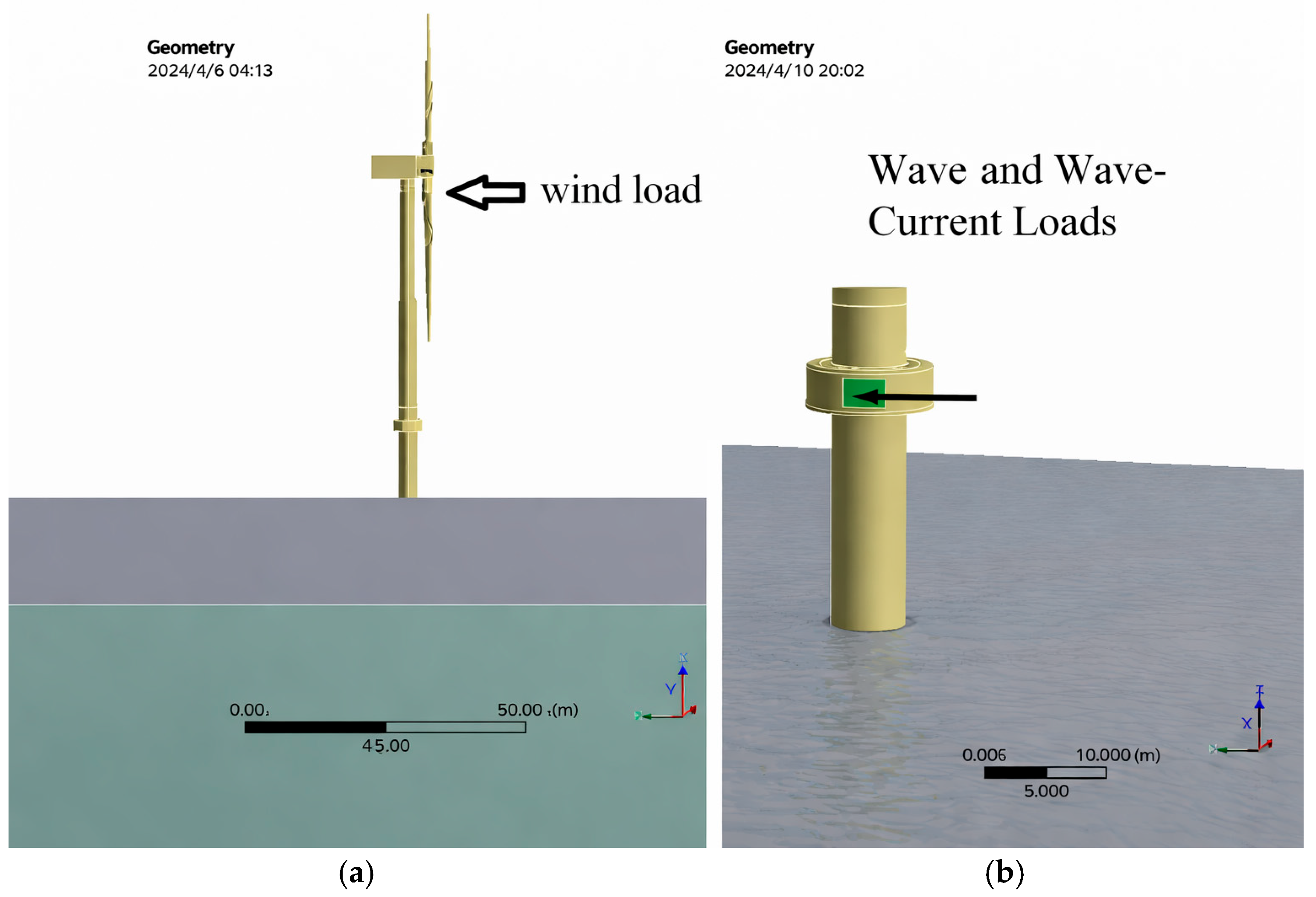
To represent the hydrodynamic actions more realistically in the equivalent-static approach, the wave- and current-induced loads are first evaluated as distributed forces along the submerged monopile rather than being applied as a single concentrated load. Specifically, based on the Stokes 5th-order wave kinematics and the prescribed current velocity, the inline force per unit length f(z) on the pile is computed using the Morison formulation (including both drag and inertia contributions). The total horizontal resultant F and the corresponding overturning moment M about the mudline reference point are then obtained by integrating f(z) over the wetted pile length. In the structural model, the hydrodynamic actions are applied in a statically equivalent manner that preserves both force and moment equilibrium: either (i) by applying the depth-varying line load along the submerged monopile, or (ii) by applying the integrated resultant force together with the associated mudline moment. For the aerodynamic loading under shutdown conditions, the wind action is represented by the resultant lateral load and overturning moment on the tower and the parked rotor (blades feathered), which are transferred to the structural model at the corresponding reference elevation (e.g., hub height/tower top) to maintain the correct global shear–moment balance, as shown in Figure 1.
From Formulas (1)–(4), it can be obtained that under the marine environment of Working Condition, the total load is:
F t o t a l = F w i n d + F h 0 + f d + F H
Substituting the above marine environmental parameters into Formula 5, the total load under the marine environment of loading condition is 2643.63 KN, among which the wind load is 745.74 KN, and the current and wave loads are 1897.9 KN. In the equivalent static analysis, the external loads are introduced using a smooth ramp function over 1.0 s to avoid spurious dynamic oscillations caused by instantaneous loading. The quasi-static response is extracted at the end of the ramp once the structural equilibrium is reached.

3. CFD-FEM Fluid-Structure Interaction Numerical Model

The environmental loads on offshore wind turbines are far more complex than those on onshore ones. In addition to wind loads, the most significant loads are those induced by wave and current impacts. In this paper, a series of numerical models covering the wind field, seawater flow field, geotechnical foundation, and the entire offshore wind turbine are first established. Among them, the structural analysis of the offshore wind turbine and seabed foundation is performed using ANSYS 19.0, employing the three-dimensional finite element method (FEM), while the ocean two-phase fluid is computed using Fluent 2024R1, utilizing computational fluid dynamics (CFD) methods for simulation.

3.1. Establishment of Fluent Fluid Geometric Model

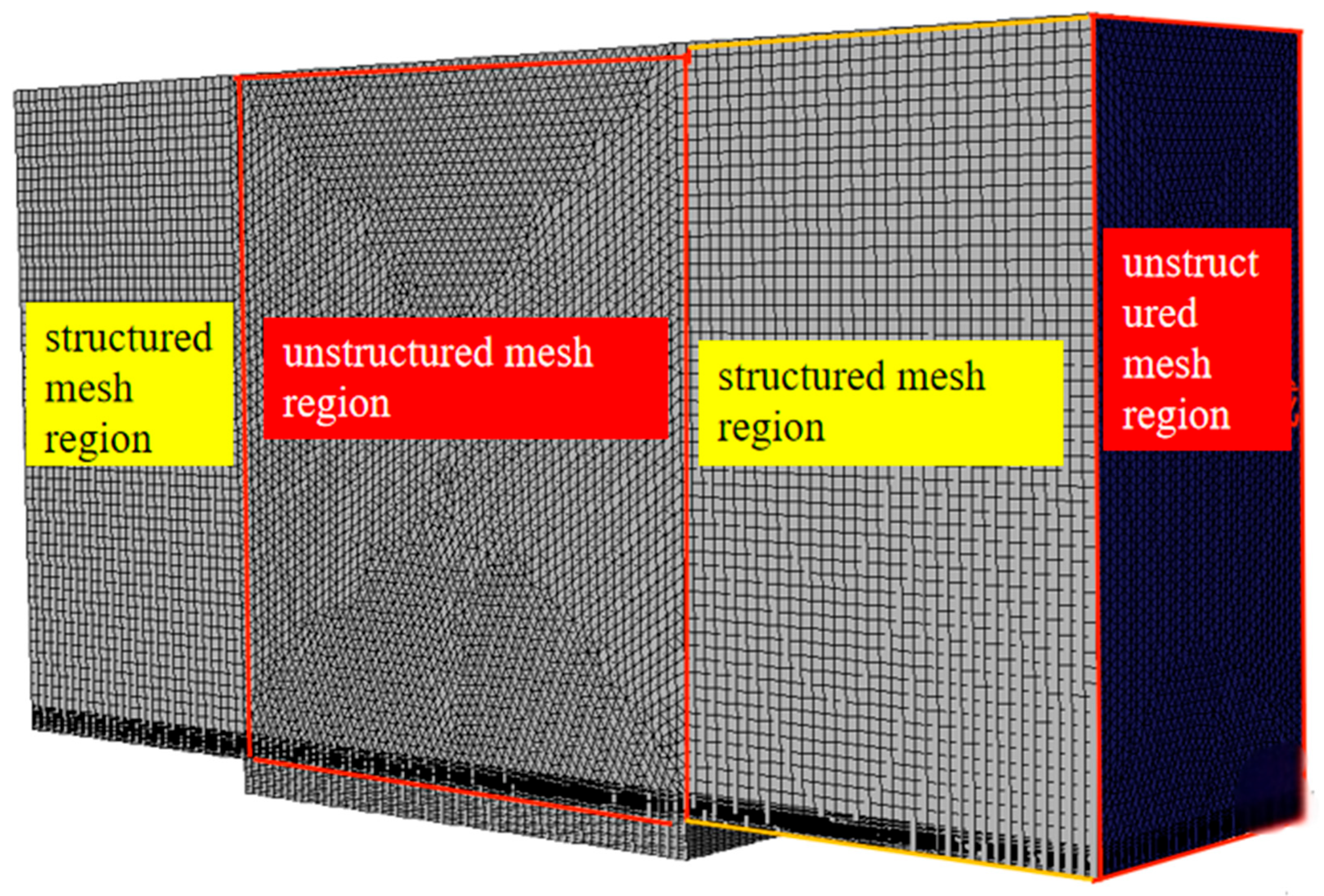
During the fluid domain modeling process, to ensure that the interaction between the wind turbine and the flow field is not affected by size effects, the wind field domain and seawater domain ranges are set according to the wind turbine dimensions. The flow field model has a length of 800 m (550 m upstream and 250 m downstream of the wind turbine, which satisfies the full development of the incoming flow and the outflow of the wake, effectively suppressing disturbances to the flow field around the wind turbine caused by outlet and inlet boundaries), a width of 200 m, and a height of 430 m (>2.5 D from the HUB center height, where D is the rotor diameter [33]. A wave damping zone is set within a 120-m range at the outlet end, configured with Fluent’s built-in wave model to form a wave generation-damping system. In the flow field model, a two-phase flow velocity inlet and a pressure outlet are adopted, with a non-reflective boundary set at the outlet side. Meanwhile, the bottom, top, and side surfaces of the model employ fixed wall boundary, pressure inlet-outlet boundary, and periodic boundary conditions, respectively. Two different fluids are configured within the flow field domain: the air domain (30–430 m) has a fluid density of 1.225 kg/m3 and a viscosity coefficient of 1.79 × 10⁻⁵ kg/(m·s); the seawater domain (0–30 m) has a fluid density of 998.2 kg/m3 and a viscosity coefficient of 1 × 10⁻³ kg/(m·s). Given the complex structure of the wind turbine blades, unstructured meshing is employed in the middle region of the flow field model—specifically near the rotor position and at the inlet/outlet regions—allowing the mesh to better conform to the blade geometry. The remaining regions use hexahedral structured grids with stronger orthogonality, balancing computational convergence and accuracy with computational efficiency. The fluid domain of the model mesh contains a total of 651,405 elements and 362,424 nodes, as shown in Figure 2.
The air–water free-surface flow is resolved using a Volume of Fluid (VOF) formulation, in which the phase volume fraction is transported together with the incompressible URANS equations. A compressive interface-capturing scheme is employed to maintain a sharp air–water interface during wave propagation and wave–current interaction. The simulations are advanced in time using an implicit transient scheme, and the time step is selected (and, if necessary, adjusted) to keep the Courant number within a stable range so that both the bulk flow and the free-surface transport remain well conditioned. Pressure–velocity coupling is handled with a transient pressure-correction procedure (PISO-type coupling) suitable for unsteady multiphase flows. Spatial discretization adopts second-order accurate schemes for the momentum and turbulence transport equations, while gradients are reconstructed using a least-squares approach to reduce numerical diffusion in regions with strong convection. For boundary conditions, the atmospheric inflow is prescribed using a representative wind-speed profile to reflect the vertical shear of offshore winds under shutdown conditions. Regular waves are generated at the inlet according to the Stokes 5th-order wave kinematics, and a numerical damping/relaxation zone is applied near the outlet to mitigate wave reflection; the outflow boundary is treated in a non-reflecting manner to maintain stable discharge of the two-phase mixture. Solid boundaries (tower/monopile surfaces and seabed) are treated as no-slip walls with appropriate near-wall treatment consistent with the turbulence model. Finally, mesh independence is assessed by repeating a representative case on additional refined meshes (with refinement concentrated near the free surface and the turbine vicinity) and confirming that the key response metrics (e.g., free-surface elevation and integrated loads) change only marginally; the baseline mesh is then selected as the best compromise between accuracy and computational cost. Among these, the turbulent kinetic energy transport equation is obtained through rigorous derivation, while the dissipation equation is an empirical formula based on physical reasoning.
( ρ k ) t + ( ρ k u i ) x i = x i [ ( μ + μ i σ k ) k x j ] + G k ρ ε
( ρ ε ) t + ( ρ ε u i ) x i = x j [ ( μ + μ t μ ε ) ε x j ] + C 1 ε ε k G k C 2 ε ρ ε 2 k
G k = μ i ( u i x j + u j x i ) u i x j
μ t = ρ C μ k 2 ε
G k represents the turbulent kinetic energy generated by the laminar velocity gradient; G k is the turbulent Prandtl number, σ k = 1.0 , σ ε = 1.3 , C 1 ε = 1.44 , C 2 ε = 1.92 , C μ are constants, with taking the value of 0.09.
In this study, the incident wave field is described using the nonlinear 5th-order Stokes wave theory. For loading Condition, the prescribed wave height is H = 14 m under a water depth of d = 30 m, and the corresponding wave kinematics are evaluated from the Stokes 5th-order formulation. In computational fluid dynamics, the discretization methods for each term of the equations include implicit and explicit schemes. In terms of stability, the implicit solution method has obvious advantages in numerical stability, especially for problems with strong nonlinearity, pulsating properties, or high convection characteristics. Meanwhile, compared with the explicit solution method, it has wider applicability in solving problems, particularly for those requiring long time steps. Therefore, the implicit solution method is chosen for fluid computation in this paper.

3.2. FEM Numerical Model

The objective of this study is to investigate the overall mechanical response of offshore wind turbines and seabed under the combined action of wind, wave, and current forces. The FEM model is established using the finite element software ANSYS 19.0, in which the seabed is divided into two parts: the soil layer (0–36 m depth) and the rock layer (36–64 m depth), with specific mechanical parameters detailed in Table 2; both parts adopt the Mohr-Coulomb constitutive model [34]. The offshore wind turbine model includes the rotor, nacelle, tower, and pile foundation, with dimensional parameters provided in Table 3. To optimize mesh generation, the nacelle and blade geometries are reasonably simplified during the modeling process. Meanwhile, according to Equations (10) and (11), the hollow steel monopile of the wind turbine ( E s t e e l = 2.1 × 10 5   M P a , ν = 0.24 ) is equivalently converted into a solid pile to improve computational efficiency. The contact surface between the monopile and seabed is defined as frictional contact, allowing separation and frictional sliding between the two parts. The friction coefficient at the pile-soil interface is set to 0.6 [35]. The bottom of the soil model is subjected to fully fixed constraints in all three directions, while the lateral sides are subjected to horizontal constraints respectively; the top surface of the seabed remains free without displacement restriction.
E e q u = E s t e e l ( D 4 d 4 ) D 4
ρ e q u = ρ s t e e l ( D 2 d 2 ) D 2
In the formula, E e q u denotes the equivalent elastic modulus of the solid rigid pile in the numerical simulation, ρ e q u represents the equivalent density of the solid rigid pile in the numerical simulation, and ρ s t e e l is the actual density of the solid rigid pile in the numerical simulation. D and d are the outer diameter and inner diameter of the monopile foundation in the offshore wind turbine with actual dimensions, respectively.
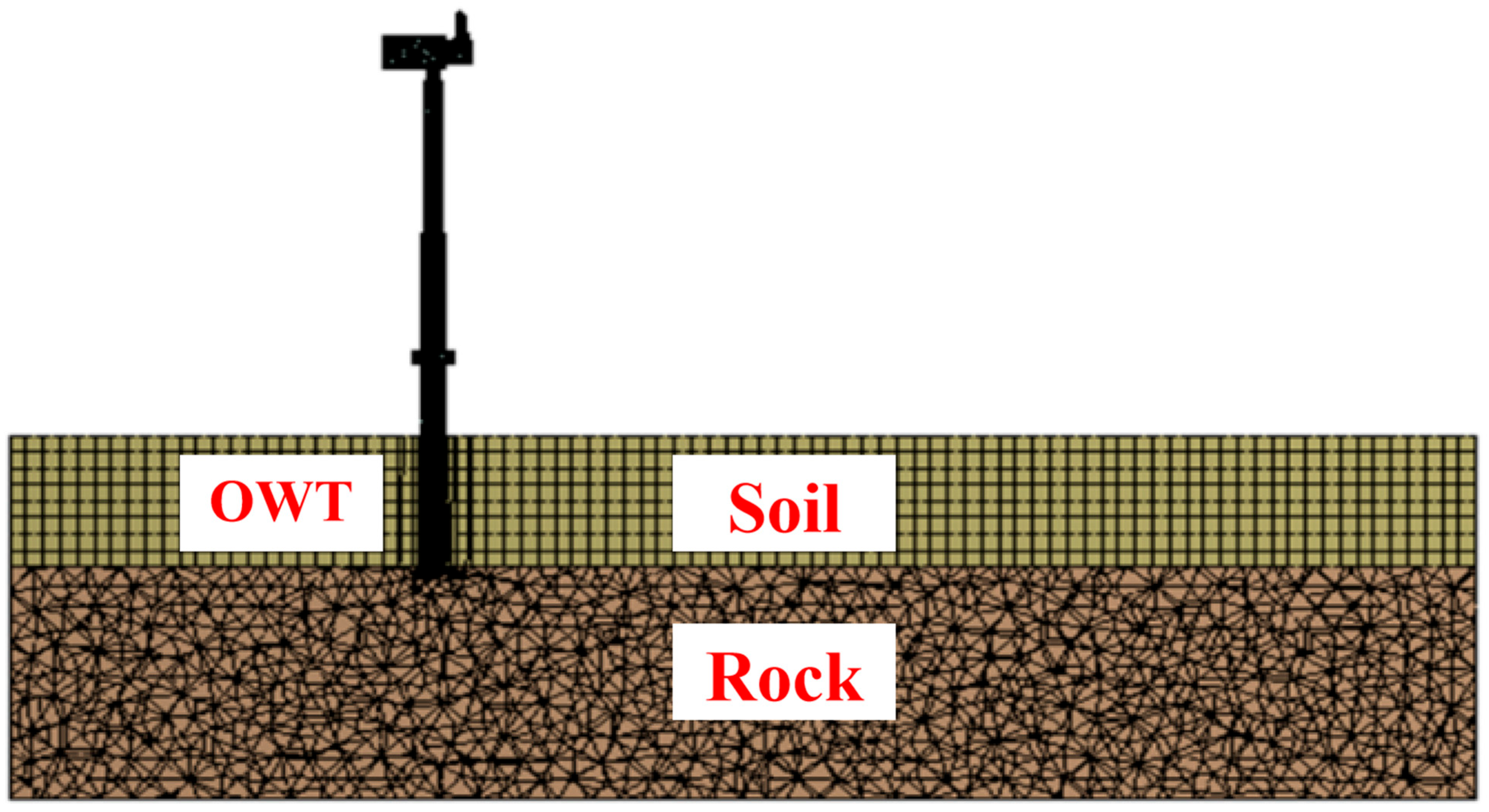
The finite element mesh size is an important parameter in the model. To analyze the influence of model parameter variations on the results, a sensitivity analysis of the main model parameters was conducted in this study. Taking the basic operating condition (wind turbine shut down, wind speed 14 m/s, current velocity 1.5 m/s, wave height 14 m, wavelength 73 m) as an example, the maximum displacement values of the overall soil layer under different mesh parameters were compared. The sensitivity analysis results are shown in Table 4, the sensitivity analysis results are shown in Table 4, indicating that the 4 m mesh provides the best performance among the tested mesh sizes [36,37]. The analysis indicates that variations in mesh size within a certain range have negligible effects on the model results. Considering numerical accuracy and computational load comprehensively, the three-dimensional numerical model in this paper adopts a soil layer mesh size of 4 m, while the rock layer mesh can be slightly coarsened to 7 m (as shown in Figure 3). The total number of solid elements in the model is 328,486, and the number of solid mesh nodes is 32,846.

3.3. Two-Way Coupling Strategy

A partitioned and implicitly coupled two-way FSI scheme is adopted to exchange information between the CFD solver and the structural solver at every physical time step. The adopted approach is a staggered (partitioned) strong coupling scheme, in which CFD and FEM are advanced within the same physical time step using sub-iterations until interface equilibrium is achieved. Within each time step, the fluid solver advances the two-phase flow field and evaluates the traction vector on the fluid–structure interface, including pressure and viscous shear. These interface tractions are transferred to the structural solver through interpolation that preserves the global resultant force and moment on the interface. The structural solver then computes the deformation of the wind turbine-monopile-seabed system under the received interface loads and returns the updated interface displacements to the CFD side. The fluid mesh is updated using dynamic mesh techniques to accommodate the structural motion while maintaining mesh quality. Sub-iterations are performed within each physical time step until the interface coupling converges, which is monitored by the change of interface forces and displacements between successive coupling iterations; under-relaxation is used to enhance robustness and convergence of the staggered coupling. An under-relaxation factor of α = 0.5 is applied to the interface update to enhance robustness of the staggered coupling.
Within each physical time step, the coupling sub-iterations are terminated when the relative change of the interface displacement between two successive sub-iterations is less than 0.5%.

3.4. Scaling Laws and Similarity Considerations

The scaled physical test follows Froude similarity to preserve gravity-dominated free-surface dynamics. Under Froude scaling, the characteristic velocity and time scale as V λ  and  T λ , where λ is the geometric scale ratio. This ensures that wave kinematics and global hydrodynamic effects are reproduced consistently at model scale. In this study, the numerical model is validated against the 1:100 test to ensure that the dominant response characteristics are captured, while the remaining scale effects are treated as a limitation when extrapolating to prototype scale.

3.5. Verification of Numerical Simulation Calculations

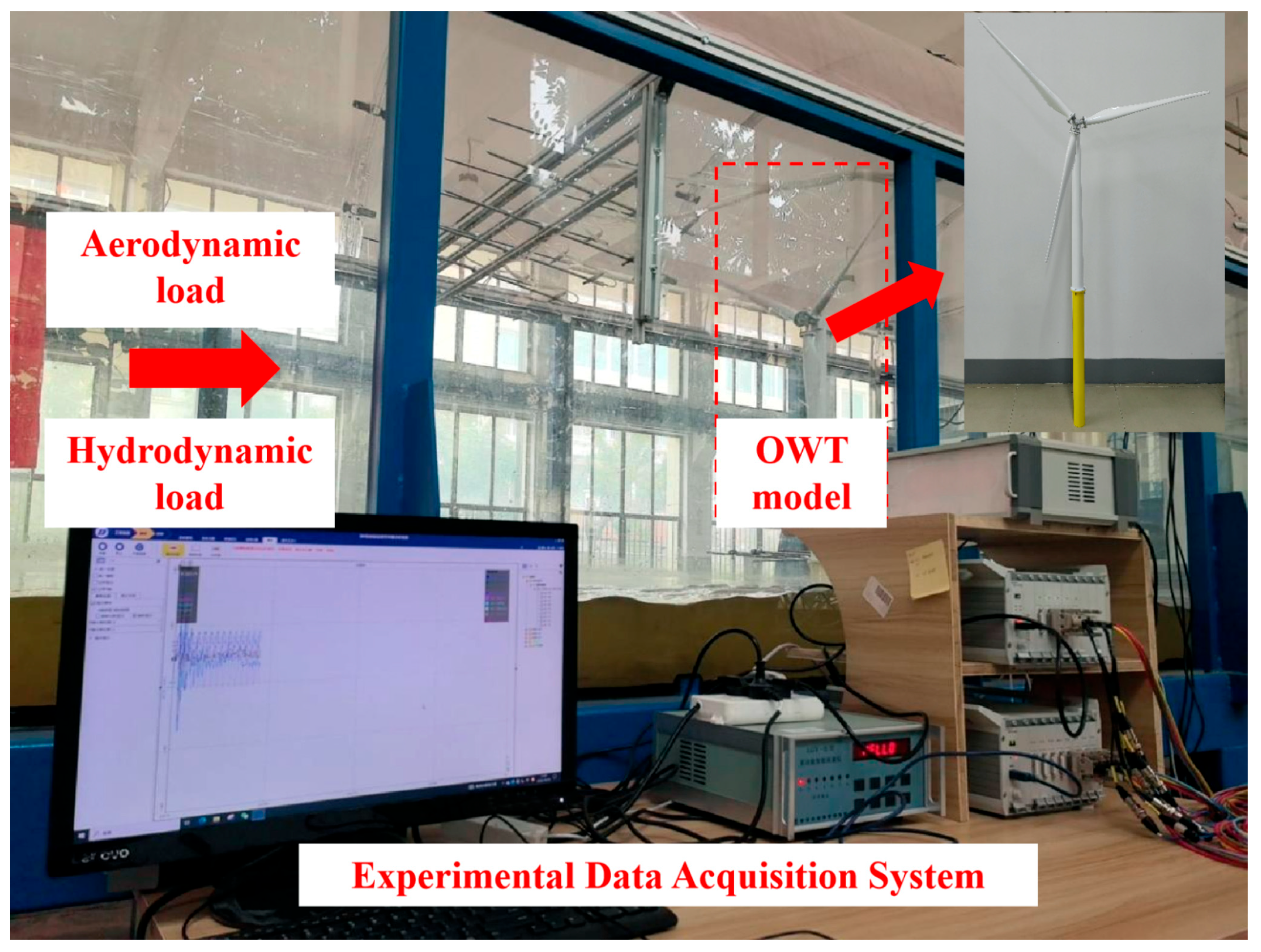
Although two-way CFD–FEM coupling can reproduce the mutual feedback between complex free-surface flow and a compliant foundation, its credibility ultimately depends on verification against controlled experiments. In this study, the numerical framework is therefore benchmarked using a scaled physical model test, so that the key response quantity is obtained under known inflow, wave, and seabed conditions. This approach reduces the uncertainty introduced by purely numerical assumptions (e.g., turbulence closure, interface capturing, and contact/friction idealization) and provides an objective basis for evaluating the stability and accuracy of the coupling algorithm. The validation experiments are conducted in an integrated facility that combines a wind-generation module, a wave-current flume, and a seabed sandbox, enabling wind–wave co-excitation while retaining a deformable foundation as shown in Figure 4. The flume is sufficiently long to form a stable combined-flow region, and the wave-maker can generate representative regular/irregular wave trains. The wind module provides a controllable incoming wind speed with fine regulation accuracy, allowing the aerodynamic loading environment to be reproduced consistently across repeated runs. Meanwhile, the seabed foundation is constructed as a stratified soil profile, which makes it possible to observe the interaction between monopile deformation and soil constraint under coupled environmental loads rather than under oversimplified fixed-base assumptions. A 1:100 scaled turbine model is adopted following the open-source NREL 5 MW reference design concept, ensuring that the main structural components (blades, nacelle, tower, and monopile) are represented in an integrated manner. Verification shows that the theoretical natural frequency of the model differs from the measured value by approximately 3.6% (2.5 Hz vs. 2.59 Hz). To capture the deformation of the monopile with sufficient spatial resolution, 12 full-bridge strain-gauge stations are installed along the pile height. Prior to the combined-load tests, the pile stiffness is checked to confirm that the structural response falls within the expected elastic range of the model assembly and that the instrumentation provides stable readings. During the loading stage, the test condition is selected to represent a typical marine environment at model scale (significant wave height Hs = 3.09 cm, peak period Tp = 0.74 s, hub-height wind speed Vhub = 2.2 m/s). Strain time histories are acquired at 50 Hz. Because the early stage may contain transient adjustments of the flow and the soil–pile system, only data after the response becomes statistically steady (after 100 s) are used for quantitative comparison.
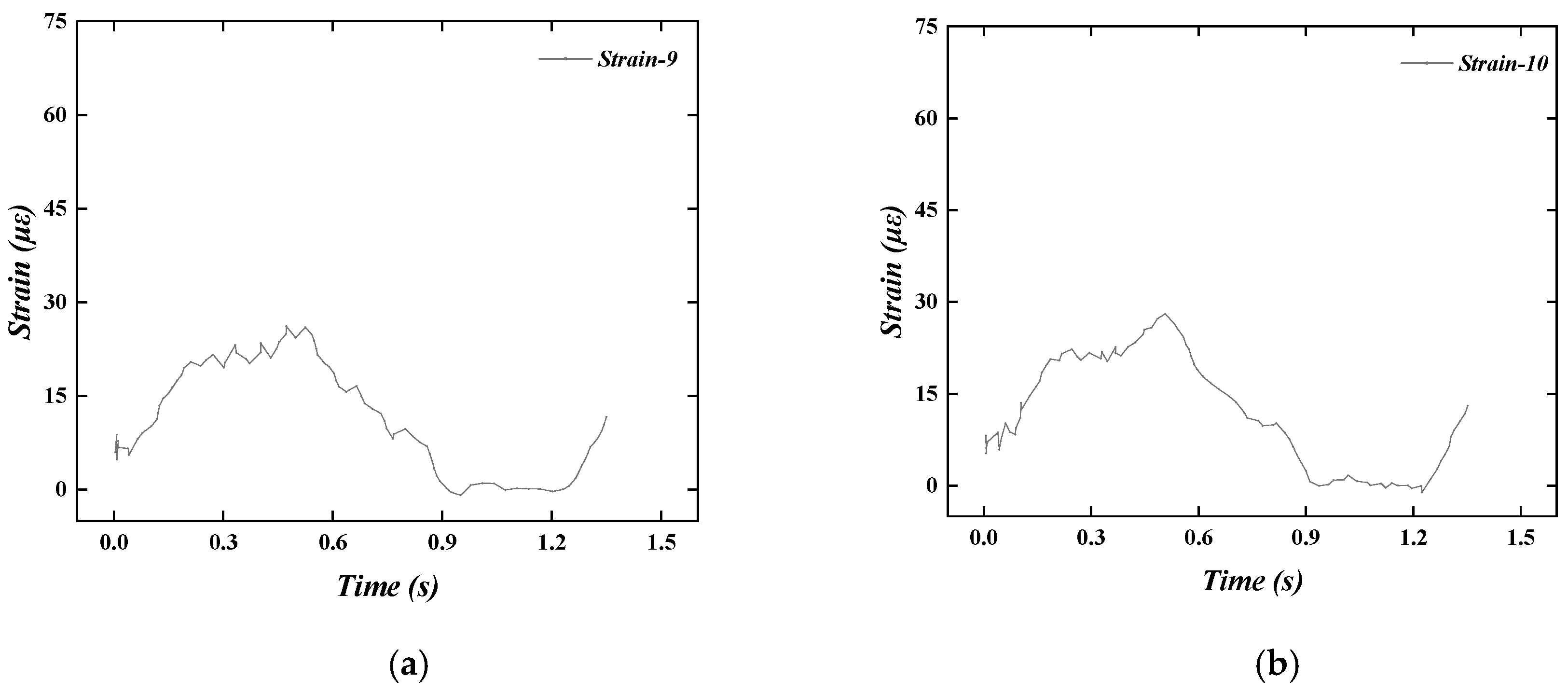
To further demonstrate the consistency between the numerical model and the scaled experiment in the time domain, the strain time histories at two representative measurement points are presented in Figure 5. The comparison focuses on the stabilized response segment used for validation and shows that the numerical model reproduces the main temporal evolution characteristics observed in the experiment.
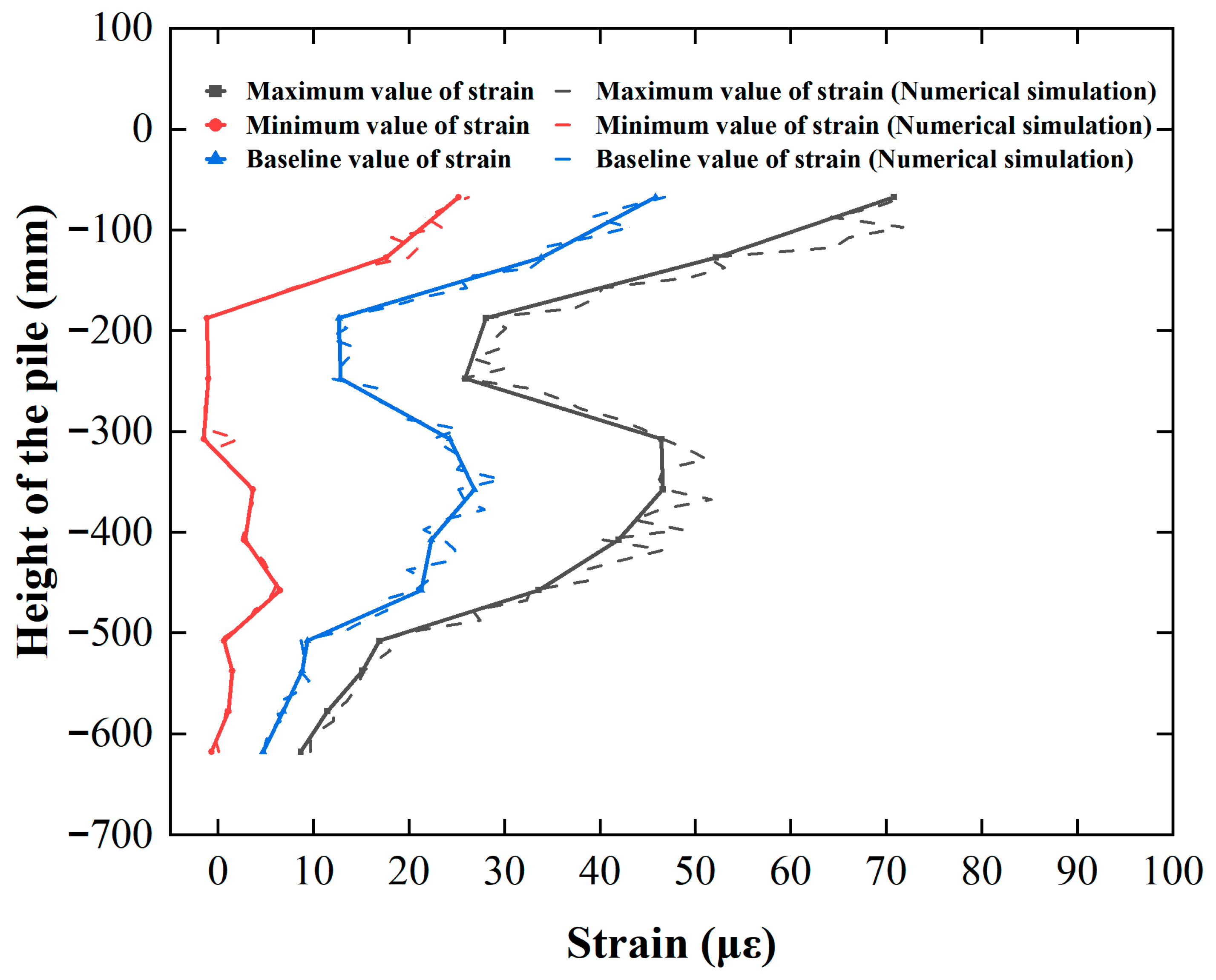
To achieve a one-to-one comparison, this study developed a numerical model consistent with the scaled model test, which incorporates an identical OWT geometric layout, a three-layer sandy seabed configuration, and an air-water two-phase flow environment. The natural frequency of the OWT was measured as 2.41 Hz. In the coupled simulation, the seabed was modeled as a continuous medium, while the turbine was treated as a deformable solid; the computational domain was set sufficiently large relative to the pile diameter (>5 D) to ensure that boundary constraints would not contaminate the local stress/strain field around the pile. The water and air subdomains are prescribed with their corresponding densities and viscosities, and the inflow wind speed is kept consistent with the experimental setting. A sufficiently small time step (0.001 s) is used to promote convergence of the two-way coupling iterations and to capture the dominant wave-induced fluctuations. For validation, the strain signals are compared in a synchronized time window: the stabilized experimental segment is mapped to the initial simulated segment of equal duration so that equivalent statistical descriptors can be computed. The assessment is performed using the mean ε m e a n = ε M a x + ε M i n / 2 , maximum  ε M a x , and minimum  ε M i n strains at the 12 measurement stations, rather than relying on a single peak value at one location. In general, the numerical predictions agree well with the experiment: the relative deviations of the characteristic strain ε t e s t / ε s i m u l a t i o n / ε s i m u l a t i o n levels are typically within 15% across the measurement points, as shown in Figure 6. Larger discrepancies may appear in a few minimum strain values, which is attributed mainly to measurement limitations and the sensitivity of local extrema to noise and subtle boundary effects. Overall, the agreement level demonstrates that the proposed CFD–FEM two-way coupling strategy can reproduce the global deformation pattern of the monopile under combined wind–wave loading, supporting its use for subsequent mechanism analysis at prototype scale.

4. Analysis of Wind Turbine Pile-Soil Interaction Under Fluid Loads

4.1. Displacement Characteristics of the Pile-Soil System

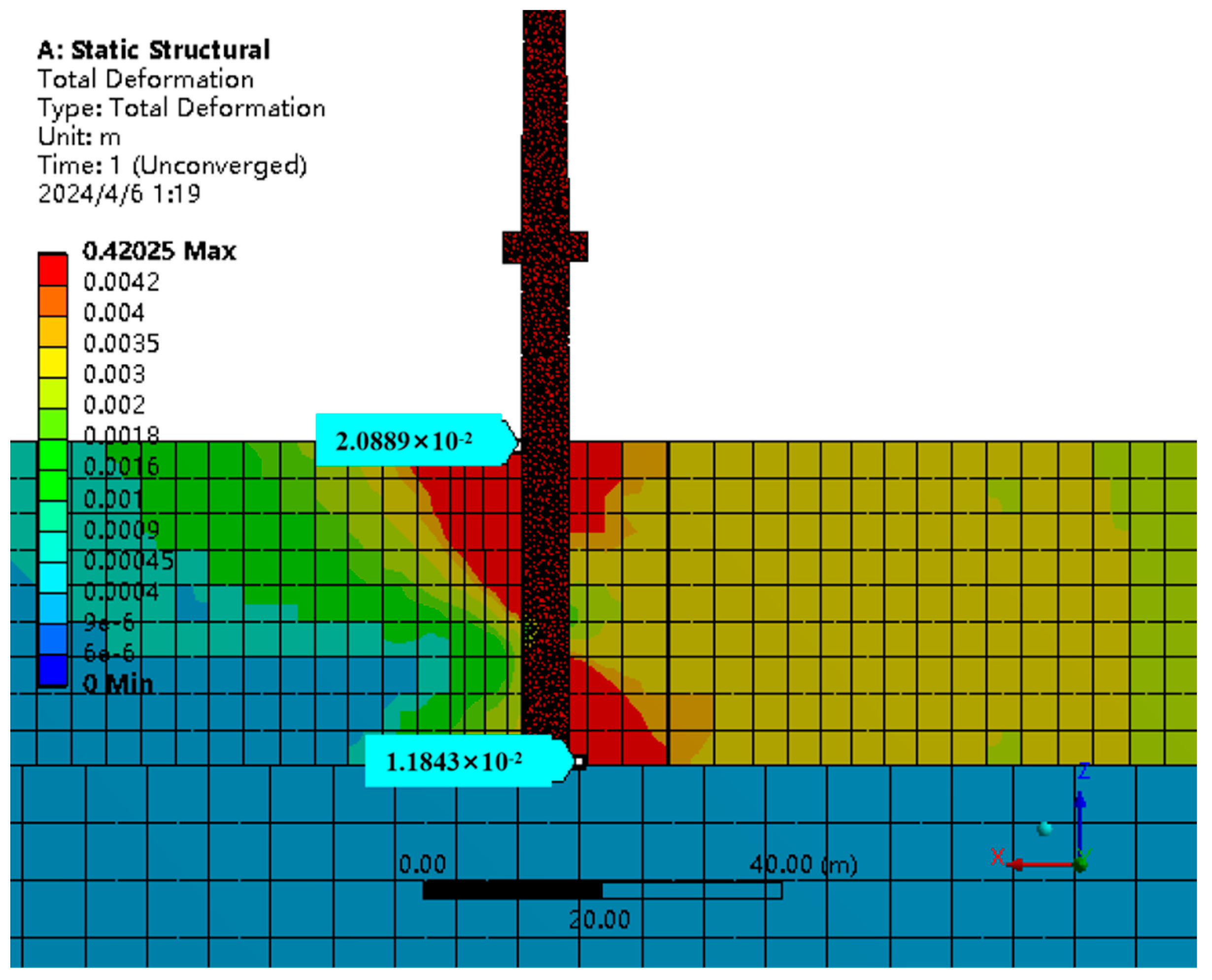
Figure 7 and Figure 8 present the displacement fields of the monopile–seabed system under loading condition, obtained by the equivalent-load approach and by the two-way FSI framework, respectively. Because wind and waves act in the same direction, the dominant structural deformation is lateral bending. Consequently, the displacement distribution is governed not only by the magnitude of the applied environmental loads, but also by how the loads are introduced into the structure and how the soil reaction is mobilized along the embedded pile segment. In the equivalent static analysis (Figure 7), the peak displacement is reported at the leeward mudline contact region, with a maximum value of approximately 0.0210 m. A secondary large-displacement zone also appears near the windward side at the bottom of the monopile, reaching about 0.0118 m. This pattern is consistent with a simplified loading scheme in which the global lateral action is represented by concentrated or lumped forces applied at a limited set of locations. Under such a representation, the bending deformation tends to localize around the vicinity where the equivalent lateral shear and moment are effectively transferred into the foundation, which in turn leads to a relatively confined “hot spot” of displacement at the soil–pile interface near the seabed surface.
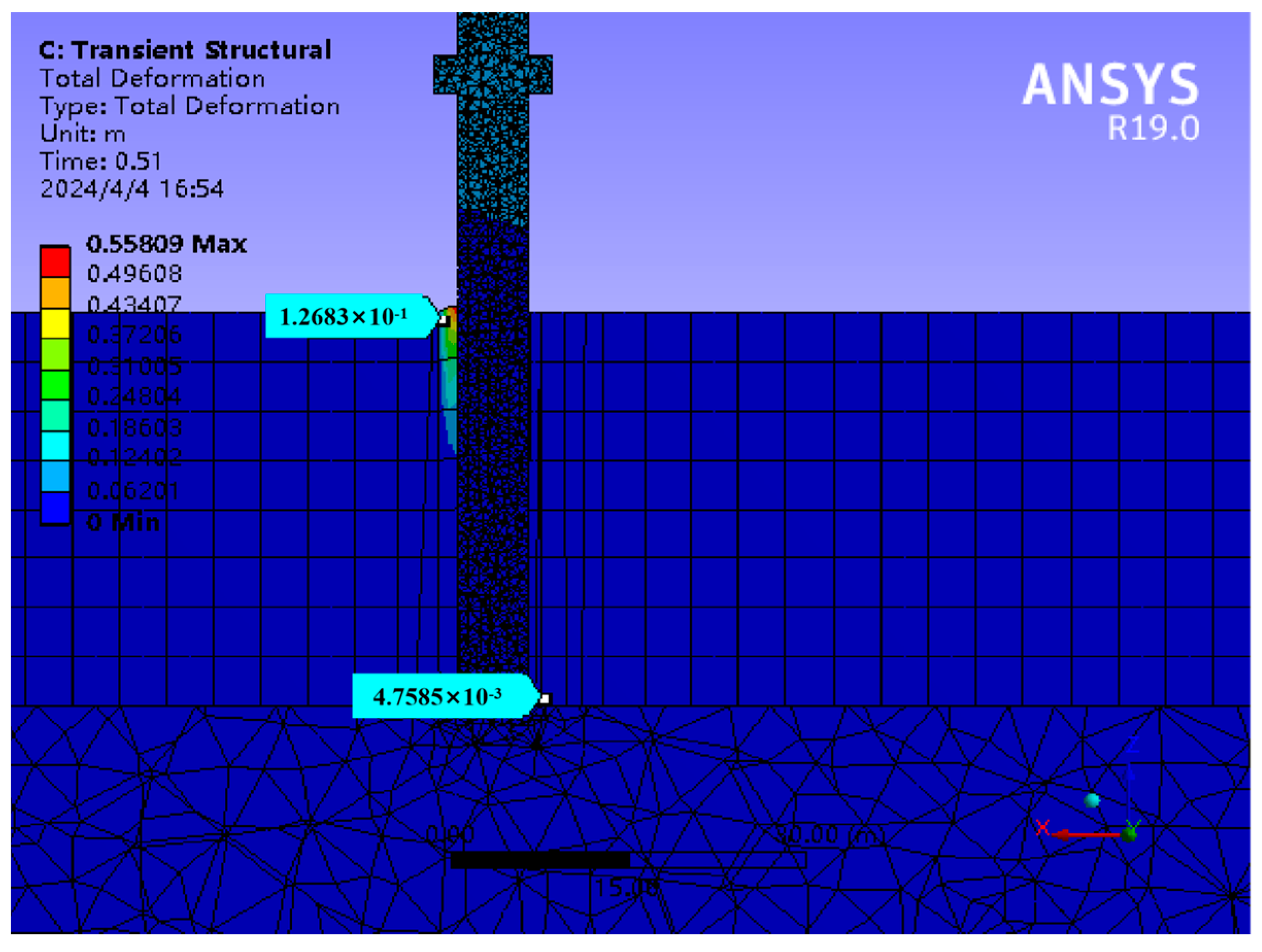
By contrast, the two-way FSI simulation (Figure 8) yields a markedly larger lateral response. The maximum displacement occurs again near the leeward mudline region, but the peak value increases to approximately 0.127 m. Compared with the equivalent-load result, the difference is about 0.106 m, corresponding to an underestimation of roughly 83.46% (0.0210 m vs. 0.127 m in this case) for the present extreme shutdown case if the equivalent-load method is used. This discrepancy is not a minor numerical deviation; rather, it reflects a fundamental difference between distributed fluid–structure loading and idealized equivalent loading. In the FSI framework, pressure and shear stresses are generated over the entire wetted and exposed surfaces of the structure and evolve with the instantaneous wave kinematics and airflow field. The resulting load transfer is spatially continuous and time-dependent, which naturally produces larger bending demand and a stronger mobilization of soil resistance. In addition, two-way coupling allows structural deformation to influence the surrounding flow, which may further modify the instantaneous pressure distribution and amplify response peaks during certain wave phases.
The windward displacement near the pile base also shows an opposite tendency between the two approaches. In the two-way FSI result, the windward-side displacement at the pile bottom is about 4.76 × 10⁻³ m, which is smaller than the corresponding equivalent-load prediction (0.0118 m). In other words, while the equivalent-load method significantly underpredicts the leeward mudline displacement, it may simultaneously overpredict displacement at deeper locations. Mechanically, this highlights that the two approaches do not merely differ by a uniform scaling factor. Instead, they produce different curvature distributions along the embedded pile, implying different bending-moment and soil-reaction profiles. In the coupled simulation, the soil constraint and the distributed loading along the above-ground and near-surface region can lead to a response that is dominated by a more realistic “cantilever-with-embedded-fixity” behavior, whereas the equivalent-load method may force the structure into an artificially constrained deformation shape due to the simplified load introduction.
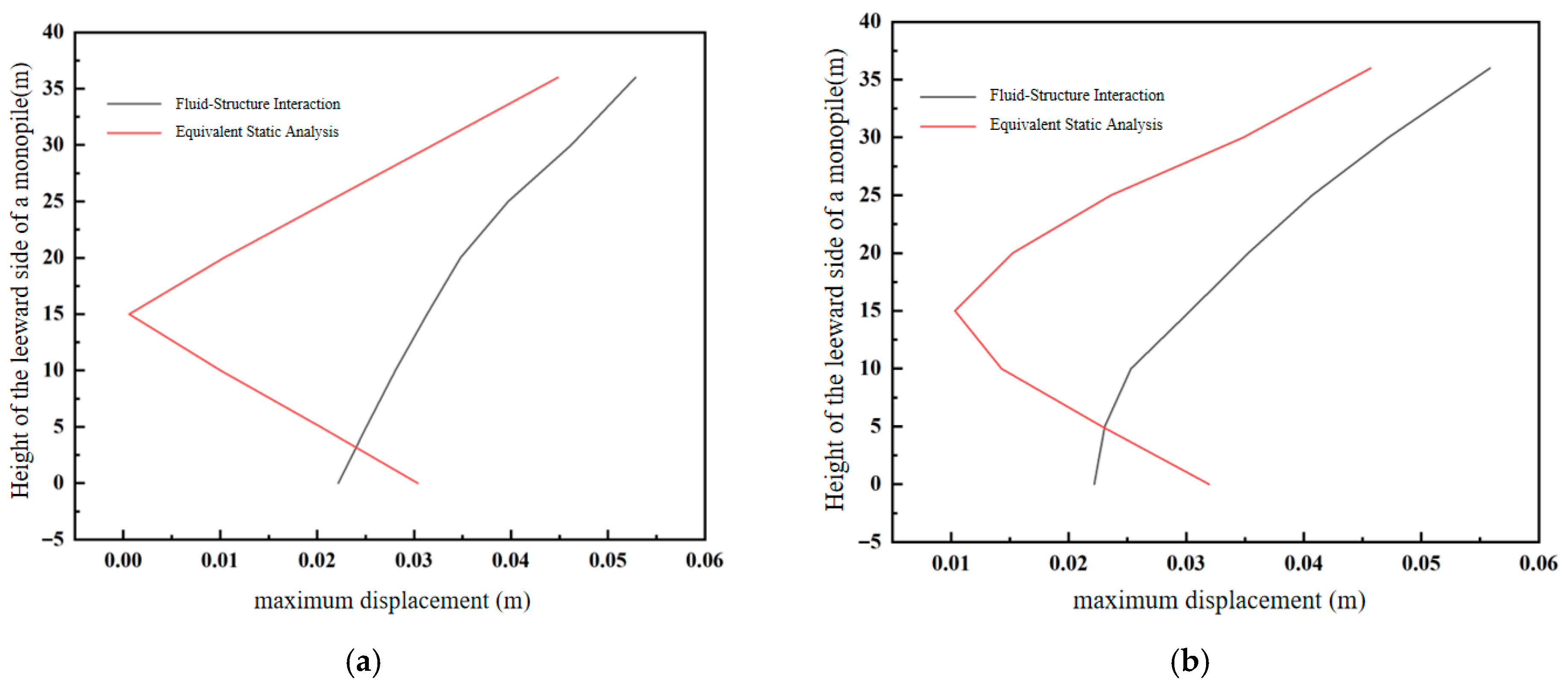
To further clarify the displacement mechanisms, Figure 9 compares the maximum lateral displacement along the pile height on the windward and leeward sides for both methods. A key observation is the distinct shape of the displacement profiles. Under the equivalent-load approach, the displacement distribution along height first decreases and then increases from bottom to top, indicating a non-monotonic deformation shape within the embedded segment. Under the two-way FSI approach, the displacement increases in an almost linear manner with height, which is more consistent with classical lateral pile behavior where curvature and rotation gradually develop with elevation under distributed lateral forcing.
The two curves Intersect at a position about 5 m above the pile bottom, where both methods yield similar displacement values. This intersection can be interpreted as an “effective pivot” location for the deformation shape under the two loading representations. Above this location, the equivalent-load method increasingly underestimates the displacement relative to FSI, suggesting that the simplified load application fails to reproduce the true bending demand in the upper embedded region and near the mudline. Around 15 m above the pile bottom, the discrepancy becomes the most pronounced: the gap reaches approximately 0.03038 m on the leeward side and 0.020 m on the windward side. Such a large difference at mid-to-upper embedment is particularly important because this region often governs serviceability and fatigue-related limit states in monopile designs, as it is sensitive to cyclic bending and soil stiffness degradation.
Below the intersection, the two-way FSI method predicts larger displacements than the equivalent-load approach. The largest gap near the pile bottom reaches 0.00821 m (leeward side) and 0.00980 m (windward side). This indicates that when the full coupled loading and soil reaction are considered, deeper sections may participate more actively in resisting lateral action, thereby producing a displacement field that is “distributed” across the embedded length rather than being confined near the mudline. Notably, the discrepancy decreases toward the top of the embedded segment, and the smallest differences at the top are about 0.0070 m (leeward) and 0.0110 m (windward). This gradual convergence suggests that near the upper embedded region the response becomes less sensitive to deep boundary constraints and more controlled by local soil–pile interaction and the net lateral load resultant.
From an engineering perspective, the displacement comparison implies that an equivalent-load approach may lead to a non-conservative assessment of lateral deformation at the mudline and upper embedded zone under complex wind–wave–current environments, especially when nonlinear free-surface effects and flow–structure feedback are pronounced. Since lateral displacement and rotation at the mudline directly affect tower alignment, drivetrain loads, and long-term fatigue accumulation, underestimating displacement by the order observed here can bias both ultimate safety checks and serviceability evaluations. Therefore, for conditions similar to loading condition, a two-way coupled framework provides not only a larger displacement magnitude but also a more credible deformation shape along the pile, which is essential for identifying the true controlling locations of foundation performance.

4.2. Stress-Strain Characteristics of the Wind Turbine Foundation

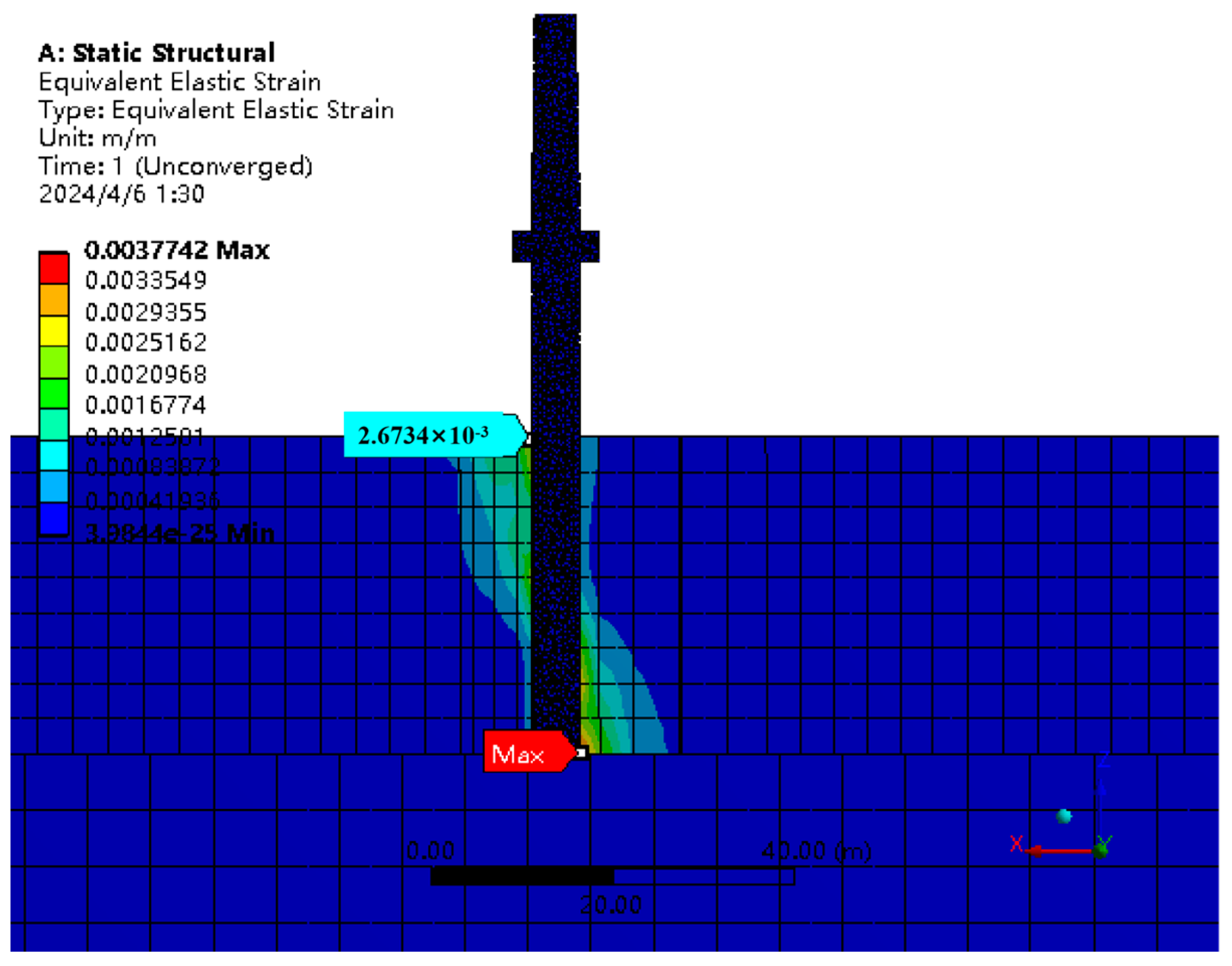
Figure 10 shows the equivalent elastic strain field under the equivalent-load approach. The maximum value is located near the windward side at the pile bottom, reaching approximately 3.8 × 10⁻³. In addition, the windward-side strain increases progressively from top to bottom in the lower region, indicating that the simplified loading scheme drives a strong bending demand that concentrates near the base. On the leeward side, the strain increases upward in the upper zone and reaches an extreme value at the mudline (about 2.67 × 10⁻³). Meanwhile, the mid-height zone of the pile exhibits relatively small elastic strain, which is broadly consistent with the expectation that bending curvature may be lower away from the main load-transfer regions in a simplified static representation.
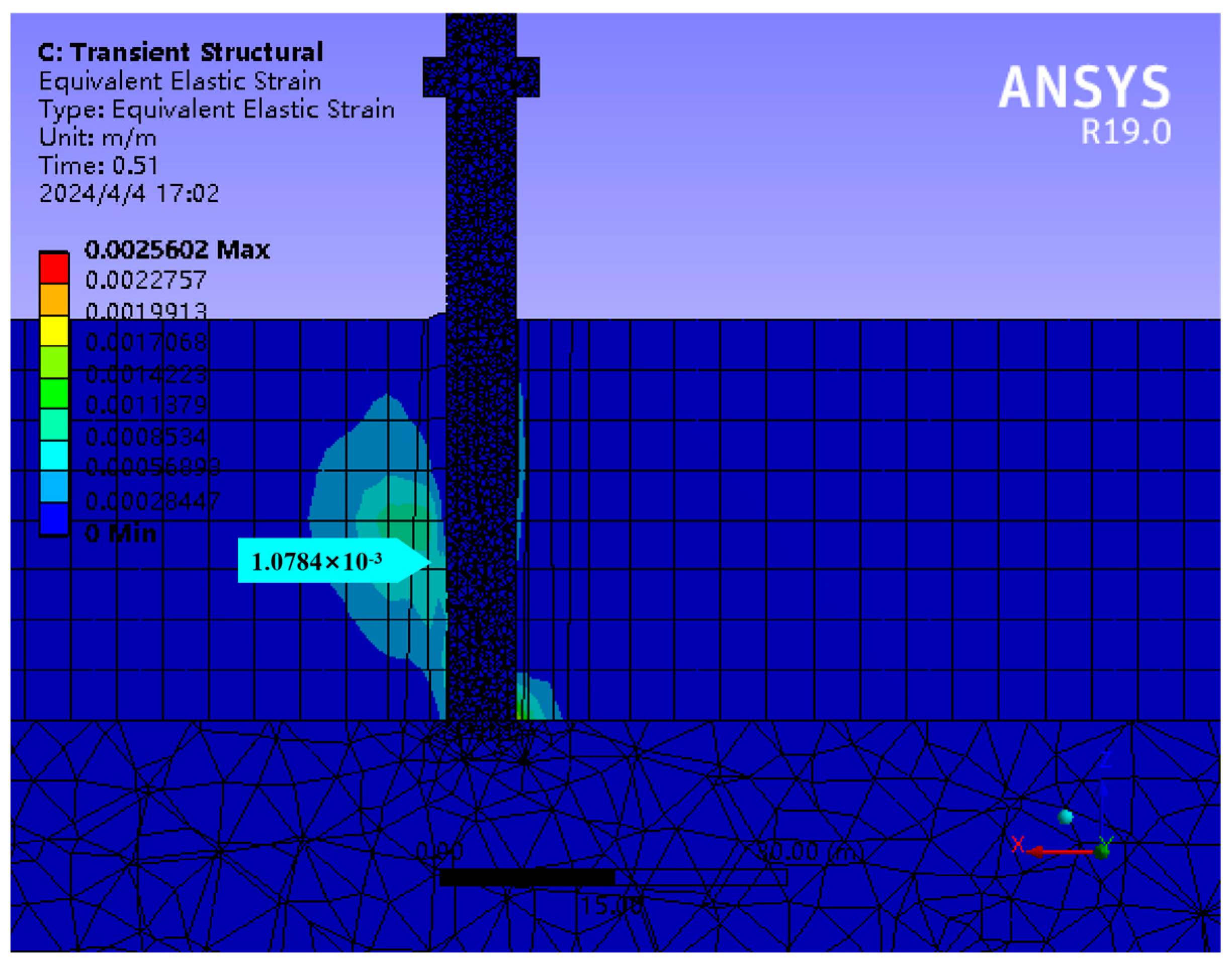
In Figure 11 (two-way FSI), the location and magnitude of the elastic strain peak change notably. The maximum equivalent elastic strain is no longer concentrated at the pile bottom or directly at the mudline; instead, it appears on the leeward side within the embedded segment, at a depth of roughly 20 m, with a peak around 1.1 × 10⁻³. Two key interpretations follow. First, the coupled simulation redistributes bending demand along the embedded length due to the continuous pressure loading on the structure and the evolving soil reaction. Second, because the FSI approach resolves the multiphase flow interaction and the load feedback, it can shift the most critical elastic response zone away from the locations suggested by a purely equivalent static load. In practical terms, this means that relying on the equivalent-load method may misidentify the controlling section for strain-based checks.
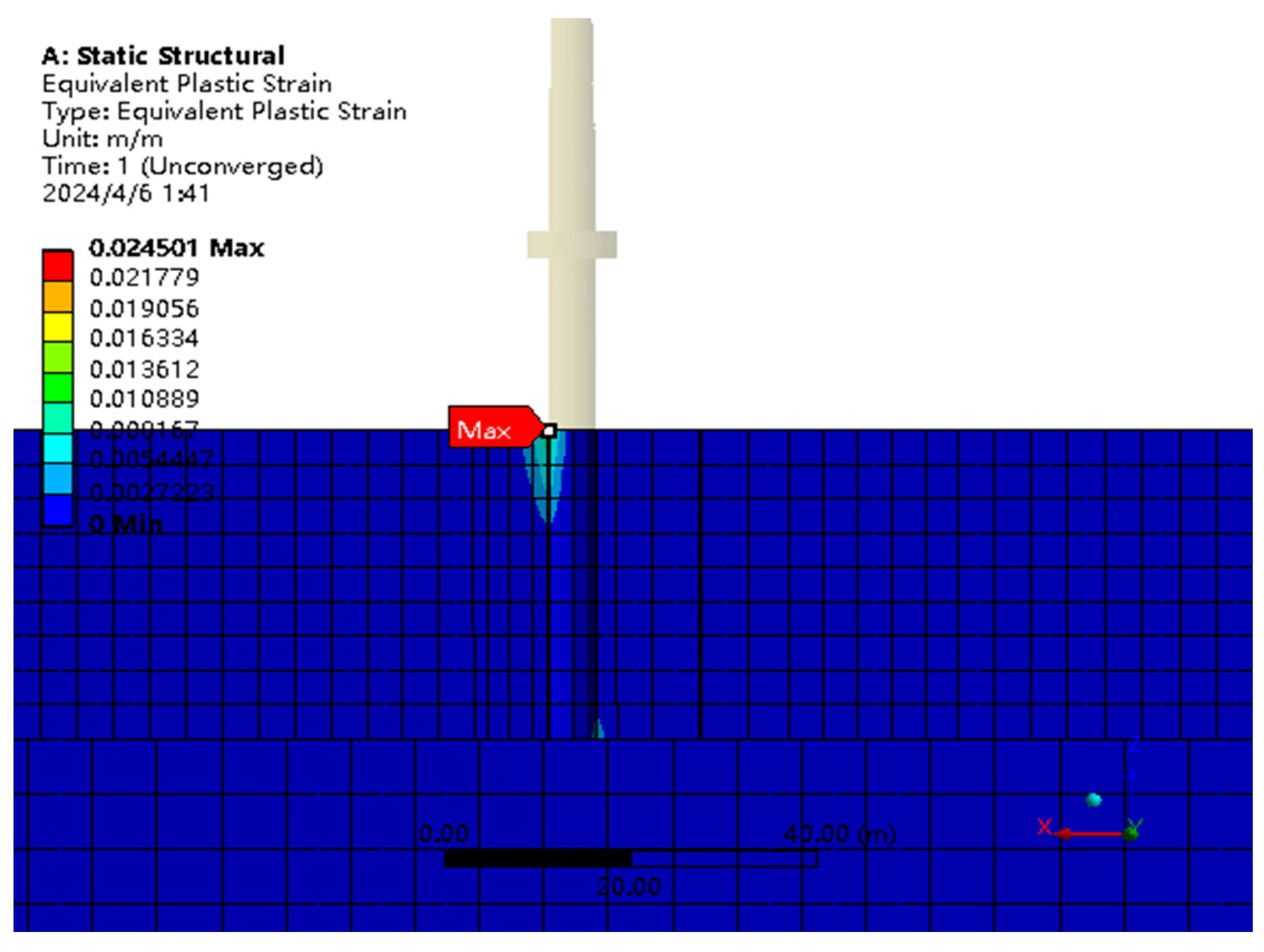
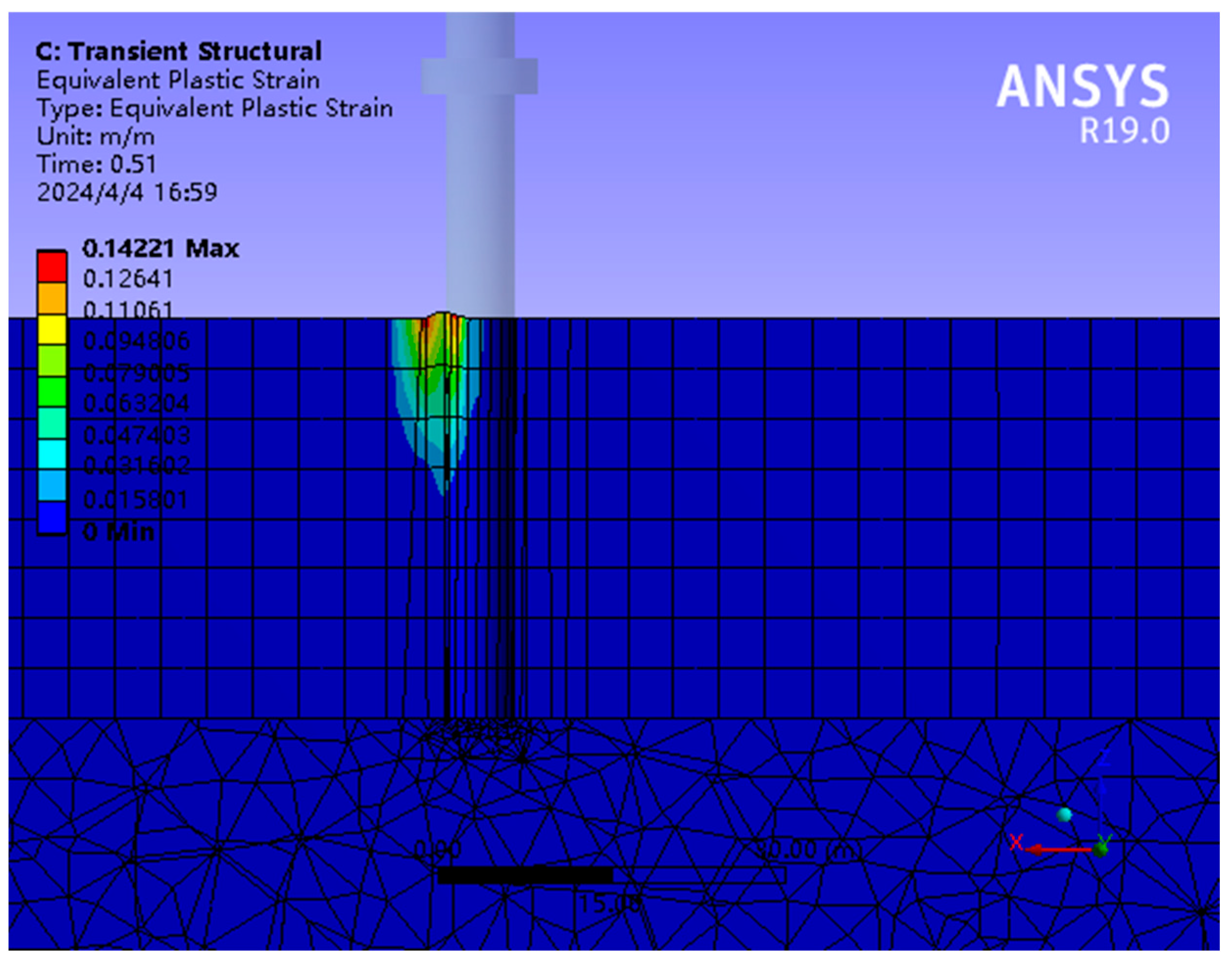
Plastic strain is a more direct indicator of irreversible deformation and potential long-term degradation of the pile–soil system. Figure 12 and Figure 13 compare the equivalent plastic strain fields. Both methods indicate that high plasticity tends to develop near the leeward mudline region, which is reasonable because this zone experiences strong bending and cyclic shear transfer between pile and soil under lateral environmental loads. However, the magnitude predicted by the two methods differs dramatically.
Under the equivalent-load approach (Figure 12), the maximum equivalent plastic strain is approximately 2.5 × 10⁻². Under the two-way FSI approach (Figure 13), the maximum value increases to about 0.14, which is several times larger. This large amplification suggests that when the actual coupled wind–wave–current loading is represented through two-way interaction, the foundation may enter a significantly more nonlinear regime. Mechanistically, this can be attributed to (i) higher instantaneous load peaks due to resolved wave kinematics and local flow acceleration, (ii) spatially varying pressure distributions that produce stronger curvature in certain phases, and (iii) the fact that structural deformation alters the near-body flow, potentially reinforcing local pressure gradients. As a result, the equivalent-load method may not only underpredict displacement but may also severely underpredict plastic development, which is critical for assessing permanent tilt, accumulated settlement/rotation, and the evolution of soil stiffness around the pile.
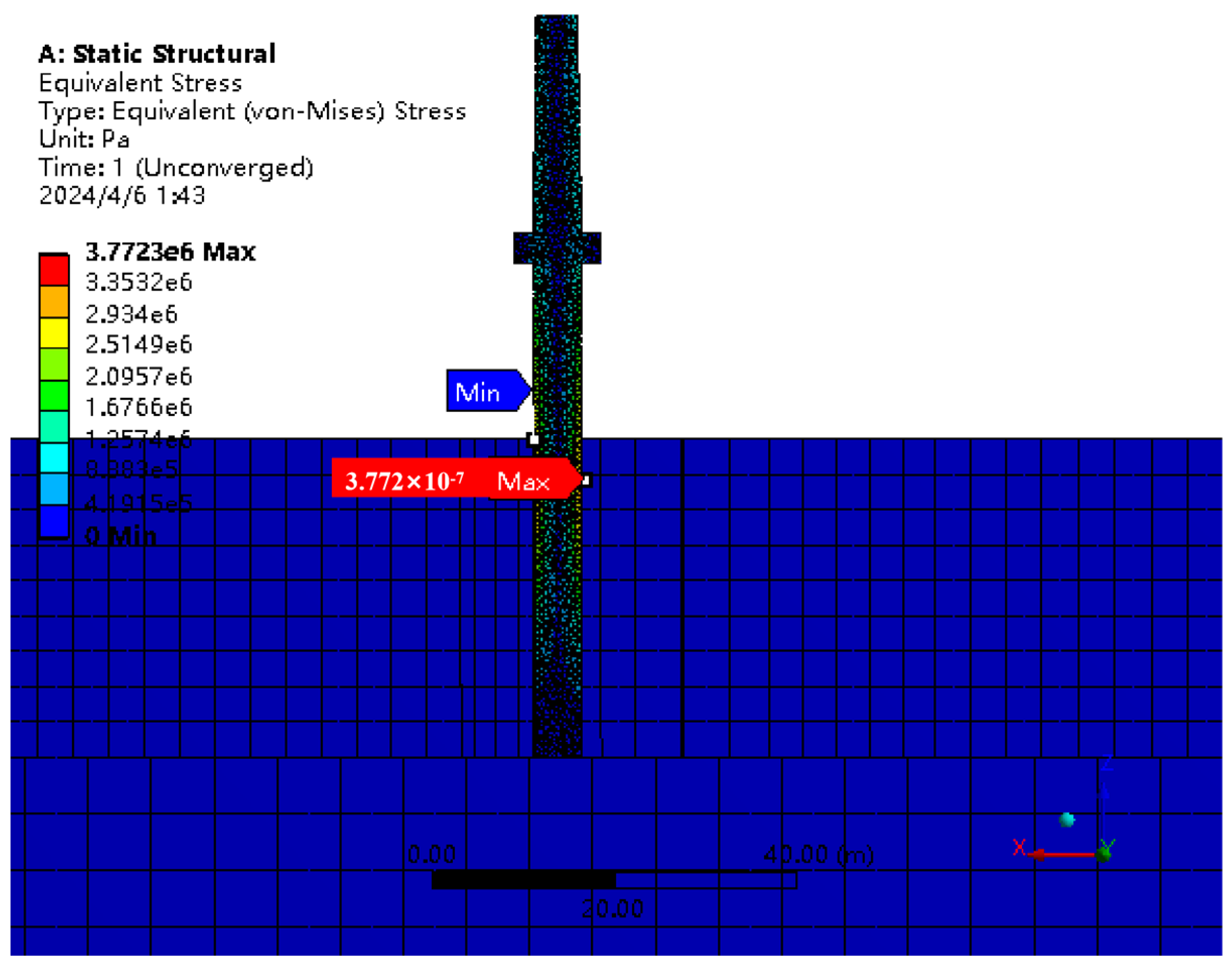
Figure 14 and Figure 15 compare the von Mises stress distributions. Under the equivalent-load method (Figure 14), the maximum von Mises stress is located at the leeward mudline height, with a magnitude of approximately 3.77 × 10⁶ Pa. This outcome is consistent with the tendency of simplified, lumped loading to produce a stress concentration near the load-transfer interface close to the seabed surface.
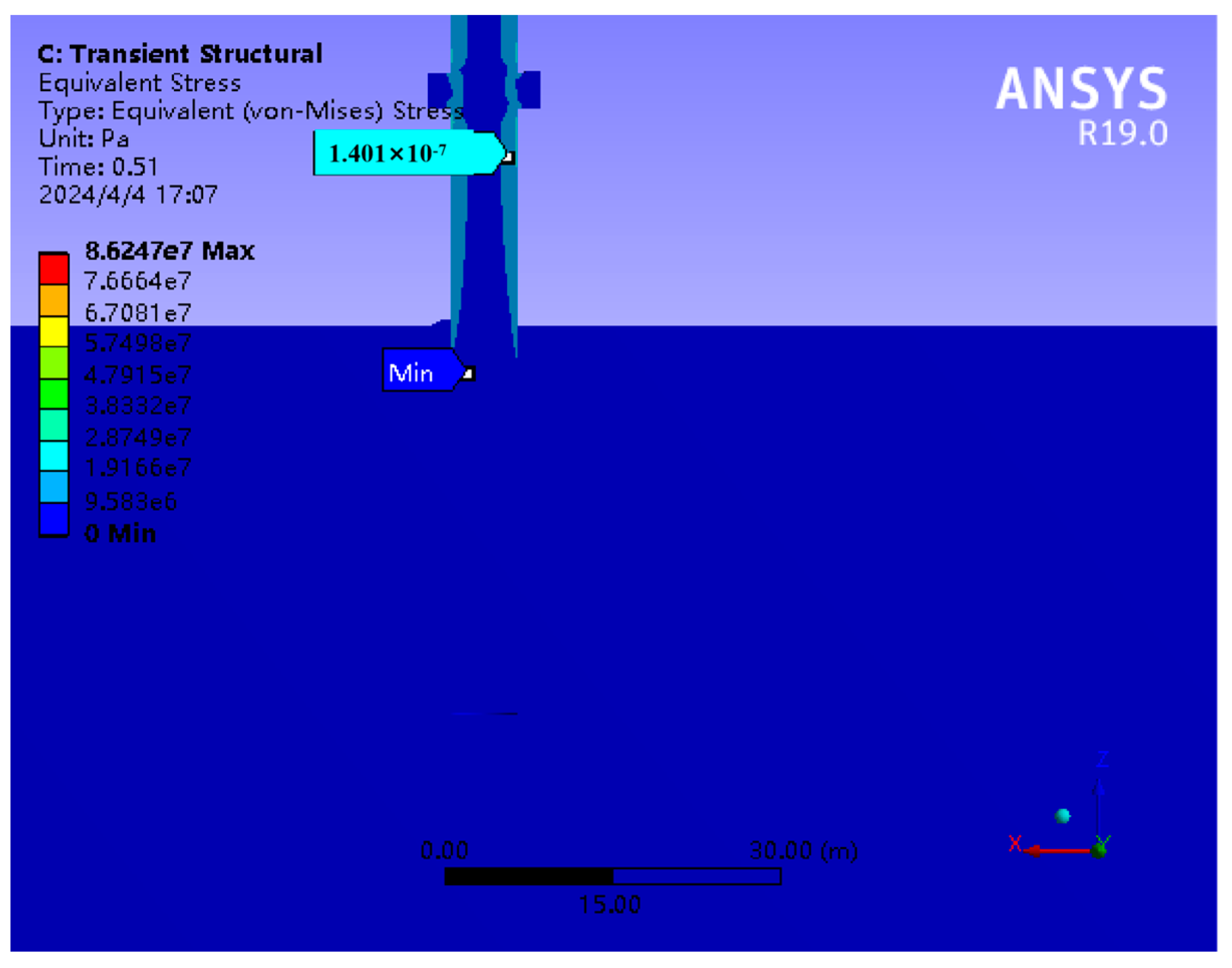
In contrast, the two-way FSI method (Figure 15) identifies a different controlling region: the maximum von Mises stress occurs on the windward side at a height of about 51 m, i.e., approximately 14 m below the pile top, with a magnitude of 1.4 × 10⁷ Pa. Compared with the equivalent-load result, the difference in peak stress is about 1.07 × 10⁷ Pa, and the critical location shifts from the mudline region to an elevated section of the pile. This shift is highly consequential. It indicates that the coupled simulation captures load-transfer pathways that are not represented when the environmental loads are simply superimposed and applied in an equivalent manner. In a two-way coupled environment, aerodynamic and hydrodynamic interactions can modify the distribution of pressure along the tower–pile system, and the structural motion can in turn affect the flow field. The resulting internal force distribution may therefore produce a stress maximum at locations associated with combined bending and local stiffness transitions, rather than strictly at the mudline.
The response results of offshore wind turbine monopile foundations under the combined action of wind, waves, and currents show significant differences between the results obtained by the fluid-structure interaction (FSI) analysis method and those from the numerical method using equivalent load application. The differences in the foundation displacement can be summarized in two aspects: first, under the same load condition, the displacement values calculated by the two-way FSI method are significantly higher. Second, the displacement distribution law obtained by the FSI method differs greatly from that of the equivalent load application method. The reasons for the result differences are analyzed as follows: Firstly, in the FSI simulation method, the fluid load covers the entire contact surface with the wind turbine, whereas the equivalent static method represents the environmental actions through depth-/height-integrated resultant forces and moments applied to the structural model, which cannot reproduce the time-varying and spatially distributed load patterns generated by the coupled multiphase flow. This simplification may still lead to biased deformation and stress localization compared with the two-way FSI results. Secondly, the FSI analysis method reproduces the coupling effects between multi-phase fluids (wind, waves, and currents) as well as between the wind turbine and the fluids. For example, due to aerodynamic effects, the wind speed in some areas of the turbine tower and impeller is generally higher than the rated wind speed. The coupling effect of wind and waves results in higher dynamic pressure values in the contact area between the seawater and air flow fields; meanwhile, the coupling effect between waves and currents causes the current velocity to be slightly higher than the rated flow velocity. It should be noted that the rotation-related mechanism of the monopile response is relatively complex, as it is jointly influenced by the load distribution, pile–soil interaction, embedded restraint, and coupling effects. Therefore, a rigorous interpretation of the rotational behavior is beyond the scope of the present study, and the discussion here is focused on the displacement response and its distribution characteristics.

5. Conclusions

In this paper, aiming at the response problem of offshore wind turbine monopile foundations under wind-wave-current multi-field coupled loads, a CFD-FEM two-way fluid-structure interaction numerical model is established, and the prediction differences between the equivalent static method and the fluid-structure interaction method are systematically compared. By simulating the dynamic interaction of the wind turbine-fluid-seabed system with high precision, it reveals the systematic deviation of the equivalent static method due to ignoring the load coupling mechanism, and proposes the fluid-structure interaction method as a reliable paradigm for the safety assessment of wind turbine foundations. The main conclusions are as follows:
  • The equivalent static method has systematic prediction deviations: Its simplified load application method leads to an 83.46% underestimation of displacement at the contact point of the seabed on the leeward side, a very high misjudgment deviation in the position and magnitude of the extreme Mises stress, and a serious underestimation of plastic strain by 5.6 times, which significantly affects the reliability of damage assessment.
  • The fluid-structure interaction method reveals key physical mechanisms under shutdown conditions: The coupled multiphase flow produces locally intensified aerodynamic/hydrodynamic pressures around the tower–rotor region and the free surface, which increases the bending demand of the monopile foundation compared with the equivalent-static representation. In the seabed modeled by the Mohr–Coulomb criterion, the cyclic environmental loading is reflected by the accumulation of equivalent plastic strain and the expansion of the plastic zone. A pronounced plastic-strain concentration is observed around the leeward side at approximately 20 m below the seabed surface, which is consistent with the formation of a displacement concentration region in the pile–soil system.
  • Engineering applications require targeted optimization of design: The equivalent static method can be used for preliminary screening, while extreme marine conditions represented by loading condition (e.g., H = 14 m, d = 30 m) should be checked using the two-way FSI framework to avoid non-conservative response estimation. Design reinforcement should be guided by the predicted critical stress locations and the displacement/rotation demand at the mudline. In addition, when the Mohr–Coulomb-based simulation indicates a persistent plastic-strain concentration zone on the leeward side, targeted ground-improvement measures (e.g., local grouting or densification) may be considered for that plastic zone to enhance lateral resistance and reduce long-term deformation risk.
Applicability of the equivalent static method: The equivalent static method can be acceptable for preliminary screening when the response is dominated by quasi-static global bending, the flow-induced pressure field remains relatively smooth (e.g., non-breaking regular waves), and the soil–pile system stays largely in the elastic regime. Under such conditions, matching the resultant shear and overturning moment can provide a reasonable estimate of the global demand. However, when free-surface nonlinearity, wake interference, and flow–structure feedback become pronounced, the loading becomes spatially distributed and phase-dependent, leading to larger cyclic ranges and localized peaks that cannot be represented by a single equivalent resultant. Moreover, once noticeable seabed plasticity develops, the response becomes sensitive to the time evolution of loads. In such cases, a two-way FSI analysis is recommended to avoid non-conservative predictions.
Several limitations of the present study should be acknowledged. First, the reported quantitative discrepancy between the equivalent method and the two-way FSI method (e.g., the 83.46% displacement underestimation) is specific to the examined extreme shutdown condition and should not be interpreted as a universal deviation without broader load-case coverage. Second, the validation is conducted against a 1:100 scaled experiment based on Froude similarity; thus, Reynolds-number mismatch may influence near-wall turbulence development and local peak responses. Third, the seabed behavior is represented by the Mohr–Coulomb model, which does not explicitly capture cyclic degradation or small-strain stiffness that may be important for long-term serviceability. Finally, while the solid-domain mesh sensitivity indicates limited variation, the sensitivity to the CFD setup (e.g., domain size, turbulence closure such as standard k- ε versus SST k- ω , and wave description such as Stokes versus linear/irregular waves) and coupling settings has not been systematically quantified and may affect local pressure peaks and transient details; This could be further reduced by dedicated sensitivity studies in future work.

Author Contributions

Z.W.: Methodology, investigation, formal analysis. D.L.: Writing—original draft, writing—review & editing, validation investigation. S.Z.: Supervision, investigation. N.H.: Data curation. B.H.: Methodology. X.K.: Conceptualization, project administration. All authors have read and agreed to the published version of the manuscript.

Funding

This work was financially supported by the “Key Technologies for Large-Diameter Monopile Foundations Supporting High-Capacity Offshore Wind Turbines in Complex Deepwater Geological Conditions” No. 7OPCTO-CPFW-20241200004.

Data Availability Statement

The original contributions presented in this study are included in the article. Further inquiries can be directed to the corresponding author.

Conflicts of Interest

Author Zhijun Wang was employed by the company China Resources New Energy Investment. Authors Shujie Zhao and Nielei Huang were employed by the company China Resources Alternative Energy (Lianjiang). The remaining authors declare that they have no known competing financial interests or personal relationships that could have appeared to influence the work reported in this paper.

References

  1. Tran, T.T.; Kim, D.H. A CFD study of coupled aerodynamic-hydrodynamic loads on a semisubmersible floating offshore wind turbine. Wind Energy 2017, 21, 70–85. [Google Scholar] [CrossRef]
  2. Barooni, M.; Ale Ali, N.; Ashuri, T. An open-source comprehensive numerical model for dynamic response and loads analysis of floating offshore wind turbines. Energy 2018, 154, 442–454. [Google Scholar] [CrossRef]
  3. Gücüyen, E. Analysis of offshore wind turbine tower under environmental loads. Ships Offshore Struct. 2016, 12, 513–520. [Google Scholar] [CrossRef]
  4. Zhang, L.-W.; Li, X. Dynamic analysis of a 5-MW tripod offshore wind turbine by considering fluid–structure interaction. China Ocean. Eng. 2017, 31, 559–566. [Google Scholar] [CrossRef]
  5. Zhao, Z.; Wang, W.; Shi, W.; Qi, S.; Li, X. Effect of floating substructure flexibility of large-volume 10 MW offshore wind turbine semi-submersible platforms on dynamic response. Ocean. Eng. 2022, 259, 111934. [Google Scholar] [CrossRef]
  6. Burmester, S.; Vaz, G.; Gueydon, S.; el Moctar, O. Investigation of a semi-submersible floating wind turbine in surge decay using CFD. Ship Technol. Res. 2018, 67, 2–14. [Google Scholar] [CrossRef]
  7. Chen, Z.; Wang, X.; Guo, Y.; Kang, S. Numerical analysis of unsteady aerodynamic performance of floating offshore wind turbine under platform surge and pitch motions. Renew. Energy 2021, 163, 1849–1870. [Google Scholar] [CrossRef]
  8. Gao, B.; Ye, G.; Zhang, Q.; Xie, Y.; Yan, B. Numerical simulation of suction bucket foundation response located in liquefiable sand under earthquakes. Ocean Eng. 2021, 235, 109394. [Google Scholar] [CrossRef]
  9. Shi, W.; Liu, Y.; Wang, W.; Cui, L.; Li, X. Numerical study of an ice-offshore wind turbine structure interaction with the pile-soil interaction under stochastic wind loads. Ocean Eng. 2023, 273, 113984. [Google Scholar] [CrossRef]
  10. Su, H.; Enrico, Z.; Zhang, J. A method for the risk analysis of energy supply in Integrated Energy Systems. In Proceedings of the 30th European Safety and Reliability Conference and the 15th Probabilistic Safety Assessment and Management Conference, Venice, Italy, 1–5 November 2020. [Google Scholar]
  11. Li, R.; Ma, J.; Zhang, X.; Shi, X.; Sun, W.; Lu, X. Modeling and analysis of relative fatigue life under 3D mixed lubrication in marine helical gears. Tribol. Int. 2025, 211, 110834. [Google Scholar] [CrossRef]
  12. Lin, H.; Luan, H.; Uzdin, A.M.; Zhang, S.; Wei, L.; Yang, L. A CFD-FEA coupled model for simulating dynamic response of offshore jacket platform under earthquake considering wind, wave, current and aftershock loads. Ocean Eng. 2024, 300, 117481. [Google Scholar] [CrossRef]
  13. Cheng, P.; Huang, Y.; Wan, D. A numerical model for fully coupled aero-hydrodynamic analysis of floating offshore wind turbine. Ocean Eng. 2019, 173, 183–196. [Google Scholar] [CrossRef]
  14. Shi, W.; Jiang, J.; Sun, K.; Ju, Q. Aerodynamic performance of semi-submersible floating wind turbine under pitch motion. Sustain. Energy Technol. Assess. 2021, 48, 101556. [Google Scholar] [CrossRef]
  15. Xie, S.-Y.; Gao, J.; Li, Y.-R.; Jiang, S.-X.; Zhang, C.-L.; He, J. Aero-Hydro-Elastic-Servo Modeling and Dynamic Response Analysis of A Monopile Offshore Wind Turbine Under Different Operating Scenarios. China Ocean Eng. 2024, 38, 379–393. [Google Scholar] [CrossRef]
  16. Zhang, P.; Li, C.; Gu, J.; Hu, Y.; Li, Y.; Tang, Y. Development and validation of a fully coupled dynamic analysis tool for an articulated foundation offshore wind turbine. Ocean Eng. 2025, 324, 120677. [Google Scholar] [CrossRef]
  17. Lee, J.H.; Kim, J.K. Dynamic response analysis of a floating offshore structure subjected to the hydrodynamic pressures induced from seaquakes. Ocean Eng. 2015, 101, 25–39. [Google Scholar] [CrossRef]
  18. Yu, D.; Ye, J.; Yin, C. Dynamics of offshore wind turbine and its seabed foundation under combined wind-wave loading. Ocean Eng. 2023, 286, 115624. [Google Scholar] [CrossRef]
  19. He, K.; Ye, J. Dynamics of offshore wind turbine-seabed foundation under hydrodynamic and aerodynamic loads: A coupled numerical way. Renew. Energy 2023, 202, 453–469. [Google Scholar] [CrossRef]
  20. Liu, S.; Xin, Z.; Wang, L.; Xu, Y.; Cai, Z. Fluid–structure interaction simulation of the effect of static yaw control on the aerodynamic responses and wake characteristics of floating offshore wind turbines. Energy 2025, 330, 136589. [Google Scholar] [CrossRef]
  21. Zhao, R.; Zhao, W.; Ma, Y.; Tai, B.; Dong, G. Hydrodynamic performance of a monopile offshore wind turbine in extreme wave groups. Ocean Eng. 2024, 312, 119328. [Google Scholar] [CrossRef]
  22. Seo, J.; Schaffer, W.; Head, M.; Shokouhian, M.; Choi, E. Integrated FEM and CFD Simulation for Offshore Wind Turbine Structural Response. Int. J. Steel Struct. 2019, 19, 1112–1124. [Google Scholar] [CrossRef]
  23. Huang, S.; Huang, M.; Lyu, Y. Seismic performance analysis of a wind turbine with a monopile foundation affected by sea ice based on a simple numerical method. Eng. Appl. Comput. Fluid Mech. 2021, 15, 1113–1133. [Google Scholar] [CrossRef]
  24. Pang, J.; Ge, J.; Tao, Y.; Zhou, Q.; Zhou, Z. Simulating cross-scale flow dynamics around offshore monopile foundations with a GFD-CFD coupled model. Ocean Eng. 2024, 312, 119200. [Google Scholar] [CrossRef]
  25. Elmas, F.; Algin, H.M. Soil-monopile interaction assessment of offshore wind turbines with comprehensive subsurface modelling to earthquake and environmental loads of wind and wave. Soil Dyn. Earthq. Eng. 2025, 192, 109293. [Google Scholar] [CrossRef]
  26. Li, F.; Fu, J.; Chen, J.; Hu, D. Two-way coupling fluid–structure interaction analysis on dynamic response of offshore wind turbine. Mar. Georesour. Geotechnol. 2024, 42, 1677–1686. [Google Scholar] [CrossRef]
  27. Zhou, H.; Liu, Z.; Shao, J.; Shen, W.; Essaieb, H. Effects of Stress Direction and Magnitude on Strength and Failure of Weakly Anisotropic Sandstone Under True Triaxial Compression. Rock Mech. Rock Eng. 2026, 59, 3213–3234. [Google Scholar] [CrossRef]
  28. Zhao, Z.; Wang, J.; Jim, S.; Luo, H.; Yu, D. Probabilistic Analysis of Pile-Reinforced Slopes Considering Anisotropic Spatial Soil Properties. Int. J. Numer. Anal. Methods Geomech. 2026, 50, 1309–1327. [Google Scholar] [CrossRef]
  29. Wu, M.; Liu, Z.; Wang, H.; Zhou, H.; Wang, X. Cyclic fatigue effect on mechanical property change of hot dry rock in wellbores of enhanced geothermal systems. Int. J. Rock Mech. Min. Sci. 2025, 195, 106303. [Google Scholar] [CrossRef]
  30. DNV-ST-0437-2016(A2021); Loads and Site Conditions for Wind Turbines. DNV: Oslo, Norway, 2021.
  31. Arany, L.; Bhattacharya, S.; Macdonald, J.; Hogan, S.J. Simplified critical mudline bending moment spectra of offshore wind turbine support structures. Wind Energy 2015, 18, 2171–2197. [Google Scholar] [CrossRef]
  32. Morison, J.R.; O’brien, M.P.; Johnson, J.W.; Schaaf, S.A. The force exerted by surface waves on piles. J. Pet. Technol. 1950, 2, 149–154. [Google Scholar] [CrossRef]
  33. Gebreslassie, M.G.; Tabor, G.R.; Belmont, M.R. Numerical simulation of a new type of cross flow tidal turbine using OpenFOAM—Part II: Investigation of turbine-to-turbine interaction. Renew. Energy 2013, 50, 1005–1013. [Google Scholar] [CrossRef]
  34. Dai, S.; Yu, X.; Han, B.; Zhang, Z.; He, B.; Lin, M. Failure criterion of submarine completely weathered granite under cyclic loads in rock-based sea area. Ocean Eng. 2024, 313, 119422. [Google Scholar] [CrossRef]
  35. Aksoy, H.S.; Taher, N.R.; Ozpolat, A.; Gör, M.; Edan, O.M. An Experimental Study on Estimation of the Lateral Earth Pressure Coefficient (K) from Shaft Friction Resistance of Model Piles Under Axial Load. Appl. Sci. 2023, 13, 9355. [Google Scholar] [CrossRef]
  36. Dhaifullah, M.H.; Jifaturrohman, M.I.; Putranto, T.; Setyawan, D.; Utama, I.K.A.P.; Huang, L. Enhancing Pure Oscillatory Response Motion Performance: Innovative Designs for Semi-Submersible and Catamaran Floating Photovoltaic Systems (FPVs) in Various Sea-State Conditions. In Proceedings of the 2024 International Conference on Sustainable Energy: Energy Transition and Net-Zero Climate Future (ICUE), Pattaya City, Thailand, 21–23 October 2024; pp. 1–6. [Google Scholar]
  37. Jifaturrohman, M.I.; Utama, I.K.A.P.; Putranto, T.; Setyawan, D.; Huang, L. A Study into the Effect of Hull Configuration on the Performance of Floating Solar PV Structure. J. Adv. Res. Fluid Mech. Therm. Sci. 2024, 124, 124–141. [Google Scholar] [CrossRef]
Figure 1. Location diagram of equivalent static load application. (a) hydrodynamic load application point, (b) aerodynamic load application point.
Jmse 14 00691 g001
Figure 2. Mesh of the fluid computational domain.
Jmse 14 00691 g002
Figure 3. Solid Mesh Model.
Jmse 14 00691 g003
Figure 4. NREL 5 MW Offshore Wind Turbine 1:100 Scale Model Testing.
Jmse 14 00691 g004
Figure 5. Time-domain strain curves at different heights of the monopile under extreme load conditions. (a) Response curve of monopile strain (−307.5 mm), (b) Response curve of monopile strain (−247.5 mm).
Jmse 14 00691 g005
Figure 6. Comparative Validation of Numerical Simulation Algorithms.
Jmse 14 00691 g006
Figure 7. Distribution Diagram of Wind Turbine Foundation Displacement Under Equivalent Loads.
Jmse 14 00691 g007
Figure 8. Displacement Distribution Diagram of the Wind Turbine Foundation from Two-Way Fluid-Structure Interaction Numerical Calculation.
Jmse 14 00691 g008
Figure 9. Distribution Curves of Maximum Displacement of Monopile Along Height Under Two Loading Methods. (a) Leeward side, (b) Windward side.
Jmse 14 00691 g009
Figure 10. Cloud Diagram of Equivalent Elastic Strain Distribution of Wind Turbine Foundation Under Equivalent Static Analysis Numerical Simulation.
Jmse 14 00691 g010
Figure 11. Cloud Diagram of Equivalent Elastic Strain Distribution of Wind Turbine Foundation Under Two-Way Fluid-Structure Interaction Numerical Simulation.
Jmse 14 00691 g011
Figure 12. Cloud Diagram of Equivalent Plastic Strain Distribution of Wind Turbine Foundation Under Equivalent Load.
Jmse 14 00691 g012
Figure 13. Cloud Diagram of Equivalent Plastic Strain Distribution of Wind Turbine Foundation Under Fluid-Structure Interaction Numerical Simulation.
Jmse 14 00691 g013
Figure 14. Cloud Diagram of Mises Stress Distribution of Wind Turbine Foundation Under Equivalent Loads.
Jmse 14 00691 g014
Figure 15. Cloud Diagram of Mises Stress Distribution of Wind Turbine Foundation Under Fluid-Structure Interaction Numerical Simulation.
Jmse 14 00691 g015
Table 1. Working Condition of Flow Field Loads for Numerical Simulation.
Wind Turbine ControlWind Turbine Rotational Speed (rad/min)Ocean Current
(m/s)
Wind Speed
(m/s)
Wave Height
(m)
shutdown01.54514
Table 2. Material parameters.
Density
kg/m3
Young’s Modulus
MPa
Poisson’s RatioShear Modulus
Pa
Bulk Modulus
Pa
Internal Friction AngleCohesion
Pa
Soil layer1500300.291.1719 × 1072.2727 × 10724.5º50,000
Rock layer265016,0000.306.1537 × 1091.3333 × 101050º3 × 10⁷
Monopile7850210,0000.301.6700 × 1011
Table 3. Actual model size.
BladeLength: 61.5 m
Tower CylinderHeight: 77.60 m
Pile diameter: 3.87 m–6.00 m
Wall thickness: 0.0247 m–0.0351 m
MonopileTotal length: 66.00 m
Embedded depth in soil: 36.00 m
Pile diameter: 6.00 m
Wall thickness: 0.06 m
Table 4. Results of Sensitivity Analysis.
ParameterAdopted ValueChange AmountValueVariation
Soil Layer Mesh Size4 m×0.50.55631.13%
×0.750.54680.16%
×1.50.5402−1.42%
×20.5366−2.54%
Disclaimer/Publisher’s Note: The statements, opinions and data contained in all publications are solely those of the individual author(s) and contributor(s) and not of MDPI and/or the editor(s). MDPI and/or the editor(s) disclaim responsibility for any injury to people or property resulting from any ideas, methods, instructions or products referred to in the content.