1. Introduction
Small island developing states (SIDS) struggle with a familiar set of energy challenges: limited domestic resources, heavy reliance on imported fossil fuels, and vulnerability to climate impacts [
1,
2]. Jamaica exemplifies these pressures, as the country depends primarily on imported oil and natural gas for electricity generation, which translates to high costs, price instability, and ongoing energy security concerns [
3]. Due to these challenges, Jamaica has committed to expanding renewable energy as part of its national policy and climate strategy, which requires identifying viable alternatives to fossil fuels [
4].
Ocean thermal energy conversion (OTEC) exploits the temperature difference between warm surface seawater and cold deep seawater to drive a heat engine and generate electricity [
5,
6]. In tropical waters, surface temperatures remain above 25–26 °C throughout the year, while depths below 800–1000 m remain near 4–7 °C [
7,
8]. This persistent gradient allows OTEC to deliver continuous baseload power, unlike solar or wind, which fluctuates with the weather [
9]. As a result of the stability of the ocean thermal structure in the tropics, OTEC plants can achieve capacity factors exceeding 80% [
10]. This is a significant advantage for islands seeking reliable, low-carbon power that can stabilize their grids.
Jamaica sits squarely within the Caribbean region, which is considered one of the best locations globally for OTEC [
10,
11]. The Caribbean offers warm surface waters, steep underwater slopes, and, importantly, deep water close to the coast, all of which are favourable conditions for this technology [
10,
12,
13]. Other Caribbean islands, such as Barbados and Martinique [
12,
14], have already been studied or have hosted pilot projects, but Jamaica itself has not received a comprehensive, spatially explicit assessment of its OTEC potential [
3,
15]. Filling this gap matters for marine energy planning and for making informed decisions about whether and where to invest in OTEC infrastructure.
Early OTEC feasibility work focused on basic requirements: finding locations with adequate thermal gradients and suitable seabed depth [
5,
16]. Most studies have converged on a threshold of at least a 20 °C temperature difference between the surface and water at 800–1000 m depth, which appears necessary for efficient operation [
5]. Over time, researchers broadened their criteria to include proximity to shore, infrastructure access, ocean currents, and environmental sensitivities [
13].
Selecting an OTEC site involves multiple factors: oceanographic conditions, seabed topography, distance to ports and electrical substations, and the presence of protected marine areas [
5,
12]. More recent work has applied multicriteria decision analysis (MCDA) to handle this complexity [
17]. Hall et al. [
12], for example, used a GIS-based approach with the analytic hierarchy process (AHP) to rank potential sites around Barbados. Their study showed how structured frameworks can narrow down candidate zones before moving to detailed engineering or economic analysis. However, the AHP depends partly on expert judgement to weight different criteria, which introduces subjectivity [
18,
19,
20]. Principal component analysis (PCA) offers an alternative that complements rather than replaces expert judgement: it derives weights directly from data variability, allowing spatial patterns to emerge in a data-driven manner with reduced subjectivity, while expert judgement remains valuable for interpreting results and making final decisions [
21,
22].
One area that has received less attention is natural hazard exposure. Many OTEC studies mention hurricanes only in passing or not at all. For Caribbean islands, this is seen as a very notable omission [
23,
24]. Tropical storms and hurricanes can damage offshore platforms, mooring systems, and the long pipelines needed to bring cold water from depth. While hurricanes are infrequent compared to everyday ocean conditions, their intensity and frequency vary geographically [
25]. Including historical storm track data in site screening helps identify areas with lower long-term exposure, even if precise risk modelling is premature at the feasibility stage [
26,
27].
Although Jamaica appears in regional renewable energy assessments, dedicated OTEC feasibility studies for Jamaica are scarce [
3,
15]. Given the country’s dependence on imported fuels and its renewable energy targets, a systematic evaluation is overdue. What is needed is a transparent, data-driven framework that pulls together ocean conditions, infrastructure constraints, environmental protections, and hazard exposure to pinpoint the most promising offshore sites.
This study assesses the technical feasibility and spatial suitability of offshore OTEC development around Jamaica using a multicriteria, data-driven approach by mapping the vertical thermal gradient (ΔT) around Jamaica using high-resolution ocean data [
28] and identifying areas that meet OTEC operational requirements. We also evaluate seabed depth and proximity to deep cold water needed for intake systems [
29] and account for infrastructure factors such as distance to ports and electrical substations that affect deployment logistics and grid connection [
30,
31]. Environmentally sensitive zones are excluded in the analysis using recognized marine protected area datasets [
32], and historical hurricane track data are incorporated to assess relative hazard exposure across potential sites [
27]. Furthermore, principal component analysis is applied to generate data-driven weights with reduced subjectivity for suitability criteria and identify the strongest candidate sites, and theoretical and realistic power outputs are estimated for top-ranked sites to gauge their energy contribution. In addition, a comparison between offshore and onshore OTEC configurations is made to identify the most promising deployment pathway for Jamaica’s context.
The focus here is on site-level screening. Questions about detailed engineering design, structural resilience under extreme conditions, and detailed economic optimization are left for future work as important next steps.
This paper contributes to the literature in three ways. First, it provides the first comprehensive, spatially explicit OTEC feasibility assessment for Jamaica, evaluating both offshore and onshore configurations while integrating oceanographic data, infrastructure considerations, environmental protections, hurricane risk, and screening-level economic analysis. Second, it demonstrates PCA as a data-driven alternative to expert-weighted approaches such as the AHP, improving transparency and reproducibility while remaining comparable to existing studies. Third, it establishes a methodology that other tropical island nations can adapt when evaluating their own OTEC prospects.
By identifying priority offshore zones and estimating their power potential, we offer concrete information that can guide policymakers, researchers, and stakeholders interested in advancing marine renewable energy in Jamaica.
2. Materials and Methods
2.1. Study Area
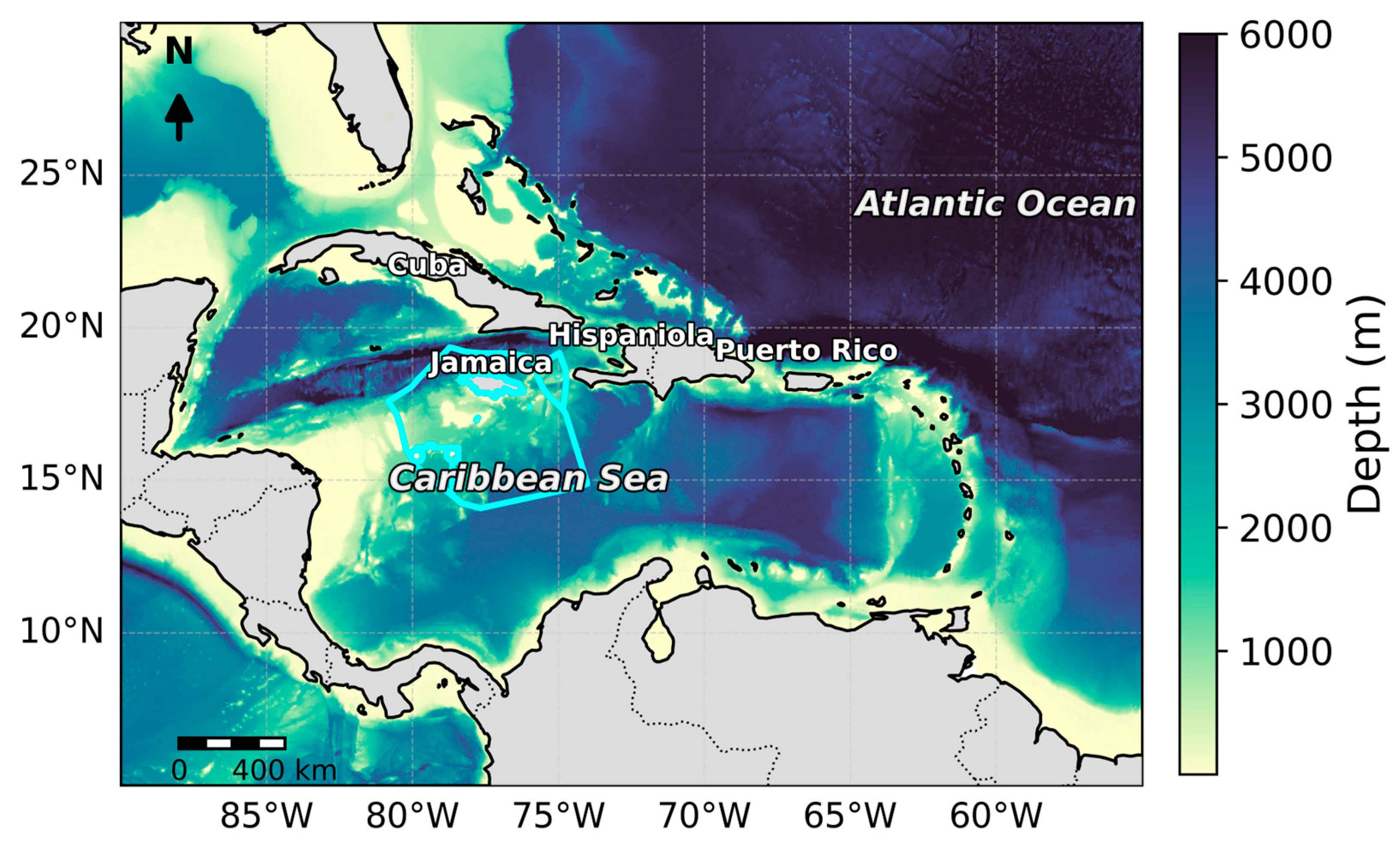
The study area encompasses Jamaica’s Exclusive Economic Zone (EEZ), located in the northwestern Caribbean Sea between approximately 17–18.5° N and 76–78° W, as shown in
Figure 1. Jamaica’s EEZ extends across regions characterized by steep continental slopes where water depths exceed 1000 m within relatively short distances from the coast, which is a favourable condition for OTEC deployment that minimizes intake pipe length and other engineering costs.
All spatial analyses were conducted using the WGS 84 geographic coordinate system and clipped to the Jamaica EEZ boundary obtained from the Flanders Marine Institute (VLIZ) Maritime Boundaries Geodatabase (version 12) to ensure consistency across datasets. A comprehensive summary of all geospatial datasets used in this study is provided in
Table 1.
2.2. Oceanographic Data
2.2.1. Thermal Gradient Assessment
Vertical ocean temperature data were obtained from the Copernicus Marine Environment Monitoring Service (CMEMS) Global Ocean Physics Reanalysis Product (GLORYS12V1) [
28] for 2023. Monthly mean temperature fields at approximately 20 m depth (representing warm surface water) and 1000 m depth (representing cold deep water) were extracted at 1/12° spatial resolution (~9 km).
The vertical thermal gradient (ΔT) was calculated for each grid cell as:
where ΔT is the vertical thermal gradient (°C), T
surface is the mean temperature at 20 m depth (°C), and T
deep is the mean temperature at 1000 m depth (°C).
Monthly ΔT values (12 months from 2023 data) were averaged to produce a representative annual mean field. Following established thresholds in the literature, regions with ΔT ≥ 20 °C were considered thermodynamically suitable for OTEC operation [
5,
8].
2.2.2. Ocean Currents
Surface ocean current velocity data (u and v components) were obtained from CMEMS Global Ocean Physics Reanalysis (GLO-MFC) for 2023 [
28] and processed to compute the mean current speed at the surface layer. Areas with excessively strong currents (e.g., >1.0 m/s) were flagged as potential engineering constraints due to increased structural loading on platforms and mooring systems.
2.2.3. Sea Surface Temperature Stability
Sea surface temperature (SST) anomaly data were derived from CMEMS Global Ocean Physics Reanalysis anomaly products for 2023 [
28] and averaged over a 12-month period to assess long-term SST variability. Lower SST variability indicates more stable thermal conditions, which is favourable for consistent OTEC performance.
2.3. Bathymetry and Distance-to-Deep-Water Analysis
Bathymetric data were obtained from the General Bathymetric Chart of the Oceans (GEBCO) 2024 [
29] global grid at 15 arc-second resolution. Depth values were processed to identify regions where water depths exceed 1000 m, which is the minimum depth generally required for effective cold-water intake.
To quantify engineering feasibility, a distance-to-deep-water metric was computed using a Euclidean distance transform that measures the horizontal distance from each grid cell to the nearest location with depth ≥1000 m. Shorter distances correspond to reduced intake pipe length, lower capital costs, and decreased pumping energy losses, which are critical factors for OTEC economic viability.
2.4. Infrastructure Proximity
Locations of major ports and electrical substations across Jamaica were compiled from multiple sources and manually digitized. Port locations were obtained from the Port Authority of Jamaica [
30], while electrical substation locations were compiled from Jamaica Public Service Company (JPS) infrastructure data and the Caribbean Atlas of Renewable Energy Resources (CATER) maintained by the University of the West Indies, Mona [
31].
All infrastructure point coordinates were digitized in a geographic information system (GIS) environment and visually verified using high-resolution satellite imagery from Google Earth Pro (2023–2024 imagery) and official infrastructure maps provided by the Port Authority of Jamaica and JPS. The final verified infrastructure dataset consists of 8 major ports and 41 electrical substations, and the complete list of coordinates used in the analysis is provided in
Supplementary Table S1 to ensure full reproducibility.
Two distance metrics were calculated using great-circle distance formulas:
- (1)
Distance to nearest port—relevant for construction logistics, equipment transport, and maintenance access
- (2)
Distance to nearest electrical substation—relevant for grid interconnection feasibility and transmission costs
These distance metrics were used as proxy indicators of deployment cost and operational accessibility. Sites located closer to existing infrastructure are expected to exhibit lower capital and operational costs, improving overall project feasibility.
2.5. Marine Protected Areas
Marine protected area (MPA) boundaries were obtained from the World Database on Protected Areas (WDPA), managed by the United Nations Environment Programme World Conservation Monitoring Centre (UNEP-WCMC) [
32]. All MPA polygons within and adjacent to Jamaica’s EEZ were merged and used to create an exclusion mask for the suitability analysis.
Grid cells falling within designated MPAs were excluded from site selection to reflect regulatory constraints and environmental conservation priorities. This approach assumes that OTEC development within MPAs would face significant barriers and potential ecological conflicts.
2.6. Coastal Population Density
Coastal population density data were obtained from WorldPop at an approximately 100 m spatial resolution [
33]. The global population raster was clipped to Jamaica’s land boundaries and a 50 km coastal buffer zone to capture population centres relevant to offshore OTEC deployment.
Population density values were extracted at each candidate OTEC site location and within surrounding coastal regions to assess proximity to electricity demand centres. Higher coastal population density near an OTEC site may indicate the following:
Greater local electricity demand and potential offtake capacity
Better justification for grid infrastructure investment
Larger workforce availability for construction and operations
Stronger socioeconomic rationale for project development
Population density was used as contextual validation rather than a suitability criterion. Unlike oceanographic or infrastructure factors, population proximity does not directly affect technical feasibility but provides an important context for interpreting site rankings and assessing energy access implications. Population data were not included in the PCA-based weighting scheme but were overlaid with top-ranked sites during results interpretation to evaluate their alignment with coastal communities and energy demand.
2.7. Hurricane Exposure Analysis
Historical tropical cyclone track data were obtained from the International Best Track Archive for Climate Stewardship (IBTrACS) dataset for the period 1995–2023, providing a 30-year climatology of storm activity in the Caribbean region [
27]. To ensure data quality and spatial consistency, only storm tracks containing at least two valid geographic coordinates were retained; track points with missing latitude or longitude values were excluded prior to analysis.
To reduce bias associated with uneven temporal sampling along storm trajectories, each hurricane track was densified by linear interpolation at 10 km intervals before spatial aggregation. This step ensures that long-track storms do not appear artificially sparse relative to shorter tracks and improves the representation of storm pathways across the study domain.
Storm track points passing within Jamaica’s Exclusive Economic Zone (EEZ) or within a 50 km buffer zone were extracted and accumulated onto a regular 0.083° grid to generate a spatial frequency density map. The EEZ boundary was verified against official maritime shapefiles.
To reduce small-scale noise and highlight coherent regional exposure patterns, the resulting storm-density grid was smoothed using a Gaussian filter. The exposure field was then normalized to a 0–1 scale, representing relative long-term hurricane exposure across the study area rather than absolute event counts. This metric was used as a contextual risk indicator rather than a hard exclusion criterion, as it provides information on historical storm exposure that can inform engineering design requirements (e.g., structural reinforcement, mooring specifications) and risk management planning.
Hurricane exposure was treated as a contextual risk indicator rather than a hard exclusion criterion. It was not included directly in the weighted suitability index but was evaluated for the highest-ranked candidate sites to contextualize their relative hazard profiles and to inform engineering considerations such as structural design and mooring requirements under extreme weather conditions.
2.8. Multi-Criteria Analysis and PCA-Based Weighting
Principal component analysis (PCA) is a statistical dimensionality reduction technique that transforms correlated variables into uncorrelated principal components ordered by explained variance [
21]. The first principal component (PC1) captures the direction of maximum variance and provides data-driven weights reflecting each variable’s importance in explaining spatial patterns. Unlike expert-weighted approaches such as the AHP, PCA derives weights directly from the data structure, reducing subjective judgement while maintaining interpretability.
All spatial criteria were normalized to a common dimensionless scale ranging from 0 (least suitable) to 1 (most suitable) using min–max normalization:
where x
norm is the normalized criterion value (dimensionless, 0–1 scale), x is the raw criterion value, x
min is the minimum value across all grid cells, and x
max is the maximum value across all grid cells.
For distance-based criteria (distance to deep water, distance to port, distance to substation), the normalized values were inverted such that shorter distances received higher suitability scores.
Principal component analysis (PCA) was applied to the normalized, stacked offshore criterion dataset to extract principal component loadings. Seven criteria were included in the PCA input matrix: thermal gradient, depth (bathymetry), distance to deep water (≥1000 m), SST anomaly, surface current speed, distance to port, and distance to substations.
The PCA loadings from the first principal component (PC1) were used to derive the offshore weighting scheme. PC1 represents the dominant spatial variance pattern in the multivariate criteria space, and its loading magnitudes quantify the relative contribution of each criterion to that dominant structure. To compute criterion weights, the absolute PC1 loading coefficients were normalized to sum to unity:
where w
i is the PCA-derived weight for criterion i, and L
i,PC1 is the signed loading of criterion i on PC1. Absolute loadings were used because the sign of a PCA loading reflects direction relative to the component axis rather than importance, whereas the magnitude reflects the strength of association with the dominant variance pattern. This ensures that criteria with strong influence on the dominant spatial variance are not downweighted due to arbitrary sign orientation, which is irrelevant for suitability weighting but critical for composite index construction. The composite offshore suitability index was then calculated as:
where S is the composite suitability score (dimensionless, 0–1 scale), w
i is the PCA-derived weight for criterion i (dimensionless), C
i is the normalized value of criterion i (dimensionless, 0–1 scale), and
The summation is performed over all seven criteria (i = 1 to 7)
Population density and hurricane exposure were explicitly excluded from the weighting calculation and used instead as post hoc contextual indicators to inform interpretation of the top-ranked sites.
This PCA-based approach reduces the subjectivity inherent in expert-assigned weighting schemes (e.g., AHP) while allowing the relative importance of each criterion to emerge directly from the spatial data structure. It also provides a transparent, reproducible framework that can be adapted to other regions or updated with new data.
Economic metrics were not included in the PCA weighting scheme and were evaluated separately to avoid circularity and to preserve the technical focus of the suitability analysis.
PCA was applied only to offshore analysis. Onshore site selection employed a constraint-based approach better suited to the discrete nature of coastal deployment feasibility (see
Section 2.10).
The first principal component (PC1) explained 59.0% of the total variance, while PC2 explained an additional 34.3%, with subsequent components each contributing less than 6% (
Table A1). Together, PC1 and PC2 account for approximately 93% of the variance in the multicriteria space.
The signed loading coefficients for each component are listed in
Table A2. To derive a data-driven set of weights for the suitability index, the absolute PC1 loadings were normalized so that they sum to one. The resulting PCA-based weights emphasize depth suitability (0.263), distance to substations (0.228), distance to port (0.215), and thermal gradient (0.210), while the SST anomaly (0.055) and surface current speed (0.030) have smaller contributions (
Table 2). The loading for distance to deep water is effectively zero in PC1, indicating strong redundancy with the other spatial criteria over Jamaica’s EEZ; this criterion was therefore retained in the conceptual framework but carries negligible weight in the final index. PC2 primarily captured secondary spatial contrasts between infrastructure proximity and oceanographic conditions and was therefore not used for weighting to avoid overemphasizing orthogonal, non-dominant variance patterns.
2.9. Identification of Priority Sites and Power Output Estimation
The final suitability map was used to identify the top five offshore locations within Jamaica’s EEZ [
34] based on the highest composite suitability scores. For each site, the mean ΔT and surface temperature were extracted from the oceanographic dataset.
Theoretical gross power output per unit area was estimated using the Carnot efficiency limit:
where T
hot is the absolute surface temperature (in Kelvin), η
Carnot is the theoretical Carnot efficiency (dimensionless), and ΔT is the thermal gradient between the surface and deep water (K). Temperatures were converted from Celsius to Kelvin (K = °C + 273.15) for this calculation.
Realistic net power output was then estimated by applying a typical OTEC system efficiency factor (approximately 2–3% of Carnot efficiency) to account for heat exchanger losses, pumping energy requirements, and auxiliary system demands, following established methodologies [
5,
13].
Power estimates were used as order-of-magnitude checks to confirm that the identified sites fall within realistic operational envelopes reported in the OTEC literature. These estimates represent theoretical thermal potential and indicative net electrical equivalents, rather than plant-scale design outputs, and were not used as ranking criteria. Detailed engineering design, including turbine selection, heat exchanger sizing, flow rates, and platform configuration, is beyond the scope of this study.
2.10. Onshore OTEC Site Identification and Constraint-Based Spatial Screening
Onshore OTEC candidate sites were identified using a constraint-based spatial screening and multicriteria ranking approach, distinct from the PCA-based offshore suitability analysis. Potential onshore plant locations were generated at regular intervals along the Jamaican coastline and shifted inland by 300 m to represent feasible coastal installation points. All spatial operations were performed in a projected coordinate system to ensure accurate distance calculations.
The primary feasibility constraint was defined as the minimum horizontal distance from each candidate site to deep water (≥1000 m), which serves as a proxy for cold-water intake pipe length and associated capital and pumping costs. Candidate sites exceeding a maximum allowable pipe length of 20 km were excluded from further consideration. This threshold reflects practical limits on pipe installation, pumping power, and cost escalation for first-generation OTEC systems. The set of applied constraints and their engineering justification are summarized in
Table A3.
The remaining onshore candidates were ranked using normalized distance-based indicators, including intake pipe length, distance to major ports, and distance to electrical substations. Intake pipe length was assigned the greatest importance, reflecting its dominant influence on both technical feasibility and capital cost, while port and electrical substation proximity were used as secondary refinement criteria among already feasible locations. To avoid spatial clustering and ensure geographic diversity, final onshore sites were selected using a minimum separation distance of 20 km along the coastline.
Unlike offshore site selection, PCA was not applied to onshore screening for the following methodological reasons:
Discrete vs. continuous spatial patterns: PCA is most effective when analyzing continuous spatial variation across multiple correlated factors. Offshore site suitability involves gradual transitions in thermal gradients (21–25 °C), bathymetric slopes, surface current speeds, and infrastructure distances, creating multivariate spatial patterns where many criteria vary simultaneously and interdependently. In contrast, onshore OTEC feasibility is determined primarily by a discrete, binary constraint: whether a coastal location can access ≥1000 m depth within a feasible horizontal distance. Most of Jamaica’s coastline fails this threshold entirely due to gentle bathymetric slopes; only specific segments with steep nearshore gradients qualify.
Dominant single criterion: While offshore analysis benefits from integrating multiple criteria of comparable importance (see
Table 2), onshore feasibility is overwhelmingly dominated by intake pipe length, which accounts for 40–60% of total capital costs and determines technical viability. Secondary factors (port distance, grid distance) serve as refinements rather than coequal drivers of suitability. Applying PCA to such an imbalanced criterion set would artificially inflate the importance of minor factors or require arbitrary preweighting that negates PCA’s objectivity advantage.
Limited spatial domain: PCA derives meaningful weights from spatial variance across large analysis domains. The offshore analysis covered Jamaica’s entire EEZ (~235,000 km2) with thousands of candidate grid cells, whereas onshore screening yields fewer than 50 viable coastal segments once the primary constraint is satisfied. With limited spatial heterogeneity among feasible sites, PCA would not produce stable or interpretable weights.
Transparency and interpretability: For onshore deployment, stakeholders and decision-makers benefit from a transparent ranking based on the dominant cost driver (pipe length) with clearly stated secondary considerations. Constraint-based screening followed by simple additive ranking maintains interpretability and allows nontechnical stakeholders to understand why specific sites were selected.
This methodological distinction reflects fundamental differences in the underlying site-selection problem rather than analytical preference. The approach adopted for each configuration (PCA for offshore, constraint-based for onshore) is tailored to the spatial characteristics and feasibility determinants specific to that deployment mode.
2.11. Economic Screening Framework
A scenario-based economic screening model was developed to compare the relative cost performance of the highest-ranked offshore and onshore OTEC candidate sites. To avoid overly optimistic projections for a first-of-a-kind (FOAK) system, the model was calibrated to capital expenditure (CAPEX) benchmarks reported by Vega (2023) [
35]. In Vega’s archival scenario (Chapter 2), historical system-level OTEC CAPEX estimates are reported in 2023 USD after inflation adjustment using the U.S. Manufacturing Price Index (MPI), where MPI is an industrial price index used to convert costs from a historical base year to a common-year dollar basis. In this study, the MPI adjustment itself was not recomputed; instead, Vega’s MPI-adjusted 2023 USD CAPEX values were adopted as external reference anchors for calibration.
2.11.1. CAPEX Calibration and Scenarios
Rather than relying on a single deterministic cost assumption, four economic scenarios were evaluated to reflect different levels of cost maturity:
This scenario is anchored to Vega’s archival CAPEX benchmark for a ~10 MW floating closed-cycle OTEC configuration reported in Chapter 2 as approximately 41,756 USD/kW (2023 USD, MPI-adjusted) [
35]. To preserve the spatial structure of the site-screening cost model while aligning the overall magnitude with Vega’s benchmark, a uniform calibration factor was applied as follows. The calibration was performed by first computing site-specific CAPEX values using the proxy-based screening model for all offshore candidate sites. The average offshore CAPEX obtained from this model was then compared with Vega’s MPI-adjusted benchmark value for a 10 MW floating closed-cycle OTEC plant. A uniform scaling factor was applied so that the mean offshore CAPEX produced by the screening model matched the benchmark value reported by Vega.
The same scaling factor was subsequently applied to onshore candidate sites to preserve relative cost differences while ensuring a consistent comparison between configurations. This approach maintains spatial cost differentiation driven by intake pipe length, water depth, and export distance while anchoring absolute costs to realistic, inflation-adjusted reference values.
This calibration procedure allows the economic screening results to remain conservative, transparent, and directly comparable to published OTEC feasibility studies while avoiding overconfidence associated with uncalibrated proxy-based cost models.
This scenario is based on Vega’s [
35] current cost estimates derived from 2023 vendor quotations for major subsystems (Chapter 3), assembled into a 10.6 MW CC-OTEC plant configuration (Chapter 4). These values represent a preliminary design (pre-EPC) cost level, reflecting component prices prior to detailed site-specific engineering, procurement, and risk allocation.
To account for the systematic cost escalation observed when moving from preliminary design to final engineering, procurement, and construction, +30% and +50% uplifts were applied to the current vendor-based scenario, consistent with the offshore engineering experience documented by Vega [
35]. These scenarios bound the likely range of realized CAPEX for first-generation OTEC deployments.
Key assumptions: All scenarios assume a 10 MW-net plant scale, identical financial parameters (lifetime, discount rate, and capacity factor), and a single uniform calibration factor within each scenario. Spatial CAPEX differences between sites are retained through proxy-based terms (e.g., intake pipe length or intake-depth proxy, export distance to shore, and depth-related platform/mooring requirements), rather than through detailed engineering design.
2.11.2. LCOE Calculation
The Levelized Cost of Electricity (LCOE) was computed as:
where CRF is the capital recovery factor, and AEP is the annual energy production. All scenarios assume a 10 MW-net plant capacity, 25-year operational lifetime, 8% real discount rate, and 0.90 capacity factor, consistent with archival OTEC availability benchmarks. Operating expenditure (OPEX) was expressed as a fixed fraction of CAPEX, with higher values applied to offshore configurations to reflect marine platform operation and maintenance cost maturity.
2.11.3. Comparison Benchmarks
To contextualize the results, LCOE estimates were compared post hoc against Jamaican residential electricity price benchmarks derived from a 2023 Jamaica Public Service (JPS) customer invoice. Two reference prices were used: (i) a variable energy-only price (≈0.31 USD/kWh) incorporating tiered energy charges, fuel charges, IPP variable charges, and foreign-exchange adjustments; and (ii) an all-in average retail price (≈0.33 USD/kWh) including fixed customer charges. These benchmarks provide a market-based reference for evaluating the present economic gap between OTEC configurations and Jamaica’s fossil-fuel-dominated electricity system.
3. Results
3.1. Spatial Distribution of Thermal Gradient (ΔT)
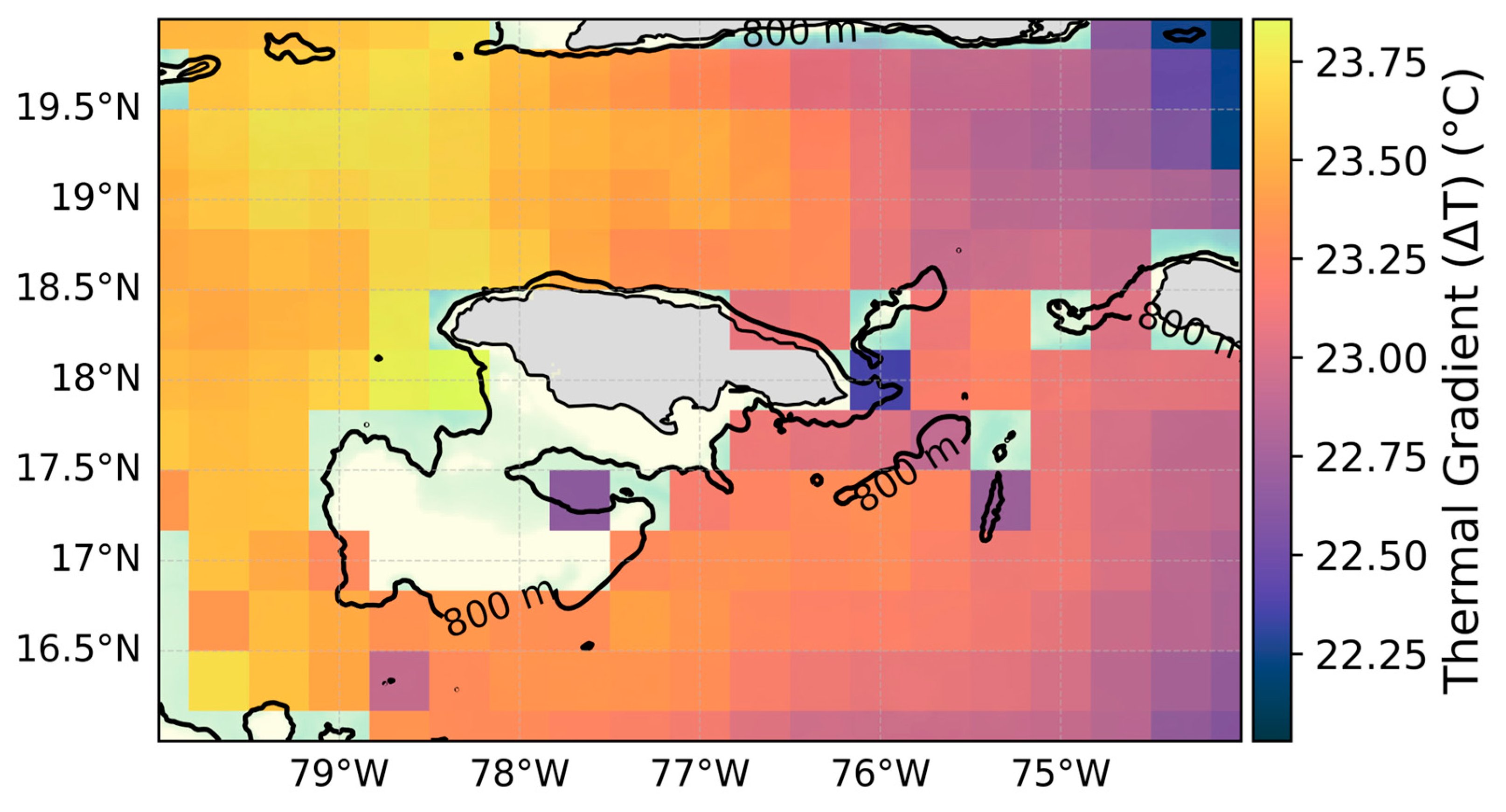
The spatial distribution of the annual mean thermal gradient (ΔT) between surface waters (18–20 m depth) and deep waters (1000 m depth) around Jamaica is presented in
Figure 2. Throughout the Jamaican EEZ, ΔT values consistently exceed 20 °C, the minimum operational threshold required for closed-cycle OTEC systems.
The highest ΔT values (23–24 °C) occur along the western and northwestern offshore regions, while slightly lower but still viable gradients (21–23 °C) are observed toward the eastern EEZ. Seasonal variability is minimal, indicating a stable year-round thermal resource suitable for baseload power generation. These results confirm Jamaica’s strong thermodynamic potential for OTEC deployment.
3.2. Bathymetric and Engineering Constraints
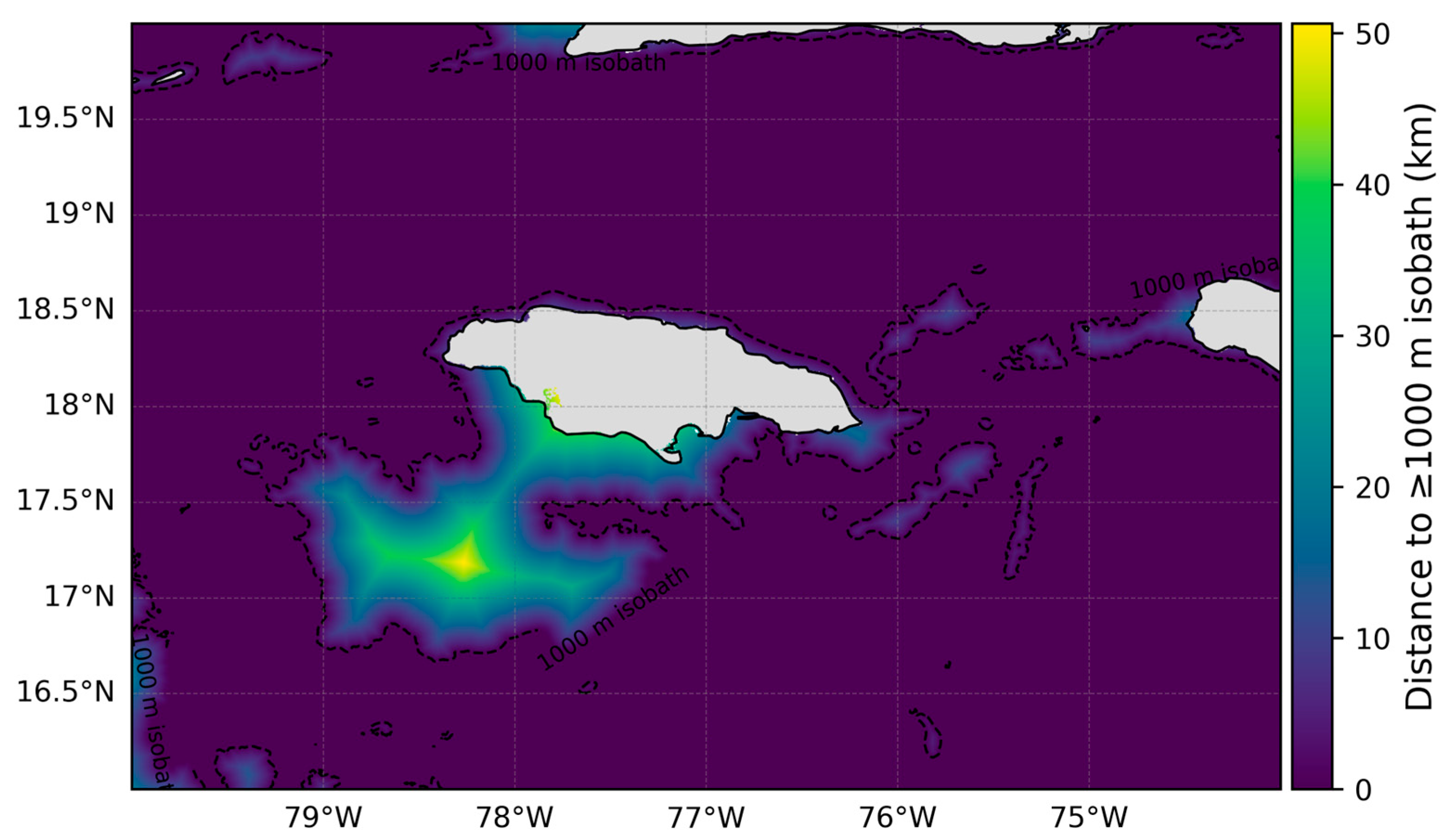
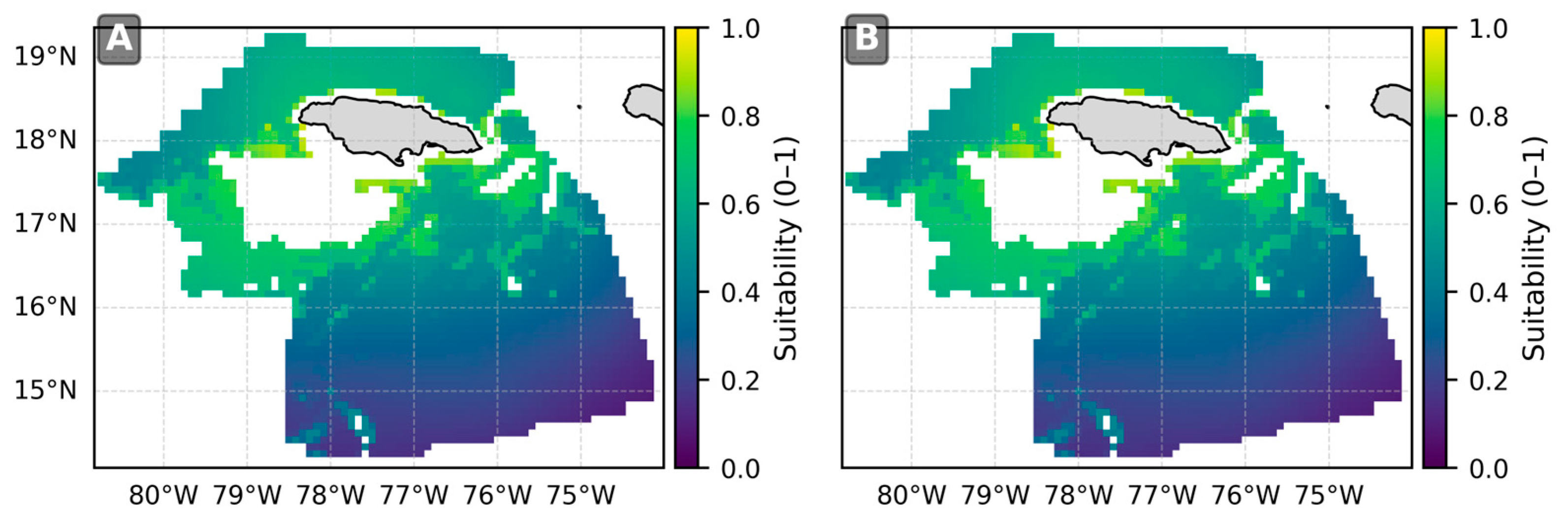
Bathymetric analysis reveals that depths of 800–1500 m, considered optimal for OTEC cold-water intake, are accessible within 5–15 km of the Jamaican coastline (
Figure A1,
Appendix A). This proximity is most pronounced along the northwestern and western margins of the EEZ, significantly reducing the cold-water pipe length and associated capital costs.
Regions with shallow bathymetry (<700 m) or excessive depth (>2000 m) were penalized in the suitability analysis due to engineering challenges and economic constraints. When combined with the thermal gradient distribution, bathymetry emerges as a critical spatial factor determining feasible OTEC deployment zones.
3.3. Infrastructure Proximity Analysis
Distance-based analyses were conducted for three key infrastructure components: (1) depth (bathymetry) access (≥1000 m isobath), (2) major ports, and (3) electrical substations.
The highest suitability scores occur in offshore regions where deep water is accessible at short horizontal distances and where proximity to ports and grid infrastructure facilitates construction logistics and power transmission. Western Jamaica exhibits particularly favourable conditions, combining steep bathymetry with access to major ports and substations, resulting in cumulative geometric and logistical advantages.
Although port and substation locations are concentrated along the coastline and therefore exhibit modest independent spatial ranges, these variables co-vary strongly with bathymetric and thermal conditions across the EEZ. As a result, infrastructure proximity loads strongly on the dominant principal component (PC1), which explains 59% of total variance, and thus contributes substantially to the PCA-derived weighting despite limited standalone variability. In this context, distance-to-port and distance-to-substation act primarily as amplifiers of favourable offshore geometry rather than independent discriminators.
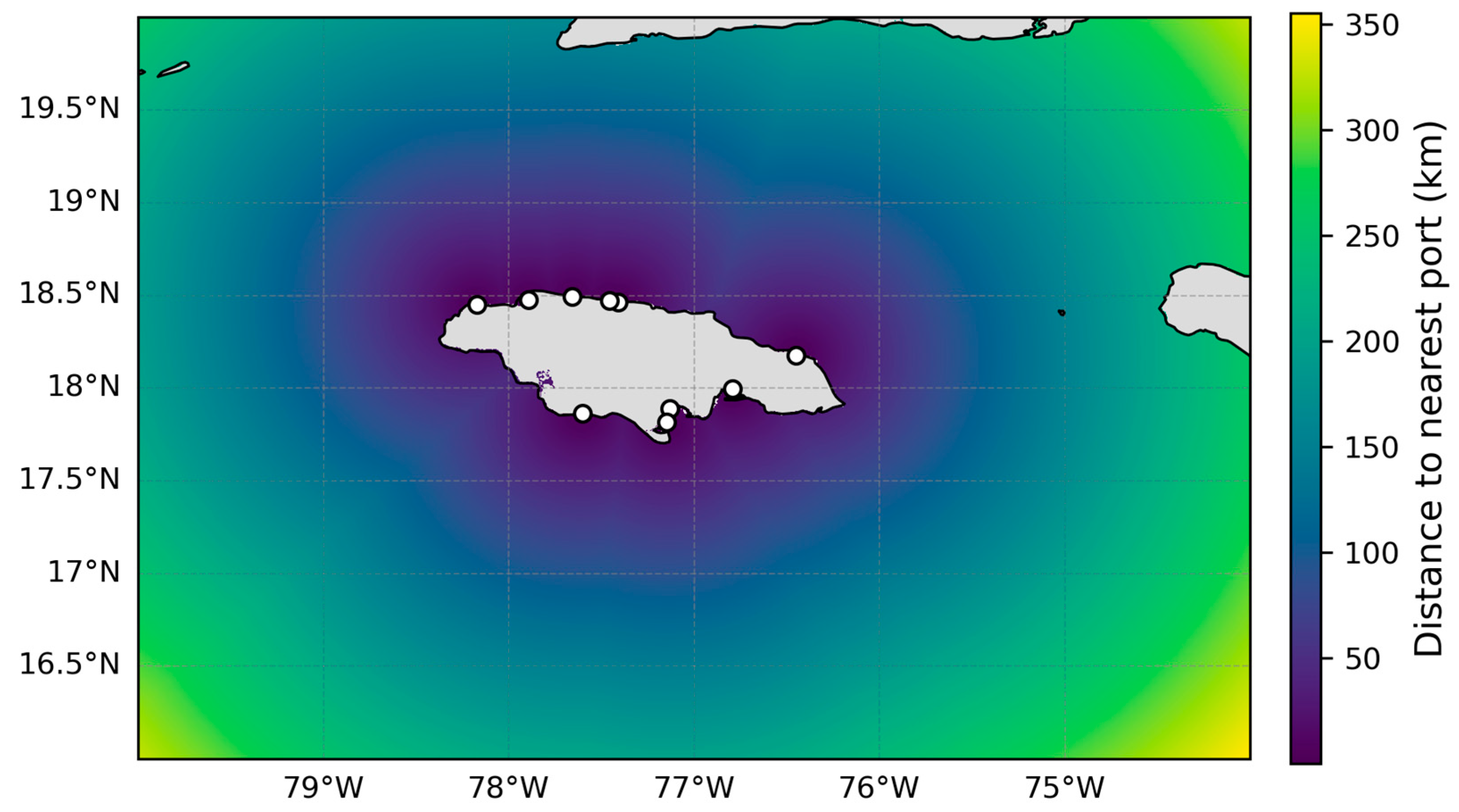
For completeness, the distance-to-port map is included in the
Appendix A,
Figure A2, while the distance-to-substation layer is retained numerically in the analysis but not presented as a separate figure due to its visual similarity across the study area.
3.4. Multi-Criteria Site Suitability Assessment
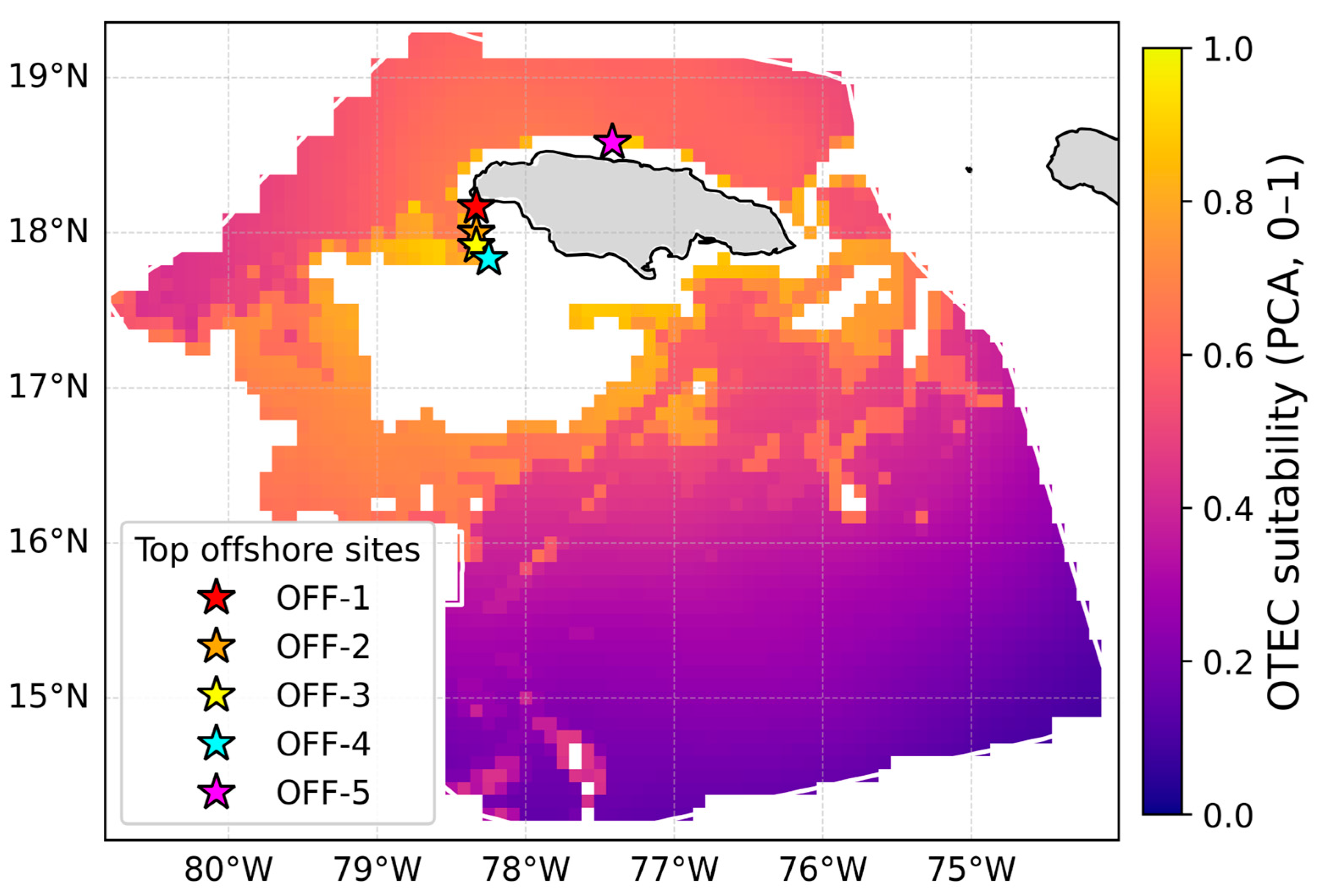
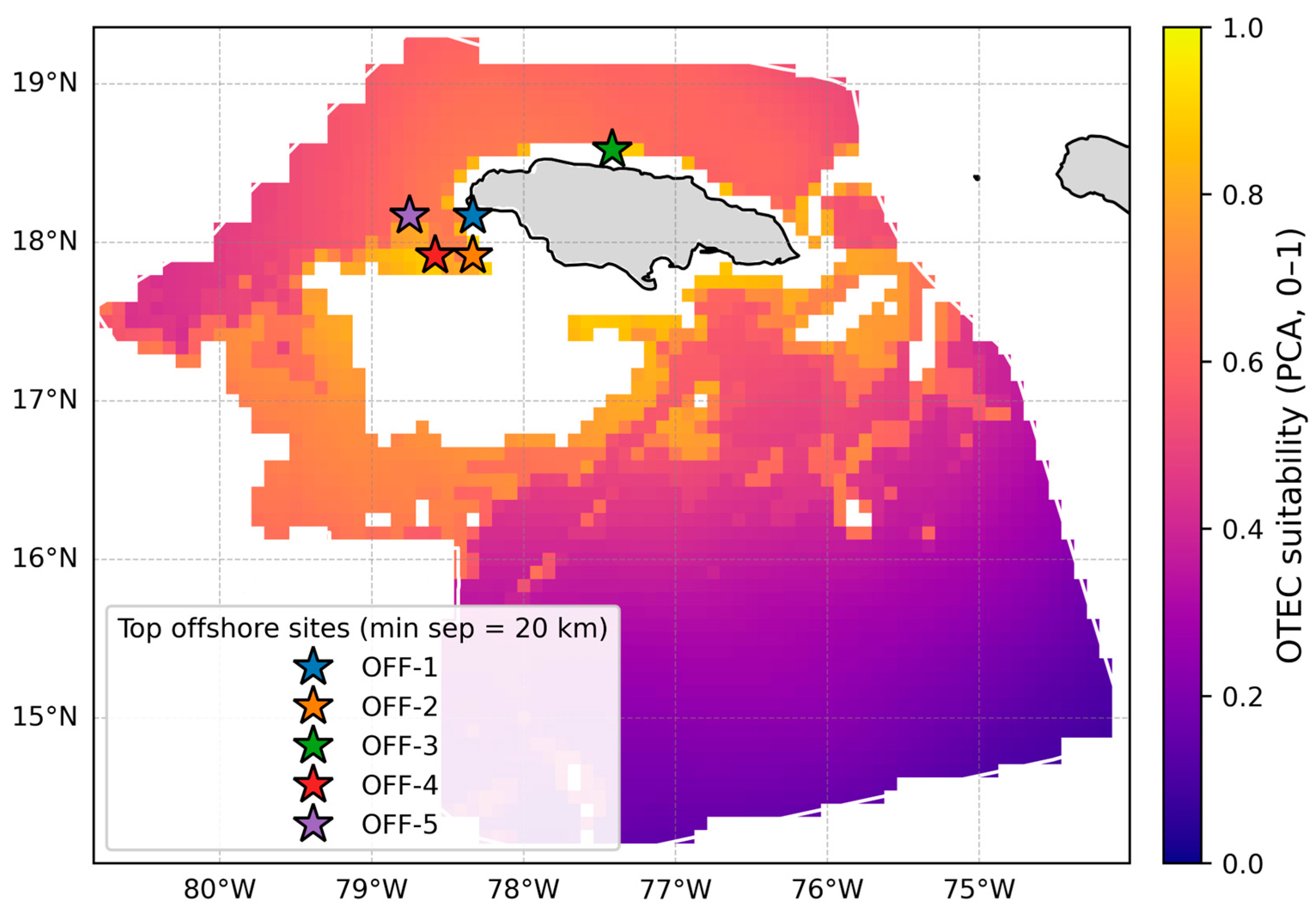
The PCA-derived data-driven weights for site-selection criteria were applied to reduce the subjectivity inherent in expert-based weighting schemes. The PCA-derived suitability map in
Figure 3 identifies several high-scoring offshore zones, primarily concentrated along the western and southwestern EEZs.
The top five candidate sites identified through the PCA-based suitability index using weights shown in
Table 2 are summarized in
Table 3. These sites exhibit a consistent combination of high ΔT, favourable bathymetry, low surface current intensity, proximity to infrastructure, and stable sea surface temperatures.
Table 2.
Principal component analysis (PCA) loadings and derived weights for offshore OTEC suitability criteria. Higher weights indicate greater spatial variability and a stronger influence on site differentiation.
Table 2.
Principal component analysis (PCA) loadings and derived weights for offshore OTEC suitability criteria. Higher weights indicate greater spatial variability and a stronger influence on site differentiation.
| Criterion | PCA-Based Weight | Interpretation |
|---|
| Distance to electrical substation | 22.80% | Grid connection feasibility |
| Depth (bathymetry) | 26.29% | Water depth at site location |
| Distance to port | 21.45% | Construction logistics and access |
| Thermal gradient (ΔT) | 20.97% | Thermodynamic potential |
| SST anomaly (stability) | 5.45% | Temperature variability |
| Ocean current speed | 3.03% | Structural loading |
| Distance to deep water (≥1000 m) | 0.00% | Already captured by depth criterion |
Table 3.
Characteristics of the five highest-ranked offshore OTEC sites identified through PCA-based multicriteria analysis. Sites are ordered by composite suitability score (0–1 scale). Most sites are located in western Jamaica waters where favourable combinations of thermal, bathymetric, and infrastructure conditions occur.
Table 3.
Characteristics of the five highest-ranked offshore OTEC sites identified through PCA-based multicriteria analysis. Sites are ordered by composite suitability score (0–1 scale). Most sites are located in western Jamaica waters where favourable combinations of thermal, bathymetric, and infrastructure conditions occur.
| Site | Coordinates | Water Depth (m) | Thermal Gradient (ΔT) (°C) | Coastal Population (20 km Radius) | PCA Suitability Score |
|---|
| OFF-1 | 18.17° N, 78.33° W | 1245 | 24.22 | 34,552 | 0.933 |
| OFF-2 | 18.00° N, 78.33° W | 1245 | 24.19 | 0 | 0.914 |
| OFF-3 | 17.92° N, 78.33° W | 1452 | 24.17 | 0 | 0.903 |
| OFF-4 | 17.83° N, 78.25° W | 1245 | 24.14 | 0 | 0.900 |
| OFF-5 | 18.58° N, 77.42° W | 1452 | 23.86 | 37,186 | 0.897 |
Unlike onshore facilities, offshore OTEC platforms are not constrained by land availability or coastal land-use conflicts and can be deployed in close proximity without mutual interference. The offshore selection, therefore, did not initially impose a minimum separation distance, as clustering of high-suitability sites reflects genuine bathymetric and logistical advantages rather than redundancy. In particular, the western and northwestern Jamaican EEZ contains a narrow corridor where the 1000 m isobath lies within 8–12 km of shore, minimizing cold-water intake length and export cable distance. This produces a spatially concentrated suitability maximum that is physically meaningful rather than an artefact of the ranking procedure. Offshore OTEC development typically proceeds in modular arrays (5–20 MW units), for which close spacing is common practice, provided navigational corridors are maintained.
To assess the robustness of site ranking to spatial clustering, an additional sensitivity analysis was performed in which a minimum separation distance of 20 km was imposed between offshore sites. The resulting spacing-constrained site list is provided in
Appendix A Table A4 and
Figure A3. The dominant suitability corridor remains unchanged, and all alternative sites remain within the same western and northwestern EEZ region, confirming that clustering does not alter the study’s conclusions.
3.5. Hurricane Exposure Assessment
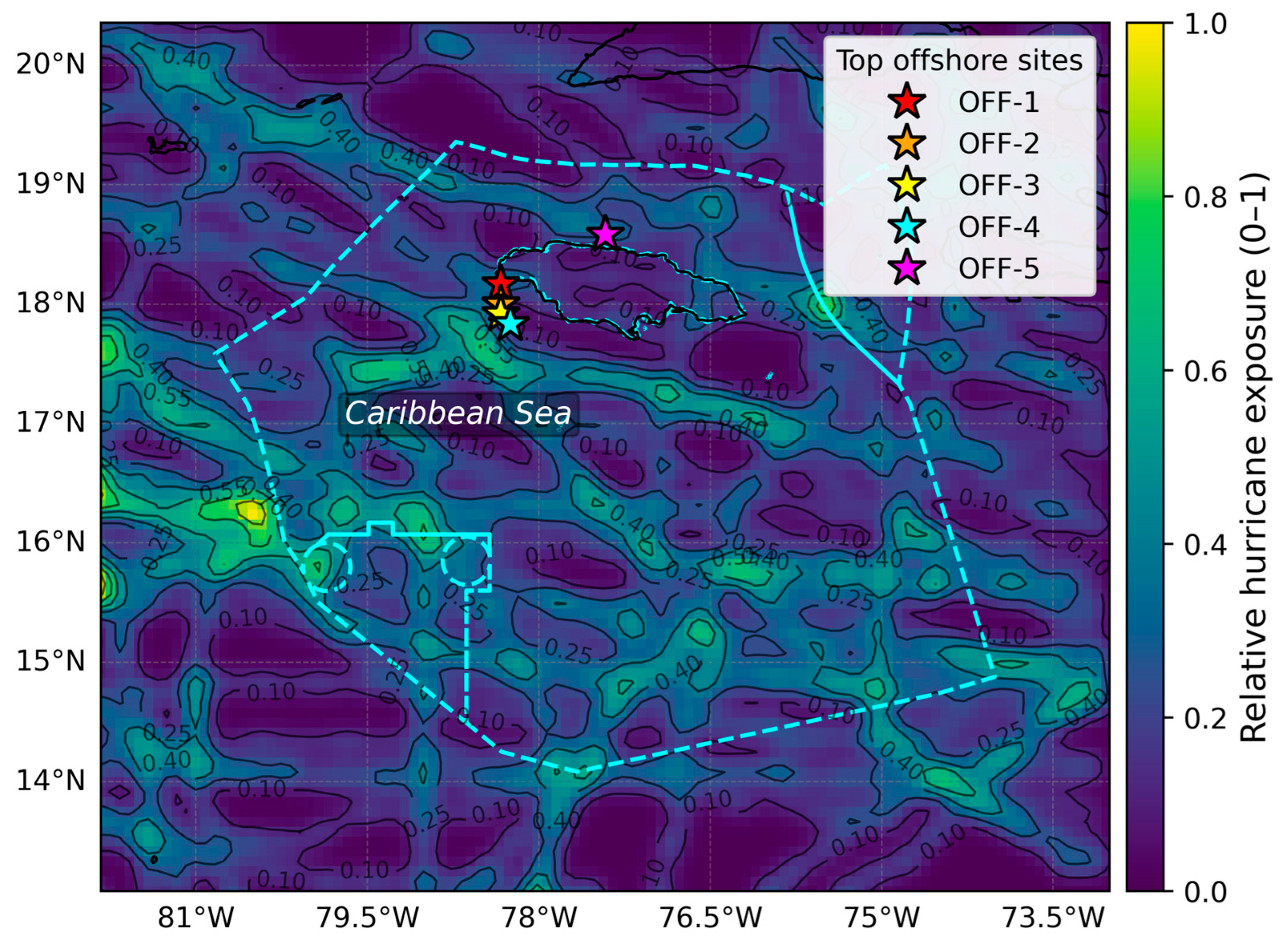
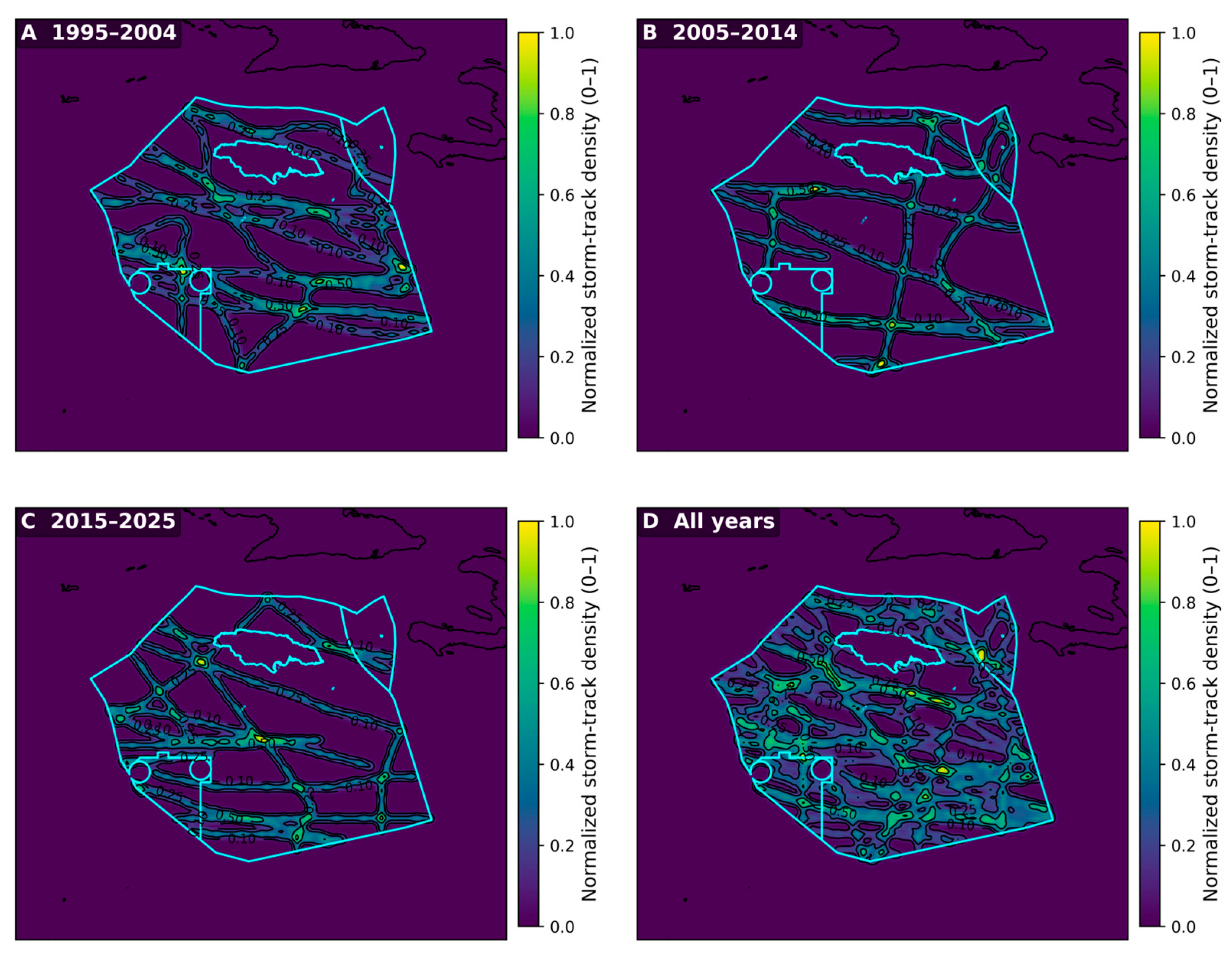
Historical hurricane exposure was evaluated using storm track data from the International Track Archive for Climate Stewardship (IBTrACS) from 1995 to 2025. Storm track points intersecting Jamaica’s EEZ and a surrounding 50 km buffer were extracted and spatially aggregated to generate a normalized storm-track density heatmap representing relative long-term hurricane exposure (
Figure 4).
Hurricane exposure across the Jamaican EEZ is spatially heterogeneous, with localized zones of elevated storm-track density interspersed with lower-exposure regions. The top five PCA-selected offshore OTEC sites exhibit site-specific normalized exposure values ranging from 0.13 to 0.39, indicating moderate but non-negligible exposure. Sites OFF-2, OFF-3, and OFF-4 are located in relatively lower-exposure zones (≈0.13), whereas OFF-1 and OFF-5 are situated in moderately exposed areas (0.27–0.33).
To quantify whether hurricane exposure constrains the highest-ranked candidate sites, exposure values were evaluated for the top 10 PCA-ranked offshore locations. The mean normalized hurricane exposure of the top 10 sites is 0.348 (median 0.293, range 0.095–0.712), compared with an EEZ-wide mean and median of 0.284 and 0.262, respectively. These results indicate that top-ranked sites are not concentrated exclusively in the highest-exposure zones and that hurricane exposure acts as a moderate, site-dependent risk factor rather than a binding spatial constraint at the screening stage.
Decadal storm-track density maps were also produced for the periods 1995–2004, 2005–2014, and 2015–2025 to assess potential temporal shifts in hurricane pathways (
Figure 5). While interdecadal variability in storm trajectories is evident, no systematic migration toward the top-ranked candidate regions was observed. Accordingly, hurricane exposure was treated as a contextual risk indicator rather than an exclusion criterion, consistent with modern OTEC design practices that incorporate structural and operational resilience for extreme weather events.
3.6. Marine Protected Area Constraints
Marine protected areas (MPAs) were identified using the World Database on Protected Areas (WDPA) for Jamaica. Offshore suitability maps were masked to exclude all legally designated marine protected zones, and the ranking procedure was repeated to assess the sensitivity of site selection to regulatory constraints.
Comparison of results before and after MPA masking shows no overlap between the top 10 offshore sites and WDPA marine protected areas (0/10 sites; 0%), and all top 10 sites were retained after masking (10/10). The spatial distribution and relative ranking of the highest-scoring candidate sites remain unchanged (
Figure A4,
Appendix A), indicating that MPA constraints do not materially restrict the most suitable offshore OTEC deployment locations identified in this study.
3.7. Order-of-Magnitude Theoretical Power Potential
Theoretical OTEC power output was estimated for the top five PCA-selected sites using site-specific thermal gradients (ΔT) and a simplified closed-cycle Rankine approximation. This analysis was conducted to contextualize the magnitude of the thermal resource and does not represent a detailed plant design.
First, the available thermal power was estimated from the temperature difference between surface and deep waters, assuming idealized heat extraction over a representative intake flow area. The resulting gross thermal power potential at each site is on the order of several gigawatts, reflecting the large-scale oceanic heat reservoir present in Jamaican waters.
To derive indicative usable power levels, a conservative net conversion efficiency of 2–3% of the Carnot limit was applied, consistent with reported closed-cycle OTEC performance after accounting for pumping power, heat exchanger losses, and auxiliary loads [
5,
13]. Under these assumptions, the theoretical net electrical-equivalent power is approximately 240–250 MW per site.
These values represent upper-bound, site-scale theoretical potential, not deployable plant capacity. In practice, OTEC development would proceed using modular units of 5–20 MW per plant, consistent with existing pilot projects and engineering studies. Power estimates are therefore presented for contextual comparison only and were not used in site ranking or economic evaluation
3.8. Coastal Population Distribution Around Offshore Candidates
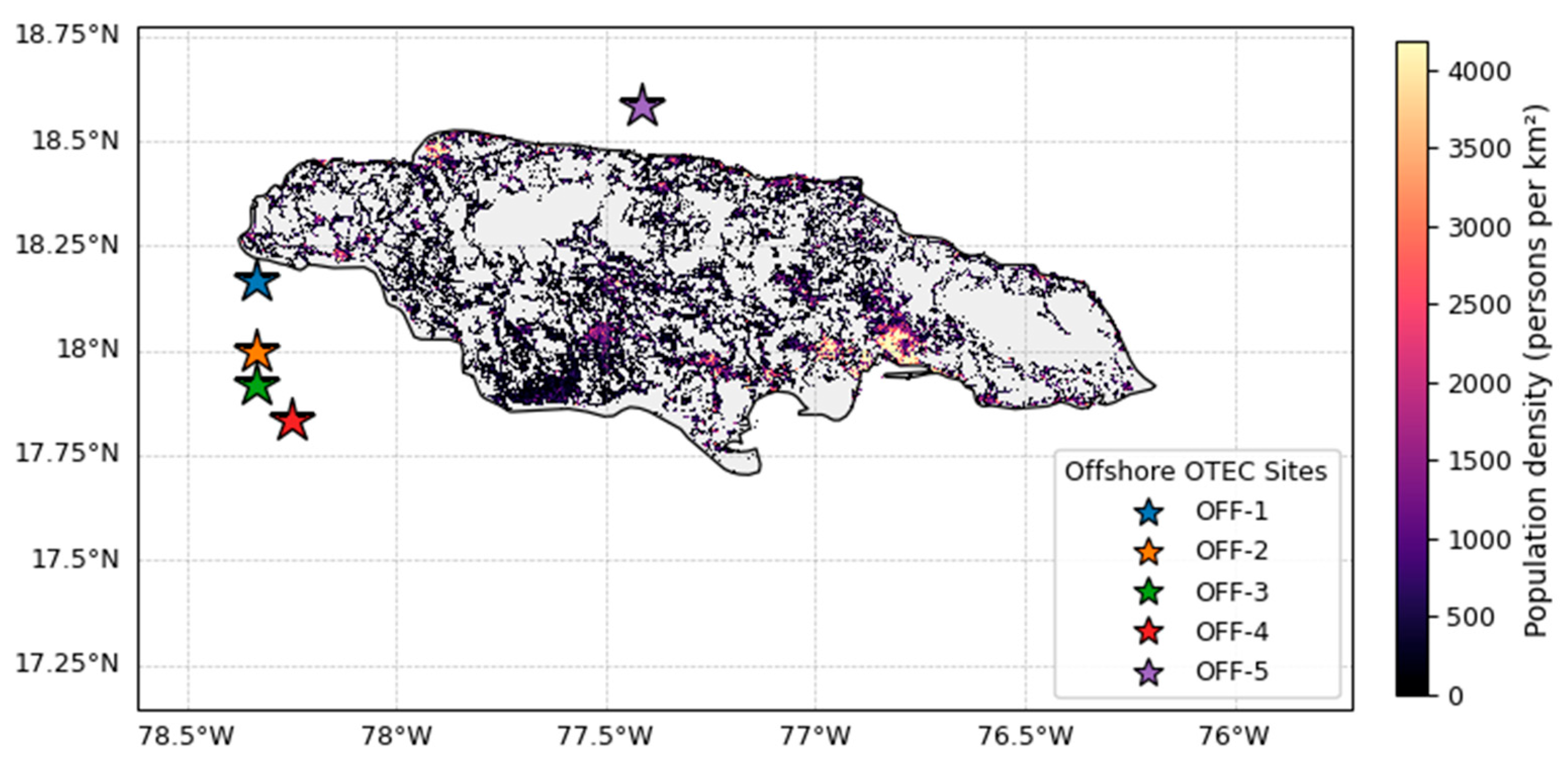
Coastal population density was evaluated to quantify the spatial relationship between technically suitable OTEC sites and nearby coastal population centres. The population within a 20 km radius of each candidate site was extracted from WorldPop data, and the resulting values are summarized in
Appendix A (
Table A5/
Figure A5). The analysis shows heterogeneous population proximity among offshore sites. Sites OFF-1 (34,552 people within 20 km) and OFF-5 (37,186 people) are located adjacent to moderately populated coastal regions along the western and northern coastlines, respectively. In contrast, Sites OFF-2, OFF-3, and OFF-4 are situated in remote offshore areas with negligible coastal population proximity (0 people within 20 km), reflecting their location along the steep continental slope away from major settlements. For onshore candidates, population proximity was not separately quantified, as these sites are inherently positioned within or adjacent to populated coastal corridors.
3.9. Onshore OTEC Site Screening Results
Onshore OTEC candidate sites were evaluated using a constraint-based spatial screening approach focused on engineering feasibility and infrastructure accessibility. Potential coastal sites were generated along the Jamaican coastline and screened based on horizontal distance to deep water (≥1000 m), used as a proxy for cold-water intake pipe length.
Following the initial screening, a limited number of coastal locations satisfied the maximum allowable pipe length criterion, primarily along the northern coast of Jamaica. These regions benefit from the nearness of steep bathymetric gradients to the shoreline, enabling comparatively short intake pipelines.
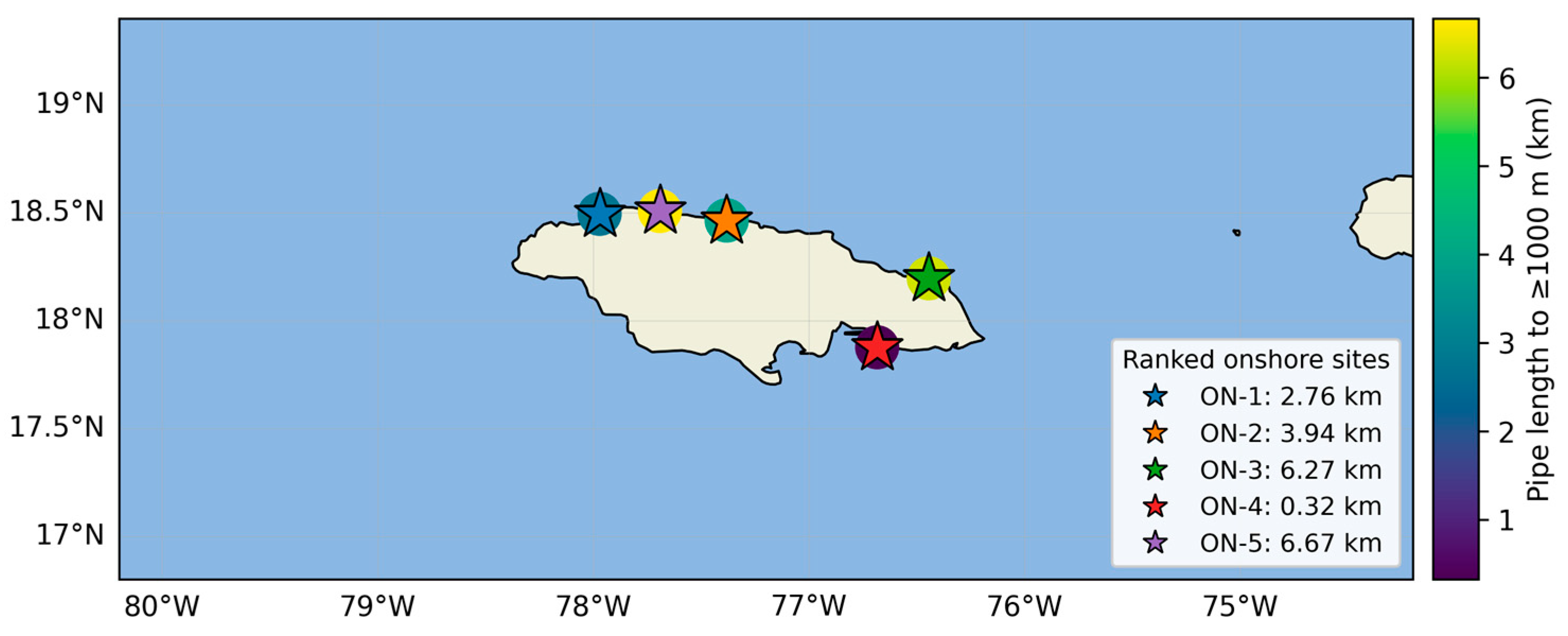
The top five onshore candidate sites identified through the ranking process are shown in
Figure 6 and summarized in
Table 4. These sites exhibit intake pipe length proxies ranging from approximately 0.32–6.67 km, indicating substantially lower offshore pipeline requirements compared to fully offshore configurations. Spatial separation criteria ensured that selected sites represent distinct coastal locations rather than clustered segments of the shoreline.
Unlike offshore site selection, principal component analysis was not applied to onshore screening, as feasibility is governed by discrete engineering constraints rather than continuous multivariate spatial patterns. Instead, site ranking was driven primarily by intake pipe length, with secondary consideration given to proximity to ports and electrical substations. The resulting onshore candidates represent locations where OTEC deployment may benefit from simplified grid connections, reduced offshore infrastructure, and improved access for construction and operations.
From an economic perspective, the identified onshore sites are characterized by shorter intake pipeline requirements and improved proximity to existing infrastructure relative to offshore alternatives. These factors are expected to reduce capital and operational costs associated with cold-water intake systems, grid interconnection, and maintenance. While detailed cost estimation is beyond the scope of this study, the onshore screening results highlight locations where economic barriers to OTEC deployment may be comparatively lower.
4. Discussion
4.1. OTEC Resource Potential Around Jamaica
The results confirm that Jamaica possesses a strong and spatially stable thermal resource suitable for OTEC development. The annual mean thermal gradients exceed the commonly cited 20 °C operational threshold across the entire EEZ, with particularly favourable conditions in the western and northwestern regions. The limited seasonal variability observed in ΔT further supports the suitability of OTEC as a baseload renewable energy option, distinguishing it from intermittent sources such as wind and solar.
These findings are consistent with previous assessments of tropical and subtropical OTEC potential in the Caribbean region [
3,
11] and reinforce Jamaica’s geographic advantage, where steep bathymetry allows access to deep cold water at relatively short horizontal distances from the coastline. Compared to other Caribbean OTEC assessments, Jamaica’s resource characteristics are highly favourable. Hall et al. [
12] identified optimal offshore sites around Barbados with ΔT values of 22–24 °C and distances to 1000 m depth of 8–15 km—comparable to Jamaica’s western offshore sites. However, Jamaica’s coastline length (~1022 km) provides substantially more spatial options for onshore deployment than Barbados’s smaller perimeter (~97 km), potentially enabling distributed coastal generation rather than centralized offshore facilities.
Similarly, Brecha et al. [
11] identified Jamaica as a high-priority Caribbean location for OTEC alongside Martinique, Cuba, and Puerto Rico, citing favourable thermal gradients and bathymetry. The present study confirms these regional-scale assessments and provides the site-specific spatial resolution needed for deployment planning that was previously lacking for Jamaica.
4.2. PCA-Derived Weights and Spatial Variability
The PCA-derived criterion weights reflect the dominant sources of spatial variability across Jamaica’s EEZ rather than a priori assumptions about relative importance. Depth (bathymetry) emerged as the highest-weighted factor (26.29% of composite score), followed by thermal gradient (
Table 2).
This result is both statistically appropriate and physically meaningful. While the thermal gradient is a fundamental requirement for OTEC operation, ΔT values throughout Jamaica’s EEZ consistently exceed the 20 °C operational threshold with relatively limited spatial variation (21–25 °C). In contrast, the depth (bathymetry) conditions vary dramatically, with values from as little as 3–5 km along steep northwestern slopes to 15–30 km in other regions, thereby directly translating to order-of-magnitude differences in cold-water pipe costs.
The high PCA loading for depth, therefore, reflects its role as the primary discriminator between economically viable and marginal sites in Jamaica’s context. This differs from regions where thermal gradients vary more substantially, where ΔT would naturally receive higher weighting. For example, in global OTEC resource assessments covering both tropical and subtropical zones, thermal gradient variability has become a primary discriminator [
7]. The PCA framework correctly identifies that in Jamaica, where all sites possess adequate thermal resources, bathymetric accessibility becomes the limiting factor for deployment feasibility.
Distance to deep water (1000 m isobath), by contrast, received a near-zero weight (0.00%) in the PCA results because candidate offshore locations were pre-screened to ensure access to deep water, resulting in negligible spatial variability for this criterion within the evaluation matrix. This variable, therefore, functions as a feasibility filter rather than a discriminating factor, while bathymetric depth captures the continuous engineering constraints relevant to platform deployment and pipeline design.
This outcome demonstrates a key advantage of data-driven weighting [
21]: the relative importance of criteria emerges from regional conditions rather than generic assumptions. For island nations with different oceanographic characteristics (e.g., more variable ΔT, less steep bathymetry), PCA would generate correspondingly different weights reflecting those regions’ distinctive spatial patterns.
4.3. Offshore Site Suitability and Engineering Constraints
The offshore suitability analysis highlights the combined importance of depth (bathymetry), distance to deep water, and infrastructure proximity in determining feasible OTEC deployment zones. Regions where depths of 800–1500 m occur within short distances of the coast consistently rank highest, as reduced intake pipe length directly lowers capital costs and pumping losses.
While the PCA provides a data-driven method for weighting spatial criteria, the resulting high-suitability offshore zones are physically intuitive: they align with areas where thermal, bathymetric, and logistical conditions are simultaneously favourable. Importantly, historical hurricane exposure and marine protected areas do not substantially overlap with the highest-ranked offshore sites, suggesting that regulatory and hazard-related barriers are manageable rather than prohibitive. This finding contrasts with some regional renewable energy assessments that identified hurricane risk as a primary barrier to offshore infrastructure in the Caribbean [
24], suggesting that site-specific analysis can identify lower-exposure zones within hurricane-prone regions.
Hurricane Risk and Engineering Resilience
Hurricane exposure analysis reveals spatially heterogeneous patterns across Jamaica’s EEZ, with top-ranked offshore sites exhibiting moderate exposure levels (0.13–0.39 normalized scale). Sites OFF-1 (0.33) and OFF-5 (0.27) show slightly higher historical storm densities than OFF-2, OFF-3, and OFF-4 (0.13). However, these moderate exposure values do not preclude OTEC development but rather inform engineering design specifications. Contemporary OTEC engineering incorporates multiple resilience strategies specifically designed for tropical cyclone conditions, including cold-water pipe disconnection systems, platform submersion capabilities (for floating designs), reinforced mooring systems engineered for Category 4–5 conditions, and operational protocols for storm preparation. These design adaptations have been demonstrated in typhoon-prone Pacific regions and are considered standard practices for OTEC in tropical environments. The spatial heterogeneity in hurricane exposure provides flexibility for risk-informed site selection. While northwestern sites rank highest in composite suitability due to superior depth (bathymetry) and infrastructure access, the variation in storm exposure across sites allows for engineering design customization based on site-specific risk profiles.
4.4. Onshore OTEC as a Complementary Deployment Pathway
The onshore screening analysis identifies a limited number of coastal locations where deep water is accessible at short horizontal distances, resulting in comparatively short intake pipe requirements. For the selected onshore sites, intake pipe length proxies range from approximately 0.32–6.67 km, substantially shorter than distances typically required for fully offshore systems.
Unlike offshore site selection, onshore feasibility is governed primarily by discrete engineering constraints rather than continuous multivariate spatial gradients. This pattern is consistent with land-based OTEC assessments in Hawaii [
5] and Martinique [
14], where coastal depth (bathymetry) acts as the primary site filter. As such, a constraint-based screening approach is more appropriate than PCA for identifying viable onshore candidates. This distinction underscores the importance of tailoring site-selection methodologies to the underlying physical and engineering context rather than applying a single analytical framework uniformly.
4.5. Archival-Calibrated Economic Implications
Screening-level economic analysis calibrated to archival OTEC CAPEX benchmarks reveals a clear distinction between onshore and offshore configurations (
Table 5). Under the archival scenario (Chapter 2) [
35], which adjusts historical system-level costs to 2023 USD using the U.S. Manufacturing Price Index (MPI), the mean LCOE for offshore OTEC is approximately 0.82 USD/kWh (
Table 6), well above Jamaica’s all-in residential electricity price of ~0.33 USD/kWh. This indicates that, at the 10 MW scale, floating offshore OTEC remains economically challenged when evaluated against conservative, inflation-adjusted investment benchmarks.
However, a narrow but important economic window remains for near-shore onshore configurations. Owing to Jamaica’s favourable bathymetry—where the 1000 m isobath is reached within approximately 1–2 km of the coastline—the best onshore site (ON-4) achieves an archival-calibrated LCOE of ~0.26 USD/kWh (
Table 5), slightly below Jamaica’s all-in retail tariff. This result confirms that although OTEC is capital-intensive, eliminating floating platforms and long export cables through land-based designs can reduce CAPEX sufficiently to approach grid parity at a small scale. These findings are consistent with Caribbean and Pacific OTEC studies, which identify coastal proximity to deep water as the dominant cost determinant [
8,
12].
Sensitivity analysis using Vega’s current vendor-based [
35] cost estimates (Chapter 3–4, 286 MUSD for a 10.6 MW CC-OTEC plantship) and +30% and +50% uplifts demonstrates the strong dependence of OTEC economics on cost maturity (
Table 6). Offshore mean LCOE decreases to approximately 0.56 USD/kWh under the current estimate but rises toward 0.84 USD/kWh under conservative uplift assumptions, converging with the archival result. Onshore configurations remain consistently lower, reinforcing their role as the most plausible entry point for Jamaica’s initial OTEC deployment.
4.6. Coastal Population Alignment and Energy Access Implications
Coastal population density was evaluated as a contextual indicator to assess the spatial alignment of technically suitable OTEC sites with potential electricity demand centres. The population within a 20 km radius of each site was extracted from WorldPop data to approximate the number of coastal inhabitants who could be served by nearby OTEC facilities (
Table 2).
The results reveal heterogeneous population proximity across top-ranked sites. Among offshore candidates, Sites OFF-1 (34,552 people within 20 km) and 5 (37,186 people) are positioned adjacent to moderate coastal population centres along Jamaica’s western and northern coasts, respectively. In contrast, Sites OFF-2, OFF-3, and OFF-4 are located in remote offshore waters with negligible nearby populations (0 people within 20 km), reflecting their positioning on steep continental slopes distant from major settlements.
Although none of the offshore sites are economically competitive under archival CAPEX, OFF-1 and OFF-5 remain the most attractive offshore candidates because they combine high thermal suitability with proximity to moderate coastal population centres, minimizing export cable length and transmission losses.
For onshore sites, population proximity was not explicitly quantified in the screening analysis, as land-based facilities are inherently closer to coastal communities and connected directly to terrestrial electrical grids serving populated areas. The geographic distribution of onshore candidates along the northern and eastern coasts (
Table 3) positions these sites near Jamaica’s coastal population belt, which concentrates along accessible shorelines rather than remote interior regions.
While population density was not included in the technical suitability weighting (as it does not affect engineering feasibility), its spatial correspondence with economically viable sites suggests that OTEC deployment at high-ranking locations could serve existing coastal load centres with minimal additional transmission infrastructure. This alignment is particularly relevant for Jamaica’s electricity system, where coastal communities currently rely on centralized fossil fuel generation with long-distance transmission, a configuration that OTEC could complement or partially replace with distributed, coastal baseload generation. This distributed generation model has been identified as particularly beneficial for island grids with limited interconnection capacity and high transmission losses [
1,
3]
The low population proximity at several high-ranking offshore sites (OFF-2, OFF-3, OFF-4) does not preclude their development but rather indicates that energy generated at these locations would require longer submarine transmission cables to reach demand centres, adding to project costs and potentially reducing economic competitiveness relative to sites with nearby populations.
4.7. Implications for Jamaica’s Energy System and Deployment Strategy
Jamaica’s electricity system faces high retail tariffs (0.31–0.33 USD/kWh) driven by fuel price volatility, a pattern common across Caribbean SIDS [
2]. OTEC offers stable, nonintermittent generation with capacity factors of 85–90% [
6], significantly outperforming solar PV (15–20%) and wind (20–30%) in Jamaica. This positions OTEC as true baseload generation, complementing variable renewables and reducing exposure to imported fuel price fluctuations—particularly valuable for small island grids with limited storage capacity [
36].
Spatial analysis reveals that high-ranking offshore sites (OFF-1: 34,552 people within 20 km; OFF-5: 37,186 people) align with moderate-to-high coastal population densities along Jamaica’s northern and western coasts, suggesting that OTEC deployment could directly serve nearby load centres while reducing transmission requirements.
4.7.1. Recommended Deployment Strategy
A phased strategy is proposed that reflects the conservative economics implied by archival CAPEX:
Phase 1 (Detailed feasibility study of near-shore sites, 0–3 years): Priority should be given to onshore sites with the lowest LCOE and shortest intake pipes, particularly ON-4 and ON-1, which exhibit the strongest economic performance under archival assumptions. Engineering studies should focus on water depth (bathymetry), geotechnics, intake routing, and grid integration.
Phase 2 (Pilot Demonstration, 3–7 years, 5–10 MW): A pilot facility at one validated onshore site should be deployed to demonstrate technical reliability and validate cost assumptions. Offshore demonstration should be limited to the most favourable sites (OFF-1 or OFF-5) where proximity to coastal demand minimizes export cable cost.
Phase 3 (Scale-up and Diversification, 7+ years, >50 MW): Economic viability is expected to improve substantially at larger scales due to economies of scale, shared infrastructure, and learning-curve effects. Large-scale offshore and distributed onshore OTEC could then be pursued as part of Jamaica’s long-term baseload decarbonization strategy.
4.7.2. Policy and Institutional Requirements
Advancing OTEC implementation requires coordinated action across five domains:
Regulatory framework: Develop OTEC-specific permitting processes, environmental impact guidelines, and grid interconnection standards—currently lacking in Jamaica’s marine energy regulations.
Energy policy integration: Incorporate OTEC into Jamaica’s Integrated Resource Plan with baseload generation targets and feed-in tariffs recognizing its capacity factor advantages over intermittent renewables.
International partnerships: Pursue collaboration with countries having operational OTEC experience (Japan, France, USA) through technology transfer and capacity-building programs to address Jamaica’s limited domestic expertise.
Stakeholder engagement: Conduct consultations with coastal communities near high-ranking sites to assess social acceptance, address environmental concerns, and identify cobenefits (desalinated water, cold-water agriculture, seawater air conditioning).
Resource monitoring: Initiate long-term oceanographic monitoring at top-ranked sites to validate thermal resource stability and establish baseline environmental conditions.
While these screening-level results do not imply immediate commercial readiness, they indicate that OTEC could play a strategic role in Jamaica’s diversified renewable energy portfolio, particularly for coastal load centres. The phased strategy positions Jamaica as a potential Caribbean leader in marine renewable energy development.
4.8. Environmental Implications of Candidate OTEC Sites
While this study focuses on spatial–technical–economic screening, potential environmental interactions were qualitatively considered for the highest-ranked onshore and offshore OTEC sites to support responsible site selection and future project planning.
For the top-ranked onshore site (ON-4), the primary environmental consideration is the discharge of mixed deep and surface seawater into the nearshore environment. Such discharge may locally alter temperature, nutrient concentrations, and stratification, with potential implications for coral reefs, seagrass beds, and aquaculture zones. However, ON-4 is located along a coastline characterized by deep water (steep bathymetry) and relatively energetic circulation, which favours rapid dilution and dispersion of discharge plumes. Prior OTEC studies indicate that with appropriate diffuser design and offshore-directed outfalls, thermal and chemical anomalies typically return to background levels within a few hundred metres of the discharge point. At the screening stage, ON-4 does not overlap with designated marine protected areas, suggesting no immediate regulatory or ecological exclusion.
For the offshore sites (OFF-1 to OFF-5), environmental interactions are mainly associated with seabed contact from intake pipes, moorings, and export cables. These sites are located in deep waters (>800–1500 m), where benthic habitats generally have lower biological productivity than shallow shelf environments. The spatial footprint of seabed disturbance is limited and comparable to that of other offshore energy installations. Thermal discharge at depth is expected to be rapidly dispersed by ambient currents and vertical mixing, reducing the likelihood of persistent thermal anomalies.
Overall, the identified candidate sites do not present obvious environmental exclusion constraints at the screening level. Potential impacts are expected to be localized and manageable through established engineering mitigation measures, including diffuser optimization, intake screening, and careful micro-siting of seabed infrastructure. A full environmental impact assessment (EIA) remains a necessary next step before deployment, but the screening results indicate no fundamental environmental barriers to OTEC development at the identified locations.
4.9. Economic Context and Comparison with Other Small Island Developing States
The LCOE values derived for Jamaica span a wide range depending on site configuration and bathymetric conditions. Offshore candidate sites yield LCOE values between 0.64 and 0.96 USD/kWh (mean: 0.82 USD/kWh), reflecting the high capital intensity associated with long cold-water intake pipelines, floating platform requirements, and export cable distances. In contrast, onshore sites exhibit substantially lower LCOE values ranging from 0.26 to 0.49 USD/kWh (mean: 0.39 USD/kWh), with the most favourable site (ON-4) achieving an LCOE of 0.26 USD/kWh due to short intake distance, optimal bathymetric access, and reduced offshore infrastructure requirements.
These results can be directly compared to recent OTEC feasibility studies in other small island developing states. For San Andrés Island, Colombia, a 2 MW open-cycle OTEC system achieved LCOE values of 0.22–0.26 USD/kWh, enabled by exceptionally favourable bathymetry with 1000 m depth accessible at only 2.49 km from shore [
37]. Jamaica’s best onshore site (ON-4) exhibits a comparable LCOE (0.26 USD/kWh), despite evaluating a larger plant scale and more spatially variable bathymetric conditions. In Martinique, a planned 16 MW floating OTEC demonstration required capital investment of approximately 20,600 USD/kW, with economic viability dependent on full public subsidy, underscoring the persistence of first-of-a-kind cost premiums even under near-optimal siting conditions. Similarly, site selection work for Barbados emphasized that variations in intake distance (5.86–19.54 km) dominate economic performance, consistent with the large LCOE spread observed across Jamaican offshore sites.
Overall, Jamaica’s results indicate that onshore OTEC sites can achieve LCOE values within the lower bound of the Caribbean demonstration-scale OTEC cost envelope, while offshore configurations remain significantly more expensive due to geometric and structural cost drivers. This spatially explicit analysis highlights the critical role of bathymetric access and intake distance in determining economic viability and provides a realistic benchmark for future Caribbean OTEC deployment pathways.
4.10. Limitations and Future Work
This study adopts a screening-level approach and is subject to several limitations. Cost estimates rely on proxy-based relationships and literature-derived ranges rather than detailed engineering designs or vendor quotations. Electricity price benchmarks are derived from a single residential invoice and are intended to illustrate contextual competitiveness rather than represent national averages.
Simplified Carnot-based power estimates were performed only to verify order-of-magnitude feasibility and are therefore not presented as results, as this study does not aim to predict plant-level electrical output.
Future work should incorporate higher-resolution coastal bathymetry, detailed intake and discharge pipe routing, environmental impact assessments, and site-specific techno-economic optimization. Integration with grid capacity constraints, hybridization with other marine renewables, and sensitivity analysis under alternative financing scenarios would further refine feasibility assessments.
5. Conclusions
This study presents a comprehensive, spatially explicit assessment of OTEC potential around Jamaica, integrating oceanographic conditions, bathymetry, infrastructure proximity, environmental constraints, and archival-calibrated economic screening [
35]. The results demonstrate that Jamaica possesses a strong and spatially stable thermal resource, with annual mean thermal gradients exceeding the 20 °C threshold required for closed-cycle OTEC operation across the entire exclusive economic zone.
Multicriteria suitability analysis indicates that offshore OTEC feasibility is primarily governed by bathymetric accessibility and intake pipe length, with the highest-ranking sites concentrated in regions where deep water occurs close to the coastline. PCA provides a data-driven framework with reduced subjectivity for weighting spatial criteria and identifying priority offshore zones, while historical hurricane exposure and marine protected areas do not substantially constrain the top-ranked sites.
Complementary onshore screening identifies a limited number of coastal locations where deep water is accessible at short horizontal distances, resulting in comparatively short intake pipe requirements. These onshore configurations emerge as particularly promising from both engineering and economic perspectives, highlighting the importance of considering multiple deployment pathways rather than focusing exclusively on offshore systems.
When the economic model is recalibrated using MPI-extrapolated archival CAPEX values from Vega [
35], the results show that 10 MW floating offshore OTEC remains economically challenged, with LCOE values in the range of 0.64–0.96 USD/kWh, well above Jamaica’s current all-in residential electricity price of approximately 0.33 USD/kWh. This confirms that, at a small scale, offshore OTEC is not yet competitive under conservative, inflation-adjusted cost assumptions.
In contrast, land-based (onshore) screening reveals a narrow but significant economic window created by Jamaica’s exceptionally steep nearshore bathymetry. At the best-performing site (ON-4), where deep water is reached within a short horizontal distance from shore, the archival-calibrated LCOE reaches approximately 0.26 USD/kWh, slightly below current retail electricity prices. This demonstrates that even under conservative archival cost assumptions, nearshore onshore OTEC can achieve grid competitiveness, owing to the elimination of floating platforms and long subsea export cables.
Although the present analysis is intentionally screening-level and does not represent bankable project economics, it provides a robust foundation for targeted feasibility studies. Future work should prioritize site-specific engineering at ON-4, including high-resolution bathymetric surveys, intake and discharge routing, geotechnical assessment, and grid-integration studies. As technology maturity, supply-chain development, and learning-curve effects reduce capital costs toward current vendor-based estimates, the feasibility of offshore OTEC plants should be re-evaluated at larger commercial scales.
Overall, this study demonstrates that OTEC is technically viable in Jamaica and strategically important as a long-term baseload renewable resource. By prioritizing nearshore and onshore configurations at high-ranking sites, Jamaica can leverage its unique bathymetric advantages to improve energy security and reduce exposure to global fuel-price volatility, positioning itself as a Caribbean leader in marine renewable energy deployment.