Article

Orbital Forcing of Paleohydrology in a Marginal Sea Lacustrine Basin: Mechanisms and Sweet-Spot Implications for Eocene Shale Oil, Bohai Bay Basin


1
School of Earth Resources, China University of Geosciences, Wuhan 430074, China
2
Institute of Sedimentary Geology, Chengdu University of Technology, Chengdu 610059, China
3
College of Marine Science and Technology, China University of Geosciences, Wuhan 430074, China
4
Laboratory of Tectonics and Petroleum Resources of Ministry of Education, China University of Geosciences, Wuhan 430074, China
*
Authors to whom correspondence should be addressed.
J. Mar. Sci. Eng. 2026, 14(3), 273; https://doi.org/10.3390/jmse14030273
Submission received: 4 January 2026 / Revised: 22 January 2026 / Accepted: 24 January 2026 / Published: 28 January 2026
(This article belongs to the Special Issue Advances in Offshore Oil and Gas Exploration and Development)

Abstract

Investigating how climatic and hydrological conditions in ecological resource-enriched zones of marginal seas respond to external forcing, particularly during past greenhouse climates, holds considerable significance for understanding current environmental and resource challenges driven by global warming. In marginal seas, climatic hydrological states, including salinity, redox conditions, and productivity, are key environmental parameters controlling organic matter production, preservation, and ultimately the formation of high-quality shale. Herein, high-resolution cyclostratigraphic and multi-proxy geochemical analyses were conducted on a continuous core from the upper part of Member 4 of the Eocene Shahejie Formation (Es4cu) in Well NY1, Dongying Sag, Bohai Bay Basin. Based on these data, a refined astronomical timescale was accordingly established for the studied interval. By integrating sedimentological observations with multiple proxy indicators, including elemental geochemistry (e.g., Sr/Ba and Ca/Al ratios), organic geochemistry, and mineralogical data, the evolution of climate and paleo-water mass conditions during the study period was reconstructed. Spectral analyses revealed prominent astronomical periodicities in paleosalinity, productivity, and redox proxies, indicating that sedimentation was modulated by cyclic changes in eccentricity, obliquity, and precession. It was hereby proposed that orbital forcing governed periodic shifts in basin hydrology by regulating the intensity and seasonality of the East Asian monsoon. Intervals of enhanced summer monsoon associated with high eccentricity and obliquity were typically accompanied by increased sediment supply and intensified chemical weathering. Increased precipitation and runoff raised the lake level while promoting stronger connectivity with the ocean. In contrast, during weak seasonal monsoon intervals linked to eccentricity minima, basin conditions shifted from humid to arid, characterized by reduced precipitation, lower lake level, decreased sediment supply, and a concomitant decline in proxies for water salinity. The present results demonstrated orbital forcing as a primary external driver of cyclical changes in conditions favorable for resource formation in the Eocene lacustrine strata of the Bohai Bay Basin. Overall, this study yields critical paleoclimate evidence and a mechanistic framework for predicting the spatial-temporal distribution of high-quality shale under comparable astronomical-climate boundary conditions.

1. Introduction

Marginal sea environments form a transitional zone between land and ocean and act as convergence regions characterized by interaction between terrigenous input, oceanic circulation, and atmospheric forcing [1,2,3,4]. As a result, they constitute key settings for the generation and accumulation of hydrocarbon resources worldwide [5,6,7]. Along the continental margin of the western Pacific, marginal sea basins, such as the South China Sea, East China Sea, and Bohai Sea in China, are at the forefront of global hydrocarbon exploration and discovery and underpin major human activities [8,9,10]. This importance is closely linked to their distinctive land–sea atmosphere climate system. Monsoon circulation, driven by land–sea thermal contrast, is the primary climatic factor controlling material and energy exchange in marginal seas. It not only regulates regional wind stress and air–sea exchange, but also modulates precipitation runoff and freshwater budgets, as well as coastal upwelling and vertical mixing intensity. Consequently, marginal sea environments are highly sensitive to climate-driven changes in sea level, freshwater input, and evaporation across multiple timescales [11,12,13]. Solar radiation is the primary driver of the climate system. Over long timescales, quasi-periodic variations in the Earth’s orbital parameters redistribute incoming insolation, which is further amplified in coupled land–sea systems with pronounced topographic asymmetry, enhancing the imbalance in radiative heating and associated momentum. Such effects can, in turn, modulate the dynamical state of Earth’s rotation on geological timescales, ultimately expressed as changes in the intensity and spatial configuration of monsoonal circulation [14]. Therefore, elucidating the effects of monsoon variability on environmental and ecological dynamics in marginal sea systems is crucial for understanding the mechanisms of resource enrichment and delineating the development patterns and resource potential of high-quality mudstone and shale under such climatic conditions [15,16,17].
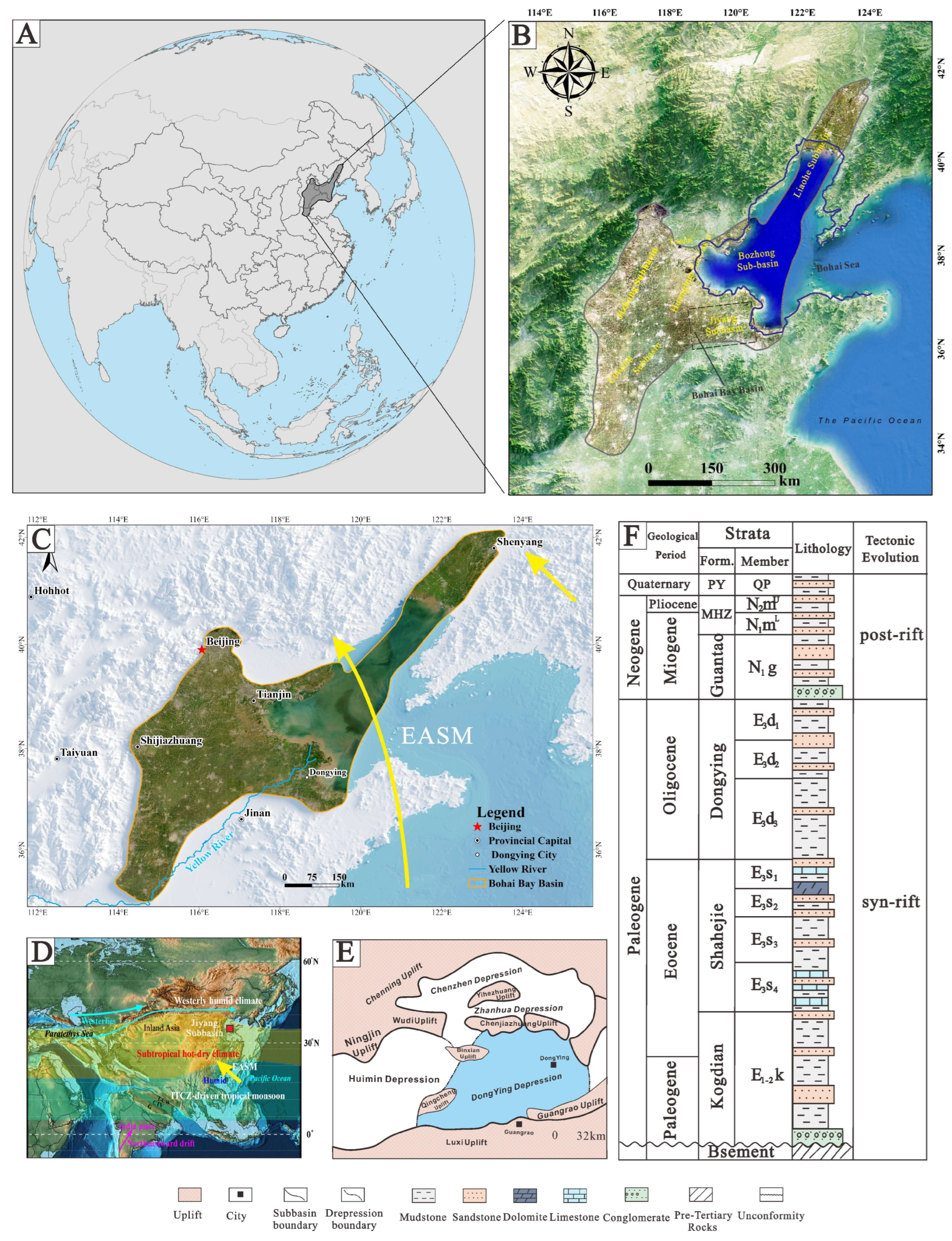
As a Cenozoic intracontinental rift basin in eastern China adjacent to the Bohai Sea (Figure 1) [18,19], the Bohai Bay Basin contains abundant Paleogene fluvial, lacustrine, and marginal-marine to transitional deposits, including prolific source rocks [10,20]. Effects of marine incursions on the basin during the Paleogene, therefore, remain highly debated. Based on assessments of tectono-paleogeography, paleosalinity/alkalinity proxies, and paleontological evidence [21], scholars argued that the intra-basin lake was intermittently connected with the open ocean via the TanLu Fault Zone and additional fault systems located ~ approximately 100 km east of the belt [22], with three distinct episodes of direct seawater incursion taking place during deposition of the Shahejie Formation. In contrast, Li et al. [23] re-evaluated the marine influence in the Dongying Depression using mineralogical, isotopic, and facies records, proposing that key features in the Shahejie succession did not arise from direct incursions. Instead, they attributed the signals to (1) subsurface seepage of seawater across topographic barriers separating the marine and lacustrine systems and to (2) sea-level-driven modulation of groundwater level, which together generated a feedback regulation. These sedimentological and geochemical studies indicated that the Shahejie deposition within this coupled sea–lake setting was highly sensitive to hydroclimatic variability [24,25,26]. Notably, spectral analysis of salinity-related proxies for the Es3x Member in the Dongying Lake Basin conducted by Wei et al. [10] revealed clear astronomical pacing, implying that orbital forcing periodically influenced lacustrine sedimentation through variations in marine input. Likewise, Zhang et al. [27] linked monsoon-driven chemical weathering intensity derived from major and trace element records in the lower Es3 interval of the Lijin Sag to eccentricity-scale orbital cycles. Accordingly, continuous, high-resolution terrestrial archives coupled with high signal-to-noise paleoclimate proxies forged an effective foundation for identifying orbitally forced climate variability [28,29,30]. Collectively, these lines of evidence suggested that variations in the strength of the land–sea monsoon circulation modulated the expression of potential marine influence, offering an exceptional window into marginal sea proximal lacustrine systems’ response to orbitally paced hydroclimate changes [31,32,33].
Debate nonetheless persists over the manner in which astronomical forcing modulated regional hydroclimate processes during the early-middle Eocene. Some studies ascribe climate variability in eastern China primarily to the ~100 kyr eccentricity cycle [34], whereas others emphasize the dominant roles of >1 Myr-long period eccentricity and obliquity cycles [35], or suggest that late Eocene hydroclimate change in western China was controlled by strong ~100 kyr and ~400 kyr eccentricity cycles [36,37]. These divergent interpretations hinder precise correlations among Eocene climate events and prevent a unified understanding of the underlying climate dynamics. Therefore, the mechanisms by which orbital forcing influences seasonality and produces hydroclimate responses at orbital timescales warrant additional evidence, rendering it necessarily important to better constrain monsoon dynamics under a marginal sea setting.
To this end, this study focused on the middle-late Eocene, a critical interval when the East Asian monsoon began to expand northward [38,39,40], while the Antarctic ice sheet had not yet undergone major expansion [41,42]. An integrated, multi-proxy cyclostratigraphic analysis was conducted on the continuous subsurface record from the upper part of Member 4 of the Shahejie Formation (Es4cu) in Well NY1, Dongying Sag. The core was recovered from a shallow- to semi-deep-lacustrine setting, where autogenic noise from the source-to-sink system was expected to be minimal [43,44]. This setting enabled the construction of a novel, high-resolution astronomical timescale for the middle Eocene. Based on the astronomically tuned stratigraphy, sedimentary petrology, geochemistry, and cyclostratigraphic analyses to identify multi-order climate cyclicity were recorded in the Es4cu succession. Cross-scale cyclicity was compared against key paleoclimatic proxies and variations to assess the coupled evolution of hydroclimatic conditions in this marginal sea-linked affiliated system and their orbital forcing responses.
Figure 1. Location map of the study area and stratigraphic column of the Dongying Sag. (A,B) Present-day geographic location map of the Jiyang Depression, Bohai Bay Basin; (C) inferred East Asian summer monsoon wind directions (yellow arrows) during the middle-late Eocene, modified from Licht et al. [38] and Meijer et al. [45]; (D) paleogeographic reconstruction for the middle-late Eocene [43], and the atmospheric circulation pattern, modified from [46]; (E) structural characteristics map of the Dongying Sag, modified from Feng et al. [47]; (F) composite stratigraphic column of the Dongying Sag.
Jmse 14 00273 g001

2. Geological Settings

The Bohai Bay Basin is located in the eastern part of the North China Craton, between ~35° and 40° N, and is a Mesozoic Cenozoic intracontinental rift basin (Figure 1). Its Cenozoic tectonic evolution comprises two main stages: a rifting stage, followed by a post-rift (sag) stage [48,49]. The basin preserves an exceptionally thick Paleogene continental succession, with its geographic position remaining largely unchanged over the past ~65 Ma. The regional land–sea configuration during the middle-late Eocene was broadly similar to the modern setting [19], affording an important opportunity to investigate past and future climate states [50,51,52].
The Dongying Sag is located in the southern part of the Jiyang Depression, Bohai Bay Basin. Spanning approximately 5700 km2, the sag ranks among the most hydrocarbon-prosperous in the basin. Cenozoic strata are continuously developed, and the Paleogene syn-rift succession exceeds 7000 m in thickness [53,54,55]. It mainly comprises lacustrine deposits of the Kongdian, Shahejie, and Dongying formations (Figure 1F). This syn-rift succession can be further divided into the following four sub-stages: (1) initial rifting (Kongdian Formation; early Paleocene to early Eocene); (2) late initial rifting (Member 4 of the Shahejie Formation; early to middle Eocene); (3) main rifting (Member 3 of the Shahejie Formation; middle to late Eocene); and (4) rift waning (Member 2 of the Shahejie Formation to the Dongying Formation; late Eocene to late Oligocene) [36,47,56]. Overall, the Paleogene stratigraphic succession is extensively regarded as continuously deposited, involving no major depositional hiatus. During the early Eocene (Kongdian Formation to the lower sub-member of Member 4), the regional climate was relatively arid, and deposition was dominated by floodplain–shallow lake and seasonal lake facies characterized by “red-gray” assemblages [57,58,59]. As deposition progressed into the upper sub-member of Member 4, the lake expanded, salinity increased, and the system evolved into a brackish-to-saline environment. In the western part of the sag, large lacustrine carbonate reef shoal systems developed, possibly attributed to the relatively warm climate and the influence of the paleo-East Asian monsoon. During deposition of Member 3, the lake deepened further, with maximum paleo-water depths estimated to exceed 550 m. Salinity gradually decreased, transitioning toward a freshwater system [60,61,62]. Thus, the depositional environment experienced a full shift from arid to humid conditions and from saline to freshwater waters, producing thick and continuous deep-lacustrine dark mudstone, shale, and oil shale. The Es4u interval, the focus of this study, was deposited in a deep-lake setting during the syn-rift stage. Relatively deep water and elevated salinity facilitated the formation and preservation of organic-rich black shale, and these deposits provide a continuous archive of orbital-scale paleoclimate and paleoenvironmental variability [63,64,65].

3. Methodology

3.1. Core and Paleoclimate Multi-Proxy Indicators

To evaluate shale oil potential and investigate paleoclimate variability, Sinopec drilled multiple cored wells in the Dongying Sag (e.g., wells FY1 and NY1, Figure 2). Continuous and complete cores, together with supporting wireline logs and high-resolution core images, were recovered from the Es3l and Es4u intervals, providing an exceptional archive for high-resolution paleoclimate studies.
In Well NY1, coring was conducted from 3295 to 3498 m, with a drilled interval of 203 m. The recovered core length is 185.22 m, corresponding to a recovery rate of 91%. The natural gamma ray log of the upper part of Es4cu spans 3316–3471 m and can be subdivided into three sub-intervals [68] (Figure 2B). Six main lithologies occur within this interval: mudstone, calcareous mudstone, calcareous shale, dolomitic limestone, argillaceous limestone, and argillaceous siltstone [69] (Figure 2). A total of 78 core samples were collected. A Bruker portable X-ray fluorescence (XRF) spectrometer was employed for in situ measurements on clean, flat core surfaces. Analyses were performed at an operating voltage of 10 kV and a current of 0.15 mA, involving a counting time of 60 s per spot. The sampling interval was 1–4 cm, locally tightened in selected intervals to increase resolution. Results are reported as oxide wt% for major elements and as ppm for selected trace elements. More than 20 elements, including Al, Mg, Fe, Ca, K, U, Zr, Ti, Mn, Ba, and Sr, were measured. Elemental concentrations determined by XRF were generally precise, and the measurement reliability exceeded the 95.4% confidence level [70]. Nevertheless, pXRF datasets are generally regarded as semi-quantitative in nature. Calibration against conventional geochemical analyses consistently yields weaker correlations for low-abundance and/or poorly detectable elements. To improve accuracy, the XRF dataset was hereby normalized to conservative elements (Si and Al) to remove the influence of detrital input, following the evaluation of pXRF calibration strategies by Gregory et al. [71].

3.2. Time-Series Analysis

All astronomical cyclostratigraphic analyses were performed using Acycle V2.7 [72] to systematically identify, extract, and calibrate orbital-scale climate signals from multiple proxy records. The workflow followed four steps: (1) data preprocessing, (2) spectral analysis, (3) optimization of sedimentation rates, and (4) filtering and tuning [73,74].
First, the raw data of natural gamma ray (GR), clay content, and Fe element were preprocessed, including the removal of outliers, equally spaced interpolation, and elimination of long-term trends using LOWESS smoothing. Subsequently, the multitaper method (MTM) power spectral analysis was applied [75,76], and fast Fourier transform (FFT) power spectra were utilized to delve into frequency evolution and identify dominant frequencies in the sequences [72]. The significance of spectral peaks was evaluated against a red-noise background (AR(1)), and the mean, 90%, 95%, and 99% confidence levels were determined. Based on the candidate orbital frequencies, the correlation coefficient method was used to compare the data spectra with the theoretical spectrum derived from the La2010 astronomical solution, thereby determining the optimal sedimentation rate and testing the null hypothesis of no orbital forcing. eCOCO was further employed to track downcore variations in sedimentation rate and to evaluate robustness [76]. Finally, using the La2010d high-precision theoretical astronomical solution as the benchmark, the significant spectral peaks extracted from the spectrum analysis were observed to be attributed to specific orbital parameters (eccentricity, obliquity, and precession). On this basis, Gaussian bandpass filtering was adopted to isolate the eccentricity and obliquity cycle signals within the target frequency bands from the proxy index series. By integrating the filtered output with visual inspection of cyclic characteristics, the ~405 kyr long eccentricity cycle was identified and anchored. Subsequently, the depth domain was converted into the time domain, ultimately constructing the floating astronomical timescale required for this study.
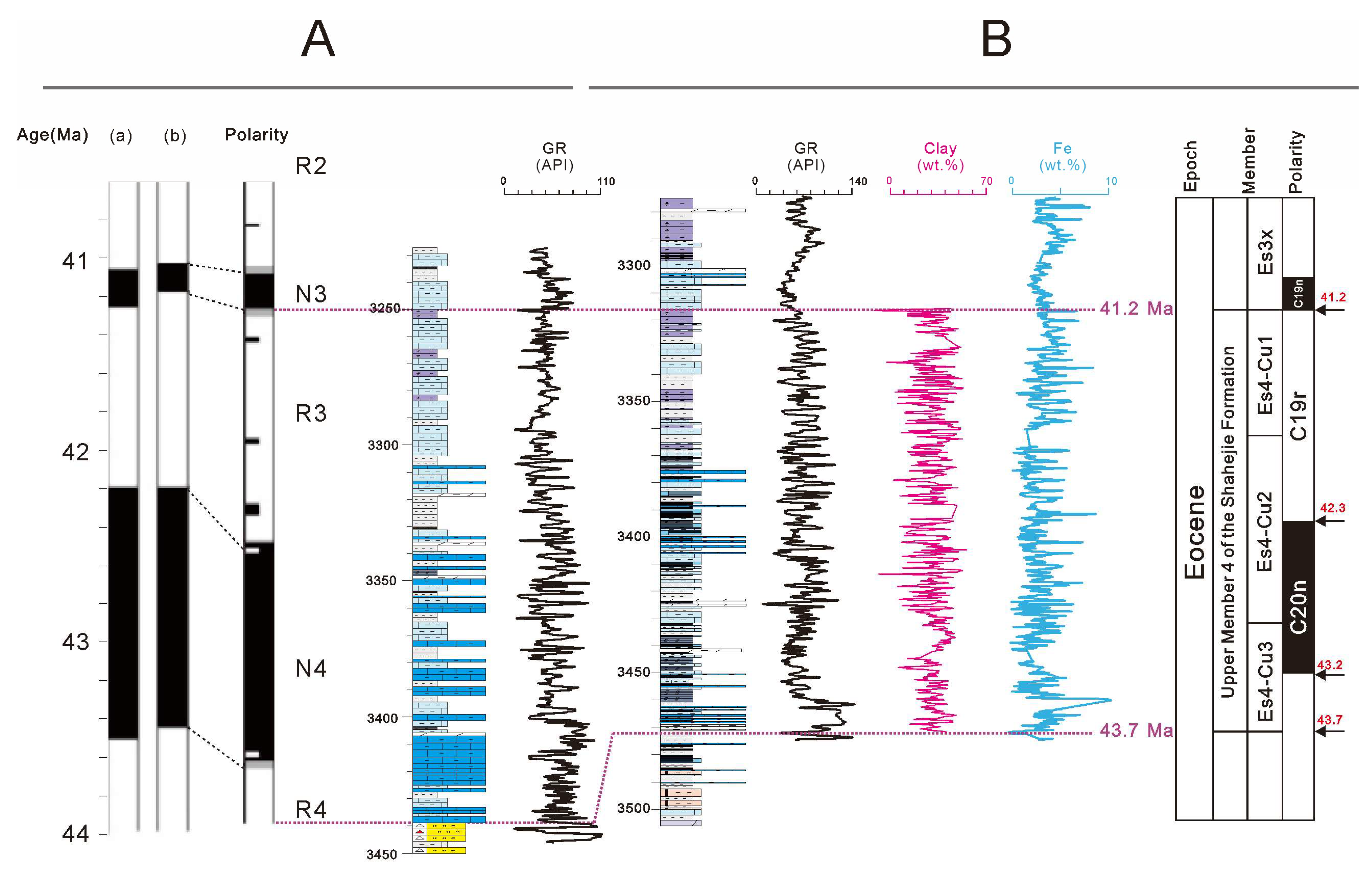
In recent years, numerous investigations have sought to establish a chronological framework for the Paleogene strata of the Bohai Bay Basin. Such frameworks, however, are often constrained by low temporal resolution and ambiguous validity. In the absence of absolute age tie points, the majority of existing astronomical timescales remain highly dependent on the selection of the reference timescale. Despite discrepancies between the GPTS2020 and the Westerhold et al. [66,77] timescales regarding the ages of several polarity chrons, the two show closely consistent boundary ages (within ±0.6 Ma) for the transitions identified at C18n.1n/C18n.1r and C19n/C19r (Figure 2A). Based on the updated polarity times provided by GPTS2020, Shi et al. [28] conducted a systematic magnetostratigraphic study on the FY1 well within the study area and established an age model refined through linear interpolation tuning. Concurrently, Jin et al. [30] established an astronomical timescale for the interval E3x–E4u in the study area using other proxy indicators, comparing it with the timescale established by Shi et al. [28,29,70]. This integrated work ultimately yielded a floating astronomical timescale spanning 39.26–43.68 Ma. It was further noted that the E3x-E4u boundary approximately corresponded to the base of C19n, thereby providing a reliable chronological framework for this study’s in-depth analysis of middle Eocene climate dynamics.

3.3. Sedimentary Noise Modeling

Li et al. [78] pioneered the application of the sedimentary noise model to lacustrine basin settings, successfully revealing the intrinsic link between lake-level changes and million-year-scale cycles. Subsequently, the theoretical work further clarified that, despite differences in study carriers (marine versus lacustrine), the core mechanisms driving sedimentary noise variations and recording their cyclicity were fundamentally similar. Multiple independent studies within the research area have further validated and advanced the applicability and robustness of the sedimentary noise model for quantitatively reconstructing paleo lake levels [79]. The DYNOT model uses orbitally tuned paleoclimate proxy records to semi-quantitatively recover the strength of non-orbital disturbances, such as bioturbation, tides, and storms. The inferred disturbance intensity is closely related to paleo-water depth. The ρ1 model employs the lag-1 autocorrelation coefficient as an independent noise metric for relative lake-level change [80]. Both models reveal a strong response to lake-level fluctuations. Therefore, they can be jointly applied to invert paleo-water depth and reconstruct million-year-scale eustatic lake-level variations. Herein, uncertainty was evaluated using a 300–500 kyr sliding window and 20,000 Monte Carlo simulations implemented in Acycle V2.7 [72,76,78].

4. Results

4.1. Mineral Composition

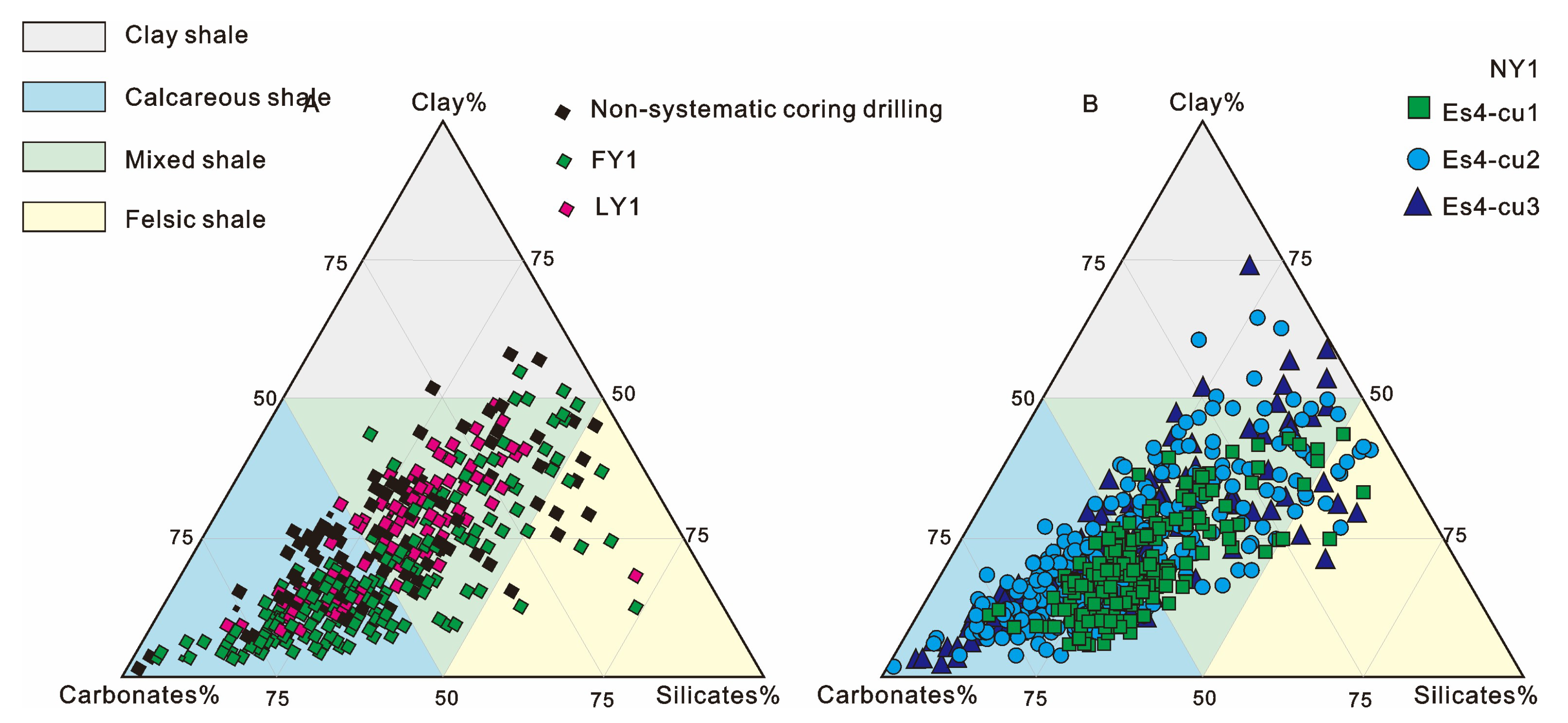
XRD results indicate that shales from the upper sub-member of Es4cu of the Shahejie Formation in the Dongying Sag are mainly composed of carbonate minerals (Figure 3), clay minerals, and quartz, with minor plagioclase, K feldspar, and pyrite. Among the samples analyzed, 55% possess carbonate content >40 wt.%. Calcite is the dominant mineral (mean 38.39 wt.%). Dolomite contents are variable and show pronounced enrichments near the base of the Es4cu interval. Siderite is minor (<3 wt.%), likely reflecting the relatively small lake basin area in the Dongying Sag during the Eocene and strong climatic control [81]. Clay minerals have an average content of ~21.2 wt.% and are dominated by illite, which accounts for an average of 83.8% of total clays; illite-smectite mixed layers are also present (mean 16.2%). Quartz is ubiquitous, with contents ranging from 1 to 54 wt.% (mean 22.6%). Plagioclase and pyrite contents vary from 1 to 22 wt.% (mean 3.8%) and 1 to 15 wt.% (mean 2.9 wt.%), respectively.
Overall, mudstones and shales from the Es4cu interval in the Dongying Sag show broadly similar mineralogical compositions, despite spatial differences arising from tectonic settings. The Lijin sub-sag constitutes the deepest and most extensive lacustrine depocenter in the study area; XRD data from Well LY1, herein, reveal elevated clay mineral contents relative to other regional intervals [80], in contrast to carbonate contents that are lower than those recorded in Well NY1.

4.2. Lithofacies

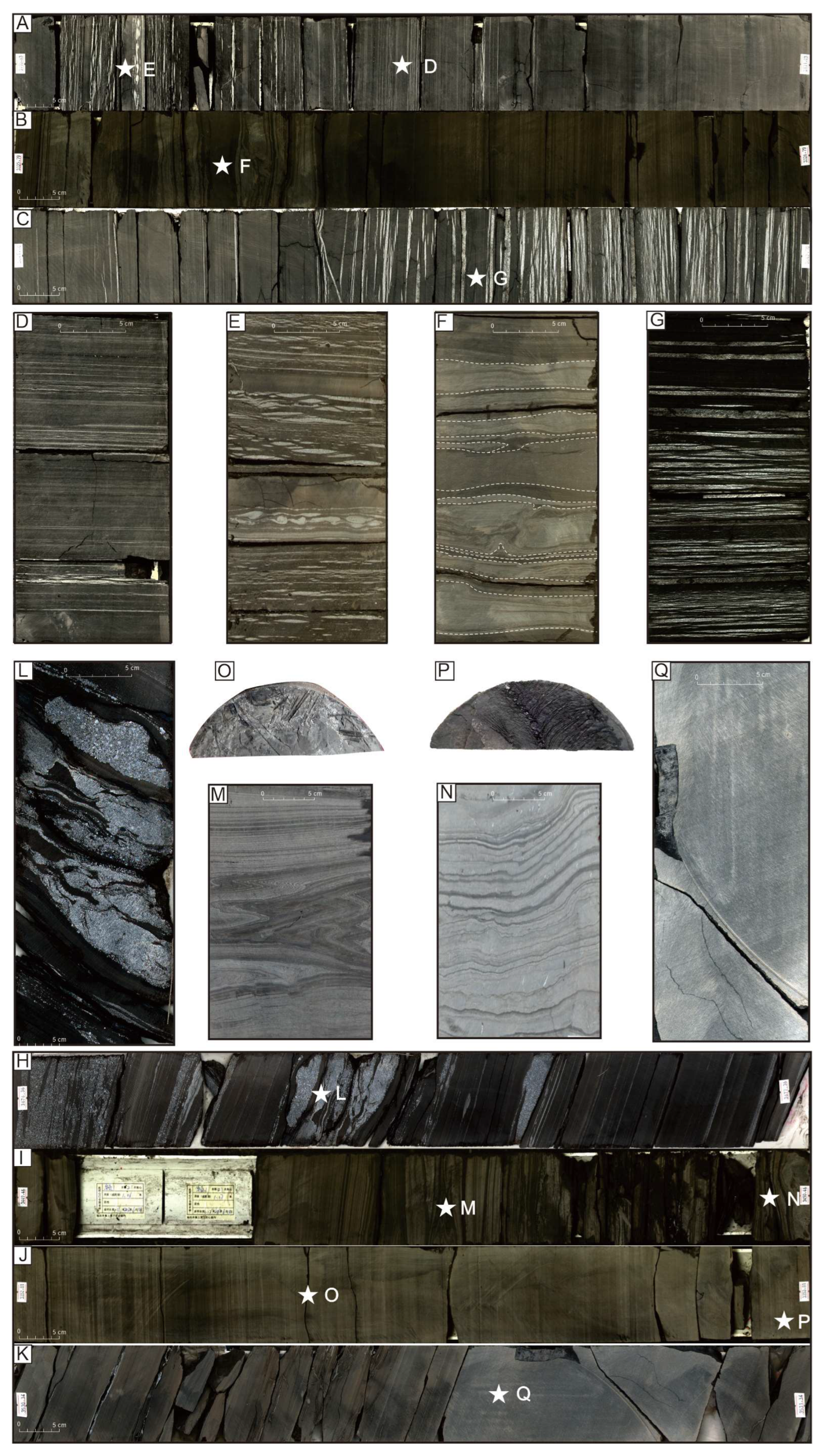
Rocks in the study area are characterized by thick-bedded mudstone and interbedded shale. Based on mineral composition, five lithologies can be identified: silty, clay-rich shale (Figure 4A), laminated calcareous shale (Figure 4B–D), laminated shale with thin gypsiferous interlayers (Figure 4C), massive calcareous shale (Figure 4Q), and bedded calcareous shale (Figure 4J,K). Bioclasts are dominated by algal fragments and ostracod shells. According to differences in the fabric of silt and sand sized detritus, the silty, clay-rich shale can be further subdivided into the following: (1) parallel-laminated, silty, clay-rich massive shale (Figure 4A,M); (2) massive silty shale with convolute lamination (Figure 4B,I,M,N); (3) laminated shale containing lenticular and irregular silty detrital particles (Figure 4A,E); and (4) massive-to-bedded silty muddy mixed rock.
Microscopic petrographic observations and mineralogical characterization (Section 4.1) demonstrate calcite as the most widespread mineral in the area. According to crystal size, calcite can be further classified into coarse crystalline (>100 μm), fine crystalline (30–100 μm), and cryptocrystalline (<30 μm). Therefore, by integrating mineral composition, sedimentary structures, carbonate crystal size, and mineral assemblages, a three-tier nomenclature scheme [82] was hereby adopted and the study area was classified into eight microfacies/lithofacies (MLs): (1) laminated micritic argillaceous limestone facies; (2) laminated microcrystalline argillaceous limestone facies; (3) laminated coarse crystalline argillaceous limestone facies; (4) laminated mixed mudstone facies; (5) bedded argillaceous limestone facies; (6) bedded calcareous mudstone facies; (7) organic-rich massive mudstone facies; and (8) organic-rich bedded gypsiferous mudstone facies. MLs developed in the study area are detailed below.
  • Laminated micritic argillaceous limestone facies (ML1)
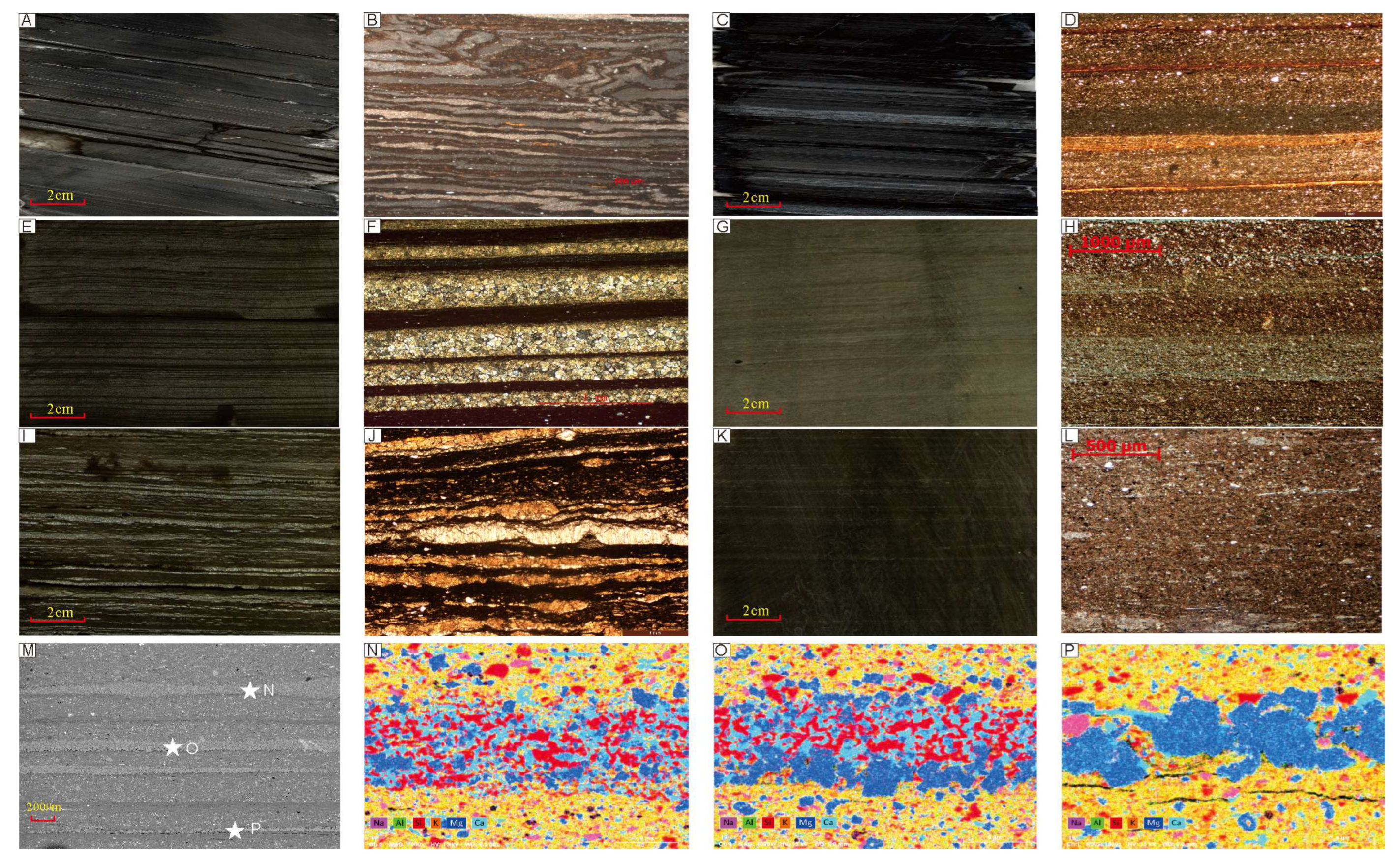
This facies is distinguished by straight, continuous, and parallel laminae (Figure 4B,J). With individual laminae typically measuring <0.5 cm in thickness. XRD analyses reveal high calcite abundances in this facies, with concentrations peaking at 76% (and averaging 47%), while dolomite contents are consistently below <10%. The facies contains abundant ostracods, algae, and terrigenous organic matter (Figure 4O,P). Shallow bioturbation structures are commonly tubular and lenticular, cutting across and locally destroying primary lamination. Most burrows are 0.5–3.2 cm in diameter and feature clear boundaries; they can be readily distinguished from the host rock by color and infill. Additionally, progradational laminae that intersect or truncate horizontal laminae are locally identified in cores. The horizontal laminae are interpreted to have formed via suspension settling in a quiet deep-lake setting with abundant algae, ostracods, and terrigenous organic matter. In contrast, the progradational laminae likely record depositional modification by turbulence or bottom currents triggered by monsoonal rainfall events. Under the microscope, this facies shows distinct alternating light-dark laminae with good continuity, forming laterally persistent horizontal layers; locally, the laminae display gentle wavy undulations (Figure 5A,B). The light-colored laminae are dominated by micritic calcite. The dark laminae consist of organic-rich, argillaceous laminae and are typically thinner than the calcite-bearing light laminae. Framboidal pyrite aggregates and dispersed organic matter fragments are common within the dark laminae. Bioclasts are frequently concentrated along lamina boundaries. Ostracod distribution differs markedly between the light- and dark-colored laminae. Ostracod abundance in the light laminae reaches ~15–40 shells/cm2, whereas it drops to as low as 0 shells/cm2 in the dark laminae. This contrast in ostracod abundance further supports the depositional origin interpretation of the light–dark lamina couplets.
2.
Laminated mixed mudstone facies (ML2)
This facies is dark gray to gray-black in core and is characterized by continuous, gently micro-wavy lamination (Figure 5C). Stratigraphically, it is primarily concentrated in the upper part of the Es4cu. Microscopic observations reveal alternating light and dark laminae. The light laminae represent a mixed deposition of clay minerals, cryptocrystalline micro-sparry calcite, and terrigenous detritus (Figure 5D). Calcite shows a low degree of recrystallization. The dark laminae are organic-rich clay layers, in which organic matter is evenly mixed with clay. XRD results indicate a ternary mixture of carbonate, clay minerals, and terrigenous detritus, with each endmember accounting for <50%. Carbonate minerals comprise 36–45% (mean 41%), and clay minerals 17–35% (mean 26.5%), with quartz plus feldspar contents being comparable to those of clay minerals.
3.
Laminated microcrystalline argillaceous limestone facies (ML3)
This facies is dark gray in core and displays distinct, continuous horizontal laminae on the core surface (Figure 5E). Thin section observations show regular interlayers of organic-rich argillaceous laminae and microcrystalline calcite laminae, with sharp boundaries between adjacent laminae (Figure 5F). Calcite laminae are typically thicker than argillaceous laminae, with calcite occurring primarily as microcrystals exhibiting rhombic, triangular, and elliptical morphologies. Intercrystalline spaces are filled with organic matter and dispersed pyrite. A small amount of coarse dolomite crystals is also present within the calcite laminae, with grain sizes of 30–50 μm. This facies is rich in organic matter, with total organic carbon (TOC) commonly ranging from 3% to 4%.
4.
Bedded argillaceous limestone facies (ML4)
Stratigraphically, this facies commonly alternates with laminated calcareous mudstone (Figure 4J,K). XRD results show reduced carbonate content compared to that in laminated shale, accompanied by increased quartz and clay minerals. In cores, a few horizontal laminae with diffuse boundaries and small thicknesses are observed, together with gently dipping progradational laminae. Thin section observations indicate relatively well-defined bedding. Sedimentary structures such as climbing ripples and low-angle cross-bedding observed in comparable deep-lacustrine settings have previously been attributed to rapid lake-level fluctuations and/or reworking by bottom currents. Observations from modern rivers and Cretaceous lacustrine successions demonstrated that hyperpycnal flows can play a key role in deep-water fine-grained deposition [83,84]. Given that the paleogeographic position of Well NY1 was closer to the deep-water depocenter, these structures are interpreted here as the product of monsoon-related heavy rainfall that generates hyperpycnal flows transporting sediment basinward; upon deposition of the relatively coarser fraction, lateral migration of the residual flow is enhanced, promoting the development of these tractional structures. The fabric is characterized by interbedded and locally mixed distributions of felsic detritus (quartz feldspar), clay minerals, and micritic calcite (Figure 5G,H), exhibiting strong color contrast between adjacent layers. Carbonate minerals are the dominant constituent, with their content being slightly higher than that of terrigenous detritus. Their organic matter abundance is relatively high, with TOC mainly ranging from 2% to 4%, occurring as dispersed enrichment within the rock.
5.
Laminated coarse crystalline argillaceous limestone facies (ML5)
This facies exhibits prominent lamination and commonly interbeds with laminated calcareous mudstone. The argillaceous horizontal laminae are mostly straight and continuous, and they contain fibrous columnar or lenticular calcite bands. In the core and thin section, calcite within these bands is mainly fine-to-medium crystalline. The bands vary in length and are typically 0.10–0.7 cm wide, with the long axes of calcite crystals predominantly oriented perpendicular to bedding (Figure 4D,G). Ostracod fossils and fragments are occasionally observed. Microscopically, this facies consists of interlayers of organic-rich argillaceous laminae and calcite laminae. The calcite laminae are relatively thick and are composed of coarse, clean crystals. Calcite is commonly euhedral to subhedral, showing typical dog-tooth crystals (often rhombohedral). These crystals usually grow in tightly packed arrays perpendicular to the lamination surface, or are connected by equigranular crystals. Under fluorescence microscopy, partial calcite exhibits heterogeneous luminescence, suggesting multi-stage cementation (Figure 5I). Organic matter is strongly enriched in the argillaceous laminae, and TOC values reach 3–8% and, displaying high overall abundances.
6.
Bedded calcareous mudstone facies (ML6)
At the core scale, this facies is characterized by silty calcareous mudstone and shows laminated to bedded structures; a massive texture is locally developed. Intervals enriched in abundant silt-sized grains display large variations in sedimentary structures and grain size, indicating typical event deposition. These event layers are composed mainly of terrigenous silt detritus with minor broken bioclasts. Bed thickness varies markedly. The bases of beds commonly show erosional, sharp contacts with uneven surfaces, and mud clasts and silty lithic fragments are clearly visible within the beds. Soft-sediment deformation structures are locally observed (Figure 4H,L). Thin section observations indicate that bedding is expressed by the occurrence of carbonate lenses, the preferred orientation of bioclasts (dominated by ostracods), and the aligned distribution of charcoal fragments (Figure 5L). The rock is composed of a mixed assemblage of clay minerals, feldspar, quartz, and calcite. Calcite occurs as local lenticular bodies, whereas feldspar and quartz grains are predominantly dispersed. Framboidal pyrite is ubiquitous, typically forming clustered aggregates. XRD analyses reveal low carbonate contents, with combined quartz plus feldspar abundances exceeding those of carbonate minerals.
7.
Organic-rich massive mudstone facies (ML7)
This facies is sparsely developed in the lower part of the Es4cu. Core observations uncover that lamination is poorly developed and the rock is mainly massive. It is dark gray to black, massive, and well-sorted, and is rich in organic matter. Plant leaf and stem fragments are locally observed (Figure 4K,Q).
8.
Organic-rich bedded gypsiferous mudstone facies (ML8)
This facies is dominated by mudstone with minor anhydrite (Figure 4C). Core samples show predominantly bedded structures, with relatively planar mudstone beds of stable thickness (typically 0.5–5 cm). Evaporite layers are 0.5–5 cm thick and occur as banded anhydrite interlayers alternating with mud-rich beds. No obvious bioturbation structures are observed.

4.3. Cyclostratigraphic Analysis of Multi-Proxy Records in the Depth Domain

Following a systematic evaluation of various astronomical solutions, Westerhold et al. [82] systematically evaluated different astronomical solutions and concluded that concluded that La2010d is the most reliable one for the period since 54 Ma. Accordingly, this study adopts the La2010d astronomical solution as the benchmark for all subsequent astronomical cycle analysis and timescale construction [85].
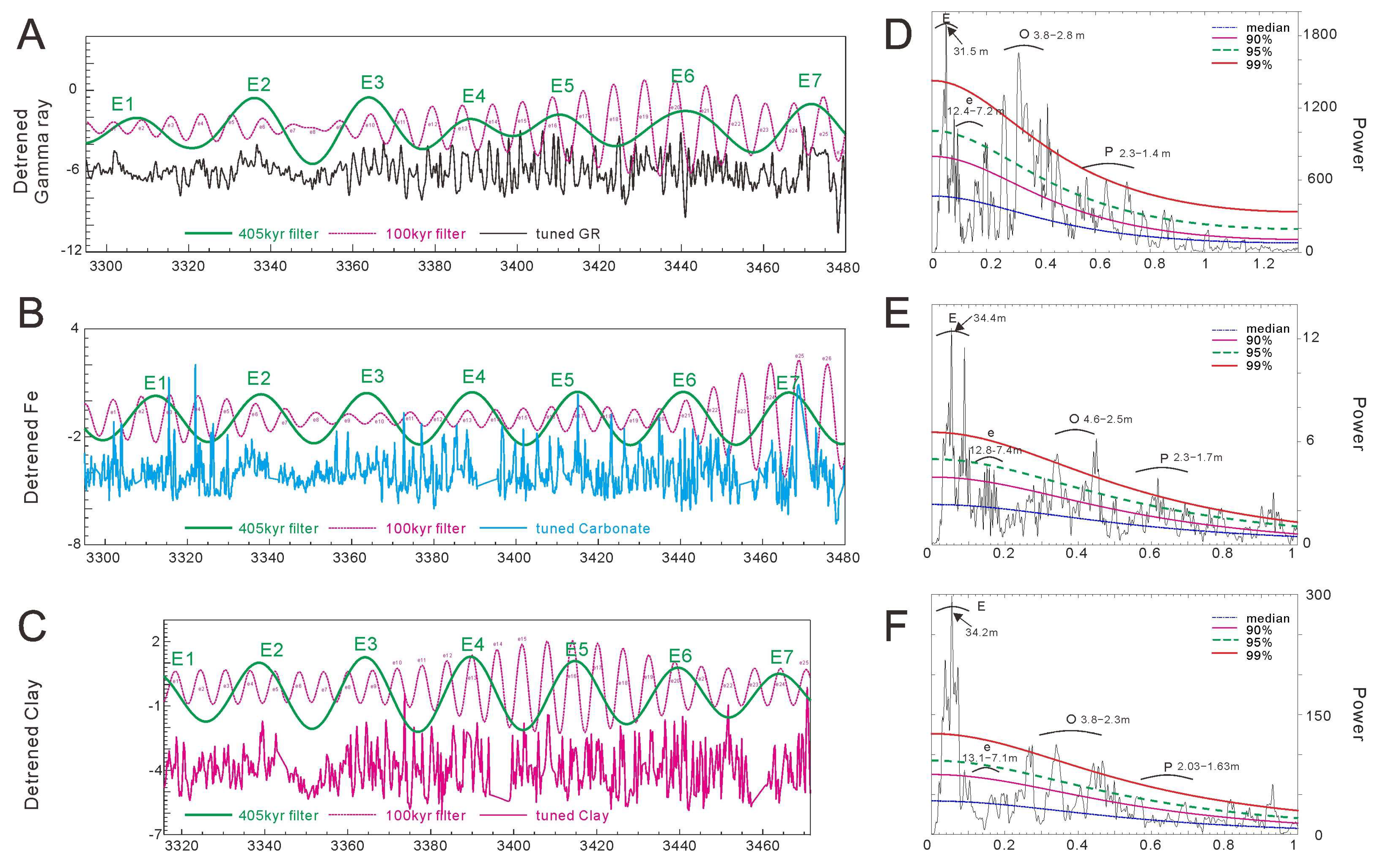
MTM power-spectrum analysis of the untuned gamma ray record from Well NY1 reveals significant peaks (confidence level > 90%). In Part 1 (Figure 6D), the prominent wavelengths are 34.2, 28.9, 19.3, 12.4, 7.2, 5.1, 3.8, 3.2, 2.8, 2.3, and 1.7–1.4 m. Wavelength peaks exceeding the 95% confidence level indicate an approximate ratio of 20:5:2:1, which matches the theoretical ratios of astronomical cycles and is consistent with Paleogene orbital periodicities [86,87]. These results demonstrate orbital forcing-driven modulation of sedimentation within the Es4cu interval.
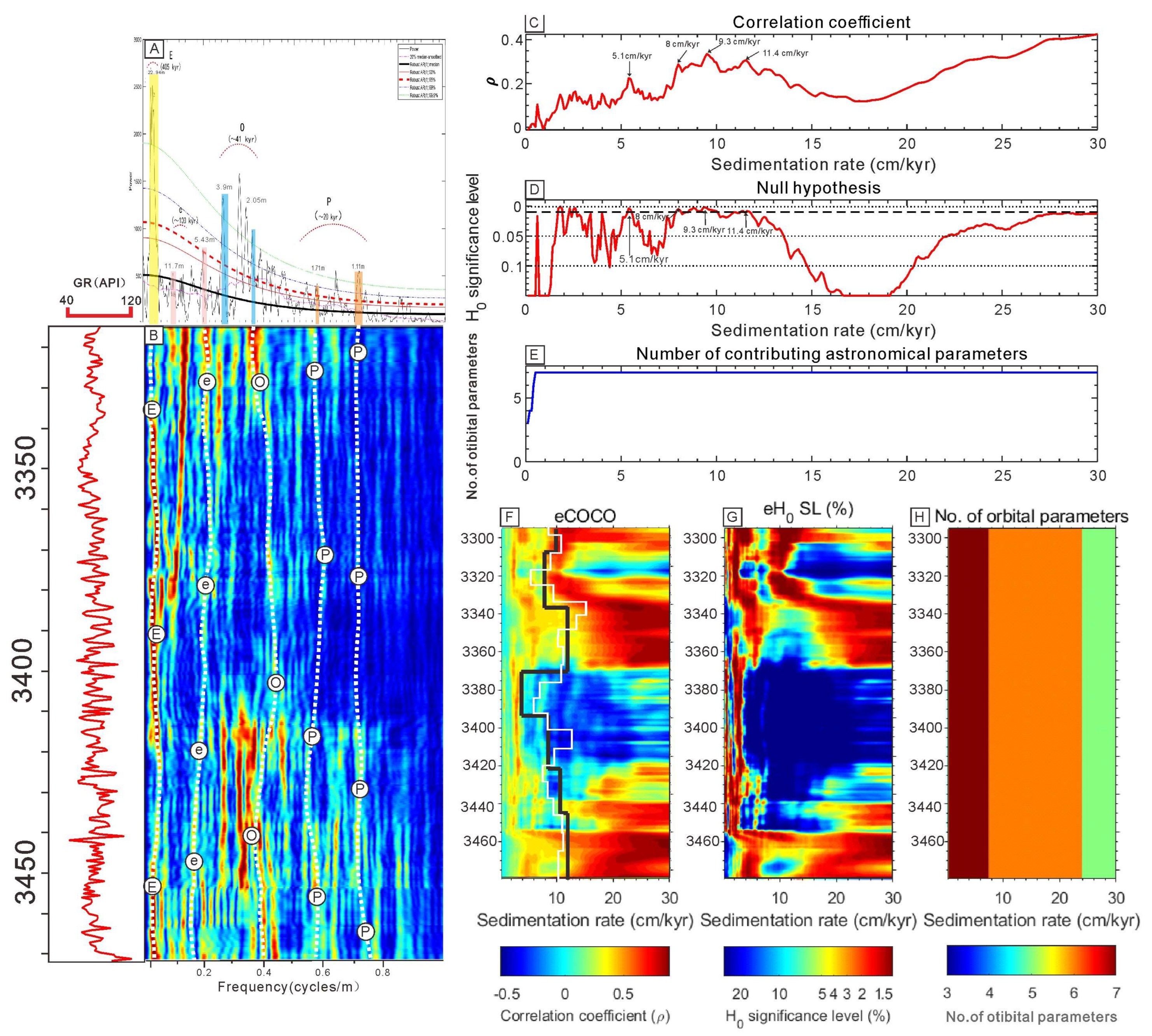
COCO analysis of the gamma ray record was performed with 2000 Monte Carlo simulations, testing sedimentation rates from 1 to 30 cm/kyr. The results reveal significant peaks at 5.1 cm/kyr and 8–11.4 cm/kyr. The significance level for the null hypothesis of “no orbital forcing” (H0) is close to 0.001 (Figure 7C–E), indicating a rather low probability that these optimal sedimentation rates arise in the absence of orbital pacing [78]. Therefore, the most plausible sedimentation rate range is 5.1–11.4 cm/kyr, with a mean of 8.2 cm/kyr. eCOCO analysis of the same record provides more detailed downcore variations in sedimentation rate and allows the studied interval to be divided into three parts: 3370–3420 m yields 4–5.9 cm/kyr, whereas intervals above 3370 m and below 3420 m yield 8.1–11.3 cm/kyr. These estimates are broadly consistent with the COCO results.
Using the sedimentation rates constrained by COCO (Figure 7), the wavelengths identified in the power spectrum were assigned to specific orbital parameters. Specifically, 34.2–28.9 m, 12.4–7.2 m, 3.8–2.8 m, and 2.3–1.4 m corresponding to long eccentricity, short eccentricity, obliquity, and precession, respectively (Figure 7A). Bandpass filtering indicates that the Es4cu interval contains ~7 cycles in the ~29 m band, corresponding to the 405 kyr long eccentricity cycle, labeled E1–E7. Moreover, 26 cycles (coded e1–e26) were identified in the 100 kyr bandpass-filtered GR record, corresponding to 6.3 long eccentricity cycles and 24.5 short eccentricity cycles within the target Es4cu interval. FFT analysis of the processed GR series shows that the 405 kyr eccentricity and 41 kyr obliquity components are the most laterally persistent and stable, whereas other components exhibit more intermittent continuity (Figure 7A,B). Collectively, observations suggest that the 405 kyr long eccentricity and 41 kyr obliquity cycles are the dominant orbital rhythms during deposition of the Es4cu interval.
GR values are positively correlated with clay content [88,89]. In addition, Fe is a relatively immobile element sensitive to climatic variability. Previous studies have shown that variations in Fe content are significantly correlated with river-borne detrital input [90,91]. Therefore, clay content and Fe were hereby selected as proxy records for mineral-series cyclostratigraphic analysis and compared using the GR-based astronomical model. Both the clay and Fe series exhibit clear cyclicity (Figure 6B,C). Spectral analyses reveal multiple significant peaks (confidence level > 90%), indicating dominant frequency bands consistent with expected orbital-period ratios in both records. Relative to the GR-based model, the corresponding cycles are largely in-phase, and their bandpass-filtered signals share similar characteristics. A minor mismatch occurs near the trough of cycle E7, where the filtered clay and Fe signals deviate from the filtered GR signal. This discrepancy is primarily attributed to data gaps in the clay and Fe records within this interval. During interpolation, the insertion of numerous low values produces an apparent long eccentricity trough and causes a phase offset of approximately one-quarter of a cycle relative to the GR peak position. Overall, cyclostratigraphic results from both proxy records verify the reliability of the GR-derived orbital framework. To this end, the GR record, which is more continuous and exhibits clearer variability, was used as the primary target series for constructing the astronomical timescale.

4.4. Time-Series Tuning

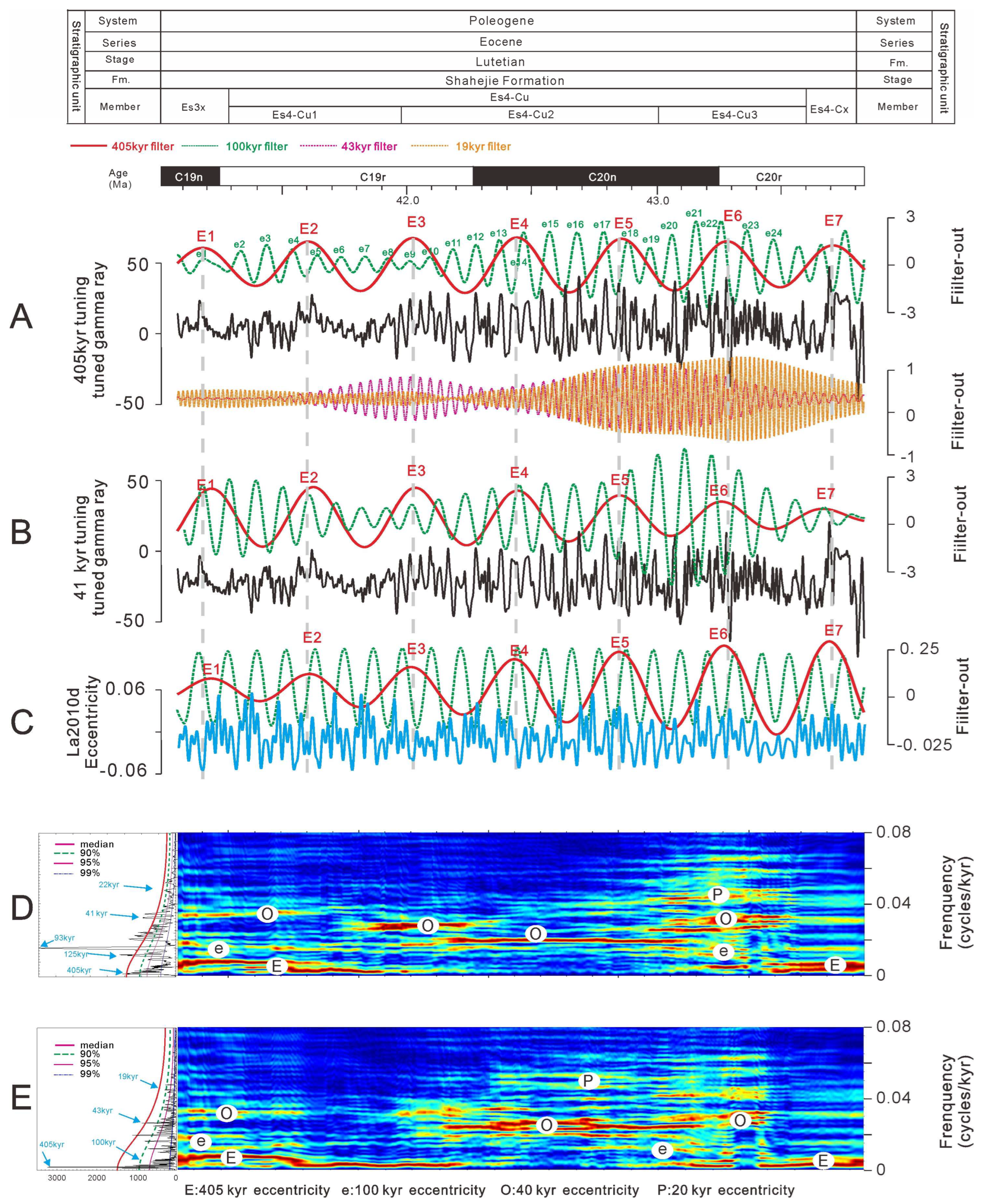
Herein, a 405 kyr tuning strategy was adopted, considering the 405 kyr cycle as the most stable orbital component in deep time, owing to the strong gravitational influence of Jupiter [86,92,93,94]. The power-spectrum and evolutive spectral results also support this selection (Figure 6D,E and Figure 7A,B). Based on the ~405 kyr tuning, tuning was additionally performed to another dominant period of ~41 kyr for comparison (Figure 8A,B).
The ~30 m-thick cyclic sequence in the Es4cu member of Well NY1 was subjected to bandpass filtering and tuned to the ~405 kyr long eccentricity cycle, thereby converting the gamma ray data from the depth domain to the time domain. Subsequently, MTM spectral and FFT analyses were performed on the tuned gamma ray data (in the time domain). Significant peaks above the 90% confidence level remain identifiable in these spectra (Figure 8D,E), and their ratios match those expected for orbital periodicities. This confirms successful tuning and validates the previously identified astronomical signals. The resulting astronomical timescale spans ~2.44 Myr. The ~405 kyr bandpass-filtered cycles in the tuned GR series (Figure 8A) are broadly in-phase with the corresponding cycles in La2010d (Figure 8C). While the E1 cycle in the GR time series shows a slight lag relative to La2010d, the strong correlation confirms the tuning model’s reliability. Leveraging the ~405 kyr tuning, the 3.8–2.8 m cyclicity was further filtered and tuned to the ~41 kyr obliquity cycle, yielding a timescale of ~2.42 Myr, which is consistent with the long eccentricity tuning result. Based on the analysis in Section 3.2, the astronomical timescale established by Jin et al. was hereby utilized as a fixed anchor point, anchored to the C18r/C19n boundary age from GPTS2020, with the base of the lower Es3x member constrained to an absolute age of 41.28 ± 0.05 Ma. By tying the floating astronomical timescale to this datum, an absolute astronomical timescale was constructed, defining the studied interval of Well NY1 between 41.28 and 43.7 million years (Figure 8B).
The clay and Fe records were tuned using the same procedure and the GR-based astronomical age model (Figure 8B). The results yield astronomical interpretations largely in-phase with the cycles observed in the GR series. Despite minor differences in the durations derived from the three proxy records, they are highly consistent overall, with an uncertainty of approximately ±0.2 Ma. Collectively, these results validate the proposed multi-proxy approach for generating high-resolution astronomically tuned time series, and cross-proxy comparison boosts the robustness of the chronological framework.

4.5. Sedimentary Noise Modeling and Paleoclimate Proxy Indicators

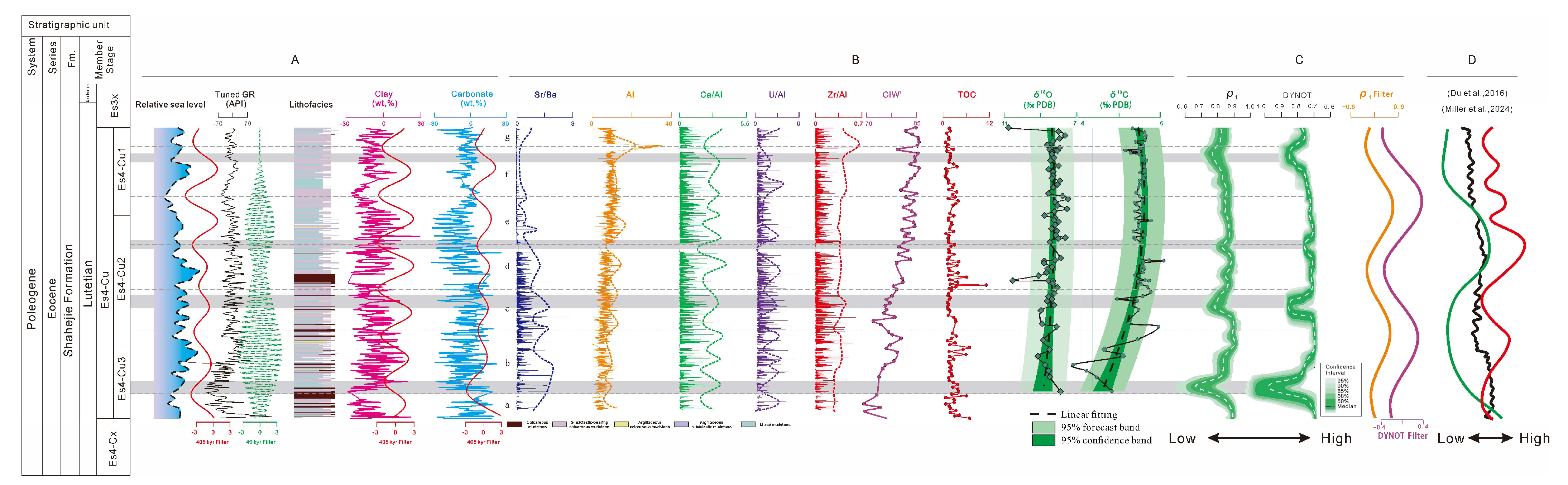
A 200 kyr sliding window was used for DYNOT-based sedimentary noise modeling of the tuned GR time series. The DYNOT and ρ1 results exhibit nearly identical patterns and show markedly higher noise in four intervals within the Es4cu (Figure 10C), reflecting relative variations in lake level through the section. Based on the lake-level curves reported by Du et al. [92] and Miller et al. [95] (Figure 10D), these high noise intervals correspond to relatively low lake-level stages, which can be interpreted as reduced signal-to-noise ratios caused by increased perturbations under shallower-water conditions [79].
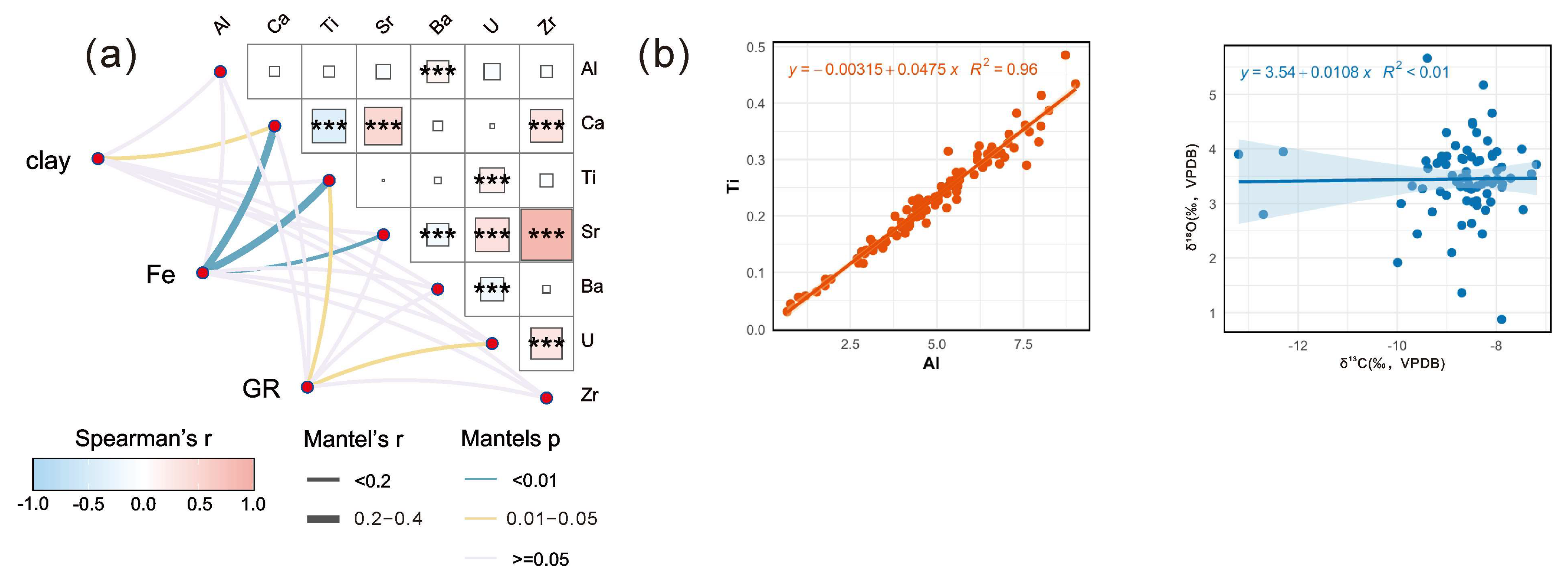
Based on high-resolution continuous core scanning and sample analyses from Well NY1, multiple paleoclimate and paleoenvironmental proxy series were hereby obtained and compiled to provide the dataset for subsequent discussion (Section 5.1). The results show broadly coherent downcore patterns among Al, K, Ti, Na, and Fe. Correlation analysis of proxy variables for NY1 (Figure 9a) yields overall correlation coefficients ranging from −0.38 to 0.88. Sr exhibits a strong positive correlation with Zr (r = 0.88, p < 0.001), which is also positively correlated with Ca (r = 0.47, p < 0.001) and U (r = 0.38, p < 0.001), suggesting broadly similar geochemical behavior and/or shared controls related to source input and mineral composition. In contrast, Ca is negatively correlated with Ti and Al, with the Ca–Ti relationship being significant (r = −0.38, p < 0.001). Notably, in fine-grained lacustrine strata, Al is preferentially hosted by clay minerals [96]. Accordingly, Al and Ti are taken as proxies for terrigenous weathering products delivered to the lake via fluvial transport and episodic events during deposition, whereas Sr and Ca in lacustrine sediments are more likely of authigenic origin. Ba shows generally weak correlations with other elements, indicating relatively independent environmental behavior. Correlation results for the three cyclostratigraphic proxy groups further confirm positive GR-U correlation alone, with the Fe–U relationship being insignificant. The clay mineral series shows a weak yet significant correlation with Ca and only a very minimal correlation with Al. These patterns imply that the three proxy groups are largely independent for cyclostratigraphic analysis, supporting the selection of the proxies used in this study.
The Sr/Ba ratio is extensively considered as an effective proxy for salinity in sedimentary systems [97,98], and previous studies have demonstrated its reproducibility and regional applicability for paleosalinity reconstructions in the Dongying Depression. In addition, redox-sensitive trace elements commonly show pronounced enrichment under reducing conditions; uranium (U) enrichment therefore provides an independent constraint on redox state [99]. Paleo-redox conditions are typically evaluated using element ratios normalized to Al to correct for dilution by detrital inputs [99]. Based on these observations, we selected proxies that reflect paleoweathering intensity, including the chemical index of weathering (CIW) [96,100], together with indicators of paleo-redox conditions U/Al [101], paleosalinity Sr/Ba [10,21,102], paleoproductivity Ca/Al [60], and provenance/terrigenous input (Al). In addition, carbonate stable isotopes (δ13Ccarb and δ18Ocarb) were used to provide independent constraints on internal lake processes. δ18Ocarb is primarily controlled by the isotopic composition of lake water and temperature, and is thus sensitive to hydrological changes (evaporation vs. precipitation) [103,104,105,106]. δ13Ccarb mainly reflects the composition of the dissolved inorganic carbon pool and is influenced by multiple processes, including primary productivity, organic matter degradation, and water-column stratification [107,108,109]. Despite the extensively documented response mechanisms of these proxies to environmental variations in the lacustrine setting of the Bohai Bay Basin, the potential influences of diagenesis and provenance should still be evaluated before applying them to constrain orbital-scale climate cycles (Figure 9b,c) [110]. First, the strong correlation between Al and Ti suggests stable provenance during deposition of the studied shale succession. Second, burial-history reconstructions for the Dongying Depression indicate that strata deposited during the Es4 and Es3 intervals mainly experienced progressive subsidence [111], implying that they were not subjected to intense late-stage diagenetic overprinting. Ma et al. [111] compared δ18Ocarb values between micritic and sparry carbonates from Well NY1 and conducted dolomite diagenetic analyses, concluding that carbonate deposition in the Es4 Member of the Shahejie Formation underwent only minimal diagenetic modification. In the present study, δ18Ocarb also shows a strong correlation with δ13Ccarb, further supporting limited diagenetic alteration. In addition, cross-validation among proxies was performed (e.g., integrating TOC, productivity indicators, and redox proxies). Intervals affected by late-stage calcite veining were excluded, and coupled analyses of productivity, water-column stratification, and anoxia reveal coherent covariation among the proxies (Figure 10B), indicating a robust response to environmental change.
The Zr/Al ratio ranges from 0.01 to 0.66, whereas Sr/Ba varies from 0.7 to 12.2. Higher-frequency fluctuations occur in the lower part of the Es4cu interval and near the Es4cu–Es3L boundary (Figure 10B). CIW values range from 63 to 84. Carbonate isotopic compositions span −3.6‰ to 5.7‰ for δ13Ccarb and −10.1‰ to −7.2‰ for δ18Ocarb, respectively. These isotope values are consistent with those reported for mudstone samples from other Shahejie Formation cores in the Bohai Bay Basin [112].

5. Discussion

5.1. Climatic Significance of the Multi-Proxy Records and Their Responses to Orbital Forcing

Based on the high-resolution floating astronomical timescale, an integrated analysis incorporating the vertical lithofacies’ succession, multiple paleoclimate proxy records, and sedimentary noise models was conducted to assess coherent orbital-scale forcing responses of the depositional system in the upper sub-member of Es4cu. Within the Es4cu interval, the lithofacies’ succession features frequent alternations in a rhythmic “calcareous mudstone–mixed mudstone–mudstone” motif [113], a pattern consistent with recent interpretations and attributed to orbital-scale climatic and hydrological fluctuations.
In Dataset Group A, the GR record shows a high signal-to-noise ratio among the paleoclimate proxies and is only weakly affected by diagenesis [114,115]. High GR values generally indicate enrichment of clay and organic matter driven by enhanced chemical weathering under warm and humid conditions [116,117]. In contrast, low GR values correspond to more arid or cold-dry conditions, when carbonates and gypsum become more abundant. GR variations are primarily controlled by mud content (enriched in radioactive elements), whereas evaporites and relatively pure carbonates yield low GR values. Accordingly, the GR trend is similar to the clay-content record but opposite to the carbonate-content record. Bandpass filtering of these three hydroclimate-sensitive datasets reveals two shifts in the dominant periodicity during deposition of the Es4cu interval. These occur broadly between the trough of cycle E1 and the trough of E3, between the trough of E3 and the peak of E6, and from the peak of E6 to E7. In the lithofacies’ succession, these intervals correspond to a transition from calcareous mudstone-dominated facies to felsic-rich calcareous mudstone dominance, followed by a mixed-mudstone-dominated interval (Figure 10A). Organic-rich laminated calcareous mudstone facies (e.g., ML1 and ML3) commonly coincide with GR maxima, accompanied by higher clay contents and lower carbonate contents. This proxy facies association indicates abundant fine-grained terrigenous input under strong chemical weathering, elevated lacustrine productivity, and oxygen-depleted bottom waters. Together, these features point to a warm, humid climate and relatively high lake level [118]. In contrast, carbonate-rich facies (e.g., ML4) and organic-lean bedded mudstone facies (ML6) occur during GR minima, characterized by a marked decrease in clay content and a corresponding increase in carbonate content. This mineralogical shift reflects reduced terrigenous supply and stronger evaporative control on lake water chemistry, consistent with lake level lowering under arid conditions and potential salinification [119]. Comparison with the obliquity band further reveals that obliquity maxima generally coincide with shale deposition and high GR values, indicating warm and humid conditions. Obliquity minima typically correspond to low GR calcareous mudstone and argillaceous limestone deposited under colder and drier conditions; the lowest GR values near the base additionally mark intervals with gypsiferous mudstone.
Group B integrates multiple proxies (CIW, Al, Zr/Al, U/Al, Sr/Ba, and Ca/Al) to further refine the inferred wet–dry cyclicity and uses coeval δ13Ccarb and δ18Ocarb records to independently validate the reconstructed climate cycles (Figure 10B). For equilibrium carbonates precipitated in lacustrine settings, previous studies have suggested an isotopic decrease of ~0.24‰ per 1 °C increase in temperature [109]. Applying this relationship to the isotopic amplitudes reported here implies temperature differences exceeding 15 °C, which is inconsistent with contemporaneous climate estimates derived from foraminiferal isotopes [77]. Temperature is therefore unlikely to be the dominant control; instead, the precipitation/evaporation (P/E) balance and water-source variability are interpreted as the primary drivers of isotopic change. The periodic wet–dry variations reconstructed from Group A proxies indicate recurrent episodes of enhanced evaporation in the paleo-Dongying Lake. The strong covariation between isotopic compositions and dolomite reported for wells NY1 and L69 by Ma et al. [111] supports the interpretation that authigenic carbonates in the basin were modulated by evaporation. Most samples in this study likewise show a strong positive correlation between carbon and oxygen isotopes. A plausible mechanism is that evaporation increases lake water alkalinity and promotes preferential loss of the lighter oxygen isotope (16O), thereby enriching carbonates in 18O. Meanwhile, δ13Ccarb tends to increase as elevated nutrient availability enhances surface water productivity. In contrast, intervals characterized by high δ18Ocarb but low δ13Ccarb are interpreted to reflect oxidation of organic matter in a shallow-lake setting, where lower total dissolved inorganic carbon contents drive lower δ13C values [109].
On the basis of Milankovitch-scale cyclicity, the climate evolution was further subdivided into Stages a, b, c, d, f, and g. The dry endmember, commonly associated with carbonate-rich facies (ML4) or organic-lean bedded mudstone (ML6), is characterized by low CIW values (dominant physical weathering), elevated Sr/Ba and Ca/Al ratios (higher salinity due to evaporative concentration and enhanced authigenic carbonate precipitation), positive shifts in δ18Ocarb (strong evaporation), and decreased U/Al ratios. In contrast, represented by organic-rich laminated calcareous mudstone facies (ML1–ML3) and mixed mudstone (ML2), the humid endmember shows high CIW values (>75, indicating intense chemical weathering), relatively low Sr/Ba (<0.2) and Ca/Al ratios (lower salinity and dilution by terrigenous input), increased U/Al ratios (anoxic bottom waters), and negative shifts in δ18Ocarb (dilution by freshwater input). Downcore variations in these proxies are consistent with the eccentricity and obliquity signals inferred from the GR record. Combined proxy facies relationships indicate that the basal Es4cu interval was initially in a dry state at the a–b peak. It then evolved toward progressively more humid conditions (b–e) with superimposed dry–wet oscillations. This transition is marked by synchronous decreases in salinity proxies and Ca/Al, opposite to increasing CIW and Al, suggesting gradually enhanced precipitation and continental weathering. This interpretation is further supported by a coeval negative shift in δ18Ocarb. In the final stage, proxy records indicate a return toward drier conditions (late e to f). However, CIW values remain at moderate levels, implying that overall weathering intensity remains elevated relative to that of the initial dry phase. Notably, Zr/Al commonly shows peaks near cycle transition surfaces (Figure 10B), which may reflect pulsed detrital inputs associated with enhanced seasonal rainfall or short-lived flood events during shifts from dry to humid conditions [120].
Comparisons among individual depositional cycles further support this interpretation. For instance, relative to Stage b, Stage c shows lower mean carbonate content (25.057 wt.%) and Sr/Ba (0.36) (Figure 10B). In contrast, Stage c exhibits higher mean GR values (86.28 API), elevated felsic-mineral content (32.302 wt.%), higher U/Al, higher CIW (68.496), and higher Al (mean 4.301). Together, these changes indicate a pronounced decrease in water salinity, persistently humid conditions, and continued increases in sediment supply. They also imply that high eccentricity conditions amplify monsoon precipitation variability, fostering a wetter climatic background and elevated lake levels during Stage c. In both stages, δ13Ccarb and δ18Ocarb are predominantly anti-phased, with only localized intervals exhibiting in-phase behavior. This points to warm, humid conditions prevailing in East Asia during eccentricity maxima, which coincide with prominent negative δ13Ccarb excursions [121,122]. The negative δ13Ccarb shift is interpreted to reflect rapid release of isotopically light carbon during warm periods [123]. In-phase intervals may reflect superposition of other orbital components, leading to phase offsets between precipitation seasonality and temperature, and thus partially decoupling the isotope responses [124]. Eccentricity-scale fluctuations in TOC, carbon–oxygen isotopes, and salinity proxies indicate that biogeochemical evolution in this marginal sea–proximal system was strongly governed by astronomical forcing. During humid intervals (i.e., strengthened monsoon conditions), increased precipitation raised the lake level, and freshwater input reduced salinity. However, a higher lake level likely increased the probability of (1) episodic connection with the open ocean and/or (2) seawater-modulated groundwater seepage across barriers, thereby enhancing potential marine influence; consequently, elevated salinity values may also occur within some humid phases. In contrast, during arid intervals (weakened monsoon conditions), reduced rainfall and lower lake levels diminished the linkage to the open ocean. Under such climatically driven extremes, evaporation became the primary control on lake water chemistry, whereas marine influence played a subordinate role.
From an orbital paleoclimate perspective, the astronomical framework allows the fine-grained deposits in the lower part of the Es4cu interval in Well NY1 to be subdivided into seven ~405 kyr cycles and 26~100 kyr cycles (Figure 10). The number of cycles and the positions of their boundaries are broadly consistent with the climate cycles identified from the multi-proxy records, providing additional support for the robustness of the Milankovitch interpretation. In other words, from long eccentricity cycle E7 to E1, basin hydroclimate progressively shifted toward more humid conditions. This transition is associated with enhanced mechanical sedimentation, increased sediment supply, higher seasonal productivity, and systematic lithological changes. The coupled responses of the two proxy groups further indicate that long eccentricity and obliquity exerted strong forcing on the hydroclimate during this interval. Most proxies suggest warmer and more humid conditions during obliquity maxima. Therefore, obliquity forcing likely acted as the primary modulator of climate hydrological variability throughout the Es4cu interval.

5.2. Lake-Level Responses in the Dongying Area

Sedimentary noise in the records may reflect both water-depth-related disturbances (e.g., storms, tides, bioturbation, and unstable sedimentation rates) and water-depth-independent noise (e.g., age-model errors, tectonism, and volcanism) [78]. The bandpass-filtered time series from the three proxy groups display in-phase cyclic variations, and the DYNOT and ρ1 outputs derived from the tuned GR series show nearly identical patterns (Figure 10C). This agreement indicates that chronological uncertainty had a minor influence on the noise estimates. Seismically induced deformation can trigger hydrological changes and generate additional sedimentary noise. In Well NY1, a small number of syndepositional deformation structures were observed near the base and middle parts of the Es4u unit (Figure 4I), suggesting that the Dongying Sag may have been affected by seismic activity around ~43.63 Ma and ~42.5 Ma [33]. Sedimentary noise shows a corresponding increase during these intervals (Figure 10C). In the remaining parts of the section, no comparable evidence is observed, supporting the applicability of sedimentary noise modeling for reconstructing lake-level changes in the Dongying area [33].
Low sedimentary noise levels correspond to high lake levels, whereas high noise values indicate low lake levels. Intervals of low sedimentary noise typically coincide with dark-gray, organic-rich laminated mixed facies or calcareous mudstone assemblages (ML1 and ML2). These facies are characterized by low carbonate content, high clay content, high GR value, low Sr/Ba, low Al, and relatively high U/Al (Figure 10B), indicating a high lake level under humid climate conditions. In contrast, high noise intervals mainly correspond to a facies assemblage dominated by light-gray bedded calcareous mudstone with thin calcite veins (ML6). This assemblage shows high carbonate content, low clay content, and low GR values, and it is associated with pollen taxa indicative of arid and cold conditions (e.g., Ephedripites and Labitricolpites) [125]. Therefore, the relationships among our reconstructed lake-level variations, lithofacies changes, and carbonate and clay contents can be explained by chemical weathering driven by land-sea hydroclimatic variability. Together, these features indicate a shallow-lake environment under an arid climate. As discussed in Section 5.1, from the lower part of the Es4cu interval to the top boundary of the lower sub-member of Member 3, the overall hydroclimate trend transitions from arid to humid conditions, and it can be further divided into four major stages: arid, semi-humid, humid, and humid to semi-humid. The sedimentary noise record similarly indicates a rapid rise in lake level from the base of Es4cu, followed by a sustained highstand with six minor lake-level oscillations. These short-term fluctuations may reflect increased regional rainfall input under a monsoonal regime, which enhanced depositional perturbations. Toward the top of the lower Member 3, lake level declines again, which is consistent with trends inferred from the proxy records. Moreover, bandpass filtering of the interpreted noise model reveals a ~1.2 Myr modulated long-period cycle (Figure 10C). On this basis, Es4cu can be subdivided into three lake-level phases: rapid lake expansion, early highstand, and late highstand, which are consistent with the scheme of [95] (Figure 10D). The episodic discontinuities in the eCOCO results (Figure 10C,D) further support markedly increased depositional instability during lake-level lowstands. This behavior is clearly linked to relatively arid climatic backgrounds. Collectively, these lines of evidence indicate that, under monsoon-driven wet-dry cyclicity, variations in chemical weathering intensity dynamically regulated lake level and terrigenous sediment flux to the basin [114,116].

5.3. Orbital Forcing and Hydroclimate Dynamics

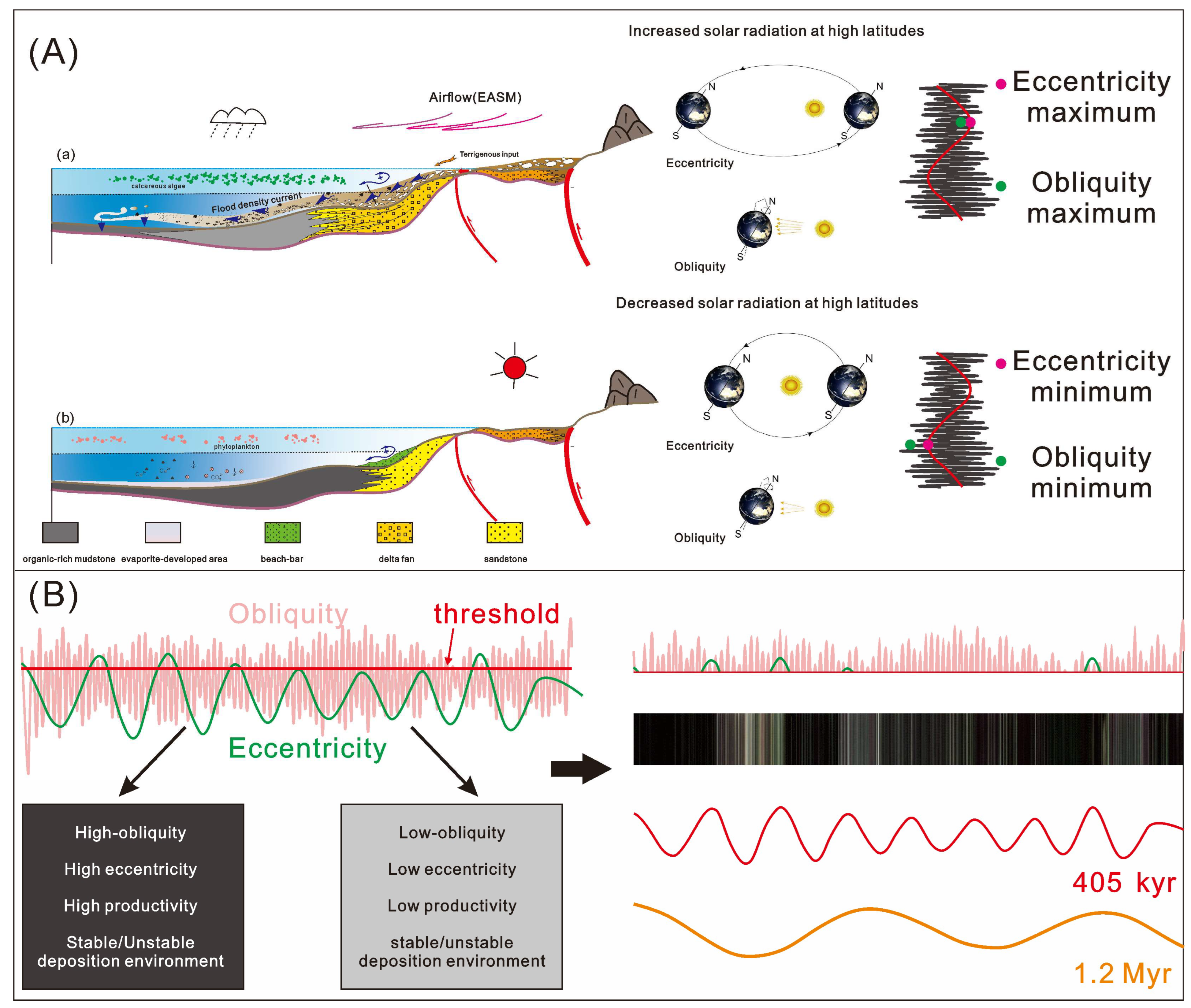
The lithofacies succession and multi-proxy records established in this study indicate that, during deposition of the Es4cu interval, the study area experienced repeated oscillations between arid/semi-arid and relatively humid conditions. This supports previous conclusions that the Asian monsoon system began to exert a periodic influence on central eastern China by the middle Eocene [34,52,65]. Potential moisture sources include southerly moisture transport associated with the Indian and Pacific summer monsoons, as well as westerly delivery that may have originated from the Proto-Tethys region [45]. Notably, the PETM triggered a short-lived humid phase in central eastern China [126,127], and extreme global warming likely promoted inland expansion of monsoonal rainfall. In addition, the broad arid belt in central China was largely controlled by the subtropical high-pressure system, which exhibited pronounced wet-dry oscillations during the late Eocene. Sedimentological evidence from the Jianghan Basin and periodic vegetation “greening” in central China indicate orbital-scale hydroclimate oscillations [128]. These have been attributed to orbitally driven changes in summer monsoon intensity [129] and are further supported by climate model simulations [38]. Together, these results suggest that orbitally paced monsoon incursions, with transient perturbations during extreme warming events such as the PETM, disrupted an otherwise persistent arid to semi-arid background climate [40,126]. Consistent with this framework, MTM power spectra of the ~405 kyr-tuned GR, clay, and Fe time series show significant peaks at the ~405 kyr long eccentricity band, ~123–95 kyr short eccentricity band, ~43–41 kyr obliquity band, and ~22–19 kyr precession band. This pattern indicates a strong linkage between quasi-periodic proxy variability and orbitally forced insolation changes. Therefore, the quasi-cyclic fluctuations in these proxies are interpreted as alternating wet-dry cycles, driven by orbitally induced insolation variability and expressed through changes in monsoon strength under Hadley cell dynamics associated with the subtropical high-pressure system.
In addition, the sedimentary noise model reveals a prominent ~1.2 Myr cycle in the ρ1 series and DYNOT series. This agrees with results from the same stratigraphic level in other wells in the study area reported by Ma [33], Zhang [27], and Zhong [130]. In addition, the amplitude variations in the ~1.2 Myr curve show a similar trend to those of the filtered curves for the three proxy records. This pattern suggests that the long-obliquity cycle may, to some extent, modulate the eccentricity cycle. Specifically, intervals with high amplitudes in the ~1.2 Myr bandpass-filtered curve coincide with strong-amplitude eccentricity variability and exhibit consistent responses in the paleoclimate proxies. During these high-amplitude intervals, the proxies indicate relatively warm and humid conditions, higher lake level, and more reducing bottom-water conditions (e.g., low noise, high clay content, elevated U/Al, and high CIW). In contrast, low-amplitude intervals are more commonly associated with cold-dry conditions, reflected by increased carbonate contents and reduced clay, Al, and CIW values. Accordingly, the forcing mechanism across kyr-Myr timescales can be interpreted as follows: the ~1.2 Myr obliquity cycle influences the meridional insolation gradient by altering the poleward transport of heat and water vapor from low to high latitudes. At the peak amplitude of this ~1.2 Myr cycle, eccentricity variability is correspondingly amplified. Enhanced forcing during these intervals may increase the cross-hemispheric pressure contrast between continental low-pressure centers and subtropical highs, promoting a northward displacement of the ITCZ, which likely dominated the climate system over southern China at that time [130,131,132]. This shift coincides with a coherent migration of the paleo-Hadley circulation, which heightens climatic seasonality—characterized by hotter, wetter summers and colder, drier winters—while raising overall mean precipitation levels. The resulting hydroclimatic responses may include lake-level rise, intensified chemical weathering, and increased sediment supply to the basin.
Growing evidence supports a strong obliquity control on the middle-late Eocene climate [133]. As shown in Section 5.1, intervals with high amplitude in the obliquity band-filtered curve are characterized by lithofacies and proxy records that jointly indicate abundant terrigenous input, sufficient nutrient supply, and high productivity in the lake system. One hypothesis proposes that obliquity forcing on regional hydroclimate may be mediated by ice-sheet feedbacks. Although the Antarctic ice sheet had not expanded widely in the middle Eocene, recent studies suggest that tidewater glaciers may have existed in the middle Eocene, implying a substantial ice volume before the Eocene-Oligocene transition [134,135]. Whether such early ice could influence climate by modifying sea levels and land–sea thermal contrasts remains unconfirmed. However, the dominant periodicity shift identified here at ~41.5–42 Ma (Figure 8D,E) broadly coincides with global cooling and a brief occurrence of high-latitude Northern Hemisphere glaciation [136]. This temporal correspondence suggests that in the Bohai Bay Basin, an obliquity-forced ice-sheet feedback mechanism may have been operative. A second hypothesis emphasizes that obliquity primarily affects high-latitude insolation. By changing the extent of polar night and the meridional contrast in insolation within and between hemispheres, obliquity can alter equator-to-pole and cross-equatorial insolation gradients. This may modulate hydroclimate by influencing the Hadley cell width and the transport of moisture and heat. Within this framework, the ~1.2 Myr obliquity cycle exerts influences on low latitudes through adjustments to the meridional insolation gradient, providing a plausible explanation for the pronounced ~1.2 Myr signal in the proposed clay record and sediment noise models. This mechanism further explains the strong obliquity imprint observed in numerous low-to-mid latitude paleoclimate records. Multi-proxy interpretations indicate that obliquity most likely modulates regional climatic conditions primarily by regulating the intensity of the East Asian summer monsoon [137,138,139,140]. During obliquity maxima (minima), stronger (weaker) land heating relative to the ocean may have generated a stronger (weaker) monsoon and associated precipitation, leading to wetter (drier) conditions [141]. This would increase continental runoff and fluvial sediment supply, which is consistent with our records (Figure 10). A pronounced obliquity-paced signal and associated switches in dominant orbital forcing have also been reported from coeval sedimentary archives across China (e.g., the Xining, Subei, Weihe, Jianghan, Nanxiang, and Beibuwan basins) [33,133,142,143,144]. These observations argue against the view that obliquity acted solely through the modulation of high-latitude insolation. Instead, during the mid–late Eocene cooling interval, obliquity likely played an important role in shaping hydroclimate evolution across East Asia. The shift in dominant orbital periodicity recorded in sediments may also have been influenced by the uplift of the Tibetan Plateau. Around ~42 Ma, significant deceleration and rotation of the northward-moving Indian plate have been linked to a pulse-like uplift of the central Tibetan Plateau (e.g., the Tanggula Mountains) [140]. The resulting topographic barrier could have effectively restricted south-derived moisture transport into central China and farther into the continental interior. Enhanced land–sea thermal contrast, together with a strengthened cross-equatorial pressure gradient for monsoonal precipitation (topographic–thermal forcing), would have promoted expansion of the East Asian monsoon (EAM) system and potentially altered the expression of orbital forcing. One plausible mechanism is that plateau uplift weakened teleconnections between low- and mid-latitude Asia, rendering the regional climate system more sensitive.
In our records, a clear 405-kyr cycle is detected, whereas the ~100-kyr band is not prominent, differing from the strong ~100-kyr modulation reported from the Jianghan and Xining basins. Several explanations are proposed. (1) Differential sedimentary responses to orbital forcing. Unlike the Es4cu interval, where gypsum–halite layers are only sporadically observed near the base, cyclostratigraphic–spectral analysis of the Qianjiang Formation shows that rhythmically developed saline-lake deposits and intersalt mudstones, as well as shallow-water clastic mudstones, are preferentially paced by ~40 kyr and ~100 kyr cycles, respectively [65]. Similarly, in the Xining Basin, superposed obliquity and short-eccentricity signals have been identified in mudstone–gypsum successions, implying that salinity thresholds during deposition can amplify the obliquity signal, whereas under contrasting conditions, the intersalt mudstones preferentially preserve eccentricity-scale variability. (2) Compared with the marginal sea-influenced setting considered here, the Qianjiang paleo-lake was more closed and evaporation-dominated. In contrast, the Dongying Depression likely experienced stronger potential marine influence and additional modulation by an ice-sheet-related ~1.2 Myr cycle, which may have obscured shorter eccentricity and precession signals [145]. (3) Nonlinear responses of the climate system and/or nonlinear distortions in the stratigraphic record may have transformed higher-frequency orbital forcing, transferring variance from short-period bands (short eccentricity and precession) into the long eccentricity band.
Notably, even when a strong obliquity signal is present, some intervals show relatively low carbonate contents but higher felsic and clay mineral abundances, accompanied by low CIW, low Al, and low U/Al. This pattern suggests that sedimentation was influenced by the superposition of other orbital components rather than by obliquity alone. Proxy behavior indicates that intervals of high eccentricity combined with high obliquity are characterized by higher clay contents, higher CIW, and elevated Zr/Al, consistent with a strengthened monsoon circulation (Figure 10B). In contrast, during high eccentricity but low obliquity, the cross-equatorial pressure gradient would be weaker than under high eccentricity–high obliquity conditions, resulting in reduced monsoonal precipitation. During low eccentricity but high obliquity, both the northward displacement of the ITCZ and the cross-equatorial insolation gradient would also be weaker than in the high eccentricity–high obliquity case. This would favor relatively higher carbonate contents and lower felsic and clay mineral contents [146]. These relationships indicate that fine-grained lacustrine deposits in the study area were jointly influenced by eccentricity, obliquity, and precession, reflecting combined control by multiple orbital cycles. Crucially, periodic insolation changes driven by different orbital components can generate nonlinear amplitude modulation and combination frequencies (Figure 11), thereby exciting distinct climate rhythms [147]. This may produce phase offsets between summer warmth (thermal forcing) and the rainy season (precipitation forcing). For example, the onset of the rainy season may not coincide with the beginning of summer and can start in mid-to-late summer. Such phase offsets, together with orbitally driven interannual variability in the duration of summer and the rainy season [124], likely determined which climate mode dominated in a given year. These dynamics are ultimately recorded in the vertical lithofacies succession and in the multi-proxy datasets.

5.4. Implications of Orbital Forcing for Predicting Shale-Oil Sweet Spots

Aforementioned findings demonstrate that astronomically forced hydroclimate variability exerts a pronounced control on terrigenous input, paleoproductivity, and redox conditions [148]. Eccentricity and obliquity—the dominant orbital parameters—regulate the intensity and seasonality of the East Asian monsoon, thereby exerting dual control on organic matter enrichment in the lake basin via both productivity and preservation processes. These controls are consistently recorded by the integrated paleoclimate and paleoenvironment proxies used in this study. Between ~41.6 and ~43.15 Ma, climate conditions are overall relatively humid. When eccentricity and obliquity reach coupled maxima, clay minerals (e.g., illite and kaolinite) and associated terrigenous elements (e.g., Al and Si), together with GR, increase to peak values (Figure 8D,E and Figure 10A). This indicates intensified chemical weathering and enhanced delivery of terrigenous nutrients (e.g., Si and Fe) to the lake, which likely stimulates primary productivity in surface waters and provides a material basis for organic matter accumulation [63,149]. TOC also increases during this interval. Elevated surface water productivity promotes organic matter production; subsequent degradation of sinking organic matter consumes dissolved oxygen, lowering oxygen levels in the water column. In a stratified lake, this process promotes bottom-water anoxia, consistent with the coeval behavior of U/Al (Figure 10B), and thus enhances organic matter preservation. In contrast, during eccentricity and obliquity minima, reduced rainfall likely decreases catchment vegetation cover. Under such conditions, terrigenous detritus could be supplied more persistently, promoting better oxygenation of the water column. Concurrently, weakened surface water productivity and stronger detrital dilution further reduce organic matter contents. However, during the climate-transition intervals before ~43.15 Ma or around ~41.6 Ma, orbital minima under a relatively arid background may be accompanied by reduced seasonality and smaller environmental variability [150]. More quiescent water-column conditions could favor the development of bottom-water anoxia, which would also be conducive to organic matter enrichment [151,152,153,154].
Orbital cyclicity not only controls the stratigraphic distribution of organic-rich intervals but also drives the heterogeneity of sedimentary microfacies and rock fabric through climate hydrological forcing. In the current exploration and development of shale oil in the Bohai Bay Basin, the lamination characteristics of distinct lithofacies assemblages are widely acknowledged to exert a profound influence on the hydrocarbon generation potential and reservoir capacity of shale oil reservoirs [155,156]. Clay mineral-rich laminae are commonly associated with higher organic matter contents and thus provide the material basis for hydrocarbon generation. In contrast, brittle mineral laminae, such as cryptocrystalline or micritic calcite layers [157], tend to host better-developed pore space and represent key reservoirs for free oil [158,159,160]. Therefore, sedimentary processes paced by astronomical cycles directly imprint the critical geological attributes of shale oil sweet spots [161]. Our results suggest that coupled precession and obliquity forcing generated meter-scale, high-frequency mudstone marl lithofacies cycles in the Dongying Sag [162]. Under favorable orbital phases, organic-rich laminated shales not only exhibit high-organic-matter abundance, but their distinctive lamination also confers higher brittleness and more developed micro- to nanopore systems [156,163]. As a result, these intervals combine strong hydrocarbon generation potential with favorable fracability. The integrated lithofacies and proxy datasets compiled here support this interpretation. We further propose and validate a workflow that uses GR logs to reconstruct paleoclimate curves, demonstrating its rationality and effectiveness [164,165]. With constraints from absolute geochronologic anchors, this approach can improve the prediction of favorable intervals and fairways for hydrocarbon accumulation, thereby supporting more efficient exploration and development. It also provides a basis for linking paleoclimate variability with geological records in marginal sea-linked lacustrine systems [166].

6. Conclusions

This study proposes a conceptual model that links hydrological conditions in the Bohai Bay Basin to astronomically forced climate variability. This work highlights the combined roles of obliquity and eccentricity in regulating hydroclimate in a marginal sea-proximal setting. Under the superposition of multiple orbital parameters, monsoon circulation periodically mediates marine influence on the paleo-Dongying Lake Basin. The main conclusions are as follows:
(1)
From a sedimentological and paleoenvironmental perspective, cyclostratigraphic frameworks based on the patterns and amplitudes of GR logs, mineral abundances, elemental concentrations, and diagnostic elemental ratios—astronomically tuned to the ~405 kyr, ~100 kyr, and ~40 kyr bands—provide robust chronological constraints for the mid-late Eocene lithostratigraphic succession.
(2)
Recognition of a ~1.2 Myr long-obliquity-modulated cycle within the sedimentary “noise” series reveals that lake-level fluctuations in this mid-late Eocene marginal sea-influenced system are strongly paced by astronomical forcing. Monsoon-driven circulation likely amplifies the potential marine influence, thus intensifying the hydrological coupling between the sea and the lake.
(3)
Regional climate variability during the mid-late Eocene is governed by forcing associated with eccentricity and obliquity. Warm and humid conditions preferentially occur during intervals of coupled high eccentricity and high obliquity. Obliquity-driven forcing modulates East Asian hydroclimate cyclicity by regulating the intensity of the East Asian summer monsoon, potentially promoting a northward migration of the ITCZ. A reinforced cross-equatorial insolation gradient and pressure contrast facilitate moisture transport into the Northern Hemisphere during boreal summer. High-latitude ice sheets may further exert feedback effects within the climate system. Moreover, the superposition of orbital bands likely induces hydroclimate oscillations through nonlinear climate responses, which, in turn, drives differentiated sedimentary processes.
(4)
By modulating monsoonal precipitation, eccentricity and obliquity periodically force lake-level fluctuations, water-column stratification, and terrigenous input. Under a coupled “high productivity–anoxic preservation” mode, these changes favor the accumulation of organic-rich shales. Climate-controlled rhythmic alternations between carbonate precipitation and detrital supply give rise to interbedded carbonate and organic-rich argillaceous facies, leading to the concurrent occurrence of high-organic-matter content, brittle mineral enrichment, and pore development in specific lithofacies. This coupling ultimately governs the spatiotemporal distribution and enrichment patterns of shale-oil sweet spots.

Author Contributions

Conceptualization, Q.C., Y.L. (Yangbo Lu), Y.M., Y.L. (Yongchao Lu), and M.M.; methodology, Q.C., Y.L. (Yangbo Lu), Y.L. (Yongchao Lu), and X.L.; software, Q.C. and K.D.; validation, Q.C., X.L., and W.S.; formal analysis, Q.C., W.S., and K.D.; investigation, Q.C.; resources, Y.L. (Yangbo Lu) and Y.L. (Yongchao Lu); data curation, Q.C., Y.L. (Yangbo Lu), Y.M., Y.L. (Yongchao Lu), W.S., and M.M.; writing—original draft preparation, Q.C.; writing—review and editing, Y.L. (Yangbo Lu), Y.M., Y.L. (Yongchao Lu), and M.M.; visualization, Q.C., X.L., and K.D.; supervision, Y.L. (Yangbo Lu), Y.M., Y.L. (Yongchao Lu), and M.M.; project administration, Y.L. (Yangbo Lu) and Y.L. (Yongchao Lu); funding acquisition, Y.L. (Yangbo Lu) and Y.L. (Yongchao Lu). All authors have read and agreed to the published version of the manuscript.

Funding

This study was supported by the National Natural Science Foundation of China (Grant No. 42472201; 42572188; 42172181), Open Research Fund of State Key Laboratory of Deep Oil and Gas (No. SKLDOG2025-KFYB-01; SKLDOG2025-KFYB-02), “CUG Scholar” Scientific Research Funds at China University of Geosciences (Wuhan) (Project No. 2023099), and Fundamental Research Funds at China University of Geosciences (Wuhan). We appreciate the Shengli Oilfield, a branch of SINOPEC, for providing cores and wireline log data for this study.

Data Availability Statement

All data and materials are available on request from the corresponding author. The data are not publicly available due to ongoing research using a part of the data.

Conflicts of Interest

The authors declare that they have no known competing financial interests or personal relationships that could have appeared to influence the work reported in this paper.

References

  1. Diaz, R.J.; Rosenberg, R. Spreading Dead Zones and Consequences for Marine Ecosystems. Science 2008, 321, 926–929. [Google Scholar] [CrossRef] [PubMed]
  2. Bianchi, T.S.; Cui, X.; Blair, N.E.; Burdige, D.J.; Eglinton, T.I.; Galy, V. Centers of Organic Carbon Burial and Oxidation at the Land-Ocean Interface. Org. Geochem. 2018, 115, 138–155. [Google Scholar] [CrossRef]
  3. Gracia, A.; Rangel-Buitrago, N.; Oakley, J.A.; Williams, A.T. Use of Ecosystems in Coastal Erosion Management. Ocean Coast. Manag. 2018, 156, 277–289. [Google Scholar] [CrossRef]
  4. Omstedt, A. How to Develop an Understanding of the Marginal Sea System by Connecting Natural and Human Sciences. Oceanologia 2023, 65, 20–29. [Google Scholar] [CrossRef]
  5. Ma, Y. Reservoir Type and Spatial Distribution. In Marine Oil and Gas Exploration in China; Ma, Y., Ed.; Springer: Berlin/Heidelberg, Germany, 2020; pp. 159–214. [Google Scholar]
  6. Yang, C.; Sun, J.; Yang, Y.; Yang, C.; Wang, J.; Xiao, G.; Wang, J. Key Factors Controlling Mesozoic Hydrocarbon Accumulation in the Southern East China Sea Basin. Mar. Pet. Geol. 2020, 118, 104436. [Google Scholar] [CrossRef]
  7. Zhang, G.; Tong, D.; Chen, K.; Liu, H.; Fang, X. Tectonic Evolution and Source Rocks Development of the Super Oil-Rich Bohai Bay Basin, East China. Pet. Explor. Dev. 2024, 51, 1165–1182. [Google Scholar] [CrossRef]
  8. Liu, W.T.; Xie, X. Spacebased Observations of the Seasonal Changes of South Asian Monsoons and Oceanic Responses. Geophys. Res. Lett. 1999, 26, 1473–1476. [Google Scholar] [CrossRef]
  9. Hu, J.; Wang, X.H. Progress on Upwelling Studies in the China Seas. Rev. Geophys. 2016, 54, 653–673. [Google Scholar] [CrossRef]
  10. Wei, W.; Kemp, D.B.; Lu, Y.; Wang, Z.; Ma, Y.; Liu, H.; Zhang, S.; Zhang, J.; Teng, X.; Robbins, L.J.; et al. Astronomically Forcing Salinity Variations in a Marginal-Marine Environment, Bohai Bay Basin, NE China. Chem. Geol. 2024, 665, 122300. [Google Scholar] [CrossRef]
  11. Wang, Y.; Cheng, H.; Edwards, R.L.; Kong, X.; Shao, X.; Chen, S.; Wu, J.; Jiang, X.; Wang, X.; An, Z. Millennial- and Orbital-Scale Changes in the East Asian Monsoon over the Past 224,000 Years. Nature 2008, 451, 1090–1093. [Google Scholar] [CrossRef]
  12. Cha, H.; Moon, J.-H.; Kim, T.; Song, Y.T. A Process-Based Assessment of the Sea-Level Rise in the Northwestern Pacific Marginal Seas. Commun. Earth Environ. 2023, 4, 300. [Google Scholar] [CrossRef]
  13. Chen, Y.; Xiao, C.; Zhang, Y.; Lai, Z. The Mixed Layer Salinity Budget in the Northern South China Sea: A Modeling Study. J. Mar. Sci. Eng. 2023, 11, 1693. [Google Scholar] [CrossRef]
  14. Ershkov, S.; Leshchenko, D.; Prosviryakov, E. Revisiting Long-Time Dynamics of Earth’s Angular Rotation Depending on Quasiperiodic Solar Activity. Mathematics 2023, 11, 2117. [Google Scholar] [CrossRef]
  15. Hays, J.; Imbrie, J.; Shackleton, N. Variations in the Earth’s Orbit: Pacemaker of the Ice Ages. Science 1976, 194, 1121–1132. [Google Scholar] [CrossRef]
  16. Berger, A. Long-Term Variations of Daily Insolation and Quaternary Climatic Changes. J. Atmos. Sci. 1978, 35, 2362–2367. [Google Scholar] [CrossRef]
  17. Clemens, S.; Prell, W.; Murray, D.; Shimmield, G.; Weedon, G. Forcing Mechanisms of the Indian Ocean Monsoon. Nature 1991, 353, 720–725. [Google Scholar] [CrossRef]
  18. Huang, L.; Liu, C.; Zhou, X.; Wang, Y. The Important Turning Points during Evolution of Cenozoic Basin Offshore the Bohai Sea: Evidence and Regional Dynamics Analysis. Sci. China Earth Sci. 2012, 55, 476–487. [Google Scholar] [CrossRef]
  19. Yu, F.; Koyi, H. Cenozoic Tectonic Model of the Bohai Bay Basin in China. Geol. Mag. 2016, 153, 866–886. [Google Scholar] [CrossRef]
  20. Mao, R.; Cheng, X.; Mao, Z.; Guan, Q.; Chen, X.; Li, Z.; Robbins, L.J.; Konhauser, K.O. Hydrocarbon Potential and Biomarker Assemblages of Paleogene Source Rocks in the Cangdong Sag, Bohai Bay Basin, China. J. Geochem. Explor. 2018, 194, 9–18. [Google Scholar] [CrossRef]
  21. Wei, W.; Algeo, T.J.; Lu, Y.; Lu, Y.; Liu, H.; Zhang, S.; Peng, L.; Zhang, J.; Chen, L. Identifying Marine Incursions into the Paleogene Bohai Bay Basin Lake System in Northeastern China. Int. J. Coal Geol. 2018, 200, 1–17. [Google Scholar] [CrossRef]
  22. Hou, G.; Hari, K.R. Mesozoic-Cenozoic Extension of the Bohai Sea: Contribution to the Destruction of North China Craton. Front. Earth Sci. 2014, 8, 202–215. [Google Scholar] [CrossRef]
  23. Li, Q.; Xu, S.; Hao, F. Reassessing the Possibility of Marine Incursion into a Paleo-Lake under the Constraints of a Chronological Framework: Implications for Lake Salinization Mechanisms. GSA Bull. 2025, 137, 2489–2505. [Google Scholar] [CrossRef]
  24. Ma, Y.; Fan, M.; Lu, Y.; Liu, H.; Hao, Y.; Xie, Z.; Peng, L.; Du, X.; Hu, H. Middle Eocene Paleohydrology of the Dongying Depression in Eastern China from Sedimentological and Geochemical Signatures of Lacustrine Mudstone. Palaeogeogr. Palaeoclimatol. Palaeoecol. 2017, 479, 16–33. [Google Scholar] [CrossRef]
  25. Ma, Y.; Fan, M.; Lu, Y.; Liu, H.; Hao, Y.; Xie, Z.; Liu, Z.; Peng, L.; Du, X.; Hu, H. Climate-Driven Paleolimnological Change Controls Lacustrine Mudstone Depositional Process and Organic Matter Accumulation: Constraints from Lithofacies and Geochemical Studies in the Zhanhua Depression, Eastern China. Int. J. Coal Geol. 2016, 167, 103–118. [Google Scholar] [CrossRef]
  26. Han, Y.; Cao, Y.; Liang, C.; Liu, K.; Hao, F. Continental Climate Variability during the Middle Eocene Global Warming. Gondwana Res. 2024, 125, 378–389. [Google Scholar] [CrossRef]
  27. Zhang, S.; Cai, J.; Zeng, X.; Yan, J.; Lai, F.; Zhu, X.; Zhang, K.; Li, J. Orbital Forcing of Lacustrine Cycles in the Eocene Shahejie Formation of China, and Its Paleoclimate Significance. Palaeogeogr. Palaeoclimatol. Palaeoecol. 2025, 677, 113188. [Google Scholar] [CrossRef]
  28. Shi, J.; Jin, Z.; Liu, Q.; Zhang, R.; Huang, Z. Cyclostratigraphy and Astronomical Tuning of the Middle Eocene Terrestrial Successions in the Bohai Bay Basin, Eastern China. Glob. Planet. Change 2019, 174, 115–126. [Google Scholar] [CrossRef]
  29. Shi, J.; Jin, Z.; Liu, Q.; Huang, Z.; Hao, Y. Terrestrial Sedimentary Responses to Astronomically Forced Climate Changes during the Early Paleogene in the Bohai Bay Basin, Eastern China. Palaeogeogr. Palaeoclimatol. Palaeoecol. 2018, 502, 1–12. [Google Scholar] [CrossRef]
  30. Jin, S.; Liu, S.; Li, Z.; Chen, A.; Ma, C. Astrochronology of a Middle Eocene Lacustrine Sequence and Sedimentary Noise Modeling of Lake-Level Changes in Dongying Depression, Bohai Bay Basin. Palaeogeogr. Palaeoclimatol. Palaeoecol. 2022, 585, 110740. [Google Scholar] [CrossRef]
  31. Li, M.; Huang, C.; Ogg, J.; Zhang, Y.; Hinnov, L.; Wu, H.; Chen, Z.-Q.; Zou, Z. Paleoclimate Proxies for Cyclostratigraphy: Comparative Analysis Using a Lower Triassic Marine Section in South China. Earth Sci. Rev. 2019, 189, 125–146. [Google Scholar] [CrossRef]
  32. Huang, C.; Ogg, J.G.; Kemp, D.B. Cyclostratigraphy and Astrochronology: Case Studies from China. Palaeogeogr. Palaeoclimatol. Palaeoecol. 2020, 560, 110017. [Google Scholar] [CrossRef] [PubMed]
  33. Ma, Y.; Fan, M.; Li, M.; Ogg, J.G.; Zhang, C.; Feng, J.; Zhou, C.; Liu, X.; Lu, Y.; Liu, H.; et al. East Asian Lake Hydrology Modulated by Global Sea-Level Variations in the Eocene Warmhouse. Earth Planet. Sci. Lett. 2023, 602, 117925. [Google Scholar] [CrossRef]
  34. Huang, C.; Hinnov, L. Astronomically Forced Climate Evolution in a Saline Lake Record of the Middle Eocene to Oligocene, Jianghan Basin, China. Earth Planet. Sci. Lett. 2019, 528, 115846. [Google Scholar] [CrossRef]
  35. Wang, M.; Chen, H.; Huang, C.; Kemp, D.B.; Xu, T.; Zhang, H.; Li, M. Astronomical Forcing and Sedimentary Noise Modeling of Lake-Level Changes in the Paleogene Dongpu Depression of North China. Earth Planet. Sci. Lett. 2020, 535, 116116. [Google Scholar] [CrossRef]
  36. Liu, Z.; Huang, C.; Algeo, T.J.; Liu, H.; Hao, Y.; Du, X.; Lu, Y.; Chen, P.; Guo, L.; Peng, L. High-Resolution Astrochronological Record for the Paleocene-Oligocene (66–23 Ma) from the Rapidly Subsiding Bohai Bay Basin, Northeastern China. Palaeogeogr. Palaeoclimatol. Palaeoecol. 2018, 510, 78–92. [Google Scholar] [CrossRef]
  37. Ao, H.; Dupont-Nivet, G.; Rohling, E.J.; Zhang, P.; Ladant, J.-B.; Roberts, A.P.; Licht, A.; Liu, Q.; Liu, Z.; Dekkers, M.J.; et al. Orbital Climate Variability on the Northeastern Tibetan Plateau across the Eocene–Oligocene Transition. Nat. Commun. 2020, 11, 5249. [Google Scholar] [CrossRef]
  38. Licht, A.; van Cappelle, M.; Abels, H.A.; Ladant, J.-B.; Trabucho-Alexandre, J.; France-Lanord, C.; Donnadieu, Y.; Vandenberghe, J.; Rigaudier, T.; Lécuyer, C.; et al. Asian Monsoons in a Late Eocene Greenhouse World. Nature 2014, 513, 501–506. [Google Scholar] [CrossRef]
  39. Xie, Y.; Wu, F.; Fang, X. Middle Eocene East Asian Monsoon Prevalence over Southern China: Evidence from Palynological Records. Glob. Planet. Change 2019, 175, 13–26. [Google Scholar] [CrossRef]
  40. Carter, A.; Riley, T.R.; Hillenbrand, C.-D.; Rittner, M. Widespread Antarctic Glaciation during the Late Eocene. Earth Planet. Sci. Lett. 2017, 458, 49–57. [Google Scholar] [CrossRef]
  41. Van Breedam, J.; Huybrechts, P.; Crucifix, M. Modelling Evidence for Late Eocene Antarctic Glaciations. Earth Planet. Sci. Lett. 2022, 586, 117532. [Google Scholar] [CrossRef]
  42. Vermeulen, D.H.A.; Baatsen, M.L.J.; von der Heydt, A.S. Sustainability of Regional Antarctic Ice Sheets under Late Eocene Seasonal Atmospheric Conditions. Clim. Past 2025, 21, 95–114. [Google Scholar] [CrossRef]
  43. Jerolmack, D.J.; Paola, C. Shredding of Environmental Signals by Sediment Transport. Geophys. Res. Lett. 2010, 37, L19401. [Google Scholar] [CrossRef]
  44. Romans, B.W.; Castelltort, S.; Covault, J.A.; Fildani, A.; Walsh, J.P. Environmental Signal Propagation in Sedimentary Systems across Timescales. Earth Sci. Rev. 2016, 153, 7–29. [Google Scholar] [CrossRef]
  45. Meijer, N.; Dupont-Nivet, G.; Abels, H.A.; Kaya, M.Y.; Licht, A.; Xiao, M.; Zhang, Y.; Roperch, P.; Poujol, M.; Lai, Z.; et al. Central Asian Moisture Modulated by Proto-Paratethys Sea Incursions since the Early Eocene. Earth Planet. Sci. Lett. 2019, 510, 73–84. [Google Scholar] [CrossRef]
  46. Xie, Y.; Wu, F.; Miao, Y.; Yang, L.; Fang, X. Reappraisal of Eocene Climate Patterns in East Asia: A Synthetic Review. Earth-Sci. Rev. 2025, 271, 105281. [Google Scholar] [CrossRef]
  47. Feng, Y.; Li, S.; Lu, Y. Sequence Stratigraphy and Architectural Variability in Late Eocene Lacustrine Strata of the Dongying Depression, Bohai Bay Basin, Eastern China. Sediment. Geol. 2013, 295, 1–26. [Google Scholar] [CrossRef]
  48. Zhao, Y.; Zhang, H.; Liu, C.; Liu, B.; Ma, L.; Wang, L. Late Eocene to Early Oligocene Quantitative Paleotemperature Record: Evidence from Continental Halite Fluid Inclusions. Sci. Rep. 2014, 4, 5776. [Google Scholar] [CrossRef]
  49. Liu, Q.; He, L.; Chen, L. Tectono-Thermal Modeling of Cenozoic Multiple Rift Episodes in the Bohai Bay Basin, Eastern China and Its Geodynamic Implications. Int. J. Earth Sci. 2018, 107, 53–69. [Google Scholar] [CrossRef]
  50. Meng, F.; Ni, P.; Yuan, X.; Zhou, C.; Yang, C.; Li, Y. Choosing the Best Ancient Analogue for Projected Future Temperatures: A Case Using Data from Fluid Inclusions of Middle-Late Eocene Halites. J. Asian Earth Sci. 2013, 67–68, 46–50. [Google Scholar] [CrossRef]
  51. Scotese, C.R.; Song, H.; Mills, B.J.W.; van der Meer, D.G. Phanerozoic Paleotemperatures: The Earth’s Changing Climate during the Last 540 Million Years. Earth Sci. Rev. 2021, 215, 103503. [Google Scholar] [CrossRef]
  52. He, Z.; Zhang, Z.; Guo, Z.; Tan, N.; Zhang, Z.; Zhang, C.; Wu, H.; Deng, C. The Origin of the Modern-like East Asian Monsoon: Insights from New Proxy Data Synthesis and Climate Modelling. Earth Sci. Rev. 2025, 271, 105297. [Google Scholar] [CrossRef]
  53. Xie, X.; Fan, Z.; Liu, X.; Lu, Y. Geochemistry of Formation Water and Its Implication on Overpressured Fluid Flow in the Dongying Depression of the Bohaiwan Basin, China. J. Geochem. Explor. 2006, 89, 432–435. [Google Scholar] [CrossRef]
  54. Zhu, J.; Zou, C.; Feng, Y.; Jiang, S.; Wu, W.; Zhu, R.; Yuan, M. Distribution and Controls of Petroliferous Plays in Subtle Traps within a Paleogene Lacustrine Sequence Stratigraphic Framework, Dongying Depression, Bohai Bay Basin, Eastern China. Pet. Sci. 2020, 17, 1–22. [Google Scholar] [CrossRef]
  55. Wu, Z.; Zhao, X.; Wang, E.; Pu, X.; Lash, G.; Han, W.; Zhang, W.; Feng, Y. Sedimentary Environment and Organic Enrichment Mechanisms of Lacustrine Shale: A Case Study of the Paleogene Shahejie Formation, Qikou Sag, Bohai Bay Basin. Palaeogeogr. Palaeoclimatol. Palaeoecol. 2021, 573, 110404. [Google Scholar] [CrossRef]
  56. Zhao, H.; Zhu, X.; Zhu, S.; Wang, X.; Zhao, F.; Shen, M.; Xu, T.; Lu, W.; Zhang, H. Seismic Geomorphology and Depositional Evolution of the Paleogene Shahejie Formation, Central-North Dongying Depression, Bohai Bay Basin, China. Arab. J. Geosci. 2019, 12, 26. [Google Scholar] [CrossRef]
  57. Yang, K.; Zhu, X.; Colombera, L.; McArthur, A.; Mountney, N.P.; Zhu, S.; Jin, L.; Shen, T.; Yang, H.; Chen, H.; et al. Sediment Provenance and Dispersal in the Early Eocene Dongying Depression, Bohai Bay Basin, Eastern China: Evidence from Detrital Zircon Geochronology, Geochemistry and Petrology. Sediment. Geol. 2023, 454, 106453. [Google Scholar] [CrossRef]
  58. Yu, Y.; Wei, W.; Yao, Y.; Qiu, K.; Yang, J.; Ji, H.; Pei, X.; Zhang, Z. Sporopollen-Algae Assemblage and Its Paleoenvironmental Significance for the Kongdian Formation of Eocene Strata in Bohai Bay Basin, China. Water 2025, 17, 92. [Google Scholar] [CrossRef]
  59. Jiang, W.; Yan, X.; Tan, X.; Garzanti, E.; Li, W.; Liu, J.; Luo, L. Lacustrine Hydrochemical Variations and Carbon Sequestration under Hyperthermal Climates: Insights from the Lower Eocene Kongdian Formation (Bohai Bay Basin, NE China). Int. J. Earth Sci. 2025, 114, 497–510. [Google Scholar] [CrossRef]
  60. Liu, S.; Jiang, Z.; He, Y.; Dou, L.; Yang, Y.; Li, Y.; Han, C. Geomorphology, Lithofacies and Sedimentary Environment of Lacustrine Carbonates in the Eocene Dongying Depression, Bohai Bay Basin, China. Mar. Pet. Geol. 2020, 113, 104125. [Google Scholar] [CrossRef]
  61. Yang, Y.; Jiang, Z.; Liu, S.; Li, Y. An Eogenetic Karst in Lacustrine Carbonates and Its Influence on Reservoir Development: A Case Study of the Eocene Dongying Depression, Bohai Bay Basin, East China. Mar. Pet. Geol. 2021, 125, 104860. [Google Scholar] [CrossRef]
  62. Xie, Y.; Wu, F.; Ning, W.; Jiang, Y. Orbitally-Forced Meridional Shifts of the Westerlies Modulated the Hydroclimate of Northeast China during the Late Eocene. Palaeogeogr. Palaeoclimatol. Palaeoecol. 2024, 633, 111908. [Google Scholar] [CrossRef]
  63. Liang, C.; Jiang, Z.; Cao, Y.; Wu, J.; Wang, Y.; Hao, F. Sedimentary Characteristics and Origin of Lacustrine Organic-Rich Shales in the Salinized Eocene Dongying Depression. GSA Bull. 2017, 130, 154–174. [Google Scholar] [CrossRef]
  64. Liu, J.; Wang, J.; Cao, Y.; Song, G. Sedimentation in a Continental High-Frequency Oscillatory Lake in an Arid Climatic Background: A Case Study of the Lower Eocene in the Dongying Depression, China. J. Earth Sci. 2017, 28, 628–644. [Google Scholar] [CrossRef]
  65. Kong, X.; Jiang, Z.; Cai, Y. Orbital and Sub-Orbital Pacing of Mudstones in the Dongying Depression, Eastern China: Implications for Middle Eocene East Asian Climate Evolution. GSA Bull. 2023, 135, 3024–3042. [Google Scholar] [CrossRef]
  66. Westerhold, T.; Marwan, N.; Drury, A.J.; Liebrand, D.; Agnini, C.; Anagnostou, E.; Barnet, J.S.K.; Bohaty, S.M.; De Vleeschouwer, D.; Florindo, F.; et al. An Astronomically Dated Record of Earth’s Climate and Its Predictability over the Last 66 Million Years. Science 2020, 369, 1383–1387. [Google Scholar] [CrossRef]
  67. Speijer, R.P.; Pälike, H.; Hollis, C.J.; Hooker, J.J.; Ogg, J.G. GTS2020: The Paleogene Period; Vienna (Gather Online); Copernicus GmbH (Copernicus Publications): Göttingen, Germany, 2021. [Google Scholar]
  68. Chen, S.; Zhang, S.; Wang, Y.; Tan, M. Lithofacies Types and Reservoirs of Paleogene Fine-Grained Sedimentary Rocks Dongying Sag, Bohai Bay Basin, China. Pet. Explor. Dev. 2016, 43, 218–229. [Google Scholar] [CrossRef]
  69. Bai, C.; Yu, B.; Liu, H.; Xie, Z.; Han, S.; Zhang, L.; Ye, R.; Ge, J. The Genesis and Evolution of Carbonate Minerals in Shale Oil Formations from Dongying Depression, Bohai Bay Basin, China. Int. J. Coal Geol. 2018, 189, 8–26. [Google Scholar] [CrossRef]
  70. Shi, J.; Jin, Z.; Liu, Q.; Huang, Z. Depositional Process and Astronomical Forcing Model of Lacustrine Fine-Grained Sedimentary Rocks: A Case Study of the Early Paleogene in the Dongying Sag, Bohai Bay Basin. Mar. Pet. Geol. 2020, 113, 103995. [Google Scholar] [CrossRef]
  71. Gregory, B.R.B.; Patterson, R.T.; Reinhardt, E.G.; Galloway, J.M.; Roe, H.M. An Evaluation of Methodologies for Calibrating Itrax X-Ray Fluorescence Counts with ICP-MS Concentration Data for Discrete Sediment Samples. Chem. Geol. 2019, 521, 12–27. [Google Scholar] [CrossRef]
  72. Li, M.; Hinnov, L.; Kump, L. Acycle: Time-Series Analysis Software for Paleoclimate Research and Education. Comput. Geosci. 2019, 127, 12–22. [Google Scholar] [CrossRef]
  73. Meyers, S.R.; Sageman, B.B. Quantification of Deep-Time Orbital Forcing by Average Spectral Misfit. Am. J. Sci. 2007, 307, 773–792. [Google Scholar] [CrossRef]
  74. Hinnov, L.A. Cyclostratigraphy and Its Revolutionizing Applications in the Earth and Planetary Sciences. GSA Bull. 2013, 125, 1703–1734. [Google Scholar] [CrossRef]
  75. Meyers, S.R.; Sageman, B.B.; Hinnov, L.A. Integrated Quantitative Stratigraphy of the Cenomanian-Turonian Bridge Creek Limestone Member Using Evolutive Harmonic Analysis and Stratigraphic Modeling. J. Sediment. Res. 2001, 71, 628–644. [Google Scholar] [CrossRef]
  76. Li, M.; Kump, L.R.; Hinnov, L.A.; Mann, M.E. Tracking Variable Sedimentation Rates and Astronomical Forcing in Phanerozoic Paleoclimate Proxy Series with Evolutionary Correlation Coefficients and Hypothesis Testing. Earth Planet. Sci. Lett. 2018, 501, 165–179. [Google Scholar] [CrossRef]
  77. Westerhold, T.; Röhl, U.; Frederichs, T.; Bohaty, S.M.; Zachos, J.C. Astronomical Calibration of the Geological Timescale: Closing the Middle Eocene Gap. Clim. Past 2015, 11, 1181–1195. [Google Scholar] [CrossRef]
  78. Li, M.; Hinnov, L.A.; Huang, C.; Ogg, J.G. Sedimentary Noise and Sea Levels Linked to Land–Ocean Water Exchange and Obliquity Forcing. Nat. Commun. 2018, 9, 1004. [Google Scholar] [CrossRef]
  79. Li, Y.; Yang, R.; Fan, A.; Chen, J.; Bilal, A.; Wang, Z. Establishment of a High-Resolution Astronomical Time Scale and High-Frequency Sequence Framework of Paleogene Lacustrine Fine-Grained Sediments Using Logging Data: A Case Study from the Bohai Bay Basin, East China. Mar. Pet. Geol. 2025, 172, 107220. [Google Scholar] [CrossRef]
  80. Teng, J.; Qiu, L.; Zhang, S.; Ma, C. Origin and Diagenetic Evolution of Dolomites in Paleogene Shahejie Formation Lacustrine Organic Shale of Jiyang Depression, Bohai Bay Basin, East China. Pet. Explor. Dev. 2022, 49, 1251–1265. [Google Scholar] [CrossRef]
  81. Jiang, Z.; Duan, H.; Liang, C.; Wu, J.; Zhang, W.; Zhang, J. Classification of Hydrocarbon-Bearing Fine-Grained Sedimentary Rocks. J. Earth Sci. 2017, 28, 693–976. [Google Scholar] [CrossRef]
  82. Westerhold, T.; Röhl, U.; Laskar, J. Time Scale Controversy: Accurate Orbital Calibration of the Early Paleogene. Geochem. Geophys. Geosyst. 2012, 13, Q06015. [Google Scholar] [CrossRef]
  83. Zavala, C. Hyperpycnal (over Density) Flows and Deposits. J. Palaeogeogr. 2020, 9, 17. [Google Scholar] [CrossRef]
  84. Silva, T.A.; Girardclos, S.; Stutenbecker, L.; Bakker, M.; Costa, A.; Schlunegger, F.; Lane, S.N.; Molnar, P.; Loizeau, J.-L. The Sediment Budget and Dynamics of a Delta-Canyon-Lobe System over the Anthropocene Timescale: The Rhone River Delta, Lake Geneva (Switzerland/France). Sedimentology 2019, 66, 838–858. [Google Scholar] [CrossRef]
  85. Laskar, J.; Fienga, A.; Gastineau, M.; Manche, H. La2010: A New Orbital Solution for the Long-Term Motion of the Earth. Astron. Astrophys. 2011, 532, A89. [Google Scholar] [CrossRef]
  86. Weedon, G.P. Time-Series Analysis and Cyclostratigraphy: Examining Stratigraphic Records of Environmental Cycles; Cambridge University Press: Cambridge, UK, 2003. [Google Scholar]
  87. Jozanikohan, G. On the Development of a Non-Linear Calibration Relationship for the Purpose of Clay Content Estimation from the Natural Gamma Ray Log. Int. J. Geo-Eng. 2017, 8, 21. [Google Scholar] [CrossRef]
  88. Díaz-Curiel, J.; Miguel, M.J.; Biosca, B.; Arévalo-Lomas, L. Gamma Ray Log to Estimate Clay Content in the Layers of Water Boreholes. J. Appl. Geophys. 2021, 195, 104481. [Google Scholar] [CrossRef]
  89. Weltje, G.J.; Tjallingii, R. Calibration of XRF Core Scanners for Quantitative Geochemical Logging of Sediment Cores: Theory and Application. Earth Planet. Sci. Lett. 2008, 274, 423–438. [Google Scholar] [CrossRef]
  90. Rothwell, R.G.; Croudace, I.w. Twenty Years of XRF Core Scanning Marine Sediments: What Do Geochemical Proxies Tell Us? In Micro-XRF Studies of Sediment Cores: Applications of a Non-Destructive Tool for the Environmental Sciences; Croudace, I.W., Rothwell, R.G., Eds.; Springer: Dordrecht, The Netherlands, 2015; pp. 25–102. [Google Scholar]
  91. Kent, D.V.; Olsen, P.E.; Rasmussen, C.; Lepre, C.; Mundil, R.; Irmis, R.B.; Gehrels, G.E.; Giesler, D.; Geissman, J.W.; Parker, W.G. Empirical Evidence for Stability of the 405-Kiloyear Jupiter–Venus Eccentricity Cycle over Hundreds of Millions of Years. Proc. Natl. Acad. Sci. USA 2018, 115, 6153–6158. [Google Scholar] [CrossRef]
  92. Du, X.; Liu, H.; Liu, H.; Lu, Y.; Wang, Y.; Hoa, X.; Yang, W.; Ding, J. Methods of sequence stratigraphy in the fine-grained sediments: A case from the upper fourth sub-member and the lower third sub-member of the Shahejie Formation in well Fanye 1 of Dongying Depression. Geol. Sci. Technol. 2016, 35, 1–11. [Google Scholar]
  93. Hilgen, F.J. An Astronomically Calibrated (Polarity) Time Scale for the Pliocene–Pleistocene: A Brief Review. In Orbital Forcing and Cyclic Sequences; John Wiley & Sons, Ltd.: Hoboken, NJ, USA, 1994; pp. 109–116. [Google Scholar]
  94. Matys Grygar, T.; Mach, K.; Schnabl, P.; Martinez, M.; Zeeden, C. Orbital Forcing and Abrupt Events in a Continental Weathering Proxy from Central Europe (Most Basin, Czech Republic, 17.7–15.9 ma) Recorded Beginning of the Miocene Climatic Optimum. Palaeogeogr. Palaeoclimatol. Palaeoecol. 2019, 514, 423–440. [Google Scholar] [CrossRef]
  95. Miller, K.G.; Schmelz, W.J.; Browning, J.V.; Rosenthal, Y.; Hess, A.V.; Kopp, R.E.; Wright, J.D. Global Mean and Relative Sea-Level Changes over the Past 66 Myr: Implications for Early Eocene Ice Sheets. Earth Sci. Syst. Soc. 2024, 4, 10091. [Google Scholar] [CrossRef]
  96. Fedo, C.M.; Wayne Nesbitt, H.; Young, G.M. Unraveling the Effects of Potassium Metasomatism in Sedimentary Rocks and Paleosols, with Implications for Paleoweathering Conditions and Provenance. Geology 1995, 23, 921–924. [Google Scholar] [CrossRef]
  97. Wang, A.; Wang, Z.; Liu, J.; Xu, N.; Li, H. The Sr/Ba Ratio Response to Salinity in Clastic Sediments of the Yangtze River Delta. Chem. Geol. 2021, 559, 119923. [Google Scholar] [CrossRef]
  98. Algeo, T.J.; Wei, W.; Liu, Z.; Song, Y.; Song, H. Are Elemental Salinity Proxies Worth Their Salt? J. Earth Sci. 2025, 36, 1848–1852. [Google Scholar] [CrossRef]
  99. Tribovillard, N.; Algeo, T.J.; Lyons, T.; Riboulleau, A. Trace Metals as Paleoredox and Paleoproductivity Proxies: An Update. Chem. Geol. 2006, 232, 12–32. [Google Scholar] [CrossRef]
  100. Nesbitt, H.W.; Young, G.M. Early Proterozoic Climates and Plate Motions Inferred from Major Element Chemistry of Lutites. Nature 1982, 299, 715–717. [Google Scholar] [CrossRef]
  101. Jones, B.; Manning, D.A.C. Comparison of Geochemical Indices Used for the Interpretation of Palaeoredox Conditions in Ancient Mudstones. Chem. Geol. 1994, 111, 111–129. [Google Scholar] [CrossRef]
  102. Wei, W.; Algeo, T.J. Elemental Proxies for Paleosalinity Analysis of Ancient Shales and Mudrocks. Geochim. Cosmochim. Acta 2020, 287, 341–366. [Google Scholar] [CrossRef]
  103. Kang, J.; Chen, X.; Deng, X.; Fang, Y.; Jiang, H.; Liu, C.; Luo, C.; Li, X.; Lin, Y.; Ren, Z.; et al. Recommendations of Stable Mg, Si, V, Fe, Cu, Zn, Rb, Sr, Ag, Cd, Ba, and U Isotope Compositions for Multiple Geological References. J. Earth Sci. 2025, 36, 1408–1424. [Google Scholar] [CrossRef]
  104. Liu, Z.; Jiang, M.; Zhou, F.; Selby, D.; Qiu, Z. Role of Terrestrial Organic Matter in Re and Os Uptake: Insights for Re-Os Dating of Organic-Bearing Sedimentary Rocks and Weathering of Organic Carbon. J. Earth Sci. 2025, 36, 2109–2116. [Google Scholar] [CrossRef]
  105. He, Y.; Li, W.; Liu, H.; Qiu, N.; Li, K.; Xi, C.; Bai, X.; Long, H.; Chen, Y. Petrogenesis of the Dengying Formation Dolomite in Northeast Sichuan Basin, SW China: Constraints from Carbon-Oxygen Isotopic and Trace Elemental Data. J. Earth Sci. 2025, 36, 75–88. [Google Scholar] [CrossRef]
  106. Hemmati, M.; Ahmadi, Y.; Vaferi, B.; Alibak, A.H.; Wood, D.A. Surveying Organic Matter, Thermal Maturity Level, and Paleo-Environmental Conditions by Considering Biomarker and Stable Carbon Isotopic Analysis. J. Earth Sci. 2025, 36, 428–440. [Google Scholar] [CrossRef]
  107. Talbot, M.R. A Review of the Palaeohydrological Interpretation of Carbon and Oxygen Isotopic Ratios in Primary Lacustrine Carbonates. Chem. Geol. Isot. Geosci. Sect. 1990, 80, 261–279. [Google Scholar] [CrossRef]
  108. Li, H.-C.; Ku, T.-L. δ13C–δ18C Covariance as a Paleohydrological Indicator for Closed-Basin Lakes. Palaeogeogr. Palaeoclimatol. Palaeoecol. 1997, 133, 69–80. [Google Scholar] [CrossRef]
  109. Leng, M.J.; Marshall, J.D. Palaeoclimate Interpretation of Stable Isotope Data from Lake Sediment Archives. Quat. Sci. Rev. 2004, 23, 811–831. [Google Scholar] [CrossRef]
  110. Ma, Y.-Q.; Zhang, C.; Lu, Y.-C.; Kong, X.-Y.; Guo, Y.; Dong, Y.-X.; Chen, L.; Qi, R.; Xing, F.-C. Characteristics, Main Controlling Factors and Densification Mechanisms of Unconventional Tight Reservoirs in Triassic Yanchang Formation in Southern Ordos Basin, China. Pet. Sci. 2024, 21, 3884–3898. [Google Scholar] [CrossRef]
  111. Ma, Y.; Fan, M.; Lu, Y.; Liu, H.; Zhang, S.; Liu, X. Stable Isotope Record of Middle Eocene Summer Monsoon and Its Instability in Eastern China. Glob. Planet. Change 2019, 175, 103–112. [Google Scholar] [CrossRef]
  112. Zhang, J.; Jiang, Z.; Jiang, X.; Wang, S.; Liang, C.; Wu, M. Oil Generation Induces Sparry Calcite Formation in Lacustrine Mudrock, Eocene of East China. Mar. Pet. Geol. 2016, 71, 344–359. [Google Scholar] [CrossRef]
  113. Liu, H.; Zhang, S.; Liu, Y.; Zhang, P.; Wei, X.; Wang, Y.; Zhu, D.; Hu, Q.; Yang, W.; Tang, D.; et al. Characteristics of Lithofacies Combinations and Reservoir Property of Carbonate-Rich Shale in Dongying Depression, Eastern China. Front. Earth Sci. 2022, 10, 857729. [Google Scholar] [CrossRef]
  114. Al-Jafar, M.K.; Al-Jaberi, M.H. Determination of Clay Minerals Using Gamma Ray Spectroscopy for the Zubair Formation in Southern Iraq. J. Pet. Explor. Prod. Technol. 2022, 12, 299–306. [Google Scholar] [CrossRef]
  115. Hussain, W.; Luo, M.; Ali, M.; Al-Khafaji, H.F.; Hussain, I.; Hussain, M.; Ahmed, S.A.A.; Obaidullah. A Gamma-Ray Spectroscopy Approach to Evaluate Clay Mineral Composition and Depositional Environment: A Case Study from the Lower Goru Formation, Southern Indus Basin, Pakistan. J. Appl. Geophys. 2024, 226, 105414. [Google Scholar] [CrossRef]
  116. Ruffell, A.; Worden, R. Palaeoclimate Analysis Using Spectral Gamma-Ray Data from the Aptian (Cretaceous) of Southern England and Southern France. Palaeogeogr. Palaeoclimatol. Palaeoecol. 2000, 155, 265–283. [Google Scholar] [CrossRef]
  117. Peng, C.; Zou, C.; Wu, H.; Zhang, S.; Kouamelan, K.S.; Wang, C. Evaluating Geophysical Logs as Proxies for Cyclostratigraphy in Lacustrine Deposits Using Power Ratio Accumulation. Palaeogeogr. Palaeoclimatol. Palaeoecol. 2023, 614, 111428. [Google Scholar] [CrossRef]
  118. Li, Q.; Xu, S.; Li, J.; Guo, R.; Wang, G.; Wang, Y. Effects of Astronomical Cycles on Laminated Shales of the Paleogene Shahejie Formation in the Dongying Sag, Bohai Bay Basin, China. Energies 2023, 16, 3624. [Google Scholar] [CrossRef]
  119. Liang, C.; Wu, J.; Jiang, Z.; Cao, Y.; Song, G. Sedimentary Environmental Controls on Petrology and Organic Matter Accumulation in the Upper Fourth Member of the Shahejie Formation (Paleogene, Dongying Depression, Bohai Bay Basin, China). Int. J. Coal Geol. 2018, 186, 1–13. [Google Scholar] [CrossRef]
  120. Ding, Z.; Huang, G.; Liu, F.; Wu, R.; Wang, P. Responses of Global Monsoon and Seasonal Cycle of Precipitation to Precession and Obliquity Forcing. Clim. Dyn. 2021, 56, 3733–3747. [Google Scholar] [CrossRef]
  121. Dickens, G.R.; O’Neil, J.R.; Rea, D.K.; Owen, R.M. Dissociation of Oceanic Methane Hydrate as a Cause of the Carbon Isotope Excursion at the End of the Paleocene. Paleoceanography 1995, 10, 965–971. [Google Scholar] [CrossRef]
  122. Sluijs, A.; Zeebe, R.E.; Bijl, P.K.; Bohaty, S.M. A Middle Eocene Carbon Cycle Conundrum. Nat. Geosci. 2013, 6, 429–434. [Google Scholar] [CrossRef]
  123. Zachos, J.C.; Röhl, U.; Schellenberg, S.A.; Sluijs, A.; Hodell, D.A.; Kelly, D.C.; Thomas, E.; Nicolo, M.; Raffi, I.; Lourens, L.J.; et al. Rapid Acidification of the Ocean during the Paleocene-Eocene Thermal Maximum. Science 2005, 308, 1611–1615. [Google Scholar] [CrossRef]
  124. Liu, T.; Yang, H.; Shi, X.; Wang, H.; Zhang, H.; Chen, D. Precession Affects the Timing and Duration of Summer and Rainy Season in East Asia. Geophys. Res. Lett. 2025, 52, e2025GL116963. [Google Scholar] [CrossRef]
  125. Zhang, J.; Jiang, Z.; Liang, C.; Baars, T.F.; Wang, Y.; Abels, H.A. Astronomical Forcing of Meter-Scale Organic-Rich Mudstone–Limestone Cyclicity in the Eocene Dongying Sag, China: Implications for Shale Reservoir Exploration. AAPG Bull. 2022, 106, 1557–1579. [Google Scholar] [CrossRef]
  126. Xie, Y.; Wu, F.; Fang, X. A Transient South Subtropical Forest Ecosystem in Central China Driven by Rapid Global Warming during the Paleocene-Eocene Thermal Maximum. Gondwana Res. 2022, 101, 192–202. [Google Scholar] [CrossRef]
  127. Meijer, N.; Licht, A.; Woutersen, A.; Hoorn, C.; Robin-Champigneul, F.; Rohrmann, A.; Tagliavento, M.; Brugger, J.; Kelemen, F.D.; Schauer, A.J.; et al. Proto-Monsoon Rainfall and Greening in Central Asia Due to Extreme Early Eocene Warmth. Nat. Geosci. 2024, 17, 158–164. [Google Scholar] [CrossRef]
  128. Yan, K.; Wang, C.; Liu, C.; Mischke, S.; Wang, J.; Yu, X. Reconstruction of Early Paleogene Landscapes and Climate in the Jianghan Basin, Central China: Evidence from Evaporites and Palynology. Palaeogeogr. Palaeoclimatol. Palaeoecol. 2022, 601, 111095. [Google Scholar] [CrossRef]
  129. Chen, Z.; Ding, Z.; Yang, S.; Zhang, C.; Wang, X. Increased Precipitation and Weathering across the Paleocene-Eocene Thermal Maximum in Central China. Geochem. Geophys. Geosyst. 2016, 17, 2286–2297. [Google Scholar] [CrossRef]
  130. Zhong, Q.; Zhang, J.; Wang, S.; Li, J.; Jiang, Z.; Qiu, Y. Depositional Evolution of Eocene Deep-Lake Mudrock Lithofacies Driven by Astronomical Forcing in the Dongying Depression, China. Mar. Pet. Geol. 2023, 158, 106516. [Google Scholar] [CrossRef]
  131. Donohoe, A.; Marshall, J.; Ferreira, D.; Mcgee, D. The Relationship between ITCZ Location and Cross-Equatorial Atmospheric Heat Transport: From the Seasonal Cycle to the Last Glacial Maximum. J. Clim. 2013, 26, 3597–3618. [Google Scholar] [CrossRef]
  132. Xu, H.; Song, Y.; Goldsmith, Y.; Lang, Y. Meridional ITCZ Shifts Modulate Tropical/Subtropical Asian Monsoon Rainfall. Sci. Bull. 2019, 64, 1737–1739. [Google Scholar] [CrossRef]
  133. Ma, Y.; Fan, M.; Lu, Y.; Zhang, C.; Liu, H.; Lu, Y. Change in Dominant Orbital Cycles Led to Warm Excursions during the Middle–Late Eocene Cooling. GSA Bull. 2025, 137, 2619–2631. [Google Scholar] [CrossRef]
  134. DeConto, R.M.; Pollard, D. Rapid Cenozoic Glaciation of Antarctica Induced by Declining Atmospheric CO2. Nature 2003, 421, 245–249. [Google Scholar] [CrossRef]
  135. Galeotti, S.; DeConto, R.; Naish, T.; Stocchi, P.; Florindo, F.; Pagani, M.; Barrett, P.; Bohaty, S.M.; Lanci, L.; Pollard, D.; et al. Antarctic Ice Sheet Variability across the Eocene-Oligocene Boundary Climate Transition. Science 2016, 352, 76–80. [Google Scholar] [CrossRef]
  136. Bosboom, R.E.; Abels, H.A.; Hoorn, C.; van den Berg, B.C.J.; Guo, Z.; Dupont-Nivet, G. Aridification in Continental Asia after the Middle Eocene Climatic Optimum (MECO). Earth Planet. Sci. Lett. 2014, 389, 34–42. [Google Scholar] [CrossRef]
  137. Mantsis, D.F.; Lintner, B.R.; Broccoli, A.J.; Erb, M.P.; Clement, A.C.; Park, H.-S. The Response of Large-Scale Circulation to Obliquity-Induced Changes in Meridional Heating Gradients. J. Clim. 2014, 27, 5504–5516. [Google Scholar] [CrossRef]
  138. Bosmans, J.H.C.; Erb, M.P.; Dolan, A.M.; Drijfhout, S.S.; Tuenter, E.; Hilgen, F.J.; Edge, D.; Pope, J.O.; Lourens, L.J. Response of the Asian Summer Monsoons to Idealized Precession and Obliquity Forcing in a Set of GCMs. Quat. Sci. Rev. 2018, 188, 121–135. [Google Scholar] [CrossRef]
  139. Bosmans, J.H.C.; Hilgen, F.J.; Tuenter, E.; Lourens, L.J. Obliquity Forcing of Low-Latitude Climate. Clim. Past. 2015, 11, 1335–1346. [Google Scholar] [CrossRef]
  140. Zhang, Q.; Shen, L.; Fu, X.; Wang, J.; Zeng, S.; Ruebsam, W.; Ahmed, M.S.; Shen, H.; Mansour, A. Eocene Climate and Hydrology of Eastern Asia Controlled by Orbital Forcing and Tibetan Plateau Uplift. Earth Planet. Sci. Lett. 2024, 646, 118981. [Google Scholar] [CrossRef]
  141. Ma, Y.; Fan, M.; Zhang, C.; Grasby, S.E.; Yin, R.; Lu, Y.; Zhang, B.; Jin, X.; Ma, C.; Lu, Y.; et al. Volcanic and Orbitally Forced Carbon Release during the Middle Eocene Climatic Optimum. Geology 2024, 52, 813–818. [Google Scholar] [CrossRef]
  142. Liu, J.; Shi, J.; Lu, Y.; Fan, X.; Zhang, Z.; Zhang, R.; Wang, Z.; Xu, K.; Xiao, A.; Kemp, D.B.; et al. Astronomical Forcing of Terrestrial Organic Carbon Burial in East Asia during the Eocene. Earth Planet. Sci. Lett. 2024, 646, 119014. [Google Scholar] [CrossRef]
  143. Abels, H.A.; Dupont-Nivet, G.; Xiao, G.; Bosboom, R.; Krijgsman, W. Step-Wise Change of Asian Interior Climate Preceding the Eocene–Oligocene Transition (EOT). Palaeogeogr. Palaeoclimatol. Palaeoecol. 2011, 299, 399–412. [Google Scholar] [CrossRef]
  144. Zhang, R.; Huang, C.; Kemp, D.B.; Wang, Z.; Zhang, Z.; Chen, W. Astronomical Forcing of the Hydrological Cycle in the Weihe Basin (North China) during the Middle to Late Eocene. Glob. Planet. Change 2023, 228, 104208. [Google Scholar] [CrossRef]
  145. Ao, H.; Rohling, E.J.; Zhang, R.; Roberts, A.P.; Holbourn, A.E.; Ladant, J.-B.; Dupont-Nivet, G.; Kuhnt, W.; Zhang, P.; Wu, F.; et al. Global Warming-Induced Asian Hydrological Climate Transition across the Miocene–Pliocene Boundary. Nat. Commun. 2021, 12, 6935. [Google Scholar] [CrossRef]
  146. Zhao, D.; Wan, S.; Lu, Z.; Zhai, L.; Feng, X.; Shi, X.; Li, A. Response of Heterogeneous Rainfall Variability in East Asia to Hadley Circulation Reorganization during the Late Quaternary. Quat. Sci. Rev. 2020, 247, 106562. [Google Scholar] [CrossRef]
  147. Huang, H.; Gao, Y.; Ma, C.; Jones, M.M.; Zeeden, C.; Ibarra, D.E.; Wu, H.; Wang, C. Organic Carbon Burial Is Paced by a ~173-Ka Obliquity Cycle in the Middle to High Latitudes. Sci. Adv. 2021, 7, eabf9489. [Google Scholar] [CrossRef] [PubMed]
  148. Xiong, Z.; Cao, Y.; Xue, S.; Wang, G.; Liang, C.; Liu, K. Characteristics, Preservation Mechanisms, and Significance of Aragonite in Lacustrine Shale: A Case Study from the Jiyang Depression, Bohai Bay Basin. Pet. Sci. 2024, 21, 3001–3015. [Google Scholar] [CrossRef]
  149. Song, S.; Ye, L.; Yu, X.; Wu, Z.; Zhang, Y.; Zhang, W. Differential Burial of Particulate Organic Carbon at the Chukchi Continental Margin, Arctic Ocean since Late-Pleistocene. Earth Sci. 2024, 49, 3387–3398. [Google Scholar]
  150. Ruhl, M.; Deenen, M.H.L.; Abels, H.A.; Bonis, N.R.; Krijgsman, W.; Kürschner, W.M. Astronomical Constraints on the Duration of the Early Jurassic Hettangian Stage and Recovery Rates Following the End-Triassic Mass Extinction (St Audrie’s Bay/East Quantoxhead, UK). Earth Planet. Sci. Lett. 2010, 295, 262–276. [Google Scholar] [CrossRef]
  151. Rohling, E.J. Paleosalinity: Confidence Limits and Future Applications. Mar. Geol. 2000, 163, 1–11. [Google Scholar] [CrossRef]
  152. Bechtel, A.; Jia, J.; Strobl, S.A.I.; Sachsenhofer, R.F.; Liu, Z.; Gratzer, R.; Püttmann, W. Palaeoenvironmental Conditions during Deposition of the Upper Cretaceous Oil Shale Sequences in the Songliao Basin (NE China): Implications from Geochemical Analysis. Org. Geochem. 2012, 46, 76–95. [Google Scholar] [CrossRef]
  153. Zou, C.; Dong, D.; Zhang, Q.; Kong, W.; Liu, W.; Zhao, Z. Formation, Potential, and Challenges of Marine-Continental Transitional Shale Gas in China. Earth Sci. 2025, 50, 4261–4283. [Google Scholar]
  154. Fan, X.; Teng, X.; Wang, C.; Zhang, J.; Lu, Y.; Zhang, L. Sedimentary Environment and Organic Matter Enrichment Mechanism of the Lower Member of the Xingouzui Formation in the Jianghan Basin during the Early Eocene. Earth Sci. 2025, 50, 1953–1967. [Google Scholar]
  155. Ding, M.; Jin, Z.; Zhang, Y.; Hu, J. A New Mixed Type Crack Propagation Criterion in Shale Reservoirs. Petroleum 2024, 10, 85–92. [Google Scholar] [CrossRef]
  156. Fu, J.; Xu, K.; Ji, Y.; Wang, X.; Ma, Y.; Ostadhassan, M.; Pan, Z.; Wang, D.; Liu, B.; Ke, Y.; et al. Water Vapor Sorption Behavior of Shale Organic Matter with Various Types and Maturation. J. Hydrol. 2025, 663, 134223. [Google Scholar] [CrossRef]
  157. Meng, M.; Li, Z.; Hong, Z.; Bao, J.; Jiang, Q. Quantifying Pore Size Distribution by Nuclear Magnetic Resonance Method in Tight Sandstones: Comparison between Water-Wet and Oil-Wet Saturated Fluids. Int. J. Hydrogen Energy 2026, 197, 152608. [Google Scholar] [CrossRef]
  158. Zeng, X.; Cai, J.; Dong, Z.; Bian, L.; Li, Y. Relationship between Mineral and Organic Matter in Shales: The Case of Shahejie Formation, Dongying Sag, China. Minerals 2018, 8, 222. [Google Scholar] [CrossRef]
  159. Meng, M.; Peng, J.; Ge, H.; Ji, W.; Li, X.; Wang, Q. Rock Fabric of Lacustrine Shale and Its Influence on Residual Oil Distribution in the Upper Cretaceous Qingshankou Formation, Songliao Basin. Energy Fuels 2023, 37, 7151–7160. [Google Scholar] [CrossRef]
  160. Hong, Z.; Meng, M.; Deng, K.; Bao, J.; Wang, Q.; Liu, X. A Quick Method for Appraising Pore Connectivity and Ultimate Imbibed Porosity in Shale Reservoirs. J. Mar. Sci. Eng. 2025, 13, 174. [Google Scholar] [CrossRef]
  161. He, H.; Xiao, J.; Yang, H.; Lan, Q.; Huang, M. Sedimentary Environment and Shale Gas Exploration Potential of Lower Cambrian Niutitang Formation in Northern Guizhou. Sediment. Geol. Tethyan Geol. 2024, 44, 267–277. [Google Scholar]
  162. Shi, J.; Jin, Z.; Liu, Q.; Zhang, T.; Fan, T.; Gao, Z. Laminar Characteristics of Lacustrine Organic-Rich Shales and Their Significance for Shale Reservoir Formation: A Case Study of the Paleogene Shales in the Dongying Sag, Bohai Bay Basin, China. J. Asian Earth Sci. 2022, 223, 104976. [Google Scholar] [CrossRef]
  163. Cao, Y.; Jin, Z.; Zhu, R.; Liu, K.; Liang, X. Progress and Prospects in the Research on Pore Structures of Organic-Rich Mud Shales. Sediment. Geol. Tethyan Geol. 2024, 44, 231–252. [Google Scholar]
  164. Ma, P.; Lin, C.; Li, G.; Dong, C.; Jiang, L.; Du, X.; Ren, M.; Liu, W.; Zhao, Z.; Yuan, Y.; et al. Lithofacies Characteristics and Sweet Spot Distribution of Lacustrine Shale Oil: A Case Study from the Dongying Depression, Bohai Bay Basin, China. Lithosphere 2022, 2022, 3135681. [Google Scholar] [CrossRef]
  165. Cao, Y.; Xi, K.; Niu, X.; Lin, M.; Ma, W.; Zhang, Z.; Hellevang, H. Lamina-Scale Diagenetic Mass Transfer in Lacustrine Organic-Rich Shales and Impacts on Shale Oil Reservoir Formation. AAPG Bull. 2024, 108, 1327–1356. [Google Scholar] [CrossRef]
  166. Hu, C.; Xi, Z.; Chen, C.; Li, Y. Identification of Astronomical Cycles and Prediction of High-Quality Reservoir Development in Lacustrine Carbonates: A Case Study of the Fourth Member of Shahejie Formation in Leijia Area, Western Sag. Earth Sci. 2025, 50, 4715–4735. [Google Scholar]
Figure 2. Magnetostratigraphy and proxy data of the NY1 well in the Dongying Sag. (A) The geomagnetic polarity timescale of the FY1 well in the Dongying Sag, modified from Ma et al. [33]: (a) from Westerhold et al. [66] and (b) from GPTS2020 [67]; (B) reinterpreted magnetostratigraphy of the NY1 well, modified from Jin et al. [30] and proxy series for cyclostratigraphic analysis: gamma ray, clay content (wt.%), and Fe (iron) content series (wt.%) from the NY1 well.
Jmse 14 00273 g002
Figure 3. Ternary diagrams of bulk mineral composition (in percentage) of shales from the upper part of the fourth member of the Shahejie Formation in the study area. (A) Data from wells FY1, LY1, and other non-systematically cored wells within the study area; (B) data exclusively from the key Well NY1 of this study.
Jmse 14 00273 g003
Figure 4. Core characteristics of the upper pure sub-member of the fourth member of the Shahejie Formation (Es4s) in the study area. (A) Core from Well FY1 at the depth of 3170.03–3171.03 m; (B) core from Well FY1 at 3325.79–3326.76 m; (C) core from Well LY1 at 3641.7–3642.7 m; (DG) enlarged views of the core features at the locations marked by stars in subfigures (AC); (H) core from Well LY2-1 at 3676.36–3677.36 m; (I) core from Well NY1 at 3649.46–3650.46 m; (J) core from Well NY1 at 3352.81–3353.81 m; (K) core from Well FY1-1 at 3530.34–3531.34 m; (LQ) enlarged views of the core features at the locations marked by stars in subfigures (HK).
Jmse 14 00273 g004
Figure 5. Characteristics of mudstone lithofacies in the upper pure sub-member of the lower fourth member of the Shahejie Formation (Es4cu) in the study area. (A,B) Laminated micritic argillaceous limestone facies, Well FY1-1, 3666 m; (C,D) laminated mixed mudstone facies, Well LY2-1, 4284 m; (E,F) laminated microcrystalline argillaceous limestone facies, Well NY1, 3484 m; (G,H) bedded argillaceous limestone facies, Well NY1, 3316 m; (I,J) laminated coarse crystalline argillaceous limestone facies, Well FY1 HF, 3666 m; (K,L) bedded calcareous mudstone facies, Well NY1, 3339.18 m; (MP) scanning electron microscopy (SEM) and energy-dispersive X-ray spectroscopy (EDS) images of laminated shale, Well FY1-1, 3667.15 m. The star indicates the area analyzed by EDS (element mapping): Si (red), Ca (light blue), Mg (dark blue), Al (green), and K (orange).
Jmse 14 00273 g005
Figure 6. Cyclostratigraphy of the NY1 well. (AC) Detrended gamma ray, clay, and carbonate series from the upper pure sub-member of the lower fourth member of the Es4cu in the NY1 well were bandpass filtered, respectively. The smoothing window size of the LOESS method was set to 30% of the total thickness of the Es4cu interval in the NY1 well. (DF) The 2π MTM power spectra of the detrended gamma ray, clay, and carbonate series in (A), (B), and (C), respectively.
Jmse 14 00273 g006
Figure 7. Results of evolutive spectral, COCO, and eCOCO analyses for the gamma ray series of the NY1 well. (A,B) The 2π MTM power spectrum and the evolutive FFT spectrum of the gamma ray (GR) series are shown, with the mean, 90%, 95%, and 99% confidence levels indicated. E, e, O, and P represent the long orbital eccentricity (405 kyr), short orbital eccentricity (~100 kyr), obliquity (~41 kyr), and precession (~19 kyr) cycles, respectively. Our COCO (CE) and eCOCO (FH) results display the calculated sedimentation rate variations (black line: based on 405 kyr tuning; white dotted line: based on 100 kyr tuning) from the age model established using the detrended GR series of the NY1 well. The number of Monte Carlo simulations is 5000, with tested sedimentation rates ranging from 1 to 30 cm/kyr in steps of 0.1 cm/kyr. The sliding window size is 50 m with a step of 1.0 m.
Jmse 14 00273 g007
Figure 8. Tuned cyclostratigraphy of the gamma ray and proxy series of the NY1 well in the Dongying Sag. (A) The ∼405 kyr cycle-tuned gamma ray series with bandpass-filtered ∼405 kyr (red curve), ∼100 kyr (green curve), ∼41 kyr (pink curve), and ∼19 kyr (orange curve) cycles. (B) The ∼41 kyr cycle-tuned gamma ray series with bandpass-filtered ∼405 kyr (red curve) and ∼100 kyr (green curve) cycles. (C) La2010d eccentricity solution filtered for 405 kyr (red curve) and ∼100 kyr (green curve) bands. (D,E) The 3π MTM power spectra of the ∼405 kyr-tuned and ∼41 kyr-tuned gamma ray series, respectively, showing the background AR(1) model and the 90%, 95%, and 99% confidence levels. Evolutionary power spectra (color plots) of the tuned series were computed using a 500 kyr running window.
Jmse 14 00273 g008
Figure 9. Correlation analysis of proxy indicators. (a) Correlation matrix between paleoclimate proxies (major and trace elements) and cyclostratigraphic proxies (GR, Fe, and the clay mineral series) for shale in the upper Es4 Member (Es4cu). (b) Cross-plots of Al versus Ti and δ18O versus δ13C for rock samples from the Dongying Depression, both showing strong correlations. *** indicate the significance level at p < 0.001.
Jmse 14 00273 g009
Figure 10. Tuned cyclostratigraphy with paleoclimate proxies and sedimentary noise-derived lake-level analysis for the NY1 well in the Dongying Sag. (A) Tuned gamma ray, clay, and carbonate time series with bandpass filtered 405 kyr and 41 kyr cycles. The vertical evolution of lithofacies is established based on carbonate mineral content, clay mineral content (wt.%), and proxy series. (B) Paleoclimate proxies showing Al content (wt.%), Ca/Al, U/Al, Zr/Al, and Sr/Ba ratios, carbonate δ18Ocarb and δ13Ccarb values (‰, VPDB), weathering indices, and total organic carbon (TOC) trends. (C) DYNOT and ρ1 models of the tuned GR curve. The DYNOT model uses a Monte Carlo simulation window of 100–200 kyr with a step of 5 kyr; the ρ1 model uses a 100–200 kyr window. (D) Global sea-level modified from [92,95].
Jmse 14 00273 g010
Figure 11. Sedimentary models driven by astronomical forcing. (A) Depositional patterns controlled by Earth’s orbital configurations. The right panel shows Earth’s orbital eccentricity, obliquity, and precession curves; the left panel illustrates the corresponding depositional patterns: (a) maximum eccentricity and high obliquity, leading to strong monsoon and high terrestrial input; and (b) low eccentricity and low obliquity, resulting in weak monsoon and reduced terrestrial input. (B) Simplified sedimentary process model of nonlinear climate feedback linked to ~405 kyr and ~1.2 Myr eccentricity and obliquity cycles in mid-latitudes. When the influence of different orbital forcings on surface climate exceeds a critical threshold (internal feedback) within a depositional system, distinct imprints can be recorded in the sedimentary sequences, modified from [142].
Jmse 14 00273 g011
Disclaimer/Publisher’s Note: The statements, opinions and data contained in all publications are solely those of the individual author(s) and contributor(s) and not of MDPI and/or the editor(s). MDPI and/or the editor(s) disclaim responsibility for any injury to people or property resulting from any ideas, methods, instructions or products referred to in the content.