Article

Design, Kinematic Analysis and Experimental Validation of a New Graded Guidance and Locking Mechanism for Deepwater Multi-Way Quick Connector

Mechanical and Electrical Engineering College, Harbin Engineering University, Harbin 150001, China
*
Author to whom correspondence should be addressed.
J. Mar. Sci. Eng. 2026, 14(12), 1080; https://doi.org/10.3390/jmse14121080 (registering DOI)
Submission received: 12 May 2026 / Revised: 1 June 2026 / Accepted: 8 June 2026 / Published: 10 June 2026

Abstract

Achieving precise docking, reliable locking and damage-free emergency unlocking under complex ocean current conditions remains a key challenge for deep-water multi-way quick connectors (MQCs). This study proposes a novel MQC prototype characterised by a tiered tolerance guidance mechanism, an innovative L-shaped spatial helical cam locking system, and a real-time visual attitude indicator. Using Ansys 2023 R2 and its tools, the safe operating limits were determined through explicit non-linear finite element collision analysis. The results demonstrate that, under a controlled docking speed of 10 mm/s, the hierarchical guidance mechanism successfully accommodated extreme initial misalignments (25 mm lateral offset, 5° horizontal rotation and 15° axial rotation), whilst keeping the peak collision stress within the elastic limit. Furthermore, the L-shaped locking guide was analysed using a fifth-order polynomial motion law and a macro-micro elastoplastic Hertzian contact mechanics model, effectively eliminating rigid-flexible impact forces. Under extreme separation loads of 10,000 psi, the maximum equivalent plastic strain at the base of the locking shaft was strictly controlled at 0.00926. This is well below the failure threshold of 0.0865 specified by ASME, providing a substantial safety margin and completely preventing local yielding. Crucially, the emergency release strategy based on precision locating pins was validated through full-scale prototype testing. Destructive tests conducted under simulated severe jamming conditions demonstrated clean, damage-free disengagement under shear torques ranging from 2100 Nm to 2200 Nm. This threshold ensures that accidental triggering will absolutely not occur during routine operations (1400 Nm) and establishes a safe underwater robotic (ROV) operating speed of ≤4 r/min. This study provides a robust theoretical framework and empirical data for the future design of yield-resistant subsea connectors and safe emergency recovery.

1. Introduction

Deepwater Multi-way Quick Connectors (MQCs) form the ‘nervous system’ of subsea production systems, integrating power, fibre-optic and hydraulic lines into a single cable bundle. The precise docking and long-term sealing of MQC, performed by remotely operated vehicles (ROV), are crucial for efficient oil production and the prevention of marine pollution. Consequently, the reliability of the locking mechanism directly determines the operational safety of the entire subsea system. Currently, leading manufacturers offer a variety of connector designs. For example, UNITECH’s Alpha and Charlie models are easy to operate, but their threaded locking mechanisms are prone to failure due to the effects of marine sediment [1]. Similarly, FMC’s ROV 13MK II employs a complex clamping locking mechanism driven by a transmission system [2], whilst Zhejiang University has developed a multi-port coupler featuring a spring-loaded clamping design [3]. With regard to the optimisation of connector structural design, Yang Tang et al. innovatively designed a hollow double-ball hinge structure for an overhead universal shaft connector (OUSC) used to connect curved pipe sections. They analysed the angular velocity under axial loads of 5 N, 10 N, and 15 N. The results indicate that the OUSC can meet the requirements with a relatively low angular velocity, whilst the deviation between the prototype’s angular displacement and the theoretical value was within 5°, thereby validating the feasibility of the OUSC design and the soundness of the theoretical analysis [4]. Jianguo Qin employed an objective function method to design and optimise a marine flange connector. Using MATLAB R2023a’s fmincon function, he determined the optimal dimensions for the connector, optimising the flange cone angle to 3.8° and reducing the contact radius of the lens gasket by 20 mm compared to the previous design, thereby significantly improving the connector’s sealing performance [5]. Kefeng Jiao et al. proposed a two-dimensional axisymmetric finite element method incorporating penetration loads to predict the performance of pipe connector sealing structures and shoulders. They optimised structural parameters by combining finite element modelling with genetic algorithms, reduced the number of effective design variables from 10 to 6 using sensitivity analysis, and employed four neural network models with backpropagation for data training and output. The effectiveness of the method was demonstrated through pressure testing. This provides a systematic and effective method for the optimisation of sealing structures [6]. In terms of locking technology, cam-locking devices by AGI and GIMATIC offer good compensation but are limited by low load-bearing capacities, whereas Harbin Engineering University innovated a hydraulic-driven sleeve-locking mechanism [7,8]. Fei Peng proposed a mathematical model-based optimisation method that takes into account mechanical efficiency, displacement transfer ratio and the bending torque effects of the actuator ring. By combining this with an optimisation method based on a mathematical model of a 12-inch collet cone seal, he optimised the connector retraction mechanism. The validity of the method was verified through finite element analysis, providing valuable guidance for engineering practice [9]. In terms of guidance and positioning, Tian Yu et al. proposed a positioning compensation model for positional and orientation errors based on a 6-DoF compensation algorithm and robotic arm principles, employing an iterative cycle to achieve higher accuracy and enabling dual correction of the robotic arm’s end-effector position and orientation. Following correction, the average positional error decreased from 1.42 mm to 0.20 mm, whilst the average angular error fell from 0.470° to 0.046°. In the bovine spine drilling experiment, the average positional error in a specific direction was 0.221 mm, demonstrating high positioning accuracy for the bone drill and highlighting its reliability and practical value in medical bone drilling applications [10]. Zhaoqian Wu et al. proposed a digital twin (DT)-driven method for compensating for positioning errors in robotic arms. By utilising interaction between the DT model and sensor data to adjust and reduce positioning errors, they improved positioning accuracy to 0.008°, thereby providing preliminary evidence of the DT model’s feasibility [11]. Yang Jianhui et al. conducted a kinematic study of the spherical locking mechanism used in satellite docking and performed kinematic simulations; the experiments demonstrated that the model is capable of reliably predicting and simulating the kinematic behaviour of the spherical locking mechanism during satellite docking [12]. Alternatively, Japan’s ETS-VIII utilises spherical and double-lobe guidance structures to better accommodate angular deviations during docking [13,14].
Significant theoretical advancements have also been made in the structural analysis and reliability of subsea connectors. Weizheng An et al. conducted a reliability analysis based on connector seal failure and yield failure criteria, employing finite element numerical simulation combined with the multiple response surface method. Through sea trial experiments, they calculated the connector reliability to be 98.73%, thereby validating the applicability of this method and providing a practical approach for the reliability analysis of underwater connector structures under comprehensive consideration of multiple factors [15]. Relevant studies have utilised the Stress Analysis Method (SAM) [16] and fuzzy theory to assess installation risks [17]. Zhuang et al. [18] proposed a rubber sleeve (RSS) connection scheme, investigated the deformation behaviour of the connector under cyclic loading, reduced the connection stiffness to 36.5% of the previous value, and demonstrated the advantages of the RSS connection under cyclic loading. Extensive research combining theoretical and experimental methods has identified failure mechanisms underlying connector deformation and contact performance [19,20], while structural fault trees have been utilised to determine component reliability metrics [21]. Niharika Gogoi et al. describe the design and development of a biodegradable connector for underwater robots. The connector comprises current-conducting tracks, a robust mechanical frame and a waterproof enclosure, offering a sustainable solution for advancing modern underwater connector systems [22]. Wang Weihua and colleagues have designed a novel hydraulic connector featuring a triple-release mechanism comprising mechanical and dual hydraulic drive systems; it incorporates a quick-change locking mechanism compatible with both HC-type and H4-type hydraulic connectors, and features a redundant sealing design comprising primary and secondary seals. and hydrate-inhibiting structures at the top and bottom of the connector, among other features. Suitable for deep-water operations at depths exceeding 3000 metres, it offers significant economic and social benefits and can serve as a reference for the research and development of subsea hydraulic connectors [23]. Feihong Yun et al. conducted an analysis of subsea connectors under thermo-structural coupling and examined pressure surge patterns under steady-state temperature conditions, demonstrating the sensitivity of spherical gaskets to high pressure under high-temperature conditions [24]. Yufang Li et al. have designed a new subsea electrical connector featuring a dual soft-shell structure for pressure equalisation. Using finite element analysis, they found that the contact stresses in the sealing elements are primarily distributed within the main sealing zone between 2 mm and 6 mm. Furthermore, the insertion and extraction speeds do not affect the sealing performance. Additionally, contact stresses increase in ammonium n-butyrate-reinforced nitrile rubber, with the optimal proportion ranging from 20% by weight to 30% by weight, providing valuable guidance for the design and optimisation of the sealing performance of subsea connectors [25]. Researchers have also investigated thermo-structural coupling at steady-state temperatures, contact stresses in pipe repair [26], and simulated crack propagation in seals using XFEM [27]. Furthermore, methods for optimising reliability and contact performance have been extensively explored, including dynamic Bayesian networks for wellhead connectors [28], cathodic protection analysis under variable temperature conditions [29], and multi-state frameworks based on Markov models [30]. Liu W et al. proposed a method for optimising the performance of multi-state systems based on Markov processes. By integrating the system’s inherent randomness, the variability in equipment performance levels, and the overall system reliability into a unified framework, they established a dynamic correlation between the reliability and performance levels of multi-state systems. Sampling tests confirmed that the error in the results was less than 0.3%, thereby providing a general framework for the reliability assessment of such systems [31]. T. Liu et al. established an optimisation method for dual-channel connectors based on the Kriging method and the NSGA-II algorithm (Non-dominant Sorting Genetic Algorithm). They constructed the Kriging model using the BBD method and optimised the structure using the NSGA-II algorithm, reducing the maximum equivalent stress by 1.8% and increasing the maximum contact pressure by 7.79%, and reduced the mass by 0.15%, thereby providing a feasible analytical method for optimising the sealing structure of underwater dual-channel connectors under conditions where multiple factors must be taken into account [32].
Despite these advances, innovation in the design of subsea connectors has largely stagnated for some time; there has been a lack of innovative research into the overall structure and mechanisms of subsea connectors in recent years, and the design of deep-water MQCs still faces two major challenges. Firstly, the issues of ‘seizing’ and emergency release in harsh subsea environments remain unresolved. Long-term biofouling and sediment accumulation often make unlocking difficult. Traditional forced extraction methods may cause catastrophic damage to the ‘Christmas tree’, whilst existing internal release mechanisms are overly complex and compromise system reliability. Secondly, the dynamic and micro-contact mechanical mechanisms of spatial cam mechanisms under extreme loads remain unclear. Existing literature primarily focuses on macro-static strength, lacking stress analysis based on micro-Hertzian contact theory for ‘L’-shaped locking structures [33,34]. Furthermore, significant initial attitude deviations caused by ocean currents often lead to ‘self-locking’ or rigid collisions in traditional guidance systems. There is currently a lack of in-depth mathematical modelling for multi-stage deviation correction under extreme underwater conditions.
In response to the technical bottlenecks of ‘difficulties in precise guidance’ and ‘difficulties in unlocking when jammed’ encountered in the aforementioned deep-water operations, this paper proposes a novel deep-water multi-channel quick-connect coupler featuring high-tolerance guidance capabilities and a non-destructive emergency release function. Using the finite element analysis software ANSYS 2023 R2 and its Workbench 2023 R2 tool, systematic theoretical analyses of dynamics and contact mechanics, as well as experimental validation, were conducted. The main contributions of this paper are as follows:
Graded tolerance guidance mechanism and collision dynamics model: A collaborative misalignment correction structure has been designed. By establishing a homogeneous transformation matrix, the geometric and mechanical conditions required for attitude adjustment have been derived. Finite element collision analysis has verified that damage-free docking can be achieved even under extreme misalignment conditions involving 5° horizontal rotation, 15° axial rotation and 25 mm horizontal offset.
Non-linear mechanical model of L-shaped spatial spiral cam locking: A novel V-lock mechanism integrating an L-shaped slot and a ‘shear pin’ was proposed, and the safe operating speed was defined. Furthermore, based on Hertz’s theory, the local ultimate contact stress between the sliding sleeve and the non-coincident L-shaped slot was calculated, providing a solid theoretical foundation for yield-resistant design.
Innovative design and comprehensive experimental validation: An innovative linked attitude indicator has been introduced. A full-scale engineering prototype has been developed and subjected to rigorous testing, comprehensively validating both the theoretical model and engineering reliability (Table 1).

2. System Design

2.1. Overall Architecture

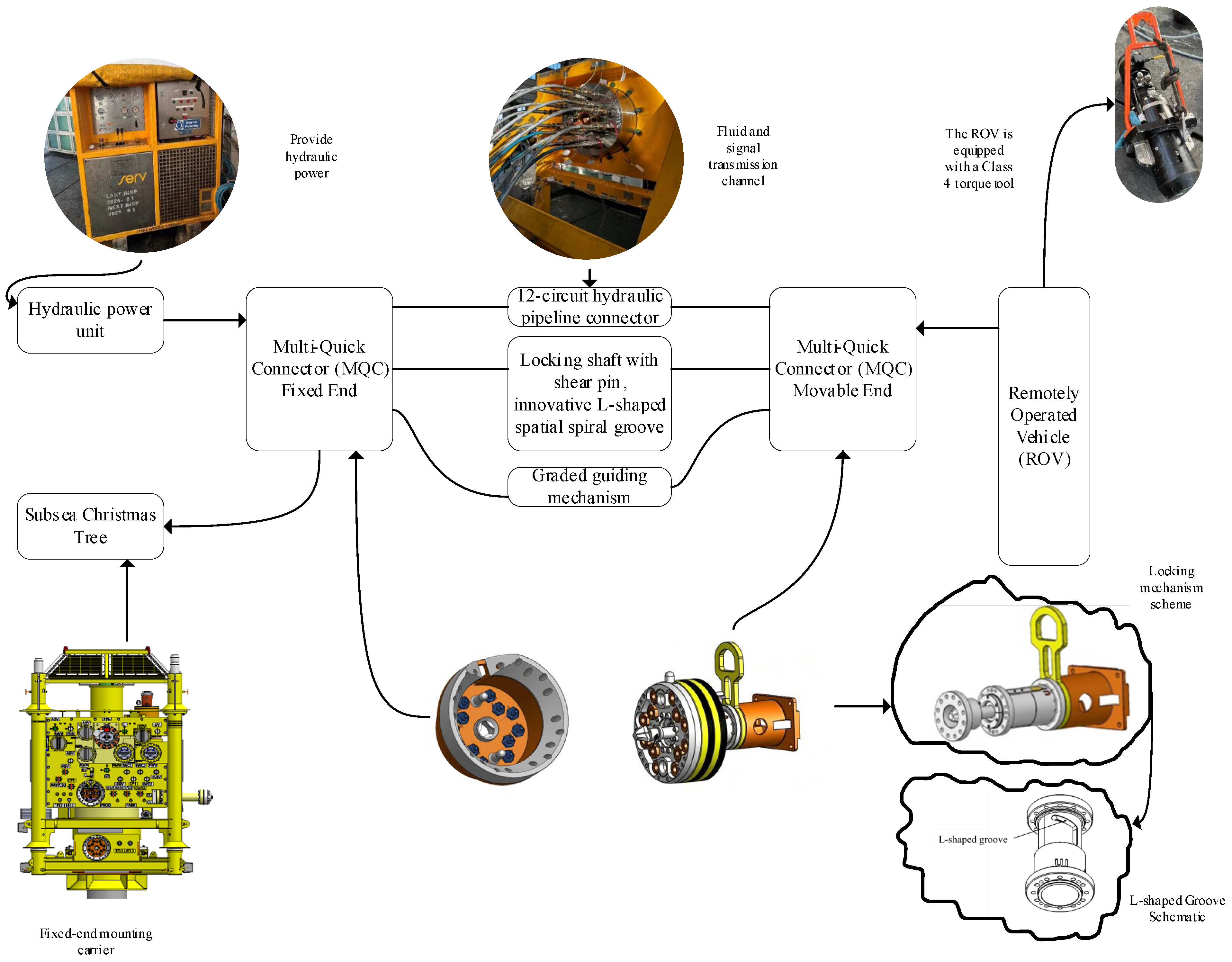
In terms of structural composition, a complete subsea multi-port quick-connect system primarily comprises several components, including the fixed end, the mobile end, the staging position, and protective caps. The mobile end can be further subdivided according to its function into supply system multi-port quick connectors, workover multi-port connectors, and logic caps. Figure 1 illustrates the overall layout of the system in which the multi-port quick connectors under investigation are situated. The fixed end of the multi-port quick connector is secured to the Christmas tree, whilst the hydraulic power unit supplies power to the connector’s hydraulic circuit. An L-shaped locking mechanism and a stepped guidance mechanism are incorporated between the mobile and fixed ends of the connector; the locking is achieved by a Class 4 torque-driven locking nut.
During the production process, a remotely operated vehicle (ROV) is first used to remove the protective cap from the fixed end and place it in a temporary storage position. Next, the fixed end is mated with the mobile end. When it is necessary to separate the fixed end from the mobile end, the mobile end is first withdrawn from the fixed end, after which the protective cap is retrieved from the temporary storage position and reattached to the fixed end to complete the entire mating and disengagement process.
The multi-port quick-connect coupler designed in this study is based on the project ‘Research and Demonstration of Key Technologies for 1500-metre-class Subsea Christmas Trees and Control Systems’, specifically the requirement for ‘Research into Key Technologies and Manufacturing of Multi-port Quick-connect Couplers’. The specific requirements of the project are shown in Table 2 below.
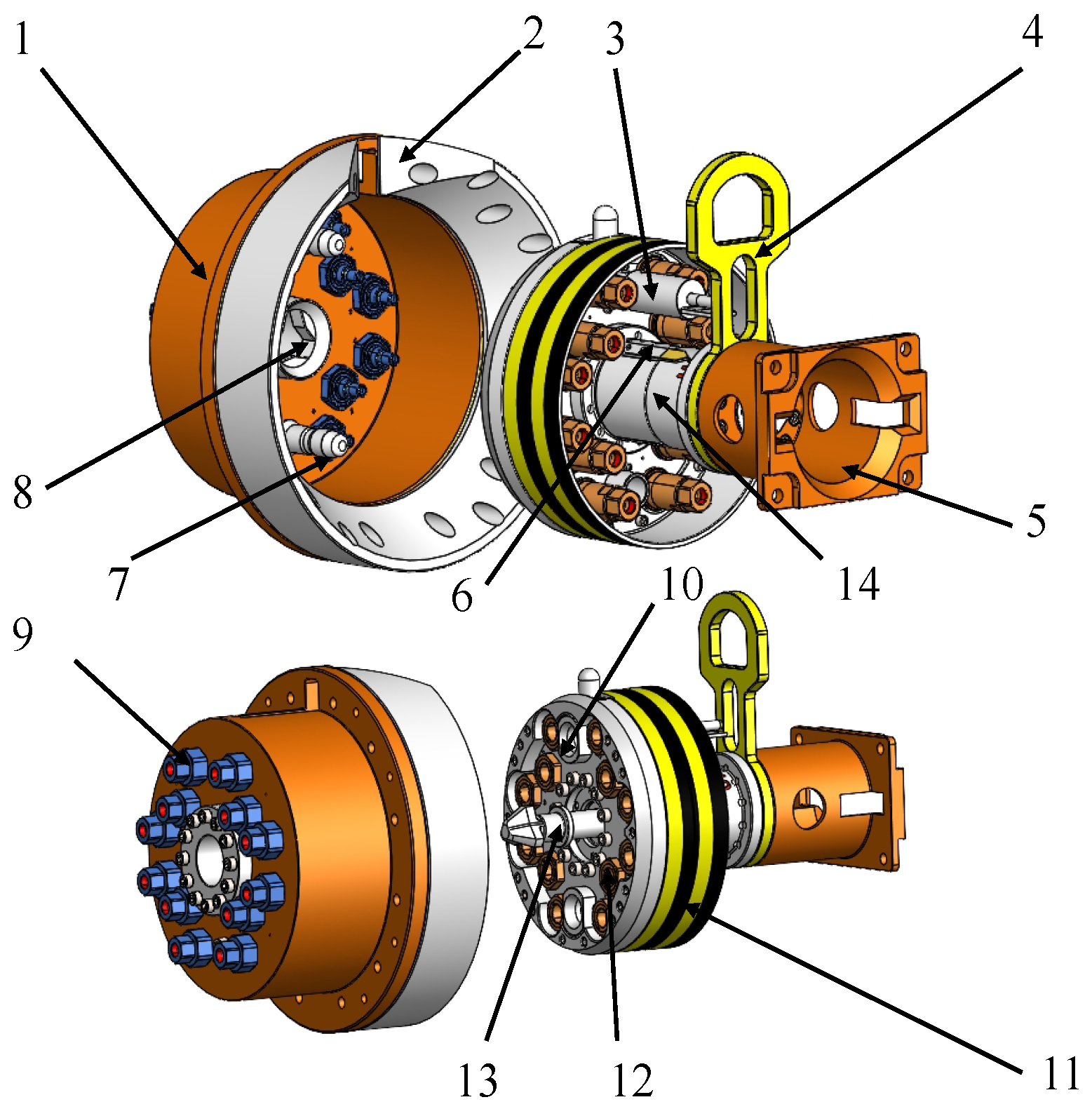
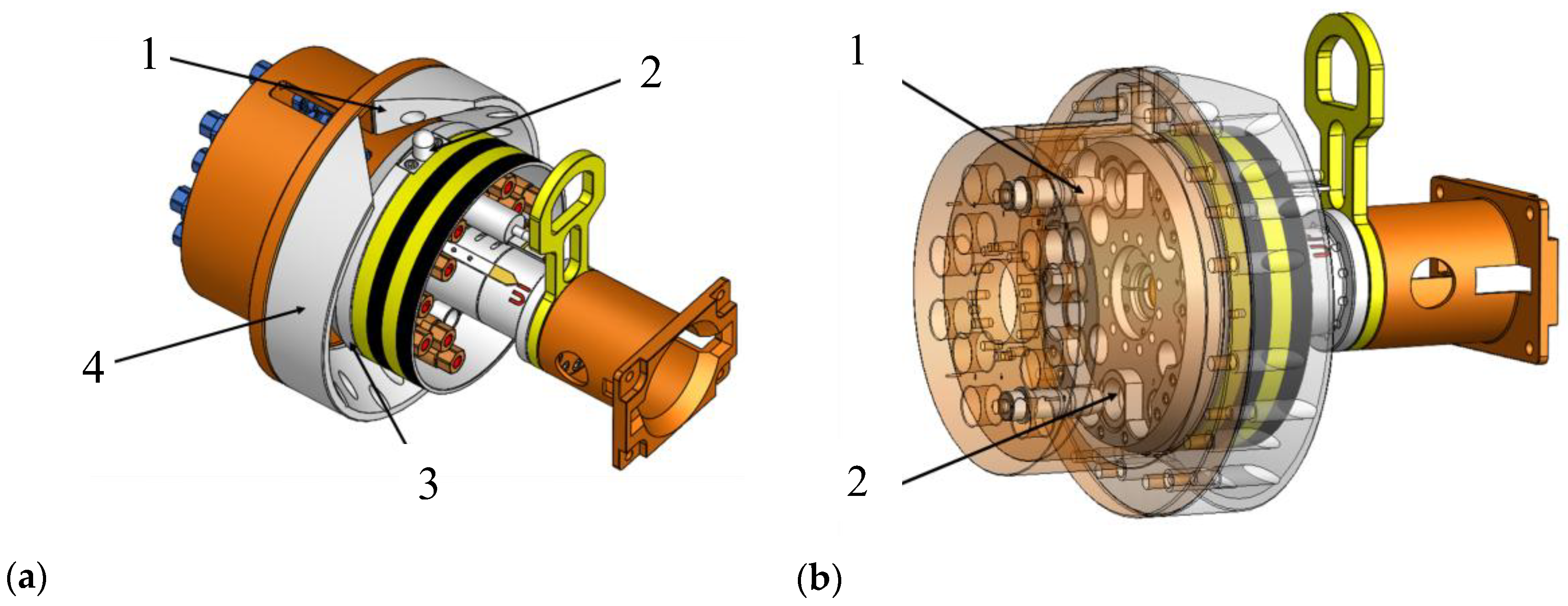
The deep-water multi-way quick coupler (MQC) designed in this study comprises a fixed end and a movable end. As shown in Figure 2, the movable plug integrates multi-stage guidance components, a core-locking module and 12 high-pressure hydraulic ports. During the docking operation, the ROV need only use a 4-stage torque tool to drive the single rotary interface at the rear of the movable plug to sequentially complete the entire sequence of operations: tolerance correction, connector insertion, mechanical locking and the establishment of the face seal.
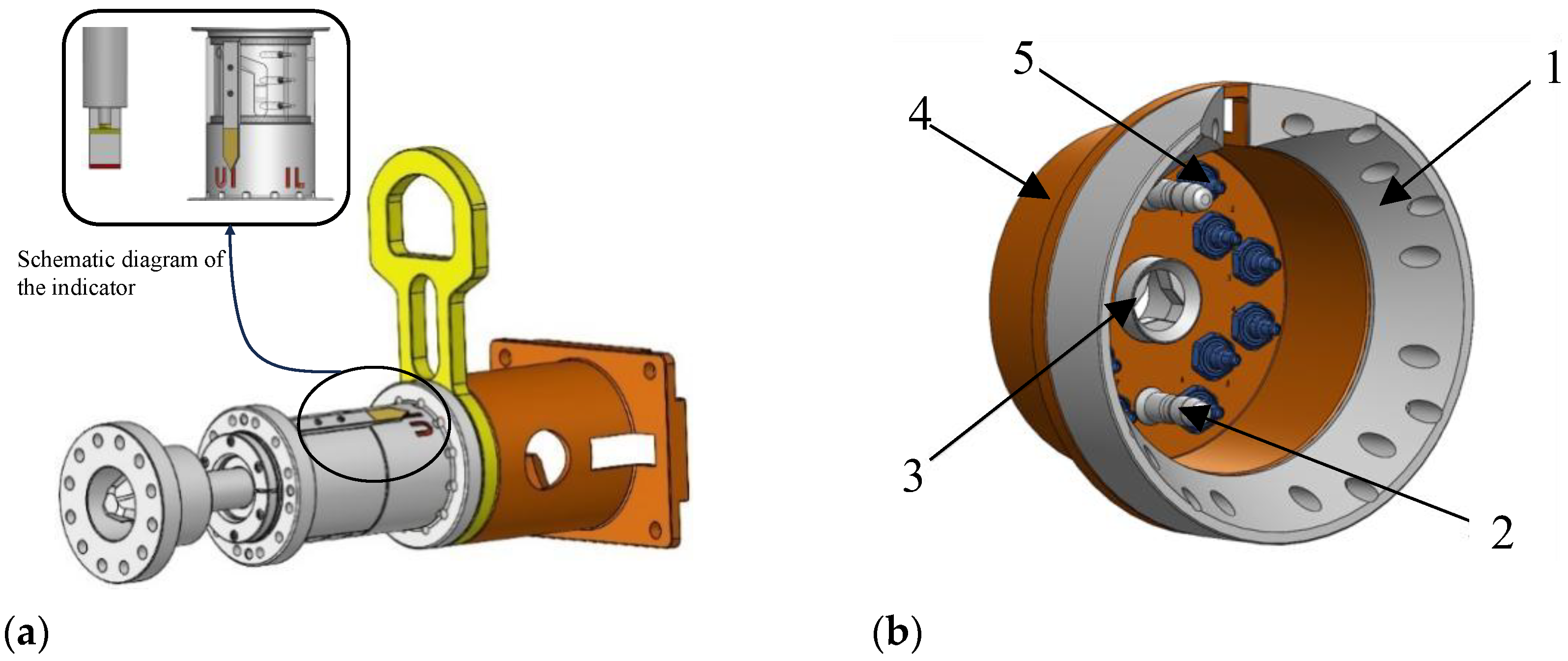
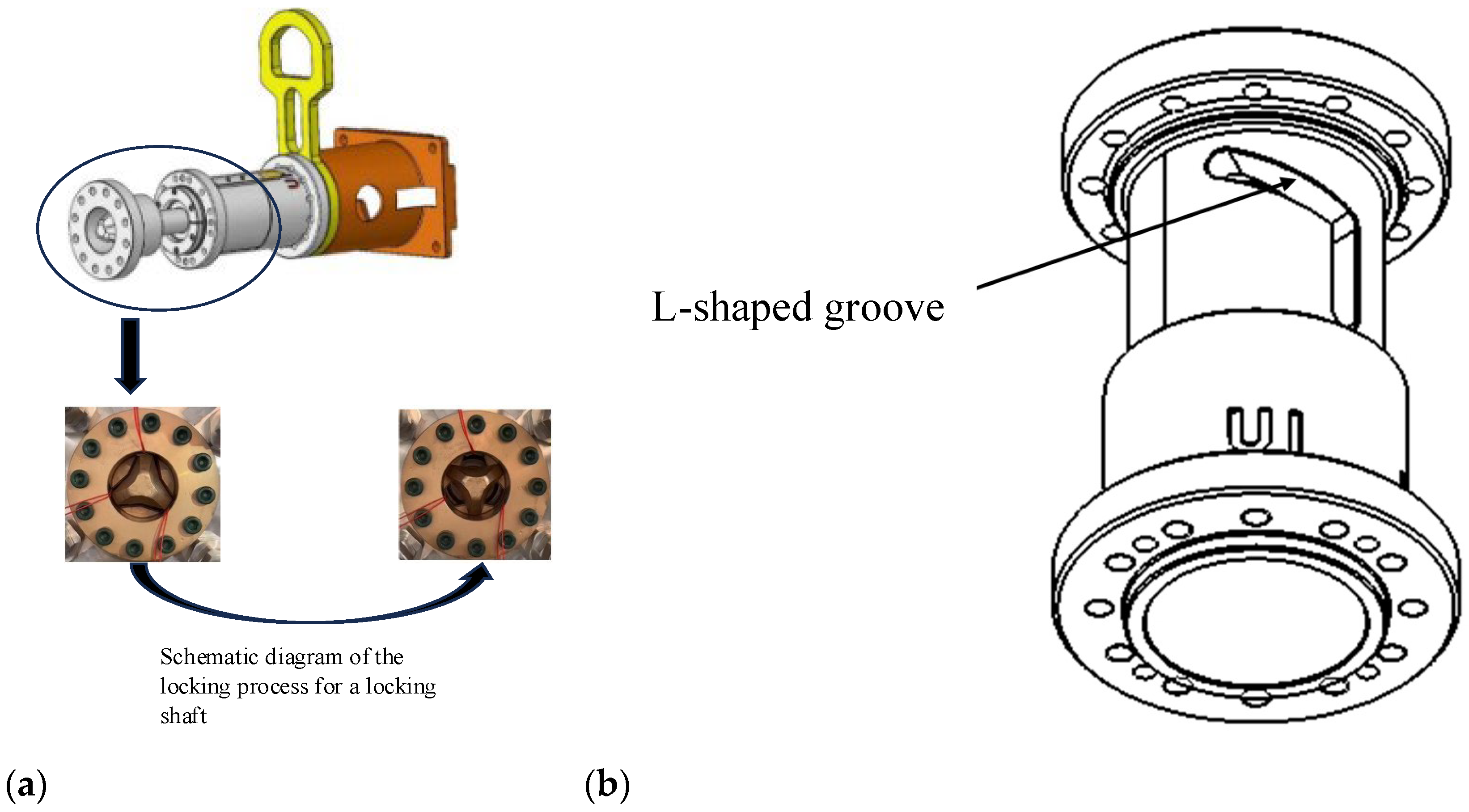
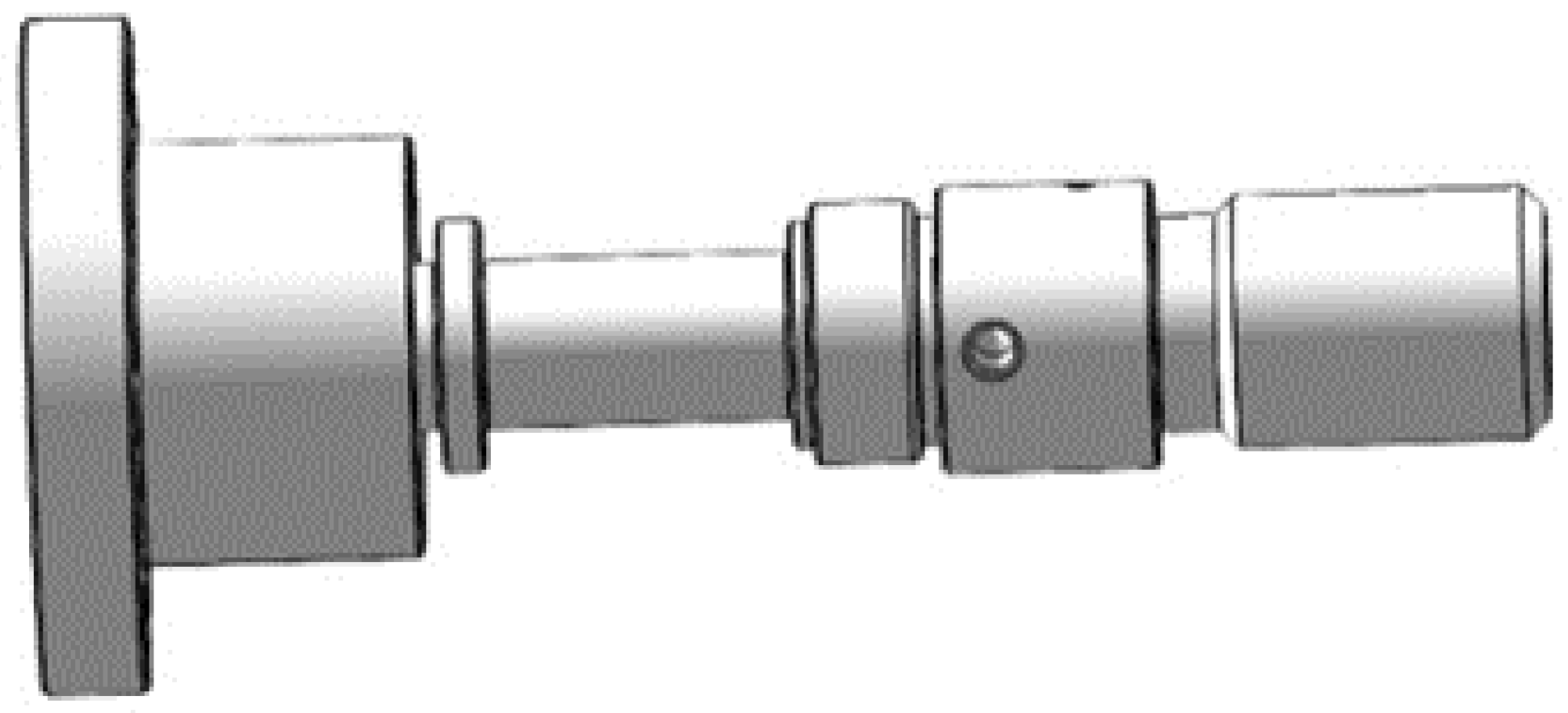
The mobile end is equipped with a locking mechanism and a pose indicator. During docking operations, the ROV drives the locking mechanism to complete the locking action by operating a torque tool. In accordance with project requirements, this study proposes a design scheme for the locking mechanism, as shown in Figure 3a. The design approach for the locking mechanism in this paper encompasses the locking method, the mechanism for completing the locking action, and the selection of component materials. The V-lock method is adopted, which is characterised by high reliability and a long service life. The front end of the locking shaft is designed as a non-circular ‘herringbone’ structure, matching the configuration of the locking holes in the locking slot; during operation, the front end of the locking head aligns with and inserts into the locking holes in the slot. The locking action is achieved by a spatial spiral cam mechanism. The cam groove of the spatial spiral cam mechanism mounted on the housing meshes with the guide-function shear pin mounted on the locking shaft, forming a complete spatial spiral cam mechanism. This design enables the locking shaft to move precisely along a predetermined trajectory. The trailing end of the spatial spiral cam mechanism is connected to a straight slot, forming an L-shaped structure. The entire system requires only one driving component: the locking nut. The tail end of the shaft is connected to the locking nut via a threaded pair; rotating the locking nut applies an axial force to the locking shaft, thereby driving the entire mechanism. Trapezoidal threads are selected as the transmission threads in this paper. This paper selects F55, Inconel 718, POM and QAL10-5-5 as the primary materials for multi-way connectors; F55 offers high strength and hardness [35], F55 typically has a yield strength of over 550 MPa and a tensile strength of over 750 MPa, which is far higher than that of ordinary stainless steel materials. This enables it to maintain excellent structural stability in environments subject to high pressure and high stress. Furthermore, due to its high chromium, molybdenum and nitrogen content, F55 exhibits outstanding resistance to pitting corrosion. In corrosive media containing chloride ions and other aggressive substances, it effectively resists the onset of pitting corrosion; its pitting resistance equivalent number (PREN) is typically greater than 40, demonstrating superior pitting resistance compared to standard stainless steels. Inconel 718 is a nickel-based precipitation-hardening high-temperature alloy which, owing to its excellent overall performance, is widely used in extreme environments across the aerospace, energy, chemical and marine engineering sectors. As an engineering plastic commonly used in engineering applications, POM offers numerous advantages, including excellent mechanical properties and a wide range of suitable applications. QAL10-5-5 is a nickel-aluminium bronze alloy which, owing to its high strength, wear resistance, high-temperature resistance and corrosion resistance, is widely used in the shipbuilding and marine engineering sectors [36]. As the equipment operates underwater for extended periods, aquatic organisms or chemical substances are likely to accumulate and grow on its surface; over time, this build-up can affect the equipment’s normal operation. In this paper, the shear pin is designed as the weak link in the locking mechanism. In the event of an emergency disengagement, an increased input torque shears the guide pin, allowing the locking shaft to rotate freely, after which it can be extracted using an ROV or specialised tools. The position indication mechanism comprises an axial position indicator, a circumferential position indicator and axial reference marks. This study proposes the fixed-end configuration shown in Figure 3b. The fixed end is secured to the Christmas tree panel via a flange on the fixed-end body; its mating panel is fitted with 12 male connectors, the ends of which are connected to the interior of the Christmas tree. The layout of the fixed-end mating panel is identical to that of the moving-end panel.
To prevent self-locking caused by poor attitude conditions during the docking process, this paper proposes a multi-stage guidance mechanism to progressively correct positional and angular deviations, with guidance carried out in the order of coarse guidance followed by fine guidance.

2.2. Tiered Tolerance Guidance Mechanism

When the ROV grasps the mobile end, significant initial translational and angular deviations occur. To prevent rigid collisions and ‘self-locking’ during the docking process, this paper proposes a two-stage guidance mechanism that progressively restricts degrees of freedom.
As shown in Figure 4a, during the coarse alignment stage, when the gripping mechanism of the mobile-end ROV approaches the fixed end, the guide rail on the mobile end first makes contact with the guide rail on the fixed end. The guide rail on the fixed end is designed in a ‘flared’ shape, whilst the guide rail on the mobile end is ‘tapered’; upon contact, this realigns the mobile end, correcting part of its positional deviation. Subsequently, the guide pins on the mobile end engage with the slotted recesses on the fixed end’s guide rail, allowing the guide pins to slide smoothly into the guide slots on the fixed end’s main body, thereby correcting the angular deviation of the mobile end. During the precision guidance phase, the guide pin at the fixed end slides into the guide sleeve at the moving end, as shown in Figure 4b. This guide pin features a stepped guidance structure, with a conical surface at the front and a cylindrical surface at the rear. The two guide pins are arranged perpendicular to one another, and the degrees of freedom are eliminated through overconstraint, thereby enhancing guidance stability. One end of the moving-end guide sleeve is designed as a wide-mouthed funnel shape to facilitate the smooth entry of the guide pins. This funnel-shaped structure effectively locks the guide pins in place during the initial guidance phase. A smooth transition is incorporated between the funnel section and the internal straight section, which prevents issues such as jamming or misalignment caused by abrupt changes in cross-sectional shape.
During the initial phase, this multi-stage guidance system enables the mobile end of the remotely operated vehicle (ROV) to rapidly correct any attitude deviations as it approaches the fixed end, bringing it into approximate alignment. During the coarse guidance phase, deviations at the macro level are eliminated. During the fine guidance phase, concentricity at the micro level is achieved, significantly improving the efficiency and reliability of the docking process.

2.3. Spiral Cam Locking and Emergency Release Mechanism

The locking mechanism is central to the MQC’s ability to withstand high-pressure separation loads and resist seizing. This paper innovatively proposes a V-lock mechanism based on the coupling of an L-shaped spatial helical groove with a shear pin.

2.3.1. Locking Mode

The V-lock locking mechanism is employed; this locking method is characterised by high reliability and a long service life. The locking position of the locking slot and the locking shaft is shown in Figure 5a. The front end of the locking shaft is designed as a non-circular ‘herringbone’ structure, matching the configuration of the locking holes in the locking groove. During operation, the front end of the locking head aligns with and inserts into the locking holes in the groove; subsequently, the ROV operator uses a torque tool to rotate the locking nut, thereby driving the locking shaft to rotate. The locking action is achieved by a spatial spiral cam mechanism. The cam groove of the spatial spiral cam mechanism mounted on the housing engages with the guide-function shear pin mounted on the locking shaft, forming a complete spatial spiral cam mechanism. This design enables the locking shaft to move precisely along a predetermined trajectory. The trailing end of the spatial spiral cam mechanism connects to a straight slot to form an L-shaped structure, as shown in Figure 5b. The L-shaped structure, innovatively designed in this paper, ensures that the movement path of the locking shaft is accurate and error-free.

2.3.2. Emergency Release Mode

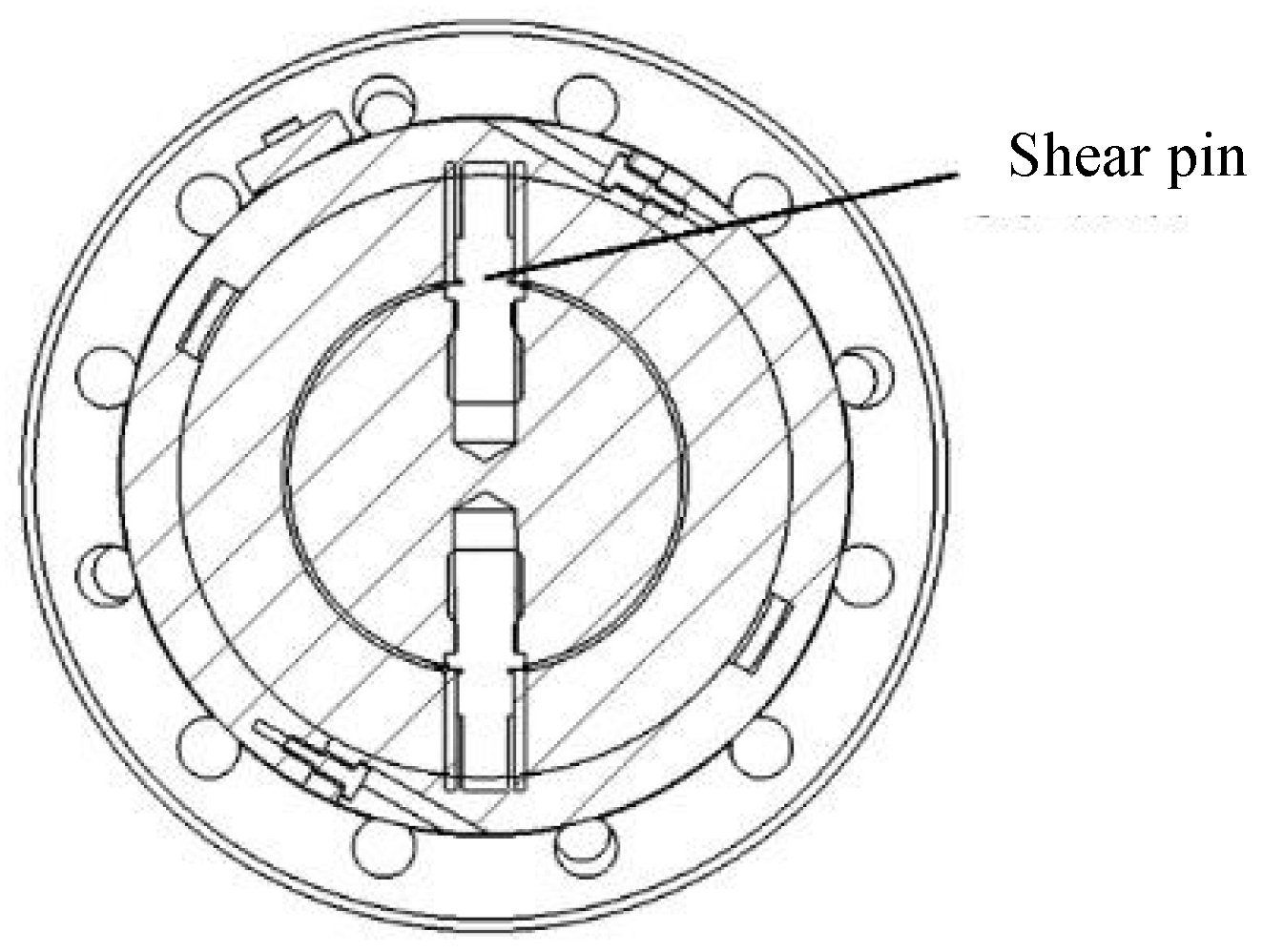
This paper proposes a non-destructive emergency release strategy. The guide pin within the locking mechanism is designed as a shear pin. The follower roller on the locking shaft is designed as a ‘shear pin’ made from a specific material, which has been verified to possess precise shear strength. In an emergency, the remotely operated vehicle (ROV) need only apply a maximum output torque exceeding a predetermined threshold to forcibly shear this shear pin. Once the shear pin fails, the locking shaft is released from the kinematic constraints of the L-shaped groove and gains the freedom to rotate freely. This releases the mechanical lock between the moving and fixed ends, thereby enabling the safe recovery of the equipment and preventing catastrophic damage to the subsea Christmas tree panel and connectors. The position of the shear pin is shown in Figure 6.
Combining this with the emergency release plan, we obtain:
M = M 1 + M 2 + M 3
In the formula: CLASS 4 torque tool input torque; M 1 is the maximum static friction torque at the contact surface between the front end of the locking shaft and the locking groove; M 2 is the maximum static friction torque at the contact surface between the axial support ring and the locking nut; M 3 is the shear torque transmitted to the guide pin.
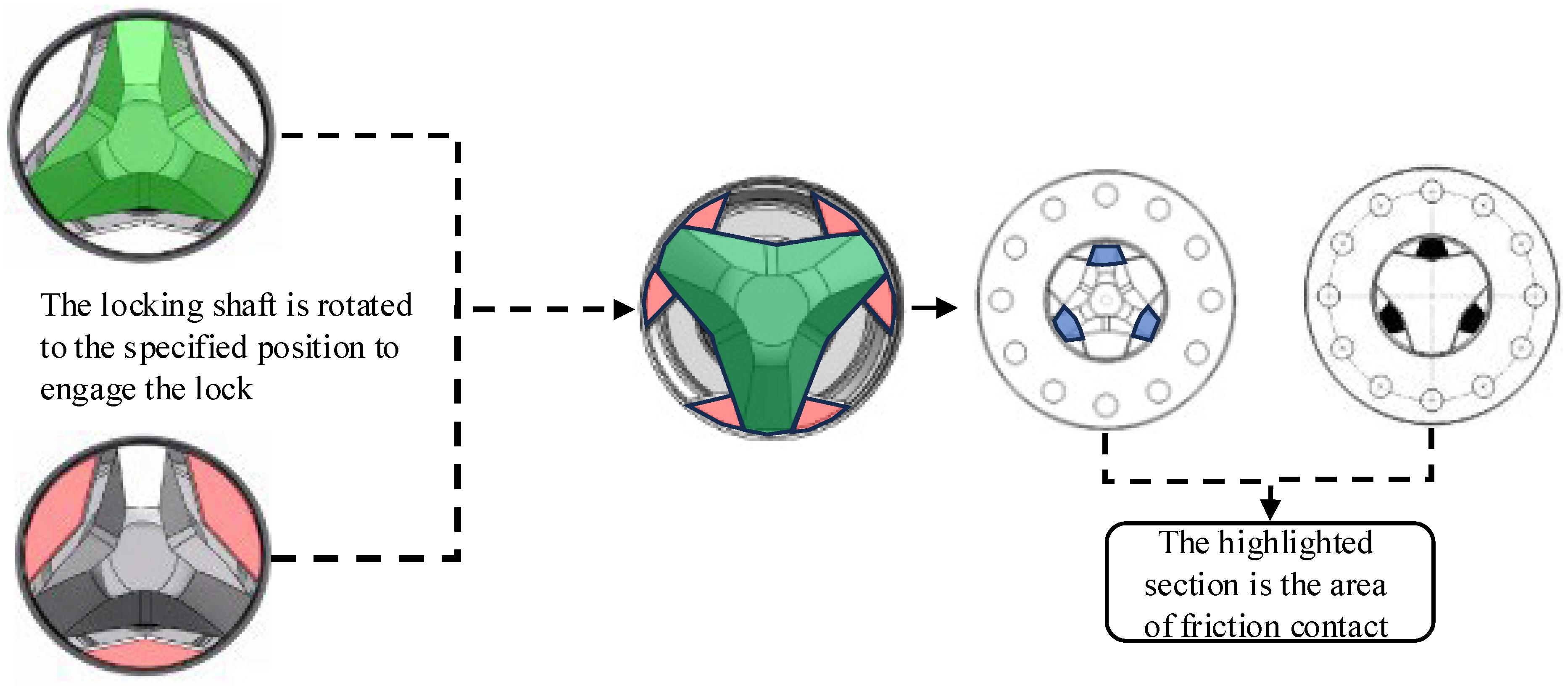
First, calculate the maximum static friction torque at the contact surface between the front end of the locking shaft and the locking groove. The contact surface between the locking groove and the locking shaft is shown in Figure 7:
As can be seen from Figure 7, the contact surface is not circular, but it is uniformly distributed in the circumferential direction. In this paper, we assume a circular ring whose outer diameter corresponds to the maximum outer diameter of Figure 7 and whose inner diameter corresponds to the minimum inner diameter; its average pressure is consistent with that of the irregular contact surface. After calculating the friction torque of this circular ring, multiplying it by the ratio of the irregular contact area to the total area of the ring allows us to estimate the equivalent friction torque of the irregular contact surface. The calculation method is as follows:
M 1 = r 2 r 1 μ p 2 π r 2 d r B
where: r 1 is the outer diameter of the equivalent ring; r 2 is the inner diameter of the equivalent ring; μ is the coefficient of friction at the contact surface between the locking groove and the front end of the locking shaft; p is the contact pressure; B is the ratio of the contact area to the area of the equivalent ring. Specifically:
p = F A
where: F is the axial force, and A is the irregular contact area; the axial support surface and the contact surface of the locking nut form a standard circular ring, and the friction torque is calculated as follows:
M 2 = r 2 r 1 μ p 2 π r 2 d r
where: r 1 is the outer diameter of the ring; r 2 is the inner diameter of the ring; μ is the coefficient of friction at the contact surface between the axial support ring and the locking nut; p is the contact pressure. Specifically: p = F A . F is the axial force; A is the area of the contact ring.
Once M 1 and M 2 have been determined, the shear torque M 3 acting on the shear pin can be calculated using Equation ε 1 = σ r A 1 1 m 1 . From this shear torque, the shear stress at the shear plane can be determined:
τ = 2 Z M 3 π d 2 D
where: Z is the number of shear pins, d is the diameter at the shear point, and D is the clamping diameter at the shear point.
Following a review of the relevant literature, this study has identified two potential materials for the guide pins: S32750 and QAL10-5-5. S32750 possesses outstanding macrostructural mechanical strength and demonstrates excellent resistance to chloride-induced stress corrosion cracking (SCC) and pitting corrosion in harsh seawater environments [37]. QAL10-5-5 is widely used in underwater friction joints due to its excellent resistance to galling, low micro-contact friction coefficient and outstanding resistance to marine biofouling [38]. S32750 has a tensile strength of 760 MPa and a yield strength of 515 MPa; the allowable tensile stress σ of the pin is σ s /1.5 = 343 MPa, and the ultimate shear stress the material can withstand is 456 MPa; QAL10-5: its tensile strength is 570 MPa and its yield strength is 400 MPa; the allowable tensile stress σ of the pin is σ s /1.5 = 267 MPa, and the ultimate shear stress the material can withstand is 342 MPa. The shear stress results for both materials under emergency release conditions at a torque of 2000 Nm are shown in Table 3.
Based on the above calculations, it can be seen that several sets of shear pins meet the operational requirements in terms of material and dimensions. These are material S32750 with shear cross-sectional diameters of 8 mm and 7.5 mm, and material QAL10-5-5 with shear cross-sectional diameters of 9 mm, 8.8 mm and 8.5 mm.

2.4. Integrated Pose Indication System

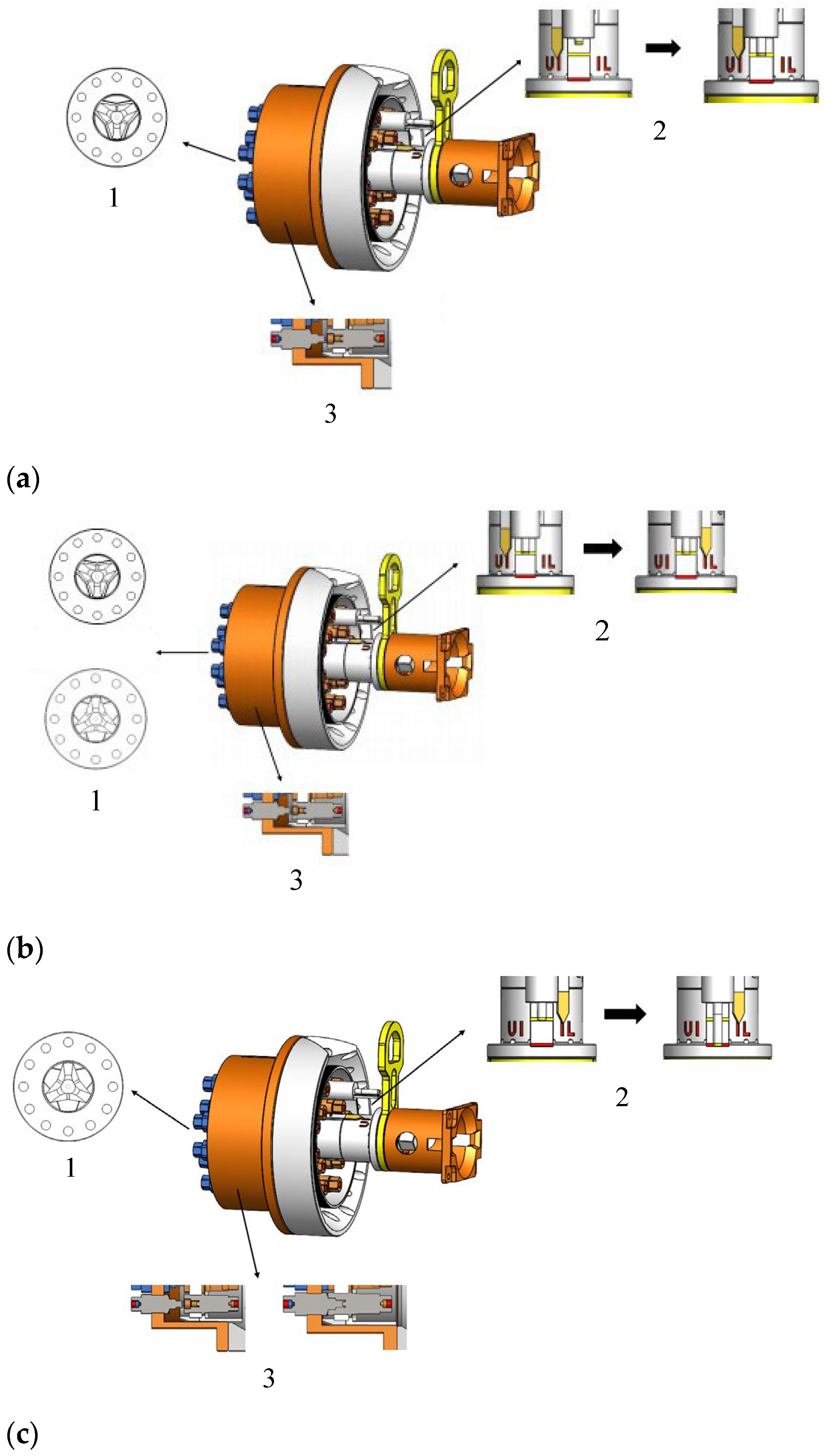
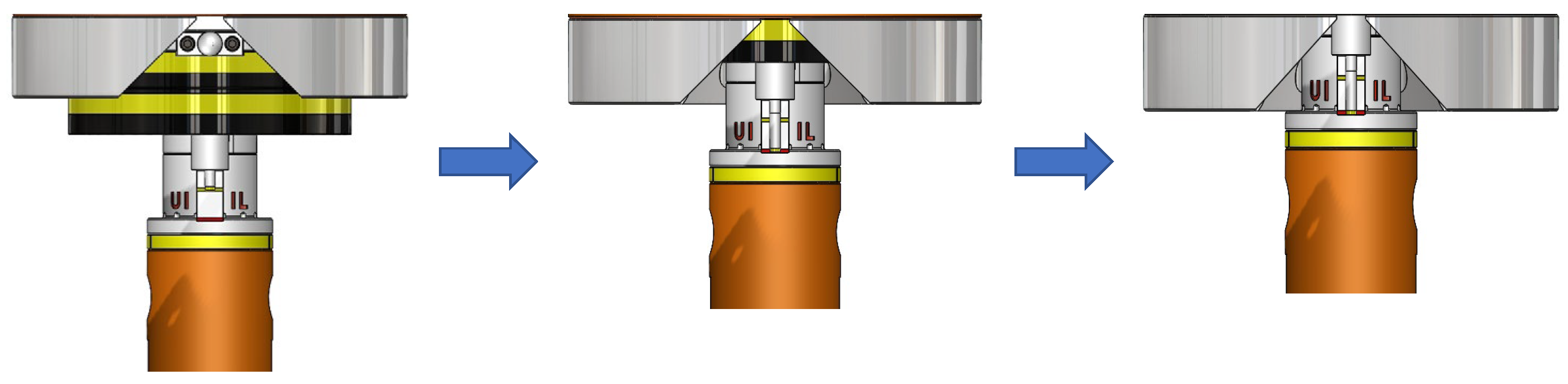
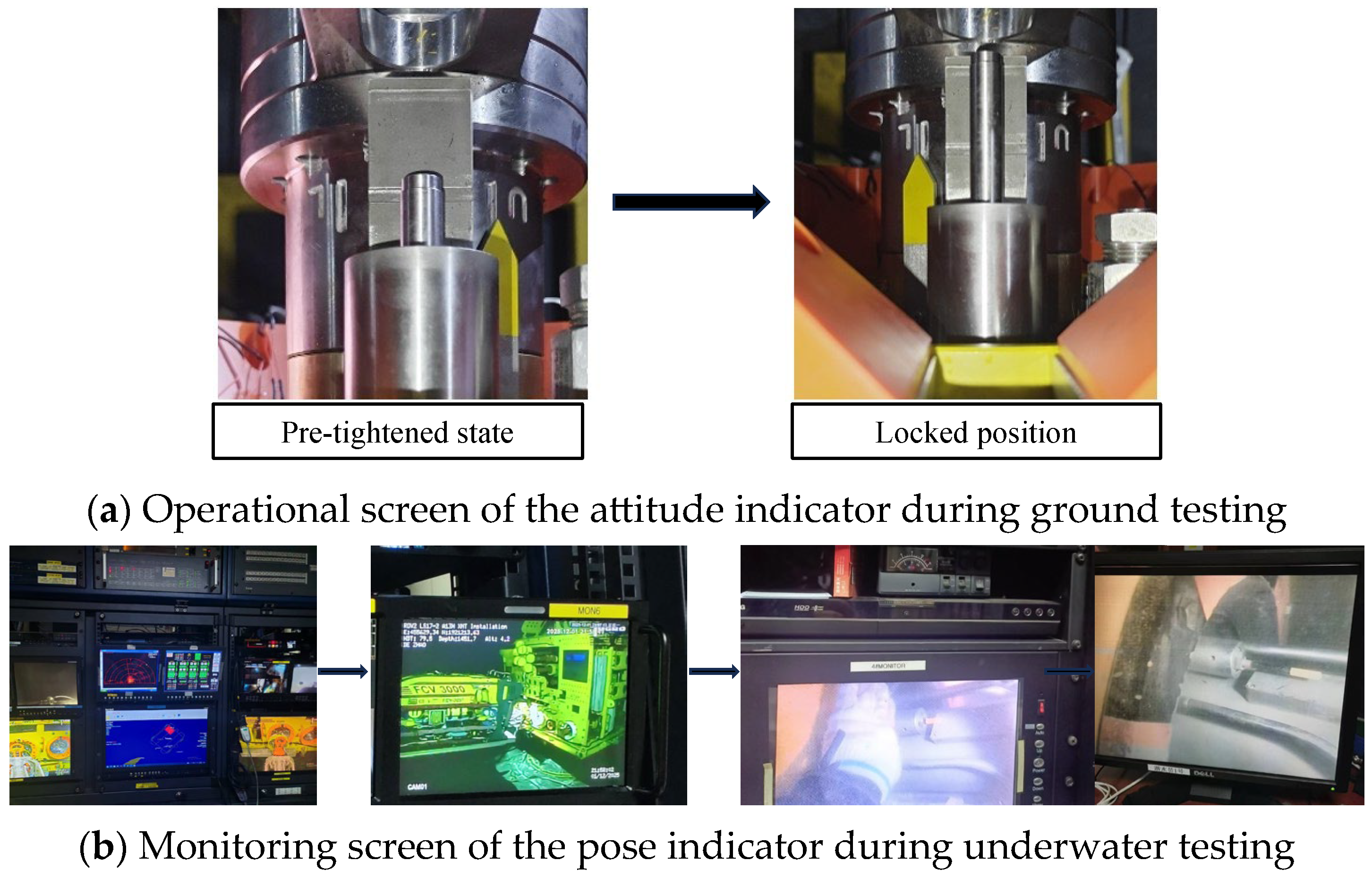
To ensure greater precision during docking, this study also incorporated an attitude indicator to assist with the process. This provides real-time feedback on the position and orientation of the connector, helping the operator to manoeuvre the ROV and complete the connection and disconnection operations quickly and accurately. The indicator comprises an axial status indicator, a circumferential status indicator and auxiliary markings. The three stages are illustrated in Figure 8a–c. In the first stage, the moving end approaches the fixed end slowly. The guide pin of the fixed end first makes contact with the axial indicator rod; as it is pushed inwards, the guide pin of the fixed end pushes the indicator rod towards the compression spring at the rear. The rear ends of both the indicator rod and the axial indicator are coated with paint to provide a clearer display of the indicator’s status, as shown in Figure 8a. During the second stage, once the moving end reaches the pre-locking position, the locking action is performed, The housing of the locking mechanism is engraved with position indicator markings to display the circumferential movement of the locking shaft; when the pointer points to ‘U’, it indicates that the mechanism is not locked, and when the pointer moves to ‘L’, it indicates that the locking shaft has reached the locking position. Marking paint is applied to both the tip of the pointer and the housing of the locking mechanism; the circumferential indicator and the connector are shown in Figure 8b. Once the circumferential indicator confirms that the locking shaft has engaged with the locking groove, the torque tool continues to drive the locking mechanism. The locking shaft moves axially, pulling the moving end and the fixed end into alignment via the engagement surfaces between the locking grooves. When the axial indicator indicates the locking position, this signifies that the connector has been successfully locked, as shown in Figure 8c.
During the preliminary guidance phase prior to pre-locking, two coloured stripes have been applied to the protective sleeve on the moving end to accurately indicate the axial displacement of the moving end. When the movable end is mated and locked into position, as shown in Figure 9, these two coloured bands will gradually alternate as they are drawn into the fixed end. By observing the visibility of these bands, the axial movement of the movable end can be determined using the ROV’s camera during insertion and withdrawal operations, thereby improving the success rate of these operations. The alternating yellow and black bands serve as a clear reminder to staff to remain constantly vigilant of conditions underwater; however, during actual operation, we need only monitor the final black band. When the final black band is completely submerged at the fixed end, this indicates that the coarse guidance phase has ended and the formal pre-tightening phase has begun.

3. Kinematic Modelling and Collision Dynamics Analysis of the Docking and Locking Process

To ensure that deep-water connectors can achieve smooth docking and reliable locking under complex ocean current disturbances, this section establishes collision dynamics models for multi-stage guidance processes and non-linear kinematic models for spatial spiral cams, thereby defining the safe operating envelope for the ROV.

3.1. Anti-Sticking Geometry and Collision Dynamics in the Guiding Process

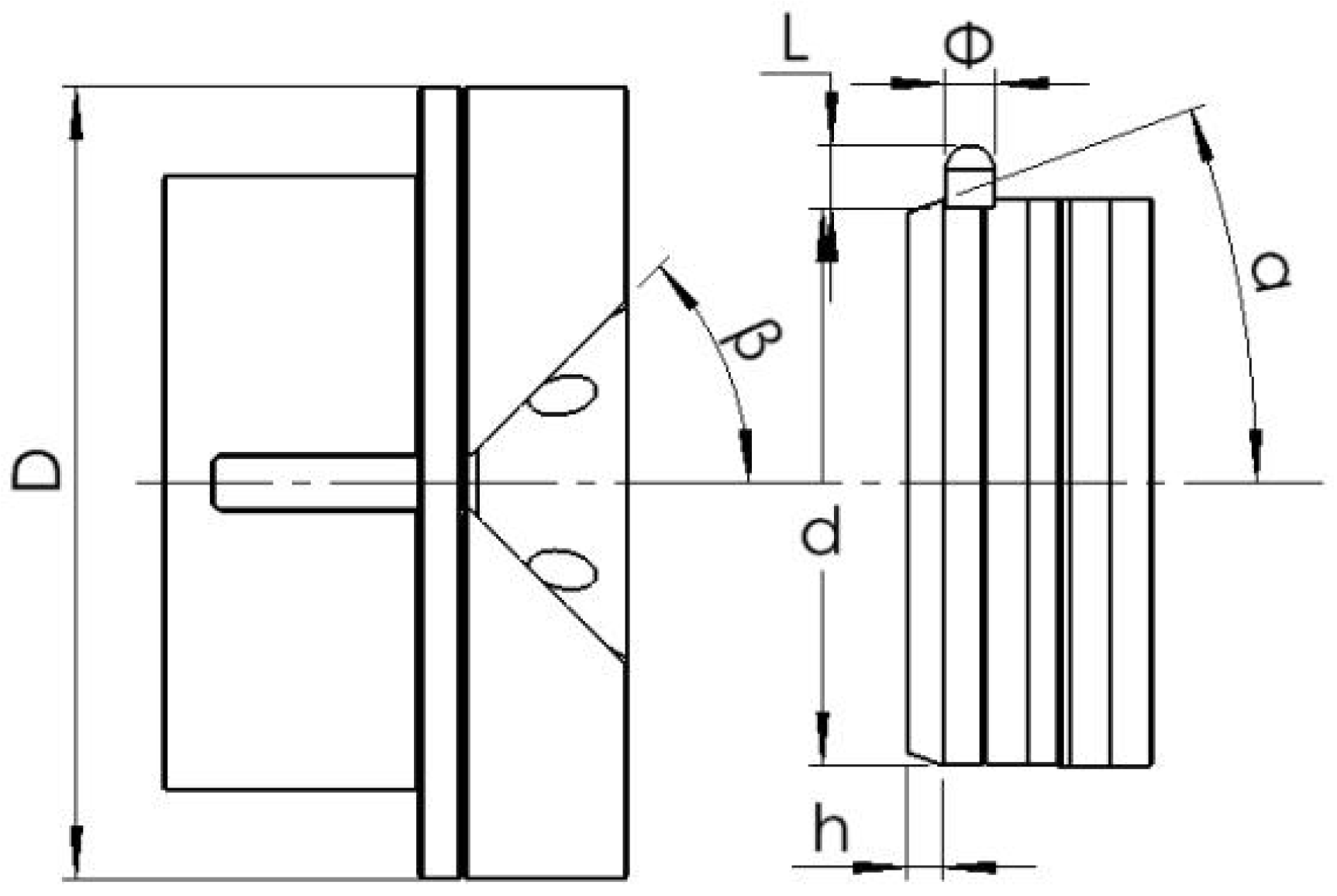
During the guiding process, the stage where misalignment occurs is the coarse guiding stage, which is also the most critical and challenging stage. The moving end of the connector features a tapered surface structure that corresponds to the flared guide on the fixed end. The moving end is equipped with a guide pin that aligns with the guide slot on the body of the fixed end and the chamfer on the guide strip, as shown in Figure 10. The connector’s alignment correction performance metrics are shown in Table 4.
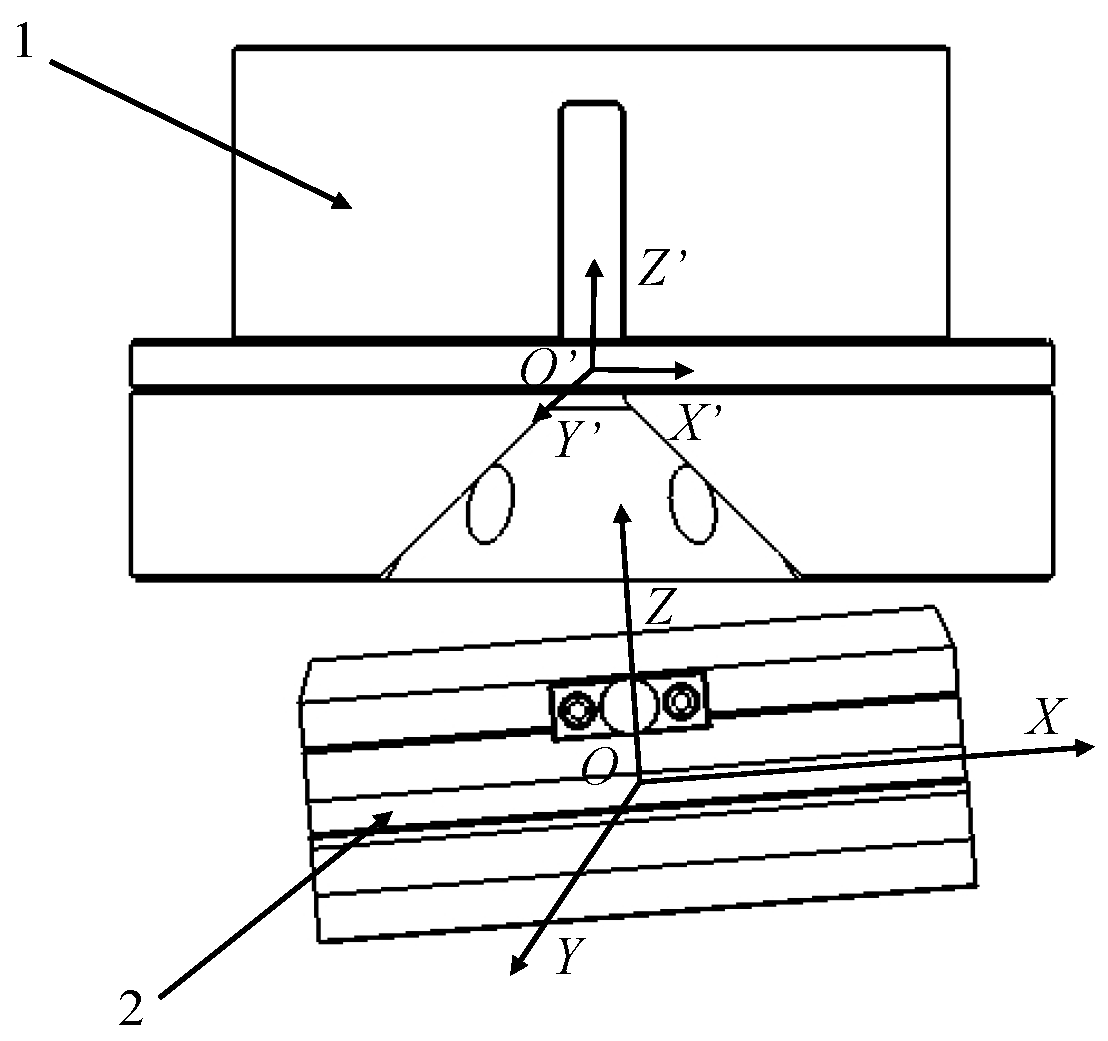
In order to analyse the positioning mechanism under non-uniform conditions, the coarse guidance stage is divided into three steps: the approach stage, the contact stage and the attitude adjustment stage. During the approach stage, there is no contact between the moving end and the fixed end; the contact stage serves to initially correct the positional and attitudinal deviations arising from the approach stage; and during the attitude adjustment stage, the inclined slot further guides the movement of the moving end, thereby further correcting the attitudinal deviations. To further analyse the attitude deviations, a spatial Cartesian coordinate system O X Y Z is established for the moving end of the connector, and another O X Y Z for the fixed end, as shown in Figure 11. The central axis of the moving end coincides with the Z axis, whilst the central axis of the fixed end coincides with the Z axis. As the fixed end remains stationary, the coordinate system of the fixed end also remains fixed.
Based on the research content and the definition of the coordinate system, the following definitions of deviation are provided: Positional deviation refers to the movement of the mobile-end spatial coordinate system relative to the fixed-end spatial coordinate system by P 1 , P 2 , P 3 units along the O X -axis, O Y -axis, and O Z -axis, respectively. Angular deviation refers to the rotation of the mobile-end spatial coordinate system relative to the fixed-end spatial coordinate system around the O X -axis, O Y -axis, and O Z -axis. By establishing homogeneous transformation matrices [39] between the moving end coordinate system O X Y Z and the fixed end O X Y Z , the spatial projections of the guide pins were mapped. According to friction self-locking theory [40], to ensure the moving guide rod slides smoothly into the flared opening without jamming, the driving force must act outside the friction cone. The geometric anti-seizing conditions for the conical and oblique slot contacts are derived as:
α < π 2 arctan f 1
β < π 2 arctan f 2
α = 30 ° and β = 40 ° represent the flared cone angle and the bevel angle, respectively; f 1 = 0.35 (POM material) and f 2 = 0.2 (F55 steel and copper-based coating) denote the maximum static coefficients of friction for the corresponding contact surfaces. Theoretical calculations indicate that the geometric design of both contact surfaces satisfies the anti-seizing conditions, allowing for smooth alignment.
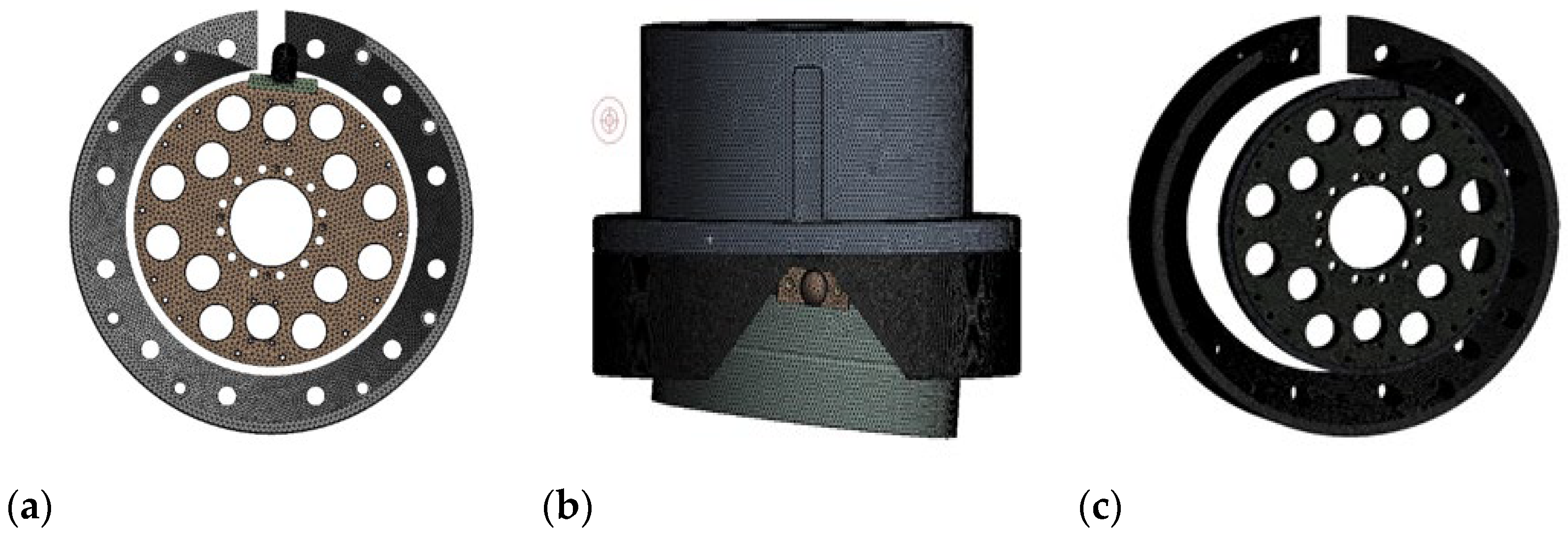
The moment of greatest impact occurs during the guiding process. In this study, the Contact and Collision Simulation module in ANSYS 2023 R2 Workbench 2023 R2 was utilised to perform contact and collision simulations under extreme tolerance conditions. To ensure the numerical stability and accuracy of the explicit dynamics simulation, rigorous mesh independence tests were conducted prior to the main collision analysis. The computational domain focused primarily on the contact interface between the guide pin and the chamfered groove, with discretisation using element sizes ranging from 5.0 mm to 1.0 mm. Mesh independence was deemed to have been achieved when the difference between the results of two adjacent meshes was less than the preset threshold (2–5%). In this study, the maximum stress value was used as the comparison parameter. Based on a convergence threshold of 5%, a mesh size of 2 mm was selected, and adaptive mesh refinement was applied at the contact boundaries. The mesh configuration is shown in Figure 12.
The analysis was conducted by dividing the data into several groups based on different joining speeds. The comparative results indicate that the best performance is achieved at a joining speed of 10 mm/s. By combining standard underwater operations codes with iterative numerical validation, a berthing speed of 10 mm/s was determined for explicit dynamic simulations. In typical deep-water intervention operations, ROV manipulators performing blind or semi-blind insertion manoeuvres typically operate at controlled, low-speed increments within a range of 5 mm/s to 20 mm/s to minimise the risk of structural damage. This study conducted preliminary simulations for this speed range (5, 10, 15 and 20 mm/s). Iterative results indicate that docking speeds exceeding 10 mm/s induce transient impact stresses approaching or exceeding the yield limit of the guide pin material, thereby increasing the risk of plastic deformation. Conversely, 10 mm/s was identified as a critical threshold that ensures maximum operational efficiency whilst safely keeping impact stresses within the elastic limit. Consequently, 10 mm/s was defined as the maximum safe limit for ROV docking operations in this analysis. Figure 13 shows the results of the collision simulation analysis for a joining speed of 10 mm/s with an axial rotation of 15°.
As shown in Figure 13a, at a mating speed of 10 mm/s and with the connector deflected axially by 15°, the maximum stress peak is 220.4 MPa. Figure 13b,c indicate that the location of maximum stress is at the point of contact between the guide pin on the moving end and the chamfered groove on the guide strip of the fixed end. Since the maximum stress is less than the allowable stress, the structural strength meets the mating requirements.
As shown in Figure 14a, at a docking speed of 10 mm/s and with the connector tilted horizontally by 5°, the maximum stress peak is 25.157 MPa. Figure 14b,c indicate that the location of the maximum stress is also at the point of contact between the guide strip on the moving end and that on the fixed end. Since the maximum stress is less than the allowable stress, the structural strength meets the docking requirements.
As shown in Figure 15a, at a butt-jointing speed of 10 mm/s and a horizontal offset of 25 mm, the maximum stress peak is 77.391 MPa. Figure 15b,c show that the location where the maximum stress occurs is at the point of contact between the guide strip of the moving end and that of the fixed end. Significant contact stress is inevitably present at the point of contact on the contact surface; however, these stress results are also below the allowable stress and do not affect the overall structural strength.
Based on the above analysis, it can be concluded that the connector strength meets the docking requirements at a docking speed of 10 mm/s. In light of these findings, the ROV’s docking speed should be limited to 10 mm/s.

3.2. Kinematic Synthesis of a Spatial Helical Cam Locking Mechanism

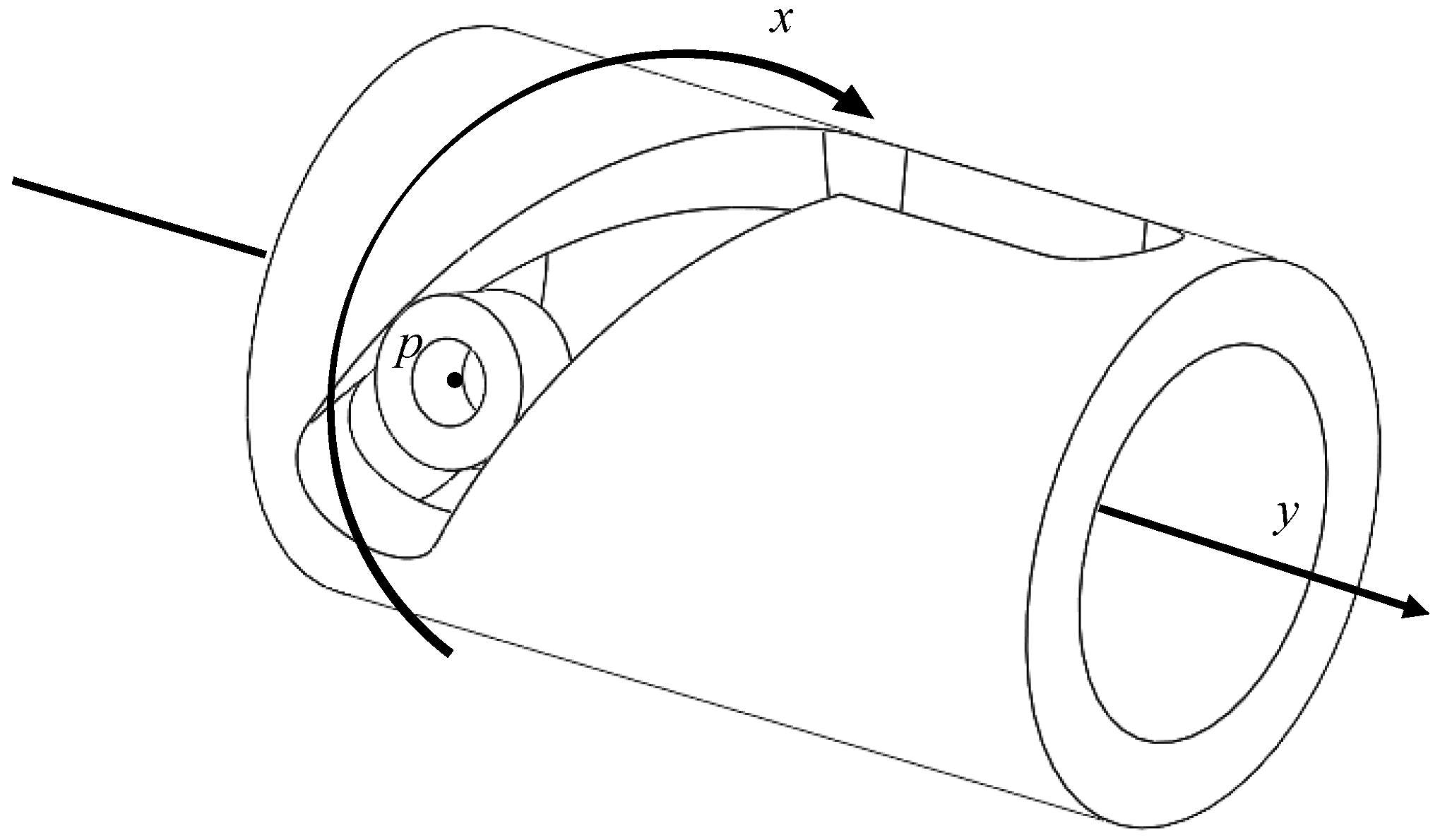
To eliminate sudden rigid-flexible impacts during the locking transition, a fifth-order polynomial motion law was adopted for the cam profile [41]. This ensures continuous acceleration and jerk profiles for the shear pin within the 0–60° locking segment. The motion of the roller within the cam groove is analysed, with the parameter definitions shown in Figure 16.
Let the lateral displacement of the cam in the cam groove be x , and the axial displacement be y . Let the maximum displacement in direction y be y max , and the displacement velocity be v ; then, the time required to complete the locking transition is t 0 = y max / v , and the corresponding displacement in direction x is x max . The resulting motion model for the follower is:
x = 10 x max t 0 3 t 3 15 x max t 0 4 t 4 + 6 x max t 0 5 t 5 x ˙ = 30 x max t 0 3 t 2 60 x max t 0 4 t 3 + 30 x max t 0 5 t 4 x ¨ = 60 x max t 0 3 t 180 x max t 0 4 t 2 + 120 x max t 0 5 t 3 y = v t
During the locking phase of the locking mechanism, the theoretical radius of curvature of the roller’s profile is:
ρ = ( r p f ˙ ( t ) ) 2 + v 2 3 / 2 v r p f ¨ ( t )
where r p is the radius of the cylinder, and t is during operation. To ensure that the actual profile of the spatial spiral cam mechanism does not intersect itself, the radius r T of the roller must satisfy the condition r T ρ min .
By wrapping the actual profile of the desired spatial spiral cam around a cylinder of radius r p , and denoting the wrapping radius r p as variable r , we can obtain profiles for cylinders of any radius.
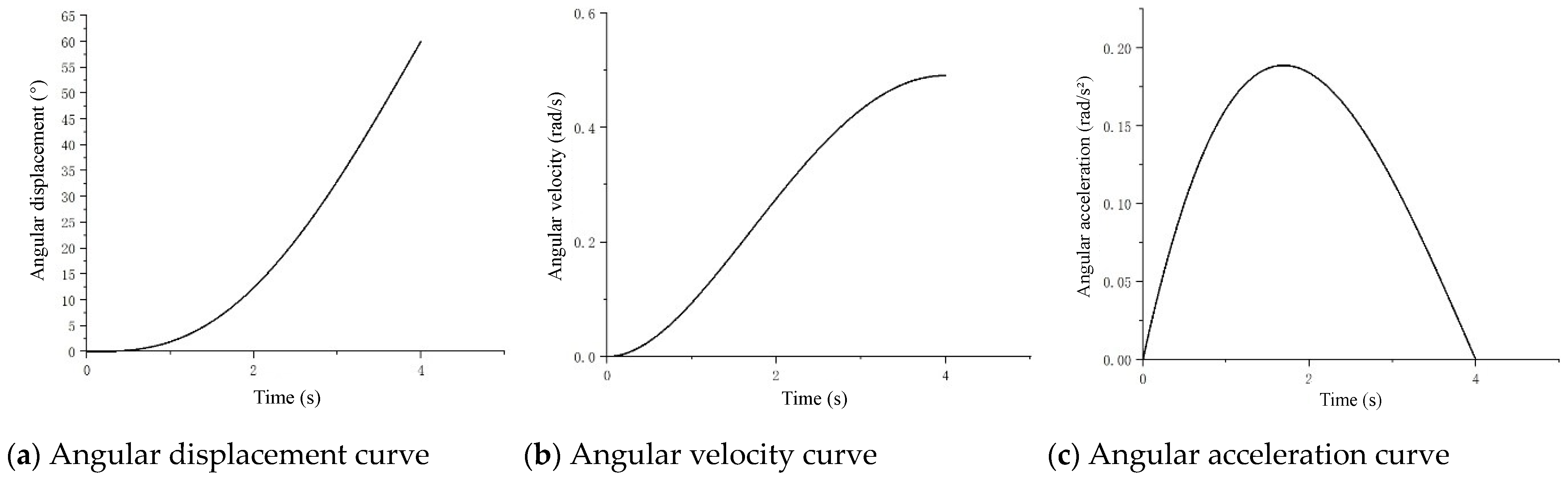
To analyse the motion characteristics of the roller, establish a coordinate system x o y with the centre of the locking mechanism housing shown in Figure 16 as the origin o , and take the centre of the roller as the moving point P . The reference frame is fixed to the housing of the locking mechanism. Let the displacement of the spatial helical cam be X ( t ) , and the rotational angle of the sliding sleeve be θ ( t ) . Once the kinematic model of the spatial cam mechanism has been obtained, the curves for the angular displacement, angular velocity and angular acceleration of the sliding sleeve within the helical groove are derived from the kinematic equations, as shown in Figure 17a–c.
The results of the curve analysis indicate that the motion of the spatial spiral cam mechanism is continuous and smooth, and its motion characteristics meet the operational requirements.

3.3. Assessment of the Ultimate Load and Impact Dynamics of Emergency Shear Pins

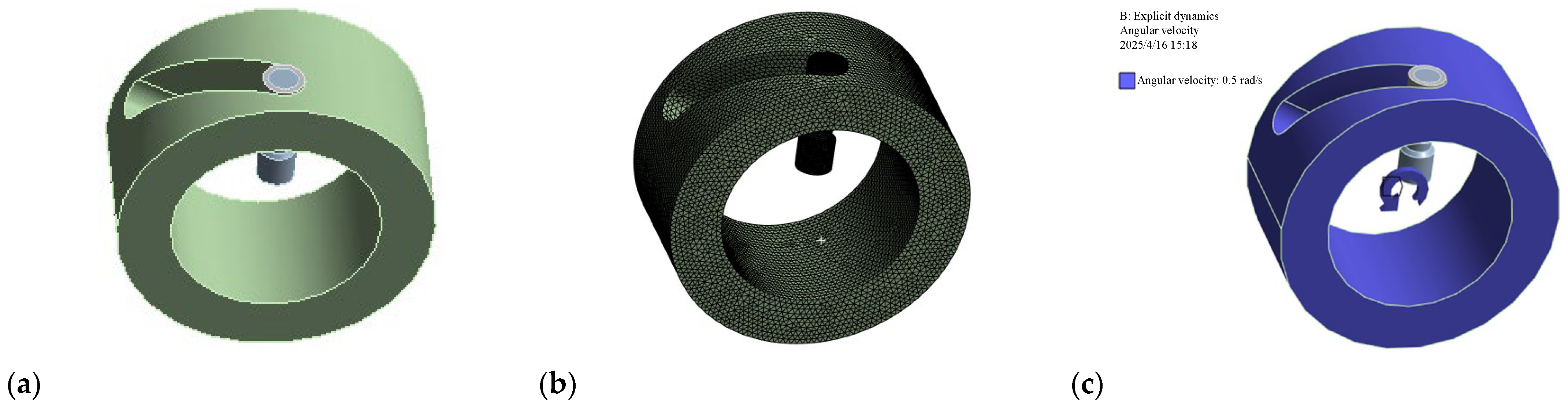
The shear pin must ensure that it does not yield during normal locking operations, while also guaranteeing precise fracture in the event of a jam. When the roller completes the locking action at the end of the L-shaped spiral groove, a boundary impact inevitably occurs. Since the impact at the end of the spiral groove is the primary impact, the simplified model omits the straight section of the L-shaped groove. To evaluate the effect of input rotational speed on the shear pin’s strength, a nonlinear finite element analysis of contact and impact was performed. The structure was simplified using SolidWorks 2023 (3D software); the simplified model is shown in Figure 18a. In the finite element software, the end of the shear pin is defined as a fixed connection; the locking shaft and shear pin are assigned masses to the slide slot; the slide sleeve is assigned an initial angular velocity; and the mesh and boundary conditions are as shown in Figure 18b,c.
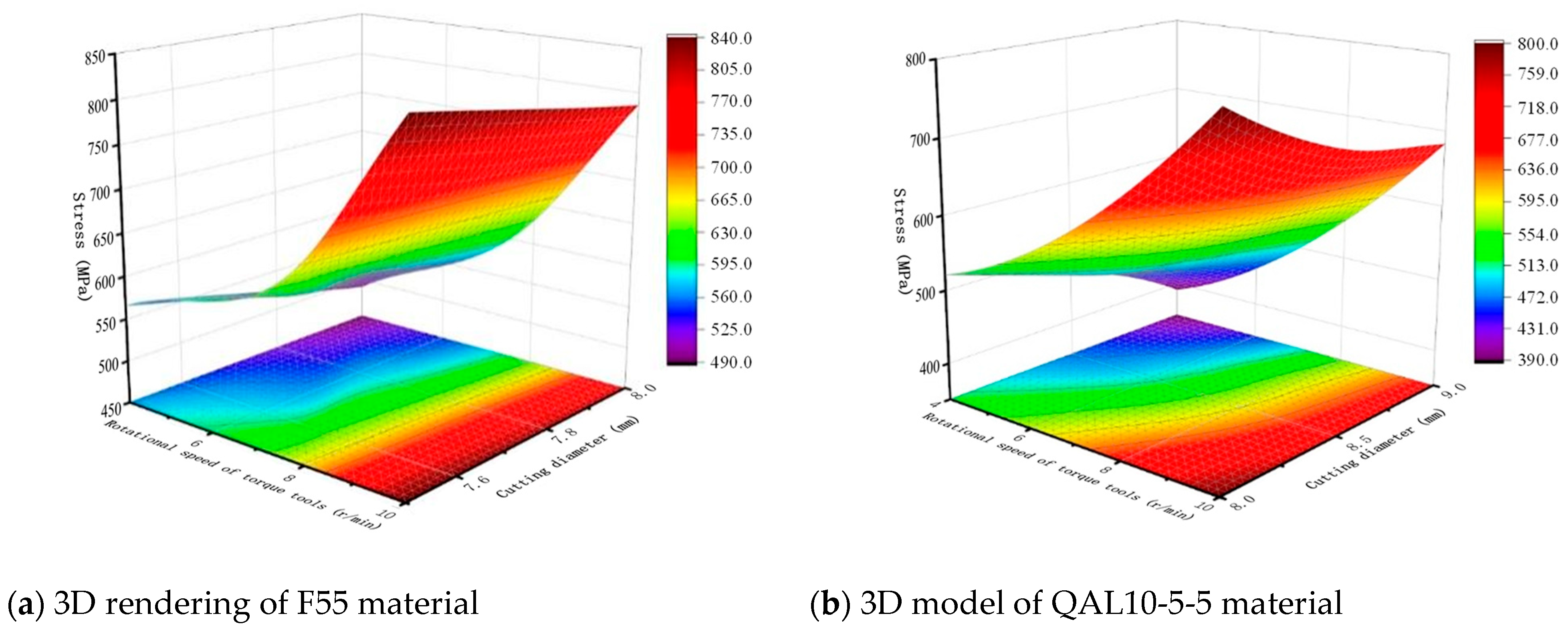
The material for the helical groove component is F55, the material for the guide pin is F55/QAL10-5-5, and the material for the sliding sleeve is QAL10-5-5. The collision speeds are set at 10 r/min, 8 r/min and 4 r/min respectively. These are defined as Class 4 tool speeds; combining this with the preceding text allows the calculation of the sleeve’s speed in the final section. The simulation results for different speeds, materials and dimensions are shown in Figure 19a,b.
The results indicate that, as rotational speed increases, the impact force at the end of the slot increases non-linearly. To ensure that the 8.8 mm diameter emergency shear pin does not suffer fatigue or plastic deformation during routine operation, the peak stress must be strictly controlled below its shear yield strength of 342 MPa; consequently, the drive speed of the ROV torque tool must be strictly limited to 4 r/min or less.

4. Macro-Elastic–Plastic and Micro-Contact Mechanics Analysis Under Extreme Loads

Once the MQC has completed docking and established fluid connectivity, the system must withstand, over the long term, the immense axial separation forces generated by the ultra-high-pressure pipeline (10,000 psi, approximately 69 MPa) as well as the suspension bending moments from the umbilical cable. To ensure the structural integrity and transmission accuracy of the V-lock locking mechanism, this section conducts a mechanical assessment from two perspectives: macroscopic non-linear elastoplastic evolution and microscopic non-coordinated surface contact stresses.

4.1. Nonlinear Elastoplastic Analysis of the Locking Module

The equivalent pressure-bearing area of the 12-way hydraulic/chemical agent connector is 9 mm2. The piping configuration comprises 10 lines rated at 10,000 psi and 2 lines rated at 5000 psi. Using the following formula, calculate the axial force required for the quick-connect coupling during mating:
F = P S
where: F is the axial force generated by a single joint; P is the pressure in the hydraulic line; S is the equivalent joint cross-sectional area.
Calculations show that the total rated axial force at the coupling is 163 k N. Taking into account deep-sea transient impacts and a safety margin (using a load factor of 1.5), the locking shaft must withstand a maximum separation force of up to 244.5 k N. The axial clamping force exerted on the clamping shaft is transmitted to the clamping groove via the contact surface between the two. The structural characteristics of the clamping shaft and clamping groove make them prone to stress concentration. As the core load-bearing components, the non-circular ‘herringbone’ mechanical interlocking roots of the clamping shaft and clamping groove are susceptible to severe stress concentration. The entire model has been simplified, retaining only the locking shaft and the locking groove; the simplified model is shown in Figure 20. A combination of tetrahedral and hexahedral elements was selected for the mesh, with a mesh size of 2 mm. A remote displacement constraint was applied to the rear face of the locking groove’s flange, whilst axial tensile force and torque were applied to the trapezoidal thread section.
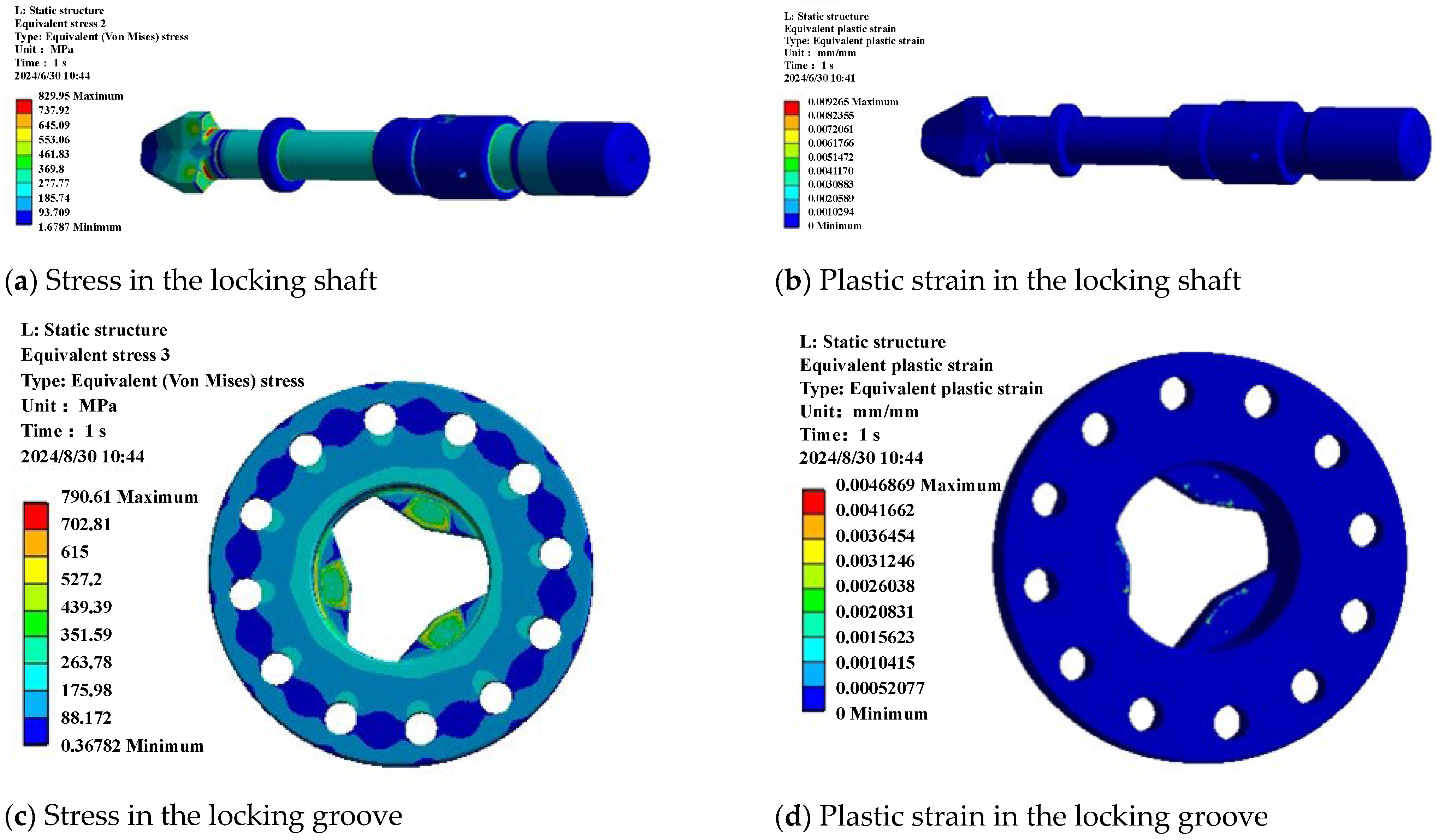
To ensure the reliability and accuracy of the results, mesh independence must be verified. In this paper, the mesh refinement function of ANSYS finite element analysis software is used to refine the global or local mesh; mesh independence is deemed to have been achieved when the difference between the results of two adjacent meshes is less than a pre-set threshold (2–5%). The study uses maximum stress as a reference for verifying independence. Tests were conducted on grid independence, and the results are shown in Table 5. The rate of change was less than 5% when the grid size varied from 3 mm to 2 mm, whereas it was only 0.21% when the grid size varied from 2 mm to 1 mm. Taking both computational cost and accuracy into account, the grid size at which the rate of change first fell below the 5% threshold was selected. In this study, a refinement factor of 2 and a convergence threshold of 5% were employed to verify grid independence. In order to accurately capture the non-linear behaviour of the material, this study employs the von Mises yield criterion to define the onset of plastic deformation in the clamping module. This approach effectively predicts the yield behaviour under the complex multi-axial stress conditions encountered during the clamping process. Finite element simulation analysis revealed that the maximum stress in the locking shaft was located at the base of the three claws, exceeding the allowable stress; the material had entered the plastic deformation stage. Stress concentration exists at this location; therefore, the structure at the root of the locking shaft requires optimisation. To ensure that structural dimensions are minimised whilst satisfying strength requirements, an elastic–plastic analysis is conducted. Prior to the elastic–plastic analysis, the stress–strain curve of the material is plotted in the finite element software. The calculation of the stress–strain curve is as follows:
ε t = σ t E y
where E y is the elastic modulus of the material, and σ t is the true stress used in calculating true strain.
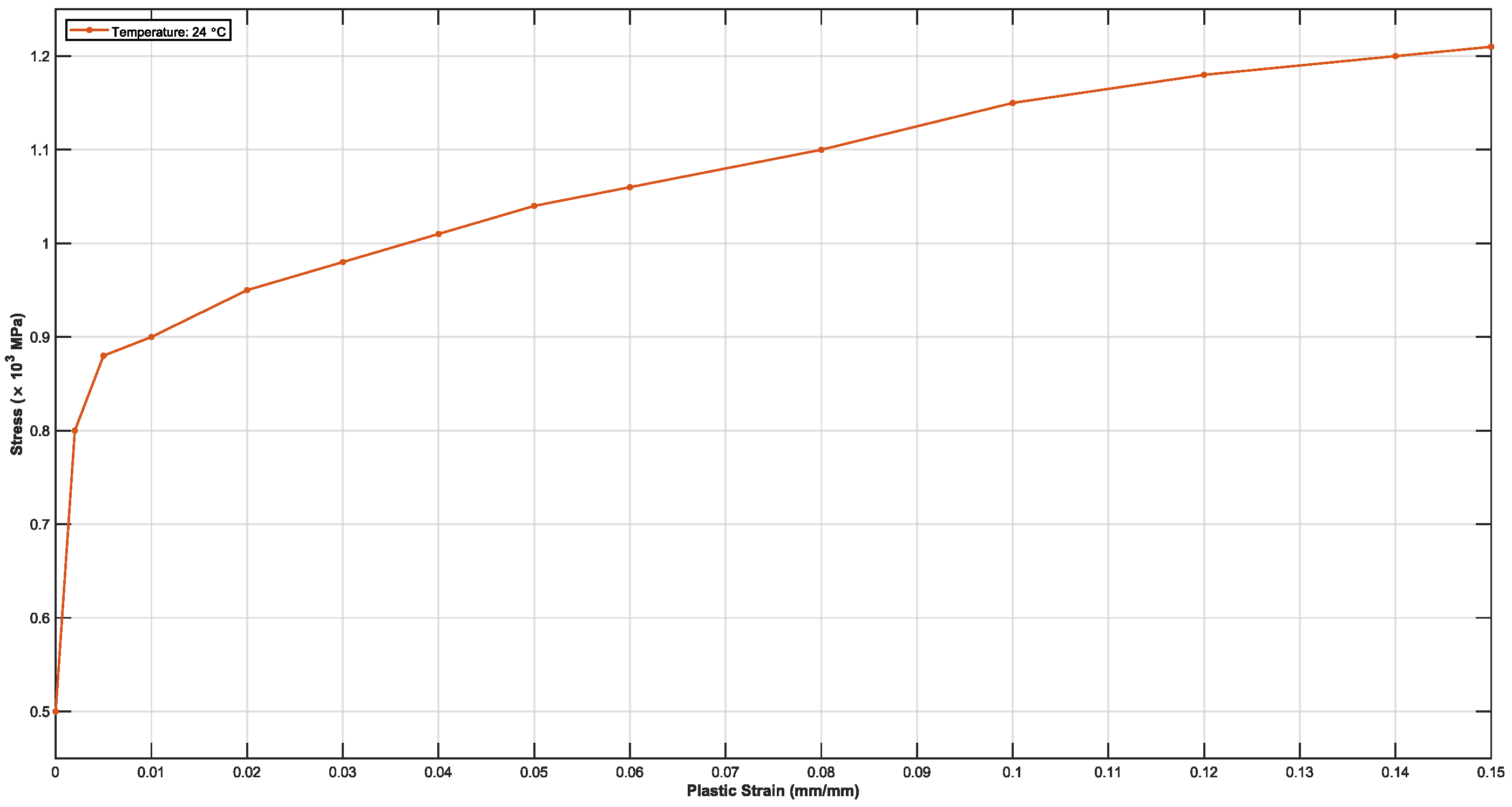
Nickel Alloy 718 is a nickel-based alloy. As shown in Table 6, the stress–strain curve parameters in the above equation can be determined. Using the calculation method described above, and in conjunction with the material properties of Nickel Alloy 718 (see Table 7), the stress–strain curve for Nickel Alloy 718 can be plotted. A total of 140 data points were uniformly selected within the stress range of 502 MPa to 1202 MPa and imported into the finite element software; The import of data points and the fitted stress–strain curve are shown in Figure 21.
A hybrid mesh consisting of tetrahedrons and hexahedrons was selected for the model, with a mesh size of 2 mm. Remote constraints were applied to the rear surface of the locking groove flange, whilst axial tensile force and torque were applied to the trapezoidal thread section. In accordance with industry standards, the working load was multiplied by 1.5 in the elastoplastic analysis. The contact between the locking shaft and the locking groove was defined as friction. Following verification of mesh independence, the simulation was carried out. The results are shown in Figure 22a–d:
Based on the analysis results, utilising actual stress–strain test data (true stress–strain curve) and incorporating the local failure assessment criteria from the ASME BPVC VIII-2 standard [42], a 2% local plastic strain threshold has been defined. The criterion obtained is:
ε p e q min 0.10 ; 0.5 1 σ y σ u
where: ε p e q is the equivalent plastic strain, σ y is the yield strength of the material, and σ u is the tensile strength of the material.
The calculation results indicate that the equivalent allowable plastic strain for this alloy is ε p e q = 0.0865 . Under ultimate load, the maximum equivalent plastic strain at the root of the locking shaft is only 0.00926, whilst the strain in the locking groove is merely 0.00468; both values are well below the failure thresholds specified in the ASME code. This indicates that the macroscopic topological structure of the locking module is capable of maintaining structural integrity under extreme high pressure without experiencing global plastic yielding.

4.2. Microscopic Contact Force Analysis of Cam Grooves Based on Hertzian Theory

The point of contact in the cam mechanism of the locking mechanism is a line-to-surface contact between the generatrix of the sliding sleeve and the surface of the helical groove, which constitutes a non-coplanar contact. It is assumed that the contact surfaces of the two objects are smooth and frictionless at both the macroscopic and microscopic scales. Hertz’s contact theory is based on four assumptions: the surfaces are continuous, smooth and non-curved; the strain is small; as the bodies approach the contact zone, each is treated as a half-space elastic body; and there is no friction at the surfaces. In deriving the stress equations using continuous mathematical tools such as calculus, it is necessary to assume that the surfaces have no geometric discontinuities or microscopic protrusions; however, if the contact involves the collision of rough peaks, The actual contact area is far smaller than the macroscopic contact area, resulting in local actual contact stresses that are significantly greater than those calculated by Hertz’s theory. Based on the above theoretical assumptions, this study and the experiments did not take into account seabed factors such as marine fouling and sediments. However, if equipment operates underwater for extended periods, marine fouling and sediment particles can easily become trapped between the roller and the L-shaped groove, transforming the contact configuration from ‘two-body line contact’ to ‘three-body point contact’. the load is no longer distributed smoothly but is concentrated on a few hard grains of sand or calcareous shells. The actual contact area is drastically reduced, leading to a potential order-of-magnitude surge in local true contact stress, far exceeding the macroscopic stress values calculated by Hertz’s theory. As this study only involved onshore and short-term underwater experiments, the effects of seabed biofouling and sediments were not taken into account. In the experimental model of this paper. At the macroscopic scale, the shape functions, first derivatives and second derivatives of the contact surfaces of the two objects are continuous within the contact region; at the microscopic scale, minute irregularities are neglected. The contact between the sliding sleeve and the L-shaped groove involves minor deformation; apart from the normal pressure distributed across the contact surface, no other external forces are acting, and therefore the contact can be considered to satisfy the Hertzian contact condition. The contact between the sliding sleeve and the L-shaped groove involves the contact between a cylinder and a plane, and can be regarded as a two-dimensional contact problem; its cross-section can be simplified as shown in Figure 23.
Since the two cylinders are in contact at points r 1 = r 1 , r 1 = , r 2 = r 2 , r 2 = , A = 1 r 1 + 1 r 2 / 2 , and B = 0 , and since contact body 1 is an L-shaped groove that unfolds into a plane, points r 1 = and A = 1 / 2 r 2 are also in contact. r is the radius of the sliding sleeve. As shown in Figure 23, the width of the contact area is 2 a , the radius of the sliding sleeve is r = 7 mm, the material of the sliding sleeve is QAL10-5-5 with a modulus of elasticity of E 1 = 110 GPa and a Poisson’s ratio of μ 1 = 0.3 , and the material of the L-shaped groove is F55 with a modulus of elasticity of E 2 = 211 GPa and a Poisson’s ratio of μ 2 = 0.286 . We can derive the equivalent modulus of elasticity:
1 E = 1 μ 1 2 E 1 + 1 μ 2 2 E 2
Based on the classical non-coordinated cylinder-plane Hertz contact model (Figure 23), the maximum contact stress q max can be directly determined:
q max = q ( 0 ) = E a 2 r
The mean contact stress is q ¯ :
q ¯ = a a q ( x 0 ) d x 0 2 a = π E a 8 r
Setting up the system of Equations (14) and (15) yields:
q max = 4 q ¯ π
It follows that half the width of the contact area a is:
a = 8 q ¯ r π E
Within the width of the contact area between the sliding sleeve and the L-shaped groove, the region is subdivided into countless small elements d s at the microscopic scale. After applying a normal distributed load q ( s ) , substituting q ( s ) = 2 P π a 2 a 2 s 2 1 / 2 yields the principal stresses inside the sliding sleeve. If we denote the stress at a general point by variables m 0 and n 0 and substitute them into the equation, we obtain:
σ x 0 = q max a m 0 1 + z 0 2 + n 0 2 m 0 2 + n 0 2 2 z 0 σ y 0 = 2 μ 2 q max a a 2 m 0 m 0 2 + n 0 2 m 0 2 n 0 2 z 0 σ z 0 = q max a m 0 1 z 0 2 + n 0 2 m 0 2 + n 0 2 τ x 0 z 0 = q max a n 0 m 0 2 n 0 2 m 0 2 + n 0 2
From the above analysis, it can be determined that, in coordinate system O 0 x 0 y 0 z 0 , under the action of the working load, the contact stress at any point on the contact surface between the sliding sleeve and the L-shaped groove, as well as the stress state at any point within the contact region, can be calculated. The first three variables σ x 0 , σ y 0 , σ z 0 represent the normal stresses at a computational point inside the sliding sleeve along the three coordinate axes x 0 , y 0 , z 0 and 3 in the local contact coordinate system O 0 x 0 y 0 z 0 . The fourth variable τ x 0 z 0 represents the shear stress in the x 0 z 0 plane within the local contact coordinate system; z 0 denotes the depth of the stress point relative to the contact surface within the local contact coordinate system O 0 x 0 y 0 z 0 . m 0 and n 0 are intermediate mathematical substitution variables introduced to simplify the extremely complex spatial stress partial differential equations; their values are determined entirely by the coordinate position ( x 0 , z 0 ) of the point in question and the half-contact width a .
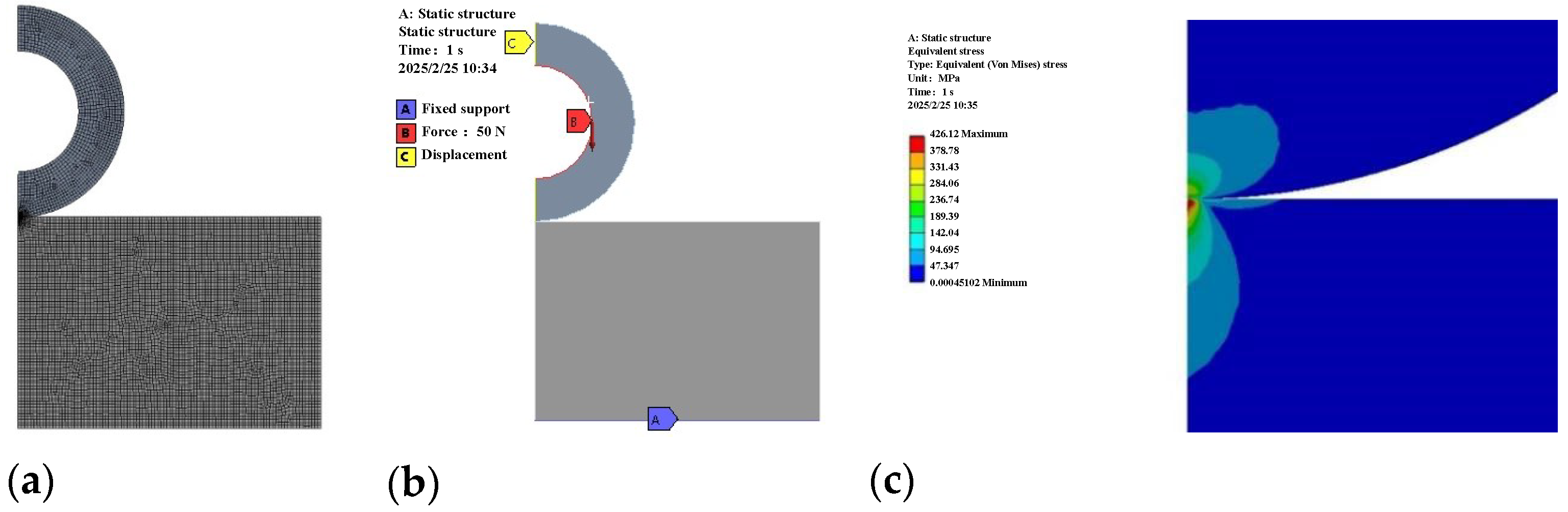
To verify the accuracy of the theoretical analysis, this paper analyses and calculates the forces acting on the guideway in both the straight and helical sections of the L-shaped track, thereby further analysing the maximum load. The analysis and calculations indicate that when the sliding sleeve moves within the L-shaped groove, the maximum contact load occurs in the helical section of the groove. This study constructed a high-mesh-density 2D non-linear finite element model of contact, applying a maximum design normal load of 50 N. As the connector under investigation is intended for use in deep-sea environments, the coefficient of friction in water is lower than that in dry conditions; furthermore, prior to submersion, the internal structure of the underwater connector is coated with a marine-grade lubricant, resulting in a coefficient of friction that is slightly lower than that of dry friction under normal conditions. Furthermore, given that QAL10-5-5 aluminium bronze possesses excellent self-lubricating and anti-seizing properties, the coefficient of friction was set at 0.1. The results of the finite element analysis are shown in Figure 24a–c.
The analysis results indicate that the maximum stress occurs at the central axis, which is in close agreement with the values calculated using Hertzian theory. As the Hertzian contact stress is strictly controlled within the permissible range, local plastic collapse of the L-shaped groove is prevented. This constitutes the microscopic physical prerequisite for ensuring that the mechanism does not seize under extreme high pressure and is capable of smoothly executing the ‘shear release’ function in an emergency; the design therefore meets the operational requirements.

5. Experimental Validation and Performance Evaluation

To comprehensively verify the accuracy of the multi-stage guiding mechanism, the spatial helical cam locking model and the non-linear contact mechanics analysis proposed in this paper, a full-scale deep-water MQC engineering prototype was developed, and a comprehensive test platform simulating complex deep-water boundary conditions was established to conduct a series of experiments. A4-80 screws (1/2 inch) and 3/8-inch pins made of F55 material should be used between the locking mechanism housing and the docking panel on the moving end.
As shown in Figure 25, this experimental platform consists primarily of four components: the MQC core prototype, comprising a mobile unit and a fixed unit; the power input system, which utilises a standard API Class 4 hydraulic torque tool with a rated output torque of 150,000 Nm; a hydraulic power unit (HPU) that supplies the test pressure; and a dynamic strain acquisition system, which employs a network of DH3816 resistive strain gauges to monitor micro-strain responses in real time during insertion, extraction and pressurisation.

5.1. Validation of the Dynamic Load Strength Test for the Locking Mechanism

To verify the structural strength of the connector, torque loading tests and hydraulic line pressure tests were designed to validate the reliability of the locking connection. A Class 4 torque tool was used as the driving torque input tool, and the pipelines at both the fixed and moving ends were pressurised to 10,000 psi, with pressure maintained to ensure stability. To protect the equipment, the maximum operating torque was limited to 350 Nm throughout the entire coupling process, and the coupling rotation speed was set to no more than 4 r/min. The Class 4 torque tool was connected to the moving-end interface, and the moving end was slowly brought into contact with the fixed end until the locking position was reached. Once the pre-tightening position is reached, the torque tool’s operating speed is limited to 4 r/min, with a working torque of 1400 Nm for the straight section of the helical groove.
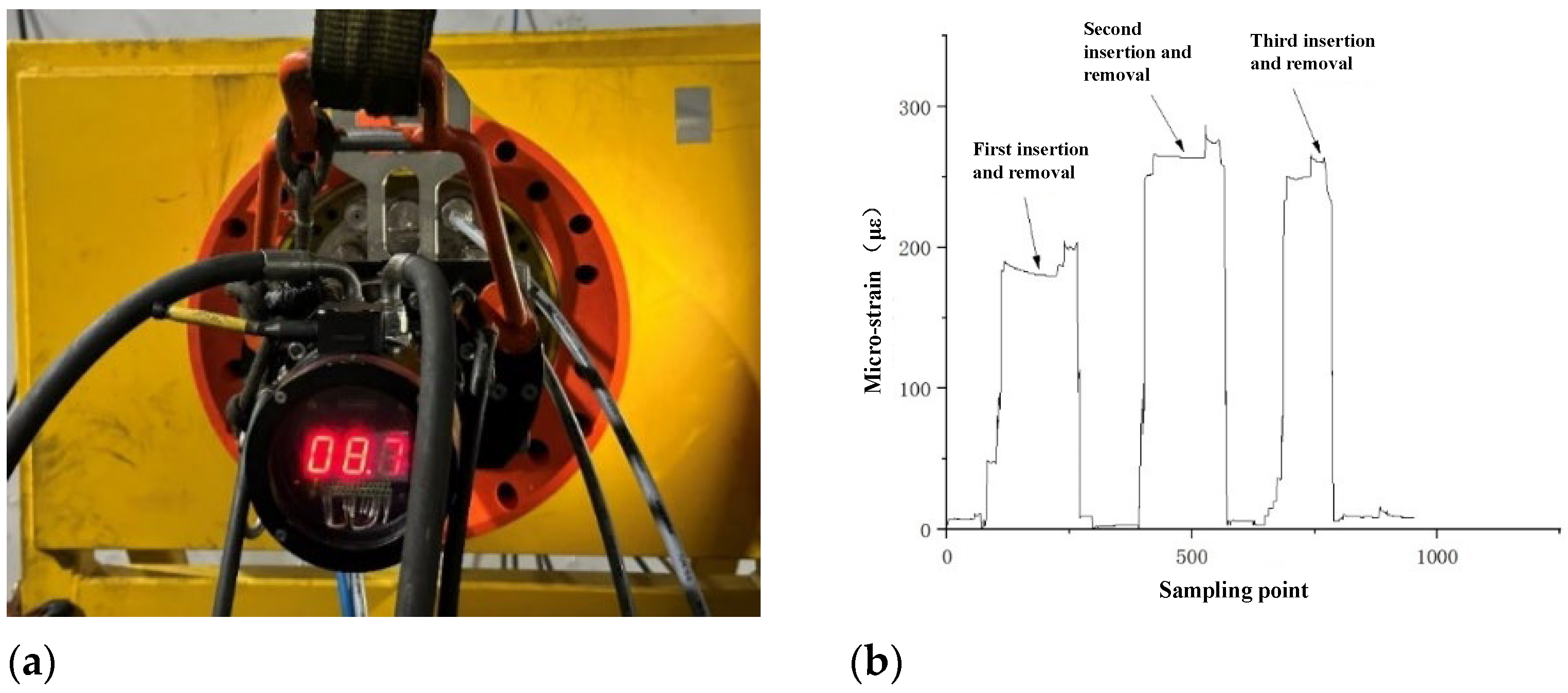
During the tightening process, the working torque and rotational speed are monitored in real time via the pressure gauge on the Class 4 hydraulic power unit and the revolution counter at the rear of the torque tool; the counter is shown in Figure 26a. The insertion and extraction tests were repeated three times; the micro-strain curve of the locking shaft measured by the strain gauge is shown in Figure 26b.
Analysis of the strain plots reveals that transient peaks occurred during the steady-state phase of all three insertion and withdrawal cycles. This is because, during the pressure-sealing process, the valve spool must overcome an internal pressure of 10,000 psi in the connecting pipes at both ends; the impact load borne by the connector at the moment the valve spool is forced open; and the subsequent drop in pipe pressure once the valve spool opens, causing the curve to trend downwards. The curve shows that the maximum micro-strain value is approximately 250. A comparison with the finite element analysis results reveals an overall error rate of approximately 20%. This error is partly due to the fact that, during the pressurisation process, the work done by the high-pressure fluid causes a slight temperature rise in the DH3816 resistive strain gauge, and the fluctuations in room temperature were not perfectly compensated for, leading to significant zero-point drift errors; on the other hand, the Coulomb friction coefficient μ set in the finite element analysis was a constant, whereas the actual sliding process exhibited stick–slip behaviour, resulting in fluctuating peaks in the measured strain; during the manual simulation of ROV docking, 100% concentricity could not be guaranteed, and a slight initial eccentric bending moment was present. Following a comprehensive evaluation, it was concluded that the theoretical analysis results are consistent with the actual experimental data.
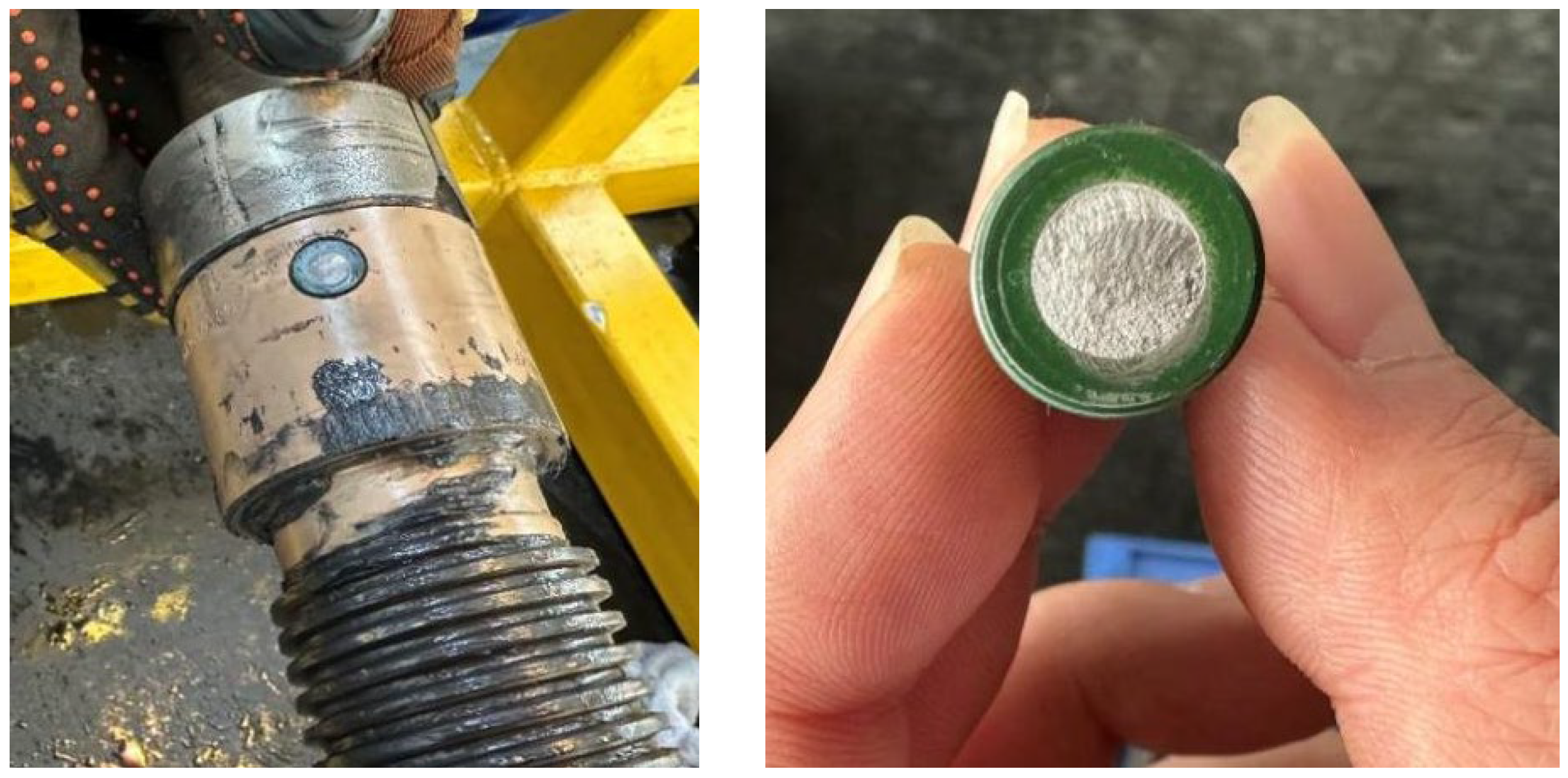
The Class torque tool was then set to a speed of 10 r/min, and another docking test was conducted. When the shear pin reached the end of the helical groove, the equipment sustained damage. Upon disassembly and inspection, it was found that the shear pin had been destroyed, as shown in Figure 27. The test results indicate that the kinematic theoretical analysis is consistent with the actual test results. Based on these results, the operating speed should be limited to 4 r/min.
The test results indicate that the underwater multi-channel quick-connect coupler is capable of performing locking and unlocking operations at the designed operating speed and torque, in line with the theoretical analysis.

5.2. Proficiency Testing for Alignment and Docking

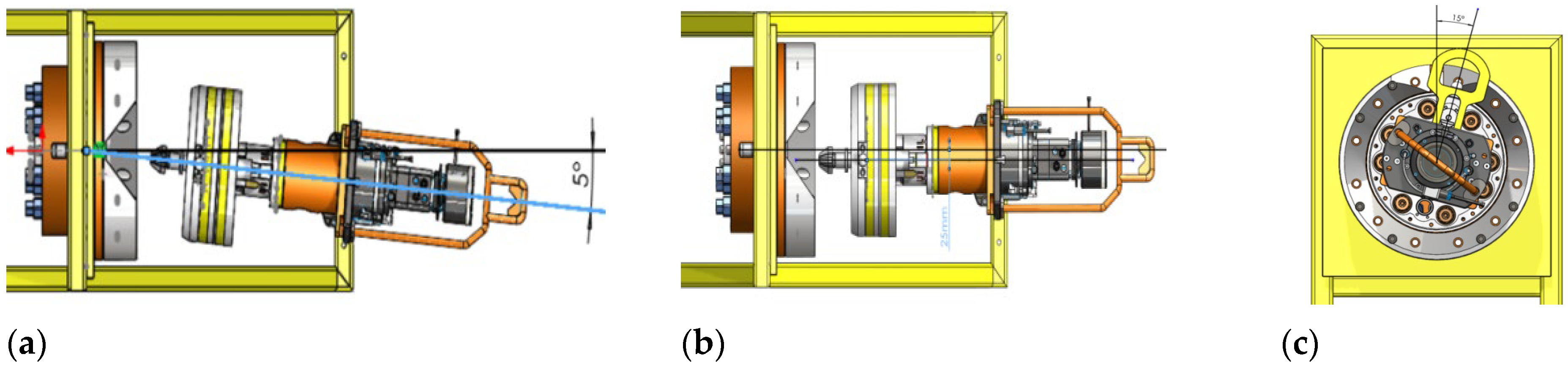
To verify the anti-sticking geometric limits and collision dynamics thresholds derived in Section 3, an experiment was designed to test the attitude tolerance during docking. Using a dedicated multi-degree-of-freedom mounting bracket, extreme tolerances were artificially introduced: a horizontal offset of 25 mm, a radial deflection of 5°, and an axial rotation of 15°. The experimental offset scenarios are shown in Figure 28a,b.
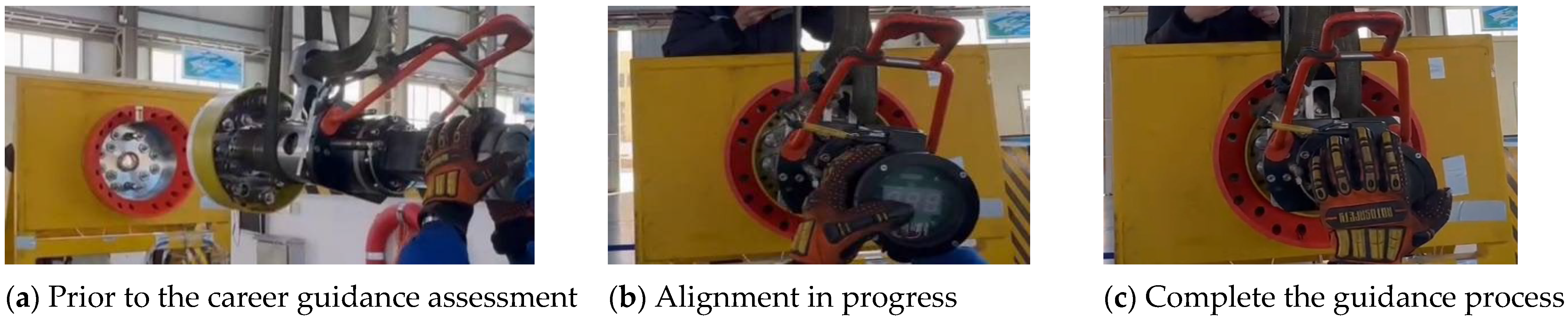
The fixed end is mounted on the test bench, whilst the mobile end is clamped by an overhead crane; manual adjustments are made to simulate the underwater movements of an ROV manipulator. A Class 4 torque tool is fitted to the rear of the connector to facilitate readjustment and to enable manual simulation of the ROV’s movements. Prior to the experiment, reference lines are marked using a laser level to ensure that, when the fixed-end bracket is positioned according to these lines, the deviation between it and the mobile end suspended by the overhead crane meets the test requirements. On the mobile end, a plumb line and a universal protractor are used to ensure that the rotation angle of the mobile end meets the test requirements. Once preparations are complete, the guidance docking test may commence. Control the movement speed of the trolley to 0.1–0.2 metres per second as it approaches the fixed end; the docking process is shown in Figure 29a–c.
The results demonstrated that the alignment correction capability was consistent with the theoretical design and analytical findings, whilst the guidance function met the design specifications of 25 mm lateral displacement, 5° rotation and 15° axial rotation. The connector was capable of completing docking even under certain attitude deviations, and its structural strength was sufficient to withstand docking at a speed of 10 mm/s. This fully confirmed that the tolerance capacity of the multi-stage guidance structure was consistent with theoretical predictions.

5.3. Static and Sealing Verification Under Ultimate Pressure and Mounting Torque

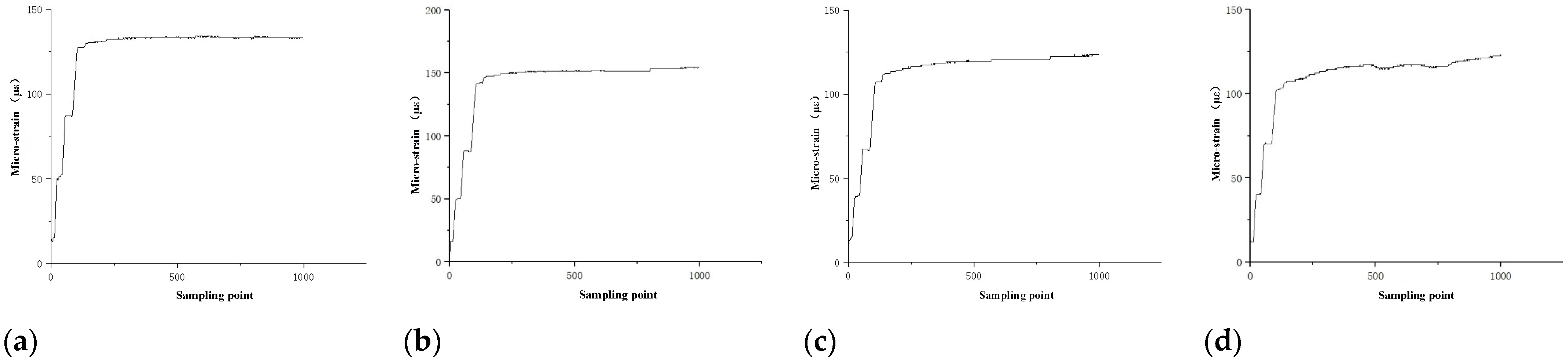
To verify the accuracy of the non-linear elastoplastic model and the microhertz contact mechanics model, coupled experiments involving ultimate pressure holding and external loading were conducted after establishing fluid communication. A hydraulic power unit (HPU) was used to apply pressure to the 12-line pipeline in stages until the design limit of 10,000 psi was reached, at which point the pressure was maintained for 15 min. During the pressure test, strain trends and strain values at the connector were recorded and monitored using strain gauges; the recorded curves are shown in Figure 30a–d.
All curves exhibit a four-stage rise followed by a plateau, corresponding to the hydraulic power unit raising the system pressure to 10,000 psi on four occasions; the plateau corresponds to the pressure-holding phase. Upon converting the micro-strain to strain, the strain range is found to be 0.0001–0.00015. A comparison with the finite element analysis results shows a strain deviation of approximately 0.00005; given the scale of the strain, this error is within a very small range, and therefore the theoretical analysis is consistent with the actual experimental results.

5.4. Destructive Emergency Release Validation Under Simulated Jamming Conditions

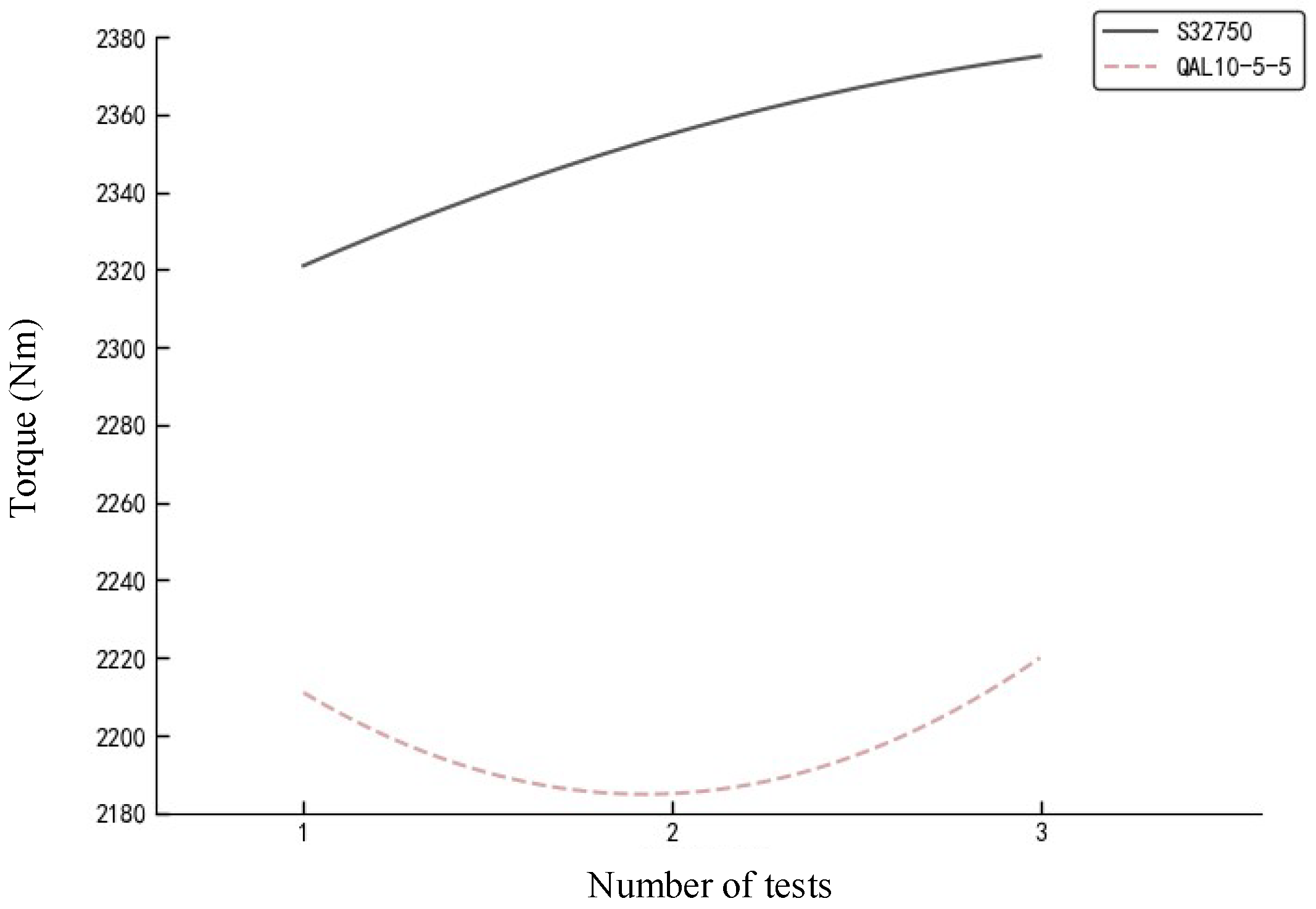
To verify the innovation described in this paper—the ‘shear-pin-based anti-seizing emergency release function’—destructive shear tests were conducted. Is it possible to disconnect the connector by increasing the unlocking torque using a torque tool? Gradually apply torque until the shear pin shears. It should be noted that the rotation angle of the torque wrench should be limited to 60°. Record the shear torque once shearing is complete. Three emergency release tests were conducted on the F55 shear pin (shear diameter 8 mm) and the QAL10-5-5 shear pin (shear diameter 8.8 mm) respectively; the recorded shear torques are shown in Figure 31.
Upon comparing the shear pin curves for the two materials in the graph, it can be seen that the shear torque for the two shear pins stabilises within the ranges of 2300–2400 Nm and 2100–2200 Nm respectively. To better align with the emergency release torque of 2000 Nm, the QAL10-5-5 material was selected for the shear pin. with a shear diameter of 8.8 mm. Observation of the curves in the graph reveals some noticeable fluctuations in the torque curve for QAL10-5-5, indicating variations in the final shear torque across the three experiments. Analysis suggests that this is due to the need to disassemble and replace the shear pin with a new one prior to each destructive test. During each reassembly, it is impossible to ensure 100% absolute consistency in the microscopic meshing state of the threaded surfaces, residual lubrication, and the minute assembly clearances between components. Consequently, this additional microscopic frictional torque fluctuated randomly across the three tests, directly leading to variations in the final measured total breaking torque. Once the shear pin was sheared, the locking shaft was instantly released from the circumferential constraint of the L-shaped slot, granting the moving end the freedom to retract. This successfully achieved an emergency disengagement without damaging the main structure of the Christmas tree. The measured breaking torque of 2100–2200 Nm was slightly higher than the theoretical calculation of 2000 Nm; this was due to the additional microscopic friction torque present in the actual test setup. However, this threshold is significantly higher than the routine locking torque of 1400 Nm—designed to prevent accidental triggering—and falls entirely within the maximum output capacity of ROV Class 4 tools. This destructive test provides compelling evidence of the high reliability and engineering practicality of the micro-contact mechanics design and emergency release strategy outlined in this paper.

5.5. Underwater Visual Validation of the Integrated Pose Indication System

To further validate the feasibility of the designed MQC attitude indication system, this study conducted both land-based and underwater wet tests. During deep-water operations, clear visual feedback is critical for preventing “false locking.” We submerged the prototype and deployed an underwater camera to simulate the ROV’s visual perspective during the docking and locking process.
Monitoring results indicate that the indicator’s kinematic behaviour fully aligns with the theoretical design. Figure 32 illustrates the indicator’s behaviour as recorded during the experiment.
The results demonstrate that the system provides operators with intuitive, real-time feedback regarding axial displacement and the successful engagement of the guide pins. When a Class 4 torque tool drives the locking mechanism, the transition of the circumferential status indicator from the “U” position to the “L” position can be clearly and continuously tracked. After the L-shaped spiral cam completes one cycle, the camera footage confirms that the system is fully locked.

5.6. Summary of Validation Results

To comprehensively evaluate the accuracy of the proposed multi-physics models, the key performance metrics obtained from theoretical calculations, numerical simulations, and full-scale prototype tests are summarised in Table 8. The minor deviations observed fall well within acceptable engineering tolerances, confirming the high reliability of both the kinematic and elastoplastic contact models.

6. Conclusions

This paper systematically addresses the issues of precise guidance, locking and unlocking, and emergency recovery of a deep-water multi-way quick connector (MQC) in complex underwater environments through theoretical modelling, numerical simulation and full-scale experimental validation. A novel prototype integrating a graded tolerance guidance mechanism with an innovative L-shaped spatial spiral cam locking system was developed, establishing a reliable analytical method and engineering foundation for the yield-resistant design of subsea connectors. The main conclusions are as follows:
This paper establishes a dynamic model for alignment deviation correction based on graded tolerances, and defines a safe operating envelope through explicit non-linear finite element collision analysis. In this study, the flared cone angle and the slot angle of the connector are designed to be 30° and 40° respectively, to ensure compliance with anti-jamming conditions and to achieve smooth coarse alignment of the connector. Both finite element collision analysis and experimental results have verified that when the remotely operated vehicle (ROV) operates at a controlled speed of 10 mm/s, the layered guidance structure enables smooth, damage-free and non-seizing docking; even under extreme initial misalignment conditions of 25 mm lateral offset, 15° axial rotation and 5° horizontal rotation, smooth, damage-free and non-seizing docking can still be achieved.
A comprehensive assessment of the safety performance of the L-shaped locking rail was conducted by combining a fifth-order polynomial motion law with macro-micro elastoplastic contact mechanics based on Hertz’s theory. Coupled pressure-holding tests conducted under an extreme separation load of 10,000 psi demonstrated that the maximum equivalent plastic strain at the critical cross-section of the locking shaft was strictly controlled at 0.00926. This value is significantly lower than the failure threshold of 0.0865 specified by ASME, thereby effectively preventing local yielding and ensuring structural integrity. Locking tests were also conducted in conjunction with the attitude status indicator designed for this study. Underwater wet tests confirmed that the newly designed attitude-linked indicator provides accurate, real-time visual feedback, thereby eliminating the phenomenon of ‘false locking’ and demonstrating the feasibility of the indicator system.
An emergency release strategy based on a shear pin was proposed and validated through full-scale destructive testing under simulated sticking conditions. Experimental results indicate that the disengagement process is clean and decisive under shear torques ranging from 2100 Nm to 2200 Nm. This threshold is significantly higher than the operational locking torque of 1400 Nm, safely preventing accidental triggering during routine operations, whilst remaining fully within the output capacity of standard ROV Class 4 tools, thereby establishing a safe operating speed of ≤4 r/min.
These research findings provide a solid theoretical framework and crucial empirical data for the anti-clogging design and safe emergency recovery of future deep-water connectors, demonstrating high engineering feasibility and practical value. However, due to experimental constraints and time limitations, this study was limited to terrestrial experiments and short-term underwater experiments, and did not include testing of the long-term effects of the actual underwater environment. Future work will further extend the current contact mechanics model by accounting for continuous disturbances caused by actual ocean currents. Concurrently, through deep-water wet-dock sea trials, the detrimental effects of long-term marine fouling, seawater corrosion and multi-cycle fatigue on the micro-contact friction coefficient will be investigated, thereby refining the full life-cycle reliability assessment model for subsea connectors.


Author Contributions

Conceptualization, H.G. and W.H.; methodology, H.G. and W.H.; software, Q.S. and Y.D.; validation, H.G., W.H. and F.Z.; formal analysis, H.G.; investigation, W.H. and L.W.; resources, Y.D. and F.Z.; data curation, H.G. and Q.S.; writing—original draft preparation, H.G. and W.H.; writing—review and editing, H.G.,W.H. and Q.S.; visualisation, Y.D. and F.Z.; supervision, W.H.; project administration, H.G.; funding acquisition, H.G. All authors have read and agreed to the published version of the manuscript.

Funding

This research was funded by “National Key Research and Development Program Project of China, grant number 2023YFB3407704”, and this research was funded by the “Special Project for Foundation Research of Featured Disciplines of Harbin Engineering University, grant number KYWZ220240701”, and this research was funded by the “Key Research and Development Program Project of Heilongjiang Province, grant number 2024ZX03802”.

Data Availability Statement

Data are contained within this article.

Conflicts of Interest

The authors declare no conflicts of interest.

References

  1. Wang, L.-Q.; Wei, Z.-L.; Yao, S.-M.; Guan, Y.; Li, S.-K. Sealing Performance and Optimization of a Subsea Pipeline Mechanical Connector. Chin. J. Mech. Eng. 2018, 31, 18. [Google Scholar] [CrossRef]
  2. Wei, Z.; Wang, L.; Guan, Y.; Yao, S.; Li, S. Static Metal Sealing Mechanism of a Subsea Pipeline Mechanical Connector. Adv. Mech. Eng. 2016, 8, 1687814016654821. [Google Scholar] [CrossRef]
  3. Wang, H.; Chen, J.; Zhou, H.; Le, X.; Ruan, D.; Xiao, Y.; Chen, X.; Wang, L. Research on Novel Multi-Way Hydraulic Quick Connector for Underwater Production System. Mar. Technol. Soc. J. 2021, 55, 129–138. [Google Scholar] [CrossRef]
  4. Tang, Y.; Zhou, M.; Liu, X.; Li, G.; Pang, R. Structure Design and Characteristic Analysis of Over-Line and Universal Shaft Connector of Pipeline Intelligent Plugging Robot. Ocean Eng. 2023, 276, 114221. [Google Scholar] [CrossRef]
  5. Qin, J.; Ji, M.; Gong, H.; Guo, S.; Zhang, Y.; Li, Y.; Cen, H. Research on Optimal Design of 6in Offshore Flange Con-nector’s Sealing Structure. Brodogradnja 2024, 75, 75207. [Google Scholar] [CrossRef]
  6. Jiao, K.; Yun, F.; Hao, X.; Wang, G.; Yao, S.; Jia, P.; Wang, X.; Wang, L. Multi-Objective Optimization of Sealing Structure of Subsea Pipeline Connector Based on Developed FE Model, Sensitivity Analysis, Surrogate Model and NSGA-II. J. Braz. Soc. Mech. Sci. Eng. 2024, 46, 101–118. [Google Scholar] [CrossRef]
  7. Wang, L.; Wei, Z.; Guan, Y.; Li, S. A novel subsea pipeline connection method and experimental study. In Proceedings of the InISOPE International Ocean and Polar Engineering Conference, Rhodes, Greece, 26 June–2 July 2016; p. ISOPE-I. [Google Scholar]
  8. Kong, F.; Diao, Y.; Yang, E. Research on Automatic Robot Manipulator Exchange. Mech. Eng. 2004, 5, 18–21. [Google Scholar]
  9. Peng, F.; Duan, M.; Wang, J.; Zhu, Y.; Wang, X. Optimisation method for mathematical model of deepwater collet connector locking mechanism. Ships Offshore Struct. 2016, 11, 575–590. [Google Scholar] [CrossRef]
  10. Rembala, R.; Ower, C. Robotic assembly and maintenance of future space stations based on the ISS mission operations experience. Acta Astronaut. 2009, 65, 912–920. [Google Scholar] [CrossRef]
  11. Wu, Z.; Chen, S.; Han, J.; Zhang, S.; Liang, J.; Yang, X. A Low-Cost Digital Twin-Driven Positioning Error Compensation Method for Industrial Robotic Arm. IEEE Sens. J. 2022, 22, 22885–22893. [Google Scholar] [CrossRef]
  12. Yang, J.; Quan, Z. Dynamics Analysis of Satellite Docking Agency Ball Lock Device Based on Mechanical System Dynamics. Autom. Appl. 2025, 14, 66. [Google Scholar]
  13. Oda, M.; Kibe, K.; Yamagata, F. ETS-VII, space robot in-orbit experiment satellite. In Proceedings of the IEEE International Conference on Robotics and Automation, Minneapolis, MN, USA, 22–28 April 1996; Volume 1, pp. 739–744. [Google Scholar]
  14. Nishida, S.I.; Yoshikawa, T. A new end-effector for on-orbit assembly of a large reflector. In Proceedings of the 2006 9th International Conference on Control, Automation, Robotics and Vision, Singapore, 5–8 December 2006; pp. 1–6. [Google Scholar]
  15. An, W.; Wang, Y.; Chen, B.; Duan, M.; Zhang, X. Analysis of the Reliability of Subsea Clamp Connector Based on Multiple Response Surface Methodology. J. Mar. Sci. Eng. 2023, 11, 1378. [Google Scholar] [CrossRef]
  16. Duan, M.; Zhang, K.; Soares, C.G.; Paik, J.K. Theoretical investigation on hub structure design of subsea connectors. Thin-Walled Struct. 2021, 159, 107036. [Google Scholar] [CrossRef]
  17. Zhang, K.; Duan, M.; Luo, X.; Hou, G. A fuzzy risk matrix method and its application to the installation operation of subsea collet connector. J. Loss Prev. Process Ind. 2017, 45, 147–159. [Google Scholar] [CrossRef]
  18. Zhuang, B.; Liu, Y.; Yang, F. Experimental and numerical study on deformation performance of Rubber-Sleeved Stud connector under cyclic load. Constr. Build. Mater. 2018, 192, 179–193. [Google Scholar] [CrossRef]
  19. Yun, F.; Wang, L.; Yao, S.; Liu, J.; Liu, T.; Wang, R. Analytical and experimental study on sealing contact characteristics of subsea collet connectors. Adv. Mech. Eng. 2017, 9, 1687814017701702. [Google Scholar] [CrossRef]
  20. Gill, W.S.; Marshall, M.B.; Lewis, R.; Hall, B.; Bolton, S. Failure analysis of pipeline indents using steel precision balls under subsea conditions. Tribol. Int. 2018, 118, 524–537. [Google Scholar] [CrossRef]
  21. Pang, N.; Jia, P.; Wang, L.; Yun, F.; Zhang, N.; Liu, P. Reliability analysis of subsea connector structure. J. Harbin Eng. Univ. 2021, 42, 68–73. [Google Scholar]
  22. Gogoi, N.; Arvin, F.; Saleh, M.; Thenius, R.; Casson, A. Biodegradable Connector for Underwater Robotics. In Proceedings of the 2025 IEEE International Conference on Flexible and Printable Sensors and Systems (FLEPS), Singapore, 22–25 June 2025; pp. 1–4. [Google Scholar]
  23. Wang, W.; Xu, H.; Chen, Y.; Meng, Q.; Qu, Z.; Wang, H. Design and Application of Subsea Hydraulic Connector. Mach. Toolhydraulics 2023, 51, 87–90. [Google Scholar]
  24. Yun, F.; Liu, D.; Xu, X.; Jiao, K.; Hao, X.; Wang, L.; Yan, Z.; Jia, P.; Wang, X.; Liang, B. Thermal–Structural Coupling Analysis of Subsea Connector Sealing Contact. Appl. Sci. 2022, 12, 3194. [Google Scholar] [CrossRef]
  25. Li, Y.; Su, H.; Wang, Y.; Ma, Q.; Sun, H.; Lin, Z. Analysis of the factors influencing the sealing performance in subsea electrical connectors. Ships Offshore Struct. 2024, 18, 1–11. [Google Scholar] [CrossRef]
  26. Li, Y.; Jiang, W.; Zeng, L.; Wang, Y.; Liu, Z.; Ye, S. Design and Characterization of Subsea Pipeline Rehabilitation Connectors. Ocean. Eng. 2023, 288, 115967. [Google Scholar] [CrossRef]
  27. Wang, Y.; Wang, C.; Liu, G.; Zhang, C.; Li, J. An Assessment Method of Sealing Performance and Stress Intensity Factors at Crack Tip of Subsea Connector Metal Sealing Rings. Energies 2022, 15, 4680. [Google Scholar] [CrossRef]
  28. Wang, Y.; Jiang, D.; Li, X.; Li, Y.; Liu, Y.; Tian, L. An Elastoplastic Finite Element Method for Evaluating the Bending Capacity of Subsea Wellhead Connectors. Ocean Eng. 2026, 348, 124089. [Google Scholar] [CrossRef]
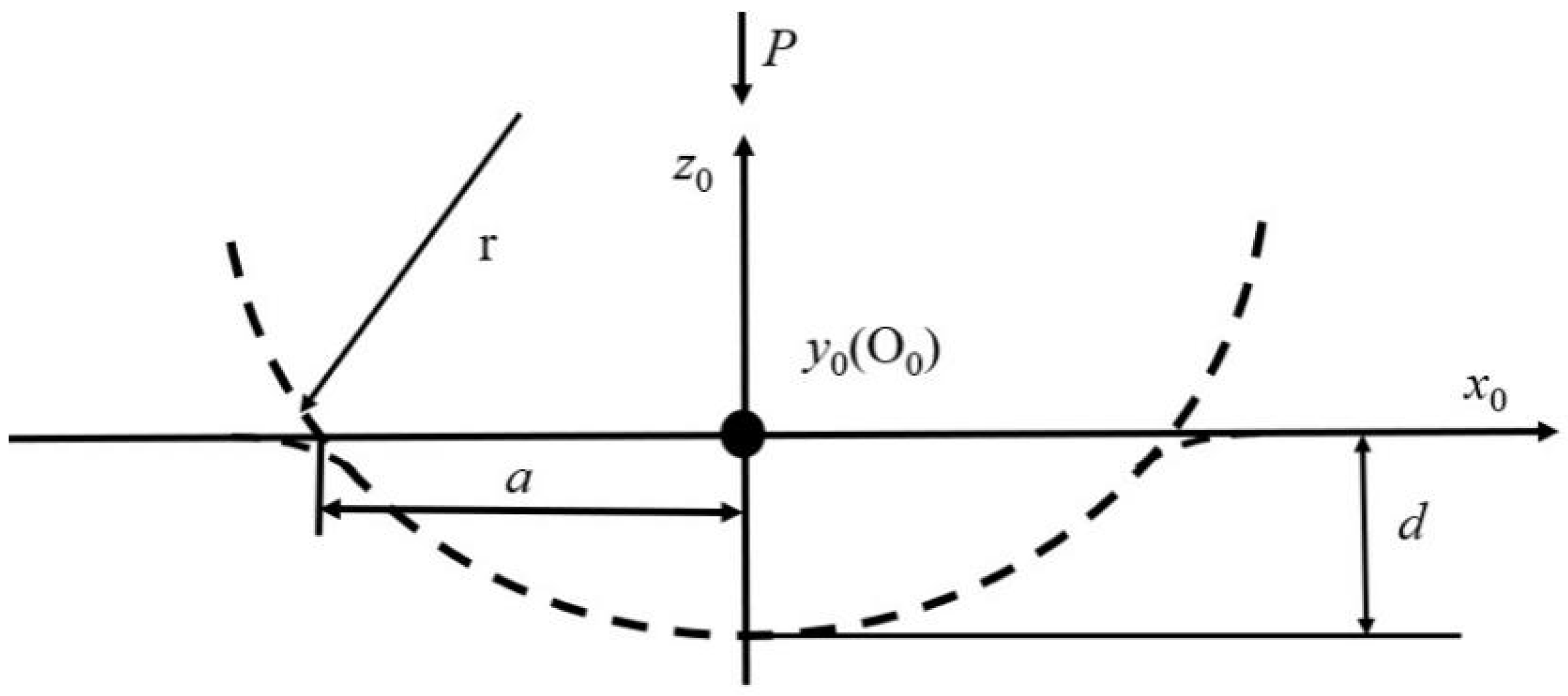
  29. Li, J.; Chang, Y.; Liu, X.; Xu, L.; Chen, G. Dynamic Reliability Assessment Approach for Deepwater Subsea Wellhead Systems via Hybrid Bayesian Networks. China Ocean Eng. 2025, 39, 101–110. [Google Scholar] [CrossRef]
  30. Medlinsky, O.; Eliezer, A.; Hadjistassou, C. Factors Governing the Failure of Subsea Critical Connector Bolts. ECS Adv. 2023, 2, 41501. [Google Scholar] [CrossRef]
  31. Liu, W.; Sun, H.; Yun, F. Reliability Analysis of Multi-State Systems for Subsea Connector under Dynamic Pressure Based on the Markov Process. Measurement 2025, 252, 117389. [Google Scholar] [CrossRef]
  32. Liu, T.; Wang, Y.; Du, Q.; Hu, W. Multi-Objective Optimization of Metal Seal Structure of Underwater Double-Channel Connector Based on Kriging Model. In Proceedings of the ISOPE International Ocean and Polar Engineering Conference, Seoul, Republic of Korea, 1–6 June 2025; p. ISOPE-I. [Google Scholar]
  33. Jiao, K.; Yun, F.; Hao, X.; Wang, G.; Yao, S.; Jia, P.; Wang, X.; Wang, L. A fast GA-ANN model and application in multi-objective optimization of the sealing ring for the subsea pipeline connector with regard of the penetration load. J. Mech. Sci. Technol. 2024, 38, 309–322. [Google Scholar] [CrossRef]
  34. Zhou, Y.; Lin, Q.; Li, W. Optimization of elastoplastic behavior of contact interface for improved contact stress distribution. Mech. Adv. Mater. Struct. 2023, 30, 803–813. [Google Scholar] [CrossRef]
  35. Gunn, R. Duplex Stainless Steels Microstructure, Properties and Applications. Anti-Corros. Methods Mater. 1998, 45, 2. [Google Scholar] [CrossRef]
  36. Gong, X.; Song, L.; Hu, J. Effect of ageing treatment on the microstructure and properties of as-forged QAl10-5-5 aluminium bronze. Mater. Mech. Eng. 2012, 36, 73–77. [Google Scholar]
  37. Iglesias, N.; Díaz, E. Influence of H2S and CO2 Partial Pressures and Temperature on the Corrosion of Superduplex S32750 Stainless Steel. Corros. Mater. Degrad. 2025, 6, 20. [Google Scholar] [CrossRef]
  38. Xue, H.; Sun, L.; Zou, J.; Jiang, Q.; Cao, X.; Chen, J.; Wang, Y. Intermetallic Compounds in Diffusion-Bonded TC4/QAl10-5-5 with a Ni Interlayer: Formation Sequence, Multi-Layer Characteristics, and Mechanical Properties. Intermetallics 2026, 194, 109313. [Google Scholar] [CrossRef]
  39. Craig, J. Introduction to Robotics: Mechanics and Control, 4th ed.; Pearson: London, UK, 2025. [Google Scholar]
  40. Budynas, R.G.; Nisbett, J.K. Shigley’s Mechanical Engineering Design; McGraw-Hill: New York, NY, USA, 2008; Volume 8. [Google Scholar]
  41. Uicker, J.J.; Uicker, J.J., Jr.; Pennock, G.R.; Shigley, J.E. Theory of Machines and Mechanisms; Cambridge University Press: Cambridge, UK, 2023. [Google Scholar]
  42. Raghavaiah, N.V. Overview of pressure vessel design using ASME boiler and pressure vessel code section VIII division-1 and division-2. Int. J. Res. Eng. Sci. Manag. 2019, 2, 525–526. [Google Scholar]
Figure 1. The overall layout of the system.
Jmse 14 01080 g001
Figure 2. Structural design of a multi-channel underwater quick-connect coupler. 1. Fixed-end body. 2. Fixed-end guide band. 3. Axial indicator. 4. Flange. 5. Class 4 torque tool interface. 6. Circumferential indicator. 7. Fixed-end guide pin. 8. Fixed-end locking groove. 9. Hydraulic male connector. 10. Moving end guide sleeve. 11. Moving end guide barrel. 12. Hydraulic female connector. 13. Locking shaft. 14. Locking mechanism.
Jmse 14 01080 g002
Figure 3. Distribution of mobile end and fixed end infrastructure. (a) Locking mechanism design. (b) Fixed end of an underwater multi-channel quick-connect coupler. 1. Fixed-end guide strip. 2. Fixed-end guide post. 3. Locking groove. 4. Fixed-end body. 5. Hydraulic couplers (male).
Jmse 14 01080 g003
Figure 4. Multi-stage guidance mechanism. (a) Schematic diagram of the coarse guidance stage. 1. Fixed-end guide strip with bevelled groove. 2. Moving-end guide post. 3. Moving-end guide strip. 4. Fixed-end guide strip. (b) Schematic diagram of the precision guidance phase. 1. Fixed-end guide pin. 2. Moving-end guide bushing.
Jmse 14 01080 g004
Figure 5. Locking mechanism: locking method. (a) Schematic diagram showing the locking mechanism between the locking pin and the locking groove. (b) Schematic diagram of an L-shaped groove.
Jmse 14 01080 g005
Figure 6. Location of shear pins.
Jmse 14 01080 g006
Figure 7. Contact surface between the locking groove and the locking pin.
Jmse 14 01080 g007
Figure 8. The three stages of integration between mobile and fixed end platforms. (a) Operation of the indicators during the pre-locking phase. 1. Status of the locking shaft and locking groove. 2. Axial and circumferential indicators. 3. Condition of the joint. (b) Operation of the indicators during the circumferential rotation of the locking pin. 1. Status of the locking pin and locking groove. 2. Axial and circumferential indicators. 3. Condition of the joint. (c) The operational sequence of the indicator during the locking phase. 1. Status of the locking shaft and locking groove. 2. Axial indicator and axial indicator. 3. Condition of the coupling.
Jmse 14 01080 g008
Figure 9. Guide tape.
Jmse 14 01080 g009
Figure 10. Design parameters for the guide structure.
Jmse 14 01080 g010
Figure 11. Definition of the coordinate system.
Jmse 14 01080 g011
Figure 12. Mesh generation under extreme tolerance conditions. (a) Mesh with a 15° axial rotation. (b) Horizontal rotation of 5° grid division. (c) Grid division with a horizontal offset of 25 mm.
Jmse 14 01080 g012
Figure 13. Results of a collision with 15° axial rotation. (a) Stress–strain curve during a collision analysis involving 15° of axial rotation at a docking speed of 10 mm/s. (b) Results of a collision involving a guide belt at the fixed end with a 15° axial rotation. (c) Collision results for the moving-end guide pillar rotated 15° axially.
Jmse 14 01080 g013
Figure 14. Finite element analysis of a 5° horizontal collision. (a) Stress-time curve during a collision analysis involving a 5° horizontal rotation at a docking speed of 10 mm/s. (b) Results of a collision with a guide belt at the fixed end rotated horizontally by 5°. (c) Collision results for a moving guide belt rotated horizontally by 5°.
Jmse 14 01080 g014
Figure 15. Finite element analysis of a collision with a 25 mm horizontal offset. (a) Stress–strain curves during an attitude collision analysis with a horizontal offset of 25 mm at a docking speed of 10 mm/s. (b) Results of a collision test involving a fixed-end guide strip with a 25 mm horizontal offset. (c) Collision results for a mobile guide strip with a horizontal offset of 25 mm.
Jmse 14 01080 g015
Figure 16. Definition of cam motion parameters.
Jmse 14 01080 g016
Figure 17. Motion curve of the roller.
Jmse 14 01080 g017
Figure 18. Finite element model for shear pin strength analysis. (a) Simplified model. (b) Results of finite element meshing for impact simulations. (c) Simulation boundary conditions under impact conditions.
Jmse 14 01080 g018
Figure 19. Simulation results for different speeds, materials and dimensions.
Jmse 14 01080 g019
Figure 20. Simplified model.
Jmse 14 01080 g020
Figure 21. Numerical values of material characteristic points and the fitted true stress–strain curve.
Jmse 14 01080 g021
Figure 22. Simulation verifying the independence of the locking shaft and locking groove from the mesh.
Jmse 14 01080 g022
Figure 23. Schematic diagram illustrating the principle of contact between the sliding sleeve and the L-shaped groove.
Jmse 14 01080 g023
Figure 24. Simulation of the contact between the sliding sleeve and the T-slot. (a) Mesh partitioning. (b) Setting boundary conditions. (c) Finite element results for Hertz contact.
Jmse 14 01080 g024
Figure 25. Components of the experimental platform.
Jmse 14 01080 g025
Figure 26. Torque tool and strain gauge status upon reaching the pre-tightening position. (a) Class 4 torque tool tail-end revolution counter. (b) Micro-strain curve of the locking shaft.
Jmse 14 01080 g026
Figure 27. Shear pin damaged at a speed of 10 r/min.
Jmse 14 01080 g027
Figure 28. Experimental offset scheme. (a) Schematic diagram showing a 5° rotation of a subsea multi-channel quick-connect coupler. (b) Schematic diagram showing a 25 mm offset in an underwater multi-channel quick-connect coupler. (c) Schematic diagram showing a 15° rotation of a multi-channel underwater quick-connect coupler.
Jmse 14 01080 g028
Figure 29. Guided docking process.
Jmse 14 01080 g029
Figure 30. Strain trends and strain values recorded by the strain gauge during the compression process. (a) Curve of the fixed-end butt joint panel. (b) Mobile interface integration curves. (c) Locking shaft curve. (d) Locking groove curve.
Jmse 14 01080 g030
Figure 31. Torque curves for two types of shear pins.
Jmse 14 01080 g031
Figure 32. Prototype experiment indicator display screen.
Jmse 14 01080 g032
Table 1. Comparison of specifications between multi-channel high-speed connectors and existing commercial connectors.
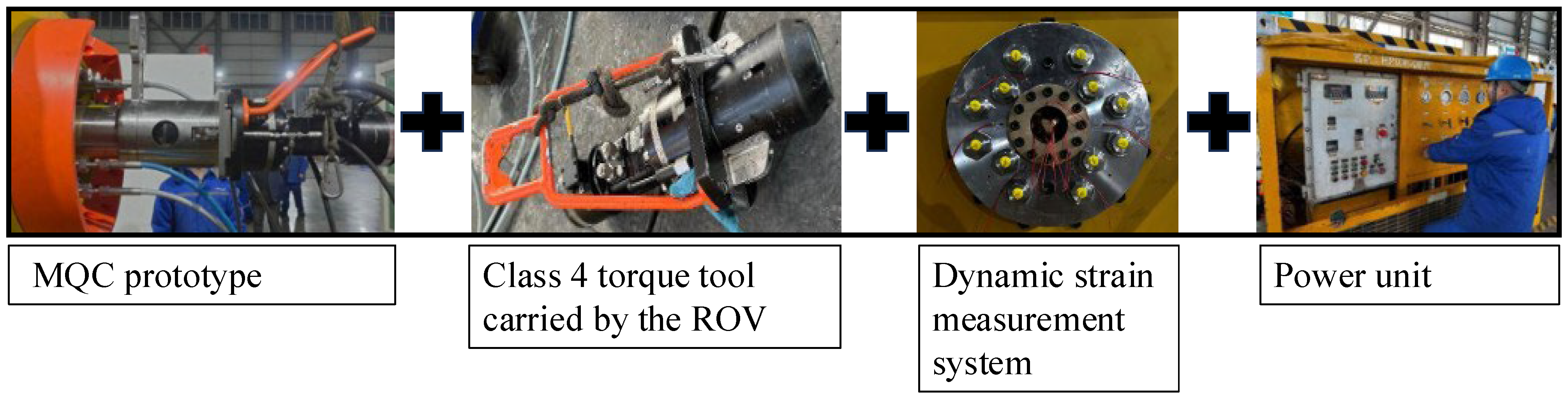
FeatureThe Proposed MQCFMC 13MK II Type (Collet-Based)UNITECH Alpha Type (Thread-Based)
Locking MechanismL-shaped spatial helical camSpring-loaded clamping jawsMulti-turn threaded pair.
Docking ToleranceHigh Tolerance: 25 mm lateral displacement, 5° radial deflection and 15° axial rotationLow to medium tolerances: Strict pre-alignment is required to prevent jamming. Deviations must be less than 15 mm and less than 3°.Low Tolerance: extremely high precision is required to prevent thread misalignment; tolerances must be kept within 5 mm.
Emergency Release StrategyControlled rotary shearing: Clean cut, suitable for standard Category 4 tools, with a torque of 2100–2200 NmAxial forced towing: This requires specialised hydraulic skids, and the axial force exceeds 100 k N, which could cause serious damage to the seabed panels.Unpredictable: Lacks a designated release mechanism; forced extraction causes destruction.
Risk of JammingMinimised: 0.00926 plastic strain, which is well below the allowable strainHigh: Gaps between moving jaws are highly susceptible to silt and biofouling blockages.High: Threaded joints are notoriously prone to cold welding and sediment seizing.
Table 2. Performance specifications for underwater multi-channel quick connectors.
Working depth2000 m
Design pressure10,000 psi
Design life20 years
Injection of chemical agentsCorrosion inhibitor CI, chemical scale inhibitor, methanol, ethylene glycol
ROV tools, interfaces(1) The operating interface complies with international standards (API Class 4 interface)
(2) The operating handle complies with standards
Control the pressure in the pipeline- 10 ways HP Design pressure 690 bar
- 2 ways LP Design Pressure 345 bar
Installation and RecyclingROV manipulator operation for tightening/loosening joints
Table 3. Stress results for shear pins of different materials and dimensions.
MaterialsShear Plane Diameter (mm)Shear Stress (MPa)
S327509361
8456.4
7.5505.7
QAL10-5-59361
8.8377
8.5404
Table 4. Connector misalignment tolerance specifications.
IndicatorsValue
Horizontal displacement deviation≤25 mm
Axial rotational deviationRotation ≤ 15°
Horizontal rotational deviationRotation ≤ 5°
Table 5. Mesh independence test for the locking module.
Mesh Size (mm)Number of ElementsEquivalent (von Mises) Stress (MPa)Relative Variation (%)
5.035,225691.46-
4.058,564753.148.19%
3.0112,437810.707.10%
2.0245,892829.952.32%
1.0810,676831.690.21%
Table 6. Material parameters for stress–strain curves.
MaterialsTemperature Limits m 2 ε p
Ferritic steel480 °C0.6(1−R)2.0 × 10⁻⁵
Stainless steel and nickel-based alloys480 °C0.75(1−R)2.0 × 10⁻⁵
Duplex stainless steel480 °C0.7(0.95−R)2.0 × 10⁻⁵
Age-hardening nickel-based alloy540 °C1.9(0.93−R)2.0 × 10⁻⁵
Aluminium120 °C0.52(0.98−R)5.0 × 10⁻⁶
Copper 65 °C0.5(1−R)5.0 × 10⁻⁶
Titanium and Zirconium260 °C0.5(0.98−R)2.0 × 10⁻⁵
Table 7. Mechanical Properties of Nickel Alloy 718.
MaterialsYield Strength (MPa)Tensile Strength (MPa)Poisson’s Ratio (μ)Density (g/cm3)Modulus of Elasticity (GPa)
Nickel Alloy 71882710000.38.25190
Table 8. Key Theoretical and Experimental Parameters.
Performance IndicatorsTheoretical PredictionsExperimental Results
Dynamic loads on the locking mechanismThe initial alignment speed shall not exceed 10 mm/s, and the locking rotation speed shall not exceed 4 r/minTests were conducted in accordance with the rotational speed and docking speed specified in the theoretical study, and the locking process was completed successfully.
Alignment capabilities25 mm lateral displacement, 5° radial deflection and 15° axial rotationTests were carried out based on theoretical deviations, and the connectors were finally mated.
Emergency shear torque2000 Nm emergency release Emergency release occurs within the range of 2100 to 2200 Nm; whilst there is some margin of error, this is within an acceptable range when micro-friction torque is taken into account.
Visual Posture Guidance SystemAxial and circumferential indicators provide visual feedback on the locking status, indicating the locking status and stageThe experiment verified the feasibility of the pose state indicator by monitoring the indicators and verifying that they corresponded one-to-one with the actual status of the connectors.
Disclaimer/Publisher’s Note: The statements, opinions and data contained in all publications are solely those of the individual author(s) and contributor(s) and not of MDPI and/or the editor(s). MDPI and/or the editor(s) disclaim responsibility for any injury to people or property resulting from any ideas, methods, instructions or products referred to in the content.