Article

Multi-Decadal Impacts of Coastal Reclamation on Tidal Hydrodynamics in a Semi-Enclosed Bay: A Case Study of Yueqing Bay

1
Ocean College, Zhejiang University, Zhoushan 316021, China
2
State Key Laboratory of Satellite Ocean Environment Dynamics, Second Institute of Oceanography, Ministry of Natural Resources of China, Hangzhou 310012, China
3
Key Laboratory of Ocean Space Resource Management Technology, Ministry of Natural Resources of China, Hangzhou 310012, China
4
Zhejiang Institute of Hydraulics and Estuary, Hangzhou 310020, China
5
Zhejiang Provincial Key Laboratory of Estuary and Coast, Hangzhou 310020, China
*
Authors to whom correspondence should be addressed.
J. Mar. Sci. Eng. 2026, 14(12), 1077; https://doi.org/10.3390/jmse14121077 (registering DOI)
Submission received: 28 March 2026 / Revised: 28 May 2026 / Accepted: 29 May 2026 / Published: 10 June 2026

Abstract

Coastal reclamation reshapes tidal hydrodynamics in semi-enclosed bays by removing intertidal storage, modifying channel conveyance, and redistributing tidal exchange among connected sub-regions. This study quantifies the multi-decadal cumulative impacts of reclamation on tidal currents and tidal prism in Yueqing Bay, China, using shoreline and bathymetric reconstructions for 1978, 2002, 2013, and 2020; hydrological observations; and a two-dimensional MIKE21 FM tidal hydrodynamic model. Characteristic cross-sections were used to estimate bay-wide and sub-regional tidal prisms, and representative stations were used to diagnose current-speed responses. The bay-wide tidal prism decreased from 15.235 × 10⁸ m3 in 1978 to 12.316 × 10⁸ m3 in 2020, corresponding to a reduction of 2.919 × 10⁸ m3 (19.16%). The strongest loss occurred during 1978–2002, when large-scale reclamation and closure of the Xuanmen Channel removed tidal storage and redirected flow into the remaining main-channel system. Although reclamation intensity weakened after 2013, mean current speed still changed by −0.050 to 0.033 m/s and sub-regional tidal-prism shares continued to adjust, indicating delayed hydrodynamic reorganization rather than immediate stabilization. These results show that reclamation impacts cannot be explained by reclaimed area alone; they depend on project timing, spatial layout, and the connectivity with key tidal pathways. The findings support staged assessment and pathway-sensitive shoreline management in reclaimed semi-enclosed bays.

1. Introduction

Coastal land reclamation, defined as the enclosure and infilling of intertidal flats and nearshore shallow waters, has been widely implemented to support coastal urban expansion, port and industrial development, and coastal protection. Remote-sensing analyses indicate that reclamation has expanded across multiple continents over recent decades, with particularly rapid growth in East Asia [1,2,3,4]. Although reclamation provides land resources and economic benefits, it substantially alters shoreline configuration, bathymetry, and tidal accommodation space, thereby affecting tidal-wave propagation, tidal-current pathways, and water-exchange conditions in bays and estuaries [2,5]. In semi-enclosed bays, where tidal exchange exerts a major impact on water renewal and material transport, these changes may further influence sediment transport, pollutant dispersion, ecological processes, and environmental carrying capacity [6,7,8,9,10,11,12].
The hydrodynamic impacts of reclamation vary among coastal landform systems. In estuarine and tidal-delta environments, reclamation and modifications to deep-water navigation channels often narrow cross-sections and alter frictional resistance and tidal gradients. These changes can amplify or attenuate tidal ranges, reorganize flow structures, and influence sediment transport and landform evolution [13,14]. In semi-enclosed or narrow bay systems, reclamation compresses tidal accommodation space and modifies tidal-current pathways, as shown in Xiamen Bay, Jiaozhou Bay, Sanmen Bay, Meizhou Bay, Daya Bay, Lingding Bay, and other semi-enclosed bays [5,15,16,17,18,19,20,21,22,23,24]. Reclamation may also affect sediment dynamics and environmental conditions [6,7,8,25,26]. To quantify these impacts, numerical models have been widely applied in hydrodynamic and environmental assessments of reclamation projects, including studies on Xiamen Bay, Jiaozhou Bay, Sanmen Bay, Meizhou Bay, Daya Bay, Lingding Bay, and other semi-enclosed coastal systems [5,15,16,17,18,19,20,22,23,24,26].
The tidal prism is a key indicator for assessing a bay’s capacity to store and exchange tidal water. It is closely linked to tidal range, current intensity, pollutant dilution and dispersion, as well as port and navigation maintenance [27,28]. Previous numerical and observational studies have shown that reclamation can reduce tidal prism and reorganize tidal-current pathways in semi-enclosed bays such as Xiamen Bay, Jiaozhou Bay, Sanmen Bay, Meizhou Bay, Daya Bay, and Lingding Bay [5,15,16,17,18,19,20,22,23,24,27]. These responses are generally linked to two processes: the loss of intertidal storage and the alteration of channel connectivity, which together modify tidal conveyance, residual circulation, and the spatial distribution of water exchange [2,5,15,16,20,23,24]. However, many previous studies have emphasized overall tidal-prism loss or local current-speed changes, whereas the coupling among tidal-storage loss, pathway reorganization, and sub-regional redistribution remains insufficiently quantified.
Yueqing Bay is a typical semi-enclosed bay along the southeastern coast of Zhejiang Province that has undergone extensive human-driven reclamation over recent decades. Previous studies have examined tidal-flat wetland evolution [9], long-term changes in tidal prism [29,30], and tidal-level, tidal-current, and residual-current characteristics in the bay [31]. However, the cumulative hydrodynamic impacts of reclamation across multiple stages remain insufficiently understood. In particular, it remains unclear how reclamation-driven shoreline and bathymetric changes jointly reorganize tidal-current pathways, redistribute tidal exchange among sub-regions, and produce continued adjustment after the main stage of reclamation.
To address this gap, this study integrates multi-period satellite imagery, historical bathymetric data, hydrological observations, and a two-dimensional tidal hydrodynamic model to reconstruct and compare tidal hydrodynamics in Yueqing Bay for 1978, 2002, 2013, and 2020. The specific objectives are to: (1) reconstruct the spatiotemporal pattern of coastal reclamation in Yueqing Bay; (2) quantify stage-wise changes in tidal currents and tidal prism at both bay-wide and sub-regional scales; and (3) interpret how reclamation magnitude, spatial layout, and tidal-current pathway reorganization jointly shape the hydrodynamic response of a semi-enclosed bay. By linking tidal-storage loss with changes in tidal routing and sub-regional exchange, this study provides a process-based understanding of reclamation impacts and supports impact assessment and shoreline management in similar semi-enclosed coastal systems.

2. Materials and Methods

2.1. Study Area

Yueqing Bay is located along the southeastern coastline of Zhejiang Province, enclosed on three sides by land. It forms a gourd-shaped, semi-enclosed bay, bordered by the Yuhuan Peninsula to the east and the Yandang Mountain range to the west and north. The southern sea area is divided into three water channels by Damen Island and Luxi Island, from east to west: the Yuhuan South Channel and Huangdaxia Channel are connected to the East China Sea, while the Shatou Channel links to the northern mouth of the Oujiang River. The study area spans approximately from 27°59′09″ to 28°24′16″ N and from 120°57′55″ to 121°17′09″ E, covering an area of about 436.6 km2. The bay features abundant tidal-flat wetlands and serves as an important base for mariculture and shellfish seed production in Zhejiang Province. The region experiences a subtropical monsoon climate, characterized by a mean annual temperature of approximately 16–17 °C and annual precipitation ranging from 1500 to 2000 mm. It is significantly influenced by typhoons in the summer and autumn months [9].
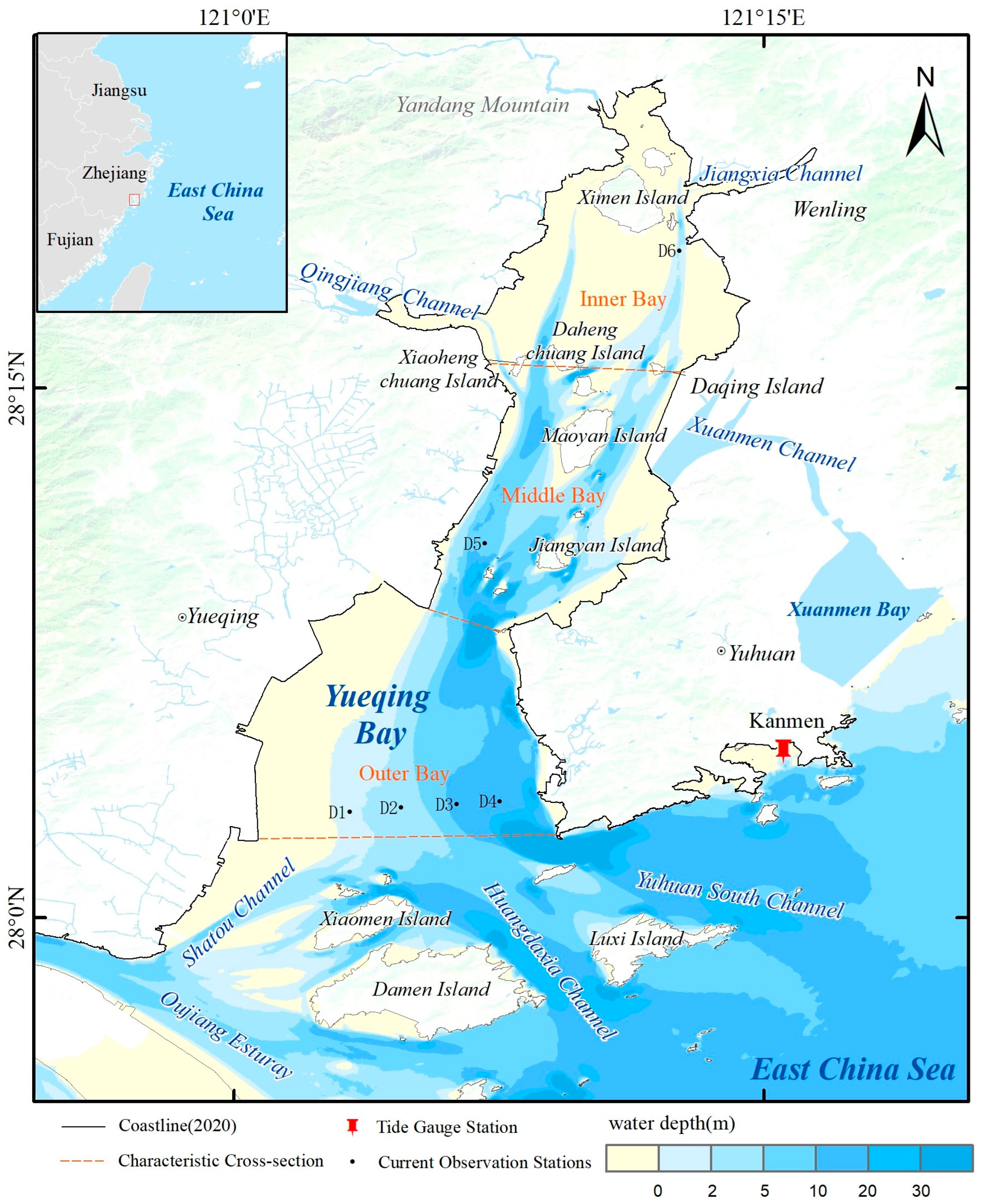
In plan view, Yueqing Bay can be divided into three regions: the outer bay, middle bay, and inner bay (Figure 1). The outer bay occupies the southern, trumpet-shaped sector, where the seabed slopes from west to east and the main deep channel is located near the eastern shore. At the boundary between the outer and middle bays, the tidal corridor narrows abruptly, and the middle-bay area is segmented by islands, such as Jiangxinyan, Maoyan Island, Dahengchuang Island, and Xiaohengchuang Island, forming multiple tidal channels. In the inner bay, tidal flats and channels alternate; tidal flats are inundated during the flood phase and drain back into channels during the ebb phase.
Yueqing Bay is dominated by semi-diurnal tides, with an average tidal range of 4.2 m. Currents are primarily oscillatory. The main water and sediment exchange occurs through the southeastern mouth, whereas exchange through the southwestern mouth and the Oujiang mouth is negligible [32]. The bay is well sheltered from offshore waves. Controlled by bay geometry, tidal flats, and branching channels, the bay exhibits pronounced spatial variability, with a relatively large tidal range and strong shallow-water tidal constituents. More than 30 rivers (e.g., Dajingxi, Baixi, and Qingjiang) discharge into the bay, with a long-term mean annual runoff of approximately 10.3 × 10⁸ m3.

2.2. Methods

2.2.1. Data Collection and Pre-Processing

To reconstruct reclamation-driven shoreline and bathymetric change, four representative years—1978, 2002, 2013, and 2020—were selected because both remote-sensing imagery and nautical-chart data were available for these periods, and because they capture the main stages of reclamation history in Yueqing Bay. The year 1978 represents the pre-intensive-reclamation baseline; 2002 represents the period after large-scale reclamation and closure of the Xuanmen Channel; 2013 captures the subsequent stage when reclamation shifted toward the middle and outer bay; and 2020 represents the most recent post-reclamation configuration available in the dataset. Hydrological observations were then compiled for model calibration and validation. The remote-sensing and bathymetric datasets used in this study are summarized in Table 1 and Table 2, respectively.
Satellite imagery was used to delineate shorelines and identify reclamation-related land expansion. Shoreline extraction and water-body identification followed the procedures of Zhu et al. [9] and the shoreline definition principles summarized by Boak and Turner [33]. The extracted shorelines were vectorized in GIS and checked against the corresponding nautical charts and coastline morphology to reduce classification errors caused by tidal stage, water turbidity, and image resolution differences.
Measured hydrological data were obtained from the 1982 Zhejiang Coastal and Tidal Flat Resources Comprehensive Survey—Sediment Landform Survey. These data include current speed and direction at stations within Yueqing Bay and tidal-elevation records from the Kanmen tide-gauge station. Although the observations are historical, they are the closest available measured dataset to the 1978 baseline morphology, and provide an internally consistent benchmark for testing whether the model reproduces the dominant tidal phase, range, and current structure under pre-intensive-reclamation conditions. Because the purpose of this study is a relative, multi-period comparison under reconstructed morphologies, the 1982 dataset was used for hydrodynamic validation rather than as a representation of present-day conditions.
Offshore open-boundary tidal elevations were specified using the TPXO9 global tidal model [34]. River-discharge boundaries were prescribed using long-term mean discharge because the simulations focused on tidally dominated hydrodynamics rather than event-scale river-plume processes. This approach is consistent with the hydrodynamic character of Yueqing Bay, where tidal forcing dominates water exchange and river inflow is secondary at the bay scale [32].
For each representative year, digitized nautical-chart soundings were converted to a unified coordinate system and vertical datum before bathymetric interpolation. The resulting bathymetric surfaces were combined with the corresponding shoreline boundaries to generate period-specific model domains. This reconstruction strategy allowed the effects of reclamation-induced planform change and bathymetric change to be incorporated simultaneously in the hydrodynamic experiments.

2.2.2. Model Construction and Validation

The tidal hydrodynamic model was constructed using the MIKE21 Flow Model FM (version 2014) developed by DHI. The hydrodynamic module solves the depth-integrated, incompressible Reynolds-averaged shallow-water equations on an unstructured flexible mesh, including mass conservation and two horizontal momentum equations. The model formulation and numerical concepts follow the MIKE21 FM hydrodynamic scientific documentation [35], while the application of two-dimensional hydrodynamic modeling to the reclamation impact assessment follows previous studies in semi-enclosed bays and estuarine systems [5,15,16,17,18,19,22,23,24,26]. The governing equations used in this study are as follows:
Continuity equation:
h t + h u ¯ x + h v ¯ y = h S
Momentum equation in the x direction:
h u ¯ t + h u ¯ 2 x + h v u ¯ y = f v ¯ h g h η x h ρ 0 p a x g h 2 2 ρ 0 ρ x + τ s x ρ 0 τ b x ρ 0 1 ρ 0 s x x x + s x y y + x h T x x + y h T x y + h u S S
Momentum equation in the y direction:
h v ¯ t + h u v ¯ x + h v ¯ 2 y = f u ¯ h g h η y h ρ 0 p a y g h 2 2 ρ 0 ρ y + τ s y ρ 0 τ b y ρ 0 1 ρ 0 s y x x + s y y y + x h T x y + y h T y y + h u S S
where, x and y are the Cartesian coordinates; u ¯ and v ¯ are the depth-averaged velocity components in the x and y directions, respectively, as determined by u ¯ = 1 h d η u d z , v ¯ = 1 h d η v d z ; t is time; g is gravitational acceleration; for the total water depth h = η + d , η is the surface elevation, and d is the still-water depth; ρ is water pressure; ρ 0 is the reference density of water; f is the Coriolis parameter ( f = 2 Ω s i n φ , where Ω is Earth’s angular velocity and φ is geographic latitude); τ s x and τ s y are the surface wind-stress components; τ b x and τ b y are the bottom-stress components; s x x , s x y , s y x , and s y y are the radiation-stress components; p a is the local atmospheric pressure; S is the source term; T x x = 2 A u ¯ x , T x y = T y x = A ( u ¯ x + v ¯ y ) , and T y y = 2 A v ¯ y are the transverse stress components; A is the horizontal eddy viscosity. In this application, wind, wave radiation stress, precipitation, and evaporation were neglected because the objective was to isolate tide-dominated responses to reclamation geometry under comparable boundary forcing.
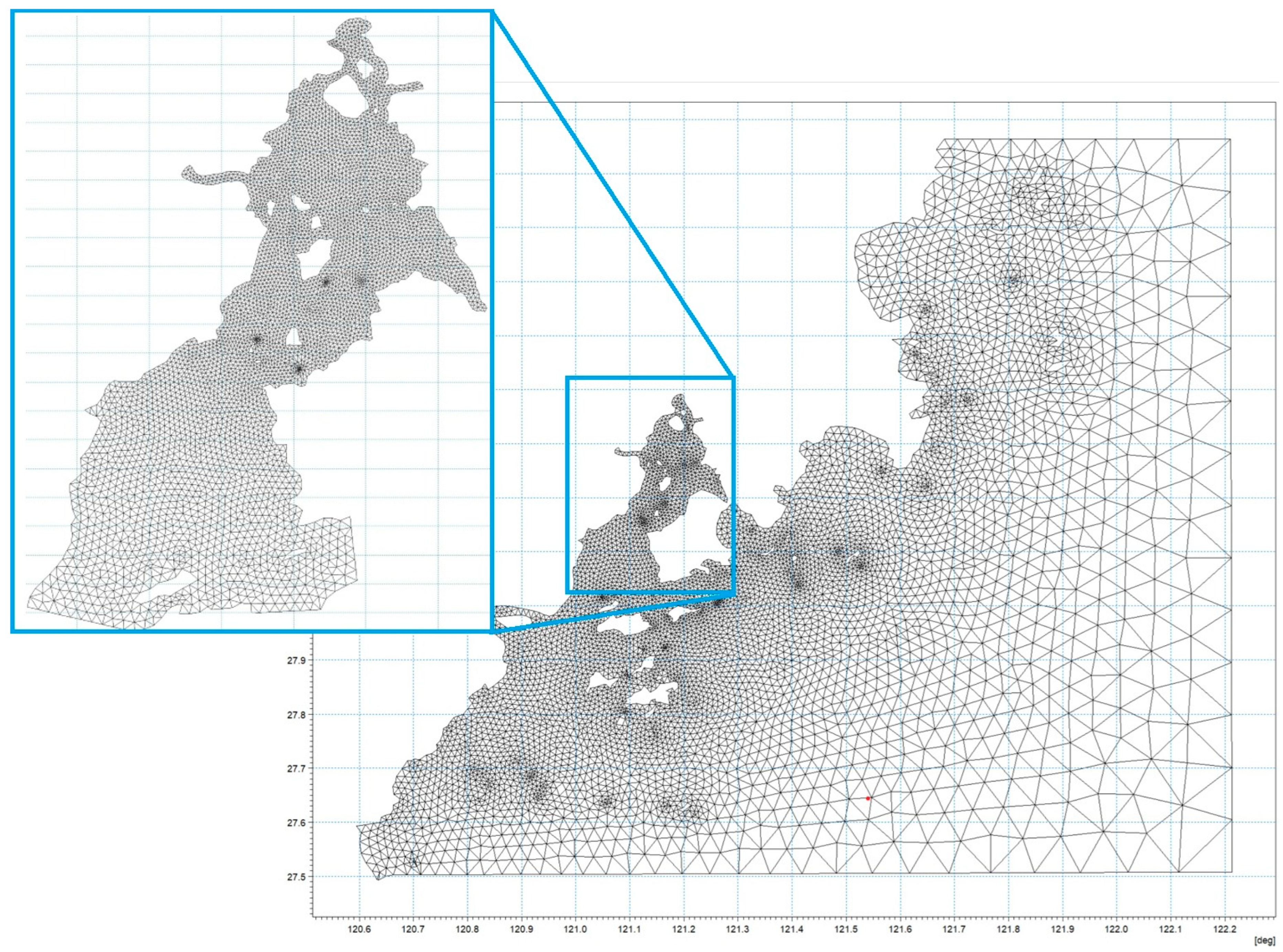
An unstructured triangular mesh was used to build a two-level nested model consisting of an outer domain and an inner, high-resolution Yueqing Bay domain (Figure 2). The outer domain extended approximately 100 km from Yueqing Bay to minimize open-boundary influence on the bay’s interior. Typical element sizes were 2.5′ along the open-sea boundary and 1′ along the coastline. The inner domain refined the bay and its main channels, with typical element sizes of 0.1′ inside the bay and 0.2′ outside the bay. This nested design balances computational efficiency with sufficient resolution of narrow channels, islands, and tidal-flat margins.
Horizontal eddy viscosity was prescribed as a uniform constant of 0.28 m2/s throughout the domain. Bottom friction was parameterized using a Manning number of 32 m 1 / 3 / s . The same eddy-viscosity and bottom-friction settings were retained across all historical scenarios to ensure that inter-period differences primarily reflected shoreline and bathymetric changes rather than calibration choices. The initial water level was set to 0 m. For the outer-domain model, open-boundary tidal elevations were prescribed from TPXO9 [34], and the Oujiang River boundary was specified using long-term mean discharge. For the inner-domain model, open-sea water-level boundaries were generated from the outer-domain simulation, and the Dajingxi runoff boundary was converted from the Oujiang discharge using the long-term discharge ratio. The same forcing strategy was applied to all historical morphologies so that simulated differences mainly reflect changes in shoreline and bathymetry rather than differences in external forcing.
Model validation was designed to evaluate whether the model reproduces the dominant tidal elevation and current patterns under the historical baseline morphology. The validation results are presented in Section 3.1, and the implications of data limitations are discussed in Section 4.4.

2.2.3. Tidal-Prism Calculation

The tidal prism is defined as the volume of water exchanged between high tide and low tide over a tidal cycle. Under a mean tidal range, it can be approximated as [23,28]:
P = H × S
where P is tidal prism (m3); ΔH is mean tidal range (m); and ΔS is bay water-surface area at mean tide level (m2). This simplified area–range method is useful for first-order estimates, but can be inaccurate in Yueqing Bay because islands, interlaced tidal channels, and broad tidal flats generate strong spatial variation in tidal range and flow pathways. Therefore, this study calculated tidal prism from modeled flow through characteristic cross-sections. Three cross-sections were defined according to the inner bay–middle bay–outer bay framework, and flood- and ebb-phase fluxes were integrated over a tidal cycle to quantify bay-wide and sub-regional tidal prisms. This approach is better suited to evaluating how reclamation changes both total exchange volume and its distribution among connected sub-regions.

2.2.4. Hydrodynamic Response Metrics and Representative Stations

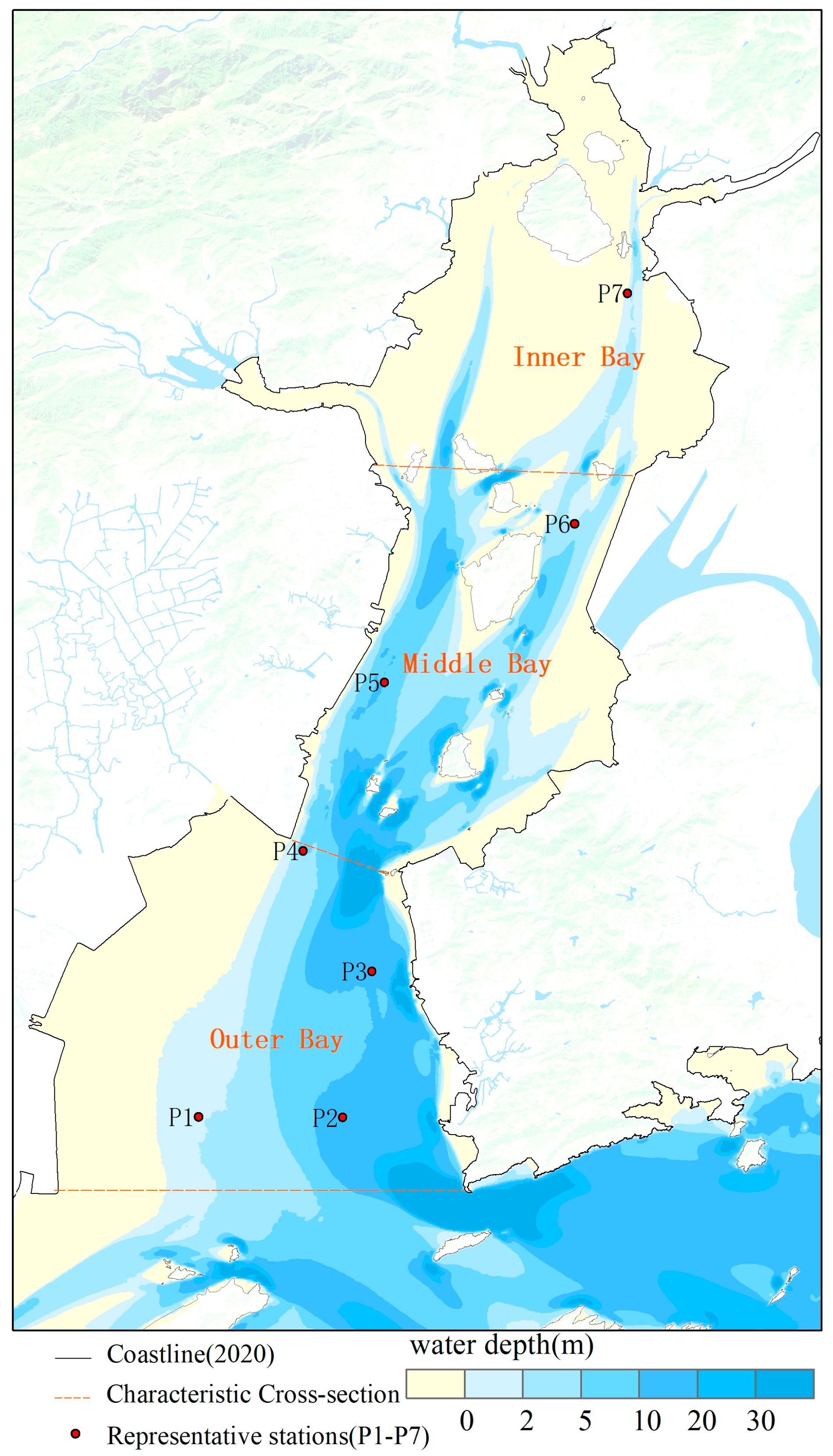
To diagnose spatial differences in current response, mean current speed was extracted at seven representative stations (Figure 3). Stations P1 and P2 represent the outer-bay entrance; P3, P5, and P7 represent the main flow channels of the outer, middle, and inner bay, respectively; and P4 and P6 are located near two characteristic cross-sections. Stage-wise changes in mean current speed were calculated by subtracting the earlier-year value from the later-year value for 1978–2002, 2002–2013, 2013–2020, and 1978–2020. These point-based indicators complement the cross-section-based tidal-prism analysis by identifying whether bay-wide changes were accompanied by local acceleration or weakening of tidal currents.

3. Results

3.1. Model Validation and Applicability

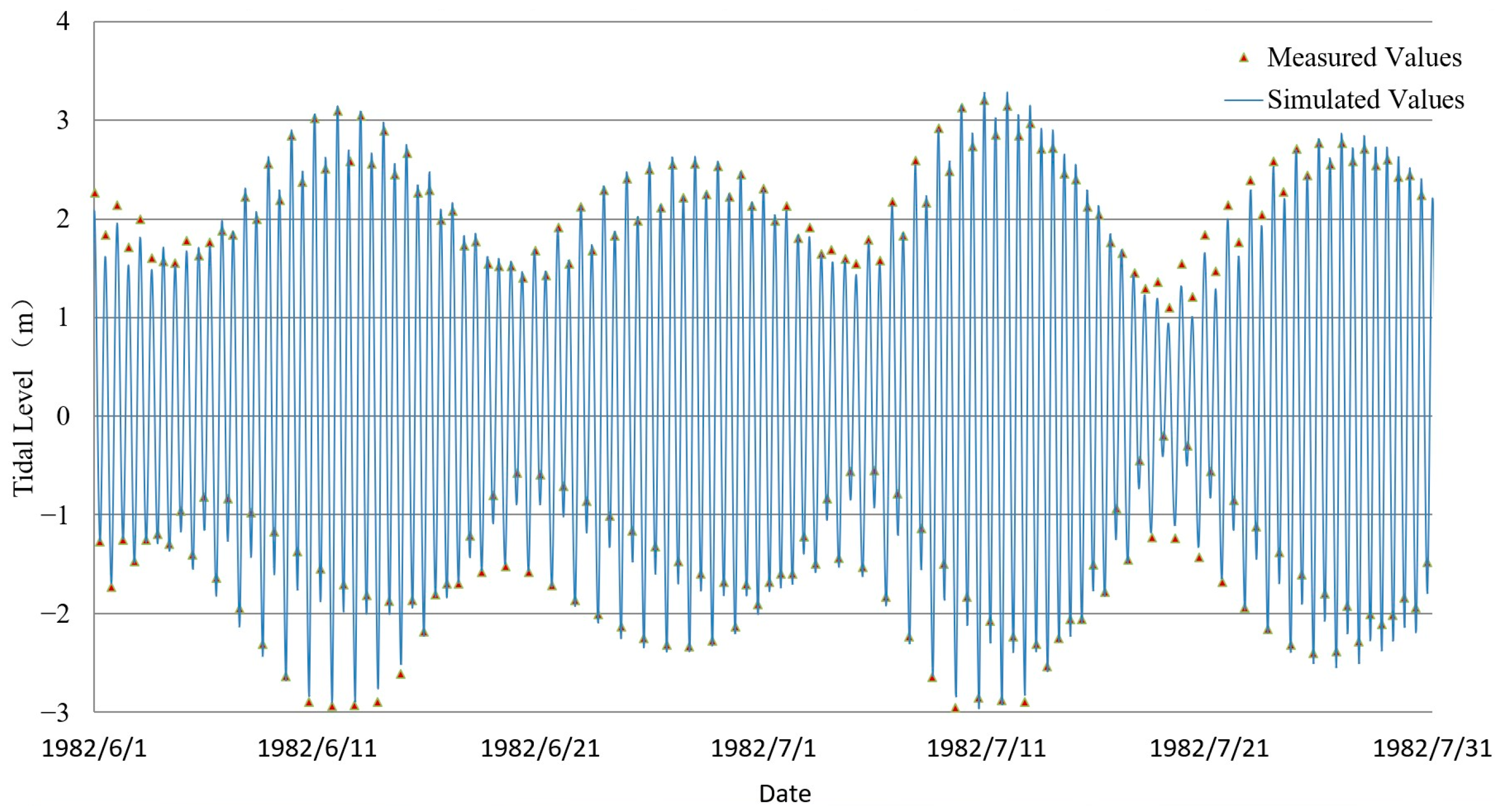
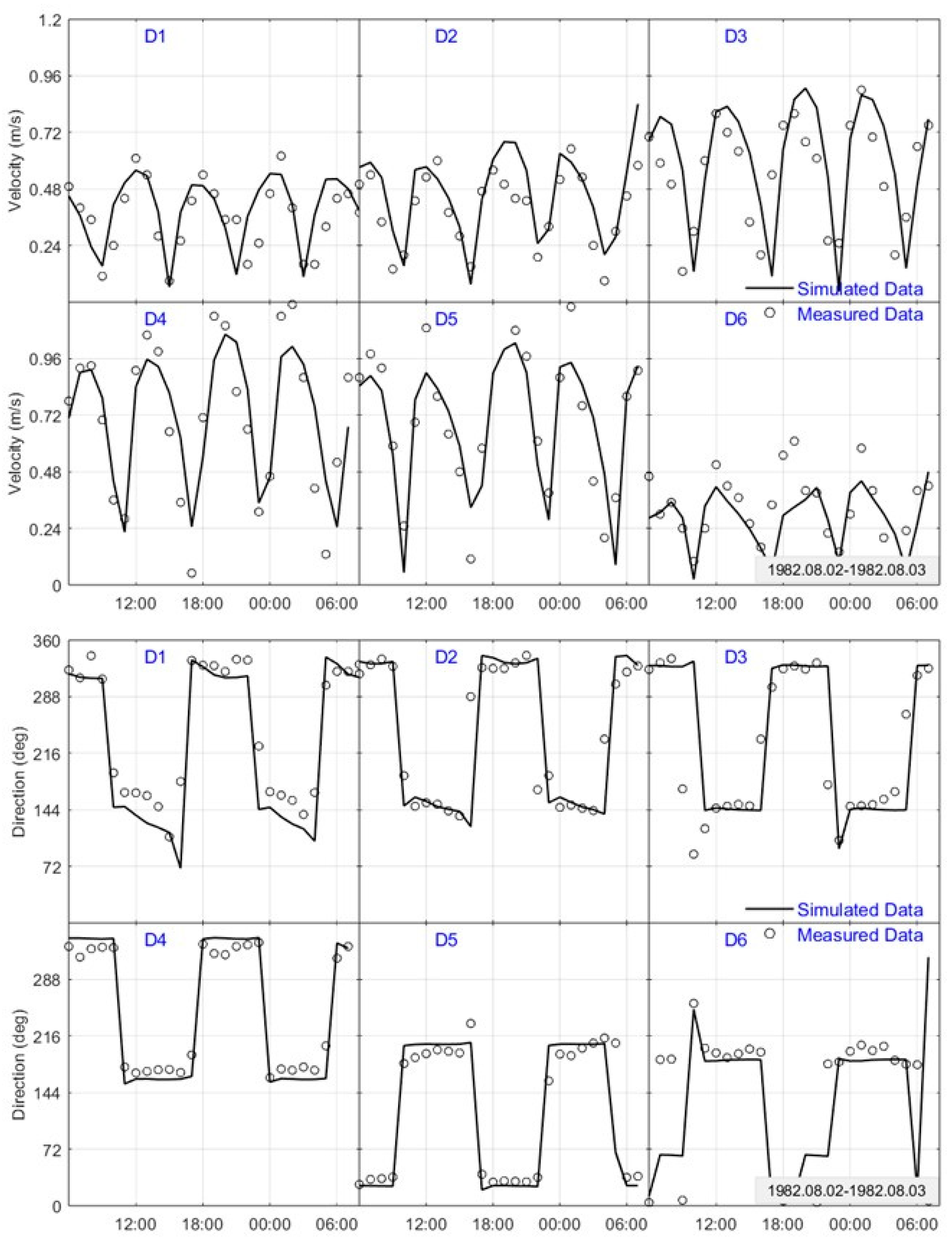
The model reproduced the main semi-diurnal tidal elevation at the Kanmen tide-gauge station and captured the dominant current-speed and current-direction patterns at most current observation stations (Figure 4 and Figure 5). The agreement indicates that the nested MIKE21 FM configuration can represent the principal tide-driven circulation of Yueqing Bay. At station D6, flood-current speed was underestimated, which is likely related to unresolved small tidal creeks and complex channel–flat morphology in the inner bay. This mismatch was considered when interpreting point-scale current changes, but the bay-wide and sub-regional tidal-prism calculations are less sensitive to individual-station errors because they integrate fluxes across characteristic sections.

3.2. Spatiotemporal Distribution and Hydrodynamic Significance of Reclamation in Yueqing Bay

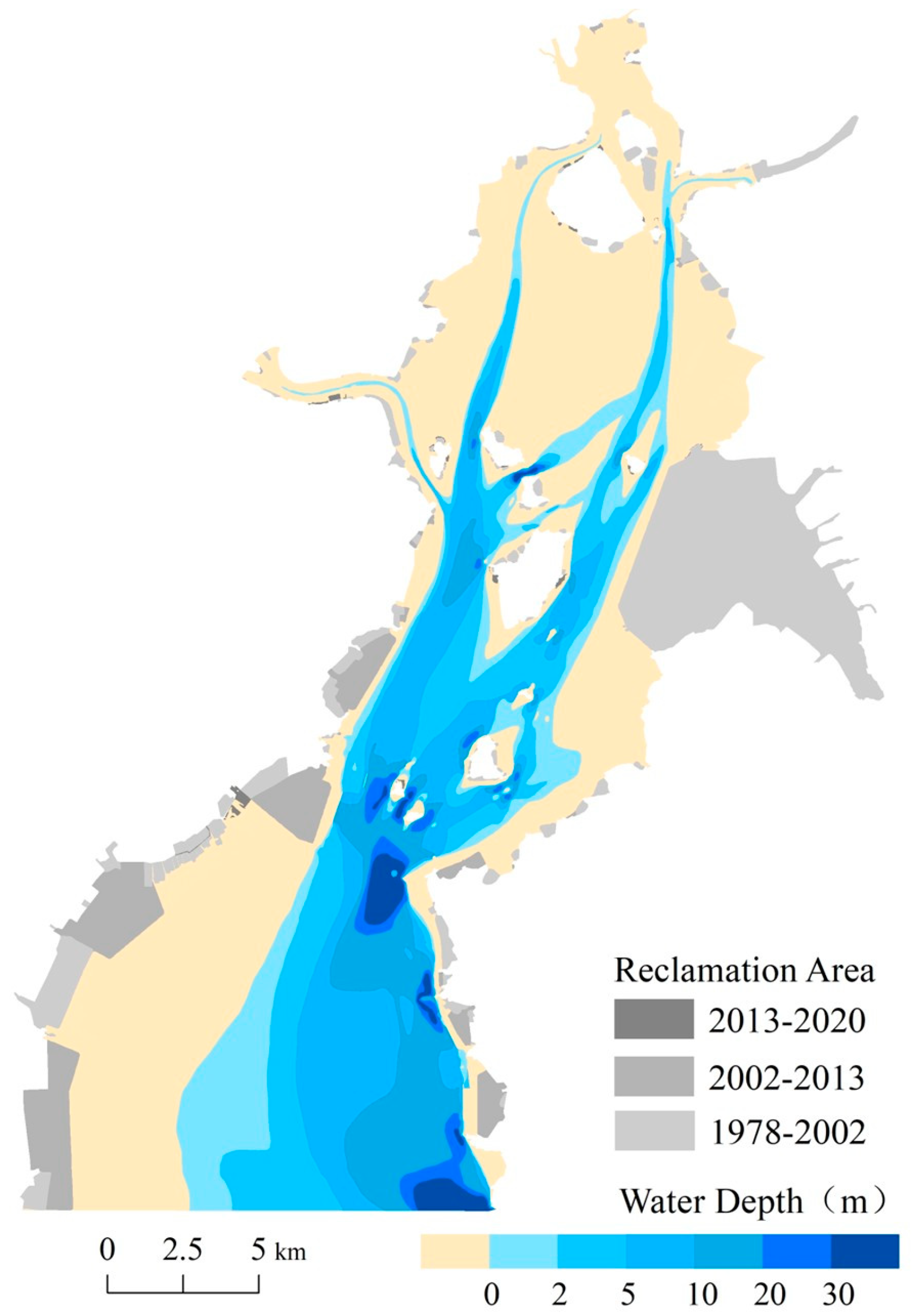
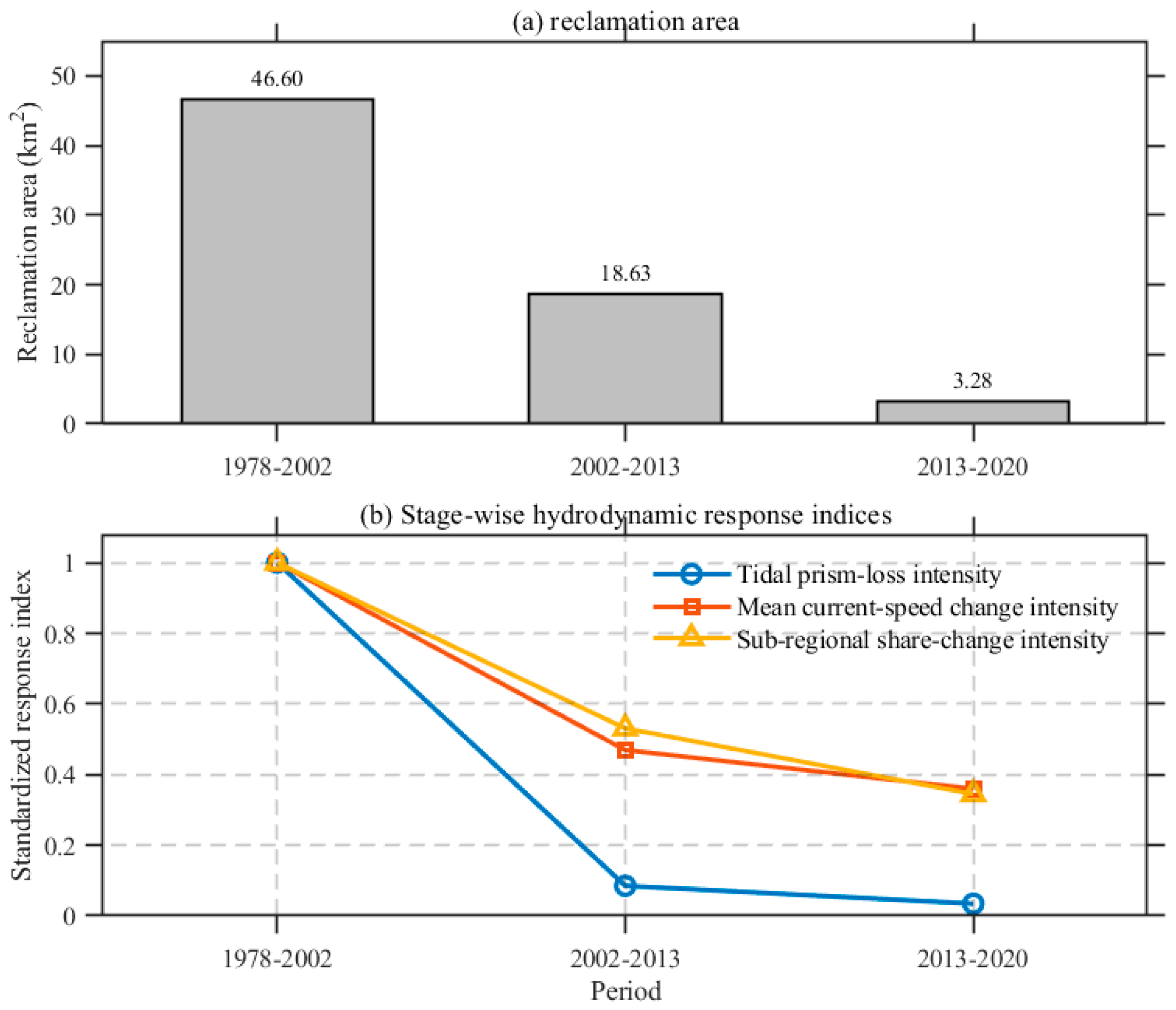
From 1978 to 2020, the cumulative reclaimed area in Yueqing Bay reached 68.51 km2, equivalent to 55% of the 1978 tidal-flat wetland area (Figure 6). This loss is hydrodynamically significant because intertidal flats function as tidal storage space during flood tide and as drainage areas during ebb tide. Their conversion to land, therefore, reduces accommodation volume and changes the geometry through which tidal water is conveyed. Reclamation was strongly stage-dependent: 46.6 km2 was reclaimed during 1978–2002, 18.63 km2 during 2002–2013, and only 3.28 km2 during 2013–2020. The reclamation focus also shifted from the middle bay and the Xuanmen Channel area toward the outer bay, implying that later projects affected different parts of the tidal pathway network than earlier projects.

3.3. Changes in Tidal Currents

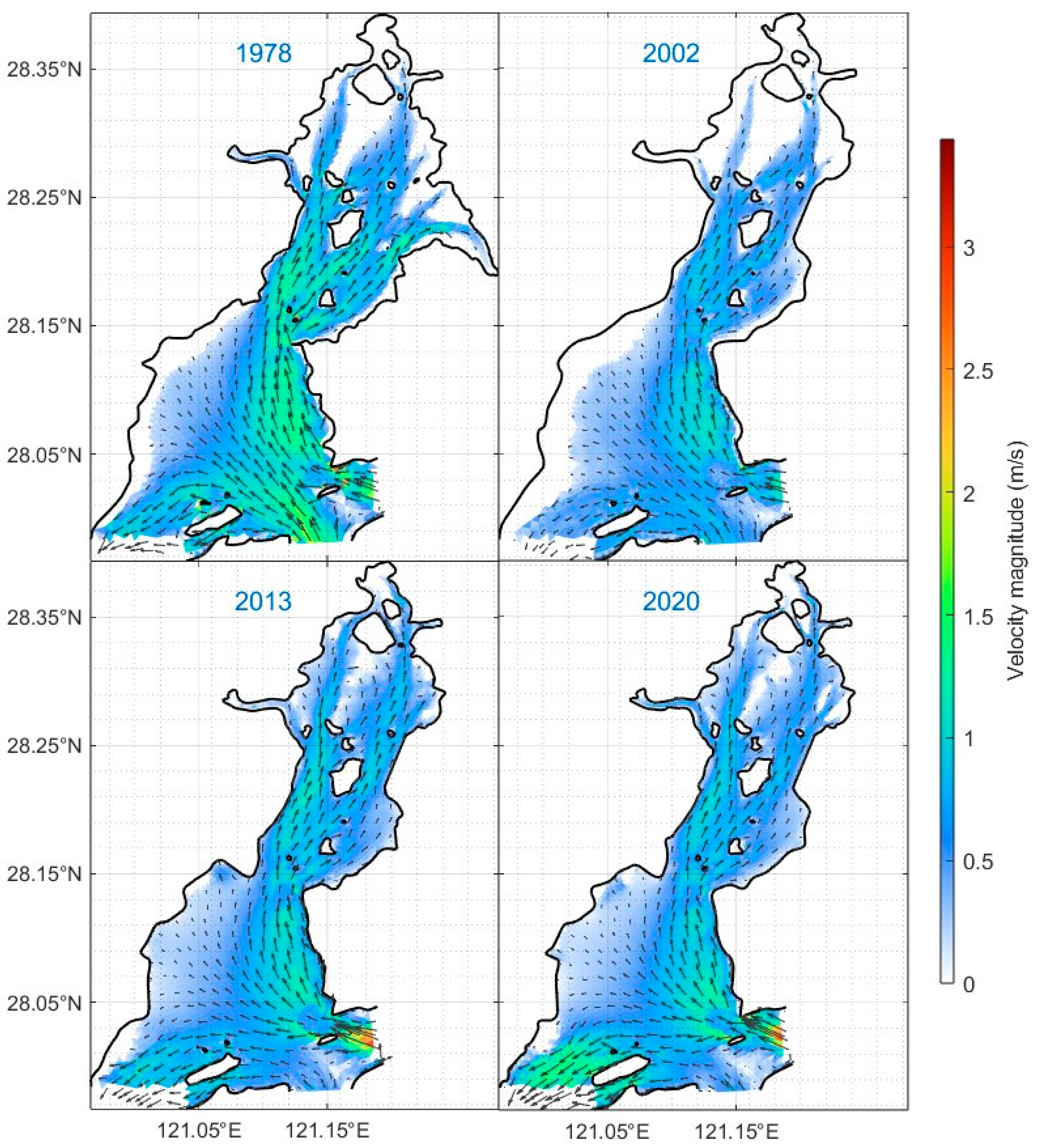
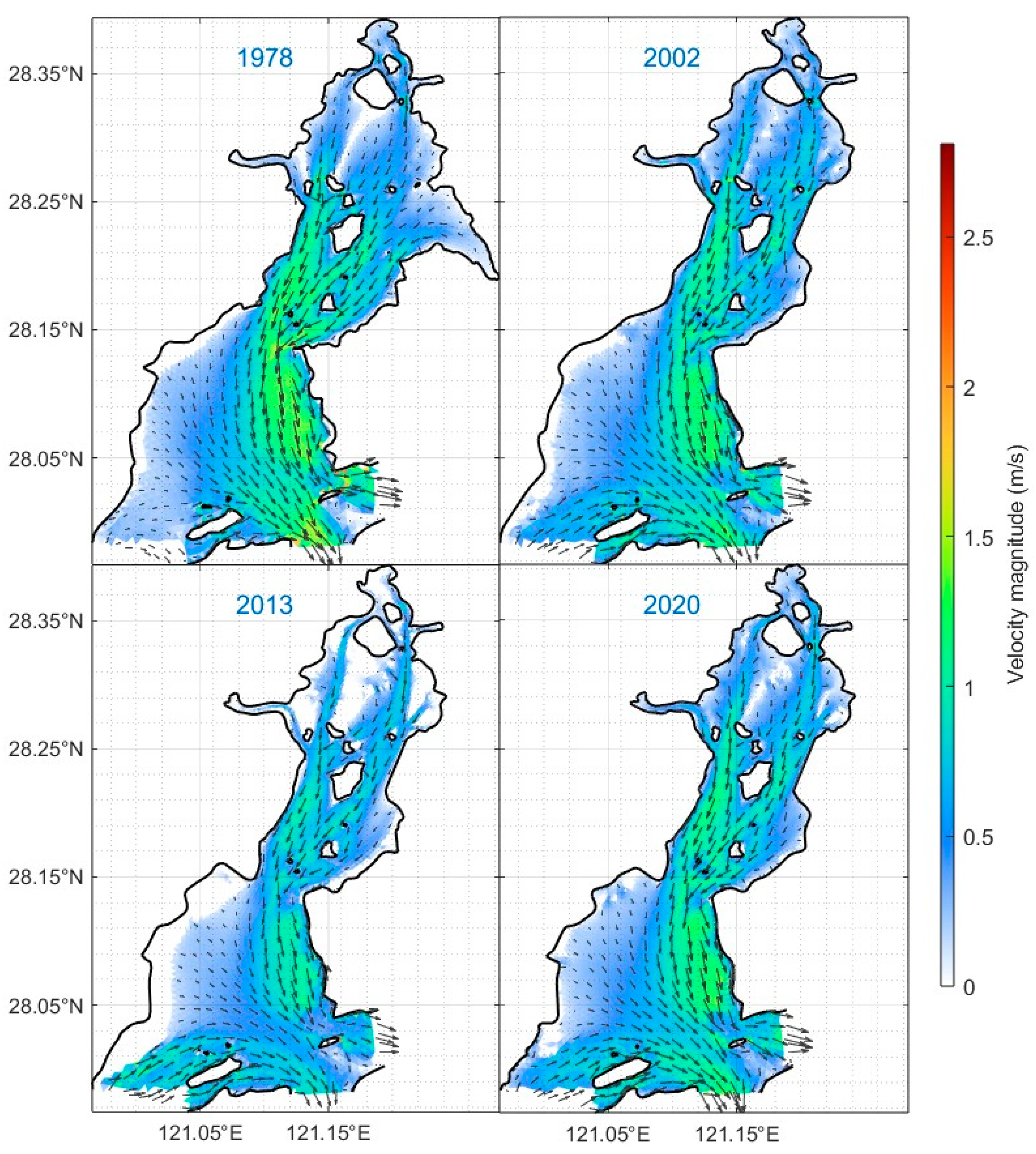
Figure 7 and Figure 8 show the peak-flood and peak-ebb tidal-current fields in 1978, 2002, 2013, and 2020. The baseline 1978 flow pattern was controlled by the bay-mouth islands, branching channels, and main deep channel, forming an outer-bay diversion and along-channel inflow structure. During flood tide, offshore water entered the outer bay through multiple pathways and then propagated into the middle and inner bay; during ebb tide, flow reversed seaward, with the main channel providing the dominant drainage route. This pattern demonstrates that the original bay functioned as a connected storage–conveyance system rather than a single uniform basin.
After reclamation blocked the original Xuanmen Channel by 2002, tidal pathways were reorganized. The branch previously entering the Xuanmen Channel disappeared, and flood currents became more concentrated along the remaining main channel toward the inner bay. This indicates a shift from distributed conveyance toward pathway concentration. Such concentration can locally increase current speed where flow is redirected, while reducing overall flood flux and tidal storage because part of the former tidal-flat and channel accommodation space was removed. From 2002 to 2020, the overall tidal-flow pattern remained broadly similar to that in 2002, but later, outer- and middle-bay reclamation continued to modify current intensity and sub-regional exchange.
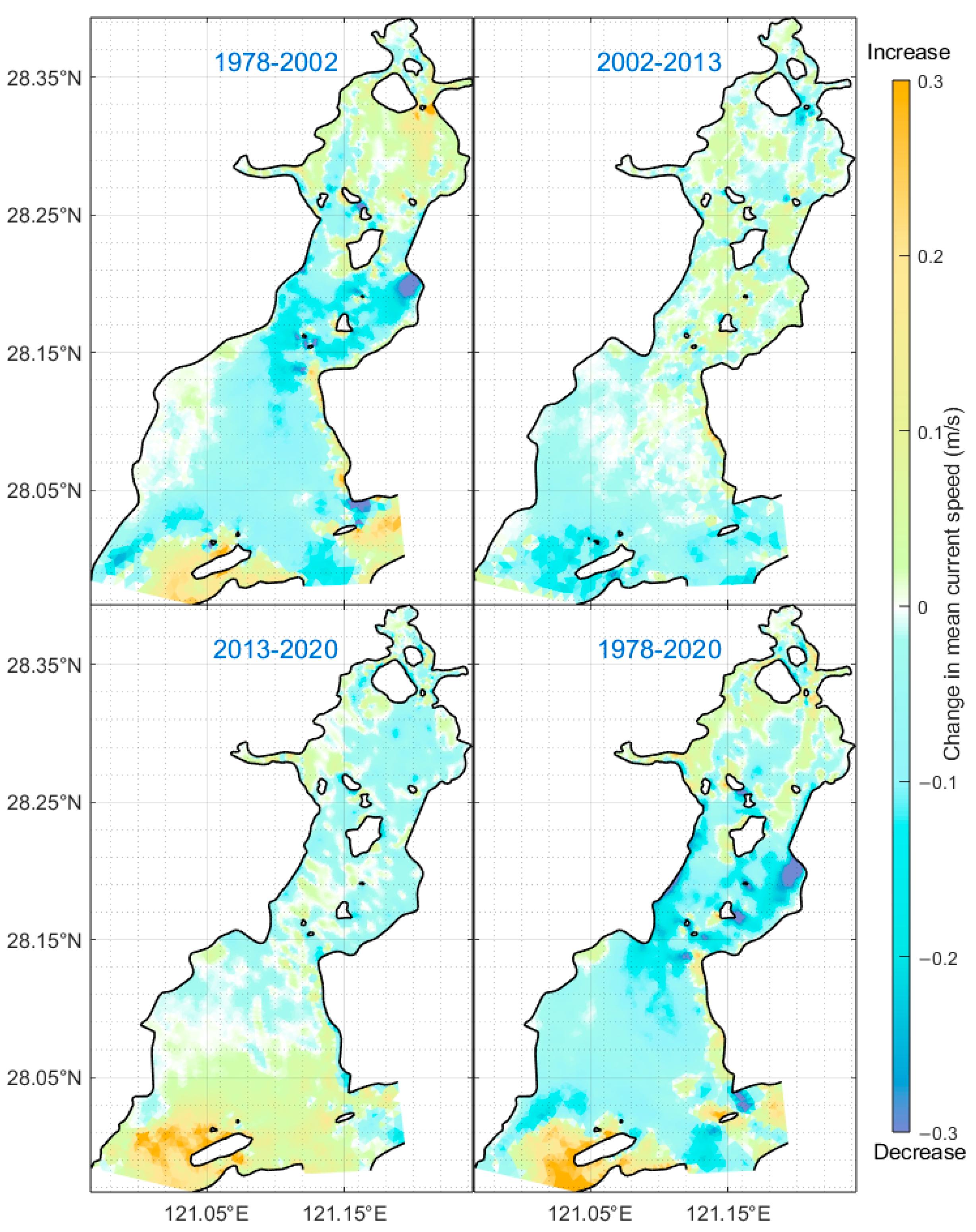
As shown in Figure 9 and Table 3, changes in mean current speed exhibit pronounced spatial variability across stages. This spatial variability reflects the competing effects of tidal-storage loss, flow-pathway blockage, and concentration of flow into the remaining channels.
During 1978–2002, the largest hydrodynamic adjustment coincided with the largest reclamation area and closure of the Xuanmen Channel. Mean current speed decreased at P1–P5 (−0.055 to −0.116 m/s), indicating weakened exchange along the outer- and middle-bay main-channel system and adjacent areas. In contrast, mean current speed increased by 0.145 m/s at P7. This local increase is interpreted as a pathway-redistribution effect: water that had previously been partly accommodated by the Xuanmen Channel and adjacent tidal flats was redirected into remaining channels, increasing local conveyance despite the overall reduction in tidal storage.
During 2002–2013, current-speed changes were smaller overall, consistent with reduced reclamation intensity. Slight weakening at P1–P2 (−0.013 and −0.007 m/s) suggests a modest reduction in exchange at the outer-bay entrance, whereas increases at P3–P5 (+0.011 to +0.017 m/s) indicate local concentration of flow in parts of the outer and middle bay. The decrease at P7 (−0.077 m/s) suggests partial relaxation of the earlier inner-bay acceleration after the major pathway adjustment had already occurred.
During 2013–2020, mean current speed increased at P1–P2 but decreased at P3–P7, showing that even small additional reclamation can redistribute flow between the bay entrance and interior channels. Over the full 1978–2020 period, changes at P1–P5 were negative (−0.050 to −0.153 m/s), with the largest decrease at P4, whereas P6 and P7 showed small net increases. These results support the interpretation of overall current weakening with localized enhancement in some remaining flow pathways, rather than a uniform current response across the bay.

3.4. Changes in Tidal Prism in Yueqing Bay

Three characteristic cross-sections were defined according to the inner bay–middle bay–outer bay framework (Figure 1). Tidal prism was computed for each sub-region over a tidal cycle, enabling the effects of reclamation to be evaluated in terms of both total exchange volume and redistribution among connected sub-regions.

3.4.1. Bay-Wide Tidal Prism and Stage-Wise Changes

Based on the two-dimensional tidal-current model, simulations for 1978, 2002, 2013, and 2020 show that bay-wide tidal prism decreased from 15.235 × 10⁸ m3 in 1978 to 12.316 × 10⁸ m3 in 2020 (Table 4), corresponding to a cumulative reduction of 2.919 × 10⁸ m3 or 19.16%. In relation to the study objective, this percentage represents a substantial decline in the bay’s tide-driven water-exchange capacity, not merely a geometric area loss.
Stage-wise changes show that tidal-prism loss was highly concentrated during 1978–2002, when the bay-wide tidal prism decreased by 2.607 × 10⁸ m3, accounting for 89.31% of the total reduction over 1978–2020. This stage coincides with the largest reclaimed area and the most important pathway change, indicating that reclamation location relative to key tidal corridors can be as important as total reclamation area. During 2002–2013, the tidal prism decreased by only 0.222 × 10⁸ m3 (1.76%), and during 2013–2020, it decreased by 0.09 × 10⁸ m3 (0.72%). These later values indicate apparent bay-wide stabilization, but they do not imply complete hydrodynamic recovery because sub-regional redistribution and current-speed changes persisted.

3.4.2. Sub-Regional Tidal-Prism Changes and Sub-Bay Shares

Sub-regional tidal-prism changes differed strongly among the inner, middle, and outer bay (Table 5). Over 1978–2020, the middle bay experienced the largest cumulative loss (1.735 × 10⁸ m3; 29.64%), with 93.5% of this reduction concentrated during 1978–2002. This large loss reflects the middle bay’s role as a transition zone between the entrance and inner storage areas; reclamation and channel modification there directly reduced both storage and conveyance. The inner bay lost 0.413 × 10⁸ m3 (14.10%) and followed a decrease–increase–decrease trajectory, while the outer bay had the smallest net decrease (0.771 × 10⁸ m3; 11.95%) and rebounded during 2013–2020 (+0.179 × 10⁸ m3). This rebound may reflect redistribution of part of the remaining exchange toward the entrance region rather than a uniform reduction in flow.
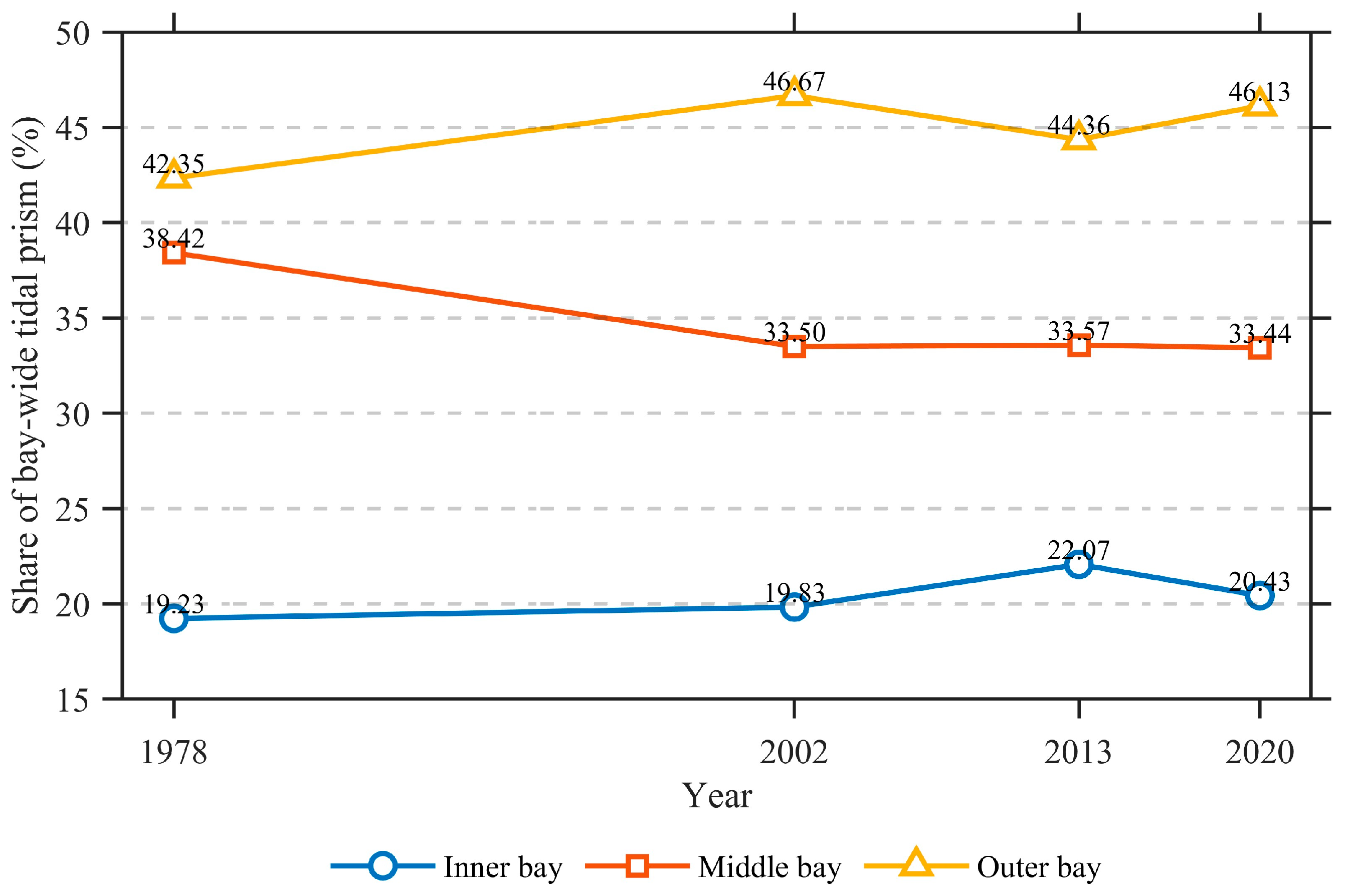
Sub-bay shares of the bay-wide tidal prism also changed markedly (Figure 10). The middle-bay share decreased from 38.42% in 1978 to 33.44% in 2020, indicating that the middle bay progressively lost relative importance in tide-driven exchange. The outer-bay share increased overall from 42.35% to 46.13%, while the inner-bay share first increased to 22.07% in 2013 and then declined to 20.43% in 2020. These percentage shifts are significant because they reveal redistribution of tidal exchange within the bay after the total prism had nearly stabilized. In practical terms, water-exchange pressure was transferred among sub-regions, so bay-wide indicators alone would underestimate continuing local hydrodynamic adjustment.

3.5. Coupled Stage-Wise Response of Reclamation and Hydrodynamics

Figure 11 summarizes the stage-wise relationship between reclamation intensity and hydrodynamic response. The strongest hydrodynamic response occurred during 1978–2002, when reclamation area, tidal prism-loss intensity, mean current-speed change intensity, and sub-regional share-change intensity were all the largest. After 2002, reclaimed area and bay-wide tidal-prism loss decreased sharply, but normalized current-speed change and sub-regional share change remained evident. This decoupling indicates that the hydrodynamic system continued to adjust after the main reclamation phase, especially through the redistribution of flow and tidal exchange among sub-regions.

4. Discussion

4.1. Reclamation Pattern and Adjustment of Tidal-Current Pathways

The results can be interpreted through a storage–conveyance–redistribution mechanism. Reclamation first removed intertidal flats and shallow-water areas that previously stored water during flood tide and released it during ebb tide. This direct reduction in tidal accommodation space explains the decline in bay-wide tidal prism. At the same time, embankments and channel closure modified the conveyance network. The closure of the Xuanmen Channel removed one tidal branch, forcing a larger fraction of the remaining exchange through the main channel and producing localized current enhancement in the inner bay, even while the bay-wide prism decreased.
This mechanism explains why the largest response occurred during 1978–2002; this period combined the greatest reclaimed area with the most disruptive pathway change, so both storage loss and conveyance reorganization acted together. Later reclamation was smaller and located more toward the outer bay, producing weaker bay-wide prism loss but still altering current speed and sub-regional shares. Thus, the hydrodynamic effect of reclamation cannot be predicted from reclaimed area alone; it depends on whether reclamation intersects tidal pathways that connect storage basins and the open sea.

4.2. Bay-Wide Tidal Prism Loss and Redistribution Among Sub-Regions

The 19.16% reduction in bay-wide tidal prism is important because tidal prism integrates the bay’s water-exchange capacity. A decline of this magnitude implies weaker tide-driven renewal, reduced dilution potential, and lower capacity for exchanging water between the inner bay and adjacent coastal waters. The fact that 89.31% of the total loss occurred during 1978–2002 further indicates that early large-scale engineering established the dominant hydrodynamic trajectory of the system.
The percentages for individual sub-regions are also meaningful. The middle bay lost 29.64% of its tidal prism, much more than the inner bay (14.10%) and outer bay (11.95%); this disproportionate loss indicates that the middle bay functioned as a hydrodynamic bottleneck and transition zone. When reclamation reduced storage and conveyance in this zone, the change affected not only local exchange but also the partitioning of flow between the inner and outer bay. The outer-bay rebound during 2013–2020 does not contradict the overall loss; instead, it reflects redistribution of the remaining exchange toward the entrance region after interior storage and conveyance had been reduced.
The shift in sub-bay tidal-prism shares provides a clearer indicator of redistribution than total prism alone. The steady decline in the middle-bay share shows that this sub-region lost relative control over tidal exchange, whereas reciprocal fluctuations between inner and outer bay shares indicate ongoing adjustment of the connected bay system. Therefore, an apparent slowdown in total tidal-prism loss after 2002 should not be interpreted as hydrodynamic equilibrium; instead, it represents a transition from rapid bay-wide loss to slower internal reorganization.

4.3. Cumulative Impacts, Delayed Adjustment, and Implications

The response of Yueqing Bay is consistent with previous studies showing that reclamation can shift tidal systems from distributed flow networks toward more concentrated channelized exchange. Similar mechanisms have been reported in Jiaozhou Bay, Xiamen Bay, Sanmen Bay, and the Pearl River Estuary, where reclamation reduced tidal prism, altered residual circulation, and increased spatial heterogeneity in flow response [5,15,16,20,23]. Studies of semi-enclosed subtropical bays also show that reclamation impacts differ according to project location, supporting the present conclusion that pathway sensitivity is a key control [24].
The findings also have broader relevance beyond Yueqing Bay because they highlight a pathway-based mechanism of coastal-engineering impacts. In estuarine and channel-shoal systems, previous studies have shown that engineering works can alter channel connectivity, redistribute flow and sediment transport, and trigger adjustments beyond the immediate engineering footprint [36,37]. Studies from deltaic coasts, particularly the Nile Delta, further show that human interventions can interrupt sediment pathways, modify coastal connectivity, and generate spatially uneven shoreline or morphodynamic responses over decadal to multi-decadal time scales [38,39,40,41]. Although the Nile Delta differs from Yueqing Bay in tidal range, sediment supply, and dominant forcing, these studies provide a useful comparison because both systems demonstrate that engineering impacts can be mediated by changes in the connectivity of tidal-current and sediment-transport pathways.
This comparison helps to generalize the Yueqing Bay results. In Yueqing Bay, reclamation reduced intertidal storage and blocked or modified key tidal pathways, causing a shift from distributed conveyance toward more concentrated channelized exchange. In the Nile Delta and other engineered coastal systems, the dominant process may be sediment-pathway interruption or morphodynamic adjustment rather than tidal-prism reduction [38,39,40,41]. Despite these differences, the common principle is that coastal engineering modifies system connectivity, producing spatially uneven, delayed, and pathway-dependent responses.
From this pathway-based perspective, the comparison also sharpens the management implications for semi-enclosed bays, where tidal exchange is strongly controlled by limited storage space and a small number of dominant tidal pathways. For shoreline management, these results suggest that reclamation assessment in semi-enclosed bays should explicitly evaluate three factors: the amount of storage removed, the degree of conveyance constriction, and the location of projects relative to dominant tidal pathways. Projects located near tidal corridors or transition zones may have larger system-wide consequences than projects of similar area located in hydraulically less sensitive zones. Monitoring should, therefore, continue after construction, because current redistribution and sub-regional tidal-prism adjustment may persist even when bay-wide tidal-prism loss appears small.

4.4. Model Limitations and Uncertainty

Several uncertainties should be considered when interpreting the results. First, historical bathymetric charts and multi-source satellite images differ in scale, resolution, acquisition time, and vertical datum; although the data were standardized in GIS, residual interpolation and shoreline-position errors may remain. Second, the model validation relies on 1982 observations because more recent observations cannot represent the 1978 baseline morphology. The historical dataset is, therefore, appropriate for testing the model under early-stage conditions, but cannot eliminate all uncertainty in present-day fine-scale currents. Third, wind, wave, event-scale river discharge, and sediment feedback were not included because the experiments were designed to isolate tide-dominated hydrodynamic effects of reclamation geometry. Fourth, uniform eddy-viscosity and bottom-friction parameterizations simplify spatial variability in turbulence and bed roughness. These assumptions mean that point-scale current changes should be interpreted with caution, especially in tidal-creek areas, whereas integrated tidal-prism changes and relative stage comparisons are more robust.

4.5. Conceptual Synthesis

Overall, the Yueqing Bay case illustrates a two-phase hydrodynamic transformation of semi-enclosed bays under reclamation. The first phase is a rapid-loss phase, during which large-scale reclamation removes tidal storage and blocks or narrows tidal pathways, causing substantial bay-wide tidal-prism reduction. The second phase is a redistribution phase, during which additional reclamation may be small, but the bay continues to adjust through changes in current speed, tidal-prism partitioning, and sub-regional exchange. This conceptual framework helps explain why hydrodynamic impacts can persist after the apparent stabilization of total tidal-prism indicators.

5. Conclusions

This study quantified the multi-decadal impacts of coastal reclamation on tidal hydrodynamics in Yueqing Bay by combining shoreline and bathymetric reconstruction, hydrological observations, and two-dimensional tidal modeling. The results demonstrate clear spatiotemporal heterogeneity in hydrodynamic response to reclamation.
Temporally, the bay-wide tidal prism decreased by 2.919 × 10⁸ m3 (19.16%) from 1978 to 2020, with most of the loss occurring during 1978–2002. Mean current speed also showed stage-dependent variation. Spatially, tidal-prism reduction differed among sub-regions, with the largest cumulative loss in the middle bay, whereas mean current speed generally weakened but increased locally at some representative stations.
Together, the tidal-prism and current-speed results indicate that reclamation impacts cannot be explained only by geometric area loss. Instead, they reflect the combined effects of tidal-storage reduction, channel blockage or modification, and redistribution of tidal exchange through the remaining connected pathways. Continued changes after reclamation intensity declined indicate cumulative adjustment toward a new equilibrium.
For semi-enclosed bays, impact assessment and shoreline management should, therefore, consider not only total reclaimed area but also project timing, spatial layout, and connectivity with key tidal pathways. More generally, reclamation in semi-enclosed bays may drive a transition from a rapid storage-loss phase to a longer redistribution phase, during which local hydrodynamic adjustment persists even after bay-wide tidal-prism loss appears to stabilize. Because the study used a depth-averaged two-dimensional model and reconstructed historical bathymetry, future work incorporating three-dimensional processes, sediment feedback, and morphodynamic coupling would further improve understanding of long-term system evolution. Comparative studies across semi-enclosed bays, estuaries, and deltaic coasts should further examine how engineering-induced changes in tidal-current and sediment-transport pathway connectivity control the timing, magnitude, and spatial unevenness of coastal-system adjustment.

Author Contributions

Conceptualization, X.X. and J.L.; methodology, J.L. and X.W.; software, J.L.; validation, J.L.; formal analysis, J.L. and X.X.; investigation, J.L.; resources, X.X. and F.C.; data curation, X.W., T.C. and F.C.; writing—original draft preparation, J.L.; writing—review and editing, J.L., X.X. and F.C.; visualization, J.L.; supervision, X.X. and F.C.; project administration, X.W.; funding acquisition, X.W. All authors have read and agreed to the published version of the manuscript.

Funding

This research was supported by the Zhejiang Provincial Natural Science Foundation of China under Grant no. LDT23D06025D06 and no. LD26D060002.

Data Availability Statement

The original contributions presented in this study are included in the article. Further inquiries can be directed to the corresponding authors.

Acknowledgments

During the preparation of this manuscript, the authors used ChatGPT (OpenAI, GPT-5.5 Thinking) for the purposes of language polishing and editorial assistance. The authors have reviewed and edited the output and take full responsibility for the content of this publication.

Conflicts of Interest

The authors declare no conflicts of interest.

References

  1. Sengupta, D.; Choi, Y.R.; Tian, B.; Brown, S.; Meadows, M.; Hackney, C.R.; Banerjee, A.; Li, Y.; Chen, R.; Zhou, Y. Mapping 21st Century Global Coastal Land Reclamation. Earth’s Future 2023, 11, e2022EF002927. [Google Scholar] [CrossRef]
  2. Van Maren, D.S.; Schrijvershof, R.A.; Beemster, J.; Zhu, C.; Xie, D.; Zhou, Z.; Alonso, A.C.; Hoitink, A.J.F. Land Reclamation Impacts on Tidal Landscape Evolution. Rev. Geophys. 2025, 63, e2024RG000860. [Google Scholar] [CrossRef]
  3. Jiang, S.; Xu, N.; Li, Z.; Huang, C. Satellite derived coastal reclamation expansion in China since the 21st century. Glob. Ecol. Conserv. 2021, 30, e01797. [Google Scholar] [CrossRef]
  4. Zhang, Q.F.; Jin, Y.D.; Li, X.B.; Wang, L.N.; Ye, F.J. Progress in the impact of reclamation projects on offshore marine environment. Adv. Mar. Sci. 2017, 35, 454–461. [Google Scholar] [CrossRef]
  5. Wang, J.; Hong, H.; Zhou, L.; Hu, J.; Jiang, Y. Numerical modeling of hydrodynamic changes due to coastal reclamation projects in Xiamen Bay, China. Chin. J. Oceanol. Limnol. 2013, 31, 334–344. [Google Scholar] [CrossRef]
  6. Hodoki, Y.; Murakami, T. Effects of tidal flat reclamation on sediment quality and hypoxia in Isahaya Bay. Aquat. Conserv. Mar. Freshw. Ecosyst. 2006, 16, 555–567. [Google Scholar] [CrossRef]
  7. Jickells, T.D.; Andrews, J.E.; Parkes, D.J. Direct and Indirect Effects of Estuarine Reclamation on Nutrient and Metal Fluxes in the Global Coastal Zone. Aquat. Geochem. 2016, 22, 337–348. [Google Scholar] [CrossRef]
  8. Yan, H.K.; Wang, N.; Yu, T.L.; Fu, Q.; Liang, C. Comparing effects of land reclamation techniques on water pollution and fishery loss for a large-scale offshore airport island in Jinzhou Bay, Bohai Sea, China. Mar. Pollut. Bull. 2013, 71, 29–40. [Google Scholar] [CrossRef] [PubMed]
  9. Zhu, M.; Xia, X.; Chen, Y.; Wang, X.; Liu, Y.; Zhang, Z.; Zheng, J. Spatiotemporal Variation of Tidal Wetlands Affected by Human Activities during the Past 50 Years: A Case Study of Yueqing Bay in Eastern China. Land 2023, 12, 851. [Google Scholar] [CrossRef]
  10. Murray, N.J.; Phinn, S.R.; DeWitt, M.; Ferrari, R.; Johnston, R.; Lyons, M.B.; Clinton, N.; Thau, D.; Fuller, R.A. The global distribution and trajectory of tidal flats. Nature 2019, 565, 222–225. [Google Scholar] [CrossRef] [PubMed]
  11. Murray, N.J.; Phinn, S.P.; Fuller, R.A.; DeWitt, M.; Ferrari, R.; Johnston, R.; Clinton, N.; Lyons, M.B. High-resolution global maps of tidal flat ecosystems from 1984 to 2019. Sci. Data 2022, 9, 542. [Google Scholar] [CrossRef] [PubMed]
  12. Pekel, J.F.O.; Cottam, A.; Gorelick, N.; Belward, A.S. High-resolution mapping of global surface water and its long-term changes. Nature 2016, 540, 418–422. [Google Scholar] [CrossRef]
  13. Song, D.; Wang, X.H.; Kiss, A.E.; Bao, X. The contribution to tidal asymmetry by different combinations of tidal constituents. J. Geophys. Res. Ocean. 2011, 116, C12007. [Google Scholar] [CrossRef]
  14. Syvitski, J.P.M.; Kettner, A.J.; Overeem, I.; Hutton, E.W.H.; Hannon, M.T.; Brakenridge, G.R.; Day, J.; Vörösmarty, C.; Saito, Y.; Giosan, L.; et al. Sinking deltas due to human activities. Nat. Geosci. 2009, 2, 681–686. [Google Scholar] [CrossRef]
  15. Gao, G.D.; Wang, X.H.; Bao, X.W. Land reclamation and its impact on tidal dynamics in Jiaozhou Bay, Qingdao, China. Estuar. Coast. Shelf Sci. 2014, 151, 285–294. [Google Scholar] [CrossRef]
  16. Shi, P.; Yang, W.; Xu, X.; Zhang, F. Response of hydrodynamic environment to land reclamation in Sanmen Bay, China over the last half-century. Front. Mar. Sci. 2024, 11, 1448565. [Google Scholar] [CrossRef]
  17. Deng, G.; Shen, Y.; Li, C.; Tang, J. Computational investigation on hydrodynamic and sediment transport responses influenced by reclamation projects in the Meizhou Bay, China. Front. Earth Sci. 2020, 14, 493–511. [Google Scholar] [CrossRef]
  18. Zhang, J.; Song, D.; Wu, W.; Bao, X. Impacts of human activities on tidal dynamics in a sexta–diurnal tidal resonant bay. Anthr. Coasts 2019, 2, 126–144. [Google Scholar] [CrossRef]
  19. Zheng, J.H.; Zhou, J.; Liang, J.Y.; Lin, J.Y. Hydrodynamic impact assessment of coastal reclamation project in semi-enclosed bay. J. Coast. Res. 2007, 50, 273–276. [Google Scholar] [CrossRef]
  20. Gao, G.D.; Wang, X.H.; Bao, X.W.; Song, D.; Lin, X.P.; Qiao, L.L. The impacts of land reclamation on suspended-sediment dynamics in Jiaozhou Bay, Qingdao, China. Estuar. Coast. Shelf Sci. 2018, 206, 61–75. [Google Scholar] [CrossRef]
  21. Kang, J.W. Changes in Tidal Characteristics as a Result of the Construction of Sea-dike/Sea-walls in the Mokpo Coastal Zone in Korea. Estuar. Coast. Shelf Sci. 1999, 48, 429–438. [Google Scholar] [CrossRef]
  22. Ock, L.M.; Jin, P.S.; Soon, K.T. Influence of Reclamation Works on the Marine Environment in a Semi-Enclosed Bay. J. Ocean Univ. China 2006, 5, 219–227. [Google Scholar] [CrossRef]
  23. Chu, N.; Yao, P.; Ou, S.; Wang, H.; Yang, H.; Yang, Q. Response of tidal dynamics to successive land reclamation in the Lingding Bay over the last century. Coast. Eng. 2022, 173, 104095. [Google Scholar] [CrossRef]
  24. Yang, Y.; Chui, T.F.M. Hydrodynamic and transport responses to land reclamation in different areas of semi-enclosed subtropical bay. Cont. Shelf Res. 2017, 143, 54–66. [Google Scholar] [CrossRef]
  25. Flemming, B.W.; Nyandwi, N. Land reclamation as a cause of fine-grained sediment depletion in backbarrier tidal flats (Southern North Sea). Neth. J. Aquat. Ecol. 1994, 28, 299–307. [Google Scholar] [CrossRef]
  26. Guo, W.; Li, S.H.; Mao, L.; Yin, Y.; Zhu, D.K. A model for environmental impact assessment of land reclamation. China Ocean Eng. 2007, 21, 343–354. [Google Scholar] [CrossRef]
  27. Xiao, K.; Li, H.; Song, D.; Chen, Y.; Wilson, A.M.; Shananan, M.; Li, G.; Huang, Y. Field Measurements for Investigating the Dynamics of the Tidal Prism during a Spring-Neap Tidal Cycle in Jiaozhou Bay, China. J. Coast. Res. 2019, 35, 335–347. [Google Scholar] [CrossRef]
  28. Chen, H.X.; Hua, F.; Liu, N.; Wu, Z.Y. Comparison Among Different Methods for Tidal Prism Calculation—Neap Tide of Jiaozhou Bay in Autumn 2006 as an Expounded Example. Adv. Mar. Sci. 2009, 27, 11–15. [Google Scholar] [CrossRef]
  29. Wang, C.C.; Pan, G.F.; Xu, X.F.; Chen, P.X. Analysis of evolution of tidal prism of the Yueqing Bay. Mar. Sci. 2017, 41, 76–85. [Google Scholar] [CrossRef]
  30. Ying, C.; Li, R.; Li, X.; Liu, Y. Anthropogenic Influences on the Tidal Prism and Water Exchange in Yueqing Bay, Zhejiang, China. J. Coast. Res. 2018, 85, 961–965. [Google Scholar] [CrossRef]
  31. Yang, C.H.; Liao, G.H.; Luo, F.; Xu, X.H. Features of the tidal level, tidal currents and residual currents in Yueqingwan Bay. J. Mar. Sci. 2010, 28, 1–13. [Google Scholar] [CrossRef]
  32. Huang, B.W.; Mao, N.; Wang, J.; Xiong, Q. Macro hydrological, sediment, and dynamic conditions of Yueqing Bay. China Water Transp. 2018, 18, 179–182. [Google Scholar]
  33. Boak, E.H.; Turner, I.L. Shoreline Definition and Detection: A Review. J. Coast. Res. 2005, 214, 688–703. [Google Scholar] [CrossRef]
  34. Egbert, G.D.; Erofeeva, S.Y. Efficient Inverse Modeling of Barotropic Ocean Tides. J. Atmos. Ocean. Technol. 2002, 19, 183–204. [Google Scholar] [CrossRef]
  35. DHI. MIKE 21 & MIKE 3 Flow Model FM—Hydrodynamic and Transport Module. In Scientific Documentation; DHI: Hørsholm, Denmark, 2017. [Google Scholar]
  36. Liang, H.; Kuang, C.; Olabarrieta, M.; Song, H.; Ma, Y.; Dong, Z.; Han, X.; Zuo, L.; Liu, Y. Morphodynamic responses of Caofeidian channel-shoal system to sequential large-scale land reclamation. Cont. Shelf Res. 2018, 165, 12–25. [Google Scholar] [CrossRef]
  37. Xie, D.; Pan, C.; Wu, X.; Gao, S.; Wang, Z.B. Local human activities overwhelm decreased sediment supply from the Changjiang River: Continued rapid accumulation in the Hangzhou Bay–Qiantang Estuary system. Mar. Geol. 2017, 392, 66–77. [Google Scholar] [CrossRef]
  38. Ali, E.M.; El-Magd, I.A. Impact of human interventions and coastal processes along the Nile Delta coast, Egypt during the past twenty-five years. Egypt. J. Aquat. Res. 2016, 42, 1–10. [Google Scholar] [CrossRef]
  39. El-Asmar, H.M.; Felfla, M.S.; ElKotby, M.R.; El-Kafrawy, S.B.; Naguib, D.M. Multi-Decadal shoreline dynamics of Ras El-Bar, Nile Delta: Unraveling human interventions and coastal resilience. Sci. Afr. 2025, 30, e02937. [Google Scholar] [CrossRef]
  40. El-Asmar, H.M.; Taha, M.M.N.; El-Sorogy, A.S. Morphodynamic changes as an impact of human intervention at the Ras El-Bar-Damietta Harbor coast, NW Damietta Promontory, Nile Delta, Egypt. J. Afr. Earth Sci. 2016, 124, 323–339. [Google Scholar] [CrossRef]
  41. Frihy, O.E.; Debes, E.A.; El Sayed, W.R. Processes reshaping the Nile delta promontories of Egypt: Pre- and post-protection. Geomorphology 2003, 53, 263–279. [Google Scholar] [CrossRef]
Figure 1. Study area of Yueqing Bay, showing sub-regions, characteristic cross-sections, and observation stations used for model validation. The tide-gauge station was used to validate simulated tidal elevation, whereas the current observation stations were used to validate simulated current speed and direction.
Jmse 14 01077 g001
Figure 2. Computational mesh of the two-level nested hydrodynamic model for Yueqing Bay. The outer domain reduces boundary effects, whereas the refined inner domain resolves the semi-enclosed bay, narrow channels, islands, and tidal-flat margins.
Jmse 14 01077 g002
Figure 3. Locations of representative stations (P1–P7) used to extract simulated mean current speed changes, shown together with the bay outline and characteristic cross-sections.
Jmse 14 01077 g003
Figure 4. Comparison between observed and modeled tidal elevations at the Kanmen tide-gauge station used for model validation.
Jmse 14 01077 g004
Figure 5. Comparison between observed and modeled current speed and direction at the observation stations used for model validation. Stations D1–D6 denote the current observation stations used for validation.
Jmse 14 01077 g005
Figure 6. Spatiotemporal distribution of reclamation in Yueqing Bay during 1978–2020.
Jmse 14 01077 g006
Figure 7. Peak-flood tidal-current fields in Yueqing Bay in 1978, 2002, 2013, and 2020. Panels are presented using the same spatial extent and vector scale to facilitate stage-wise comparison. The color-shaded background represents velocity magnitude, and arrows indicate current direction.
Jmse 14 01077 g007
Figure 8. Peak-ebb tidal-current fields in Yueqing Bay in 1978, 2002, 2013, and 2020. Panels are presented using the same spatial extent and vector scale to facilitate stage-wise comparison. The color-shaded background represents velocity magnitude, and arrows indicate current direction.
Jmse 14 01077 g008
Figure 9. Spatial distribution of mean current speed changes in Yueqing Bay for different periods. Results are shown for 1978–2002, 2002–2013, 2013–2020, and 1978–2020. Positive values indicate an increase in mean current speed relative to the earlier year in each comparison, whereas negative values indicate a decrease.
Jmse 14 01077 g009
Figure 10. Stage-wise changes in sub-bay shares of the bay-wide tidal prism in Yueqing Bay.
Jmse 14 01077 g010
Figure 11. Stage-wise reclamation area and standardized hydrodynamic response indices in Yueqing Bay: (a) stage-wise reclamation area; (b) standardized hydrodynamic response indices, including tidal prism-loss intensity, mean current-speed change intensity, and sub-regional share-change intensity. Hydrodynamic response indices were normalized by the maximum stage-wise value of each metric to facilitate comparison among variables with different units.
Jmse 14 01077 g011
Table 1. Remote-sensing data.
Observation DateSpatial Resolution (m)Sources
KH-9September 19780.6–1.2 (B/W)USGS
Landsat5October 200230 (MS)https://earthexplorer.usgs.gov/
(accessed on 31 March 2026)
Landsat5August 201330 (MS)Geospatial Data Cloud
Landsat8January 202015 (PAN)http://www.gscloud.cn/
(accessed on 31 March 2026)
Table 2. Bathymetric data.
Collection YearScaleElevation DatumSource
Bathymetric charts19781:50,000Theoretical lowest tide levelMaritime Security Department
2002
20131:25,000
2020
Table 3. Changes in mean current speed at representative stations (m/s).
1978–20022002–20132013–20201978–2020
P1−0.055−0.0130.022−0.050
P2−0.072−0.0070.033−0.058
P3−0.0920.011−0.013−0.080
P4−0.1140.017−0.034−0.153
P5−0.1160.014−0.017−0.104
P60.0040.040−0.0300.017
P70.145−0.077−0.0500.004
Table 4. Tidal prism in Yueqing Bay for each period (108 m3).
YearInner BayMiddle BayOuter BayTotal
19782.9295.8536.45315.235
20022.5044.2315.89312.628
20132.7384.1655.50312.406
20202.5164.1185.68212.316
Table 5. Period-to-period changes in tidal prism in Yueqing Bay (108 m3).
PeriodInner BayMiddle BayOuter BayTotal
1978–2002−0.425−1.622−0.560−2.607
2002–20130.234−0.066−0.390−0.222
2013–2020−0.222−0.0470.179−0.09
1978–2020−0.413−1.735−0.771−2.919
Disclaimer/Publisher’s Note: The statements, opinions and data contained in all publications are solely those of the individual author(s) and contributor(s) and not of MDPI and/or the editor(s). MDPI and/or the editor(s) disclaim responsibility for any injury to people or property resulting from any ideas, methods, instructions or products referred to in the content.