



Influence of the Hainan Plume on the Deep Thermal Structure and Shallow Geothermal Field of Southeastern Coastal China
Abstract
1. Introduction
2. Seismic Velocity Structure and Thermal Implications
3. Methods
3.1. Theoretical Framework
3.2. Model Setup
4. Modeling Results
4.1. Evolutionary Characteristics of Lithospheric Thermal Anomalies
4.2. Evolution Characteristics of Heat Flow
5. Discussion
5.1. Origin of the Thermal Anomaly Offset
5.2. Geothermal Resources Distribution
5.3. Model Limitations
6. Conclusions
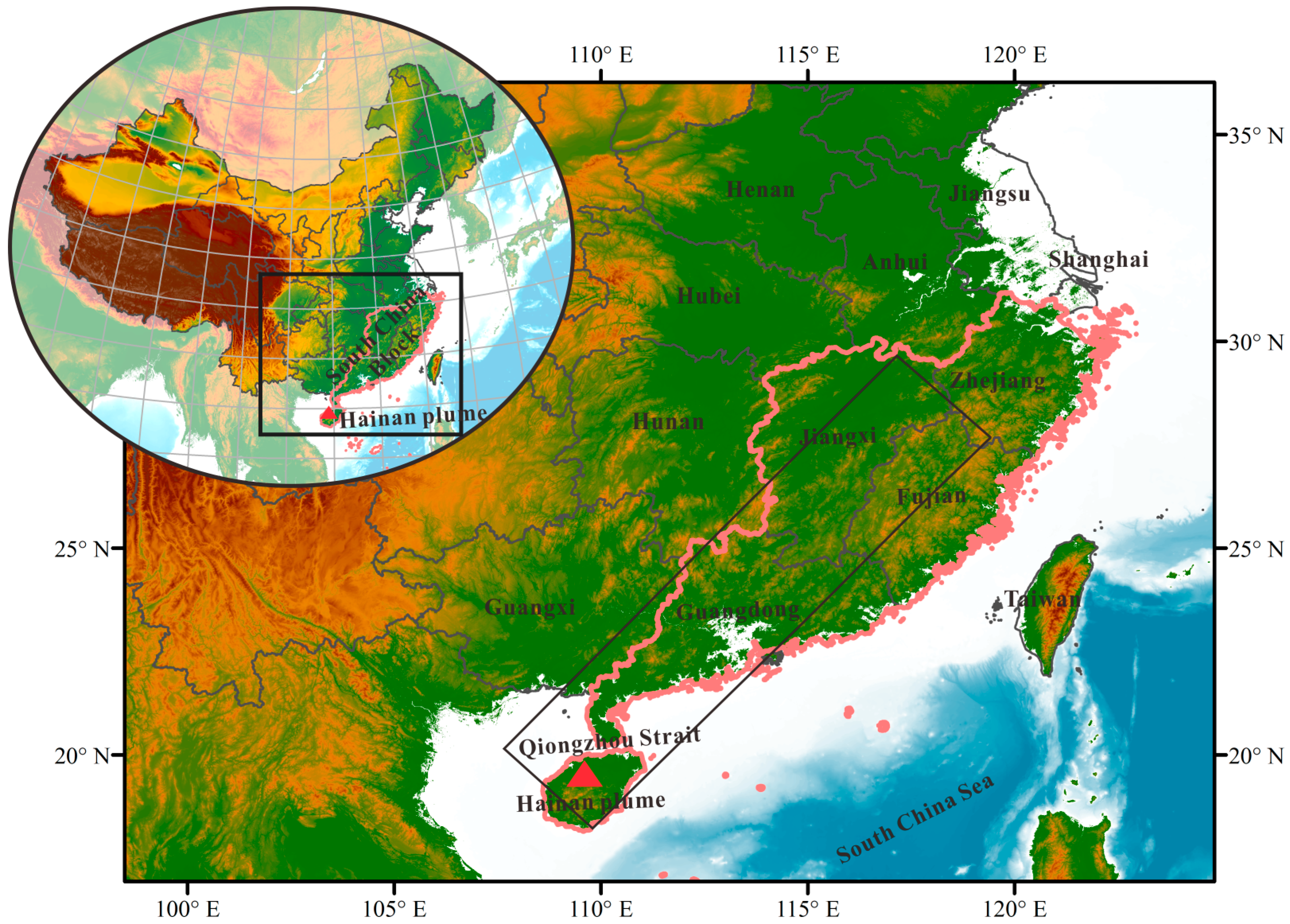
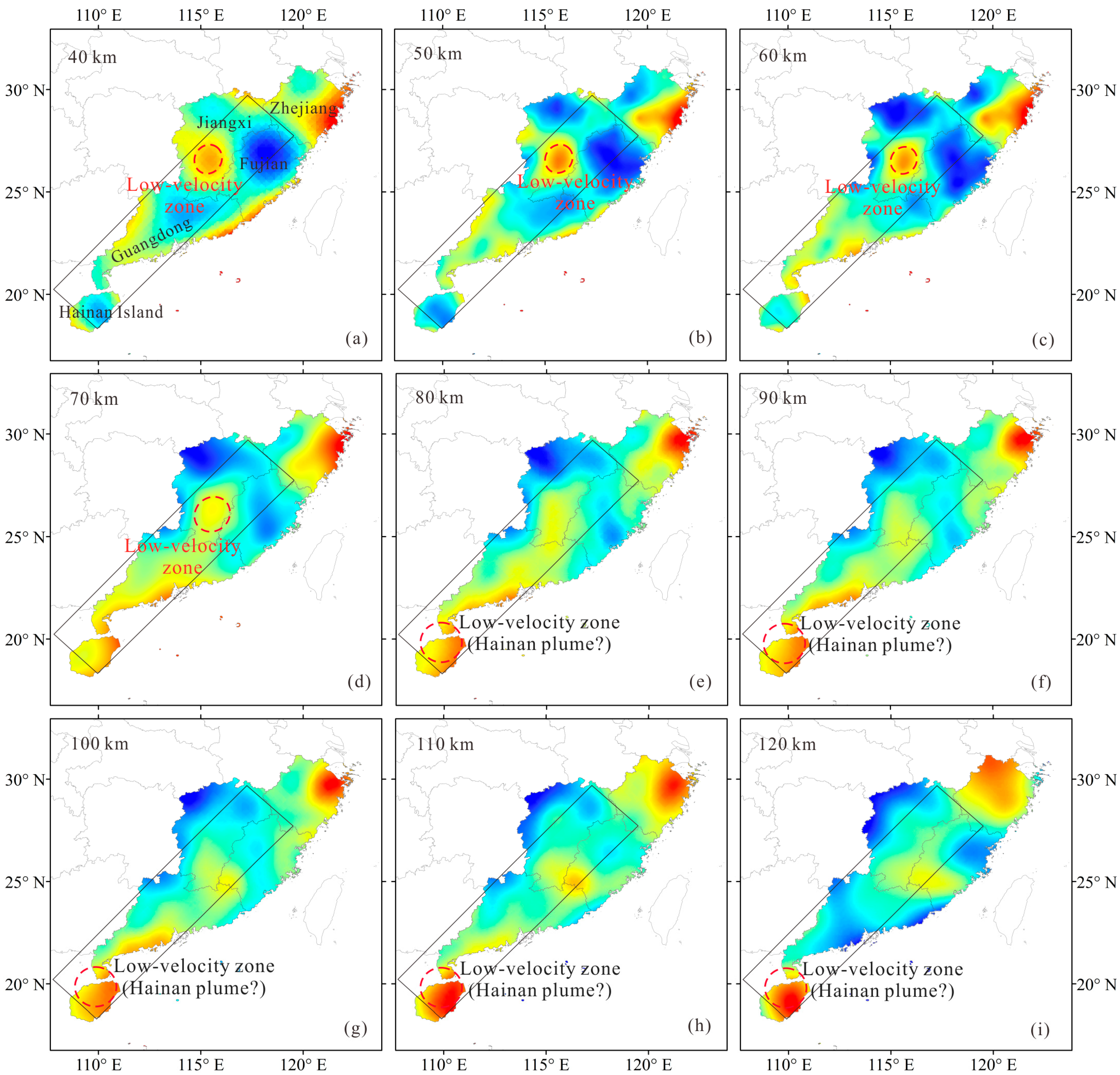
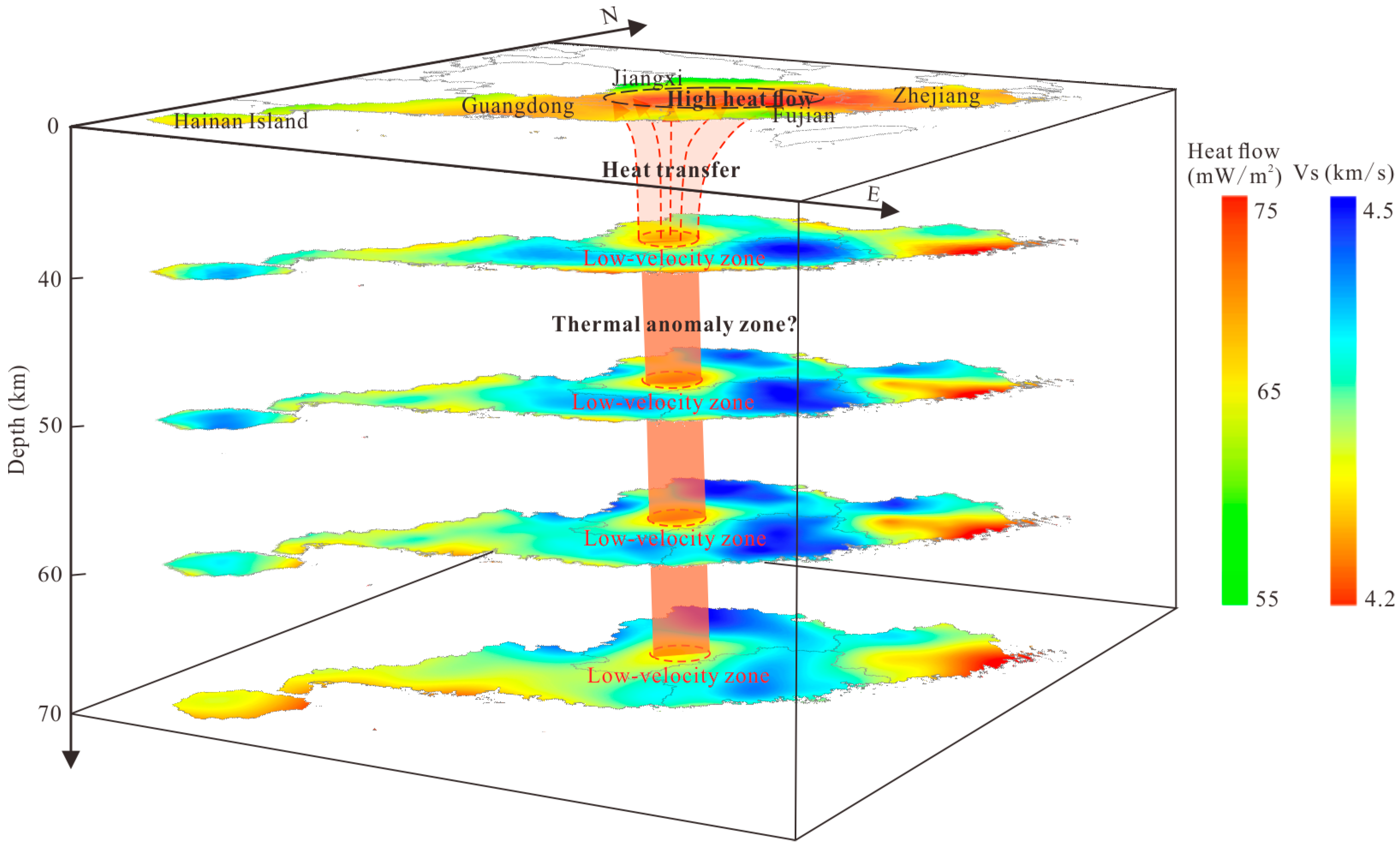
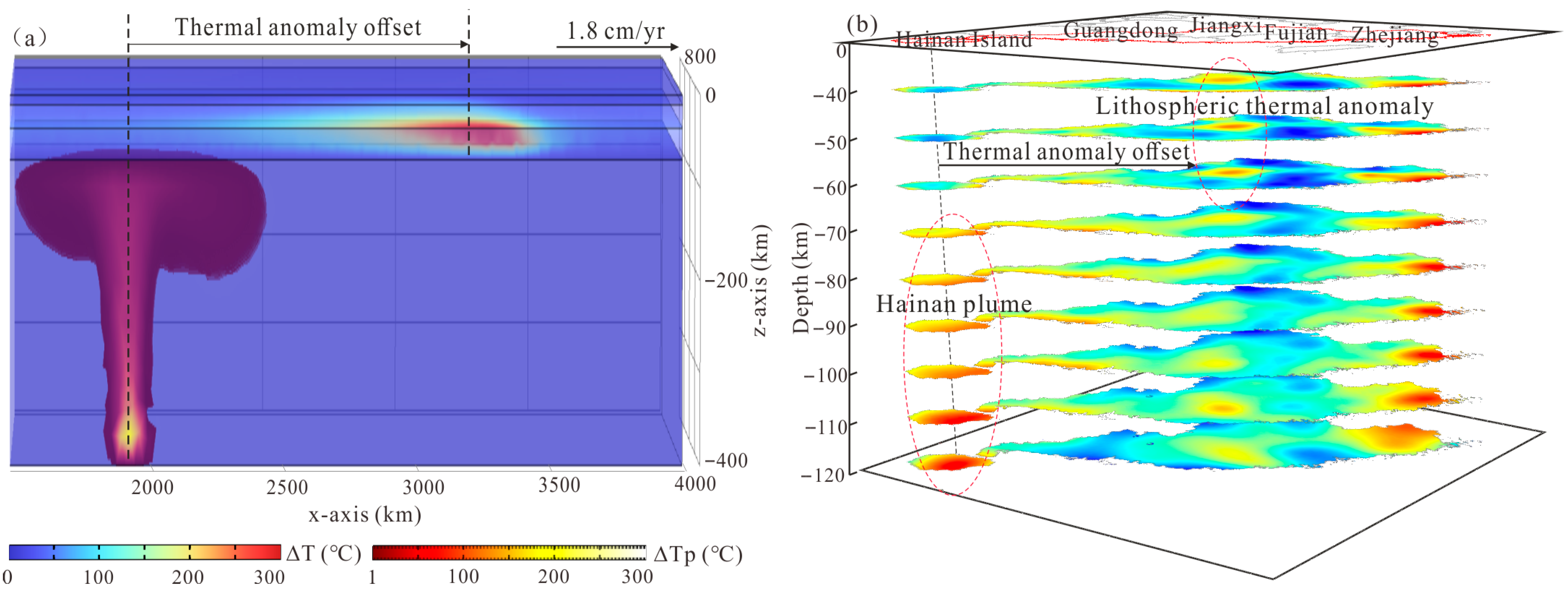
- Analysis of S-wave velocity structure based on high-resolution seismic models indicates a pronounced spatial offset of S-wave low-velocity zones between the asthenospheric and the lithospheric mantle in the southeastern coastal region of China. A notable low-velocity zone is observed within the asthenospheric mantle underneath Hainan Island, which may correspond to the upwelling Hainan plume. Nevertheless, no notable low-velocity body is detected in the overlying lithospheric mantle. In comparison, within the same depth slice, a localized low-velocity body exists within the lithospheric mantle underneath the Gan-Min area, with its position offset approximately 1300 km to the northeast relative to the low-velocity body underneath the asthenosphere of Hainan Island.
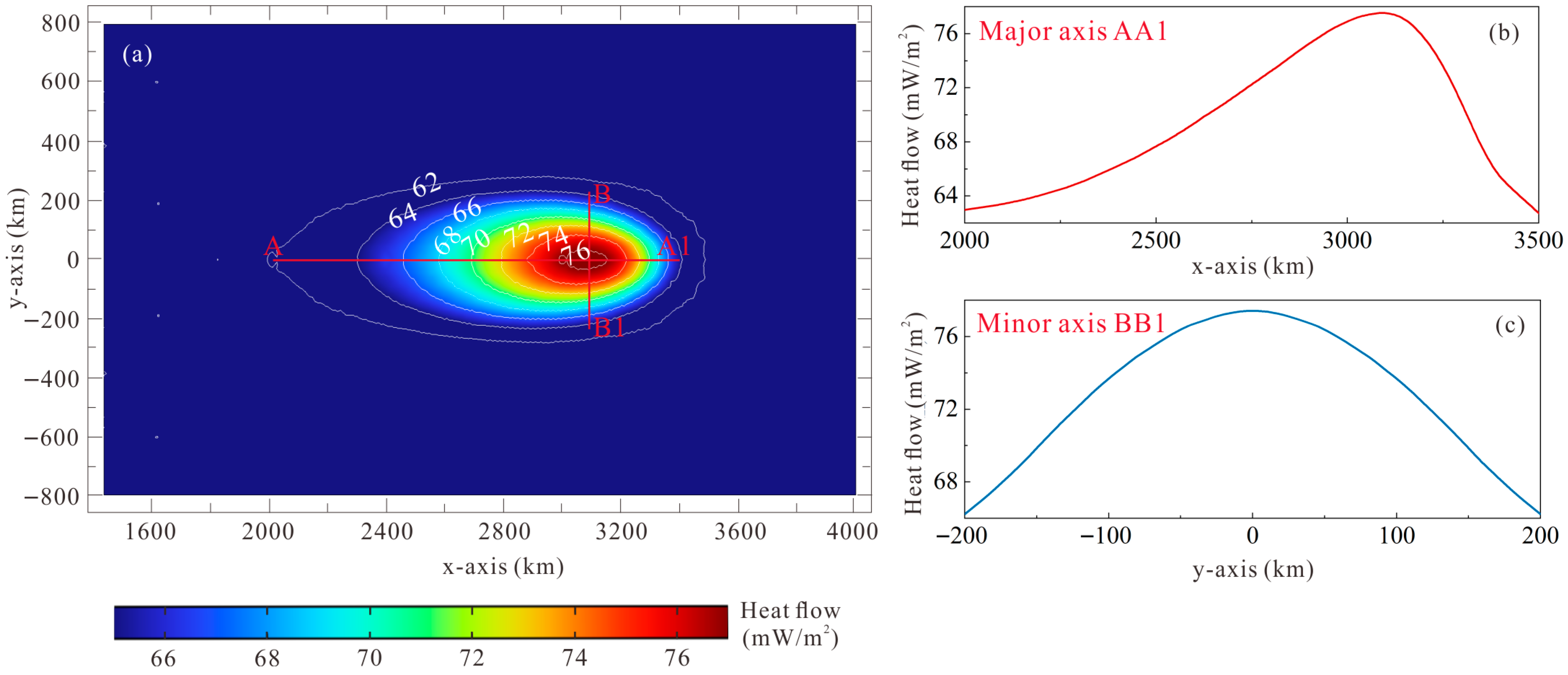
- The lithospheric low-velocity anomaly in the Coastal area of Southeastern China shows a good spatial correspondence with high surface heat flow. The low-velocity zone in the lithosphere is detected beneath the Gan-Min region, and the surface also exhibits a significantly high heat flow. However, despite the presence of a mantle plume below Hainan Island, no lithospheric low-velocity anomaly is detected, and the surface does not show a significant heat flow anomaly.
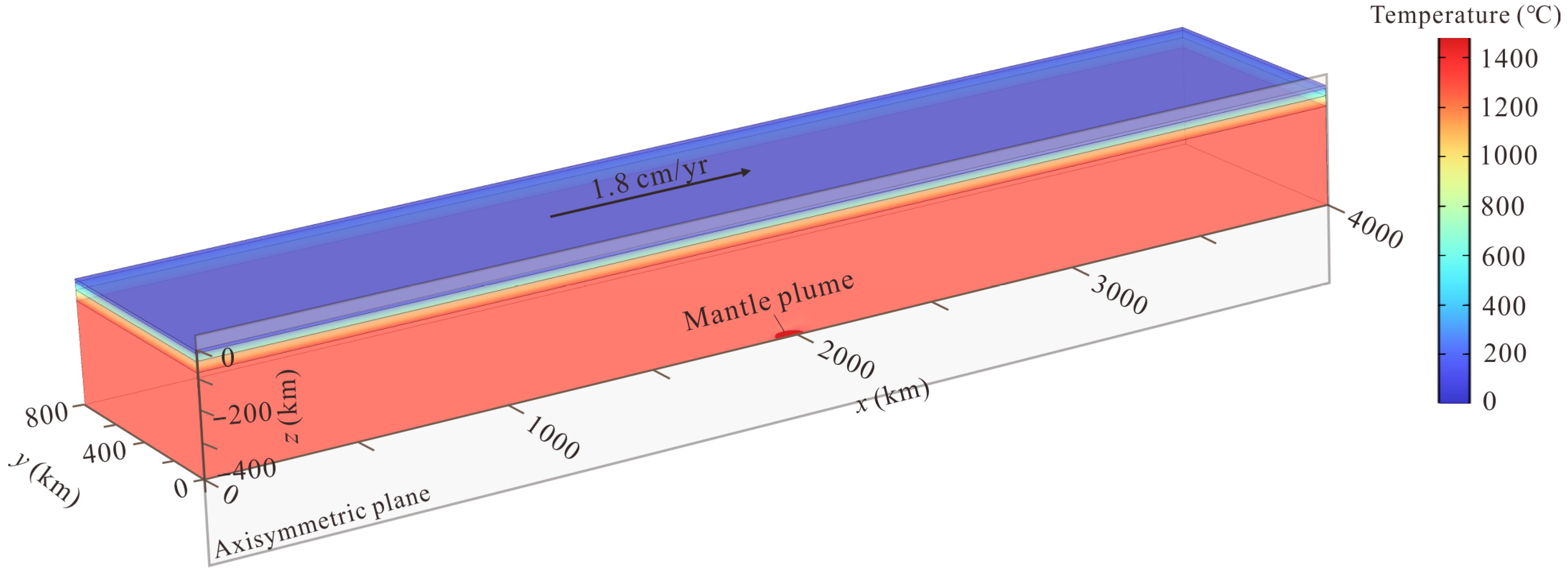
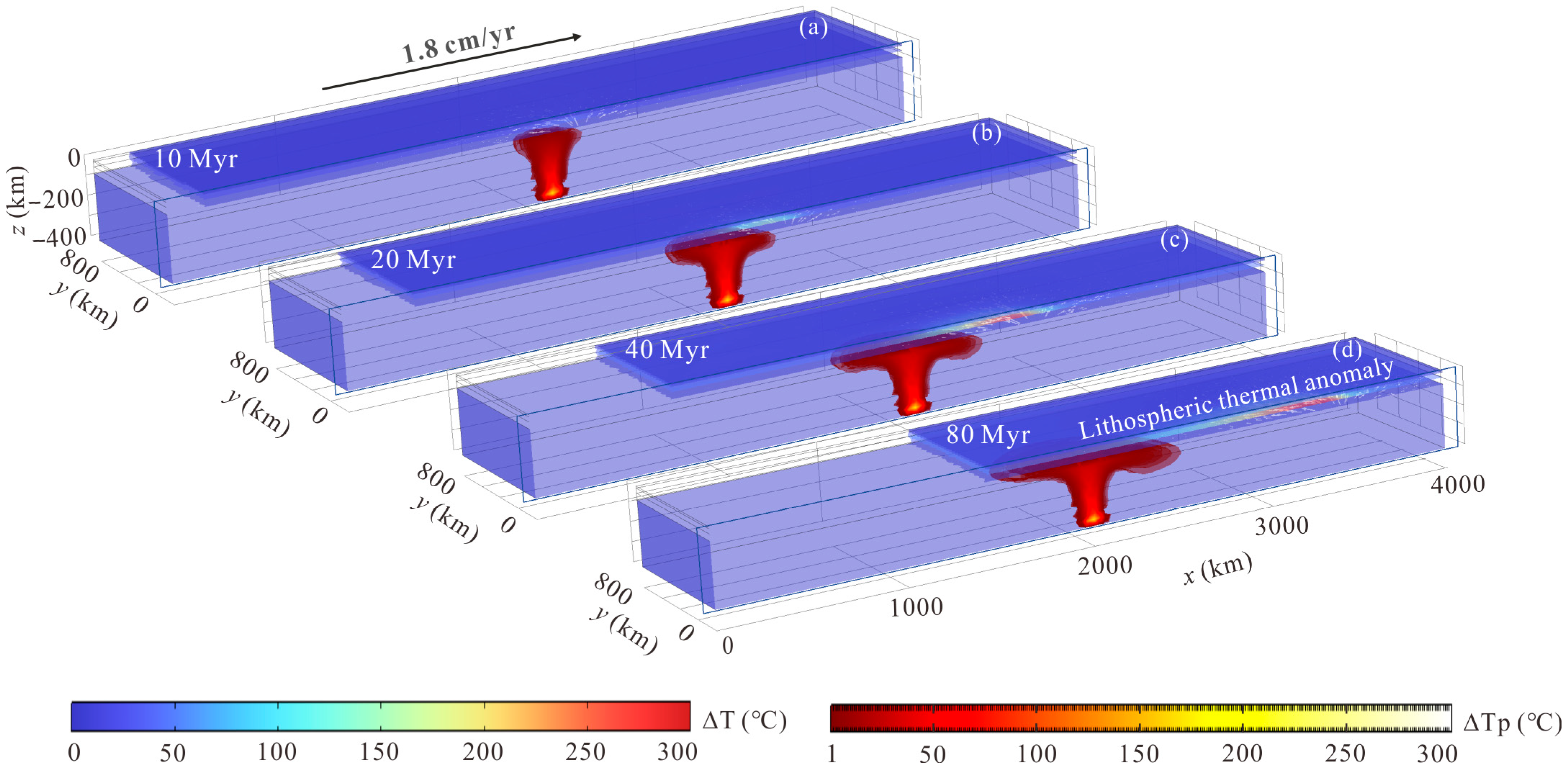
- We developed a geodynamic model to reproduce the movement of the South China Plate in relation to the underlying Hainan mantle plume, using heat flow data as a constraint to invert for key dynamical parameters (plume tail radius of approximately 50 km and excess temperature of about 180 K) of the Hainan plume, and obtained the evolution of the lithospheric thermal structure. The modeling results reveal that the heat delivered by the Hainan plume to the lithosphere gradually migrates along with plate motion, forming a thermal anomaly zone along its hotspot path. The high-temperature region at the leading edge of this thermal anomaly zone may correspond to the lithospheric low-velocity zone observed beneath the Gan-Min region.
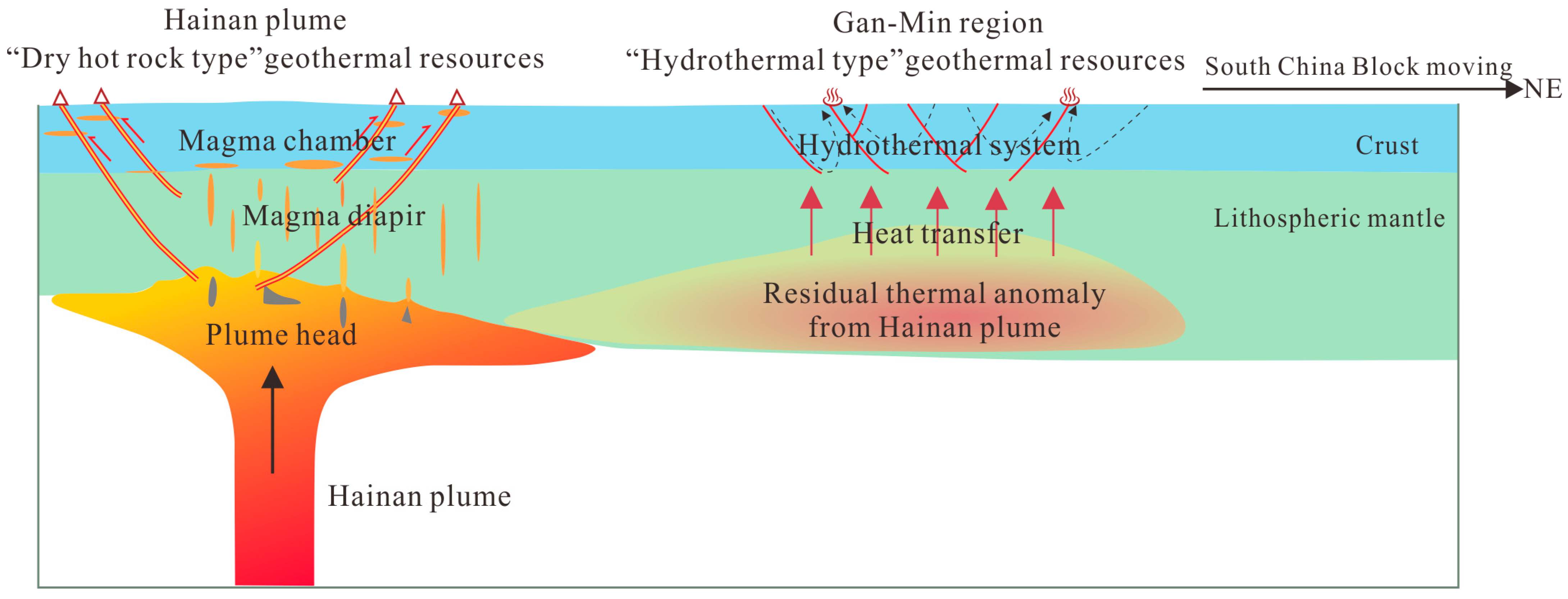
- Under the dynamical context of the Hainan plume activity and the NE-directed motion of the South China Plate, the spatial offset of the low-velocity anomaly and the lithospheric thermal anomalies can be well explained. Concurrently, the heat transfer patterns of the geothermal systems in both the Gan-Min region and Hainan Island are better understood. The Gan-Min geothermal system is mainly hydrothermal, powered mainly by a residual thermal anomaly associated with the Hainan plume, and may exhibit a large-scale and relatively uniform distribution. The geothermal resources on Hainan Island are primarily hot dry rock, shaped by underlying faults, and may exhibit local regionality, uneven distribution.
Author Contributions
Funding
Data Availability Statement
Conflicts of Interest
References
- Richards, M.A.; Hager, B.H.; Sleep, N.H. Dynamically supported geoid highs over hotspots: Observation and theory. J. Geophys. Res. Solid Earth 1988, 93, 7690–7708. [Google Scholar] [CrossRef]
- Morgan, W.J. Convection Plumes in the Lower Mantle. Nature 1971, 230, 42–43. [Google Scholar] [CrossRef]
- Duncan, R.A.; Richards, M.A. Hotspots, mantle plumes, flood basalts, and true polar wander. Rev. Geophys. 1991, 29, 31–50. [Google Scholar] [CrossRef]
- Davies, D.R.; Rawlinson, N.; Iaffaldano, G.; Campbell, I.H. Lithospheric controls on magma composition along Earth’s longest continental hotspot track. Nature 2015, 525, 511–514. [Google Scholar] [CrossRef] [PubMed]
- Molnar, P.; Stock, J. Relative motions of hotspots in the Pacific, Atlantic and Indian Oceans since late Cretaceous time. Nature 1987, 327, 587–591. [Google Scholar] [CrossRef]
- Wei, S.S.; Chen, Y.J. Seismic evidence of the Hainan mantle plume by receiver function analysis in southern China. Geophys. Res. Lett. 2016, 43, 8978–8985. [Google Scholar] [CrossRef]
- Lei, J.; Zhao, D.; Steinberger, B.; Wu, B.; Shen, F.; Li, Z. New seismic constraints on the upper mantle structure of the Hainan plume. Phys. Earth Planet. Inter. 2009, 173, 33–50. [Google Scholar] [CrossRef]
- Hua, Y.; Zhao, D.; Xu, Y. Azimuthal Anisotropy Tomography of the Southeast Asia Subduction System. J. Geophys. Res. Solid Earth 2022, 127, e2021JB022854. [Google Scholar] [CrossRef]
- Le, B.M.; Yang, T.; Gu, S. Upper mantle and transition zone structure beneath Leizhou–Hainan region: Seismic evidence for a lower-mantle origin of the Hainan plume. J. Asian Earth Sci. 2015, 111, 580–588. [Google Scholar] [CrossRef]
- Zou, H.; Fan, Q. U–Th isotopes in Hainan basalts: Implications for sub-asthenospheric origin of EM2 mantle endmember and the dynamics of melting beneath Hainan Island. Lithos 2010, 116, 145–152. [Google Scholar] [CrossRef]
- Lei, M.; Suzuki, K.; Kurisu, M.; Kashiwabara, T.; Xu, J.; Guo, Z.; Li, J.; Chen, J. Late Cenozoic Hainan OIB-like basalts in SE Asia record the interaction between a deep mantle plume and stagnant slab. Geochim. Cosmochim. Acta 2025, 407, 295–308. [Google Scholar] [CrossRef]
- Chen, S.; Gao, R.; Wang, Z.; Hou, T.; Liao, J.; Yan, C. Coexistence of Hainan Plume and Stagnant Slab in the Mantle Transition Zone beneath the South China Sea Spreading Ridge: Constraints from Volcanic Glasses and Seismic Tomography. Lithosphere 2021, 2021, 6619463. [Google Scholar] [CrossRef]
- Smith, R.B.; Jordan, M.; Steinberger, B.; Puskas, C.M.; Farrell, J.; Waite, G.P.; Husen, S.; Chang, W.-L.; O’Connell, R. Geodynamics of the Yellowstone hotspot and mantle plume: Seismic and GPS imaging, kinematics, and mantle flow. J. Volcanol. Geotherm. Res. 2009, 188, 26–56. [Google Scholar] [CrossRef]
- Courtillot, V.; Davaille, A.; Besse, J.; Stock, J. Three distinct types of hotspots in the Earth’s mantle. Earth Planet. Sci. Lett. 2003, 205, 295–308. [Google Scholar] [CrossRef]
- Liu, H.; Chen, F.; Leng, W.; Zhang, H.; Xu, Y. Crustal Footprint of the Hainan Plume Beneath Southeast China. J. Geophys. Res. Solid Earth 2018, 123, 3065–3079. [Google Scholar] [CrossRef]
- Li, Y.; Gao, M.; Wu, Q. Crustal thickness map of the Chinese mainland from teleseismic receiver functions. Tectonophysics 2014, 611, 51–60. [Google Scholar] [CrossRef]
- Wang, Y.B.; Liu, S.W.; Chen, C.i.; Jiang, G.Z.; Wu, J.H.; Guo, L.Y.; Wang, Y.Q.; Zhang, H.; ZhuTing, W.; XiaoXue, J.; et al. Compilation of terrestrial heat flow data in continental China (5th edition). Chin. J. Geophys. 2024, 67, 4233–4265. [Google Scholar]
- Zhang, H.; He, L.; Chen, C.; Guo, L. Geodynamic correlation between the Hainan plume and the heat flow along the Southeast Coast of China: Numerical simulation. Geothermics 2025, 132, 103411. [Google Scholar] [CrossRef]
- Sain, K. Seismic Velocity and Temperature Relationships. In Encyclopedia of Solid Earth Geophysics; Gupta, H.K., Ed.; Springer: Cham, Switzerland, 2020; Volume 161, pp. 1–2. [Google Scholar]
- Fowler, C.M.R. The Solid Earth: An Introduction to Global Geophysics, 2nd ed.; Cambridge University Press: Cambridge, UK, 2004; Volume 978. [Google Scholar]
- Karato, S.I. Importance of anelasticity in the interpretation of seismic tomography. Geophys. Res. Lett. 1993, 20, 1623–1626. [Google Scholar] [CrossRef]
- Goes, S.; Govers, R.; Vacher, P. Shallow mantle temperatures under Europe from P and S wave tomography. J. Geophys. Res. Solid Earth 2000, 105, 11153–11169. [Google Scholar] [CrossRef]
- Xiao, X.; Cheng, S.; Wu, J.; Wang, W.; Sun, L.; Wang, X.; Ma, J.; Tong, Y.; Liang, X.; Tian, X.; et al. CSRM-1.0: A China Seismological Reference Model. J. Geophys. Res. Solid Earth 2024, 129, e2024JB029520. [Google Scholar] [CrossRef]
- Wen, L.; Yu, S. The China Seismological Reference Model project. Earth Planet. Phys. 2023, 7, 521–532. [Google Scholar] [CrossRef]
- An, M.; Shi, Y. Lithospheric thickness of the Chinese continent. Phys. Earth Planet. Inter. 2006, 159, 257–266. [Google Scholar] [CrossRef]
- He, L. Emeishan mantle plume and its potential impact on the Sichuan Basin: Insights from numerical modeling. Phys. Earth Planet. Inter. 2022, 323, 106841. [Google Scholar] [CrossRef]
- Weertman, J.; Weertman, J.R. High Temperature Creep of Rock and Mantle Viscosity. Annu. Rev. Earth Planet. Sci. 1975, 3, 293–315. [Google Scholar] [CrossRef]
- Weertman, J. The creep strength of the Earth’s mantle. Rev. Geophys. 1970, 8, 145–168. [Google Scholar] [CrossRef]
- Stocker, R.L.; Ashby, M.F. On the rheology of the upper mantle. Rev. Geophys. 1973, 11, 391–426. [Google Scholar] [CrossRef]
- Ranalli, G. Rheology of the Earth, 2nd ed.; Springer: Berlin, Germany, 1995; Volume XVI, p. 414. [Google Scholar]
- Zhong, S.; Watts, A.B. Constraints on the dynamics of mantle plumes from uplift of the Hawaiian Islands. Earth Planet. Sci. Lett. 2002, 203, 105–116. [Google Scholar] [CrossRef]
- van Hunen, J.; Zhong, S. New insight in the Hawaiian plume swell dynamics from scaling laws. Geophys. Res. Lett. 2003, 30. [Google Scholar] [CrossRef]
- He, L. Numerical modeling of convective erosion and peridotite-melt interaction in big mantle wedge: Implications for the destruction of the North China Craton. J. Geophys. Res. Solid Earth 2014, 119, 3662–3677. [Google Scholar] [CrossRef]
- Dressel, I.; Scheck-Wenderoth, M.; Cacace, M. Backward modelling of the subsidence evolution of the Colorado Basin, offshore Argentina and its relation to the evolution of the conjugate Orange Basin, offshore SW Africa. Tectonophysics 2017, 716, 168–181. [Google Scholar] [CrossRef]
- Liu, Q.; He, L.; Yi, Z.; Zhang, L. Anomalous Post-Rift Subsidence in the Bohai Bay Basin, Eastern China: Contributions From Mantle Process and Fault Activity. Tectonics 2022, 41, e2021TC006748. [Google Scholar] [CrossRef]
- Yang, T.; Leng, W. Dynamics of hidden hotspot tracks beneath the continental lithosphere. Earth Planet. Sci. Lett. 2014, 401, 294–300. [Google Scholar] [CrossRef]
- Lebedev, S.; Nolet, G. Upper mantle beneath Southeast Asia from S velocity tomography. J. Geophys. Res. Solid Earth 2003, 108. [Google Scholar] [CrossRef]
- Jiang, J.W. Numerical Modelings on the Dynamic Process of the Paleo-Pacific Plate beneath the South China Block in the Mesozoic. Doctoral Thesis, China University of Geosciences, Wuhan, China, 2023. [Google Scholar]
- Gilder, S.A.; Keller, G.R.; Luo, M.; Goodell, P.C. Eastern Asia and the Western Pacific timing and spatial distribution of rifting in China. Tectonophysics 1991, 197, 225–243. [Google Scholar] [CrossRef]
- Xu, J.; Zhu, G.; Tong, W.; Cui, K.R.; Liu, Q. Formation and evolution of the Tancheng-Lujiang wrench fault system: A major shear system to the northwest of the Pacific Ocean. Tectonophysics 1987, 134, 273–310. [Google Scholar] [CrossRef]
- Mao, J.; Tao, K.; Xing, G.; Yang, Z.; Zhao, Y. Petrological Records of the Mesozoic-Cenozoic Mantle Plume Tectonics in Epicontinental Area of Southeast China. Unspecified. Acta Geosci. Sin. 1999, 20, 253–258. [Google Scholar]
- Hsü, K.J.; Sun, S.; Li, J.l.; Chen, H.; Pen, H.P.; Şengör, A.M.C. Mesozoic overthrust tectonics in south China. Geology 1988, 16, 418–421. [Google Scholar] [CrossRef]
- Hsü, K.J.; Li, J.; Chen, H.; Wang, Q.; Sun, S.; Şengör, A.M.C. Tectonics of South China: Key to understanding West Pacific geology. Tectonophysics 1990, 183, 9–39. [Google Scholar] [CrossRef]
- Li, X. Cretaceous magmatism and lithospheric extension in Southeast China. J. Asian Earth Sci. 2000, 18, 293–305. [Google Scholar] [CrossRef]
- Li, H.; Ling, M.; Li, C.; Zhang, H.; Ding, X.; Yang, X.; Fan, W.; Li, Y.L.; Sun, W. A-type granite belts of two chemical subgroups in central eastern China: Indication of ridge subduction. Lithos 2012, 150, 26–36. [Google Scholar] [CrossRef]
- Wang, Y.; Fan, W.; Cawood, P.A.; Li, S. Sr–Nd–Pb isotopic constraints on multiple mantle domains for Mesozoic mafic rocks beneath the South China Block hinterland. Lithos 2008, 106, 297–308. [Google Scholar] [CrossRef]
- Jiang, Y.; Zhao, P.; Zhou, Q.; Liao, S.; Jin, G. Petrogenesis and tectonic implications of Early Cretaceous S- and A-type granites in the northwest of the Gan-Hang rift, SE China. Lithos 2011, 121, 55–73. [Google Scholar] [CrossRef]
- Jiang, Y.; Jiang, S.; Dai, B.; Liao, S.; Zhao, K.; Ling, H. Middle to late Jurassic felsic and mafic magmatism in southern Hunan province, southeast China: Implications for a continental arc to rifting. Lithos 2009, 107, 185–204. [Google Scholar] [CrossRef]
- Zhou, X.; Li, W. Origin of Late Mesozoic igneous rocks in Southeastern China: Implications for lithosphere subduction and underplating of mafic magmas. Tectonophysics 2000, 326, 269–287. [Google Scholar] [CrossRef]
- Liu, Q.; He, L.; Huang, F. Review of Mesozoic geodynamics research of South China. Prog. Geophys. 2013, 28, 633–647. [Google Scholar]
- Li, Z.; Li, X. Formation of the 1300-km-wide intracontinental orogen and postorogenic magmatic province in Mesozoic South China: A flat-slab subduction model. Geology 2007, 35, 179–182. [Google Scholar] [CrossRef]
- Shu, L.; Faure, M.C.; Wang, B.; Zhou, X.; Song, B. Late Palaeozoic–Early Mesozoic geological features of South China: Response to the Indosinian collision events in Southeast Asia. Comptes Rendus Geosci. 2008, 340, 151–165. [Google Scholar] [CrossRef]
- Lithgow-Bertelloni, C.; Richards, M.A. The dynamics of Cenozoic and Mesozoic plate motions. Rev. Geophys. 1998, 36, 27–78. [Google Scholar] [CrossRef]
- Zahirovic, S.; Seton, M.; Müller, R.D. The Cretaceous and Cenozoic tectonic evolution of Southeast Asia. Solid Earth 2014, 5, 227–273. [Google Scholar] [CrossRef]
- Seton, M.; Müller, R.D.; Zahirovic, S.; Gaina, C.; Torsvik, T.H.; Shephard, G.; Talsma, A.; Gurnis, M.; Turner, M.; Maus, S.; et al. Global continental and ocean basin reconstructions since 200 Ma. Earth-Sci. Rev. 2012, 113, 212–270. [Google Scholar] [CrossRef]
- Müller, R.D.; Seton, M.; Zahirovic, S.; Williams, S.E.; Matthews, K.J.; Wright, N.M.; Shephard, G.E.; Maloney, K.T.; Barnett-Moore, N.; Hosseinpour, M.; et al. Ocean Basin Evolution and Global-Scale Plate Reorganization Events Since Pangea Breakup. Annu. Rev. Earth Planet. Sci. 2016, 44, 107–138. [Google Scholar]
- Zhao, D. Seismic structure and origin of hotspots and mantle plumes. Earth Planet. Sci. Lett. 2001, 192, 251–265. [Google Scholar] [CrossRef]
- Zhou, X. Major transformation and thinning of subcontinental lithosphere beneath eastern China in the Cenozoic-Mesozoic: Review and prospect. Earth Sci. Front. 2006, 13, 50–64. [Google Scholar]
- Cheng, S.; Xiao, X.; Wu, J.; Wang, W.; Sun, L.; Wang, X.; Wen, L. Crustal thickness and Vp/Vs variation beneath continental China revealed by receiver function analysis. Geophys. J. Int. 2021, 228, 1731–1749. [Google Scholar] [CrossRef]
- Kohlstedt, D.L.; Evans, B.; Mackwell, S.J. Strength of the lithosphere: Constraints imposed by laboratory experiments. J. Geophys. Res. Solid Earth 1995, 100, 17587–17602. [Google Scholar] [CrossRef]
- Zhu, B.Q.; Wang, H.F. Nd-Sr-Pb isotopic and chemical evidence for the volcanism with MORB-OIB source characteristics in the Leiqiong area, China. Geochimica 1989, 3, 193–201. [Google Scholar]
- Zhu, B.; Wang, H.; Mao, C.; Zhu, N.; Huang, R.; Peng, J.; Pu, Z. Geochronology of and Nd-Sr-Pb isotopic evidence for mantle source in the ancient subduction zone beneath Sanshui Basin, Guangdong Province, China. Chin. J. Geochem. 1989, 8, 65–71. [Google Scholar]
- Zhu, B.; Wang, H.; Chen, Y.; Chang, X.; Hu, Y.; Xie, J. Geochronological and geochemical constraint on the Cenozoic extension of Cathaysian lithosphere and tectonic evolution of the border sea basins in East Asia. J. Asian Earth Sci. 2004, 24, 163–175. [Google Scholar] [CrossRef]
- Zhao, Z.; Bao, Z.; Zhang, B. Geochemistry of the Mesozoic basaltic rocks in southern Hunan Province. Sci. China Ser. D Earth Sci. 1998, 41, 102–112. [Google Scholar] [CrossRef]
- Wang, Y.; Fan, W.; Guo, F.; Peng, T.; Li, C. Geochemistry of Mesozoic Mafic Rocks Adjacent to the Chenzhou-Linwu fault, South China: Implications for the Lithospheric Boundary between the Yangtze and Cathaysia Blocks. Int. Geol. Rev. 2003, 45, 263–286. [Google Scholar] [CrossRef]
- Meng, L.; Li, Z.; Chen, H.; Li, X.; Wang, X. Geochronological and geochemical results from Mesozoic basalts in southern South China Block support the flat-slab subduction model. Lithos 2012, 132–133, 127–140. [Google Scholar] [CrossRef]
- Lai, Z.; Wang, A. The Mesozoic volcanic age and the source of magma in south Jiangxi. Geol. Jiangxi 1996, 10, 111–118. [Google Scholar]
- Chung, S.L.; Lee, T.Y.; Lo, C.H.; Wang, P.; Chen, C.Y.; Nguyen, T.Y.; Tran, T.H.; Wu, G. Intraplate extension prior to continental extrusion along the Ailao Shan-Red River shear zone. Geology 1997, 25, 311–314. [Google Scholar] [CrossRef]
- Yu, M.; Yan, Y.; Huang, C.-Y.; Zhang, X.; Tian, Z.; Chen, W.-H.; Santosh, M. Opening of the South China Sea and Upwelling of the Hainan Plume. Geophys. Res. Lett. 2018, 45, 2600–2609. [Google Scholar] [CrossRef]
- Zhang, Y.; Yu, K.; Fan, T.; Yue, Y.; Wang, R.; Jiang, W.; Xu, S.; Wang, Y. Geochemistry and petrogenesis of Quaternary basalts from Weizhou Island, northwestern South China Sea: Evidence for the Hainan plume. Lithos 2020, 362–363, 105493. [Google Scholar] [CrossRef]
- Xiong, L.; Hu, S.; Wang, J.; Wang, j. Terrestrial heat flow in western part of Fujian Province. Chin. J. Geol. 1993, 28, 96–101. [Google Scholar]
- Zhao, P.; Luo, D.G. Characteristics of Heat Production Distribution in SE China. Acta Petrol. Sin. 1995, 11, 292–305. [Google Scholar]
- Hu, S.; He, L.; Wang, J. Heat flow in the continental area of China: A new data set. Earth Planet. Sci. Lett. 2000, 179, 407–419. [Google Scholar] [CrossRef]
- Wang, G.; Liu, Y.; Zhu, X.; Zhang, W. The status and development trend of geothermal resources in China. Earth Sci. Front. 2020, 27, 1–9. [Google Scholar]
- Qiu, N.; Tang, B.; Zhu, C. Deep thermal background of hot spring distribution in the Chinese continent. Acta Geol. Sin. 2022, 96, 195–207. [Google Scholar]
- Hu, Y.; Hao, M.; Ji, L.; Song, S. Three-dimensional crustal movement and the activities of earthquakes, volcanoes and faults in Hainan Island, China. Geod. Geodyn. 2016, 7, 284–294. [Google Scholar] [CrossRef]
- Hu, Y.; Hao, M.; Qin, S.; Ji, L.; Song, S. Present-day 3D crustal motion and fault activity in the Hainan island. Chin. J. Geophys.-Chin. Ed. 2018, 61, 2310–2321. [Google Scholar]
- Lin, W.; Wang, G.; Shao, J.; Gan, H.; Tan, X. Distribution and exploration of hot dry rock resources in China: Progress and inspiration. Acta Geol. Sin. 2021, 95, 1366–1381. [Google Scholar]
- Lin, W.; Gan, H.; Wang, G.; Ma, F. Occurrence Prospect of HDR and Target Site Selection Study in Southeastern of China. Acta Geol. Sin. 2016, 90, 2043–2058. [Google Scholar]

| Reference Parameters | Parameter Symbol | Reference Values |
|---|---|---|
| Upper crust thickness | 10 km | |
| Middle crust thickness | 10 km | |
| Lower crust thickness | 15 km | |
| Crust density | 2900 kg/m3 | |
| Mantle density | 3300 kg/m3 | |
| Radiogenic heat production of the upper crust | 1.3 µW/m3 | |
| Radiogenic heat production of the middle-lower crust | 0.27 µW/m3 | |
| Thermal conduction coefficient | 2.5 W/(m·K) | |
| Surface heat flux | 65 mW/m2 | |
| Plate motion rate | 1.8 cm/yr | |
| Universal gas constant | 8.31 J(°C)/mol | |
| Activation energy | 120 kJ/mol | |
| Acceleration of gravity | 9.8 m/s2 | |
| Coefficient of thermal expansion | 3.28 × 10⁻⁵ (°C)−1 | |
| Background viscosity | 3 × 10¹⁹ Pa·s | |
| Plume tail radius | 40~80 km | |
| Plume excess temperature | ∆Tp | 140~200 K |
Disclaimer/Publisher’s Note: The statements, opinions and data contained in all publications are solely those of the individual author(s) and contributor(s) and not of MDPI and/or the editor(s). MDPI and/or the editor(s) disclaim responsibility for any injury to people or property resulting from any ideas, methods, instructions or products referred to in the content. |
© 2025 by the authors. Licensee MDPI, Basel, Switzerland. This article is an open access article distributed under the terms and conditions of the Creative Commons Attribution (CC BY) license.
Share and Cite
Zhang, H.; He, L.; Wang, Y. Influence of the Hainan Plume on the Deep Thermal Structure and Shallow Geothermal Field of Southeastern Coastal China. J. Mar. Sci. Eng. 2026, 14, 19. https://doi.org/10.3390/jmse14010019
Zhang H, He L, Wang Y. Influence of the Hainan Plume on the Deep Thermal Structure and Shallow Geothermal Field of Southeastern Coastal China. Journal of Marine Science and Engineering. 2026; 14(1):19. https://doi.org/10.3390/jmse14010019
Chicago/Turabian StyleZhang, Huihui, Lijuan He, and Yaqi Wang. 2026. "Influence of the Hainan Plume on the Deep Thermal Structure and Shallow Geothermal Field of Southeastern Coastal China" Journal of Marine Science and Engineering 14, no. 1: 19. https://doi.org/10.3390/jmse14010019
APA StyleZhang, H., He, L., & Wang, Y. (2026). Influence of the Hainan Plume on the Deep Thermal Structure and Shallow Geothermal Field of Southeastern Coastal China. Journal of Marine Science and Engineering, 14(1), 19. https://doi.org/10.3390/jmse14010019



