Article

Inter-Basin Teleconnection of the Atlantic Multidecadal Oscillation and Interdecadal Pacific Oscillation in Modulating the Decadal Variation in Winter SST in the South China Sea


1
Yazhou Bay Innovation Institute, College of Marine Science and Technology, Hainan Tropical Ocean University, Sanya 572022, China
2
Sanya Oceanographic Institution, Ocean University of China, Sanya 572024, China
3
Hainan Institute of Zhejiang University, Zhejiang University, Sanya 572022, China
*
Authors to whom correspondence should be addressed.
J. Mar. Sci. Eng. 2025, 13(12), 2355; https://doi.org/10.3390/jmse13122355
Submission received: 8 November 2025 / Revised: 3 December 2025 / Accepted: 8 December 2025 / Published: 10 December 2025
(This article belongs to the Section Physical Oceanography)

Abstract

The South China Sea (SCS) sea surface temperature (SST) plays a crucial modulating effect on the climate of East Asia. While the interannual variability of South China Sea SST has been extensively examined, the decadal-scale linkages and underlying physical mechanisms between South China Sea SST and the three major ocean basins (the Atlantic, Pacific, and Indian Oceans) remain inadequately comprehended. To fill the gap, the study investigates the decadal variability of winter SST in the SCS during 1940–2023, utilizing long-term observational datasets and methods such as empirical orthogonal function decomposition, regression analysis, and teleconnections analysis. The first dominant mode of this decadal variability is characterized by basin-warming across the SCS, which is mainly driven by the Atlantic Multidecadal Oscillation (AMO, r = 0.62, p < 0.05). Specifically, the AMO imposes its remote influence on the SCS through three distinct pathways: the tropical Pacific pathway, the North Pacific pathway, and the tropical Indian Ocean pathway. These pathways collectively trigger an anomalous cyclone in the western North Pacific and SCS, and further induce basin-wide SST warming via a positive feedback that includes SST, sea level pressure, cloud cover, and longwave radiation. The second leading mode of SCS winter SST decadal variability displays a north–south dipole pattern, which is positively correlated with the Interdecadal Pacific Oscillation (IPO, r1 = 0.85, p1 < 0.05). Notably, this South China Sea SST dipole–IPO relationship weakened significantly after 1985 (r2 = 0.23, p2 < 0.05), related to the strengthening of the anomalous anticyclone over the SCS and the weakening of the anomalous cyclone over the tropical Indian Ocean. Furthermore, both the AMO and IPO influence the SST in the northern SCS by regulating wind field anomalies in the bifurcation region of the North Equatorial Current. This wind-driven modulation subsequently affects the intensity of Kuroshio intrusion into the SCS. These findings provide a novel mechanistic pathway for interpreting decadal-scale climate variability over East Asia, with implications for improving long-term climate prediction in the region.

1. Introduction

Sea surface temperature (SST) is a critical indicator of the climate system. Particularly against the backdrop of global warming, the persistently rising SST exerts important impacts on global heat and water cycles, posing a long-term threat to ecosystem stability [1,2,3]. As a key confluence area within the Indo-Pacific warm pool, the South China Sea (SCS) exhibits a significant amplification effect on global warming, and its sea temperature variations play a crucial modulating role in the climate and weather patterns of surrounding areas [4,5]. To promote the sustainable development of marine ecology and the economy in the SCS, exploring SST variations and their responses is of great significance and understanding how these variations interact with adjacent basins such as the East China Sea, Philippine Sea, and Bay of Bengal is critical for regional climate prediction and disaster preparedness.
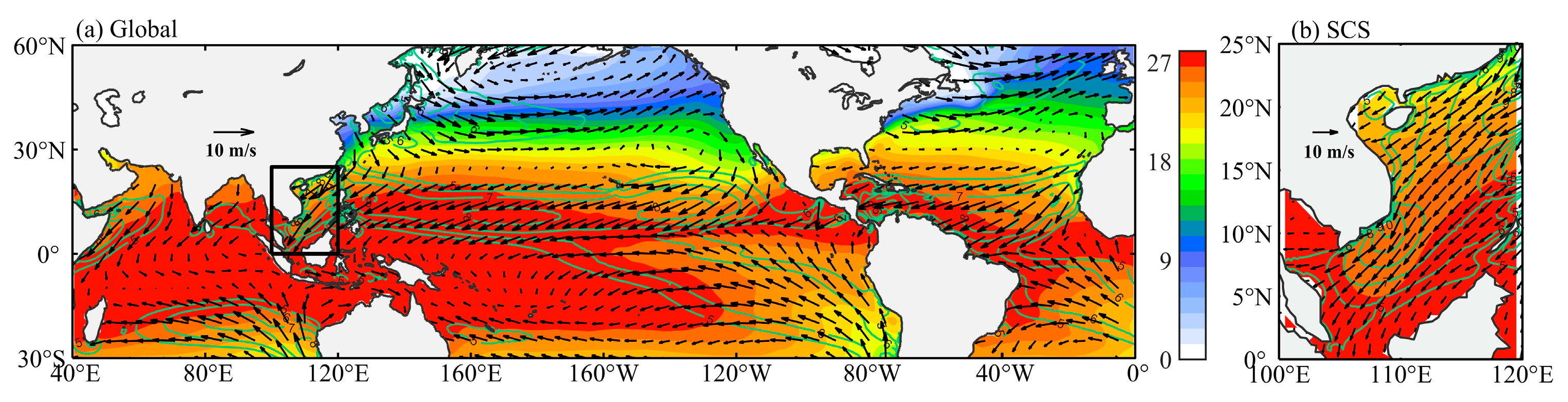
Modulated by multiple factors such as solar radiation and monsoons, the SST in the SCS features a stable north–south gradient and pronounced seasonal variability [6,7]. Previous studies have shown strong coupled feedback between winter South China Sea SST and the atmospheric system [8,9,10,11]. Under the vigorous East Asian winter monsoon and resultant cyclonic circulation, which suppresses local latent heat flux and enhances cold advection, a persistent cold tongue forms along the western boundary, leading to a south–west–northeast orientation of the isotherms (Figure 1a) [12,13,14,15]. However, winter SST in the SCS is co-modulated by global climate signals, regional circulation, and local air–sea processes across multiple scales, exhibiting significant spatiotemporal variability [16,17,18,19].
The El Niño–Southern Oscillation (ENSO) stands as one of the most prominent signals of interannual variability in the global climate system. It exerts a dominant influence on the climate of the northwestern Pacific and adjacent marginal seas, including the SCS, via atmospheric teleconnections and oceanic pathways [20,21]. During El Niño events, SST anomalies in the tropical central-eastern Pacific trigger a Matsuno–Gill-type atmospheric response, giving rise to an anomalous anticyclone over the northwestern Pacific [22]. The anomalous southerlies on the western flank of the anticyclone weaken the prevailing northeasterly monsoon over the SCS. This weakening, in turn, facilitates a pronounced rise in SST, particularly in the southern basin of the SCS [23,24,25,26].
On decadal and interdecadal timescales, the Atlantic Multidecadal Oscillation (AMO) is a key climate mode, defined by persistent basin-scale SST anomalies in the North Atlantic with a quasi-periodic oscillation of 50–70 years [27]. The influence of these persistent SST anomalies extends beyond adjacent regions to remotely regulate climates as far as the western Pacific through atmospheric teleconnections. A well-coupled Atlantic–Pacific mechanism on low-frequency timescales has been identified, primarily functioning through two pathways: the tropical–tropical and extratropical–tropical routes. In the tropical pathway, previous studies used regression analysis combined with AMO index to reveal that a warm-phase AMO enhances local convection, driving a reorganization of the Walker circulation that induces subsidence over the tropical eastern Pacific. This generates anomalous easterlies over the central-western Pacific, which act through the Bjerknes feedback [28] to accumulate warm water and cause regional warming in the western Pacific [29,30]. The resultant heating then forces Gill-type atmospheric response and produces anomalous subsidence and surface westerlies over the tropical central-eastern Indian Ocean, which in turn promote the development of significant warm SST anomalies in the tropical eastern Indian Ocean and western Pacific [31,32]. Simultaneously, via the extratropical pathway, North Atlantic warming triggers ascent and upper-level divergence. This, in turn, induces compensatory subsidence over the North Pacific, forming an anomalous high-pressure system, this weakens the Aleutian Low and the subtropical westerlies. The resultant reduction in surface wind speed diminishes evaporation, promoting warming in the subtropical North Pacific (SNP) via the wind–evaporation–SST positive feedback (WES). The SNP warming pattern subsequently steers tropical wind fields to converge in the subtropics, fostering an anomalous cyclone on the northwestern Pacific. The associated increase in cloud cover enhances the absorption of longwave radiation, establishing a positive feedback among SST, sea level pressure (SLP), cloud amount, and longwave radiation that further amplifies the warm anomalies in the northwestern Pacific [33].
Similarly to the AMO, the Interdecadal Pacific Oscillation (IPO) represents another large-scale mode of SST variability with global implications. IPO represents the leading mode of decadal-scale variability in the Pacific, characterized by a quasi-periodic oscillation of 20–30 years [34]. Previous studies have revealed that its positive phase manifests as anomalous warm SST in the central-eastern tropical Pacific and anomalous cool SST in the mid-latitude Pacific, accompanied by a strengthening of the Aleutian Low, with the opposite pattern occurring during its negative phase [35,36,37]. Beyond its influence on the mid-latitude Pacific, the relationship between the IPO and decadal SST variability in the tropical Indo-Pacific warm pool region is non-stationary. The Indian Ocean Basin Mode (IOBM) serves as the primary mode of decadal SST variability in the Indian Ocean, and empirical orthogonal function (EOF) analysis of SST for the Indian Ocean reveals its linkage with the IPO underwent a notable weakening around 1985 [38,39]. Dong et al. (2017) [40] further demonstrated, using coupled climate models, that decadal changes in Indian Ocean SST are closely tied to IPO-related variability in the tropical eastern Pacific. This shift in the inter-basin relationship implies that the South China Sea SST may also have experienced analogous climatic adjustments under the evolving Indo-Pacific interplay. A significant negative correlation (r = −0.71) between the upper-ocean heat content in the SCS and the IPO is observed based on correlation analysis after the 1980s [41]. During IPO negative phases, easterly wind anomalies over the equatorial Pacific extend westward to the area east of the Philippines. These wind anomalies drive a southward shift in the North Equatorial Current bifurcation, strengthening the Kuroshio Current and suppressing water exchange through the Luzon Strait, collectively modulating the thermal structure of the SCS. This mechanism provides a new perspective on SCS winter SST responses to IPO.
In general, numerous studies have established that the AMO and the IPO exert substantial influences on interdecadal SST variability across the Pacific and Indian Oceans, including the mid-latitude North Pacific, the tropical western Pacific, the central-eastern Pacific, and the tropical Indian Ocean. It is noteworthy that the SCS, located between the Indian and Pacific Oceans, has distinct climate significantly modulated by the coordinated influence of these two oceans. However, a clear understanding of several key issues remains elusive. First, whether the decadal variability of winter SST in the SCS is intrinsically linked to the AMO and IPO has not been conclusively established. Second, the spatiotemporal characteristics exerted by the AMO versus the IPO on the SCS SST are still unclear. Finally, the physical pathways and mechanisms through which these remote climate modes modulate SCS SST lack a comprehensive and comparative analysis. Investigating the inter-basin modulation mechanisms of global large-scale SST variability modes on the South China Sea SST is of great value for constructing more accurate regional climate prediction models for the SCS, assessing the risks of extreme weather events under global warming, and is highly significant for the ecological environmental protection and marine economic development of the SCS [42,43]. In this regard, this study will use observational and reanalysis data and employ a suite of established climate methods based on EOF decomposition to explore the multi-modal characteristics of the interdecadal variability of winter SST in the SCS, and employ correlation analysis to investigate the relationships between two modes and the AMO and IPO; it is based on the normalized index of the AMO and IPO, which are widely recognized as representative measures of North Atlantic and Pacific decadal-scale SST variability, respectively [31,32,33,34,35,36]. Then, through regression analysis combined with teleconnection atmospheric bridges and oceanic pathways, we will comprehensively investigate modulation processes, pathways, and mechanisms of AMO and IPO on the interdecadal variability of winter SST in the SCS. The physical interpretation of these statistical links is grounded in established atmospheric propagation mechanisms, such as the Gill–Matsuno response and Rossby wave dynamics, and fundamental ocean–atmosphere interaction mechanisms, including the Bjerknes feedback in the tropics and the WES in the subtropics [28,33].

2. Data and Methods

2.1. Data

The monthly SST used in this study is the Hadley Center sea ice and SST dataset (HadISST) at https://www.metoffice.gov.uk/hadobs/hadisst/ (accessed on 1 July 2025) [44]. Additionally, the ERSST [45] and Kaplan SST [46] datasets are used to verify the result reliability. ERSST data were provided by the U.S. National Oceanic and Atmospheric Administration and are available at https://www1.ncdc.noaa.gov/pub/data/cmb/ersst/v5/netcdf/ (accessed on 1 July 2025); Kaplan SST data were provided by the NOAA PSL, Boulder, Colorado, USA, and can be accessed at http://psl.noaa.gov/data/gridded/data.kaplan_sst.html (accessed on 1 July 2025). The monthly mean SLP, surface wind, total cloud cover, surface heat flux, total precipitation, SST, velocity potential and divergent winds (850 hPa and 250 hPa) are sourced from the ERA5 reanalysis provided by the European Center for Medium-Range Weather Forecasts (ECMWF) at https://www.ecmwf.int/en/forecasts/datasets/reanalysis-datasets/era5 (accessed on 1 July 2025) [47]. The monthly mean oceanic currents and mixed layer depth data are sourced from the Simple Ocean Data Assimilation (SODA) system v2.2.4 at http://apdrc.soest.hawaii.edu/datadoc/soda_2.2.4.php (accessed on 1 July 2025) [48], which integrates historical shipborne hydrology and satellite observations.
The study period (1940–2023) was selected to ensure data quality and homogeneity. Notably, the SODA dataset is not available beyond 2010. Data prior to 1940, particularly from the wartime period, are known to have larger uncertainties and sparser spatial coverage, which could compromise the reliability of decadal-scale signal extraction. Data homogeneity was ensured by using widely recognized reanalysis products (ERA5, SODA) and gridded observational datasets (HadISST, ERSST). The AMO and IPO index employed are the standard, peer-reviewed definitions used in major climate studies [49,50], ensuring their representativeness of the respective climate modes. The consistency of key findings across multiple SST datasets (HadISST, ERSST, Kaplan) further verifies the robustness of the results against uncertainties in any single product.
The study focuses on the SCS, a semi-enclosed marginal sea in the northwestern tropical Pacific. Climatically, the SCS is dominated by the East Asian monsoon system. The basin exhibits a distinct north–south SST gradient during winter (Figure 1b), with mean temperatures ranging from ~20 °C in the north to ~28 °C in the south. Key oceanic processes influencing its thermodynamics include the intrusion of the Kuroshio Current through the Luzon Strait and the wind-driven basin circulation, making it a critical region for studying air–sea interactions and remote teleconnections. It is particularly emphasized that the winter mean is defined as the December(0)–February(1) average. To prevent signal disturbance from the warm waters of the southern Taiwan Strait, we restricted the analysis domain to 100–120° E and 0–20° N.

2.2. Methods

2.2.1. Extraction of the Decadal Modes

All variables were calculated as anomalies relative to the 1940–2023 climatology. Long-term linear trends were removed to exclude the influence of global warming, and decadal variability was derived by applying a 10-year low-pass filter to the detrended data. This effectively removes higher frequency interannual variability and focuses the analysis on the targeted timescales. Then, we performed an EOF decomposition on the decadal-filtered SST anomalies over the SCS to objectively identify the dominant patterns of decadal variability. The North test was used to confirm the independence of the modes. In addition to conventional filtering methods, we employed techniques like wavelet analysis to more rigorously assess the validity of the observed climate modes. Furthermore, the reliability of the EOF results is rigorously assessed through bootstrapping and Monte Carlo simulations to confirm that the observed patterns are statistically significant.
Subsequently, linear regression and correlation analysis were used to establish statistical linkages between the climate indices (AMO, IPO) and oceanic/atmospheric fields. Statistical significance was assessed using a two-tailed Student’s t-test, with the effective degrees of freedom Neff [51] adjusted to account for temporal autocorrelation, thus reducing the risk of spurious results. It is calculated by the following approximation.
1 N e f f 1 N + 2 N j = 1 N j N ρ X X ( j ) ρ Y Y ( j )
where N is the sample size; ρ X X ( j ) ρ Y Y ( j ) separately represent the autocorrelations of time series X and Y at time lag j, respectively. Furthermore, we run formal tests like KPSS, and model the data with ARIMA and state-space approaches to achieve a better handle on the temporal dynamics.
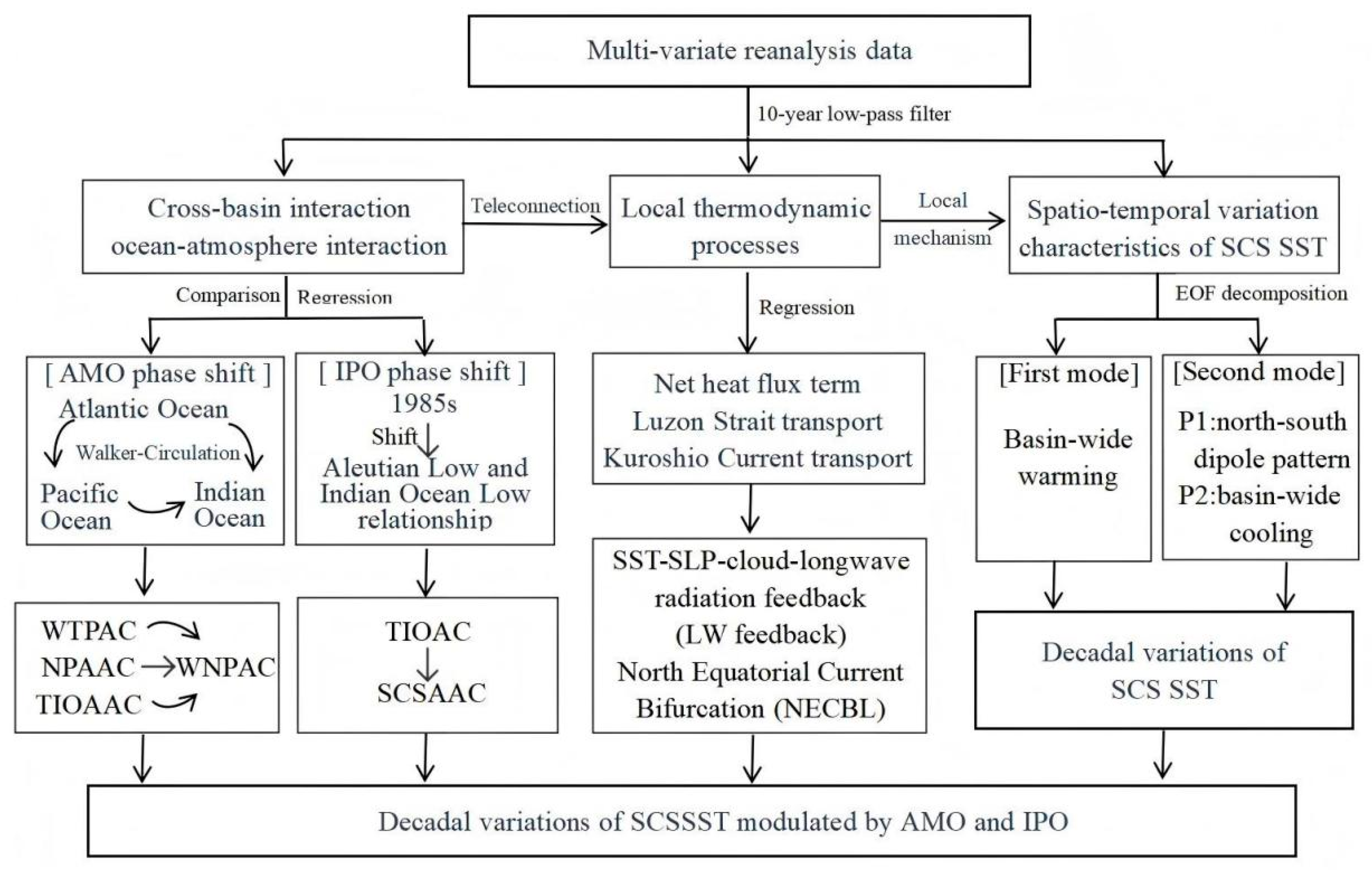
Moreover, the criteria for identifying teleconnections and underlying physical mechanisms were based on a combination of statistical evidence, dynamical consistency, and established climate theory. First, the associated atmospheric propagation mechanisms (e.g., Rossby wave trains, Gill-type responses) were identified by regressing atmospheric variables (velocity potential, divergent wind, SLP) onto the indices. Ocean–atmosphere interaction mechanisms (e.g., WES, Bjerknes feedback) were inferred from the spatial patterns of heat flux components and wind–SST coupling that form a closed, self-amplifying loop. Finally, specific teleconnection pathways were considered robust when supported by statistically significant and physically consistent anomalies across multiple, related fields (e.g., SLP, wind, precipitation), while oceanic influences (e.g., Kuroshio intrusion) were assessed by analyzing current and transport data relative to wind stress curl anomalies, ensuring that the diagnosed ocean dynamic responses were consistent with the observed SST and atmospheric circulation patterns. Finally, to clearly and reproducibly present the research process, this paper has created a complete technical roadmap flowchart (Figure 2) based on the constructed methodological framework. This flowchart systematically outlines the main steps from data preparation and analysis to result validation.

2.2.2. The Choice of Indices

Our analysis employs multiple normalized climate indices. The AMO index is defined as the area-weighted average of SST anomalies over the North Atlantic region (0–60° N, 80° W–0°) at https://psl.noaa.gov/data/correlation/amon.us.data (accessed on 1 July 2025) [49]. The IPO index is derived from the difference in the averaged SST anomalies over three regions: the northwest Pacific (25–45° N, 140° E–145° W), the central equatorial Pacific (10° S–10° N, 170° E–90° W), and the southwest Pacific (50–15° S, 150° E–160° W). It is available at https://psl.noaa.gov/data/timeseries/IPOTPI/ (accessed on 1 July 2025) [50].
To address the specific metrics used in our analysis, we calculated the volume transport of two key ocean currents. The upper 300 m Luzon Strait transport (LST) refers to the volume transport through the 120.25° E transect from 18.25° N to 22.25° N, while the Kuroshio Current transport (KC) refers to that along the 18.25° N transect between 122.25° E and 123.75° E [52].
It focuses on a qualitative analysis of the relative contributions of net surface heat flux (Qnet) to the variations in the SCS. The net surface heat flux(Qnet) can be decomposed into four components, namely shortwave radiation (Qsw), longwave radiation (Qlw), latent heat flux (Qlh), and sensible heat flux(Qsh), with each term defined as positive in a downward direction [53].
Q n e t = Q s w + Q l w + Q l h + Q s h

3. Results

3.1. The Primary Mode of South China Sea SST Interdecadal Variability

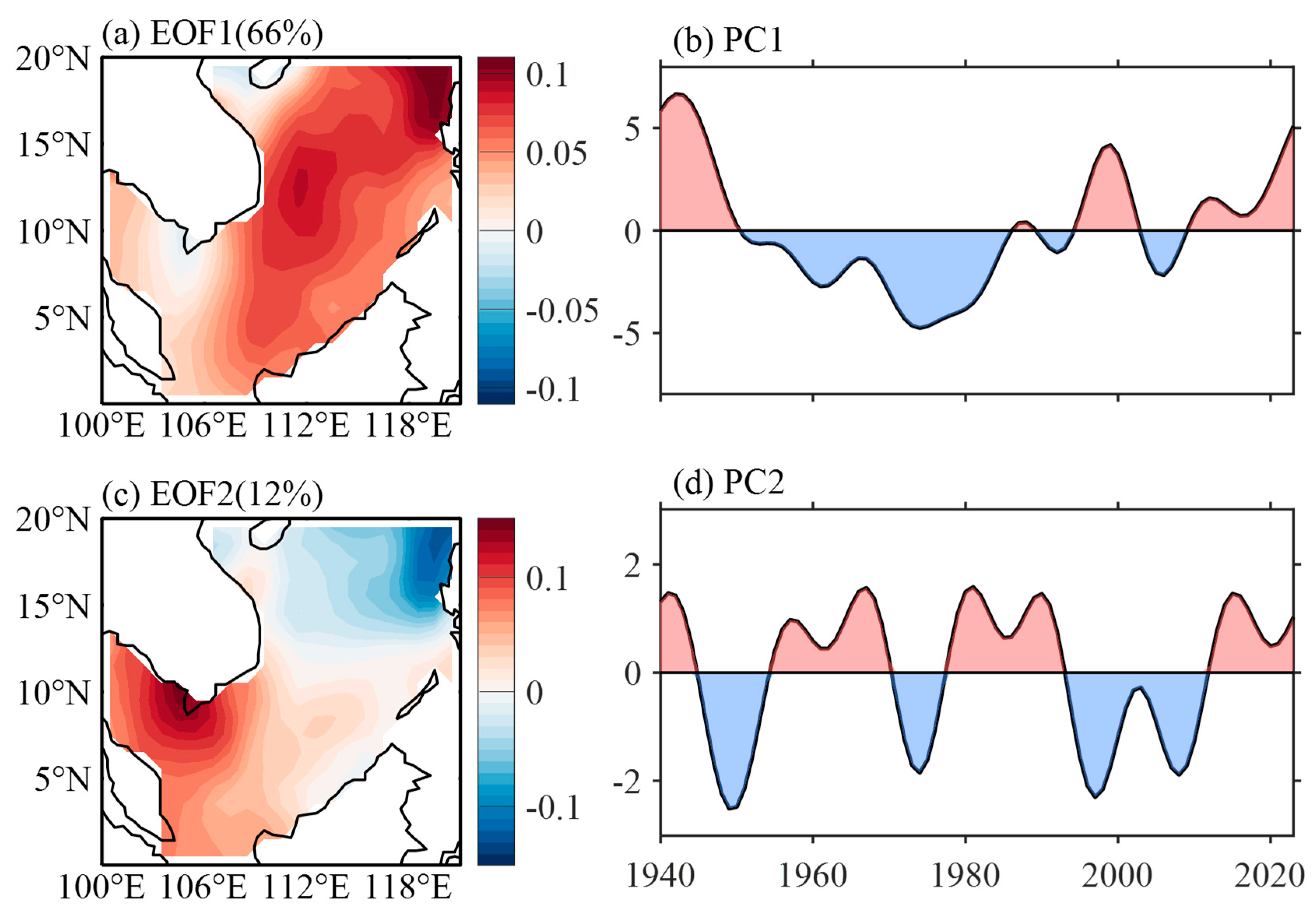
To investigate the dominant spatiotemporal patterns of winter SST variability in the SCS, this study applies the EOF decomposition to the anomalies of winter mean SST over the region bounded by 100° E–120° E and 0° N–20° N for the period 1940–2023 (Figure 3). The North test confirmed that each mode is independent.
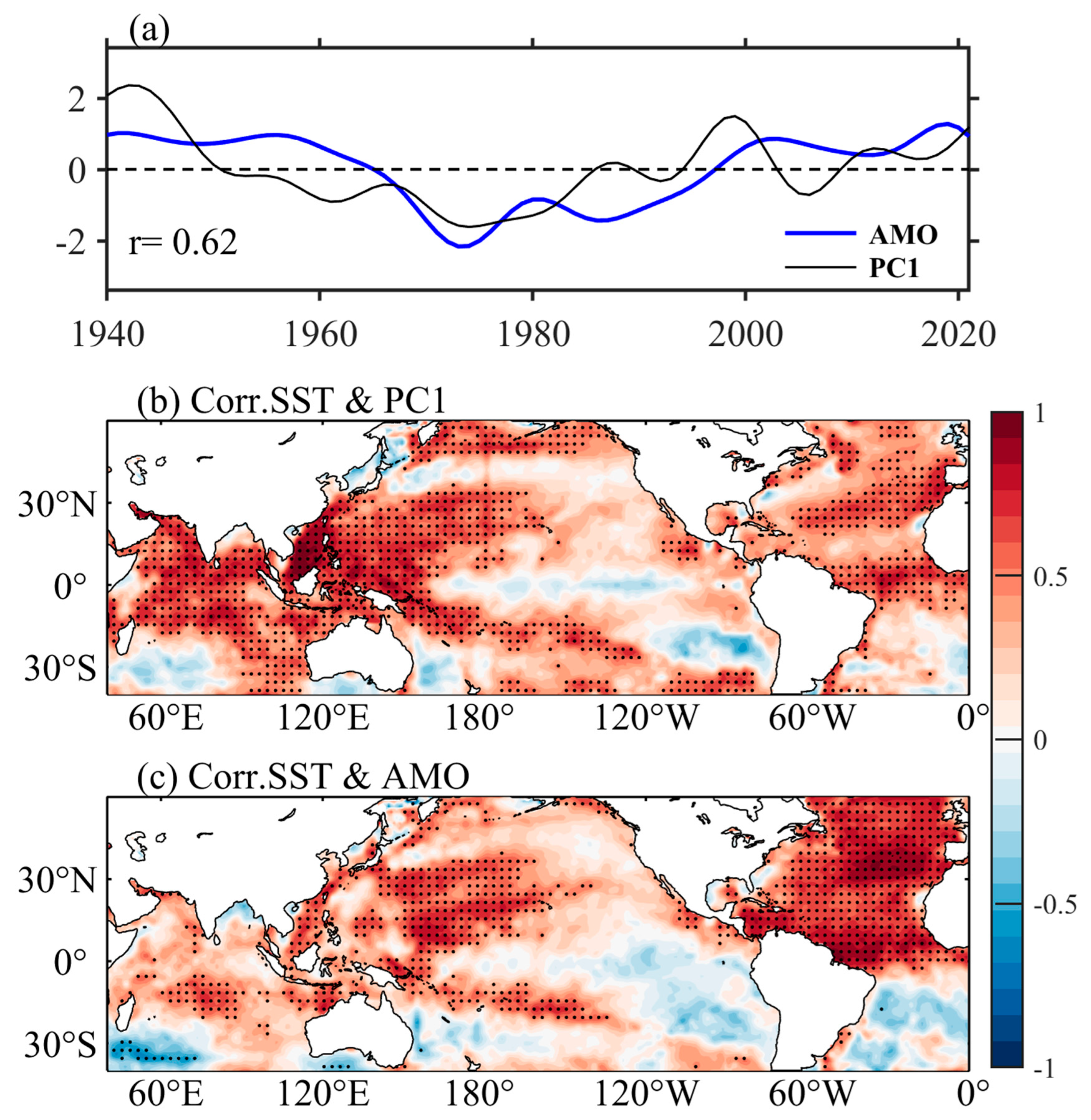
The first mode of EOF explains 66% of the total variance, displaying a pattern of basin-scale warming. Intensified warming centers are localized west of Luzon Island (12° N–20° N, 115° E–120° E) and east of the Indochinese Peninsula (8° N–12° N, 110° E–115° E), whereas relatively weaker warming is observed west of Hainan Island and southern Vietnam. Meanwhile, the corresponding principal component (PC1) and wavelet analysis exhibits clear decadal-scale fluctuations (Figure 3b and Figure S1). Similar EOF decomposition results are obtained based on ERSST, demonstrating the robustness of this mode (Figure S2). Existing research also indicates that AMO and IPO play a key role in driving global and regional decadal climate variability [54,55]. To explore the formation mechanism of EOF1, the correlation between PC1 and global decadal SST was calculated (Figure 4b). The results reveal a significant positive correlation pattern spanning the entire North Atlantic basin, closely resembling the canonical positive-phase AMO pattern. In addition, the correlation between AMO and global decadal SST anomalies yields analogous results (Figure 4c), albeit with smaller regions passing significance tests in the tropical–subtropical northwest Pacific and North Indian Ocean. The correlation pattern spans the entire North Atlantic basin, resembling the canonical positive-phase AMO pattern (Figure 4c). The decadal evolution of the normalized AMO index and PC1 shows synchronicity, with a correlation coefficient of 0.62 (Figure 4a).
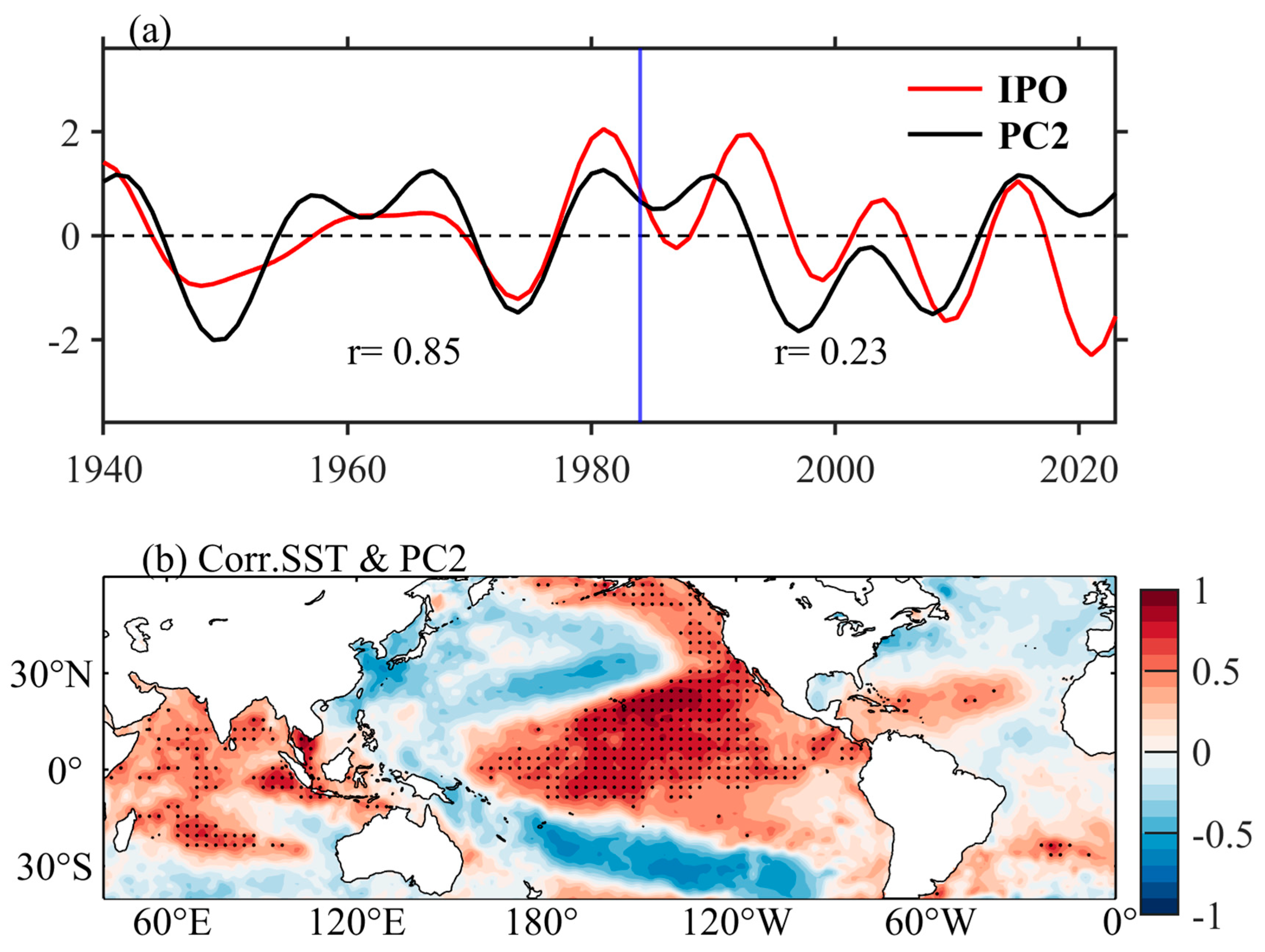
The second mode of EOF explains 12% of the total variance, presenting a southwest–northeast dipole pattern. The corresponding PC2 time series and wavelet analysis exhibit a strong interdecadal oscillation (Figure 3b and Figure S3). Correlation analysis between PC2 and global interdecadal SST anomalies (Figure 5b) reveals that the Pacific domain is marked by a distinct “horseshoe” correlation pattern. This particular mode aligns closely with the typical features of positive IPO. To assess the reliability of the dipole mode of SST in HadISST, we compared it with ERSST and Kaplan SST over 1940–2023. An IPO-based composite analysis further verifies the robustness of the second mode, with both ERSST (Figure S4b) and Kaplan SST (Figure S4c) consistently revealing a distinct north–south SCS dipole—cooling in the north and warming in the south—objectively confirming the existence and reliability of this interdecadal pattern (Figure S4a). Notably, the relationship between the IPO and PC2 underwent a significant shift, and the correlation coefficient was 0.85 prior to 1985 and 0.23 thereafter. This suggests that the relationship between the IPO and PC2 varies across these two temporal segments. In the subsequent sections, the different driving mechanisms underlying the IPO-EOF2 linkage pre- and post-1985 will be comparatively analyzed.

3.2. Connection Between AMO and the SCS Basin Mode

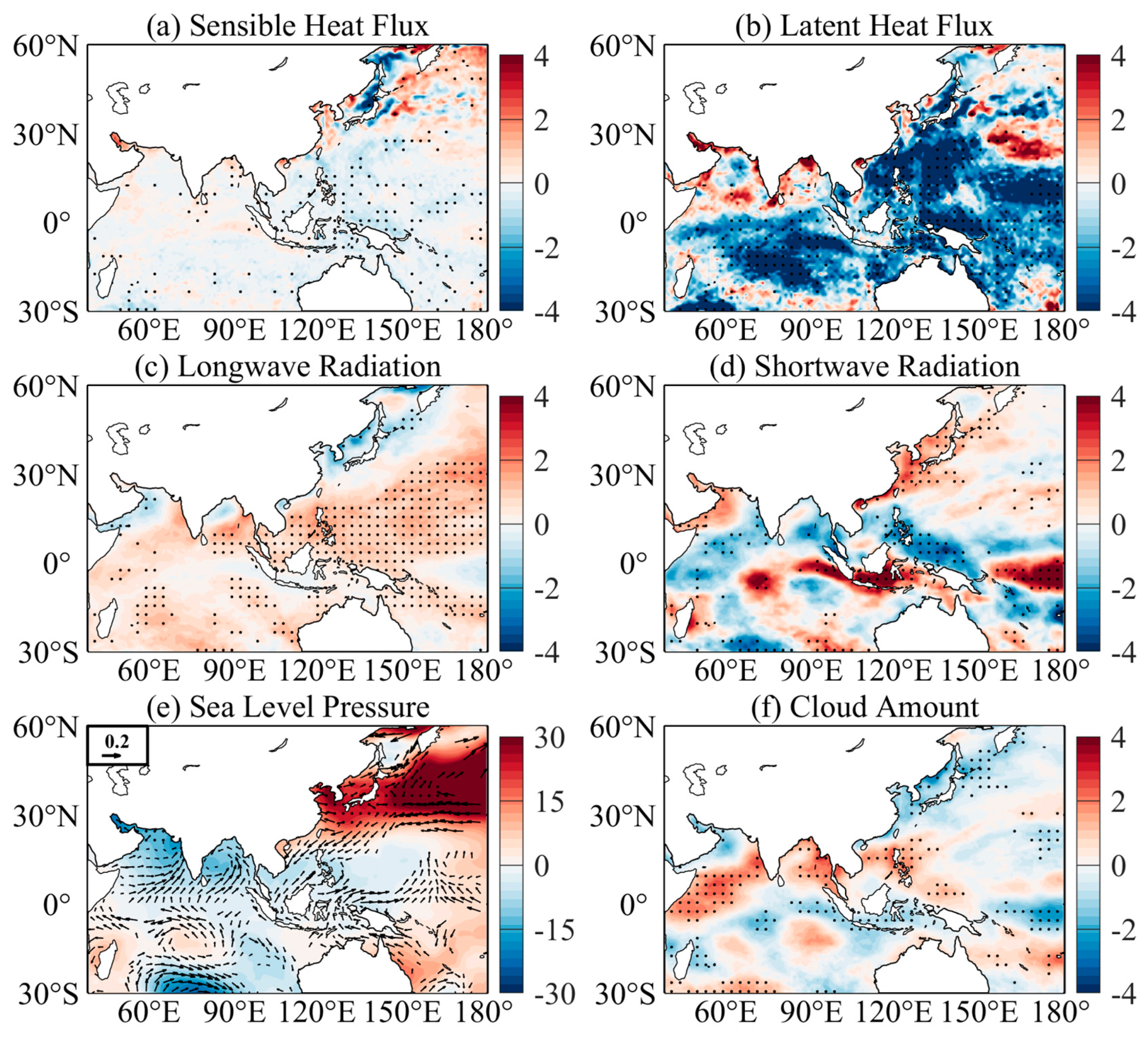
A regression analysis of atmospheric variables—specifically, the four net surface heat flux components, SLP, wind, and cloud cover over the SCS and adjacent regions—on the normalized AMO index was conducted from 1940 to 2023 (Figure 6). The results indicate that the sensible heat flux, latent heat flux, and shortwave radiation across the SCS generally exhibit negative anomalies, presenting a pattern opposite to that of SST. In contrast, the spatial pattern of positive longwave radiation anomalies (Figure 6c) aligns most consistently with the basin-wide SST warming, suggesting its primary role in the warming process. In the northeastern part of the SCS, the enhanced anomalous northeasterly wind intensifies evaporation, thereby giving rise to a pronounced negative anomaly in the latent heat flux. It is noteworthy that the dominance of longwave radiation in the warming of the South China Sea SST follows positive feedback of SST–SLP–cloud–longwave radiation. A warm anomaly in the SCS heats the overlying atmosphere, intensifying the vertical motion of the atmosphere. Then a low pressure anomaly occurs near the sea surface (Figure 6e), which facilitates convection with upward motion, consequently increasing cloud cover (Figure 6f). Dense cloud cover reduces oceanic heat loss, further amplifying the SST warm anomaly. This SST–SLP–cloud cover–longwave radiation positive feedback not only sustains the persistence of warming SST but also provides initial thermodynamic forcing for the development of cyclonic circulation over the SCS by promoting near-surface wind convergence.
The SST–SLP–cloud–longwave radiation positive feedback has been generally revealed across global tropical oceanic regions [56,57,58], with relevant evidence also reported in the SCS [23]. The aforementioned results demonstrate that longwave radiation positive feedback plays a distinct role in initiating and amplifying basin-scale SST warming of SCS. In contrast, increased cloud cover reduces incoming shortwave radiation and depresses the SST warming. The anomalous cyclone serves as the key driver of the aforementioned local positive longwave radiation feedback. Thus, investigating its generation mechanism is critical for understanding the basin-wide coherent warming of the SCS (EOF1).
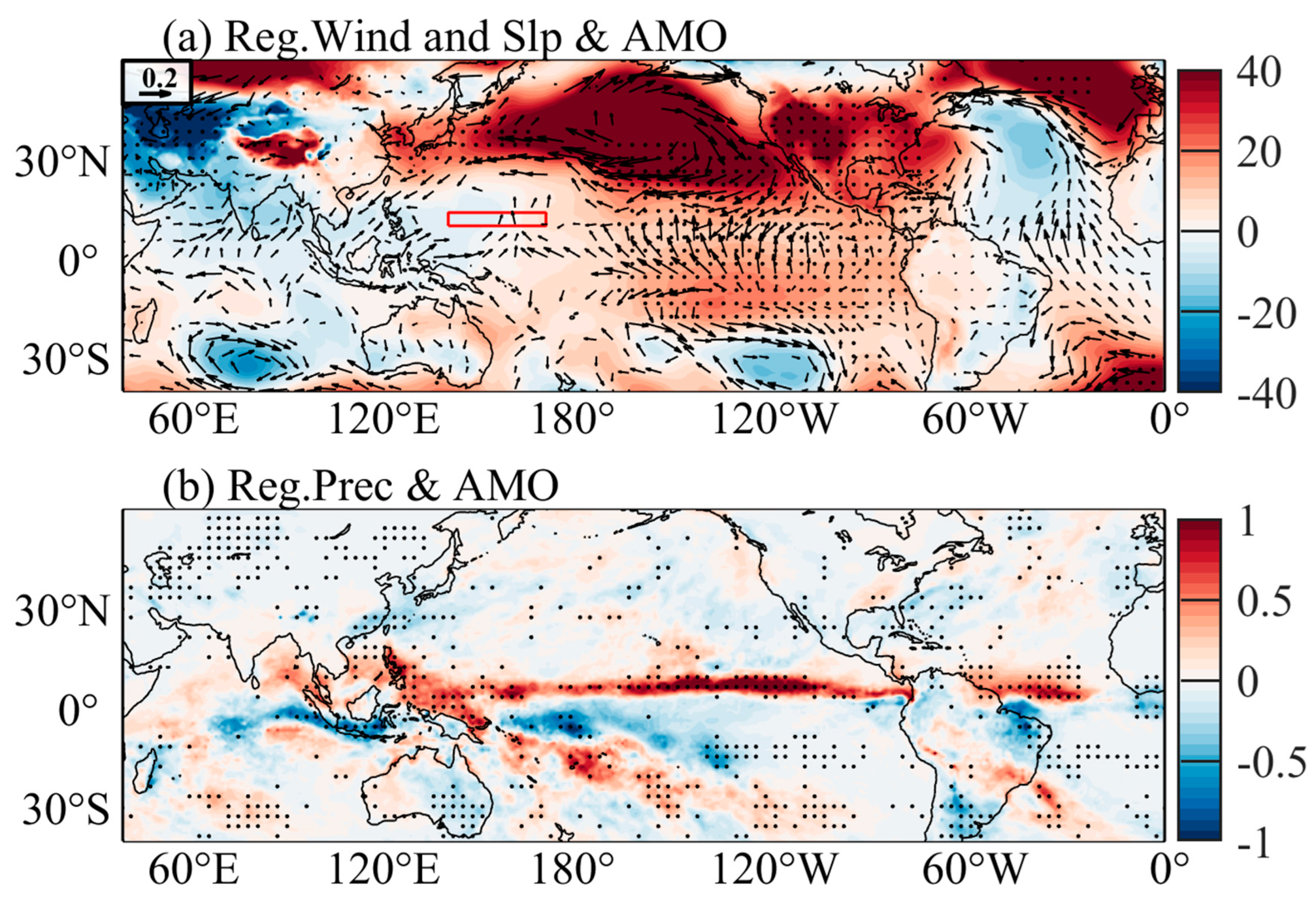
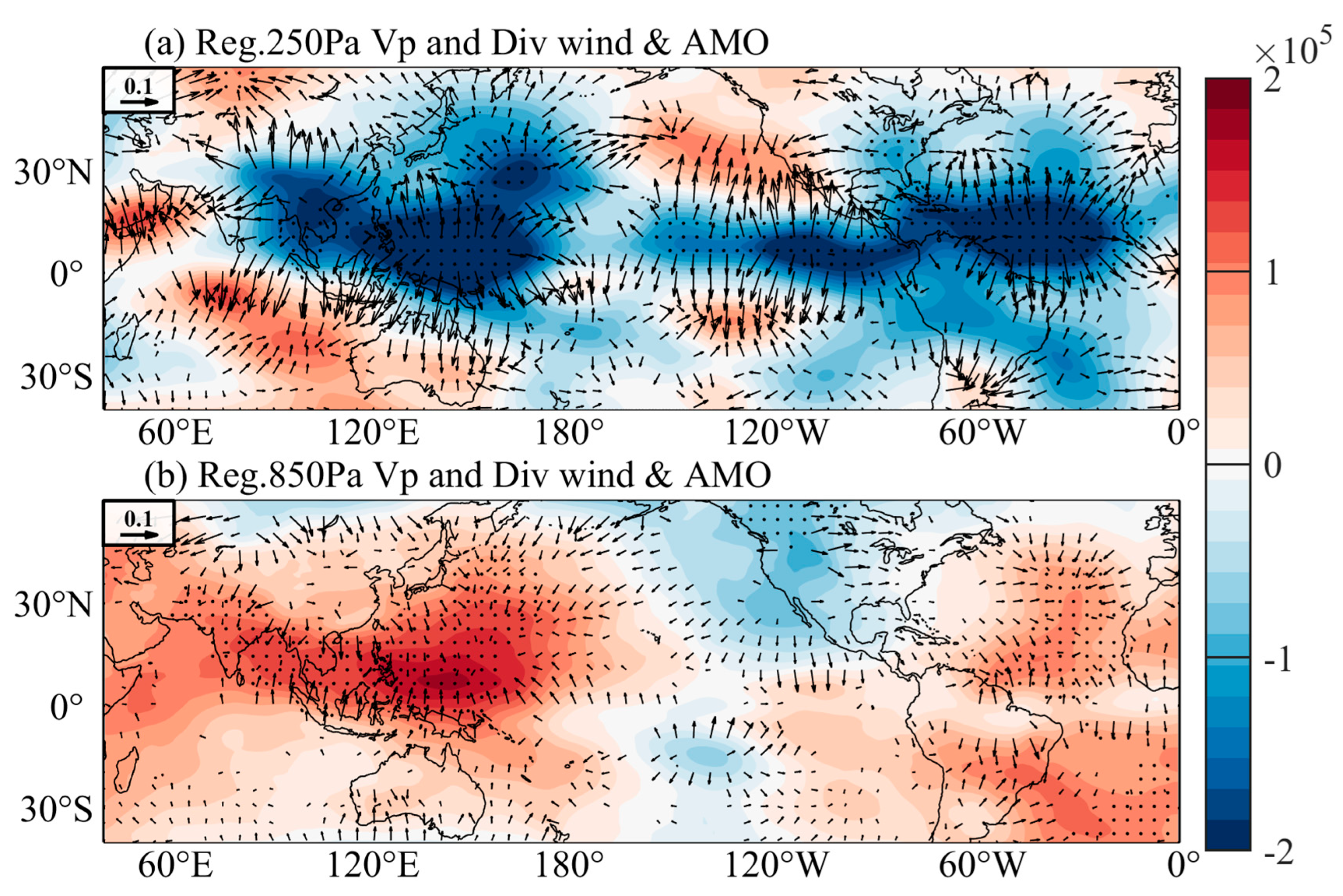
To elucidate the mechanism by which the AMO drives anomalous cyclone/anticyclone in the tropical northwestern Pacific, we conducted a regression analysis of global precipitation, wind, and SLP anomalies onto the AMO index (Figure 7). It can be seen that a pronounced anomalous cyclone was identified in the SCS and Philippine Sea. A diagnostic analysis of divergent winds and velocity potential at 850 hPa and 250 hPa (Figure 8) reveals that vertical motion around the SCS and Philippine Sea is characterized by low-level convergence and upper-level divergence. This configuration triggers deep vertical motion, which is manifested as a positive precipitation anomaly (Figure 8b). These findings demonstrate a direct relationship between the AMO and the generation of anomalous cyclone in the western Pacific and SCS.
One key pathway for the AMO to force anomalous cyclone (Figure 7a) in the western Pacific is by generating a tropical Pacific zonal temperature gradient (Figure 4c), which in turn alters the Walker circulation. During the positive phase, this process initiates with tropical Atlantic warming, which elicits an atmospheric response that enhances upward motion locally. Then the resultant large-scale adjustment of the Pacific Walker circulation produces anomalous subsidence in the east-central Pacific and ascent in the west-central Pacific (Figure 8). Notably, the easterly anomalies over the west-central Pacific induce a tilted tropical Pacific thermocline—uplifted in the eastern Pacific and deepened in the western Pacific. Western Pacific warming—driven by zonal advective feedback and thermocline deepening—stimulates convection (Figure 7b) and diabatic heating that reinforce both the anomalous ascent and the zonal SST gradient [31]. This configuration is sustained and amplified by the Bjerknes feedback [28], strengthening the initial easterly wind and SST anomalies, ultimately generating an anomalous cyclone over the WNP and SCS, culminating in the basin-coherent warming of SCS—a pattern ultimately sustained by the longwave radiation positive feedback. Collectively, the AMO exerts its influence on the western Pacific by perturbing the Pacific Walker circulation.
Another key pathway for the AMO to modulate the interdecadal variability of SST in the western tropical Pacific (WTP) and adjacent seas—including the SCS—is via the “North Atlantic–North Pacific–western North Pacific (WNP)–WTP” chain reaction [33]. During a positive AMO, a Gill-type response to North Atlantic SST warming drives upward motion via diabatic heating. This generates a characteristic vertical circulation pattern with low-level convergence and upper-level divergence. Westward propagation of this circulation anomaly induces subsidence over the North Pacific, which subsequently forms the development of a high-pressure system (Figure 7a). This high-pressure system modulates the SNP climate through the easterly anomalies on its southern flank, weakening the surface westerlies and suppressing evaporative heat loss, leading to regional SST warming. The SNP SST warming initiates a coupled air–sea process: it enhances SNP upward motion and reduces surface pressure, which intensifies the high’s subsidence over the North Pacific. This configuration is then self-amplifying via the WES, critically setting the stage for the development of a cyclonic circulation in the WTP. Ascending motion over the WNP induces upper-level divergence (Figure 8), whose southward-moving branch—deflected by the Coriolis force—converges with easterly flow to establish an anomalous cyclone over the WTP and SCS. This circulation pattern influences interdecadal SST variability through longwave radiation feedback, finalizing the AMO remote impact on the regional climate.
In addition, the anomalous heating associated with a positive AMO over the tropical Atlantic triggers an eastward-propagating equatorial Kelvin wave. While reaching eastward into the tropical Indian Ocean, these Kelvin waves induce concomitant easterly wind and positive SLP anomalies in the central oceanic basin (Figure 7a). The suppressed convection (Figure 7b), accompanied by an atmospheric structure of low-level divergence and upper-level convergence (Figure 8), triggers a basin-spanning adjustment in the Walker circulation. This relays the forcing from the Indian Ocean to the western Pacific, ultimately enhancing ascending motion and setting the stage for SCS cyclone.
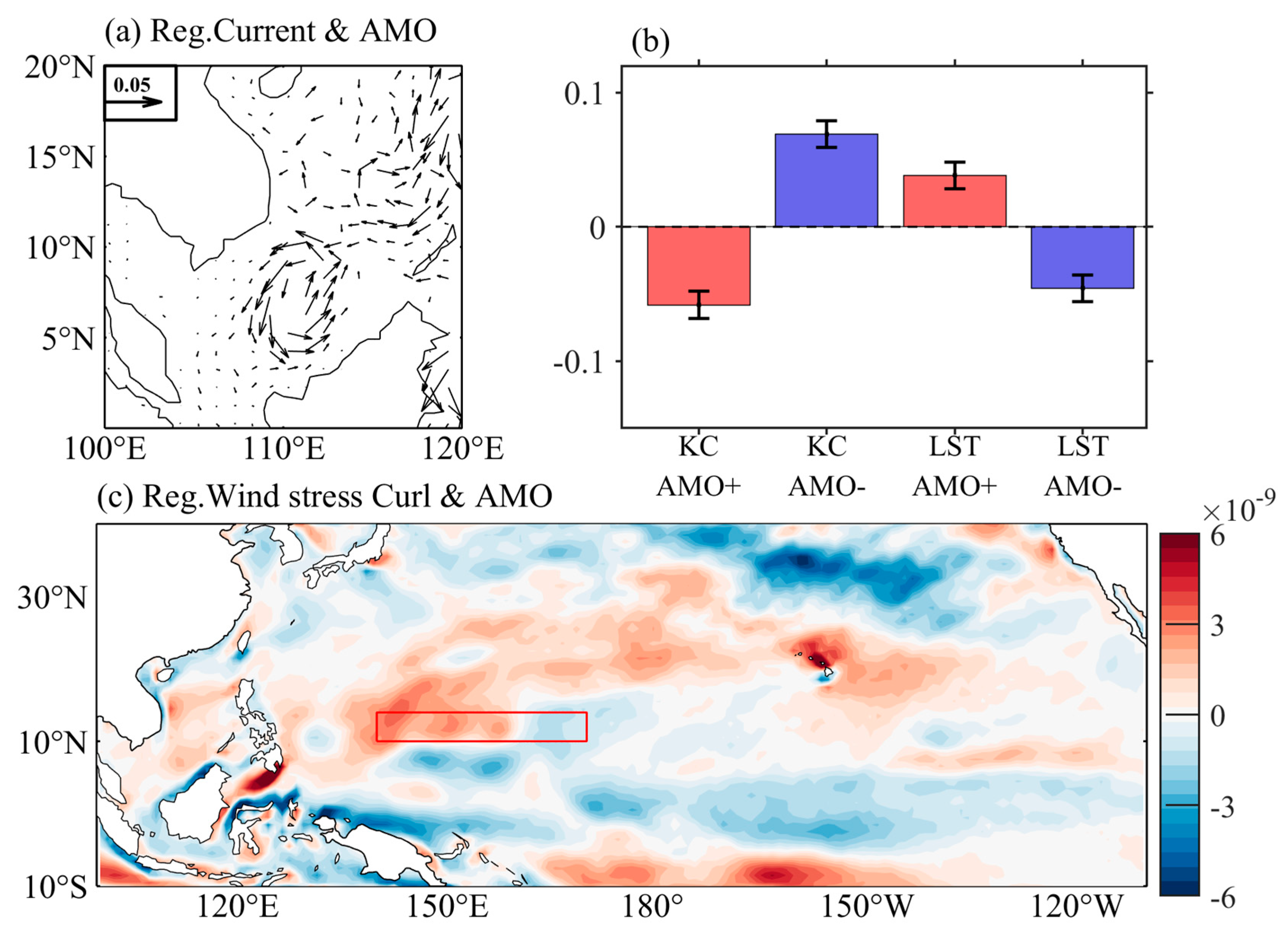
The latitudinal position of the North Equatorial Current Bifurcation (NECBL) has been conventionally estimated using mean wind stress curl anomalies around key regions adjacent to its climatological location [59,60,61]. In line with this methodology, we focus on the region 10–14° N, 140–170° E (red box, Figure 9c) to assess AMO-related wind stress curl anomalies [41]. During a positive AMO phase, the enhanced influence on the NECBL arises from a wind stress curl anomaly whose spatial extent fully encompasses this key region (Figure 9c), resulting in more effective dynamical forcing of northward migration.
Analysis further links the positive AMO to a northward NECBL shift, a weakened Kuroshio, and an enhanced LST (Figure 9b), which is a combination that promotes SCS warming and a concurrent cyclonic circulation in the region (Figure 9a). This finding aligns with the conclusions of Hu et al. (2015) [62], who reported that a northward shift in the NECBL depresses the Kuroshio, subsequently strengthening the LST. A single-layer depth-averaged model is used to investigate a western boundary current crossing a ridge gap [63]. Their model revealed that a decelerating current disrupts the balance between potential vorticity advection and the beta effect, thereby enhancing water transport through the gap. During periods of acceleration, however, the transport is diminished. This dynamic response—whereby a weakened Kuroshio enhances its SCS intrusion, thus inducing an anomalous cyclonic circulation—is analogous to the “teapot effect”, where a slower-pouring liquid adheres more to the container’s surface [52].
Through three converging atmospheric pathways—spanning the tropical Atlantic/Pacific, the North Atlantic/North Pacific, and the tropical Atlantic/Indian Ocean—the AMO synergistically forces SCS cyclonic/anticyclonic anomalies. This multi-pathway influence regulates the basin-coherent interdecadal South China Sea SST pattern (EOF1) via positive feedback combining SST–SLP–cloud–longwave radiation. Furthermore, the AMO also affects South China Sea SST variability through oceanic processes: wind-induced NECBL displacements regulate Kuroshio intrusion, which in turn modulates heat transport and thermocline structure in the SCS.

3.3. Connection Between IPO and the SCS Dipole Mode

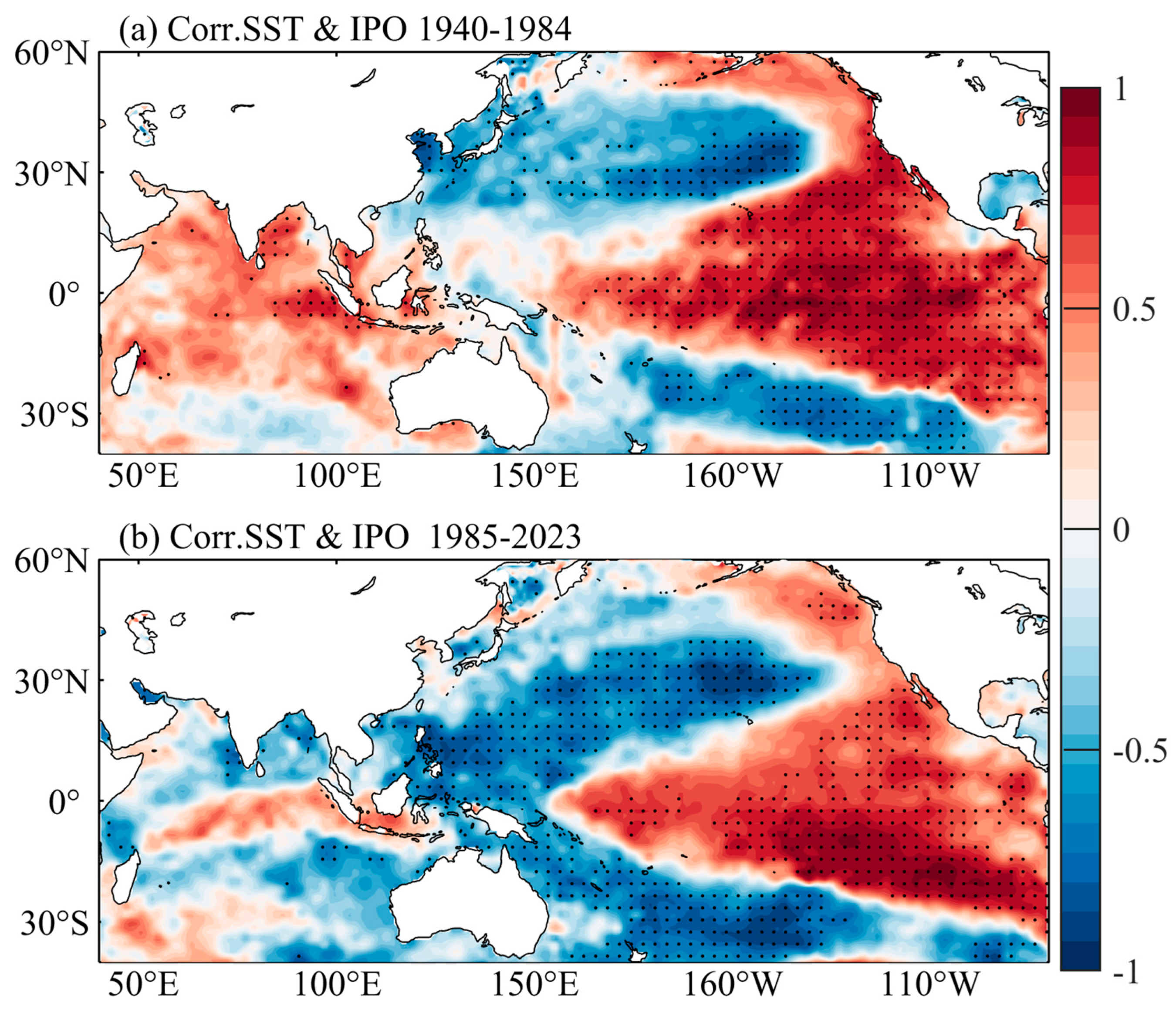
To investigate the pronounced shift in the IPO–EOF2 relationship circa 1985, we evaluated its global SST teleconnection patterns separately for two epochs: 1940–1984 (P1) and 1985–2023 (P2) (Figure 10).
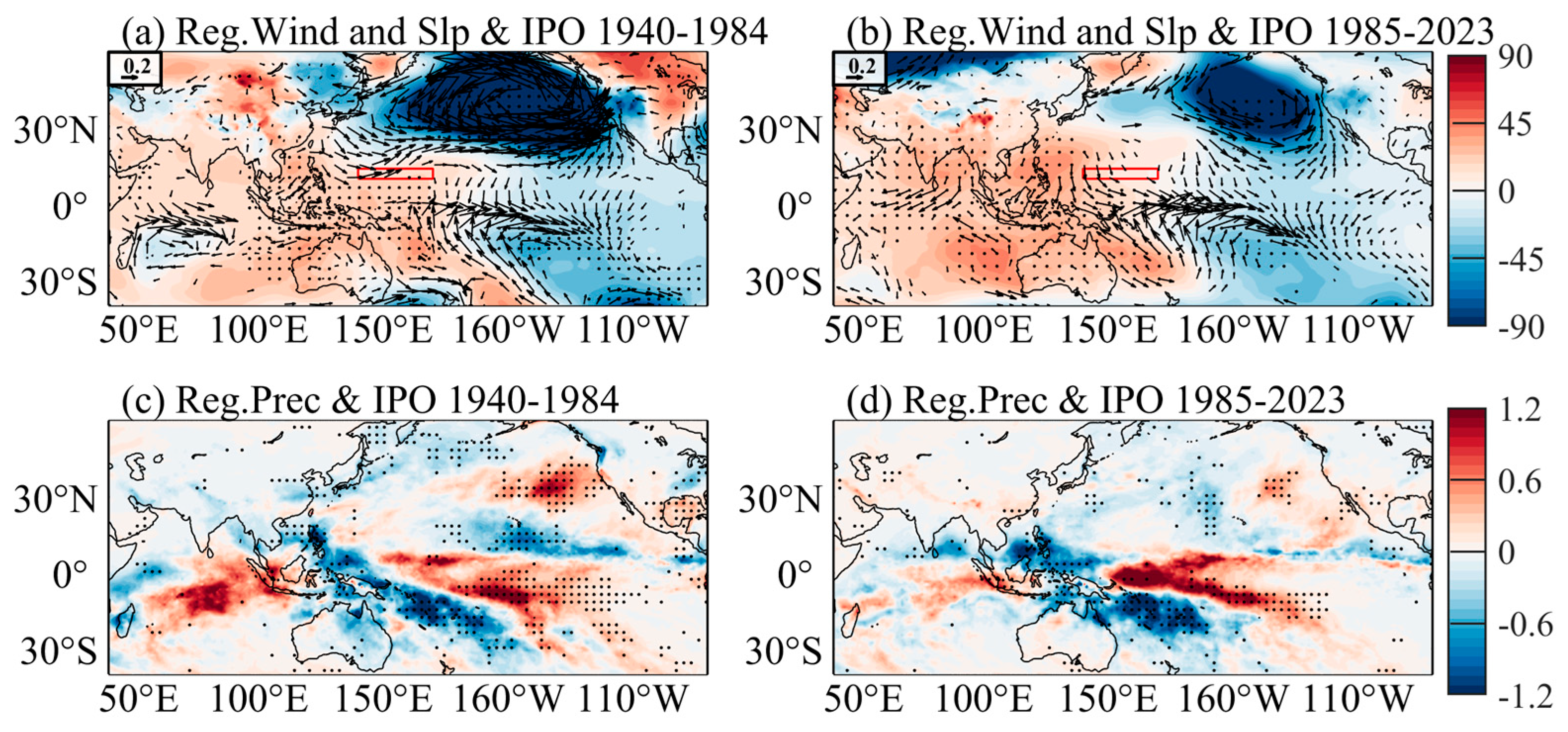
The spatial pattern of IPO correlations in P1 exhibits a dipole-like structure, with significant positive values in the equatorial central-eastern Pacific, tropical Indian Ocean, and southern SCS contrasting with negative values in the North Pacific and northern SCS (Figure 10a). In P2, this pattern changed markedly, characterized by a marked weakening of positive correlations in the tropical Indian Ocean and southern SCS and a pronounced intensification of negative correlations over the North Pacific and northern SCS (Figure 10b). Comparable shifts in SST teleconnections have been reported in the Philippine Sea and East China Sea, suggesting a basin-wide reorganization of Indo-Pacific climate modes. To probe the physical mechanisms behind the differing SST responses in the SCS, we regress net heat flux, SLP, surface wind, and cloud cover against the IPO index for both periods.
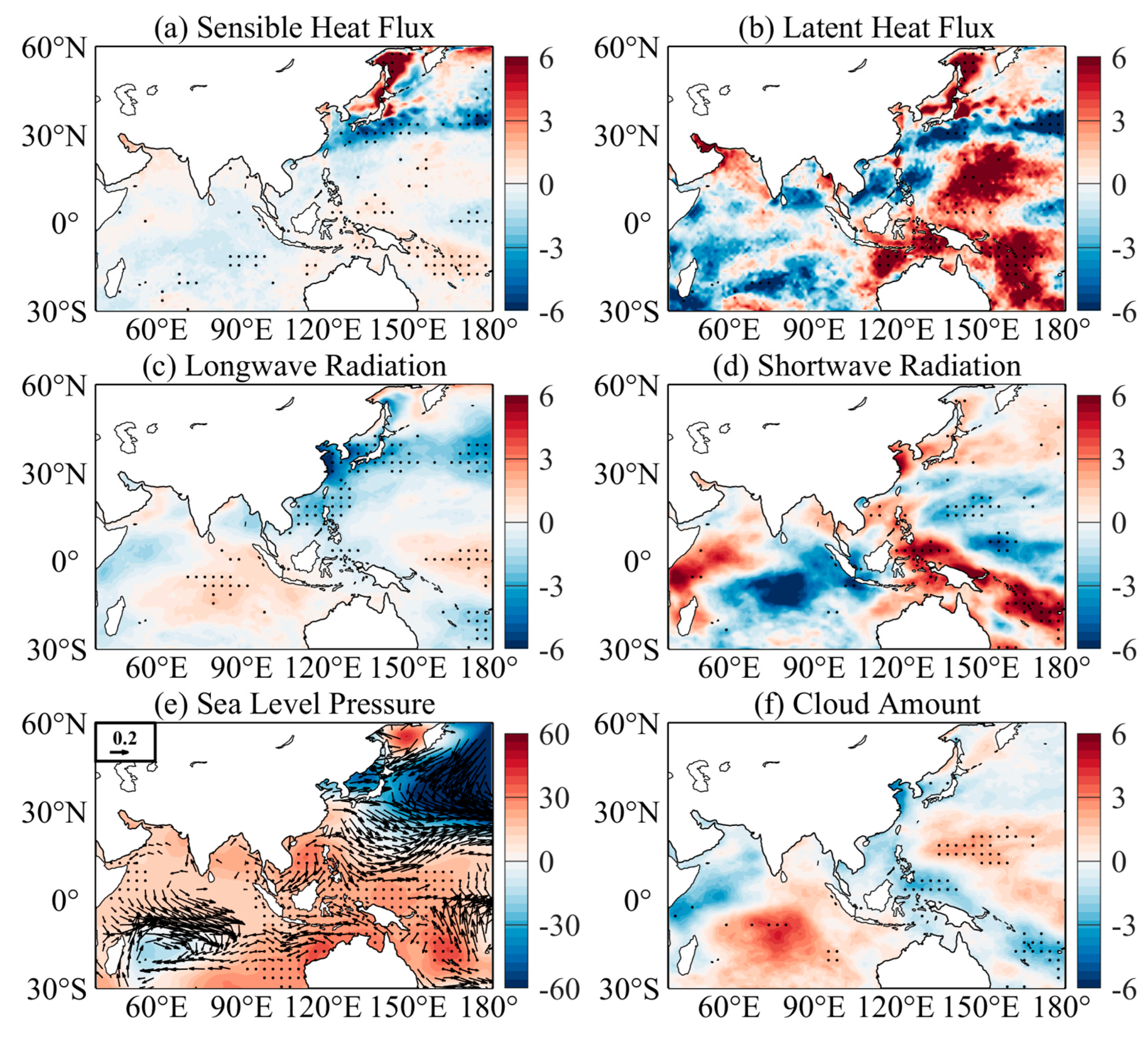
During P1, the South China Sea SST dipole (north cooling, south warming) was primarily forced by contrasting cloud-radiation effects resulting from anomalous atmospheric circulations (Figure 11). The anomalous anticyclone over the central-northern SCS (Figure 11e) induced subsidence, reduced cloud cover (Figure 11f), and enhanced shortwave radiation (Figure 11d), while the cyclonic circulation linked to Indian Ocean warming increased cloud cover over the southern SCS. This cloud dipole led to a longwave radiation pattern (negative north, positive south) that amplified the initial SST gradient (Figure 11c). The SST–SLP–cloud–longwave radiation feedback thereafter maintained and intensified the dipole, with anomalous northerlies and enhanced latent heat loss further reinforcing the northern cooling (Figure 11b).
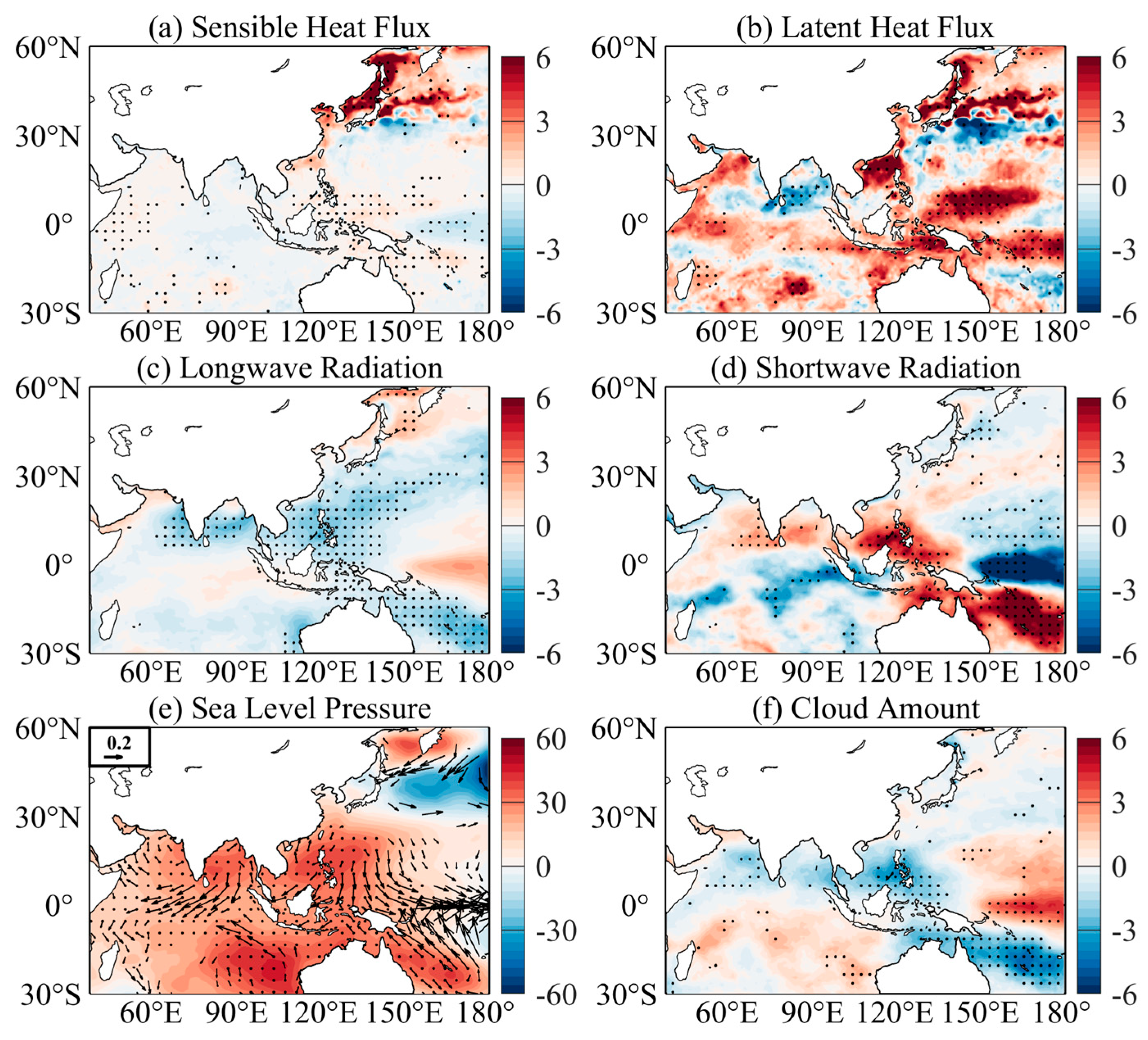
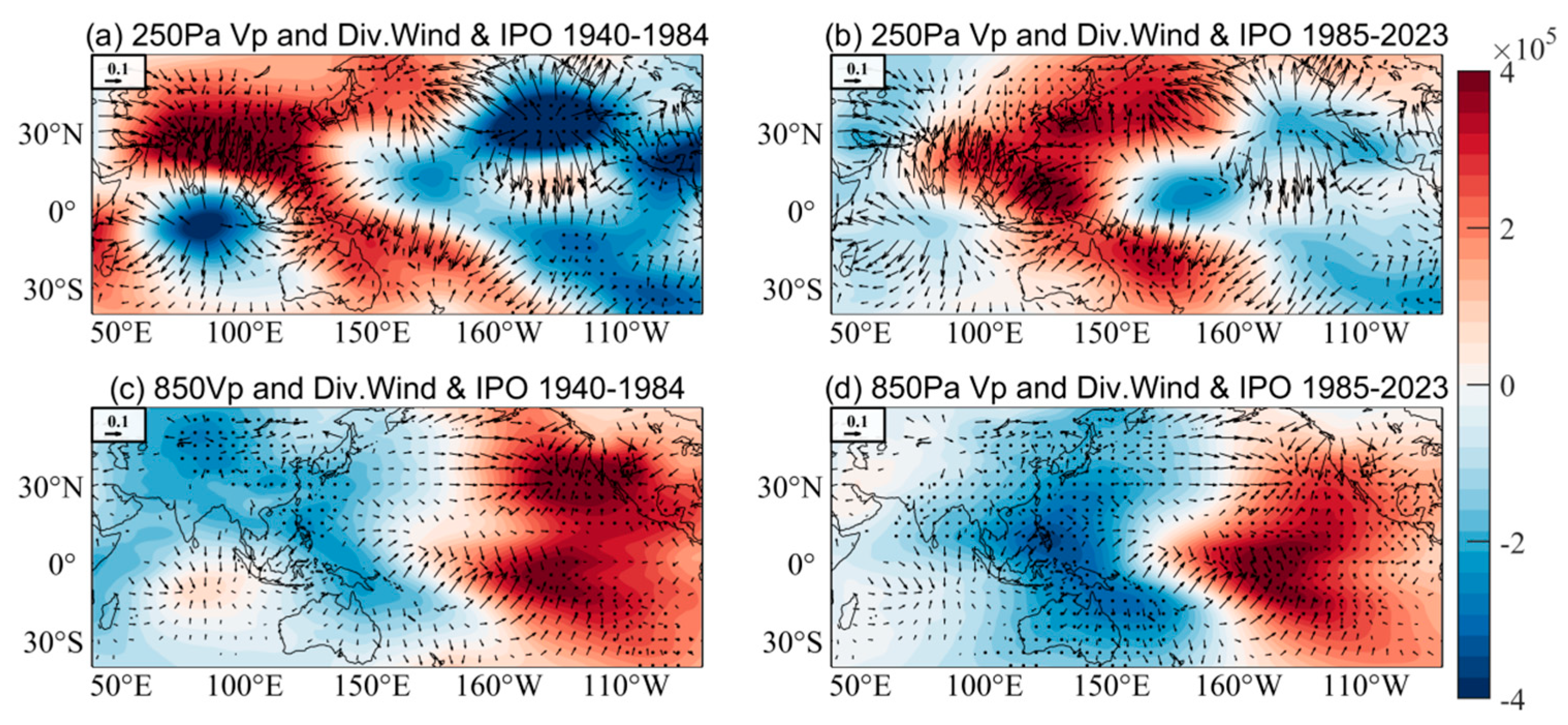
During P2, the SCS anomalous anticyclone underwent a southeastward migration, while the Indian Ocean anomalous cyclone contracted markedly (Figure 12). These adjustments allowed the high-pressure center to migrate southward and dominate the entire SCS (Figure 13). Under the influence of anomalous southerly winds on the western flank of the anticyclone, latent heat flux over the central and northern SCS shifted to significant positive anomalies (Figure 12b). The high-pressure anomaly also facilitated a reduction in cloud cover (Figure 12f), resulting in positive shortwave radiation anomalies (Figure 12d)—neither of these factors can explain the observed SCS cooling. During P2, as the IPO decoupled from the Indian Ocean (Figure S5), the associated anomalous cyclonic forcing over the region consequently weakened (Figure 13). Then longwave radiation exhibited basin-wide negative anomalies over the SCS (Figure 12c). Notably, the SST–SLP–cloud–longwave radiation feedback played a dominant role in driving basin-wide SST cooling in the SCS during P2. Our results demonstrate that the evolving IPO-EOF2 relationship across periods is largely determined by the competing influences of the SCS anomalous anticyclone and the Indian Ocean anomalous cyclone.
The South China Sea SST pattern transitioned from a dipole (P1) to basin-wide cooling (P2), driven by large-scale atmospheric adjustments (Figure 14). A southeastward migration of the SCS anticyclone forced by a contracted Aleutian Low and southward-extending WNP cooling (Figure 10b) redistributed cloud cover and surface fluxes, overwhelming the dipole structure. This regime shift, initiated by IPO-modulated tropical forcing, occurred despite Kuroshio’s persistent damping of the dipole mode (Figure S6).

4. Discussion and Conclusions

The SCS, as a central component of the Indo-Pacific warm pool, regulates regional and global climate by serving as a critical heat and moisture source. Here, an EOF decomposition of observational data reveals two leading modes of interdecadal variability in winter South China Sea SST. All raw time series underwent detrending prior to analysis, followed by application of a 10-year low-pass filter, which aimed to extract stable low-frequency climate variability signals. Significance tests were conducted on the EOF modes using North’s rules, confirming the independence of the extracted modes. We employ bootstrapping and Monte Carlo simulation for significance testing of the EOF analysis. All statistical results were subjected to a 95% confidence level in statistical significance tests that accounts for autocorrelation, ensuring that the reported teleconnections are robust. Also, we have systematically applied standardized stationarity tests such as KPSS to key climate indices (Table S1). Concurrently, we have constructed dynamic modeling frameworks such as ARIMA models and state-space models (Figures S7 and S8) to more clearly reveal their intrinsic temporal evolution patterns, thereby enhancing the robustness of statistical conclusions. The results show that dynamics of interdecadal variability are driven by remote forcing from AMO and IPO. And our wavelet analysis (Figures S1 and S3) indeed supports the dominance of the AMO and IPO at the decadal scale. The identified AMO and IPO pathways likely extend beyond the SCS, influencing adjacent basins such as the East China Sea and Philippine Sea through shared atmospheric bridges and oceanic currents. Incorporating these regions into future analyses will enhance the robustness of Indo-Pacific climate predictions.
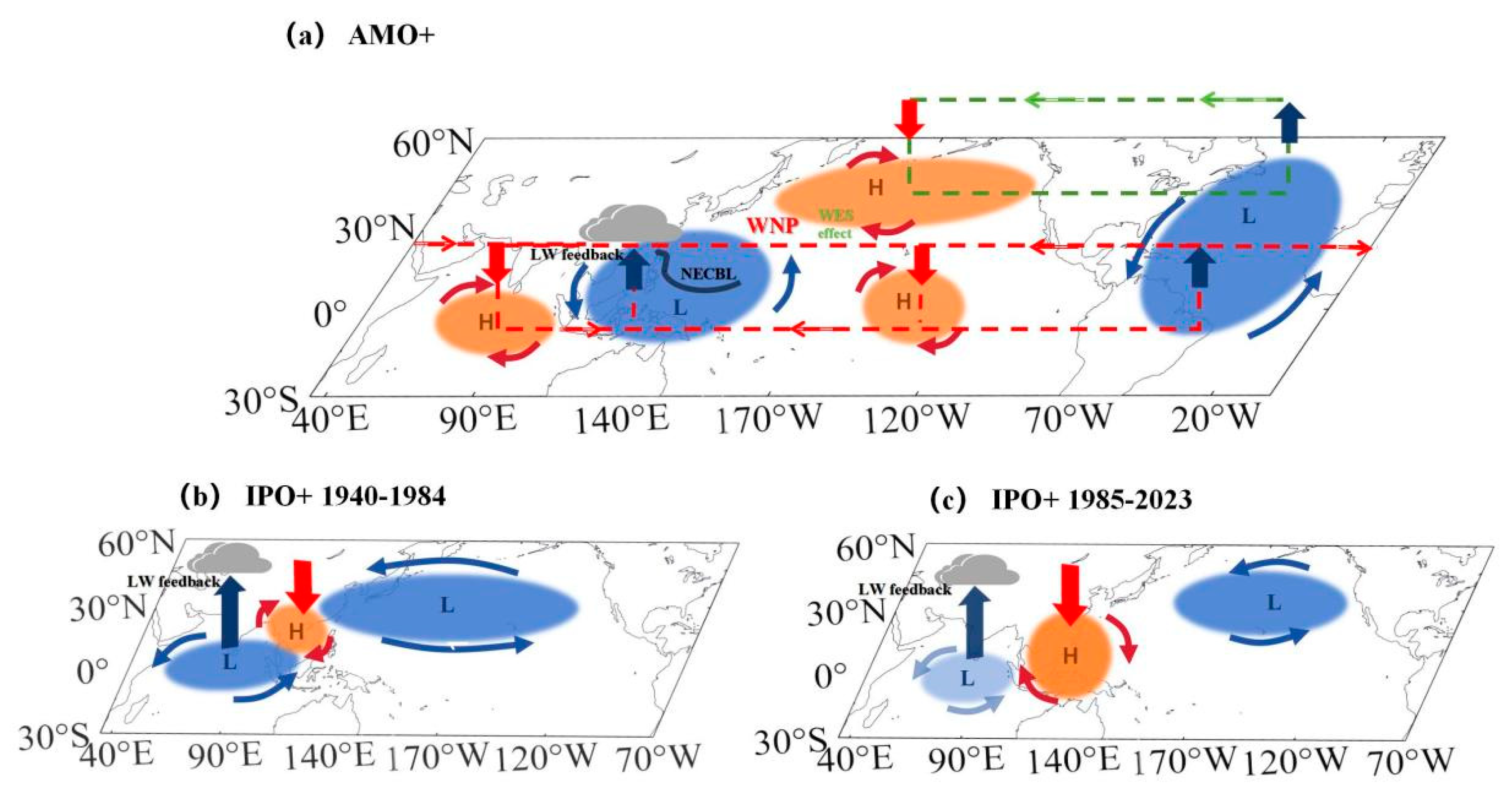
The EOF1 mode, characterized by basin-warming SST of the SCS, is primarily forced by the remote influence of the AMO. The AMO modulates the SCS thermal state through three distinct pathways, each culminating in the development of anomalous cyclonic circulation over the WNP and the SCS. These cyclonic anomalies subsequently drive basin-wide warming via positive feedback involving SST–SLP–cloud–longwave radiation. During the AMO positive phase, the teleconnection operates as follows: (a) Warm SST anomalies in the tropical Atlantic strengthen the tropical Pacific Walker circulation through atmospheric teleconnection. The resulting equatorial easterly anomalies promote western Pacific warming via the Bjerknes feedback, which then excites a Gill-type response, generating anomalous cyclone over the WNP and the SCS. (b) Anomalous cyclone over the North Atlantic, associated with local warm SST anomalies, triggers the development of an anomalous anticyclone on the North Pacific. These anticyclonic anomalies induce SNP SST warming through the WES positive feedback mechanism. In response, surface winds converge from the tropics toward the subtropics, ultimately initiating an anomalous cyclone over the WNP and the SCS. (c) Warm SST anomalies in the tropical Atlantic excite eastward-propagating Kelvin waves, which generate anomalous easterly winds and a high-pressure system over the tropical Indian Ocean. By perturbing the Indo-Pacific Walker circulation, this high-pressure system indirectly contributes to the genesis of anomalous cyclone over the SCS (Figure 15a). In addition, the AMO modulates SST variability in the northern SCS by influencing wind patterns over the NECBL. These wind anomalies further regulate the strengthened Kuroshio Current and its intrusion into the SCS, thereby indirectly shaping thermal conditions in the northern SCS.
This study identifies three primary pathways through which the AMO remotely influences the winter climate of the SCS, which aligns with the established ‘Atlantic –Pacific’ teleconnection framework [28,29,30,31,32,33], further clarifying its specific impacts on the South China Sea. In addition, a trans-Eurasian atmospheric bridge may represent another plausible route. Previous work suggests that AMO could modify the atmospheric anomalies over Siberia via downstream energy propagation at the mid-high latitudes over Eurasia, subsequently impacting the East Asian winter monsoon (EAWM) [64]. The associated atmospheric circulation anomalies manifest as a distinct Rossby wavetrain extending eastward to East Asia. It is accompanied by a circulation anomaly over the North Atlantic, resembling the negative phase of the North Atlantic Oscillation, reinforcing the Siberian High—a core component of the EAWM. While previous studies have established the remote influence of the AMO on Eurasian atmospheric anomalies and the subsequent modulation of the EAWM [65,66,67], a coherent physical pathway linking these mid-latitude responses to specific oceanic variability in the South China Sea (SCS) remains elusive. The strengthened EAWM would then promote enhanced southward cold air advection, potentially modulating surface wind patterns and turbulent heat fluxes, thereby modifying air–sea interactions throughout East Asia and its adjacent seas [68,69,70].
Thus, the study recognizes a critical gap in the existing literature: the precise dynamical mechanism by which Eurasian planetary-scale Rossby wavetrains propagate downstream to directly modulate the winter climate of the SCS. Specifically, we hypothesize a trans-Eurasian pathway in which AMO-driven anomalies over Siberia excite a trans-Eurasian wavetrain that extends eastward, bypassing the typical tropical teleconnection routes and establishing a direct atmospheric bridge. This pathway would explain how high-latitude forcing can remotely impact the subtropical marginal seas without relying solely on tropical heating. This trans-Eurasian pathway necessitates systematic numerical modeling to verify its existence and quantify its relative contribution to AMO-driven SCS winter climate variability. Future studies should also examine whether similar AMO- and IPO-driven mechanisms operate in neighboring regions like the East China Sea and western Pacific marginal seas, which share monsoon dynamics and oceanic pathways with the SCS.
The EOF2 mode displays a north–south dipole pattern that correlates positively with the IPO. This relationship weakened significantly after 1985, in close association with an intensified anomalous anticyclone over the SCS and a weakened anomalous cyclone over the tropical Indian Ocean. Relative to the earlier period (P1), during the later period (P2), the IPO-induced Aleutian Low shifted eastward and contracted spatially (Figure 15b,c), while the cold SST anomaly over the WNP strengthened and shifted southward. These coordinated changes caused the anomalous SCS anticyclone to intensify and migrate southeastward. Concurrently, a marked weakening in the statistical linkage between the IPO and tropical Indian Ocean SST anomalies restricted the spatial influence of the Indian Ocean cyclone. The IPO-related South China Sea SST pattern thus transitioned from a dipole to a basin-wide cooling mode via SST–SLP–cloud–longwave radiation feedback.
This work documents a regime shift circa 1985 in how the IPO influences SCS winter SST, changing from a dipole to a basin-wide cooling mode. It coincides with a documented decoupling between the IPO and tropical Indian Ocean SSTs around the same period [38,39,40]. Our results suggest that this represents a large-scale reorganization of Indo-Pacific teleconnections. This shift is associated with large-scale atmospheric changes—including a contracted Indian Ocean low, an eastward-moving Aleutian Low, and a stronger SCS anticyclone [34,35,36]. While this study describes the associated atmospheric adjustments, the ultimate driver of this regime shift remains an open question. We hypothesize that it could be linked to the accelerated global warming trend [42,71] or a phase change in concurrent climate modes, such as the AMO [32] which transitioned to a positive phase around the mid-1990s. These factors may have altered the background state of the Indo-Pacific climate system, thereby modulating the efficacy of the IPO’s remote impacts. Yet, the detailed trans-basin pathways and the relative roles of Indian Ocean and Pacific dynamics in this IPO-SCS linkage are not fully understood. Future research must use numerical modeling to unravel the spatiotemporal structure of these teleconnections and the key air–sea interactions involved, which is critical for advancing the prediction of multidecadal climate variability in the SCS.
Despite the robust teleconnections identified, this study has several limitations that point to future research directions. First, the hypothesized trans-Eurasian atmospheric bridge for the AMO, while physically plausible, requires further validation through dedicated numerical modeling. Second, the ultimate driver of the post-1985 regime shift in the IPO-SCS relationship remains uncertain, and its potential linkage to accelerated global warming or phase changes in other climate modes warrants deeper investigation. Future work should prioritize the use of numerical model experiments to quantitatively dissect the relative contributions of these inter-basin pathways, which is critical for advancing decadal climate prediction in the SCS region.

Supplementary Materials

The following supporting information can be downloaded at https://www.mdpi.com/article/10.3390/jmse13122355/s1; Figure S1. Comparative wavelet analysis of PC1 and AMO Index. (a) Time series comparison between the PC1 (blue) and AMO index (red) from 1940 to 2023. (b,c) Wavelet power spectrum of PC1 and AMO; the color intensity represents the power at specific periods and times. (d) Global wavelet spectrum comparison between PC1 (blue) and AMO index (red), providing an integrated view of their dominant periodicities. Figure S2. The first two leading modes of decadal winter SST variability in the SCS derived from EOF analysis from the ERSST dataset. The dominant (a) EOF1 and (c) EOF2 modes of the winter SST anomalies in the SCS from 1940 to 2023. Decadal variability is obtained by performing a 10-year low-pass filter on the detrended data. (b,d) are unnormalized PC time series of the two decadal modes, respectively. Figure S3. Comparative wavelet analysis of PC2 and IPO Index. (a) Time series comparison between the PC2 (blue) and IPO index (red) from 1940 to 2023. (b,c) Wavelet power spectrum of PC2 and IPO; the color intensity represents the power at specific periods and times. (d) Global wavelet spectrum comparison between PC2 (blue) and IPO index (red), providing an integrated view of their dominant periodicities. Figure S4. (a) Composite of SST (°C) from the HadISST dataset. The composite is calculated in terms of the IPO index with the positive minus negative phases. The positive (negative) phase is selected when the IPO index is of greater (less) than 0.5 standard deviations. (b,c) As in (a), but for the ERSST and Kaplan SST datasets, respectively. Figure S5. Decadal variation in the relationship between winter Indian Ocean (40–100° E, 30° S–30° N) SST (purple line) and decadal-filtered IPO index (blue line). Figure S6. Regression of mixed layer currents against normalized IPO Index during (a) 1940–1984 and (b) 1985–2010, based on SODA dataset. Figure S7. ARIMA model forecasts for (a) PC1 and (b) PC2. The blue line represents the observed values, the red line represents the ARIMA forecast, and the shaded area represents the 95% confidence interval. Figure S8. (a) PC1 and (b) PC2 state-space model with local level specification. The blue line represents the observed principal component time series, while the red line shows the estimated state (level component) derived from Kalman filtering. The light red shading indicates the 95% confidence interval for the state estimate. Table S1. Test results of PC1 and PC2.

Author Contributions

Conceptualization, Z.W. and G.Z.; methodology, M.Q. and Y.W.; software, M.Q., W.D. and R.S.; validation, S.Y., Y.Z. and Z.W.; formal analysis, S.Y., Z.W. and M.Q.; resources, G.Z. and Z.W.; investigation, S.Y.; data curation, Y.W.; writing—original draft preparation, M.Q., S.Y., Y.W. and Z.W.; visualization, R.S., W.D. and Y.Z.; writing—review and editing, Y.Z., G.Z., W.D. and R.S.; funding acquisition, Y.Z., G.Z. and Z.W. All authors have read and agreed to the published version of the manuscript.

Funding

This research was supported jointly by the Major Science and Technology Plan Project of Yazhou Bay Innovation Research Institute of Hainan Tropical Ocean College (2022CXYZD003), Scientific Research Foundation of Hainan Tropical Ocean University (NO. RHDRC202120), and Special Program of Hainan Province for Academician Innovation Platform (NO. YSPTZX202507).

Data Availability Statement

The data that support the findings of this study are available from the corresponding author upon reasonable request.

Conflicts of Interest

The authors declare that there are no conflicts of interest.

Abbreviations

South China Sea (SCS), sea surface temperature (SST), Atlantic Multidecadal Oscillation (AMO), Interdecadal Pacific Oscillation (IPO), El Niño–Southern Oscillation (ENSO), subtropical North Pacific (SNP), wind–evaporation–SST positive feedback (WES), sea level pressure (SLP), Indian Ocean basin mode (IOBM), empirical orthogonal function(EOF), Hadley Center Sea Ice and SST Dataset (HadISST), European Center for Medium-Range Weather Forecasts (ECMWF), Simple Ocean Data Assimilation (SODA), western tropical Pacific (WTP), western North Pacific (WNP), North Equatorial Current Bifurcation (NECBL).

References

  1. Frölicher, T.L.; Laufkötter, C. Emerging risks from marine heatwaves. Nat. Commun. 2018, 9, 650. [Google Scholar] [CrossRef]
  2. Frölicher, T.L.; Fischer, E.M.; Gruber, N. Marine heatwaves under global warming. Nature 2018, 560, 360–364. [Google Scholar] [CrossRef]
  3. Oliver, E.C.J.; Donat, M.G.; Burrows, M.T.; Moore, P.J.; Smale, D.A.; Alexander, L.V.; Benthuysen, J.A.; Feng, M.; Gupta, A.S.; Hobday, A.J.; et al. Longer and more frequent marine heatwaves over the past century. Nat. Commun. 2018, 9, 1324. [Google Scholar] [CrossRef]
  4. He, Y.; Shu, Q.; Wang, Q.; Song, Z.; Zhang, M.; Wang, S.; Zhang, L.; Bi, H.; Pan, R.; Qiao, F. Arctic Amplification of Marine Heatwaves under Global Warming. Nat. Commun. 2024, 15, 52760. [Google Scholar] [CrossRef] [PubMed]
  5. Zhang, M.; Han, G.; Wu, X.; Li, C.; Shao, Q.; Li, W.; Cao, L.; Wang, X.; Dong, W.; Ji, Z. SST Forecast Skills Based on Hybrid Deep Learning Models: With Applications to the South China Sea. Remote Sens. 2024, 16, 1034. [Google Scholar] [CrossRef]
  6. Yu, Y.; Zhang, H.-R.; Jin, J.; Wang, Y. Trends of sea surface temperature and sea surface temperature fronts in the South China Sea during 2003–2017. Acta Oceanol. Sin. 2019, 38, 106–115. [Google Scholar] [CrossRef]
  7. Lin, Y.; Gan, J.; Cai, Z.; Quan, Q.; Zu, T.; Liu, Z. Coherent Interannual–Decadal Potential Temperature Variability in the Tropical–North Pacific Ocean and Deep South China Sea. Geophys. Res. Lett. 2024, 51, e2024GL012345. [Google Scholar] [CrossRef]
  8. Chen, S.; Chen, J.P.; Wang, X.; Xiao, Z.N. Varying Relationship between La Niña and SST Anomalies in the Kuroshio and Adjacent Regions during Boreal Winter: Role of East Asian Winter Monsoon. J. Clim. 2023, 36, 5907–5922. [Google Scholar] [CrossRef]
  9. Zhang, L.Y.; Xu, H.M.; Ma, J.; Zhao, J.W.; Xu, X. Downstream impact of the North Pacific subtropical sea surface temperature front on the North Atlantic westerly jet stream in winter. Atmos. Res. 2021, 253, 105492. [Google Scholar] [CrossRef]
  10. Kuo, Y.C.; Tseng, Y.H. Impact of ENSO on the South China Sea during ENSO decaying winter–spring modeled by a regional coupled model (a new mesoscale perspective). Ocean Model. 2020, 152, 101655. [Google Scholar] [CrossRef]
  11. Sun, B.; Li, B.; Yan, J.; Zhou, Y.; Zhou, S. Seasonal variation of atmospheric coupling with oceanic mesoscale eddies in the North Pacific Subtropical Countercurrent. Acta Oceanol. Sin. 2022, 41, 109–118. [Google Scholar] [CrossRef]
  12. Liu, Q.; Jiang, X.; Xie, S.P.; Liu, W.T. A Gap in the Indo-Pacific Warm Pool over the SCS in Boreal Winter: Seasonal Development and Interannual Variability. J. Geophys. Res. Ocean. 2004, 109, C07012. [Google Scholar] [CrossRef]
  13. Chen, J.M.; Chang, C.P.; Li, T. Annual Cycle of the SCS Surface Temperature Using the NCEP/NCAR Reanalysis. J. Meteorol. Soc. Jpn. Ser. II 2003, 81, 879–884. [Google Scholar] [CrossRef]
  14. Koseki, S.; Koh, T.-Y.; Teo, C.-K. Effects of the Cold Tongue in the South China Sea on the Monsoon, Diurnal Cycle and Rainfall in the Maritime Continent. Q. J. R. Meteorol. Soc. 2013, 139, 1566–1582. [Google Scholar] [CrossRef]
  15. Ce Seow, M.X.; Tomoki, T. Ocean Thermodynamics Behind the Asymmetry of Interannual Variation of SCS Winter Cold Tongue Strength. Clim. Dyn. 2018, 52, 3241–3253. [Google Scholar] [CrossRef]
  16. Zhang, Y.M.; Zhao, Z.; Liao, E.; Jiang, Y. ENSO and PDO-Related Interannual and Interdecadal Variations in the Wintertime Sea Surface Temperature in a Typical Subtropical Strait. Clim. Dyn. 2022, 59, 3359–3372. [Google Scholar] [CrossRef]
  17. Zhang, L.; Wu, L.; Lin, X.; Wu, D. Modes and Mechanisms of Sea Surface Temperature Low-Frequency Variations Over the Coastal China Seas. J. Geophys. Res. 2010, 115, C08031. [Google Scholar] [CrossRef]
  18. Xiao, F.; Wang, D.; Zeng, L.; Liu, Q.-Y.; Zhou, W. Contrasting Changes in the Sea Surface Temperature and Upper Ocean Heat Content in the South China Sea During Recent Decades. Clim. Dyn. 2019, 53, 1597–1612. [Google Scholar] [CrossRef]
  19. Liu, Q.; Zheng, X. Recent Progress in China in the Study of Ocean’s Role in Climate Variation. Acta Oceanol. Sin. 2012, 31, 1–8. [Google Scholar] [CrossRef]
  20. Wu, R.; Chen, W.; Wang, G.; Hu, K. Relative Contribution of ENSO and East Asian Winter Monsoon to the South China Sea SST Anomalies During ENSO Decaying Years. J. Geophys. Res. Atmos. 2014, 119, 5046–5064. [Google Scholar] [CrossRef]
  21. Klein, S.A.; Soden, B.J.; Lau, N.C. Remote Sea Surface Temperature Variations During ENSO: Evidence for a Tropical Atmospheric Bridge. Clim. Dyn. 1999, 12, 917–932. [Google Scholar] [CrossRef]
  22. Shiozaki, M.; Enomoto, T.; Takaya, K. Disparate Midlatitude Responses to the Eastern Pacific El Niño. J. Clim. 2021, 34, 773–786. [Google Scholar] [CrossRef]
  23. Wang, Z.; Wang, Y.; Qiu, M.; Zhang, Y.; Zhang, G.; Dong, W. PDO-Modulated ENSO Impact on Southern South China Sea Winter SST: Multi-Anticyclone Synergy. J. Mar. Sci. Eng. 2025, 13, 1741. [Google Scholar] [CrossRef]
  24. Wu, S.; Lin, W.; Dong, L.; Song, F.; Yang, S.; Lu, Z.; Hu, X. Role of SST in Seasonal Western North Pacific Anomalous Anticyclone: Insights From AMIP Simulations in CMIP6. Geophys. Res. Lett. 2024, 51, e2023GL107080. [Google Scholar] [CrossRef]
  25. Zhang, W.; Tao, W.; Huang, G.; Hu, K.; Qu, X.; Wang, Y.; Tang, H.; Zhang, S. Ongoing intensification of anomalous Western North Pacific anticyclone during post-El Niño summer with achieved carbon neutrality. npj Clim. Atmos. Sci. 2024, 7, 317. [Google Scholar] [CrossRef]
  26. Jiang, N.; Yan, Q.; Wang, H.; Ma, J. Strengthened Western North Pacific Anomalous Anticyclone in an El Niño–Decaying Summer across the Last Interglacial. J. Clim. 2025, 38, 2031–2046. [Google Scholar] [CrossRef]
  27. Enfield, D.B.; Mestas-Nunez, A.M.; Trimble, P.J. The Atlantic multidecadal oscillation and its relation to rainfall and river flows in the continental US. Geophys. Res. Lett. 2001, 28, 2077–2080. [Google Scholar] [CrossRef]
  28. Bjerknes, J. Atmospheric teleconnections from the equatorial Pacific. Mon. Weather Rev. 1969, 97, 163–172. [Google Scholar] [CrossRef]
  29. Meehl, G.A.; Hu, A.; Castruccio, F.; England, M.H.; Bates, S.C.; Danabasoglu, G.; McGregor, S.; Arblaster, J.M.; Xie, S.-P.; Rosenbloom, N. Atlantic and Pacific tropics connected by mutually interactive decadal-timescale processes. Nat. Geosci. 2021, 14, 36–42. [Google Scholar] [CrossRef]
  30. Hong, S.; Kang, I.S.; Choi, I.; Ham, Y.G. Climate responses in the tropical pacific associated with atlantic warming in recent decades. Asia-Pac. J. Atmos. Sci. 2013, 49, 209–217. [Google Scholar] [CrossRef]
  31. Xue, J.; Zhang, W.; Zhang, Y.; Luo, J.J.; Zhu, H.; Sun, C.; Yamagata, T. Interdecadal modulation of Ningaloo Niño/Niña strength in the Southeast Indian Ocean by the Atlantic Multidecadal Oscillation. Nat. Commun. 2025, 16, 1966. [Google Scholar] [CrossRef] [PubMed]
  32. Kucharski, F.; Parvin, A.; Rodriguez-Fonseca, B.; Farneti, R.; Martin-Rey, M.; Polo, I.; Mohino, E.; Losada, T.; Mechoso, C.R. The teleconnection of the Tropical Atlantic to Indo-Pacific sea surface temperatures on inter-annual to centennial time scales: A review of recent findings. Atmosphere 2016, 7, 29. [Google Scholar] [CrossRef]
  33. Sun, C.; Kucharski, F.; Li, J.; Jin, F.-F.; Kang, I.-S.; Ding, R. Western tropical Pacific multidecadal variability forced by the Atlantic multidecadal oscillation. Nat. Commun. 2017, 8, 15998. [Google Scholar] [CrossRef]
  34. Dong, B.; Dai, A.; Vuille, M.; Timm, O.E. Asymmetric modulation of ENSO teleconnections by the interdecadal Pacific Oscillation. J. Clim. 2018, 31, 7337–7361. [Google Scholar] [CrossRef]
  35. Dong, B.; Dai, A. The influence of the interdecadal Pacific Oscillation on temperature and precipitation over the globe. Clim. Dyn. 2015, 45, 2667–2681. [Google Scholar] [CrossRef]
  36. Xie, M.; Wang, C. Decadal variability of the anticyclone in the western North Pacific. J. Clim. 2020, 33, 1–45. [Google Scholar] [CrossRef]
  37. Fedorov, A.V.; Hu, S.; Wittenberg, A.T.; Levine, A.F.Z.; Deser, C. ENSO low-frequency modulation and mean state interactions. In El Niño Southern Oscillation in a Changing Climate; Wiley: Hoboken, NJ, USA, 2020; Volume 253, pp. 173–198. [Google Scholar]
  38. Han, W.; Vialard, J.; McPhaden, M.J.; Lee, T.; Masumoto, Y.; Feng, M.; Ruijter, W.P.M. Indian Ocean decadal variability: A review. Bull. Am. Meteor. Soc. 2014, 95, 1679–1703. [Google Scholar] [CrossRef]
  39. Lim, E.-P.; Hendon, H.H.; Zhao, M.; Yin, Y. Inter-decadal variations in the linkages between ENSO, the IOD and south-eastern Australian springtime rainfall in the past 30 years. Clim. Dyn. 2017, 49, 97–112. [Google Scholar] [CrossRef]
  40. Dong, L.; McPhaden, M.J. Why has the relationship between Indian and Pacific Ocean decadal variability changed in recent decades? J. Clim. 2017, 30, 1971–1983. [Google Scholar] [CrossRef]
  41. Xiao, F.; Wang, D.; Yang, L. Can Tropical Pacific Winds Enhance the Footprint of the Interdecadal Pacific Oscillation on the Upper-Ocean Heat Content in the South China Sea? J. Clim. 2020, 33, 4419–4437. [Google Scholar] [CrossRef]
  42. Xu, C.; Tao, L.; Rong, Y.; Xu, C. Relative importance of global warming, the IPO, and the AMO in surface air temperature and terrestrial precipitation. Int. J. Climatol. 2024, 44, 923–952. [Google Scholar] [CrossRef]
  43. Lu, Z.; Wang, C. Influence of three tropical oceans on western North Pacific anticyclone strengthening under global warming. npj Clim. Atmos. Sci. 2025, 8, 349. [Google Scholar] [CrossRef]
  44. Kennedy, J.J.; Rayner, N.A.; Smith, R.O.; Parker, D.E.; Saunby, M. Reassessing biases and other uncertainties in sea surface temperature observations measured in situ since 1850: 1. Measurement and sampling uncertainties. J. Geophys. Res. 2011, 116, D14103. [Google Scholar] [CrossRef]
  45. Smith, T.M.; Reynolds, R.W.; Peterson, T.C.; Lawrimore, J. Improvements to NOAA’s historical merged land-ocean surface temperature analysis (1880–2006). J. Clim. 2008, 21, 2283–2296. [Google Scholar] [CrossRef]
  46. Kaplan, A.; Cane, M.A.; Kushnir, Y.; Clement, A.C.; Blumenthal, M.B.; Rajagopalan, B. Analyses of global sea surface temperature 1856–1991. J. Geophys. Res. 1998, 103, 18567–18589. [Google Scholar] [CrossRef]
  47. Hersbach, H.; Bell, B.; Berrisford, P.; Hirahara, S.; Horányi, A.; Muñoz-Sabater, J.; Nicolas, J.; Peubey, C.; Radu, R.; Schepers, D.; et al. The ERA5 Global Reanalysis. Q. J. R. Meteorol. Soc. 2020, 146, 1999–2049. [Google Scholar] [CrossRef]
  48. Carton, J.A.; Giese, B.S. A Reanalysis of Ocean Climate Using Simple Ocean Data Assimilation (SODA). Mon. Weather Rev. 2008, 138, 2999. [Google Scholar] [CrossRef]
  49. Dai, A.; Fyfe, J.C.; Xie, S.-P.; Dai, X. Decadal modulation of global surface temperature by internal climate variability. Nat. Clim. Change 2015, 5, 555–559. [Google Scholar] [CrossRef]
  50. Henley, B.J.; Gergis, J.; Karoly, D.J.; Power, S.; Kennedy, J.; Folland, C.K. A tripole index for the interdecadal Pacific oscillation. Clim. Dyn. 2015, 45, 3077–3090. [Google Scholar] [CrossRef]
  51. Bretherton, C.S.; Widmann, M.; Dymnikov, V.P.; Wallace, J.M.; Bladé, I. The effective number of spatial degrees of freedom of a time-varying field. J. Clim. 1999, 12, 1990–2009. [Google Scholar] [CrossRef]
  52. Xiao, F.; Zeng, L.; Liu, Q.-Y.; Zhou, W.; Wang, D. Extreme subsurface warm events in the South China Sea during 1998/99 and 2006/07: Observations and mechanisms. Clim. Dyn. 2018, 50, 115–128. [Google Scholar] [CrossRef]
  53. Xiao, F.; Wang, D.; Leung, M.Y.T. Early and Extreme Warming in the South China Sea During 2015/2016: Role of an Unusual Indian Ocean Dipole Event. Geophys. Res. Lett. 2020, 47, e2020GL089936. [Google Scholar] [CrossRef]
  54. Yang, Y.-M.; An, S.-I.; Wang, B.; Park, J.H. A global-scale multidecadal variability driven by Atlantic multidecadal oscillation. Natl. Sci. Rev. 2020, 7, 1190–1197. [Google Scholar] [CrossRef]
  55. Tao, L.; Liang, X.S.; Cai, L.; Zhao, J.; Zhang, M. Relative contributions of global warming, AMO and IPO to the land precipitation variabilities since 1930s. Clim. Dyn. 2021, 56, 2225–2243. [Google Scholar] [CrossRef]
  56. Bony, S.; Lau, K.-M.; Sud, Y.C. Sea surface temperature and large-scale circulation influences on tropical greenhouse effect and cloud radiative forcing. J. Clim. 1997, 10, 2055–2077. [Google Scholar] [CrossRef]
  57. Eitzen, Z.A.; Xu, K.-M.; Wong, T. An estimate of low-cloud feedbacks from variations of cloud radiative and physical properties with sea surface temperature on interannual time scales. J. Clim. 2010, 24, 1106–1125. [Google Scholar] [CrossRef]
  58. Klein, S.A.; Hall, A.; Norris, J.R.; Pincus, R. Low-cloud feedbacks from cloud-controlling factors: A review. Surv. Geophys. 2017, 38, 1307–1329. [Google Scholar] [CrossRef]
  59. Qiu, B.; Lukas, R. Seasonal and interannual variability of the North Equatorial Current, the Mindanao Current, and the Kuroshio along the Pacific western boundary. J. Geophys. Res. 1996, 101, 22465–22482. [Google Scholar] [CrossRef]
  60. Qiu, B.; Chen, S. Interannual-to-decadal variability in the bifurcation of the North Equatorial Current off the Philippines. J. Phys. Oceanogr. 2010, 40, 2525–2538. [Google Scholar] [CrossRef]
  61. Wang, X.; Tong, B.; Wang, D.; Yang, L. Variations of the North Equatorial Current bifurcation and the SSH in the western Pacific associated with El Niño flavors. J. Geophys. Res. Ocean. 2019, 125, e2019JC015733. [Google Scholar] [CrossRef]
  62. Hu, D.; Wu, L.; Cai, W.; Gupta, A.S.; Ganachaud, A.; Qiu, B.; Gordon, A.L.; Lin, X.; Chen, Z.; Hu, S.; et al. Pacific western boundary currents and their roles in climate. Nature 2015, 522, 299–308. [Google Scholar] [CrossRef]
  63. Sheremet, V. Hysteresis of a western boundary current leaping across a gap. J. Phys. Oceanogr. 2001, 31, 1247–1259. [Google Scholar] [CrossRef]
  64. Geng, X.; Zhang, W.; Stuecker, M.F.; Liu, P.; Jin, F.-F.; Tan, G. Decadal modulation of the ENSO–East Asian winter monsoon relationship by the Atlantic Multidecadal Oscillation. Clim. Dyn. 2017, 49, 2531–2544. [Google Scholar] [CrossRef]
  65. Chen, P.; Lu, R. A teleconnection pattern of upper-tropospheric circulation anomalies over the Eurasian continent associated with the interannual variability of atmospheric convection over the tropical western North Pacific in July. Atmos. Ocean. Sci. Lett. 2024, 17, 100451. [Google Scholar] [CrossRef]
  66. Song, L.; Wu, R. Two types of Rossby wave breaking events and their influences on East Asian winter temperature. J. Geophys. Res. Atmos. 2021, 126, e2020JD033917. [Google Scholar] [CrossRef]
  67. Li, X.; Holland, D.M.; Gerber, E.P.; Yoo, C. Rossby Waves Mediate Impacts of Tropical Oceans on West Antarctic Atmospheric Circulation in Austral Winter. J. Clim. 2015, 28, 150904104833007. [Google Scholar] [CrossRef]
  68. Chen, L.; Chen, W.; Hu, P.; Chen, S.; An, X.; Ma, T.; Wang, Z. Processes and mechanisms of the initial formation of the Siberian High during the autumn-to-winter transition. Clim. Dyn. 2024, 62, 315–329. [Google Scholar] [CrossRef]
  69. Sun, C.; Yan, X. Interannual variations of surface winds over China marginal seas. Chin. J. Oceanol. Limnol. 2012, 30, 922–932. [Google Scholar] [CrossRef]
  70. Dong, Z.; Wang, L.; Gui, S.; Gong, H.; Hu, K. Diminished impact of the East Asian winter monsoon on the Maritime Continent rainfall after the late-1990s tied to weakened Siberian high–Aleutian low covariation. J. Geophys. Res. Atmos. 2023, 128, e2022JD037336. [Google Scholar] [CrossRef]
  71. Li, Z.; Liu, J.; Li, T.; Sun, Y. Relative roles of dynamic and thermodynamic processes in causing positive and negative global mean SST trends during the past 100 years. Dyn. Atmos. Oceans 2019, 86, 18–32. [Google Scholar] [CrossRef]
Figure 1. Climatological characteristics of (a) global regions and (b) the South China Sea during the winter season from 1940 to 2023: SST (shading; °C), surface wind (vectors; m s−1), and wind speed (contours; m s−1).
Jmse 13 02355 g001
Figure 2. Flowchart of research methodology. The diagram outlines the technical roadmap for identifying atmospheric teleconnections and diagnosing their underlying physical mechanisms, encompassing stages from data preparation and statistical analysis to dynamical verification and synthesis.
Jmse 13 02355 g002
Figure 3. The first two leading modes of decadal winter SST variability in the SCS derived from EOF analysis of the HadISST dataset. The dominant (a) EOF1 and (c) EOF2 modes of the winter SST anomalies over the SCS from 1940 to 2023. (b,d) are unnormalized PC time series of the two decadal modes, respectively.
Jmse 13 02355 g003
Figure 4. Link between the PC1 and the AMO. (a) Normalized time series of PC1 (black) and the normalized AMO index (blue) for 1940–2023. (b) The correlation maps of the decadal winter SST anomalies (shading; °C) with respect to the normalized PC1. (c) The correlation maps of decadal winter SST anomalies (shading; °C) with respect to the normalized AMO index. The dots denote statistical significance at the 95% level for the correlation coefficients.
Jmse 13 02355 g004
Figure 5. Link between the PC2 and the IPO. (a) Time series of the PC2 (black) and the filtered IPO index (red) for 1940–2023. The blue solid line represents the year of 1984. (b) Correlation maps of the decadal winter SST anomalies (shading; °C) with respect to the normalized PC2. The dots denote statistical significance at the 95% level for the correlation coefficients.
Jmse 13 02355 g005
Figure 6. The regression of (a) sensible heat flux, (b) latent heat flux, (c) longwave radiation, (d) shortwave radiation (shading, units: W m2), (e) SLP (shading, units: hPa), surface wind (vector, units: m s−1), and (f) total cloud amount (shading, units: %) onto the normalized AMO index. The dots denote statistical significance at the 95% level for the regression coefficients.
Jmse 13 02355 g006
Figure 7. The atmospheric response associated with the AMO. The regression of (a) SLP (shading; hPa), surface wind (vectors; m s−1), and (b) precipitation (shading; mm day−1) with respect to the normalized AMO index. The dots denote statistical significance at the 95% level for the regression coefficients. The red rectangle in (a) marks the key region (10–14° N, 140–170° E) surrounding the climatological NECBL.
Jmse 13 02355 g007
Figure 8. Large-scale atmospheric response to the AMO. (a) Regression maps of the 250 hPa velocity potential (shading; 105 m2 s−1) and divergent wind (vectors; m s−1) against the normalized AMO index. (b) Regression maps of the 850 hPa velocity potential (shading; 105 m2 s−1) and divergent wind (vectors; m s−1) against the normalized AMO index. The dots denote statistical significance at the 95% level for the regression coefficients.
Jmse 13 02355 g008
Figure 9. Physical processes related to the AMO. (a) Regression of the mixed layer current (vectors; m s−1) onto the normalized AMO index. (b) Composite KC anomaly and the LST anomaly (bar, units: Sv) for AMO+ (red) and AMO− (blue). Error bars represent the 90% confidence intervals. (c) Regression map of the wind stress curl (shading; N/m3) onto the normalized AMO index. The red rectangle in the (c) marks the key region around the climatological NECBL.
Jmse 13 02355 g009
Figure 10. Footprints of the IPO during two periods. (a) The correlation maps of the decadal annual SST anomalies (shading; °C) with respect to the normalized IPO index from 1940 to 1984. (b) As in (a), but from 1985 to 2023. The dots denote statistical significance at the 95% level for the regression coefficients.
Jmse 13 02355 g010
Figure 11. As in Figure 6, but for the normalized IPO index for 1940–1984. The dots denote statistical significance at the 95% level for the regression coefficients.
Jmse 13 02355 g011
Figure 12. As in Figure 6, but for the normalized IPO index for 1985–2023. The dots denote statistical significance at the 95% level for the regression coefficients.
Jmse 13 02355 g012
Figure 13. The atmospheric response associated with the IPO during the two periods. (a) The regression maps of the decadal winter SLP (shading; hPa), surface wind (vectors; m s−1) and (c) precipitation (shading; 10−2 mm day−1) with respect to the normalized IPO index from 1940 to 1984. (b) and (d) correspond to (a) and (c), but for the normalized IPO index from 1985 to 2023. The dots denote statistical significance at the 95% level for the regression coefficients. The red rectangle represents the key region surrounding the climatological NECBL.
Jmse 13 02355 g013
Figure 14. Atmospheric circulation associated with the IPO during the two study periods. (a,c) Regression map of the 250 hPa and 850 hpa velocity potential (shading; m2 s−1) and divergent wind (vectors; m s−1) onto the IPO index from 1940 to 1984. (b,d) As in (a,c), but from 1985 to 2023. The dots denote statistical significance at the 95% level for the regression coefficients.
Jmse 13 02355 g014
Figure 15. Schematic diagram for the teleconnections of AMO+ and IPO+ in different epochs, including SLP systems (H/L), wind anomalies (arrow), the wind–evaporation–SST effect (‘WES effect’ in the figure), the SST–SLP–cloud–longwave radiation positive feedback (‘LW feedback’), and local warming over the WNP: (a) represents the AMO+ teleconnection pattern; (b) denotes IPO+ during 1940–1984; (c) illustrates IPO+ during 1985–2023.
Jmse 13 02355 g015
Disclaimer/Publisher’s Note: The statements, opinions and data contained in all publications are solely those of the individual author(s) and contributor(s) and not of MDPI and/or the editor(s). MDPI and/or the editor(s) disclaim responsibility for any injury to people or property resulting from any ideas, methods, instructions or products referred to in the content.