Analytical Solution for Dynamic Responses of Distinct Tubular Piles Under Vertical Seismic Excitation Considering Water–Pile–Soil Interaction

Abstract
1. Introduction
2. Synopsis of Theoretical Frameworks
2.1. Fundamental Equation for Water
2.2. Fundamental Equation for Soil
2.3. Fundamental Equation for Tubular Pile
2.4. Boundary Conditions
3. Determining Solutions
3.1. Free-Field Motion (Applicable to the First and Second Types of Tubular Pile Model)
3.1.1. Outer Domain (j = 1)
3.1.2. Inner Domain (j = 2)
3.2. Scattered-Field Motion
3.2.1. Outer Water Motion (j = 1)
3.2.2. Inner Water Motion (j = 2)
3.2.3. Outer Soil Motion (j = 1)
3.2.4. Inner Soil Motion (j = 2)
3.3. Determining Solutions for the Tubular Pile
3.3.1. One-Dimensional Model of Tubular Pile
3.3.2. Three-Dimensional Model of Tubular Pile
4. Convergence and Verifying of Model
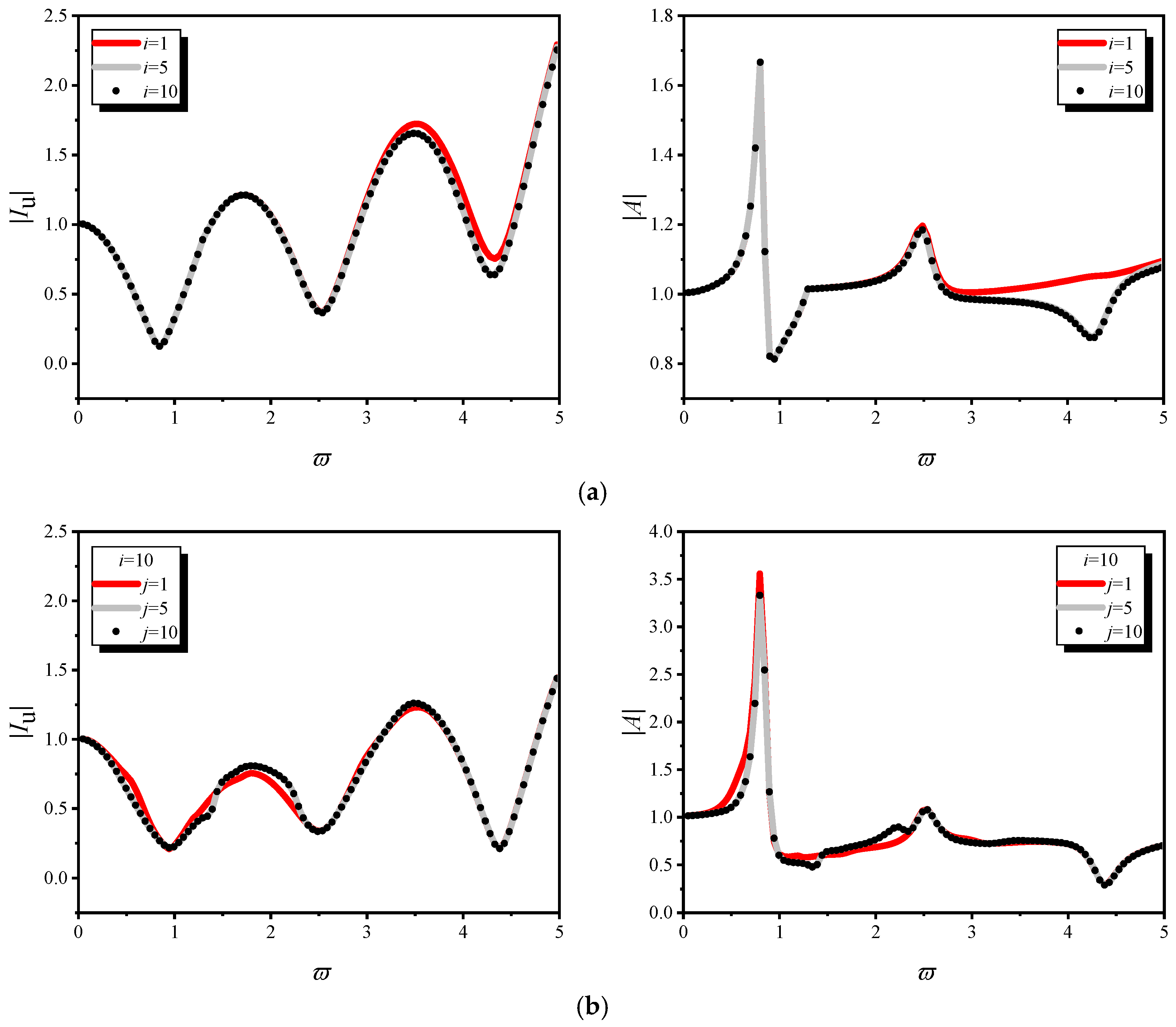
4.1. Convergence Analysis
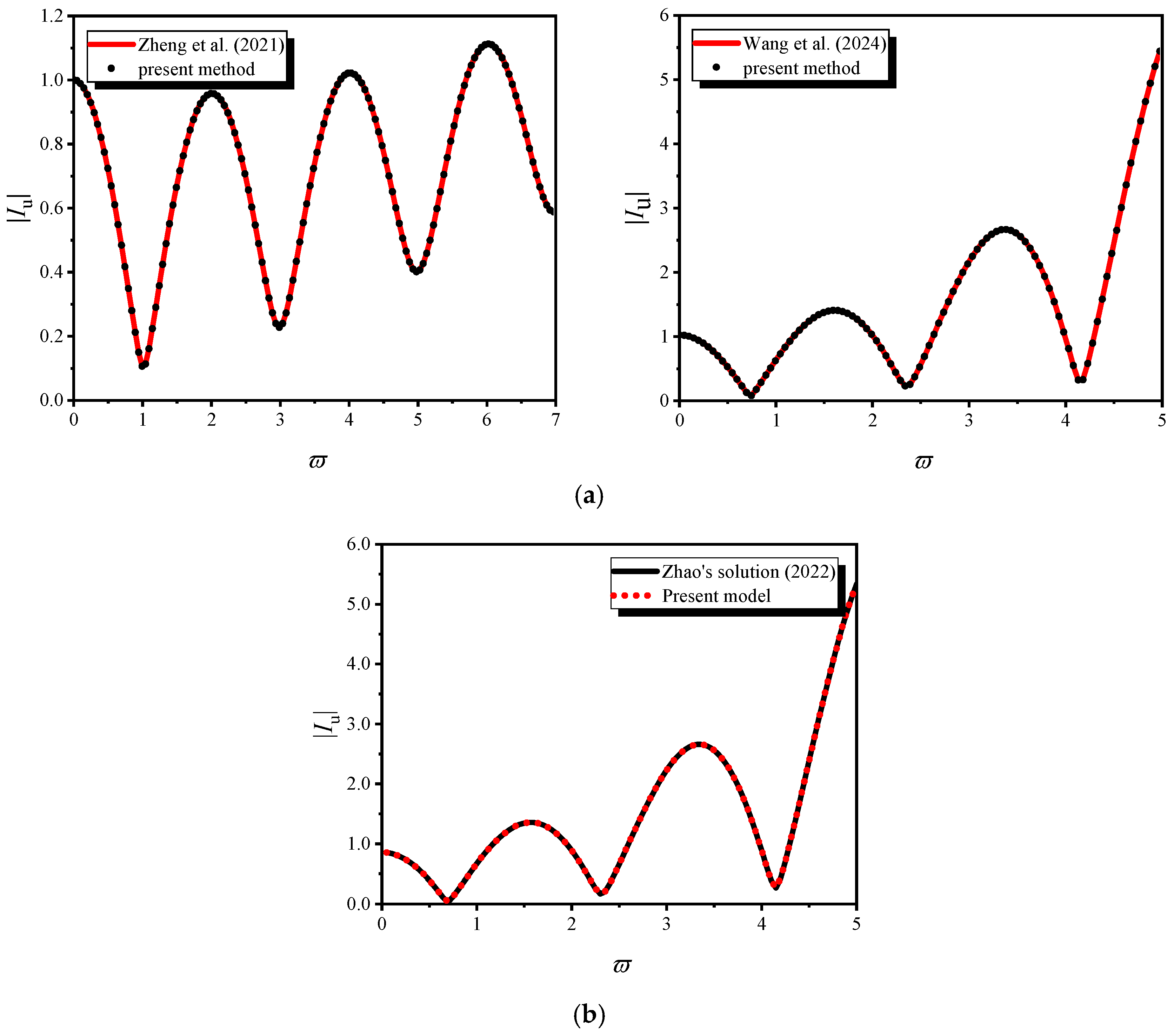
4.2. Verifying
5. Mechanism Analysis
5.1. Distinctive Effects of the Scattering Field
- (1)
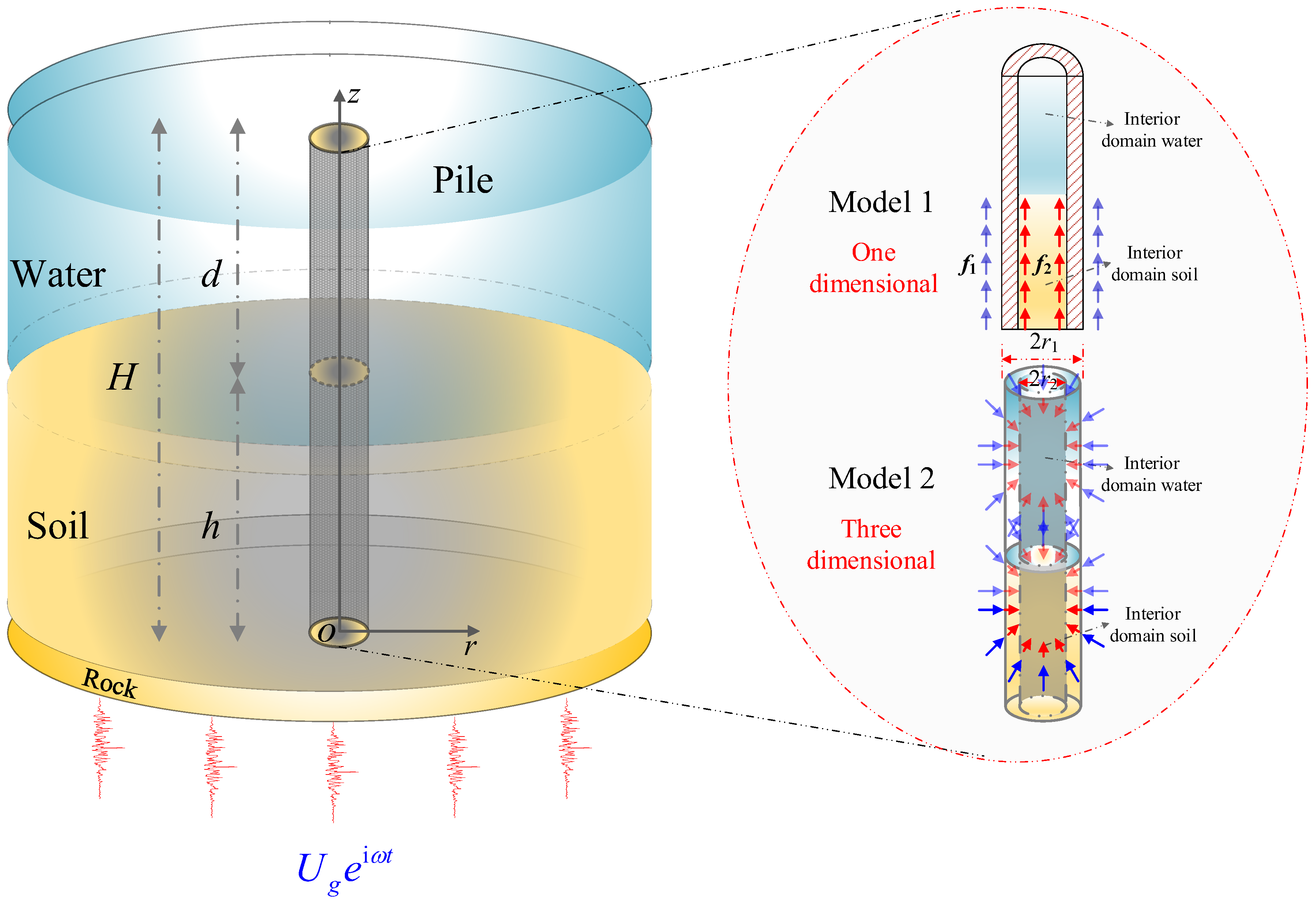
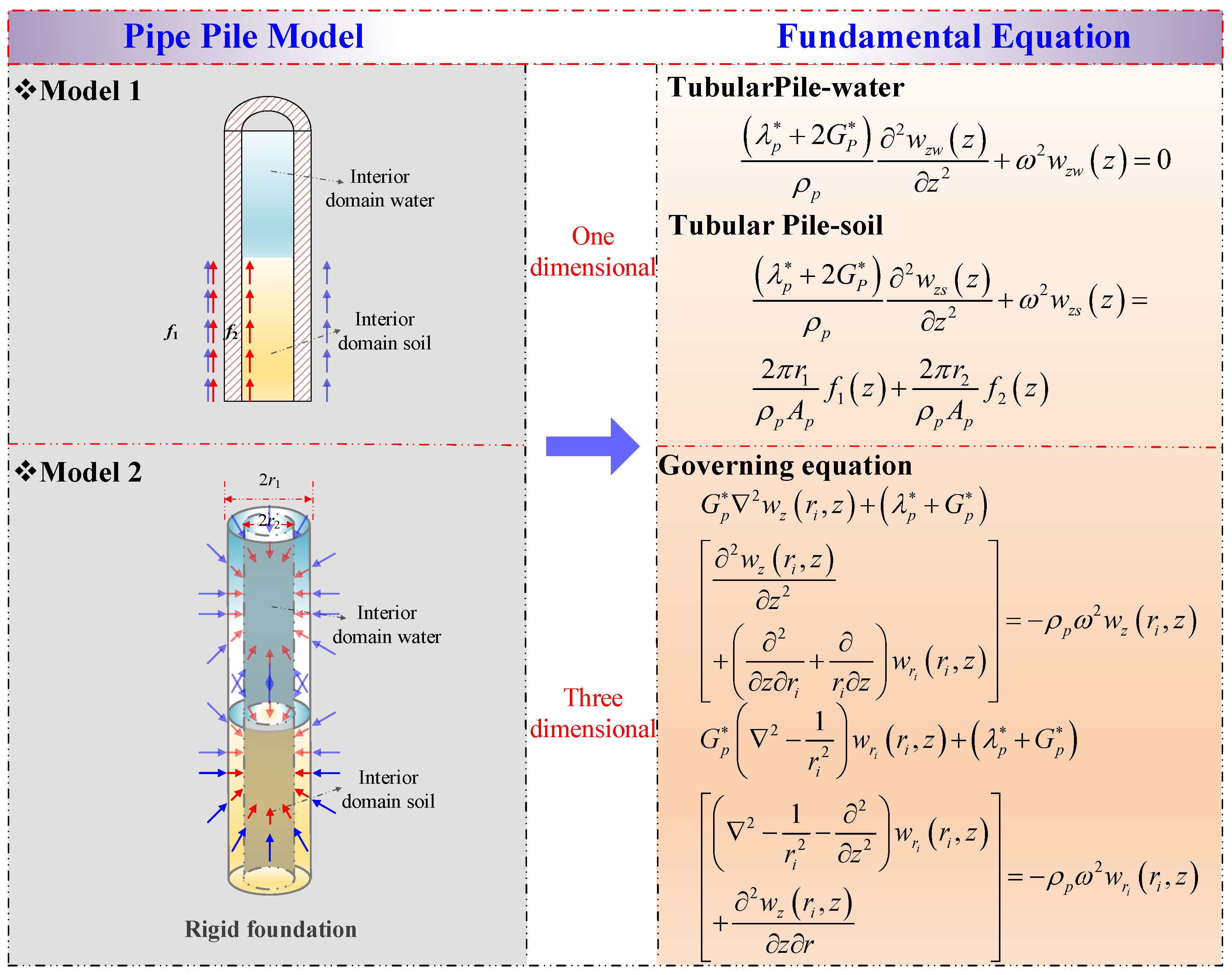
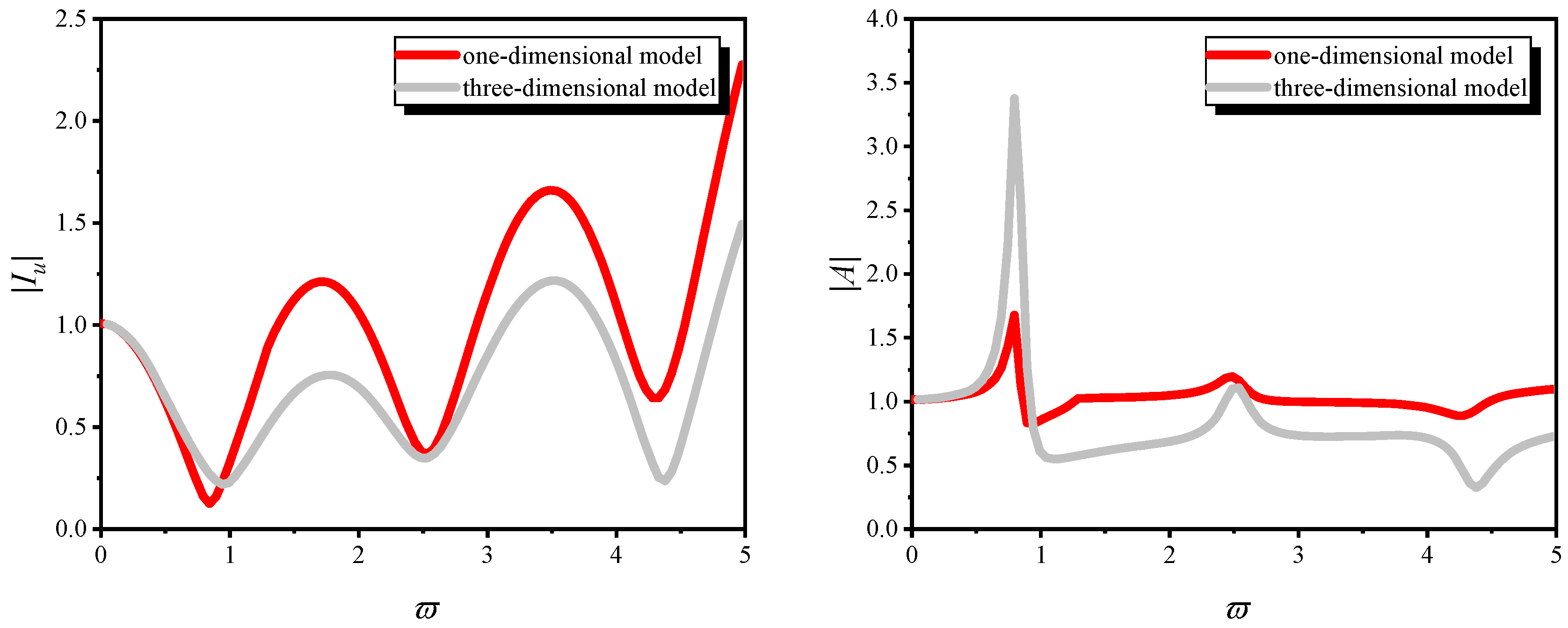
- The absence of a tubular pile–water coupling effect: The one-dimensional tubular pile model simplifies the pile to an “axial vibration rod” with radial displacement neglected, thereby completely neglecting the tubular pile–water interaction. In contrast, in the three-dimensional tubular pile model, the radial vibration of the tubular pile squeezes the inner and outer water, generating a scattered field water response. Through the “added mass method”, the water imposes an equivalent distributed mass on the pile, and meanwhile, additional damping is supplied by hydrodynamic pressure. The added mass raises the vibration inertia of the pile, and damping disperses vibration energy. Both factors jointly suppress the pipe vibration amplitude in the three-dimensional tubular pile model. While the one-dimensional model lacks such restrictive effects, it naturally yields a larger dynamic response.
- (2)
- Constraint contribution from soil’s three-dimensional response: In the one-dimensional tubular pile model, only the axial response of the soil is considered, and the constraint on the pile is merely reflected as axial friction, ignoring the constraint effect of radial normal stress (equivalent to “the pile can deform freely in the radial direction within the soil”). This results in relatively low overall constraint stiffness. In the three-dimensional tubular pile model, the soil achieves a combined radial–axial response through Helmholtz decomposition. The radial displacement of the pile causes radial compression of the soil, and the soil forms a strong constraint on the pile via radial normal stress. Meanwhile, three-dimensional soil response couples the propagation of longitudinal and shear waves in the soil, further amplifying the soil’s vibration suppression effect on the pile. This “bidirectional constraint” makes the vibration stiffness of the pile in the three-dimensional tubular pile model significantly higher than that in the one-dimensional tubular pile model. Therefore, under the same excitation, the response of the three-dimensional tubular pile model is smaller, while that of the one-dimensional tubular pile model is larger.
- (3)
- The simplification defect of the scattered field in the one-dimensional tubular pile model: The one-dimensional tubular pile model only accounts for the axial scattering of the soil, induced by the pile’s axial vibration, without the contribution of radial and water scattering, and the scattered field is dominated by a few low-order modes. At high frequencies, this simplification leads to two key problems: first, the stiffness of the soil’s axial response decreases rapidly with increasing frequency (the soil exhibits obvious visco-elasticity at high frequencies, and axial friction attenuates), causing the pile to lose effective constraint; second, the one-dimensional tubular pile model has no multi-order modal energy dissipation paths. As a result, vibration energy cannot be dissipated through radial scattering or water–soil coupling, but only slowly through axial friction. However, the dissipation efficiency of axial friction at high frequencies is much lower than that of multi-field scattering in the three-dimensional tubular pile model. The superposition of these two factors results in the one-dimensional model exhibiting a larger response amplitude in the high-frequency range compared to the three-dimensional model.
5.2. Distinctive Effects of the Water Depth
- (1)
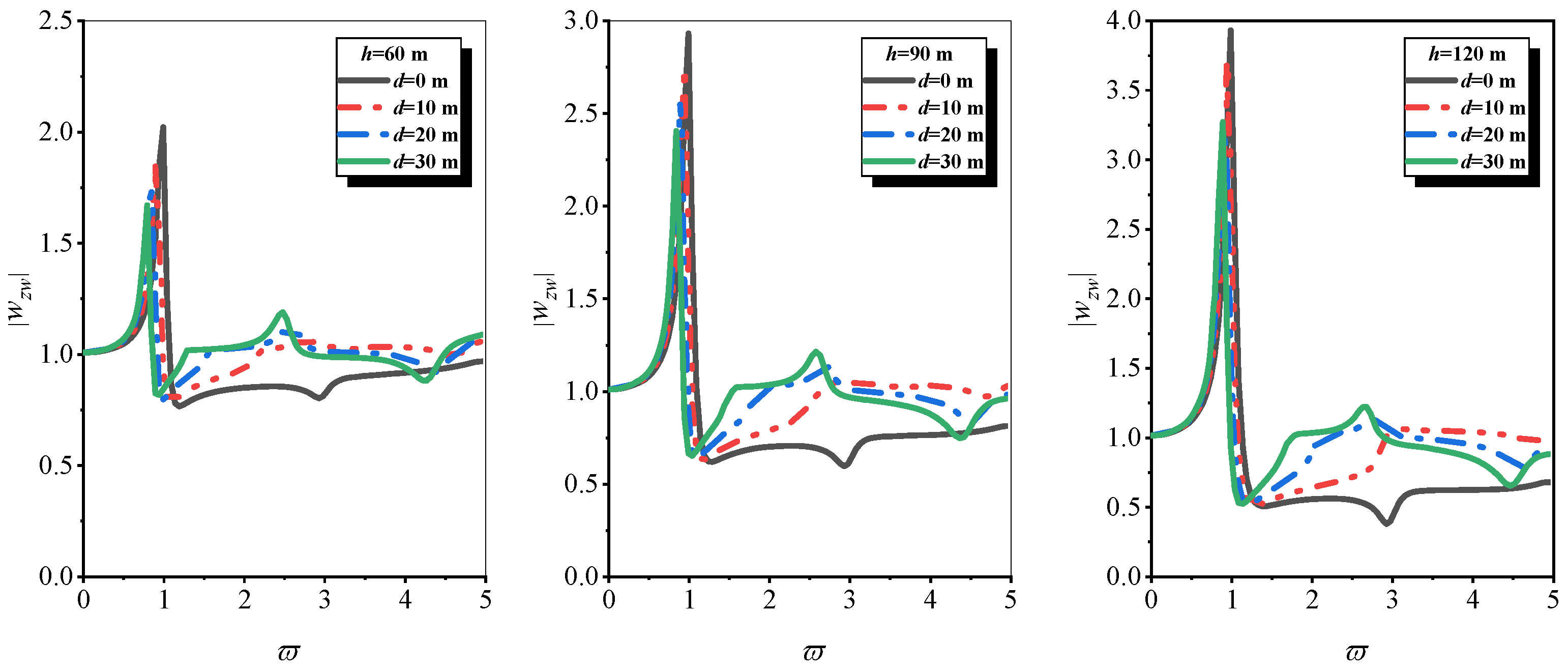
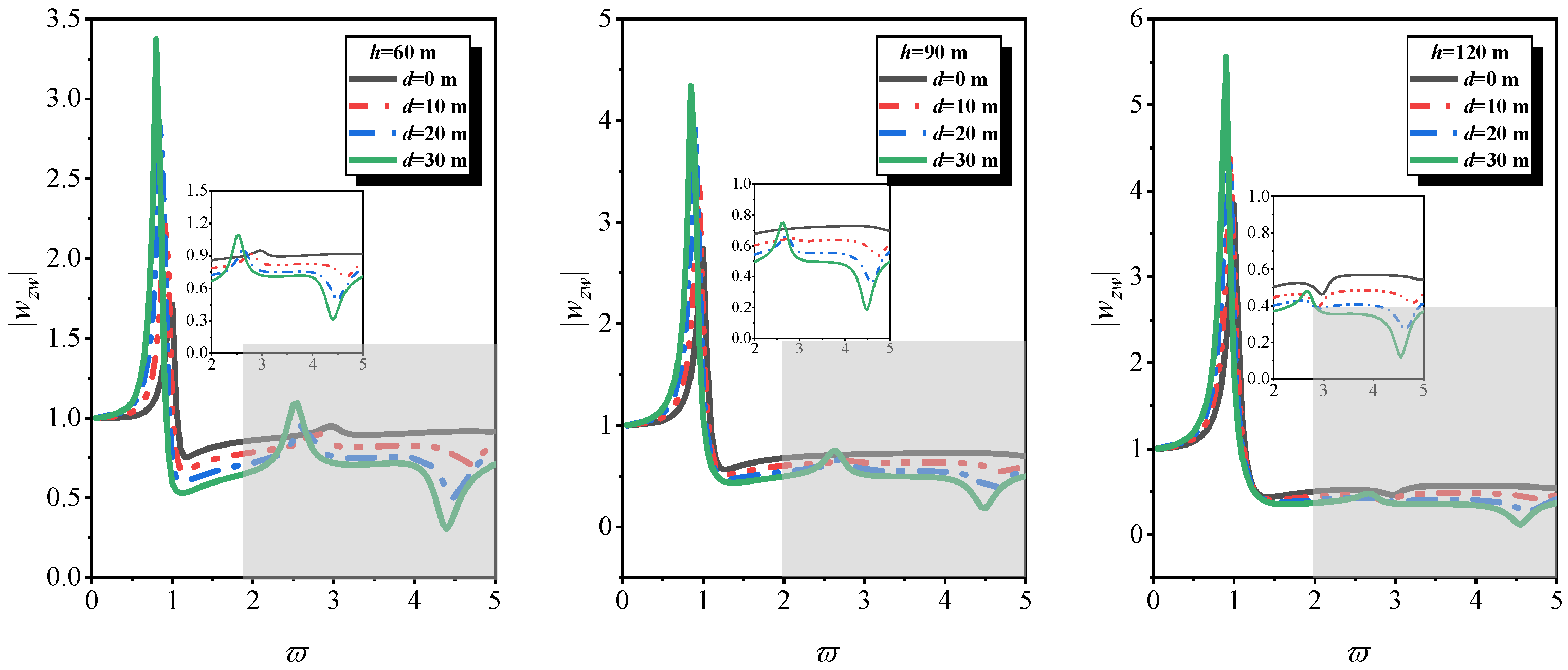
- The one-dimensional tubular pile model simplifies the tubular pile into a “force rod” that only vibrates along the axial direction, ignoring radial deformation and three-dimensional coupling. When water depth increases, the “added mass effect” (more water interacts with the pile, increasing the equivalent vibration mass of the pile) and the “hydrodynamic damping effect” (the viscous and radiation damping at the pile–water interface are enhanced, dissipating vibration energy) dominate jointly. The added mass enhances the vibration inertia, while hydrodynamic damping mitigates energy concentration; these two factors jointly suppress the peak displacement of the pile top. Meanwhile, the growth of added mass lowers the system’s natural frequency, causing the frequency corresponding to the peak to shift toward the low-frequency range.
- (2)
- The three-dimensional tubular pile model considers the axial and radial coupled vibration of the tubular pile as well as the pile–water–soil interaction. When water depth increases, in addition to the “added mass” and “hydrodynamic damping”, the “radial constraint enhancement effect” becomes the core difference. The radial extrusion of the pile by water forms a “confining pressure-like constraint”, which significantly improves the radial equivalent stiffness of the pile. At this time, the “magnitude of stiffness increase” exceeds the “magnitude of inertia suppression by added mass”. This occurs according to the law of the vibration system whereby the resonance amplitude is positively correlated with the stiffness–mass ratio. The peak displacement at the pile top increases with the increase in water depth. However, the added mass still reduces the natural frequency of the system; thus, the peak frequency also shifts to the low-frequency band.
5.3. Distinctive Effects of the Tubular Pile Wall Thickness
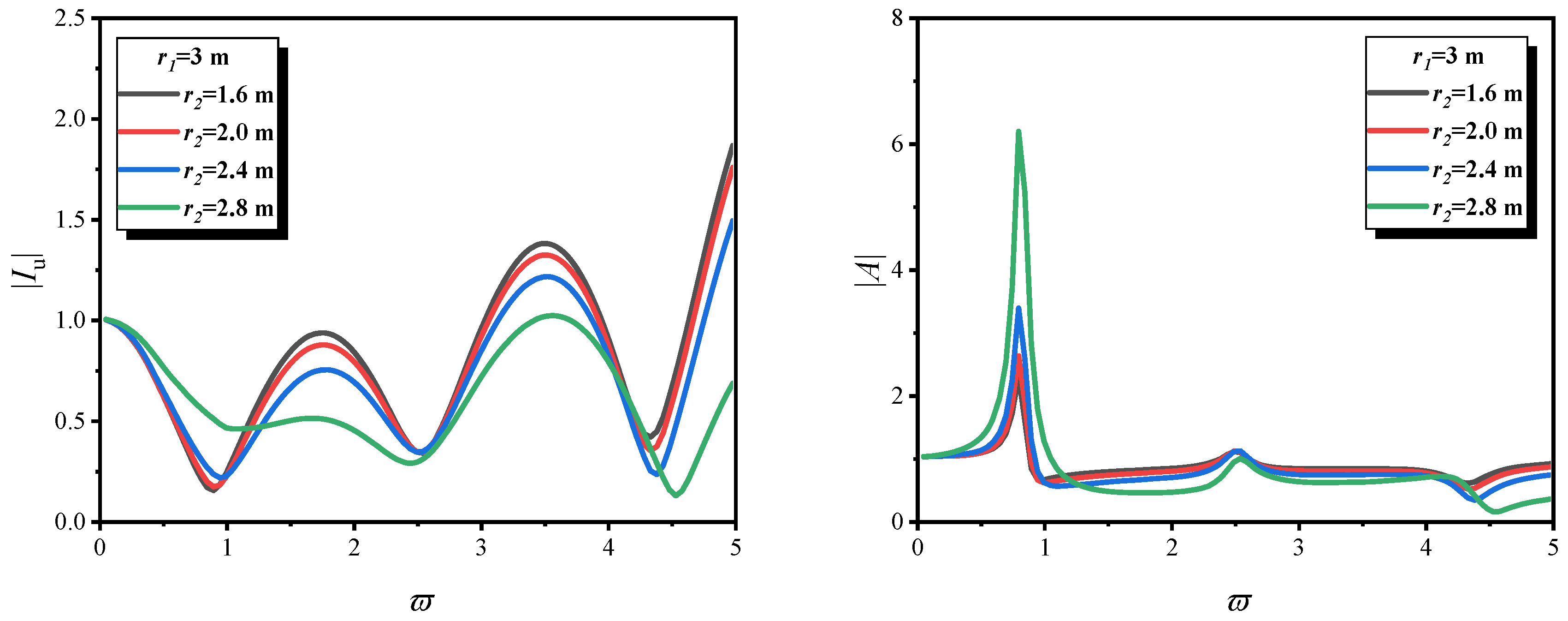
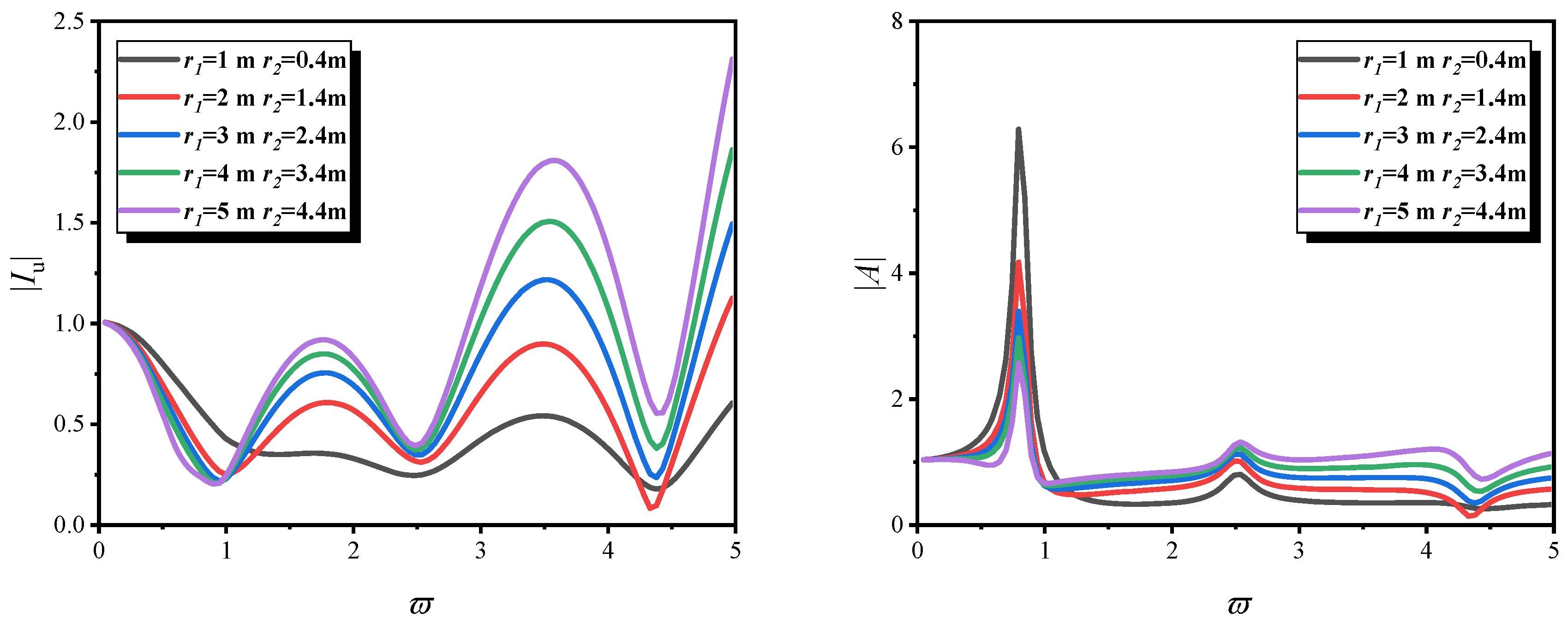
5.4. Distinctive Effects of the Tubular Pile Radius
6. Conclusions
- Model dimensionality dominates responses: one-dimensional tubular pile model (axial vibration only) underestimates radial water–pile–soil coupling, leading to 20–30% overpredicted high-frequency displacements; three-dimensional tubular pile model (axial–radial coupling) captures radial constraint and scattering, providing more accurate results.
- Water depth exerts model-dependent effects: for one-dimensional tubular pile model, deeper water (5–30 m) suppresses displacement peaks via added mass/damping; for three-dimensional tubular pile model, d > 20 m enhances radial water confinement, increasing peaks (stiffness gain > inertia effect).
- Geometric parameters regulate responses nonlinearly: larger pile diameter strengthens water–soil energy dissipation (damping increases by 15–25%); thinner walls (hollow ratio < 0.6) reduce radial stiffness, amplifying low-frequency responses.
Author Contributions
Funding
Data Availability Statement
Conflicts of Interest
Appendix A
Appendix B
Appendix C
Appendix D
References
- Upasana, N.; Suanta, H. Seismic fragility and vulnerability assessment of multi-megawatt jacket-supported offshore wind turbines. Mar. Struct. 2015, 104, 103882. [Google Scholar]
- He, R.; Kaynia, A.M.; Zhang, J.S. Lateral free-field responses and motion interaction of monopiles to obliquely incident seismic waves in offshore engineering. Comput. Geotech. 2021, 132, 103956. [Google Scholar] [CrossRef]
- Yu, W.L.; Wang, P.G.; Zhao, M.; Xi, R.Q.; Du, X.L. A numerical method for evaluating the earthquake response of a 5 MW OC4 semi-submersible FOWT under multidirectional excitations. Soil Dyn. Earthq. Eng. 2025, 196, 109467. [Google Scholar] [CrossRef]
- Zhang, G.L.; Zhao, M.; Zhang, J.Q.; Gao, Z.D.; Du, X.L. A non-convolutional complex-frequency-shifted SBPML for wave problems in 3D unbounded waveguide modellings. Appl. Math. Model. 2025, 148, 116277. [Google Scholar] [CrossRef]
- Wang, P.; Shen, Y.; Qu, Y.; Zhao, M.; Du, X. The dynamic response and parameter influence analysis of Submerged Floating Tunnel under seismic action. Ocean Eng. 2025, 337, 121877. [Google Scholar] [CrossRef]
- Bhattacharya, S.; Adhikari, S. Experimental validation of soil-structure interaction of offshore wind turbines. Soil Dyn. Earthq. Eng. 2011, 31, 805–816. [Google Scholar] [CrossRef]
- Chen, L.; Wu, W.; Liu, H.; Li, J.; Newson, T.; El Naggar, M.H. Analytical solution for kinematic response of offshore piles under vertically propagating S-waves. Ocean Eng. 2022, 262, 112018. [Google Scholar] [CrossRef]
- Arany, L.; Bhattacharya, S.; Adhikari, S.; Hogan, S.J.; Macdonald, J.H.G. An analytical model to predict the natural frequency of offshore wind turbines on three-spring flexible foundations using two different beam models. Soil Dyn. Earthq. Eng. 2015, 74, 40–45. [Google Scholar] [CrossRef]
- Alkhoury, P.; Ait-Ahmed, M.; Soubra, A.H.; Rey, V. Vibration reduction of monopile-supported offshore wind turbines based on finite element structural analysis and active control. Ocean Eng. 2022, 263, 112234. [Google Scholar] [CrossRef]
- Deng, G.D.; Zhang, J.S.; Wu, W.B.; Shi, X.; Meng, F. Soil-pile interaction in the pile vertical vibration based on fictitious soil-pile model. J. Appl. Math. 2014, 2014, 905194. [Google Scholar] [CrossRef]
- Dezi, F.; Carbonari, S.; Leoni, G. A model for the 3d kinematic interaction analysis of pile groups in layered soils. Earthq. Eng. Struct. Dyn. 2009, 38, 1281–1305. [Google Scholar] [CrossRef]
- Ding, Y.; Ma, R.; Shi, Y.D.; Li, Z.X. Underwater shaking table tests on bridge pier under combined earthquake and wave-current action. Mar. Struct. 2018, 58, 301–320. [Google Scholar] [CrossRef]
- Poulos, H.G.; Davis, E.H. Pile Foundation Analysis and Design; John Wiley & Sons: Hoboken, NJ, USA, 1980. [Google Scholar]
- Zhao, M.; Huang, Y.M.; Wang, P.G. An analytical solution for the dynamic response of an end-bearing pile subjected to vertical P-waves considering water-pile-soil interactions. Soil Dyn. Earthq. Eng. 2022, 153, 107126. [Google Scholar] [CrossRef]
- Morison, J.R.; O’Brien, M.P.; Johnson, J.W.; Schaaf, S.A. The force exerted by surface waves on piles. J. Pet. Technol. 1950, 2, 149–154. [Google Scholar] [CrossRef]
- Gao, L.; Wang, K.H.; Xiao, S.; Wu, W.B. Dynamic response of a pile considering the interaction of pile variable cross section with the surrounding layered soil. Int. J. Numer. Anal. Methods GeoMech. 2017, 41, 1196–1214. [Google Scholar] [CrossRef]
- Hu, D.M.; Lin, Z.N.; Yin, J.; Zeng, L.; Zhao, Z.J.; Chen, N.C. Study on aerodynamic performance of floating offshore wind turbine with fusion winglets under yaw motion. Ships Offshore Struct. 2025, 1–15. [Google Scholar] [CrossRef]
- Wang, P.G.; Zhao, M.; Li, H.F.; Du, X.L. An accurate and efficient time-domain model for simulating water-cylinder dynamic interaction during earthquakes. Engin. Struct. 2018, 166, 263–273. [Google Scholar] [CrossRef]
- Chen, L.; Liu, J.; Wu, W.; Liu, H.; Yao, Y.; Zhang, P. New method to calculate the kinematic response of offshore pipe piles under seismic S-waves. Soil Dyn. Earthq. Eng. 2023, 165, 107651. [Google Scholar] [CrossRef]
- Zheng, C.; Lin, H.; Cao, G.; Luan, L. Horizontal dynamic response of offshore large-diameter pipe piles. Ocean Eng. 2023, 272, 113797. [Google Scholar] [CrossRef]
- Yu, J.; Wang, C.; Luo, C.; Yin, B.; Sun, H. Damping cable-based vibration control of pile-supported offshore wind turbine tower. Ocean Eng. 2025, 338, 121921. [Google Scholar] [CrossRef]
- Cai, M.; Yang, M.; Yang, H.; Li, S. Lateral dynamic response of partially embedded piles in the sea considering wave loads and wave-induced seabed dynamic response load distribution effects. Ocean Eng. 2025, 318, 120041. [Google Scholar] [CrossRef]
- He, L.; Liu, X.; Xie, Y.; Cao, S.; Liang, Y.; Liu, Y. Study on complex failure modes of super-long piles in deep-water and soft-clay seabed under multiple combined loads. Ocean Eng. 2025, 336, 121806. [Google Scholar] [CrossRef]
- Chen, L.B.; Wu, W.B.; Liu, H.; El Naggar, M.H.; Wen, M.; Wang, K. Influence of defects on the lateral dynamic characteristics of offshore piles considering hydrodynamic pressure. Ocean Eng. 2022, 260, 111894. [Google Scholar] [CrossRef]
- Noorzaei, J.; Naghshineh, A.; Abdul, K. Nonlinear interactive analysis of cooling tower-foundation-soil interaction under unsymmetrical wind load. Thin-Walled Struct. 2006, 44, 997–1005. [Google Scholar] [CrossRef]
- Nejad, A.R.; Guo, Y.; Gao, Z.; Moan, T. Development of a 5 MW reference gearbox for offshore wind turbines. Wind. Energy 2016, 19, 1089–1106. [Google Scholar] [CrossRef]
- Ni, P.P.; Song, L.H.; Mei, G.X.; Zhao, Y.L. On predicting displacement-dependent earth pressure for laterally loaded piles. Soils Found. 2018, 58, 85–96. [Google Scholar] [CrossRef]
- Novak, M. Dynamic impedance of piles. Can. Geotech. J. 1974, 10, 486–497. [Google Scholar]
- Zheng, C.J.; Luan, L.B.; Qin, H.Y.; Zhou, H. Horizontal dynamic response of a combined loaded large-diameter pipe pile simulated by the Timoshenko beam theory. Int. J. Struct. Stab. Dyn. 2020, 20, 2071003. [Google Scholar] [CrossRef]
- Novak, M.; Beredugo, Y. Vertical vibration of embedded footings. J. Soil Mech. Found. Div. 1972, 98, 1291–1310. [Google Scholar] [CrossRef]
- Zheng, C.J.; Ding, X.M.; Luan, L.B. Analysis of lateral dynamic response of pipe pile in viscoelastic soil layer. Rock Soil Mech. 2017, 37, 26–40. (In Chinese) [Google Scholar]
- Comodromos, E.M.; Papadopoulou, M.C.; Rentzeperis, I.K. Pile foundation analysis and design using experimental data and 3-D numerical analysis. Comput. Geotech. 2009, 36, 819–836. [Google Scholar] [CrossRef]
- Sun, C. Semi-active control of monopile offshore wind turbines under multi-hazards. Mech. Syst. Sig. Process. 2018, 99, 285–305. [Google Scholar] [CrossRef]
- Zhu, S.P.; Mitchell, L. Diffraction of ocean waves around a hollow cylindrical shell structure. Wave Motion 2009, 46, 78–88. [Google Scholar] [CrossRef]
- Iovino, M.; Di Laora, R.; Rovithis, E.; De Sanctis, L. The beneficial role of piles on the seismic loading of structures. Earthq. Spectra 2019, 35, 1141–1162. [Google Scholar] [CrossRef]
- Stacul, S.; Rovithis, E.; Di Laora, R. Kinematic soil-pile interaction under earthquake-induced nonlinear soil and pile behavior: An equivalent-linear approach. J. Geotech. Geoenviron. Eng. 2022, 148, 04022055. [Google Scholar] [CrossRef]
- Dai, D.H.; El Naggar, M.H.; Zhang, N.; Gao, Y.F. Kinematic response of an end-bearing pile subjected to vertical P-wave considering the three-dimensional wave scattering. Comput. Geotech. 2020, 120, 103368. [Google Scholar] [CrossRef]
- Huang, Y.M.; Wang, P.G.; Zhao, M.; Zhang, C.; Du, X.L. Dynamic responses of an end-bearing pile subjected to horizontal earthquakes considering water-pile-soil interactions. Ocean. Eng. 2021, 238, 109726. [Google Scholar] [CrossRef]
- Zhao, M.; Huang, Y.M.; Wang, P.G.; Cheng, X.L. Du, X.L. Analytical solution of vertical vibration of a floating pile considering different types of soil viscoelastic half-space. Soil Dyn. Earthq. Eng. 2023, 165, 107697. [Google Scholar] [CrossRef]
- Jiang, J.; Jeong, H.K.; Dou, H. Study on the structural strength assessment of mega offshore wind turbine tower. Energies 2025, 18, 69. [Google Scholar] [CrossRef]
- Cui, C.Y.; Meng, K.; Xu, C.; Wang, B.; Xin, Y. Vertical vibration of a floating pile considering the incomplete bonding effect of the pile-soil interface. Comput. Geotech. 2022, 150, 104894. [Google Scholar] [CrossRef]
- Chen, T.; Wang, X.; Gu, X.L.; Zhao, Q.; Yuan, G.K.; Liu, J.C. Axial compression tests of grouted connections in jacket and monopole offshore wind turbine structures. Eng. Struct. 2019, 196, 109330. [Google Scholar] [CrossRef]
- Jonkman, J.; Butterfield, S.; Musial, W.; Scott, G. Definition of a 5-MW Reference Wind Turbine for Offshore System Development; National Renewable Energy Laboratory: Golden, CO, USA, 2009; p. 75. [Google Scholar]
- He, R.; Wang, L.; Pak, R.Y.S.; Guo, Z.; Zheng, J. Vertical elastic dynamic impedance of a large diameter and thin-walled cylindrical shell type foundation. Soil Dyn. Earthq. Eng. 2017, 95, 138–152. [Google Scholar] [CrossRef]
- Liaw, C.Y.; Chopra, A.K. Dynamics of towers surrounded by water. Earthq. Eng. Struct. Dyn. 1974, 3, 33–49. [Google Scholar] [CrossRef]
- Li, Q.; Yang, W.L. An improved method of hydrodynamic pressure calculation for circular hollow piers in deep water under earthquake. Ocean Eng. 2013, 72, 241–256. [Google Scholar] [CrossRef]
- Zheng, C.; Kouretzis, G.; Luan, L.; Ding, X. Motion response of pipe piles subjected to vertically propagating seismic P-waves. Acta Geotech. 2021, 16, 895–909. [Google Scholar] [CrossRef]
- Wang, P.G.; Wang, B.X.; Dong, Z.H.; Cheng, X.L.; Du, X.L. An analytical solution for vertical seismic response of an end-bearing pile in saturated soil considering pile-soil and free and scattered field water-soil interaction. Mar. Struct. 2024, 98, 103677. [Google Scholar] [CrossRef]







| Outer Soil | Inner Soil | Pipe Pile | |
|---|---|---|---|
| Height (m) | 60 | 60 | 90 |
| Outer radius (m) | - | - | 3.0 |
| Inner radius (m) | - | - | 2.4 |
| radius (m) | - | 2.4 | - |
| Elastic modulus (MPa) | 30 | 30 | 30,000 |
| Mass density (kg/m3) | 2200 | 2200 | 2500 |
| Hysteretic damping | 0.05 | 0.05 | 0.05 |
| Poisson’s ratio | 0.4 | 0.4 | 0.2 |
Disclaimer/Publisher’s Note: The statements, opinions and data contained in all publications are solely those of the individual author(s) and contributor(s) and not of MDPI and/or the editor(s). MDPI and/or the editor(s) disclaim responsibility for any injury to people or property resulting from any ideas, methods, instructions or products referred to in the content. |
© 2025 by the authors. Licensee MDPI, Basel, Switzerland. This article is an open access article distributed under the terms and conditions of the Creative Commons Attribution (CC BY) license (https://creativecommons.org/licenses/by/4.0/).
Share and Cite
Huang, Y.; Zhou, J.; Li, X.; Liu, Y.; Wang, P. Analytical Solution for Dynamic Responses of Distinct Tubular Piles Under Vertical Seismic Excitation Considering Water–Pile–Soil Interaction. J. Mar. Sci. Eng. 2025, 13, 2158. https://doi.org/10.3390/jmse13112158
Huang Y, Zhou J, Li X, Liu Y, Wang P. Analytical Solution for Dynamic Responses of Distinct Tubular Piles Under Vertical Seismic Excitation Considering Water–Pile–Soil Interaction. Journal of Marine Science and Engineering. 2025; 13(11):2158. https://doi.org/10.3390/jmse13112158
Chicago/Turabian StyleHuang, Yiming, Jiaxi Zhou, Xin Li, Yichen Liu, and Piguang Wang. 2025. "Analytical Solution for Dynamic Responses of Distinct Tubular Piles Under Vertical Seismic Excitation Considering Water–Pile–Soil Interaction" Journal of Marine Science and Engineering 13, no. 11: 2158. https://doi.org/10.3390/jmse13112158
APA StyleHuang, Y., Zhou, J., Li, X., Liu, Y., & Wang, P. (2025). Analytical Solution for Dynamic Responses of Distinct Tubular Piles Under Vertical Seismic Excitation Considering Water–Pile–Soil Interaction. Journal of Marine Science and Engineering, 13(11), 2158. https://doi.org/10.3390/jmse13112158