Article

Cross-Domain Contrastive Learning-Based Few-Shot Underwater Acoustic Target Recognition

1
School of Marine Science and Technology, Northwestern Polytechnical University, Xi’an 710072, China
2
School of Computer Science, Northwestern Polytechnical University, Xi’an 710072, China
3
Cyberspace Institute of Advanced Technology, Guangzhou University, Guangzhou 510006, China
4
School of Artificial Intelligence, Optics and Electronics (iOPEN), Northwestern Polytechnical University, Xi’an 710072, China
*
Authors to whom correspondence should be addressed.
J. Mar. Sci. Eng. 2024, 12(2), 264; https://doi.org/10.3390/jmse12020264
Submission received: 21 December 2023 / Revised: 19 January 2024 / Accepted: 30 January 2024 / Published: 1 February 2024
(This article belongs to the Special Issue Underwater Wireless Communications: Recent Advances and Challenges)

Abstract

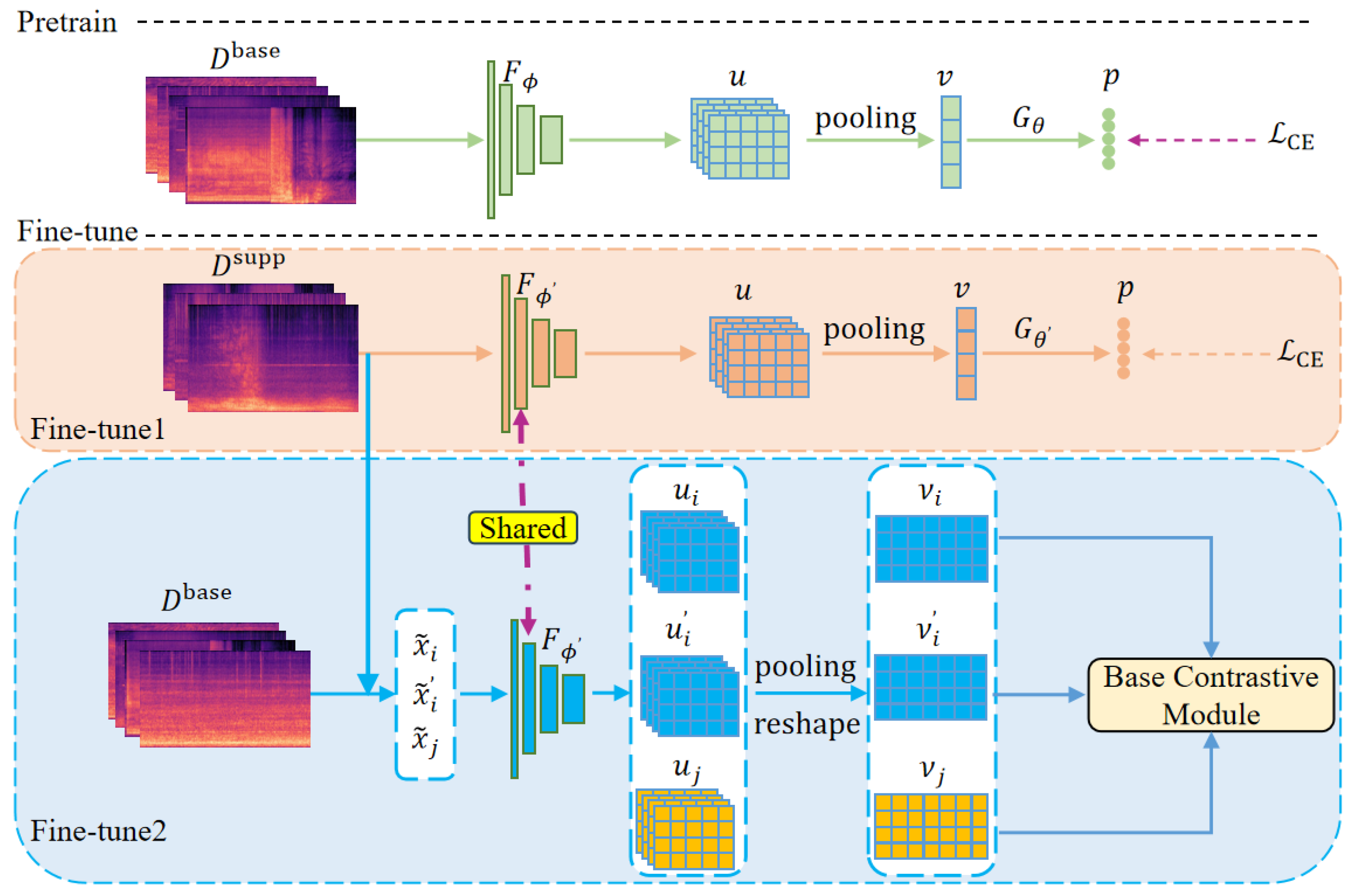
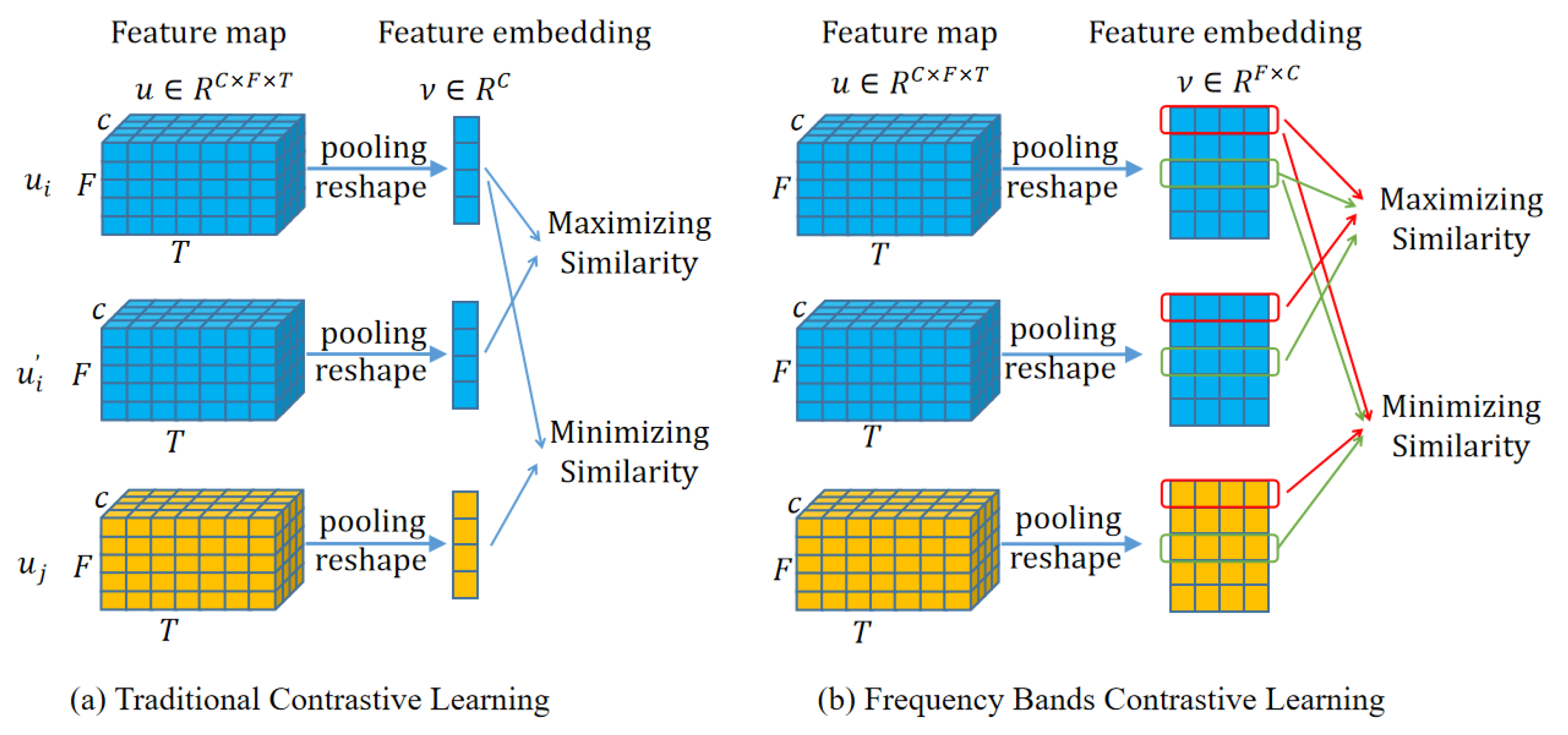
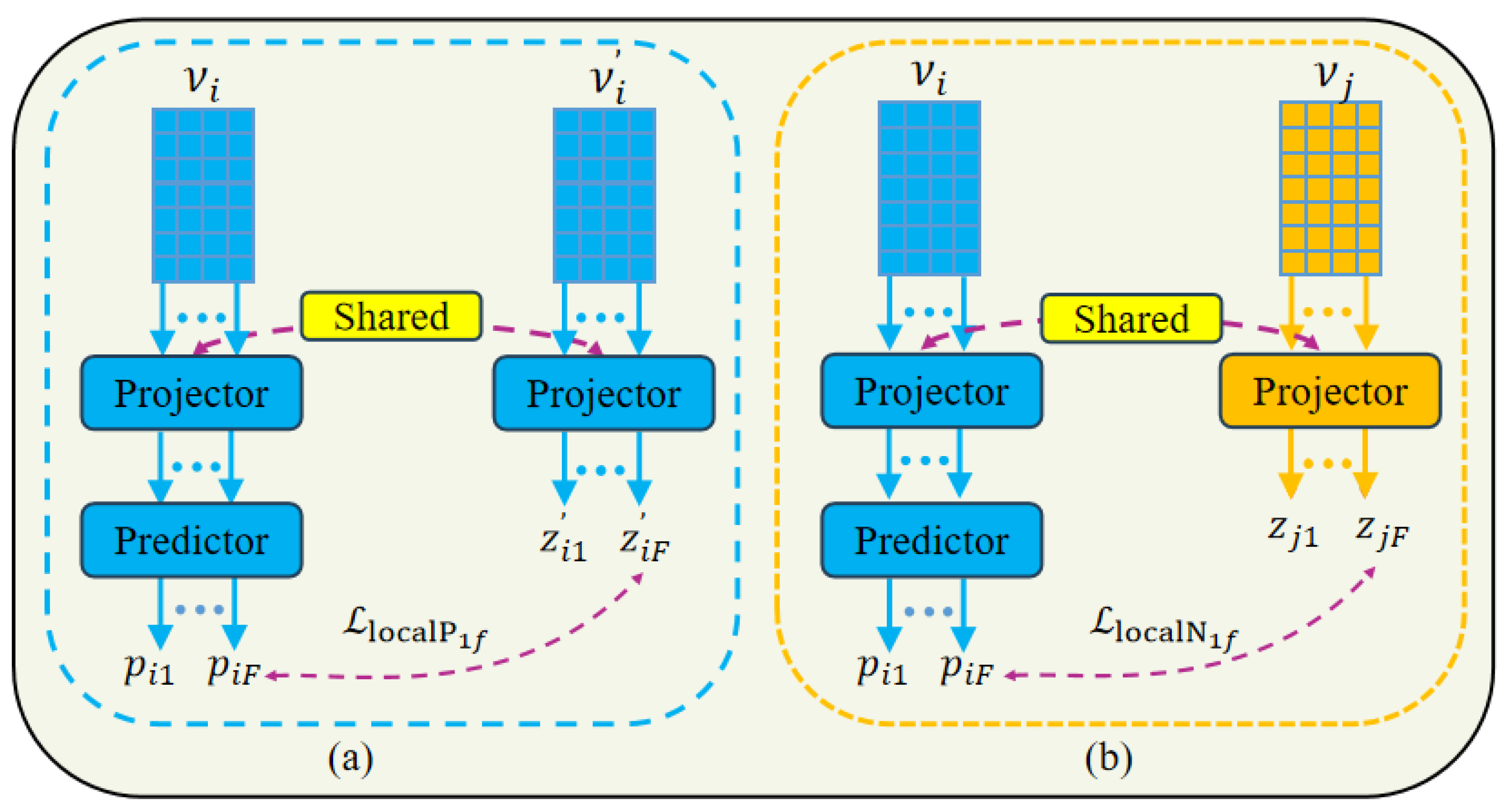
Underwater Acoustic Target Recognition (UATR) plays a crucial role in underwater detection devices. However, due to the difficulty and high cost of collecting data in the underwater environment, UATR still faces the problem of small datasets. Few-shot learning (FSL) addresses this challenge through techniques such as Siamese networks and prototypical networks. However, it also suffers from the issue of overfitting, which leads to catastrophic forgetting and performance degradation. Current underwater FSL methods primarily focus on mining similar information within sample pairs, ignoring the unique features of ship radiation noise. This study proposes a novel cross-domain contrastive learning-based few-shot (CDCF) method for UATR to alleviate overfitting issues. This approach leverages self-supervised training on both source and target domains to facilitate rapid adaptation to the target domain. Additionally, a base contrastive module is introduced. Positive and negative sample pairs are generated through data augmentation, and the similarity in the corresponding frequency bands of feature embedding is utilized to learn fine-grained features of ship radiation noise, thereby expanding the scope of knowledge in the source domain. We evaluate the performance of CDCF in diverse scenarios on ShipsEar and DeepShip datasets. The experimental results indicate that in cross-domain environments, the model achieves accuracy rates of 56.71%, 73.02%, and 76.93% for 1-shot, 3-shot, and 5-shot scenarios, respectively, outperforming other FSL methods. Moreover, the model demonstrates outstanding performance in noisy environments.

Keywords: underwater acoustic target recognition; few-shot learning; self-supervised learning underwater acoustic target recognition; few-shot learning; self-supervised learning