1. Introduction
Global food systems remain highly inefficient, with approximately one-third of all food produced being lost or wasted worldwide (FAO, 2019) [
1]. However, food waste generation is unevenly distributed across supply chains and regions. In developing economies, losses predominantly occur at the agricultural and post-harvest stages due to infrastructural constraints, whereas in developed regions waste is concentrated downstream, particularly at the consumption stage [
2,
3]. Although households represent the largest share of food waste by volume, accounting for approximately 60% globally and over 50% within the European Union [
2,
4], this fraction is largely unsuitable for circular reintegration due to contamination, logistical dispersion, and hygiene constraints.
In contrast, agro-industrial processing residues represent a strategically critical intervention point for circular economy implementation. While contributing a smaller proportion of total food waste, these side-streams are generated in controlled environments, at high volumes, and with consistent composition, making them technically and economically viable for valorization [
5,
6]. A key distinction must therefore be made between avoidable process losses and unavoidable industrial side-streams, such as fruit pomace, peels, and seeds.
This distinction is formally embedded in EU legislation. Under Article 5 of Directive 2008/98/EC (Waste Framework Directive), certain production residues may be classified as by-products rather than waste, provided that their further use is certain, lawful, and requires no processing beyond normal industrial practice [
7]. Unlike household food waste, industrial fruit-processing side-streams are generated under the regulatory oversight of EU Regulation 2017/625, which enforces hygiene and safety standards across the food production chain. As a result, residues such as juice pomace can retain food-grade status when managed in compliance with Hazard Analysis and Critical Control Points (HACCP) systems [
8].
Furthermore, the evolving “end-of-waste” framework, including Regulation (EU) 2019/1009, supports the standardization and market integration of secondary raw materials derived from exhausted biomass, such as pomace following bioactive extraction [
9]. Together with the EU Circular Economy Action Plan, these regulatory instruments establish a clear pathway for the industrial upcycling of fruit-processing residues, provided that valorization technologies preserve chemical integrity and ensure product safety [
10].
Despite representing a concentrated reservoir of polyphenolic compounds, including phenolic acids, flavonoids, and anthocyanins [
11,
12,
13], fruit-processing residues, primarily peels, pomace, and seeds, are still managed predominantly through linear disposal pathways. Current industrial practice relies largely on sanitary landfilling, open dumping, or incineration, reflecting an inefficient end-of-life strategy for these materials [
14,
15]. Such approaches increase the environmental footprint of agricultural production, as they effectively downgrade these side-streams from potential sources of high-value functional antioxidants [
16] to mere environmental pollutants.
Life Cycle Assessment (LCA) studies consistently identify conventional disposal of fruit by-products as a major environmental hotspot. Comparative analyses show that open-dump landfilling can impose environmental burdens up to 98% higher than valorization pathways such as anaerobic digestion, largely due to methane emissions and leachate formation [
17]. Similar trends were reported for Mediterranean fruit and vegetable supply chains, where landfilling dominates greenhouse gas contributions [
18]. At the global level, landfill methane represents the third-largest anthropogenic methane source, while at the local scale even small disposal volumes of fruit waste generate measurable CH
4 and fossil CO
2 emissions [
18].
Geographically, fruit by-product generation is highly concentrated. In Asia, China constitutes the primary global hotspot for apple, plum, and citrus residues, with production increasingly agglomerated in specific provinces such as Shaanxi and Shandong, intensifying localized disposal pressures [
19]. In the Americas, residue generation reflects transboundary production systems: while the United States remains a major producer of citrus and berries, a significant share of processing residues has shifted toward Mexican export and processing hubs, effectively transferring the environmental burden of waste management across borders [
20].
In Europe, fruit-processing residues are primarily concentrated in the Mediterranean basin and Eastern Europe. Southern European countries dominate olive oil production and generate large volumes of pomace and wastewater [
21], while Eastern European regions, including Romania, Serbia, and Poland, represent major hotspots for apple and plum by-products [
22]. Despite alignment with EU Circular Economy priorities, these regions continue to rely heavily on disposal routes identified by LCA as high contributors to greenhouse gas emissions, particularly methane from landfilling [
18].
In response to the environmental and economic limitations of linear waste management, agro-food residue handling is increasingly transitioning toward a Circular Bioeconomy framework. Within this paradigm, fruit-processing by-products are no longer regarded as waste but as a potential income stream for farmers with the recovery of high-value polyphenols, as outlined by Campos et al. [
23]. This shift is supported by growing evidence that fruit outer tissues, including peels and rinds, often contain significantly higher concentrations of phenolic acids, flavonoids, and anthocyanins than the edible pulp itself [
24,
25]. Consequently, current research efforts emphasize the reintegration of these matrices into the value chain through the development of functional ingredients. Eliopoulos et al. [
26] report the expanding use of these recovered phenolic extracts as natural preservatives and antioxidant additives in food, cosmetic, and pharmaceutical formulations, offering sustainable alternatives to synthetic counterparts. Beyond food-related uses, these biomasses also demonstrate versatility in non-food sectors; Selva Ganesh et al. [
27] highlight their applicability as low-cost biosorbents and biofuel precursors. However, these legal definitions fail to translate into economic value without industrially scalable extraction technologies. In this line,
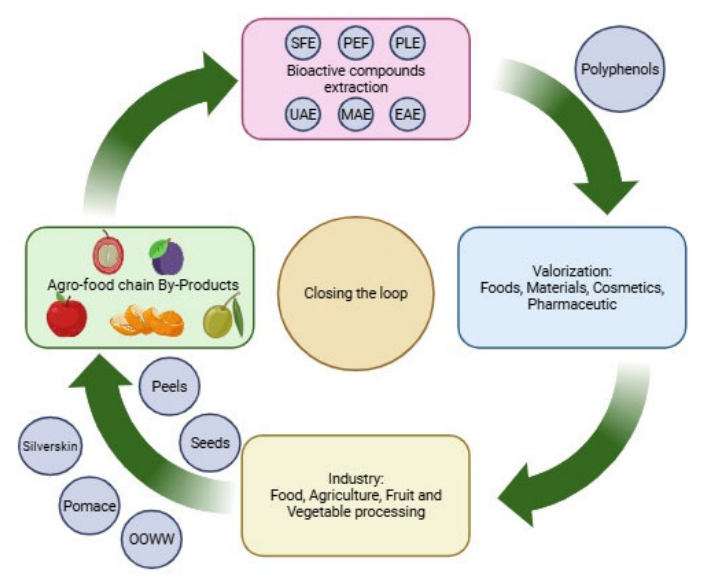
Figure 1 shows the integration of polyphenol extraction into a circular bioeconomy framework, highlighting the connection between agri-food residues, green extraction technologies (PEF, MAE, UAE, EAE, PLE, SFE), and downstream valorization pathways.
The aim of this study is to critically review current strategies for the recovery of polyphenolic compounds from fruit-processing by-products, with particular emphasis on extraction technologies, regulatory constraints, and their role in enabling circular bioeconomy-oriented valorization pathways. Unlike previous narrative reviews that primarily catalog extraction technologies or broadly address agro-food waste valorization, the present review adopts an integrative matrix–technology framework. The review examines major fruit-processing residues—including apple, plum, grape, citrus, coffee, and olive by-products—as representative matrices with distinct structural and compositional characteristics. By linking the chemical architecture of these residues with the mechanistic principles of modern extraction technologies, the study evaluates their suitability within circular bioeconomy-oriented biorefinery systems. This approach highlights that different fruit by-products require matrix-specific recovery strategies, rather than a universal extraction methodology.
2. Methodology and Search Strategy
To ensure a comprehensive and representative overview of the current literature regarding polyphenol recovery from agro-food by-products, a structured literature search was conducted. The systematic search encompassed electronic databases, primarily focusing on ScienceDirect and Google Scholar, to identify the relevant peer-reviewed literature published between January 2016 and February 2026. The search strategy utilized a combination of the following keywords and Boolean operators tailored to our target matrices: (“polyphenol” OR “phenolic compounds” OR “bioactive compounds”) AND (“recovery” OR “extraction” OR “valorization”) AND (“grape” OR “apple” OR “plum” OR “olive” OR “citrus” OR “coffee”) AND (“by-products” OR “waste” OR “pomace” OR “peels” OR “residue”). To determine the suitability of the retrieved articles, specific inclusion and exclusion criteria were established. The inclusion criteria were as follows: (1) peer-reviewed research articles, official institutional/governmental reports, review papers, and comprehensive book chapters; (2) studies published in the English language primarily within the 2016–2026 timeframe to capture recent technological advancements; (3) research explicitly detailing extraction methodologies, polyphenol characterization, or the valorization of plant-based agro-industrial waste, or the statistical or regulatory context, while, exclusion criteria were (1) articles published in languages other than English; (2) conference abstracts or short communications lacking sufficient methodological details; (3) studies focusing primarily on animal-derived by-products or unrelated synthetic compounds.
While the primary focus of the search was restricted to the last decade to reflect the current state of the art, a select number of highly cited, foundational papers published prior to 2016 (e.g., 2008–2015) were deliberately included. These older sources were integrated strictly to elucidate fundamental chemical structures, classical extraction principles, and basic classifications of polyphenolic compounds that remain standard scientific consensus.
The initial database search yielded approximately 945 potentially relevant records. After the removal of duplicates, 680 articles remained for preliminary screening. The titles and abstracts of these records were manually evaluated for relevance to the core theme of the review, reducing the pool to 215 articles. Following a rigorous full-text assessment to ensure alignment with the inclusion criteria and the specific objectives of this paper, a final selection of 120 core references was chosen to be synthesized and comprehensively discussed in this review.
3. Chemical Composition and Functional Potential of Agri-Food Residues
The valorization potential of agri-food processing residues is determined not only by their total phytochemical content, but also by the structural organization of the plant matrix in which these compounds are embedded. Unlike fresh fruit pulp, industrial side-streams such as pomace, peels, and husks are characterized by a heterogeneous cellular architecture rich in insoluble structural carbohydrates. This rigid lignocellulosic framework acts as a physical barrier that limits the extractability of bioactive compounds when conventional solvent-based approaches are applied. Consequently, effective valorization increasingly relies on bioconversion strategies, such as enzymatic treatment or microbial processing, capable of disrupting this recalcitrant matrix and releasing associated functional compounds [
25]. Importantly, this structural complexity is not solely a technological limitation; it also confers functional advantages, as fiber-bound polyphenols can bypass upper gastrointestinal absorption and reach the colon, where they interact with the gut microbiota [
28].
From a compositional perspective, agri-food residues represent concentrated reservoirs of plant-derived functional components rather than inert waste materials. Their chemical profile is generally dominated by three major classes: dietary fiber, phenolic compounds, and micronutrients, each contributing to both technological functionality and biological activity.
Dietary fiber constitutes the bulk of most fruit-derived by-products, typically accounting for 35–60% of dry weight depending on botanical origin and processing conditions. This fraction is primarily composed of insoluble cellulose and hemicellulose, alongside variable amounts of soluble pectin, particularly abundant in apple and citrus residues [
12,
25]. Beyond its conventional role as a bulking agent, this fiber matrix functions as a fermentable substrate for colonic microbiota, supporting the production of short-chain fatty acids (SCFAs) that are associated with metabolic regulation and intestinal homeostasis [
25,
28]. Moreover, the fiber framework plays a key role in modulating the release, stability, and bioaccessibility of bound phytochemicals.
Phenolic compounds represent the most functionally relevant class of secondary metabolites in agri-food residues. These compounds occur in both free (vacuolar) and bound forms, the latter being covalently associated with cell wall polymers [
29]. It is estimated that the majority of dietary polyphenols, up to 90% escape absorption in the small intestine and undergo microbial transformation in the colon, highlighting the importance of matrix-bound phenolics in determining physiological effects [
28]. Flavonoids, including anthocyanins in pigmented fruit skins and flavanones in citrus peels, exhibit strong antioxidant and anti-inflammatory activity [
30], while phenolic acids such as chlorogenic and gallic acid are often retained within the fiber matrix and released progressively during digestion or bioprocessing [
29,
31].
In addition to fiber and polyphenols, fruit-processing residues are notable sources of micronutrients and minor lipid fractions. Fruit peels frequently contain higher concentrations of vitamins and minerals than the edible pulp, while seed and kernel-rich residues may provide essential oils and polyunsaturated fatty acids with documented metabolic benefits [
12,
29]. Collectively, the synergy between fiber-bound polyphenols and associated micronutrients gives the matrices their functional relevance and provides the scientific rationale for their targeted recovery and reintegration into food, nutraceutical, and biorefinery value chains.
3.1. The Apple Industry
The apple (
Malus domestica Borkh.) stands as one of the most widely cultivated and consumed fruit crops globally, ranking third in production volume after bananas and watermelons [
32]. Global production has experienced dynamic growth over the last two decades, currently stabilizing between 82 and 87 million tons annually, with China and the United States serving as the leading producers [
32]. In Europe, apples are a cornerstone of the fruit sector, with approximately 19.6 million tons produced on roughly 1 million hectares [
32]. Eastern European countries are particularly significant contributors, accounting for a major share of this cultivation area, with Poland distinguishing itself as the largest producer in the region regarding both orchard area and yield [
32,
33]. This massive scale of cultivation and the associated industrial processing inevitably result in the generation of substantial quantities of residues.
Apple pomace constitutes the main by-product of the apple processing industry, representing approximately 25–35% of the original fruit mass after juice, cider, or purée production. It is a chemically heterogeneous matrix composed of peel, residual pulp, seeds, and stems, with composition influenced by cultivar, maturity stage, and processing conditions. From a valorization perspective, its defining feature is the high carbohydrate content, dominated by dietary fiber fractions, particularly pectin (3.5–14.3% dry weight), alongside cellulose and hemicellulose [
34,
35]. The presence of residual mono and disaccharides further enhances its suitability as a fermentable substrate, making apple pomace especially attractive for biotechnological applications such as solid-state fermentation (SSF), where it serves as both structural support and carbon source for microbial growth.
The polyphenolic composition of apple pomace is characterized by marked tissue-specific distribution. The peel fraction is particularly enriched in flavonols, mainly quercetin glycosides such as hyperoside and avicularin, whereas the pulp-derived fraction contains higher concentrations of hydroxycinnamic acids, with chlorogenic acid as the dominant representative [
34]. A distinctive phytochemical feature of apple-derived matrices is the presence of phloridzin, a dihydrochalcone regarded as a chemotaxonomic marker of the
Malus genus and detected almost exclusively in apple tissues. Significant accumulation of phloridzin has been reported in apple pomace, particularly in peel-rich fractions [
34]. Beyond its antioxidant capacity, phloridzin has attracted interest due to its inhibitory effect on sodium-glucose co-transporter 1 (SGLT1), highlighting the potential of apple pomace extracts as functional ingredients for dietary modulation of postprandial glycemia and diabetes management [
36]. As such, the peel fraction must be prioritized as a target for high-value compounds extraction.
Despite these favorable compositional attributes, apple pomace valorization is constrained by safety considerations associated with seed inclusion. Apple seeds contain amygdalin, a cyanogenic glycoside present at concentrations of approximately 1–4 mg/g, which can serve as a precursor for hydrogen cyanide (HCN) formation upon enzymatic hydrolysis [
36]. Importantly, in vivo investigations by Opyd et al. [
37] demonstrated that ingestion of apple seed meal significantly increased β-glucosidase activity in the cecum, mediated by gut microbiota, thereby accelerating microbial conversion of amygdalin into free cyanide. Although hepatic detoxification via rhodanese can mitigate moderate cyanide exposure, elevated dietary intake was shown to disturb intestinal metabolic activity and microbial balance [
37]. Consequently, valorization strategies involving enzymatic or microbial processing are limited by the required prevention of premature activation of cyanogenic pathways prior to human consumption, such as mechanical separation of seeds.
3.2. Plum Processing By-Products
Plum (
Prunus domestica and
Prunus salicina) processing generates significant volumes of heterogeneous waste, primarily comprising pomace (skins and residual pulp) and stones. While historically undervalued, these residues represent a concentrated matrix of dietary fiber and bioactive polyphenols, often exceeding the concentrations found in the edible fruit flesh. The magnitude of this waste stream is substantial; notably, Spain alone produced 164,685 tons of plums in 2023 [
38], while Romania ranks as the world’s third-largest producer, generating 512,459 tons annually [
39]. Given that the stone alone accounts for approximately 15–30% of the total fruit weight, the disposal of these materials constitutes not only a critical loss of biomass but also a significant environmental burden if not properly valorized.
The functional value of plum pomace is defined largely by its phenolic composition, which is heavily localized in the exocarp (skin). Research by Navarro et al. [
40] indicates that plum skins function as the superior reservoir for antioxidant compounds, exhibiting significantly higher Oxygen Radical Absorbance Capacity (ORAC) and DPPH scavenging activity compared to the flesh and stone.
The composition of these residues is strictly cultivar-dependent, with a direct correlation between chromatic intensity and anthocyanin density. Mieszczakowska-Frąc et al. [
41] demonstrate that “dark” cultivars (purple/blue skin) accumulate significantly higher loads of anthocyanins compared to yellow or green varieties. The dominant anthocyanin profile in these residues consists primarily of cyanidin-3-rutinoside and cyanidin-3-glucoside, which serve as the major chemotaxonomic markers for Prunus species [
42]. Other minor anthocyanins, such as peonidin-3-rutinoside and peonidin-3-glucoside, act as auxiliary pigments contributing to the total antioxidant capacity of the pomace.
Beyond anthocyanins, the residues are rich in hydroxycinnamic acids and flavonols. Navarro-Hoyos et al. [
42] and Liu et al. [
43] identify neochlorogenic acid (3-O-caffeoylquinic acid) as the predominant phenolic acid in plum by-products, often accompanied by chlorogenic acid and cryptochlorogenic acid. The flavonol fraction is characterized by quercetin derivatives, specifically rutin (quercetin-3-rutinoside) and hyperoside, which contribute to the matrix’s structural integrity and radical scavenging potential.
One constrains in the valorization of plum by-products is the sensitivity of the extracts. The high moisture content of fresh pomace makes it susceptible to rapid microbial degradation and enzymatic oxidation. Mieszczakowska-Frąc et al. [
41] highlight that post-harvest physiology and processing conditions critically influence the retention of these compounds; anthocyanins, in particular, are highly sensitive to thermal degradation and pH fluctuations during conventional drying or extraction processes. This sensitivity dictates the extraction strategy to preserve the structural integrity of the cyanidin–glycoside linkages. Non-thermal strategies are viable options to recover the heat-sensitive cyanidin glycosides.
The plum stone (endocarp) represents a structurally distinct fraction of the waste. While often discarded, Rodríguez-Blázquez et al. [
38] characterize the stone as a dual-purpose resource. The lignocellulosic shell offers a high-density fiber source, while the enclosed kernel contains an oil fraction rich in oleic and linoleic acids with high oxidative stability. Although the kernel is often processed separately for oil, the stone aggregate remains a relevant component of the waste stream for integral valorization strategies.
3.3. Grape Processing By-Products
The grape (
Vitis vinifera L.) stands as one of the most extensively cultivated and economically significant fruit crops globally. While widely consumed as fresh table fruit, a substantial portion of the global harvest, dominated by major producers such as China, Italy, the United States, and Spain, is processed into wine, juice, and raisins [
44]. The scale of this processing is immense: global wine production alone reached approximately 250 million hectoliters in 2021. Consequently, the industry generates nearly 20 million tons of solid by-products annually, representing roughly 30% of the total mass of vinified grapes [
45]. However, this industrial processing, particularly winemaking, is characterized by a low biomass efficiency. It is estimated that approximately 20–30% of the original grape mass is discarded as solid waste, collectively known as pomace, which includes skins, seeds, and stalks [
46,
47], countries like Portugal contribute to the generation of approximately 31.2 kg of by-products per 100 L of white wine and 25 kg per 100 L of red wine, highlighting the critical need for local valorization strategies [
46].
The chemical composition of the grape plant is complex and varies significantly depending on the cultivar and tissue type. While the pulp is rich in water, sugars (glucose and fructose), and organic acids (tartaric and malic), the bioactive potential is largely concentrated in the skins, seeds, and stems [
48,
49]. These fractions are abundant in phenolic compounds, which represent the most chemically diverse matrix, ranging from simple phenolic acids to complex polymers like tannins [
50]. Key bioactive compounds identified across
V. vinifera varieties include flavonoids (such as quercetin and catechins), anthocyanins (responsible for the pigmentation in red and black cultivars), and stilbenes, most notably resveratrol [
44,
49]. Furthermore, grape stalks specifically have been found to contain significant amounts of structural carbohydrates, including cellulose and xylan-type hemicelluloses, alongside lignin [
46].
The functional potential of these constituents has drawn immense scientific interest. The phenolic richness of grapes and their by-products is directly correlated with potent antioxidant, anti-inflammatory, and antimicrobial activities [
44]. Epidemiological evidence suggests that regular consumption of grape-derived bioactives contributes to the prevention of chronic pathologies, including cardiovascular diseases, metabolic syndrome, and certain types of cancer. Beyond human health, the valorization of these chemical constituents offers sustainable opportunities for the food industry, serving as natural preservatives or functional ingredients in baked goods and meat products, thereby addressing the environmental burden of agro-industrial waste [
47,
50].
From a scalability perspective, wine industry offers the highest immediate potential for biorefinery integration, as by-products are generated centrally in large volume with low moisture content compared to other fruit pomaces.
3.4. Citrus Processing By-Products
The citrus processing industry, predominantly driven by juice production, generates by-products corresponding to approximately 50–60% of the fresh fruit mass. Global citrus production reached approximately 158 million tons in 2020, with the orange sector alone accounting for nearly half of this volume major producers being China, Brazil, and India. These residues are structurally heterogeneous, consisting mainly of the peel subdivided into flavedo (oil-rich exocarp) and albedo (pectin-rich mesocarp), along with segmental membranes and seeds. As non-edible tissues with a primary protective function, citrus by-products accumulate a high density of secondary metabolites with recognized functional potential [
51,
52].
Citrus peels are characterized by a high polysaccharide content, dominated by pectic substances (approximately 20–35% dw), alongside cellulose and hemicellulose. The degree of pectin esterification and calcium-mediated cross-linking contributes to the mechanical resistance of the peel and influences extractability, underpinning the extensive industrial exploitation of citrus waste for pectin recovery and biotechnological applications [
52].
The phenolic composition of citrus by-products is distinctly dominated by flavanones, mainly present in glycosylated forms. Hesperidin and naringin are widely reported as the principal chemotaxonomic markers of the genus, although their relative abundance is species-dependent [
51]. Sweet orange (
Citrus sinensis) residues are enriched in hesperidin and narirutin, whereas grapefruit (
Citrus paradisi) and pummelo by-products are characterized by high naringin and neohesperidin contents [
52,
53].
In lemon (
Citrus limon) by-products, eriocitrin (eriodictyol-7-
O-rutinoside) and hesperidin dominate the phenolic profile, particularly within the albedo and flavedo layers. Comparative studies demonstrate that lemon peels exhibit significantly higher total phenolic content and antioxidant capacity than the corresponding juice, highlighting the phytochemical superiority of the industrial residue over the primary product [
54].
In addition to flavanones, citrus peels, especially the flavedo are a unique source of polymethoxylated flavones (PMFs), including nobiletin, tangeretin, and sinensetin. These compounds, localized in oil glands, exhibit enhanced lipophilicity and bioavailability due to their methylation pattern and have been associated with anti-inflammatory and anticarcinogenic activities [
55].
The phenolic acid fraction further includes hydroxycinnamic acids such as ferulic,
p-coumaric, caffeic, and sinapic acids, frequently esterified to cell wall polysaccharides. These “bound phenolics” contribute to peel rigidity and require chemical or enzymatic hydrolysis for efficient release [
56].
Citrus seeds represent a chemically distinct valorization stream, combining a lipid fraction rich in linoleic and oleic acids with a phenolic–triterpenoid fraction dominated by limonoids, such as limonin and nomilin. This dual composition supports fractionation-based valorization strategies that separate lipophilic seed extracts from hydrophilic peel-derived compounds [
51].
Therefore, the most efficient extraction protocol is sequential. First targeting the lipophilic essential oils, followed by recovery of hydrophilic flavones and pectin.
3.5. Coffee Processing By-Products
The industrial processing of coffee (
Coffea arabica and
Coffea canephora) is characterized by a low biomass utilization efficiency, where less than 10% of the fruit weight (the green bean) is valorized. The remaining biomass is discarded as two distinct streams depending on the post-harvest method: pulp/husk (generated during primary processing) and silverskin (generated during roasting). The scale of global production is exceeding 10 million tons annually, the industry generating vast quantities of residues, particularly in major producing nations like Brazil, Vietnam, Colombia, and Indonesia. Specifically, for every ton of green coffee produced, approximately 0.55 tons of coffee pulp and 0.18 tons of coffee husk are released into the environment, creating a severe disposal challenge [
57]. Unlike other fruit residues, coffee by-products possess a unique alkaloid–phenolic profile that has recently garnered significant regulatory attention.
Coffee pulp (mesocarp) and husk (exocarp + endocarp) represent the most abundant fractions, accounting for approximately 45% of the cherry’s dry weight [
57,
58]. Chemically, these matrices are defined by a high concentration of chlorogenic acids (CGAs), specifically 5-O-caffeoylquinic acid (5-CQA), which acts as the primary antioxidant marker. Machado et al. (2023) highlighted that Arabica pulp extracts exhibit exceptional radical scavenging activity (DPPH/ABTS), largely attributed to the synergistic interaction between hydroxycinnamic acids and caffeine (1.3,7-trimethylxanthine) [
58,
59].
A critical distinction must be made regarding Coffee Silverskin (CS), the thin tegument detached during roasting. While pulp is rich in native phenolic acids, CS is characterized by the presence of Melanoidins—high molecular weight, brown-colored nitrogenous polymers formed via the Maillard reaction during thermal processing [
59,
60]. Iriondo-DeHond et al. [
61] note that these melanoidins possess distinct functional properties, acting as both antioxidants and dietary fiber, offering a stability advantage over the heat-sensitive anthocyanins found in fresh fruit waste. Furthermore, CS remains a significant reservoir of caffeine and ferulic acid derivates, making it a standalone functional ingredient for bakery and cosmetic formulations, due to its low moisture content [
58].
The valorization of coffee by-products faces unique regulatory hurdles compared to other fruit residues due to the presence of alkaloids and potential contaminants. However, a significant legislative milestone was achieved in 2022 when the European Food Safety Authority (EFSA) evaluated the safety of dried coffee husk (marketed as “Cascara”) derived from
Coffea arabica L. [
62,
63].
Under the framework of Regulation (EU) 2015/2283, EFSA concluded that coffee husk is safe for use as a traditional food from a third country, specifically for the preparation of infusions. The safety assessment established caffeine as the limiting factor, capping intake at 400 mg/day for the general population [
62]. Consequently, extraction protocols targeting polyphenol recovery must concurrently monitor caffeine levels to ensure compliance with these toxicological thresholds. Beyond alkaloids, Serna-Jiménez et al. [
57] and Iriondo-DeHond et al. [
61] emphasize that safety frameworks must rigorously control for Ochratoxin A (OTA), a nephrotoxic mycotoxin produced by Aspergillus species during improper drying of the husk, and acrylamide, a potential carcinogen formed in silverskin during high-temperature roasting. Thus, the “Novel Food” status validates the edible potential of these by-products, provided that extraction technologies can selectively isolate bioactive fractions while mitigating alkaloid and contaminant loads. Same as the case of amygdalin found in apple seeds, the coexistence of antioxidants with natural toxicants implies that extraction methods must prioritize selectivity to ensure food-grade safety of the extracts.
3.6. Olive Processing By-Products
The olive oil industry (
Olea europaea L.) is a cornerstone of the Mediterranean bioeconomy, reaching approximately 3.1 million tons in the 2017/2018 campaign [
64], yet it generates massive volumes of waste approximately 80% of the total harvest weight is discarded. The physicochemical nature of these by-products is heavily influenced by the extraction method: the traditional three-phase system generates a liquid effluent known as Olive Mill Wastewater (OMWW), while the modern two-phase system produces a semi-solid sludge termed “alperujo” or wet pomace, roughly 4 tons of pomace per ton of oil produced [
65,
66,
67]. However, the waste fraction retains the majority of the phenolic fraction, as only 1–2% of the olive’s total hydrophilic phenols transfer to the oil phase during processing [
64].
Unlike other fruit residues dominated by flavonoids, olive by-products are chemically distinguished by the presence of secoiridoids. Contreras-Angulo et al. [
65] and Otero et al. [
68] identify oleuropein and its degradation product, hydroxytyrosol, as the primary bioactive markers of this industry.
Oleuropein: Predominant in the olive leaves and unprocessed fruit, this glycosylated secoiridoid is responsible for the bitter taste of olives. During oil processing (malaxation) and waste storage, endogenous β-glucosidases and esterases partially hydrolyze oleuropein, releasing the more stable and bioavailable molecule, hydroxytyrosol [
68,
69].
Hydroxytyrosol: Found abundantly in OMWW and pomace, this compound is considered one of the most potent natural antioxidants. Gullón et al. [
64] note that its structural stability allows it to effectively scavenge free radicals and inhibit low-density lipoprotein (LDL) oxidation.
While pomace results from fruit processing, olive leaves represent a significant biomass generated during tree pruning and harvest cleaning (approx. 25 kg per tree/year). Roque et al. [
66] and Selim et al. [
70] characterize the leaf matrix as chemically distinct from the fruit waste. The leaves are the primary storage site for oleuropein (constituting up to 6–9% of dry matter), alongside substantial concentrations of flavones such as luteolin-7-O-glucoside and apigenin-7-O-glucoside [
66,
70,
71]. Unlike the fermentable sugars found in fruit pomace, the leaf matrix is fibrous and stable, making it an ideal substrate for the solid–liquid extraction of high-purity oleuropein for pharmaceutical applications [
70].
Historically, the high polyphenol content of olive by-products was viewed as an environmental liability. Berbel and Posadillo [
72] explain that the antimicrobial nature of these phenols makes OMWW phytotoxic and resistant to standard biological degradation, posing a threat to soil and waterways. However, within the Circular Economy, this toxicity is recontextualized as functional potency. The extraction of these compounds serves a dual purpose: it recovers high-value antimicrobial and fungicidal agents demonstrated by Contreras-Angulo et al. [
65] to inhibit pathogens like
Botrytis cinerea, while simultaneously detoxifying the residual organic matter for subsequent use as soil amendments or animal feed [
72].
To facilitate a comparative interpretation of the diverse agri-food processing by-products discussed above,
Table 1 synthesizes their key chemical features, dominant bioactive compounds, and principal valorization constraints. While each processing industry generates residues with distinct botanical origin and structural organization, common compositional patterns emerge, notably the prevalence of fiber-rich matrices embedding phenolic compounds with tissue- and cultivar-specific distribution. The table highlights both convergent traits, such as the enrichment of polyphenols in non-edible tissues and critical divergences, including chemotaxonomic markers (e.g., phloridzin, cyanidin glycosides, flavanones, secoiridoids), matrix recalcitrance, and safety-related limitations (e.g., cyanogenic glycosides, alkaloids, mycotoxins). By consolidating this information, the table provides a structured framework for linking chemical composition to downstream processing choices and valorization strategies, serving as a reference point for the subsequent discussion on extraction, bioconversion, and functional ingredient development.
4. Recovery and Processing of Phenolic Compounds
Direct comparison of phenolic extraction yields across independent studies is inherently constrained by substantial methodological variability. Reported yields differ according to analytical expression (e.g., mg gallic acid equivalents (GAE)/g fresh weight versus dry weight), extraction severity (solvent polarity, temperature, time, solid–liquid ratio), and the presence or absence of pretreatment such as drying, milling, or enzymatic hydrolysis. To mitigate these inconsistencies, data discussed in this review are normalized, where possible, to phenolic yield expressed as mg GAE per g of dry matrix, enabling comparison on a mass-equivalent basis. When absolute normalization is not feasible, extraction performance is evaluated using relative yield enhancement (% increase) compared to conventional solvent extraction applied to the same matrix under comparable conditions. Importantly, yield comparisons are interpreted as matrix-specific and technology-dependent rather than absolute indicators of extraction efficiency across different fruit residues. This framework allows for a technically meaningful assessment of process intensification strategies while avoiding overgeneralization across chemically and structurally dissimilar by-products.
4.1. Conventional Extraction Techniques
Maceration represents the simplest embodiment of SLE, where the biomass is immersed in a solvent for prolonged periods (typically 12–72 h) with or without agitation. The efficiency of this process is strictly dictated by the solubility of the target analytes, the structural characteristics of the plant matrix and the physicochemical properties of the extraction solvent [
73].
Solvent Selectivity: As highlighted by Martínez-Inda et al. [
74] in their study on coffee and cocoa by-products, the recovery of polyphenols is non-linear regarding solvent polarity. They observed that while pure water favors the extraction of glycosylated and hydrophilic acids (e.g., chlorogenic acid), it fails to solubilize higher molecular weight proanthocyanidins. Conversely, pure ethanol yields poor recovery due to the dehydration of the plant tissue, which collapses the cell pores. Consequently, the optimal baseline for most fruit residues is established at 40–60% (
v/
v) ethanol–water mixtures. This “hydroalcoholic optimum” was corroborated by Caldas et al. [
75] for grape skins, where a 50% ethanol solution with mechanical agitation yielded the maximum phenolic recovery (33.22 mg GAE/g DW), significantly outperforming both pure water and higher ethanol concentrations.
Kinetic Limitations: The primary drawback of maceration is the mass transfer resistance. In rigid matrices such as apple pomace or coffee silverskin, the solvent must penetrate a recalcitrant lignocellulosic network to reach the vacuolar payload. da Silva et al. [
76] note that conventional maceration of apple pomace often requires 24 h to reach equilibrium. Even with mechanical agitation to reduce the boundary layer resistance, the process fails to disrupt the cell wall, leaving a significant fraction of “bound phenolics” trapped within the cellulose matrix.
Soxhlet extraction serves as the standard analytical benchmark for determining the total extractable mass, yet its utility for functional ingredient recovery is controversial. This continuous method involves repeated cycles of solvent evaporation and condensation, ensuring the matrix is perpetually in contact with fresh solvent [
77].
While Soxhlet extraction typically yields the highest gravimetric mass (total dry extract), it often degrades the quality of that extract. Barrales et al. [
78] compared Soxhlet extraction (ethanol, 6 h) against pressurized liquids for orange peel. Although Soxhlet achieved a high global yield, the antioxidant capacity of the extract was compromised due to the prolonged exposure to boiling temperatures, which induced the thermal degradation of thermosensitive flavonoids like hesperidin and vitamin C. Similarly, Patra et al. [
79] emphasize that for lipid-rich residues like plum kernels or citrus seeds, Soxhlet is effective for oil recovery but results in the oxidation of unsaturated fatty acids and the hydrolysis of phenolic glycosides, rendering the “spent” meal less valuable for subsequent bioactive recovery.
The environmental and economic burden of conventional extraction pathways represents a major process bottleneck. As highlighted by da Silva et al. [
76] and Patra et al. [
79], three structural limitations must be addressed by emerging recovery technologies:
High solvent demand: Solid–liquid extraction (SLE) typically operates at liquid-to-solid ratios of 10:1–50:1 (v/w), producing large volumes of dilute extracts that require energy-intensive downstream concentration.
Thermal sensitivity: In the absence of effective matrix-disruption mechanisms (e.g., cavitation), elevated temperatures (>60 °C) are often applied to enhance mass transfer, promoting thermal degradation of labile compounds such as anthocyanins in plum and grape skins.
Incomplete phenolic release: Diffusion-driven extraction fails to liberate phenolics esterified to the cell wall, including bound hydroxycinnamic acids (e.g., ferulic acid in coffee husk), resulting in systematic underutilization of the bioactive fraction.
4.2. Sustainable and Intensified Extraction Strategies
To address the kinetic limitations and environmental footprint of conventional solid–liquid extraction, research has shifted toward process intensification. These emerging “green” technologies ranging from acoustic cavitation to supercritical fluids, aiming to maximize the transfer of intracellular compounds while minimizing solvent usage and thermal degradation. Among the reviewed intensified extraction strategies, Ultrasound-Assisted Extraction (UAE) emerges as the most scalable option for continuous industrial extraction lines. While new technologies demonstrate superior kinetic performance, one omission across reviewed literature is the absence of energy consumption data (kWh/g of extract). Without a parallel analysis, it remains impossible to determine if the yield improvements of the new technologies justify their operational energy intensity compared to passive methods.
Before detailing the specific mechanisms of each technology,
Table 2 provides a consolidated comparative analysis. It normalizes the performance of these intensified methods against the conventional baselines (maceration/Soxhlet) discussed in the previous section, highlighting the specific efficiency gains achieved for the six target matrices [
27,
41,
51,
65,
68,
76,
80,
81,
82,
83,
84,
85,
86,
87,
88].
In line with previous findings, several studies demonstrate that extraction efficiency varies substantially depending on both technology and matrix characteristics. For example, a comparative investigation of PEF and UAE reported that PEF significantly increased extraction efficiency, total phenolic content, and antioxidant activity compared with microwave extraction, highlighting the influence of non-thermal electroporation on cell permeability and mass transfer [
89]. The structural resistance of plant tissues to mass transfer represents a major limitation in the energy efficiency of biorefinery processes. Intracellular compounds are enclosed within plant cells and protected by rigid cell wall structures, which require additional energy input to facilitate the release of valuable constituents from biological matrices [
90].
Within this framework, PEF is considered an innovative approach for the valorization of orange processing residues, as it enhances cell membrane permeabilization and promotes the release of intracellular bioactive compound [
90]. Similarly, comparative studies on olive pomace extraction have shown that PEF pretreatment increased phenolic recovery from 9.8 to 15.3 g GAE kg
−1 after 1 h extraction and up to 18.6 g GAE kg
−1 after 24 h, illustrating the potential of electric field–induced cell membrane disruption to enhance solute diffusion [
91]. However, the literature also reports contradictory findings depending on the biomass structure and extraction conditions. For instance, studies on fruit peel extraction indicate that high-voltage electrical discharge (HVED) produced approximately three-fold higher polyphenol recovery compared with ultrasound and about 1.3-fold higher recovery than PEF, suggesting that matrix-disruption intensity plays a crucial role in determining extraction performance [
92].
Furthermore, synergistic approaches combining technologies may improve extraction yields. For example, PEF pretreatment followed by ultrasound-assisted extraction has been reported to increase polyphenol yield by up to 35%, demonstrating that hybrid extraction strategies can enhance cell disruption and mass transfer efficiency beyond single-technology systems [
93].To conclude, we can assess that these examples indicate that extraction performance cannot be generalized across technologies; rather, it depends on process parameters, solvent systems, and the physicochemical structure of the biomass matrix.
4.3. Ultrasound-Assisted Extraction (UAE)
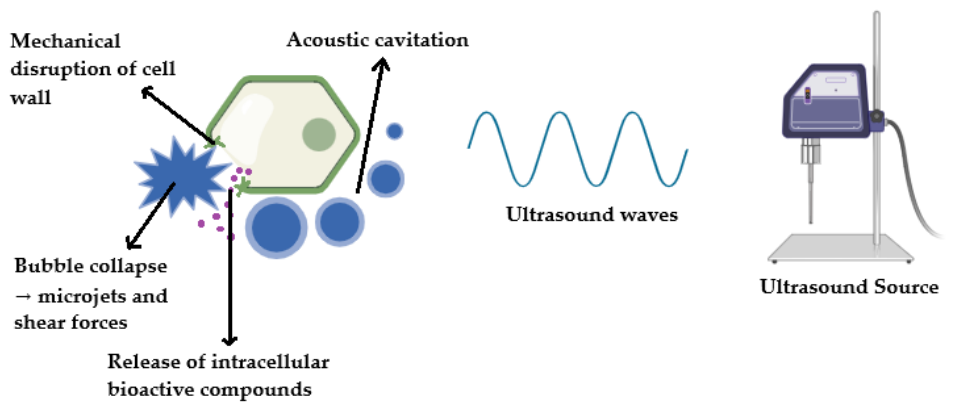
Among emerging intensification technologies, Ultrasound-Assisted Extraction (UAE) is arguably the most mature and widely adopted method for polyphenol recovery. Unlike conventional maceration, which relies on passive diffusion, UAE utilizes high-frequency sound waves (20–100 kHz) to mechanically disrupt the matrix, as shown in
Figure 2.
Mechanism: Cavitation and Sonoporation. The fundamental driving force of UAE is acoustic cavitation. As described by Shen et al. [
80] and Chemat et al. [
94], the propagation of ultrasonic waves through a solvent creates alternating cycles of compression and rarefaction. This pressure fluctuation generates microscopic bubbles that grow until they reach a critical size and implode violently. The collapse of these bubbles generates localized “hotspots” (temperatures up to 5000 K, pressures up to 1000 atm) and high-velocity liquid microjets. When these microjets impact the solid matrix, they induce distinct physical effects:
Fragmentation: Physical reduction in particle size, increasing the surface area.
Erosion: Washing away of the surface waxes (cuticle) of fruit peels.
Sonoporation: The formation of transient micropores in the cell wall, which significantly enhances solvent penetration and solute diffusivity [
94].
A key advantage of Ultrasound-Assisted Extraction (UAE) lies in its capacity for process intensification. By mechanically disrupting the mass transfer boundary layer at the solid–liquid interface, UAE enhances solvent penetration and solute diffusion, enabling efficient extraction at lower bulk temperatures. This feature is particularly advantageous for thermolabile compounds, allowing the preservation of structurally sensitive molecules such as anthocyanins [
51]. Patra et al. [
79] report that this predominantly non-thermal mechanism enables UAE to reach extraction equilibrium within minutes, in contrast to the extended timescales (hours) required for conventional maceration, resulting in reduced energy demand and lower solvent consumption.
For structurally resistant or fibrous matrices, UAE offers additional benefits. In the case of coffee silverskin, Biondić Fučkar et al. [
83] demonstrated that ultrasonic treatment promotes the release of bound phenolics under mild thermal conditions, avoiding the high temperatures that can trigger the formation of undesirable Maillard reaction products and compromise extract quality.
Despite these advantages, UAE presents several limitations that must be addressed for effective process design. A primary concern is sonolysis, which can occur under excessive ultrasonic power or prolonged exposure. Expósito-Almellón et al. [
95] report that such conditions may induce the dissociation of water molecules, generating reactive hydroxyl radicals (OH•) capable of oxidizing and degrading polyphenolic compounds.
Scalability also represents a critical challenge. Acoustic attenuation limits the uniform propagation of ultrasonic energy, leading to heterogeneous cavitation intensity as the distance from the transducer increases. This phenomenon complicates scale-up, as large-volume reactors may exhibit non-uniform extraction zones and reduced process efficiency [
94]. Consequently, industrial application of UAE requires careful optimization of power density, treatment time, and reactor geometry to balance effective matrix disruption against radical-induced degradation and energy losses.
4.4. Microwave-Assisted Extraction (MAE)
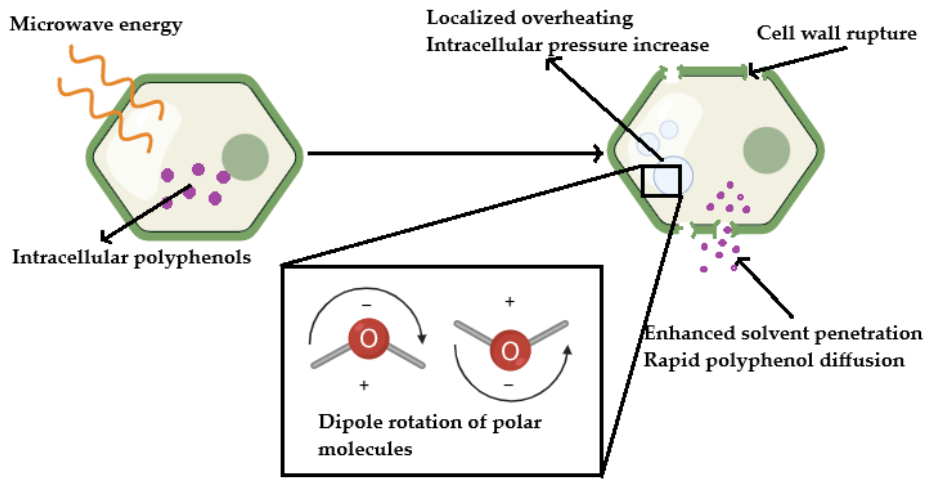
In contrast to ultrasound-assisted extraction, which relies on mechanical cavitation, Microwave-Assisted Extraction (MAE) is driven by rapid volumetric heating induced by non-ionizing electromagnetic radiation, represented in
Figure 3, typically operating at 2.45 GHz. Rather than transferring heat by conduction from the vessel wall to the matrix, MAE generates heat directly within both the solvent and the plant tissue. This internalized heating mechanism effectively overcomes the thermal conductivity limitations of conventional systems, resulting in accelerated mass transfer and extraction kinetics [
96] (
Figure 3).
The performance of MAE arises from the combined action of two electromagnetic heating mechanisms occurring simultaneously within the extraction medium, as described by Patra et al. [
79] and Shawky et al. [
11]:
Dipole Rotation: Polar molecules, predominantly water and hydroalcoholic solvents, continuously realign with the oscillating electric field. This rapid molecular rotation, occurring at frequencies on the order of 109 cycles per second, generates frictional heating through molecular collisions).
Ionic Conduction: Dissolved ions within the solvent or plant tissue migrate under the influence of the alternating electric field. Resistance to this ionic movement results in Joule (ohmic) heating, contributing to rapid temperature elevation within the matrix.
Otero et al. [
68] report that this internal heating produces steep pressure gradients at the cellular level. As intracellular moisture vaporizes, internal pressure increases until it exceeds the mechanical resistance of the cell wall, leading to cell rupture and rapid release of intracellular polyphenols into the surrounding solvent. This phenomenon, often described as a “cell explosion” effect, markedly enhances extraction efficiency.
The principal advantage of MAE lies in its exceptional kinetic performance. Caldas et al. [
75], in a comparative study on grape skins, demonstrated that MAE achieved phenolic yields comparable to or exceeding those of conventional maceration within seconds to minutes, whereas maceration required several hours. This acceleration is attributed to localized solvent superheating within the plant matrix, where temperatures can transiently exceed the normal boiling point under elevated internal pressure, enhancing solubility and diffusion of compounds such as chlorogenic acid.
From a process sustainability perspective, MAE aligns with Green Chemistry principles. Nirmal et al. [
6] highlight that the drastic reduction in extraction time exceeding 80–90% compared to Soxhlet extraction translates into lower energy input and reduced solvent demand, making MAE particularly attractive for high-throughput and semi-continuous valorization processes.
Despite its efficiency, MAE is subject to important physicochemical constraints. Le et al. [
97] emphasize that extraction efficiency is strongly governed by the dielectric properties of the solvent system. Non-polar solvents, such as hexane or limonene, exhibit minimal microwave absorption and therefore cannot generate sufficient heat, rendering MAE unsuitable for the direct recovery of lipophilic fractions (e.g., oils from plum kernels) without the inclusion of polar co-solvents or modifiers.
Thermal sensitivity represents an additional limitation. The rapid formation of localized hotspots may induce degradation of heat-labile compounds if temperature control is insufficient. Eliopoulos et al. [
26] report that uncontrolled MAE conditions can accelerate the degradation of anthocyanins in plum and grape matrices, as well as ascorbic acid in citrus residues, potentially yielding extracts with reduced antioxidant activity despite high total phenolic recovery.
4.5. Pulsed Electric Field (PEF) Extraction
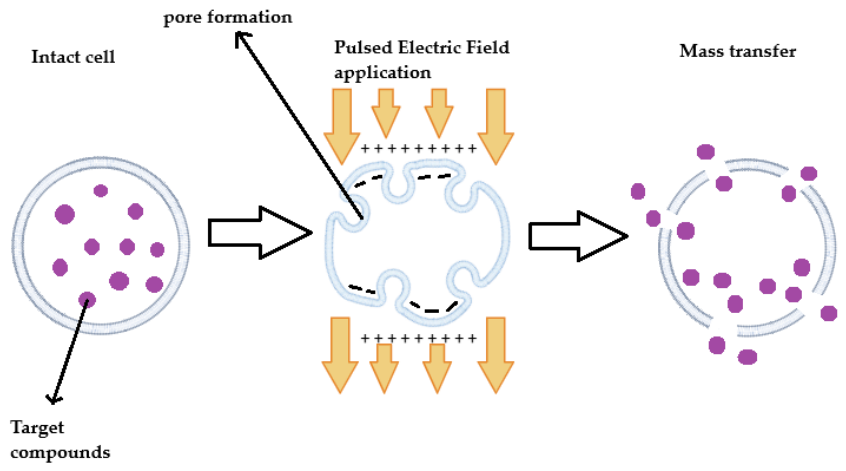
Pulsed Electric Field (PEF) represents a fundamentally different approach than ultrasound or microwave extractions discussed earlier: it uses short, high-voltage pulses to induce electroporation in the cell membrane, as represented in
Figure 4. PEF, originally developed for non-thermal pasteurization, has emerged as a “cold extraction” technology for fruit bioactives, enhancing the recovery of thermolabile compounds through electroporation while preserving their structural integrity [
98,
99].
4.5.1. Mechanism: Electroporation and Membrane Permeabilization
The core principle of PEF, as detailed by Ranjha et al. [
98], involves the application of short electrical pulses (typically microseconds to milliseconds) at high field strengths (0.5–20 kV/cm) to a plant matrix placed between two electrodes. When the external electric field exceeds the critical transmembrane potential (approximately 1 V), it induces the repulsion of charge-carrying molecules in the lipid bilayer. This creates temporary or permanent hydrophilic pores in the cell membrane.
Lakka et al. [
88] explain that this “electroporation” dramatically increases mass transfer by allowing intracellular fluids (rich in polyphenols) to diffuse out of the cytoplasm without the need for significant heating or physical comminution. The process is extremely rapid, often requiring treatment times of less than 1 s (accumulated pulse duration) to achieve permeabilization.
4.5.2. Advantages: Non-Thermal Selectivity
The primary advantage of PEF is its ability to preserve the structural integrity of thermolabile compounds.
Enhanced Yield at Low Temperature: In a study on lemon residues, Peiró et al. [
81] demonstrated that a PEF treatment of 7 kV/cm increased the extraction of hesperidin and eriocitrin by 300% compared to untreated pressing, without raising the temperature. This makes PEF superior to MAE for recovering volatile aroma compounds or heat-sensitive vitamins.
Reduced Solvent and Time: Barbosa-Pereira et al. [
85] applied PEF to Cocoa Bean Shells and Coffee Silverskin, achieving a 20% increase in polyphenol recovery compared to conventional methods, while reducing the extraction time significantly. The technology effectively creates a “sponge-like” texture in the waste material, facilitating the rapid entry of solvents like water or ethanol.
4.6. Enzyme-Assisted Extraction (EAE)
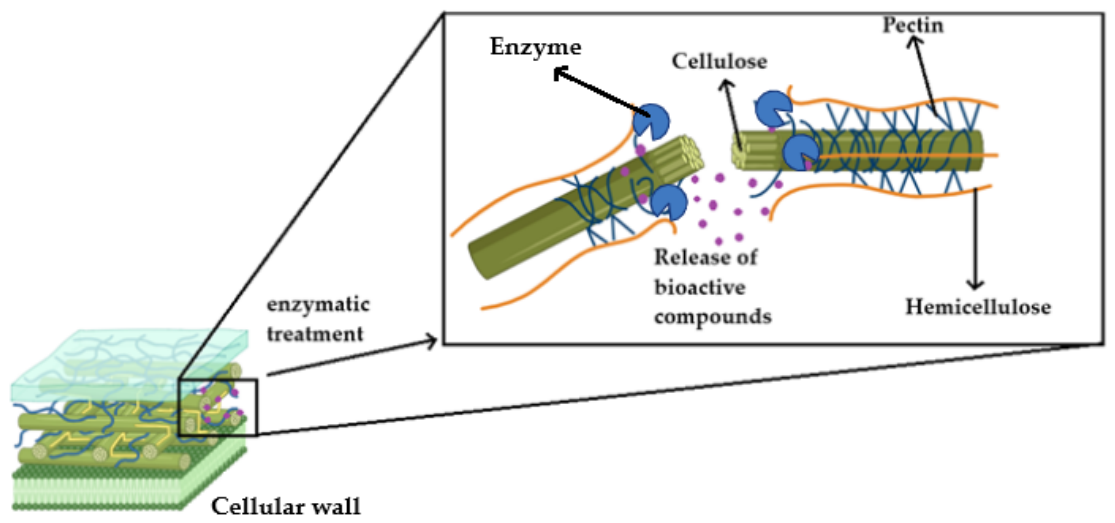
Unlike the physical disruption mechanisms discussed earlier, Enzyme-Assisted Extraction (EAE) relies on biochemical hydrolysis. It addresses the fundamental barrier to polyphenol recovery: the complex polysaccharide network of the plant cell wall (
Figure 5).
4.6.1. Biochemical Principle: Catalytic Hydrolysis
The plant cell wall acts as a recalcitrant cage composed of cellulose, hemicellulose, and pectin, within which phenolic compounds are often entrapped or covalently bound (e.g., via ester bonds). Gligor et al. [
100] describe EAE as a targeted strategy using specific hydrolases, primarily cellulases, pectinases, and hemicellulases, to degrade these structural polymers. By cleaving the glycosidic linkages of the cell wall, enzymes increase the permeability of the matrix and liberate the “bound” phenolic fraction that remains inaccessible to conventional solvent extraction.
Stanek-Wandzel et al. [
101] emphasized the importance of enzyme specificity in their study on grape pomace. They demonstrated that a “cocktail” approach by combining cellulolytic and pectinolytic enzymes to achieve a synergistic effect, dismantling the heterogeneity of the skin matrix more effectively than single-enzyme treatments.
4.6.2. Advantages: Specificity and Bound Phenolic Release
The defining advantage of EAE is its ability to operate under mild processing conditions (typically pH 4.5–6.0 and temperatures of 40–50 °C). This prevents the thermal degradation and oxidation often observed in Soxhlet or high-temperature MAE. Poblete et al. [
102] validated this in Pisco grape pomace, reporting that EAE yielded extracts with superior antioxidant capacity compared to thermal methods, primarily due to the preservation of heat-sensitive anthocyanins.
Furthermore, EAE is uniquely effective for recovering bound phenolics. Vardakas et al. [
103] optimized the extraction of olive leaves using commercial enzyme preparations (Celluclast
® and Pectinex
®), achieving a significant increase in the recovery of oleuropein and luteolin-7-O-glucoside. Their results indicated that enzymatic pretreatment acts as a biological “key,” unlocking phenolic moieties esterified to the lignocellulosic backbone.
4.6.3. Limitations: Cost and Kinetics
Despite its high selectivity, EAE faces industrial hurdles. Gil-Martín et al. [
104] note that the process is kinetically slow, often requiring incubation times of 2 to 24 h to achieve complete hydrolysis, compared to minutes for UAE or MAE. Additionally, the economic feasibility is constrained by the high cost of industrial enzymes and the strict requirement for precise control of pH and temperature to prevent enzyme denaturation [
105]. Currently, trends point toward hybrid technologies (e.g., Ultrasound-Enzyme-Assisted Extraction) to enhance biochemical specificity with physical speed.
4.7. Pressurized Liquid Extraction (PLE)
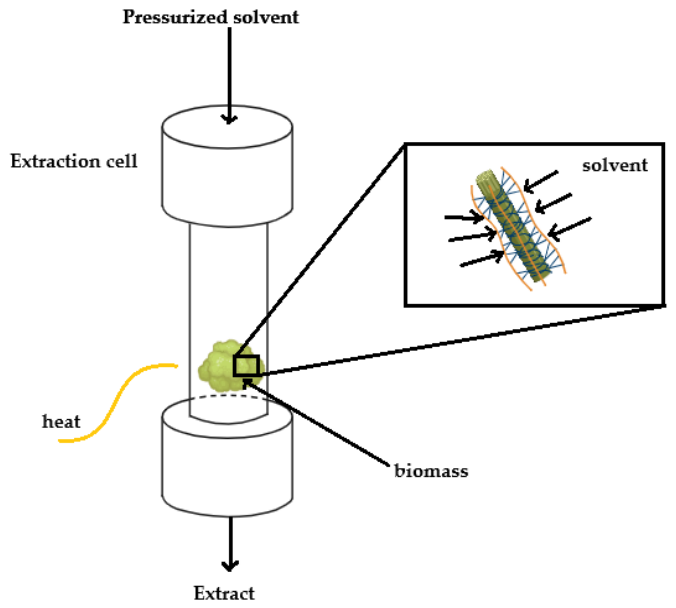
Pressurized Liquid Extraction (PLE), often referred to commercially as Accelerated Solvent Extraction (ASE), utilizes liquid solvents at elevated temperatures (typically 50–200 °C) and pressures (35–200 bar). Unlike supercritical fluids, the solvent in PLE remains in the liquid state, maintained by pressure above its boiling point [
106] (
Figure 6).
4.7.1. Thermodynamic Mechanism: Dielectric Tuning
The efficiency of PLE is driven by the alteration of the solvent’s physicochemical properties under heat and pressure. Miklavčič Višnjevec et al. [
106] explain that as temperature rises, the viscosity and surface tension of the solvent decrease significantly, allowing for deeper penetration into the matrix pores. Simultaneously, the diffusivity of the solute increases, enhancing mass transfer rates.
A critical phenomenon in PLE is the modification of the dielectric constant (ε). This is particularly relevant for Subcritical Water Extraction (SWE). At ambient conditions, water is highly polar (ε ≈ 80) and poor at dissolving non-polar polyphenols. However, as the temperature approaches 200 °C, the dielectric constant of water drops to values similar to those of ethanol or methanol (ε ≈ 30). This allows pure water to effectively extract semi-polar compounds (like curcumin or quercetin) without the need for organic co-solvents, a principle highlighted by Miklavčič Višnjevec et al. [
106] as a cornerstone of green analytical chemistry.
4.7.2. Operational Efficiency and Solvent Tunability
PLE is characterized by its ability to achieve exhaustive extraction in short cycles. Machado et al. [
86] compared PLE against Soxhlet and ultrasound for grape pomace, reporting that PLE using acidified ethanol achieved the highest recovery of total phenolics (57.2 mg GAE/g) in a fraction of the time (15 min vs. 6 h for Soxhlet). The high pressure forces solvent into the “dead zones” of the plant tissue, effectively washing out solutes that are physically trapped rather than chemically bound.
Furthermore, the process allows for fractionation. Silva et al. [
87] demonstrated an intermittent PLE process for grape pomace, where varying the temperature allowed for the selective separation of monomeric anthocyanins (extracted at lower temperatures) from more complex polymeric tannins (extracted at higher temperatures), facilitating the downstream production of specific functional ingredients.
4.7.3. Limitations: Thermal Selectivity and Neo-Formation
The primary constraint of PLE is the risk of thermal degradation. While high temperatures enhance solubility, they can also trigger unwanted chemical reactions. Koskinakis et al. [
84] investigated PLE on coffee silverskin and observed that while extraction yields increased at temperatures > 160 °C, the chemical profile changed drastically. The harsh conditions induced the Maillard reaction, generating melanoidins, antioxidant polymers formed from sugars and amino acids. While these new compounds contribute to the total antioxidant capacity, their formation indicates the simultaneous degradation of native chlorogenic acids and amino acids. Thus, to optimize the process, balance between maximizing solubility and preserving the native phytochemical profile is required.
4.8. Supercritical Fluid Extraction (SFE)
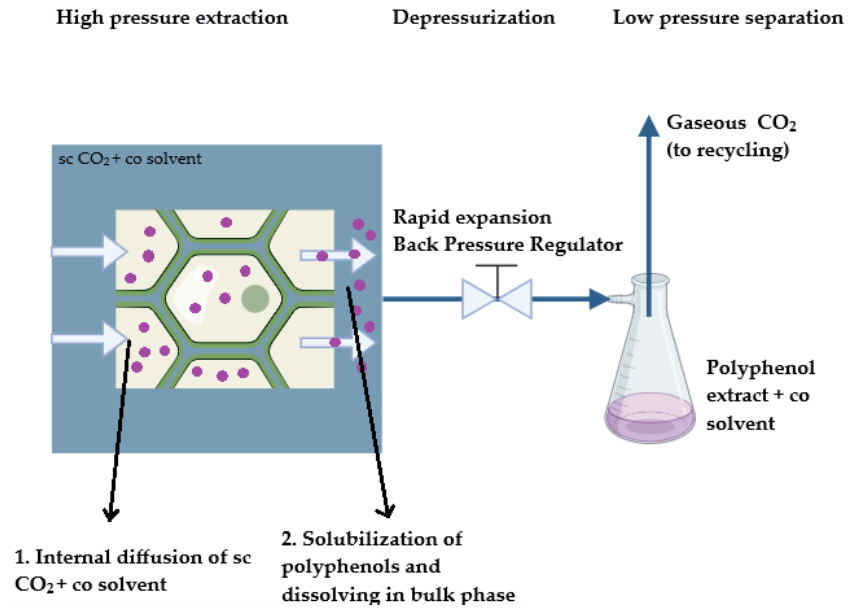
While Pressurized Liquid Extraction (PLE) modifies water to behave like an organic solvent, Supercritical Fluid Extraction (SFE) utilizes fluids, predominantly Carbon Dioxide CO
2, maintained above their critical temperature and pressure. In this state, the fluid exhibits a hybrid nature: it possesses the density of a liquid (enabling solvation) and the diffusivity of a gas (enabling rapid mass transfer) (Zhang et al.) [
82] (
Figure 7).
4.8.1. Mechanism: Tunable Density and Polarity
The fundamental advantage of SFE is its thermodynamic tunability. Zhang and Wu [
82] explain that by making small adjustments to pressure and temperature, the density of supercritical CO
2 can be precisely modulated to target specific compounds. However, pure CO
2 is non-polar, making it highly effective for extracting lipophilic fractions, such as essential oils from citrus peels or lipids from plum kernels, but inherently poor at solubilizing hydrophilic polyphenols.
To overcome this polarity gap, Słota et al. [
107] highlight the necessity of using organic modifiers (co-solvents). The addition of small percentages (typically 5–20%) of ethanol or water to the supercritical stream induces dipole–dipole interactions, significantly enhancing the solubility of polar compounds like tannins and flavonoids. This “modified SFE” approach allows for the simultaneous recovery of lipophilic and hydrophilic fractions, or their fractionation based on pressure steps.
4.8.2. Advantages: The “Zero Residue” Standard
From a regulatory and safety perspective, SFE is superior to all liquid solvent methods. Herzyk et al. [
108] emphasize that CO
2 is Generally Recognized As Safe (GRAS), non-toxic, and non-flammable. Crucially, post-extraction recovery is achieved by simple depressurization: the CO
2 returns to its gaseous state and evaporates instantly, yielding a solvent-free extract. This eliminates the energy-intensive evaporation steps required in UAE or PLE and prevents the thermal degradation of sensitive bioactives like anthocyanins.
4.8.3. Limitations and Sequential Applications
The primary limitation of SFE is economic; the requirement for high-pressure pumps and vessels results in high capital costs (CAPEX). Furthermore, Anusha and Sivakumar [
109] note that even with co-solvents, the recovery yields of high-molecular-weight phenolics (e.g., polymeric proanthocyanidins) are often lower than those achieved by PLE or UAE.
Consequently, the current trend described by Zhang and Wu [
82] is Sequential Extraction. In this cascade approach, SFE is used first to strip the lipophilic fraction (e.g., recovering limonene from citrus peel), leaving a defatted residue. This residue is then subjected to water-based methods (UAE or PLE) to recover the polyphenols. This biorefinery strategy maximizes the total valorization of the biomass while maintaining the purity of the individual fractions.
4.9. Future Trends and Hybrid Technologies
Current research indicates that the future of polyphenol recovery lies not in a single technology, but in the synergistic combination of methods and the adoption of the circular bioeconomy framework.
4.9.1. Hybrid Technologies: Synergistic Intensification
To overcome the insufficiencies of single unit-operations extraction methods, researchers are increasingly coupling physical and biochemical mechanisms to systematically dismantle the plant cell wall.
Ultrasound-Assisted Enzymatic Extraction (UA-EAE): Gligor et al. [
100] describe this as the most promising hybrid approach. While enzymes provide high specificity for bound phenolics, their action is often rate-limited by the diffusion of the enzyme into the dense plant tissue. By applying low-intensity ultrasound, the sonoporation effect opens micropores in the cell wall, allowing enzymes (like pectinase or cellulase) to penetrate the matrix instantly. This reduces hydrolysis time from 24 h to <2 h.
Ultrasound-Microwave Assisted Extraction (UMAE): Shen et al. [
80] highlight the coupling of acoustic cavitation (UAE) with volumetric heating (MAE). This dual action destroys cell walls more effectively than either method alone, although precise temperature control is required to prevent the degradation of anthocyanins.
4.9.2. Bioconversion and Fermentation-Assisted Extraction (FAE)
A distinct evolution from standard enzymatic extraction is Bioconversion, specifically via Solid-State Fermentation (SSF). Unlike EAE, which relies on the addition of costly purified enzymes, SSF involves the cultivation of food-grade microorganisms (e.g.,
Aspergillus niger,
Rhizopus oligosporus) directly on the wet agro-industrial waste [
110].
Mechanism: In Situ Enzymatic Release
Zmuncilă et al. [
47] highlight that during fermentation, microorganisms secrete a complex synergistic pool of enzymes (cellulases, xylanases, beta-glucosidases) to digest the plant matrix. This metabolic activity not only breaks down the cell wall but also modifies the phenolic profile, bioconverting simple glycosides into more bioactive aglycones (e.g., converting resveratrol glucoside into free resveratrol).
Advantages: Bound Phenolic Release
Shawky et al. [
11] emphasize that bioconversion is uniquely effective for releasing the insoluble-bound phenolic fraction linked to lignin, which is often inaccessible even to ultrasound or microwave methods. In their review of agri-food waste valorization, they note that fermentation can increase the extractable TPC of matrices like wheat bran and citrus peels by 40–100% compared to unfermented controls, while simultaneously enriching the protein content of the residue, making it suitable for animal feed.
4.9.3. Closing the Loop: The Fate of “Exhausted” Solids
A defining feature of the biorefinery concept is the management of the solid residue remaining after phenolic extraction. Within a conventional linear framework, this so-called “exhausted” biomass is treated as waste. In contrast, circular processing models reconceptualize this residue as a secondary feedstock for downstream valorization, enabling full resource utilization across multiple value tiers.
Scenario A: Integration into Animal Feed Systems.
When extraction is combined with biological pretreatment such as solid-state fermentation (SSF), the residual biomass may be nutritionally upgraded. SSF has been shown to increase microbial protein content while simultaneously reducing anti-nutritional factors, including phytates and residual tannins partially removed during phenolic extraction. As a result, the post-extraction solid can be repurposed as a functional animal feed supplement, facilitating the reintegration of nutrients into the agri-food chain [
111].
Scenario B: Energy Recovery and Process Self-Sufficiency.
For structurally recalcitrant matrices, such as olive stones or highly lignified plant residues, biochemical reuse may be limited. In these cases, thermochemical conversion represents a complementary valorization route. Zhu et al. [
112] propose that, following recovery of thermolabile polyphenols, the dried solid residue can be subjected to pyrolysis to generate bio-oil and biochar, contributing to renewable energy production.
Scenario C: Soil Amelioration and Nutrient Cycling.
A critical component of circular agriculture consists of returning organic matter to the soil to maintain fertility. The integration of bioactive compound extraction with the subsequent composting of exhausted biomass represents a viable strategy for fully valorizing agro-industrial residues. For instance, recent research on grape pomace has demonstrated that the prior extraction of polyphenols does not hinder the composting process; the exhausted solid residues retain their structural integrity and organic carbon, allowing them to be successfully processed into stable organic soil amendments [
113]. This cascading approach ensures that the biomass is fully valorized: first as a source of high-value phytochemicals, and second as a nutrient-rich material that supports soil health, effectively closing the loop in the agricultural production cycle.
An illustrative example of this integrated approach is provided by Gómez-Cruz et al. [
114] in the olive oil sector. After hydroxytyrosol extraction, the residual olive pâté was utilized for biogas production or direct thermal energy generation. The recovered energy was subsequently reintegrated into the extraction process, forming a partially self-sustaining system that substantially reduces the overall carbon footprint of polyphenol recovery. Such “integral valorization” strategies highlight the potential of circular biorefineries to simultaneously maximize resource efficiency and improve the environmental performance of bioactive compound production.
Moreover, recent studies highlight that the industrial valorization of agro-food processing residues should be addressed through integrated biorefinery systems, in which extraction technologies are combined with downstream conversion processes to maximize the utilization of biomass. Within this framework, fruit-processing residues such as apple, grape, citrus, coffee, plum, and olive by-products can be treated as feedstocks for cascade processing, enabling the sequential recovery of high-value compounds (e.g., polyphenols, pectin, lipids) followed by the conversion of the remaining biomass into energy or materials through processes such as anaerobic digestion, fermentation, or hydrothermal carbonization. This integrated approach improves resource efficiency, reduces environmental impacts associated with waste disposal, and enhances the economic feasibility of biomass valorization within circular bioeconomy systems, thereby supporting the transition toward sustainable agro-industrial processing chains [
115].
4.10. Industrial and Techno-Economic Considerations for the Scale-Up of Green Extraction Technologies
From an industrial perspective, the implementation of emerging extraction technologies for polyphenol recovery from fruit-processing by-products requires careful evaluation of scale-up feasibility, energy demand, equipment costs, and regulatory constraints for food and nutraceutical applications. Although techniques such as ultrasound-assisted extraction (UAE), microwave-assisted extraction (MAE), and pulsed electric field (PEF) have demonstrated high extraction efficiencies at laboratory scale, their transition to industrial processing remains challenging. For instance, the scale-up of UAE is not straightforward because uniform energy distribution in large reactors and the mechanical resistance of transducers under higher loads may limit process efficiency, requiring optimized reactor configurations such as flow-through systems or multiple transducer arrangements [
116]. Similarly, techno-economic studies indicate that the industrial integration of PEF as a pretreatment step in polyphenol extraction processes depends strongly on energy consumption, equipment investment, and process throughput, which influence overall operating costs and return on investment [
117]. On the other side, a techno-economic comparison between subcritical water extraction (SWE) and ethanol extraction for phenolic compounds showed that SWE is a more efficient process. Ethanol extraction requires solvent recovery and additional processing units, resulting in higher energy consumption and longer extraction time. While SWE achieved the same phenolic yield in 1 h, ethanol extraction required 8 h to obtain comparable results. Furthermore, the cost of manufacturing (COM) for ethanol extraction was 4.6% higher due to solvent costs. Overall, SWE demonstrated a more competitive and energy-efficient alternative for phenolic extraction [
118].
Alternatively, despite their well-recognized advantages and demonstrated feasibility, enzyme-assisted extraction techniques remain limited in industrial application, primarily due to their relatively recent development, lack of large-scale implementation and limited commercial adoption [
100]. Conversely, the primary limitation of pressurized liquid extraction (PLE) lies in its high energy demand required to achieve and maintain elevated system pressures, which consequently leads to increased operational and production costs [
119]. From an economic perspective, pressurized liquid extraction (PLE) is generally more cost-effective than supercritical fluid extraction (SFE), as it involves lower capital and operational costs due to simpler equipment requirements and reduced processing time, whereas SFE requires higher investment associated with high-pressure systems and CO
2 compression [
119].
Nevertheless, these technologies offer promising advantages for industrial biorefineries, including enhanced mass transfer, reduced solvent consumption, and shorter processing times, which may improve the economic feasibility of valorizing fruit residues such as apple, plum, grape, citrus, coffee, and olive by-products within circular bioeconomy systems [
90]. Consequently, future research should focus on pilot-scale validation, energy optimization, and integrated biorefinery approaches to facilitate the industrial adoption of these green extraction technologies.
5. Discussion
The transition towards a circular economy in the agro-food sector requires effective strategies for the valorization of processing by-products [
23]. As synthesized in this review, residues from grapes, apple, plum, olive, citrus, and coffee processing represent immense, largely untapped reservoirs of valuable polyphenolic compounds [
6]. However, the industrial application of this potential is heavily bottlenecked by extraction methodologies. A critical analysis of the current literature highlights a definitive shift in recovery methodologies. There is a clear trajectory shift from conventional solid–liquid extractions utilizing harsh solvents, towards green extraction technologies. The green extraction techniques have demonstrated superior extraction yields, shorter processing times, and reduced environmental footprints [
105]. Nonetheless the shift from conventional solid–liquid extraction to intensified green technologies involves critical trade-offs between extraction yield, extract purity, and operational scalability [
97].
Conventional maceration and Soxhlet extractions, while industrially implemented, present severe limitations due to high solvent demand, prolonged processing times, and the thermal degradation of sensitive compounds [
76]. To overcome mass transfer resistances, physical disruption technologies such as Ultrasound-Assisted Extraction (UAE) and Microwave-Assisted Extraction (MAE) have demonstrated substantial yield enhancements [
10,
79]. UAE offers a highly scalable and predominantly non-thermal solution, making it ideal for thermolabile compounds [
83]. Conversely, MAE accelerates extraction kinetics drastically. However, its reliance on rapid internal heating presents a significant risk of localized thermal degradation if not rigorously controlled [
26].
Non-thermal permeabilization via Pulsed Electric Field (PEF) provides exceptional selectivity for heat-sensitive bioactives, enabling rapid intracellular release without the thermal damage associated with MAE [
85]. Yet, physical disruption alone is not efficient for all matrices. In such cases, Enzyme-Assisted Extraction (EAE) provides unparalleled biochemical specificity. Despite this superior extract quality, the industrial application of EAE remains constrained by slow kinetics and the high cost of specific enzymatic cocktails [
104].
High-pressure systems, namely Pressurized Liquid Extraction (PLE) and Supercritical Fluid Extraction (SFE), offer tunable dielectric properties and superior solvent penetration [
106,
107]. PLE significantly shortens extraction cycles. However, the elevated temperatures required for Subcritical Water Extraction (SWE) can induce the formation of Maillard products, inherently altering the native phenolic profile [
106]. SFE remains optimal for lipophilic fractions (e.g., essential oils from citrus) and produces solvent-free extracts, but its low polarity limits its efficacy for highly hydrophilic polyphenols without the introduction of polar co-solvents [
107].
Ultimately, the optimal recovery strategy is inherently matrix dependent. To bridge the gap between bench-scale yields and industrial application, future research must pivot towards comprehensive techno-economic assessments and life cycle analyses (LCAs), integrating these technologies into sequential biorefinery frameworks that simultaneously valorize polyphenols, lipids, and dietary fibers [
114,
120].
6. Conclusions
This analysis of recent literature confirms the evolution of agro-food by-product valorization from waste management to a mature field of process engineering. However, while laboratory scale optimization is robust, industrial implementation continues to lag behind, primarily due to limited methodological standardization. Future research must prioritize the quantification of matrix-specific compounds (e.g., phloridzin, oleuropein, resveratrol) to validate the functional potential, regulatory compliance, rather than relying on total polyphenol content (TPC).
The comparative analysis presented in this review shows that feasibility is intrinsically matrix and extraction method dependent. Apple peel represents the most valuable fraction among apple by-products; however, seed removal is recommended to mitigate toxicological risks in the case of valorization strategies involving enzymatic or microbiological extraction. The valorization of plum skins is strictly a non-thermal approach, since the functional value lies entirely in the heat-labile anthocyanins. In citrus residues, high added value is provided by the flavedo, rich in polymethoxylated flavones, but requires sequential extraction to address both hydrophilic and lipophilic compounds. Coffee cascara is an emergent immediately exploitable by-product, benefiting from favorable regulatory status and minimal processing requirements. In contrast, olive oil mill wastewater should be primarily approached as an environmental liability, with polyphenol recovery serving the second place as a valorization strategy.
From the technological perspective, single extraction operations are insufficient to successfully achieve both high yield and compound integrity. Ultrasound-assisted extraction has the highest potential for industrial scaling for continuous, low temperature processing, while supercritical fluid extraction remains the most selective method for recovering lipophilic bioactives.
The most promising pathway forward is the complete valorization of biomass while minimizing waste streams. To achieve this, hybrid biorefinery systems must be developed. Strategies combining physical, chemical, biological treatments to enable comprehensive biomass valorization. Ultimately, closing the loop in plant-based food systems requires a structural redefinition of agro-food residues from waste to secondary raw materials, supported by extraction frameworks designed around industrial feasibility, regulatory constraints, and whole-biomass utilization.




 ,
,