Development of Advanced Pea Breeding Lines with Improved Resistance to Ascochyta Blight

 , ,
, , 
Abstract
1. Introduction
2. Materials and Methods
2.1. Development and Selection of Resistant Breeding Lines
2.2. Validation Field Trial: Assessment of Disease and Agronomic Traits
2.3. Traits Modelling
2.4. Trait Correlations and Principal Component Analyses
2.5. Multi-Trait Selection
3. Results
3.1. Field Performance, Resistance and Agronomic Traits
3.2. Trait Associations Revealed by Correlations and Principal Component Analysis
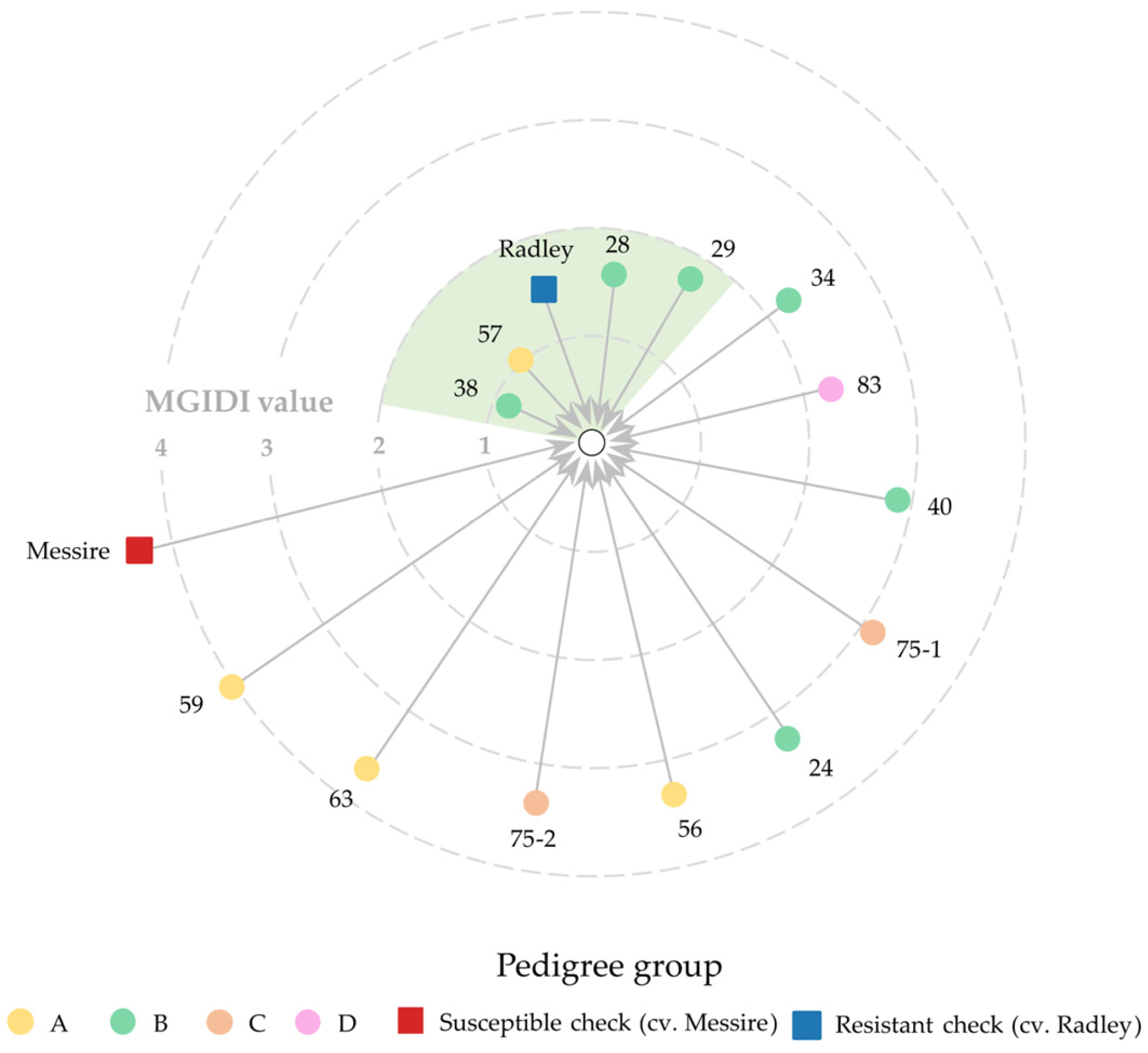
3.3. Integrative Multi-Trait Assessment of Breeding Lines with MGIDI
4. Discussion
5. Conclusions
Supplementary Materials
Author Contributions
Funding
Data Availability Statement
Conflicts of Interest
Abbreviations
| QTL/QTLs | Quantitative trait loci |
| IAS-CSIC | Institute for Sustainable Agriculture (Spanish National Research Council) |
| CCs | Controlled conditions |
| RCBD | Randomised Complete Block Design |
| DS | Disease severity |
| GDD | Growing Degree Days |
| rGY | Grain yield relative to Radley |
| HI | Harvest Index |
| REML | Restricted Maximum Likelihood |
| LMM | Linear mixed models |
| LMs | Linear (fixed effects) models |
| EMMs | Estimated Marginal Means |
| BLUEs | Best Linear Unbiased Estimators |
| PCA | Principal component analysis |
| PC1/PC2 | First/second principal components |
| MAD | Median absolute deviation |
| MGIDI | Multi-trait genotype–ideotype distance index |
| h2 | Broad-sense heritability (entry mean basis) |
| QTL/QTLs | Quantitative trait loci |
| IAS-CSIC | Institute for Sustainable Agriculture (Spanish National Research Council) |
| CC | Controlled-Conditions |
| RCBD | Randomised Complete Block Design |
| DS | Disease Severity |
| GDD | Growing Degree Days |
| rGY | Grain Yield relative to Radley |
| HI | Harvest Index |
| REML | Restrictred Maximum Likelihood |
| LMM | Linear mixed models |
| LM | Linear (fixed-effects) models |
| EMMs | Estimated Marginal Means |
| BLUEs | Best Linear Unbiased Estimators |
| PCA | Principal Component Analysis |
| PC1/PC2 | First/second Principal Components |
| MAD | Median absolute deviation |
| MGIDI | Multi-trait genotype–ideotype distance index |
| h2 | Broad-sense heritability (entry mean basis) |
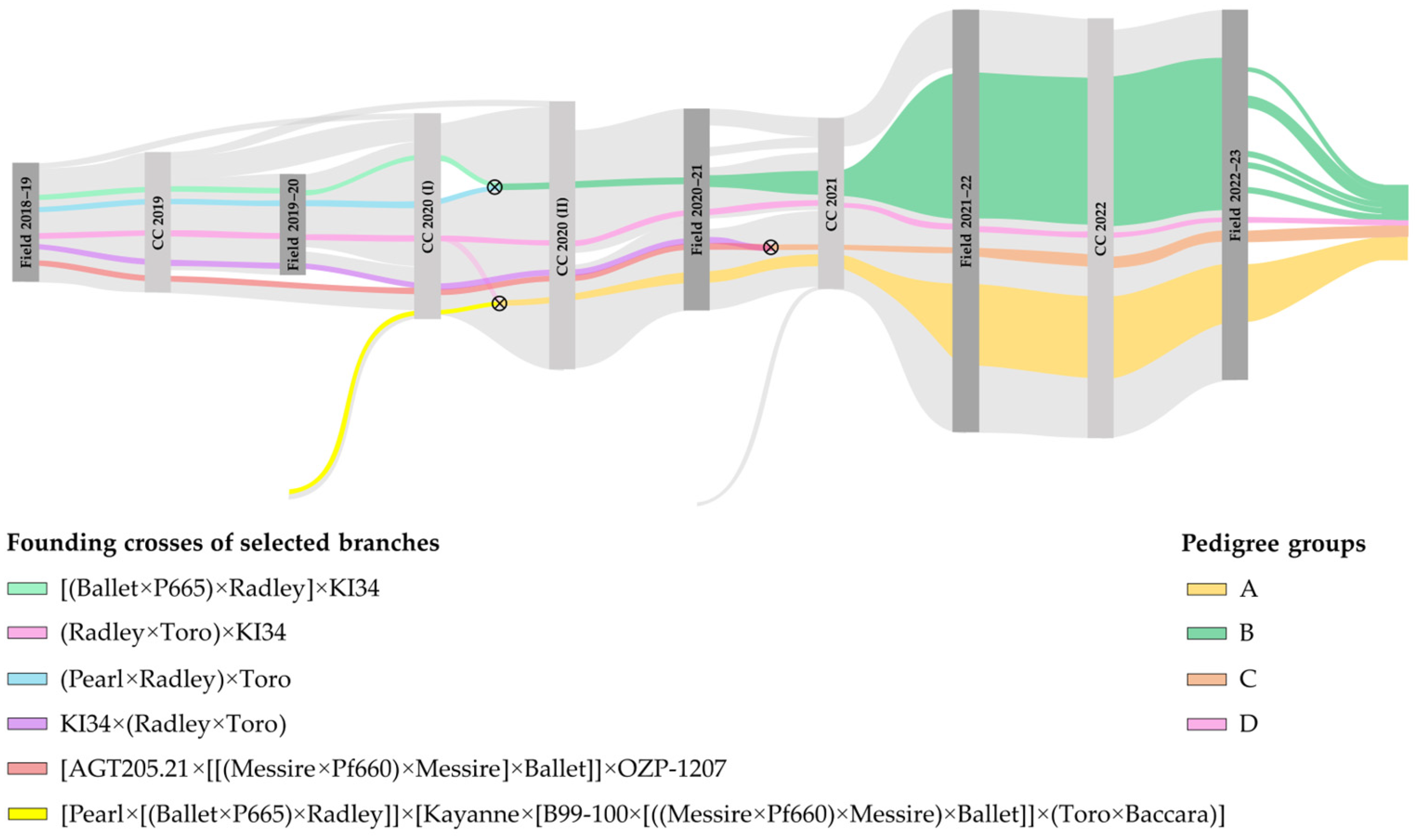
Appendix A. Guide to Interpreting Figure 1
- Field 2018–19: sown autumn 2018; harvested late spring 2019.
- CC 2019: early summer 2019.
- Field 2019–20: sown late summer 2019; harvested early winter 2020.
- CC 2020 (I): winter 2020.
- CC 2020 (II): early autumn 2020.
- Field 2020–21: sown late autumn 2020; harvested late spring 2021.
- CC 2021: summer 2021.
- Field 2021–22: sown autumn 2021; harvested late spring 2022.
- CC 2022: summer 2022.
- Field 2022–23: sown autumn 2022; harvested late spring 2023.
References
- Cernay, C.; Pelzer, E.; Makowski, D. A global experimental dataset for assessing grain legume production. Sci. Data 2016, 3, 160084. [Google Scholar] [CrossRef]
- Rawal, V.; Navarro, D.K. (Eds.) The Global Economy of Pulses; Food and Agriculture Organization of the United Nations: Rome, Italy, 2019. [Google Scholar] [CrossRef]
- Food and Agriculture Organization of the United Nations. FAOSTAT Statistical Database. Available online: https://www.fao.org/faostat/ (accessed on 2 July 2025).
- Adhikari, K.N.; Khan, T.N.; Stefanova, K.; Pritchard, I. Recurrent breeding method enhances the level of blackspot (Didymella pinodes (Berk. & Blox.) Vestergr.) resistance in field pea (Pisum sativum L.) in southern Australia. Plant Breed. 2014, 133, 508–514. [Google Scholar] [CrossRef]
- Khan, T.N.; Timmerman-Vaughan, G.M.; Rubiales, D.; Warkentin, T.D.; Siddique, K.H.M.; Erskine, W.; Barbetti, M.J. Didymella pinodes and its management in field pea: Challenges and opportunities. Field Crops Res. 2013, 148, 61–77. [Google Scholar] [CrossRef]
- Rubiales, D.; Barilli, E.; Rispail, N. Breeding for biotic stress resistance in pea. Agriculture 2023, 13, 1825. [Google Scholar] [CrossRef]
- Fonseka, D.L.; Markell, S.G.; Zaccaron, M.L.; Ebert, M.K.; Pasche, J.S. Ascochyta blight in North Dakota field pea: The pathogen complex and its fungicide sensitivity. Front. Plant Sci. 2023, 14, 1165269. [Google Scholar] [CrossRef]
- Zhang, R.; Hwang, S.-F.; Gossen, B.D.; Chang, K.-F.; Turnbull, G.D. A quantitative analysis of resistance to Mycosphaerella Blight in field pea. Crop Sci. 2007, 47, 162–167. [Google Scholar] [CrossRef]
- Gossen, B.D.; Hwang, S.F.; Conner, R.L.; Chang, K.F. Managing the Ascochyta blight complex on field pea in Western Canada. Prairie Soils Crops 2011, 4, 135–141. [Google Scholar]
- Tivoli, B.; Banniza, S. Comparison of the epidemiology of Ascochyta blights on grain legumes. Eur. J. Plant Pathol. 2007, 119, 59–76. [Google Scholar] [CrossRef]
- Onfroy, C.; Tivoli, B.; Corbière, R.; Bouznad, Z. Cultural, molecular and pathogenic variability of Mycosphaerella pinodes and Phoma medicaginis var. pinodella isolates from dry pea (Pisum sativum) in France. Plant Pathol. 1999, 48, 218–229. [Google Scholar] [CrossRef]
- Owati, A.; Agindotan, B.; Burrows, M. Characterization of fungal species associated with Ascochyta blight of dry pea in Montana and North America and development of a differential medium for their detection. Plant Health Prog. 2020, 21, 262–271. [Google Scholar] [CrossRef]
- Tran, H.S.; Li, Y.P.; You, M.P.; Khan, T.N.; Pritchard, I.; Barbetti, M.J. Temporal and spatial changes in the pea Black spot disease complex in Western Australia. Plant Dis. 2014, 98, 790–796. [Google Scholar] [CrossRef] [PubMed]
- Annan, E.N.; Mwanza, C.; Lucas, B.; Yan, Q.; Huang, L. Interspecific interactions and host background influence the population dynamics of the species causing the Ascochyta blight complex in pea. Plant Pathol. 2025, 74, 1878–1890. [Google Scholar] [CrossRef]
- McDonald, G.K.; Peck, D. Effects of crop rotation, residue retention and sowing time on the incidence and survival of ascochyta blight and its effect on grain yield of field peas (Pisum sativum L.). Field Crops Res. 2009, 111, 11–21. [Google Scholar] [CrossRef]
- Gudero Mengesha, G.; Terefe, H.; Yae, A.J.; Arato, A.A.; Betire, M.G.; Shago, T.S.; Bires, Z.F.; Borano, B.B.; Abebe, S.M. Integration of host resistance and fungicides reduced ascochyta blight pressure and minimised yield loss in field pea (Pisum sativum L.) in southern Ethiopia. Acta Agric. Scand. B Soil Plant Sci. 2022, 72, 971–986. [Google Scholar] [CrossRef]
- Timmerman-Vaughan, G.M.; Frew, T.J.; Russell, A.C.; Khan, T.; Butler, R.; Gilpin, M.; Murray, S.; Falloon, K. QTL mapping of partial resistance to field epidemics of Ascochyta blight of pea. Crop Sci. 2002, 42, 2100–2111. [Google Scholar] [CrossRef]
- Tar’an, B.; Warkentin, T.; Somers, D.J.; Miranda, D.; Vandenberg, A.; Blade, S.; Woods, S.; Bing, D.; Xue, A.; DeKoeyer, D.; et al. Quantitative trait loci for lodging resistance, plant height and partial resistance to mycosphaerella blight in field pea (Pisum sativum L.). Theor. Appl. Genet. 2003, 107, 1482–1491. [Google Scholar] [CrossRef]
- Timmerman-Vaughan, G.M.; Frew, T.J.; Butler, R.; Murray, S.; Gilpin, M.; Falloon, K.; Johnston, P.; Lakeman, M.B.; Russell, A.; Khan, T. Validation of quantitative trait loci for Ascochyta blight resistance in pea (Pisum sativum L.), using populations from two crosses. Theor. Appl. Genet. 2004, 109, 1620–1631. [Google Scholar] [CrossRef]
- Prioul, S.; Frankewitz, A.; Deniot, G.; Morin, G.; Baranger, A. Mapping of quantitative trait loci for partial resistance to Mycosphaerella pinodes in pea (Pisum sativum L.), at the seedling and adult plant stages. Theor. Appl. Genet. 2004, 108, 1322–1334. [Google Scholar] [CrossRef]
- Fondevilla, S.; Satovic, Z.; Rubiales, D.; Moreno, M.T.; Torres, A.M. Mapping of quantitative trait loci for resistance to Mycosphaerella pinodes in Pisum sativum subsp. syriacum. Mol. Breed. 2008, 21, 439–454. [Google Scholar] [CrossRef]
- Jha, A.B.; Tar’an, B.; Stonehouse, R.; Warkentin, T.D. Identification of QTLs associated with improved resistance to ascochyta blight in an interspecific pea recombinant inbred line population. Crop Sci. 2016, 56, 2926–2939. [Google Scholar] [CrossRef]
- Jha, A.B.; Gali, K.K.; Tar’an, B.; Warkentin, T.D. Fine mapping of QTLs for Ascochyta blight resistance in pea using heterogeneous inbred families. Front. Plant Sci. 2017, 8, 765. [Google Scholar] [CrossRef]
- Lee, R.C.; Grime, C.R.; O’Driscoll, K.; Khentry, Y.; Farfan-Caceres, L.M.; Tahghighi, H.; Kamphuis, L.G. Field pea (Pisum sativum) germplasm screening for seedling Ascochyta blight resistance and genome-wide association studies reveal loci associated with resistance to Peyronellaea pinodes and Ascochyta koolunga. Phytopathology 2023, 113, 265–276. [Google Scholar] [CrossRef]
- Fondevilla, S.; Ávila, C.M.; Cubero, J.I.; Rubiales, D. Response to Mycosphaerella pinodes in a germplasm collection of Pisum spp. Plant Breed. 2005, 124, 313–315. [Google Scholar] [CrossRef]
- Khan, T.W.; Keane, P.J.; Price, T.V. The epidemiology and control of Ascochyta blight in field peas: A review. Aus. J. Agric. Res. 2006, 57, 883–902. [Google Scholar] [CrossRef]
- Boutet, G.; Lavaud, C.; Lesné, A.; Miteul, H.; Pilet-Nayel, M.L.; Andrivon, D.; Lejeune-Hénaut, I.; Baranger, A. Five regions of the pea genome co-control partial resistance to D. pinodes, tolerance to frost, and some architectural or phenological traits. Genes 2023, 14, 1399. [Google Scholar] [CrossRef] [PubMed]
- Le May, C.; Ney, B.; Lemarchand, E.; Schoeny, A.; Tivoli, B. Effect of pea plant architecture on spatiotemporal epidemic development of ascochyta blight (Mycosphaerella pinodes) in the field. Plant Pathol. 2009, 58, 332–343. [Google Scholar] [CrossRef]
- Richard, B.; Bussière, F.; Langrume, C.; Rouault, F.; Jumel, S.; Faivre, R.; Tivoli, B. Effect of pea canopy architecture on microclimate and consequences on ascochyta blight infection under field conditions. Eur. J. Plant Pathol. 2013, 135, 509–524. [Google Scholar] [CrossRef]
- Banniza, S.; Hashemi, P.; Warkentin, T.D.; Vanderberg, A.; Davis, A.R. The relationships among lodging, stem anatomy, degree of lignification, and resistance to mycosphaerella blight in field pea (Pisum sativum). Can. J. Bot. 2005, 83, 954–967, Erratum in Can. J. Bot. 2005, 83, 1365. [Google Scholar] [CrossRef]
- Tivoli, B.; Beasse, C.; Lemarchand, E.; Masson, E. Effect of ascochyta blight (Mycosphaerella pinodes) on yield components of single pea (Pisum sativum) plants under field conditions. Ann. Appl. Biol. 1996, 129, 207–216. [Google Scholar] [CrossRef]
- Rubiales, D.; Fondevilla, S. Future prospects for ascochyta blight resistance breeding in cool season food legumes. Front. Plant Sci. 2012, 3, 27. [Google Scholar] [CrossRef]
- Tran, H.S.; You, M.P.; Khan, T.N.; Barbetti, M.J. Relative host resistance to black spot disease in field pea (Pisum sativum) is determined by individual pathogens. Plant Dis. 2015, 99, 580–587. [Google Scholar] [CrossRef] [PubMed]
- Joshi, S.; Pandey, B.R.; Rosewarne, G. Characterization of field pea (Pisum sativum) resistance against Peyronellaea pinodes and Didymella pinodella that cause ascochyta blight. Front. Plant Sci. 2022, 13, 976375. [Google Scholar] [CrossRef] [PubMed]
- Rubiales, D.; Fernández-Aparicio, M.; Pérez-de-Luque, A.; Castillejo, M.A.; Prats, E.; Sillero, J.C.; Rispail, N.; Fondevilla, S. Breeding approaches for crenate broomrape (Orobanche crenata Forsk.) management in pea (Pisum sativum L.) Pest Manag. Sci. 2009, 65, 553–559. [Google Scholar] [CrossRef]
- Rubiales, D.; Osuna-Caballero, S.; González-Bernal, M.J.; Cobos, M.J.; Flores, F. Pea Breeding Lines Adapted to Autumn Sowings in Broomrape Prone Mediterranean Environments. Agronomy 2021, 11, 769. [Google Scholar] [CrossRef]
- Zhang, R.; Hwang, S.-F.; Chang, K.-F.; Gossen, B.D.; Strelkov, S.E.; Turnbull, G.D.; Blade, S.F. Genetic resistance to Mycosphaerella pinodes in 558 field pea accessions. Crop Sci. 2006, 46, 2409–2414. [Google Scholar] [CrossRef]
- Xue, A.G.; Warkentin, T.D. Partial resistance to Mycosphaerella pinodes in field pea. Can. J. Plant Sci. 2001, 81, 535–540. [Google Scholar] [CrossRef]
- Česnulevičienė, R.; Gaurilčikienė, I.; Ramanauskienė, J. Control of ascochyta blight (Ascochyta complex) in pea under Lithuanian conditions. Zemdirbyste-Agriculture 2014, 101, 101–108. [Google Scholar] [CrossRef]
- Pulse Breeding Australia. PBA Pearl: White Field Pea [Fact Sheet] . September 2012. Available online: https://www.seednet.com.au/sites/seednet/files/2018-07/documents/PBA-Pearl-field-pea-factsheet.pdf (accessed on 10 December 2025).
- Tran, H.S.; You, M.P.; Khan, T.N.; Pritchard, I.; Barbetti, M.J. Resistance in field pea (Pisum sativum) to the black spot disease complex in Western Australia. Eur. J. Plant Pathol. 2014, 140, 597–605. [Google Scholar] [CrossRef]
- Fondevilla, S.; Cubero, J.I.; Rubiales, D. Inheritance of resistance to Mycosphaerella pinodes in two wild accessions of Pisum. In Ascochyta Blights of Grain Legumes; Tivoli, B., Baranger, A., Muehlbauer, F.J., Cooke, B.M., Eds.; Springer: Dordrecht, The Netherlands, 2007; pp. 53–58. [Google Scholar] [CrossRef]
- Fondevilla, S.; Küster, H.; Krajinski, F.; Cubero, J.I.; Rubiales, D. Identification of genes differentially expressed in a resistant reaction to Mycosphaerella pinodes in pea using microarray technology. BMC Genom. 2011, 12, 28. [Google Scholar] [CrossRef]
- Instituto de Investigación y Formación Agraria y Pesquera (IFAPA), Junta de Andalucía. Red de Información Agroclimática de Andalucía (RIA). Available online: https://www.juntadeandalucia.es/agriculturaypesca/ifapa/riaweb/web/ (accessed on 1 December 2025).
- R Core Team. R: A Language and Environment for Statistical Computing, version 4.3.3; R Foundation for Statistical Computing: Vienna, Austria, 2024.
- Bates, D.; Maechler, M.; Bolker, B.; Walker, S. lme4: Linear Mixed-Effects Models using ‘Eigen’ and S4, R package version 1.1.37; Comprehensive R Archive Network (CRAN): Vienna, Austria, 2025.
- Kuznetsova, A.; Brockhoff, P.B.; Christensen, R.H.B. lmerTest: Tests in Linear Mixed Effects Models, R package version 3.1.3; Comprehensive R Archive Network (CRAN): Vienna, Austria, 2020.
- Lenth, R.V.; Piaskowski, J. EMMEANS: Estimated Marginal Means, aka Least-Squares Means, R package version 1.11.2.8; Comprehensive R Archive Network (CRAN): Vienna, Austria, 2025.
- Olivoto, T. METAN: Multi Environment Trials Analysis, R package version 1.19.0; Comprehensive R Archive Network (CRAN): Vienna, Austria, 2024.
- Olivoto, T.; Nardino, M. MGIDI: Toward an effective multivariate selection in biological experiments. Bioinformatics 2021, 37, 3450–3456. [Google Scholar] [CrossRef]
- Tivoli, B.; Baranger, A.; Avila, C.M.; Banniza, S.; Barbetti, M.; Chen, W.; Davidson, J.; Lindeck, K.; Kharrat, M.; Rubiales, D.; et al. Screening techniques and sources of resistance to foliar diseases caused by major necrotrophic fungi in grain legumes. Euphytica 2006, 147, 223–253. [Google Scholar] [CrossRef]
- Roger, C.; Tivoli, B.; Huber, L. Effects of temperature and moisture on disease and fruit body development of Mycosphaerella pinodes on pea (Pisum sativum). Plant Pathol. 1999, 48, 1–9. [Google Scholar] [CrossRef]
- Beeck, C.P.; Wroth, J.M.; Falk, D.E.; Khan, T.; Cowling, W.A. Two cycles of recurrent selection lead to simultaneous improvement in black spot resistance and stem strength in field pea. Crop Sci. 2008, 48, 2235–2244. [Google Scholar] [CrossRef]
- Debnath, P.; Chakma, K.; Bhuiyan, M.S.U.; Thapa, R.; Pan, R.; Akhter, D. A novel multi trait genotype ideotype distance index (MGIDI) for genotype selection in plant breeding: Application, prospects, and limitations. Crop Des. 2024, 3, 1000074. [Google Scholar] [CrossRef]
- Wang, T.F.; Gossen, B.D.; Slinkard, A.E. Lodging increases severity and impact of mycosphaerella blight on field pea. Can. J. Plant Sci. 2006, 86, 855–863. [Google Scholar] [CrossRef]
- Schoeny, A.; Menat, J.; Darsonval, A.; Rouault, F.; Jumel, S.; Tivoli, B. Effect of pea canopy architecture on splash dispersal of Mycosphaerella pinodes conidia. Plant Pathol. 2008, 57, 1073–1085. [Google Scholar] [CrossRef]
- Boros, L.; Marcinkowska, J. Assessement of selected pea genotypes reaction to Ascochyta blight under field conditions and the impact of disease severity on yield components. J. Agric. Sci. 2010, 2, 84–91. [Google Scholar] [CrossRef]
- Daba, K.; Deokar, A.; Banniza, S.; Warkentin, T.D.; Tar’an, B. QTL mapping of early flowering and resistance to ascochyta blight in chickpea. Genome 2016, 59, 413–425. [Google Scholar] [CrossRef]
- Conner, R.L.; Gossen, B.D.; Hwang, S.F.; Chang, K.F.; McRae, K.B.; Penner, W.C. Field assessment of partial resistance to mycosphaerella blight in Pisum subspecies accessions. Can. J. Plant Sci. 2012, 92, 289–296. [Google Scholar] [CrossRef]
- Jha, A.B.; Warkentin, T.D.; Gurusamy, V.; Tar’an, B.; Banniza, S. Identification of Mycosphaerella blight resistance in wild Pisum species for use in pea breeding. Crop Sci. 2012, 52, 2462–2468. [Google Scholar] [CrossRef]
- Annan, E.N.; Nyamesorto, B.; Yan, Q.; McPhee, K.; Huang, L. Optimized high throughput Ascochyta blight screening protocols and immunity to Ascochyta pisi in pea. Pathogens 2023, 12, 494. [Google Scholar] [CrossRef]
- Jha, A.B.; Gali, K.K.; Banniza, S.; Warkentin, T.D. Validation of SNP markers associated with ascochyta blight resistance in pea. Can. J. Plant Sci. 2019, 99, 243–249. [Google Scholar] [CrossRef]
- Castillejo, M.A.; Fondevilla, S.; Fuentes-Almagro, C. Quantitative analysis of target peptides related to resistance against Ascochyta blight (Peyronellaea pinodes) in pea. J. Proteome Res. 2020, 19, 1000–1012. [Google Scholar] [CrossRef]
- Martins, L.B.; Balint-Kurti, P.; Reberg-Horton, S.C. Genome-wide association study for morphological traits and resistance to Peryonella pinodes in the USDA pea single plant plus collection. G3 (Bethesda) 2022, 12, jkac168. [Google Scholar] [CrossRef]
- Carpenter, M.A.; Goulden, D.S.; Woods, C.J.; Thomson, S.J.; Kenel, F.; Frew, T.J.; Cooper, R.D.; Timmerman-Vaughan, G.M. Genomic selection for Ascochyta blight resistance in pea. Front. Plant Sci. 2018, 9, 1878. [Google Scholar] [CrossRef]
- Jha, A.B.; Gali, K.K.; Alam, Z.; Lachagari, V.B.R.; Warkentin, T.D. Potential application of genomic technologies in breeding for fungal and oomycete disease resistance in pea. Agronomy 2021, 11, 1260. [Google Scholar] [CrossRef]



| Genotype | Pedigree | Resistance Sources | Pedigree Group |
|---|---|---|---|
| 56 | [[Pearl × [(Ballet × P665) × Radley]] × [Kayanne × [B99-100 × [((Messire × Pf660) × Messire) × Ballet]] × (Toro × Baccara)]] × [(Radley × Toro) × KI34]] | Radley Pearl Baccara P665 (Pisum sativum ssp. syriacum) Pf660 (Pisum fulvum) | A |
| 57 | |||
| 59 | |||
| 63 | |||
| 24 | [[(Ballet × P665) × Radley] × KI34] × [Pearl × (Radley × Toro)] | Radley Pearl Baccara P665 (Pisum sativum ssp. syriacum) | B |
| 28 | |||
| 29 | |||
| 34 | |||
| 38 | |||
| 40 | |||
| 75-1 | [[AGT205,21 × [[(Messire × Pf660) × Messire] × Ballet]] × OZP-1207] × [KI34 × (Radley × Toro)] | Radley OZP-1207 | C |
| 75-2 | |||
| 83 | (Radley × Toro) × KI34 | Radley | D |
| Radley | Resistant check | ||
| Messire | Susceptible check |
| Trait | Mean | SD | CV | min. | max. | h2 | |
|---|---|---|---|---|---|---|---|
| DS | (% canopy affected) | 55.13 | 19.52 | 35.4 | 20 | 90 | 0.828 |
| Flowering GDD | (°C days) | 967.91 | 65.5 | 6.77 | 752 | 1051 | 0.848 |
| rGY | (× fold Radley yield) | 0.76 | 0.44 | 0.58 | 0.16 | 1.66 | 0.965 |
| HI | (% grain dry weight) | 18.36 | 7.73 | 42.09 | 3.9 | 36.4 | 0.746 |
| Lodging | (1–10 scale) | 5.89 | 2.07 | 35.14 | 2 | 9 | 0.846 |
Disclaimer/Publisher’s Note: The statements, opinions and data contained in all publications are solely those of the individual author(s) and contributor(s) and not of MDPI and/or the editor(s). MDPI and/or the editor(s) disclaim responsibility for any injury to people or property resulting from any ideas, methods, instructions or products referred to in the content. |
© 2026 by the authors. Licensee MDPI, Basel, Switzerland. This article is an open access article distributed under the terms and conditions of the Creative Commons Attribution (CC BY) license.
Share and Cite
Jiménez-Vaquero, M.A.; Cobos, M.J.; Ruiz-Pastor, C.M.; Rubiales, D. Development of Advanced Pea Breeding Lines with Improved Resistance to Ascochyta Blight. Agriculture 2026, 16, 726. https://doi.org/10.3390/agriculture16070726
Jiménez-Vaquero MA, Cobos MJ, Ruiz-Pastor CM, Rubiales D. Development of Advanced Pea Breeding Lines with Improved Resistance to Ascochyta Blight. Agriculture. 2026; 16(7):726. https://doi.org/10.3390/agriculture16070726
Chicago/Turabian StyleJiménez-Vaquero, Manuel Alejandro, María José Cobos, Carmen María Ruiz-Pastor, and Diego Rubiales. 2026. "Development of Advanced Pea Breeding Lines with Improved Resistance to Ascochyta Blight" Agriculture 16, no. 7: 726. https://doi.org/10.3390/agriculture16070726
APA StyleJiménez-Vaquero, M. A., Cobos, M. J., Ruiz-Pastor, C. M., & Rubiales, D. (2026). Development of Advanced Pea Breeding Lines with Improved Resistance to Ascochyta Blight. Agriculture, 16(7), 726. https://doi.org/10.3390/agriculture16070726