Article

Exploitation of Different Frass from the Hermetia illucens (L.) (Diptera, Stratiomyidae, Hermetiinae) Rearing Chain

1
Research Centre for Engineering and Agro-Food Processing, Council for Agricultural Research and Economics (CREA), Via della Pascolare 16, 00015 Monterotondo, Metropolitan City of Rome Capital, Italy
2
Research Centre for Plant Protection and Certification, Council for Agricultural Research and Economics (CREA), Via C. G. Bertero 22, 00156 Rome, Italy
3
Energy Technologies and Renewable Sources Department, Italian National Agency for New Technologies, Energy and Sustainable Economic Development—ENEA, Via Anguillarese 301, 00123 Santa Maria di Galeria, Metropolitan City of Rome Capital, Italy
4
Energy Technologies and Renewable Sources Department, Italian National Agency for New Technologies, Energy and Sustainable Economic Development—ENEA, S.S. Jonica 106, km 419.5, 75026 Rotondella, Matera, Italy
*
Author to whom correspondence should be addressed.
Agriculture 2026, 16(7), 725; https://doi.org/10.3390/agriculture16070725
Submission received: 11 February 2026 / Revised: 16 March 2026 / Accepted: 19 March 2026 / Published: 25 March 2026
(This article belongs to the Special Issue Application of Biomass in Agricultural Circular Economy)

Abstract

Black Soldier Fly larvae (BSFL) bioconvert a wide variety of organic waste into value compounds including the residual frass, a by-product exploitable as compost for plant growth. The use of a non-standardized waste diet that varies in terms of properties does not ensure the maintenance of a highly fertile and healthy BSF colony able to produce viable inoculum (5–7-day-old larvae) for waste bioconversion. The Gainesville diet (GD) is a balanced formulation to ensure full larval development in fertile adults, resulting in a stable rearing colony. On a large scale, the bioconversion supply chain can produce different types of frass. Frass derived from the Gainesville diet (GDf), from fruit and vegetable waste (FVWf), and from milled fruit and vegetable waste (MWf) was composted and then compared to evaluate its fertilizing effect on lettuce growth in two pot-growing experiments. Each compost was added at concentrations of 2.5, 5, and 10%. The growth of lettuce improved significantly with the addition of composted frass in a dose-dependent manner when compared to unfertilized soil. GDf 10% gave the significantly best performance in terms of plant height (20.8 cm versus 17.9 cm) and fresh weight (113.5 g versus 87.7 g) compared to FVWf. In the experiment, the combined use of composted frass at 10% of both GDf and FVWf with a double mineral fertilizer application showed no significant differences compared to triple application. However, GDf provided significantly greater chlorophyll content than FVWf. These results highlight how, under the conditions tested in the present work, the frass of the entire productive chain of BSF is a high value by-product.

1. Introduction

The use of CORS (Conversion of Organic Refuse mediated by Saprophages) technology is a solution for the recovery of organic waste [1]. The process uses organisms, such as earthworms, able to degrade decaying organic matter in a substrate useful as a soil conditioner. In recent years, waste bioconversion based on farming saprophagous insects, such as the Black Soldier Fly (BSF) [Hermetia illucens (L.), Diptera, Stratiomyidae, Hermetiinae], has gained increasing popularity [2,3,4,5].
This species is native to tropical, subtropical and temperate regions of the American continent. It is now widely distributed between the 40° south and 45° north latitude, and it is naturalized in various countries in Europe, Africa, Oceania and Asia [2,3]. H. illucens is a holometabolous insect whose life cycle, in the best environmental conditions, lasts about 40 days, comprising five developmental stages: egg, larva, prepupa, pupa and adult. Feeding occurs in the larval stage. With an average lifespan of 15–18 days, at 27–30 °C, at the end of growth, the mature BSF larvae (BSFL) can contain up to 45% crude proteins, 40% fats, and 25% chitin and micronutrients that represent valuable products usable for feeding, energy or green chemistry [6,7,8]. At the end of bioconversion, a residual frass, made of excrements, exuviae and unconsumed feed, can be removed. It represents a by-product exploitable as an organic fertilizer in sustainable cultivation [9].
BSF farming technology has achieved high levels of reliability, enabling numerous companies to start up worldwide [10,11]. Regardless, there are still some challenges that can hinder efficiency and scalability, one of which is the maintenance of a healthy BSF colony, which serves for reproduction [12,13].
Of critical importance is the food substrate administered to the larvae. H. illucens is included in the Commission Regulation (EU) 2017/893 [14], which authorized the use of processed insect proteins in animal feed (aquaculture, pet food, pig and poultry) [15]. Regulation (EC) No 1069/2009 [16] determines that insects bred for the production of processed animal protein are considered “farmed animals”, and because of hygiene and health standards they must be reared on vegetal food and vegetable by-products. Organic waste such as slaughterhouses or rendering-derived products, manure, or catering waste are prohibited.
However, with a view to an extensive transition towards development models based on the circular economy, it would be desirable to extend the bioconversion aptitude of BSFL to exploit waste outside the list of those currently authorized. In addition to the production of feed or food, larval biomass, pupae and adults can be delivered to biorefinery processes with the recovery of molecules for green chemistry (bioplastic, protein hydrolysate, foaming agents, bioactive peptides, biodiesel, lubricants) and frass for producing organic fertilizers, biogas, and biochar [17,18,19,20,21]. Since BSFL can bioconvert animal manure [22], municipal waste [4], municipal sewage sludge [23], food waste [24] and agri-food industry by-products [25,26,27,28], most of which are difficult to dispose [4,5], bioconversion chains can be expanded to provide an alternative, sustainable, green solution to traditional waste disposal. This reduces landfill waste, decreases greenhouse gas emissions and improves soil health through the application of nutrient-rich insect frass [29]. It must be underlined that each type of waste substrate impacts larval development. The low nutritional value, or the presence of pollutants or contaminants can affect development, compromising the fecundity and fertility of the adults and, consequently, both the production of inoculum (newborn larvae which must ensure optimal waste conversion) and the maintenance of the fly colony itself.
Taking into account the organization of material flow, each territory generates different amounts and types of organic waste stream, and each one must find a suitable and practicable solution for bioconversion management [30]. The choice between centralized and decentralized waste processing models is one of the issues [31]. From an economic and logistical point of view, the decentralization of waste treatment facilities has several advantages, first of all the limitation of costs and pollution due to waste transportation and the stimulation of local circular economy, enhancing community resilience [32]. On the other hand, according to refs. [31,33], a centralized BSFL nursery, specialized in the production of the inoculum, can conveniently support decentral bioconversion units. Presumably, this unit is not linked to the flow of waste, but it is supported by an artificial standardized diet with proper nutritional balance, such as the Gainesville diet (GD) [34]. GD is a standard fly diet, typically used for the maintenance of a BSF nursery for experimental purposes and as a reference diet to evaluate bioconversion efficiency [35,36]. It is recommended also as a starter feed for newborn larvae until the age of 5–7 days [37,38].
The reproductive colony produces by-products as well as bioconversion units, and, in addition to the frass, exuviae and dead adults can be collected. They are rich in chitin, a natural polymer in insect exoskeletons that has been proven to trigger systemic immune responses in plants, improving their resistance to pathogens and pests [39]. On the other hand, chitin-based materials can be exploited for many applications in cosmetics, biomedicine and pharmaceutics [40].
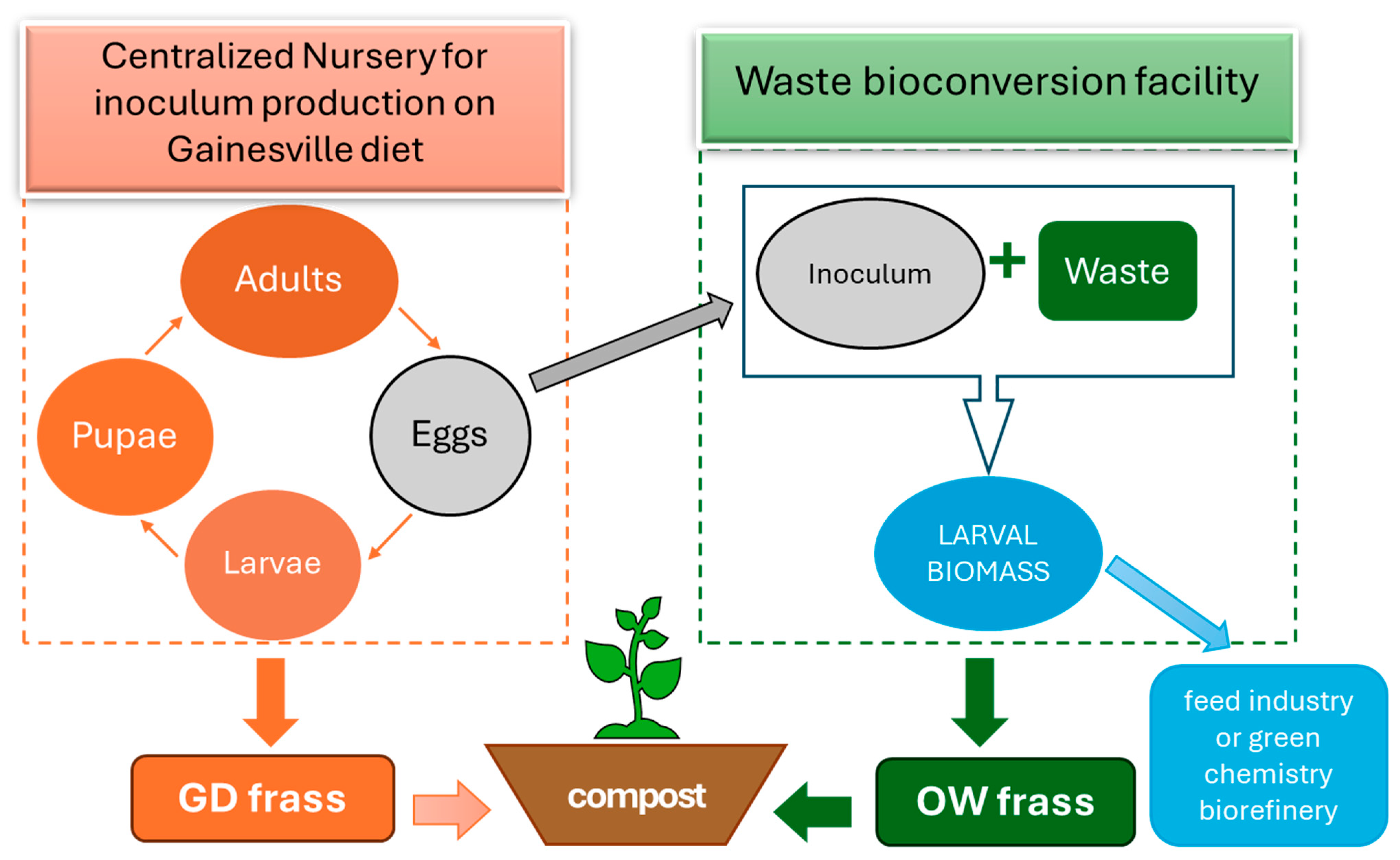
Figure 1 shows how a centralized facility for BSF rearing produces inoculum to be sent to decentralized waste treatment units, located elsewhere, next to the place of waste production.
Regarding the future, according to a United Nations Report, the world population is projected to reach nearly 10 billion by 2050 [41]. Along with this growth, an increase in demand for protein is expected [42]. Insect farming represents a promising and sustainable alternative to livestock for protein production for food [43] and feed [44]. According to refs. [45,46], in Europe, production can potentially exceed several thousand tons per year, and it is estimated that it could reach 260,000 tons of insect-based food product yearly by 2030 [47] and 1 million tons of insect meal for feed by 2030 [44]. These forecasts lead us to support the fact that the production of frass in the world will significantly increase. Quantitatively, frass constitutes up to 80–95% of the output [48]. According to ref. [49], the production of 1 ton of insects from waste bioconversion generates 2–4 tons of frass. Regarding the size of a nursery colony, for 1 ton of waste, an inoculum of approximately 0.8–1 M eggs/newborn larvae is needed. Based on the average values of female fecundity (500–900 eggs per female) and larval survival (90%), the rearing of about 3500 larvae is necessary to obtain a mating adult population of 3200 individuals (males and females) [50,51]. According to an optimal larval food consumption of 0.1 g/day, and with an average lifespan of 15 days, 5.25 kg of substrate will be needed [52]. Considering the short lifespan and the oviposition period of 4–6 days [53], a weekly renewal of the population for each ton of waste is needed.
Across the European Union, annual bio-waste generation is between 118 and 138 million tons, of which only about 40% (equivalent to 47.5 million tons per annum) is effectively recycled into high-quality compost and digestate [54]. There is therefore a considerable scope for the industrial development of insect farming across the entire supply chain, including nursery units.
According to Regulation (EU) 2021/1925, frass is defined as the “mixture of excrement derived from farmed insects, food substrate, parts of farmed insects, dead eggs and with a content of dead farmed insects not exceeding 5% by volume and 3% by weight” [55]. The macro- and microelements present in frass are heavily influenced by the composition of the initial waste biomass provided to BSFL [56]. Frass rich in organic compounds and micronutrients can improve soil structure and microbiota; the presence of chitin contributes to reduced biotic and abiotic stress in plants [57,58,59]. Furthermore, specific agricultural by-products, such as waste tomatoes, can produce frass rich in bioactive molecules [60].
In agriculture, since larval activity is considered a form of composting (entomocomposting according to Beesigamukama et al. [61]), the direct use of BSF frass has been proposed [62,63,64,65]. However, the direct application of fresh frass can affect plant growth due to unsuitable characteristics such as an excess of moisture, non-compliant chemical parameters, phytotoxicity, and nutrient immobilization [62,66,67,68]. Song et al. [69] observed statistically significant differences between fresh frass, 8-week-old aerated compost and composted frass. The direct use of fresh frass resulted in the lower growth of potted Chinese cabbage plants than in the application of the aerated compost. The authors attributed the poor plant growth to the presence of phytotoxins in the fresh frass. Based on the literature data, to obtain a stable/mature product, post-treatment of the frass through aerobic composting is necessary [56]. Furthermore, the post-processing of frass is recommended for sanitation reasons [70]. Regulation (EU) 2021/1925 establishes that frass must be preliminarily treated at 70 °C for 60 min before commercial valorization or must be composted [55].
Regarding the need to pre-treat larval feeding substrates, several authors suggest milling the waste biomass to enhance insect growing performance and bioconversion efficiency [71].
Based on this background, to carry out this study, it was decided to use frass derived from the rearing of larvae on GD until the prepupal stage and frass derived from the bioconversion of a mixture of fruit and vegetable waste (FVW) as-is or milled (MW) and to compost them before their application. The bioconversion process associated with composting maintains the benefits of bioconversion, while ensuring greater stability of the final product. After the process of maturation/stabilization, the product is fully mature, odor emissions are eliminated, and the product is easier to handle (for storage, packaging, and transport). The main goals of the present study were: (i) to verify whether the addition of each composted frass differentially improved the production performance of lettuce in pot trials; (ii) to verify if, at constant mineral NPK input, composted frass provides additional benefits beyond nutrient supply; (iii) to demonstrate the validity of the separate reuse of frass produced using the GD. The main experimental hypothesis is that, at equal inclusion rates, GD frass increases lettuce fresh weight more than FVW/MW frass. This and other growth parameters would be useful for the separate and innovative management of GD frass resulting from the centralized nursery of H. illucens.

2. Materials and Methods

2.1. Frass Compost Production

The research was carried out using individuals from a BSF colony raised at the ENEA Casaccia Research Center, Rome, Italy, as described by ref. [28].
The frass used for the present study were obtained from the rearing of BSFL on the following substrates:
  • The Gainesville diet (GD) (50% wheat bran, 30% alfalfa meal, 20% corn meal; 170 mL of tap water per 100 g) [34], considered the nursery diet in this study;
  • Fruit and vegetable waste (FVW), as provided by supermarket;
  • Milled fruit and vegetable waste (MW), obtained by grinding the previous fruit and vegetable waste with the addition of leftover bread in an 80:20 ratio.
Milling FVW and adding bakery waste to obtain MW was thought to support larval growth, enhance bioconversion efficiency and facilitate the separation of the final frass from the larval biomass at the end of the process. This solution was developed in light of evidence from various authors [28,56]. A moisture level above 80% of the initial substrate negatively affects bioconversion and makes frass separation difficult, indicating the need to reduce waste particle size. Adding bread to the FVW reduced its moisture content from an average humidity of around 90% to a range of 68–78% [28].
From the centralized nursery, larvae intended for breeding were reared on GD until the prepupal stage, and frass were collected after separation and recovered for use in the composting process. Six-day-old larvae were transferred to the food scrap substrate. At the end of the bioconversion process, the larvae (prepupal stage) were separated, and the frass was recovered for use in the composting process.
The three types of frass were composted in an open field in the second half of 2022. Each type of BSFL frass was mixed with straw at a ratio of 1:1 (w/w) to achieve a C/N ratio of 25–30, and three heaps (3 m × 1 m × h 0.8 m) were prepared. The heaps were covered with shading cloth and rested on a polythene sheet to maintain the moisture and heat level. They were watered periodically (at least once a week) until they reached a moisture content of 70% and turned to favor aerobiosis. After watering and turning, the heaps were covered again.
The composting process lasted 150 days, and the three types of composted frass obtained were:
  • Frass derived from Gainsville diet rearing (GDf);
  • Frass derived from fruit and vegetable waste (FVWf);
  • Frass derived from milled fruit and vegetable waste (MWf).

2.2. Composted Frass Characterization

The material from the three heaps of each composted frass was pooled and analyzed for its main element and heavy metal content. Before the characterization, 50 g of each substrate was dried for 24 h at 105 ± 2 °C in a drying oven (Model UFP800, Memmert, Schwabach, Germany), in accordance with the standard UNI EN ISO 18134-1:2015 [72], to determine the moisture content. The dried biomass was then treated first with a kneading mill (Model SM100, Retsch, Haan, Germany) and then with a centrifugal mill (Model ZM200, Retsch, Haan, Germany) (to shred and homogenize the matrix). To determine the carbon (C) and nitrogen (N) content, approximately 5 mg of each sample was analyzed using a CHNS-O elemental analyser (Model ECS 4010, Costech, Valencia, CA, USA) according to UNI EN ISO 16948:2015 [73]. The quantification limit (LOQ) for each sample was 0.05% w/w. For the analysis of inorganic phosphorus, approximately 3 g of each sample was subjected to a 24 h extraction using 40 mL of 33% hydrogen peroxide. The resulting extracts were subsequently filtered and analyzed in triplicate using a ECO-IC ion chromatograph (Metrohm, Origgio, Italy) equipped with an amperometric detector. Prior to analysis, each sample was diluted 1:10.
To determine the macro- and trace element content, 0.5 g of the dehydrated sample was homogenized and solubilized with 6 ± 0.1 mL of HNO3 65% and 3 ± 0.1 mL of H2O2 30%. The solution was digested in a microwave oven at 180 °C and 650 W for 8 min, followed by a further 15 min. After digestion, the samples were filtered and diluted with MilliQ water (Merck, Darmstadt, Germany). Two replicates and a blank were prepared for each sample. The calibration line was made in nitric acid at five points with increasing concentrations of the internal standard. Element analysis was performed using ICP-MS (Model Agilent 7700, Agilent, Santa Clara, CA, USA).
To assess the degree of compost maturity, we determined the germination index (GI) following the methodology described in previous studies [68,74]. An aqueous extract was prepared from the three types of composted frass at a ratio of 1:10 to distilled water and kept in solution for 24 h. Approximately 5 mL of the extract was placed on two-layer filter paper in each Petri dish (15 cm diameter). Within each plate, 20 tomato seeds of F1 hybrid Elisir (Olter) were placed. Filter paper soaked in distilled water was used as the control. Each treatment was replicated four times. Germination took place in a temperature-controlled growth chamber (G-Therm 205, F.lli Galli, Milan, Italy) under dark conditions at 25 °C for 48 h.
The GI (%) was calculated as follows:
G I % = ( ( G 1 / G 2 ) × 100 ) × ( ( R 1 / R 2 ) × 100 ) 100
where G1 and G2 are the average number of germinated seeds for each Petri dish in the extract and the control, respectively; R1 and R2 are the average length of rooted seeds for each Petri dish in the extract and the control, respectively. GI values below 50% indicated the potential phytotoxicity of the residue [68].

2.3. Lettuce Growth (Experimental Plants)

Two pot-growing experiments were carried out on lettuce (Lactuca sativa L. var. romana) to evaluate the soil-conditioning properties of the different composted frass at the experimental field of the CREA Research Centre for Engineering and Agro-Food Processing, Monterotondo (RM), Italy (42° N 05′56.86″, 12° E 37′26.23″). The soil used for the tests came from the experimental farm and had previously been characterized for its physical and chemical properties (Table 1). For the potting trial, we used plastic pots (diameter 16 cm, volume 1.6 L, surface 201 cm2) filled with 1200 g per pot of the different substrate. Each substrate was composed of air-dried soil and sieved with a 2 mm mesh and an amount of frass corresponding to the percentage in weight.
In the first experiment (April–May 2023), we compared three increasing concentrations of each composted frass (GDf, FVWf and MWf), in addition to soil, calculated by dry weight: 2.5%, 5% and 10% (30 g, 60 g and 120 g, respectively). Soil without composted frass was considered the control (Table 2). A randomized block experimental design was adopted, with ten treatments (nine mixtures plus the control soil) and four replicates per treatment. After the filling of the pots (16 cm diameter), lettuce plants at the 4–5-leaf stage were transplanted (one plant per pot). The first experiment lasted 38 days (mid-April to the end of May). Water was supplied regularly to restore the available water capacity when it dropped to around 60% of the maximum level.
In the second experiment (October–November 2023), we evaluated the application of composted frass and its ability to replace synthetic fertilizer (Jolly 20-20-20, Agribios, Mantova, Italy). The latter was applied every 15 days at 10 g m−2 per application in solution (referring to the pot surface area) up to three times according to the specifications for its use. Based on the results of the first experiment (substantial equivalence between FVWf and MWf), the treatments that were compared included soil (as the control), soil plus GDf (10% dry weight basis) and soil plus FVWf (10% dry weight basis), all of which were supplemented with two or one fertilization or none at all (Table 3). The GDf and FVWf used in the first experiment were stored at room temperature in breathable raffia bags. The experimental design was a randomized block with four replicates. The experiment lasted 36 days (mid-October to mid-November).
The following traits were measured in both experiments: plant height, number of leaves per plant, and chlorophyll level (once a week, using a SPAD-502 reader (Konica Minolta, Tokyo, Japan). The reported chlorophyll level (in SPAD units) refers to the final value before harvest. At harvest, the plants were cut and weighed to determine their fresh weight. The plants were then dried in an oven at 65 °C until a constant weight was reached, and the dry weight was calculated. In addition, the basal diameter, the height-to-diameter ratio and the leaf area index (LAI) were determined for each plant in the second experiment, and the specific leaf area (SLA), expressed as the ratio of LAI to leaf dry weight, was calculated. To calculate the LAI, photographs of all the leaves of each plant were analyzed using ImageJ software, version 1.54g (https://imagej.net/ij/download.html, accessed 10 October 2025).

2.4. Statistical Analysis

The data were checked for normality using the PAST software, version 4.17 (2018, Øyvind Hammer, University of Oslo, Oslo, Norway, https://www.nhm.uio.no/english/research/resources/past/, 30 January 2026) [75]. The same software was used for the principal component analysis (PCA) [76].
All data were analyzed by using the MSTATC software (original version) to apply ANOVA and check the statistical significance of the differences between treatments. The ANOVA-1 function (one-way ANOVA) was used to focus the study on comparing individual substrates as separate factors and to verify their behavior in relation to the soil in the first experiment, or in relation to fertilization or the soil alone in the second experiment. The same function was used also to compare the compost composition. Significantly different means were separated through Tukey’s test. Microsoft Excel (v2602 Build) was used to process the data and was used to create the trend of the plant fresh weight. The equations shown were generated using the software’s built-in functions.

3. Results

3.1. Composted Frass Characterization

The nature of the initial substrate and the introduction of a pre-processing step influenced the final composition of the composted frass, resulting in significant differences in some elements compared to the same unchopped substrate.
The C and N content showed opposite responses. The C content was lower in GDf (25.5%) than in FVWf (32.1%), while the N content was higher in GDf (4.5%) and lower in FVWf (2.9%) (Table 4). The MWf sample showed intermediate values for both C and N. However, the differences among the three composted frass were not statistically significant. This resulted in an increase in the C/N ratio. The compost obtained from artificial diet residue (GDf) was found to have the lowest C/N content, showing a statistically significant difference compared to FVWf. The composting process resulted in pH stabilization towards neutrality, with no significant differences observed among the three types of composted frass.
The germination test to check the maturity of the composted frass showed values consistently above 100 (Table 4). However, the test revealed differences between the three types of composted frass, with the GI value of FVWf (178.1%) being significantly higher than that of MWf (106.7%). The GI value of the compost obtained from GD (120.5%) was not significantly different from those of FVWf and MWf.
Basically, the GDf was often richer, with a significant statistical difference in many of the macro- (Table 5) and trace (Table 6) elements analyzed. For Ca, Fe, As and Pb, however, the values were higher in the MWf compost. In some cases, such as with Ca and Zn, the compost from GDf contained comparable amounts to that from MWf. Composted frass produced from FVW generally showed no significant differences in the content of macro- and trace elements compared to MWf (Table 5 and Table 6).

3.2. Lettuce Growth

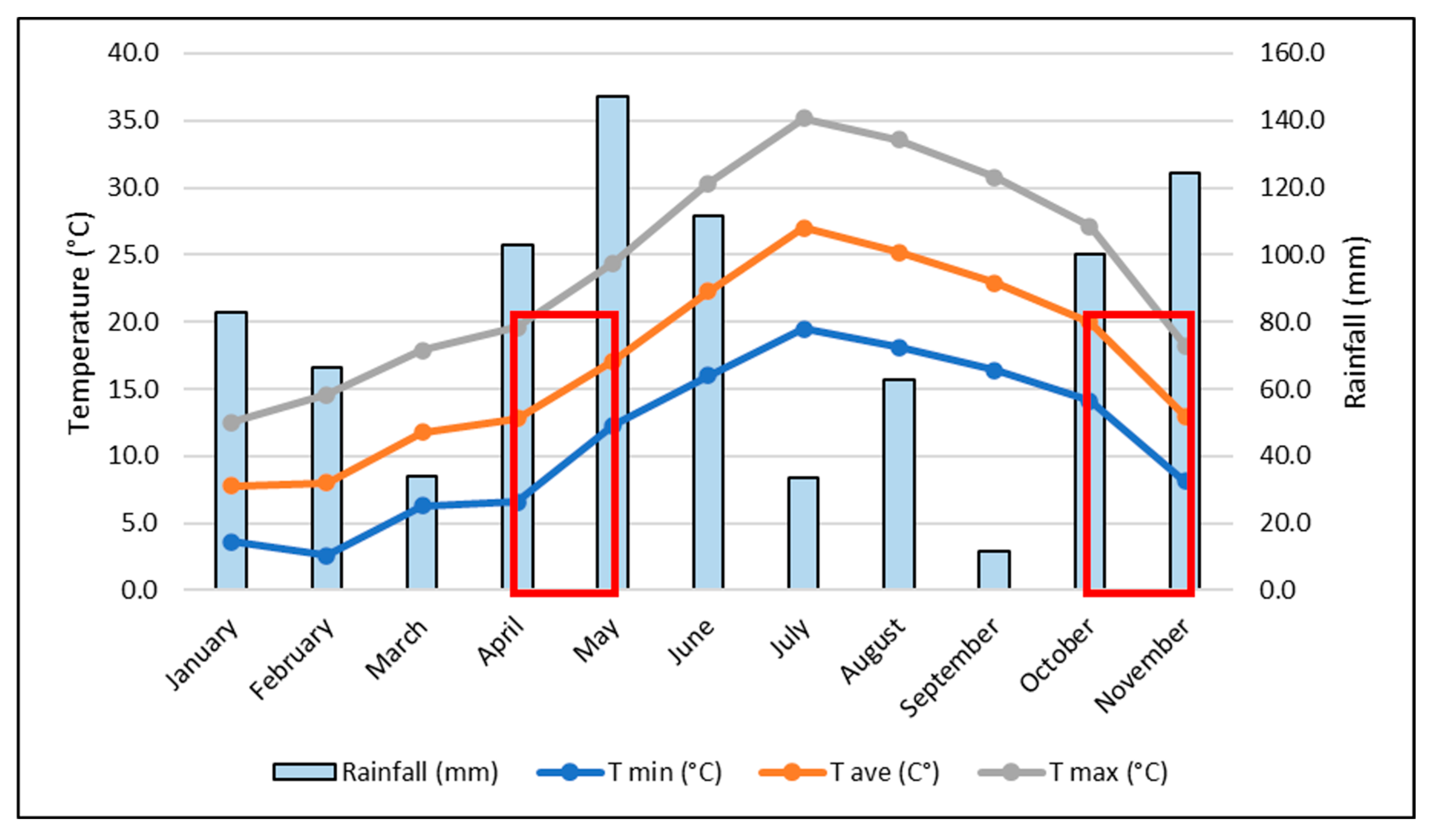
The trials occurred under very similar climatic conditions (Figure 2). During the lettuce growth period, from transplant to harvest, there was consistent rainfall (between 100 and 140 mm) and average temperatures ranging from 12 to 20 °C. There was an ascending trend for the temperatures in the first experiment and a descending trend in the second experiment.

3.2.1. First Experiment

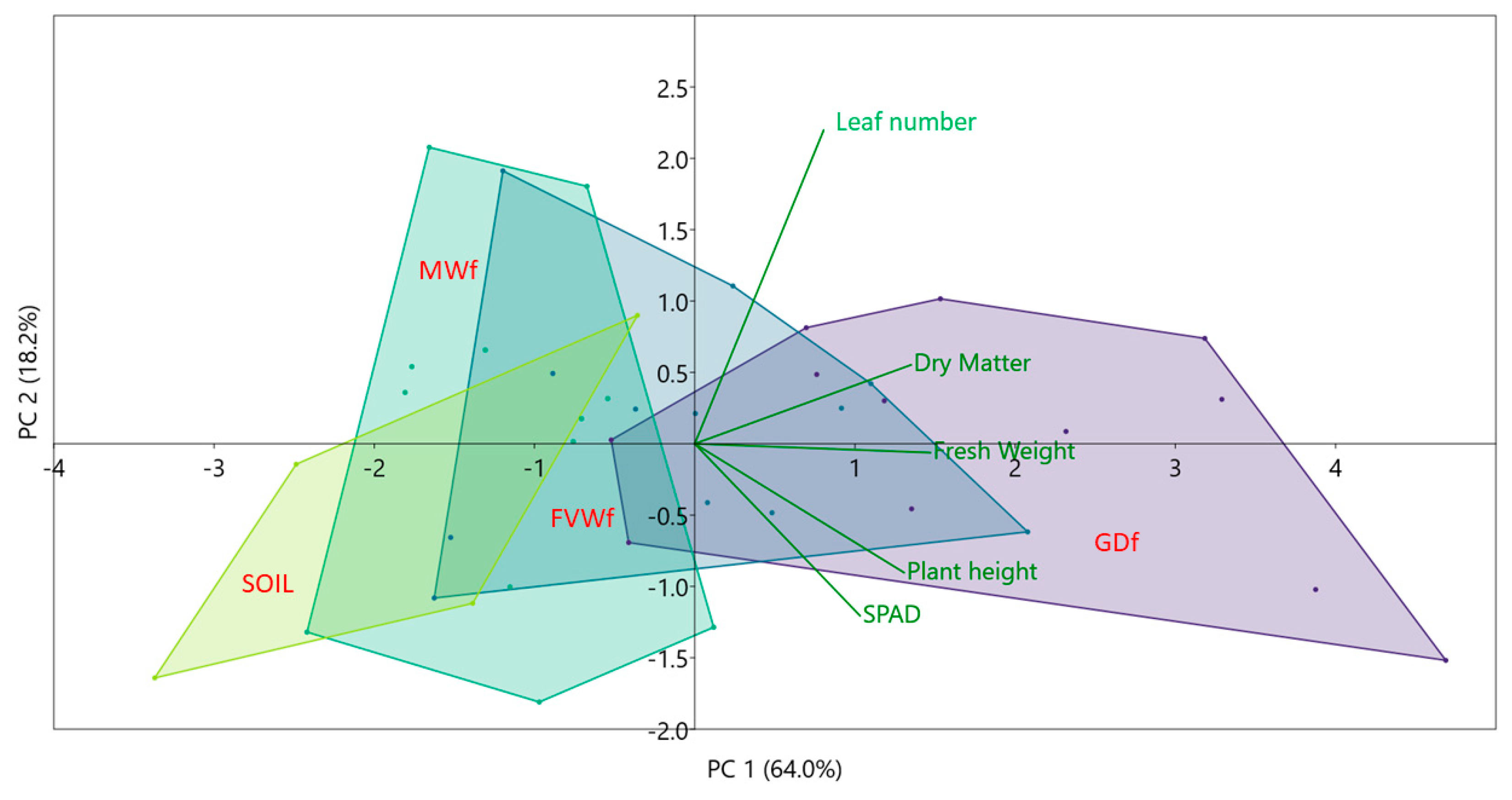
The addition of different composted frass had a positive effect on the parameters characterizing lettuce growth. As shown in Figure 3, the areas in the PCA partially overlapped. However, it was clear that passing from soil to soil plus MWf, FVWf and finally GDf, there was a shift along the PC1 axis towards higher values for the morpho-productive traits.
This trend was confirmed by the behavior of the single substrate (Table 7) and by the data of each type-per-dosage combination (Table 8). Compared to other composted frass (MWf and FVWf), the addition of GDf had a positive effect on some traits, with significant differences observed in plant height and the fresh weight of the leaves, and no significant differences in the leaf number or chlorophyll content. The only exception was the dry matter (DM), which was significantly higher in soil treatment than in the others, indicating a lower water content.
The addition of GDf (at the three tested doses) produced the greatest increase in plant height compared to the addition of the other types of composted frass or soil alone (Table 8). However, only the highest dose of GDf (GDf 10) had a significantly higher fresh weight compared to the other treatments. In general, the highest concentration (10%) led to the highest values for MWf and FVWf, although there were no statistically significant differences between these two types of composted frasses. The chlorophyll content was comparable across all treatments, although the mean value was higher for the GDf.

3.2.2. Second Experiment

Based on the results of the first experiment, a second experiment was scheduled to study the maximum concentration of the composted frass (GDf and FVWf), which showed the best yield in terms of fresh weight, in the presence or in the absence of an increasing supply of synthetic fertilizer.
The use of the synthetic fertilizer had a clear, statistically significant effect on the chlorophyll content only (Table 9 and Table 10). In terms of the plant height, leaf number, FW and leaf area index (LAI), the use of the maximum number of fertilizer doses (S3) did not result in statistically significant differences compared to the double administration supplemented with composted frass (S2-GD10 and S2-FVW10). The average (±standard deviation) FW for S2-GD10 (143.80 ± 34.46 g plant−1) was the highest, and it was not statistically different from S3 (129.25 ± 15.04 g plant−1) nor S2-FVW10 (119.78 ± 7.52). For the same traits, the addition of composted frass in the absence of chemical inputs (S0-GD10 and S0-FVW10) always improved the values, with a statistically significant difference in some cases. In fact, plant height, chlorophyll content and FW were significantly higher for S0-GD10 (20.9 ± 1.85 cm, 24.13 ± 1.18 SPAD unit and 87.80 ± 27.52 g plant−1, respectively) than for the S0 treatment (16.2 ± 1.79 cm, 19.38 ± 0.37 SPAD unit and 36.92 ± 8.46 g plant−1, respectively).
In the treatment where only soil was present, the DM content decreased significantly as the number of fertilizer interventions increased, dropping from 5.77 ± 1.34% for S0 down to 3.15 ± 0.28% for S3 (Table 10). For S0 and S1, the values of individual soils were higher than those for the corresponding treatment with the presence of composted frass. No differences were observed in the values of the specific leaf area (SLA).
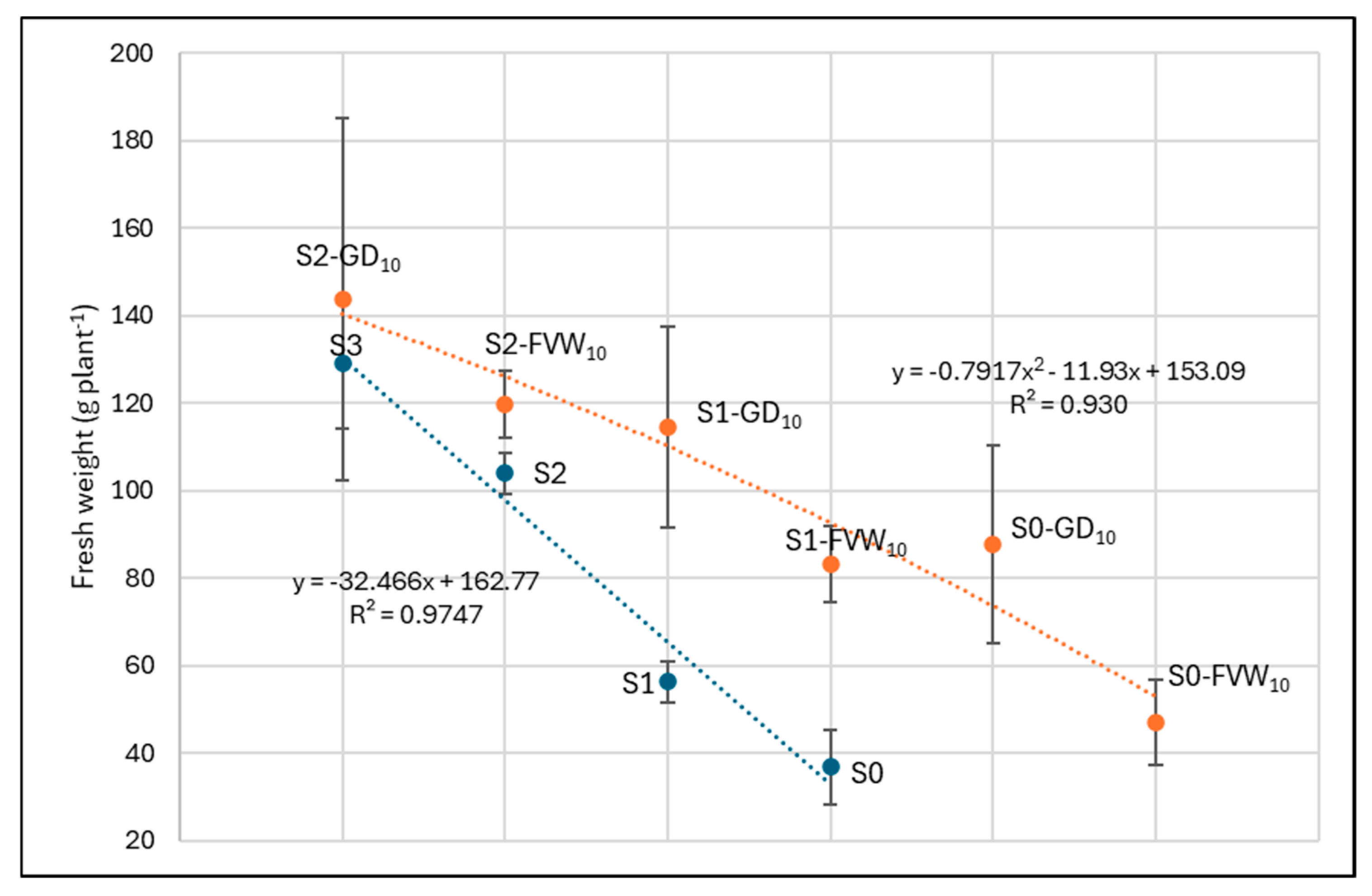
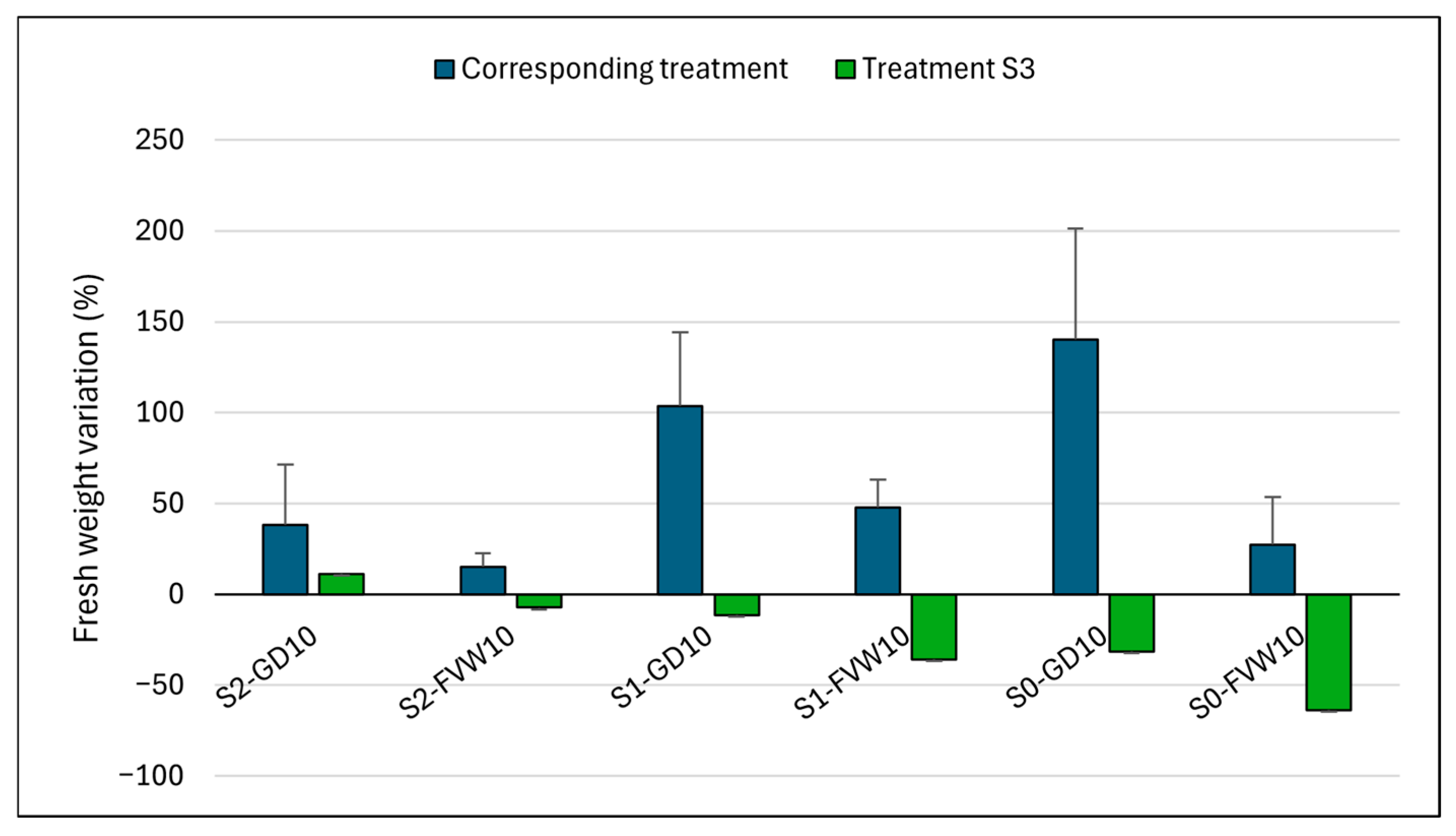
In the specific case of lettuce, the fresh weight of the leaves is the most commercially important parameter. Figure 4 and Figure 5 show the effect on the fresh weight of isolated fertilization versus composted frass supplementation. The different slopes of the curves in the graph show that using only synthetic fertilizer results in a much more rapid decline in productivity with the reduction in dosage than with the same number of interventions supplemented with composted frass. The second effect is an upward shift (i.e., towards a higher FW) determined by the presence of composted frass, as opposed to the number of fertilization interventions in the absence of composted frass supplementation (Figure 4).
Figure 5 shows the positive or negative variation (in percentage) of the fresh weight of leaves when each “fertilizer dosage/composted frass” combination was compared with the corresponding fertilization dosage and the maximum dosage (S3) of the fertilizer. Two common trends were identified: (a) adding composted frass to various fertilizer applications increased the fresh weight compared to the same fertilizer dosage without composted frass; (b) except in S2-GD10, the fresh weight in the presence of composted frass was lower than the maximum fertilizer dosage. However, it is important to note that the reduction in the productivity of S2-FVW10 was negligible compared to the maximum fertilizer input (S3). The reduction was still below 15% for S1-GD10, suggesting that further improvements are possible.

4. Discussion

Goal 12 of the Agenda 2030 [77] aims to reduce food waste and losses and encourage recycling. To replace the linear economy with a circular one, the EU Parliament’s Research Service published Closing the Loop—New Circular Economy package [78]. This package aimed to reduce waste by reusing products and resources. Organic waste also represents a valuable resource for generating new products and energy [9,79] through the bioconversion process involving BSFL.
In this context, the present work explored a possible agronomic reuse of three different types of composted frass: one obtained from rearing BSFL on a specific artificial diet (Gainesville diet, GDf) and two using fruit and vegetable waste, as-is (FVWf) or milled (MWf), as feeding substrates.
The growth of lettuce improved significantly with the addition of composted frass in a dose-dependent manner when compared to unfertilized soil. As the percentage of compost increased, plant development and fresh weight also increased. The effect was most evident for GDf compost, while it was smaller but still present for compost from FVWf and MWf. GDf has a much higher N and lower C/N than FVWf (significant for C/N). Although this can be an important factor, it must be taken into consideration that, generally, compost enhances the physical, chemical and biological fertility of soil, also modifying other characteristics such as water retention and infiltration rates, bulk density, root penetration resistance, soil aggregate stability, and microbioma. Our data suggested at least two other considerations. Firstly, the absence of statistical significance between doses for FVWf compost and MWf compost indicated that it is possible to work with a reduced dosage. In the future, the lower limit below which the addition of compost ceases to have a positive effect should be analyzed. Secondly, the results confirmed the absence of phytotoxicity in lettuce plants, even at the highest concentration (10%). This observation was supported by the results of the germination test. After about four months of composting, the GI was above 100%. As stated by different authors [68,80], values above 80% indicate the absence of phytotoxicity, while a GI exceeding 100% indicates phytonutrient or phytostimulant properties. The GI values obtained in the present study were similar to those reported by ref. [69] after eight weeks of composting. However, given the different processing conditions, higher or lower values have been reported in the literature: higher values were observed after 112 [81], 40 [74] or 11 [82] days of composting; comparable or lower values were reported by refs. [63] and [68], respectively.
Although the composting process was not compared with the direct use of frass, positive indications emerged. Compared to the direct use of the residue, composting enables product stabilization. Furthermore, the process is quicker than conventional composting.
Windrow composting with infrequent turning may require up to about 9 months for the primary composting phase, depending on the feedstock and management conditions, while passive composting (little or no turning) may require one year [83]. This is due to the exploitation of the lithic activity of the larvae, which speeds up the post-processing time. However, the post-treatment time varies, thus requiring careful consideration in determining the minimum length of composting to obtain a mature and stable material. In the composted frass derived from the bioconversion of horticultural waste, whether shredded or not, the C/N ratio following composting was slightly higher than in the diet, owing to a lower nitrogen content. The concentration of heavy metals, shown in Table 6, did not show criticality with respect to the use of the three substrates used as soil conditioners: all values were below the limits set by the most recent European regulatory framework on fertilizers [84,85]. The contaminants in an organic soil improver must not exceed the following limit values (dry matter basis): Cu 300 mg kg−1, Zn 800 mg kg−1, Cd 2 mg kg−1, Ni 50 mg kg−1, Pb 120 mg kg−1, As 40 mg kg−1 [85], and Cr 100 mg kg−1 [84].
An essentially technical consideration is the possibility of pre-treating the waste by grinding it before supplying it to the BSF larvae [71,86,87]. This would favor bioconversion, since the larvae lack the necessary mouthparts to shred large pieces of biowaste [71]. The increased surface area would also promote bacterial growth and improve the quality of the residue. However, experiments on compost, as well as our findings, suggest that grinding has little effect. Further investigation is recommended to assess cost and technical feasibility, as well as its effect on process efficiency and value.
Compost can be used in combination with chemical fertilizers to reduce the environmental and economic impact of the latter. Testing this hypothesis was the second objective of this work. According to ref. [66], the composted frass–synthetic fertilizer combination has a positive impact on plant production when compared to unfertilized or frass-fertilized soil. In fact, ref. [81] found that vegetables (tomato, leaf cabbage and French beans) produced higher yields when fertilised with compost obtained from BSF frass supplemented with NPK, compared to using frass or fertilizer alone, in both the greenhouse and open field. However, for leaf cabbage in an open field, mineral fertilizer, BSF frass fertilizer alone or their combination gave a comparable yield. The present study confirmed the behavior reported by ref. [81]. The integration of compost with the mineral fertilizer led to an evident yield improvement when compared to the corresponding fertilizer dosages, especially at lower intakes. In our work, particularly for the S1 and S0 treatments, the supply of compost seemed to vicariate, at least partially, the missing mineral fertilizer inputs, above all the compost produced by GD. When observing the relationship between the doses of mineral fertilizer alone and their combination with compost, the effect is quite clear. The reduction in yield was rapid and pronounced in the former case. In the latter, the polynomial trend indicates a kind of “buffer” effect carried out on the yield by the presence of the compost. Given the timing and conditions of the test, the positive effect of the compost was probably due to a combination of factors. The trial conducted in October involved a drop in temperatures, which gradually reduced the activity of soil microorganisms. This resulted in a reduction in mineralization, eventually leading to biostasis. Considering the natural high availability of nitrogen (N) in the soil used, the mineral fertilizer at the higher dosage provided the necessary quantities of nitrogen (N) to restore fertility quickly. The slower mineralization of compost [88] results in a prolonged release of elements (albeit probably at lower levels than chemical fertilizer), which complements the positive effects attributable to the physical and biological improvement of the soil. In the long term, the complete mineralization of compost is likely to result in an even greater release of nutrients. Compost integration with N fertilizers is an efficient solution when soil biological activity decreases. It balances mineralization and humification by increasing soil microorganisms’ capacity to contribute to plant nutrition [89]. The improvement induced by the addition of compost affects other soil properties (porosity, structure, role of humic substances) and helps plant development. Castellini et al. [90] found that the addition of compost at an agronomic dose improved the water retention and bulk density of clay soil. Soil indicators derived from the water retention curve showed that the air capacity and available water capacity increased with the compost amendment, while the relative field capacity and soil bulk density instead decreased.
The starting organic substrate has a significant influence on the final composition of the compost, and it has effects on the development cycle of BSFL. The Gainesville diet (GD) used for insect rearing has a standard composition (50% wheat bran, 30% alfalfa meal, 20% corn meal) suitable for the balanced and simultaneous development of the larvae [34]. The compost produced from GDf under our conditions had the highest richness in macro- and microelement content, favoring the growth of lettuce plants more than FVWf and MWf compost did. Unlike the GD, the composition of FVW is generally variable due to various factors including the seasonality, different supply chains or different pre-treatments. For example, ref. [24] reported a differentiated composition of the feeding substrate of the larvae depending on the availability of summer and autumn leftovers. In the latter, the fiber, protein and fat contents were highly increased compared to summer leftovers owing to the presence of pomace, legumes and corn.
Although the larvae are able to develop on a wide range of different organic waste, variability, poor nutritional value, and the presence of pesticides, heavy metals or entomopathogens [91,92,93,94] make them unsuitable for the maintenance of a fecund and consistent populations of BSF. On the contrary, a high-quality diet results in reproductive success for adult BSF [12,95,96,97]. A centralized reproductive facility can serve more than one bioconversion plant based on the use of BSF; the larger the size of the framework, the greater the amount (by number and size) of inoculum needed [71] and the greater the feeding substrates suitable for supporting continuous generations of a large BSF population. This study demonstrated that the composted frass derived from the rearing of BSFL on the Gainesville diet is a by-product with a high added value that represents a major advance in the farming chain of the BSF.

5. Conclusions

Under the conditions tested in the present study, compost supplementation to the soil improved its fertility, as demonstrated by the pot trials conducted. The study examined lettuce growth (less than forty days) in one type of soil with different levels of composted frass added. In this specific case, compost allowed for replacing at least one mineral fertilizer application without adversely affecting lettuce productivity. The finding opens the possibility of using compost in plant nursery activities by mixing it with growing substrates and has prospects for reducing the economic and environmental cost of synthetic fertilizers. In both the first and second trials, compost made from the residue of the diet (Gainesville Diet) used for the maintenance of the BSF colony and to produce the bioconversion’s starter (6-day-old larvae) performed better than compost from agrifood leftovers. With the residue from Gainesville diet-based farming, a “niche” compost of superior quality can be obtained. Therefore, its value side deserves to be taken into account, along with the compost obtained from waste bioconversion.

Author Contributions

Conceptualization, E.S. and C.B.; Methodology, E.S., C.B. and A.d.I.; Formal analysis, E.S.; Investigation, E.S., A.d.I., C.B., S.A., F.B., E.D.S., M.C., P.M., F.G., A.D.G. and A.A.; Writing—original draft preparation, E.S., S.A. and F.B.; Writing—review and editing, E.S., C.B., A.d.I., S.A. and F.B.; Visualization, E.S., S.A. and F.B.; Funding acquisition, A.A. and S.A.; Resources, S.A., F.G. and E.S.; Supervision, E.S. and C.B. All authors have read and agreed to the published version of the manuscript.

Funding

This research was funded within POR FESR Lazio 2014–2020 (Det. Reg. n. G09493 140721, 22 July 2021), Project HERMES “Hermetia illucens per il recupero e la valorizzazione di biomassa residuale: realizzazione di un modulo prototipale ecosostenibile”.

Institutional Review Board Statement

Not applicable.

Data Availability Statement

The raw data supporting the conclusions of this article will be made available by the authors on request.

Acknowledgments

We thank the anonymous reviewers for their constructive comments on the manuscript.

Conflicts of Interest

The authors declare no conflicts of interest.

References

  1. Diener, S.; Zurbrugg, C. Conversion of Organic Refuse by Saprophages (CORS). Sandec News 2008, 99, 10–11. [Google Scholar]
  2. Joly, G.; Nikiema, J. Global Experiences on Waste Processing with Black Soldier Fly (Hermetia illucens): From Technology to Business; International Water Management Institute (IWMI): Colombo, Sri Lanka, 2019; p. 62. [Google Scholar] [CrossRef]
  3. Singh, A.; Kumari, K. An Inclusive Approach for Organic Waste Treatment and Valorisation Using Black Soldier Fly Larvae: A Review. J. Environ. Manag. 2019, 251, 109569. [Google Scholar] [CrossRef] [PubMed]
  4. Diener, S.; Studt Solano, N.M.; Roa Gutiérrez, F.; Zurbrügg, C.; Tockner, K. Biological Treatment of Municipal Organic Waste Using Black Soldier Fly Larvae. Waste Biomass Valoriz. 2011, 2, 357–363. [Google Scholar] [CrossRef]
  5. Amrul, N.F.; Ahmad, I.K.; Basri, N.E.A.; Suja, F.; Jalil, N.A.A.; Azman, N.A. A Review of Organic Waste Treatment Using Black Soldier Fly (Hermetia illucens). Sustainability 2022, 14, 4565. [Google Scholar] [CrossRef]
  6. Spranghers, T.; Ottoboni, M.; Klootwijk, C.; Ovyn, A.; Deboosere, S.; De Meulenaer, B.; Michiels, J.; Eeckhout, M.; De Clercq, P.; De Smet, S. Nutritional Composition of Black Soldier Fly (Hermetia illucens) Prepupae Reared on Different Organic Waste Substrates. J. Sci. Food Agric. 2017, 97, 2594–2600. [Google Scholar] [CrossRef]
  7. Belperio, S.; Cattaneo, A.; Nannoni, E.; Sardi, L.; Martelli, G.; Dabbou, S.; Meneguz, M. Assessing Substrate Utilization and Bioconversion Efficiency of Black Soldier Fly (Hermetia illucens) Larvae: Effect of Diet Composition on Growth and Development Temperature. Animals 2024, 14, 1340. [Google Scholar] [CrossRef]
  8. Triunfo, M.; Tafi, E.; Guarnieri, A.; Salvia, R.; Scieuzo, C.; Hahn, T.; Zibek, S.; Gagliardini, A.; Panariello, L.; Coltelli, M.B.; et al. Characterization of Chitin and Chitosan Derived from Hermetia illucens, a Further Step in a Circular Economy Process. Sci. Rep. 2022, 12, 6613. [Google Scholar] [CrossRef]
  9. Favoino, E.; Giavini, M. Bio-Waste Generation in the EU: Current Capture Levels and Future Potential; Bio-based Industries Consortium (BIC): Brussel, Belgium, 2020; p. 50. [Google Scholar]
  10. Diener, S.; Storey, D. Trasforming Organic Waste with Black Soldier Flies: A Guide for Decision-Makers, Entrepreneurs, and Implementers to Unlock the Organic Waste Potential of Black Soldier Fly System; UNEP-CCAC: New York, NY, USA, 2025. [Google Scholar]
  11. Larisa, C. Waste-to-Feed Bioconversion Using Hermetia illucens Larvae: Current Insight and Prospects. Open Vet. J. 2025, 15, 5427. [Google Scholar] [CrossRef]
  12. Laursen, S.F.; Flint, C.A.; Bahrndorff, S.; Tomberlin, J.K.; Kristensen, T.N. Reproductive Output and Other Adult Life-History Traits of Black Soldier Flies Grown on Different Organic Waste and by-Products. Waste Manag. 2024, 181, 136–144. [Google Scholar] [CrossRef]
  13. Zhang, Q.-H.; Puniamoorthy, N. Impact of Rearing Substrates on Black Soldier Fly Growth and Fertility: A Semi-Industrial Scale Study to Optimize Egg Collection. Insects 2025, 16, 142. [Google Scholar] [CrossRef] [PubMed]
  14. European Commission. Commission Regulation (EU) 2017/893 Amending Annexes I and IV to Regulation (EC) No 999/2001 of the European Parliament and of the Council and Annexes X, XIV and XV to Commission Regulation (EU) No 142/2011 as Regards the Provisions on Processed Animal Protein; European Commission: Brussel, Belgium, 2017. [Google Scholar]
  15. European Commission. Commission Regulation (EU) 2021/1372 Amending Annex IV to Regulation (EC) No 999/2001 of the European Parliament and of the Council as Regards the Prohibition to Feed Non-Ruminant Farmed Animals, Other than Fur Animals, with Protein Derived from Animals; European Commission: Brussel, Belgium, 2021. [Google Scholar]
  16. European Parliament. Regulation (EC) No 1069/2009 of the European Parliament and of the Council of 21 October 2009 Laying down Health Rules as Regards Animal by-Products and Derived Products Not Intended for Human Consumption and Repealing Regulation (EC) No 1774/2002 (Animal By-Products Regulation); European Parliament: Brussel, Belgium, 2009. [Google Scholar]
  17. Yang, S.-S.; Chen, Y.; Zhang, Y.; Zhou, H.-M.; Ji, X.-Y.; He, L.; Xing, D.-F.; Ren, N.-Q.; Ho, S.-H.; Wu, W.-M. A Novel Clean Production Approach to Utilize Crop Waste Residues as Co-Diet for Mealworm (Tenebrio molitor) Biomass Production with Biochar as Byproduct for Heavy Metal Removal. Environ. Pollut. 2019, 252, 1142–1153. [Google Scholar] [CrossRef]
  18. Almeida, C.; Rijo, P.; Rosado, C. Bioactive Compounds from Hermetia illucens Larvae as Natural Ingredients for Cosmetic Application. Biomolecules 2020, 10, 976. [Google Scholar] [CrossRef]
  19. Franco, A.; Scieuzo, C.; Salvia, R.; Petrone, A.M.; Tafi, E.; Moretta, A.; Schmitt, E.; Falabella, P. Lipids from Hermetia illucens, an Innovative and Sustainable Source. Sustainability 2021, 13, 10198. [Google Scholar] [CrossRef]
  20. Bataglia, L.; Conversano, A.; Di Bona, D.; Sogni, D.; Voccia, D.; Mazzoni, E.; Lamastra, L. Recent Developments, Challenges, and Environmental Benefits of Using Hermetia illucens for Bioenergy Production Within a Circular Economy Approach. Energies 2025, 18, 2826. [Google Scholar] [CrossRef]
  21. Di Pasquale, A.; Zoccola, M.; Mohod, A.; Dalla Fontana, G.; Anceschi, A.; Dalle Vacche, S. From Waste to Technological Products: Bioplastics Production from Proteins Extracted from the Black Soldier Fly. Polymers 2025, 17, 1582. [Google Scholar] [CrossRef]
  22. Oonincx, D.G.A.B.; van Huis, A.; van Loon, J.J.A. Nutrient Utilisation by Black Soldier Flies Fed with Chicken, Pig, or Cow Manure. J. Insects Food Feed 2015, 1, 131–139. [Google Scholar] [CrossRef]
  23. Arnone, S.; De Mei, M.; Petrazzuolo, F.; Musmeci, S.; Tonelli, L.; Salvicchi, A.; Defilippo, F.; Curatolo, M.; Bonilauri, P. Black Soldier Fly (Hermetia illucens L.) as a High-Potential Agent for Bioconversion of Municipal Primary Sewage Sludge. Environ. Sci. Pollut. Res. 2022, 29, 64886–64901. [Google Scholar] [CrossRef] [PubMed]
  24. Barbi, S.; Macavei, L.I.; Fuso, A.; Luparelli, A.V.; Caligiani, A.; Ferrari, A.M.; Maistrello, L.; Montorsi, M. Valorization of Seasonal Agri-Food Leftovers through Insects. Sci. Total Environ. 2020, 709, 136209. [Google Scholar] [CrossRef]
  25. Meneguz, M.; Schiavone, A.; Gai, F.; Dama, A.; Lussiana, C.; Renna, M.; Gasco, L. Effect of Rearing Substrate on Growth Performance, Waste Reduction Efficiency and Chemical Composition of Black Soldier Fly (Hermetia illucens) Larvae. J. Sci. Food Agric. 2018, 98, 5776–5784. [Google Scholar] [CrossRef]
  26. Da Costa e Silva, D.; Köhler, A.; de Vargas, D.P. Performance of Larvae of the Black Soldier Fly (Hermetia illucens) in the Bioconversion Process of Brewery Waste and Insect Farming (Ephestia kuehniella). Waste Biomass Valoriz. 2024, 15, 4043–4050. [Google Scholar] [CrossRef]
  27. Muin, H.; Alias, Z.; Nor, A.M.; Taufek, N.M. Bioconversion of Desiccated Coconut and Soybean Curd Residues for Enhanced Black Soldier Fly Larvae Biomass as a Circular Bioeconomy Approach. Waste Biomass Valoriz. 2023, 14, 249–260. [Google Scholar] [CrossRef]
  28. De Santis, E.; De Iudicibus, A.; Lecce, F.; De Mei, M.; Petrazzuolo, F.; Del Giudice, A.; Carnevale, M.; Gallucci, F.; Beni, C.; Assirelli, A.; et al. A Multidisciplinary Approach for the Development of a Supply Chain in Biomass Conversion of Agrifood Waste Mediated by Larvae of Hermetia illucens L.: From Rearing to By-Product Exploitation. Agriculture 2024, 14, 1010. [Google Scholar] [CrossRef]
  29. Ayompe, L.M.; Masso, C.; Epie, W.N.; Crook, E.D.; Egoh, B.N. Insect-Based Organic Waste Management: A Sustainable Pathway to Enhanced Ecosystem Services and Food Security. Front. Sustain. 2025, 6, 1620925. [Google Scholar] [CrossRef]
  30. Schoefs, O.; Ravoahangy, N.; Majeau-Bettez, G.; Huet, F. Management of Organic Waste Materials in a Territory with a Circular Economy Approach: Issues and Challenges. Rev. Tecnol. E Soc. 2024, 20, 1–10. [Google Scholar] [CrossRef]
  31. Grau, M.G.P.; Dortmans, B.M.A.; Egger, J.; Virard, G.; Zurbrügg, C. Modelling the Financial Viability of Centralised and Decentralised Black Soldier Fly Larvae Waste Processing Units in Surabaya, Indonesia. J. Insects Food Feed 2023, 9, 303–316. [Google Scholar] [CrossRef]
  32. Suryawan, I.W.K. Decentralized Approaches to Black Soldier Fly Waste Management for Enhancing Community Resilience. J. Sci. Innovare 2024, 7, 039–044. [Google Scholar] [CrossRef]
  33. Diener, S.; Lalander, C.; Zurbruegg, C.; Vinnerås, B. Opportunities and Constraints for Medium-Scale Organic Waste Treatment with Fly Larvae Composting. In Proceedings of the Proceedings Sardinia 2015, Fifteenth International Waste Management and Landfill Symposium; CISA Publisher: Padova, Italy, 2015. [Google Scholar]
  34. Hogsette, J.A. New Diets for Production of House Flies and Stable Flies (Diptera: Muscidae) in the Laboratory. J. Econ. Entomol. 1992, 85, 2291–2294. [Google Scholar] [CrossRef]
  35. Loiotine, Z.; Gasco, L.; Biasato, I.; Resconi, A.; Bellezza Oddon, S. Effect of Larval Handling on Black Soldier Fly Life History Traits and Bioconversion Efficiency. Front. Vet. Sci. 2024, 11, 1330342. [Google Scholar] [CrossRef]
  36. Deruytter, D.; Gasco, L.; Yakti, W.; Katz, H.; Coudron, C.L.; Gligorescu, A.; Frooninckx, L.; Noyens, I.; Meneguz, M.; Grosso, F.; et al. Standardising Black Soldier Fly Larvae Feeding Experiments: An Initial Protocol and Variability Estimates. J. Insects Food Feed 2023, 10, 1685–1696. [Google Scholar] [CrossRef]
  37. Coudron, C.L.; Adamaki-Sotiraki, C.; Yakti, W.; Pascual, J.J.; Wiklicky, V.; Sandrock, C.; Peer, M.V.; Athanassiou, C.; Peguero, D.A.; Rumbos, C.; et al. BugBook: Basic Information and Good Practices on How to Maintain Stock Populations for Tenebrio molitor and Hermetia illucens for Research. J. Insects Food Feed 2025, 11, 241–267. [Google Scholar] [CrossRef]
  38. Deriu, G.; De Santis, E.; Lecce, F.; Franco, A.; Falabella, P.; De Mei, M.; Musmeci, S.; Baldacchino, F.; Angeli, S.; Cristofaro, M.; et al. Feeding Bioassays of Hermetia illucens L. Aimed to the Sustainable Production of Starter for the Bioconversion Process of Waste. In Proceedings of the XXVIII Congresso Nazionale Italiano di Entomologia, Siena, Italy, 16–20 June 2025; p. 322. [Google Scholar]
  39. Riseh, S.R.; Vazvani, M.G.; Vatankhah, M.; Kennedy, J.F. Chitin-Induced Disease Resistance in Plants: A Review. Int. J. Biol. Macromol. 2024, 266, 131105. [Google Scholar] [CrossRef]
  40. Dutta, P.K.; Dutta, J.; Tripathi, V.S. Chitin and Chitosan: Chemistry, Properties and Applications. J. Sci. Ind. Res. 2004, 63, 20–31. [Google Scholar]
  41. United Nations. 9.7 Billion on Earth by 2050, but Growth Rate Slowing, Says New UN Population Report. Available online: https://www.un.org/en/academic-impact/97-billion-earth-2050-growth-rate-slowing-says-new-un-population-report#:~:text=9.7%20billion%20on%20Earth%20by%202050%2C%20but,new%20UN%20population%20report%20%7C%20United%20Nations (accessed on 16 March 2026).
  42. Hayes, M. Challenges Regarding Protein Provision for the Growing Global Population: Improving the Environmental Impact of Traditional Protein Supply Chains and Maximising Use of Coproducts and Alternative, New Resources. Glob. Chall. 2023, 7, 2300059. [Google Scholar] [CrossRef]
  43. Mina, G.; Peira, G.; Bonadonna, A. The Potential Future of Insects in the European Food System: A Systematic Review Based on the Consumer Point of View. Foods 2023, 12, 646. [Google Scholar] [CrossRef] [PubMed]
  44. IPIFF. An Overview of the European Market of Insects as Feed. Available online: https://ipiff.org/wp-content/uploads/2021/04/Apr-27-2021-IPIFF_The-European-market-of-insects-as-feed.pdf (accessed on 16 March 2026).
  45. Caparros Megido, R.; Francis, F.; Haubruge, E.; Le Gall, P.; Tomberlin, J.K.; Miranda, C.D.; Jordan, H.R.; Picard, C.J.; Pino, M.J.M.; Ramos-Elordy, J.; et al. A Worldwide Overview of the Status and Prospects of Edible Insect Production. Entomol. Gen. 2024, 44, 3–27. [Google Scholar] [CrossRef]
  46. Larouche, J.; Campbell, B.; Hénault-Éthier, L.; Banks, I.J.; Tomberlin, J.K.; Preyer, C.; Deschamps, M.-H.; Vandenberg, G.W. The Edible Insect Sector in Canada and the United States. Anim. Front. 2023, 13, 16–25. [Google Scholar] [CrossRef] [PubMed]
  47. Mancini, S.; Sogari, G.; Espinosa Diaz, S.; Menozzi, D.; Paci, G.; Moruzzo, R. Exploring the Future of Edible Insects in Europe. Foods 2022, 11, 455. [Google Scholar] [CrossRef]
  48. Caruso, D.; Devic, E.; Subamia, I.W.; Talamond, P.; Baras, E. Technical Handbook of Domestication and Production of Diptera Black Soldier Fly (BSF), Hermetia illucens, Stratiomyidae; Dwi Murti, N., Ed.; IPB Press: Marseille, France, 2014; ISBN 978-979-493-610-8. [Google Scholar]
  49. Hénault-Ethier, L.; Quinche, M.; Reid, B.; Hotte, N.; Fortin, A.; Normandin, É.; De La Rochelle Renaud, G.; Rasooli Zadeh, A.; Deschamps, M.-H.; Vandenberg, G. Opportunities and Challenges in Upcycling Agri-Food Byproducts to Generate Insect Manure (Frass): A Literature Review. Waste Manag. 2024, 176, 169–191. [Google Scholar] [CrossRef]
  50. Tomberlin, J.K.; Sheppard, D.C.; Joyce, J.A. Selected Life-History Traits of Black Soldier Flies (Diptera: Stratiomyidae) Reared on Three Artificial Diets. Ann. Entomol. Soc. Am. 2002, 95, 379–386. [Google Scholar] [CrossRef]
  51. Chia, S.Y.; Tanga, C.M.; Khamis, F.M.; Mohamed, S.A.; Salifu, D.; Sevgan, S.; Fiaboe, K.K.M.; Niassy, S.; Van Loon, J.J.A.; Dicke, M.; et al. Threshold Temperatures and Thermal Requirements of Black Soldier Fly Hermetia illucens: Implications for Mass Production. PLoS ONE 2018, 13, e0206097. [Google Scholar] [CrossRef]
  52. Diener, S.; Zurbrugg, C.; Tockner, K. Conversion of Organic Material by Black Soldier Fly Larvae: Establishing Optimal Feeding Rates. Waste Manag. Res. J. Sustain. Circ. Econ. 2009, 27, 603–610. [Google Scholar] [CrossRef]
  53. Bertinetti, C.; Samayoa, A.C.; Hwang, S.-Y. Effects of Feeding Adults of Hermetia illucens (Diptera: Stratiomyidae) on Longevity, Oviposition, and Egg Hatchability: Insights Into Optimizing Egg Production. J. Insect Sci. 2019, 19, 19. [Google Scholar] [CrossRef]
  54. Gilbert, J.; Siebert, S. Compost and Digestate for a Circular Bioeconomy. Overview of Bio-Waste Collection, Treatment and Markets Across Europe; European Compost Network ECN: Bochum, Germany, 2022. [Google Scholar]
  55. European Commission. Commission Regulation (EU) 2021/1925 Amending Certain Annexes to Regulation (EU) No 142/2011 as Regards the Requirements for Placing on the Market of Certain Insect Products and the Adaptation of a Containment Method; European Commission: Brussel, Belgium, 2021; pp. 1–5. [Google Scholar]
  56. Lomonaco, G.; Franco, A.; De Smet, J.; Scieuzo, C.; Salvia, R.; Falabella, P. Larval Frass of Hermetia illucens as Organic Fertilizer: Composition and Beneficial Effects on Different Crops. Insects 2024, 15, 293. [Google Scholar] [CrossRef]
  57. Schmitt, E.; De Vries, W. Potential Benefits of Using Hermetia illucens Frass as a Soil Amendment on Food Production and for Environmental Impact Reduction. Curr. Opin. Green Sustain. Chem. 2020, 25, 100335. [Google Scholar] [CrossRef]
  58. Esteves, C.; Fareleira, P.; Castelo-Branco, M.A.; Lopes, I.G.; Mota, M.; Murta, D.; Menino, R. Black Soldier Fly Larvae Frass Increases the Soil’s Residual Nutrient Content and Enzymatic Activity—A Lettuce Production Trial. J. Insects Food Feed 2022, 8, 1431–1440. [Google Scholar] [CrossRef]
  59. Zunzunegui, I.; Martín-García, J.; Santamaría, Ó.; Poveda, J. Insect Frass as an Agricultural Resource Against Abiotic and Biotic Crop Stresses: Mechanisms of Action and Possible Negative Effects. Appl. Sci. 2025, 15, 3606. [Google Scholar] [CrossRef]
  60. Baldacchino, F.; Spagnoletta, A.; Lamaj, F.; Vitale, M.L.; Verrastro, V. First Optimization of Tomato Pomace in Diets for Tenebrio molitor (L.) (Coleoptera: Tenebrionidae). Insects 2023, 14, 854. [Google Scholar] [CrossRef] [PubMed]
  61. Beesigamukama, D.; Tanga, C.M.; Sevgan, S.; Ekesi, S.; Kelemu, S. Waste to Value: Global Perspective on the Impact of Entomocomposting on Environmental Health, Greenhouse Gas Mitigation and Soil Bioremediation. Sci. Total Environ. 2023, 902, 166067. [Google Scholar] [CrossRef]
  62. Menino, R.; Felizes, F.; Castelo-Branco, M.A.; Fareleira, P.; Moreira, O.; Nunes, R.; Murta, D. Agricultural Value of Black Soldier Fly Larvae Frass as Organic Fertilizer on Ryegrass. Heliyon 2021, 7, e05855. [Google Scholar] [CrossRef]
  63. Setti, L.; Francia, E.; Pulvirenti, A.; Gigliano, S.; Zaccardelli, M.; Pane, C.; Caradonia, F.; Bortolini, S.; Maistrello, L.; Ronga, D. Use of Black Soldier Fly (Hermetia illucens (L.), Diptera: Stratiomyidae) Larvae Processing Residue in Peat-Based Growing Media. Waste Manag. 2019, 95, 278–288. [Google Scholar] [CrossRef] [PubMed]
  64. Klammsteiner, T.; Turan, V.; Juárez, M.F.D.; Oberegger, S.; Insam, H. Suitability of Black Soldier Fly Frass as Soil Amendment and Implication for Organic Waste Hygienization. Agronomy 2020, 10, 1578. [Google Scholar] [CrossRef]
  65. Rummel, P.S.; Beule, L.; Hemkemeyer, M.; Schwalb, S.A.; Wichern, F. Black Soldier Fly Diet Impacts Soil Greenhouse Gas Emissions From Frass Applied as Fertilizer. Front. Sustain. Food Syst. 2021, 5, 709993. [Google Scholar] [CrossRef]
  66. Lopes, I.G.; Yong, J.W.; Lalander, C. Frass Derived from Black Soldier Fly Larvae Treatment of Biodegradable Wastes. A Critical Review and Future Perspectives. Waste Manag. 2022, 142, 65–76. [Google Scholar] [CrossRef]
  67. Elissen, H.; van der Weide, R.; Gollenbeek, L. Effects of Black Soldier Fly Frass on Plant and Soil Characteristics—A Literature Overview; Rep. WPR-OT996; Wageningen Plant Research: Wageningen, The Netherlands, 2023; pp. 1–23. [Google Scholar]
  68. Beesigamukama, D.; Subramanian, S.; Tanga, C.M. Nutrient Quality and Maturity Status of Frass Fertilizer from Nine Edible Insects. Sci. Rep. 2022, 12, 7182. [Google Scholar] [CrossRef]
  69. Song, S.; Ee, A.W.L.; Tan, J.K.N.; Cheong, J.C.; Chiam, Z.; Arora, S.; Lam, W.N.; Tan, H.T.W. Upcycling Food Waste Using Black Soldier Fly Larvae: Effects of Further Composting on Frass Quality, Fertilising Effect and Its Global Warming Potential. J. Clean. Prod. 2021, 288, 125664. [Google Scholar] [CrossRef]
  70. Lopes, I.G.; Lalander, C.; Vidotti, R.M.; Vinnerås, B. Reduction of Bacteria in Relation to Feeding Regimes When Treating Aquaculture Waste in Fly Larvae Composting. Front. Microbiol. 2020, 11, 1616. [Google Scholar] [CrossRef]
  71. Dortmans, B.; Diener, S.; Verstappen, B.; Zurbrügg, C. Black Soldier Fly Biowaste Processing: A Step-by-Step Guide, 2nd ed.; Eawag—Swiss Federal Institute of Aquatic Science and Technology: Dübendorf, Switzerland, 2021; ISBN 978-3-906484-75-4.
  72. UNI EN ISO 18134-1:2015; Solid Biofuels—Determination of Moisture Content—Oven Dry Method—Part 1: Total moisture—Reference method. Ente Nazionale Italiano di Unificazione: Milan, Italy, 2015.
  73. UNI EN ISO 16948:2015; Solid Biofuels—Determination of Total Content of Carbon, Hydrogen and Nitrogen. Ente Nazionale Italiano di Unificazione: Milan, Italy, 2015.
  74. Cai, M.; Zhang, K.; Zhong, W.; Liu, N.; Wu, X.; Li, W.; Zheng, L.; Yu, Z.; Zhang, J. Bioconversion-Composting of Golden Needle Mushroom (Flammulina velutipes) Root Waste by Black Soldier Fly (Hermetia illucens, Diptera: Stratiomyidae) Larvae, to Obtain Added-Value Biomass and Fertilizer. Waste Biomass Valoriz. 2019, 10, 265–273. [Google Scholar] [CrossRef]
  75. Hammer, Ø.; Harper, D.A.T.; Ryan, P.D. Past: Paleontological Statistics Software Package for Education and Data Analysis. Palaeontol. Electron. 2001, 4, 9. [Google Scholar]
  76. Montanari, M. Statistica Ambientale. Analisi Multivariata. Metodologie di Ordinamento; Snc., S., Ed.; SISSAD Snc.: Trieste, Italy, 2012. [Google Scholar]
  77. United Nations. Transforming Our World: The 2030 Agenda for Sustainable Development; United Nations: New York, NY, USA, 2015. [Google Scholar]
  78. European Commission. COM(2015) 614 Final. Closing the Loop—An EU Action Plan for the Circular Economy; European Commission: Brussel, Belgium, 2015; p. 21. [Google Scholar]
  79. Tremier, A.; Barrault, J.; Bayard, R.; Berger, S.; Besson, M.; Vivière Bevan, M.; Zdanevitch, I.; Paul, E. Bio-Waste: A Unique and Valuable Resource with Significant Recovery, Prevention and Management Challenges. Waste Biomass Valoriz. 2024, 16, 2985–2998. [Google Scholar] [CrossRef]
  80. Barral, M.T.; Paradelo, R. A Review on the Use of Phytotoxicity as a Compost Quality Indicator. Dyn. Soil Dyn. Plant 2011, 5, 36–44. [Google Scholar]
  81. Anyega, A.O.; Korir, N.K.; Beesigamukama, D.; Changeh, G.J.; Nkoba, K.; Subramanian, S.; van Loon, J.J.A.; Dicke, M.; Tanga, C.M. Black Soldier Fly-Composted Organic Fertilizer Enhances Growth, Yield, and Nutrient Quality of Three Key Vegetable Crops in Sub-Saharan Africa. Front. Plant Sci. 2021, 12, 680312. [Google Scholar] [CrossRef]
  82. Xiao, X.; Mazza, L.; Yu, Y.; Cai, M.; Zheng, L.; Tomberlin, J.K.; Yu, J.; Van Huis, A.; Yu, Z.; Fasulo, S.; et al. Efficient Co-Conversion Process of Chicken Manure into Protein Feed and Organic Fertilizer by Hermetia illucens L. (Diptera: Stratiomyidae) Larvae and Functional Bacteria. J. Environ. Manag. 2018, 217, 668–676. [Google Scholar] [CrossRef] [PubMed]
  83. Oshins, C.; Michel, F.; Louis, P.; Richard, T.L.; Rynk, R. The Composting Process. In The Composting Handbook; Elsevier: Amsterdam, The Netherlands, 2022; pp. 51–101. ISBN 978-0-323-85602-7. [Google Scholar]
  84. European Commission. Commission Decision (EU) 2015/2099 of 18 November 2015 Establishing the Ecological Criteria for the Award of the EU Ecolabel for Growing Media, Soil Improvers and Mulch (Notified under Document C(2015) 7891); European Commission: Brussel, Belgium, 2015. [Google Scholar]
  85. European Commission. Regulation of the European Parliament and of the Council Laying down Rules on the Making Available on the Market of EU Fertilising Products and Amending Regulations (EC) No 1069/2009 and (EC) No 1107/2009 and Repealing Regulation (EC) No 2003/2003; European Commission: Brussel, Belgium, 2019. [Google Scholar]
  86. Verner, D.; Roos, N.; Halloran, A.; Surabian, G.; Tebaldi, E.; Ashwill, M.; Vellani, S.; Konishi, Y. Insect and Hydroponic Farming in Africa. The New Circular Food Economy; World Bank Publications; The World Bank Group: Washington, DC, USA, 2021; ISBN 978-1-4648-1767-0. [Google Scholar]
  87. Salomone, R.; Saija, G.; Mondello, G.; Giannetto, A.; Fasulo, S.; Savastano, D. Environmental Impact of Food Waste Bioconversion by Insects: Application of Life Cycle Assessment to Process Using Hermetia illucens. J. Clean. Prod. 2017, 140, 890–905. [Google Scholar] [CrossRef]
  88. Case, S.D.C.; Jensen, L.S. Nitrogen and Phosphorus Release from Organic Wastes and Suitability as Bio-Based Fertilizers in a Circular Economy. Environ. Technol. 2019, 40, 701–715. [Google Scholar] [CrossRef]
  89. Morra, L.; Bilotto, M.; Baldantoni, D.; Alfani, A.; Baiano, S. A Seven-Year Experiment in a Vegetable Crops Sequence: Effects of Replacing Mineral Fertilizers with Biowaste Compost on Crop Productivity, Soil Organic Carbon and Nitrates Concentrations. Sci. Hortic. 2021, 290, 110534. [Google Scholar] [CrossRef]
  90. Castellini, M.; Diacono, M.; Preite, A.; Montemurro, F. Short-and Medium-Term Effects of On-Farm Compost Addition on the Physical and Hydraulic Properties of a Clay Soil. Agronomy 2022, 12, 1446. [Google Scholar] [CrossRef]
  91. Ribeiro, N.; Costa, R.; Ameixa, O.M.C.C. The Influence of Non-Optimal Rearing Conditions and Substrates on the Performance of the Black Soldier Fly (Hermetia illucens). Insects 2022, 13, 639. [Google Scholar] [CrossRef]
  92. She, W.; Xiao, Q.; Meng, Y.; Zhao, P.; Wu, C.; Huang, F.; Cai, M.; Zhang, J.; Yu, Z.; Ur Rehman, K.; et al. Isolated and Identified Pathogenic Bacteria from Black Soldier Fly Larvae with “Soft Rot” Reared in Mass Production Facilities and Its Incidence Characteristics. Waste Manag. 2023, 163, 85–95. [Google Scholar] [CrossRef]
  93. Eriksen, N.T. Metabolic Performance and Feed Efficiency of Black Soldier Fly Larvae. Front. Bioeng. Biotechnol. 2024, 12, 1397108. [Google Scholar] [CrossRef] [PubMed]
  94. Pienaar, R.D.; García-Castillo, P.; Piterois, H.; Wallart, V.; Manas, F.; Herniou, E.A.; Herrero, S. A Solinvivirus Induces Cellular Antiviral Response and Reduces the Lifespan of Adult Hermetia illucens (Black Soldier Flies). bioRxiv 2025. [Google Scholar] [CrossRef]
  95. Georgescu, B.; Struți, D.; Păpuc, T.; Cighi, V.; Boaru, A. Effect of the Energy Content of Diets on the Development and Quality of the Fat Reserves of Larvae and Reproduction of Adults of the Black Soldier Fly, Hermetia illucens (Diptera: Stratiomyidae). Eur. J. Entomol. 2021, 118, 297–306. [Google Scholar] [CrossRef]
  96. Gobbi, P.; Martínez-Sánchez, A.; Rojo, S. The Effects of Larval Diet on Adult Life-History Traits of the Black Soldier Fly, Hermetia illucens (Diptera: Stratiomyidae). Eur. J. Entomol. 2013, 110, 461–468. [Google Scholar] [CrossRef]
  97. Julita, U.; Fitri, L.L.; Putra, R.E.; Permana, A.D. Survival and Reproductive Value of Hermetia illucens (Diptera: Stratiomyidae) on Vegetable and Fruits Waste Rearing Substrate. J. Phys. Conf. Ser. 2019, 1245, 012002. [Google Scholar] [CrossRef]
Figure 1. Scheme of a centralized nursery facility maintained on Gainesville diet (GD) serving decentralized bioconversion units of decaying organic waste (OW). All the facilities produce frass.
Agriculture 16 00725 g001
Figure 2. Data on minimum, average, and maximum temperatures and monthly rainfall of the period January–November 2023 were collected by the ARSIAL control unit of Monterotondo (RM), location: Grotta Marozza (92 m asl) (https://siarl.arsial.it/bi/superset/dashboard/18/, accessed 30 January 2026). The red squares indicate the periods of growth from transplant to harvest.
Agriculture 16 00725 g002
Figure 3. Biplot based on the principal component analysis of different composted frass.
Agriculture 16 00725 g003
Figure 4. Trend of the average plant fresh weight when grown in soil (blue line) and in soil additioned with composted frass from GD or FVW (red line). The bars represent the standard deviation.
Agriculture 16 00725 g004
Figure 5. Percentage variation in fresh weight compared to the corresponding treatment of mineral fertilizer (blue bars) or the maximum S3 dose of fertilizer (green bars). Black bars represent the standard deviation.
Agriculture 16 00725 g005
Table 1. Soil physical and chemical properties.
Soil PropertiesU.M. *Value
Sand%25
Silt%38
Clay%37
pH 7.9
Organic matter%2.6
Total nitrogen (N)%0.16
Assimilable phosphorous (P)mg kg−114.1
Exchangeable potassium (K)mg kg−1365.3
Cation Exchange Capacitymeq 100 g−131.8
Note. * Unit of measurement.
Table 2. Treatments compared in the first experiment.
Source of FrassTreatment (% on DW)Code
Gainsville Diet2.5GDf 2.5
5.0GDf 5
10.0GDf 10
Fruit and Vegetable Waste2.5FVWf 2.5
5.0FVWf 5
10.0FVWf 10
Milled Fruit and Vegetable Waste2.5MWf 2.5
5.0MWf 5
10.0MWf 10
None0.0Soil
Table 3. Treatments compared in the second experiment.
TreatmentN. of FertilizationsCode
Soil3S3
2S2
1S1
0S0
Soil plus GDf (10% dw)2S2-GD10
1S1-GD10
0S0-GD10
Soil plus FVWf (10% dw)2S2-FVW10
1S1-FVW10
0S0-FVW10
Table 4. Main characteristics of the tested composted frass. For each row, values followed by different letters are significantly different for p < 0.05 after Tukey’s test (n = 3, except GI).
GDfFVWfMWf
C (%)25.5 ± 3.932.1 ± 2.129.8 ± 1.2
N (%)4.5 ± 1.02.9 ± 0.33.7 ± 0.3
C/N6.0 ± 2.2 b11.2 ± 1.9 a8.2 ± 0.5 ab
pH7.58 ± 0.067.85 ± 0.657.60 ± 0.43
GI (%)120.5 ± 15.5 ab178.1 ± 41.2 a106.7 ± 30.6 b
Table 5. Concentration of main elements in the three different frass after composting. For each row, values followed by different letters are significantly different for p < 0.05 after Tukey’s test (n = 3). The letters ns mean that the difference is not significant.
Element (g kg−1 DM)Composted Frass
GDfFVWfMWf
Na0.627 a0.560 b0.418 c
K1.542 a1.148 b1.116 b
P1.542 a0.641 b0.539 b
Mg5.176 a3.488 c4.090 b
Ca8.434 a6.321 b8.475 a
Fe1.738 ns1.086 ns1.930 ns
Mn0.171 a0.070 c0.105 b
Cu0.026 a0.013 b0.011 b
Zn0.113 a0.042 b0.074 ab
Table 6. Concentration of trace elements in the three different frass after composting. For each row, values followed by different letters are significantly different for p < 0.05 after Tukey’s test (n = 3). The letters ns mean that the difference is not significant.
Element (mg kg−1)Composted Frass
GDfFVWfMWf
Cr4.539 a2.433 b3.543 ab
Co 0.685 a0.467 a0.691 a
Ni3.245 ns2.147 ns2.604 ns
As0.904 ab0.673 b0.941 a
Cd0.150 a0.096 b0.120 ab
Pb1.790 ns1.272 ns2.175 ns
Table 7. Morphological traits measured for lettuce growth on soil and soil plus GDf, FVWf and MWf. For each column, values followed by different letters are significantly different at p < 0.05 after Tukey’s test. The absence of letters indicates that the difference is not significant.
TreatmentPlant Height
(cm)
Leaves
(n Plant−1)
Chlorophyll (SPAD Unit)FW *
(g Plant−1)
DM *
(%)
GDf20.8 a26.2 a24.28113.47 a8.65 c
FVWf17.9 b24.7 a23.1287.68 b9.44 b
MWf17.1 b24.3 a22.6868.13 bc9.76 ab
Soil16.5 b20.5 b23.1249.70 cd11.48 a
Note. * FW (fresh weight); DM (dry matter).
Table 8. Morphological traits measured for lettuce growth on soil and soil plus different concentrations of GDf, FVWf and MWf. For each column, values followed by different letters are significantly different at p < 0.05 after Tukey’s test. The absence of letters indicates that the difference is not significant.
TreatmentPlant Height
(cm)
Leaves
(n Plant−1)
Chlorophyll (SPAD Unit)FW *
(g Plant−1)
DM *
(%)
GDf 2.519.5 ac25.5 ab23.1485.10 bd9.20 ab
GDf 520.3 ab27.0 a24.38103.78 b8.68 b
GDf 1022.8 a26.0 a25.31151.53 a8.08 b
FVWf 2.517.5 bc26.5 a23.2482.40 bd9.30 ab
FVWf 518.3 bc24.5 ab22.6089.08 bd9.49 ab
FVWf 1018.0 bc23.3 ab23.5391.58 bc9.52 ab
MWf 2.516.5 c25.0 ab22.6866.88 ce10.58 ab
MWf 516.0 c23.8 ab22.4760.43 de9.88 ab
MWf 1018.8 bc24.0 ab22.8977.08 be8.84 ab
Soil16.5 c20.5 b23.1249.70 e11.48 a
Note. * FW (fresh weight); DM (dry matter).
Table 9. Morphological traits measured for lettuce grown on soil and soil plus GDf and FVWf at 10% (w/w) supplied with different levels of fertilization. For each column, when present, values followed by different letters are significantly different at p < 0.05 after Tukey’s test. The absence of letters indicates that the difference is not significant.
TreatmentPlant Height (cm)Leaves
(n. Plant−1)
Chlorophyll
(SPAD Unit)
Basal Diameter
(mm)
H/Diam
S325.2 a23 ab28.92 a15.51.63
S223.4 ab22 ac25.04 bc15.31.54
S2-GD1023.4 ab27 a26.70 ab15.31.54
S2-FVW1022.7 ab24 ab24.17 bc14.31.60
S119.0 cd16 cd23.32 cd14.01.40
S1-GD1022.4 b23 ab24.23 bc15.51.45
S1-FVW1021.0 bc21 bd24.04 c14.31.48
S016.2 d17 cd19.38 e13.51.24
S0-GD1020.9 bc19 bd24.13 bc15.51.35
S0-FVW1017.4 d16 d20.96 de12.01.46
Table 10. Foliar traits determined for lettuce grown on soil and soil plus GDf and FVWf at 10% (w/w) supplied with different levels of fertilization. For each column, values followed by different letters are significantly different at p < 0.05 after Tukey’s test. The absence of letters indicates that the difference is not significant.
TreatmentFW * (g Plant−1)LAI * (cm2)DM * (%)SLA *
S3129.25 ab2673.11 a3.15 b660.72
S2103.95 bc2293.86 ab3.46 b639.98
S2-GD10143.80 a2864.25 a3.78 b584.82
S2-FVW10119.78 ac2471.97 ab3.75 b555.45
S156.29 df1340.14 cd4.66 ab521.11
S1-GD10114.53 ac2501.03 ab3.47 b617.28
S1-FVW1083.11 ce1932.69 bc4.29 ab555.28
S036.92 f916.87 d5.77 a452.88
S0-GD1087.80 cd1912.51 cd3.74 b606.65
S0-FVW1046.97 ef1093.05 d4.61 ab528.99
Note. * FW (fresh weight); LAI (leaf area index); DM (dry matter); SLA (specific leaf area).
Disclaimer/Publisher’s Note: The statements, opinions and data contained in all publications are solely those of the individual author(s) and contributor(s) and not of MDPI and/or the editor(s). MDPI and/or the editor(s) disclaim responsibility for any injury to people or property resulting from any ideas, methods, instructions or products referred to in the content.