Article

Physiological, Biochemical and Transcriptomic Mechanisms Underlying the Mitigation of Salt Stress in Cabernet Sauvignon Grapevine Seedlings by Foliar Application of a Seaweed-Based Biostimulant (Jinmei Extract)


1
College of Life Science and Technology, Gansu Agricultural University, Lanzhou 730070, China
2
College of Horticulture, Gansu Agricultural University, Lanzhou 730070, China
3
State Key Laboratory of Crop Science in Arid Habitat Co-Constructed by Province and Ministry, Lanzhou 730070, China
4
Laboratory and Base Management Center, Gansu Agricultural University, Lanzhou 730070, China
*
Author to whom correspondence should be addressed.
Agriculture 2026, 16(6), 636; https://doi.org/10.3390/agriculture16060636
Submission received: 3 February 2026 / Revised: 3 March 2026 / Accepted: 9 March 2026 / Published: 10 March 2026
(This article belongs to the Special Issue Abiotic Stress Responses in Horticultural Crops—2nd Edition)

Abstract

Salt stress is one of the major abiotic constraints limiting the growth of grapevine (Vitis vinifera L.). Although seaweed-based biostimulants have been widely reported to enhance plant stress tolerance, the physiological and molecular mechanisms underlying their foliar application-mediated alleviation of salt stress in grapevine remain poorly understood. In this study, 1-year-old grapevine (‘Cabernet Sauvignon’) seedlings were grown to the 15–20 leaf stage prior to treatment. The seedlings were then exposed to 200 mmol·L−1 NaCl with foliar spraying of three doses of seaweed-based biostimulant: low (SLF, 1:1200 dilution), medium (SMF, 1:800 dilution), and high (SHF, 1:500 dilution) concentrations of a seaweed-based biostimulant via foliar spraying. Physiological and biochemical parameters were determined, and transcriptomic analysis was performed to elucidate the regulatory mechanisms involved. The results showed that the low-concentration treatment exhibited the most pronounced mitigating effect, significantly reducing malondialdehyde and hydrogen peroxide contents by 35.47% and 27.53%, respectively, while markedly enhancing the activities of superoxide dismutase, catalase, and ascorbate peroxidase. In addition, SLF treatment effectively maintained Na+/K+ ionic homeostasis and preserved the normal functioning of the photosynthetic system under salt stress. Transcriptomic analysis revealed that 1482 differentially expressed genes (DEGs) were identified between the SLF and salt-stressed groups, including 593 upregulated and 869 downregulated genes. These DEGs were significantly enriched in pathways related to photosynthesis, hormone signal transduction, and antioxidant detoxification, indicating their active involvement in salt stress responses. Furthermore, weighted gene co-expression network analysis identified several candidate genes closely associated with these physiological processes, including VvAOC4, VvGBSS1, and VvARR9, suggesting a strong linkage between transcriptional regulation and physiological alleviation effects. Overall, this study provides novel insights into the coordinated physiological and molecular mechanisms by which foliar application of a seaweed-based biostimulant enhances salt stress tolerance in grapevine seedlings.

1. Introduction

Grapevine (Vitis vinifera L.) is one of the most important fruit crops worldwide and is widely used for fresh consumption, processing, and wine production, holding substantial economic value in the global market [1]. Cabernet Sauvignon, a representative wine grape cultivar, is extensively cultivated due to its stable enological quality and strong adaptability [2]. However, with ongoing climate change, limited precipitation in certain grape-growing regions, and increased surface evaporation, the widespread adoption of water-saving irrigation practices such as drip irrigation has promoted the upward movement of saline groundwater into the cultivated soil layer through capillary rise, thereby exacerbating soil salinization [3]. Consequently, soil salinity has become a major environmental constraint restricting normal grapevine growth and yield formation [4,5]. Salt stress, as a critical abiotic stress factor, severely limits agricultural yield and disrupts ionic homeostasis and water balance in plants through the combined effects of osmotic stress and ion toxicity [6]. In addition, it induces excessive accumulation of reactive oxygen species (ROS), leading to membrane lipid peroxidation, impairment of the photosynthetic apparatus, and growth inhibition [7,8]. In grapevine, salt stress is typically manifested as a decline in photosynthetic efficiency, a reduction in chlorophyll content, and an imbalance in the antioxidant system, ultimately resulting in suppressed plant growth and deteriorated fruit quality [9,10]. These adverse effects have prompted the exploration of various mitigation strategies, including exogenous phytohormones, osmoprotectants, antioxidants, microbial inoculants, and plant biostimulants [11]. Although some of these approaches can partially alleviate abiotic stress-induced damage, they may involve environmental risks, high costs, or unstable efficacy. In contrast, plant biostimulants are environmentally friendly, cost-effective, and highly efficient, making them promising tools for mitigating abiotic stress in crop production.
Exogenous biostimulants are bioactive formulations derived from natural substances and developed with the aim of improving agricultural performance. They have attracted increasing attention in recent years [12]. These products mainly include seaweed extracts, humic and fulvic acids, protein hydrolysates of plant or animal origin, and beneficial microorganisms [12]. By supplying bioactive compounds such as betaines, oligosaccharides, polyphenols, and phytohormones, biostimulants regulate plant growth and metabolism, enhance nutrient use efficiency, and induce defense responses, thereby improving plant tolerance to abiotic stresses [13,14]. Numerous studies have demonstrated that seaweed-derived biostimulants can alleviate the adverse effects of abiotic stresses such as salinity and drought on horticultural crops. For example, application of seaweed extracts under salt stress conditions significantly improved photosynthetic performance, promoted plant growth, and reduced electrolyte leakage in Zea mays, thereby mitigating salt-induced membrane damage [15]. In addition, amino acid-based biostimulants have been shown to effectively alleviate oxidative stress in tomato plants under drought conditions and, to some extent, increase leaf fresh mass and root water content [16]. In broccoli Brassica oleracea L. var. italica, both root application and foliar spraying of biostimulants significantly enhanced drought tolerance and improved photosynthetic rate, stomatal conductance, intercellular CO2 concentration, and transpiration rate to varying degrees, although the regulatory effects differed among cultivars [17].
In the present study, a commercial seaweed-based biostimulant (Jinmei extract), prepared mainly from kelp (Laminaria spp.), with main active components including brown algal polysaccharides, algal oligosaccharides, natural amino acids, phytohormones, and natural macro- and micronutrients, was selected as the experimental material. At present, systematic investigations into the physiological regulation and molecular responses of grapevine to such seaweed-derived biostimulants under salt stress remain limited, and in-depth mechanistic studies are particularly scarce. Unlike previous studies that mainly focused on physiological responses, this study integrates phenotypic, physiological, and transcriptomic analyses to provide a more comprehensive understanding of the regulatory processes involved in salt stress alleviation by seaweed-based biostimulants. Accordingly, we hypothesize that the application of exogenous seaweed-based biostimulants can enhance salt tolerance in grapevine seedlings by improving photosynthetic performance, strengthening antioxidant defense capacity, maintaining ionic homeostasis, and simultaneously regulating the expression of related functional genes. Therefore, one-year-old ‘Cabernet Sauvignon’ grapevine seedlings were used as experimental materials to investigate the alleviating effects of foliar application of different concentrations of seaweed-based biostimulants under salt stress. This study aimed to elucidate the potential regulatory mechanisms by which exogenous seaweed-based biostimulants enhance salt tolerance in grapevine, thereby providing a theoretical basis for their scientific application in grape cultivation.

2. Materials and Methods

2.1. Plant Materials and Growth Conditions

The experiment was conducted in a greenhouse from August to September 2025 at Gansu Agricultural University, China. A total of 15 pots of grape seedlings were used in this study, with three biological replicates per treatment. One-year-old own-rooted seedlings of Vitis vinifera L. ‘Cabernet Sauvignon’ were used as experimental materials and were obtained from Zeshanhu Fruit Cooperative (Pingdu, Qingdao, Shandong, China). Before transplanting, the seedlings were rinsed with running water for 12 h and then planted in plastic pots (20 cm in height, 16 cm bottom diameter, and 18 cm top diameter), each filled with 4 kg of field soil routinely used in the greenhouse. The main physicochemical properties of the potting soil were as follows: total nitrogen, 0.816 g·kg−1; total carbon, 15.305 g·kg−1; nitrate nitrogen, 8.028 mg·kg−1; ammonium nitrogen, 15.123 mg·kg−1; available phosphorus, 26.137 mg·kg−1; and available potassium, 132.221 mg·kg−1. All plants were irrigated every 5 days to maintain soil moisture at 65 ± 5%. Soil moisture was monitored using a handheld soil moisture meter (HM-S, Shandong Hengmei Electronic Technology Co., Ltd., Weifang, Shandong, China). The grape seedlings were cultivated in a greenhouse under controlled conditions throughout the entire experimental period, with a daytime temperature of 25.0 ± 1.5 °C and a nighttime temperature of 20.5 ± 1.5 °C. Light was provided by natural sunlight, and the photosynthetic photon flux density (PPFD) was maintained at approximately 600 μmol m−2 s−1.

2.2. Exogenous Biostimulant

The seaweed-based biostimulant used in this study (commercial name: Jinmei extract) was produced by Shandong Institute of Enzymatic Hydrolysis Technology of Kelp Co., Ltd. (Weihai, Shandong, China) and prepared using a patented low-temperature enzymatic hydrolysis technology developed by Shidai Ocean (Weihai, Shandong, China). The raw material was derived from fresh kelp (Saccharina japonica). The main active components of this biostimulant include brown algal polysaccharides (≥10 g·L−1), algal oligosaccharides (≥15 g·L−1), natural amino acids (≥5 g·L−1), phytohormones (≥3000 μg·L−1), and naturally occurring macro- and micronutrients (≥5 g·L−1). The product exhibited a characteristic golden-yellow appearance and had a pH ranging from 4.0 to 6.0.

2.3. Experimental Design

Treatments were initiated when one-year-old grapevine seedlings developed 15–20 fully expanded leaves. The experiment was conducted from 27 August to 15 September 2025, with a total treatment duration of 20 days. A total of five treatments were established: control (CK), salt stress (S), salt stress plus low concentration of seaweed-based biostimulant (SLF, 1:1200 dilution), salt stress plus medium concentration of seaweed-based biostimulant (SMF, 1:800 dilution), and salt stress plus high concentration of seaweed-based biostimulant (SHF, 1:500 dilution). Salt stress was applied as a NaCl aqueous solution over a 4-day period. Seedlings were initially treated with 50 mmol L−1 NaCl solution, and the concentration was increased by 50 mmol L−1 each subsequent day until a final concentration of 200 mmol L−1 was reached. After salt treatment, plants in the SLF, SMF, and SHF groups were subjected to foliar application of the biostimulant. Spraying was conducted after 17:00 to avoid rapid evaporation and photodegradation. Leaves were evenly sprayed on both adaxial and abaxial surfaces until fully wetted without runoff. Foliar application was performed once every 7 days for a total of two applications. Each treatment consisted of three biological replicates, with each individual plant considered as one replicate. After 20 days of treatment, the 6th to 8th fully expanded leaves from the apex were selected for photosynthetic parameter measurements. Subsequently, leaves from the same positions were harvested, immediately frozen in liquid nitrogen, and stored at −80 °C for subsequent physiological and molecular analyses.

2.4. Experimental Methods

2.4.1. Measurement of Gas Exchange Parameters

Gas exchange parameters, including net photosynthetic rate (Pn, μmol·m−2·s−1), stomatal conductance (gs, mmol·m−2·s−1), intercellular CO2 concentration (Ci, μmol·mol−1), and transpiration rate (Tr, mmol·m−2·s−1), were measured using a portable photosynthesis system (LI-6400XT, LI-COR Biosciences, Lincoln, NE, USA). During measurements, the air flow rate was maintained at 0.3 L min−1, leaf temperature was controlled at 25 ± 1 °C, CO2 concentration was set at 400 ± 10 μmol mol−1, and photosynthetically active radiation (PAR) was fixed at 1000 μmol m−1 s−1.

2.4.2. Measurement of Chlorophyll Fluorescence Parameters and Chlorophyll Content

Chlorophyll fluorescence was measured using a portable fluorometer (FluorPen FP 100, Eijkelkamp, Beijing, China), and the maximum photochemical efficiency of photosystem II (Fv/Fm) was recorded. Leaves were dark-adapted for 20 min prior to measurement.
Chlorophyll a (Chl a) and chlorophyll b (Chl b) contents were determined using the ethanol extraction method. Briefly, 0.3 g of fresh leaf tissue was homogenized and extracted with 10 mL of 95% ethanol under dark conditions at 4 °C until the pigments were completely dissolved. The absorbance (A) of the extract was measured at 663, 646, and 470 nm using a spectrophotometer (Beijing Puche General Instruments Co., Ltd. Beijing, China). Chlorophyll concentrations were calculated and expressed as mg·g−1 fresh weight (FW) according to Yang [18]:
Chl a = 13.95 × A665 − 6.88 × A649
Chl b = 24.96 × A649 − 7.32 × A665

2.4.3. Determination of Antioxidant System and Osmotic Adjustment-Related Parameters

The activities of superoxide dismutase (SOD, G0101W48, U·g−1 FW), peroxidase (POD, G0107W48, U·g−1 FW), catalase (CAT, G0105W48, U·g−1 FW), and ascorbate peroxidase (APX, G0203W, U·g−1 FW), as well as the contents of hydrogen peroxide (H2O2, G0112W48, μmol·g−1 FW), superoxide anion (O2·, G0116W48, nmol·g−1 FW), malondialdehyde (MDA, G0109W, nmol·g−1 FW), proline (Pro, G0111W48, μg·g−1 FW), soluble sugars (SS, G0501W, mg·g−1 FW), and reduced glutathione (GSH, G0206W, μmol·g−1 FW), were determined using commercial assay kits (Suzhou Grace Biotechnology Co., Ltd., Suzhou, Jiangsu, China), following the manufacturer’s instructions. All measurements were performed with three biological replicates.

2.4.4. Determination of Na+ and K+ Contents

The contents of sodium (Na+) and potassium (K+) ions in leaf tissues, expressed as mmol·g−1 dry weight (DW), were determined by flame photometry according to the method described by [19].

2.4.5. RNA Extraction and Transcriptome Sequencing Analysis

Total RNA was extracted from grape leaves using the RNAprep Pure Plant Kit (Tiangen, Beijing, China). RNA concentration and purity were assessed with a NanoDrop 2000 spectrophotometer (Thermo Fisher Scientific, Waltham, MA, USA), and RNA integrity was evaluated using an Agilent 2100 Bioanalyzer system (Agilent Technologies, Santa Clara, CA, USA). Qualified RNA samples were used for library construction with the Hieff NGS Ultima Dual-mode mRNA Library Prep Kit for Illumina (Yeasen Biotechnology, Shanghai, China). Briefly, mRNA was enriched from total RNA using oligo(dT) magnetic beads, followed by double-stranded cDNA synthesis. After end repair, A-tailing, and adapter ligation, the cDNA fragments were purified with AMPure XP beads (Beckman Coulter, Brea, CA, USA) and amplified by PCR. The final libraries were sequenced on an Illumina NovaSeq platform (Illumina, Inc., San Diego, CA, USA) to generate paired-end reads (PE150). Raw reads were further processed using the BMKCloud bioinformatics platform (www.biocloud.net, accessed on 6 January 2026). Low-quality reads, adaptor sequences, and reads containing excessive ambiguous bases (N) were removed to obtain high-quality clean reads, and the Q20, Q30, and GC content were calculated. The clean reads were aligned to the grape reference genome Vitis vinifera (PN40024.v4.57, NCBI) using HISAT2. Gene expression levels were quantified as fragments per kilobase of transcript per million mapped reads (FPKM). Differential expression analysis among different treatment groups was performed using DESeq2, with |log2FC| ≥ 1.5 and false discovery rate (FDR) ≤ 0.05 set as the thresholds for identifying significantly differentially expressed genes (DEGs). Functional annotation and enrichment analyses of DEGs were conducted based on the Gene Ontology (GO) and Kyoto Encyclopedia of Genes and Genomes (KEGG) databases using GOseq and KOBAS, respectively.

2.4.6. qRT-PCR Validation of RNA-Seq Data

To validate the RNA-Seq results, nine differentially expressed genes (DEGs) were randomly selected from salt stress-responsive pathways in grapevine, including the MAPK signaling pathway, plant hormone signal transduction, starch and sucrose metabolism, and phenylpropanoid biosynthesis, for quantitative real-time PCR (qRT-PCR) analysis. RNA reverse transcription was performed using the FastKing gDNA Dispel RT SuperMix (Tiangen Biotech Co., Beijing, China) according to the manufacturer’s instructions. qRT-PCR was carried out on a LightCycler® 96 Real-Time PCR System (Roche, Basel, Switzerland) using gene-specific primers (listed in Table S1) and Talent qPCR PreMix (SYBR Green; Tiangen Biotech Co., Beijing, China). Relative gene expression levels were calculated using the 2−ΔΔCt method [20]. Livak and Schmittgen, 2001, with VvGAPDH used as the internal reference gene. Three technical replicates were performed for each gene.

2.5. Statistical Analysis

All experiments were conducted with three biological replicates. Data on physiological parameters were processed using Microsoft Excel 2023 and analyzed by one-way analysis of variance (ANOVA) followed by Duncan’s multiple range test (p ≤ 0.05) using IBM SPSS Statistics 27.0.1 to compare differences among treatments. For transcriptomic data, differential expression analysis was performed using DESeq2, and genes with |log2FC| ≥ 1.5 and false discovery rate (FDR) < 0.05 were considered significantly differentially expressed. Gene Ontology (GO) and Kyoto Encyclopedia of Genes and Genomes (KEGG) enrichment analyses were conducted based on hypergeometric tests with FDR correction. For qRT-PCR data, relative gene expression levels were calculated using the 2−ΔΔCt method, and statistical significance among treatments was evaluated using one-way ANOVA (p ≤ 0.05). Data visualization was performed using GraphPad Prism 10.1.2, TBtools 2.0, the CNSknowal online platform (https://cnsknowall.com/index.html#/HomePage), and the NewMer online platform (NewMer Bioinformation Technology Co., Ltd., Shanghai, China, 2024, NGplot [Internet]. Available from: https://www.bioinforw.com/ldm/webdraw; accessed 7 January 2026). All figures were finally edited using Adobe Illustrator 2024.

3. Results

3.1. Effects of the Seaweed-Based Biostimulant on Leaf Phenotype and the Photosynthetic System of Grapevine Under Salt Stress

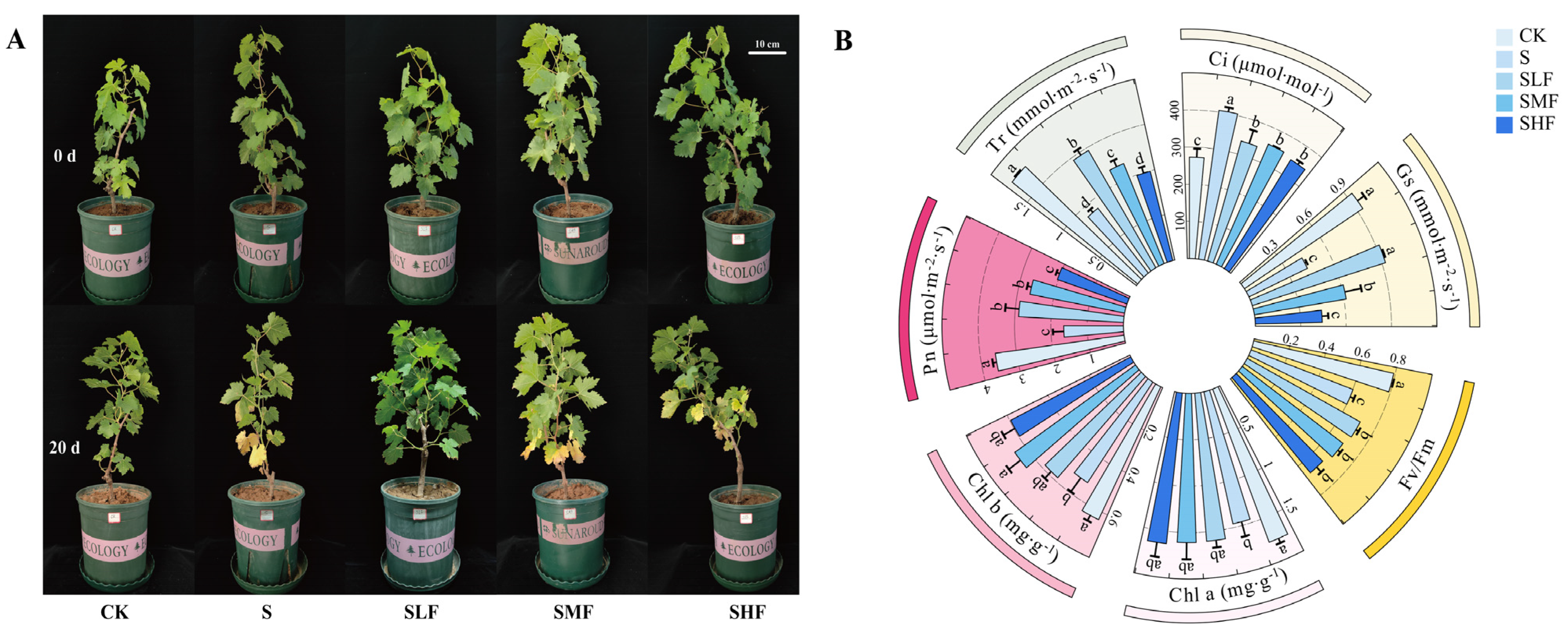
The phenotypic changes in grapevine plants under different treatments (CK, S, SLF, SMF, and SHF) at 0 d (before treatment) and 20 d (after treatment) are shown in Figure 1A. Plants in the CK group maintained normal growth with healthy green leaves. In contrast, plants subjected to salt stress exhibited pronounced growth inhibition and visible leaf chlorosis after 20 d of treatment. Foliar application of the seaweed-based biostimulant markedly alleviated the adverse effects of salt stress, with the SLF treatment showing the most pronounced protective effect. At 20 d, plants in the SLF group displayed only slight chlorosis and exhibited the best overall growth recovery, indicating that a low concentration of the seaweed-based biostimulant effectively mitigated salt-induced damage. Although the SMF and SHF treatments also reduced leaf chlorosis and partially improved plant growth, their alleviating effects were less pronounced than those observed in the SLF group.
The photosynthetic parameters of grape leaves under different treatments at 20 d are shown in Figure 1B. Compared with the control group, salt stress significantly impaired photosynthetic performance, as evidenced by marked decreases in net photosynthetic rate, transpiration rate, and stomatal conductance by 54.11%, 49.43%, and 54.39%, respectively, while the intercellular CO2 concentration increased significantly by 48.34% (p ≤ 0.05). These results indicate that salt stress severely disrupted leaf gas exchange and photosynthetic capacity. In contrast, the SLF, SMF, and SHF treatments effectively reversed these declines by improving leaf gas exchange and maintaining photosynthetic capacity. Similarly, salt stress led to significant reductions in Chl a and Chl b contents by 17.28% and 18.07%, respectively (p ≤ 0.05), whereas all biostimulant treatments mitigated these decreases to varying extents, thus effectively preserving chlorophyll levels and alleviating photoinhibition caused by salt stress. In addition, salt stress significantly reduced the maximum photochemical efficiency of PSII (Fv/Fm). Among the three biostimulant treatments, the SLF group exhibited the strongest alleviating effect compared with the S group. SLF treatment significantly increased Fv/Fm by 18.25%, with values approaching those of the control group.

3.2. Effects of the Seaweed-Based Biostimulant on Biochemical Traits and Ionic Balance of Grape Leaves Under Salt Stress

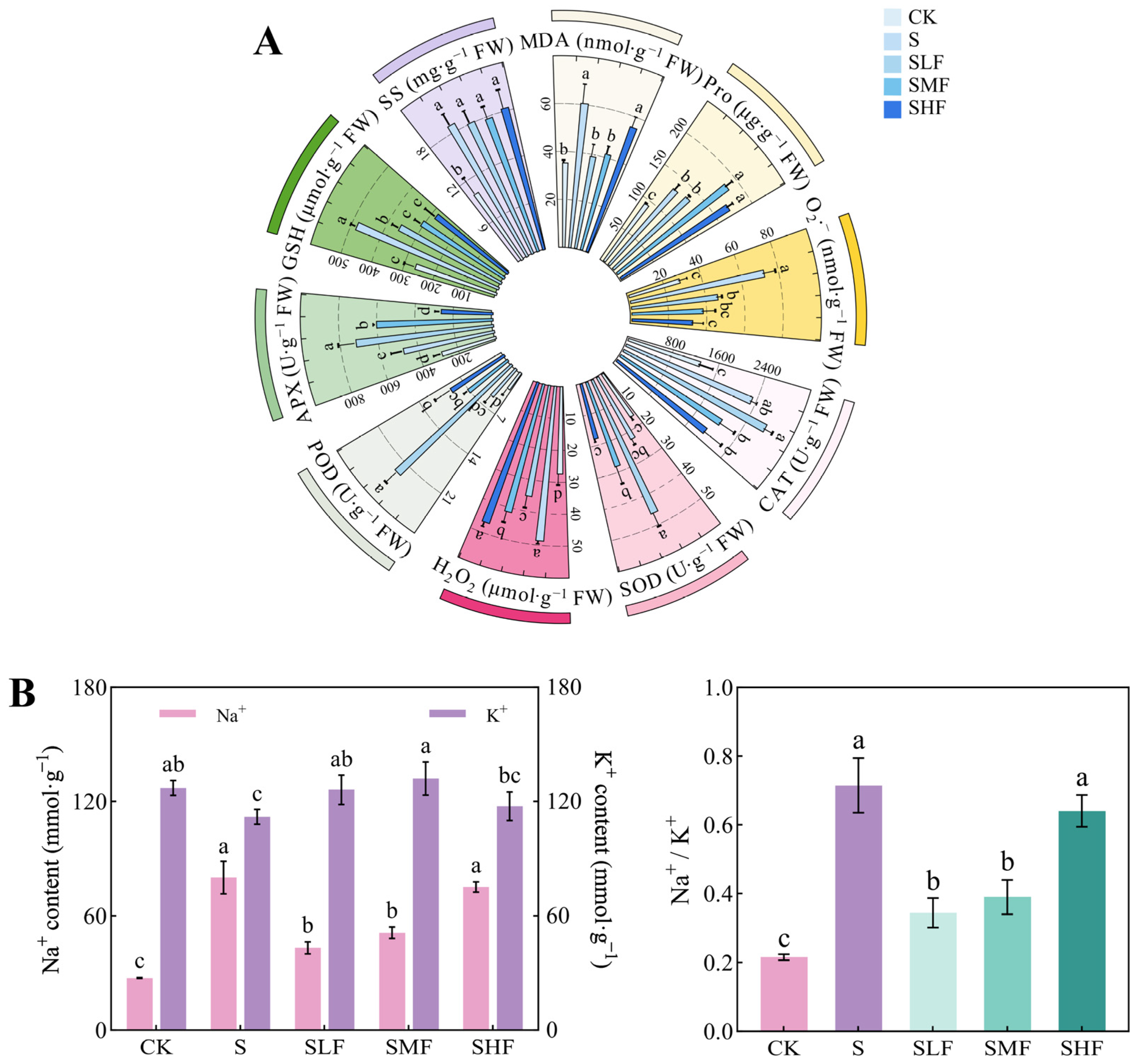
The biochemical indicators of grapevine leaves under different treatments under salt stress are shown in Figure 2. Compared to the CK group, the MDA content in grapevine leaves under salt stress increased significantly by 71.56%, and the H2O2 content also increased significantly by 77.73% (p ≤ 0.05), resulting in severe lipid peroxidation damage to the membrane and inducing a substantial accumulation of reactive oxygen species, which triggered oxidative stress responses in the plants. The accumulation of O2· also reflects the oxidative stress caused by salt stress, while excessive ROS damages the integrity of plant cell structures and disrupts their normal physiological functions. To combat oxidative stress, plants initiated antioxidant defense responses. In the SLF group, the activities of SOD, POD, APX, and CAT were significantly higher than those in the S group, highlighting the substantial activation of the antioxidant system by the low-concentration seaweed-based biostimulant. This activation helped scavenge excess ROS (such as H2O2 and O2·) and reduced oxidative damage. Compared to the S group, SLF treatment significantly reduced the MDA and H2O2 contents by 35.47% and 27.53%, respectively (p ≤ 0.05), effectively inhibiting the accumulation of ROS and lipid peroxidation. The changes in GSH content further confirmed the external regulatory effect. Under salt stress, GSH content reached its peak, but SLF treatment significantly reduced it by 25.27% (p ≤ 0.05), suggesting that with the significant activation of the antioxidant system, the plants did not need to excessively accumulate GSH to counteract oxidative damage. This reflects the precise regulatory role of the seaweed-based biostimulant on the grapevine’s antioxidant system.
Sodium ion (Na+), potassium ion (K+), and the Na+/K+ ratio (Figure 2B), as well as soluble sugars (SS) and proline (Pro) (Figure 2A), are key indicators of osmotic regulation. Salt stress often leads to Na+ accumulation and K+ loss, disrupting ion balance. Compared to the CK group, Na+ content increased significantly by 191.47%, K+ content decreased significantly by 11.92% (p ≤ 0.05), and the Na+/K+ ratio increased sharply. Meanwhile, SS and Pro contents significantly increased by 88.4% and 41.48% (p ≤ 0.05), indicating that the plants responded to salt stress by enhancing the synthesis of osmotic regulators. The SLF group showed the best ion balance, highlighting the effectiveness of the low-concentration seaweed-based biostimulant in alleviating salt stress and restoring ion homeostasis. Additionally, the lower levels of SS and Pro suggest that the biostimulant mitigated the negative effects of salt stress and reduced the plant’s need to synthesize osmotic regulation substances. Although the SMF and SHF groups also improved ion balance, their effects were not as significant as those of the SLF group.
In conclusion, the SLF treatment effectively alleviated salt stress damage in grape leaves, improving photosynthetic efficiency, reducing oxidative damage, strengthening the antioxidant defense system, and maintaining ion homeostasis. This ultimately mitigated the negative effects of salt stress, confirming that SLF treatment is an ideal solution for alleviating salt stress in Cabernet Sauvignon grapes. Based on these findings, SLF treatment was selected for further transcriptomic sequencing to explore the intrinsic regulatory mechanisms underlying its mediation of salt tolerance in grapes.

3.3. Transcriptomic Analysis

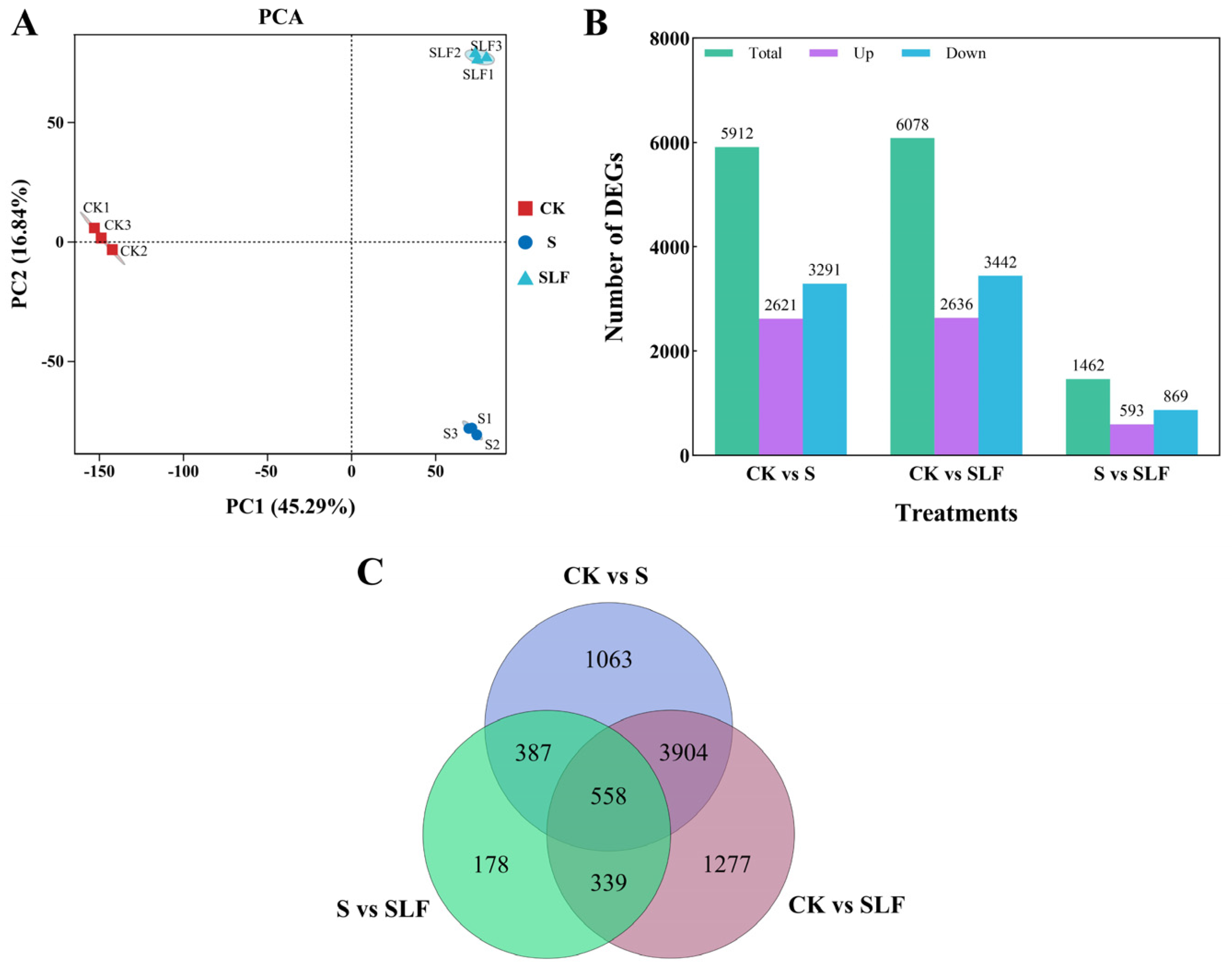
To investigate the impact of low-concentration seaweed-based biostimulant foliar application on gene expression in grape seedlings under salt stress, transcriptomic sequencing was performed on grape leaves treated for 20 days with CK, S, and SLF treatments. The Q30 values (97.52–98.57%) and GC content (44.73–45.28%) of the clean reads from each sample indicate that the transcriptomic sequencing data is of high quality. The clean reads of each sample were aligned to the grape reference genome, with alignment efficiencies ranging from 91.19% to 93.36% (Table S2). Principal component analysis (PCA) based on gene expression levels showed clear clustering boundaries among the three groups (Figure 3A), indicating good sample reproducibility, and the data is suitable for further analysis. Differentially expressed genes (DEGs) were analyzed for the comparisons of CK vs. S, CK vs. SLF, and S vs. SLF using a fold change (FC) ≥ 1.5 and false discovery rate (FDR) ≤ 0.05 as filtering criteria. A total of 5912, 6078, and 1462 DEGs were identified in the CK vs. S, CK vs. SLF, and S vs. SLF comparisons, respectively. Among these, 2621 genes were upregulated and 3291 were downregulated in CK vs. S; 2636 genes were upregulated and 3442 were downregulated in CK vs. SLF; and 593 genes were upregulated and 869 were downregulated in S vs. SLF (Figure 3B). Venn diagram analysis of the DEGs showed that 558 DEGs were commonly expressed across the three comparisons, while 1063, 1277, and 178 DEGs were uniquely responsive in the CK vs. S, CK vs. SLF, and S vs. SLF comparisons, respectively (Figure 3C).

3.4. GO Functional Annotation and KEGG Pathway Enrichment Analysis of Differentially Expressed Genes

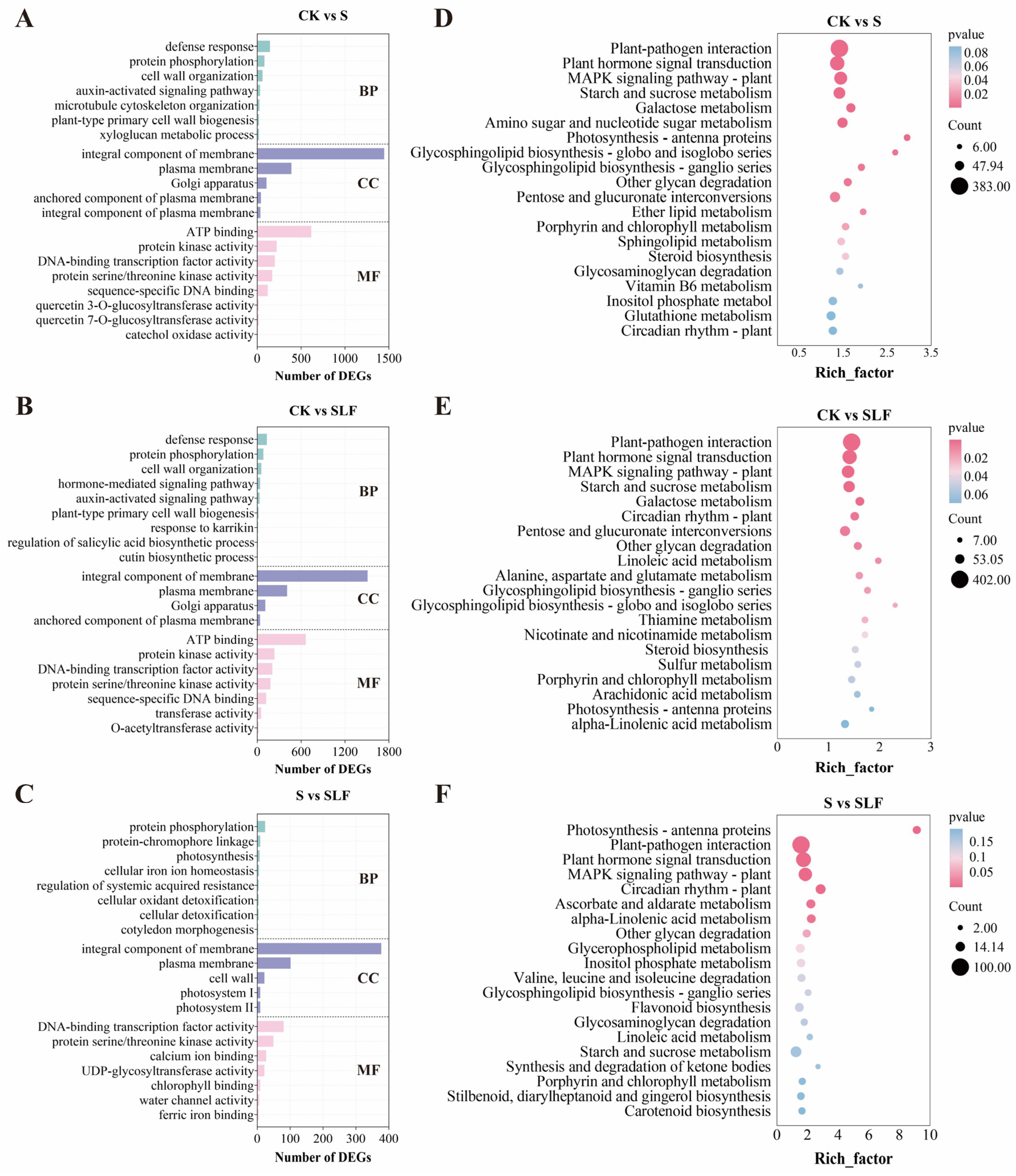
To systematically reveal the effects of salt stress and low-concentration seaweed-based biostimulant on the function of grapevine seedlings, GO functional enrichment analysis was performed on DEGs from the CK vs. S, CK vs. SLF, and S vs. SLF groups (Figure 4A–C). The three groups were enriched in 3396, 3726, and 1497 GO terms, respectively (Table S3), with only the top 20 significant terms (p ≤ 0.05) listed. In the CK vs. S comparison, DEGs were primarily enriched in biological processes (BP) related to defense response, protein phosphorylation, cell wall organization, and auxin-mediated signaling, indicating stress response and signaling transduction. In cellular components (CC), enrichment was observed in membrane components, plasma membrane, and Golgi apparatus, highlighting the impact of salt stress on membrane structure and membrane-related functions. Molecular functions (MF) were predominantly enriched in ATP binding, protein kinase activity, and transcription factor activity. In the CK vs. SLF comparison, in addition to defense response and protein phosphorylation, there was significant enrichment in hormone-mediated signaling pathways, cuticle formation, and salicylic acid biosynthesis, demonstrating the regulatory role of low-concentration seaweed-based biostimulant on hormone signaling and epidermal structure. In the S vs. SLF comparison, the number of enriched terms decreased significantly. The BP category was mainly enriched in protein phosphorylation, photosynthesis, ion homeostasis regulation, and antioxidant detoxification processes. CC terms were closely related to Photosystem I, Photosystem II, and the cell wall. MF terms were enriched in transcription regulation, protein kinase activity, and calcium ion binding, indicating that low-concentration seaweed-based biostimulant alleviates salt stress by regulating photosynthesis, signaling transduction, and ion balance.
Figure 3. Transcriptomic analysis of grape seedlings treated with low-concentration seaweed-based biostimulant under salt stress. (A) Principal component analysis (PCA) of transcriptome sequencing, with each point representing an independent biological replicate. (B) Differentially expressed genes (DEGs) statistics (FC > 1.5 and FDR ≤ 0.05). (C) Venn diagram of differentially expressed genes. S: Salt treatment; SLF: Salt treatment + low-concentration seaweed-based biostimulant.
Agriculture 16 00636 g003
KEGG pathway enrichment analysis was further conducted for DEGs derived from the CK vs. S, CK vs. SLF, and S vs. SLF comparisons (Figure 4D–F). A total of 3167, 3244, and 719 DEGs were identified in the three comparisons and mapped to 132, 133, and 100 KEGG pathways, respectively (Table S4). For clarity, only the top 20 significantly enriched pathways (p ≤ 0.05) are presented. In the CK vs. S comparison, DEGs were predominantly enriched in plant–pathogen interaction, plant hormone signal transduction, and the MAPK signaling pathway, as well as carbohydrate metabolism pathways, including starch and sucrose metabolism and galactose metabolism. In addition, enrichment was observed in photosynthesis-antenna proteins, lipid metabolism, and glutathione metabolism, indicating that salt stress not only activates defense-related and signaling pathways but also markedly disrupts energy metabolic homeostasis and redox balance. In the CK vs. SLF comparison, enriched pathways remained mainly associated with plant–pathogen interaction, hormone signal transduction, and the MAPK signaling pathway; however, fatty acid metabolism, amino acid metabolism, and sulfur metabolism were also significantly enriched, suggesting that the low-concentration seaweed-based biostimulant regulates signaling processes while simultaneously modulating primary metabolic networks. In the S vs. SLF comparison, the number of enriched pathways was further reduced and was mainly associated with photosynthesis-antenna proteins, hormone signal transduction, and the MAPK signaling pathway, together with antioxidant- and secondary metabolism-related pathways such as flavonoid, alkaloid, and carotenoid biosynthesis. These results indicate that the low-concentration seaweed-based biostimulant alleviates salt stress primarily by modulating photosynthetic performance, stress signaling responses, and secondary metabolic processes.
Figure 4. GO functional annotation and KEGG pathway enrichment analysis of differentially expressed genes (DEGs) in the comparison groups. (AC) GO enrichment analysis results of DEGs in the CK vs. S, CK vs. SLF, and S vs. SLF comparison groups. The GO terms are categorized into biological process (BP), cellular component (CC), and molecular function (MF). Only the top 20 significantly enriched GO terms (p ≤ 0.05) are presented, with the length of the bars indicating the number of DEGs enriched in each term. (DF) KEGG pathway enrichment analysis results of DEGs in the CK vs. S, CK vs. SLF, and S vs. SLF comparison groups. The bubble size represents the number of DEGs enriched in each pathway, while the color indicates the enrichment significance level (p-value). The Rich factor is the ratio of the number of DEGs to the total number of annotated genes in the pathway.
Agriculture 16 00636 g004

3.5. Construction and Analysis of Weighted Gene Co-Expression Networks

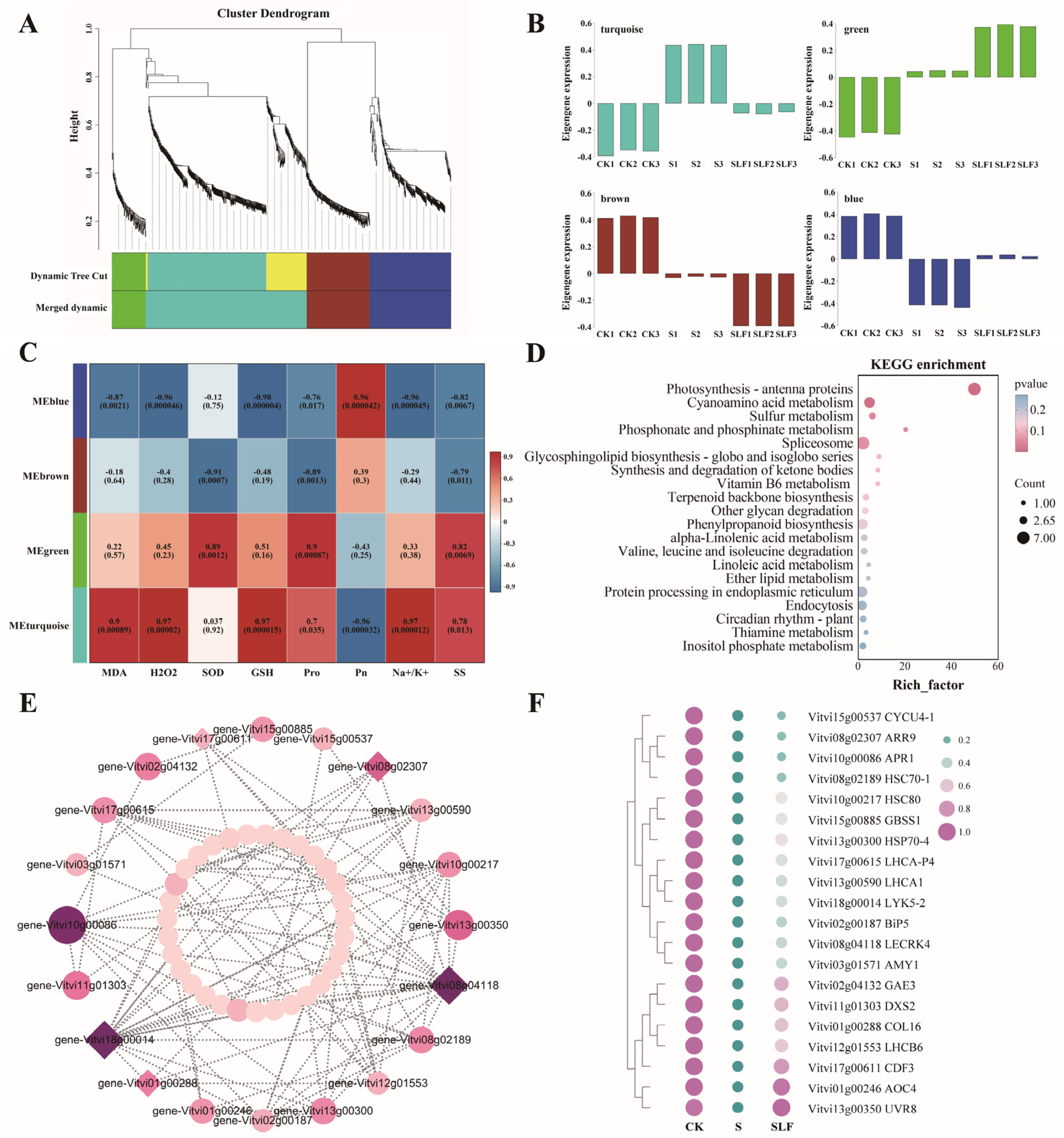
After quality control of the transcriptomic data, genes with low expression variance were filtered out from the expression matrix, and a total of 1327 DEGs were retained for weighted gene co-expression network analysis (WGCNA). Based on the similarity of gene expression patterns, these genes were clustered into four co-expression modules, each represented by a distinct color (Figure 5A). Analysis of module eigengenes revealed distinct expression profiles among the CK, S, and SLF treatments. Notably, the Blue module exhibited relatively high expression levels in the CK group but was significantly downregulated under salt stress; its expression was markedly restored following SLF treatment, suggesting that this module is closely associated with salt stress-induced injury and the mitigating effect of the seaweed-based biostimulant (Figure 5B).
To explore the relationship between each module and physiological traits, A correlation analysis was performed between the module eigengenes and several physiological indicators (Figure 5C). The results showed that the Blue module had a significant positive correlation with the photosynthetic rate (R = 0.96, p = 4.2 × 10⁻⁵), and a significant negative correlation with MDA, H2O2, and Na+/K+ ratios, which are indicators of salt stress and oxidative damage (R = −0.87, p = 2.1 × 10⁻³; R = −0.96, p = 4.6 × 10⁻⁵; R = −0.96, p = 4.5 × 10⁻⁵). This correlation pattern suggests that the Blue module may play a vital role in maintaining photosynthetic function, mitigating oxidative damage, and improving ion homeostasis, and thus was selected for further analysis.
Based on the results above, further KEGG pathway enrichment analysis was conducted for the genes in the Blue module. The results revealed that these genes were mainly enriched in pathways related to photosynthesis-antenna proteins, sulfur metabolism, α-linolenic acid metabolism, phenylpropanoid biosynthesis, lipid metabolism, endoplasmic reticulum protein processing, and circadian rhythm (Figure 5D). Among these, pathways related to photosynthesis and energy metabolism showed high enrichment, suggesting that the Blue module may be involved in the alleviating effect of the seaweed-based biostimulant on grape leaves under salt stress by regulating photosynthetic systems and metabolic homeostasis.
To identify core regulatory genes in the protein–protein interaction (PPI) network of the MEBlue module, we utilized Cytoscape_v3. 10. 4 software and applied the betweenness centrality (BC) algorithm for topological analysis (Figure 5E). Based on BC ranking, the top 20 genes were selected as core candidate genes, and their expression patterns under different treatments were further analyzed (Figure 5F). The results indicated that the expression levels of these genes changed significantly under salt stress, and after SLF treatment, their expression levels were restored to varying degrees. Functional annotation of these genes showed that AOC4 is involved in oxylipin synthesis and jasmonic acid (JA) signaling pathways, mediating plant defense responses to stress; ARR9 is mainly involved in cytokinin signal transduction; GBSS1, a key gene in starch synthesis, participates in starch metabolism, affecting energy supply and growth maintenance under stress; LECRK4, a receptor-like cytoplasmic kinase, participates in plant signal transduction, antioxidant defense, and abiotic stress responses; AMY1, an amylase-encoding gene, is involved in starch degradation and carbon metabolism. These findings suggest that these genes are involved in key pathways of plant hormone signaling, carbon metabolism, and antioxidant defense, which are crucial for salt stress responses. Therefore, they were selected as candidate genes for further functional validation and mechanism studies.

3.6. Quantitative Fluorescence Validation

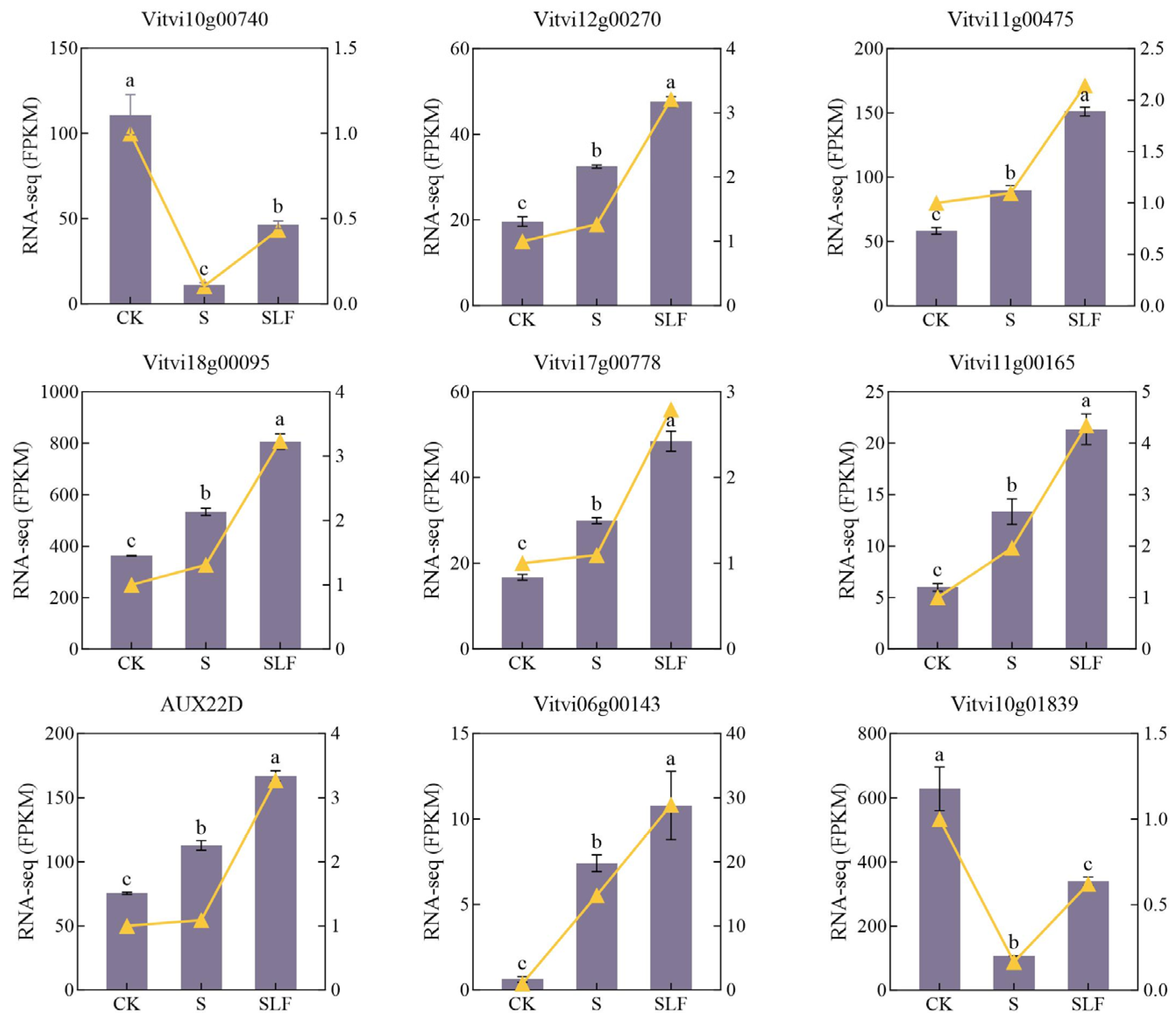
To validate the reliability of the RNA-Seq results, nine differentially expressed genes (DEGs) were randomly selected for quantitative real-time polymerase chain reaction (qRT-PCR) analysis. As shown in Figure 6, these genes include one gene related to ethylene (ETH) synthesis and signaling (VvEBF1), one gene related to auxin (IAA) synthesis and response (VvAUX22D), one gene related to jasmonic acid (JA) synthesis regulation (VvBHLH41), one gene related to phenylpropanoid biosynthesis (VvBGLU12), one gene related to the synthesis of trehalose and soluble sugars (VvTPS9), two genes related to chlorophyll synthesis and light-harvesting pigment binding (VvCAB40-1 and VvCAB40-2), one gene related to reactive oxygen species (ROS) metabolism (VvCAT1), and one gene related to ion homeostasis (VvNAAT1). The relative expression levels of these genes exhibited trends similar to the FPKM (Fragments Per Kilobase of exon per Million mapped reads) values obtained from the RNA-Seq data, thus confirming the reliability of the transcriptomic data for further analysis.

4. Discussion

Soil salinization is one of the major abiotic stresses faced in global agricultural production, with reports indicating that approximately 50% of the world’s arable land will be affected by varying degrees of salinization [21,22]. In this study, salt stress treatment significantly inhibited the photosynthetic capacity of grape leaves, while inducing excessive accumulation of reactive oxygen species, increasing membrane lipid peroxidation levels, and disturbing ion homeostasis and osmotic regulation systems. Similar effects of salt stress and the physiological responses it triggers have been widely reported in various crops, including Oryza sativa [23], Zea mays [24], and Malus domestica [25], further indicating that salt stress inhibits normal plant growth and development by interfering with physiological processes.
The photosynthetic system is one of the most sensitive physiological systems in plants’ response to salt stress. The results of this study show that SLF treatment significantly improved the net photosynthetic rate, stomatal conductance, transpiration rate, and PSII maximum photochemical efficiency of grape leaves under salt stress, effectively restoring chlorophyll content, confirming that exogenous seaweed-based biostimulants help maintain the structural and functional stability of the photosynthetic system. Similar regulatory effects have been validated in studies on abiotic stress responses in various crops. Results show that the application of plant extracts and seaweed extracts significantly enhances photosynthetic capacity and chlorophyll content under salt stress in crops such as Cucurbita pepo [26], Phaseolus vulgaris, and Zea mays [27,28], maintaining photosynthetic homeostasis and enhancing antioxidant defense levels. Similarly, foliar spraying of seaweed extracts effectively improves photosynthetic efficiency under drought and high-temperature stresses in crops like Brassica juncea [29] and Coffea arabica [30].
Reactive oxygen species are natural by-products of plant metabolism; however, their excessive accumulation under salt stress induces membrane lipid peroxidation, with malondialdehyde serving as a typical indicator of this process. Although plants activate osmotic adjustment and antioxidant defense systems to maintain cellular homeostasis, such passive defense responses are often insufficient to counteract the massive overproduction of ROS under salt stress. In the present study, salt stress significantly increased the contents of H2O2, O2·, and MDA in grape leaves. Meanwhile, the levels of Pro, SS, and GSH, as well as the activities of antioxidant enzymes such as SOD and POD, were simultaneously enhanced; however, these responses failed to effectively eliminate excessive ROS. This response pattern is consistent with previous reports in salt-stressed fruit trees [31,32]. Low-concentration seaweed-based biostimulant application exhibited a pronounced regulatory effect on oxidative damage induced by salt stress, with the SLF treatment showing the strongest alleviation. Compared with the S treatment, the contents of H2O2, O2·, and MDA were significantly reduced in all biostimulant-treated groups, with the greatest decreases observed in the SLF group, indicating that exogenous regulation effectively suppressed ROS accumulation and membrane lipid peroxidation. Concurrently, the activities of SOD, POD, CAT, and APX were further enhanced relative to the S group. Notably, SOD, CAT, and APX activities were most strongly increased in the SLF group, whereas POD activity showed the largest increase in the SMF group. These results suggest that the seaweed-based biostimulant did not merely induce a stress-related increase in antioxidant enzyme activities, but rather enhanced enzymatic antioxidant capacity through coordinated regulation: SOD rapidly scavenges O2·, thereby reducing its conversion to H2O2, while CAT and APX act synergistically to efficiently remove H2O2, ultimately blocking the cascade of membrane lipid peroxidation. In addition, the contents of GSH and SS in all biostimulant-treated groups were significantly lower than those in the S group, although still higher than in the CK group, and Pro content showed a similar downward trend. These results indicate that, under conditions of highly efficient enzymatic antioxidant activity, plants no longer rely on excessive GSH synthesis to cope with oxidative stress, nor do they require overaccumulation of SS and Pro to maintain osmotic balance, thereby effectively reducing the metabolic cost of passive defense. Under salt stress, plants accumulate large amounts of Na+ and Cl, and the osmotic stress induced by high salinity further leads to physiological water deficit; thus, maintaining dynamic balance between Na+ and K+ is crucial for normal plant growth [33,34]. In this study, foliar application of a low concentration of seaweed-based biostimulant significantly alleviated salt stress-induced Na+/K+ imbalance. Compared with the salt-stressed group, the SLF treatment markedly reduced Na+ content while increasing K+ content in leaves, thereby maintaining a more favorable Na+/K+ ratio. Similar regulatory effects have also been reported in Cossypium hirsutum [35] and Oryza sativa [36].
The seaweed-based biostimulant used in this study is rich in fucoidan, alginate oligosaccharides, natural amino acids, and phytohormones, which can directly function as non-enzymatic antioxidants [37]. These components are capable of scavenging free radicals and interrupting oxidative chain reactions, thereby interacting with intracellular reactive oxygen species and reducing their oxidative damage to macromolecules such as proteins and lipids. Previous studies have demonstrated that the stress-regulatory effects of fucoidan-derived polysaccharides are highly conserved. These compounds enhance the activity of ω-fatty acid desaturases (ω-FDAs), induce the upregulation of CsSAD and CsFAD genes under cold stress in Cucumis sativus, and simultaneously downregulate CsPLD and CsLOX expression, leading to reduced phospholipid content and membrane lipid peroxidation and ultimately maintaining cellular integrity [38]. The salt stress-alleviating effects of alginate oligosaccharides (AOS) have also been verified across species. In Oryza sativa under salt stress, foliar application of AOS significantly increased the activities of SOD, CAT, and APX as well as the levels of GSH and ascorbic acid (ASA), thereby reducing membrane lipid damage through reinforcement of the antioxidant system. Meanwhile, AOS coordinately regulated the expression of genes involved in photosynthesis, cell wall biosynthesis, and signal transduction (e.g., CBA, Lhcb, and LhcP), and promoted the accumulation of stress-related metabolites associated with amino acid and tryptophan metabolism, ultimately enhancing salt tolerance in Oryza sativa [39]. Exogenous application of natural amino acids such as methionine, tryptophan, and glycine has been shown to significantly alleviate salt stress in maize by increasing the activities of antioxidant enzymes (SOD, CAT, and POD) and the contents of total phenolics and flavonoids, thereby improving plant growth and strengthening antioxidant defense capacity [40]. Consistently, studies in Arabidopsis thaliana have demonstrated that amino acids such as Gly and Met can mitigate the inhibitory effects of salt stress on seed germination, further supporting the evolutionary conservation of amino acid-mediated salt tolerance across plant species [41]. In addition, naturally occurring phytohormones in the extract (e.g., cytokinins and gibberellin precursors) may act synergistically to regulate plant physiological metabolism and enhance the responsiveness of the antioxidant system [42]. Moreover, the trace and micronutrients contained in the extract, such as copper (Cu), zinc (Zn), manganese (Mn), and iron (Fe), serve as essential cofactors for antioxidant enzymes, ensuring the structural stability and catalytic efficiency of enzymes such as SOD and CAT and thereby further improving ROS scavenging efficiency [43].
To further elucidate the mitigating effects of the exogenous seaweed-based biostimulant on salt stress in grapevine, transcriptomic analyses were performed on the CK, S, and SLF treatment groups. The transcriptome results revealed that the differentially expressed genes (DEGs) were mainly enriched in pathways associated with defense responses, plant hormone signal transduction, the MAPK signaling pathway, and carbohydrate metabolism, indicating that salt stress not only activates stress-responsive pathways but also markedly affects primary metabolic processes. Following the application of the exogenous biostimulant under salt stress, the number of DEGs was substantially reduced, and these genes were predominantly enriched in pathways related to photosynthesis, antioxidant metabolism, and secondary metabolism. These findings suggest that the seaweed-based biostimulant alleviates the adverse effects of salt stress on grapevine by actively regulating light energy capture, signal transduction, and antioxidant-related metabolic processes, thereby contributing to the restoration of physiological and metabolic homeostasis under saline conditions.
WGCNA further demonstrated that the Blue module, which showed a significant positive correlation with photosynthetic rate and significant negative correlations with MDA, H2O2, and the Na+/K+ ratio, was globally downregulated under salt stress, whereas its expression was markedly restored following treatment with the low concentration of the seaweed-based biostimulant. This module was significantly enriched in pathways associated with photosynthesis-antenna proteins, sulfur metabolism, α-linolenic acid metabolism, and phenylpropanoid biosynthesis, suggesting that it may play a pivotal role in salt stress alleviation through coordinated regulation of photosystem performance, lipid metabolism, and secondary metabolic networks. The candidate genes AOC4, ARR9, GBSS1, LECRK4, and AMY1 are involved in cytokinin signal transduction, jasmonic acid biosynthesis, starch metabolism, signal transduction and antioxidant defense, as well as starch degradation and carbon metabolism. Among these, AOC4 functions as a key enzyme in the jasmonic acid biosynthetic pathway and is closely associated with stress-induced defense responses [44], whereas ARR9 is a central regulator of cytokinin signaling in Arabidopsis thaliana and is transcriptionally modulated by CRF6 under oxidative stress conditions [45].
Although the present study demonstrates that seaweed-based biostimulants can effectively alleviate salt stress damage in grapevine, certain limitations exist in the experimental design and implementation. This study was carried out under controlled pot conditions, and the lack of comprehensive monitoring of the rhizosphere microenvironment and plant water status restricts the precise interpretation of plant physiological responses to salt stress. In addition, own-rooted grape seedlings were used in this experiment, whereas grafted vines or standardized cuttings are primarily used in commercial field production. Therefore, future studies are warranted to employ grafted vines and cuttings at different growth stages as experimental materials, to further explore their physiological responses to salt stress and the mitigating effects of seaweed-based biostimulants. However, the practical application of seaweed-based biostimulants in agricultural production still faces several challenges. First, regarding product uniformity, variations in seaweed raw materials, extraction processes, and formulation composition may lead to instability in the content and proportion of active components (e.g., alginates, phytohormones, and polysaccharides), thereby affecting the reproducibility and consistency of their biological effects. Second, the effectiveness of seaweed-based biostimulants is context-dependent, as their regulatory performance is influenced by crop species, developmental stage, and stress intensity. Since this study focused on one-year-old ‘Cabernet Sauvignon’ grapevine seedlings, the applicability of the present findings to other grape cultivars or different growth stages requires further validation, and responses may also differ substantially among crop species. Third, the underlying mechanisms are inherently complex. Because such formulations typically contain multiple bioactive substances, their salt stress-alleviating effects involve the coordinated regulation of multiple signaling pathways and metabolic processes, making it difficult to clearly distinguish the relative contributions of individual active components, which poses challenges for the development of precisely targeted formulations. Finally, field applicability remains to be verified. As this study was conducted primarily under controlled pot conditions, long-term and multi-site field trials across different ecological environments and cultivation systems are still required to comprehensively evaluate their stability, applicability, and economic feasibility in agricultural practice.

5. Conclusions

Salt stress significantly inhibited the growth of grapevine seedlings, impaired photosynthetic system function, induced excessive accumulation of reactive oxygen species and membrane lipid peroxidation, and disrupted ionic homeostasis, thereby increasing the metabolic cost of osmotic regulation. This study demonstrates that foliar application of a low-concentration (SLF) kelp-derived seaweed-based biostimulant effectively alleviates salt stress in grapevine. The biostimulant mitigated salt-induced damage by maintaining photosynthetic performance, activating the antioxidant defense system to reduce oxidative injury, and restoring ionic homeostasis. At the molecular level, salt tolerance was enhanced through coordinated regulation of key pathways via modulation of genes involved in signal transduction, carbon metabolism, and antioxidant defense. More importantly, this seaweed-based biostimulant can be used as a feasible foliar application strategy under salt stress to alleviate salt-induced growth inhibition in grapevine, thereby providing direct practical guidance for the development and promotion of salt-tolerant grape cultivation practices in salinized regions. Moreover, this study clarifies the physiological and molecular mechanisms underlying the regulation of grapevine salt tolerance by a low-concentration seaweed-based biostimulant, offering valuable experimental evidence for future research. Further investigations should focus on identifying the core regulatory pathways and key targets to facilitate its practical application in grapevine stress-resilient cultivation.

Supplementary Materials

The following supporting information can be downloaded at https://www.mdpi.com/article/10.3390/agriculture16060636/s1. Table S1. Gene-specific primer list of qRT-PCR. Table S2. Statistics of sequencing data and reference genome alignment results. Table S3. GO enrichment terms table. Table S4. KEGG enrichment pathways table.

Author Contributions

J.D., L.M., G.N., P.S. and S.L. designed the experiments, analyzed the data, and wrote the manuscript; J.Z. and Z.L. performed the experiments; S.M. provided the experimental equipment and facilities; Y.L., X.S. and L.F. revised the manuscript. All authors have read and agreed to the published version of the manuscript.

Funding

This study was supported by the Central Government-Guided Local Science and Technology Development Fund Project (25ZYJA033).

Data Availability Statement

All data used during the study are proprietary or confidential, and only limited data can be provided.

Acknowledgments

The authors sincerely thank the editors and reviewers for their time and effort in evaluating this manuscript.

Conflicts of Interest

The authors declare that they have no known competing financial interests or personal relationships that could have influenced the work reported in this paper.

References

  1. Cavaco, A.R.; Maia, M.; Laureano, G.; Duarte, B.; Caçador, I.; Silva, M.S.; Matos, A.R.; Figueiredo, A. P-285-Identifying grapevine lipid biomarkers of resistance/susceptibility to Plasmopara viticola; towards a sustainable viticulture. Free Radic. Biol. Med. 2018, 120, S131. [Google Scholar] [CrossRef]
  2. Apolinar-Valiente, R.; Gómez-Plaza, E.; Terrier, N.; Doco, T.; Ros-García, J.M. The composition of cell walls from grape skin in Vitis vinifera intraspecific hybrids. J. Sci. Food Agric. 2017, 97, 4029–4035. [Google Scholar] [CrossRef]
  3. Shi, J.F.; Hao, Z.; Sun, J.J.; Wang, Y.G. Enhancing soil salinity accumulation in the profile from water-saving irrigation in drylands. Soil Tillage Res. 2025, 257, 106949. [Google Scholar] [CrossRef]
  4. Rahman, M.M.; Mostofa, M.G.; Keya, S.S.; Siddiqui, M.N.; Ansary, M.M.; Das, A.K.; Rahman, M.A.; Tran, L.S. Adaptive mechanisms of halophytes and their potential in improving salinity tolerance in plants. Int. J. Mol. Sci. 2021, 22, 10733. [Google Scholar] [CrossRef]
  5. Liu, Z.Y.; Zhu, C.M.; Zhang, Z.J.; Zhang, D.L.; Xie, A.Q.; Zhang, Z.Y.; Zhai, W.T.; Sun, J.L.; Zhao, B.L. Differential physiological responses of grafted cabernet sauvignon grapes to salt and saline–alkali stress: The dual role of VvGAD1 in GABA-mediated tolerance. Ind. Crops Prod. 2026, 240, 122641. [Google Scholar] [CrossRef]
  6. Fu, H.Q.; Yang, Y.Q. How plants tolerate salt stress. Curr. Issues Mol. Biol. 2023, 45, 5914–5934. [Google Scholar] [CrossRef]
  7. Shah, S.H.; Parrey, Z.A.; Barwal, S.K.; Mohammad, F.; Siddiqui, M.H. Deciphering the mechanism of action and crosstalk of brassinosteroids with other plant growth regulators in orchestrating physio-biochemical responses in plants under salt stress. Plant Growth Regul. 2024, 104, 1285–1306. [Google Scholar] [CrossRef]
  8. Xu, N.; Chen, Z.; Niu, J.P.; Niu, K.J.; Khan, Z. Effects of exogenous 5-aminolevulinic acid (5-ALA) on alfalfa (Medicago sativa L.) under NaCl-induced salinity stress. J. Soil Sci. Plant Nutr. 2025, 25, 478–494. [Google Scholar] [CrossRef]
  9. Lu, X.; Ma, L.; Zhang, C.C.; Yan, H.K.; Bao, J.Y.; Gong, M.S.; Wang, W.H.; Li, S.; Ma, S.Y.; Chen, B.H. Grapevine (Vitis vinifera) responses to salt stress and alkali stress: Transcriptional and metabolic profiling. BMC Plant Biol. 2022, 22, 528. [Google Scholar] [CrossRef]
  10. Zheng, W.W.; Tian, Y.T.; Shi, H.L.; Chen, M.M.; Hong, S.B.; Xu, K.; Cheng, J.H.; Zang, Y.X. Exogenous 5-aminolevulinic acid promotes plant growth and salinity tolerance of grape rootstocks in coastal areas. Hortic. Environ. Biotechnol. 2023, 64, 179–191. [Google Scholar] [CrossRef]
  11. Feng, D.; Li, W.X.; Huang, P.F.; Gu, M.Y.; Tang, G.M.; Ding, Y.H.; Cao, G.; Xu, W.L. Mechanisms of microorganisms alleviating drought and salt stresses in plants. Microorganisms 2025, 13, 2565. [Google Scholar] [CrossRef]
  12. Ma, Y.; Freitas, H.; Dias, M.C. Strategies and prospects for biostimulants to alleviate abiotic stress in plants. Front. Plant Sci. 2022, 13, 1024243. [Google Scholar] [CrossRef]
  13. Abdelkader, M.; Bhuker, A.; Malik, A.; Punia, H.; Koul, A.; Ahmed, M.; Elshamly, A.M.S.; Iqbal, R.; Aghayeva, S.; Ullah, S. Cultivating resilience from the ocean to the field: Leveraging seaweed biostimulants for sustainable and efficient farming systems. Plant Stress 2025, 19, 101170. [Google Scholar] [CrossRef]
  14. Yakhin, O.I.; Lubyanov, A.A.; Yakhin, I.A.; Brown, P.H. Biostimulants in plant science: A global perspective. Front. Plant Sci. 2017, 7, 2049. [Google Scholar] [CrossRef]
  15. Pienaar, B.C.; Majeke, B.M.; Wittenberg, M.F.; Adetunji, A.E.; Nephali, L.; Tugizimana, F.; Rafudeen, M.S. Mitigating salt stress in maize using Ecklonia maxima seaweed extracts. Plant Stress 2025, 16, 100828. [Google Scholar] [CrossRef]
  16. Gil-Ortiz, R.; Naranjo, M.Á.; Atares, S.; Vicente, O. Antioxidant responses of water-stressed cherry tomato plants to natural biostimulants. Agronomy 2023, 13, 2314. [Google Scholar] [CrossRef]
  17. Kałuzewicz, A.; Krzesiński, W.; Spizewski, T.; Zaworska, A. Effect of biostimulants on several physiological characteristics and chlorophyll content in broccoli under drought stress and re-watering. Not. Bot. Horti Agrobot. Cluj-Napoca 2017, 45, 197–202. [Google Scholar] [CrossRef]
  18. Yang, C.B.; Feng, M.C.; Bai, J.; Sun, H.; Bi, R.T.; Song, L.F.; Wang, C.; Zhao, Y.; Yang, W.D.; Xiao, L.J.; et al. Hyperspectral estimation of chlorophyll density in winter wheat using fractional-order derivative combined with machine learning. Front. Plant Sci. 2025, 15, 1492059. [Google Scholar] [CrossRef]
  19. Chen, J.B.; Zong, J.Q.; Li, D.D.; Chen, Y.; Wang, Y.; Guo, H.L.; Li, J.J.; Li, L.; Guo, A.G.; Liu, J.X. Growth response and ion homeostasis in two bermudagrass (Cynodon dactylon) cultivars differing in salinity tolerance under salinity stress. Soil Sci. Plant Nutr. 2019, 65, 419–429. [Google Scholar] [CrossRef]
  20. Livak, K.J.; Schmittgen, T.D. Analysis of relative gene expression data using real-time quantitative PCR and the 2−ΔΔCT method. Methods 2001, 25, 402–408. [Google Scholar] [CrossRef]
  21. Feng, D.; Zhang, W.J.; Zheng, C.L.; Tang, G.M.; Adili, Y.; Ge, C.H.; Xu, W.L. Mechanisms of plant extracts in alleviating drought and saline-alkali stress in plants. Ind. Crops Prod. 2025, 233, 121346. [Google Scholar]
  22. Kelbessa, B.G.; Dubey, M.; Catara, V.; Ghadamgahi, F.; Ortiz, R.; Vetukuri, R.R. Potential of Plant Growth-Promoting Rhizobacteria to Improve Crop Productivity and Adaptation to a Changing Climate; CABI International: Oxford, UK, 2023; cabireviews. 0001. [Google Scholar]
  23. Wang, K.; Zhu, J.; Xu, X.W.; Li, T.J.; Wang, X.; Warner, T.A.; Cheng, T.; Zhu, Y.; Cao, W.X.; Yao, X.; et al. Quantitative monitoring of salt stress in rice with solar-induced chlorophyll fluorescence. Eur. J. Agron. 2023, 150, 126954. [Google Scholar] [CrossRef]
  24. Guo, R.; Shi, L.X.; Yan, C.R.; Zhong, X.L.; Gu, F.X.; Liu, Q.; Xia, X.; Li, H.R. Ionomic and metabolic responses to neutral salt or alkaline salt stresses in maize (Zea mays L.) seedlings. BMC Plant Biol. 2017, 17, 41. [Google Scholar] [CrossRef]
  25. Zhao, J.H.; Zhang, S.H.; Yu, Z.C.; Gu, T.T.; Zhang, J.; Meng, L.Y.; Chen, Z.J.; Zhang, Z.Y.; Wang, N.; Chen, X.S.; et al. The transcription factor MdWRKY9 is involved in jasmonic acid-mediated salt stress tolerance in apple. Hortic. Res. 2025, 12, uhaf068. [Google Scholar] [CrossRef]
  26. ElSayed, A.I.; Rafudeen, M.S.; Ganie, S.A.; Hossain, M.S.; Gomaa, A.M. Seed priming with cypress leaf extract enhances photosynthesis and antioxidative defense in zucchini seedlings under salt stress. Sci. Hortic. 2022, 293, 110707. [Google Scholar] [CrossRef]
  27. Hussein, M.H.; Eltanahy, E.; Fathy, A.B.; Nesrein, E.; Maha, E.M. Seaweed extracts as prospective plant growth bio-stimulant and salinity stress alleviator for Vigna sinensis and Zea mays. J. Appl. Phycol. 2021, 33, 1273–1291. [Google Scholar] [CrossRef]
  28. Lotfi, M.; Eghlima, G.; Mirjalili, M.H. Growth and physiological responses of Grammosciadium platycarpum seed treated with seaweed bio-stimulant under salinity stress. BMC Plant Biol. 2025, 25, 1751. [Google Scholar] [CrossRef]
  29. Sujata; Goyal, V.; Baliyan, V.; Avtar, R.; Mehrotra, S. Alleviating drought stress in Brassica juncea (L.) Czern & Coss. by foliar application of biostimulants-orthosilicic acid and seaweed extract. Appl. Biochem. Biotechnol. 2023, 195, 693–721. [Google Scholar]
  30. Chandon, E.; Nualkhao, P.; Vibulkeaw, M.; Tisarum, R.; Samphumphuang, T.; Sun, J.Q.; Cha-Um, S.; Yooyongwech, S. Mitigating excessive heat in Arabica coffee using nanosilicon and seaweed extract to enhance element homeostasis and photosynthetic recovery. BMC Plant Biol. 2024, 24, 1064. [Google Scholar] [CrossRef]
  31. Yu, B.; Wang, L.P.; Guan, Q.A.; Xue, X.M.; Gao, W.S.; Nie, P.X. Exogenous 24-epibrassinolide promoted growth and nitrogen absorption and assimilation efficiency of apple seedlings under salt stress. Front. Plant Sci. 2023, 14, 1178085. [Google Scholar] [CrossRef]
  32. Sun, M.X.; Liu, X.L.; Zhang, B.B.; Yu, W.; Xiao, Y.S.; Peng, F.T. Lipid metabolomic and transcriptomic analyses reveal that phosphatidylcholine enhanced the resistance of peach seedlings to salt stress through phosphatidic acid. J. Agric. Food Chem. 2023, 71, 8846–8858. [Google Scholar] [CrossRef]
  33. Jini, D.; Joseph, B. Physiological mechanism of salicylic acid for alleviation of salt stress in rice. Rice Sci. 2017, 24, 97–108. [Google Scholar] [CrossRef]
  34. Shi, Y.J.; Li, Y.X.; Liu, T.F.; Guo, C.Y.; Liang, W.; Ma, F.W.; Li, C.Y. γ-Aminobutyric acid enhances salt tolerance by sustaining ion homeostasis in apples. Plant Physiol. Biochem. 2024, 206, 108306. [Google Scholar] [CrossRef]
  35. Lu, K.S.; Yan, L.; Riaz, M.; Babar, S.; Hou, J.Y.; Zhang, Y.L.; Jiang, C.C. Exogenous boron alleviates salt stress in cotton by maintaining cell wall structure and ion homeostasis. Plant Physiol. Biochem. 2023, 201, 107858. [Google Scholar] [CrossRef]
  36. Sobahan, M.A.; Akter, N.; Karim, M.M.; Badhon, M.M.I.; Khan, S.N.; Alam, S.; Prasad, P.V.V.; Hasanuzzaman, M. Bioaugmentation with plant growth-promoting rhizobacteria alleviates chromium and salt stress in rice through the improvement of physiology, ion homeostasis, and antioxidant defense. Microorganisms 2025, 13, 1462. [Google Scholar] [CrossRef]
  37. Ashour, M.; Hassan, S.M.; Elshobary, M.E.; Ammar, G.A.G.; Gaber, A.; Alsanie, W.F.; Mansour, A.T.; El-Shenody, R. Impact of commercial seaweed liquid extract (TAM®) biostimulant and its bioactive molecules on growth and antioxidant activities of hot pepper (Capsicum annuum). Plants 2021, 10, 1045. [Google Scholar] [CrossRef]
  38. Zhang, Y.P.; Lin, D.; Yan, R.Y.; Xu, Y.H.; Xing, M.Y.; Liao, S.Y.; Wan, C.P.; Chen, C.Y.; Zhu, L.Q.; Kai, W.B.; et al. Amelioration of chilling injury by fucoidan in cold-stored cucumber via membrane lipid metabolism regulation. Foods 2023, 12, 301. [Google Scholar] [CrossRef]
  39. Du, Y.W.; Liu, L.; Feng, N.J.; Zheng, D.F.; Liu, M.L.; Zhou, H.; Deng, P.; Wang, Y.X.; Zhao, H.M. Combined transcriptomic and metabolomic analysis of alginate oligosaccharides alleviating salt stress in rice seedlings. BMC Plant Biol. 2023, 23, 455. [Google Scholar] [CrossRef]
  40. Ahmad, M.H.; Zafar, Z.; Bibi, H.; Latif, N.; Afzal, B.; Ali, N.; Nisa, Z.U.; Usman, S.; Shah, A.A.; Shafique, S.; et al. Effect of exogenously applied amino acids on photosynthetic pigments, metabolites and enzymatic antioxidants in Zea mays L. subjected to salt stress. Sci. Rep. 2025, 15, 39025. [Google Scholar] [CrossRef]
  41. Cheng, Y.; Tian, Q.Y.; Zhang, W.H. Glutamate receptors are involved in mitigating effects of amino acids on seed germination of Arabidopsis thaliana under salt stress. Environ. Exp. Bot. 2016, 130, 68–78. [Google Scholar] [CrossRef]
  42. Nambara, E.; Wees, S.C.M.V. Plant hormone functions and interactions in biological systems. Plant J. 2021, 105, 287–289. [Google Scholar] [CrossRef]
  43. Gupta, R.; Verma, N.; Tewari, R.K. Micronutrient deficiency-induced oxidative stress in plants. Plant Cell Rep. 2024, 43, 213. [Google Scholar] [CrossRef]
  44. Ndecky, S.; Nguyen, T.H.; Eiche, E.; Cognat, V.; Pflieger, D.; Pawar, N.; Betting, F.; Saha, S.; Champion, A.; Riemann, M.; et al. Jasmonate signaling controls negative and positive effectors of salt stress tolerance in rice. J. Exp. Bot. 2023, 74, 3220–3239. [Google Scholar] [CrossRef]
  45. Zwack, P.J.; De Clercq, I.; Howton, T.C.; Hallmark, H.T.; Hurny, A.; Keshishian, E.A.; Parish, A.M.; Benkova, E.; Mukhtar, M.S.; Breusegem, F.V.; et al. Cytokinin response factor 6 represses cytokinin-associated genes during oxidative stress. Plant Physiol. 2016, 172, 1249–1258. [Google Scholar] [CrossRef]
Figure 1. Effects of foliar application of a seaweed-based biostimulant on the growth and photosynthetic parameters of grapevine seedlings under salt stress. (A) Comparison of plant phenotypes under combined salt and seaweed-based biostimulant treatments; the scale bar represents 10 cm. (B) Net photosynthetic rate (Pn), transpiration rate (Tr), intercellular CO2 concentration (Ci), stomatal conductance (gs), maximum photochemical efficiency of PSII (Fv/Fm), Chl a content, and Chl b content. Five treatments were applied: CK (control, watered only), S (200 mmol L−1 NaCl), SLF (200 mmol L−1 NaCl + 1:1200 diluted seaweed-based biostimulant solution), SMF (200 mmol L−1 NaCl + 1:800 diluted seaweed-based biostimulant solution), and SHF (200 mmol L−1 NaCl + 1:500 diluted seaweed-based biostimulant solution). Data are presented as means ± standard deviation (SD) of three biological replicates. Different lowercase letters indicate significant differences among treatments according to Duncan’s multiple range test (p ≤ 0.05).
Agriculture 16 00636 g001
Figure 2. Effects of foliar application of a seaweed-based biostimulant on physiological traits and ion contents of grape seedlings under salt stress. (A) Malondialdehyde (MDA) content, proline (Pro) content, superoxide anion (O2·) content, catalase (CAT) activity, superoxide dismutase (SOD) activity, hydrogen peroxide (H2O2) content, peroxidase (POD) activity, ascorbate peroxidase (APX) activity, reduced glutathione (GSH) content, and soluble sugar (SS) content. (B) Sodium ion (Na+) content, potassium ion (K+) content, and Na+/K+ ratio. Five treatments were applied: CK (control, watered only), S (200 mmol·L−1 NaCl), SLF (200 mmol·L−1 NaCl + 1200-fold diluted seaweed-based biostimulant solution), SMF (200 mmol·L−1 NaCl + 800-fold diluted seaweed-based biostimulant solution), and SHF (200 mmol·L−1 NaCl + 500-fold diluted seaweed-based biostimulant solution). Data are presented as means ± standard deviation (SD) of three biological replicates. Different lowercase letters indicate significant differences among treatments according to Duncan’s multiple range test (p ≤ 0.05).
Agriculture 16 00636 g002
Figure 5. WGCNA, construction of the protein–protein interaction (PPI) network, and identification of key genes. (A) Hierarchical clustering dendrogram of differentially expressed genes. Each branch represents an individual gene, and the major branches were classified into four distinct modules, which are indicated by different colors. (B) Expression patterns of the four modules under CK, S, and SLF treatments. (C) Correlation analysis between module eigengenes and physiological traits. (D) KEGG pathway enrichment analysis of genes in the MEBlue module. Bubble size indicates the number of enriched genes, color represents the significance level (p-value), and the rich factor represents the ratio of differentially expressed genes to the total number of genes annotated in each pathway. (E) PPI network of core genes in the MEBlue module, analyzed via the betweenness centrality (BC) algorithm. The top 20 genes ranked by BC are displayed in the outer circle. Round nodes represent genes, and diamond-shaped nodes represent transcription factors. Node color and size correspond to BC values, with darker and larger nodes indicating higher BC. Edges represent protein–protein interactions. (F) Expression heatmap of the top 20 core candidate genes under CK, S, and SLF treatments. Color intensity reflects the relative expression level of each gene, with deeper colors indicating higher expression abundance.
Agriculture 16 00636 g005
Figure 6. qPCR Expression Validation of DEGs in Grape Leaves Under Different Treatments. Nine DEGs, which are key genes involved in pathways responding to salt stress, were selected for validation. The left vertical axis represents the FPKM values of the genes from RNA-Seq data (bars), and the right vertical axis represents the relative expression level (fold change) of the genes determined by qRT-PCR (lines), with the expression level in the CK group set as the baseline (1.0). Error bars in the columns represent the standard error (SE). The qRT-PCR expression levels of these genes exhibited trends similar to the FPKM values from the RNA-Seq data, confirming the reliability of the transcriptomic data. Different lowercase letters represent the results of Duncan’s multiple range test, indicating significant statistical differences (p ≤ 0.05).
Agriculture 16 00636 g006
Disclaimer/Publisher’s Note: The statements, opinions and data contained in all publications are solely those of the individual author(s) and contributor(s) and not of MDPI and/or the editor(s). MDPI and/or the editor(s) disclaim responsibility for any injury to people or property resulting from any ideas, methods, instructions or products referred to in the content.