Article

Impact of Heat Stress at Flowering Stages on Nutraceutical Traits and Allergen Expression in Tomato Fruits

1
Department of Biological, Geological and Environmental Sciences, University of Bologna, Via Irnerio 42, 40126 Bologna, Italy
2
Department of Life Sciences, University of Siena, 53100 Siena, Italy
3
Interdepartmental Centre for Agri-Food Industrial Research, University of Bologna, Via Quinto Bucci 336, 47521 Cesena, Italy
*
Author to whom correspondence should be addressed.
Agriculture 2026, 16(10), 1041; https://doi.org/10.3390/agriculture16101041
Submission received: 31 March 2026 / Revised: 27 April 2026 / Accepted: 6 May 2026 / Published: 11 May 2026
(This article belongs to the Special Issue Abiotic Stress Responses in Horticultural Crops—2nd Edition)

Abstract

Tomato (Solanum lycopersicum L.) is a key source of bioactive compounds and essential minerals, but it also contains clinically relevant allergens. Despite growing concern about the effects of climate change on crop quality, the impact of heat stress during specific reproductive stages on fruit allergen accumulation remains poorly understood. This study aimed to investigate how the timing of heat stress affects tomato fruit quality, antioxidant traits, and the expression of major pan-allergens. Plants of the cultivar Micro-Tom were exposed to heat stress (40 °C for 8 h) at three flowering stages: pre-anthesis, anthesis, and post-anthesis. Ripe fruits were evaluated for morphological parameters, mineral composition, nutraceutical properties, antioxidant responses, and the expression of profilin and cyclophilin. Heat stress applied at post-anthesis significantly reduced fruit weight and diameter, while earlier treatments had limited morphological effects. Mineral composition was largely unchanged across treatments. In contrast, total phenolic content increased progressively with later stress application, whereas flavonoid content and antioxidant capacity (FRAP) remained relatively stable. Antioxidant enzyme activity showed only minor stage-dependent variation, suggesting a controlled oxidative response. Notably, allergen-related proteins exhibited distinct patterns: profilin accumulation increased progressively under heat stress, while cyclophilin showed a transient peak at anthesis. These findings demonstrate that the timing of reproductive heat stress differentially affects tomato fruit quality and allergen accumulation. This study provides novel insights into the stage-specific modulation of food allergens under heat stress, contributing to a better understanding of crop nutritional and allergenic properties in the context of climate change.

1. Introduction

Tomato (Solanum lycopersicum L.) is among the most widely cultivated crops worldwide, with an annual production exceeding 190 million tons (FAOSTAT, 2024, accessed 15 January 2026). Due to its high economic value, nutritional relevance, and consumer demand, the tomato represents a cornerstone of global horticultural production. In addition to its agronomic importance, the tomato has become a model species for studying fleshy fruit development and ripening, due to its relatively small genome, availability of genomic resources, and well-characterized mutant collections [1,2,3].
Regular consumption of tomatoes, rich in bioactive compounds like vitamin C, potassium, and carotenoids (lycopene and β-carotene) as well as polyphenols such as hydroxycinnamic acids and flavonoids [4,5], is linked to a reduced risk of cardiovascular disease, cancer, and metabolic disorders due to their antioxidant and anti-inflammatory properties.
The tomato, in addition to its nutritional value, is a significant source of allergens, with prevalence varying from 1.5% in Northern Europe to 16% in Italy, and can reach 39.2% among individuals sensitized to pollen, particularly grasses. Studies have identified IgE epitopes linked to N-glycans with xylan and fucose, and numerous well-characterized allergens, including the panallergen profilin and cyclophilin, and lipid transfer proteins (LTPs) [6,7]; the latter are thermostable and persist in processed products such as paste, concentrate, and canned tomatoes, while other allergens are denatured by heat. Reactions are predominantly local (oral syndrome, itching, and swelling of the lips, tongue, and pharynx, as well as erythema and urticaria) but can sometimes involve the gastrointestinal tract and the cardiovascular system. Sensitization is often due to ubiquitous structures such as profilins and cross-reactive N-glycans, although there are also independent pollen-derived allergens (LTPs, poligalacturonase 2A, β-fructofuranosidase, pectin esterase) [8]. Environmental conditions influence the abundance of allergens in plant tissues, but the evidence that thermal stress during reproduction increases their concentration in fruits is still limited; from a molecular perspective, profilins (14–17 kDa) are highly conserved cytosolic proteins that bind actin and explain the cross-reactivity between pollens, fruits, vegetables, and latex, while cyclophilin, peptidyl-prolyl isomerase involved in protein folding and various cellular processes, also acts as a significant diagnostic panallergen [9,10].
In spite of the numerous health benefits of tomato, maintaining its biological and nutritional value depends on several factors, including cultivation practices, processing methods, consumption levels, and bioavailability. All these variables influence the overall effects of tomato intake on human health [11]. Under normal conditions, tomatoes are cultivated at temperatures ranging between 25–30 °C during the day and around 20 °C at night [12]. However, with global warming, tomato crops in many regions are increasingly exposed to elevated temperatures. Heat stress (namely, a temperature rise for a certain period causes irreversible alterations in plant metabolism and affects numerous physiological and biochemical processes in tomato plants, particularly growth, development, photosynthesis, and reproductive performance [13]. The reproductive stage is highly sensitive to heat, with stress leading to poor pollen germination and impaired pollen tube development. Photosynthesis is also severely impacted by high temperatures, which inhibit photosystem II and ribulose-1,5-bisphosphate carboxylase/oxygenase (RuBisCO) in the Calvin cycle. These impairments ultimately threaten food security [11,14]. The extent of these changes depends on the plant genotype, which largely determines heat susceptibility [15]. In addition, heat stress promotes the overproduction of ROS, leading to oxidative damage to lipids, proteins, and nucleic acids, as well as to membrane stability, often resulting in electrolyte leakage [16]. The membrane stability index (MSI) is therefore a useful measure of heat tolerance, and many tomato genotypes show a pronounced MSI reduction after heat exposure. At the same time, ROS also act as signaling molecules, initiating a heat stress response (HSR) [14].
Despite numerous studies investigating the effects of heat stress on tomato yield and plant physiology, a knowledge gap persists regarding how elevated temperatures alter fruit nutraceutical composition and the abundance of allergenic proteins, particularly in a stage-specific manner during flowering. Previous research has primarily focused on whole-plant performance, leaving unclear whether and how heat exposure at pre-anthesis, anthesis, or post-anthesis stages differentially impacts bioactive compounds, antioxidant defenses, and allergen expression, thereby influencing both nutritional value and food safety risk. Although we conducted experiments on a single cultivar under controlled conditions and targeted two allergen proteins, which may limit generalizability to other varieties and field environments, this study is unique in its integration of physiological, biochemical, and protein expression analyses. We aim to link stage-dependent heat exposure with (1) changes in fruit morphology and mineral content, (2) shifts in nutraceutical traits and antioxidant enzyme activity, and (3) modulation of two clinically relevant allergens, profilin and cyclophilin. This approach provides a more comprehensive, fruit-centered evaluation compared with yield-focused research.

2. Materials and Methods

2.1. Plant Growth and Heat Stress Procedure

Tomato seeds (Solanum lycopersicum L. cv Micro-Tom) were surface-sterilized and placed in Petri dishes on moistened filter paper to allow germination. Micro-Tom represents the smallest tomato variety in the world, with a maximum height of about 20 cm. This peculiarity is due to the presence of two recessive mutations: one in the dwarf gene and the other in the miniature gene. Availability of sequenced genome, the high-density growth capacity (1357 plants/m2) and the short life cycle (70–90 days), make the Micro-Tom an effective model system for the study of plant biology [15]. Seeds were hydrated for about 30 min. The Petri dishes containing the seeds were transferred into an incubator at constant humidity and controlled temperature (25 °C) for 10 days, time necessary for the seedling development and growth. Afterward, the plants were transferred into a 6 cm diameter pot containing the Vigor Plant® Growing Medium, Professional Mix. They were maintained in greenhouse at 25 °C for about 2 weeks with a PPFD (photosynthetic photon-flux density) of 350 μmol m−2 s−1, with relative humidity of 70% and ambient CO2 concentration; 16 h photoperiod. Upon reaching 4–5 cm height, plants were transferred into bigger 10 cm diameter pots.
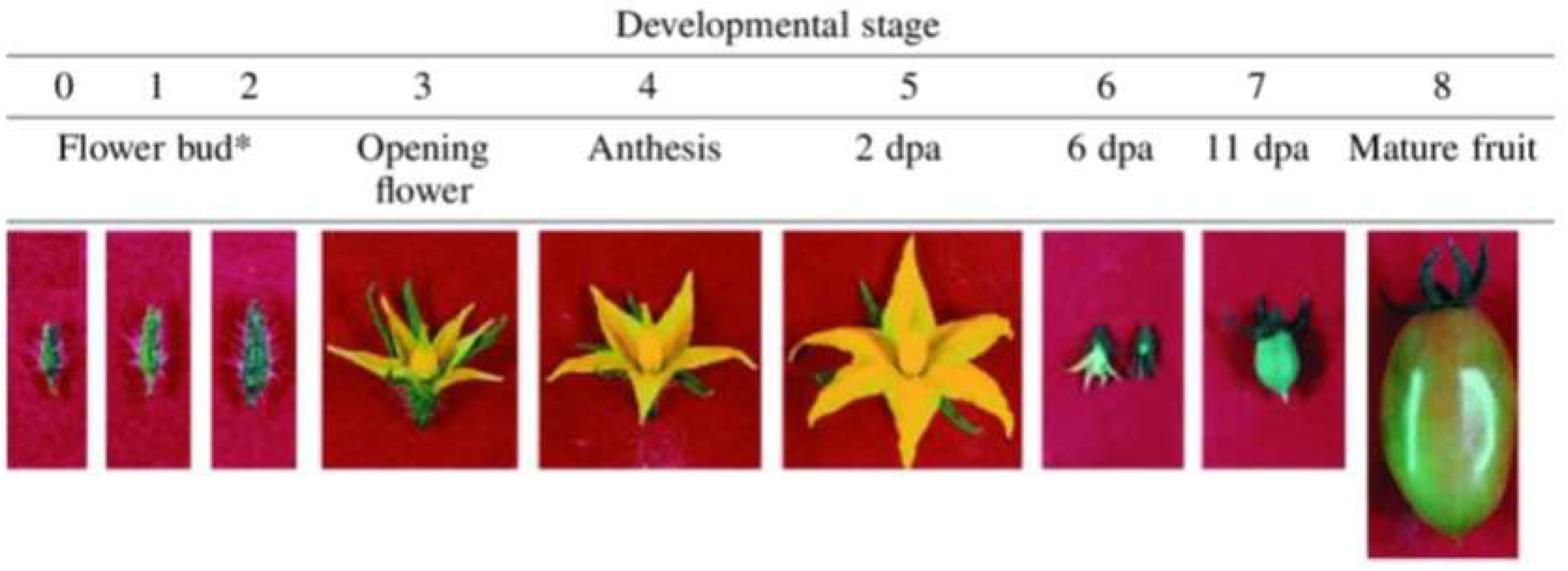
The heat stress procedure consisted of subjecting the plants (15 plants for treatment/flower stage development) to a temperature of 40 °C for 8 h with a relative humidity of 70%, during three specific stages of tomato flowering: pre-anthesis step or opening flower (stage 3), during the anthesis (stage 4), and post-anthesis or 2 dpa (days after anthesis—stage 5) [17], using a thermostatic chamber (Multitemp CA 7000, day light 18 W, max intensity lux 4000, Frigomeccanica Andreaus S.r.l., Verona, Italy) (Figure 1). The experimental phases were carried out during the summer and autumn of 2025, and the experiments were conducted in three independent replicates, each analyzing 15 plants per treatment. After the stress phase, the stressed and control plants were maintained at 25 °C until fruit formation and complete ripening (about 3–4 weeks). Following harvest, tomatoes from stressed flowers and from control plant were weighed, and their diameter was measured. Samples were immediately snap-frozen in liquid nitrogen and subsequently stored at −80 °C until the next stage of analysis.

2.2. Morphological Analyses

Morphological analyses were conducted on tomatoes collected from both control plants and stressed plants and focused on the measurement of weight and diameter. Physical assessments were carried out by measuring each tomato fruit individually. Fruit weight was determined using an analytical balance (Crystal 200SMI, Gibertini, Milano, Italy), while diameter was measured with a caliper, following the widest part of each tomato. For each treatment and control, at least 100 tomatoes harvested from all plants were analyzed, with an average of approximately 35 fruits per independent replicate. Tomatoes were selected at full ripeness (approximately 3–4 weeks after development), based on their uniform red coloration.

2.3. ICP-OES Analysis of Mineral Elements

ICP-OES (Inductively Coupled Plasma Optical Emission Spectroscopy) was used for the quantitative determination of mineral elements in the tomato fruit samples following the method reported in [18] and subsequent modifications in [19]. Samples (1 g of fresh/wet tomatoes) were weighed and transferred into Teflon digestion tubes, to which Suprapur nitric acid (65%, Honeywell) and Suprapur hydrogen peroxide (30%, Carlo Erba) were added for mineral analysis. The tubes were hermetically sealed and subjected to microwave-assisted digestion using a Milestone Start D system under controlled conditions. After digestion and cooling, the samples were diluted with double-distilled water to a final volume of 20 mL and filtered through Whatman 42 paper. The resulting solutions were analyzed using an ICP-OES instrument (SPECTRO Analytical Instruments GmbH, Boschstr., Kleve, Germany). The analysis was carried out in triplicate using tomatoes randomly selected from the three independent growth and stress replicates.
The detection limits of the analyzed elements were reported in Supplementary Table S1 (ST1). Quality control solutions were Astasol(R) Mixes (ANCUS 0263 and ANCUS 0262) obtained by Analytika (ANALYTIKA, spol. s r.o., Khodlova Praha, Czech Republic); included in the measurements to assure instrumental measurement stability. Data are reported in mg/kg of wet weight (ww).

2.4. Nutraceutical Analysis

Approximately 1 g of frozen tomato tissue, obtained from a randomly selected pool of fruits, was weighed, cut into small pieces, and homogenized using T25 Ultra-Turrax (IKA-Werke GmbH & Co., Staufen, Germany) homogenizer for 5 min. The homogenate was transferred to a 15 mL centrifuge tube, and 3 mL of 70% (v/v) acetone was added, maintaining a 1:3 (w/v) ratio. The sample was vortexed for 1 min, then sonicated for 20 min. After sonication, the sample was vortexed again for approximately 1 min and subsequently centrifuged at 4000× g for 5 min. The supernatant was collected for further analysis.
The FRAP (Ferric Reducing Antioxidant Power) method [20] was used to determine the antioxidant activity (AOA) of tomato samples. The binding of Fe2+ cations to the ligand results in an intense blue color, and the absorbance is directly proportional to the antioxidant content of the samples. To each sample tube, 2040 µL of acetate buffer (pH 3.6) was added, followed by 200 µL of TPTZ solution, 200 µL of ferric chloride (FeCl3), and 20 µL of sample extract. The tubes were briefly vortexed and incubated at 37 °C for 1 h to ensure complete reaction. Samples were analyzed in triplicate, measuring the absorbance at 593 nm using a Shimadzu UV-1280 spectrophotometer (Shimadzu Italy S.r.l., Milan, Italy). Results were compared with a calibration curve constructed with ferrous sulfate solutions (SF1) and expressed in μM Fe2+ ± standard deviation.
The Folin–Ciocalteu method [21] was used to assess the total phenolic content (TPC). Samples were tested in triplicate, and each tube contained 500 µL of extract, 3950 µL of distilled water, 250 µL of Folin’s reagent (Sigma Chemical, St. Louis, MO, USA), and 750 µL of a saturated sodium carbonate solution (Na2CO3). The samples were incubated at 37 °C for 30 min to allow the colorimetric reaction to develop. Absorbance was then measured at 765 nm using a Shimadzu UV-1280 spectrophotometer. The TPC was determined by comparison with a calibration curve prepared with standard gallic acid solutions (SF1) (Sigma Chemical, St. Louis, MO, USA) and expressed as mg of gallic acid equivalents (GAE) per 100 g of product ± standard deviation.
The total flavonoid content (TFC) was determined using the aluminum chloride method [22], which specifically measures flavonoids separately from other polyphenolic compounds. Samples were prepared in triplicate by adding 2800 μL of distilled water, 500 μL of extract, 1500 μL of 95% ethanol, 100 μL of 10% aluminum chloride (AlCl3), and 100 μL of 9.8% potassium acetate. Samples were incubated at room temperature for 30 min to stabilize the reaction. Absorbance was then measured at 415 nm using a Shimadzu UV-1280 spectrophotometer. TFC was calculated using a calibration curve constructed with quercetin standard solutions (SF1) (Sigma Chemical, St. Louis, MO, USA) and expressed as mg of quercetin equivalents (QE) per 100 g of product ± standard deviation.

2.5. Ascorbate Peroxidase Activity

For the extraction, 1 g of tomato tissue was weighed, cut into small pieces, and transferred to a 2 mL Eppendorf tube. The material was homogenized using T25 Ultra-Turrax (IKA-Werke GmbH & Co., Staufen, Germany) for 5 min. Then, 0.8 mL of 50 mM potassium phosphate buffer (pH 7.0) was added to the homogenate. The samples were centrifuged at 15,000× g for 20 min at 4 °C, and the supernatant was transferred to a new tube, vortexed, and centrifuged again under the same conditions for an additional 15 min. Ascorbate peroxidase (APX) activity was determined by monitoring the decrease in absorbance at 290 nm resulting from the oxidation of ascorbate [23]. The reaction mixture (1 mL total volume) contained 50 mM potassium phosphate buffer (pH 7.0), 0.5 mM ascorbate, 0.5 mM H2O2, and 10 μL of the tomato extract. Hydrogen peroxide was added last to initiate the reaction, and the decrease in absorbance was recorded for 3 min. Enzyme activity was calculated using an extinction coefficient of 2.8 mM−1 cm−1 for reduced ascorbate and expressed as millimoles of ascorbate oxidized per minute per gram of fresh weight.

2.6. Protein Extraction and Western Blotting Analysis

Proteins for electrophoretic analysis were extracted from frozen fruit tissue obtained from a pool of four experimental conditions (control, pre-anthesis, anthesis, and post-anthesis) using a phenol-based protocol developed for protein extraction from recalcitrant tissues [24], with subsequent modifications [25]. Protein extraction was performed in triplicate from pools of tomatoes collected from independent stressed and control plants. The reported images represent the average of three independent Western blot analyses. Protein concentration of samples was determined using a commercial kit 2-D Quant Kit, (GE HealthCare Italy, Milan, Italy) using BSA as standard, and a V-730 spectrophotometer at 480 nm (Jasco Europe, Carpi, Italy).
Separation of proteins by 1-D electrophoresis was carried out on Mini Protean using TGX gel 4–15% precast gels (Bio-Rad, Segrate, MI, Italy) and polyacrylamide gels [26]. A total of 30 µg of total proteins was loaded into a single lane. After SDS-PAGE separation, proteins were electrotransferred to nitrocellulose membranes using a Trans-Blot Turbo Transfer System (Bio-Rad, Italy) according to the manufacturer’s instructions. The membrane was incubated for 10 min with Ponceau staining to visualize protein profiles and loadings for all the fractions. Membranes were blocked overnight using in 5% Blotting Grade Blocker Non-Fat Dry Milk (Bio-Rad, Italy) in TBS (20 mM Tris pH 7.5, 150 mM NaCl) plus 0.1% Tween-20 and after washing with TBS, membranes were incubated at 1 h with following primary antibodies: the mouse monoclonal anti-actin 10B3 (Sigma-Aldrich Italy, Milan, Italy) diluted 1:3000; the polyclonal antibody anti CYP-18 diluted at 1:1000, and the rabbit polyclonal anti-profilin (LoFarma S.p.a., Milan, MI, Italy) diluted at 1:3000. Subsequently, membranes were washed three times with TBS and incubated for 1 h with secondary antibodies: the goat anti-mouse IgG peroxidase conjugated (Sigma-Aldrich, Italy), diluted at 1:3000; and the goat anti-rabbit IgG peroxidase conjugated (Sigma-Aldrich, Italy) diluted at 1:3000. The membranes were developed with ECL™ Western Blotting Reagents Cytiva (Sigma-Aldrich) and read in chemiluminescence with Azure 280 (Azure Biosystems, Sierra Ct Suites AB, Dublin, CA, USA) with an exposure time of 1 min. The band intensity per lane was calculated with the ImageJ software Version 1.54s (available at https://imagej.net/ij/) using the Measure command.

2.7. Statistical Analysis

Statistical analyses were performed using R version 4.6.0 [27] on raw experimental data for each measured parameter. Data distribution was initially assessed for normality; however, due to the limited sample size per group, non-parametric statistical methods were applied to ensure robustness. Differences among the four experimental groups (CNTR, PRE, ANTHE, and POST) were evaluated using the Kruskal–Wallis test. When significant effects were detected (p < 0.05), post hoc pairwise comparisons were performed using the Dunn test with Holm correction for multiple testing. To facilitate interpretation of statistically significant differences, a lettering system was applied: groups sharing at least one letter are not significantly different, whereas groups with no letters in common are considered significantly different (p < 0.05). Continuous variables are reported as mean ± standard deviation (SD) and, where appropriate, also as mean, minimum, maximum, median, and SD. All statistical analyses were conducted with a significance level set at p < 0.05.

3. Results

3.1. Morphological Traits of Tomato Fruits Were Slightly Influenced by Heat Stress

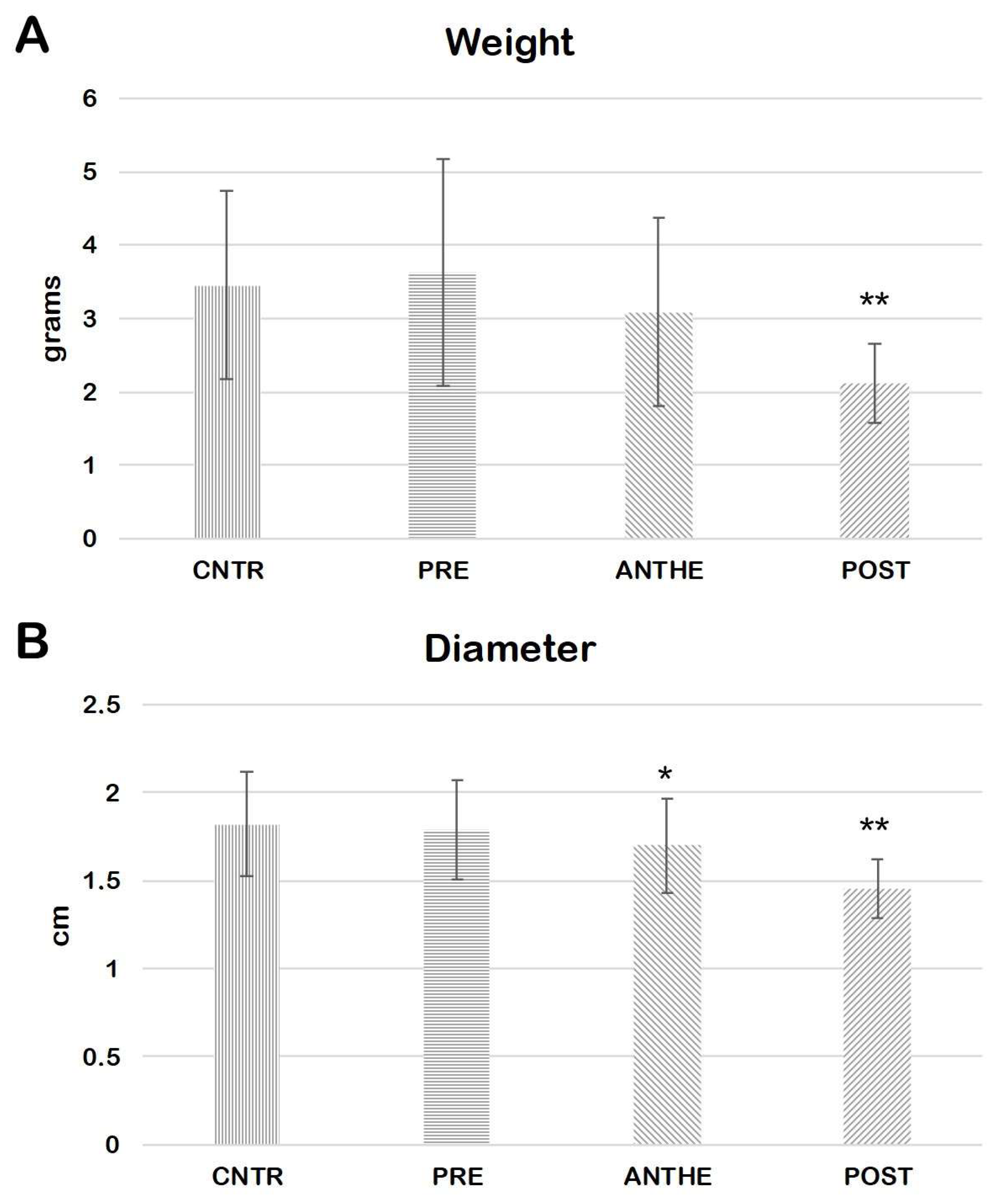
Analysis of weight measurements revealed differences among the four experimental samples (Figure 2A). Both the control (CNTR) and pre-anthesis treatment (PRE) samples showed comparable mean values, approximately 3.5–3.7 g, with similar variability. The ANTHE sample exhibited a slightly lower mean weight (around 3.2–3.3 g), although without indications of statistical significance. In contrast, the POST sample displayed a marked decrease in weight (approximately 2.2 g), which was significantly lower than the other groups (p < 0.01).
Regarding diameter (Figure 2B), the CNTR and PRE samples showed nearly identical values (around 1.8–1.9 cm). Samples treated during the anthesis phase (ANTHE) resulted in a slight reduction in diameter (around 1.7 cm confirmed by a significant difference compared with controls (p < 0.05). The most pronounced reduction was observed in the POST sample (around 1.5 cm), which differed highly significantly from all other samples (p < 0.01).

3.2. Macro- and Microelement Composition of Tomato Fruits Under Heat Stress Conditions

A total of seven macroelements (Ca, Fe, K, Mg, Na, P, and S) and sixteen microelements (Al, B, Ba, Cd, Cr, Cu, Mn, Mo, Ni, Pb, Sb, Si, Sn, Sr, Ti, and Zn) were quantified in all tomato fruit samples. The complete dataset is provided in Supplementary Table S2 (ST2), while descriptive statistics are reported in Table 1.
Regarding microelements, Al and B were the most abundant, followed by Zn and Si, while Cd, Cr, Mo, Ni, Sb, Sn, and Ti were present at low concentrations in all samples; several elements exhibited significant treatment effects. Specifically, Ba, Cu, Pb, Sb, Si, and Ti showed statistically significant differences among groups, with ANTHE and/or POST generally displaying distinct values compared with CNTR and PRE (p < 0.05). In particular, Si and Ti showed marked increases in ANTHE and POST groups, while Ba decreased significantly in these same treatments. In contrast, Cd, Cr, Mo, Ni, Sr, and Zn did not show significant differences among experimental groups.
Among the macroelements, K was the most abundant across all experimental groups, followed by P and Ca, whereas the lowest concentrations were observed for Na and Fe. Overall, macroelements showed relatively consistent distributions, with mean and median values generally comparable, suggesting approximately symmetric distributions. However, some elements, such as Na and Fe, exhibited slightly greater variability among treatments. In particular, K, Mg, and P showed clear treatment-related increases, with significantly higher values in ANTHE and POST compared with CNTR and PRE (p < 0.05), as indicated by the lettering system, whereas Ca, Fe, Na, and S did not show significant differences among groups.
Overall, the variability of microelements differed substantially among elements, with some (e.g., Si and Al) showing higher dispersion, whereas others remained relatively stable across treatments.

3.3. Variation of Bioactive Compounds and Antioxidant Activity in Tomato Fruits

Total flavonoid content (TFC), total phenolic content (TPC), and antioxidant activity (AOA) varied among the different experimental stages. The complete dataset is provided in Supplementary Table S3 (ST3), while descriptive statistics are reported in Table 2.
TFC showed no statistically significant differences among stages. The highest mean value was observed in the PRE stage (32.57), followed by CNTR (30.45), POST (27.91), and ANTHE (26.86). Overall variability was moderate, with the highest standard deviation recorded in ANTHE (SD = 5.82) and the lowest in POST (SD = 1.47). Mean and median values were generally comparable across stages, indicating relatively symmetric distributions, although ANTHE showed a wider range of values, suggesting greater dispersion.
TPC showed a clear progressive increase across stages, with a statistically significant effect of treatment. Mean values increased from CNTR (79.20) to PRE (84.41), reaching higher levels in ANTHE (90.97) and POST (94.37), with the latter two groups significantly different from CNTR (p < 0.05), while PRE showed an intermediate behavior. Variability was highest in PRE (SD = 15.08), reflecting a broader range of concentrations, whereas the other stages showed more limited dispersion and median values close to the means, suggesting a generally consistent accumulation trend across samples.
AOA showed relatively small but statistically significant differences among stages. The highest mean value was observed in PRE (9.42), which was significantly different from CNTR and POST, while ANTHE showed intermediate values not significantly different from either group. Overall variability was low across all stages (SD ≤ 1.33), with mean and median values closely aligned and narrow ranges, indicating stable antioxidant activity throughout the experimental conditions.
Overall, while TFC remained relatively stable across stages, TPC exhibited a clear increasing trend from CNTR to POST, indicating a stage-dependent accumulation of phenolic compounds, whereas AOA showed only slight but significant fluctuations among stages.

3.4. Modulation of Ascorbate Peroxidase Activity Under Different Experimental Stages

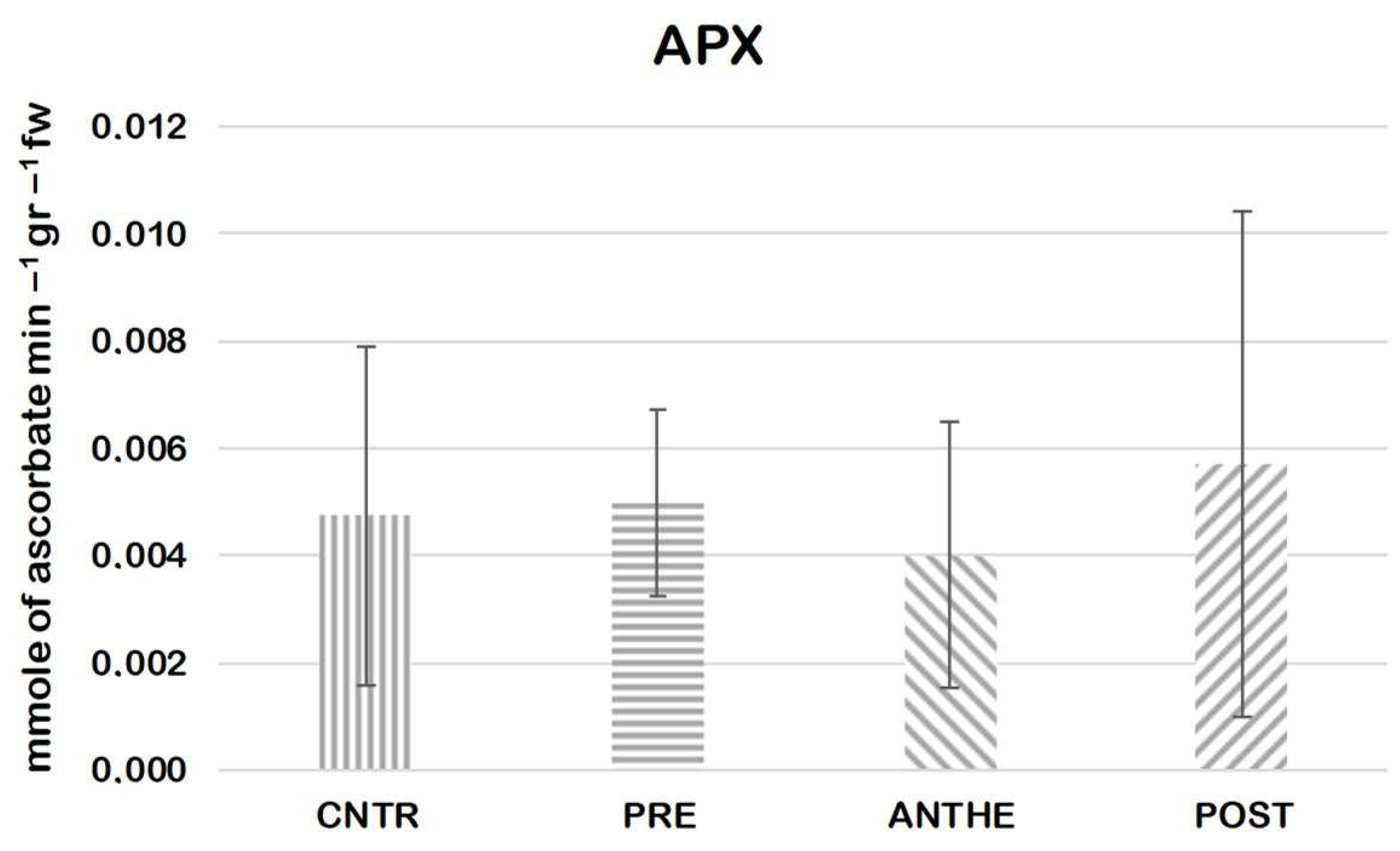
Ascorbate peroxidase (APX) activity showed moderate variations across the different experimental stages (Figure 3). Mean APX activity ranged from approximately 0.004 to 0.006 mmol of ascorbate min−1 g−1 FW. The lowest activity was observed during the ANTHE stage, while the highest mean value was recorded in the POST stage. Intermediate APX activity levels were detected in CNTR and PRE stages, which showed comparable mean values.
Data dispersion, as indicated by the error bars, differed among stages. The POST stage exhibited the highest variability, whereas the PRE stage showed relatively lower dispersion. Despite these fluctuations, APX activity remained within a narrow range across all stages, suggesting a generally stable enzymatic response throughout the experimental conditions. Overall, the observed pattern indicates slight stage-dependent changes in APX activity, with a tendency toward increased activity in the POST stage compared with earlier stages.

3.5. Differential Expression of Profilin and Cyclophilin in Tomato Fruits

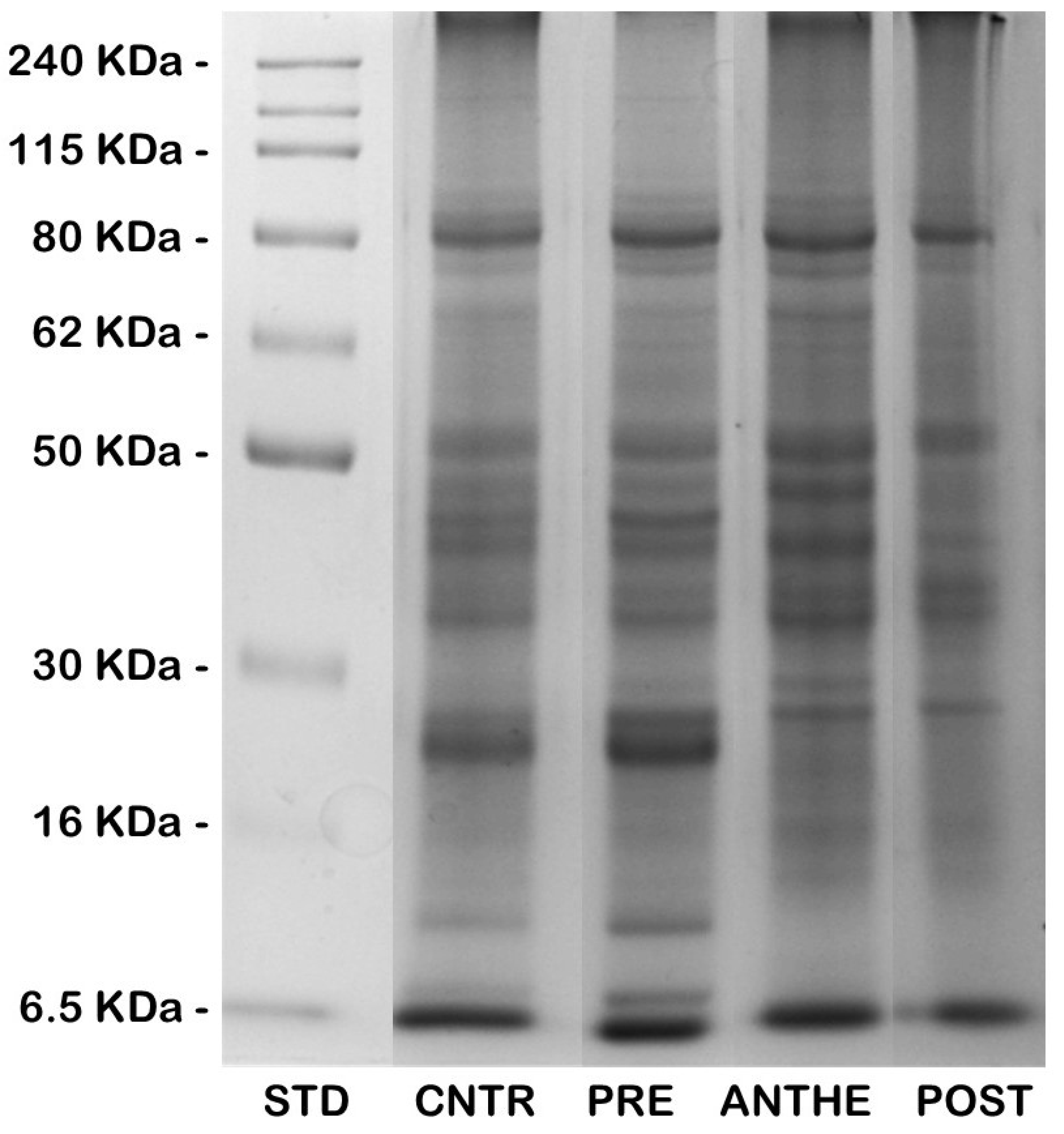
The four different samples from tomato fruits from plants subjected to heat stress at different developmental stages were analyzed by SDS-PAGE. The gel electrophoresis shows the separation of proteins in distinct banding patterns of the different extracts, in order: control (CNTR), pre-anthesis (PRE), anthesis (ANTHE), and post-anthesis (POST) (Figure 4). The control sample shows the protein run of the tomato grown without stress, then small differences in protein band pattern can be seen in the samples that were subjected to heat stress, especially during the anthesis and after the anthesis (POST).
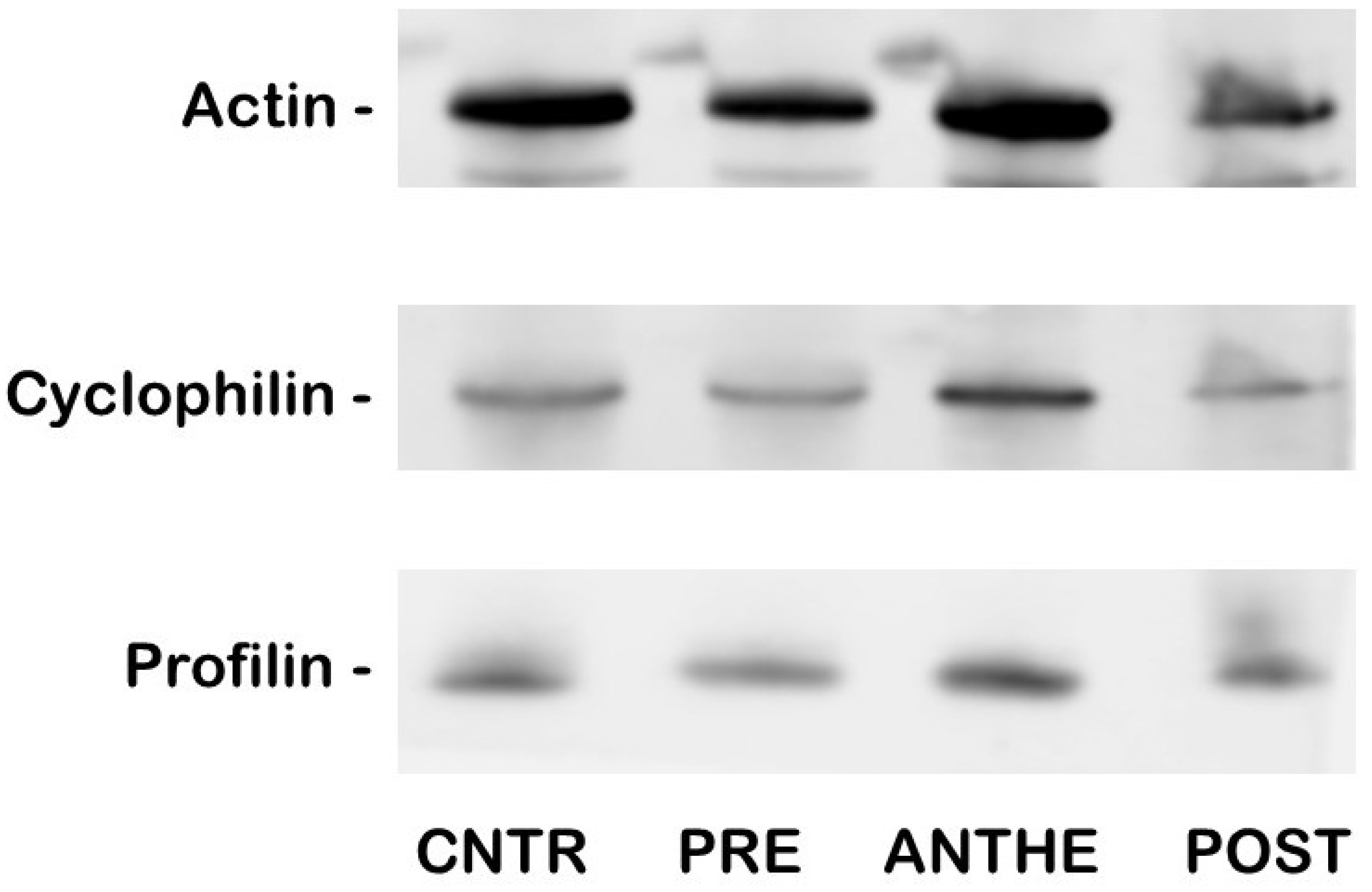
Western blot analysis demonstrated significant alterations in key allergen expression patterns across developmental stages (Figure 5). Actin, used as a loading control, showed consistent expression across all treatment groups (CNTR, PRE, ANTE, POST), confirming uniform protein loading. The actin protein is normally present in the cytoskeleton of plant cells, and no variation should be present concerning its quantity; it is, in fact, expressed remarkably across all treatment groups, with relatively stable expression in both the control and the stressed samples. There is increased intensity in the band corresponding to plant stress post-anthesis. Cyclophilin and profilin showed differential expression patterns. Cyclophilin showed a variable expression between treatments, especially in the “POST” sample for the same reason as before, and the same for the profilin sample. These variations in intensity of the bands suggest potential stress-responsive changes in cyclophilin and profilin.
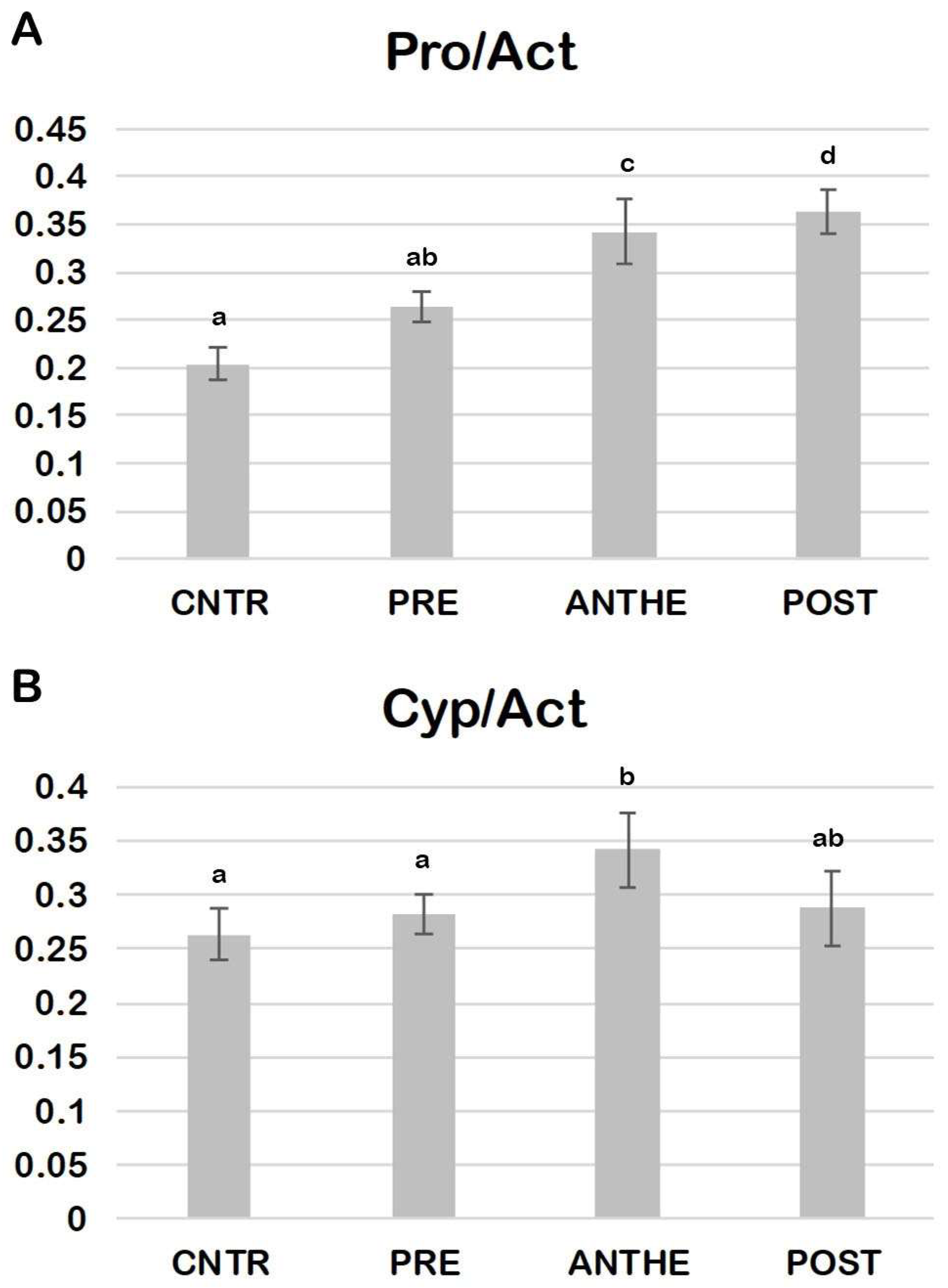
These bands were analyzed using the ImageJ software, and the relative expression levels of the proteins were measured six times for each band; the arithmetic mean was calculated, from which the following graphs were extrapolated. The relative protein expression levels of profilin (Pro) and cyclophilin (Cyp), normalized to actin (Act), showed distinct patterns across the experimental stages.
The Pro/Act ratio (Figure 6A) exhibited a progressive increase from CNTR to POST. The lowest values were observed in the CNTR group, followed by a gradual rise in PRE and ANTHE, with the highest levels detected in POST. This trend indicates a stage-dependent increase in profilin protein abundance relative to the actin reference protein.
The Cyp/Act ratio (Figure 6B) showed a different pattern, increasing from CNTR to ANTHE, where it reached its maximum, and then slightly decreasing in the POST group. Despite this reduction, POST values remained higher than those observed in CNTR, suggesting sustained cyclophilin expression at later stages. Overall, profilin and cyclophilin displayed distinct expression dynamics when normalized to actin: profilin showed a continuous increase across stages, whereas cyclophilin exhibited a transient peak at the ANTHE stage.
Statistical analysis confirmed significant differences among the four experimental groups (CNTR, PRE, ANTHE, and POST) for both ratios. For Pro/Act, the Kruskal–Wallis test revealed a highly significant effect (p < 0.001). Post hoc comparisons performed using the Dunn test with Holm correction showed that both ANTHE and POST were significantly higher than CNTR (p < 0.001), while PRE did not significantly differ from CNTR. Additionally, POST was significantly higher than PRE, whereas ANTHE showed intermediate values. Overall, although a progressive increase was observed (CNTR < PRE < ANTHE < POST), the difference between CNTR and PRE was not statistically significant after correction.
For Cyp/Act, the Kruskal–Wallis test also indicated a significant effect (p < 0.001). Post hoc analysis using the Dunn test with Holm correction demonstrated that ANTHE was significantly higher than both CNTR (p < 0.001) and PRE (p < 0.01). No significant differences were observed between CNTR and PRE, nor between POST and any of the other groups. The POST group displayed intermediate values, not significantly different from either lower (CNTR, PRE) or higher (ANTHE) groups.
Taken together, these results indicate a clear treatment effect for Pro/Act, characterized by a progressive increase culminating in the POST stage, whereas the effect for Cyp/Act was less pronounced and mainly driven by a peak in the ANTHE group.

4. Discussion

The present study shows that the effects of heat stress on tomato fruit quality are strongly dependent on the developmental stage at which stress is applied. Among the three reproductive windows examined, post-anthesis treatment produced the most pronounced and consistent effects, as evidenced by significant reductions in fruit weight and diameter. Anthesis stress induced intermediate changes, whereas pre-anthesis treatment had only limited effects on final fruit morphology [28,29,30,31].
The strong response observed under post-anthesis conditions is consistent with previous reports showing that high temperatures impair key processes such as cell division and expansion, ultimately affecting fruit growth and yield in tomato (Solanum lycopersicum L.) [28,29,30]. Since the stress was applied after flower opening, the observed reductions are more likely associated with alterations in early fruit development, including sink establishment and growth coordination, rather than direct effects on pollination or fertilization. This suggests that even short heat exposure can have lasting developmental consequences despite the return to optimal conditions [32,33].
In contrast, the limited effect of pre-anthesis stress suggests a greater capacity for recovery when stress occurs before flowering, as previously reported under moderate heat conditions [34]. Overall, these results identify the post-anthesis phase as the most sensitive window for fruit growth under the experimental conditions, in agreement with the known vulnerability of reproductive stages to heat stress [31].
Despite clear effects on fruit size, mineral composition remained largely stable across treatments. Potassium, phosphorus, and calcium were the predominant macroelements, consistent with the typical mineral profile and nutritional relevance of tomato fruits [35,36]. Under the present experimental conditions, the mineral fractions analyzed showed only limited treatment-related variation, indicating that a short heat episode during flowering did not markedly affect the final mineral composition of the fruit. The limited variability observed in both essential and potentially toxic elements (Cd, Pb, Cr) further supports the absence of treatment-induced accumulation, which is relevant from a food safety perspective [37,38]. Nevertheless, these results indicate that fruit growth parameters were more responsive to the imposed heat stress than mineral composition, highlighting the relative resilience of the fruit mineral profile even when post-anthesis stress significantly reduced fruit size.
A more complex response emerged for the nutraceutical traits. Total phenolic content (TPC) showed a progressive increase from control to POST fruits, whereas total flavonoid content (TFC) and FRAP measure antioxidant activity (AOA) varied within a narrower range. The increase in TPC is consistent with the view that phenolic metabolism is part of the adaptive response to abiotic stress and may contribute to protection against oxidative imbalance through activation of the phenylpropanoid pathway [39,40,41]. At the same time, the lack of a parallel increase in AOA indicates that a higher total phenolic content does not necessarily translate into a proportional increase in overall reducing capacity. This discrepancy is not unexpected, since antioxidant activity reflects the integrated contribution of multiple compounds and systems whose relative abundance may change independently [42,43].
The behavior of TFC further supports this interpretation. Although flavonoids are an important subclass of phenolic compounds and contribute substantially to antioxidant protection in tomato fruits [44,45], they did not show the same increasing trend as TPC. This pattern suggests that heat stress promoted a selective remodeling of phenolic metabolism rather than a generalized increase across all phenolic classes. Such selective modulation is particularly relevant for fruit quality, since qualitative shifts in phenolic composition may contribute to the nutritional response of tomato fruits under stress [44,46].
Tomato antioxidant capacity is mainly associated with compounds such as carotenoids, phenolics, and vitamin C, which are relevant contributors to fruit quality [33]. In the present study context, the stability of FRAP values alongside the increase in TPC suggests that the antioxidant profile of ripe fruits was not simply determined by total phenolic content but likely reflected the balance among different antioxidant components and enzymatic responses [44,45].
The enzymatic antioxidant response, estimated through ascorbate peroxidase (APX) activity, showed limited variation across treatments. APX values remained within a narrow range, with a slight increase under POST stress; however, this variation was not statistically significant, indicating only minor treatment-related effects at the ripe fruit stage.
APX is a key enzyme involved in hydrogen peroxide detoxification within the ascorbate–glutathione cycle and contributes to cellular redox regulation [23,47]. In this study, its stability across treatments represents a notable result, as it suggests that this major enzymatic component was not substantially altered by short heat stress episodes applied at different developmental stages.
These findings indicate that, under the present experimental conditions, APX activity was less responsive to transient heat stress than other fruit quality traits analyzed in this study, such as fruit morphology, phenolic accumulation, and allergen-related protein abundance. This reinforces the view that the fruit response to reproductive heat stress is trait-specific, with biochemical and protein markers showing different sensitivities at ripening.
A key finding of this study is the differential modulation of profilin and cyclophilin under heat stress. Both are plant panallergens involved in IgE cross-reactivity and associated with pollen–food allergy syndrome [48,49]. Densitometric analysis of immunoblots showed that profilin progressively increased from control (CNTR) to POST, whereas cyclophilin followed a different pattern, peaking at anthesis and then slightly decreasing in POST while remaining above control levels. These distinct profiles suggest a protein-specific and stage-dependent response to heat stress. It should be noted that the interpretation of these protein changes is limited by the experimental design, which included a single cultivar, controlled environmental conditions, and the absence of metabolomic and immunological validation. Therefore, the results should be considered as indicative of compositional modulation rather than of functional or clinical relevance [9,50,51,52,53]. Within these constraints, the observed patterns indicate that profilin and cyclophilin do not respond uniformly to heat stress. Profilin showed a progressive increase under later stress conditions, while cyclophilin exhibited a transient response with partial attenuation at ripening. These differences likely reflect distinct biological roles of the two proteins in plant metabolism. From a food quality perspective, these data provide evidence that heat stress can influence selected allergen-related protein fractions in a stage-dependent manner. Since immunological assays were not performed, the clinical relevance of these changes should be interpreted cautiously; nevertheless, the observed protein modulation identifies a relevant target for future studies linking climate-related stress, fruit composition, and allergen expression.
Taken together, the results indicate that reproductive heat stress leaves measurable signatures in ripe tomato fruits, with stage-dependent effects on fruit morphology, phenolic accumulation, and selected allergen-related proteins. These findings support the view that heat stress acts as a determinant of fruit quality variability and extend this concept to protein fractions relevant to the allergen-related profile of tomato fruits [52,53,54,55]. By linking the timing of heat exposure during reproduction with compositional changes at ripening, this study provides a focused contribution to understanding tomato fruit quality responses under warming climate conditions.

5. Conclusions

Taken together, these findings show that short heat-stressful events during the reproductive phase affect the final tomato fruit phenotype in a stage-dependent manner, with the post-anthesis stage emerging as the most sensitive developmental window. Under the experimental conditions adopted, mineral composition and overall antioxidant capacity remained comparatively stable, whereas fruit morphology, phenolic content, and the accumulation of specific proteins showed greater responsiveness to heat exposure.
In particular, the stage-dependent changes observed for profilin and cyclophilin indicate that reproductive heat stress can modulate selected allergen-related protein fractions in ripe fruits, providing a novel perspective on how climate-related stress may influence tomato fruit composition beyond yield and conventional quality traits.
Overall, this study identifies the post-anthesis phase as a critical window during which transient heat stress can leave measurable signatures on fruit quality. These results contribute to a better understanding of how increasingly frequent high-temperature events may shape tomato fruit composition under climate change scenarios, supporting the need to consider developmental timing when evaluating crop quality responses to heat stress.
Future studies integrating multiple genotypes and heat stress regimes, together with metabolomic, proteomic, and immunological approaches, will help define the biological significance and applied relevance of these responses under climate change scenarios [48,49,50,51,52].

Supplementary Materials

The following supporting information can be downloaded at: https://www.mdpi.com/article/10.3390/agriculture16101041/s1, Figure S1: Calibration curves prepared with standard for nutraceutical analysis; Table S1: Trace element detection limits; Table S2: The complete dataset of trace elements analysis; Table S3: The complete dataset of nutraceutical analysis.

Author Contributions

Conceptualization, L.P. and S.D.D.; methodology, L.P., G.C. and S.D.D.; software, L.P.; formal analysis, L.P.; data curation, G.C. and S.D.D.; writing—original draft preparation, L.P.; writing—review and editing, L.P., G.C. and S.D.D. All authors have read and agreed to the published version of the manuscript.

Funding

This research received no external funding.

Institutional Review Board Statement

Not applicable for studies not involving humans or animals.

Data Availability Statement

Data are contained within the article and Supplementary Materials.

Conflicts of Interest

The authors declare no conflicts of interest.

Abbreviations

The following abbreviations are used in this manuscript:
AOAAntioxidant activity
APXAscorbate peroxidase
ICP-OESInductively Coupled Plasma Optical Emission Spectroscopy
LTPsLipid Transfer Proteins
OASOral Allergy Syndrome
ROSReactive Oxygen Species
TFCTotal Flavonoids Content
TPCTotal Phenolic Content

References

  1. Karlova, R.; Chapman, N.; David, K.; Angenent, G.C.; Seymour, G.B.; de Maagd, R.A. Transcriptional control of fleshy fruit development and ripening. J. Exp. Bot. 2014, 65, 4527–4541. [Google Scholar] [CrossRef] [Scilit]
  2. Ré, M.D.; Gonzalez, C.; Sdrigotti, M.A.; Sorrequieta, A.; Valle, E.M.; Boggio, S.B. Ripening tomato fruit after chilling storage alters protein turnover. J. Sci. Food Agr. 2012, 92, 1490–1496. [Google Scholar] [CrossRef] [Scilit]
  3. Carvalho, R.F.; Campos, M.L.; Pino, L.E.; Crestana, S.L.; Zsögön, A.; Lima, J.E.; Benedito, V.A.; Peres, L.E.P. Convergence of developmental mutants into a single tomato model system: ‘Micro-Tom’ as an effective toolkit for plant development research. Plant Methods 2011, 7, 18. [Google Scholar] [CrossRef] [Scilit]
  4. Conti, V.; Romi, M.; Guarnieri, M.; Cantini, C.; Cai, G.M.R. Italian Tomato Cultivars under Drought Stress Show Different Content of Bioactives in Pulp and Peel of Fruits. Foods 2022, 11, 270. [Google Scholar] [CrossRef] [Scilit]
  5. Perveen, R.; Suleria, H.A.R.; Anjum, F.M.; Butt, M.S.; Pasha, I.; Ahmad, S. Tomato (Solanum lycopersicum L.) Carotenoids and Lycopenes Chemistry; Metabolism, Absorption, Nutrition, and Allied Health Claims-A Comprehensive Review. Crit. Rev. Food Sci. 2015, 55, 919–929. [Google Scholar] [CrossRef] [Scilit] [PubMed]
  6. Wlodarczyk, K.; Smolinska, B.; Majak, I. Tomato Allergy: The Characterization of the Selected Allergens and Antioxidants of Tomato (Solanum lycopersicum)—A Review. Antioxidants 2022, 11, 644. [Google Scholar] [CrossRef] [Scilit]
  7. Pravettoni, V.; Primavesi, L.; Farioli, L.; Brenna, O.V.; Pompei, C.; Conti, A.; Scibilia, J.; Piantanida, M.; Mascheri, A.; Pastorelloo, E.A. Tomato Allergy: Detection of IgE-Binding Lipid Transfer Proteins in Tomato Derivatives and in Fresh Tomato Peel, Pulp, and Seeds. J. Agr. Food Chem. 2009, 57, 10749–10754. [Google Scholar] [CrossRef] [Scilit] [PubMed]
  8. Foetisch, K.; Son, D.Y.; Altmann, F.; Aulepp, H.; Conti, A.; Haustein, D.; Vieths, S. Tomato (Lycopersicon esculentum) allergens in pollen-allergic patients. Eur. Food Res. Technol. 2001, 213, 259–266. [Google Scholar] [CrossRef] [Scilit]
  9. Parrotta, L.; Aloisi, I.; Suanno, C.; Faleri, C.; Kielbowicz-Matuk, A.; Bini, L.; Cai, G.; Del Duca, S. A low molecular-weight cyclophilin localizes in different cell compartments of Pyrus communis pollen and is released in vitro under Ca2+ depletion. Plant Physiol. Biochem. 2019, 144, 197–206. [Google Scholar] [CrossRef] [Scilit]
  10. Potapova, E.; Sénéchal, H.; Scala, E.; Matricardi, P.M.; Poncet, P. Cyclophilins and gibberellin-regulated proteins in IgE-mediated allergic diseases. Allergo J. Int. 2023, 32, 280–288. [Google Scholar] [CrossRef] [Scilit]
  11. Collins, E.J.; Bowyer, C.; Tsouza, A.; Chopra, M. Tomatoes: An Extensive Review of the Associated Health Impacts of Tomatoes and Factors That Can Affect Their Cultivation. Biology 2022, 11, 239. [Google Scholar] [CrossRef] [Scilit]
  12. Camejo, D.; Rodríguez, P.; Morales, A.; Dell’Amico, J.M.; Torrecillas, A.; Alarcón, J.J. High temperature effects on photosynthetic activity of two tomato cultivars with different heat susceptibility. J. Plant Physiol. 2005, 162, 281–289. [Google Scholar] [CrossRef] [Scilit]
  13. Alsamir, M.; Mahmood, T.; Trethowan, R.; Ahmad, N. An overview of heat stress in tomato (Solanum lycopersicum L.). Saudi J. Biol. Sci. 2021, 28, 1654–1663. [Google Scholar] [CrossRef] [Scilit]
  14. Khan, Q.; Wang, Y.X.; Xia, G.S.; Yang, H.; Luo, Z.R.; Zhang, Y. Deleterious Effects of Heat Stress on the Tomato, Its Innate Responses, and Potential Preventive Strategies in the Realm of Emerging Technologies. Metabolites 2024, 14, 283. [Google Scholar] [CrossRef] [Scilit]
  15. Parrotta, L.; Aloisi, I.; Faleri, C.; Romi, M.; Del Duca, S.; Cai, G. Chronic heat stress affects the photosynthetic apparatus of Solanum lycopersicum L. cv Micro-Tom. Plant Physiol. Biochem. 2020, 154, 463–475. [Google Scholar] [CrossRef] [Scilit] [PubMed]
  16. Conti, V.; Parrotta, L.; Romi, M.; Del Duca, S.; Cai, G. Tomato Biodiversity and Drought Tolerance: A Multilevel Review. Int. J. Mol. Sci. 2023, 24, 10044. [Google Scholar] [CrossRef] [Scilit]
  17. Mazzucato, A.; Taddei, A.R.; Soressi, G.P. The parthenocarpic fruit (pat) mutant of tomato (Lycopersicon esculentum Mill.) sets seedless fruits and has aberrant anther and ovule development. Development 1998, 125, 107–114. [Google Scholar] [CrossRef] [Scilit]
  18. Yücel, Y.; Sultanoglu, P. Characterization of Hatay honeys according to their multi-element analysis using ICP-OES combined with chemometrics. Food Chem. 2013, 140, 231–237. [Google Scholar] [CrossRef] [Scilit] [PubMed]
  19. Poggi, G.M.; Conti, V.; Piana, L.; Rudelli, C.; Isani, G.; Parrotta, L.; Del Duca, S. Influence of conventional and organic beekeeping on the nutraceutical properties of Italian honeys. J. Food Compos. Anal. 2026, 153, 109057. [Google Scholar] [CrossRef] [Scilit]
  20. Benzie, I.F.F.; Strain, J.J. The ferric reducing ability of plasma (FRAP) as a measure of “antioxidant power”: The FRAP assay. Anal. Biochem. 1996, 239, 70–76. [Google Scholar] [CrossRef] [Scilit] [PubMed]
  21. Ainsworth, E.A.; Gillespie, K.M. Estimation of total phenolic content and other oxidation substrates in plant tissues using Folin-Ciocalteu reagent. Nat. Protoc. 2007, 2, 875–877. [Google Scholar] [CrossRef] [Scilit]
  22. Smirnova, L.; Pervykh, L. Quantitative determination of the total content of flavonoids in a cholagogic species. Pharm. Chem. J. 1999, 33, 151–154. [Google Scholar] [CrossRef] [Scilit]
  23. Elavarthi, S.; Martin, B. Spectrophotometric Assays for Antioxidant Enzymes in Plants. Methods Mol. Biol. 2010, 639, 273–280. [Google Scholar] [CrossRef] [Scilit] [PubMed]
  24. Wang, W.; Vignani, R.; Scali, M.; Cresti, M. A universal and rapid protocol for protein extraction from recalcitrant plant tissues for proteomic analysis. Electrophoresis 2006, 27, 2782–2786. [Google Scholar] [CrossRef] [Scilit]
  25. Parrotta, L.; Cai, G.; Cresti, M. Changes in the accumulation of α- and β-tubulin during bud development in Vitis vinifera L. Planta 2010, 231, 277–291. [Google Scholar] [CrossRef] [Scilit]
  26. Laemmli, U.K. Cleavage of structural proteins during the assembly of the head of bacteriophage T4. Nature 1970, 227, 680–685. [Google Scholar] [CrossRef] [Scilit] [PubMed]
  27. RStudio Team. RStudio: Integrated Development for R; RStudio, Inc.: Boston, MA, USA, 2020; Volume 42, p. 14. [Google Scholar]
  28. Bita, C.E.; Gerats, T. Plant tolerance to high temperature in a changing environment: Scientific fundamentals and production of heat stress-tolerant crops. Front. Plant Sci. 2013, 4, 273. [Google Scholar] [CrossRef] [Scilit]
  29. Peet, M.M.; Sato, S.; Gardner, R.G. Comparing heat stress effects on male-fertile and male-sterile tomatoes. Plant Cell Environ. 1998, 21, 225–231. [Google Scholar] [CrossRef] [Scilit]
  30. Sato, S.; Peet, M.M.; Thomas, J.F. Physiological factors limit fruit set of tomato (Lycopersicon esculentum Mill.) under chronic, mild heat stress. Plant Cell Environ. 2000, 23, 719–726. [Google Scholar] [CrossRef] [Scilit]
  31. Janni, M.; Gullì, M.; Maestri, E.; Marmiroli, M.; Valliyodan, B.; Nguyen, H.T.; Marmiroli, N. Molecular and genetic bases of heat stress responses in crop plants and breeding for increased resilience and productivity. J. Exp. Bot. 2020, 71, 3780–3802. [Google Scholar] [CrossRef] [Scilit]
  32. Garg, N.; Cheema, D.S. Assessment of fruit quality attributes of tomato hybrids involving ripening mutants under high temperature conditions. Sci. Hortic. 2011, 131, 29–38. [Google Scholar] [CrossRef] [Scilit]
  33. Hedhly, A.; Hormaza, J.I.; Herrero, M. Global warming and sexual plant reproduction. Trends Plant Sci. 2009, 14, 30–36. [Google Scholar] [CrossRef] [Scilit] [PubMed]
  34. Mesa, T.; Polo, J.; Arabia, A.; Caselles, V.; Munné-Bosch, S. Differential physiological response to heat and cold stress of tomato plants and its implication on fruit quality. J. Plant Physiol. 2022, 268, 153581. [Google Scholar] [CrossRef] [Scilit] [PubMed]
  35. White, P.J.; Broadley, M.R. Biofortification of crops with seven mineral elements often lacking in human diets–iron, zinc, copper, calcium, magnesium, selenium and iodine. New Phytol. 2009, 182, 49–84. [Google Scholar] [CrossRef] [Scilit]
  36. Fernández-Ruiz, V.; Olives, A.I.; Cámara, M.; Sánchez-Mata, M.D.; Torija, M.E. Mineral and Trace Elements Content in 30 Accessions of Tomato Fruits (Solanum lycopersicum L.,) and Wild Relatives (Solanum pimpinellifolium L., Solanum cheesmaniae L. Riley, and Solanum habrochaites S. Knapp & D.M. Spooner). Biol. Trace Elem. Res. 2011, 141, 329–339. [Google Scholar] [CrossRef] [Scilit]
  37. Kumari, V.V.; Banerjee, P.; Verma, V.C.; Sukumaran, S.; Chandran, M.A.S.; Gopinath, K.A.; Venkatesh, G.; Yadav, S.K.; Singh, V.K.; Awasthi, N.K. Plant Nutrition: An Effective Way to Alleviate Abiotic Stress in Agricultural Crops. Int. J. Mol. Sci. 2022, 23, 8519. [Google Scholar] [CrossRef] [Scilit]
  38. Wahid, A.; Gelani, S.; Ashraf, M.; Foolad, M.R. Heat tolerance in plants: An overview. Environ. Exp. Bot. 2007, 61, 199–223. [Google Scholar] [CrossRef] [Scilit]
  39. Crizel, R.L.; Perin, E.C.; Siebeneichler, T.J.; Borowski, J.M.; Messias, R.S.; Rombaldi, C.V.; Galli, V. Abscisic acid and stress induced by salt: Effect on the phenylpropanoid, L-ascorbic acid and abscisic acid metabolism of strawberry fruits. Plant Physiol. Bioch 2020, 152, 211–220. [Google Scholar] [CrossRef] [Scilit]
  40. Dixon, R.A.; Paiva, N.L. Stress-Induced Phenylpropanoid Metabolism. Plant Cell 1995, 7, 1085–1097. [Google Scholar] [CrossRef] [Scilit]
  41. Rivero, R.M.; Ruiz, J.M.; García, P.C.; López-Lefebre, L.R.; Sánchez, E.; Romero, L. Resistance to cold and heat stress: Accumulation of phenolic compounds in tomato and watermelon plants. Plant Sci. 2001, 160, 315–321. [Google Scholar] [CrossRef] [Scilit]
  42. Apel, K.; Hirt, H. Reactive oxygen species: Metabolism, oxidative stress, and signal transduction. Annu. Rev. Plant Biol. 2004, 55, 373–399. [Google Scholar] [CrossRef] [Scilit]
  43. George, B.; Kaur, C.; Khurdiya, D.S.; Kapoor, H.C. Antioxidants in tomato (Lycopersium esculentum) as a function of genotype. Food Chem. 2004, 84, 45–51. [Google Scholar] [CrossRef] [Scilit]
  44. Gerszberg, A.; Hnatuszko-Konka, K.; Kowalczyk, T.; Kononowicz, A.K. Tomato (Solanum lycopersicum L.) in the service of biotechnology. Plant Cell Tiss. Org. 2015, 120, 881–902. [Google Scholar] [CrossRef] [Scilit]
  45. Kurze, E.; Lo Scalzo, R.; Campanelli, G.; Schwab, W. Effect of tomato variety, cultivation, climate and processing on Sola l 4, an allergen from. PLoS ONE 2018, 13, e0197971. [Google Scholar] [CrossRef] [Scilit] [PubMed]
  46. Sies, H.; Berndt, C.; Jones, D.P. Oxidative Stress. Annu. Rev. Biochem. 2017, 86, 715–748. [Google Scholar] [CrossRef] [Scilit]
  47. Noctor, G.; Foyer, C.H. Ascorbate and glutathione: Keeping active oxygen under control. Annu. Rev. Plant Phys. 1998, 49, 249–279. [Google Scholar] [CrossRef] [Scilit] [PubMed]
  48. Haidar, L.; Banarescu, C.F.; Uta, C.; Moldovan, S.I.; Zimbru, E.L.; Zimbru, R.I.; Ciurariu, E.; Georgescu, M.; Panaitescu, C. Pollen-Food Allergy Syndrome: Allergens, Clinical Insights, Diagnostic and Therapeutic Challenges. Appl. Sci. 2025, 15, 66. [Google Scholar] [CrossRef] [Scilit]
  49. Matricardi, P.M.; Potapova, E.; Panetta, V.; Lidholm, J.; Mattsson, L.; Scala, E.; Bernardini, R.; Caffarelli, C.; Casani, A.; Cervone, R.; et al. IgE to cyclophilins in pollen-allergic children: Epidemiologic, clinical, and diagnostic relevance of a neglected panallergen. J. Allergy Clin. Immun. 2024, 153, 1586–1596.e2. [Google Scholar] [CrossRef] [Scilit]
  50. Olejnik, P.; Madrzak, C.J.; Nuc, K. Cyclophilins and Their Functions in Abiotic Stress and Plant-Microbe Interactions. Biomolecules 2021, 11, 1390. [Google Scholar] [CrossRef] [Scilit]
  51. Singh, H.; Kaur, K.; Singh, M.; Kaur, G.; Singh, P. Plant Cyclophilins: Multifaceted Proteins with Versatile Roles. Front. Plant Sci. 2020, 11, 585212. [Google Scholar] [CrossRef] [Scilit]
  52. Cabanillas, B.; Novak, N. Effects of daily food processing on allergenicity. Crit. Rev. Food Sci. 2019, 59, 31–42. [Google Scholar] [CrossRef] [Scilit] [PubMed]
  53. Zinn, K.E.; Tunc-Ozdemir, M.; Harper, J.F. Temperature stress and plant sexual reproduction: Uncovering the weakest links. J. Exp. Bot. 2010, 61, 1959–1968. [Google Scholar] [CrossRef] [Scilit] [PubMed]
  54. Sun, T.T.; Li, S.W.; Ren, H.Y. Profilin as a regulator of the membrane-actin cytoskeleton interface in plant cells. Front. Plant Sci. 2013, 4, 512. [Google Scholar] [CrossRef] [Scilit] [PubMed]
  55. Witke, W. The role of profilin complexes in cell motility and other cellular processes. Trends Cell Biol. 2004, 14, 461–469. [Google Scholar] [CrossRef] [Scilit]
Figure 1. Schematic representation of tomato flower and fruit developmental stages according to Mazzucato et al. [17]. * Class limits for flower bud length are 3.0 to 5.9 mm for stage 0, 6.0 to 8.9 for stage 1, and 9.0 to 12 mm for stage 2. Stress treatments were applied at stage 3 (PRE), stage 4 (ANTHE), and stage 5 (POST).
Agriculture 16 01041 g001
Figure 2. Weight and diameter measurements of four tomato fruit samples. Bar graphs show mean ± SD for weight (A) and diameter (B) in control (CNTR), pre-anthesis treatment (PRE), treatment during anthesis (ANTHE), and post-anthesis treatment (POST) samples. Asterisks indicate statistically significant differences compared with controls (* p < 0.05; ** p < 0.01).
Agriculture 16 01041 g002
Figure 3. Ascorbate peroxidase (APX) activity measured in samples collected at different experimental stages (CNTR, PRE, ANTHE, and POST). APX activity is expressed as mmol of ascorbate min−1 g−1 fresh weight (FW). Bars represent mean values, and error bars indicate standard deviation.
Agriculture 16 01041 g003
Figure 4. Electrophoretic analysis of tomato samples subjected to heat stress in different development stages. Coomassie blue-stained SDS-PAGE showing the fruit proteins. Molecular weight markers in the first lane (STD—lane 1) and their values in kDa on the left. Samples analyzed are Control, without treatment (CNTR); during pre-anthesis stage (PRE); anthesis stage (ANTHE); and post-anthesis development (POST).
Agriculture 16 01041 g004
Figure 5. Western blot analysis of actin, cyclophilin, and profilin in 4 tomato samples subjected to heat stress in different development stages.
Agriculture 16 01041 g005
Figure 6. Comparison of Pro/Act (A) and Cyp/Act (B) ratios among the four experimental groups (CNTR, PRE, ANTHE, and POST). Data are presented as mean ± standard deviation (SD). Statistical differences among groups were assessed using the Kruskal–Wallis, followed by post hoc pairwise comparisons using the Dunn test with Holm correction. Different letters indicate statistically significant differences between groups (p < 0.05), whereas groups sharing at least one letter are not significantly different. For Pro/Act, all groups were significantly different from each other except for partial overlap between CNTR and PRE after correction. For Cyp/Act, ANTHE was significantly higher than CNTR and PRE, while POST showed intermediate values and did not significantly differ from the other groups.
Agriculture 16 01041 g006
Table 1. Macro- and microelement composition (mean ± standard deviation) of samples from the four experimental groups (CNTR, PRE ANTHE, ANTHE, POST ANTHE). Different letters within each row indicate statistically significant differences among groups. Elements sharing the same letter are not significantly different.
ElementCNTRPREANTHEPOST
Al5.03 ± 3.41 a3.05 ± 2.64 a7.02 ± 3.28 a10.81 ± 9.44 a
B5.31 ± 2.07 a4.17 ± 0.62 a4.14 ± 0.73 a4.54 ± 0.76 a
Ba1.20 ± 1.22 a0.77 ± 0.60 a0.27 ± 0.08 b0.29 ± 0.06 b
Cd0.07 ± 0.02 a0.08 ± 0.02 a0.09 ± 0.02 a0.10 ± 0.02 a
Cr0.11 ± 0.03 a0.05 ± 0.01 a0.08 ± 0.01 a0.09 ± 0.02 a
Cu0.93 ± 0.06 a0.71 ± 0.07 b0.89 ± 0.20 a1.11 ± 0.69 a
Mn0.58 ± 0.10 a0.52 ± 0.08 a0.54 ± 0.02 a0.80 ± 0.15 b
Mo0.17 ± 0.02 a0.20 ± 0.04 a0.17 ± 0.03 a0.20 ± 0.03 a
Ni0.31 ± 0.20 a0.26 ± 0.01 a0.29 ± 0.07 a0.30 ± 0.11 a
Pb0.31 ± 0.03 a0.35 ± 0.09 a0.43 ± 0.08 b0.46 ± 0.11 b
Sb0.25 ± 0.03 a0.37 ± 0.07 a0.39 ± 0.07 a0.48 ± 0.09 b
Si0.57 ± 0.16 a0.58 ± 0.42 a2.84 ± 2.03 b4.10 ± 2.42 b
Sn0.39 ± 0.11 a0.43 ± 0.08 a0.47 ± 0.10 a0.49 ± 0.09 a
Sr0.81 ± 0.12 a0.62 ± 0.15 a0.67 ± 0.20 a0.72 ± 0.36 a
Ti0.06 ± 0.01 a0.06 ± 0.01 a0.20 ± 0.08 b0.29 ± 0.18 b
Zn3.18 ± 1.06 a2.85 ± 0.55 a3.74 ± 1.23 a3.60 ± 1.30 a
Ca192.06 ± 41.15 a182.58 ± 21.19 a214.19 ± 40.69 a209.16 ± 34.49 a
Fe15.58 ± 4.21 a12.23 ± 3.29 a14.62 ± 0.34 a18.65 ± 6.92 a
K2546.87 ± 180.17 a2502.60 ± 177.95 a3103.80 ± 379.19 b3202.38 ± 355.28 b
Mg125.10 ± 4.60 a124.33 ± 15.41 a148.56 ± 12.05 b163.27 ± 5.40 b
Na76.12 ± 16.01 a50.49 ± 7.93 a90.98 ± 8.71 a81.11 ± 11.06 a
P242.09 ± 16.64 a255.18 ± 35.11 a329.43 ± 32.98 b335.12 ± 27.98 b
S138.97 ± 10.73 a120.99 ± 29.20 a118.05 ± 12.91 a131.55 ± 11.07 a
Table 2. Total phenolic content (TPC), total flavonoid content (TFC), and antioxidant activity (AOA) expressed as mean ± standard deviation for the four experimental groups (CNTR, PRE, ANTHE, POST). Different letters within each row indicate statistically significant differences among groups. Groups sharing the same letter are not significantly different.
CNTRPREANTHEPOST
TFC30.45 ± 5.24 a32.57 ± 2.28 a26.86 ± 5.82 a27.91 ± 1.47 a
TPC79.20 ± 4.48 a84.41 ± 15.08 ab90.97 ± 5.74 b94.37 ± 8.47 b
AOA8.24 ± 0.90 a9.42 ± 1.33 b8.85 ± 0.93 ab8.22 ± 0.78 a
Disclaimer/Publisher’s Note: The statements, opinions and data contained in all publications are solely those of the individual author(s) and contributor(s) and not of MDPI and/or the editor(s). MDPI and/or the editor(s) disclaim responsibility for any injury to people or property resulting from any ideas, methods, instructions or products referred to in the content.