Nitrogen and Sulfur Cycling in Diverse Farm Ages and Ecological Zones Under Agricultural Expansion

Abstract
1. Introduction
2. Materials and Methods
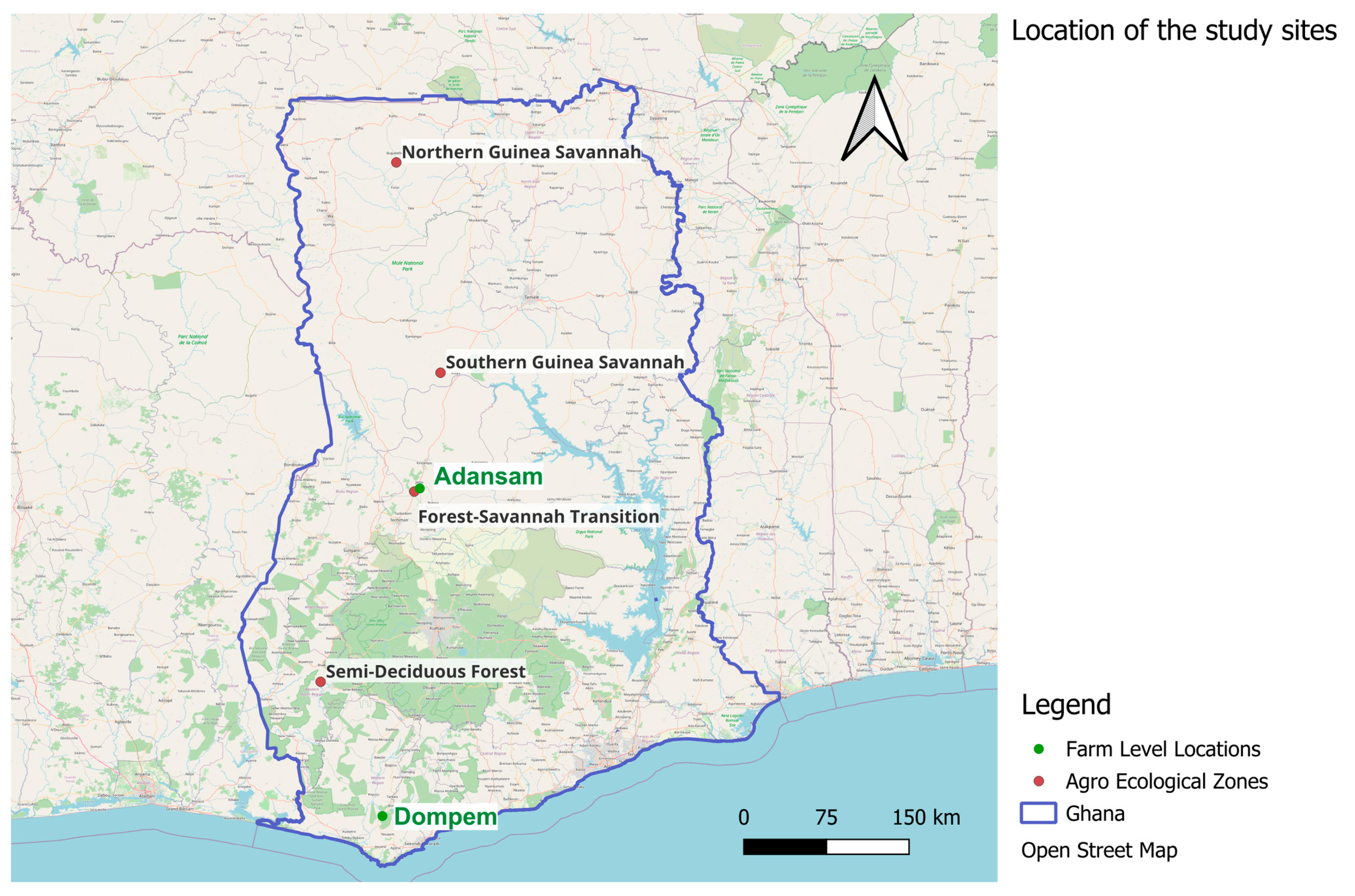
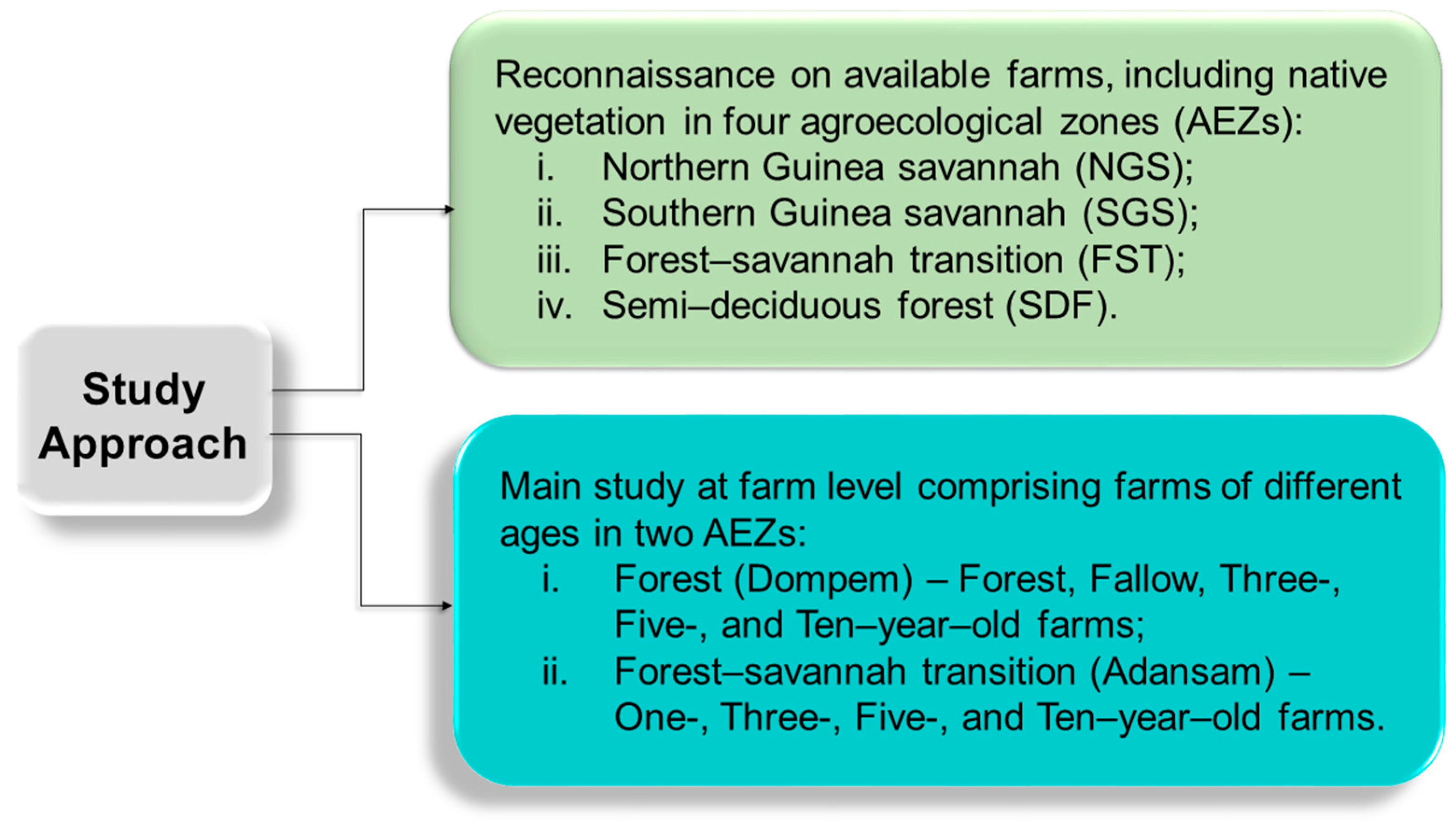
2.1. Study Design, Site Description, and Soil Sampling
- Proximity to natural habitats that still provide a range of ecosystem services and a potential for agricultural expansion;
- Evidence of agricultural expansion, partially driven by food crop production, and largely dominated by smallholder farmers;
- Agro-ecological contrast and natural habitat lost to agriculture within a 10–20 km2 area;
- Proximity to road networks or settlements, combined with communities’ readiness to work with the project team.

2.2. Laboratory Procedures
2.2.1. Soil Analyses
2.2.2. Nitrogen and Sulfur Mineralization
2.3. Statistical Analysis
3. Results
3.1. Physical and Chemical Properties of the Soil
3.2. Nitrogen Mineralization
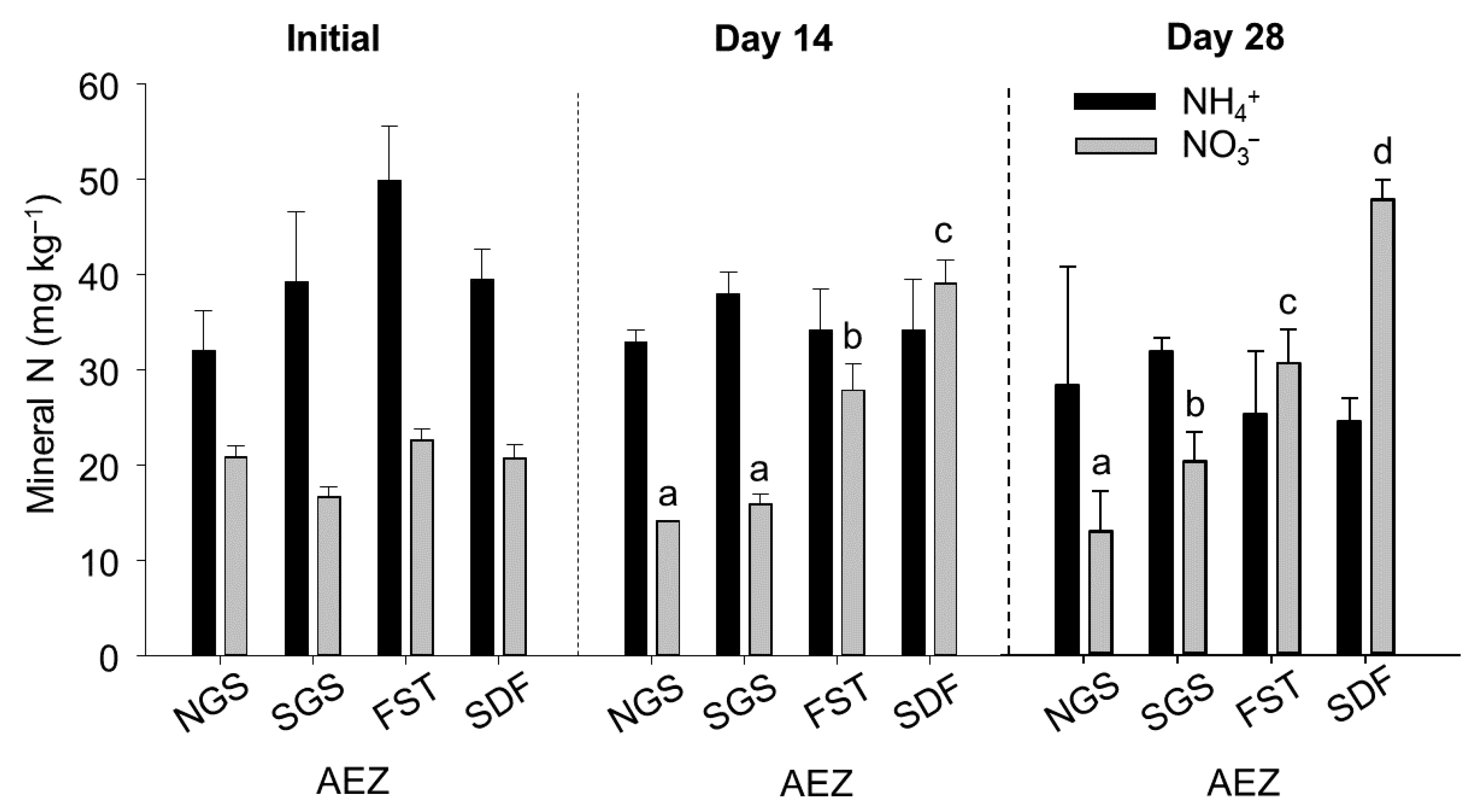
3.2.1. Mineralization Trends and Mineral N Species Across the Zones
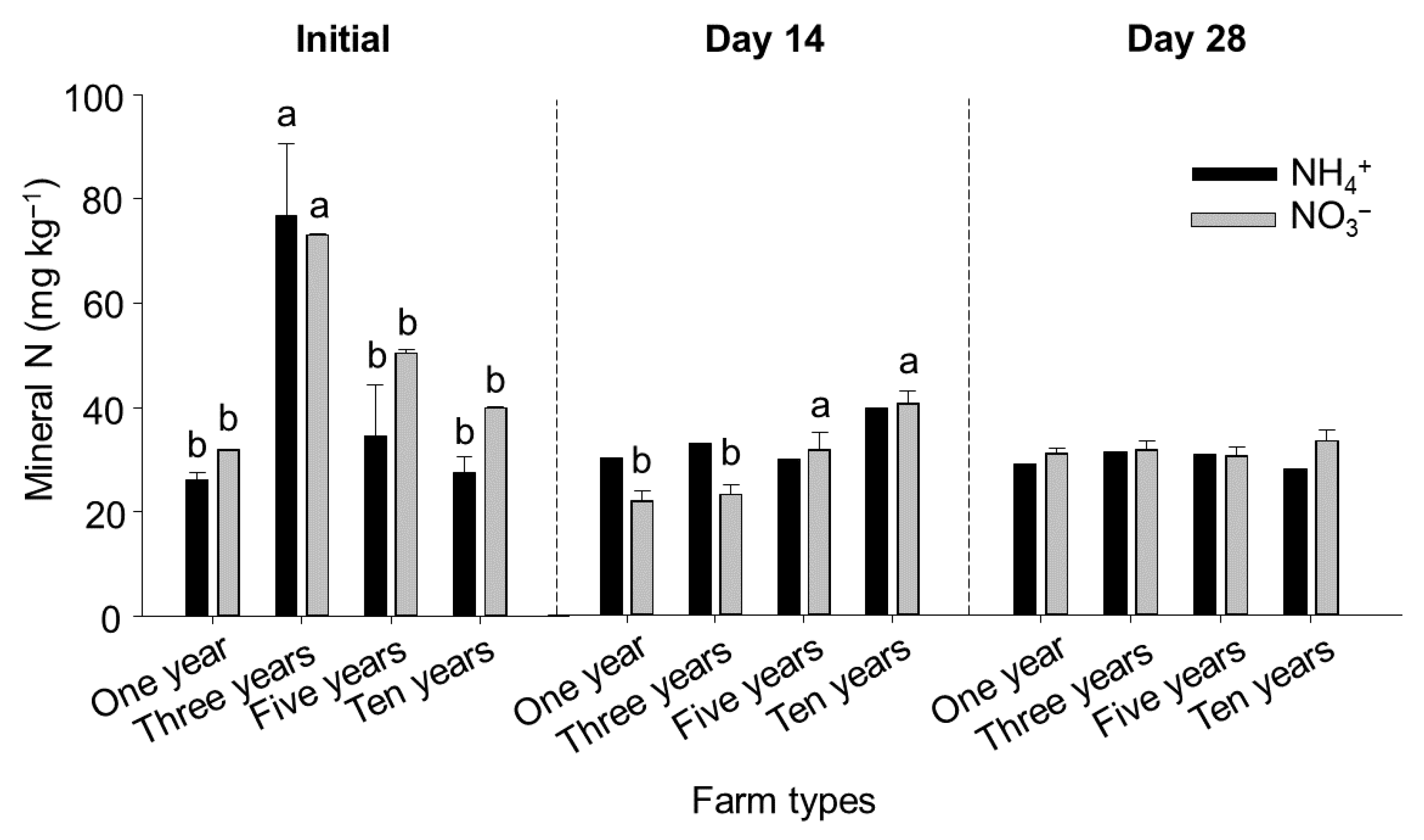
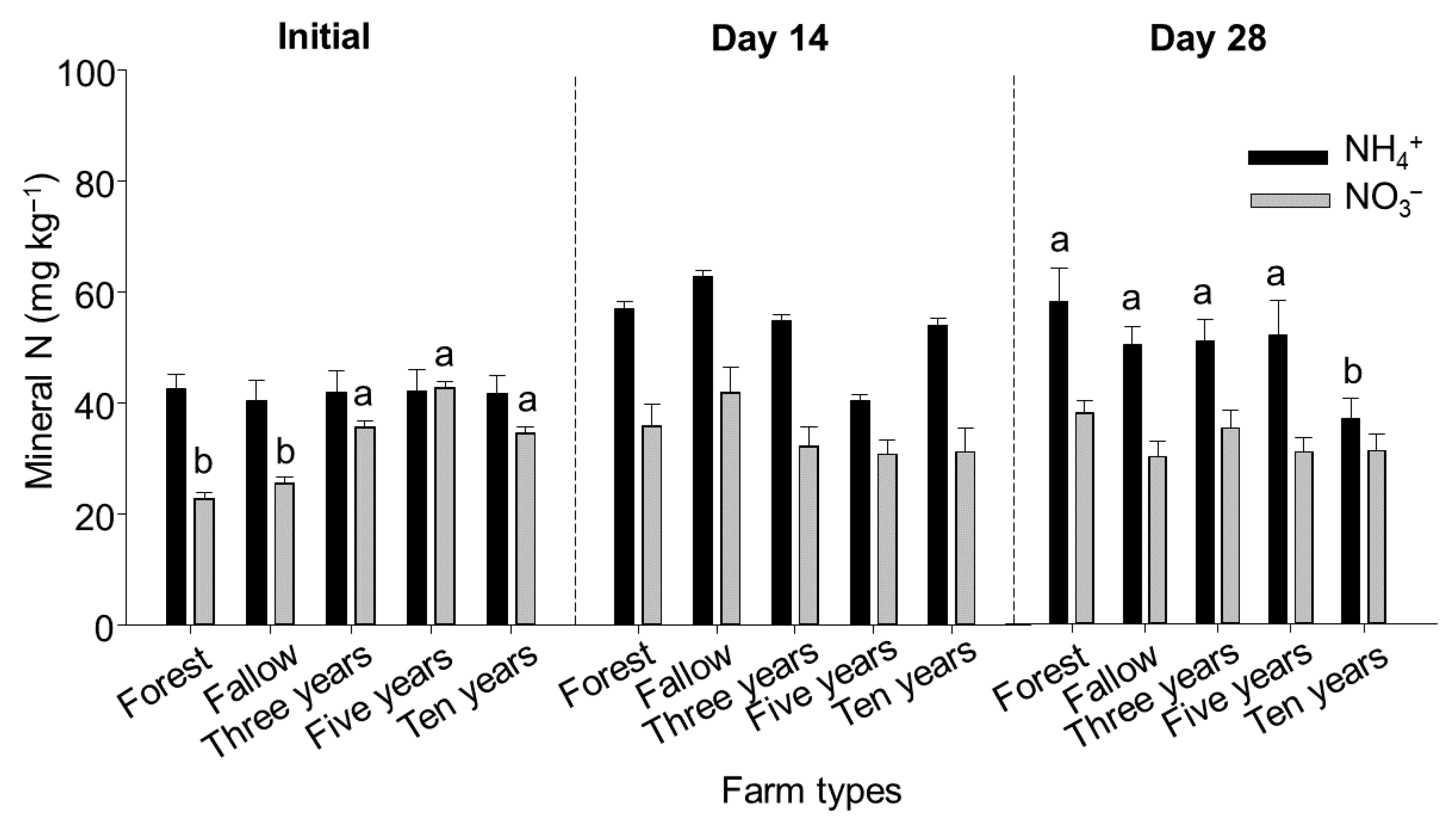
3.2.2. Mineralization Trends in the Farms
3.3. Sulfur Mineralization
4. Discussion
5. Conclusions
Author Contributions
Funding
Institutional Review Board Statement
Data Availability Statement
Acknowledgments
Conflicts of Interest
Abbreviations
| AEZ | Agro-ecological zones |
| ECEC | Effective cation exchange capacity |
| FST | Forest–savannah transition |
| NGS | Northern Guinea savannah |
| POXC | Permanganate oxidizable C |
| RF | Rain forest |
| SDF | Semi-deciduous forest |
| SEB | Sum of exchangeable bases |
| SGS | Southern Guinea savannah |
| SOC | Soil organic carbon |
| SOM | Soil organic matter |
| UKRI | UK Research and Innovation |
References
- Gomiero, T. Soil Degradation, Land Scarcity and Food Security: Reviewing a Complex Challenge. Sustainability 2016, 8, 281. [Google Scholar] [CrossRef]
- Kopittke, P.M.; Harper, S.M.; Asio, L.G.; Asio, V.B.; Batalon, J.T.; Batuigas, A.M.T.; Gonzaga, A.B.; Gonzaga, N.R.; de Guzman, M.T.L.; Lumanao, D.M.; et al. Soil degradation: An integrated model of the causes and drivers. Int. Soil Water Conserv. Res. 2025, 13, 744–755. [Google Scholar] [CrossRef]
- Lal, R. Restoring Soil Quality to Mitigate Soil Degradation. Sustainability 2015, 7, 5875–5895. [Google Scholar] [CrossRef]
- Keith, D.A.; Benson, D.H.; Baird, I.R.C.; Watts, L.; Simpson, C.C.; Krogh, M.; Gorissen, S.; Ferrer-Paris, J.R.; Mason, T.J. Effects of interactions between anthropogenic stressors and recurring perturbations on ecosystem resilience and collapse. Conserv. Biol. 2023, 37, e13995. [Google Scholar] [CrossRef] [PubMed]
- Holden, S.T. Fertilizer and sustainable intensification in Sub-Saharan Africa. Glob. Food Secur. 2018, 18, 20–26. [Google Scholar] [CrossRef]
- Sanchez, P.A.; Swaminathan, M.S. Hunger in Africa: The link between unhealthy people and unhealthy soils. Lancet 2005, 365, 442–444. [Google Scholar] [CrossRef]
- Acheampong, E.O.; Macgregor, C.J.; Sloan, S.; Sayer, J. Deforestation is driven by agricultural expansion in Ghana’s forest reserves. Sci. Afr. 2019, 5, e00146. [Google Scholar] [CrossRef]
- Tefera, M.L.; Carletti, A.; Altea, L.; Rizzu, M.; Migheli, Q.; Seddaiu, G. Land degradation and the upper hand of sustainable agricultural intensification in sub-Saharan Africa—A systematic review. J. Agric. Rural Dev. Trop. Subtrop. 2024, 125, 63–83. [Google Scholar] [CrossRef]
- Kyere-Boateng, R.; Marek, M.V. Analysis of the Social-Ecological Causes of Deforestation and Forest Degradation in Ghana: Application of the DPSIR Framework. Forests 2021, 12, 409. [Google Scholar] [CrossRef]
- Reynolds, T.W.; Waddington, S.R.; Anderson, C.L.; Chew, A.; True, Z.; Cullen, A. Environmental impacts and constraints associated with the production of major food crops in Sub-Saharan Africa and South Asia. Food Sec. 2015, 7, 795–822. [Google Scholar] [CrossRef]
- Tadele, Z. Raising Crop Productivity in Africa through Intensification. Agronomy 2017, 7, 22. [Google Scholar] [CrossRef]
- Neina, D.; Agyarko-Mintah, E. Duration of cultivation has varied impacts on soil charge properties in different agro-ecological zones of Ghana. Land 2022, 11, 1633. [Google Scholar] [CrossRef]
- Neina, D.; Agyarko-Mintah, E. Differential Impacts of Cropland Expansion on Soil Biological Indicators in Two Ecological Zones. Sustainability 2023, 15, 8138. [Google Scholar] [CrossRef]
- Viglizzo, E.F.; Frank, F.C.; Carreño, L.V.; Jobbágy, E.G.; Pereyra, H.; Clatt, J.; Pincén, D.; Ricard, M.F. Ecological and environmental footprint of 50 years of agricultural expansion in Argentina. Glob. Change Biol. 2011, 17, 959–973. [Google Scholar] [CrossRef]
- Locatelli, J.L.; Santos, R.S.; Cherubin, M.R.; Cerri, C.E. Changes in soil organic matter fractions induced by cropland and pasture expansion in Brazil’s new agricultural frontier. Geoderma Reg. 2022, 28, e00474. [Google Scholar] [CrossRef]
- Liu, Z.; Liu, Y.; Wang, J. A global analysis of agricultural productivity and water resource consumption changes over cropland expansion regions. Agric. Ecosyst. Environ. 2021, 321, 107630. [Google Scholar] [CrossRef]
- Rukundo, E.; Liu, S.; Dong, Y.; Rutebuka, E.; Asamoah, E.F.; Xu, J.; Wu, X. Spatio-temporal dynamics of critical ecosystem services in response to agricultural expansion in Rwanda, East Africa. Ecol. Indic. 2018, 89, 696–705. [Google Scholar] [CrossRef]
- Chen, Y.; Yang, X.; Fu, W.; Chen, B.; Hu, H.; Feng, K.; Geisen, S. Conversion of natural grassland to cropland alters microbial community assembly across northern China. Environ. Microbiol. 2022, 24, 5630–5642. [Google Scholar] [CrossRef] [PubMed]
- Burke, W.J.; Frossard, E.; Kabwe, S.; Jayne, T.S. Understanding fertilizer adoption and effectiveness on maize in Zambia. Food Policy 2019, 86, 101721. [Google Scholar] [CrossRef] [PubMed]
- Havlin, J.L. Fertility, Reference Module in Earth Systems and Environmental Sciences; Elsevier Inc.: Amsterdam, The Netherlands, 2013. [Google Scholar]
- Provin, T.L.; McFarland, M.L. Essential Nutrients for Plants; ESC-009; Texas A&M AgriLife Extension Service, Texas A&M University System: College Station, TX, USA, 2001. [Google Scholar]
- Yang, T.; Siddique, K.H.; Liu, K. Cropping systems in agriculture and their impact on soil health-A review. Glob. Ecol. Conserv. 2020, 23, e01118. [Google Scholar] [CrossRef]
- Singh, N.K.; Sachan, K.; Ranjitha, G.; Chandana, S.; Manoj, B.P.; Panotra, N.; Katiyar, D. Building Soil Health and Fertility through Organic Amendments and Practices: A Review. Asian J. Soil Sci. Plant Nutr. 2024, 10, 175–197. [Google Scholar] [CrossRef]
- Hatano, R.; Baggs, E.M. (Eds.) Nitrogen Cycling and Soil Health; Springer Nature: Singapore, 2025. [Google Scholar]
- Ostle, N.J.; Smith, P.; Fisher, R.; Ian Woodward, F.; Fisher, J.B.; Smith, J.U.; Galbraith, D.; Levy, P.; Meir, P.; McNamara, N.P.; et al. Integrating plant–soil interactions into global carbon cycle models. J. Ecol. 2009, 97, 851–863. [Google Scholar] [CrossRef]
- Zaman, W.; Ayaz, A.; Puppe, D. Biogeochemical Cycles in Plant-Soil Systems: Significance for Agriculture, Interconnections, and Anthropogenic Disruptions. Biology 2025, 14, 433. [Google Scholar] [CrossRef]
- Zhang, X.; Zhang, H.; Wang, Z.; Tian, Y.; Liu, Z. Trends in the Research and Development of Soil Nitrogen Mineralization in Forests from 2004 to 2024. Sustainability 2024, 16, 7882. [Google Scholar] [CrossRef]
- Gerson, J.R.; Hinckley, E.-L.S. It Is Time to Develop Sustainable Management of Agricultural Sulfur. Earth’s Future 2023, 11, e2023EF003723. [Google Scholar] [CrossRef]
- Sharma, R.K.; Cox, M.S.; Oglesby, C.; Dhillon, J.S. Revisiting the role of sulfur in crop production: A narrative review. J. Agric. Food Res. 2024, 15, 101013. [Google Scholar] [CrossRef]
- Barnard, M.; Dalal, R.C.; McKenna, B.A.; Wykes, J.L.; Cowie, B.C.; Kopittke, P.M. Bringing soil sulfur to the forefront: How long-term cropping impacts sulfur speciation in soil organic matter fractions. Agric. Ecosyst. Environ. 2025, 393, 109833. [Google Scholar] [CrossRef]
- Lu, Z.; Zhang, S.; Li, G.; Ge, Y.; Haim, P.G.; Mey-Tal, S.; Magen, H.; Huang, C. Sulfur fertilization contribute to China’s food security: A meta-analysis. Eur. J. Agron. 2025, 164, 127510. [Google Scholar] [CrossRef]
- The Sulphur Institute. Sulphur—The Fourth Major Crop Nutrient; Technical Report; The Sulphur Institute: Washington, DC, USA, 2024. [Google Scholar]
- Rasheed, M.U.; Lihong, W.; Mahmood, A.; Rehman, H.U.; Javaid, M.M.; Ali, B.; Ishfaq, F.; Ameen, M.; Hassan, M.U.; Hashem, A.; et al. Impact of Nitrogen, Sulphur, and Foliar Applied Thiourea on Growth, Oil Yield, and Fatty Acid Profile of Canola. Pol. J. Environ. Stud. 2025, 34, 2337–2347. [Google Scholar] [CrossRef]
- Santana, M.M.; Dias, T.; Gonzalez, J.M.; Cruz, C. Transformation of organic and inorganic sulfur–adding perspectives to new players in soil and rhizosphere. Soil Biol. Biochem. 2021, 160, 108306. [Google Scholar] [CrossRef]
- Crespo, C.; Wyngaard, N.; Sainz Rozas, H.; Barbagelata, P.; Barraco, M.; Gudelj, V.; Barbieri, P. Improving soil organic nitrogen and sulfur pools by cover cropping and crop fertilization in soybean-based cropping systems. Soil Tillage Res 2021, 213, 105138. [Google Scholar] [CrossRef]
- Głowacka, A.; Jariene, E.; Flis-Olszewska, E.; Kiełtyka-Dadasiewicz, A. The Effect of Nitrogen and Sulphur Application on Soybean Productivity Traits in Temperate Climates Conditions. Agronomy 2023, 13, 780. [Google Scholar] [CrossRef]
- Kihara, J.; Sileshi, G.W.; Nziguheba, G.; Kinyua, M.; Zingore, S.; Sommer, R. Application of secondary nutrients and micronutrients increases crop yields in sub-Saharan Africa. Agron. Sustain. Dev. 2017, 37, 25. [Google Scholar] [CrossRef]
- Moshi, M.M.; Amuri, N.A.; Weil, R.R. Sulphur nutrition management in Sub-Saharan Africa crop production: A systematic review. Front. Agron. 2025, 7, 1656622. [Google Scholar] [CrossRef]
- Pias, O.H.D.; Tiecher, T.; Cherubin, M.R.; Mazurana, M.; Byer, C. Crop Yield Responses to Sulfur Fertilization in Brazilian No-Till Soils: A Systematic Review. Rev. Bras. Ciênc. Solo 2019, 43, e0180078. [Google Scholar] [CrossRef]
- Saha, B.; Saha, S.; Roy, P.D.; Padhan, D.; Pati, S.; Hazra, G.C. Microbial Transformation of Sulphur: An Approach to Combat the Sulphur Deficiencies in Agricultural Soils. In Role of Rhizospheric Microbes in Soil; Springer: Singapore, 2018; pp. 77–97. [Google Scholar]
- Tully, K.; Ryals, R. Nutrient cycling in agroecosystems: Balancing food and environmental objectives. Agroecol. Sustain. Food Syst. 2017, 41, 761–798. [Google Scholar] [CrossRef]
- Zenda, T.; Liu, S.; Dong, A.; Duan, H. Revisiting Sulphur—The Once Neglected Nutrient: It’s Roles in Plant Growth, Metabolism, Stress Tolerance and Crop Production. Agriculture 2021, 11, 626. [Google Scholar] [CrossRef]
- Neina, D.; Adolph, B. Sulphur contents in arable soils from four agro-ecological zones of Ghana. Land 2022, 11, 1866. [Google Scholar] [CrossRef]
- Jamal, A.; Moon, Y.-S.; Abdin, M.Z. Sulphur—A General Overview and Interaction with Nitrogen. Aust. J. Crop Sci. 2010, 4, 523–529. [Google Scholar]
- Yamba, E.I.; Aryee, J.N.; Quansah, E.; Davies, P.; Wemegah, C.S.; Osei, M.A.; Ahiataku, M.A.; Amekudzi, L.K. Revisiting the agro-climatic zones of Ghana: A re-classification in conformity with climate change and variability. PLoS Clim. 2023, 2, e0000023. [Google Scholar] [CrossRef]
- Asare-Nuamah, P.; Botchway, E. Understanding climate variability and change: Analysis of temperature and rainfall across agroecological zones in Ghana. Heliyon 2019, 5, e02654. [Google Scholar] [CrossRef]
- Appiah Mensah, A.; Akoto Sarfo, D.; Partey, S.T. Assessment of vegetation dynamics using remote sensing and GIS: A case of Bosomtwe Range Forest Reserve, Ghana. Egypt. J. Remote Sens. Space Sci. 2019, 22, 145–154. [Google Scholar] [CrossRef]
- Hall, J.B.; Swaine, M.D. Classification and Ecology of Closed-Canopy Forest in Ghana. J. Ecol. 1976, 64, 913. [Google Scholar] [CrossRef]
- Blair, G.J.; Lefroy, R.D.; Lisle, L. Soil carbon fractions based on their degree of oxidation, and the development of a carbon management index for agricultural systems. Aust. J. Agric. Res. 1995, 46, 1459. [Google Scholar] [CrossRef]
- Weil, R.R.; Islam, K.R.; Stine, M.A.; Gruver, J.B.; Samson-Liebig, S.E. Estimating active carbon for soil quality assessment: A simplified method for laboratory and field use. Am. J. Altern. Agric. 2003, 18, 3–17. [Google Scholar] [CrossRef]
- Jenkinson, D.S.; Powlson, D.S. The effects of biocidal treatments on metabolism in soil—V. Soil Biol. Biochem. 1976, 8, 209–213. [Google Scholar] [CrossRef]
- Mehra, B.P.; Jackson, H.L. Iron oxide removal from soils and clays by a dithionite–citrate system buffered with sodium bicarbonate. Clays Clay Miner. 1960, 7, 317–327. [Google Scholar] [CrossRef]
- Bationo, A.; Kihara, J.; Vanlauwe, B.; Waswa, B.; Kimetu, J. Soil organic carbon dynamics, functions and management in West African agro-ecosystems. Agric. Syst. 2007, 94, 13–25. [Google Scholar] [CrossRef]
- Haynes, R.J. Origin, Distribution, and Cycling of Nitrogen in Terrestrial Ecosystems. In Mineral Nitrogen in the Plant–Soil System; Elsevier: Amsterdam, The Netherlands, 1986; pp. 1–51. [Google Scholar]
- Alghamdi, R.S.; Cihacek, L. Do post-harvest crop residues in no-till systems provide for nitrogen needs of following crops? Agron. J. 2022, 114, 835–852. [Google Scholar] [CrossRef]
- Oksana; Hermansah; Agustian; Yasin, S. Review—Soil Sulfur Dynamics and Their Role in Plant Growth and Development. J. Agron. Tanam. Trop. 2024, 6, 850–868. [Google Scholar] [CrossRef]
- Mulvaney, R.L. Nitrogen-inorganic forms. In Methods of Soil Analysis. Part 3. Chemical Methods. SSSA Book Ser. 5. SSSA and ASA; Sparks, D.L., Page, A.L., Helmke, P.A., Loeppert, R.H., Soltanpour, P.N., Tabatabai, M.A., Johnston, C.T., Sumner, M.E., Eds.; American Society of Agronomy: Madison, WI, USA, 1996; pp. 1123–1184. [Google Scholar]
- Keeney, D.R.; Nelson, D.W. Nitrogen in organic forms. In Methods of Soil Analysis. Part 2. Agronomy No. 9; Page, A.L., Miller, R.H., Keeney, D.R., Eds.; American Society of Agronomy: Madison, WI, USA, 1982; pp. 643–698. [Google Scholar]
- Fox, R.L.; Olson, R.A.; Rhoades, H.F. Evaluating the sulfur status of soils by plant and soil tests. Soil Sci. Soc. Am. J. 1964, 28, 243–246. [Google Scholar] [CrossRef]
- Ji, W.; Li, R.; Qian, X.; Albasher, G.; Li, Z. Microbial nitrogen mineralization is slightly affected by conversion from farmland to apple orchards in thick loess deposits. Sci. Total Environ. 2024, 908, 168268. [Google Scholar] [CrossRef]
- Rapport, D.J.; Whitford, W.G. How Ecosystems Respond to Stress. BioScience 1999, 49, 193–203. [Google Scholar] [CrossRef]
- Wu, L.; Wang, B.; Wu, Y.; Chen, D. Regional-scale evidence that determinants of soil microbial biomass and N mineralization depend on sampling depth and layer on the Mongolian Plateau. Catena 2022, 213, 106180. [Google Scholar] [CrossRef]
- Wei, H.; Wang, P.; Li, J.; Wang, Q.; Zhang, F.; Sun, D.; Gao, D.; Ding, Z.; Du, W.; Zhang, G.; et al. Nitrogen mineralization/immobilization dynamics across the river-estuary-sea continuum: Effects of organic matter and microorganisms. Mar. Pollut. Bull. 2024, 209, 117241. [Google Scholar] [CrossRef] [PubMed]
- Netthisinghe, A.M.; Galloway, H.O.; Agga, G.E.; Gunter, P.A.; Sistani, K.R. Effects of Cropping Systems on Soil Physicochemical Properties and Abundances and Spatial Distributions of Nitrogen-Cycling Bacteria. Agronomy 2023, 13, 1461. [Google Scholar] [CrossRef]
- Ros, G.H. Predicting soil N mineralization using organic matter fractions and soil properties: A re-analysis of literature data. Soil Biol. Biochem. 2012, 45, 132–135. [Google Scholar] [CrossRef]
- Kuśmierz, S.; Skowrońska, M.; Tkaczyk, P.; Lipiński, W.; Mielniczuk, J. Soil Organic Carbon and Mineral Nitrogen Contents in Soils as Affected by Their pH, Texture and Fertilization. Agronomy 2023, 13, 267. [Google Scholar] [CrossRef]
- Du, X.; Li, X.; Wang, J.; Xu, J.; Gao, J. Climate factors dominate the spatial variation of forest soil nutrients: A meta analysis. Front. For. Glob. Change 2025, 7, 1525250. [Google Scholar] [CrossRef]
- Yuan, D.; Hu, Y.; Jia, S.; Li, W.; Zamanian, K.; Han, J.; Huang, F.; Zhao, X. Microbial Properties Depending on Fertilization Regime in Agricultural Soils with Different Texture and Climate Conditions: A Meta-Analysis. Agronomy 2023, 13, 764. [Google Scholar] [CrossRef]
- Zhang, Y.; Li, P.; Liu, X.; Xiao, L.; Li, T.; Wang, D. The response of soil organic carbon to climate and soil texture in China. Front. Earth Sci. 2022, 16, 835–845. [Google Scholar] [CrossRef]
- Ma, Q.; Luo, Y.; Wen, Y.; Hill, P.W.; Chadwick, D.R.; Wu, L.; Jones, D.L. Carbon and sulphur tracing from soil organic sulphur in plants and soil microorganisms. Soil Biol. Biochem. 2020, 150, 107971. [Google Scholar] [CrossRef]
- Gupta, V.; Germida, J.J. Microbial transformations of sulfur in soil. Princ. Appl. Soil Microbiol. 2021, 489–522. [Google Scholar] [CrossRef]
- Zhou, W.; He, P.; Li, S.; Lin, B. Mineralization of organic sulfur in paddy soils under flooded conditions and its availability to plants. Geoderma 2005, 125, 85–93. [Google Scholar] [CrossRef]
- Li, L.; Li, S. Nitrogen Mineralization from Animal Manures and Its Relation to Organic N Fractions. J. Integr. Agric. 2014, 13, 2040–2048. [Google Scholar] [CrossRef]
- Cao, Y.; He, Z.; Zhu, T.; Zhao, F. Organic-C quality as a key driver of microbial nitrogen immobilization in soil: A meta-analysis. Geoderma 2021, 383, 114784. [Google Scholar] [CrossRef]
- Cao, Y.; Fengliang, Z.; Zhongyi, Z.; Tongbin, Z.; Huayun, X. Biotic and abiotic nitrogen immobilization in soil incorporated with crop residue. Soil Tillage Res. 2020, 202, 104664. [Google Scholar] [CrossRef]
- Vermeiren, C.; Smolders, E.; McLaughlin, M.J.; Degryse, F. Model-based rationalization of sulphur mineralization in soils using 35S isotope dilution. Soil Biol. Biochem. 2018, 120, 1–11. [Google Scholar] [CrossRef]
- Gomes, M.F.; Vasconcelos, S.S.; Viana-Junior, A.B.; Costa, A.N.M.; Barros, P.C.; Ryohei Kato, O.; Castellani, D.C. Oil palm agroforestry shows higher soil permanganate oxidizable carbon than monoculture plantations in Eastern Amazonia. Land Degrad. Dev. 2021, 32, 4313–4326. [Google Scholar] [CrossRef]
- Culman, S.W.; Snapp, S.S.; Freeman, M.A.; Schipanski, M.E.; Beniston, J.; Lal, R.; Drinkwater, L.E.; Franzluebbers, A.J.; Glover, J.D.; Grandy, A.S.; et al. Permanganate Oxidizable Carbon Reflects a Processed Soil Fraction that is Sensitive to Management. Soil Sci. Soc. Am. J. 2012, 76, 494–504. [Google Scholar] [CrossRef]
- Hartman, W.H.; Richardson, C.J. Differential nutrient limitation of soil microbial biomass and metabolic quotients (qCO2): Is there a biological stoichiometry of soil microbes? PLoS ONE 2013, 8, e57127. [Google Scholar] [CrossRef]
- Gioacchini, P.; Manici, L.M.; Ramieri, N.A.; Marzadori, C.; Ciavatta, C. Nitrogen dynamics and microbial response in soil amended with either olive pulp or its by-products after biogas production. Biol. Fertil. Soils 2007, 43, 621–630. [Google Scholar] [CrossRef]
- Matus, F.; Stock, S.; Eschenbach, W.; Dyckmans, J.; Merino, C.; Nájera, F.; Köster, M.; Kuzyakov, Y.; Dippold, M.A. Ferrous Wheel Hypothesis: Abiotic nitrate incorporation into dissolved organic matter. Geochim. Cosmochim. Acta 2019, 245, 514–524. [Google Scholar] [CrossRef]
- Porras, R.C.; Hicks Pries, C.E.; McFarlane, K.J.; Hanson, P.J.; Torn, M.S. Association with pedogenic iron and aluminum: Effects on soil organic carbon storage and stability in four temperate forest soils. Biogeochemistry 2017, 133, 333–345. [Google Scholar] [CrossRef]
- Jia, N.; Li, L.; Guo, H.; Xie, M. Important role of Fe oxides in global soil carbon stabilization and stocks. Nat. Commun. 2024, 15, 10318. [Google Scholar] [CrossRef]
- Laloo, A.E.; Gupta, A.; Verrone, V.; Dubey, R.K. Role of Fe and Mn in organo–mineral–microbe interactions: Evidence of carbon stabilization and transformation of organic matter leading to carbon greenhouse gas …: Role of Fe and Mn in organo–mineral–microbe interactions: Evidence of carbon stabilization and transformation of organic matter leading to carbon greenhouse gas emissions. Lett. Appl. Microbiol. 2025, 78, ovaf044. [Google Scholar] [CrossRef]
- Rasmussen, C.; Southard, R.J.; Horwath, W.R. Mineral control of organic carbon mineralization in a range of temperate conifer forest soils. Glob. Change Biol. 2006, 12, 834–847. [Google Scholar] [CrossRef]
- Kramer, M.G.; Chadwick, O.A. Climate-driven thresholds in reactive mineral retention of soil carbon at the global scale. Nat. Clim. Change 2018, 8, 1104–1108. [Google Scholar] [CrossRef]
- Zhang, J.C.; Zhang, L.; Wang, P.; Huang, Q.W.; Yu, G.H.; Li, D.C.; Shen, Q.R.; Ran, W. The role of non-crystalline Fe in the increase of SOC after long-term organic manure application to the red soil of southern China. Eur. J. Soil Sci. 2013, 64, 797–804. [Google Scholar] [CrossRef]
- Huang, X.; Liu, X.; Chen, L.; Wang, Y.; Chen, H. Iron-bound organic carbon dynamics in peatland profiles: The preservation equivalence of deep and surface soil. Fundam. Res. 2023, 3, 852–860. [Google Scholar] [CrossRef]
- Song, X.; Wang, P.; van Zwieten, L.; Bolan, N.; Wang, H.; Li, X.; Cheng, K.; Yang, Y.; Wang, M.; Liu, T.; et al. Towards a better understanding of the role of Fe cycling in soil for carbon stabilization and degradation. Carbon Res. 2022, 1, 5. [Google Scholar] [CrossRef]
- Kirsten, M.; Mikutta, R.; Vogel, C.; Thompson, A.; Mueller, C.W.; Kimaro, D.N.; Bergsma, H.L.T.; Feger, K.-H.; Kalbitz, K. Iron oxides and aluminous clays selectively control soil carbon storage and stability in the humid tropics. Sci. Rep. 2021, 11, 5076. [Google Scholar] [CrossRef]
- Regelink, I.C.; Stoof, C.R.; Rousseva, S.; Weng, L.; Lair, G.J.; Kram, P.; Nikolaidis, N.P.; Kercheva, M.; Banwart, S.; Comans, R.N. Linkages between aggregate formation, porosity and soil chemical properties. Geoderma 2015, 247–248, 24–37. [Google Scholar] [CrossRef]
- Matus, F.J. Fine silt and clay content is the main factor defining maximal C and N accumulations in soils: A meta-analysis. Sci. Rep. 2021, 11, 6438. [Google Scholar] [CrossRef]
- Cao, Y.-W.; Wang, X.-B.; Wang, C.; Bai, E.; Wu, N. Sulfur biogeochemical dynamics of grassland soils in northern China transect along an aridity gradient. Geoderma 2024, 451, 117073. [Google Scholar] [CrossRef]
- Sultana, M.; Jahiruddin, M.; Islam, M.R.; Rahman, M.M.; Abedin, M.A.; Al Mahmud, A. Nitrogen, phosphorus and sulphur mineralization in soil treated with amended municipal solid waste compost under aerobic and anaerobic conditions. Int. J. Recycl. Org. Waste Agric. 2021, 10, 245–256. [Google Scholar] [CrossRef]
- Wang, C.; Dorodnikov, M. Biological transformations of sulfur in soil. In Encyclopedia of Soils in the Environment, 2nd ed.; Hillel, D., Ed.; Academic Press: Cambridge, MA, USA, 2005; pp. 85–90. [Google Scholar]
- Alam, M.K.; Bell, R.W.; Haque, M.E.; Islam, M.A.; Kader, M.A. Soil nitrogen storage and availability to crops are increased by conservation agriculture practices in rice–based cropping systems in the Eastern Gangetic Plains. Field Crops Res. 2020, 250, 107764. [Google Scholar] [CrossRef]
- Jellason, N.P.; Robinson, E.J.Z.; Chapman, A.S.A.; Neina, D.; Devenish, A.J.M.; Po, J.Y.T.; Adolph, B. A systematic review of drivers and constraints on agricultural expansion in Sub-Saharan Africa. Land 2021, 10, 332. [Google Scholar] [CrossRef]
- Gibbs, H.K.; Ruesch, A.S.; Achard, F.; Clayton, M.K.; Holmgren, P.; Ramankutty, N.; Foley, J.A. Tropical forests were the primary sources of new agricultural land in the 1980s and 1990s. Proc. Natl. Acad. Sci. USA 2010, 107, 16732–16737. [Google Scholar] [CrossRef]
- van Ittersum, M.K.; van Bussel, L.G.J.; Wolf, J.; Grassini, P.; van Wart, J.; Guilpart, N.; Claessens, L.; de Groot, H.; Wiebe, K.; Mason-D’Croz, D.; et al. Can sub-Saharan Africa feed itself? Proc. Natl. Acad. Sci. USA 2016, 113, 14964–14969. [Google Scholar] [CrossRef]
- de Vries, F.T.; Liiri, M.E.; Bjørnlund, L.; Bowker, M.A.; Christensen, S.; Setälä, H.M.; Bardgett, R.D. Land use alters the resistance and resilience of soil food webs to drought. Nat. Clim. Change 2012, 2, 276–280. [Google Scholar] [CrossRef]
- de Blécourt, M.; Gröngröft, A.; Baumann, S.; Eschenbach, A. Losses in soil organic carbon stocks and soil fertility due to deforestation for low-input agriculture in semi-arid southern Africa. J. Arid Environ. 2019, 165, 88–96. [Google Scholar] [CrossRef]
- Boullouz, M.; Bindraban, P.S.; Kissiedu, I.N.; Kouame, A.K.K.; Devkota, K.P.; Atakora, W.K. An integrative approach based on crop modeling and geospatial and statistical analysis to quantify and explain the maize (Zea mays) yield gap in Ghana. Front. Soil Sci. 2022, 2, 1037222. [Google Scholar] [CrossRef]
- Blum, C.S.; Lehmann, J.; Solomon, D.; Caires, E.F.; Alleoni, L.R.F. Sulfur forms in organic substrates affecting S mineralization in soil. Geoderma 2013, 200–201, 156–164. [Google Scholar] [CrossRef]
- Wang, H.; Ren, T.; Müller, K.; van Zwieten, L.; Wang, H.; Feng, H.; Xu, C.; Yun, F.; Ji, X.; Yin, Q.; et al. Soil type regulates carbon and nitrogen stoichiometry and mineralization following biochar or nitrogen addition. Sci. Total Environ. 2021, 753, 141645. [Google Scholar] [CrossRef]
- Rhodes, E.R. Nutrient depletion by food crops in Ghana and soil organic nitrogen management. Agric. Syst. 1995, 48, 101–118. [Google Scholar] [CrossRef]
- Tan, Z.X.; Lal, R.; Wiebe, K.D. Global Soil Nutrient Depletion and Yield Reduction. J. Sustain. Agric. 2005, 26, 123–146. [Google Scholar] [CrossRef]
- Eugenio, N.R.; Nachtergaele, F.; Biancalani, R.; Emiliano, M.; Benedetti, F.; Li, L. Working Together for Soils: The Longstanding Collaboration Between FAO and the IUSS. In Soil Science in Italy; Springer: Cham, Switzerland, 2024; pp. 649–653. [Google Scholar]
- Azadi, H.; Movahhed Moghaddam, S.; Burkart, S.; Mahmoudi, H.; van Passel, S.; Kurban, A.; Lopez-Carr, D. Rethinking resilient agriculture: From Climate-Smart Agriculture to Vulnerable-Smart Agriculture. J. Clean. Prod. 2021, 319, 128602. [Google Scholar] [CrossRef]
- Urakawa, R.; Ohte, N.; Shibata, H.; Isobe, K.; Tateno, R.; Oda, T.; Hishi, T.; Fukushima, K.; Inagaki, Y.; Hirai, K.; et al. Factors contributing to soil nitrogen mineralization and nitrification rates of forest soils in the Japanese archipelago. For. Ecol. Manag. 2016, 361, 382–396. [Google Scholar] [CrossRef]
- Cao, H.; Chen, R.; Wang, L.; Jiang, L.; Yang, F.; Zheng, S.; Wang, G.; Lin, X. Soil pH, total phosphorus, climate and distance are the major factors influencing microbial activity at a regional spatial scale. Sci. Rep. 2016, 6, 25815. [Google Scholar] [CrossRef]
- Neina, D.; Mureithi, S.M.; van Ranst, E. Soil System Status and Issues in the Global South. In Sustainable Soil Systems in Global South; Springer: Singapore, 2024; pp. 83–112. [Google Scholar]
- Neina, D.; Glaser, B. Terra Preta production from Ghanaian and Zambian soils using domestic wastes. Sci. Rep. 2024, 14, 24197. [Google Scholar] [CrossRef]



| Site/Farm | Silt + Clay | pHwater | POXC | Ald | Alox | Fed | Feox |
|---|---|---|---|---|---|---|---|
| (%) | (mg kg−1) | (mg kg−1) | |||||
| Agro-ecological zone | |||||||
| Northern Guinea Savannah (NGS) | 6.33 | 6.28 | 28.0 | 25.7 | 17.6 | 55.4 | 3500 |
| Southern Guinea Savannah (SGS) | 7.50 | 5.63 | 33.1 | 24.7 | 17.0 | 45.3 | 960.3 |
| Forest–Savannah Transition (FST) | 11.7 | 6.28 | 73.7 | 24.6 | 16.9 | 9.27 | 621.9 |
| Semi-Deciduous Forest (SDF) | 9.25 | 6.21 | 46.7 | 24.8 | 16.7 | 28.5 | 454.8 |
| Adansam (FST AEZ) | |||||||
| One year | 10.1 | 6.28 | 47.3 | 39.4 | 13.9 | 44.9 | 498.1 |
| Three years | 10.4 | 6.23 | 38.0 | 28.7 | 15.8 | 103.8 | 507.5 |
| Five years | 8.64 | 6.40 | 36.6 | 24.9 | 16.5 | 16.0 | 563.4 |
| Ten years | 10.9 | 6.35 | 38.9 | 25.0 | 16.3 | 31.5 | 510.8 |
| Dompem (RF AEZ) | |||||||
| Forest (One year) | 26.6 | 4.28 | 64.8 | 27.2 | 22.9 | 450.2 | 2477 |
| Fallow (One year) | 28.8 | 4.25 | 67.0 | 26.7 | 19.7 | 423.4 | 1427 |
| Three years | 28.7 | 4.36 | 53.9 | 34.6 | 18.0 | 229.5 | 2249 |
| Five years | 23.6 | 4.53 | 65.1 | 28.8 | 22.3 | 258.4 | 1293 |
| Ten years | 19.4 | 4.53 | 52.0 | 34.1 | 20.0 | 309.6 | 1955 |
| Site/Farm | Total C | Total N | Mineral N Day 0 | Nmin Day 14 | Nmin Day 28 |
|---|---|---|---|---|---|
| (g kg−1) | (mg kg−1) | (mg kg−1) | |||
| Agro-ecological zone | |||||
| Northern Guinea Savannah (NGS) | 10.8 (3.42) b | 1.13 (0.14) a | 53.5 (5.45) | 47.6 (1.19) d | 41.6 (9.73) c |
| Southern Guinea Savannah (SGS) | 8.90 (1.06) c | 1.21 (0.06) a | 56.2 (8.78) | 54.4 (1.71) c | 52.6 (3.68) b |
| Forest–Savannah Transition (FST) | 17.03 (2.48) a | 0.76 (0.06) b | 73.6 (8.04) | 62.7 (4.03) b | 56.3 (4.57) b |
| Semi-Deciduous Forest (SDF) | 5.86 (0.66) d | 0.65 (0.16) b | 62.9 (9.79) | 74.0 (3.70) a | 72.8 (1.24) a |
| p-value | 0.020 | 0.033 | 0.209 | 0.015 | 0.022 |
| Adansam (Forest–Savannah Transition) | |||||
| One year | 12.2 (0.63) a | 1.02 (0.07) a | 57.8 (1.08) c | 52.3 (1.08) b | 60.8 (1.33) |
| Three years | 10.3 (0.70) a | 0.74 (0.06) a | 141.6 (1.14) a | 56.5 (1.05) b | 63.8 (2.69) |
| Five years | 8.79 (0.69) b | 0.49 (0.05) b | 79.8 (1.16) b | 61.0 (1.08) b | 60.1 (2.67) |
| Ten years | 10.9 (0.73) a | 0.81 (0.07) a | 66.4 (1.11) b | 80.4 (1.06) a | 62.3 (1.22) |
| p-value | 0.012 | 0.012 | 0.001 | 0.001 | 0.388 |
| Dompem (Rain Forest) | |||||
| Forest (One year) | 22.14 (1.15) | 0.85 (0.33) b | 65.82 (3.26) | 94.57 (0.06) b | 97.23 (7.43) a |
| Fallow (One year) | 21.09 (1.09) | 2.02 (0.13) a | 66.89 (3.53) | 110.36 (0.18) a | 81.35 (5.32) b |
| Three years | 19.25 (1.17) | 1.67 (0.29) b | 85.44 (9.50) | 88.43 (0.18) b | 94.39 (9.05) a |
| Five years | 16.52 (1.07) | 1.36 (0.09) b | 88.54 (10.47) | 72.21 (0.04) c | 88.28 (8.36) b |
| Ten years | 15.64 (1.13) | 1.56 (0.22) b | 83.29 (8.36) | 88.55 (0.34) b | 68.98 (4.55) c |
| p-value | 0.103 | 0.003 | 0.195 | 0.006 | 0.058 |
| Soil Properties | Agroecological Zones | Adansam (FST) | Dompem (RF) | |||
|---|---|---|---|---|---|---|
| Day 14 | Day 28 | Day 14 | Day 28 | Day 14 | Day 28 | |
| Permanganate oxidizable C | 0.70 ** | 0.64 * | - | - | 0.35 * | 0.42 ** |
| Total N | −0.71 ** | - | - | - | 0.38 ** | - |
| Smin day 14 | 0.78 ** | 0.60 * | - | - | - | - |
| Smin day 28 | - | 0.77 ** | - | - | - | - |
| Microbial biomass | −0.67 ** | −0.57 * | - | - | 0.32 * | - |
| Basal respiration | - | - | 0.49 ** | - | - | - |
| Soil pH | - | - | - | - | −0.33 * | - |
| Dithionite extractable Al | −0.51 ns | −0.22 ns | −0.45 ** | - | −0.41 ** | - |
| Dithionite extractable Fe | −0.81 *** | −0.72 ** | - | - | - | - |
| Oxalate extractable Fe | −0.49 ns | - | - | - | - | - |
| Sum of basic cations | 0.59 * | 0.66 * | - | - | - | 0.44 ** |
| Effective CEC | 0.58 * | 0.65 * | - | - | 0.43 ** | 0.40 ** |
| Silt + clay | 0.43 ns | - | - | - | 0.29 * | 0.49 ** |
| Clay | 0.42 ns | - | - | - | - | 0.37 * |
| Zone/Farm | Initial | Day 14 | Day 28 |
|---|---|---|---|
| (mg kg−1) | |||
| Agro-ecological zone | |||
| Northern Guinea Savannah (NGS) | 8.42 (0.40) | 34.4 (5.97) d | 17.4 (1.06) c |
| Southern Guinea Savannah (SGS) | 9.33 (1.34) | 51.9 (4.49) c | 42.6 (1.46) b |
| Forest–Savannah Transition (FST) | 7.19 (0.13) | 93.5 (14.54) b | 41.4 (1.09) b |
| Semi-Deciduous Forest (SDF) | 13.0 (2.14) | 114.4 (16.56) a | 122.1 (1.35) a |
| p-value | 0.092 | 0.014 | 0.044 |
| Adansam (FST AEZ) | |||
| One year | 5.39 (1.10) b | 61.8 (2.98) | 66.1 (0.01) a |
| Three years | 9.24 (1.18) a | 62.5 (3.10) | 68.9 (0.05) a |
| Five years | 12.3 (1.14) a | 63.2 (3.01) | 60.2 (0.01) b |
| Ten years | 9.51 (1.11) a | 64.8 (3.99) | 58.9 (0.02) b |
| p-value | 0.001 | 0.723 | 0.017 |
| Dompem (RF AEZ) | |||
| Forest (One year) | 11.13 (0.04) a | 112.3 (1.10) a | 105.1 (1.12) a |
| Fallow (One year) | 11.17 (0.05) a | 53.0 (1.19) c | 98.7 (1.10) a |
| Three years | 12.24 (0.06) a | 64.8 (1.15) b | 70.9 (1.15) b |
| Five years | 11.58 (0.06) a | 55.9 (1.08) b | 64.9 (1.05) b |
| Ten years | 5.68 (0.04) b | 59.4 (1.05) b | 66.6 (1.06) b |
| p-value | 0.019 | 0.002 | 0.001 |
| Soil Properties | Agroecological Zones | Adansam (FST) | Dompem (RF) | |||
|---|---|---|---|---|---|---|
| Day 14 | Day 28 | Day 14 | Day 28 | Day 14 | Day 28 | |
| Permanganate oxidizable C | 0.78 ** | 0.71 ** | - | 0.47 ** | - | 0.41 ** |
| Total C | 0.38 ** | 0.50 *** | ||||
| Total N | −0.75 ** | - | - | - | - | - |
| Nmin day 14 | 0.78 ** | 0.70 ** | - | - | - | 0.45 ** |
| Nmin day 28 | - | 0.77 ** | - | - | - | - |
| Microbial biomass | −0.55 * | −0.41 ns | - | - | - | 0.30 * |
| Basal respiration | - | - | - | - | - | - |
| Soil pH | - | - | - | - | - | - |
| Dithionite extractable Al | - | - | - | - | - | −0.56 *** |
| Dithionite extractable Fe | −0.94 *** | −0.65 * | - | 0.40 ** | - | 0.29 * |
| Oxalate extractable Fe | −0.67 ** | - | - | - | −0.26 ns | 0.30 * |
| Sum of basic cations | - | 0.57 * | - | - | 0.41 ** | 0.27 ns |
| Effective CEC | - | 0.56 * | - | - | 0.36 * | 0.42 ** |
| Silt + clay | - | - | - | - | - | 0.30 * |
| Clay | - | - | - | - | - | - |
Disclaimer/Publisher’s Note: The statements, opinions and data contained in all publications are solely those of the individual author(s) and contributor(s) and not of MDPI and/or the editor(s). MDPI and/or the editor(s) disclaim responsibility for any injury to people or property resulting from any ideas, methods, instructions or products referred to in the content. |
© 2026 by the authors. Licensee MDPI, Basel, Switzerland. This article is an open access article distributed under the terms and conditions of the Creative Commons Attribution (CC BY) license.
Share and Cite
Neina, D.; Agyarko-Mintah, E.; Faust, S. Nitrogen and Sulfur Cycling in Diverse Farm Ages and Ecological Zones Under Agricultural Expansion. Agriculture 2026, 16, 637. https://doi.org/10.3390/agriculture16060637
Neina D, Agyarko-Mintah E, Faust S. Nitrogen and Sulfur Cycling in Diverse Farm Ages and Ecological Zones Under Agricultural Expansion. Agriculture. 2026; 16(6):637. https://doi.org/10.3390/agriculture16060637
Chicago/Turabian StyleNeina, Dora, Eunice Agyarko-Mintah, and Sibylle Faust. 2026. "Nitrogen and Sulfur Cycling in Diverse Farm Ages and Ecological Zones Under Agricultural Expansion" Agriculture 16, no. 6: 637. https://doi.org/10.3390/agriculture16060637
APA StyleNeina, D., Agyarko-Mintah, E., & Faust, S. (2026). Nitrogen and Sulfur Cycling in Diverse Farm Ages and Ecological Zones Under Agricultural Expansion. Agriculture, 16(6), 637. https://doi.org/10.3390/agriculture16060637