
Article

Interaction Between Nutrient-Laden Biochar and PGPR Reshapes Rhizosphere Microbiome to Reclaim Coastal Saline–Alkali Soil Fertility


1
College of Resources and Environmental Sciences, Hebei Agricultural University, Baoding 071051, China
2
Key Laboratory for Farmland Eco-Environment of Hebei Province, Baoding 071001, China
*
Author to whom correspondence should be addressed.
These authors contributed equally to this work.
Agriculture 2026, 16(6), 631; https://doi.org/10.3390/agriculture16060631
Submission received: 28 January 2026 / Revised: 28 February 2026 / Accepted: 3 March 2026 / Published: 10 March 2026
(This article belongs to the Section Agricultural Soils)

Abstract

Biochar and plant growth-promoting rhizobacteria (PGPR) are promising for coastal saline–alkali soil remediation, but their combined effect is often limited by nutrient scarcity. This study investigated whether nutrient-laden biochar (saturated with livestock wastewater) synergizes with a PGPR inoculant (Paenibacillus mucilaginosus PM12) to enhance maize productivity by reshaping the rhizosphere microbiome. A field experiment included five treatments: control (CK), sheep manure biochar alone (BC), nutrient-laden biochar (NBC), BC + PGPR (MBC), and NBC + PGPR (MNBC). The MNBC treatment showed the most pronounced improvements, increasing maize yield by 52.5% compared to CK, while reducing soil pH by 0.30 units and enhancing soil organic matter, total nitrogen, and available phosphorus. Metagenomic analysis revealed that MNBC uniquely enriched beneficial genera (e.g., Nocardioides) and saprotrophic Basidiomycota, while suppressing pathogenic Fusarium. This restructuring elevated the genetic potential for nitrogen transformation, phosphorus solubilization, and carbon metabolism. Structural equation modeling identified increased soil available phosphorus and total nitrogen as the primary direct drivers of yield enhancement. The integration of nutrient-laden biochar and PGPR creates a synergistic system that reclaims saline–alkali soil by alleviating stress, supplying nutrients, and directing the assembly of a functional microbiome.

1. Introduction

Global food security is increasingly challenged by population growth and the scarcity of arable land. The rational development and utilization of the extensive areas of saline–alkali soils are therefore considered a crucial pathway toward sustainable agricultural development [1]. Coastal saline–alkali soils account for approximately 2.4% of the global land area, with significant expanses found in regions such as China, the Middle East, and parts of South Asia [2]. The coastal saline–alkali soils in China are primarily distributed in the coastal areas north of the Yangtze River, particularly in the northeastern and eastern coastal regions. In contrast, such soils are less common in the southeastern coastal areas and are mostly found in scattered patches [2,3]. These soils represent a critical category of arable land resources and are essential for enhancing agricultural production in areas with limited suitable land for cultivation [4]. Common crops grown in these areas include rice, barley, wheat, and various vegetables, although crop productivity here is often constrained by multiple abiotic stresses such as salinity, high pH, poor soil structure [5,6,7], and nutrient deficiencies [8]. Consequently, implementing effective reclamation strategies for coastal saline–alkali soils to enhance crop productivity is of critical importance for ensuring global food security, particularly in densely populated and land-stressed regions [9].
Various physical and chemical methods have been employed for saline–alkali soil remediation [10]. For example, drainage systems (ditches or subsurface pipes) can leach soluble salts, reducing topsoil salinity by 25–40% within a growing season [11]; however, the cost of such systems poses a significant barrier to large-scale adoption. Chemical amendments such as gypsum can effectively reduce exchangeable sodium [12], but their long-term application may lead to soil compaction. In contrast to these traditional methods, biochar has emerged as a promising amendment for saline–alkali soil remediation due to its porous structure and unique physicochemical properties [13,14]. Biochar is a carbon-rich substance produced through the pyrolysis of organic materials in an oxygen-limited environment [15]. This process typically involves heating materials such as crop residues, wood, or animal manure to temperatures ranging from 300 °C to 700 °C, in the absence of oxygen, to produce biochar. The resulting biochar is known for its remarkable physicochemical properties, including high porosity, a large surface area, and a unique structure, which endow it with various beneficial characteristics [16,17]. These properties also make biochar an effective tool for improving soil health. As a result, biochar has gained significant attention in agricultural practices, particularly for its role in improving soil quality and enhancing crop yields in affected areas [18,19,20]. Evidence supports its efficacy: biochar application can reduce the sodium adsorption ratio (SAR) and exchangeable sodium percentage (ESP) by 30.31% and 28.88%, respectively [21]. Field experiments demonstrate that biochar can increase soil sand content by 1.6–8.4% and improve the water-holding capacity by 6.5–16.7% [22]. Another study reported that biochar applied at 20 t/ha reduced topsoil salinity by 32.7% and increased soil organic matter by 25.1% compared to an unamended control [23]. Collectively, these findings confirm that biochar alleviates saline–alkali stress by improving soil structure and mitigating sodium toxicity.
Beyond abiotic stresses, coastal saline–alkali soils typically harbor a functionally impaired microbial community, limiting biological activity and nutrient cycling. To address this limitation, biochar is frequently combined with microbial inoculants to synergistically enhance soil ecosystem health [24]. For instance, compared to a control, the co-application of biochar and arbuscular mycorrhizal fungi (AMF) was reported to increase switchgrass biomass and the rhizosphere soil quality index by 177.3% and 49.1%, respectively [25]. This synergistic effect was linked to concurrent reductions in soil pH and enhancements in microbial interactions. Similarly, combining nitrogen-fixing Azotobacter chroococcum with biochar significantly improved soil bulk density, water retention, and nutrient retention capacity in coastal saline–alkali soil [26]. Another study showed that Pseudomonas resinovorans B9 combined with biochar improved soil properties and promoted grape growth by reshaping the native rhizosphere microbial community [27]. These studies collectively demonstrate that biochar–microbe co-application can reshape the soil microenvironment, enhance plant–soil–microbe interactions, and sustainably improve ecosystem functioning in saline–alkali coastal areas.
However, the effectiveness of biochar–microbe co-application is often inconsistent. A key reason is that biochar itself often fails to provide sufficient readily available nutrients to support the initial establishment of exogenous microorganisms [28]. This can lead to a rapid decline in microbial survival, with studies reporting a drop of nearly 60% within seven days, thereby hindering the formation of a stable, functional microbial community [29]. Therefore, enhancing nutrient availability during the co-application process is crucial to improve the colonization success of introduced microbes and achieve the dual goals of saline–alkali soil reclamation and soil health restoration. A promising strategy to address this nutrient limitation leverages biochar’s inherent adsorptive capacity. Biochar is often used to recover nutrients such as nitrogen and phosphorus from livestock wastewater due to its porous structure and surface functional groups [30]. For example, MgO-modified biochar can effectively recover phosphorus from wastewater, and the resulting nutrient-saturated biochar can function as a slow-release phosphorus fertilizer [31]. In a batch adsorption experiment, biochar achieved a maximum phosphate sorption capacity of 110.8 mg·g−1, and the nutrient-laden biochar subsequently enhanced seed germination and seedling growth [32]. Therefore, biochar saturated with nutrients from livestock wastewater represents a potential alternative to conventional fertilizers and a valuable resource for soil amendment.
Based on the hypothesis that nutrient-laden biochar can simultaneously provide physical refuge and continuous nutrient supply for inoculated PGPR microorganisms, thereby significantly enhancing their colonization and metabolic activity under saline–alkali conditions, thus establishing a biochar-based amendment system integrating carrier, nutrient, and microbial factors, we propose the combined use of nutrient-saturated biochar and functional PGPR inoculants for the remediation of coastal saline–alkali soil. Therefore, a field experiment was conducted to investigate the synergistic effects of nutrient-loaded biochar and PGPR inoculants on soil physical–chemical properties, maize growth traits and the microbial mechanisms in the mildly saline–alkali land. The results can provide a theoretical foundation and practical framework for developing novel biochar-based microbial amendments for sustainable saline–alkali soil remediation.

2. Materials and Methods

2.1. Site Description and Experimental Design

A field experiment was conducted in 2024 to investigate the effects of different biochar amendments on soil physicochemical properties and maize yield in a mildly saline–-alkali soil. The site was located in Huanghua (117.33° E, 38.37° N), Cangzhou City, Hebei Province, China, which has a warm temperate semi-humid to semi-arid monsoon climate. The mean annual temperature and precipitation are 12.6 °C and 573.1 mm, respectively, with approximately 72% of the rainfall occurring between June and August. Meteorological data during the field experiment (June–October 2024) in Huanghua, Cangzhou, Hebei Province are as follows. The mean temperature was 24.4 °C, with the extreme high temperature of 38.7 °C and extreme low temperature of 3.0 °C. Total precipitation during this period was 714.8 mm, with heavy rainfall mainly concentrated in August. The average wind speed was 12.7 km·h−1, and the average visibility was 15.3 km. The soil at the experimental site is a coastal mildly saline–alkali soil. Key initial soil physicochemical properties (0–20 cm depth) were: pH 8.51, electrical conductivity (EC) 111.55 μS·cm−1, organic matter 17.218 g·kg−1, soluble salt content 1.425 g·kg−1, available phosphorus 21.68 mg·kg−1, available potassium 120.729 mg·kg−1, and total nitrogen 0.83 g·kg−1.
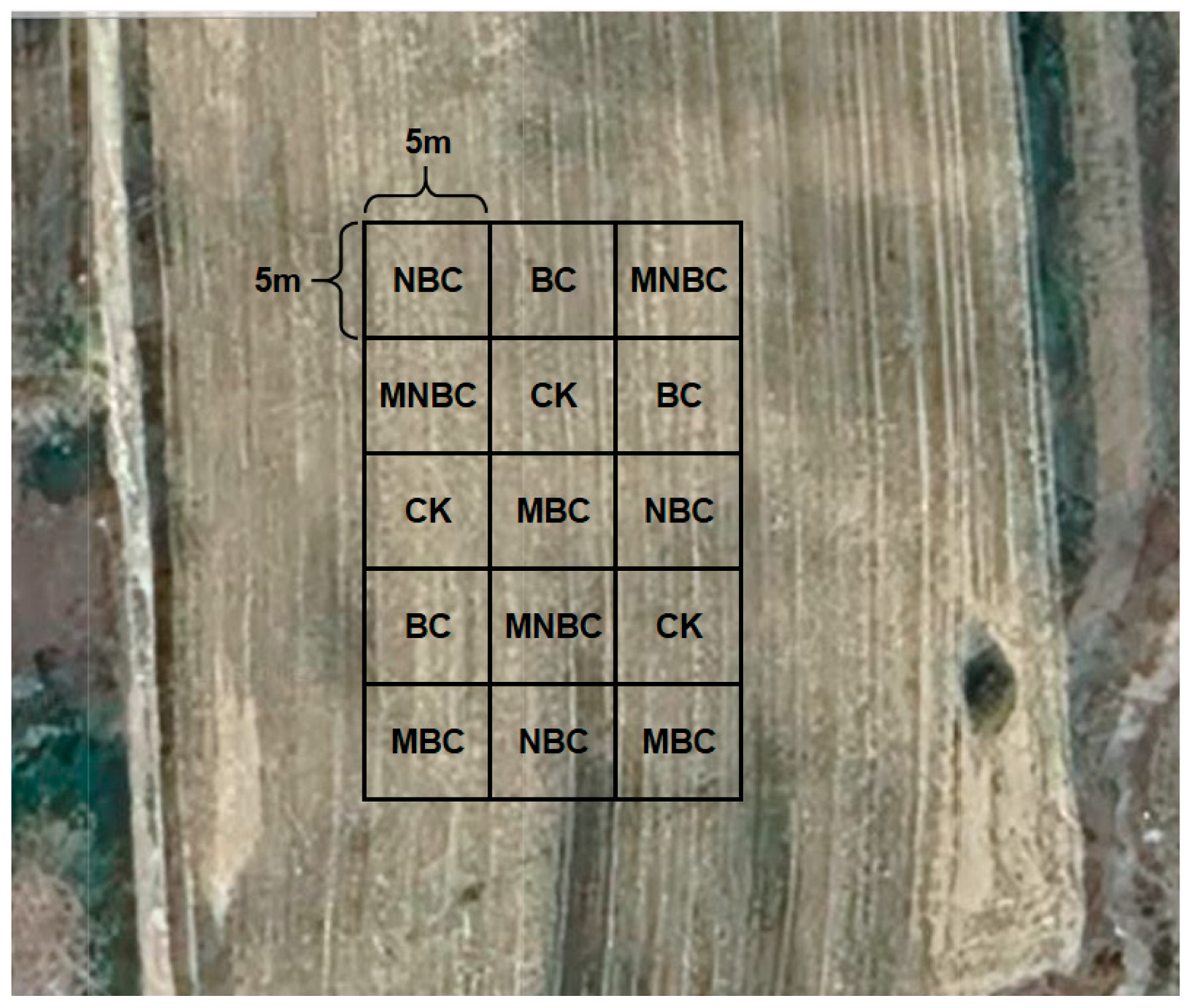
The experiment comprised five treatments (Figure 1): (1) control without biochar (CK); (2) sheep manure biochar alone (BC); (3) nutrient-laden biochar alone (NBC); (4) biochar combined with microbial inoculant (MBC); and (5) nutrient-laden biochar combined with microbial inoculant (MNBC). A randomized complete block design with three replications was employed. Each plot measured 5 m × 5 m (25 m2). The biochar, produced from sheep manure, was obtained from Henan Xingnuo Biochar Co., Ltd., Zhengzhou, China. It was applied at a uniform rate of 10 t·ha−1 for all biochar treatments. The microbial inoculant was Paenibacillus mucilaginosus strain PM12 (viable count: 2 × 10⁸ CFU·mL−1), a plant growth-promoting rhizobacterium confirmed to solubilize phosphate and potassium, applied at 75 L·ha−1. A compound fertilizer (N-P2O5-K2O, 20-18-5) was applied as a base fertilizer at 600 kg·ha−1 to all plots. Nutrient-laden biochar (NBC) was prepared by immersing the raw sheep manure biochar in livestock wastewater collected from an oxidation pond of a commercial farm. After 72 h of immersion, the biochar was retrieved, air-dried, and sieved through a 100-mesh screen. The maize cultivar ‘Xindan 58’ was sown mechanically on 27 June 2024, with a row spacing of 55 cm, plant spacing of 35 cm, and sowing depth of 5 cm. The maize was harvested on 27 September 2024. The planting density of maize was 51,948 plants per hectare, with 55 cm row spacing and 35 cm plant spacing.
Maize growth and soil samples were collected at key developmental stages: the bell stage (21 July 2024), the milk stage (4 August 2024), and maturity (27 September 2024). At each stage, three representative plants with uniform growth were randomly selected from each plot. Plant height was measured in the field. Aboveground biomass (shoot) and belowground biomass (roots) were separated, oven-dried at 105 °C for 30 min followed by 75 °C to constant weight, and weighed. At maturity, theoretical grain yield was estimated from all harvested plants per plot based on kernel number per ear and 1000-kernel weight. Rhizosphere soil samples were collected from each plot using a five-point sampling method at the bell stage for the analysis of microbial community structure, and again at the milk and maturity stages for analysis of soil physicochemical properties. Soil samples for microbial DNA analysis were immediately placed on dry ice, transported to the laboratory, and stored at −80 °C until processing.

2.2. Measurement of Plant and Soil Samples

Maize growth parameters, including plant height, aboveground biomass, and belowground (root) biomass, were measured at the bell, milk, and maturity stages. Plant height was measured in the field using a standard measuring tape. For biomass determination, the harvested shoot and root samples from three representative plants per plot were separately placed in paper bags. They were first oven-dried at 105 °C for 30 min to deactivate enzymes, and then dried at 75 °C to a constant weight. The dry weights of shoots and roots were subsequently measured using a precision electronic balance.
Soil physicochemical properties were analyzed using standard methods [33]. Soil pH and electrical conductivity (EC) were measured in a 1:2.5 (w/v) soil-to-deionized water suspension after 30 min of equilibration, using a pH meter (pH S-3E, INESA, Shanghai, China) and a conductivity meter (DDS-307A, INESA, China), respectively. The soil water–soluble salt (SSC) content was determined gravimetrically. Briefly, a soil extract was obtained at a 1:5 soil-to-water ratio via filtration, and an aliquot was evaporated to dryness in a pre-weighed dish at 105 °C. The SSC content was calculated from the mass of the residue. Soil organic matter (SOM) content was determined by the potassium dichromate oxidation method with external heating. Total nitrogen (TN) was measured using the semi-micro Kjeldahl digestion and distillation method. Available phosphorus (AP) was extracted with 0.5 M NaHCO3 (pH 8.5) and quantified by the molybdenum blue method using a UV–Vis spectrophotometer (UV-1800, Shimadzu, Kyoto, Japan) at a wavelength of 700 nm. Available potassium (AK) was extracted with 1 M neutral ammonium acetate and its concentration was determined using a flame photometer (FP6410, INESA, China).

2.3. Metagenomic Sequencing and Analysis

Metagenomic sequencing was conducted by Majorbio Bio-Pharm Technology Co., Ltd. (Shanghai, China). Total DNA was extracted from rhizosphere soil using a soil-optimized kit with bead-beating and inhibitor removal (FastPure Soil/Soil-like DNA Isolation Kit; MJYH, Shanghai, China). DNA concentration was quantified with a Qubit 3.0 fluorometer (Thermo Fisher Scientific, Waltham, MA, USA), and purity/integrity were assessed by spectrophotometry (A260/280, A260/230) and agarose gel electrophoresis. Libraries with an insert size of ~350 bp were prepared using the NEXTFLEX Rapid DNA-Seq Kit (Bioo Scientific, Austin, TX, USA), quality-checked on an Agilent 2100 Bioanalyzer (Agilent Technologies, Santa Clara, CA, USA), and sequenced on an Illumina NovaSeqTM X Plus platform (PE150) (Illumina, Inc., San Diego, CA, USA), generating ~10 Gb data per sample. Raw reads were processed using fastp (v0.20.0) [34] to remove adapters and low-quality reads (reads < 50 bp, mean quality < Q20, and reads containing ambiguous bases). Host-derived reads were removed by mapping to the host/plant reference genome (including organelle sequences when available). Clean reads were de novo assembled using MEGAHIT (v1.2.8) [35], and contigs ≥ 500 bp were retained. ORFs were predicted with Prodigal (v2.6.3; -p meta), and proteins with ≥ 100 amino acids were retained. A non-redundant gene catalog was constructed using CD-HIT (v4.8.1) [36]. Gene abundance was estimated by mapping clean reads to the gene catalog with a short-read aligner (e.g., Bowtie2) and normalized as RPKM. Taxonomic and functional annotations were assigned by aligning representative protein sequences against the NCBI NR, KEGG, and COG databases using DIAMOND (v2.1.23) [37], retaining the best hit by bitscore. CAZyme annotation was performed using dbCAN 3 (HMM- and/or DIAMOND-based searches) with recommended e-value and coverage thresholds. Annotation results were summarized at the gene and pathway levels for downstream analyses.

2.4. Statistical Analysis

All data were processed and analyzed using SPSS Statistics (version 26, IBM Corp., USA). For maize growth, yield, and soil physicochemical properties, one-way analysis of variance (ANOVA) was applied to determine significant differences among treatments. Differences between individual means were compared using Duncan’s multiple range test. Graphical presentations were generated using OriginPro 2024 (OriginLab Corporation, Northampton, MA, USA). For microbial community analysis, alpha diversity indices, including community richness (Chao1), diversity (Shannon), and evenness (Simpson), were calculated based on the obtained sequencing data. Beta diversity was assessed using principal coordinate analysis (PCoA) based on Bray–Curtis distances. The significance of differences in overall microbial community structure among treatments was tested using permutational multivariate analysis of variance (PERMANOVA) and analysis of similarities (ANOSIM).

3. Results

3.1. Nutrient-Laden Biochar Combined with P. mucilaginosus 12 Promotes Maize Growth and Improves Soil Physicochemical Properties

3.1.1. Maize Growth and Yield

Biochar-based amendments significantly influenced maize growth across all developmental stages (Table 1). Compared to CK, all biochar-amended treatments significantly increased plant height, aboveground biomass, and belowground biomass. The MNBC treatment showed the most pronounced effects, achieving the highest values in plant height (268.65 cm), aboveground biomass (509.53 g), and belowground biomass (33.07 g). The performance ranking across stages consistently followed the order MNBC > MBC ≈ NBC > BC > CK, indicating progressive enhancement from biochar alone to the combined application of biochar with nutrients and microbes.
Maize yield was significantly affected by the biochar treatments. Compared to CK (7141.89 kg·ha−1), the maize yield in BC, NBC, and MBC increased by 15.3%, 23.0%, and 31.5%, respectively. The MNBC treatment achieved the highest yield of 10,889.10 kg·ha−1, representing a 52.5% increase over CK, and a significant advantage over all other treatments. In addition, pairwise comparisons elucidated the individual and interactive contributions of nutrient loading and microbial inoculation. The addition of nutrients (NBC vs. BC) increased yield by 6.7%. This nutrient effect was amplified in the presence of the microbial inoculant, with MNBC surpassing MBC by 16.0%. Similarly, microbial inoculation alone (MBC vs. BC) enhanced yield by 14.0%, and this effect was strengthened to 23.9% when combined with nutrient-loaded biochar (MNBC vs. NBC). These results demonstrate that the efficacy of either nutrient loading or microbial inoculation is enhanced when applied in conjunction with the other.

3.1.2. Soil Physicochemical Properties

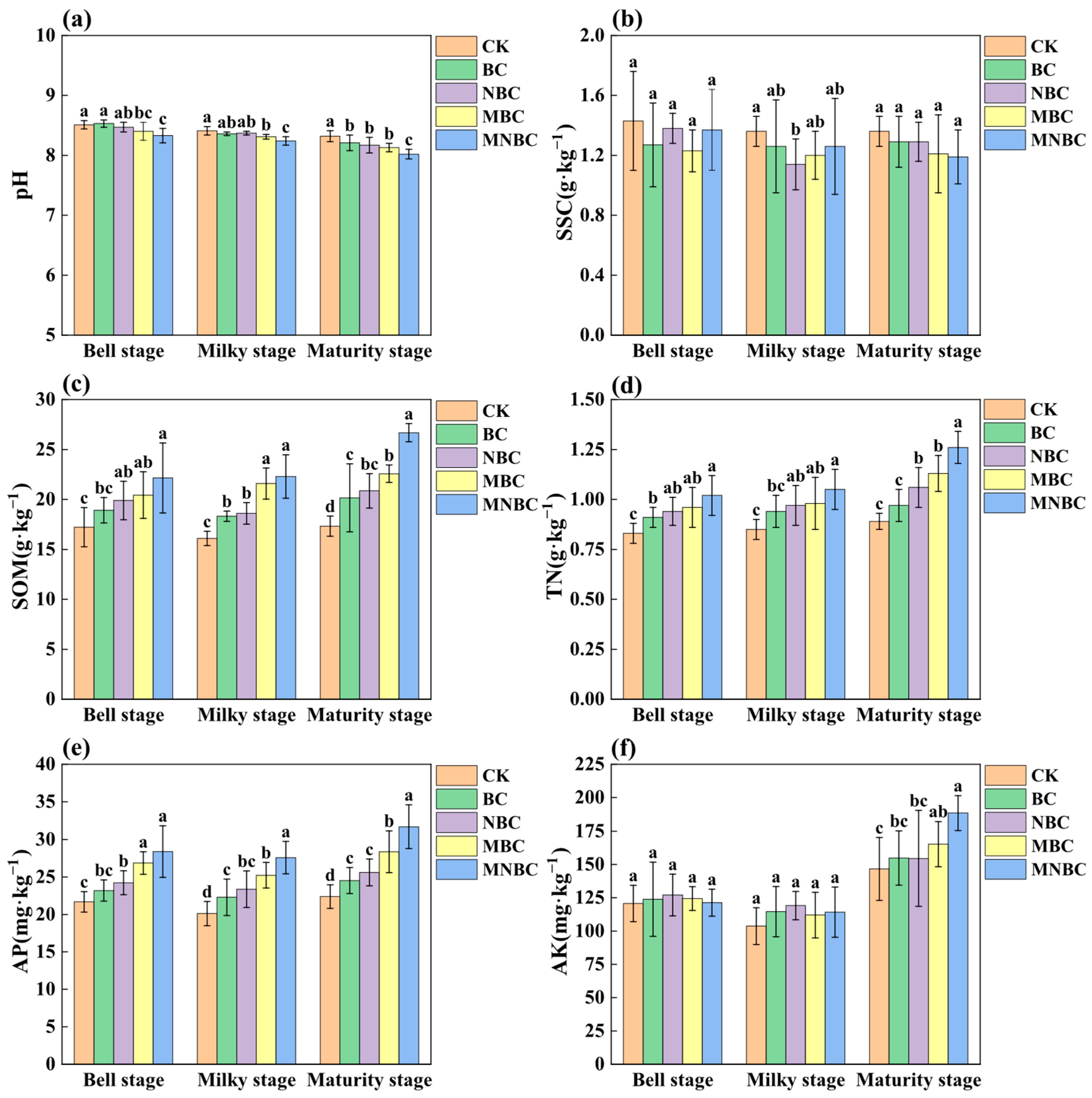
The application of different biochar treatments significantly altered the physicochemical properties of the coastal mildly saline–alkali soil (p < 0.05) (Figure 2). Regarding soil nutrient enhancement, the NBC and MBC treatments functioned through distinct pathways, while the MNBC treatment achieved a synergistic effect by integrating both. Specifically, the NBC treatment enhanced soil nutrient availability, which can be attributed to the direct supply of nutrients adsorbed from the livestock slurry. At the bell stage, the AP content in NBC was 24.23 mg·kg−1, significantly higher than that in BC (23.19 mg·kg−1). At maturity, its TN content was 1.06 g·kg−1, also significantly greater than that in BC (0.97 g·kg−1). In contrast, the MBC treatment likely promoted nutrient transformation via microbial activation. Its AP content was significantly higher than that of CK at all growth stages. For instance, at maturity, the AP content in MBC reached 28.37 mg·kg−1, which was 1.27 times that of CK (22.38 mg·kg−1). More importantly, the MNBC treatment exhibited the highest soil nutrient indices across all growth stages. At maturity, the SOM, TN, AP and AK contents in MNBC were 26.68 g·kg−1, 1.26 g·kg−1, 31.70 mg·kg−1, and 188.43 mg·kg−1, respectively, all significantly surpassing those in other treatments. Notably, the AK content enhancement effect was not observed in either the NBC or MBC treatment alone.
The different biochar treatments also had a significant effect on decreasing the soil alkalinity. As a physicochemical approach, the alkaline-reducing effect of the NBC treatment became significant only in the later growth stages. Its soil pH at maturity was 8.17, representing a reduction of 0.15 units compared to the CK treatment (8.32). In contrast, the MBC treatment showed a notable pH reduction (pH 8.31) as early as the milk stage. Moreover, the MNBC treatment showed the strongest and most stable alkaline-reduction capacity throughout the observation period, achieving the lowest soil pH at each stage. For example, its soil pH at maturity was 8.02, a reduction of 0.30 units compared to CK. In addition, The SSC content in the biochar treatments exhibited a declining trend, but did not reach statistical significance. Therefore, the MNBC treatment generated a synergistic effect, leading to concurrent and significant improvements in both the soil nutrient pool and the reduction in soil alkalinity.

3.2. Nutrient-Laden Biochar Combined with P. mucilaginosus 12 Reshapes the Diversity and Composition of the Rhizosphere Microbiome

3.2.1. Effects of Different Biochar Amendments on Microbial Alpha Diversity

The application of different biochar treatments significantly affected the alpha diversity of the rhizosphere soil microbial communities (Table 2). For the bacterial community, the biochar treatments had a limit impact on species richness (Chao1). However, the biochar treatments exerted a pronounced effect on bacterial community diversity and evenness. Specifically, the MBC treatment showed the highest Shannon index (5.18) and the lowest Simpson index (0.0182), indicating the introduction of the microbial inoculant, rather than nutrient addition alone, was the primary driver for forming a more diverse and evenly structured bacterial community.
For the fungal community, the BC, NBC, and MNBC treatments all showed significantly higher Chao1 indices than CK. More importantly, the nutrient-loading treatments, including NBC and MNBC, significantly enhanced fungal community diversity and evenness, since they had higher Shannon indices (4.55 and 4.60, respectively) and lower Simpson indices (0.0191 and 0.0168, respectively). This demonstrates that nutrient availability is a key factor regulating fungal community structure.

3.2.2. Effects of Different Biochar Amendments on Microbial Beta Diversity

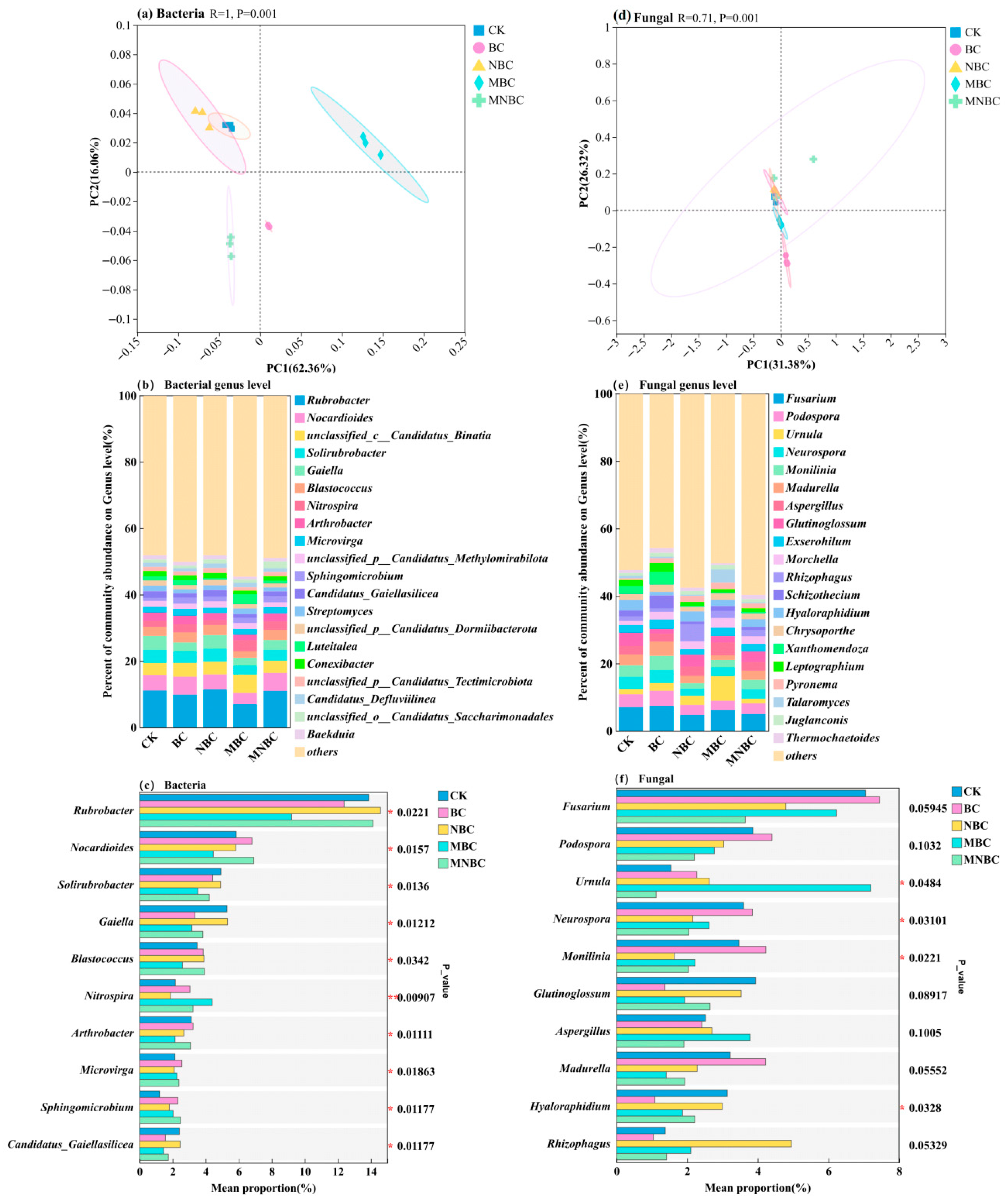
Principal coordinate analysis (PCoA) revealed a clear separation in bacterial community composition among different biochar treatments (Figure 3a). The first two principal coordinates (PC1 and PC2) explained 78.42% of the total variance. Along PC1, a distinct separation was observed between BC and MBC. Furthermore, the MBC and MNBC treatments were further differentiated along PC2, suggesting that the introduction of the microbial inoculant induced a unique shift in bacterial community assembly. This observed separation was statistically supported by ANOSIM analysis, which confirmed significant differences between treatments (p < 0.05). Similarly, the fungal community structure was also significantly restructured by the biochar amendments (Figure 3b). The PCoA ordination explained 57.61% of the total variance. The ANOSIM result confirmed that the differences among treatments were statistically significant (p < 0.05).

3.2.3. Effects of Different Biochar Amendments on Microbial Community Composition

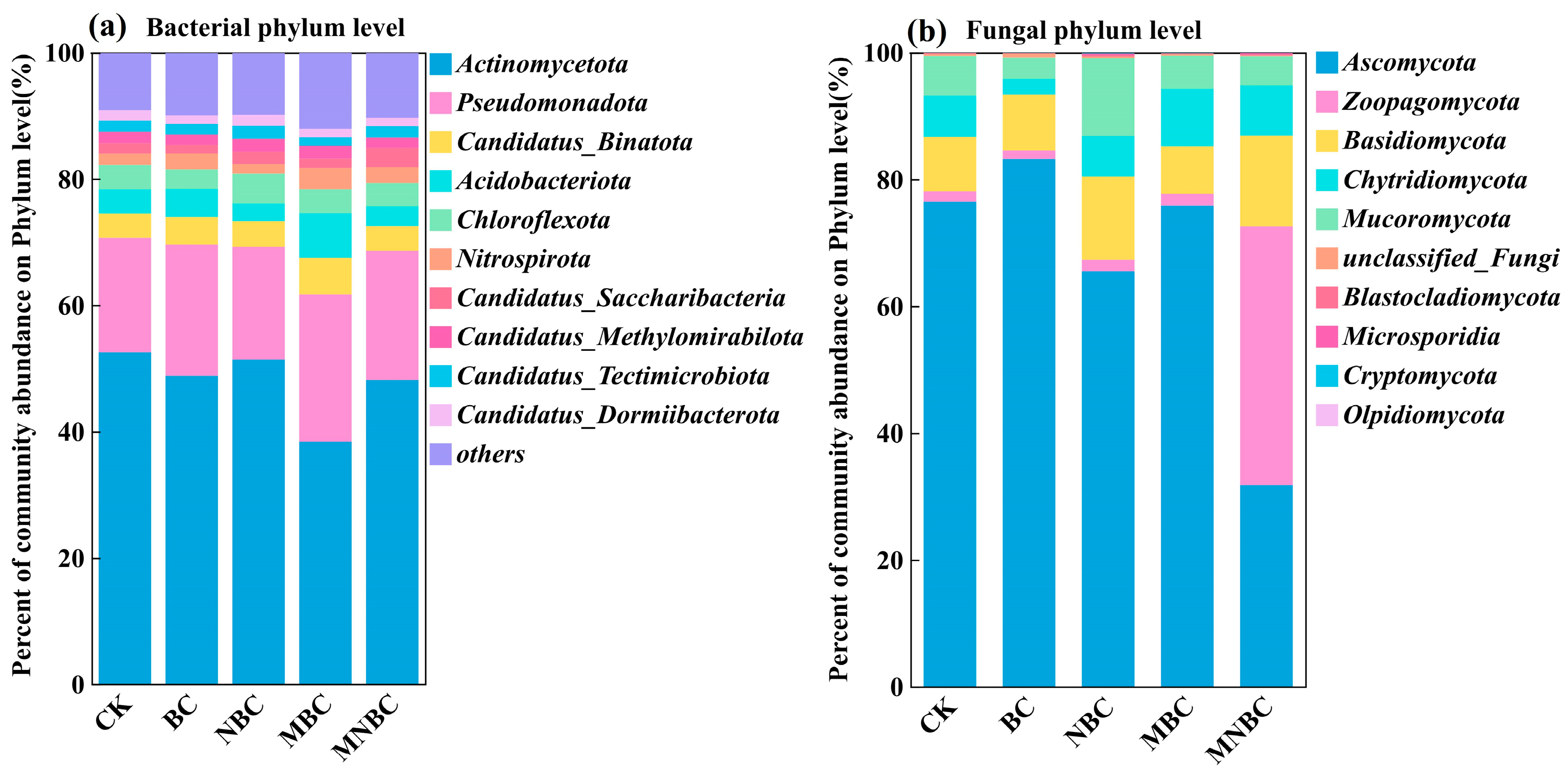
The application of different treatments had a significant effect on the bacteria structure. At the phylum level, Actinomycetota and Pseudomonadota constituted the dominant core in all treatments, collectively accounting for nearly 68% of the total community (Figure A1). Compared to CK (52.54%), the relative abundance of Actinomycetota decreased in all biochar-amended treatments, ranging from 38.39% to 51.39%. Notably, the MBC treatment exhibited a high proportion of Acidobacteriota, which was significantly greater than in other treatments. Furthermore, a specific enrichment of Candidatus Saccharibacteria was observed in the MNBC treatment, reaching 3.01%. At the genus level, Rubrobacter was identified as the dominant genus in all treatments, ranging from 6.99% to 11.41% (Figure 3c). Compared to CK, the MBC treatment significantly reduced the abundance of two common dominant genera, Rubrobacter and Nocardioides. Furthermore, the MNBC treatment specifically enriched the abundance of genera linked to carbon metabolism, namely Sphingomicrobium (1.93%) and an unclassified genus within Candidatus Saccharimonadales (2.03%).
The biochar amendments significantly altered the structure of the fungal community. At the phylum level, Ascomycota was the dominant phylum in all treatments (Figure A1). Its relative abundance was 76.47% in CK, while it markedly decreased to 65.47% and 70.18% in the NBC and MNBC treatments, respectively. The relative abundance of Basidiomycota, a phylum key to complex carbon decomposition, increased to 17.11% in the MNBC treatment, nearly double that in the CK treatment (8.55%). At the genus level, Fusarium was a dominant taxon, with its relative abundance ranging from 4.73% to 7.49% in all treatments (Figure 3d). Compared to CK (7.07%), its abundance was significantly lower in the NBC (4.73%) and MNBC (5.01%) treatments. In contrast, the MBC treatment specifically enriched other genera, notably Urnula (7.33%) and Talaromyces (3.88%). Additionally, the relative abundance of Rhizophagus reached 5.11%, which was significantly higher than that in the other treatments.

3.2.4. Analysis of Bacterial Genera in Different Biochar Treatments

Figure 3e presents the top ten key bacterial genera in different biochar treatments. In the MBC treatment, the relative abundances of several dominant genera, including Rubrobacter, Nocardioides, Solirubrobacter, and Gaiella, were the lowest among all treatments. Conversely, this treatment significantly enriched Nitrospira, increasing its relative abundance to 4.40%, which was more than double that in the CK treatment (2.17%). This pattern indicates that microbial inoculation induced a pronounced shift in bacterial community composition. For the NBC and MNBC treatments, a different pattern was observed, characterized by the selective enrichment of specific functional taxa. Notably, the MNBC treatment exhibited the highest relative abundances of Rubrobacter (14.12%) and Nocardioides (6.91%) among all treatments, while also maintaining a substantial level of Nitrospira (3.23%).
The effects of different biochar amendments on key fungal taxa are shown in Figure 3f. Both the NBC and MNBC treatments significantly reduced the relative abundance of several potential plant-pathogenic fungi. Specifically, the MNBC treatment exhibited the lowest relative abundances of Fusarium, Neurospora, Monilinia, and Madurella. For instance, its relative abundance of Fusarium was 3.64%, significantly lower than in CK (7.05%). Beyond pathogen suppression, the NBC treatment significantly promoted the colonization of beneficial functional fungi. The relative abundance of Rhizophagus reached 4.95%, significantly higher than in all other treatments. The MBC treatment was primarily characterized by the enrichment of specific functional groups. For example, the saprotroph Urnula and the genus Aspergillus attained their highest relative abundances in this treatment at 7.20% and 3.78%, respectively. Therefore, nutrient-laden biochar and its combination with microbial inoculants reshaped the rhizosphere fungal community structure mainly through pathogen suppression and beneficial taxon enrichment.

3.3. Effects of Different Biochar Amendments on Microbial Community Metabolic Function

3.3.1. Nitrogen Metabolism

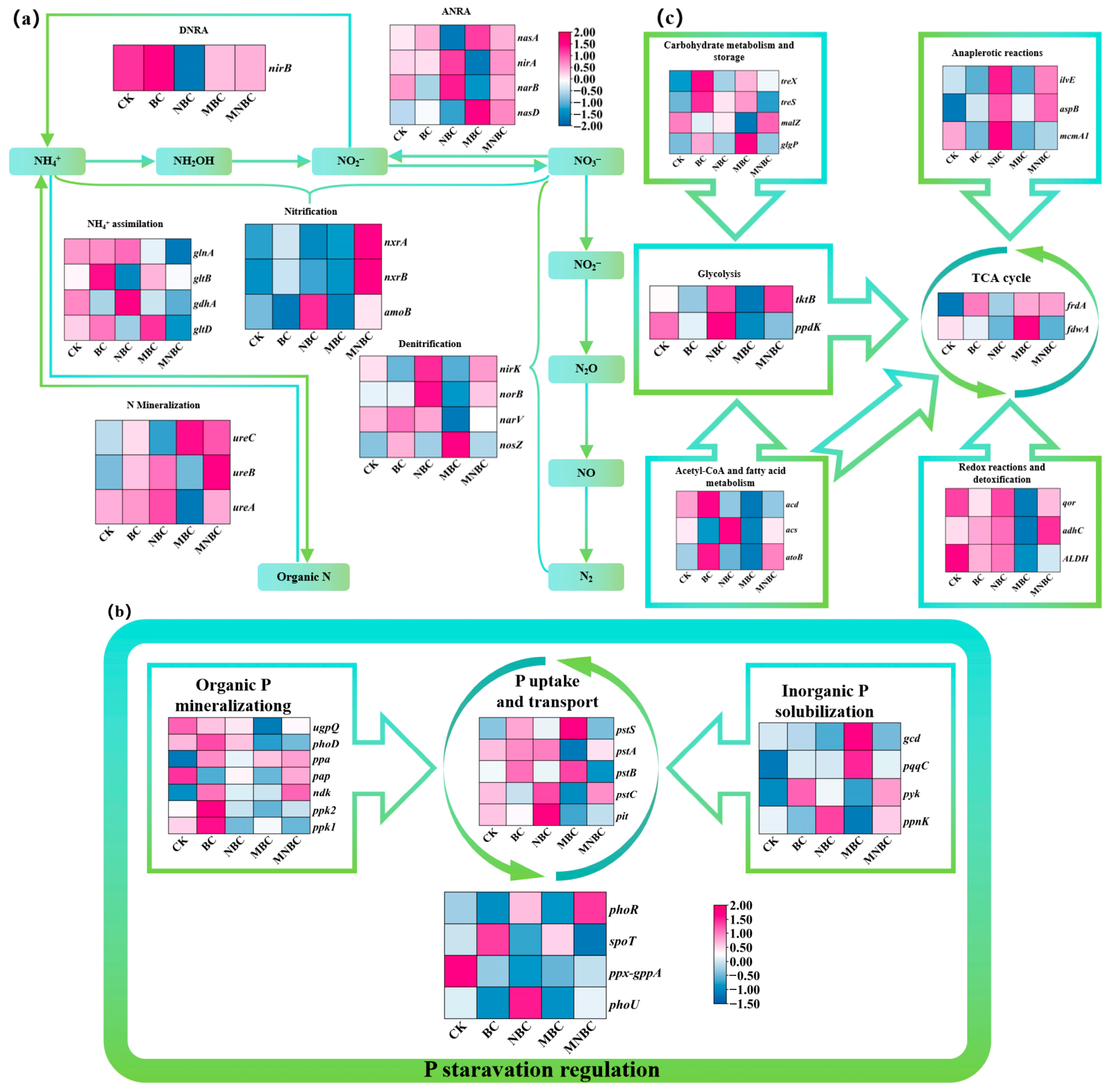
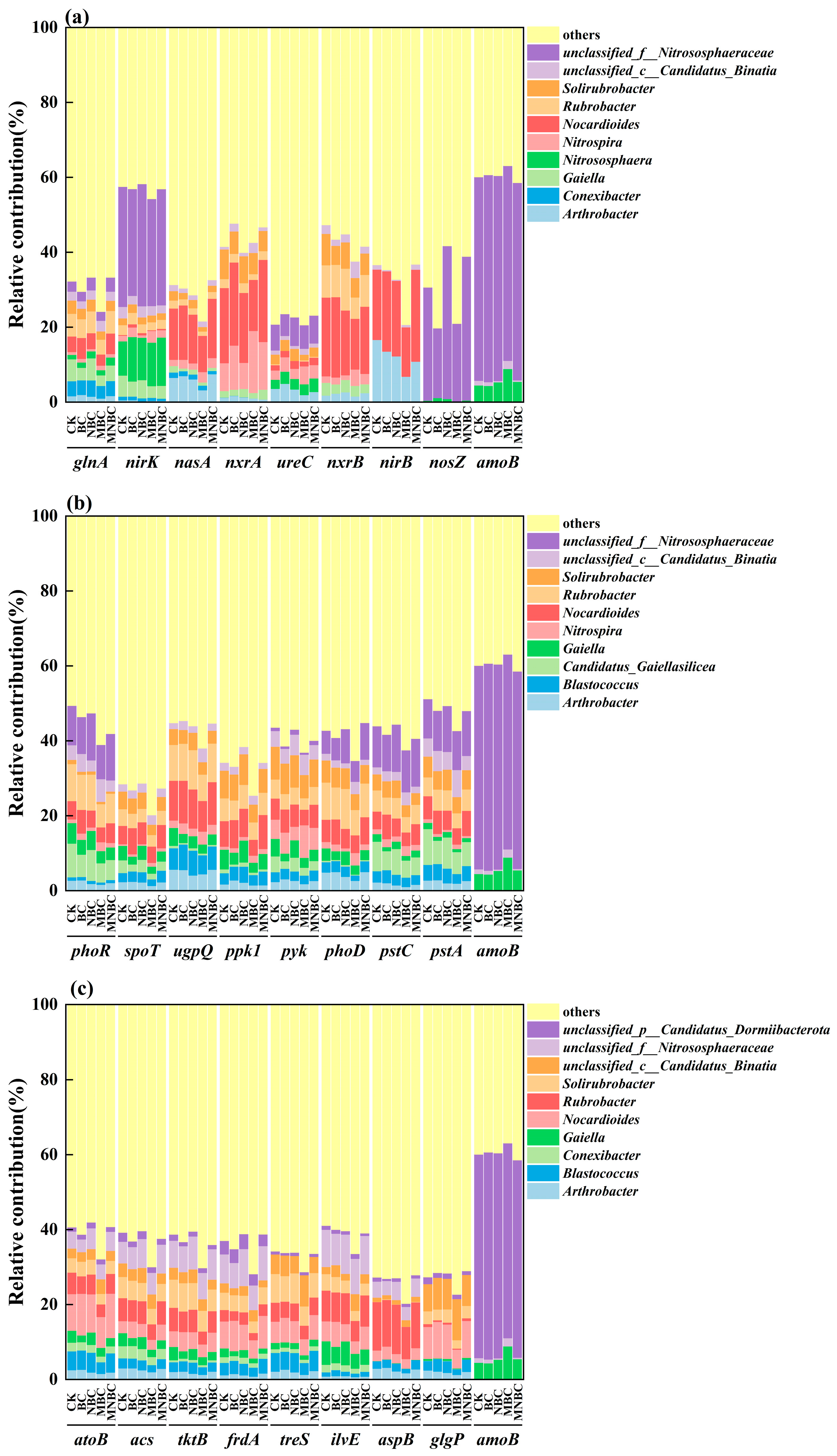
Figure 4a illustrates the key genes involved in the soil nitrogen cycle across all treatments. Analysis of these genes revealed that microbial assimilation and denitrification were the dominant processes. The NBC treatment significantly enhanced the potential for several key processes. It yielded the highest relative abundances of the assimilation gene glnA (27.48%) and the ammonia oxidation gene amoB. Moreover, the abundance of the denitrification initiation gene nirK also peaked in this treatment (18.04%). In contrast, the MBC treatment exhibited a contrasting regulatory pattern aimed at nitrogen retention and loss mitigation. It resulted in the lowest abundance of nirK (13.78%) but the highest abundance of the N2O-reducing gene nosZ (1.19%). Concurrently, this treatment also showed the highest abundance of the assimilatory nitrate-reduction gene nasA (6.86%). The MNBC treatment led to a general increase in the abundance of genes associated with both nitrification and denitrification, indicating an integrated enhancement of multiple nitrogen transformation pathways under the combined effects of nutrients and microbes.

3.3.2. Phosphorus Metabolism

In this study, organic phosphorus mineralization was the predominant microbial pathway for soil available phosphorus acquisition (Figure 4b), with its related genes exhibiting the highest total relative abundance, ranging from 22.81% to 24.77%. The total gene abundance for inorganic phosphorus solubilization was comparatively lower, at 14.00% to 15.88%. Notably, microbial inoculation significantly enhanced the inorganic phosphorus solubilization potential. In the MBC treatment, the relative abundances of key solubilization genes, gcd and pqqC, reached their peaks at 5.45% and 2.19%, respectively. Meanwhile, within the same MBC treatment, the relative abundances of two key genes for organic phosphorus mineralization, ugpQ and phoD, showed a declining trend. Concerning phosphorus starvation regulation, the total abundance of related genes was elevated in both the NBC and MNBC treatments compared to CK, with the MNBC treatment attaining the highest value of 26.71%. Most critically, the relative abundance of phoR, which encodes the core regulatory sensor, was highest in the MNBC treatment at 11.82%, significantly exceeding all other treatments. These results indicate that the combination of nutrient loading and microbial inoculation triggers a pronounced phosphorus starvation response.

3.3.3. Carbon Metabolism

The soil microbial carbon metabolism network is fundamental and multi-pathway (Figure 4c). Consistent with this characteristic, the relative abundances of most carbon metabolism-related functional genes were generally low across all treatments, typically ranging from 1% to 4%. Nevertheless, distinct functional patterns emerged among the biochar amendments. The MBC treatment showed an inhibitory effect on several specific pathways. In this treatment, the abundances of genes involved in C1 compound oxidation, acetate metabolism, and simple organic matter hydrolysis were often the lowest. For instance, the ALDH gene abundance in MBC (1.27%) was significantly lower than in the CK treatment (1.56%). In contrast, the nutrient-loading treatments (NBC and MNBC) exhibited a slight promotional effect on biosynthetic metabolism. Notably, the abundance of tktB, a key gene in the pentose phosphate pathway, was highest in MNBC (2.23%). This indicates that nutrient addition may provide a better resource base, thereby slightly enhancing the microbial capacity to generate biosynthetic precursors.

3.4. Contributions of Bacterial Genera to N, P, and C Metabolic Genes

Different biochar treatments reshaped the functional network of the nitrogen cycle by modulating the functional profiles of these key microbial taxa (Figure 5a). In this study, nitrogen assimilation was mediated by a consortium of bacterial groups, with Rubrobacter, Nocardioides, Gaiella, and Conexibacter serving as the primary contributors to the glnA gene encoding glutamine synthetase. The genus Nocardioides functioned as a critical hub in the nitrogen cycle, not only contributing significantly to the nxrA and nxrB genes encoding nitrite oxidase (up to 22.2%), but also acting as a core taxon for the nitrate assimilatory reductase (nasA) and nitrite reductase (nirB) genes. Compared to CK, the BC treatment exerted a relatively mild overall influence, whereas the NBC treatment strongly activated the denitrification pathway driven by unclassified_f__Nitrososphaeraceae. Moreover, the MBC treatment exhibited a nitrification-enhancement pattern centered on Nitrospira, whose contribution to the nxrA gene increased to 16.5%. Crucially, the MNBC treatment maintained a high level of nitrogen assimilation (glnA) and nitrification capacity while preserving a substantial contribution (38.4%) of unclassified_f__Nitrososphaeraceae to the nosZ gene. This indicates that the co-application of nutrient-laden biochar and microbial inoculant not only optimized nitrogen transformation efficiency but also maximized the microbial potential to reduce the potent greenhouse gas N2O to N2.
Different biochar treatments significantly altered the taxonomic composition of microbial communities responsible for soil phosphorus transformation (Figure 5b). The core processes of the phosphorus cycle were governed by specific microbial taxa. The high-affinity phosphate-specific transport system, encoded by the pstA and pstC genes, was primarily contributed by unclassified_f__Nitrososphaeraceae, which dominated the contributions to both pstA (10.4–12.3%) and pstC (9.7–12.6%) across all treatments. In addition, the alkaline phosphatase gene phoD, a key marker for organic phosphorus mineralization, was mainly driven by the actinobacterium Rubrobacter (6.8–10.7%). The NBC treatment selectively enhanced the phosphorus acquisition function associated with unclassified_f__Nitrososphaeraceae. In contrast, the MBC treatment significantly suppressed the phosphorus-related functional contributions of most indigenous actinobacteria. Critically, the MNBC treatment not only maintained the high phosphorus-sensing and acquisition capacity linked to unclassified_f__Nitrososphaeraceae (e.g., 9.8% for phoD and 12.8% for pstC), but also preserved the robust organic phosphorus mineralization function of Rubrobacter (9.0% for phoD) and the phosphorus storage potential of Nocardioides (9.1% for ppk1).
Different biochar treatments significantly altered the taxonomic contribution patterns of key functional genes involved in soil carbon transformation (Figure 5c). The NBC treatment selectively enhanced the functional contribution of unclassified_f__Nitrososphaeraceae in acetate assimilation (acs) and anaerobic respiration (frdA), with its relative abundances reaching 7.7% and 9.9%, respectively. In contrast, the MBC treatment generally suppressed the contribution of most indigenous actinobacteria, such as Nocardioides and Rubrobacter. Notably, the MNBC treatment integrated these functional advantages. It maintained the high contribution of unclassified_f__Nitrososphaeraceae to acs, frdA, and tktB genes while simultaneously preserving the core functions of Nocardioides in atoB and glgP genes. This integration facilitated the establishment of a more complete and efficient microbial network for carbon metabolism.

3.5. Interactions Linking Soil Properties, Microbiome, and Maize Growth Performance

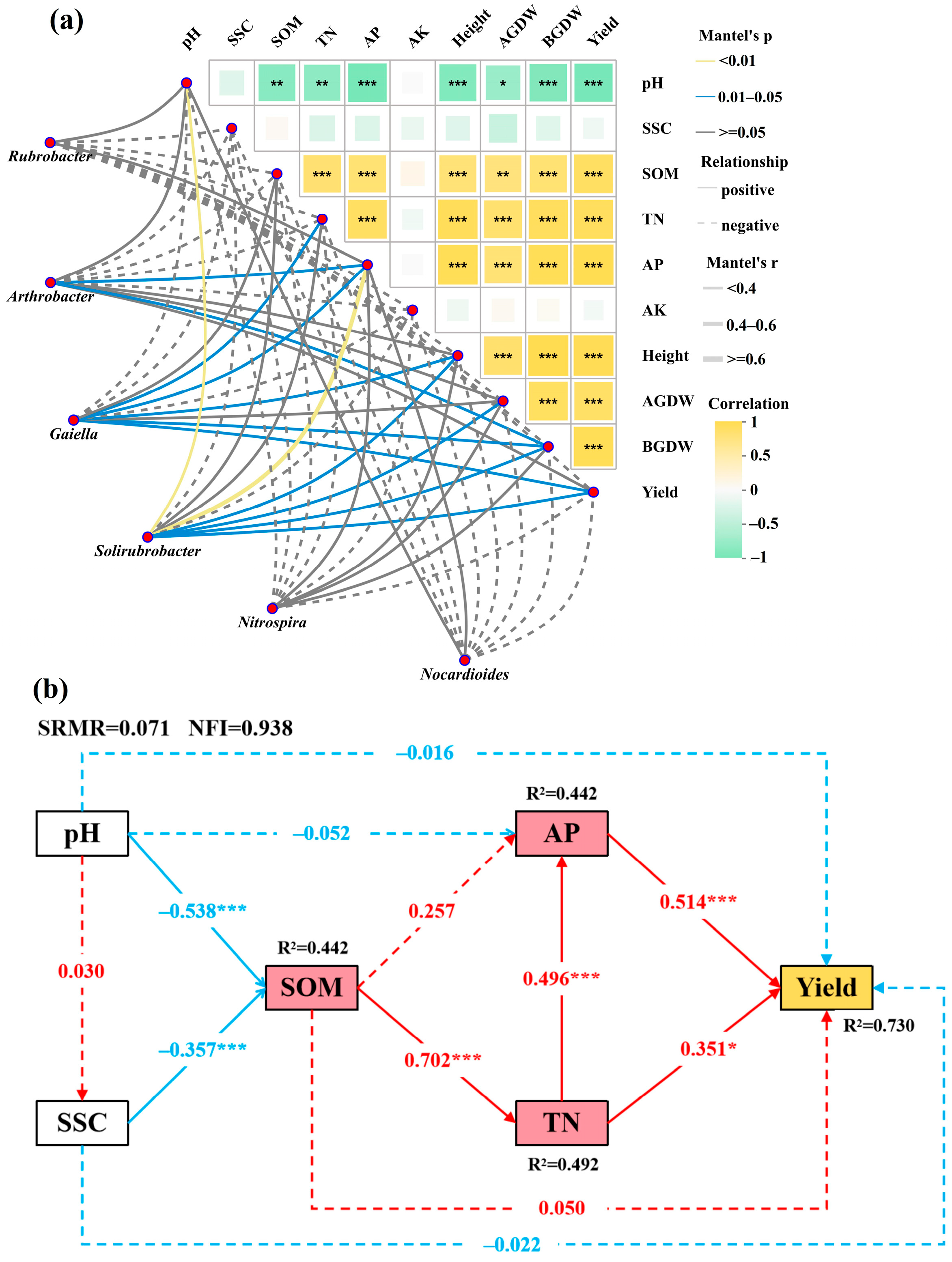
Figure 6a presents a correlation heatmap combined with Mantel test network analysis, elucidating the relationships among soil physicochemical properties, plant growth indicators, and key microbial taxa. The results showed a significant negative correlation between rhizosphere soil pH and maize growth parameters (height, AGDW, and BGDW) and yield (p < 0.01), suggesting that the decreased soil pH following biochar application may help alleviate saline–alkaline stress, thereby promoting maize growth. Furthermore, soil nutrients including SOM, TN, and AP showed significant positive correlations with all maize growth parameters (p < 0.01), indicating that the combined application of nutrient-loaded biochar and microbial inoculants enhanced soil nutrient availability, directly supporting plant growth and yield improvement.
The Mantel test network further illustrates potential microbial mechanisms underlying these relationships. Several key bacterial genera, including Arthrobacter, Solirubrobacter, and Gaiella, exhibited significant positive associations with soil TN and AP, as well as with plant height and AGDW. Notably, Solirubrobacter demonstrated strong correlations with both SOM (r = 0.702, p < 0.001) and TN (r = 0.514, p < 0.01), implying a potential functional role in soil organic nitrogen transformation and stabilization.
A structural equation model (SEM) was developed to elucidate the mechanistic pathways through which soil physicochemical properties affect maize yield. The model exhibited acceptable fit (SRMR = 0.071, NFI = 0.938), indicating a reasonable representation of structural relationships among variables (Figure 6b). The model explained 73.0% of the total variance in maize yield. Path analysis revealed that both soil pH and SSC exerted significant negative direct effects on SOM content, with standardized path coefficients of −0.538 and −0.357, respectively (p < 0.001). Conversely, SOM showed a strong positive direct effect on TN (path coefficient = 0.702, p < 0.001), highlighting the pivotal role of organic matter in sustaining the soil nitrogen pool. Regarding direct effects on maize yield, both AP and TN had significant positive influences, with AP being particularly strong (path coefficient = 0.514, p < 0.001) and TN also statistically significant (path coefficient = 0.351, p < 0.05). In contrast, the direct effects of pH and SSC on yield were non-significant (path coefficients = 0.016 and 0.022, respectively), indicating that saline–alkaline stress suppresses maize productivity primarily through indirect pathways.
The indirect inhibitory effects of soil pH and SSC on maize yield were mainly reflected in two sequential links: first, elevated soil alkalinity and salinity reduced the stability and accumulation of soil organic matter by inhibiting the activity of soil microbial decomposers and reducing the input of plant litter; second, the decline in SOM content limited the mineralization and retention of soil nitrogen and phosphorus, leading to the reduction in TN and AP contents, which ultimately constrained maize growth and yield formation. This indicates that saline–alkaline stress indirectly affects crop productivity by disrupting the soil nutrient cycling process rather than directly acting on plant growth and development.

4. Discussion

4.1. Yield Enhancement Through Saline–Alkaline Stress Amelioration and Nutrient Enhancement

All biochar treatments in this study ameliorated saline–alkaline soil conditions and enhanced maize growth, although significant differences were observed among the treatments. The BC treatment exhibited slight improvements in soil physicochemical properties. By using biochar to adsorb nutrients from wastewater, the NBC treatment can supply a certain amount of nitrogen [38]; however, its effect on enhancing phosphorus and potassium availability was limited, because non-modified biochar itself has a low phosphate adsorption capacity [39]. Conversely, the MBC treatment possessed the biological potential for dissolving phosphorus and releasing potassium nutrient solubilization since Paenibacillus mucilaginosus strains have been recognized as typically representative of phosphate-solubilizing and potassium-releasing bacteria [40]. However, the inoculated microbial inoculants often struggle to establish in the rhizosphere due to intense competition with indigenous microbiota and nutrient limitations [41].
Importantly, the MNBC treatment, which integrated a physical carrier, a chemical nutrient source, and biological activation, demonstrated the most pronounced effect on maize growth and yield in mild coastal saline–alkali land. This is consistent with the finding that the combination of Bacillus mucilaginosus and wood vinegar-acidified, diatomite-modified biochar can decrease soil pH, exchangeable Na+, and EC, whereas it can elevate the cation exchange capacity and nutrient availability [42]. This can be attributed to its integrated capacity for concurrent amelioration of multiple soil constraints. The MNBC treatment established the most favorable rhizosphere microenvironment by simultaneously and significantly reducing soil pH while increasing the contents of soil nutrients. It has been reported that when the saturated biochar was used as a soil conditioner, the cation exchange capacity of the soil increased from 8.4 cmol·kg−1 to 13.6 cmol·kg−1 [43]. Moreover, the nutrients adsorbed in it constitute a direct resource reservoir [44], and the inoculated functional bacterium, Paenibacillus mucilaginosus PM12, continuously mobilizes soil-bound phosphorus and potassium via metabolite secretion while concomitantly assisting in pH regulation [45]. The interplay of these three components facilitates the mitigation of site-specific soil constraints and nutrient limitations, thereby realizing crop yield enhancement.

4.2. Directed Assembly of the Rhizosphere Functional Microbiome Through Synergistic Nutrient–Microbe Interactions

In this study, different biochar treatments exerted distinct regulatory effects on both bacterial and fungal communities in the rhizosphere soil. The sole application of the microbial inoculant (MBC) significantly altered the bacterial community structure, increasing its diversity and evenness. This finding is consistent with previous research showing that the introduction of exogenous functional microorganisms reshapes soil bacterial community structure through competition for ecological niches [46]. Specifically, the MBC treatment suppressed certain dominant native taxa, such as Rubrobacter, while specifically enriching Nitrospira, a genus known for its complete nitrification capability [47]. In contrast, the NBC treatment had a weaker influence on bacterial community but significantly enhanced the richness and diversity of the fungal community. This is consistent with the foundational ecological concept that fungi, in their role as key decomposers, are particularly responsive to shifts in external nutrient availability [48]. A significant enrichment of the beneficial arbuscular mycorrhizal fungus Rhizophagus was observed under the NBC treatment, which can be attributed to its specific dependencies on host carbon and soil phosphorus and nitrogen availability [49].
Furthermore, the soil microbial community in the MNBC treatment exhibited a distinctive integrated effect. For the bacterial community, it maintained high richness while simultaneously enriching multifunctional taxa involved in nitrification and carbon fixation processes. This suggests the assembly of a more balanced and functionally resilient bacterial community [50]. Regarding the fungal community, MNBC enriched soil decomposers like Basidiomycota, while concurrently exhibiting the most comprehensive suppression of various potential fungal pathogens [51]. This implies that the combined application of nutrient-loaded biochar with selected microbes likely enhances the soil’s inherent disease-suppressive capacity through mechanisms such as competition or antagonism.

4.3. Rhizosphere Microbiome Functional Synergy Through Synergistic Nutrient–Microbe Interactions

This study demonstrates that the co-application of nutrient-loaded biochar and microbial inoculant reshapes rhizosphere microbial metabolic functions, establishing a more efficient and synergistic soil micro-ecosystem. Firstly, the MNBC treatment achieved functional synergy in the cycles of key soil nutrient elements, including nitrogen, phosphorus, and carbon. Unlike single amendments that preferentially enhanced specific metabolic pathways, the MNBC treatment promoted the concurrent intensification of multiple biological processes. For instance, the genus Nocardioides harbored key functional genes involved in nitrification (nxrA), nitrate assimilation (nasA), and carbon skeleton synthesis (atoB). Meanwhile, the Thaumarchaeotal group unclassified_f__Nitrososphaeraceae was found to carry genes crucial for both ammonia oxidation (amoB) and high-affinity phosphate transport (pstA/C), alongside acetate assimilation (acs). This internally coordinated metabolic network, formed by multiple taxa performing complementary functions, significantly enhanced the overall transformation and turnover efficiency of rhizosphere nutrients [52].
Secondly, the functional reshaping of the rhizosphere microbiome may steer it toward a more environmentally favorable trajectory. While intensifying nitrogen transformation, the MNBC treatment maintained a relatively high abundance of the nitrous oxide reductase gene (nosZ). Notably, a key contributor to this gene pool, the Thaumarchaeotal genus unclassified_f__Nitrososphaeraceae, was also actively involved in both nitrogen and phosphorus cycling [53]. This genomic evidence suggests that nitrogen transformation under MNBC treatment is more inclined toward the complete reduction of N2O to N2, potentially mitigating N2O emissions from saline–alkaline soils. Although this putative greenhouse gas mitigation effect requires further validation through in situ gas flux measurements, it provides a crucial microbiological perspective for designing environmentally sustainable strategies for saline–alkaline soil reclamation.

4.4. Crop Yield Response Through the Central Role of Microbial Functionality in Soil Amendment

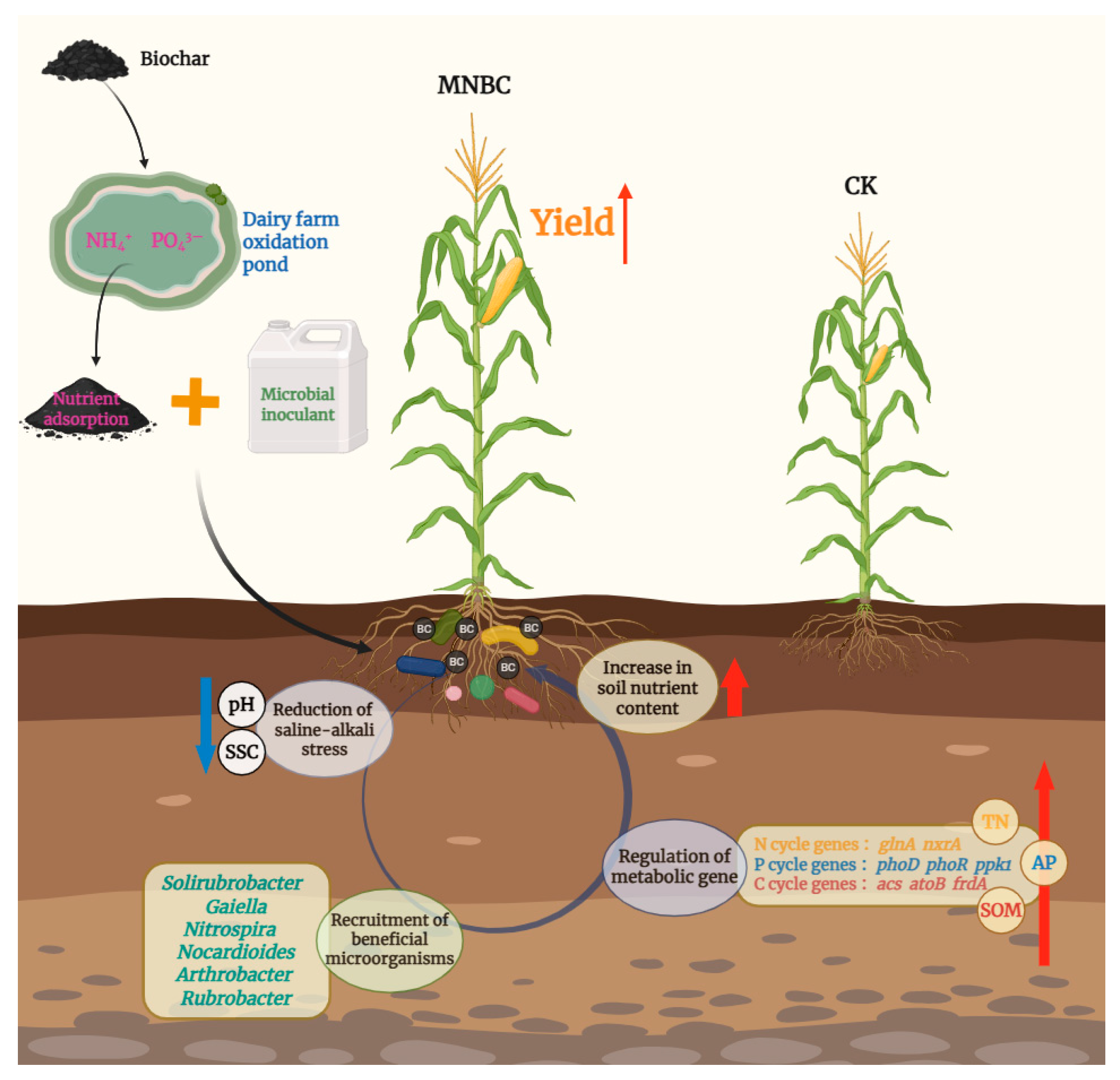
This study established a synergistic continuum from rhizosphere stress alleviation and functional enhancement to crop yield improvement (Figure 7). Biochar first mitigates direct saline–alkaline stress by adsorbing salt ions and lowering rhizosphere pH, thereby creating a favorable microenvironment. Subsequently, inoculated microbes colonize the biochar carrier, which provides physical protection and nutrient slow-release, while further recruiting indigenous beneficial taxa [54]. The significantly enriched bacterial genera, such as Arthrobacter and Solirubrobacter, are intrinsically linked to the elevated nutrient availability [55]. Structurally, SEM analysis quantitatively demonstrated that rhizosphere AP and TN exerted the most direct and strong positive effects on maize yield, consistent with the paradigm that nutrient availability is the primary limiting factor in saline soils [56]. Notably, salinity–alkalinity indicators (pH and SSC) showed no direct significant effect on yield but indirectly suppressed it by reducing SOM. This underscores that under mild saline–alkaline conditions, reclamation should prioritize the concurrent enhancement of SOM and nutrient availability [57]. Therefore, the combination of nutrient-loaded biochar and microbial inoculants synergistically enhances maize productivity through physical amelioration by the biochar matrix, chemical supplementation from loaded nutrients, and biological activation of functional microbes, thereby sustaining rhizosphere nutrient availability and increasing both biomass and grain yield.

4.5. Implications

This study elucidates the synergistic mechanisms through which the integration of functionalized biochar and microbial inoculation optimizes rhizosphere microbial functions, thereby enhancing maize yield in saline–alkaline soils. However, the conclusions are drawn from a single-season field experiment. Long-term efficacy requires verification through multi-year, multi-location trials. Furthermore, the measured gene abundances represent metabolic potential, confirming that their actual functional expression necessitates complementary meta-transcriptomic or enzyme activity analyses. In addition, while biochar effectively recovers nutrients from livestock wastewater, it may also immobilize heavy metals and antibiotics. A thorough assessment of the potential risks associated with these co-adsorbed emerging pollutants is therefore essential prior to large-scale application. Although single-strain inoculation enabled mechanistic clarification in this study, future research should explore functionally complementary bacterial consortia to enhance ecological stability and long-term field performance under saline–alkaline conditions.

5. Conclusions

This study demonstrates that the integrated application of nutrient-laden biochar and a plant growth-promoting rhizobacterium (Paenibacillus mucilaginosus PM12) represents a highly effective strategy for reclaiming coastal saline–alkaline soils and enhancing maize productivity. The MNBC treatment outperformed all other amendments by achieving a synergistic effect that concurrently alleviated saline–alkaline stress and enhanced soil fertility. The MNBC treatment enriched key beneficial bacterial taxa and fungal decomposers, suppressed potential fungal pathogens, and established a more complex and efficient microbial metabolic network. This network exhibited enhanced functional potential for nitrogen transformation, phosphorus solubilization, and carbon metabolism. Structural equation modeling revealed that the increases in soil available phosphorus and total nitrogen, facilitated by this functionally robust microbiome, were the most direct and significant drivers of the yield increasement. Our findings establish a mechanistic framework for designing synergistic biochar–microbe amendments, integrating physical, chemical, and biological components for sustainable saline soil reclamation.

Author Contributions

Z.P.: Methodology, Sample Collection and Measurement, Data Organization, Data Analysis and Visualization, Writing—Original Draft. Q.Y.: Methodology, Sample Collection, and Writing—Review and Editing. X.L. (Xu Li): Sample Collection and Measurement. X.Z.: Sample Collection and Measurement. Z.W.: Sample Collection and Measurement and Data Organization. X.L. (Xueyou Liang): Data Analysis Guidance. J.X.: Data Analysis Guidance. Z.G.: Data Analysis Guidance. C.L.: Research Design and Planning, Data Organization and Analysis, and Writing—Review and Editing. All authors have read and agreed to the published version of the manuscript.

Funding

This research was financially supported by the National Key R&D Program of China (2022YFD1901303), Jing-Jin-Ji Regional Integrated Environmental Improvement-National Science and Technology Major Project (2025ZD1205400, 2025ZD1205402), and Research and Industry Cooperation Projects of Universities in Hebei Province Stationed in Shijiazhuang (2515000202A), and the S&T Program of Hebei Province (Grant No. 24466301D).

Institutional Review Board Statement

Not applicable.

Data Availability Statement

The original contributions presented in this study are included in the article. Further inquiries can be directed to the corresponding author.

Conflicts of Interest

The authors declare that they have no known competing financial interests or personal relationships that could have appeared to influence the work reported in this paper.

Abbreviations

The following abbreviations are used in this manuscript:
PGPRPlant growth-promoting rhizobacteria
ESPExchangeable sodium percentage
AMFArbuscular mycorrhizal fungi
ECElectrical conductivity
SSCSoil water–soluble salt
SOMSoil organic matter
TNTotal nitrogen
APAvailable phosphorus
AKAvailable potassium
ANOVAAnalysis of variance
PCoAPrincipal coordinate analysis
PREMANOVAPermutational multivariate analysis of variance
ANOSIMAnalysis of similarities
SEMStructural equation model

Appendix A

Figure A1. Soil microbial community structure in response to different biochar amendments. (a) Bacterial phylum-level composition; (b) fungal phylum-level composition.
Agriculture 16 00631 g0a1
Table A1. Effects of different biochar amendments on kernel number per ear, 1000-kernel weight, and theoretical yield in maize.
TreatmentKernel Number per Ear (Kernels Ear)Thousand-Kernel Weight (g)Theoretical Grain Yield (kg/ha)
CK423.80 ± 17.95 d324.36 ± 26.23 d7141.89 ± 633.56 e
BC461.90 ± 28.17 c343.13 ± 29.66 c8232.02 ± 672.11 d
NBC476.20 ± 38.95 c355.08 ± 22.33 bc8785.37 ± 947.73 c
MBC494.63 ± 42.20 b365.38 ± 19.13 b9388.81 ± 847.26 b
MNBC540.07 ± 33.88 a388.10 ± 18.14 a10,889.10 ± 805.36 a
Note. Different letters represent significant differences in the same indicator during a certain period and different treatments. (p < 0.05), according to Duncan’s multiple range test.

References

  1. Smith, P.; Poch, R.M.; Lobb, D.A.; Bhattacharyya, R.; Alloush, G.; Eudoxie, G.D.; Anjos, L.H.C.; Castellano, M.; Ndzana, G.M.; Chenu, C.; et al. Status of the World’s Soils. Annu. Rev. Environ. Resour. 2024, 49, 73–104. [Google Scholar] [CrossRef]
  2. Liu, M.Y.; Li, X.H.; Li, M.M.; Wang, Y.L.; Shi, T.; Xi, M. Characteristics of carbon sequestration in coastal saline-alkali soils of the Yellow River Delta and their response to crop planting patterns. J. Environ. Manag. 2025, 395, 127806. [Google Scholar] [CrossRef] [PubMed]
  3. Dai, H.; Fang, Y.; Chen, C.; Liu, K.; Li, X.; Yang, Z.; Fang, N.; Zhang, Y. Geochemical evaluation and driving factor analysis of soil salinization in Northeast China Plain. Front. Environ. Sci. 2025, 13, 1614178. [Google Scholar] [CrossRef]
  4. Du, Y.; Liu, X.; Zhang, L.; Zhou, W. Drip irrigation in agricultural saline-alkali land controls soil salinity and improves crop yield: Evidence from a global meta-analysis. Sci. Total Environ. 2023, 880, 163226. [Google Scholar] [CrossRef] [PubMed]
  5. Peng, W.; Zhu, X.; Zheng, W.; Xie, Q.; Wang, M.; Ran, E. Rice cultivation can mitigate soil salinization and alkalization by modifying the macropore structure in saline–sodic paddy fields. Agric. Water Manag. 2025, 313, 109473. [Google Scholar] [CrossRef]
  6. Shelden, M.C.; Munns, R. Crop root system plasticity for improved yields in saline soils. Front. Plant Sci. 2023, 14, 1120583. [Google Scholar] [CrossRef]
  7. Zhang, X.; Geng, X.; Zhu, J.; Wang, L.; Ma, W.; Liu, Y.; Sheng, X.; Qi, X.; Chen, Y.; Gao, P.; et al. Sustainable agronomic and tillage strategies for rice–wheat rotation systems in saline–alkali soils: Lessons, advances, and prospects. Field Crops Res. 2026, 337, 110278. [Google Scholar] [CrossRef]
  8. Verma, S.; Negi, N.P.; Pareek, S.; Mudgal, G.; Kumar, D. Auxin response factors in plant adaptation to drought and salinity stress. Physiol. Plant. 2022, 174, e13714. [Google Scholar] [CrossRef]
  9. Lei, S.H.; Jia, X.X.; Zhao, C.L.; Shao, M.A. A review of saline-alkali soil improvements in China: Efforts and their impacts on soil properties. Agric. Water Manag. 2025, 317, 109617. [Google Scholar] [CrossRef]
  10. Li, Z.; Kekeli, M.A.; Jiang, Y.; Rui, Y. Progress and Prospect of Saline-Alkaline Soil Management Technology: A Review. Appl. Sci. 2025, 15, 4567. [Google Scholar] [CrossRef]
  11. Li, X.; Kang, Y. Agricultural utilization and vegetation establishment on saline-sodic soils using a water–salt regulation method for scheduled drip irrigation. Agric. Water Manag. 2020, 231, 105995. [Google Scholar] [CrossRef]
  12. Lu, J.J.; Zhang, L.Y.; Song, R.X.; Zeng, H.X.; Cao, J.P.; Qin, Z.F.; Yang, Z.P.; Zhang, Q.; Li, J.H.; Wang, B. Use of Cattle Manure as Auxiliary Material to Gypsum to Ameliorate Saline-Alkali Soils. Agronomy 2025, 15, 2378. [Google Scholar] [CrossRef]
  13. Haider, F.U.; Coulter, J.A.; Cai, L.Q.; Hussain, S.; Cheema, S.A.; Wu, J.; Zhang, R.Z. An overview on biochar production, its implications, and mechanisms of biochar-induced amelioration of soil and plant characteristics. Pedosphere 2022, 32, 107–130. [Google Scholar] [CrossRef]
  14. Taheri, M.A.; Astaraei, A.R.; Lakzian, A.; Emami, H. The role of biochar and sulfur-modified biochar on soil water content, biochemical properties and millet crop under saline-sodic and calcareous soil. Plant Soil 2024, 499, 221–236. [Google Scholar] [CrossRef]
  15. Shyam, S.; Ahmed, S.; Joshi, S.J.; Sarma, H. Biochar as a Soil amendment: Implications for soil health, carbon sequestration, and climate resilience. Discov. Soil 2025, 2, 18. [Google Scholar] [CrossRef]
  16. Li, Y.; Gupta, R.; Zhang, Q.; You, S. Review of biochar production via crop residue pyrolysis: Development and perspectives. Bioresour. Technol. 2023, 369, 128423. [Google Scholar] [CrossRef]
  17. Yilmaz, E.; Merdun, H.; Galadima, M.M.; Sezgin, İ.V. Features of Biochar Produced Under Different Pyrolysis Conditions and their Possible Significance for Soil Fertility. J. Soil Sci. Plant Nutr. 2026, early access. [Google Scholar] [CrossRef]
  18. Chen, Y.; Feng, X.; Zhao, X.; Hao, X.; Tong, L.; Wang, S.; Ding, R.; Kang, S. Biochar application enhances soil quality by improving soil physical structure under particular water and salt conditions in arid region of Northwest China. J. Integr. Agric. 2025, 24, 3242–3263. [Google Scholar] [CrossRef]
  19. Omokaro, G.O.; Kornev, K.P.; Nafula, Z.S.; Chikukula, A.A.; Osayogie, O.G.; Efeni, O.S. Biochar for sustainable soil management: Enhancing soil fertility, plant growth and climate resilience. Farming Syst. 2025, 3, 100167. [Google Scholar] [CrossRef]
  20. Wang, Y.; Tian, G.; Zhao, Q.; Li, D.; He, S. Temporal dynamics and optimal dose effects of biochar on soil properties, cotton growth, and bacterial community assembly in saline-alkali soils. BMC Plant Biol. 2025, 25, 1337. [Google Scholar] [CrossRef]
  21. Mao, T.T.; Wang, Y.F.; Ning, S.R.; Mao, J.F.; Sheng, J.D.; Jiang, P.A. Assessment of the Effects of Biochar on the Physicochemical Properties of Saline-Alkali Soil Based on Meta-Analysis. Agronomy 2024, 14, 2431. [Google Scholar] [CrossRef]
  22. Guan, R.H.; Li, Y.; Jia, Y.L.; Jiang, F.C.; Li, L.W. Acidified biochar one-off application for saline-alkali soil improvement: A three-year field trial evaluating the persistence of effects. Ind. Crops Prod. 2024, 222, 119972. [Google Scholar] [CrossRef]
  23. Xiao, L.; Yuan, G.; Feng, L.; Shah, G.M.; Wei, J. Biochar to Reduce Fertilizer Use and Soil Salinity for Crop Production in the Yellow River Delta. J. Soil Sci. Plant Nutr. 2022, 22, 1478–1489. [Google Scholar] [CrossRef]
  24. Li, G.; Shan, Y.Y.; Bai, Y.G.; Nie, W.B.; Sun, Y.; Su, L.J.; Zhang, J.H.; Liu, H.B.; Ding, Y.; Wang, X.Y.; et al. Humic acid, biochar-based microbial agent and vermicompost improve cotton growth, photosynthesis, yield and fiber quality in saline-alkali soil. J. Sci. Food Agric. 2025, 105, 7019–7032. [Google Scholar] [CrossRef]
  25. Wen, Y.Q.; Wu, R.T.; Qi, D.D.; Xu, T.L.; Chang, W.; Li, K.; Fang, X.X.; Song, F.Q. The effect of AMF combined with biochar on plant growth and soil quality under saline-alkali stress: Insights from microbial community analysis. Ecotoxicol. Environ. Saf. 2024, 281, 116592. [Google Scholar] [CrossRef]
  26. Hou, J.J.; Tang, J.W.; Zhang, X.T.; Zhang, S.D.; Zhang, Q.Z. Combined improvement of coastal saline-alkali soils by biochar and Azotobacter chroococcum: Effects and mechanisms. Appl. Soil Ecol. 2025, 212, 106214. [Google Scholar] [CrossRef]
  27. Li, Y.Q.; Zhang, J.Q.; Wang, X.D.; Feng, Z.Z.; Yang, E.S.; Wu, M.Z.; Jiang, Y.Q.; Huang, J.Q.; Gao, Z.; Du, Y.P. The synergistic effect of extracellular polysaccharide-producing salt-tolerant bacteria and biochar promotes grape growth under saline-alkaline stress. Environ. Technol. Innov. 2025, 38, 104070. [Google Scholar] [CrossRef]
  28. Liu, Z.; Zhou, W.; Sun, Y.; Peng, Y.; Niu, J.; Tan, J.; Wei, M. Biochar and its coupling with microbial inoculants for suppressing plant diseases: A review. Appl. Soil Ecol. 2023, 190, 105025. [Google Scholar] [CrossRef]
  29. Neemisha; Kumar, A.; Sharma, P.; Kaur, A.; Sharma, S.; Jain, R. Harnessing rhizobacteria to fulfil inter-linked nutrient dependency on soil and alleviate stresses in plants. J. Appl. Microbiol. 2022, 133, 2694–2716. [Google Scholar] [CrossRef]
  30. Ji, S.R.; Zhang, F.; Yao, P.P.; Li, C.L.; Faheem, M.; Feng, Q.W.; Chen, M.; Wang, B. Optimization of pig manure-derived biochar for ammonium and phosphate simultaneous recovery from livestock wastewater. Environ. Sci. Pollut. Res. 2023, 30, 82532–82546. [Google Scholar] [CrossRef]
  31. Gao, R.; Ding, S.J.; Liu, Z.Z.; Jiang, H.M.; Liu, G.; Fang, J. Recent advances and perspectives of biochar for livestock wastewater: Modification methods, applications, and resource recovery. J. Environ. Chem. Eng. 2024, 12, 113678. [Google Scholar] [CrossRef]
  32. Maharathi, P.; Eripogu, K.K.; Lo, S.L. Nutrients recovery from livestock wastewater by batch and gas bubble-column studies with biochar, nano-composite material, and ammonium magnesium phosphate hydrate. J. Environ. Manag. 2024, 366, 121722. [Google Scholar] [CrossRef] [PubMed]
  33. Bao, S.D. Soil and Agricultural Chemistry Analysis, 3rd ed.; China Agriculture Press: Beijing, China, 2000. [Google Scholar]
  34. Chen, S.; Zhou, Y.; Chen, Y.; Gu, J. fastp: An ultra-fast all-in-one FASTQ preprocessor. Bioinformatics 2018, 34, i884–i890. [Google Scholar] [CrossRef] [PubMed]
  35. Hideki, N.; Jungho, P.; Toshihisa, T. MetaGene: Prokaryotic gene finding from environmental genome shotgun sequences. Nucleic Acids Res. 2006, 34, 5623–5630. [Google Scholar] [CrossRef]
  36. Fu, L.; Niu, B.; Zhu, Z.; Wu, S.; Li, W. CD-HIT: Accelerated for clustering the next-generation sequencing data. Bioinformatics 2012, 28, 3150–3152. [Google Scholar] [CrossRef]
  37. Buchfink, B.; Xie, C.; Huson, D.H. Fast and sensitive protein alignment using DIAMOND. Nat. Methods 2015, 12, 59–60. [Google Scholar] [CrossRef]
  38. Yang, H.L.; Ye, S.J.; Zeng, Z.T.; Zeng, G.M.; Tan, X.F.; Xiao, R.; Wang, J.J.; Song, B.; Du, L.; Qin, M.; et al. Utilization of biochar for resource recovery from water: A review. Chem. Eng. J. 2020, 397, 125502. [Google Scholar] [CrossRef]
  39. He, L.T.; Wang, D.H.; Wu, Z.Y.; Lv, Y.Z.; Li, S.C. Magnesium-modified biochar was used to adsorb phosphorus from wastewater and used as a phosphorus source to be recycled to reduce the ammonia nitrogen of piggery digestive wastewater. J. Clean. Prod. 2022, 360, 132130. [Google Scholar] [CrossRef]
  40. Sattar, A.; Naveed, M.; Ali, M.; Zahir, Z.A.; Nadeem, S.M.; Yaseen, M.; Meena, V.S.; Farooq, M.; Singh, R.; Rahman, M.; et al. Perspectives of potassium solubilizing microbes in sustainable food production system: A review. Appl. Soil Ecol. 2019, 133, 146–159. [Google Scholar] [CrossRef]
  41. Mendoza-Suárez, M.; Andersen, S.U.; Poole, P.S.; Sánchez-Cañizares, C. Competition, Nodule Occupancy, and Persistence of Inoculant Strains: Key Factors in the Rhizobium-Legume Symbioses. Front. Plant Sci. 2021, 12, 690567. [Google Scholar] [CrossRef]
  42. Mei, Y.H.; Kayoumu, M.; He, T.T.; Cui, X.D.; Duan, G.L. Enhancing salt tolerance and growth of Oryza sativa L. through biochar-bacteria composite amendment for potential application in coastal saline soil reclamation. Environ. Technol. Innov. 2026, 41, 104667. [Google Scholar] [CrossRef]
  43. Bai, X.F.; Li, Z.F.; Zhang, Y.Z.; Ni, J.W.; Wang, X.M.; Zhou, X.Q. Recovery of Ammonium in Urine by Biochar Derived from Faecal Sludge and its Application as Soil Conditioner. Waste Biomass Valoriz. 2018, 9, 1619–1628. [Google Scholar] [CrossRef]
  44. Entio, L.J.; Taggart, C.B.; Muir, J.P.; Kan, E.; Brady, J.A.; Obayomi, O. Dairy Effluent-Saturated Biochar’s Short-Term Effects on Vigna unguiculata and Cynodon dactylon Performance and Soil Properties. Plants 2024, 13, 851. [Google Scholar] [CrossRef] [PubMed]
  45. Li, C.B.; Wang, S.; Zhang, Q.; He, Y.; Luo, B.Z.; Li, G.T.; Lin, Q.M.; Zhao, X.R. Isolation and Characterization of Efficient Multifunctional Potassium-Solubilizing Bacteria from Tobacco Rhizosphere Soil. J. Soil Sci. Plant Nutr. 2025, 25, 7728–7737. [Google Scholar] [CrossRef]
  46. Li, C.; Chen, X.L.; Jia, Z.H.; Zhai, L.; Zhang, B.; Grueters, U.; Ma, S.L.; Qian, J.; Liu, X.; Zhang, J.C.; et al. Meta-analysis reveals the effects of microbial inoculants on the biomass and diversity of soil microbial communities. Nat. Ecol. Evol. 2024, 8, 1270–1284. [Google Scholar] [CrossRef]
  47. Gao, C.Q.F.; Wang, Y.S.; Li, S.J.; Lin, X.B. Salinity-driven shifts in potential ammonia oxidation rates and microbial community dynamics in estuarine mangrove sediments. Mar. Pollut. Bull. 2026, 222, 118936. [Google Scholar] [CrossRef]
  48. Sokolowski, A.; Siegieda, D.; Panek, J.; Frac, M.; Kobylecki, R.; Zarzycki, R.; Klepka, T.; Oleszczuk, P.; Gao, Y.Z.; Czech, B. Long-term biochar amendment promotes microbial resilience and detoxification in phthalate-contaminated soil. Appl. Soil Ecol. 2026, 218, 106708. [Google Scholar] [CrossRef]
  49. Zhang, S.M.; Wei, J.Y.; Zhang, J.L.; Chen, M.H.; Zhang, Y.Y.; Cai, Y.X.; Wang, W. Combined applications of organic bran Fertilizer, biochar and microbial inoculants control tobacco soil-borne diseases by recruiting beneficial rhizosphere microbes and enhancing soil quality. Biol. Control 2026, 212, 105948. [Google Scholar] [CrossRef]
  50. Zhu, L.Y.; Luan, L.; Chen, Y.; Wang, X.Y.; Zhou, S.G.; Zou, W.X.; Han, X.R.; Duan, Y.H.; Zhu, B.; Li, Y.; et al. Community assembly of organisms regulates soil microbial functional potential through dual mechanisms. Glob. Change Biol. 2024, 30, e17160. [Google Scholar] [CrossRef]
  51. Lei, C.T.; Lu, T.; Qian, H.F.; Liu, Y.X. Machine learning models reveal how biochar amendment affects soil microbial communities. Biochar 2023, 5, 89. [Google Scholar] [CrossRef]
  52. Camargo, A.P.; de Souza, R.S.C.; Jose, J.; Gerhardt, I.R.; Dante, R.A.; Mukherjee, S.; Huntemann, M.; Kyrpides, N.C.; Carazzolle, M.F.; Arruda, P. Plant microbiomes harbor potential to promote nutrient turnover in impoverished substrates of a Brazilian biodiversity hotspot. ISME J. 2023, 17, 354–370. [Google Scholar] [CrossRef]
  53. Zhao, J.; Huang, L.B.; Chakrabarti, S.; Cooper, J.; Choi, E.; Ganan, C.; Tolchinsky, B.; Triplett, E.W.; Daroub, S.H.; Martens-Habbena, W. Nitrogen and phosphorous acquisition strategies drive coexistence patterns among archaeal lineages in soil. ISME J. 2023, 17, 1839–1850. [Google Scholar] [CrossRef]
  54. Khan, A.A.; Chen, Y.P.; Asghar, R.M.A.; Azeem, I.; Shah, T.; Cao, W.D.; Zhang, D.B.; Gao, Y.J. P-solubilising bacteria and P-cycling genes drive soil P transformation during green manure decomposition. Agric. Ecosyst. Environ. 2025, 394, 109875. [Google Scholar] [CrossRef]
  55. Philippot, L.; Chenu, C.; Kappler, A.; Rillig, M.C.; Fierer, N. The interplay between microbial communities and soil properties. Nat. Rev. Microbiol. 2024, 22, 226–239. [Google Scholar] [CrossRef]
  56. Sun, X.X.; Wu, J.T.; Jiang, L.J.; Yao, J.N.; Chen, X.Y.; Liu, M.Q. Nutrient limitation and saline-alkaline stress primarily drive community and function shifts in protists inhabiting saline-sodic soils. Agric. Ecosyst. Environ. 2026, 396, 110009. [Google Scholar] [CrossRef]
  57. Fei, Y.J.; Jiao, K.R.; Liu, X.Y.; Wang, B.L.; Song, R.; Meng, Z.L.; Liu, B.B.; Wu, J.Q.; Qi, C.Y.; Zhou, W.F.; et al. A sulfate-palygorskite composite amendment for saline-alkali soil: Simultaneous alkalinity reduction, nutrient enrichment, and crop growth promotion. Soil Tillage Res. 2026, 256, 106872. [Google Scholar] [CrossRef]
Figure 1. Functional zoning map of the residential community.
Agriculture 16 00631 g001
Figure 2. Different lowercase letters within the same column indicate significant differences among treatments (p < 0.05) according to Duncan’s multiple range test. Soil physicochemical properties: (a) pH, (b) water-soluble salt content (SSC), (c) soil organic matter (SOM) content, (d) total nitrogen (TN) content, (e) available phosphorus (AP) content, and (f) available potassium (AK) content.
Agriculture 16 00631 g002
Figure 3. Effects of different biochar amendments on rhizosphere microbial community structure. (a) Principal coordinate analysis (PCoA) of bacterial communities. (b) PCoA of fungal communities. (c) Relative abundance of dominant bacterial genera. (d) Relative abundance of dominant fungal genera. (e) Significantly differentiated bacterial genera among treatments. (f) Significantly differentiated fungal genera among treatments. * indicates significant difference (p < 0.05), ** indicates highly significant difference (p < 0.01).
Agriculture 16 00631 g003
Figure 4. Effects of different biochar amendments on microbial community metabolic functions. (a) Effects on nitrogen metabolism genes and pathways. (b) Effects on phosphorus metabolism genes and pathways. (c) Effects on carbon metabolism genes and pathways.
Agriculture 16 00631 g004
Figure 5. Effects of different amendment treatments on the contributions of bacterial genera to the abundance of nitrogen-, phosphorus-, and carbon-related metabolic genes. The top 10 most abundant genera are shown for (a) nitrogen metabolism genes, (b) phosphorus metabolism genes, and (c) carbon metabolism genes.
Agriculture 16 00631 g005
Figure 6. Integrated Mantel test and structural equation model (SEM) illustrating the associations between dominant bacterial genera and soil/plant variables. (a) Mantel test network linking bacterial genera with soil properties (pH, SSC, SOM, TN, AP, AK) and plant traits (height, AGDW, BGDW, yield), together with a correlation heatmap among these variables. Edge color indicates Mantel’s p value (<0.01, 0.01–0.05, ≥0.05), edge width indicates Mantel’s r (<0.4, 0.4–0.6, ≥0.6), and solid vs. dashed edges denote positive vs. negative relationships; heatmap colors represent Pearson correlation coefficients (−1 to 1), and asterisks indicate significance levels. (b) SEM showing the direct and indirect effects of pH and SSC on SOM, TN and AP, and their subsequent contributions to yield. Numbers on arrows are standardized path coefficients; solid arrows indicate significant pathways and dashed arrows indicate non-significant pathways. Model fit indices (SRMR, NFI) and explained variance (R2) are shown. * indicates a significant effect (p < 0.05), ** indicates a highly significant effect (p < 0.01), *** indicates an extremely significant effect (p < 0.001).
Agriculture 16 00631 g006
Figure 7. Proposed schematic of the interaction mechanism between nutrient-laden biochar and PGPR.
Agriculture 16 00631 g007
Table 1. Maize growth parameters, biomass, and grain yield in different biochar-amendment treatments.
StageTreatmentPlant Height (cm)Aboveground Biomass (g)Belowground Biomass (g)Maize Yield (kg·ha−1)
Bell stageCK143.29 ± 5.52 d62.30 ± 6.35 c7.79 ± 0.64 e-
BC156.35 ± 6.38 c71.03 ± 6.97 b11.74 ± 1.25 d-
NBC159.67 ± 6.38 bc77.33 ± 8.87 ab15.82 ± 1.63 c-
MBC164.20 ± 3.68 b80.74 ± 11.20 a17.50 ± 1.16 b-
MNBC172.37 ± 5.78 a85.66 ± 4.74 a19.37 ± 1.11 a-
Milky stageCK229.62 ± 10.01 c179.04 ± 7.09 e8.71 ± 0.57 d-
BC246.74 ± 14.49 b244.77 ± 20.96 d15.27 ± 2.07 c-
NBC250.76 ± 9.33 b267.44 ± 9.66 c16.39 ± 2.09 c-
MBC255.35 ± 5.38 ab307.88 ± 22.77 b22.03 ± 1.98 b-
MNBC262.94 ± 6.80 a392.52 ± 19.15 a27.12 ± 1.90 a-
Maturity stageCK233.76 ± 5.95 d226.36 ± 11.29 e9.10 ± 0.18 e7141.89 ± 633.56 e
BC249.80 ± 5.39 c326.12 ± 14.99 d19.50 ± 0.44 d8232.02 ± 672.11 d
NBC253.35 ± 9.09 bc359.48 ± 10.87 c20.62 ± 1.10 c8785.37 ± 947.73 c
MBC261.87 ± 9.61 ab418.33 ± 13.78 b25.18 ± 1.20 b9388.81 ± 847.26 b
MNBC268.65 ± 5.29 a509.53 ± 10.33 a33.07 ± 1.31 a10,889.10 ± 805.36 a
Note. The significance analysis of differences adopts the multiple-comparison letter-marking method, where different letters represent significant differences in the same indicator during a certain period and different treatments. (p < 0.05), according to Duncan’s multiple range test. Treatments: CK (control, conventional practice); BC (sheep manure biochar); MBC (sheep manure biochar+ P. mucilaginosus 12); NBC (nutrient-enriched sheep manure biochar); MNBC (bio-fertilization and carbon enhancement agent, NBC + PM12). Data are means ± standard deviation (SD) (n = 3), same below.
Table 2. The microbial alpha diversity variation in different treatments.
TreatmentsBacteriaFungal
Chao1ShannonSimpsonChao1ShannonSimpson
CK3644.33 ± 21.78 b4.94 ± 0.01 c0.0259 ± 0.0008 a195.00 ± 7.81 c4.22 ± 0.19 b0.0327 ± 0.0126 a
BC3620.67 ± 18.93 b5.00 ± 0.01 b0.0235 ± 0.0003 b223.00 ± 7.94 ab4.27 ± 0.12 b0.0270 ± 0.0037 ab
NBC3673.33 ± 6.81 a4.95 ± 0.02 c0.0262 ± 0.0003 a220.00 ± 13.86 ab4.55 ± 0.03 a0.0191 ± 0.0011 b
MBC3642.33 ± 9.02 b5.18 ± 0.02 a0.0182 ± 0.0009 c206.67 ± 10.79 bc4.41 ± 0.08 ab0.0217 ± 0.0023 ab
MNBC3689.67 ± 16.26 a4.97 ± 0.02 bc0.0252 ± 0.0006 a226.00 ± 9.90 a4.60 ± 0.11 a0.0168 ± 0.0024 b
Note. Different letters represent significant differences in the same indicator during a certain period and different treatments. (p < 0.05), according to Duncan’s multiple range test.
Disclaimer/Publisher’s Note: The statements, opinions and data contained in all publications are solely those of the individual author(s) and contributor(s) and not of MDPI and/or the editor(s). MDPI and/or the editor(s) disclaim responsibility for any injury to people or property resulting from any ideas, methods, instructions or products referred to in the content.