Editorial

Best Management Practices for Soil Health and Water Quality: From Practice Catalogs to Decision Intelligence


1
College of Jiyang, Zhejiang A&F University, Zhuji 311800, China
2
Department of Biosystems Engineering and Soil Science, The University of Tennessee at Knoxville, Knoxville, TN 37996, USA
3
Department of Land, Air and Water Resources, University of California, Davis, CA 95616, USA
*
Author to whom correspondence should be addressed.
Agriculture 2026, 16(5), 565; https://doi.org/10.3390/agriculture16050565
Submission received: 20 February 2026 / Revised: 28 February 2026 / Accepted: 1 March 2026 / Published: 2 March 2026

1. Introduction

Agricultural landscapes sit at the center of two coupled crises: accelerating degradation of soil functions and persistent impairment of surface and groundwater quality [1]. The policy and practice response has long relied on “best management practices” (BMPs)—a broad set of agronomic, structural, and landscape measures intended to curb erosion, reduce nutrient losses, and sustain productivity. Despite decades of investment, BMP outcomes remain inconsistent across regions and farms, and monitoring programs continue to report high spatial variability in sediment and nutrient exports. The persistence of the problem is not evidence that BMPs do not work; rather, it shows that BMPs are not plug-and-play technologies. Their effectiveness depends on how they modify the controlling processes of water flow, sediment detachment and transport, nutrient surplus, and biological retention, and on whether implementation is tuned to local constraints and risk regimes [2].
Recent studies reinforce this point by showing that “the same practice” can perform very differently depending on the controllable parameters used in deployment. In rice–wheat rotation systems, optimization of straw incorporation is sensitive to operational settings such as tillage depth, forward speed, and rotor speed, which jointly determine residue mixing and soil disturbance [3]. In irrigated lucerne systems, ridge–film mulching interacts with controlled-release nitrogen rates to shift yield, forage quality, and water–nitrogen use efficiencies, revealing strong non-linear responses rather than a simple monotonic benefit of added inputs [4]. At the watershed scale, evaluation of integrated BMPs for erosion control shows that reduction efficiency varies widely among subbasins, highlighting the importance of targeting and the limits of uniform prescriptions [5].
A key barrier to transferability is that BMPs are often communicated as categorical labels, while the underlying mechanisms are governed by continuous variables (e.g., soil moisture, temperature). For example, residue management affects aggregate stability and carbon accrual via the amount, placement, and biochemical composition of plant inputs [6,7,8]. Evidence from controlled additions of distinct corn residue components indicates that aggregate organic carbon responses depend on the specific residue fractions introduced, implying that “return residues” is an underspecified recommendation unless the residue mixture and handling are defined [9]. Similarly, microtopography influences runoff connectivity and detachment by controlling surface roughness and depression storage [10]. Rainfall experiments on loess slopes show that changes in roughness and depression storage can delay connectivity and reduce soil loss and that data-driven models can accurately predict soil loss when microtopographic descriptors are available [11].
Treating BMPs as controllable variables has three practical advantages. First, it allows synthesis across contexts by linking outcomes to process-relevant parameters (e.g., organic matter, total nitrogen, etc.) rather than to local “named practices”. Second, it enables uncertainty-aware planning because variability in rainfall regime, soil texture, and management execution can be propagated through response functions. Third, it supports optimization: once practices are parameterized, planners can search the design space for portfolios that meet targets for water quality, soil health, and production under realistic constraints.
Scaling BMPs is not only a biophysical problem. The same intervention can be technically effective and socially infeasible, economically unattractive, or institutionally misaligned. Consequently, BMP planning increasingly needs to integrate stakeholder preferences and risk perceptions. A recent decision-making framework for large-scale BMP planning in East Africa demonstrates how incorporating stakeholder priorities can improve contextual relevance and acceptance while maintaining a data-driven basis for selection [12].
This perspective argues that the next step for the BMP field is to connect three strands that are often treated separately: process understanding, spatial targeting, and decision legitimacy. Progress will depend on workflows that translate experiments and models into implementable design variables, quantify trade-offs transparently, and update decisions as climate and land use evolve.

2. Mechanistic Levers that Unify BMP Families

BMPs are commonly grouped as in-field management, structural and engineering controls, and edge-of-field or riparian measures. Across these groups, a small set of mechanistic levers repeatedly determines outcomes: infiltration capacity, runoff connectivity, detachment and transport efficiency, nutrient surplus and timing relative to crop demand, and biological or physical retention along flow paths [13,14]. This shared structure means that BMP portfolios should be designed to address the dominant limiting processes in a given landscape rather than maximizing the number of practices deployed.
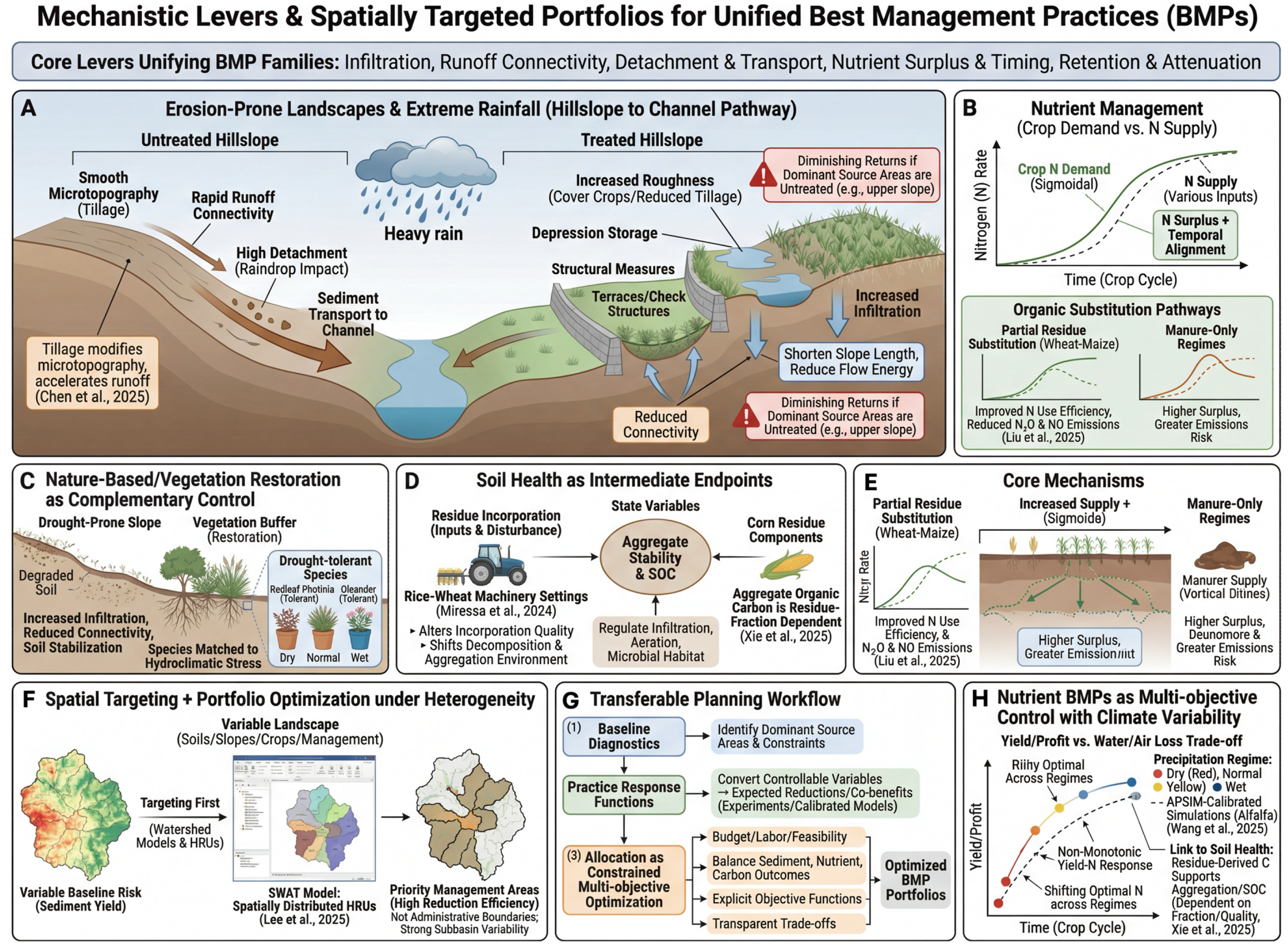
As shown in Figure 1A, in erosion-prone systems, reducing transport capacity and connectivity is often decisive, especially under extreme rainfall regimes [10,15]. Microtopographic modification through tillage operations changes surface roughness and depression storage, which in turn control when and how quickly runoff networks connect [11]. Structural measures can further interrupt slope length and reduce energy, but their marginal benefit depends on whether the dominant source areas are treated. In nutrient management (Figure 1B), the central lever is frequently nitrogen surplus and its temporal alignment with uptake; therefore, rate, timing, formulation, and substitution pathways matter more than the generic “increase organic inputs.” Evidence from wheat–maize rotation systems indicates that partial substitution with crop residues can simultaneously improve nitrogen use efficiency and reduce combined N2O and NO emissions compared with manure-only regimes, underscoring the need to specify the substitution pathway [16].
As shown in Figure 1C, nature-based measures such as vegetation restoration can complement in-field and structural controls, but plant selection must match hydroclimatic stress regimes. Pot experiments comparing four shrub species across graded drought intensities identified Redleaf Photinia and Oleander as the most drought-tolerant options, supporting their use in drought-prone ecological slope protection and restoration [17].
For soil health outcomes (Figure 1D), aggregate stability and soil organic carbon are critical intermediate endpoints because they modulate infiltration, aeration, and microbial habitat. Residue incorporation strategies influence these endpoints not only by adding carbon but also by changing soil structure through disturbance intensity and residue placement. Operational optimization in rice–wheat systems illustrates how machinery settings can alter incorporation quality and therefore shift the soil environment that governs decomposition and aggregation [3].
Figure 1. A conceptual figure of mechanistic levers and spatially targeted portfolios for unified best management practices (BMPs) [3,5,6,11,16,18].
Agriculture 16 00565 g001

3. Spatial Targeting and Portfolio Design Under Heterogeneity

Spatial heterogeneity in soils, slopes, crop types, and management implies that uniform BMP prescriptions are rarely efficient (Figure 1F). The effectiveness of an identical management practice is highly context-dependent. Its performance can diverge significantly between farms because of differing site characteristics and can also exhibit substantial inter-annual variability within a single field due to fluctuating climatic conditions, such as changes in rainfall patterns [18]. Portfolio design therefore requires a spatially explicit view of both baseline risk and practice response.
Watershed-scale modeling provides a practical way to quantify where interventions yield the largest reductions per unit effort, but model structure must represent terrain and farmland boundaries adequately. In steep agricultural watersheds, subbasin-scale evaluation using SWAT enhanced with spatially distributed HRUs and calibrated MUSLE parameters demonstrates large variability in erosion reduction efficiency among subbasins, even under the same BMP set [5]. Such results make a strong case for “targeting first,” where priority management areas are identified based on reduction efficiency rather than on administrative boundaries or voluntary uptake alone.
A transferable planning pathway is to combine physically based models with decision rules and optimization (Figure 1G). Baseline diagnostics identify dominant source areas and constraints. Practice response functions, derived from experiments or calibrated models, translate controllable variables into expected reductions and co-benefits. Then, allocation becomes a constrained optimization problem that selects portfolios under budget, labor, and feasibility constraints, and that balances multiple objectives such as sediment reduction, nutrient reduction, and carbon outcomes. Importantly, the objective function and constraints should be explicit so that trade-offs are transparent to stakeholders and decision makers.

4. Nutrient Management as a Multi-Objective Control Problem

As shown in Figure 1H, nitrogen management sits at the intersection of yield formation, soil fertility, water quality, and climate forcing. The decision is inherently multi-objective: farms aim to maximize yield and profitability, while society aims to minimize losses to water and air. This tension is sharpened in intensive systems where high nitrogen inputs coincide with high loss potential [19].
Evidence from subtropical wheat–maize systems shows that partial substitution of inorganic fertilizer with organic sources can sustain yields while altering gaseous nitrogen losses, but outcomes depend on the substitution pathway and the resulting soil nitrogen surplus [16]. From a planning standpoint, this implies that “organic substitution” should be treated as a design choice with competing mechanisms, including changes in mineralization dynamics, carbon availability, and microbial activity. The same substitution fraction can have different emission consequences when implemented via manure versus crop residues.
Process-based crop models offer a route to translate experimental findings into adaptive rules under climate variability [20,21]. In alfalfa systems, APSIM-based simulations calibrated to field data suggest that yield responses to nitrogen are non-monotonic and that optimal nitrogen rates shift across dry, normal, and wet precipitation regimes [22]. When such models are coupled with water and nitrogen use efficiency metrics, they can support decision rules that are conditional on observed or forecast precipitation regimes. These adaptive rules are more defensible than fixed prescriptions in climates where interannual variability is large.
Nutrient BMPs should also be evaluated for their interaction with soil health. Residue-derived carbon inputs can support aggregation and soil organic carbon accrual, but the effect depends on residue composition and handling. Controlled additions of different corn residue components demonstrate that aggregate organic carbon outcomes are residue-fraction dependent, indicating that residue management should be linked to carbon quality as well as to quantity [9].

5. A Decision-Intelligence Blueprint for Next-Generation BMP Planning

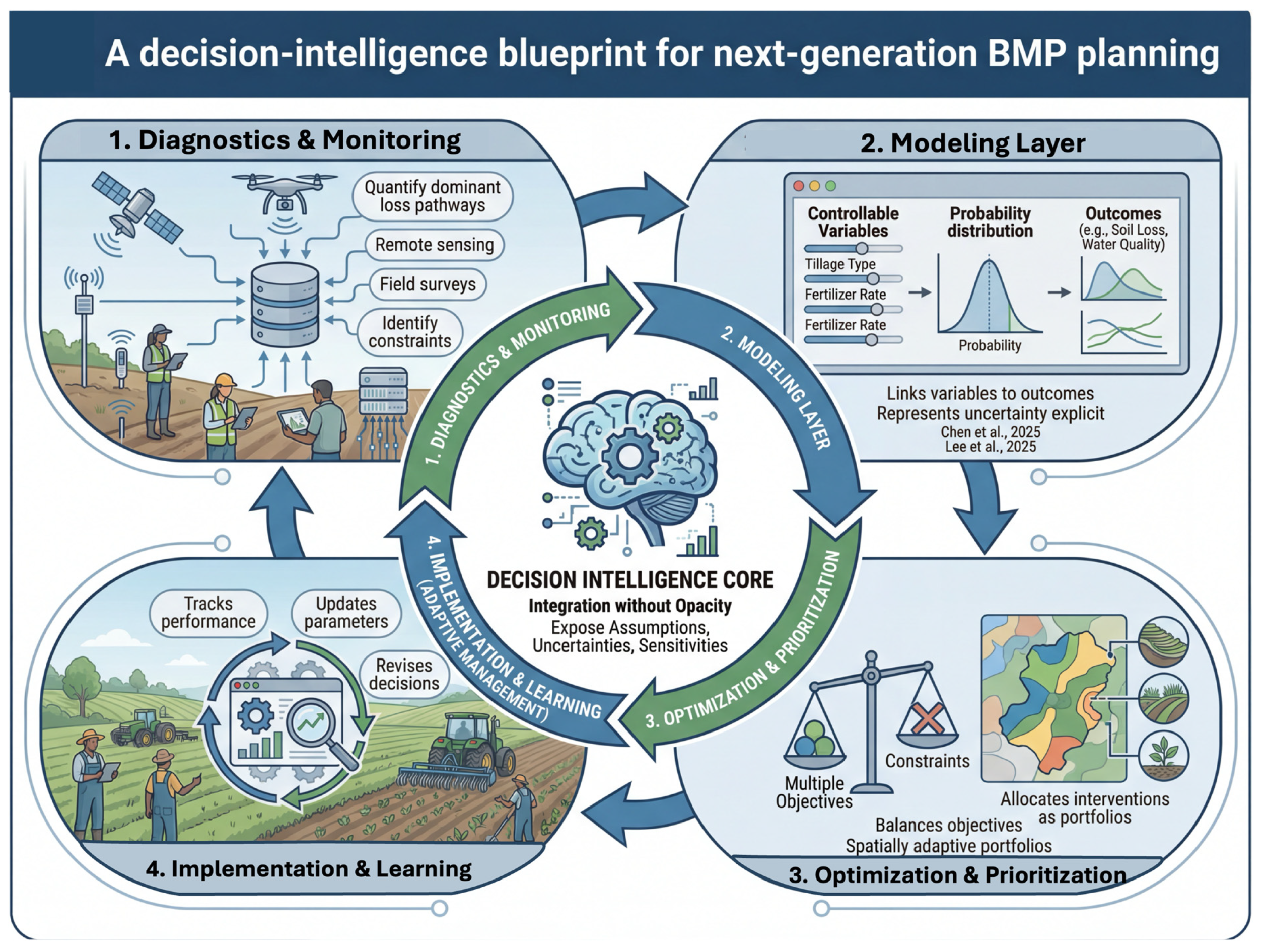
A next-generation BMP workflow should be framed as a closed-loop decision system that treats BMPs as controllable design variables and deploys them as spatially targeted portfolios rather than isolated practice labels. As summarized in Figure 2, the framework links four components through a decision-intelligence core that integrates heterogeneous evidence while maintaining transparency by making assumptions explicit and carrying uncertainty forward. Diagnostics and monitoring combine remote sensing, UAV products, in situ sensors, and field surveys to characterize baseline conditions, identify dominant loss pathways, and define binding feasibility constraints [23]. An uncertainty-explicit modeling layer then connects controllable management variables (e.g., tillage intensity, fertilizer rate/timing, irrigation scheduling, structural design choices) to outcomes such as soil loss and water-quality indicators, enabling sensitivity analysis and scenario stress testing. Optimization and prioritization formalize BMP allocation as a multi-objective, constraint-aware portfolio problem that balances pollutant reduction, productivity, cost, and risk to generate spatially adaptive intervention sets. Implementation and learning close the loop via adaptive management, tracking performance, updating parameters with new observations, and revising decisions as climate and operational conditions evolve.
Recent studies provide complementary building blocks for this loop. Microtopography descriptors combined with machine learning enable rapid prediction of soil loss responses to tillage-induced surface heterogeneity, supporting faster screening of management options in erosion-prone loess landscapes [11]. Spatially explicit watershed modeling supports subbasin prioritization for erosion and sediment control and demonstrates why portfolios should be spatially adaptive rather than uniform [5]. Field-level optimization studies show how operational parameters and input formulations can be tuned to improve outcomes in residue incorporation and irrigated forage production, strengthening the evidence base for translating practices into controllable variables [3,4]. Process-based simulations demonstrate how optimal nitrogen strategies shift with precipitation regime, offering a template for adaptive nutrient rules [22].
Decision legitimacy requires that portfolios reflect stakeholder constraints and preferences. Participatory decision frameworks can formalize these constraints and preferences, improving adoption and long-term maintenance. Work in East Africa illustrates how stakeholder engagement can be integrated with data-driven BMP selection to create scalable planning methodologies [12]. This approach is transferable: regardless of region, the ability to make trade-offs explicit and to respect local priorities is essential for sustained BMP performance.
The main methodological challenge is integration without opacity. Mechanistic models can be used where process understanding is strong, while data-driven emulators can represent components that are difficult to parameterize at scale, such as management execution variability and microtopographic complexity. The integration should not hide assumptions; instead, decision support tools should expose assumptions, uncertainties, and sensitivities so that planners can understand what drives recommendations and where additional data collection would be most valuable.

6. Conclusions

BMPs remain indispensable for reconciling agricultural production with environmental integrity, but their planning and evaluation must evolve. The evidence increasingly supports a shift from practice labels to controllable variables, from uniform prescriptions to spatially targeted portfolios, and from purely technical optimization to decision processes that are transparent and legitimate to stakeholders. Closing the loop between monitoring, modeling, optimization, and participatory governance will be central to making BMPs more transferable across regions and more robust under climate variability.

Acknowledgments

We sincerely thank all authors who contributed their research to this Special Issue/Collection and, collectively, advanced the evidence base for translating BMP concepts into actionable decision variables and scalable portfolios. We are also grateful to the anonymous reviewers for their constructive critiques and time, which substantially improved the rigor and clarity of the published papers. We appreciate the support from the editorial office of Agriculture in coordinating peer review and production, and we thank all collaborators and stakeholders whose practical insights and field experiences help ensure that BMP research remains grounded in real-world constraints and management needs.

Conflicts of Interest

The authors declare no conflicts of interest.

References

  1. Gan, F.; Shi, H.; Yan, Y.; Pu, J.; Dai, Q.; Gou, J.; Fan, Y. Soil quality assessment of karst trough valley under different bedrock strata dip and land-use types, based on a minimum data set. Catena 2024, 241, 108048. [Google Scholar] [CrossRef]
  2. Fan, Y.; Amgain, N.R.; Rabbany, A.; Manirakiza, N.; Bai, X.; VanWeelden, M.; Bhadha, J.H. Assessing flood-depth effects on water quality, nutrient uptake, carbon sequestration, and rice yield cultivated on Histosols. Clim. Smart Agric. 2024, 1, 100005. [Google Scholar] [CrossRef]
  3. Miressa, S.B.; Ding, Q.; Li, Y.; Amisi, E.O. Optimization of tillage operation parameters to enhance straw incorporation in rice-wheat rotation field. Agriculture 2024, 15, 54. [Google Scholar] [CrossRef]
  4. Yin, M.; Jiang, Y.; Ling, Y.; Ma, Y.; Qi, G.; Kang, Y.; Wang, Y.; Lu, Q.; Shang, Y.; Fan, X. Optimizing lucerne productivity and resource efficiency in China’s yellow river irrigated region: Synergistic effects of ridge-film mulching and controlled-release nitrogen fertilization. Agriculture 2025, 15, 845. [Google Scholar] [CrossRef]
  5. Lee, J.; Lee, S.; Park, W.J.; Shin, M.; Lim, K.J. Assessment of Integrated BMPs for Subbasin-Scale Soil Erosion Reduction Considering Spatially Distributed Farmland Characteristics. Agriculture 2025, 15, 893. [Google Scholar] [CrossRef]
  6. Xie, N.; Fan, Y.; Duan, N.; Yang, L.; Radosevich, M.; Zhang, Y.; Wang, Y.; Wang, J.; Liang, X. Interactive effects of straw and biochar amendments on soil organic carbon stabilization and bacterial community dynamics. Biol. Fertil. Soils 2025, 61, 1423–1437. [Google Scholar] [CrossRef]
  7. Wu, Z.; Zhang, Y.; Fan, Y.; Wang, C.; Li, B.; Rengel, Z.; Shen, J.; le Cadre, E.; Whalen, J.; Tang, X. Decadal manure substitution reshapes microbial communities to drive plant and microbial carbon accumulation in soil carbon fractions. Geoderma 2025, 463, 117581. [Google Scholar] [CrossRef]
  8. Dai, W.; Fan, Y.; Cao, L.; Cao, L.; Sha, Z. Soil organic carbon dynamics shift by incorporating wheat straw in paddy soil in China. J. Environ. Qual. 2023, 52, 960–971. [Google Scholar] [CrossRef]
  9. Xie, N.; Sun, L.; Lu, T.; Zhang, X.; Duan, N.; Wang, W.; Liang, X.; Fan, Y.; Liu, H. Effects of Adding Different Corn Residue Components on Soil and Aggregate Organic Carbon. Agriculture 2025, 15, 1050. [Google Scholar] [CrossRef]
  10. Gan, F.; Jiang, L.; Tan, X.; Shi, H.; Dai, Q.; Yan, Y.; Pu, J.; Fan, Y. Rock dip angle affects relationship between slope hydrodynamic characteristics and soil detachment capacity: Evidence from land-use patterns of inverse and bedding slopes in karst trough valley. J. Hydrol. 2025, 654, 132816. [Google Scholar] [CrossRef]
  11. Chen, L.; Song, Y.; Lin, J.; Meng, Q.; Wang, J. Microtopography-Driven Soil Loss in Loess Slopes Based on Surface Heterogeneity with BPNN Prediction. Agriculture 2025, 15, 2602. [Google Scholar] [CrossRef]
  12. Sawassi, A.; Ladisa, G.; Scardigno, A.; Bogliotti, C. Incorporating Stakeholders’ Preferences into a Decision-Making Framework for Planning Large-Scale Agricultural Best Management Practices’ Implementation in East Africa. Agriculture 2025, 15, 1384. [Google Scholar] [CrossRef]
  13. Fan, Y.; Zhuang, J.; Essington, M.; Jagadamma, S.; Schwartz, J.; Lee, J. Global significance of substrates for nitrate removal in denitrifying bioreactors revealed by meta-analysis. Engineering 2023, 21, 214–226. [Google Scholar] [CrossRef]
  14. Fan, Y.; Essington, M.; Jagadamma, S.; Zhuang, J.; Schwartz, J.; Lee, J. The global significance of abiotic factors affecting nitrate removal in woodchip bioreactors. Sci. Total Environ. 2022, 848, 157739. [Google Scholar] [CrossRef]
  15. Shi, H.; Gan, F.; Jiang, L.; Tan, X.; Liu, D.; Yan, Y.; Fan, Y.; Pu, J. Responses of Soil Infiltration and Erodibility to Vegetation Succession Stages at Erosion and Deposition Sites in Karst Trough Valleys. Forests 2024, 15, 2167. [Google Scholar] [CrossRef]
  16. Liu, Y.; Hu, L.; Zhang, S.; Yao, Z.; Zhou, M.; Zhu, B. Organic–Inorganic Fertilization Sustains Crop Yields While Mitigating N2O and NO Emissions in Subtropical Wheat–Maize Systems. Agriculture 2025, 15, 1108. [Google Scholar] [CrossRef]
  17. Ma, B.; Hu, H.; Liu, X.; Wang, Q.; Zhou, H.; Chen, S.; Liu, J.; Li, Y. Response of Four Shrubs to Drought Stress and Comprehensive Evaluation of Their Drought Resistance. Agriculture 2025, 15, 1211. [Google Scholar] [CrossRef]
  18. Wang, J.; Wang, X.; Yan, Y.; Wang, L.; Hu, H.; Ma, B.; Zhou, H.; Liu, J.; Gan, F.; Fan, Y. Peak Soil Erosion Risk in Mixed Forests: A Critical Transition Phase Driven by Moso Bamboo Expansion. Agriculture 2025, 15, 1772. [Google Scholar] [CrossRef]
  19. Wang, S.; Xiao, L.; Smith, P.; Luo, Z.; Zhuang, J.; Yu, L.; Qin, Y.; Wang, E.; Fan, Y.; Guo, Y.; et al. Improving soil quality enables reductions in nitrogen application rate in China’s rice production systems. Agric. Syst. 2026, 231, 104544. [Google Scholar] [CrossRef]
  20. Zhang, T.; Zuo, Q.; Shi, J.; Fan, Y.; Zhang, S.; Wu, X.; Ben-Gal, A. Evaluation and improvement of crop root-water-uptake and transpiration in AquaCrop. Agric. Water Manag. 2025, 318, 109686. [Google Scholar] [CrossRef]
  21. Zhang, T.; Zuo, Q.; Ma, N.; Shi, J.; Fan, Y.; Wu, X.; Wang, L.; Xue, X.; Ben-Gal, A. Optimizing relative root-zone water depletion thresholds to maximize yield and water productivity of winter wheat using AquaCrop. Agric. Water Manag. 2023, 286, 108391. [Google Scholar] [CrossRef]
  22. Wang, Y.; Li, H.; Jiang, Y.; Duan, Y.; Ling, Y.; Yin, M.; Ma, Y.; Kang, Y.; Wang, Y.; Qi, G. Using APSIM Model to Optimize Nitrogen Application for Alfalfa Yield Under Different Precipitation Regimes. Agriculture 2025, 15, 1789. [Google Scholar] [CrossRef]
  23. Yanqi, X.; Qiang, Z.; Jianchu, S.; Yuchun, F.; Xun, W.; Alon, B.-G. Estimating groundwater depth in a coastal drained field using a process-and data-driven hybrid model. Pedosphere 2025, in press. [Google Scholar] [CrossRef]
Figure 2. A conceptual figure of a decision-intelligence blueprint for next-generation BMP planning.
Agriculture 16 00565 g002
Disclaimer/Publisher’s Note: The statements, opinions and data contained in all publications are solely those of the individual author(s) and contributor(s) and not of MDPI and/or the editor(s). MDPI and/or the editor(s) disclaim responsibility for any injury to people or property resulting from any ideas, methods, instructions or products referred to in the content.