Article

Regulating Soil Salinity and Microbiome Through Exogenous Amendments: A Comparative Study Under Alternate Irrigation with Brackish and Reclaimed Water


1
College of Hydraulic Science and Engineering, Yangzhou University, Yangzhou 225009, China
2
Institute of Farmland Irrigation, Chinese Academy of Agricultural Sciences, Xinxiang 453002, China
3
Agriculture Water and Soil Environmental Field Science Research Station of Xinxiang City, Chinese Academy of Agricultural Sciences, Xinxiang 453000, China
*
Authors to whom correspondence should be addressed.
These authors contributed equally to this work.
Agriculture 2026, 16(5), 560; https://doi.org/10.3390/agriculture16050560
Submission received: 22 January 2026 / Revised: 22 February 2026 / Accepted: 25 February 2026 / Published: 28 February 2026
(This article belongs to the Section Agricultural Soils)

Abstract

To address freshwater scarcity in agriculture, the use of brackish and reclaimed water for alternate irrigation has emerged as a viable alternative. This study evaluated four biochars (rice husk, peanut shell, rice straw, and wheat straw, applied at 2%) and three silicon fertilizers (Lang-Si (S1), Nayou-Si (S2), and sodium metasilicate pentahydrate (S3)) as amendments for sandy loam soil (Lang-Si, Nayou-Si, foliar spray at 1000× dilution; sodium metasilicate pentahydrate, foliar spray at 150 mg∙L−1). Their effects on soil salinity, physicochemical properties, and microbial community structure were assessed under alternate irrigation with brackish and reclaimed water. Alternate irrigation reduced soil electrical conductivity and increased total phosphorus (TP) content compared to single-source irrigation. The effects of amendments varied by type. Biochars improved soil fertility and reduced salinity: peanut shell biochar decreased EC by 15.5%; rice husk biochar increased total nitrogen (TN), TP, and organic matter (OM) by 11.8%, 8.2%, and 10.1%, respectively; and wheat straw biochar elevated subsurface soil TN and OM by 14.1% and 40.0%. Straw-derived biochars and sodium metasilicate pentahydrate maintained higher bacterial α-diversity (Shannon index ≥ 6.67). These effects corresponded with the nutrient adsorption capacity of biochars and the ionic stress alleviation by soluble silicon. The correlation analysis identified OM, TN, TP, and EC as the key drivers shifting the microbial community. Straw-derived biochars and sodium metasilicate pentahydrate are suitable amendments for alternate irrigation systems. These materials balance salinity control, fertility improvement, and microbial conservation, offering practical options for sustainable use of brackish and reclaimed water in agriculture.

1. Introduction

Rapid economic development and population growth have intensified freshwater scarcity in many regions, particularly in arid and semi-arid agricultural areas where poor management and climate change constrain productivity [1]. Unconventional water resources, including reclaimed water and brackish water, have emerged as strategic alternatives to support sustainable agricultural development [2]. Among unconventional water resources, reclaimed water (treated wastewater) and brackish water are widely distributed and relatively reliable, showing considerable potential for agricultural irrigation.
Reclaimed water can serve as both an irrigation source and a supplier of nutrients such as nitrogen and phosphorus, thereby enhancing soil fertility and influencing the structure and activity of soil microbial communities [3,4]. However, long-term or improper irrigation with reclaimed water may cause the accumulation of salts, heavy metals, and persistent organic pollutants in the soil, posing risks of secondary salinization [5,6], and potentially introducing pathogenic microorganisms that threaten soil ecological health [7,8]. Studies indicate that reclaimed-water irrigation can increase soil urease and catalase activity as well as soil nitrogen content, but may reduce sucrase activity [9]. It can also stimulate the growth of microorganisms involved in soil carbon and nitrogen transformation, alter the microbial community structure, and enhance soil microbial biomass and enzyme activity [10,11]. Nevertheless, prolonged irrigation leads to the buildup of ions such as Cl and Na+ in the soil [12,13], aggravating secondary salinization and degrading soil physicochemical properties [14]. Additionally, reclaimed-water irrigation may introduce diverse pathogens into the soil—including Escherichia coli, Legionella, heat-tolerant coliforms, Proteobacteria, monensin-resistant bacteria, and Bacteroides [15,16,17], as well as toxic substances such as heavy metals (e.g., Pb, Cd) [18], aromatic compounds, phthalates [19], nonylphenol and bisphenol A [20].
Irrigation with brackish water represents another alternative for reducing freshwater demand, yet its soluble salts directly increase the risk of soil salinization. These salts can deteriorate soil physical structure (e.g., destroying aggregate structure and reducing permeability) [21], and exert osmotic and ionic stress on soil microorganisms and plant roots. They may also interfere with key biogeochemical processes such as nitrification and denitrification, ultimately impairing crop growth [22,23]. Rational use of brackish water for agricultural irrigation can alleviate freshwater shortages and reduce dry-season soil salinity; certain trace elements in brackish water may even benefit crop development [24]. However, the introduced salts can elevate soil salinity, reduce soil permeability and water-holding capacity, and alter microbial communities. Salinity and moisture jointly affect processes including nitrification and denitrification, soil root respiration, enzyme activity, and microbial metabolism, thereby influencing soil emissions of CO2 and N2O [25,26].
Alternate irrigation with reclaimed and brackish water has been proposed to combine the nutrient benefits of reclaimed water with the dilution of brackish-water salts [27]. However, the combined effects on soil microbial communities remain poorly understood. Under such coupled irrigation regimes, however, the combined effects of multiple salt ions and pollutants become more complex, and their impact on the soil environment, particularly on the highly sensitive microbial community structure, remains poorly understood. This constitutes a key scientific bottleneck for the safe application of this technology. To ensure the sustainability of irrigation with unconventional water resources, the application of exogenous amendments to alleviate adverse effects represents a viable agronomic measure. Biochar can adsorb Na+, improve soil permeability, and provide microbial habitat [28,29]. Silicon fertilizers exert salinity-regulating effects on soil mainly by promoting plant silicification to enhance salt tolerance, regulating rhizosphere ion balance to immobilize harmful ions such as Na+ [30], and indirectly improving soil structure through root activity [31]. However, their comprehensive effects on salinity dynamics under practical field conditions, particularly when co-applied with other amendments such as biochar, are still complex and not sufficiently studied.
Although existing studies have examined biochar or silicon fertilizers separately, comparative research on their independent effects under alternating brackish–reclaimed-water irrigation is lacking. To our knowledge, no prior study has directly compared these two amendment types within a single experimental framework. Specifically, how different exogenous amendments differentially influence salt migration in the soil, and how they reshape associated microbial community networks, are critical questions for achieving precise management. This study addresses two questions: (1) How do biochars and silicon fertilizers differentially influence salt migration and soil physicochemical properties? (2) How do these amendments reshape soil microbial community structure and diversity? We hypothesized that biochars would primarily improve soil physicochemical conditions through their adsorption capacity and nutrient content, while silicon fertilizers would alleviate ionic stress through plant-mediated effects, with indirect consequences for rhizosphere microbiota. These hypotheses were tested using pot experiments with paired soil–plant-microbe sampling under alternating brackish–reclaimed-water irrigation—a design that enables direct comparison of soil-incorporated versus foliar-applied amendments within a unified irrigation regime.

2. Materials and Methods

2.1. Experimental Materials

The experiment was conducted from July to September 2022 in a rainout shelter at the Agricultural Water and Soil Environmental Field Science Research Station of Xinxiang City of the Chinese Academy of Agricultural Sciences, located in Xinxiang, China. The soil used was collected from adjacent farmland at the research station. Initial soil characterization indicated a pH of 8.32 (soil–water = 1:2.5), an electrical conductivity (EC) of 457.5 μS∙cm−1, a total nitrogen content of 0.70 g∙kg−1, a total phosphorus content of 0.77 g∙kg−1, and an organic matter content of 19.1 g kg−1 (equivalent to 1.91). The soil texture was classified as sandy loam (international classification), consisting of 75.20% sand, 24.36% silt, and 0.44% clay. Four types of biochar, derived from peanut shell (PSB), rice straw (RSB), rice husk (RHB), and wheat straw (WSB), were used as exogenous soil amendments at an application rate of 2% (w/w). Their key properties are summarized in Table 1.
Four types of biochar, derived from peanut shell (PSB), rice straw (RSB), rice husk (RHB), and wheat straw (WSB), were used as exogenous soil amendments. These agricultural residues were collected from local farmlands in Xinxiang, Henan Province, China, where rice, peanut, and wheat are the predominant crops in the region. Their key properties are summarized in Table 1. Briefly, their pH values ranged from 8.34 to 9.58, and their EC from 773 to 1917 μS∙cm−1, and they contained varying concentrations of Na+ (32–76 mg∙kg−1), K+ (246–519 mg∙kg−1), total organic carbon (11.65–88.99 mg∙kg−1), ammonia nitrogen (0.3–1.0 mg∙kg−1), and total phosphorus (10.5–83.3 mg∙kg−1). Three commercial silicon (Si) fertilizers were applied as foliar sprays: sodium metasilicate pentahydrate (Na2SiO3·5H2O, ≥20% SiO2; China National Pharmaceutical Group Chemical Reagents Co., Ltd., Shanghai, China), with a reported SiO2 content ≥ 20%; Lang-Si (Henan Zhonglang Agricultural Technology Co., Ltd., Zhengzhou, China), a liquid fertilizer with a water-soluble Si content ≥ 25%; and Nayou-Si (Baolai Fertilizer (Yantai) Co., Ltd., Yantai, China), a powdered fertilizer with an effective chelated Si content ≥ 15%.
Maize (Zea mays L.) was selected as the test crop. This selection was based on its status as a major staple crop in the North China Plain, its moderate sensitivity to salt stress, and its extensive root system, which is conducive to studying rhizosphere microbial dynamics under unconventional water irrigation. Reclaimed water was sourced from the Luotuowan Domestic Sewage Treatment Plant in Xinxiang City, Henan Province, which employs an A2/O process. The effluent quality conformed to the Chinese “Water Quality Standards for Farmland Irrigation” (GB5084-2021, Standard for Irrigation Water Quality. Ministry of Ecology and Environment, State Administration for Market Regulation: Beijing, China, 2021). Brackish water, with a salinity of 5 g∙L−1, was prepared by dissolving sea salt in freshwater.

2.2. Experimental Design

A completely randomized pot experiment was established with ten treatments, with three replications for each treatment, as detailed in Table 2. These included three control treatments irrigated with different water sources but without exogenous amendments (CK1: reclaimed water; CK2: brackish water; CK3: alternating reclaimed–reclaimed–brackish-water cycle), and seven amendment treatments under the alternating irrigation cycle (CK3). The amendments comprised four biochars (C1: RH; C2: PS; C3: RS; C4: WS) applied at 2% (w/w) to the soil (this application rate was selected based on preliminary experiments and previous studies demonstrating significant improvements in soil physicochemical properties without adverse effects on soil structure [32,33]) and three Si fertilizers (S1: Lang-Si; S2: Nayou-Si; S3: sodium metasilicate pentahydrate) applied as foliar sprays. Foliar application was chosen to avoid direct interference with soil chemical properties, thereby isolating the specific effects of irrigation water sources on the soil environment. Each treatment was replicated three times.
Plastic pots (top diameter 24.7 cm, bottom diameter 29 cm, height 22.5 cm) were each filled with 12 kg of air-dried soil, mixed with biochar where applicable. A compound fertilizer (N-P2O5-K2O, 15-15-15) was applied as a basal dose according to local practice. After pre-sowing irrigation, two maize seeds were sown per pot on 9 July 2022. Seedlings were thinned to one plant per pot at the two-leaf stage, after which the designated treatments commenced. Silicon fertilizers were applied foliarly at 7-day intervals. Silicon fertilizer was applied via foliar spraying, starting after seedling establishment, once every 7 days, for a total of 10 applications throughout the growth period. Drip irrigation was employed using emitters with a flow rate of 2 L∙h−1. The irrigation quota (amount per watering event) was determined by replenishing soil moisture from 75% to 90% of field capacity. Soil moisture was monitored in real-time using installed sensors.

2.3. Measurements and Analytical Methods

Soil Sampling and Physicochemical Analysis: After harvest, soil samples were collected from the 0–10 cm and 10–20 cm layers using a soil auger. Three replicate cores were randomly collected from each pot and composited to form one representative sample per pot. One subsample was used for gravimetric moisture determination. The remaining soil was air-dried, ground, and passed through a 2 mm sieve for analysis. Soil pH was measured potentiometrically in a 1:2.5 (w/v) soil–water suspension. Electrical conductivity (EC) was determined using a conductivity meter in a 1:5 (w/v) soil–water extract. Soil organic matter was quantified by the low-temperature external heating potassium dichromate oxidation-spectrophotometric method. Total nitrogen and total phosphorus were analyzed using a continuous flow analyzer (Auto Analyzer 3, BRAN LUEBBE, Norderstedt, Germany).
Microbial Community Analysis: Rhizosphere soil was collected at harvest by gently shaking roots. Total genomic DNA was extracted and used as a template to amplify the bacterial 16S rRNA gene V3-V4 region with universal primers 338F (5′-ACTCCTACGGGAGGCAGCAG-3′) and 806R (5′-GGACTACHVGGGTWTCTAAT-3′). PCR reactions (25 μL) contained 12.5 μL of 2× Pfu High-Fidelity PCR Master Mix, 2.5 μL of each primer (10 μM), 50 ng of DNA template, and nuclease-free water. The thermal cycling conditions were: initial denaturation at 98 °C for 30 s; 35 cycles of 98 °C for 10 s, 54 °C for 30 s, and 72 °C for 45 s; and final extension at 72 °C for 10 min. The V3-V4 region of the bacterial 16S rRNA gene was selected for amplification, as this hypervariable region provides sufficient sequence variation for bacterial community profiling in soil samples, and primers 338F/806R have been widely applied in soil microbiome studies. Amplified products were verified by 2% agarose gel electrophoresis, purified, and subjected to high-throughput sequencing on an Illumina MiSeq platform.

2.4. Data Analysis

Alpha and beta diversity indices were calculated based on the rarefaction curves and PCoA ordination presented in Section 3.2, with the Shannon diversity index calculated as
H = i = 1 S p i ln p i
(where S represents the total number of observed species, and pi denotes the relative abundance of the i-th species). Redundancy analysis (RDA) was performed to constrain the relationship between soil environmental factors and microbial community structure (Section 3.4.1). Treatment effects on soil physicochemical properties were evaluated using one-way ANOVA with Dunnett’s multiple comparison test. All statistical analyses were conducted using SPSS 25.0 (IBM), and visualizations were generated with Origin 2024 (OriginLab). Treatment effects were evaluated using one-way analysis of variance (ANOVA), and significant differences among means (p < 0.05) were identified using Dunnett’s multiple comparison test.

3. Results

3.1. Soil Physicochemical Properties

The physicochemical properties of the 0–10 cm soil layer under different treatments are shown in Table 3. Compared to the single-source irrigation controls, the application of biochar and silicon (Si) fertilizer elicited distinct and varied responses in key soil parameters, including electrical conductivity (EC), pH, moisture content, total nitrogen (TN), total phosphorus (TP), and organic matter (OM).
Irrigation Water Source Effects. In the 0–10 cm layer, irrigation solely with reclaimed water (CK1) significantly reduced soil EC, pH, and moisture content relative to irrigation with brackish water (CK2). The alternating irrigation cycle (CK3) also resulted in significantly lower EC and moisture content compared to CK2. While the OM content under CK3 was lower than under CK2, its TP content was higher. In the 10–20 cm layer, brackish-water irrigation (CK2) significantly increased soil EC and moisture content by 27.9% and 73.4%, respectively, compared to reclaimed-water irrigation (CK1).
Effects of Biochar Amendments. Among biochar treatments in the surface layer (0–10 cm), peanut shell biochar (C2) demonstrated the strongest salt-mitigation effect, reducing soil EC by 15.5% compared to CK3. Rice straw (C3) and wheat straw (C4) biochars showed intermediate efficacy in increasing TN and TP, with C4 also maintaining a higher moisture content than other biochar treatments. Similar trends were observed in the 10–20 cm layer, with C4 significantly increasing TN and OM, and C2 significantly raising soil pH (Table 3).
In the subsurface layer (10–20 cm), wheat straw biochar (C4) significantly increased TN and OM by 14.1% and 40.0%, respectively, relative to CK3. Peanut shell biochar (C2) significantly raised soil pH. The effects of rice husk (C1) and rice straw (C3) biochars on TN were intermediate between those of C4 and CK3.
Effects of Silicon Fertilizer Amendments. The effects of Si fertilizers were more pronounced on specific nutrients. In the 0–10 cm layer, the powdered Si fertilizer Nayou-Si (S2) significantly increased soil TP by 14.5% compared to CK3. However, all three Si fertilizers (S1: Lang-Si; S2: Nayou-Si; S3: sodium metasilicate pentahydrate) resulted in significantly lower OM content relative to both the CK3 control and the biochar-amended soils. A similar trend was observed in the 10–20 cm layer, where S2 increased TP by 27.6% compared to CK3, yet all Si fertilizer treatments maintained significantly lower OM content than the biochar treatments.

3.2. Analysis of Microbial Community Diversity

3.2.1. Rarefaction Curve and Alpha Diversity

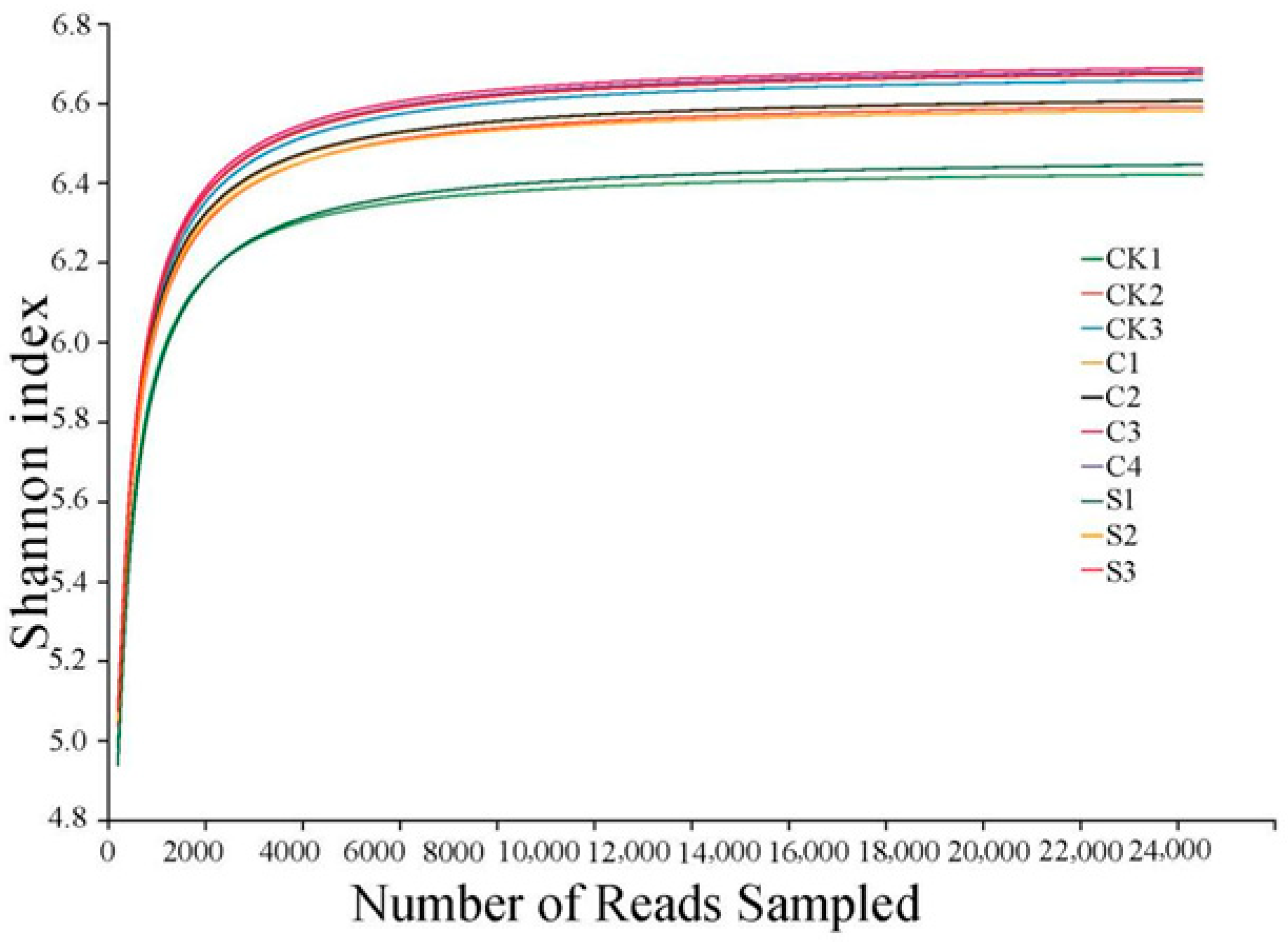
Rarefaction curves based on the Shannon index were constructed to assess the adequacy of sequencing depth and compare soil bacterial community diversity across treatments (Figure 1). All curves reached a clear plateau, confirming that the sequencing effort was sufficient to capture the majority of microbial diversity present. The curve for the reclaimed-water control (CK1) plateaued at the lowest Shannon index value, indicating the lowest bacterial diversity under single-source reclaimed-water irrigation. In contrast, the curve for the alternating irrigation control (CK3) plateaued at a higher level than both CK1 and CK2 (brackish-water control), demonstrating that the alternating irrigation regime itself enhanced community diversity.
Among the amendment treatments under alternating irrigation, the rarefaction curves for rice straw biochar (C3) and wheat straw biochar (C4) reached levels comparable to CK3 and were significantly higher than CK1, indicating that these biochars further optimized community diversity. Within the silicon fertilizer treatments, sodium metasilicate pentahydrate (S3) yielded a high Shannon index, not significantly different from CK3, C3, or C4. Conversely, the curve for Lang-Si (S1) plateaued at a relatively lower level.
The quantitative alpha diversity indices are presented in Table 4. The alternating irrigation control (CK3) exhibited the highest values for observed species (Sobs), richness estimators (ACE, Chao), and diversity indices (Shannon, Pd) among the control groups, all significantly greater than those of CK1. In line with the rarefaction analysis, the biochar treatments C3 and C4 showed no significant difference from CK3 in these indices and were significantly higher than CK1. Their higher evenness indices (Shannoneven, Simpsoneven) suggest these straw-derived biochars improved community structure by enhancing both richness and evenness, outperforming rice husk (C1) and peanut shell (C2) biochars.
The silicon fertilizer S3 maintained alpha diversity indices significantly higher than CK1 and statistically indistinguishable from CK3, C3, and C4. In contrast, Lang-Si (S1) resulted in a significantly higher Simpson index (indicating lower evenness) and lower Shannon and evenness indices compared to most other treatments, confirming a negative impact on community structure. Nayou-Si (S2) showed an intermediate effect. Overall, rice straw biochar (C3), wheat straw biochar (C4), and sodium metasilicate pentahydrate (S3) were most effective in maintaining or enhancing soil bacterial α-diversity under alternating irrigation.

3.2.2. Beta Diversity Analysis

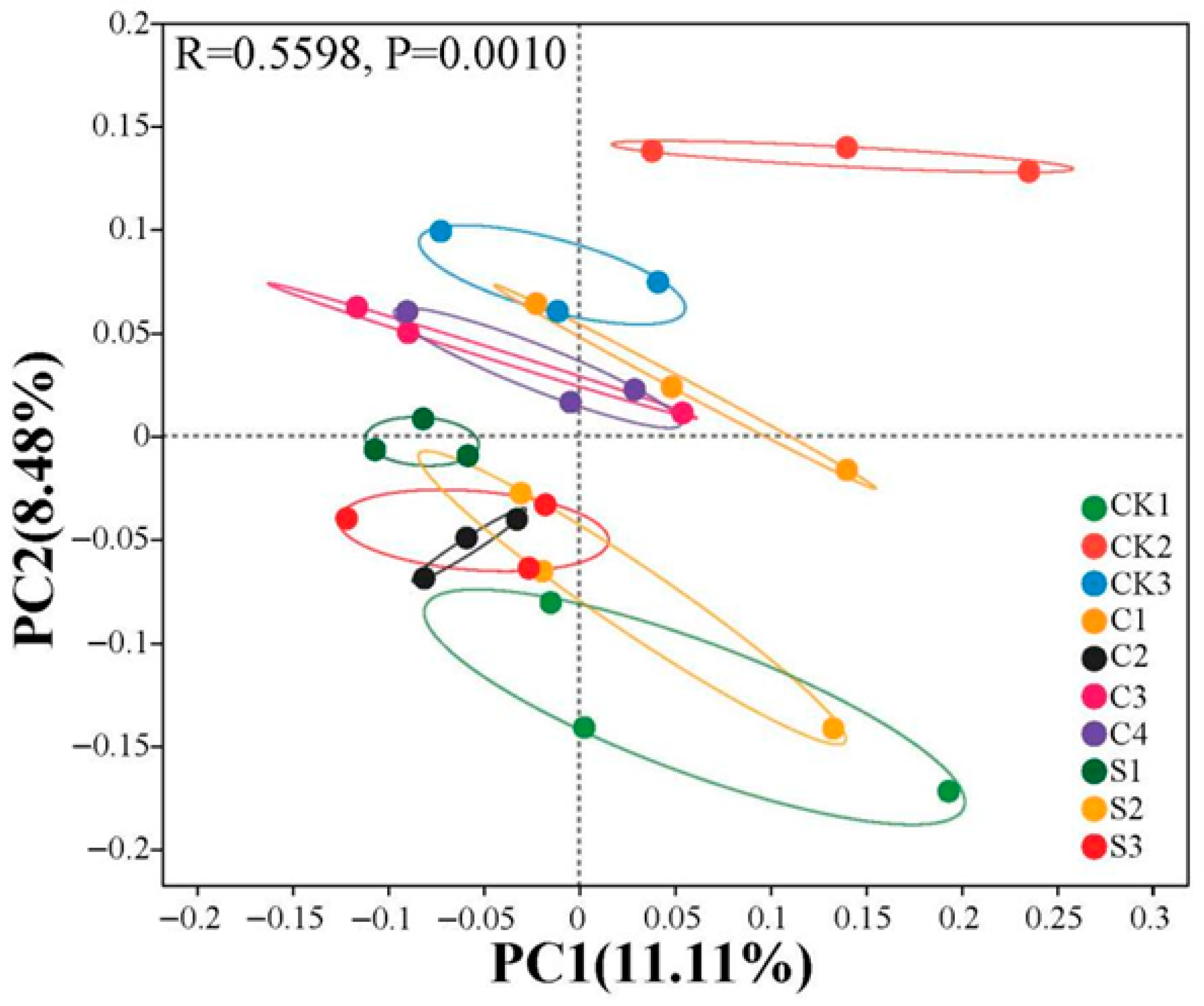
Principal Coordinate Analysis (PCoA) based on unweighted UniFrac distances revealed clear separation in microbial community composition among treatments (Figure 2). The first two principal coordinates (PC1 and PC2) explained 11.11% and 18.48% of the total variance, respectively. Samples from the brackish-water control (CK2) were distantly positioned from other treatments, indicating a distinct community structure. In contrast, samples from treatments C3 and C4, as well as S2 and S3, clustered closely, with some overlap, suggesting similarities in their microbial composition. This ordination confirms that both the irrigation regime and exogenous amendments significantly influenced the β-diversity of soil microbial communities.

3.3. Analysis of Microbial Community Composition

3.3.1. Venn Diagram Analysis

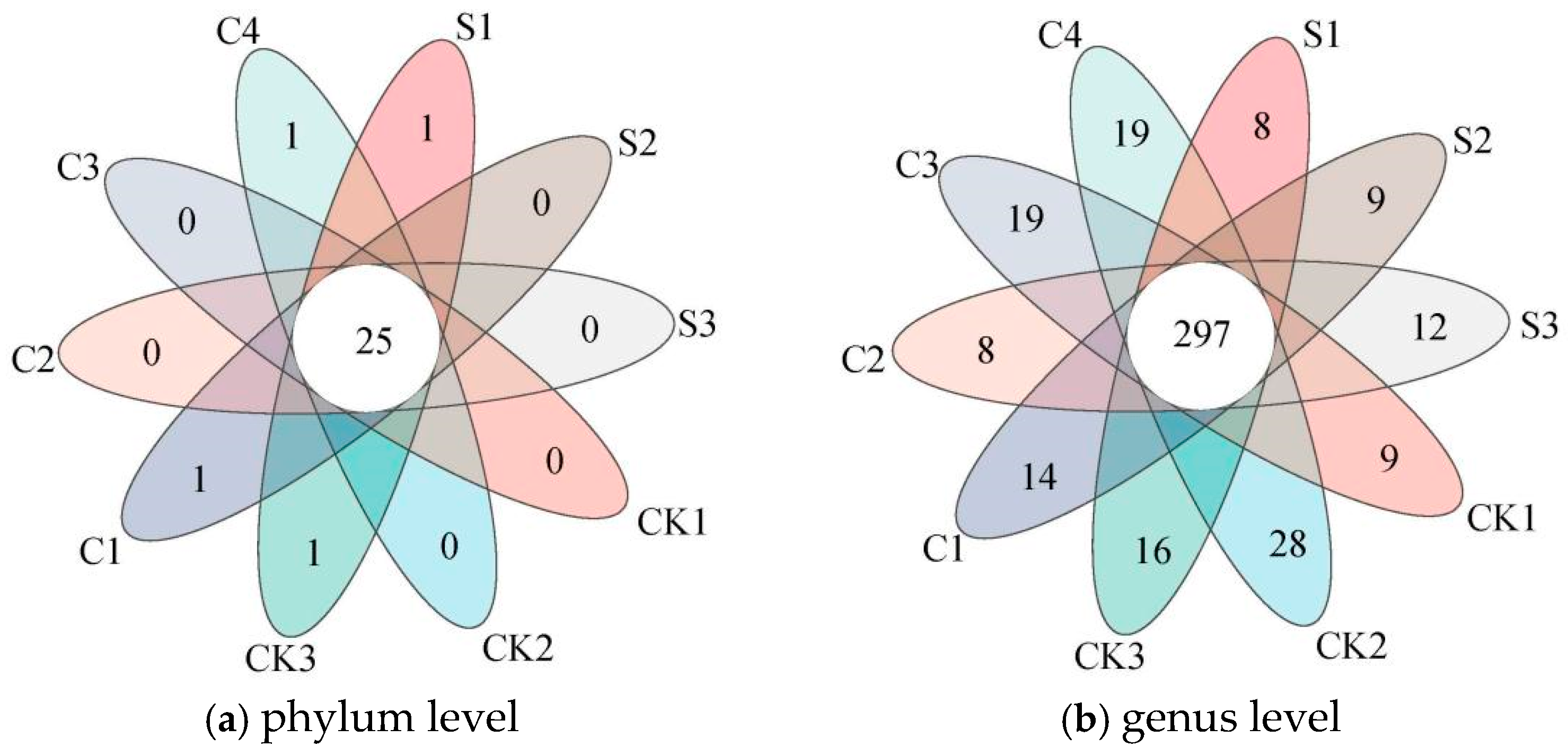
Venn diagrams were constructed to visualize shared and unique microbial taxa at the phylum and genus levels (Figure 3). At the phylum level (Figure 3a), all treatments shared a core of 25 phyla. Unique phyla were minimal, with only C1, C4, CK3, and S1 each possessing one unique phylum, indicating that the treatments had a minor effect on the high-level taxonomic composition.
In contrast, at the genus level (Figure 3b), while a substantial core of 297 genera was shared across all treatments, each treatment also harbored a notable number of unique genera (e.g., 28 for CK2, 19 for C3 and C4, 16 for CK3). This greater uniqueness at the genus level demonstrates that different irrigation and amendment treatments exerted more pronounced and targeted effects on fine-scale microbial community structure.

3.3.2. Community Heatmap Analysis

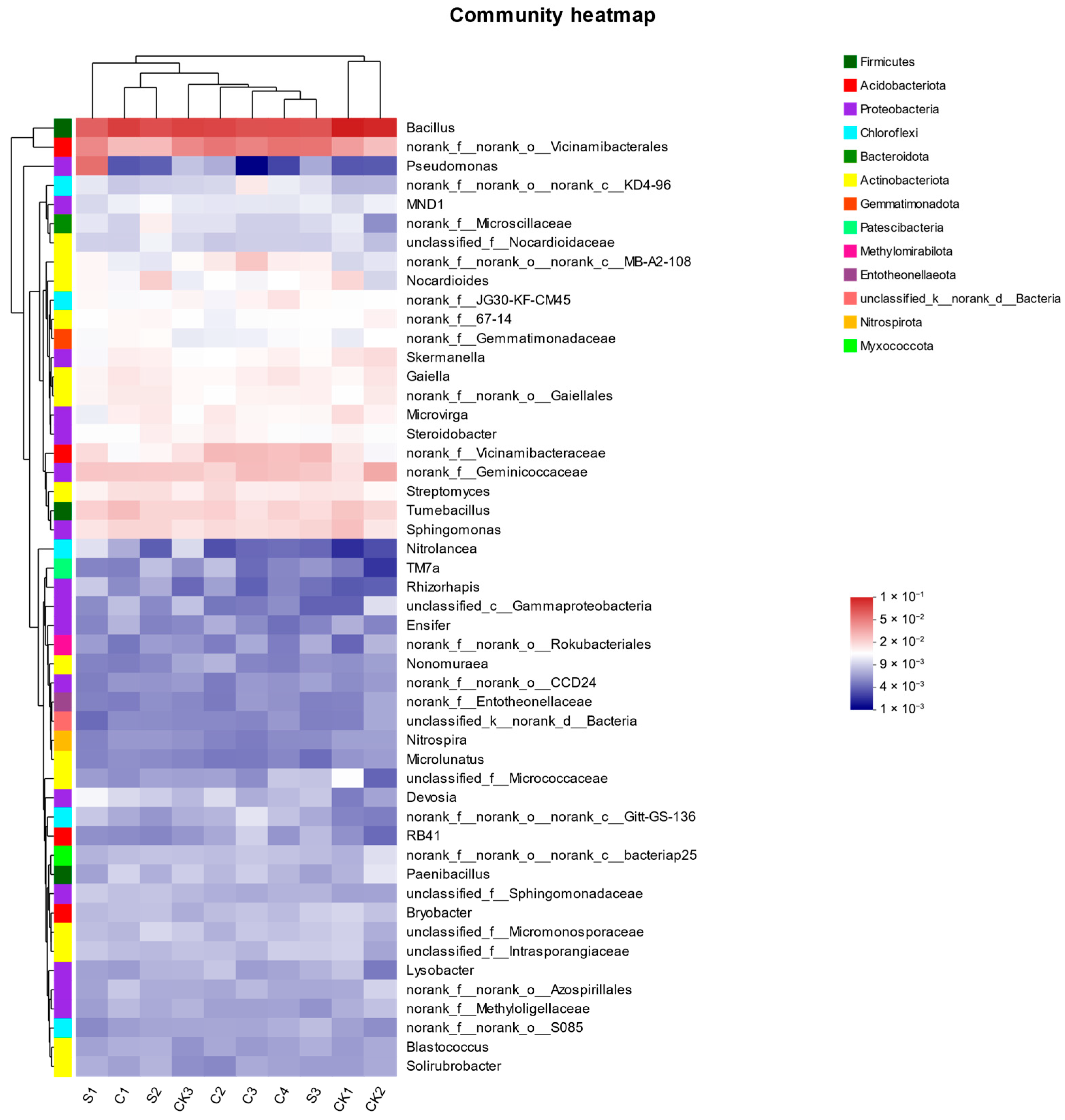
A heatmap visualizing the relative abundance of dominant genera and hierarchical clustering of both samples and taxa is shown in Figure 4. The sample clustering dendrogram primarily separated treatments into two major clusters. The first cluster contained the single-source irrigation controls CK1 and CK2. The second cluster comprised the alternating irrigation control (CK3) and all amendment treatments. Notably, CK3 clustered not with the other controls but within the amendment group, closely associated with straw-derived biochars (C3, C4) and silicon fertilizers S2/S3, suggesting that the alternating irrigation regime induced a community shift towards a state more similar to that of amended soils.
Within the amendment cluster, straw-derived biochars (C3, C4) and silicon fertilizers (S2, S3) formed distinct, tight sub-clusters, indicating highly similar effects on community structure for each amendment type. Peanut shell (C2) and rice husk (C1) biochars were positioned more independently.
Taxon clustering revealed several dominant groups. Bacillus and related unclassified Bacillaceae exhibited the highest relative abundance in the CK1 and CK2 controls (red hues in heatmap). Their abundance decreased in CK3 and was further reduced in most amendment treatments, especially silicon fertilizers (blue hues). A second major group, primarily comprising genera from Proteobacteria (e.g., Sphingomonas) and Actinobacteriota (e.g., Streptomyces, Vicinamibacterales), showed the opposite pattern: lower abundance in CK1/CK2, a slight increase in CK3, and a marked increase (light red to red) in many amendment treatments, particularly C3, C4, and S3.

3.4. Correlation Analysis

3.4.1. Redundancy Analysis (RDA)

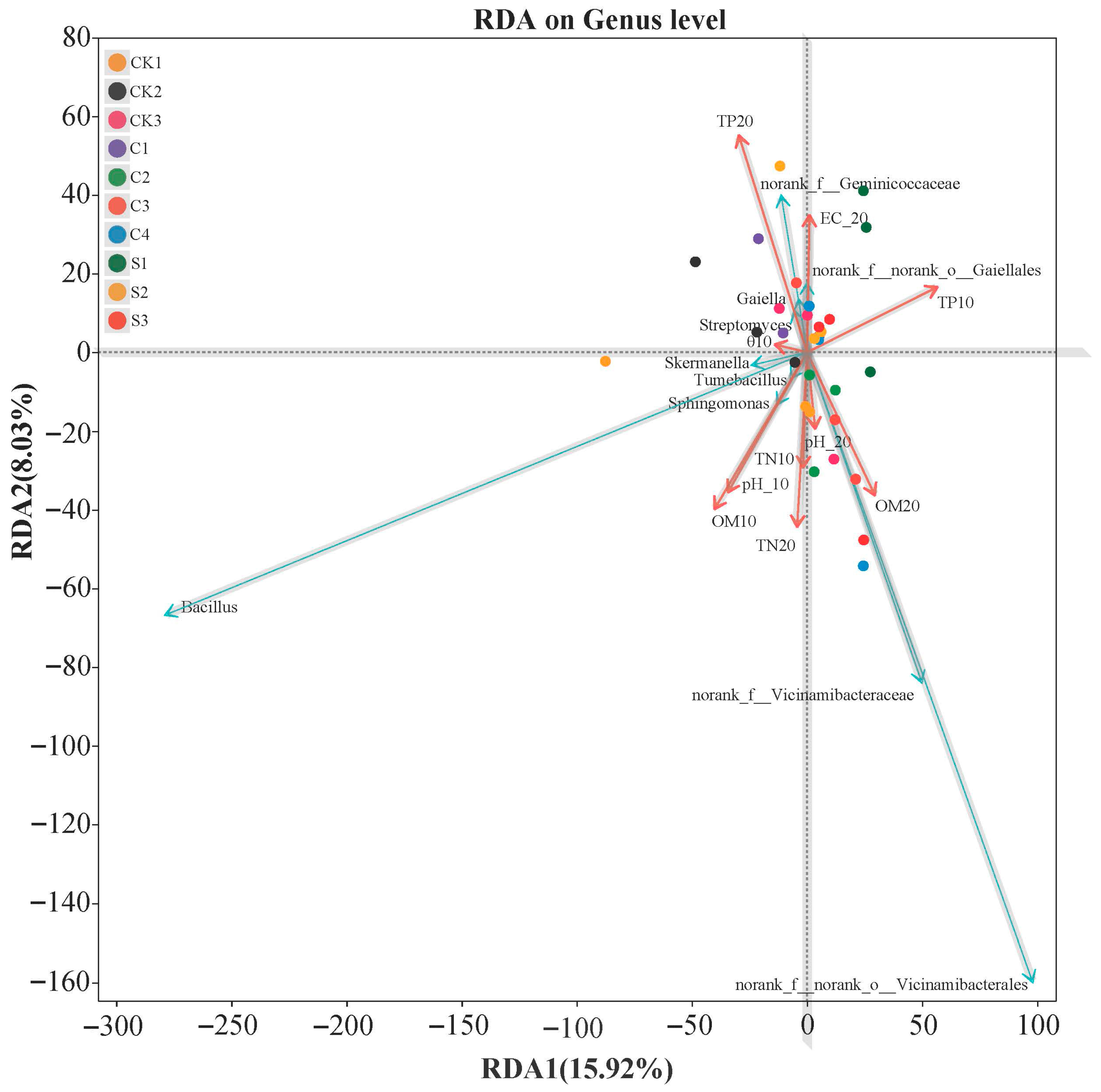
RDA was performed to constrain the relationship between soil environmental factors and microbial community structure (Figure 5). The first two RDA axes together explained 23.95% of the total community variation. Variation partitioning analysis identified total phosphorus (TP10) and organic matter (OM10) in the 0–10 cm layer as the most critical drivers, with explanatory powers (r2) of 0.1925 and 0.1981, respectively. TP10 showed a strong positive correlation with RDA1 (0.885, p = 0.046), while OM10 was negatively correlated with both axes (−0.7137 and −0.7005, p = 0.057). Soil pH (pH_10) also showed considerable explanatory potential (r2 = 0.1505), although it did not reach significance (p = 0.118).
In the ordination biplot, the vector for TP10 pointed towards the first quadrant, aligning with the distribution of samples from the C4 and S3 treatments and genera like Streptomyces and Gaiella, suggesting a positive association. The OM10 vector pointed towards the third quadrant, correlating with the distribution of Bacillus and unclassified Vicinamibacteraceae. The S1 and S2 treatments were mainly distributed in quadrant IV, close to the opposite direction of the OM10 and pH10 arrows. The control treatments were distinctly separated—CK1 in quadrant II, CK2 in quadrant IV, and CK3 in quadrant I—highlighting the strong effect of the irrigation water source.

3.4.2. Correlation Heatmap Analysis

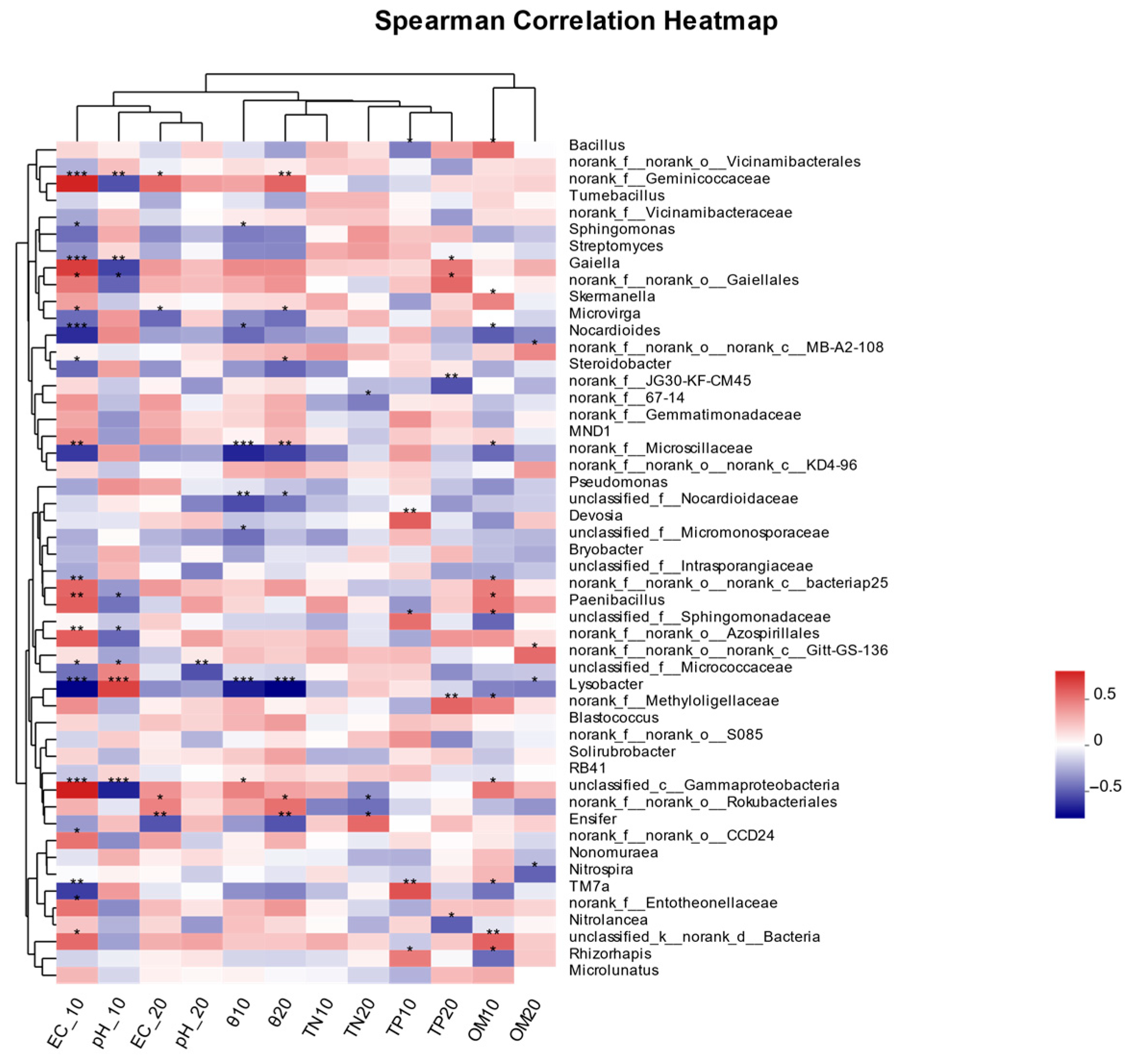
A correlation heatmap quantified pairwise relationships between dominant microbial genera and soil properties in both layers (Figure 6). In the surface layer (0–10 cm), organic matter (OM10) and total nitrogen (TN10) were significantly positively correlated (red) with many beneficial genera, including Streptomyces, Sphingomonas, and Vicinamibacterales. In contrast, electrical conductivity (EC10) was negatively correlated (blue) with several taxa, including Bacillus.
Key genus-specific correlations were observed: Bacillus abundance was positively correlated with OM10 but negatively with EC10. Streptomyces correlated positively with TN10 and OM10, and weakly negatively correlated with TP20. Sphingomonas showed a positive correlation with TN10 and a negative one with EC20. Unclassified Vicinamibacterales were strongly negatively correlated with both EC10 and EC20. Notably, the influential environmental drivers differed between layers, with OM10/TN10 being more prominent in the surface layer, while TP20 showed stronger associations in the subsurface layer.

4. Discussion

4.1. Effects of Exogenous Amendments on Soil Physicochemical Properties Under Alternating Brackish- and Reclaimed-Water Irrigation

The use of alternating irrigation with brackish and reclaimed water presents a viable strategy to mitigate agricultural water scarcity. However, its sustainability is constrained by potential soil salinity accumulation and alterations in soil physicochemical properties. This study demonstrates that the targeted application of exogenous amendments can differentially regulate the soil environment across depths. As expected, single brackish-water irrigation (CK2) significantly elevated the electrical conductivity (EC) in the surface soil (0–10 cm), aligning with previous reports [34]. This increase is primarily attributed to the high concentration of Na+ and Cl in brackish water, which raises the ionic strength of the soil solution, subsequently destabilizing soil colloids and impairing pore structure. Concurrently, the elevated pH under CK2 relative to the reclaimed-water control (CK1) may stem from exchange reactions where soluble salt ions displace OH from soil colloids, with released H+ being neutralized by the soil’s inherent buffering capacity [35]. Notably, the increases in EC, moisture content, and pH in the 10–20 cm deep soil, as well as the increases in EC, moisture content, and pH under CK2, were less pronounced in the subsurface layer (10–20 cm), likely due to the denser soil matrix, reduced hydraulic connectivity, and greater ion-buffering capacity of deeper soil horizons, which collectively retard salt migration—a phenomenon consistent with other studies [36].
The introduction of alternating reclaimed-water and brackish-water irrigation (CK3) effectively mitigated salt stress. The surface soil EC (0–10 cm) under CK3 was significantly lower than under CK2, while the total phosphorus (TP) and organic matter (OM) content were higher than in CK1. This supports the concept of a “dynamic leaching” effect [27], wherein the freshwater (reclaimed water) phases dilute soil solution salinity and promote downward salt leaching, while the brackish-water phases maintain soil moisture without causing rapid surface salt accumulation.
The regulatory effects on soil properties diverged significantly based on amendment type. Among biochars, rice husk biochar (C1) was most effective in enhancing soil fertility, significantly increasing the total nitrogen (TN), total phosphorus (TP), and organic matter (OM) content in the surface layer compared to CK3. This is primarily attributed to its high specific surface area and pore structure, which facilitate the physical adsorption and retention of nutrients, complemented by chelation via its surface functional groups [37]. Peanut shell biochar (C2) exhibited the strongest salt-mitigation capacity, demonstrating superior salt-mitigation capacity. This effect may be driven by the elevated K+ and Ca2+ contents in its ash, which can compete with Na+ for exchange sites on the soil colloid and enhance salt leaching. Notably, this study only determined soil electrical conductivity (EC) to characterize soil salinity, and did not measure the Sodium Adsorption Ratio (SAR) or Exchangeable Sodium Percentage (ESP), key indicators for soil sodicity assessment, which is a certain limitation of this research. For the sandy loam soil in this experiment, the input of Na+ from brackish-water irrigation and biochar application may bring a potential sodicity risk, but the biochars used in this study contained high contents of K+ and Ca2+ (Table 1), and these cations can compete with Na+ for the exchange sites on soil colloids, reduce the adsorption and accumulation of Na+ in the soil, and thus indirectly mitigate the potential soil sodicity risk caused by Na+ enrichment. This ionic competition effect is also an important reason for the significant salinity mitigation effect of peanut shell biochar (C2) observed in this study. Wheat straw biochar (C4) showed preferential enhancement of subsurface nutrient status in the subsurface layer. This may be related to its slower decomposition rate and propensity for downward migration, enabling a sustained release of nutrients in the deeper soil layers [38,39].
In contrast, silicon (Si) fertilizer amendments elicited distinct responses. Nayou-Si (S2) significantly increased TP content in both soil layers, potentially through the formation of stable silicon-phosphorus complexes that reduced phosphorus fixation [40]. It is worth noting that all silicon fertilizer treatments (S1, S2, S3) resulted in significantly lower OM content compared to both biochar treatments and CK3. This suggests that Si fertilizers may subtly suppress microbial activity, thereby indirectly slowing the decomposition and transformation processes of organic matter [41].

4.2. Effects of Exogenous Amendments on Soil Microbial Community Structure Under Alternating Irrigation

Soil microbial communities, serving as a critical nexus between the abiotic environment and ecosystem functioning, are highly responsive to changes in water, salt, and nutrient dynamics [42]. Our results confirm that both irrigation regimes and exogenous amendments significantly reshaped microbial community structure and diversity by altering the rhizosphere microenvironment. Compared to single-source irrigation, the alternating irrigation with reclaimed and brackish water (CK3) significantly increased bacterial α-diversity indices (e.g., Sobs, ACE, Chao, Shannon, Pd), suggesting that alternating irrigation alleviated the singular stress imposed by either reclaimed or brackish water, creating a more favorable habitat. The effects of amendments further differentiated this response. Straw-derived biochars (C3, C4) and sodium metasilicate pentahydrate (S3) maintained or further optimized the α-diversity, with maintained diversity levels exceeding those under single-source irrigation. These results are consistent with the established roles of biochar in providing a “shelter” and stable carbon source [32,33], and of soluble Si in mitigating ionic stress [43]. Conversely, the Lang-Si treatment (S1) reduced Shannon and evenness indices while increasing the Simpson index, indicating a suppressive effect on community diversity. Nayou-Si (S2) showed an intermediate effect.
Analysis of community composition revealed differential responses at the phylum and genus levels. Core phyla, such as Firmicutes, Proteobacteria, and Actinobacteriota, remained relatively stable across treatments, consistent with patterns observed in soils under unconventional water irrigation [44]. However, substantial variation emerged at the genus level, with treatments like CK2, CK3, C3 and C4 harboring greater numbers of unique operational taxonomic units (OTUs). This suggests that exogenous amendments mainly drive community differentiation by selectively enriching or inhibiting specific genera within the stable phylum-level framework, thereby steering functional diversification—a finding supported by other researchers [45,46]. The heatmap and clustering analysis reinforced this view. Control treatments were dominated by high-abundance, often stress-tolerant taxa like Bacillus (Firmicutes). In contrast, amendments, particularly biochars and sodium metasilicate pentahydrate, promoted a shift towards a more balanced community with increased relative abundances of diverse functional genera within Proteobacteria and Actinobacteriota. This transition from “oligarchy” to a more equitable “coexistence” of taxa is likely more conducive to maintaining multifunctional ecosystem processes.
The β-diversity analysis (PCoA) further illustrated significant community restructuring. The CK2 samples were distinctly separated, reflecting a unique community assembled under high salt stress. Samples from C3/C4 and S2/S3 clustered closely, indicating similar structural outcomes induced by similar amendment types under alternating irrigation. Notably, the C3 and C4 communities were positioned near CK3 rather than the single-source controls (CK1 and CK2), suggesting that straw-derived biochars further fine-tuned, rather than completely overhauled, the community established by alternating irrigation—a “slowly and progressively” occurring modulation consistent with biochar’s known effects in stressed soils [47].
Correlation analysis elucidated the potential environmental drivers behind these shifts. RDA and Spearman correlation heatmaps identified organic matter (OM), total nitrogen (TN), total phosphorus (TP), and electrical conductivity (EC) as key factors shaping community composition. Specifically, OM10 and TN10 were significantly positively correlated with beneficial functional genera (e.g., Streptomyces, Sphingomonas), whereas EC10 and EC20 were significantly negatively correlated with various sensitive taxa. Biochar treatments, by increasing OM, TN, and TP content and reducing surface EC, significantly strengthened a positive “nutrient–functional microbe” positive feedback loop. Sodium metasilicate pentahydrate, through improving TP availability and alleviating salt stress, similarly supported diversity and functional groups. In contrast, the Lang-Si’s limited effect on EC and its association with lower OM likely left the community under persistent salt stress, explaining its reduced diversity and simplified structure.
In summary, under alternating brackish–reclaimed-water irrigation, different exogenous amendments distinctly impacted the soil bacterial community primarily via the pathway of “modifying the soil chemical environment (salinity, nutrients)–reshaping the abundance and composition of key functional bacterial groups–fostering feedback mechanisms that further regulate water, salt, and nutrients dynamics” [32,48].

5. Conclusions

This study explored the regulatory effects of four biochar types and three silicon fertilizer types on soil properties and microbial communities under alternating brackish- and reclaimed-water irrigation. The principal conclusions are as follows:
(1)
Alternate irrigation (CK3) alleviated surface soil salinization and increased total phosphorus (TP) compared to single brackish-water irrigation (CK2). Rice husk biochar (C1) enhanced surface soil nutrients, peanut shell biochar (C2) exhibited the strongest salt mitigation, and wheat straw biochar (C4) improved subsurface soil fertility. Nayou-Si (S2) increased TP but reduced soil organic matter (OM).
(2)
Alternate irrigation supported higher bacterial α-diversity than single-source irrigation. Straw-derived biochars (C3, C4) and sodium metasilicate pentahydrate (S3) preserved this diversity, while Lang-Si (S1) had an inhibitory effect, with amendments driving distinct microbial community shifts at the genus level.
(3)
Soil OM, total nitrogen (TN), TP, and electrical conductivity (EC) were the key factors correlated with microbial community variation, explaining 23.95% of the total variance.
(4)
Straw-derived biochars (C3, C4) and sodium metasilicate pentahydrate (S3) are recommended as suitable amendments for this irrigation system based on improved soil properties and maintained microbial diversity, whereas Lang-Si (S1) is not recommended for short-term use.
In conclusion, this study clarifies the regulatory mechanisms of exogenous amendments on the soil environment under unconventional water irrigation, providing theoretical support and practical options for agricultural sustainability. Field validation of these pot experiment results and optimization of application rates are required for large-scale implementation.

Author Contributions

Y.G.: writing (lead); Conceptualization (equal); methodology (equal). Q.H.: writing—review and editing (equal); Conceptualization (equal); methodology (equal). B.C.: Data curation (equal); supervision (lead); C.H.: Data curation (equal); supervision (lead); Y.X.: Data curation (equal); methodology (supporting). J.Z.: Data curation (equal); supervision (lead). Y.Q.: Data curation (equal); methodology (equal). J.W.: Conceptualization (lead); methodology (equal). C.L.: Conceptualization (lead); project administration (supporting); supervision (equal); funding acquisition (equal). All authors have read and agreed to the published version of the manuscript.

Funding

This research was funded by “the Natural Science Foundation of Henan Province of China (242300420061)”, “the Scientific and Technological Project of Henan Province (232102110014)”, “the Key Promotion Program of Scientific and Technological Achievements of Jiangxi Provincial Department of Water Resources (202526TGKT04)” and “the Water Conservancy Science and Technology Project of Inner Mongolia Autonomous Region (202501010102A)”.

Data Availability Statement

The data that support the findings of this study are available from the corresponding authors upon reasonable request.

Conflicts of Interest

The authors declare no conflicts of interest.

References

  1. Huang, Z.Y.; Zhang, J.X.; Ren, D.Y.; Hu, J.Q.; Xia, G.M.; Pan, B.Z. Modeling and Assessing Water and Nitrogen Use and Crop Growth of Peanut in Semi-Arid Areas of Northeast China. Agric. Water Manag. 2022, 267, 107621. [Google Scholar] [CrossRef]
  2. Hu, Y.Q.; Wu, W.Y. Review and Development Strategy of Irrigation with Unconventional Water Resources in China. Strategic Stud. CAE 2018, 20, 69–76. [Google Scholar]
  3. Muscarella, S.M.; Alduina, R.; Badalucco, L.; Capri, F.C.; Di Leto, Y.; Gallo, G.; Laudicina, V.A.; Paliaga, S.; Mannina, G. Water Reuse of Treated Domestic Wastewater in Agriculture: Effects on Tomato Plants, Soil Nutrient Availability and Microbial Community Structure. Sci. Total Environ. 2024, 928, 172259. [Google Scholar] [CrossRef] [PubMed]
  4. Wang, Y.; Cheng, D.H.; Tan, W.B.; Yu, H.; Xi, B.D.; Jiang, Y.H.; Dang, Q.L. Different Responses of Soil Microbial Community Structure to Irrigation with Treated Wastewater from Domestic and Industrial Sources. Environ. Sci. 2020, 41, 4253–4261. [Google Scholar] [CrossRef]
  5. Liu, C.; Cui, B.; Zeleke, K.T.; Hu, C.; Wu, H.; Cui, E.; Huang, P.; Gao, F. Risk of Secondary Soil Salinization under Mixed Irrigation Using Brackish Water and Reclaimed Water. Agronomy 2021, 11, 2039. [Google Scholar] [CrossRef]
  6. Liu, X.F.; Shen, J.; Yin, X.M.; Feng, J.M.; Wang, X.Z. Research Progress on Environmental and Ecological Impacts of Wastewater Treatment Plant Reclaimed Water Discharge and Reuse. J. Environ. Eng. Technol. 2025, 15, 249–258. [Google Scholar]
  7. Dou, P.Q.; Sun, C.B. Fate and Transport of Pathogens of Reclaimed Water in Flotation System. Adv. Mater. Res. 2011, 281, 286–290. [Google Scholar] [CrossRef]
  8. Cui, B.J.; Gao, F.; Hu, C.; Li, Z.Y.; Fan, X.Y.; Cui, E.P. Effect of Different Reclaimed Water Irrigation Methods on Bacterial Community Diversity and Pathogen Abundance in the Soil-Pepper Ecosystem. Environ. Sci. 2019, 40, 5151–5163. [Google Scholar] [CrossRef]
  9. Guo, W.; Qi, X.B.; Li, Z.Y.; Li, P. Impact of Reclaimed Water on Soil Microenvironment Under Different Nitrogen Levels. J. Soil Water Conserv. 2015, 29, 311–315, 319. [Google Scholar] [CrossRef]
  10. Guo, W.; Qi, X.; Xiao, Y.; Li, P.; Andersen, M.; Zhang, Y.; Zhao, Z. Effects of Reclaimed Water Irrigation on Microbial Diversity and Composition of Soil with Reducing Nitrogen Fertilization. Water 2018, 10, 365. [Google Scholar] [CrossRef]
  11. Bastida, F.; Torres, I.F.; Abadía, J.; Romero-Trigueros, C.; Ruiz-Navarro, A.; Alarcón, J.J.; García, C.; Nicolás, E. Comparing the Impacts of Drip Irrigation by Freshwater and Reclaimed Wastewater on the Soil Microbial Community of Two Citrus Species. Agric. Water Manag. 2018, 203, 53–62. [Google Scholar] [CrossRef]
  12. Zalacáin, D.; Martínez-Pérez, S.; Bienes, R.; García-Díaz, A.; Sastre-Merlín, A. Salt Accumulation in Soils and Plants under Reclaimed Water Irrigation in Urban Parks of Madrid (Spain). Agric. Water Manag. 2019, 213, 468–476. [Google Scholar] [CrossRef]
  13. Lyu, S.; Chen, W.; Wen, X.; Chang, A.C. Integration of HYDRUS-1D and MODFLOW for Evaluating the Dynamics of Salts and Nitrogen in Groundwater under Long-Term Reclaimed Water Irrigation. Irrig. Sci. 2019, 37, 35–47. [Google Scholar] [CrossRef]
  14. Erel, R.; Eppel, A.; Yermiyahu, U.; Ben-Gal, A.; Levy, G.; Zipori, I.; Schaumann, G.E.; Mayer, O.; Dag, A. Long-Term Irrigation with Reclaimed Wastewater: Implications on Nutrient Management, Soil Chemistry and Olive (Olea europaea L.) Performance. Agric. Water Manag. 2019, 213, 324–335. [Google Scholar] [CrossRef]
  15. Hamilton, K.A.; Hamilton, M.T.; Johnson, W.; Jjemba, P.; Bukhari, Z.; LeChevallier, M.; Haas, C.N. Health Risks from Exposure to Legionella in Reclaimed Water Aerosols: Toilet Flushing, Spray Irrigation, and Cooling Towers. Water Res. 2018, 134, 261–279. [Google Scholar] [CrossRef] [PubMed]
  16. Han, Y.; Li, P.; Qi, X.B.; Cui, B.J.; Chang, D.; Ma, H.H. Effects of Different Levels of Irrigation with Reclaimed Water on Soil Enzyme Activity and Distribution of Thermotolerant Coliforms. Environ. Sci. 2018, 39, 4366–4374. [Google Scholar] [CrossRef]
  17. Guo, W.; Andersen, M.N.; Qi, X.; Li, P.; Li, Z.; Fan, X.; Zhou, Y. Effects of Reclaimed Water Irrigation and Nitrogen Fertilization on the Chemical Properties and Microbial Community of Soil. J. Integr. Agric. 2017, 16, 679–690. [Google Scholar] [CrossRef]
  18. Hu, Y.; Wu, W.; Xu, D.; Liu, H. Impact of Long-Term Reclaimed Water Irrigation on Trace Elements Contents in Agricultural Soils in Beijing, China. Water 2018, 10, 1716. [Google Scholar] [CrossRef]
  19. Pablos, M.V.; Rodríguez, J.A.; García-Hortigüela, P.; Fernández, A.; Beltrán, E.M.; Torrijos, M.; Fernández, C. Sublethal and Chronic Effects of Reclaimed Water on Aquatic Organisms. Looking for Relationships between Physico-Chemical Characterisation and Toxic Effects. Sci. Total Environ. 2018, 640–641, 1537–1547. [Google Scholar] [CrossRef] [PubMed]
  20. Wang, S.; Liu, F.; Wu, W.; Hu, Y.; Liao, R.; Chen, G.; Wang, J.; Li, J. Migration and Health Risks of Nonylphenol and Bisphenol A in Soil-Winter Wheat Systems with Long-Term Reclaimed Water Irrigation. Ecotoxicol. Environ. Saf. 2018, 158, 28–36. [Google Scholar] [CrossRef]
  21. Suvendran, S.; Acevedo, M.F.; Smithers, B.; Walker, S.J.; Xu, P. Evaluating the Effects of Irrigation Water Quality and Compost Amendment on Soil Health and Crop Productivity. Water 2025, 17, 2927. [Google Scholar] [CrossRef]
  22. Ma, L.J. Effects of Saline Water Irrigation on Key Nitrifying Microorganisms in a Drip-Irrigated Cotton Field. Master’s Thesis, Shihezi University, Shihezi, China, 2016. [Google Scholar]
  23. Su, Z.; Guo, W.; Qiu, H.; Jiang, Z.; He, D.; Hu, N.; Yu, G.; Jiang, S. Long-Term Saline Water Irrigation Affected Soil Carbon and Nitrogen Cycling Functional Profiles in the Cotton Field. Front. Microbiol. 2024, 15, 1310387. [Google Scholar] [CrossRef]
  24. Li, J.; He, P.; Chen, J.; Hamad, A.A.A.; Dai, X.; Jin, Q.; Ding, S. Tomato Performance and Changes in Soil Chemistry in Response to Salinity and Na/Ca Ratio of Irrigation Water. Agric. Water Manag. 2023, 285, 108363. [Google Scholar] [CrossRef]
  25. Boyrahmadi, M.; Raiesi, F. Plant Roots and Species Moderate the Salinity Effect on Microbial Respiration, Biomass, and Enzyme Activities in a Sandy Clay Soil. Biol. Fert. Soils 2018, 54, 509–521. [Google Scholar] [CrossRef]
  26. Wei, C.C.; Ren, S.M.; Xu, Z.A.; Zhang, M.T.; Wei, R.; Yang, P.L. Effects of Irrigation Water Salinity and Irrigation Water Amount on Greenhouse Gas Emissions and Spring Maize Growth. Trans. Chin. Soc. Agric. Mach. 2021, 52, 251–260. [Google Scholar]
  27. Wang, Y.Q.; Guan, Y.; He, X.H.; Li, H.W.; Fan, D.B. Effects of Leaching Irrigation Patterns on Water and Salt Transport in Saline-Alkali Soil with Different Textures. J. Arid Land Resour. Environ. 2023, 37, 137–145. [Google Scholar] [CrossRef]
  28. Yang, K.; Jing, W.; Wang, J.; Zhang, K.; Li, Y.; Xia, M.; Zhang, K.; Mao, J. Structure–Activity Mechanism of Sodium Ion Adsorption and Release Behaviors in Biochar. Agriculture 2024, 14, 1246. [Google Scholar] [CrossRef]
  29. Wei, Y.; Jiao, L.; Zhang, P.; Liu, F.D.; Xiao, H.; Dong, Y.C.; Sun, H.W. Research and Application Progress of Biochar in Amelioration of Saline-Alkali Soil. Environ. Sci. 2024, 45, 940–951. [Google Scholar] [CrossRef]
  30. Aouz, A.; Khan, I.; Chattha, M.B.; Ahmad, S.; Ali, M.; Ali, I.; Ali, A.; Alqahtani, F.M.; Hashem, M.; Albishi, T.S.; et al. Silicon Induces Heat and Salinity Tolerance in Wheat by Increasing Antioxidant Activities, Photosynthetic Activity, Nutrient Homeostasis, and Osmo-Protectant Synthesis. Plants 2023, 12, 2606. [Google Scholar] [CrossRef]
  31. Xu, F.; Liang, Y.; Wang, X.; Guo, Y.; Tang, K.; Feng, F. Synergic Mitigation of Saline-Alkaline Stress in Wheat Plant by Silicon and Enterobacter sp. FN0603. Front. Microbiol. 2023, 13, 1100232. [Google Scholar] [CrossRef]
  32. Cui, B.J.; Cui, E.P.; Hu, C.; Fan, X.Y.; Gao, F. Effects of Selected Biochars Application on the Microbial Community Structures and Diversities in the Rhizosphere of Water Spinach (Ipomoea aquatica Forssk.) Irrigated with Reclaimed Water. Environ. Sci. 2020, 41, 5636–5647. [Google Scholar] [CrossRef]
  33. Liu, J.Y.; Qiu, H.S.; Wang, C.; Shen, J.L.; Wu, J.S. Influence of Biochar Amendment on Soil Denitrifying Microorganisms in Double Rice Cropping System. Environ. Sci. 2019, 40, 2394–2403. [Google Scholar] [CrossRef]
  34. Hu, J.F.; Zeng, Z.; Liu, C.C. Effect of Mixed Irrigation of Brackish Water and Reclaimed Water on Soil Ion Exchange Performance. Pearl River 2024, 45, 105–113. [Google Scholar]
  35. Li, X.; Li, H.; Yang, G. Configuration, Anion-Specific Effects, Diffusion, and Impact on Counterions for Adsorption of Salt Anions at the Interfaces of Clay Minerals. J. Phys. Chem. C 2016, 120, 14621–14630. [Google Scholar] [CrossRef]
  36. Hu, C.W.; Wang, H.; Wu, Y.; Lu, J.Y.; Li, Y.Y. Migration Characteristics and Its Differences of Reclaimed Water Salinity in Different Subtropical Soils. Trans. Chin. Soc. Agric. Eng. 2018, 34, 99–107. [Google Scholar] [CrossRef]
  37. Mosquera, V.; Gundale, M.J.; Palviainen, M.; Laurén, A.; Laudon, H.; Hasselquist, E.M. Biochar as a Potential Tool to Mitigate Nutrient Exports from Managed Boreal Forest: A Laboratory and Field Experiment. GCB Bioenergy 2024, 16, e13131. [Google Scholar] [CrossRef]
  38. Zhao, J.F.; Chen, J.W.; Zhang, D.; Saikat, G. Thermal Stability and Oxidation Resistance of Biochars Derived from Corn Stalk and Wheat Stalk. J. Agro-Environ. Sci. 2019, 38, 458–465. [Google Scholar]
  39. Wang, Y.; Dong, J.X.; Zheng, X.B.; Zhang, J.G.; Zhou, P.L.; Song, X.P.; Song, W.J.; Wang, S.S. Wheat Straw and Biochar Effect on Soil Carbon Fractions, Enzyme Activities, and Nutrients in a Tobacco Field. Can. J. Soil Sci. 2021, 101, 353–364. [Google Scholar] [CrossRef]
  40. Xiong, L.P.; Cai, J.P.; Zhu, J.; Peng, H.; Li, C.J.; Ji, X.H. Effects of Silicon Fertilizer on Nitrogen and Phosphorus Contents in the Rice-Surface Water-Soil of Paddy Field. Chin. J. Appl. Ecol. 2019, 30, 1127–1134. [Google Scholar] [CrossRef]
  41. Zhang, B.C.; Yao, K.; Guo, Z.H.; Wang, J.L.; Huang, J.H.; Bian, Y.T.; Yan, Y.; Chang, C.R. Effect of Silicon Spraying on Degradation of Green Manure Crops under Natural Conditions. Mol. Plant Breed. 2022, 20, 529–535. [Google Scholar] [CrossRef]
  42. Zhao, J.; Wang, J.; Cui, B.; Zhai, B.; Hu, C.; Liu, Y.; Xia, L.; Liu, C.; Li, Z. Mixed Irrigation Affects the Composition and Diversity of the Soil Bacterial Community. Open Geosciences 2024, 16, 20220659. [Google Scholar] [CrossRef]
  43. Han, X.N.; Sun, S.H.; Ma, W.H.; Xue, Z. Effect of Silicon Fertilizer on Rice Yield Under Brackish Water Irrigation. Water Sav. Irrig. 2022, 44, 74–79, 84. [Google Scholar]
  44. Ye, Y.; Guo, X.W.; Yang, M.Q.; Min, W.; Guo, H.J. Microbial Community Structure and Functional Genes of Phosphorus Cycling in Cotton Field Soil Under Long-term Saline Drip Irrigation. Environ. Sci. 2025, 46, 1225–1235. [Google Scholar] [CrossRef]
  45. Liu, H. Study of Phytoremediation and Fungal Community Response in Manganese Slag Under the Mediation of Amendments and Plants. Master’s Thesis, Central South University of Forestry and Technology, Changsha, China, 2025. [Google Scholar]
  46. Yang, J.; Ren, Y.; Huang, S.; Weng, L.; Li, Y.; Liu, H.; Zhao, P.; Wang, L.; Jie, X. Medium Molecular Weight Carbon Fractions of DOM: Driving Soil Microbial Community Differentiation and Soil Organic Carbon Sequestration. Agric. Ecosyst. Environ. 2025, 389, 109688. [Google Scholar] [CrossRef]
  47. Guo, X.W.; Xiang, G.Q.; Zhang, F.C.; Jiang, S.; Min, W. Effects of Biochar and Straw Return on Soil Microbial Community Characteristics and Functional Differences in Saline Water Drip Irrigation Cotton Fields. Environ. Sci. 2024, 45, 3571–3583. [Google Scholar] [CrossRef]
  48. Liu, Y.; Yang, S.Q.; Zhang, W.F.; Lou, S. Effects of Microbial Fertilizer on Physicochemical Properties and Bacterial Communities of Saline Soil Under Brackish Water Irrigation. Environ. Sci. 2023, 44, 4585–4598. [Google Scholar] [CrossRef]
Figure 1. Rarefaction curves of soil bacterial communities under different treatments.
Agriculture 16 00560 g001
Figure 2. Principal Coordinate Analysis (PCoA) plot based on unweighted UniFrac distances.
Agriculture 16 00560 g002
Figure 3. Venn diagrams of soil microbial communities at the (a) phylum and (b) genus levels.
Agriculture 16 00560 g003
Figure 4. Community heatmap.
Agriculture 16 00560 g004
Figure 5. Redundancy analysis (RDA).
Agriculture 16 00560 g005
Figure 6. Heatmap of Spearman’s correlation coefficients between dominant microbial genera and soil environmental factors. *, ** and *** indicate significance at p < 0.05, p < 0.01 and p < 0.001 levels, respectively.
Agriculture 16 00560 g006
Table 1. Physicochemical characteristics of the biochar amendments used in the study.
Property/Biochar SourceRice Husk (RH)Peanut Shell (PS)Rice Straw (RS)Wheat Straw (WS)
pH9.019.589.118.34
EC (μS∙cm−1)139813787731917
Na+ (mg∙kg−1)76345332
K+ (mg∙kg−1)397449246519
Total Organic Carbon (mg∙kg−1)88.9912.9411.6521.63
Ammonia Nitrogen (mg∙kg−1)0.90.31.00.9
Total Phosphorus (mg∙kg−1)83.329.438.810.5
Table 2. Experimental design.
TreatmentExogenous AdditivesWater SourceApplication Mode/Rate
CK1NoneReclaimed Water (RW)
CK2NoneBrackish Water (BW, 5 g∙L−1)
CK3NoneRW-RW-BW
C1Rice Husk BiocharRW-RW-BWSoil incorporation, 2% (w/w)
C2Peanut Shell BiocharRW-RW-BWSoil incorporation, 2% (w/w)
C3Rice Straw BiocharRW-RW-BWSoil incorporation, 2% (w/w)
C4Wheat Straw BiocharRW-RW-BWSoil incorporation, 2% (w/w)
S1Lang-SiRW-RW-BWFoliar spray, 1000× dilution
S2Nayou-SiRW-RW-BWFoliar spray, 1000× dilution
S3Sodium Metasilicate PentahydrateRW-RW-BWFoliar spray, 150 mg∙L−1
Note: “RW-RW-BW” means an alternating irrigation sequence of reclaimed water, reclaimed water, and brackish water. This sequence was designed to prioritize reclaimed water during critical growth stages while utilizing brackish water during less sensitive periods, reflecting practical water management strategies for maximizing crop yield under water scarcity conditions.
Table 3. Soil physicochemical properties.
Treatment0–10 cm10–20 cm
EC/μS·cm−1pHSW/%/TN/mg·kg−1TP/mg·kg−1OM/%EC/μS·cm−1pHSW/%TN/mg·kg−1TP/mg·kg−1OM/%
CK1598 i 8.09 a8.93 d0.85 d1.03 d1.98 b997 g8.12 ef10.59 e0.83 cd0.89 a1.58 cd
CK21870 a 8.11 d20.06 a0.86 d1.00 d2.24 ab1275 a8.22 b18.36 a0.77 ef0.92 a1.78 c
CK31375 e 7.97 d9.97 cd0.85 d1.10 c2.08 ab1144 c8.11 f11.81 d0.78 ef0.87 a1.65 cd
C11493 c 8.25 g11.81 bc0.95 a1.19 b2.29 a1112 e8.16 c13.33 bc0.86 abc0.90 a2.12 ab
C21162 h 8.06 b10.93 cd0.90 bc1.12 c2.13 ab1118 de8.36 a12.47 cd0.87 ab0.90 a2.10 b
C31463 d8.04 e11.74 bc0.86 cd1.08 c2.04 ab1037 f8.20 b13.95 b0.84 bc0.91 a2.16 ab
C41639 b8.11 f13.92 b0.94 ab1.18 b2.14 ab1152 c8.14 cde14.50 b0.89 a0.89 a2.31 a
S11353 f8.10 d11.70 bc0.83 de1.12 c1.66 c1148 c8.14 cde13.48 bc0.78 ef0.87 a1.78 c
S21281 g8.14 d10.84 cd0.79 e1.26 a1.60 c1125 d8.15 cd13.48 bc0.76 f1.11 a1.67 cd
S31351 f8.14 c10.89 cd0.83 de1.17 b1.68 c1167 b8.13 def14.18 b0.80 de0.87 a1.53 d
Note: Different lowercase letters in the same column indicate significant differences at the 0.05 level, n = 3, unless otherwise specified. EC = Electrical Conductivity; SW = Soil Water; TN = Total Nitrogen; TP = Total Phosphorus; OM = Organic Matter.
Table 4. Alpha diversity indices of treated samples.
TreatmentSobsACEChaoShannonSimpsonShannonevenSimpsonevenPd
CK11039 b1039 b1039 b6.42 b0.00362 ab0.92 ab 0.342 a85.18 c
CK21224 a1224 a 1224 a6.60 ab0.00235 b 0.928 ab 0.351 a98.37 ab
CK31255 a1255 a1255 a 6.66 ab0.00205 b 0.933 a 0.391 a102.12 a
C11170 ab1170 ab1170 ab 6.61 ab0.00210 b 0.935 a 0.409 a95.85 abc
C21160 ab1160 ab 1160 ab 6.61 ab0.00205 b 0.936 a 0.422 a95.21 abc
C31232 a1232 a 1232 a6.69 a0.00186 b 0.940 a 0.436 a102.38 a
C41253 a1253 a1253 a6.68 a0.00194 b 0.936 a 0.411 a102.59 a
S11167 ab1167 ab1167 ab6.45 ab0.00534 a 0.914 b 0.185 b94.57 abc
S21127 ab1127 ab 1127 ab6.58 ab0.00210 b 0.937 a 0.428 a89.98 bc
S31230 a1230 a1230 a6.67 a0.00191 b 0.938 a 0.427 a99.14 ab
Note: Different lowercase letters within a column indicate significant differences (p < 0.05). Sobs = Observed Species; ACE = Abundance-based Coverage Estimator; Chao = Chao richness estimator; Pd = Phylogenetic diversity.
Disclaimer/Publisher’s Note: The statements, opinions and data contained in all publications are solely those of the individual author(s) and contributor(s) and not of MDPI and/or the editor(s). MDPI and/or the editor(s) disclaim responsibility for any injury to people or property resulting from any ideas, methods, instructions or products referred to in the content.