Article

A Novel Rotating–Throwing Seed-Metering System Enabling Zero-Velocity and Damage-Free High-Speed Seeding


1
College of Mechanical and Electrical Engineering, Qingdao Agricultural University, Qingdao 266109, China
2
Yellow River Delta Intelligent Agricultural Machinery Equipment Industry Academy, Dongying 257300, China
3
National Research University “Tashkent Institute of Irrigation and Agricultural Mechanization Engineers”, Tashkent 100000, Uzbekistan
*
Author to whom correspondence should be addressed.
Agriculture 2026, 16(5), 503; https://doi.org/10.3390/agriculture16050503
Submission received: 8 December 2025 / Revised: 14 February 2026 / Accepted: 15 February 2026 / Published: 25 February 2026
(This article belongs to the Section Agricultural Technology)

Abstract

Conventional pneumatic precision planters still face challenges in combining high-speed operation with accurate seed placement and embryo protection under zero-velocity seeding conditions. This study presents a dual-motor rotating–throwing seed-metering device that simultaneously overcomes these challenges. Instead of relying on conventional imprecise airflow to generate initial velocity, seeds are accelerated and released by a motor-driven spoon with precisely defined kinematic profiles. By accurately controlling seed-throwing velocity and angle, the system compensates for the forward motion of the machine to achieve zero-velocity seeding and accurate landing point control across the full speed range. The elimination of seed tubes prevents frictional embryo damage, particularly benefiting fragile seeds such as cotton or peanuts. High-speed imaging (1000 fps) verified uniform initial seed ejection conditions, stable trajectories, and landing position errors below 1.5 cm at 7–13 km/h. The proposed electromechanical approach provides accurate metering, zero-velocity seeding, and seed protection under high-speed conditions, overcoming the inherent limitations of airflow-dependent systems and offering a robust alternative for precision agriculture. Compared with conventional pneumatic meters, the proposed system reduced seed landing variation by over 50%, demonstrating superior robustness under 7–13 km/h operation.

1. Introduction

Precision sowing plays a fundamental role in modern crop production. Studies have confirmed that optimizing seed spacing, planting density, depth- and site-specific adjustments is essential for maximizing agronomic performance, minimizing resource waste, and ensuring sustainable crop production [1,2,3,4,5,6]. Within this context, single-seed precision sowing has attracted increasing attention, as it guarantees accurate seed singulation and placement—both critical for achieving uniform plant stands and high yields [7,8,9]. To improve field operation efficiency, large-scale mechanized agriculture has an increasing demand for higher planting speeds. Multiple recent field studies indicate that increasing operating speed may aggravate in-row spacing variability and lead to stand non-uniformity. Therefore, maintaining stable, high-quality seed placement and spacing uniformity while achieving high-speed operation remains a key challenge for modern precision planters [10,11,12].
Central to this technology is the seed-metering device, whose evolution reflects continuous efforts to improve seeding accuracy, speed and adaptability. An early mechanical plate-type device provided basic singulation but suffered from frequent misses and doubles. Pneumatic suction-based seed meters then became dominant [13]. By adhering seeds to a rotating disc with negative pressure, and then releasing them into a seed tube, these devices achieved higher accuracy and speed [14]. With the advent of electric drives, independent motor actuation further enhanced controllability and operational flexibility [15,16,17,18,19,20]. High-speed airflow was also introduced to accelerate seeds inside the seed tube, extending maximum operational speeds to 18–20 km/h [21]. This novel seed-metering device provides the seed with an initial ejection motion through precisely controlled motor rotation, whereas conventional systems rely on pneumatic airflow that is inherently more difficult to regulate accurately, which will also be discussed in detail in Section 4.1.
The first issue is seeding precision caused by imprecise airflow–seed interactions. Airflow forces cannot be exactly controlled and vary with seed size, shape, and orientation, resulting in inconsistent initial velocities and trajectories [22]. A considerable body of research has sought to improve pneumatic seed-metering performance by optimizing airflow–seed interactions through structural parameterization and auxiliary mechanism design, often relying on intensive CFD/DEM/FEA simulations that are computationally costly, case-specific, and lack generalizability. For example, Ding optimized vacuum chamber pressure for corn seeders [23], Wang used DEM to analyze the friction-filling process of a vertical-disc seed-metering device and clarify how structural and friction parameters affect the seed-filling force [24], while Du and Xu refined the structural and dimensional parameters of the inner filling disc [16,25]. Zhao further enhanced efficiency by optimizing the discharge disc [26], Zhu optimized the inclination angle of the triage convex ridge, the radius of the shaped hole and the depth of the seed guide groove to ensure a high single-seed rate and consistent seed-casting points in a double-row seed-metering device [27], and Liu introduced variable cross-section disc holes and groove depth to assist seed filling [28]. Zhong mitigated the problem of inaccurate seed adsorption caused by an overly dense seed population in the filling zone by adjusting factors such as seed population thickness, flow angle, suction negative pressure and forward speed [29]. Feng designed conical suction holes for carrot seeding, and Li modified mixing wheel geometry and hole numbers to support high-speed, clean production [30], Dong optimized the filling structure and operating parameters to stabilize seed filling at high speeds [31]. Complementary to disc optimization, auxiliary pneumatic mechanisms have also been explored: Deng adjusted airflow-interactive shapes to improve maize seed posture in the filling zone [32], Wang compared six structural assemblies for seed transport using DEM–CFD coupling [33], and Li proposed airflow-assisted filling and cleaning [12]. However, nearly all current studies remain constrained by airflow dependence, which fundamentally limits precision and high-speed control.
In parallel, researchers have sought to improve the seed trajectory within the seed tube. Han demonstrated that multiple collisions in the seed tube degrade seeding quality and optimized tube parameters accordingly, while Jia applied a brachistochrone-based tube design [34]. Li investigated airflow-assisted tubes and parameter optimization for auxiliary seed delivery systems [35]. Collectively, these studies demonstrate substantial progress in refining pneumatic seeding performance.
Nevertheless, the reliance on airflow introduces inherent challenges to precision. Aerodynamic forces vary significantly with seed size, shape, and orientation, resulting in inconsistent initial velocities, trajectories, and landing positions. Consequently, many designs require complex CFD/DEM/FEA simulations for optimization, which are computationally intensive, case-specific, and often lack generalizability. In practice, this means that even with sophisticated designs, pneumatic systems remain limited by the fundamental imprecision of airflow-based seed acceleration, compromising uniform plant spacing under high-speed field conditions.
The second issue is the inability to achieve zero-velocity seeding. To prevent seed bouncing and displacement after soil contact, it is generally required that seeds land with zero horizontal velocity relative to the ground, i.e., the backward horizontal velocity of the seeds should match the forward velocity of the seeding machine [36]. However, existing pneumatic devices rely on fixed-geometry seed tubes that constrain the seed trajectory and exit angle. As a result, the velocity and angle of seeds at the tube exit remain almost constant, making zero-velocity seeding achievable only at a very specific vehicle speed [37]; that is also one reason for performance degradation observed at high speed. Without zero-velocity seeding, seeds will land with horizontal velocity, and collisions with soil or press wheels lead to displacement and reduced sowing quality. Hence, innovation is required to enable the online adjustment of seed ejection angle and velocity, ensuring stable zero-velocity seeding across a wide speed range.
The third issue is seed embryo damage during high-speed seed-tube conveyance. During high-speed conveyance through seed tubes, seeds are subjected to frictional forces and collisions with the tube wall, which can damage the embryo. This is particularly problematic for fragile crops such as cotton and peanuts, and is a major reason why most high-speed pneumatic systems are applied mainly to corn [15,16,23,34]. The inability to simultaneously achieve high-speed delivery and damage-free handling reflects a fundamental limitation of conventional airflow-based seed acceleration mechanisms.
Despite extensive research efforts, conventional airflow-based mechanisms still cannot simultaneously achieve precision metering, zero-velocity placement, and embryo protection under a high-speed operation. This limitation highlights the need for a fundamentally different approach. To address this gap, this paper proposes a novel dual-motor rotating–throwing seed-metering device. By imparting controlled kinetic energy directly to seeds through a rotating motor-driven spoon, the system enables precisely regulated seed-throwing velocities and angles, achieves accurate control, full-range zero-velocity seeding, and eliminates the use of seed tubes to avoid embryo damage.
The remainder of this paper is organized as follows: Section 2 introduces the structural design and control strategy of the proposed device; Section 3 presents experimental validation and performance analysis; Section 4 discusses advantages, limitations, and future improvements; and Section 5 concludes the study.

2. Materials and Methods

2.1. Overall Structure and Working Principle

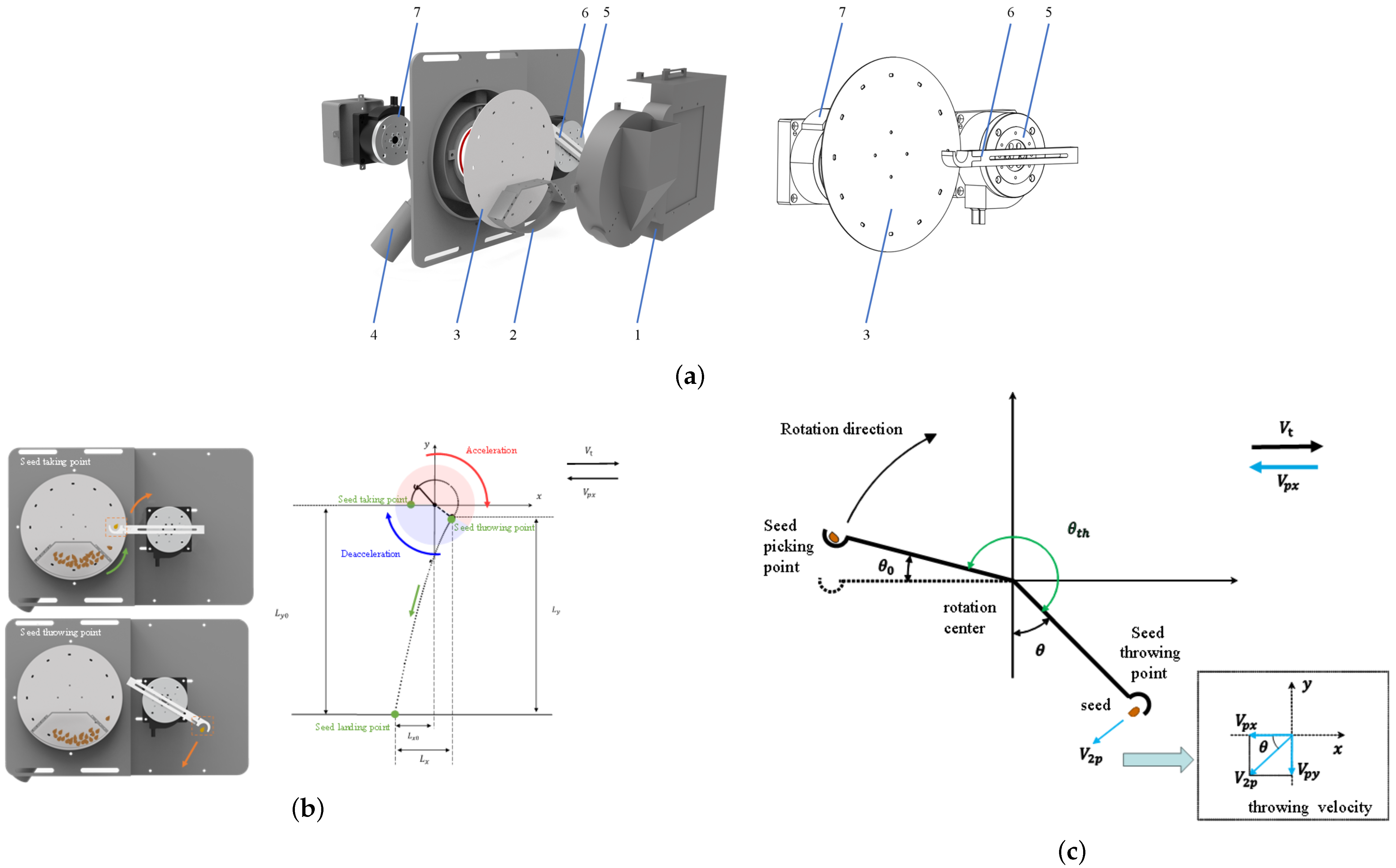
The proposed novel seed-metering device is primarily composed of a supplying motor, a throwing motor, a seed-supplying disc, a seed metering spoon, and other supplementary components, as depicted in Figure 1a. This configuration leverages the coordinated operation of the two motors to achieve its intended function. This mechanism enables both high-speed operation and precise controllability. The seeding process and the underlying working principle are illustrated in Figure 1b, with a detailed explanation of each part’s function. To provide a detailed description of the control algorithm, the variables utilized in the control strategy are depicted in Figure 1c, and the variables are further explained in conjunction with the algorithm’s description.
The seed supply motor drives the seed supply disc, which features holes that, in conjunction with negative pressure airflow, firmly attach seeds onto the disc. As the disc rotates, the seed reaches a preset position for “seed taking”. Simultaneously, the seed metering spoon, driven by the throwing motor, arrives at the same position with an identical velocity, facilitating a damage-free transfer of the seed into the spoon.
Upon receiving the seed, the throwing motor accelerates the seed metering spoon, accumulating kinetic energy for the subsequent throwing action. Once the spoon rotates to the designated position for “seed throwing”, the seeds are ejected by decelerating the spoon through the action of the seed-throwing motor.
After being released, the seeds follow a parabolic motion determined by their initial velocity in different directions, as described in Equation (1). Here, L x (m) and L y (m) are the horizontal and vertical distance between the throwing point and the seed landing point, g (m/s2) is the gravitational acceleration, V p x (m/s) and V p y (m/s) are respectively the horizontal and vertical component of the seed velocity at throwing point, T f (s) is the seed flight time from throwing to landing. Air resistance is neglected because the short flight time and small seed size render its effect negligible on overall performance. Aerodynamic drag and other secondary forces are neglected because the seed flight distance and time are very short. Under the tested conditions, the resulting landing-point errors are only sub-millimeter ( Δ L x 0 0.054 mm; Δ L y 0 0.143 mm). Thus, omitting these effects does not affect the theoretical conclusions, and wind disturbances can be further reduced with a wind shield along the seeding path. By precisely coordinating the horizontal and vertical components of the throwing speed, the landing position of the seeds can also be accurately controlled.
L x = V p x T f , L y = V p y T f + 1 2 g T f 2
Furthermore, by ensuring that the horizontal component of the seed’s throwing speed at the throwing point matches the forward speed of the entire machine, zero-velocity seeding is achieved, as in Equation (2). Here, V t (m/s) is the forward speed of the whole machine.
V p x = V t
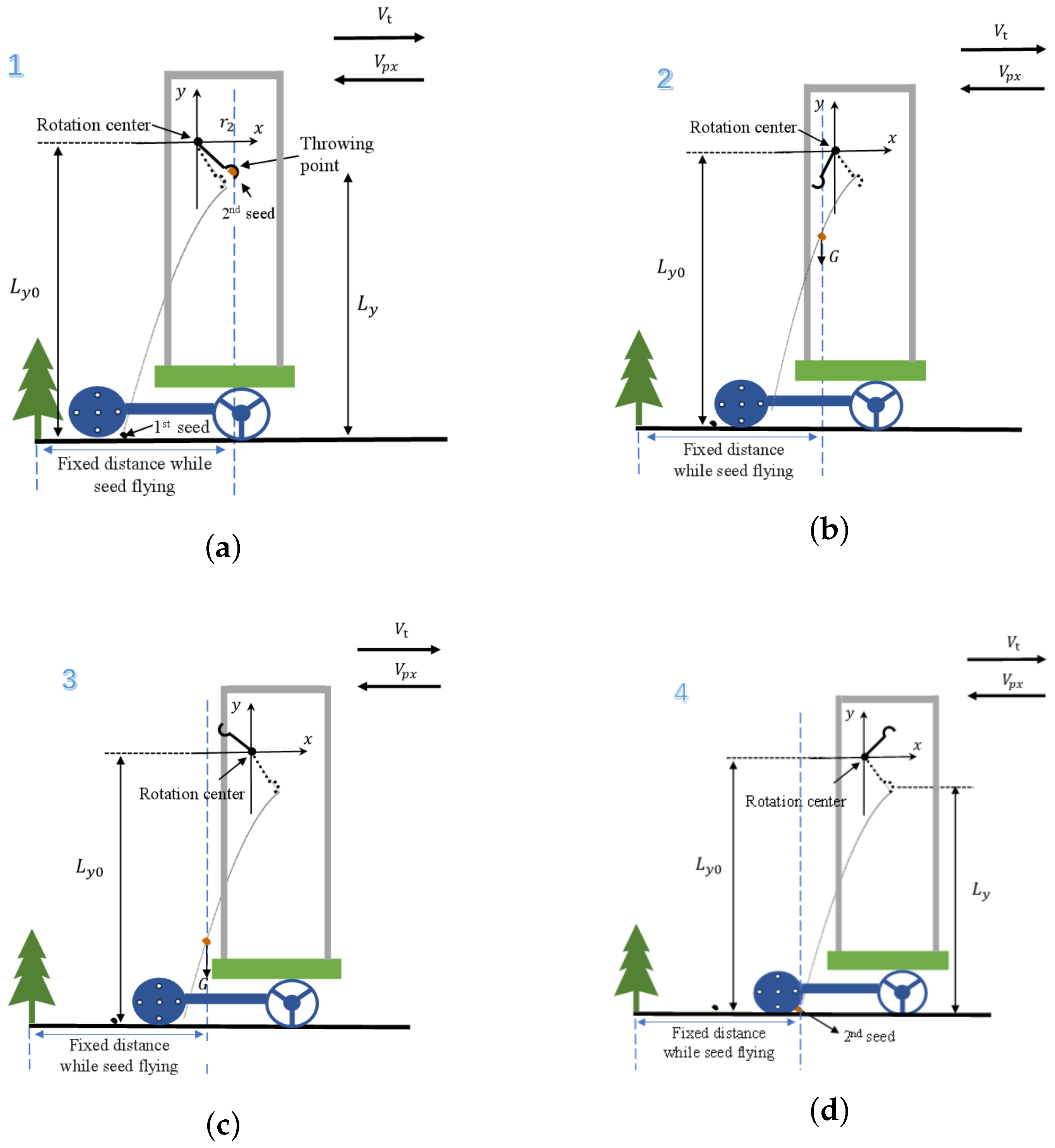
Although the seed appears to be thrown backward when observed from the seed metering unit’s frame of reference, when integrated into the complete machinery system, the horizontal velocity of the thrown seed effectively cancels out the horizontal velocity of the vehicle’s forward motion. Consequently, the seed achieves zero horizontal velocity relative to the ground from the moment of throwing until landing. This mechanism, termed “zero-velocity seeding,” significantly reduces seed bouncing and enhances seeding quality. The entire zero-velocity seeding mechanism is further elucidated in Figure 2.

2.2. Control Algorithm and Motor Position Profile Generation

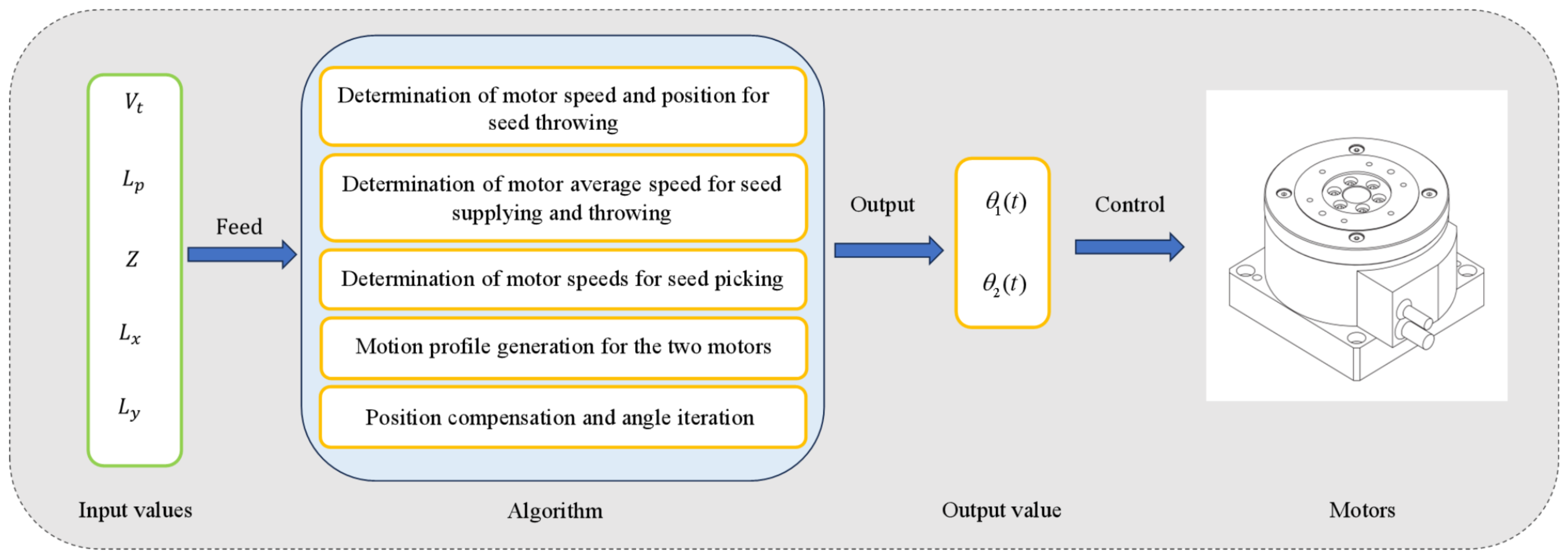
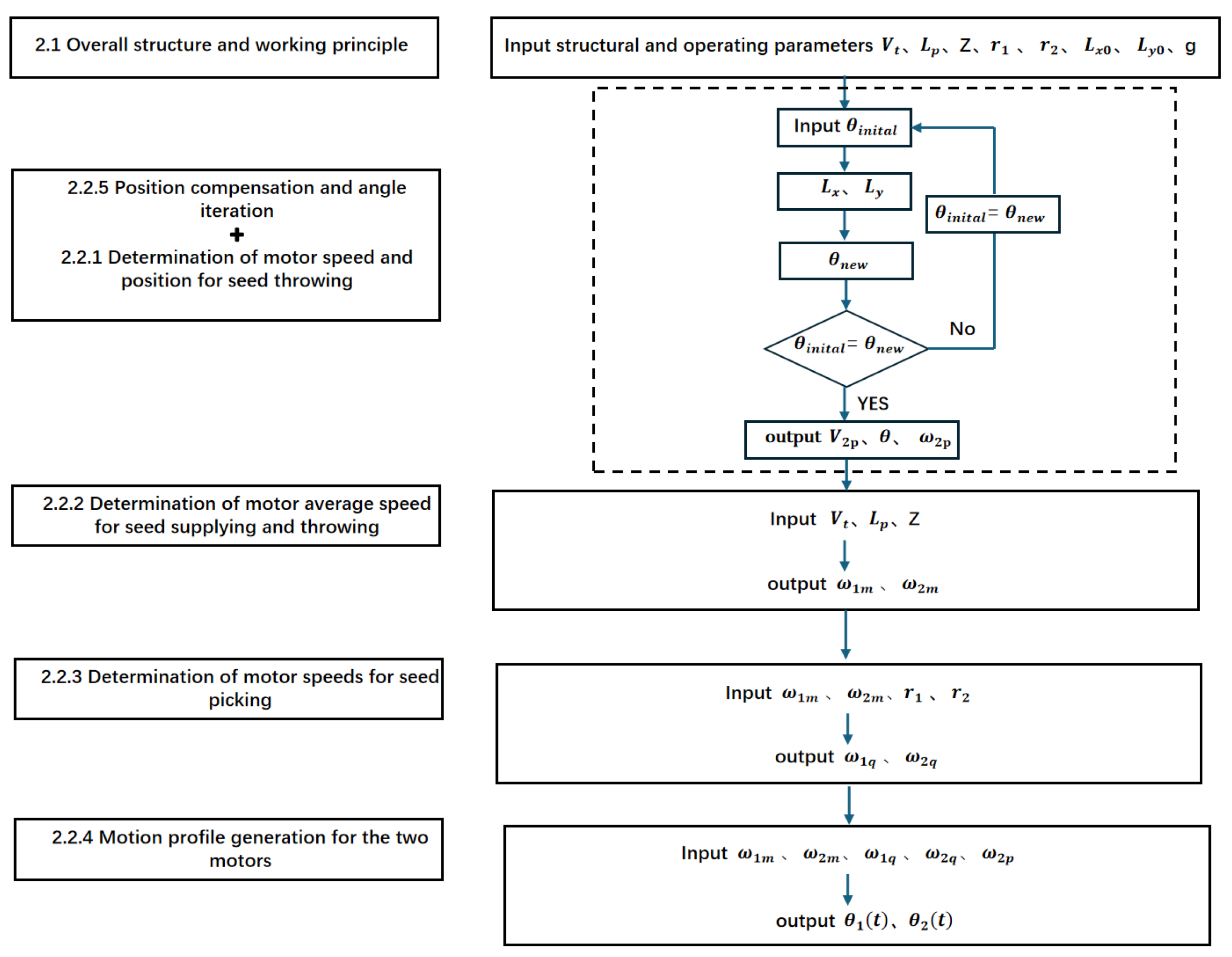
The overall control algorithm of the seed-metering unit, developed to realize the proposed throwing principle, is shown in Figure 3. The control algorithm accepts several input parameters: the forward speed of the whole machine, V t (m/s), which can be measured by a ground-speed radar sensor or a ground wheel; the desired plant spacing, L p (m); the number of seed suction holes on the seed supply disc, Z; and the desired seed flying horizontal distance, L x (m), and vertical distance, L y (m), between the throwing point and the landing point. The algorithm then outputs position commands for the two motors to coordinate their motion.
The algorithm comprises five primary functions. Generally, the algorithm first determines the motion requirements at the critical points of seed throwing and seed picking (parts 1–3). Subsequently, it generates the motion profile (part 4) for the entire operational period. Concurrently, a compensation mechanism (part 5) is employed through iteration to resolve algebraic loops. The detailed functions are elaborated in the subsequent subsections.
The control algorithm integrates kinematic coordination, dynamic compensation, and iterative angle correction, achieving real-time synchronization of both motors.

2.2.1. Determination of Motor Speed and Position for Seed Throwing

This part of the algorithm is designed to determine the seed velocity and angle at the throwing point, which is necessary for achieving zero-velocity seeding and precise landing point control.
The seed-throwing velocity and angle are determined by Equation (3). Here, V 2 p (m/s) is the seed velocity at throwing point; θ (rad) is the seed-throwing angle in radians.
V 2 p = V p x 2 + V p y 2 , θ = arctan V p y V p x
The components V p x and V p y are further defined in Equation (4). To achieve zero-velocity seeding, V p x and V t are equal in magnitude but opposite in direction. The arrangement of V p x and V p y also ensures the seed landing point with desired distance L x and L y from the throwing point.
V p x = V t , V p y = 1 2 2 L y T f g T f , T f = L x V p x
Finally, the angular velocity of the spoon at the throwing point is given in Equation (5), where ω 2 p (rad/s) is the spoon’s angular velocity at the throwing point, and r 2 (m) is the radius of the seed’s rotational motion.
ω 2 p = V 2 p r 2

2.2.2. Determination of Motor Average Speed for Seed Supplying and Throwing

This part of the algorithm determines the average speeds of the two motors to ensure coordinated seeding. Given the machine forward speed V t (m/s) and the desired plant spacing L p (m), the average angular velocity of the supply motor ω 1 m (rad/s) is calculated as shown in Equation (6), where Z is the number of seed suction holes on the seed supply disc.
ω 1 m = 2 π V t L p Z
When the seed-metering spoon completes one full rotation, the supply disc must rotate by the angular distance between two adjacent suction holes. Accordingly, the rotational speed relationship is expressed in Equation (7), where ω 2 m (rad/s) is the average angular velocity of the spoon and θ s (rad) is the angular spacing between two suction holes.
2 π ω 2 m = θ s ω 1 m , ω 2 m = 2 π V t L p

2.2.3. Determination of Motor Speeds for Seed Picking

This part of the algorithm determines motor speeds at the seed-picking point. To ensure a smooth transfer of the seeds from the supply disc to the spoon, the linear velocity of the spoon must match that of the seed carried by the rotating disc.
The corresponding angular velocities of the seed-metering spoon and the seed supply disc at the picking point are expressed in Equation (8), where ω 2 q (rad/s) denotes the angular velocities of the seed-metering spoon at seed-picking point; ω 1 q (rad/s) is the angular velocities of the seed supply disc at the seed-picking point; r 1 (m) is the radius of the seed’s rotational motion on the supply disc.
ω 2 q = 2 ω 2 m ω 2 p , ω 1 q = ω 2 q r 2 r 1

2.2.4. Motion Profile Generation for the Two Motors

This part of the algorithm generates continuous motion profiles for both the supply disc motor and the throwing motor, based on the above calculated critical speeds. Seed picking instant is referenced as initial time 0.
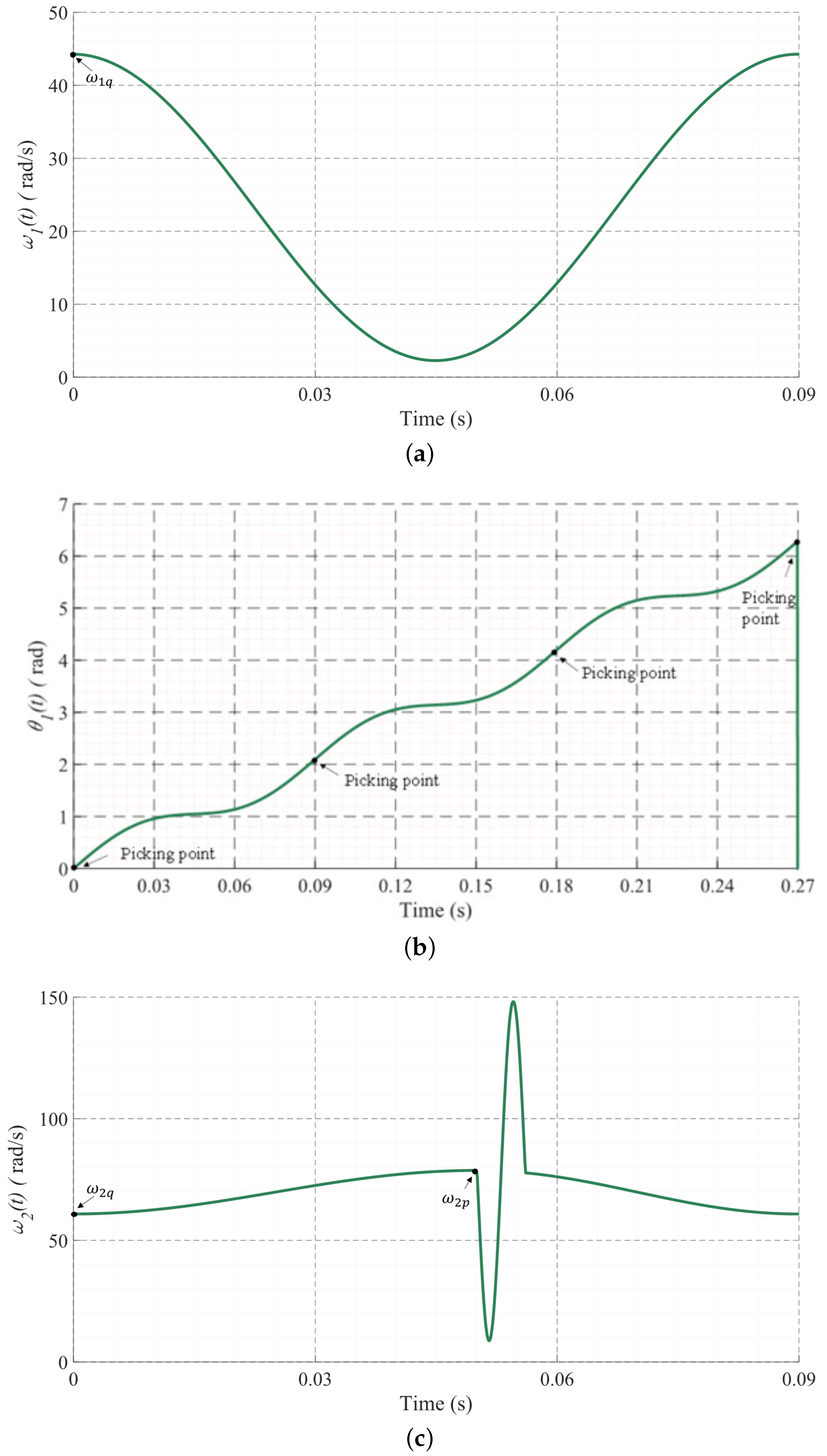
For the supplying motor/disc, the motion trajectory between two adjacent suction holes is expressed in Equation (9). Here, ω 1 ( t ) (rad/s) is the instantaneous angular velocity, θ 1 ( t ) (rad) is the angular position, and T 2 s (s) is one seed-picking cycle of the seed supply disc. The typical angular velocity and position profiles of the seed supply disc motor are shown in Figure 4a and Figure 4b, respectively.
ω 1 ( t ) = ω 1 m + ( ω 1 q ω 1 m ) cos 2 π T 2 s t , t [ 0 , T 2 s ) , θ 1 ( t ) = 0 t ω 1 ( t ) d t , t [ 0 , T 2 s )
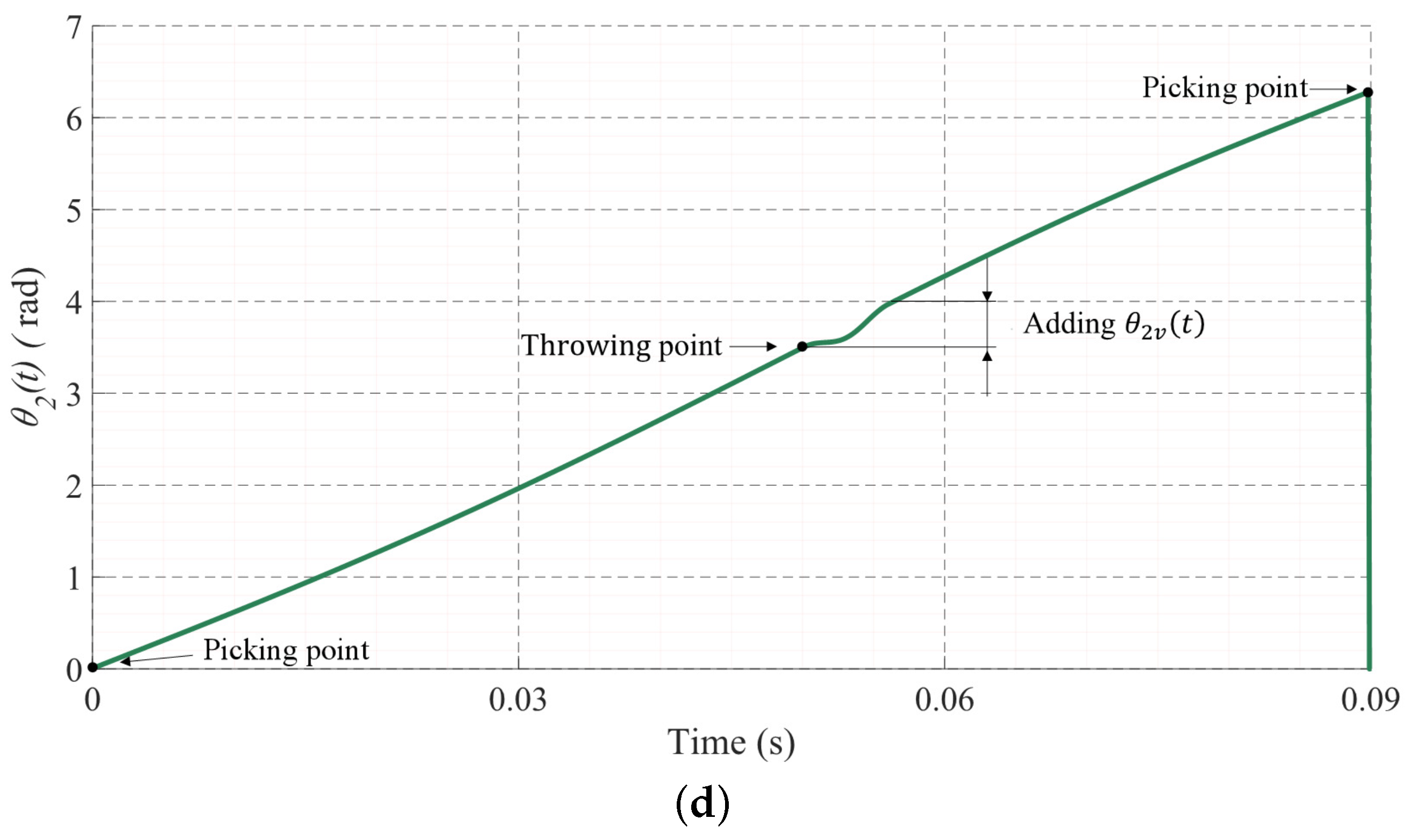
For the throwing motor/spoon, the trajectory is divided into two phases: acceleration and deceleration. The corresponding motion profiles are described by Equation (10), where ω 2 a ( t ) and ω 2 d ( t ) in rad/s, θ 2 a ( t ) and θ 2 d ( t ) in rad, denote the instantaneous angular velocities and positions during acceleration and deceleration. T 2 a (s) is the maximum acceleration time instant of the seed-metering spoon; T 2 d (s) is the deceleration duration of the seed-metering spoon; T 2 s (s) is the time for the seed-metering spoon to rotate a full circle.
ω 2 a ( t ) = ω 2 m ( ω 2 m ω 2 q ) cos π T 2 a t , t [ 0 , T 2 a ) , ω 2 d ( t ) = ω 2 m + ( ω 2 m ω 2 q ) cos π T 2 d ( t T 2 a ) , t [ T 2 a , T 2 s ) , θ 2 a ( t ) = 0 t ω 2 a ( t ) d t , t [ 0 , T 2 a ) , θ 2 d ( t ) = T 2 a t ω 2 d ( t ) d t + θ 2 a ( T 2 a ) , t [ T 2 a , T 2 s ) .
The time instants are calculated by Equation (11), where θ t h (rad) is the angle between the seed-picking point and the throwing point, θ 0 (rad) is the angle between the seed-picking point and the horizontal direction, as illustrated in Figure 1c.
T 2 a = θ t h ω 2 m , T 2 s = 2 π ω 2 m , θ t h = 3 π 2 θ 0 θ .
To ensure smooth seed release, a small jitter function is superimposed during deceleration, as given in Equation (12), where θ 2 v ( t ) (rad) is the instantaneous jitter position curve; A (rad) is amplitude, ω v (rad/s) is the jittering frequency, T 2 v (s) is jittering period.
θ 2 v ( t ) = A + A cos ω v ( t T 2 a ) , t [ T 2 a , T 2 a + T 2 v ) , T 2 v = 2 π ω v .
To ensure the smooth seeding, it is necessary to ensure
( T 2 a + T 2 v ) < T 2 s
The typical angular velocity and position profiles of the seed-throwing motor are shown in Figure 4c and Figure 4d, respectively.
This trajectory planning allows the supply disc and spoon to remain synchronized while achieving the required throwing velocity and angle.

2.2.5. Position Compensation and Angle Iteration

The above calculation requires horizontal and vertical distances of the seed flight path from throwing to landing. Under different forward speeds, however, the seed-throwing position varies. To ensure that seeds land at a fixed-position relative to the machine frame, flight distance compensation is applied.
As shown in Figure 1b, let L x 0 (m) and L y 0 (m) denote the horizontal and vertical distance from the seed landing point to the spoon rotation center. The compensated flight distance is expressed in Equation (14).
L x = L x 0 + r 2 sin θ L y = L y 0 r 2 cos θ
It should be noted that in Equation (14), the throwing angle θ is required to calculate distances, while θ itself depends on the distance values through Equations (3) and (4). To resolve this interdependence, a Pre-fetch–Iteration–Verification algorithm is applied. In this procedure, a pre-fetched value of θ is first used in Equation (14) to calculate the distances. These distance values are then substituted into Equations (3) and (4) to obtain a verification value of θ . If the pre-fetched and verified values agree within the predefined tolerance, the solution is accepted. Otherwise, a new pre-fetch and iteration are performed until convergence is achieved. This process can also be executed offline to generate a look-up table, thereby reducing computational cost during real-time deployment.

2.2.6. Overall Algorithm

To improve clarity and provide an intuitive overview of the control logic, a simplified block diagram of the proposed control strategy is presented in Figure 5. The diagram illustrates the end-to-end workflow, starting from structural and operating inputs, proceeding through position compensation and throwing-angle iteration, and finally generating the two-motor trajectory commands for rotating–throwing seed release.
As shown in Figure 5, the compensated flight distances ( L x , L y ) and the converged throwing angle θ are obtained through a closed-loop iterative process. The pre-estimated angle is updated continuously until the convergence condition is satisfied, thereby resolving the algebraic interdependence between the kinematic equations and the compensation model.

2.2.7. Verification of the Seeding Process

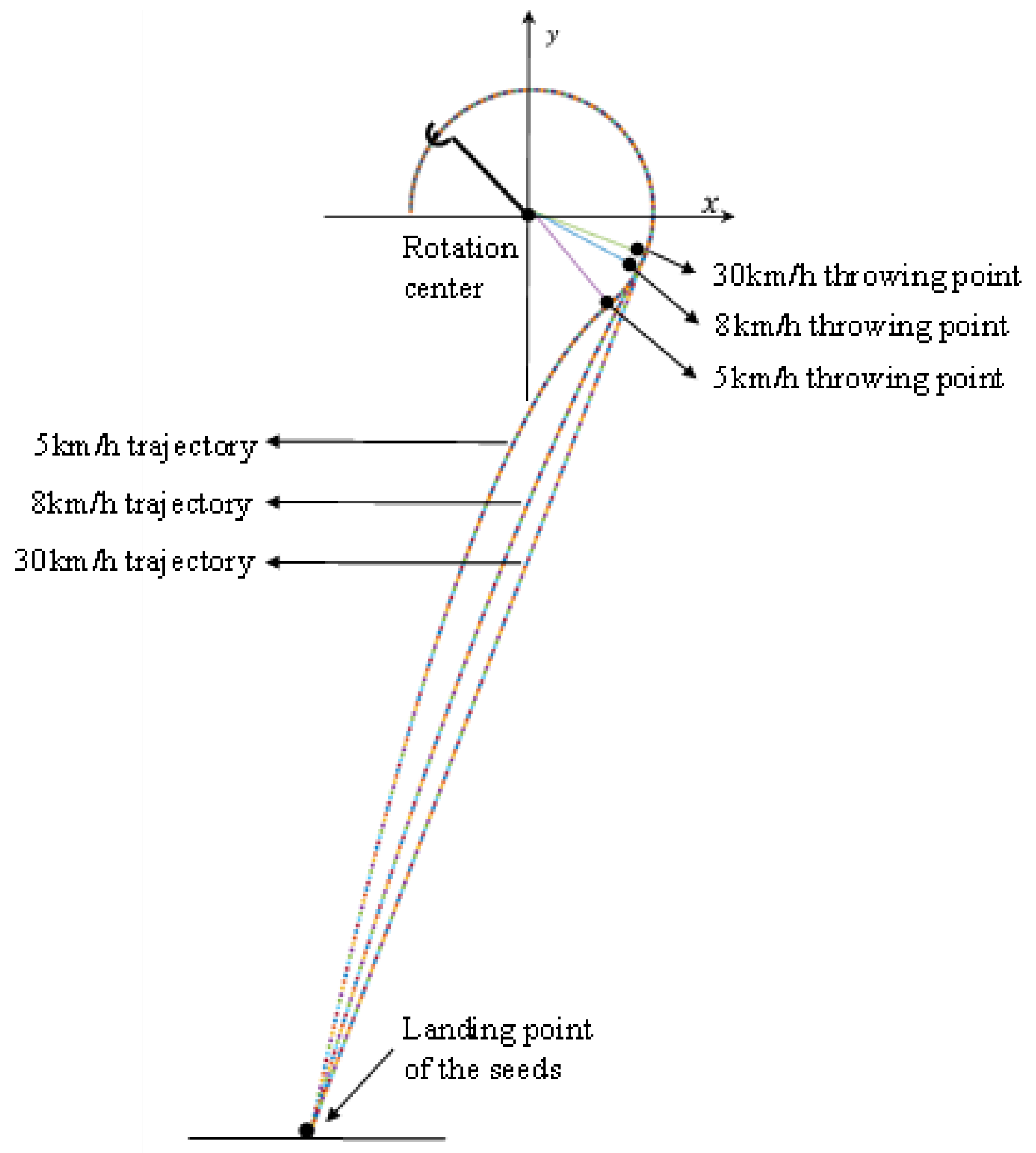
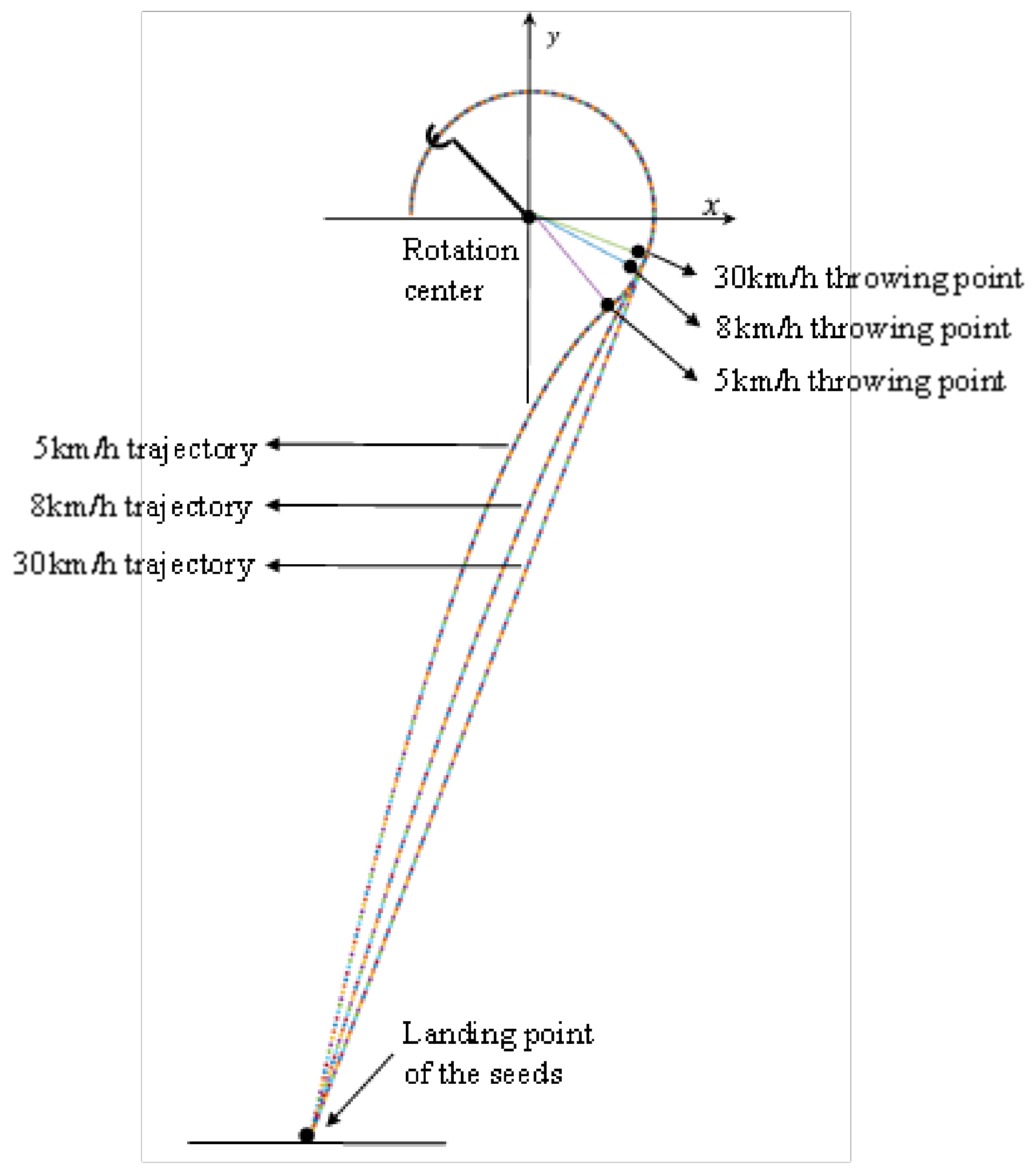
The proposed control strategy was verified and evaluated in MATLAB R2020a (MathWorks, Natick, MA, USA),with the strategy and model formulated by Equations (1)–(14). As shown in Figure 6, the seed-metering device maintained precise seeding performance across different forward speeds. While the flight trajectories varied with speed—being more parabolic at lower speeds due to longer flight times and straighter at higher speeds due to greater throwing velocity—the landing position of the seeds remained consistent.

3. Results

3.1. Simulation Results Using FEA

The control strategy and process were established based on the kinematic model and the proposed control logic, and the structural–dynamic response of the seed-throwing mechanism was further evaluated using a coupled multiphysics finite element transient dynamic simulation (FEA) in ANSYS Workbench 2024 R2 (ANSYS, Inc., Canonsburg, PA, USA) with the LS-DYNA module. In the simulation, gravity, material properties, the prescribed seed–spoon motion, and seed–spoon impact interactions were considered to quantify the transient response, including stress distribution and potential failure risk.
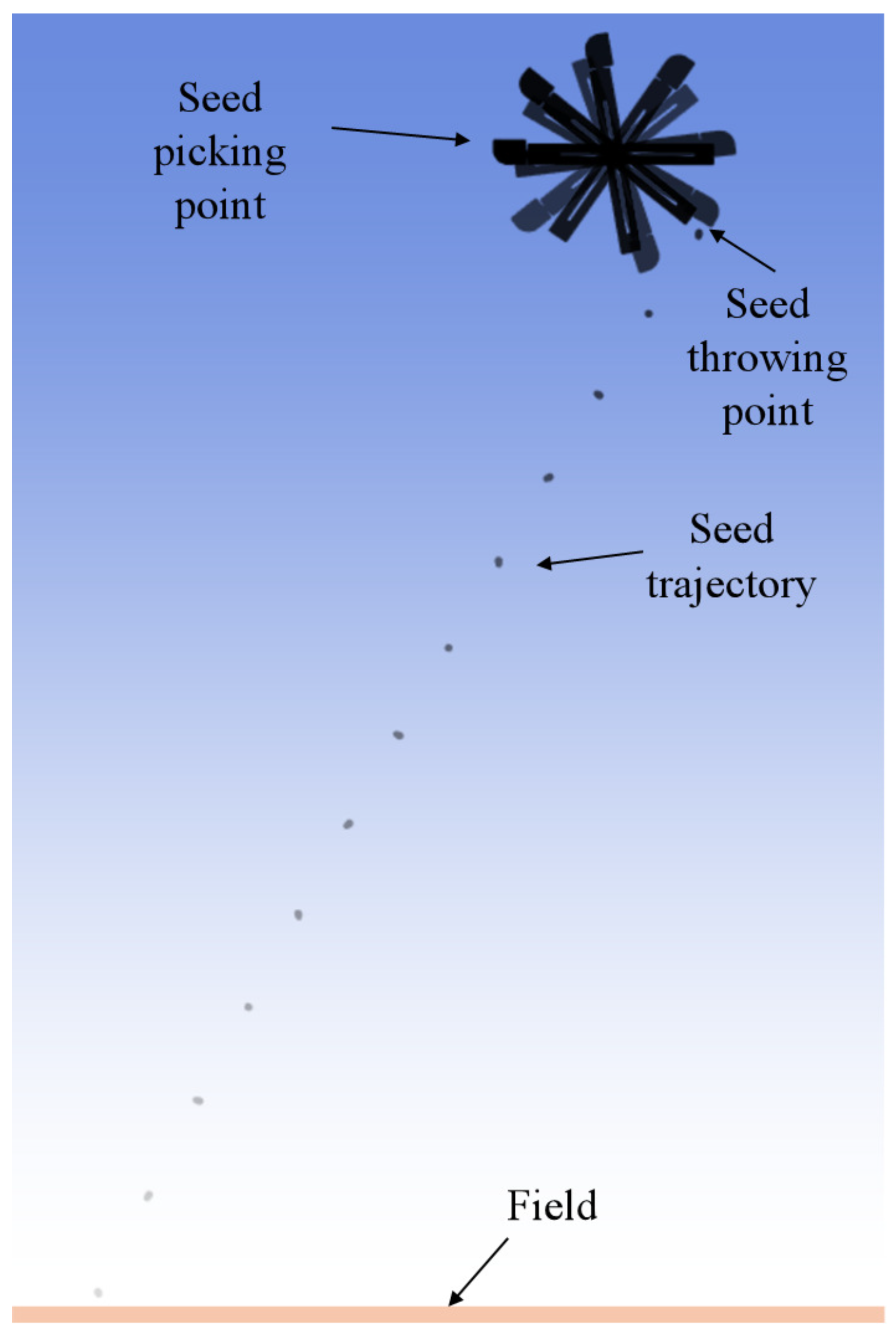
According to the simulation results, the overall seed-throwing process evolves as expected, and the seeds are released sequentially along the designed trajectory, as shown in Figure 7. The simulation confirms that the seed-throwing motion is smooth and continuous, effectively achieving the desired seed-throwing trajectory.
The analysis of the stress distribution reveals that the maximum equivalent stress occurs at the spoon head during the instant of seed ejection, as illustrated in Figure 8a,b. The stress concentration is mainly located at the joint between the spoon head and the connecting arm, which bears the combined load of centrifugal force and impact force at the moment of release.
This result indicates that while the spoon structure satisfies the working requirement under normal operating conditions, local reinforcement or material optimization at the spoon head may further improve its fatigue resistance and service life.

3.2. Hardware Configuration and Experiment Rig

The main parameters of the prototype and its components are summarized in Table 1. The throwing motor has a maximum speed of 3000 r/min (50 r/s). Considering acceleration and deceleration during operation, the theoretical maximum throwing capacity is about 30 seeds per second. This configuration can achieve a 20 cm seed spacing at an operating speed of 21.6 km/h, or 10 cm spacing at 10.8 km/h. When higher capacity is required, the motor can be replaced with a higher-speed model.
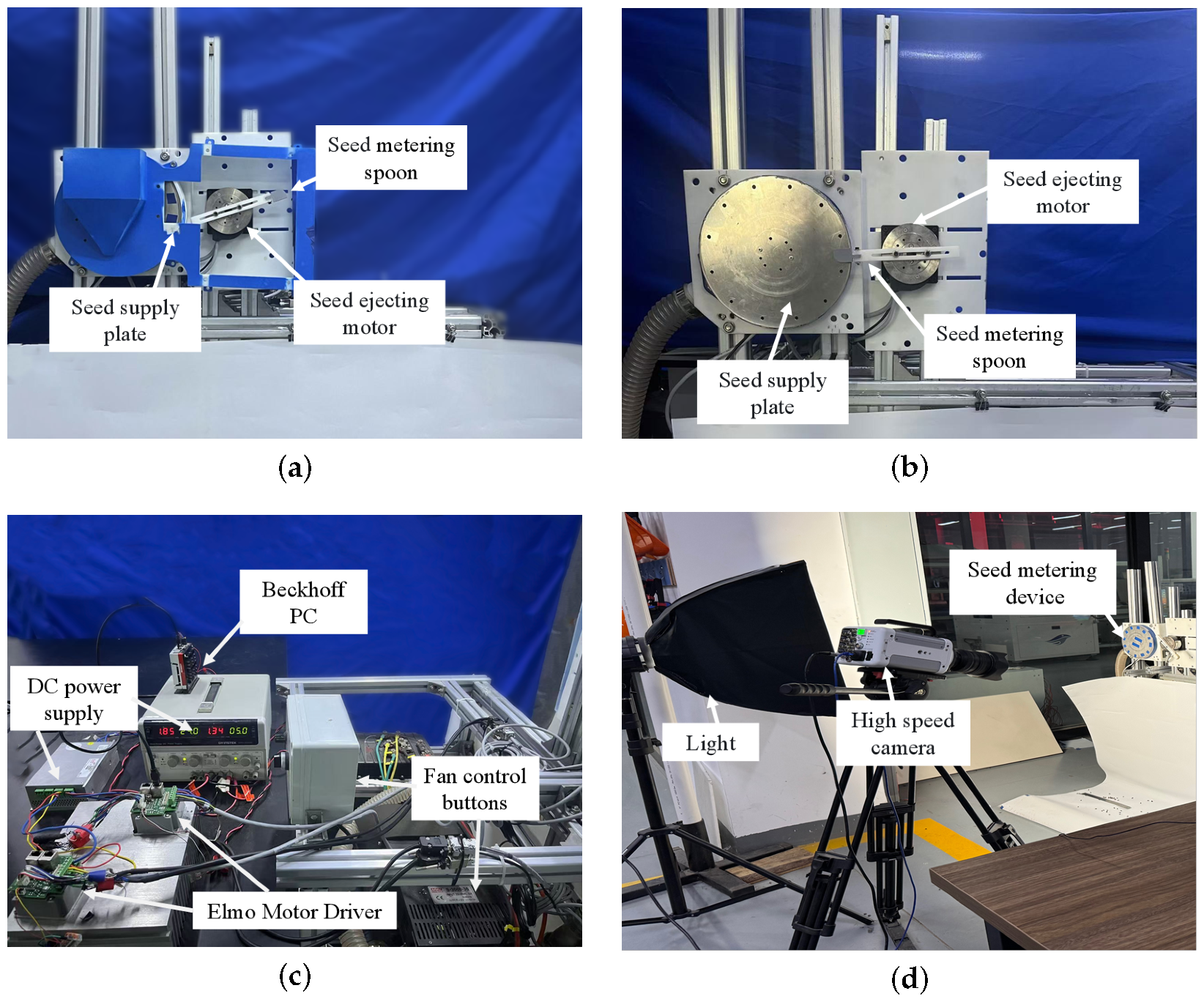
For performance evaluation, an ultra-high-speed camera (FASTCAM R3-4K, Photron Limited, Tokyo, Japan; 1000 fps) was used to capture seed trajectories. The test bench is shown in Figure 9, where the device was tested with cotton seeds.

3.3. The Seeding Performance

3.3.1. Seed-Throwing Process and Performance at Different Forward Speed

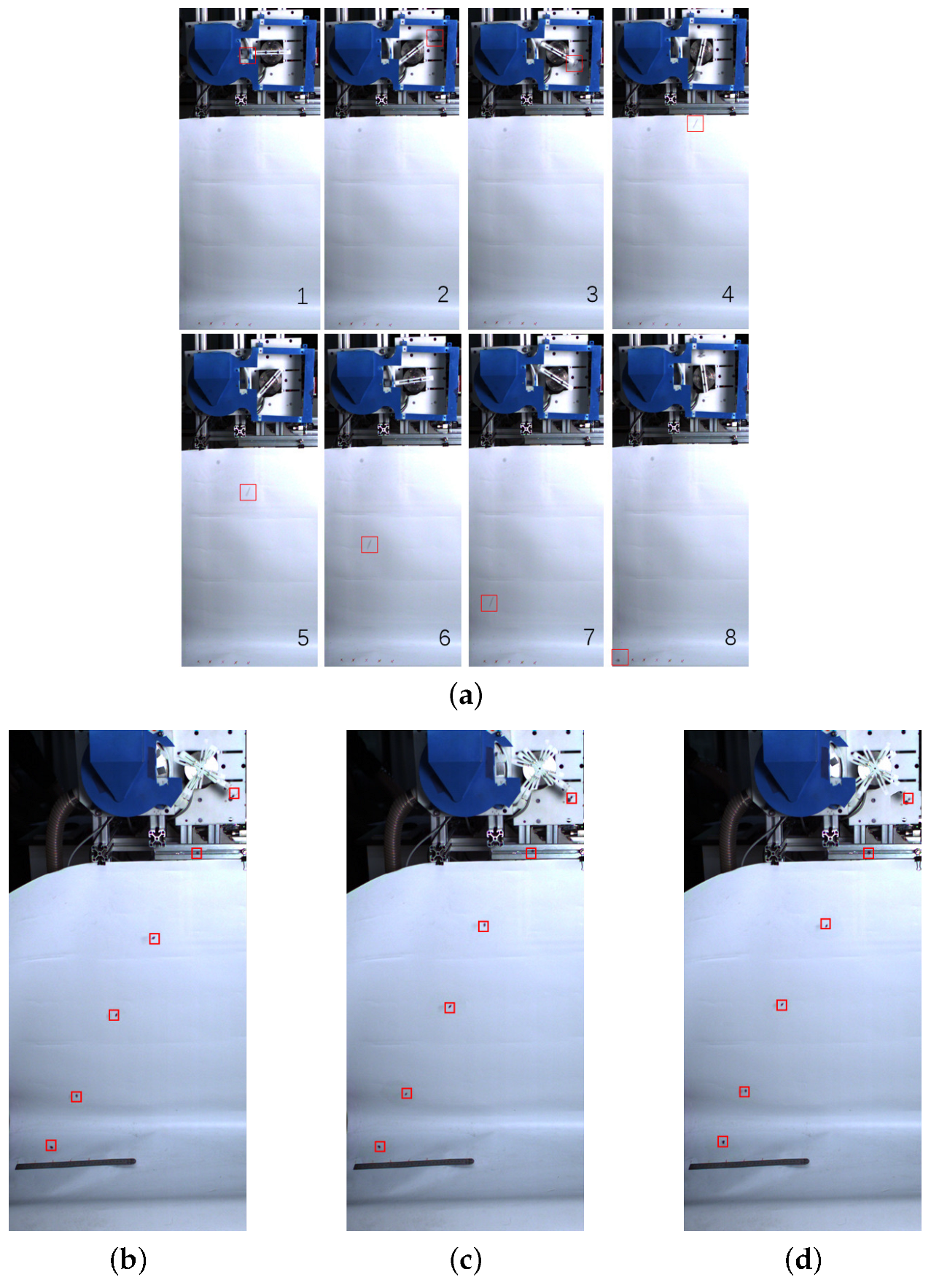
The seed-throwing process recorded by the high-speed camera is illustrated in Figure 10a. The entire sequence from seed picking to landing is shown by eight steps. At the picking point (step 1), the spoon and the seed on the supply disc share the same linear velocity, enabling smooth transfer without damage. The seed is then accelerated by the spoon (step 2), released at the throwing point through spoon deceleration (step 3), and subsequently follows a free-flight trajectory under gravity (steps 4–8). By properly arranging the throwing angle and velocity, the seed lands at the desired target point (step 8).
The device performance was further evaluated under different forward speeds of the machine, while keeping other parameters unchanged. Figure 10b–d shows the seed flight trajectories at 7, 10, and 13 km/h, obtained by superimposing video frames of seeds at the same heights. The results indicate a clear difference in spoon movement at different speeds. Despite variations in flight trajectory, the seed landing error remained within 1.5 cm across all cases, confirming the effectiveness of the control algorithm for precise landing point regulation.

3.3.2. Statistic Evaluation by Seed Flight Time

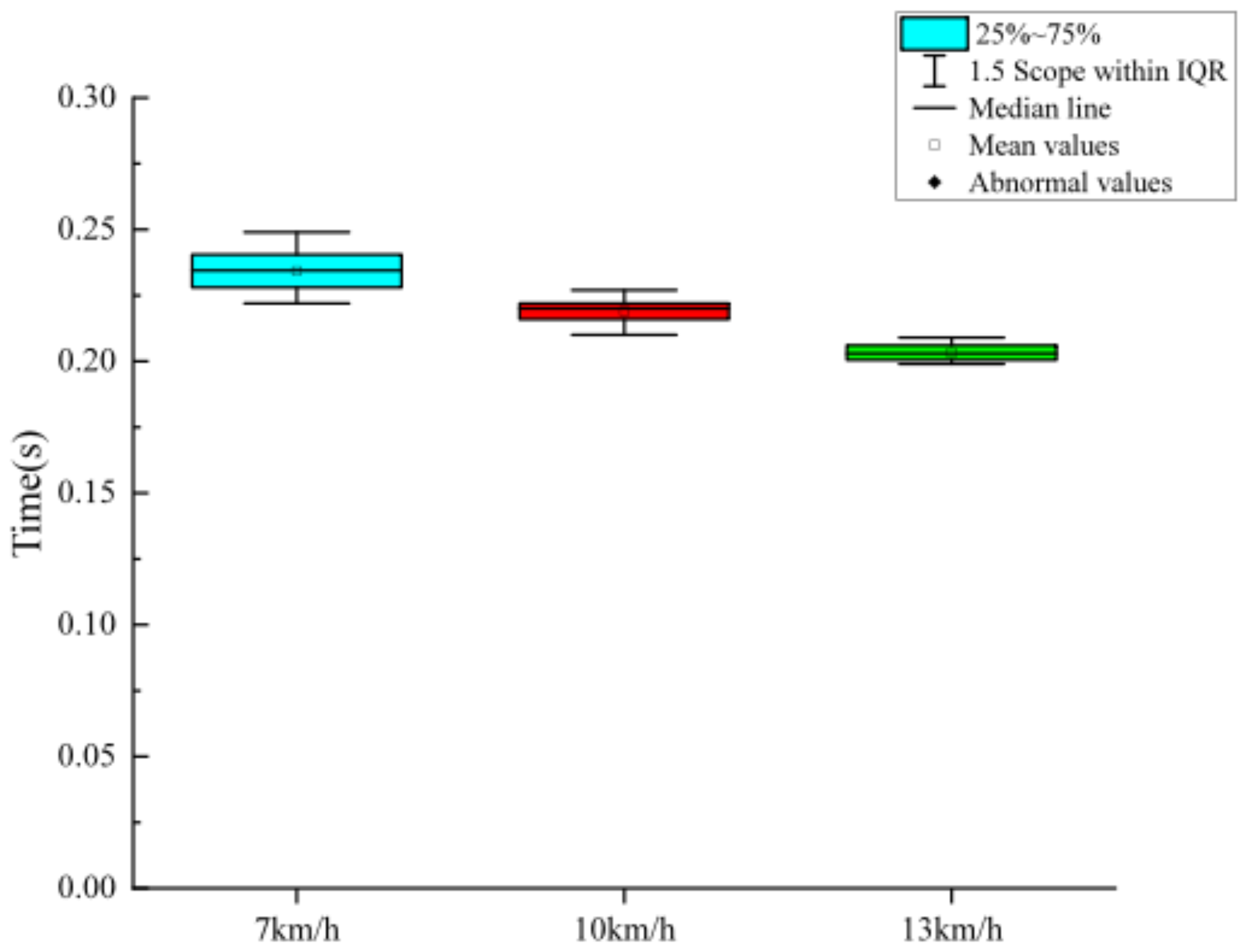
Statistical tests were conducted to assess the consistency of seed-metering performance at three forward speeds (7, 10, and 13 km/h), with 20 seeds analyzed per case. Seed flight time was extracted from high-speed video recordings, and the results are presented in Figure 11.
Experimental results of seed flight dynamics reveal an inverse correlation between operational velocity and flight duration. This phenomenon occurs because the horizontal component of the seed ejection velocity must compensate for the forward motion of the machinery, while maintaining a constant displacement from the rotational center. To achieve consistent landing position at increased operational speeds, a corresponding increase in vertical velocity is required, ensuring spatial precision during the seeding process.
The experiments revealed an inverse relationship between operational speed and seed flight duration. At higher forward speeds, a greater vertical velocity component is required to ensure the same landing point within a shorter flight time, thereby coordinating for increased horizontal velocity to achieve zero-velocity seeding at the same time. Quantitative analysis of temporal variation demonstrated that the standard deviation of seed flight time decreased with increasing forward speed, from 0.0087 s at 7 km/h to 0.0034 s at 13 km/h, and the temporal variation declined from 12% to 5%. The underlying causes of these variations will be further discussed in the subsequent section. The experimental results demonstrate the feasibility of the proposed seed-metering system.

4. Discussions

4.1. Advantages Compared with Traditional Seed-Metering Units

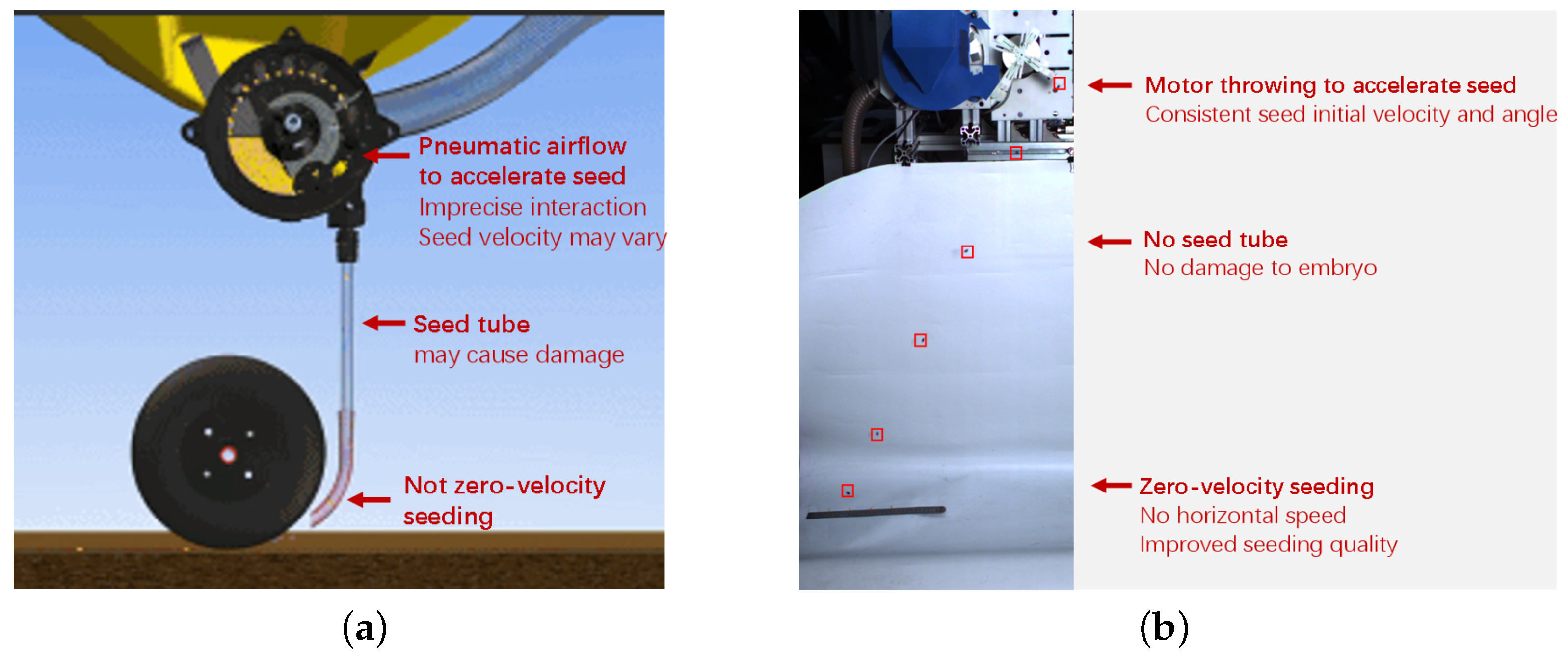
The experimental results demonstrated that the proposed rotating–throwing device consistently achieved precise seed placement across different operating speeds. To further highlight its advantages, a comparative analysis with conventional pneumatic systems was conducted, as illustrated in Figure 12.
As shown in Figure 12a, traditional pneumatic devices face three major limitations: (1) Variable initial velocity. Seeds are propelled into the seed tube by imprecise airflow interaction, leading to significant velocity fluctuations due to differences in seed size, shape and orientation. (2) Risk of embryo damage. Seeds traveling through the seed tube undergo high-speed friction and collision, which may injure the embryo, particularly in fragile seeds like cotton and peanuts. (3) Absence of zero-velocity seeding. The fixed geometry of the seed tube restricts exit angle adjustment. As a result, horizontal velocity compensation is inconsistent across different operating speeds, causing seed bouncing and reduced placement accuracy.
In contrast, the proposed novel rotating and throwing high-speed seed-metering device, shown in Figure 12b, addresses these limitations by offering the following: (1) Uniform initial conditions. Seeds are thrown by motor-driven rotation, providing nearly identical initial velocity and exit angle, regardless of seed size or orientation. (2) Tube-free discharge. By precisely controlling seed flight trajectories, the device eliminates the need for seed tubes, ensuring damage-free seed release. (3) Full-range zero-velocity seeding. The throwing angle and velocity are precisely regulated, enabling accurate landing point control and zero-velocity seeding across the full operational speed range, thereby improving seeding quality.
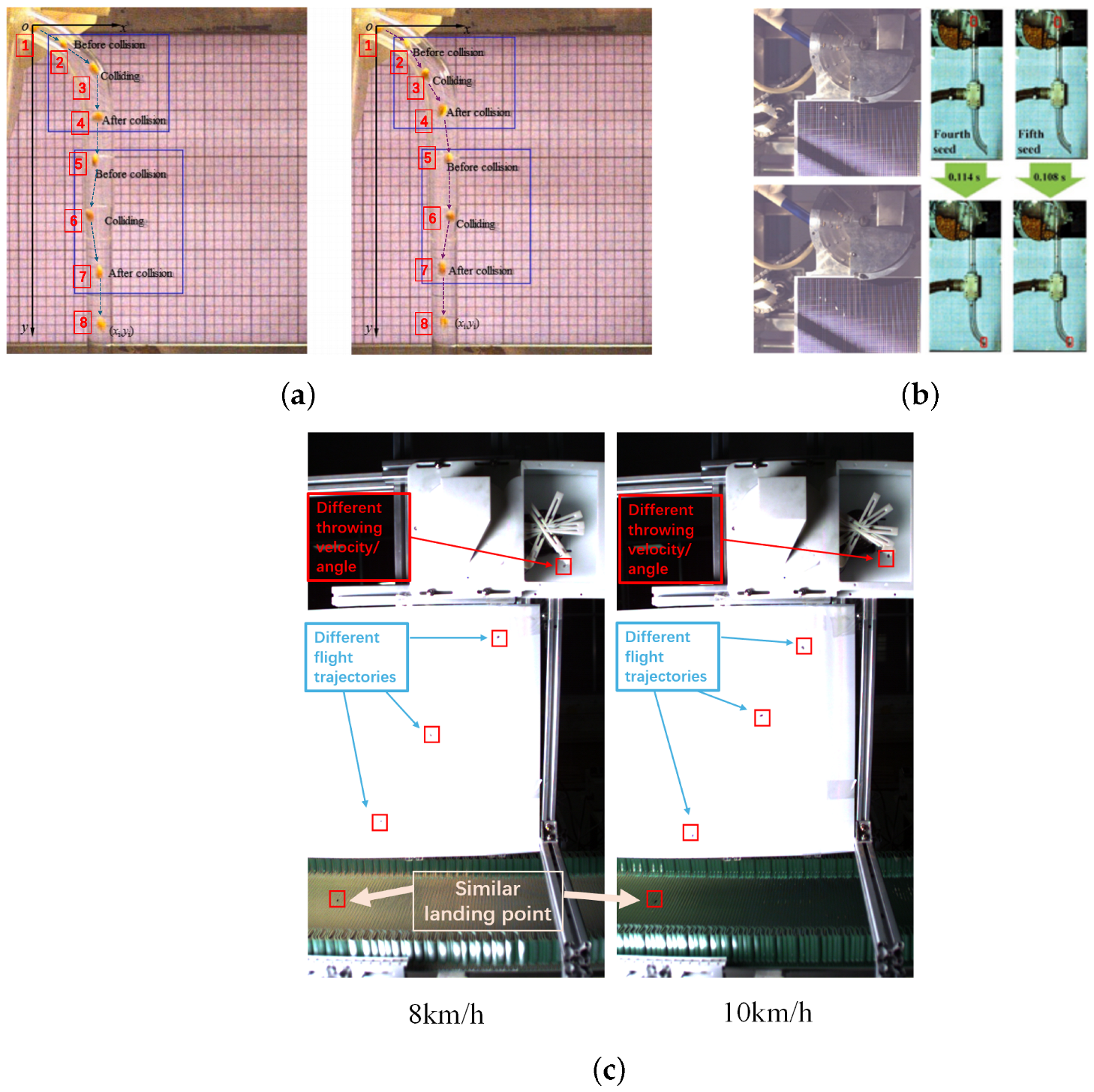
To contextualize these advantages, recent studies indicate that high-speed pneumatic meters remain sensitive to airflow fluctuations and tube–wall interactions, which can disturb the seed exit state and increase trajectory variability and placement error, particularly at higher speeds. By contrast, the proposed motor-driven rotating–throwing method deterministically regulates the seed’s initial kinematic state via motion planning; eliminating tube-guided conveying and reducing airflow dependence helps deliver more consistent initial velocity and ejection angle, consistent with our stable landing-point performance at 7–13 km/h, as shown in Figure 13 [37,38,39].

4.2. Opportunities for Further Performance Improvement

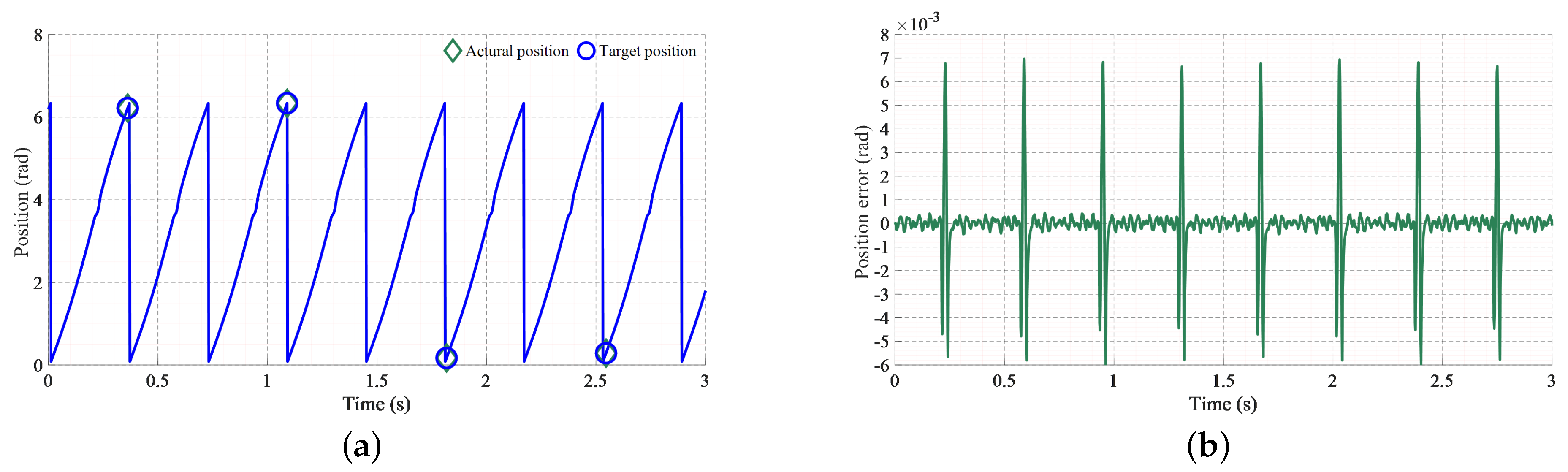
Statistical analysis in Section 3.3.2 indicated a 5–12% variation in seeding performance at different operating speeds. To identify the cause, motor control performance was analyzed, as shown in Figure 14.
In Figure 14a, the actual motor trajectory closely follows the target, with the position error illustrated in Figure 14b. The maximum error (0.007 rad) occurred during spoon jittering at the moment of seed release, while at all other times, the error remained below 0.0005 rad. For different seeds, the position error remains the same. These results confirm that the observed performance variation is not attributable to motor control, which consistently maintained high positional accuracy across repeated throws.
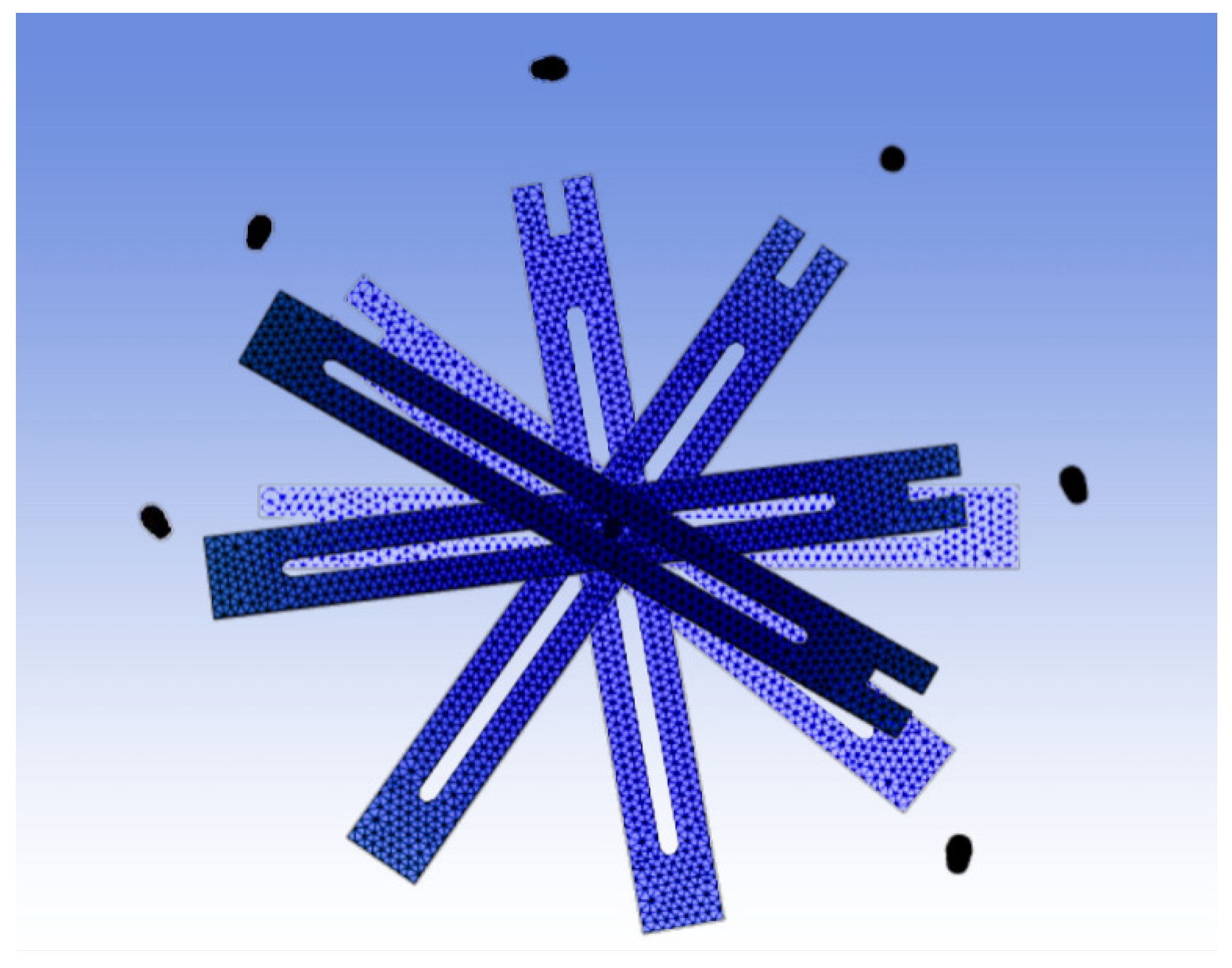
Finite-element analysis revealed that the seed posture gradually changed within the spoon during rotation and release, as shown in Figure 15. Experiment by high-speed imaging (1000 fps) also revealed variability in the posture and positioning of seeds within the metering spoon cavity. Besides, during throwing, seeds are subjected to additional forces from spoon–seed friction, centrifugal effects, and irregular contact geometries. These interactions are likely the primary source of performance variation. Accordingly, future work should focus on optimizing spoon geometry and spoon material to further enhance stability and consistency.

4.3. Limitations and Future Work

Despite the promising results, several limitations should be acknowledged.
Firstly, tests were conducted under bench/laboratory conditions, which is conventional for seed-metering device evaluation. The primary objective of this paper is to verify the feasibility of a novel rotating–throwing seed-metering principle; future work will complete full-machine integration and conduct systematic field trials.
Secondly, although validated on cotton seed, extending the system to different seeds is relatively straightforward because the control principle does not depend on airflow–seed interaction. Adapting to different seeds will require seed-specific parameter re-calibration, including vacuum pressure, suction-hole geometry, and spoon-cavity design, which will be addressed in future work.
Finally, under mass-production conditions using industrial-grade off-the-shelf components, the hardware cost is estimated to be approximately USD 300–400 per unit. Future work will further quantify the system-level cost–performance and energy implications under realistic field conditions.

5. Conclusions

This study introduces a dual-motor rotating–throwing seed-metering device designed to address key precision limitations of airflow-based high-speed seed meters. By precisely coordinating motor-driven seed release, the system achieves accurate metering, zero-velocity seeding, and seed embryo protection simultaneously, providing a robust solution for high-speed precision agriculture.
High-speed imaging experiments verified seed landing errors below 1.5 cm across speeds of 7–13 km/h, confirming stable and precise seed placement. The elimination of seed tubes significantly reduces embryo damage and broadens the applicability of the system to fragile crops such as cotton and peanuts.
Future work will concentrate on field-scale evaluations, refinement of spoon design, and integration with advanced sensing and control technologies. These improvements will further enhance system performance and reliability, as well as support the wider adoption of rotating–throwing seed metering in sustainable precision crop production.

Author Contributions

Conceptualization, B.W. and H.Z.; methodology, B.W.; software, H.Z., C.L. and P.W.; validation, H.Z., C.L. and F.L.; formal analysis, H.Z. and C.L.; investigation, H.Z., P.W., F.L. and C.W.; resources, B.W.; data curation, H.Z. and P.W.; writing—original draft preparation, H.Z., C.L. and P.W.; writing—review and editing, B.W.; visualization, P.W., F.L. and C.W.; supervision, B.W., A.P. and S.S.; project administration, B.W., A.P. and D.W.; funding acquisition, B.W. All authors have read and agreed to the published version of the manuscript.

Funding

This paper was supported by the National Key R&D Program of China (Grant No. 2022YFE0125800) and the Yellow River Delta Scholar (Grant No. DYRC20230105).

Data Availability Statement

The original contributions presented in this study are included in the article. Further inquiries can be directed to the corresponding author.

Acknowledgments

The authors would like to thank all those who contributed to this study.

Conflicts of Interest

The authors declare no conflicts of interest.

References

  1. da Silva, E.E.; Baio, F.H.R.; Teodoro, L.P.R.; Campos, C.N.S.; Plaster, O.B.; Teodoro, P.E. Variable-rate seeding in soybean according to soil attributes related to grain yield. Precis. Agric. 2022, 23, 35–51. [Google Scholar] [CrossRef]
  2. Abu Bakar, B.; Ahmad, M.T.; Ghazali, M.S.S.; Abd Rani, M.N.F.; Bookeri, M.A.M.; Rahman, M.S.A.; Ismail, R. Leveling-index based variable rate seeding technique for paddy. Precis. Agric. 2020, 21, 729–736. [Google Scholar] [CrossRef]
  3. Licht, M.A.; Lenssen, A.W.; Elmore, R.W. Corn (Zea mays L.) seeding rate optimization in Iowa, USA. Precis. Agric. 2017, 18, 452–469. [Google Scholar] [CrossRef]
  4. Rahim, H.; Ghazali, M.; Bookeri, M.A.M.; Abu Bakar, B.H.; Ariff, E.E.E.; Rahman, M.S.A.; Wahab, M. Economic potential of rice precision farming in Malaysia: The case study of Felcra Seberang Perak. Precis. Agric. 2022, 23, 812–829. [Google Scholar] [CrossRef]
  5. Knappenberger, T.; Köller, K. Spatial assessment of the correlation of seeding depth with emergence and yield of corn. Precis. Agric. 2012, 13, 163–180. [Google Scholar] [CrossRef]
  6. Conceição, L.A.; Barreiro, P.; Dias, S.; Garrido, M.; Valero, C.; da Silva, J.R.M. A partial study of vertical distribution of conventional no-till seeders and spatial variability of seed depth placement of maize in the Alentejo region, Portugal. Precis. Agric. 2016, 17, 36–52. [Google Scholar] [CrossRef][Green Version]
  7. Gao, X.J.; Xie, G.F.; Li, J.; Shi, G.S.; Lai, Q.H.; Huang, Y.X. Design and validation of a centrifugal variable-diameter pneumatic high-speed precision seed-metering device for maize. Biosyst. Eng. 2023, 227, 161–181. [Google Scholar] [CrossRef]
  8. Nikolay, Z.; Nikolay, K.; Gao, X.; Li, Q.W.; Mi, G.P.; Huang, Y.X. Design and testing of novel seed miss prevention system for single seed precision metering devices. Comput. Electron. Agric. 2022, 198, 107048. [Google Scholar] [CrossRef]
  9. Li, K.; Cai, W.; Zhao, B.; Lu, B.; Li, S.; Ni, X. Simulation and experimental study on the seed filling performance of a split cotton seeder. Biosyst. Eng. 2025, 253, 104128. [Google Scholar] [CrossRef]
  10. Petrović, I.; Vučajnk, F.; Trdan, S.; Bernik, R.; Vidrih, M. The influence of planting speed of a maize vacuum planter on plant spacing variability and ear parameters. Agronomy 2025, 15, 462. [Google Scholar] [CrossRef]
  11. Olomitutu, O.E.; Dhillon, J.; Lowe, J.W.; Bryant, C.J.; Larson, E.J.; Zhang, J.; Wallace, J.; Meadows, J.; Shavers, G.; Hilyer, T.; et al. Planting corn at high-speed increased stand variability but did not affect yield. Agron. J. 2025, 117, e70220. [Google Scholar] [CrossRef]
  12. Li, C.; Zhang, D.; Yang, L.; Cui, T.; He, X.; Li, Z.; Dong, J.; Xing, S.; Jiang, Y.; Liang, J. Research on a centrifugal high-speed precision seed metering device for maize with airflow-assisted seed filling and cleaning. Comput. Electron. Agric. 2024, 226, 109434. [Google Scholar] [CrossRef]
  13. Zhai, C.Y.; Long, J.; Taylor, R.; Weckler, P.; Wang, N. Field scale row unit vibration affecting planting quality. Precis. Agric. 2020, 21, 589–602. [Google Scholar] [CrossRef]
  14. Feng, D.H.; Sun, X.P.; Li, H.; Qi, X.D.; Wang, Y.J.; Nyambura, S.M. Optimized design of the pneumatic precision seed-metering device for carrots. Int. J. Agric. Biol. Eng. 2023, 16, 134–147. [Google Scholar] [CrossRef]
  15. Cay, A.; Kocabiyik, H.; May, S. Development of an electro-mechanic control system for seed-metering unit of single seed corn planters Part II: Field performance. Comput. Electron. Agric. 2018, 145, 11–17. [Google Scholar]
  16. Du, X.; Liu, C.L. Design and testing of the filling-plate of inner-filling positive pressure high-speed seed-metering device for maize. Biosyst. Eng. 2023, 228, 1–17. [Google Scholar]
  17. Tang, H.; Guan, T.Y.; Xu, F.D.; Xu, C.S.; Wang, J.W. Test on adsorption posture and seeding performance of the high-speed precision dual-chamber maize metering device based on the seed characteristics. Comput. Electron. Agric. 2024, 216, 108471. [Google Scholar]
  18. Wang, H.; Yang, L.; Zhang, D.; Cui, T.; He, X.; Xiao, T.; Xie, C. Comparative investigation and evaluation of electric-drive seed-metering systems across diverse speed ranges for enhanced high-precision seeding applications. Comput. Electron. Agric. 2024, 222, 108976. [Google Scholar]
  19. Yu, Y.; Hu, Y.R.; Shang, S.Q.; Diao, L.S.; Ge, R.C.; Zhang, X. Design of motor-driven precision seed-metering device with improved fuzzy PID controller for small peanut planters. Int. J. Agric. Biol. Eng. 2023, 16, 136–144. [Google Scholar] [CrossRef]
  20. Zhao, X.; Zhao, H.; Wang, Z.; Li, J.; Yu, H.; Yan, Q. Electronic control seed-metering system for precision seeding maize based on fuzzy PID. Int. J. Agric. Biol. Eng. 2024, 17, 217–226. [Google Scholar] [CrossRef]
  21. Liao, Y.; Wang, L.; Liao, Q. Design and test of an inside-filling pneumatic precision centralized seed-metering device for rapeseed. Int. J. Agric. Biol. Eng. 2017, 10, 56–62. [Google Scholar]
  22. Li, Z.; Ren, D.; Huang, J.; Wu, J.; Duan, D.; Zhang, T.; Chen, Y. Analysis of the seed filling performance influenced by maize seed shape, posture, and suction force. Biosyst. Eng. 2025, 256, 104186. [Google Scholar] [CrossRef]
  23. Ding, L.; Yuan, Y.; Dou, Y.; Li, C.; He, Z.; Guo, G.; Zhang, Y.; Chen, B.; Li, H. Design and experiment of air-suction maize seed-metering device with auxiliary guide. Agriculture 2024, 14, 169. [Google Scholar]
  24. Wang, Y.; Kang, X.; Wang, G.; Ji, W. Numerical analysis of friction-filling performance of friction-type vertical disc precision seed-metering device based on EDEM. Agriculture 2023, 13, 2183. [Google Scholar] [CrossRef]
  25. Xu, J.; Sun, S.; He, Z.; Wang, X.; Zeng, Z.; Li, J.; Wu, W. Design and optimisation of seed-metering plate of air-suction vegetable seed-metering device based on DEM–CFD. Biosyst. Eng. 2023, 230, 277–300. [Google Scholar]
  26. Zhao, Z.; Lyu, Y.; Lyu, J.; Zhu, X.; Li, J.; Yang, D. The influence of a seeding plate of the air-suction minituber precision seed-metering device on seeding quality. Comput. Electron. Agric. 2024, 227, 109680. [Google Scholar]
  27. Zhu, H.; Zhang, S.; Wang, W.; Lv, H.; Chen, Y.; Zhou, L.; Li, M.; Zhao, J. Design and testing of soybean double-row seed-metering device with double-beveled seed guide groove. Agriculture 2024, 14, 1595. [Google Scholar]
  28. Liu, R.; Liu, Z.J.; Zhao, J.L.; Lu, Q.; Liu, L.J.; Li, Y.H. Optimization and experiment of a disturbance-assisted seed filling high-speed vacuum seed-metering device based on DEM-CFD. Agriculture 2022, 12, 1304. [Google Scholar] [CrossRef]
  29. Zhong, W.; Zhao, X.; Liu, F.; Bai, H.; Dong, W.; Hu, H.; Kong, X. Design and Experiment of Precision Seed Metering Device for Flow Adsorption of Quinoa Seeds. Agriculture 2024, 14, 434. [Google Scholar] [CrossRef]
  30. Li, C.; Zhang, D.; Yang, L.; Cui, T.; He, X.; Li, Z.; Dong, J.; Xing, S.; Jiang, Y.; Liang, J. Research on high-speed and clean production with a high-speed centrifugal maize precision seed metering device featuring variable hole insert numbers. Comput. Electron. Agric. 2024, 227, 109620. [Google Scholar] [CrossRef]
  31. Dong, J.; Wu, J.; Zhu, Y.; Gao, X. Investigation on Seed-Filling Effect of Quantitative Precision Filling High-Speed Seed-Metering Device for Maize. Agriculture 2025, 15, 1517. [Google Scholar]
  32. Deng, S.; Feng, Y.; Cheng, X.; Wang, X.; Zhang, X.; Wei, Z. Disturbance analysis and seeding performance evaluation of a pneumatic-seed spoon interactive precision maize seed-metering device for plot planting. Biosyst. Eng. 2024, 247, 221–240. [Google Scholar] [CrossRef]
  33. Wang, L.; Liao, Y.; Li, M.; Ren, N.; Zheng, X.; Wang, M.; Liao, Q. Motion characteristics of rapeseeds and wheat seeds within mixing components of air-assisted centralized metering device based on DEM–CFD. Comput. Electron. Agric. 2024, 221, 108986. [Google Scholar] [CrossRef]
  34. Jia, X.; Zhu, J.; Guo, G.; Huang, Y.; Gao, X.; Zhang, C. Design and test of a novel converging groove-guided seed tube for precision seeding of maize. Biosyst. Eng. 2024, 245, 36–55. [Google Scholar] [CrossRef]
  35. Li, Z.; Zhang, H.; Huang, J.; Lou, C.; Chen, Y.; Liu, L.; Chen, L. Design and parameter optimization of air-delivery auxiliary seed guide for pneumatic plate precision rapeseed metering device. Comput. Electron. Agric. 2025, 230, 109840. [Google Scholar]
  36. Wang, F.; Zhang, W.; Jiang, J. Seed guide path planning and parameter optimization for air-suction carrot seed-metering device. Int. J. Agric. Biol. Eng. 2023, 16, 104–112. [Google Scholar]
  37. Xing, H.; Wang, Z.; Luo, X.; He, S.; Zang, Y. Mechanism modeling and experimental analysis of seed throwing with rice pneumatic seed metering device with adjustable seeding rate. Comput. Electron. Agric. 2020, 178, 105697. [Google Scholar] [CrossRef]
  38. Tang, H.; Xu, F.; Xu, C.; Zhao, J.; Wang, Y.-J. The influence of a seed drop tube of the inside-filling air-blowing precision seed-metering device on seeding quality. Comput. Electron. Agric. 2023, 204, 107555. [Google Scholar] [CrossRef]
  39. Tang, H.; Xu, F.; Guan, T.; Xu, C.; Wang, J. Design and test of a pneumatic type of high-speed maize precision seed metering device. Comput. Electron. Agric. 2023, 211, 107997. [Google Scholar] [CrossRef]
Figure 1. The proposed seed-metering device: (a) overview and major structure: 1. Front case of seed-metering unit. 2. Seed container. 3. Seed-supplying disc. 4. Rear case of seed-metering unit with ventilation duct. 5. Seed-throwing motor. 6. Seed-metering spoon. 7. Seed-supplying motor; (b) The seeding process and schematic diagram of working principle; (c) Angles involved in the seed-metering process.
Agriculture 16 00503 g001
Figure 2. Zero-velocity seeding from ground reference: seed lands without horizontal speed to avoid bouncing and misplacement: (a) Throwing–release stage; (b) In-air flight stage 1; (c) In-air flight stage 2; (d) Landing and placement stage.
Agriculture 16 00503 g002
Figure 3. Overview of the control algorithm.
Agriculture 16 00503 g003
Figure 4. Motion profile for the two motors: (a) angular velocity between two seed suction holes of the seed-supplying motor; (b) the position trajectory of the seed-supplying motor; (c) angular velocity of the seed-throwing motor; (d) the position trajectory of the seed-throwing motor.
Agriculture 16 00503 g004aAgriculture 16 00503 g004b
Figure 5. Simplified block diagram of the control strategy for the rotating–throwing seed-metering system.
Agriculture 16 00503 g005
Figure 6. The flight trajectories of seeds at different forward speeds with consistent landing position.
Agriculture 16 00503 g006
Figure 7. The FEA-simulated process of seed throwing, showing sequential seed trajectories.
Agriculture 16 00503 g007
Figure 8. Stress distribution on the seed spoon under maximum load conditions: (a) side view; (b) top view.
Agriculture 16 00503 g008
Figure 9. The experiment rig: (a) seed-metering device with cover; (b) seed-metering device without cover; (c) controller, driver and auxiliary components; (d) high-speed camera.
Agriculture 16 00503 g009
Figure 10. Experimental results of the proposed seed-metering device: (a) decomposition of the seed-throwing process; (b) seed flight trajectories at 7 km/h; (c) seed flight trajectories at 10 km/h; (d) seed flight trajectories at 13km/h.
Agriculture 16 00503 g010
Figure 11. Flight time of seeds at different forward speeds.
Agriculture 16 00503 g011
Figure 12. Comparative analysis of seed-metering systems: (a) traditional pneumatic device; (b) proposed dual-motor rotating–throwing device.
Agriculture 16 00503 g012
Figure 13. Difference between the conventional and proposed techniques: (a) imprecise motion in the tube (Tang, 2023, 204 [38]); (b) imprecise motion at dropping (Xing, 2020, 178 [37]; Tang, 2023, 211 [39]); (c) precise control: seed-throwing velocity and angle can be controlled to achieve similar landing point.
Agriculture 16 00503 g013
Figure 14. Motor position control performance: (a) actual and target positions; (b) position error.
Agriculture 16 00503 g014
Figure 15. Seed posture changing during throwing process by Finite Element Analysis of the seed-throwing process.
Agriculture 16 00503 g015
Table 1. Hardware configuration and parameters of the seed-metering unit.
NameValue (Unit)
Seed-metering device total weight6 (kg)
Seed supply disc0.3 (kg)
Motor maximum speed3000 (r/min)
Motor rated torque0.9 (Nm)
Motor modelAXD80-56
(Akribis Systems Pte. Ltd.,
Singapore)
Drive modelG-SOLMAN7/400
(Elmo Motion Control Ltd.,
Petah Tikva, Israel)
IPC modelC6015
(Beckhoff Automation GmbH & Co. KG,
Verl, Germany)
V t 7, 10, 13 (km/h)
L p 0.2 (m)
Z3
r 1 0.11 (m)
r 2 0.08 (m)
L x 0 0.2 (m)
L y 0 0.834 (m)
Disclaimer/Publisher’s Note: The statements, opinions and data contained in all publications are solely those of the individual author(s) and contributor(s) and not of MDPI and/or the editor(s). MDPI and/or the editor(s) disclaim responsibility for any injury to people or property resulting from any ideas, methods, instructions or products referred to in the content.