Article

Genetic Control, Stability, and Multivariate Analysis of Wheat Seed Quality Traits in Elite Pure Lines Under Mediterranean Environments

by
Vasileios Greveniotis
1,2,*,
Elisavet Bouloumpasi
3,
Adriana Skendi
3,
Stylianos Zotis
2,†,
Dimitrios Kantas
4 and
Constantinos G. Ipsilandis
5
1
Institute of Industrial and Forage Crops, Hellenic Agricultural Organization Demeter (ELGO-Dimitra), 41335 Larissa, Greece
2
Department of Agricultural Technology, Technological Educational Institute of Western Macedonia, 53100 Florina, Greece
3
Department of Viticulture and Oenology, Democritus University of Thrace, 66100 Drama, Greece
4
Department of Animal Science, University of Thessaly, Campus Gaiopolis, 41500 Larissa, Greece
5
Regional Administration of West Macedonia, 50131 Kozani, Greece
*
Author to whom correspondence should be addressed.
Deceased.
Agriculture 2026, 16(4), 444; https://doi.org/10.3390/agriculture16040444
Submission received: 12 January 2026 / Revised: 3 February 2026 / Accepted: 12 February 2026 / Published: 14 February 2026
(This article belongs to the Section Seed Science and Technology)

Abstract

Grain quality traits in wheat (Triticum aestivum L.), including protein content, gluten strength, and carbohydrate composition, are key determinants of end-use performance and breeding potential. This study assessed the genetic variability, stability, and multivariate relationships of seed quality traits among elite F7 pure lines derived from six long-term cultivated wheat cultivars. Field trials were conducted across six contrasting environments to evaluate genotype, environment, and genotype × environment (G × E) effects on crude protein, fat, ash, starch, crude fiber, Zeleny sedimentation, carbohydrates, non-starch carbohydrates, and moisture. Combined ANOVA revealed that genotypic effects accounted for the largest proportion of variation, though significant environmental and G × E effects were also observed. Broad-sense heritability was high for protein, Zeleny, and carbohydrate content. Stability analysis using the Stability Index (SI) highlighted A1, A2, A4, C2, E1, and F2 as genotypes combining high mean performance with a consistent expression across all environments. Principal component analysis (PCA) illustrated key trait relationships and trade-offs, particularly the negative association between protein-related traits and carbohydrate accumulation, while revealing the partial clustering of genotypes with similar quality profiles. AMMI and GGE biplots further supported broad adaptation for some genotypes (e.g., E1, F4, E2 for crude protein; F3, F4, E2 for Zeleny) and trait- or environment-specific performance for others. Correlation analyses confirmed positive associations between protein and gluten strength, and negative correlations with carbohydrate traits. Overall, targeted pure-line selection effectively exploits intracultivar genetic variation, offering a practical strategy for identifying superior, resilient wheat lines for breeding programs across diverse environments.

1. Introduction

Wheat (Triticum aestivum L.) is a major staple crop worldwide, providing a significant source of calories and protein for human consumption [1]. In 2024, wheat was cultivated on approximately 219.5 million hectares worldwide, producing about 798.5 million tons, highlighting its importance as a major global staple crop [2]. Its production faces challenges from population growth, climate change, and increasing drought stress, highlighting the need for breeding resilient and high-performing cultivars [3,4]. Grain quality traits, including protein content, gluten strength, starch composition, and grain hardness, influence wheat end-use performance in food and industrial applications [5,6,7]. Understanding the variability and stability of these traits is essential for breeding cultivars that combine high quality, adaptability, and consistent performance across diverse environments [8,9,10,11].
Similar genotype × environment (G × E) interaction and stability analyses have been conducted in other crops, particularly maize, showing that environmental effects strongly influence performance while G × E interactions affect cultivar rankings [12]. Multi-environment evaluations of quality protein maize hybrids under stress and non-stress conditions have used AMMI and GGE biplots to identify high-yielding and stable genotypes [13,14], highlighting the importance of considering both performance and stability when selecting superior genotypes across variable environments.
Commercial wheat cultivars must also maintain high yield potential and stability across diverse environments [15]. Although monogenotypic cultivars are often considered uniform, significant intracultivar variation exists due to residual heterozygosity, spontaneous mutations, or epigenetic changes [16,17,18,19]. Exploiting this internal variability, together with additive genetic variation and mechanisms such as gene mutations, crossing over, and epigenetic modifications, supports adaptation to environmental stress and improvement of both yield and grain quality [20,21,22,23,24,25,26]. The intravarietal variation observed in monogenotypic cultivars, often due to heterozygosity or spontaneous mutations, presents a unique opportunity to develop more resilient, high-quality crops. This study will focus on using this variation to improve seed quality and stability across diverse environmental conditions. The use of diverse gene pools, including local landraces and segregating populations, further enhances resilience to biotic and abiotic stresses [27,28,29,30,31].
Environmental conditions interact with genotype, resulting in G × E interactions that affect wheat seed quality traits, particularly protein content, gluten strength, and starch composition [32,33,34,35]. To fully exploit the genetic potential of wheat for high-quality seed production, it is essential to quantify the effects of genotype, environment, and their interaction, and to analyze the stability and interrelationships of multiple quality traits. Multivariate tools such as PCA have been widely applied to explore complex variation in wheat quality traits [36], while genome-wide association and predictive breeding approaches reveal the genetic architecture underlying protein, starch, and grain hardness [37]. The assessment of trait stability using indices like the Stability Index (SI) provides a quantitative measure of consistency, guiding the selection of genotypes that perform reliably under variable environmental conditions [38]. Similar multi-environment evaluations in other crops, including faba beans and forage species, support the identification of genotypes combining high performance with environmental resilience [39,40].
Despite extensive research on G × E interactions in other crops, such as maize, the understanding of these interactions in wheat quality traits remains limited, particularly under varying altitudes and growing seasons. Additionally, the use of pure-line selection for improving wheat quality and stability has not been thoroughly studied in modern commercial cultivars. Therefore, this study investigates these gaps by analyzing G × E interactions and evaluating the effectiveness of pure-line selection for improving wheat quality. However, the extent to which pure-line selection can exploit this intracultivar variation to improve wheat quality and stability across diverse environments remains unclear, representing a key knowledge gap.
Therefore, this study aims to dissect the genetic control, stability, and multivariate relationships of wheat seed quality traits, and to evaluate the potential of pure-line selection within established commercial cultivars. Elite F7 pure lines derived from six long-term cultivated commercial cultivars were compared with their parental cultivars across six diverse environments varying in location, altitude, and cropping season. The specific objectives were to: (i) quantify the effects of genotype, environment, and their interaction (G × E) on key seed quality traits; (ii) assess trait stability using the Stability Index (SI), AMMI, and GGE biplots; (iii) estimate genetic parameters, including heritability and genetic variability, to evaluate selection efficiency; (iv) explore trait interrelationships through correlation and principal component analysis (PCA); and (v) identify pure lines that consistently outperform their parental cultivars, demonstrating the effectiveness of targeted pure-line breeding for superior and stable wheat seed quality.

2. Materials and Methods

2.1. Plant Material and Experimental Design

The study was conducted on 30 wheat genotypes, originating from six F7 commercial cultivars (A: Generoso, B: Vergina, C: Vitsi, D: Irnerio, E: Yecora, F: Nestos). These cultivars were originally purchased as certified seed but had subsequently been maintained by local farmers for approximately 20 years, using only seeds from their own harvest. The initial material consisted of 200 individual plants per cultivar, which were visually selected in 2008 from six remote and isolated bread wheat farms in Western Macedonia, Greece. This long-term farmer-maintained cultivation created intracultivar variation, which was exploited to improve wheat seed quality traits through a multi-year head-to-row selection program [41].
During the first generation (2008–2009), spikes from the 200 plants per cultivar were sown in separate rows. Each row was evaluated for total spike number, spike weight per row, number of kernels, and 1000-kernel weight (TKW). Based on mean spike weight per row, the 50 best rows per cultivar were selected, representing a selection intensity of approximately 25%.
In the second generation (2009–2010), seeds from these 50 rows were sown in separate rows (300 rows in total). Measurements included spike weight per row, TKW, and specific weight (bulk density). The four best rows per cultivar were selected based on specific weight, corresponding to a selection intensity of ~8% of the 50 previously selected rows, or ~2% of the original population.
These selected lines, together with the original cultivar as a check, totaling 30 genetic materials, were then used in the final multi-environment field trials [41].

2.1.1. Field Trials

The genotypes were evaluated across six environments (E1–E6), defined as unique combinations of location and growing season:
E1–E2: TEI of Western Macedonia, Florina, Greece (40°46′ N, 21°22′ E, 705 m a.s.l.), 2010–2011 (E1) and 2011–2012 (E2).
E3–E4: Trikala (39°55′ N, 21°46′ E, 120 m a.s.l.), 2023–2024 (E3) and 2024–2025 (E4).
E5–E6: Kalambaka (39°42′ N, 21°37′ E, 190 m a.s.l.), 2023–2024 (E5) and 2024–2025 (E6).
Trials were arranged in a randomized complete block design (RCB) with three replications. Each plot consisted of seven rows, 6 m long, with 25 cm row spacing (~350 plants/m2). Sowing was performed in early November, and harvest took place in mid-July for Florina and in late June for Trikala and Kalambaka, representing the full growing season typical for each location.

2.1.2. Soil Characteristics

The soils of the experimental sites differed in texture, chemical properties, and pH. Florina (2010–2011) had sandy loam soil with N-NO3 15.3 mg kg−1, P-Olsen 28.5 mg kg−1, K 241 mg kg−1, pH(H2O) 6.25, organic matter 1.33%, and CaCO3 1.64%. In 2011–2012, Florina soil remained sandy loam with N-NO3 17.1 mg kg−1, P-Olsen 30.2 mg kg−1, K 252 mg kg−1, pH 6.25, organic matter 1.43%, and CaCO3 1.76%.
Trikala (2023–2024) had loam soil with N-NO3 6.8 mg kg−1, P-Olsen 14.4 mg kg−1, K 175 mg kg−1, pH 8.05, organic matter 1.9%, and CaCO3 8.59%. In 2024–2025, Trikala soil was similar: N-NO3 5.7 mg kg−1, P-Olsen 15.6 mg kg−1, K 186 mg kg−1, pH 8.05, organic matter 1.8%, and CaCO3 8.48%.
Kalambaka (2023–2024) had silty clay soil with N-NO3 10.6 mg kg−1, P-Olsen 10.2 mg kg−1, K 124.2 mg kg−1, pH 8.14, organic matter 2.08%, and CaCO3 4.52%. In 2024–2025, Kalambaka soil was similar: N-NO3 10.5 mg kg−1, P-Olsen 10.4 mg kg−1, K 121.6 mg kg−1, pH 8.14, organic matter 2.09%, and CaCO3 4.63%.
The relatively high pH in Trikala and Kalambaka reflects the naturally elevated carbonate content in these soils, which is typical for the region and can influence nutrient availability. These differences in soil chemistry are important for interpreting genotype × environment (G × E) interactions affecting wheat seed quality traits.

2.1.3. Crop Management

Standard agronomic practices were applied uniformly across all experimental plots to ensure consistent crop management. Fertilization consisted of incorporating 500 kg ha−1 of 20-10-0 NPK fertilizer into the soil prior to sowing, followed by 250 kg ha−1 of 34-0-0 N fertilizer applied at the tillering stage.
Weeds were removed manually by hand, and no chemical herbicides or pesticides were applied. All management practices were performed identically across all genotypes and environments to ensure that observed differences reflect genetic and environmental effects rather than differences in crop management.

2.1.4. Climatic Data

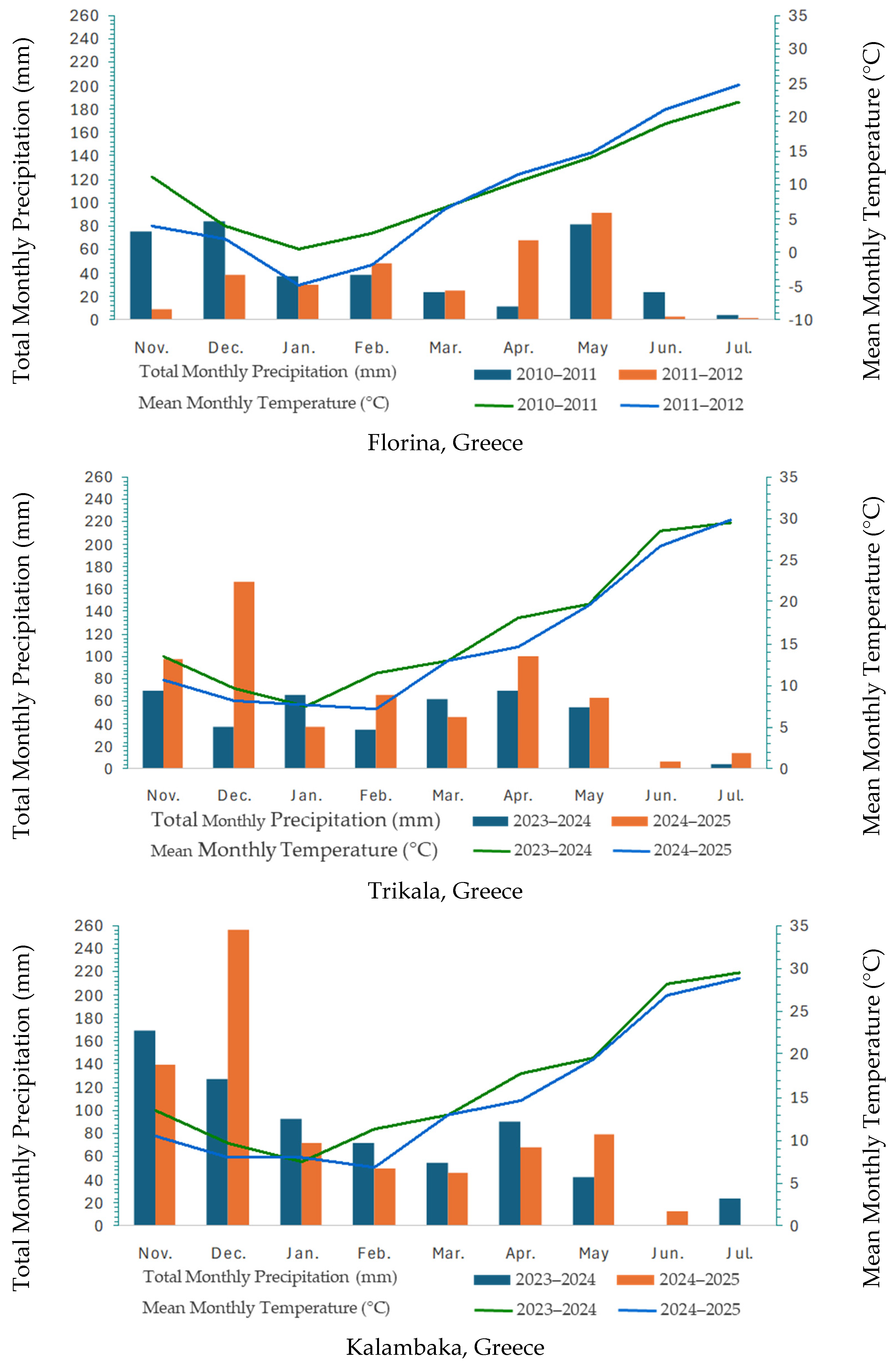
Monthly mean temperature (°C) and total precipitation (mm) were systematically recorded for all six environments, as shown in Figure 1. Considerable seasonal and spatial variation was observed, with differences in temperature ranges and rainfall patterns across locations and years. These climatic fluctuations are critical for understanding genotype × environment (G × E) interactions, as they directly influence wheat seed quality traits. Integrating these environmental data allows a more accurate interpretation of cultivar performance and stability for these traits across diverse conditions.
The experiments conducted at the TEI of Western Macedonia farm in Florina took place during the 2010–2011 and 2011–2012 growing seasons. Although these datasets are historical, the environmental conditions in Florina have remained largely stable, and the local wheat germplasm continues to represent unique and valuable material for Mediterranean breeding programs. Complementary trials were carried out in Trikala and Kalambaka during the 2023–2024 and 2024–2025 growing seasons, providing contemporary environmental contexts with distinct soil types, altitudes, and climatic conditions.
The combined evaluation across six environments, encompassing both historical and recent seasons, enabled a comprehensive assessment of genotype × environment (G × E) interactions. This approach allows quantification of trait stability and adaptability while capturing the effects of inter-annual and regional climatic variability on key wheat seed quality traits. Collectively, these multi-year, multi-location trials provide a robust framework for evaluating the performance and stability of established commercial wheat cultivars and their derived pure lines, informing selection strategies for superior and resilient germplasm under Mediterranean conditions.

2.2. Sample Collection and Grain Quality Analysis

Grain samples were collected from each plot after harvest, cleaned, and analyzed in triplicate following standardized AACC methods [42]. Crude protein content (%) was determined from total nitrogen using the Kjeldahl method (AACC 46-12.01) [42] with a nitrogen-to-protein conversion factor of 5.7. Crude fat (%) was measured via Soxhlet extraction with petroleum ether (AACC 30-25.01) [42], ash content (%) was determined by dry ashing at 550 °C to constant weight (AACC 08-01.01) [42], and moisture content (%) was assessed by oven-drying (AACC 44-15.02) [42]. Total starch content (%) was quantified enzymatically using the Megazyme Amyloglucosidase/α-Amylase assay kit (Neogen, Wicklow, Ireland) (AACC 76-13.01) [42], while crude fiber (%) was measured according to AACC 32-10.01 [42]. Gluten strength was evaluated via the Zeleny sedimentation test (AACC 56-61.02) [42].
Total carbohydrate content (%) was determined using the difference method:
Carbohydrates (%) = 100 − [moisture (%) + crude protein (%) + crude fat (%) + ash (%)]
Non-starch carbohydrates (%) were calculated by subtracting the starch content (%) from total carbohydrates (%):
Non-starch carbohydrates (%) = Carbohydrates (%) − Starch (%)

2.3. Statistical Analysis

All statistical analyses were performed to examine the variability, stability, and interrelationships of the measured grain quality traits. A combined analysis of variance (ANOVA) was conducted for each trait, considering the genetic material as a fixed factor [43], using IBM SPSS version 29 (IBM Corp., Armonk, NY, USA). Mean comparisons were performed using Tukey’s Honest Significant Difference (HSD) test at a 0.05 significance level to control the family-wise error rate, implemented in MSTAT-C software, version 2.10 (Michigan State University, v.2.10, USA). Pearson’s correlation coefficients were calculated to assess relationships among traits and visualized using JMP 18 (Statistical Discovery LLC, Cary, NC, USA). Principal Component Analysis (PCA) was applied in JMP 18 to identify patterns of covariation among quality traits.
Trait stability across environments and years was quantified using the Stability Index (SI) following Fasoula [38]:
S I = ( x ¯ / s ) 2
where x ¯ is the trait mean and S its standard deviation. Higher SI values indicate greater consistency of a trait under varying environmental conditions.
Variance components were estimated from the ANOVA mean squares following McIntosh [44] and used to calculate broad-sense heritability (H2) according to Johnson et al. [45] and Hanson et al. [46]:
H 2 = σ g 2 σ g 2 + σ g x e 2 e + σ r e 2 r x e
The genotypic (GCV) and phenotypic (PCV) coefficients of variation were calculated following Singh and Chaudhary [47] to quantify the relative contributions of genetic versus environmental factors:
  GCV   ( % )   =   σ g 2 x ¯   ×   100
  PCV   ( % ) = σ p 2 x ¯   ×   100
For these calculations, the genotypic variance, phenotypic variance, genotype × environment interaction variance, residual error variance, number of replications, number of environments, and overall mean were incorporated as parameters, represented as σ g 2 , σ p 2 , σ g x e 2 , σ r e 2 , r, e, and x ¯ , respectively.

2.4. Multi-Environment Analysis Using AMMI and GGE Biplots

Genotype × environment interactions were further analyzed using AMMI (Additive Main Effects and Multiplicative Interaction) and GGE (Genotype plus Genotype × Environment) biplot approaches [48]. The AMMI method combines an ANOVA of the main effects of genotypes and environments with a principal component analysis (PCA) of the interaction matrix [49]. Biplots were generated using singular value decomposition (SVD) of the double-centered genotype × environment table. This allows main effects to be interpreted separately, while residual interactions are captured by the multiplicative components [50]. Genotypes with lower PC1 values indicate higher stability across environments.
GGE biplots focus on the combined effects of genotypes and genotype × environment interactions, highlighting the main sources of variation and helping to identify the most desirable genotypes and environments [51,52]. The biplot was first proposed by Gabriel [53] as a scatter plot showing both the entries (genotypes) and the environments, providing a visual way to examine performance and stability. All analyses and biplot constructions were performed using PB Tools v.1.4 (International Rice Research Institute, IRRI, Laguna, Philippines).

3. Results

Wheat seed quality traits were systematically evaluated to understand the relative contributions of genotype, environment, and their interaction to the observed variation, as well as the relationships among traits. The analyzed traits included crude protein, fat, ash, starch, crude fiber, Zeleny sedimentation, carbohydrate, non-starch carbohydrates, and moisture. To assess the consistency of genotypes across different environments, the Stability Index (SI) was calculated for each trait. Statistical analyses included combined ANOVA, Stability Index assessment, genetic parameter estimation, multiple range comparisons, and correlation analysis. Furthermore, multivariate analyses, including principal component analysis (PCA), AMMI (Additive Main effects and Multiplicative Interaction) analysis, and GGE (Genotype × Genotype plus Genotype × Environment) biplot analysis, were performed to summarize the multivariate structure of the data, identify the main sources of variation among traits, reveal patterns of genotype differentiation, and provide a complementary perspective to the univariate analyses.

3.1. Combined ANOVA

The combined analysis of variance (ANOVA) revealed highly significant effects (p ≤ 0.001) of genotype (G), environment (E), and their interaction (G × E) for all evaluated wheat seed quality traits (Table 1), including crude protein, fat, starch, ash, crude fiber, Zeleny sedimentation, carbohydrate, non-starch carbohydrates, and moisture.
For quality-related traits such as crude protein (G m.s. = 14.627) and Zeleny sedimentation (G m.s. = 41.933), the genotypic effect was substantially larger than the corresponding environmental effect, indicating strong genetic control over these traits. In contrast, environmental effects were dominant for starch (E m.s. = 25.838 vs. G m.s. = 3.304), non-starch carbohydrates (E m.s. = 71.365 vs. G m.s. = 15.165), and moisture (E m.s. = 11.806 vs. G m.s. = 1.729), highlighting the high sensitivity of these traits to environmental conditions.
Crude fiber exhibited comparable contributions from genotype (G m.s. = 0.228) and environment (E m.s. = 0.240), suggesting that both genetic background and growing conditions equally influence its expression. For fat and ash content, genotypic effects were generally greater than environmental effects, although both sources of variation were statistically significant.
The genotype × environment interaction was highly significant for all traits (p ≤ 0.001), including crude protein (G × E m.s. = 0.031) and Zeleny sedimentation (G × E m.s. = 0.194), indicating differential genotype responses across environments and justifying subsequent stability and multivariate analyses.
Replication effects within environments (REPS/environments) were mostly non-significant, with only minor exceptions (Table 1), suggesting that the observed variation was primarily attributable to genotype, environment, and their interaction rather than experimental error.
Overall, the combined ANOVA highlights substantial genetic variability among wheat genotypes and confirms the importance of considering both environmental effects and genotype × environment interaction when selecting genotypes with consistently superior seed quality across diverse environments.

3.2. Seed Quality Stability

The Stability Index (SI) was used as a descriptive measure to provide an initial overview of genotype and environment consistency for the evaluated wheat seed quality traits (Table 2 and Table 3). Higher SI values indicate relatively lower variation in a trait across environments; however, SI values should be interpreted comparatively within traits rather than across traits due to scale dependence.
At the genotypic level (Table 2), substantial differences in stability were observed among the 30 wheat genotypes. For crude protein, SI values ranged from approximately 4650 (Vergina) to 7200 (F2), indicating marked differences in consistency among genotypes. Several derived lines exceeded their parental cultivars in protein stability, particularly lines A1–A4 and F2.
Starch exhibited generally higher stability across genotypes, with SI values ranging from approximately 12,000 to 15,250, whereas carbohydrate stability showed a wider dispersion (~20,000 to 57,700), reflecting stronger genotype-dependent responses. Lines A1, A2, A4, C2, and D4 consistently ranked among the most stable genotypes for carbohydrate-related traits.
Zeleny sedimentation displayed intermediate stability, with SI values ranging from approximately 2400 (Vergina) to 4650 (A4). Fat and non-starch carbohydrates showed comparatively lower stability across genotypes, confirming their higher sensitivity to environmental variation.
Overall, starch and total carbohydrate were the most stable traits across genotypes, whereas fat and non-starch carbohydrates were the least stable.
Environmental SI values (Table 3) indicated clear differences in trait stability across the six test environments. For starch, SI values ranged from approximately 14,400 (E5) to 21,700 (E3), while carbohydrate stability varied between ~4600 and 5200 across environments. Crude protein stability showed narrower variation (~155–165), suggesting relatively consistent environmental effects for this trait.
Fat stability was uniformly low across environments (SI ≈ 53–65), whereas Zeleny sedimentation and non-starch carbohydrates exhibited moderate stability ranges (~388–436 and ~129–218, respectively). Moisture content showed pronounced environmental sensitivity, with SI values ranging from ~700 (E6) to ~1190 (E3).
These results demonstrate that both genotype and environment influence the stability of wheat seed quality traits, with notable trait-specific patterns. However, because the Stability Index is scale-dependent and tends to favor traits with higher mean values, SI results were used as a preliminary descriptive assessment. Consequently, genotype × environment interaction patterns and stability rankings are further explored and validated using AMMI and GGE biplot analyses, which provide a more robust multivariate interpretation.

3.3. Descriptive Statistics

The descriptive statistics and genetic parameter estimates for the evaluated wheat seed quality traits are presented in Table 4. Considerable phenotypic variation was observed among genotypes for all traits across the six environments.
Crude protein content ranged from 9.594 to 12.669%, with a mean value of 11.262% and a standard deviation (SD) of 0.898. Zeleny sedimentation varied between 28.433 and 34.769 mL (mean 31.223 mL, SD 1.581), while the carbohydrate content ranged from 72.11 to 76.932% (mean 73.980%, SD 1.102). These ranges indicate substantial variability among genotypes despite the significant environmental and G × E effects detected in the combined ANOVA.
Broad-sense heritability (H2) estimates were high for most traits (Table 4), ranging from 93.81% (moisture) to 99.79% (crude protein). These values reflect the proportion of variance attributable to genetic differences within the specific experimental design and dataset, which included elite pure lines evaluated across multiple environments. High H2 estimates in this context indicate that genotypic variance exceeded residual variance; however, they do not imply that environmental effects were negligible, as environment and G × E interactions were highly significant for all traits (Table 1).
Fat content ranged from 1.535 to 2.867% (mean 2.235%, SD 0.291, H2 99.67%), ash from 1.369 to 1.692% (mean 1.476%, SD 0.068, H2 98.78%), and crude fiber from 2.358 to 3.024% (mean 2.713%, SD 0.125, H2 98.25%). Non-starch carbohydrates exhibited broader variation (9.519–15.184%, mean 12.188%, SD 1.240, H2 98.58%), whereas moisture content showed comparatively lower heritability (93.81%), consistent with its stronger environmental sensitivity.
Genotypic (GCV) and phenotypic (PCV) coefficients of variation were very similar for most traits, such as crude protein (GCV 7.986%, PCV 7.994%) and Zeleny sedimentation (GCV 4.877%, PCV 4.888%). The small differences between GCV and PCV suggest that, within this dataset, genetic variance constituted a major component of phenotypic variance, although environmental effects remained statistically significant.
Overall, these descriptive statistics indicate that wheat seed quality traits exhibit substantial genotypic variation among elite pure lines. While genetic effects accounted for a large proportion of variance in this study, the significant environmental and G × E effects highlight the importance of multi-environment testing for reliable selection.

3.4. Performance of Wheat Genotypes Based on Tukey’s Honest Significant Difference (HSD) Test

Tukey’s Honest Significant Difference (HSD) test (Table 5) revealed significant differences among the 30 wheat genotypes for all evaluated seed quality traits (p ≤ 0.05).
Several progeny lines equaled or outperformed their parental cultivars for key quality traits. Lines derived from Generoso (A1–A4) exhibited crude protein values ranging from 11.21 to 12.24%, with lines A1, A3, and A4 significantly exceeding the parental mean (11.85%). Zeleny sedimentation values in these lines (31.51–32.24 mL) were comparable to or higher than the parent, while starch and carbohydrate contents remained within a narrow and stable range.
Progeny lines from Vergina (B1–B4) showed protein values between 10.72 and 12.20% and fat content between 2.11 and 2.35%, with several lines significantly exceeding the parental cultivar for individual traits. Zeleny sedimentation ranged from 29.99 to 32.86 mL, indicating moderate variation among derived lines.
Lines derived from Vitsi (C1–C4) generally exhibited protein levels similar to or slightly lower than the parent, whereas starch (61.84–62.33%) and carbohydrate (74.47–75.75%) contents were maintained. In contrast, Irnerio-derived lines (D1–D4) showed relatively stable protein content (9.79–10.43%) but pronounced variation in carbohydrate-related traits, with D4 exhibiting the highest carbohydrate (76.41%) and non-starch carbohydrate (14.30%) contents among all genotypes.
Progeny lines from Yecora (E1–E4) consistently exceeded the parental cultivar in crude protein (11.63–12.47%) and Zeleny sedimentation (31.56–33.36 mL), whereas starch and carbohydrate content remained comparable. Similarly, Nestos-derived lines (F1–F4) displayed high protein (11.41–12.41%) and Zeleny sedimentation values (32.64–34.10 mL), with lines F3 and F4 significantly exceeding the parent for gluten strength.
Overall, mean comparisons indicate that several elite pure lines combined improved protein content and gluten strength with stable starch and carbohydrate levels, demonstrating the potential of pure-line selection to enhance wheat seed quality.

3.5. Correlation Analysis of Wheat Seed Traits

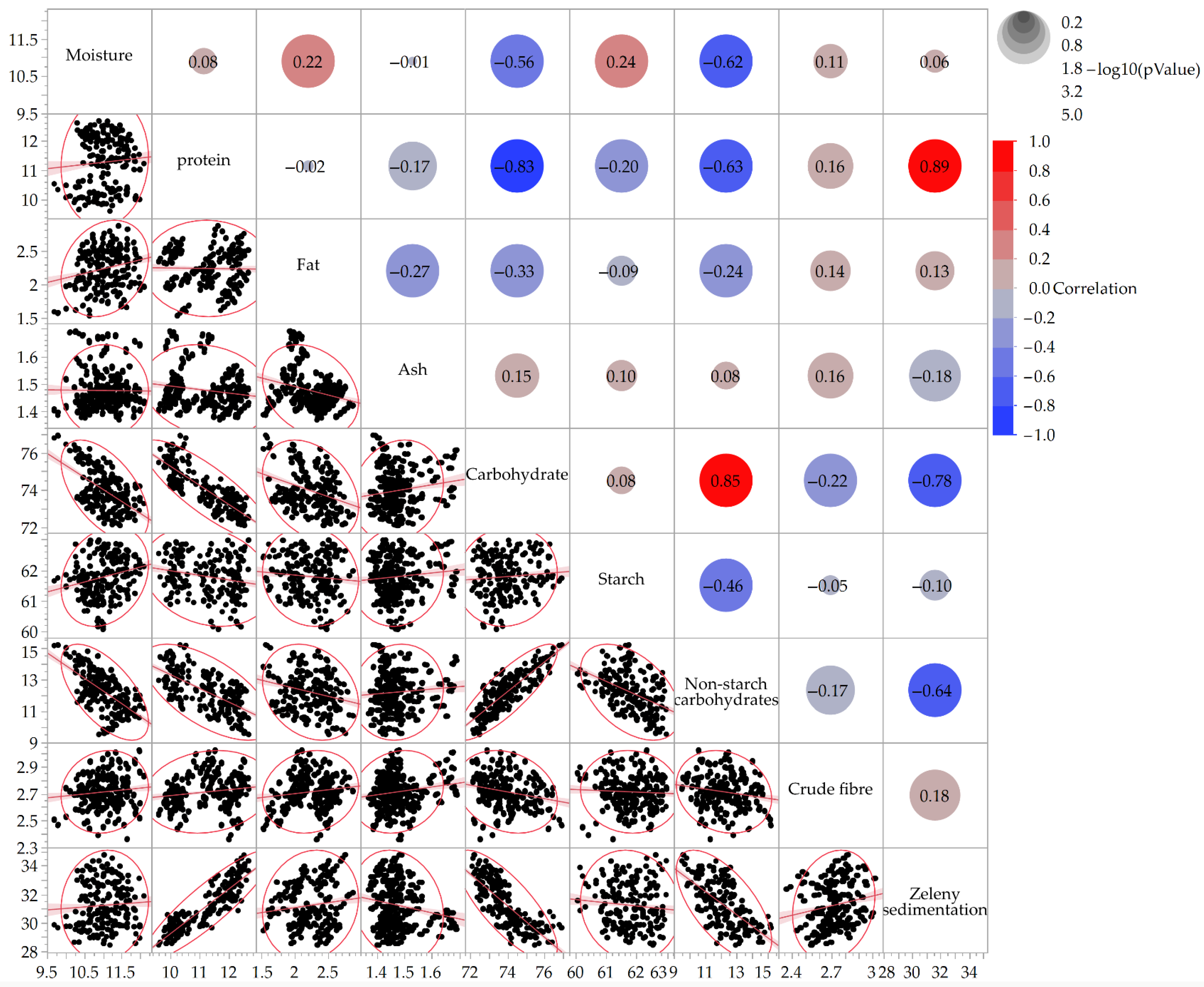
Correlation coefficients among wheat seed quality traits are presented in Figure 2. Several statistically significant relationships were observed, indicating coordinated variation among traits across genotypes and environments.
Crude protein exhibited a strong positive correlation with Zeleny sedimentation (r = 0.89, p < 0.01), confirming the close association between protein quantity and gluten strength. In contrast, crude protein was strongly negatively correlated with total carbohydrate (r = −0.83, p < 0.01) and non-starch carbohydrates (r = −0.63, p < 0.01), reflecting a clear trade-off between protein accumulation and carbohydrate deposition.
Fat content showed weak but significant positive correlation with moisture (r = 0.22, p < 0.01) and negative correlations with ash (r = −0.27, p < 0.01) and starch (r = −0.09, p < 0.05), indicating limited but consistent associations with other seed components.
Ash content was weakly positively correlated with starch (r = 0.10, p < 0.05) and crude fiber (r = 0.16, p < 0.01). Starch content exhibited a moderate negative correlation with non-starch carbohydrates (r = −0.46, p < 0.01) and crude protein (r = −0.20, p < 0.01), consistent with contrasting allocation patterns among grain constituents.
Crude fiber showed weak positive correlations with crude protein (r = 0.16, p < 0.01) and Zeleny sedimentation (r = 0.18, p < 0.01). Zeleny sedimentation was negatively correlated with carbohydrate (r = −0.78, p < 0.01) and non-starch carbohydrates, highlighting its dependence on protein composition rather than carbohydrate accumulation.
Overall, the correlation structure reveals consistent antagonistic relationships between protein–gluten traits and carbohydrate-related traits, whereas fat, moisture, and ash exhibit comparatively weaker associations with the major quality parameters.

3.6. Exploratory Analysis

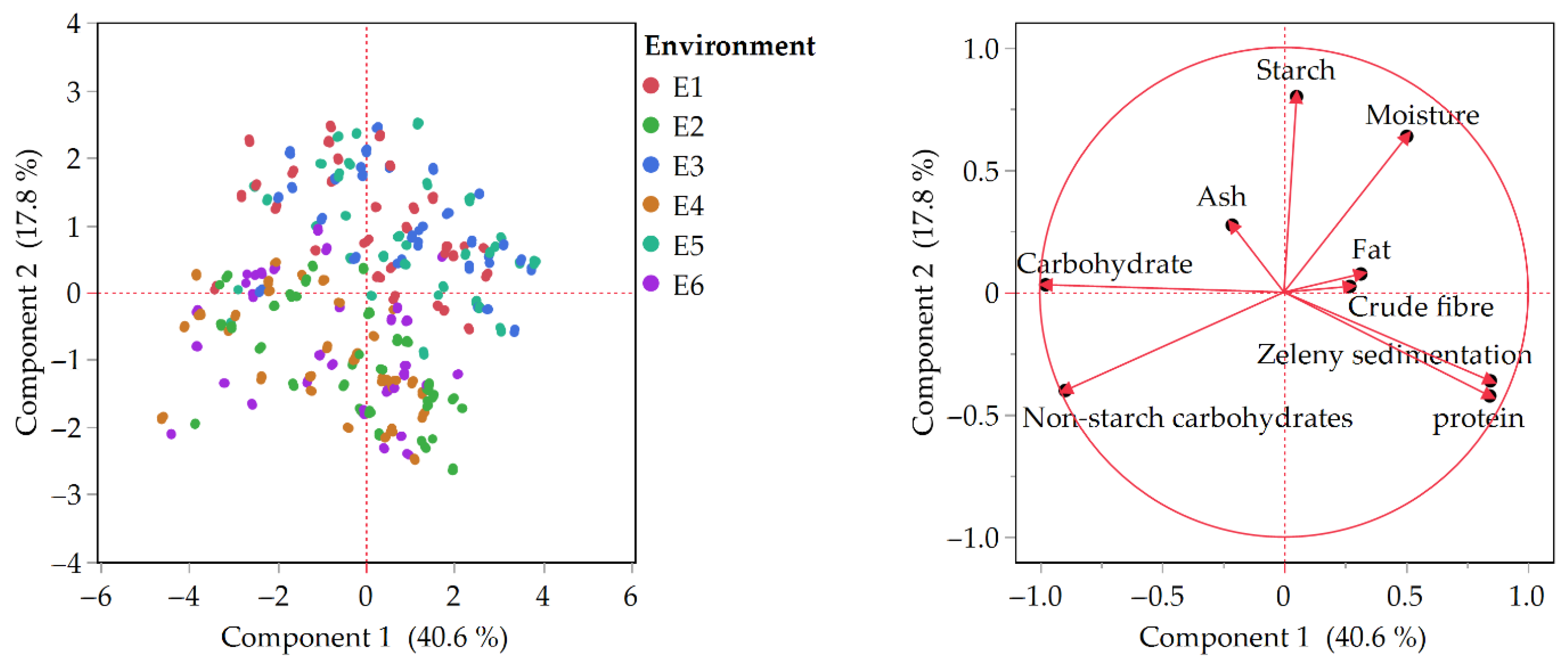
Principal component analysis (PCA) was performed to explore the multivariate structure of wheat seed quality traits and to identify the traits contributing most to variation among genotypes and environments (Figure 3). The first two principal components (PC1 and PC2) explained 58.4% of the total variation, with PC1 accounting for 40.6% and PC2 for 17.8%.
PC1 was primarily associated with protein-related traits, including crude protein and Zeleny sedimentation, which loaded strongly and in the same direction. Carbohydrate-related traits loaded in the opposite direction, indicating a strong negative association between protein–gluten traits and carbohydrate accumulation. This pattern is consistent with the correlations observed among these traits (Figure 2).
PC2 was mainly influenced by starch and moisture, representing variation related to grain filling and water retention. The moderate opposition between PC2 (starch and moisture) and PC1 (protein-related traits) reflects the physiological trade-off between protein accumulation and carbohydrate deposition in wheat grain.
The PCA biplot revealed partial separation of samples according to environment, particularly along PC2. Samples from environments E1, E3, and E5 tended to cluster on the positive side of PC2, whereas samples from E2, E4, and E6 were more frequently located on the negative side. This suggests environmental modulation of starch and moisture content. At the same time, overlap among genotypes across environments indicates that genetic differences contribute substantially to the observed multivariate structure.
Overall, PCA highlights the combined influence of genetic and environmental factors on wheat seed quality traits and supports the presence of trade-offs among key compositional components.

3.7. Multi-Environment Analysis Using AMMI and GGE Biplots

AMMI and GGE biplot analyses were used to further explore genotype × environment (G × E) interactions and to identify genotypes combining high performance with stability across environments (Figures S1–S9). These multivariate approaches complement the combined ANOVA by partitioning interaction effects and visualizing patterns of specific and broad adaptation.
Across traits, environments were generally positioned close to the ideal and average environment in the AMMI1 and GGE biplots, indicating relatively similar discriminatory ability and representativeness. This observation is consistent with the ANOVA results, where although environmental effects were significant, G × E interaction variance was relatively smaller than genotypic variance for several traits.
For crude protein (Figure S1), genotypes G21 (E1), G29 (F4), and G22 (E2) exhibited both high mean performance and low interaction effects, indicating broad adaptation across environments. Similar patterns of broadly adapted genotypes were observed for Zeleny sedimentation (Figure S6), where genotypes G28 (F3), G29 (F4), and G22 (E2) combined high values with relative stability.
Trait-specific adaptation was also evident. For starch (Figure S4), genotypes G11 (C1) and G2 (A2) showed adaptation to environments E1, E2, and E6, whereas G14 (C4) was more specifically adapted to E3 and E5. Comparable patterns of specific adaptation were observed for fat, crude fiber, carbohydrate, non-starch carbohydrates, and moisture (Figures S2–S9).
Overall, AMMI and GGE analyses confirmed that several genotypes exhibit broad adaptation across environments, while others display trait-specific or environment-specific advantages. These results reinforce the combined ANOVA and PCA findings, demonstrating that both genetic effects and G × E interactions shape wheat seed quality performance under diverse environmental conditions.

4. Discussion

The present study provides a comprehensive evaluation of genetic variability, stability, and multivariate relationships of seed quality traits among elite F7 wheat lines derived from six long-term cultivated commercial cultivars. The observed differences among genotypes confirm the presence of exploitable genetic variability, demonstrating that pure-line selection within established cultivars remains an effective approach for improving wheat seed quality. This finding is consistent with previous studies showing that self-pollinated crops such as wheat retain useful additive genetic variation even within commercially uniform cultivars [32,37,54].
Stability analysis using the Stability Index (SI) indicated that several genotypes combined relatively high performance with consistent expression across six contrasting environments. In particular, genotypes A1, A2, A4, C2, E1, and F2 exhibited favorable SI values for key quality traits, including protein, starch, and carbohydrate content. Mean comparisons based on Tukey’s HSD test confirmed that several of these lines matched or exceeded their parental cultivars in protein content and gluten strength while maintaining stable starch and carbohydrate levels (e.g., A1, A4, E1). Although some genotypes (e.g., A2 and F2) showed slightly lower protein content than their parents, their overall performance across environments remained stable. Stability is a critical breeding target, as environmental variability is known to substantially affect wheat grain quality traits, particularly protein concentration, gluten strength, and starch composition [32,55]. The present results demonstrate that pure-line selection can identify genotypes combining acceptable performance with environmental consistency, supporting continuous selection strategies aimed at preserving or improving quality traits in commercial cultivars over successive generations [20,22,24].
While high broad-sense heritability (H2) values were estimated for most traits, these should be interpreted with caution in the context of multi-environment trials. Significant environmental and genotype × environment (G × E) effects were detected, indicating that trait expression is influenced by both genetic and environmental factors. Nevertheless, the relatively consistent ranking of genotypes across environments, as reflected by SI, AMMI, and GGE analyses, suggests that genetic effects play a major role in determining seed quality. Similar findings have been reported in other crops, including cotton, clover, alfalfa, and vetch, where multi-environment evaluations successfully identified stable genotypes despite significant environmental variation [56,57,58,59,60].
Correlation analysis revealed strong positive associations between crude protein content and gluten strength (Zeleny sedimentation), alongside negative correlations with carbohydrate and non-starch carbohydrate content. These relationships reflect the well-documented physiological and biochemical trade-off between protein accumulation and carbohydrate deposition during wheat grain filling [33,34,37,54,61]. Traits such as fat, ash, and moisture exhibited weaker correlations with protein and starch, suggesting that they are less constrained by these trade-offs and may be improved more independently. Although protein, Zeleny sedimentation, and starch showed relatively high heritability estimates, the observed correlations emphasize that selection for one trait may indirectly affect others, highlighting the importance of multi-trait selection strategies.
Principal component analysis (PCA) explained 58.4% of the total variation in seed quality traits, with PC1 (40.6%) primarily associated with protein-related traits (crude protein and Zeleny sedimentation) and non-starch carbohydrates, and PC2 (17.8%) mainly reflecting variation in starch, moisture, and ash content. These patterns clearly illustrate the trade-off between protein-related traits and carbohydrate accumulation, in agreement with previous studies on wheat grain quality [36,55,62]. Environmental differentiation was evident, as environments E1, E3, and E5 were associated with higher starch and moisture, whereas E2, E4, and E6 favored higher protein, Zeleny sedimentation, and non-starch carbohydrates. Despite this environmental influence, genotypes formed relatively distinct groups in PCA space, indicating that genetic differences were not overridden by environmental effects. These findings highlight the usefulness of PCA for visualizing complex trait relationships and identifying genotypes with stable quality profiles across environments [36,55,62].
The combined use of univariate (ANOVA, SI), bivariate (correlation), and multivariate (PCA, AMMI, GGE) analyses provides a comprehensive framework for evaluating wheat seed quality. AMMI and GGE biplots further supported the identification of genotypes with both broad and trait-specific adaptation. Specifically, genotypes such as G21 (E1), G29 (F4), and G22 (E2) exhibited broad adaptation for crude protein, while G28 (F3), G29 (F4), and G22 (E2) were broadly adapted for Zeleny sedimentation. Trait-specific adaptation was evident for starch, fat, crude fiber, carbohydrate, non-starch carbohydrates, and moisture, where different genotypes performed best in specific environments (e.g., G11 (C1) and G2 (A2) for starch in E1, E2, E6; G14 (C4) for starch in E3, E5; G12 (C2) and G25 (E: Yecora) for fat in E6).
While Stability Index (SI) identified genotypes A1, A2, A4, C2, E1, and F2 as combining relatively high mean performance with consistent expression across all environments, AMMI and GGE analyses highlighted that other genotypes may excel in specific traits or environments, reflecting both broad and environment-dependent performance. The Stability Index complements AMMI and GGE analyses by providing a clear and practical measure of overall stability across environments, allowing breeders to select genotypes that combine high mean performance with reliable environmental consistency. This observation reinforces the conclusion that both genetic potential and G × E interactions must be considered in breeding programs. The observed plasticity of wheat seed composition reflects the dynamic interaction between genotype and environment and underscores the capacity of the wheat genome to generate heritable variation for complex traits [20,22,24,63].
Overall, our findings demonstrate that targeted pure-line selection within long-term cultivated wheat cultivars effectively harnesses existing genetic variability to enhance seed quality. Several genotypes, notably A1, A2, A4, C2, E1, and F2, combined high protein content and strong gluten strength with stable starch and carbohydrate levels across diverse environments, as reflected by the Stability Index (SI). Although minor reductions in protein content were observed for some lines (e.g., A2 and F2) compared with their parental cultivars, overall performance and environmental stability remained high.
The combined use of SI, broad-sense heritability estimates, multivariate approaches such as PCA, and stability models based on AMMI and GGE biplots allowed a thorough assessment of both mean performance and genotype × environment interactions. AMMI and GGE analyses specifically highlighted broad or trait-specific adaptation for other genotypes, depending on the trait and environment (e.g., E1, F4, E2 for crude protein; F3, F4, E2 for Zeleny sedimentation). This distinction reinforces that while some genotypes maintain stable performance across all environments (SI), others excel in specific traits or environments, illustrating the importance of considering both general and environment-dependent performance in breeding programs.
Collectively, these results demonstrate that integrating univariate, multivariate, and biplot-based stability analyses provides a clear framework for exploiting intracultivar genetic variation and developing wheat cultivars that achieve a balance between high quality, productivity, and environmental adaptability.

5. Conclusions

The present study revealed substantial genetic variability among elite F7 wheat lines for key seed quality traits, including crude protein content, Zeleny sedimentation, carbohydrate content, and crude fiber. Although significant genotype × environment (G × E) interactions were detected, several genotypes consistently exhibited favorable performance and stability across contrasting environments. In particular, genotypes A1, A2, A4, C2, E1, and F2 showed stable performance across environments, as indicated by the Stability Index (SI), making them promising candidates for breeding programs targeting high-quality wheat.
The combined use of ANOVA, SI, correlation analysis, PCA, and AMMI/GGE approaches demonstrated that genetic effects play a major role in determining wheat seed quality, while environmental conditions act as important modifiers of trait expression. PCA highlighted a central biological trade-off during grain filling between protein-related traits and non-starch carbohydrates versus starch accumulation, while correlation analysis confirmed that selection for higher protein and gluten strength may inversely affect carbohydrate content. In contrast, traits such as fat, ash, and moisture showed weaker associations and may improve more independently.
Overall, these findings emphasize that targeted pure-line selection within established wheat cultivars provides an effective strategy to enhance seed quality while maintaining stability across environments. Integrating stability metrics with multivariate analyses offers a practical and reliable framework for identifying genotypes that balance high quality, environmental adaptability, and resilience, thereby supporting the development of wheat cultivars suited to diverse and variable growing conditions.

Supplementary Materials

The following supporting information can be downloaded at: https://www.mdpi.com/article/10.3390/agriculture16040444/s1, Figure S1: Stability analysis of crude protein in wheat genotypes based on (a) AMMI adaptation map, (b) AMMI1 biplot, (c) GGE biplot for environmental stability, (d) GGE biplot for genotypic stability, and (e) “which-won-where” GGE biplot. Genotypes positioned closer to the ideal genotype are considered the most stable and desirable; Figure S2: Stability analysis of fat in wheat genotypes based on (a) AMMI adaptation map, (b) AMMI1 biplot, (c) GGE biplot for environmental stability, (d) GGE biplot for genotypic stability, and (e) “which-won-where” GGE biplot. Genotypes positioned closer to the ideal genotype are considered the most stable and desirable; Figure S3: Stability analysis of ash in wheat genotypes based on (a) AMMI adaptation map, (b) AMMI1 biplot, (c) GGE biplot for environmental stability, (d) GGE biplot for genotypic stability, and (e) “which-won-where” GGE biplot. Genotypes positioned closer to the ideal genotype are considered the most stable and desirable; Figure S4: Stability analysis of starch in wheat genotypes based on (a) AMMI adaptation map, (b) AMMI1 biplot, (c) GGE biplot for environmental stability, (d) GGE biplot for genotypic stability, and (e) “which-won-where” GGE biplot. Genotypes positioned closer to the ideal genotype are considered the most stable and desirable; Figure S5: Stability analysis of crude fibre in wheat genotypes based on (a) AMMI adaptation map, (b) AMMI1 biplot, (c) GGE biplot for environmental stability, (d) GGE biplot for genotypic stability, and (e) “which-won-where” GGE biplot. Genotypes positioned closer to the ideal genotype are considered the most stable and desirable; Figure S6: Stability analysis of Zeleny sedimentation in wheat genotypes based on (a) AMMI adaptation map, (b) AMMI1 biplot, (c) GGE biplot for environmental stability, (d) GGE biplot for genotypic stability, and (e) “which-won-where” GGE biplot. Genotypes positioned closer to the ideal genotype are considered the most stable and desirable; Figure S7: Stability analysis of carbohydrate content in wheat genotypes based on (a) AMMI adaptation map, (b) AMMI1 biplot, (c) GGE biplot for environmental stability, (d) GGE biplot for genotypic stability, and (e) “which-won-where” GGE biplot. Genotypes positioned closer to the ideal genotype are considered the most stable and desirable; Figure S8: Stability analysis of non-starch carbohydrates in wheat genotypes based on (a) AMMI adaptation map, (b) AMMI1 biplot, (c) GGE biplot for environmental stability, (d) GGE biplot for genotypic stability, and (e) “which-won-where” GGE biplot. Genotypes positioned closer to the ideal genotype are considered the most stable and desirable; Figure S9: Stability analysis of moisture in wheat genotypes based on (a) AMMI adaptation map, (b) AMMI1 biplot, (c) GGE biplot for environmental stability, (d) GGE biplot for genotypic stability, and (e) “which-won-where” GGE biplot. Genotypes positioned closer to the ideal genotype are considered the most stable and desirable.

Author Contributions

Conceptualization, V.G. and S.Z.; methodology, V.G. and S.Z.; investigation, V.G., C.G.I., D.K. and E.B.; statistical analysis, A.S. and V.G., writing—original draft preparation, V.G., E.B. and C.G.I.; writing—review and editing, V.G., E.B., D.K., and A.S.; visualization, A.S. and V.G.; supervision, V.G.; project administration, V.G. All authors have read and agreed to the published version of the manuscript.

Funding

This research received no external funding.

Institutional Review Board Statement

Not applicable.

Data Availability Statement

The original contributions presented in this study are included in the article. Further inquiries can be directed to the corresponding author.

Conflicts of Interest

The authors declare no conflicts of interest.

References

  1. Shen, L.; Qi, X.; Guo, Z. Wheat. Curr. Biol. 2025, 35, R1037–R1043. [Google Scholar] [CrossRef] [PubMed]
  2. FAO. FAOSTAT: Crops and Livestock Products; Food and Agriculture Organization of the United Nations: Rome, Italy, 2026; Available online: https://www.fao.org/faostat/en/#data/QCL/visualize (accessed on 31 January 2026).
  3. Erenstein, O.; Jaleta, M.; Mottaleb, K.A.; Sonder, K.; Donovan, J.; Braun, H.J. Global trends in wheat production, consumption and trade. In Wheat Improvement; Reynolds, M.P., Braun, H.J., Eds.; Springer: Cham, Switzerland, 2022. [Google Scholar]
  4. Bohra, A.; Choudhary, M.; Bennett, D.; Joshi, R.; Mir, R.R.; Varshney, R.K. Drought-tolerant wheat for enhancing global food security. Funct. Integr. Genom. 2024, 24, 212. [Google Scholar] [CrossRef]
  5. Morris, C.F. Puroindolines: The Molecular Genetic Basis of Wheat Grain Hardness. Plant Mol. Biol. 2002, 48, 633–647. [Google Scholar] [CrossRef]
  6. Tester, R.F.; Karkalas, J. The Effects of Environmental Conditions on the Structural Features and Physico-Chemical Properties of Starches. Starch-Staerke 2001, 53, 513–519. [Google Scholar] [CrossRef]
  7. Branlard, G.; Dardevet, M.; Saccomano, R.; Lagoutte, F.; Gourdon, J. Genetic diversity of wheat storage proteins and bread wheat quality. Euphytica 2001, 119, 59–67. [Google Scholar] [CrossRef]
  8. Siddiqi, R.S.; Singh, T.P.; Rani, M.; Sogi, D.S.; Bhat, M.A. Diversity in grain, flour, amino acid composition, protein profiling, and proportion of total flour proteins of different wheat cultivars of north India. Front. Nutr. 2020, 7, 141. [Google Scholar] [CrossRef]
  9. Shewry, P.R. Wheat. J. Exp. Bot. 2009, 60, 1537–1553. [Google Scholar] [CrossRef] [PubMed]
  10. Wieser, H.; Koehler, P.; Scherf, K.A. Chemistry of Wheat Gluten Proteins: Qualitative Composition. Cereal Chem. 2023, 100, 23–35. [Google Scholar] [CrossRef]
  11. Zhong, Y.; Yang, M.; Cai, J.; Wang, X.; Zhou, Q.; Cao, W.; Dai, T.; Jiang, D. Nitrogen topdressing timing influences the spatial distribution patterns of protein components and quality traits of flours from different pearling fractions of wheat (Triticum aestivum L.) grains. Field Crops Res. 2018, 216, 120–128. [Google Scholar] [CrossRef]
  12. Marcinkowska, K.; Kolańska, K.; Banaś, K.; Łacka, A.; Lenartowicz, T.; Szulc, P.; Bujak, H. Genotype–Environment Interaction in Shaping the Agronomic Performance of Silage Maize Varieties Cultivated in Organic Farming Systems. Agriculture 2026, 16, 123. [Google Scholar] [CrossRef]
  13. Engida, B.T.; Tarekegne, A.; Wegary, D.; Van Biljon, A.; Labuschagne, M.T. Genotype × environment interaction and grain yield stability of quality protein maize hybrids under stress and non-stress environments. Cogent Food Agric. 2024, 10, 2324537. [Google Scholar] [CrossRef]
  14. Beyene, D.; Wegary, D.; Tesso, B.; Jalata, Z.; Geleta, N.; Sadessa, K. Grain yield stability and genotype by environment interaction of quality protein maize hybrids in Ethiopia. Agrosyst. Geosci. Environ. 2025, 8, e70236. [Google Scholar] [CrossRef]
  15. Stratilakis, S.N.; Goulas, C.K. Yield performance at three nitrogen rates of a set of honeycomb vs. traditional pedigree selected bread wheat varieties. Eur. J. Agron. 2003, 19, 65–76. [Google Scholar] [CrossRef]
  16. Yates, J.L.; Boerma, R.H.; Fasoula, V. SSR-marker analysis of the intracultivar phenotypic variation discovered within 3 soybean cultivars. J. Hered. 2012, 103, 570–578. [Google Scholar] [CrossRef]
  17. McClintock, B. The significance of responses of the genome to challenge. Science 1984, 226, 792–801. [Google Scholar] [CrossRef]
  18. Fasoula, D.A. Correlations between auto-, allo- and nill-competition and their implications in plant breeding. Euphytica 1990, 50, 57–62. [Google Scholar] [CrossRef]
  19. Fasoula, V.A.; Boerma, H.R. Intra-cultivar variation for seed weight and agronomic traits. Crop Sci. 2007, 47, 367–373. [Google Scholar] [CrossRef]
  20. Rasmusson, D.C.; Phillips, R.L. Plant breeding progress and genetic diversity from de novo variation and elevated epistasis. Crop Sci. 1997, 37, 303–310. [Google Scholar] [CrossRef]
  21. Duvick, D.N.; Smith, J.S.C.; Cooper, M. Long-term selection in a commercial hybrid corn breeding program: Past, present, and future. Plant Breed. Rev. 2004, 25, 109–151. [Google Scholar]
  22. Cullis, C.A. DNA rearrangements in response to environmental stress. Adv. Genet. 1990, 28, 73–97. [Google Scholar]
  23. Parlevliet, J.E. How to maintain improved cultivars. Euphytica 2007, 153, 353–362. [Google Scholar] [CrossRef]
  24. Fasoula, V.A.; Fasoula, D.A. Honeycomb breeding: Principles and applications. Plant Breed. Rev. 2000, 18, 177–250. [Google Scholar]
  25. Fasoulas, A.C. Principles of Crop Breeding; Aristotle University Press: Thessaloniki, Greece, 1993. [Google Scholar]
  26. Riggs, A.D.; Porter, T.N. Overview of epigenetic mechanisms. In Epigenetic Mechanisms of Gene Regulation; Russo, V.E.A., Martienssen, R., Riggs, A.D., Eds.; Cold Spring Harbor Laboratory Press: Cold Spring Harbor, NY, USA, 1996; Volume 32, pp. 29–45. [Google Scholar]
  27. Agorastos, A.G.; Goulas, C.K. Line Selection for Exploiting Durum Wheat (T. turgidum L. Var. Durum) Local Landraces in Modern Variety Development Program. Euphytica 2005, 146, 117–124. [Google Scholar] [CrossRef]
  28. Sleper, D.A.; Poehlman, J.M. Breeding Field Crops, 5th ed.; Blackwell Pub: Ames, IA, USA, 2006. [Google Scholar]
  29. Greveniotis, V.; Fasoula, V.A. Application of prognostic breeding in maize. Crop Pasture Sci. 2016, 67, 605–620. [Google Scholar] [CrossRef]
  30. Lopes, M.S.; El-Basyoni, I.; Baenziger, P.S.; Singh, S.; Royo, C.; Ozbek, K.; Aktas, H.; Ozer, E.; Ozdemir, F.; Manickavelu, A. Exploiting genetic diversity from landraces in wheat breeding for adaptation to climate change. J. Exp. Bot. 2015, 66, 3477–3486. [Google Scholar] [CrossRef]
  31. Dwivedi, S.L.; Ceccarelli, S.; Blair, M.W.; Upadhyaya, H.D.; Are, A.K.; Ortiz, R. Landrace germplasm for improving yield and abiotic stress adaptation. Trends Plant Sci. 2016, 21, 31–42. [Google Scholar] [CrossRef]
  32. Kedir, A.; Letta, T. Genotype by Environmental Interaction on Grain Quality of Bread Wheat (Triticum aestivum L.) Genotypes at Southern Ethiopia. Int. J. Genet. Genom. 2022, 10, 7–11. [Google Scholar] [CrossRef]
  33. Desheva, G. Effects of genotype, environment and their interaction on quality characteristics of winter bread wheat. J. Basic Appl. Res. 2016, 2, 363–372. [Google Scholar]
  34. Takač, V.; Tóth, V.; Rakszegi, M.; Mikić, S.; Mirosavljević, M.; Kondić-Špika, A. Differences in Processing Quality Traits, Protein Content and Composition between Spelt and Bread Wheat Genotypes Grown under Conventional and Organic Production. Foods 2021, 10, 156. [Google Scholar] [CrossRef]
  35. Williams, R.M.; O’Brien, L.; Eagles, H.A.; Solah, V.A.; Jayasena, V. The influences of genotype, environment, and genotype × environment interaction on wheat quality. Aust. J. Agric. Res. 2008, 59, 95–111. [Google Scholar] [CrossRef]
  36. Westerlund, E.; Andersson, R.; Hämäläinen, M.; Åman, P. Principal component analysis—An efficient tool for selection of wheat samples with wide variation in properties. J. Cereal Sci. 1991, 14, 95–104. [Google Scholar] [CrossRef]
  37. Muqaddasi, Q.H.; Brassac, J.; Ebmeyer, E.; Kollers, S.; Korzun, V.; Argiller, O.; Stiewe, G.; Plieske, J.; Ganal, M.W.; Rode, M. Prospects of GWAS and predictive breeding for European winter wheat’s grain protein content, grain starch content, and grain hardness. Sci. Rep. 2020, 10, 1254. [Google Scholar] [CrossRef]
  38. Fasoula, V.A. Prognostic Breeding: A new paradigm for crop improvement. Plant Breed. Rev. 2013, 37, 297–347. [Google Scholar]
  39. Greveniotis, V.; Bouloumpasi, E.; Zotis, S.; Korkovelos, A.; Kantas, D.; Ipsilandis, C.G. Genotype-by-Environment Interaction Analysis for Quantity and Quality Traits in Faba Beans Using AMMI, GGE Models, and Stability Indices. Plants 2023, 12, 3769. [Google Scholar] [CrossRef] [PubMed]
  40. Greveniotis, V.; Bouloumpasi, E.; Skendi, A.; Korkovelos, A.; Kantas, D.; Ipsilandis, C.G. Stability of Forage Quality Traits in Artificial Meadows Across Greek Environments. Agriculture 2025, 15, 2595. [Google Scholar] [CrossRef]
  41. Greveniotis, V.; Zotis, S.; Sioki, E.; Ipsilandis, C. A Breeding Concept to improve the performance of locally cultivated bread wheat (Triticum aestivum L.) cultivars. Czech J. Genet. Plant Breed. 2019, 56, 1–8. [Google Scholar] [CrossRef]
  42. Association of Official Analytical Chemists (AOAC). Official Methods of Analysis, 18th ed.; AOAC International: Gaithersburg, MD, USA, 2005. [Google Scholar]
  43. Steel, R.G.D.; Torrie, H.; Dickey, D.A. Principles and Procedures of Statistics. A Biometrical Approach, 3rd ed.; McGraw-Hill: New York, NY, USA, 1997; p. 666. [Google Scholar]
  44. McIntosh, M.S. Analysis of Combined Experiments. Agron. J. 1983, 75, 153–155. [Google Scholar] [CrossRef]
  45. Johnson, H.W.; Robinson, H.E.; Comstock, R.E. Estimate of genetic and environmental variability in soybean. Agron. J. 1955, 47, 314–318. [Google Scholar] [CrossRef]
  46. Hanson, G.; Robinson, H.F.; Comstock, R.E. Biometrical studies on yield in segregating population of Korean Lespedeza. Agron. J. 1956, 48, 268–274. [Google Scholar] [CrossRef]
  47. Singh, R.K.; Chaudhary, B.D. Biometrical Methods in Quantitative Genetic Analysis; Kalyani Publishers: New Delhi, India, 1977; p. 304. [Google Scholar]
  48. Khan, M.M.H.; Rafii, M.Y.; Ramlee, S.I.; Jusoh, M.; Al Mamun, M. AMMI and GGE biplot analysis for yield performance and stability assessment of selected Bambara groundnut (Vigna subterranea L. Verdc.) genotypes under the multi-environmental trials (METs). Sci. Rep. 2021, 11, 22791. [Google Scholar] [CrossRef]
  49. Gauch, H., Jr. Statistical Analysis of Regional Yield Trials: AMMI Analysis of Factorial Designs; Elsevier Science Publishers: Amsterdam, The Netherlands, 1992. [Google Scholar]
  50. Koundinya, A.V.V.; Ajeesh, B.R.; Hegde, V.; Sheela, M.N.; Mohan, C.; Asha, K.I. Genetic parameters, stability and selection of cassava genotypes between rainy and water stress conditions using AMMI, WAAS, BLUP and MTSI. Sci. Hortic. 2021, 281, 109949. [Google Scholar] [CrossRef]
  51. Yan, W.; Hunt, L.A.; Sheng, Q.; Szlavnics, Z. Cultivar Evaluation and Mega-Environment Investigation Based on the GGE Biplot. Crop Sci. 2000, 40, 597–605. [Google Scholar] [CrossRef]
  52. Haile, G.A.; Kebede, G.Y. Identification of Stable Faba Bean (Vicia faba L.) Genotypes for Seed Yield in Ethiopia Using GGE Model. J. Plant Sci. 2021, 9, 163–169. [Google Scholar]
  53. Gabriel, K.R. The biplot graphic display of matrices with application to principal component analysis. Biometrika 1971, 58, 453–467. [Google Scholar] [CrossRef]
  54. Jing, Q.; Jiang, D.; Dai, T.; Cao, W. Effects of genotype and environment on wheat grain quality and protein components. Ying Yong Sheng Tai Xue Bao 2003, 14, 1649–1653. [Google Scholar]
  55. Spanic, V.; Cosic, J.; Zdunic, Z.; Drezner, G. Characterization of Agronomical and Quality Traits of Winter Wheat (Triticum aestivum L.) for Fusarium Head Blight Pressure in Different Environments. Agronomy 2021, 11, 213. [Google Scholar] [CrossRef]
  56. Greveniotis, V.; Bouloumpasi, E.; Skendi, A.; Korkovelos, A.; Ipsilandis, C.G. Yield Components Analysis in Partially Interspecific Lines of Cotton and Irrigation-Nitrogen Effects. Appl. Sci. 2025, 15, 11746. [Google Scholar] [CrossRef]
  57. Greveniotis, V.; Bouloumpasi, E.; Skendi, A.; Kantas, D.; Ipsilandis, C.G. Assessing Stability and Correlations Among Cotton Seed Quality Traits Across Multiple Environments Using the Stability Index. Appl. Sci. 2026, 16, 984. [Google Scholar] [CrossRef]
  58. Greveniotis, V.; Bouloumpasi, E.; Skendi, A.; Korkovelos, A.; Kantas, D.; Ipsilandis, C.G. Evaluation and Stability of Red and White Trifolium Species for Nutritional Quality in a Mediterranean Environment. Agriculture 2025, 15, 391. [Google Scholar] [CrossRef]
  59. Greveniotis, V.; Bouloumpasi, E.; Skendi, A.; Korkovelos, A.; Kantas, D.; Zotis, S.; Ipsilandis, C.G. Modeling Stability of Alfalfa Yield and Main Quality Traits. Agriculture 2024, 14, 542. [Google Scholar] [CrossRef]
  60. Greveniotis, V.; Bouloumpasi, E.; Zotis, S.; Korkovelos, A.; Kantas, D.; Ipsilandis, C.G. A Comparative Study on Stability of Seed Characteristics in Vetch and Pea Cultivations. Agriculture 2023, 13, 1092. [Google Scholar] [CrossRef]
  61. Du, M.; Deng, G.; Liu, R.; Lu, J.; Wang, M.; Cheng, J.; Luo, X.; Zhang, L.; Zhang, C.; Li, Y.; et al. Impact of kernel hardness, protein, and total starch content on wheat starch digestibility. Int. J. Food Sci. Technol. 2025, 60, vvae103. [Google Scholar] [CrossRef]
  62. Poonia, M.K.; Kumar, A.; Rana, M.; Kumar, R. Genetic Diversity Assessment of Wheat Genotypes in Bundelkhand Region Using Principal Component Analysis. Asian J. Soil Sci. Plant Nutr. 2025, 11, 241–246. [Google Scholar] [CrossRef]
  63. Sadras, V.O.; Slafer, G.A. Environmental modulation of yield components in cereals: Heritability reveal a hierarchy of phenotypic plasticities. Field Crops Res. 2012, 127, 215–224. [Google Scholar] [CrossRef]
Figure 1. Monthly mean temperature (°C) and total precipitation (mm) recorded during the wheat growing seasons across all experimental sites: Florina (2010–2011, 2011–2012), Trikala (2023–2024, 2024–2025), and Kalambaka (2023–2024, 2024–2025). The observed climatic variation among locations and years provides important context for interpreting genotype × environment (G × E) interactions and their effects on wheat seed quality traits.
Agriculture 16 00444 g001
Figure 2. Correlation matrix displaying pairwise scatterplots for the analyzed parameters of wheat. The upper section presents the correlation coefficients, while the lower section contains scatterplots (black dots) with 95% density ellipses that illustrate the clustering of data points.
Agriculture 16 00444 g002
Figure 3. PCA of 30 wheat genotypes evaluated across six environments for seed quality traits. The first two principal components (PC1 and PC2) explained 40.6% and 17.8% of the total variation, respectively. PC1 is primarily associated with protein-related traits, including crude protein, Zeleny sedimentation, and crude fiber, while PC2 represents variation in starch and moisture. The biplot illustrates the dispersion of genotypes, indicating that genetic differences are the main source of variation, with environmental effects acting as secondary modifiers.
Agriculture 16 00444 g003
Table 1. Combined analysis of variance (ANOVA) for wheat seed traits, including crude protein, fat, starch, ash, crude fiber, carbohydrate, non-starch carbohydrates, moisture (all in %) and Zeleny sedimentation (mL). The table presents the mean squares (m.s.) for the effects of genotype (G), environment (E), and their interaction (E × G), as well as the residual error and the replicate variation within environments. This table allows the evaluation of the relative contribution of genetic and environmental factors, as well as their interaction, on wheat seed quality traits.
Source of
Variation
Crude
Protein
FatAshStarchCrude FiberZeleny SedimentationCarbohydrateNon-Starch
Carbohydrates
Moisture
m.s.m.s.m.s.m.s.m.s.m.s.m.s.m.s.m.s.
Environment (E)1.197 ***0.356 ***0.015 ***25.838 ***0.240 ***20.703 ***14.028 ***71.365 ***11.806 ***
REPS/Environments0.00006 *0.00004 ns0.00004 ns0.001 ns0.00003 ns0.00005 ns0.001 ns0.001 ns0.0003 ns
Genotype (G)14.627 ***1.482 ***0.080 ***3.304 ***0.228 ***41.933 ***19.293 ***15.165 ***1.729 ***
Environment × Genotype (E × G)0.031 ***0.005 ***0.001 ***0.091 ***0.004 ***0.194 ***0.172 ***0.215 ***0.107 ***
Error0.000030.000030.000020.00040.000030.000090.0010.0010.001
Probability levels: * p ≤ 0.05; *** p ≤ 0.001; ns—not significant.
Table 2. Stability Index (SI) values for wheat seed traits including crude protein, fat, starch, ash, crude fiber, carbohydrate, non-starch carbohydrates, moisture (all in %) and Zeleny sedimentation (mL). Higher SI values indicate greater stability of the trait across environments.
GenotypesCrude
Protein
FatAshStarchCrude FiberZeleny
Sedimentation
CarbohydrateNon-Starch CarbohydratesMoisture
A169401054769214,8962027422346,8133581069
A265491005671914,7352146443450,0122241130
A363161012730915,2522256451421,2062301132
A46646971756914,9411961464557,732363923
Generoso5624909613713,4691838408830,465193884
B161621059756314,5161964317726,295204912
B250141098723614,5471905327643,536277977
B363081048713312,9201768300231,296163899
B45745906724013,6252038327223,162148806
Vergina46481001618112,0011677239227,529184829
C167851061622513,3252069303146,7792521109
C26239952670614,3232037357055,0463811045
C35993961727214,1051890348825,5832211037
C458441059729113,0121902376827,5452081160
Vitsi5208755591512,3111455299220,2051911011
D15944955637514,8992063362233,4732371118
D25230910659313,4511706354628,2381791062
D35536876640113,1301890379826,457203918
D45619885654214,3131763322540,744284928
Irnerio5081829533012,9551589287621,375177914
E16428962633813,7901997426436,5411891126
E25895908624112,9062080400224,4121681017
E35865845660813,1852025466124,8811621094
E45344922648213,1851725437439,7132091099
Yecora5195814609411,7031556392422,9671611007
F16867976627612,8222021369025,991160862
F27199833614213,7401853356224,876145895
F36610871647913,3721850399525,969131785
F460261155629013,1931717347422,953129819
Nestos5907831527612,0031520313323,958128782
Table 3. Stability Index (SI) values for wheat seed traits including crude protein, fat, starch, ash, crude fiber, carbohydrate, non-starch carbohydrates, moisture (all in %) and Zeleny sedimentation (mL) across six environments. Higher SI values indicate greater stability of the trait.
EnvironmentsCrude
Protein
FatAshStarchCrude FiberZeleny
Sedimentation
CarbohydrateNon-Starch CarbohydratesMoisture
E11586546220,54657039851821751129
E21566445720,09252538851892181107
E31656463121,68151743649971581190
E41586241219,25756642851502141112
E51555361314,4115584364624129879
E61566040718,2215174304896143698
Table 4. Genetic parameter estimates for wheat seed traits, including crude protein, fat, starch, ash, crude fiber, carbohydrate, non-starch carbohydrates, moisture (all in %) and Zeleny sedimentation (mL). The table presents mean values, genotypic variance ( σ g 2 ), phenotypic variance ( σ p 2 ), broad-sense heritability (H2, %), genotypic coefficient of variation (GCV, %), phenotypic coefficient of variation (PCV, %), standard deviation (SD), minimum (min), and maximum (max) values for each trait.
TraitsMin.Max.MeanSD σ g 2 σ p 2 GCV (%)PCV (%)H2 (%)
Crude protein9.59412.66911.2620.8980.80900.81077.9867.99499.79
Fat1.5352.8672.2350.2910.08200.082312.81812.83999.67
Ash1.3691.6921.4760.0680.00440.00454.4894.51798.78
Starch60.06362.98861.7920.6650.17850.18360.6840.69397.25
Crude fiber2.3583.0242.7130.1250.01240.01264.1124.14898.25
Zeleny sedimentation28.43334.76931.2231.5812.31892.32964.8774.88899.54
Carbohydrate72.11076.93273.9801.1021.06231.07181.3931.39999.11
Non-starch carbohydrates9.51915.18412.1881.2400.83060.84257.4777.53198.58
Moisture9.68612.11111.0470.4810.09010.09612.7172.80593.81
Table 5. Mean comparisons among the 30 wheat genotypes for all evaluated seed traits, including crude protein, fat, starch, ash, crude fiber, carbohydrate, non-starch carbohydrates, moisture (all in %) and Zeleny sedimentation (mL), were performed using Tukey’s Honest Significant Difference (HSD) test at a 0.05 significance level to control the family-wise error rate.
GenotypesCrude
Protein
FatAshStarchCrude FiberZeleny
Sedimentation
CarbohydrateNon-Starch CarbohydratesMoisture
A112.24 e1.920 s1.537 d61.54 n2.683 l31.51 l73.35 q11.81 no10.95 hi
A211.21 q2.006 r1.656 b61.81 k2.905 b30.24 q73.64 o11.84 mn11.49 b
A312.01 h1.913 s1.540 d62.05 f2.646 o32.19 j73.33 q11.29 s11.20 e
A411.98 i1.816 t1.467 hi62.24 b2.534 r32.24 i73.72 n11.48 q11.02 g
Generoso11.85 k1.700 u1.461 jk61.66 l2.682 l31.30 m73.86 m12.21 l11.13 f
B110.72 r2.137 m1.433 m61.55 n2.890 c29.99 t74.88 g13.34 e10.82 m
B211.28 o2.219 l1.450 l61.49 o2.859 e30.39 p74.09 k12.60 i10.97 h
B311.23 p2.347 k1.431 m62.17 cd2.701 j30.49 o73.73 n11.56 p11.27 d
B412.20 f2.114 n1.472 h61.66 l2.708 j32.86 g73.02 t11.37 r11.19 e
Vergina11.23 p2.115 n1.431 m61.56 n2.693 k30.66 n73.92 l12.35 k11.31 cd
C110.01 x2.013 r1.668 a62.33 a2.732 i29.85 v75.75 c13.42 d10.56 o
C210.17 v2.552 d1.478 g61.87 i2.667 m29.95 t74.47 i12.60 i11.34 c
C310.18 v2.420 h1.517 e61.84 j2.641 o30.08 s74.58 h12.75 h11.31 cd
C410.51 s2.089 o1.591 c62.24 b2.748 h29.90 u75.05 f12.81 g10.76 n
Vitsi9.993 y2.398 i1.431 m61.56 n2.658 n29.59 w75.12 e13.56 c11.06 g
D110.04 w2.030 q1.501 f62.22 b2.748 h29.16 y75.91 b13.68 b10.53 o
D210.25 u2.562 c1.470 hi62.15 d2.631 p29.20 y74.39 j12.24 l11.33 c
D310.18 v2.463 f1.467 hi61.96 g2.600 q29.52 x74.55 h12.59 i11.34 c
D410.43 t1.611 v1.410 o62.11 e2.515 s30.14 r76.41 a14.30 a10.14 p
Irnerio9.791 z2.461 f1.433 m62.18 c2.633 p29.19 y75.44 d13.26 f10.87 kl
E112.47 a2.083 o1.461 jk61.59 m2.745 h33.31 d73.16 s11.58 p10.83 lm
E212.33 c2.359 j1.456 k60.86 r2.876 d33.36 c72.72 v11.86 m11.13 f
E312.20 f2.446 g1.505 f60.94 q2.445 t32.98 f72.72 v11.78 o11.13 f
E411.63 l2.747 a1.407 op61.32 p2.762 g31.56 k72.92 u11.60 p11.30 cd
Yecora11.54 m2.445 g1.466 ij60.7 s2.818 f31.31 m73.22 r12.52 j11.33 c
F111.41 n2.055 p1.459 k61.91 h2.922 a32.64 h73.50 p11.59 p11.57 a
F211.90 j2.446 g1.399 q62.12 e2.752 h33.08 e73.32 q11.20 t10.94 hij
F312.30 d2.643 b1.458 k61.87 i2.727 i34.10 a72.69 v10.82 v10.92 ij
F412.41 b2.413 h1.403 pq62.31 a2.703 j33.67 b72.98 t10.68 w10.79 mn
Nestos12.18 g2.521 e1.421 n61.98 g2.763 g32.25 i72.98 t11.00 u10.90 jk
Different letters indicate statistically significant differences at p ≤ 0.05.
Disclaimer/Publisher’s Note: The statements, opinions and data contained in all publications are solely those of the individual author(s) and contributor(s) and not of MDPI and/or the editor(s). MDPI and/or the editor(s) disclaim responsibility for any injury to people or property resulting from any ideas, methods, instructions or products referred to in the content.