1. Introduction
According to Zewdu et al. [
1], climate change increasingly challenges the viability of agricultural systems and rural livelihoods, particularly in climate-sensitive regions [
2] where environmental variability directly affects production stability, income security, and long-term sustainability [
3]. Rising temperatures, altered precipitation patterns, water stress, and the increasing frequency of extreme weather events complicate farm-level planning and intensify uncertainty, compelling farmers to reconsider traditional production models and explore adaptive strategies [
4,
5,
6,
7]. In this context, many rural areas have increasingly turned to livelihood diversification, with agritourism often discussed as a practical pathway for enhancing adaptive capacity and buffering climate-related risks [
8,
9].
Agritourism can offer farm operators a way to stabilize income [
10], lessen reliance on climate-sensitive agricultural production [
11], and incorporate tourism activities into existing farming systems [
12]. Additionally, clustering in agriculture assists farm operators in realizing the full potential of rural tourism development [
13]. At the same time, decisions to diversify are rarely straightforward [
14,
15]. They involve weighing environmental uncertainty against investment constraints and long-term sustainability goals [
16]. Nguyen et al. [
17] argue that adaptive decision-making under climate risk is shaped not only by objective environmental conditions, but also by how farmers themselves perceive, interpret, and respond to climate-related information.
Recent advances in artificial intelligence (AI), including trends such as AI-powered accessibility solutions [
18] and digital decision-support systems, have increased the availability of climate forecasts, water-stress alerts, yield simulations, and risk assessments designed for agricultural use [
19,
20]. According to Bayar et al. [
21], such tools can support climate adaptation by helping farmers translate complex environmental data into information that is useful for everyday planning [
22]. In practice, however, their effectiveness at the farm level depends heavily on transparency—that is, on whether AI-based information is perceived as clear, interpretable, and reliable [
23,
24]. When transparency is lacking, AI systems may be experienced as opaque technological tools that do little to support meaningful decision-making or to build trust under conditions of uncertainty [
25].
Employing smart technologies in agriculture has transformed conventional farming practices, which has led to increased productivity and sustainability [
26]. Existing research on AI in agriculture has tended to prioritize technological performance, predictive accuracy, and optimization outcomes [
27]. In many cases, this work implicitly assumes that improvements in algorithmic performance and optimization outcomes will translate directly into better farm-level decisions, despite limited attention to how such outputs are interpreted, trusted, or operationalized by farmers [
28,
29]. At the same time, tourism and agritourism studies have largely concentrated on destination competitiveness [
30,
31,
32], visitor motivations, and consumer behavior [
33], devoting far less attention to farm operators themselves as strategic decision-makers operating under climate risk [
34]. Consequently, there is still limited empirical understanding of how AI transparency shapes farmers’ climate awareness, decision confidence, diversification intentions, and perceptions of farm resilience. From a theoretical standpoint, this gap sits at the intersection of several strands of research, including work on trust in AI and algorithmic transparency, farm-level climate risk awareness, and adaptive capacity and resilience in agricultural and rural systems. However, despite extensive research on climate change impacts and digitalization in agriculture, existing studies rarely examine how farmers cognitively engage with AI-based climate information. In particular, little attention has been paid to how transparency shapes adaptive decision-making and diversification under climate uncertainty.
Studies grounded in trust-based frameworks suggest that transparent information systems help users make sense of risk signals and act with greater confidence under uncertain conditions [
35]. Research on climate adaptation similarly shows that awareness of environmental threats does not inevitably lead to inaction; when supported by usable and actionable knowledge, it can instead stimulate adaptive responses [
36]. Resilience-oriented scholarship further points to livelihood diversification as a central mechanism through which rural systems cope with shocks, reorganize, and maintain their core functions over time [
37]. Drawing on these perspectives, this study views AI transparency as a key cognitive and informational link between climate awareness, adaptive decision-making, and agritourism-based resilience. To avoid conceptual ambiguity, it is necessary to explicitly clarify how AI transparency is understood in this study. AI transparency is not equivalent to algorithmic explainability in a technical sense and does not imply that farm operators understand model architectures, computational logic, or internal decision rules of AI systems. Nor is AI transparency treated as trust itself, which represents an affective outcome of human–technology interaction rather than an informational property of AI-based tools. Instead, AI transparency is conceptualized as a cognitive interface between climate uncertainty and adaptive agency at the farm level. In this sense, transparency represents a precondition for transforming probabilistic climate information into actionable knowledge that can be integrated into adaptive decision-making, diversification strategies, and resilience-oriented evaluations at the farm level. While prior studies tend to treat AI transparency primarily as a technical or ethical property of intelligent systems, this study conceptualizes AI transparency as a cognitive-enabling mechanism within climate-adaptive farm decision-making.
This study departs from the aforementioned logic by introducing AI transparency as a cognitive mechanism rather than a system feature or an attitudinal outcome. Here, transparency functions as a sensemaking interface that mediates between externally generated climate risk signals and farmers’ adaptive agency. Instead of asking whether AI systems are transparent or trusted per se, the focus shifts to how perceived clarity and reliability of AI-based climate information organize farmers’ cognitive processes—specifically climate awareness and decision confidence—which in turn shape strategic diversification intentions and evaluations of farm resilience. In this framing, AI transparency is not a new label for explainability or trust, but a distinct analytical category capturing the mechanism through which information becomes actionable. It operates between climate uncertainty and adaptive response by enabling farmers to interpret probabilistic signals, reduce decisional ambiguity, and integrate climate information into forward-looking livelihood strategies. This mechanism-oriented conceptualization extends existing transparency and trust frameworks by embedding AI transparency within a dynamic process of climate-adaptive decision-making rather than treating it as a static system attribute or a psychological outcome.
Accordingly, AI is approached not as a stand-alone technological input, but as part of a relational decision-making process through which farmers interpret climate risks, weigh adaptive options, and evaluate the long-term robustness of their farms. Empirically, the study focuses on agritourism-oriented farm operators located in two climate-sensitive rural clusters within Serbia: A Western mountain agritourism belt characterized by higher elevation, pronounced tourism seasonality, and mixed livestock and fruit production [
38], and an Eastern and Southeastern dry-stress zone exposed to recurrent drought, water scarcity, lower agricultural yields, and heightened climatic vulnerability [
39]. These clusters were selected to capture variation in perceived climate risk while examining a common farm-level adaptation mechanism across heterogeneous agro-climatic contexts.
Using structural equation modeling (SEM) based on farmer perceptions, this study theorizes and empirically tests AI transparency as a cognitive-enabling mechanism linking climate awareness, adaptive decision confidence, agritourism diversification intention, and perceived farm resilience within a unified analytical framework. The study addresses two interrelated research questions: (1) how transparency in AI-based climate and decision-support tools influences farmers’ decisions to diversify toward agritourism under climate risk, and (2) whether AI transparency strengthens perceived farm resilience in climate-sensitive rural systems. In doing so, it contributes to AI and digital agriculture research by foregrounding transparency as a determinant of farm-level adaptation; advances agritourism scholarship by shifting analytical attention from destinations to farmers as adaptive agents; and enriches rural resilience literature by empirically linking AI-enabled information processes to diversification and perceived resilience outcomes across climate-sensitive agricultural contexts.
2. Literature Review and Hypothesis Development
2.1. AI Transparency, Trust, and Climate Risk Awareness
Existing theoretical approaches tend to examine climate adaptation, digital decision support, and agritourism diversification as largely separate phenomena. Trust-in-AI and technology acceptance frameworks primarily explain adoption or use intentions, but offer limited insight into how AI-based information is cognitively processed under climate uncertainty. Climate adaptation and resilience theories emphasize awareness and diversification, yet rarely specify the informational mechanisms through which abstract climate risk is translated into confident adaptive decision-making. Without an integrative model, these perspectives cannot explain how AI transparency simultaneously shapes climate awareness, decision confidence, strategic diversification intentions, and perceived farm resilience. The proposed structural model addresses this gap by theorizing AI transparency as a cognitive-enabling mechanism operating across multiple adaptive pathways, rather than as a single antecedent or outcome.
To position the proposed framework relative to established theoretical models, it is necessary to clarify where it aligns with, and where it departs from, three influential streams of research: trust-in-AI, technology acceptance, and adaptive capacity. Trust-in-AI models conceptualize transparency primarily as a system attribute that facilitates appropriate reliance by supporting trust formation, often treating trust as the central mediating outcome between system characteristics and use [
40,
41]. Our framework aligns with these models in recognizing transparency as a prerequisite for effective information use under uncertainty; however, it departs from them by shifting the analytical focus away from trust as an attitudinal outcome toward the cognitive processing of risk information itself. Technology acceptance models, such as TAM and UTAUT, similarly emphasize perceived usefulness and ease of use as drivers of adoption or behavioral intention [
42,
43]. While our conceptualization overlaps with these models at the level of information usability, it diverges fundamentally in terms of outcomes: rather than explaining AI adoption or use intentions, the present framework embeds AI-supported information within climate-adaptive decision-making, linking transparency to diversification intentions and resilience evaluations. Adaptive capacity and resilience frameworks in agriculture and climate change research highlight risk perception, perceived agency, and diversification as key precursors to adaptation [
44,
45], but typically leave the informational mechanism connecting climate risk signals to adaptive cognition under-specified. By theorizing AI transparency as a cognitive interface that translates probabilistic climate information into climate awareness and decision confidence, the proposed model explicitly specifies this previously missing link. In doing so, it does not compete with existing trust, acceptance, or resilience frameworks, but reorients their core insights toward a mechanism-based explanation of how digital climate information becomes actionable for farm-level adaptation and perceived resilience. This comparison clarifies that the novelty of the proposed framework lies not in introducing a new construct label, but in specifying a previously implicit cognitive mechanism linking digital information, climate risk interpretation, and adaptive agency. Against this broader theoretical positioning, it becomes necessary to examine how transparency itself is conceptualized in existing AI research.
Existing literature on transparency, explainability, and trust in AI predominantly treats these constructs as analytically distinct elements within human–AI interaction [
46,
47]. Transparency is most commonly treated as a system-level feature or signal referring to the visibility, disclosure, or clarity of algorithmic processes and outputs; explainability is approached as a technical or methodological solution aimed at clarifying how specific predictions or recommendations are generated; and trust is modeled as an attitudinal or affective outcome reflecting users’ confidence in system reliability or performance. While these perspectives provide valuable insights into technology adoption and acceptance, they largely conceptualize transparency as a static property of AI systems and trust as a psychological response. As a result, they offer limited insight into how transparent information is cognitively translated into adaptive action under conditions of climate uncertainty. What remains under-theorized in this literature is the translation process through which probabilistic, uncertain, and abstract climate information becomes meaningful for farm-level decision-making. In climate-sensitive agricultural contexts, the central challenge is not merely whether AI systems are transparent or trusted, but how farmers make sense of climate risk signals and integrate them into judgments about preparedness, control, and feasible adaptation pathways. Existing transparency and trust frameworks rarely map this sensemaking process, leaving a conceptual gap between climate risk perception and adaptive agency. This study addresses that gap by conceptualizing AI transparency as a cognitive mechanism operating between risk and agency. Rather than treating transparency as a system attribute or trust precursor, AI transparency is theorized as a sensemaking interface that organizes key cognitive steps—specifically climate awareness and decision confidence—through which climate risk is interpreted, evaluated, and translated into strategic adaptation choices.
The growing integration of artificial intelligence into agricultural decision-support systems has drawn increasing scholarly attention to questions of trust and algorithmic transparency, especially in settings marked by high levels of uncertainty [
48]. Transparency—typically understood as the clarity, interpretability, and perceived reliability of algorithmic outputs—is widely regarded as a basic condition for trust and effective information use [
49]. In agricultural systems exposed to climate variability, farmers’ engagement with AI-based tools appears to depend less on technical sophistication or predictive accuracy than on whether the information provided is understandable, credible, and usable in everyday farm planning [
50]. Within trust-in-AI research, transparency is therefore viewed not simply as a technical feature, but as a relational property that shapes how users make sense of and internalize algorithmic information [
51]. When systems are transparent, users are better able to contextualize outputs, judge their relevance, and integrate them into decision-making, particularly under conditions of uncertainty and risk. At the farm level, climate risk awareness is formed not through abstract assessments of long-term climate trends [
52], but through lived experiences of weather instability, water stress, and increasing difficulty in planning agricultural activities [
53]. When AI-based climate information is perceived as transparent, farmers are more likely to actively incorporate it into their understanding of environmental risk, strengthening climate awareness rather than merely receiving information passively [
54].
Accordingly, transparency in AI-supported climate information is expected to shape how farmers perceive and make sense of climate-related threats by improving the interpretability of climate signals and reducing informational opacity. Taken together, existing studies emphasize either the technical performance of AI systems, trust as an affective response to algorithmic use, or climate risk awareness as a contextual driver of adaptation. This manuscript differs by integrating these strands through a unified cognitive perspective, theorizing AI transparency as a mechanism that links climate risk interpretation, adaptive confidence, and diversification-oriented decision-making at the farm level.
To improve conceptual clarity and readability for a broader audience, the hypotheses are organized into three thematic blocks reflecting (1) the cognitive–informational role of AI transparency, (2) adaptive cognition under climate risk, and (3) pathways toward perceived farm resilience. While the empirical model estimates individual relationships, this structure highlights the higher-order logic underpinning the proposed framework. Within this cognitive framing, climate awareness represents the first outcome of transparent AI-supported information processing under climate uncertainty.
H1. AI Transparency is positively related to Climate Awareness within the proposed structural framework.
Beyond its influence on climate awareness, AI transparency also plays an important role in shaping decision confidence under conditions of uncertainty [
55,
56]. Research on trust in AI suggests that transparent systems help reduce decisional ambiguity by making clearer how information is produced, what it represents, and how it can be used in practice [
57]. In agricultural settings affected by climate instability, decision confidence reflects farmers’ perceived ability to plan activities, respond to environmental risks, and manage uncertainty in day-to-day operations [
58]. Transparent AI tools can contribute to this process by translating complex climate data into insights that are directly relevant for decision-making [
59]. In doing so, they support farmers’ confidence in their adaptive choices rather than substituting human judgment. Consequently, greater transparency is expected to strengthen farmers’ perceived capacity to act decisively and competently under conditions of climate-related uncertainty.
H2. AI Transparency is positively related to Decision Confidence within the proposed structural framework.
AI transparency may also shape strategic adaptation choices that go beyond immediate cognitive outcomes, including decisions related to diversification toward agritourism [
60]. Research on digital decision support [
61], rural innovation [
62], and livelihood diversification [
63] indicates that clear and trustworthy information can lower perceived barriers to entering new activities by reducing uncertainty around investment decisions, operational trade-offs, and risk exposure [
64]. When AI-based climate information is experienced as transparent, farmers appear more willing to view agritourism not as a speculative or excessively risky option, but as a feasible and manageable strategy for adaptation [
65,
66,
67]. From this perspective, AI transparency facilitates diversification-oriented decision-making by reducing informational uncertainty and strengthening the perceived viability of agritourism as a response to climate risk.
H3. AI Transparency is positively related to Agritourism Diversification Intention within the proposed structural framework.
2.2. Climate Awareness, Adaptive Cognition, and Diversification
Climate awareness has long been recognized as an important antecedent of adaptive behavior in agricultural and rural systems [
68]. Earlier literature often portrayed awareness of climate risk as a source of anxiety, uncertainty, or even behavioral paralysis [
69]. More recent research, however, highlights its activating role, particularly when risk awareness is accompanied by access to actionable knowledge and feasible adaptive options [
70]. At the farm level, awareness of climate-related threats can encourage active cognitive engagement with adaptation strategies rather than avoidance, prompting farmers to reassess existing production models and livelihood arrangements [
71]. From this perspective, climate awareness is expected to support adaptive cognition by motivating farmers to seek relevant information, evaluate alternative responses, and engage proactively with climate adaptation strategies [
72,
73]. Decision confidence captures this cognitive process by reflecting farmers’ perceived competence in planning farm activities, responding to environmental risks, and managing uncertainty [
74]. Rather than weakening decisional capacity, heightened awareness of climate threats may serve as a cognitive trigger that strengthens perceived competence when farmers feel informed and capable of acting [
75]. Accordingly, climate awareness is expected to positively influence decision confidence under conditions of climate uncertainty.
H4. Climate Awareness is positively related to Decision Confidence within the proposed structural framework.
Climate awareness is also closely connected to diversification-oriented adaptation strategies [
76]. Within rural resilience and agricultural adaptation literature, agritourism is frequently discussed as a way to buffer climate-induced income volatility and to reduce dependence on climate-sensitive primary production [
77]. When farmers experience climate change as a tangible and ongoing threat to production stability, they are more likely to consider supplementary income sources that are less directly exposed to climatic variability [
78,
79]. From this standpoint, heightened climate awareness can increase the perceived necessity and strategic relevance of diversification as a response to risk. As a result, climate awareness is expected to strengthen farmers’ intentions to pursue agritourism as an adaptive strategy under conditions of climate uncertainty.
H5. Climate Awareness is positively related to Agritourism Diversification Intention within the proposed structural framework.
2.3. Decision Confidence, Diversification, and Farm Resilience
Adaptive capacity frameworks emphasize that behavioral change under environmental stress requires more than risk awareness alone; it also depends on confidence in one’s ability to act [
80]. Decision confidence reflects farmers’ perceived control over adaptive decision-making processes and their ability to translate information into concrete actions [
81]. In rural agricultural systems, diversification decisions often entail financial investment, operational complexity, and long-term commitment, which makes decision confidence a critical condition for the formation of adaptive intentions [
82]. Within this context, farmers who feel more confident in interpreting climate-related information and planning adaptive responses are more likely to view agritourism diversification as a feasible and manageable option, rather than as an uncertain or excessively risky undertaking.
H6. Decision Confidence is positively related to Agritourism Diversification Intention within the proposed structural framework.
Diversification intention, in turn, represents a key pathway through which adaptive cognition is translated into perceived farm resilience [
83]. In agricultural resilience literature, resilience is increasingly understood as the capacity of farming systems to absorb shocks, reorganize, and sustain their functioning over time under environmental stress [
84,
85]. Agritourism diversification can support this capacity by spreading income risk, stabilizing revenue streams, and increasing operational flexibility [
86]. Accordingly, stronger intentions to diversify are expected to be associated with higher levels of perceived farm resilience.
H7. Agritourism Diversification Intention is positively related to Perceived Farm Resilience within the proposed structural framework.
Beyond its indirect role through diversification, decision confidence may also directly shape how farm resilience is perceived [
87]. Confidence in adaptive decision-making influences how farmers assess their overall ability to cope with climate-related challenges, regardless of specific strategic choices [
88]. Farms are therefore more likely to be viewed as resilient when operators feel capable of responding effectively to uncertainty and environmental change.
H8. Decision Confidence is positively related to Perceived Farm Resilience within the proposed structural framework.
Climate awareness may likewise contribute directly to perceived farm resilience [
89]. Awareness of climate-related risks can foster anticipatory adaptation, proactive planning, and strategic reorientation—processes that are fundamental to resilience in agricultural systems [
90]. Rather than diminishing optimism, informed awareness of environmental threats may strengthen farmers’ perceptions that their farms can withstand, adapt to, and recover from climatic pressures.
H9. Climate Awareness is positively related to Perceived Farm Resilience within the proposed structural framework.
2.4. AI Transparency as a Systemic Enabler of Farm Resilience
Bringing together insights from trust in AI research, adaptive capacity frameworks, and resilience theory suggests that AI transparency can influence perceived farm resilience not only indirectly—through climate awareness, decision confidence, and diversification intentions—but also in a more immediate and direct way. Transparent AI systems do not merely support specific cognitive steps in decision-making; they shape farmers’ broader judgments about preparedness, control, and long-term sustainability under climate risk [
91]. When AI-based climate and decision-support tools provide clear, interpretable, and trustworthy information, they can reduce perceived vulnerability and strengthen farmers’ sense of agency in managing environmental uncertainty [
92]. In this way, transparency positions AI not merely as a technical aid but as a systemic resilience enabler, reinforcing perceptions that farms are capable of anticipating, absorbing, and adapting to climate-related shocks [
93]. Rather than operating only through individual adaptive choices, AI transparency contributes to resilience by shaping how farmers assess the overall robustness and future viability of their farming systems. Accordingly, AI transparency is expected to be positively associated with perceived farm resilience at the farm level.
H10. AI Transparency is positively related to Perceived Farm Resilience within the proposed structural framework.
3. Materials and Methods
Data were collected from agritourism-oriented farm operators in two climate-sensitive rural clusters within Serbia. Farm operators were approached in person based on availability and willingness to participate, following a non-probability, purposive field-based sampling strategy appropriate for rural and agritourism contexts, where no comprehensive sampling frame exists. Eligibility criteria required respondents to (1) be actively involved in farm operations and (2) operate or consider agritourism as an existing or potential diversification activity; farms without any involvement or interest in agritourism were not included. Participation was voluntary; due to the on-site recruitment approach, an exact refusal rate could not be systematically recorded; farm operators who declined participation typically cited time constraints rather than substantive objections. Potential sources of bias include self-selection of farm operators more engaged with agritourism or digital tools, as well as social desirability effects associated with face-to-face survey administration. To mitigate these risks, data collection covered diverse farm types, activity profiles, experience levels, and two distinct agro-climatic regions. Incomplete questionnaires were rare; responses with substantial missing data were excluded prior to factor analysis and structural equation modeling to ensure data quality. Fieldwork was conducted by trained members of the research team with prior experience in rural and agricultural surveys, who personally administered the questionnaires on-site at farms and agritourism facilities during routine agricultural and seasonal activities.
Engagement in agritourism is relatively evenly distributed across response categories. Approximately one-third of respondents are already engaged in agritourism (34.4%), a comparable proportion plan to enter this activity (30.6%), and 35.0% report no engagement. This distribution suggests that agritourism represents a meaningful, though not universally adopted, diversification strategy within the surveyed sample. The use of digital or AI-based tools for production planning or climate monitoring reflects a moderate level of technological adoption: 32.9% report regular use, 37.9% occasional use, and 29.2% no use. This pattern reflects a transitional phase of digital transformation in agriculture, where advanced technologies are increasingly integrated into decision-making processes but have not yet become standardized across all farms. Regionally, respondents are slightly more represented in Western Serbia (56.5%) than in Eastern and Southeastern Serbia (43.5%), supporting comparative analysis while maintaining adequate statistical power across subgroups. Overall, the descriptive structure of the sample indicates a heterogeneous and well-balanced composition across experiential, structural, technological, and regional dimensions, reducing the risk of bias associated with a dominant farmer profile.
In addition to perception-based survey measures, two observed contextual indicators were included in the analysis: agritourism engagement status (yes/planning/no) and farm location (Western Serbia vs. Eastern/Southeastern Serbia). Agritourism engagement captures actual or planned diversification behavior, while farm location reflects exposure to distinct agro-climatic conditions. These variables are not based on attitudinal self-assessment and therefore serve as semi-objective anchors that complement the perception-based constructs and reduce reliance on common-method data sources.
Given the perception-based nature of the survey, the model captures how farmers interpret climate risk and AI-based information and how these perceptions relate to adaptive cognition and perceived resilience. In this study, AI transparency is operationally defined as the extent to which AI-based and digital climate information is perceived by farm operators as clear, understandable, and usable for everyday farm planning and climate-related decision-making. Transparency is conceptualized from the user perspective and refers to whether farmers can readily interpret AI-supported climate information, consider it reliable, and meaningfully relate it to local farm conditions and climate risks. Importantly, AI transparency does not refer to technical explainability of algorithms or understanding of underlying computational models. Instead, it captures the perceived interpretability and actionability of AI-based climate outputs as a cognitive interface enabling farmers to translate climate information into informed adaptive decisions.
The survey instrument initially consisted of 30 perception-based items capturing farmers’ experiences related to climate conditions, digital and AI-supported information use, decision-making under uncertainty, diversification considerations, and farm adaptability. Item formulation followed established practices in agricultural and rural research literature, where complex and multidimensional adaptation processes are explored through a broad pool of indicators prior to empirical refinement [
94,
95]. Items addressing digital and AI-supported information use were informed by research on digital agriculture and decision-support systems emphasizing perceived clarity, interpretability, and reliability of information as key determinants of technology use [
96]. Climate-related items were grounded in farm-level climate risk and adaptation literature that conceptualizes climate change as an experiential and operational challenge manifested through weather variability, water stress, and planning difficulty [
97]. Items related to decision-making under uncertainty drew on adaptive capacity frameworks highlighting perceived competence, confidence, and control as enabling mechanisms for adaptive responses in agricultural systems [
98]. Agritourism-related items were informed by rural diversification research framing diversification as a forward-looking strategic orientation aimed at stabilizing income and reducing exposure to climate-sensitive agricultural production. Items related to farm resilience were derived from agricultural resilience literature conceptualizing resilience as the capacity to adapt, reorganize, and sustain function over time under stress [
99,
100]. The questionnaire items retained for analysis are systematized by latent factor and corresponding theoretical sources in
Table 1.
Importantly, the items used to operationalize AI transparency were intentionally designed at the interface level of information use, rather than at the level of technical explainability or attitudinal trust. Specifically, the transparency indicators capture farmers’ perceptions of information clarity, reliability, and usability in everyday farm planning, focusing on whether AI-supported climate information can be readily interpreted and acted upon in practical decision-making contexts. These items do not assess understanding of algorithmic logic, model structure, or prediction rationale, nor do they measure trust as an affective disposition toward AI systems. Instead, transparency is operationalized as perceived interpretability and actionability of AI-based climate outputs in everyday planning, reflecting its role as a cognitive interface between climate uncertainty and adaptive agency.
Following data collection, exploratory factor analysis was applied to identify the latent structure of the item set and to refine the measurement model. Item reduction followed theoretically and statistically predefined criteria applied at the exploratory factor analysis stage. Items were excluded if they exhibited factor loadings below 0.30, substantial cross-loadings (difference < 0.20 between primary and secondary loadings), low communalities, or conceptual redundancy with other indicators. Importantly, item elimination was conducted prior to confirmatory factor analysis and structural equation modeling and was not guided by model fit considerations; instead, it aimed to improve construct clarity and measurement parsimony. Based on empirical results, 18 items were retained for subsequent analysis [
101].
Data analysis followed a multi-step procedure combining exploratory factor analysis, confirmatory factor analysis, and structural equation modeling, conducted using IBM SPSS Statistics (version 26.0; IBM Corp., Armonk, NY, USA) and IBM SPSS AMOS (version 24.0; IBM Corp., Armonk, NY, USA). Prior to factor extraction, data suitability was assessed using the Kaiser–Meyer–Olkin measure of sampling adequacy and Bartlett’s test of sphericity. Exploratory factor analysis using Maximum Likelihood extraction was conducted to identify the latent structure of the item set, with factor retention guided by eigenvalues greater than one and overall interpretability. Rotation was applied to achieve a simple and stable factor solution. Confirmatory factor analysis was subsequently used to evaluate the reliability and validity of the measurement model. Internal consistency and convergent validity were assessed using composite reliability and average variance extracted, while discriminant validity was evaluated using the Fornell–Larcker criterion and the heterotrait–monotrait ratio. Finally, structural equation modeling was employed to examine the relationships among the latent factors, estimating standardized path coefficients and covariances within the proposed analytical framework. To assess the robustness of the proposed model across regional contexts, a multi-group SEM analysis was conducted comparing Western Serbia and Eastern/Southeastern Serbia. The same measurement structure and correlational specifications among latent constructs were applied across groups, and model fit was first evaluated at the configural level. Group comparisons focused on similarities in standardized latent correlations, reflecting the non-directional specification of relationships within the model, rather than formal tests of path coefficient invariance.
4. Results
4.1. Sample Characteristics
The final analytical sample comprised 517 farm operators and represents the fully usable dataset retained after initial data screening procedures. Questionnaires with substantial missing responses were excluded prior to factor analysis and structural equation modeling. The final sample exhibits a heterogeneous and analytically robust distribution across key control variables, providing a solid empirical foundation for subsequent quantitative modeling. With respect to farming experience, the majority of respondents reported moderate to extensive tenure in agriculture. Nearly two-thirds of the sample (65.4%) had more than six years of experience, with the largest share in the 6–15-year category (35.0%), followed by those with more than 16 years of experience (30.4%). The presence of less experienced operators (9.5% with less than one year of experience) ensured sufficient variability in perspectives. The primary farm activity profile reflects a heterogeneous production structure. Mixed farming (27.9%) and livestock production (26.1%) are the most prevalent activities, while crop farming (22.6%) and fruit production (17.0%) are also substantially represented. The relatively small proportion of farms classified as “other” (6.4%) indicates that most respondents operate within clearly defined and conventional production systems, allowing this variable to be reliably incorporated as a control.
4.2. Observed Behavioral and Contextual Indicators
In addition to the latent perception-based constructs, observed behavioral and contextual indicators were examined to provide external grounding for the proposed framework. Agritourism engagement status (yes/planning/no) and farm location (Western Serbia vs. Eastern/Southeastern Serbia) were analyzed using cross-tabulation. As shown in
Table 2, agritourism engagement is similarly distributed across the two climate-sensitive regions. Approximately one-third of respondents in both regions report active engagement in agritourism, while a comparable proportion indicate planned entry. Pearson’s chi-square test indicates no statistically significant association between agritourism engagement and farm location (χ
2 = 0.021, df = 2,
p = 0.989). This result suggests that agritourism diversification represents a broadly shared behavioral orientation across the two regions, rather than a region-specific artifact within the observed sample. The inclusion of these observed indicators provides a semi-objective reference point that complements the latent cognitive constructs examined in the structural equation model.
4.3. Measurement and Structural Model Results
The KMO value (0.837) indicates good sampling adequacy, while Bartlett’s test of sphericity is significant (χ
2 = 2642.602, df = 435,
p < 0.001), confirming that the correlation matrix is suitable for factor analysis (
Table 3).
As shown in
Table 4, exploratory factor analysis using Maximum Likelihood extraction yielded a stable five-factor solution, with all retained factors exhibiting eigenvalues greater than 1. The first factor explains 18.34% of the total variance, indicating a dominant, though not overwhelming, latent dimension. The remaining factors contribute progressively smaller yet substantively meaningful shares of variance, ranging from 9.66% (Factor 2) to 6.86% (Factor 5). Cumulatively, the five-factor structure accounts for 51.17% of the total variance, which is considered satisfactory for perceptual and multidimensional constructs in agricultural and rural research.
The rotated factor matrix reveals a clear and theoretically coherent five-factor structure, with all retained items exhibiting a dominant primary loading consistent with the predefined retention criterion (≥0.30) and no problematic cross-loadings, as secondary loadings remained substantially lower than primary factor loadings (
Table 5). The first factor, AI Transparency, is defined by Information Clarity and System Reliability, capturing farmers’ perceptions of the clarity, interpretability, and trustworthiness of AI-based and digital tools used in climate- and weather-related farm planning. The second factor, Climate Awareness, is characterized by high loadings on Perceived Threat, Weather Uncertainty, Water Stress, and Planning Difficulty, indicating that climate awareness is rooted in farmers’ direct experiences of climatic variability, resource constraints, and increasing planning uncertainty. The third factor, Decision Confidence, comprises Adaptive Decisions, Planning Competence, Response Clarity, and Uncertainty Reduction, reflecting farmers’ perceived ability to interpret information, respond effectively to climate-related risks, and maintain confidence in decision-making under uncertain conditions. The fourth factor, Diversification Intention, includes Risk Buffering, Investment Willingness, Diversification Motivation, and Economic Stability, highlighting agritourism diversification as a forward-looking strategic response aimed at mitigating climate-related risks and stabilizing farm income. The fifth factor, Farm Resilience, is defined by Adaptive Capacity, System Flexibility, Resilience Building, and Long-Term Sustainability, capturing an integrated assessment of farms’ ability to adapt, remain flexible, and sustain operations over time in the face of climatic pressures. Overall, the rotated solution converges to a stable and interpretable simple structure, supporting the conceptual distinctiveness of the five constructs and providing a robust foundation for subsequent confirmatory and structural analyses.
As shown in
Table 6, all constructs exhibit satisfactory internal consistency, with composite reliability values exceeding the recommended threshold of 0.70. In addition, average variance extracted values meet or surpass the minimum criterion of 0.50, indicating adequate convergent validity. Together, these results confirm that the measurement model is reliable and suitable for subsequent structural equation modeling.
As shown in
Table 7, discriminant validity is confirmed for all constructs, as the square roots of AVE exceed the corresponding inter-construct correlations. This indicates clear construct distinctiveness and confirms the adequacy of the measurement model for subsequent structural analysis.
As shown in
Table 8, all HTMT values remain at or below the conservative threshold of 0.90, providing further support for discriminant validity among the latent constructs.
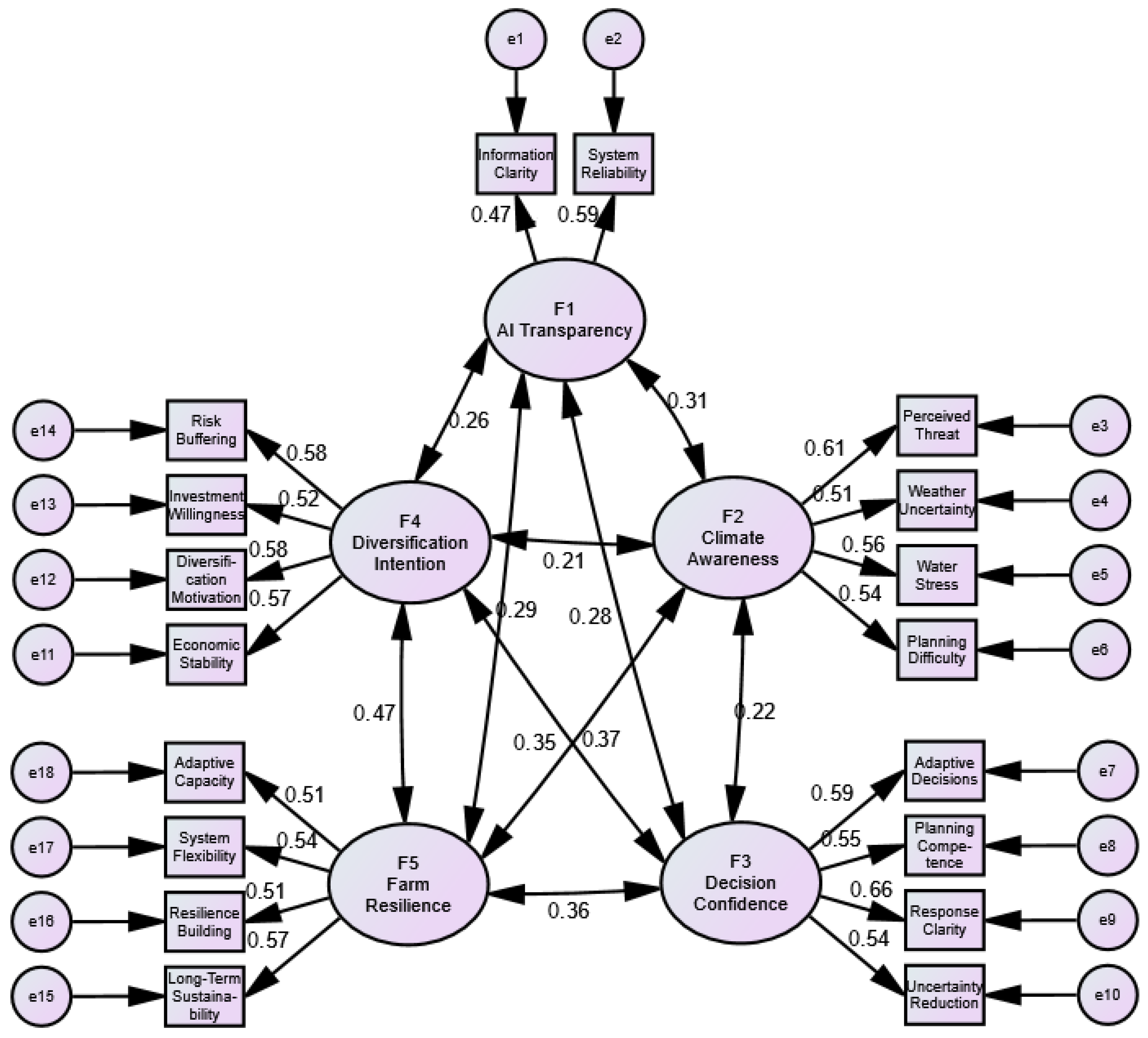
The structural equation modeling results indicate that all hypothesized relationships specified within the proposed framework are positive and statistically significant (
Figure 1). The structural paths show that AI Transparency is positively related to Climate Awareness (β = 0.31,
p = 0.003), Decision Confidence (β = 0.28,
p = 0.004), Agritourism Diversification Intention (β = 0.26,
p = 0.007), and Perceived Farm Resilience (β = 0.29,
p = 0.004). Climate Awareness is positively related to Decision Confidence (β = 0.22,
p < 0.01), Agritourism Diversification Intention (β = 0.21,
p < 0.01), and Perceived Farm Resilience (β = 0.37,
p < 0.001). Decision Confidence also shows positive relationships with Agritourism Diversification Intention (β = 0.35,
p < 0.001) and Perceived Farm Resilience (β = 0.36,
p < 0.001). Agritourism Diversification Intention exhibits the strongest relationship with Perceived Farm Resilience (β = 0.47,
p < 0.001). Taken together, the results provide empirical support for all hypothesized relationships within the proposed structural framework. Although all hypothesized paths are positive and statistically significant, the model does not presuppose uniform or automatic effects. Instead, the analysis empirically tests the relative strength, configuration, and mediating structure through which AI transparency operates across distinct cognitive and adaptive pathways, rather than merely confirming the direction of individual relationships.
The overall fit of the structural equation model was acceptable and within commonly recommended thresholds for SEM analyses. The fit indices indicate a satisfactory model fit (χ2/df = 1.94; RMSEA = 0.041; CFI = 0.951; TLI = 0.944; SRMR = 0.046), supporting the adequacy of the proposed structural framework. Given the perception-based nature of the data, the analysis does not imply causal inference or behavioral validation. The identified relationships are interpreted as cognitive–informational associations and pathways rather than causal effects on realized adaptation outcomes. Potential common method variance was assessed using Harman’s single-factor test. The unrotated factor solution did not reveal a dominant single factor, as the first factor accounted for 18.34% of the total variance, suggesting that common method bias is unlikely to drive the observed relationships.
To assess the robustness of the proposed model, several additional checks were conducted. First, the stability of the structural relationships was examined across alternative model specifications, including the exclusion of the direct path between AI transparency and perceived farm resilience. The core pattern of relationships and the statistical significance of the remaining paths remained substantively unchanged. Second, given the inclusion of two distinct climate-sensitive rural regions, the model was estimated on the pooled sample to examine whether the proposed cognitive–informational mechanism holds across heterogeneous contexts. The consistency in path direction and significance across these specifications supports the robustness of the findings and suggests that the results are not driven by a single modeling assumption or contextual artifact.
4.4. Multi-Group Analysis by Region
To examine whether the proposed cognitive–informational framework operates consistently across regional contexts, a multi-group SEM analysis was conducted comparing Western Serbia and Eastern/Southeastern Serbia. The same measurement structure and correlational specification among latent constructs were applied across groups, without imposing equality constraints on individual path coefficients. The configural multi-group model demonstrated excellent fit (χ
2 = 252.08, df = 250,
p = 0.451), indicating that the overall relational structure was applicable across both regions. As shown in
Table 9, standardized latent construct associations exhibited highly similar patterns across Western Serbia and Eastern/Southeastern Serbia. While minor differences in the magnitude of specific correlations were observed, the overall configuration and direction of relationships remained stable, suggesting strong regional robustness of the proposed cognitive–informational framework. This robustness was further examined through the reported multi-group comparison across regional contexts.
5. Discussion
This study deepens understanding of climate-adaptive agritourism by showing that AI transparency plays a key informational and cognitive role within the proposed framework in shaping farm-level decision-making and perceptions of resilience under climate risk. By shifting the analytical focus away from tourist destinations toward farm operators themselves, the findings contribute to agricultural and rural resilience research, where uncertainty management and livelihood diversification are persistent challenges. Rather than viewing digital tools as neutral or purely technical inputs, the results highlight AI transparency as a relational feature that influences how farmers make sense of climate signals, weigh adaptive options, and judge the long-term viability of their farming systems. The consistent empirical support observed across the hypothesized relationships points to an integrated pattern linking AI transparency, climate awareness, decision confidence, agritourism diversification intention, and perceived farm resilience.
It is important to note that the constructs examined in this study capture farmers’ perceptions and evaluative judgments rather than objective or realized outcomes. Accordingly, AI transparency, agritourism diversification intention, and farm resilience are interpreted as cognitive and behavioral orientations toward adaptation, not as direct measures of implemented strategies or material performance. This distinction is theoretically consistent with adaptive capacity and resilience frameworks, which emphasize perception, interpretation, and agency as critical precursors to observable change [
44,
82].
Taken together, this pattern of results supports AI transparency as a cognitive mechanism rather than merely a system feature, as transparency predicts both proximal cognitive states (climate awareness and decision confidence) and downstream strategic orientations and resilience evaluations within the proposed framework. Importantly, this interpretation is reinforced by the inclusion of observed behavioral and contextual indicators. The analysis of agritourism engagement status and farm location shows that diversification behavior is not confined to a specific regional context, nor is it merely an abstract attitudinal construct. The absence of significant regional differences in agritourism engagement suggests that diversification intention reflects a broadly shared adaptive orientation rather than a context-specific artifact. This observed alignment between latent diversification intentions and real or planned agritourism engagement provides behavioral grounding for the proposed cognitive–informational mechanism. It also mitigates concerns related to exclusive reliance on perception-based measures, without implying behavioral validation or causal inference.
The positive relationship between AI transparency and climate awareness (H1) indicates that when AI-based climate information is perceived as clear, understandable, and reliable, farmers are better able to recognize and make sense of climate-related risks. Rather than remaining abstract or distant, climatic trends are translated into signals that are cognitively accessible and relevant to everyday farm operations. In this way, AI transparency operates less as a channel for delivering information and more as an interpretive interface that helps farmers connect climate data with lived experience. This interpretation is consistent with research on trust in AI and decision-support systems, which shows that transparency allows users to situate uncertainty within their own knowledge frameworks and practical contexts. As a result, risk awareness is strengthened without triggering inaction or decisional paralysis. This finding aligns with prior research showing that transparent information systems support the interpretation of climate signals and strengthen risk awareness in agricultural contexts [
35,
42].
AI transparency is also positively associated with decision confidence (H2), underscoring its role in reducing ambiguity under conditions of climate uncertainty. When AI systems communicate information in a transparent manner, farmers appear to feel more capable of planning, responding, and managing uncertainty in their operations. Importantly, these tools do not replace human judgment; instead, they reinforce farmers’ sense of competence by clarifying options and supporting informed choices. This finding is theoretically significant because it counters technologically deterministic views of algorithmic governance, showing that AI-enabled adaptation remains grounded in human interpretation and agency. In volatile agricultural environments, confidence in one’s ability to understand information and act decisively emerges as a crucial condition for timely and effective adaptation. Similar patterns have been observed in studies showing that accessible and interpretable information strengthens farmers’ perceived competence under climate uncertainty [
66].
The positive relationship between AI transparency and agritourism diversification intention (H3) further demonstrates that the influence of transparent AI information extends beyond operational or agronomic decisions to strategic livelihood choices. When climate information is perceived as interpretable and reliable, farmers appear more willing to evaluate agritourism as a viable and manageable adaptation pathway. This suggests that AI transparency lowers informational and cognitive barriers associated with diversification by clarifying climate-related trade-offs and reducing perceived uncertainty surrounding investment decisions. In this way, digital climate intelligence indirectly facilitates rural economic diversification without prescribing specific behavioral outcomes.
Climate awareness shows positive associations with both decision confidence (H4) and agritourism diversification intention (H5), indicating that heightened recognition of climate risk does not necessarily undermine adaptive capacity. Instead, awareness appears to activate cognitive engagement with adaptation options, particularly when supported by actionable information. This finding contributes to a growing body of literature that reframes climate awareness from a source of anxiety to a potential catalyst for proactive adaptation, especially in contexts where farmers retain agency over strategic decisions. Decision confidence emerges as a key mediating mechanism within the adaptive process. Its positive association with agritourism diversification intention (H6) suggests that diversification is more likely when farmers perceive themselves as capable of interpreting information and managing uncertainty. This supports adaptive capacity frameworks in agricultural systems, where perceived competence and control are understood as central precursors to behavioral change. The results thus reinforce the notion that adaptation is not driven by risk exposure alone but by the interaction between information, cognition, and perceived agency. This supports earlier work framing agritourism diversification as an adaptive strategy under climate risk [
8].
The strongest associations in the model involve agritourism diversification intention and perceived farm resilience (H7), underscoring diversification as a structural resilience-building strategy rather than a marginal or opportunistic activity. Agritourism is perceived as a mechanism for stabilizing income, spreading risk, and enhancing long-term sustainability in the face of climate volatility. This finding is particularly salient in climate-sensitive rural areas, where reliance on primary agricultural production increasingly exposes farms to environmental and economic shocks. Decision confidence (H8) and climate awareness (H9) also show positive associations with perceived farm resilience, indicating that resilience is not solely a material or infrastructural outcome but also a cognitive and evaluative state shaped by information quality, awareness, and confidence in adaptive capacity. The positive association between AI transparency and perceived farm resilience (H10) positions transparent AI systems as systemic enablers of resilience rather than isolated technological solutions. AI transparency appears to influence resilience through multiple interconnected pathways—enhancing climate awareness, strengthening decision confidence, and supporting diversification intentions—thereby contributing to farmers’ broader evaluations of preparedness, flexibility, and long-term sustainability. This multifaceted role highlights AI transparency as an integral component of adaptive governance at the farm level. This is consistent with resilience frameworks that identify diversification as a core mechanism for buffering shocks and sustaining farm functioning over time [
75,
78].
Beyond the interpretation of individual hypothesized relationships, the findings can be read as evidence of a broader cognitive–informational adaptation process operating at the farm level. Rather than acting as a direct driver of behavioral change, AI transparency appears to structure how climate risk is cognitively processed, evaluated, and translated into adaptive orientations. An alternative explanation for the uniformly positive relationships is that farmers who are generally more proactive or innovation-oriented tend to report higher levels across all perceptual constructs. However, the differentiated strength of the structural paths—particularly the central role of diversification intention in shaping perceived farm resilience—suggests that the model captures more than a general attitudinal disposition. Instead, the results point to a layered mechanism in which information quality, awareness, confidence, and strategic orientation interact to shape resilience perceptions. This interpretation aligns with adaptive capacity frameworks that emphasize cognition and agency as intermediate mechanisms between risk exposure and observable adaptation outcomes.
Importantly, these relationships were observed across two climate-sensitive rural clusters within Serbia: the Western Serbian mountain agritourism belt and the Eastern/Southeastern dry-stress rural zone. Despite substantial differences in agro-climatic conditions, production structures, and tourism seasonality, the consistency of the observed associations suggests that the underlying cognitive–informational mechanism linking AI transparency to adaptation and resilience remains stable across the examined contexts. The multi-group analysis further demonstrates that the strength and configuration of latent construct associations are highly similar across Western Serbia and Eastern/Southeastern Serbia. Rather than indicating region-specific pathways, the results point to a stable cognitive–informational structure through which AI transparency, climate awareness, decision confidence, and diversification intentions jointly shape perceived farm resilience.
The analytical focus of the study is not on comparing path differences between clusters, but on testing whether the proposed cognitive–informational mechanism linking AI transparency, adaptive cognition, and perceived resilience holds across heterogeneous climate-sensitive contexts. Modeling a single structural equation model across heterogeneous rural settings demonstrates the general relevance of the proposed framework while avoiding unnecessary methodological complexity. Taken together, the findings reinforce the view that effective climate adaptation in agriculture depends not only on access to digital technologies, but on how transparently these technologies communicate uncertainty, limitations, and decision relevance. By integrating trust in AI, climate risk perception, adaptive cognition, and agritourism diversification within a unified empirical framework, the study deepens theoretical understanding of digitally enabled adaptation and provides a nuanced account of how AI transparency shapes farm-level resilience trajectories.
6. Conclusions
This study contributes to the literature on climate adaptation and rural resilience by examining how perceived AI transparency is associated with farm-level decision-making and agritourism diversification within this study’s analytical framework and empirical context. Focusing on agritourism-oriented farm operators in two climate-sensitive rural clusters in Serbia, the research adopts an agriculture-centered perspective on AI-enabled adaptation, positioning farmers as interpretive agents who engage with digital climate information when evaluating adaptive options under uncertainty. The findings indicate that, in this context, higher perceived transparency of AI-based climate and decision-support information is associated with stronger climate awareness, greater decision confidence, higher diversification intention, and more favorable evaluations of farm resilience. These relationships should be interpreted as cognitive–informational associations rather than evidence of causal effects or realized behavioral outcomes. Agritourism diversification emerges as a salient perceived resilience pathway within the model, reflecting how farmers cognitively frame diversification as a strategy for managing climate-related uncertainty and income volatility, rather than demonstrating its objective effectiveness beyond the studied context. From a theoretical perspective, the study advances agritourism and rural resilience research by conceptualizing AI transparency as a cognitive–informational mechanism embedded in adaptive decision-making, rather than as a technical or ethical system attribute. By integrating AI transparency, climate awareness, decision confidence, diversification intention, and perceived farm resilience within a single structural model, the findings highlight how adaptive capacity is shaped through interconnected cognitive processes that precede observable adaptation. Importantly, this contribution remains bounded to evaluative perceptions and does not claim to assess material performance, economic outcomes, or long-term resilience trajectories. Although the proposed mechanism was observed consistently across two climatically distinct rural clusters—a Western Serbian mountain agritourism region and an Eastern/Southeastern dry-stress zone—this consistency should be understood as contextual robustness within the studied Serbian case, rather than as evidence of broad external validity. The analysis was not designed to identify region-specific causal pathways, but to test whether a common cognitive–informational structure linking AI transparency and adaptive orientations holds across heterogeneous climate-sensitive settings within a single national context.
Several limitations frame the scope of the conclusions. First, the study is contextually bounded to agritourism-oriented farm operators in two climate-sensitive rural clusters within Serbia. While the inclusion of a mountain agritourism region and a dry-stress zone enhances internal contextual robustness, the findings should be interpreted as case-specific rather than universally generalizable across different institutional, climatic, or policy environments. Second, the cross-sectional and perception-based research design limits causal inference and captures adaptation as a subjective evaluative process rather than as an observed behavioral or performance outcome. Potential biases include self-selection of farm operators more engaged with agritourism or digital tools, as well as social desirability effects associated with face-to-face data collection, despite efforts to mitigate these risks through heterogeneous sampling across farm types and regions. Third, issues of scalability and transferability should be approached with caution. The proposed cognitive–informational mechanism linking AI transparency to adaptive orientations may not operate identically in production-only agricultural systems, in regions with different governance arrangements, or where access to digital infrastructure and advisory services differs substantially. Modeling a single adaptive mechanism may therefore obscure finer-grained institutional or socio-technical differences in how AI transparency is interpreted or utilized across contexts. Future research should extend this work through longitudinal designs, the inclusion of objective performance indicators, and comparative cross-regional or cross-national studies. Such approaches would help clarify how perceived AI transparency translates into realized adaptation outcomes over time and under varying governance, infrastructural, and climatic conditions.






 ,
,