1. Introduction
Agroecosystems play an important role in the global carbon cycle. They not only assume the role of carbon sinks but are also one of the main sources of global greenhouse gases. According to statistics released by the Intergovernmental Panel on Climate Change (IPCC) in 2022, greenhouse gas emissions generated by the agricultural sector accounted for 13–21% of total global greenhouse gas emissions. In China, agricultural greenhouse gas emissions account for 7–8% of the total [
1], and greenhouse gas emissions increased by nearly 46% from 1980 to 2020 [
2]. To this end, in recent years, China has attached great importance to the reduction of agricultural carbon emissions and has actively participated in global governance of climate change. For example, China has successively signed agreements on global climate governance such as the United Nations Framework Convention on Climate Change and the Paris Agreement. China has also proposed the “dual carbon” goal of achieving carbon peak by 2030 and carbon neutrality by 2060, along with the implementation of a series of action plans. In fact, the main ways to achieve the “dual carbon” goal include both emission reduction and carbon sink increase. For agriculture, particularly planting, naturally holding the dual roles of carbon source and carbon sink, is generally considered to be the largest and most promising carbon sink. To sum up, the realization of China’s “dual carbon” goal relies on the in-depth participation of the agricultural sector. A full understanding of the current status of agricultural carbon emissions is the first step in exploring how to achieve the “dual carbon” goal.
With the superior climate and environmental conditions, the annual agricultural output of Guangdong has consistently ranked among the top in China. According to data from the National Bureau of Statistics, the added value of the primary industry in Guangdong Province was CNY 583.703 billion in 2024, ranking second in China. Notably, Guangdong Province is also an important hub for trade in agricultural products and foreign trade in China, providing important support for national food safety in the Guangdong–Hong Kong–Macao Greater Bay Area. In Guangdong Province, the vegetable industry is the second-largest planting industry, with the planting area accounting for nearly one-third (1.4284 million hectares) of the total in 2022. The total vegetable production reached 39.9911 million tons, and the total output value was CNY 163.42 billion. The vegetable industry of Guangdong has created about 40% of the output value of the planting industry with 19% of the planting area, playing an important role in increasing farmers’ income and ensuring stable vegetable supply.
The other key basis for selecting the vegetable industry as the research target in this study is that most vegetables have shallow root systems with weak nutrient absorption capacity, requiring high nutrient input [
3]. Moreover, due to the climate characteristics of high temperature and humidity, vegetable production in Guangdong is characterized by severe pests and diseases, high cropping intensity, and high inputs of fertilizers and pesticides. For example, in 2022, Guangdong Province’s fertilizer and pesticide application amounts were 2.0874 and 7.6042 million tons, respectively, ranking among the top in China. The large amounts of agricultural inputs undoubtedly increase the emissions of greenhouse gases, such as CO
2 and NO
2, and also restrict the sustainable development of the vegetable industry. In summary, selecting the vegetable industry in Guangdong for exploring the carbon footprint of vegetable production has a certain practical significance for promoting sustainable agricultural development.
Scholars have carried out substantial research in the field of agricultural carbon emissions. First, in studies on carbon emissions from China’s vegetable production system, it was found that the greenhouse gas emissions from China’s northern vegetable production system were significantly higher than those in the northern regions, with nitrogen fertilizer being the largest source of greenhouse gases. Among these studies, a study on Hubei Province found that the carbon footprint of greenhouse gas emissions caused by electricity and diesel showed the largest increase [
4,
5]. Secondly, both domestically and internationally, studies have been conducted to measure and evaluate the carbon footprint of specific vegetable production systems such as those used for greenhouse tomatoes and open-field peppers [
6,
7,
8]. Notably, some scholars have employed the life cycle assessment method to compare the environmental benefits of different vegetable varieties, aiming to provide policy recommendations for reducing greenhouse gas emissions [
9,
10,
11]. Furthermore, experts in the field have systematically measured greenhouse gas emissions from vegetables based on different cultivation management practices, revealing that various fertilization methods and agricultural management models yield distinct environmental benefits [
12,
13,
14,
15]. Additionally, the contribution rates of different production inputs to greenhouse gas emissions have been extensively studied and quantified [
16,
17]. By reviewing the literature, it can be found that the initial research on agricultural carbon emissions mainly originated in European countries such as Spain and Italy. Since 2015, the issue of agricultural carbon emissions in different regions has begun to attract the attention of Chinese scholars. Further classified by vegetable planting categories, the vegetable varieties that domestic and foreign scholars have focused on currently include solanaceous plants, cucumbers, chili, lettuce, and lettuce, among which the cultivation method of facility planting has always been the research focus of scholars. In conclusion, the existing research findings provide valuable references for this paper in terms of carbon emission accounting indicators, decoupling effects of carbon emissions, and carbon emission trends across different agricultural production systems.
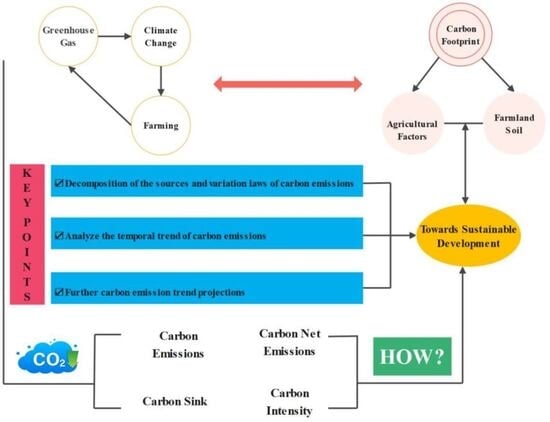
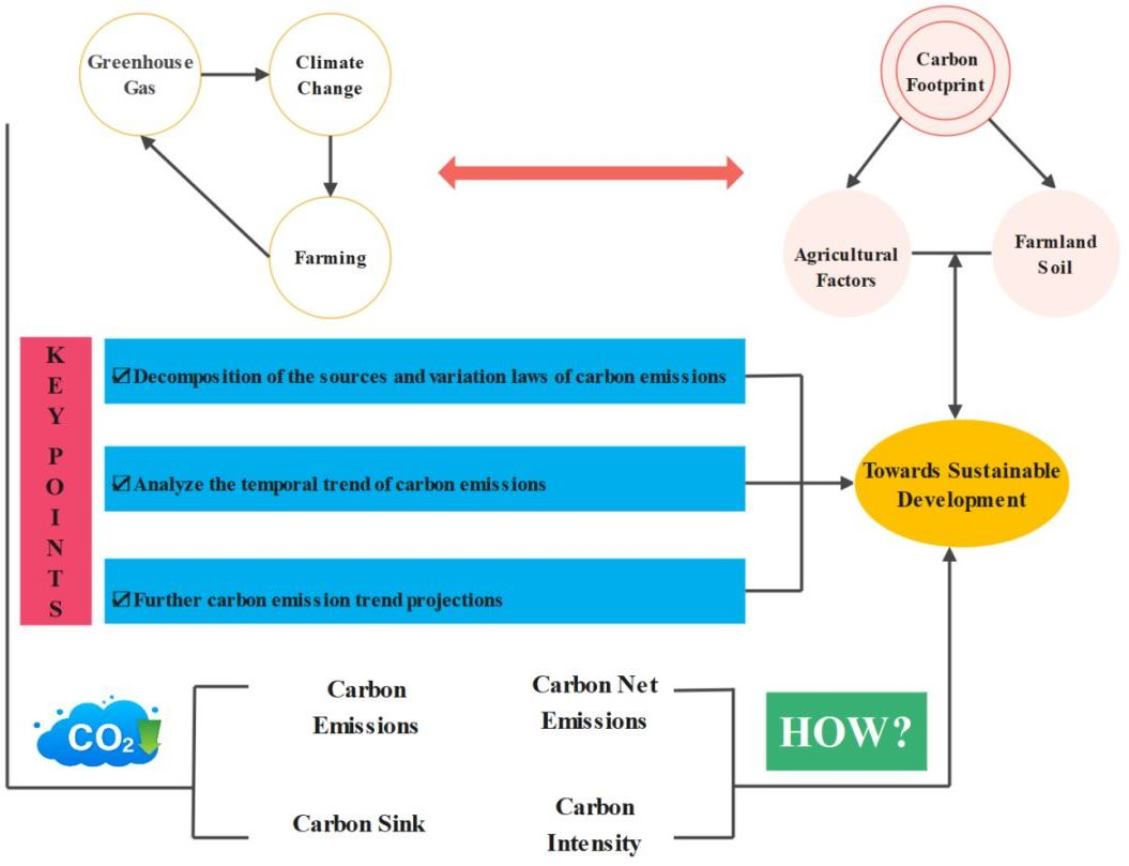
As for the research of this article, although there are no shortage of academic achievements on carbon emissions in Guangdong Province and its neighboring provinces, there are limited studies in the agricultural field in Guangdong. Moreover, given the significant role of Guangdong’s agriculture and economy in China, the research conclusions using Guangdong’s agricultural industry as a typical subject are highly representative and persuasive. However, the academic community has not yet concentrated on presenting research achievements in this field. The limited literature associated with this topic typically covers shorter research periods, resulting in conclusions with relatively lower forward-looking relevance and reference value. Finally, considering Guangdong’s unique agricultural climate conditions and consumption habits, the vegetable industry in Guangdong serves as an excellent starting point for studying agricultural carbon emissions. Yet, the lack of research in this area also urgently needs to be addressed. The lack of existing literature provides space for this paper to break through the research limitations and create marginal contribution. We intend to measure carbon emissions, carbon sinks, net carbon emissions (net carbon emissions (NCEs) are the net amount of carbon emissions determined by accounting for both carbon emissions and carbon absorption; this metric covers direct emissions, indirect emissions, and carbon removal and is closely related to carbon capture and storage technologies, as well as carbon sinks), carbon emission intensity, and net carbon emission intensity of vegetable production in Guangdong Province from 1990 to 2022 to analyze the carbon footprint. Finally, we use the gray prediction model GM (1, 1) to predict the carbon emissions of vegetable production in Guangdong Province from 2023 to 2060 to objectively evaluate the impact of vegetable production in Guangdong Province on greenhouse gas emissions. The study findings will provide reference for the transformation to low-carbon vegetable production in Guangdong Province and also provide a practical basis for promoting the sustainable and healthy development of Guangdong’s vegetable industry.
3. Results
3.1. The Temporal Characteristics of Carbon Emissions from Vegetable Production in Guangdong Province
From 1990 to 2022, the total carbon emissions from vegetable production in Guangdong Province generally showed a trend of first increasing and then decreasing (
Table 2). Specifically, the total carbon emissions increased from 1.4119 million tons in 1990 to 5.4125 million tons in 2015 and then gradually decreased to 4.8677 million tons in 2022. Consistent with the trend of the total carbon emissions, the net carbon emissions of vegetable production also showed a trend of first increasing and then decreasing. They reached a maximum of 2.8334 million tons in 2015 and then gradually fell to 1.8683 million tons in 2022. The above results are in line with the rapid development trend of China’s agricultural economy, and the overall trend is close to the conclusions of related domestic and foreign research [
8,
11]. At its root, China began to place greater emphasis on the importance of “ecological civilization construction” from the later stage of the 12th Five-Year Plan, especially after the convening of the 18th National Congress, and continued to practice the “Two Mountains Theory” (“Lucid waters and lush mountains are invaluable assets”) and the “dual carbon strategy”. As a result, since the period of the 13th Five-Year Plan, total carbon emissions have shown a significant downward trend. On the other hand, due to the continuous increase in planting area and yield, the carbon sink of vegetable production has increased year by year from 732,600 tons in 1990 to 2.9993 million tons in 2022, with a growth rate of 309.40%. This increasing rate is greater than that in the total carbon emissions. Overall, the growth rate exceeds that of total carbon emissions; the rate of increase in net carbon emissions was 175.05%, which was lower than the rate of increase in total carbon emissions.
3.2. Carbon Emissions from Different Sources in Vegetable Production
According to
Table 2, agricultural input is the main carbon emission source for vegetable production in Guangdong Province. From 1990 to 2022, the overall emissions and proportion showed a trend of first increasing and then decreasing, reaching the maximum value in 2015 (the carbon emissions and proportion were 3.6019 million tons and 66.55%, respectively). As of 2022, the above two values have increased by 308.15% and 18.39%, respectively. However, during this period, the carbon emissions from farmland soil use in vegetable production in Guangdong Province also showed a growth trend, with a cumulative increase of 176.11% over 32 years. From the perspective of the proportion change, the proportion gradually decreased from 1990 to 2015 but slowly increased after 2016.
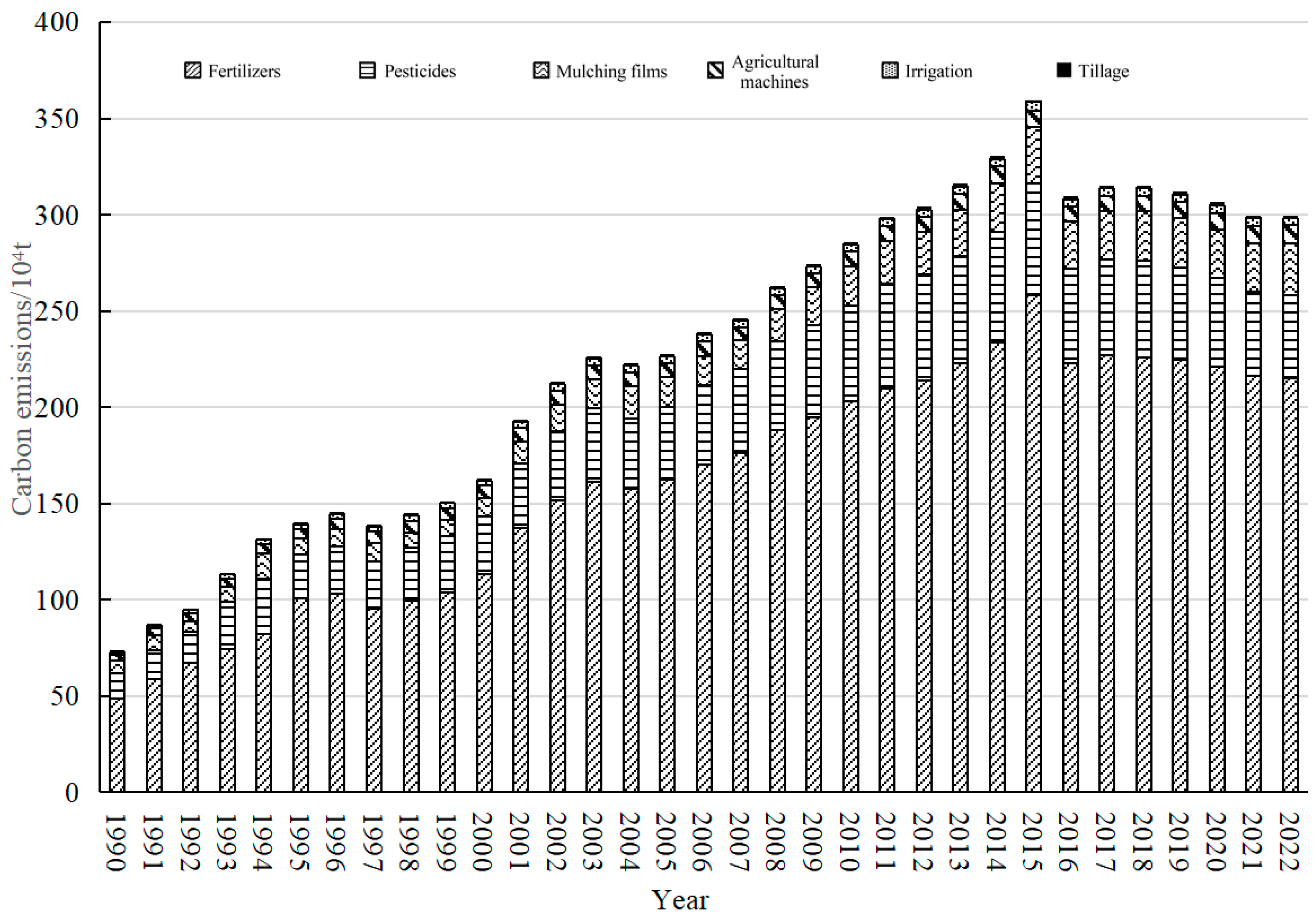
Figure 1 indicates that among all agricultural inputs, fertilizers are the most important carbon source. Combining various policies, guidance, and regulations issued in recent years, reducing fertilizer use becomes the main focus of carbon reduction. Specifically, from 1990 to 2022, the carbon emissions from fertilizer input ranged from 486,600 to 2578,900 tons. They showed a trend of rapid increasing and then gradual decreasing, peaking in 2015. In 2022, 2,151,000 tons of carbon emissions were reported; this increased by 342.01% over the past 30 years. The proportion of carbon emissions from fertilizers ranged from 62.43% to 72.21%, showing a sustained and slow upward trend. The largest proportion was in 2021, with an increase of 8.29% over 32 years. Pesticides are the second-largest source of carbon emissions from agricultural inputs. From 1990 to 2022, the carbon emissions from pesticides ranged from 131,200 to 581,100 tons, with an overall trend of first increasing and then decreasing. The highest emissions were in 2015, increasing by 228.94% over 32 years. The proportion of carbon emissions from pesticides was 14.40–21.72%, showing a decreasing trend. It reached its minimum value in 2022, decreasing by 3.47% over 32 years. Mulching film is the third-largest source of carbon emissions from agricultural inputs. From 1990 to 2022, the carbon emissions from mulching film ranged from 54,700 to 292,800 tons. They showed a trend of continuous increase and then gradual decrease, reaching a maximum value in 2015. The carbon emissions from mulching film reached 269,800 tons in 2022, with a significant increase of 324.67% over 32 years. The proportion of carbon emissions from mulching film was 5.34–9.00%, showing a trend of gradual decrease and then increase. It reached its minimum value in 1998. In 2022, the proportion reached 9.00%, slightly higher than that (8.65%) in 1990. The carbon emissions from agricultural machines, irrigation, and tillage were 32,000–91,600, 14,800–43,800, and 5900–16,400 tons, accounting for 2.50–4.36%, 1.15–2.02%, and 0.44–0.81% of the total carbon emissions, respectively. The carbon emissions from these three sources have shown an upward trend, but their proportions have shown an opposite trend.
3.3. Characteristics of Carbon Emission Intensity of Vegetable Production in Guangdong Province
Due to the continued and stable growth in the planting area, yield, and output value, the carbon emission intensity and net carbon emission intensity of income, land, and yield of vegetable production in Guangdong Province have all decreased significantly from 1990 to 2022, although they did increase slightly in 2015 (
Table 3). This result indicates that the environmental cost of vegetable production in Guangdong Province has gradually decreased. Among them, the carbon emission intensity and net carbon emission intensity of income fell the most, followed by those of yield.
3.4. Prediction of Carbon Emissions from Vegetable Production in Guangdong Province
We construct a grey prediction model GM (1, 1) to predict the carbon emissions from vegetable production, net carbon emissions, and trends in Guangdong Province using carbon emissions and net carbon emissions data of 1991–2022, 2001–2022, and 2011–2022. Due to space limitations, we only present the specific prediction values for the ending year of each five-year plan (
Table 4).
The prediction results of carbon emissions based on the data of 1991–2022, 2001–2022, and 2011–2022 show that although the carbon emissions from vegetable production in Guangdong will continue to increase, there are significant differences in the growth rate for different periods. Among them, the predictions obtained based on the data of 1991–2022 are the largest, and the increase is also the largest; i.e., the emissions in 2030, 2040, 2050, and 2060 will increase by 43.11%, 87.27%, 145.07%, and 220.69%, respectively, compared with that in 2022. The predictions based on the data of 2011–2022 were the smallest, with predicted values for 2030, 2040, 2050, and 2060 increasing by 4.06%, 5.42%, 6.80%, and 8.19%, respectively, compared with that in 2022. Overall, it can be seen that the carbon emissions from the vegetable industry in Guangdong province will continue to increase, mainly due to the continuous expansion of vegetable yield and planting area. Notably, the predicted results of future carbon emissions based on long-term data are not very optimistic, while those based on the latest data from the past decade are more in line with China’s green and low-carbon policies.
The prediction results of net carbon emissions based on different data show a certain difference in trends. Among them, the predictions based on the data of 1991–2022 and 2001–2022 both predict a continuous increasing trend in the net carbon emissions of vegetable production in Guangdong Province after 2023, but the specific increase will vary. Specifically, the prediction based on the data of 1991–2022 yields the largest predictions and the fastest growth rate. However, the prediction based on the data of 2011–2022 predicts a continuous decline trend in the net carbon emissions of vegetable production in Guangdong Province after 2022, with the predicted values in 2030, 2040, 2050, and 2060 decreasing by 45.69%, 57.59%, 66.87%, and 74.13%, respectively, compared with that in 2022. This result once again verifies the guiding role of national policies and also reflects the remarkable achievements of a series of strategic layouts in ecological civilization construction of China, such as green agricultural development, the dual carbon strategy in agriculture, and the reduction and efficiency enhancement of chemical fertilizers.
4. Discussion and Conclusions
4.1. Discussion
From the perspective of the overall spatiotemporal evolution trend in carbon emissions, the total and net carbon emissions from vegetable production in Guangdong Province showed a trend of continuous increase and then gradually decline from 1990 to 2022, with a peak in 2015. Compared to 1990, the carbon sink in 2022 showed a significant increase, which contradicts the findings of the Guangdong Province agricultural carbon emissions study [
29,
30]. On the contrary, the vegetable planting area has increased continuously, reaching 1.4284 million hm
2 in 2022, 1.76 times the 517,300 hm
2 in 1990. This judgment is also evidenced by the temporal characteristics of carbon sinks. From 1990 to 2022, the carbon sink volume from vegetable production in Guangdong Province increased significantly, with a growth rate of 309.40%, exceeding the growth rate in total carbon emissions. Overall, vegetable production requires more frequent pesticide and fertilizer applications. With the expansion of the planting scale and the increase in yield targets, the amount of inputs, such as pesticides, fertilizers, and mulching films, has increased significantly, leading to a marked rise in carbon emissions from vegetable production. The pivotal turning point occurred around 2015, when Guangdong’s vegetable production carbon emissions began to decline steadily, driven by the national strategy for ecological civilization development. This progress was particularly notable in the agricultural sector, where initiatives to reduce pesticide and fertilizer use, along with the promotion of green production technologies, were implemented. The forecast results indicate that, except for the net carbon emissions from vegetable production predicted using 2011–2022 data, which showed a sustained decline after 2023, the carbon emissions and net carbon emissions predicted by other annual time-series samples all exhibited a continuous upward trend post-2023, though the growth rates varied. These findings also differ from the carbon emission prediction trends observed in other regions of Guangdong Province [
30]. The reason for this is that the data period used in this paper is longer, and the time node of the study is relatively new, which takes into account more recent policies, so the carbon emission trend is more optimistic. In any case, the conclusion of this paper can provide reference for the sustainable development of vegetable production.
4.2. Conclusions
In terms of carbon emissions, the total carbon emissions from vegetable production in Guangdong Province from 1990 to 2022 generally showed a trend of first continuous increase and then gradual decline. The reason for this is that before 2015, the rapid growth of China’s agriculture and overall economy kept pace with the synchronous development trend of agricultural production carbon emissions. However, China began to attach great importance to the construction of ecological civilization and its low-carbon development strategy around 2015, leading to an immediate decline in indicators such as agricultural production carbon emissions. Meanwhile, thanks to the continuous expansion of vegetable cultivation areas and yields, the carbon sequestration from crop production increased steadily from 1990 to 2022, with its growth rate significantly outpacing the overall rise in carbon emissions. Therefore, the vegetable industry in Guangdong has made positive contributions to the implementation of the sustainable development concept and implementation of the double carbon strategy.
The analysis reveals that factor inputs consistently represent the dominant agricultural carbon source during the research period, accounting for 51.99–66.55% of total emissions. Both the quantity and proportion initially rose before gradually declining during the research period. Fertilizers, pesticides, and mulching films are the main inputs that cause carbon emissions, accounting for more than 90% of the total carbon emissions from agricultural inputs. The overall trend of carbon emissions from farmland soil use is increasing, with a growth rate of 176.11% over 32 years. However, the trend shows that the number of cases gradually decreased from 1990 to 2015 and then increased slowly after 2016. The reason for the inconsistency in the proportion and trend of the main carbon sources is that the focus of national agricultural green development is changing. Prior to the period of the 13th Five-Year Plan, the Chinese government placed significant emphasis on strategies for fallow land management, no-till farming, and soil fertility enhancement. Since 2015, China has strictly enforced its red line on arable land to ensure national food security, and has paid more attention to the control of factor input in the process of ecological civilization construction. The conclusion of this study can be supported by policies and experiences.
In terms of prediction of carbon emissions, except for the net carbon emissions of vegetable production predicted by the sample data of 2011–2022, which showed a continuous decreasing trend after 2023, the carbon emissions and net carbon emissions predicted by the sample data of other years showed a continuous increasing trend in the future, but the increase rate varied. Specifically, since the 21st century, the Chinese government has prioritized balancing ecological conservation with economic development. This has led to a noticeable decline in key environmental indicators. Consequently, projections based on data from the past two decades show the lowest growth rate in carbon emissions. Carbon emission projections based on post-2010 data show the slowest growth rate, which is particularly significant for achieving carbon peaking and carbon neutrality goals. This trend also reflects the remarkable progress in China’s ecological governance in recent years.
5. Policy Implications
Fertilizers, pesticides, and mulching films have been proven to be the main sources of carbon emissions in vegetable production, so efforts should be made to continuously promote the reduction of agricultural inputs in the future. Firstly, it is necessary to formulate different fertilization guidance for different soil types and to promote soil test-based fertilization, quota management of nitrogen fertilizer, and efficient and advanced fertilization technologies such as unmanned aerial vehicle-based fertilization and fertigation. It is also recommended to promote the replacement of chemical fertilizers with organic fertilizers and the use of methods such as foliar spraying to increase fertilizer use efficiency. These measures can reduce nitrous oxide emissions from vegetable fields, helping realize the green and low-carbon transformation. At the same time, crop rotations, i.e., vegetables–soybeans–rapeseed, can be adopted to increase soil organic matter, contributing to a reduction in fertilizers. Then, in response to the call for pesticide reduction, the government can stimulate the R&D and promotion of green and low-carbon prevention and control technologies and pesticide reduction technologies and promote the development of professional social service organizations with high-performance equipment, standardized management, and high-quality services. Efficient and low-risk pesticides and other green prevention and control measures can also be incorporated into the unified prevention and control services, promoting the integration of green prevention and control with unified prevention and control. Finally, it is necessary to promote the rational use of mulching films and establish a system for the recycling, utilization, and harmless disposal of waste mulching films, according to local conditions, to achieve recycling and reuse of waste films.
It is necessary to strengthen the R&D and promotion of green and low-carbon production technologies for vegetables. It is recommended to control the inputs, accelerate the formulation or revision of resource-saving and environmentally friendly vegetable production standards, and continuously optimize the standard system for green production of vegetables. In particular, it is necessary to focus on the implementation of low-carbon technologies, such as fertilizer and pesticide reductions, and green pest control at key and weak links in vegetable production. At the same time, the government should vigorously support major scientific research institutions and relevant agricultural enterprises to carry out joint research. For example, by using the advantages and conditions of policies, resources, technologies, and talents in relevant scientific research institutes and universities, technical guidance and other services can be provided to enterprises to jointly solve problems in green vegetable production. The government can stimulate experts in the field of green agricultural development to provide technical services and promote green varieties, advanced technologies, and high-performance equipment. Based on resource conditions, production modes, and the degree of acceptance of farmers in various places, the R&D and promotion of advanced agricultural models such as “pig–biogas–vegetable” and “fruit–vegetable–tea” can be strengthened.
Policy support for green vegetable production can be increased to promote the establishment of the concept of low-carbon vegetable production. In combination with current major agricultural projects, such as modern agricultural industrial parks and towns, financial support for green and low-carbon production of vegetables can be increased. The government can also establish an incentive system to promote the commercialization of scientific and technological achievements of green vegetable production. Given the advantages of agricultural cooperatives and enterprises in the adoption of new varieties, green technologies, and new equipment, the government can guide them to develop green agriculture, take the lead in using green vegetable production technologies, and carry out standardized production. Furthermore, the demonstration effect of agricultural cooperatives and enterprises can provide professional and full-process green technology services to small farmers, driving them to carry out green vegetable production. The government can also increase farmers’ awareness of green development by strengthening farmers’ resource conservation and conceptions of green development and their related training. Green production technology training can be provided, and social service systems, such as unified farming, fertilization, pest and disease prevention and control, and harvesting, can be established to improve the green level of vegetable production for small farmers. The government can also promote consumption of green and high-quality agricultural products by subsidizing some promotional activities.