Article

Possibilities of Producing Agricultural Biogas from Animal Manure in Poland

Department of Economics, Koszalin University of Technology, 75-343 Koszalin, Poland
*
Author to whom correspondence should be addressed.
Agriculture 2026, 16(3), 301; https://doi.org/10.3390/agriculture16030301
Submission received: 11 December 2025 / Revised: 14 January 2026 / Accepted: 22 January 2026 / Published: 24 January 2026
(This article belongs to the Special Issue Application of Biomass in Agricultural Circular Economy)

Abstract

Biogas production from agricultural residues is a promising solution for renewable energy production, improved waste management, and beneficial impact on climate change mitigation. The aim of this study is to assess the actual use and theoretical potential of agricultural biogas produced from animal manure in Poland at the local level. The potential and actual use of agricultural biogas are presented regionally (16 voivodeships) and locally (314 districts). The theoretical potential of agricultural biogas was estimated based on data from the Agricultural Census conducted by the Central Statistical Office in Poland in 2020. Actual biogas production is based on data from the Register of Agricultural Biogas Producers maintained by the National Support Center for Agriculture. The study shows that Poland is only tapping into the existing potential for agricultural biogas production to a limited extent. Furthermore, both actual agricultural biogas production and the identified theoretical potential vary spatially (greater potential in the northern part of the country, significantly lower in the southern part). This situation is attributed to existing barriers that hinder the utilization of existing potential. Therefore, it is crucial to seek new solutions to reduce existing barriers of an organizational, legal, technical, economic, environmental, spatial, and social nature.

1. Introduction

The development of biogas production is increasingly recognized as a key element of the transition towards sustainable energy systems, contributing directly to climate change mitigation, improved waste management, and universal access to clean energy [1,2]. Energy from biogas is available, inexpensive, and often contributes to the management of generated waste and residues, making it one of the most promising renewable energy sources, especially in rural areas [3]. The search for new ways of developing agriculture is a frequently discussed aspect. Agricultural biogas plants can provide an opportunity for agricultural diversification and multifunctional development of rural areas [4,5]. Important arguments in favor of the development of biogas plants are the possible benefits. The main benefit is the use of regional natural resources [6], which are not adequately managed. Furthermore, from an environmental perspective, biogas plants support the reduction in greenhouse gases. Economically, the development of agricultural biogas plants can provide farmers with an additional source of income, positively impacting the profitability of their farms. However, biogas plants are not free from drawbacks. The main concerns regarding the development of biogas plants are ethical considerations related to the use of resources used for food production for energy purposes [7]. However, thanks to its ability to transform environmental problems into sustainable solutions, biogas is becoming an indispensable pillar in the transition to a resilient, affordable, and more environmentally responsible future [2].
Distributed energy based on renewable energy sources could continuously and naturally provide energy services that meet the needs of all of Poland at an appropriate level [8]. In Poland, energy from biogas has a higher economic potential among the renewable energy sources mix. However, the development of this energy source is relatively slow compared to some neighboring countries, such as Germany, Denmark, Sweden, and Austria [9]. Therefore, as research conducted by Blaszke [10] indicates, strengthening the renewable energy sector in Poland requires the development of regional technological infrastructure and the efficient use of local resources. Furthermore, as other authors point out, the main factors determining the development of the biogas sector are the local supply of biomass, legal regulations, and financial support mechanisms enabling innovative production technologies [11,12].
Previous studies of the potential of agricultural biogas in various countries indicate that the raw material resources that can be used in biogas production are often significant but largely unused [13,14,15,16]. The main reasons for the lack of greater use of existing resources for biogas production are economic (high costs of building agricultural biogas plants) and legal (regulatory obstacles or lack of appropriate regulations). Furthermore, the low concentration of agriculture is another problem, which prevents the provision of sufficient raw materials for biogas production [17]. It is important that the input for agricultural biogas installations can be based on local waste and by-products, which require appropriate disposal or storage conditions and may be harmful to the environment [18]. Therefore, many researchers indicate that future research on the potential of agricultural biogas should focus on the priority use of agricultural residues and waste for its production, rather than plants grown intentionally for energy purposes, to ensure sustainable local development, support rural development, and achieve environmental benefits [19,20,21,22,23]. Moreover, it is worth emphasizing that the use of waste and residues from agriculture supports the development of sustainable energy systems (by improving access to energy in rural areas) and also contributes to the development of a circular economy [24].
Therefore, this article focuses on assessing the actual use and theoretical potential of agricultural biogas produced from animal manure in Poland at the local level. The following research questions were formulated for this study:
RQ1:
Which areas in Poland are characterized by the greatest use of agricultural biogas?
RQ2:
Which areas in Poland are characterized by the greatest theoretical potential for agricultural biogas?
RQ3:
To what extent is Poland utilizing the existing theoretical potential for agricultural biogas?
The remainder of the manuscript consists of four sections. Section 2 presents the research materials and methods, Section 3 presents the results, Section 4 contains a discussion, and the final section draws conclusions.

2. The Specificity of Agricultural Activity in Poland

In Poland, agriculture is a key sector of the economy, ensuring food security. Furthermore, by occupying almost half of the country’s territory, agriculture also influences the landscape and natural environment of rural areas. Due to integration with the European Union, it has become part of an open, global economic system. The Common Agricultural Policy, in turn, plays a crucial role in agricultural development [25].
Poland is a country with significant agricultural production potential, resulting from a relatively large area of agricultural land and a significant labor force. The degree to which this potential is utilized and its regional diversity are determined by the specific characteristics of Poland’s natural environment and a complex set of organizational and economic conditions [26]. Since 2002 (during which time three General Agricultural Censuses were conducted), visible changes in the livestock population have occurred in Poland, leading to an increase in the scale of production and its concentration. The overall cattle population in Poland has increased, but considering the regional structure, 7 of the 16 voivodeships saw a decrease in the number of animals (the remaining voivodeships saw an increase in the number of animals). The largest increases were recorded in the Wielkopolskie, Podlaskie, and Mazowieckie voivodeships. The largest decreases, however, occurred in the Małopolskie, Podkarpackie and Lubelskie voivodeships. In the years analyzed, there was a significant decrease in the number of pigs. The largest declines occurred in the Kujawsko-Pomorskie, Lubelskie, and Mazowieckie Voivodeships. The smallest declines were recorded in the Śląskie, Łódzkie, and Kujawsko-Pomorskie Voivodeships. The largest changes occurred in the poultry population, which increased significantly. Regionally, the increase occurred in 15 of the 16 voivodeships, with the largest increase in the Wielkopolskie, Podlaskie, and Zachodniopomorskie Voivodeships. However, a decrease was recorded only in the Małopolskie Voivodeship [27].
Furthermore, there were changes in the number of farms conducting agricultural activities. The number of farms decreased (from 1.5 million in 2010 to 1.2 million in 2020) [27]. Furthermore, there were changes in the structure of farms by agricultural production. In 2020, farms conducting exclusive crop production dominated, accounting for 55.8% of all farms. Farms conducting exclusive livestock production accounted for only 0.6% of all farms. The remaining 43.6% were farms engaged in mixed production (comprising both crop and livestock production). Comparing 2020 with 2010 (the years of the General Agricultural Census in Poland), there was an increase of 1/4 of farms conducting exclusive crop production, while the number of mixed farms decreased by over 1/3. Farms conducting exclusive livestock production remained at the same level. In 2010, farms with mixed production dominated (60.6%), and farms with only plant production accounted for 38.9% [28].
As emphasized by Krasowicz and Kuś [26], restrictive environmental protection policies, with particular emphasis on greenhouse gas emissions and the consequences of ongoing climate change, may influence the development and direction of changes in agricultural production. In the future, a multifunctional agriculture model combining food, ecological, and energy security will be preferred.

3. Materials and Methods

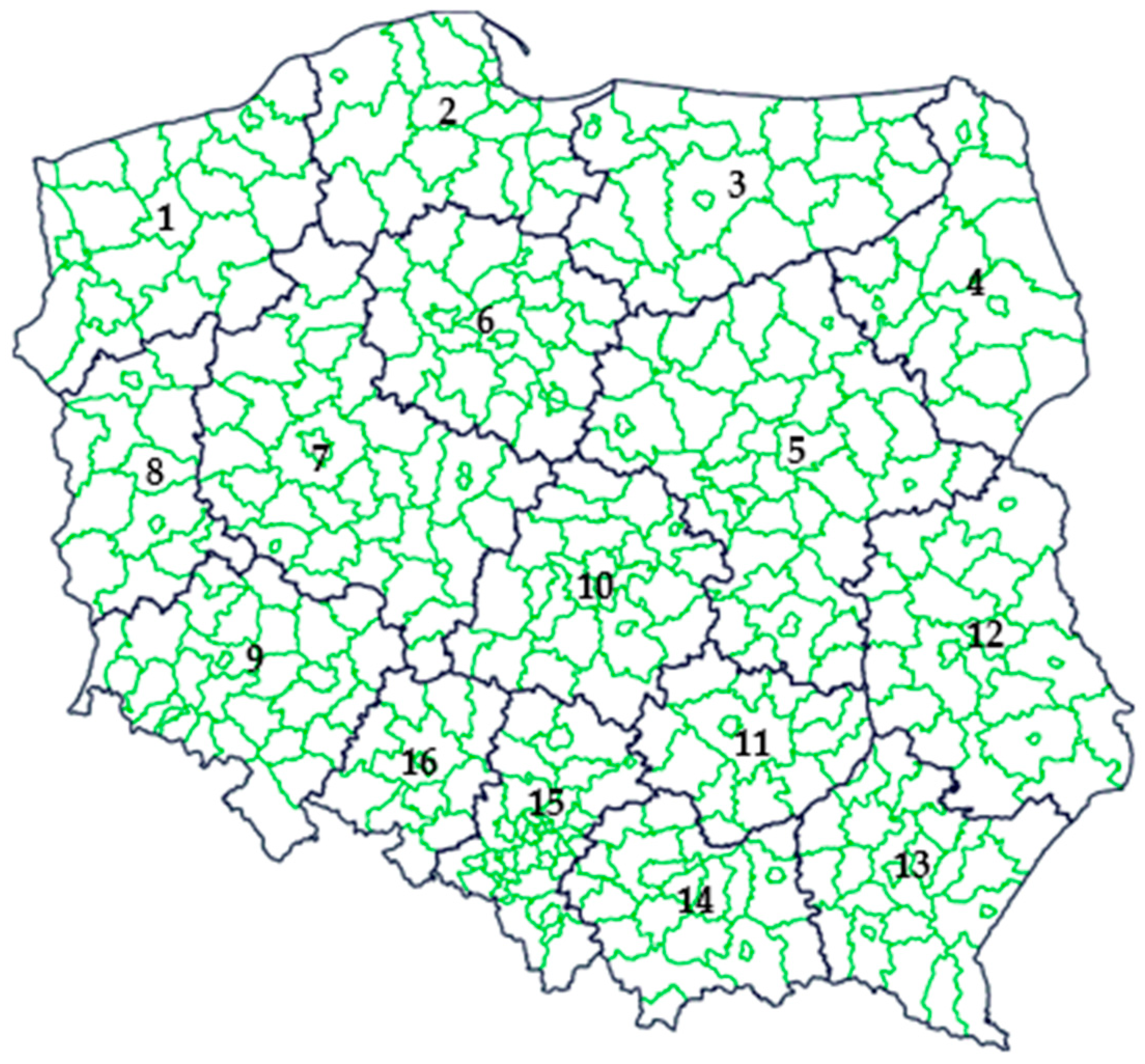
The analyses presented in this article were conducted at the regional (voivodeship) and local (county) levels. Therefore, the research covered 16 voivodeships (regional level) and 314 rural counties (local level). Cities with county rights were excluded from the analyses due to their non-agricultural nature, taking into account the purpose of the study. The spatial layout of the analyses is presented in Figure 1 [29].
This article compares the actual production of agricultural biogas in existing biogas plants across Poland with the potential biogas production based on existing resources.
Information on the actual location of biogas plants, biogas production and installed capacity comes from the National Support Centre for Agriculture, which, in accordance with Article 24, paragraph 1 of the Act of 20 February 2015 on renewable energy sources (Journal of Laws of 2024, item 1361, as amended) [31], is the body responsible for maintaining the register of agricultural biogas producers [32]. The presented data illustrates the status of biogas production as of 14 October 2025.
When estimating biogas production potential, it should be emphasized that assessing the actual quantity and availability of by-product biomass from animal production is difficult. Difficulties stem from limited access to comprehensive information on animal husbandry practices and the use of natural fertilizers in crop production [33]. Due to these limitations, it was decided to estimate the theoretical biogas potential. This potential is defined as all biomass produced in a given area, regardless of its use or availability [34]. It is also assumed that the total available potential is used for energy purposes [35]. Therefore, these estimates should be treated with caution, and prior to investment, more extensive field studies should be conducted to assess the profitability of the planned investment. The conducted potential analysis presents similar volumes of raw material resources for production in Poland’s regions. Moreover, because animal husbandry and farming contribute to ammonia emissions, which negatively impact public health and the natural environment (as it, along with other pollutants—SO2, NOx, and volatile organic compounds—causes soil acidification, water eutrophication, and ground-level ozone pollution) [33], only farm animal excrement (cattle, pigs, and poultry) were considered when estimating the potential of agricultural biogas. Furthermore, the main substrate for agricultural biogas production is most often liquid manure (cattle, pigs, and poultry) [36]. Advantages of using liquid manure as a substrate, in addition to biogas production, include both the utilization of burdensome waste and the ability to produce ecological fertilizer. Furthermore, this substrate is often used due to its good buffering properties [37].
Theoretical biogas production potential was estimated based on the following formula [38,39,40]:
Pbr = L · Wd.m. · 365/1000 · Pb
where Pbr—potential biogas production for a given animal species—cattle, pig and poultry (in m3 year−1); L—number of livestock units of a given animal species (LSU); Wd.m.—average daily manure production expressed in kg of dry matter converted to LSU (kg d.m.∙LSU−1∙d−1); 365—number of days in a year; Pb—average biogas production from a ton of dry matter of manure (m3/t d.m.).
Due to the fact that the analyses are conducted on a local basis (for poviats), data on farm animals come from the last Agricultural Census [27], which took place in 2020. Furthermore, due to the lack of detailed data on individual species and technological groups of farm animals in the Central Statistical Office database, physical units of animals were converted into large inventory conversion units using average conversion factors. For cattle, the conversion factor was 0.8, for pigs—0.2, and for poultry—0.004 [41]. It should be emphasized that the averaging performed, due to data gaps, reduces the accuracy of estimates at the local level and may ultimately distort spatial conclusions, especially in regions with a specific livestock population structure. Therefore, when replanning investments, more detailed analyses should be conducted, for example, regarding the size of farms with livestock located in a given area. According to Szymańska and Łabędowicz [42], for a single 1 MW biogas plant, the demand for raw material can be met by approximately 300 livestock units (LSU), while Klugman-Radziemska [43] indicates that biogas plants on farms are profitable for livestock populations exceeding 200 LSU. Gostomczyk [44], on the other hand, points out that when analyzing the profitability of biogas investments, the most frequently considered locations are those with farms with the following livestock populations: cattle—over 200; pigs—over 2000 pcs, and poultry—over 20 thousand pcs.
The average daily production of dry matter from one LSU of animals and the average production of biogas from one tonne of dry matter were estimated based on studies by other authors [45,46] and are presented in Table 1.

4. Results

4.1. Biogas Production in Poland

The first agricultural biogas plant in Poland was built in 2005 in Pawłówko (Pomeranian Voivodeship). The plant was built by Poldanor (currently GoodvalleyAgro S.A.), a company engaged in pig breeding, crop cultivation, and wholesale of animals and agricultural products. The decision to build a biogas plant was dictated by the need to manage the by-products generated during the operation (liquid manure, slaughterhouse waste, plant residues). By producing biogas, the company meets both its energy and heat needs [47]. Annually, the biogas plant produces 3.8 million m3 of biogas, resulting in the production of 7458.26 MWh of electricity and 8680.28 MWh of heat [48].
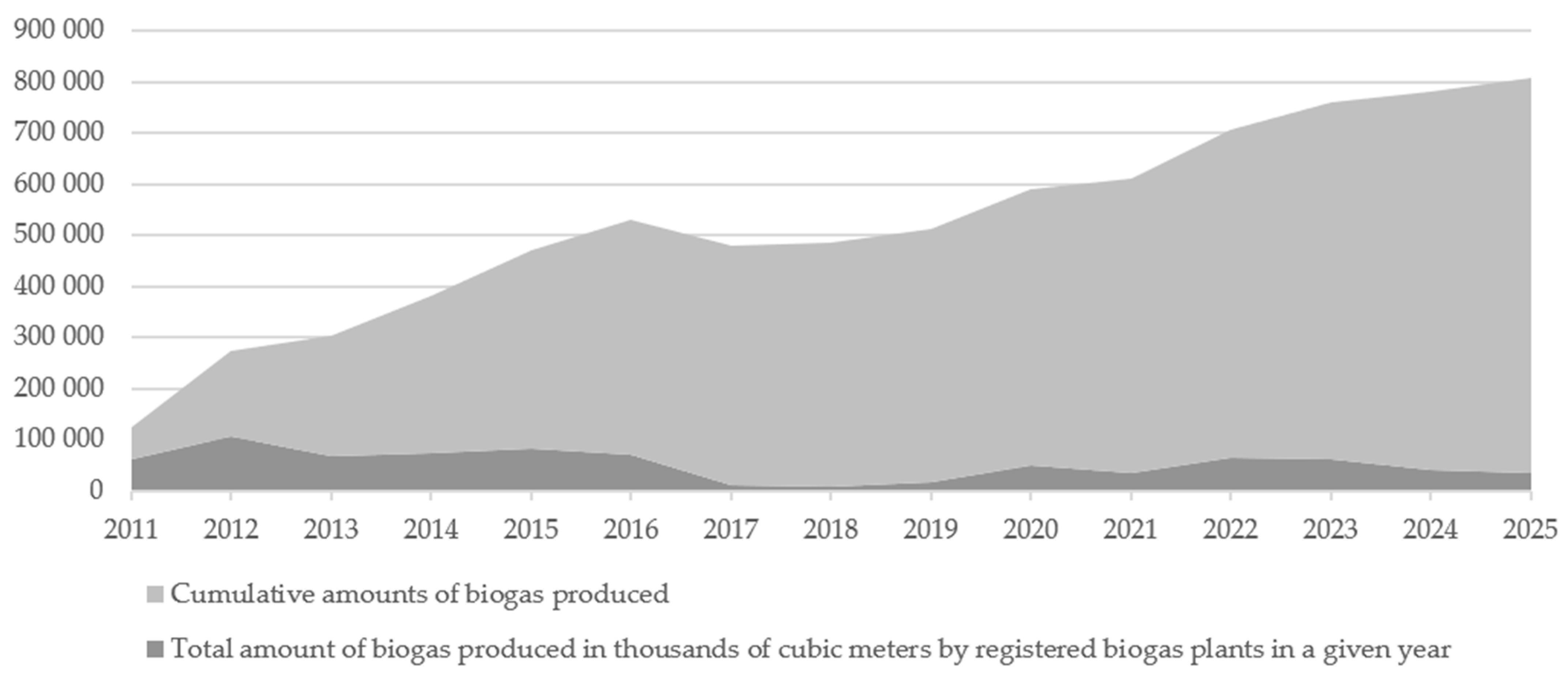
Data published by the National Support Centre for the Development of Biogas (KOWR) indicate that at the end of October 2025, there were 192 agricultural biogas plants in Poland, with a total biogas production of 774.9 million m3 and an installed electrical capacity of 177.3 MW. Furthermore, according to the register, agricultural biogas is produced in Poland by 161 producers. Considering individual years, it can be seen that biogas plants in Poland were built with varying intensity. Between 2011 and 2015, 72 agricultural biogas plants were registered, producing 388.9 million m3 of biogas during this period, with an installed capacity of 84.1 MW. In the following five years (2016–2020), 39 biogas plants were registered, producing 153.8 million m3 during this period, with an installed capacity of 36.5 MW. The largest number of biogas plants was registered in the years 2021–2025 (81 installations), which produced 232.1 million m3 of biogas during this period, and their total installed capacity was 56.7 MW. Figure 2 presents the amount of biogas produced in individual years and its cumulative values.
Considering the territorial distribution of biogas plants, the highest number of such installations can be found in the northern and central parts of the country, with significantly fewer in the south. The dominant regions in terms of the number of agricultural biogas plants are the Wielkopolskie (32 agricultural biogas plants), the Mazowieckie (23 agricultural biogas plants), and the Zachodniopomorskie (20 agricultural biogas plants). These regions have a total of 75 biogas plants, representing 39.1% of all installations in Poland. The regions with the lowest number of biogas plants are the Małopolskie (1 agricultural biogas plant), the Śląskie (2 agricultural biogas plants), the Świętokrzyskie (2 agricultural biogas plants), the Opolskie (4 agricultural biogas plants), the Kujawsko-Pomorskie (5 agricultural biogas plants), and the Podkarpackie (7 agricultural biogas plants). These regions have a total of 21 biogas plants, representing 10.9% of all installations in Poland (Table 2). The increased number of agricultural biogas plants may indicate the region’s greater commitment to renewable energy production. This may be due to the greater availability of raw materials used for biogas production, as well as favorable regulatory conditions.
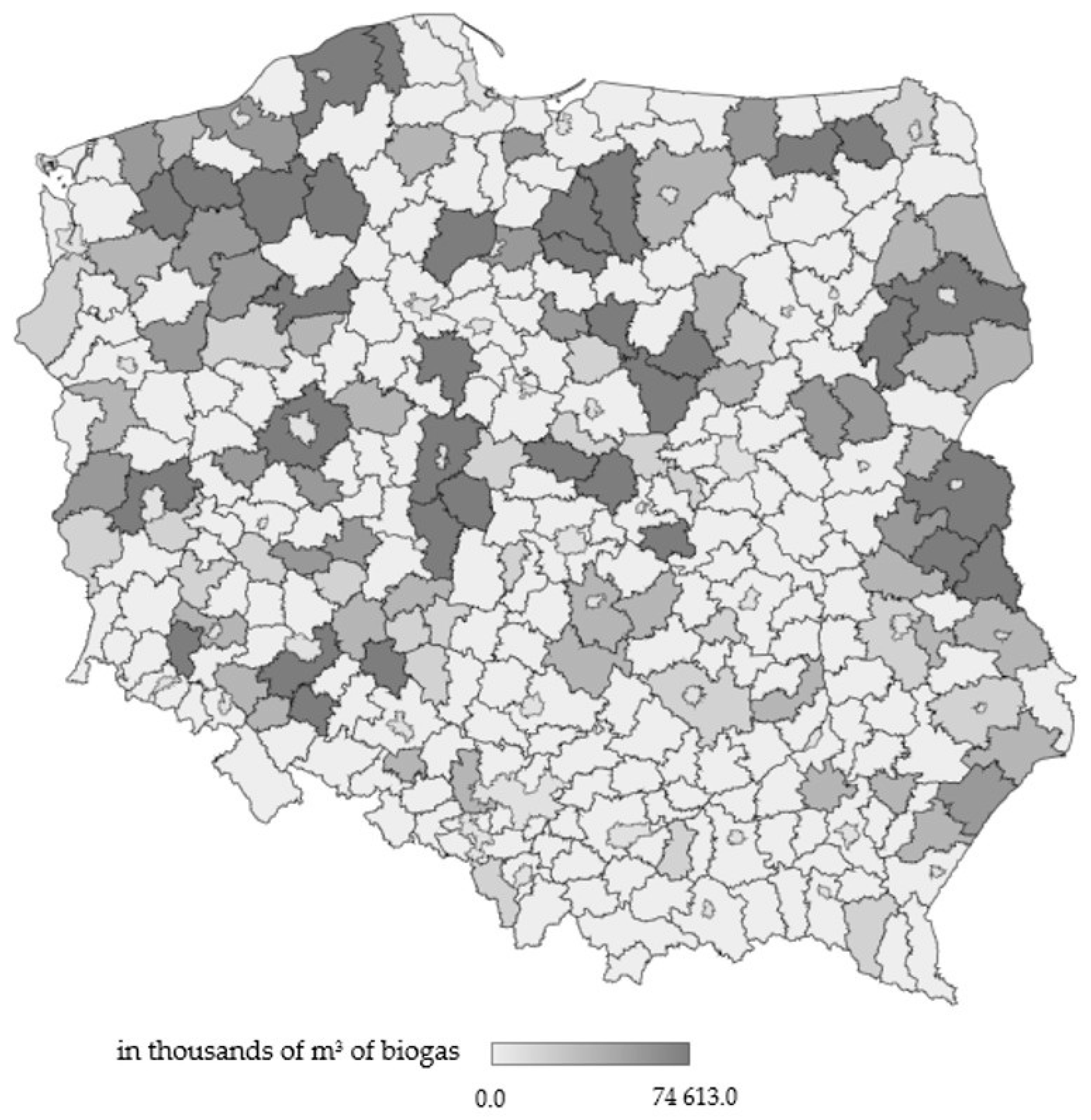
The situation was similar, taking into account the amount of biogas produced and installed capacity. The largest amounts of biogas are produced in the Wielkopolskie Voivodeship (129.5 million m3) (16.7% of total biogas production), the Dolnośląskie Voivodeship (115.8 million m3) (14.9% of total biogas production) and the Zachodniopomorskie Voivodeship (72.7 million m3) (9.4% of total biogas production). These regions account for 41% of the national agricultural biogas production and 38.3% of installed capacity. The installed electrical capacity of renewable energy installations in the following voivodeships: Wielkopolskie—31.7 MW (17.9% of the total installed capacity), Dolnośląskie—18.5 MW (10.5% of the total installed capacity) and Zachodniopomorskie—17.6 MW (9.9% of the total installed capacity). On the other hand, the least agricultural biogas is produced in the following voivodeships: Małopolskie—0.9 million m3 (0.1% of the total biogas production), Śląskie—6.1 million m3 (0.8% of the total production) and Świętokrzyskie—6.8 million m3 (0.9% of the total biogas production). In total, the above-mentioned regions account for 1.8% of agricultural biogas production in Poland and less than 2.0% of the installed capacity. The installed electrical capacity of renewable energy installations in these voivodeships was, respectively: in Małopolskie—0.2 MW (0.1% of total installed capacity), in Śląskie—1.5 MW (0.8% of total installed capacity) and in Świętokrzyskie—1.8 MW (1% of total installed capacity). It should be emphasized that in some regions larger installations dominate; therefore, despite the low number of installations, the overall production is higher (Dolnośląskie), while in others (Wielkopolskie), numerous but relatively smaller installations can be observed. (Table 2, Figure 3). The annual agricultural biogas productivity indicates the region’s importance in renewable energy production and allows for easier assessment of the efficiency and stability of production in the long term. Installed capacity, on the other hand, contributes to the ability to assess the production potential of individual voivodeships. High values indicate the ability to produce significant amounts of energy, which is a determinant when assessing energy efficiency and energy demand at the local level.
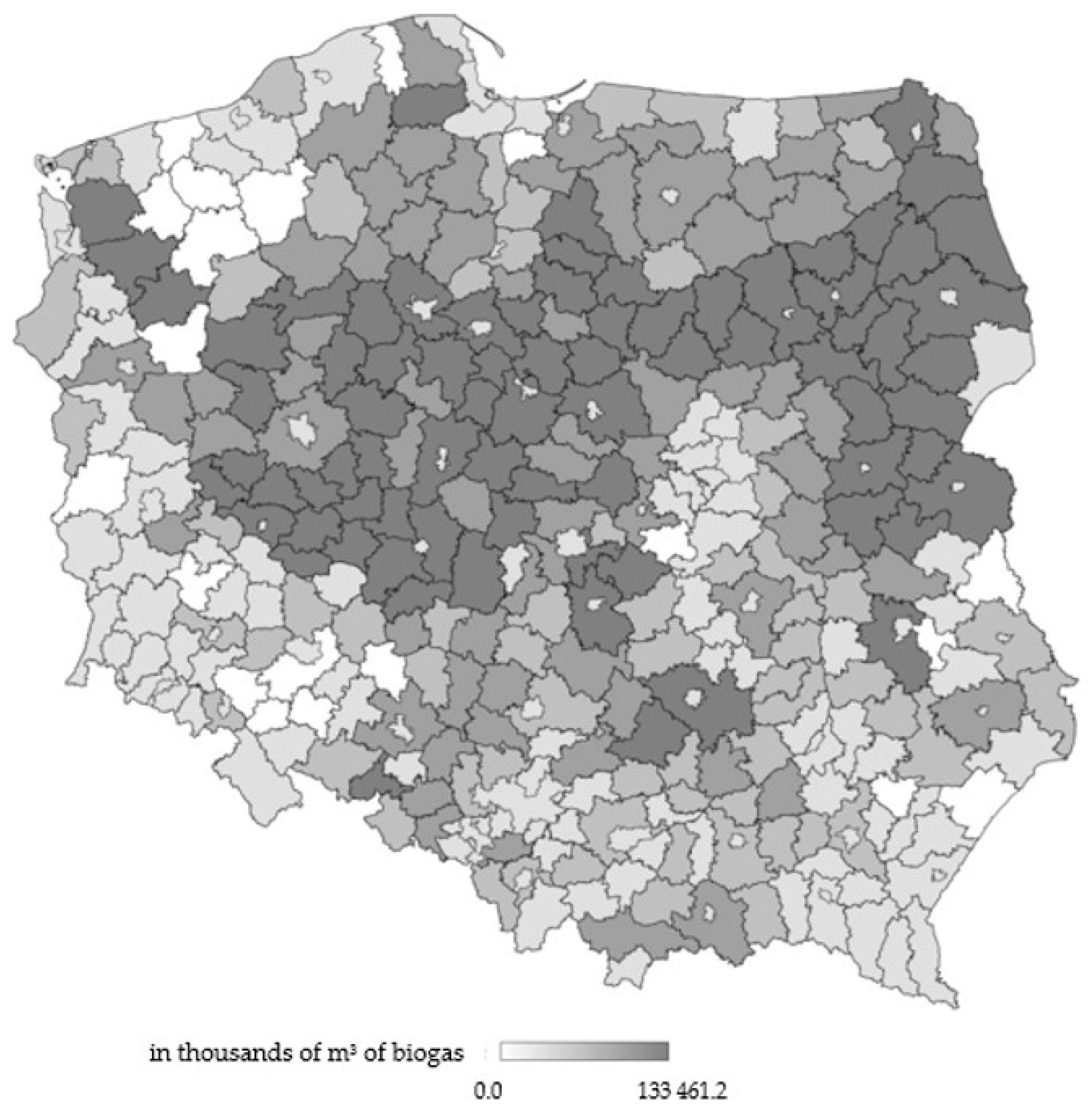
Taking into account the local (poviats) structure, agricultural biogas production is dispersed (Figure 3). As shown in Figure 3, agricultural biogas production is much lower in the counties of southern Poland. Overall, there are 314 poviats in Poland, but agricultural biogas is produced in only 109 poviats (which constitutes 34.7% of all Polish poviats). The largest amounts of agricultural biogas are produced in the poviats: strzeliński—74,613 thousand m3 (Dolnośląskie Voivodeship), poznański—32,602.5 thousand m3 (Wielkopolskie Voivodeship), człuchowski—28,210.0 thousand m3 (Pomorskie Voivodeship), kaliski—19,349.0 thousand m3 (Wielkopolskie Voivodeship), and iławski—17,590.0 thousand m3 (Warmińsko-Mazurskie Voivodeship). The smallest amount of agricultural biogas is produced in the following poviats: suwalski—420 thousand m3 (Podlaskie Voivodeship), bocheński—864 thousand m3 (Małopolskie Voivodeship), czarnkowsko-trzcianecki—900 thousand m3 (Wielkopolskie Voivodeship), sierpecki—1000.0 thousand m3 (Mazowieckie Voivodeship) and nowosolski—1100.0 thousand m3 (Lubuskie Voivodeship).

4.2. Theoretical Production Potential and Possibilities of Using Agricultural Biogas in Polish Regions

Based on livestock population (in LSU), dry organic matter production rates (kg/dm/LSU/d), and biogas production (m3/t dm), estimates of potential biogas production were made at the regional (by province) and local (by county) levels. Based on the assumptions made in the methodological part and the calculations presented in Table 3, it follows that the potential biogas production in Poland may amount to 5117.0 million m3. The central and northeastern parts of the country offer particularly favorable conditions for biogas production. The highest theoretical potential was identified in the following voivodeships: Wielkopolskie—1035.2 million m3 of biogas (20.2% of Poland’s total potential), Mazowieckie—928.0 million m3 (18.1%), and Podlaskie—561.0 million m3 (11.0%). Together, three Polish voivodeships account for almost half of the estimated potential (49.3%). These voivodeships are characterized by a highly developed agricultural sector and a significant share of agricultural land. Therefore, they have a particularly high potential for the development of agricultural biogas production thanks to the availability of biomass from agricultural waste, used as a substrate in biogas plants. However, due to unfavorable conditions, the south and southwestern parts of Poland have a significantly smaller impact on the potential production of agricultural biogas. The lowest potential was identified in the following voivodeships: Podkarpackie—84.2 million m3 (1.6% of the total potential), Lubuskie—90.5 million m3 (1.8%), Dolnośląskie—110.6 million m3 (2.2%), and Małopolskie—113.8 million m3 (2.2%). Together, these voivodeships account for less than 8% of the total estimated potential. These voivodeships are characterized by lower intensity of agricultural activity and smaller farm sizes, which results in lower access to substrates and, therefore, fewer opportunities for the justified construction of agricultural biogas plants.
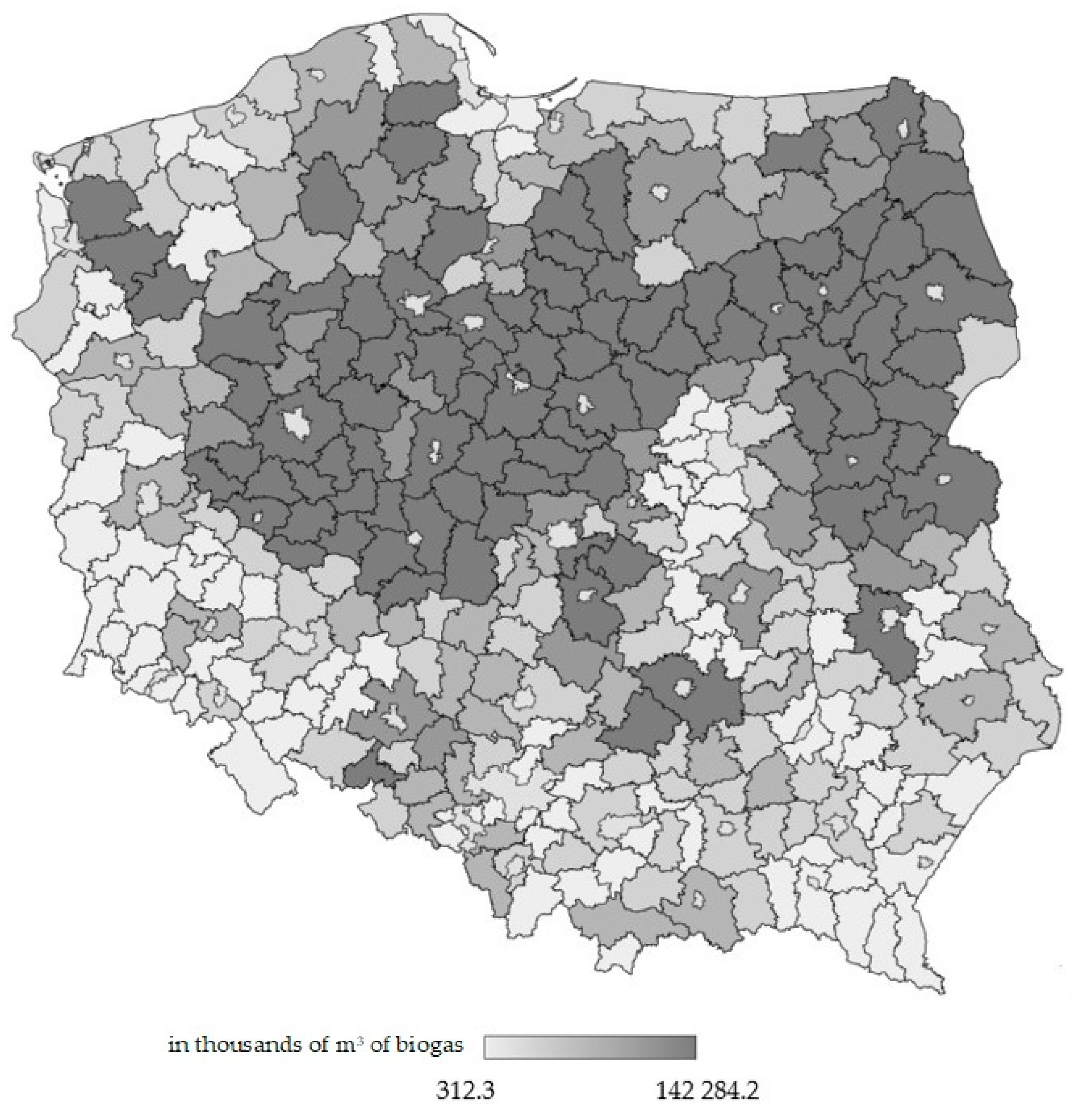
Taking into account the local (poviats) structure, it can be seen that the theoretical potential for agricultural biogas production accumulates in a belt from central to eastern Poland (Figure 4). Figure 4 shows a similar situation to Figure 3, with the counties of southern Poland having significantly lower agricultural biogas production capacities. Based on the estimates, the theoretical potential was identified in all Polish counties. However, the greatest potential for biogas production is found in the following poviats: żuromiński—142,284.2 thousand m3 (Mazowieckie Voivodeship), rawicki—103,744.9 thousand m3 (Wielkopolskie Voivodeship), mławski—92,059.2 thousand m3 (Mazowieckie Voivodeship), siedlecki—73,003.2 thousand m3 (Mazowieckie Voivodeship), and wysokomazowiecki—68,168 thousand m3 (Podlaskie Voivodeship). The smallest potential biogas production capacity was identified in the following poviats: chrzanowski—312.3 thousand m3 (Małopolskie Voivodeship), oławski—470.0 thousand m3 (Dolnośląskie Voivodeship), legionowski—636.8 thousand m3 (Mazowieckie Voivodeship), leski—882.7 thousand m3 (Podkarpackie Voivodeship) and pruszkowski—920.7 thousand m3 (Mazowieckie Voivodeship).
Knowing actual production and the estimated theoretical potential for agricultural biogas, a comparison was made. Based on the comparison of actual and potential production, it was noted that 294 of the 314 poviats have the potential to develop agricultural biogas production from animal manure. Furthermore, comparing the current production volume with the theoretical potential reveals that the existing potential is being utilized to a limited extent—current production represents approximately 20% of the identified theoretical potential (Figure 5).
Regionally, the voivodeships with the greatest potential for developing large-scale agricultural biogas production are the Wielkopolskie, Mazowieckie, and Podlaskie Voivodeships. Due to greater agricultural intensification, these voivodeships generate significant amounts of manure, which is an important substrate for biogas production. Furthermore, more favorable economic and political conditions, as well as institutional support, also influence the development of the agricultural biogas sector. On the other hand, the voivodeships with the lowest potential for developing biogas production are the Dolnośląskie, Lubuskie, and Podkarpackie Voivodeships. These voivodeships experience lower agricultural intensification, which translates to lower availability of the raw material. In the case of the Lubuskie Voivodeship, the low potential for developing agricultural biogas is determined by its economic specificity—it is the most forested area in Poland (forestation rate: approximately 50%). In the local system (poviats), the greatest possibilities in terms of potential production are possessed by counties of the Mazowieckie Voivodeship (poviats: żuromiński—133,461.2 thousand m3; mławski—92,059.2 thousand m3, siedlecki—73,003.2 thousand m3, ostrołęcki—63,587.5 thousand m3, sierpecki—57,909.4 thousand m3); Wielkopolskie (poviats: rawicki—97,744.9 thousand m3; gostyński—60,607.1 thousand m3; krotoszyński—55,139.1 thousand m3) and Podlaskie (poviats: wysokomazowiecki—60,547.0 thousand m3; łomżyński—54,878.3 thousand m3; sokólski—52,963.1 thousand m3).

5. Discussion

In accordance with the adopted research objective, actual biogas production was assessed and the theoretical potential for agricultural biogas in Poland was estimated at the local level. The study considered the potential for biogas production from the excrement of the main farm animal species—cattle, pigs and poultry. The use of this type of waste, by-products, and residues is currently the preferred approach due to issues related to sustainable development and the circular economy—an issue emphasized by many authors [13,20,24]. The conducted research indicates a gap between the identified agricultural biogas potential and its actual utilization. Based on the estimates, a significant biogas potential was identified in Poland, which, compared to actual production, is largely untapped. Other authors conducting research in various countries in Europe and around the world point to a similar situation [13,14,15,16]. Moreover, the identified potential in Poland varies spatially, which is also evident in studies by other authors [49,50]. The spatial variation in the theoretical potential of agricultural biogas results from the uneven distribution of livestock populations in Poland. Therefore, the use of biogas will not be economically justified everywhere, taking into account the necessary condition, i.e., the availability of raw materials, which is emphasized by various researchers [51,52].
However, it is important to emphasize that developing biogas production based on existing potential is worthwhile, as it brings a number of positive environmental and social benefits. The main positive environmental impact of biogas production is primarily the conversion of difficult-to-manage biomass into renewable energy. Biogas processing also produces post-fermentation solids, which are high-quality fertilizers that can be used in agricultural crop production and improve soil quality. Furthermore, the use of post-fermentation solids reduces the need for artificial fertilizers and, compared to traditional natural fertilizers, significantly reduces unpleasant odors. Furthermore, using post-fermentation solids (instead of natural fertilizers) helps eliminate pathogens, reduces the risk of groundwater and surface water contamination, and reduces the spread of pathogenic organisms (occurring in animal excrement) due to the hygienization process. Agricultural biogas production also contributes to the reduction in greenhouse gas emissions (primarily harmful methane). From a social perspective, the development of biogas production contributes to the creation of new jobs and increasing regional revenues. Furthermore, it contributes to the creation of gross domestic product, enhances regional development, improves local infrastructure, and leads to changes in the structure of local businesses by introducing a new business profile [53].
Biogas production is a promising renewable energy source because it can be produced in a stable and predictable manner while also utilizing local resources. This is consistent with the provisions of the Polish Renewable Energy Sources Act [31]. Despite Poland’s significant potential for biogas production, it is not utilized adequately. The main reasons for the limited utilization of existing agricultural biogas potential in Poland are numerous barriers. A significant legal barrier is the lack of consistency in regulations governing biogas production, which hinders the planning and implementation of biogas plant projects. Furthermore, lengthy procedures for obtaining certificates for digestate, a byproduct of biogas plants that can be used in agriculture as a valuable fertilizer that improves soil properties, also pose a problem. Municipal strategic documents also pose a barrier, as they either do not include or even prohibit the construction of biogas plants within their boundaries—amending these documents is difficult, time-consuming, expensive, and sometimes even impossible. Politically, the main barrier is the lack of a coherent energy policy and a long-term renewable energy development strategy, which creates uncertainty for the future development of the biogas sector. Furthermore, there is also the problem of poor coordination between the private and public sectors, which negatively impacts the development of the biogas sector in Poland. In addition to existing legal barriers, Poland also faces economic constraints. The main barrier in this area is the high investment costs of biogas plants, which are further exacerbated by the construction of biomethane plants. This problem is exacerbated by limited access to bank loans with concessionary conditions, as well as the lack of programs and projects promoting biogas and biomethane investments. Furthermore, there is a lack of support for financing the high operating costs of biogas plants (labor, maintenance, repairs, and feedstock pre-treatment). Limited access to support systems is a barrier to the development of larger installations. Poland operates the FIT system (a feed-in tariff system for installations below 500 kW until the end of 2025; from 2026, below 200 kW) and the FIP system (a system of market price subsidies for installations from 500 kW to 1 MW until the end of 2025, with a plan from 2026 for 200 kW to 1 MW). Currently, the highest price applies to the smallest installations. In addition to the legal, political, and economic barriers mentioned above, limitations to the development of biogas production also create knowledge barriers at various levels. There are knowledge gaps in the development of technologies, necessitating importing them from abroad. Due to a lack of trained personnel, there are also problems with servicing and operating biogas installations. Furthermore, there are problems with the appropriate preparation (knowledge) and approach of officials responsible for issuing decisions and permits related to the specifics of the installations, the technologies used, and the processes carried out. Finally, it is important to mention the low level of awareness among Polish society regarding the benefits of biogas production—lack of knowledge, ambiguity, and misinformation create barriers in the form of negative attitudes towards the construction of biogas plants, especially in the immediate vicinity (the so-called NIMBY syndrome) [54,55,56].
Therefore, further research should focus on identifying and developing solutions that will help reduce or eliminate existing barriers to agricultural biogas production in Poland. The identification of barriers indicates that to utilize the existing potential for agricultural biogas production in Poland, comprehensive legal, institutional, and financial support tools should be introduced. Economic considerations are paramount, indicating the need for financial support not only for investment but also for operational support. Furthermore, there is also a need to introduce support tools for biomethane investments, which are rapidly developing in various European countries (France, Denmark, Italy, Germany, and the United Kingdom)—only one biomethane plant has currently been established in Poland (in 2025). Various opportunities for subsidies, loans, and preferential credits are currently emerging in Poland, but they often have specific formal requirements that may conflict with the goals of a potential investor. Therefore, there is a need to expand support instruments on both the demand side (obligatory supply of biomethane by fuel companies and gas suppliers) and the supply side (FiP tariffs, auctions, subsidies). Legally, there is a need to standardize and simplify legal regulations for all types of biogas plants to shorten the lengthy procedures that hinder the development of biogas plants. It is important to simplify the legal implications regarding the locations of biogas plants without having to adapt to the provisions of the municipal general plan. There is also a need to simplify administrative procedures for issuing environmental decisions, integrated permits, and sectoral permits (especially those related to waste management). Successful implementation of further biogas investments in Poland also requires cooperation between various stakeholders (investor, local government units, society). Support for distribution network operators is also necessary in financing the expansion and co-financing connections for biomethane. This could help address the geographic imbalances in biogas production (or access to gas), delivering biomethane to areas less resource-rich for their own biogas production. Another key aspect of the entire biogas plant development process is increasing knowledge and educating local communities, especially those who are often the owners of raw materials for biogas production, about the benefits of developing biogas plants.
To improve the utilization of existing potential (reducing existing barriers) and increase production in Poland, it is worthwhile to draw on the experience of other countries that are more advanced in utilizing this type of renewable energy source: biogas (production of electricity, heat, and biomethane), such as Denmark, France, and Italy. In Denmark, biogas production has grown rapidly since 2012, thanks to the introduction of a subsidy system that offered fixed levels of funding for eligible biogas producers. The system aimed to increase biogas production for electricity, heat, and biomethane. The subsidies were awarded to producers for a period of 20 years, providing an additional incentive and guaranteeing the stability of biogas producers’ operations. Thanks to the mass upgrading of biogas to grid quality and its connection to the system, approximately 40% of the gas in Denmark’s system is currently biomethane, and by 2030, government strategies envisage a 100% biomethane network [57]. France also introduced a feed-in tariff support system in 2011, which encourages renewable energy production by offering producers a fixed, guaranteed price for each unit of energy supplied to the grid for a period of 15 years [58]. Furthermore, barriers related to the gas grid have been broken down by promoting reverse flow installations, which create the possibility of injecting locally produced gas into higher-pressure pipelines in the network, thus lifting some of the restrictions on summer consumption in injection zones [59]. In Italy, the development of the biogas market is a key element of broader efforts to promote sustainable development, energy security, and economic resilience. This broad approach resulted in the introduction of a new agricultural system, incorporating agroecological practices that improved soil fertility and reduced resource consumption (water, energy, seeds, synthetic fertilizers). The main benefit was the return of organic matter to the soil through the use of digestate, a byproduct of biogas production [60]. Furthermore, in Italy, the development of the biogas sector was also based on financial support in the form of subsidies for the construction of installations and incentive tariffs (€4.7 billion invested by 2026). Support was primarily provided for installations utilizing livestock waste and agricultural processing residues, rather than dedicated crops. Italy also developed a business model for the development of the sector based on public–private partnerships, with municipalities and small, medium, and large enterprises as shareholders in energy production [61]. The ISAAC program, which focuses on increasing public awareness and acceptance of biogas and biomethane, is also a significant step in the development of production. Lack of public acceptance is a common barrier to the development of the biogas sector. The project’s activities focus on disseminating sustainable information about biogas production and its benefits to potential stakeholders involved in plant construction. A pilot project was conducted in two territories to foster a shared decision-making process and prevent social conflict [62].
Based on the solutions presented in other countries, we can conclude that the development of biogas production is possible and profitable. Furthermore, it is worthwhile to develop it from the perspective of existing benefits for rural areas (rural development through the use of local resources for biogas production), the environment (reduction in greenhouse gas emissions), and energy security (an alternative energy source). Based on the examples presented, it can be seen that an appropriate system of financial support offered by the public sector to biogas producers is a way to long-term evaluation of the agricultural biogas sector. To ensure the stability and reliability of the biogas sector, support for appropriate sales prices over the long term (15–20 years) is important. The development of public–private partnerships to jointly support the development of the agricultural biogas sector is also important.
The conducted research has its limitations, which relate to the method of estimating the potential of agricultural biogas. The study presented theoretical potential, i.e., the maximum possible amount of biogas that can be obtained from existing biomass resources, without taking into account technical and economic constraints. It should be emphasized that in real conditions, only a portion of the existing animal population in individual Polish counties will produce raw materials for biogas production. This stems from the fact that the main condition for building a biogas plant in a given location is the availability of raw materials. Economic practice indicates that building a biogas plant in a given location is economically justified if there are farms with a livestock population exceeding 200 livestock units (LSU) nearby [51]. Furthermore, the availability of detailed data on livestock population is a certain limitation. At the local level (county level), the Central Statistical Office publishes data only on the overall livestock population, without specifying specific species. Therefore, when estimating the agricultural biogas potential, the livestock population was converted into LSU using average coefficients, which may also affect the accuracy of the calculations.

6. Conclusions

Due to its stable and predictable production, as well as the ability to utilize local resources, agricultural biogas is a future-proof and desirable source of renewable energy. Furthermore, it aligns with current trends at the European Union level regarding sustainable development and the circular economy.
Based on the conducted analyses, the theoretical potential for agricultural biogas in Poland has been identified at 5117.0 million m3. The greatest potential lies in the central belt of Poland, i.e., the Wielkopolskie, Mazowieckie, and Podlaskie voivodeships, which are also characterized by a high concentration of animal populations, which are a source of raw materials for biogas production. It is worth emphasizing that these regions accumulate almost 50% of Poland’s theoretical potential for agricultural biogas production. In these areas, the construction of larger agricultural biogas production facilities is justified. Southern Poland, on the other hand, has significantly lower potential for biogas production. However, under favorable conditions (adequate access to raw materials), these areas could be significant for biogas production in micro-scale installations. Meanwhile, an analysis of the Register of Agricultural Biogas Producers maintained by the National Support Center for Agriculture shows that 774.9 million cubic meters of agricultural biogas are currently produced in Poland. Currently, the largest amounts of agricultural biogas are produced in the Wielkopolskie, Dolnośląskie and Zachodniopomorskie Voivodeships. These regions account for over 40% of Poland’s actual biogas production.
Comparisons of actual agricultural biogas production and theoretical potential indicate that Poland is underutilizing existing opportunities. Current agricultural biogas production represents approximately 20% of the existing potential that can be obtained from farm animal manure. This situation is attributed to the numerous barriers that exist in Poland, hindering the wider use of agricultural biogas. Therefore, it is crucial to seek new solutions to reduce these barriers. The main barriers leading to underutilization of existing potential are the lack of established long-term strategies for supporting and financing investments related to agricultural biogas production. There is also a need for scientific research to develop innovative technologies. Furthermore, improving public awareness of biogas production is crucial, which may reduce objections to the location of agricultural biogas plants. It is worthwhile to leverage the experience of foreign countries with greater involvement in agricultural biogas production in this regard.

Author Contributions

Conceptualization, D.J. and L.O.; methodology, D.J. and L.O.; software, D.J. and L.O.; formal analysis, D.J. and L.O.; investigation, D.J. and L.O.; resources, D.J. and L.O.; data curation, D.J. and L.O.; writing—original draft preparation, D.J. and L.O.; writing—review and editing, D.J. and L.O.; visualization, D.J. and L.O. All authors have read and agreed to the published version of the manuscript.

Funding

This research received no external funding.

Institutional Review Board Statement

Not applicable.

Data Availability Statement

The original contributions presented in this study are included in the article. Further inquiries can be directed to the corresponding author.

Conflicts of Interest

The authors declare no conflict of interest.

References

  1. Abd, A.A.; Kim, J.; Othman, M.R. Bibliometric guide to future biogas technology for sustainable energy need and agricultural development. Clean Technol. Environ. Policy 2025, 27, 6031–6065. [Google Scholar] [CrossRef] [Scilit]
  2. Uranga-Valencia, L.P.; Pérez-Álvarez, S.; Gabriel-Parra, R.; Chávez-Medina, J.A.; Magallanes-Tapia, M.A.; Sánchez-Chávez, E.; Muñoz-Márquez, E.; García-García, S.A.; Rascón-Solano, J.; Castruita-Esparza, L.U. Biogas Production from Organic Waste in the Forestry and Agricultural Context: Challenges and Solutions for a Sustainable Future. Energies 2025, 18, 3174. [Google Scholar] [CrossRef] [Scilit]
  3. Kuboń, M.; Skibko, Z.; Borusiewicz, A.; Romaniuk, W.; Gajda, J.S.; Kłosowska, O.; Wasąg, Z. Influence of the Parame-ters of an Agricultural Biogas Plant on the Amount of Power Generated. Appl. Sci. 2024, 14, 4200. [Google Scholar] [CrossRef] [Scilit]
  4. Chodkowska-Miszczuk, J.; Szymańska, D. Agricultural biogas plants—A chance for diversification of agriculture in Poland. Renew. Sustain. Energy Rev. 2013, 20, 514–518. [Google Scholar] [CrossRef] [Scilit]
  5. Mautz, R.; Byzio, A.; Rosenbaum, W. Auf dem Weg zur Energiewende: Die Entwicklung der Stromproduktion aus Erneuerbaren Energien in Deutschland; Universitätsverlag Göttingen: Göttingen, Germany, 2008; p. 17. [Google Scholar]
  6. Theuerl, S.; Herrmann, C.; Heiermann, M.; Grundmann, P.; Landwehr, N.; Kreidenweis, U.; Prochnow, A. The Future Agricultural Biogas Plant in Germany: A Vision. Energies 2019, 12, 396. [Google Scholar] [CrossRef] [Scilit]
  7. Brudermann, T.; Mitterhuber, C.; Posch, A. Agricultural biogas plants—A systematic analysis of strengths, weaknesses, opportunities and threats. Energy Policy 2015, 76, 107–111. [Google Scholar] [CrossRef] [Scilit]
  8. Rzeznik, W.; Mielcarek, P. Agricultural biogas plants in Poland. In 17th International Scientific Conference: Engineering for Rural Development; Engineering for Rural Development; Malinovska, W.L., Osadcuks, V., Eds.; Latvia University of Life Sciences and Technologies: Jelgava, Latvia, 2018; Available online: http://www.tf.llu.lv/conference/proceedings2018/ (accessed on 21 November 2025).
  9. Budzianowski, W.M. Sustainable biogas energy in Poland: Prospects and challenges. Renew. Sustain. Energy Rev. 2012, 16, 342–349. [Google Scholar] [CrossRef] [Scilit]
  10. Blaszke, M. Regional differentiation of agricultural biogas, biocomponent and biofuel production in Poland. Environ. Prot. Nat. Resour. 2024, 3, 14–28. [Google Scholar] [CrossRef] [Scilit]
  11. Stürmer, B.; Leiers, D.; Anspach, V.; Brügging, E.; Scharfy, D.; Wissel, T. Agricultural biogas production: A regional comparison of technical parameters. Renew. Energy 2021, 164, 171–182. [Google Scholar] [CrossRef] [Scilit]
  12. Pilarski, K.; Pilarska, A.A.; Pietrzak, M.B. Biogas Production in Agriculture: Technological, Environmental, and Socio-Economic Aspects. Energies 2025, 18, 5844. [Google Scholar] [CrossRef] [Scilit]
  13. Sevryugina, N.S.; Dragulenko, V.V.; Sukhanov, D.S.; Ukraintsev, M.M.; Korchagin, P.T. Biogas as a solution to the prob-lem of waste utilisation in agriculture. BIO Web Conf. 2025, 161, 00009. [Google Scholar] [CrossRef] [Scilit]
  14. Koval, V.; Atstāja, D.; Filipishyna, L.; Udovychenko, V.; Kryshtal, H.; Gontaruk, Y. Sustainability Assessment and Re-source Utilization of Agro-Processing Waste in Biogas Energy Production. Climate 2025, 13, 99. [Google Scholar] [CrossRef] [Scilit]
  15. Gao, M.; Wang, D.; Wang, H.; Wang, X.; Feng, Y. Biogas potential, utilization and countermeasures in agricultural provinces: A case study of biogas development in Henan Province, China. Renew. Sustain. Energy Rev. 2019, 99, 191–200. [Google Scholar] [CrossRef] [Scilit]
  16. Zhang, T.; Yang, Y.; Xie, D. Insights into the production potential and trends of China’s rural biogas. Int. J. Energy Res. 2015, 39, 1601–1614. [Google Scholar] [CrossRef] [Scilit]
  17. Wąs, A.; Sulewski, P.; Krupin, V.; Popadynets, N.; Malak-Rawlikowska, A.; Szymańska, M.; Skorokhod, I.; Wysokiński, M. The Potential of Agricultural Biogas Production in Ukraine—Impact on GHG Emissions and Energy Production. Energies 2020, 13, 5755. [Google Scholar] [CrossRef] [Scilit]
  18. Koryś, K.A.; Latawiec, A.E.; Grotkiewicz, K.; Kuboń, M. The Review of Biomass Potential for Agricultural Biogas Pro-duction in Poland. Sustainability 2019, 11, 6515. [Google Scholar] [CrossRef] [Scilit]
  19. Czekała, W.; Pulka, J.; Jasiński, T.; Szewczyk, P.; Bojarski, W.; Jasiński, J. Waste as substrates for agricultural biogas plants: A case study from Poland. J. Water Land Dev. 2023, 56, 45–50. [Google Scholar] [CrossRef] [Scilit]
  20. Frankowski, J.; Czekała, W. Agricultural Plant Residues as Potential Co-Substrates for Biogas Production. Energies 2023, 16, 4396. [Google Scholar] [CrossRef] [Scilit]
  21. Balać, M.; Janković, B.; Manić, N. Theoretical Assessment of Agro-Waste for Biogas Production Based on Novel Meth-odology Related to Biochemical Potential. Processes 2024, 12, 2440. [Google Scholar] [CrossRef] [Scilit]
  22. Qayyum, S.; Tahir, A.; Mian, A.; Zeb, S.; Siddiqui, M.F.; Rehman, B. Optimizing biogas production through anaerobic digestion: Transforming food waste and agricultural residues into renewable. Biomass Convers. Biorefinery 2025, 15, 26027–26043. [Google Scholar] [CrossRef] [Scilit]
  23. Pence, I.; Kumaş, K.; Cesmeli, M.S.; Akyüz, A. Future prediction of biogas potential and CH4 emission with boosting algorithms: The case of cattle, small ruminant, and poultry manure from Turkey. Environ. Sci. Pollut. Res. 2024, 31, 24461–24479. [Google Scholar] [CrossRef] [Scilit] [PubMed]
  24. Łaba, S. Selected elements of biogas production from food waste in the context of a circular economy. Ann. Pol. Assoc. Agric. Agribus. Econ. 2025, 27, 127–147. [Google Scholar] [CrossRef] [Scilit]
  25. Statistics Poland. Agricultural Census 2020 Characteristics of Households with Holders of the Agricultural Holding Based on Combined Data from the 2020 Agricultural Census and the 2021 Population and Housing Census; Statistics Poland: Warsaw, Poland, 2023; p. 29.
  26. Krasowicz, S.; Kuś, J. Kierunki zmian w produkcji rolniczej w Polsce do roku 2020—próba prognozy. Probl. Agric. 2010, 324, 5–18. [Google Scholar]
  27. Available online: https://bdl.stat.gov.pl/bdl/dane/podgrup/temat (accessed on 21 November 2025).
  28. National Agricultural Census 2020. Report on the Results; Central Statistical Office, Department of Agriculture: Warsaw, Poland, 2021.
  29. Available online: https://stat.gov.pl/statystyka-regionalna/jednostki-terytorialne/podzial-administracyjny-polski/ (accessed on 21 November 2025).
  30. Available online: https://www.podgik.pl/index.php?ppd=&ppg=ankieta/ewidencja&cosort=ogolne&sort=powiat&kier=desc (accessed on 9 January 2026).
  31. Ustawa z Dnia 20 Lutego 2015 r. o Odnawialnych Źródłach Energii (Dz. U. z 2024 r. poz. 1361, z późn. zm.), Art. 24, Ust. 1. Available online: https://isap.sejm.gov.pl/isap.nsf/DocDetails.xsp?id=wdu20150000478 (accessed on 21 November 2025).
  32. Available online: https://www.gov.pl/web/kowr/rejestr-wytworcow-biogazu-rolniczego (accessed on 21 November 2025).
  33. Pudełko, R. Ocena Potencjałów Biomasy Ubocznej i Odpadowej w UE-27 i Szwajcarii Oraz Ich Regionalizacja; IUNiG PIB: Puławy, Poland, 2013; p. 37. [Google Scholar]
  34. Kowalczyk-Juśko, A. Metodyka szacowania regionalnych zasobów biomasy na cele energetyczne. Eiogz 2010, 85, 103–116. [Google Scholar] [CrossRef] [Scilit]
  35. Siejka, K.; Tańczuk, M.; Trinczek, K. Koncepcja szacowania potencjału energetycznego biomasy na przykładzie wybranej gminy województwa opolskiego. Inżynieria Rol. 2008, 6, 167–174. [Google Scholar]
  36. Wiącek, D.; Tys, J. Biogaz—wytwarzanie i możliwości jego wykorzystania. Instytut Agrofizyki im. Bohdana Dobrzańskiego PAN. Acta Agroph. 2015, 1, 1–92. [Google Scholar]
  37. Curkowski, A.; Oniszk-Popławska, A. Surowce do produkcji biogazu—uproszczona metoda obliczenia wydajności biogazowni rolniczej. Czysta Energ. 2010, 1, 25–27. [Google Scholar]
  38. Marczak, H. Aspects of the energy use of biogas from waste on the example of the Lubuskie Voivodeship. Ecol. Eng. 2009, 21, 97–108. (In Polish) [Google Scholar]
  39. Curkowski, A.; Mroczkowski, P.; Oniszk-Popławska, A.; Wiśniewski, G. Agricultural Iiogas—Production and Use; Biogas Guide; Masovian Energy Agency: Warsaw, Poland, 2009; p. 64. (In Polish) [Google Scholar]
  40. Talavyria, M.; Furman, I.; Alexandrov, D.; Drabovskyi, A. Assessment of agricultural biomass potential in sustainable biofuel production. Econ. Ecol. Socium 2025, 9, 109–123. [Google Scholar] [CrossRef] [Scilit]
  41. Annex to the Regulation of the Council of Ministers of 9 November 2004 (Coefficients for Converting Livestock Units into Large Livestock Units) on the Types of Projects That May Have a Significant Impact on the Environment and Detailed Conditions Related to Qualifying a Project for the Preparation of an Environmental Impact Report (Dz. U. Nr 257, poz. 2573). Available online: https://isap.sejm.gov.pl/isap.nsf/DocDetails.xsp?id=WDU20042572573 (accessed on 21 November 2025). (In Polish)
  42. Szymańska, M.; Łabędowicz, J. Rolniczy potencjał substratów do produkcji biogazu rolniczego w Polsce. In Regionalny i Lokalny Potencjał Biomasy Energetycznej; Jasiulewicz, M., Ed.; Polskie Towarzystwo Ekonomiczne: Koszalin, Poland, 2010; pp. 89–112. [Google Scholar]
  43. Klugman-Radziemska, E. Odnawialne źródła energii. In Przykłady Obliczeniowe; Wydawnictwo politechniki Gdańskiej: Gdańsk, Poland, 2015; p. 55. [Google Scholar]
  44. Gostomczyk, W. Surowce do produkcji biogazu i efektywność ich wykorzystania. In Regionalny i Lokalny Potencjał Biomasy Energetycznej; Jasiulewicz, M., Ed.; Polskie Towarzystwo Ekonomiczne: Koszalin, Poland, 2010; pp. 113–144. [Google Scholar]
  45. Schulz, E.; Eder, B. Biogas Praxis; Oekobuch: Hemsbach, Germany, 2001; p. 237. [Google Scholar]
  46. Skoczkowski, T.; Mikucki, O.; Choromański, P.; Grzybek, A.; Kaniszewska, A.; Ludwicka, A.; Mazurkiewicz, M.; Wasiak, A.; Wnuk, R. Legal Assessment and Economic Analysis of the Possibilities of Achieving the Objectives Resulting from the Renewable Energy Strategy and Directive 2001/77/EC of the European Parliament and of the Council of 27 September 2001 on the Promotion of Electricity Produced from Renewable Energy Sources in the Internal Electricity Market; National Energy Conservation Agency: Warsaw, Poland, 2007; p. 76. (In Polish)
  47. Grzybek, A. Biogazownie Szansa dla Rolnictwa i Środowiska; Fundation for the Development of Polish Agriculture: Warsaw, Poland, 2013. [Google Scholar]
  48. Powałka, M.; Klepacka, A.M.; Skudlarski, J.; Golisz, E. The agricultural biogas sector in Poland as compared to other European Union member-countries. Probl. Pol. Agric. 2013, 13, 203–212. [Google Scholar]
  49. Scarlat, N.; Martinov, M.; Dallemand, J.F. Assessment of the availability of agricultural crop residues in the European Union: Potential and limitations for bioenergy use. Waste Manag. 2010, 30, 1889–1897. [Google Scholar] [CrossRef] [Scilit] [PubMed]
  50. Ericsson, K.; Nilsson, L.J. Assessment of the potential biomass supply in Europe using a resource focused approach. In Proceedings of the World Conference and Technology Exhibition on Biomass for Energy and Industry ETA Florence Renewable Energies, Rome, Italy, 10–14 May 2004. [Google Scholar]
  51. Biłos, Ł. Teoretyczny potencjał energii pochodzącej ze stabilnych i przewidywalnych źródeł w województwie opolskim. Barom. Reg. 2016, 14, 147–153. [Google Scholar] [CrossRef] [Scilit]
  52. Singh, A.K.; Pal, P.; Rathore, S.S.; Sahoo, U.K.; Sarangi, P.K.; Prus, P.; Dziekański, P. Sustainable Utilization of Biowaste Resources for Biogas Production to Meet Rural Bioenergy Requirements. Energies 2023, 16, 5409. [Google Scholar] [CrossRef] [Scilit]
  53. Obrycka, E. Korzyści społeczne i ekonomiczne budowy biogazowni rolniczych. Zesz. Nauk. Szk. Głow. Gospodar. Wiej. Warsz. Ekon. Organ. Gospodar. Żywn. 2014, 107, 163–176. [Google Scholar] [CrossRef] [Scilit]
  54. Bojanowicz-Bablok, A.; Hajto, M.; Horak, N.; Kuśmierz, A.; Potapowicz, I.; Sobol, A. Bariery Wdrażania Rozwiązań w Zakresie Produkcji Biogazu i Gospodarki Bioodpadami; Raport; Instytut Ochrony Środowiska—Państwowy Instytut Badawczy: Warsaw, Poland, 2024. [Google Scholar]
  55. Kostecka-Jurczyk, D.; Struś, M. Problems of developing distributed energy in Poland based on renewable energy sources on the example of energy cooperatives and clusters. Przegląd Ustawodawstwa Gospod. 2024, 5, 9–17. [Google Scholar] [CrossRef] [Scilit]
  56. Koźmiński, A. Rolnicze wyspy energetyczne jako narzędzie bezpieczeństwa i dywersyfikacji dochodów na terenach wiejskich. Srod. Stud. Polit. 2025, 2, 421–436. [Google Scholar] [CrossRef] [Scilit]
  57. Available online: https://mspm-biogaz.pl/2025/09/15/biogaz-w-polsce-i-europie-szanse-wyzwania-i-przyszlosc-rynku-oze-przeglad-regulacji-dotacji-kierunkow-rozwoju-do-2030-2050/ (accessed on 9 January 2026).
  58. Available online: https://magazynbiomasa.pl/francja-nie-zwalnia-do-2030-roku-chce-potroic-produkcje-biometanu/ (accessed on 9 January 2026).
  59. PDF. Available online: https://www.ttw-legal.pl/Upload/0Francuski_model_wsparcia_dla_biometanu_03_2020.PDF (accessed on 9 January 2026).
  60. Available online: https://magazynbiomasa.pl/biogaz-we-wloszech-jakie-korzysci-przyniosl-rozwoj-rynku/ (accessed on 9 January 2026).
  61. Available online: https://magazynbiomasa.pl/wlochy-jednym-z-liderow-produkcji-biometanu-w-europie/ (accessed on 9 January 2026).
  62. Available online: https://www.isaac-project.it/en/il-progetto/ (accessed on 9 January 2026).
Figure 1. Spatial study area. Voivodeship: 1—zachodniopomorskie; 2—pomorskie; 3—warmińsko-mazurskie; 4—podlaskie; 5—ma-zowieckie; 6—kujawsko-pomorskie; 7—wielkopolskie; 8—lubuskie; 9—dolnośląskie; 10—łódzkie; 11—świętokrzyskie; 12—lubelskie; 13—podkarpackie; 14—małopolskie; 15—śląskie; 16—opolskie [30].
Agriculture 16 00301 g001
Figure 2. Annual and cumulative values of agricultural biogas produced in Poland in 2011–2025.
Agriculture 16 00301 g002
Figure 3. Actual biogas production in Polish counties (in thousand m3 of biogas).
Agriculture 16 00301 g003
Figure 4. Theoretical potential of agricultural biogas in Polish voivodeships (in thousand m3).
Agriculture 16 00301 g004
Figure 5. Agricultural biogas production capacity in Polish counties—comparison of theoretical production potential with actual production (in thousand m3).
Agriculture 16 00301 g005
Table 1. Empirical data for calculating the theoretical potential of biogas and biomethane from animal manure.
SpecificationMeasurement UnitSpecies of Farm Animals
CattlePigPoultry
Production of dry matter (Wd.m.)kg s.m.o/LSU/d3.0–5.4
Average: 4.2
2.5–4.0
Average: 3.3
5.5–10
Average: 7.78
Biogasproduction (Pb)m3/t s.m.o175–520
Average: 347
220–637
Average: 428
327–722
Average: 524
Table 2. Number, annual efficiency and installed capacity of agricultural biogas plants in Polish voivodeships (as of 14 October 2025).
VoivodeshipNumber of Biogas Plants in the VoivodeshipShare of Biogas Plants in the Voivodeship in the Total Number of Biogas Plants in Poland (in %)Annual Efficiency of the Renewable Energy Installation in Which Agricultural Biogas Is Produced (Million m3/year)Share of Biogas Produced in the Voivodeship in Total Production (in %)Total Installed Electrical Capacity of the Renewable Energy Installation in Which Electricity Is Produced from Agricultural Biogas (in MW)Share of Installed Capacity in the Voivodeship in the Total Installed Capacity in Poland (in %)
Dolnośląskie12.06.3115.814.918.510.5
Kujawsko-pomorskie5.02.629.83.87.74.3
Lubelskie16.08.357.27.414.28.0
Lubuskie10.05.229.83.86.83.8
Łódzkie14.07.351.96.712.87.2
Małopolskie1.00.50.90.10.20.1
Mazowieckie23.012.067.58.716.19.1
Opolskie4.02.114.51.93.72.1
Podkarpackie7.03.621.62.85.02.8
Podlaskie12.06.341.85.49.85.5
Pomorskie13.06.856.77.313.27.5
Śląskie2.01.06.10.81.50.8
Świętokrzyskie2.01.06.80.91.81.0
Warmińsko-mazurskie19.09.972.59.316.89.5
Wielkopolskie32.016.7129.516.731.717.9
Zachodniopomorskie20.010.472.79.417.69.9
Total192.0100.0774.9100.0177.3100.0
Table 3. Theoretical potential of agricultural biogas in Polish voivodeships (in million m3).
VoivodeshipAnimal Population (in Thousands of LSU)Theoretical Potential of Agricultural Biogas (in Million m3)Share of Agricultural Biogas Potential in the Voivodeship in Total Production (in %)Biogas Utilization Possibilities—Difference Between Theoretical Potential and Utilization (in Million m3)Biogas Utilization Possibilities—Difference Between Theoretical Potential and Utilization (in %)
Dolnośląskie159.8110.62.2-0.0
Kujawsko-pomorskie688.3409.18.0379.38.7
Lubelskie424.3265.45.2208.24.8
Lubuskie124.890.51.860.71.4
Łódzkie674.3416.28.1364.38.4
Małopolskie180.5113.82.2113.02.6
Mazowieckie1415.8928.018.1860.519.8
Opolskie197.0124.02.4109.52.5
Podkarpackie117.284.21.662.61.4
Podlaskie957.1561.011.0519.211.9
Pomorskie371.7221.14.3164.43.8
Śląskie187.4130.02.5123.92.9
Świętokrzyskie187.4131.02.6124.22.9
Warmińsko-mazurskie558.6334.36.5261.96.0
Wielkopolskie1628.31035.220.2905.720.8
Zachodniopomorskie210.3162.63.289.92.1
Total8082.65117.0100.04347.3100.0
Disclaimer/Publisher’s Note: The statements, opinions and data contained in all publications are solely those of the individual author(s) and contributor(s) and not of MDPI and/or the editor(s). MDPI and/or the editor(s) disclaim responsibility for any injury to people or property resulting from any ideas, methods, instructions or products referred to in the content.