Article

Impact of Long-Term Inhibitors and Organic Materials Addition on Soil Microbial Carbon Use Efficiency in a Corn Field

1
Institute of Applied Ecology, Chinese Academy of Sciences, Shenyang 110016, China
2
School of Innovation and Entrepreneurship, Liaoning Institute of Science and Technology, Benxi 117004, China
3
CAS Key Laboratory of Forest Ecology and Silviculture, Institute of Applied Ecology, Chinese Academy of Sciences, Shenyang 110016, China
4
Institute of Tillage and Cultivation, Liaoning Academy of Agricultural Sciences, Shenyang 110161, China
5
College of Resources, Sichuan Agricultural University, Chengdu 611130, China
*
Author to whom correspondence should be addressed.
These authors contributed equally to this work.
Agriculture 2026, 16(3), 300; https://doi.org/10.3390/agriculture16030300
Submission received: 26 December 2025 / Revised: 16 January 2026 / Accepted: 22 January 2026 / Published: 23 January 2026
(This article belongs to the Section Agricultural Soils)

Abstract

The addition of inhibitors and organic materials in corn fields is an important measure to ensure yield and improve soil fertility. Understanding the effects of the addition of inhibitors and organic material on soil microbial carbon use efficiency (CUE) and microbial mechanisms is crucial for promoting carbon (C) sequestration in agricultural systems. This study explored the effects of the addition of inhibitors (N-(nbutyl) thiophosphoric triamide (NBPT) and 3,4-dimethylpyrazole phosphate (DMPP)) and organic materials (corn stalks and pig manure (PM)) on soil microbial CUE through a field experiment with the continuous addition of inhibitors, corn stalks, and PM incorn fieldss for 7 years. Overall, the application of inhibitors reduced soil microbial CUE by 39.20% by reducing microbial immobilization C and promoting microbial respiration, but did not affect the microbial community structure. Under inhibitor application conditions, the addition of PM improved soil microbial CUE by 37.38%, which was mainly achieved by increasing microbial immobilization C, fungal, and bacterial copies. Long-term addition of organic materials and fertilizers was beneficial to the increase in soil microbial CUE, because the input of nutrients stimulates microbial growth. Although high soil microbial CUE was beneficial to soil C sequestration, it also required appropriate exogenous organic matter addition to ensure soil organic carbon (SOC) increase. In this study, when fertilizer-containing inhibitors were used, combined application with PM was beneficial to improve soil microbial CUE and promote SOC sequestration.

1. Introduction

The soil organic carbon (SOC) storage is about 2344 billion tons, which is about three times the atmospheric C storage [1,2]. The change in SOC seriously affects the content of atmospheric C, which in turn affects the process of global climate change. Therefore, there is an urgent need to enhance the carbon (C) sequestration in agricultural soil to mitigate climate change. Soil microbial carbon use efficiency (CUE) affects the short-term C cycle of terrestrial ecosystems. It is the proportion of substrate C for microbial assimilation and growth to total absorbed C, and is believed to regulate the changes in SOC [3,4]. Higher CUE generally means more microbial biomass and other microbial products, which in turn is conducive to an increase in SOC, as a portion of SOC comes from microbial products (10–80%) [3]. Therefore, understanding the changes in microbial CUE and its influencing factors in soil can help to understand the process of SOC sequestration.
In order to improve N utilization and reduce N loss in fertilizers, inhibitors are widely used in agricultural production [5,6]. It has been proven that urease inhibitors and nitrification inhibitors can change the N release rule of fertilizers, increase N availability, and make it more in line with the N absorption rule of corn [7,8,9]. The combination of urease and nitrification inhibitors is superior to either of them alone [10]. However, when inhibitors regulate the process of N transformation, they may affect soil microbial CUE in several ways. Inhibitors may directly influence the abundance of genes related to N transformation, thereby affecting microbial CUE [10]. Inhibitors may also alter soil pH by regulating N transformation, which in turn affects the abundance and composition of microbial communities, thereby impacting soil microbial CUE [11]. The application of inhibitors increases the availability of N, stimulating an increase in soil microbial CUE as the cost for microbes to acquire N decreases, leading to more C being used for microbial growth [12,13]. As N availability increases, microbial communities shift towards bacteria, which may reduce CUE because bacteria have a lower CUE than fungi [14,15]. However, the specific impact of inhibitor application on soil microbial CUE remains unclear.
The addition of organic materials in farmland is a common fertilization pattern [15,16]. Application of organic materials (corn stalks, pig manure, etc.) can increase soil C stocks [15,17]. C in organic materials is not only another important source of SOC [18], but also significantly affects soil microbial CUE, which is due to the different substance composition, decomposition process, degree of reduction, and availability of the substrate [19]. The decomposition of substrates with complex structure (such as lignin, phenols, etc.) requires more enzymatic decomposition reactions, which may reduce the CUE of soil microorganisms [20]. Moreover, the growth of soil microorganisms is generally considered to be limited by C [21]. Therefore, due to the different C contents in corn stalks and PM, their application may have significant differences in soil microbial CUE and SOC sequestration, necessitating a deeper understanding of these phenomena.
Furthermore, the short-term input of organic materials brings a large amount of easily decomposable C into the soil, which may increase the soil microbial CUE [11], while with the continuous input of organic materials, refractory substances (cellulose, etc.) may accelerate decomposition, which may reduce the soil microbial CUE, and it is not conducive to SOC persistence [15,22]. Thus, evaluating the impacts of organic material amendments over varying years on soil microbial CUE and SOC facilitates a more comprehensive understanding of the linkage between these two parameters.
This study conducted a 7-year experiment on the addition of inhibitors and organic materials to the corn planting system of the Liaohe Plain, investigating the effects and mechanisms of the addition of short-term and long-term inhibitors and organic materials on soil microbial CUE in corn fields. Soil microbial community composition, SOC, microbial biomass C, pH, and their relationship with soil microbial CUE were analyzed under the addition of inhibitors and organic materials. The main objectives of this study were as follows: (1) to evaluate the effects of inhibitor application on soil microbial CUE; (2) to elucidate the mechanisms of the impact of organic material application on soil microbial CUE under the condition of inhibitor application; (3) to compare the effects of short-term and long-term inhibitor-combined application of organic materials on soil microbial CUE and SOC.

2. Materials and Methods

2.1. Experimental Design and Soil Sampling

Field sites were set up at the Shenyang Experimental Station of the Institute of Applied Ecology, Liaoning province, China (43°32′ N, 123°23′ E, 51 m above sea level). The site information and the basic physicochemical properties of the soil are shown in Table 1. The experimental field was set up in 2016 and had been continuously growing corn for seven years up to 2022. Four treatments were established: (1) urea application (U), (2) urea application with inhibitors (UI), (3) urea and inhibitor application with corn stalks (UIS), (4) urea and inhibitor application with pig manure (UIPM). A randomized block design was adopted with 3 replicates per treatment, and each plot had an area of 43.2 m2 (4.8 m × 9 m). The row spacing for corn is 60 cm. All treatments’ fertilizer application rate was 150 kg ha−1 of N, 120 kg ha−1 of P2O5, and 180 kg ha−1 of K2O per year. N fertilizer was urea, phosphorus fertilizer was triple superphosphate, and potassium fertilizer was KCl. The inhibitors were urease inhibitor N-(n-butyl) thiophosphoric triamide (NBPT) and nitrification inhibitor 3,4-dimethylpyrazole phosphate (DMPP); the dosage was 1% and 2% of urea N content, respectively. Corn stalk returning was the full return of corn stalks (C 43.14%, N 0.43%) to the field (10,000 kg ha−1). The amount of PM (C 29.45%, N 2.11%) applied was 2000 kg ha−1 (Equal to the N content of corn stalks). All fertilizers were surface-applied to the soil and subsequently incorporated manually to a depth of 15–20 cm. Corn seeds were sown at a depth of 5 cm in May, with a seeding rate of 60,000 seeds ha−1; no irrigation was supplied throughout the growing season. The experiment was conducted under a continuous single-season corn cropping system, and the mature corn was harvested manually.
Soil samples (0–20 cm depth) were collected with a 5 cm diameter auger after corn harvests on 11 October 2016 and 30 October 2022, following surface crop residue removal. A total of 24 samples were obtained (2 sampling periods × 4 treatments × 3 replicates per treatment). Each sample was a composite of five random soil cores, homogenized, sieved (<2 mm), and split into three subsamples: one stored at −80 °C for fungal/bacterial gene abundance and microbial community analysis; one air-dried for determining soil pH and SOC; and the third stored at −20 °C for soil microbial CUE analysis.

2.2. Soil Analysis

Soil microbial CUE refers to the ratio of substrate C assimilated for microbial growth to total assimilated C, calculated via the 18O-labeled water approach [23]. Firstly, soil pre-incubation was conducted, which was required prior to the formal incubation. A 10 g portion of fresh soil was weighed into a 50 mL plastic straight-sided bottle. An appropriate volume of ultrapure water was then added to adjust the soil moisture content to 60% of field capacity. The bottle mouth was tightly sealed with sterile parafilm, and the soil was incubated in a dark soil incubator at 20 °C for 24 h. Next, the formal incubation was conducted. A 1 g aliquot of pre-incubated soil was weighed into a 2 mL brown vial, with two replicates prepared for each soil sample. One replicate was added with a certain amount of H218O (98.0%, Qingdao Tenglong Microwave Technology Co., Ltd., Qingdao, China) to adjust the 18O abundance in the soil to 20%, while the other replicate was added with an equal volume of ultrapure water to serve as the natural abundance control. The height of the soil in the brown vial was measured. The brown vials were then placed into 20 mL headspace bottles, and the mouths of the headspace bottles were tightly sealed. Subsequently, high-purity air (O2: 20%; N2: 80%) from a gas cylinder was used to flush the headspace bottles, with a long needle for gas inlet and a short needle for gas outlet to replace the internal gas. For every 6 samples, two empty bottles were included as blank controls. Subsequently, the headspace bottles after gas replacement were placed in a soil incubator and incubated in the dark at 20 °C for 24 h. After the incubation, the gas inside the headspace vial was immediately extracted using a 20 mL syringe, and the CO2 concentration was determined by gas chromatography. Then, the brown vial was taken out of the headspace vial and placed in a freeze dryer for 48 h. Soil DNA was extracted from the lyophilized samples using the Mobio DNeasy Powersoil DNA Kit (Mobio, Carlsbad, CA, USA). The DNA concentration was then determined using a microplate reader (Synergy H1, BioTek, Winooski, VT, USA). Subsequently, the remaining DNA was completely transferred into a silver cup, which was then placed in an oven (45 °C) until fully dried. The dried sample was wrapped and subjected to the determination of 18O isotopic abundance and oxygen content using a stable isotope ratio mass spectrometer (EA-IRMS, Thermo Scientific, Houston, TX, USA).
Soil pH (H2O) was determined with a glass electrode (pH 700 Bench Meter, Eutech Instruments, Singapore) at a soil-to-water ratio of 1:2.5. SOC was measured using an automatic elemental analyzer (vario MICRO cube, Elementar, Langenselbold, Germany) [24]. Soil microbial biomass C (MBC) was quantified via chloroform fumigation, followed by extraction with 0.5 mol·L−1 K2SO4 (soil–solution = 1:4, w/v) and determination using a total organic carbon (TOC) analyzer (Elementar vario TOC Analyzer, Dusseldorf, Germany) [25].

2.3. DNA Extraction and Real-Time Quantitative PCR (qPCR) Analysis

Soil DNA was extracted using the Mobio PowerSoil DNA Isolation Kit (Mobio Laboratories, Carlsbad, CA, USA). The quantity and quality of the extracted DNA were determined using a Nanodrop Spectrophotometer (Thermo Fisher Scientific, Waltham, MA, USA) [26]. The primers are listed in Table 2. High-throughput sequencing for profiling microbial community structure was conducted on an Illumina MiSeq platform (Illumina, San Diego, CA, USA) at Allwegene Technology Company (Beijing, China) [27]. The Chao1 index, observed species number, and Shannon index were calculated to assess microbial alpha-diversity.

2.4. Statistical Analysis

All analyses were performed using SPSS Statistics 16.0 (SPSS, Inc., Chicago, IL, USA). The LSD test was used to conduct one-way ANOVA for the comparison between different treatments within the same year. The difference in the same treatment between different years was tested using the independent-sample T test. Significance was set at p < 0.05. Tables and figures were prepared with Excel 2016 (Microsoft Corp., Redmond, WA, USA) and R (version 4.4.0). The data in the figures and tables are the average value ± standard error.

3. Results

3.1. Soil Properties

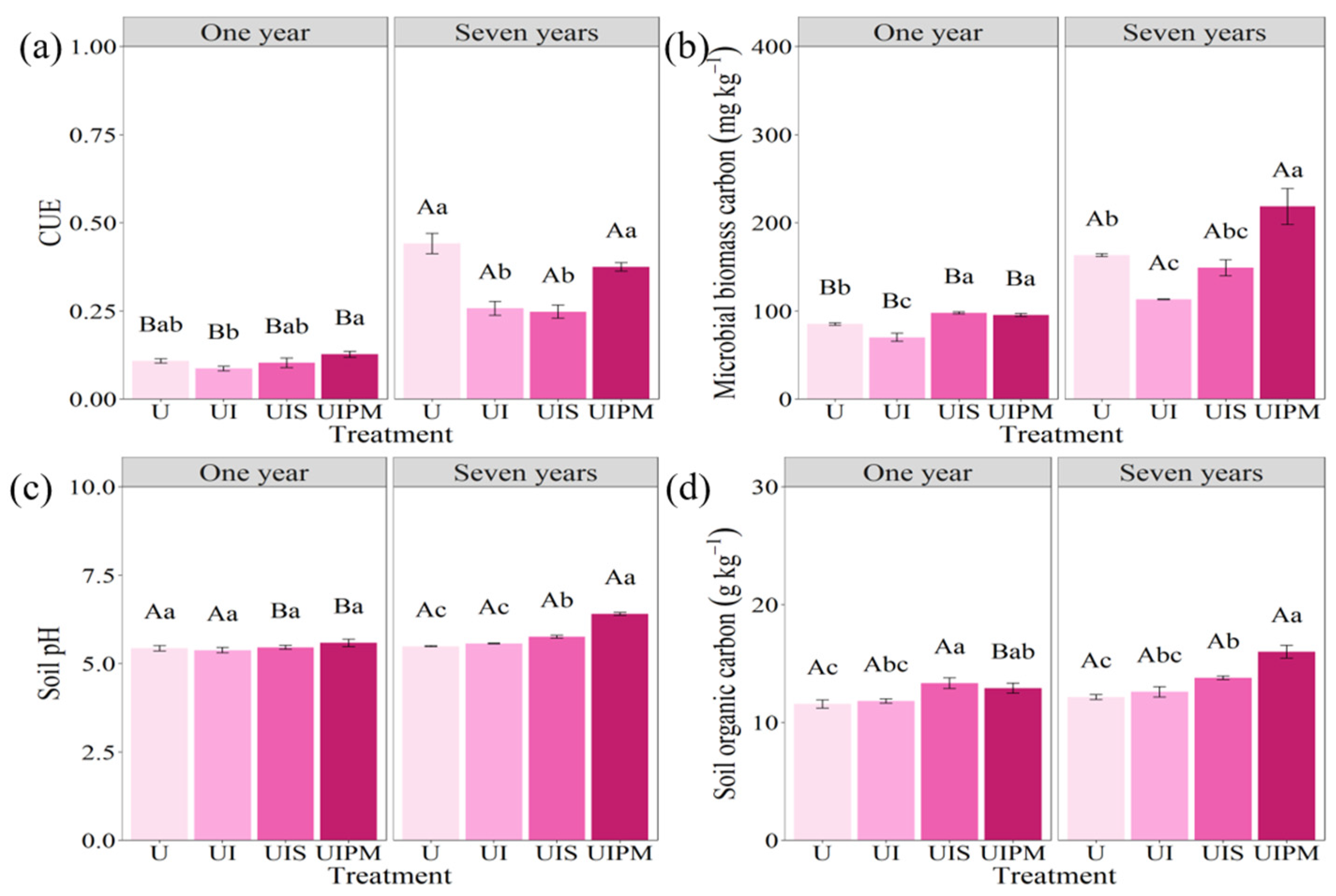
The soil microbial CUE of all treatments ranges from 0.10 to 0.42 (Figure 1a). After the corn harvest in 2022, the soil microbial CUE of all treatments was significantly higher than that of 2016 (p < 0.05). After one year of corn planting, the soil microbial CUE of UIPM (0.14) was significantly higher than that of UI (0.11). After seven years of corn planting, the soil microbial CUE of U (0.42) and UIPM (0.35)was significantly higher than that of UI (0.26) and UIS (0.22) (p < 0.05).
The soil MBC of all treatments ranges from 70.13 to 218.58 mg kg−1 (Figure 1b). The soil MBC of all treatments after 7 years of corn planting was significantly higher than that after 1 year of corn planting (p < 0.05). After one year of corn planting, the MBC of UIS and UIPM treatment was the highest, followed by U treatment, and UI treatment was the lowest (p < 0.05). After seven years of corn planting, the UIPM treatment had the highest soil MBC and was significantly higher than that of other treatments; in addition, the soil MBC of the U treatment was significantly higher than that of the UI treatment (p < 0.05).
The pH of all treatments ranges from 5.38 to 6.41 g kg−1 (Figure 1c). After seven years of corn planting compared to one year of corn planting, the pH of UIPM and UIS treatment increased significantly (p < 0.05). After one year of corn planting, there was no significant difference in the pH of all treatments. After seven years of corn planting, UIPM treatment had the highest pH and was significantly higher than that of other treatments; in addition, UIS treatment had significantly higher pH than U and UI treatment (p < 0.05).
The SOC of all treatments ranges from 11.58 to 16.01 g kg−1 (Figure 1d). After seven years of corn planting, compared to one year of corn planting, only the UIPM treatment showed a significant increase in SOC (p < 0.05). After one year of corn cultivation, SOC content was highest under the UIS treatment, significantly exceeding that under UI and U treatments; additionally, SOC under UIPM treatment was significantly higher than that under U treatment (p < 0.05). After seven years, UIPM treatment yielded the highest SOC, significantly higher than the other three treatments, while UIS treatment had significantly higher SOC than U treatment (p < 0.05).

3.2. Bacterial and Fungal Gene Diversity

Different treatments and years of corn planting had different effects on the bacterial and fungal copies (Table 3). After seven years of corn planting, compared with one year of corn planting, the soil bacterial copies in all treatments increased significantly (p < 0.05). The soil bacterial copies in all treatments showed no significant difference after the first year of corn planting. Following seven years of cropping, the UIPM treatment yielded significantly higher soil bacterial copy numbers than the UI and U treatments, while the UIS treatment had significantly higher levels than the U treatment (p < 0.05). After seven years of corn planting, compared with one year of corn planting, the soil fungal copies in all treatments except the U treatment increased significantly (Table 3) (p < 0.05). Following one year of corn cropping, the UIPM treatment yielded significantly higher soil fungal copy numbers than the UI treatment; after seven years, UIPM values were significantly higher than those of the UI and U treatments. The fungal/bacterial gene ratio (F/B) declined over the seven-year period, with all treatments maintaining an F/B of ~1%.
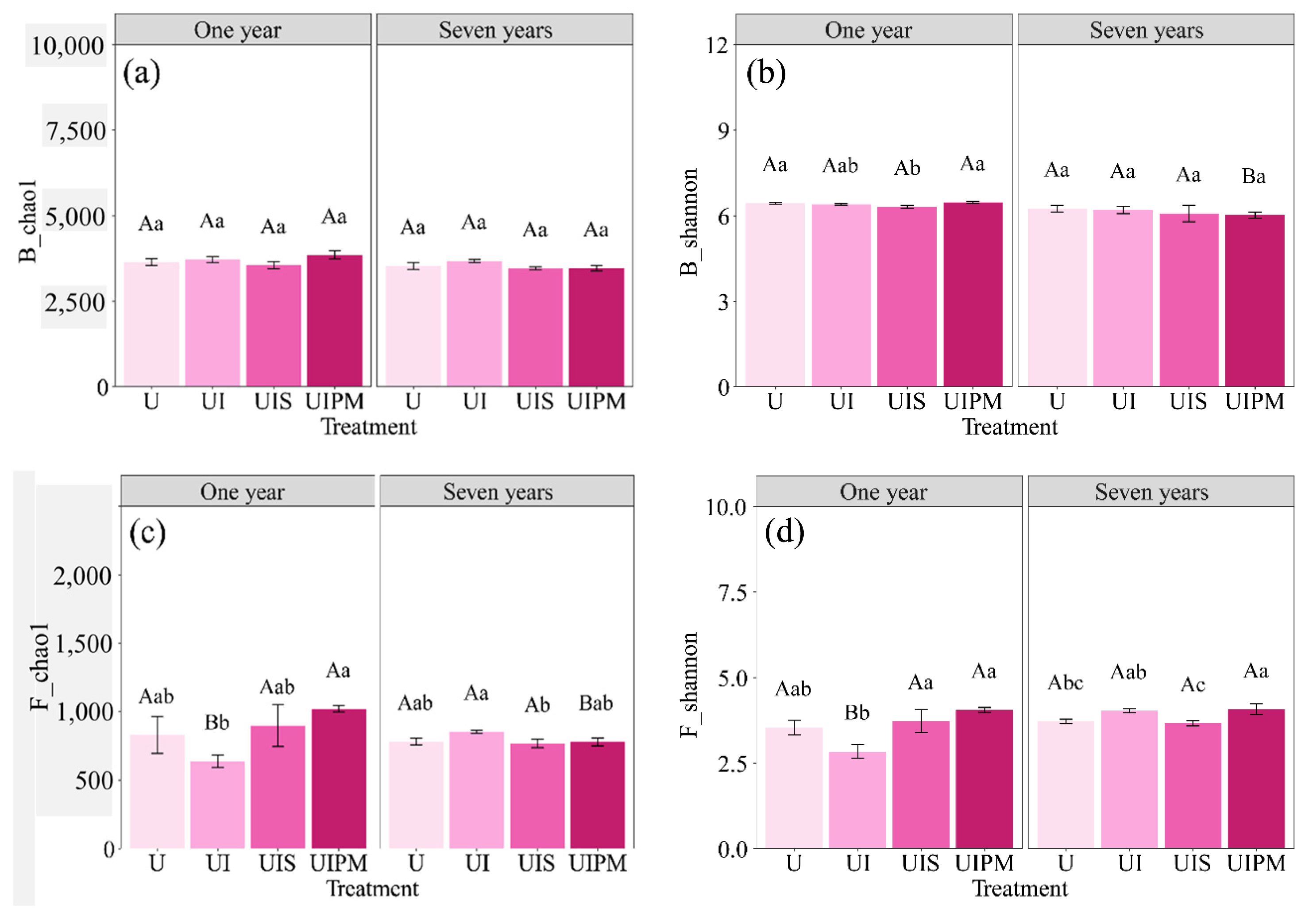
The α-diversity of bacteria and fungi was affected by different treatments and corn planting years (Figure 2). There was no significant change in soil bacterial Chao1 in the seventh and first year of corn planting in each treatment. There was no significant difference in soil bacterial Chao1 among all treatments, whether in the first or seventh year of corn planting (Figure 2a). There was no significant change in soil bacterial Shannon in the seventh and first year of corn planting in each treatment, except for a significant decrease in the UIPM treatment (p < 0.05). Except for the significant decrease in the UIS treatment compared to the UIPM treatment in the first year of corn planting, there was no significant difference in soil bacterial Shannon among all treatments in the first and seventh years of corn planting (Figure 2b) (p < 0.05). After seven years of corn planting compared to one year of corn planting, the soil fungal Chao1 of UIPM showed a decreasing trend, while the UI treatment showed a significant increase in fungal Chao1 (p < 0.05). After one year of corn planting, the soil fungal Chao1 in the UIPM treatment was significantly higher than that in the UI treatments (p < 0.05), while after seven years of corn planting, the soil fungal Chao1 in the UI treatment was significantly higher than that in the UIS treatment (p < 0.05) (Figure 2c). There was no significant change in soil fungal Shannon in the seventh year of corn planting compared to the first year of corn planting in each treatment, except for a significant increase in the UI treatment (p < 0.05). After one year of corn planting, the soil fungal Shannon in the UIPM and UIS treatments were significantly higher than that in the UI treatment (p < 0.05). After seven years of corn planting, the UIPM treatment had the highest fungal Shannon and was significantly higher than that of the U and UIS treatments; in addition, the UI treatment was significantly higher than the UIS treatment (p < 0.05) (Figure 2d).
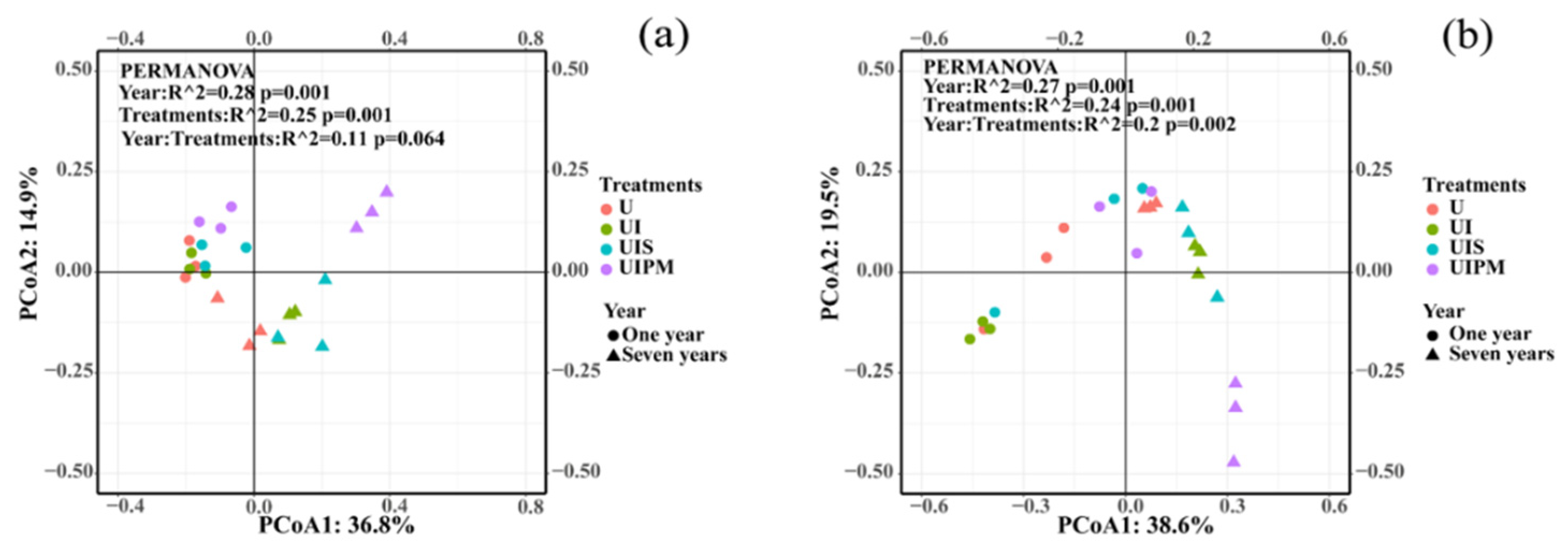
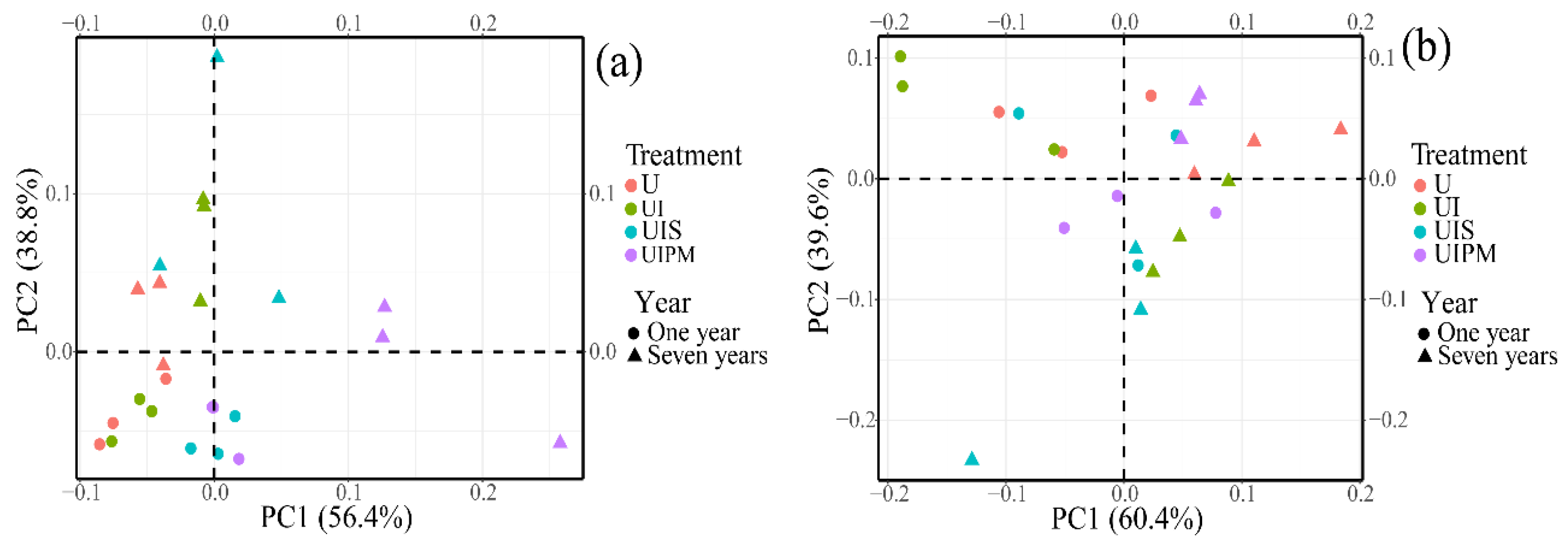
The β-diversity results of differences between microbial communities were visualized in Figure 3 by principal coordinate analysis (PCoA), and the significance of differences between microbial communities in soil treatments and between years was analyzed using PerMANOVA, calculated based on a distance matrix (Table 4). The bacterial and fungal communities were significantly separated between treatments and between years (Figure 3). The PerMANOVA results based on Bray–Curtis distance matrix also showed that the bacterial community structure of the U treatment was significantly different from that of UIS and UIPM; the fungal community structure of the UIPM treatment was significantly different from that of U and UIS; and the planting years had a significant impact on both bacterial and fungal communities (Table 4).

3.3. Bacterial and Fungal Communities

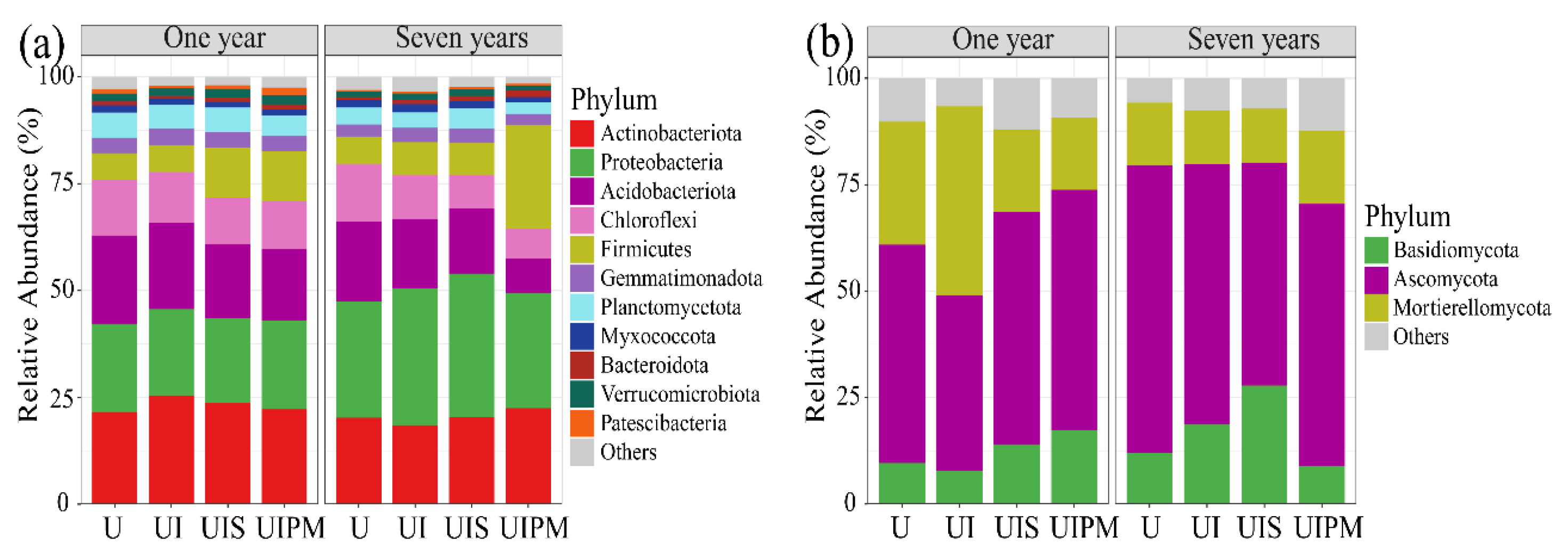
After processing and classifying high-throughput data of soil bacterial and fungal communities, all bacteria could be classified into 41 phyla. Acidobacteriota, Proteobacteria, Actinobacteriota, Chloroflexi, Firmicutes, Gemmatimonadota, Planctomycetota, Myxococcota, Bacteroidota, Verrucomicrobiota, and Patescibacteria were the dominant phyla, and collectively accounted for >96% of all sequences in all samples (Figure 4a). After seven years of corn planting, compared to one year of corn planting, Chloroflexi, Acidobacteriota, and Patescibacteria in the UIPM treatment and Patescibacteria in U and UIS significantly decreased (p < 0.05), while Proteobacteria in all treatments and Firmicutes in the UIPM treatment significantly increased (p < 0.05). After one year of corn planting, Patescibacteria in the UIPM treatment were significantly greater than those in the UI treatment; in addition, Firmicutes in the UIS and UIPM treatments were significantly greater than those in the UI and U treatments. After seven years of corn planting, Chloroflexi in the U treatment was significantly greater than that in the other three treatments, and Chloroflexi in the UI treatment was significantly greater than those in the UIS and UIPM treatments (p < 0.05). Acidobacteriota in the UIPM treatment were significantly smaller than those in the other three treatments, while Firmicutes in the UIPM treatment were significantly higher than those in the other treatments (p < 0.05). Except for those unidentified, all fungi could be classified into 17 phyla. Basidiomycota, Ascomycota, and Mortierellomycota were the dominant phyla and collectively accounted for >87% of all sequences in all samples (Figure 4b). After seven years of corn planting, compared to one year of corn planting, Ascomycota in the U treatment and Ascomycota and Basidiomycota in the UI treatment significantly increased, while Basidiomycota in the UIPM treatment significantly decreased (p < 0.05). After one year of corn planting, Ascomycota and Basidiomycota in the UIPM treatment were significantly greater than those in the UI treatment (p < 0.05). After seven years of corn planting, Ascomycota in the U treatment was significantly greater than that in the UIS treatment; in addition, Basidiomycota in the UIS treatment was significantly greater than those in the U and UIPM treatments (p < 0.05).
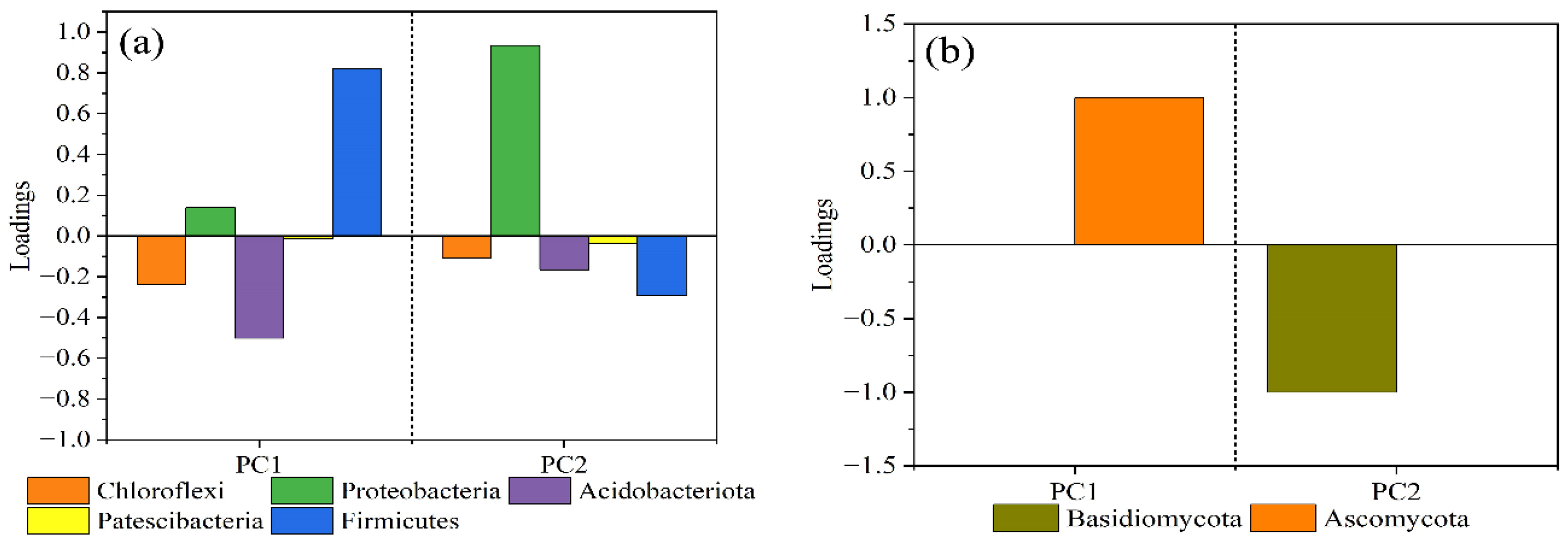
The results of soil microbial composition differences at the phylum level were visualized in Figure 5 by PCA, and then the significance of microbial community composition differences at the phylum level between soil treatments in different years was analyzed by PerMANOVA based on Euclidean distances (Table 5). Bacterial and fungal community quadrats separated along the principal component first axis (PC1) (Figure 5a,b), with significant differences in bacterial and fungal community composition between years found by PerMANOVA (Table 5). The bacterial community samples of UIPM treatment were separated from U and UI treatments along the principal component second axis (PC2) (Figure 5a), and the bacterial community composition was significantly different by PerMANOVA (Table 5). Further analysis of the loading values (Loading) on the PCA principal axis of bacterial and fungal communities that are more sensitive to different treatments and corn planting years was conducted, identifying the microbes that primarily contribute to the differences in bacterial and fungal community composition between treatments. Through the analysis of the loading values of bacterial composition in PC1 and PC2, it was found that Firmicutes had a higher score in PC1, while Proteobacteria had a higher score in PC2 (absolute value > 0.5) (Figure 6a). Through the analysis of the loading values of fungal composition in PC1 and PC2, it was found that Ascomycota had a higher score in PC1, while Basidiomycota had a higher score in PC2 (absolute value > 0.5) (Figure 6b).

3.4. Importance Analysis

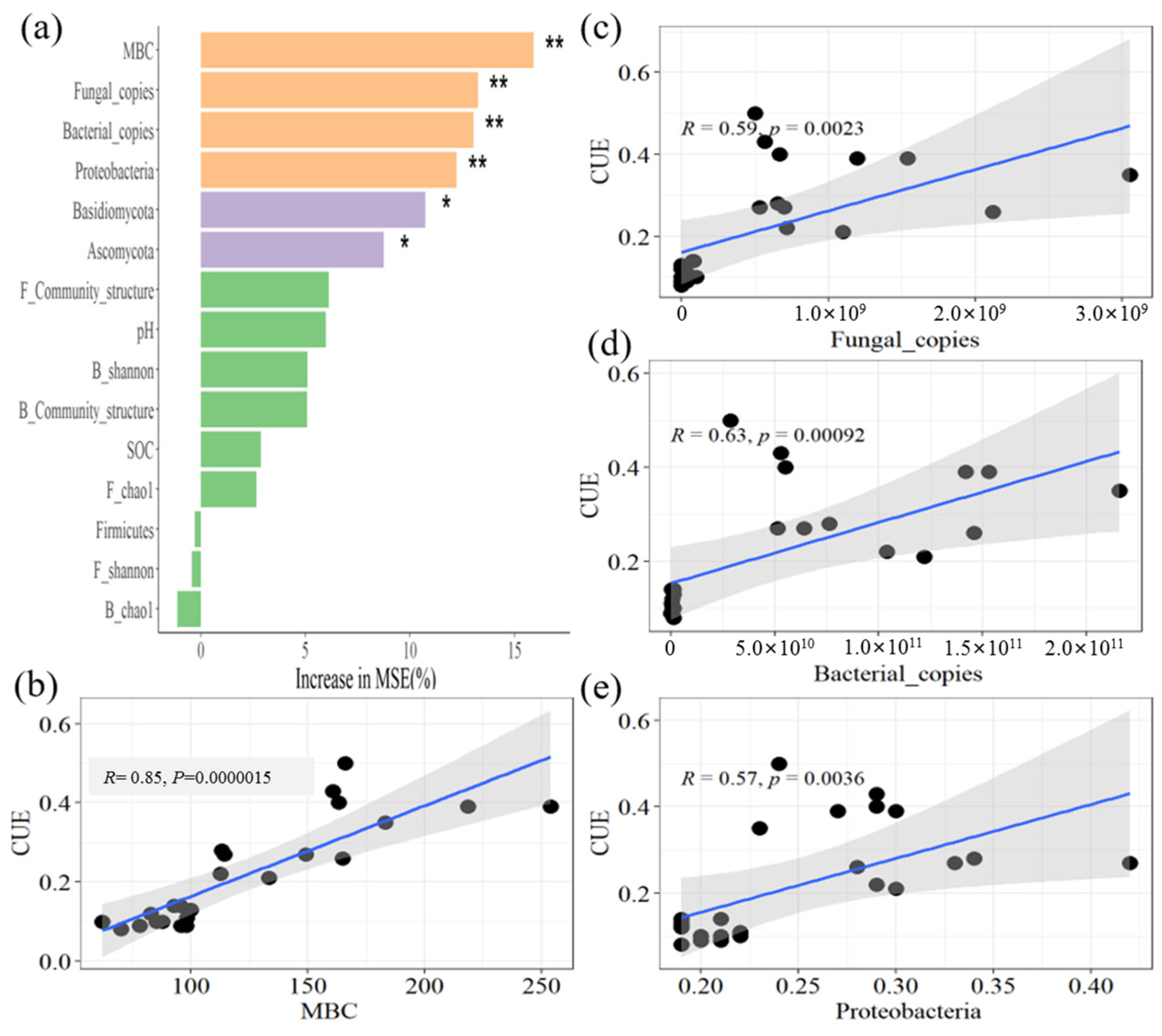
Importance analysis revealed that the MBC, fungal copies, bacterial copies, Proteobacteria, Basidiomycota, and Ascomycota significantly impacted CUE from the corn field (Figure 7a). Notably, the CUE was primarily driven by MBC, fungal copies, bacterial copies, and Proteobacteria and positively correlated with them (Figure 7b–e).

4. Discussion

4.1. Effects of Inhibitor Application on Soil Microbial CUE

Our results indicate that compared with the U treatment, the soil microbial CUE in the UI treatment is significantly decreased (Figure 1a), mainly due to the reduction in microbial growth and promotion of microbial respiration (Figure 1b; Table S1). This may be because the application of inhibitors inhibited the gene abundance or enzymatic activity of N transformation-related soil microbes and had a positive feedback effect on these soil microbes, leading to an increase in C loss from microbial respiration [28], which supports hypothesis 1. However, there was no significant difference in the α-diversity and β-diversity of the soil microbial community (Figure 2 and Figure 3; Table 4). This suggests that although the application of inhibitors can affect the abundance of some N transformation-related functional genes [5,10], it has little effect on the entire microbial community. In addition, both short-term (one-year) and long-term (seven-year) application of inhibitors had no significant effect on soil pH, fungal, and bacterial copies (Figure 1c; Table 3), so hypotheses 2, 3, and 4 are not supported. Although the MBC in the UI treatment was significantly lower than that in the U treatment (Figure 1b), there was no significant difference between their SOC (Figure 1d). This may be due to the small proportion of changes in MBC within SOC (Figure 1b,d).

4.2. Effects of Inhibitors Combined with Different Organic Materials on Soil Microbial CUE

In this study, soil microbial CUE significantly increased with the increase in corn planting years (Figure 1a), which might be due to the long-term addition of C and N alleviating substrate limitation for microbial growth [18,29], both bacterial and fungal gene copies significantly increased (Table 3), and more C was used for microbial growth (Figure 1b; Table S1). In addition, the proportion of oligotrophic microorganisms (e.g., Chloroflexi, Acidobacteriota, and Basidiomycota) decreased, while the proportion of copiotrophic microorganisms (e.g., Proteobacteria, Firmicutes, and Ascomycota) increased (Figure 4), indicating that long-term C and N input was beneficial to soil microorganisms to obtain nutrients and increase soil CUE [6,18].
Previous studies have indicated that C and N addition shifts microbial community composition [14,26], which in turn affects soil microbial CUE [15,29]. After seven years of corn cultivation, the UIPM treatment had significantly higher soil microbial CUE than the UI and UIS treatments, by 0.10 (37.38%) and 0.14 (63.89%), respectively, with no significant difference between the UIS and UI treatments (Figure 1a). Soil microbial CUE was mainly influenced by MBC, and fungal and bacterial copy numbers (Figure 7). UIPM significantly increased MBC (Figure 1b), fungal, and bacterial copies (Table 3) compared with UI. In addition, the UIPM treatment significantly increased Firmicutes, which tend to have higher CUE [30]. The UIPM treatment has a higher soil microbial CUE than the UIS treatment, which may be due to the optimal soil microbial CUE decreasing with the increase in substrate C/N [12], PM being more nutrient-rich and having a lower C/N ratio than corn stalks. Soil microbes preferentially absorb and utilize substances with an elemental composition most suitable for their growth needs, facilitating the maintenance of their own stoichiometric balance [31,32]. Therefore, PM is more conducive to microbial growth than corn stalks (Figure 1b). In addition, the application of PM reduces the C loss of soil microbial respiration during the corn growth period compared to corn stalks (Table S1). The SOC of the UIPM treatment was significantly larger than that of the UIS and UI treatments, which, combined with the differences in soil microbial CUE among the three treatments mentioned above, indicated that not only higher soil microbial CUE but also appropriate addition of exogenous organic matter was required for SOC increase.

4.3. Limitations and Future Directions

In this study, compared with the UIS treatment, the UIPM treatment significantly increased SOC content and soil microbial CUE under inhibitor application conditions. This might be attributed to the fact that PM was more readily decomposable and thus more available for microbial utilization than corn stalks. Therefore, future studies should focus on the mechanisms and potential of SOC sequestration induced by the combined application of inhibitors and PM.

5. Conclusions

This study showed that inhibitor application reduced soil microbial CUE by decreasing microbial C immobilization and enhancing microbial respiration, with negligible effects on microbial community structure. Under inhibitor application conditions, the addition of PM improved soil microbial CUE, which was mainly achieved by increasing microbial immobilization C, fungal, and bacterial copies. Long-term addition of C and N was beneficial to the increase in soil microbial CUE, because the input of nutrients stimulates microbial growth. Although high soil microbial CUE was beneficial to soil C sequestration, it also required appropriate exogenous organic matter addition to ensure SOC increase. Therefore, in this study, when using inhibitors to improve fertilizer N supply in corn fields, combined application with PM was more conducive to improving soil microbial CUE and promoting SOC sequestration than corn stalks.

Supplementary Materials

The following supporting information can be downloaded at: https://www.mdpi.com/article/10.3390/agriculture16030300/s1. Table S1: Changes in soil microbial uptake C, respiration C, and growth C under different planting years of corn.

Author Contributions

Conceptualization, Y.M. and K.W.; methodology, Y.M.; validation, W.B. and N.L.; investigation, S.Z.; resources, Y.X., P.G. and Y.S.; data curation, Y.M.; writing—original draft preparation, Y.M. and K.W.; writing—review and editing, K.W. and L.Z.; supervision, Z.W.; funding acquisition, L.Z. All authors have read and agreed to the published version of the manuscript.

Funding

This research was funded by the National Key Research and Development Program of China (2023YFD1500500), the Liaoning Province Key Research and Development Program (2025JH2/102700015), the Applied Basic Research Program of Liaoning Province (2025JH2/101300076), the National Scientific Foundation Project of China (32272232), the Northeast Water saving Agriculture Key Laboratory of the Ministry of Agriculture and Rural Affairs (120520501), and the Discipline Construction Project of Liaoning Academy of Agricultural Sciences (120520303).

Institutional Review Board Statement

Not applicable.

Data Availability Statement

The raw data supporting the conclusions of this article will be made available by the authors upon request.

Acknowledgments

The authors thank the editors and reviewers for their constructive comments and suggestions.

Conflicts of Interest

The authors declare no conflicts of interest.

References

  1. Stockmann, U.; Adams, M.A.; Crawford, J.W.; Field, D.J.; Henakaarchchi, N.; Jenkins, M.; Minasny, B.; McBratney, A.B.; Courcelles, V.R.; Singh, K.; et al. The knowns, known unknowns and unknowns of sequestration of soil organic carbon. Agric. Ecosyst. Environ. 2013, 164, 80–99. [Google Scholar] [CrossRef]
  2. Pries, C.E.H.; Castanha, C.; Porras, R.; Torn, M. The whole-soil carbon flux in response to warming. Science 2017, 355, 1420–1423. [Google Scholar] [CrossRef]
  3. Wang, C.; Qu, L.; Yang, L.; Liu, D.; Morrissey, E.; Miao, R.; Liu, Z.; Wang, Q.; Fang, Y.; Bai, E. Large-scale importance of microbial carbon use efficiency and necromass to soil organic carbon. Glob. Change Biol. 2021, 27, 2039–2048. [Google Scholar] [CrossRef] [PubMed]
  4. Meng, Y.; Wu, K.K.; Gong, P.; Zhang, Z.; Han, M.; Wei, Z.B.; Wang, L.L.; Lv, N.; Bai, W.; Zhang, L.L. Effects of corn stalks returning on soil microbial carbon use efficiency and corn yield in semi-arid cropland. BioResources 2024, 19, 103–115. [Google Scholar] [CrossRef]
  5. He, T.; Liu, D.; Yuan, J.; Luo, J.; Lindsey, S.; Bolan, N.; Ding, W. Effects of application of inhibitors and biochar to fertilizer on gaseous nitrogen emissions from an intensively managed wheat field. Sci. Total Environ. 2018, 628, 121–130. [Google Scholar] [CrossRef] [PubMed]
  6. Ma, S.; Zhu, W.; Wang, W.; Li, X.; Sheng, Z. Microbial assemblies with distinct trophic strategies drive changes in soil microbial carbon use efficiency along vegetation primary succession in a glacier retreat area of the southeastern Tibetan Plateau. Sci. Total Environ. 2023, 867, 161587. [Google Scholar] [CrossRef]
  7. Tian, D.; Zhang, Y.; Zhou, Y.; Mu, Y.; Liu, J.; Zhang, C.; Liu, P. Effect of nitrification inhibitors on mitigating N2O and NO emissions from an agricultural field under drip fertigation in the North China Plain. Sci. Total Environ. 2017, 598, 87–96. [Google Scholar] [CrossRef]
  8. Vogel, C.; Sekine, R.; Huang, J.; Steckenmesser, D.; Steffens, D.; Huthwelker, T.; Borca, C.N.; Pradas Del Real, A.E.; Castillo-Michel, H.; Adam, C. Effects of a nitrification inhibitor on nitrogen species in the soil and the yield and phosphorus uptake of maize. Sci. Total Environ. 2020, 715, 136895. [Google Scholar] [CrossRef]
  9. Su, Y.; Wang, Y.; Liu, G.; Zhang, Z.; Li, X.; Chen, G.; Gou, Z.; Gao, Q. Nitrogen (N) “supplementation, slow release, and retention” strategy improves N use efficiency via the synergistic effect of biochar, nitrogen-fixing bacteria, and dicyandiamide. Sci. Total Environ. 2024, 908, 168518. [Google Scholar] [CrossRef]
  10. Wu, K.K.; Gong, P.; Bai, W.; Zhang, Z.; Wei, Z.B.; Yu, C.X.; Song, Y.C.; Xue, Y.; Zhang, L.L. Effect of mixed inhibitor application on N2O production pathways in paddy soil. J. Soils Sediments 2022, 22, 1913–1923. [Google Scholar] [CrossRef]
  11. Silva-Sánchez, A.; Soares, M.; Rousk, J. Testing the dependence of microbial growth and carbon use efficiency on nitrogen availability, pH, and organic matter quality. Soil Biol. Biochem. 2019, 134, 25–35. [Google Scholar] [CrossRef]
  12. Manzoni, S.; Capek, P.; Mooshammer, M.; Lindahl, B.D.; Richter, A.; Santruckova, H. Optimal metabolic regulation along resource stoichiometry gradients. Ecol. Lett. 2017, 20, 1182–1191. [Google Scholar] [CrossRef] [PubMed]
  13. Cui, J.; Zhu, Z.; Xu, X.; Liu, S.; Jones, D.L.; Kuzyakov, Y.; Shibistova, O.; Wu, J.; Ge, T. Carbon and nitrogen recycling from microbial necromass to cope with C:N stoichiometric imbalance by priming. Soil Biol. Biochem. 2020, 142, 107720. [Google Scholar] [CrossRef]
  14. Strickland, M.S.; Rousk, J. Considering fungal: Bacterial dominance in soils—Methods, controls, and ecosystem implications. Soil Biol. Biochem. 2010, 42, 1385–1395. [Google Scholar] [CrossRef]
  15. Miao, Y.C.; Niu, Y.H.; Luo, R.Y.; Li, Y.; Zheng, H.J.; Kuzyakov, Y.; Chen, Z.M.; Liu, D.Y.; Ding, W.X. Lower microbial carbon use efficiency reduces cellulose-derived carbon retention in soils amended with compost versus mineral fertilizers. Soil Biol. Biochem. 2021, 156, 108227. [Google Scholar] [CrossRef]
  16. Yin, G.; Gu, J.; Zhang, F.; Hao, L.; Cong, P.; Liu, Z. Maize yield response to water supply and fertilizer input in a semi-arid environment of Northeast China. PLoS ONE 2014, 9, e86099. [Google Scholar] [CrossRef]
  17. Cai, A.; Liang, G.; Zhang, X.; Zhang, W.; Li, L.; Rui, Y.; Xu, M.; Luo, Y. Long-term straw decomposition in agro-ecosystems described by a unified three-exponentiation equation with thermal time. Sci. Total Environ. 2018, 636, 699–708. [Google Scholar] [CrossRef]
  18. Fang, Y.Y.; Singh, B.P.; Collins, D.; Li, B.Z.; Zhu, J.; Tavakkoli, E. Nutrient supply enhanced wheat residue-carbon mineralization, microbial growth, and microbial carbon-use efficiency when residues were supplied at high rate in contrasting soils. Soil Biol. Biochem. 2018, 126, 168–178. [Google Scholar] [CrossRef]
  19. Jones, D.L.; Hill, P.W.; Smith, A.R.; Farrell, M.; Ge, T.; Banning, N.C.; Murphy, D.V. Role of substrate supply on microbial carbon use efficiency and its role in interpreting soil microbial community-level physiological profiles (CLPP). Soil Biol. Biochem. 2018, 123, 1–6. [Google Scholar] [CrossRef]
  20. Öquist, M.G.; Erhagen, B.; Haei, M.; Sparrman, T.; Ilstedt, U.; Schleucher, J.; Nilsson, M.B. The effect of temperature and substrate quality on the carbon use efficiency of saprotrophic decomposition. Plant Soil 2017, 414, 113–125. [Google Scholar] [CrossRef]
  21. Soong, J.L.; Fuchslueger, L.; Maranon-Jimenez, S.; Torn, M.S.; Janssens, I.A.; Penuelas, J.; Richter, A. Microbial carbon limitation: The need for integrating microorganisms into our understanding of ecosystem carbon cycling. Glob. Change Biol. 2020, 26, 1953–1961. [Google Scholar] [CrossRef] [PubMed]
  22. Wang, H.; Ye, W.H.; He, W.; Guo, Z.X.; Hu, G.Q.; Lou, Y.H.; Yang, Q.G.; Yang, Z.C.; Sun, Y.J.; Pan, H.; et al. Phosphorus addition increases soil organic matter priming in a coastal saline soil. Soil Biol. Biochem. 2025, 208, 109862. [Google Scholar] [CrossRef]
  23. Qu, L.R.; Wang, C.; Bai, E. Evaluation of the 18O-H2O incubation method for measurement of soil microbial carbon use efficiency. Soil Biol. Biochem. 2020, 145, 107802. [Google Scholar] [CrossRef]
  24. Yu, C.X.; Xie, X.S.; Yang, H.Z.; Yang, L.J.; Li, W.T.; Wu, K.K.; Zhang, W.M.; Feng, C.; Li, D.P.; Wu, Z.J.; et al. Effect of straw and inhibitors on the fate of nitrogen applied to paddy soil. Sci. Rep. 2020, 10, 21582. [Google Scholar] [CrossRef]
  25. Joergensen, R.G. The fumigation-extraction method to estimate soil microbial biomass: Calibration of the k(EC) value. Soil Biol. Biochem. 1996, 28, 25–31. [Google Scholar] [CrossRef]
  26. Li, J.; Sang, C.P.; Yang, J.Y.; Qu, L.R.; Xia, Z.W.; Sun, H.; Jiang, P.; Wang, X.G.; He, H.B.; Wang, C. Stoichiometric imbalance and microbial community regulate microbial elements use efficiencies under nitrogen addition. Soil Biol. Biochem. 2021, 156, 108207. [Google Scholar] [CrossRef]
  27. Xia, Z.; Yang, J.; Sang, C.; Wang, X.; Sun, L.; Jiang, P.; Wang, C.; Bai, E. Phosphorus Reduces Negative Effects of Nitrogen Addition on Soil Microbial Communities and Functions. Microorganisms 2020, 8, 1828. [Google Scholar] [CrossRef]
  28. Jiang, D.Q.; Jiang, N.; Jiang, H.; Chen, L.J. Urease inhibitors increased soil ureC gene abundance and intracellular urease activity when extracellular urease activity was inhibited. Geoderma 2023, 430, 116295. [Google Scholar] [CrossRef]
  29. Hu, J.; Huang, C.; Zhou, S.; Kuzyakov, Y. Nitrogen addition to soil affects microbial carbon use efficiency: Meta-analysis of similarities and differences in 13C and 18O approaches. Glob. Change Biol. 2022, 28, 4977–4988. [Google Scholar] [CrossRef]
  30. Smith, T.P.; Clegg, T.; Bell, T.; Pawar, S. Systematic variation in the temperature dependence of bacterial carbon use efficiency. Ecol. Lett. 2021, 24, 2123–2133. [Google Scholar] [CrossRef]
  31. Lee, Z.M.; Schmidt, T.M. Bacterial growth efficiency varies in soils under different land management practices. Soil Biol. Biochem. 2014, 69, 282–290. [Google Scholar] [CrossRef]
  32. Li, S.; Cui, Y.; Xia, Z.; Zhang, X.; Zhou, C.; An, S.; Zhu, M.; Gao, Y.; Yu, W.; Ma, Q. Microbial nutrient limitations limit carbon sequestration but promote nitrogen and phosphorus cycling: A case study in an agroecosystem with long-term straw return. Sci. Total Environ. 2023, 870, 161865. [Google Scholar] [CrossRef]
Figure 1. Changes in soil microbial carbon use efficiency (CUE) (a), soil microbial biomass carbon (MBC) (b), soil organic carbon (SOC) (c), and soil pH (d) under different planting years of corn. U, urea application; UI, urea application with inhibitors; UIS, urea and inhibitor application with corn stalks; UIPM, urea and inhibitor application with pig manure. Data are presented as mean values with standard errors (n = 3). Different capital letters indicated significant difference between different years at p < 0.05. Different lowercase letters indicated significant difference between different treatments at p < 0.05.
Agriculture 16 00300 g001
Figure 2. Changes in species richness index (Chao1) and diversity index (Shannon) of soil bacteria (a,b) and fungi (c,d) under different planting years (α-diversity). Different capital letters indicated significant difference between different years at p < 0.05. Different lowercase letters indicated significant difference between different treatments at p < 0.05.
Agriculture 16 00300 g002
Figure 3. Principal coordinate analysis (PCoA) based on OTU horizontal Bray–Curtis distance visualizes the difference in soil microbial community structure ((a): bacteria community; (b): fungi community) in different years and treatments (β-diversity).
Agriculture 16 00300 g003
Figure 4. Taxonomic composition of soil bacterial (a) and fungal (b) communities at the phylum level (of relative abundance > 1% at least in one treatment) under different planting years of corn.
Agriculture 16 00300 g004
Figure 5. Visualization of bacteria (a) and fungal (b) community composition dissimilarities upon different treatments in different years using principal component analysis (PCA) based on Euclidean distances at phylum level.
Agriculture 16 00300 g005
Figure 6. The loadings of principal components for microbial community composition ((a): bacteria community; (b): fungi community) at phylum level upon different treatments in different years.
Agriculture 16 00300 g006
Figure 7. Importance analysis of factors influencing CUE in corn field. (a) Relative importance of variables affecting CUE; (b) relationship between CUE and MBC (mg kg−1); (c) relationship between CUE and Fungal_copies (log of fungal gene copies g−1 dry soil); (d) relationship between CUE and Bacterial_copies (log of fungal gene copies g−1 dry soil); (e) relationship between CUE and Proteobacteria (relative abundance of Proteobacteria). The blue solid line represents the linear fitting trend, the gray shaded area denotes the 95% confidence interval of the fitting results (*, p < 0.05; **, p < 0.01), and the black dots indicate the measured data points of each independent sample.
Agriculture 16 00300 g007
Table 1. Soil physicochemical properties (0–20 cm soil layer).
Soil TypeMean Annual Air TemperatureMean Annual PrecipitationFrost-Free PeriodOrganic C
(g kg−1)
Total N
(g kg−1)
pH
Luvisol7–8 °C700 mm147–164 days11.621.035.77
Table 2. Primer sequences of bacteria and fungi used for PCR amplification.
Sample TypeAmplification RegionPrimer Sequence 5′–3′ Thermal Profile
Bacteria16S rDNA V3-V4 (338–806)ACTCCTACGGGAGGCAGCAG95 °C for 30 s, followed by 40 cycles of 95 °C for 10 s, 60 °C for 30 s, and 72 °C for 40 s
GGACTACHVGGGTWTCTAAT
FungiITS1 (ITS1-ITS2)CTTGGTCATTTAGAGGAAGTAA95 °C for 30 s, followed by 40 cycles of 95 °C for 10 s, 60 °C for 30 s, and 72 °C for 40 s
TGCGTTCTTCATCGATGC
Table 3. Changes in gene copies of soil fungi and bacteria under different planting years of corn.
YearTreatmentLog of Fungal Gene Copies g−1 Dry SoilLog of Bacterial Gene Copies g−1 Dry SoilFungal Gene/Bacterial Gene
2016U7.37 ± 0.63 Aab8.93 ± 0.10 Ba0.08 ± 0.04 Aa
UI6.10 ± 0.09 Bb8.93 ± 0.10 Ba0.00 ± 0.00 Ba
UIS7.13 ± 0.43 Bab8.48 ± 0.31 Ba0.16 ± 0.09 Aa
UIPM7.77 ± 0.12 Ba8.65 ± 0.25 Ba0.19 ± 0.12 Aa
2022U8.76 ± 0.04 Ab10.64 ± 0.09 Ac0.01 ± 0.00 Aa
UI8.80 ± 0.04 Ab10.87 ± 0.09 Abc0.01 ± 0.00 Aa
UIS9.07 ± 0.14 Aab11.02 ± 0.11 Aab0.01 ± 0.00 Aa
UIPM9.25 ± 0.12 Aa11.22 ± 0.06 Aa0.01 ± 0.00 Aa
U, urea application; UI, urea application with inhibitors; UIS, urea and inhibitor application with corn stalks; UIPM, urea and inhibitor application with pig manure. Data are presented as mean values with standard errors (n = 3). Different capital letters indicated significant difference between different years at p < 0.05. Different lowercase letters indicated significant difference between different treatments at p < 0.05.
Table 4. F-value of Permutational ANOVA (PerMANOVA) test of differences in soil microbial community dissimilarities based on Bray–Curtis distances at OTU level.
Bacteria CommunityFungi Community
UUIUISUUIUIS
TreatmentU
UI1.17 0.89
UIS2.40 *1.09 2.091.65
UIPM3.77 **2.452.113.10 *2.322.67 *
Year One yearOne year
Seven years18.53 ***9.83 ***
Bold indicates significant difference. * p < 0.05, ** p < 0.01, *** p < 0.001.
Table 5. F-value of Permutational ANOVA (PerMANOVA) test of differences in soil microbial community composition dissimilarities based on Euclidean distances at phylum level.
Bacteria CommunityFungi Community
UUIUISUUIUIS
TreatmentU
UI0.86 1.42
UIS2.030.50 2.981.08
UIPM8.37 **5.45 **2.580.191.532.66
Year One yearOne year
Seven years9.41 ***6.11 **
Bold indicates significant difference. ** p < 0.01, *** p < 0.001.
Disclaimer/Publisher’s Note: The statements, opinions and data contained in all publications are solely those of the individual author(s) and contributor(s) and not of MDPI and/or the editor(s). MDPI and/or the editor(s) disclaim responsibility for any injury to people or property resulting from any ideas, methods, instructions or products referred to in the content.