Article

Effects of Ethylicin Fumigation on Soil-Borne Diseases and Tomato Growth in an Organic Agricultural Park


1
College of Plant Protection, Jilin Agricultural University, Changchun 130118, China
2
Institute of Plant Protection, Beijing Academy of Agriculture and Forestry Sciences, Beijing 100097, China
3
College of Forestry, Southwest Forestry University, Kunming 650224, China
4
Beijing Lvfulong Agricultural Technology Development Co., Ltd., Beijing 102100, China
5
Hebei Technology Innovation Center for Green Management of Soil-Borne Diseases, Baoding University, Baoding 071000, China
6
State Key Laboratory for Biology of Plant Diseases and Insect Pests, Institute of Plant Protection, Chinese Academy of Agricultural Sciences, Beijing 100193, China
*
Authors to whom correspondence should be addressed.
Agriculture 2026, 16(18), 1964; https://doi.org/10.3390/agriculture16181964 (registering DOI)
Submission received: 21 July 2026 / Revised: 7 September 2026 / Accepted: 10 September 2026 / Published: 13 September 2026
(This article belongs to the Section Crop Protection, Diseases, Pests and Weeds)

Abstract

Long-term continuous cropping aggravates soil-borne diseases and seriously affects crop growth, yield, and quality. Soil fumigation is an effective approach for reducing soil-borne pathogen pressure before crop planting, but environmentally compatible alternatives to conventional fumigants are still needed. The objective of this study was to evaluate the field efficacy of ethylicin as a soil fumigant for controlling major soil-borne pathogens under organic greenhouse production conditions and to determine its effects on soil physicochemical properties and tomato growth and yield. Two consecutive years of field trials were conducted at Yanqing Organic Park. During fumigation, the maximum soil temperature reached 50.8 °C at the soil surface and 42.6 °C at a depth of 10 cm, which may have contributed to pathogen suppression and enhanced the fumigation effect of ethylicin. Ethylicin markedly reduced the populations of Fusarium spp., Phytophthora spp., and Meloidogyne spp., with control efficacies ranging from 96.44% to 97.73%, 68.12% to 95.30%, and 72.12% to 96.91%, respectively. Fumigation also altered soil physicochemical and nutrient properties, decreasing NO3–N content and electrical conductivity while increasing NH4+–N, organic matter, and available potassium. Tomato plant height, stem diameter, and chlorophyll content increased by 16.52%, 20.71%, and 6.73%, respectively, and yield increased by 35.28–38.83% over the two years. Phytophthora parasitica-associated root rot was also reduced following ethylicin fumigation, with the disease index decreasing from 3.75 ± 3.23 to 1.25 ± 2.50 in 2023 and from 5.56 ± 1.92 to 0 in 2024; no visible root rot symptoms were observed in the ethylicin treatment in 2024. Overall, ethylicin provided stable suppression of major soil-borne pathogens while improving soil nutrient conditions and tomato performance. These results support the potential of ethylicin as a pre-plant soil fumigant for greenhouse vegetable production, particularly in systems with high requirements for pesticide-residue control and environmental safety.

1. Introduction

In recent years, protected agriculture in China has expanded rapidly, particularly for high-value crops such as tomato and strawberry. However, long-term continuous cropping has led to an increasing incidence of soil-borne diseases, which seriously threaten crop growth, product quality, and soil productivity. Ensuring crop quality and safety while maintaining economic returns has therefore become an important challenge for sustainable greenhouse production.
Continuous cropping promotes the accumulation of soil-borne pathogens and plant-parasitic nematodes, disrupts the soil microbial balance, and increases the risk of soil-borne disease outbreaks. These problems can substantially reduce crop yield and, in severe cases, result in crop failure and considerable economic losses. As one of the world’s major tomato-producing countries, China faces increasingly serious soil-borne pest and disease problems associated with continuous tomato cultivation, leading to declines in both yield and fruit quality. With the rapid expansion of greenhouse tomato production, the incidence and severity of soil-borne diseases have continued to increase, making effective disease management an important constraint to sustainable production [1,2]. Common tomato diseases include late blight, gray mold, blight, canker, and damping-off [3,4], while continuous cropping further aggravates soil-borne diseases such as blight and wilt [5].
Currently, pre-plant soil fumigation is an effective approach for controlling soil-borne pests and diseases. Methyl bromide (MB) was once widely used as a soil fumigant, but its use has been phased out because of its ozone-depleting potential [6]. At present, commonly used soil fumigants in China include chloropicrin, metam sodium, dimethyl disulfide (DMDS), dazomet, ethylicin, 1,3-dichloropropene (1,3-D), and allyl isothiocyanate [7,8].
Ethylicin is a plant-derived pesticide developed in China and has attracted increasing attention because of its broad-spectrum antimicrobial activity, rapid degradation, and relatively low environmental persistence. These characteristics suggest that ethylicin may have potential as an alternative soil fumigant. Previous studies have shown that ethylicin can effectively suppress soil-borne pathogens such as Fusarium spp. and Phytophthora spp. [9]. Moreover, ethylicin dissipates relatively rapidly in soil and is unlikely to persist for long periods in the environment [10,11,12,13]. Because of its volatility, ethylicin can migrate and diffuse through soil pores in the gaseous phase, potentially allowing it to act against pathogens distributed at different soil depths. These properties may provide advantages for balancing pathogen control and environmental safety. However, previous studies on ethylicin have mainly focused on its antimicrobial activity, dissipation behavior, and performance under controlled conditions, whereas its overall effectiveness under field fumigation conditions remains insufficiently evaluated. In particular, its simultaneous effects on major soil-borne pathogens, soil physicochemical and nutrient properties, and subsequent crop growth and yield require further investigation.
Therefore, this study was conducted at Yanqing Organic Ecological Park, where long-term continuous cropping has resulted in severe soil-borne disease pressure and conventional control measures often fail to provide sufficient and stable disease suppression. The primary objective was to evaluate the field efficacy and application potential of ethylicin as a soil fumigant under these production conditions. Two consecutive years of field experiments were conducted to determine the effects of ethylicin fumigation on the populations of Fusarium spp., Phytophthora spp., and Meloidogyne spp. Soil temperature during plastic-covered fumigation, soil physicochemical and nutrient properties, including pH, electrical conductivity, organic matter, NO3–N, NH4+–N, and available potassium, as well as tomato plant height, stem diameter, chlorophyll content, disease incidence, and yield were also evaluated. We hypothesized that ethylicin fumigation would effectively suppress major soil-borne pathogens and plant-parasitic nematodes, improve soil physicochemical and nutrient conditions, and thereby promote tomato growth and yield. We further hypothesized that the elevated soil temperature generated under plastic mulch would contribute to pathogen suppression during fumigation. This study was designed to assess whether ethylicin could provide an effective soil fumigation option for greenhouse vegetable production systems with stringent requirements for disease control, pesticide residues, and environmental safety.

2. Materials and Methods

2.1. Test Agent

The agents used in the experiment are listed in Table 1.

2.2. Experimental Design

Field fumigation trials were conducted before tomato planting at Yanqing Organic Ecological Park on 11 August 2023 and 12 August 2024. The experimental site had been continuously cultivated with tomato and was characterized by severe soil-borne disease pressure. Before fumigation, the soil was thoroughly mixed by rotary tillage and irrigated to maintain the soil moisture content at 60–70%.
Two treatments were included in the present study: an untreated control (CK) and ethylicin fumigation. The ethylicin-treated area consisted of 17 beds in 2023 and 19 beds in 2024, with untreated areas serving as controls. Each bed was approximately 1.0 m wide and 7.5 m long, with a center-to-center spacing of approximately 1.2 m between adjacent beds and a drip-emitter spacing of 30 cm. Ethylicin was applied through drip irrigation at a rate of 20 g m−2. Immediately after application, the soil surface was covered with polyethylene (PE) film to maintain fumigation conditions and reduce fumigant loss. After 30 d of fumigation, the PE film was removed to allow residual ethylicin to dissipate. The soil was subsequently left uncovered for 15–30 d to minimize potential phytotoxic effects on the following crop. Tomato seedlings were transplanted into the greenhouse in late September in both 2023 and 2024 (the detailed treatment scheme is shown in Table 2).
To evaluate changes in soil-borne pathogens and soil physicochemical properties before and after fumigation, spatially distributed soil sampling was conducted within each treatment area. Before fumigation, soil samples were randomly collected from three locations within both the CK and ethylicin-treated areas to characterize the initial soil conditions. After removal of the PE film, four locations were randomly selected within each treatment area for soil sampling. Sampling locations were positioned away from the treatment boundaries, and soil was collected from a depth of 5–20 cm. Samples collected from different locations were placed in separate bags and transported to the laboratory for subsequent analyses. These sampling locations were used to characterize the spatial variability of soil-borne pathogens and physicochemical properties within each treatment area.

2.3. Test Detection Indicators

(1)
Detection of Fusarium spp. and Phytophthora spp. in soil
A soil suspension was prepared by adding 5 g of soil sample to 95 mL of 0.7‰ sterile agar water, followed by thorough shaking and mixing. In a sterile condition, 1 mL of the soil suspension was inoculated onto Petri dishes containing Komada’s medium [14] and Masago’s medium [15] for the selective isolation of Fusarium spp. and Phytophthora spp., respectively. The compositions of the selective media are shown in Table 3. The plates were incubated at 28 °C in the dark condition for 2–3 d, after which the colonies of Fusarium spp. and Phytophthora spp. were counted.
(2)
Detection of Meloidogyne spp. in soil
After thorough mixing, 50 g of each soil sample was weighed and placed into a plastic cup lined with two layers of gauze and one layer of paper towel. Then, 120 mL of water was added, and the sample was left to stand for 24 h to facilitate nematode extraction. The filtrate containing nematodes was collected into a 50 mL centrifuge tube. The upper suspension was transferred with a pipette and adjusted to a final volume of 10 mL. After thorough mixing, a 1 mL aliquot was taken, and the number of nematodes was counted under a stereomicroscope [16].
(3)
Determination of soil physicochemical properties
Soil physicochemical properties were determined according to standard soil analysis procedures. The methods used and the main reagents required are summarized in Table 4.
(4)
Plant growth and yield measurement
During the fruiting stage, 20 plants were randomly selected from each treatment plot. Plant height and stem diameter were measured using a measuring tape and a digital vernier caliper, respectively. Leaf chlorophyll content was determined using a portable SPAD-502 chlorophyll meter. The harvest date and fruit weight were recorded at each harvest. At the end of the harvest period, total fruit yield was calculated for each treatment.
(5)
Disease and Meloidogyne spp. incidence assessment
At the end of the growing season, after tomato plants were uprooted, each plot was surveyed to assess the incidence of Meloidogyne spp. and Phytophthora parasitica-associated disease. Disease severity was evaluated according to the grading criteria shown in Table 5. The control efficacy of ethylicin treatment was then calculated based on disease incidence in each treatment.

2.4. Data Statistics

Calculation of the effectiveness of defence against soil-borne pathogens [17]:
C o n t r o l   e f f i c a c y % = X 0 X 1 X 0 × 100 %
Y is the control efficacy (%) against soil-borne pathogens, X0 is the number of colonies in the control treatment, and X1 is the number of colonies in the ethylicin treatment.
The disease index (DI) was calculated according to the following formula [18]:
D I % = n i × i N × G × 100
ni is the number of plants at severity grade in each replicate, N is the total number of plants assessed in that replicate, and G is the maximum severity grade.
All experimental data were initially organized using Microsoft Excel 2016. Statistical analyses were performed using IBM SPSS Statistics (version 25.0) (SPSS Inc., Chicago, IL, USA). Differences among treatments were analyzed by one-way analysis of variance (ANOVA), followed by multiple comparison tests. Figures were prepared using Origin 2017 (OriginLab Corp., Northampton, MA, USA) and Adobe Illustrator CC 2019 (Adobe Inc., San Jose, CA, USA).

3. Results

3.1. Soil Temperature During Ethylicin Fumigation

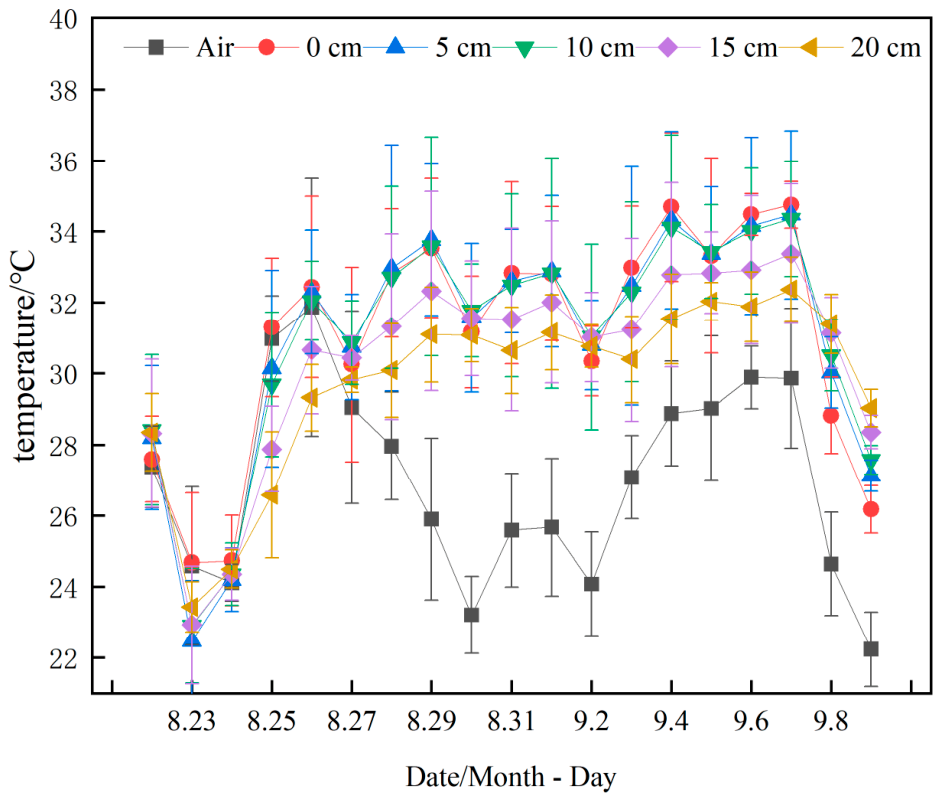
During soil fumigation with ethylicin at an application rapsste of 20 g m−2, temperature changes in the air above the plastic film and at soil depths of 0, 5, 10, 15, and 20 cm beneath the film were continuously monitored using a temperature recorder. Temporal temperature variations from 22 August to 9 September are shown in Figure 1.
The maximum air temperature above the plastic film reached 47.5 °C. The maximum soil temperatures at depths of 0, 5, 10, 15, and 20 cm were 50.8, 45.0, 42.6, 37.1, and 37.3 °C, respectively. The mean temperatures during the monitoring period were 26.9 °C in the air above the film and 31.0, 31.0, 31.0, 30.4, and 29.8 °C at soil depths of 0, 5, 10, 15, and 20 cm, respectively.

3.2. Effects of Ethylicin Fumigation on Soil-Borne Pathogens

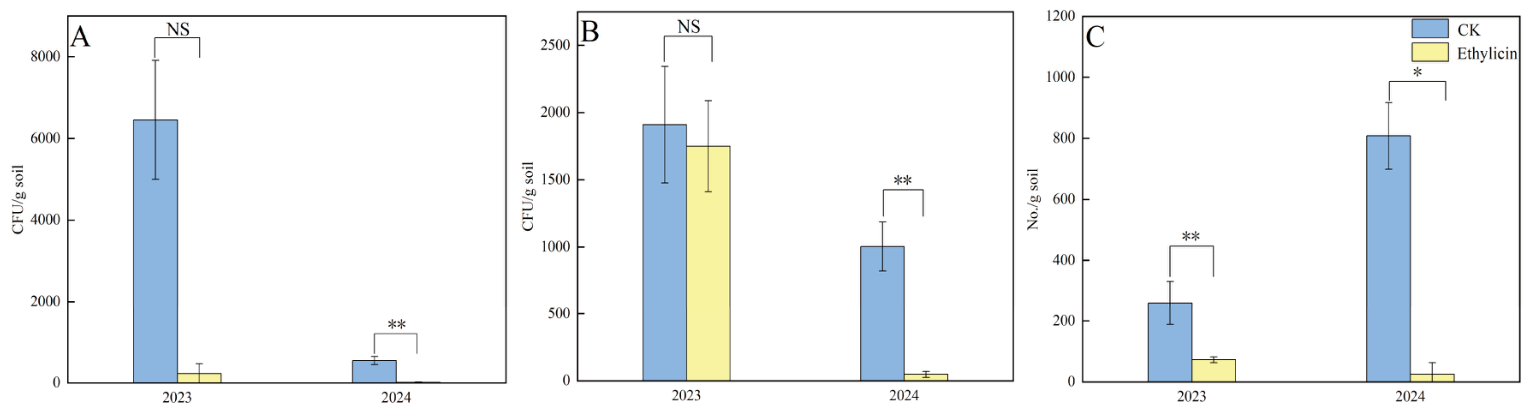
Ethylicin fumigation reduced the populations of Fusarium spp., Phytophthora spp., and Meloidogyne spp. compared with the untreated control, although the statistical significance varied among target organisms and years (Figure 2). In 2023, the control efficacies against Fusarium spp., Phytophthora spp., and Meloidogyne spp. were 96.44%, 68.12%, and 72.12%, respectively. The reductions in Fusarium spp. and Phytophthora spp. were not statistically significant, with mean differences of 5468.00 (95% CI: −1598.08 to 12534.08; p = 0.098) and 338.40 (95% CI: −460.88 to 1137.68; p = 0.358), respectively. In contrast, Meloidogyne spp. abundance was significantly reduced, with a mean difference of 196.00 (95% CI: 116.66–275.34; p = 0.002).
In 2024, ethylicin showed control efficacies of 97.73%, 95.30%, and 96.91% against Fusarium spp., Phytophthora spp., and Meloidogyne spp., respectively. Significant reductions were observed for all three target organisms. The mean differences between the untreated control and ethylicin treatment were 534.00 for Fusarium spp. (95% CI: 250.40–817.60; p = 0.006), 956.40 for Phytophthora spp. (95% CI: 444.74–1468.06; p = 0.007), and 783.00 for Meloidogyne spp. (95% CI: 20.09–1545.91; p = 0.046). Overall, ethylicin consistently reduced the populations of the three soil-borne harmful organisms over the two field seasons, with particularly strong and statistically supported effects in 2024.

3.3. Effects of Ethylicin Fumigation on Soil Physicochemical Properties

Measurements conducted in 2024 showed that ethylicin fumigation significantly affected several soil physicochemical properties (Table 6).
Compared with the control (CK), ethylicin treatment significantly reduced soil nitrate nitrogen (NO3–N) by 59.67%, whereas ammonium nitrogen (NH4+–N) increased by 167.40%. Available potassium showed an increasing trend, although the difference was not statistically significant. Soil organic matter increased significantly by 26.98% following ethylicin fumigation.
Ethylicin fumigation also affected soil chemical characteristics. Soil pH increased by 5.45%, while soil electrical conductivity (EC) decreased significantly by 52.58% relative to the control.

3.4. Effects of Ethylicin Fumigation on Tomato Growth

Field measurements conducted in 2024 showed that ethylicin fumigation significantly promoted tomato growth (Table 7). Compared with the untreated control (CK), ethylicin treatment increased plant height by 16.52%, corresponding to a mean increase of 18.49 cm (95% CI: 12.03–24.94; p = 0.001). Stem diameter increased by 20.71%, with a mean increase of 2.04 mm (95% CI: 0.55–3.53; p = 0.019). Leaf chlorophyll content also increased by 6.73%, corresponding to a mean increase of 2.65 SPAD units (95% CI: 0.27–5.03; p = 0.036).

3.5. Effects of Ethylicin Fumigation on Tomato Yield

As shown in Table 8, ethylicin fumigation significantly increased tomato yield in both years at the Yanqing experimental site. In 2023, the average yield reached 0.56 kg plant−1 under ethylicin treatment, representing a 38.83% increase compared with the untreated control. The total yield was also significantly higher under ethylicin treatment, with a mean difference of 2.52 kg (95% CI: 1.69–3.35; p < 0.001). In 2024, ethylicin treatment increased the average yield by 35.28% to 0.22 kg plant−1, and the total yield remained significantly higher than that of the control, with a mean difference of 0.90 kg (95% CI: 0.05–1.75; p = 0.043). These results demonstrate that ethylicin fumigation significantly increased tomato yield in both years.

3.6. Efficacy of Ethylicin Fumigation Against Meloidogyne spp. and Phytophthora parasitica

As shown in Table 9, Phytophthora parasitica-associated root rot was more severe in the untreated control than in the ethylicin-treated plants. In 2023, root rot severity ranged from grade 0 to 3 in the control and from grade 0 to 1 after ethylicin fumigation, with disease indices of 3.75 ± 3.23 and 1.25 ± 2.50, respectively; however, the difference was not statistically significant. In 2024, root rot severity ranged from grade 1 to 2 in the control, whereas no visible root rot symptoms were observed in the ethylicin treatment. The corresponding disease index decreased from 5.56 ± 1.92 in the control to 0 after fumigation, representing a significant reduction (p < 0.05). These results indicate that ethylicin fumigation consistently reduced the severity of P. parasitica-associated root rot under field conditions.
No visible root galling caused by Meloidogyne spp. was observed on tomato roots in either the untreated control or ethylicin treatment during the two-year survey, and the corresponding disease index remained 0. This was consistent with the relatively low occurrence of root-knot symptoms at the experimental site.

4. Discussion

Under long-term continuous cropping conditions, soil-borne pathogens such as Fusarium spp., Phytophthora spp., and Meloidogyne spp. accumulate in soil and become major constraints to greenhouse vegetable production. Soil fumigation can rapidly reduce pathogen populations before planting and therefore remains an important measure for controlling soil-borne diseases [19,20]. In our two-year field trials, ethylicin fumigation significantly reduced the populations of Fusarium spp., Phytophthora spp., and Meloidogyne spp. The control efficacy against Fusarium spp. exceeded 96% in both years, while high efficacy was also observed against Phytophthora spp. and Meloidogyne spp., demonstrating broad-spectrum and stable field performance. These results were comparable to those obtained with conventional fumigants. For example, combined treatment with dazomet and 1,3-dichloropropene achieved control efficacies of 97.99%, 93.67%, and 94.49% against the three pathogens, respectively [21], close to the maximum efficacies of ethylicin observed in this study. In greenhouse substrates, ethylicin also achieved control efficacies of 94.2% and 87.5% against Fusarium spp. and Phytophthora spp., respectively [22]. Considering the greater heterogeneity of field soils in organic matter, clay content, moisture, and pathogen distribution, the consistently high efficacy observed under field conditions further supports the practical application potential of ethylicin [23,24].
Ethylicin fumigation also markedly altered soil nutrient status. NO3–N decreased by 59.67%, whereas NH4+–N increased by 167.40%, indicating nitrate depletion and ammonium accumulation. Similar responses have been reported for other soil fumigants. Chloropicrin, 1,3-dichloropropene, dimethyl disulfide, and metam sodium can alter soil nitrogen mineralization and nitrification [25], while dazomet treatment has been reported to reduce NO3–N by approximately 61.7%. Dimethyl disulfide fumigation also inhibited NO3–N formation and caused temporary NH4+–N accumulation, accompanied by decreases in ammonia-oxidizing archaea and bacteria [26]. During the early stage after fumigation, soil bacterial abundance, community diversity, and the abundance of some nitrogen-cycling functional genes may decrease to varying degrees before gradually recovering [27,28,29,30]. Therefore, the increase in NH4+–N observed here more likely reflects temporary inhibition of nitrification than an overall improvement in soil nitrogen fertility. Soil organic matter also increased after ethylicin fumigation, possibly because fumigation-induced microbial mortality released cellular materials into the soil [31]. Fumigation may further alter soil pH, nutrient availability, and electrical conductivity through changes in microbial activity, soluble ions, and nutrient transformation [32,33,34,35]. In the present study, ethylicin fumigation increased soil available potassium and reduced electrical conductivity, further indicating its effects on soil nutrient cycling and physicochemical properties [25,36]. Similar changes in soil potassium transformation and enhanced potassium uptake by tomato have also been reported following chloropicrin fumigation [37].
Changes in soil nutrient availability after fumigation may also contribute to crop growth. Fumigation with dazomet, chloropicrin, metam sodium, and 1,3-dichloropropene has been reported to promote nutrient uptake and significantly increase crop yield [38,39,40]. Hu further showed that metam sodium and dazomet fumigation significantly increased chlorophyll content in potato minituber leaves, while repeated fumigation reduced common scab incidence and increased yield [41]. Consistent with these findings, ethylicin fumigation increased tomato plant height, stem diameter, and leaf chlorophyll content by 16.52%, 20.71%, and 6.73%, respectively, in 2024, while tomato yield increased by 38.83% and 35.28% in the two consecutive years. Under greenhouse substrate conditions, ethylicin treatment also increased tomato yield by 45.16% [22]. These improvements likely resulted from the combined effects of reduced pathogen pressure and changes in soil nutrient and microbial conditions. Previous studies have also shown that the application of beneficial microorganisms or organic fertilizers after fumigation can promote microbial recovery, further suppress soil-borne pathogens, and improve crop growth [38,39].
The relatively high soil temperature generated under plastic mulch may have further contributed to pathogen suppression. In this study, the maximum soil surface temperature reached 50.8 °C, the maximum temperature at a depth of 10 cm was 42.6 °C, and the mean temperature in the 0–10 cm soil layer was approximately 31.0 °C. The survival of Fusarium oxysporum chlamydospores can be markedly reduced after exposure to temperatures close to 40 °C in moist soil [42]. Soil moisture was maintained at 60–70% before fumigation, which may have facilitated ethylicin release and movement while enhancing heat stress on pathogen propagules. This also suggests that the field efficacy of ethylicin may result from the combined effects of fumigant activity, soil moisture, and the warming effect of plastic mulching.
Although ethylicin provided strong pathogen suppression, fumigation alone is unlikely to maintain low pathogen populations throughout the cropping period. Residual pathogens may recover and external pathogens may recolonize the rhizosphere as plant–soil–microbe interactions are reestablished [43,44]. Ethylicin fumigation is therefore more suitable as a pre-plant measure for rapidly reducing the initial pathogen population, while subsequent disease control should be integrated with management during crop growth.
The experimental site was located in an organic agricultural ecological park with stringent requirements for pesticide residues and environmental safety. Under these conditions, the strong pathogen suppression and stable yield increases achieved with ethylicin are of considerable practical significance. In 2025, we further investigated the absorption, translocation, and dissipation of ethylicin in tomato plants and found that, following root application, ethylicin was absorbed and translocated within the plant but dissipated rapidly, with no detectable residues at the end of the observation period [13]. This broadens its potential application from pre-plant fumigation to possible use during crop growth. In agricultural practice, soil fumigation is often conducted during high-temperature or fallow periods, when plastic mulching can increase soil temperature through solar radiation and enhance the suppression of soil-borne pests and pathogens [45]. Therefore, optimizing fumigation timing, soil moisture, mulching practices, application rates, and subsequent crop management may further improve the control of soil-borne diseases by ethylicin and enhance its practical value in greenhouse vegetable production.

5. Conclusions

This study evaluated the potential of ethylicin as a soil fumigant at an application rate of 20 g m−2 under greenhouse field conditions. During fumigation, plastic mulching maintained relatively high soil temperatures, with the maximum temperature at a depth of 10 cm reaching 42.6 °C and the mean temperature in the 0–10 cm soil layer reaching approximately 31.0 °C. These conditions may have contributed to pathogen suppression and enhanced the fumigation effect of ethylicin.
Two consecutive years of field trials demonstrated that ethylicin effectively suppressed Fusarium spp., Phytophthora spp., and Meloidogyne spp., with maximum control efficacies of 97.73%, 95.30%, and 96.91%, respectively. Ethylicin fumigation also altered soil physicochemical and nutrient properties, decreasing NO3–N and electrical conductivity while increasing NH4+–N, organic matter, and available potassium. Tomato growth was improved, as reflected by increases in plant height, stem diameter, and chlorophyll content, and yield increased by 38.83% in 2023 and 35.28% in 2024. In addition, Phytophthora parasitica-associated root rot was reduced following ethylicin fumigation in both years, further supporting its effectiveness under field conditions. Overall, ethylicin simultaneously reduced soil-borne pathogen pressure, modified soil nutrient conditions, and improved tomato performance.
These results indicate that ethylicin has considerable potential as a pre-plant soil fumigant for greenhouse vegetable production, particularly in production systems with stringent requirements for pesticide residues and environmental safety. However, this study was conducted at a single field site, evaluated only one application rate, and did not include a conventional fumigant as a positive control. Moreover, the long-term effects of ethylicin on pathogen recolonization, non-target microorganisms, and soil ecological recovery remain unclear. Future studies should therefore focus on multi-site validation, optimization of application rates and fumigation conditions, comparison with standard fumigants, and long-term monitoring of soil microbial communities and nutrient cycling to further establish a reliable and sustainable ethylicin-based soil-borne disease management strategy.

Author Contributions

Conceptualization, Y.Z., R.H., J.G., L.R. and A.C.; methodology, Y.Z., R.H., J.G., L.R. and A.C.; software, Y.Z. and W.W.; validation, Y.Z., S.L. and W.W.; formal analysis, Y.Z., W.W., S.L., K.Y. and L.R.; investigation, Y.Z., K.Y., J.Z. and Y.C.; resources, R.H., J.G., L.R. and A.C.; data curation, Y.Z.; writing—original draft preparation, Y.Z.; writing—review and editing, A.C.; visualization, A.C.; supervision, R.H., J.G., L.R. and A.C.; project administration, A.C. and X.J.; funding acquisition, X.J., Z.H. and A.C. All authors have read and agreed to the published version of the manuscript.

Funding

This research was funded by the Beijing Innovation Consortium of Agriculture Research System (BAIC01-2017), the Hainan Province Science and Technology Special Fund (ZDYF2022XDNY336), and the Hebei Technology Innovation Center for Green Management of Soil-borne Diseases (SG2020126).

Institutional Review Board Statement

Not applicable.

Data Availability Statement

The original contributions presented in this study are included in the article. Further inquiries can be directed to the corresponding authors.

Acknowledgments

We would like to give special thanks to Hainan Zhengye Biotechnology Co., Ltd. for its support in this experiment.

Conflicts of Interest

Authors Jin Zhang and Yingchao Cheng are employed by the company Beijing Lvfulong Agricultural Science and Technology Development Co., Ltd. The remaining authors declare that the research was conducted in the absence of any commercial or financial relationships that could be construed as a potential conflict of interest.

References

  1. Yu, J.; Land, C.J.; Vallad, G.E.; Boyd, N.S. Tomato tolerance and pest control following fumigation with different ratios of dimethyl disulfide and chloropicrin. Pest Manag. Sci. 2019, 75, 1416–1424. [Google Scholar] [CrossRef] [Scilit] [PubMed]
  2. Su, L.; Zhang, L.; Nie, D.; Kuramae, E.E.; Shen, B.; Shen, Q. Bacterial tomato pathogen Ralstonia solanacearum invasion modulates rhizosphere compounds and facilitates the cascade effect of fungal pathogen Fusarium solani. Microorganisms 2020, 8, 806. [Google Scholar] [CrossRef] [Scilit] [PubMed]
  3. Wolfgang, A.; Taffner, J.; Guimarães, R.A.; Coyne, D.; Berg, G. Novel strategies for soil-borne diseases: Exploiting the microbiome and volatile-based mechanisms toward controlling Meloidogyne-based disease complexes. Front. Microbiol. 2019, 10, 1296. [Google Scholar] [CrossRef] [Scilit] [PubMed]
  4. Lutz, S.; Thuerig, B.; Oberhaensli, T.; Mayerhofer, J.; Fuchs, J.G.; Widmer, F.; Freimoser, F.M.; Ahrens, C.H. Harnessing the microbiomes of suppressive composts for plant protection: From metagenomes to beneficial microorganisms and reliable diagnostics. Front. Microbiol. 2020, 11, 1810. [Google Scholar] [CrossRef] [Scilit] [PubMed]
  5. Cheng, H. Effect of Soil Activation After 1,3-Dichloropropene Fumigation on Soil Microbial Community Structure and Tomato; Chinese Academy of Agricultural Sciences: Beijing, China, 2021. [Google Scholar] [CrossRef]
  6. Wang, Q.; Wang, X.; Zhang, D.; Fang, W.; Li, Y.; Cao, A.; Wang, Q.; Yan, D. Transcriptome reveals the toxicity difference of dimethyl disulfide by contact and fumigation on Meloidogyne incognita through calcium channel-mediated oxidative phosphorylation. J. Hazard. Mater. 2023, 11, 132268. [Google Scholar] [CrossRef] [Scilit] [PubMed]
  7. Yan, D.; Liu, J.; Wang, X.; Fang, W.; Li, Y.; Cao, A.; Wang, Q. A review on the mechanisms of fumigant action. New Plant Prot. 2025, 2, e27. [Google Scholar] [CrossRef] [Scilit]
  8. Cao, A.; Fang, W.; Li, Y.; Yan, D.; Wang, Q.; Ouyang, C. Review on 60 years of soil fumigation and disinfestation in China. J. Plant Prot. 2022, 49, 325–335. [Google Scholar] [CrossRef]
  9. Li, W. Research on the Toxicity and Application Technology of Ethylicin as a Fumigant; Chinese Academy of Agricultural Sciences: Beijing, China, 2023. [Google Scholar] [CrossRef]
  10. She, J. Dissipation and Ecotoxicological Effects of Pesticide Ethylicin in Cucumber and Soil; Hunan Agricultural University: Changsha, China, 2009; Available online: https://kns.cnki.net/kcms2/article/abstract?v=MdENDFpkZq6OFqZOsTORo1_hvuFjdrfr_ryUxM9RtWGxM99jKGG6AEB7JtPQfIHCMLyJWn6saMhWlFCmUR9dvZLpTrGT1CUekv3WCM8RRaA30j62hA7DMdKEcVVt4Bhtl0VB9jj8odQRmoAmJ6EN9_QcjSzpGTL5PNqkhSt2aCxH0SQLyYWpRz9Gkx15BGe7E43YSxC8rWE=&uniplatform=NZKPT&language=CHS (accessed on 8 September 2026).
  11. She, J.; Yang, R.; Fu, Q.; Wang, H. Ethylicin residue dynamics in cucumber and soil. Environ. Sci. Manag. 2009, 34, 25–28, 37. [Google Scholar] [CrossRef]
  12. Cao, D. Broad-spectrum and efficient fungicide—Ethylicin. Nongcun Baishitong 2014, 1, 47–48. [Google Scholar] [CrossRef]
  13. Zheng, Y.; Liu, S.; Ren, L.; Zeng, T.; Wen, X.; Wang, S.; Jin, X.; Hao, Z.; Gao, S.; Gao, J.; et al. The impacts of ethylicin on absorption, transport, and growth in tomato plants. Agriculture 2025, 15, 533. [Google Scholar] [CrossRef] [Scilit]
  14. Komada, H. Development of a selective medium for quantitative isolation of Fusarium oxysporum from natural soil. Rev. Plant Prot. Res. 1975, 8, 114–124. [Google Scholar]
  15. Masago, H.; Yoshikawa, M.; Fukada, M.; Nakanishi, N. Selective inhibition of Pythium spp. on a medium for direct isolation of Phytophthora spp. from soils and plants. Phytopathology 1977, 67, 425–428. [Google Scholar] [CrossRef] [Scilit]
  16. Helder, J.; Vervoort, M.; Van Megen, H.; Rybarczyk-Mydłowska, K.; Quist, C.; Smant, G.; Bakker, J. Phytopathogenic Nematodes. In Principles of Plant-Microbe Interactions: Microbes for Sustainable Agriculture; Lugtenberg, B., Ed.; Springer International Publishing: Cham, Switzerland, 2015; pp. 91–102. [Google Scholar] [CrossRef] [Scilit] [PubMed]
  17. Li, W.; Ren, L.; Li, Q.; Zhang, D.; Jin, X.; Fang, W.; Yan, D.; Li, Y.; Wang, Q.; Cao, A. Evaluation of ethylicin as a potential soil fumigant in commercial tomato production in China. Sci. Total Environ. 2023, 854, 158520. [Google Scholar] [CrossRef] [Scilit] [PubMed]
  18. Zhang, B.; Yang, Y.; Chen, T.; Yu, W.; Liu, T.; Li, H.; Fan, X.; Ren, Y.; Shen, D.; Liu, L.; et al. Island cotton Gbve1 gene encoding a receptor-like protein confers resistance to both defoliating and non-defoliating isolates of Verticillium dahliae. PLoS ONE 2012, 7, e51091. [Google Scholar] [CrossRef] [Scilit] [PubMed]
  19. Liu, E.; Li, Y.; Hu, Y.; Sun, C.; Mao, Z. Effects of dazomet on edaphon and growth of Malus hupehensis Rehd. under continuous apple cropping. Acta Ecol. Sin. 2014, 34, 847–852. [Google Scholar] [CrossRef] [Scilit]
  20. Zhang, D.; Yan, D.; Fang, W.; Huang, B.; Wang, X.; Wang, X.; Zhu, J.; Liu, J.; Ouyang, C.; Li, Y.; et al. Chloropicrin alternated with biofumigation increases crop yield and modifies soil bacterial and fungal communities in strawberry production. Sci. Total Environ. 2019, 675, 615–622. [Google Scholar] [CrossRef] [Scilit] [PubMed]
  21. Mao, L.; Liu, X.; Sial, M.U.; Zhang, L.; Zhu, L.; Wu, C.; Cao, A. Soil application of dazomet combined with 1,3-dichloropropene against soilborne pests for tomato production. Sci. Rep. 2024, 14, 31439. [Google Scholar] [CrossRef] [Scilit] [PubMed]
  22. Chen, G.; Zhang, M.; Shi, Z.; Cao, A.; Wang, Q.; Yan, D.; Fang, W.; Li, Y. Evaluation of allyl isothiocyanate and ethylicin as potential substrate and space fumigants in tomato greenhouses. Agriculture 2025, 15, 2502. [Google Scholar] [CrossRef] [Scilit]
  23. Qin, R.; Gao, S.; Ajwa, H. Emission and distribution of fumigants as affected by soil moistures in three different textured soils. Chemosphere 2013, 90, 866–872. [Google Scholar] [CrossRef] [Scilit] [PubMed]
  24. Lembright, H.W. Soil fumigation: Principles and application technology. J. Nematol. 1990, 22, 632–644. Available online: https://api.semanticscholar.org/CorpusID:9763257 (accessed on 8 September 2026). [PubMed]
  25. Yan, D.; Wang, Q.; Mao, L.; Li, W.; Xie, H.; Guo, M.; Cao, A. Quantification of the effects of various soil fumigation treatments on nitrogen mineralization and nitrification in laboratory incubation and field studies. Chemosphere 2013, 90, 1210–1215. [Google Scholar] [CrossRef] [Scilit] [PubMed]
  26. Wang, X.; Liu, J.; Sun, X.; Yang, P.; Fang, W.; Li, Y.; Cao, A.; Wang, Q.; Yan, D. Impact of dimethyl disulfide fumigation on soil nitrification and community assembly of ammonia-oxidizing archaea and bacteria. Soil Biol. Biochem. 2026, 219, 110166. [Google Scholar] [CrossRef] [Scilit]
  27. Castellano-Hinojosa, A.; Boyd, N.S.; Strauss, S.L. Impact of fumigants on non-target soil microorganisms: A review. J. Hazard. Mater. 2022, 427, 128149. [Google Scholar] [CrossRef] [Scilit] [PubMed]
  28. Fang, W.; Wang, X.; Huang, B.; Zhang, D.; Liu, J.; Zhu, J.; Yan, D.; Wang, Q.; Cao, A.; Han, Q. Comparative analysis of the effects of five soil fumigants on the abundance of denitrifying microbes and changes in bacterial community composition. Ecotoxicol. Environ. Saf. 2020, 187, 109850. [Google Scholar] [CrossRef] [Scilit] [PubMed]
  29. Fang, W.; Yan, D.; Wang, X.; Huang, B.; Wang, X.; Liu, J.; Liu, X.; Li, Y.; Ouyang, C.; Wang, Q.; et al. Responses of nitrogen-cycling microorganisms to dazomet fumigation. Front. Microbiol. 2018, 9, 2529. [Google Scholar] [CrossRef] [Scilit] [PubMed]
  30. Li, J.; Huang, B.; Wang, Q.; Li, Y.; Fang, W.; Han, D.; Yan, D.; Guo, M.; Cao, A. Effects of fumigation with metam-sodium on soil microbial biomass, respiration, nitrogen transformation, bacterial community diversity and genes encoding key enzymes involved in nitrogen cycling. Sci. Total Environ. 2017, 598, 1027–1036. [Google Scholar] [CrossRef] [Scilit] [PubMed]
  31. Zhao, H.; Wei, X.; He, Y.; Zhang, J. Effects of freeze-thaw on the physical and chemical properties of saline and alkali soil at Shenzhou City, Hebei Province. J. Soil Water Conserv. 2018, 32, 78–83. [Google Scholar] [CrossRef]
  32. Wang, S.; Dong, C.; Yang, L.; Chen, P.-F.; Ni, G.-S.; Li, C.-X. Effects of soil fumigation on growth, quality and soil property of continuous cropping Rehmannia glutinosa Libosch. Lishizhen Med. Mater. Med. Res. 2022, 33, 193–197. Available online: https://kns.cnki.net/kcms2/article/abstract?v=kz9ikNiCkdoffr0kpSJVN9nnsy4ukzbRxeKNCv-bjMQApzd47cgSwnQEh6WfKCahj7grlqv5g51_gJN17NZswN1lBA7l81W-NH_8fHH2mv_hnr0ZPJiQdyawWQRm71tj_1NmOb1SxmMc2-O3lY4KpRwDV-aL7wOVAYypHeeuR98ToK7R7e1wCVzfAjpWz0g3GfBn016vc6k=&uniplatform=NZKPT&language=CHS (accessed on 8 September 2026).
  33. Li, Q.; Zhang, D.; Ren, L.; Li, J.; Yuan, Y.; Yan, D.; Cao, A.; Wang, Q. Effects of chloropicrin and dazomet on strawberry soil nutrients, pathogenic bacteria and microbial communities. J. Hebei Agric. Univ. 2021, 44, 24–29. [Google Scholar] [CrossRef]
  34. Gao, Z.; Yang, S.; Wang, Z.; Wang, Z.; Zhang, B.; Guo, W. Effects of different fumigation on continuous cropping soil in peach orchard. Acta Agric. Zhejiangensis. 2022, 34, 2251–2258. [Google Scholar]
  35. Zhang, D.; Liu, S.; Zheng, Y.; Wang, Q.; Yan, D.; Fang, W.; Li, Y.; Cao, A. Research progress on measures to reduce soil fumigation gas missions. Chin. J. Pestic. Sci. 2024, 26, 311–323. [Google Scholar] [CrossRef]
  36. Qi, J. High Temperature Closed Shed Application Biologics on Strawberry Continuous Cropping Barriers: Studies on the Role of Repair. Master’s Thesis, Huaiyin Institute of Technology, Huai’an, China, 2021. [Google Scholar] [CrossRef]
  37. Sun, Y.; Zeng, R.; Fang, W.; Hua, J.; Huang, S.; Wang, Q.; Cao, A.; Zhu, F.; Zhang, H. Mechanisms by which chloropicrin fumigation promotes soil potassium conversion and absorption. Front. Microbiol. 2023, 14, 1208973. [Google Scholar] [CrossRef] [Scilit] [PubMed]
  38. Cheng, H.; Zhang, D.; Ren, L.; Song, Z.; Li, Q.; Wu, J.; Fang, W.; Huang, B.; Yan, D.; Li, Y.; et al. Bio-activation of soil with beneficial microbes after soil fumigation reduces soil-borne pathogens and increases tomato yield. Environ. Pollut. 2021, 283, 117160. [Google Scholar] [CrossRef] [Scilit] [PubMed]
  39. Li, Q.; Zhang, D.; Song, Z.; Ren, L.; Jin, X.; Fang, W.; Yan, D.; Li, Y.; Wang, Q.; Cao, A. Organic fertilizer activates soil beneficial microorganisms to promote strawberry growth and soil health after fumigation. Environ. Pollut. 2022, 295, 118653. [Google Scholar] [CrossRef] [Scilit] [PubMed]
  40. Crants, J.E.; Kinkel, L.L.; Dundore-Arias, J.P.; Robinson, A.P.; Gudmestad, N.C.; Rosen, C.J. Potato nitrogen response and soil microbial activity as affected by fumigation. Am. J. Potato Res. 2021, 98, 285–303. [Google Scholar] [CrossRef] [Scilit]
  41. Hu, B. Efficacy and Residue Dynamics of Three Fumigants against Micropotato Scab in Vermiculite. Master’s Thesis, Jilin Agricultural University, Changchun, China, 2024. [Google Scholar] [CrossRef]
  42. Bennett, R.S. Survival of Fusarium oxysporum f. sp. vasinfectum chlamydospores under solarization temperatures. Plant Dis. 2012, 96, 1564–1568. [Google Scholar] [CrossRef] [Scilit] [PubMed]
  43. Chen, L.; Shi, Y.; Li, L.; Chai, A.-L.; Guo, N.; Fan, T.-F.; Xie, X.-W.; Li, B.-J. Efficacies of different soil fumigants against Fusarium spp. of lettuce (Lactuca sativa) planting soil and their influences on soil microbial community. J. Agric. Biotechnol. 2021, 29, 2365–2374. [Google Scholar]
  44. Li, Y.; Wu, R.; Jia, S.; Fan, F.; Li, J.; Liu, S. Effects of soil fumigant-mediated changes in the microbial communities of soil with continuous cropping on tomato yield and soil-borne diseases. Microorganisms 2026, 14, 400. [Google Scholar] [CrossRef] [Scilit] [PubMed]
  45. Cao, A.; Liu, X.; Guo, M.; Wang, Q.-X.; Li, Y.; Ouyang, C.-B.; Yan, D.-D. Incidences of soil-borne diseases and control measures. Plant Prot. 2017, 43, 6–16. [Google Scholar] [CrossRef]
Figure 1. Soil temperature in Ethylicin treatment period.
Agriculture 16 01964 g001
Figure 2. Effects of ethylicin fumigation against Fusarium spp. (A) Phytophthora spp. (B) and Meloidogyne spp. (C) on soil. Note: * denotes p < 0.05; ** denotes p < 0.01, all of the above denote significant differences, and NS denotes non-significant differences.
Agriculture 16 01964 g002
Table 1. Description of formulations.
NameManufacturer
80% EthylicinHainan Zhengye Zhongnong High-Tech Co., Ltd. (Haikou, China)
Table 2. Treatment plan of trails.
Trial TimePlot NumberAgentTreatment Dose (g/m2)Application Mode
20231Control--
2Ethylicin20Drip Irrigation
20241Control--
2Ethylicin20Drip Irrigation
Table 3. Medium formulation.
IndexA Component Composition and DosageB Component Composition and Dosage
Fusarium spp.KCl 1 g Streptomycin sulfate 1 g
D-Galactose 40 g Ox-gall extract 1 g
K2HPO4 2 g Fe-Na EDTA 0.02 g
MgSO4 1 gNa2B4O7•10H2O 2 g
Agar 30 g C6Cl5NO2 1.5 g
L-Asparagine 4 g
Phytophthora spp.Agar 34 gAmpicillin 0.03 g
Glucose 40 gC6Cl5NO2 0.15 g
Rifampicin 0.02 g
Table 4. Determination of physical and chemical properties of soil.
Soil ParameterMethodMain Reagents
Ammonium nitrogenKCl extraction distillation method2 mol L−1 KCl solution, 1 mol L−1 NaOH stock solution, potassium sodium tartrate stock solution, sodium salicylate/sodium nitroprusside solution, dichloroisocyanurate solution
Nitrate nitrogenKCl extraction reduction distillation method2 mol L−1 KCl extraction solution, copper sulfate pentahydrate stock solution, NaOH solution, copper hydrazide reagent, sulfanilamide reagent
Organic matterK2Cr2O7 oxidation titration method0.008 mol L−1 K2Cr2O7 standard solution, concentrated H2SO4, 0.2 mol L−1 FeSO4 solution, o-phenanthroline indicator
Available potassiumNH4OAc extraction with flame photometry1 mol L−1 NH4OAc neutral solution, potassium standard solution
pHpH meter methodpH 4.0, 6.0, 7.0, 8.0, and 10.0 buffer solutions
Electrical conductivityConductivity meter Distilled water
Table 5. Standards for the incidence of Meloidogyne spp. and Phytophthora parasitica disease in tomatoes.
Sort012345
Disease spotsNo disease<5% spot coverage5% to 15% spot coverage15% to 25% spot coverage25% to 50% spot coverage>50% spot coverage
Table 6. Effects of ethylicin fumigation on soil physicochemical properties.
Physicochemical PropertiesNO3-N
(mg/kg)
NH4+-N
(mg/kg)
Available K
(mg/kg)
Organic Matter
(g/kg)
pH
(1:2.5)
Electrical Conductivity
(ms/cm)
Control7.97 ± 1.502.13 ± 2.511076.88 ± 87.1927.74 ± 3.127.70 ± 0.15996.60 ± 276.82
Ethylicin3.21 ± 1.70 **5.69 ± 0.28 *1315.63 ± 162.31 NS35.23 ± 2.50 *8.12 ± 0.19 **472.60 ± 124.54 **
Note: * denotes p < 0.05; ** denotes p < 0.01 and NS denotes non-significant differences.
Table 7. Effect of ethylicin fumigation on tomato growth.
TreatmentPlant Height (cm)Stem Diameter (mm)Leaf Chlorophyll (SPAD)
Control111.89 ± 2.369.84 ± 0.6839.42 ± 1.21
Ethylicin130.38 ± 3.26 ***11.88 ± 0.63 *42.07 ± 0.86 *
Note: * denotes p < 0.05 and *** denotes p < 0.001.
Table 8. Effect of ethylicin fumigation on tomato yield.
YearTreatmentYield (kg/m2)Individual Plant Yield (kg)
2023Control6.50 ± 0.36 0.41 ± 0.02
Ethylicin9.02 ± 0.72 ***0.56 ± 0.04 ***
2024Control2.55 ± 0.360.16 ± 0.02
Ethylicin3.45 ± 0.39 *0.22 ± 0.02 *
Note: * denotes p < 0.05 and *** denotes p < 0.001.
Table 9. Severity of root galling caused by Meloidogyne spp. and root rot caused by Phytophthora parasitica on tomato roots.
YearTreatmentMeloidogyne spp.Phytophthora parasitica Disease
Root Rot Severity GradeDisease IndexRoot Rot Severity GradeDisease Index
2023Control00.000–33.75 ± 3.23
Ethylicin00.000–11.25 ± 2.5 NS
2024Control00.001–25.56 ± 1.92
Ethylicin00.0000.00 ± 0.00 *
Note: Disease severity was assessed on tomato roots at the end of the growing season according to the grading criteria shown in Table 5. Disease index values are presented as mean ± SD. The assessment of root symptoms was conducted independently of the quantification of Meloidogyne spp. and soil-borne pathogens in soil samples described in Section 2.3. Within each year, NS indicates no significant difference between the ethylicin treatment and the untreated control, whereas * indicates a significant difference at p < 0.05.
Disclaimer/Publisher’s Note: The statements, opinions and data contained in all publications are solely those of the individual author(s) and contributor(s) and not of MDPI and/or the editor(s). MDPI and/or the editor(s) disclaim responsibility for any injury to people or property resulting from any ideas, methods, instructions or products referred to in the content.