Review

The Ecosystem Services of Irrigated Orchards: A Review

by
Pedro Matias
1,2,3,4,*,
Ana Rita Trindade
1,2,
Tomás Magalhães
1,2,
Silvio Lisboa de Souza, Junior
1,2,
Beatriz Duarte
1,2,
Luísa Coelho
2,5,
Miguel Freitas
1,
Isabel Barrote
1,6 and
Amílcar Duarte
1,2
1
Faculdade de Ciências e Tecnologia, Campus de Gambelas, Universidade do Algarve, 8005-139 Faro, Portugal
2
MED—Instituto Mediterrânico para a Agricultura, Ambiente e Desenvolvimento & CHANGE—Instituto para a Mudança Global e Sustentabilidade, Faculdade de Ciências e Tecnologia, Campus de Gambelas, Universidade do Algarve, 8005-139 Faro, Portugal
3
CIMA/ARNET—Centro de Investigação Marinha e Ambiental/Rede de Investigação Aquática, Campus de Gambelas, Universidade do Algarve, 8005-139 Faro, Portugal
4
Instituto Superior de Engenharia, Universidade do Algarve, Campus da Penha, 8005-139 Faro, Portugal
5
GreenColab—Associação Oceano Verde, Campus de Gambelas, Universidade do Algarve, 8005-139 Faro, Portugal
6
Centro de Ciências do Mar do Algarve (CCMAR/CIMAR LA), Campus de Gambelas, Universidade do Algarve, 8005-139 Faro, Portugal
*
Author to whom correspondence should be addressed.
Agriculture 2026, 16(12), 1336; https://doi.org/10.3390/agriculture16121336
Submission received: 30 April 2026 / Revised: 8 June 2026 / Accepted: 11 June 2026 / Published: 17 June 2026

Abstract

In the context of global population growth and intensifying climate change, ensuring food security remains a critical challenge. Orchards are more productive than arable crops, contributing significantly to the nutrition of a growing population. Ecologically, due to the absence of frequent soil tillage, orchards resemble natural forest ecosystems more closely than other agricultural systems. Irrigated orchards are particularly productive and enhance biodiversity in territories where water scarcity is the limiting factor for ecosystems. This review, the result of extensive reflection and a comprehensive analysis of the literature on orchard sustainability, synthesizes evidence on the diverse ecosystem services provided by these perennial systems. Due to their structural complexity, well-managed orchards contribute significantly to climate regulation through carbon sequestration, microclimate cooling, and soil erosion prevention. Furthermore, they support nutrient cycling and provide cultural value. This paper establishes an integrated scientific framework to inform evidence-based policies and reshape societal perceptions. It argues that recognizing orchards as multifunctional landscapes, rather than mere resource consumers, is critical for environmental resilience, supporting their fair valuation as essential components of a sustainable bioeconomy.

1. Introduction

While the ecosystem services of forests are well-documented [1,2,3], human-managed agroecosystems remain comparatively understudied, despite their global relevance and varying degrees of anthropization. Orchards represent a notable example. Although often perceived as highly polluted agroecosystems due to the traditionally intensive use of pesticides [1], they are perennial, woody and vertically stratified ecosystems that exhibit substantial structural complexity and ecological functionality, particularly when incorporating cultural practices that enhance biodiversity and soil health [4,5].
Irrigated orchards represent a unique category. They often resemble productive forests in canopy structure, biomass accumulation, and carbon sequestration potential [6], while being primarily oriented toward fruit production rather than ecosystem services [7,8]. Their perennial nature, combined with continuous water availability, can support a wide range of ecosystem services, including microclimate regulation, soil stabilization, pollination support, and habitat provision for beneficial organisms. However, high input intensity, advanced management technologies, and strong market orientation distinguish irrigated orchards from natural or semi-natural forests and may influence the type and magnitude of ecosystem services they provide [9].
Although orchard ecosystem services have been documented [10], they remain underrepresented in scientific literature, particularly in the context of irrigated orchards. Existing research typically focuses on individual services such as pollination, pest regulation, or carbon storage [11], rather than adopting a holistic, multifunctional perspective. Despite their increasing importance, there is still a lack of integrative studies that comprehensively assess irrigated orchards as complex socio-ecological systems. This limitation is particularly relevant, given the rapid expansion of these systems in Mediterranean and semi-arid regions, where they are central to rural economies, land-use change, and water dynamics. In this context, a systematic synthesis of existing knowledge is imperative.
This paper aims to address the existing gap in the literature by providing a comprehensive and integrative perspective on irrigated orchards as multifunctional agroecosystems. Specifically, the objectives of this review are:
(i)
to synthesize existing knowledge on the ecosystem services associated with irrigated orchards;
(ii)
to provide an integrated and critical perspective on the conceptualization of these systems in the scientific literature, particularly in relation to their ecological and socioeconomic roles;
(iii)
to identify key knowledge gaps and highlight future research needs, particularly regarding the relationships between management practices and ecosystem service provision.
Accordingly, this study addresses the following research questions:
(i)
What types of ecosystem services are associated with irrigated orchards?
(ii)
How are irrigated orchards conceptualized in the literature, and to what extent are they recognized as providers of ecosystem services?
(iii)
What are the key knowledge gaps and research needs regarding the relationship between irrigated orchard management and ecosystem service provision?

2. Methodology

This review focuses on the role of irrigated orchards in the provision of ecosystem services. Therefore, other permanent crops, including herbaceous plants (e.g., banana), climbers (e.g., grapevine, kiwi), shrubs (e.g., berries, tea), cacti (e.g., pitaya, prickly pear), palms (e.g., coconut, oil palm, date palm), and species cultivated for non-fruit products (e.g., cinnamon, rubber), are not considered orchards and are excluded from this review.
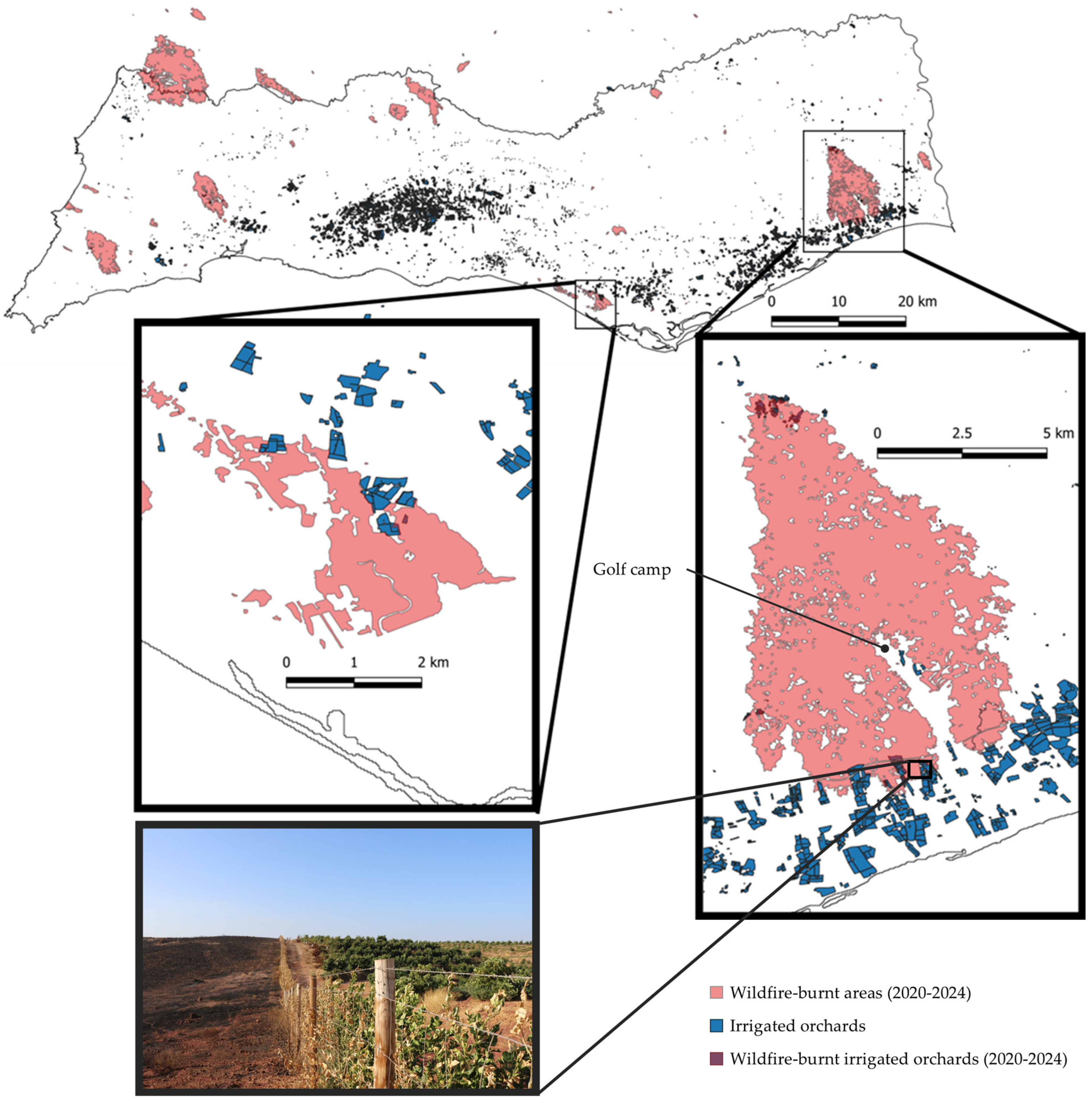
This review is based on an extensive literature survey comprising more than 300 articles. Searches were conducted through the b-On (Online Knowledge Library), which provides access to major scientific databases (e.g., Web of Science and Scopus) using keywords such as “orchard” OR “olive grove,” combined with service-specific terms, such as “transpiration”, “microclimate”, “water infiltration”, and “water retention” for microclimate regulation and water regulation services, and “carbon sequestration”, “carbon storage”, and “soil organic carbon” for carbon sequestration and storage. To quantify the role of orchards in food production and to estimate their caloric and nutritional productivity, open access databases from FAOSTAT (https://www.fao.org/faostat/en/#data/; accessed on 6 October 2025) and USDA FoodData Central (https://fdc.nal.usda.gov/download-datasets; accessed on 6 October 2025) were used. Maps illustrating wildfires between 2020 and 2024 and irrigated orchards in the Algarve region (Portugal) were produced using QGIS 3.40, based on open access data from the Instituto da Conservação da Natureza e das Florestas (ICNF) and the Instituto de Financiamento da Agricultura e Pescas (IFAP).
The literature was analyzed using an integrative and qualitative approach, aiming to provide a comprehensive synthesis of current knowledge on irrigated orchard ecosystem services.

3. The Orchard as an (Agro)Ecosystem

An ecosystem is “a system in which living things (plants, animals, bacteria, etc.) and their non-living surroundings interact as a functional unit”, according to the European Union [12]. Similarly, the Convention on Biological Diversity describes it as “a dynamic complex of plant, animal and microorganism communities and their non-living environment interacting as a functional unit” [13], a definition widely adopted also by the European Environment Agency, among other entities [14].
When referring to human-modified ecosystems dedicated to agricultural activity, a more specific term is used: agroecosystem. The Biodiversity Information System for Europe (BISE), based on established literature [15], defines agroecosystems as “communities of plants and animals interacting with their physical and chemical environments that have been modified by people to produce food, fibre, fuel, and other products for human consumption and processing” [16]. Thus, an orchard is a specialized agroecosystem designed for the cultivation of fruit or nut-producing trees (perennial woody species), typically arranged in a systematic and managed layout to optimize productivity [17].
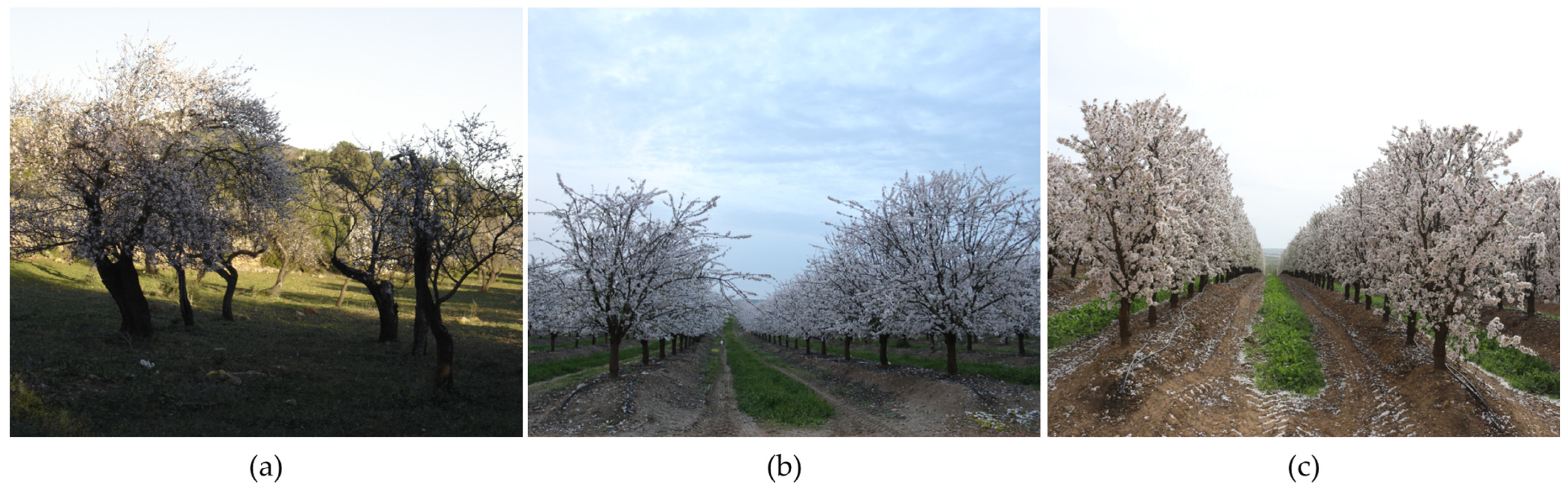
Within orchard agroecosystems, management intensity varies along a gradient from extensive to super-intensive systems, reflecting distinct production objectives. A system becomes more intensive as greater amounts of external inputs are added. Extensive orchards are characterized by low planting densities [18,19] and rely primarily on natural ecosystem processes, with minimal investment per unit area (Figure 1a). These systems generally depend on natural resources, such as rainfall and inherent soil fertility, involving few external inputs and resulting in low productivity and limited economic return per hectare [20]. Conversely, intensive (Figure 1b) or even super-intensive (Figure 1c) orchards aim to maximize yields by fully exploiting the cultivated area. This is achieved through higher planting densities [19,21] and the application of external inputs (water, fertilizers, and phytopharmaceuticals) to optimize growth conditions.
Intensification may affect orchard ecosystem services in contrasting ways. Highly intensive systems generally show greater productivity and short-term carbon sequestration than water-stressed or pest-affected systems [22]. However, intensive mineral nitrogen fertilization also increases nitrate leaching and N2O emissions [23]. In orchards receiving 140 kg N ha−1 yr−1 of mineral fertilizer, nitrate leaching reached 45–55 kg NO3 ha−1 yr−1, whereas organic or unfertilized systems remained below 10 kg NO3 ha−1 yr−1 [24]. Nevertheless, irrigation and fertilization can enhance carbon sequestration in biomass and soil, thereby achieving a more favorable balance between carbon sequestration and greenhouse gas emissions [22,23].
Ecosystem service provision therefore depends on (i) biological factors; (ii) edaphoclimatic conditions [25]; and (iii) management practices, which explained up to 78.5% of the observed variance in simulated ecosystem services in other studies [24].
In irrigated orchards, irrigation acts as an intensification factor at multiple levels. First, it is an intensifier in itself, increasing the total volume of inputs applied while also enabling fertigation. Second, irrigation allows higher planting densities, thereby increasing demand for external inputs.

4. Ecosystem Services and Externalities

Ecosystems provide a wide range of benefits known as ecosystem services [26]. In orchard agroecosystems, some authors propose the term “agroecosystem services” to emphasize the human-managed nature of these benefits [27,28,29]. Following the Millennium Ecosystem Assessment framework, these services are categorized into four groups: provisioning (material goods like food), regulating (climate or water regulation), cultural (recreational or spiritual benefits), and supporting (nutrient cycling and soil formation) [26].
From an economic perspective, these services relate to externalities—positive or negative effects of economic activities on third parties that are not reflected in market prices [30]. While fruit production is a provisioning service, its nature as a private, tradable good often centralizes it in a “productivist” view, overshadowing the orchard’s role as a provider of public goods. However, an environmental perspective recognizes that orchards generate both positive externalities (derived from ecosystem services like carbon sequestration) and negative externalities (arising from ecosystem disservices, such as nutrient leaching). As summarized in Table 1, many negative externalities can be mitigated through appropriate territorial planning and sustainable management.

5. Provisioning Services

5.1. Food Production

This ecosystem service directly contributes to food security, a critical contribution to society in the current global context, from both humanitarian and geopolitical perspectives. According to the United Nations, food security is based on four pillars: (i) availability, the physical existence of food; (ii) access, the ability of individuals to obtain it; (iii) utilization, the appropriate use of food regarding nutritional value, quality, and safety; and (iv) stability, the consistent performance of the three preceding pillars over time [63].
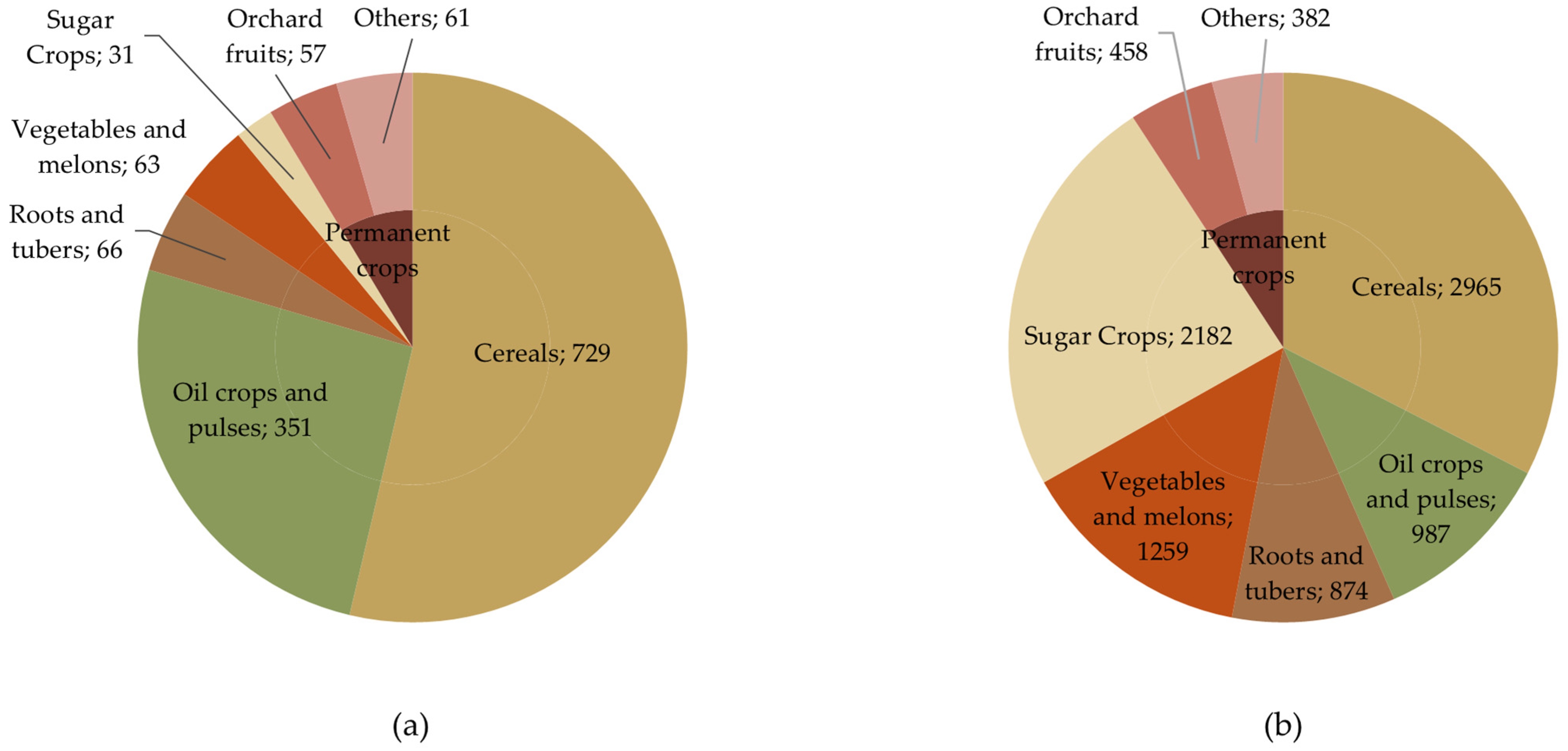
Food production is the main purpose of orchards, providing tradable products that generate income and justify investment in the establishment and maintenance of orchards. Despite occupying only slightly more than 4% of the utilized agricultural area, orchard systems account for approximately 5% of total crop production (Figure 2), reflecting their high productivity per unit area. In contrast, annual crops, particularly cereals, legumes, and oilseeds, dominate land use, covering nearly 80% of cropland, yet contribute only around 43% of total production due to their lower productivity. This contrast underscores the disproportionate contribution of orchards to the food provisioning ecosystem service, highlighting their strategic role in efficient land use and in strengthening food security within multifunctional agricultural landscapes.
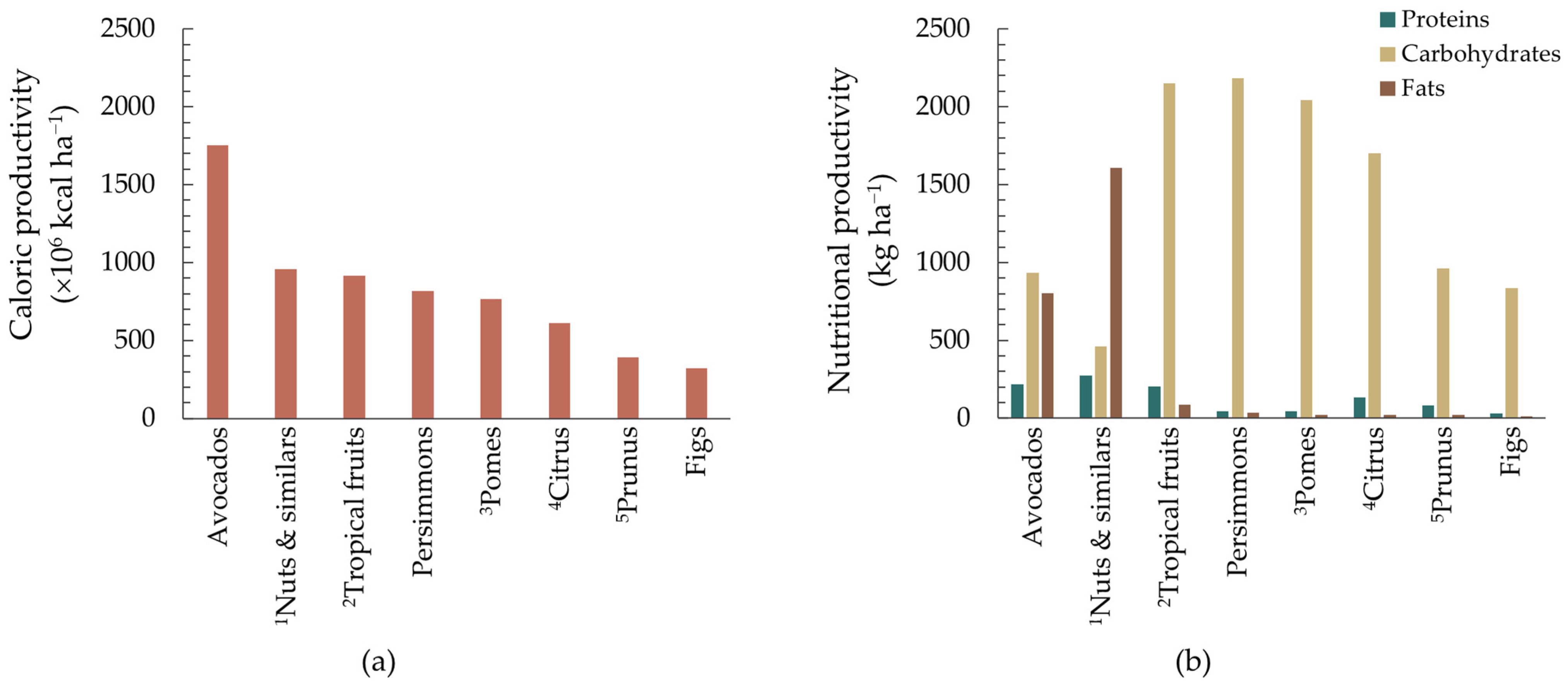
Within orchards, crops can be grouped by fruit type, with each group contributing differently to meeting human energy requirements. Avocado is the most productive crop in terms of calories per unit area, producing nearly twice as much as the next most productive group, nuts and similar (Figure 3a). Although nuts and similar crops contain more than three times the calories per unit of product weight, their productivity per unit of cultivated area is considerably lower than that of avocado. Fruits and nuts contribute to global energy intake but play a complementary role compared to cereals, which remain the main calorie source worldwide [65,66].
However, under the third pillar of food security, foods must meet the population’s nutritional requirements, extending beyond energy provision alone. From this perspective, nuts and similar crops produce the highest amounts of protein and fat per unit area (Figure 3b). When considering fresh fruits only, avocado stands out as the fruit with the highest protein and fat yields per unit area (Figure 3b). Most other crop groups are considerably more efficient in producing carbohydrates (natural sugars and dietary fiber), while their protein and fat yields remain marginal. That said, nutritional value is not determined solely by the three primary macronutrients. These fruits are also important sources of vitamins (e.g., vitamin C in citrus and vitamin A in apricots) [67,68], minerals (e.g., potassium in avocados) [69], and antioxidants (e.g., polyphenols in blood oranges and pomegranate) [70,71,72,73,74]. Fruit quality, including both internal attributes [75] and external appearance [76,77,78], is also essential for consumer acceptance and market value.
Figure 3. Nutritional productivity of different fruit groups commonly consumed fresh and nuts cultivated in orchards worldwide: (a) caloric productivity; and (b) nutritional productivity. Notes: In groups comprising multiple crops, the group average was calculated. 1 Nuts and similar: cashew, almonds, walnuts, hazelnuts, pistachios, karité nuts, and chestnuts; 2 Tropical fruits: mangoes, guavas, papayas, and others. 3 Pomes: apples, pears, quinces, and others. 4 Citrus: oranges, mandarins, lemons and limes, grapefruits, and others. 5 Prunus: plums, apricots, peaches, cherries, nectarines, and others, excluding almonds. Sources: FAO, 2023 and USDA, 2020 [64,79].
Agriculture 16 01336 g003

5.2. By-Products Production

By-products are secondary outputs of a production process, lower in value than the main product, legally usable, and derived from the same process, but they may still hold economic value as complementary or collateral outcomes [80].
Vegetative by-products, such as pruning residues, can serve multiple purposes. Although typically shredded and left in the orchard inter-rows [81], larger materials, such as thick branches, can be collected and utilized for energy production [82]. These residues can be shredded and densified into pellets, which can subsequently be used as a solid fuel in boilers, furnaces, or heating systems [83,84]. Pellets from branches have higher calorific value and lower ash content, making them suitable as biofuels, while those including leaves are limited by high ash, nitrogen, sulfur, and heavy metal content [83]. Considering that their calorific value differs between species [85]. On the other hand, leaves and flowers, such as those from citrus trees, can be used to produce other by-products, including essential oil [86,87,88,89,90] or animal feed [91,92,93]. Pruning residues and other by-products, such as nut or almond shells, can also be used as livestock bedding [94,95]. Shells may additionally serve as mulch in orchards, reducing the need for weed control and contributing to soil carbon storage and nutrient cycling [6].

5.3. Complementary Productions

Orchards can support complementary livestock production, which, although not the primary objective, provides additional benefits including enhancing nutrient cycling, improving soil fertility, and contributing to vegetation and pest management [96,97,98,99,100]. However, the increasing demand for animal-source foods places significant pressure on forested areas due to the extensive land requirements of livestock production [101,102]. In this context, integrated crop–livestock systems offer a relevant alternative, as they are consistently associated with lower environmental impacts than conventional specialized systems [103], while also improving overall land-use efficiency.
The relationship between intensification and grazing varies significantly. While extensive orchards are characterized by low planting densities, which facilitate the use of inter-tree spaces for pasture [17], grazing is not exclusive to these systems. It also occurs in more intensive orchards [104], where the integration of livestock acts as an additional layer of intensification. Integrating livestock increases resource use per unit area, enhances overall productivity and provisioning services, and promotes greater on-farm biodiversity.
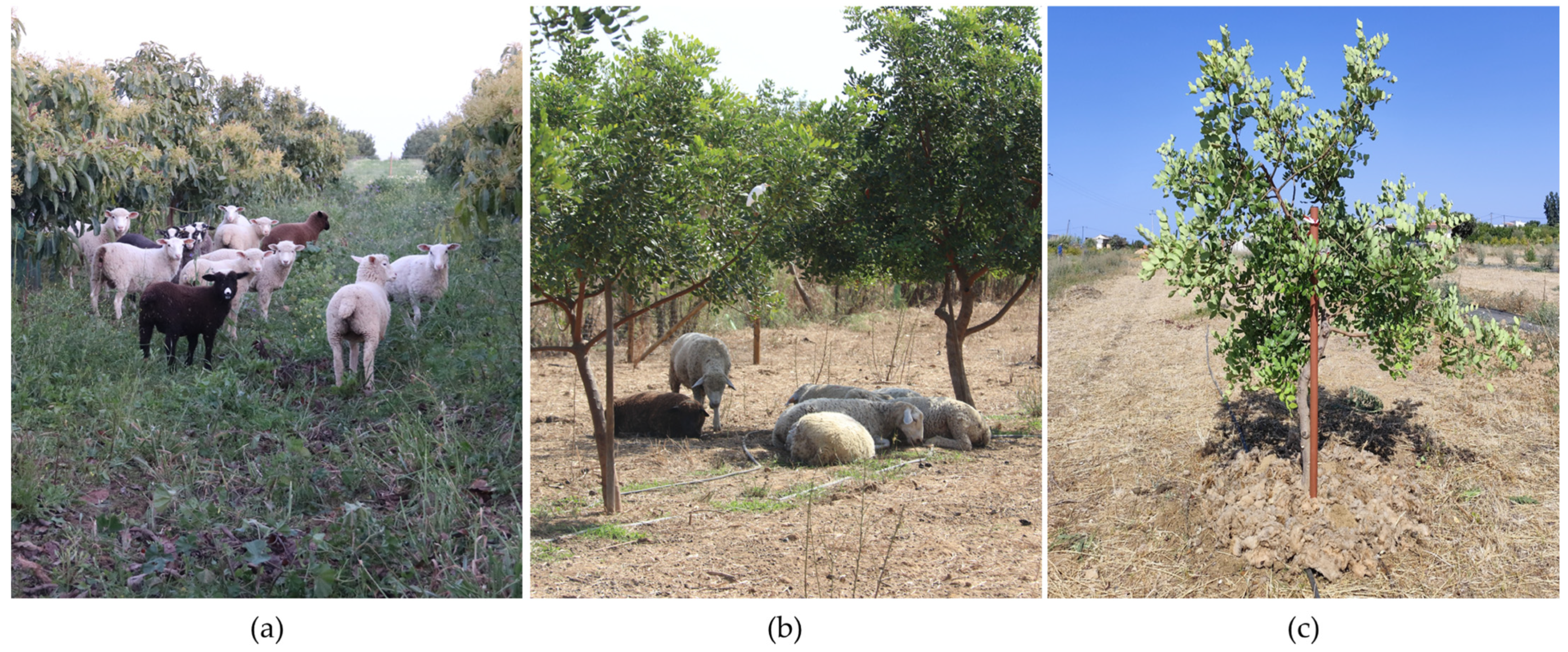
Not all livestock species are equally suitable for integration into orchards. Larger animals, such as cattle, have high space requirements [105]; however, their integration may become feasible in extensive orchards [106]. Highly opportunistic feeders, such as goats, may consume a wide range of plants, including woody parts, potentially affecting tree growth and orchard management [107]. Due to their selective grazing behavior, sheep are well-suited for weed control with minimal impact on fruit crops [108] (Figure 4a). Sheep generally do not require enclosed night shelters, but adequate shade is essential, especially during summer (Figure 4b). Irrigated orchards provide superior cooling compared to other agroecosystems, even at wider spacings (e.g., carob orchards), as water availability enhances transpiration and soil evaporation, improving microclimatic regulation [109].
Accordingly, livestock can be integrated into orchard systems at three different levels: (i) continuous and intensive integration (high level of integration); (ii) seasonal integration with agronomic adjustments (intermediate level of integration); or (iii) opportunistic or collaborative integration (low level of integration) [104]. At the highest integration level, animals remain in orchards year-round, improving weed control and reducing costs, but increasing herbaceous management complexity and sometimes requiring adjustments to tree training systems [98,104]. At the lowest integration level, grazing is occasional and often involves external livestock producers, promoting resource sharing and reducing labor for the fruit grower. However, it requires coordination and depends on supplementary grazing areas during key periods (spring and autumn) [104]. Some livestock by-products can be reintegrated; for example, low-value wool can be used as mulch [110,111] (Figure 4c).
Figure 4. Livestock integration in irrigated orchards: (a) a flock of sheep grazing in an avocado orchard (Algarve, Portugal, April 2022); (b) sheep resting in the shade of carob trees (Algarve, Portugal, October 2022); and (c) wool used as a soil mulch in a young carob orchard (Algarve, Portugal, July 2025).
Agriculture 16 01336 g004

6. Regulating Services

6.1. Microclimate Regulation

When considering the energy balance of an orchard, incoming radiation is dissipated through three main pathways: (i) latent heat flux (λE), the energy used for soil evaporation and leaf transpiration; (ii) sensible heat flux (H) associated with air heating and the consequent temperature increase; and (iii) soil heat flux (G), which represents the energy that heats the soil [37,38].
Orchard evapotranspiration is highly dependent on canopy size. When the leaf area index (LAI) is low, sparse canopy cover and minimal shading allow substantial radiation to reach the soil, while transpiration remains limited. Consequently, a large fraction of the available energy is dissipated as sensible heat (H), leading to a high Bowen ratio (β = H/λE) [37].
In contrast, under a higher LAI (denser canopy), a greater proportion of incoming radiation is intercepted by the leaves. This increases transpiration due to a larger aggregate stomatal surface, while the increased shading reduces the energy reaching the soil, thereby limiting soil evaporation and sensible heat flux. This shift in energy partitioning results in a greater proportion of energy being used for latent heat flux (λE) and less for heating the air (H), causing the Bowen ratio to decrease. In other words, a higher leaf density in an orchard channels a greater proportion of solar energy into the biological process of transpiration, rather than dissipating it as sensible heat above the canopy [37].
Under well-watered conditions, trees can maintain high transpiration rates, dissipating a large proportion of available solar energy as latent heat, and cooling down the canopy below air temperature [112,113]. In irrigated orchards, increases in atmospheric evaporative demand (e.g., higher vapor pressure deficit) can enhance transpirational cooling by dissipating available energy as latent heat, thereby reducing the temperature of the canopy, surrounding air, and soil surface [112]. This effect occurs at the orchard level, resulting in differences in temperature between the orchard and adjacent areas [114]. By analogy, studies in urban areas demonstrated that irrigating green spaces can reduce mean air temperature by up to 2.3 °C and afternoon peaks by up to 4.2 °C, highlighting the profound capacity of irrigated vegetation to alter local microclimates [115].
Under water deficit, stomatal closure reduces transpiration, and less energy is dissipated as latent heat, causing the canopy to warm up, often above air temperature [112,113]. This frequently occurs in non-irrigated ecosystems such as forests and grasslands [112]. In orchards, the use of sprinklers is a strategy to artificially promote canopy cooling and simultaneously mitigate water deficit [116,117,118].
In young or sparse orchards, soil evaporation is a critical component of evapotranspiration (ET), contributing significantly to the total, especially after irrigation or rain [37]. Shortly after irrigation, soil evaporation is high and gradually decreases as the soil dries, becoming practically negligible in a very dry soil [119]. While localized irrigation creates wet patches that enhance evaporation, canopy development and increased shading eventually reduce their impact [37].
Irrigated orchards generally sustain high Leaf Area Index (LAI) values, and the continuous availability of water allows tree canopies to remain cool even under extremely high atmospheric temperatures [120]. This evaporative cooling effect benefits local fauna by creating favorable microhabitats for a wide range of animal species, including insects, birds, and mammals. Moreover, extensive areas of irrigated orchards contribute to thermal regulation at the landscape scale; by buffering peak temperatures, they provide important ecosystem services related to climate moderation and enhance human thermal comfort.
Globally, irrigation-induced cooling varies with the time of day, precipitation regime, and the balance between albedo and evapotranspiration, yielding an average annual daytime cooling of 0.96 ± 1.66 °C and a weaker nighttime effect of 0.34 ± 0.71 °C [121]. This cooling is particularly important in arid regions, where summertime reductions can reach 2.72 ± 1.71 °C under less than 400 mm precipitation, compared to negligible effects in humid regions (>1200 mm precipitation; 0.17 ± 0.47 °C) [121]. Despite reduced albedo from darker, wet soils, enhanced evapotranspiration and latent heat fluxes dominate, resulting in net cooling [121,122].

6.2. Carbon Sequestration and Storage

Carbon sequestration is a crucial regulating ecosystem service that removes atmospheric carbon dioxide (CO2), thereby reducing its concentration in the atmosphere. CO2 is a major greenhouse gas, and its increasing atmospheric concentration is a primary driver of global warming; consequently, enhancing carbon sequestration is essential for climate change mitigation [123,124]. Terrestrial ecosystems have two main carbon reservoirs: (i) plant biomass and (ii) soil [125,126]. In orchards, the plant biomass carbon pool includes both long-term carbon stored in perennial tree structures and more rapidly cycling carbon in herbaceous vegetation, which typically has an annual life cycle.
Carbon enters the agroecosystem primarily through photosynthesis. In this process, light energy drives the removal of electrons from water (H2O), generating reducing power that is used to convert atmospheric CO2 into carbohydrates. As a result of the splitting of water molecules, molecular oxygen (O2) is released into the atmosphere as a by-product [127]. The carbohydrates produced through photosynthesis are subsequently used in a variety of plant biological functions. Notably, they serve as fundamental building blocks for the synthesis of structural molecules such as cellulose, hemicellulose, and—particularly in woody plants—lignin, thereby contributing to long-term carbon storage in plant biomass.
Carbon sequestration is closely linked to photosynthetic activity, which varies seasonally due to leaf development, phenology, and environmental factors such as radiation, temperature and humidity [128], with peak sequestration rates occurring during periods of rapid vegetative growth [129]. In evergreen crops, such as citrus, winter conditions promote stomatal closure, leading to reduced CO2 assimilation and transpiration rates compared with warmer periods and, consequently, constraining CO2 influx into the leaves [130,131]. Moreover, low temperatures downregulate the activity of enzymes involved in the Calvin–Benson cycle, including the CO2-fixing enzyme, Ribulose-1,5-bisphosphate carboxylase/oxygenase (RuBisCO), thereby decreasing the plant’s capacity for CO2 assimilation [132,133,134].
Higher planting densities reduce individual tree size, canopy development, and root system expansion due to increased inter-tree competition. However, this reduction is offset by the greater number of trees per unit area, resulting in comparable carbon sequestration at the orchard scale. Despite similar leaf area index (LAI) values across planting densities, denser orchards display a higher proportion of shaded foliage, which may influence leaf-level carbon content and overall carbon dynamics [135]. Under these conditions, long-term carbon storage is largely determined by the accumulation of permanent woody biomass, which represents a stable and substantial carbon reservoir in orchard systems [136].
Carbon storage in plant biomass varies among crops and is distributed across both above- and below-ground organs, with trunks and branches forming a major structural carbon pool that frequently accounts for more than 40% of the stored carbon [128]. Forest tree species generally allocate a higher proportion of biomass to aboveground organs [137]; in contrast, the canopy architecture of cultivated tree species is deliberately modified through management practices to enhance productivity and accommodate intensified fruit production [8,21,81]. Carbon stored in these trees tends to increase over time and eventually stabilize as they reach maturity [128]. Accordingly, carbon storage in orchard plant biomass is ultimately constrained by the maximum size attained by the trees.
Carbon is released from plant biomass through six main pathways: (i) cellular respiration; (ii) fruit harvest; (iii) leaf senescence and abscission; (iv) pruning operations; (v) root turnover; and (vi) root exudation.
To sustain metabolic processes, plants and other organisms within the agroecosystem oxidize carbohydrates through cellular respiration, during which chemical free energy is conserved in ATP and reduced electron carriers, with carbon returned to the atmosphere as CO2 (C6H12O6 + 6O2 → 6CO2 + 6H2O).
Carbon contained in harvested fruits—comprising mainly carbohydrates such as sugars and structural polysaccharides, but also proteins, lipids and other compounds—can represent up to half of the carbon assimilated by trees through photosynthesis [128]. Carbohydrates are one of the three essential macronutrients in the human diet, and fruit consumption provides a valuable and healthy source of these compounds, as their high fiber content moderates sugar absorption, slowing it down. Consequently, although the carbon exported from orchards via harvested fruits is ultimately returned to the atmosphere, it plays a crucial role in ensuring food security, an important positive externality by orchard agroecosystems.
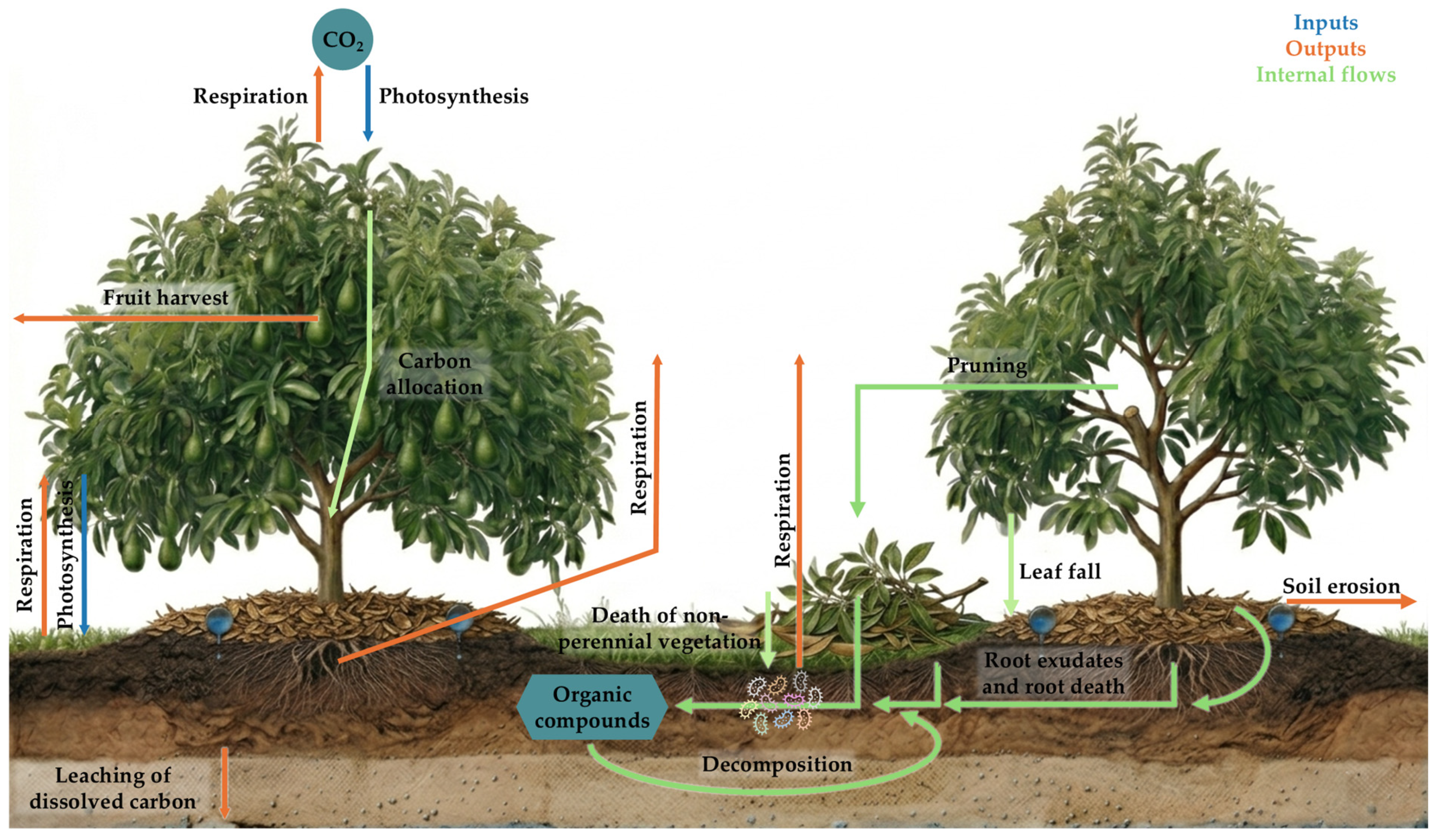
The remaining carbon-loss pathways—including leaf fall, pruning residues, root exudates, and root turnover—can contribute to soil carbon storage. The magnitude and persistence of this storage vary with environmental conditions and soil properties but are primarily governed by soil management practices [6]. Litter decomposition plays a central role in this process by supplying soil organic carbon and regulating nutrient cycling, with variations in decomposition exerting a strong influence on the overall soil carbon balance [138].
Once in the soil, dead plant biomass and root exudates are degraded by decomposer microorganisms, which break them down into simpler compounds used for cellular respiration. This is a key determinant of the carbon balance and varies with soil moisture and temperature [135]. Other intermediate organic compounds, not immediately used by microorganisms, can condense to form more complex and stable structures, eventually creating humus, a very stable form of organic carbon. Due to the accumulation of organic matter, soil is the largest carbon reservoir in terrestrial ecosystems [125,126,139]. Soil CO2 emissions mainly result from biological respiration processes, including microbial decomposition of organic matter [140] and respiration by plant roots [141].
Irrigated orchards are specialized agroecosystems where strategic water application and concomitant fertilization mitigate growth-limiting stresses, thereby enhancing carbon storage potential compared to rainfed systems, particularly in intensive and super-intensive plantations [23]. Under rainfed conditions, severe summer soil water stress reduces stomatal conductance, severely limiting net CO2 assimilation and causing pronounced midday and afternoon depressions in gas exchange [142,143]. In contrast, irrigation sustains the trees’ water status, increasing transpiration, stomatal conductance, and stem water potential, significantly boosting photosynthetic activity [143,144]. Depending on the cultivar, irrigation can increase daily photosynthesis by 173% up to 331%, extending maximum carbon assimilation rates into hotter midday hours [145]. This increased biomass production directly enhances carbon inputs and, over time, substantially improves soil organic carbon (SOC) stocks—up to 100 cm depth—surpassing rainfed systems [22]. Consequently, super-intensive irrigated orchards can achieve remarkably positive net carbon balances, averaging up to 4.10 Mg C ha−1 yr−1 [23].
While this resource-rich environment stimulates overall carbon accumulation in biomass, soil, and litter (Figure 5), the net sequestration benefit must be balanced against the substantial carbon footprint of the manufacture and transport of fertilizers [22,23]. To optimize this balance, management practices such as reduced tillage, cover cropping, and the incorporation of organic composts or pruning residues are essential to minimize emissions and can even double the net carbon balance in these plantations [6,34,146,147,148]. Furthermore, irrigating with treated wastewater enables the utilization of dissolved nutrients, thereby lowering the fertilization carbon footprint and further reducing atmospheric carbon emissions [149].
The incorporation of organic fertilizers can enhance soil organic carbon storage [150], increase the bioavailability of essential nutrients such as nitrogen and phosphorus, and improve the soil’s water retention capacity [151], while also improving its structure [152].
Soil tillage leads to a reduction in soil organic carbon primarily due to three mechanisms: (i) soil aeration and enhanced microbial decomposition: tillage introduces oxygen into the surface soil layers, stimulating microbial activity and accelerating the breakdown of organic matter, resulting in increased CO2 emissions; (ii) disruption of soil aggregates: tillage physically breaks down micro- and macro-aggregates that protect organic matter, thereby increasing its susceptibility to decomposition; and (iii) erosion: tilled soils, particularly on slopes or in semi-arid areas, are more prone to wind and water erosion, which remove organic-matter-rich soil particles [153]. Soil tillage and soil compaction contribute to reducing aggregate stability over time [154]. In orchard systems, soil management practices such as ground cover have been shown to promote substantially greater increases in soil organic carbon than tillage-based practices [6,155,156].
Although agricultural land expansion is frequently associated with carbon losses, particularly soil carbon release, the carbon and ecological outcomes of orchard establishment are highly context-dependent and critically influenced by prior land use, the degree of disturbance, subsequent management practices, and environmental conditions. Carbon flows in perennial crops differ from those in livestock systems and annual crops, mainly due to carbon storage in plant biomass and the continuous addition of organic matter to the soil, with minimal disturbance [157,158]. Additionally, technologies such as localized irrigation and fertilization allow orchards to be established in arid areas with naturally poor soils [159]. Sustainable soil management in orchards leads to a progressive increase in soil organic carbon over time [155,160], eventually reaching a maximum threshold that varies across systems. Studies have shown that the factor exerting the greatest influence on changes in soil organic carbon is temperature, explaining more than 50% of the variation, followed by crop age, and then by bulk density, clay content, and soil depth [160].
Several studies have shown that, in an agricultural context, orchard systems can serve as significant carbon sinks compared with other cropping systems, thereby contributing to atmospheric CO2 mitigation while also meeting food-production objectives (Table 2).
Up to this point, we have discussed how orchards remove atmospheric CO2 through photosynthesis and store carbon in permanent plant biomass and soil pools. However, orchard maintenance practices also give rise to CO2 and other greenhouse gas emissions, mainly associated with fertilization, soil management, phytosanitary treatments, and machinery operations. The magnitude of these emissions varies widely among crops and even among orchards of the same crop, being largely determined by management intensity and practice selection [158,162]. Consequently, organic orchards generally exhibit lower carbon footprints [162]. Nevertheless, evidence also shows that low-input management strategies for pesticide use, irrigation, and fertilization do not necessarily lead to significant changes in net ecosystem production or overall net ecosystem carbon balance [158].

6.3. Water Regulation

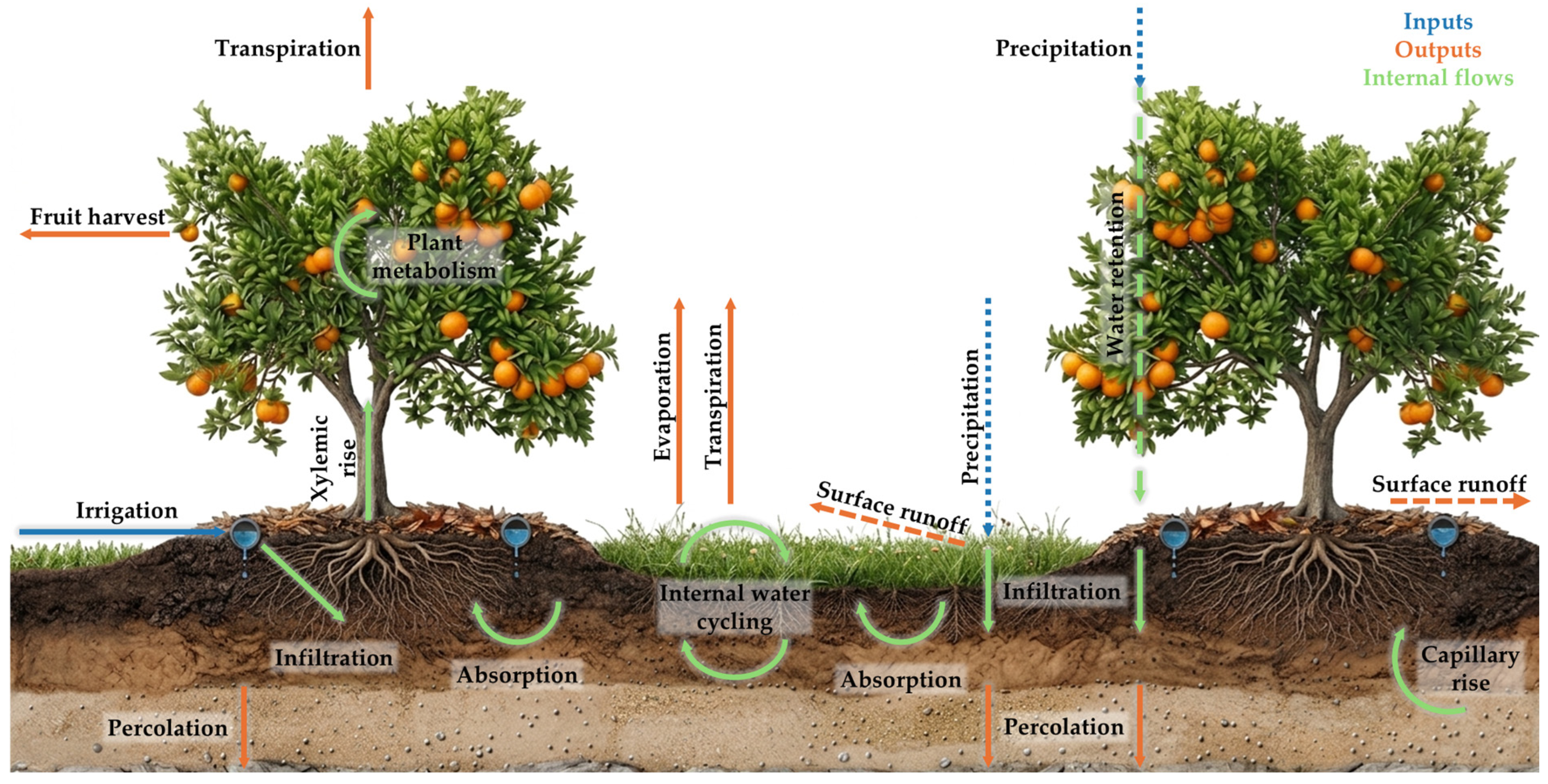
Irrigated orchards play a vital role in water regulation, acting as managed systems in which water cycles are shaped by the interaction between natural soil–plant processes and human-controlled water inputs (Figure 6). While these agroecosystems can enhance landscape resilience to hydrological extremes under climate change by influencing key processes such as water infiltration, soil moisture retention, evapotranspiration [163], and groundwater recharge, their net hydrological contribution is highly context-dependent and may involve important trade-offs. Indeed, the role of irrigated orchards in the water cycle varies significantly depending on multiple factors such as climatic conditions, soil properties, irrigation regimes, and seasonal dynamics.
During the rainy season, orchards contribute positively to water regulation by enhancing water retention and infiltration, often functioning in ways comparable to forest systems. Their root systems increase soil porosity and create preferential flow pathways, thereby promoting both infiltration and deeper percolation within the soil profile. During rainfall events, trees play a key role in modulating the water cycle. As observed in forested [164,165] and urban green spaces [166,167], canopy interception delays and reduces the transfer of precipitation to the soil surface, consequently minimizing surface runoff (Figure 6). In orchard systems, rainfall is partitioned into interception, throughfall, and stemflow, thereby regulating both the timing and spatial distribution of water inputs [168]. While throughfall delivers water to the soil in a heterogeneous pattern, stemflow concentrates water near the trunk, potentially creating localized zones of higher soil moisture [169]. As irrigated orchards frequently develop relatively large and dense canopies, characterized by a high leaf area index (LAI), rainfall interception is enhanced, amplifying these regulatory effects on soil water dynamics. However, increased interception may also reduce the effective amount of water reaching the soil, particularly in high-LAI systems, highlighting a potential trade-off between runoff reduction and net water availability. Moreover, part of the intercepted rainfall is stored on canopy surfaces and subsequently evaporated back to the atmosphere, linking hydrological regulation with the energy balance and contributing to microclimatic cooling [170,171].
At the landscape scale, orchards reduce surface runoff and increase water retention, helping to regulate water flow and maintain more stable water availability over time. This buffering effect is partly driven by canopy-mediated rainfall redistribution and delayed water inputs into the soil, which help attenuate peak flow events [172,173]. This is especially important in low-lying coastal areas, where surrounding orchards or forested uplands can reduce downstream flood risk by slowing and absorbing excess water compared with non-vegetated landscapes. In addition, the deep root systems of perennial crops can substantially modify hydrological processes beyond the surface soil layer, influencing the vertical redistribution of water, water storage in deep soil layers, and groundwater recharge dynamics. Using stable isotopes (δ18O and δ2H) and tritium profiles, a study conducted in the North China Plain [174] demonstrated that deep soil water recharge is largely associated with heavy precipitation events, particularly during the monsoon season. Furthermore, the relatively homogeneous isotopic composition below a depth of 6 m indicates long-term storage and slow vertical redistribution of infiltrated water [175,176,177]. The authors further noted that deep-rooted orchards (pear) promoted greater water storage in the deep soil compared to shallow-rooted agricultural systems (maize) under irrigated conditions, indicating that perennial orchard systems may facilitate deeper infiltration pathways and long-term water retention in the soil profile. However, the same study highlighted significant hydrological trade-offs associated with orchard systems. Although orchards can increase deep infiltration and the redistribution of water in the soil, they also exhibited evapotranspiration rates substantially higher than those of annual crops, with evapotranspiration accounting for up to 95.7% of total annual water inflows in older pear orchards. This indicates that a large proportion of incoming water is returned to the atmosphere rather than contributing to groundwater recharge. This high-water consumption was associated with increased water uptake by roots and the progressive development of deeper root systems as the orchard aged, resulting in greater soil water deficits and reduced deep drainage [178]. Furthermore, the lower albedo of the land surface and the higher LAI of the orchards altered the surface energy balance and evapotranspiration dynamics, reinforcing the role of perennial orchards as strong eco-hydrological modifiers. Overall, these findings demonstrate that the hydrological impacts of orchards are highly context-dependent and may involve trade-offs between water regulation, groundwater recharge, and atmospheric water fluxes, emphasizing the need to integrate hydrological considerations into large-scale land-use planning in water-scarce regions.
In contrast, during the dry season, irrigated orchards rely on stored surface water (e.g., reservoirs and dams) or groundwater, when water resources are naturally more limited. In this period, water output from the system occurs mainly through evaporation, plant transpiration, and export via harvested biomass. In addition, tree canopies reduce soil temperature and incoming solar radiation at the soil surface, limiting evaporative losses. Consequently, irrigated orchards help maintain higher soil moisture levels by both introducing water into the system and limiting evaporation [179], thereby reinforcing their role as regulators of water availability under dry conditions.
Yet, the effectiveness of irrigation in regulating water dynamics is strongly dependent on management practices. While inappropriate irrigation management may lead to deep percolation, representing a loss for immediate crop water use but supporting groundwater recharge, biophysical trade-offs often emerge between provisioning and regulating ecosystem services. In particular, the increase in tree biomass and the LAI, stimulated by the inflow of water and nutrients, maximizes carbon sequestration and fruit production, but can simultaneously result in a decline in groundwater conservation indicators and in an increased risk of nitrate leaching through drainage [24]. Consequently, the transport of agrochemicals in percolated water can lead to diffuse pollution and soil salinization, posing risks to both water quality and soil health [180,181]. On the other hand, orchards can be irrigated with treated wastewater, thereby conserving potable water resources and acting as a biological filter when this water percolates through the soil, while also allowing the recovery of dissolved nutrients [149], which, if discharged into the environment, would otherwise be considered pollutants.
In this context, irrigation efficiency becomes a key consideration and can be approached from two complementary perspectives. From a productivity standpoint, water use efficiency (WUE) is commonly defined as the amount of fruit produced per unit of water applied. In regions where water is a limited resource, currently used irrigation systems are already relatively efficient, particularly localized systems such as drip irrigation [182]. However, to achieve higher WUE, it is also necessary to adopt strategies that reduce water inputs while maintaining fruit yield and quality. One such approach is regulated deficit irrigation, which allows for reduced water application during specific phenological stages without significantly affecting production. On the other hand, from an ecosystem services perspective, reduced water inputs may also limit water availability within the agroecosystem, potentially influencing soil processes, microclimatic regulation, and biodiversity, thus highlighting trade-offs between water saving and ecosystem functioning.
The capacity of soil to receive, store, and supply water is largely determined by soil physical and chemical properties, particularly those related to structure and soil organic matter (SOM) content, which directly influence infiltration and water retention processes. Soils with higher organic matter content and better aggregation generally exhibit greater water-holding capacity and enhanced infiltration dynamics. The presence of herbaceous soil cover enhances these processes by reducing runoff velocity, increasing infiltration, and protecting the soil surface from water erosion [183]. Conversely, systems with a high proportion of bare soil are more prone to water losses, erosion, and reduced soil moisture [184]. The same applies in non-cultivated, degraded, or rainfed systems. Here, rainfall often results in rapid surface runoff due to limited infiltration capacity, thereby reducing groundwater recharge.
Therefore, optimized irrigation strategies, together with the inherent advantages of permanent crops and their associated soil management practices, are key to regulating surface water dynamics, increasing water use efficiency, and minimizing environmental risks.

6.4. Soil Erosion Control

Soil erosion has emerged as a critical global concern, driven by decades of continuous soil degradation and intensified by inappropriate agricultural practices [48,49]. Since soil is effectively non-renewable on human timescales, current erosion rates in Europe, ranging from 3 to 40 Mg ha−1 year−1 [185], severely threaten the goal of increasing agricultural productivity to meet rising food demand [185,186]. This degradation is particularly severe in soils with low organic matter and weak structural stability [187,188], where runoff transports nutrients and valuable soil biota off-site [189]. Historically, soils under annual crops have shown higher vulnerability to these processes due to frequent soil disturbance and limited vegetation cover [190].
In contrast, orchards are perennial agroecosystems that inherently offer superior erosion control. Even in the absence of ground cover, the tree canopy provides a first line of protection by intercepting rainfall, thereby reducing raindrop kinetic energy at the soil surface [191]. However, irrigated orchards are particularly effective at mitigating soil loss, as the consistent availability of water allows for the maintenance of larger, denser canopies, thereby enhancing rainfall interception. Proper management within these systems significantly enhances soil conservation. The use of frequent tillage and herbicides on steep slopes has historically accelerated degradation [192,193], whereas the preservation of spontaneous vegetation or cover crops provides the mechanical protection necessary to promote infiltration and mitigate both splash and concentrated flow erosion [32,49,194].
Empirical evidence from citrus orchards demonstrates that groundcover can markedly reduce runoff and soil loss by 46.9% and 66.8%, respectively, compared to bare-soil management [192]. Long-term watershed studies (1957–2013) show that converting annual cropland to permanent plantations reduces erosion intensity, with arable land previously exhibiting rates 9.6 times higher than permanent crops, lowering basin sediment loss from high to moderate [195]. Herbicide use, which leaves orchard soil bare, produced the highest slope-scale erosion rates (11.3 Mg ha−1 yr−1), whereas inter-row ground cover reduced erosion by up to 99%, nearly eliminating soil loss [196]. Beyond living cover, the integration of mulching and the incorporation of shredded pruning residues improves soil porosity and aggregate stability, effectively dissipating runoff energy [197,198]. These practices establish a clear management efficiency gradient: while bare land and traditional tillage lead to peak erosion risk, the transition to grass cover and heterogeneous vegetation significantly stabilizes the ecosystem [199,200]. Consequently, in particularly vulnerable areas, such as those with gypsiferous soils, site-specific groundcover strategies are essential to prevent erosion risks [201]. Conversely, frequent soil tillage in olive groves (4–5 times per year) resulted in severe soil loss, reaching 29.4 Mg ha−1 yr−1. Although the tree canopy provided about 38% ground cover against raindrop impact, the remaining 62% of bare soil and machinery-induced furrows largely offset its protective effect [202]. Ultimately, through the combination of canopy interception, reduced tillage, and permanent groundcover, irrigated orchards serve as key providers of soil erosion control as a regulating ecosystem service [32,33,34].

6.5. Wildfire Spread Control

Fire-prone areas such as the Mediterranean face persistent risks of human, ecological, and economic losses from wildfires. However, ecosystem services related to fire regulation are rarely quantified and are often omitted from socio-ecological and economic assessments of land use [203]. Certain forms of agricultural land use can nevertheless provide effective fire-regulating services.
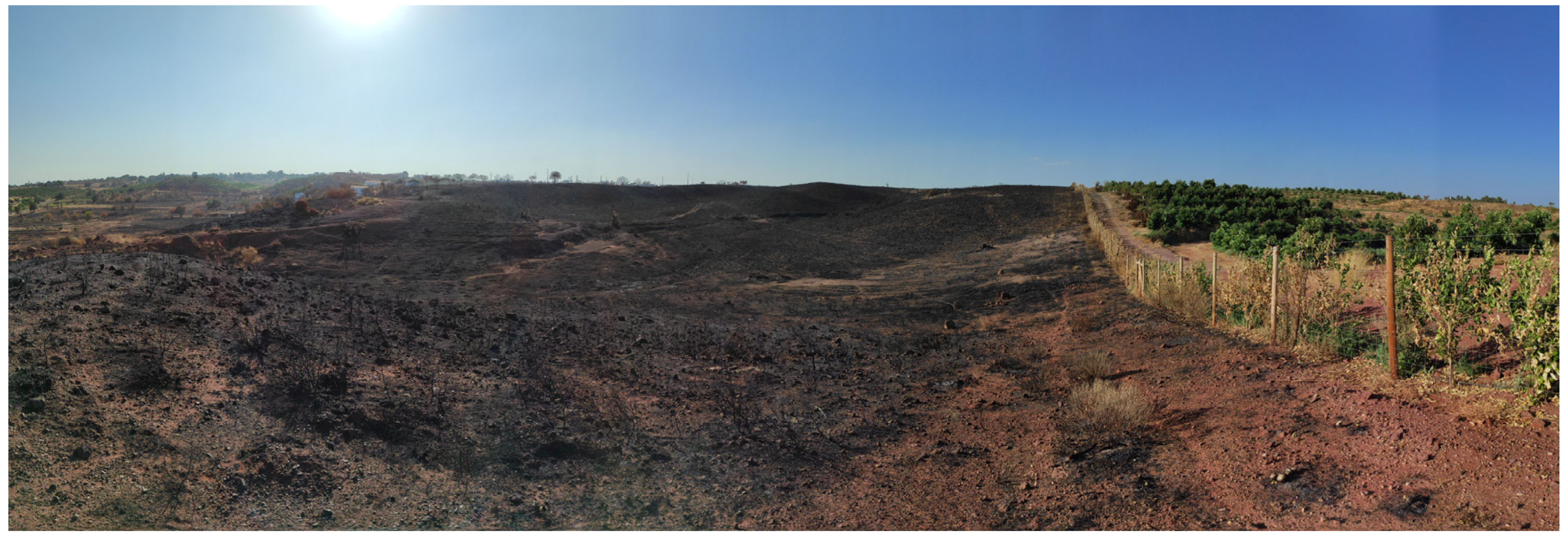
While some studies suggest that biomass in orchards, particularly non-irrigated ones in arid regions, may increase fire hazard [204], irrigated orchards demonstrate the opposite effect. Irrigation induces a significant cooling effect, reducing land surface temperature by up to 1.22 °C [205]. When irrigation is widespread, this cooling effect can extend beyond the plot scale and manifest at the landscape to regional level, as increased evapotranspiration alters surface energy partitioning, potentially lowering fire risk. More importantly, live fuel moisture content, the key determinant of fire susceptibility [206], remains high in these agroecosystems due to increased root-zone volumetric water content [207]. As a result, large-scale wildfires, upon reaching irrigated orchards, may scorch the perimeter trees but typically fail to propagate through the entire irrigated area (Figure 7). Similar fire-mitigation effects have also been observed in other irrigated land uses, such as golf courses and irrigated shrublands, where irrigation consistently reduces fire intensity and spread compared to non-irrigated vegetation [39,40].
Several wildfires in the Algarve region (Portugal) ceased to spread after reaching irrigated orchards (Figure 8). This effect is likely linked to increased landscape patchiness, lower orchard microclimate temperatures, and higher plant biomass moisture compared to surrounding non-irrigated land uses.
Irrigated orchards can slow fire spread, protecting plantation structure and economic returns while also acting as strategic firebreaks for nearby infrastructure (Figure S1) and natural areas. Although shredded pruning residues in inter-rows may allow some fire movement (Figure S2), orchards may still reduce fire intensity and propagation. In burned landscapes, these orchards become key green refuges that support wildlife, as seen in the high bird activity observed after fire events (Video S1). This effect also preserves the soil microbiota and critical below-ground ecosystem functions from thermal degradation [208].

7. Cultural Services

7.1. Landscape

Landscape is defined by the European Landscape Convention as “an area, as perceived by people, whose character is the result of the action and interaction of natural and/or human factors” [209]. This definition explicitly highlights the central role of human activities in shaping landscapes, with agriculture being one of the main drivers of this long-term transformation [210].
The continuity of landscapes is strongly connected to the values attributed to them by society [211]. While rapidly changing areas struggle to establish a recognizable identity [212], traditional and enduring landscapes tend to be appreciated and cherished by communities [213,214].
Orchards contribute decisively to the visual structure and cultural significance of many rural landscapes, frequently acting as defining elements of territorial identity [17,56,57,58]. As perennial cultivation systems, orchards embody long-term interactions between people and land, incorporating accumulated knowledge, management traditions and place-based practices. Consequently, these environments are increasingly recognized as ‘food landscapes’: spatial configurations where aesthetic quality, cultural memory, and food production converge to strengthen a community’s sense of belonging [215].
From an aesthetic and perceptual perspective, cultivated orchard landscapes are frequently characterized by high visual quality. Regular planting patterns, terraced landforms, and marked seasonal dynamics associated with flowering and fruiting enhance landscape diversity, structural complexity, and scenic value [17,216]. Historically, fruit tree cultivation has transformed landscapes through features such as terraced slopes, step balks, and stone banks, creating distinctive landscapes closely linked to regional historical development (Figure S3) and adaptive agricultural strategies [17]. However, declining economic viability often leads to orchard abandonment, resulting in the progressive loss of the unique cultural landscapes they generate (Figure S4) [20]. A striking example of this process is the decline of traditional almond groves in the Algarve (Portugal). Integrated into Mediterranean dryland agroecosystems for centuries, almond trees shaped the region’s cultural identity and achieved international recognition for their seasonal flowering landscapes before widespread abandonment began in the 1960s. Recently, however, new irrigated almond orchards have been established. These economically viable orchards are beginning to restore the iconic “snow-covered” appearance of the southern Portuguese landscape, evoking imagery of snowy fields in a subtropical region where snowfall is absent.
Mediterranean citrus orchards illustrate particularly well how irrigated orchards shape landscapes of high cultural and aesthetic value, in some cases formally recognized by UNESCO. The terraced lemon orchards of the Amalfi Coast reflect centuries of adaptation to steep terrain, integrating irrigated agriculture and architecture into a distinctive Mediterranean cultural landscape [217,218]. Similarly, the irrigated citrus orchards of La Huerta de Valencia exemplify traditional water-management systems and horticultural practices, that express enduring socio-ecological values of Mediterranean irrigated agriculture [219,220,221]. Irrigated orchard landscapes of high cultural relevance are also found in other regions of the world. In California’s Central Valley, extensive almond and citrus orchards have become emblematic features of the regional landscape, reflecting the historical development of large-scale irrigation infrastructure and shaping contemporary perceptions of agricultural productivity and rural space. These productive environments function as dynamic food landscapes, where the visual identity of the territory is a direct expression of its role in food systems. In North Africa and the Middle East, irrigated date-palm orchards within traditional oasis systems constitute iconic cultural landscapes, where water management, food production, and settlement patterns are deeply intertwined. In East Asia, long-established irrigated pear and peach orchards in parts of China and Japan similarly contribute to rural identity through their seasonal visual expression and long-standing cultivation traditions. Beyond these more emblematic examples, irrigated orchards also contribute to landscape quality in many other contexts, enhancing visual amenity by breaking spatial monotony and, in some cases, being the only landscape elements that retain intense greenness during prolonged dry periods.

7.2. Cultural, Historical, and Traditional Values

In some regions, the cultivation of specific crops is integral to local identity and traditional values, with agricultural practices transmitted across generations and shaping local ways of life. Fruit production often extends beyond economic activity to express cultural identity, fostering strong connections between farmers and the environment and reinforcing community belonging and collective memory [215].
Extensive orchards are often closely linked to regional and local identity, embedded in rural cultural traditions and associated with local varieties and traditional products [222]. Their terminology and practices reflect knowledge transmitted across generations [57]. In some cases, they also preserve historical identity and collective memory of traditional agricultural organization, contributing to cultural landscapes and historical land-use patterns [17,57].
The Mediterranean diet, renowned for its positive health effects and historically shaped by the populations of the Mediterranean Basin, is characterized by a high consumption of fruits, eaten both as fresh produce and as processed products [223]. In current Mediterranean agri-food systems, a substantial share of this fruit production—particularly under modern conditions—is derived from irrigated orchards. This is especially the case for species (or groups of species) such as citrus fruits, figs, pomegranates, almonds, stone fruits (including peaches, apricots, cherries and plums), pomaceous fruits (apples, pears and quinces), as well as carobs, loquats, walnuts and pistachios [224,225,226,227].

7.3. Recreation and Tourism

In regions where the cultivation of a specific crop is deeply embedded in local culture and traditional values, it is common for festivals and recreational activities to be associated with the agricultural cycle [228,229,230,231]. These festivals often include activities that combine leisure, learning, and sensory engagement, such as visiting orchards, picking fruits, or participating in food-related workshops [232]. Gastronomic festivals offer a recreational platform where tasting and exploring local fruits entertains and educates visitors about production processes, seasonality, and fruit quality [233,234,235,236]. These also reinforce regional gastronomic identity and promote local fruits through tastings and direct sales [232]. The produce of irrigated orchards frequently serves as the centerpiece for cultural events attracting thousands of tourists. Prominent examples (cited in their original names) include: Fête du Citron (Menton, France); Fira de la Taronja (Sóller, Mallorca, Spain); Battaglia delle Arance (Ivrea, Italy); Silves, Capital da Laranja (Silves, Portugal); International Mango Festival (Delhi, India); Mandorlo in Fiore (Agrigento, Sicily, Italy); Fiesta del Almendro en Flor (Gran Canaria, Spain); Festival des Amandiers (Tafraout, Morocco); Festival-e Pesteh (Kerman, Iran); California Walnut Festival (California, United States); Apple Blossom Festival (Shenandoah Valley, United States); Fête de la Pomme (Normandy, France); Festa dell’Olio Nuovo (various regions of Italy); and Fiestas del Aceite (Andalusia, Spain).
The combination of recreation and local fruit production provides multiple benefits: (i) economic—direct fruit sales at festivals, increased restaurant revenue from fruit-based dishes, and higher hotel occupancy [237,238]; (ii) social and cultural—promotion of local culinary heritage, strengthening of community identity, and visitor education on agricultural practices [236,239]; and (iii) tourism and branding—enhancement of the destination’s image, encouragement to repeat visits, and provision of unique experiences centered on local produce [238,240].
In this context, orchard-dominated landscapes support tourism by stimulating recreational activities and enhancing regional attractiveness. Beyond their visual appeal, certain fruit species offer a unique sensory experience during flowering due to their intense fragrance. A prime example is found in citrus orchards, where the orange blossom scent, a result of the high essential oil content in the flowers [89], is so iconic that it defines the identity of entire tourist regions. This is the case of the Costa del Azahar (Orange Blossom Coast), where the fragrance (known as azahar) creates a distinct olfactory landscape that significantly increases visitor interest and regional prestige. They can also directly generate agrotourism, which integrates agricultural production with visitor experiences [59,60]. This approach attracts individuals interested in nature, culture, and leisure, while providing farmers with additional income beyond crop sales [60]. Agrotourism in orchards offers visitors experiences of local lifestyles and culture, including harvesting, tasting, artisanal products, educational activities, tours, festivals, and gastronomy [60,241,242]. Studies indicate that the most preferred activities are harvesting and tasting, orchard walks, learning about agricultural tourism, cycling, and engaging with farmers’ lifestyles [60].

8. Supporting Services

8.1. Nutrient Cycling

Nutrient cycling in soil refers to the biogeochemical processes by which plant nutrients, such as nitrogen, phosphorus, potassium, calcium, magnesium, and sulfur, are released, transformed, taken up, and recycled within the soil ecosystem [243]. Nutrient cycling occurs in five stages: (i) input of organic matter and nutrients through litterfall, dead roots, other organic residues, and external additions such as fertilizers and amendments onto the soil; (ii) decomposition of organic materials by soil microorganisms; (iii) mineralization of organic forms into inorganic forms such as nitrates, phosphates, and sulfates; (iv) plant uptake of nutrients in their available inorganic forms from the soil solution; and (v) return of nutrients to the soil through tissue death and subsequent deposition.
The rate and efficiency of nutrient cycling are strongly influenced by environmental, biological and orchard management factors, with soil microbial activity playing an important role across all systems. In tropical climates, decomposition rates are typically higher during the rainy season, due to favorable moisture and temperature conditions that enhance microbial activity, resulting in more efficient nutrient cycling compared with degraded areas [244]. Nutrient losses may occur through leaching, erosion, and volatilization [31]. In orchards, most nutrients are recycled back into the soil through processes such as leaf litterfall and root turnover [31].
Nutrient cycling therefore relies on both the continuous input of plant residues from the crop into the soil [244] and the presence and activity of soil microbial communities [245]. Soil bacterial and protist diversity plays a crucial role in the biogeochemical cycling of multiple nutrients, whereas fungal diversity appears to exert a comparatively smaller influence on these processes [246]. Nutrient cycling is also strongly affected by the rate and quality of litter production. In the Amazon region, litter from mango orchards has been shown to contain higher nitrogen, calcium, and magnesium concentrations than litter from degraded areas, with nutrient levels comparable to those of native forests [244].
Soil management strongly affects nutrient cycling. Compost application can stimulate soil food webs; however, different compost types shape distinct microbial communities, altering trophic interactions and potentially enhancing plant nutrient uptake [245]. In orchards, pruning residues should be shredded and retained in inter-row areas, when phytosanitary conditions allow, to minimize nutrient export and promote internal nutrient recycling [31].
The establishment of cover crops in orchard inter-rows, particularly legume-based mixtures, enhances soil nutrient cycling and promotes beneficial shifts in soil microbiome composition [247,248]. These cover crops increase nitrogen (N) availability and can also elevate potassium (K) and boron (B) levels while reducing calcium (Ca) and manganese (Mn) availability, likely as a result of organic matter mineralization, gradual nutrient release, and changes in soil chemistry [248]. Residue incorporation further supports nutrient release and tree uptake, highlighting the role of legumes as green manure in promoting sustainable biological nutrient recycling [247,248]. Compared with other cover crops, legumes are associated with more substantial changes in the soil microbiome, including increases in beneficial microorganisms and reductions in soil-borne pathogens, although these responses are modulated by plant density, species composition, relative proportions, and abiotic soil conditions [247].
Inoculation with arbuscular mycorrhizal fungi enhances nutrient cycling by increasing soil NH4+, NO3, available phosphorus, and exchangeable potassium. It also stimulates microbial biomass and enzymatic activity, accelerating organic matter decomposition and C and N cycling, while promoting microbial diversity and beneficial taxa such as Bradyrhizobium and Nitrospira, thereby improving overall nutrient cycling efficiency [249].

8.2. Biodiversity

Agriculture has long been recognized as a major driver of biodiversity loss, especially under intensive or poorly managed systems that simplify landscapes and restrict conservation practices, thereby reducing species diversity and abundance [250]. The impact of agriculture on biodiversity loss was vividly illustrated in Rachel Carson’s Silent Spring [251], which documented the ecological consequences of chemically intensive farming in the United States during the post-Green Revolution era. This period was shaped by productivist paradigms that prioritized yield maximization, often at the expense of ecological integrity, and that still persist in some agricultural contexts. By contrast, many modern orchards managed using diversified, low-input or agroecological practices are no longer “silent”, instead supporting a wide range of insects, birds, and other fauna. These systems increasingly highlight the potential role of orchards to conserve biodiversity within broader agricultural landscapes.
To some extent, biodiversity loss is an inherent consequence of food production, a process that has existed, albeit at much smaller spatial and technological scales, since the advent of agriculture approximately 12,000 years ago [252], with the establishment of early orchards about 8000 years ago [17]. Agriculture footprint remained relatively limited until the post-Green Revolution era, when landscape simplification and increasingly input-intensive management led to pronounced declines in farmland biodiversity and associated ecosystem services [253,254]. The resulting challenge is to reconcile food production with environmental sustainability through context-specific management strategies adapted to different crops and regions. Agriculture has repeatedly demonstrated its potential to severely harm global biodiversity, particularly when it involves deforestation and species extinction [255], the expansion of large-scale monocultures that reduce landscape heterogeneity and simplify habitats [50,51], and the widespread use of chemical inputs [256] with few or even no practices that support biodiversity conservation [250]. However, agriculture can positively contribute to biodiversity by reclaiming degraded lands, providing resources and habitats for a wide range of organisms [257,258,259], including rare or endangered species, and functioning as green corridors within fragmented landscapes [260]. Increasingly, farmers and policymakers recognize that biodiversity loss can ultimately reduce yields and increase production costs, whereas greater spatial heterogeneity and ecological diversification can generate win–win outcomes for both agricultural productivity and biodiversity conservation [261].
Irrigated orchards can represent structurally complex agroecosystems with multiple strata that produce various resources and fulfil the habitat requirements of many species, including plants, microorganisms, and fauna, and their interactions.
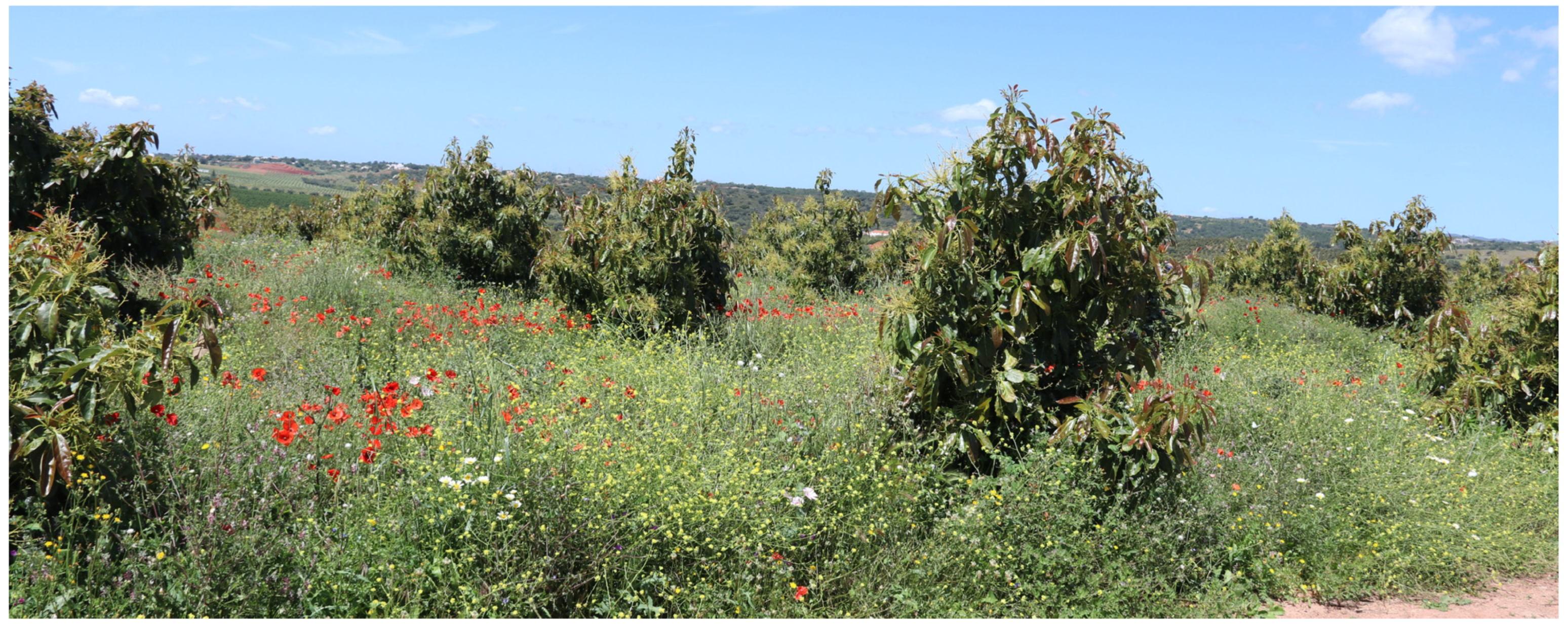
In orchards, plants typically form at least two strata: (i) an arboreal stratum; and (ii) an herbaceous stratum (Figure 9). The arboreal layer generally comprises two biological components: the cultivar and the rootstock. The use of traditional cultivars contributes to the conservation of genetic resources and is closely linked to cultural ecosystem services [262]. The herbaceous layer, which is commonly present, may consist of spontaneous species or be intentionally established as cover-crops, thereby increasing biodiversity even in high-intensity agroecosystems [263].
In agroecosystems, microorganisms are fundamental to the ecosystem services the agroecosystem provides, as they play key roles in nutrient cycling [245] and in the carbon cycle [264], enhance plant nutrient uptake (e.g., through mycorrhizal associations) [249], and contribute to the biological control of pathogenic organisms [265,266]. In irrigated orchards, soil management practices strongly influence the soil environment and, consequently, soil microbiota, since soil moisture is a major driver of microbial activity and nutrient cycling. Irrigation in orchards generally increases microbial biomass and activity [267,268]. Moreover, higher soil microbial diversity is associated with enhanced ecosystem stability and resilience, reducing susceptibility to both anthropogenic and natural stresses [269].
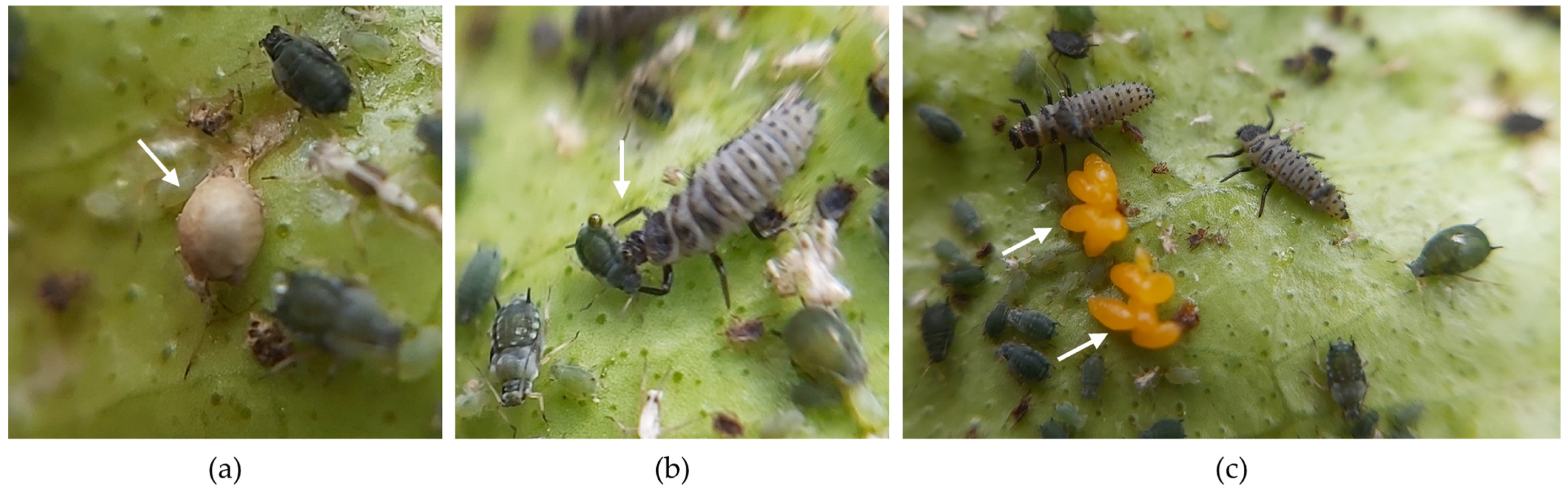
Regarding animals, the most common groups found in orchards are arthropods, small mammals and birds. Arthropods, the most species-rich animal phylum, serve as key bioindicators and play fundamental roles in structuring ecosystems and supporting species persistence in both natural and agricultural systems [255,270]. Orchard management strongly influences agrosystem equilibrium. When this balance is disrupted, some arthropod species may proliferate excessively and become agricultural pests. Such imbalances often arise from high food availability, high reproductive rates, and reduced natural mortality, leading to population outbreaks that cause economic damage, yield losses and broader socioeconomic and environmental impacts [271,272]. In contrast, when agroecosystem equilibrium is maintained, orchards support a substantial proportion of beneficial arthropods (Figure 10) that provide essential ecosystem services, including pollination, contributions to nutrient cycling, and the regulation of other arthropod populations [273]. These services enhance crop productivity and resilience while reducing reliance on external agricultural inputs, thereby supporting the long-term sustainability of agroecosystems.
Increasing ecological complexity in intensive orchards enhances arthropod abundance and diversity, including pollinators and natural enemies, indicating that well-managed systems can mitigate impacts and support biodiversity [35,36]. A key ecosystem service is the biological control of arthropod populations by predators and parasitoids, which helps suppress pest outbreaks. However, the effectiveness of this service depends on ecological complexity and varies with spatial scale, landscape context, and the availability of surrounding natural or semi-natural habitats [35,274,275].
In orchards, landscape heterogeneity can be enhanced through the conservation of semi-natural habitats, such as ecological refuges, which increase species abundance and richness and support a wide range of ecosystem services [276,277,278]. Orchards with heterogeneous structures, combining trees, grasslands and adjacent arable land, tend to support high levels of biodiversity by enhancing floristic diversity and functioning as ecological corridors and refuges for rare and disturbance-sensitive species [17]. By acting as transitional habitats within agricultural landscapes, these systems promote the diversity of multiple taxonomic groups, including birds, pollinators (e.g., bees, flies, and some wasps), beetles, butterflies, terrestrial gastropods, and plants [216].
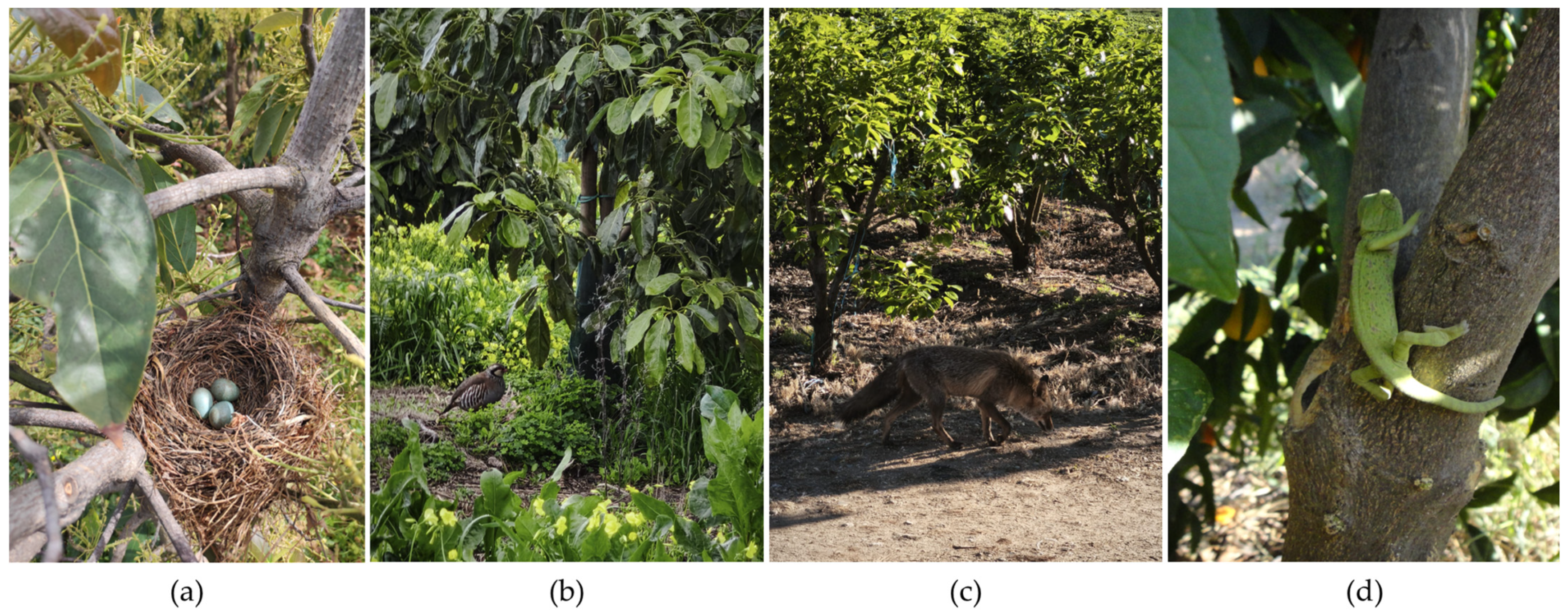
Irrigation can alter arthropod communities by modifying vegetation structure and microclimate, although effects are inconsistent and often depend on broader management practices such as pesticide use and ground cover management [279,280]. In drought-prone environments, water limitation constrains both production and biological communities, whereas irrigation can reduce stress by increasing resource availability and soil moisture. Higher moisture levels are associated with increased arthropod abundance, including beetles and spiders, underscoring the role of microclimatic conditions in shaping these communities [281,282,283]. Beyond supporting arthropods, orchards can also serve as habitats for macrofauna, such as small mammals and birds, which may complete part or all of their life cycles within agroecosystems (Figure 11a). In Mediterranean and other dryland regions, orchards often provide relatively stable, resource-rich environments compared with non-cultivated or degraded lands; however, the loss of traditional tree–grassland mosaics in these landscapes can contribute to declines in species that depend on heterogeneous habitats [284,285].
Structural heterogeneity in orchards, including tree canopies, herbaceous understory vegetation, and leaf litter, is essential for maintaining high levels of biodiversity [108]. This structural complexity provides shelter, nesting sites, and foraging resources while also buffering organisms against climatic extremes. Increased microhabitat complexity, especially when bare soil is reduced, is further associated with higher abundance and species richness of small mammals [286,287]. Leaf litter layers create suitable microenvironments for macroinvertebrates [288] such as earthworms, millipedes, and other taxa [289], which are an important food resource for small mammals [290]. In turn, small mammals play a pivotal role in ecosystem functioning by contributing to soil aeration, regulating weed populations, and supporting biological control [291,292,293,294].
Trees play a critical role in moderating microclimatic conditions, especially during the summer, by reducing heat stress and buffering temperature extremes [295,296]. Irrigation further enhances understory development in orchards, increasing food availability both directly (through greater plant biomass and seed production) and indirectly by supporting higher insect abundance. These conditions benefit numerous species, including the European rabbit (Oryctolagus cuniculus) and ground-nesting birds such as the Red-legged partridge (Alectoris rufa) (Figure 11b), which benefit from the combined availability of cover, food resources, and relatively low disturbance. During periods of seasonal resource limitation, irrigated orchards can also enhance landscape connectivity by facilitating species movement across fragmented habitats, thereby supporting the persistence of diverse faunal communities, including predators (Figure 11c). Consequently, orchards may function as suitable habitats for breeding, foraging, and refuge, contributing to the maintenance of local populations [297]. Promoting the activity of pest predators (e.g., Pipistrellus kuhlii preying on Prays oleae in olive groves) may yield significant economic benefits [298,299]. In some cases, water sources can be installed for wildlife to prevent damage to irrigation systems caused by animals seeking water (Figure S5). In addition, the managed nature of these ecosystems generally reduces wildfire risk compared to unmanaged landscapes, further enhancing habitat stability.
Habitat provision in orchards is an important supporting ecosystem service, but its effectiveness is strongly shaped by management intensity [300]. Intensive practices such as frequent soil disturbance, herbicide use, and reduced ground cover can limit habitat availability and diversity of resources, thereby disrupting trophic interactions and ecological functioning. In contrast, low-input orchards characterized by greater structural complexity and less disturbance generally sustain higher biodiversity and more stable biological communities. Such systems may even provide suitable habitat for strictly protected species such as the common chameleon (Chamaeleo chamaeleon) (Figure 11d), a species commonly associated with Mediterranean ecosystems, such as shrublands, coastal vegetation and orchards [301]. Nevertheless, sustainability outcomes are context-dependent, and in some cases higher-intensity agricultural systems may reduce pressure on surrounding natural ecosystems, for example by limiting land conversion. Optimizing ecosystem service provision therefore requires the integration of local and landscape-scale management strategies, as well as a clearer understanding of their relative contributions to biodiversity conservation and long-term sustainability [253].

8.3. Pollination

Pollination is a fundamental ecosystem service that directly influences crop yield, fruit quality, and farm economic viability, playing a key role in food security, while also being essential for the reproduction of numerous spontaneous plant species. It occurs through abiotic vectors, such as wind (anemophily) and water (hydrophily), or through biotic agents, including birds (ornithophily), bats (chiropterophily), and insects (entomophily) [302]. Many irrigated orchards rely on effective pollination to sustain productive performance and, through appropriate management, contribute to maintaining pollination as an ecosystem service.
Although wind pollination is relevant for some tree crops, particularly in Mediterranean landscapes, insect-mediated pollination represents the dominant mode for most fruit crops [278,303] and underpins a wide range of pollinator-dependent crops [304,305,306]. Consequently, orchard productivity is tightly linked to the availability and activity of pollinating insects. In many fruit production systems, managed honeybees (Apis mellifera) are used to supplement natural pollination, especially under conditions of reduced pollinator diversity [307,308]. High-quality colonies can improve pollination efficiency, enhancing fruit set, seed number, and fruit quality in crops such as apple and pear, thereby improving growers’ economic profitability [309]. However, effective pollination often depends on diversified pollinator communities, including bumblebees and other wild bees, whose presence is strongly influenced by orchard and landscape management [310]. In contrast, some fruit crops do not benefit from pollination. In certain citrus cultivars such as clementines and other mandarins (‘Nadorcott’, ‘Nova’) cross-pollination induces seed formation, which reduces fruit commercial value [311].
Irrigated orchards can support diverse assemblages of wild pollinators, especially when management practices promote habitat heterogeneity. These include not only bees, but also other hymenopterans (e.g., wasps and ants), as well as dipterans, lepidopterans, and coleopterans, which contribute significantly to pollen transfer and the pollination of multiple plant species [312,313]. Although non-bee insects generally deposit less pollen per visit, their high visitation frequency enables them to play a significant role in pollination [312].
Plant biodiversity in orchards creates a mosaic of ecological niches that support pollinators, while agricultural management shapes the diversity, structure and habitat quality of both managed and wild communities [314]. Climate change may disrupt the synchrony between flowering and pollinator activity, reducing pollination efficiency. In this context, irrigated orchards can provide more continuous floral resources, particularly in resource-limited landscapes, while spontaneous or sown vegetation extends floral availability and supports pollinator persistence (Figure 12a,b). Irrigation reduces water stress, promoting tree growth, flowering, and vegetation development within and between rows. It also increases water availability, as drip irrigation runoff and moist microsites can serve as important drinking sources for pollinators during dry periods when natural resources are scarce (Figure 12c) (Video S2).
Although still understudied, evidence suggests that bee-rich orchards can benefit adjacent natural habitats by supplying floral resources that sustain pollinator populations, complement foraging, and enhance pollination services and wild plant reproduction [315,316]. Managed bee species may, in some cases, partially compensate for native pollinator declines through movement between orchards and surrounding ecosystems [316]. These effects depend on landscape heterogeneity, where moderate conversion of natural habitats can enhance complementarity between agricultural and semi-natural areas. Spatial and temporal heterogeneity supports pollinator-rich communities, while excessive forest loss reduces diversity, especially of specialist species, highlighting the importance of balance between natural and managed habitats [317,318].
Studies also indicate that, even after the flowering period, orchards may continue to function as relevant habitats for pollinators, particularly when they maintain well-developed vegetation cover. The use of orchards by bees may vary throughout the season, with increases occurring during certain periods; this pattern is associated with the availability of alternative floral resources in the herbaceous layer [319,320]. These findings reinforce the role of orchards in supporting functional biodiversity, not only through the continuity of floral resources but also by sustaining diverse pollinator communities that are essential for the stability of these agroecosystems [321].

9. Modelling Frameworks for Quantifying Ecosystem Services

Although ecosystem services in irrigated orchards are increasingly recognized, their quantification remains challenging due to the complex interactions among hydrological, physiological, and management processes. Since the economic valuation of ecosystem services depends on robust quantification methods, physics-based and AI-driven models offer promising tools to assess, predict, and support the management of ecosystem services in orchard agroecosystems [322].
Physics-based approaches can simulate water and energy fluxes together with plant physiological responses, thereby improving the assessment of ecosystem services such as water regulation and carbon sequestration [323,324,325]. Other approaches, such as the InVEST (Integrated Valuation of Ecosystem Services and Tradeoffs) framework, enable the estimation of carbon sequestration, biodiversity, soil erosion (through RUSLE), and other ecosystem services [326]. The RUSLE (Revised Universal Soil Loss Equation) is a widely used empirical model for estimating soil erosion under agricultural conditions at multiple spatial scales [327]. Additional process-based models, such as STICS [328] and APSIM [329], also support the simulation of carbon dynamics and a range of ecosystem services under different management and environmental scenarios.

10. Economical Valorization

10.1. European Public Policy Instruments

Orchards, as perennial and structurally complex agroecosystems, play an important role in providing ecosystem services, which largely take the form of positive externalities not remunerated by the market. This gap between environmental value and economic compensation is socially inequitable and creates a structural disincentive for the adoption of more sustainable practices, especially when they involve additional costs, production risks, or short-term income losses.
To address this societal and market failure, public policies have been implemented worldwide to promote sustainable agricultural practices, ecosystem restoration, biodiversity preservation, and the conservation of rural landscapes [330,331,332]. Within the framework of the Common Agricultural Policy (CAP), the European Union has developed a set of instruments aimed at compensating for opportunity costs, income losses, and expenses associated with the implementation of environmentally beneficial practices. These payments do not constitute mere income subsidies, but rather structured incentives designed to align economic rationale with environmental objectives, following the principle of “no overcompensation,” that is, compensating adequately without generating undue profit [333,334].

10.2. The Trajectory of the CAP “Green Architecture”

The 1992 CAP reform marked a paradigm shift: from a policy focused on market regulation and price support to one that progressively incorporated environmental objectives, thereby laying the foundations for its subsequent legitimation through the provision of environmental public goods [335].
In this context, “Agri-Environmental Measures” were introduced, establishing compensatory payments for the voluntary adoption of environmentally beneficial practices, alongside cross-compliance as a regulatory instrument. Mandatory mechanisms, such as “greening,” were subsequently integrated into environmental conditionalities, increasing the complexity of control systems and the need for administrative simplification [335,336].
More recently, the European Green Deal has reinforced the centrality of climate and environmental objectives in agricultural policy, including carbon neutrality, biodiversity protection, and the transition towards sustainable production systems. The 2023–2027 CAP programming has consolidated this trajectory through the introduction of “Eco-schemes” and the strengthening of environmental conditionality, shaping the current CAP “green architecture”, which combines mandatory requirements with remunerated incentives for sustainable practices [334,336].
Although the CAP green architecture has progressively incorporated environmental and climate objectives, evidence regarding its effectiveness remains ambiguous. The instruments largely continue to rely on practice-based measures, compensating for additional costs and income losses without necessarily ensuring measurable ecological outcomes. Several evaluations of agri-environmental measures and greening mechanisms suggest that environmental results have frequently fallen short of expectations, particularly regarding biodiversity recovery, soil restoration, and greenhouse gas emission reductions. In many cases, the predominance of prescriptive approaches has encouraged formal compliance with predefined management practices without guaranteeing effective improvements in ecosystem service delivery [337,338,339].
This limitation has reinforced interest in results-based or hybrid payment models, aimed at effectively remunerating ecosystem services [336,340]. The recent introduction of eco-schemes represents an attempt to strengthen the link between public expenditure and measurable environmental outcomes. However, the practical implementation of such approaches raises important methodological and institutional challenges. Reliable indicators capable of capturing ecosystem service delivery at the farm level remain insufficiently developed, while monitoring systems often involve high transaction, verification, and technical support costs. Furthermore, environmental outcomes are influenced by climatic variability and ecological uncertainty, increasing risks for farmers participating in these schemes [341].
In this context, research, pilot projects, and action-research initiatives become essential for developing robust monitoring methodologies, harmonized indicators, and locally adapted assessment frameworks capable of supporting credible and operational result-based policies. The development of reliable, scientifically validated, and operationally applicable indicators constitutes a critical prerequisite for the effective implementation of this type of agri-environmental scheme. Such indicators must be capable of measuring ecosystem services in a verifiable and cost-effective manner while remaining sufficiently flexible to accommodate different environmental conditions and farming practices [336,340]. The territorial heterogeneity of agroecosystems, particularly evident in Mediterranean orchard systems, reinforces the need for interdisciplinary research and knowledge transfer through bottom-up approaches capable of integrating local ecological variability into policy design.
It is also important to consider that results-based remuneration models tend to be more easily adapted to multifunctional and extensive rainfed farming systems, where structural diversity favors the expression of ecosystem services. In contrast, intensive irrigated orchards focus many of their sustainable management practices—such as organic farming, integrated production, cover crops, or mulching—primarily on mitigating negative externalities associated with production intensification. In this context, the transition towards schemes strictly dependent on ecological outcomes may generate resistance and reduce farmers’ participation due to uncertainties associated with climatic variability, environmental indicators, and production risks. Therefore, hybrid models combining sustainable practices with gradual result-based components may prove more suitable for irrigated orchard systems.

10.3. Voluntary Carbon Markets

Beyond public instruments, market mechanisms have emerged to economically valorize carbon sequestration in agricultural systems. Voluntary carbon markets allow companies to offset emissions by financing projects that remove or avoid CO2 emissions, generating tradable carbon credits.
In this context, the EU has developed a regulatory certification framework, the Carbon Removal Certification Framework, to harmonize standards and strengthen environmental integrity. In Carbon Farming (Land Use and Agriculture), also called Nature-Based Carbon, removals are linked to regenerative agricultural practices that enhance climate resilience [342].
These markets face technical and institutional challenges, including the need for robust measurement methodologies, guarantees of additionality, carbon permanence, and the prevention of double counting. Nevertheless, they represent a promising mechanism to internalize the climate value of regulating services provided by orchards, stimulating regenerative soil processes.
Taken together, agri-environmental measures, eco-schemes, and voluntary carbon markets form a hybrid system of public and private incentives with the potential to accelerate the transition to more sustainable orchards. Still, integration between CAP green architecture instruments and environmental markets remains institutionally incipient and fragmented [343]. While both share the goal of valuing ecosystem services, they operate under distinct and weakly coordinated regulatory logics, generating uncertainties regarding cumulative eligibility, legal compatibility, and verification responsibilities. The absence of a coherent framework reduces predictability for farmers and limits the potential complementarity between public financing and private payments based on environmental results [344].

10.4. Policy Territorialization and Symbolic Valorization of Orchards

An emerging dimension of green architecture lies in the territorialization of agricultural and environmental policies. The integration of instruments such as Integrated Territorial Investments (ITI), zoning plans, and local development strategies strengthens the linkage between agriculture, environment, and territorial cohesion. The application of different instruments enables the environmental valorization of some ecosystem services (Table 3).
Simultaneously, international recognition initiatives, such as the Globally Important Agricultural Heritage Systems (GIAHS) of the Food and Agriculture Organization (FAO) and agricultural landscapes classified as UNESCO World Heritage, confer symbolic and cultural value to agricultural territories. In traditional orchard regions, this symbolic valorization can generate multiplier effects, linking ecosystem services with tourism, gastronomy, and high-quality products. The creation of Bio-Districts, anchored in organic agriculture promotion, also provides a powerful tool for ecological territorial governance, potentially reconfiguring agri-food value chains, consumption patterns, and relations between agriculture and society [345].

11. Summary and Conclusions

Irrigated orchards are a form of intensive agriculture and, as such, are frequently the subject of severe criticism from environmental movements and society at large due to their perceived negative environmental impacts. This has fostered an atmosphere of public distrust. Climate change, characterized by rising temperatures and increasingly irregular precipitation, has further intensified this scrutiny, portraying irrigated orchards primarily as “water sinks” that compete with other essential needs.
However, this prevailing view often overlooks the vital ecosystem services that these systems provide. In this article, we have described these services based on an extensive literature review and a profound reflection on the relationship between irrigated orchards and the environment, weighing both negative and positive impacts. Given the breadth of this review, it was not possible to explore every ecosystem service in exhaustive detail; this therefore creates clear opportunities for future, more specialized research to investigate specific services with greater depth.
The authors believe that this comprehensive overview provides a compelling case that may shift the perspective of those who approach this text with an attentive and open mind. Nothing in this work is intended to minimize or disregard the negative impacts that certain irrigated orchards may have due to inadequate cultural practices or a purely productivist mindset. Rather, we assert that such practices are neither the only way to farm nor the dominant approach in many fruit-growing regions.
While this article does not specifically address organic farming or agroforestry, this is not a devaluation of their role in the agroecological transition. Instead, our focus acknowledges that even within “conventional” systems, the adoption of integrated pest management and integrated production practices has significantly transformed fruit production systems.
This review addressed three main research questions related to the role of irrigated orchards as providers of ecosystem services:
(i)
Irrigated orchards were shown to provide a wide range of ecosystem services, including provisioning, regulating, cultural, and supporting services.
(ii)
The scientific literature still largely reflects a productivist perspective, often underrepresenting the multifunctional role of these systems.
(iii)
Important knowledge gaps persist, particularly regarding the relationships between management practices, production intensity, and ecosystem service provision, which remain insufficiently understood and require further research.
In summary, the main conclusions of this study can be synthesized as follows:
-
Irrigated orchards should be recognized as multifunctional agroecosystems capable of providing significant ecosystem services alongside food production.
-
The perception of irrigated orchards as predominantly environmentally harmful systems is overly simplistic and does not reflect their full ecological and socioeconomic role.
-
The interactions between management practices and ecosystem service provision are complex and context-dependent, requiring further integrative research.
-
Improving the quantification and valuation of ecosystem services is essential to support more effective policy design and implementation.
In conclusion, this article does not ignore the potential environmental risks of irrigated fruit crops; rather, it opens a prejudice-free perspective on their positive contributions. This is not a closed discussion but a scientifically grounded reflection intended to open a new field of dialogue among researchers, technicians, and farmers, aiming for a more sustainable future for global fruit production.

Supplementary Materials

The following supporting information can be downloaded at: https://www.mdpi.com/article/10.3390/agriculture16121336/s1, Figure S1: Wildfire perimeter at an irrigated citrus orchard that helped protect nearby houses (Castro Marim, Algarve, Portugal; August 2021); Figure S2: Shredded pruning residues in the inter-row area facilitated limited fire spread while reducing fire intensity, during the wildfire (Castro Marim, Algarve, Portugal; August 2021); Figure S3: Mediterranean landscape shaped by irrigated citrus orchards (Algarve, Portugal; May 2021); Figure S4: Abandoned citrus orchard (Algarve, Portugal; June 2021); Figure S5: Improvised watering bowl installed by farmers beneath a drip emitter to retain part of the irrigation water and make it available to wildlife in the orchard (Algarve, Portugal; October 2016); Video S1: Birdsong following a wildfire, with birds using the orchard as a refuge (Algarve, Portugal; August 2021); Video S2: Several Apis mellifera individuals using a drip emitter as a water source in an avocado orchard (Algarve, Portugal; April 2023).

Author Contributions

Conceptualization, A.D.; methodology and investigation, A.D., P.M. and A.R.T.; writing—original draft preparation, P.M., A.R.T., T.M., S.L.d.S.J. and B.D.; writing—review and editing, P.M., A.R.T., T.M., S.L.d.S.J., M.F., B.D., I.B., L.C. and A.D.; supervision, A.D. All authors have read and agreed to the published version of the manuscript.

Funding

This research received no external funding.

Data Availability Statement

Publicly available datasets were analyzed in this study. These data can be found at the following sources: FAOSTAT (https://www.fao.org/faostat/en/#data/; accessed on 6 October 2025), USDA FoodData Central (https://fdc.nal.usda.gov/download-datasets; accessed on 6 October 2025), ICNF Territórios Ardidos dataset (https://si.icnf.pt; accessed on 13 November 2025), IFAP WMS service (https://www.ifap.pt/isip/ows/isip.data/wms; accessed 26 November 2025), and dados.gov.pt (https://dados.gov.pt; accessed 11 on November 2025).

Acknowledgments

We would like to express our sincere gratitude to the farmer and agronomist Diamantino Trindade for the many insightful discussions held in his orchards, where topics such as the role of irrigated orchards in fire prevention, biodiversity, and related ecosystem services were explored. One of his remarks—“I’ve seen more [wild] rabbits from the farm gate to here [a 700 m journey through an irrigated orchard] than in a whole day of hunting [in uncultivated areas]”—prompted reflection on the ecological importance of these systems and contributed to the development of this work. We also thank him for kindly sharing photographs (including sheep grazing in the orchards, a sheltered partridge, and a fox in a persimmon orchard), as well as for facilitating those collected by the authors in his avocado and carob orchards. We are equally grateful to Silvino Oliveira, Angélica Mendonça and Pedro Godinho for valuable discussions on ecosystem services in orchards and for their collaboration in parallel experiments, which contributed to a deeper understanding of these processes and their documentation. We also thank Frederico Mestre and Diogo Valentim for recommending literature. Finally, the authors acknowledge the R&D unit MED—Mediterranean Institute for Agriculture, Environment and Development (https://doi.org/10.54499/UID/05183/2025 accessed on 30 April 2026) and the Associate Laboratory CHANGE—Global Change and Sustainability Institute (https://doi.org/10.54499/LA/P/0121/2020 accessed on 30 April 2026). During the preparation of this manuscript, the authors used Gemini to assist in the development of the initial versions of two figures (Figure 5 and Figure 6). The authors reviewed and edited the output as needed and take full responsibility for the content of the publication.

Conflicts of Interest

The a uthors declare no conflicts of interest.

Correction Statement

This article has been republished with a minor correction to three authors’ ORCID and to resolve spelling and grammatical errors. These changes do not affect the scientific content of the article.

References

  1. Tiwari, M.; Siry, J.; Abrams, J.; Bettinger, P. Linking environmental sustainability in forest companies to ecosystem services: A systematic review and outlook. Ecosyst. Serv. 2026, 79, 101842. [Google Scholar] [CrossRef]
  2. Gamfeldt, L.; Snäll, T.; Bagchi, R.; Jonsson, M.; Gustafsson, L.; Kjellander, P.; Ruiz-Jaen, M.C.; Fröberg, M.; Stendahl, J.; Philipson, C.D.; et al. Higher Levels of Multiple Ecosystem Services Are Found in Forests with More Tree Species. Nat. Commun. 2013, 4, 1340. [Google Scholar] [CrossRef] [PubMed]
  3. Biswas, B.; Chakraborty, D.; Timsina, J.; Bhowmick, U.R.; Dhara, P.K.; Lkn, D.K.G.; Sarkar, A.; Mondal, M.; Adhikary, S.; Kanthal, S.; et al. Agroforestry Offers Multiple Ecosystem Services in Degraded Lateritic Soils. J. Clean. Prod. 2022, 365, 132768. [Google Scholar] [CrossRef]
  4. Altieri, M.A.; Nicholls, C.I. The Adaptation and Mitigation Potential of Traditional Agriculture in a Changing Climate. Clim. Change 2017, 140, 33–45. [Google Scholar] [CrossRef]
  5. Torralba, M.; Fagerholm, N.; Burgess, P.J.; Moreno, G.; Plieninger, T. Do European Agroforestry Systems Enhance Biodiversity and Ecosystem Services? A Meta-Analysis. Agric. Ecosyst. Environ. 2016, 230, 150–161. [Google Scholar] [CrossRef]
  6. Reis, A.; Duarte, B.; Duarte, A. Effect of Ground Cover on Soil Carbon Storage in a Citrus Orchard: Challenges and Preliminary Results. Acta Hortic. 2024, 1399, 491–498. [Google Scholar] [CrossRef]
  7. Moreno-Ortega, G.; Pliego, C.; Sarmiento, D.; Barceló, A.; Martínez-Ferri, E. Yield and Fruit Quality of Avocado Trees under Different Regimes of Water Supply in the Subtropical Coast of Spain. Agric. Water Manag. 2019, 221, 192–201. [Google Scholar] [CrossRef]
  8. Matias, P.; Duarte, B.; Mendonça, A.; Oliveira, S.; Barrote, I.; Guerrero, C.; Duarte, A. Effects of a Severe Recovery Pruning in the Productivity and Fruit Quality of Two Late Orange Cultivars. Acta Hortic. 2024, 1399, 255–264. [Google Scholar] [CrossRef]
  9. Bommarco, R.; Kleijn, D.; Potts, S.G. Ecological Intensification: Harnessing Ecosystem Services for Food Security. Trends Ecol. Evol. 2013, 28, 230–238. [Google Scholar] [CrossRef] [PubMed]
  10. Demestihas, C.; Plénet, D.; Génard, M.; Raynal, C.; Lescourret, F. Ecosystem Services in Orchards. A Review. Agron. Sustain. Dev. 2017, 37, 12. [Google Scholar] [CrossRef]
  11. Zanotelli, D.; Vendrame, N.; Caruso, G. Carbon Sequestration in Orchards and Vineyards. Italus Hortus 2018, 25, 13–28. [Google Scholar] [CrossRef]
  12. European Union. Ecosystem. Available online: https://eur-lex.europa.eu/summary/glossary/ecosystem.html (accessed on 16 July 2025).
  13. Convention on Biological Diversity Ecosystem Approach. Available online: https://www.cbd.int/ecosystem (accessed on 16 July 2025).
  14. European Environment Agency Ecosystem. Available online: https://www.eea.europa.eu/help/glossary/eea-glossary/ecosystem (accessed on 16 July 2025).
  15. Makovníková, J.; Pálka, B.; Širáň, M.; Kološta, S. Regulating Ecosystem Service (Filtering/Immobilization of Inorganic Pollutants) Supplied by Soil in Model Regions of Slovakia. J. Geosci. Environ. Prot. 2021, 9, 61–72. [Google Scholar] [CrossRef]
  16. Biodivesity Information System for Europe Agroecosystems. Available online: https://biodiversity.europa.eu/europes-biodiversity/ecosystems/agroecosystems (accessed on 17 July 2025).
  17. Špulerová, J.; Piscová, V.; Gerhátová, K.; Bača, A.; Kalivoda, H.; Kanka, R. Orchards as Traces of Traditional Agricultural Landscape in Slovakia. Agric. Ecosyst. Environ. 2015, 199, 67–76. [Google Scholar] [CrossRef]
  18. Benito, M.; Lasa, J.M.; Gracia, P.; Oria, R.; Abenoza, M.; Sánchez-Gimeno, A.C. Evolution of Phenols and Pigments in Extra Virgin Olive Oil from Irrigated Super-intensive Orchard. Eur. J. Lipid Sci. Technol. 2012, 114, 558–567. [Google Scholar] [CrossRef]
  19. Morariu, P.A.; Mureșan, A.E.; Sestras, A.F.; Dan, C.; Andrecan, A.F.; Borsai, O.; Militaru, M.; Mureșan, V.; Sestras, R.E. The Impact of Cultivar and Production Conditions on Apple Quality. Not. Bot. Horti Agrobot. Cluj-Napoca 2025, 53, 14046. [Google Scholar] [CrossRef]
  20. Lieskovský, J.; Bezák, P.; Špulerová, J.; Lieskovský, T.; Koleda, P.; Dobrovodská, M.; Bürgi, M.; Gimmi, U. The Abandonment of Traditional Agricultural Landscape in Slovakia—Analysis of Extent and Driving Forces. J. Rural Stud. 2015, 37, 75–84. [Google Scholar] [CrossRef]
  21. Jacinto, C.; Matias, P.; Oliveira, C.M.; Duarte, A. Effect of Heading Cuts on Branch Growth of ‘Encore’ Mandarin. Acta Hortic. 2024, 1399, 241–246. [Google Scholar] [CrossRef]
  22. Zhang, X.; Chen, L.; Li, Q.; Qi, X.; Yang, S. Increase in Soil Nutrients in Intensively Managed Cash-Crop Agricultural Ecosystems in the Guanting Reservoir Catchment, Beijing, China. Geoderma 2013, 193–194, 102–108. [Google Scholar] [CrossRef]
  23. Lopez-Bellido, P.J.; Lopez-Bellido, L.; Fernandez-Garcia, P.; Muñoz-Romero, V.; Lopez-Bellido, F.J. Assessment of Carbon Sequestration and the Carbon Footprint in Olive Groves in Southern Spain. Carbon Manag. 2016, 7, 161–170. [Google Scholar] [CrossRef]
  24. Demestihas, C.; Plénet, D.; Génard, M.; Raynal, C.; Lescourret, F. A Simulation Study of Synergies and Tradeoffs between Multiple Ecosystem Services in Apple Orchards. J. Environ. Manag. 2019, 236, 1–16. [Google Scholar] [CrossRef] [PubMed]
  25. Díaz, S.; Pascual, U.; Stenseke, M.; Martín-López, B.; Watson, R.T.; Molnár, Z.; Hill, R.; Chan, K.M.A.; Baste, I.A.; Brauman, K.A.; et al. Assessing Nature’s Contributions to People. Science 2018, 359, 270–272. [Google Scholar] [CrossRef] [PubMed]
  26. Reid, W.V.; Mooney, H.A.; Cropper, A.; Capistrano, D.; Carpenter, S.R.; Chopra, K.; Dasgupta, P.; Dietz, T.; Duraiappah, A.K.; Hassan, R.; et al. Ecosystems and Human Well-Being: Synthesis; Sarukhán, J., Whyte, A., Eds.; Island Press: Washington, DC, USA, 2005. [Google Scholar]
  27. Martin, E.A.; Dainese, M.; Clough, Y.; Báldi, A.; Bommarco, R.; Gagic, V.; Garratt, M.P.D.; Holzschuh, A.; Kleijn, D.; Kovács-Hostyánszki, A.; et al. The Interplay of Landscape Composition and Configuration: New Pathways to Manage Functional Biodiversity and Agroecosystem Services across Europe. Ecol. Lett. 2019, 22, 1083–1094. [Google Scholar] [CrossRef] [PubMed]
  28. Wagg, C.; van Erk, A.; Fava, E.; Comeau, L.-P.; Mitterboeck, T.F.; Goyer, C.; Li, S.; McKenzie-Gopsill, A.; Mills, A. Full-Season Cover Crops and Their Traits That Promote Agroecosystem Services. Agriculture 2021, 11, 830. [Google Scholar] [CrossRef]
  29. Michail, I.; Pantazis, C.; Solomos, S.; Michailidis, M.; Molassiotis, A.; Gkisakis, V. Cover Crops for Carbon Mitigation and Biodiversity Enhancement: A Case Study of an Olive Grove in Messinia, Greece. Agriculture 2025, 15, 898. [Google Scholar] [CrossRef]
  30. de Groot, R.; Brander, L.; van der Ploeg, S.; Costanza, R.; Bernard, F.; Braat, L.; Christie, M.; Crossman, N.; Ghermandi, A.; Hein, L.; et al. Global Estimates of the Value of Ecosystems and Their Services in Monetary Units. Ecosyst. Serv. 2012, 1, 50–61. [Google Scholar] [CrossRef]
  31. Faqi, W.; Haibin, L.; Baosheng, S.; Jian, W.; Gale, W.J. Net Primary Production and Nutrient Cycling in an Apple Orchard–Annual Crop System in the Loess Plateau, China: A Comparison of Qinguan Apple, Fuji Apple, Corn and Millet Production Subsystems. Nutr. Cycl. Agroecosyst. 2008, 81, 95–105. [Google Scholar] [CrossRef]
  32. Duan, J.; Wang, L.; Tang, C.; Liu, Y.; Zheng, H.; Yang, J. Divergent Effects of Grass Cover on Soil Infiltration Patterns and Water Recharge in Orchards: Taproot vs. Fibrous Root Systems. Soil Tillage Res. 2026, 258, 107045. [Google Scholar] [CrossRef]
  33. Pardo, G.; del Prado, A.; Martínez-Mena, M.; Bustamante, M.A.; Martín, J.A.R.; Álvaro-Fuentes, J.; Moral, R. Orchard and Horticulture Systems in Spanish Mediterranean Coastal Areas: Is There a Real Possibility to Contribute to C Sequestration? Agric. Ecosyst. Environ. 2017, 238, 153–167. [Google Scholar] [CrossRef]
  34. Montanaro, G.; Xiloyannis, C.; Nuzzo, V.; Dichio, B. Orchard Management, Soil Organic Carbon and Ecosystem Services in Mediterranean Fruit Tree Crops. Sci. Hortic. 2017, 217, 92–101. [Google Scholar] [CrossRef]
  35. Perennes, M.; Diekötter, T.; Hoffmann, H.; Martin, E.A.; Schröder, B.; Burkhard, B. Modelling Potential Natural Pest Control Ecosystem Services Provided by Arthropods in Agricultural Landscapes. Agric. Ecosyst. Environ. 2023, 342, 108250. [Google Scholar] [CrossRef]
  36. Gómez-Marco, F.; Urbaneja, A.; Tena, A. A Sown Grass Cover Enriched with Wild Forb Plants Improves the Biological Control of Aphids in Citrus. Basic Appl. Ecol. 2016, 17, 210–219. [Google Scholar] [CrossRef]
  37. Testi, L.; Villalobos, F.J.; Orgaz, F. Evapotranspiration of a Young Irrigated Olive Orchard in Southern Spain. Agric. For. Meteorol. 2004, 121, 1–18. [Google Scholar] [CrossRef]
  38. Passerat de Silans, A.; Monteny, B.A.; Lhomme, J.P. The Correction of Soil Heat Flux Measurements to Derive an Accurate Surface Energy Balance by the Bowen Ratio Method. J. Hydrol. 1997, 188–189, 453–465. [Google Scholar] [CrossRef]
  39. Keeley, J.E.; Rubin, G.; Brennan, T.; Piffard, B. Protecting the Wildland-Urban Interface in California: Greenbelts vs Thinning for Wildfire Threats to Homes. Bull. South. Calif. Acad. Sci. 2020, 119, 35. [Google Scholar] [CrossRef]
  40. Herbert, C.; Butsic, V. Assessing the Effectiveness of Green Landscape Buffers to Reduce Fire Severity and Limit Fire Spread in California: Case Study of Golf Courses. Fire 2022, 5, 44. [Google Scholar] [CrossRef]
  41. Sharma, S.; Sharma, S.; Likhita, J.; Rana, V.S.; Kumar, A.; Kumar, R.; Thakur, S.; Sharma, N. Geogenic Contaminants in Groundwater: Impacts on Irrigated Fruit Orchard Health. Water 2025, 17, 2534. [Google Scholar] [CrossRef]
  42. Pergola, M.; Persiani, A.; D’Ammaro, D.; Pastore, V.; D’Adamo, C.; Palese, A.M.; Celano, G. Environmental and Energy Analysis of Two Orchard Systems: A Case Study in Mediterranean Environment. Agronomy 2022, 12, 2556. [Google Scholar] [CrossRef]
  43. Xu, P.; Han, Z.; Wu, J.; Li, Z.; Wang, J.; Zou, J. Emissions of Greenhouse Gases and NO from Rice Fields and a Peach Orchard as Affected by N Input and Land-Use Conversion. Agronomy 2022, 12, 1850. [Google Scholar] [CrossRef]
  44. Shi, P.; Yang, J.; Yang, Y.; Li, Z. Connection between Water Consumption of Apple Production and Subsurface Water Depletion on the Loess Plateau of China. Agric. Water Manag. 2025, 315, 109546. [Google Scholar] [CrossRef]
  45. Taghavi, M.; Bakhshi, K.; Zarei, A.; Hoseinzadeh, E.; Gholizadeh, A. Soil Pollution Indices and Health Risk Assessment of Metal(Loid)s in the Agricultural Soil of Pistachio Orchards. Sci. Rep. 2024, 14, 8971. [Google Scholar] [CrossRef] [PubMed]
  46. Madjar, R.M.; Vasile Scăețeanu, G.; Sandu, M.A. Nutrient Water Pollution from Unsustainable Patterns of Agricultural Systems, Effects and Measures of Integrated Farming. Water 2024, 16, 3146. [Google Scholar] [CrossRef]
  47. Latorre-Cárdenas, M.C.; González-Rodríguez, A.; Godínez-Gómez, O.; Arima, E.Y.; Young, K.R.; Denvir, A.; García-Oliva, F.; Ghilardi, A. Estimating Fragmentation and Connectivity Patterns of the Temperate Forest in an Avocado-Dominated Landscape to Propose Conservation Strategies. Land 2023, 12, 631. [Google Scholar] [CrossRef]
  48. Sastre, B.; Barbero-Sierra, C.; Bienes, R.; Marques, M.J.; García-Díaz, A. Soil Loss in an Olive Grove in Central Spain under Cover Crops and Tillage Treatments, and Farmer Perceptions. J. Soils Sediments 2017, 17, 873–888. [Google Scholar] [CrossRef]
  49. Pimentel, D.; Burgess, M. Soil Erosion Threatens Food Production. Agriculture 2013, 3, 443–463. [Google Scholar] [CrossRef]
  50. Duflot, R.; San-Cristobal, M.; Andrieu, E.; Choisis, J.-P.; Esquerré, D.; Ladet, S.; Ouin, A.; Rivers-Moore, J.; Sheeren, D.; Sirami, C.; et al. Farming Intensity Indirectly Reduces Crop Yield through Negative Effects on Agrobiodiversity and Key Ecological Functions. Agric. Ecosyst. Environ. 2022, 326, 107810. [Google Scholar] [CrossRef]
  51. Seibold, S.; Gossner, M.M.; Simons, N.K.; Blüthgen, N.; Müller, J.; Ambarlı, D.; Ammer, C.; Bauhus, J.; Fischer, M.; Habel, J.C.; et al. Arthropod Decline in Grasslands and Forests Is Associated with Landscape-Level Drivers. Nature 2019, 574, 671–674. [Google Scholar] [CrossRef] [PubMed]
  52. Rutledge, Z.; Mérel, P. Farm Labor Supply and Fruit and Vegetable Production. Am. J. Agric. Econ. 2023, 105, 644–673. [Google Scholar] [CrossRef]
  53. Achoja, F.; Obodaya, O. Backyard Orchard Ownership: Implications for Rural Poverty Alleviation and Food Security Management in Nigeria. J. Agric. Nat. 2019, 22, 456–464. [Google Scholar] [CrossRef]
  54. Tionwa, G.D.F.; Fombe, L.F.; Samba, G. Socio-Economic Impacts of Fruit Crop Production in the Mungo Corridor, Littoral Region, Cameroon. Am. J. Food Sci. Nutr. 2024, 6, 16–30. [Google Scholar] [CrossRef]
  55. Keifer, M.; Salazar, M.K.; Connon, C. An Exploration of Hispanic Workers’ Perspectives About Risks and Hazards Associated With Orchard Work. Fam. Community Health 2009, 32, 34–47. [Google Scholar] [CrossRef] [PubMed]
  56. Lieskovský, J.; Bürgi, M. Persistence in Cultural Landscapes: A Pan-European Analysis. Reg. Environ. Change 2018, 18, 175–187. [Google Scholar] [CrossRef]
  57. Forejt, M.; Syrbe, R.-U. The Current Status of Orchard Meadows in Central Europe: Multi-Source Area Estimation in Saxony (Germany) and the Czech Republic. Morav. Geogr. Rep. 2019, 27, 217–228. [Google Scholar] [CrossRef]
  58. Kuemmerle, T.; Levers, C.; Erb, K.; Estel, S.; Jepsen, M.R.; Müller, D.; Plutzar, C.; Stürck, J.; Verkerk, P.J.; Verburg, P.H.; et al. Hotspots of Land Use Change in Europe. Environ. Res. Lett. 2016, 11, 064020. [Google Scholar] [CrossRef]
  59. Ekawati; Rizieq, R.; Widarti, S.; Viktor, F.R. Strategy of the Orchard Agro-Tourism Development in Rasau Jaya Tiga, Kubu Raya. IOP Conf. Ser. Earth Environ. Sci. 2021, 905, 012054. [Google Scholar] [CrossRef]
  60. Pitchayadejanant, K.; Nakpathom, P. Data Mining Approach for Arranging and Clustering the Agro-Tourism Activities in Orchard. Kasetsart J. Soc. Sci. 2018, 39, 407–413. [Google Scholar] [CrossRef]
  61. Ribeiro, P.F.; Santos, J.L.; Santana, J.; Reino, L.; Leitão, P.J.; Beja, P.; Moreira, F. Landscape Makers and Landscape Takers: Links between Farming Systems and Landscape Patterns along an Intensification Gradient. Landsc. Ecol. 2016, 31, 791–803. [Google Scholar] [CrossRef]
  62. Van der Sluis, T.; Pedroli, B.; Frederiksen, P.; Kristensen, S.B.P.; Busck, A.G.; Pavlis, V.; Cosor, G.L. The Impact of European Landscape Transitions on the Provision of Landscape Services: An Explorative Study Using Six Cases of Rural Land Change. Landsc. Ecol. 2019, 34, 307–323. [Google Scholar] [CrossRef]
  63. FAO. Declaration of the World Summit on Food Security; FAO: Rome, Italy, 2009. [Google Scholar]
  64. Food and Agriculture Organization of the United Nations. FAOSTAT: Crops and Livestock Products. Available online: https://www.fao.org/faostat/en/#data/ (accessed on 4 December 2025).
  65. Shewry, P.R. Can We Increase the Use of Wheat and Other Cereals as Sources of Protein? J. Cereal Sci. 2024, 117, 103899. [Google Scholar] [CrossRef]
  66. KC, K.B.; Dias, G.M.; Veeramani, A.; Swanton, C.J.; Fraser, D.; Steinke, D.; Lee, E.; Wittman, H.; Farber, J.M.; Dunfield, K.; et al. When Too Much Isn’t Enough: Does Current Food Production Meet Global Nutritional Needs? PLoS ONE 2018, 13, e0205683. [Google Scholar] [CrossRef] [PubMed]
  67. Munzuroglu, O.; Karatas, F.; Geckil, H. The Vitamin and Selenium Contents of Apricot Fruit of Different Varieties Cultivated in Different Geographical Regions. Food Chem. 2003, 83, 205–212. [Google Scholar] [CrossRef]
  68. Duarte, A.; Caixeirinho, D.; Miguel, G.; Sustelo, V.; Nunes, C.; Mendes, M.; Marreiros, A. Vitamin C Content of Citrus from Conventional versus Organic Farming Systems. Acta Hortic. 2010, 868, 389–394. [Google Scholar] [CrossRef]
  69. Dreher, M.L.; Davenport, A.J. Hass Avocado Composition and Potential Health Effects. Crit. Rev. Food Sci. Nutr. 2013, 53, 738–750. [Google Scholar] [CrossRef] [PubMed]
  70. Legua, P.; Modica, G.; Porras, I.; Conesa, A.; Continella, A. Bioactive Compounds, Antioxidant Activity and Fruit Quality Evaluation of Eleven Blood Orange Cultivars. J. Sci. Food Agric. 2022, 102, 2960–2971. [Google Scholar] [CrossRef] [PubMed]
  71. Puneeth, H.R.; Chandra, S.S.P. A Review on Potential Therapeutic Properties of Pomegranate (Punica granatum L.). Plant Sci. Today 2020, 7, 9–16. [Google Scholar] [CrossRef]
  72. Kandylis, P.; Kokkinomagoulos, E. Food Applications and Potential Health Benefits of Pomegranate and Its Derivatives. Foods 2020, 9, 122. [Google Scholar] [CrossRef] [PubMed]
  73. Velotto, S.; Palmeri, R.; Alfeo, V.; Gugino, I.M.; Fallico, B.; Spagna, G.; Todaro, A. The Effect of Different Technologies in Pomegranate Jam Preparation on the Phenolic Compounds, Vitamin C and Antioxidant Activity. Food Biosci. 2023, 53, 102525. [Google Scholar] [CrossRef]
  74. Viuda-Martos, M.; Fernández-López, J.; Pérez-Álvarez, J.A. Pomegranate and Its Many Functional Components as Related to Human Health: A Review. Compr. Rev. Food Sci. Food Saf. 2010, 9, 635–654. [Google Scholar] [CrossRef] [PubMed]
  75. Matias, P.; Guerreiro, T.; Trindade, A.R.; Duarte, A. Effect of Fruit Thinning on Fruit Quality and Alternate Bearing of ‘Setubalense’ Mandarin (Citrus deliciosa). Acta Hortic. 2024, 1399, 591–599. [Google Scholar] [CrossRef]
  76. Sustelo, V.; Matias, P.; Duarte, B.; Duarte, A. Anthracnose Control in Orange Trees, by Pruning, Fungicides and a Biostimulant. Acta Hortic. 2026, 1448, 539–548. [Google Scholar] [CrossRef]
  77. Matias, P.; Faustino, M.; Duarte, B.; Trindade, A.R.; Oliveira, C.; Duarte, A. Effect of Kaolin on Rind-Stain Control in ‘Encore’ Mandarin Fruits. Acta Hortic. 2026, 1448, 431–438. [Google Scholar] [CrossRef]
  78. Matias, P.; Duarte, B.; Trindade, A.R.; Duarte, A. Effect of Blocking Pest Stings and Solar Radiation on Rind-Stain Development in ‘Encore’ Mandarin Fruits. Acta Hortic. 2026, 1448, 439–446. [Google Scholar] [CrossRef]
  79. U.S. Department of Agriculture. Food Data Central Download Datasets. Available online: https://fdc.nal.usda.gov/download-datasets (accessed on 4 December 2025).
  80. Dyckhoff, H.; Souren, R. Are Important Phenomena of Joint Production Still Being Neglected by Economic Theory? A Review of Recent Literature. J. Bus. Econ. 2023, 93, 1015–1053. [Google Scholar] [CrossRef]
  81. Matias, P.; Barrote, I.; Azinheira, G.; Continella, A.; Duarte, A. Citrus Pruning in the Mediterranean Climate: A Review. Plants 2023, 12, 3360. [Google Scholar] [CrossRef] [PubMed]
  82. Duarte, A.; Segarra, J.; Jorro, J.; Merloni, E.; Campana, G.; Pernice, A.; Rodríguez, A.; Marsala, S. The Transformation of Citrus Waste in Bioproducts. Techniques, Methodologies and Technologies. Manual for Agricultural VET Teachers; CitriVET Project Consortium: Bologna, Italy, 2019; ISBN 9789898859891. [Google Scholar]
  83. Soria-González, J.; Tauro, R.; Alvarado-Flores, J.; Berrueta-Soriano, V.; Rutiaga-Quiñones, J. Avocado Tree Pruning Pellets (Persea americana Mill.) for Energy Purposes: Characterization and Quality Evaluation. Energies 2022, 15, 7514. [Google Scholar] [CrossRef]
  84. Ruiz-García, V.M.; Huerta-Mendez, M.Y.; Vázquez-Tinoco, J.C.; Alvarado-Flores, J.J.; Berrueta-Soriano, V.M.; López-Albarrán, P.; Masera, O.; Rutiaga-Quiñones, J.G. Pellets from Lignocellulosic Material Obtained from Pruning Guava Trees: Characterization, Energy Performance and Emissions. Sustainability 2022, 14, 1336. [Google Scholar] [CrossRef]
  85. Irawati, D.; Higeta, S.; Wedatama, S.; Ishiguri, F.; Yokota, S. Characterization of Branch Waste of Several Tropical Fruit Tree Species as Considerations for Bioenergy Resources. IOP Conf. Ser. Earth Environ. Sci. 2020, 449, 012019. [Google Scholar] [CrossRef]
  86. da Cruz, E.P.; Souza, E.J.D.; Pail, G.L.; Siebeneichler, T.J.; Fonseca, L.M.; Rombaldi, C.V.; Zavareze, E.d.R.; Dias, A.R.G. Sweet Orange and Sour Orange Essential Oils: A Review of Extraction Methods, Chemical Composition, Antioxidant and Antimicrobial Activities, and Applications in Innovative Food Technologies. Food Biophys. 2025, 20, 101. [Google Scholar] [CrossRef]
  87. Lota, M.-L.; Serra, D.d.R.; Tomi, F.; Casanova, J. Chemical Variability of Peel and Leaf Essential Oils of Mandarins from Citrus reticulata Blanco. Biochem. Syst. Ecol. 2000, 28, 61–78. [Google Scholar] [CrossRef]
  88. Fancello, F.; Petretto, G.L.; Zara, S.; Sanna, M.L.; Addis, R.; Maldini, M.; Foddai, M.; Rourke, J.P.; Chessa, M.; Pintore, G. Chemical Characterization, Antioxidant Capacity and Antimicrobial Activity against Food Related Microorganisms of Citrus limon var. pompia Leaf Essential Oil. LWT—Food Sci. Technol. 2016, 69, 579–585. [Google Scholar] [CrossRef]
  89. Miguel, M.G.; Dandlen, S.; Figueiredo, A.C.; Barroso, J.G.; Pedro, L.G.; Duarte, A.; Faísca, J. Essential Oils of Flowers of Citrus sinensis, and Citrus clementina Cultivated in Algarve, Portugal. Acta Hortic. 2008, 773, 89–94. [Google Scholar] [CrossRef]
  90. Lemes, R.S.; Alves, C.C.; Estevam, E.B.; Santiago, M.B.; Martins, C.H.; dos Santos, T.C.; Crotti, A.E.; Miranda, M.L. Chemical Composition and Antibacterial Activity of Essential Oils from Citrus aurantifolia Leaves and Fruit Peel against Oral Pathogenic Bacteria. An. Acad. Bras. Ciências 2018, 90, 1285–1292. [Google Scholar] [CrossRef] [PubMed]
  91. Alzawqari, M.H.; Al-Baddany, A.A.; Al-Baadani, H.H.; Alhidary, I.A.; Khan, R.U.; Aqil, G.M.; Abdurab, A. Effect of Feeding Dried Sweet Orange (Citrus sinensis) Peel and Lemon Grass (Cymbopogon citratus) Leaves on Growth Performance, Carcass Traits, Serum Metabolites and Antioxidant Status in Broiler during the Finisher Phase. Environ. Sci. Pollut. Res. 2016, 23, 17077–17082. [Google Scholar] [CrossRef] [PubMed]
  92. Romero, T.; Pérez-Baena, I.; Larsen, T.; Gomis-Tena, J.; Loor, J.J.; Fernández, C. Inclusion of Lemon Leaves and Rice Straw into Compound Feed and Its Effect on Nutrient Balance, Milk Yield, and Methane Emissions in Dairy Goats. J. Dairy Sci. 2020, 103, 6178–6189. [Google Scholar] [CrossRef] [PubMed]
  93. Fernández, C.; Martí, J.V.; Pérez-Baena, I.; Palomares, J.L.; Ibáñez, C.; Segarra, J.V. Effect of Lemon Leaves on Energy and C–N Balances, Methane Emission, and Milk Performance in Murciano-Granadina Dairy Goats. J. Anim. Sci. 2018, 96, 1508–1518. [Google Scholar] [CrossRef] [PubMed]
  94. Kendall, A.; Marvinney, E.; Brodt, S.; Zhu, W. Life Cycle–Based Assessment of Energy Use and Greenhouse Gas Emissions in Almond Production, Part I: Analytical Framework and Baseline Results. J. Ind. Ecol. 2015, 19, 1008–1018. [Google Scholar] [CrossRef]
  95. Pari, L.; Suardi, A.; Longo, L.; Carnevale, M.; Gallucci, F. Jatropha Curcas, L. Pruning Residues for Energy: Characteristics of an Untapped By-Product. Energies 2018, 11, 1622. [Google Scholar] [CrossRef]
  96. Lavigne, A.; Dumbardon-Martial, E.; Lavigne, C. Les Volailles Pour Un Contrôle Biologique Des Adventices Dans Les Vergers. Fruits 2012, 67, 341–351. [Google Scholar] [CrossRef]
  97. Clark, M.S.; Gage, S.H. Effects of Free-Range Chickens and Geese on Insect Pests and Weeds in an Agroecosystem. Am. J. Altern. Agric. 1996, 11, 39–47. [Google Scholar] [CrossRef]
  98. Buehrer, K.A.; Grieshop, M.J. Postharvest Grazing of Hogs in Organic Fruit Orchards for Weed, Fruit, and Insect Pest Management. Org. Agric. 2014, 4, 223–232. [Google Scholar] [CrossRef]
  99. Trindade, A.R.; Matias, P.; Lacerda, V.; Pestana, M.; Marques, N.; Duarte, A. Pitaya as a New Alternative Crop for Iberian Peninsula: Cultural Practices. Plants 2026, 15, 807. [Google Scholar] [CrossRef] [PubMed]
  100. Landi, S. Evaluation of Sheep Grazing Effects on Nematode Community, Insect Infestation and Soil Fertility in Sweet Chestnut Orchards: A Case of Study. Redia 2016, 99, 117–126. [Google Scholar] [CrossRef]
  101. Mertens, B.; Poccard-Chapuis, R.; Piketty, M.; Lacques, A.; Venturieri, A. Crossing Spatial Analyses and Livestock Economics to Understand Deforestation Processes in the Brazilian Amazon: The Case of São Félix do Xingú in South Pará. Agric. Econ. 2002, 27, 269–294. [Google Scholar] [CrossRef]
  102. Guzman, D.H.; Zielinski, S.; Guzman, A.H.; Tapias, B.A.H.; Ramírez, O.; Milanés, C.B. Greenhouse Gas Emissions from Livestock-Driven Deforestation in the Amazon: A Bibliometric Analysis 2004–2024. Land 2025, 14, 1695. [Google Scholar] [CrossRef]
  103. Savian, M.; Holden, N.M. Life Cycle Assessment of Large-Scale Integrated Organic Crop-Egg Production in Brazil. Sci. Total Environ. 2025, 1000, 180393. [Google Scholar] [CrossRef] [PubMed]
  104. Paut, R.; Dufils, A.; Derbez, F.; Dossin, A.-L.; Penvern, S. Orchard Grazing in France: Multiple Forms of Fruit Tree–Livestock Integration in Line with Farmers’ Objectives and Constraints. Forests 2021, 12, 1339. [Google Scholar] [CrossRef]
  105. Schütz, K.E.; Huddart, F.J.; Sutherland, M.A.; Stewart, M.; Cox, N.R. Effects of Space Allowance on the Behavior and Physiology of Cattle Temporarily Managed on Rubber Mats. J. Dairy Sci. 2015, 98, 6226–6235. [Google Scholar] [CrossRef] [PubMed]
  106. Borek, R. AFINET—Agroforestry Innovation Networks; University of Santiago de Compostela (USC): Lugo, Spain, 2019; pp. 32–33. [Google Scholar]
  107. Delibes, M.; Castañeda, I.; Fedriani, J.M. Tree-climbing Goats Disperse Seeds during Rumination. Front. Ecol. Environ. 2017, 15, 222–223. [Google Scholar] [CrossRef]
  108. Sattler, C.; Schrader, J.; Hüttner, M.-L.; Henle, K. Effects of Management, Habitat and Landscape Characteristics on Biodiversity of Orchard Meadows in Central Europe: A Brief Review. Nat. Conserv. 2024, 55, 103–134. [Google Scholar] [CrossRef]
  109. Wang, K.; Zhao, D.; Chen, Z.; Zheng, D. Evapotranspiration Dominates Vegetation Cooling in Drylands under Hydrological Limitations. J. Hydrol. 2026, 668, 134988. [Google Scholar] [CrossRef]
  110. Juhos, K.; Papdi, E.; Kovács, F.; Vasileiadis, V.P.; Veres, A. The Effect of Wool Mulch on Plant Development in the Context of the Physical and Biological Conditions in Soil. Plants 2023, 12, 684. [Google Scholar] [CrossRef] [PubMed]
  111. Gitea, M.A.; Borza, I.M.; Domuta, C.G.; Gitea, D.; Rosan, C.A.; Vicas, S.I.; Pasca, M.B. A Sustainable Approach Based on Sheep Wool Mulch and Soil Conditioner for Prunus domestica (Stanley Variety) Trees Aimed at Increasing Fruit Quality and Productivity in Drought Conditions. Sustainability 2024, 16, 7287. [Google Scholar] [CrossRef]
  112. Zanotelli, D.; Montagnani, L.; Andreotti, C.; Tagliavini, M. Water and Carbon Fluxes in an Apple Orchard during Heat Waves. Eur. J. Agron. 2022, 134, 126460. [Google Scholar] [CrossRef]
  113. Testi, L.; Goldhamer, D.A.; Iniesta, F.; Salinas, M. Crop Water Stress Index Is a Sensitive Water Stress Indicator in Pistachio Trees. Irrig. Sci. 2008, 26, 395–405. [Google Scholar] [CrossRef]
  114. Chandel, A.K.; Khot, L.R.; Stöckle, C.O.; Kalcsits, L.; Mantle, S.; Rathnayake, A.P.; Peters, T.R. Canopy Transpiration Mapping in an Apple Orchard Using High-Resolution Airborne Spectral and Thermal Imagery with Weather Data. AgriEngineering 2025, 7, 154. [Google Scholar] [CrossRef]
  115. Broadbent, A.M.; Coutts, A.M.; Tapper, N.J.; Demuzere, M. The Cooling Effect of Irrigation on Urban Microclimate during Heatwave Conditions. Urban Clim. 2018, 23, 309–329. [Google Scholar] [CrossRef]
  116. Deligios, P.A.; Chergia, A.P.; Sanna, G.; Solinas, S.; Todde, G.; Narvarte, L.; Ledda, L. Climate Change Adaptation and Water Saving by Innovative Irrigation Management Applied on Open Field Globe Artichoke. Sci. Total Environ. 2019, 649, 461–472. [Google Scholar] [CrossRef] [PubMed]
  117. Lazare, S.; Vitoshkin, H.; Alchanatis, V.; Reshef, G.; Ziv, D.; Simenski, E.; Dag, A. Canopy-Cooling Systems Applied on Avocado Trees to Mitigate Heatwaves Damages. Sci. Rep. 2022, 12, 12563. [Google Scholar] [CrossRef] [PubMed]
  118. Lakatos, L.; Zyromski, A.; Biniak-Pierog, M. Possibility for Modification of Microclimate in Orchards by Using Evaporative Cooling Irrigation. J. Water Land Dev. 2012, 16, 29–34. [Google Scholar] [CrossRef]
  119. Williams, D.G.; Cable, W.; Hultine, K.; Hoedjes, J.C.B.; Yepez, E.A.; Simonneaux, V.; Er-Raki, S.; Boulet, G.; de Bruin, H.A.R.; Chehbouni, A.; et al. Evapotranspiration Components Determined by Stable Isotope, Sap Flow and Eddy Covariance Techniques. Agric. For. Meteorol. 2004, 125, 241–258. [Google Scholar] [CrossRef]
  120. Andrade, J.A.; Santos, F.L.; Correia, M.; Do Paço, T.A. Effects of Irrigation and Tree Spacing on Soil and Air Temperature Profiles of Olive Orchards. Acta Hortic. 2014, 1057, 443–450. [Google Scholar] [CrossRef]
  121. Yang, Q.; Huang, X.; Tang, Q. Global Assessment of the Impact of Irrigation on Land Surface Temperature. Sci. Bull. 2020, 65, 1440–1443. [Google Scholar] [CrossRef] [PubMed]
  122. Bonfils, C.; Lobell, D. Empirical Evidence for a Recent Slowdown in Irrigation-Induced Cooling. Proc. Natl. Acad. Sci. USA 2007, 104, 13582–13587. [Google Scholar] [CrossRef] [PubMed]
  123. Calvin, K.; Dasgupta, D.; Krinner, G.; Mukherji, A.; Thorne, P.W.; Trisos, C.; Romero, J.; Aldunce, P.; Barrett, K.; Blanco, G.; et al. IPCC, 2023: Climate Change 2023: Synthesis Report. Contribution of Working Groups I, II and III to the Sixth Assessment Report of the Intergovernmental Panel on Climate Change [Core Writing Team, H. Lee and J. Romero (Eds.)]. IPCC, Geneva, Switzerland.; Arias, P., Bustamante, M., Elgizouli, I., Flato, G., Howden, M., Méndez-Vallejo, C., Pereira, J.J., Pichs-Madruga, R., Rose, S.K., Saheb, Y., et al., Eds.; IPCC: Geneva, Switzerland, 2023. [Google Scholar]
  124. Xu, H. Facilitating Full and Effective Implementation of the Paris Agreement for Carbon Neutrality Vision. Carbon Neutrality 2022, 1, 3. [Google Scholar] [CrossRef]
  125. Friedlingstein, P.; O’Sullivan, M.; Jones, M.W.; Andrew, R.M.; Hauck, J.; Olsen, A.; Peters, G.P.; Peters, W.; Pongratz, J.; Sitch, S.; et al. Global Carbon Budget 2020. Earth Syst. Sci. Data 2020, 12, 3269–3340. [Google Scholar] [CrossRef]
  126. Friedlingstein, P.; O’Sullivan, M.; Jones, M.W.; Andrew, R.M.; Hauck, J.; Landschützer, P.; Le Quéré, C.; Li, H.; Luijkx, I.T.; Olsen, A.; et al. Global Carbon Budget 2024. Earth Syst. Sci. Data 2025, 17, 965–1039. [Google Scholar] [CrossRef]
  127. Taiz, L.; Moller, I.M.; Murphy, A.; Zeiger, E. Plant Physiology and Development, 7th ed.; Sinauer Associates: Sunderland, MA, USA, 2023. [Google Scholar]
  128. Iglesias, D.J.; Quiñones, A.; Font, A.; Martínez-Alcántara, B.; Forner-Giner, M.Á.; Legaz, F.; Primo-Millo, E. Carbon Balance of Citrus Plantations in Eastern Spain. Agric. Ecosyst. Environ. 2013, 171, 103–111. [Google Scholar] [CrossRef]
  129. Jiaxuan, G.; Guimei, H.; Guanglu, S.; Xiaoping, W.; Younian, W. Dynamic Change Characteristics of Carbon Exchange on Sown Grass and No-Tillage Peach Orchard. Nongye Gongcheng Xuebao/Trans. Chin. Soc. Agric. Eng. 2012, 28, 216–222. [Google Scholar]
  130. Munjonji, L.; Ayisi, K.K.; Mafeo, T.P.; Maphanga, T.; Mabitsela, K.E. Seasonal Variation in Soil CO2 Emission and Leaf Gas Exchange of Well-managed Commercial Citrus sinensis (L.) Orchards. Plant Soil 2021, 465, 65–81. [Google Scholar] [CrossRef]
  131. Ribeiro, R.V.; Machado, E.C. Some Aspects of Citrus Ecophysiology in Subtropical Climates: Re-Visiting Photosynthesis under Natural Conditions. Braz. J. Plant Physiol. 2007, 19, 393–411. [Google Scholar] [CrossRef]
  132. Sage, R.F. Variation in the Kcat of Rubisco in C3 and C4 Plants and Some Implications for Photosynthetic Performance at High and Low Temperature. J. Exp. Bot. 2002, 53, 609–620. [Google Scholar] [CrossRef] [PubMed]
  133. Sage, R.F.; Kubien, D.S. The Temperature Response of C3 and C4 Photosynthesis. Plant Cell Environ. 2007, 30, 1086–1106. [Google Scholar] [CrossRef] [PubMed]
  134. Hendrickson, L.; Ball, M.C.; Wood, J.T.; Chow, W.S.; Furbank, R.T. Low Temperature Effects on Photosynthesis and Growth of Grapevine. Plant Cell Environ. 2004, 27, 795–809. [Google Scholar] [CrossRef]
  135. Liguori, G.; Gugliuzza, G.; Inglese, P. Evaluating Carbon Fluxes in Orange Orchards in Relation to Planting Density. J. Agric. Sci. 2009, 147, 637–645. [Google Scholar] [CrossRef]
  136. Ioannidou, S.; Litskas, V.D.; Stavrinides, M.; Vogiatzakis, I.N. The Role of Mixed Orchards in Carbon Sequestration and Climate Change Mitigation in a Mediterranean Island Environment. Front. Sustain. Food Syst. 2024, 8, 1457462. [Google Scholar] [CrossRef]
  137. Luyssaert, S.; Inglima, I.; Jung, M.; Richardson, A.D.; Reichstein, M.; Papale, D.; Piao, S.L.; Schulze, E.D.; Wingate, L.; Matteucci, G.; et al. CO2 Balance of Boreal, Temperate, and Tropical Forests Derived from a Global Database. Glob. Change Biol. 2007, 13, 2509–2537. [Google Scholar] [CrossRef]
  138. Ding, Z.; Su, Z.; Gu, Z.; Wu, X.; Lin, X.; Zhang, Q. Plant Diversity and Precipitation Gradients Drive Litter Return and SOC in Alpine Vegetation. Carbon Balance Manag. 2025, 21, 3. [Google Scholar] [CrossRef] [PubMed]
  139. Lal, R. Sequestration of Atmospheric CO2 in Global Carbon Pools. Energy Environ. Sci. 2008, 1, 86–100. [Google Scholar] [CrossRef]
  140. Trindade, A.R.; Matias, P.; Silva, S.; Duarte, B.; Trindade, D.; Duarte, A.; Reis, M.; Coelho, L. Sustainable Management of Pitaya (Selenicereus spp.) Pruning Residues: Exploring Composting as a Sustainable Solution. Acta Hortic. 2026, 1452, 463–470. [Google Scholar] [CrossRef]
  141. Phillips, C.L.; Bond-Lamberty, B.; Desai, A.R.; Lavoie, M.; Risk, D.; Tang, J.; Todd-Brown, K.; Vargas, R.; Phillips, C.L.; Bond-Lamberty, B.; et al. The Value of Soil Respiration Measurements for Interpreting and Modeling Terrestrial Carbon Cycling. Plant Soil 2016, 413, 1–25. [Google Scholar] [CrossRef]
  142. Diaz-Espejo, A.; Nicolás, E.; Fernández, J.E. Seasonal Evolution of Diffusional Limitations and Photosynthetic Capacity in Olive under Drought. Plant Cell Environ. 2007, 30, 922–933. [Google Scholar] [CrossRef] [PubMed]
  143. Psarras, G.; Kasapakis, I.; Stefanoudaki, E.; Papadakis, I.; Chartzoulakis, K.S. Effect of Different Irrigation Regimes on Olive Tree (Olea europaea L., ’Koroneiki’) Physiology, Yield and Fruit Quality. Acta Hortic. 2011, 888, 89–94. [Google Scholar] [CrossRef]
  144. Perulli, G.D.; Boini, A.; Morandi, B.; Grappadelli, L.C.; Manfrini, L. Irrigation Improves Tree Physiological Performances and Nut Quality in Sweet Chestnut. Italus Hortus 2022, 29, 156–169. [Google Scholar] [CrossRef]
  145. Gomes-Laranjo, J.; Coutinho, J.P.; Galhano, V.; Cordeiro, V. Responses of Five Almond Cultivars to Irrigation: Photosynthesis and Leaf Water Potential. Agric. Water Manag. 2006, 83, 261–265. [Google Scholar] [CrossRef]
  146. Altieri, R.; Esposito, A. Olive Orchard Amended with Two Experimental Olive Mill Wastes Mixtures: Effects on Soil Organic Carbon, Plant Growth and Yield. Bioresour. Technol. 2008, 99, 8390–8393. [Google Scholar] [CrossRef] [PubMed]
  147. Chenu, C.; Angers, D.A.; Barré, P.; Derrien, D.; Arrouays, D.; Balesdent, J. Increasing Organic Stocks in Agricultural Soils: Knowledge Gaps and Potential Innovations. Soil Tillage Res. 2019, 188, 41–52. [Google Scholar] [CrossRef]
  148. Repullo-Ruibérriz de Torres, M.A.; Moreno-García, M.; Ordóñez-Fernández, R.; Rodríguez-Lizana, A.; Rodríguez, B.C.; García-Tejero, I.F.; Zuazo, V.H.D.; Carbonell-Bojollo, R.M. Cover Crop Contributions to Improve the Soil Nitrogen and Carbon Sequestration in Almond Orchards (Sw Spain). Agronomy 2021, 11, 387. [Google Scholar] [CrossRef]
  149. Moreira da Silva, M.; Resende, F.C.; Freitas, B.; Aníbal, J.; Martins, A.; Duarte, A. Urban Wastewater Reuse for Citrus Irrigation in Algarve, Portugal—Environmental Benefits and Carbon Fluxes. Sustainability 2022, 14, 10715. [Google Scholar] [CrossRef]
  150. Trindade, A.R.; Matias, P.; Duarte, B.; Trindade, D.; Duarte, A. Effects of Planting Density and Soil Management on Pitaya (S. undatus) Yield in an Outdoor Plantation. Acta Hortic. 2026, 1452, 207–214. [Google Scholar] [CrossRef]
  151. Brown, S.; Kurtz, K.; Bary, A.; Cogger, C. Quantifying Benefits Associated with Land Application of Organic Residuals in Washington State. Environ. Sci. Technol. 2011, 45, 7451–7458. [Google Scholar] [CrossRef] [PubMed]
  152. Deurer, M.; Grinev, D.; Young, I.; Clothier, B.E.; Müller, K. The Impact of Soil Carbon Management on Soil Macropore Structure: A Comparison of Two Apple Orchard Systems in New Zealand. Eur. J. Soil Sci. 2009, 60, 945–955. [Google Scholar] [CrossRef]
  153. Nieto, O.M.; Castro, J.; Fernández, E.; Smith, P. Simulation of Soil Organic Carbon Stocks in a Mediterranean Olive Grove under Different Soil-Management Systems Using the RothC Model. Soil Use Manag. 2010, 26, 118–125. [Google Scholar] [CrossRef]
  154. Cao, S.; Zhou, Y.; Zhou, Y.; Zhou, X.; Zhou, W. Soil Organic Carbon and Soil Aggregate Stability Associated with Aggregate Fractions in a Chronosequence of Citrus Orchards Plantations. J. Environ. Manag. 2021, 293, 112847. [Google Scholar] [CrossRef] [PubMed]
  155. Repullo-Ruibérriz de Torres, M.A.; Veroz-González, Ó.; Sánchez-Ruiz, F.; Moreno-García, M.; Ordóñez-Fernández, R.; González-Sánchez, E.J.; Carbonell-Bojollo, R.M. Carbon Sequestration Through Groundcovers and Pruning Residues in Sustainable Olive Orchards Under Different Edaphoclimatic Conditions. Agriculture 2024, 14, 2118. [Google Scholar] [CrossRef]
  156. Fernández-Soler, C.; Garcia-Franco, N.; Almagro, M.; Díaz-Pereira, E.; Luján, R.; García, E.; Martínez-Mena, M. Cover Crops Improve the Long-term Stabilization of Soil Organic Carbon and Total Nitrogen through Physico-chemical Protection in Rainfed Semiarid Mediterranean Woody Crop Systems. Soil Use Manag. 2024, 40, e13066. [Google Scholar] [CrossRef]
  157. Pacchiarelli, A.; Priori, S.; Chiti, T.; Silvestri, C.; Cristofori, V. Carbon Sequestration of Hazelnut Orchards in Central Italy. Agric. Ecosyst. Environ. 2022, 333, 107955. [Google Scholar] [CrossRef]
  158. Plénet, D.; Borg, J.; Barra, Q.; Bussi, C.; Gomez, L.; Memah, M.-M.; Lescourret, F.; Vercambre, G. Net Primary Production and Carbon Budget in Peach Orchards under Conventional and Low Input Management Systems. Eur. J. Agron. 2022, 140, 126578. [Google Scholar] [CrossRef]
  159. Nardino, M.; Pernice, F.; Rossi, F.; Georgiadis, T.; Facini, O.; Motisi, A.; Drago, A. Annual and Monthly Carbon Balance in an Intensively Managed Mediterranean Olive Orchard. Photosynthetica 2013, 51, 63–74. [Google Scholar] [CrossRef]
  160. Ledo, A.; Smith, P.; Zerihun, A.; Whitaker, J.; Vicente-Vicente, J.L.; Qin, Z.; McNamara, N.P.; Zinn, Y.L.; Llorente, M.; Liebig, M.; et al. Changes in Soil Organic Carbon under Perennial Crops. Glob. Change Biol. 2020, 26, 4158–4168. [Google Scholar] [CrossRef] [PubMed]
  161. Zanotelli, D.; Montagnani, L.; Manca, G.; Scandellari, F.; Tagliavini, M. Net Ecosystem Carbon Balance of an Apple Orchard. Eur. J. Agron. 2015, 63, 97–104. [Google Scholar] [CrossRef]
  162. Aguilera, E.; Guzmán, G.; Alonso, A. Greenhouse Gas Emissions from Conventional and Organic Cropping Systems in Spain II Fruit Tree Orchards. Agron. Sustain. Dev. 2015, 35, 725–737. [Google Scholar] [CrossRef]
  163. Trindade, A.R.; Veiga, E.; Arozarena, A.; Neves, M.A.; Duarte, A. Assessing Water Requirements of Pitaya (S. undatus) under Greenhouse Conditions: A First Step towards Optimizing Irrigation. Acta Hortic. 2026, 1452, 135–140. [Google Scholar] [CrossRef]
  164. Li, G.; Wan, L.; Cui, M.; Wu, B.; Zhou, J. Influence of Canopy Interception and Rainfall Kinetic Energy on Soil Erosion under Forests. Forests 2019, 10, 509. [Google Scholar] [CrossRef]
  165. Sheng, H.; Cai, T. Influence of Rainfall on Canopy Interception in Mixed Broad-Leaved—Korean Pine Forest in Xiaoxing’an Mountains, Northeastern China. Forests 2019, 10, 248. [Google Scholar] [CrossRef]
  166. Matias, P.; Moreira da Silva, M.; Teigão, J.; Duarte, A. Urban Vegetation Benefits in Mediterranean Cities for Climate Change Adaptation and Water Usage Efficiency—A Case Study in Algarve, Portugal. Front. Environ. Sci. 2025, 13, 1520934. [Google Scholar] [CrossRef]
  167. Matias, P.; Moreira da Silva, M.; Duarte, A. Carbon Sequestration and Other Ecosystem Services Provided by Urban Citrus Trees: A Case Study in a Mediterranean City. Acta Hortic. 2026, 1448, 415–424. [Google Scholar] [CrossRef]
  168. Wang, D.; Wang, L.; Zhang, R. Measurement and Modeling of Canopy Interception Losses by Two Differently Aged Apple Orchards in a Subhumid Region of the Yellow River Basin. Agric. Water Manag. 2022, 269, 107667. [Google Scholar] [CrossRef]
  169. Crockford, R.H.; Richardson, D.P. Partitioning of Rainfall into Throughfall, Stemflow and Interception: Effect of Forest Type, Ground Cover and Climate. Hydrol. Process. 2000, 14, 2903–2920. [Google Scholar] [CrossRef]
  170. Muzylo, A.; Llorens, P.; Valente, F.; Keizer, J.J.; Domingo, F.; Gash, J.H.C. A Review of Rainfall Interception Modelling. J. Hydrol. 2009, 370, 191–206. [Google Scholar] [CrossRef]
  171. Miralles, D.G.; Gash, J.H.; Holmes, T.R.H.; de Jeu, R.A.M.; Dolman, A.J. Global Canopy Interception from Satellite Observations. J. Geophys. Res. Atmos. 2010, 115, D16122. [Google Scholar] [CrossRef]
  172. Bombino, G.; Denisi, P.; Gómez, J.A.; Zema, D.A. Water Infiltration and Surface Runoff in Steep Clayey Soils of Olive Groves under Different Management Practices. Water 2019, 11, 240. [Google Scholar] [CrossRef]
  173. Srivastava, S.; Basche, A.; Traylor, E.; Roy, T. The Efficacy of Conservation Practices in Reducing Floods and Improving Water Quality. Front. Environ. Sci. 2023, 11, 1136989. [Google Scholar] [CrossRef]
  174. Wu, H.; Song, F.; Min, L.; Li, J.; Shen, Y.; Huang, Y.; Fan, H.; Liu, J.; Fu, C. Exploring Recharge Mechanisms of Soil Water in the Thick Unsaturated Zone Using Water Isotopes in the North China Plain. Catena 2024, 234, 107615. [Google Scholar] [CrossRef]
  175. McMahon, P.B.; Dennehy, K.F.; Bruce, B.W.; Böhlke, J.K.; Michel, R.L.; Gurdak, J.J.; Hurlbut, D.B. Storage and Transit Time of Chemicals in Thick Unsaturated Zones under Rangeland and Irrigated Cropland, High Plains, United States. Water Resour. Res. 2006, 42, W03413. [Google Scholar] [CrossRef]
  176. Huang, T.; Ma, B.; Pang, Z.; Li, Z.; Li, Z.; Long, Y. How Does Precipitation Recharge Groundwater in Loess Aquifers? Evidence from Multiple Environmental Tracers. J. Hydrol. 2020, 583, 124532. [Google Scholar] [CrossRef]
  177. Ji, W.; Huang, Y.; Shi, P.; Li, Z. Recharge Mechanism of Deep Soil Water and the Response to Land Use Change in the Loess Deposits. J. Hydrol. 2021, 592, 125817. [Google Scholar] [CrossRef]
  178. Condon, L.E.; Atchley, A.L.; Maxwell, R.M. Evapotranspiration Depletes Groundwater under Warming over the Contiguous United States. Nat. Commun. 2020, 11, 873. [Google Scholar] [CrossRef] [PubMed]
  179. Kool, D.; Ben-Gal, A.; Agam, N.; Šimůnek, J.; Heitman, J.L.; Sauer, T.J.; Lazarovitch, N. Spatial and Diurnal below Canopy Evaporation in a Desert Vineyard: Measurements and Modeling. Water Resour. Res. 2014, 50, 7035–7049. [Google Scholar] [CrossRef]
  180. Wang, D.; Zheng, J.; Tan, Y.; Wei, Z.; Xin, J.; Lu, Y.; Huang, W.; Wang, Y.; Zhang, H.; Zhong, C.; et al. Seasonal Climate Drives Soil Salinity Dynamics through Vegetation and Water Regulation. Resour. Environ. Sustain. 2025, 22, 100266. [Google Scholar] [CrossRef]
  181. Zörb, C.; Geilfus, C.-M.; Dietz, K.-J. Salinity and Crop Yield. Plant Biol. 2019, 21, 31–38. [Google Scholar] [CrossRef] [PubMed]
  182. Duarte, A.; Matias, P.; Magalhães, T.; Coelho, L.; Duarte, B.; Reis, A.; Trindade, A.R.; Oliveira, S.; Trindade, D.; Sustelo, V.; et al. Sustainability of Portuguese Citrus Production through Environmentally Friendly Cultural Practices and Ecosystem Services. Acta Hortic. 2026, 1448, 23–30. [Google Scholar] [CrossRef]
  183. Gómez, J.A.; Romero, P.; Giráldez, J.V.; Fereres, E. Experimental Assessment of Runoff and Soil Erosion in an Olive Grove on a Vertic Soil in Southern Spain as Affected by Soil Management. Soil Use Manag. 2004, 20, 426–431. [Google Scholar] [CrossRef]
  184. Castro, G.; Romero, P.; Gómez, J.A.; Fereres, E. Rainfall Redistribution beneath an Olive Orchard. Agric. Water Manag. 2006, 86, 249–258. [Google Scholar] [CrossRef]
  185. Verheijen, F.G.A.; Jones, R.J.A.; Rickson, R.J.; Smith, C.J. Tolerable versus Actual Soil Erosion Rates in Europe. Earth-Sci. Rev. 2009, 94, 23–38. [Google Scholar] [CrossRef]
  186. Lal, R. Restoring Soil Quality to Mitigate Soil Degradation. Sustainability 2015, 7, 5875–5895. [Google Scholar] [CrossRef]
  187. Panagos, P.; Meusburger, K.; Ballabio, C.; Borrelli, P.; Alewell, C. Soil Erodibility in Europe: A High-Resolution Dataset Based on LUCAS. Sci. Total Environ. 2014, 479–480, 189–200. [Google Scholar] [CrossRef] [PubMed]
  188. Taguas, E.V.; Gómez, J.A. Vulnerability of Olive Orchards under the Current CAP (Common Agricultural Policy) Regulations on Soil Erosion: A Study Case in Southern Spain. Land Use Policy 2015, 42, 683–694. [Google Scholar] [CrossRef]
  189. Oumasst, A.; Tiouidji, F.E.; Chabbi, N.; Zahidi, A.; El Mousadik, A.; Elame, F.; Mimouni, A.; Ait Aabd, N.; Wifaya, A.; Qessaoui, R.; et al. Evaluating the Dynamics of Carbon Accumulation in Extensive Argan Orchard Ecosystems in Arid Regions. Ecol. Process. 2026, 15, 6. [Google Scholar] [CrossRef]
  190. Tadjiev, S.; Isashov, A.; Ashirov, Y.; Djumanazarova, A.; Butayarov, A.; Sarimsakov, M.; Isaev, S.; Khojasov, A.; Zokirova, S.; Tadjieva, M.; et al. Mitigating Irrigation-Induced Soil Erosion and Enhancing Soil Ecosystem Services on Sloping Lands Using Zig-Zag Furrow Irrigation in Cotton Production. Front. Agron. 2026, 8, 1778881. [Google Scholar] [CrossRef]
  191. Atucha, A.; Merwin, I.A.; Brown, M.G.; Gardiazabal, F.; Mena, F.; Adriazola, C.; Lehmann, J. Soil Erosion, Runoff and Nutrient Losses in an Avocado (Persea americana Mill) Hillside Orchard under Different Groundcover Management Systems. Plant Soil 2013, 368, 393–406. [Google Scholar] [CrossRef]
  192. Duan, J.; Liu, Y.-J.; Yang, J.; Tang, C.-J.; Shi, Z.-H. Role of Groundcover Management in Controlling Soil Erosion under Extreme Rainfall in Citrus Orchards of Southern China. J. Hydrol. 2020, 582, 124290. [Google Scholar] [CrossRef]
  193. Prosdocimi, M.; Jordán, A.; Tarolli, P.; Keesstra, S.; Novara, A.; Cerdà, A. Long-term soil erosion on a vineyard in an alpine environment: Evaluation of soil loss rates in a steep-slope vineyard. Land Degrad. Dev. 2018, 29, 617–629. [Google Scholar] [CrossRef]
  194. Ioannidou, S.C.; Litskas, V.D.; Stavrinides, M.C.; Vogiatzakis, I.N. Linking Management Practices and Soil Properties to Ecosystem Services in Mediterranean Mixed Orchards. Ecosyst. Serv. 2022, 53, 101378. [Google Scholar] [CrossRef]
  195. Chen, Z.; Wang, L.; Wei, A.; Gao, J.; Lu, Y.; Zhou, J. Land-Use Change from Arable Lands to Orchards Reduced Soil Erosion and Increased Nutrient Loss in a Small Catchment. Sci. Total Environ. 2019, 648, 1097–1104. [Google Scholar] [CrossRef] [PubMed]
  196. Daimonakos, V.; Zinderen, A.V.; Muñoz-Rojas, J.; Costa, D.; Nunes, J.P.; Prats, S.A. How Strongly Do Management Practices and Scales Influence Soil Erosion Rates in Olive Orchards? Empirical Evidence from Alentejo (Portugal). Geoderma 2026, 466, 117673. [Google Scholar] [CrossRef]
  197. Aguilera-Huertas, J.; Pereira, P.; Lozano-García, B.; Parras-Alcántara, L.; Labella-Ortega, M.; González-Rosado, M. The Effects of Olive Orchard Diversifications on Greenhouse Gas Emissions and Its Influencing Factors. J. Soils Sediments 2026, 26, 61. [Google Scholar] [CrossRef]
  198. Joshi, N.; Kaur, R.; Nawaz, T. The Soil-Root Nexus: How Soil Health Shapes Plant Nutrient Uptake and Food Nutritional Security. Plant Soil 2026, 521, 1145–1173. [Google Scholar] [CrossRef]
  199. Gómez, J.A.; Campos, M.; Guzmán, G.; Castillo-Llanque, F.; Vanwalleghem, T.; Lora, Á.; Giráldez, J.V. Soil Erosion Control, Plant Diversity, and Arthropod Communities under Heterogeneous Cover Crops in an Olive Orchard. Environ. Sci. Pollut. Res. 2018, 25, 977–989. [Google Scholar] [CrossRef]
  200. Canedo, J.N.; Coelho, L.; Castro, L.; Verheijen, F.G.; Prats, S. Biochar and Mulch: Hydrologic, Erosive, and Phytotoxic Responses Across Different Application Strategies and Agricultural Soils. Agronomy 2025, 15, 926. [Google Scholar] [CrossRef]
  201. de Pagter, T.; Canedo, J.N.G.V.; Pijl, A.; Coelho, L.; Nunes, J.P.; Prats, S. UAV-Based Soil Erosion Assessment in Mediterranean Agricultural Orchards. Agronomy 2026, 16, 645. [Google Scholar] [CrossRef]
  202. Gristina, L.; Barone, E.; Scalenghe, R. Olive Orchard Intensification Compromises Soil Water Erosion Control in a Semi-Arid Environment. PLoS ONE 2026, 21, e0346675. [Google Scholar] [CrossRef] [PubMed]
  203. Depietri, Y.; Orenstein, D.E. Fire-Regulating Services and Disservices With an Application to the Haifa-Carmel Region in Israel. Front. Environ. Sci. 2019, 7, 107. [Google Scholar] [CrossRef]
  204. Winkler, J.; Ježová, M.; Punčochář, R.; Hurajová, E.; Martínez Barroso, P.; Kopta, T.; Semerádová, D.; Vaverková, M.D. Fire Hazard: Undesirable Ecosystem Function of Orchard Vegetation. Fire 2023, 6, 25. [Google Scholar] [CrossRef]
  205. Albaladejo-García, J.A.; Alcon, F.; Martínez-Paz, J.M. The Irrigation Cooling Effect as a Climate Regulation Service of Agroecosystems. Water 2020, 12, 1553. [Google Scholar] [CrossRef]
  206. Lee, S.W.; Branca, C.; Baranovskiy, N.V.; Kirienko, V.A. Forest Fuel Drying, Pyrolysis and Ignition Processes during Forest Fire: A Review. Processes 2022, 10, 89. [Google Scholar] [CrossRef]
  207. Brown, T.P.; Hoylman, Z.H.; Conrad, E.; Holden, Z.; Jencso, K.; Jolly, W.M. Decoupling between Soil Moisture and Biomass Drives Seasonal Variations in Live Fuel Moisture across Co-Occurring Plant Functional Types. Fire Ecol. 2022, 18, 14. [Google Scholar] [CrossRef]
  208. Shi, Z.; Chen, Y.; Li, A.; Hu, M.; Liu, W. Fire Alters Soil Bacterial and Fungal Communities and Intensifies Seasonal Variation in Subtropical Forest Ecosystem. Eur. J. Soil Biol. 2024, 123, 103677. [Google Scholar] [CrossRef]
  209. Council of Europe European Landscape Convention. European Treaty Series; Council of Europe: Strasbourg, France, 2000. [Google Scholar]
  210. Žarnovičan, H.; Kollár, J.; Falťan, V.; Petrovič, F.; Gábor, M. Management and Land Cover Changes in the Western Carpathian Traditional Orchard Landscape in the Period after 1948. Agronomy 2021, 11, 366. [Google Scholar] [CrossRef]
  211. Stobbelaar, D.J.; Pedroli, B. Perspectives on Landscape Identity: A Conceptual Challenge. Landsc. Res. 2011, 36, 321–339. [Google Scholar] [CrossRef]
  212. Palang, H.; Printsmann, A.; Gyuró, É.K.; Urbanc, M.; Skowronek, E.; Woloszyn, W. The Forgotten Rural Landscapes of Central and Eastern Europe. Landsc. Ecol. 2006, 21, 347–357. [Google Scholar] [CrossRef]
  213. Baránková, Z.; Dobrovodská, M.; Štefunková, D.; Babicová, D.; Moyzeová, M.; Petrovič, F. Participation of Local People on Identifying the Landscape Values and Future Development in Historical Agricultural Landscapes. Ekologia 2011, 30, 216–228. [Google Scholar] [CrossRef]
  214. Howley, P.; Donoghue, C.O.; Hynes, S. Exploring Public Preferences for Traditional Farming Landscapes. Landsc. Urban Plan. 2012, 104, 66–74. [Google Scholar] [CrossRef]
  215. Shen, J.; Chou, R.-J. Cultural Landscape Development Integrated with Rural Revitalization: A Case Study of Songkou Ancient Town. Land 2021, 10, 406. [Google Scholar] [CrossRef]
  216. Horak, J.; Peltanova, A.; Podavkova, A.; Safarova, L.; Bogusch, P.; Romportl, D.; Zasadil, P. Biodiversity Responses to Land Use in Traditional Fruit Orchards of a Rural Agricultural Landscape. Agric. Ecosyst. Environ. 2013, 178, 71–77. [Google Scholar] [CrossRef]
  217. Savo, V.; Salvati, L.; Caneva, G. In-between Soil Erosion and Sustainable Land Management: Climate Aridity and Vegetation in a Traditional Agro-Forest System (Costiera Amalfitana, Southern Italy). Int. J. Sustain. Dev. World Ecol. 2016, 23, 423–432. [Google Scholar] [CrossRef]
  218. Cicinelli, E.; Caneva, G.; Savo, V. Risk Factors and Plant Management Activities for the Terraced Agricultural Systems on the Amalfi Coast (Italy): An Interdisciplinary Approach. Rend. Lincei Sci. Fis. Nat. 2021, 32, 761–774. [Google Scholar] [CrossRef]
  219. Esquilache, F. La Distribución Tradicional del Agua del Río Turia Entre las Acequias de la Huerta de Valencia: Un Sistema de Origen Bajomedieval. Hist. Agrar. Rev. Agric. Hist. Rural 2021, 71–97. [Google Scholar] [CrossRef]
  220. Melo, C. L’Horta de València: Past and Present Dynamics in Landscape Change and Planning. Int. J. Sustain. Dev. Plan. 2020, 15, 28–44. [Google Scholar] [CrossRef]
  221. Mayordomo Maya, S.; Hermosilla Pla, J. Evaluación del Patrimonio Cultural: La Huerta de Valencia como Recurso Territorial. Boletín Asoc. Española Geogr. 2019, 82, 2790. [Google Scholar] [CrossRef]
  222. Thanopoulos, R.; Negri, V.; Pinheiro de Carvalho, M.A.A.; Petrova, S.; Chatzigeorgiou, T.; Terzopoulos, P.; Ralli, P.; Suso, M.-J.; Bebeli, P.J. Landrace Legislation in the World: Status and Perspectives with Emphasis in EU System. Genet. Resour. Crop Evol. 2024, 71, 957–997. [Google Scholar] [CrossRef]
  223. Trichopoulou, A.; Martínez-González, M.A.; Tong, T.Y.N.; Forouhi, N.G.; Khandelwal, S.; Prabhakaran, D.; Mozaffarian, D.; de Lorgeril, M. Definitions and Potential Health Benefits of the Mediterranean Diet: Views from Experts around the World. BMC Med. 2014, 12, 112. [Google Scholar] [CrossRef] [PubMed]
  224. Naureen, Z.; Dhuli, K.; Donato, K.; Aquilanti, B.; Velluti, V.; Matera, G.; Iaconelli, A.; Bertelli, M. Foods of the Mediterranean Diet: Citrus, Cucumber and Grape. J. Prev. Med. Hyg. 2022, 63, E21–E27. [Google Scholar] [CrossRef] [PubMed]
  225. Bach-Faig, A.; Berry, E.M.; Lairon, D.; Reguant, J.; Trichopoulou, A.; Dernini, S.; Medina, F.X.; Battino, M.; Belahsen, R.; Miranda, G.; et al. Mediterranean Diet Pyramid Today. Science and Cultural Updates. Public Health Nutr. 2011, 14, 2274–2284. [Google Scholar] [CrossRef] [PubMed]
  226. Xavier Medina, F. Mediterranean Diet, Culture and Heritage: Challenges for a New Conception. Public Health Nutr. 2009, 12, 1618–1620. [Google Scholar] [CrossRef] [PubMed]
  227. Duarte, A.; Fernandes, J.; Bernardes, J.; Miguel, G. Citrus as a Component of the Mediterranean Diet. J. Spat. Organ. Dyn. 2016, 4, 289–304. [Google Scholar]
  228. Allen, J. Check Out Japan’s Most Vibrant Cherry Blossom Festivals. Available online: https://unseen-japan.com/japan-cherry-blossom-festivals-vibrant/ (accessed on 21 July 2025).
  229. Swetlik, S. Peach Festival Kicks off This Week: Does Georgia or SC Produce More of the Stone Fruit? Available online: https://www.greenvilleonline.com/story/news/local/2025/07/08/what-to-know-about-scs-number-of-peach-farms-peachy-nickname-festival/84502473007/ (accessed on 21 July 2025).
  230. Proficet, E.; Simoes, A. Fête du Citron à Menton: Une Édition 2025 Record Avec Une Hausse de 14% du Nombre D’entrées. Available online: https://www.bfmtv.com/cote-d-azur/fete-du-citron-a-menton-une-edition-2025-record-avec-une-hausse-de-14-du-nombre-d-entrees_AN-202503060551.html (accessed on 21 July 2025).
  231. Simiris, M. 9.a Mostra da Laranja: Rosa Palma Destaca Excelência da Citricultura de Silves. Available online: https://www.barlavento.pt/9-a-mostra-da-laranja-rosa-palma-destaca-excelencia-da-citricultura-de-silves/ (accessed on 21 July 2025).
  232. Güden, G.; Nebioğlu, O. Comprehending Gastronomy Festivals: A Qualitative Case Study on Alanya Tropical Fruit Festival. Adv. Hosp. Tour. Res. 2025, 13, 30–54. [Google Scholar] [CrossRef]
  233. Doğrul, Ü.; Atçeken, K.; Şahin, A. Festival Kalitesinin Ziyaretçilerin Algıladıkları Değer, Tatmin ve Sadakat Üzerine Etkisi: Mersin Uluslararası Narenciye Festivali Üzerine Bir Uygulama. Cag Univ. J. Soc. Sci. 2015, 12, 72–84. [Google Scholar]
  234. Smith, S.L.J.; Xiao, H. Culinary Tourism Supply Chains: A Preliminary Examination. J. Travel Res. 2008, 46, 289–299. [Google Scholar] [CrossRef]
  235. Seyitoğlu, F.; Alphan, E. Gastronomy Tourism through Tea and Coffee: Travellers’ Museum Experience. Int. J. Cult. Tour. Hosp. Res. 2021, 15, 413–427. [Google Scholar] [CrossRef]
  236. Blichfeldt, B.S.; Halkier, H. Mussels, Tourism and Community Development: A Case Study of Place Branding Through Food Festivals in Rural North Jutland, Denmark. Eur. Plan. Stud. 2014, 22, 1587–1603. [Google Scholar] [CrossRef]
  237. Baptista Alves, H.M.; María Campón Cerro, A.; Vanessa Ferreira Martins, A. Impacts of Small Tourism Events on Rural Places. J. Place Manag. Dev. 2010, 3, 22–37. [Google Scholar] [CrossRef]
  238. Lee, I.; Arcodia, C. The Role of Regional Food Festivals for Destination Branding. Int. J. Tour. Res. 2011, 13, 355–367. [Google Scholar] [CrossRef]
  239. Kim, Y.H.; Duncan, J.L.; Jai, T.-M. (Catherine) A Case Study of a Southern Food Festival: Using a Cluster Analysis Approach. Anatolia 2014, 25, 457–473. [Google Scholar] [CrossRef]
  240. Getz, D.; Andersson, T.; Vujicic, S.; Robinson, R.N.S. Food Events in Lifestyle and Travel. Event Manag. 2015, 19, 407–419. [Google Scholar] [CrossRef]
  241. Indah Rahmani, N.; Patabang, M.; Kurnia, I.; Resmayasari, I.; Astri Muliasari, A.; Larastio, A. Opportunity and Challenges in Transforming Agato Organic Plantation’s Agricultural Activities Into Agro-Edutourism. E3S Web Conf. 2023, 454, 02015. [Google Scholar] [CrossRef]
  242. Kusuma Paksi, A.; Hayati Azizah, R.Z.; Hayu Agus Putri, A.; Prasasti, L. Challenges and Opportunities in Integrating Agriculture and Tourism: A Case Study of Banana Agro-Tourism in Yogyakarta, Indonesia. E3S Web Conf. 2024, 595, 01034. [Google Scholar] [CrossRef]
  243. Mangalassery, S.; Mog, B.; Manjunatha, K.; Adiga, J.D.; Manjesh, G.N.; Veena, G.L.; Bhagya, H.P.; Thondaiman, V.; Preethi, P. Sustainable Cashew Plantation Management on Weathered Tropical Soils through Biomass and Nutrient Cycling. Clean. Circ. Bioeconomy 2025, 12, 100175. [Google Scholar] [CrossRef]
  244. Rodrigues, J.C.; Miranda, I.S.; de Sousa, A.M.L. Can Mango Orchards Rehabilitate Degraded Areas by Nutrient Cycling? J. Environ. Manag. 2019, 231, 1176–1181. [Google Scholar] [CrossRef] [PubMed]
  245. Hodson, A.K.; Sayre, J.M.; Lyra, M.C.C.P.; Rodrigues, J.L.M. Influence of Recycled Waste Compost on Soil Food Webs, Nutrient Cycling and Tree Growth in a Young Almond Orchard. Agronomy 2021, 11, 1745. [Google Scholar] [CrossRef]
  246. Wang, L.; Ji, J.; Zhou, F.; Wu, B.; Zhong, Y.; Qi, L.; Wang, M.; Wu, Y.; Cui, X.; Ge, T.; et al. Soil Bacterial and Protist Communities from Loquat Orchards Drive Nutrient Cycling and Fruit Yield. Soil Ecol. Lett. 2024, 6, 240232. [Google Scholar] [CrossRef]
  247. Castellano-Hinojosa, A.; Kanissery, R.; Strauss, S.L. Cover Crops in Citrus Orchards Impact Soil Nutrient Cycling and the Soil Microbiome after Three Years but Effects Are Site-Specific. Biol. Fertil. Soils 2023, 59, 659–678. [Google Scholar] [CrossRef]
  248. Raimundo, S.; Arrobas, M.; Ribeiro, A.C.; Rodrigues, M.Â. White Lupin and Hairy Vetch as Green Manures: Impacts on Yield and Nutrient Cycling in an Organic Almond Orchard. Agronomy 2025, 15, 1974. [Google Scholar] [CrossRef]
  249. Han, Y.; Yuan, G.; Yang, X.; Fang, L.; Liang, Y.; Zhou, B.; Wei, Z. Arbuscular Mycorrhizal Fungi Enhance Soil Nutrient Cycling by Regulating Soil Bacterial Community Structures in Mango Orchards with Different Soil Fertility Rates. Front. Microbiol. 2025, 16, 1615694. [Google Scholar] [CrossRef] [PubMed]
  250. Dietrich, A.S.; Carini, V.; Vico, G.; Bommarco, R.; Hansson, H. Changing the Understanding of Crop Production: Integrating Ecosystem Services into the Production Function. Ecol. Econ. 2025, 230, 108526. [Google Scholar] [CrossRef]
  251. Carson, R. Silent Spring; Houghton Mifflin: Boston, MA, USA, 1962; ISBN 0618249060. [Google Scholar]
  252. Carey, J. Unearthing the Origins of Agriculture. Proc. Natl. Acad. Sci. USA 2023, 120, e2304407120. [Google Scholar] [CrossRef] [PubMed]
  253. Tscharntke, T.; Klein, A.M.; Kruess, A.; Steffan-Dewenter, I.; Thies, C. Landscape Perspectives on Agricultural Intensification and Biodiversity—Ecosystem Service Management. Ecol. Lett. 2005, 8, 857–874. [Google Scholar] [CrossRef]
  254. Šálek, M.; Boháč, O.; Šimeček, K.; Grill, S.; Żmihorski, M.; Kotowska, D. Small-Scale Farming Benefits Birds and Boosts Their Diversity in Nearby Farmland and Villages. Agric. Ecosyst. Environ. 2026, 397, 110048. [Google Scholar] [CrossRef]
  255. Pillay, R.; Venter, M.; Aragon-Osejo, J.; González-del-Pliego, P.; Hansen, A.J.; Watson, J.E.; Venter, O. Tropical Forests Are Home to over Half of the World’s Vertebrate Species. Front. Ecol. Environ. 2022, 20, 10–15. [Google Scholar] [CrossRef] [PubMed]
  256. Vasconcelos, S.; Pina, S.; Herrera, J.M.; Silva, B.; Sousa, P.; Porto, M.; Melguizo-Ruiz, N.; Jiménez-Navarro, G.; Ferreira, S.; Moreira, F.; et al. Canopy Arthropod Declines along a Gradient of Olive Farming Intensification. Sci. Rep. 2022, 12, 17273. [Google Scholar] [CrossRef] [PubMed]
  257. Westphal, C.; Steffan-Dewenter, I.; Tscharntke, T. Mass Flowering Crops Enhance Pollinator Densities at a Landscape Scale. Ecol. Lett. 2003, 6, 961–965. [Google Scholar] [CrossRef]
  258. Wunderle, J.M.; Latta, S.C. Avian Resource Use in Dominican Shade Coffee Plantations. Wilson Bull. 1998, 110, 271–281. [Google Scholar]
  259. Söderström, B.; Svensson, B.; Vessby, K.; Glimskär, A. Plants, Insects and Birds in Semi-Natural Pastures in Relation to Local Habitat and Landscape Factors. Biodivers. Conserv. 2001, 10, 1839–1863. [Google Scholar] [CrossRef]
  260. Krauss, J.; Steffan-Dewenter, I.; Tscharntke, T. How Does Landscape Context Contribute to Effects of Habitat Fragmentation on Diversity and Population Density of Butterflies? J. Biogeogr. 2003, 30, 889–900. [Google Scholar] [CrossRef]
  261. Priyadarshana, T.S.; Martin, E.A.; Sirami, C.; Woodcock, B.A.; Goodale, E.; Martínez-Núñez, C.; Lee, M.; Pagani-Núñez, E.; Raderschall, C.A.; Brotons, L.; et al. Crop and Landscape Heterogeneity Increase Biodiversity in Agricultural Landscapes: A Global Review and Meta-analysis. Ecol. Lett. 2024, 27, e14412. [Google Scholar] [CrossRef] [PubMed]
  262. Špulerová, J.; Bartlett, D.; Kruse, A.; Bürckmann, H.; Eiter, S.; Hribar, M.Š.; Kladnik, D.; Kučera, Z.; Melicher, J.; Philipp, S.; et al. A Review of the Cultural Significance of Traditional Orchards Using Examples from Selected European Countries. Landsc. Ecol. 2025, 40, 159. [Google Scholar] [CrossRef]
  263. Ploeg, R.; Ballesteros, A.R.; Bartomeus, I.; Kleijn, D.; Scheper, J.; Alonso, E.V. Green Covers Effectively Increase Arthropod Biodiversity in Orchards, Even at High Management Intensity. Agric. Ecosyst. Environ. 2025, 381, 109436. [Google Scholar] [CrossRef]
  264. Li, J.; Zhu, T.; Singh, B.K.; Pendall, E.; Li, B.; Fang, C.; Nie, M. Key Microorganisms Mediate Soil Carbon-Climate Feedbacks in Forest Ecosystems. Sci. Bull. 2021, 66, 2036–2044. [Google Scholar] [CrossRef] [PubMed]
  265. Matias, P.; Coelho, L.; Reis, M. Efficacy of Slow Sand Filtration Enriched with Trichoderma atroviride in the Control of Rhizoctonia solani in Soilless Culture. Crop Prot. 2024, 186, 106917. [Google Scholar] [CrossRef]
  266. Matias, P.; Coelho, L.; Reis, M. Efficacy of Slow Sand Filtration Enriched with Trichoderma atroviride in the Control of Fusarium oxysporum in Soilless Cultivation Systems. Pathogens 2026, 15, 91. [Google Scholar] [CrossRef] [PubMed]
  267. Entry, J.A.; Mills, D.; Mathee, K.; Jayachandran, K.; Sojka, R.E.; Narasimhan, G. Influence of Irrigated Agriculture on Soil Microbial Diversity. Appl. Soil Ecol. 2008, 40, 146–154. [Google Scholar] [CrossRef]
  268. Ritz, K.; Black, H.I.J.; Campbell, C.D.; Harris, J.A.; Wood, C. Selecting Biological Indicators for Monitoring Soils: A Framework for Balancing Scientific and Technical Opinion to Assist Policy Development. Ecol. Indic. 2009, 9, 1212–1221. [Google Scholar] [CrossRef]
  269. Osburn, E.D.; Yang, G.; Rillig, M.C.; Strickland, M.S. Evaluating the Role of Bacterial Diversity in Supporting Soil Ecosystem Functions under Anthropogenic Stress. ISME Commun. 2023, 3, 66. [Google Scholar] [CrossRef] [PubMed]
  270. Ojeda-Martinez, D.; Diaz, I.; Santamaria, M.E.; Ortego, F. Comparative Genomics Reveals Carbohydrate Enzymatic Fluctuations and Herbivorous Adaptations in Arthropods. Comput. Struct. Biotechnol. J. 2024, 23, 3744–3758. [Google Scholar] [CrossRef] [PubMed]
  271. Altieri, M.A.; Nicholls, C.I.; Dinelli, G.; Negri, L. Towards an Agroecological Approach to Crop Health: Reducing Pest Incidence through Synergies between Plant Diversity and Soil Microbial Ecology. npj Sustain. Agric. 2024, 2, 6. [Google Scholar] [CrossRef]
  272. Lenné, J.; Wood, D. Crop Diversity in Agroecosystems for Pest Management and Food Production. Plants 2024, 13, 1164. [Google Scholar] [CrossRef] [PubMed]
  273. Sowa, G.; Droge, S.T.J.; Sousa, J.P.; Maltby, L. Arthropod Biodiversity in European Crops: Representative Taxa for Pest Control and Pollination. Ecol. Indic. 2025, 178, 114080. [Google Scholar] [CrossRef]
  274. Bannwart, P.; Gardarin, A.; Petit, S. Do Semi-Natural Habitats Enhance Overwintering of Generalist Predators in Arable Cropping Systems? A Meta-Analysis. Biol. Control 2025, 201, 105700. [Google Scholar] [CrossRef]
  275. Alarcon-Segura, V.; Grass, I.; Feuerbacher, A.; Gonzales-Chavez, A.; Mupepele, A.-C. Semi-Natural Habitats and Their Contribution to Crop Productivity through Pollination and Pest Control: A Systematic Review. Landsc. Ecol. 2025, 40, 137. [Google Scholar] [CrossRef]
  276. Guo, X.; Bian, Z.; Zhou, J.; Wang, S.; Zhou, W. The Effect of Semi-Natural Habitat Types on Epigaeic Arthropods: Isolate Habitats Make Critical Contribution to Biodiversity in Agricultural Landscape. Ecol. Indic. 2022, 145, 109642. [Google Scholar] [CrossRef]
  277. Tassoni, S.; Becker, D.; Kasten, M.K.; Morinière, J.; Grass, I. Insect Conservation in Agricultural Landscapes Needs Both High Crop Heterogeneity and Semi-Natural Habitats. Glob. Ecol. Conserv. 2024, 55, e03218. [Google Scholar] [CrossRef]
  278. Dainese, M.; Martin, E.A.; Aizen, M.A.; Albrecht, M.; Bartomeus, I.; Bommarco, R.; Carvalheiro, L.G.; Chaplin-Kramer, R.; Gagic, V.; Garibaldi, L.A.; et al. A Global Synthesis Reveals Biodiversity-Mediated Benefits for Crop Production. Sci. Adv. 2019, 5, eaax0121. [Google Scholar] [CrossRef] [PubMed]
  279. Melloul, E.; Rocher, L.; Gros, R.; Bischoff, A.; Blight, O. Irrigation Decreases Flower Cover and Beneficial Arthropod Abundances in Mediterranean Vineyards. Basic Appl. Ecol. 2024, 77, 1–7. [Google Scholar] [CrossRef]
  280. del-Val, E.; Ramírez, E.; Astier, M. Comparison of Arthropod Communities between High and Low Input Maize Farms in Mexico. CABI Agric. Biosci. 2021, 2, 40. [Google Scholar] [CrossRef]
  281. Kober, K.; Birkhofer, K.; Glemnitz, M. High Soil Moisture Promotes the Emergence of Ground Beetles and Spiders from Soils in Wheat Fields. Basic Appl. Ecol. 2024, 80, 72–80. [Google Scholar] [CrossRef]
  282. Prather, R.M.; Castillioni, K.; Welti, E.A.R.; Kaspari, M.; Souza, L. Abiotic Factors and Plant Biomass, Not Plant Diversity, Strongly Shape Grassland Arthropods under Drought Conditions. Ecology 2020, 101, e03033. [Google Scholar] [CrossRef] [PubMed]
  283. Frampton, G.K.; Van Den Brink, P.J.; Gould, P.J.L. Effects of Spring Drought and Irrigation on Farmland Arthropods in Southern Britain. J. Appl. Ecol. 2000, 37, 865–883. [Google Scholar] [CrossRef]
  284. Ernst, L.M.; Tscharntke, T.; Batáry, P. Grassland Management in Agricultural vs. Forested Landscapes Drives Butterfly and Bird Diversity. Biol. Conserv. 2017, 216, 51–59. [Google Scholar] [CrossRef]
  285. Zarnovican, H.; Kollár, J.; Škodová, I. Grassland Communities of Traditional Orchards in the Western Carpathians (Slovakia). Acta Soc. Bot. Pol. 2017, 86, 3552. [Google Scholar] [CrossRef]
  286. Gelling, M.; Macdonald, D.W.; Mathews, F. Are Hedgerows the Route to Increased Farmland Small Mammal Density? Use of Hedgerows in British Pastoral Habitats. Landsc. Ecol. 2007, 22, 1019–1032. [Google Scholar] [CrossRef]
  287. Szymañski, C.R.; Alvarez, J.A.; Campos, C.M.; Tabeni, S. A First Assessment of the Land Management Effect on the Ecological Role of Large Trees as Habitat Refuges for Desert Small Mammals. Basic Appl. Ecol. 2020, 48, 136–145. [Google Scholar] [CrossRef]
  288. Dorigo, L.; Boscutti, F.; Sigura, M. Landscape and Microhabitat Features Determine Small Mammal Abundance in Forest Patches in Agricultural Landscapes. PeerJ 2021, 9, e12306. [Google Scholar] [CrossRef] [PubMed]
  289. Tresch, S.; Frey, D.; Le Bayon, R.-C.; Zanetta, A.; Rasche, F.; Fliessbach, A.; Moretti, M. Litter Decomposition Driven by Soil Fauna, Plant Diversity and Soil Management in Urban Gardens. Sci. Total Environ. 2019, 658, 1614–1629. [Google Scholar] [CrossRef] [PubMed]
  290. Piper, R.W.; Lewis, Z.; Compton, S.G. Life in the Leaf-Litter: A Novel Metal Detector Technique to Investigate the over-Wintering Survival of Rare, Case-Bearing Beetle Larvae. J. Insect Conserv. 2014, 18, 1163–1169. [Google Scholar] [CrossRef]
  291. Dickman, C.R. Rodent-Ecosystem Relationships: A Review. In Ecologically-Based Management of Rodent Pests; Singleton, G.R., Hinds, L.A., Leirs, H., Zhang, Z., Eds.; Australian Centre of International Agricultural Research: Canberra, ACT, Australia, 1999; pp. 113–133. [Google Scholar]
  292. Laundré, J.W.; Reynolds, T.D. Effects of Soil Structure on Burrow Characteristics of Five Small Mammal Species. Great Basin Nat. 1993, 53, 358–366. [Google Scholar] [CrossRef]
  293. Denan, N.; Wan Zaki, W.M.; Norhisham, A.R.; Sanusi, R.; Nasir, D.M.; Nobilly, F.; Ashton-Butt, A.; Lechner, A.M.; Azhar, B. Predation of Potential Insect Pests in Oil Palm Plantations, Rubber Tree Plantations, and Fruit Orchards. Ecol. Evol. 2020, 10, 654–661. [Google Scholar] [CrossRef] [PubMed]
  294. Bricker, M.; Pearson, D.; Maron, J. Small-mammal Seed Predation Limits the Recruitment and Abundance of Two Perennial Grassland Forbs. Ecology 2010, 91, 85–92. [Google Scholar] [CrossRef] [PubMed]
  295. Davin, E.L.; de Noblet-Ducoudré, N. Climatic Impact of Global-Scale Deforestation: Radiative versus Nonradiative Processes. J. Clim. 2010, 23, 97–112. [Google Scholar] [CrossRef]
  296. Bonan, G.B. Forests and Climate Change: Forcings, Feedbacks, and the Climate Benefits of Forests. Science 2008, 320, 1444–1449. [Google Scholar] [CrossRef] [PubMed]
  297. Mlambo, D.; Sebata, A.; Chichinye, A.; Mabidi, A. Agroforestry and Biodiversity Conservation. In Agroforestry for Carbon and Ecosystem Management; Elsevier: Amsterdam, The Netherlands, 2024; pp. 63–78. [Google Scholar]
  298. Ferro, M.D.; Silva, B.; Duarte, M.F.; Muñoz-Rojas, J.; Herrera, J.M. Flying Vertebrates Provide Valuable Biocontrol Services in Olive Grove Landscapes of the Mediterranean. Basic Appl. Ecol. 2026, 92, 37–46. [Google Scholar] [CrossRef]
  299. Herrera, J.M.; Carvalho, A.; Barreiro, S.; Jiménez-Navarro, G.; Melguizo-Ruiz, N.; Beja, P.; Moreira, F.; Vasconcelos, S.; Morgado, R.; Silva, B. Temporal Mismatches in Flight Activity Patterns between Pipistrellus kuhlii and Prays oleae in Olive Farms: Implications for Biocontrol Services Potential. J. Appl. Ecol. 2024, 61, 526–537. [Google Scholar] [CrossRef]
  300. Leuschner, C.; Ellenberg, H. Ecology of Central European Non-Forest Vegetation: Coastal to Alpine, Natural to Man-Made Habitats; Springer International Publishing: Cham, Switzerland, 2017; ISBN 978-3-319-43046-1. [Google Scholar]
  301. Dimaki, M.; Hundsdörfer, A.; Fritz, U. Eastern Mediterranean Chameleons (Chamaeleo chamaeleon, Ch. africanus) Are Distinct. Amphibia-Reptilia 2008, 29, 535–540. [Google Scholar] [CrossRef]
  302. Gao, Y. Pollination Biology: From Pollinators and Floral Traits to Landscape Management. Biology 2025, 14, 1420. [Google Scholar] [CrossRef] [PubMed]
  303. Garratt, M.P.D.; O’Connor, R.S.; Carvell, C.; Fountain, M.T.; Breeze, T.D.; Pywell, R.; Redhead, J.W.; Kinneen, L.; Mitschunas, N.; Truslove, L.; et al. Addressing Pollination Deficits in Orchard Crops through Habitat Management for Wild Pollinators. Ecol. Appl. 2023, 33, e2743. [Google Scholar] [CrossRef] [PubMed]
  304. Gazzea, E.; Batáry, P.; Marini, L. Global Meta-Analysis Shows Reduced Quality of Food Crops under Inadequate Animal Pollination. Nat. Commun. 2023, 14, 4463. [Google Scholar] [CrossRef] [PubMed]
  305. Siopa, C.; Carvalheiro, L.G.; Castro, H.; Loureiro, J.; Castro, S. Animal-pollinated Crops and Cultivars—A Quantitative Assessment of Pollinator Dependence Values and Evaluation of Methodological Approaches. J. Appl. Ecol. 2024, 61, 1279–1288. [Google Scholar] [CrossRef]
  306. Klatt, B.K.; Holzschuh, A.; Westphal, C.; Clough, Y.; Smit, I.; Pawelzik, E.; Tscharntke, T. Bee Pollination Improves Crop Quality, Shelf Life and Commercial Value. Proc. R. Soc. B Biol. Sci. 2014, 281, 20132440. [Google Scholar] [CrossRef] [PubMed]
  307. Osterman, J.; Aizen, M.A.; Biesmeijer, J.C.; Bosch, J.; Howlett, B.G.; Inouye, D.W.; Jung, C.; Martins, D.J.; Medel, R.; Pauw, A.; et al. Global Trends in the Number and Diversity of Managed Pollinator Species. Agric. Ecosyst. Environ. 2021, 322, 107653. [Google Scholar] [CrossRef]
  308. Osterman, J.; Landaverde-González, P.; Garratt, M.P.D.; Gee, M.; Mandelik, Y.; Langowska, A.; Miñarro, M.; Cole, L.J.; Eeraerts, M.; Bevk, D.; et al. On-Farm Experiences Shape Farmer Knowledge, Perceptions of Pollinators, and Management Practices. Glob. Ecol. Conserv. 2021, 32, e01949. [Google Scholar] [CrossRef]
  309. Geslin, B.; Aizen, M.A.; Garcia, N.; Pereira, A.J.; Vaissière, B.E.; Garibaldi, L.A. The Impact of Honey Bee Colony Quality on Crop Yield and Farmers’ Profit in Apples and Pears. Agric. Ecosyst. Environ. 2017, 248, 153–161. [Google Scholar] [CrossRef]
  310. Osterman, J.; Theodorou, P.; Radzevičiūtė, R.; Schnitker, P.; Paxton, R.J. Apple Pollination Is Ensured by Wild Bees When Honey Bees Are Drawn Away from Orchards by a Mass Co-Flowering Crop, Oilseed Rape. Agric. Ecosyst. Environ. 2021, 315, 107383. [Google Scholar] [CrossRef]
  311. Duarte, B.; Matias, P.; Trindade, A.R.; Duarte, A. Comparative Analysis of Organoleptic Preference and External Attractiveness of ‘Encore’ and ‘Nadorcott’ Mandarin Cultivars. Int. J. Food Sci. 2026, 2026, 7941699. [Google Scholar] [CrossRef] [PubMed]
  312. Rader, R.; Bartomeus, I.; Garibaldi, L.A.; Garratt, M.P.D.; Howlett, B.G.; Winfree, R.; Cunningham, S.A.; Mayfield, M.M.; Arthur, A.D.; Andersson, G.K.S.; et al. Non-Bee Insects Are Important Contributors to Global Crop Pollination. Proc. Natl. Acad. Sci. USA 2016, 113, 146–151. [Google Scholar] [CrossRef] [PubMed]
  313. Kleijn, D.; Winfree, R.; Bartomeus, I.; Carvalheiro, L.G.; Henry, M.; Isaacs, R.; Klein, A.-M.; Kremen, C.; M’Gonigle, L.K.; Rader, R.; et al. Delivery of Crop Pollination Services Is an Insufficient Argument for Wild Pollinator Conservation. Nat. Commun. 2015, 6, 7414. [Google Scholar] [CrossRef] [PubMed]
  314. Osterman, J.; Mateos-Fierro, Z.; Siopa, C.; Castro, H.; Castro, S.; Eeraerts, M. The Impact of Pollination Requirements, Pollinators, Landscape and Management Practices on Pollination in Sweet and Sour Cherry: A Systematic Review. Agric. Ecosyst. Environ. 2024, 374, 109163. [Google Scholar] [CrossRef]
  315. Fijen, T.P.M.; Bishop, G.A.; Ganuza, C.; Scheper, J.; Kleijn, D. Analyzing the Relative Importance of Habitat Quantity and Quality for Boosting Pollinator Populations in Agricultural Landscapes. Conserv. Biol. 2025, 39, e14317. [Google Scholar] [CrossRef] [PubMed]
  316. Blitzer, E.J.; Dormann, C.F.; Holzschuh, A.; Klein, A.-M.; Rand, T.A.; Tscharntke, T. Spillover of Functionally Important Organisms between Managed and Natural Habitats. Agric. Ecosyst. Environ. 2012, 146, 34–43. [Google Scholar] [CrossRef]
  317. Parreño, M.A.; Werle, S.; Buydens, L.; Leroy, C.; Roberts, S.; Koirala, S.; Filipiak, M.; Kuhlmann, M.; Brunet, J.-L.; Henry, M.; et al. Landscape Heterogeneity Correlates with Bee and Pollen Diversity While Size and Specialization Degree Explain Species-Specific Responses of Wild Bees to the Environment. Sci. Total Environ. 2024, 954, 176595. [Google Scholar] [CrossRef] [PubMed]
  318. Martínez-Núñez, C.; Kleijn, D.; Ganuza, C.; Heupink, D.; Raemakers, I.; Vertommen, W.; Fijen, T.P.M. Temporal and Spatial Heterogeneity of Semi-natural Habitat, but Not Crop Diversity, Is Correlated with Landscape Pollinator Richness. J. Appl. Ecol. 2022, 59, 1258–1267. [Google Scholar] [CrossRef]
  319. Steele, T.N.; Schürch, R.; Ohlinger, B.D.; Couvillon, M.J. Apple Orchards Feed Honey Bees during, but Even More so after, Bloom. Ecosphere 2022, 13, e4228. [Google Scholar] [CrossRef]
  320. Couvillon, M.J.; Schürch, R.; Ratnieks, F.L.W. Waggle Dance Distances as Integrative Indicators of Seasonal Foraging Challenges. PLoS ONE 2014, 9, e93495. [Google Scholar] [CrossRef] [PubMed]
  321. Kline, O.; Phan, N.T.; Porras, M.F.; Chavana, J.; Little, C.Z.; Stemet, L.; Acharya, R.S.; Biddinger, D.J.; Reddy, G.V.P.; Rajotte, E.G.; et al. Biology, Genetic Diversity, and Conservation of Wild Bees in Tree Fruit Orchards. Biology 2022, 12, 31. [Google Scholar] [CrossRef] [PubMed]
  322. Buckley Biggs, N.; Hafner, J.; Mashiri, F.E.; Huntsinger, L.; Lambin, E.F. Payments for Ecosystem Services within the Hybrid Governance Model: Evaluating Policy Alignment and Complementarity on California Rangelands. Ecol. Soc. 2021, 26, 19. [Google Scholar] [CrossRef]
  323. Rateb, A.; Scanlon, B.R.; Pokhrel, Y.; Shrestha, A.; Jia, M.; Peng, B. Freshwater Availability in the Mississippi River Basin and Adjacent Texas Aquifers Under Human and Climate Pressures. Earths Future 2026, 14, e2025EF006653. [Google Scholar] [CrossRef]
  324. Jia, M.; Jacques, D.; Gérard, F.; Su, D.; Mayer, K.U.; Šimůnek, J. A Benchmark for Soil Organic Matter Degradation under Variably Saturated Flow Conditions. Comput. Geosci. 2021, 25, 1359–1377. [Google Scholar] [CrossRef]
  325. Dombrowski, O.; Brogi, C.; Franssen, H.H.; Pisinaras, V.; Panagopoulos, A.; Swenson, S.; Bogena, H. Land Surface Modeling as a Tool to Explore Sustainable Irrigation Practices in Mediterranean Fruit Orchards. Water Resour. Res. 2024, 60, e2023WR036139. [Google Scholar] [CrossRef]
  326. Feng, X.; Zhao, X.; Tong, L.; Wang, S.; Ding, R.; Kang, S. Impacts of Land Use and Cover Change on Carbon Storage: Multi-Scenario Projections in the Arid Region of Northwest China. Reg. Sustain. 2025, 6, 100248. [Google Scholar] [CrossRef]
  327. Gao, G.; Liang, Y.; Liu, J.; Dunkerley, D.; Fu, B. A Modified RUSLE Model to Simulate Soil Erosion under Different Ecological Restoration Types in the Loess Hilly Area. Int. Soil Water Conserv. Res. 2024, 12, 258–266. [Google Scholar] [CrossRef]
  328. Couëdel, A.; Laub, M.; Ranaivomanana, R.; Falconnier, G.N.; Cardinael, R.; Mucheru-Muna, M.W.; Mugendi, D.; Vanlauwe, B.; Six, J.; Corbeels, M. Evaluating DayCent and STICS in Simulating the Long-Term Impact of Contrasting Organic Resource Amendments on Soil Organic Carbon and Maize Yields in Sub-Saharan Africa. Field Crops Res. 2026, 335, 110169. [Google Scholar] [CrossRef]
  329. Mohanty, M.; Sinha, N.K.; Somasundaram, J.; McDermid, S.S.; Patra, A.K.; Singh, M.; Dwivedi, A.; Reddy, K.S.; Rao, C.S.; Prabhakar, M.; et al. Soil Carbon Sequestration Potential in a Vertisol in Central India- Results from a 43-Year Long-Term Experiment and APSIM Modeling. Agric. Syst. 2020, 184, 102906. [Google Scholar] [CrossRef]
  330. The U.S. Department of Agriculture (USDA) Natural Resources Conservation Service (NRCS). Environmental Quality Incentives Program (EQIP): Evaluation Report/Fact Sheet; Natural Resources Conservation Service U.S. Department of Agriculture: Washington, DC, USA, 2025.
  331. OECD. Tracking Economic Instruments and Finance for Biodiversity 2024; OECD Publishing: Paris, France, 2024; ISBN 9789264543171. [Google Scholar]
  332. Wunder, S.; Engel, S.; Pagiola, S. Taking Stock: A Comparative Analysis of Payments for Environmental Services Programs in Developed and Developing Countries. Ecol. Econ. 2008, 65, 834–852. [Google Scholar] [CrossRef]
  333. OECD. Making Agri-Environmental Payments More Cost Effective; OECD Publishing: Paris, France, 2022; ISBN 9789264475342. [Google Scholar]
  334. European Parliament & Council of the European Union. Regulation (EU) 2021/2115 Establishing Rules on Support for Strategic Plans to Be Drawn up by Member States Under the Common Agricultural Policy and Financed by the European Agricultural Guarantee Fund (EAGF) and by the European Agricultural Fund for Rural Development (EAFRD). Available online: http://data.europa.eu/eli/reg/2021/2115/oj (accessed on 27 February 2026).
  335. Altmann, A. Medidas Agroambientais e Climáticas da Política Agrícola Comum Enquanto Instrumento de Valorização, Restauração e Proteção dos Serviços Ecossistémicos na União Europeia. Debater Eur. 2020, 23, 41–65. [Google Scholar] [CrossRef] [PubMed]
  336. Guyomard, H.; Détang-Dessendre, C.; Dupraz, P.; Delaby, L.; Huyghe, C.; Peyraud, J.-L.; Reboud, X.; Sirami, C. How the Green Architecture of the 2023–2027 Common Agricultural Policy Could Have Been Greener. Ambio 2023, 52, 1327–1338. [Google Scholar] [CrossRef] [PubMed]
  337. European Court of Auditors. Biodiversity on Farmland: CAP Contribution Has Not Halted the Decline; Special Report 13/2020; European Court of Auditors: Luxembourg, 2020. [Google Scholar]
  338. Batáry, P.; Dicks, L.V.; Kleijn, D.; Sutherland, W.J. The Role of Agri-Environment Schemes in Conservation and Environmental Management. Conserv. Biol. 2015, 29, 1006–1016. [Google Scholar] [CrossRef] [PubMed]
  339. Kleijn, D.; Sutherland, W.J. How Effective Are European Agri-Environment Schemes in Conserving and Promoting Biodiversity? J. Appl. Ecol. 2003, 40, 947–969. [Google Scholar] [CrossRef]
  340. Engel, S.; Pagiola, S.; Wunder, S. Designing Payments for Environmental Services in Theory and Practice: An Overview of the Issues. Ecol. Econ. 2008, 65, 663–674. [Google Scholar] [CrossRef]
  341. Herzon, I.; Birge, T.; Allen, B.; Povellato, A.; Vanni, F.; Hart, K.; Radley, G.; Tucker, G.; Keenleyside, C.; Oppermann, R.; et al. Time to Look for Evidence: Results-Based Approach to Biodiversity Conservation on Farmland in Europe. Land Use Policy 2018, 71, 347–354. [Google Scholar] [CrossRef]
  342. European Parliament & Council of the European Union. Regulation (EU) 2024/3012 of 27 November 2024 Establishing a Union Certification Framework for Permanent Carbon Removals, Carbon Farming and Carbon Storage in Products; European Union: Bruxelles, Belgium, 2024. [Google Scholar]
  343. McDonald, H.; Frelih Larsen, A.; Lóránt, A.; Duin, L.; Pyndt Andersen, S.; Costa, G.; Bradley, H. Carbon Farming: Making Agriculture Fit for 2030 (Study for the Committee on Environment, Public Health and Food Safety); European Parliament: Bruxelles, Belgium, 2021. [Google Scholar]
  344. Laktuka, K.; Luksta, I.; Blumberga, D. Policy Coherence of the EU Carbon Removal Certification Framework: Integration of Carbon Farming in Climate and Agricultural Policy. Environ. Clim. Technol. 2025, 29, 658–684. [Google Scholar] [CrossRef]
  345. Freitas, M. Bioregiões: A Eco Territorialização das Políticas Públicas. In Estado da Nação e as Políticas Públicas; IPPS_ISCTE: Lisboa, Portugal, 2025; pp. 142–147. [Google Scholar]
Figure 1. Different levels of intensification in almond (Prunus dulcis) orchards: (a) extensive rainfed orchard with irregular spacing (Algarve, Portugal); (b) intensive irrigated orchard (6 m × 4 m) (Alentejo, Portugal); (c) super-intensive irrigated orchard (3.5 m × 1.2 m) (Alentejo, Portugal).
Agriculture 16 01336 g001
Figure 2. Global production of non-animal food: (a) Cultivated area (values in ×106 ha; 10-year average, 2013–2024); (b) Production (values in ×106 t; 10-year average, 2013–2024). Notes: Sugar crops include all sugar crops, including non-food uses. Source: FAO, 2023 [64].
Agriculture 16 01336 g002
Figure 5. Carbon flows in the orchard. Inputs to the agroecosystem: uptake of atmospheric CO2 through photosynthesis. Outputs from the agroecosystem: respiratory CO2 emissions and carbon removal via fruit harvesting. Internal flows: redistribution of carbon between plant and soil compartments.
Agriculture 16 01336 g005
Figure 6. Water flows in an irrigated orchard. During periods of deficient precipitation, irrigated orchards receive supplemental water through irrigation systems. This enhances water availability for plant physiological processes, thereby increasing tree transpiration and crop yields. Both precipitation and irrigation can lead to water percolation into the subsoil; a fraction of this may subsequently rise via capillary action during the dry season, remaining available to both the trees and spontaneous vegetation.
Agriculture 16 01336 g006
Figure 7. Wildfire perimeter at an irrigated orchard following the August 2021 wildfire in eastern Algarve (Castro Marim, Portugal). The fire, which spread over several tens of kilometers through forested, agricultural, and urban areas, was halted upon reaching a mosaic of irrigated orchards. Perimeter lemon trees were scorched but did not ignite, and a similar effect was observed in avocado trees adjacent to the burned area.
Agriculture 16 01336 g007
Figure 8. Wildfires and irrigated orchards in the Algarve region (Portugal). Red polygons represent wildfire-burnt areas between 2020 and 2024, while blue polygons indicate irrigated orchards. Burnt area data were obtained from the Instituto da Conservação da Natureza e das Florestas (ICNF), Territórios Ardidos dataset, including annual shapefiles for 2020–2024 (https://si.icnf.pt/shp/ardida_2020 to https://si.icnf.pt/shp/ardida_2024 accessed on 13 November 2025). Data on irrigated orchards were retrieved from the Instituto de Financiamento da Agricultura e Pescas (IFAP), WMS service “Parcelas, ocupações de solo e culturas” (https://www.ifap.pt/isip/ows/isip.data/wms accessed on 26 November 2025). The base map of the Algarve region was obtained from Mapa dos Distritos, Agência para a Reforma Tecnológica do Estado (https://dados.gov.pt/api/1/datasets/r/d57a2fd1-0a5b-43a2-bbd1-27f6cbcb5c48 accessed on 11 November 2025).
Agriculture 16 01336 g008
Figure 9. Plant diversity in an avocado (Persea americana) orchard, including spontaneous vegetation from the following families: Papaveraceae, Fabaceae, Poaceae, Asteraceae, Brassicaceae, Malvaceae, Plantaginaceae, among others (Algarve, Portugal, May 2020).
Agriculture 16 01336 g009
Figure 10. Examples of pest–natural enemy dynamics on young shoots of ‘Nadorcott’ mandarin: (a) mummified aphid resulting from parasitoid activity; (b) larva of Coccinellidae preying on an aphid; (c) eggs of Coccinellidae.
Agriculture 16 01336 g010
Figure 11. Examples of macrofauna frequently found in irrigated orchards in the Mediterranean Basin: (a) a nest of a common blackbird (Turdus merula) in the canopy of an avocado tree (Algarve, Portugal, March 2023); (b) red-legged partridge (Alectoris rufa) sheltering in an avocado orchard (Algarve, Portugal, February 2026); (c) red fox (Vulpes vulpes) in a persimmon orchard (Algarve, Portugal, March 2026); and (d) a common chameleon (Chamaeleo chamaeleon) sheltering in an orange orchard (Algarve, Portugal, October 2011).
Agriculture 16 01336 g011
Figure 12. Illustrative examples of the orchard’s role in supporting honeybees (Apis mellifera) activity: (a) Vicia faba sown between rows in an organic ‘Lane Late’ orange orchard (Algarve, Portugal, April 2026); (b) close-up of (a), showing a honeybee landing on a Vicia faba flower; and (c) several honeybees drinking water from a drip emitter in an avocado orchard (Algarve, Portugal, May 2022).
Agriculture 16 01336 g012
Table 1. Examples of potential positive and negative externalities provided by orchards, including environmental, socioeconomic, and cultural dimensions, depending on management practices and other influencing factors.
Positive ExternalitiesNegative Externalities
Environmental
  • Carbon sequestration [31]
  • Soil stabilization and erosion control [32,33,34].
  • Enhancement of biodiversity [35,36].
  • Microclimate regulation [37,38].
  • Wildfire spread control [39,40].
  • Agrochemical runoff and groundwater contamination [41].
  • Greenhouse gas emissions (e.g., machinery, fertilizers, residue burning) [42,43].
  • Depletion of water resources [44]
  • Soil and air pollution [45,46]
  • Loss of natural habitats [47].
  • Soil degradation [48,49].
  • Biodiversity decline and pollinator loss [50,51].
Socioeconomic
  • Employment: Direct (permanent and temporary); and indirect (related sectors) [52].
  • Food security: Availability, access, utilization, and stability of food for the population [53].
  • Rural development: Retaining population in rural areas [54].
  • Local economic resilience [53].
  • Occupational hazards and job precariousness [55]
  • Competition for land and water resources
Cultural
  • Preservation of traditional agricultural knowledge [17].
  • Preservation of cultural landscapes
  • Reinforcement of regional identity [17,56,57,58].
  • Enhancement of agritourism potential [59,60].
  • Community cohesion
  • Homogenization of the landscape [61]
  • Loss of cultural diversity [62]
  • Degradation of scenic beauty [61,62]
Table 2. Examples of studies on carbon balances in orchards, carbon storage in tree biomass, and/or soil organic carbon.
CropPlanting Density
(trees ha−1)
Orchard AgeCarbon in Plant Biomass
(kg tree−1)
Soil Organic Carbon
(t ha−1)
Net Ecosystem Productivity
(t ha−1)
Source
Citrus × sinensis
‘Tarocco Sciré’
49414103.5-0.5[135]
Citrus × sinensis
‘Newhall’
10001238.7-1.8[135]
Citrus reticulata
‘Clemenules’
5001256.2-10.4[128]
Malus domestica
‘Fuji’
333012--4.03[161]
Corylus avellana
‘Nocchione’
740510.23.38
(0–30 cm)
-[157]
Corylus avellana
‘Tonda Gentile Romana’
6255040.211.2
(0–30 cm)
-[157]
Prunus persica var. nucipersica ‘Nectarlove’5717-53(row); 61(interrow)
(0–30 cm)
7.63[158]
Table 3. Environmental valorization instruments and orchard practices.
InstrumentFrameworkOrchard PracticesAssociated Ecosystem Services
Agri-environmental and climate measures2nd CAP PillarPermanent or temporary ground cover; reduced or no tillage; protection of water lines and riparian corridors; maintenance of ecological infrastructures and landscape elements; efficient water management; organic and integrated productionSoil carbon sequestration; functional biodiversity; water regulation; cultural values
Eco-schemes1st CAP Pillar (2023–2027)Conservation agriculture; increased soil cover; organic matter application or composting; intra-plot functional diversification; promotion of on-farm biodiversity; low-carbon practicesEmission reduction; improved soil structure; enhanced ecological resilience
Voluntary carbon marketsMarket instrumentIncreased tree density and longevity; varietal conversion for higher biomass; incorporation of pruned residues; systematic application of stabilized organic compounds; monitoring of soil organic carbonAdditional and measurable CO2 removal in biomass and soil; climate resilience
Disclaimer/Publisher’s Note: The statements, opinions and data contained in all publications are solely those of the individual author(s) and contributor(s) and not of MDPI and/or the editor(s). MDPI and/or the editor(s) disclaim responsibility for any injury to people or property resulting from any ideas, methods, instructions or products referred to in the content.