Article

Ensemble Machine Learning Predicts Flooding- and Organic Matter-Induced Micronutrient Dynamics in Calcareous Soils


1
Isparta Directorate of Food Control Laboratory, Isparta 32200, Türkiye
2
Department of Soil Science and Plant Nutrition, Faculty of Agriculture, Iğdır University, Iğdir 76100, Türkiye
3
Department of Plant and Animal Production, Vocational School of Technical Sciences, Aksaray University, Aksaray 68100, Türkiye
4
Department of Soil Science and Plant Nutrition, Faculty of Agriculture, Isparta University of Applied Sciences, Isparta 32260, Türkiye
*
Author to whom correspondence should be addressed.
Agriculture 2026, 16(16), 1766; https://doi.org/10.3390/agriculture16161766
Submission received: 29 June 2026 / Revised: 6 August 2026 / Accepted: 14 August 2026 / Published: 18 August 2026

Abstract

Flooding and farmyard manure (FYM) application trigger complex, non-linear redox reactions that govern micronutrient availability in calcareous soils, yet predictive modelling of these dynamics using machine learning (ML) remains largely unexplored, and the present study was designed to address this gap. To this end, seven supervised ML algorithms—Ridge Regression, Support Vector Regression (SVR), Random Forest (RF), Extreme Gradient Boosting (XGBoost), Gradient Boosting Machine (GBM), Artificial Neural Network (ANN), and Cubist—were compared under a unified nested cross-validation scheme to predict DTPA-extractable Fe, Mn, Cu, and Zn concentrations in a flooding incubation experiment comprising 10 contrasting calcareous soils (Entisol, Mollisol, Inceptisol, Vertisol) from the Atabey Plain (Isparta, Türkiye), two FYM doses, and five flooding durations (n = 100). Under Leave-One-Out Cross-Validation (LOO-CV), rule- and tree-based ensemble methods consistently outperformed linear and neural network models, with Cubist achieving the best performance for Fe (R2 = 0.812) and Mn (R2 = 0.915), XGBoost for Cu (R2 = 0.929), and GBM for Zn (R2 = 0.919). However, a stricter leave-one-soil-out (LOSO) validation with grouped inner cross-validation revealed that this accuracy is element-specific in its transferability: Mn predictions remained robust on previously unseen soils (R2cv = 0.739) and Fe moderate (R2cv = 0.412), whereas Cu and Zn did not generalise beyond the soils used for training, indicating that their high within-soil accuracy reflects soil-specific rather than transferable structure. SHAP analysis revealed that flooding duration was the dominant predictor of Fe and Mn availability, amorphous Fe oxide content was the primary driver for Cu, and plant-available phosphorus (Olsen-P) was the principal feature for Zn. These findings demonstrate that combining ensemble ML with SHAP interpretability enables element-specific, cross-soil-validated and mechanistically interpretable prediction of micronutrient dynamics under varying redox and organic amendment conditions, while highlighting cross-soil transferability as a critical consideration for deploying such models in calcareous agroecosystems.

1. Introduction

Soil flooding and waterlogging—whether driven by irrigation, seasonal rainfall, or land-use practices—trigger a cascade of oxidation–reduction (redox) reactions that fundamentally alter the chemical environment of the root zone. As molecular oxygen is depleted, the sequential reduction of Mn and Fe oxides releases sorbed micronutrients into soil solution, transiently elevating the plant-available fractions of Fe, Mn, Cu, and Zn [1]. These dynamics are further modulated by soil pH, which shifts downward under anaerobic conditions in calcareous soils as CO2 accumulates and carbonate equilibria are disrupted [2,3]. The net effect on micronutrient availability is therefore non-linear, time-dependent, and highly soil-specific—posing a persistent challenge for nutrient management in flood-irrigated and seasonally waterlogged agroecosystems [4].
The application of organic amendments such as farmyard manure (FYM) intensifies these redox processes by supplying labile carbon that accelerates microbial oxygen consumption and promotes reducing conditions [5]. In calcareous soils, FYM simultaneously contributes chelating organic acids and micronutrient loads (Fe, Mn, Zn, Cu), modifying both the quantity and geochemical fractionation of plant-available elements [6]. Despite the agronomic relevance of FYM in Turkish and Mediterranean dryland agriculture, the interactive effects of organic matter input and flooding duration on the dynamics of multiple micronutrients across soils with contrasting physicochemical properties remain insufficiently characterised [7].
Classical incubation studies have described micronutrient behaviour under flooded conditions through univariate correlations or repeated-measures ANOVA, approaches that are ill-suited to capturing the high-dimensional, non-linear interactions among soil properties—texture, CaCO3, organic matter, Fe/Mn oxide fractions, and geochemical fractionation—and management variables [8]. The complexity of these systems is compounded by the fact that flooding-induced micronutrient release is not governed by a single soil property but by the simultaneous interplay of redox potential, pH buffering capacity, oxide reactivity, and organic carbon availability, all of which vary independently across soil types [9]. Conventional statistical frameworks require either simplifying assumptions about linearity and additivity or the prior specification of interaction terms—limitations that become increasingly restrictive as the number of predictors grows [10].
Machine learning (ML) algorithms have emerged as powerful alternatives to classical statistical models in soil science, demonstrating superior predictive accuracy for a wide range of soil chemical and physical properties [11]. Ensemble tree-based methods—particularly Random Forest (RF), Extreme Gradient Boosting (XGBoost), and Gradient Boosting Machines (GBM)—have been successfully applied to predict soil organic carbon [12], heavy metal concentrations [13], cation exchange capacity [14], and soil pH across diverse pedological settings [15]. Their advantage over linear approaches stems from their capacity to model complex, non-additive interactions among predictors through recursive partitioning, without requiring prior specification of functional forms or distributional assumptions [8]. Among ensemble methods, XGBoost and GBM have consistently outperformed RF in high-dimensional soil datasets by incorporating regularisation to prevent overfitting and using gradient-based optimisation to minimise prediction error iteratively [10]. Despite this progress, the application of ensemble ML to redox-driven micronutrient dynamics in controlled incubation settings remains largely unexplored, and multi-element prediction frameworks—where Fe, Mn, Cu, and Zn are each modelled with element-specific algorithms under varying flooding and organic amendment conditions—have not been reported for calcareous soils.
A critical limitation of ensemble ML models is their black-box nature: while they achieve high predictive accuracy, the contributions of individual soil properties to model outputs are not directly accessible, limiting their utility for pedochemical inference [16]. SHapley Additive exPlanations (SHAP), rooted in cooperative game theory, addresses this limitation by decomposing each model prediction into additive contributions from individual features, providing both global importance rankings and local directional attribution [8]. In soil science applications, SHAP has been used to identify the principal drivers of soil carbon stocks [17], heavy metal mobility [18], and nutrient availability [19], transforming black-box predictions into mechanistically interpretable outputs that can be interrogated against established pedochemical theory. Critically, SHAP captures non-linear and interaction effects that cannot be inferred from permutation-based feature importance scores, making it particularly appropriate for multi-variable soil systems where individual predictors act through interacting pathways [17].
Against this background, the present study used a flooding incubation experiment (10 contrasting calcareous soils × 2 FYM doses × 5 flooding durations; n = 100) to (i) compare seven supervised ML algorithms (Ridge, SVR, RF, XGBoost, GBM, ANN, and Cubist) for predicting DTPA-extractable Fe, Mn, Cu, and Zn under Leave-One-Out Cross-Validation (LOO-CV), a resampling strategy chosen to maximise training data utility given the limited dataset size; (ii) identify the optimal model for each micronutrient based on R2, RMSE, and MAE; and (iii) apply SHAP analysis to quantify and interpret the contributions of soil physicochemical properties, oxide fractions, sequential extraction fractions, and incubation parameters to micronutrient availability predictions. To the best of our knowledge, this is the first study to model the redox-driven dynamics of four micronutrients (Fe, Mn, Cu, and Zn) using separate, element-specific ensemble ML models combined with SHAP-based interpretability in a calcareous soil context, providing both a predictive tool and a mechanistic interpretive framework for micronutrient dynamics under flooding and organic amendment.

2. Materials and Methods

2.1. Study Site and Soil Collection

Ten surface soils (0–20 cm) were collected on 2 September 2020 from the Atabey Plain (37°52′–38°00′ N, 30°37′–30°45′ E), Isparta Province, southwestern Türkiye—a calcareous landscape supporting Entisol, Mollisol, Inceptisol, and Vertisol orders. Sites were selected from a 70-profile survey [20] to maximise diversity in texture, pH, OM, CaCO3, and Fe/Mn oxide contents. Samples were air-dried, sieved to <2 mm, and fully characterised (Table 1).
The Atabey Plain has a highland Mediterranean climate, classified as Csa (hot-summer Mediterranean) under the Köppen–Geiger system, with cool, wet winters and hot, dry summers. The mean annual air temperature is 12.4 °C and the mean annual precipitation is 524 mm, most of which falls in the winter months (maximum in December, ~79.6 mm) while summers are markedly dry (minimum in August, ~6.5 mm). Mean annual relative humidity is 55% (ranging from 35% in July to 75% in December). The mean annual soil temperature at 50 cm depth is 13.82 °C, varying from 3.32 °C in February to 25.03 °C in August. Accordingly, the soils have a xeric soil-moisture regime and a mesic soil-temperature regime [20], consistent with the calcareous, carbonate-rich character of the study soils.

2.2. Soil Physicochemical Characterisation

Soil pH, oxidation–reduction (redox) potential (ORP), and EC were measured in 1:2 (w/v) soil–water suspensions [21,22,23]. OM was determined by modified Walkley–Black oxidation [24]; CaCO3 by Scheibler calcimetry [25]; texture by the hydrometer method [26]; and CEC by Na-acetate/NH4-acetate displacement [27]. Exchangeable cations were extracted with 1 M NH4OAc (pH 7.0) and quantified by AAS (Atomic Absorption Spectrometry, AA240FS, Varian Inc., Palo Alto, CA, USA). Olsen-p was extracted with 0.5 M pH 8.5 NaHCO3 [28]. DTPA-extractable Fe, Mn, Cu, and Zn were determined [29]. Total metals were digested with aqua regia and measured by ICP-OES (Optima 2100 DV, PerkinElmer Inc., Waltham, MA, USA). Amorphous Fe/Mn oxides (AFeOx, AMnOx) were dissolved in 0.2 M ammonium oxalate (pH 3.0, dark, 4 h); total pedogenic oxides (TFeOx, TMnOx) by dithionite–citrate–bicarbonate extraction. Cu, Fe, Mn, and Zn geochemical fractions were resolved by a seven-step sequential extraction [30]; P fractions (labile-P, CBD-P, Ca-P, residual-P) by calcareous-soil sequential extraction [31]. Information on soil, including the complete Soil Taxonomy/WRB (2022) classification and A-horizon USDA textural class of each profile, is given in Table S1. All chemicals and reagents used in the experiments were of analytical grade and purchased from (Merck, Darmstadt, Germany).

2.3. Incubation Experiment

Composted cattle farmyard manure (FYM; OM = 330 g kg−1; p = 1.89 g kg−1) was applied at 0 or 4 t da−1 (≈40 t ha−1; ~1.5% w/w, i.e., ~1.5 g manure per 100 g air-dry soil, assuming a 0–20 cm layer at a bulk density of 1.3 g cm−3) and thoroughly mixed into the air-dry soil in the laboratory immediately before incubation. A flooding incubation was established as a completely randomised factorial design (10 soils × 2 FYM levels × 5 durations × 3 replicates = 300 independent containers). A separate set of containers was prepared for each flooding duration so that every container was harvested destructively at a single time point; each observation, therefore, represents an independent experimental unit rather than a repeated measurement on the same unit. Each container (100 g air-dry soil, 1:2 (w/v) suspension) was incubated at 22 ± 3 °C in the dark for 0, 7, 14, 21, or 40 days. At each harvest, suspension pH and ORP were recorded; the dried soil was analysed for DTPA-Fe, Mn, Cu, and Zn [29], olsen-p [31], and exchangeable cations [27]. Drainage solution pH, EC, and nutrient concentrations were also determined. For each of the 100 treatment combinations, the three replicates were averaged, and the resulting mean value was used as a single observation in the machine-learning dataset. The resulting dataset comprised 100 observations per target element (10 soils × 2 FYM × 5 days).

2.4. Machine Learning Modelling

Thirty-six predictor variables were compiled from soil physicochemical properties (sand, silt, clay, CaCO3 equivalent [CCE], organic matter, total N, pH, ORP, EC, available-P, K, Ca, Mg, and Na), Fe/Mn oxide fractions (MnOx, AMnOx, TMnOx, AFeOx, TFeOx), Zn and P sequential extraction fractions, and the incubation variables FYM dose, flooding duration (Day), and their interaction term (FYM × Day). Pairwise Pearson correlations among all 36 predictors were examined prior to modelling and are provided as a correlation heatmap in Figure S1; because the optimal models are tree- and rule-based ensembles with embedded feature selection and inherent robustness to multicollinearity, all predictors were retained rather than removed a priori. Seven algorithms were evaluated for each target variable (DTPA-Fe, Mn, Cu, Zn): Ridge Regression, Support Vector Regression (SVR), Random Forest (RF), Extreme Gradient Boosting (XGBoost), Gradient Boosting Machine (GBM), Artificial Neural Network (ANN), and Cubist.
All seven algorithms were trained and evaluated under an identical nested cross-validation scheme so that no observation could influence the hyperparameters used to predict it. The outer loop was Leave-One-Out Cross-Validation (LOO-CV, n = 100). Within each outer fold, the 99 remaining observations were subjected to an independent inner 5-fold cross-validated grid search, and the combination yielding the lowest inner RMSE was used to refit the model on those 99 observations and to predict the single held-out observation. Hyperparameters were therefore re-selected 100 times per algorithm and target element, and the held-out observation entered neither model fitting nor hyperparameter selection. Where centring and scaling were required (Ridge, SVR, ANN), the transformation parameters were likewise estimated within each outer training set only. Grid ranges were: Ridge—λ ∈ {0.001, 0.01, 0.1, 1, 10, 100, 1000}, α = 0; SVR—C ∈ {0.1, 1, 10, 100} × σ ∈ {0.001, 0.01, 0.1}; RF—mtry ∈ {3, 5, 7, 10, 15}, with 500 trees; XGBoost—nrounds ∈ {100, 200, 300} × max_depth ∈ {3, 4, 6} × eta ∈ {0.05, 0.10} (18 combinations), with gamma = 0, subsample = 0.8, colsample_bytree = 0.8 and min_child_weight = 1 held constant; GBM—n.trees ∈ {100, 200, 300} × interaction.depth ∈ {2, 3, 4} × shrinkage ∈ {0.05, 0.10} (18 combinations), with n.minobsinnode = 10 and a Gaussian loss function; ANN—size ∈ {5, 10, 20} × decay ∈ {0.001, 0.01, 0.1} (9 combinations), with a linear output activation; Cubist—committees ∈ {1, 5, 10, 20} × neighbours ∈ {0, 5, 9} (12 combinations).
Because the 100 observations originate from only 10 parent soils, each contributing 10 observations (2 FYM levels × 5 flooding durations), observation-level LOO-CV retains the remaining nine observations of the same soil in the training set. To quantify how much of the apparent accuracy depends on this shared soil identity, the entire nested procedure was repeated with the outer loop redefined at the soil level: all 10 observations of one soil were withheld simultaneously; the inner 5-fold grid search was performed on the remaining 90 observations with folds grouped by soil so that all observations of any given soil fell within the same inner fold and no soil was split between tuning-training and tuning-validation partitions; and the withheld soil was predicted by a model that had never encountered it. This leave-one-soil-out (LOSO) scheme provides a direct estimate of transferability to an unseen soil and is reported alongside the LOO-CV results in Table 2.
All analyses were conducted in R (v4.5.3; [32]). Model training and resampling were managed with caret (v7.0.1), using glmnet (v4.1.10) for Ridge, kernlab (v0.9.33) for SVR, randomForest (v4.7.1.2) for RF, gbm (v2.2.3) for GBM, nnet (v7.3.20) for the ANN, and Cubist (v0.5.1) for Cubist. XGBoost was called directly through the xgboost package (v3.1.3.1), with its inner 5-fold grid search implemented explicitly so that the tuning procedure was identical to that applied to the remaining six algorithms. Model performance was quantified by the coefficient of determination (1 − SSE/SST), RMSE, and MAE, computed from observed versus cross-validated predicted values. To distinguish the two resampling schemes, this metric is denoted R2 when obtained under Leave-One-Out Cross-Validation (Table 3) and R2cv when obtained under the stricter leave-one-soil-out (LOSO) grouped cross-validation (Table 2); both are cross-validated coefficients of determination and differ only in the validation scheme.

2.5. SHAP Analysis and Model Diagnostics

Feature importance was interpreted using SHapley Additive exPlanations (SHAP) for the optimal model of each element. For Cu, whose optimal model was XGBoost, SHAP values were computed via exact TreeSHAP decomposition using the SHAPforxgboost package (v0.1.3). For Fe and Mn (optimal model: Cubist) and Zn (optimal model: GBM)—model classes not natively supported by SHAPforxgboost—SHAP values were instead estimated using a model-agnostic Kernel SHAP approximation implemented in the shapr package (v0.2.3), with a representative background reference sample (n = 30 observations) and a custom prediction wrapper applied to generate explanations for all 100 observations.
Residual diagnostics (observed-vs.-predicted, residual-vs.-fitted, Q–Q plots) and Shapiro–Wilk normality tests (rstatix v0.7.2) were applied to assess model adequacy. During the preparation of this manuscript, the authors used Jenni AI for language editing and proofreading purposes.

3. Results

3.1. Soil Physicochemical Characteristics

The 10 calcareous soils collected from the Atabey Plain exhibited wide variation in physicochemical properties, reflecting their diverse taxonomic origins (Entisol, Mollisol, Inceptisol, Vertisol). Soil pH ranged from 6.78 to 8.00, organic matter (OM) from 5.1 to 69.4 g kg−1, and CaCO3 from 13.2 to 415.3 g kg−1, indicating contrasting buffering capacities across the dataset. Texture ranged from sandy loam to clay, with clay content varying between 147 and 699 g kg−1. Cation exchange capacity (CEC) spanned 11.2–48.8 cmol(+) kg−1. Baseline DTPA-extractable micronutrient concentrations were also highly variable: Fe (1.68–20.97 mg kg−1), Mn (2.12–21.44 mg kg−1), Cu (0.92–37.38 mg kg−1), and Zn (0.22–10.84 mg kg−1). Amorphous Fe oxide (AFeOx) content ranged from 666 to 8441 mg kg−1, underscoring the large differences in reactive Fe surface area among soils. This variability across soils, combined with two FYM levels and five flooding durations, generated a dataset with sufficient diversity to train and evaluate ML models across a broad feature space. The correlation structure among predictors (Figure S1) revealed several expected associations (e.g., among Fe/Mn oxide fractions and among sequential-extraction fractions), confirming a degree of redundancy that the ensemble models accommodate internally through their embedded feature-selection mechanism.

3.2. ML Model Performance

LOO-CV performance metrics for all seven algorithms across the four target elements are presented in Table 3. Rule- and tree-based ensemble models (Cubist, XGBoost, GBM) ranked first for every element, outperforming linear (Ridge) and single-layer network (ANN) approaches and confirming the non-linear nature of redox-driven micronutrient dynamics.
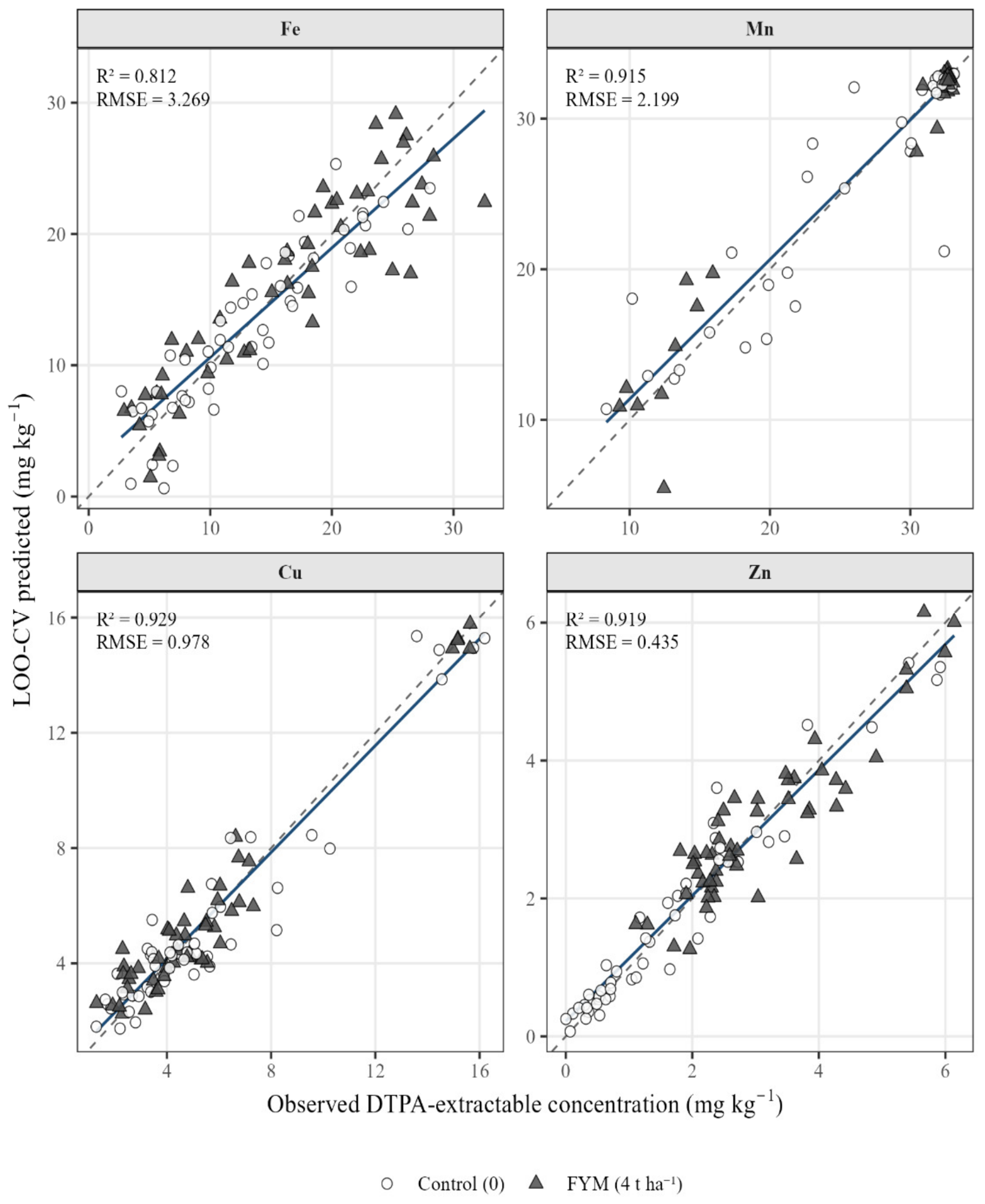
For Fe, Cubist achieved the highest accuracy (R2 = 0.812, RMSE = 3.269 mg kg−1), followed by XGBoost (R2 = 0.803); Ridge and ANN were weakest (R2 = 0.736 and 0.769). For Mn, Cubist again led by a clear margin (R2 = 0.915, RMSE = 2.199 mg kg−1), ahead of XGBoost (R2 = 0.887) and RF (R2 = 0.869), with Ridge poorest (R2 = 0.713). For Cu, all models performed strongly under LOO-CV (R2 = 0.901–0.929), XGBoost ranking first (R2 = 0.929, RMSE = 0.978 mg kg−1); however, this apparent accuracy did not persist under soil-level validation (Table 2). For Zn, inter-model variation was minimal (R2 = 0.890–0.919), and GBM ranked first (R2 = 0.919, RMSE = 0.435 mg kg−1).
Because the LOO-CV values in Table 3 are estimated at the observation level, with the nine remaining observations of each parent soil retained in the training set, part of this performance may reflect the models learning soil identity rather than transferable process structure. To disentangle these effects, all seven algorithms were re-evaluated under a leave-one-soil-out (LOSO) scheme with grouped inner cross-validation, in which every observation of a given soil was withheld simultaneously and hyperparameters were tuned only on the remaining soils (Table 2). Under this stricter test, a clear transferability gradient emerged. Mn predictions remained robust (Cubist R2cv = 0.739, RMSE = 3.862 mg kg−1; GBM R2cv = 0.693; RF R2cv = 0.681), and Fe retained moderate accuracy (RF R2cv = 0.412; XGBoost R2cv = 0.403). In contrast, Zn showed only marginal predictability (best RF R2cv = 0.077), and Cu collapsed entirely, with all models yielding negative R2cv (best GBM R2cv = −0.204; XGBoost R2cv = −1.21). The near-perfect Cu accuracy obtained under LOO-CV therefore largely reflects within-soil information rather than genuine cross-soil predictability, whereas the strong Mn performance was preserved across independent soils, indicating that spatial transferability is element-specific and cannot be inferred from observation-level cross-validation alone.

3.3. Prediction Accuracy and Scatter Analysis

Scatter plots of observed against LOO-CV predicted values for the optimal model of each element (Cubist for Fe and Mn, XGBoost for Cu, GBM for Zn; Figure 1) show close alignment with the 1:1 line across the full concentration range. Regression lines were near-coincident with the 1:1 reference for Mn, Cu, and Zn, while Fe showed a tendency to under-predict at higher concentrations, consistent with its more heterogeneous redox behaviour among soils. FYM-treated observations (▲) and controls (○) were distributed without systematic clustering, confirming that the models captured organic matter effects without segregation artefacts.

3.4. Residual Analysis

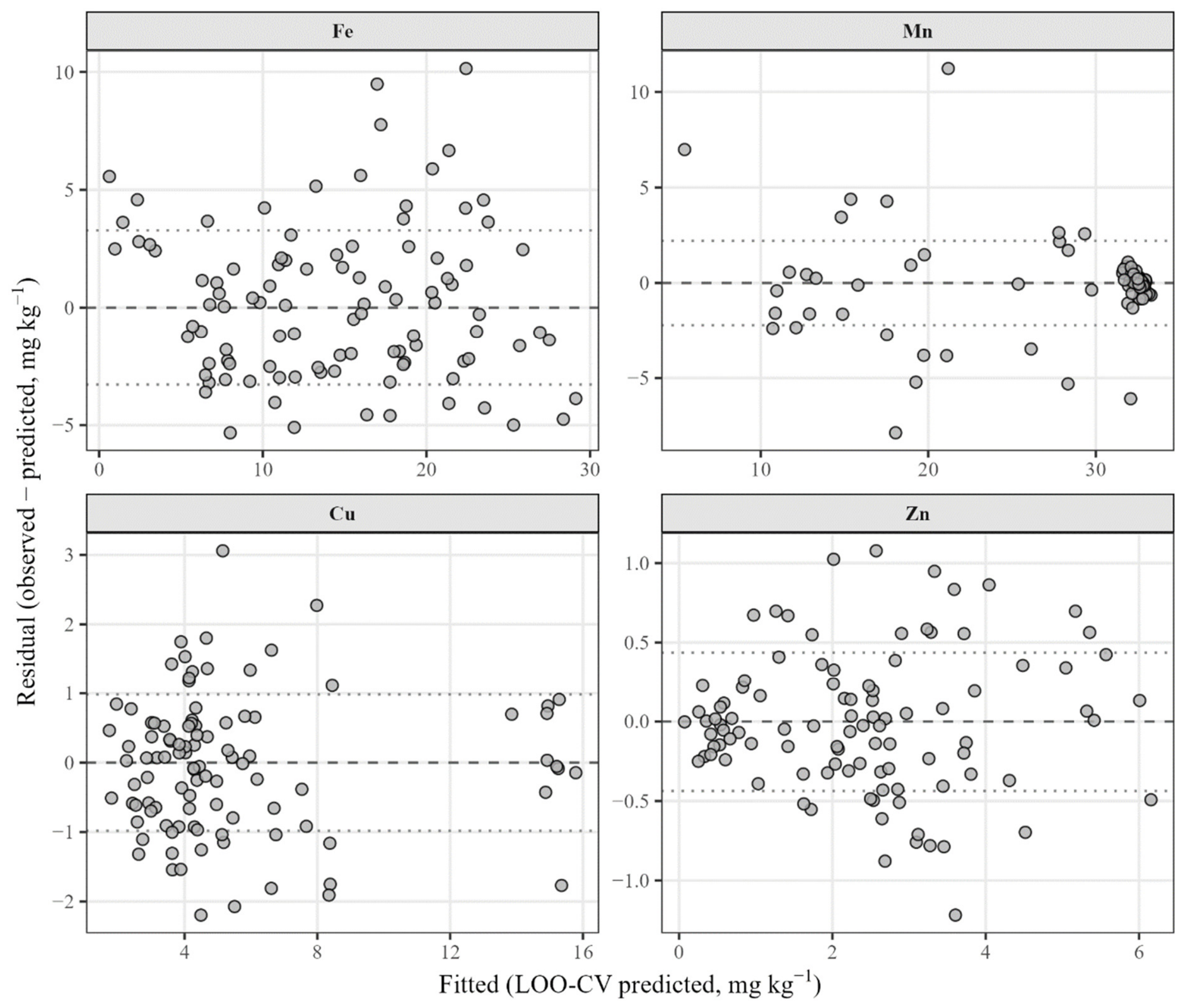
Residual-vs.-fitted plots (Figure 2) showed scatter around the zero reference with no pronounced systematic trend for any element, indicating no major model misspecification. For Fe, residuals were distributed fairly evenly across the fitted range; for Mn, they were tightly concentrated near zero at the high fitted values where most observations occurred, with larger deviations confined to intermediate concentrations. Residuals for Cu and Zn were homogeneous and closely bounded across the prediction range, with only a few isolated points exceeding the ±1 SD bounds.
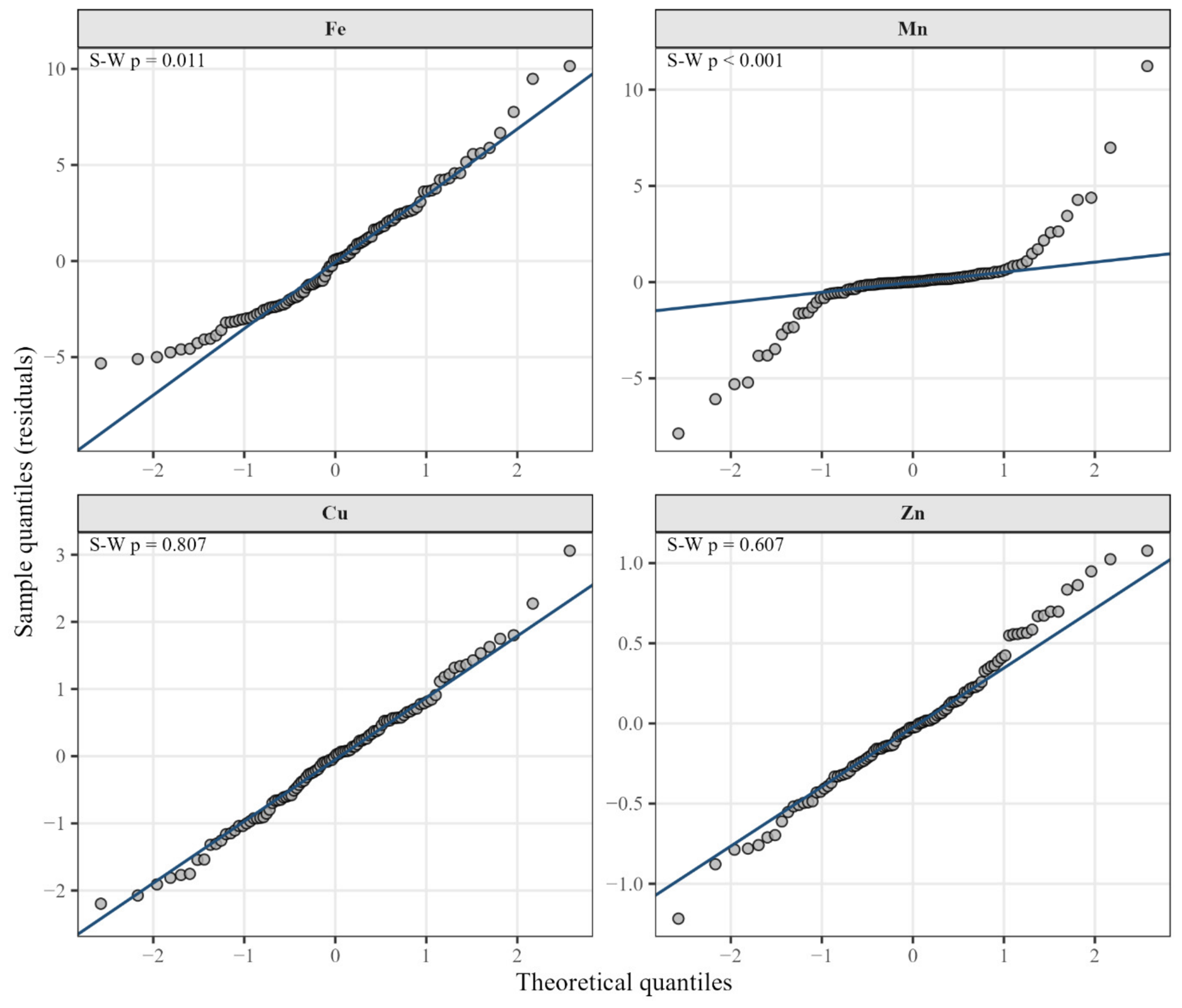
Normality of the residuals was assessed with normal Q–Q plots (Figure 3) and Shapiro–Wilk tests. Residuals for Cu (p = 0.807) and Zn (p = 0.607) did not deviate significantly from normality, whereas Fe (p = 0.011) and Mn (p < 0.001) exhibited departures from normality—heavy-tailed and most pronounced for Mn. These deviations are consistent with the non-linear, threshold-driven nature of reductive Fe and Mn dissolution under anaerobic conditions, which produces episodic concentration peaks not fully captured by symmetric error distributions [33]. Importantly, such departures affect the shape of the error distribution rather than the central predictive accuracy, and the near-zero mean residuals confirm the absence of systematic bias for all four elements.

3.5. SHAP Feature Importance

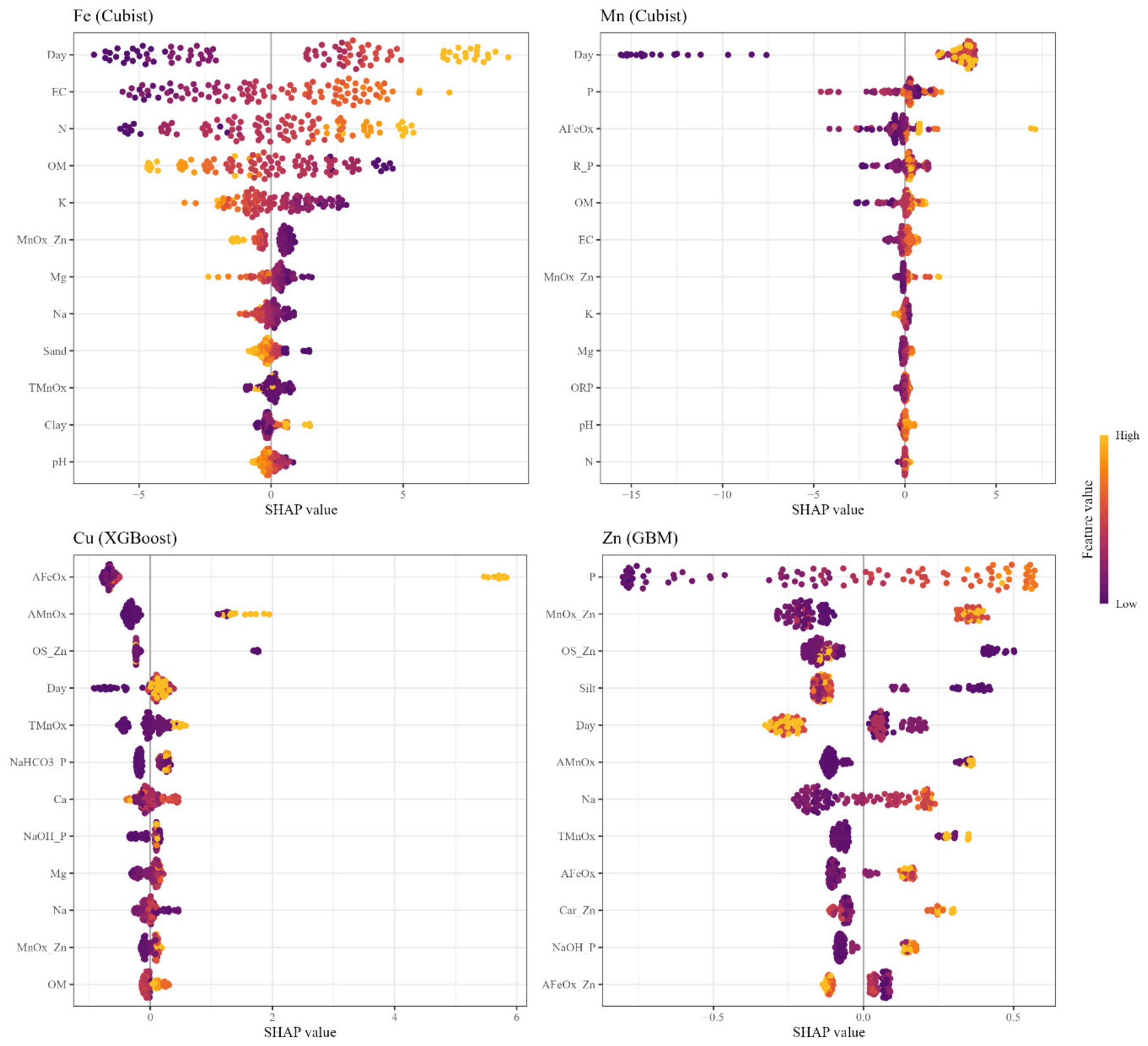
SHAP beeswarm plots for the optimal model of each element (Figure 4) identified the dominant predictors and their directional effects on micronutrient availability predictions. Key findings are summarised in Table 4.
For Fe [Cubist], flooding duration (Day) was the dominant feature by a wide margin (mean |SHAP| = 4.37): low Day values produced strongly negative and high Day values strongly positive SHAP contributions, reflecting the progressive reductive dissolution of Fe oxides over time. Electrical conductivity (EC) and total N were the main secondary predictors, with higher values associated with greater predicted Fe availability, followed by organic matter and K. For Mn [Cubist], Day was again overwhelmingly dominant (mean |SHAP| = 5.25), with residual-P (R_P), Olsen-p, and amorphous Fe oxide (AFeOx) as lower-ranked contributors, pointing to phosphate–oxide surface competition superimposed on redox-driven Mn reduction.
For Cu [XGBoost], amorphous Fe oxide content (AFeOx) was by far the dominant driver (mean |SHAP| = 1.31): high AFeOx values produced strongly positive SHAP contributions, confirming the pivotal role of poorly crystalline Fe oxide surfaces in Cu sorption capacity. Amorphous Mn oxides (AMnOx) ranked second, with flooding duration (Day), organic matter, and Ca providing further, lower-magnitude explanatory power, reflecting multi-surface competitive sorption dynamics. For Zn [GBM], plant-available P (Olsen-P) was the principal predictor (mean |SHAP| = 0.41), followed by MnOx-associated Zn (MnOx-Zn) and amorphous Mn oxides (AMnOx). The wide, bidirectional SHAP distribution of P—negative at low and positive at high values—underscores the non-linear nature of the P–Zn interaction, likely mediated by competitive adsorption on oxide and carbonate surfaces.

4. Discussion

4.1. General Soil Properties

The ten soils selected from the Atabey Plain represented a broad spectrum of physicochemical characteristics, which was a deliberate prerequisite for constructing a training dataset with sufficient feature diversity for machine learning. The wide range in CaCO3 content (13.2–415.3 g kg−1) is characteristic of calcareous soils developed on limestone-derived alluvial and colluvial parent materials in the Isparta region [11] and has direct implications for micronutrient dynamics: high carbonate levels buffer pH in the alkaline range, limiting the solubility of Fe and Zn through various geochemical reactions. The pronounced variability in organic matter content (5.1–69.4 g kg−1) across soils with contrasting land use and drainage histories further ensured that organic matter–redox interactions were represented across a realistic agronomic gradient [34].
The high variability in amorphous Fe oxide (AFeOx: 666–8441 mg kg−1) and Mn oxide (AMnOx: 8–3317 mg kg−1) contents reflects the differing pedogenic histories and redox exposure frequencies of the sampled soils. Amorphous oxides are the most reactive Fe and Mn phases in soil, and their content is known to fluctuate markedly in soils subject to periodic wetting and drying. The baseline DTPA-extractable micronutrient concentrations were also highly variable, particularly for Cu (0.92–37.38 mg kg−1) and Zn (0.22–10.84 mg kg−1), likely reflecting differences in parent material composition, organic matter inputs, and land-use history among sampling sites. This intrinsic soil variability, rather than being a limitation, strengthened the capacity of the ML models to generalise across diverse pedological conditions.

4.2. Machine Learning-Based Prediction

The superior performance of rule- and tree-based ensemble models—particularly Cubist for Fe and Mn, XGBoost for Cu, and GBM for Zn—over linear (Ridge) and single-layer network (ANN) approaches is consistent with the broader soil science literature reporting that gradient boosting, rule-based, and random forest algorithms outperform parametric methods when predictor–response relationships are non-linear and interactions among features are complex [35]. In this respect, both linear and non-linear model families were benchmarked under identical Leave-One-Out Cross-Validation conditions, and for every target element, the best-fitting model was a non-linear ensemble rather than a linear regression, confirming that these predictor–response relationships are better captured by non-linear fits. In the present dataset, the non-linearity arises from the multi-step, threshold-driven nature of redox reactions: Fe3+ and Mn4+ reduction does not proceed linearly with time but is gated by oxygen depletion, pH buffering capacity, and the availability of electron donors—conditions that differ substantially across calcareous soils [36].
Under observation-level LOO-CV, the highest predictive accuracy was achieved for Cu (R2 = 0.929) and Mn (R2 = 0.915), followed by Zn (R2 = 0.919) and Fe (R2 = 0.812). Mn reduction is thermodynamically favoured before Fe reduction and proceeds more consistently across soil types, making Mn availability more predictable from flooding duration and organic matter inputs [37]. Cu availability, while not directly redox-sensitive, is strongly governed by stable soil properties such as AFeOx and organic matter content that varied widely across soils but remained relatively stable within the incubation—properties that ensemble models are well-suited to capture [38]. Fe, by contrast, is subject to competing processes of reductive dissolution, secondary precipitation as vivianite and siderite, and re-adsorption onto residual oxide surfaces, introducing prediction uncertainty, particularly at longer flooding durations [39].
These observation-level accuracies, however, were estimated with the remaining nine observations of each parent soil retained in the training set, so part of the apparent skill may reflect the models learning soil identity rather than transferable process structure. To test this, the models were re-evaluated under a leave-one-soil-out (LOSO) scheme with grouped inner cross-validation (Table 2), in which every observation of a soil was withheld simultaneously. A clear, element-specific transferability gradient emerged: Mn predictions remained robust across independent soils (Cubist R2cv = 0.739), and Fe retained moderate skill (R2cv = 0.412), whereas Zn showed only marginal transferability (best R2cv = 0.077) and Cu collapsed entirely, with all models yielding negative R2cv. This contrast indicates that the near-perfect Cu accuracy obtained under LOO-CV largely reflects within-soil information rather than genuine cross-soil predictability—consistent with Cu availability being governed by static, soil-specific properties (e.g., AFeOx, organic matter) that a model can memorise within a soil but cannot extrapolate to an unseen soil. Mn, in contrast, is driven by a transferable, redox-time mechanism that generalises across pedologically diverse calcareous soils. These findings temper the headline LOO-CV performances and identify Mn—and, to a lesser extent, Fe—as the micronutrients most amenable to spatially transferable ML prediction in calcareous systems.
The adoption of Leave-One-Out Cross-Validation for the observation-level analysis was appropriate given the dataset size (n = 100), as it maximises the number of training observations at each fold while providing an unbiased estimate of generalisation error [40]. The near-zero bias values and absence of systematic over- or under-prediction across elements confirm that the models were not driven by a subset of influential observations and that FYM and control treatments were handled equivalently. Residual diagnostics were consistent with this: residuals were centred on zero with no pronounced fitted-value trend, and while those of Cu and Zn did not depart significantly from normality (Shapiro–Wilk p = 0.807 and 0.607), Fe and Mn residuals were heavier-tailed (p = 0.011 and p < 0.001), reflecting episodic high-concentration values arising from specific soil × treatment combinations rather than systematic bias [41].
SHAP analysis provided mechanistic grounding for the statistical model outputs. The dominance of flooding duration (Day) as the primary SHAP feature for both Fe and Mn confirms that temporal redox progression is the principal driver of these elements’ solubilisation, consistent with classical incubation studies reporting progressive increases in DTPA-Fe and DTPA-Mn over the first 21–40 days of anaerobiosis [8]. For Fe, electrical conductivity and total N emerged as the main secondary features, consistent with ionic-strength and organic-substrate controls on the onset of Fe3+ reduction [42]; for Mn, residual and Olsen-p ranked next, pointing to phosphate–oxide surface competition superimposed on redox-driven Mn reduction. For Cu, the primacy of AFeOx in SHAP rankings aligns with the well-established role of amorphous Fe oxides as the dominant sorbent for Cu in calcareous soils, where Cu2+ is retained through inner-sphere complexation on ferrihydrite surfaces [43]. The non-linear, bidirectional SHAP behaviour of Olsen-P for Zn availability reflects the competitive adsorption between phosphate and zinc on carbonate and oxide surfaces—a well-documented antagonism in calcareous soil systems—and suggests that soil P status should be considered a key covariate in Zn availability assessments [44].

4.3. Agronomic and Environmental Implications

The high predictive accuracy of ensemble ML models for DTPA-extractable micronutrients under varying environmental conditions has practical implications for nutrient management in calcareous soils [45]. Traditional fertiliser recommendations for Fe, Mn, Cu, and Zn are typically derived from single-point soil tests that do not account for the dynamic changes induced by waterlogging or organic matter additions [29]. The present framework demonstrates that soil properties routinely measured in agronomic laboratories, along with environmental covariates, can serve as input features for accurate prediction of micronutrient availability, potentially informing more temporally responsive fertilisation strategies [45]. The LOSO results further indicate that such transfer is currently most reliable for Mn and Fe, whereas Cu and Zn predictions remain soil-specific and would require local calibration.
From an environmental perspective, the SHAP-identified role of AFeOx in governing Cu availability has implications for risk assessment in soils with elevated Cu inputs from repeated FYM or pesticide applications. As amorphous Fe oxides are reduced and dissolved under prolonged flooding, Cu previously sorbed to these surfaces may be mobilised into soil solution and the drainage fraction, elevating the risk of Cu leaching to groundwater or surface waters [46]. Similarly, the P–Zn antagonism identified through SHAP analysis suggests that excessive P fertilisation in calcareous soils could inadvertently suppress Zn availability, contributing to Zn deficiency in crops grown under flood-irrigated conditions—a concern of particular relevance in Türkiye, where widespread Zn deficiency in calcareous soils has been documented [47].
The FYM application at 4 t da−1 consistently intensified redox reactions across soils, enhancing Fe and Mn release over the incubation period. While this reflects the agronomic benefit of enhanced micronutrient availability, it also implies a higher risk of anaerobic conditions persisting beyond the optimal window for nutrient uptake if drainage is inadequate. These findings underscore the need to balance organic amendment rates with water management practices in flood-prone calcareous agroecosystems.

4.4. Study Limitations and Future Research Directions

Several limitations of the present study warrant consideration. First, the dataset (n = 100) is modest in size for machine learning applications; although the leave-one-soil-out evaluation reported here provides a first, within-dataset estimate of cross-soil transferability, the models should still be validated against independent soil datasets from different calcareous regions before being applied in prediction contexts beyond the Atabey Plain. Second, the incubation was conducted under controlled laboratory conditions (22 ± 3 °C, static flooding), which do not fully replicate the dynamic temperature regimes, drying–rewetting cycles, and rhizosphere effects of field conditions. Third, the study addressed DTPA-extractable micronutrients as proxies for plant availability; direct validation against plant uptake data would strengthen the agronomic interpretation of model outputs.
Future research should focus on expanding the training dataset to include soils from a wider range of calcareous agroecosystems and organic amendment types, which would improve model generalisability—particularly for the poorly transferable elements Cu and Zn—and allow cross-regional transfer learning. Incorporating time-series soil solution chemistry—including redox potential (Eh) and dissolved organic carbon—as dynamic features could further improve predictive accuracy for Fe and Mn, whose solubilisation is strongly time-gated. The integration of easily measurable proximal sensing data (vis–NIR spectra, electrical conductivity mapping) as additional input features represents a promising avenue for scaling ML-based micronutrient prediction from controlled experiments to field-scale application. Finally, extending the SHAP framework to interaction SHAP values would allow explicit quantification of synergistic and antagonistic feature pairs—such as the flooding-duration × EC interaction for Fe and the P × MnOx-Zn interaction for Zn—providing deeper mechanistic insight into redox-driven micronutrient dynamics in calcareous soils. Beyond the predictive focus of the present study, a dedicated analysis of the temporal dynamics of Fe, Mn, Cu, and Zn under contrasting FYM doses and flooding durations—including formal soil × FYM × time interaction testing and treatment-effect contrasts—represents a valuable complementary direction for future work and would link the predictive framework developed here to explicit agronomic dose–response interpretation.

5. Conclusions

This study demonstrated that ensemble machine learning algorithms—particularly Cubist, XGBoost, and GBM—can predict DTPA-extractable Fe, Mn, Cu, and Zn availability in calcareous soils under flooding and farmyard manure treatments with high observation-level accuracy (R2 = 0.812–0.929), outperforming linear regression and single-layer neural network approaches across all four target elements under Leave-One-Out Cross-Validation. However, stricter leave-one-soil-out (grouped nested) validation showed that this accuracy is transferable to unseen soils only for Mn (R2cv = 0.739) and, moderately, Fe (R2cv = 0.412), whereas Cu and Zn predictions remained soil-specific—establishing cross-soil transferability, rather than observation-level accuracy alone, as the decisive performance criterion.
The comparatively minor SHAP role of flooding duration for Cu and Zn may reflect sulfide-driven sequestration under sustained anaerobiosis, a mechanism that DTPA extraction cannot resolve and that warrants targeted Eh and acid-volatile-sulfide monitoring in future work.
For Fe and Mn, flooding duration (Day) was the overwhelmingly dominant SHAP feature, providing quantitative evidence that temporal redox progression is the principal driver of their solubilisation; the organic-amendment effect of FYM operated within this redox framework by accelerating the onset of reducing conditions rather than acting as an independent top-ranked predictor.
Because these transferability estimates derive from grouped, soil-level (leave-one-soil-out) validation, they provide the more conservative and realistic basis for deployment: local calibration is recommended before operational use of the Cu and Zn models.
Future work should expand the training dataset to encompass a broader range of calcareous soil series and organic amendment types, incorporate dynamic soil solution chemistry as time-varying features, and validate model predictions against plant uptake data under field conditions. The integration of proximal sensing inputs and interaction SHAP analysis represents promising extensions of the present framework towards scalable, mechanistically interpretable micronutrient prediction tools for sustainable soil management.

Supplementary Materials

The following supporting information can be downloaded at: https://www.mdpi.com/article/10.3390/agriculture16161766/s1, Table S1: Classification of the 10 study soils from the Atabey Plain; Figure S1: Pearson correlation matrix among the predictor variables used in the machine-learning models (n = 100).

Author Contributions

Conceptualization, S.Ö. and V.U.; methodology, S.Ö. and V.U.; software, S.Ö. and V.U.; validation, S.Ö. and V.U.; formal analysis, F.G.; investigation, S.Ö. and V.U.; resources, S.Ö. and V.U.; data curation, S.Ö., F.G. and V.U.; writing—original draft preparation, S.Ö., F.G., S.A.D. and V.U.; writing—review and editing, S.Ö., F.G., S.A.D. and V.U.; visualisation, F.G.; supervision, F.G. and V.U.; project administration, S.Ö. and V.U.; funding acquisition, S.Ö. and V.U. All authors have read and agreed to the published version of the manuscript.

Funding

This research was funded by the Scientific Research Projects Coordination Unit of Isparta University of Applied Sciences (Project No. 2021-D1-0149).

Institutional Review Board Statement

Not applicable.

Data Availability Statement

The original contributions presented in this study are included in the article. Further inquiries can be directed to the corresponding author.

Acknowledgments

This article is derived in part from the first author’s PhD dissertation entitled “Effects of changes in redox potential induced by flooding and organic matter interaction on plant nutrient elements availability, phosphorus and zinc adsorption in soils” 2023, submitted to the Graduate School of Isparta University of Applied Sciences, under the supervision of Veli Uygur. During the preparation of this manuscript, the authors used Jenni AI for language editing and proofreading purposes. The authors have reviewed and edited the output and take full responsibility for the content of this publication.

Conflicts of Interest

The authors declare no conflicts of interest.

References

  1. Pradhan, N.; Singh, S.; Saxena, G.; Pradhan, N.; Koul, M.; Kharkwal, A.C.; Sayyed, R.Z. A Review on Microbe–Mineral Transformations and Their Impact on Plant Growth. Front. Microbiol. 2025, 16, 1549022. [Google Scholar] [CrossRef] [Scilit] [PubMed]
  2. Affholder, M.-C.; Weiß, D.; Wissuwa, M.; Johnson-Beebout, S.E.; Kirk, G.J.D. Soil CO2 Venting as One of the Mechanisms for Tolerance of Zn Deficiency by Rice in Flooded Soils. Plant Cell Environ. 2017, 40, 3018–3030. [Google Scholar] [CrossRef] [Scilit] [PubMed]
  3. Ismail, S.M. Interactive Redox–pH Effects on Iron and Manganese Solubility in Soils of the Farafra Oasis, Egypt. Alex. Sci. Exch. J. 2025, 46, 713–746. [Google Scholar] [CrossRef] [Scilit]
  4. Larson, K.D.; Graetz, D.A.; Schaffer, B. Flood-induced chemical transformations in calcareous agricultural soils of south florida. Soil Sci. 1991, 152, 33–40. [Google Scholar] [CrossRef] [Scilit]
  5. Vitali, A.; Russo, F.; Moretti, B.; Romani, M.; Vidotto, F.; Fogliatto, S.; Celi, L.; Said-Pullicino, D. Interaction between Water, Crop Residue and Fertilization Management on the Source-Differentiated Nitrogen Uptake by Rice. Biol. Fertil. Soils 2024, 60, 757–772. [Google Scholar] [CrossRef] [Scilit]
  6. Shabtai, I.; Wilhelm, R.C.; Schweizer, S.A.; Höschen, C.; Buckley, D.H.; Lehmann, J. Calcium Promotes Persistent Soil Organic Matter by Altering Microbial Transformation of Plant Litter. Nat. Commun. 2023, 14, 6609. [Google Scholar] [CrossRef] [Scilit] [PubMed]
  7. Gürbüz, M.A. Identification of Multiple Extraction Methods to Be Used in Extraction of Macro and Micronutrients of Neutral and Alkaline Soils by a Multi-Criteria Decision-Making Technique (TOPSIS). J. Soil Sci. Plant Nutr. 2025, 25, 4669–4686. [Google Scholar] [CrossRef] [Scilit]
  8. Qi, C.; Hu, T.; Zheng, Y.; Wu, M.; Tang, F.H.M.; Liu, M.; Zhang, B.; Derrible, S.; Chen, Q.; Hu, G.; et al. Global and Regional Patterns of Soil Metal(Loid) Mobility and Associated Risks. Nat. Commun. 2025, 16, 2947. [Google Scholar] [CrossRef] [Scilit] [PubMed]
  9. Narteh, L.T.; Sahrawat, K.L. Influence of Flooding on Electrochemical and Chemical Properties of West African Soils. Geoderma 1999, 87, 179–207. [Google Scholar] [CrossRef] [Scilit]
  10. Zeng, T.; Wu, X.; Lai, Y.; Wu, L.; Glade, T.; Yin, K.; Peduto, D. Assessing Soil Thickness and Distribution in Subtropical Typhoon Areas: An Integration of Advanced Geomorphological Surveys and Ensemble Learning Approaches. Geoenviron. Disasters 2025, 12, 31. [Google Scholar] [CrossRef] [Scilit]
  11. Aljanabi, F.; Dedeoğlu, M. Hybrid Machine Learning Model and Terrain Variables for Spatial Modeling of Topsoil Physicochemical Properties. Int. J. Eng. Geosci. 2025, 11, 149–162. [Google Scholar] [CrossRef] [Scilit]
  12. Heuvelink, G.B.M.; Angelini, M.E.; Poggio, L.; Bai, Z.; Batjes, N.H.; van den Bosch, R.; Bossio, D.; Estella, S.; Lehmann, J.; Olmedo, G.F.; et al. Machine Learning in Space and Time for Modelling Soil Organic Carbon Change. Eur. J. Soil Sci. 2020, 72, 1607–1623. [Google Scholar] [CrossRef] [Scilit]
  13. Shi, S.; Hou, M.; Gu, Z.; Jiang, C.; Zhang, W.-Q.; Hou, M.; Li, C.; Xi, Z. Estimation of Heavy Metal Content in Soil Based on Machine Learning Models. Land 2022, 11, 1037. [Google Scholar] [CrossRef] [Scilit]
  14. Kaya, F.; Mishra, G.; Francaviglia, R.; Keshavarzi, A. Combining Digital Covariates and Machine Learning Models to Predict the Spatial Variation of Soil Cation Exchange Capacity. Land 2023, 12, 819. [Google Scholar] [CrossRef] [Scilit]
  15. Tziachris, P.; Aschonitis, V.; Chatzistathis, T.; Papadopoulou, M.P.; Doukas, I. Comparing Machine Learning Models and Hybrid Geostatistical Methods Using Environmental and Soil Covariates for Soil pH Prediction. ISPRS Int. J. Geo-Inf. 2020, 9, 276. [Google Scholar] [CrossRef] [Scilit]
  16. Minasny, B.; Bandai, T.; Ghezzehei, T.A.; Huang, Y.; Ma, Y.; McBratney, A.B.; Ng, W.; Norouzi, S.; Padarian, J.; Rudiyanto; et al. Soil Science-Informed Machine Learning. Geoderma 2024, 452, 117094. [Google Scholar] [CrossRef] [Scilit]
  17. Chinilin, A.V.; Lozbenev, N.I.; Shilov, P.M.; Fil’, P.P.; Khitrov, N.B.; Kozlov, D.N. Interpretation of a Complex Model of Soil-Landscape Relationships: Thematic Modeling of Organic Carbon Content in Arable Soils of the Bugul’minsko-Belebeevskaya Upland. Eurasian Soil Sci. 2026, 59, 59. [Google Scholar] [CrossRef] [Scilit]
  18. Yan, Y.; Yang, Y. Revealing the Synergistic Spatial Effects in Soil Heavy Metal Pollution with Explainable Machine Learning Models. J. Hazard. Mater. 2024, 482, 136578. [Google Scholar] [CrossRef] [Scilit] [PubMed]
  19. Xiang, M.; Rao, Q.; Yang, X.; Wu, X.; Zhan, D.; Zhang, J.; Lu, M.; Song, Y. Evaluation of Spatial Variability of Soil Nutrients in Saline–Alkali Farmland Using Automatic Machine Learning Model and Hyperspectral Data. ISPRS Int. J. Geo-Inf. 2025, 14, 403. [Google Scholar] [CrossRef] [Scilit]
  20. Durgun, B.; Uygur, V.; Durgun, B.; Sukuşu, E. Assessment of Relations between Micro Element Availability and Soil Properties in Isparta-Atabey Plain Using Principal Component Analysis. Anadolu J. Agric. Sci. 2017, 32, 258. [Google Scholar] [CrossRef] [Scilit]
  21. Lindsay, W.L. Chemical Equilibria in Soils; Blackburn Press: Caldwell, NJ, USA, 2001. [Google Scholar]
  22. Rhoades, J.D. Salinity: Electrical Conductivity and Total Dissolved Solids. In Soil Science Society of America Book Series; John Wiley & Sons: Hoboken, NJ, USA, 1996; pp. 417–435. [Google Scholar] [CrossRef] [Scilit]
  23. Thomas, G.W. Soil pH and Soil Acidity. In Methods of Soil Analysis; Soil Science Society of America Book Series; John Wiley & Sons: Hoboken, NJ, USA, 1996; pp. 475–490. [Google Scholar] [CrossRef] [Scilit]
  24. Nelson, D.W.; Sommers, L.E. Total Carbon, Organic Carbon, and Organic Matter. In Methods of Soil Analysis; Soil Science Society of America Book Series; John Wiley & Sons: Hoboken, NJ, USA, 1982; pp. 539–579. [Google Scholar] [CrossRef] [Scilit]
  25. Loeppert, R.H.; Suarez, D.L. Carbonate and Gypsum. In Methods of Soil Analysis; Agronomy Monograph; John Wiley & Sons: Hoboken, NJ, USA, 1996; pp. 437–474. [Google Scholar] [CrossRef] [Scilit]
  26. Bouyoucos, G.J. Hydrometer Method Improved for Making Particle Size Analyses of Soils1. Agron. J. 1962, 54, 464–465. [Google Scholar] [CrossRef] [Scilit]
  27. Rhoades, J.D. Cation Exchange Capacity. In Methods of Soil Analysis; Agronomy Monograph; John Wiley & Sons: Hoboken, NJ, USA, 1982; pp. 149–157. [Google Scholar] [CrossRef] [Scilit]
  28. Olsen, S.R.; Sommers, L.E. Phosphorus. In Methods of Soil Analysis; Agronomy Monograph; John Wiley & Sons: Hoboken, NJ, USA, 1982; pp. 403–430. [Google Scholar] [CrossRef] [Scilit]
  29. Lindsay, W.L.; Norvell, W.A. Development of a DTPA Soil Test for Zinc, Iron, Manganese, and Copper. Soil Sci. Soc. Am. J. 1978, 42, 421–428. [Google Scholar] [CrossRef] [Scilit]
  30. Leleyter, L.; Probst, J. A New Sequential Extraction Procedure for the Speciation of Particulate Trace Elements in River Sediments. Int. J. Environ. Anal. Chem. 1999, 73, 109–128. [Google Scholar] [CrossRef] [Scilit]
  31. Kuo, S. Phosphorus. In Methods of Soil Analysis; Soil Science Society of America Book Series; John Wiley & Sons: Hoboken, NJ, USA, 1996; pp. 869–919. [Google Scholar] [CrossRef] [Scilit]
  32. R Core Team. A Language and Environment for Statistical Computing; R Foundation for Statistical Computing: Vienna, Austria, 2026. [Google Scholar]
  33. Vink, J.P.M.; van Zomeren, A.; Dijkstra, J.J.; Comans, R.N.J. When Soils Become Sediments: Large-Scale Storage of Soils in Sandpits and Lakes and the Impact of Reduction Kinetics on Heavy Metals and Arsenic Release to Groundwater. Environ. Pollut. 2017, 227, 146–156. [Google Scholar] [CrossRef] [Scilit] [PubMed]
  34. Kaushal, M.; Baijukya, F.; Kidane, Y.B.; Fadda, C.; Omolo, P. From Land Use to Soil Functions: Insights from Contrasting Farming Systems. Agronomy 2026, 16, 587. [Google Scholar] [CrossRef] [Scilit]
  35. Keshavarzi, A.; Kaya, F.; Başayığıt, L.; Gyasi-Agyei, Y.; Rodrigo-Comino, J.; Caballero-Calvo, A. Spatial Prediction of Soil Micronutrients Using Machine Learning Algorithms Integrated with Multiple Digital Covariates. Institutional Repos. Univ. Granada 2023, 127, 137–153. [Google Scholar] [CrossRef] [Scilit]
  36. Aeppli, M.; Thompson, A.; Dewey, C.; Fendorf, S. Redox Properties of Solid Phase Electron Acceptors Affect Anaerobic Microbial Respiration under Oxygen-Limited Conditions in Floodplain Soils. Environ. Sci. Technol. 2022, 56, 17462–17470. [Google Scholar] [CrossRef] [Scilit] [PubMed]
  37. Ponting, J.; Verhoef, A.; Watts, M.J.; Sizmur, T. Field Observations to Establish the Impact of Fluvial Flooding on Potentially Toxic Element (PTE) Mobility in Floodplain Soils. Sci. Total Environ. 2021, 811, 151378. [Google Scholar] [CrossRef] [Scilit] [PubMed]
  38. Yang, K.; Wu, F.; Guo, H.; Chen, D.; Deng, Y.; Huang, Z.; Han, C.; Chen, Z.; Xiao, R.; Chen, P. Hyperspectral Inversion of Soil Cu Content in Agricultural Land Based on Continuous Wavelet Transform and Stacking Ensemble Learning. Land 2024, 13, 1810. [Google Scholar] [CrossRef] [Scilit]
  39. Stolze, L.; Zhang, D.; Guo, H.; Rolle, M. Model-Based Interpretation of Groundwater Arsenic Mobility during in Situ Reductive Transformation of Ferrihydrite. Environ. Sci. Technol. 2019, 53, 6845–6854. [Google Scholar] [CrossRef] [Scilit] [PubMed]
  40. Mabrouk, A.; Inam, I.; Qureshi, M.Z.; Ali, T.; Murtaza, N.; Ouda, M.; Al-Naghi, A.A.A.; Cruz, D.M.T. Artificial Intelligence Evaluation of Nature Based Flood Resilience in Hilly Terrain. Sci. Rep. 2025, 15, 35492. [Google Scholar] [CrossRef] [Scilit] [PubMed]
  41. King, A.E.; Congreves, K.A.; Deen, B.; Dunfield, K.E.; Voroney, R.P.; Wagner-Riddle, C. Quantifying the Relationships between Soil Fraction Mass, Fraction Carbon, and Total Soil Carbon to Assess Mechanisms of Physical Protection. Soil Biol. Biochem. 2019, 135, 95–107. [Google Scholar] [CrossRef] [Scilit]
  42. Ojha, S.; Sourabh, S.; Dasgupta, S.; Das, D.K.; Sarkar, A. Influence of Different Organic Amendments on Fe, Mn, Cu and Zn Availability in Indian Soils. Int. J. Curr. Microbiol. Appl. Sci. 2018, 7, 2435–2445. [Google Scholar] [CrossRef] [Scilit]
  43. Scheinost, A.C.; Abend, S.; Pandya, K.I.; Sparks, D.L. Kinetic Controls on Cu and Pb Sorption by Ferrihydrite. Environ. Sci. Technol. 2001, 35, 1090–1096. [Google Scholar] [CrossRef] [Scilit] [PubMed]
  44. Alloway, B.J. Soil factors associated with zinc deficiency in crops and humans. Environ. Geochem. Health 2009, 31, 537. [Google Scholar] [CrossRef] [Scilit] [PubMed]
  45. Dasgupta, S.; Debnath, S.; Das, A.; Biswas, A.; Weindorf, D.C.; Li, B.; Shukla, A.K.; Das, S.; Saha, S.; Chakraborty, S. Developing Regional Soil Micronutrient Management Strategies through Ensemble Learning Based Digital Soil Mapping. Geoderma 2023, 433, 116457. [Google Scholar] [CrossRef] [Scilit]
  46. Ponting, J.; Kelly, T.J.; Verhoef, A.; Watts, M.J.; Sizmur, T. The Impact of Increased Flooding Occurrence on the Mobility of Potentially Toxic Elements in Floodplain Soil—A Review. Sci. Total Environ. 2020, 754, 142040. [Google Scholar] [CrossRef] [Scilit] [PubMed]
  47. Taşpınar, K.; Aytop, H.; Ates, O.; Varol, M.; Yalçın, G.; Kızılaslan, F.; Çakıllı, H.; Toprak, S. Zinc Bioavailability in Semiarid Agricultural Regions: A Soil Property-Based. Environ. Geochem. Health 2025, 47, 238. [Google Scholar] [CrossRef] [Scilit] [PubMed]
Figure 1. Observed vs. LOO-CV predicted values for the optimal ML model of each target element (n = 100). The dashed line is the 1:1 line; the solid blue line is the linear regression fit.
Agriculture 16 01766 g001
Figure 2. Residual-vs.-fitted plots for the optimal ML model of each element (Cubist for Fe and Mn, XGBoost for Cu, GBM for Zn). Dashed line: zero reference; dotted lines: ±1 SD bounds.
Agriculture 16 01766 g002
Figure 3. Normal Q–Q plots for residuals of the optimal model per element (Cubist for Fe and Mn, XGBoost for Cu, GBM for Zn). Blue line: theoretical normal fit; S-W: Shapiro–Wilk test p-value.
Agriculture 16 01766 g003
Figure 4. SHAP beeswarm plots for the optimal ML model of each element.
Agriculture 16 01766 g004
Table 1. Selected physicochemical properties of the 10 study soils.
PropertyUnitRangeMean ± SD
pH (1:2 w/v)6.78–8.007.63 ± 0.40
EC (1:2 w/v)µS cm−1123–473262 ± 110
Organic matterg kg−15.1–69.422.4 ± 18.7
CaCO3g kg−113.2–415.3142.8 ± 148.1
Clayg kg−1147–699316 ± 165
Siltg kg−1159–371238 ± 70
Sandg kg−16–675447 ± 199
CECcmol(+) kg−111.2–48.828.3 ± 11.0
DTPA-Femg kg−11.68–20.977.54 ± 5.83
DTPA-Mnmg kg−12.12–21.4412.25 ± 6.17
DTPA-Cumg kg−10.92–37.3811.67 ± 13.83
DTPA-Znmg kg−10.22–10.842.75 ± 3.28
AFeOxmg kg−1666–84412920 ± 2534
TFeOxmg kg−18572–21,06716,842 ± 4290
AMnOxmg kg−18–3317405 ± 1024
TMnOxmg kg−1191–3652709 ± 1038
MnOxmg kg−153–176130 ± 39
Table 2. Leave-one-soil-out (LOSO) test performance with grouped inner cross-validation.
ModelR2cvRMSEMAE ModelR2cvRMSEMAE
CuANN−1.35.5494.657MnANN0.0347.435.617
Cubist−6.1999.8167.139Cubist0.7393.8622.349
GBM−0.2044.0152.974GBM0.6934.1862.861
RF−0.2744.133.139RF0.6814.2713.098
Ridge−12.49313.4396.721Ridge−361.747143.97750.678
SVR−0.4094.3433.196SVR0.0977.1855.385
XGBoost−1.215.4394.542XGBoost0.5964.8033.277
FeANN−1.3111.459.818ZnANN−0.4611.8411.419
Cubist−0.087.836.154Cubist0.0341.4971.198
GBM0.3955.8614.627GBM0.061.4761.156
RF0.4125.7784.665RF0.0771.4631.113
Ridge−2876.53404.159133.718Ridge−205.37621.8788.012
SVR0.2246.6365.465SVR−0.1761.6521.189
XGBoost0.4035.8224.713XGBoost−0.3571.7741.357
R2cv = coefficient of determination under leave-one-soil-out (LOSO) cross-validation; RMSE and MAE in mg kg−1.
Table 3. Nested cross-validation performance of seven ML algorithms for four target micronutrients (n = 100).
ModelR2RMSEMAE ModelR2RMSEMAE
FeRidge0.7363.8743.091CuRidge0.9161.0640.845
SVR0.7733.5922.702SVR0.9081.1120.874
RF0.7713.6052.769RF0.9131.0800.832
XGBoost0.8033.3412.604XGBoost0.9290.9780.770
GBM0.7733.5882.848GBM0.9231.0140.782
ANN0.7693.6192.641ANN0.9011.1540.925
Cubist0.8123.2692.658Cubist0.9181.0460.831
MnRidge0.7134.0473.305ZnRidge0.9040.4720.376
SVR0.7323.9172.775SVR0.8900.5050.382
RF0.8692.7321.770RF0.9040.4710.359
XGBoost0.8872.5391.527XGBoost0.9130.4490.341
GBM0.8313.1132.191GBM0.9190.4350.335
ANN0.7753.5852.727ANN0.9010.4800.372
Cubist0.9152.1991.129Cubist0.9030.4740.381
R2 = coefficient of determination under Leave-One-Out Cross-Validation (1 − SSE/SST); RMSE and MAE in mg kg−1. Hyperparameters were re-optimised independently within every outer fold by an inner 5-fold grid search, and centring/scaling was fitted within folds so that the held-out observation influenced neither model fitting nor hyperparameter selection. Bold rows indicate best-performing model per element.
Table 4. Summary of dominant SHAP features for the optimal ML model of each target element.
ElementBest ModelRank 1 (Dominant)Rank 2Rank 3Direction/Mechanism
FeCubistDayECN↑ flooding duration → ↑ Fe solubility via reductive dissolution; EC (ionic strength) and N as secondary modulators
MnCubistDayR_PP↑ flooding duration → ↑ Mn release; residual-/available-P reflect phosphate–oxide competition superimposed on redox-driven Mn reduction
CuXGBoostAFeOxAMnOxDay↑ AFeOx → ↑ Cu retention; poorly crystalline Fe/Mn oxide surfaces dominate Cu sorption
ZnGBMP (Olsen)MnOx-ZnAMnOxNon-linear P–Zn interaction; oxide-bound Zn pools (MnOx/AMnOx) as secondary controls
In the Direction/Mechanism column, “↑” denotes an increase and “→” denotes a resulting effect (cause → effect); thus “↑ X → ↑ Y” indicates that an increase in X leads to an increase in Y (a positive relationship). Day = flooding duration; EC = electrical conductivity; N = total nitrogen; R_P = residual-P; AFeOx/AMnOx = amorphous Fe/Mn oxides; MnOx-Zn = Mn-oxide-bound Zn.
Disclaimer/Publisher’s Note: The statements, opinions and data contained in all publications are solely those of the individual author(s) and contributor(s) and not of MDPI and/or the editor(s). MDPI and/or the editor(s) disclaim responsibility for any injury to people or property resulting from any ideas, methods, instructions or products referred to in the content.