Article

Influence of Altitudinal Grassland Systems on Forage Antioxidant Potential and Nutritional Quality of Beef from Cattle Raised in Caraș-Severin County, Romania

1
Faculty of Management and Rural Tourism, University of Life Sciences “King Mihai I” from Timisoara, Aradului Street No. 119, 300645 Timisoara, Romania
2
Doctoral School Engineering of Plant and Animal Resources, University of Life Sciences “King Mihai I” from Timisoara, Aradului Street No. 119, 300645 Timisoara, Romania
3
Faculty of Food Engineering, University of Life Sciences “King Mihai I” from Timisoara, Aradului Street No. 119, 300645 Timisoara, Romania
4
“Food Science” Research Center, University of Life Sciences “King Mihai I” from Timisoara, Aradului Street No. 119, 300645 Timisoara, Romania
5
Faculty of Agriculture, University of Life Sciences “King Mihai I” from Timisoara, Aradului Street No. 119, 300645 Timisoara, Romania
*
Author to whom correspondence should be addressed.
Agriculture 2026, 16(11), 1251; https://doi.org/10.3390/agriculture16111251 (registering DOI)

Submission received: 12 May 2026 / Revised: 2 June 2026 / Accepted: 3 June 2026 / Published: 5 June 2026
(This article belongs to the Special Issue Research on the Nutrition and Physiology of Dairy and Beef Cattle)

Abstract

The aim of this study was to evaluate the influence of altitudinal grassland systems on forage antioxidant properties and the nutritional composition of beef produced in Caraș-Severin County, Romania. We hypothesised that cattle raised at higher altitudes would produce beef with a superior nutritional profile, characterised by a more favourable lipid composition and enhanced antioxidant-related characteristics. Samples of fresh grass and hay were gathered from three representative areas: plain (Sacu, 154 m), hill (Văliug, 550 m), and mountain (Cozia, 1130 m). The beef samples were represented by two categories of commercially important muscles: Longissimus thoracis (loin) and Semimembranosus (topside), sourced from animals raised in each location. The proximate composition of forage samples indicated substantially higher levels of fatty acids, protein, and ash in mountain grasslands compared to lowland regions (p < 0.05). The total polyphenol content (TPC) and antioxidant activity (DPPH test) revealed a similar pattern, with the strongest antioxidant activity (lowest IC50 value) recorded for Cozia hay (GHC) samples. The composition of beef was additionally influenced by the production area. Samples derived from mountainous regions exhibited elevated protein concentrations, moderate intramuscular fat levels, and enhanced mineral composition in comparison to samples from plain areas. Fatty acid analysis revealed that mountain-sourced beef had significantly reduced levels of saturated fatty acids (SFA) and elevated concentrations of monounsaturated fatty acids (MUFA) and polyunsaturated fatty acids (PUFA), including the nutritionally beneficial n-3 fatty acids and conjugated linoleic acid (CLA). Principal component analysis distinctly classified beef samples based on production method, with mountain-origin samples indicating better lipid properties and enhanced antioxidant-related variables. The findings demonstrate that natural grasslands at higher altitudes may enhance both the bioactive quality of fodder and the nutritional value of beef. Mountain pasture systems are a sustainable approach for producing high-quality beef with enhanced lipid composition and increased market value.

1. Introduction

Growing consumer awareness of the interplay between nutrition, health, and environmental sustainability has significantly heightened demand in animal products that originate from natural and low-input production systems. Beef from pasture-based farming has drawn considerable attention in recent years due to its advantageous nutritional profile, enhanced animal welfare perception, and reduced reliance on concentrate feeds [1,2,3,4]. In multiple regions, consumers are increasingly associating grass-fed beef with superior product quality, sustainability, and authenticity.
Caraș-Severin County covers approximately 8520 km2 in south-western Romania and is the third largest county in the country. It encompasses three distinct relief units: the Western Carpathians in the north and east—represented by the Semenic, Almăj, and Cernei mountain ranges—a hilly transition zone (the Caraș and Pogăniș hills), and low-lying alluvial plains along the Timiș and Caraș river valleys. Two nationally protected areas—Semenic–Cheile Carașului National Park and Cheile Nerei–Beușnița National Park—lie within the county, underscoring the ecological significance of its grasslands. This natural diversity sustains a wide spectrum of plant communities, from subalpine meadows rich in Festuca rubra, Agrostis capillaris, and Nardus stricta at higher elevations, to mesophilic hill swards dominated by Dactylis glomerata and Arrhenatherum elatius, and lowland grasslands characterised by Lolium perenne and Poa pratensis.
Furthermore, pasture-fed beef frequently contains a more balanced n-6/n-3 ratio, conjugated linoleic acid (CLA), and omega-3 polyunsaturated fatty acids (PUFA), all of which are considered nutritionally beneficial in human diets [1,5,6]. Due to these nutritional enhancements, extensive grazing systems have become increasingly commercially viable.
In addition to their function as nutrient sources, diversified pasture ecosystems may also provide a variety of phytochemicals, including polyphenols, flavonoids, terpenoids, and other antioxidant compounds. Upon ingestion, these metabolites can influence the biochemical quality of meat, sensory traits, oxidative stability, and ruminal biohydrogenation processes [7,8,9,10,11,12,13]. Thus, the composition of the pasture can significantly influence the functional attributes of beef.
The nutritional and phytochemical composition of grasslands is significantly influenced by environmental factors, including altitude, soil properties, plant diversity, temperature variations, and precipitation distribution. Forage nutritive value may be enhanced by the accumulation of bioactive compounds in mountain grasslands, which are often distinguished by a higher species richness, lower fertilization pressure, and slower plant development [14,15,16,17,18]. Such ecological differences may ultimately influence animal welfare and meat quality.
Caraș-Severin County, located in western Romania, serves as a significant natural model for studying these relations, encompassing plains, hills, and mountainous terrains within the same geographical region. Traditional cattle farming techniques are still used in numerous regions, frequently linked with agritourism activities that promote local cuisine and rural attractiveness. Geographical variation in pasturelands had a substantial impact on the physicochemical characteristics and fatty acid composition of artisanal cheeses in a previous study conducted at the same three agritourism farms as those used in the current study [5]. The analysis underscored the significance of local grazing ecosystems in determining the quality of dairy products.
This study extends the previous research framework from dairy products to beef, providing a more cohesive understanding of how pasture biodiversity and altitude-related environmental factors may influence various cattle-derived products under identical agricultural settings.
There have been a lot of studies on how feeding systems affect milk and cheese, yet research examining how variations in local grazing land affect the nutritional composition of specific beef cuts within traditional Eastern European farming practices remains relatively limited.
Traditional cattle farming in Caraș-Severin County centres primarily on the Romanian Simmental (Bălțata Românească), a dual-purpose breed officially recognised in Romania that combines moderate milk and meat yields with robustness and adaptability to mountainous conditions. In several highland communities, herds of Pinzgau de România are still maintained; this is a regional conservation breed, listed in Romanian national programmes for the preservation of local genetic resources, known for its resilience to high-altitude environments and its ability to utilise coarse mountain forages efficiently. Both breeds are well adapted to local pasture conditions and remain integral to the cultural and agricultural identity of rural communities in the region.
Variation in beef quality characteristics is strongly influenced by the anatomical origin of the muscle. The Longissimus thoracis muscle is commercially esteemed for its tenderness and moderate marbling, while the Semimembranosus muscle is typically leaner, firmer, and metabolically more active. These inherent differences may affect moisture, protein, lipid content, and fatty acid distribution [19,20,21,22,23,24]. Examining both types of muscle provides a comprehensive picture of the nutritional diversity of the carcass.
Thus, the objective of this study was to evaluate the impact of three distinct altitudinal production systems (plain, hill, and mountain) on the following: (i) the proximate composition and antioxidant profile of fresh grass and hay; (ii) the physicochemical composition of beef from Longissimus thoracis and Semimembranosus muscles; (iii) the fatty acid composition and nutritional lipid indices of beef; and (iv) multivariate relationships between forage quality and meat nutritional traits.
The hypothesis claimed that cattle raised in mountain pasture settings would produce beef with superior nutritional qualities, specifically a more advantageous lipid profile and enhanced functional nutritional value.

2. Materials and Methods

2.1. Study Area and Experimental Design

The investigation was carried out in Caraș-Severin County, in Romania’s south-western area, which is known for its geographical diversity and the coexistence of plain, hilly, and mountainous agroecosystems. Because of this natural variation, it is possible to assess how local pasture resources and altitude affect cattle-derived goods.
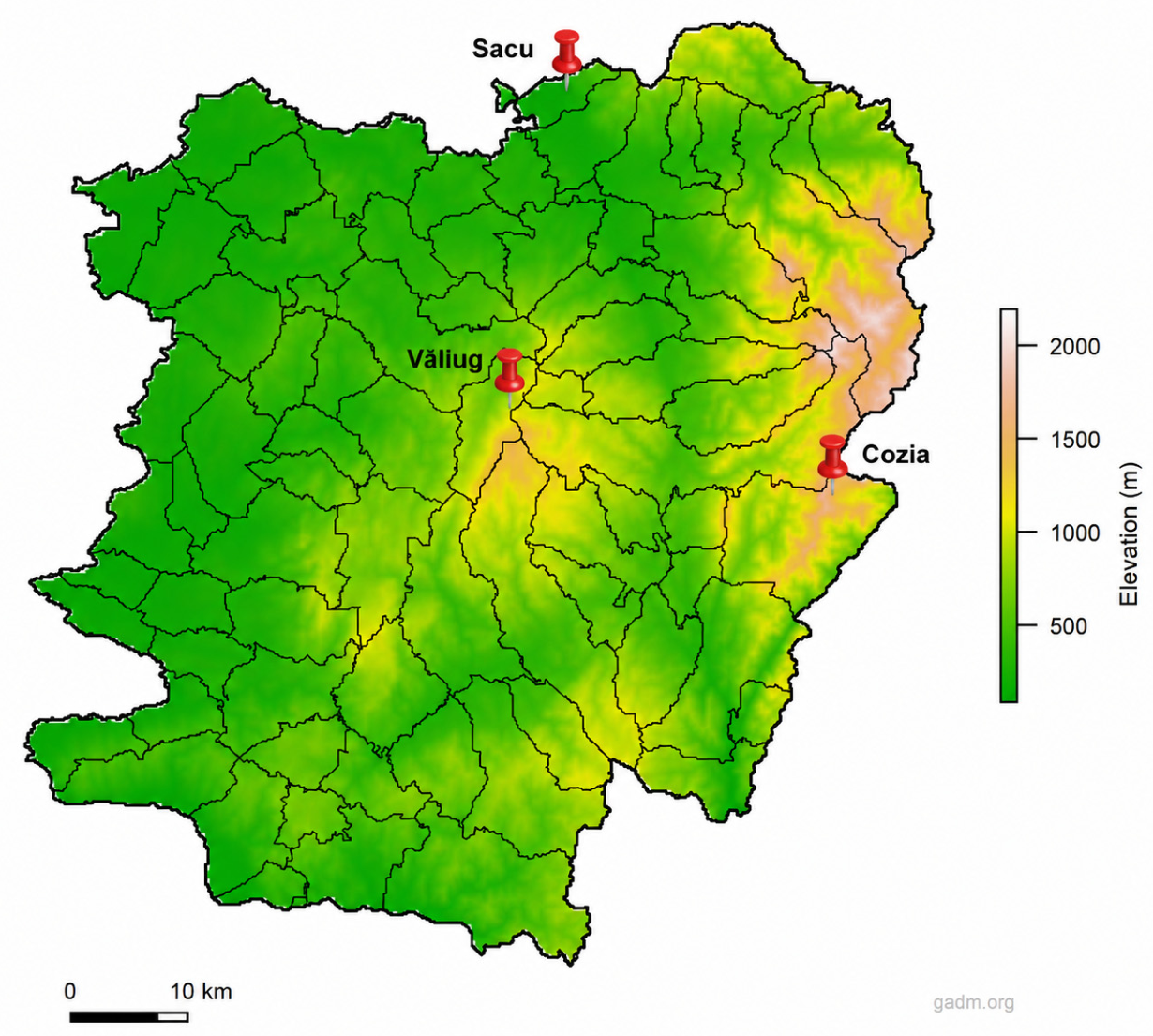
Three representative agritourism farms practicing traditional cattle husbandry were selected as case studies. The farms were located in three different altitudinal zones: Cozia (mountain area), Văliug (hill area), and Sacu (plain area). Figure 1 shows their spatial distribution within Caraş-Severin County, while Table 1 presents their geographical coordinates, altitude, and relief unit classification.
In order to maintain consistency in the assessment of pasture influence on various bovine food products under similar environmental and management settings, the chosen farms were the same production units that were previously included in a 2024 study focused on artisanal cheese quality [5].
The research area had above-average spring temperatures, erratic rainfall patterns, and brief summer drought episodes during the 2025 vegetation period, especially in the lowland sector. In contrast, a more prolonged vegetation period and more consistent soil moisture prevailed in the mountainous region. The relevance of these climatic contrasts was determined by their potential to affect the production of pasture biomass, the synthesis of bioactive compounds and the botanical composition.
Two complementary research components were integrated in the experimental design: (i) the characterization of forage resources (fresh grass and hay) from each farm, and (ii) the assessment of beef quality characteristics in cattle raised under the same local grazing systems. In this manner, three production environments—plain, hill, and mountain conditions—were compared.

2.2. Sampling and Preparation of Feed Samples

Fresh forage samples were collected during the peak grazing season (May–June 2025), corresponding to the period of maximum pasture utilisation by cattle and optimal herbage availability. Sampling was performed in actively grazed paddocks on each farm. Representative herbage was hand-harvested from several randomly selected locations, while contaminated areas (e.g., trampled patches or sites affected by faecal deposition) and overgrown vegetation were systematically excluded. Individual subsamples collected from each pasture were pooled and homogenised to obtain a single composite sample representative of the forage available to animals at each location.
Prior to forage sampling, a preliminary botanical assessment of each pasture was conducted using a visual transect survey to identify the dominant plant species. The mountain pasture at Cozia (1130 m a.s.l.) was dominated by Festuca rubra L., Agrostis capillaris L., and Nardus stricta L., with the presence of Plantago lanceolata L., Achillea millefolium L., Trifolium repens L., and Lotus corniculatus L. The hill pasture at Văliug (550 m a.s.l.) was characterised by Dactylis glomerata L., Festuca pratensis Huds., and Arrhenatherum elatius (L.) P. Beauv., accompanied by Trifolium pratense L. and Lotus corniculatus L. The lowland pasture at Sacu (154 m a.s.l.) consisted predominantly of Lolium perenne L., Poa pratensis L., and Trifolium repens L. A detailed phytosociological analysis was not performed and therefore quantitative data on species abundance were not available.
Following collection, a portion of each fresh forage sample was analysed immediately, while the remaining material was processed into hay representative of the forage used during the winter feeding period. Hay was obtained by natural drying under farm conditions. After mowing, the forage was wilted in the field for 24–48 h under natural sunlight exposure and turned once to ensure uniform drying. The partially dried material was subsequently transferred to shaded, well-ventilated barns and stored for an additional 7–10 days until a constant weight was achieved. Ambient temperatures during the drying period ranged from 18 to 28 °C in the plain area, 15 to 24 °C in the hill area, and 12 to 20 °C in the mountain area, while relative humidity varied between 40% and 65%. No artificial drying methods or additives were applied.
Both fresh forage and hay samples were vacuum-packed, transported to the laboratory under refrigerated conditions (approximately 4 °C), and stored at −20 °C until analysis. The abbreviations used to designate the different forage samples are presented in Table 2.
Forage sampling was conducted at a single time point during the peak of the growing season (May–June 2025). Although repeated sampling throughout the grazing season would provide additional information regarding seasonal changes in botanical composition and nutritional value, such an approach was beyond the scope of the present study. Consequently, seasonal variability in forage characteristics should be considered when interpreting the results. The abbreviations used to designate each fodder sample are presented in Table 2.

2.3. Beef Sampling

Beef samples were collected from clinically healthy male cattle (bulls) of the Romanian Simmental breed (Bălțata Românească), raised in extensive production systems at the three selected farms. To ensure comparability across locations, only animals of similar age and live weight were included in the study. Samples were collected from a total of nine animals, with three animals from each farm/housing system.
All animals were slaughtered at 18–22 months of age (mean age: 20 ± 1.5 months). Prior to transport to the slaughterhouse, each animal was weighed individually. The mean live weight at slaughter was 475 ± 28 kg for the lowland farm, 465 ± 31 kg for the hillside farm, and 468 ± 25 kg for the mountain farm, with no significant differences between groups (p > 0.05).
All animals were males (bulls); no females were included in the study. Slaughter was performed under identical commercial conditions in EU-approved slaughterhouses. Warm carcass weight was recorded immediately after evisceration. The mean carcass weights were 249 ± 16 kg (lowland), 245 ± 17 kg (hilly), and 248 ± 14 kg (mountain), corresponding to a mean yield percentage of 52.4 ± 1.6%.
In accordance with standard commercial slaughter procedures applied in EU-approved slaughterhouses, 24 h after slaughter, two types of muscle of high economic value were sampled from each carcass:
  • Longissimus thoracis (loin region).
  • Semimembranosus (topside region).
These muscles were selected on the basis of their contrasting metabolic and structural characteristics—the Longissimus thoracis being predominantly glycolytic and the Semimembranosus displaying a more oxidative-glycolytic profile—as well as their commercial importance in the beef market. The Semimembranosus is generally characterized as a leaner and more locomotor-active muscle with a higher proportion of oxidative fibers, whereas the Longissimus thoracis is typically associated with greater tenderness and higher intramuscular fat deposition [19,20,21].
After removal of visible connective tissue and external fat, samples were vacuum-packaged in polyethylene bags, transported to the laboratory under refrigerated conditions (approximately 4 °C), and stored at −20 °C until further analysis. The abbreviations used to designate each beef sample are presented in Table 3.

2.4. Determination of the Physicochemical Characteristics of Feed

2.4.1. Proximate Composition Analysis

Before the analytical procedures were carried out, all feed samples were subjected to grinding and homogenization in a laboratory mill (Retsch ZM 200, Retsch GmbH, Haan, Germany) to achieve a uniform particle size and representative composition. Moisture content was determined gravimetrically by drying the samples in a forced-air oven at 105 °C until a stable mass was obtained, following the procedure described in ISO 6496:1999 [25]. The mineral residue (ash) was obtained by combustion in a muffle furnace (Nabertherm L9/11, Nabertherm GmbH, Lilienthal, Germany) at 550 °C until complete oxidation of organic matter was confirmed by the attainment of constant mass, as specified in ISO 5984:2002 [26].
Crude protein content was established by means of the Kjeldahl digestion and distillation method, employing an automated analytical system (KjeltecTM 8400, FOSS Analytical A/S, Hillerød, Denmark) in line with ISO 5983-2:2009 [27]. The total nitrogen value obtained was subsequently converted to crude protein by applying a factor of 6.25. Crude lipid content was quantified through Soxhlet extraction, using petroleum ether with a boiling range of 40–60 °C as the extraction solvent and a SER 148 extraction unit (VELP Scientifica, Usmate Velate, Italy), as outlined in ISO 6492:1999 [28].
The carbohydrate fraction was obtained by indirect calculation, subtracting the sum of moisture, protein, lipid, and ash contents from 100. The gross energy value of each sample was subsequently derived using the conventional Atwater conversion factors.

2.4.2. Antioxidant Profile of Fresh Grass and Grass Hay

Preparation of Plant Extracts
Polyphenolic extraction from fresh grass and hay samples was performed using a 70% (v/v) ethanol–water solution (Sigma-Aldrich KGaA, Darmstadt, Germany) as the extraction solvent. For each sample, a 0.5 g aliquot of plant material was accurately weighed into sealed extraction vessels, to which a volume of 25 mL of the ethanolic solvent was added. Homogeneous contact between the solvent and the plant matrix was ensured by placing the vessels on a linear orbital shaker (DLAB SK-L180-Pro, DLAB Scientific Co., Ltd., Beijing, China) for a period of 30 min. Following agitation, the crude extracts were clarified by gravity filtration through Whatman No. 42 filter paper (Sigma-Aldrich KGaA, Darmstadt, Germany) and kept at 4 °C in sealed containers pending further analysis.
Method for Total Polyphenol Content (TPC) Determination
The Folin–Ciocalteu colorimetric method was employed for the quantification of total polyphenol content. From each of the six prepared plant extracts, a 0.5 mL volume was pipetted into individual reaction vessels. A volume of 1.25 mL of Folin–Ciocalteu reagent (Sigma-Aldrich Chemie GmbH, Munich, Germany), previously diluted tenfold with distilled water (1:10, v/v), was then introduced into each vessel. The reaction mixture was allowed to equilibrate for 5 min at ambient temperature, after which 1 mL of a sodium carbonate solution (Na2CO3, 60 g/L; Geyer GmbH, Renningen, Germany) was incorporated to initiate colour development. The resulting mixtures were transferred to a thermostatic incubator (INB500, Memmert GmbH, Schwabach, Germany) and maintained at 50 °C for 30 min to ensure complete chromogenic reaction. Optical absorbance was subsequently recorded at a wavelength of 750 nm with a UV-Vis spectrophotometer (UV-1900I, Shimadzu Corporation, Kyoto, Japan). Quantification was carried out against an external calibration curve prepared from gallic acid standard solutions (Sigma-Aldrich Chemie GmbH, Munich, Germany) spanning a concentration range of 5–250 μg/mL. All measurements were conducted in triplicate and results were reported as milligrams of gallic acid equivalents (GAE) per kilogram of dry matter [15].
Assessment of Antioxidant Activity Using the DPPH Method
Radical scavenging capacity was assessed by means of the DPPH (1,1-diphenyl-2-picrylhydrazyl; Sigma-Aldrich, Taufkirchen, Germany) method, employing a 0.03 mM solution of the reagent prepared in absolute ethanol. Primary stock solutions of each plant extract (fresh grass and hay) were prepared in 70% ethanol at an initial concentration of 1 mg/mL, from which a series of working dilutions was obtained at the following concentrations: 5, 10, 25, 50, 125, 250, and 500 µg/mL. For each concentration level, a 1 mL volume of the respective dilution was combined with 2.5 mL of the DPPH reagent solution, mixed thoroughly by vortexing, and subsequently left to react in darkness at room temperature for a period of 30 min. Upon completion of the incubation interval, optical absorbance was measured at 518 nm using the UV-Vis spectrophotometer described previously, with a 70% ethanolic solution serving as the reference blank. Each determination was performed in triplicate and the reported values represent the arithmetic mean of the three independent measurements [16].

2.5. Physicochemical Analysis of Beef Samples

Before analysis, all meat samples were transferred from frozen storage and allowed to thaw overnight at 4 °C. Following thawing, the samples were minced and mechanically homogenized to a uniform consistency using a laboratory grinder (Bosch MFW3520W, Robert Bosch GmbH, Stuttgart, Germany).
Moisture content was established by gravimetric determination, involving oven drying of the homogenized material at 105 °C until no further mass loss was recorded, in accordance with ISO 1442:1997 [29]. The crude protein fraction was quantified via the Kjeldahl nitrogen determination procedure, following the specifications of ISO 937:1978 [30]. Intramuscular fat content was measured by means of Soxhlet solvent extraction, as prescribed by ISO 1443:1973 [31]. The mineral residue was obtained through high-temperature combustion at 550 °C in a muffle furnace until complete ashing was achieved, as outlined in ISO 936:1998 [32].
The total carbohydrate content was derived by the subtraction method, whereby the combined proportions of moisture, protein, lipid, and ash were deducted from 100. The energy density of each sample (expressed as kcal/100 g) was subsequently calculated by applying the standard Atwater physiological fuel values to the experimentally determined macronutrient fractions.

2.6. Fatty Acid Analysis

The determination of fatty acids in beef samples was performed according to the method described in ISO 12966-2:2017 [33]. Total lipids were extracted from beef samples using a chloroform:methanol mixture (2:1, v/v), according to the method described by Folch et al. [34]. Fatty acid methyl esters (FAMEs) were prepared by alkaline transesterification using methanolic potassium hydroxide according to the method described by Christie [35].
FAME separation and quantification were performed using a Shimadzu GC-2010 Plus gas chromatograph (Shimadzu Corporation, Kyoto, Japan) equipped with a flame ionization detector (FID) and fitted with an SP-2560 fused silica capillary column (100 m × 0.25 mm i.d., 0.20 μm film thickness; Supelco, Bellefonte, PA, USA). The chromatographic system was operated using helium as carrier gas under optimized temperature programming conditions suitable for FAME analysis.
Individual fatty acids were identified by comparing their retention times with those of a certified reference standard mixture (Supelco 37 Component FAME Mix, Sigma-Aldrich, St. Louis, MO, USA), and quantified by peak area normalization. Results were expressed as g/100 g of total identified fatty acids.
Fatty acids were grouped as follows: saturated fatty acids (SFA), monounsaturated fatty acids (MUFA), polyunsaturated fatty acids (PUFA), and unsaturated fatty acids (UFA).
In addition, several nutritional lipid quality indices were calculated, including the polyunsaturated-to-saturated fatty acid ratio (PUFA/SFA), the n-6/n-3 ratio, the atherogenicity index (AI), the thrombogenicity index (TI), and the hypocholesterolemic-to-hypercholesterolemic ratio (h/H).

2.7. Statistical Analysis of Experimental Data

All determinations were performed in triplicate, and results are expressed as mean ± standard error of the mean (SEM). Before conducting inferential tests, the normality of the data distribution and the homogeneity of variances were verified using the Shapiro–Wilk test and Levene’s test, respectively, to confirm the assumptions required for parametric analysis. Differences between sample means were assessed using one-way analysis of variance (ANOVA), followed by Tukey’s post hoc multiple comparison test to detect significant effects [36]. Independent samples t-tests were additionally used for direct pairwise comparisons between selected groups [36].
Pearson correlation coefficients (r) have been calculated to assess the relation between fodder antioxidant properties (TPC and IC50) and beef fatty acid characteristics. The magnitude and direction of relations were analyzed based on established statistical criteria.
Principal component analysis (PCA) was employed to examine multivariate relations among beef samples and compositional traits, thereby facilitating dimensionality reduction and the visualization of grouping patterns based on geographical origin and muscle type [37]. The interpretation of component loadings and score distributions followed established multivariate statistical approaches [38].
In addition, a hierarchical clustering heatmap was constructed to provide an integrated visualization of similarity patterns among variables and samples.
All statistical analyses and graphical representations were performed using Microsoft Excel 365, Version 2605 (Build 16.0.20026.20076) (Microsoft Corporation, Redmond, WA, USA). Statistical significance was set at p < 0.05.

3. Results

3.1. Determination of the Physicochemical Characteristics of Fresh Grass and Grass Hay

3.1.1. Proximate Composition of Fresh Grass and Grass Hay

Table 4 displays the proximate composition of fresh grass and grass hay samples. The results revealed clear differences between fresh and dry feed, as well as variations related to geographical origin.
As expected, fresh grass samples exhibited considerably higher moisture contents than the corresponding hay samples, which is consistent with the concentration effect occurring during the drying process. Moisture values ranged from 81.20 to 87.10 g/100 g in fresh samples and from 7.50 to 8.90 g/100 g in hay samples.
Protein content varied significantly between fresh and dry feeds, as well as among the three geographic regions. The highest protein values were recorded in samples collected from the mountain area (6.10 g/100 g for FGC and 13.40 g/100 g for GHC), followed by those from the hill area (4.40 g/100 g for FGV and 11.80 g/100 g for GHV), while the lowest values were consistently observed in samples originating from the plain (2.80 g/100 g for FGS and 10.30 g/100 g for GHS). This altitudinal gradient in protein content may be attributed to the concentration effect caused by reduced moisture at higher elevations, combined with the physiological responses of plants to environmental stress conditions characteristic of mountain ecosystems.
The lipid content was considerably influenced by both the sample type and sampling location. As anticipated, hay samples exhibited higher lipid concentrations (2.60–3.60 g/100 g) than fresh grass (0.40–0.65 g/100 g), consistent with the concentration effect occurring during drying. The highest values were consistently recorded in samples from the mountain area, followed by those from the hill and plain areas. This altitudinal gradient may be attributed to plant adaptive responses to environmental stress, including the accumulation of lipid compounds as protective metabolites.
A similar altitudinal trend was observed for ash content. Samples collected from the mountainous region exhibited the highest mineral concentrations, while those from the plains exhibited the lowest values. The reduced moisture content in hay samples led to a relative concentration of mineral substances within plant tissues, explaining the markedly higher ash values recorded in dried compared to fresh forage.
The carbohydrate content showed only slight fluctuations across sampling zones and forage types, influenced by metabolic adjustments under stress conditions and the inherent variability associated with its determination by difference.
Fresh samples ranged from 35.60 to 60.20 kcal/100 g, whereas hay samples ranged from 352.10 to 358.40 kcal/100 g. The substantially higher energy values in hay are primarily attributable to the combined effect of higher protein and fat contents and markedly reduced moisture content relative to fresh grass.

3.1.2. The Antioxidant Profile of Feed Samples

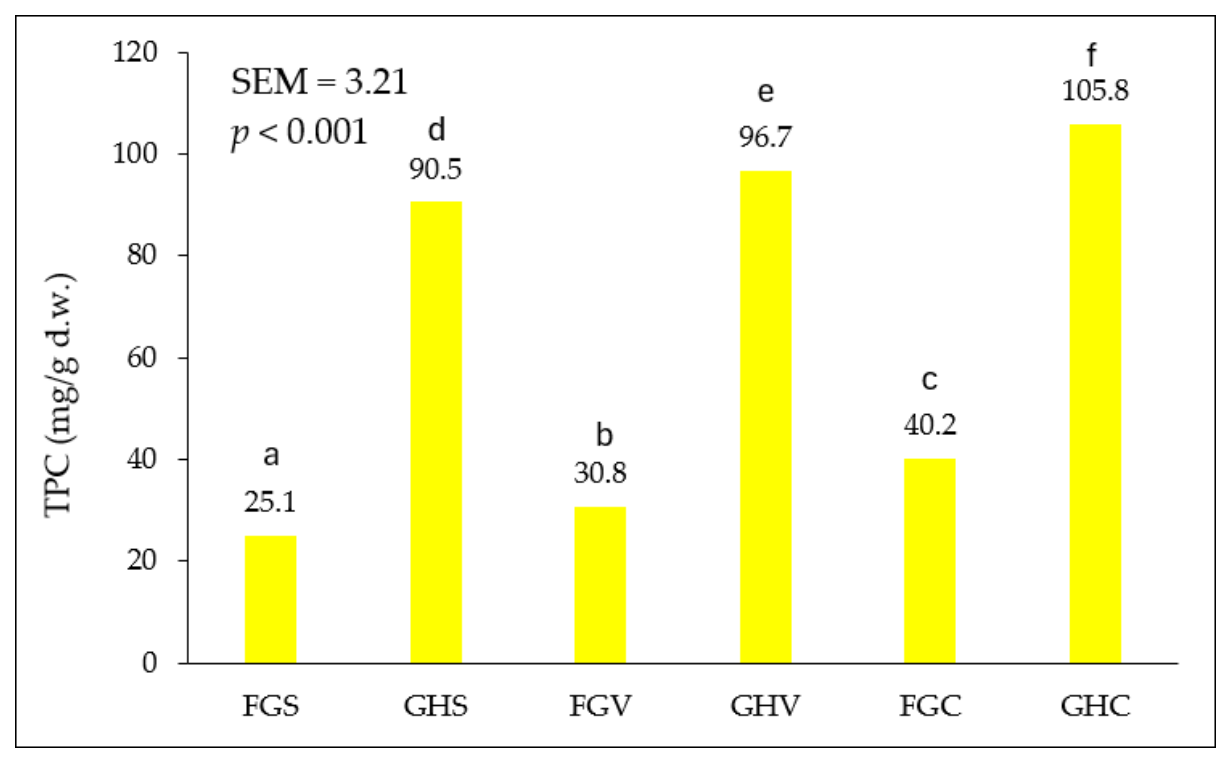
Total Polyphenol Content of Feed Samples Figure 2 presents the total polyphenol content (TPC), expressed as mg GAE/g dry matter (d.m.), in the alcoholic extracts obtained from fresh grass and grass hay samples.
Among the six extracts analyzed, sample GHC showed the highest TPC value (105.80 mg GAE/g d.m.), whereas sample FGS exhibited the lowest value (25.10 mg GAE/g d.m.).
The highest total phenolic content (TPC) values for both fresh grass and hay samples were recorded in samples from mountainous area (FGC—40.20 mg GAE/g d.m. and GHC—105.80 mg GAE/g d.m.), followed by those from hilly area (FGV—30.80 mg GAE/g d.m. and GHV—96.70 mg GAE/g d.m.), whereas the lowest values were recorded in samples from the lowland area (FGS—25.10 mg GAE/g d.m. and GHS—90.50 mg GAE/g d.m.).
In addition, hay samples exhibited significantly higher TPC values than the corresponding fresh grass samples. This finding may be explained by the concentration effect occurring during the drying process, together with structural modifications of plant tissues that enhance the extractability of phenolic compounds.
Statistical analysis performed using Student’s t-test revealed significant differences among all analyzed samples (p < 0.05).
DPPH Radical Scavenging Activity of Feed Samples
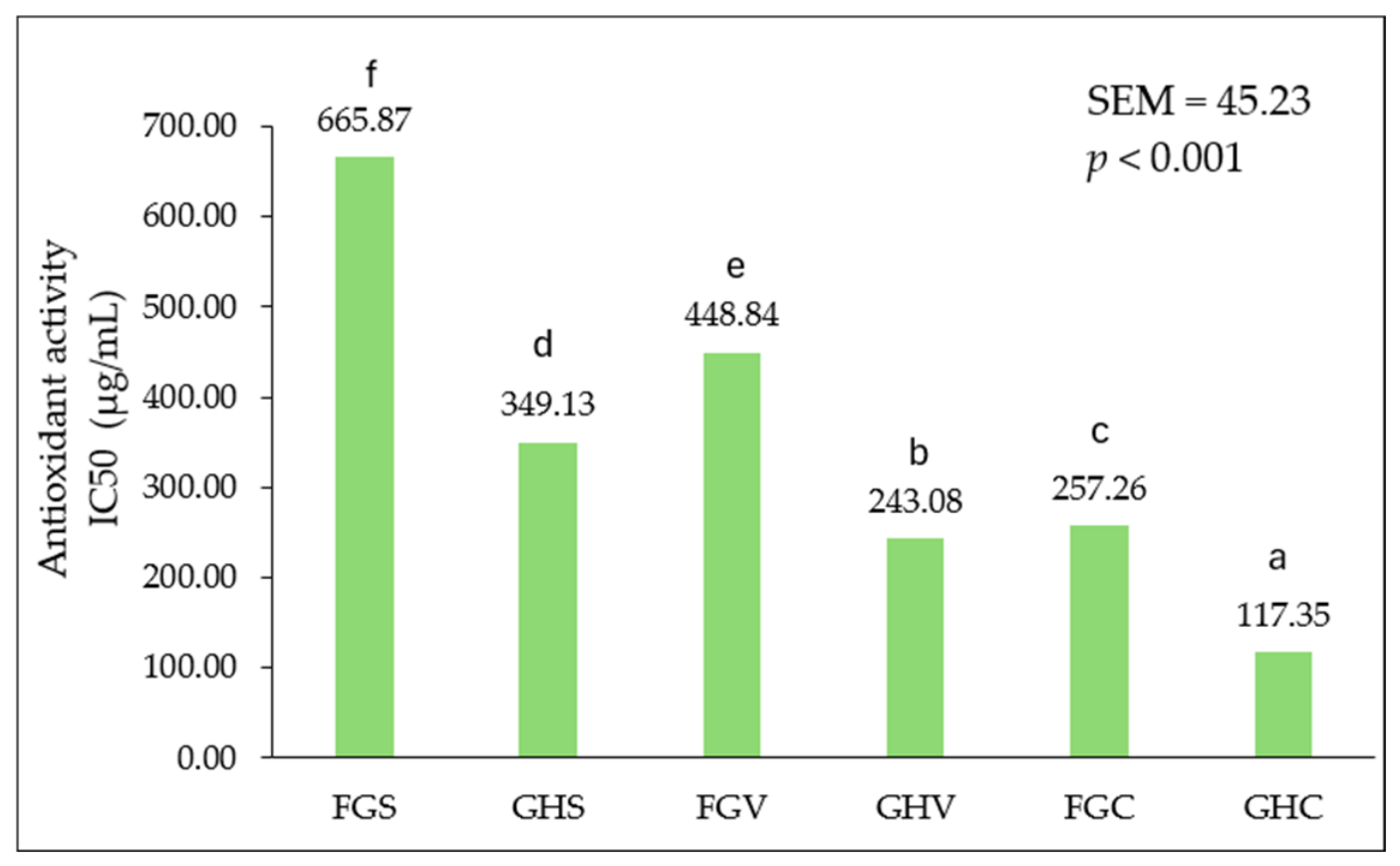
Figure 3 presents the antioxidant activity of the analyzed samples, expressed as IC50 values (μg/mL).
Consistent with the trend observed for TPC, stronger antioxidant activity (lower IC50 values) was recorded, reflecting an intensified biosynthesis of bioactive compounds under environmental stress conditions. It should be noted that, for IC50 values, lower concentrations indicate stronger antioxidant activity, as less extract is required to inhibit 50% of DPPH radicals. The strongest antioxidant activity (lowest IC50 value) was recorded for sample GHC (117.35 μg/mL), whereas the weakest activity was obtained for sample FGS (665.87 μg/mL). A clear altitudinal trend was evident across the three sampling zones:
  • Mountainous area: strongest antioxidant activity (FGC—257.26 μg/mL; GHC—117.35 μg/mL);
  • Hilly area: intermediate antioxidant activity (FGV—448.84 μg/mL; GHV—243.08 μg/mL);
  • Lowland area: weakest antioxidant activity (FGS—665.87 μg/mL; GHS—349.13 μg/mL). Hay samples consistently exhibited stronger antioxidant activity (lower IC50 values) than the corresponding fresh grass from the same location at all three altitudinal zones: GHC (117.35 μg/mL) vs. FGC (257.26 μg/mL) at the mountain site, GHV (243.08 μg/mL) vs. FGV (448.84 μg/mL) at the hill site, and GHS (349.13 μg/mL) vs. FGS (665.87 μg/mL) at the lowland site. This pattern is consistent with the TPC results and is attributable to the concentration effect occurring during the hay-making process: field drying substantially reduces moisture content (from 81–87 g/100 g in fresh grass to 7.5–8.9 g/100 g in hay), thereby increasing the mass of extractable phenolic compounds per gram of sample and enhancing the overall radical-scavenging capacity of hay extracts [33]. One-way ANOVA followed by Tukey’s HSD post hoc test revealed statistically significant differences among all analyzed samples (p < 0.05).

3.2. Determination of the Physicochemical Characteristics of Beef

3.2.1. The Proximate Composition of Beef Samples

Table 5 displays the proximate composition of meat samples. The proximate composition of beef samples revealed variations influenced by both muscle type and geographical origin.
The moisture content ranged from 70.54 and 73.67 g/100 g, with the maximum values recorded in samples from the lowland area (Sacu) and the lowest values observed in those from the mountainous area (Cozia). This decreasing trend may be associated with a greater muscle density and higher nutrient concentration in animals reared in more demanding environmental conditions. Furthermore, the slightly decreased moisture levels reported in the mountainous area may indirectly reflect the particular climatic conditions of 2025, characterized by higher temperatures and mild water deficit.
The protein level ranged from 21.23 to 23.28 g/100 g, which is characteristic of beef. A progressive increase was observed from the lowland towards the mountainous area, suggesting a direct correlation between fodder quality and muscle protein deposition. Animals reared in hilly areas benefit from more diverse and nutritiously rich pastures, which might stimulate protein synthesis and enhance muscle protein accretion.
Regarding lipid content, values ranged from 2.87 to 4.17 g/100 g, indicating that all samples can be classified as lean meat. A clear pattern was observed, with Longissimus thoracis (LT) samples exhibiting higher values than Semimembranosus (SM) samples. This difference may be explained by the physiological role of these muscles: Longissimus thoracis is a less active, postural muscle that favors intramuscular fat deposition, whereas Semimembranosus is a more active locomotor muscle, characterized by lower lipid accumulation.
In addition, lipid content increased with altitude, with the highest values recorded in samples from the mountainous area (Cozia). This pattern may be attributed both to the superior quality of feed resources and to the metabolic adaptations of animals reared under more restrictive environmental conditions.
Ash content showed limited variation (1.08–1.31 g/100 g), with slightly higher values in the mountainous area, indicating a greater mineral intake associated with grazing on natural pastures.
Carbohydrate content was low (0.47–1.28 g/100 g), as is characteristic of meat, and no clear trend was observed among samples. These values mainly reflect residual glycogen content and are primarily influenced by post-mortem biochemical processes.
The energy value ranged from 141.38 to 158.94 kcal/100 g and was strongly influenced by lipid content. Samples with higher intramuscular fat content, particularly Longissimus thoracis (LT) from Cozia, exhibited the highest caloric values.

3.2.2. Fatty Acid Profile of Beef Samples

Table 6 presents the fatty acid composition of beef samples from the Longissimus thoracis (LM) and Semimembranosus (TM) muscles collected from the three geographical areas under study. Analysis of the data revealed that palmitic acid (C16:0), stearic acid (C18:0), and oleic acid (C18:1) were the predominant fatty acids in all samples, a finding consistent with the typical fatty acid profile reported for beef.
The beef samples’ fatty acid profile showed significant differences associated with both muscle type and geographical origin. The major fatty acids identified were palmitic acid (C16:0), stearic acid (C18:0), and oleic acid (C18:1 cis-9), with oleic acid being the predominant component, a feature characteristic of bovine intramuscular fat. Saturated fatty acids (SFA) decreased gradually as altitude increased, with samples from the plain area showing the highest values and those from the mountain area showing the lowest.
Conversely, monounsaturated fatty acids (MUFA) and polyunsaturated fatty acids (PUFA) followed an opposite trend, increasing progressively from the plain to the mountainous area. This distribution indicates an improvement in the nutritional quality of beef produced under mountain rearing systems.
Of particular importance was the finding of higher concentrations of n-3 fatty acids (C18:3, EPA and DHA) and conjugated linoleic acid (CLA) in samples from the mountain area. The health benefits of these compounds have been widely studied, including anti-inflammatory, cardioprotective and antioxidant properties.
The PUFA/SFA ratio (Table 7) increased from 0.07 in the plain area to 0.14 in the mountain area, indicating a significant improvement in nutritional value. The n-6/n-3 ratio decreased in a similar way (Table 7), approaching the values recommended for human nutrition, suggesting a more balanced lipid profile.
Muscle type had a less pronounced effect on the fatty acid profile than geographical origin. However, the Longissimus thoracis muscle generally exhibited higher MUFA values, which confirmed its tendency toward higher intramuscular fat deposition.
Overall, beef from the mountain region had a better lipid profile, with greater levels of MUFA and PUFA, reduced SFA content, a more favorable n-6/n-3 ratio, and higher concentrations of bioactive compounds such as CLA, EPA, and DHA. These characteristics indicate enhanced nutritional and functional value, which is directly influenced by feed quality and environmental conditions.

3.3. Statistical Relationships Among Feed Antioxidants and Beef Quality Traits

3.3.1. Correlations Between Variables

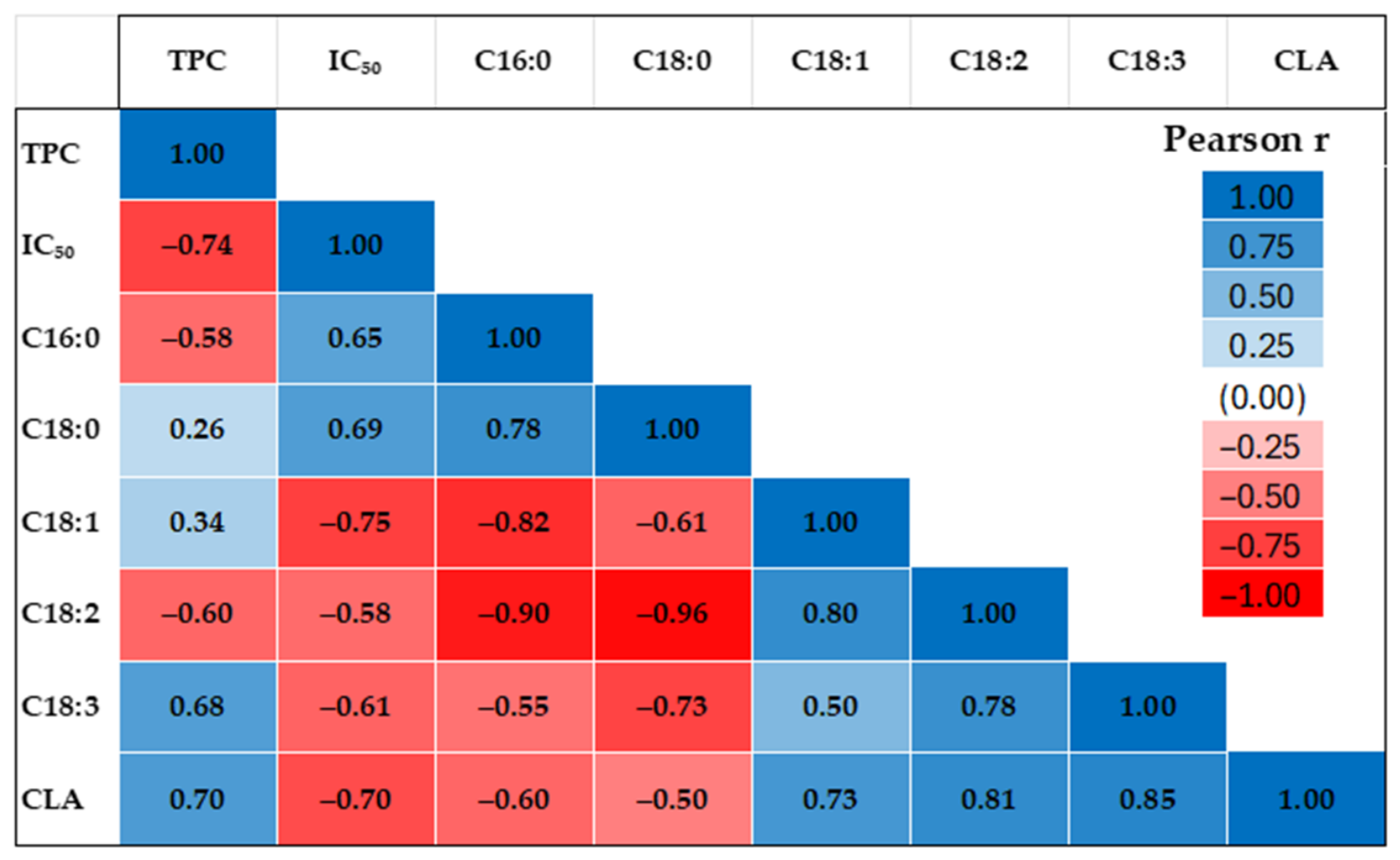
Table 8 presents the Pearson correlation coefficients between the antioxidant markers in feed and the fatty acid profile of the beef samples, and a graphical representation of these associations is shown in Figure 4.
Pearson correlation analysis revealed several meaningful associations between the antioxidant profile of the feed resources and the fatty acid composition of the beef samples. A moderate negative correlation was identified between total polyphenol content (TPC) and palmitic acid (C16:0) (r = −0.58), suggesting that higher concentrations of phenolic compounds in pasture may be associated with a reduced deposition of saturated fatty acids in meat.
At the same time, TPC exhibited positive correlations with nutritionally desirable fatty acids, particularly α-linolenic acid (C18:3) (r = 0.68) and conjugated linoleic acid (CLA) (r = 0.70). The data suggest that feed rich in polyphenols may indirectly contribute to the lipid quality of beef.
Strong associations were also observed among individual fatty acids. Stearic acid (C18:0) and linoleic acid (C18:2) exhibited a strong negative correlation (r = −0.96), whereas C18:3 and CLA showed a strong positive correlation (r = 0.85). These patterns are consistent with the known ruminal biohydrogenation pathways and fatty acid metabolism in ruminants.
A significant finding was the strong negative correlation between antioxidant activity (IC50) and oleic acid (C18:1) (r = −0.75), indicating that forages with stronger radical-scavenging activity (lower IC50), characteristic of mountain pastures, were associated with higher oleic acid concentrations in beef.
Overall, the correlation analysis supports the hypothesis that bioactive compounds naturally present in pasture vegetation may modulate ruminal lipid metabolism and, consequently, improve the nutritional profile of beef fat.

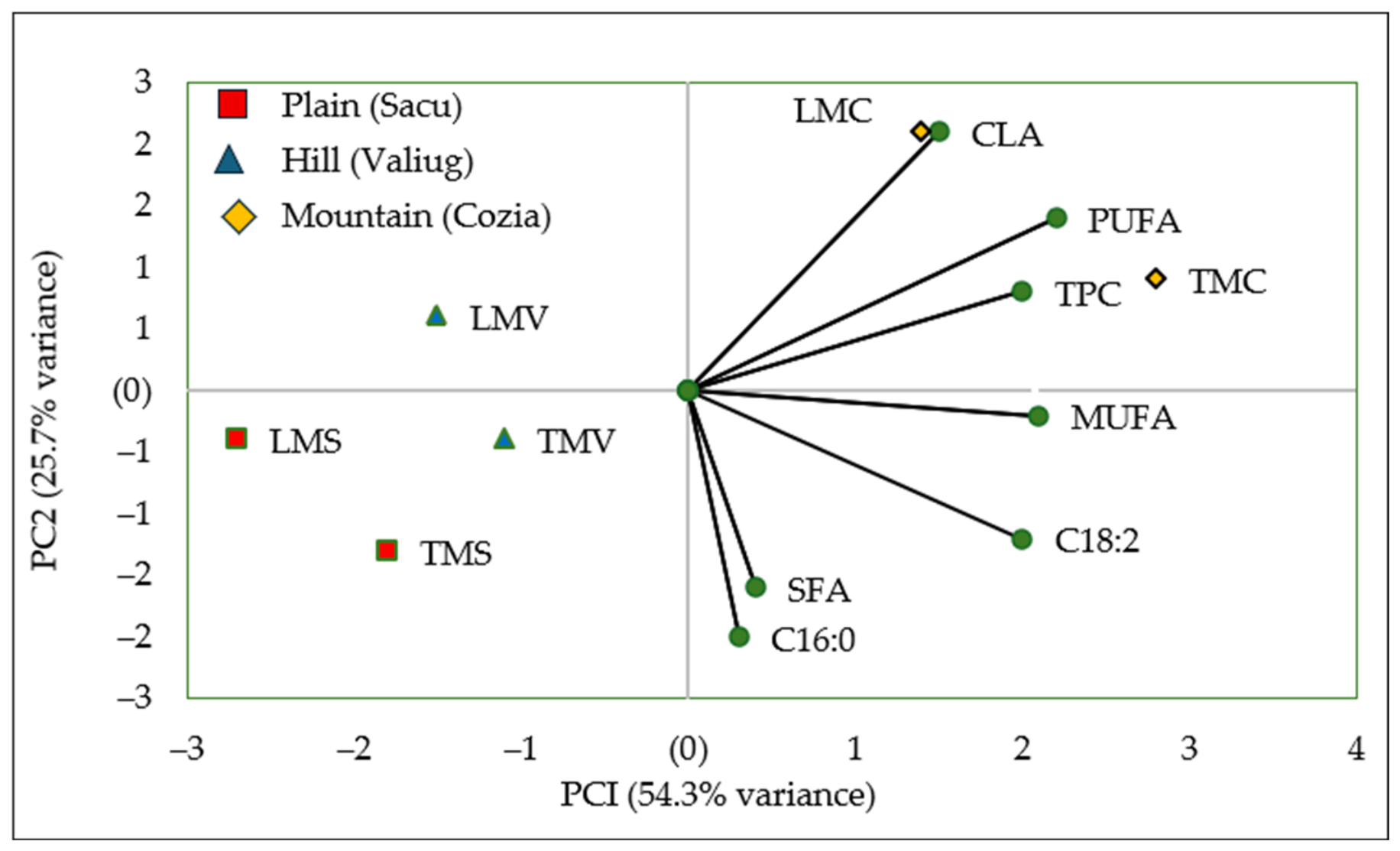
3.3.2. Principal Component Analysis (PCA)

Principal component analysis (PCA) was utilized to explore the associations among the beef samples and the analyzed variables, which include bioactive indicators of feed (TPC and IC50) and lipid quality parameters (SFA, MUFA, PUFA, n-3, n-6, and CLA). PCA is a prevalent multivariate tool for reducing data dimensionality and identifying key factors responsible for sample differentiation.
The first two principal components (PC1 and PC2) accounted for most of the total data variability, explaining 80.0% of the cumulative variance (PC1 = 54.3%; PC2 = 25.7%). This high proportion indicates that the two-dimensional PCA model adequately described the patterns of variation among the investigated beef samples.
A clear separation of the samples according to geographical origin was observed, as illustrated in Figure 5. Beef samples from the mountainous region (LMC and TMC) were positioned on the positive side of PC1, in the direction of the vectors associated with PUFA, CLA, TPC, and MUFA. This distribution indicates a superior nutritional profile, characterized by higher levels of beneficial unsaturated fatty acids and bioactive-related parameters.
Samples collected from the hill area (LMV and TMV) occupied an intermediate position on the score plot, suggesting transitional compositional characteristics between the mountain and plain production systems.
Conversely, samples from the plain area (LMS and TMS) were grouped on the negative side of PC1, opposite to the vectors of the beneficial lipid variables. Their position suggests a comparatively less favorable lipid profile, characterized by a higher relative contribution of saturated fatty acids.
The orientation of the loading vectors also revealed associations among the variables. PUFA, CLA, TPC, and MUFA were projected in a similar direction, indicating positive associations among these quality indicators. In contrast, the SFA-related vectors were oriented in the opposite direction, reflecting the antagonistic pattern between saturated fatty acids and nutritionally desirable lipid fractions.
Overall, the PCA clearly showed that geographical origin was the main discriminating factor among the beef samples, exceeding the influence of muscle type. Beef obtained from the mountain production system exhibited the most favorable nutritional characteristics, highlighting the importance of pasture ecosystem quality in shaping meat composition.

3.3.3. Multivariate Comparison of Lipid Quality Parameters According to Geographical Origin

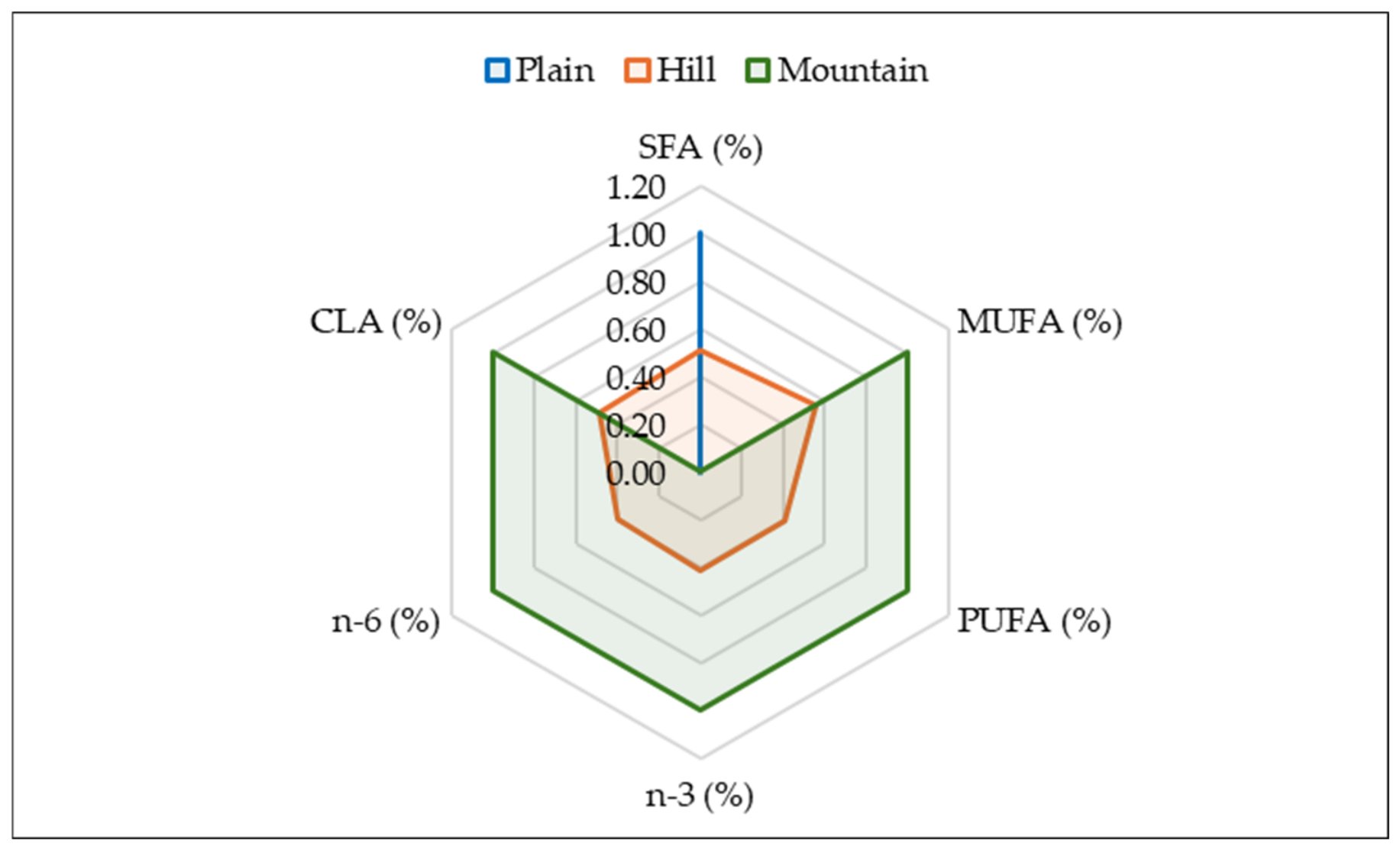
The radar plot (Figure 6) depicts the comparative distribution of normalized lipid quality markers in beef samples from plain, hill, and mountain production systems. Beef samples from the mountainous region (green polygon) exhibited the highest relative values for MUFA, PUFA, n-3 PUFA, n-6 PUFA, and CLA, indicating the most favorable nutritional lipid profile. Concurrently, the mountain samples showed the lowest relative SFA proportion.
Samples from the plain area (blue polygon) presented the highest normalized SFA value and the lowest levels of beneficial unsaturated fatty acids, suggesting a less favorable fatty acid composition. The hill area samples (orange polygon) displayed intermediate values for all lipid variables, representing a transitional profile between the plain and mountain production systems.
The radar plot indicates that geographical origin substantially influenced beef lipid composition, with mountain grazing systems yielding the most favorable nutritional profile.

4. Discussion

4.1. Determination of the Physicochemical Characteristics of Fresh Grass and Grass Hay

4.1.1. Determination of Proximate Composition

Several studies have examined the influence of altitude on the chemical composition of pasture plants, revealing trends that align with those observed in the current study. Mountousis et al. [13] revealed that grasslands at higher altitudes exhibit significant variations in protein and energy content in comparison to lowland regions, mainly due to differences in vegetation type and environmental conditions.
Their research demonstrated that mountain pastures generally provide feed with improved nutritional quality. Andueza et al. [14] stated that altitude gradients significantly influence the chemical composition of perennial grasses, including ash, nitrogen (protein), and fiber fractions, with higher altitudes frequently correlating with enhanced nutritional density.
Kumar et al. [39] observed in a study of Himalayan pastures that high-altitude forage species displayed higher levels of protein, lipids, and bioactive compounds compared to those from lower altitudes, an effect attributed to environmental stressors and plant adaptation mechanisms. Comparable results were reported by Katoch [40], who observed significant differences in the crude protein and ash contents of grasses cultivated at different altitudes, confirming that altitude is a key factor influencing forage quality. Moreover, Katoch [40] emphasized that forage plants from mountainous regions typically present higher mineral (ash) and protein contents due to soil composition and climatic conditions, whereas lowland pastures tend to exhibit higher moisture levels.
The findings support the results of the present study, indicating that samples from the mountainous region exhibited elevated levels of protein, fat, and ash compared to those from hill and plain regions. The observed differences can be attributed to variations in altitude, climatic conditions, and the botanical composition of pastures.
A key methodological limitation that must be acknowledged is the confounding of altitude with farm/location identity in the experimental design of this study. Since only one farm was included per altitudinal zone (plain—Sacu; hill—Văliug; mountain—Cozia), it is not possible to statistically disentangle the effects of altitude from those of other farm-specific factors, including soil properties, microclimate, management history, stocking rate, and botanical composition. Therefore, observed differences in forage composition and beef quality should be interpreted as associated with the combined effect of altitude and the specific farm characteristics at each location, rather than being attributed exclusively to altitude. Future studies should include multiple farms per altitudinal category to enable a proper factorial analysis of altitude versus farm effects.

4.1.2. Antioxidant Profile of Forage Samples

The findings of this study align with several papers emphasizing the impact of altitude and environmental stress on polyphenol accumulation and antioxidant capacity in forage plants. Amrit et al. [41] shown that pasture grasses subjected to environmental stress displayed increased polyphenol concentrations and higher antioxidant activity, as assessed by methods such as DPPH. Similarly, Rapisarda and Abu-Ghannam [17] reported that the antioxidant potential of grassland species varies significantly according to environmental conditions, with the highest values associated with water stress and temperature fluctuations.
Verhulst et al. [16] reported that forage plants harvested from mountain areas exhibited significantly greater antioxidant capacity than those collected from plain regions, owing to the increased synthesis of phenolic compounds. Cabiddu et al. [15] also showed that natural pastures, particularly those located in mountain areas, are rich in phenolic compounds and display high antioxidant activity, which may subsequently be transferred to animal-derived products. Comparable observations were reported by Karami et al. [42], who underlined the role of dietary antioxidants in improving the oxidative stability and functional quality of ruminant products.
Furthermore, Al-Mamun et al. [18] reported significant variations in antioxidant activity based on altitude, which correlated strongly with total polyphenol content. More recent research by Davis et al. [4] and Ibric et al. [5] further demonstrated that pasture composition and geographic origin have a major impact on antioxidant profiles, with higher values often found in mountainous regions. Rufino-Moya et al. [19] indicated that hay might exhibit superior antioxidant activity compared to fresh fodder, owing to concentration effects and structural changes throughout the drying process. Similar findings regarding conservation methods were reported by Rufino-Moya et al. [19] and Gagaoua et al. [43]. This observation is fully supported by the present data, in which hay samples exhibited stronger antioxidant activity (lower IC50 values) than the corresponding fresh grass samples at all three altitudinal levels: GHC (117.35 μg/mL) vs. FGC (257.26 μg/mL) at the mountainous site, GHV (243.08 μg/mL) vs. FGV (448.84 μg/mL) at the hilly site, and GHS (349.13 μg/mL) vs. FGS (665.87 μg/mL) at the lowland site. The concentration of bioactive phenolic compounds during the hay-making process, combined with the partial degradation of cell wall components that may enhance extractability, likely accounts for the consistently lower IC50 values observed in hay across all sampling zones.
It should be noted that the botanical characterisation of the pastures in this study was based on a preliminary visual survey only; a comprehensive phytosociological analysis, including species frequency, cover estimation, and quantitative plant biomass determination, was not conducted. Therefore, attributions of observed phytochemical differences to specific plant species or functional groups should be regarded as indicative and hypothesis-generating, pending confirmation by dedicated botanical studies.
The present findings indicate that the climatic conditions recorded in 2025 favored the accumulation of phenolic compounds and enhanced the antioxidant capacity of the forage plants. The interplay of high temperatures and moderate water deficit undoubtedly acted as a stress factor, stimulating the synthesis of secondary metabolites.
These results are particularly relevant, as they suggest that climatic variability may influence not only the nutritional value of forage resources but also their functional properties, with potential implications for the quality of animal-derived products, including beef.

4.2. Determination of the Physicochemical Characteristics of Beef

4.2.1. The Proximate Composition of Beef Samples

Moholisa et al. [12] reported moisture values ranging between 70 and 75 g/100 g depending on the production system and muscle type, an interval that corresponds closely with the results obtained in the present study. Similarly, Ponnampalam et al. [20] indicated that protein levels in the Longissimus thoracis muscle generally vary between 20 and 23 g/100 g, confirming the relative stability of this parameter.
Regarding lipid content, Horcada et al. [44] and Vasta and Luciano [45] reported values between 2 and 5 g/100 g for beef originating from pasture-based systems, with higher values in the Longissimus than in the Semimembranosus muscle, which is also consistent with the present findings. Terlouw et al. [21] demonstrated that muscle type greatly affects fat distribution, with more active muscles such the Semimembranosus exhibiting lower lipid content compared to less active muscles such as the Longissimus. These differences are closely related to muscle fiber metabolism and anatomical function, as discussed by Purslow et al. [46] and Wood et al. [47]. The studies conducted by De Smet et al. [22] indicated that beef produced under extensive grazing systems tends to exhibit lower lipid content but also greater variability depending on environmental conditions, supporting the moderate differences observed among the studied regions. In addition, Smith et al. [6] and Serra et al. [7] underlined that environmental factors such as feeding regime and geographical origin significantly influence meat chemical composition, in agreement with the altitudinal trends observed in the present study.
Overall, the results confirm that both muscle type and geographical area of origin influenced the proximate composition of beef. The observed differences, while moderate, adhered to a physiologically coherent pattern and aligned with previously reported findings. The elevated protein and lipid contents reported in the samples from the mountainous region indicate that the pastures in these areas may enhance the nutritional quality of beef production. The identified differences between the Longissimus thoracis and Semimembranosus muscles underscore the significance of anatomical variability when assessing meat quality.

4.2.2. Determination of Fatty Acid Content

The findings about the fatty acid content of beef align with several research in the scientific literature that emphasize the impact of the feeding system, environment, and muscle type on the lipid profile.
Daley et al. [1] showed that pasture-raised animals exhibit a superior lipid profile, characterized by reduced saturated fatty acids and increased polyunsaturated fatty acids, particularly from the n-3 series. The values obtained in the present study, especially for the samples from the mountain area, confirm this tendency through higher PUFA levels and lower SFA proportions. Similarly, Nogoy et al. [8] reported that PUFA typically represent less than 5–7% of total fatty acids in beef, values comparable with those determined in the present study (3.46–5.97%). This agreement supports the validity of the present results.
The botanical composition of the pastures under study represents a key determinant of forage phytochemical quality and, consequently, of beef fatty acid profile. Mountain pastures at Cozia were dominated by Festuca rubra and Agrostis capillaris, with a conspicuous forb component including Plantago lanceolata, Achillea millefolium, and leguminous species (Trifolium repens, Lotus corniculatus). These plant families are established sources of n-3 fatty acid precursors (particularly α-linolenic acid, C18:3 n-3), condensed tannins, and phenolic compounds that can modulate ruminal biohydrogenation and thereby increase the flow of PUFA towards duodenal absorption [9,15]. Indeed, legumes and herb-rich swards have been associated in multiple studies with higher CLA and n-3 fatty acid concentrations in ruminant products [45]. Conversely, the lowland sward at Sacu, dominated by Lolium perenne and Poa pratensis—species characterised by lower concentrations of secondary metabolites and n-3 precursors—was associated with a relatively higher SFA proportion and lower PUFA and CLA values in the resulting beef. The hill pasture at Văliug, with its mixed composition of grasses and legumes (Dactylis glomerata, Festuca pratensis, Trifolium pratense), yielded intermediate fatty acid values, consistent with its transitional botanical identity. These observations are in line with the findings of Kearns et al. [9], who demonstrated that botanically diverse pastures significantly increase the concentrations of CLA and n-3 fatty acids in ruminant meat, and underscore the importance of characterising pasture floristic composition when evaluating the nutritional quality of grass-fed beef.
Studies conducted by Nuernberg et al. [3], later confirmed by Kearns et al. [9], revealed that grazing systems promote the accumulation of n-3 fatty acids, particularly C18:3, along with its long-chain derivatives (EPA and DHA). The heightened levels of these fatty acids in the mountain samples signify a direct impact of forage abundant in bioactive chemicals. Vahmani et al. [10] also indicated that pasture-based feeding can improve the fatty acid profile of beef by increasing the PUFA and CLA contents. This aspect is confirmed in the present study by the higher CLA values recorded in the samples originating from the mountain area. Similar conclusions were reported by Wood et al. [47] and De Smet et al. [48].
Regarding monounsaturated fatty acids, specifically oleic acid (C18:1), Scollan et al. [2] stated that it is the dominant fatty acid in beef, generally accounting for more than 35–40% of total fatty acids. The values obtained in this study (35–41%) fall well within this range.
The PUFA/SFA ratio determined in the present study (0.07–0.14) is comparable with the values reported by Lukić et al. [11], who indicated that in beef originating from extensive systems this ratio remains relatively low but can be improved by increasing the proportion of fresh forage in the diet. An essential indicator of nutritional quality is the n-6/n-3 ratio, which in the present study ranged between 3.5 and 4.6. These values are close to those recommended for human nutrition and are substantially more favorable than those reported for beef from intensive systems [1]. The nutritional relevance of a balanced omega-3 intake has also been underlined by Calder [49], whereas the broader implications of animal-derived lipids in human diets were discussed by Givens [50].
Furthermore, the research conducted by Moholisa et al. [12] reported that pasture-based systems increase the levels of CLA and n-3 fatty acids, thereby improving the functional value of meat. The current results reinforce this observation, particularly for the samples originating from the mountainous region. Similar evidence was presented by Kearns et al. [9], who described improved fatty acid quality indices in grass-fed beef systems.
Overall, the results confirm that the fatty acid profile of beef is strongly influenced by the feeding regime and environmental conditions, with the samples from the mountain area exhibiting superior nutritional characteristics, in agreement with the scientific literature.

5. Conclusions

This study provides evidence that altitude-driven differences in grassland botanical composition and phytochemical quality exert a measurable and ecologically coherent influence on the nutritional properties of beef produced under traditional extensive grazing in Caraș-Severin County, Romania. Mountain pastures, characterised by a floristically diverse sward including Festuca rubra, Agrostis capillaris, herb-rich forbs, and leguminous species, delivered forage with the highest polyphenol content and antioxidant activity, and this quality advantage was reflected in beef with a superior lipid profile—lower SFA, higher MUFA and PUFA fractions, elevated CLA and n-3 fatty acid concentrations, and a more favourable n-6/n-3 ratio. From a nutritional standpoint, the mountain-origin beef analysed in this study meets the criteria for a more health-promoting product compared to beef from lowland systems, particularly with respect to the lipid quality indices (PUFA/SFA and n-6/n-3 ratios) relevant for cardiovascular disease prevention. The multivariate (PCA) analysis further confirmed geographical origin as the dominant discriminating factor, surpassing muscle type in explanatory power. These findings carry direct implications for sustainable livestock policy and value-added food production. The promotion of high-altitude, pasture-based cattle systems as a strategy for enhancing meat quality aligns with growing consumer interest in origin-labelled and sustainably produced beef. The data also provide a scientific rationale for integrating botanical diversity indicators into quality assessment frameworks for grass-fed beef. Future studies should investigate (i) the influence of seasonal variation in forage composition on beef quality, through multi-season sampling; (ii) a full phytosociological characterisation of the pastures, including species frequency and biomass data; (iii) the sensory and oxidative stability properties of the beef; and (iv) economic and market viability analyses for premium mountain beef in the regional agri-tourism context.

Author Contributions

Conceptualization, A.-I.I. and I.C.; methodology, A.-I.I., I.C., E.A. and M.N.; validation, I.C., E.A., C.J. and T.I.; formal analysis, A.-I.I., I.C., E.A., M.N. and C.A.; investigation, A.-I.I., I.C., M.N. and C.A.; resources, A.-I.I., I.C., E.A., C.J. and T.I.; data curation, A.-I.I., I.C. and A.D.-P.; writing—original draft preparation, A.-I.I., I.C., E.A., C.J., M.N., C.A., A.D.-P. and T.I.; writing—review and editing, A.-I.I., I.C., E.A., C.J., M.N., C.A., A.D.-P. and T.I.; visualization, A.-I.I., I.C., E.A., C.J., M.N., C.A., A.D.-P. and T.I.; supervision, E.A., C.J. and T.I.; funding acquisition, A.-I.I. and T.I. All authors have read and agreed to the published version of the manuscript.

Funding

This research was supported by funds from the University of Life Sciences “King Mihai I” from Timișoara.

Institutional Review Board Statement

Ethical review and approval were not required for this study because beef samples were collected post-mortem from animals slaughtered under standard commercial procedures in EU-approved slaughterhouses, in full compliance with Regulation (EC) No 1099/2009 on the protection of animals at the time of killing. No experimental procedures were performed on live animals.

Data Availability Statement

The data presented in this study are available within the article. Additional data supporting the reported results are available on request from the corresponding author.

Acknowledgments

The authors would like to thank to the Doctoral School “Engineering of Vegetable and Animal Resources”, University of Life Sciences “King Mihai I” from Timişoara (Calea Aradului 119, 300645 Timişoara, Romania), for the academic support and resources provided throughout the development of this research.

Conflicts of Interest

The authors declare no conflicts of interest.

Abbreviations

The following abbreviations are used in this manuscript:
TPCtotal polyphenol content
DPPH1,1-diphenyl-2-picrylhydrazyl
SFAssaturated fatty acids
PUFAspolyunsaturated fatty acids
MUFAsmonounsaturated fatty acids
CLAconjugated linoleic acid
FGSFresh grass from Sacu
GHSGrass hay from Sacu
FGVFresh grass from Văliug
GHVGrass hay from Văliug
FGCFresh grass from Cozia
GHCGrass hay from Cozia
LMSLongissimus thoracis (loin) muscle from Sacu
TMSSemimembranosus (topside) muscle from Sacu
LMVLongissimus thoracis (loin) muscle from Văliug
TMVSemimembranosus (topside) muscle from Văliug
LMCLongissimus thoracis (loin) muscle from Cozia
TMCSemimembranosus (topside) muscle from Cozia

References

  1. Daley, C.A.; Abbott, A.; Doyle, P.S.; Nader, G.A.; Larson, S. A review of fatty acid profiles and antioxidant content in grass-fed and grain-fed beef. Nutr. J. 2010, 9, 10. [Google Scholar] [CrossRef]
  2. Scollan, N.D.; Dannenberger, D.; Nuernberg, K.; Richardson, I.; MacKintosh, S.; Hocquette, J.F.; Moloney, A.P. Enhancing the nutritional and health value of beef lipids and their relationship with meat quality. Meat Sci. 2014, 97, 384–394. [Google Scholar] [CrossRef] [PubMed]
  3. Nuernberg, K.; Dannenberger, D.; Nuernberg, G.; Ender, K.; Voigt, J.; Scollan, N.D.; Wood, J.D.; Nute, G.R.; Richardson, R.I. Effect of a grass-based and a concentrate feeding system on meat quality characteristics and fatty acid composition of longissimus muscle in different cattle breeds. Livest. Prod. Sci. 2005, 94, 137–147. [Google Scholar] [CrossRef]
  4. Davis, H.; Magistrali, A.; Butler, G.; Stergiadis, S. Nutritional benefits from fatty acids in organic and grass-fed beef. Foods 2022, 11, 646. [Google Scholar] [CrossRef]
  5. Ibric, A.I.; Cocan, I.; Alexa, E.; Jianu, C.; Negrea, M.; Dragoescu, A.A.; Jurcuț, R.-C.; Iancu, T. Geographical variation in pasturelands and their impact on the physicochemical characterization and fatty acid composition of cheese in Caraș-Severin County, Romania. Sustainability 2024, 16, 7179. [Google Scholar] [CrossRef]
  6. Smith, S.B.; Gotoh, T.; Greenwood, P.L. Current situation and future prospects for global beef production: Overview of special issue. Asian-Australas. J. Anim. Sci. 2018, 31, 927–932. [Google Scholar] [CrossRef]
  7. Serra, X.; Guerrero, L.; Guàrdia, M.D.; Gil, M.; Sañudo, C.; Panea, B.; Campo, M.M.; Olleta, J.L.; García-Cachán, M.D.; Piedrafita, J.; et al. Eating quality of young bulls from three Spanish beef breed-production systems and its relationships with chemical and instrumental meat quality. Meat Sci. 2008, 79, 98–104. [Google Scholar] [CrossRef]
  8. Nogoy, K.M.C.; Park, S.; Lee, Y.; Han, S.G. Fatty acid composition of beef and its nutritional implications: A review. Food Sci. Anim. Resour. 2022, 42, 18–33. [Google Scholar] [CrossRef] [PubMed]
  9. Kearns, M.; Ponnampalam, E.N.; Jacquier, J.C.; Grasso, S.; Boland, T.M.; Sheridan, H.; Monahan, F.J. Can botanically-diverse pastures positively impact the nutritional and antioxidant composition of ruminant meat? Meat Sci. 2023, 197, 109055. [Google Scholar] [CrossRef] [PubMed]
  10. Vahmani, P.; Mapiye, C.; Prieto, N.; Rolland, D.C.; McAllister, T.A.; Aalhus, J.L.; Dugan, M.E.R. The scope for manipulating the polyunsaturated fatty acid content of beef: A review. J. Anim. Sci. Biotechnol. 2015, 6, 29. [Google Scholar] [CrossRef]
  11. Lukić, M.; Trbovic, D.; Karan, D.; Petrovic, Z.; Jovanovic, J.; Milijasevic, J.B.; Nikolic, A. The nutritional and health value of beef lipids—Fatty acid composition in grass-fed and grain-fed beef. IOP Conf. Ser. Earth Environ. Sci. 2021, 854, 012054. [Google Scholar] [CrossRef]
  12. Moholisa, E.; Strydom, P.E.; Hugo, A. The effect of beef production system on proximate composition and fatty acid profile of three beef muscles. S. Afr. J. Anim. Sci. 2018, 48, 295–306. [Google Scholar] [CrossRef]
  13. Mountousis, I.; Dotas, V.; Stanogias, G.; Papanikolaou, K.; Roukos, C.; Liamadis, D. Altitudinal and seasonal variation in herbage composition and energy and protein content of grasslands on Mt Varnoudas, NW Greece. Anim. Feed. Sci. Technol. 2011, 164, 174–183. [Google Scholar] [CrossRef]
  14. Andueza, D.; Rodrigues, A.M.; Picard, F.; Rossignol, N.; Baumont, R.; Cecato, U.; Farruggia, A. Relationships between botanical composition, yield and forage quality of permanent grasslands over the first growth cycle. Grass Forage Sci. 2016, 71, 366–378. [Google Scholar] [CrossRef]
  15. Cabiddu, A.; Delgadillo-Puga, C.; Decandia, M.; Molle, G. Extensive Ruminant Production Systems and Milk Quality with Emphasis on Unsaturated Fatty Acids, Volatile Compounds, Antioxidant Protection Degree and Phenol Content. Animals 2019, 9, 771. [Google Scholar] [CrossRef]
  16. Verhulst, E.P.; Brunton, N.P.; Rai, D.K. Polyphenols in agricultural grassland crops and their health-promoting activities—A review. Foods 2023, 12, 4122. [Google Scholar] [CrossRef] [PubMed]
  17. Rapisarda, S.; Abu-Ghannam, N. Polyphenol characterization and antioxidant capacity of multi-species swards grown in Ireland–environmental sustainability and nutraceutical potential. Sustainability 2023, 15, 634. [Google Scholar] [CrossRef]
  18. Al-Mamun, M.; Yamaki, K.; Masumizu, T.; Nakai, Y.; Saito, K.; Sano, H.; Tamura, Y. Superoxide anion radical scavenging activities of herbs and pastures in northern Japan determined using electron spin resonance spectrometry. Int. J. Biol. Sci. 2007, 3, 349–355. [Google Scholar] [CrossRef]
  19. Rufino-Moya, P.J.; Bertolín, J.R.; Blanco, M.; Lobón, S.; Joy, M. Fatty acid profile, secondary compounds and antioxidant activities in the fresh forage, hay and silage of sainfoin (Onobrychis viciifolia) and sulla (Hedysarum coronarium). J. Sci. Food Agric. 2022, 102, 4736–4743. [Google Scholar] [CrossRef]
  20. Ponnampalam, E.N.; Sinclair, A.J.; Holman, B.W.B. The sources, synthesis and biological actions of omega-3 and omega-6 fatty acids in red meat: An overview. Foods 2021, 10, 1358. [Google Scholar] [CrossRef] [PubMed]
  21. Terlouw, E.M.C.; Picard, B.; Deiss, V.; Berri, C.; Hocquette, J.-F.; Lebret, B.; Lefèvre, F.; Hamill, R.; Gagaoua, M. Understanding the determination of meat quality using biochemical characteristics of the muscle: Stress at slaughter and other missing keys. Foods 2021, 10, 84. [Google Scholar] [CrossRef]
  22. De Smet, S.; Vossen, E. Meat: The balance between nutrition and health. A review. Meat Sci. 2016, 120, 145–156. [Google Scholar] [CrossRef]
  23. Listrat, A.; Lebret, B.; Louveau, I.; Astruc, T.; Bonnet, M.; Lefaucheur, L.; Picard, B.; Bugeon, J. How muscle structure and composition influence meat and flesh quality. Sci. World J. 2016, 2016, 3182746. [Google Scholar] [CrossRef] [PubMed]
  24. Picard, B.; Gagaoua, M. Muscle fiber properties in cattle and their relationships with meat qualities: An overview. J. Agric. Food Chem. 2020, 68, 6021–6039. [Google Scholar] [CrossRef] [PubMed]
  25. ISO 6496:1999; Animal Feeding Stuffs—Determination of Moisture and Other Volatile Matter Content. International Organization for Standardization (ISO): Geneva, Switzerland, 1999.
  26. ISO 5984:2002; Animal Feeding Stuffs—Determination of Crude Ash. International Organization for Standardization (ISO): Geneva, Switzerland, 2002.
  27. ISO 5983-2:2009; Animal Feeding Stuffs—Determination of Nitrogen Content and Calculation of Crude Protein Content—Part 2: Block Digestion and Steam Distillation Method. International Organization for Standardization (ISO): Geneva, Switzerland, 2009.
  28. ISO 6492:1999; Animal Feeding Stuffs—Determination of Fat Content. International Organization for Standardization (ISO): Geneva, Switzerland, 1999.
  29. ISO 1442:1997; Meat and Meat Products—Determination of Moisture Content (Reference Method). International Organization for Standardization (ISO): Geneva, Switzerland, 1997.
  30. ISO 937:1978; Meat and Meat Products—Determination of Nitrogen Content (Reference Method). International Organization for Standardization (ISO): Geneva, Switzerland, 1978.
  31. ISO 1443:1973; Meat and Meat Products—Determination of Total Fat Content. International Organization for Standardization (ISO): Geneva, Switzerland, 1973.
  32. ISO 936:1998; Meat and Meat Products—Determination of Total Ash. International Organization for Standardization (ISO): Geneva, Switzerland, 1998.
  33. ISO 12966-2:2017; Animal and Vegetable Fats and Oils—Gas Chromatography of Fatty Acid Methyl Esters—Part 2: Preparation of Methyl Esters of Fatty Acids. International Organization for Standardization (ISO): Geneva, Switzerland, 2017.
  34. Folch, J.; Lees, M.; Sloane-Stanley, G.H. A simple method for the isolation and purification of total lipids from animal tissues. J. Biol. Chem. 1957, 226, 497–509. [Google Scholar] [CrossRef]
  35. Christie, W.W. A simple procedure for rapid transmethylation of glycerolipids and cholesteryl esters. J. Lipid Res. 1982, 23, 1072–1075. [Google Scholar] [CrossRef] [PubMed]
  36. Montgomery, D.C. Design and Analysis of Experiments, 9th ed.; Wiley: Hoboken, NJ, USA, 2017. [Google Scholar]
  37. Jolliffe, I.T. Principal Component Analysis, 2nd ed.; Springer: New York, NY, USA, 2002. [Google Scholar]
  38. Hair, J.F.; Black, W.C.; Babin, B.J.; Anderson, R.E. Multivariate Data Analysis, 7th ed.; Pearson: Harlow, UK, 2014. [Google Scholar]
  39. Kumar, R.; Joshi, R.; Kumar, R.; Srivatsan, V.; Satyakam; Chawla, A.; Patial, V.; Kumar, S. Nutritional quality evaluation and proteome profile of forage species of Western Himalaya. Grassl. Sci. 2022, 68, 214–225. [Google Scholar] [CrossRef]
  40. Katoch, R. Nutritional quality management of forages in the Himalayan region. In Nutritional Quality Management of Forages in the Himalayan Region; Springer: Singapore, 2022. [Google Scholar] [CrossRef]
  41. Amrit, B.K.; Ponnampalam, E.N.; Macwan, S.; Wu, H.; Aziz, A.; Muir, S.; Dunshea, F.R.; Suleria, H.A.R. Comprehensive screening and characterization of polyphenol compounds from pasture grasses used for livestock production under temperate region. Anim. Feed. Sci. Technol. 2023, 299, 115699. [Google Scholar] [CrossRef]
  42. Karami, M.; Alimon, A.R.; Sazili, A.Q.; Goh, Y.M.; Ivan, M. Effects of dietary antioxidants on the quality, fatty acid profile, and lipid oxidation of longissimus muscle in Kacang goat with aging time. Meat Sci. 2011, 88, 102–108. [Google Scholar] [CrossRef]
  43. Gagaoua, M.; Terlouw, E.M.C.; Picard, B. The study of protein biomarkers to understand the biochemical processes underlying beef color development in young bulls. Meat Sci. 2017, 134, 18–27. [Google Scholar] [CrossRef]
  44. Horcada, A.; Polvillo, O.; González-Redondo, P.; López, A.; Tejerina, D.; García-Torres, S. Stability of fatty acid composition of intramuscular fat from pasture- and grain-fed young bulls during the first 7 d postmortem. Arch. Anim. Breed. 2020, 63, 45–55. [Google Scholar] [CrossRef]
  45. Vasta, V.; Luciano, G. The effects of dietary consumption of plant secondary compounds on small ruminants’ products quality. Small Rumin. Res. 2011, 101, 150–159. [Google Scholar] [CrossRef]
  46. Purslow, P.P.; Gagaoua, M.; Warner, R.D. Insights on meat quality from combining traditional studies and proteomics. Meat Sci. 2021, 174, 108423. [Google Scholar] [CrossRef]
  47. Wood, J.D.; Enser, M.; Fisher, A.V.; Nute, G.R.; Sheard, P.R.; Richardson, R.I.; Hughes, S.I.; Whittington, F.M. Fat deposition, fatty acid composition and meat quality: A review. Meat Sci. 2008, 78, 343–358. [Google Scholar] [CrossRef] [PubMed]
  48. De Smet, S.; Raes, K.; Demeyer, D. Meat fatty acid composition as affected by fatness and genetic factors: A review. Anim. Res. 2004, 53, 81–98. [Google Scholar] [CrossRef]
  49. Calder, P.C. Omega-3 fatty acids and inflammatory processes. Nutrients 2010, 2, 355–374. [Google Scholar] [CrossRef] [PubMed]
  50. Givens, I. Animal nutrition and lipids in animal products and their contribution to human intake and health. Nutrients 2009, 1, 71–82. [Google Scholar] [CrossRef]
Figure 1. Geographic location of the three studied agritourism farms in Caraș-Severin County, Romania (Administrative boundaries from GADM (https://gadm.org), modified by the authors).
Agriculture 16 01251 g001
Figure 2. Total polyphenolic content of the fresh grass and grass hay samples. Values represent the mean of three independent determinations. Different superscript letters (a–f) indicate statistically significant differences between samples (p < 0.05) based on the one-way ANOVA followed by Tukey’s HSD post hoc test. SEM = 3.21; p < 0.001.
Agriculture 16 01251 g002
Figure 3. The DPPH radical scavenging activity of the grass samples. Values represent the mean of three independent determinations. Different superscript letters (a–f) indicate statistically significant differences between samples (p < 0.05) based on the one-way ANOVA followed by Tukey’s HSD post hoc test. FGS—fresh grass from Sacu; GHS—grass hay from Sacu; FGV—fresh grass from Văliug; GHV—grass hay from Văliug; FGC—fresh grass from Cozia; GHC—grass hay from Cozia. SEM = 45.23; p < 0.001.
Agriculture 16 01251 g003
Figure 4. Pearson correlation heatmap between antioxidant parameters of feed and the quality characteristics of beef lipids. Positive correlations are displayed in blue and negative correlations in red, with colour intensity proportional to the magnitude of the correlation coefficient.
Agriculture 16 01251 g004
Figure 5. Principal component analysis (PCA) biplot of beef samples based on antioxidant and lipid quality parameters. Mountain samples (LMC and TMC) were associated with higher PUFA, CLA, TPC, and MUFA values, whereas plain samples (LMS and TMS) were correlated with less favorable lipid traits.
Agriculture 16 01251 g005
Figure 6. Radar plot of normalized lipid quality parameters of beef samples according to geographical production area.
Agriculture 16 01251 g006
Table 1. Identification and geographical location of the three selected agritourism farms.
Nr. Crt.AreaLocationAltitude (m)Geographic CoordinatesUAA (ha)Stock. Rate (LU/ha)BreedNo. CowsManagement
1.PlainSacu15445°33′57″ N 22°07′48″ E650.67Romanian Simmental44Extensive, seasonal grazing
2.HillValiug55045°13′35″ N 22°01′44″ E520.73Romanian Simmental38Extensive, seasonal grazing
3.MountainCozia113045°52′4″ N 22°50′28″ E640.75Romanian Simmental48Extensive, seasonal grazing
UAA = Usable Agricultural Area; LU/ha = Livestock Units per hectare; management for all farms: seasonal grazing May–October, hay-based feeding November–April.
Table 2. Abbreviations for the forage samples analyzed.
SampleAbbreviation
Fresh grass from SacuFGS
Grass hay from SacuGHS
Fresh grass from VăliugFGV
Grass hay from VăliugGHV
Fresh grass from CoziaFGC
Grass hay from CoziaGHC
Table 3. Abbreviation of analysed beef samples.
SampleAbbreviation
Longissimus thoracis (loin) muscle from SacuLMS
Semimembranosus (topside) muscle from SacuTMS
Longissimus thoracis (loin) muscle from VăliugLMV
Semimembranosus (topside) muscle from VăliugTMV
Longissimus thoracis (loin) muscle from CoziaLMC
Semimembranosus (topside) muscle from CoziaTMC
Table 4. Proximate composition of the samples.
SampleChemical Parameters
Moisture
(g/100 g)
Protein
(g/100 g)
Lipids
(g/100 g)
Ash
(g/100 g)
Carbohydrates
(g/100 g)
Energy Value
(kcal/100 g)
FGS81.20 c2.80 e0.40 c3.25 f12.3560.20
GHS7.50 a10.30 c2.60 b7.50 c72.10358.40
FGV84.10 d4.40 d0.50 c3.90 e7.1048.90
GHV7.90 a11.80 b2.95 b8.10 b69.25355.80
FGC87.10 d6.10 d0.65 c4.40 d1.7535.60
GHC8.90 b13.40 a3.60 a8.90 a65.20352.10
SEM1.1370.1700.0430.1240.9475.042
p-value<0.001<0.001<0.001<0.001<0.001<0.001
The reported values represent the mean of three independent determinations ± standard error of the mean (SEM). Different superscript letters (a–f) indicate statistically significant differences between samples (p < 0.05) based on one-way ANOVA followed by Tukey’s HSD post hoc test.. FGS—Fresh grass from Sacu; GHS—Grass hay from Sacu; FGV—Fresh grass from Văliug; GHV—Grass hay from Văliug; FGC—Fresh grass from Cozia; GHC—Grass hay from Cozia.
Table 5. The proximate composition of beef samples.
SamplesChemical Parameters
Moisture
(g/100 g)
Protein
(g/100 g)
Lipids
(g/100 g)
Ash
(g/100 g)
Carbohydrates
(g/100 g)
Energy Value
(kcal/100 g)
LMS73.67 c21.23 a3.36 b1.08 a0.66 a147.62 a
TMS72.84 b21.91 a2.87 a1.14 a1.24 b141.38 a
LMV72.41 b22.18 a3.68 b1.19 A0.54 a151.73 b
TMV71.76 a,b22.64 b3.14 a,b1.23 b1.23 b146.85 b
LMC71.18 a22.91 b4.17 c1.27 B0.47 a158.94 c
TMC70.54 a23.28 b3.59 b1.31 c1.28 b150.26 b
SEM1.1250.4360.0960.0250.0163.188
p-value0.4450.062<0.001<0.001<0.001<0.05
The parameters shown in the table indicate the average values of the three separate calculations made for each sample, plus or minus the standard error of the mean (SEM). Statistically significant differences among groups were determined by one-way ANOVA followed by Tukey’s HSD post hoc test (p < 0.05). Different superscript letters within the same column indicate significant differences between samples.
Table 6. Fatty acid composition of beef samples (g/100 g fatty acids).
Fatty AcidsLMSTMSLMVTMVLMCTMCSEMp-Value
C14:02.68 c2.45 b2.51 b2.33 a,b2.21 a2.18 a0.064<0.01
C16:026.84 f25.73 e24.62 d23.88 c22.41 a22.95 b0.636<0.01
C18:014.92 c15.60 d14.35 b15.02 c13.88 a14.20 b0.4160.110
C20:00.21 a,b0.23 b0.20 a,b0.22 b0.18 a0.19 a0.010<0.05
C16:12.31 b2.05 a2.44 b2.28 b2.62 c2.55 c0.060<0.001
C18:1, cis-936.72 b35.11 a38.65 c37.94 c40.82 d39.96 d1.095<0.05
C18:1, trans-111.125 b1.05 b1.34 c1.28 c1.62 d1.55 d0.034<0.001
C20:10.71 b0.64 a0.83 c0.78 c0.92 d0.88 d0.020<0.001
C18:2, n-62.84 a2.96 a3.72 b3.41 b4.65 c4.42 c0.088<0.001
C18:3, n-30.62 a0.68 a0.94 b0.88 b1.32 c1.25 c0.024<0.001
C18:2 cis-9, trans-110.52 a0.48 a0.74 b0.69 b0.98 a,c0.92 c0.017<0.001
C20:5, n-30.08 a0.09 a0.14 b0.13 b0.21 c0.19 c0.010<0.001
C22-6, n-30.05 a0.06 a0.09 b0.08 b0.14 c0.12 c0.010<0.001
MUFA41.86 b39.92 a43.86 c42.96 c45.92 d44.98 d0.928<0.01
PUFA3.46 a3.64 a4.66 b4.29 b5.97 c5.67 c0.105<0.001
SFA47.90 e48.78 f45.48 c45.96 d42.68 a43.33 b0.993<0.01
The results are expressed as mean ± standard error of the mean SEM). of three determinations. Statistically significant differences among groups were determined by one-way ANOVA followed by Tukey’s HSD post hoc test (p < 0.05). Different superscript letters within the same column indicate significant differences between samples.
Table 7. Nutritional lipid indices of beef samples.
IndicesLMSTMSLMVTMVLMCTMC
PUFA/SFA0.070.070.100.090.140.13
n-6/n-34.584.353.963.873.523.54
Table 8. Pearson correlation coefficients between antioxidant variables in feed and lipid quality parameters in beef.
TPCIC50C16:0C18:0C18:1C18:2C18:3CLA
TPC1.00−0.74−0.580.260.34−0.600.680.70
IC50−0.741.000.650.69−0.75−0.58−0.61−0.70
C16:0−0.580.651.000.78−0.82−0.90−0.55−0.60
C18:00.260.690.781.00−0.61−0.96−0.73−0.50
C18:10.34−0.75−0.82−0.611.000.800.500.73
C18:2−0.60−0.58−0.90−0.960.801.000.780.81
C18:30.68−0.61−0.55−0.730.500.781.000.85
CLA0.70−0.70−0.60−0.500.730.810.851.00
Disclaimer/Publisher’s Note: The statements, opinions and data contained in all publications are solely those of the individual author(s) and contributor(s) and not of MDPI and/or the editor(s). MDPI and/or the editor(s) disclaim responsibility for any injury to people or property resulting from any ideas, methods, instructions or products referred to in the content.