Article

Evaluation of High-Yield Potential, Yield Stability, and Adaptability of Different Varieties Under Long-Term Environmental Conditions

1
College of Agriculture, Xinjiang Agricultural University, 311 Nongda East Road, Urumqi 830052, China
2
College of Life Sciences and Technology, Xinjiang University, Urumqi 830000, China
3
College of Agriculture, Tarim University, Alar 843300, China
4
College of Smart Agriculture (Research Institute), Xinjiang University, Urumqi 830049, China
*
Author to whom correspondence should be addressed.
These authors contributed equally to this work.
Agriculture 2026, 16(11), 1247; https://doi.org/10.3390/agriculture16111247 (registering DOI)
Submission received: 6 May 2026 / Revised: 2 June 2026 / Accepted: 3 June 2026 / Published: 5 June 2026
(This article belongs to the Special Issue Analysis of Crop Yield Stability and Quality Evaluation)

Abstract

To identify upland cotton varieties with consistently high yields and stable performance across variable growing seasons in Xinjiang, we evaluated yield data for 11 varieties over 4 consecutive years (2022–2025). Among the tested varieties, 02 achieved the highest average yield (10.85 kg per plot). Variety ZMBH1939 showed the most stable yield across years (coefficient of variation = 0.1557). Analysis of variance showed that variety, year, and their interaction significantly affected yield (p < 0.01 for all). Further evaluation using two complementary multi-environment trial models (AMMI and GGE) revealed consistent findings: 02 and FC190 were high-yielding but moderately stable; W21 and TH02 showed moderate yield with good stability; and XLM108 combined high yield potential with excellent stability. The control variety Z49 (CK) exhibited good stability but only moderate yield. Among the four trial years, 2023 was the most representative and discriminatory environment, making it ideal for screening superior varieties. Exploratory analysis of climatic covariates suggested that accumulated temperature (≥10 °C) may be associated with interannual yield variation (R2 = 0.464), and low precipitation was linked to stronger environmental discrimination. However, given the limited number of environments (n = 4), these findings are preliminary and hypothesis-generating rather than confirmatory. This study provides a framework for understanding climate-driven yield variation in regional cotton trials and identifies promising germplasm (notably XLM108 and 02) for further breeding and promotion. Validation in multi-location or longer-term trials is required before drawing definitive conclusions.

1. Introduction

Cotton is a major cash crop worldwide, primarily producing textile fibers, vegetable oil, and protein [1]. As the most commonly used natural fiber, cotton supplies approximately one-quarter of the world’s renewable natural raw varieties for the textile industry annually [2]. In China, Xinjiang Uygur Autonomous Region produces over 90% of the national cotton output, with a planting area of 2.59 million hectares and an average yield of 154.9 kg per mu (2025 data) [3]. The region’s continental arid climate, characterized by abundant sunshine and heat, creates favorable conditions for cotton cultivation.
High yield potential, yield stability, and wide adaptability are important economic traits of crop varieties and key objectives of yield breeding [4,5]. Yield traits are complex and polygenic, regulated by genetic and environmental effects, as well as genotype–environment interactions. Because of these complex interactions, the yield performance of the same variety can vary significantly across environments. Moreover, the relative ranking of varieties often changes depending on environmental conditions, posing a significant challenge for developing new varieties that combine broad adaptability with high and stable yields [6,7].
Previous studies have shown that genotype–environment interactions are a key factor influencing the yield stability of crop varieties and play a decisive role in the successful breeding of widely adaptable varieties [8,9]. Therefore, to scientifically describe and quantify the impact of genotype–environment interactions on the yield stability of crop varieties, researchers have successfully developed a series of analytical methods based on different mathematical principles by incorporating multivariate statistical modeling approaches [10,11,12,13]. These methods, which approach the problem from the perspectives of statistical inference, variance decomposition, dimensionality reduction and visualization, and structural analysis, provide a systematic toolbox for revealing variety–environment interaction patterns. Among these, the AMMI model proposed by Zobel et al. [14] and the GGE model discovered by Yan et al. [15] have become the most widely used and effective analytical tools in this field in recent years due to their ability to effectively analyze the interaction effects between genotype and environment.
AMMI and GGE biplots are widely used to analyze G × E interactions and visualize cultivar stability and adaptability. In this study, we integrated the AMMI model with GGE biplots to evaluate the yield potential, stability, and adaptability of 11 upland cotton varieties (lines) using multi-year trial data from 2022 to 2025. Our objectives were: (1) to identify varieties with both high and stable yield; (2) to evaluate the discriminatory power and representativeness of each trial year; and (3) to preliminarily investigate climatic effects (accumulated temperature, precipitation, extreme temperatures) on yield variability and environmental discrimination. We proposed the following hypotheses:
  • Yield stability differs significantly among varieties, with some showing both high and stable yield across the four years.
  • Discriminatory power of a trial year is positively associated with drought stress (low precipitation) and thermal conditions (high growing degree days).
  • Among agronomic traits, bolls per plant have a strong positive direct effect on yield, while the height of the first fruiting node has a negative direct effect.
The current analysis is based on yield data from a single location over four consecutive years (n = 4 environments). This design allows for the assessment of inter-annual variability but does not capture spatial variation across different ecological zones. Therefore, our conclusions regarding cultivar adaptability, environmental representativeness, and ideal genotype selection are preliminary and exploratory. The primary aim is to generate hypotheses for future regional trials, not to provide definitive recommendations. We present the results using AMMI and GGE biplots to systematically assess the high-yield potential, yield stability, and adaptability of each cotton variety.

2. Varieties and Methods

2.1. Test Varieties and Test Site

Test Varieties: Eleven different upland cotton varieties, including Z49, XLM108, JYM001, FC190, W52, W18, W21, ZMBH1939, D3, 02, and TH02, were used as test varieties, with Z49 serving as the control variety.
Test Site: The experiment was conducted from 2022 to 2025 at the cotton breeding experimental field of the Modern Agricultural Science and Technology Innovation Center in Kuche City, Aksu Prefecture, Xinjiang Uygur Autonomous Region, People’s Republic of China. The experimental site is located on the northern edge of the Tarim Basin and has a warm–temperate continental arid climate. The region experiences a maximum daily sunshine duration of 16 h in summer and a minimum of over 10 h in winter. The long-term average annual sunshine duration is 3000 h, with an average annual temperature of 11.98 °C and average annual precipitation of 73.26 mm, making the climate suitable for cotton cultivation. The soil texture in the experimental area is clay. This plot has been continuously planted with cotton for more than three years, with cotton also serving as the preceding crop; no crop rotation has been practiced, resulting in a typical continuous-cropping environment. All experimental varieties were planted under standard field management conditions.
Study limitations regarding data structure: A key methodological limitation of this study must be acknowledged upfront. The analysis is based on yield data collected from a single experimental field in Kuche City, Xinjiang, over four consecutive years (2022–2025). Thus, the total number of environments (E) in the AMMI and GGE models is four (E = 4). This sample size is substantially smaller than what is typically recommended for robust genotype × environment interaction analysis. As a result:
  • The statistical power of the regression analyses involving climatic covariates is extremely low, and p-values are not reported because they would be meaningless with n = 4.
  • The estimated discriminatory power and representativeness of individual years (environments) are sensitive to the inclusion or exclusion of any single year.
  • The identification of “ideal” varieties and “mega-environments” should be interpreted as hypotheses to be tested in future studies, not as definitive conclusions.
  • Therefore, all interpretations presented below are exploratory and descriptive, intended to guide future multi-location or longer-term trials.

2.2. Experimental Design

We employed a completely randomized block design with three replications and a control row. We used one plastic mulch film (locally purchased) covering six rows; each plot had a row length of 6 m, row spacing of (66 + 10) cm, and plant spacing of 7 cm. We laid and perforated the mulch mechanically, then sowed seeds manually on the mulch. Drip irrigation (locally purchased) was applied under the mulch.
Base fertilization: Before sowing, a base fertilizer was applied at 1050 kg/ha, consisting of 600 kg/ha diammonium phosphate, 180 kg/ha urea, and 120 kg/ha potassium fertilizer.
Topdressing and irrigation: During the growing season, topdressing was conducted six times via drip irrigation using a special drip-irrigation fertilizer and urea. The first three applications mainly consisted of urea phosphate (1.2 kg/ha potassium dihydrogen phosphate and 0.75 kg/ha urea), with the first application additionally including 30 kg/ha potassium fulvate. The subsequent three applications applied 90 kg/ha potassium dihydrogen phosphate, 90 kg/ha urea, and 45 kg/ha potassium sulfate. A total of nine drip irrigations were applied throughout the growing period, with a total water amount of 3300 m3/ha.
Weeding and inter-row tillage: Mechanical inter-row tillage and manual weeding were carried out multiple times during the growing season. All chemical reagents, fertilizers, and pesticides used in this study were purchased from local agricultural suppliers in Kuche City, Aksu Prefecture, Xinjiang, China.
Pest and disease control: Pesticides, including chlorpyrifos, abamectin, acetamiprid, beta-cyfluthrin, Bacillus thuringiensis, and boric acid, were applied at locally recommended rates to control thrips, aphids, spider mites, and other cotton pests.
All other field management practices followed local conventional cotton production standards. During the boll-setting stage, six representative plants were selected from each variety to measure and record key agronomic traits, including plant height, height of the first fruit-bearing node, position of the first fruit-bearing node, number of fruit-bearing branches, number of fruit-bearing branches with bolls, number of bolls per plant, and growth duration. After boll opening, the bolls were harvested manually in stages to determine the yield traits of each variety. Meteorological data (temperature, precipitation, etc.) were obtained from the China Meteorological Data Network (http://data.cma.cn), covering the local cotton-growing season (April to October).

2.3. Data Analysis

Data preprocessing: Yield data were checked for normality using the Shapiro–Wilk test (p > 0.05 for all varieties within each year) and for homogeneity of variances using Levene’s test (p > 0.05), confirming the suitability of parametric methods.
Analysis of variance (ANOVA): A two-way fixed-effects ANOVA was performed using the following linear model:
Y i j k   =   μ   +   G i   +   E j   +   G E i j   +   ε i j k
where Yijk is the yield of the i-th genotype in the j-th environment (year) for the k-th replicate, μ is the grand mean, Gi is the main effect of genotype, Ej is the main effect of environment, (GE)ij is the interaction term, and εijk is the residual error assumed ~N (0,σ2). All effects were considered fixed because the genotypes were selected, and the environments (years) were not sampled randomly from a larger population.
Multiple comparisons: Post hoc comparisons among genotype means were conducted using Tukey’s honestly significant difference (HSD) test at α = 0.05, which controls the family-wise error rate. This test was chosen after confirming homoscedasticity.
AMMI and GGE biplot analysis: The additive main effects and multiplicative interaction (AMMI) model and the genotype main effects plus genotype × environment interaction (GGE) model were employed to visualize yield stability and adaptability. Both models decompose the G × E interaction into principal components (IPCA). The AMMI model retains the main effects of genotype and environment and measures variety stability using IPCA distances, whereas the GGE model first removes the main environmental effect and then integrates genotype with G × E effects to focus on “which variety performs best where” [16,17,18]. These methods have been widely used to analyze genotype–environment interactions for yield and quality traits in crops such as maize [19,20], wheat [21,22], rice [23,24], cotton [25,26], and soybean [27,28].
Importantly, these methods are used exploratorily to generate hypotheses about variety performance patterns, not as confirmatory hypothesis tests.
All biplots were generated using Genstat 24th Edition and the metan package (v1.19.0) in R version 4.4.3.
Correlation and path analysis: Pearson correlation coefficients were calculated among yield and agronomic traits. Path coefficient analysis was then performed to partition the correlation coefficients into direct and indirect effects, using yield as the dependent variable and agronomic traits as predictors. All analyses were performed with IBM SPSS Statistics (Version 26.0), OriginPro (Version 2025), Genstat 24th Edition, and R 4.4.3.

3. Results

3.1. Descriptive Statistics

3.1.1. Analysis of Yield Traits and High-Yield Potential Across Varieties and Years

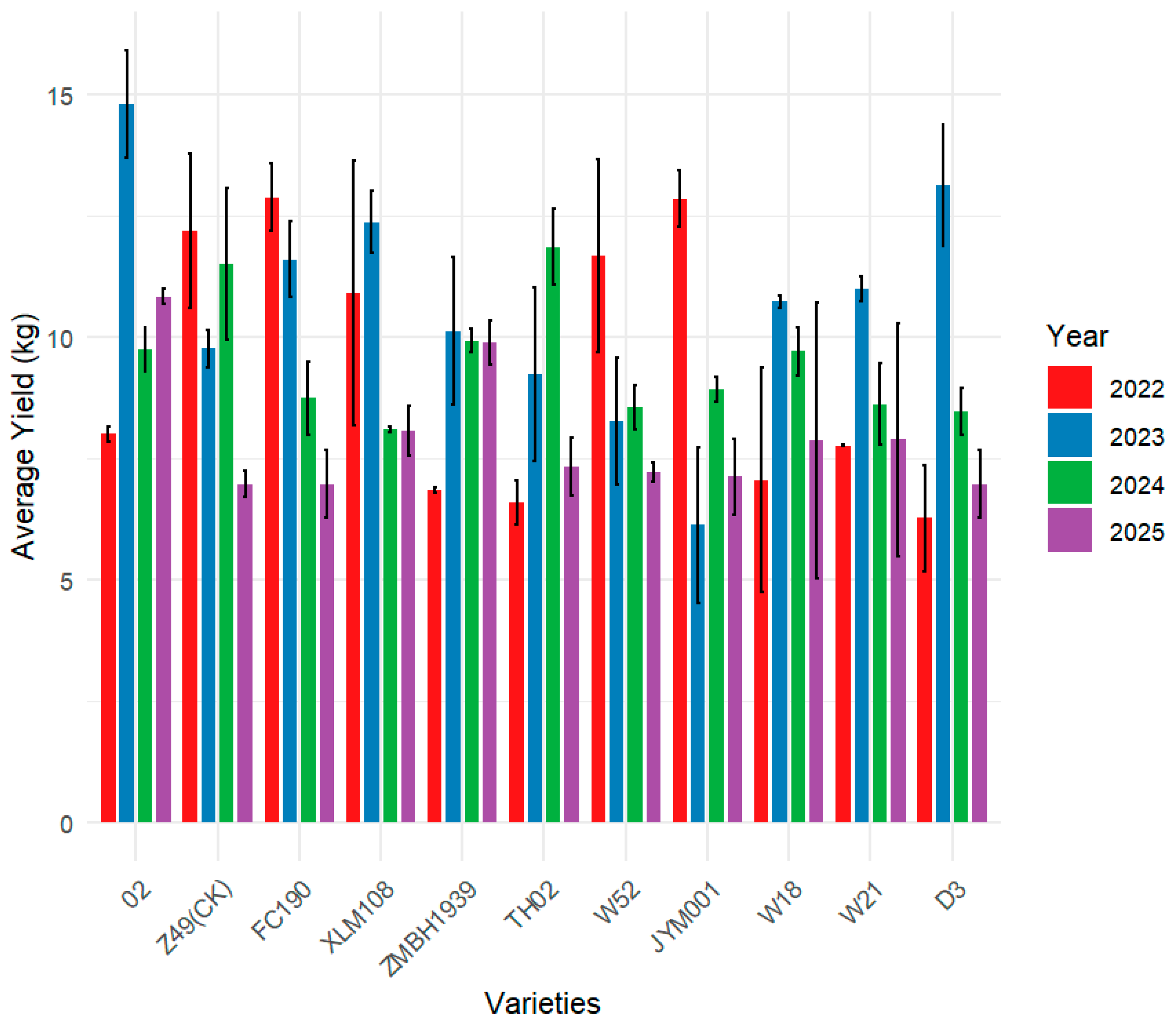
Figure 1 shows the yield data from 2022 to 2025. The performance of the main varieties is summarized below by year:
  • For 2022, analysis of variance revealed extremely significant differences in yield among the varieties (F = 9.51, df = 10,22, p < 0.001). Multiple comparisons showed that FC190 (12.88 ± 0.69 kg), JYM001 (12.85 ± 0.58 kg), Z49 (CK) (12.18 ± 1.59 kg), and W52 (11.68 ± 2.00 kg) belonged to the highest-yielding group (marked a), and there were no significant differences among these four. Varieties XLM108 (10.91 ± 2.72 kg), 02 (8.01 ± 0.16 kg), and W21 (7.77 ± 0.02 kg) belonged to the second group (bc), with yields significantly lower than those in group a but significantly higher than those in the lowest group. The lowest-yielding group (c) included D3 (6.27 ± 1.10 kg), ZMBH1939 (6.84 ± 0.05 kg), W18 (7.06 ± 1.67 kg), and TH02 (6.60 ± 0.31 kg); the yields of these varieties were significantly lower than those of the other groups. In terms of stability, FC190 and JYM001 not only yielded high yields but also had small standard deviations (≤0.69 kg), demonstrating good stability, whereas XLM108 exhibited greater variability (SD = 2.72) and poorer stability.
  • In 2023, the differences in yield among varieties were extremely significant (F = 13.50, df = 10,22, p < 0.001). Variety 02 (14.80 ± 1.10 kg) was the sole member of the highest-yielding group (a), significantly higher than all other varieties. The second group (b) included D3 (13.13 ± 1.26 kg), whose yield was significantly lower than that of 02 but higher than that of the remaining varieties. The third group (bc or bcd) comprised XLM108 (12.37 ± 0.64 kg), FC190 (11.60 ± 0.82 kg), W21 (11.00 ± 0.26 kg), W18 (10.73 ± 0.12 kg), and ZMBH1939 (10.13 ± 1.50 kg). There were no significant differences among these five varieties. Z49 (CK) (9.77 ± 0.38 kg) and TH02 (9.23 ± 1.79 kg) also belonged to the cd group and had lower yields. JYM001 (6.13 ± 1.60 kg) belonged to the lowest-yielding group (e) and was significantly lower than all other varieties. In terms of stability, XLM108 and W18 had very small standard deviations (≤0.64 kg), demonstrating excellent stability, whereas TH02 had a large SD (1.79 kg) and poor stability.
  • In 2024, there were significant differences in yield among varieties (F = 9.58, df = 10,22, p < 0.01). The highest-yielding group (a) consisted of TH02 (11.86 ± 0.78 kg) and Z49 (CK) (11.52 ± 1.56 kg), with no significant difference between the two. The second group (b) consisted of ZMBH1939 (9.93 ± 0.25 kg), whose yield was significantly lower than that of group a but higher than that of the subsequent varieties. The remaining varieties (02, W52, W21, XLM108, D3, FC190, JYM001, W18) belonged to either the bc or abc groups, with no significant differences within these groups. XLM108 had the lowest yield (8.10 ± 0.07 kg), but its standard deviation was extremely small (0.07 kg), indicating excellent stability in that year. ZMBH1939 had an SD of only 0.25 kg, also demonstrating high stability, whereas Z49 (CK) had an SD of 1.56 kg, indicating relatively poor stability.
  • In 2025, yield differences among varieties were highly significant (F = 9.43, df = 10,22, p < 0.001). Variety 02 (10.84 ± 0.16 kg) was the only high-yielding group (a), significantly higher than all other varieties. The second group (ab) included ZMBH1939 (9.89 ± 0.45 kg), XLM108 (8.06 ± 0.50 kg), W21 (7.89 ± 3.05 kg), and TH02 (7.33 ± 0.59 kg), with no significant differences among these four. The lowest-yielding group (b) included W52 (7.22 ± 0.19 kg), D3 (6.97 ± 0.69 kg), FC190 (6.97 ± 0.69 kg), Z49(CK) (6.97 ± 0.27 kg), JYM001 (7.12 ± 0.77 kg), and W18 (7.86 ± 2.84 kg). The yields of these varieties were significantly lower than that of 02. In terms of stability, 02 had an SD of only 0.16 kg, combining high yield with excellent stability; ZMBH1939 had an SD of 0.45 kg and also exhibited good stability, whereas W21 and W18 had SDs as high as 3.05 kg and 2.84 kg, respectively, indicating extremely poor stability.
  • Over the four years (Appendix A Table A2), variety 02 had the highest and most stable yields in 2023 and 2025 and performed well in 2024, making it the top performer overall. FC190 and JYM001 excelled in 2022 but declined in subsequent years. TH02 performed exceptionally in 2024 but was mediocre in other years. XLM108 showed outstanding stability but relatively low yields.

3.1.2. Analysis of Yield Stability Across Varieties and Years

Based on the four-year yield data (Table 1), 02 showed the highest average yield (10.85 kg), though its yield stability was moderate (CV = 26.56%). ZMBH1939 exhibited the lowest yield variability (CV = 15.57%) and a moderately high yield (9.42 kg), making it the most stable variety. XLM108 achieved a balance of high yield (9.85 kg) and good stability (CV = 23.23%). In contrast, D3 and JYM001 had high CV values (33.82% and 32.03%, respectively), indicating poor yield stability across years. These conclusions are based on Tukey’s HSD multiple comparisons (α = 0.05) after verifying normality (Shapiro–Wilk, p > 0.05) and homoscedasticity (Levene’s test, p > 0.05).

3.2. Analysis of Variance

An analysis of variance was conducted on the harvest yields of the 11 tested varieties (Table 2). Significant effects were observed for the main effects of variety (F = 3.675 **) and year (F = 25.924 **), as well as a highly significant interaction between variety and year (F = 7.953 **). These results indicate that variety, year, and the interaction between variety and year all have significant effects on yield.
Further multiple comparison analysis revealed highly significant differences among the varieties, as shown in Table 1. Compared with the control variety Z49 (CK), eight varieties (02, W52, W21, D3, ZMBH1939, JYM001, W18, TH02) showed significant differences, and seven varieties (02, W52, W21, ZMBH1939, JYM001, W18, TH02) exhibited highly significant differences in yield.
A multiple comparison analysis across years (Table 3) reveals that there were significant differences in yield over the four years, reaching a highly significant level. Furthermore, there were also differences in yield among the various varieties across different years; therefore, further analysis is warranted.

3.3. AMMI Model Analysis

3.3.1. Analysis of Covariance for Yield

In this study, a conventional two-factor fixed-effects model was used to perform a combined analysis of variance on the raw data (Table 1). The results indicated that genotype, environment, and their interaction all had highly significant effects on the trait. Therefore, it was necessary to further decompose the significant G × E interaction using AMMI.
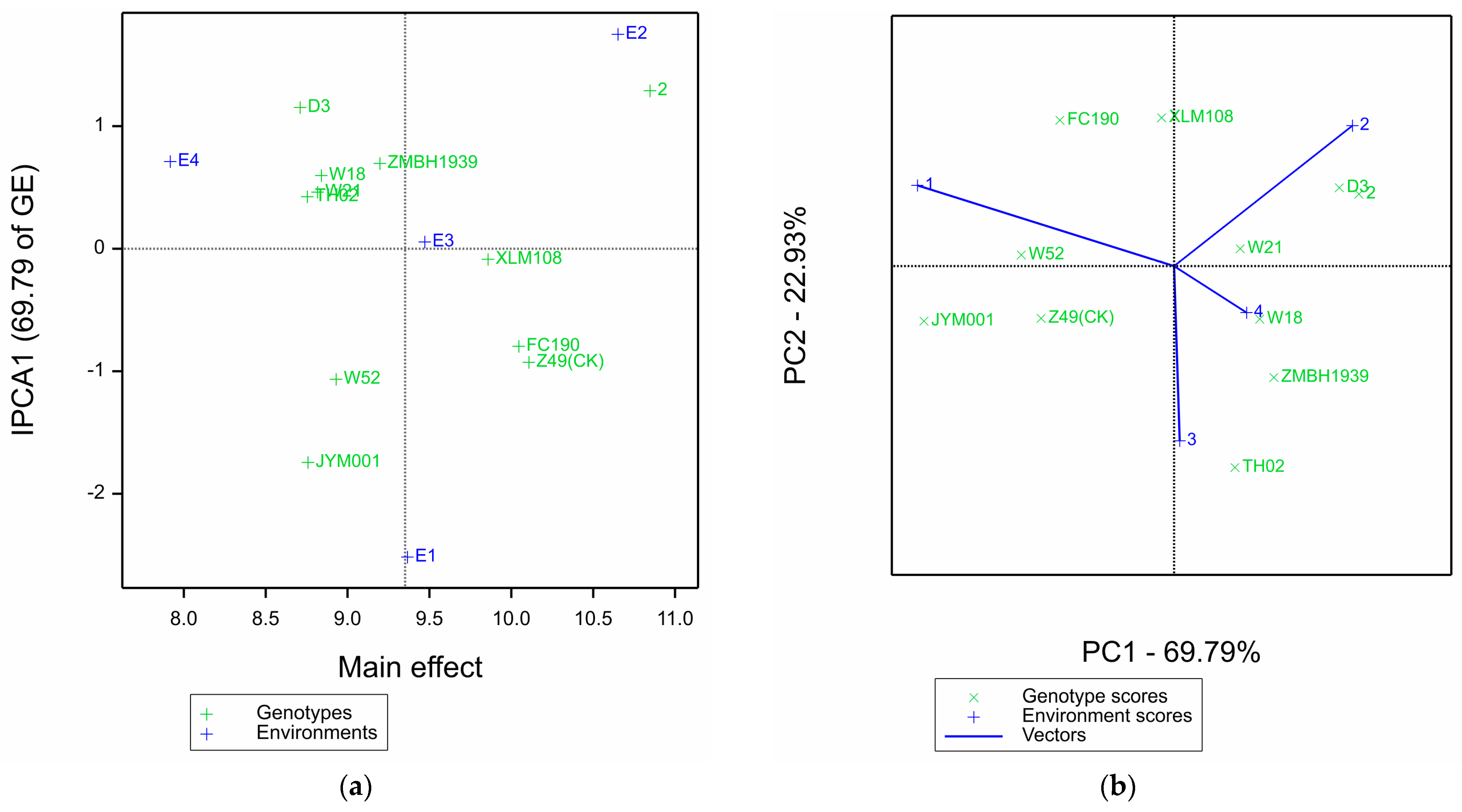
Table 4 presents the results of the AMMI joint analysis of variance, which aims to further decompose the significant G × E interaction into several principal components (IPCA). The joint analysis of variance revealed that the differences between genotypes and environments reached a highly significant level, indicating substantial variation among cotton varieties [29], and that the data from the four years used were representative. The AMMI model, using IPCA1 and IPCA2, enables systematic analysis of genotype–environment interaction effects. IPCA1 accounts for 69.79% of the G × E variance, while IPCA2 accounts for 22.93%; together, they explain 92.72% of the interaction variance, demonstrating that the AMMI model can effectively analyze G × E interaction effects. This result fully confirms the significant advantage of the AMMI model in accurately dissecting the complex underlying mechanisms of G × E interaction effects [30].

3.3.2. Analysis of Variety Yield Potential, Yield Stability, and Discrimination Power Using AMMI Dual-Plot Diagrams

The AMMI1 biplot (Figure 2a) revealed clear differences among varieties in yield potential and stability. Varieties 02, Z49 (CK), and FC190 were positioned on the right side of the x-axis, indicating their high yield potential. In contrast, XLM108, TH02, and W21 were located closest to the horizontal line (y = 0), demonstrating superior yield stability across the four years.
Regarding the trial environments, 2022 (E1) showed the greatest distance from y = 0, indicating it had the strongest discriminatory power to separate varieties. The year 2024 (E3) was closest to y = 0, suggesting the weakest discriminatory power. The AMMI2 biplot (Figure 2b) further confirmed that 2022 and 2023 had the largest IPCA1 scores, consistent with their strong discrimination ability.

3.4. GGE Biplot Analysis

Based on the AMMI results, GGE biplot analysis was further employed to evaluate the high-yield potential and yield stability of each variety. This method intuitively decomposes the genotype main effect (G) and the genotype–environment interaction effect (G × E), enabling a more systematic understanding of variety performance [31].

3.4.1. Evaluation of Variety Adaptability

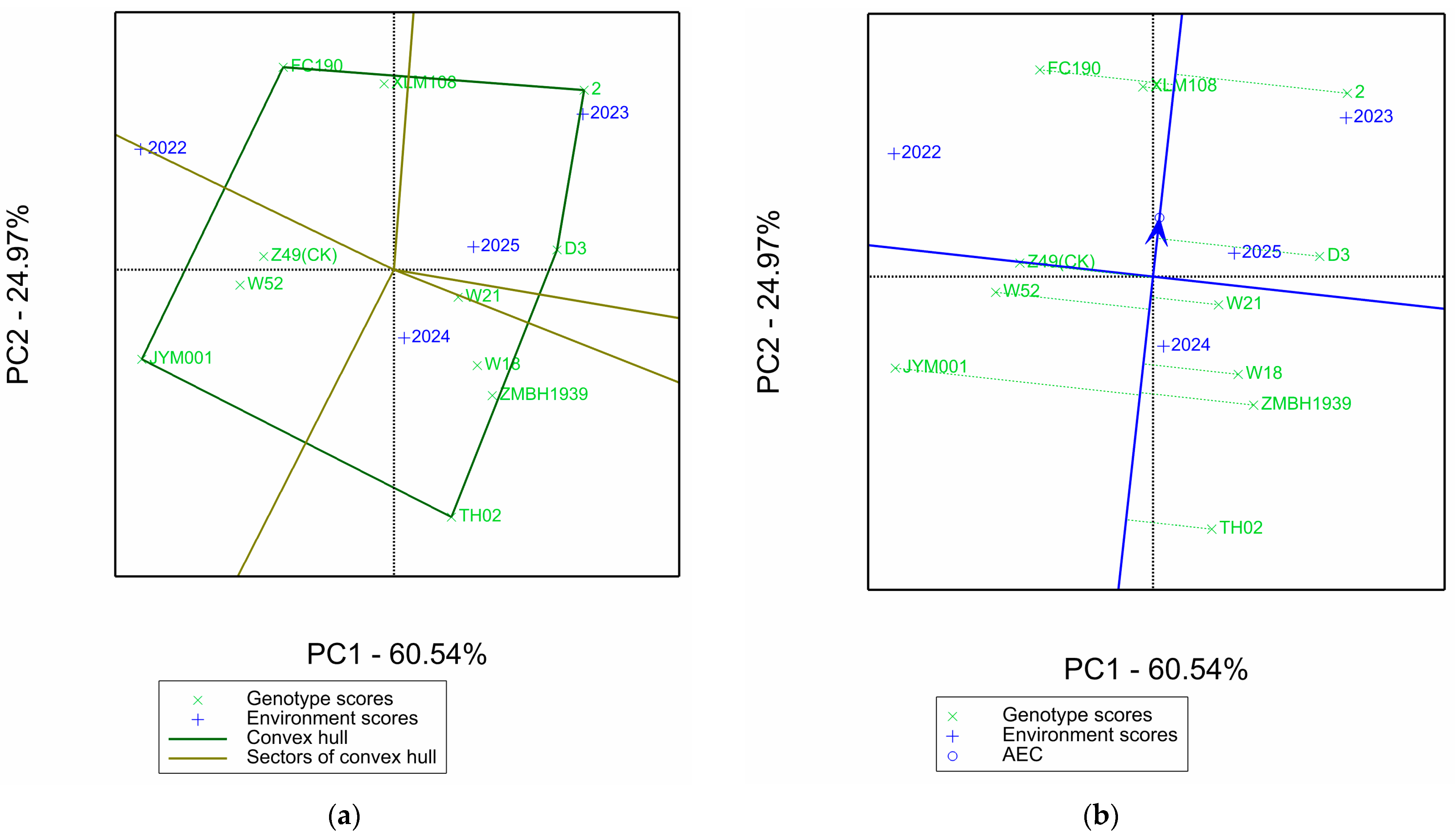
In the GGE biplot, straight lines connecting the outermost varieties formed a polygon, and perpendicular lines were drawn from the origin to each side. Based on the clustering of trial environments across different years, the polygon can be divided into distinct sectors and grouped accordingly.
As shown in Figure 3a, this study classified the trial environments across different years into three distinct groups: 2023 and 2025 form Group 1, 2024 forms Group 2, and 2022 forms Group 3. The varieties located at the vertices of the polygon exhibit the highest yields and strongest adaptability within their respective groups. Variety 02 is the top variety in Group 1, variety TH02 is the top variety in Group 2, and variety JYM001 is the top variety in Group 3. Varieties located at the vertices of the polygon represent those with the highest yields within their respective sectors. Varieties 02 and D3 are both located within the same sector; they exhibit the best adaptability and highest yields in the 2023 and 2025 environments. Variety D3 is positioned near the boundary between the two groups, indicating that its adaptability is higher than that of Variety 02.

3.4.2. Yield Potential and Stability of Varieties

The GGE biplot for yield potential and stability (Figure 3b) showed that the average environment axis (AEA, arrowed line) points toward higher yield. Variety 02 had the largest projection onto the AEA, confirming its highest average yield (10.85 kg, Table 1). The stability of a variety is inversely related to its perpendicular distance from the AEA. XLM108 had the smallest perpendicular distance, indicating it was the most stable variety. JYM001 had the largest distance, indicating the poorest yield stability. The yield potential ranking from the GGE biplot was 02 > FC190 > XLM108 > D3 > Z49(CK) > W21 > W52 > W18 > ZMBH1939 > JYM001 > TH02, which was largely consistent with the observed means in Table 1.

3.4.3. Discrimination Power and Representativeness Across Different Years

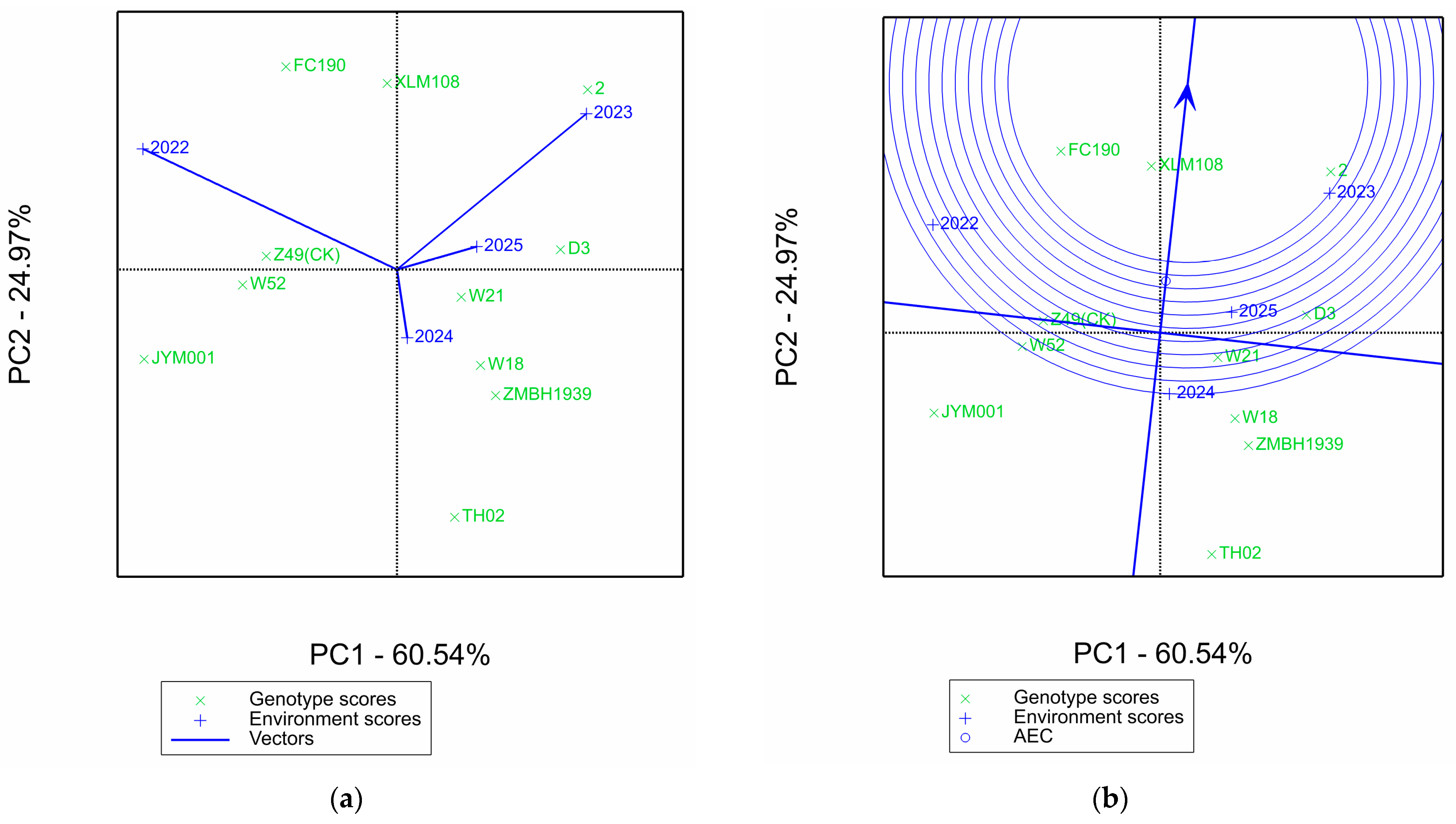
As shown in Figure 4a, the years 2022 and 2023 exhibited the longest environmental vectors, indicating strong discriminatory power for genotype differentiation. Among them, 2022 was positioned closest to the positive end of the PC1 axis, suggesting it was the most effective year for distinguishing yield performance among varieties. The year 2025 showed a moderate vector length but remained on the positive PC1 axis, indicating a good ability to discriminate yield potential.
Regarding representativeness, 2025 had the smallest angle between its vector and the average environment axis (PC1 axis), making it the most representative year for the target ecological region. The year 2023 also formed an acute angle with the PC1 axis, indicating relatively good representativeness. In contrast, the vectors for 2024 and 2022 formed obtuse angles with the PC1 axis, suggesting low representativeness; the 2024 vector in particular deviated markedly, potentially indicating experimental anomalies.

3.4.4. Comprehensive Analysis of Yield Potential and Stability in Varieties

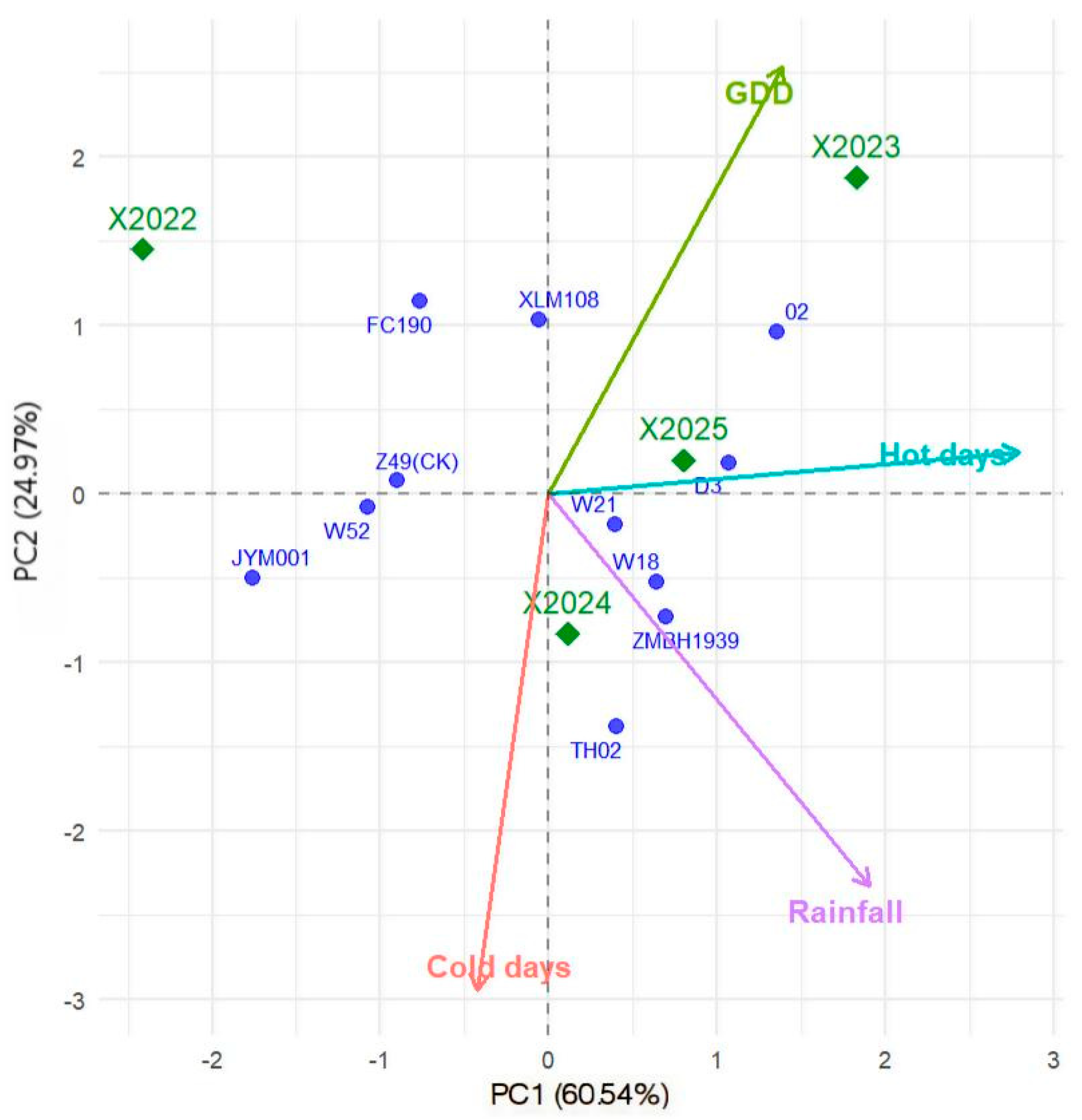
Principal Component Contribution Analysis: In this study, PC1 (60.54%) reflects differences in genotype yield potential; the positive axis on the right represents the high-yield region, while the negative axis on the left represents the low-yield region. PC2 (24.97%) reflects the interaction effects between genotype and environment. The total explanatory power reached 85.51%, indicating that this model effectively captures both the yield potential of varieties (PC1) and their interaction with the environment (PC2).
In a GGE biplot, there exists a virtual variety with the longest vector among all varieties, located in the positive direction of the average environment axis [32]. This ideal variety serves as a reference at the center of concentric circles; the closer a variety is to the center, the higher its degree of idealness. As shown in Figure 4b, in this trial, XLM108 was closest to the ideal variety, indicating the best combination of high yield and stability. FC190 ranked second. The control variety Z49 (CK) showed good stability but only moderate yield potential.

3.5. Relationship Between Climate Covariates and Yield Performance in the Experimental Years

3.5.1. Climate Attribution of Main Environmental Effects

To exploratorily examine potential associations between yield and climatic factors, univariate linear regressions were performed using the four year-level averages. We report coefficients of determination (R2) as descriptive measures of trend strength.
The results (Table 5) show that among the four covariates, growing degree days (GDD) yielded the highest R2 (0.464) for average yield, suggesting that thermal conditions may be associated with yield levels. The number of days with extremely low temperatures (≤0 °C) showed an R2 of 0.359 in the negative direction, also indicating a possible inverse relationship. In contrast, total precipitation and days with extreme high temperatures showed very low R2 values (0.044 and 0.201, respectively), providing no clear trend in this limited dataset.
Specifically, 2023 had the highest GDD (2735.8 °C·d) and the highest average yield (10.65 kg), while 2025 had the lowest yield (7.91 kg) alongside a higher number of low-temperature days (3 days) and above-average precipitation (132.2 mm). These observations are purely descriptive and serve as hypotheses for future testing.

3.5.2. Explanation of Climate Covariates for Environmental Discrimination

A rank comparison (Table 6) was performed to visually explore whether climatic covariates align with the ordering of discriminatory power (absolute IPCA1 values). The following patterns were qualitatively observed:
  • The year with the lowest total precipitation (2022) had the highest discriminatory power, while the year with the highest precipitation (2024) had the lowest.
  • Similarly, the year with the most days of extreme low temperatures (2024) showed the weakest discriminatory power.
These rank-order patterns suggest a possible negative association between high precipitation and cold stress and the ability to discriminate among genotypes. However, with only four years, no causal or statistically robust conclusion can be drawn. The observation that the driest year (2022) was the most discriminatory suggests that moderate drought stress may amplify genotypic differences in cotton yield. This proposition requires dedicated multi-location drought trials.

3.5.3. Projection of Climate Covariates on the GGE Biplot

To visually illustrate the relationship between climate covariates and the experimental environment, each covariate was projected onto the GGE bipolar plot (Figure 5) as a supplementary vector. The coordinates of the vector endpoints correspond to the correlation coefficients between the covariates and PC1 and PC2 (Table 7). The results show the following:
The vector for the number of high-temperature days points almost horizontally to the right, toward 2023, but this direction is not the one with the strongest discriminatory power.
The precipitation vector points downward and to the right, consistent with the direction of 2024—the year with the weakest discriminatory power—while 2022 lies in the opposite direction (to the left), further confirming that a low-precipitation environment exhibits high discriminatory power.
The vector for the number of days with low temperatures points vertically downward, also toward 2024, indicating that cold-weather disasters are closely associated with weak discriminatory power.
The GDD vector points upward and to the right, consistent with the direction of 2023, reflecting its association with high-yield environments.
It is worth noting that none of the covariate vectors point toward 2022 (on the negative side of PC1), suggesting that the strong discriminatory power observed for that year may stem from a composite factor of drought stress (low precipitation + high evaporation + moderate heat). Therefore, a more comprehensive drought index may be required to effectively characterize this phenomenon.

3.6. Correlation Analysis and Path Coefficient Analysis of Yield Traits

3.6.1. Correlation Analysis of Yield Traits and Agronomic Traits

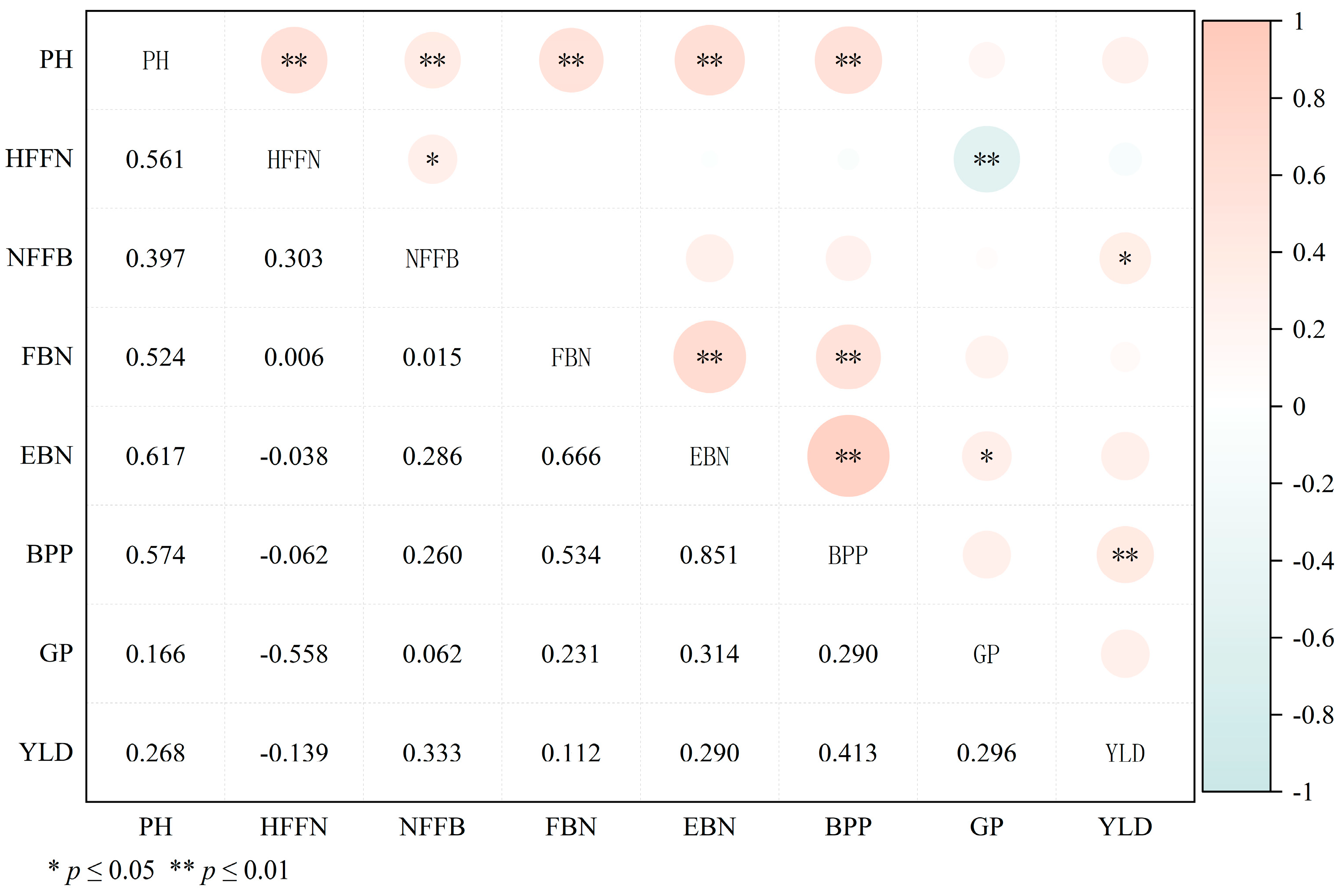
As shown in Figure 6, the correlation coefficient between the number of bolls per plant and yield was 0.413 **, indicating a strong positive relationship whereby cotton yield increases markedly with the number of bolls per plant. Similarly, the correlation coefficient between the number of fruiting nodes and yield was 0.333 *, suggesting that a higher number of fruiting nodes is also associated with a significant increase in yield. For other agronomic traits, the correlation coefficients with yield were 0.268 for plant height, 0.112 for number of fruiting branches, 0.290 for number of productive fruiting branches, and 0.296 for growth period; all of these exhibited non-significant positive correlations, implying that increases in these traits have a certain promoting effect on variety yield, albeit not statistically robust. In contrast, the height of the first fruit branch node showed a non-significant negative correlation with yield (coefficient = −0.139), indicating that an increase in this trait tends to be associated with a decrease in variety yield.

3.6.2. Analysis of Path Coefficients for Yield Traits and Agronomic Traits

As shown in Table 8, the path coefficients for cotton yield and agronomic traits, from highest to lowest, are plant height (PH) > number of bolls per plant (BPP) > first fruiting node (NFFB) > number of fruiting branches (FBN) > growth period (GP) > number of effective fruiting branches (EBN) > height of first fruiting node (HFFN).
Through path analysis and correlation analysis of the relationship between cotton yield and agronomic traits, it was determined that the relationship between each agronomic trait and yield is as follows:
  • Plant height traits and yield traits: The direct path coefficient of PH on yield was 0.685, with a correlation coefficient of 0.268 (not significant). This indicates that PH had a moderate direct positive effect, but it was largely offset by strong negative indirect effects, particularly via the height of the first fruiting node (HFFN, indirect effect = −0.399). Positive indirect effects were observed through the node of the first fruiting branch (NFFB, +0.126) and bolls per plant (BPP, +0.223). Thus, while taller plants tend to promote yield directly, breeding efforts should avoid the correlated increase in HFFN, which strongly counteracts yield gains.
  • Traits related to the number of pods per plant and yield: BPP showed a highly significant positive correlation with yield (r = 0.413) and a large direct path coefficient (0.389). It also exerted positive indirect effects via PH (0.393), HFFN (0.044), and NFFB (0.082). Negative indirect effects via fruiting branch number (FBN) and effective branch number (EBN) were minor and did not cancel the overall strong positive impact. These results confirm that BPP is the most critical direct determinant of yield. Therefore, selection for high BPP should be a primary breeding objective.
  • Traits of the first node on fruiting branches and yield traits: NFFB had a direct path coefficient of 0.316 and a significant positive correlation with yield (r = 0.333). Its positive effect was mediated mainly through PH (0.272) and BPP (0.101). Negative indirect pathways (via HFFN, FBN, EBN, growth period) were relatively weak. Hence, a moderately high NFFB is beneficial for yield, but should be evaluated together with plant architecture.
  • Relationship between the number of productive branches and yield: HFFN exhibited a negative direct effect on yield (path coefficient = −0.711), despite a weak and non-significant negative correlation (r = −0.139). This large negative direct impact was partially compensated by positive indirect effects through PH (0.384), NFFB (0.095), and other traits. In practice, reducing HFFN is a promising strategy to directly boost yield, as it avoids the yield penalty associated with high first fruiting node placement.
  • Relationship between the height of the first node on fruiting branches and yield: The direct path coefficient of EBN was negative (−0.448), while the simple correlation with yield was positive but not significant (r = 0.290). This apparent contradiction arises because EBN promotes yield indirectly through PH (0.423), NFFB (0.090), and BPP (0.331), masking its negative direct effect. Consequently, breeders should not select solely for more effective branches without considering their negative direct impact on yield.
  • Number of fruit-bearing branches, growth stage, and yield: Both traits showed negative direct path coefficients (FBN: −0.115; GP: −0.180) and small, non-significant positive correlations with yield (r = 0.112 and 0.296, respectively). Their contributions to yield were minimal and predominantly indirect. Therefore, they should not be prioritized as direct selection criteria in high-yield breeding programs.

4. Discussion

4.1. Variability in Yield Among Varieties

The significant genotype × year interaction observed in this study (F = 7.95, p < 0.01) confirms that the 11 cotton varieties exhibited differences in yield responses when facing the variable climatic conditions of 2022–2025 [33,34]. A detailed examination of the yield trajectories (Appendix A Table A1) allows us to classify the varieties into three distinct response types based on their biological behavior across years.
Heat-sensitive high-yielding type: Variety 02 had the highest four-year average yield (10.85 kg) but intermediate stability (CV = 26.6%). Its yield peaked in 2023 (14.80 kg), when growing degree days were highest (GDD = 2735.8 °C·d), and declined in 2025 (10.84 kg), when GDD was lower and three days of extreme cold occurred. This pattern may suggest that 02 achieves high yield primarily under favorable thermal conditions, and its performance could be more sensitive to cold stress. Such behavior, if confirmed, would be consistent with genotypes having a narrow optimum temperature window [35]. Pending further validation, 02 might be less suitable for seasons with unpredictable spring or autumn frosts.
Stress-tolerant stable type: In contrast, ZMBH1939 showed the lowest coefficient of variation (15.6%) across the four years, with yields consistently ranging between 6.8 and 11.5 kg across all years. Notably, its yield in 2025 (9.89 kg) was only 0.5 kg below its four-year average, whereas many other varieties suffered substantial reductions. The stability might be related to traits such as a longer flowering window, greater compensation capacity after stress, or a more robust root system [36]; however, these hypotheses require direct testing.
Environmentally plastic type: TH02 exhibited the most extreme year-to-year fluctuation: it yielded only 6.60 kg in 2022 but surged to 11.86 kg in 2024, the wettest year (precipitation 174.0 mm). This response indicates that TH02 is particularly responsive to moisture availability, a trait that could be exploited under irrigated conditions but poses a risk in drought-prone seasons [37,38].
These distinct response patterns underline the importance of matching variety characteristics to expected seasonal conditions and support the need for multi-year trials to capture genotype × environment interactions.

4.2. High-Yielding and Stable Yield Potential of Varieties

Both the AMMI and GGE models consistently identified XLM108 as the variety with the best combination of high yield potential (average 9.86 kg, ranking 4th) and yield stability (the smallest vertical distance to the average environment axis in GGE, and closest to Y = 0 in the AMMI1 biplot). This dual-model consensus supports the identification of XLM108 as a candidate, despite the exploratory nature of our single-location dataset.
The superior stability of XLM108 can be tentatively linked to its agronomic trait profile as revealed by our correlation and path analyses (Section 3.6). XLM108 maintained a moderate but stable BPP across years, and BPP contributed strongly to yield (path coefficient = 0.389). Additionally, XLM108 had a low HFFN, a trait with a strong negative direct effect on yield (path coefficient = −0.711). While the underlying mechanisms remain unclear, one hypothesis is that a low HFFN reduces the yield penalty typically associated with high first fruiting node placement [39].
By contrast, variety 02 and FC190 were identified as high-yielding but moderately stable. Their larger distance from the stability axis in the GGE biplot reflects a greater sensitivity to year-to-year climatic fluctuations. The control variety Z49 (CK) showed good stability but only moderate yield potential. This observation is consistent with the idea that commercial check varieties may be bred to prioritize yield stability over maximum yield potential [40].

4.3. The Impact of Climatic Covariates on the Evaluation of Environmental Conditions in Regional Trials of Cotton Varieties

One of the novel questions we explored was why some trial years discriminate among varieties more effectively than others. Given the limited number of environments (n = 4), we refrained from formal statistical testing and instead examined rank-order patterns to generate testable hypotheses [41].
Precipitation as a potential amplifier of genotypic differences: The ranking of years by discriminatory power was 2022 > 2023 > 2025 > 2024. The ranking by total growing-season precipitation was the reverse: 2024 (174.0 mm) > 2025 (132.2 mm) > 2023 (48.7 mm) > 2022 (22.4 mm). This inverse relationship suggests that dry years enhance the ability to discriminate among cotton varieties, while wet years may mask genotypic differences. Previous studies suggest that, under drought stress, factors such as root architecture and water-use efficiency may amplify yield differences, whereas, under ample rainfall, genotypic variation tends to be compressed [42].
Low-temperature stress also appeared to reduce discriminatory power. As summarized from Table 6, the year with the most low-temperature days (2024) coincided with the weakest discrimination, suggesting that cold stress may mask genotypic differences [43].
Thermal time and high-yield environments: Thermally rich environments (e.g., 2023) may allow fuller expression of yield potential and more consistent genotypic rankings, and could therefore be more suitable for screening high-yielding varieties [42].
Due to the limited number of environments (n = 4), all climatic covariate analyses are exploratory and hypothesis-generating. Validation in multi-location or longer-term trials is required before drawing definitive conclusions.

4.4. Correlation Between Variety and Yield

The path analysis (Table 8) allowed us to disentangle direct from indirect effects of agronomic traits on yield, revealing two key insights that are directly applicable to breeding programs aiming for high and stable yield.
First, bolls per plant (BPP) shows a strong direct positive effect on yield and may serve as a useful selection index. BPP had the second-largest direct path coefficient (0.389) and the highest positive correlation with yield (r = 0.41, p < 0.01). Notably, its direct positive effect was only partially offset by negative indirect effects via the number of fruiting branches (FBN) and effective branches (EBN). This indicates that selecting for high BPP—even in plants with moderate branch numbers—can effectively increase yield. If validated in multi-location trials, early-generation selection for BPP using simple field counting could be a low-cost, high-gain strategy [44].
Second, the height of the first fruiting node (HFFN) has a strong direct negative effect on yield that is not obvious from its simple correlation. HFFN showed the largest direct negative path coefficient (−0.711), indicating that each unit increase in HFFN substantially reduces yield.
However, this negative effect is masked in the simple correlation (r = −0.14) because HFFN also has positive indirect effects via plant height (0.384) and other traits. Taller plants tend to have higher HFFN, and plant height itself has a positive direct effect on yield (0.685). The net result is a near-zero apparent correlation, which has likely led breeders to overlook HFFN as a selection target.
Our analysis suggests that reducing HFFN without reducing plant height may represent a promising strategy to boost yield potential, for example, by selecting genotypes with a more compact lower stem and greater upper-branch development. This specific combination warrants further investigation.
Other traits: The number of fruiting branches (FBN) and growth period (GP) had negative direct path coefficients (−0.115 and −0.180) despite positive simple correlations, suggesting that their contributions to yield are predominantly indirect. Consequently, selecting for these traits alone is not recommended without further validation, as they may increase vegetative biomass without improving reproductive output.

5. Conclusions

Based on this exploratory, four-year, single-location trial, we draw the following preliminary conclusions:
Variety performance: Variety XLM108 stands out as a candidate combining both high yield potential and superior stability. Variety 02 is a high-yielding but riskier option for favorable years. ZMBH1939 is the most stable but not the highest-yielding.
Environmental screening: The year 2023, characterized by high thermal time, proved to be the most effective environment for discriminating genotype performance, suggesting that heat accumulation is a key driver of variety differentiation in this arid region.
Trait-based selection: Bolls per plant appears to be a major direct contributor to yield and could serve as a useful selection index, pending multi-location validation. Reducing the height of the first fruiting node may represent a promising, often overlooked, strategy to boost yield potential, but this hypothesis requires further testing.
Climatic hypothesis: Low-precipitation years appear to enhance environmental discriminatory power. This hypothesis, if validated in future multi-location drought trials, could lead to more efficient regional variety screening protocols.
Ultimately, the findings presented here serve as a hypothesis-generating foundation. Multi-location trials across diverse ecological zones in Xinjiang are urgently needed to validate the claims of stability and adaptability for XLM108 and the proposed trait-based selection strategies.

Author Contributions

Conceptualization: X.A. and S.F.; Methodology: S.F. and Y.L.; Investigation: S.F., Y.L., Y.W., X.W., T.L., S.J., Y.Y. and S.C.; Data curation: S.F.; Formal analysis: S.F.; Supervision: X.A., Y.L., X.W. and T.L.; Writing—original draft: S.F. and Y.L.; Writing—review and editing: X.A., X.W., T.L., S.J., Y.Y. and S.C. All authors have read and agreed to the published version of the manuscript.

Funding

This research described here was supported by the Regional Science Fund of the National Natural Science Foundation of China (32460502); the Tianshan Elite Program, Young Elite Talent Project—Young Science and Technology Innovation Talent (2023TSYCCX0018); Major Science and Technology Special Project of Xinjiang Uygur Autonomous Region (2024A02002); Key R&D Special Project of the Autonomous Region (2025B04046-003); Key R&D Program Project of the Autonomous Region (2024B02005-2); Key R&D Program Project of the Autonomous Region (2025B02004).

Data Availability Statement

Data are contained within the article.

Acknowledgments

The authors have reviewed and edited the output and take full responsibility for the content of this publication.

Conflicts of Interest

The authors declare no competing interests.

Abbreviations

The following abbreviations are used in this manuscript:
PHPlant Height
HFFNHeight of the First Fruiting Node
NFFBNode of First Fruiting Branch
FBNNumber of Fruiting Branches
EBNEffective Number of Fruiting Branches
BPPBolls Per Plant
GPGrowth Period
YLDYield

Appendix A

Table A1. Production data for various varieties, 2022–2025.
Unit: kg
VarietiesRepeat2022202320242025
02I8.1214.8010.2710.96
II7.9013.709.4510.90
III8.0115.909.5010.66
W52I9.918.409.097.18
II13.856.908.297.05
III11.299.508.287.43
W21I7.7510.909.185.21
II7.7811.309.037.89
III7.7710.807.6510.57
XLM108I7.7712.008.038.63
II12.6312.008.107.64
III12.3313.108.177.90
D3I6.2713.309.036.86
II7.4414.308.176.33
III5.0911.808.237.71
FC190I12.0912.509.606.86
II13.3611.108.406.33
III13.1811.208.227.71
ZMBH1939I6.8810.409.909.71
II6.7911.509.7010.40
III6.848.5010.209.56
JYM001I12.324.508.706.22
II12.776.209.207.43
III13.477.708.907.70
W18I5.4310.809.904.68
II8.6910.609.1511.04
III7.0610.8010.097.86
Z49(CK)I10.4610.2012.847.25
II12.469.6011.926.71
III13.619.509.806.94
TH02I6.9111.3012.517.69
II6.288.3012.086.63
III6.608.1011.007.66
Table A2. Annual yield (mean ± SD) and significance grouping of 11 cotton varieties from 2022 to 2025.
Variety NameAverage Yield (kg)
2022202320242025
028.01 ± 0.16bc14.80 ± 1.10a9.74 ± 0.46bc10.84 ± 0.16a
W5211.68 ± 2.00a8.27 ± 1.31de8.55 ± 0.46abc7.22 ± 0.19b
W217.77 ± 0.02bc11.00 ± 0.26bcd8.62 ± 0.84abc7.89 ± 2.40ab
XLM10810.91 ± 2.72ab12.37 ± 0.64abc8.10 ± 0.07c8.06 ± 0.51ab
D36.27 ± 1.10c13.13 ± 1.26ab8.48 ± 0.48bc6.97 ± 0.70b
FC19012.88 ± 0.69a11.60 ± 0.78abc8.74 ± 0.75abc6.97 ± 0.70b
ZMBH19396.84 ± 0.06c10.13 ± 1.52bcd9.93 ± 0.25b9.89 ± 0.45ab
JYM00112.85 ± 0.58a6.13 ± 1.60e8.93 ± 0.25abc7.12 ± 0.79b
W187.06 ± 2.31c10.73 ± 0.12bcd9.71 ± 0.50bc7.86 ± 2.84b
Z49(CK)12.18 ± 1.59a9.77 ± 0.38cd11.52 ± 1.56a6.97 ± 0.27b
TH026.60 ± 0.45c9.23 ± 1.79cde11.86 ± 0.78a7.33 ± 0.60b
Note: Data are presented as mean ± SD. For each year, a one-way ANOVA followed by Tukey’s HSD post-hoc test was performed at α = 0.05. Within the same column (same year), different lowercase letters indicate significant differences among varieties, while varieties sharing the same letter are not statistically different.

References

  1. Huang, Y.W.; Li, C.Y.; Fu, S.Y.; Wu, Y.Z.; Zhou, D.Y.; Huang, L.Y.; Peng, J.; Kuang, M. Comprehensive Evaluation of Nutritional Quality Diversity in Cottonseeds from 259 Upland Cotton Germplasms. Foods 2025, 14, 2895. [Google Scholar] [CrossRef]
  2. Zhang, Z.G.; Huang, J.; Yao, Y.; Peters, G.; Macdonald, B.; Rosa, A.D.L.; Wang, Z.B.; Scherer, L. Environmental impacts of cotton and opportunities for improvement. Nat. Rev. Earth Environ. 2023, 4, 703–715. [Google Scholar] [CrossRef]
  3. National cotton production to increase in 2025. China Information Daily, 30 December 2025; p. 2.
  4. Mohammed, Y.A.; Chen, C.C.; McPhee, K.; Miller, P.; McVay, K.; Eckhoff, J.; Lamb, P.; Miller, J.; Khan, Q.; Bahannon, B.; et al. Yield performance and stability of dry pea and lentil genotypes in semi-arid cereal-dominated cropping systems. Field Crops Res. 2016, 188, 31–40. [Google Scholar] [CrossRef]
  5. Chang, L.; Chai, S.X. Application of GGE biplot in the stability analysis of spring wheat yield in China’s dryland. Chin. J. Eco-Agric. 2010, 18, 988–994. [Google Scholar] [CrossRef]
  6. Silva, K.B.; Bruzzi, A.T.; Zuffo, A.M.; Zambiazzi, E.V.; Soares, I.O.; de Rezende, P.M.; Fronza, V.; Vilela, G.D.L.; Botelho, F.B.S.; Teixeira, C.M.; et al. Adaptability and phenotypic stability of soybean cultivars for grain yield and oil content. Genet. Mol. Res. 2016, 15, 15026756. [Google Scholar] [CrossRef] [PubMed]
  7. Xu, N.Y.; Fok, M.; Zhang, G.W.; Li, J.; Zhou, Z.G. The application of GGE biplot analysis for evaluating test locations and mega-environment investigation of cotton regional trials. J. Integr. Agric. 2014, 13, 1921–1933. [Google Scholar] [CrossRef]
  8. Yan, W.K.; Frégeau-Reid, J.; Pageau, D.; Martin, R. Genotype-by-environment interaction and trait associations in two genetic populations of oat. Crop Sci. 2016, 56, 1136–1145. [Google Scholar] [CrossRef]
  9. Wang, Z.T.; Su, W.H.; Que, Y.X.; Xu, L.P.; Zhang, H.; Luo, J. Analysis of yield stability and site representativeness of sugarcane varieties using AMMI and HA-GGE biplot. Chin. J. Eco-Agric. 2016, 24, 790–800. [Google Scholar]
  10. Annicchiarico, P. Joint regression vs AMMI analysis of genotype-environment interactions for cereals in Italy. Euphytica 1997, 94, 53–62. [Google Scholar] [CrossRef]
  11. Van Eeuwijk, F.A.; Malosetti, M.; Yin, X.; Struik, P.C.; Stam, P. Statistical models for genotype-by-environment data: From conventional ANOVA models to eco-physiological QTL models. Aust. J. Agric. Res. 2005, 56, 883–894. [Google Scholar] [CrossRef]
  12. DeLacy, I.H.; Redden, R.J.; Butler, D.G.; Usher, T. Analysis of line × environment interactions for yield in navy beans. 3. Pattern analysis of environments over the years. Aust. J. Agric. Res. 2000, 51, 619–628. [Google Scholar] [CrossRef]
  13. Yan, W.K. Singular-value partitioning in biplot analysis of multienvironment trial data. Agron. J. 2002, 94, 990–996. [Google Scholar] [CrossRef]
  14. Zobel, R.W.; Wright, M.J.; Gauch, H.G. Statistical analysis of a yield trial. Agron. J. 1988, 80, 388–393. [Google Scholar] [CrossRef]
  15. Yan, W.K.; Hunt, L.A.; Sheng, Q.L.; Szlavnics, Z. Cultivar evaluation and mega-environment investigation based on the GGE biplot. Crop Sci. 2000, 40, 597–605. [Google Scholar] [CrossRef]
  16. Xu, N.Y.; Chen, X.S.; Guo, Z.G.; Zhang, J.Y.; Xiao, S.H.; Di, J.H.; Liu, J.G. Application of the AMMI Model in Cotton Regional Trial Data Analysis. Acta Agric. Jiangsu 2001, 17, 205–210. [Google Scholar]
  17. Yan, W.K.; Kang, M.S.; Ma, B.; Woods, S.; Cornelius, P.L. GGE biplot vs. AMMI analysis of genotype-by-environment data. Crop Sci. 2007, 47, 643–653. [Google Scholar] [CrossRef]
  18. Yan, W.K. Application of dual-plot analysis in multi-location trials of crop varieties. Acta Crop. Sin. 2010, 36, 1805–1819. [Google Scholar]
  19. Chen, G.L.; Xu, C.F.; Wei, C.M.; Wang, R.Y.; Zhang, Y.F.; Li, H.Y.; Zhang, J. Analysis of Genotype-Environment Interaction Effects of New Silage Maize Varieties in Henan Province. Crop J. 2025, 41, 91–99. [Google Scholar]
  20. Mao, W.B.; Su, C.F.; Mao, R.X.; Wang, G.Y.; Gao, H.M.; Ma, X.J.; Zhao, Y.M. Analysis of Genotype-Environment Interaction Effects of Maize Varieties in Shandong Provincial Regional Trials Using GGE Biplot. Shandong Agric. Sci. 2020, 52, 7–13. [Google Scholar]
  21. Wang, H.X.; Gao, X.H.; Ma, Q.Y.; Chen, X.C.; Hou, Q.L.; Zhang, L.P. High and stable yield potential of wheat varieties in the northern winter wheat region and evaluation of experimental environments. Chin. J. Eco-Agric. 2025, 33, 1117–1127, (In Chinese and English). [Google Scholar]
  22. Kamal, S.; Rana, A.; Devi, R.; Kumar, R.; Yadav, N.; Chaudhari, A.A.; Yadav, S.; Singh, S.; Bhargava, B.; Singh, S.; et al. Stability assessment of selected chrysanthemum (Dendranthema grandiflora Tzvelev) hybrids over the years through AMMI and GGE biplot in the mid hills of North-Western Himalayas. Sci. Rep. 2024, 14, 14170. [Google Scholar] [CrossRef]
  23. Ma, H.Y.; Wang, Q.L.; Fu, D.; Huo, E.W. Application of the AMMI Model to Study the Influence of Regional Test Sites on the Judgment Ability of Varieties in Henan Rice Regional Trials. Chin. Rice 2012, 18, 42–44. [Google Scholar]
  24. Yu, B.X.; Zhang, S.L.; He, Y.X.; Lu, Y. Application of the AMMI Model in Regional Trials of Rice Varieties. Mod. Agric. Sci. Technol. 2010, 2, 45–46. [Google Scholar]
  25. Yi, X.H. Evaluating the Stability of Cotton Varieties in Hunan Regional Trials Using the AMMI Model. Jiangxi Cotton 2008, 30, 20–24. [Google Scholar]
  26. He, S.J.; Wang, Y.Q.; Chen, H.D. Application of GGE dual-plot in regional trials of cotton varieties in Hunan Province. Chin. Agric. Sci. Bull. 2015, 31, 273–278. [Google Scholar]
  27. Li, J.T.; Han, Z.F.; Yue, Z.G.; Sun, G.Q.; Yu, H.Y. Analysis of High and Stable Yield and Adaptability of Pudou 754 Based on AMMI Model and GGE Biplot. Heilongjiang Agric. Sci. 2025, 11, 16–23. [Google Scholar]
  28. Li, S.G.; Fu, M.M.; Wang, Y.Q.; Zhao, Z.X.; Yu, X.W.; Yang, J.Y.; Xu, H.F. Evaluation of high-yield potential and adaptability of summer soybean varieties in regional trials in Huaibei, Jiangsu Province, based on the AMMI model and GGE biplot. Jiangsu Agric. Sci. 2025, 53, 33–40. [Google Scholar]
  29. Xu, N.Y.; Zhang, G.W.; Li, J.; Zhou, Z.G. Ecological region division of cotton varieties based on GGE biplot and specific strength selection. Chin. J. Eco-Agric. 2012, 20, 1500–1507. [Google Scholar] [CrossRef]
  30. Miao, H.; Wang, L.; Qu, L.; Liu, H.Y.; Sun, Y.M.; Le, M.W.; Wang, Q.; Wei, S.L.; Zheng, Y.Z.; Lin, W.C.; et al. Genomic evolution and insights into agronomic trait innovations of Sesamum species. Plant Commun. 2024, 5, 100729. [Google Scholar] [CrossRef]
  31. Yan, W.K.; Sheng, Q.L.; Hu, Y.G.; Hunt, L.A. GGE plot method—An ideal method for analyzing variety × environment interaction patterns. Acta Crop. Sin. 2001, 27, 21–28. [Google Scholar]
  32. Xu, N.Y.; Rong, Y.H.; Li, J.; Fu, Y.H.; Mei, H.C. Application of GGE biplot in the analysis of high and stable yield and adaptability of upland cotton-Taking the nationally approved new cotton variety ‘Eza Cotton 30’ in the Yangtze River cotton region as an example. Chin. J. Eco-Agric. 2017, 25, 884–892. [Google Scholar]
  33. Sultana, F.; Dev, W.; Zhi, X.; Sakibul, H.; Han, Y.C.; Feng, L.; Yang, B.F.; Lei, Y.P.; Jiao, Y.H.; Ma, Y.Z.; et al. Heatmap clustering and performance analysis of cotton genotypes in response to environmental conditions. Sci. Rep. 2025, 15, 19297. [Google Scholar] [CrossRef] [PubMed]
  34. Xu, N.Y.; Li, J. Principles and Applications of Information Ratio Correction in GGE Bimodal Plots: A Case Study of the Ecological Zoning of Cotton Varieties in the Yangtze River Basin. J. Ecol. Agric. 2015, 23, 1169–1177. [Google Scholar]
  35. Zafar, M.M.; Jia, X.; Shakeel, A.; Sarfraz, Z.; Manan, A.; Imran, A.; Mo, H.J.; Ali, A.; Yuan, Y.L.; Razzaq, A.; et al. Unraveling heat tolerance in upland cotton (Gossypium hirsutum L.) using univariate and multivariate analysis. Front. Plant Sci. 2022, 12, 727835. [Google Scholar] [CrossRef]
  36. Bange, M.P.; Milroy, S.P.; Thongbai, P. Growth and yield of cotton in response to waterlogging. Field Crops Res. 2004, 88, 129–142. [Google Scholar] [CrossRef]
  37. Han, H.L.; Kang, F.J. Experimental Study on the Effects of Water Stress on Cotton Production. Trans. Chin. Soc. Agric. Eng. 2001, 17, 37–40. [Google Scholar]
  38. Jia, Y.Y.; Huang, W.B.; Yang, B.F.; Li, X.F.; Wang, G.P.; Han, Y.C.; Wang, Z.B.; Li, Y.B.; Feng, L. A Meta-Analysis of the Effects of Deficit Irrigation on Cotton Yield and Irrigation Water Productivity in China. J. Cotton Sci. 2023, 35, 195–210. [Google Scholar]
  39. Liu, Y.; Zhang, X.; Wang, G.E.; Cui, S.F.; Qian, Y.Y.; Li, J.L. Phenotypic characterization and genetic analysis of the dwarf mutant df31 in upland cotton. J. Plant Genet. Resour. 2023, 24, 1736–1743. [Google Scholar]
  40. Iwańska, M.; Paderewski, J.; Stępień, M. Prediction of Winter Wheat Cultivar Performance Using Mixed Models and Environmental Mean Regression from Multi-Environment Trials for Cultivar Recommendation to Reduce Yield Gap in Poland. Agronomy 2025, 15, 2309. [Google Scholar] [CrossRef]
  41. Han, Y.C.; Wang, G.P.; Fan, Z.Y.; Li, Y.B.; Feng, L.; Mao, S.C. Effects of Major Climatic Factors on Cotton Yield in a Wheat-Cotton Double-Crop System. Acta Ecol. Sin. 2013, 33, 3185–3191. [Google Scholar]
  42. Zheng, J.Y.; Wang, Z.H.; Wang, J.G.; Gong, Z.L.; Liang, Y.J.; Zhang, N.L.; Guo, J.P.; Li, X.Y. Effects of Drought Stress During the Flowering and Boll-Forming Stages on Agronomic Traits of Upland Cotton and Classification of Drought Tolerance Levels. Agric. Res. Arid Areas 2024, 42, 1–8. [Google Scholar]
  43. Xu, N.Y.; Zhang, G.W.; Li, J.; Zhou, Z.G. Environmental Evaluation of Regional Cotton Trials in the Yangtze River Basin Based on GGE Bipolar Diagrams and Fiber Length Selection. Resour. Environ. Yangtze River Basin 2013, 22, 735–741. [Google Scholar]
  44. Dewey, D.R.; Lu, K.A. Correlation and path-coefficient analysis of components of crested wheatgrass seed production. Agron. J. 1959, 51, 515–518. [Google Scholar] [CrossRef]
Figure 1. Comparison of yield by variety, 2022–2025. The black lines in the figure represent the standard deviation of the production data for each material.
Agriculture 16 01247 g001
Figure 2. Analysis of yield potential and yield stability based on the AMMI model. (a) AMMI1 biplot for the yield of 11 cotton varieties tested in four environments (2022–2025). The x-axis represents the average yield (kg) across all environments, indicating yield potential. The y-axis represents the first interaction principal component (IPCA1) score, which explains 69.79% of the G × E sum of squares. Varieties located close to the horizontal line (y = 0) have higher yield stability. Environments (years) farther from y = 0 have stronger discriminatory power. E1 = 2022, E2 = 2023, E3 = 2024, E4 = 2025. (b) AMMI2 biplot based on IPCA1 (69.79%) and IPCA2 (22.93%) for yield. The distance from the origin indicates the magnitude of the G × E interaction. Varieties and environments that are close together indicate positive interaction (specific adaptation). The angle between vectors approximates the correlation.
Agriculture 16 01247 g002
Figure 3. Analysis of adaptability and yield stability of various cotton varieties. (a) GGE biplot “which-won-where” view for 11 cotton varieties across four years. The polygon is formed by connecting the vertex varieties farthest from the origin. Perpendicular lines from the origin divide the biplot into sectors. Environments (years) located in a sector indicate that the variety of that sector is the highest-yielding in those environments. (b) GGE biplot for evaluation of yield stability and potential. The arrowed line is the average environment axis (AEA), which points to the direction of increasing average yield across all environments. Yield potential: The projection of a variety onto the AEA indicates its average yield; a larger projection = higher yield. Yield stability: The perpendicular distance from a variety to the AEA measures yield stability; a shorter distance = greater stability.
Agriculture 16 01247 g003
Figure 4. Analysis of the discriminatory power and representativeness of the experimental environments across different years, and the degree of variety idealness. (a) GGE biplot showing discriminatory power and representativeness of the four trial years. Vector length from the origin indicates discriminatory power: longer = stronger ability to distinguish genotypes. The cosine of the angle between an environment vector and the AEA (x-axis) indicates representativeness: smaller angle = better representation of the target environment. (b) GGE biplot “ideal genotype” view. The concentric circles are centered on an imaginary ‘ideal’ variety, which has the highest yield potential (largest projection on the AEA) and perfect stability (zero distance from the AEA). Environment rays help assess yield potential: varieties with longer projection onto the AEA have higher yield. Varieties closer to the center are more desirable under the tested conditions.
Agriculture 16 01247 g004
Figure 5. GGE biplot overlaid with climate covariate vectors. Vectors represent the direction and strength of correlation between climate variables and the first two principal components (PC1 = 60.54%, PC2 = 24.97%). Covariates were projected as supplementary variables (not used in the PCA). The direction of a covariate vector indicates which environments (years) are associated with higher values of that covariate. Color coding of vectors: green = growing degree days (GDD); blue = number of days with extreme heat (Hot day); red = number of days with extreme cold (Cold day); purple = total precipitation (Rainfall). Dashed lines: the horizontal dashed line represents the x-axis (PC1 = 0); the vertical dashed line represents the y-axis (PC2 = 0). The intersection of the dashed lines marks the origin.
Agriculture 16 01247 g005
Figure 6. Correlation between yield traits and agronomic traits. * indicates significant correlation at the 0.05 level (two-tailed); ** indicates significant correlation at the 0.01 level (two-tailed).
Agriculture 16 01247 g006
Table 1. Multiple comparisons of yield among varieties.
Variety NameAverage Yield (kg)Coefficient of Variation (%)5% Significance Level1% Extremely Significant Level
0210.85 ± 2.8826.56aa
Z49(CK)10.11 ± 2.3222.95abab
FC19010.05 ± 2.5124.95abab
XLM1089.85 ± 2.2923.23bcb
ZMBH19399.42 ± 1.4715.57bcdc
TH028.95 ± 2.3125.78bcdc
W528.93 ± 2.0222.64bcdc
JYM0018.76 ± 2.8032.03cdc
W188.75 ± 2.3526.84cdc
W218.69 ± 1.9822.95cdc
D38.52 ± 2.8833.82dc
Note: Data are presented as mean ± SD. A two-way ANOVA followed by Tukey’s HSD post-hoc test was performed. In the column “5% significance level”, different lowercase letters indicate significant differences at p < 0.05. In the column “1% extremely significant level”, different lowercase letters indicate highly significant differences at p < 0.01. Means sharing the same letter are not statistically different at the respective significance level.
Table 2. Analysis of variance of cotton yield.
Source of VariationDegrees of FreedomSum of SquaresMean SquareF-Statisticp-Value
Genotype G1061.786.183.68 **0.0004
Environment E3130.7443.5825.92 **<0.0001
Genotype × Environment G × E30401.0613.377.95 **<0.0001
Residual90151.291.68
Total133761.29
Note: * and ** indicate significance at the 0.05 and 0.01 probability levels, respectively.
Table 3. Multiple comparisons of yield across years.
YearAverage Yield (kg)Coefficient of Variation (%)5% Significance Level1% Extremely Significant Level
202310.65 ± 2.3822.32%aa
20249.47 ± 1.2513.15%bb
20229.37 ± 2.7128.96%bb
20257.92 ± 1.2916.30%cc
Note: Data are presented as mean ± SD. A two-way ANOVA followed by Tukey’s HSD post-hoc test was performed. In the column “5% Significance Level”, different lowercase letters indicate significant differences at p < 0.05. In the column “1% Extremely Significant Level”, different lowercase letters indicate highly significant differences at p < 0.01. Means sharing the same letter are not statistically different at the respective significance level.
Table 4. Combined analysis of variance for yield and the AMMI model.
Source of VariationDFSSMSF
Genotype G1021.652.170.90
Environment E341.3813.790.05
Genotype × Environment G × E30140.584.69
IPCA 11298.118.180.01
IPCA 21032.233.220.10
Residual810.241.28
Table 5. Simple regression fits of average yield against various climatic covariates.
CovariatesEquationR2Direction
GDDy = 0.0134x − 25.890.464Right
Number of days with extreme coldy = −0.743x + 11.270.359Negative
Number of days with extreme heaty = 0.155x + 3.790.201Right
Total precipitationy = −0.014x + 11.160.044Negative
Table 6. Discrimination power and ranking of climatic covariates by year.
Sort1234
Discriminatory power (absolute value of IPCA1)2022202320252024
Total precipitation (mm)2024202520232022
Number of days with extreme cold (d)2024202520222023
GDD2023202220252024
Number of days with extreme heat (d)2023202420252022
Table 7. Projected coordinates of climate covariates in the GGE biplot.
CovariatesCoefficient of Correlation with PC1Coefficient of Correlation with PC2
GDD0.4640.845
Total precipitation0.636−0.776
Number of days with extreme heat0.9310.082
Number of days with extreme cold−0.142−0.982
Table 8. Path analysis of yield traits and agronomic traits.
Effect FactorDirect EffectThrough PHThrough HFFNThrough NFFBThrough FBNThrough EBNThrough BPPThrough GP
PH0.6850 −0.39890.1255−0.0603−0.27640.2233−0.0299
HFFN−0.71100.3843 0.0954−0.00070.0170−0.02410.1004
NFFB0.31600.2719−0.2147 −0.0017−0.12810.1011−0.0113
FBN−0.11500.3589−0.00430.0047 −0.29880.2077−0.0416
EBN−0.44800.42260.02700.0904−0.0767 0.3310−0.0565
BPP0.38900.39320.04410.0822−0.0614−0.3812 −0.0522
GP−0.1800−0.02990.39670.0199−0.0266−0.14070.1128
Disclaimer/Publisher’s Note: The statements, opinions and data contained in all publications are solely those of the individual author(s) and contributor(s) and not of MDPI and/or the editor(s). MDPI and/or the editor(s) disclaim responsibility for any injury to people or property resulting from any ideas, methods, instructions or products referred to in the content.