Article

Effects of Potassium Management on Yield Formation and Nutrient Utilization in Japonica Rice Cultivars with Contrasting Nitrogen Efficiency Under a Simplified Nitrogen Regime

1
School of Agriculture, Liaodong University, Dandong 118001, China
2
Rice Research Institute, Agronomy College, Shenyang Agricultural University, Shenyang 110866, China
*
Authors to whom correspondence should be addressed.
Agriculture 2026, 16(11), 1242; https://doi.org/10.3390/agriculture16111242
Submission received: 30 April 2026 / Revised: 2 June 2026 / Accepted: 3 June 2026 / Published: 4 June 2026
(This article belongs to the Special Issue Analysis of Crop Yield Stability and Quality Evaluation)

Abstract

Nitrogen (N) and potassium (K) co-management is critical for optimizing grain yield in rice. However, the interactive effects of N supply and K application timing on cultivars with contrasting N efficiencies remain poorly understood. Here, we conducted a two-year field experiment (2020 and 2021) using two japonica rice cultivars, Shennong 265 (SN265) and Meifengdao 61 (MFD61), under three N rates (180, 225, and 270 kg ha−1) and three K application ratios (basal: panicle = 3:7, 5:5, and 7:3). SN265 exhibited a 20.31% higher average grain yield than MFD61, primarily attributable to increased crop growth rates during the tillering–booting (14.08%) and grain-filling–maturity phases (31.88%). Under moderate N supply (N180 and N225), increasing the proportion of basal K application (K7:3) consistently improved dry matter accumulation, enzyme activity, and grain yield in both cultivars. However, under high-N conditions (N270), excessive early-season K application reduced grain yield in MFD61 by 7.69%. For SN265, further yield improvement required an enhanced net assimilation rate during the tillering–booting phase. Although this study was conducted at a single site with only two cultivars, it provides a physiological and agronomic framework for cultivar-specific N–K co-management strategies to improve grain yield and nutrient use efficiency.

1. Introduction

Developing high-yield and high-efficiency rice cultivation systems is of strategic importance for ensuring national food security [1]. Nitrogen (N)-efficient rice cultivars can achieve increased grain yields with reduced N input [2,3]. Additionally, the integration of simplified cultivation techniques further enhances N uptake and utilization efficiency, thereby synergistically improving productivity and resource use efficiency [4].
Although considerable progress has been made in developing simplified and highly efficient cultivation practices for japonica rice in northern China [5,6,7,8], existing studies have predominantly focused on N management. In comparison, the agronomic roles of phosphorus and potassium (K) have received disproportionately less attention [9,10,11]. K is directly involved in several important physiological processes; it enhances canopy carbon assimilation, promotes carbohydrate translocation to grains, thereby impacting grain filling, and activates N-assimilatory enzymes such as NR and GS, thus regulating N use efficiency [12,13,14,15]. Given these essential roles, an adequate and balanced K supply is critical for sustaining rice productivity. China has limited potash ore reserves and a constrained domestic production capacity, resulting in substantial reliance on international imports [16]. This dependency, exacerbated by recent global instabilities and escalating K fertilizer prices, has intensified the widespread agronomic malpractice of “prioritizing N over K [17].” Consequently, soil K depletion has accelerated, thereby aggravating K deficiency in numerous rice-producing regions [18,19,20,21].
Despite the recognized importance of K, the interactive effects of N and K on rice productivity have not been fully elucidated. N and K exhibit strong physiological synergies: adequate K supply enhances N uptake by maintaining root activity and membrane transport, whereas N availability influences K absorption and translocation within the plant [22]. Balanced N–K management improves nutrient uptake efficiency and dry matter accumulation, whereas imbalanced ratios reduce nutrient efficiency and increase lodging susceptibility, thereby destabilizing yield potential [23]. This interaction is particularly critical for N-efficient cultivars, which exhibit high N uptake rates and robust canopy development [24]. These cultivars may require greater K supply during key developmental stages to sustain photosynthetic carbon assimilation, assimilate transport, and enzyme activation [25]. K deficiency disrupts photosynthetic N metabolism and impairs N absorption and utilization, and coordinated N and K supply is essential for maintaining N-assimilatory enzyme activities [11]. A mismatch between N supply and K availability can negate the yield advantage of N-efficient cultivars and reduce overall nutrient use efficiency [26]. The combined application of N and K optimizes asynchronous grain filling of superior and inferior spikelets in japonica rice, thereby increasing grain weight and yield [27]. Similarly, increasing K supply under the same N level significantly enhances N use efficiency through the stimulation of nitrate reductase (NR), glutamine synthetase/glutamate synthase (GS/GOGAT), and GDH enzyme activities [28]. A recent comprehensive review systematically elucidated the physiological functions and interaction mechanisms of N and K, emphasizing that N–K balance is crucial for improving crop yield and quality, improving fertilizer use efficiency, and reducing environmental pollution [29]. Field experiments have also confirmed that optimal N–K combinations maximize grain yield and nutrient uptake, with K enhancing N uptake across all growth stages [30]. Therefore, understanding the responses of N-efficient cultivars to varying K management strategies is essential for designing integrated nutrient management protocols that fully exploit the synergistic potential of N and K.
However, how japonica rice cultivars with contrasting N-use efficiencies respond to different K management strategies under simplified N regimes, particularly the effects of N–K interactions on key physiological processes underlying yield formation, remain unclear. Therefore, this study aimed to elucidate the physiological mechanisms through which K fertilizer management strategies enhance yield and efficiency synergies in N-efficient cultivars. To this end, a two-year field experiment was conducted to systematically elucidate these responses of rice cultivars under a simplified, high-efficiency N regime. Specifically, we examined differences in growth dynamics, biomass production and partitioning, N and K uptake and utilization, and final yield. The findings of this study provide a robust theoretical foundation for optimizing integrated nutrient management in rice production.

2. Materials and Methods

2.1. Experimental Site

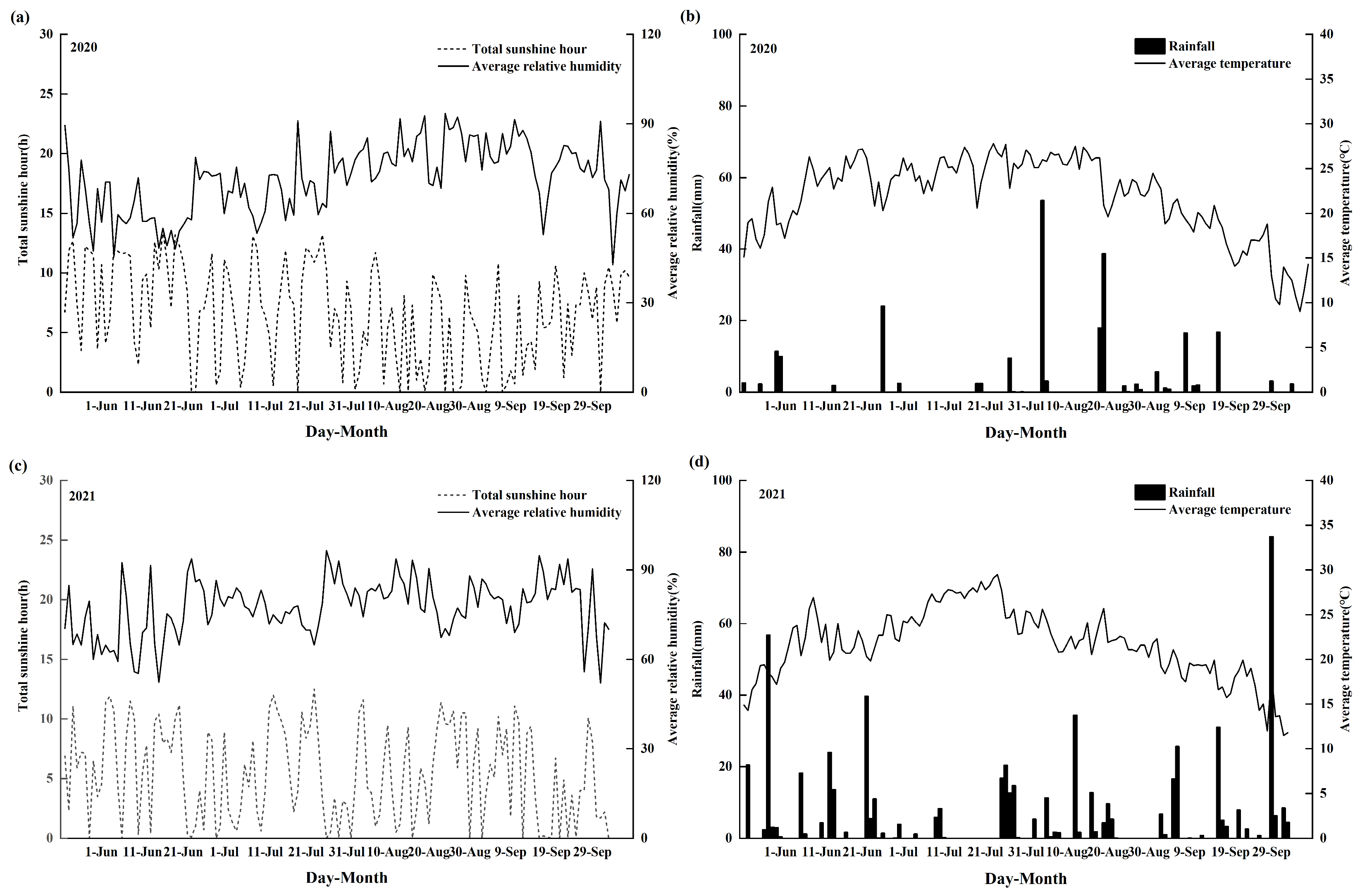
Field experiments were conducted on a farm at Shenyang Agricultural University, China (41°49′ N, 123°34′ E) during the rice-growing season (June–October) in 2020 and 2021. The site is located within the main high-yielding rice region of the Liaohe River Basin and is characterized by a temperate, semi-humid continental climate. The daily mean temperature, precipitation, relative humidity, and total sunshine hours during the two growing seasons are shown in Figure 1. Soil at the experimental site was classified as brown loam. Chemical properties of the 0–20 cm soil layer were as follows: total N, 1.00 g kg−1; available P, 34.2 mg kg−1; available K, 107.5 mg kg−1; organic matter, 24.5 g kg−1; and pH, 7.03.

2.2. Experimental Design and Crop Management

The test cultivars were Shennong 265 (SN265) and Meifengdao 61 (MFD61). SN265 is a medium-maturity cultivar with 15 leaves on its main stem, a plant height of 103 cm, compact plant architecture, strong tillering ability, and erect panicles. MFD61 is a medium-early maturing cultivar with 14 leaves on its main stem, a plant height of 109 cm, compact architecture, moderately strong tillering, and a curved panicle type. Under conventional fertilization rates (225.0 kg N ha−1 and 112.5 kg K2O ha−1), the two cultivars exhibited significant differences in N uptake and utilization efficiency, whereas their K uptake and utilization efficiency did not differ significantly (Table 1).
A three-factor randomized complete block design was employed, with year (2020 and 2021), N application rate, and K application ratio as the experimental factors. The N rates were 180 kg ha−1 (N180, 80% of conventional rate), 225 kg ha−1 (N225, conventional rate), and 270 kg ha−1 (N270, 120% of conventional rate); the K application ratios (basal: panicle fertilizer) were 3:7 (K3:7), 5:5 (K5:5), and 7:3 (K7:3), resulting in nine factorial treatment combinations. Additionally, a zero-N control plot (N0) and a zero-K control plot (K0) were included, resulting in a total of 11 treatments per cultivar. The experiment included two cultivars with three replications and a plot size of 20 m2, comprising a total of 66 experimental units. Detailed information is presented in Table 2.
Total phosphorus (P2O5) and K (K2O) rates were maintained at 112.5 kg ha−1 across all treatments. N was supplied as urea (46% N), phosphorus as single superphosphate (12% P2O5), and K as K sulfate (52% K2O). N fertilizer was applied in three splits: 36% as basal, 24% at tillering, and 40% at panicle initiation. K fertilizer was applied in two splits according to the designated ratios, with basal fertilizer applied one day before transplanting and panicle fertilizer applied at the 80% leaf age stage. Tillering N was applied at the 60% leaf age stage. Separate N0 and K0 control plots were included to enable calculation of the respective fertilizer-use efficiency indices for N and K.
In 2020, seeds were sown on 24 April, transplanted on 22 May, and harvested on 8 October. In 2021, sowing occurred on 21 April, transplantation on 29 May, and harvesting on 7 October. At transplantation, seedlings were at the four-leaf stage. Transplanting was performed manually at a spacing of 30.0 × 13.3 cm, with two seedlings per hill. Polyvinyl chloride (PVC) barriers (40.0 cm height, 1.5 mm thickness) were inserted to a depth of 25.0 cm between plots to prevent lateral movement of water and nutrients. Each plot was equipped with independent irrigation and drainage channels. Water management, mid-season drainage, weeding, and pest control followed conventional local practices.

2.3. Measurement Index and Methods

2.3.1. Dry Matter Accumulation and Leaf Area Index (LAI)

Prior to sampling, the number of tillers per hill was counted for each plot, and the average tiller number per hill was calculated. Based on the averages, four representative hills were selected from each plot for plant sampling. The sampled plant materials were initially desiccated at 105 °C for 30 min and then oven-dried at 70 °C to a constant weight. The dried samples were weighed and ground into a fine powder for further analysis.
Leaf area index (LAI) was determined at each growth stage using the method described by Yoshida et al. [31]. The length and maximum width of each green leaf were measured using a ruler. Leaf area per hill (LA, m2 hill−1), LAI, and effective leaf area index (ELAI) were calculated using the following equations:
L A I = L A t o t a l × D
E L A I = L A e f f × D
LAI and ELAI are dimensionless, where LAtotal is the total leaf area per hill (m2 hill−1), LAeff is the effective leaf area per hill, that is, the sum of the leaf areas of the top three fully expanded leaves (flag leaf and the next two leaves) per hill (m2 hill−1), and D is the hill density (hills m−2).

2.3.2. Determination of N and K Content

The dry matter weighed at maturity was ground into a powder, passed through an 80-mesh sieve, and digested using the H2SO4-H2O2 digestion method [32]. The N content of each organ was determined using a FOSS-8400 analyzer (FOSS A/S, Hillerød, Denmark), and the K content of each organ was determined using a Flame Photometer 410 flame spectrophotometer (Sherwood Scientific Ltd., UK).
The N recovery efficiency (NRE, %), N agronomic use efficiency (NAE, kg kg−1), N physiological efficiency (NPE, kg kg−1), partial factor productivity from applied N (PFPN, kg kg−1), K recovery efficiency (KRE, %), K agronomic use efficiency (KAE, kg kg−1), K physiological efficiency (KPE, kg kg−1), and partial factor productivity from applied K (PFPK, kg kg−1) were calculated as follows:
N R E = U N U N 0 T N N P E = Y N Y N 0 U N U N 0 N A E = Y N Y N 0 T N P F P N = Y N T N K R E = U K U K 0 T K K P E = Y K Y K 0 U K U K 0 K A E = Y K Y K 0 T K P F P K = Y K T K
where YN0 and YK0 represent the grain yield (kg ha−1), and UN0 and UK0 denote the N and K accumulation in aboveground biomass at maturity (kg ha−1) for the N0 and K0 treatments, respectively; YN and YK are the grain yield (kg ha−1), and UN and UK are the N and K accumulation in aboveground biomass at maturity (kg ha−1) under the respective N and K application treatments; TN and TK are the total N and K application rates (kg ha−1) for each treatment.

2.3.3. Calculation of Crop Growth Rate (CGR) and Net Assimilation Rate (NAR)

The CGR is a measure of the dry matter accumulation rate per unit land area per unit time, indicating the productivity of the crop canopy. It is crucial for evaluating the growth dynamics and yield-forming capacity of rice populations. In rice studies, the CGR typically shows a unimodal curve over time, peaking around the booting-to-heading stages. Appropriate planting density and crop management can increase the CGR, thereby enhancing dry matter production and grain yield. The NAR, also known as the photosynthetic efficiency, is defined as the net dry matter gain per unit leaf area per unit time, representing the difference between the photosynthesis and respiration efficiencies. In rice, the NAR also shows a unimodal trend, with the maximum typically occurring from the active tillering to the jointing stage. NAR is influenced by the LAI, leaf age, and management practices. The CGR and NAR are calculated as follows:
C G R = W 2 W 1 T 2 T 1
N A R = W 2 W 1 T 2 T 1 × ln L A I 2 ln L A I 1 L A I 2 L A I 1
where CGR is the crop growth rate (g m−2 d−1), NAR is the net assimilation rate (g m−2 d−1), W1 and W2 are the total dry matter per unit land area (g m−2) at times t1 and t2 (d), respectively, LAI1 and LAI2 are the leaf area indices (m2 m−2) at times t1 and t2, and ln represents the natural logarithm. CGR was expressed on a unit land area basis and indicates dry matter accumulation at the population level, whereas NAR was expressed on a unit leaf area basis and reflects the net photosynthetic efficiency of the canopy.

2.3.4. Method for Determination of Nitrate Reductase (NR) and Glutamine Synthetase (GS) Activities

During the tillering, booting, and grain-filling stages, four representative hills with uniform growth were selected from each plot. The flag leaf and the second leaf from the top were sampled, immediately frozen in liquid N, and stored at −80 °C until analysis. For enzyme extraction, leaf samples (approximately 0.5 g fresh weight) were ground to a fine powder in liquid N and homogenized in 5 mL of ice-cold phosphate-buffered saline (PBS, 0.01 mol L−1, pH 7.4). The homogenate was centrifuged at 5000× g for 15 min at 4 °C, and the supernatant was collected for enzyme activity assays. Nitrate reductase (NR) activity was determined using a double-antibody sandwich enzyme-linked immunosorbent assay (ELISA) with a commercial kit. The provided standard was serially diluted to concentrations of 160, 80, 40, 20, and 10 to obtain the standard curve. Microplates pre-coated with purified plant NR antibody were used as the solid-phase carrier. Samples were diluted 5-fold with sample dilution buffer (10 μL supernatant + 40 μL diluent). Standards (50 μL) and diluted samples (50 μL) were added to the wells, incubated at 37 °C for 30 min, and washed five times. HRP-conjugated detection antibody (50 μL per well) was added, and samples were incubated at 37 °C for 30 min and washed again. TMB substrate (50 μL chromogen A + 50 μL chromogen B) was added and incubated at 37 °C for 10 min in the dark. The reaction was terminated by adding 50 μL of stop solution, and the absorbance was measured at 450 nm using a microplate reader. NR activity was calculated from the standard curve and multiplied by the dilution factor (×5). Glutamine synthetase (GS) activity was determined using a similar double-antibody sandwich ELISA procedure with a commercial kit. The standard was serially diluted to concentrations of 48, 24, 12, 6, and 3, and microplates were pre-coated with purified plant GS antibody. All other steps, including sample dilution, incubation, washing, color development, and calculation, were identical to those described for NR.

2.3.5. Actual Grain Yield and Yield Components

At maturity, 10 representative hills were sampled from each plot based on the average panicle number per hill to determine yield components, including effective panicle number per hill, spikelets per panicle, seed-setting rate, and 1000-grain weight. Actual grain yield was determined by harvesting a 6 m2 area (excluding border rows) from each plot at maturity, with three replications. After threshing and cleaning, grain yield per unit area was calculated based on a standard moisture content of 14.50% for japonica rice.

2.4. Statistical Analysis

All statistical analyses were performed separately for each cultivar. A three-way analysis of variance (ANOVA) was conducted using IBM SPSS Statistics (version 22.0; IBM Corp., Armonk, NY, USA) to evaluate the effects of year, nitrogen (N) application rate, potassium (K) application ratio, and their interactions on the measured variables. The model included three fixed factors: year (Y, 2020 and 2021), N rate (N180, N225, and N270), and K ratio (K3:7, K5:5, and K7:3). All two-way interactions (Y × N, Y × K, N × K) and the three-way interaction (Y × N × K) were tested. Prior to ANOVA, assumptions of normality and homogeneity of variances were assessed using the Shapiro–Wilk test and Levene’s test, respectively. When significant differences were detected, treatment means were separated using Fisher’s least significant difference (LSD) test at p < 0.05, and different letters were assigned to indicate statistically significant differences. The two cultivars, SN265 and MFD61, were analyzed independently; their performance was compared descriptively based on the magnitude and direction of the observed differences, without formal statistical testing between cultivars. Graphs were generated using Origin 2024b (OriginLab, Northampton, MA, USA).

3. Results

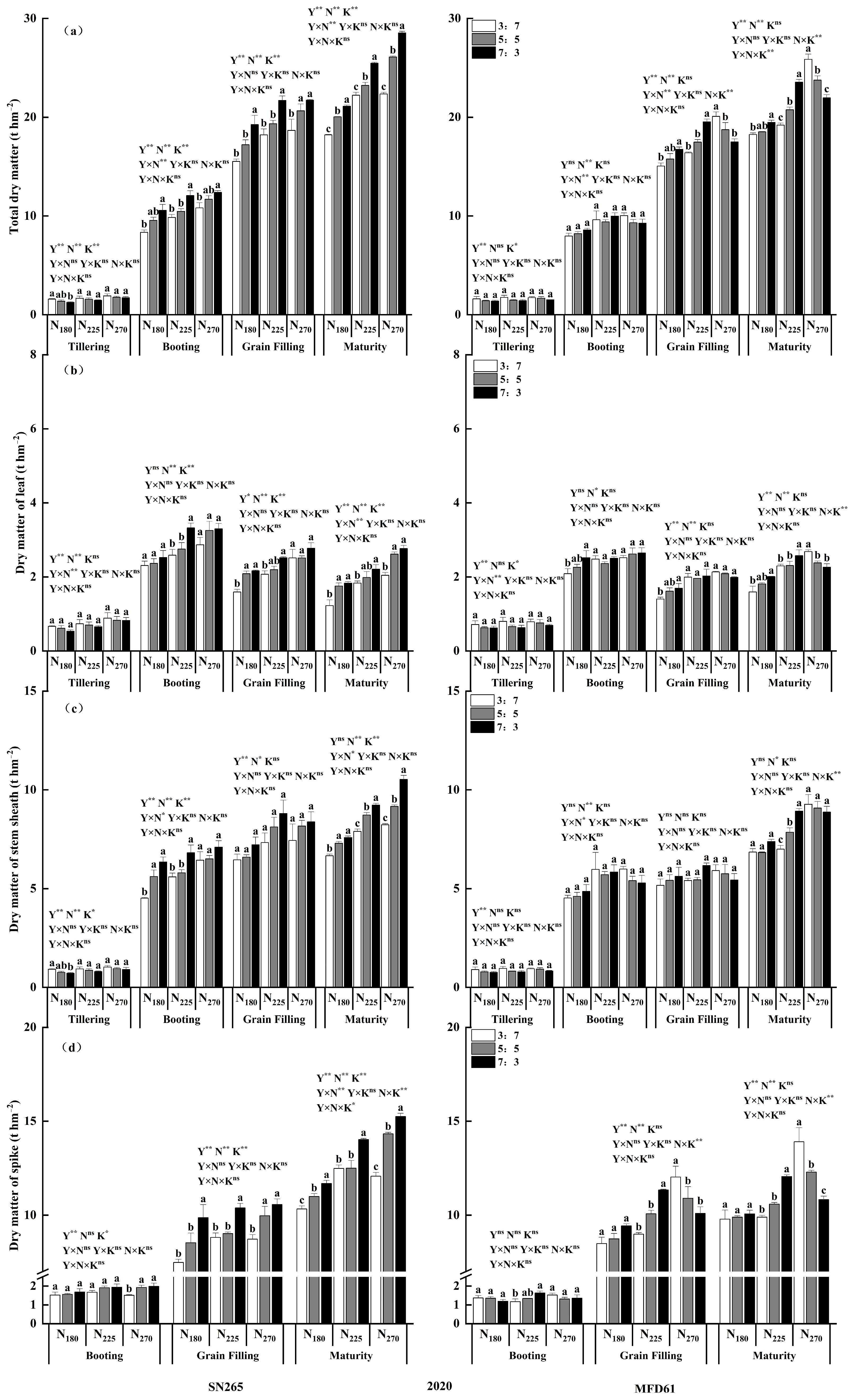
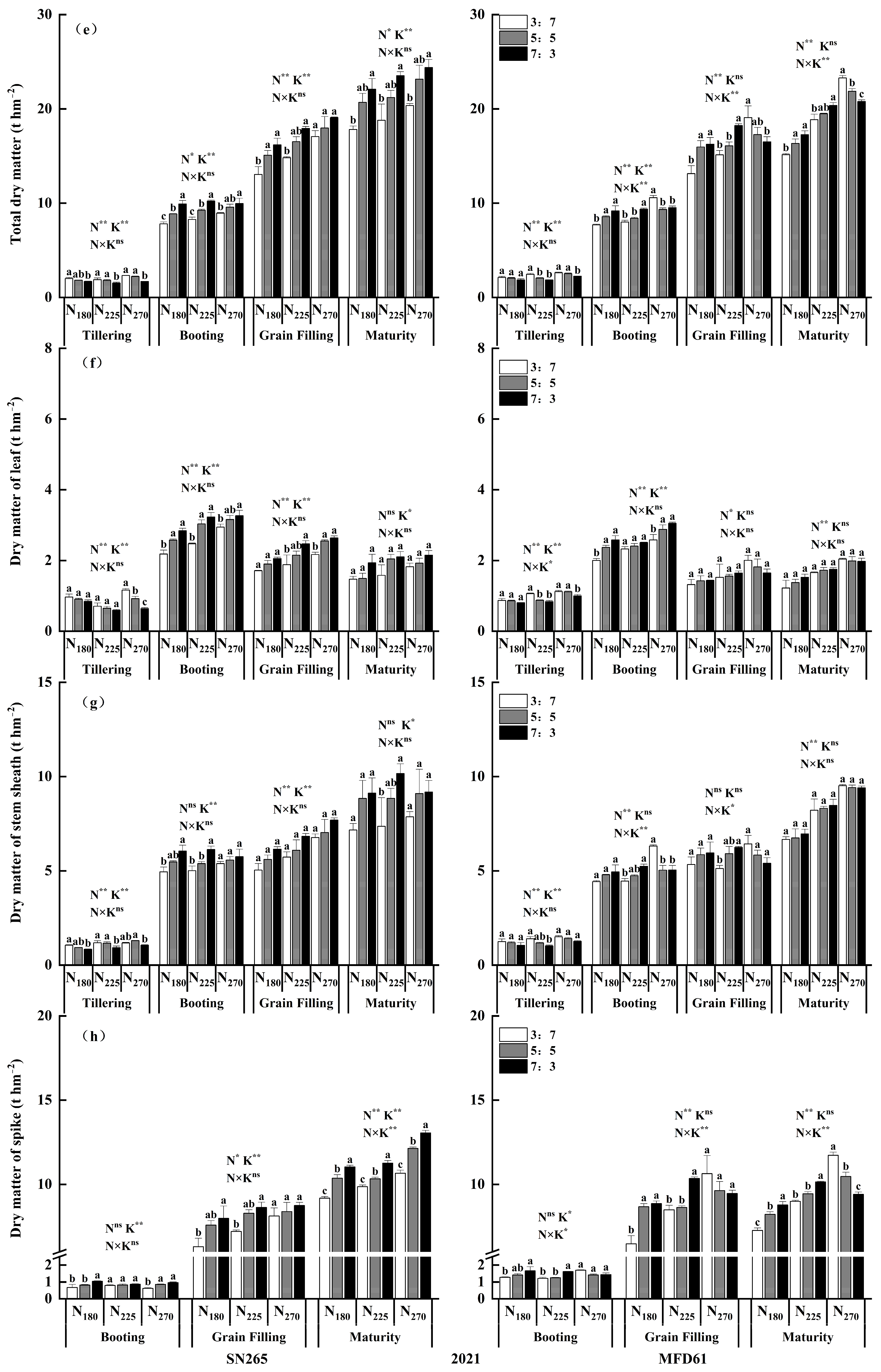
Figure 2 shows that the temporal dynamics of aboveground dry matter accumulation were generally consistent across treatments in both years. In both cultivars, total aboveground dry matter accumulation increased continuously throughout the growing season. Panicle dry matter accumulation followed a similar increasing trend, whereas leaf dry matter accumulation peaked at the booting stage and subsequently declined. Stem dry matter accumulation increased progressively in SN265. In MFD61, however, a decline from the booting stage to the grain-filling stage was observed in the N225K3:7, N225K5:5, and N270K3:7 treatments, although this phenomenon occurred only in 2020.
Total dry matter accumulation consistently followed the pattern N270 > N225 > N180 across all growth stages from tillering onward, with statistically significant differences. Under the N180 and N225 regimes, increasing the basal K proportion (K7:3) generally promoted dry matter accumulation compared with K5:5 and K3:7 in both cultivars. However, under the high-N regime (N270), the two cultivars exhibited contrasting responses. SN265 maintained the pattern K7:3 > K5:5 > K3:7, whereas MFD61 showed the reverse trend (K3:7 > K5:5 > K7:3). In MFD61, differences among K ratios under N270 were not significant before the booting stage but became statistically significant during the grain-filling stage, with the maximum difference observed at maturity.
These results reveal a significant N × K interaction on dry matter accumulation: under high N supply, excessive early-season K application (K7:3) suppressed dry matter accumulation in MFD61, whereas this adverse effect was not observed in SN265. This contrasting response highlights the necessity of cultivar-specific K management under high-N conditions.
Table 3 shows that CGR declined progressively with crop development across all treatments in both years. SN265 exhibited significantly higher CGR than MFD61 during the tillering–booting and grain-filling–maturity phases (averaging 14.08% and 31.88% higher, respectively), whereas no cultivar difference was observed during the booting–grain-filling phase.
CGR consistently ranked as N270 > N225 > N180 across all growth phases in both cultivars, with statistically significant differences. Under the N180 and N225 regimes, increasing the basal K proportion (K7:3) significantly enhanced CGR compared to K5:5 and K3:7 in both cultivars. However, under the high-N regime (N270), the two cultivars showed contrasting responses. SN265 maintained the pattern K7:3 > K5:5 > K3:7, whereas MFD61 exhibited the reverse trend (K3:7 > K5:5 > K7:3). In MFD61, the K3:7 treatment under N270 produced a higher CGR during the tillering–maturity phase compared with the K5:5 and K7:3 treatments, a pattern opposite to that observed under lower N rates.
These results demonstrate a significant N × K interaction on CGR: high N supply combined with early-season K application (K7:3) suppressed CGR in MFD61, but not in SN265, reinforcing the need for cultivar-specific K management under high-N conditions.
As presented in Table 4, the temporal dynamics of NAR closely aligned with those of CGR. Regarding N × K interactions, no significant N × K interaction effects on NAR were observed in the N-efficient cultivar SN265 at any growth stage. In contrast, significant or highly significant N × K interactions were observed for the N-inefficient cultivar MFD61 across all growth stages examined, indicating that SN265 exhibited greater stability in response to varying N and K management regimes. Notably, the three-way interaction between N rate, K ratio, and year on NAR during the grain-filling–maturity phase was highly significant for both cultivars.
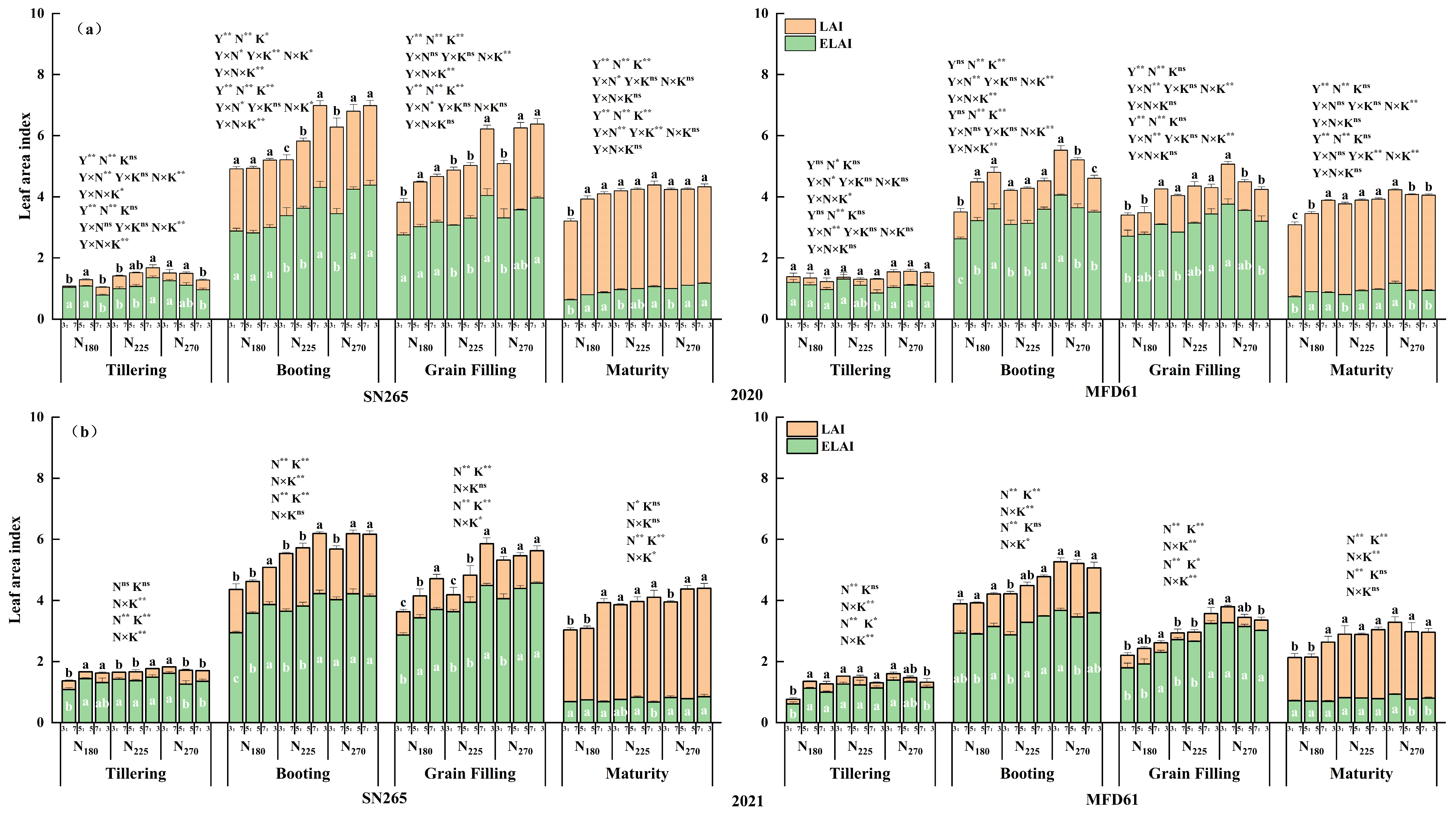
As shown in Figure 3, the temporal dynamics of LAI and ELAI were generally consistent across all treatments in both years, exhibiting a unimodal pattern that peaked at the booting stage and subsequently declined.
Across all treatments, the LAI and ELAI of both SN265 and MFD61 initially increased and then decreased as the growing season progressed. Averaged across the booting and grain-filling stages in both years, the LAI and ELAI of SN265 were 32.00% and 17.11% higher, respectively, than those of MFD61.
Regarding N management, both cultivars exhibited a consistent ranking of LAI and ELAI across all growth stages (except the tillering stage): N270 > N225 > N180. For both SN265 and MFD61, the maximum difference in LAI among the N rates occurred at the grain-filling stage, where the N270 treatment exceeded N180 by 34.06% and 32.73%, respectively. For ELAI, the maximum difference in SN265 was observed at the maturity stage, with N270 exhibiting an average increase of 29.55% than that of N180. In MFD61, the maximum difference occurred at the grain-filling stage, with N270 exhibiting an average increase of 36.80% compared to that of N180. All differences in N application rates were statistically significant for both cultivars.
Regarding K management, under the N180 and N225 regimes, the LAI and ELAI of both cultivars followed the same ranking across all growth stages (except the tillering stage): K7:3 > K5:5 > K3:7. These differences were statistically significant. However, under the N270 treatment, the two cultivars exhibited contrasting responses. SN265 maintained the ranking K7:3 > K5:5 > K3:7, whereas MFD61 exhibited the opposite pattern, beginning at the booting stage and persisting until maturity. For MFD61, the difference among the K ratios was most pronounced at the booting stage and progressively decreased in subsequent stages. These results indicate that under high-N conditions, excessive early-season K application reduced post-booting LAI and ELAI in MFD61, thereby suppressing canopy development and potentially limiting grain yield. In contrast, the response pattern of SN265 was consistent across all N and K combinations.
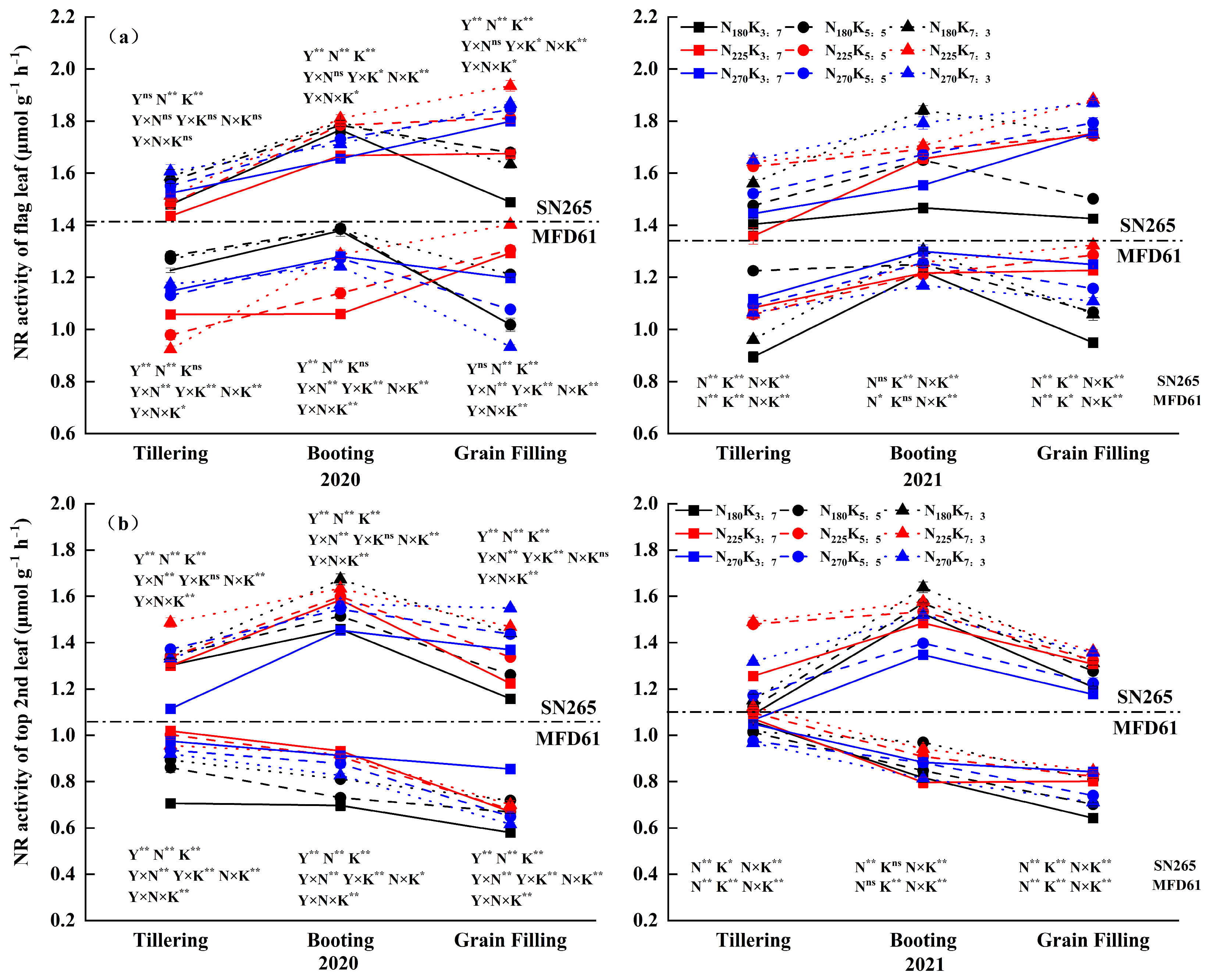
Nitrate reductase (NR) is the first key enzyme in the N assimilation pathway, catalyzing the reduction of soil-derived NO3 to NO2, which is subsequently reduced to NH4+ by nitrite reductase (NiR). Adequate N supply typically increases NR activity. As shown in Figure 4, the temporal dynamics of flag leaf NR activity were generally consistent across treatments in both years.
Across all treatments, the flag leaf NR activity of SN265 was consistently higher than that of MFD61 at all growth stages, with the maximum difference observed at the grain-filling stage, when SN265 exceeded MFD61 by 49.40%. Regarding N management, the two cultivars exhibited distinct response patterns. For SN265, flag-leaf NR activity did not differ significantly among N rates at the tillering and booting stages. However, at the grain-filling stage, NR activity followed the pattern N270 > N225 > N180, with significant differences among all N levels. For MFD61, at both the tillering and booting stages, NR activity was highest under N180, intermediate under N270, and lowest under N225. At the grain-filling stage, this trend was reversed: NR activity peaked under N225, followed by N270, and was lowest under N180. Regarding K management, under the N180 and N225 regimes, flag leaf NR activity of both cultivars increased with a higher proportion of basal K application (K7:3 > K5:5 > K3:7), and these differences were statistically significant. However, under the N270 regime, the two cultivars exhibited contrasting responses. For MFD61, reducing late-season K application under high-N conditions increased flag-leaf NR activity, whereas for SN265, increasing the proportion of basal K application consistently improved flag-leaf NR activity regardless of the N rate.
In addition to the flag leaf, the second leaf from the top is an important functional leaf, and its NR activity is critical for N metabolism. Temporal patterns of NR activity in the second leaf were similar to those observed in the flag leaves in both years. In all treatments, the NR activity of the second leaf of SN265 was consistently higher than that of MFD61. In SN265, NR activity in the second leaf initially increased and subsequently declined with crop development, peaking during the booting stage. In MFD61, NR activity in the second leaf decreased progressively and was the highest at the tillering stage. Regarding N management, both cultivars exhibited a similar pattern in the second leaf; NR activity increased initially and then decreased with increasing N application rate, reaching a maximum activity at N225. Regarding K management, the response patterns of the NR activity in the second leaf were identical to those in the flag leaf.
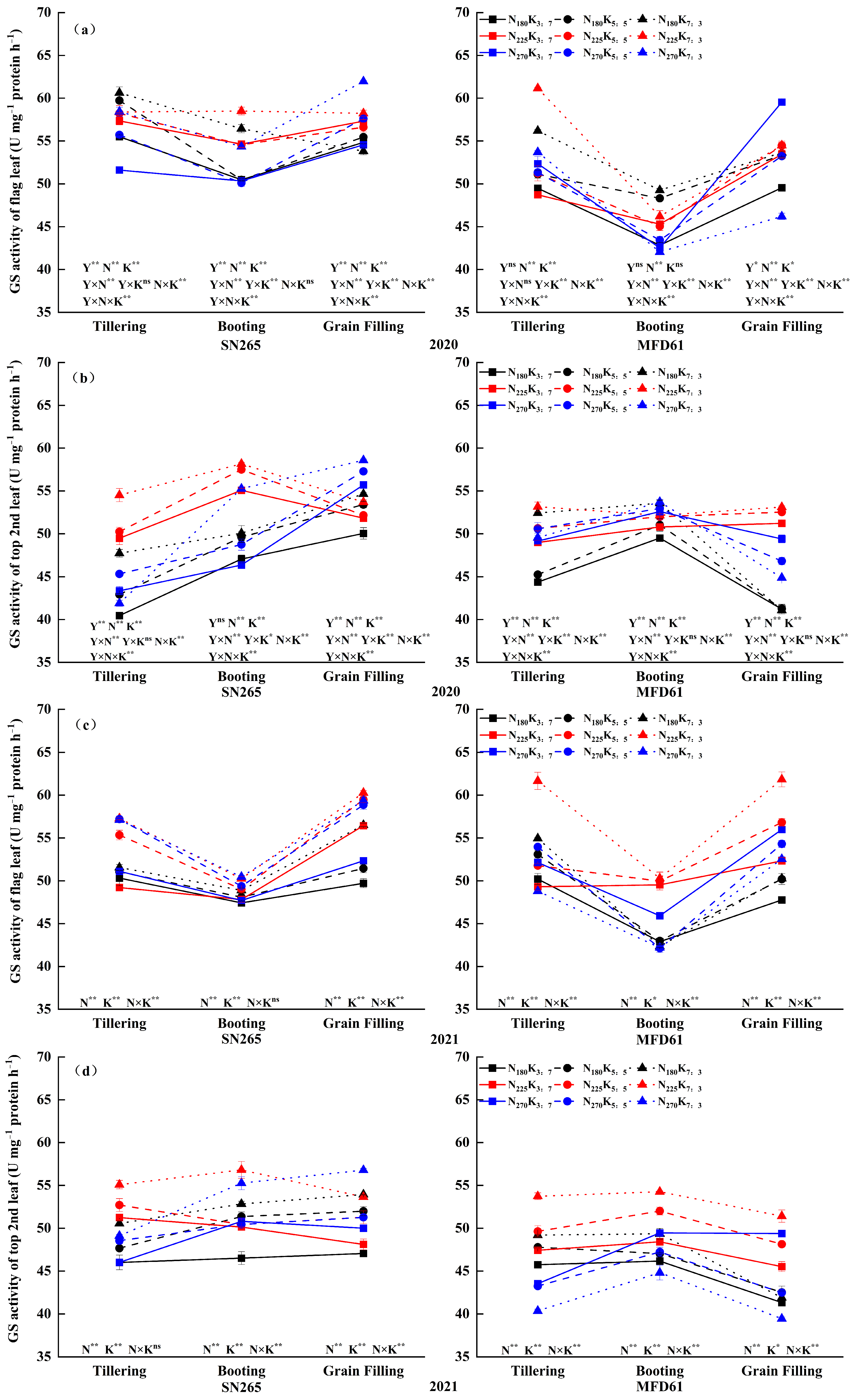
Over 95% of inorganic N in higher plants is assimilated through the glutamine synthetase/glutamate synthase (GS/GOGAT) cycle, where NH4+ is incorporated into glutamate and glutamine, a central process in N metabolism. As shown in Figure 5, the temporal dynamics of flag-leaf GS activity were generally consistent across treatments in both years and closely aligned with those of NR activity. In both SN265 and MFD61, the flag-leaf GS activity initially increased and subsequently declined as the growing season progressed.
Regarding N management, both cultivars exhibited a similar pattern; from the tillering to the grain-filling stages, GS activity first increased and subsequently decreased with increasing N rate, peaking at N225. Although the relative ranking of N270 and N180 varied, the data indicate that an optimal N supply is critical for maximizing flag leaf GS activity. Regarding K management, the response patterns of flag leaf GS activity were identical to those described for flag leaf NR activity. In terms of N × K interactions, except for SN265 at the booting stage, where the interaction effect on flag-leaf GS activity was not significant, all other N × K interactions across the cultivars and growth stages were highly significant.
The temporal trends in GS activity in the second leaf from the top were less consistent across treatments and years. At the tillering stage, the mean GS activity of MFD61 was slightly higher than that of the N-efficient cultivar (SN265); however, this difference was not statistically significant. However, at the booting and grain-filling stages, GS activity in the second leaf of MFD61 was significantly lower than that of SN265. In SN265, GS activity in the second leaf increased progressively with crop development, reaching a maximum at the grain-filling stage. In contrast, MFD61 exhibited a unimodal pattern, with peak activity occurring at the booting stage.
Regarding N management, at the tillering and booting stages, both cultivars exhibited the same response; as the N rate increased, GS activity in the second leaf initially increased and then declined, with the maximum activity observed at N225. However, cultivar differences were observed during the grain-filling stage. MFD61 maintained the same unimodal pattern, whereas SN265 showed a continuous increase in GS activity with increasing N application rates, reaching its highest value at the grain-filling stage.
Regarding K management, the N-efficient cultivar SN265 exhibited a consistent positive response to increased basal K application, with GS activity in the second leaf exhibiting the trend K7:3 > K5:5 > K3:7. The N-inefficient cultivar MFD61 followed the same pattern under N180 and N225. Under N270, however, MFD61 exhibited a distinct response: at the tillering stage, GS activity increased and then decreased, whereas at the booting and grain-filling stages, activity declined continuously with increasing basal K. Regarding N × K interactions, except for the N-efficient cultivar at the tillering stage, where the interaction effect on second-leaf GS activity was not significant, all other interactions were highly significant across cultivars and growth stages.
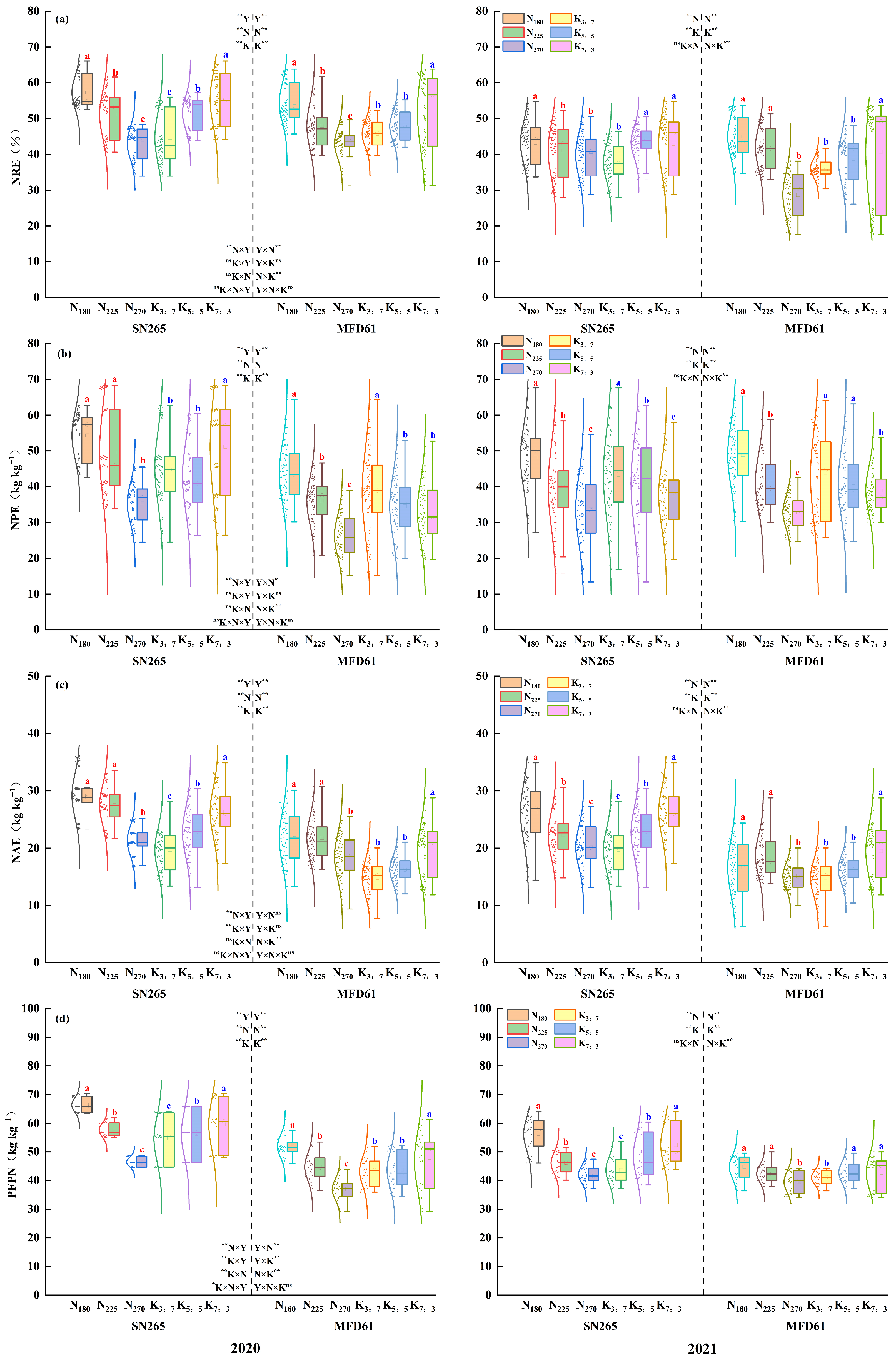
As shown in Figure 6, N use efficiency traits were significantly influenced by year and the interactive effects of N and K fertilization, with highly significant interaction effects observed. Averaged across the two years, the NRE, NPE, NAE, and PFPN of SN265 were 9.06%, 10.39%, 31.17%, and 20.11% higher than those of MFD61, respectively.
Regarding N management, all N use efficiency parameters in both cultivars declined consistently with increasing N application rates (N180 > N225 > N270). Specifically, the NPE of SN265 decreased most sharply from N180 to N225, by 30.39%, whereas that of MFD61 showed the steepest decline from N225 to N270, by 30.40%, indicating that the two cultivars experienced their greatest reductions in NPE at different N supply intervals.
Regarding K management, under the N180 and N225 regimes, the NRE, NAE, and PFPN of both cultivars increased with a higher proportion of basal K application (K7:3 > K5:5 > K3:7), whereas NPE exhibited the opposite trend (K7:3 < K5:5 < K3:7). Within each N treatment, the differences among K ratios were statistically significant. However, under the N270 regime, a significant N × K interaction was observed: SN265 maintained the same response pattern as at lower N rates, whereas MFD61 exhibited the reverse trend (K3:7 > K5:5 > K7:3 for NRE, NAE, and PFPN; K3:7 < K5:5 < K7:3 for NPE). This indicates that under high-N conditions, increasing the proportion of early-season K application in MFD61 led to reduced N uptake and utilization efficiency, except for NPE.
In terms of the N × K interactions, the interaction effects on PFPN in SN265 and all N use efficiency components in MFD61 were highly significant.
As presented in Table 5, the yield and yield components exhibited generally consistent patterns across treatments in both experimental years, with the average grain yield in 2020 being 11.25% higher than that in 2021. SN265 had a higher panicle number per square meter and a higher seed-setting rate, resulting in a significantly greater two-year average grain yield compared to that of MFD61, with an average increase of 20.31% across all treatments. However, SN265 produced significantly fewer spikelets per panicle than MFD61, averaging 15.05 fewer spikelets per panicle.
Regarding N management, the grain yield of both cultivars increased progressively with increasing N rates (N270 > N225 > N180), and all differences among the N rates were highly significant. However, the responses of individual yield components were less consistent. The panicle number per square meter in both cultivars and the seed-setting rate in MFD61 followed the same trend as that observed for grain yield, whereas the patterns of the remaining yield components were comparatively irregular.
Regarding K management, both cultivars exhibited similar yield rankings under the N180 and N225 regimes (K7:3 > K5:5 > K3:7). Averaged across the two years and all N application rates, the maximum yield difference for SN265 was observed between K7:3 and K3:7, with K7:3 producing a yield 10.18% higher than that of K3:7. In contrast, the corresponding difference for MFD61 was 4.93%, indicating that SN265 was more responsive to K management. This yield advantage under K7:3 was primarily associated with an increased panicle number per square meter in both cultivars, which was partially offset by a reduction in spikelets per panicle and 1000-grain weight.
Under the N270 treatment, the two cultivars exhibited contrasting responses. SN265 maintained the following ranking: K7:3 > K5:5 > K3:7. In contrast, for MFD61, excessive early-season K application under high-N conditions significantly reduced the panicle number per square meter, spikelets per panicle, seed-setting rate, and 1000-grain weight, thereby notably decreasing grain yield. No adverse effects were observed in the SN265 group.
Regarding N × K interactions, significant interaction effects were observed for panicle number per square meter, 1000-grain weight, and grain yield in MFD61. The three-way interaction (year × N × K) was not significant for any yield component or grain yield.
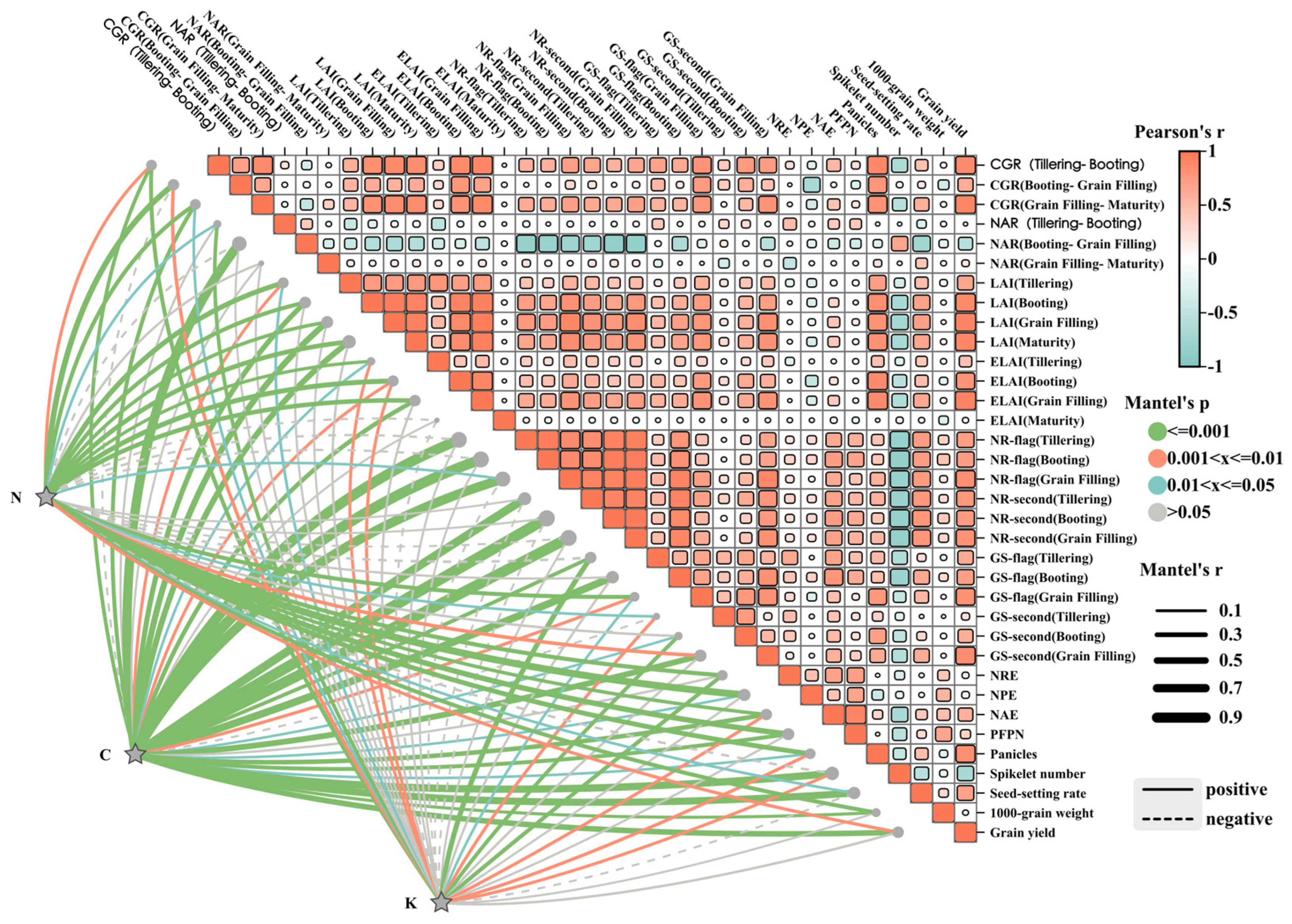
The Mantel test and Pearson correlation analysis (Figure 7) revealed distinct correlation patterns between the two cultivars. When data were pooled across cultivars, most indicators significantly positively correlated with panicle number were also positively correlated with grain yield. In contrast, seed setting rate exhibited weak correlations with the measured parameters, and 1000-grain weight was negatively correlated with most physiological and growth indicators, with no significant positive correlations observed. The Mantel test further demonstrated that cultivar was the predominant driver of trait association variation, followed by N and K nutrition. The N metabolic enzyme and N use efficiency matrices showed the strongest positive correlations with the full set of analyzed traits (p < 0.001). Overall, most significant associations within the network were positive and synergistic, with only limited negative trade-offs among certain N efficiency-related indicators.

4. Discussion

4.1. Effects of Combined N and K Application on Population Development Characteristics of Rice Cultivars with Contrasting N Efficiency

Rice population development is influenced by genotype, environmental conditions, and cultivation practices [33]. The yield advantage of N-efficient cultivars is primarily attributed to the increased effective panicle number, and no notable differences in biomass production exist among cultivars with differing N efficiency before full heading [34,35]. Additionally, N-efficient cultivars can maintain enhanced population growth rates, increased dry matter accumulation, and improved photosynthetic capacity following the heading stage [36,37]. Zhu et al. [38] reported that the post-heading dry matter accumulation rate affects both population growth rate and grain filling, with N-efficient cultivars exhibiting a greater contribution of post-heading dry matter to grain yield compared to other cultivars. In the present study, no significant differences in dry matter accumulation or LAI were observed between the two cultivars during the early growth stages. However, substantial divergence in population development emerged after the booting stage. N-efficient cultivars exhibited significantly higher dry matter accumulation rates, LAI, and ELAI than N-inefficient cultivars, with a particularly pronounced advantage in panicle dry matter accumulation during the grain-filling to maturity phase.
Increasing the N application rates extends the duration of rapid dry matter accumulation in rice, with total dry matter accumulation exhibiting an initial increase, followed by a decline [39]. An elevated K supply significantly advances the onset of rapid dry matter accumulation [40] and promotes post-anthesis dry matter accumulation [41,42]. Yang et al. [43] reported that K application exerts a relatively small effect on dry matter accumulation at the tillering and maturity stages but has a pronounced effect at the booting and full-heading stages, with accumulation showing an initial increase followed by a decrease as K rates rise. Furthermore, Yan et al. [44] demonstrated that postponing K application enhanced dry matter accumulation in rice. Recent studies have shown that optimizing the combined application of N and K can enhance canopy development, promote dry matter allocation to reproductive organs, and increase grain yield in japonica rice [45,46]. Similar synergistic effects of balanced N and K ratios on growth and development have also been reported in oilseed rape [47,48]. Collectively, these findings indicate that a balanced N:K ratio can significantly influence the quality of rice population development. In the present study, under a fixed total K input, a moderate increase in N supply combined with an elevated proportion of early-season K application increased dry matter accumulation, LAI, CGR, and NAR during the mid-to-late growth stages in a N-efficient cultivar. In contrast, the N-inefficient cultivar exhibited an opposite response to increasing N and early-season K inputs. This discrepancy may be attributed to the inability of the N-inefficient cultivar to effectively absorb and utilize excess N and K during the early growth phase, potentially reducing nutrient availability for later growth stages. The subsequent application of panicle fertilizer partially compensated for the nutrient deficit, leading to observed differences in later growth stages. Mantel test results further confirmed that cultivar was the predominant driver of trait associations, its influence exceeding that of N and K nutrition, which reinforces the conclusion that population development responses to N–K management are fundamentally cultivar-dependent.

4.2. Effects of N and K Combined Application on N Utilization in Rice Cultivars Differing in N Use Efficiency

N use efficiency in rice exhibits an initial increase followed by a decrease as N application rates increase [49]. Additionally, a significant positive interaction was observed between N and K; increased K fertilization improved N use efficiency by 15.0% to 45.0% [50,51]. In the present study, as N application rates increased, N efficiency decreased in both cultivars, with a particularly significant decline in physiological utilization.
When N was applied at rates of 180–225 kg ha−1, increasing the proportion of K incorporated early in the growing season improved N uptake and agronomic utilization. However, under high-N conditions (270 kg ha−1), the two cultivars responded differently: SN265 demonstrated strong adaptability and maintained relatively high late-stage N efficiency. In contrast, MFD61, whose early-stage N uptake capacity was notably lower than nutrient supply, showed signs of N deficiency and stunted development. Notably, the delayed application pattern of high-N and low-K resulted in a slight improvement in N uptake in MFD61. This indicates that adjusting the timing of K fertilizer application can modulate the N uptake characteristics of cultivars with different N efficiencies. In the trait correlation network, N metabolic enzyme and N use efficiency matrices both exhibited highly significant and strong positive correlations with the full set of analyzed traits, emphasizing the central role of N assimilation and utilization in determining overall crop performance.

4.3. Effects of Combined N and K Application on N Metabolic Enzyme Activities in Rice Cultivars with Contrasting N Efficiency

In higher plants, over 95% of inorganic N is assimilated into glutamine and glutamate through the GS/GOGAT pathway before being utilized for protein synthesis [52]. The N application rate directly influences N metabolism, as N serves as a reaction substrate [53], and K acts as a critical enzymatic activator in numerous metabolic reactions [54]. The optimal combined application of N and K enhances the activities of free amino acids, glutamine synthetase (GS), and nitrate reductase (NR) in crops such as maize [55], soybean [56], cotton [57], and rice [58]. Additionally, combined N and K application has been shown to influence grain-filling processes and rice quality in different japonica cultivars [8]. The present study revealed that the effects of combined N and K application on NR and GS activities varied between cultivars with contrasting N efficiencies, and distinct responses were observed between the flag and second leaves from the top. A descriptive comparison indicated that, numerically, NR and GS activities in both the flag and second leaves were higher in SN265 than in MFD61 across most treatments and growth stages. Although these differences could not be formally tested across cultivars, this trend aligns with previous findings on the synergistic effects of N and K on photosynthetic N assimilation in rice [58].
With increasing N application rate, NR activity in the flag leaf of SN265 increased progressively, with a particularly pronounced trend at the grain-filling stage. In contrast, NR activity in the flag leaf of MFD61 declined gradually with increasing N rate, whereas NR activity in the second leaf increased initially and then decreased, peaking at 225 kg ha−1. Increasing the proportion of early-season K application generally enhanced NR activity; however, under high-N conditions, MFD61 exhibited the opposite trend. Regarding GS activity, both cultivars exhibited an initial increase followed by a decrease with increasing N rate, reaching maximum activity at 225 kg ha−1, although the pattern in the second leaf was less consistent. Increasing the proportion of early-season K application increased GS activity in the flag and second leaves; however, under the high N rate (270 kg ha−1), MFD61 again showed a reversed response.

4.4. Effects of Combined N and K Application on Grain Yield and Yield Components of Rice Cultivars with Contrasting N Efficiency

A balanced N and K supply is a fundamental prerequisite for achieving high rice grain yield [46,51]. In the present study, SN265 exhibited a 20.31% higher average grain yield compared to MFD61, which was primarily attributable to its increased panicle number per unit area and elevated seed-setting rate. Increasing the N application rate primarily promoted panicle formation in SN265, whereas it significantly influenced both panicle number and seed-setting rate in MFD61.
The effects of K fertilizer management were modulated by a significant cultivar × N level interaction. For SN265, increasing the proportion of basal K application (K7:3 treatment) enhanced grain yield under the N180 and N225 regimes, with increases of 6.93% and 5.17%, respectively, averaged across the two years relative to the K5:5 treatment, whereas grain yield remained relatively high under N270. For MFD61, the K7:3 treatment also increased grain yield under the N180 and N225 regimes, by 6.69% and 10.18%, respectively, averaged across the two years relative to K5:5. Under the high-N regime (N270), the two cultivars diverged: for SN265, the K7:3 treatment further increased grain yield by 12.25% compared with K3:7, whereas for MFD61, the K7:3 treatment reduced grain yield by 13.74% compared to K3:7. Correlation analysis across both cultivars confirmed that crop growth rate during the early reproductive phases, leaf area index at later growth stages, and grain-filling flag-leaf NR and GS activities were all significantly positively correlated with grain yield. In contrast, 1000-grain weight showed no significant positive correlations with most physiological indicators, consistent with the weak and often negative relationships observed between this component and the measured traits. These results underscore that tailoring N and K management strategies to specific cultivar types is essential for synergistically improving grain yield and resource-use efficiency in rice production.

4.5. Study Limitations and Future Directions

The present study has several limitations that warrant consideration. Because the field trials were conducted at a single site over two years and involved only two japonica cultivars, the generalizability of these findings to other environments or broader germplasm remains uncertain; multi-location trials encompassing diverse varietal types are necessary to confirm the universality of the identified N–K interaction patterns. Furthermore, although physiological responses at the whole-plant and biochemical levels were systematically characterized—spanning dry matter accumulation, enzyme activity, and yield components—the molecular regulatory mechanisms driving the distinct NR and GS responses to K in cultivars with contrasting N efficiency remain unclear. Future investigations employing transcriptional and proteomic analyses of N assimilation pathways would clarify these underlying genetic controls. Additionally, the present study evaluated only two K application timings under conventional flooded irrigation. Exploring more refined split-application regimes and integrated water–fertilizer strategies could better synchronize K supply with cultivar-specific N uptake dynamics, ultimately strengthening the physiological framework for precision nutrient management in rice production.

5. Conclusions

This two-year field study demonstrated that the interactive effects of N and K management on rice grain yield are strongly cultivar-dependent. For SN265, increasing both the N application rate and the proportion of basal K synergistically enhanced post-booting dry matter accumulation, CGR, and leaf area development. In contrast, under a high-N regime, a high proportion of basal K negatively affected the growth and development of MFD61. Maintaining high NR and GS activities in the upper leaves during grain filling was the physiological basis for the higher N uptake efficiency observed in SN265. Increasing N supply combined with a higher basal K ratio further enhanced enzyme activities in the second leaf from the top, thereby contributing to sustained photosynthetic efficiency. Conversely, MFD61 exhibited lower and more variable NR and GS activities, which may partly explain its lower N and K use efficiencies. Grain yield in SN265 increased with higher N and basal K inputs, although this was accompanied by a decline in N use efficiency. Under high-N and high-basal-K conditions, MFD61 showed a substantial reduction in grain yield, along with significant decreases in N and K uptake and utilization efficiencies, fewer spikelets per panicle, and reduced 1000-grain weight. These findings provide a clear practical recommendation: potassium application timing should be tailored to cultivar-specific N responsiveness. N-efficient cultivars such as SN265 can accommodate higher basal K proportions even under elevated N supply, whereas cultivars with lower N efficiency, such as MFD61, benefit from allocating a greater proportion of K to the panicle stage under high-N conditions to avoid excessive vegetative growth and maintain canopy function during grain filling. As this study was conducted at a single site and involved only two cultivars, multi-location validation using a wider range of germplasm is required to confirm the generalizability of these strategies.

Author Contributions

Conceptualization, W.Z. and X.L.; resources, W.Z. and X.L.; investigation, H.J., Y.L., Y.X., J.X. and L.C.; formal analysis, L.C. and H.J.; visualization, L.C. and H.J.; writing—original draft preparation, L.C.; writing—review and editing, W.Z., X.L., H.J., Y.L., Y.X., J.X. and L.C. All authors have read and agreed to the published version of the manuscript.

Funding

This research was funded by the Basic Scientific Research Project of the Education Department of Liaoning Province (grant number LJ212411779004) and the Doctoral Scientific Research Start-up Fund Project of Eastern Liaoning University (grant number 2024BS013).

Institutional Review Board Statement

Not applicable.

Data Availability Statement

The raw data supporting the conclusions of this article will be made available by the authors upon reasonable request.

Conflicts of Interest

The authors declare no conflicts of interest.

Abbreviations

The following abbreviations are used in this manuscript:
CGRCrop growth rate
ELAIEffective leaf area index
ELISAEnzyme-linked immunosorbent assay
GSGlutamine synthetase
KAEK agronomic use efficiency
KPEK physiological efficiency
LAILeaf area index
NAEN agronomic use efficiency
NARNet assimilation rate
NPEN physiological efficiency
NRNitrate reductase
PFPKPartial factor productivity from applied K
PFPNPartial factor productivity from applied N

References

  1. Chen, L.; Yang, J. Research Advances on Effect of Nitrogen on Grain Yield of Super Rice and Its Biological Basis. Crops 2012, 116, 19–24. [Google Scholar] [CrossRef]
  2. Sun, H.; Qian, Q.; Wu, K.; Luo, J.; Wang, S.; Zhang, C.; Ma, Y.; Liu, Q.; Huang, X.; Yuan, Q.; et al. Heterotrimeric G Proteins Regulate Nitrogen-Use Efficiency in Rice. Nat. Genet. 2014, 46, 652–656. [Google Scholar] [CrossRef]
  3. Hu, B.; Wang, W.; Ou, S.; Tang, J.; Li, H.; Che, R.; Zhang, Z.; Chai, X.; Wang, H.; Wang, Y.; et al. Variation in NRT1.1B Contributes to Nitrate-Use Divergence between Rice Subspecies. Nat. Genet. 2015, 47, 834–838. [Google Scholar] [CrossRef] [PubMed]
  4. Yi, J.; Gao, J.; Zhang, W.; Zhao, C.; Wang, Y.; Zhen, X. Differential Uptake and Utilization of Two Forms of Nitrogen in Japonica Rice Cultivars from North-Eastern China. Front. Plant Sci. 2019, 10, 1061. [Google Scholar] [CrossRef] [PubMed]
  5. Yi, J.; Gao, J.; Zhang, W.; Xin, W.; Zhao, Y.; Li, Z.; Zhao, C.; Zhao, Y. Uptake and Utilization of Different Nitrogen Forms in Erect Panicle Japonica Rice Cultivar. J. Plant Interact. 2019, 14, 397–406. [Google Scholar] [CrossRef]
  6. Yi, J.; Gao, J.; Zhang, W.; Zhao, Y.; Zhao, C.; Zhao, Y.; Li, Z.; Xin, W. Delayed Timing of Tillering Fertilizer Improved Grain Yield and Nitrogen Use Efficiency in Japonica Rice. Crop Sci. 2020, 60, 2. [Google Scholar] [CrossRef]
  7. Xin, W.; Zhang, L.; Zhang, W.; Gao, J.; Yi, J.; Zhen, X.; Du, M.; Zhao, Y.; Chen, L. Morphological and Physiological Characteristics of Rice Cultivars with Higher Yield and Nitrogen Use Efficiency at Various Nitrogen Rates. Agronomy 2022, 12, 358. [Google Scholar] [CrossRef]
  8. Chen, L.; Gao, J.; Zhang, W.; Jiang, H.; Liu, Y.; Yan, B.; Wan, X. Nitrogen and Potassium Application Effects on Grain-Filling and Rice Quality in Different Japonica Rice Cultivars. Agronomy 2024, 14, 1629. [Google Scholar] [CrossRef]
  9. Jákli, B.; Tavakol, E.; Tränkner, M.; Senbayram, M.; Dittert, K. Quantitative Limitations to Photosynthesis in K Deficient Sunflower and Their Implications on Water-Use Efficiency. J. Plant Physiol. 2017, 209, 20–30. [Google Scholar] [CrossRef]
  10. Jiang, H.; Zhao, Y.; Chen, L.; Wan, X.; Yan, B.; Liu, Y.; Liu, Y.; Zhang, W.; Gao, J. Grain Weight and Taste Quality in Japonica Rice Are Regulated by Starch Synthesis and Grain Filling Under Nitrogen–Phosphorus Interactions. Plants 2025, 14, 432. [Google Scholar] [CrossRef]
  11. Liu, Y.; Gao, J.; Zhong, M.; Chen, L.; Zhang, W. Effects of Phosphorus and Potassium Supply on Photosynthetic Nitrogen Metabolism, Nitrogen Absorption, and Nitrogen Utilization of Hydroponic Rice. Agronomy 2024, 14, 1726. [Google Scholar] [CrossRef]
  12. Ragel, P.; Raddatz, N.; Leidi, E.; Quintero, F.; Pardo, J. Regulation of K+ Nutrition in Plants. Front. Plant Sci. 2019, 10, 281. [Google Scholar] [CrossRef]
  13. Johnson, R.; Vishwakarma, K.; Hossen, M.; Kumar, V.; Shackira, A.; Puthur, J.; Abdi, G.; Sarraf, M.; Hasanuzzaman, M. Potassium in Plants: Growth Regulation, Signaling, and Environmental Stress Tolerance. Plant Physiol. Biochem. 2022, 172, 56–69. [Google Scholar] [CrossRef]
  14. Che, Y.; Fan, D.; Wang, Z.; Xu, N.; Zhang, H.; Sun, G.; Chow, T. Potassium Mitigates Salt-Stress Impacts on Photosynthesis by Alleviation of the Proton Diffusion Potential in Thylakoids. Environ. Exp. Bot. 2022, 194, 104708. [Google Scholar] [CrossRef]
  15. Cakmak, I.; Rengel, Z. Humboldt Review: Potassium May Mitigate Drought Stress by Increasing Stem Carbohydrates and Their Mobilization into Grains. J. Plant Physiol. 2024, 303, 154325. [Google Scholar] [CrossRef]
  16. Wang, Y.; Liu, Q.; Zheng, H.; Liu, J.; Yang, Z.; Zhao, X.; Liu, X. Supply and Demand Situation and Security Guarantee Degree of Potash in China. Geol. China 2026, 53, 507–516. [Google Scholar] [CrossRef]
  17. Song, H.; Jiang, C. The Impact of the Ukraine Crisis on the Global Supply and Demand Pattern of Fertilizers and China‘s Response. Issues Agric. Econ. 2023, 7, 88–100. (In Chinese) [Google Scholar] [CrossRef]
  18. Zhan, A.; Zou, C.; Ye, Y.; Liu, Z.; Cui, Z.; Chen, X. Estimating On-Farm Wheat Yield Response to Potassium and Potassium Uptake Requirement in China. Field Crops Res. 2016, 191, 13–19. [Google Scholar] [CrossRef]
  19. Pan, Z.; Zhang, Z.; Wu, Q. Analysis of Potash Supply and Demand in China from 2024 to 2035: Based on the Study of Geological Characteristics of Mineral Deposits. Acta Geol. Sin. 2024, 98, 2989–3001. [Google Scholar] [CrossRef]
  20. Li, D.; Li, T.; Gu, J.; Wang, Y.; Chen, X.; Lu, D.; Tao, Y.; Cui, Z.; Chen, X.; Lu, J.; et al. Potassium Resources Management Systems in Chinese Agriculture: Yield Gaps and Environmental Costs. Resour. Conserv. Recycl. 2024, 202, 107397. [Google Scholar] [CrossRef]
  21. Yin, H.; Zhao, W.; Li, T.; Cheng, X.; Liu, Q. Balancing Straw Returning and Chemical Fertilizers in China: Role of Straw Nutrient Resources. Renew. Sustain. Energy Rev. 2018, 81, 2695–2702. [Google Scholar] [CrossRef]
  22. Raddatz, N.; Morales de los Ríos, L.; Lindahl, M.; Quintero, F.J.; Pardo, J.M. Coordinated Transport of Nitrate, Potassium, and Sodium. Front. Plant Sci. 2020, 11, 247. [Google Scholar] [CrossRef] [PubMed]
  23. Li, Z.X.; Hu, M.M.; Liu, T.; Tang, Y.; Liu, R.H.J.; Peng, Z.B.; Wang, C.; Peng, Z.L.; Wang, Z.L.; Chen, Z.K.; et al. Effects of N–K Management Strategies on Nutrient Uptake Efficiency, Lodging Resistance, and Yield in Machine-Transplanted Rice. Front. Plant Sci. 2025, 16, 1658245. [Google Scholar] [CrossRef]
  24. Zhang, Z.; Chu, G.; Liu, L.; Wang, Z.; Wang, X.; Zhang, H.; Yang, J.; Zhang, J. Mid-Season Nitrogen Application Strategies for Rice Varieties Differing in Panicle Size. Field Crops Res. 2013, 150, 9–18. [Google Scholar] [CrossRef]
  25. Zahoor, R.; Zhao, W.; Abid, M.; Dong, H.; Zhou, Z. Potassium Application Regulates Nitrogen Metabolism and Osmotic Adjustment in Cotton (Gossypium hirsutum L.) Functional Leaf under Drought Stress. J. Plant Physiol. 2017, 215, 30–38. [Google Scholar] [CrossRef]
  26. Shu, X.; Zhang, X.; Wang, S.; Fu, T.; Ding, Z.; Yang, Y.; Wang, Z.; Zhao, S.; Xu, J.; Zhou, J.; et al. Simplified Panicle Fertilization Is Applicable to Japonica Cultivars, but Splits Are Preferred in Indica Rice for a Higher Paddy Yield under Wheat Straw Return. Front. Plant Sci. 2024, 15, 1273774. [Google Scholar] [CrossRef]
  27. Xu, W.; Hou, W.; Feng, J.; Wang, B.; Shao, Z.; Gao, Q. Nitrogen and Potassium Interactions Optimized Asynchronous Spikelet Filling and Increased Grain Yield of Japonica Rice. Peer J. 2023, 11, e14710. [Google Scholar] [CrossRef]
  28. Deng, J.; Liu, K.; Xiong, X.; Hussain, T.; Huang, L.; de Voil, P.; Harrison, M.T.; Tian, X.H.; Zhang, Y.B. Achieving Sustainable Rice Production through Nitrogen–Potassium Harmony for Enhanced Economic and Environmental Gains. Agric. Water Manag. 2024, 301, 108949. [Google Scholar] [CrossRef]
  29. Cao, W.Y.; Sun, H.; Shao, C.; Wang, Y.; Zhu, J.P.; Long, H.J.; Geng, X.M.; Zhang, Y.Y. Progress in the Study of Plant Nitrogen and Potassium Nutrition and Their Interaction Mechanisms. Horticulturae 2025, 11, 930. [Google Scholar] [CrossRef]
  30. Sarkar, S.; Rahman, M.M.; Uddin, F.M.J.; Hossain, M.S.; Kader, M.A.; Hossain, A. Optimizing Rice Yield and Nutrient Uptake: Investigating the Interaction Between Nitrogen and Potassium in Wet Season Rice Cultivation. Adv. Agric. 2024, 2024, 4984165. [Google Scholar] [CrossRef]
  31. Yoshida, S.; Forno, D.A.; Cock, J.H.; Gomez, K.A. Laboratory Manual for Physiological Studies of Rice, 3rd ed.; International Rice Research Institute: Los Baños, Philippines, 1976; p. 83. [Google Scholar]
  32. Nelson, D.; Sommers, L. Total Nitrogen Analysis of Soil and Plant Tissues. J. Assoc. Off. Anal. Chem. 1980, 63, 770–777. [Google Scholar] [CrossRef]
  33. Peng, S.; Khush, G.S.; Virk, P.; Tang, Q.; Zou, Y. Progress in Ideotype Breeding to Increase Rice Yield Potential. Field Crops Res. 2008, 108, 32–38. [Google Scholar] [CrossRef]
  34. Wang, D.S.; Fan, J.B.; Ye, L.T.; Zhang, Y.M.; Shen, Q.R.; Guo, S.W. Population Development Characteristics of Rice Cultivars with Different Nitrogen Use Efficiency. J. Nanjing Agric. Univ. 2010, 33, 101–106. (In Chinese) [Google Scholar] [CrossRef]
  35. Chen, G.; Chen, Y.; Zhao, G.; Cheng, W.; Guo, S. Do High Nitrogen Use Efficiency Rice Cultivars Reduce Nitrogen Losses from Paddy Fields? Agric. Ecosyst. Environ. 2015, 209, 26–33. [Google Scholar] [CrossRef]
  36. Li, M.; Zhang, H.C.; Yang, X.; Ge, M.J.; Ma, Q.; Wei, H.Y.; Dai, Q.G.; Huo, Z.Y.; Xu, K. Characteristics of Dry Matter Accumulation and Translocation in Rice Cultivars with High Yield and High Nitrogen Use Efficiency. Acta Agron. Sin. 2013, 39, 101–110. (In Chinese) [Google Scholar] [CrossRef]
  37. Liang, J.; Li, J.; Li, X.F.; Shu, P.; Zhang, H.C.; Huo, Z.Y.; Dai, Q.G.; Xu, K.; Wei, H.Y.; Guo, B.W. Yield, Nitrogen Absorption and Utilization of Rice Varieties with the Highest Population Productivity of Nitrogen Fertilization in Huaibei Area. Acta Agron. Sin. 2016, 42, 1188–1200. (In Chinese) [Google Scholar] [CrossRef]
  38. Zhu, L.; Li, G.Y.; Zhou, W.; Zhu, S.L.; Li, Z.Z.; Xia, H.X.; Tao, Y.F.; Ren, W.J.; Hu, J.F. Dry Matter Accumulation and Yield Characteristics of High-NitrogeN-efficient Rice Cultivars under Different Ecological Conditions. J. Plant Nutr. Fertil. 2022, 28, 1015–1028. (In Chinese) [Google Scholar] [CrossRef]
  39. Wang, D.; Laza, M.R.; Cassman, K.G.; Huang, J.; Nie, L.; Ling, X.; Centeno, G.S.; Cui, K.; Wang, W.; Li, Y.; et al. Temperature Explains the Yield Difference of Double-Season Rice between Tropical and Subtropical Environments. Field Crops Res. 2016, 198, 303–311. [Google Scholar] [CrossRef]
  40. Yang, L.S.; Zhang, Y.T.; Yang, L.Q.; Xie, J.; Yang, M.; Zhang, Y.Q.; Shi, X.J. Effects of Different Nitrogen and Potassium Levels on Dry Matter Accumulation, Translocation and Yield of Rice. Soil Fertil. Sci. China 2019, 4, 89–95. (In Chinese) [Google Scholar]
  41. Yang, Z.; Inoue, N.; Fujita, K.; Kato, M. Analysis of Dry Matter Translocation during Grain Filling Stage of Rice: Focusing on the Cellular Contents and Cell Wall Materials. Jpn. J. Crop Sci. 2004, 73, 416–423. [Google Scholar] [CrossRef]
  42. Zhang, F.S.; Niu, J.F.; Zhang, W.F.; Chen, X.P.; Li, C.J.; Yuan, L.X.; Xie, J.C. Potassium Nutrition of Crops under Varied Regimes of Nitrogen Supply. Plant Soil 2010, 335, 21–34. [Google Scholar] [CrossRef]
  43. Yang, B.; Huo, X.L.; Wu, J.Y.; Yang, W.T.; Xiao, Q.Y.; Ren, W.J. Effects of Farming and Seedling-Raising Methods on Population Quality and Grain Yield of Mechanically Transplanted Rice. Hybrid. Rice 2017, 32, 62–65. (In Chinese) [Google Scholar] [CrossRef]
  44. Yan, L.Y.; Qin, S.; Yang, G.L.; Fan, C.W.; Zhang, B.L. Effects of Postponed Application of Nitrogen and Potassium Fertilizers on Yield, Yield Components and Nutrient Content of Super High-Yielding Rice. Southwest China J. Agric. Sci. 2016, 29, 103–108. (In Chinese) [Google Scholar] [CrossRef]
  45. Wang, B.; Lei, Y.; Zhang, Y.; Li, J.; Guo, C.; Xu, J.; Wang, Y.; Gao, Q.; Hou, W. Optimization of Nitrogen and Potassium Fertilizer Application to Promote Canopy Development and Enhance Dry Matter Allocation and Grain Yield in Japonica Rice. Field Crops Res. 2026, 345, 110528. [Google Scholar] [CrossRef]
  46. Li, X.; Yang, R.; Zhang, S.; Lu, Z.; Wu, G.; Ren, T.; Cong, R.; Lu, J. Synergistic Effect of Nitrogen and Potassium on Seed Yield and Nitrogen Use Efficiency in Winter Oilseed Rape (Brassica napus L.). Eur. J. Agron. 2023, 148, 126875. [Google Scholar] [CrossRef]
  47. Gu, H.; Li, J.; Lu, Z.; Li, X.; Cong, R.; Ren, T.; Lu, J. Effects of Combined Application of Nitrogen and Potassium on Oil Concentration and Fatty Acid Component of Oilseed Rape (Brassica napus L.). Field Crops Res. 2024, 306, 109229. [Google Scholar] [CrossRef]
  48. Chen, G.; Duan, Q.; Wu, C.; He, X.; Hu, M.; Li, C.; Ouyang, Y.; Peng, L.; Yang, H.; Zhang, Q.; et al. Optimizing Rice Yield, Quality and Nutrient Use Efficiency through Combined Application of Nitrogen and Potassium. Front. Plant Sci. 2024, 15, 1335744. [Google Scholar] [CrossRef] [PubMed]
  49. Hou, W.F.; Xue, X.X.; Li, X.K.; Khan, M.R.; Yan, J.Y.; Ren, T.; Cong, R.H.; Lu, J.W. Interactive Effects of Nitrogen and Potassium on Grain Yield, Nitrogen Uptake and Nitrogen Use Efficiency of Rice in Low Potassium Fertility Soil in China. Field Crops Res. 2019, 236, 14–23. [Google Scholar] [CrossRef]
  50. Wang, W.N.; Lu, J.W.; He, Y.Q.; Li, X.K.; Li, H. Effects of N, P, K Fertilizer Application on Grain Yield, Quality, Nutrient Uptake and Utilization of Rice. Chin. J. Rice Sci. 2011, 25, 645–653. (In Chinese) [Google Scholar] [CrossRef]
  51. Xu, W.; Liu, S.; Feng, J.; Wang, B.; Shao, Z.; Wang, Y.; Hou, W.; Gao, Q. Rice Canopy Light Resources Allocation, Leaf Net Photosynthetic Rate, and Yield Formation Characteristics Response to Combined Application of Nitrogen and Potassium. J. Soil Sci. Plant Nutr. 2023, 23, 4889–4900. [Google Scholar] [CrossRef]
  52. Deng, J.; Ye, J.; Zhong, X.; Yang, Q.; Harrison, M.T.; Wang, C.; Huang, L.; Tian, X.; Liu, K.; Zhang, Y. Optimizing Grain Yield and Radiation Use Efficiency through Synergistic Applications of Nitrogen and Potassium Fertilizers in Super Hybrid Rice. Plants 2023, 12, 2858. [Google Scholar] [CrossRef]
  53. Raun, W.R.; Johnson, G.V. Improving Nitrogen Use Efficiency for Cereal Production. Agron. J. 1999, 91, 357–363. [Google Scholar] [CrossRef]
  54. Cui, J.; Tcherkez, G. Potassium Dependency of Enzymes in Plant Primary Metabolism. Plant Physiol. Biochem. 2021, 166, 522–530. [Google Scholar] [CrossRef]
  55. Rutkowska, A.; Suszek-Łopatka, B. Nitrogen Use Efficiency in Maize over Sixteen Years of Unbalanced Fertilization with Nitrogen and Potassium. Agriculture 2026, 16, 788. [Google Scholar] [CrossRef]
  56. Osuji, G.O.; Mangaroo, A.S.; Reyes, J.; Bulgin, A.; Wright, V. Biomass Enhancement in Maize and Soybean in Response to Glutamate Dehydrogenase Isomerization. Biol. Plant 2003, 47, 45–52. [Google Scholar] [CrossRef]
  57. Hu, W.; Jiang, N.; Yang, J.S.; Yang, J.; Meng, Y.L.; Wang, Y.H.; Chen, B.L.; Zhao, W.Q.; Oosterhuis, D.M.; Zhou, Z.G. Potassium (K) Supply Affects K Accumulation and Photosynthetic Physiology in Two Cotton (Gossypium hirsutum L.) Cultivars with Different K Sensitivities. Field Crops Res. 2016, 196, 51–63. [Google Scholar] [CrossRef]
  58. Hou, W.F.; Yan, J.Y.; Jákli, B.; Lu, J.W.; Ren, T.; Cong, R.H.; Li, X.K. Synergistic Effects of Nitrogen and Potassium on Quantitative Limitations to Photosynthesis in Rice (Oryza sativa L.). J. Agric. Food Chem. 2018, 66, 5125–5132. [Google Scholar] [CrossRef]
Figure 1. Average temperature, average relative humidity, total sunshine hours, and rainfall during the rice growth period (2020–2021). (a) Total sunshine hours and average relative humidity in 2020; (b) Rainfall and average temperature in 2020; (c) Total sunshine hours and average relative humidity in 2021; (d) Rainfall and average temperature in 2021.
Agriculture 16 01242 g001
Figure 2. Dry matter accumulation dynamics of two rice cultivars under different nitrogen (N) and potassium (K) management regimes. The two cultivars are displayed together, with the two experimental years presented in separate panels. (a) Total dry matter in 2020; (b) Leaf dry matter in 2020; (c) Stem sheath dry matter in 2020; (d) Spike dry matter in 2020; (e) Total dry matter in 2021; (f) Leaf dry matter in 2021; (g) Stem-sheath dry matter in 2021; (h) Spike dry matter in 2021. To maintain analytical consistency across years, statistical tests for the 2020 data were performed using a three-way ANOVA that included year as a factor, whereas the 2021 data were analyzed using a two-way ANOVA. Values are presented as mean ± standard error (SE). Different lowercase letters indicate statistically significant differences among K application ratios within each N treatment level, with comparisons performed separately for each year, cultivar, and growth stage (p < 0.05). * and ** denote significant differences at the 0.05 and 0.01 probability levels, respectively, for main effects (Y, N, K) and their interactions (Y × N, Y × K, N × K, and Y × N × K); ns indicates non-significant differences. Abbreviations: N180, N225, N270—N application rates (kg ha−1); 3:7, 5:5, 7:3—K application ratios (basal: panicle fertilizer).
Agriculture 16 01242 g002aAgriculture 16 01242 g002b
Figure 3. Leaf area index (LAI) and effective leaf area index (ELAI) of two rice cultivars under different nitrogen (N) and potassium (K) management regimes across growth stages. The two cultivars are displayed together, with the two experimental years presented in separate panels. (a) LAI and ELAI in 2020; (b) LAI and ELAI in 2021.To maintain analytical consistency across years, statistical tests for the 2020 data were performed using a three-way ANOVA that included year as a factor, whereas the 2021 data were analyzed using a two-way ANOVA (N treatment × K treatment). Within each panel, LAI is shown in the upper section and ELAI in the lower section, with separate statistical analyses performed for each index; lowercase letters and significance symbols above the bars refer to LAI, and those below the bars refer to ELAI. Values are presented as mean ± standard error (SE). Different lowercase letters indicate statistically significant differences among K application ratios within each N treatment level, with comparisons performed separately for each year, cultivar, and growth stage (p < 0.05). * and ** denote significant differences at the 0.05 and 0.01 probability levels, respectively, for main effects (Y, N, K) and their interactions (Y × N, Y × K, N × K, and Y × N × K); ns indicates non-significant differences. Abbreviations: N180, N225, N270—N application rates (kg ha−1); 3:7, 5:5, 7:3—K application ratios (basal: panicle fertilizer).
Agriculture 16 01242 g003
Figure 4. Effects of nitrogen (N) and potassium (K) management on nitrate reductase (NR) activity in two rice cultivars across growth stages. (a) NR activity of flag leaf; (b) NR activity of top 2nd leaf. Values are presented as mean ± standard error (SE). * and ** denote significant differences at the 0.05 and 0.01 probability levels, respectively, for main effects (Y, N, K) and their interactions (Y × N, Y × K, N × K, and Y × N × K); ns indicates non-significant differences. Abbreviations: N180, N225, N270—N application rates (kg ha−1); K3:7, K5:5, K7:3—K application ratios (basal: panicle fertilizer).
Agriculture 16 01242 g004
Figure 5. Effects of nitrogen (N) and potassium (K) management on glutamine synthetase (GS) activity in two rice cultivars with contrasting N efficiency across growth stages. (a) GS activity of flag leaf in 2020; (b) GS activity of top 2nd leaf in 2020; (c) GS activity of flag leaf in 2021; (d) GS activity of top 2nd leaf in 2021. Values are presented as mean ± standard error (SE). * and ** denote significant differences at the 0.05 and 0.01 probability levels, respectively, for main effects (Y, N, K) and their interactions (Y × N, Y × K, N × K, and Y × N × K); ns indicates non-significant differences. Abbreviations: N180, N225, N270—N application rates (kg ha−1); K3:7, K5:5, K7:3—K application ratios (basal: panicle fertilizer).
Agriculture 16 01242 g005
Figure 6. Effects of nitrogen (N) and potassium (K) management on N use efficiency traits in two rice cultivars with contrasting N efficiency. (a) NRE; (b) NPE; (c) NAE; (d) PFPN. Boxplots show the distribution of N recovery efficiency (NRE), N physiological efficiency (NPE), N agronomic efficiency (NAE), and N partial factor productivity (PFPN) across all treatments. In each boxplot, the box represents the interquartile range (IQR, 25th–75th percentiles) with the horizontal line inside indicating the median; whiskers extend to the minimum and maximum observed values. The square (□) indicates the mean, and error bars represent ± standard error (SE). Circles (○) represent jittered raw data points. Solid curves matching the box color in each panel show fitted normal distributions for each group. Different lowercase letters indicate statistically significant differences among K application ratios within each N treatment level, with comparisons performed separately for each year and cultivar (p < 0.05). * and ** denote significant differences at the 0.05 and 0.01 probability levels, respectively, for main effects (Y, N, K) and their interactions (Y × N, Y × K, N × K, and Y × N × K); ns indicates non-significant differences. Sample sizes: for NRE, NPE and NAE, n = 81 per trait; for PFPN, n = 27. Abbreviations: N180, N225, N270—N application rates (kg ha−1); K3:7, K5:5, K7:3—K application ratios (basal: panicle fertilizer).
Agriculture 16 01242 g006
Figure 7. Mantel test correlation heatmap of population growth traits, nitrogen (N)-related enzyme activities, N use efficiency, and grain yield and its components, and their associations with cultivar (C), N application rate (N), and potassium application ratio (K). The upper triangular matrix shows Pearson’s correlation coefficients (r) between pairs of variables, with a color gradient from red (r = 1) to blue (r = −1). The left panel displays Mantel test results linking trait matrices with the three experimental factors (C, N, K). For the Mantel test, distance matrices were constructed using Bray–Curtis distance for trait data and Euclidean distance for the treatment factors (C, N, and K). Mantel tests were performed with 999 permutations. Line colors indicate significance levels: green (p ≤ 0.001), orange (0.001 < p ≤ 0.01), light blue (0.01 < p ≤ 0.05), and gray (p > 0.05). Line width is proportional to Mantel’s r statistic (thicker = larger |r|), and solid and dashed lines denote positive and negative correlations, respectively.
Agriculture 16 01242 g007
Table 1. Nitrogen (N) and potassium (K) use efficiency of the two rice cultivars (2019).
CultivarsNRE
%
NPE
kg kg−1
NAE
kg kg−1
PFPN
kg kg−1
KRE
%
KPE
kg kg−1
KAE
kg kg−1
PFPK
kg kg−1
SN26552.0 a50.0 a27.1 a53.2 a38.5 a34.0 a15.0 a107.0 a
MFD6147.2 b33.2 b18.4 b41.7 b42.0 a37.0 a13.2 a100.6 a
F-value********nsnsnsns
Note: Values are presented as means. Different lowercase letters within a column indicate statistically significant differences between the two cultivars (p < 0.05). ** and ns denote significant differences at the 0.01 probability level and non-significant differences, respectively, based on one-way ANOVA. Abbreviations: NRE, nitrogen (N) recovery efficiency; NPE, N physiological efficiency; NAE, N agronomic efficiency; PFPN, N partial factor productivity; KRE, potassium (K) recovery efficiency; KPE, K physiological efficiency; KAE, K agronomic efficiency; PFPK, K partial factor productivity.
Table 2. Schematic diagram of the experimental design.
K Ratios
(Basal: Panicle Fertilizer)
N Rates
N180N225N270N0
K3:7N180K3:7N225K3:7N270K3:7-
K5:5N180K5:5N225K5:5N270K5:5N0
K7:3N180K7:3N225K7:3N270K7:3-
K0-K0--
Table 3. Effects of N and K management on crop growth rates (CGRs) of rice cultivars with contrasting N efficiency across growth stages.
YearTreatment
(N and K)
SN265MFD61
Tillering-
Booting
Booting-
Grain Filling
Filling-
Maturity
Tillering-
Booting
Booting-
Grain Filling
Grain Filling-
Maturity
2020N180K3:724.2 ± 1.0 c20.5 ± 0.6 b8.7 ± 0.8 b22.4 ± 0.8 b20.2 ± 1.0 b7.9 ± 0.4 b
K5:529.2 ± 1.4 b21.9 ± 0.8 b9.8 ± 0.5 b24.3 ± 0.5 ab21.6 ± 1.4 ab10.6 ± 0.3 a
K7:333.3 ± 0.7 a24.8 ± 0.4 a11.6 ± 0.2 a25.7 ± 0.3 a23.4 ± 1.2 a10.8 ± 0.5 a
N225K3:729.2 ± 1.2 b23.9 ± 0.9 b12.6 ± 0.2 a26.4 ± 0.6 b21.4 ± 0.9 b10.7 ± 0.0 b
K5:531.8 ± 1.4 b25.4 ± 0.9 ab12.2 ± 0.1 a28.3 ± 0.8 ab23.1 ± 1.0 b11.6 ± 0.1 b
K7:337.9 ± 0.5 a27.5 ± 1.0 a12.5 ± 0.2 a30.6 ± 1.5 a27.3 ± 0.6 a13.3 ± 0.3 a
N270K3:732.1 ± 0.6 b22.4 ± 0.1 b11.5 ± 0.3 c30.3 ± 0.9 a28.7 ± 0.6 a16.3 ± 0.4 a
K5:535.4 ± 0.0 a25.6 ± 1.0 a18.3 ± 0.8 b27.6 ± 0.5 b26.9 ± 0.3 a12.9 ± 0.4 b
K7:338.1 ± 1.1 a26.7 ± 0.7 a22.0 ± 0.6 a26.4 ± 0.5 b23.5 ± 0.3 b12.1 ± 0.9 b
2021N180K3:720.7 ± 0.5 c14.6 ± 0.3 b12.1 ± 1.0 c20.0 ± 0.6 c13.5 ± 0.6 b6.6 ± 0.3 b
K5:525.1 ± 0.2 b17.5 ± 0.6 a18.1 ± 0.9 b23.3 ± 0.5 b19.4 ± 0.7 a6.6 ± 0.0 b
K7:329.4 ± 0.5 a17.9 ± 0.4 a20.7 ± 0.3 a26.5 ± 0.6 a20.2 ± 0.6 a8.9 ± 0.4 a
N225K3:722.8 ± 1.1 c18.7 ± 0.5 b12.5 ± 0.1 c20.8 ± 0.0 c20.4 ± 1.0 b7.9 ± 1.0 b
K5:526.6 ± 0.7 b20.8 ± 0.2 a14.8 ± 0.4 b23.4 ± 0.2 b22.0 ± 0.8 b11.6 ± 0.9 a
K7:331.1 ± 0.8 a22.0 ± 0.9 a16.7 ± 0.5 a26.8 ± 0.5 a25.4 ± 0.6311.7 ± 0.6 a
N270K3:723.6 ± 0.4 c22.5 ± 0.7 b12.9 ± 1.1 b28.5 ± 1.1 a24.9 ± 0.9 a13.6 ± 0.2 a
K5:526.3 ± 0.4 b24.0 ± 1.1 ab16.7 ± 0.5 a24.3 ± 0.8 b22.7 ± 1.9 ab12.8 ± 0.5 ab
K7:329.6 ± 0.3 a25.7 ± 0.4 a16.8 ± 0.2 a26.0 ± 0.6 b19.9 ± 0.6 b11.8 ± 0.3 b
F-valueY************
N************
K***********
Y × N*********ns
Y × Knsns**nsns
N × Knsns********
N × K × Ynsns**nsns**
Note: Values are presented as mean ± standard error (SE). Different lowercase letters indicate statistically significant differences among potassium (K) application ratios within each nitrogen (N) treatment level, with comparisons performed separately for each year, cultivar, and growth stage (p < 0.05). * and ** denote significant differences at the 0.05 and 0.01 probability levels, respectively, for main effects (Y, N, K) and their interactions (Y × N, Y × K, N × K, and Y × N × K); ns indicates non-significant differences. Y, year; N, N treatment; K, K treatment.
Table 4. Effects of N and K management on net assimilation rate (NAR) of rice cultivars with contrasting N efficiency across growth stages.
YearTreatment
(N and K)
SN265MFD61
Tillering-
Booting
Booting-
Grain Filling
Grain Filling-
Maturity
Tillering-
Booting
Booting-
Grain Filling
Grain Filling-
Maturity
2020N180K3:79.6 ± 0.4 c8.4 ± 0.2 b2.5 ± 0.2 a9.2 ± 0.1 a5.2 ± 0.1 b2.5 ± 0.2 b
K5:510.8 ± 0.6 b8.7 ± 0.1 ab2.5 ± 0.1 a9.9 ± 0.2 a5.4 ± 0.1 b3.2 ± 0.4 ab
K7:312.8 ± 0.8 a9.0 ± 0.3 a2.7 ± 0.1 a9.9 ± 0.4 a6.0 ± 0.1 a3.3 ± 0.1 a
N225K3:79.9 ± 0.4 a8.2 ± 0.2 a2.9 ± 0.6 a10.4 ± 0.2 b5.5 ± 0.1 c2.3 ± 0.2 b
K5:510.2 ± 0.3 a8.7 ± 0.2 a2.7 ± 0.3 a11.4 ± 0.3 a5.9 ± 0.1 b2.6 ± 0.3 ab
K7:310.1 ± 0.5 a8.7 ± 0.2 a2.3 ± 0.3 a11.6 ± 0.1 a6.3 ± 0.1 a3.2 ± 0.3 a
N270K3:79.2 ± 0.2 b8.0 ± 0.2 a2.6 ± 0.7 b9.5 ± 0.1 a6.0 ± 0.1 a3.9 ± 0.1 a
K5:510.1 ± 0.4 b8.0 ± 0.3 a3.4 ± 0.6 ab9.4 ± 0.2 a5.8 ± 0.1 a3.1 ± 0.1 b
K7:311.4 ± 0.2 a7.9 ± 0.1 a4.2 ± 0.2 a9.2 ± 0.1 a5.3 ± 0.1 b3.0 ± 0.1 b
2021N180K3:78.0 ± 0.1 b7.7 ± 0.7 a2.3 ± 0.1 b7.5 ± 0.4 c5.2 ± 0.9 a2.2 ± 0.1 b
K5:58.7 ± 0.1 b7.8 ± 0.8 a3.4 ± 0.2 a8.4 ± 0.3 b6.1 ± 0.3 a2.5 ± 0.2 b
K7:39.7 ± 0.3 a8.1 ± 0.4 a3.6 ± 0.2 a9.4 ± 0.2 a6.1 ± 0.3 a3.1 ± 0.1 a
N225K3:77.1 ± 0.4 b7.7 ± 0.2 a3.8 ± 0.1 a9.5 ± 0.1 b5.8 ± 0.5 a2.8 ± 0.2 b
K5:58.1 ± 0.1 a7.9 ± 0.1 a3.8 ± 0.1 a9.8 ± 0.1 ab6.0 ± 0.2 a3.4 ± 0.1 a
K7:38.8 ± 0.3 a8.0 ± 0.4 a3.8 ± 0.1 a10.4 ± 0.2 a6.1 ± 0.2 a3.6 ± 0.1 a
N270K3:77.0 ± 0.1 b8.2 ± 0.1 a4.4 ± 0.4 a9.4 ± 0.1 a5.4 ± 0.3 a4.1 ± 0.1 a
K5:57.6 ± 0.4 b8.4 ± 0.1 a4.7 ± 0.3 a9.2 ± 0.1 ab5.3 ± 0.5 a3.7 ± 0.1 b
K7:38.5 ± 0.6 a8.8 ± 0.1 a5.0 ± 0.6 a8.6 ± 0.3 b4.8 ± 0.3 a3.5 ± 0.1 b
F-valueY*******ns*
N**ns*******
K**ns***ns*
Y × Nns**ns**ns**
Y × Knsnsnsnsnsns
N × Knsnsns*****
N × K × Ynsnsnsnsnsns
Note: Values are presented as mean ± standard error (SE). Different lowercase letters indicate statistically significant differences among potassium (K) application ratios within each nitrogen (N) treatment level, with comparisons performed separately for each year, cultivar, and growth stage (p < 0.05). * and ** denote significant differences at the 0.05 and 0.01 probability levels, respectively, for main effects (Y, N, K) and their interactions (Y × N, Y × K, N × K, and Y × N × K); ns indicates non-significant differences. Y, year; N, N treatment; K, K treatment.
Table 5. Effects of nitrogen (N) and potassium (K) management on grain yield and yield components of rice cultivars with contrasting N efficiency.
YearTreatment
(N and K)
SN265 MFD61
Panicles
m−2
Spikelet Number
Per Panicle
Seed-Setting Rate %1000-Grain Weight gActual Grain Yield
kg ha−1
Panicles
m−2
Spikelet Number
Per Panicle
Seed-Setting Rate % 1000-Grain Weight gActual Grain Yield
kg ha−1
2020N180K3:7300 ± 1 c136 ± 2 a92.2 ± 0.6 a25.4 ± 0.0 a9056.2 ± 21.5 b300 ± 14 b161 ± 1 a89.5 ± 0.4 a24.5 ± 0.3 a7418.8 ± 51.1 b
K5:5333 ± 8 b135 ± 3 a92.7 ± 0.2 a25.2 ± 0.1 a9370.1 ± 299.0 ab325 ± 14 ab153 ± 1 a88.2 ± 0.8 a24.5 ± 0.1 a7662.9 ± 135.5 b
K7:3375 ± 1 a125 ± 3 b94.1 ± 0.6 a25.7 ± 0.3 a9724.3 ± 359.3 a350 ± 1 a153 ± 5 a87.4 ± 0.3 a23.3 ± 0.2 b8411.9 ± 186.3 a
N225K3:7375 ± 14 c135 ± 3 a94.2 ± 0.9 a25.2 ± 0.1 a9968.1 ± 103.5 b342 ± 8 b158 ± 1 a87.3 ± 0.9 a23.4 ± 0.3 ab8178.3 ± 49.49 c
K5:5405 ± 10 b132 ± 3 ab94.5 ± 1.0 a24.9 ± 0.1 a10,033.9 ± 87.4 b358 ± 8 b158 ± 4 a87.3 ± 0.3 a23.0 ± 0.3 b8551.0 ± 29.1 b
K7:3475 ± 1 a128 ± 0 b95.2 ± 1.6 a24.5 ± 0.2 a10,562.4 ± 4 a392 ± 17 a157 ± 1 a88.0 ± 1.2 a23.9 ± 0.1 a9696.0 ± 68.5 a
N270K3:7375 ± 1 c136 ± 3 a93.1 ± 0.6 a24.4 ± 0.5 a10,448.8 ± 201.5 b422 ± 3 a159 ± 2 a86.7 ± 0.9 a23.1 ± 0.2 a9002.0 ± 23.8 a
K5:5425 ± 1 b139 ± 1 a93.5 ± 0.6 a24.4 ± 0.2 a10,811.9 ± 77.0 b408 ± 8 a155 ± 2 ab88.3 ± 1.3 a22.6 ± 0.1 ab8417.4 ± 189.5 b
K7:3450 ± 2 a139 ± 1 a93.9 ± 0.4 a24.3 ± 0.2 a11,536.4 ± 85.6 a407 ± 7 a149 ± 4 b87.7 ± 1.2 a22.4 ± 0.2 b7767.0 ± 111.2 c
2021N180K3:7275 ± 1 c146 ± 0 a95.4 ± 0.9 a25.5 ± 0.5 a8069.4 ± 28.1 c233 ± 8 b150 ± 8 a85.3 ± 0.5 a25.1 ± 0.3 a6378.8 ± 141.8 b
K5:5317 ± 8 b138 ± 1 b87.5 ± 4.2 b25.0 ± 0.3 a8469.1 ± 23.9 b275 ± 1 a144 ± 3 a84.5 ± 0.5 a24.7 ± 0.1 a7416.5 ± 185.3 a
K7:3358 ± 8 a138 ± 1 b93.3 ± 0.6 ab24.7 ± 0.6 a9350.5 ± 41.2 a283 ± 8 a136 ± 7 a83.0 ± 0.9 a25.0 ± 0.5 a7677.0 ± 143.0 a
N225K3:7292 ± 8 c137 ± 1 a94.3 ± 1.9 a24.2 ± 0.2 a8791.5 ± 21.8 b300 ± 14 b153 ± 1 a90.1 ± 0.8 a23.9 ± 0.2 a7846.7 ± 212.9 c
K5:5350 ± 1 b136 ± 2 a93.6 ± 3.0 a24.8 ± 0.2 a9034.5 ± 120.9 b308 ± 8 b148 ± 1 a87.1 ± 0.4 ab24.4 ± 0.3 a8267.5 ± 28.7 b
K7:3383 ± 17 a128 ± 1 b93.5 ± 1.2 a24.9 ± 0.2 a9490.9 ± 72.4 a327 ± 8 a142 ± 4 a85.0 ± 2.5 b24.3 ± 0.4 a8834.0 ± 65.4 a
N270K3:7325 ± 1 b140 ± 3 a90.8 ± 2.1 a24.3 ± 0.4 a9224.5 ± 65.9 c350 ± 14 a150 ± 3 a92.7 ± 0.5 a25.3 ± 0.3 a8809.8 ± 103.6 a
K5:5342 ± 8 b134 ± 2 b94.1 ± 1.2 a24.0 ± 0.4 a9616.0 ± 197.1 b342 ± 8 a150 ± 2 a93.8 ± 0.9 a25.3 ± 0.5 a8129.8 ± 107.8 b
K7:3375 ± 1 a131 ± 3 b94.3 ± 1.4 a23.2 ± 0.8 a10,547.6 ± 71.1 a300 ± 14 b137 ± 2 b87.5 ± 1.3 b23.9 ± 0.3 b7597.6 ± 48.9 c
F-valueY***ns*******ns****
N****ns******ns******
K****nsns*******nsns
Y × N****nsns*nsns*****
Y × Knsnsnsnsnsnsns**nsns
N × Knsnsnsnsns**nsns****
N × K × Ynsnsnsnsnsnsnsnsnsns
Note: Values are presented as mean ± standard error (SE). Different lowercase letters indicate statistically significant differences among potassium (K) application ratios within each nitrogen (N) treatment level, with comparisons performed separately for each year, cultivar, and growth stage (p < 0.05). * and ** denote significant differences at the 0.05 and 0.01 probability levels, respectively, for main effects (Y, N, K) and their interactions (Y × N, Y × K, N × K, and Y × N × K); ns indicates non-significant differences. Y, year; N, N treatment; K, K treatment.
Disclaimer/Publisher’s Note: The statements, opinions and data contained in all publications are solely those of the individual author(s) and contributor(s) and not of MDPI and/or the editor(s). MDPI and/or the editor(s) disclaim responsibility for any injury to people or property resulting from any ideas, methods, instructions or products referred to in the content.