1. Introduction
The relationship among viticultural biotope, grapevine-associated biocenosis and the microorganisms that enter grape must is now central to both viticulture and oenology. In the classical concept of terroir, wine identity is explained through interactions among climate, soil, topography, cultivar and human practice [
1]. During the last decade, this vocabulary has expanded toward microbial terroir and the plant holobiont, a framework that treats the grapevine and its associated microbiome as a single ecological unit, recognizing that microbial communities can be spatially structured and may contribute to regional wine distinctiveness [
2,
3,
4].
This microbial perspective is especially important for fermentation. Must is not only a chemically defined grape substrate; it is also a transient ecological system in which berry-derived metabolites, agricultural treatment residues, nutrients and microorganisms from multiple habitats converge. Soil can contribute to grapevine-associated microbiota, but the relationship is neither exclusive nor linear and is modified by plant compartment, phenology, cultivar, environmental conditions and management [
5,
6,
7,
8,
9]. Recent reviews further show that berry, soil, vineyard and winery microbiomes must be interpreted as connected but non-identical ecological compartments [
10,
11,
12,
13].
The need for an integrated reevaluation is amplified by the current climatic context. Wine production is being reorganized by warming, altered precipitation regimes, more frequent heatwaves and droughts, advanced phenology and shifting viticultural suitability [
14,
15]. For the wine regions of Eastern Europe (used here as a geographic and viticultural descriptor rather than a geopolitical category), including Romania, climate adaptation is not only a future scenario. Recent reviews emphasize increasing water stress and the need for improved irrigation and water-management strategies [
16], while the Oltenia case illustrates measurable changes in climatic suitability for grapevine cultivation and a potential displacement of areas favorable for some wine profiles [
17]. These trends affect not only yield and grape composition, but also the ecological conditions that select the microbial inoculum entering the winery.
1.1. Rationale and Scope
Most discussions of vineyard microbiota focus on diversity patterns, the organization of the viticultural biotope and biocenosis, microbial terroir or the transfer of microorganisms from soil and berry surfaces into fermenting must. These perspectives are important but often remain descriptive. From a production perspective, the more actionable question is whether the vineyard system creates a raw material that supports a desired fermentation strategy: spontaneous, co-inoculated, sequential, and low intervention or inoculated and tightly controlled. This requires the integration of agronomic variables with oenological endpoints.
The present review therefore examines climate change, soil fertility, nitrogen nutrition, crop protection and bio-based inputs as interacting drivers of must microbiota ecology and fermentation quality. It does not attempt to quantify a single effect size across heterogeneous studies. Instead, it organizes current evidence into a conceptual and operational framework that can guide future multi-vintage research and vineyard–winery decision making. The scope is therefore deliberately conceptual and integrative rather than exhaustive or quantitative: it spans climate, soil fertility, nitrogen nutrition, crop protection and bio-based inputs as they shape must microbiota and fermentation, while detailed post-fermentation oenology, sensory methodology and non-grapevine systems fall outside its boundaries.
1.2. Objectives and Contribution
The main contribution of this manuscript is to consolidate and operationalize fermentation-oriented viticulture as an explicit, integrative framework. While the general idea of linking vineyard conditions to fermentation is not itself new, this review formalizes it into a structured and testable form. Unlike a general discussion of microbial terroir, this framework has an explicit oenological endpoint: the capacity of the raw material to sustain robust, typical and microbiologically manageable fermentation. In this perspective, vineyard practices are evaluated not only through yield, disease control and classical ripening parameters, but also through downstream effects on berry chemistry, YAN, must microbiota, microbial succession, fermentation kinetics and wine typicity.
The objectives of this review were (i) to synthesize evidence linking viticultural environment, vineyard management and must microbiota; (ii) to integrate climate change, soil fertility, nitrogen nutrition, crop protection and bio-based alternatives within the same conceptual model; (iii) to assess whether these variables influence fermentation quality rather than only microbial composition; and (iv) to propose operational indicators and decision points for research and practice in viticulture oriented toward the fermentative potential of the raw material.
2. Review Methodology
2.1. Review Design and Working Questions
Methodologically, the review combined a structured bibliographic search with thematic synthesis. A narrative design was selected because the central question—how climate change and vineyard management influence must microbiota and fermentation quality—crosses heterogeneous bodies of the literature, including reviews, field experiments, microvinification studies, metagenomic and metabolomic studies, grapevine physiology studies and regulatory documents. The review was not intended to provide PRISMA-type quantitative exhaustiveness. Rather, it aimed to integrate heterogeneous evidence into a critical framework linking vineyard drivers, must microbiota and fermentation-relevant outcomes.
These objectives were translated into five working questions that structured the synthesis: (1) what evidence indicates that vineyard-level factors shape grape berry and must microbiota; (2) how climate change reconfigures this relationship; (3) to what extent soil fertility and nitrogen nutrition influence substrates and microorganisms relevant to fermentation; (4) how conventional plant protection and bio-based alternatives modify microbial community structure and function; and (5) what is still missing for transforming microbial terroir from a descriptive concept into a management tool for fermentation.
2.2. Bibliographic Sources and Search Strategy
Bibliographic sources were identified through structured searches in PubMed and Google Scholar, complemented by targeted searches on the platforms of publishers and journals relevant to the field, including MDPI, Frontiers, Nature, Elsevier/ScienceDirect, OENO One and PNAS. Official European Union regulatory sources were included for aspects related to copper compounds and plant-protection inputs. Searches covered the period 2010–April 2026, with priority assigned to publications from 2020 to 2026. The lower bound of 2010 was chosen because the wide adoption of high-throughput sequencing from around that time substantially reshaped the understanding of grapevine- and must-associated microbiota, while the emphasis on 2020–2026 ensured that the synthesis reflects the most current evidence. Older sources were retained when they represented foundational concepts, methodological landmarks or widely cited references on terroir, nitrogen nutrition, grape berry ecology and microbial biogeography.
Search terms were used in English, with Romanian equivalents consulted for the local literature. Examples included “grapevine microbiome”, “microbial terroir”, “wine grape berry microbiome”, “must microbiota”, “climate change viticulture”, “nitrogen grapevine fermentation”, “yeast-assimilable nitrogen”, “fungicide grape microbiota”, “copper viticulture”, “biofungicide must microbiota”, “biostimulant viticulture”, “biocontrol vineyard yeast”, “Eastern Europe viticulture climate change”, “Oltenia climate change viticulture” and “Romania viticulture climate change”.
Because the review was narrative rather than systematic or scoping, database hit numbers were not used as a formal inclusion metric, and no PRISMA or PRISMA-ScR diagram is claimed. The final synthesis retained 50 references that were judged relevant to the conceptual and practical scope of the paper. This choice should be interpreted as a structured thematic selection, not as an exhaustive systematic evidence map.
2.3. Eligibility, Exclusion and Critical Synthesis
Priority was given to papers connecting at least one of the following pairs: viticultural environment–grapevine microbiota; vineyard management–berry or must microbiota; soil fertility–must composition; crop protection–microbial community structure; or microbiota–fermentation kinetics, volatilome and typicity. Studies combining culture-dependent and culture-independent methods, spontaneous fermentation experiments, functional omics and reviews integrating edaphic, climatic and technological factors were considered especially relevant.
Studies were excluded when they had no direct link to the viticultural system, no relevance for microbiota, must composition or fermentation, or when they were exclusively methodological without conceptual or applied relevance to the review questions. No formal risk-of-bias scoring scheme was applied. Nevertheless, the discussion prioritizes studies that move beyond taxonomic description and propose functional, experimentally validated or management-relevant links between microbial communities, must composition and fermentative results. This approach is important because a major limitation of the current grapevine microbiome literature is the abundance of descriptive studies in the absence of robust causal demonstrations.
The selection logic used for this narrative synthesis is summarized in
Table 1.
This methodological boundary supports the interpretation of the following synthesis as a structured narrative review rather than a systematic evidence map.
2.4. Positioning in Relation to Existing Reviews
Several recent reviews have advanced understanding of the grapevine microbiome, microbial terroir, climate change adaptation, vineyard soil ecology, crop protection and biostimulants [
10,
11,
12,
13,
14,
15,
16,
18,
19,
20,
21,
22,
23,
24]. The contribution of the present review is to connect them through a fermentation-relevant endpoint.
Table 2 summarizes the added value of this approach.
This positioning explains why the review privileges fermentation-relevant interpretation over a purely taxonomic inventory.
3. Ecological Dynamics Across Vineyard and Fermentation Environments
3.1. From Viticultural Biotope and Biocenosis to Functional Must Microbiota
The classical concepts of viticultural biotope and biocenosis remain useful, but they require reformulation within contemporary microbial ecology. The viticultural biotope can be understood as the abiotic matrix formed by climate, soil, topography, water availability and cultural practices. The viticultural biocenosis includes not only the vine, pests, pathogens and associated macroorganisms, but also epiphytic, endophytic and rhizospheric microorganisms that contribute to system functioning. Must is therefore not a passive extract of berry tissue, but a short-lived ecological interface between field and cellar. The distinction between the two concepts is functional rather than merely descriptive: the biotope sets the physico-chemical boundaries that determine which organisms can establish at a given site, whereas the biocenosis represents the living community that actually assembles within those boundaries and whose interactions (competition, facilitation, antagonism) govern how the system behaves. To avoid the terminological overlap noted across the microbial-ecology literature, three related terms are used consistently throughout this review with distinct meanings. The grapevine microbiome refers to the full assemblage of microorganisms associated with the living vine across its organs, including roots, leaves and berries. The must microbiota denotes the specific subset of these organisms that is carried into freshly crushed juice and shapes fermentation. Microbial terroir designates the region- and site-specific signature of these communities that contributes to wine typicity. Within this hierarchy, the biotope constrains which organisms can establish, the biocenosis determines which actually coexist and interact, and the must microbiota represents the fermentation-relevant fraction that ultimately reaches the cellar.
Early evidence that grape-associated microbial distribution is non-random showed that region, cultivar, vintage and climatic variables condition bacterial and fungal community structures in early must [
3]. Later studies showed that soil can act as an important reservoir for part of the grapevine-associated microbiota, although the soil–plant–berry relationship is neither exclusive nor linear [
5]. Berry surfaces themselves host specialized communities that vary with ripening stage, berry integrity and environmental exposure [
6,
10]. The relevant question for oenology is therefore not simply which taxa are present, but which consortia and substrate properties actually matter for fermentation.
For this reason, the term functional must microbiota is useful. It refers to the microbial assemblage, nutrient context and chemical selectivity of must that influence fermentation onset, microbial succession, spoilage risk, volatile formation and microbial stability. Functional must microbiota is not reducible to soil, berry skin or winery microbiota alone. It is a network outcome of connected habitats. This distinction is essential for avoiding deterministic interpretations of microbial terroir.
3.2. Conceptualizing Fermentation-Oriented Viticulture
The reviewed literature supports a conceptual shift from a viticulture assessed mainly through yield, sanitary status and conventional ripening indices, toward a broader framework defined here as fermentation-oriented viticulture. In this framework, vineyard management is interpreted not only as a determinant of grape production and composition, but also as a driver of the biological conditions that precede fermentation. Climate, soil fertility, nitrogen availability, crop-protection strategies and bio-based inputs may directly or indirectly influence three interconnected pre-fermentative levels: (i) grapevine physiological status and berry chemistry; (ii) the assembly and functional balance of berry- and must-associated microbiota; and (iii) the probability of achieving robust, typical and microbiologically stable fermentation.
Compared with concepts focused primarily on microbial terroir or vineyard microbiome diversity, fermentation-oriented viticulture has an explicit oenological endpoint. Microbial variation matters here not because it reflects site specificity, but because of its functional consequences. These include effects on YAN availability, microbial succession in must, fermentation onset and kinetics, the risk of sluggish or stuck fermentations, spoilage, aroma formation and wine typicity. In this perspective, the vineyard is not merely the place where grapes are produced, but a pre-fermentative system in which the biological potential of must is progressively shaped before it reaches the winery.
Table 3 presents the proposed working definition and practical endpoints.
This definition is used throughout the review to connect vineyard decisions with fermentation behavior.
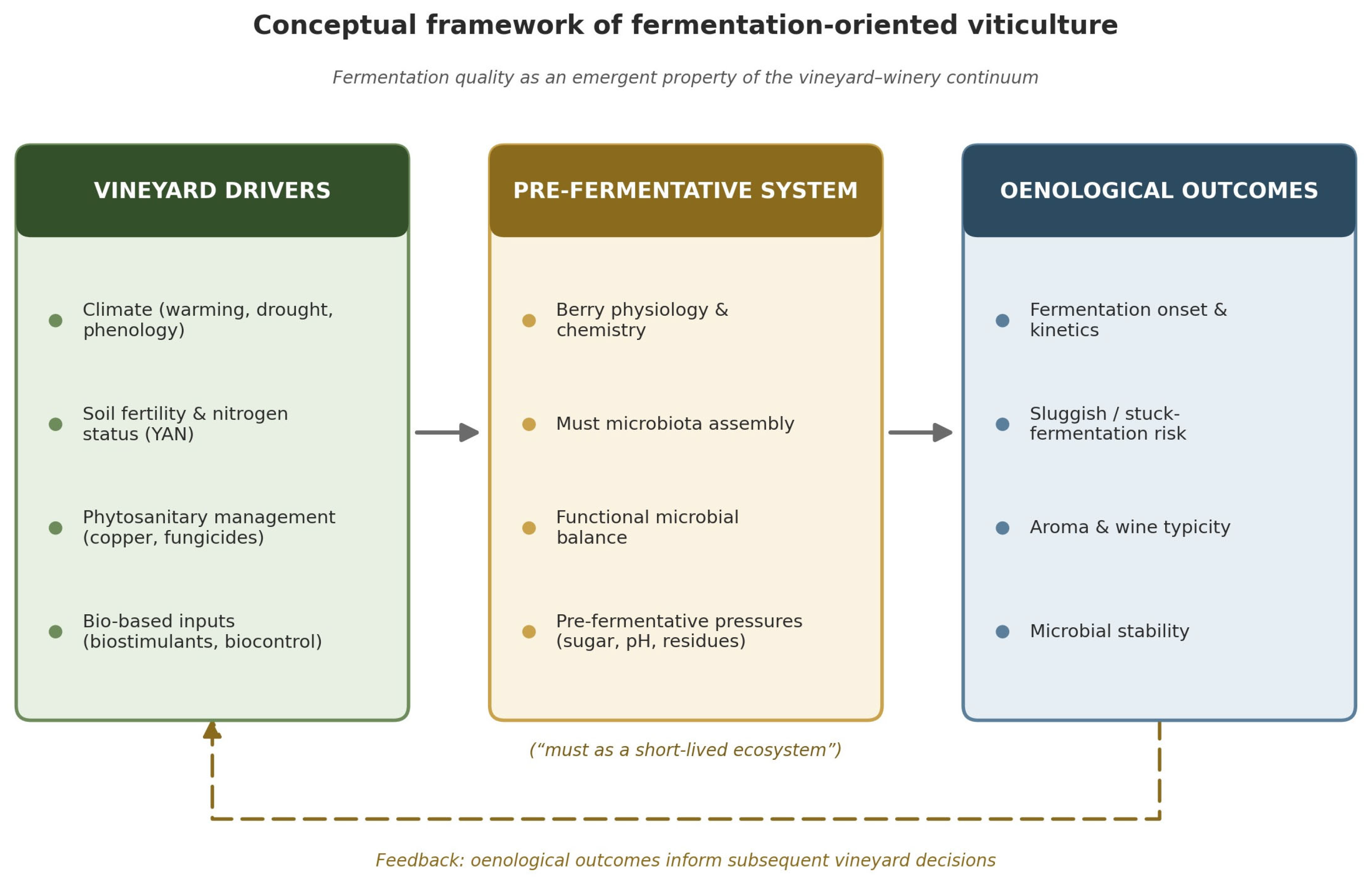
The conceptual framework proposed in this review links vineyard-level drivers with pre-fermentative states and downstream oenological outcomes (
Figure 1). It emphasizes that fermentation quality should be understood as an emergent property of the viticultural ecosystem, resulting from interactions among environmental conditions, agronomic decisions, berry physiology, nutrient status and microbial community structure. Such a framework may support more integrated research designs and more coherent management strategies, especially under climate change, where grape composition, microbial ecology and fermentation reliability are increasingly exposed to combined abiotic and biotic pressures.
4. Vineyard Drivers and Fermentation-Relevant Implications
4.1. Soil Fertility, Nitrogen and Biofertility Strategies
Soil fertility simultaneously influences soil microbiota, vine nutritional status and must composition. Among nutrients, nitrogen is particularly important because it links agronomic management with fermentative performance. Classical and contemporary reviews show that nitrogen deficiency and excess can both be problematic: deficiency favors slow, incomplete or sulfur-defect-prone fermentations, whereas excessive fertilization can increase vegetative vigor, reduce resource-use efficiency and fail to produce a balanced fermentative profile [
25,
26].
YAN is a key bridge indicator between the vineyard and winery. It reflects the fraction of nitrogen available for yeast metabolism, affecting biomass formation, fermentation rate, volatile production and the probability of completion [
27]. Recent field evidence also shows that nitrogen source, timing and application method can modify YAN and amino-acid composition in must; a three-year ‘Riesling’ study, for example, confirmed that vineyard nitrogen fertilization strategy can influence the fermentative potential of the grape substrate [
28]. In fermentation-oriented viticulture, YAN should therefore be treated not merely as a cellar correction parameter, but as an agronomic-oenological indicator. As a practical reference value, musts with YAN below approximately 140 mg N/L are widely associated with an increased risk of slow or incomplete fermentation, whereas concentrations above this level generally support more reliable fermentation kinetics [
25]. This threshold provides a concrete, measurable target that links a vineyard-level decision, namely the nitrogen fertilization strategy, to a defined oenological endpoint, although the exact value remains dependent on yeast strain, sugar concentration and fermentation temperature.
Beyond mineral fertilization, cover crops, compost, organic matter management and regenerative practices are increasingly discussed as strategies for soil health, biodiversity and resilience. Systematic reviews indicate that cover crops can improve soil organic carbon, aggregate stability, infiltration and biodiversity, although effects depend strongly on pedoclimatic context, species selection and vineyard objectives [
35,
36,
37]. These practices may influence must microbiota indirectly through soil structure, water balance, nutrient cycling and canopy condition, but direct causal evidence linking cover crops to reproducible fermentative outcomes remains limited.
Biofertility approaches, including plant growth-promoting rhizobacteria (PGPR), microbial consortia, arbuscular mycorrhizal fungi (AMF), humic substances and biostimulants, are promising under climate stress [
18,
19,
38,
39]. AMF can improve grapevine drought responses under controlled conditions [
40], and regenerative viticulture frames these practices within the broader soil and biodiversity restoration [
20]. However, fermentation-oriented viticulture requires that such interventions be evaluated not only by vigor, stress tolerance or yield, but also by effects on must chemistry, microbial community structure and fermentation reliability.
4.2. Climate Change as a Driver of Must Composition and Microbial Ecology
Climate change affects fermentation indirectly because it first modifies the vineyard system. Warming, altered precipitation, increased drought and heatwave frequency, and changes in radiation and humidity affect grape phenology, yield, sugar accumulation, acidity, phenolic development and disease pressure [
14,
15]. These changes are important for fermentation because they modify the substrate entering the cellar: sugar concentration, organic-acid balance, pH, nitrogen-to-sugar relationships, berry integrity and susceptibility to dehydration or pathogen damage. A must with higher sugar, lower acidity, altered amino-acid balance and a different microbial inoculum is a different fermentation ecosystem, even if the same cellar protocol is applied.
In Eastern Europe, the recent literature emphasizes water stress, irregular precipitation and the need for intelligent irrigation and water-management strategies [
16]. The Oltenia case is especially useful as a regional example because climate-suitability indices for 1961–2020 indicate changes in the spatial distribution of areas suitable for different wine profiles and highlight the risk that southern parts of the region become excessively warm for some traditional production profiles [
17]. Although this review is not a regional case study, Romania illustrates why fermentation-oriented viticulture is relevant beyond the Mediterranean core of climate change viticulture research.
The effect of climate on microbiota should not be interpreted deterministically. Climate change does not directly produce a single “warm-climate microbiota”; rather, it rearranges a set of ecological and agronomic constraints. Phenology shifts, disease pressure changes, treatment number and timing are modified, cultivars and rootstocks may be replaced, and adaptation practices, such as irrigation, shading or canopy management, generate new microhabitats. Therefore, climate affects must microbiota both directly, by changing microbial habitats, and indirectly, by changing management decisions.
The main vineyard drivers discussed above are summarized in
Table 4.
These links show why vineyard variables should be evaluated together rather than as isolated agronomic factors.
5. Crop Protection and Bio-Based Inputs
5.1. Crop Protection: From Copper and Conventional Fungicides to Fermentation Compatibility
Crop protection is one of the clearest points at which the difference between a strictly disease-control-oriented viticulture and fermentation-oriented viticulture becomes visible. Copper compounds have played an essential role in viticulture, but their use in the European Union is limited to a maximum of 28 kg Cu ha
−1 over seven years, corresponding to an average of 4 kg Cu ha
−1 year
−1 [
29]. These restrictions reflect concerns related to soil accumulation, persistence and effects on non-target organisms. From the perspective of fermentation-relevant microbiota, the critical question is not only residue presence, but also how repeated treatments modify microbial balance on leaves and berries.
The literature on fungicides and grape microbiota is not uniform. Reviews on pesticides and winemaking emphasize the diversity of active substances, residue dynamics and alternatives available to viticulture [
21]. Empirical studies show that fungicide effects on yeast and fungal communities associated with grapes are real but context dependent. Some work found that fungicides have only minor effects after safety intervals compared with weather and sampling effects [
30], whereas other studies observed significant effects of farming system, copper-based treatments or chemical fungicides on epiphytic yeasts and wine-associated microbial diversity [
31,
32,
33].
Biocontrol and alternative strategies add further complexity. Seasonal monitoring under biocontrol and copper fungicide treatments showed that microbial dynamics vary across time and treatment context [
34]. Comparisons of conventional and biodynamic management found differences in soil, bark and fruit fungal communities, but not necessarily a direct translation into juice diversity or final wine aroma [
42]. These results support a cautious conclusion: plant protection matters, but its effect on fermentation must be assessed through the full causal chain—treatment program, residue profile, berry health, microbial diversity, must composition and fermentative outcome—rather than inferred from isolated shifts in epiphytic communities.
5.2. Bio-Based Solutions: Advantages, Limits and Oenological Evaluation
Bio-based solutions in viticulture include biological control agents, biostimulants, PGPR, AMF, seaweed extracts, humic substances and native or selected microorganisms with antagonistic or resilience-enhancing functions [
18,
19,
38,
39]. Their theoretical advantage for fermentation-oriented viticulture lies in reducing chemical pressure, supporting plant resilience and potentially maintaining microbial interactions closer to the local ecology of the vineyard. Native berry yeasts are particularly interesting because the same ecological reservoir can be relevant for disease suppression and for early fermentation dynamics [
41].
However, “bio-based” should not be equated automatically with “oenologically beneficial”. Field efficacy is variable and depends on climate, disease pressure, phenological stage, formulation quality, application timing and compatibility with other treatments. Moreover, microbial or biochemical inputs can shift community structure without a predictable effect on fermentation. For this reason, bio-based products should be evaluated with the same rigor as conventional treatments, but using broader endpoints: disease suppression, berry integrity, residue profile, YAN, must microbiota, spoilage taxa, fermentation kinetics and sensory consequences.
The main crop-protection and bio-based strategies are compared in
Table 5.
The comparison highlights that both conventional and bio-based inputs require evaluation against downstream oenological performance.
6. Network Assembly of Fermentative Microbiota: Beyond a Linear Soil–Must Model
One risk in the interpretation of microbial terroir is reductionism: the assumption that must microbiota derives simply and linearly from soil or intact grapes. Current evidence contradicts this simplification.
Saccharomyces cerevisiae, although central to alcoholic fermentation, is rare on intact grapes and does not normally appear to be a stable resident of the grape-skin environment [
43]. Early fermentation stages are often dominated by non-
Saccharomyces yeasts and other microorganisms transferred from multiple sources, including berries, equipment, winery surfaces, insects and air [
6,
8,
44].
At the same time, the microbial dimension of terroir is supported by increasingly robust datasets. A global survey of vineyard soils described microbial biogeographical patterns and showed that vineyard soil microbiomes contain a geographically structured component [
45]. Studies on spontaneous fermentation and volatilome further indicate that geography, subregion and variety can jointly influence grape epidermis microbiota and volatile aroma profiles [
46], and combined omics approaches can identify microbial niches correlated with specific volatile compounds [
47]. Experimental reconstitution of fermentations with grape-specific native microbial communities also supports the idea that native microbiota can shape volatile profiles in fermenting juices [
48].
These findings are complemented by recent reviews on indigenous non-
Saccharomyces yeasts, functional metagenomics and winery microbiota [
22,
23,
24]. Therefore, fermentation-oriented viticulture should not idealize wild fermentation as a direct expression of soil. Instead, it should define the conditions under which a vineyard lot carries a microbiological and chemical profile compatible with a desired fermentation strategy. This includes recognizing that winery microbiota can amplify, filter or overwrite vineyard signals.
7. Operationalization in Research and Practice
7.1. Fermentation-Relevant Endpoints
For fermentation-oriented viticulture to become more than a conceptual expression, it must be translated into measurable indicators. Classical viticultural indicators—yield, sugar concentration, total acidity, pH and sanitary status—remain indispensable. However, they are insufficient for assessing whether a lot is biologically and chemically prepared for a given fermentation strategy.
Table 6 defines a set of fermentation-relevant endpoints that can connect vineyard observations with winery decisions.
These endpoints provide the measurable basis for the practical matrix developed below.
7.2. Practical Decision Matrix
The practical value of the framework is that it can inform decisions before and immediately after harvest.
Table 7 proposes a decision matrix linking pre-harvest or harvest signals with fermentation risks and possible management responses. The matrix is not a universal prescription; it should be adapted to cultivar, region, wine style and cellar protocol.
To illustrate how the matrix operates, consider a representative warm-vintage scenario. A red-wine lot is harvested at high sugar, for example, around 250 g/L of fermentable sugars, corresponding to a potential alcohol close to 14.5%
v/
v, but with a measured must YAN of about 110 mg N/L, that is, below the indicative 140 mg N/L threshold [
25]. Following the matrix logic, the combination of high sugar and low YAN flags a high risk of sluggish or stuck fermentation. The corresponding response is not a single cellar correction but a coordinated set of measures: confirming the diagnosis through must analysis, adjusting the harvest date in subsequent vintages to balance sugar accumulation against nitrogen status, and, where permitted, supplementing nitrogen at appropriate fermentation stages while selecting a robust yeast strain. This worked example shows that the framework translates two routinely measured parameters, sugar concentration and YAN, into an explicit and testable management decision rather than a qualitative recommendation.
The matrix should be interpreted as a flexible guide for linking vineyard observations with winery choices.
7.3. Indicators for Classical and Fermentation-Oriented Viticulture
Table 8 contrasts conventional viticultural indicators with indicators proposed for fermentation-oriented viticulture.
Together, these indicators translate the concept into variables that can be monitored across seasons and production lots.
8. Implications for Romanian and Eastern European Viticulture
For Romania and other Eastern European wine regions, the proposed framework has both scientific and practical value. Climate change already requires reconsideration of cultivar choice, harvest timing, water management, canopy management and plant-protection strategies [
16,
17]. These changes may alter the microbial ecosystems involved in local typicity, spontaneous fermentation and the relationship between raw material and wine style. Fermentation-oriented viticulture provides a bridge between climate adaptation and the preservation or redesign of regional oenological identity. As elsewhere in this review, the term “Eastern Europe” is used here as a geographic and viticultural descriptor denoting a shared climatic and wine-growing context, and not as a geopolitical category.
Oltenia can be considered a relevant case example, but not the exclusive focus of the concept. Its climate trends illustrate why future oenology cannot depend only on corrections applied after harvest. A strategic direction for Romanian viticulture would be the construction of integrated datasets combining climate series, soil properties, fertilization programs, YAN, berry and must microbiota, plant-protection schedules and microvinification outcomes. Without such datasets, discussions on terroir, typicity and adaptation remain incomplete.
9. Research Agenda and Future Directions
The current state of knowledge allows a precise research agenda to be formulated. First, longitudinal, multi-vintage studies are needed rather than taxonomic snapshots from a single harvest. Second, correlations between microbiota and volatile compounds should be complemented by controlled microvinification experiments and functional approaches, including shotgun metagenomics, transcriptomics, culturomics and network analyses [
23,
47,
49]. Third, agronomic metadata should be integrated systematically: fertilization, treatments, water management, canopy management, harvest date, berry health, must chemistry and cellar protocol.
At an applied level, fermentation-oriented viticulture should propose new indicators, not only new narratives. Alongside traditional indicators, such as yield, sugar, total acidity, pH and sanitary status, vineyards should increasingly monitor a set of fermentation-relevant parameters. These include must YAN, the microbiological profile of berries and must at harvest, spoilage-risk taxa, the conservation of beneficial native yeasts, the compatibility of treatments with spontaneous fermentation, and the match between the raw-material microbiota and the intended inoculation or nutrition strategy. Studies on grape-associated yeasts and spontaneous fermentations show that capturing local microbial resources remains relevant for both typicity and controlled innovation [
22,
50].
This paradigm has practical value. It may help producers decide whether a lot is suitable for spontaneous fermentation, whether it requires nutritional adjustment, whether rapid inoculation is advisable, or whether a plant-protection program unintentionally compromises the microbial diversity later invoked as an expression of terroir. The practical stake of this review is therefore the relocation of fermentation microbiology from a technological consequence to an agronomic design criterion.
10. Limitations
The first limitation of this manuscript derives from its methodological design. It is a narrative, not a systematic or scoping review. Although the search strategy was explicit and structured, formal PRISMA-type exhaustiveness was not pursued, database hit numbers were not used as a quantitative inclusion metric and no methodological quality score was applied to each included study. The conclusions therefore have the value of critical synthesis and conceptual proposal rather than quantitative aggregation of effects.
A second limitation concerns literature heterogeneity. Available studies differ markedly in geographical scale, analyzed compartment (soil, rhizosphere, leaf, berry, must, wine or winery), method (culture-based assays, amplicon sequencing, metagenomics, metabolomics or microvinification), management type and reported indicators. This heterogeneity makes it difficult to trace a simple causal relationship between an agronomic factor and a specific fermentative outcome. In many cases, the literature provides robust associations but incomplete experimental demonstrations.
A third limitation concerns microbial terroir itself. Although there is consistent evidence that microbiota is spatially structured and that some communities are associated with differences in volatile profile or typicity, it remains difficult to separate the vineyard contribution from winery effects and from confounding by vintage, cultivar, management and vinification technology. Likewise, evidence on the direct and reproducible effect of bio-based solutions on must microbiota and fermentative performance remains insufficient for universal recommendations. The proposed framework should therefore be considered a working matrix that requires validation through prospective, integrated studies.
11. Conclusions
The literature reviewed here supports a necessary paradigm shift in the interpretation of wine fermentation: fermentation should not be viewed exclusively as a technologically controlled winery process, but as the final outcome of an agroecological continuum that begins in the vineyard. Climate change, soil properties, nutritional management, plant-protection strategies and the use of bio-based inputs influence not only grapevine physiology and grape composition, but also the ecological conditions that select berry- and must-associated microbiota. In this context, fermentation quality can no longer be explained only through starter selection, nutrient corrections or control of technological parameters; it must be understood as an integrated expression of the interaction among environment, agronomic practice and microbial communities relevant to fermentation.
The main contribution of this review lies in consolidating fermentation-oriented viticulture into an explicit and integrative framework, in which vineyard decisions are also evaluated through their downstream effects on must microbiota, YAN, fermentation kinetics and the final expression of wine typicity. From this perspective, the vineyard is not merely the site where raw material is produced, but the first level at which fermentative potential and wine quality are constructed. This framework offers an integrative basis for adapting viticulture to climate change, reducing dependence on late corrective interventions in the winery and developing production systems that are more resilient, biologically efficient and oenologically coherent.
The main contribution of this review is therefore twofold. Scientifically, it reformulates fermentation as an emergent property of the viticultural system. Practically, it proposes indicators and decision points through which growers and winemakers can connect climate adaptation, soil fertility, crop protection and bio-based innovation with fermentation reliability and typicity. Future research should validate this framework through multi-vintage datasets that integrate climatic, edaphic, microbiological and oenological variables into a predictive ecology of fermentation.
Author Contributions
Conceptualization, E.D.C.-C. and A.M.D.; methodology, E.D.C.-C. and A.M.D.; software, not applicable; validation, E.D.C.-C., A.M.D. and G.-D.B.; formal analysis, E.D.C.-C. and G.-D.B.; investigation, E.D.C.-C., A.M.D. and G.-D.B.; resources, A.M.D. and G.-D.B.; data curation, E.D.C.-C.; writing—original draft preparation, E.D.C.-C.; writing—review and editing, E.D.C.-C., A.M.D. and G.-D.B.; visualization, E.D.C.-C.; supervision, A.M.D. and G.-D.B.; project administration, A.M.D.; funding acquisition, not applicable. All authors have read and agreed to the published version of the manuscript.
Funding
The publication fee was supported by the University of Craiova, Romania.
Institutional Review Board Statement
Not applicable.
Data Availability Statement
No new data were created or analyzed in this study. Data sharing is not applicable to this article.
Acknowledgments
The authors acknowledge the institutional support provided during the preparation of this manuscript.
Conflicts of Interest
The authors declare no conflicts of interest.
Abbreviations
The following abbreviations are used in this manuscript:
| AMF | Arbuscular mycorrhizal fungi |
| Cu | Copper |
| EU | European Union |
| PGPR | Plant growth-promoting rhizobacteria |
| YAN | Yeast-assimilable nitrogen |
References
- Van Leeuwen, C.; Seguin, G. The concept of terroir in viticulture. J. Wine Res. 2006, 17, 1–10. [Google Scholar] [CrossRef]
- Gilbert, J.A.; van der Lelie, D.; Zarraonaindia, I. Microbial terroir for wine grapes. Proc. Natl. Acad. Sci. USA 2014, 111, 5–6. [Google Scholar] [CrossRef] [PubMed]
- Bokulich, N.A.; Thorngate, J.H.; Richardson, P.M.; Mills, D.A. Microbial biogeography of wine grapes is conditioned by cultivar, vintage, and climate. Proc. Natl. Acad. Sci. USA 2014, 111, E139–E148. [Google Scholar] [CrossRef] [PubMed]
- Bokulich, N.A.; Collins, T.S.; Masarweh, C.; Allen, G.; Heymann, H.; Ebeler, S.E.; Mills, D.A. Associations among wine grape microbiome, metabolome, and fermentation behavior suggest microbial contribution to regional wine characteristics. mBio 2016, 7, e00631-16. [Google Scholar] [CrossRef]
- Zarraonaindia, I.; Owens, S.M.; Weisenhorn, P.; West, K.; Hampton-Marcell, J.; Lax, S.; Bokulich, N.A.; Mills, D.A.; Martin, G.; Taghavi, S.; et al. The soil microbiome influences grapevine-associated microbiota. mBio 2015, 6, e02527-14. [Google Scholar] [CrossRef]
- Barata, A.; Malfeito-Ferreira, M.; Loureiro, V. The microbial ecology of wine grape berries. Int. J. Food Microbiol. 2012, 153, 243–259. [Google Scholar] [CrossRef]
- Morgan, H.H.; du Toit, M.; Setati, M.E. The grapevine and wine microbiome: Insights from high-throughput amplicon sequencing. Front. Microbiol. 2017, 8, 820. [Google Scholar] [CrossRef]
- Liu, D.; Zhang, P.; Chen, D.; Howell, K. From the vineyard to the winery: How microbial ecology drives regional distinctiveness of wine. Front. Microbiol. 2019, 10, 2679. [Google Scholar] [CrossRef]
- Belda, I.; Zarraonaindia, I.; Perisin, M.; Palacios, A.; Acedo, A. From vineyard soil to wine fermentation: Microbiome approximations to explain the “terroir” concept. Front. Microbiol. 2017, 8, 821. [Google Scholar] [CrossRef]
- Minerdi, D.; Sabbatini, P. Exploring the grapevine microbiome: Insights into the microbial ecosystem of grape berries. Microorganisms 2025, 13, 438. [Google Scholar] [CrossRef]
- Franco, G.C.; Leiva, J.; Nand, S.; Lee, D.M.; Hajkowski, M.; Dick, K.; Withers, B.; Soto, L.; Mingoa, B.-R.; Acholonu, M.; et al. Soil microbial communities and wine terroir: Research gaps and data needs. Foods 2024, 13, 2475. [Google Scholar] [CrossRef]
- Silva, V.; Brito, I.; Alexandre, A. The vineyard microbiome: How climate and the main edaphic factors shape microbial communities. Microorganisms 2025, 13, 1092. [Google Scholar] [CrossRef]
- García-Izquierdo, I.; Colino-Rabanal, V.J.; Tamame, M.; Rodríguez-López, F. Microbiota ecosystem services in vineyards and wine: A review. Agronomy 2024, 14, 131. [Google Scholar] [CrossRef]
- van Leeuwen, C.; Sgubin, G.; Bois, B.; Ollat, N.; Swingedouw, D.; Zito, S.; Gambetta, G.A. Climate change impacts and adaptations of wine production. Nat. Rev. Earth Environ. 2024, 5, 258–275. [Google Scholar] [CrossRef]
- Baltazar, M.; Castro, I.; Gonçalves, B. Adaptation to climate change in viticulture: The role of varietal selection—A review. Plants 2025, 14, 104. [Google Scholar] [CrossRef] [PubMed]
- Florea, A.C.; Sumedrea, D.I.; Rodino, S.; Ion, M.; Dragomir, V.; Dumitru, A.-M.; Pîrcalabu, L.; Dinu, D.G. The impact of climate change on Eastern European viticulture: A review of smart irrigation and water management strategies. Horticulturae 2025, 11, 1282. [Google Scholar] [CrossRef]
- Licurici, M.; Vlăduț, A.Ș.; Burada, C.D. A study of observed climate change effects on grapevine suitability in Oltenia (Romania). Horticulturae 2025, 11, 591. [Google Scholar] [CrossRef]
- Jindo, K.; Goron, T.L.; Pizarro-Tobías, P.; Sánchez-Monedero, M.Á.; Audette, Y.; Deolu-Ajayi, A.O.; van der Werf, A.; Goitom Teklu, M.; Shenker, M.; Pombo Sudré, C.; et al. Application of biostimulant products and biological control agents in sustainable viticulture: A review. Front. Plant Sci. 2022, 13, 932311. [Google Scholar] [CrossRef] [PubMed]
- Cataldo, E.; Fucile, M.; Mattii, G.B. Biostimulants in viticulture: A sustainable approach against biotic and abiotic stresses. Plants 2022, 11, 162. [Google Scholar] [CrossRef] [PubMed]
- O’Brien, F.; Nesbitt, A.; Sykes, R.; Kemp, B. Regenerative viticulture and climate change resilience. OENO One 2025, 59, 1. [Google Scholar] [CrossRef]
- Martín-García, B.; Longo, E.; Ceci, A.T.; Pii, Y.; Romero-González, R.; Garrido Frenich, A.; Boselli, E. Pesticides and winemaking: A comprehensive review of conventional and emerging approaches. Compr. Rev. Food Sci. Food Saf. 2024, 23, e13419. [Google Scholar] [CrossRef]
- Mikhailenko, D.O.; Gorovtsov, A.V.; Chistyakov, V.A.; Onasenko, K.A.; Sedova, V.V. Towards the microbial terroir and mixed starter cultures: The role of indigenous non-Saccharomyces yeasts in modern winemaking. Food Res. Int. 2025, 220, 117038. [Google Scholar] [CrossRef]
- Di Gianvito, P.; Englezos, V.; Ferrocino, I.; Cocolin, L.; Rantsiou, K. Survey of a grapevine microbiome through functional metagenomics. Food Res. Int. 2025, 219, 117000. [Google Scholar] [CrossRef]
- Aires, C.; Maioto, R.; Inês, A.; Dias, A.A.; Rodrigues, P.; Egas, C.; Sampaio, A. Microbiome and microbiota within wineries: A review. Microorganisms 2025, 13, 538. [Google Scholar] [CrossRef] [PubMed]
- Bell, S.-J.; Henschke, P.A. Implications of nitrogen nutrition for grapes, fermentation and wine. Aust. J. Grape Wine Res. 2005, 11, 242–295. [Google Scholar] [CrossRef]
- Verdenal, T.; Dienes-Nagy, Á.; Spangenberg, J.E.; Zufferey, V.; Spring, J.-L.; Viret, O.; Marin-Carbonne, J.; van Leeuwen, C. Understanding and managing nitrogen nutrition in grapevine: A review. OENO One 2021, 55, 1–44. [Google Scholar] [CrossRef]
- Petrovic, G.; Aleixandre-Tudo, J.-L.; Buica, A. Unravelling the complexities of wine: A big data approach to yeast assimilable nitrogen using infrared spectroscopy and chemometrics. OENO One 2019, 53, 107–127. [Google Scholar] [CrossRef]
- Göttmann, J.; Kunz, R.; Dries, L.; Löhnertz, O.; Geilfus, C.-M. Evaluation of the impact of different nitrogen fertilisation forms and techniques on yeast-assimilable nitrogen (YAN) in Vitis vinifera L. cv. Riesling: A three-year field study. OENO One 2026, 60, 1. [Google Scholar] [CrossRef]
- European Commission. Commission Implementing Regulation (EU) 2018/1981 of 13 December 2018 renewing the approval of active substances copper compounds as candidates for substitution. Off. J. Eur. Union 2018, L317, 16–20. [Google Scholar]
- Čadež, N.; Zupan, J.; Raspor, P. The effect of fungicides on yeast communities associated with grape berries. FEMS Yeast Res. 2010, 10, 619–630. [Google Scholar] [CrossRef]
- Martins, G.; Vallance, J.; Mercier, A.; Albertin, W.; Stamatopoulos, P.; Rey, P.; Lonvaud, A.; Masneuf-Pomarède, I. Influence of the farming system on the epiphytic yeasts and yeast-like fungi colonizing grape berries during the ripening process. Int. J. Food Microbiol. 2014, 177, 21–28. [Google Scholar] [CrossRef] [PubMed]
- Escribano-Viana, R.; López-Alfaro, I.; López, R.; Santamaría, P.; Gutiérrez, A.R.; González-Arenzana, L. Impact of chemical and biological fungicides applied to grapevine on grape biofilm, must, and wine microbial diversity. Front. Microbiol. 2018, 9, 59. [Google Scholar] [CrossRef]
- Agarbati, A.; Canonico, L.; Mancabelli, L.; Milani, C.; Ventura, M.; Ciani, M.; Comitini, F. The influence of fungicide treatments on mycobiota of grapes and its evolution during fermentation evaluated by metagenomic and culture-dependent methods. Microorganisms 2019, 7, 114. [Google Scholar] [CrossRef] [PubMed]
- Gobbi, A.; Kyrkou, I.; Filippi, E.; Ellegaard-Jensen, L.; Hansen, L.H. Seasonal epiphytic microbial dynamics on grapevine leaves under biocontrol and copper fungicide treatments. Sci. Rep. 2020, 10, 681. [Google Scholar] [CrossRef]
- Abad, J.; Hermoso de Mendoza, I.; Marín, D.; Orcaray, L.; Santesteban, L.G. Cover crops in viticulture. A systematic review (1): Implications on soil characteristics and biodiversity in vineyard. OENO One 2021, 55, 295–312. [Google Scholar] [CrossRef]
- Abad, J.; Hermoso de Mendoza, I.; Marín, D.; Orcaray, L.; Santesteban, L.G. Cover crops in viticulture. A systematic review (2): Implications on vineyard agronomic performance. OENO One 2021, 55, 1–27. [Google Scholar] [CrossRef]
- Gattullo, C.E.; Mezzapesa, G.N.; Stellacci, A.M.; Ferrara, G.; Occhiogrosso, G.; Petrelli, G.; Castellini, M.; Spagnuolo, M. Cover crop for a sustainable viticulture: Effects on soil properties and table grape production. Agronomy 2020, 10, 1334. [Google Scholar] [CrossRef]
- Andrade, L.A.; Santos, C.H.B.; Frezarin, E.T.; Sales, L.R.; Rigobelo, E.C. Plant growth-promoting rhizobacteria for sustainable agricultural production. Microorganisms 2023, 11, 1088. [Google Scholar] [CrossRef]
- Alzate Zuluaga, M.Y.; Fattorini, R.; Cesco, S.; Pii, Y. Plant–microbe interactions in the rhizosphere for smarter and more sustainable crop fertilization: The case of PGPR-based biofertilizers. Front. Microbiol. 2024, 15, 1440978. [Google Scholar] [CrossRef]
- Ye, Q.; Wang, H.; Li, H. Arbuscular mycorrhizal fungi improve growth, photosynthetic activity, and chlorophyll fluorescence of Vitis vinifera L. cv. Ecolly under drought stress. Agronomy 2022, 12, 1563. [Google Scholar] [CrossRef]
- Ayogu, P.; Martins, V.; Gerós, H. Grape berry native yeast microbiota: Advancing trends in the development of sustainable vineyard pathogen biocontrol strategies. OENO One 2024, 58, 107–130. [Google Scholar] [CrossRef]
- Morrison-Whittle, P.; Lee, S.A.; Goddard, M.R. Fungal communities are differentially affected by conventional and biodynamic agricultural management approaches in vineyard ecosystems. Agric. Ecosyst. Environ. 2017, 246, 306–313. [Google Scholar] [CrossRef]
- Watanabe, D.; Hashimoto, W. Adaptation of yeast Saccharomyces cerevisiae to grape-skin environment. Sci. Rep. 2023, 13, 9279. [Google Scholar] [CrossRef]
- Setati, M.E.; Jacobson, D.; Andong, U.-C.; Bauer, F. The vineyard yeast microbiome, a mixed model microbial map. PLoS ONE 2012, 7, e52609. [Google Scholar] [CrossRef]
- Gobbi, A.; Acedo, A.; Imam, N.; Santini, R.G.; Ortiz-Álvarez, R.; Ellegaard-Jensen, L.; Belda, I.; Hansen, L.H. A global microbiome survey of vineyard soils highlights the microbial dimension of viticultural terroirs. Commun. Biol. 2022, 5, 241. [Google Scholar] [CrossRef] [PubMed]
- Chen, Y.; Lei, X.; Jiang, J.; Qin, Y.; Jiang, L.; Liu, Y.-L. Microbial diversity on grape epidermis and wine volatile aroma in spontaneous fermentation comprehensively driven by geography, subregion, and variety. Int. J. Food Microbiol. 2023, 404, 110315. [Google Scholar] [CrossRef]
- Martins, V.; López, R.; Teixeira, A.; Gerós, H. Combined omics expose microbial niches of fungi and bacteria correlating with wine volatile profiles in Douro wine region. LWT 2024, 193, 115769. [Google Scholar] [CrossRef]
- Raymond Eder, M.L.; Fariña, L.; Carrau, F.; Rosa, A.L. Grape-specific native microbial communities influence the volatile compound profiles in fermenting grape juices. Food Chem. 2025, 466, 142155. [Google Scholar] [CrossRef]
- Alcalá-Jiménez, M.T.; García-Martínez, T.; Mauricio, J.C.; Moreno, J.; Peinado, R.A. Influence of terroir on microbial diversity and wine volatilome. Appl. Sci. 2025, 15, 3237. [Google Scholar] [CrossRef]
- González-Alonso, I.; Walker, M.E.; Vallejo-Pascual, M.E.; Naharro-Carrasco, G.; Jiranek, V. Capturing yeast associated with grapes and spontaneous fermentations of the Negro Saurí minority variety from an experimental vineyard near León. Sci. Rep. 2021, 11, 3748. [Google Scholar] [CrossRef]
| Disclaimer/Publisher’s Note: The statements, opinions and data contained in all publications are solely those of the individual author(s) and contributor(s) and not of MDPI and/or the editor(s). MDPI and/or the editor(s) disclaim responsibility for any injury to people or property resulting from any ideas, methods, instructions or products referred to in the content. |