Systematic Review

Arbuscular Mycorrhizal Fungal Symbiosis Enhances Crop Photosynthetic Traits Under Drought Stress—A Meta-Analysis


1
College of Life and Environmental Science, Wenzhou University, Wenzhou 325035, China
2
Département de Sciences Biologiques, Institut de Recherche en Biologie Végétale, Université de Montréal, Montréal, QC H1X 2B2, Canada
3
African Genome Center, University Mohammed VI Polytechnic (UM6P), Ben Guerir 43150, Morocco
4
Department of Ecology and Evolution, University of Lausanne, 1015 Lausanne, Switzerland
5
State & Local Joint Engineering Research Center for Ecological Treatment Technology of Urban Water Pollution, Wenzhou University, Wenzhou 325035, China
6
Zhejiang Provincial Key Lab for Water Environment and Marine Biological Resources Protection, Wenzhou University, Wenzhou 325035, China
7
The UBC-Soil Group, Tallus Heights, Kelowna, BC V4T 3M2, Canada
*
Author to whom correspondence should be addressed.
Agriculture 2026, 16(11), 1180; https://doi.org/10.3390/agriculture16111180
Submission received: 12 March 2026 / Revised: 24 April 2026 / Accepted: 25 May 2026 / Published: 27 May 2026

Abstract

The benefits of arbuscular mycorrhizal fungi (AMF) in alleviating plant abiotic and biotic stresses have been well documented; however, how AMF modulate photosynthesis-related processes under different drought intensities is poorly understood. This study quantified the impact of different AMF formulations on the photosynthetic traits in different host plant types under different intensities of drought stress. A total of 52 published studies were included in a meta-analysis with a random-effects model. Synthesizing the research findings revealed that, under drought stress, AMF significantly improved plant photosynthetic rates and nutrient absorption, with the strongest effect on phosphorus absorption (the effect size Hedges’ g = 3.85, 95% CI: 2.76–4.95, p < 0.001). Overall, the between-study heterogeneity was moderate to high (I2 = 64.7%, τ2 = 0.38), indicating variability among the included studies. As drought intensity increased, the effect of AMF on the net photosynthetic rate decreased, with the transpiration rate (Tr) and stomatal conductance (Gs) first increasing and then diminishing. Drought intensity exceeding the ‘moderate’ threshold inhibited both Tr and Gs. The AMF effect on chlorophyll content differed among the plant types, with Hedges’ g being 1.656, 2.715, and 3.231 for herbaceous, grass, and woody plants, respectively. Inoculation with multiple AMF species provided greater benefits than single AMF strains in promoting chlorophyll content (Hedges’ g = 1.949 for single vs. 3.217 for mixture) and net photosynthetic rate (Hedges’ g = 2.242 for single vs. 3.986 for mixture). We conclude that the AMF–plant symbiotic association alleviates drought stress by adjusting the net photosynthetic rate, transpiration rate, and stomatal conductance. The magnitude of these responses varies depending on plant functional type, drought intensity, and AM fungal formulation.

1. Introduction

Global climate change has led to increased drought severity [1], and multi-year droughts have become a crucial environmental stressor [2], impacting crop productivity [3]. Many crops respond to droughts through a series of physiological and metabolic adjustments. Stomatal closure reduces water loss through transpiration [4], while reduced CO2 supply lowers net photosynthetic rate (Pn) [5]. Meanwhile, plants and soil lose more water under drought [6], reducing the availability of mineral elements, such as nitrogen, phosphorus, and potassium, which weakens root absorption and inhibits biomass accumulation and leaf area expansion, thereby enhancing plant drought tolerance.
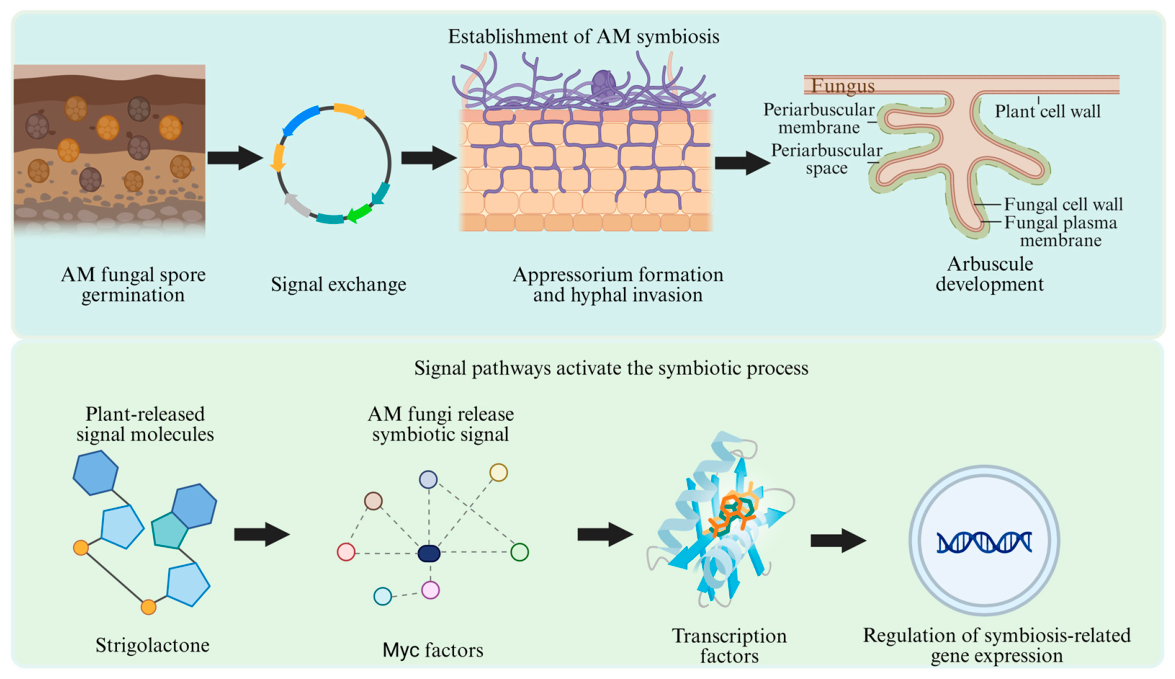
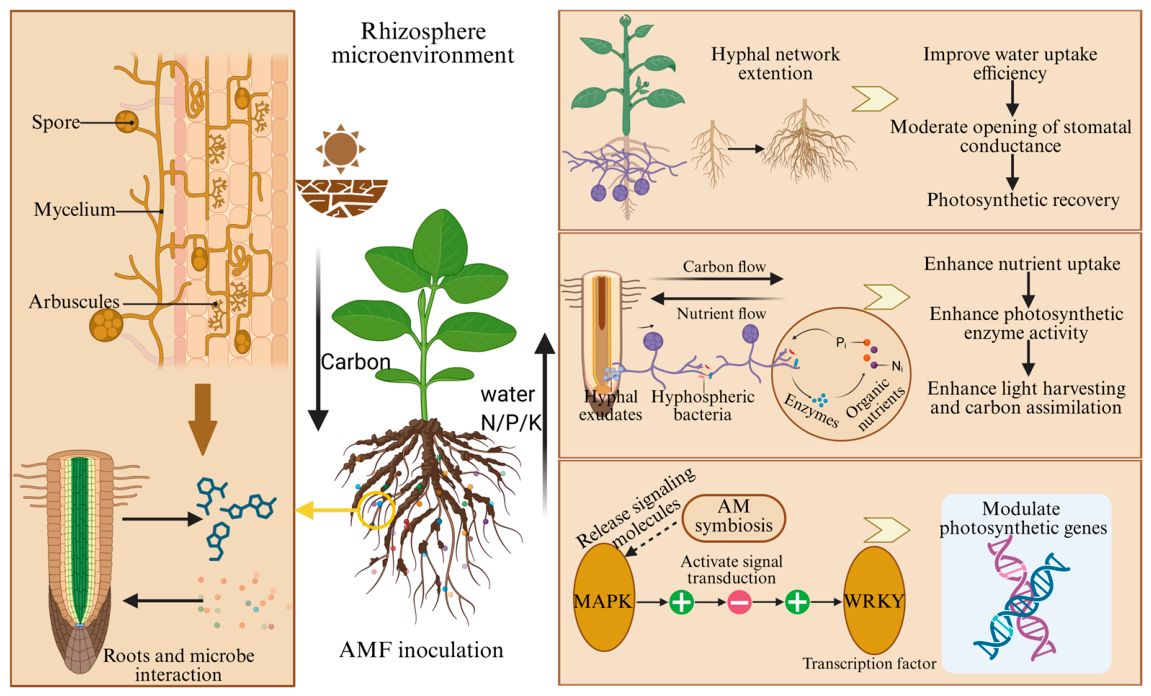
Through long-term evolution, terrestrial plants have developed diverse stress adaptation strategies, such as establishing symbiotic relationships with soil microorganisms. Such symbiotic capacity is a highly conserved evolutionary characteristic shared by most land plants, among which arbuscular mycorrhizal fungi (AMF) symbiosis represents one of the most widespread and ancient associations, occurring in 80% of terrestrial plants [7]. AM fungi colonize plant roots through spore germination, form hyphal branches, and establish intercellular hyphae (Figure 1). The mutually beneficial symbiosis helps plants to alleviate stress through multidimensional interactions [8]. First, after colonizing plant roots, AMF stimulate root hair growth, thereby increasing the root absorption surface area. AMF hyphae have a diameter of only 2–10 μm, allowing them to penetrate soil micropores (diameter < 10 μm) and extend water absorption to areas that are inaccessible to roots, thus expanding the host plant’s water absorption areas [9]. Meanwhile, AMF enable plants to obtain nutrients from a larger volume of soil, thereby enhancing the absorption of those poorly mobilizable nutrient elements. AMF’s phosphorus (P) absorption capacity is particularly prominent: hyphae dissolve soil-insoluble P by secreting acid phosphatase and organic acids, then efficiently transport phosphorus to host plants through specific P transporters (such as GintPT1 and MtPT4), significantly increasing plant phosphorus uptake under drought conditions [10]. Additionally, AMF hyphae can alleviate drought-induced nutrient imbalance by enhancing the transport efficiency of nitrogen (N) and potassium (K).
Second, AMF can alleviate drought-induced cellular damage by inducing host plants to accumulate osmoprotectants and antioxidant enzymes [11]. Under drought conditions, plants inoculated with AMF increase proline and soluble sugar content in leaves. These substances help to maintain cell turgor pressure and reduce protoplast dehydration by lowering cellular osmotic potential. AMF can activate the host plant’s antioxidant system: increasing the activities of superoxide dismutase and catalase, effectively scavenging reactive oxygen species induced by drought, and reducing membrane lipid peroxidation (manifested by decreased malondialdehyde content) [12]. Third, AMF regulate hormone signaling networks, which serve as a core pathway in maintaining plant growth via alleviating stress. AMF can promote auxin (IAA) synthesis and accumulation, which induces lateral root emergence and root hair elongation in host plants, expanding the root absorption area to acquire limited water and nutrients while alleviating the inhibitory effect of abscisic acid (ABA) on stem elongation and maintaining photosynthetic leaf area. During the initial stage of drought stress, AMF moderately activate key enzyme activities involved in host ABA synthesis, promoting ABA accumulation to rapidly close stomata and reduce transpirational water loss. Furthermore, AMF can regulate the levels of jasmonic acid and gibberellin to establish a dynamic balance of stress resistance without growth inhibition through multi-hormone coordination; this is an important physiological basis for AMF to enhance plant adaptability to drought [13].
The benefits that AMF can offer when host plants encounter drought stress have been well documented; however, the physiological mechanisms that are responsible for these beneficial outcomes are poorly understood. Little is known about how the AMF symbiotic association can enhance the photosynthesis–transpiration balance and improve photosynthesis under drought. We hypothesize that (i) host functional type (herbaceous, grass, and woody) acts as a key moderating factor shaping AMF responses; (ii) AMF inoculation type (single vs. multiple species) modulates mycorrhizal performance under drought; and (iii) the intensity of drought stress (such as severe versus low) regulates the outcomes of the AMF effect. To test the above hypotheses, we established the following specific research objectives: 1. Determine the physiological responses of AMF symbiosis in coordinating photosynthesis–transpiration balance under drought stress. 2. Quantify the AMF-induced benefits, changing with host type, AMF inoculation form, and the intensity of drought stress. To fulfil the objectives, we performed a meta-analysis to synthesize effect sizes from independent global studies and reveal the potential factors (e.g., drought intensity, plant type, and AMF inoculum type) driving the AMF responses. The meta-analysis enables a quantitative assessment of AMF responses with robust conclusions.

2. Materials and Methods

2.1. Literature Search and Eligibility Criteria

2.1.1. Search Strategy

A systematic literature search was conducted in the core databases Web of Science and PubMed. The search window was restricted to January 2016–August 2025 to focus on recent contemporary studies that employ modern experimental and analytical methods for AMF drought tolerance research. Earlier foundational studies (pre-2016) were excluded from quantitative synthesis to ensure methodological consistency and relevance to current research practices. The search string was constructed using a combination of keywords and Boolean operators to maximize relevance: (“arbuscular mycorrhizal fungi” OR “AMF” OR “mycorrhiza” OR “mycorrhizal symbiosis”) AND (“drought stress” OR “water stress” OR “drought” OR “water deficit”) AND (“photosynthesis” OR “photosynthetic rate” OR “stomatal conductance” OR “transpiration rate” OR “chlorophyll” OR “nutrient uptake” OR “nitrogen” OR “phosphorus” OR “potassium” OR “biomass” OR “leaf area”). The search was limited to peer-reviewed original research articles (excluding reviews, book chapters, and conference abstracts). Discrepancies in search results were resolved through discussion with a eighth author (G.Y.G.).

2.1.2. Eligibility Criteria

Studies were included if they met all the following predefined criteria (based on the PICO principle: Population (P): Terrestrial plants (herbaceous, graminoid, or woody) grown under field, greenhouse or pot drought conditions. Intervention (I): Inoculation with arbuscular mycorrhizal fungi (single AMF species, mixed AMF species). Comparison (C): Non-inoculated control group (no AMF addition) with identical growth conditions (soil type, drought intensity, temperature, light, etc.) to the intervention group. Outcome (O): At least two measurable plant traits related to growth parameters: aboveground dry weight, leaf area index (LAI); nutrient uptake: nitrogen (N) content, phosphorus (P) content, potassium (K) content (tissue concentration, %); photosynthetic pigments: total chlorophyll content (mg/g FW), carotenoid content (mg/g FW); gas exchange parameters: net photosynthetic rate (Pn, μmol m−2 s−1), transpiration rate (Tr, mmol m−2 s−1), stomatal conductance (Gs, mol m−2 s−1).
The majority of studies meeting our inclusion criteria were conducted under controlled-environment settings (n = 44, 84.6%), with only 8 studies (15.4%) conducted under true field conditions. This distribution reflects the inherent challenge of conducting field-based drought research with AMF inoculation, where precipitation variability, soil heterogeneity, and uncontrollable factors complicate drought intensity quantification. Controlled-environment studies offer critical advantages for mechanistic meta-analyses, including precise soil water content manipulation, elimination of confounding climatic variables, and standardized AMF inoculation protocols, thereby enabling robust effect size estimation for photosynthetic traits under defined drought intensities.

2.1.3. Exclusion Criteria

Studies were excluded if they were reviews, meta-analyses, or theoretical articles (no original experimental data); drought stress was not explicitly defined or manipulated (Some studies imposed drought treatments only qualitatively based on water-withholding days or irrigation amounts without quantifying soil water content. The ambiguous definition of drought intensity prevented a consistent comparison of drought gradients across different experiments; thus, these studies were excluded from the analysis.); no control group was included, or the control group differed in non-AMF factors (e.g., fertilizer application, or soil pH); target outcome variables (photosynthesis-related traits, nutrient uptake, or growth parameters) were not reported; data were incomplete (e.g., missing SD/SE or sample size < 2 replicates per group); duplicate publications (same dataset published in multiple journals) were retained only once (the most comprehensive version was selected). The selection criteria were similar to those employed by peer researchers [14,15].

2.2. Literature Screening and Data Extraction

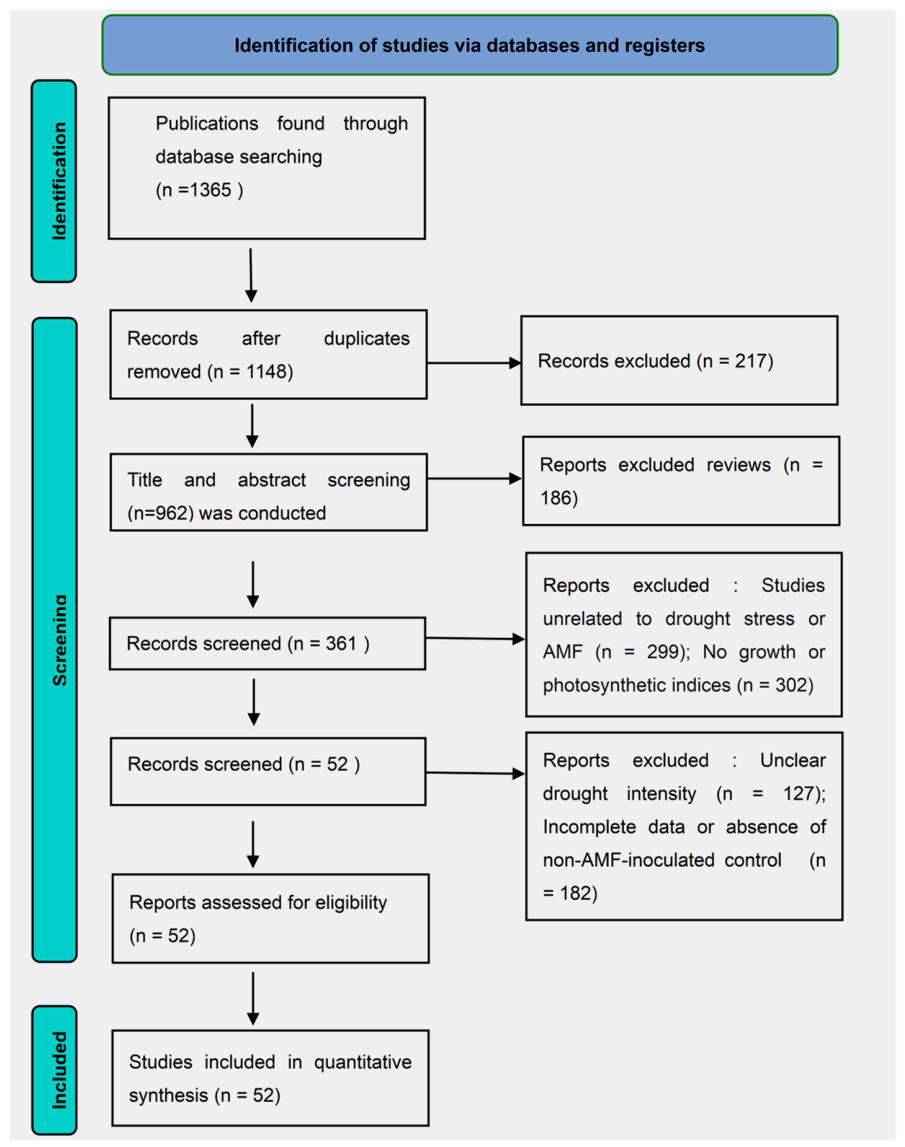
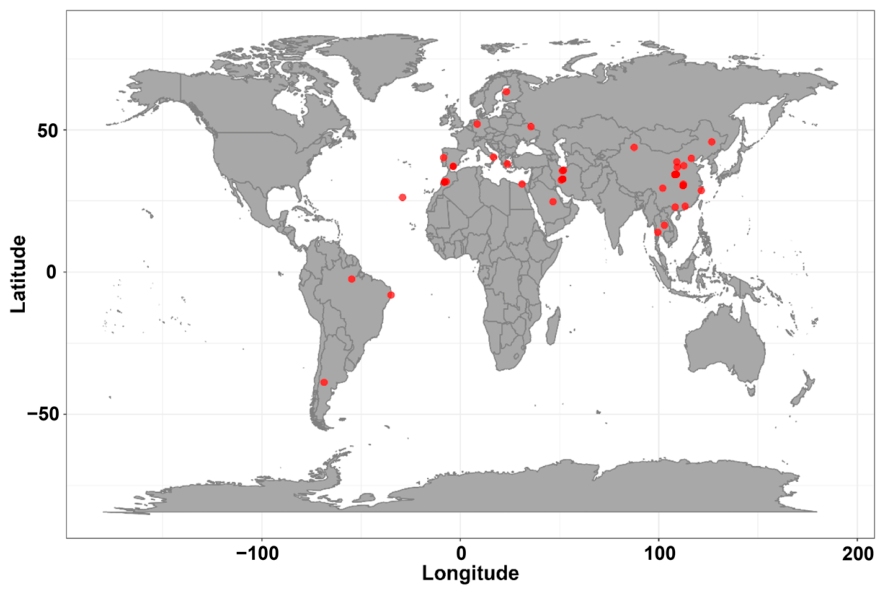
The literature screening process followed the PRISMA 2020 guidelines [16] and was conducted in four stages (Figure 2). Indeed, 1365 studies were retrieved from the two databases, 217 duplicate studies were removed, and the remaining 1148 studies, titles and abstracts were screened to exclude 186 reviews, resulting in 962 studies for full-text assessment. Full texts of 962 studies were evaluated against the inclusion/exclusion criteria. A total of 910 studies were excluded (299 unrelated to AMF/drought, 302 without target outcomes, 127 with unclear drought intensity, 104 with unclear drought methods, and 78 with incomplete data), leaving 52 eligible studies included in the meta-analysis. A global map shows the primary study sites (Figure 3).

Data Extraction Protocol

Two authors independently extracted data, with discrepancies resolved by a eighth author (G.Y.G.). The extracted information included study characteristics: author, publication year, country, experimental setting (field/greenhouse), soil type, plant species, AMF inoculation type (single/mixed), drought stress duration; drought intensity: soil water content (SWC) or field water capacity (FWC) for treatment and control groups; outcome variables: mean values, SD/SE, sample size (n) for AMF-inoculated (treatment) and non-inoculated (control) groups; and covariates: plant functional type, AMF inoculation density, and co-inoculants (if any). For studies reporting SE instead of SD, SD was calculated using the formula: SD = SE × n . For studies reporting 95% CI, SD was derived as: SD = (CI upper − CI lower)/2 × n /1.96 [17].

2.3. Subgroup Classification

Subgroup analyses were conducted to test the moderating effects of the key factors, with classification justifications based on ecological relevance and previous literature as follows. Geographic subgroup analysis was not performed because studies were unevenly distributed across regions, which limited statistical reliability.

2.3.1. Drought Intensity

Drought intensity was classified by field water capacity (FWC) (the standard metric for soil moisture in drought studies: low drought stress: FWC = 60–80% (mild water limitation, plants maintain normal physiological functions); moderate drought stress: FWC = 40–60% (moderate water deficit, plants exhibit stress responses but not severe damage); and high drought stress: FWC = 0–40% (severe water scarcity, plants show significant physiological inhibition). This classification is consistent with previous meta-analyses on plant drought responses [18] and ensures comparability across studies with varying drought manipulation methods.

2.3.2. Plant Functional Type

We categorized plants into three functional types based on growth form and physiology: herbaceous plants are non-woody plants with short life cycles (e.g., crops, forbs, or vegetables); graminoid plants are grass-like plants with narrow leaves and fibrous roots (e.g., wheat, maize, or grasses); and woody plants are perennial plants with woody stems (e.g., trees, shrubs, or seedlings of forest species). This classification reflects differences in root architecture, nutrient demand, and drought adaptation strategies (e.g., C3 vs. C4 photosynthesis in herbaceous vs. graminoid plants), which modulate AMF symbiotic effect.

2.3.3. AMF Inoculation Form

We divided AMF inoculation forms into two categories based on the composition of the inoculum. Single-species inoculation involved a single AM fungal strain. Mixed-species inoculation consisted of two or more AMF species. This classification addresses the functional complementarity (or competition) between AMF strains, which may affect colonization efficiency and symbiotic benefits.

2.4. Statistical Analysis

2.4.1. Effect Size Calculation and Model Selection

The standardized mean difference, as Hedges’ g, was used as the effect size metric, which accounts for small-sample bias. A positive Hedges’ g indicates that AMF inoculation promoted the target trait, while a negative value indicates inhibition. Statistical significance was determined by whether the 95% CI of Hedges’ g overlapped with zero (non-overlap = significant effect, p < 0.05).
We used R software (version 4.4.1) and the metafor package for data analysis, following a method similar to that reported by peer researchers [19,20,21]. A random-effects model was used as it accounts for both within-study sampling error and between-study heterogeneity. This model is preferred for meta-analyses of ecological studies, where variability in experimental conditions (e.g., soil type, plant species, and AMF strain) is expected. The DerSimonian–Laird (DL) estimator was used as the primary method for estimating the between-study variance component (τ2) due to its widespread use and computational simplicity. However, the DL estimator is known to underestimate τ2 in meta-analyses with a small number of studies (e.g., <10 per subgroup). Given that several of our subgroup analyses (e.g., woody plants, mixed-strain inoculations, and severe drought) contain fewer than 10 studies, we conducted a sensitivity analysis using the restricted maximum likelihood (REML) estimator, which reduces small-sample bias and is readily implemented in the metafor package (Viechtbauer, 2010) [22]. REML is generally preferred for random-effects meta-analysis when the number of studies is modest (Langan et al., 2019) [23]. The results of the DL and REML estimators were compared to assess the robustness of our findings to the choice of τ2 estimator (see Supplementary Table S3).

2.4.2. Multi-Factor Network Analysis

A multi-factor correlation network was constructed to explore the interrelationships among plant variables under AMF inoculation. Briefly, the Hedges’ g effect size for each variable was first calculated using the metafor package in R, consistent with the main meta-analysis. Based on the effect sizes across different drought intensities and plant types, a correlation matrix was established using Pearson correlation coefficients.
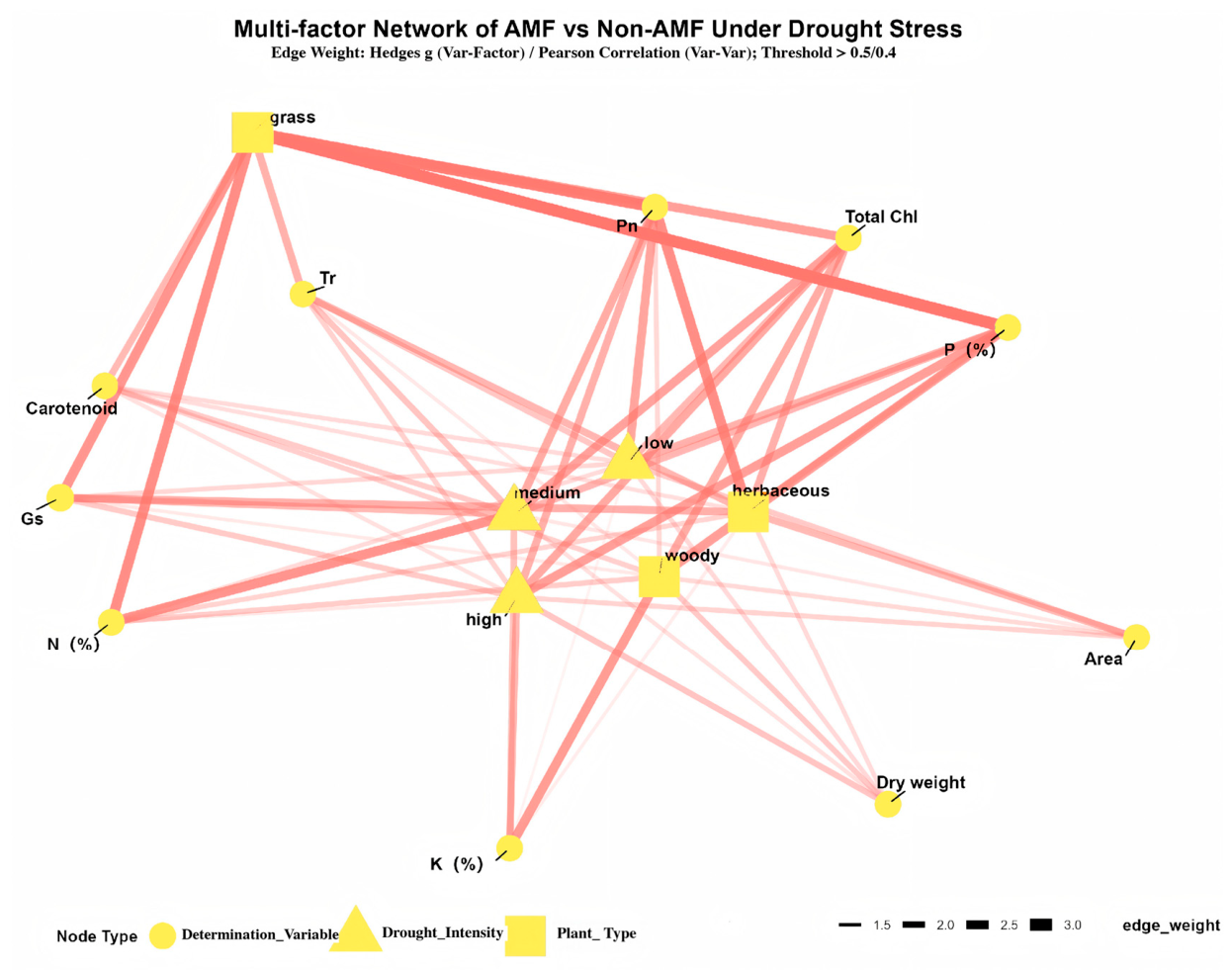
Edge weight and association strength were defined as the absolute value of the Pearson correlation coefficient (|r|). A threshold of |r| > 0.4 was used to filter meaningful connections, which represents a moderate-to-strong correlation commonly used in ecological and physiological studies. The network was visualized using the qgraph package with the spring layout algorithm.

2.4.3. Heterogeneity Assessment and Sensitivity Analysis

Heterogeneity among studies was quantified using two metrics: I2 statistic, which represents the proportion of total variation attributed to between-study heterogeneity (values: 0% = no heterogeneity, 25% = low, 50% = moderate, 75% = high; Higgins et al., 2003) [24]; and Q-test, which tests the null hypothesis of no heterogeneity (p < 0.10 = significant heterogeneity). When heterogeneity was significant (I2 > 50% or Q-test p < 0.10), subgroup analyses were conducted to identify potential moderators (drought intensity, plant type, and inoculation form). Meta-regression was not performed due to the limited number of studies per subgroup (n < 10 for some subgroups), which could reduce statistical power.
Sensitivity analysis was conducted to evaluate the robustness of the results by excluding one study at a time and recalculating the pooled effect size (leave-one-out analysis). We also assessed the impact of low-quality studies (defined as studies with unclear drought manipulation or small sample sizes, n < 3) on the overall effect size. If the direction or significance of the pooled effect size did not change after excluding individual studies, the results were considered robust [21,25].
Additionally, we conducted a moderator analysis comparing effect sizes between field (n = 8) and controlled-environment (n = 44) studies. The results demonstrate that the experimental setting did not alter the direction or significance of AMF effects for any response variable. While net photosynthetic rate (Pn) showed a statistically significant difference in magnitude (field: Hedges’ g = 1.89; controlled: 2.71; Q~between~ = 4.21, p = 0.04), both remained positive and significant, and sensitivity analysis excluding all field studies yielded pooled effect sizes nearly identical to the main analysis. Furthermore, many controlled-environment studies were identified from the literature and included in our study for three key points: (1) the need for precise discrete drought intensity thresholds (low: 60–80% FWC; moderate: 40–60%; high: 0–40%) that field studies rarely achieve; (2) the requirement to eliminate confounding climatic variables to isolate AMF-specific effects; and (3) the mechanistic focus of our meta-analysis, where physiological responses (e.g., aquaporin expression and P transporter activity) are conserved across settings.

3. Results

3.1. Arbuscular Mycorrhizal Fungi (AMF) Symbiosis Enhanced Plant Morphological and Physiological Traits Under Drought Stress

The random-effects model revealed moderate to substantial between-study heterogeneity for most outcome variables. For example, the between-study variance (τ2) for net photosynthetic rate was 0.52 (I2 = 58.3%, Q = 187.4, df = 78, p < 0.001), while, for stomatal conductance, τ2 was 0.31 (I2 = 64.7%, Q = 302.6, df = 107, p < 0.001). These statistics indicate that a meaningful proportion of the total variance is attributable to true differences among studies rather than sampling error.
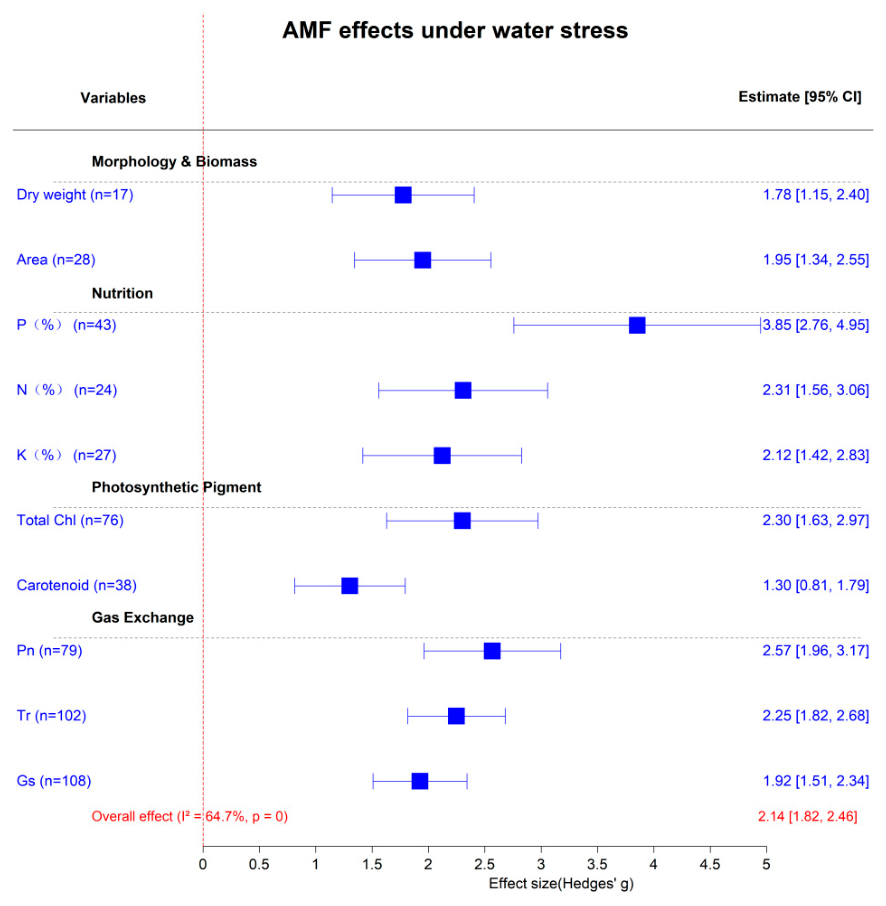
Plants inoculated with AMF significantly increased aboveground biomass with the pooled effect size (standardized mean difference) of Hedges’ g = 1.78 [95% confidence interval (CI): 1.15, 2.40; n = 17 independent studies; p < 0.0001) (Figure 4). AMF inoculation significantly alleviated the inhibitory effect of drought stress on plant leaf area with the pooled effect size of Hedges’ g = 1.95 (CI: 1.34, 2.55; n = 28; p < 0.0001). Under drought stress, AMF had the most significant promoting effect on plant P uptake, with 43 independent effect sizes included, and the pooled effect size was Hedges’ g = 3.85 (CI: 2.76, 4.95; p < 0.0001); similar to the P uptake effect, AMF inoculation enhanced plant N (Hedges’ g = 2.31; CI: 1.56, 3.06; n = 24; p < 0.0001) and K (Hedges’ g = 2.12; CI: 1.42, 2.83; n = 27; p < 0.0001) uptakes.
Inoculation with AMF significantly increased plant chlorophyll content (Hedges’ g = 2.30, CI: 1.63, 2.97; n = 76; p < 0.0001) and carotenoid content (Hedges’ g = 1.30, CI: 0.81, 1.79; n = 38; p < 0.0001) (Figure 4). Gas exchange, the net photosynthetic rate (Hedges’ g = 2.57, CI: 1.96, 3.17; n = 79; p < 0.0001), transpiration rate (Hedges’ g = 2.25, CI: 1.82, 2.68; n = 102; p < 0.0001), and stomatal conductance (Hedges’ g = 1.92, CI: 1.51, 2.34; n = 108; p < 0.0001) all exhibited positive and significant responses to AMF inoculation under drought stress.
Table 1. AMF inoculation effects on different plant response variables under drought stress.
Response VariableStudies (n)Effect Sizeτ2I2 (%)Prob (Chi-Square)
Dry weight171.7760.2952.40.000015
Area281.9490.3458.7<0.00001
P (%)433.8530.6771.2<0.00001
N (%)242.3080.4162.5<0.00001
K (%)262.2640.3859.8<0.00001
Total Chl762.3010.5566.3<0.00001
Pn792.5670.5258.3<0.00001
Tr1022.2490.4461.9<0.00001
Gs1081.9250.3164.7<0.00001
To assess whether the choice of between-study variance estimator influenced our conclusions—particularly for subgroups with fewer than 10 studies—we re-analyzed all pooled effect sizes using the REML estimator and compared the results to those obtained with the DL estimator (Supplementary Table S3). Overall, the REML-estimated τ2 values were slightly higher than DL estimates for subgroups with small sample sizes (e.g., mixed-strain inoculation for Pn: τ2_DL = 0.48 vs. τ2_REML = 0.61; woody plants for total chlorophyll: τ2_DL = 0.55 vs. τ2_REML = 0.72), consistent with the known downward bias of DL in small meta-analyses. The direction, magnitude, and statistical significance of all pooled Hedges’ g effect sizes remained unchanged when using REML (all p < 0.05 for primary outcomes). For example, the REML-reestimated effect of AMF on net photosynthetic rate under severe drought (Hedges’ g = 1.98, 95% CI: 1.45–2.51, τ2_REML = 0.44) was nearly identical to the DL estimate (Hedges’ g = 2.00, 95% CI: 1.47–2.53, τ2_DL = 0.38). These results confirm that our primary conclusions are robust to the choice of τ2 estimator despite the presence of small subgroups.

3.2. Drought-Stress Intensity Governs the Magnitude of the AMF Effect

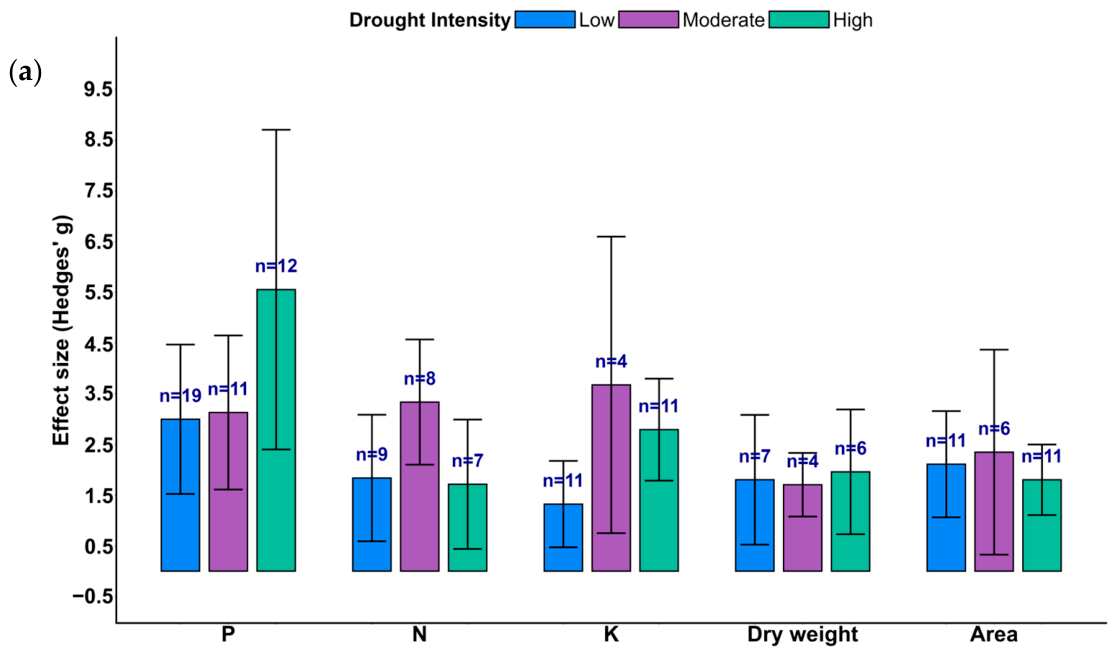
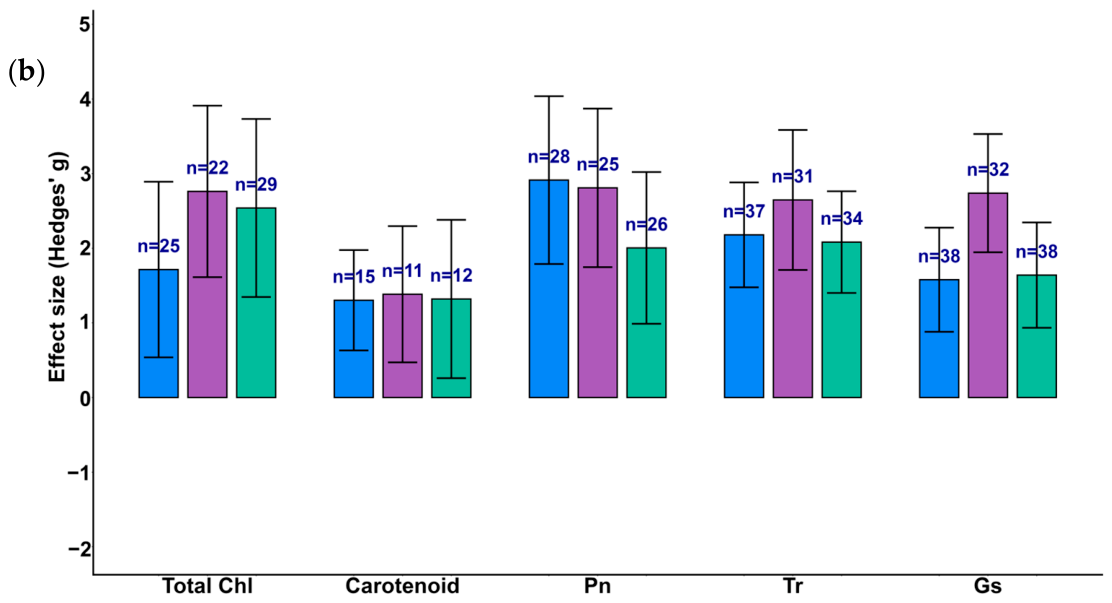
The aboveground biomass of plants inoculated with AMF was significantly higher than that of non-inoculated plants under different drought levels (the effect sizes were 1.802, 1.704, and 1.958 under low, moderate, and high drought stress, respectively) (Figure 5a). AMF inoculation showed significant positive effects on plant leaf area (Hedges’ g > 0) under drought stress, with the strongest positive effect shown under moderate drought, followed by mild drought, and the weakest effect under severe drought. The responses of P, N, and K absorption to AMF differed with drought intensity: Under severe drought, AMF showed the most significant promoting effect on P absorption (n = 12; Hedges’ g = 5.553), followed by moderate drought (n = 11; Hedges’ g = 3.129), and then low drought (n = 19; Hedges’ g = 2.995). The promoting effect of AMF on N absorption was most significant under moderate drought stress (n = 8; Hedges’ g = 3.334), followed by mild drought (n = 9; Hedges’ g = 1.837), and then severe drought (n = 7; Hedges’ g = 1.713). In contrast, the effect of AMF on plant K absorption under different drought stresses increased first and thereafter decreased with increasing drought intensity (low: n = 11; Hedges’ g = 1.321, moderate: n = 4; Hedges’ g = 3.673, severe: n = 11; Hedges’ g = 2.790). Under the different drought stress levels, inoculation with AMF had significant positive effects on chlorophyll content (with effect sizes of 1.714, 2.762, and 2.539 under low, moderate, and high drought stress, respectively) (Figure 5b). The effect size of gas exchange decreased with increasing drought severity, ranging from 2.913 and 2.809 to 2.005 under low, moderate, and high drought stress levels, respectively. AMF inoculation had significant positive effects on transpiration rate (Tr) and stomatal conductance (Gs), with the mean effect size ranking at 2.179, 2.647, and 2.082 under low, moderate, and high drought stress, respectively, for Tr, with values of 1.578, 2.738, and 1.640 under low, moderate, and high drought stress, respectively, for Gs.

3.3. Host Plant Type Regulates the AMF Responses to Drought Stress

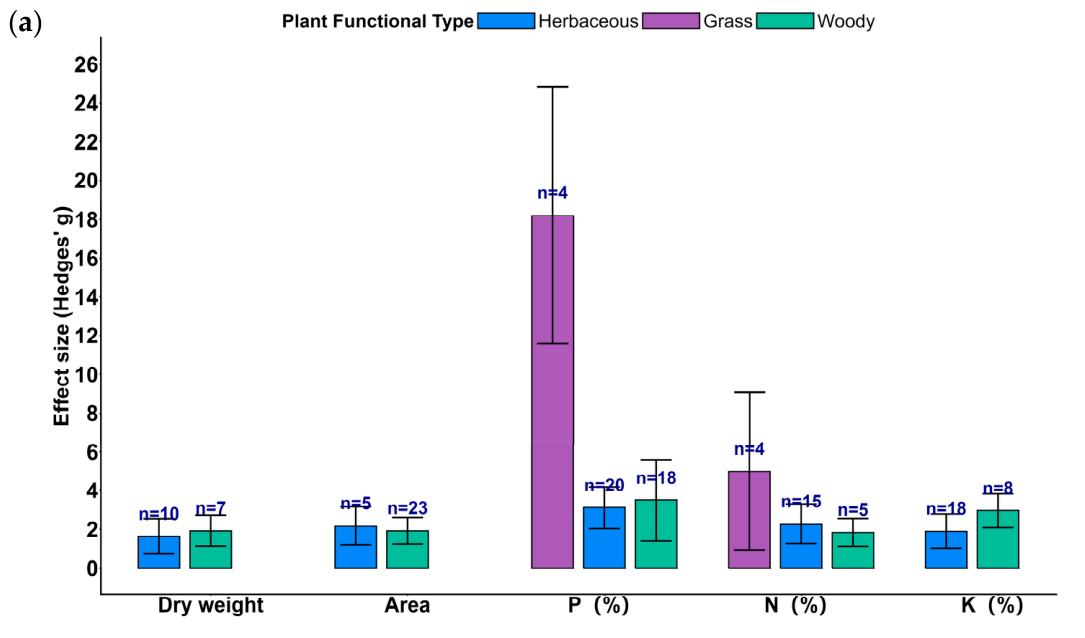
AMF inoculation significantly promoted aboveground biomass accumulation and leaf area index in both herbaceous and woody plants (Figure 6a). In terms of nutrient element absorption, AMF significantly promoted P, N, and K uptake within all three plant types (all 95% CIs > 0). The point estimates varied: for P uptake, grass plants showed the largest effect (Hedges’ g = 4.52), followed by herbaceous (3.21) and woody (3.05); for N uptake, grass also had the largest point estimate (3.01), with herbaceous (2.08) and woody (1.96) following. Figure 6 demonstrates that AMF significantly enhance nutrient uptake within each plant type under drought stress.
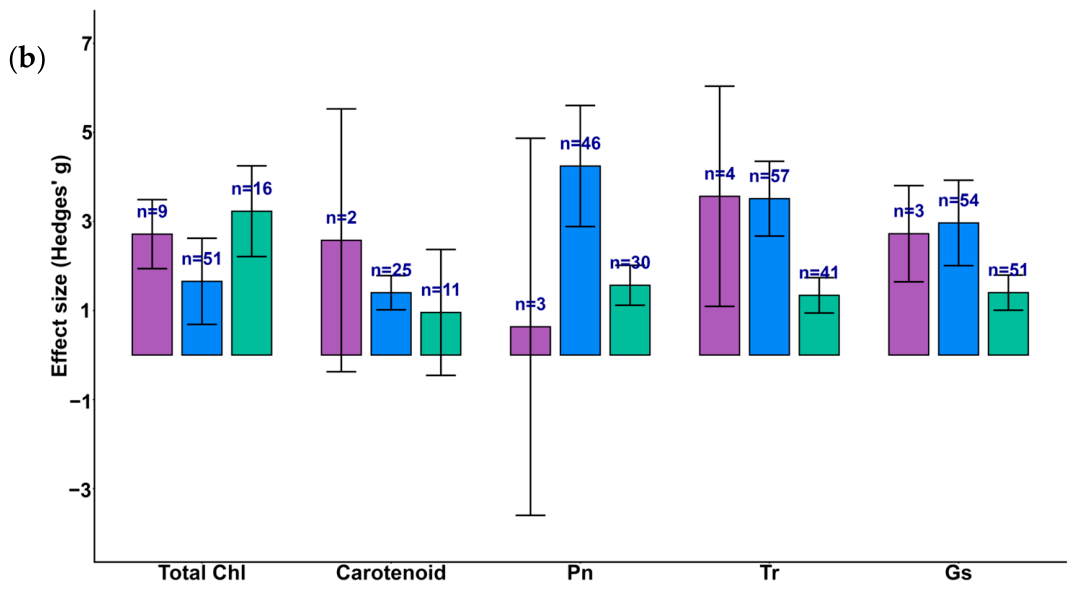
For chlorophyll, all three types showed significant positive effects, with woody plants having the largest point estimate (3.23). For carotenoid, only herbaceous plants showed a significant effect (1.65; grass and woody 95% CIs included zero). For Pn, Tr, and Gs, all the within-type effects were significant except as noted.

3.4. Host Plant Responses to Drought Stress Vary with AMF Inoculation Forms

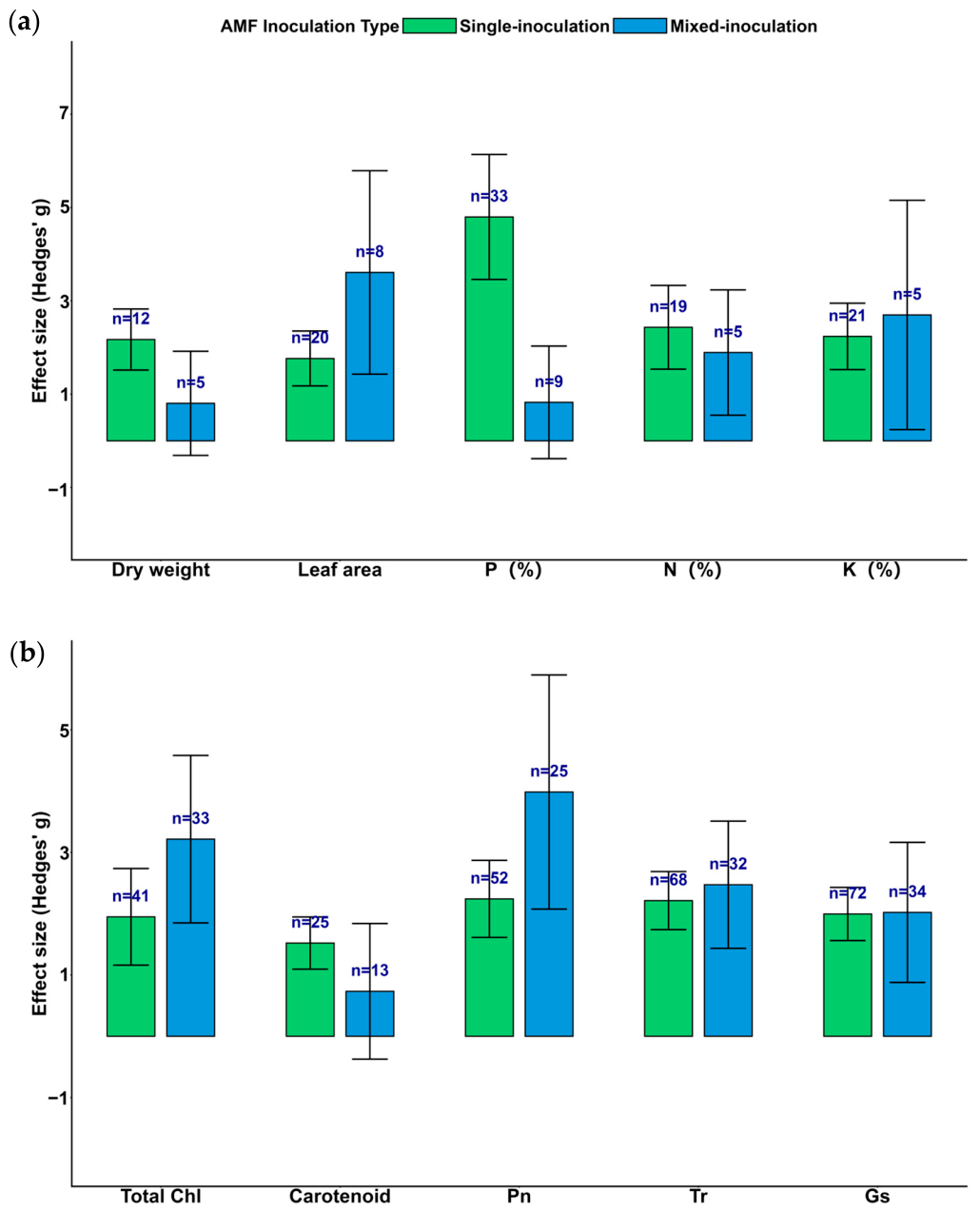
On average, the effect size of single-strain inoculation on plant biomass (Hedges’ g = 2.171) was significantly greater than that of multiple-strain inoculation (Hedges’ g = 0.803) (Figure 7a). The confidence interval of the effect size for multiple-strain inoculation included zero, indicating that the promoting effect of multiple-strain inoculation on aboveground biomass was not significant. Both inoculation forms, single-strain (n = 5; Hedges’ g = 1.765) and multiple-strain (n = 12; Hedges’ g = 3.609) significantly promoted leaf area index, with multiple-strain inoculation showing a stronger promoting effect. In terms of nutrient absorption, single-strain inoculation significantly increased P content and multiple-strain inoculation did not; for N absorption, the promoting effect of single-strain inoculation (n = 19; Hedges’ g = 2.433) was stronger compared to multiple-strain inoculation (n =5; Hedges’ g = 1.892); both inoculation forms significantly increased K content, with multiple-strain inoculation showing slightly stronger promoting effects.
Both inoculation modes, single- and mixed-strain inoculation, significantly promoted total chlorophyll content (total Chl for single-strain Hedges’ g = 1.949; mixed-strain Hedges’ g = 3.217), net photosynthetic rate (single-strain Hedges’ g = 2.242; mixed-strain Hedges’ g = 3.986), transpiration rate (single-strain Hedges’ g = 2.213; mixed-strain Hedges’ g = 2.472), and stomatal conductance (single-strain Hedges’ g = 1.995; mixed-strain Hedges’ g = 2.021), with the effect sizes of mixed strains being higher than those of single strains (Figure 7b). However, there was trait specificity in inoculation forms. Single-strain inoculation significantly promoted carotenoids (Hedges’ g = 1.521), while mixed-strain inoculation showed no significant effect on carotenoid content (95% CI included zero). Additionally, single-strain inoculation had larger sample sizes in most traits, resulting in stronger statistical stability. In contrast, mixed-strain inoculation had smaller sample sizes for carotenoids, with its effect not significant.

3.5. Multivariate Network of AMF Mediated by Drought Intensity and Plant Functional Traits

To clarify the combined effects of drought intensity and plant type on AMF regulation of plant traits, we constructed a multi-factor correlation network (Figure 8). The results showed that the vast majority of valid correlations were represented by cyan edges (accounting for >90%), with AMF significantly promoting most plant functional traits under drought stress. This result was further supported by the subgroup analysis, where all the Hedges’ g values were positive. The network showed the highest number of correlation edges under moderate drought (e.g., for traits such as leaf area index, N (%), total Chl, and Pn). The promoting effect of AMF reaches its optimum within a range of moderate stress. The grass correlation edges are denser, and the symbiotic relationship between AMF and herbaceous plants is more pronounced compared with the others. Furthermore, the widest edges were observed between the growth indicators (i.e., dry weight and area) and nutrient indicators [P (%), N (%)], and AMF primarily enhanced plant stress resistance by strengthening the link between nutrient uptake and growth improvement.

4. Discussion

Numerous studies have documented the positive effects of AMF symbiosis in colonized plants against various abiotic and biotic stressors [26,27,28,29,30,31,32]. The positive effects are mostly achieved through activating immune responses or secreting functional enzymes that modify host plant cell functioning [26,33,34,35]. AM fungal symbiosis can activate conserved molecular signaling pathways to enhance drought resistance. Previous studies have demonstrated that the AM fungus R. irregularis employs its own HOG1–MAPK cascade (including key genes such as RiSte11, RiPbs2, and RiHog1) to regulate arbuscule development and downstream drought-responsive genes under drought stress [36]. Still, how AMF influence photosynthetic activities, such as net photosynthetic rate, transpiration rate, and stomatal conductance, is poorly understood. It is uncertain whether the symbiotic association promotes nitrogen, phosphorus, and potassium uptake under different levels of drought stress in different host plant types (Figure 9). This study fills this knowledge gap by synthesizing recent research findings from global studies.
Some effect sizes were based on fewer studies than initially expected. Nevertheless, the sensitivity analyses confirmed that our results are highly robust (Figures S1–S5) as only high-quality studies were included. High-quality studies provide more reliable estimates of true effect sizes, whereas low-quality studies tend to introduce bias and increase random error. By applying strict a priori quality criteria (see Section 2), we minimized noise and improved estimation precision, allowing robust conclusions even with relatively small subgroup sample sizes.
Several limitations should be acknowledged when interpreting the findings. First, publication bias cannot be fully excluded. Although funnel plots were examined, the predominance of positive effect sizes and small sample sizes in some subgroups may lead to asymmetric distribution. To further address this issue, we performed Egger’s test and trim-and-fill correction (Table S1). Egger’s test confirmed significant funnel plot asymmetry, suggesting publication bias. However, the trim-and-fill analysis revealed that all the adjusted effect sizes remained statistically significant and consistent with the original estimates. Thus, while publication bias may have slightly influenced the magnitude of pooled effects, it did not alter the direction or statistical significance of our main conclusions.
Second, the included studies were geographically concentrated in East Asia (especially China) and the Mediterranean region. Because AMF communities, soil properties, and dominant plant species vary widely across climates, this imbalance may limit the global generalizability of our findings. A formal regional subgroup analysis was not conducted due to highly uneven sample sizes across areas. Third, to ensure modern experimental consistency, we only included studies published between 2016 and 2025. Although older foundational work is cited mechanistically, it was excluded from quantitative synthesis. This temporal restriction may omit some earlier research but ensures alignment with the contemporary methodological standards.
Despite these limitations, this meta-analysis demonstrates that AMF consistently improve plant physiological performance under drought stress. The results are robust to publication bias, sensitivity analyses, and quality filtering, supporting the reliability of our main conclusions.

4.1. AMF-Mediated Nutrient Absorption and Plant Trait Change with Stress Are Regulated by Drought Intensity

Nitrogen, P, and K are the core nutritional elements that plants require to cope with drought stress. P participates in photosynthetic phosphorylation, N is a component of osmotic adjustment substances and photosynthetic enzymes, and K maintains cellular osmotic pressure. In this study, we find that the absorption promotion effect of AMF on these nutrients is element-specific, varying with the level of drought intensity, which is due to the differential coupling between the AMF nutrient acquisition strategy and soil availability of different elements under drought stress. For example, we find that the promoting effect of AMF on P uptake is highest under severe drought levels; this is largely due to P combining with calcium, iron, and other elements in soil to form insoluble compounds, and its availability mainly depends on soil moisture content and root and hyphal contact area [27]. Under low to moderate drought conditions, the soil still maintains a certain level of moisture. Plants can dissolve insoluble P by secreting organic acids through their root systems. Indigenous soil microorganisms (such as phosphate-solubilizing bacteria) can also participate in P activation [28]. In these cases, the competitive advantages brought by AMF mycelial expansion and P transporter (such as GintPT) expression are not prominent, resulting in moderate synergistic effects (as shown by low drought Hedges’ g = 2.995 and moderate drought Hedges’ g = 3.129). Under severe drought conditions, the sharp decrease in soil moisture reduces the contact area between roots and soil, limiting the secretion and diffusion range of organic acids by plants, and the activity of native phosphorus-solubilizing bacteria is also inhibited by drought, leading to a sudden drop in P bioavailability.
In our study, the effect of inoculating AMF on plant N absorption is highest under moderate drought, where soil moisture is neither too low to inhibit nitrifying bacteria activity nor too high to suppress AMF-regulated N transport. Soil under moderate drought stress maintains sufficient humidity for nitrifying bacteria to convert ammonium ions into nitrate ions, providing an adequate N source for AMF. Previous studies have demonstrated that AMF can enhance the absorption of ammonium and nitrate ions by upregulating the expression of ammonium transporters (e.g., GintAMT1) and nitrate transporters (e.g., GintNRT2) [29]. Simultaneously, the mycelium N storage capacity (such as converting N into arginine) can reduce N loss caused by drought, ultimately achieving efficient N absorption. In contrast, extreme drought stress leads to the massive death of nitrifying bacteria (such as Nitrosomonas), a sharp reduction in nitrate production, and N mainly existing in soil in an organic form that is difficult to absorb. Severe drought inhibits the metabolic activity of AMF, leading to decreased expression of N transport proteins, making it difficult to efficiently transport N to plants even if hyphae can contact N sources.
The promoting effect of AMF on K absorption is most significant under moderate drought stress. Under low drought levels, plant cell osmotic pressure fluctuates less, the demand for K is lower, and the concentration of K+ in soil solution is sufficient, allowing plants to absorb K through their own roots, so the promoting effect of AMF is relatively small (Hedges’ g = 1.321). Under moderate drought conditions, plants’ demand for K increases sharply to maintain cell osmotic pressure and prevent water loss [30]. AMF can promote K+ absorption through two pathways: First, mycelial expansion increases the contact probability with soil K+, especially in micro-regions that are difficult for roots to reach. Second, AMF can improve soil structure by secreting polysaccharides, reduce K+ leaching loss, and upregulate the expression of its own potassium transporter proteins (such as GintK1). Therefore, the synergistic effect is the strongest (Hedges’ g = 3.673).
Gas exchange parameters (Pn, Tr, and Gs) directly reflect plant photosynthetic efficiency and water-use strategies. We find that the synergistic effects of AMF on these parameters show differential responses to drought stress, and their core driving mechanism is closely related to the dynamic balance between AMF physiological regulation ability and plant stress tolerance threshold. First, AMF significantly promoted Pn under low and moderate drought conditions (e.g., Hedges’ g = 2.913 in the low drought group and Hedges’ g = 2.809 in the moderate). This is probably because of AMF expanding mycorrhizal networks to increase soil water and nutrient (especially P) absorption, thereby alleviating drought-induced water deficit and insufficient photosynthetic substrates (CO2 and P) [32]. Second, AMF induce plants to synthesize osmotic regulatory substances, such as proline and soluble sugars; they maintain the structural stability of chloroplasts and reduce photo-damage to photosystem II (PSII) [37]. In contrast, high drought conditions significantly reduced the AMF effect (e.g., Hedges’ g = 2.00), possibly due to two limiting factors: First, severe drought leads to a sharp decline in soil water potential, making it difficult even for AMF’s mycelial extension ability to obtain effective water from the soil. Extreme water deficit inhibits plant roots’ carbon supply to AMF (imbalance in the carbon and nutrient exchange of the symbiotic relationship), weakening AMF’s functional expression. Second, under high drought conditions, plants activate a passive defense strategy—reducing water loss via stomatal conductance (Gs). At this point, even if AMF can slightly increase Gs, it is difficult to offset the inhibitory effect of extreme drought on photosynthetic enzyme activity, ultimately limiting the effect on Pn. Our results suggest a drought threshold for an AMF protective effect on plant photosynthesis. When stress exceeds the tolerance limit of the plant–AMF symbiont, AMF’s synergistic ability will significantly decline.
The magnitude of the AMF effect on Tr and Gs varied with drought intensity, with moderate drought promoting AMF-regulated stomatal behavior the most. The changes in transpiration rate (Tr) and stomatal conductance (Gs) reflect the plant’s trade-off strategy between water loss and CO2 uptake. The finding that the promoting effect of AMF on Tr and Gs was highest under moderate drought reflects the stress adaptability of AMF-compatible plants in regulating stomatal behavior. Moderate drought breaks the plant’s water balance, and water absorbed by AMF hyphae can effectively alleviate water deficit, reducing excessive stomatal closure caused by water stress. Additionally, AMF can regulate the ABA signaling pathway in plants by reducing root ABA synthesis or decreasing ABA transport to leaves, thereby inhibiting excessive stomatal closure, maintaining Gs at an optimal level that balances CO2 intake and water loss, and ultimately promoting effects on Tr and Gs.

4.2. AMF-Mediated Effects Vary with Host Plant Functional Type

In this study, AMF had similar effects on the dry weight and leaf area of herbaceous and woody plants, where AMF expand the absorption range of P and N through mycelial networks, promoting aboveground biomass and leaf area accumulation [33]. The similar response in woody plants originates from their nutrient dependence on AMF during the seedling stage. After inoculation with AMF, the leaf area of tropical rainforest woody seedlings can be increased [34]. As the plant matures, resource allocation shifts towards the root system, resulting in weakened aboveground responses [37].
The subgroup analysis of plant functional types reveals a significant type dependence in the regulatory effects of AMF on plant functions, with AMF having the highest impact on N and P uptake in grass plants. The C4 photosynthetic pathway in grasses improves water-use efficiency and increases their demand for N and P. Drought stress hinders the dissolution and diffusion of soil N and P [38]. Despite their dense root hairs, grasses have short root hairs that cannot absorb nutrients from deep soil layers. AMF can simultaneously absorb ammonium (NH4+) and nitrate (NO3) ions, with higher transport efficiency for ammonium ions. Under drought conditions, soil N is mainly in the form of ammonium ions. AMF hyphae can extend to 30–40 cm deep soil layers, efficiently absorbing N and P through specific transport proteins [35]. This morphological adaptation helps grasses to increase their N content by 55–60%, outperforming other plant types. Under low-P conditions, P transporters (such as ZmPT1) are upregulated during AMF symbiosis and localized at the periphery of the extraradical hypha–host plant interface [39], participating in P transport, with the transport efficiency of AMF symbiosis being 2–3 times higher than that of grass plant root transport proteins [40], increasing shoot P content by 60–65% in grass plants (50–55% in herbaceous plants and 35–40% in woody plants).
Conversely, AMF show the greatest promoting effect on woody plants, which is related to the photosynthetic protection dependence of woody plants. Woody plants have longer leaf lifespan and need to regulate photosynthetic pigment synthesis through AMF to enhance stress tolerance, which is related to the upregulation of AMF-mediated antioxidant enzyme activities [41]. Among carotenoids, AMF have a significant promoting effect on herbaceous plants, while their promoting effect on grasses and woody plants is insignificant.

4.3. AMF-Mediated Plant Response to Drought Is Dependent on Inoculation Modes

Single-strain AMF inoculation exhibited significantly higher effect sizes on dry weight, P content, and N content (Hedges’ g = 2.171, 4.797, and 2.433, respectively) than mixed-strain inoculation, with the mixed-strain effects approaching zero (and 95% CIs encompassing zero for P content). Single AMF strains often form more stable symbiotic interfaces with plants, thereby enhancing nutrient acquisition efficiency [42]. The greatest effect sizes on P content (Hedges’ g = 4.797) indicate that AMF promote P uptake the most. However, the mixed-strain inoculation showed stronger positive effects on leaf area and K content (Hedges’ g = 3.609 and 2.698, respectively) compared to single-strain inoculation. This could be attributed to the functional complementarity of mixed AMF communities, where different strains may specialize in distinct ecological functions, thereby synergistically promoting leaf growth and K accumulation [43,44].
We find inoculation mode-specific divergence that affects plant photosynthetic traits (pigments and gas exchange), reflecting the functional specificity of single vs. mixed AMF communities. Mixed-strain inoculation exhibited stronger positive effects on total chlorophyll and Pn (Hedges’ g = 3.217, Hedges’ g = 3.986, respectively) than single-strain inoculation. In contrast, carotenoid showed a weak response to mixed-strain inoculation (Hedges’ g = 0.733, with its 95% confidence interval encompassing zero), suggesting that mixed AMF communities have limited effects on carotenoid accumulation. Carotenoid synthesis is more strongly tied to abiotic stress than AMF community composition [45]. However, both inoculation modes induced positive effects on Tr and Gs, with mixed-strain inoculation exhibiting a slightly higher effect size. Expanding hyphal water uptake networks and modulating leaf stomatal regulation enhance transpiration and stomatal conductance [44]. The consistency of effects across large sample sizes (n = 68 for single-strain Tr) further supports that AMF inoculation—regardless of mode—plays a conserved role in optimizing plant water-use traits.

5. Conclusions

This meta-analysis synthesizes data from global studies to systematically clarify the context-dependent effects of AMF on plant drought tolerance by regulating photosynthetic traits and nutrient acquisition. The findings reveal that AMF–plant symbiosis constitutes a pivotal adaptive strategy for plants confronting water scarcity, with its efficacy modulated by three core factors: drought intensity, host plant functional type, and AMF inoculation formulation. First, AMF exert a robust and consistent promoting effect on P uptake (Hedges’ g = 3.85, 95% CI: 2.76–4.95, p < 0.001), followed by improvements in Pn, Tr, Gs, and absorption of N and K. This underscores the role of AMF in optimizing nutrient–water coupling and photosynthetic efficiency. Second, drought intensity acts as a critical threshold regulator of AMF-mediated effects. The promoting effect of AMF on Pn decreases with increasing drought severity, and Tr and Gs exhibit a unimodal response, peaking under moderate drought and declining under severe drought. AMF-induced P acquisition is maximized under severe drought and N and K uptake under moderate drought stress. These patterns reflect the dynamic balance between AMF’s physiological regulatory capacity and the plant’s stress tolerance limit, highlighting that moderate drought represents an optimal window for AMF symbiotic functioning. Third, host plant functional type significantly modulates AMF symbiotic benefits, with herbaceous plants exhibiting the strongest response in Pn, Tr, and Gs, attributed to their short growth cycles and high dependence on AMF for rapid nutrient–photosynthesis coupling. In contrast, AMF help grass plants to enhance N and P uptake, leveraging the efficient transport of ammonium ions and deep-soil P acquisition to compensate for their inherent limitations in root nutrient foraging. Fourth, the AMF inoculation form exhibits trait-specific effects. Mixed-species inoculation outperforms single-species inoculation in promoting photosynthetic traits (total chlorophyll content, Pn, Tr, and Gs), likely due to functional complementarity among diverse AMF strains. In contrast, single-species inoculation is more effective in enhancing biomass accumulation and uptake of P and N as it avoids inter-strain competition and forms more stable symbiotic interfaces with host roots. Overall, adopting AMF-based management strategies can enhance plant photosynthetic traits under drought stress, providing an effective biological means of mitigating drought-induced stress.

Supplementary Materials

The following supporting information can be downloaded at: https://www.mdpi.com/article/10.3390/agriculture16111180/s1, Figure S1. Sensitivity analysis summary for the variables (a) P (%), (b) N (%), and (c) K (%). The numbers in the far-right column represent the effect size and 95% CIs estimated under the scenario in which selected individual studies were excluded. The vertical red lines indicate the original effect size means. Figure S2. Sensitivity analysis summary for the variables (d) Pn and (e) total chlorophyll. The numbers in the far-right column represent the effect size and 95% CIs estimated under the scenario in which selected individual studies were excluded. The vertical red lines indicate the original effect size means. Figure S3. Sensitivity analysis summary for the variables (f) Gs and (g) Tr. The numbers in the far-right column represent the effect size and 95% CIs estimated under the scenario in which selected individual studies were excluded. The vertical red lines indicate the original effect size means. Figure S4. Sensitivity analysis for the selected variables (a) plant dry weight, (b) leaf area index, and (c) carotenoid. The numbers in the far-right column represent the effect size and 95% CIs estimated under the scenario in which selected individual studies were excluded. The vertical red lines indicate the original effect size means. A summary of sensitivity analysis for other variables is provided in the Supplementary Materials. Figure S5. Funnel diagram and shearing method analysis to evaluate the publication bias of AMF on plant physiological indicators under water stress. Each point represents an independent study included. Table S1. Assessment of publication bias using Egger’s test and trim-and-fill analysis. Table S2. Basic information on the 52 meta-analysis articles. Table S3. Comparison of DerSimonian–Laird (DL) and restricted maximum likelihood (REML) estimators for between-study variance (τ2) and pooled effect sizes (Hedges’ g) in subgroup analyses with small sample sizes (n < 10). References [12,46,47,48,49,50,51,52,53,54,55,56,57,58,59,60,61,62,63,64,65,66,67,68,69,70,71,72,73,74,75,76,77,78,79,80,81,82,83,84,85,86,87,88,89,90,91,92,93,94,95] are cited in Table S2.

Author Contributions

X.S.: investigation, formal analysis, visualization, writing—original draft, methodology, data curation. Y.N.: investigation, resources, data curation. P.W.: investigation, resources, data curation. H.C.: investigation, resources, data curation. M.H.: resources, investigation. S.-J.L.: resources, investigation. S.F.: resources, investigation and revision. L.W.: supervision, writing—review and editing, project administration, funding acquisition, conceptualization, resources. G.Y.G.: supervision, writing—review and editing, project administration, funding acquisition, conceptualization, resources. All authors have read and agreed to the published version of the manuscript.

Funding

This research was funded by the National Natural Science Foundation of China (32472826), the Leading Project of the “Three Agri-Priorities with Nine Directions” Science and Technology Collaboration Plans in Zhejiang Province (2025SNJF016), the Wenzhou University research start-up fund (QD2024084), the Wenzhou City Talent Introduction Fund (R20241101), and Central Government Funds for Guiding Local Scientific and Technological Development (2025ZY01039).

Institutional Review Board Statement

Not applicable.

Data Availability Statement

Data will be made available on request.

Conflicts of Interest

The authors declare that they have no known competing financial interests or personal relationships that could have appeared to influence the work reported in this paper.

References

  1. Gebrechorkos, S.H.; Sheffield, J.; Vicente-Serrano, S.M.; Funk, C.; Miralles, D.G.; Peng, J.; Dyer, E.; Talib, J.; Beck, H.E.; Singer, M.B.; et al. Warming accelerates global drought severity. Nature 2025, 642, 628–635. [Google Scholar] [CrossRef]
  2. Chen, L.; Brun, P.; Buri, P.; Fatichi, S.; Gessler, A.; McCarthy, M.J.; Pellicciotti, F.; Stocker, B.; Karger, D.N. Global increase in the occurrence and impact of multiyear droughts. Science 2025, 387, 278–284. [Google Scholar] [CrossRef] [PubMed]
  3. Kraklow, V.A.; Paff, K.; Comeau, D.; Solander, K.; Pitts, T.R.; Price, S.F.; Xu, C. Impact of drought on global food security by 2050. Nat. Commun. 2026, 17, 1099. [Google Scholar] [CrossRef] [PubMed]
  4. Ke, X.; Yao, J.; Jiang, Z.; Gu, X.; Xu, P. Recover and surpass: The mechanisms of plants transition upon rehydration from drought. Plant Stress 2025, 15, 100782. [Google Scholar] [CrossRef]
  5. Peters, R.L.; Arend, M.; Zahnd, C.; Hoch, G.; Arndt, S.K.; Cernusak, L.A.; Poyatos, R.; Zhorzel, T.; Kahmen, A. Uniform regulation of stomatal closure across temperate tree species to sustain nocturnal turgor and growth. Nat. Plants 2025, 11, 725–730. [Google Scholar] [CrossRef]
  6. Pascolini-Campbell, M. Soil and plants lose more water under drought. Nat. Clim. Change 2022, 12, 969–970. [Google Scholar] [CrossRef]
  7. Fan, X.; Xie, H.; Huang, X.; Zhang, S.; Nie, Y.; Chen, H.; Xie, X.; Tang, M. A module centered on the transcription factor Msn2 from arbuscular mycorrhizal fungus Rhizophagus irregularis regulates drought stress tolerance in the host plant. New Phytol. 2023, 240, 1497–1518. [Google Scholar] [CrossRef]
  8. Wang, L.; Guo, S.; Zhang, J.-L.; Field, K.J.; Baquerizo, M.D.; Souza, T.A.F.d.; Lee, S.-J.; Hijri, M.; Shang, X.; Sun, D.; et al. Arbuscular mycorrhizal networks—A climate-smart blueprint for agriculture. Plant Commun. 2025, 6, 101526. [Google Scholar] [CrossRef]
  9. Abdalla, M.; Bitterlich, M.; Jansa, J.; Pueschel, D.; Ahmed, M.A. The role of arbuscular mycorrhizal symbiosis in improving plant water status under drought. J. Exp. Bot. 2023, 74, 4808–4824. [Google Scholar] [CrossRef]
  10. Fiorilli, V.; Lanfranco, L.; Bonfante, P. The expression of GintPT, the phosphate transporter of Rhizophagus irregularis, depends on the symbiotic status and phosphate availability. Planta 2013, 237, 1267–1277. [Google Scholar] [CrossRef]
  11. Benhiba, L.; Fouad, M.O.; Essahibi, A.; Ghoulam, C.; Qaddoury, A. Arbuscular mycorrhizal symbiosis enhanced growth and antioxidant metabolism in date palm subjected to long-term drought. Trees-Struct. Funct. 2015, 29, 1725–1733. [Google Scholar] [CrossRef]
  12. Essahibi, A.; Benhiba, L.; Babram, M.A.; Ghoulam, C.; Qaddoury, A. Influence of arbuscular mycorrhizal fungi on the functional mechanisms associated with drought tolerance in carob (Ceratonia siliqua L.). Trees-Struct. Funct. 2018, 32, 87–97. [Google Scholar] [CrossRef]
  13. Wang, W.-X.; Zhang, F.; Chen, Z.-L.; Liu, J.; Guo, C.; He, J.-D.; Zou, Y.-N.; Wu, Q.-S. Responses of phytohormones and gas exchange to mycorrhizal colonization in trifoliate orange subjected to drought stress. Arch. Agron. Soil Sci. 2017, 63, 14–23. [Google Scholar] [CrossRef]
  14. Wang, L.; Garland, G.M.; Ge, T.; Guo, S.; Kebede, E.A.; He, C.; Hijri, M.; Plaza-Bonilla, D.; Stringer, L.C.; Davis, K.F.; et al. Integrated strategies for enhancing agrifood productivity, lowering greenhouse gas emissions, and improving soil health. Innovation 2025, 6, 101006. [Google Scholar] [CrossRef] [PubMed]
  15. Wang, L.; Guo, S.; Hijri, M.; Farooq, M.; Rehman, A.; Ge, T.; Feng, S.; Wei, Z.; Zhang, J.-L.; Kang, S.; et al. Enhancing carbon restoration and ecosystem resilience in global drylands via water-to-carbon biotransformation strategies. Commun. Earth Environ. 2025, 6, e916. [Google Scholar] [CrossRef]
  16. Page, M.J.; McKenzie, J.E.; Bossuyt, P.M.; Boutron, I.; Hoffmann, T.C.; Mulrow, C.D.; Shamseer, L.; Tetzlaff, J.M.; Akl, E.A.; Brennan, S.E.; et al. The PRISMA 2020 statement: An updated guideline for reporting systematic reviews. BMJ 2021, 372, n71. [Google Scholar] [CrossRef]
  17. Borenstein, M.C.M.A.S. Comprehensive Meta-Analysis Software. Syst. Rev. Health Res. 2022, 3, 535–548. [Google Scholar] [CrossRef]
  18. Chandrasekaran, M. Arbuscular Mycorrhizal Fungi Mediated Enhanced Biomass, Root Morphological Traits and Nutrient Uptake under Drought Stress: A Meta-Analysis. J. Fungi 2022, 8, 660. [Google Scholar] [CrossRef]
  19. Oladele, S.; Gould, I.; Varga, S. Is arbuscular mycorrhizal fungal addition beneficial to potato systems? A meta-analysis. Mycorrhiza 2025, 35, 5. [Google Scholar] [CrossRef]
  20. Ge, S.; Chen, Y.; Wang, Z.; Li, Z.; Shen, C.; Zhang, T.; Wang, J. Deep insights into the diversified cropping and their impact on arbuscular mycorrhizal fungi: A global meta-analysis. Agric. Ecosyst. Environ. 2025, 383, 109537. [Google Scholar] [CrossRef]
  21. Banerjee, S.; Mandal, J.; Sarkar, D.; Datta, R.; Bhattacharyya, P. A review and meta-analysis of the efficacy of arbuscular mycorrhizal fungi in remediating toxic metals in mine-affected soils. Front. Environ. Sci. 2025, 12, 1532169. [Google Scholar] [CrossRef]
  22. Viechtbauer, W.; Cheung, M.W. Outlier and influence diagnostics for meta-analysis. Res. Synth. Methods 2010, 1, 112–125. [Google Scholar] [CrossRef] [PubMed]
  23. Langan, D.; Higgins, J.P.T.; Jackson, D.; Bowden, J.; Veroniki, A.A.; Kontopantelis, E.; Viechtbauer, W.; Simmonds, M. A comparison of heterogeneity variance estimators in simulated random-effects meta-analyses. Res. Syn. Meth. 2019, 10, 83–98. [Google Scholar] [CrossRef] [PubMed]
  24. Higgins, J.P.; Thompson, S.G.; Deeks, J.J.; Altman, D.G. Measuring inconsistency in meta-analyses. BMJ (Clin. Res. Ed.) 2003, 327, 557–560. [Google Scholar] [CrossRef]
  25. Wang, L.; Guo, S.; Ge, T.; Mancl, K.M.; Hijri, M.; Iseri, Y.; Lee, S.-J.; Feng, S.; Wang, L.; Ji, H.; et al. Plastic mulch productivity-sustainability tradeoffs and pathways toward an eco-friendly framework. Nat. Commun. 2026; in press.
  26. Wanke, A.; van Boerdonk, S.; Mahdi, L.K.; Wawra, S.; Neidert, M.; Chandrasekar, B.; Saake, P.; Saur, I.M.L.; Derbyshire, P.; Holton, N.; et al. A GH81-type 13-glucan-binding protein enhances colonization by mutualistic in barley. Curr. Biol. 2023, 33, 5071–5084.e5077. [Google Scholar] [CrossRef]
  27. Tian, H.; Jia, Z.; Liu, W.; Wei, X.; Wang, H.; Bao, G.; Li, J.; Zhou, Q. Effects of Arbuscular Mycorrhizal Fungi on Growth and Nutrient Accumulation of Oat under Drought Conditions. Agronomy 2023, 13, 2580. [Google Scholar] [CrossRef]
  28. Williams, A.; de Vries, F.T. Plant root exudation under drought: Implications for ecosystem functioning. New Phytol. 2020, 225, 1899–1905. [Google Scholar] [CrossRef]
  29. Jacob, P.-T.; Pilar, S.T.; Raffaella, B.; Valentina, F.; Concepción, A.-A.; Nuria, F. GintAMT2, a new member of the ammonium transporter family in the arbuscular mycorrhizal fungus Glomus intraradices. Fungal Genet. Biol. 2011, 48, 1044–1055. [Google Scholar] [CrossRef]
  30. Yang, X.; Wang, Z.; Li, J.; Struik, P.C.; Jiang, S.; Jin, K.; Mu, H. How do arbuscular mycorrhizal fungi enhance drought resistance of Leymus chinensis? BMC Plant Biol. 2025, 25, 453. [Google Scholar] [CrossRef] [PubMed]
  31. Zhu, X.C.; Song, F.B.; Liu, S.Q.; Liu, T.D.; Zhou, X. Arbuscular mycorrhizae improves photosynthesis and water status of Zea mays L. under drought stress. Plant Soil Environ. 2012, 58, 186–191. [Google Scholar] [CrossRef]
  32. Khalvati, M.A.; Hu, Y.; Mozafar, A.; Schmidhalter, U. Quantification of water uptake by arbuscular mycorrhizal hyphae and its significance for leaf growth, water relations, and gas exchange of barley subjected to drought stress. Plant Biol. 2005, 7, 706–712. [Google Scholar] [CrossRef]
  33. Li, J.; Meng, B.; Chai, H.; Yang, X.; Song, W.; Li, S.; Lu, A.; Zhang, T.; Sun, W. Arbuscular Mycorrhizal Fungi Alleviate Drought Stress in C3 (Leymus chinensis) and C4 (Hemarthria altissima) Grasses via Altering Antioxidant Enzyme Activities and Photosynthesis. Front. Plant Sci. 2019, 10, 499. [Google Scholar] [CrossRef]
  34. Johnson, D.; Liu, X.; Burslem, D.F.R.P. Symbiotic control of canopy dominance in subtropical and tropical forests. Trends Plant Sci. 2023, 28, 995–1003. [Google Scholar] [CrossRef] [PubMed]
  35. Wang, H.; Wang, Y.; Cheng, X.; He, Y.; Shen, Z.; Zhang, W.; Pu, X. Effects of Arbuscular Mycorrhizal Fungi on Nitrogen Uptake in Cotton (Gossypium hirsutum L.) Under Low-Nitrogen Conditions. 2024; preprint. preprint. [CrossRef]
  36. Wang, S.; Xie, X.; Che, X.; Lai, W.; Ren, Y.; Fan, X.; Hu, W.; Tang, M.; Chen, H. Host- and virus-induced gene silencing of HOG1-MAPK cascade genes in Rhizophagus irregularis inhibit arbuscule development and reduce resistance of plants to drought stress. Plant Biotechnol. J. 2023, 21, 866–883. [Google Scholar] [CrossRef]
  37. Katalin, P.; Nguyen Hong, D. Benefits of Arbuscular Mycorrhizal Fungi Application to Crop Production under Water Scarcity. In Drought-Detection and Solutions; Gabrijel, O., Ed.; IntechOpen: London, UK, 2019. [Google Scholar]
  38. Wang, L.; Lu, P.; Feng, S.; Hamel, C.; Sun, D.; Siddique, K.H.M.; Gan, G.Y. Strategies to improve soil health by optimizing the plant–soil–microbe–anthropogenic activity nexus. Agric. Ecosyst. Environ. 2024, 359, 108750. [Google Scholar] [CrossRef]
  39. Liu, F.; Xu, Y.; Jiang, H.; Jiang, C.; Du, Y.; Gong, C.; Wang, W.; Zhu, S.; Han, G.; Cheng, B. Systematic Identification, Evolution and Expression Analysis of the Zea mays PHT1 Gene Family Reveals Several New Members Involved in Root Colonization by Arbuscular Mycorrhizal Fungi. Int. J. Mol. Sci. 2016, 17, 930. [Google Scholar] [CrossRef]
  40. Sawers, R.J.H.; Svane, S.F.; Quan, C.; Grønlund, M.; Wozniak, B.; Gebreselassie, M.-N.; González-Muñoz, E.; Chávez Montes, R.A.; Baxter, I.; Goudet, J.; et al. Phosphorus acquisition efficiency in arbuscular mycorrhizal maize is correlated with the abundance of root-external hyphae and the accumulation of transcripts encoding PHT1 phosphate transporters. New Phytol. 2017, 214, 632–643. [Google Scholar] [CrossRef] [PubMed]
  41. Wang, L.; Jia, X.; Zhao, Y.; Zhang, C.; Zhao, J. Effect of arbuscular mycorrhizal fungi in roots on antioxidant enzyme activity in leaves of Robinia pseudoacacia L. seedlings under elevated CO(2) and Cd exposure. Environ. Pollut. 2022, 294, 118652. [Google Scholar] [CrossRef]
  42. Sastry, M.S.R.; Sharma, A.K.; Johri, B.N. Effect of an AM fungal consortium and Pseudomonas on the growth and nutrient uptake of Eucalyptus hybrid. Mycorrhiza 2000, 10, 55–61. [Google Scholar] [CrossRef]
  43. Lino, I.A.N.; Silva, D.; Martins, L.M.V.; Maia, L.C.; Yano-Melo, A.M. Microbial inoculation and fertilizer application on growth of cowpea and spore-based assemblages of arbuscular mycorrhizal fungi in its rhizophere. Acad. Bras. Cienc. 2022, 94, e20201243. [Google Scholar] [CrossRef] [PubMed]
  44. Meng, L.-L.; Xu, F.-Q.; Zhang, Z.-Z.; Alqahtani, M.D.; Tashkandi, M.A.; Wu, Q.-S. Arbuscular Mycorrhizal Fungi, Especially Rhizophagus intraradices as a Biostimulant, Improve Plant Growth and Root Columbin Levels in Tinospora sagittata. Horticulturae 2023, 9, 1350. [Google Scholar] [CrossRef]
  45. Fester, T.; Schmidt, D.; Lohse, S.; Walter, M.H.; Giuliano, G.; Bramley, P.M.; Fraser, P.D.; Hause, B.; Strack, D. Stimulation of carotenoid metabolism in arbuscular mycorrhizal roots. Planta 2002, 216, 148–154. [Google Scholar] [CrossRef]
  46. Leventis, G.; Tsiknia, M.; Feka, M.; Ladikou, E.V.; Papadakis, I.E.; Chatzipavlidis, I.; Papadopoulou, K.; Ehaliotis, C. Arbuscular mycorrhizal fungi enhance growth of tomato under normal and drought conditions, via different water regulation mechanisms. Rhizosphere 2021, 19, 100394. [Google Scholar] [CrossRef]
  47. Cui, Z.; Chen, R.; Li, T.; Zou, B.; Geng, G.; Xu, Y.; Stevanato, P.; Yu, L.; Nurminsky, V.N.; Liu, J.; et al. Arbuscular Mycorrhizal Fungi Enhance Tolerance to Drought Stress by Altering the Physiological and Biochemical Characteristics of Sugar Beet. Sugar Tech. 2024, 26, 1377–1392. [Google Scholar] [CrossRef]
  48. Wang, Z.; Lian, J.; Liang, J.; Wei, H.; Chen, H.; Hu, W.; Tang, M. Arbuscular mycorrhizal symbiosis modulates nitrogen uptake and assimilation to enhance drought tolerance of Populus cathayana. Plant Physiol. Biochem. 2024, 210, 108648. [Google Scholar] [CrossRef]
  49. Wu, L.; Zheng, Y.; Liu, S.; Jia, X.; Lv, H. Response of Ammodendron bifolium Seedlings Inoculated with AMF to Drought Stress. Atmosphere 2023, 14, 989. [Google Scholar] [CrossRef]
  50. Xu, G.; Pan, J.; Rehman, M.; Li, X.; Cao, S.; Wang, C.; Wang, X.; Chen, C.; Nie, J.; Wang, M.; et al. Arbuscular mycorrhizal fungi-mediated drought stress tolerance in kenaf (Hibiscus cannabinus L.): A mechanistic approach. Plant Growth Regul. 2024, 103, 803–824. [Google Scholar] [CrossRef]
  51. Jadrane, I.; Al Feddy, M.N.; Dounas, H.; Kouisni, L.; Aziz, F.; Ouahmane, L. Inoculation with selected indigenous mycorrhizal complex improves Ceratonia siliqua’s growth and response to drought stress. Saudi J. Biol. Sci. 2021, 28, 825–832. [Google Scholar] [CrossRef]
  52. Li, Y.; Wang, X.; Chen, X.; Lu, J.; Jin, Z.; Li, J. Functions of arbuscular mycorrhizal fungi in regulating endangered species Heptacodium miconioides growth and drought stress tolerance. Plant Cell Rep. 2023, 42, 1967–1986. [Google Scholar] [CrossRef]
  53. Li, X.; Zhu, W.-z.; Wang, W.-w.; Ma, S.-l.; Sheng, Z.-l.; Shu, S.-m. Drought adaptation of Bauhinia faberi var. Microphylla seedlings with dual inoculation of arbuscular mycorrhizal fungi. J. Mt. Sci. 2023, 20, 2214–2227. [Google Scholar] [CrossRef]
  54. Xia, H.; Yang, C.; Liang, Y.; He, Z.; Guo, Y.; Lang, Y.; Wei, J.; Tian, X.; Lin, L.; Deng, H.; et al. Melatonin and arbuscular mycorrhizal fungi synergistically improve drought toleration in kiwifruit seedlings by increasing mycorrhizal colonization and nutrient uptake. Front. Plant Sci. 2022, 13, 1073917. [Google Scholar] [CrossRef]
  55. Liu, C.-Y.; Hao, Y.; Wu, X.-L.; Dai, F.-J.; Abd-Allah, E.F.; Wu, Q.-S.; Liu, S.-R. Arbuscular mycorrhizal fungi improve drought tolerance of tea plants via modulating root architecture and hormones. Plant Growth Regul. 2024, 102, 13–22. [Google Scholar] [CrossRef]
  56. Zhang, B.; Lv, Y.-F.; Li, Y.; Li, L.; Jia, J.-Q.; Feng, M.-C.; Wang, C.; Song, X.-Y.; Yang, W.-D.; Shafiq, F.; et al. Inoculation with Rhizophagus intraradices Confers Drought Stress Tolerance in Oat by Improving Nitrogen and Phosphorus Nutrition. J. Soil Sci. Plant Nutr. 2023, 23, 2039–2052. [Google Scholar] [CrossRef]
  57. Afshari, M.; Rahimmalek, M.; Sabzalian, M.R.; Szumny, A.; Matkowski, A.; Jezierska-Domaradzka, A. Mycorrhizal Colonization Modulates the Essential Oil Profile and Enzymatic and Non-Enzymatic Antioxidants to Mitigate the Adverse Effects of Water Deficit in Salvia subg. Perovskia. Biology 2022, 11, 1757. [Google Scholar] [CrossRef]
  58. Li, H. Arbuscular Mycorrhizal Fungi Improve Growth, Photosynthetic Activity, and Chlorophyll Fluorescence of Vitis vinifera L. cv. Ecolly under Drought Stress. Agronomy 2022, 12, 1563. [Google Scholar] [CrossRef]
  59. He, F.; Sheng, M.; Tang, M. Effects of Rhizophagus irregularis on Photosynthesis and Antioxidative Enzymatic System in Robinia pseudoacacia L. under Drought Stress. Front. Plant Sci. 2017, 8, 183. [Google Scholar] [CrossRef] [PubMed]
  60. Oliveira, R.S.; Carvalho, P.; Marques, G.; Ferreira, L.; Pereira, S.; Nunes, M.; Rocha, I.; Ma, Y.; Carvalho, M.F.; Vosátka, M.; et al. Improved grain yield of cowpea (Vigna unguiculata) under water deficit after inoculation with Bradyrhizobium elkanii and Rhizophagus irregularis. Crop Pasture Sci. 2017, 68, 1052–1059. [Google Scholar] [CrossRef]
  61. Tisarum, R.; Samphumphuang, T.; Yooyoungwech, S.; Singh, H.P.; Cha-um, S. Arbuscular mycorrhizal fungi modulate physiological and morphological adaptations in para rubber tree (Hevea brasiliensis) under water deficit stress. Biologia 2022, 77, 1723–1736. [Google Scholar] [CrossRef]
  62. Arpanahi, A.A.; Feizian, M.; Mehdipourian, G.; Khojasteh, D.N. Arbuscular mycorrhizal fungi inoculation improve essential oil and physiological parameters and nutritional values of Thymus daenensis Celak and Thymus vulgaris L. under normal and drought stress conditions. Eur. J. Soil Biol. 2020, 100, 103217. [Google Scholar] [CrossRef]
  63. Paravar, A.; Wu, Q.-S. Is a combination of arbuscular mycorrhizal fungi more beneficial to enhance drought tolerance than single arbuscular mycorrhizal fungus in Lallemantia species? Environ. Exp. Bot. 2024, 226, 105853. [Google Scholar] [CrossRef]
  64. Bagheri, V.; Shamshiri, M.H.; Alaei, H.; Salehi, H. The role of inoculum identity for growth, photosynthesis, and chlorophyll fluorescence of zinnia plants by arbuscular mycorrhizal fungi under varying water regimes. Photosynthetica 2019, 57, 409–419. [Google Scholar] [CrossRef]
  65. Bouskout, M.; Bourhia, M.; Alfeddy, M.N.; Dounas, H.; Salamatullah, A.; Soufan, W.; Nafidi, H.-A.; Lahcen, O. Mycorrhizal Fungi Inoculation Improves Capparis spinosa’s Yield, Nutrient Uptake and Photosynthetic Efficiency under Water Deficit. Agronomy 2022, 12, 149. [Google Scholar] [CrossRef]
  66. He, J.-D.; Zou, Y.-N.; Wu, Q.-S.; Kuča, K. Mycorrhizas enhance drought tolerance of trifoliate orange by enhancing activities and gene expression of antioxidant enzymes. Sci. Hortic. 2020, 262, 108745. [Google Scholar] [CrossRef]
  67. Mo, Y.; Wang, Y.; Yang, R.; Zheng, J.; Liu, C.; Li, H.; Ma, J.; Zhang, Y.; Wei, C.; Zhang, X. Regulation of Plant Growth, Photosynthesis, Antioxidation and Osmosis by an Arbuscular Mycorrhizal Fungus in Watermelon Seedlings under Well-Watered and Drought Conditions. Front. Plant Sci. 2016, 7, 644. [Google Scholar] [CrossRef]
  68. Yooyongwech, S.; Tisarum, R.; Samphumphuang, T.; Phisalaphong, M.; Cha-um, S. Integrated strength of osmotic potential and phosphorus to achieve grain yield of rice under water deficit by arbuscular mycorrhiza fungi. Sci. Rep. 2023, 13, 5999. [Google Scholar] [CrossRef]
  69. Nahuelcura, J.; Bravo, C.; Valdebenito, A.; Rivas, S.; Santander, C.; González, F.; Cornejo, P.; Contreras, B.; Ruiz, A. Physiological and Enzymatic Antioxidant Responses of Solanum tuberosum Leaves to Arbuscular Mycorrhizal Fungal Inoculation under Water Stress. Plants 2024, 13, 1153. [Google Scholar] [CrossRef]
  70. Chen, W.; Meng, P.; Feng, H.; Wang, C. Effects of Arbuscular Mycorrhizal Fungi on Growth and Physiological Performance of Catalpa bungei C.A.Mey. under Drought Stress. Forests 2020, 11, 1117. [Google Scholar] [CrossRef]
  71. Begum, N.; Ahanger, M.A.; Su, Y.; Lei, Y.; Mustafa, N.S.A.; Ahmad, P.; Zhang, L. Improved Drought Tolerance by AMF Inoculation in Maize (Zea mays) Involves Physiological and Biochemical Implications. Plants 2019, 8, 579. [Google Scholar] [CrossRef]
  72. Hu, W.; Zhang, H.; Chen, H.; Tang, M. Arbuscular mycorrhizas influence Lycium barbarum tolerance of water stress in a hot environment. Mycorrhiza 2017, 27, 451–463. [Google Scholar] [CrossRef] [PubMed]
  73. Tekaya, M.; Dabbaghi, O.; Guesmi, A.; Attia, F.; Chehab, H.; Khezami, L.; Algathami, F.K.; Ben Hamadi, N.; Hammami, M.; Prinsen, E.; et al. Arbuscular mycorrhizas modulate carbohydrate, phenolic compounds and hormonal metabolism to enhance water deficit tolerance of olive trees (Olea europaea). Agric. Water Manag. 2022, 274, 107947. [Google Scholar] [CrossRef]
  74. Wu, N.; Li, Z.; Meng, S.; Wu, F. Effects of arbuscular mycorrhizal inoculation on the growth, photosynthesis and antioxidant enzymatic activity of Euonymus maackii Rupr. under gradient water deficit levels. PLoS ONE 2021, 16, e0259959. [Google Scholar] [CrossRef]
  75. Amiri, R.; Nikbakht, A.; Rahimmalek, M.; Hosseini, H. Variation in the Essential Oil Composition, Antioxidant Capacity, and Physiological Characteristics of Pelargonium graveolens L. Inoculated with Two Species of Mycorrhizal Fungi Under Water Deficit Conditions. J. Plant Growth Regul. 2017, 36, 502–515. [Google Scholar] [CrossRef]
  76. He, F.; Zhang, H.; Tang, M. Aquaporin gene expression and physiological responses of Robinia pseudoacacia L. to the mycorrhizal fungus Rhizophagus irregularis and drought stress. Mycorrhiza 2016, 26, 311–323. [Google Scholar] [CrossRef]
  77. Zhang, F.; Zou, Y.-N.; Wu, Q.-S.; Kuča, K. Arbuscular mycorrhizas modulate root polyamine metabolism to enhance drought tolerance of trifoliate orange. Environ. Exp. Bot. 2020, 171, 103926. [Google Scholar] [CrossRef]
  78. Palhares Neto, L.; Silva-Santos, L.; de Souza, L.M.; de Morais, M.B.; Corte-Real, N.; Monte Júnior, I.P.; Camara, C.A.G.; Martins Moraes, M.; Ulisses, C. Influence of Arbuscular Mycorrhizal Fungi on Morphophysiological Responses and Secondary Metabolism in Lippia alba (Verbenaceae) Under Different Water Regimes. J. Plant Growth Regul. 2023, 42, 827–841. [Google Scholar] [CrossRef]
  79. Huang, D.; Ma, M.; Wang, Q.; Zhang, M.; Jing, G.; Li, C.; Ma, F. Arbuscular mycorrhizal fungi enhanced drought resistance in apple by regulating genes in the MAPK pathway. Plant Physiol. Biochem. 2020, 149, 245–255. [Google Scholar] [CrossRef]
  80. Cheng, H.-Q.; Zou, Y.-N.; Wu, Q.-S.; Kuča, K. Arbuscular Mycorrhizal Fungi Alleviate Drought Stress in Trifoliate Orange by Regulating H+-ATPase Activity and Gene Expression. Front. Plant Sci. 2021, 12, 659694. [Google Scholar] [CrossRef] [PubMed]
  81. Gong, M.; Bai, N.; Wang, P.; Su, J.; Chang, Q.; Zhang, Q. Co-Inoculation with Arbuscular Mycorrhizal Fungi and Dark Septate Endophytes under Drought Stress: Synergistic or Competitive Effects on Maize Growth, Photosynthesis, Root Hydraulic Properties and Aquaporins? Plants 2023, 12, 2596. [Google Scholar] [CrossRef] [PubMed]
  82. Han, Y.; Lou, X.; Zhang, W.; Xu, T.; Tang, M. Arbuscular Mycorrhizal Fungi Enhanced Drought Resistance of Populus cathayana by Regulating the 14-3-3 Family Protein Genes. Microbiol. Spectr. 2022, 10, e02456-21. [Google Scholar] [CrossRef]
  83. Quiroga, G.; Erice, G.; Aroca, R.; Chaumont, F.; Ruiz-Lozano, J.M. Contribution of the arbuscular mycorrhizal symbiosis to the regulation of radial root water transport in maize plants under water deficit. Environ. Exp. Bot. 2019, 167, 103821. [Google Scholar] [CrossRef]
  84. Calvo, A.; Reitz, T.; Sillo, F.; Montesano, V.; Cañizares, E.; Zampieri, E.; Mahmoudi, R.; Gohari, G.; Chitarra, W.; Giovannini, L.; et al. Interactions between an arbuscular mycorrhizal inoculum and the root-associated microbiome in shaping the response of Capsicum annuum “Locale di Senise” to different irrigation levels. Plant Soil 2025, 508, 361–383. [Google Scholar] [CrossRef]
  85. Ruiz-Lozano, J.M.; Aroca, R.; Zamarreño, Á.M.; Molina, S.; Andreo-Jiménez, B.; Porcel, R.; García-Mina, J.M.; Ruyter-Spira, C.; López-Ráez, J.A. Arbuscular mycorrhizal symbiosis induces strigolactone biosynthesis under drought and improves drought tolerance in lettuce and tomato. Plant Cell Environ. 2016, 39, 441–452. [Google Scholar] [CrossRef]
  86. Hu, Y.; Xie, W.; Chen, B. Arbuscular mycorrhiza improved drought tolerance of maize seedlings by altering photosystem II efficiency and the levels of key metabolites. Chem. Biol. Technol. Agric. 2020, 7, 20. [Google Scholar] [CrossRef]
  87. Li, S.; Liu, Y.; He, H. The effect of drought stress on Pinellia ternata in terms of physiology and aquaporin genes after Arbuscular mycorrhizal fungal inoculation. J. Appl. Bot. Food Qual. 2025, 98, 11–21. [Google Scholar] [CrossRef]
  88. Liu, Y.; Lu, J.; Cui, L.; Tang, Z.; Ci, D.; Zou, X.; Zhang, X.; Yu, X.; Wang, Y.; Si, T. The multifaceted roles of Arbuscular Mycorrhizal Fungi in peanut responses to salt, drought, and cold stress. BMC Plant Biol. 2023, 23, 36. [Google Scholar] [CrossRef]
  89. Benaffari, W.; Boutasknit, A.; Anli, M.; Ait-El-Mokhtar, M.; Ait-Rahou, Y.; Ben-Laouane, R.; Ben Ahmed, H.; Mitsui, T.; Baslam, M.; Meddich, A. The Native Arbuscular Mycorrhizal Fungi and Vermicompost-Based Organic Amendments Enhance Soil Fertility, Growth Performance, and the Drought Stress Tolerance of Quinoa. Plants 2022, 11, 393. [Google Scholar] [CrossRef]
  90. Boutasknit, A.; Baslam, M.; Ait-El-Mokhtar, M.; Anli, M.; Ben-Laouane, R.; Ait-Rahou, Y.; Mitsui, T.; Douira, A.; El Modafar, C.; Wahbi, S.; et al. Assemblage of indigenous arbuscular mycorrhizal fungi and green waste compost enhance drought stress tolerance in carob (Ceratonia siliqua L.) trees. Sci. Rep. 2021, 11, 22835. [Google Scholar] [CrossRef]
  91. He, S.; Long, M.; He, X.; Guo, L.; Yang, J.; Yang, P.; Hu, T. Arbuscular mycorrhizal fungi and water availability affect biomass and C:N:P ecological stoichiometry in alfalfa (Medicago sativa L.) during regrowth. Acta Physiol. Plant 2017, 39, 199. [Google Scholar] [CrossRef]
  92. Jabborova, D.; Annapurna, K.; Al-Sadi, A.M.; Alharbi, S.A.; Datta, R.; Zuan, A.T.K. Biochar and Arbuscular mycorrhizal fungi mediated enhanced drought tolerance in Okra (Abelmoschus esculentus) plant growth, root morphological traits and physiological properties. Saudi J. Biol. Sci. 2021, 28, 5490–5499. [Google Scholar] [CrossRef] [PubMed]
  93. Wu, X.-L.; Hao, Y.; Lu, W.; Liu, C.-Y.; He, J.-D. Arbuscular mycorrhizal fungi enhance nitrogen assimilation and drought adaptability in tea plants by promoting amino acid accumulation. Front. Plant Sci. 2024, 15, 1450999. [Google Scholar] [CrossRef] [PubMed]
  94. Hamedani, N.G.; Gholamhoseini, M.; Bazrafshan, F.; Habibzadeh, F.; Amiri, B. Yield, irrigation water productivity and nutrient uptake of arbuscular mycorrhiza inoculated sesame under drought stress conditions. Agric. Water Manag. 2022, 266, 107569. [Google Scholar] [CrossRef]
  95. Lahbouki, S.; Hashem, A.; Kumar, A.; Abd Allah, E.F.; Meddich, A. Integration of Horse Manure Vermicompost Doses and Arbuscular Mycorrhizal Fungi to Improve Fruit Quality, and Soil Fertility in Tomato Field Facing Drought Stress. Plants 2024, 13, 1449. [Google Scholar] [CrossRef] [PubMed]
Figure 1. Schematic illustration of AM fungal colonization and symbiosis formation. AM fungi colonize plant roots through germinating spores, form hyphal branches, and establish intercellular hyphae—the extraradical and intraradical mycelium development toward root colonization.
Agriculture 16 01180 g001
Figure 2. PRISMA showing the process of the identification and screening of the eligible studies for inclusion in the database. Detailed information on the 52 selected articles is provided in Table S2.
Agriculture 16 01180 g002
Figure 3. A global map showing the geographic locations of the 52 original studies included in the meta-analysis. The red points represent the experimental sites.
Agriculture 16 01180 g003
Figure 4. Arbuscular mycorrhizal fungi (AMF) inoculation enhanced host plant morphological and physiological traits under drought stress. The effects include plant growth characteristics, nutrient absorption capacity, photosynthetic pigment content, and gas exchange parameters. The effect size was quantified using Hedges’ g, and statistical analysis was based on the DerSimonian–Laird random-effects model. n represents independent effect sizes, and the error bars represent the 95% confidence interval (95% CI). Hedges’ g > 0 indicates that the AMF inoculation group performed better than the control group. The 95% CI not crossing the zero value indicates statistical significance (p < 0.05). The variable ‘dry weight’ refers to aboveground plant dry weight; area represents leaf area index, a key growth-related trait; total Chl, total chlorophyll; Pn, net photosynthetic rate; Tr, transpiration rate; Gs, stomatal conductance. Corresponding τ2 values for each variable are provided in Table 1.
Agriculture 16 01180 g004
Figure 5. Response of AMF-inoculated plants to stress varying with drought intensity. Responses in (a) plant aboveground biomass, leaf area, and nutrient absorption, and (b) chlorophyll-related indices and gas exchange under different drought intensities. Blue, purple, and green bars represent low, moderate, and high drought intensity, respectively. n represents independent effect sizes, and the error bars represent the 95% confidence intervals. An effect size greater than 0 indicates better performance in the AMF treatment group than the non-AMF control group. The variable ‘dry weight’ refers to aboveground plant dry weight; area represents leaf area index, a key growth-related trait; total Chl, total chlorophyll; Pn, net photosynthetic rate; Tr, transpiration rate; Gs, stomatal conductance.
Agriculture 16 01180 g005aAgriculture 16 01180 g005b
Figure 6. Response of AMF inoculation to stress varying among host plant type. Responses reflected in (a) plant aboveground biomass, leaf area, and nutrient absorption, and (b) chlorophyll-related indices and gas exchange in different host types. n represents independent effect sizes, and the error bars represent the 95% confidence intervals. An effect size greater than 0 indicates better performance in the AMF treatment group than the non-AMF control group. The variable ‘dry weight’ refers to aboveground plant dry weight; area represents leaf area index, a key growth-related trait; total Chl, total chlorophyll; Pn, net photosynthetic rate; Tr, transpiration rate; Gs, stomatal conductance.
Agriculture 16 01180 g006aAgriculture 16 01180 g006b
Figure 7. Response of plant growth-related traits to AMF inoculation type (single vs. multiple species). (a) Single-species AMF inoculation; (b) mixed-species AMF inoculation (multiple AMF species). n represents independent effect sizes, and error bars represent 95% confidence intervals. Effect values greater than 0 indicate better performance in the AMF inoculation treatment group than the control group. A 95% confidence interval containing 0 indicates statistical insignificance. The variable ‘dry weight’ refers to aboveground plant dry weight; area represents leaf area index, a key growth-related trait; total Chl, total chlorophyll; Pn, net photosynthetic rate; Tr, transpiration rate; Gs, stomatal conductance.
Agriculture 16 01180 g007
Figure 8. A multi-factor association network diagram of AMF regulating plant traits under drought stress. Yellow triangles represent drought intensities (i.e., low, moderate, and high), yellow circles represent plant variables (e.g., dry weight, P (%), etc.), and yellow squares represent plant types (i.e., grass, herbaceous, and woody). Edge colors indicate the nature of the relationship: Red denotes AMF promotion effects or positive associations. The width of the edges corresponds to the effect strength (refer to the edge weight scale; higher values indicate greater strength). To highlight core relationships, only edges with an effect strength greater than 0.5 and an association strength greater than 0.4 are retained.
Agriculture 16 01180 g008
Figure 9. AM fungi alleviate drought stress in plants by remodeling the rhizosphere microenvironment, regulating the photosynthetic system, and activating signal transduction pathways. AMF broaden the uptake scope of water and fertilizers through extraradical hyphal network extension, optimize soil physical structure and mobilize mineral nutrients. They secrete symbiotic signaling molecules to activate the MAPK cascade phosphorylation, which further activates drought-related transcription factors (WRKY) and regulates the expression of photosynthetic genes and stress-resistant genes. By improving light harvesting and carbon assimilation efficiency, enhancing photosynthetic enzyme activity, and maintaining moderate stomatal opening, AMF achieve the repair and functional improvement of the photosynthetic system, ultimately enhancing drought tolerance in plants.
Agriculture 16 01180 g009
Disclaimer/Publisher’s Note: The statements, opinions and data contained in all publications are solely those of the individual author(s) and contributor(s) and not of MDPI and/or the editor(s). MDPI and/or the editor(s) disclaim responsibility for any injury to people or property resulting from any ideas, methods, instructions or products referred to in the content.