Article

Transcriptome and Metabolome-Based Analysis of Carbon–Nitrogen Co-Application Effects on Fe/Zn Contents in Dendrobium officinale and Its Metabolic Molecular Mechanisms


State Key Laboratory for Development and Utilization of Forest Food Resources, Zhejiang A&F University, Hangzhou 311300, China
*
Author to whom correspondence should be addressed.
These authors contributed equally to this work.
Agriculture 2026, 16(1), 29; https://doi.org/10.3390/agriculture16010029
Submission received: 10 November 2025 / Revised: 16 December 2025 / Accepted: 16 December 2025 / Published: 22 December 2025
(This article belongs to the Section Crop Genetics, Genomics and Breeding)

Abstract

To explore the impact of combined carbon–nitrogen fertilization on the concentrations of Fe (ferrum) and Zn (zinc) in Dendrobium officinale (D. officinale), and to elucidate the underlying metabolic regulatory mechanisms, two-year-old seedlings of D. officinale were selected as the experimental subjects. Three treatment groups were established: a control group (CK), an α-ketoglutaric acid (AKG) treatment group (C treatment, CT), a urea treatment group (N treatment, NT), and an AKG and urea combined treatment group (CT_NT). Samples were collected at 0, 8, 16, 24, and 32 days post-treatment. Physiological and biochemical analyses measured stem contents of iron, zinc, copper, nitrate nitrogen, soluble proteins, and citric acid. Transcriptomic and metabolomic technologies were employed to elucidate molecular mechanisms. Physiological studies have shown that combined carbon–nitrogen application exerts time-dependent regulation on Fe, Zn, and their key metabolites in the stems of D. officinale, presenting a trend of first increasing and then decreasing. Metabolomic analysis revealed that flavonoids, phenolic compounds, and organic acids are involved in Fe chelation, while quercetin, dopamine, and other substances promote Zn absorption. Transcriptomic analysis indicated that combined carbon–nitrogen application activates the accumulation of Fe and Zn contents by upregulating the expression of related genes. Integrated analysis demonstrated that carbon–nitrogen metabolism affects the metabolic network of D. officinale by regulating primary and secondary metabolic pathways. This study elucidated the physiological and molecular mechanisms underlying the regulation of Fe and Zn contents in D. officinale by combined carbon–nitrogen application, providing theoretical support and a scientific basis for the high-efficiency cultivation and quality improvement of D. officinale.

1. Introduction

Dendrobium officinale Kimura & Migo is a traditional Chinese medicinal plant with significant healthcare and medicinal values. It contains various bioactive components such as polysaccharides, alkaloids, and flavonoids, as well as essential trace elements required by the human body, which directly affect its medicinal efficacy and edible safety. Notably, the appropriate proportion of trace elements in D. officinale medicinal materials is a key limiting factor for its medicinal and healthcare functions [1,2]. However, it typically grows on rock walls or broad-leaved tree trunks, exhibiting extremely slow growth. Furthermore, its natural reproduction rate is low, and existing wild resources are extremely scarce, severely limiting their utilization. Since the 1990s, advances in artificial cultivation technology have driven the rapid expansion of D. officinale cultivation across China. Nevertheless, the problem of unstable trace element contents caused by unregulated fertilization remains in large-scale cultivation, hindering the improvement of its yield and quality. Prior research on functional genes in D. officinale using techniques like transcriptomics and Gene cloning has yielded some progress, though it has primarily focused on areas including Growth and development and Secondary metabolism. Therefore, exploring the molecular regulatory mechanisms underlying Fe and Zn accumulation in D. officinale through transcriptomic and metabolomic technologies, and improving its trace element accumulation via efficient cultivation measures, holds important practical value for promoting the high-quality development of the D. officinale industry and meeting consumers’ demand for high-quality Chinese medicinal materials.
The application of fertilizers plays a crucial role in plant growth by supplying essential nutrients and promoting the vigorous development of plants [3]. For instance, nitrogen fertilizers are vital for the synthesis of proteins and chlorophyll, which are key to plant growth and photosynthesis [4]. Phosphorus fertilizers enhance flowering and fruiting, while potassium is important for the overall metabolism and fruit development [5]. Proper fertilization can significantly increase crop yields and improve plant health, but overuse can lead to soil degradation and reduced crop quality [6]. Carbon and nitrogen are two essential nutrients for plant growth, with nitrogen playing a pivotal role in protein synthesis, cell division, and photosynthesis [7]. Nitrogen fertilizers are a critical source of nitrogen for plants, significantly impacting crop yield and quality. Nitrogen is a fundamental component of essential plant molecules, including amino acids, nucleic acids, and chlorophyll, which are crucial for protein synthesis, genetic information transfer, and photosynthesis, respectively [4]. α-ketoglutaric acid (abbreviated as AKG) is a crucial organic acid that serves as a key substance linking carbon and nitrogen metabolism [8]. This molecule, a product of metabolic reactions following photosynthetic carbon dioxide fixation in plants, plays a crucial role in the synthesis of organic carbon and the generation of energy [9]. In nitrogen metabolism, AKG acts as an amino acceptor and participates in the synthesis of amino acids (especially glutamic acid) through transamination, which is a key step in nitrogen assimilation in plants [10]. Therefore, AKG, as a key intermediate in the tricarboxylic acid cycle, plays a pivotal role in bridging carbon and nitrogen metabolism. It is crucial for plant growth and maintaining nutritional balance, as it influences energy production and the regulation of metabolic pathways.
Trace elements iron and zinc are essential components for maintaining vital biological functions. Health issues caused by deficiencies in these trace elements, known as “hidden hunger,” highlight the importance of supplementing iron and zinc from plant sources. Iron (Fe), a plant-essential trace element, is vital for several key life processes in plants, including photosynthesis, mitochondrial respiration, nutrient transport, and hormone synthesis. Iron’s availability in the soil is influenced by pH levels and other factors, which can lead to deficiencies or toxicities in plants. For instance, in alkaline soils, iron is less soluble, potentially causing iron deficiency symptoms such as chlorosis in young leaves. Conversely, in acidic soils, iron may be overly available, leading to toxicity and affecting plant growth and development [11]. Chloroplasts, the iron-richest organelles in plant cells, contain 80–90% of the iron in leaf cells. Zinc (Zn), a vital nutrient, participates in multiple physiological processes and serves as both a cofactor for various enzymes and a key structural component of transcriptional regulatory proteins [12]. Research indicates that the application of organic carbon fertilizers at optimal nitrogen levels can significantly enhance the iron and zinc content in water spinach (Ipomoea aquatica Forssk), thereby enhancing its nutritional quality. Notably, exogenous AKG acid fertilizer has been shown to significantly enhance carbon–nitrogen biosynthesis in water spinach, particularly under high nitrogen conditions, with the most pronounced effects observed at elevated nitrogen levels. Studies have demonstrated that the application of organic carbon fertilizers, such as biochar, consistently enhances the iron and zinc content and reduces nitrite accumulation in leafy vegetables like water spinach across various nitrogen levels (high, medium, low) [13]. In addition, studies have shown that the application of organic carbon fertilizer AKG can improve the quality of D. officinale, which is manifested by the increase of sucrose, soluble polysaccharides, and trace elements Fe and Zn [14,15].
The exogenous application of the organic carbon fertilizer AKG significantly enhances the trace element contents of Fe and Zn in D. officinale [16,17]. Extensive research has elucidated the molecular mechanisms by which soil-derived iron and zinc are absorbed, transported, and stored within plants, particularly in crops such as wheat, rice, and maize. This includes the roles of specific genes and proteins, such as those involved in root acidification, Fe3+ reduction, and Fe2+ transport, as well as regulatory processes that control these mechanisms [18,19,20]. Gaining a deeper understanding of how to promote the accumulation of iron and zinc in the stems of D. officinale, thereby enhancing plant quality, has significant implications for meeting human dietary requirements for these trace elements and advancing public health initiatives. Therefore, this study hypothesizes that exogenous AKG and urea enhance the accumulation of Fe and Zn in D. officinale by upregulating the expression of genes associated with Fe and Zn absorption and transport. By doing so, this study focuses on the effects of exogenous application of AKG and urea on the contents of Fe and Zn in the stems of D. officinale and their secondary metabolism, and further explores the metabolic pathways and molecular mechanism affecting Fe and Zn contents, so as to reveal the regulatory effect of AKG on the secondary metabolism and trace elements of D. officinale. This study provides theoretical support and technical reference for improving the quality of D. officinale through pre-harvest treatment.

2. Materials and Methods

2.1. Test Materials and Treatment

Two-year-old seedlings of D. officinale from the same batch were selected as the experimental materials and cultured in a plastic greenhouse in the fruit orchard of Zhejiang A&F University. Seedlings with consistent growth were selected and planted in plastic plug trays, using decomposed bark as the cultivation substrate. Each hole was planted with 1 cluster of D. officinale seedlings (4–6 plants), and each plug tray was planted with 16 clusters, which was set as 1 replicate, with 6 replicates for each treatment group.
D. officinale plug seedlings were placed in a plastic greenhouse for seedling rejuvenation treatment for a period of 2 weeks. After seedling hardening, the test seedlings were randomly divided into 4 groups with 6 trays per group, and four treatments were conducted: control group (CK), AKG treatment group (CT), urea treatment group (NT), and AKG and urea combined treatment group (CT_NT). The specific experimental design is shown in Table 1. The application intervals of AKG (3 days) and urea (7 days) are designed to maintain effective treatment concentrations [21]. During each treatment, the substrate was fully soaked, and the leaf face was uniformly sprayed. Samples were taken at 0, 8, 16, 24, and 32 days of the experiment, respectively. During the entire experimental period, the Substrate was irrigated with Hoagland nutrient solution once every 2 weeks to eliminate the interference of absolute deficiency and provide a stable and reproducible baseline for trace elements. The sample collection interval was set to 8 days, mainly based on three core considerations: first, D. officinale grows slowly, and a period of 7–10 days is required for significant differences to appear in the absorption, metabolism, and accumulation of Fe and Zn; second, the synergistic effect of combined carbon–nitrogen application needs to cover both the urea conversion cycle (7 days) and multiple AKG application cycles (3 days × 2) to ensure that the plants maintain a carbon–nitrogen homeostasis; third, it balances data integrity with experimental practicality.
Select plant stems as the sampling material. First, wash them with distilled water, dry them, and weigh them. Then, inactivate chlorophyll by heating in an oven at 120 °C for 30 min, followed by drying to a constant weight at 80 °C. The dried samples are crushed by a grinder and used for the subsequent determination of carbon and nitrogen metabolism indicators. Meanwhile, the cut stems are promptly placed in liquid nitrogen for freezing and stored at −80 °C for subsequent use in enzyme activity determination.

2.2. Determination of Carbon and Nitrogen Metabolism Indicators

2.2.1. Trace Elements Fe, Zn, Cu Content Determination

Inductively coupled plasma mass spectrometry (ICP-MS) was used to determine the contents of iron, zinc, and copper [22]. Three replicates were set for each treatment group during the determination, and the element content in the sample was calculated with milligrams per kilogram (mg/kg) as the unified unit. Mettler ML204 one-ten-thousandth balance (METTLER TOLEDO, Zurich, Switzerland) was used to weigh 0.2 g (accurate to 0.001 g) of dried D. officinale sample into a microwave digestion inner tank, 5 mL of nitric acid was added, covered, and placed for 1 h, and the tank cover was screwed tightly. After cooling to room temperature, the tank cover was slowly unscrewed to release the internal gas, the inner side of the tank cover was rinsed with a small amount of deionized water, and then the digestion tank was placed on a temperature-controlled electric hot plate and heated at 100 °C for 30 min. After cooling, transfer the digestion solution to the volumetric flask, dilute to the 50 mL mark with water, mix thoroughly, and set aside for later use. Perform the blank test simultaneously to correct for background interference. Introduce the mixed standard solution, which includes internal standard elements, into the ICP-MS to detect the signal response values of the 66 elements to be measured.

2.2.2. Determination of Nitrate Nitrogen Content

The nitrate nitrogen content was determined using the salicylic acid nitration method [23]. For the extraction process, 5 g of fresh powder from D. officinale stem was placed into a 50 mL volumetric flask, followed by the addition of 30 mL of deionized water. The mixture was then extracted in a 45 °C constant temperature water bath for 1 h with occasional shaking. After cooling, the solution was brought up to the mark, and the filtrate was prepared for use after filtration or centrifugation. Take 0.2 mL of filtrate into a 50 mL conical flask, and add 0.8 mL of 5% salicylic acid—sulfuric acid solution to each conical flask. Mix well and let it stand for 20–30 min to allow sufficient reaction (color development). Finally, add 19 mL (2 mol/L) of sodium hydroxide solution to each conical flask and mix well. After cooling, measure its absorbance value at 410 nm.

2.2.3. Determination of Soluble Protein Content

The content of soluble protein was determined by the Coomassie Brilliant Blue method [24]. Take 0.1 g of fresh powder of D. officinale stem, add 2 mL of phosphoric acid buffer, rinse to 5 mL, centrifuge in a 10 mL centrifuge tube, and the supernatant is the extract. Take 0.1 mL of the extract, add 0.9 mL of deionized water and 5 mL of Coomassie Brilliant Blue G-250 staining solution, invert to mix, and after reacting for 2 min, measure its absorbance value at 595 nm.

2.2.4. Determination of Citric Acid Content

The content of citric acid was determined using a citric acid content kit, which was purchased from Genepioneer Biotechnologies (Nanjing, China). Take a fresh sample, add the kit’s supporting extraction solution, deionized water, or 0.1 mol/L hydrochloric acid (pH 2.0~3.0) at a sample-to-solvent ratio of 1:5~1:20 (g/mL), perform leaching in a water bath at 60~80 °C for 10~30 min (with shaking during the period), then centrifuge at 8000~12,000 rpm for 10~15 min. Take the supernatant, dilute it as needed, and measure the absorbance at 545 nm [25].

2.3. Non-Targeted Metabolomics Determination

Weigh 50 mg (±5 mg) of D. officinale stem sample [26]. Place the sample in a 2.0 mL EP tube, add 500 μL of 80% ice methanol solution as the extraction solution, add a small amount of steel beads, and crush with a grinder. After sealing the EP tube containing the crushed sample, place it in a −20 °C refrigerator and let it stand for 30 min to precipitate protein in the sample. Centrifuge at 20,000× g for 15 min, and transfer 400 μL of supernatant to another EP tube. After freeze-drying the supernatant, add 100 μL of 50% ice methanol solution to redissolve. After centrifuging at 20,000× g for 15 min, transfer the supernatant into a sample vial for UPLC-HRMS detection. Take 10–20 μL of extract from each sample in equal amounts and mix to form a QC sample for UPLC-HRMS detection. The whole process is operated on ice. The ACQUITY UPLC ultra-high-pressure liquid chromatography system from Waters, renowned for its stability, reliability, and high reproducibility, is utilized for data collection. The model specification of the chromatographic analytical column used is ACQUITY UPLC T3 (100 mm × 2.1 mm, 1.8 µm, Waters, Wilmslow, UK). During acquisition, the column temperature was set to 40 °C, and the flow rate was 0.3 mL/min. The Q-Exactive high-resolution mass spectrometer (ThermoFisher Scientific, Bremen, Germany) used for acquisition performed positive and negative ion acquisition on metabolites. During the acquisition process, a scan of the QC sample was performed every 10 samples. The mass differences between QCs were used to correct the Systematic error of the entire batch of experiments.

2.4. Transcriptome Sequencing

First, total RNA was extracted from the samples and purified using a TRIzol kit (Invitrogen, Carlsbad, CA, USA). Next, the concentration and purity of the extracted total RNA were checked for quality using a NanoDrop ND-1000 spectrophotometer (NanoDrop, Wilmington, DE, USA). Then, RNA integrity was assessed with a Bioanalyzer 2100 system (Agilent, Santa Clara, CA, USA) and further confirmed through agarose gel electrophoresis. The RNA samples were only used in later experiments if they met the following criteria: concentration over 50 ng/μL, RIN (RNA integrity number) above 7.0, OD260/280 ratio higher than 1.8, and total amount of total RNA exceeding 1 μg.
Two rounds of purification were performed using oligo(dT) magnetic beads (catalog number 25-61005, Thermo Fisher, Waltham, MA, USA) to specifically capture mRNA with PolyA tail. Subsequently, the captured mRNA was subjected to high-temperature fragmentation treatment at 94 °C for 5–7 min using the NEBNext® Magnesium RNA Fragmentation Module kit (NEB, catalog number e6150, USA). Then, the fragmented RNA was reverse-transcribed into cDNA using Invitrogen SuperScript™ II reverse transcriptase (catalog number 1896649, Carlsbad, CA, USA). After that, the synthesis of the second strand is completed with E. coli DNA polymerase I (NEB, catalog number m0209, Ipswich, MA, USA) and RNase H (NEB, catalog number m0297, USA), the RNA-DNA hybrid double-strand is converted into pure DNA double-strand, Subsequently, dUTP (Thermo Fisher, catalog number R0133, San Jose, CA, USA) is incorporated at the ends of the double-stranded DNA, resulting in a blunt end. Further add A base to the end of double-stranded DNA to facilitate ligation with an adapter carrying a T base at the end, and finally perform fragment size selection and purification using magnetic beads.
Double-stranded DNA was digested with UDG enzymes (NEB, catalog number m0280, MA, USA), followed by PCR amplification to construct a library with a fragment size of 300 bp ± 50 bp. The PCR reaction conditions were as follows: pre-denaturation at 95 °C for 3 min, denaturation at 98 °C for a total of 8 cycles with 15 s each, annealing at 60 °C for 15 s, extension at 72 °C for 30 s, and final extension at 72 °C for 5 min. Finally, high-throughput sequencing was performed in paired-end 150 bp (PE150) mode using the Illumina Novaseq™ 6000 sequencing platform, offered by LC Bio Technology Co., Ltd. in Hangzhou, China, which is known for its powerful performance and scalability, capable of delivering high output sequencing with adjustable throughput.

2.5. Data Processing

2.5.1. Carbon and Nitrogen Metabolism Data Processing and Analysis

Microsoft Excel 2022 was used for preliminary collation of raw data, followed by statistical processing such as analysis of variance (ANOVA) and correlation analysis via Origin 2024. The verification results of the analysis of variance (ANOVA) and the corresponding bar chart were plotted using Prism 10.1.2. Finally, the schematic diagram was completed with the collaboration of Microsoft Visio 2022 and Photoshop 2019.

2.5.2. Metabolome Data Processing and Analysis

After acquiring raw mass spectrometry data, the data were processed in sequence according to the established information analysis process. First, the mass spectrometry raw data were converted into a readable mzXML format using the MSConvert tool in Proteowizard software (version 3.0.23069). Subsequently, peak extraction was performed using XCMS software (version 4.7.3), and quality control of peak extraction was conducted. Then, adduct ion annotation was carried out on the extracted substances using CAMERA software (version 1.42.0), and primary identification was performed using metaX software (version 2.0.0). Identification was conducted using mass spectrometry primary information, and Mass spectrometry secondary information was matched with the in-house standard database, respectively. The identified candidate substances underwent metabolite annotation using databases such as HMDB and KEGG to elucidate their physicochemical properties and biological functions. Subsequently, metaX 2.0.0 was employed for quantification and differential metabolite screening on the differential metabolites.

2.5.3. Transcriptome Data Processing and Analysis

A reference-free transcriptome analysis approach was adopted. The raw sequencing data were preprocessed as follows: sequencing adapters were removed using Cutadapt 1.9, and low-quality sequences were filtered out with fqtrim 0.94 to obtain clean data. The raw data were subjected to de novo gene assembly using Trinity 2.4.0, and the assembled transcripts were clustered into Clusters based on sequence similarity. Subsequently, the longest sequence among these similar transcripts was designated as a Unigene. All assembled Unigenes were aligned and annotated against the Nr database (http://www.ncbi.nlm.nih.gov/, accessed on 12 January 2025), Gene Ontology (GO) (http://www.geneontology.org, accessed on 12 January 2025), SwissProt (http://www.expasy.ch/sprot/, accessed on 12 January 2025), Kyoto Encyclopedia of Genes and Genomes (KEGG) (http://www.kegg.jp/kegg/, accessed on 12 January 2025), and eggNOG (http://eggnogdb.embl.de/, accessed on 12 January 2025) using DIAMOND 2.0.15, with an annotation alignment threshold of e-value < 1 × 10⁻⁵. Salmon 1.9.0 was used for the quantification of Unigenes with TPM, and the R package edgeR 3.40.2 was employed for differential expression analysis of Unigenes. Genes with a fold change greater than 2 or less than 0.5 and a p-value < 0.05 were identified as differentially expressed genes.
Differentially expressed genes were screened using the criteria of fold change FC ≥ 2 or FC ≤ 0.5 and FDR < 0.05. Gene names were derived from the annotation information of the SwissProt database. Different Unigenes may share similarity with different regions of a single protein, thus being annotated to the same gene and resulting in the same gene name. GO functional enrichment analysis was performed by mapping significantly differentially expressed Unigenes to GO annotation terms, counting the number of Unigenes corresponding to each term, and applying a hypergeometric test to screen out GO terms that are significantly enriched in differentially expressed Unigenes compared with the GO annotation results of all Unigenes. KEGG functional enrichment analysis was conducted by aligning significantly differentially expressed Unigenes with pathways in the KEGG database, counting the number of Unigenes in each pathway, and using a hypergeometric test to identify KEGG pathways significantly enriched in differentially expressed Unigenes. The construction and plotting of transcriptome-related visualization graphs for differentially expressed genes, such as enrichment scatter plots, cluster heatmaps, and Venn diagrams, were carried out on the Lianchuan Biological Cloud Platform (https://www.omicstudio.cn/index, accessed on 20 January 2025).

3. Result

3.1. Carbon and Nitrogen Combined Application on the Fe Content in the Stems of D. officinale

AKG significantly promoted Fe accumulation in D. officinale stems at both 16 d (days post-treatment) and 32 d, with a peak at 16 d. The stimulatory effect of CT on Fe accumulation exhibited a declining trend at 32 d. In contrast, urea (NT) treatment had no significant effect on stem Fe content at 16 d but significantly reduced it at 32 d (p < 0.0001). At 16 d, Fe contents in the CT and CT_NT groups were significantly higher than those in the CK and NT groups, while no significant difference was observed between the NT and CK groups. Notably, the CT_NT group showed a transient synergistic promotion of Fe accumulation at 16 d compared to the single-factor treatments. However, at 32 d, the Fe content in the CT group remained significantly higher than that in the CK, NT, and CT_NT groups (p < 0.05), whereas both the NT and CT_NT groups exhibited lower Fe contents than the CK group—indicating an antagonistic effect of combined carbon–nitrogen application at the later stage. Compared with the results at 16 d, the Fe-promoting capacity of the CT group weakened, and the difference in Fe content between the CT group and CK group gradually narrowed (Figure 1A).

3.2. Combined Application of Carbon and Nitrogen on Zn Content in Stems of D. officinale

The effects of CT treatment on Zn content in D. officinale stems varied with time (0, 16, 32 d; Figure 1B). At 0 d, Zn contents showed no significant difference among all treatment groups. With the extension of treatment duration, Zn content in the CT group increased relatively slowly. The NT group exhibited time-dependent changes in Zn content, with the highest accumulation at 16 d, followed by a decline at 32 d. Most notably, the CT_NT group displayed a short-term synergistic enhancement of Zn content at 16 d (significantly higher than all other groups, p < 0.01) but dropped to the lowest level at 32 d—reflecting a distinct time-dependent shift from synergy to antagonism. At 16 d, Zn content in the CT group was slightly lower than that in the CK group, while the NT group showed significantly higher Zn content than both the CK and CT groups (p < 0.05). At 32 d, Zn contents in all treatment groups were significantly lower than those in the CK group (p < 0.001). Among them, Zn contents in the CT and NT groups were similar, while the CT_NT group exhibited significantly lower Zn content than the other two treatment groups, further confirming the late-stage antagonism of combined carbon and nitrogen application.

3.3. Combined Application of Carbon and Nitrogen on Cu Content in Stems of D. officinale

The Cu content in the CK group remained stable throughout the treatment period. In contrast, the Cu content in the CT group gradually increased with prolonged treatment, while the NT group showed the opposite trend. The CT_NT group exhibited a transient synergistic peak of Cu content at 16 d (significantly higher than all other groups, p < 0.0001), but this promoting effect was significantly attenuated at 32 d—manifesting as a time-dependent antagonistic response. At 16 d, the Cu content in the NT group was similar to that in the CK group; the CT group showed significantly higher Cu content than the CK group (p < 0.01), and the CT_NT group achieved the highest Cu accumulation via short-term synergy. At 32 d, compared with the CK group, the Cu content in the CT group was significantly increased (p < 0.001), while the NT group showed significantly lower Cu content (p < 0.05). Notably, the Cu content in the CT_NT group decreased significantly compared with that at 16 dpt, consistent with the late-stage antagonism observed for Fe and Zn (Figure 1C).

3.4. Combined Application of Carbon and Nitrogen on the Contents of Nitrate Nitrogen, Soluble Protein, and Citric Acid in D. officinale

Compared to the CK group, the nitrate nitrogen content in the CT group showed no significant increase at 16 d (p > 0.05), while the NT group exhibited a significant decrease (p < 0.05). In contrast, the CT_NT group showed a short-term synergistic increase in nitrate nitrogen content (p < 0.0001; Figure 1D). For soluble protein content, the CT group showed a slight but non-significant decrease at 16 d (p > 0.05), while both the NT and CT_NT groups exhibited significantly higher soluble protein contents than the CK group (p < 0.01), with the CT_NT group showing a more pronounced promotion—suggesting transient synergy (Figure 1E). Regarding citric acid content, both the CT and NT groups showed significant increases compared to the CK group at 16 d (p < 0.05), while the CT_NT group showed a marginal but non-significant increase (p > 0.05)—indicating that the synergistic effect on citric acid accumulation was weak even at the early stage (Figure 1F).

3.5. Metabolomics Analysis

3.5.1. Sample Correlation Analysis

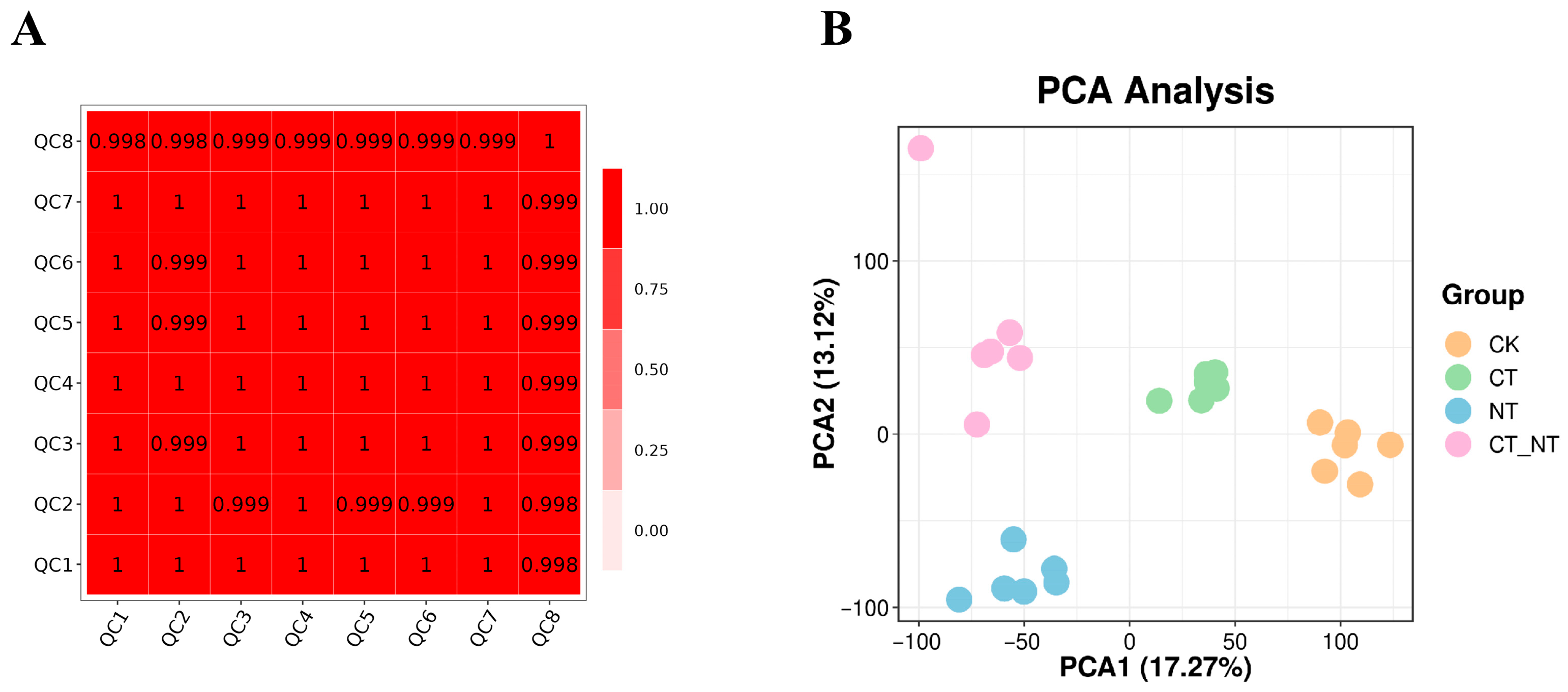
Quality control (QC) constitutes an indispensable procedure for guaranteeing the reliability and precision of experimental outcomes. As illustrated in Figure 2A, all sample correlation coefficients approach 1, which denotes robust linear correlations and excellent reproducibility among the samples. Such high reproducibility validates the suitability of the samples for subsequent analyses.

3.5.2. PCA of Total Samples

Principal component analysis (PCA) was utilized to assess the overall distribution of all tested samples and the reliability of the analytical process. As depicted in Figure 2B, the first principal component (PC1) accounted for 17.27% of the total variance, while the second principal component (PC2) explained 13.12% of the total variance—PC1 thus represented the direction of maximum variability in the dataset. The PCA score plot revealed clear intergroup separation among the four treatment groups, with samples within each group exhibiting tight aggregation and excellent reproducibility. This clustering pattern validated the reliability of the tested samples and confirmed the robustness of the analytical workflow. Collectively, these results indicated significant differences in metabolite profiles among the samples from the four treatment groups.

3.5.3. Differential Metabolite Analysis

Differential metabolites were screened using the thresholds of VIP ≥ 1.0, FC ≥ 1.2 or FC ≤ 0.67 and p-value < 0.05 (Variable Importance in Projection, Fold Change), with the results shown in Table 2. Analysis of Table 2 reveals the following:
Compared with the CK group, 83 significantly upregulated and 88 significantly downregulated metabolites were identified in the CT group; 123 significantly upregulated, and 88 significantly downregulated metabolites were detected in the NT group; and 116 significantly upregulated, and 114 significantly downregulated metabolites were found in the CT_NT group. Further intergroup comparisons revealed that: between the NT group and the CT_NT group, 75 metabolites were significantly upregulated and 115 were significantly downregulated; between the CT group and the CT_NT group, 101 metabolites were significantly upregulated, and 98 were significantly downregulated; and between the NT group and the CT group, 99 metabolites were significantly upregulated, and 140 were significantly downregulated.

3.5.4. KEGG Enrichment Pathway Analysis

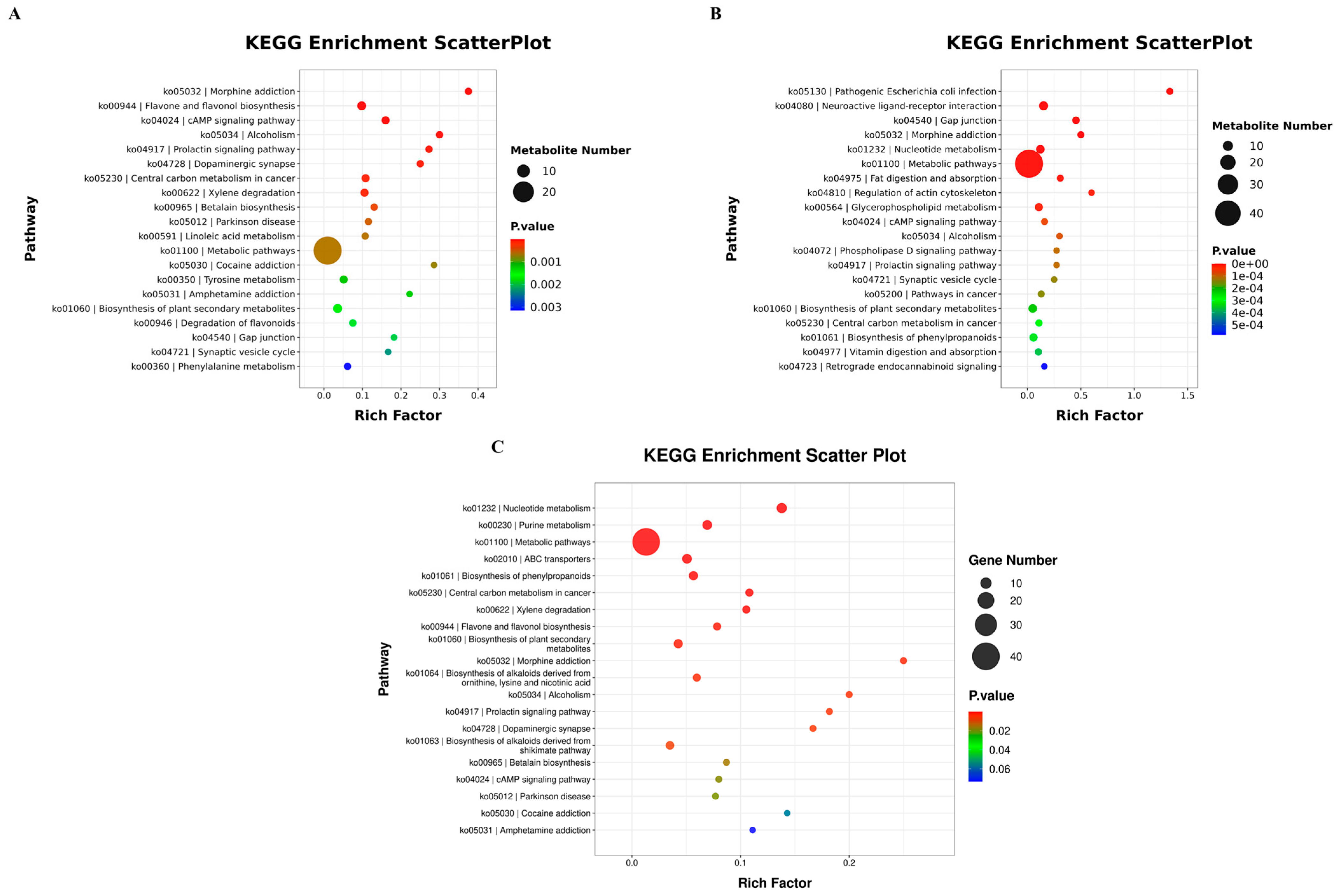
Between group CT and group CK, the enrichment analysis of differentially expressed metabolites across various KEGG pathways revealed that the node ko01100 (metabolic pathways) was prominent, indicating its extensive coverage of metabolites and reactions. However, owing to the broad scope of this pathway, the enrichment factor remained low, posing challenges in achieving significant enrichment within specific categories. In contrast, pathways related to central carbon metabolism and dopamine metabolism not only contained more metabolites but also had a higher enrichment factor and smaller p-value. In addition, pathways such as ko00944 (flavonoid and flavonol biosynthesis), ko04024 (cAMP signaling pathway), ko00622 (xylene degradation), ko00965 (betalain biosynthesis), and ko00591 (linoleic acid metabolism) also had small p-values and a large number of metabolites. The analysis results of the NT vs. CK group showed that the ko01100 (metabolic pathways) pathway contained the largest number of metabolites, but had a ko04977 pathway, related to digestion and absorption of vitamins, had a moderate enrichment factor with a small number of metabolites. Similarly, the ko01060 pathway, involved in the biosynthesis of plant secondary metabolites, also exhibited a moderate enrichment factor and contained a limited number of metabolites. The initial pathway mentioned had a low enrichment factor. Within the CT_NT vs. CK group, the metabolic pathways encompassed the highest number of metabolites, yet they displayed a low enrichment factor. In contrast, the carbon metabolism and dopamine-related metabolic pathways exhibited a different enrichment factor, indicating that the simultaneous application of urea and AKG significantly affected these two types of metabolic pathways in D. officinale stem. In addition, several metabolic pathways, including ABC transporters, biosynthesis of plant secondary metabolites, biosynthesis of phenylpropanoids, xylene degradation, betalain biosynthesis, cAMP signaling pathway, biosynthesis of alkaloids derived from shikimate pathway, and biosynthesis of alkaloids derived from ornithine, lysine, and other metabolic pathways, also showed significant changes and are worthy of attention (Figure 3A–C).
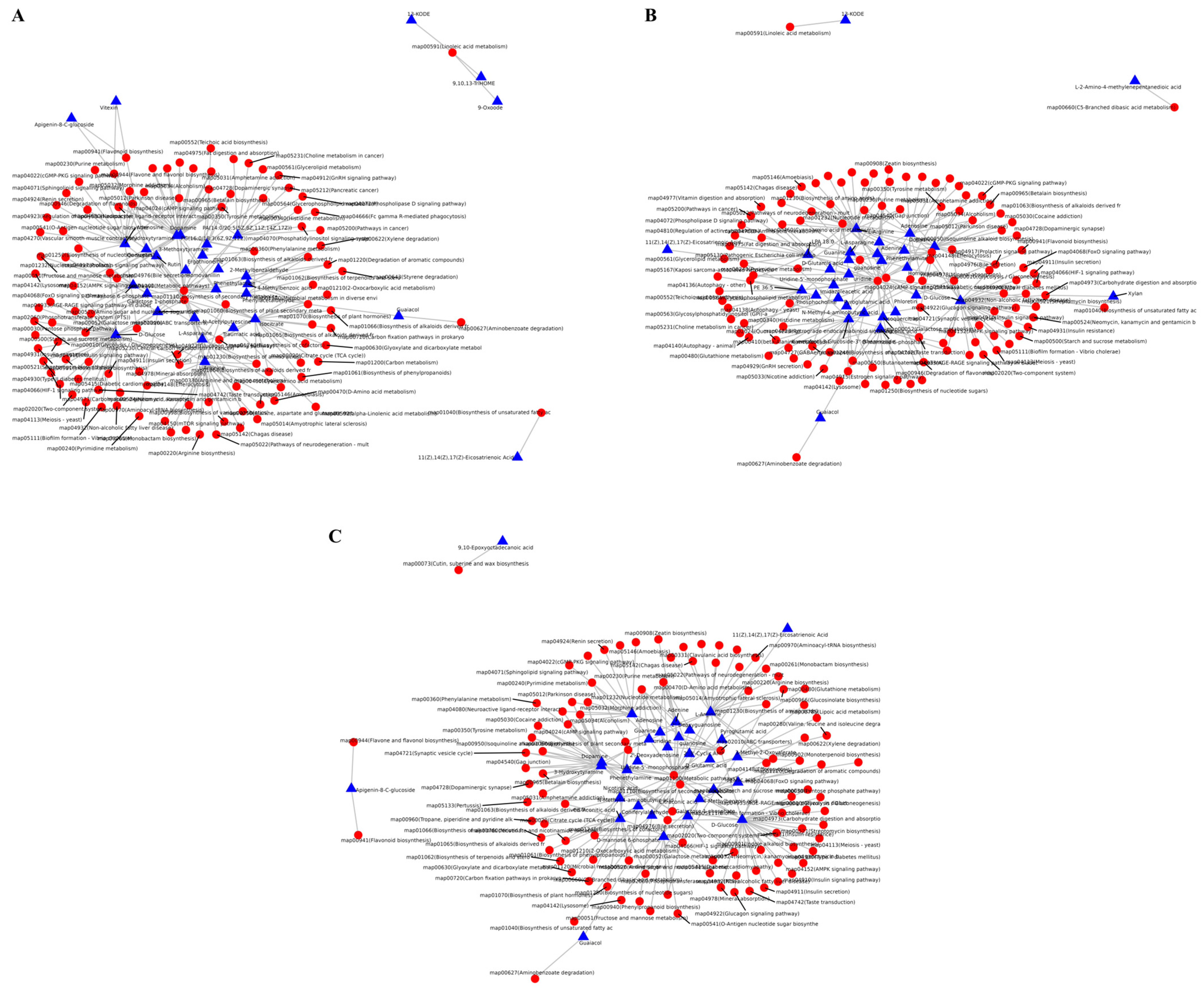
Based on the top 30 differential metabolites with the smallest p-values, a metabolic network diagram is drawn (Figure 4A–C). In the figure, triangles denote differential metabolites, while dots represent pathways. The connecting lines illustrate the relationships between differential metabolites and pathways. A greater number of connecting lines indicates a higher importance of the pathway or metabolite within the regulatory mechanism. Some pathways and metabolites are interconnected by multiple lines, suggesting that they are in the core position in the regulatory mechanism. Through metabolic network analysis, it was found that urea treatment significantly affected the pathway related to secondary metabolite synthesis, carbon and nitrogen metabolism, and mineral absorption in the metabolic network of D. officinale. The regulatory roles of these key metabolites and pathways collectively participate in the adaptive response of plants to urea treatment, providing an important basis for further analyzing the trace element metabolic regulatory mechanism of D. officinale.
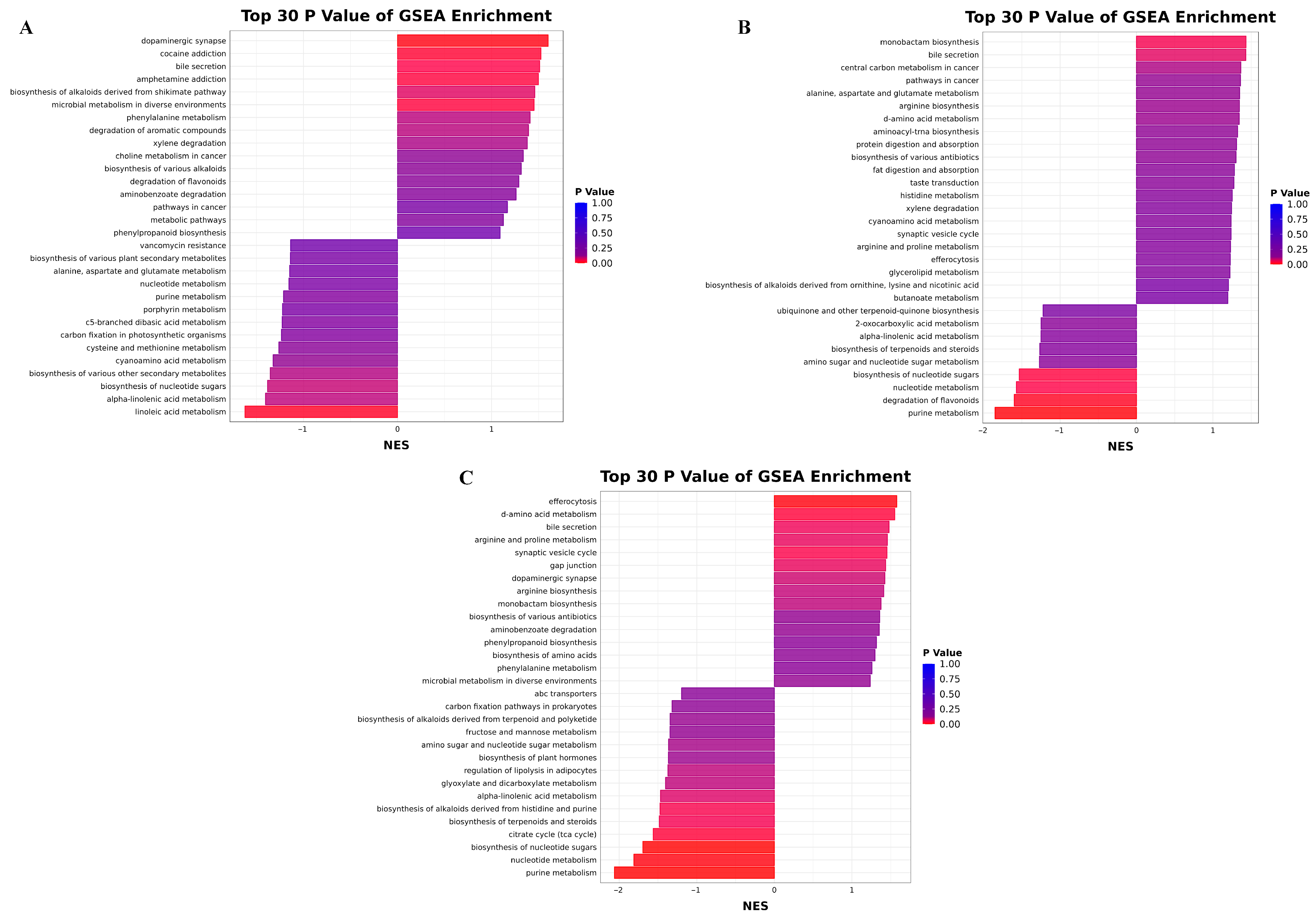
To elucidate the regulatory impact of a specific functional unit, a GSEA (Gene Set Enrichment Analysis) enrichment bar chart was generated using the top 30 metabolite sets with the lowest p and FDR values (False Discovery Rate, Figure 5A–C). The color gradient in the bar chart signifies statistical significance, where a transition from blue to red corresponds to a reduction in p-value, indicating higher significance. Upon treating D. officinale with AKG alone, a significant enrichment of the dopaminergic-related metabolic pathway was observed, as indicated by the metabolic pathway enrichment analysis. Urea treatment significantly enhanced the amino acid metabolic pathway of D. officinale, inhibited pathways such as amino sugar and nucleotide sugar metabolism and nucleotide metabolism, thereby affecting Zn homeostasis in plants. The synergistic application of AKG and urea has been shown to substantially alter the metabolic pathways of D. officinale, including those involved in alkaloid synthesis, benzene ring compound metabolism, lipid turnover, organic acid processing, and flavonoid biosynthesis. The changes in these metabolites indicate that the combined application methods can significantly influence zinc uptake and transport in plants, as well as its utilization, by modulating carbon and nitrogen metabolism and the synthesis of specialized metabolites.
In conclusion, based on the above metabolite information and the analysis of changes in significantly differential metabolites, the application of AKG significantly promoted the increase in the contents of alkaloids and derivatives, benzene ring compounds, organic acids and their derivatives, and phenylpropanoids and polyketides in the stems of D. officinale, while reducing the content of lipids and lipid molecules. Urea treatment significantly affected the metabolic network of D. officinale, including changes in metabolic pathways such as alkaloids, benzene ring compounds, lipids, organic acids, and flavonoids. Alterations in these metabolites suggest that urea may influence plant growth and adaptive responses through the regulation of carbon and nitrogen metabolism, as well as the synthesis of secondary metabolites. It is noteworthy that certain metabolites, such as glutamine, aspartic acid, and pyroglutamic acid, may indirectly influence the absorption, transport, and utilization of Zn in plants by regulating zinc-dependent enzyme activity or related metabolic pathways. The influence of dopamine and its related metabolites on Zn absorption, transport, and utilization in plants also warrants attention. The combined application of AKG and urea markedly modified the metabolic network of D. officinale through regulating the synthesis and degradation pathways of carbohydrates, amino acids, and flavonoid metabolites in its stems. Among these, the upregulation of flavonoids may enhance antioxidant defense mechanisms, while the accumulation of aromatic acids and aldehydes implies the enhancement of the secondary metabolic pathway. The findings offer a theoretical framework for understanding how AKG and urea influence zinc metabolism in D. officinale, potentially through mechanisms similar to those described in eukaryotic cells.

3.6. Transcriptome Analysis

3.6.1. Illumina Sequencing and Correlation Between Samples

Sequencing was performed on the Illumina Novaseq™6000 platform, and using the Trinity software (version 2.4.0), as shown in Table 3, a de novo transcriptome database was assembled from 12 samples. A total of 530,370,142 raw data reads were obtained; after processing the raw data, 513,458,206 valid reads were acquired. The proportion of valid reads reached over 95.16% for all samples, the proportion of bases with a quality score (Q20) ≥ 20 exceeded 98.01% in all cases, and the GC content was above 46.22% for each sample. These results indicate that the analyzed data are feasible and ensure the reliability of further analyses.
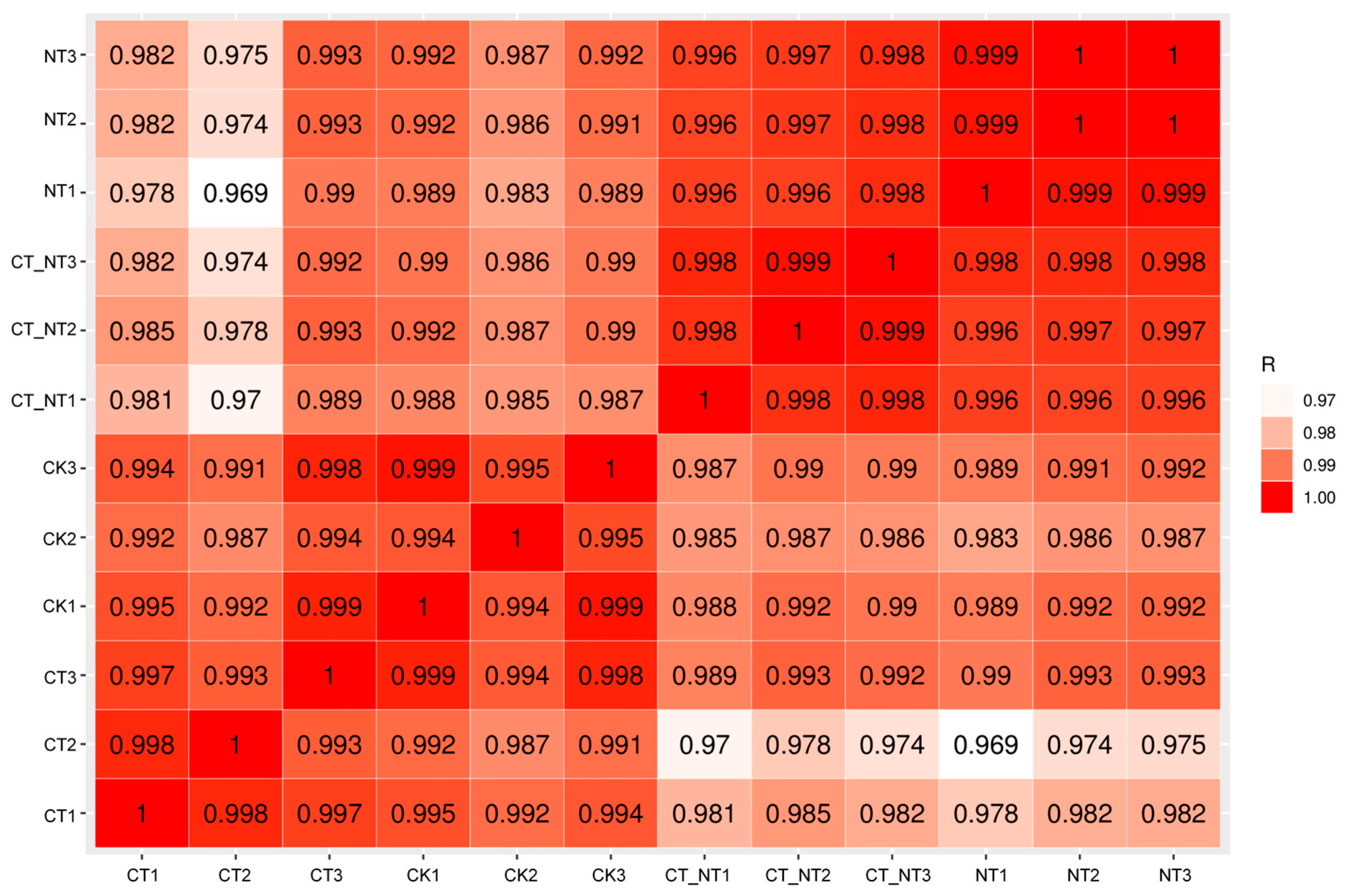
It was shown (Figure 6) that the three biological replicates of each treatment have strong correlation coefficients, thus indicating that the samples collected in this study had high homogeneity.

3.6.2. Differential Gene Expression Analysis

In total, 42,491 unigenes were functionally annotated in six databases. The unigenes annotated to GO, KEGG, Pfam, Swiss Prot, eggNOG, and NR libraries were 18,169, 7089, 17,187, 14,834, 20,660, and 24,821, respectively (Table 4).
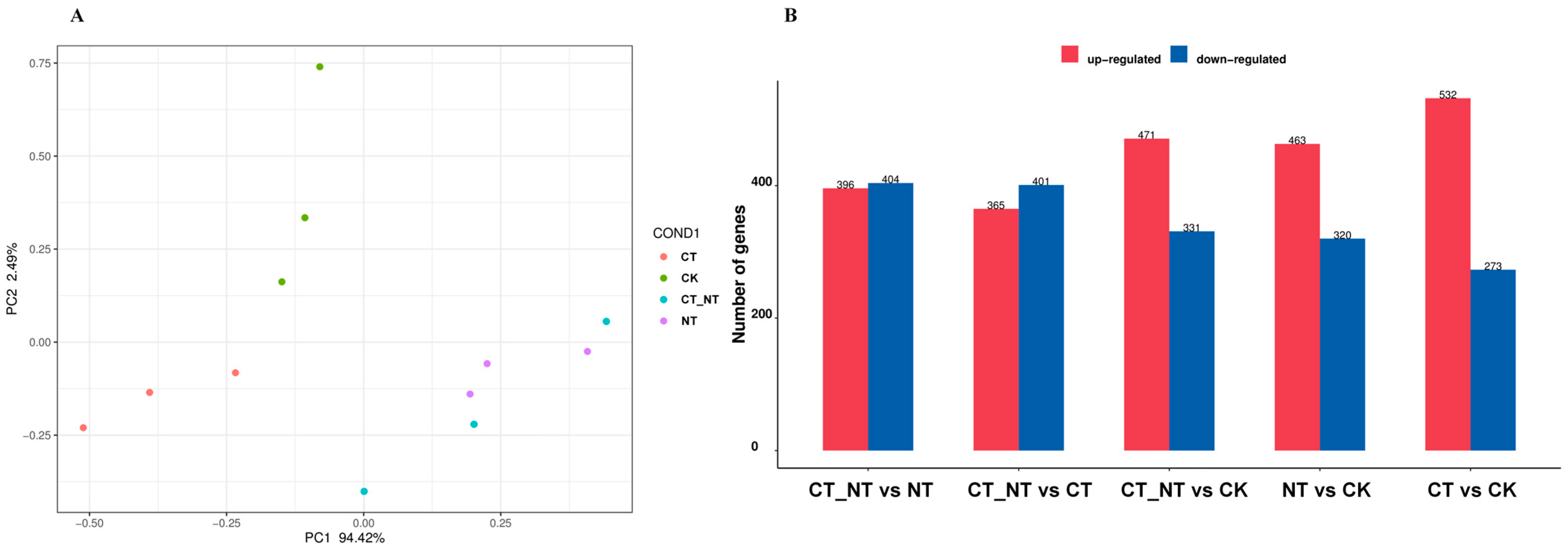
PCA results showed that PC1 and PC2 cumulatively explained 96.91% of the total variance, with PC1 alone accounting for 94.42% of the variance (Figure 7A).
The results of differential expression gene analysis indicated that each treatment group induced significant transcriptome changes (Figure 7B). In the CT vs. CK comparison group, the highest number of upregulated genes (532) was observed, significantly exceeding that in other groups. Meanwhile, there were 273 downregulated genes. The NT vs. CK group exhibited 463 upregulated genes and 320 downregulated genes, while the CT_NT vs. CK group displayed 471 upregulated genes and 331 downregulated genes. Notably, the CT_NT group exhibited a unique expression pattern compared to the single treatment groups: compared with the N group, the CT_NT group had 396 upregulated genes and 404 downregulated genes; compared with the CT group, it showed 365 upregulated genes and 401 downregulated genes.

3.6.3. GO Enrichment Analysis

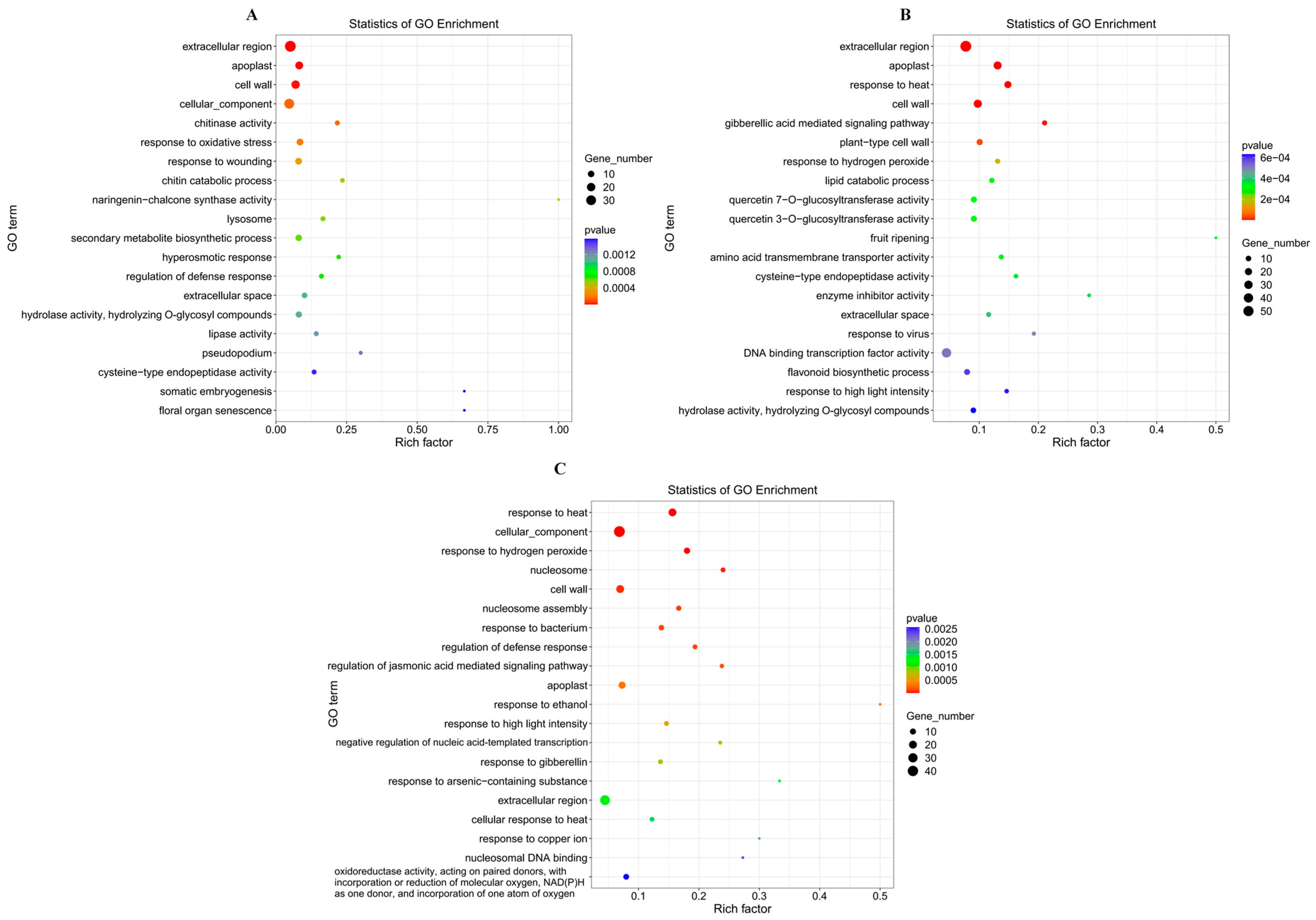
In the biological processes of CT vs. CK, there is a significant enrichment in pathways related to oxidative stress response and the biosynthesis of secondary metabolites, as indicated by detailed studies on the types and characteristics of these metabolites and their roles in cellular processes. At the cellular component level, genes associated with the extracellular region and apoplast show obvious aggregation. Concerning molecular function, genes related to cysteine-type endopeptidase and lipase activity demonstrate significant alterations. The gibberellin-mediated signaling pathway exhibits the highest degree of enrichment and statistical significance, indicating that urea treatment may mediate its physiological effects by regulating the gibberellin signaling network. Meanwhile, the significant enrichment of genes related to the extracellular region suggests that the treatment may have changed the structure or function of the extracellular microenvironment. In terms of metabolic function, genes related to amino acid transmembrane transporter activity, flavonoid biosynthetic process, and O-glycosyl compound hydrolase activity all show significant enrichment. These changes collectively reflect the broad impact of urea treatment on the plant metabolic network. When AKG is mixed with urea for treatment, in terms of biological processes, differentially expressed genes are primarily involved in oxidative stress response (11 genes for hydrogen peroxide response, 9 genes for cadmium ion response), transcriptional regulation (31 genes for DNA-templated transcription, 11 genes for positive regulation), and metabolic processes (9 genes for secondary metabolite biosynthesis), 14 genes for oxidation-reduction process). It is particularly noteworthy that the significant changes in genes related to abscisic acid response (10 genes) and wounding response (9 genes) suggest that the mixed treatment may activate the stress defense system of plants. Molecule function analysis shows that DNA-binding-related functions are significantly enriched, including DNA-binding transcription factor activity (34 genes), sequence-specific DNA binding (17 genes), etc. Meanwhile, genes related to protein binding (38 genes), ATP binding (22 genes), and metal ion binding (27 genes) are also widely regulated, among which the expression changes of genes related to Zn ion binding (11 genes) and kinase activity (10 genes) are particularly prominent (Figure 8A–C).

3.6.4. KEGG Enrichment Analysis

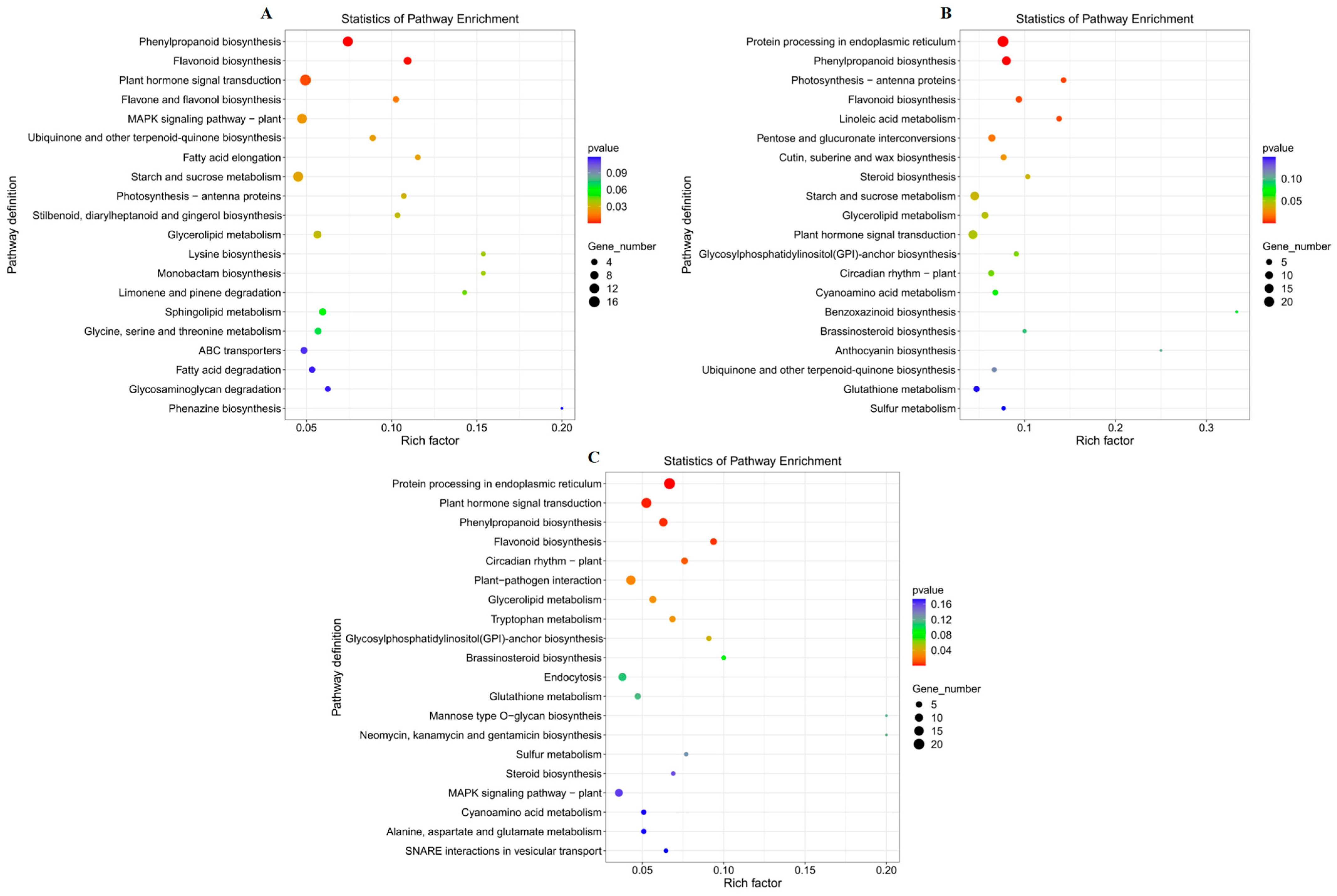
The KEGG pathway enrichment analysis revealed that AKG treatment had a profound impact on several critical metabolic pathways in D. officinale, as evidenced by Figure 9A. The transcriptome analysis of the Arabidopsis mutant revealed that differentially expressed genes were significantly enriched in phenylpropanoid biosynthesis pathways, indicating a strong activation of secondary metabolic processes. Additionally, the identification of MYB transcription factors and structural genes in the anthocyanin biosynthesis pathway of Rehmannia further supports the notion that flavonoid biosynthesis is a critical component of secondary metabolism. Meanwhile, the enrichment of plant hormone signal transduction and the MAPK (Mitogen-Activated Protein Kinase) signaling pathway suggested that the treatment might affect plant growth and development by regulating the signal transduction network. In addition, changes in starch and sucrose metabolism and glycine-related metabolic pathways reflected carbon and nitrogen metabolism, while the enrichment of the ABC (ATP-Binding Cassette) transporter and fatty acid degradation pathway indicated that substance transport and energy metabolic processes were significantly regulated.
In the study, it was observed that differentially expressed genes were significantly enriched in several key metabolic pathways, including the endoplasmic reticulum protein processing pathway and the phenylpropanoid biosynthesis pathway. KEGG pathway enrichment analysis revealed a significant enrichment in the flavonoid biosynthesis pathway and linoleic acid metabolism. Meanwhile, carbohydrate and lipid metabolism pathways, such as starch and sucrose metabolism and glycerolipid metabolism, also changed significantly, indicating that urea treatment may have affected the energy metabolism process of plants. In addition, gene expression of special metabolic pathways such as cyanoamino acid metabolism, brassinosteroid biosynthesis, and glutathione metabolism also changed significantly. The findings suggest that urea, a nitrogen-rich compound, plays a pivotal role in biological systems by influencing critical processes such as protein synthesis, energy metabolism, and the production of secondary metabolites, as illustrated in Figure 9B. Differential genes were significantly enriched in endoplasmic reticulum protein processing, plant hormone signal transduction, and the MAPK signaling pathway, indicating that mixed treatment may affect plant physiological processes by regulating protein homeostasis and signal transduction network (Figure 9C).
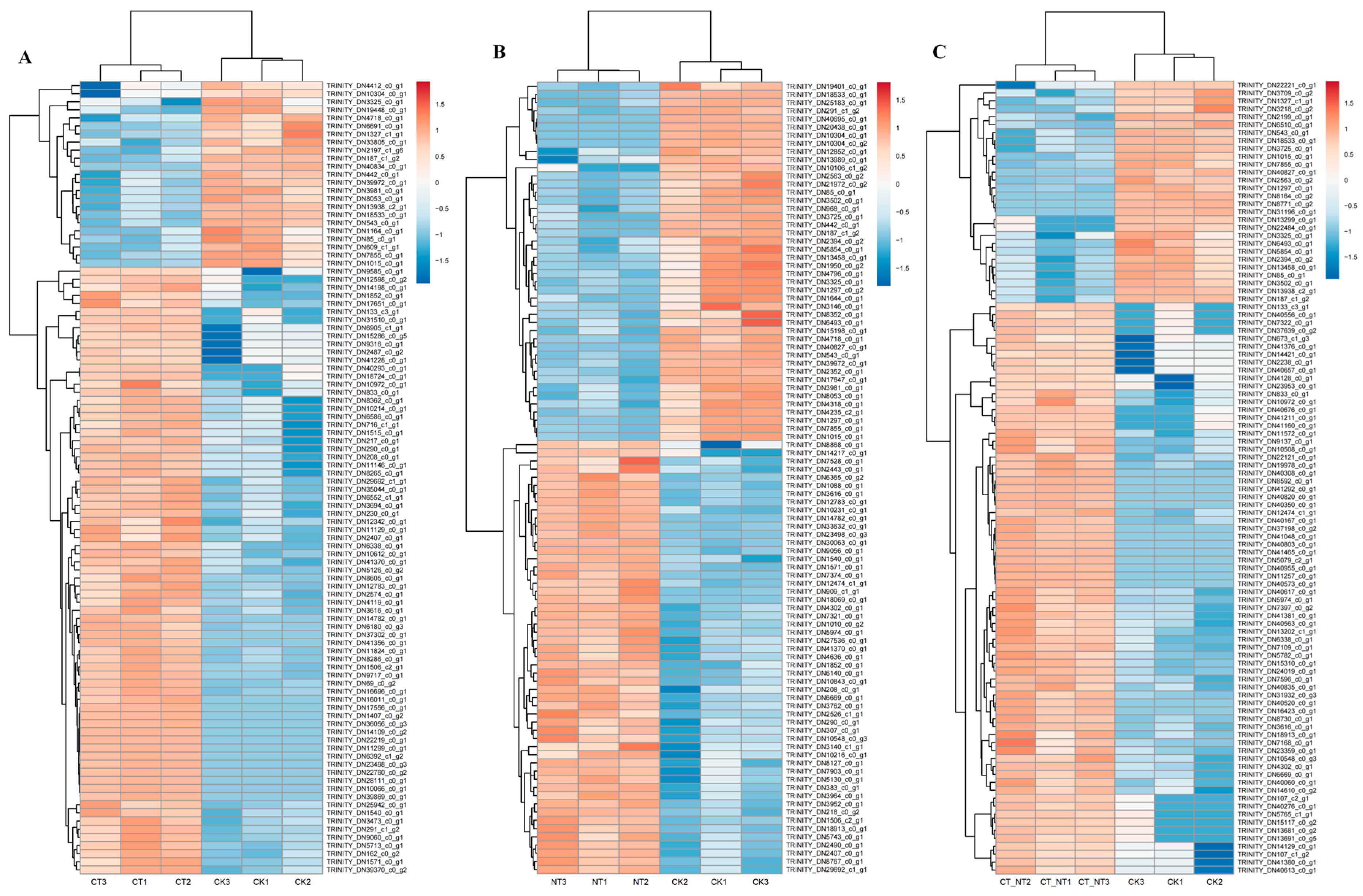
During AKG treatment, KEGG enrichment analysis identified multiple differentially expressed genes related to metal ion binding (Figure 10A). Among the genes associated with Zn ion binding, TRINITY_DN15093_c2_g1(TY3B-I) was downregulated, and TRINITY_DN69_c0_g2(TY3B-G) was upregulated. TRINITY_DN15093_c2_g1 and TRINITY_DN69_c0_g2 are both associated with tryptophan metabolism, which is crucial for the synthesis of neurotransmitters such as dopamine. Tryptophan serves as a precursor for these neurotransmitters, playing a pivotal role in plant growth, development, and adaptation to environmental changes. The TRINITY_DN37185_c0_g1(XBAT35) gene was downregulated, which may be involved in ubiquitin-mediated signal transduction. TRINITY_DN16646_c0_g1SAP5 was upregulated, and this gene may encode a glycosyltransferase involved in carbohydrate metabolism. The TRINITY_DN5262_c0_g2 (IDD2) gene was upregulated, which may be related to plant growth and development. TRINITY_DN1650_c1_g1(ELI3) was upregulated, and this gene may be associated with plant photosynthesis and involved in electron transport in the photophosphorylation pathway. TRINITY_DN23309_c0_g1(SOD1) is upregulated, and this gene may be related to plant secondary metabolism. Secondary metabolites play a role in plant growth and development, stress response, and signal transduction. Through sequence alignment analysis, the genes identified in this study are homologous to the genes in parentheses.
The genes TRINITY_DN16865_c0_g1(COI) and TRINITY_DN5392_c0_g1(SBH1), which bind to iron ions, are both significantly upregulated, with the TRINITY_DN5392_c0_g1 gene potentially associated with stilbene biosynthesis in plants. Stilbene, a type of plant hormone, plays a crucial role in regulating plant growth, development, and responses to environmental stress. The genes TRINITY_DN804_c0_g1(LAC3), TRINITY_DN16054_c0_g1(RBCS-4), TRINITY_DN23309_c0_g1, and TRINITY_DN2407_c0_g1(Bp10), which bind to copper ions, are all upregulated in expression. These genes may affect metal ion homeostasis by regulating processes such as photosynthesis.
Urea treatment has been shown to significantly influence the expression of genes associated with metal metabolism, as evidenced by KEGG enrichment analysis, which identified 18 such genes in D. officinale (Figure 10B). In the context of transition metal ion binding, the upregulation of the copper transporter TRINITY_DN3469_c0_g1(ATX1) gene is observed, which is crucial for maintaining cellular copper ion homeostasis. In a study focusing on metal ion binding genes, it was observed that out of 24 genes identified, 20 were upregulated, including TRINITY_DN1225_c1_g1(ILL6), TRINITY_DN8728_c0_g1(PER11), TRINITY_DN9587_c0_g1(LOX1), TRINITY_DN12453_c0_g1(ZHD1), TRINITY_DN6061_c0_g1(PNC1), TRINITY_DN35334_c0_g1(SEND1), TRINITY_DN3193_c0_g1(OBE3), TRINITY_DN5774_c0_g1(HB2), TRINITY_DN5372_c0_g1(LRP1), TRINITY_DN5631_c1_g1(SRS5), TRINITY_DN8099_c0_g1(ENDO1), TRINITY_DN11380_c0_g2(NIR1), TRINITY_DN17684_c0_g1(PER51), TRINITY_DN14113_c0_g1(SHI), TRINITY_DN16776_c0_g2(GRXC1), TRINITY_DN766_c0_g2(PETF), TRINITY_DN23541_c0_g1(PAP15), and others. Conversely, 3 genes were downregulated, including TRINITY_DN15093_c2_g1, TRINITY_DN37185_c0_g1, and TRINITY_DN13770_c0_g1(ZHD11). TRINITY_DN5392_c0_g1 in iron ion binding was upregulated. There were 4 genes in copper ion binding, among which 3 genes were upregulated, namely TRINITY_DN804_c0_g1, TRINITY_DN7790_c0_g1(LAC14), and TRINITY_DN2407_c0_g1. There were 10 genes in zinc ion binding, among which 5 genes were upregulated, namely TRINITY_DN16646_c0_g1, TRINITY_DN16468_c0_g1(COL14), etc.; 5 genes were downregulated, namely TRINITY_DN15093_c2_g1, TRINITY_DN37185_c0_g1 and other genes. The above results indicate that urea treatment may affect the metal ion homeostasis and related physiological processes of D. officinale by differentially regulating the expression of various metal ion-binding proteins.
When AKG was mixed with urea for treatment, differential expression gene analysis showed that genes related to metal ion binding exhibited extensive changes (Figure 10C), with 19 out of 25 genes being significantly upregulated, namely TRINITY_DN8099_c0_g1, TRINITY_DN6061_c0_g1, TRINITY_DN5262_c0_g2, TRINITY_DN16776_c0_g2, TRINITY_DN4799_c0_g1(WIP3), TRINITY_DN3193_c0_g1, TRINITY_DN7036_c0_g1(PER72), TRINITY_DN585_c0_g1(DOF5.4), TRINITY_DN11380_c0_g2, TRINITY_DN17684_c0_g1, TRINITY_DN13454_c0_g1(CTF7), TRINITY_DN16776_c0_g2, TRINITY_DN23541_c0_g1, TRINITY_DN14931_c0_g1 (DOF3.5), and other genes; 5 genes were significantly downregulated, namely TRINITY_DN15093_c2_g1, TRINITY_DN37185_c0_g1, TRINITY_DN7409_c0_g1(sld1), TRINITY_DN13189_c0_g1(GUX2), and TRINITY_DN13770_c0_g1. For copper ion binding, there were 8 genes with significant changes; the expression levels of TRINITY_DN731_c0_g1(SKU5) and TRINITY_DN2407_c0_g1 were significantly upregulated. Among zinc ion binding genes, the expression levels of TRINITY_DN37185_c0_g1 and TRINITY_DN15093_c2_g1were significantly downregulated; among calcium ion binding genes, the expression levels of TRINITY_DN487_c0_g1(CML19), TRINITY_DN5775_c0_g1(PXG3), and TRINITY_DN666_c0_g1(CML28) were significantly upregulated, while that of TRINITY_DN778_c0_g1(NPF4.6) was significantly downregulated. In addition, the expression level of the gene TRINITY_DN8759_c0_g1(HIPP21), which is related to metal ion transport, was enhanced.

3.7. Transcriptome and Metabolome Joint Analysis

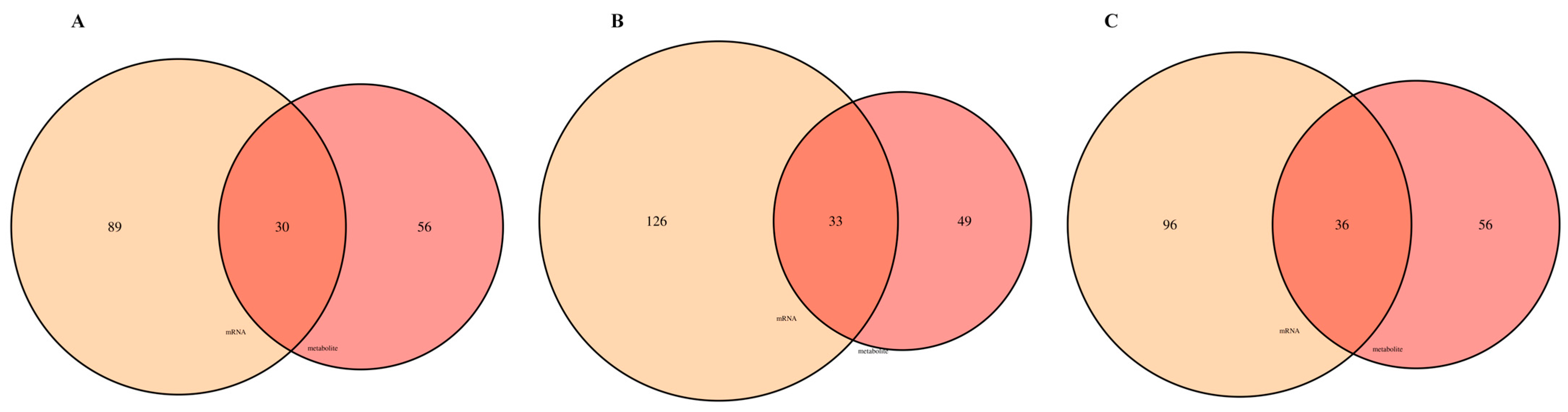
The pathway association characteristics of groups CT and CK in terms of gene expression (mRNA) and metabolite level showed that there were 89 specifically changed pathways at the transcriptome level (left orange area); 56 specifically changed pathways at the metabolome level (right red area); and 30 commonly changed pathways in two omics (overlapping area), accounting for 17.1% of the total number of jointly detected pathways (Figure 11A). Between groups NT and CK, there were 126 transcriptome-specifically changed pathways, 49 metabolome-specifically changed pathways, and 33 commonly changed pathways in two omics, accounting for 15.9% of the total number of detected pathways (Figure 11B). The multi-omics pathway association characteristics between the CT_NT group and CK group revealed 96 transcriptome-specific pathways, 56 metabolome-specific pathways, and 36 co-changed pathways across the two omics, accounting for 19.1% of the total detected pathways. This distribution pattern indicates that the mixed treatment induces extensive reprogramming at the transcriptional level, and about 19% of the pathway changes are consistent at the gene expression and metabolite level (Figure 11C).
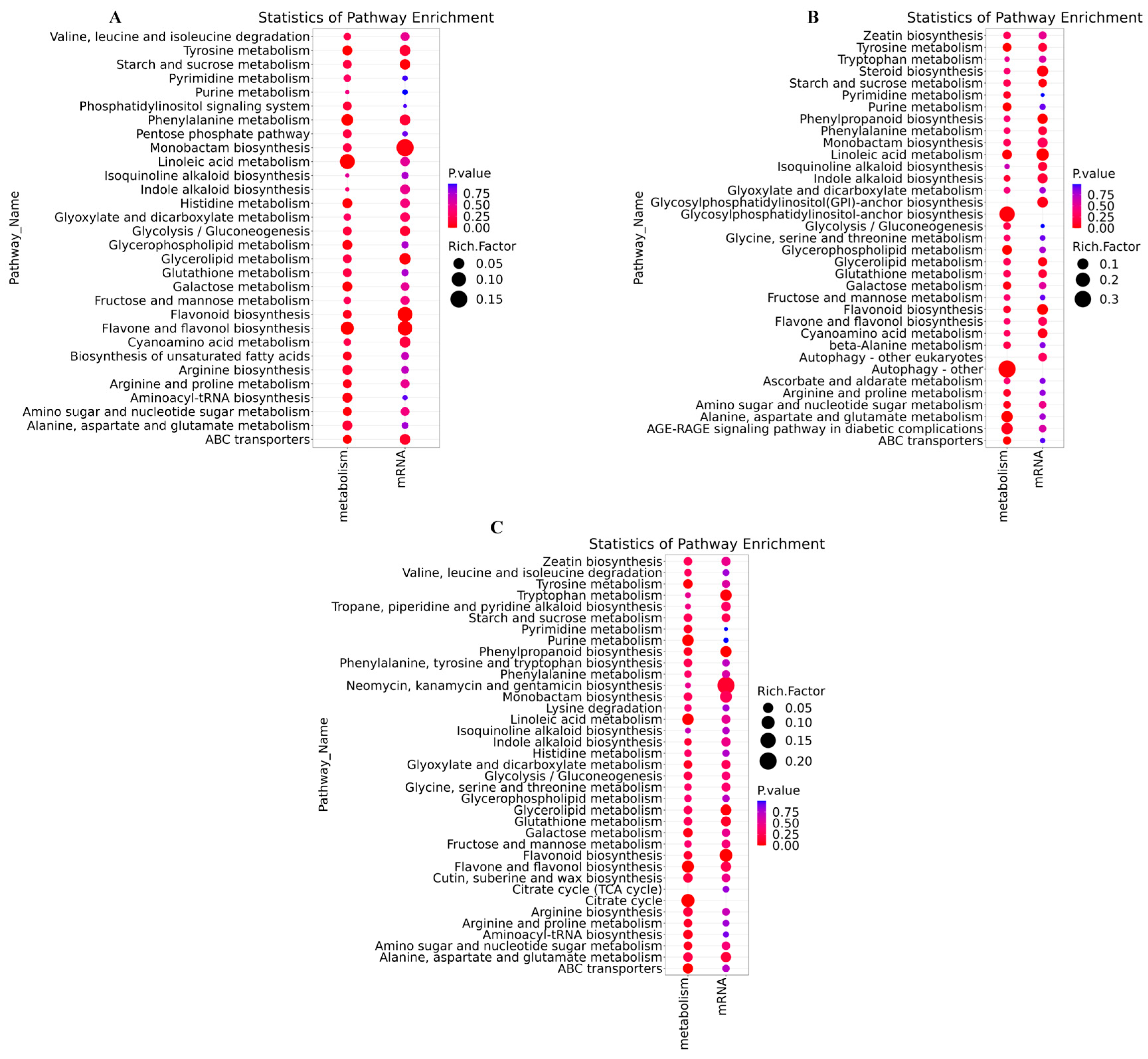
Analyze the enrichment of different pathways at the metabolism and mRNA levels. Studies have revealed that the flavonoid and flavonol biosynthesis pathway is significantly enriched at both transcriptional and metabolic levels, as evidenced by the largest Enrichment factor and the smallest p-value, indicating its critical role in plant metabolism. AKG treatment may significantly affect iron absorption and utilization efficiency in D. officinale by regulating key processes such as iron chelation (flavonoids), redox balance, and iron transport (ABC transporter). The differential analysis between the NT group and the CK group reveals that several key metabolic pathways, including those involved in urea metabolism, are significantly enriched at both transcriptional and metabolic levels. Urea treatment can influence the physiological state of plants by coordinately regulating key biological processes, including lipid metabolism, amino acid metabolism, and redox balance. This is in line with its role in the urea cycle, where urea is synthesized from ammonia and plays a critical role in nitrogen metabolism and maintaining acid-base balance. In both the CT_NT and CK groups, citrate cycle was highly enriched at the metabolic level; tryptophan metabolism, flavonoid biosynthesis, and alkaloid biosynthesis were highly enriched at the transcription level. In addition, 21 pathways, including glyoxylate and dicarboxylate metabolism, glutathione metabolism, tyrosine metabolism, glycolysis/gluconeogenesis, glycine, serine, and threonine metabolism, were significantly enriched at both transcription and metabolic levels. The combined treatment significantly affected the metabolic network of D. officinale by differentially regulating primary metabolism (such as citrate cycle, amino acid metabolism) and secondary metabolism (such as flavonoids, alkaloid synthesis) pathways (Figure 12A–C).

4. Discussion

4.1. Physiological Effects of Combined Carbon and Nitrogen Application on Fe and Zn Contents in Stems of D. officinale

Combined carbon–nitrogen application exerts time-dependent regulation on Fe, Zn, and their key metabolites in D. officinale by modulating the synergistic network of “carbon-nitrogen metabolism-citric acid transport-trace element absorption” [27]. At 16 d, the synergistic activation of absorption pathways and citric acid-mediated transport mechanisms by carbon and nitrogen leads to the peak accumulation of Fe and Zn; at 32 d, the combined effect of multiple factors, such as feedback inhibition, nutrient consumption, and metabolic function shift, results in a significant decrease in Fe and Zn contents. This dynamic change reveals the adaptive response mechanism of D. officinale to combined carbon–nitrogen application, and also provides a theoretical basis for optimizing the accumulation efficiency of trace elements by regulating the timing and ratio of carbon–nitrogen supply [28,29,30].

4.2. Effect of AKG on Fe Content in Stems of D. officinale

After AKG treatment, the expression levels of TRINITY_DN41370_c0_g1(CIPK11), TRINITY_DN12199_c0_g2(CIPK23), and TRINITY_DN20738_c1_g1(FDH1) genes in D. officinale were significantly upregulated. Among them, TRINITY_DN41370_c0_g1 and TRINITY_DN12199_c0_g2, as key components of the CBL-CIPK calcium signaling pathway [31], their upregulation indicates that AKG may activate calcium signaling transduction to initiate the expression of downstream Fe absorption-related genes; FDH1, as an important regulatory factor of the iron transport system [32], its enhanced expression can directly promote the transport and distribution of Fe in plants. The synergistic expression of the above genes may strengthen the FIT-dependent iron deficiency response pathway [33], forming a cascade regulation of “calcium signaling-iron transport—iron deficiency response”, thereby efficiently promoting Fe absorption.
TRINITY_DN5940_c0_g1(FLS), TRINITY_DN5191_c0_g1(MYB12), TRINITY_DN267_c0_g1(TOGT1), TRINITY_DN4590_c1_g1(UGT73C6), AKG treatment significantly activated the synthetic metabolism of flavonoids, flavonols, and phenolic compounds in D. officinale. Related pathways showed the most significant enrichment at both transcriptional and metabolic levels, while promoting the accumulation of iron chelates to indirectly enhance Fe absorption and utilization. From the perspective of molecular regulation: (1) Activation of core regulatory genes and upstream pathways: TRINITY_DN5191_c0_g1(MYB12) (a key transcription factor for flavonoid synthesis [34]), TRINITY_DN1350_c0_g1(4CL2) (a key enzyme in the phenylpropanoid metabolism, regulated by iron deficiency and ethylene [35]), and TRINITY_DN10049_c0_g1(BGLU41) (a regulatory gene for phenylpropanoid metabolism [36]) were significantly upregulated, jointly activating the synthetic pathways of flavonoids and phenolic compounds; among them, TRINITY_DN1350_c0_g1, as a key node in phenylpropanoid metabolism, its high expression provides sufficient precursor substances for the synthesis of flavonoids and phenolic compounds. (2) Synergistic effects of functional genes and metabolites: The upregulation of TRINITY_DN5940_c0_g1(FLS) (flavonol synthase, which requires Fe2+ as a cofactor [37]), TRINITY_DN267_c0_g1(TOGT1) (a regulatory gene for coumarin glycosylation [38]), and TRINITY_DN4590_c1_g1(UGT73C6) (a flavonol modification gene [39]) not only promotes the production of flavonoids but also optimizes their Fe chelating ability through structural modification; meanwhile, the contents of phenolic substances such as dopamine, 3-hydroxytyramine, 3-methoxytyramine, and guaiacol in the stems of D. officinale were significantly increased [40], forming a synergistic effect with flavonoids (e.g., quercetin). These substances form high-affinity metal chelating sites through functional groups such as hydroxyl and carbonyl groups in their structures [39], efficiently chelating Fe ions in the rhizosphere and plants, while enhancing the reduction capacity of Fe3+, thus providing a guarantee for Fe absorption [40].
AKG treatment systematically improved Fe absorption, transport, and storage efficiency by reconstructing the organic acid metabolic network and activating the ABCB14 transporter. On the one hand, AKG significantly promoted the biosynthesis and accumulation of citric acid or isocitric acid, syringic acid, and lactic acid: citric acid, as a core carrier for Fe transport, can avoid Fe oxidation and precipitation through chelation, improving transport efficiency; syringic acid and lactic acid further optimize the rhizosphere microenvironment and intracellular metabolic balance, creating favorable conditions for Fe absorption and storage. On the other hand, AKG upregulated the expression of the TRINITY_DN13174_c0_g1(ABCB14) gene, which can mediate the transport of citric acid and malic acid from extracellular to intracellular [41]. By regulating intracellular pH and ion concentration, it optimizes the active environment of Fe transporters and provides a guarantee for the transmembrane transport of Fe-organic acid chelates. The synergistic effect of the above organic acid metabolism and ABCB14 transport forms an efficient pathway of “organic acid chelation-Fe ion activation-transmembrane transport”, significantly improving Fe utilization efficiency.
Under AKG treatment, the expression of the TRINITY_DN1195_c0_g2(NAC100) gene in D. officinale was significantly upregulated. Previous studies have shown that NAC100 regulates silique growth in the early stage of Arabidopsis silique development by regulating the Gibberellins (GA) biosynthesis pathway [42]. Based on the correlation between hormone signals and nutrient absorption, it is speculated that the AKG-induced upregulation of TRINITY_DN1195_c0_g2 may indirectly affect the expression of Fe absorption and transport-related genes or the activity of transporters by regulating the synthesis and distribution of GA, thereby regulating the absorption, transport, and utilization efficiency of Fe in D. officinale.
AKG treatment significantly upregulated the expression of the TRINITY_DN2052_c0_g2(ABCG36) gene in D. officinale. This gene belongs to the same ABCG transporter subfamily as Arabidopsis AtABCG37, which is specifically upregulated under plant iron deficiency stress and promotes Fe absorption by secreting phenolic compounds (such as coumarin) into the rhizosphere [43]. It is speculated that TRINITY_DN2052_c0_g2 may have similar functional characteristics, participating in the secretion of phenolic substances (such as coumarin and flavonoid derivatives) in the rhizosphere of D. officinale, thereby promoting the dissolution and absorption of Fe. In addition, some members of the ABCG transporter family are also involved in the regulation of auxin transport. Therefore, the upregulation of TRINITY_DN2052_c0_g2 may indirectly affect the development of Fe absorption and transport-related tissues or the localization of transporters by changing the distribution pattern of auxin in plants, maintaining Fe homeostasis in plants.
After AKG treatment, the Fe ion binding-related genes TRINITY_DN16865_c0_g1(COI) and TRINITY_DN5392_c0_g1(SBH1) were significantly upregulated. The expression level of the TRINITY_DN16865_c0_g1 gene can indirectly affect the microenvironment of Fe active sites [44], thereby regulating the redox reactions involving Fe and their coupling with proton pumps, providing an energy basis for Fe transmembrane transport; TRINITY_DN5392_c0_g1 affects the production and scavenging of reactive oxygen species (ROS) by regulating the accumulation of sphingolipid long-chain bases [45], and Fe2+/Fe3+ is a key participant in redox reactions [46], whose metabolic process is closely related to ROS (Reactive Oxygen Species) homeostasis. Therefore, the synergistic upregulation of TRINITY_DN16865_c0_g1 and TRINITY_DN5392_c0_g1 can optimize the efficiency of metabolic reactions involving Fe, while maintaining intracellular ROS balance, providing a stable cellular environment for the efficient absorption and utilization of Fe.
The copper ion binding-related genesTRINITY_DN804_c0_g1(LAC3), TRINITY_DN16054_c0_g1(RBCS-4), and TRINITY_DN2407_c0_g1(Bp10) were all significantly upregulated after AKG treatment, indirectly participating in Fe metabolic regulation by maintaining redox homeostasis. Among them, the core function of TRINITY_DN23309_c0_g1(SOD1) is to catalyze the dismutation of superoxide anions, reducing intracellular oxidative stress [47]. Its upregulation can regulate the structure and function of iron transporters by improving the intracellular redox environment, thereby affecting the transmembrane transport, storage, and utilization of Fe3+/Fe2+; the product encoded by TRINITY_DN2407_c0_g1 has high sequence similarity with ascorbate oxidase (AO) from cucumber and pumpkin [48], and ascorbate metabolism is a key link in the regulation of plant redox balance. As an important cofactor in redox reactions, Fe may be indirectly affected by the expression of TRINITY_DN2407_c0_g1 or the activity of its product. The upregulation of the above Cu ion binding genes forms a synergistic effect with Fe metabolism-related genes, jointly maintaining intracellular redox homeostasis and providing a guarantee for the efficient absorption and utilization of Fe.
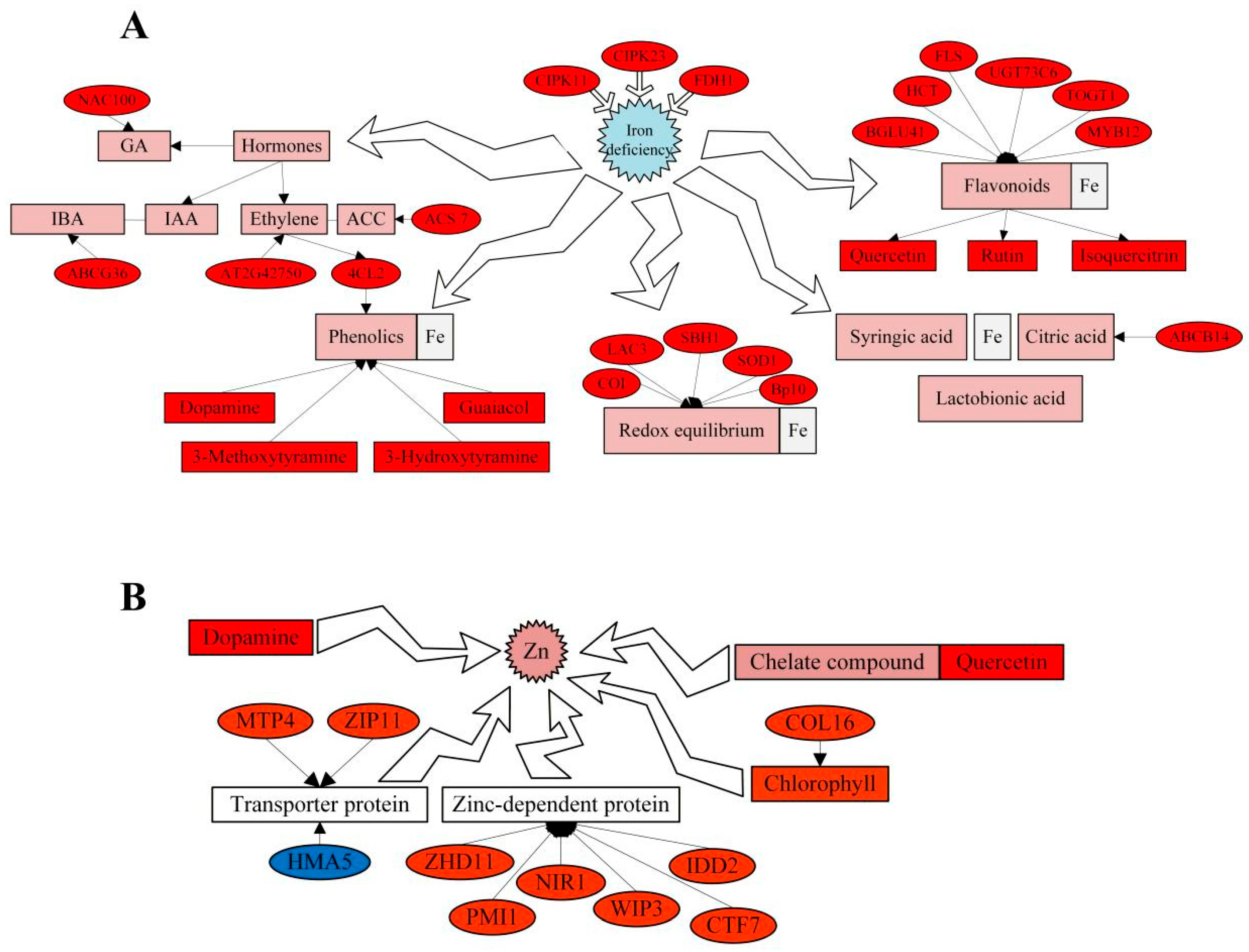
This study reveals the multilevel regulatory mechanism by which AKG promotes D. officinale iron absorption (Figure 13A). First, the application of AKG responds to the iron deficiency signal by upregulating the expression of genes such as TRINITY_DN41370_c0_g1, TRINITY_DN12199_c0_g2, and TRINITY_DN20738_c1_g1. Second, it upregulates hormone and flavonoids synthesis-related genes, enhances the synthesis of flavonoids, phenolic substances, and organic acids, and improves iron chelation and reduction ability, thereby increasing the bioavailability of iron. In addition, it regulates hormone levels and redox balance, further refining the iron metabolism process. In summary, through multilevel gene regulation and metabolite synergistic effect, AKG significantly increases the Fe content in the stems of D. officinale.

4.3. Combined Application of Carbon and Nitrogen on D. officinale Stem Zn Content

The ZIP (ZRT/IRT-like Protein) family is a widely distributed group of Zn and Fe transporters in plants, primarily responsible for the absorption, transport, and distribution of zinc and iron [49]. Kozak et al. [50] found that NtZIP11 can enhance zinc uptake in tobacco, while Sun et al. [51] demonstrated that SlZIP11 plays a regulatory role in plants adapting to environments with varying zinc concentrations. In the present study, TRINITY_DN2443_c0_g1(ZIP11) was significantly upregulated in the NT group, indicating that urea increased zinc content in the stems of D. officinale by promoting TRINITY_DN2443_c0_g1 expression. Meanwhile, the expression of the TRINITY_DN6536_c0_g1(HMA5) gene was significantly downregulated in the CT_NT group, which may reduce the accumulation of heavy metal ions to alleviate their toxicity. TRINITY_DN9402_c0_g1(MTP4) regulates zinc ion distribution and responds to changes in intracellular zinc concentrations [52]. The significant upregulation of TRINITY_DN9402_c0_g1 in the NT group suggests that urea treatment may activate the TRINITY_DN9402_c0_g1-mediated transport mechanism, thereby promoting iron accumulation in the stems of D. officinale.
The upregulation of PMI1 increases the intracellular content of this enzyme, which in turn enhances cellular demand for zinc ions [53]. TRINITY_DN4799_c0_g1(WIP3), TRINITY_DN13770_c0_g1(ZHD11), TRINITY_DN13454_c0_g1(CTF7), and TRINITY_DN5262_c0_g2 (IDD2) proteins belong to the zinc finger protein family, whose structural integrity and functional activity depend on zinc ion binding [54,55,56]. The upregulation of these genes may lead to the production of more related proteins, increasing zinc ion-binding sites, which in turn attract more zinc ions to enter and bind with cells, thereby promoting intracellular zinc accumulation. In addition, TRINITY_DN11380_c0_g2 belongs to the zinc cluster family of transcriptional activators; its N-terminal domain binds zinc ions, and this zinc-binding domain can stabilize protein structure to regulate the transcription of nitrogen metabolism-related genes [57]. Metabolomic data showed that compared with the CK group, the transcriptional expression of TRINITY_DN11380_c0_g2 was significantly upregulated in the CT_NT group, indicating that combined carbon–nitrogen application regulates nitrogen metabolism and zinc homeostasis. Furthermore, the content of quercetin in D. officinale was significantly increased under combined carbon–nitrogen application. Quercetin may promote zinc accumulation in D. officinale through direct chelation of zinc ions [58], regulation of plant hormone signaling pathways [59], and enhancement of the antioxidant defense system [60]. Under drought stress, dopamine can enhance the zinc uptake capacity of plant roots, promote long-distance transport of zinc in plants, and alter the distribution of zinc among different organs of apple plants [61]. Dopamine has a close association with zinc [62]; compared with the CK group, dopamine content was significantly increased in all other treated groups, suggesting that dopamine may significantly promote zinc absorption and utilization.
This study uncovers the molecular mechanism through which AKG and urea work synergistically to regulate zinc metabolism in D. officinale (Figure 13B). Research has shown that urea treatment enhances zinc absorption by increasing the expression of the TRINITY_DN9402_c0_g1 gene, and the combined application of AKG and urea further improves zinc utilization efficiency by activating the zinc ion distribution mechanism through TRINITY_DN9402_c0_g1and by upregulating the expression of metal ion binding protein genes, such as TRINITY_DN7940_c0_g1 and TRINITY_DN4799_c0_g1. In addition, the combined treatment significantly increases the contents of metabolites such as quercetin and dopamine, and these substances promote zinc accumulation through multiple pathways, including chelation, regulation of hormone signal, and antioxidant defense.
However, the functions of these key genes screened in this study have not yet been verified and in-depth studied, and how they enhance the Fe and Zn contents in D. officinale remains to be further explored. Meanwhile, in the future, targeted determination of changes in substances such as flavonoids, organic acids, hormones, and dopamine can be conducted, or the effects of exogenous application of these substances on Fe and Zn contents can be verified to further clarify the specific mechanism by which combined carbon–nitrogen application improves the Fe and Zn contents in D. officinale.

5. Conclusions

In this study, AKG and urea were co-applied to D. officinale, and combined with transcriptomic and metabolomic analyses, the effects on Fe and Zn contents in the stems of D. officinale and their metabolic molecular mechanisms were systematically investigated. Combined carbon–nitrogen application exhibited a trend of first increasing and then decreasing the Fe and Zn contents in the stems of D. officinale. Additionally, some metabolites and key genes regulating the accumulation of Fe and Zn contents were identified. This study provides theoretical support for the development of precision fertilization regulation technology and has practical guiding significance for the high-quality cultivation of D. officinale.

Author Contributions

Conceptualization, D.Y. and B.Z.; methodology, S.X.; software, S.X.; validation, S.X., Y.C. and T.L.; formal analysis, Y.C. and T.L.; investigation, T.L.; resources, D.Y.; data curation, Y.C.; writing—original draft preparation, D.Y. and S.X.; writing—review and editing, D.Y. and B.Z.; visualization, D.Y. and B.Z.; supervision, D.Y.; project administration, B.Z.; funding acquisition, B.Z. All authors have read and agreed to the published version of the manuscript.

Funding

We are grateful for the funding support from the Open Project of Ningbo Key Laboratory of Characteristic Horticultural Crops in Quality Adjustment and Resistance Breeding. (NBYYL20230003).

Data Availability Statement

The original data presented in the study are openly available in NCBI with PRJNA1363688 and CNCB with PRJCA051073.

Acknowledgments

The authors would like to thank Zhejiang A&F University. Thanks to the editors and reviewers for their constructive comments and suggestions, which have improved the quality of the manuscript.

Conflicts of Interest

The authors declare no conflicts of interest.

References

  1. Chen, L.; Duan, S.; Huang, J.; Hu, L.; Liu, S.; Lan, Q.; Wei, G. Integrated metabolomic and transcriptomic analysis reveals variation in the metabolites of Dendrobium officinale, Dendrobium huoshanense, Dendrobium nobile. Phytochem. Anal. PCA 2024, 36, 181–193. [Google Scholar] [CrossRef] [PubMed]
  2. Meng, W.N.; Jia, Y.; Zhang, Y.; Jing, H.; An, D.; Gui, C.; Ming, T.; Zeng, X. Effects of element deficiency and deficiency recovery on tissue culture seedlings of Dendrobium officinale. J. Plant Resour. Environ. 2024, 33, 39–49. [Google Scholar]
  3. Zhao, J. A brief discussion on the functions and techniques of rational fertilization for crops. Friends Farmers Get. Rich. 2017, 71. [Google Scholar]
  4. Nunes-Nesi, A.; Fernie, A.R.; Stitt, M. Metabolic and Signaling Aspects Underpinning the Regulation of Plant Carbon Nitrogen Interactions. Mol. Plant 2010, 3, 973–996. [Google Scholar] [CrossRef] [PubMed]
  5. Qi, Y.C.; Pan, Y.Z.; Yang, Y.N.; Xian, X.L.; Chen, R.; Li, S.L. Effects of combined application of nitrogen, phosphorous and potassium fertilizers on flowering traits and contents of chlorophyll and nutrient elements in leaves of Osmanthus fragrans ‘Jinyu Taige’. J. J. Plant Resour. Environ. 2017, 26, 35–45. [Google Scholar]
  6. Ye, J.Y. Nitrogen in plants: From nutrition to the modulation of abiotic stress adaptation. Stress Biol. 2022, 2, 1–14. [Google Scholar] [CrossRef]
  7. Li, J.P.; Chen, R.Y.; Liu, H.C.; Song, S.W.; Su, W.; Sun, G.W. Effects of Organic Carbon Fertilizer on Growth, Quality, and Metabolizing Enzymes Activities of Carbon and Nitrogen in Lettuce. China Veg. 2023, 1, 98–103. [Google Scholar]
  8. Li, M.; Xu, J.; Wang, X.; Fu, H.; Zhao, M.; Wang, H.; Shi, L. Photosynthetic characteristics and metabolic analyses of two soybean genotypes revealed adaptive strategies to low-nitrogen stress. J. Plant Physiol. 2018, 229, 132–141. [Google Scholar] [CrossRef] [PubMed]
  9. Shen, L.X.; Wang, P. Determination of C-N Metabolism Indices in Ear-leaf of Maize (Zea mays L.). Chin. Agric. Sci. Bull. 2009, 25, 155–157. [Google Scholar]
  10. Sookoian, S.; Pirola, C.J. Liver enzymes, metabolomics and genome-wide association studies: From systems biology to the personalized medicine. World J. Gastroenterol. 2015, 21, 711. [Google Scholar] [CrossRef]
  11. Chang, J.B.; Ma, Z.Y.; Ding, Z.J.; Zheng, S.J. Research progresses on molecular mechanisms of storage, transportation and reutilization of plant seed iron. J. Zhejiang Univ. Agric. Life Sci. 2021, 47, 473–480. [Google Scholar]
  12. Ishimaru, Y.; Suzuki, M.; Kobayashi, T.; Takahashi, M.; Nakanishi, H.; Mori, S.; Nishizawa, N.K. OsZIP4, a novel zinc-regulated zinc transporter in rice. J. Exp. Bot. 2005, 56, 3207–3214. [Google Scholar] [CrossRef]
  13. Gui, P.; Chen, X.; Liao, Z.W.; Wang, L.M.; Zhong, X.J.; Mao, X.Y. Effect of organic carbon on carbon and nitrogen metabolism and the growth of water spinach as affected by soil nitrogen levels. Acta Pedol. Sin. 2016, 53, 746–756. [Google Scholar]
  14. Zhao, M.X.; Jiang, Y.L.; He, Y.X.; Chen, Y.F.; Teng, Y.B.; Chen, Y.X.; Zhang, C.C.; Zhou, C.Z. Structural basis for the allosteric control of the global transcription factor NtcA by the nitrogen starvation signal 2-oxoglutarate. Proc. Natl. Acad. Sci. USA 2010, 107, 12487–12492. [Google Scholar]
  15. Wu, Y.L.; Hu, J.X.; Chen, Y.X.; Zheng, B.S.; Yan, D.L. Effects of external application of α-ketoglutarate on growth, carbon, nitrogen and phosphorus accumulation and their stoichiometric relationships in Kosteletzkya virginica under salt stress. J. Agric. Sci. Technol. 2023, 25, 170–177. [Google Scholar]
  16. Xiao, D.F.; Zeng, L.M.; Yao, K.; Kong, X.F.; Wu, G.Y.; Yin, Y.L. The glutamine-alpha-ketoglutarate (AKG) metabolism and its nutritional implications. Amino Acids 2016, 48, 2067–2080. [Google Scholar]
  17. Wu, T.T.; Chen, J.B.; Yuan, H.W.; Zheng, B.S.; Yan, D.L. Effects of foliar spraying organic carbon on carbohydrate metabolism and Fe, Zn content of Dendrobium officinale. Ecol. Sci. 2021, 40, 31–36. [Google Scholar]
  18. Kolberg, F.; Tóth, B.; Rana, D.; Arcoverde, C.; Gerényi, A.; Solti, Á.; Szalóki, I.; Sipos, G.; Fodor, F. Iron Status Affects the Zinc Accumulation in the Biomass Plant Szarvasi-1. Plants 2022, 11, 3227. [Google Scholar] [CrossRef] [PubMed]
  19. López-Millán, F.; Duy, D.; Philippar, K. Chloroplast Iron Transport Proteins—Function and Impact on Plant Physiology. J. Frontiers in Plant Sci. 2016, 7, 178. [Google Scholar]
  20. Shafiq, S.; Ali, A.; Sajjad, Y.; Zeb, Q.; Shahzad, M.; Khan, A.; Nazir, R.; Widemann, E. The Interplay between Toxic and Essential Metals for Their Uptake and Translocation Is Likely Governed by DNA Methylation and Histone Deacetylation in Maize. Int. J. Mol. Sci. 2020, 21, 6959. [Google Scholar]
  21. Fu, X.M.; Gui, R.F.; Li, W.; Gao, Z.F.; Ashraf, U.; Tan, J.T.; Ye, Q.Y.; Chen, J.L.; Xie, H.J.; Mo, Z.W. Nitrogen and α-Ketoglutaric Acid Application Modulate Grain Yield, Aroma, Nutrient Uptake and Physiological Attributes in Fragrant Rice. J. Plant Growth Regul. 2021, 40, 1613–1628. [Google Scholar] [CrossRef]
  22. Ammann, A.A. Inductively coupled plasma mass spectrometry (ICP MS): A versatile tool. J. Mass Spectrom. 2007, 42, 419–427. [Google Scholar] [CrossRef]
  23. Cataldo, D.A.; Maroon, M.; Schrader, L.E.; Youngs, V.L. Rapid colorimetric determination of nitrate in plant tissue by nitration of salicylic acid. Commun. Soil Sci. Plant Anal. 1975, 6, 71–80. [Google Scholar] [CrossRef]
  24. Sapan, C.V.; Lundblad, R.L.; Price, N.C. Colorimetric protein assay techniques. Biotechnol. Appl. Biochem. 1999, 29, 99–108. [Google Scholar] [CrossRef] [PubMed]
  25. Hartford, C.G. Rapid spectrophotometric method for the determination of itaconic, citric, aconitic, and fumaric acids. Anal. Chem. 1962, 34, 426–428. [Google Scholar] [CrossRef]
  26. Li, F.; Jin, C.G.; Ren, X.Y.; Fei, X.; Zhao, Q.; Pan, X.J.; Wu, Z.G.; Jiang, C.X. Flavonoid compound differences in Dendrobium officinale under different cultivation modes analyzed using UPLC-MS/MS-based Metabolomics technology. Chin. Tradit. Herb. Drugs 2022, 53, 1156–1162. [Google Scholar]
  27. Toubiana, D.; Xue, W.T.; Zhang, N.Y.; Kremling, K.; Gur, A.; Pilosof, S.; Gibon, Y.; Stitt, M.; Buckler, E.S.; Fernie, A.R.; et al. Correlation-Based Network Analysis of Metabolite and Enzyme Profiles Reveals a Role of Citrate Biosynthesis in Modulating Nand Metabolism in Zea mays. Front. Plant Sci. 2016, 7, 1002. [Google Scholar] [CrossRef]
  28. Meng, F.H.; Zhang, R.F.; Zhang, Y.Q.; Li, W.M.; Zhang, Y.S.; Zhang, M.W.; Yang, X.Z.; Yang, H.S. Improving maize carbon and nitrogen metabolic pathways and yield with nitrogen application rate and nitrogen forms. PeerJ 2024, 12, e16548. [Google Scholar] [CrossRef]
  29. Seck-Mbengue, M.F.; Müller, A.; Ngwene, B.; George, E. Transport of nitrogen and zinc to rhodes grass by arbuscular mycorrhiza and roots as affected by different nitrogen sources (NH4+-N and NO3-N). Symbiosis 2017, 73, 191–200. [Google Scholar] [CrossRef]
  30. Hamnér, K.; Weih, M.; Eriksson, J.; Kirchmann, H. Influence of nitrogen supply on macro- and micronutrient accumulation during growth ofwinter wheat. Field Crops Res. 2017, 213, 118–129. [Google Scholar] [CrossRef]
  31. Zhang, X.X.; Zhang, D.; Sun, W.; Wang, T.Z. The Adaptive Mechanism of Plants to Iron Deficiency via Iron Uptake, Transport, and Homeostasis. Int. J. Mol. Sci. 2019, 20, 2424. [Google Scholar] [CrossRef] [PubMed]
  32. Aung, M.S.; Masuda, H.; Kobayashi, T.; Nishizawa, N.K. Physiological and transcriptomic analysis of responses to different levels of iron excess stress in various rice tissues. Soil Sci. Plant Nutr. 2018, 64, 370–385. [Google Scholar] [CrossRef]
  33. Gu, S.B.; Wang, X.; Bai, J.Y.; Wei, T.; Sun, M.L.; Zhu, L.; Wang, M.L.; Zhao, Y.; Wei, W. The kinase CIPK11 functions as a positive regulator in cadmium stress response in Arabidopsis. Gene 2021, 772, 145372. [Google Scholar] [CrossRef]
  34. Moy, A.; Nkongolo, K. Decrypting Molecular Mechanisms Involved in Counteracting Copper and Nickel Toxicity in Jack Pine (Pinus banksiana) Based on Transcriptomic Analysis. Plants 2024, 13, 1042. [Google Scholar] [CrossRef]
  35. Li, W.; Lan, P. The Understanding of the Plant Iron Deficiency Responses in Strategy I Plants and the Role of Ethylene in This Process by Omic Approaches. Front. Plant Sci. 2017, 8, 14. [Google Scholar] [CrossRef] [PubMed]
  36. Jie, H.D.; He, P.L.; Zhao, L.; Ma, Y.S.; Jie, Y.C. Molecular Mechanisms Regulating Phenylpropanoid Metabolism in Exogenously-Sprayed Ethylene Forage Ramie Based on Transcriptomic and Metabolomic Analyses. Plants 2023, 12, 3899. [Google Scholar] [CrossRef] [PubMed]
  37. Sun, Y.-J.; He, J.-M.; Kong, J.-Q. Characterization of two flavonol synthases with iron-independent flavanone 3-hydroxylase activity from Ornithogalum caudatum Jacq. BMC Plant Biol. 2019, 19, 195. [Google Scholar] [CrossRef]
  38. Stringlis, I.A.; De Jonge, R.; Pieterse, C.M.J. The Age of Coumarins in Plant–Microbe Interactions. Plant Cell Physiol. 2019, 60, 1405–1419. [Google Scholar] [CrossRef]
  39. Saito, K.; Yonekura-Sakakibara, K.; Nakabayashi, R.; Higashi, Y.; Yamazaki, M.; Tohge, T.; Fernie, A.R. The flavonoid biosynthetic pathway in Arabidopsis: Structural and genetic diversity. Plant Physiol. Biochem. 2013, 72, 21–34. [Google Scholar] [CrossRef]
  40. Pradhan, S.K.; Pandit, E.; Pawar, S.; Pradhan, A.; Behera, L.; Das, S.R.; Pathak, H. Genetic regulation of homeostasis, uptake, bio-fortification and efficiency enhancement of iron in rice. Environ. Exp. Bot. 2020, 177, 104066. [Google Scholar] [CrossRef]
  41. Jenness, M.K.; Tayengwa, R.; Bate, G.A.; Tapken, W.; Zhang, Y.Q.; Pang, C.X.; Murphy, A.S. Loss of Multiple ABCB Auxin Transporters Recapitulates the Major twisted dwarf 1 Phenotypes in Arabidopsis thaliana. Front. Plant Sci. 2022, 13, 840260. [Google Scholar] [CrossRef]
  42. Massafra, A.; Forlani, S.; Periccioli, L.; Rotasperti, L.; Mizzotti, C.; Mariotti, L.; Tagliani, A.; Masiero, S. NAC100 regulates silique growth during the initial phase of fruit development through the gibberellin biosynthetic pathway. Plant Sci. 2025, 352, 112344. [Google Scholar]
  43. Wang, Y.; Zhang, X.; Yan, Y.; Niu, T.T.; Zhang, M.; Fan, C.; Liang, W.W.; Shu, Y.J.; Guo, C.H.; Guo, D.L.; et al. GmABCG5, an ATP-binding cassette G transporter gene, is involved in the iron deficiency response in soybean. Front. Plant Sci. 2024, 14, 1289801. [Google Scholar] [CrossRef]
  44. Yoshikawa, S.; Shimada, A. Reaction Mechanism of Cytochrome c Oxidase. Chem. Rev. 2015, 115, 1936–1989. [Google Scholar] [CrossRef]
  45. Haslam, T.M.; Feussner, I. Diversity in sphingolipid metabolism across land plants. J. Exp. Bot. 2022, 73, 2785–2798. [Google Scholar] [CrossRef]
  46. Su, J.B.; Yang, L.Y.; Zhu, Q.K.; Wu, H.J.; He, Y.; Liu, Y.D.; Xu, J.; Jiang, D.A.; Zhang, S.Q. Active photosynthetic inhibition mediated by MPK3/MPK6 is critical to effector-triggered immunity. PLoS Biol. 2018, 16, e2004122. [Google Scholar] [CrossRef] [PubMed]
  47. FiLiZ, E.; Tombuloğlu, H. Genome-wide distribution of superoxide dismutase (SOD) gene families inSorghum bicolor. Turk. J. Biol. 2015, 39, 49–59. [Google Scholar] [CrossRef]
  48. Zhang, Y. Enzymes Involved in Ascorbate Biosynthesis and Metabolism in Plants. In Ascorbic Acid in Plants: Biosynthesis, Regulation and Enhancement; Springer New York: New York, NY, USA, 2013; pp. 57–86. [Google Scholar]
  49. Guerinot, M.L. The ZIP family of metal transporters. Biochimica et Biophysica Acta (BBA). Biomembranes 2000, 1465, 190–198. [Google Scholar] [PubMed]
  50. Kozak, K.; Papierniak, A.; Barabasz, S.A.; Kendziorek, M.; Palusińska, M.; Williams, L.E.; Antosiewicz, D.M. NtZIP11, a new Zn transporter specifically upregulated in tobacco leaves by toxic Zn level. Environ. Exp. Bot. 2019, 157, 69–78. [Google Scholar] [CrossRef]
  51. Sun, J.; Wang, M.; Zhang, X.S.; Liu, X.; Jiang, J. SlZIP11 mediates zinc accumulation and sugar storage in tomato fruits. PeerJ 2024, 12, e17473. [Google Scholar] [CrossRef]
  52. Muro, K.; Segami, S.; Kawachi, M.; Horikawa, N.; Namiki, A.; Hashiguchi, K.; Maeshima, M.; Takano, J. Localization of the MTP4 transporter to trans-Golgi network in pollen tubes of Arabidopsis thaliana. J. Plant Res. 2024, 137, 939–950. [Google Scholar] [CrossRef]
  53. Papoutsopoulou, S.V.; Kyriakidis, D.A. Phosphomannose isomerase of Xanthomonas campestris: A zinc activated enzyme. Mol. Cell. Biochem. 1997, 177, 183–191. [Google Scholar] [CrossRef] [PubMed]
  54. Jiang, L.; Yuan, L.; Xia, M.; Makaroff, C.A. Proper Levels of the Arabidopsis Cohesion Establishment Factor CTF7 Are Essential for Embryo and Megagametophyte, But Not Endosperm, Development. Plant Physiol. 2010, 154, 820–832. [Google Scholar] [CrossRef] [PubMed]
  55. Chandra, A.K.; Jha, S.K.; Agarwal, P.; Mallick, N.; Niranjana, M.; Vinod. Leaf rolling in bread wheat (Triticum aestivum L.) is controlled by the upregulation of a pair of closely linked/duplicate zinc finger homeodomain class transcription factors during moisture stress conditions. Front. Plant Sci. 2022, 13, 1038881. [Google Scholar] [CrossRef]
  56. Huang, P.; Yoshida, H.; Yano, K.; Kinoshita, S.; Kawai, K.; Koketsu, E.; Hattori, M.; Takehara, S.; Huang, J.; Hirano, K.; et al. OsIDD2, a zinc finger and INDETERMINATE DOMAIN protein, regulates secondary cell wall formation. J. Integr. Plant Biol. 2018, 60, 130–143. [Google Scholar] [CrossRef]
  57. Horowitz, S.; Freeman, S.; Zveibil, A.; Yarden, O. A defect in nir1, a nirA -like transcription factor, confers morphological abnormalities and loss of pathogenicity in Colletotrichum acutatum. Mol. Plant Pathol. 2006, 7, 341–354. [Google Scholar] [CrossRef]
  58. Primikyri, A.; Mazzone, G.; Lekka, C.; Tzakos, A.G.; Russo, N.; Gerothanassis, L.P. Understanding Zinc(II) Chelation with Quercetin and Luteolin: A Combined NMR and Theoretical Study. J. Phys. Chem. B 2015, 119, 83–95. [Google Scholar] [CrossRef] [PubMed]
  59. Singh, P.; Arif, Y.; Bajguz, A.; Hayat, S. The role of quercetin in plants. Plant Physiol. Biochem. 2021, 166, 10–19. [Google Scholar] [CrossRef]
  60. Tan, J.; Wang, B.; Zhu, L. DNA binding, cytotoxicity, apoptotic inducing activity, and molecular modeling study of quercetin zinc(II) complex. Bioorganic Med. Chem. 2009, 17, 614–620. [Google Scholar] [CrossRef]
  61. Liang, B.; Gao, T.; Zhao, Q.; Ma, C.; Ma, F. Effects of Exogenous Dopamine on the Uptake, Transport, and Resorption of Apple Ionome Under Moderate Drought. Front. Plant Sci. 2018, 9, 755. [Google Scholar] [CrossRef]
  62. Eibl, J.K.; Abdallah, Z.; Ross, G.M. Zinc–metallothionein: A potential mediator of antioxidant defence mechanisms in response to dopamine-induced stressThis review is one of a selection of papers published in a Special Issue on Oxidative Stress in Health and Disease. Can. J. Physiol. Pharmacol. 2010, 88, 305–312. [Google Scholar] [CrossRef] [PubMed]
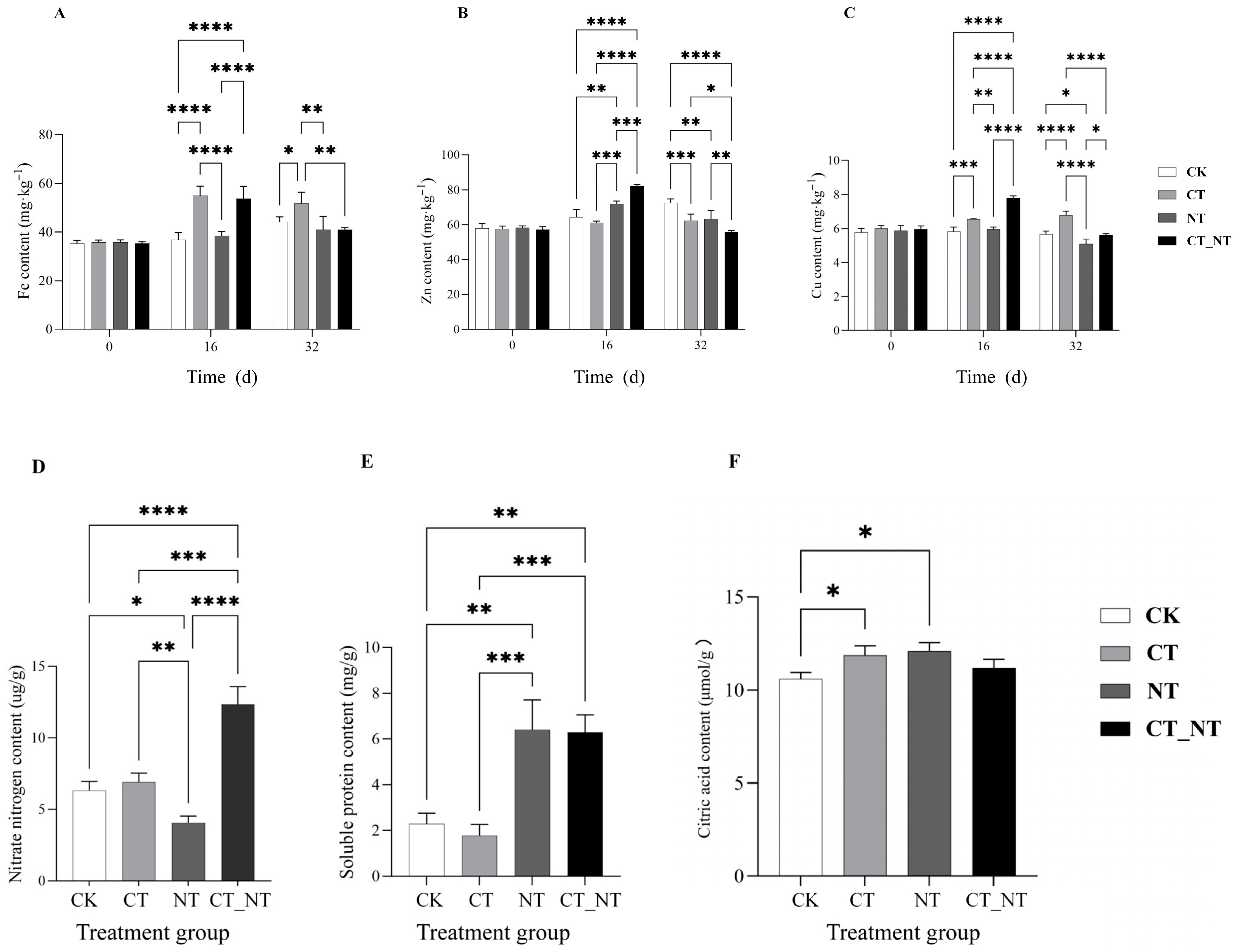
Figure 1. (A) Effects of carbon and nitrogen application at different treatment times on Fe content in stems of D. officinale. (B) Effects of carbon and nitrogen application at different treatment times on Zn content in stems of D. officinale. (C) Effects of carbon and nitrogen application at different treatment times on Cu content in stems of D. officinale. (D) Effects of combined application of carbon and nitrogen on nitrate nitrogen content in stems of D. officinale after 16 days. (E) Effects of combined application of carbon and nitrogen on soluble protein content in stems of D. officinale after 16 days. (F) Effects of combined application of carbon and nitrogen on citric acid content in stems of D. officinale after 16 days. (* indicate the significance of differences between groups, and the number of asterisks represents the degree of significance. *: p < 0.05, **: p < 0.01, ***: p < 0.001, ****: p < 0.0001).
Agriculture 16 00029 g001
Figure 2. (A) Correlation analysis of D. officinale Samples. (B) Principal component analysis (PCA) of D. officinale.
Agriculture 16 00029 g002
Figure 3. Presents a KEGG enrichment analysis comparing CK and other experimental groups. (A) CT vs. CK KEGG enrichment pathway scatter plot. (B) NT vs. CK KEGG enrichment pathway scatter plot. (C) CT_NT vs. CK KEGG enrichment pathway scatter plot.
Agriculture 16 00029 g003
Figure 4. Presents the KEGG pathway-metabolite network diagrams for various comparative analyses: (A) Comparison between Condition CT and Control (CT vs. CK), (B) Comparison between Condition NT and Control (NT vs. CK), and (C) Comparison between Condition CT_NT and Control [CT_NT vs. CK]. These diagrams are constructed using the Kyoto Encyclopedia of Genes and Genomes (KEGG) database, which integrates genomic, chemical, and systemic functional information to elucidate the metabolic pathways and their interrelationships. (Triangles represent differential metabolites, circles represent pathways, and connecting lines indicate the relationships between differential metabolites and pathways).
Agriculture 16 00029 g004
Figure 5. (A) CT vs. CK GSEA enrichment bar graph. (B) NT vs. CK GSEA enrichment bar graph. (C) CT_NT vs. CK GSEA enrichment bar graph.
Agriculture 16 00029 g005
Figure 6. Heat map of sample correlation.
Agriculture 16 00029 g006
Figure 7. (A) PCA score plot. (B) Differentially expressed genes up- or downregulation quantity map.
Agriculture 16 00029 g007
Figure 8. GO enrichment scatter plot of differential genes: (A) CT vs. CK; (B) NT vs. CK; (C) CT_NT vs. CK.
Agriculture 16 00029 g008
Figure 9. KEGG enrichment scatter plot of differential genes. (A) CT vs. CK (B) NT vs. CK; (C) CT_NT vs. CK.
Agriculture 16 00029 g009
Figure 10. Heat map of differential gene expression in key KEGG pathways: (A) CT vs. CK; (B) NT vs. CK; (C) CT_NT vs. CK.
Agriculture 16 00029 g010
Figure 11. Venn diagram of different pathways between genes and metabolites: (A) CT vs. CK; (B) NT vs. CK; (C) CT-NT vs. CK.
Agriculture 16 00029 g011
Figure 12. Statistics graph of pathway enrichment for differentially expressed genes and metabolites. (A) CT vs. CK; (B) NT vs. CK; (C) CT_NT vs. CK.
Agriculture 16 00029 g012
Figure 13. (A) Gene-metabolite interaction network diagram of AKG regulating iron metabolism in D. officinale. (B) The gene-metabolite interaction network diagram of zinc metabolism regulation in D. officinale under carbon–nitrogen combined application.
Agriculture 16 00029 g013
Table 1. D. officinale combined carbon and nitrogen treatment groups.
Treatment GroupNameFertilization TreatmentTreatment Method
Control groupCKDeionized waterDeionized water every 3 days
AKG every 3 days
Urea every 7 days
AKG treatmentCT20 mg·L−1 AKG solution
Urea treatmentNT0.2% urea solution
AKG and urea combined treatmentCT_NT20 mg·L−1 AKG solution and 0.2% urea solution
Table 2. Comparative analysis of differential metabolites in D. officinale under different treatments.
Treatment GroupTotal Identification Results of MetabolitesTotal Number of Metabolites with Significant DifferencesTotal Number of Metabolites Significantly UpregulatedTotal Number of Metabolites Significantly Downregulated
CT vs. CK9731718388
NT vs. CK97321112388
CT_NT vs. CK973230116114
CT_NT vs. NT97319075115
CT_NT vs. CT97319910198
CT vs. NT97323999140
Table 3. Sample sequencing data.
SampleRaw_ReadsRaw_BasesValid_ReadsValid_BasesValid%Q20%Q30%GC%
CT138,582,9665.79 G37,450,5865.52 G97.0798.1394.3146.90
CT241,541,7846.23 G40,268,3725.93 G96.9398.1894.4746.81
CT340,251,0626.04 G39,077,4225.76 G97.0898.2394.6446.76
CK140,904,9766.14 G39,709,8365.86 G97.0898.1494.3446.88
CK256,387,6488.46 G53,719,0347.89 G95.2798.2194.4546.22
CK340,269,5726.04 G39,047,5985.75 G96.9798.2194.5346.62
CT_NT153,990,1868.10 G51,378,6027.55 G95.1698.0193.9247.09
CT_NT241,454,7726.22 G40,815,5806.05 G98.4698.7195.9946.59
CT_NT340,878,6206.13 G39,571,2145.83 G96.8098.1494.3646.96
NT140,181,7166.03 G39,231,2265.79 G97.6398.2094.5546.97
NT242,100,9206.32 G41,063,5846.06 G97.5498.1794.4946.93
NT353,825,9208.07 G52,125,1527.69 G96.8498.1694.2747.02
Table 4. Statistics of the annotation results.
DBAllGOKEGGPfamSwissproteggNOGNRTF
Num42,49118,169708917,18714,83420,66024,8211262
Ratio (%)100.0042.7616.6840.4534.9148.6258.412.97
Disclaimer/Publisher’s Note: The statements, opinions and data contained in all publications are solely those of the individual author(s) and contributor(s) and not of MDPI and/or the editor(s). MDPI and/or the editor(s) disclaim responsibility for any injury to people or property resulting from any ideas, methods, instructions or products referred to in the content.