
Article

Identification and Characterization of Maize Yellow Mosaic Virus Causing Mosaic Symptoms on Maize in Taiwan

1
Master Program for Plant Medicine and Good Agriculture Practice, National Chung Hsing University, Taichung 40227, Taiwan
2
Department of Agronomy, National Chung Hsing University, Taichung 40227, Taiwan
3
Department of Plant Pathology, National Chung Hsing University, Taichung 40227, Taiwan
4
Department of Plant Pathology, University of Georgi-Griffin Campus, Griffin, GA 30223, USA
*
Author to whom correspondence should be addressed.
Agriculture 2026, 16(1), 27; https://doi.org/10.3390/agriculture16010027
Submission received: 9 November 2025 / Revised: 14 December 2025 / Accepted: 16 December 2025 / Published: 22 December 2025
(This article belongs to the Section Crop Protection, Diseases, Pests and Weeds)

Abstract

Maize, as the global highest-yield grain crop, can impact social stability and security based on its annual yield. Given that maize viruses have caused up to 91% yield reductions, investigating maize virus diseases is of the utmost importance. In July 2020, a suspected maize yellow mosaic virus (MaYMV) was discovered in a maize field, and a MaYMV detection protocol was established. The MaYMV isolate MA70, discovered in a maize plant from Wuri District, Taiwan, in November 2022, was shown to infect both maize 42 days post-inoculation (dpi) and wheat (35 dpi), causing mosaic symptoms, through aphid transmission with corn leaf aphid (Rhopalosiphum maidis). To determine the whole genome sequence of MA70, a 5642 bp sequence was obtained using RT-PCR and Sanger sequencing. Sequencing results indicated a 94.8–96.8% nucleotide sequence similarity with 54 MaYMV isolates from GenBank and with amino acid sequence identities exceeding 90% for all MaYMV proteins. Phylogenetic analysis showed the relationship of MA70 is closest to the Chinese isolate. The nucleotide sequence identity was lower among isolates of more distinct geographical clusters. Between October 2023 and January 2024, survey results indicated that MaYMV prevalence in corn fields across six areas in Taichung reached 17.5% (130/743 plants) and was present in all the sampled fields. MaYMV was present in all sampled fields affirming its ubiquitous presence. This study establishes the first documented case of MaYMV in Taiwan; however, survey findings hint at a potential pre-existing presence in Taiwanese maize fields. Therefore, this research also develops a practical diagnostic tool for field monitoring of MaYMV prevalence, which is crucial for informing future disease management strategies, including the critical need for cross-strait between Taiwan and China collaboration on viral disease surveillance.

1. Introduction

Maize (Zea mays), the world’s highest-yield grain crop, accounts for approximately one-third of the world’s cereal crop production, serving as a staple food in many countries [1]. In 2022, maize production reached 1163 million tons, exceeding rice and wheat, which ranked second and third by over 300 million tons [1]. As the second most widely cultivated crop in Taiwan, after rice, maize plays a considerable role in Taiwanese agriculture [2].
Currently, 52 known members of distinct virus species classified into 24 different genera can infect maize globally [3,4]. Maize viral diseases pose a remarkable threat to global maize production, often causing substantial yield losses and resulting in considerable economic hardship for farmers and communities. Maize lethal necrosis (MLN), caused by a mixed-infection of maize chlorotic mottle virus (MCMV) and sugarcane mosaic virus (SCMV), often leads to at least a 50% yield loss in Kansas [5] and up to a 91% yield loss in a single corn field [6]. MLN reportedly caused an average yield loss of 50.5% per hectare in Uganda [7]. Such severe loss can impact farmers’ livelihoods and destabilize the market. Given the expansion of maize growing areas in Taiwan, it is crucial to closely survey maize viral diseases.
Previously, only four maize viruses have been recorded in Taiwan. They were MCMV [8], belonging to the Machlomovirus genus, SCMV [9] and maize dwarf mosaic virus (MDMV) [10], both belonging to Potyvirus genus, and maize stripe virus (MSpV) [11], classified under the Tenuivirus genus. Although the field survey of corn viruses was reported in 2018 [12], the recently discovered maize yellow mosaic virus (MaYMV) has garnered considerable interest because it has rapidly been found in many countries [13,14,15,16,17,18,19,20,21,22,23,24].
MaYMV, a member of the Polerovirus genus, possesses a single-stranded positive-sense RNA genome that encodes seven functional proteins, e.g., P0, P1, P1-P2, P3a, P3, P4, and P3-P5 [25]. Since its initial report in China [13], MaYMV has been found in 12 countries across Asia, Africa, and America in five years [14,15,16,17,18,19,20,21,22,23,24]. MaYMV can naturally infect maize (Zea mays), sorghum (Sorghum bicolor), sugarcane (Saccharum spp.), wheat (Triticum aestivum), millet (Panicum miliaceum), itch grass (Rottboellia cochinchinensis), barnyard grass (Echinochloa crusgalli), green foxtail (Setaria viridis), and goosegrass (Eleusine indica) [13,20,21,26,27]. It is also noteworthy that MaYMV infection has been achieved experimentally in Nicotiana benthamiana through agro-infiltration [28]. MaYMV is primarily transmitted by the corn leaf aphid (Rhopalosiphum maidis), with an inoculation rate of 90% [29]. Additionally, two other aphid species, bird cherry-oat aphid (Rhopalosiphum padi) and greenbug aphid (Schizaphis graminum), can transmit MaYMV with inoculation rates of 37% and 16%, respectively [29]. Necrotic symptoms appear when maize plants are co-infected with MaYMV and SCMV [30].
In this study, we discovered a virus and identified it as MaYMV, which has not been previously reported in Taiwan. Transmission and host range were investigated and identified, and a detection protocol was established. The full-genome sequence was used for comparison of sequence identity and phylogenetic analysis with the sequences available in GenBank. The occurrence of MaYMV was investigated in corn fields in Taichung, Taiwan, as well.

2. Materials and Methods

2.1. Sampling, Isolation, and Preliminary Detection

In July 2020, maize plants exhibiting severe stunting, mottling, and yellowing were observed in a corn field in Daya District, Taichung City (Figure S1A–C). Twelve symptomatic plants were labeled as 109-ma-1 to 109-ma-12. RNA was extracted from symptomatic and asymptomatic leaf tissues with TRIzol reagent (Invitrogen, Carlsbad, CA, USA) and used for RT-PCR detection with primer pairs available in the laboratory for maize virus detection, including MCMVg3514F/MCMVg4014R [8] for ORF4 of MCMV, 3-6/3-5 [31] for nucleocapsid protein of MSpV, Pol-G-F/Pol-G-R [32] for P2, P3, P3a, and P4 of poleroviruses, and HRP5/Pot1 [33,34] for nuclear inclusion b (NIb) and coat protein (CP) of potyviruses (Table S1).
In November 2022, four maize (Z. mays cv. Red Autumn) samples infested with aphids were collected in Wuri District, Taichung City. Samples 111-ma-67 and 111-ma-70 exhibited mosaic symptoms (Figure S1D,E), while 111-ma-68 and 111-ma-69 showed no symptoms. Total RNA of symptomatic leaf tissue and asymptomatic tissue was separately extracted and used for RT-PCR detection with primer pairs including MCMVg3514F/MCMVg4014R, 3-6/3-5, Pol-G-F/Pol-G-R, and HRP5/Pot1. In addition, total RNA from aphids was extracted using TRIzol and used for RT-PCR detection with primer pair FJJ2020-127/FJJ2020-128 (Table S1).

2.2. Reverse Transcription-Polymerase Chain Reaction (RT-PCR)

In total, 1 microliter of total RNA, 1 µL of reverse primer (0.2 µg/µL), and 3.625 µL of DEPC-H2O were mixed in a PCR tube. The mixture was heated in a 92 °C water bath for 5 min, then placed in an ice bath for 5 min. Then, 2 microliters of 5× First Strand Buffer, 1 µL of 2.5 mM dNTP mix, 1 µL of 100 mM DTT, 0.25 µL of RNaseOUT™ Recombinant Ribonuclease Inhibitor (40 U/µL) (Invitrogen), and 0.125 µL of M-MLV reverse transcriptase (200 U/µL) (Invitrogen) were added to the PCR tube. The tube was incubated at 42 °C for 30 min, then at 37 °C for 30 min to synthesize the cDNA.
For PCR amplification, we used the detection primers listed in Table S1. In total, 2 microliters of the amplified cDNA, 0.5 µL of forward primer (0.2 µg/µL), 0.5 µL of reverse primer (0.2 µg/µL), 1 µL of 2.5 mM dNTP mix, 5 µL of 10× Reaction Buffer, 0.25 µL of ProTaq DNA Polymerase (5 U/µL) (Biotect Biotechnology Co., Ltd., Taipei, Taiwan), and 40.75 µL of sterile distilled water were combined. The target DNA fragments were amplified using the following conditions: 94 °C for 5 min; 35 cycles of 94 °C for 30 s, 50 °C for 30 s, and 72 °C for 1 min; and a final extension at 72 °C for 10 min.

2.3. Virus Isolation

Corn leaf aphids, which carried only MaYMV, from 111-ma-70 were transferred to a cage in a greenhouse. MaYMV was isolated and maintained in a maize plant in a cage according to Stewart et al. (2020) [35] for subsequent experiments. Aphids were allowed to feed on different healthy maize leaves for 10, 15, 20, and 30 min. Three aphids were individually placed on three separate maize plants, designated ma-gh-1, ma-gh-2, and ma-gh-3, for 4 days to enable virus transmission. The inoculated plants were sprayed three times, at 3-day intervals, with 1000-fold dilution of methomyl 24% SC (Sinon Co., Ltd., Taichung, Taiwan). After 21 days post-inoculation (dpi) with aphids, RT-PCR detection of the virus was performed with total RNA extracted from inoculated tissues, and symptoms were continuously monitored while the maize plants were placed in BugDorm-6E610 cages (150 × 150 mesh) (MegaView Science Co., Ltd., Taichung, Taiwan).

2.4. Establishment of Non-Viruliferous Aphid Colonies

The corn leaf aphids were collected and identified by Dr. Mei-Hua Kuo and were subsequently used for transmission tests. To prevent virus contamination in the aphids and ensure high genetic similarity, three groups of virus-free corn leaf aphids (aph-vf-1, aph-vf-2, and aph-vf-3) were reared. RT-PCR was conducted on all three groups to confirm the absence of MaYMV contamination indirectly. Three adult aphids were placed in each Petri dish, and after three days, five nymphs, along with the adults, were subjected to RT-PCR. The remaining nymphs were reared apart on three maize plants (ma-vf-1, ma-vf-2, and ma-vf-3) and tested after 25 days. Maize plants, serving as a food source for the aphids, were cultivated within BugDorm-6E610 insect rearing cages (150 × 150 mesh).

2.5. Transmission Assay

The non-viruliferous adult corn leaf aphids from ma-vf-1 were reared in Petri dishes containing corn leaf tissues for 3 days. The nymphs that were laid during these 3 days were considered the same generation [36]. The nymphs were transferred to maize plants infected with MaYMV. After a 3-day acquisition period, 5 nymphs were transferred to each of 30 plants per species for a 4-day inoculation period. Insecticide (methomyl 24% SC, diluted 1000 times, manufactured by Sinon Corporation) was used to kill the aphids, and RT-PCR detection of the virus and observation of symptoms were conducted at 21 dpi. Besides the original host (Z. mays cv. Red Autumn), the test plants included Triticum aestivum cv. Taichung Sel. 2, Sorghum bicolor cv. Taichung No. 5, Chenopodium quinoa, Nicotiana benthamiana, Solanum lycopersicum cv. Farmers 301, Cucumis melo var. makawa cv. Silver Light, Pisum sativum, and Brassica oleracea.

2.6. Rapid Amplification of cDNA Ends (RACE)

The RACE experiment was used to obtain the 5′- and 3′-end sequences of the viral genome. M-MLV reverse transcriptase (Invitrogen) (200 U/µL) was used for reverse transcription following the previously described procedure. For both 5′ and 3′ RACE, reverse transcription was performed using one microgram of total RNA with primers FJJ2023-127 and FJJ2023-128 (Table S1), respectively. After the reaction, the mixture was heated at 92 °C for 5 min and then cooled in an ice bath for 5 min. To remove single-stranded RNA, 0.2 µL RNase A (Amresco, Solon, OH, USA) was added, and the mixture was incubated at 37 °C for 10 min. An equal volume of phenol–chloroform–isoamyl alcohol (25:24:1) was added and the mixture was centrifuged at 9300× g for 5 min. The supernatant was collected, and 10 µL of 3 M sodium acetate (pH 5.2) was added to dilute the solution to 100 µL. Then, 250 µL of 100% ethanol was added, and the mixture was placed at −80°C for 2 h. After ethanol precipitation, the mixture was centrifuged at 13,000× g for 15 min, the supernatant was discarded, and the tube walls were washed with 700 µL of 70% ethanol. The tube was placed in a 65 °C oven for 1 min, then 20 µL of sterile distilled water was added to dissolve the mixture.
Specifically, 4–5 pmol of cDNA (20 µL), 10 µL of 5× TdT buffer, 5 µL of 0.1% BSA, 0.8 µL of 25 mM dATP, and 1 µL of TdT (14 U/µL) (TaKaRa, Kusatsu, Japan) were added to an Eppendorf tube and sterile distilled water was added to make a total volume of 50 µL. The mixture was incubated at 37 °C for 1 hr. After the reaction, 5 µL of 5 M NaCl and 1 µL of 0.5 M EDTA (pH 8.0) were added to terminate the reaction. The mixture was purified using an equal volume of phenol–chloroform–isoamyl alcohol (25:24:1) and ethanol precipitation as described above. After purification, DNA was amplified and sequenced using ProTaq DNA Polymerase (5 U/µL) (Biotect Biotechnology Co.) according to previously described procedure in RT-PCR paragraph. 5′ and 3′ RACE were performed using primer pairs FJJ2003-46/FJJ2023-180 and FJJ2023-183/FJJ2003-46 (Table S1).

2.7. Whole Genome Amplification

Whole genome amplification was performed using the primer pair FJJ2023-250/FJJ2023-251 (Table S1). These primers were designed based on the sequence information derived from the RACE procedure. First, 1 microliter of total RNA, 1 µL of reverse primer, and 3 µL of DEPC-H2O were mixed in a PCR tube. The mixture was heated in a 92 °C water bath for 5 min and then transferred to an ice bath for 5 min. Subsequently, 2 µL of 5× First Strand Buffer, 1 µL of 2.5 mM dNTP mix, 1 µL of 100 mM DTT, 0.5 µL of RNaseOUT™ Recombinant Ribonuclease Inhibitor (40 U/µL) (Invitrogen), and 0.5 µL of SuperScript™ III Reverse Transcriptase (200 U/µL) (Invitrogen) were added to the tube. The reaction mixture was incubated at 50 °C for 59 min, followed by incubation at 70 °C for 15 min to synthesize cDNA.
Synthesized cDNA (2 µL) was mixed with 0.5 µL of forward primer, 0.5 µL of reverse primer, 6 µL of 2.5 mM dNTP mix, 5 µL of 10× LA PCR Buffer II, 0.5 µL of TaKaRa LA Taq® DNA Polymerase (5 U/µL) (TaKaRa), and 40.5 µL of sterile distilled water in a PCR tube. This mixture was thoroughly mixed and subjected to the following PCR conditions: 94 °C for 5 min; 35 cycles of 94 °C for 30 s, 64 °C for 30 s, and 72 °C for 1 min; and a final extension at 72 °C for 10 min.

2.8. Sequence and Phylogenetic Analysis

The complete genome sequence of MA70 was cloned using pCR®II-TOPO® TA Cloning kit (Invitrogen) and transformed into E. coli DH5α competent cells. The recombinant plasmid was subsequently extracted using a Plasmid Purification Kit (Scientific Biotech Co., Ltd., Taipei, Taiwan) and sequenced with the ABI 3730 automatic sequencer (Applied Biosystems, Waltham, MA, USA). The MA70 sequence was aligned with sequences available in GenBank using BLASTn (https://blast.ncbi.nlm.nih.gov/Blast.cgi?PROGRAM=blastn&PAGE_TYPE=BlastSearch&LINK_LOC=blasthome, accessed on 29 December 2023). Sequence identities of all pairwise alignments were performed with MegAlign program available in Lasergene software 7.1 (DNASTAR, Madison, WI, USA) using the Clustal W tool [37]. For phylogenetic analysis, the Neighbor-Joining (NJ) method was employed using the Molecular Evolutionary Genetics Analysis 11 (MEGA11) software, with 1000 bootstrap replicates to ensure the robustness of the phylogenetic tree. The virus isolates, including 54 MaYMV isolates and a barley virus G (BVG) isolate for the outgroup, are listed in Table S2.

2.9. Sample Collection in Maize Field

The field survey in Taichung City was conducted using stratified random sampling [38] to collect samples. The maize fields were divided into a checkerboard pattern, with each section containing 24 plants (6 × 4). One plant was randomly sampled from each section. After sampling, 3 or 5 samples were pooled together as one group. In this experiment, 111 samples were collected from a field in the Houli District, 113 from the Fengyuan District, 151 from the Waipu District, 150 from the Wuri District, and 137 and 81 samples from each of the two fields in the Daya District. A total of 743 corn samples were collected. RNA was extracted and detected with primer pair FJJ2020-127/FJJ2020-128, specifically designed for MaYMV detection (Table S1). Groups that tested positive were subsequently reanalyzed individually by extracting RNA from each sample within the group and repeating RT-PCR to determine the MaYMV infection rate in each field.

3. Results

3.1. Occurrence of MaYMV

Using the primer sets available in our laboratory for maize virus detection, we analyzed the 12 mosaic-symptomatic plants collected from the field to determine the causative agents. RT-PCR analysis showed that all 12 plants were infected with MCMV, with one plant (109-ma-8) showing co-infection with a polerovirus. All other plants tested negative for polerovirus, potyvirus, and MSpV.
The amplified product with Pol-G-F/Pol-G-R was sequenced, and a 1096 bp fragment was obtained. Results of comparison with all MaYMV sequences in the GenBank database, including parts of P2, P3, P4, and the complete P3a, showed nucleotide sequence identities of 96.3–98.9%, but only 86.8% with the next closest virus, BVG (Table S3). Based on comparisons, we hypothesized that the 109-ma-8 sample might be infected with MaYMV. Among all the MaYMV isolates, those that most resembled our amplified sequence were from China, with sequence identities ranging from 98.2% to 98.9% (Table S3). Therefore, we selected 21 Chinese MaYMV isolates to design specific primers for amplifying the complete CP and movement protein (MP) for MaYMV detection (FJJ2020-127/FJJ2020-128) (Table S1). The highest sequence identity of using BLASTn with sequences amplified by specific primers was MaYMV. Asymptomatic tissues showed no amplified band.
In November 2022, four maize plants infested with aphids (111-ma-67 to 111-ma-70) were collected from the field. Two plants, 111-ma-67 and 111-ma-70, exhibiting mosaic symptoms (Figure S1D,E), were found to be infected with polerovirus. The other two asymptomatic plants tested negative for polerovirus, MCMV, MSpV, and potyvirus which have been known to infect maize plants in Taiwan. MaYMV-specific primers detected MaYMV in aphids on 111-ma-67 and 111-ma-70, but not in aphids on the other two plants (Figure 1). The aphids from 111-ma-70 were then transferred to a greenhouse for the isolation of MaYMV and maintained as the inoculum source.

3.2. Isolation of Virus

To confirm that the mosaic symptoms observed in the field were caused by MaYMV, wingless corn leaf aphids carrying suspect MaYMV from 111-ma-70 were transferred to a greenhouse. In the greenhouse, these aphids were allowed to transmit the virus to healthy maize plants from which the suspect MaYMV would be isolated. After isolation and transmission, three maize plants (ma-gh-1, ma-gh-2, and ma-gh-3) were detected as MaYMV-positive at 21 dpi (Figure S2A) and displayed mosaic symptoms at 42 dpi (Figure S2B–D). The virus isolate was designated as MA70.

3.3. Host Range Test

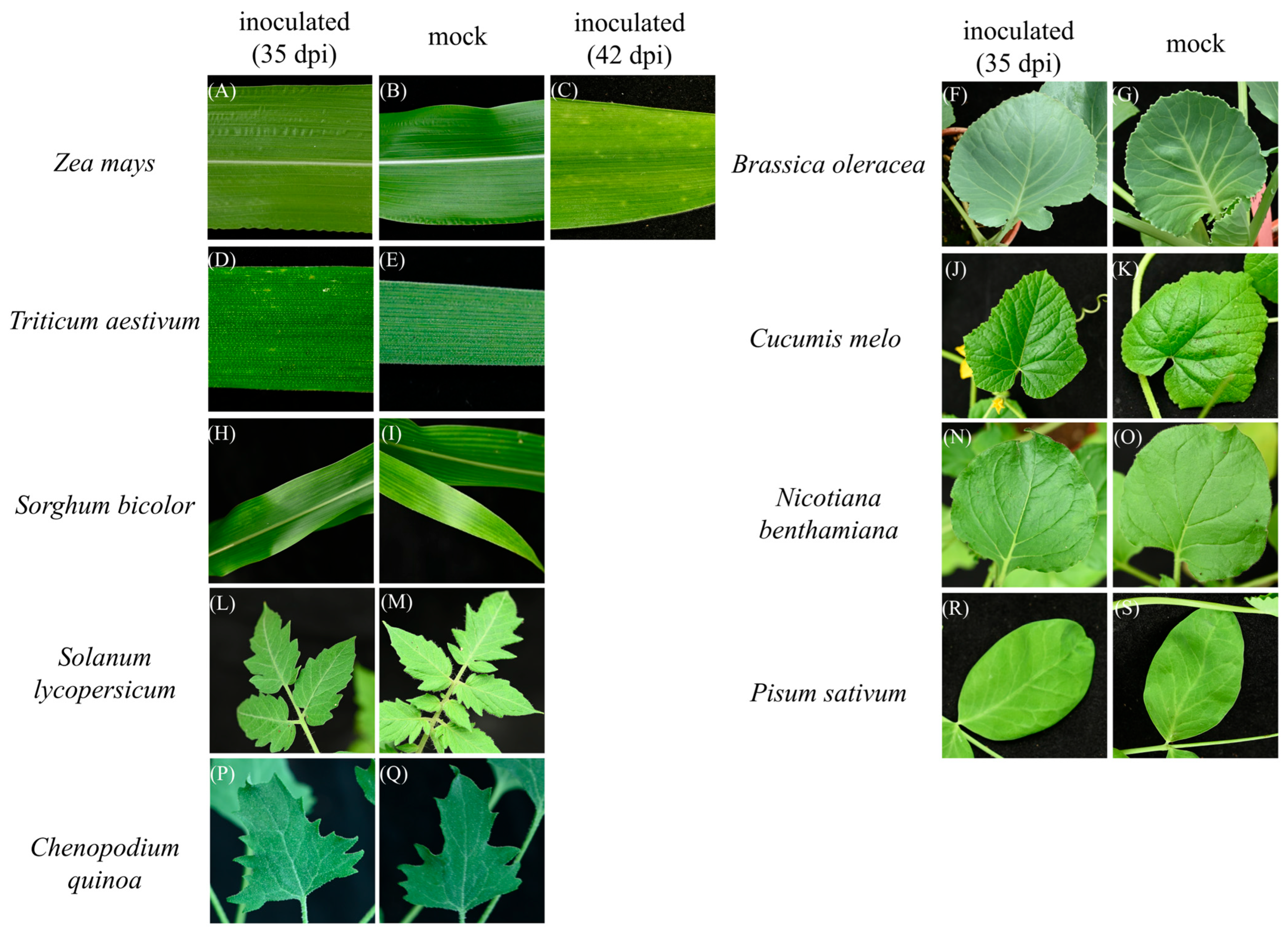
To test the host range of MaYMV, nine plant species were included in three separate experiments. The aphids were confirmed to be virus-free prior to the experiments. In the three biological replicate experiments, only maize and wheat tested positive for MA70 at 21 dpi. Subsequent symptom observations revealed that maize and wheat showed mosaic symptoms at 42 dpi and 35 dpi, respectively (Figure 2B,D). MA70 was not detected in sorghum, makawa melon, tomato, pea, cabbage, quinoa, and N. benthamiana (Table 1).

3.4. Whole Viral Genome and Individual Gene Sequences Analysis

Using the primer pair FJJ2023-250/FJJ2023-251 (Table S1), which was designed based on the sequencing results from the RACE procedure, a 5642 bp (GenBank accession number PQ231203) fragment was amplified by RT-PCR and subjected to sequencing analysis. Comparison results of MA70 with the full or near-full genome sequences of 54 MaYMV isolates from GenBank showed identities of 94.8–96.8%. The closely related virus, BVG, exhibited a nucleotide sequence identity of 77.8% (Table 2). Further comparison of nucleotide and amino acid sequence identities for each viral gene revealed that all identity exceed 90%, except for those with BVG (Table 2). These findings confirm that MA70 is indeed one of the MaYMV species and not associated with any other polerovirus.

3.5. Phylogenetic Analysis

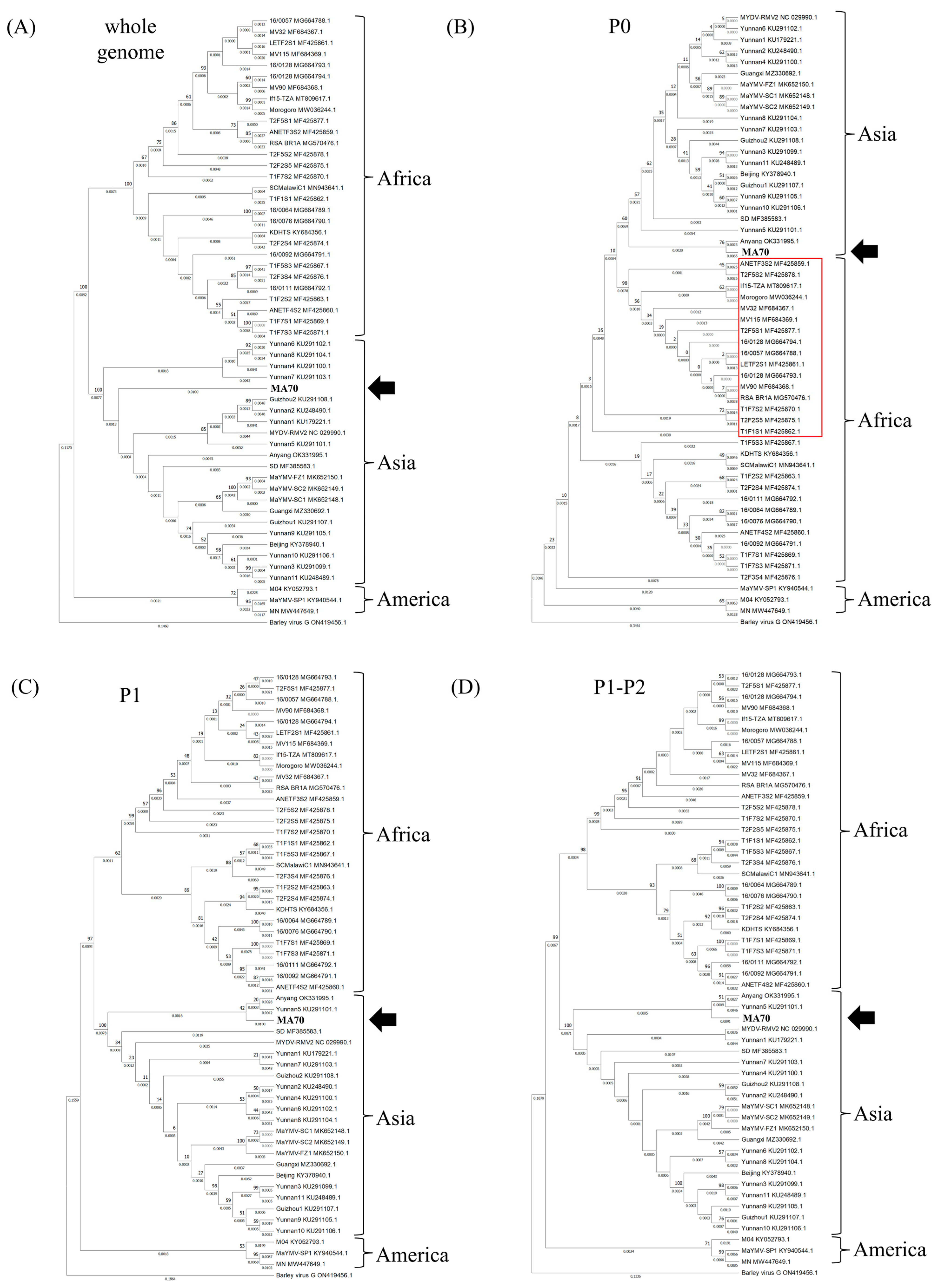
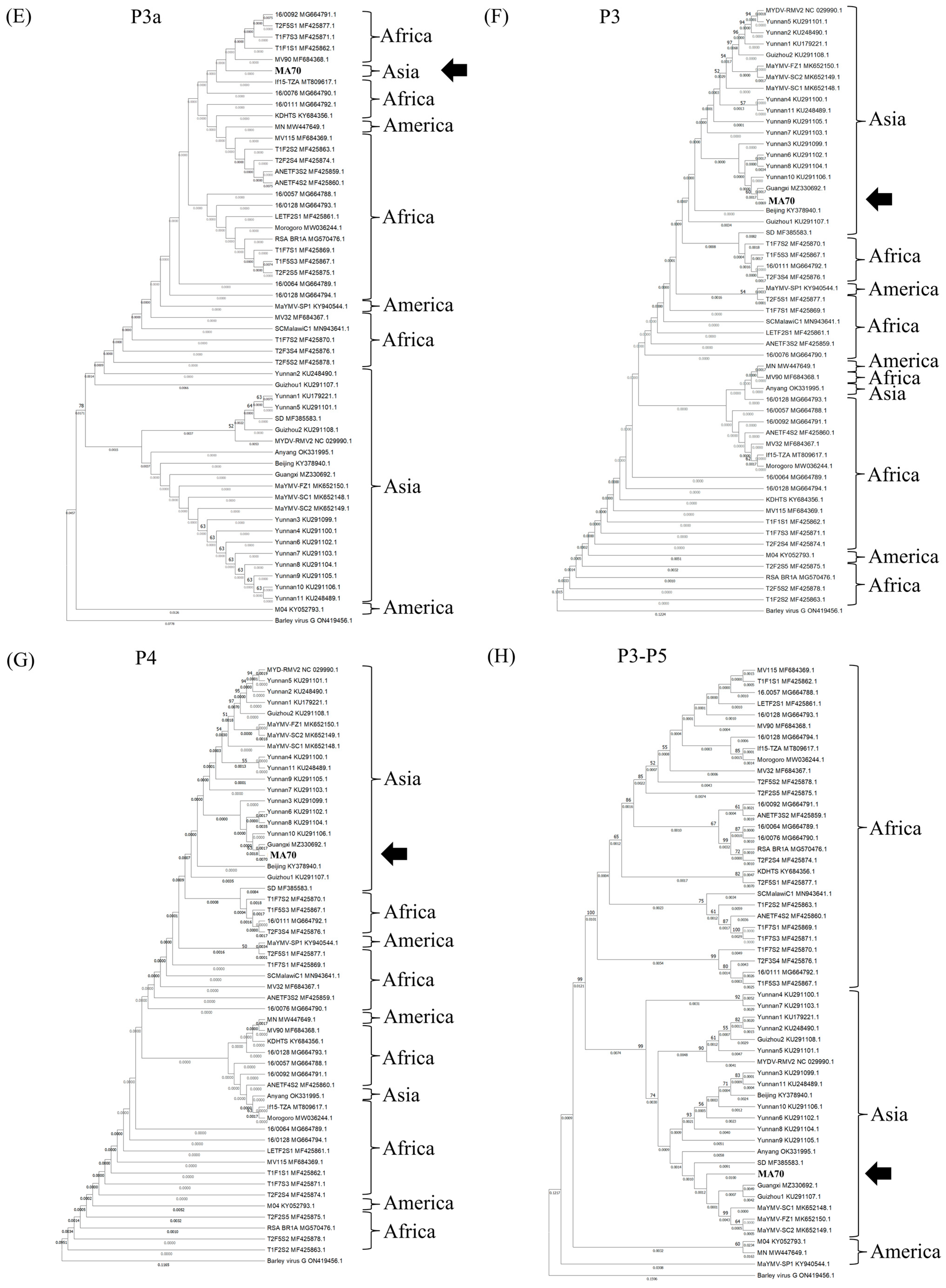
Phylogenetic analysis of the complete genome sequences of 54 MaYMV isolates and MA70 resolved three major lineages corresponding to their geographical origins in Africa, Asia, and the Americas. MA70 was grouped with the Asian isolates (Figure 3A). The phylogenetic tree of the P0 nucleotide sequence showed four groups: (1) all Asian isolates plus 15 African isolates, (2) all other 14 African isolates, and (3) two other groups that separate American isolates. The Brazilian isolate MaYMV-SP1 formed a distinct group, while isolates from Ecuador and Minnesota, U.S.A., formed another American group (Figure 3B). Similar results were obtained from the P1 and P1–P2 phylogenetic trees of the nucleotide sequence as observed in the whole genome analysis (Figure 3C,D). The P3a, P3, and P4 sequences did not show geographical clustering (Figure 3E–G). The phylogenetic tree of the P3-P5 nucleotide sequence (Figure 3H) divided isolates into four groups, with two groups each composed of Africa isolates and Asia isolates and two groups from the Americas, similar to the clustering pattern structure observed in the P0 phylogenetic tree (Figure 3B). Based on the phylogenetic trees of the whole genome and gene sequences grouped by geographical location, MA70 showed the closest relationship to isolates from China.

3.6. Field Survey of MaYMV

A field survey was conducted in maize production areas in the Houli District and found that 7 of 111 samples were infected with MaYMV, with an infection rate of 6.3%. In the Fengyuan District, 4 out of 113 samples were infected, showing an infection rate of 3.5%. In the Waipu District, 19 out of 151 samples were infected, resulting in an infection rate of 12.6%. In the Wuri District, 60 out of 150 samples were infected, with an infection rate of 40%. In the Daya District, two sampling areas had 137 and 81 samples, with 8 and 32 infected plants, resulting in infection rates of 5.8% and 39.5%, respectively. Overall, of 743 samples tested, 130 plants were infected with MaYMV, leading to an infection rate of 17.5% (Table 3) (Figure S3).

4. Discussion

In November 2022, maize plants exhibiting mosaic symptoms were found to be infected solely by MaYMV. Based on the isolation using corn leaf aphids, this viral strain was designated as MA70. It could be inoculated on corn and wheat, but sorghum which was reported as the host of MaYMV could not be inoculated. MA70 was identified as MaYMV with the condition described in the International Committee on Taxonomy of Viruses (ICTV). Phylogenetic analysis of the whole genome nucleotide sequences indicated a close relationship between MA70 and the Chinese isolates. Fields survey in Taichung City revealed the presence of MaYMV in all sampled fields indicating its widespread occurrence in Taichung cornfields. Further investigation is required to determine whether MaYMV also affects cornfields in other regions of Taiwan.
In the host range test study, maize plants inoculated with MA70 exhibited mosaic symptoms similar to those caused by MaYMV-SP1 in Brazil. Previous studies have reported that co-infection of MaYMV-SP1 with sugarcane mosaic virus (SCMV) resulted in necrotic symptoms [30]. Historically, co-infection of MCMV and SCMV could cause severe maize lethal necrosis (MLN), resulting in more than a 70% yield reduction [5,6]. Given that SCMV is prevalent in vegetatively propagated sugarcane fields in Taiwan [12], and the primary sugarcane-growing regions (Chiayi, Yunlin, and Tainan) significantly overlap with major maize production zones [2], there is a high potential for SCMV transmission to maize. Therefore, the appearance of necrotic symptoms warrants serious attention. The presence of SCMV in maize fields has also been reported [12]. If co-infection with MA70 occurs, it could severely impact domestic corn production.
To guarantee the reliability of the aphid transmission experiment, feeding aphids on healthy corn leaves can eliminate non-persistently transmitted viruses, while using aphids for virus isolation can exclude non-aphid-transmitted viruses. The degenerate primers targeting poleroviruses (Pol-G-F/Pol-G-R) (Table S1) could also detect luteoviruses that infect maize. Therefore, if no other polerovirus or luteovirus was detected, the isolation process was considered appropriate to yield a MaYMV isolate. Wingless aphids were chosen because poleroviruses are non-transovarial viruses [39]. Therefore, the viruses in aphids were likely acquired from 111-ma-70 because the aphids were fed on 111-ma-70 from birth.
MaYMV infection has also been reported in sugarcane in Nigeria, China, and India [19,20,40]. Although MaYMV accounts for only 7.47% of samples exhibiting mosaic symptoms in China, the occurrence is primarily in areas where corn and sugarcane are cultivated in proximity [41]. This suggests that regions with considerable overlap between corn and sugarcane cultivation should consider the possibility that sugarcane serves as an initial inoculum for MaYMV. To protect the maize industry in Taiwan, future research should investigate the impact of symptoms development and maize yield caused by co-infection of MA70 and SCMV in major corn-producing areas (Yunlin County, Chiayi County, and Tainan City) [2].
MaYMV has been found in sorghum [21]. However, our inoculation tests revealed that MA70 did not cause mosaic symptoms on sorghum and MA70 was not detected in inoculated sorghum tissues by PCR. Sorghum variety Taichung No. 5 has been widely cultivated in Taiwan since 1977, due to its resistance to aphids [42]. Although corn leaf aphids could feed and molt to the next instar on Taichung No. 5 sorghum, MA70 was not detected by RT-PCR, suggesting that Taichung No. 5 may be resistant to MaYMV. Previous reports noted that, among five sorghum varieties tested for MaYMV infection, only Sart and Atlas could occasionally be inoculated [29]. This suggests that many sorghum varieties might be resistant to MaYMV. Further research is needed to confirm whether Taichung No. 5 is indeed a MaYMV-resistant variety.
Regarding nucleotide sequence identity, the identity from lowest to highest is P3-P5, P1, P1-P2, and P0, with P3 and P4 being similar, and P3a having the highest identity (Table 2). The phylogenetic trees of the whole genome, P1, P1-P2, and P3-P5, are grouped by geographical location, suggesting that genetic differentiation may be driven by geographical variation (Figure 3A,C,D,H). The phylogenetic trees of P3a, P3, and P4 (Figure 3E–G) fail to show variation, likely due to their high sequence identities (Table 2). This also implies that these regions are evolutionarily conserved among different MaYMV isolates. P3-P5 is the region with the lowest sequence identity, and the phylogenetic tree shows that the American isolates can be divided into two groups. One group comprises the Brazilian isolate (MaYMV-SP1), which forms an independent branch, while the other group includes two American isolates from Ecuador and Minnesota, U.S.A. The separation of the Brazilian isolate from the American group may be due to geographical isolation caused by the rainforest leading to genetic differentiation. However, the number of American isolates is too small to confirm this hypothesis and more MaYMV isolates from both sides of the rainforest are needed to validate this assumption.
Based on the whole genome nucleotide sequence phylogenetic tree shown in Figure 3A, MA70 and Chinese isolates could be grouped together, indicating that MaYMV isolates from Taiwan and China could not be separated into two groups with geographical information. This also suggests a recent exchange of MaYMV between the two regions. Given that there are no known cases of seed transmission for poleroviruses [43] and crops that are the hosts of MaYMV, such as sugarcane, which is primarily propagated vegetatively with no records of imported seedlings, it is hypothesized that MaYMV may be transmitted across the sea by aphids [44]. The current results show that phylogenetically, MA70 is most closely related to the Chinese isolates, and that MaYMV may be spread by aphids within both regions. In the future, it is necessary to monitor newly emerging Chinese viruses transmitted by aphids and take preventive measures before invasion occurs.
The severity of viral diseases is closely related to the environment. Research indicates that high temperatures (30 ± 2 °C) and high CO2 concentrations (940 ± 50 ppm) increase the titers of PLRV in potato plants and the transmission rate by Myzus persicae [45]. Given that climate warming is irreversible, future temperatures and CO2 concentrations are bound to rise. The winter temperature in Taiwan is already reaching a common 30 °C. Although rainfall can reduce aphids and whiteflies populations [46,47], the major maize-producing regions in Taiwan experience low rainfall during winter [48]. Therefore, it can be anticipated that the incidence of polerovirus infections in maize fields may remarkably increase during winter in future. This study highlights that MaYMV is widespread in maize fields and may impact maize yields. The method for MaYMV detection established in this research can monitor the occurrence of MaYMV in fields to alert farmers to prepare accordingly.

5. Conclusions

This study is the first report of MaYMV causing maize yellow mosaic disease in Taiwan. The MaYMV detection protocol established in this research is highly effective and reliable for screening MaYMV infection in maize plants. Special attention should be paid to the co-infection of MA70 and SCMV because co-infection may impact maize yields in Taiwan. The phylogenetic analysis suggests that the Taiwan Strait cannot prevent aphid-transmitted virus invasions. In the future, in addition to monitoring viral diseases in Taiwan’s fields, we must also closely pay attention to new aphid-transmitted viruses in China and vice versa.

Supplementary Materials

The following supporting information can be downloaded at https://www.mdpi.com/article/10.3390/agriculture16010027/s1. Figure S1: Maize field showed symptoms of mosaic, yellowing, and dwarfing, suspected to be caused by viral infection. Figure S2: Corn leaf aphids on 111-ma-70 collected from the field were used for isolation of MA70. Figure S3. Investigation of the occurrence of maize yellow mosaic virus (MaYMV) in maize fields. Table S1: Primers used in the study. Table S2: The virus isolates used in the study [49]. Table S3: The identities of nucleotide sequences amplified by degenerate primers designed for poleroviruses compared with MaYMV isolates and BVG isolate available on GenBank.

Author Contributions

Conceptualization, F.-J.J., H.-H.C., and J.-H.C.; methodology, J.-H.C. and H.-H.C.; validation, J.-H.C. and H.-H.C.; formal analysis, J.-H.C. and H.-H.C.; investigation, J.-H.C.; resources, F.-J.J. and H.-M.K.; data curation, F.-J.J. and J.-H.C.; writing—original draft preparation, J.-H.C.; writing—review and editing, F.-J.J., H.-M.K., C.-J.C., and H.-H.C.; visualization, J.-H.C.; supervision, F.-J.J., H.-M.K., H.-H.C., and C.-J.C.; project administration, F.-J.J.; funding acquisition, F.-J.J. All authors have read and agreed to the published version of the manuscript.

Funding

This work was partially supported by grants (112-2313-B-005-031-MY3 & 110-2313-B-005-012-MY3) from the National Science and Technology council and by the “Advanced Plant and Food Crop Biotechnology Center” from The Featured Areas Research Center Program within the framework of the Higher Education Sprout Project by the Ministry of Education (MOE) in Taiwan.

Data Availability Statement

The data presented in this study are openly available in National Center for Biotechnology Information (https://www.ncbi.nlm.nih.gov/ (accessed on in 29 December 2023)) under the accession number: PQ231203.

Acknowledgments

We are grateful to Kuang-Ren Chung for his critical editing and review of the manuscript. We appreciate Mei-Hwa Kuo, Department of Entomology at National Chung Hsing University, for identifying the species of aphids.

Conflicts of Interest

The authors declare no conflicts of interest.

References

  1. Food and Agriculture Organization of the United Nations. FAOSTAT Statistical Database. Available online: https://www.fao.org/faostat/en/#compare (accessed on 10 February 2024).
  2. Agriculture and Food Agency, Ministry of Agriculture. Agricultural Situation Report Resource Network. Available online: https://agr.afa.gov.tw (accessed on 16 February 2024).
  3. Signoret, P.-A.; Lapierre, H. Virus diseases of maize. In Viruses and Virus Diseases of Poaceae (Gramineae); Signoret, P.-A., Lapierre, H., Eds.; Mieux Comprendre: Paris, France, 2004; pp. 617–696. [Google Scholar]
  4. Sastry, K.S.; Mandal, B.; Hammond, J.; Scott, S.W.; Briddon, R.W.  Zea mays. In Encyclopedia of Plant Viruses and Viroids; Sastry, K.S., Mandal, B., Hammond, J., Scott, S.W., Briddon, R.W., Eds.; Springer: New Delhi, India, 2020; pp. 2824–2853. [Google Scholar]
  5. Uyemoto, J.K.; Bockelman, D.L.; Claflin, L.E. Severe outbreak of corn lethal necrosis disease in Kansas. Plant Dis. 1980, 64, 99–100. [Google Scholar] [CrossRef]
  6. Niblett, C.; Claflin, L. Corn lethal necrosis—A new virus disease of corn in Kansas. Plant Dis. Rep. 1978, 62, 15–19. [Google Scholar]
  7. Mahuku, G.; Lockhart, B.E.; Wanjala, B.; Jones, M.W.; Kimunye, J.N.; Stewart, L.R.; Cassone, B.J.; Sevgan, S.; Nyasani, J.O.; Kusia, E.; et al. Maize lethal necrosis (MLN), an emerging threat to maize-based food security in sub-Saharan Africa. Phytopathology 2015, 105, 956–965. [Google Scholar] [CrossRef] [PubMed]
  8. Deng, T.C.; Chou, C.M.; Chen, C.T.; Tsai, C.H.; Lin, F.C. First report of maize chlorotic mottle virus on sweet corn in Taiwan. Plant Dis. 2014, 98, 1748. [Google Scholar] [CrossRef]
  9. Lin, S.J. Research of sugarcane mosaic disease. Rep. Taiwan Sugar Exp. Stat. 1968, 47, 139–153. Available online: https://taiwanebook.ncl.edu.tw/zh-tw/book/NCL-9910010577/reader (accessed on 15 December 2025).
  10. Deng, T.C. Identification of maize dwarf mosaic virus B strain and screening for resistance of corn. J. Agric. Res. China 1985, 34, 195–206. [Google Scholar] [CrossRef]
  11. Chen, C.; Tsai, J.; Chiu, R.; Chen, M. Purification, characterization, and serological analysis of maize stripe virus in Taiwan. Plant Dis. 1993, 77, 367–372. [Google Scholar] [CrossRef]
  12. Chou, C.M.; Chen, C.T.; Chien, Y.H.; Tsai, C.H.; Chen, C.C.; Lin, F.C.; Chen, Y.J.; Deng, T.C. Phylogenetic analysis and occurrence of maize chlorotic mottle virus infecting maize in Taiwan. J. Taiwan Agric. Res. 2018, 67, 191–208. [Google Scholar] [CrossRef]
  13. Chen, S.; Jiang, G.; Wu, J.; Liu, Y.; Qian, Y.; Zhou, X. Characterization of a novel polerovirus infecting maize in China. Viruses 2016, 8, 120. [Google Scholar] [CrossRef]
  14. Gonçalves, M.; Godinho, M.; Alves-Freitas, D.; Varsani, A.; Ribeiro, S. First report of maize yellow mosaic virus infecting maize in Brazil. Plant Dis. 2017, 101, 2156. [Google Scholar] [CrossRef]
  15. Guadie, D.; Abraham, A.; Tesfaye, K.; Winter, S.; Menzel, W.; Knierim, D. First report of maize yellow mosaic virus infecting maize (Zea mays) in Ethiopia. Plant Dis. 2018, 102, 1044. [Google Scholar] [CrossRef]
  16. Read, D.A.; Featherstone, J.; Rees, D.J.G.; Thompson, G.D.; Roberts, R.; Flett, B.C.; Mashingaidze, K.; Berger, D.K.; Welgemoed, T.; Pietersen, G. First report of maize yellow mosaic virus (MaYMV) on maize (Zea mays) in Tanzania. J. Plant Pathol. 2019, 101, 203. [Google Scholar] [CrossRef]
  17. Bernreiter, A.; Teijeiro, R.G.; Jarrin, D.; Garrido, P.; Ramos, L. First report of maize yellow mosaic virus infecting maize in Ecuador. New Dis. Rep. 2017, 36, 2044–20588. [Google Scholar] [CrossRef]
  18. Welgemoed, T.; Pierneef, R.; Read, D.A.; Schulze, S.E.; Pietersen, G.; Berger, D.K. Next-generation sequencing reveals past and current widespread occurrence of maize yellow mosaic virus in South Africa. Eur. J. Plant Pathol. 2020, 158, 237–249. [Google Scholar] [CrossRef]
  19. Nithya, K.; VishnuVardhan, J.; Balasaravanan, S.; Vishalakshi, D.; Kaverinathan, K.; Viswanathan, R. First report of maize yellow mosaic virus (MaYMV) infecting sugarcane in India and its molecular characterization. Australas. Plant Pathol. 2021, 50, 633–638. [Google Scholar] [CrossRef]
  20. Yahaya, A.; Al Rwahnih, M.; Dangora, D.; Gregg, L.; Alegbejo, M.; Lava Kumar, P.; Alabi, O. First report of maize yellow mosaic virus infecting sugarcane (Saccharum spp.) and itch grass (Rottboellia cochinchinensis) in Nigeria. Plant Dis. 2017, 101, 1335. [Google Scholar] [CrossRef]
  21. Lim, S.; Yoon, Y.; Jang, Y.; Bae, D.; Kim, B.S.; Maharjan, R.; Yi, H.; Bae, S.; Lee, Y.H.; Lee, B. First report of maize yellow mosaic virus infecting Panicum miliaceum and Sorghum bicolor in South Korea. Plant Dis. 2018, 102, 689. [Google Scholar] [CrossRef]
  22. Palanga, E.; Longué, R.; Koala, M.; Néya, J.; Traoré, O.; Martin, D.P.; Peterschmitt, M.; Filloux, D.; Roumagnac, P. First report of maize yellow mosaic virus infecting maize in Burkina Faso. New Dis. Rep. 2017, 35, 26. [Google Scholar] [CrossRef]
  23. Tanui, C.; Anami, S.; Wamaitha, J.; Wanjal, B.W. Occurrence of maize yellow mosaic virus and evidence of co-infection with maize lethal necrosis viruses in Bomet County, Kenya. Afr. J. Plant Sci. 2021, 15, 299–308. [Google Scholar]
  24. Adams, I.; Braidwood, L.; Stomeo, F.; Phiri, N.; Uwumukiza, B.; Feyissa, B.; Mahuku, G.; Wangi, A.; Smith, J.; Mumford, R. Characterising maize viruses associated with maize lethal necrosis symptoms in Sub-Saharan Africa. bioRxiv 2017. bioRxiv:161489. [Google Scholar]
  25. Delfosse, V.C.; Barrios Barón, M.P.; Distéfano, A.J. What we know about poleroviruses: Advances in understanding the functions of polerovirus proteins. Plant Pathol. 2021, 70, 1047–1061. [Google Scholar] [CrossRef]
  26. Guo, M.; Yuan, X.; Song, Y.; Liu, Y.; Wang, X. First report of maize yellow mosaic virus (MaYMV) naturally infecting wheat in China. Plant Dis. 2022, 106, 2763. [Google Scholar] [CrossRef]
  27. Zhang, Y.; Wang, H.; Jiang, X.; Yang, X.; Liu, X.; Wang, Y.; Liu, Y.; Li, H.; Yuan, H.; Shi, Y. First report of maize yellow mosaic virus on weed hosts in China. Plant Dis. 2023, 107, 4036. [Google Scholar] [CrossRef]
  28. Mlotshwa, S.; Khatri, N.; Todd, J.; Tran, H.H.; Stewart, L.R. First report of cDNA clone-launched infection of maize plants with the polerovirus maize yellow mosaic virus (MaYMV). Virus Res. 2021, 295, 198297. [Google Scholar] [CrossRef] [PubMed]
  29. Ohlson, E.W.; Khatri, N.; Wilson, J.R. Experimental host and vector ranges of the emerging maize yellow mosaic polerovirus. Plant Dis. 2024, 108, 1246–1251. [Google Scholar] [CrossRef]
  30. Gonçalves, M.C.; Ramos, A.; Nascimento, T.; Harakava, R.; Duarte, A.P.; Lopes, J.R. Aphid transmission of maize yellow mosaic virus: An emerging polerovirus. Trop. Plant Pathol. 2020, 45, 544–549. [Google Scholar] [CrossRef]
  31. Castello, J.; Rogers, S.; Bachand, G.; Fillhart, R.; Murray, J.; Weidemann, K.; Bachand, M.; Almond, M. Detection and partial characterization of tenuiviruses from black spruce. Plant Dis. 2000, 84, 143–147. [Google Scholar] [CrossRef]
  32. Knierim, D.; Deng, T.; Tsai, W.; Green, S.; Kenyon, L. Molecular identification of three distinct Polerovirus species and a recombinant cucurbit aphid-borne yellows virus strain infecting cucurbit crops in Taiwan. Plant Pathol. 2010, 59, 991–1002. [Google Scholar] [CrossRef]
  33. Pappu, S.; Pappu, H.; Chang, C.; Culbreath, A.; Todd, J. Differentiation of biologically distinct peanut stripe potyvirus strains by a nucleotide polymorphism-based assay. Plant Dis. 1998, 82, 1121–1125. [Google Scholar] [CrossRef]
  34. Colinet, D.; Kummert, J. Identification of a sweet potato feathery mottle virus isolate from China (SPFMV-CH) by PCR with degenerate primers. J. Virol. Methods 1993, 45, 149–159. [Google Scholar] [CrossRef]
  35. Stewart, L.R.; Todd, J.; Willie, K.; Massawe, D.; Khatri, N. A recently discovered maize polerovirus causes leaf reddening symptoms in several maize genotypes and is transmitted by both the corn leaf aphid (Rhopalosiphum maidis) and the bird cherry-oat aphid (Rhopalosiphum padi). Plant Dis. 2020, 104, 1589–1592. [Google Scholar] [CrossRef]
  36. Bhat, A.I.; Rao, G.P. Transmission of viruses by aphids. In Characterization of Plant Viruses: Methods and Protocols; Bhat, A.I., Rao, G.P., Eds.; Humana: New York, NY, USA, 2020; pp. 69–75. [Google Scholar]
  37. Thompson, J.D.; Higgins, D.G.; Gibson, T.J. CLUSTAL W: Improving the sensitivity of progressive multiple sequence alignment through sequence weighting, position-specific gap penalties and weight matrix choice. Nucleic Acids Res. 1994, 22, 4673–4680. [Google Scholar] [CrossRef] [PubMed]
  38. Delp, B.; Stowell, L.; Marois, J. Evaluation of field sampling techniques for estimation of disease incidence. Phytopathology 1986, 76, 1299–1305. [Google Scholar] [CrossRef]
  39. Dietzgen, R.G.; Mann, K.S.; Johnson, K.N. Plant virus–insect vector interactions: Current and potential future research directions. Viruses 2016, 8, 303. [Google Scholar] [CrossRef] [PubMed]
  40. Sun, S.R.; Chen, J.S.; Yang, J.; Huang, X.C.; Huang, M.T.; Gao, S.J. First report of maize yellow mosaic virus infecting sugarcane in China. Plant Dis. 2019, 103, 2482. [Google Scholar] [CrossRef]
  41. Sun, S.R.; Chen, J.S.; He, E.Q.; Huang, M.T.; Fu, H.Y.; Lu, J.J.; Gao, S.J. Genetic variability and molecular evolution of maize yellow mosaic virus populations from different geographic origins. Plant Dis. 2021, 105, 896–903. [Google Scholar] [CrossRef]
  42. Chang, L.Z.; Huang, S.C. Achievement and perspectives of sorghum variety improvement in Taiwan. Improv. Prod. Technol. Upl. Crops Taiwan 1995, 49, 125–133. [Google Scholar]
  43. Hull, R. Plant-to-plant movement. In Plant Virology; Hull, R., Ed.; Academic Press: Cambridge, MA, USA, 2014; pp. 669–751. [Google Scholar]
  44. Loxdale, H.D.; Hardie, J.; Halbert, S.; Foottit, R.; Kidd, N.A.; Carter, C.I. The relative importance of short- and long-range movement of flying aphids. Biol. Rev. 1993, 68, 291–311. [Google Scholar] [CrossRef]
  45. Chung, B.N.; Koh, S.W.; Choi, K.S.; Joa, J.H.; Kim, C.H.; Selvakumar, G. Temperature and CO2 level influence potato leafroll virus infection in Solanum tuberosum. Plant Pathol. J. 2017, 33, 522. [Google Scholar] [CrossRef]
  46. Kaakeh, W.; Dutcher, J.D. Effect of rainfall on population abundance of aphids (Homoptera: Aphididae) on pecan. J. Entomol. Sci. 1993, 28, 283. [Google Scholar] [CrossRef]
  47. Marabi, R.; Das, S.; Bhowmick, A.; Pachori, R.; Sharma, H. Seasonal population dynamics of whitefly (Bemisia tabaci Gennadius) in soybean. J. Entomol. Zool. Stud. 2017, 5, 169–173. [Google Scholar]
  48. Central Weather Administration. Daily Rainfall. Available online: https://www.cwa.gov.tw/V8/C/D/DailyPrecipitation.html (accessed on 1 June 2024).
  49. Svanella-Dumas, L.; Vitry, C.; Valade, R.; Robin, N.; Thibord, J.B.; Marais, A.; Candresse, T. First report of barley virus G infecting winter barley (Hordeum vulgare) in France. Plant Dis. 2023, 107, 591. [Google Scholar] [CrossRef]
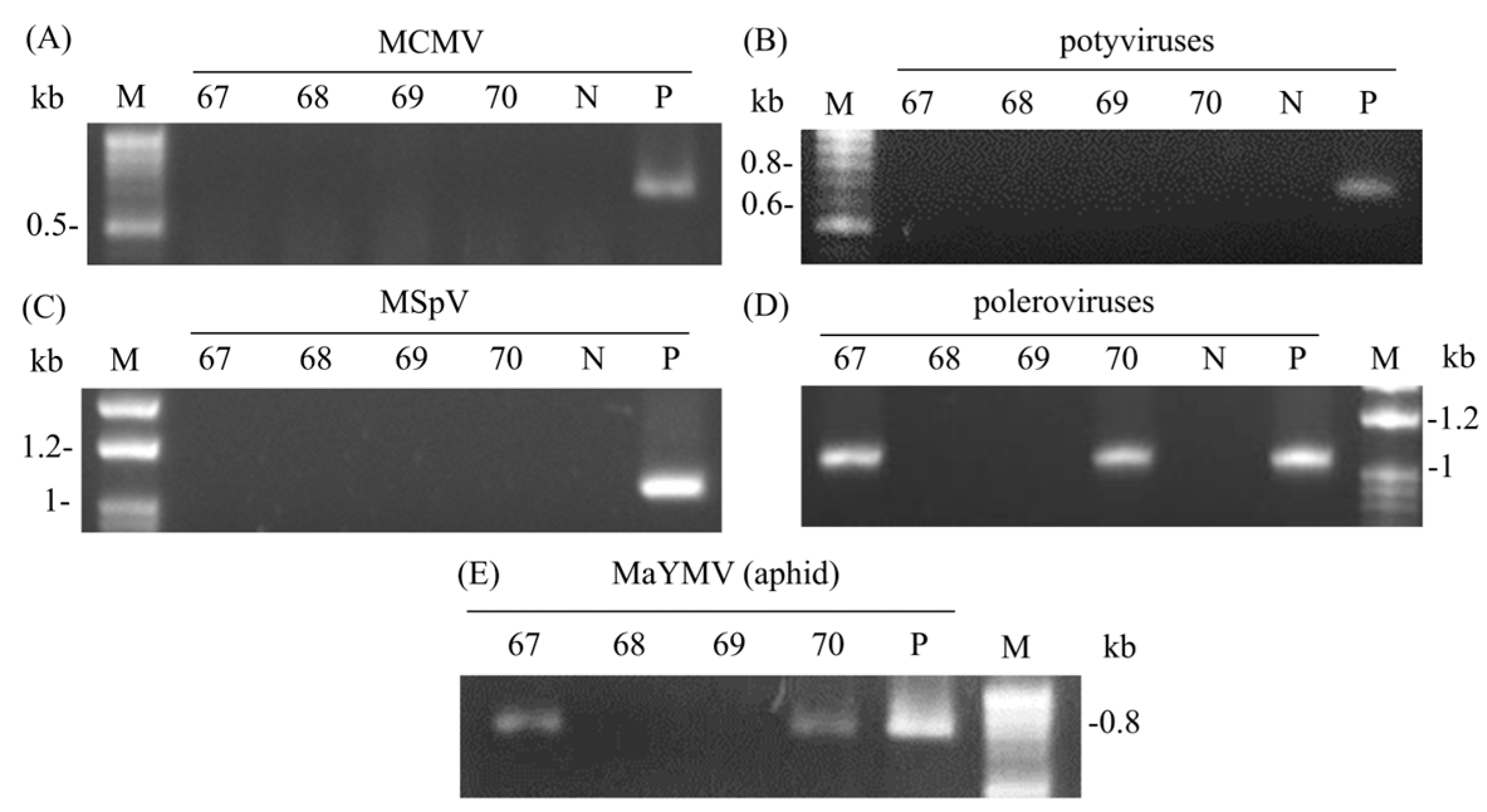
Figure 1. The detection results for four maize plants collected in November 2022. The samples, numbered 67–70 representing 111-ma-67~111-ma-70, were detected for various viruses. (A) Specific primers for maize chlorotic mottle virus (MCMV) with an expected band size of 517 bp. (B) Degenerate primers for potyviruses with an expected band size of 600–750 bp. Positive control: Bidens mottle virus (BiMoV). (C) Specific primers for maize stripe virus (MSpV) with an expected band size of 1100 bp. (D) Degenerate primers for poleroviruses with an expected band size of 1096 bp were used for maize plant virus detection. Positive control: maize yellow mosaic virus (MaYMV). (E) Specific primers for MaYMV with an expected band size of 798 bp were used for virus detection with the aphid that infested the maize plant.
Agriculture 16 00027 g001
Figure 2. Inoculation results of host range test. Both wheat and corn were successfully inoculated with maize yellow mosaic virus (MaYMV), displaying mosaic symptoms. (A) Maize plant 35 dpi. (B) Control maize plant. (C) Maize plant 42 dpi. (D) Inoculated wheat plant. (E) Control wheat plant. (F) Inoculated cabbage plant. (G) Control cabbage plant. (H) Inoculated sorghum plant. (I) Control sorghum plant. (J) Inoculated muskmelon plant. (K) Control muskmelon plant. (L) Inoculated tomato plant. (M) Control tomato plant. (N) Inoculated Nicotiana benthamiana plant. (O) Control Nicotiana benthamiana plant. (P) Inoculated quinoa plant after inoculation. (Q) Control quinoa plant. (R) Inoculated pea plant. (S) Control pea plant. Pictures were taken at 35 dpi, except for maize, which was taken at 42 dpi when symptoms appeared.
Agriculture 16 00027 g002
Figure 3. Phylogenetic trees based on the whole genome and individual gene nucleotide sequences. The trees were constructed using the neighbor-joining (NJ) method with 55 MaYMV isolates (including MA70, highlighted in bold and indicated with an arrow) and one BVG isolate on GenBank. The evolutionary distances for each branch were calculated using 1000 bootstrap replicates. Species names on each branch are composed of the name and accession number of virus isolates. Barley virus G (BVG) was used as the outgroup. (A) The whole genome phylogenetic tree can be divided into three groups: African, Asian, and American. (B) The phylogenetic tree based on the P0 gene can be divided into four groups, where 15 African isolates (isolates within the red box) cluster with Asian isolates, the remaining 14 African isolates form another group, the American isolate MaYMV-SP1 forms its own group, and two other American isolates form another group. The phylogenetic trees based on (C) P1 and (D) P1-P2 genes show similar grouping patterns to the whole genome phylogenetic tree. Phylogenetic trees based on (E) P3a, (F) P3, and (G) P4 gene do not show geographic clustering. (H) The phylogenetic tree based on the P3–P5 gene can be divided into four groups: two groups are from Asia and Africa, the American isolate MaYMV-SP1 forms its own group, and two other American isolates form another group. In phylogenetic trees where geographical clustering is observed, MA70 is most closely related to other Chinese isolates.
Agriculture 16 00027 g003aAgriculture 16 00027 g003b
Table 1. Infection ratio of MaYMV.
SpeciesCultivarInfection Ratio (1st)Infection Ratio (2nd)Infection Ratio (3rd)
Zea maysRed autumn3 a/3 b10/1017/20
Sorghum bicolorTaichung No. 50/30/100/18
Triticum aestivumTaichung Sel. 23/310/1012/20
Solanum lycopersicum3010/30/100/20
Nicotiana benthamiana 0/30/100/20
Chenopodium quinoa 0/30/100/20
Pisum sativum 0/30/100/20
Brassica oleracea 0/30/100/20
Cucumis meloSilver light0/30/100/20
a. Plants showing symptoms and maize yellow mosaic virus (MaYMV) were detected by PCR. b. Total number of inoculated plants.
Table 2. Sequence identities of MA70 with maize yellow mosaic virus (MaYMV) isolates and the closely related virus BVG isolate on GenBank.
Whole GenomeP0P1P1–P2P3aP3P4P3–P5
Nucleotide sequence
MaYMV
(54 isolate a)
94.8–96.8% b96.7–99.1%95.3–98.7%95.7–98.7%97–100%97.8–99.2%97.9–99.1%93.2–98.5%
BVG
(ON419456.1)
77.8%60%74.6%80%88.1%83.8%84.2%76.1%
Amino acid sequence
MaYMV
(54 isolate)
-95.5–98.9%95.2–98.7%97.3–99.1%97.8–100%96.4–98.5%95.8–99%93.9–98.2%
BVG
(ON419456.1)
-48.9%67.7%78%91.1%79.8%71.5%75.6%
a. MaYMV isolates used for sequence comparison were listed in Table S3. b. Range of sequence identity of 54 MaYMV isolates.
Table 3. Incidence rate of maize yellow mosaic virus (MaYMV) in maize fields.
Location/No.DateMaYMV ratio
Daya No.120 October 20238 a/137 b/5.8% c
Houli No.131 October 20237/111/6.3%
Fengyuan No.11 November 20234/113/3.5%
Waipu No.122 November 202319/151/12.6%
Daya No.215 December 202332/81/39.5%
Wuri No.13 January 202460/150/40%
Total 130/743/17.5%
a Number of samples infected with MaYMV. b. Quantity of samples collected in the field. c. Ratio of MaYMV infection in the field.
Disclaimer/Publisher’s Note: The statements, opinions and data contained in all publications are solely those of the individual author(s) and contributor(s) and not of MDPI and/or the editor(s). MDPI and/or the editor(s) disclaim responsibility for any injury to people or property resulting from any ideas, methods, instructions or products referred to in the content.