Article

Soil Fertility Assessment Through the Integration of Satellite Imagery and Spatial Analysis: Application to Arabica Coffee Cultivation in Lonya Grande, Peruvian Amazon


1
Civil Engineering School, Universidad Nacional Autónoma de Tayacaja Daniel Hernández Morillo, Pampas 09156, Peru
2
Civil Engineering School, Universidad Tecnológica de los Andes, Abancay 03001, Peru
3
Research Group on Numerical and Computational Methods, Graphic and Scientific Computing, Instituto de Investigación Científica, Universidad de Lima, Av. Javier Prado Este 4600, Santiago de Surco 15023, Peru
4
Escuela Universitaria de Posgrado, Universidad Nacional Federico Villarreal, Lima 15046, Peru
5
Industrial Engineering School, Universidad Nacional de Piura, Piura 20002, Peru
*
Author to whom correspondence should be addressed.
Agriculture 2026, 16(1), 130; https://doi.org/10.3390/agriculture16010130
Submission received: 2 October 2025 / Revised: 4 November 2025 / Accepted: 5 November 2025 / Published: 4 January 2026
(This article belongs to the Section Agricultural Soils)

Abstract

Soil fertility assessment is fundamental for improving agricultural productivity and promoting sustainable land management. This study proposes an integrated methodological framework that combines Sentinel-2 satellite imagery, spatial analysis techniques, and field-based soil data to evaluate soil fertility in Arabica coffee plantations in the Lonya Grande district, Peruvian Amazon. The framework involves three analytical phases: (i) spatial interpolation of soil macronutrients using Inverse Distance Weighting (IDW), (ii) local modeling through Geographically Weighted Regression (GWR), and (iii) spectral correlation analysis between field-measured soil properties and Sentinel-2 reflectance bands. The SWIR2 (Band 12) data were identified as the most sensitive predictor of soil moisture-related properties, with the strongest relationship observed for soil saturation (R2 = 0.40). Field validation revealed pronounced spatial heterogeneity, particularly for macronutrients such as nitrogen, phosphorus, and potassium. The study also found that soils exhibited moderately acidic pH values (5.1–6.8), favorable for coffee cultivation. Despite adequate water retention, nutrient deficiencies highlight the need for site-specific soil management strategies. Overall, spatial analysis confirmed consistent relationships between remote sensing data and soil parameters, demonstrating the feasibility and cost-effectiveness of this approach under data-limited tropical conditions. The proposed framework offers a scalable basis for regional soil fertility monitoring, and future research should incorporate machine learning and expanded sampling networks to further enhance predictive performance.

1. Introduction

Soil fertility is a critical factor for agricultural productivity, directly influencing crop yield, quality, and the economic stability of farming communities [1,2,3,4]. According to the Food and Agriculture Organization (FAO) [5], approximately 33% of the world’s arable land is degraded, severely affecting soil fertility and productive capacity. This issue is particularly acute in developing regions, where agriculture underpins local economies. The growing global demand for food, driven by population growth and changing consumption patterns, further intensifies pressure on soil resources [6,7,8,9,10].
In the context of Latin America and the Caribbean, soil degradation represents an urgent and complex challenge. The Economic Commission for Latin America and the Caribbean (ECLAC) [6] reports that nearly 48% of soils in the Caribbean, 50% in Mesoamerica, and 18% in South America are classified as severely degraded. Such declines limit agricultural productivity and threaten the sustainability of food systems, posing a significant risk to regional food security [6,11,12].
At the local scale, in the Amazonas region of Peru, soil fertility is fundamental to agricultural development, serving as a key economic driver and accounting for about 25% of the economically active population [13,14,15]. In the province of Utcubamba—particularly in the district of Lonya Grande, a major coffee-producing area—soil degradation poses a serious challenge, mainly resulting from monoculture practices. The persistent reliance on monoculture leads to nutrient depletion and accelerates erosion, thereby jeopardizing the long-term sustainability of coffee farming in the region [16,17]. According to the World Reference Base for Soil Resources [18], the dominant soils in the study area are classified as Dystric Cambisols and Haplic Acrisols, characterized by moderate weathering, acidic pH, and limited natural fertility—conditions consistent with tropical highland zones in the Peruvian Amazon.
To address the limitations of conventional field-based soil fertility assessments, remote sensing technologies have emerged as a powerful alternative. Among the available satellite platforms, Sentinel-2 was selected due to its high spatial resolution (10–20 m), frequent revisit cycle (5 days), and the inclusion of the SWIR2 band, which has demonstrated particular sensitivity to soil moisture and organic matter variability. These attributes make Sentinel-2 exceptionally well-suited for fine-scale and data-driven assessments of soil fertility in heterogeneous agricultural landscapes, such as those found in the Peruvian Amazon.
Traditional methods for assessing soil fertility, such as extensive soil sampling and laboratory analysis, have several limitations, including high cost, labor intensity, and limited capacity to capture spatial variability over large areas. These constraints restrict the ability of farmers and agricultural planners to implement evidence-based soil management strategies aimed at mitigating degradation [18,19,20,21,22,23,24]. Consequently, there is an urgent need for more efficient, scalable, and spatially explicit approaches to evaluate soil fertility, providing critical information for sustainable agricultural planning and decision-making.
Remote sensing technologies have emerged as a promising solution to overcome the limitations of conventional soil fertility assessments. Satellite imagery—particularly from the Sentinel-2 mission—enables the collection of high-resolution spatial data, offering a comprehensive and up-to-date representation of soil conditions without the need for direct field sampling [25,26,27,28,29,30,31,32,33,34,35,36]. This platform employs a multispectral sensor capable of capturing 13 spectral bands, including visible, near-infrared (NIR), and shortwave infrared (SWIR) wavelengths. These spectral capabilities allow the estimation of key soil properties such as moisture content, nutrient concentration, and organic matter, with the SWIR2 band showing strong correlations with principal soil fertility indicators [28,34,37,38,39,40,41,42,43,44].
Integrating satellite data with advanced spatial analysis techniques further enhances the accuracy and applicability of soil fertility assessments. In this study, two spatial analysis methods—Inverse Distance Weighting (IDW) and Geographically Weighted Regression (GWR) [45,46,47,48]—were employed to analyze soil properties in Lonya Grande. IDW serves as an interpolation technique that generates spatial distribution maps of soil nutrients and physicochemical parameters, providing insight into spatial variability, whereas GWR allows for the exploration of localized relationships between soil properties and spectral data, capturing the inherent heterogeneity of the landscape [45,46,47,48,49].
Recent research has demonstrated the potential of remote sensing data to estimate key soil characteristics such as organic carbon, pH, and nutrient content [50,51,52,53,54,55,56]. Advances in multispectral sensors, particularly Sentinel-2 and Landsat 8, have enabled large-scale soil property mapping through reflectance in the visible, near-infrared, and shortwave infrared regions. Studies have successfully used these data to model soil fertility in crops like soybean and sugarcane [3,4,42,50,51,52,53,54], and to assess geothermal patterns [25,55,56,57,58,59,60]. However, existing research still faces limitations such as the heterogeneity of soil types, reduced model transferability due to regional calibration needs, and the weak integration between field observations and remote predictions. These gaps highlight the need for integrated approaches that combine spectral information with spatial interpolation techniques to improve reliability and scalability in tropical, data-scarce environments.
The present study aims to assess soil fertility in Lonya Grande, Amazonas, through a hybrid approach that integrates Sentinel-2 satellite imagery with spatial modeling techniques. Specifically, it evaluates the correlation between spectral indices (with emphasis on the SWIR2 band) and soil properties, and applies spatial interpolation using the Inverse Distance Weighting (IDW) method in areas or parameters where spectral relationships are weak or non-significant. This integrative approach enables a more comprehensive, consistent, and scalable assessment of soil fertility variability.
This study introduces an innovative, three-phase methodological framework that addresses the specific challenges of soil fertility assessment in rural Arabica coffee-growing regions. The framework covers (1) identification of optimal study areas, (2) soil sampling and laboratory analysis, and (3) model development and prediction of the Soil Fertility Index (SFI). Unlike previous studies that focused on single-crop systems or lacked spatial detail, this research integrates the SWIR2 band of Sentinel-2 imagery with localized GWR modeling, achieving high-resolution and field-scale mapping of soil fertility. Moreover, this approach provides a scalable and cost-effective solution for soil assessment, bridging the gap between technological innovation and practical field applications in sustainable agriculture.
The primary novelty of this work lies in the development of a Soil Fertility Index (SFI) based on spatial analysis modeling derived from satellite imagery, validated through field surveys of soil parameters. The proposed method was applied to a 365 km2 area of Arabica coffee cultivation in the Lonya Grande district, Amazonas region, Peru. The analysis considered both physical and chemical soil properties, including key nutrients essential for Arabica coffee growth. The results demonstrated that macronutrient levels are strongly related to the SWIR2 spectral data, and that the fertility index and spatial models effectively identify nutrient concentration patterns, supporting targeted soil management practices to improve crop performance and sustainability.

2. Methodology

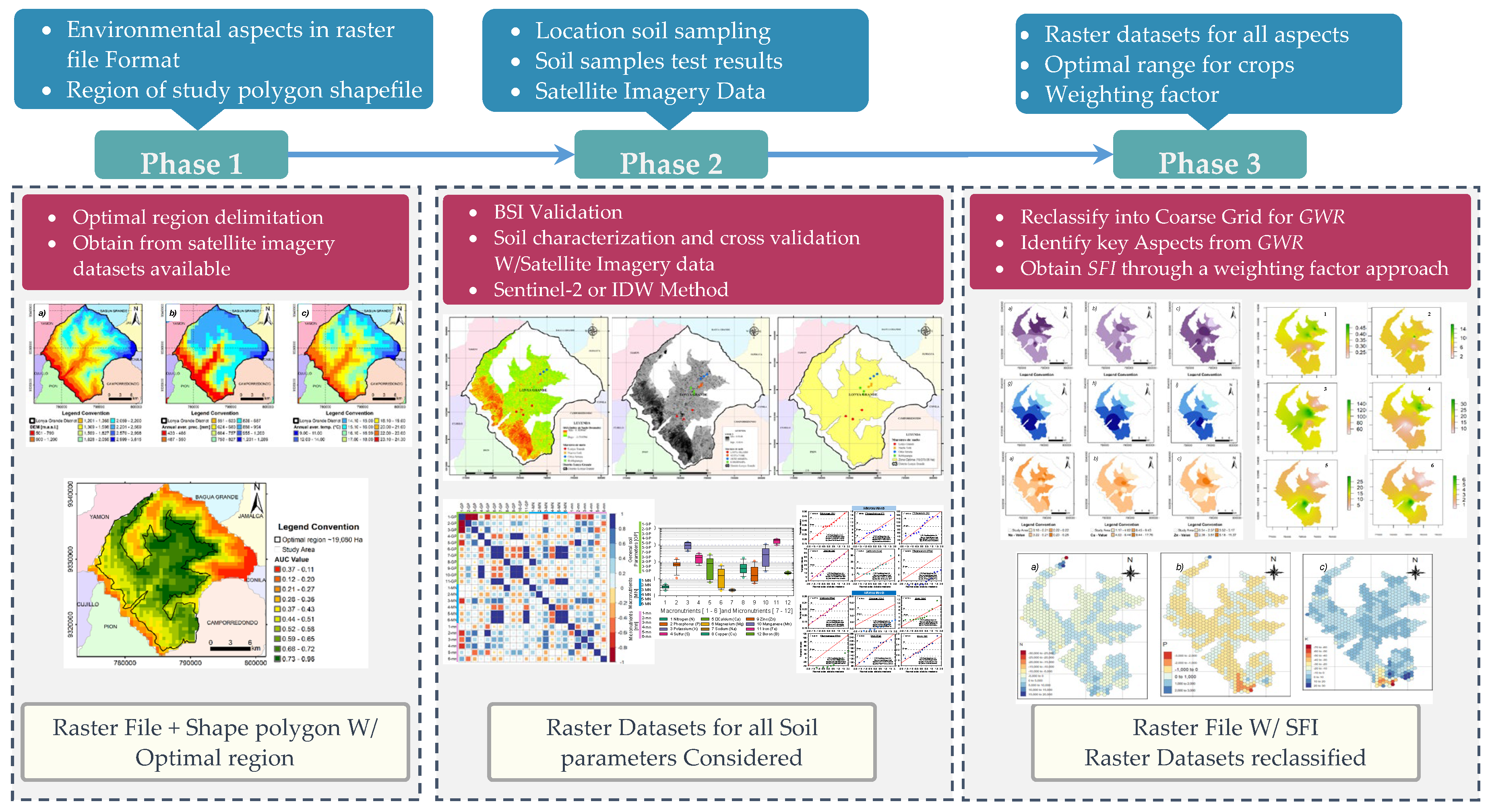
The proposed methodology focuses on predicting soil fertility zones for Arabica coffee cultivation through three main phases, integrating remote sensing data, spatial modeling, and field-based soil analyses to compute a Soil Fertility Index (SFI). This framework considers key environmental, physical, and chemical parameters, as well as macro- and micronutrient concentrations. The first phase delimits optimal regions within the study area based on environmental factors. The second phase identifies the soil properties associated with high Arabica coffee productivity and determines the relevant remote sensing datasets from an agricultural perspective.
In addition, a comprehensive field survey and soil sampling campaign were conducted to establish the relationship between in situ data and satellite imagery. Finally, the third phase quantifies soil fertility by integrating multiple parameters—physical and chemical soil properties and nutrient contents—to generate an SFI raster map and database. These outputs serve as decision-support tools for farmers and agricultural planners. Figure 1 presents the overall workflow of the proposed methodology.

2.1. Phase 1: Optimal Region Delimitation

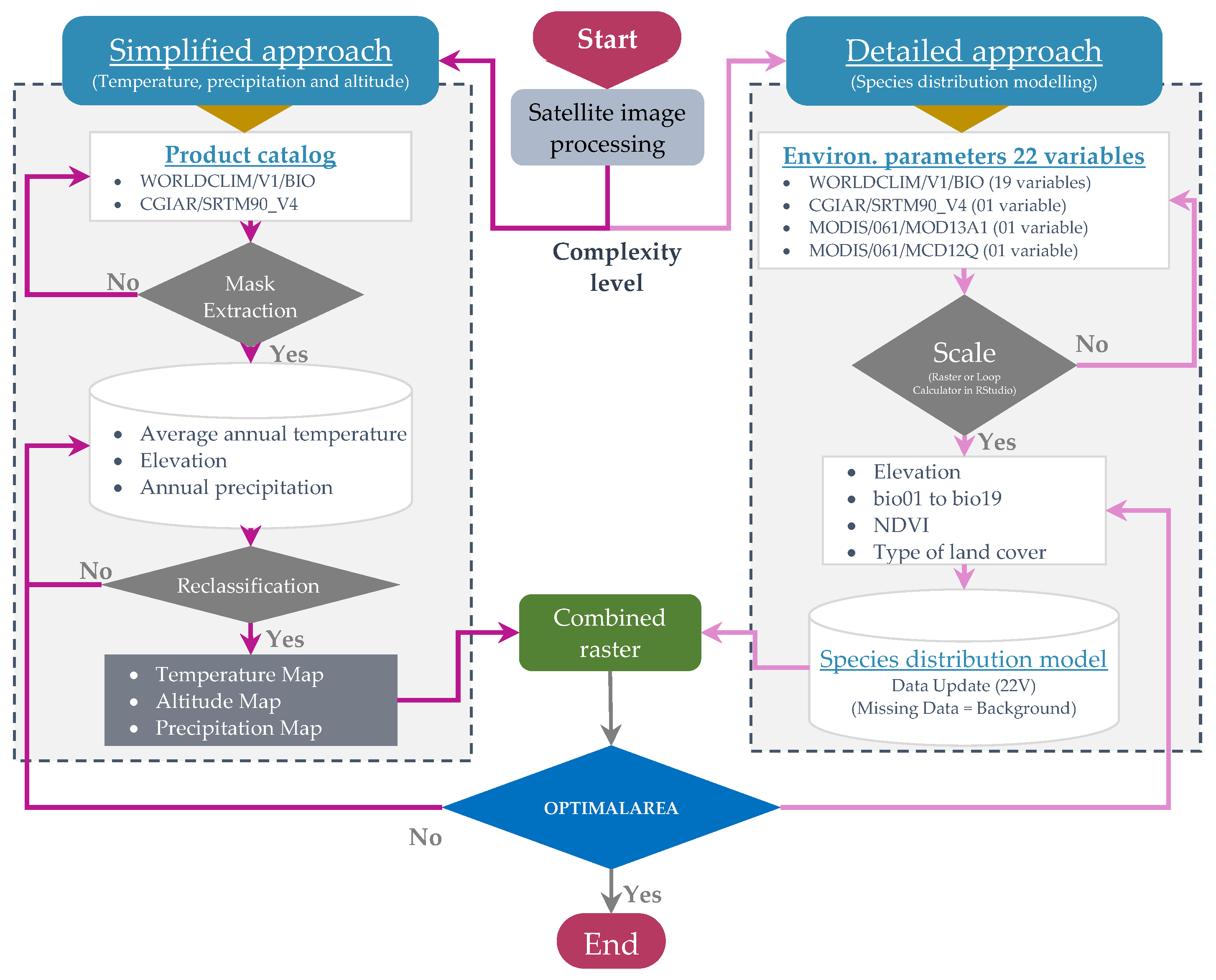
This phase is subdivided into three steps. First, the analysis area is defined, and environmental variables are extracted from satellite imagery datasets accessible through public databases such as NASA and NOAA [61,62,63]. Depending on the level of analysis, two methodological alternatives can be applied: (i) a simplified approach considering elevation, rainfall, and mean annual temperature; or (ii) a detailed approach including up to 22 environmental variables.
The next step involves data preprocessing and curation, including filling missing values using spatial regression techniques, extracting relevant data for the study area, and converting them into raster formats. Pixel resolution is a key factor influencing subsequent analyses, as it depends on the source data and can be refined through local surveys to improve model accuracy—though the size of the study area and project resources may constrain it.
Finally, optimal regions are identified through a reclassification process based on the selected environmental criteria, followed by combining the reclassified layers. This procedure employs the Maximum Entropy (MaxEnt) model, a machine learning algorithm widely used for species distribution modeling [64,65]. Model performance is evaluated using the Area Under the Curve (AUC), which ranges from 0 to 1, with higher values indicating better accuracy. In this study, regions with AUC > 0.5 were classified as optimal, consistent with prior recommendations [66,67,68,69,70,71]. The complete process is summarized in Figure 2.

2.2. Phase 2: Soil Sampling, Spatial Interpolation, and Deterministic Modeling

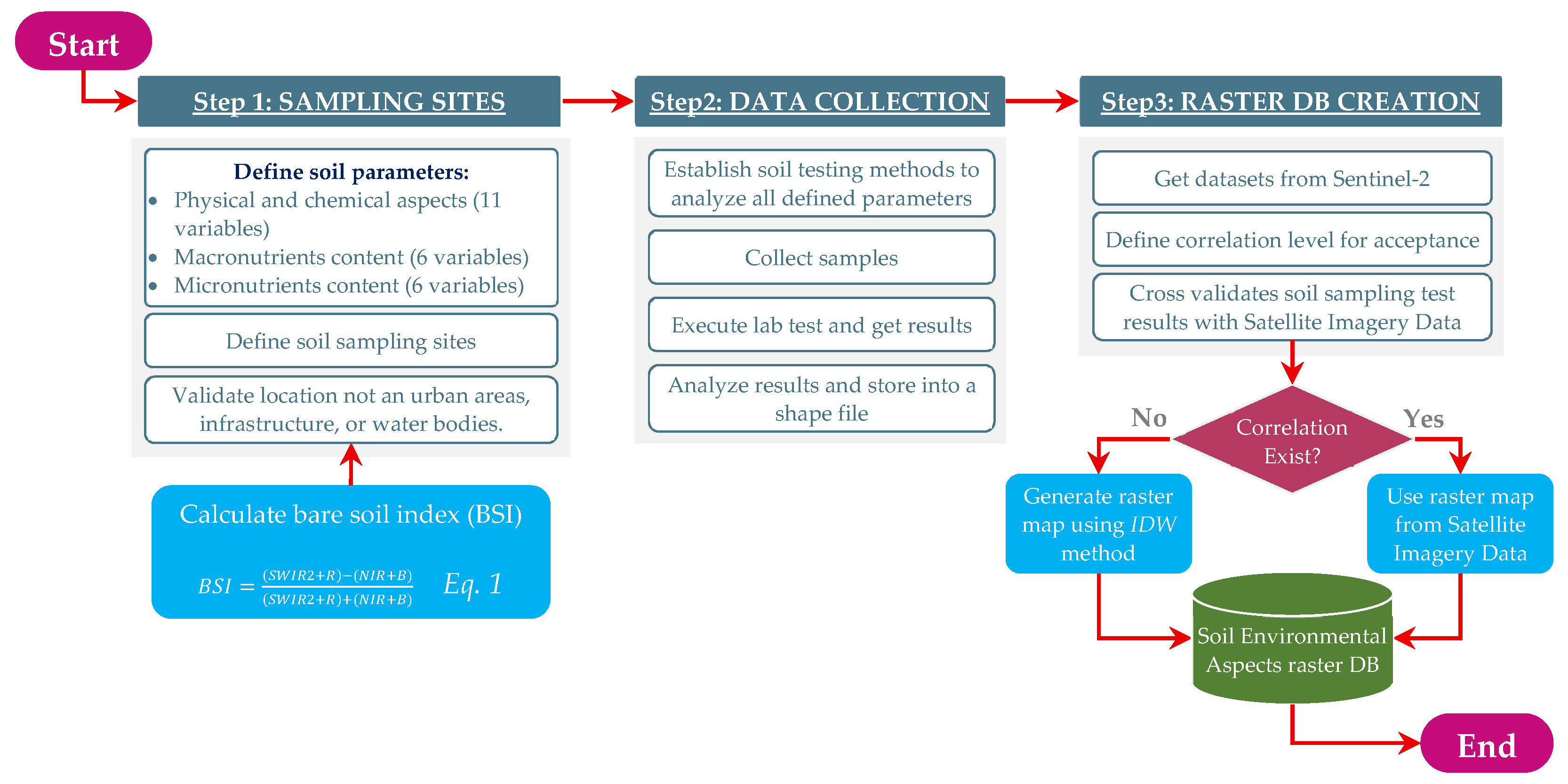
The soil sampling and testing phase consists of three main steps (Figure 3). The first step involves selecting sampling sites within the optimal region and defining the required physical and chemical soil properties. Once sampling points are established, a validation step ensures that selected sites correspond to rural and non-infrastructure areas, using the Bare Soil Index (BSI) proposed by [72], expressed as Equation (1):
B S I = S W I R 2 + R ( N I R + B ) S W I R 2 + R + ( N I R + B )
where SWIR2 = shortwave infrared (Band 12), NIR = near-infrared (Band 8), R = red band, and B = blue band—all from Sentinel-2 imagery [73,74,75,76,77,78,79]. Before analysis, Sentinel-2 Level 1C data were atmospherically corrected using the Sen2Cor processor to obtain surface reflectance (Level 2A). Cloud and shadow masking were performed using the Scene Classification Layer (SCL), and all spectral bands were resampled to 10 m for consistency. Spectral subsets focused on the red-edge, NIR, and SWIR regions, and dry-season imagery was selected to minimize soil moisture interference, thereby enhancing soil spectral sensitivity.
The soil tests quantified physical and chemical properties, including macro- and micronutrients, with emphasis on those most relevant to Arabica coffee. The second step involved conducting laboratory analyses, which provided reference data for comparison with remote sensing values. At this stage, Sentinel-2 Band 12 was prioritized due to its proven correlation with soil attributes [68,79,80,81,82,83,84,85,86].
To model spatial variability, a deterministic interpolation approach—Inverse Distance Weighting (IDW)—was applied instead of a geostatistical method. IDW was chosen for its simplicity, computational efficiency, and suitability for small datasets, as it does not require variogram modeling or assumptions of spatial autocorrelation. These characteristics make it appropriate for heterogeneous agricultural landscapes with sparse sampling density.
The final step establishes the correlation between laboratory soil data and Sentinel-2 spectral information, serving as a validation of remote sensing reliability. When correlation strength fell below the defined acceptance threshold, the IDW interpolation was used to derive soil attributes. Conversely, when significant correlations were identified, soil properties were estimated using fitted regression models derived from spectral relationships.
It is important to note that the correlation analysis in this study was based on bivariate relationships between the SWIR2 band and individual soil attributes. While this approach provides valuable initial insights, it does not fully capture multivariate or nonlinear dynamics. Future work should incorporate advanced modeling techniques, such as Partial Least Squares Regression (PLSR) or Random Forests, to leverage the full spectral dataset and improve predictive accuracy across soil variables [80,87,88,89,90].

2.3. Phase 3: Soil Fertility Index for Arabica Coffee Crops

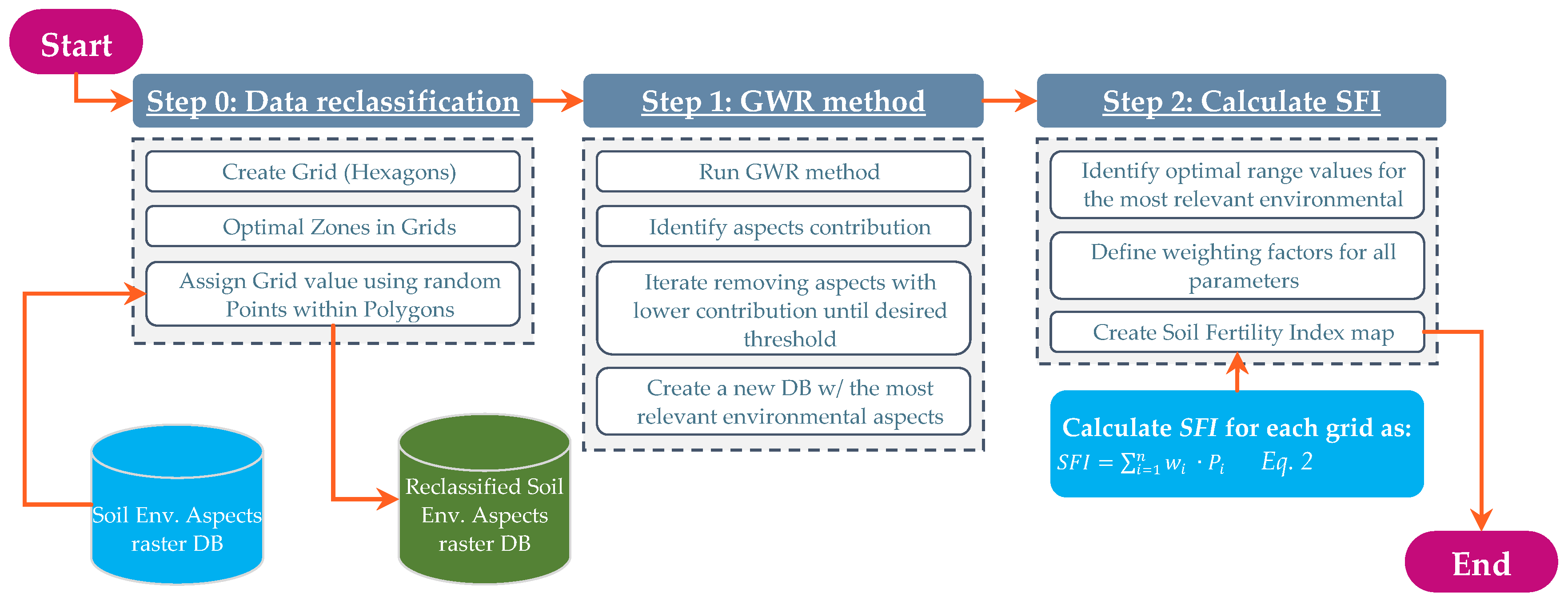
The third phase identifies soil fertility levels within the optimal region (Figure 4) using results from the previous analyses. The first step is to identify the soil properties most strongly associated with fertility using the Geographically Weighted Regression (GWR) model. Before applying GWR, a resampling of pixel resolution was performed to reduce computational load. In this study, a 500 m hexagonal grid was used, with each cell value representing the average of 100 random points extracted from the raster data within the hexagon. This process was applied across all analyzed soil properties to ensure statistical robustness.
The second step focuses on calculating the Soil Fertility Index (SFI) by defining optimal value ranges for each parameter and applying the following equation, Equation (2):
S F I = i = 1 n w i · P i  
where P i represents the binary state (1 = within optimal range; 0 = otherwise) and w i the corresponding weight.
In this study, the SFI was computed using five macronutrients—nitrogen (N), phosphorus (P), potassium (K), calcium (Ca), and magnesium (Mg)—each assigned an equal weight ( w i = 0.20 ) to ensure balanced contribution. Sulfur (S) was excluded due to missing data. Although 23 soil parameters were analyzed overall, only those with complete datasets and agronomic relevance were used in the index to ensure methodological rigor and avoid bias.
The final product is a spatially explicit raster map depicting soil fertility distribution, offering a practical tool for precision agriculture and sustainable management in Arabica coffee systems.

3. Results

3.1. Phase 1: Optimal Region Delimitation

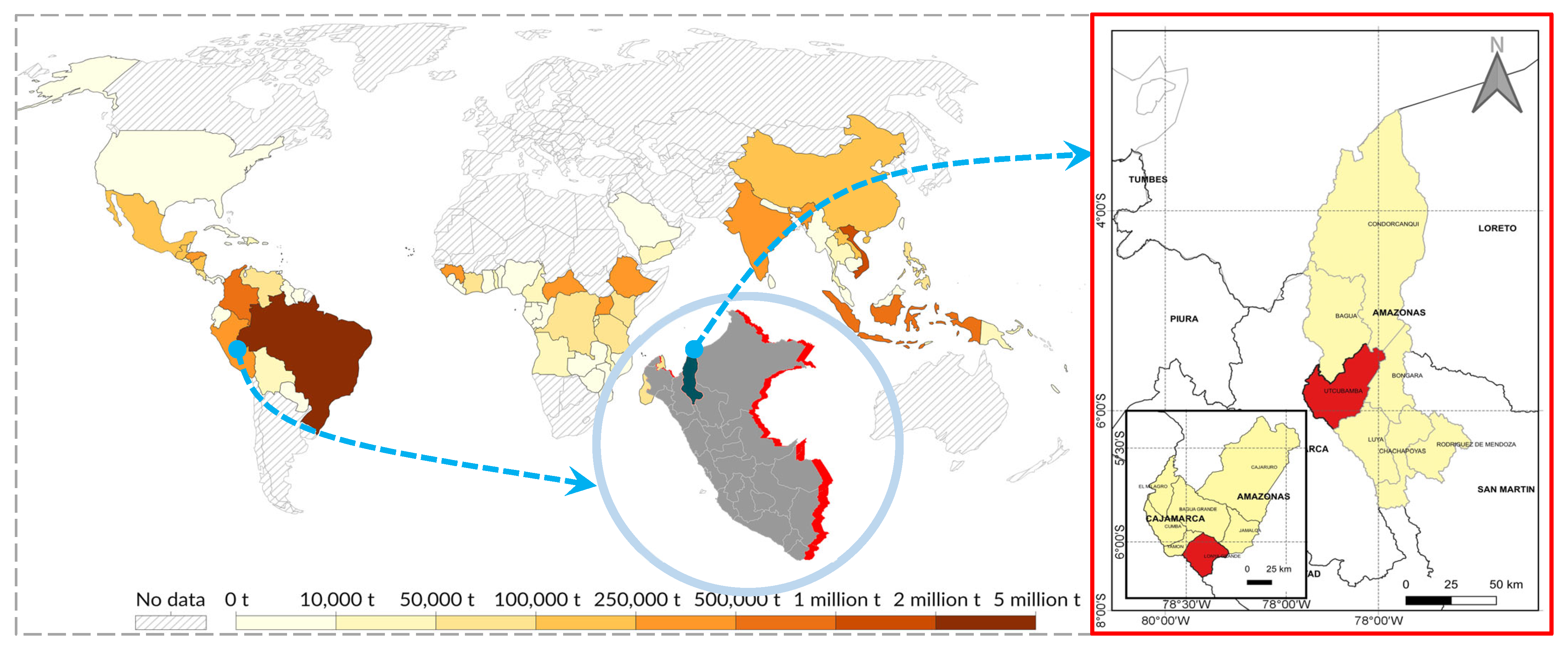
Lonya Grande district was selected as the study area, located in the Utcubamba province of the Peruvian Amazon. This region stands out as the main coffee producer in the department (SEIA [91]), covering approximately 365 square kilometers (≈36,500 ha) and a perimeter of about 87 km. Figure 5 displays the location of the study area.
The optimal region was determined using the MaxEnt model, which accounted for 19 environmental and 3 physical variables. The former are related to temperature and precipitation, while the latter are associated with terrain elevation, land cover, and vegetation index. Table 1 lists the variables used, derived from the WORLDCLIM/V1/BIO [93], CGIAR/SRTM90_V4 [94], MODIS/061/MOD13A1 [95], and MODIS/061/MCD12Q [96] datasets. This information was obtained via Google Earth Engine [97], which served as the data source for ecological niche modeling, providing key insights into temperature and precipitation patterns that influence species distribution. Finally, once the information was reported in raster format, pixel resolution standardization was also performed.
Temperature-related variables (i.e., bio01 to bio11) capture annual, seasonal, and extreme thermal conditions, including diurnal range, seasonality, and specific temperature values for the warmest, coldest, wettest, and driest quarters. Meanwhile, precipitation variables (i.e., bio12 to bio19) quantify total, seasonal, and extreme rainfall conditions, which are essential for understanding moisture availability and hydrological stability across different ecosystems. Physical variables capture the elevation above sea level suitable for crop growth (i.e., elevation variable). Likewise, vegetation concentration in the region is represented by the Normalized Difference Vegetation Index (NDVI), which can be combined with land-use data through the annual biogeochemical classification (LC_Type4 variable). It is important to note that bioclimatic and physical predictors are crucial for MaxEnt modeling, allowing for precise habitat suitability assessments based on climatic constraints. Their integration helps to identify the environmental factors driving species distribution in climate-sensitive regions.
Although sunshine hours and accumulated temperature are also known to influence crop phenology, these variables were not included because the model focused on estimating spatial variation in soil fertility rather than modeling plant growth processes. Future studies could incorporate such variables in broader agroecological suitability assessments.
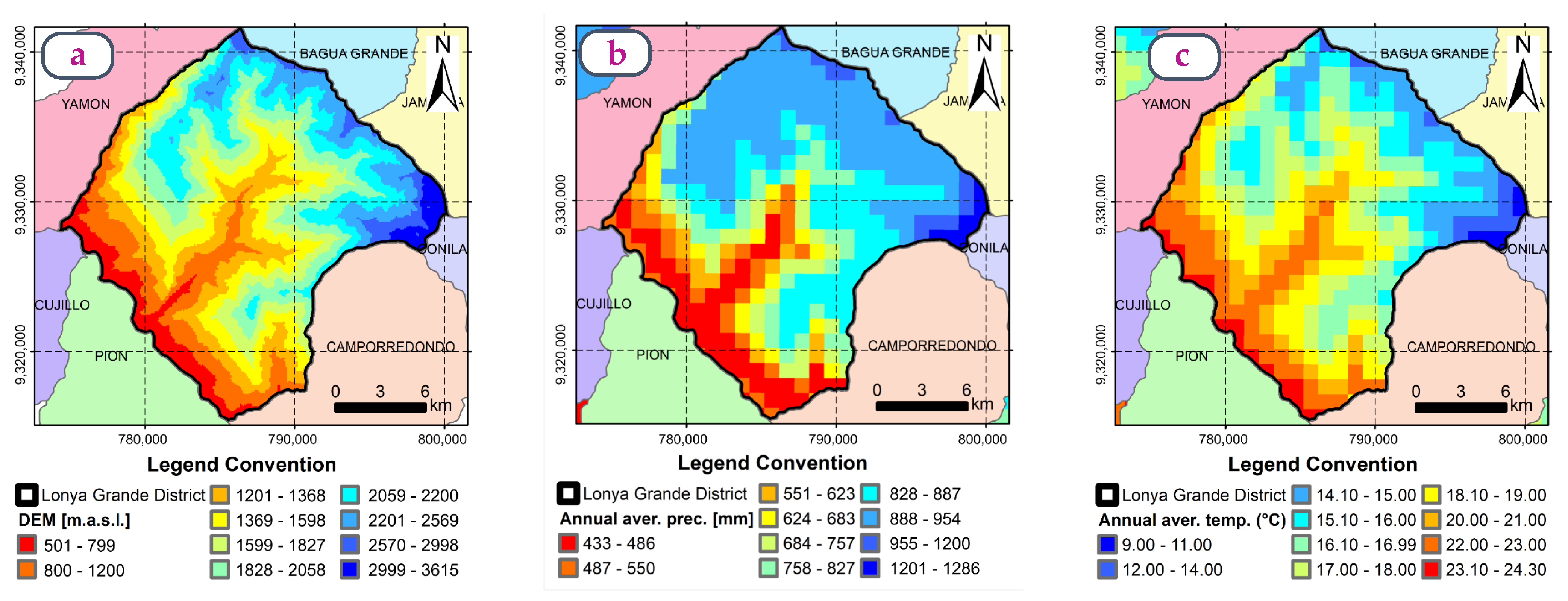
Previous studies have identified the optimal agroclimatic ranges for Arabica coffee. For example, Ballesteros [98] states that Arabica coffee grows best at elevations between 800 and 2100 m above sea level and temperatures around 17–23 °C. Likewise, Parada et al. [99] provide ranges for total annual precipitation and multiple temperature statistics, including maximum, mean, minimum, and extreme values (Table 2). In addition, Figure 6 illustrates the Digital Elevation Model (DEM), annual average temperature, and total annual rainfall for the region of interest.
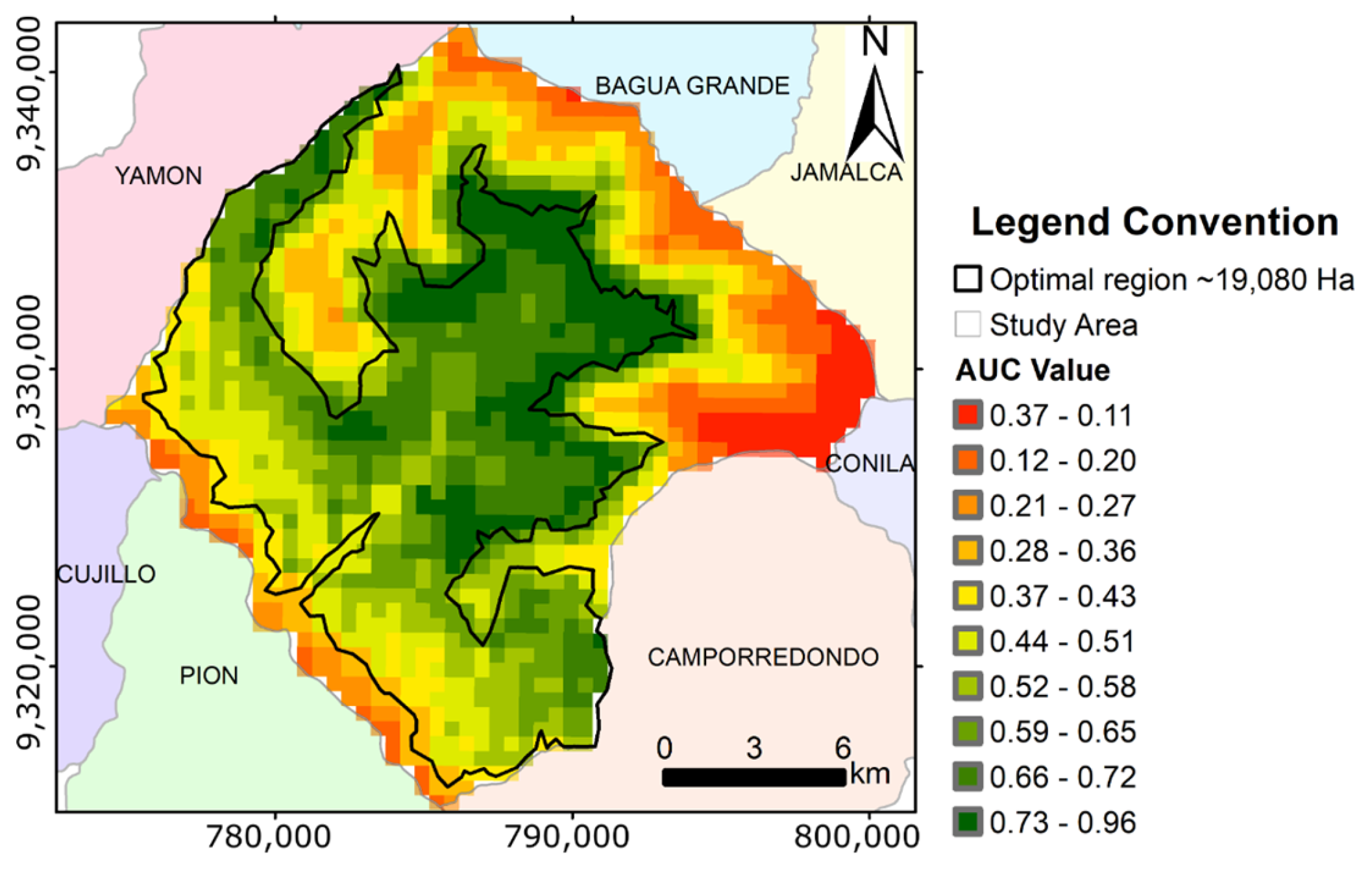
Afterward, the distribution model for Arabica coffee crops was obtained using the MaxEnt algorithm, considering 22 environmental and physical variables (Table 1), as shown in Figure 7. Subsequently, the optimal regions for Arabica coffee growth were defined as those exhibiting an AUC value greater than 0.5. Values below this threshold indicate that the model does not surpass random prediction, implying a lack of discriminative capacity [66]. Overall, the optimal region covers approximately 52% of the total study area (~191 km2).

3.2. Phase 2

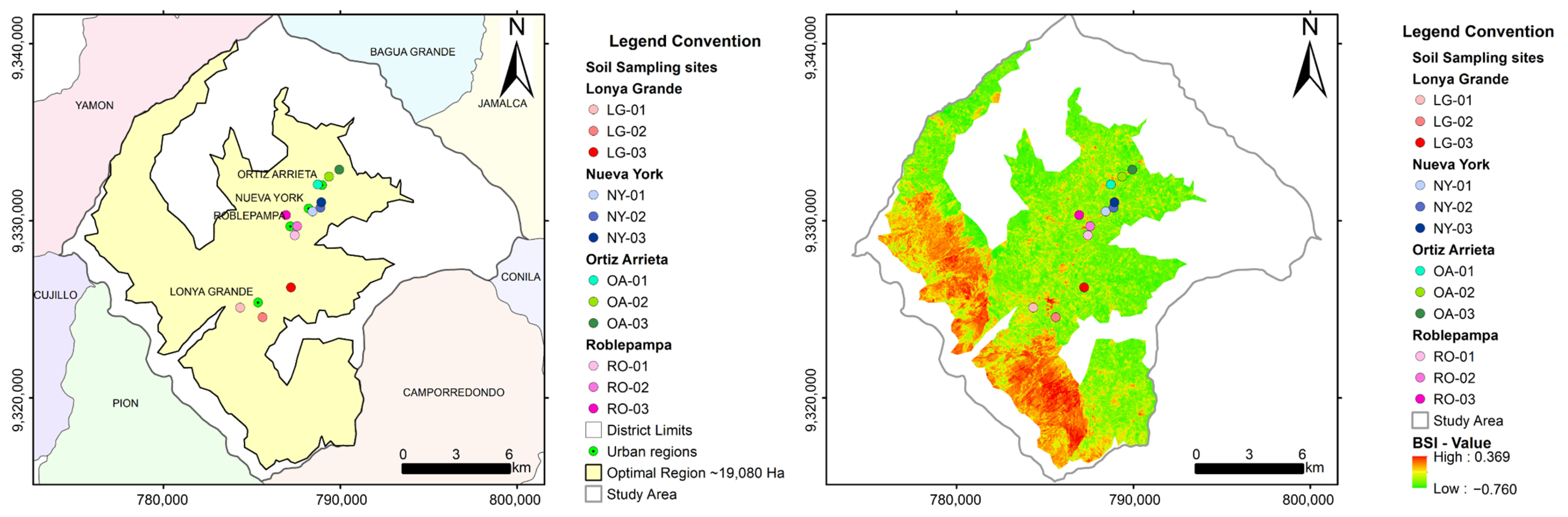
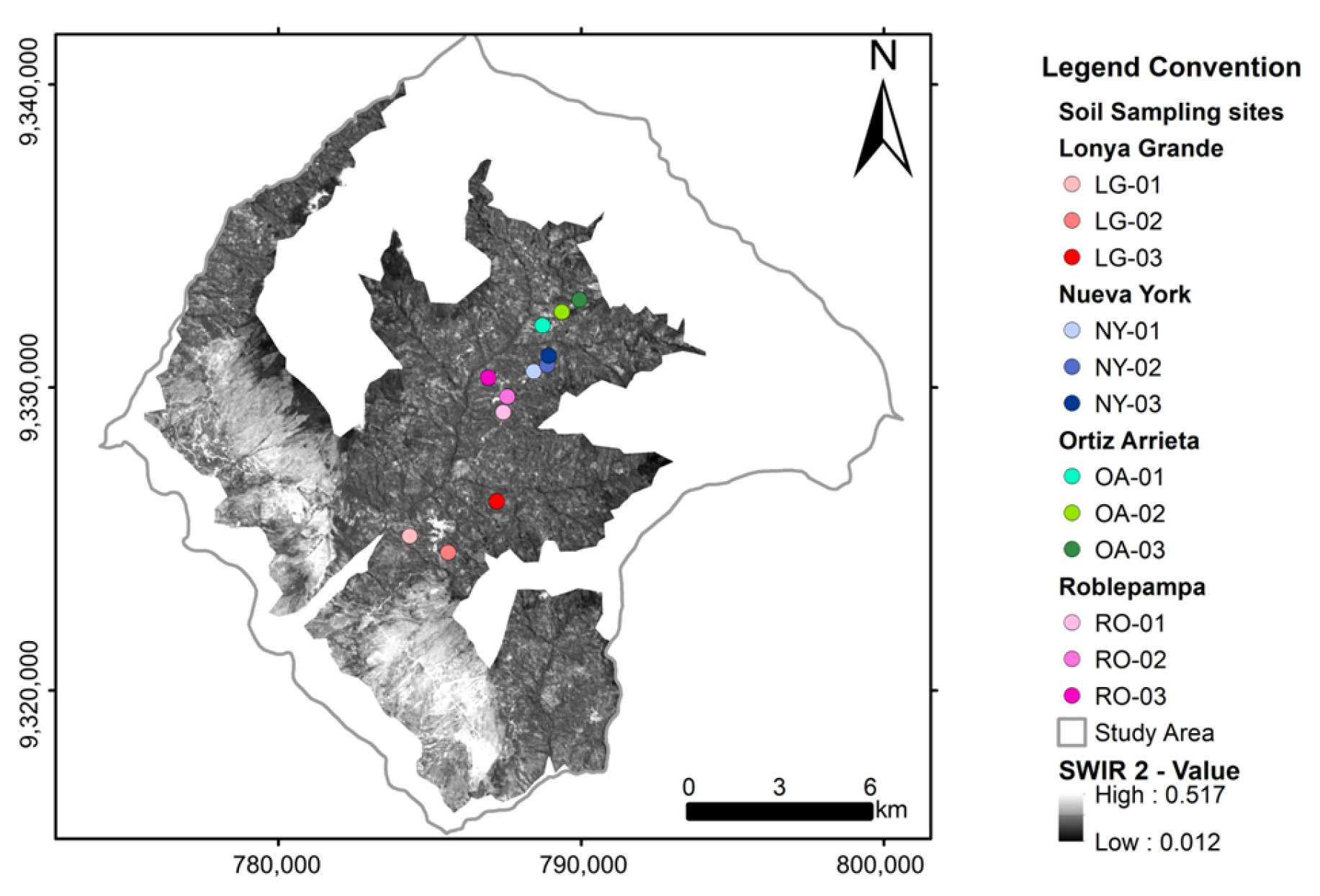
A total of twelve sampling sites were selected for soil collection, representing the four main urban centers in the district: Lonya Grande, Nueva York, Ortiz Arrieta, and Roblepampa. Three rural sampling points were selected for each urban area and validated using the BSI map derived from Sentinel-2 remote sensing data and Equation (1). The Sentinel-2 imagery used in this study was acquired between May and August 2022, corresponding to the dry season in the study area. This period was chosen to minimize cloud interference and soil moisture variability. The data underwent atmospheric correction using the Sen2Cor processor to obtain Level-2A surface reflectance products. Additionally, cloud and shadow pixels were masked using the Scene Classification Layer (SCL), and all bands were resampled to 10 m resolution to ensure consistency in the analysis.
At each site, three soil subsamples were collected within a 10 m radius and subsequently homogenized to form a composite sample, ensuring spatial representativeness and minimizing local variability. In total, 36 individual samples were taken, providing a robust basis for statistical analysis. While administrative boundaries ensured broad spatial coverage, the specific locations within each region were selected based on spectral variability captured by the BSI, enhancing the representativeness and calibration strength of the remote sensing analysis. Figure 8 shows the results for Step 1 of this phase.
Table 3 presents a comprehensive characterization of the soil, encompassing key physical, chemical, and nutritional parameters essential for sustainable Arabica coffee production. It includes textural properties—sand, silt, and clay —which are crucial for soil porosity and hydrodynamics, along with key indicators such as saturation (Sw) and electrical conductivity (EC), which reflect water availability and salinity levels. Additionally, the pH in water ( H 2 O ) and calcium chloride ( C a C l 2 ) solutions were analyzed, as they play a fundamental role in nutrient availability and colloidal interactions. Moreover, organic matter (OM), field capacity (FC), and permanent wilting point (PWP) were assessed to evaluate water retention capacity and overall soil fertility. Finally, the effective cation exchange capacity (CEC) was incorporated as a critical indicator of the soil’s ability to retain and supply essential nutrients.
From a nutritional perspective, macro- and micronutrients were quantified using advanced analytical techniques, including Flame Atomic Absorption Spectrometry (FAAS), along with high-precision gravimetric and electrochemical methods. These analyses provide a rigorous scientific framework for optimizing agronomic management and support data-driven decision-making on nutrient availability, water retention, and soil ionic dynamics—factors crucial to maintaining the sustainability and productivity of high-value Arabica coffee cultivation systems.

3.2.1. Results from In-Field Surveys

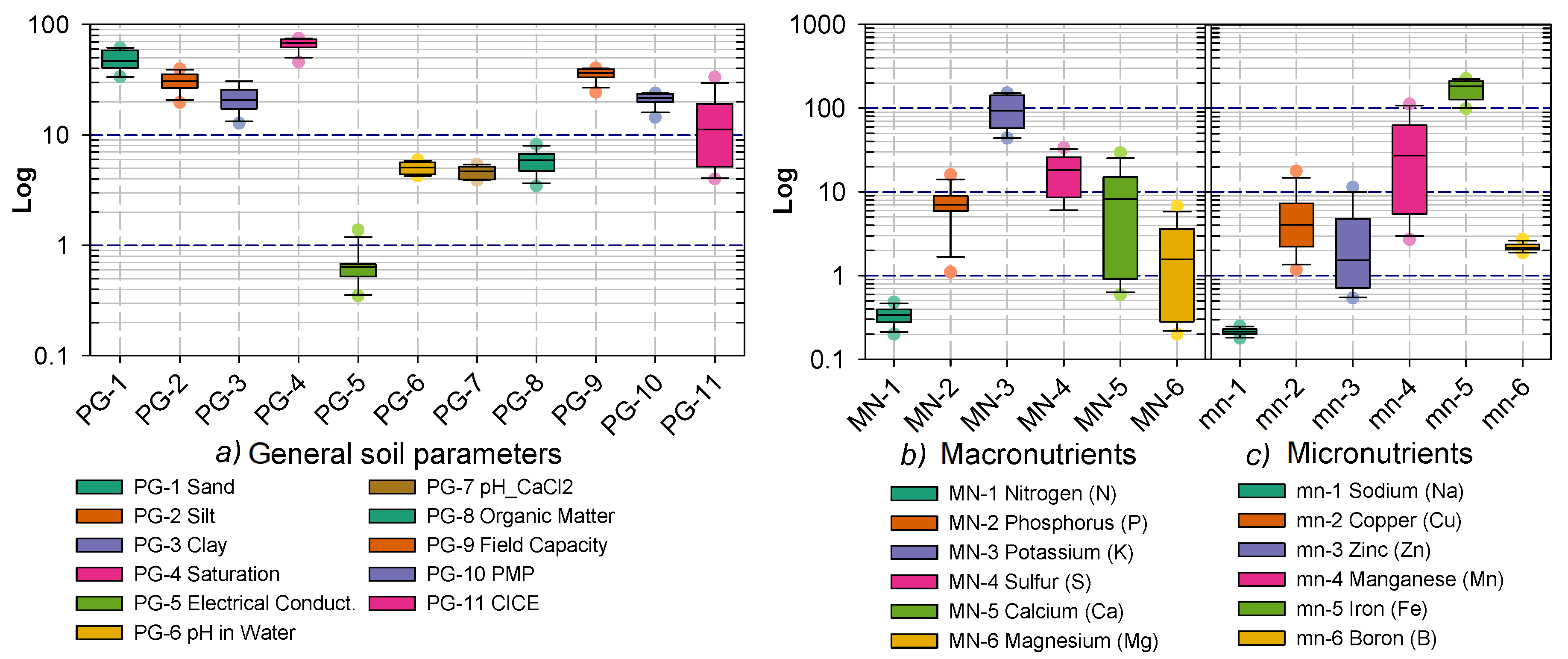
Figure 9a illustrates the box plot evaluating the general soil parameters (11 in total), including physical properties (sand, silt, clay), moisture-related parameters (saturation, field capacity, and permanent wilting point), and chemical properties (electrical conductivity,   p H in H 2 O and C a C l 2 , organic matter, and cation exchange capacity). The data are presented on a logarithmic scale, revealing significant variability among samples and emphasizing the heterogeneous nature of soil properties across the study area. Likewise, Figure 9b shows the box plot displaying the distribution of macronutrients (parameters MN-1 to MN-6) and micronutrients (parameters mn-1 to mn-6) using the same logarithmic scale.
Figure 9a confirms that the sand and clay contents (parameters PG-1 and PG-3) display the widest interquartile ranges among physical properties, indicating pronounced textural differences across the sampled locations. This directly affects soil permeability and water retention. Conversely, saturation (PG-4) and field capacity (PG-9) exhibit consistent distributions with high median values, reflecting their importance in maintaining adequate moisture levels for Arabica coffee production. In contrast, electrical conductivity (PG-5) shows minimal variability and low median values, confirming that salinity is not a limiting factor for crop growth in this region. Finally, the organic matter (PG-8) parameter exhibits moderate dispersion, underscoring its role in improving soil structure and nutrient cycling.
To quantify the degree of spatial heterogeneity among key soil nutrients, the Coefficient of Variation (CV) was calculated for phosphorus (P), potassium (K), and organic matter (OM), yielding values of 46.8%, 51.2%, and 42.5%, respectively. These moderate to high CV levels confirm substantial variability across the study area, warranting the application of geospatial interpolation methods, such as IDW, to ensure spatially explicit nutrient management. Furthermore, when compared to agronomic thresholds established for Arabica coffee cultivation (e.g., P: 35–70 mg/kg; K: 150–300 mg/kg; OM: > 2.5%), the mean values for both P and K were below recommended levels, while OM was within acceptable limits. These results point to localized nutrient deficiencies that require site-specific fertilization strategies to optimize crop health and productivity.
Among the macronutrients, calcium (Ca) and potassium (K) show wide variability, with potassium exhibiting the most extensive range, suggesting spatial differences in nutrient management practices or variations in soil mineralogy, as evident in Figure 9b. Meanwhile, nitrogen (N) and phosphorus (P)—both critical for plant growth—show narrower interquartile ranges but consistently low median values, highlighting potential nutrient deficiencies in the area. Regarding micronutrients, iron (Fe) and manganese (Mn) exhibit the greatest variability and highest median values, reflecting their dynamic availability across different soil conditions. Zinc (Zn) and boron (B) show relatively stable distributions but low overall concentrations, suggesting limited availability and potential impacts on coffee plant development.
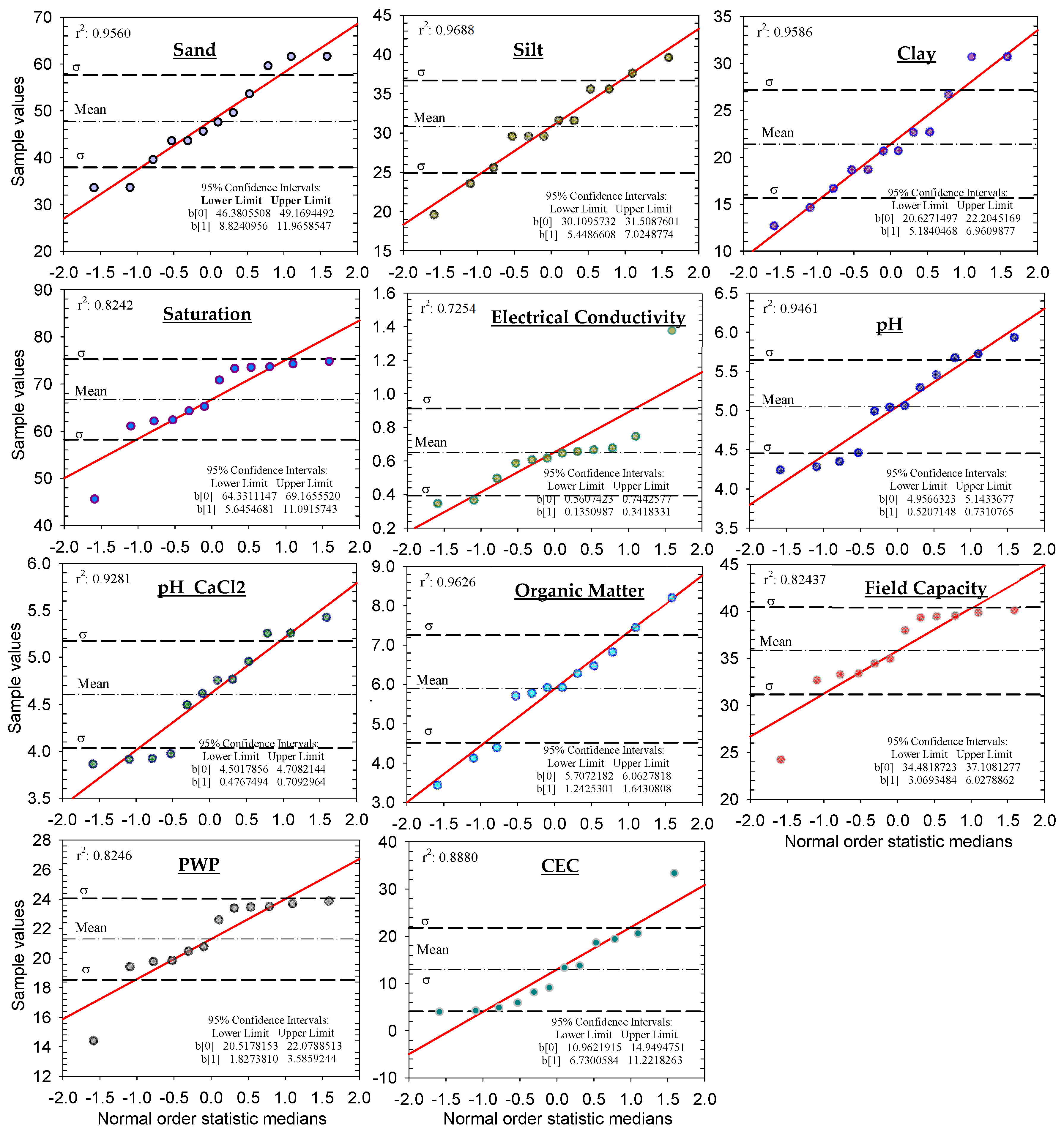
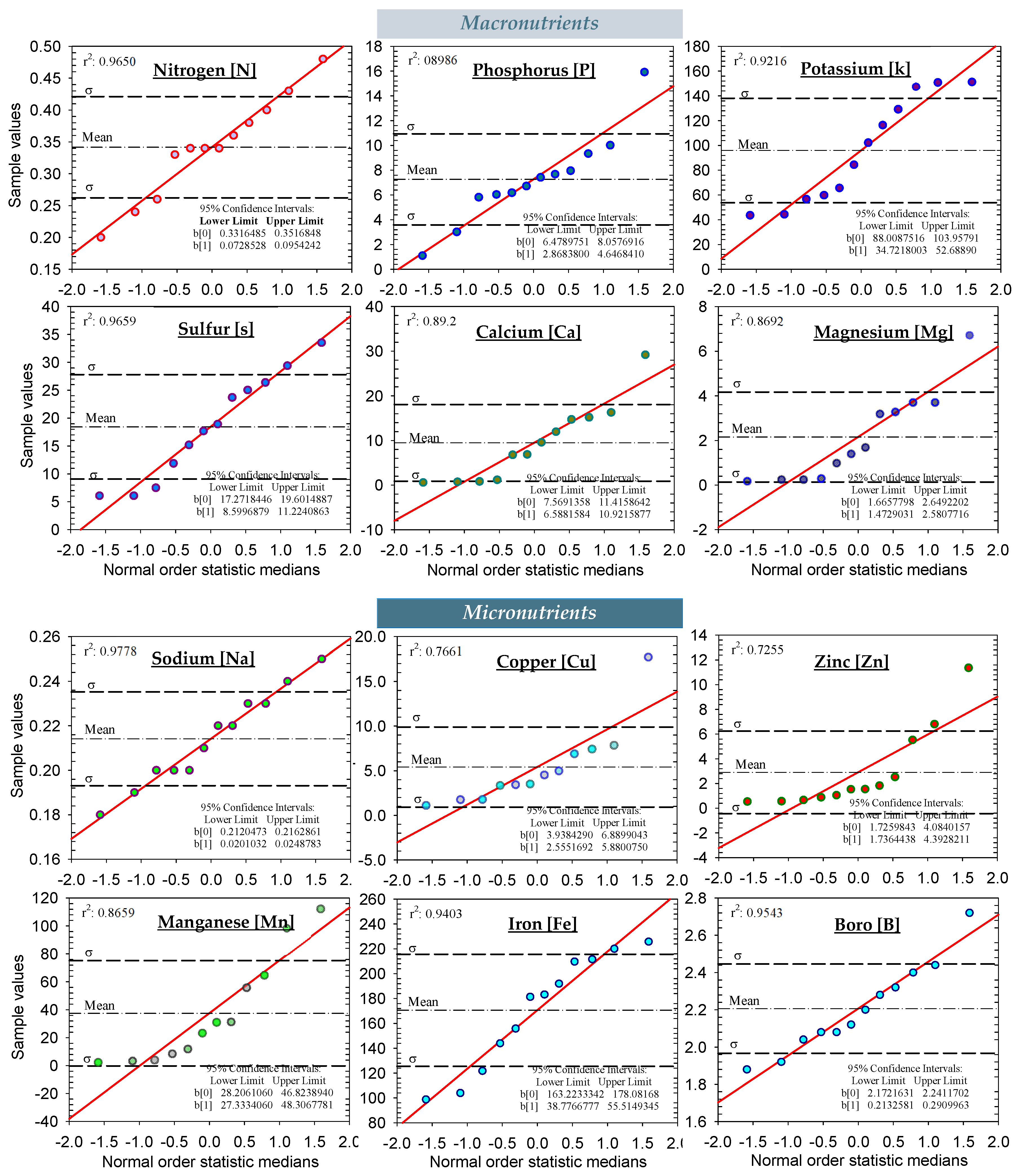
Figure 10 and Figure 11 illustrate the alignment of eleven soil parameters (sand, silt, clay, saturation, electrical conductivity, pH H2O, pH CaCl2, organic matter, field capacity, PWP, and CEC) and all macro- and micronutrients with a normal distribution, validating the statistical consistency of the data. Physical parameters such as sand (R2 = 0.96), silt (R2 = 0.97), and clay (R2 = 0.96) exhibit high consistency, confirming uniform distribution across the analyzed samples despite the natural heterogeneity of the study area. This is essential for modeling soil texture, which directly influences water retention and nutrient availability. Moisture-related parameters, including saturation (R2 = 0.82) and field capacity (R2 = 0.8243), show moderate correlations, reflecting the influence of management practices and soil composition on water dynamics—critical for Arabica coffee cultivation.
Regarding chemical properties, pH (H2O) ( R 2 = 0.95 ) and pH (CaCl2) ( R 2 = 0.93 ) confirm moderately acidic soil conditions, optimal for Arabica coffee growth. Organic matter ( R 2 = 0.96 ) also shows strong alignment with normality, emphasizing its role in enhancing soil fertility and structural stability. However, electrical conductivity ( R 2 = 0.73 ) and cation exchange capacity (CEC, R 2 = 0.89 ) exhibit greater variability, reflecting complexities in soil chemistry linked to mineral composition and localized salinity. Overall, these findings indicate that the evaluated parameters are statistically consistent and suitable for integration into spatial analysis models such as GWR. However, some factors—particularly CEC and electrical conductivity—may require specific adjustments to improve predictive accuracy.
As a general remark, while box plots emphasize variability and dispersion, probability plots focus on validating the statistical normality of the data and detecting potential biases. The strong alignment of parameters such as sand, clay, pH, and organic matter with the normal distribution line ( R 2 > 0.95 ) underscores their consistency and relative homogeneity, highlighting their robustness as predictive variables within the GWR model applied in later stages.
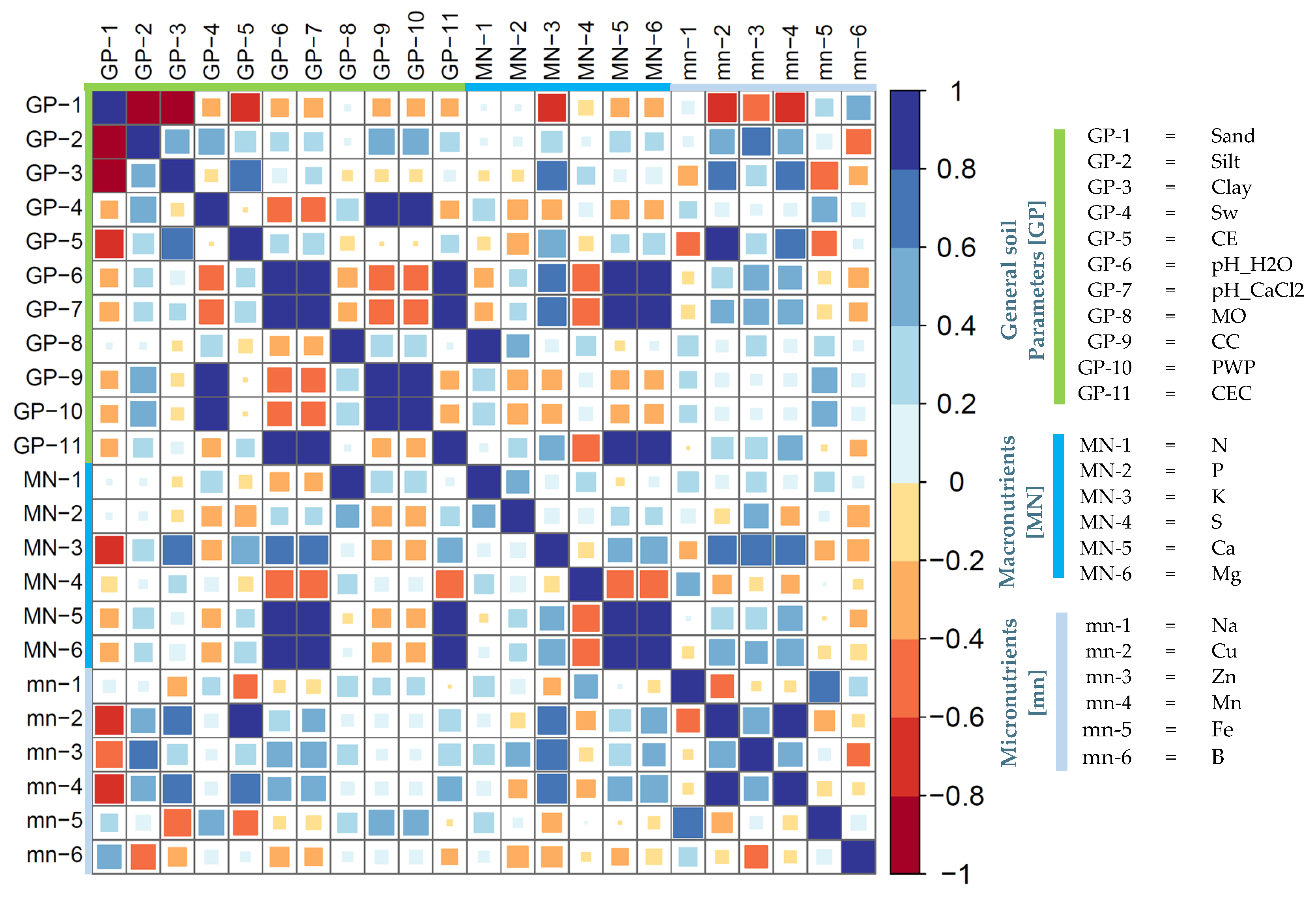
Figure 12 presents the correlation matrix, providing critical insights into the interactions among soil physical, chemical, and nutrient properties and offering a comprehensive understanding of their dynamics in the context of Arabica coffee production.
On the one hand, physical parameters such as sand, silt, and clay exhibit strong inverse correlations ( r 0.9 ), reflecting the characteristic textural balance of soils. Moisture-related parameters, including saturation, field capacity, and permanent wilting point, show moderate to strong correlations ( r 0.7 0.8 ), underscoring their importance in water retention and soil resilience under drought conditions, which are crucial for sustaining coffee yields. These relationships emphasize the combined influence of texture and moisture content on soil functionality.
On the other hand, chemical properties reveal significant interactions, with pH (measured in H2O and CaCl2) displaying strong internal correlations ( r > 0.9 ), confirming the stability of soil acidity. Organic matter and cation exchange capacity (CEC) exhibit a moderate positive correlation (r ≈ 0.6), highlighting their joint role in nutrient retention and soil fertility. Among micronutrients, zinc and manganese show moderate positive correlations ( r 0.6 ), whereas iron is negatively correlated with pH (r ≈ −0.4), reflecting pH influence on Fe availability. The weaker correlations observed for nitrogen and potassium suggest greater mobility and susceptibility to leaching in highly weathered soils, underscoring the need for targeted nutrient management strategies.

3.2.2. Data Performance/Validation

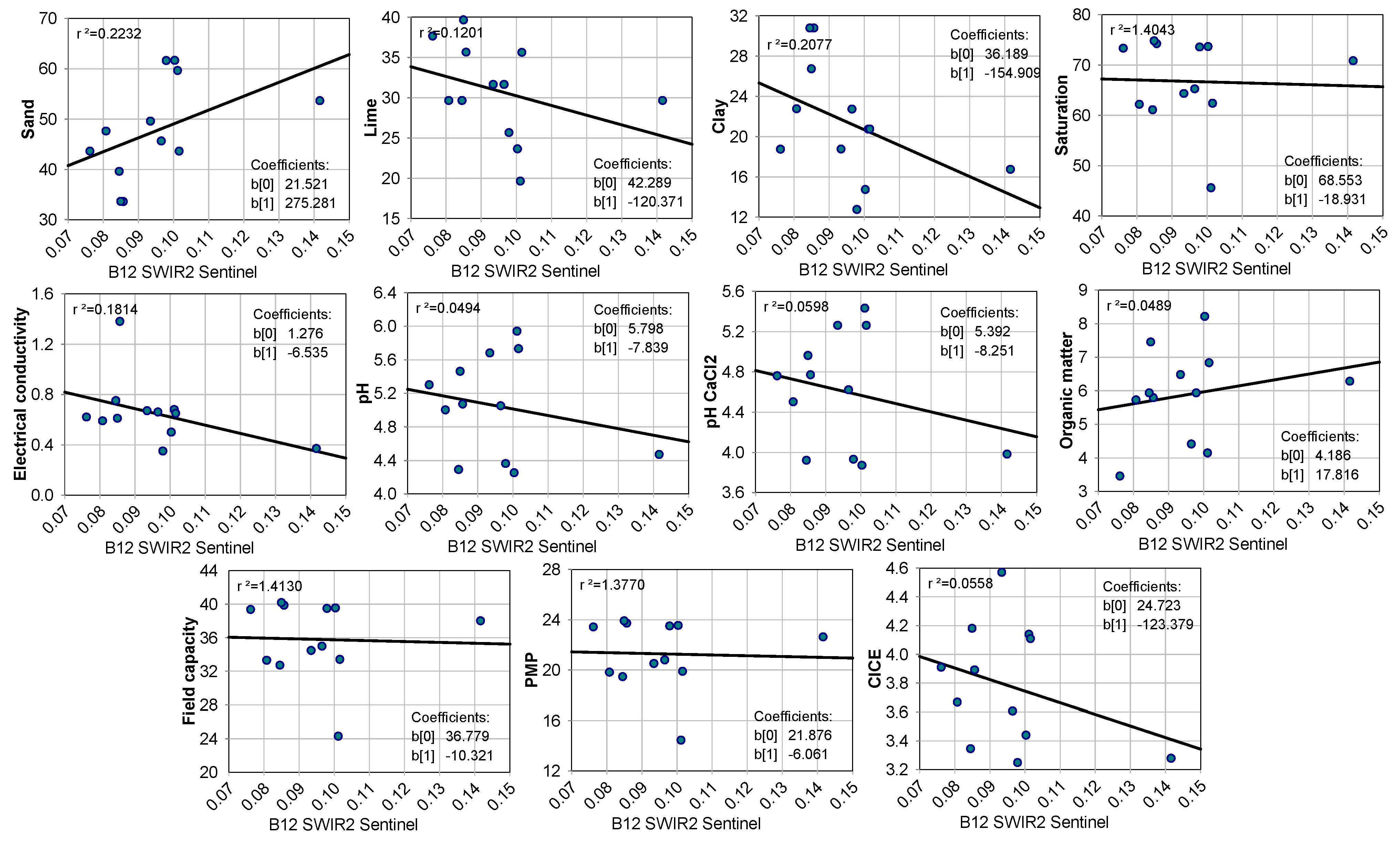
Figure 13 presents the spatial information for the optimal region derived from the SWIR2 band of Sentinel-2 satellite imagery, while Figure 14 illustrates the evaluation of physical and chemical soil properties based on 12 samples collected from different locations. Their relationship was established using the SWIR2 band reflectance from Sentinel-2 imagery. These properties were used for cross-validation and calibration of the Geographically Weighted Regression (GWR) model in the context of Arabica coffee cultivation in Lonya Grande, Amazonas. The results highlight the capability of the SWIR2 band to capture key soil variations, particularly moisture-related properties that are critical for agricultural management.
Figure 13 presents the spatial information for the optimal region derived from the SWIR2 band of Sentinel-2 satellite imagery, while Figure 14 illustrates the evaluation of physical and chemical soil properties based on 12 samples collected from different locations. Their relationship was established using the SWIR2 band reflectance from Sentinel-2 imagery.
The SWIR2 reflectance values were extracted from atmospherically corrected Sentinel-2 Level-2A imagery (using the Sen2Cor algorithm). Each reflectance value corresponds to a georeferenced sampling point, matched through bilinear interpolation. The correlation plots use normalized surface reflectance (X-axis) against lab-measured soil properties (Y-axis). Axis labels and units have been included in the updated figure to ensure clarity and reproducibility.
These properties were used for cross-validation and calibration of the Geographically Weighted Regression (GWR) model in the context of Arabica coffee cultivation in Lonya Grande, Amazonas. The results highlight the capability of the SWIR2 band to capture key soil variations, particularly moisture-related properties that are critical for agricultural management.
Results from Figure 14 indicate that soil texture—represented by sand, silt, and clay fractions—exhibits weak to moderate correlations with the SWIR2 band ( R 2 = 0.22 for sand and R 2 = 0.21 for clay). These correlations suggest that, although SWIR2 partially reflects physical soil properties, its predictive capacity for these variables remains limited and may require complementary spectral bands. Conversely, soil saturation (Sw) shows a strong positive correlation ( R 2 = 0.44 ), highlighting the SWIR2 band’s sensitivity to variations in soil moisture content. This property is especially critical for coffee production because it directly influences root-zone water dynamics.
Regarding chemical properties, pH values (in H2O and CaCl2) and cation exchange capacity (CEC) display weak correlations ( R 2 0.05 0.06 ), reflecting their indirect influence on SWIR2 spectral reflectance. However, organic matter (OM) demonstrates a moderate correlation ( R 2 = 0.05 ), indicating its impact on soil optical behavior. Additionally, field capacity (FC) and permanent wilting point (PWP) exhibit significant correlations ( R 2 = 0.41 and R 2 = 0.38 , respectively), underscoring their importance in water retention dynamics and their connection to agricultural productivity.
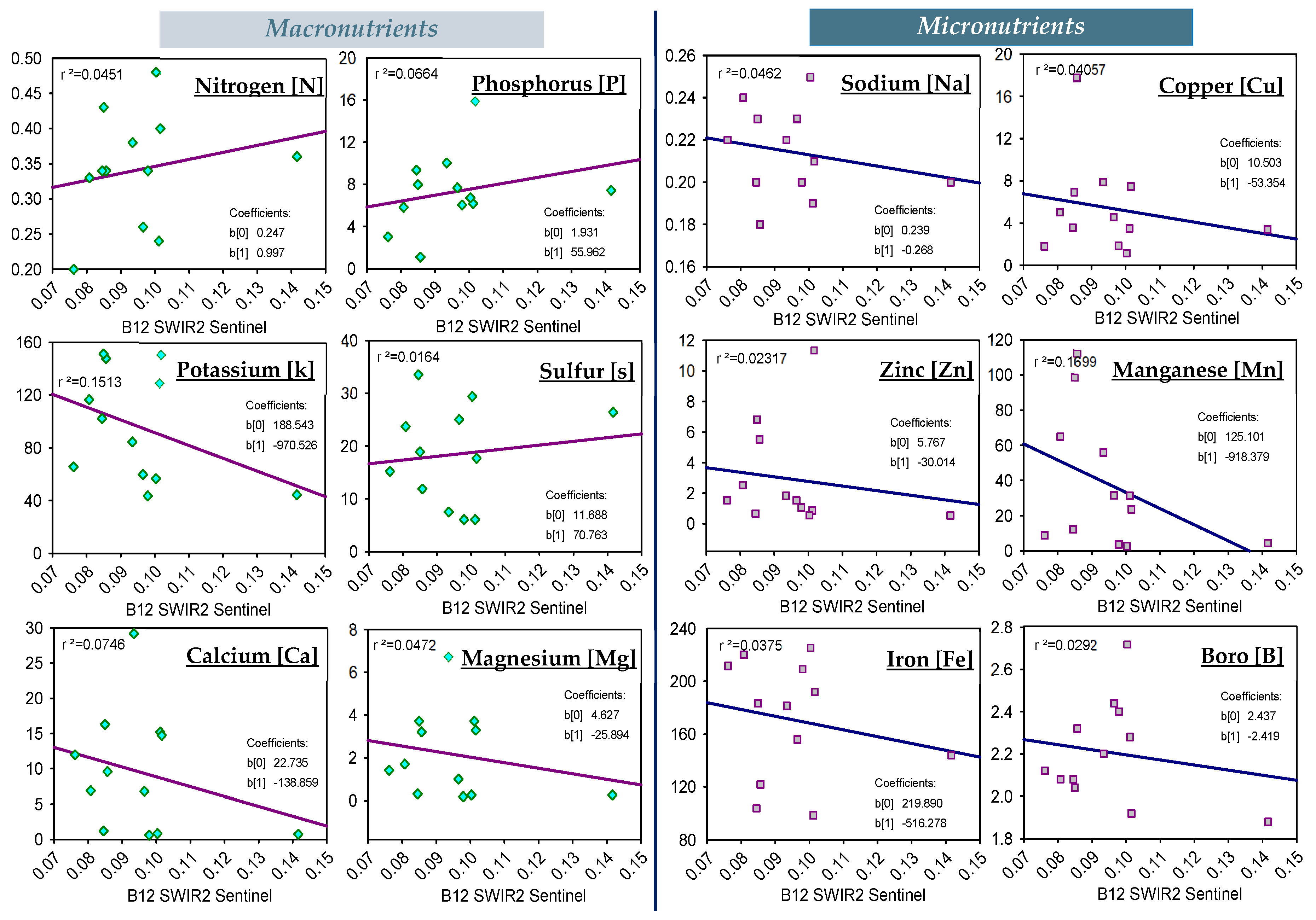
Similarly, Figure 15 presents the analysis of 12 soil samples, revealing key insights into the relationships between macro- and micronutrients and the SWIR2 band of Sentinel-2 imagery. These relationships were assessed using regression models to quantify the spectral responses of each nutrient, serving as the basis for validating the GWR model in the study area. The results are displayed for macronutrients (columns 1 and 2) and micronutrients (columns 3 and 4), emphasizing their relevance to soil fertility and coffee cultivation in Lonya Grande. Finally, Figure 15 highlights the following findings:
  • Macronutrients: Nitrogen (N) shows a weak positive correlation with the SWIR2 band ( R 2 = 0.05 ), while phosphorus (P) also exhibits a minor positive trend ( R 2 = 0.07 ). These limited correlations indicate that, although these elements may influence spectral reflectance, their contribution is overshadowed by other soil properties. Potassium (K), sulfur (S), and calcium (Ca) show stronger negative correlations ( R 2 = 0.15 ,   0.02 , and 0.07 , respectively), suggesting that these nutrients affect soil reflectance through their influence on soil structure and surface interactions. Magnesium (Mg) displays the weakest correlation ( R 2 = 0.05 ), indicating a minimal impact on SWIR2 spectral variability.
Although phosphorus (P) is not spectrally active and does not directly influence reflectance in the visible or infrared regions, its availability in the soil significantly impacts plant physiological processes, which are detectable through vegetation indices such as NDVI. Phosphorus plays a critical role in energy transfer (ATP), root development, and photosynthesis efficiency. When phosphorus levels are sufficient, crops tend to develop more vigorous root systems and denser canopies, enhancing chlorophyll production and biomass accumulation.
This improvement in vegetative vigor results in increased reflectance in the near-infrared band (due to greater cellular structure and leaf area), leading to higher NDVI values. Therefore, the observed correlation between NDVI and P content is indirect: elevated P availability improves plant health and biomass, which in turn enhances the spectral signal captured by NDVI. Similar indirect relationships between vegetation indices and soil nutrient status have been documented in precision agriculture studies, particularly in crops such as maize and wheat, where NDVI has served as a proxy for nutrient-induced changes in canopy development. Hence, although P itself is not optically active, its physiological effects on plant growth create measurable impacts on spectral indices.
  • Micronutrients: The spectral response of micronutrients revealed notable variations. Sodium (Na) and zinc (Zn) exhibited weak correlations ( R 2 = 0.05 and R 2 = 0.02 ), while copper (Cu) and boron (B) showed negligible correlations ( R 2 = 0.04 and R 2 = 0.03 ). Conversely, manganese (Mn) demonstrated a stronger inverse relationship ( R 2 = 0.1699 ), indicating its significant contribution to soil reflectance in the SWIR2 band range. Iron (Fe) with a R 2 = 0.04 , reflected a weak correlation, possibly due to its indirect influence on soil surface properties.
Table 4 summarizes the calculated correlations for all 23 assessed parameters, followed by a classification process into four discrete levels: strong, moderate, weak, and none based on their values. An R2 greater than 0.5 indicates a strong correlation. A moderate level corresponds to values greater than 0.3 and less than or equal to 0.5; weak values range from 0.1 to 0.3. Finally, those lower than or equal to 0.1 are assigned a “non-level” label.
Table 4 highlights that most soil parameters exhibit very weak or no correlation with the SWIR2 band of Sentinel-2 reflectance.

3.2.3. IDW

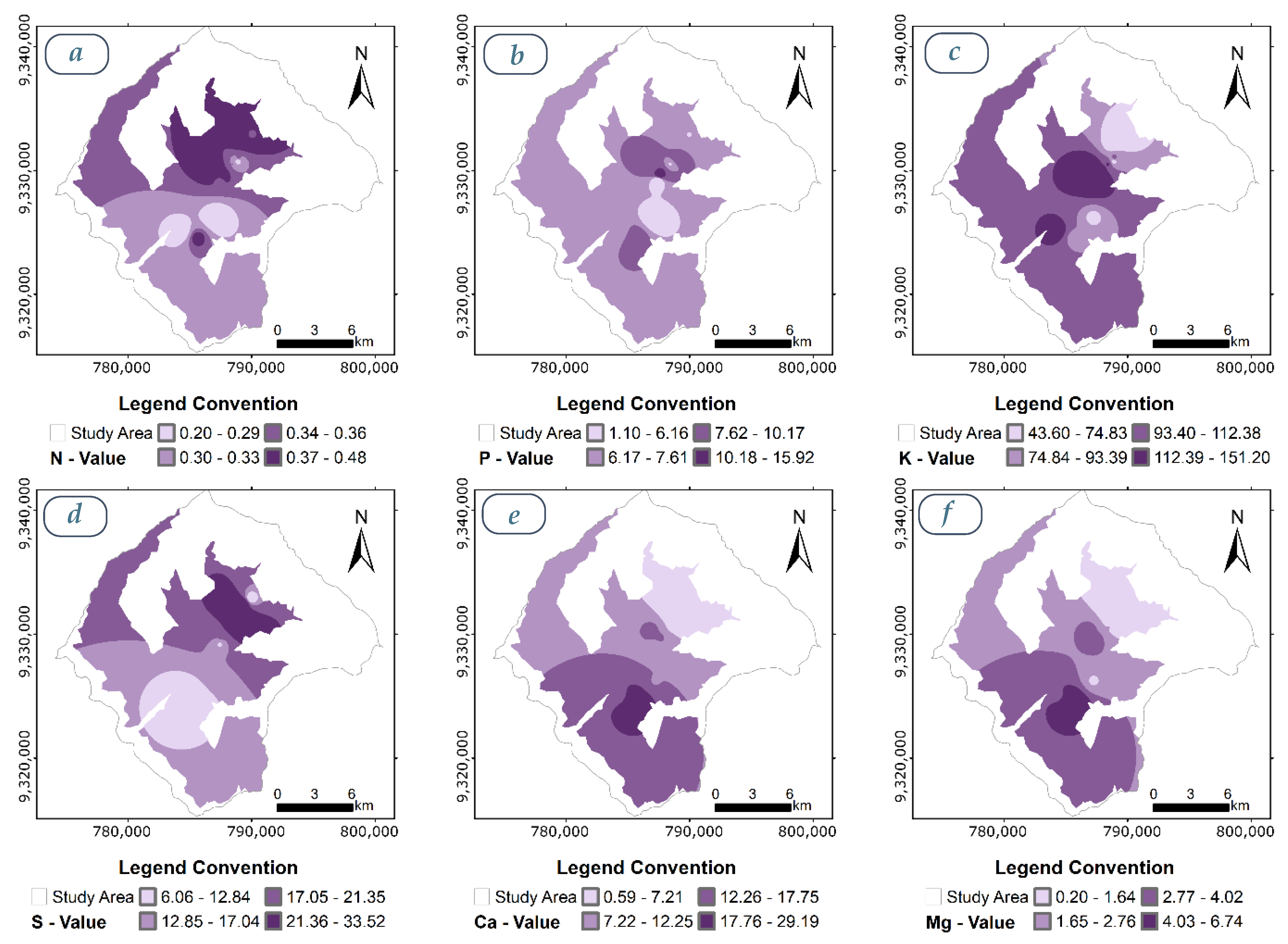
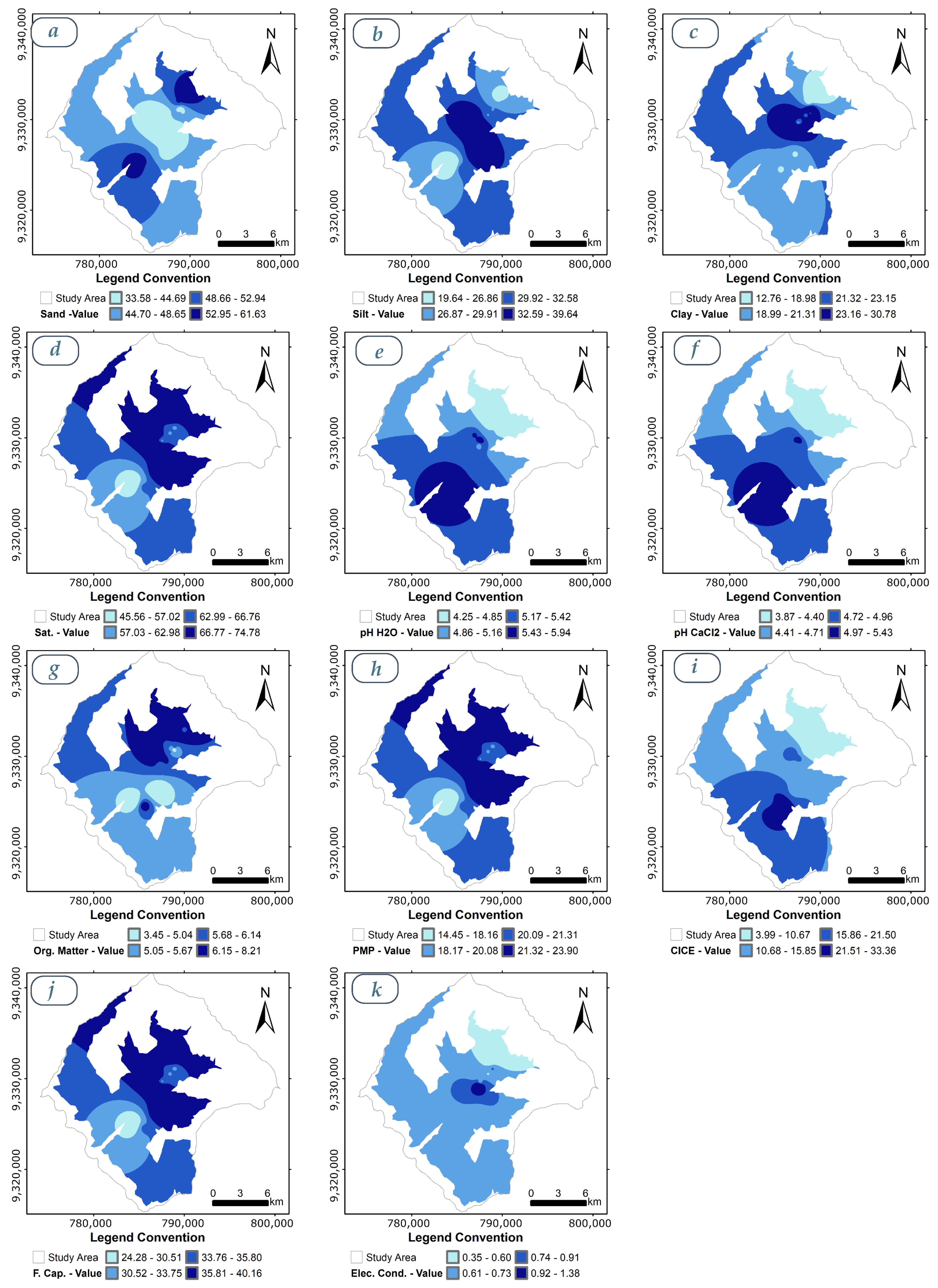
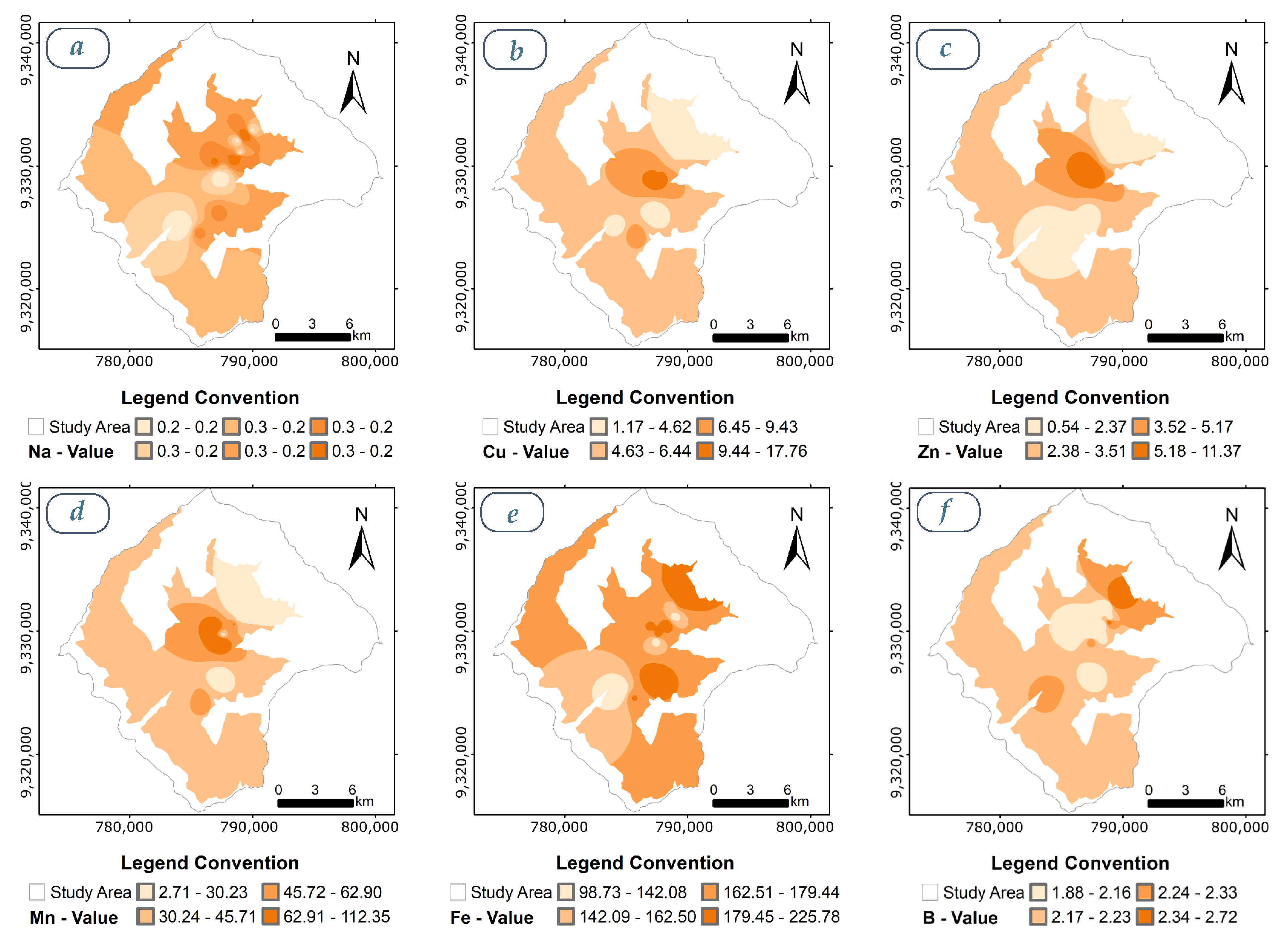
Then, soil parameters for the entire optimal region were obtained using spatial analysis and a spatial interpolation technique, since there was no strong correlation between the sample results and the SWIR2 band from Sentinel-2 imagery. At this stage, the Inverse Distance Weighted (IDW) method was applied to generate raster maps for the complete set of 23 variables, due to its simplicity and straightforward implementation process [32,100]. A 2 m pixel resolution was defined in the calculation process, using the 12 soil samples as baseline data. Figure 16, Figure 17 and Figure 18 show the results for the macronutrients, general soil parameters, and micronutrients, respectively.
The spatial distribution of Organic Matter (OM) exhibited notably higher concentrations in the northern sector of the study area, particularly in areas with gentle slopes and dense vegetation cover. This pattern aligns with NDVI and DEM-derived data, suggesting that reduced slope and enhanced plant biomass accumulation contribute to lower erosion risks and greater retention of organic residues. These areas also coincide with sites managed under traditional agroforestry systems, as confirmed by field interviews and land-use data, where composted coffee pulp and natural litter are more frequently applied—thereby enhancing OM levels.
Conversely, lower OM and phosphorus (P) concentrations were predominantly found in the southern and southwestern zones, characterized by steep gradients and intensive monoculture practices. These conditions favor nutrient leaching and surface runoff, reducing fertility and long-term sustainability. Potassium (K), while more spatially scattered, exhibited slight elevation-related trends, with relatively lower concentrations in high-rainfall, low-lying zones—likely due to increased leaching.
These spatial patterns reveal that soil nutrient variability is not random but is closely linked to environmental covariates, including slope, elevation, vegetation index, and land management history. Such relationships underscore the importance of integrating environmental layers in spatial modeling, enabling a more accurate understanding of nutrient dynamics and their implications for sustainable Arabica coffee cultivation.

3.3. Phase 3

3.3.1. GWR

Once this stage was reached (before any regression analysis), the data were resampled. The raster maps for the 23 variables were converted into a grid format with hexagon-shaped cells. As a result, the optimal region was represented by 716 hexagons, each measuring 500 m in width and height (area: 21.6 ha). A hexagonal grid structure was selected for its geometric advantages in spatial analysis and interpolation, including uniform neighbor distances and minimized directional bias. The cell size was chosen to match the spatial resolution of Sentinel-2 data (10–20 m) and the spatial support of soil sampling points, as recommended by [101,102]. Subsequently, the assigned parameter value for each hexagon was calculated as the mean of 100 random points selected from the IDW raster map contained within that hexagon. The base condition required that each selected point be at least 35 m apart from the others to avoid bias, and this procedure was applied to all 23 variables.
In the next step, the Geographically Weighted Regression (GWR) model was executed, using a cross-validation (CV) process between the SWIR2 band from Sentinel-2 and the 23 parameters for each sampling site, followed by an adjustment based on the Akaike Information Criterion (AIC). Seven models were evaluated and are summarized in Table 5. The first three models (GWR-01, GWR-02, GWR-03) used macronutrients as the best estimators of the SWIR2 band, whereas GWR-04 used micronutrients. Likewise, GWR-05 incorporated only physical parameters, and GWR-06 and GWR-07 used organic matter and acidity, respectively. The variables selected for each model were based on expert judgment. GWR statistical analyses were conducted using R version 4.4.2 [103], and the maps were processed and edited in QGIS 3.6.2 [104].
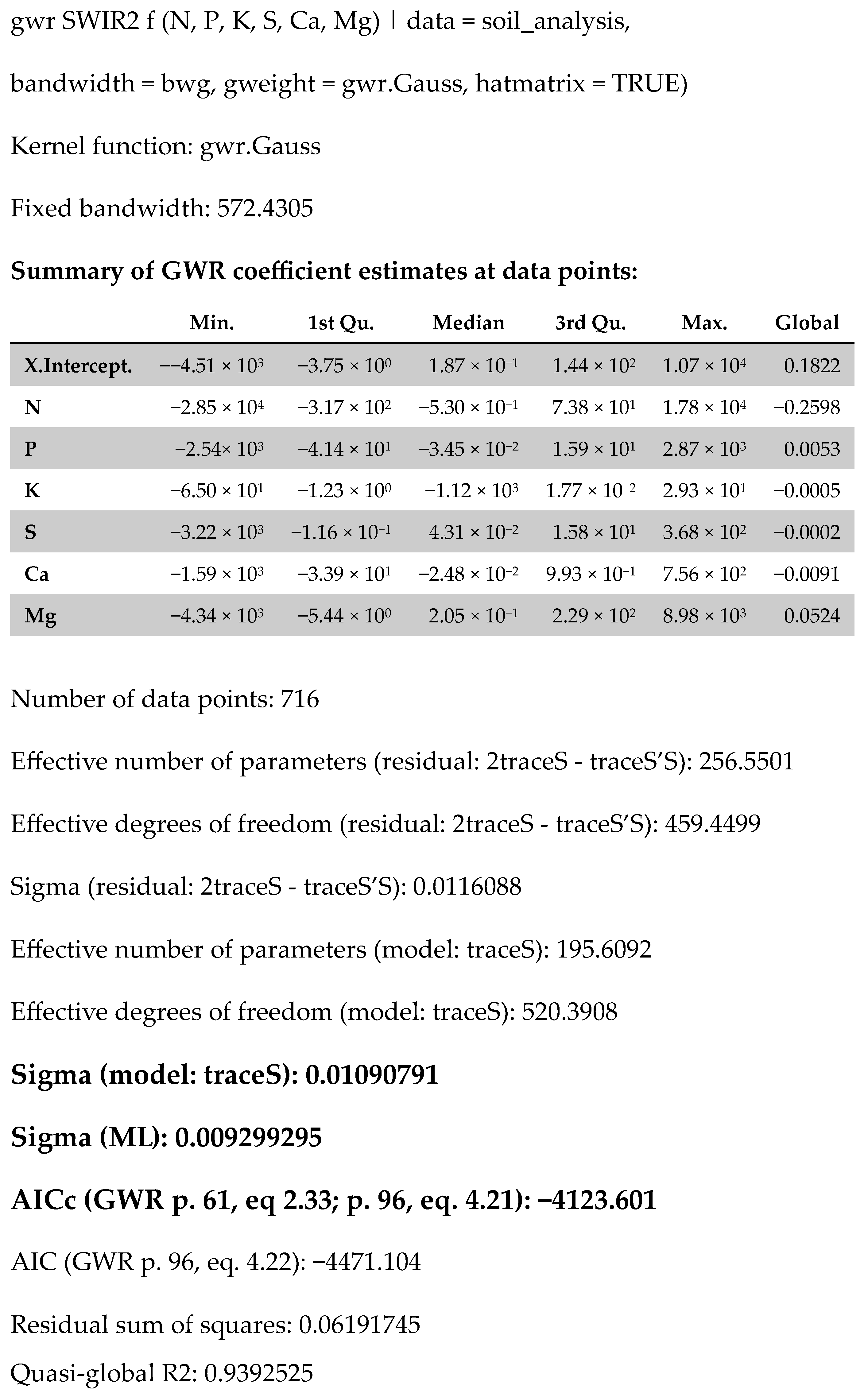
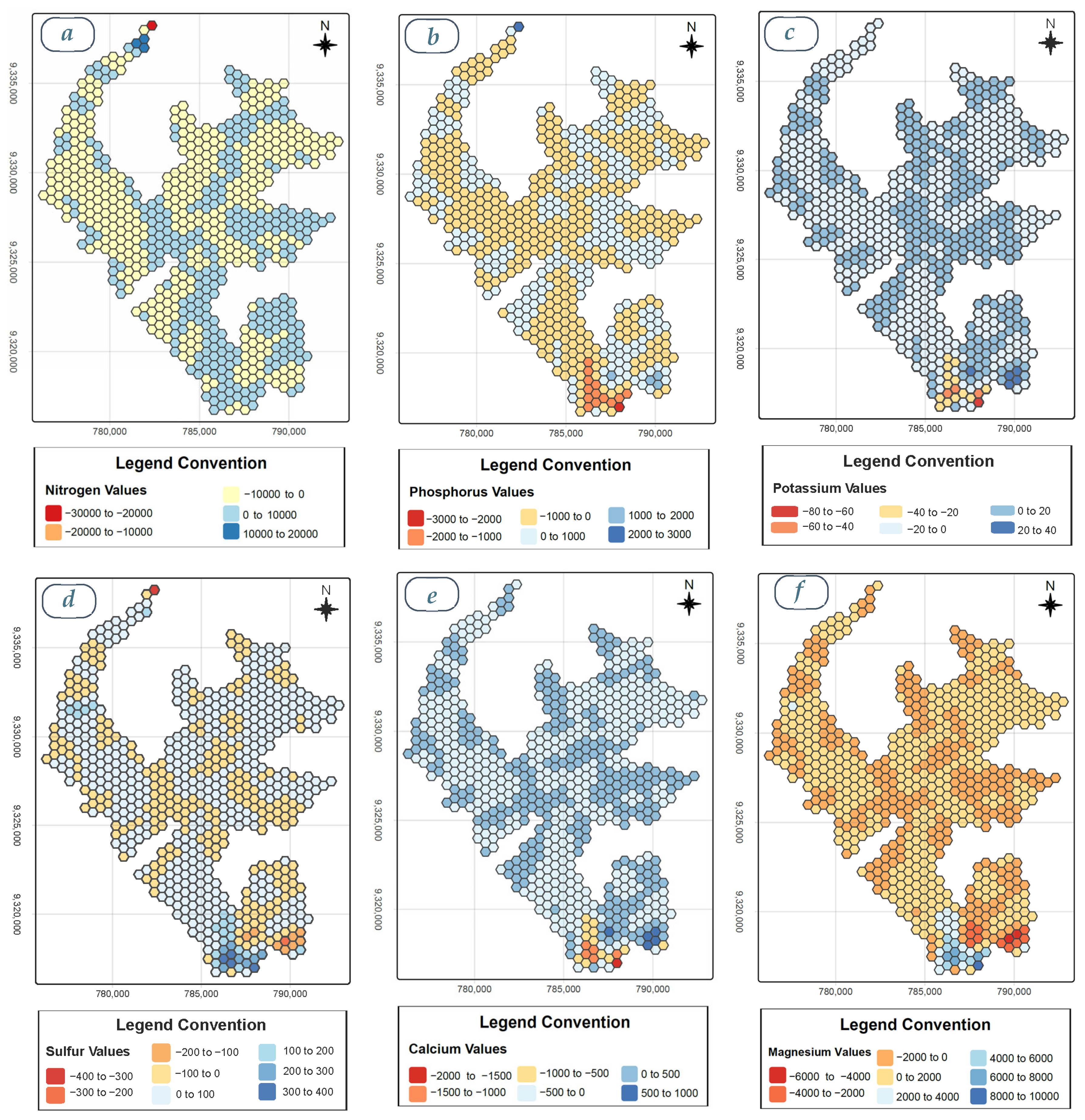
According to Table 5, the model with the highest performance is the GWR-06, with the highest R2 (i.e., 0.9616) and the minimum AIC value (i.e., 403), and relying on a single variable, making it easy to apply. However, it is considered that the CV of the model should be the highest. Considering this, the models that adapt best are those of Macronutrients and Micronutrients (GWR-01 to GWR-04). In addition to being the most complex considering the number of variables used to validate it, but according to performance, only the Macronutrients model reaches R2 above 90% and has the lowest AIC compared to that of Micronutrients. Therefore, the GWR-01 predictive model generated by the relationship of Macronutrients and SWIR2 was chosen. The output results are summarized in Figure 19 and Figure 20. The former depicts the model performance through statistical variables, and the second one shows the maps with the normalized factor assigned to each parameter.

3.3.2. Soil Fertility Index Map

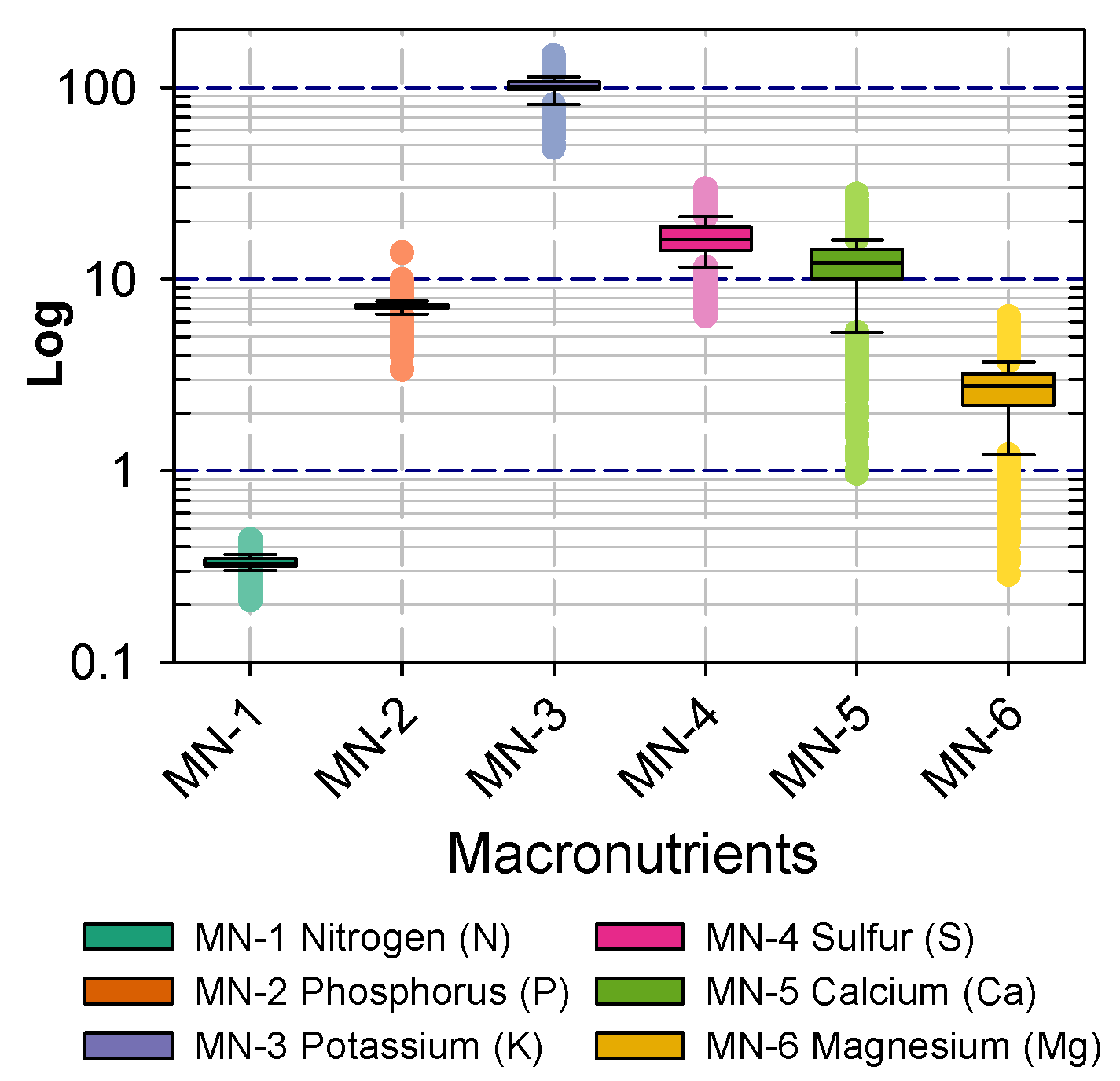
The macronutrients variability from the maps obtained at phase 2 and adjusted through grid resampling in the first step of this phase is illustrated in Figure 21. It shows the log-scaled boxplot for each parameter identified from the GWR-01 model, MN-1 to MN-6. In addition, the optimal reference values for macronutrients identified from GWR-01 model are summarized in Table 6, highlighting the importance of soil chemical balance and nutrient availability in agricultural fertility related to Arabica coffee crops. That information was retrieved from [105]. For this case, only 5 of the 6 parameters have reliable information, excluding the sulfur (MN-4). These results provide a framework for evaluating the suitability of the GWR-01 predictive model and for optimizing soil management practices to improve agricultural productivity and maintain edaphic ecosystem sustainability.
From Table 6, it can be observed that total nitrogen (MN-1) falls within a narrow range (0.1–0.2%), indicating the need for continuous monitoring to prevent production limitations. Phosphorus (MN-2), in its Olsen and Burriel forms, shows a similar trend ensuring efficient nutrient uptake, while assimilable potassium (MN-3) varies between 150 and 300 mg/kg, guaranteeing its availability in the soil. Exchangeable cations show critical relationships between Ca/Mg (4.0–6.0) and K/Mg (0.3–0.8), reflecting the importance of ionic balance in nutrient retention and availability. In the saturated extract, calcium (MN-5) and magnesium (MN-6) exhibit appropriate concentrations to ensure soil structural stability, while potassium (MN-3) in solution ranges from 1.0 to 5.0 m e q / L , which is crucial for plant nutrition. The relationships among Ca/Mg, K/Ca, and K/Mg emphasize the need to maintain balanced proportions to avoid antagonistic effects on nutrient absorption.
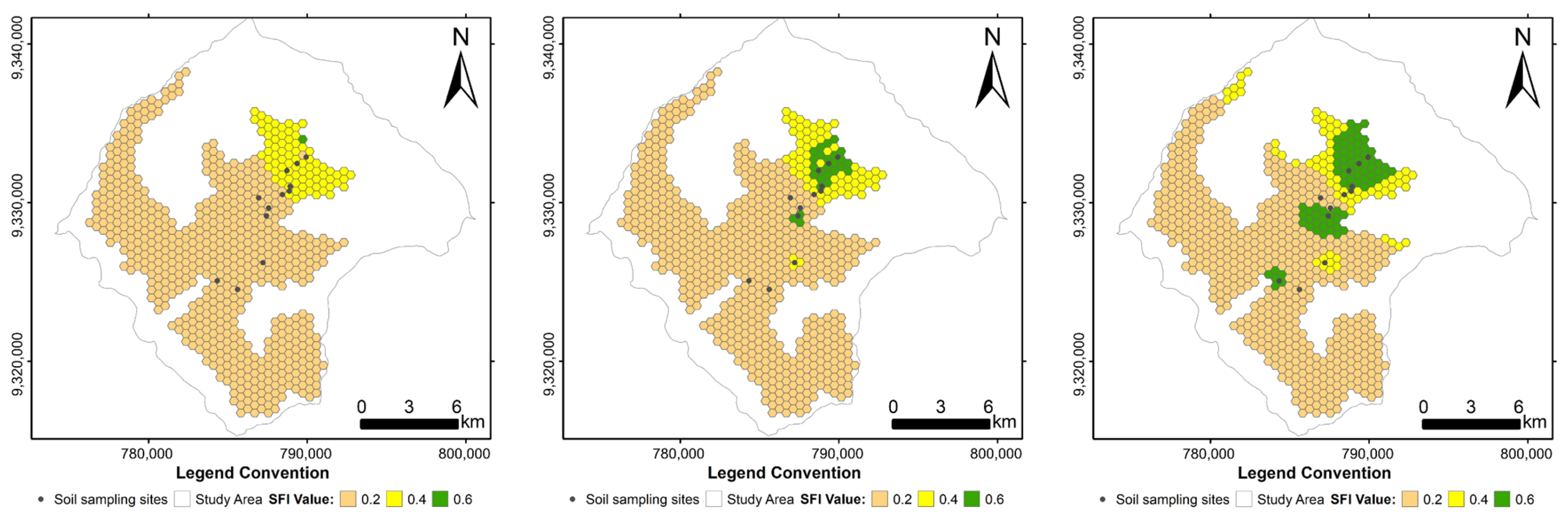
When performing the SFI calculation, the weight factor ( w i ) for the five parameters with available information was set equally to ensure uniform probability across all, i.e., w i   =   0.20 . For sulfur, a value of zero was assigned due to the lack of reliable data. Additionally, a sensitivity analysis was conducted to account for variability in results when defining the optimal parameter ranges, as shown in Table 6; the considered variation levels were 0%, 20%, and 40%. Specifically, the lower bound was obtained by multiplying the minimum optimal range value by (1 − variation), while the upper bound was calculated as the maximum optimal range value multiplied by (1 + variation). The resulting outputs are presented in Figure 22, which depicts the SFI maps and their corresponding sensitivity analysis for the optimal study region after applying Equation (2).
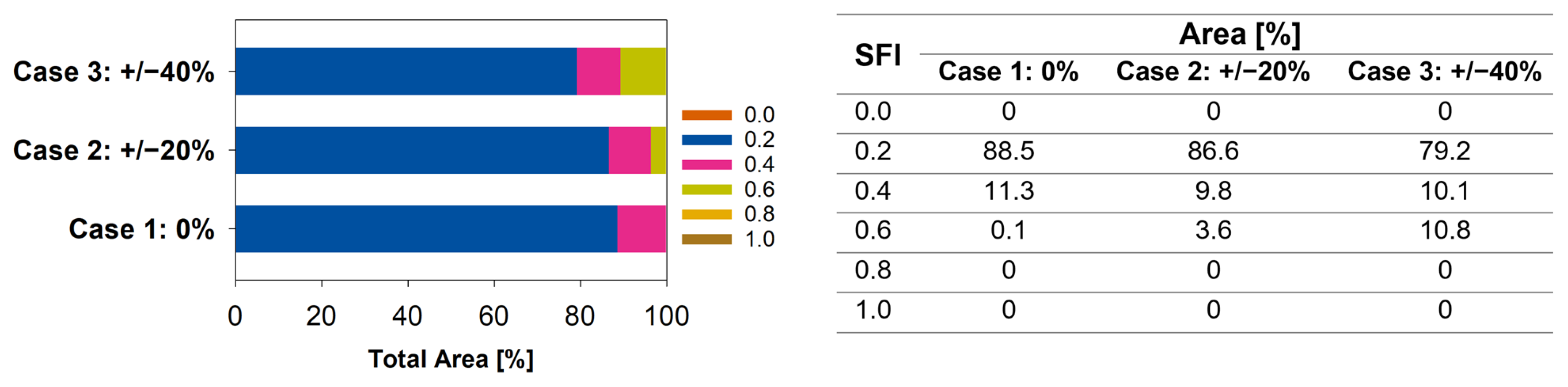
Results from Figure 22 confirm that the maximum SFI is 0.60 regardless of the sensitivity analysis cases, meaning that at least 3 out of the 5 parameters are within the optimal ranges recommended by previous studies. For the 0% variation case, this condition represented less than 1% of the optimal area (i.e., ~22 Ha). Likewise, the SFI values of 0.40, 0.20, and 0.00 cover an area of 1750 Ha, 13,694 Ha, and 0 Ha, respectively. Such a condition highlights the need to increase soil fertility by incorporating fertilizers that compensate for the lack of micronutrients. Finally, the variability among the sensitivity analysis cases for the SFI vs. the percentage of area is depicted in Figure 23.
The sensitivity cases do not alter the overall trend in the area represented by SFI values of 0.2 and 0.4, with maximum differences of 9% and 2%, respectively (see Figure 23). On the contrary, the total area with a 0.6 result depicts a high sensitivity to the optimal range definition, increasing by up to 3 times between levels. Finally, it is observed that there are no cases where an SFI value is equal to 0, nor greater than or equal to 0.8. This means that at least one parameter is within the optimal range for the most critical condition, or in the other scenario, three parameters present a nutrient content within the desired intervals.
A comparative assessment between the IDW interpolation maps and the spectral correlation models (GWR–SWIR2) reveals both convergence and complementarity. For example, in the case of organic matter (OM), both methods identified higher values in the northern areas, indicating consistent spatial patterns. However, the IDW maps captured finer local variations around sampling sites, while the spectral models provided smoother gradients reflecting broader environmental influences. Overall, IDW offers higher reliability for localized estimates based on measured points, whereas the spectral–GWR approach is better suited for large-scale prediction of soil fertility trends. Thus, integrating both methods enhances spatial accuracy and supports a more comprehensive understanding of soil variability.

4. Discussion

The heterogeneous nature of soils in the study area is evident from the variability observed in both physical and chemical parameters during the Phase 2 field surveys. This spatial heterogeneity directly influences water retention, nutrient availability, and overall soil fertility. Parameters related to soil moisture (saturation and field capacity) align with the water requirements of Arabica coffee, confirming the region’s suitability for its cultivation. However, the low concentrations and high spatial variability of essential macronutrients (nitrogen, phosphorus, and potassium) underscore the need for targeted and site-specific fertilization strategies to optimize crop productivity. Similarly, the uneven distribution of micronutrients such as zinc and boron emphasizes the importance of localized interventions to improve specific deficiencies. These findings support integrating remote sensing and spatial modeling techniques (e.g., GWR) into precision agriculture frameworks, enabling the detection of soil variability and promoting efficient, data-driven management practices tailored to regional conditions.
The validation process, which compared field measurements with SWIR2 band data from Sentinel-2 imagery, revealed varying degrees of correlation among soil nutrients, emphasizing the selective sensitivity of the SWIR2 band to specific soil properties. Stronger associations with potassium, sulfur, and manganese indicate their greater influence on spectral reflectance. In contrast, nutrients such as copper and boron exhibited negligible correlations, suggesting they are less responsive to SWIR2 reflectance. The main findings can be summarized as follows:
  • For general soil parameters, saturation (Sw) exhibited the highest correlation (moderate; see Table 4). This indicates that the SWIR2 band effectively captures variations in soil moisture, consistent with previous studies that have highlighted its sensitivity to soil water content. However, other physical and chemical variables—such as texture (sand, silt, clay) and pH—showed weak or negligible relationships, suggesting that additional spectral bands or data sources are needed to improve predictive power.
  • For macronutrients, potassium (K) presented the strongest relationship (weak correlation; Table 4), indicating some potential for SWIR2-based prediction of potassium spatial distribution. In contrast, nitrogen (N), phosphorus (P), sulfur (S), calcium (Ca), and magnesium (Mg) exhibited very weak or no correlation, suggesting that their spatial variability is not adequately captured by SWIR2 data alone.
  • For micronutrients, manganese (Mn) demonstrated the highest correlation (weak; Table 4), indicating a modest relationship between the SWIR2 band and Mn concentrations. Other micronutrients—including sodium (Na), copper (Cu), zinc (Zn), iron (Fe), and boron (B)—showed minimal or no correlation, reinforcing the need for multi-band spectral analysis or advanced machine learning methods to enhance soil nutrient prediction.
Overall, these findings indicate that SWIR2 reflectance alone is insufficient for accurately modeling most soil properties, except for soil moisture (Sw) and, to a lesser extent, potassium (K) and manganese (Mn). The results suggest that incorporating other spectral bands—particularly NIR and SWIR1—and applying advanced spatial analysis models could substantially enhance predictive capability. Additionally, local soil heterogeneity and environmental variability likely contribute to the low correlation values, highlighting the importance of future validation with multispectral or hyperspectral data for precision agriculture. Ultimately, integrating spectral and spatial data provides a robust and scalable framework for identifying soil fertility gradients, optimizing resource use, and supporting sustainable Arabica coffee production.
The IDW interpolation method was applied to generate maps for 19 soil parameters within the optimal region, based on 12 field sampling sites. This approach was adopted because there were no strong correlations with SWIR2 data. However, several interpolated maps—particularly for clay, organic matter, nitrogen, phosphorus, potassium, sodium, and iron (Figure 16, Figure 17 and Figure 18)—showed spatial patterns strongly influenced by the limited number of input samples. This limitation suggests that future studies should increase sampling density to better capture fine-scale variability, consistent with the high heterogeneity observed in the field data.
Conversely, other parameters displayed more uniform spatial distributions across the study area. Despite the limitations of sampling density, the generated maps provide valuable spatial insights for soil management, offering farmers practical alternatives to traditional field measurements for identifying suitable zones for coffee production. Therefore, future research should aim to expand soil sampling coverage and incorporate additional explanatory variables—such as topography or proximity to urban areas—to refine crop suitability assessments and optimize resource allocation.
The selected GWR-01 model demonstrated the strongest overall performance, with results showing high dependence across all six macronutrients (MN-1 to MN-6). This model achieved the highest cross-validation (CV = 572.12), coefficient of determination (R2 = 93.93%), and acceptable Akaike Information Criterion (AIC = 602.80). Although some models using general soil parameters or micronutrients yielded slightly higher R2 values, they were excluded due to lower cross-validation performance. One model (GWR-06) outperformed GWR-01 in terms of statistical fit but relied solely on organic matter, which would bias results and fail to represent the multi-nutrient complexity essential for Arabica coffee cultivation.
Subsequently, a cross-validation procedure was conducted using the macronutrient variables from GWR-01 to generate the Soil Fertility Index (SFI) map. The classification was based on recommended nutrient thresholds for Arabica coffee, though reference ranges were available for only five of the six nutrients. The sensitivity analysis showed a maximum SFI value of 0.60, indicating that at least three of the five parameters met optimal conditions in roughly 10% (~19 km2) of the study area. Furthermore, the results revealed that at least one macronutrient consistently fell within the optimal range across most of the region. These findings reinforce the role of macronutrients as key indicators of soil fertility and agronomic performance, complementing traditional environmental factors such as temperature, elevation, and precipitation.

5. Conclusions

This study proposes a well-structured and practical methodological framework for large-scale soil fertility assessment in coffee cultivation. By integrating satellite imagery with field survey campaigns, the proposed methodology combines Inverse Distance Weighting (IDW) and Geographically Weighted Regression (GWR) models to predict the suitability of agricultural regions. The approach is organized into three sequential phases, utilizing Sentinel-2 SWIR2 band data as the primary input, which has shown a strong correlation with key soil fertility indicators.
The case study was carried out in the Lonya Grande region of the Peruvian Amazon, covering approximately 365 km2. Field surveys and soil analyses were conducted to assess the availability of macro- and micronutrients, providing a comprehensive dataset for model calibration and validation. This integration ensured high accuracy in soil fertility estimation and enabled the identification of optimal zones for coffee cultivation.
Soil property analysis revealed significant heterogeneity within the study area. The results confirmed that the soils possess adequate water retention capacity, with stable values for saturation (Sw), field capacity (FC), and permanent wilting point (PWP), indicating favorable conditions for coffee growth. However, deficiencies in essential macronutrients such as nitrogen (N), phosphorus (P), and potassium (K) were identified, potentially limiting yields and highlighting the need for targeted fertilization strategies. Among the micronutrients, iron (Fe) and manganese (Mn) exhibited the greatest variability, emphasizing the importance of differentiated soil management to optimize nutrient uptake and improve crop productivity.
A key finding of this study is that traditional methods for assessing soil suitability—based on general parameters such as terrain elevation, rainfall, and average temperature—fail to capture the spatial distribution of essential nutrients. This limitation significantly reduces their accuracy in predicting soil fertility for specific crops. In contrast, the proposed methodology successfully generated a high-resolution raster-based nutrient distribution map, offering a valuable tool for precision agriculture and data-driven land management.
Spatial analysis confirmed the reliability of the soil sampling network, showing strong correlations with satellite-derived data. On the one hand, the soil test results for variables such as sand ( R 2   =   0.96 ), silt ( R 2   =   0.97 ), and clay ( R 2   =   0.96 ) exhibited consistent distribution, supporting their integration into predictive soil fertility models. However, parameters such as cation exchange capacity (CEC) and electrical conductivity (EC) displayed higher variability, with values of R 2   =   0.89 and R 2   =   0.73 , respectively, reflecting the complexity of nutrient retention and transport processes in the soil.
On the other hand, when trying to capture the relationships among soil sampling results and the SWIR2 band using traditional statistical methods, there was no clear correlation. Nonetheless, after applying the spatial analysis GWR model, all macronutrients were identified as the most suitable variable that fits with the SWIR2 band, reaching a R 2   =   0.94 . In addition, the soil fertility index displayed a high dependency on the optimal range for the assessed parameters, focused on a high precision when predicting the physicochemical soil features.
From an applied perspective, the integration of satellite-based remote sensing with spatial analysis modeling represents a significant advancement in agricultural soil monitoring and management. This methodology enables precise soil fertility assessment in remote areas, facilitating data-driven decision-making for crop management and resource allocation. It is recommended that this approach be adopted in regional and national farming programs to optimize and supervise fertilizer application, enhance productivity, and promote sustainable coffee production. Furthermore, the incorporation of advanced machine learning models could further improve predictive accuracy and refine soil management practices across the agricultural sector.

Author Contributions

H.A.: Investigation, Conceptualization, Methodology, Data Curation, Formal analysis, Validation, Visualization, Supervision, Software, Writing—Original Draft. A.H.: Conceptualization, Methodology, Data Curation, Formal analysis, Validation, Visualization, Supervision, Writing—Original Draft, Software. S.C.: Investigation, Methodology, Data Curation, Formal analysis, Software, Visualization, Data Collection and Processing (as part of Shelsen Cuba’s Master thesis). Y.P. and E.C.: Data Curation Collection and Processing. All authors have read and agreed to the published version of the manuscript.

Funding

The Article Processing Charge (APC) was funded by the Universidad Nacional Autónoma de Tayacaja Daniel Hernández Morillo (UNAT-DHM), Peru, within the framework of the institutional program for the promotion of scientific research. The corresponding author, Dr. Héctor Aroquipa Velásquez, expresses his sincere appreciation to UNAT-DHM for the financial support provided in his capacity as Principal Investigator and academic researcher.

Data Availability Statement

All final datasets generated and analyzed for this study are openly available at https://sjcp-2913.projects.earthengine.app/view/environmental-conditions-and-soil-fertility-in-lg-coffee, accessed on 25 May 2025. Any additional datasets are available from the corresponding author upon reasonable request.

Acknowledgments

This research was not funded by any agency. The outstanding help of Christiam C. Ángel with the style editing and overall proofreading is highly appreciated.

Conflicts of Interest

The authors declare that they have no known competing financial interests or personal relationships that could have appeared to influence the work reported in this paper.

Glossary

AICAkaike criterion
AUCArea under the curve
Brefers to blue band for Equation (1) or Boron
BSIBare soil index
CaCalcium
CaCl2calcium chloride
CECCation exchange capacity
CuCopper
CVCross-validation
DBDatabase
DEMdigital elevation model
ECelectrical conductivity
FAASFlame Atomic Absorption Spectroscopy
FCField capacity
FeIron
GWR Geographically Weighted Regression
H2OWater
IDWInverse Distance Weighting
KPotassium
MaxEntmaximum entropy
MgMagnesium
MnManganese
MNMacronutrient
mnMicronutrient
NNitrogen
NaSodium
NDVI Normalized difference vegetation index
NIRNear-infrared band
OMOrganic matter
PPhosphorus
PGGeneral soil parameter
pHpotential of hydrogen
PiBinary state for Equation (2)
PWPpermanent wilting point
rcorrelation factor
Rrefers to red band for Equation (1)
R2R-squared
SSulfur
SFISoil fertility index
SwSaturation
SWIR2Sentinel-2 Short-wave infrared band
SWIRShort-wave infrared band
wiWeight value for Equation (2)
ZnZinc

References

  1. Cherlinka, V. Fertilidad del Suelo: Estrategias de Preservación y Mejora. Available online: https://eos.com/es/blog/fertilidad-del-suelo/ (accessed on 20 October 2024).
  2. Webster, C.F.; Kim, W.-J.; Reguera, G.; Friesen, M.L.; Beyenal, H. Review: Can bioelectrochemical sensors be used to monitor soil microbiome activity and fertility? Curr. Opin. Biotechnol. 2024, 90, 103222. [Google Scholar] [CrossRef]
  3. Nasukawa, H.; Tajima, R.; Pereira, M.C.F.; Pedro, J.A.; Nakamura, S.; Fukuda, M.; Koide, J.; Oya, T.; Homma, K. Management strategies for regenerative agriculture based on the assessment of soil fertility in northern Mozambique. Geoderma Reg. 2025, 40, e00912. [Google Scholar] [CrossRef]
  4. Rao, R.; Reddy, U.S. Sparse attention regression network-based soil fertility prediction with UMMASO. Chemom. Intell. Lab. Syst. 2025, 257, 105289. [Google Scholar] [CrossRef]
  5. FAO. Financing to end hunger, food insecurity and malnutrition in all its forms. In The State of Food Security and Nutrition in the World; FAO: Rome, Italy, 2024; p. 286. [Google Scholar] [CrossRef]
  6. CEPAL; FAO; IICA. Perspectivas de la Agricultura y del Desarrollo Rural en las Américas. San José. 2021. Available online: https://repositorio.cepal.org/server/api/core/bitstreams/ec3e9a9f-593e-4c55-85a3-b5eefbeca839/content (accessed on 10 February 2025).
  7. Lipp, M.; Bessy, C.; Cannavan, A.; Dupouy, E.; Fattori, V.; Kopko, C.; Lejeune, J.; Mukherjee, K.; Ferreira, J.P.; Schulz, D.; et al. Food and Agriculture Organization of the United Nations (FAO). In Encyclopedia of Food Safety; Elsevier: Amsterdam, The Netherlands, 2024; pp. 752–760. [Google Scholar] [CrossRef]
  8. Yang, L.; Zhao, G.; Mu, X.; Lan, Z.; Jiao, J.; An, S.; Wu, Y.; Miping, P. Integrated assessments of land degradation on the Qinghai-Tibet plateau. Ecol. Indic. 2023, 147, 109945. [Google Scholar] [CrossRef]
  9. de Sousa, G.P.B.; Bellinaso, H.; Rosas, J.T.F.; de Mello, D.C.; Rosin, N.A.; Amorim, M.T.A.; Bartsch, B.d.A.; Cardoso, M.C.; Mallah, S.; Francelino, M.R.; et al. Assessing soil degradation in Brazilian agriculture by a remote sensing approach to monitor bare soil frequency: Impact on soil carbon. Soil Adv. 2024, 2100011. [Google Scholar] [CrossRef]
  10. Servimedia. Un Tercio del Suelo del Planeta está Degradado, Según la FAO. Available online: https://www.servimedia.es/noticias/tercio-suelo-planeta-esta-degradado-fao/3507456 (accessed on 20 October 2024).
  11. Foucher, A.; Tassano, M.; Chaboche, P.-A.; Chalar, G.; Cabrera, M.; Gonzalez, J.; Cabral, P.; Simon, A.-C.; Agelou, M.; Ramon, R.; et al. Inexorable land degradation due to agriculture expansion in South American Pampa. Nat. Sustain. 2023, 6, 662–670. [Google Scholar] [CrossRef]
  12. Valenzuela, Perdida y Degradacion de Suelos en America Latina y el Caribe. Rev. Eure 1993, 21, 61–72. Available online: https://www.eure.cl/index.php/eure/article/view/1119/221 (accessed on 12 February 2025).
  13. Polo, B.; Chávez, R.; Mori, P.; Ramirez, G. Potencialidades del sector agrario: Condición necesaria en la generación de empleo en la región Amazonas-Perú. Rev. Cienc. Soc. 2021, 27, 326–339. Available online: https://www.redalyc.org/journal/280/28068276026/html/ (accessed on 12 February 2025).
  14. Song, Y.; Zhang, R.; Hao, Y. Digital economy, labor force transfer, and high-quality agricultural development. Finance Res. Lett. 2025, 74, 106692. [Google Scholar] [CrossRef]
  15. Schwarz, J.; Mathijs, E.; Maertens, M. A dynamic view on agricultural trade patterns and virtual water flows in Peru. Sci. Total. Environ. 2019, 683, 719–728. [Google Scholar] [CrossRef]
  16. Munroe, J.; Soto, G.; Filho, E.d.M.V.; Fulthorpe, R.; Isaac, M. Soil microbial and nutrient properties in the rhizosphere of coffee under agroforestry management. Appl. Soil Ecol. 2015, 93, 40–46. [Google Scholar] [CrossRef]
  17. Matos, E.d.S.; Mendonça, E.d.S.; Cardoso, I.M.; de Lima, P.C.; Freese, D. Decomposition and nutrient release of leguminous plants in coffee agroforestry systems. Rev. Bras. De Cienc. Do Solo 2011, 35, 141–149. [Google Scholar] [CrossRef]
  18. IUSS Working Group WRB. World Reference Base for Soil Resources, 2022: International Soil Classification System for Naming Soils and Creating Legends for Soil Maps, 4th ed.; FAO: Rome, Italy, 2022. [Google Scholar]
  19. Oliver-Rodríguez, B.; Zafra-Gómez, A.; Reis, M.; Duarte, B.; Verge, C.; de Ferrer, J.; Pérez-Pascual, M.; Vílchez, J. Evaluation of Linear Alkylbenzene Sulfonate (LAS) behaviour in agricultural soil through laboratory continuous studies. Chemosphere 2015, 131, 1–8. [Google Scholar] [CrossRef] [PubMed]
  20. Fernández-Ramos, C.; Rodríguez-Gómez, R.; Reis, M.; Zafra-Gómez, A.; Verge, C.; de Ferrer, J.; Pérez-Pascual, M.; Vílchez, J. Sorption, degradation and transport phenomena of alcohol ethoxysulfates in agricultural soils. Laboratory studies. Chemosphere 2017, 171, 661–670. [Google Scholar] [CrossRef]
  21. Koponen, H.T.; Flöjt, L.; Martikainen, P.J. Nitrous oxide emissions from agricultural soils at low temperatures: A laboratory microcosm study. Soil Biol. Biochem. 2004, 36, 757–766. [Google Scholar] [CrossRef]
  22. Arslanova, L.; Hese, S.; Fölsch, M.; Scheibler, F.; Schmullius, C. Assessing data and sample complexity in unmanned aerial vehicle imagery for agricultural pattern classification. Smart Agric. Technol. 2025, 10, 100799. [Google Scholar] [CrossRef]
  23. Li, J.; Zhao, J.; Liao, X.; Yi, Q.; Zhang, W.; Lin, H.; Liu, K.; Peng, P.; Wang, K. Long-term returning agricultural residues increases soil microbe-nematode network complexity and ecosystem multifunctionality. Geoderma 2023, 430, 116340. [Google Scholar] [CrossRef]
  24. Wang, G.; Zhu, Z.; Cao, J.; Zhu, T.; Zhou, J.; Müller, C.; Li, J.; Freese, D.; Le Roux, X. Agricultural cultivation duration affects soil inorganic N turnover and supply capacity: Evidence in subtropical karst regions. Agric. Ecosyst. Environ. 2025, 381, 109462. [Google Scholar] [CrossRef]
  25. Silvero, N.E.; Demattê, J.A.; Vieira, J.d.S.; Mello, F.A.d.O.; Amorim, M.T.A.; Poppiel, R.R.; Mendes, W.d.S.; Bonfatti, B.R. Soil property maps with satellite images at multiple scales and its impact on management and classification. Geoderma 2021, 397, 115089. [Google Scholar] [CrossRef]
  26. Nascimento, C.; Demattê, J.; Mello, F.; Rosas, J.; Tayebi, M.; Bellinaso, H.; Greschuk, L.T.; Albarracín, H.; Ostovari, Y. Soil degradation detected by temporal satellite image in São Paulo state, Brazil. S. Am. Earth Sci. 2022, 120, 104036. [Google Scholar] [CrossRef]
  27. Wang, L.; Zhou, Y.; Sun, X.; Wu, S.; Xia, L.; Sun, J.; Zha, Y.; Yang, P. Retrieval of chromium and mercury concentrations in agricultural soils: Using spectral information, environmental covariates, or a fusion of both? Ecol. Indic. 2024, 167, 112594. [Google Scholar] [CrossRef]
  28. Xue, J.; Zhang, X.; Huang, Y.; Chen, S.; Dai, L.; Chen, X.; Yu, Q.; Ye, S.; Shi, Z. A two-dimensional bare soil separation framework using multi-temporal Sentinel-2 images across China. Int. J. Appl. Earth Obs. Geoinf. 2024, 134, 104181. [Google Scholar] [CrossRef]
  29. Wang, R.; Zhao, H.; Zhang, C.; Hao, Z.; Chen, A.; Xu, R.; He, J. Development of soil water content retrieving method for irrigation agriculture areas using the red-edge band of Gaofen-6 satellite. Agric. Water Manag. 2024, 303, 109045. [Google Scholar] [CrossRef]
  30. Ebrahimy, H.; Yu, T.; Zhang, Z. Developing a spatiotemporal fusion framework for generating daily UAV images in agricultural areas using publicly available satellite data. ISPRS J. Photogramm. Remote. Sens. 2025, 220, 413–427. [Google Scholar] [CrossRef]
  31. Zhou, Y.; Liu, C.; Wang, J.; Zhang, M.W.; Wang, X.; Zeng, L.T.; Cui, Y.P.; Wang, H.; Sun, X.L. Monitoring soil arsenic content in densely vegetated agricultural areas using UAV hyperspectral, satellite multispectral and SAR data. J. Hazard. Mater. 2025, 484, 136689. [Google Scholar] [CrossRef]
  32. Alsaleh, A.R.S.; Alcibahy, M.; Gafoor, F.A.; Al Hashemi, H.; Athamneh, B.; Al Hammadi, A.A.; Seneviratne, L.; Al Shehhi, M.R. Estimation of soil organic carbon in arid agricultural fields based on hyperspectral satellite images. Geoderma 2025, 453, 117151. [Google Scholar] [CrossRef]
  33. Tan, C.; Luan, H.; He, Q.; Zheng, Y.; Lin, Z.; Wang, L. Mapping soil cadmium content using multi-spectral satellite images and multiple-residual-stacking model: Incorporating information from homologous pollution and spectrally active materials. J. Hazard. Mater. 2025, 485, 136755. [Google Scholar] [CrossRef]
  34. ESA. European Space Agency—Centinela-2. Available online: https://sentiwiki.copernicus.eu/web/sentinel-2 (accessed on 31 October 2024).
  35. Phiri, D.; Simwanda, M.; Salekin, S.; Nyirenda, V.R.; Murayama, Y.; Ranagalage, M. Sentinel-2 Data for Land Cover/Use Mapping: A Review. Remote Sens. 2020, 12, 2291. [Google Scholar] [CrossRef]
  36. Blickensdörfer, L.; Schwieder, M.; Pflugmacher, D.; Nendel, C.; Erasmi, S.; Hostert, P. Mapping of crop types and crop sequences with combined time series of Sentinel-1, Sentinel-2 and Landsat 8 data for Germany. Remote. Sens. Environ. 2022, 269, 112831. [Google Scholar] [CrossRef]
  37. Metternicht, G.; Teece, B.L. Satellite Images: Selfies for Preserving Earth’s Environment. Front. Young Minds 2023, 10, 886767. [Google Scholar] [CrossRef]
  38. Ramos, T.B.; Castanheira, N.; Oliveira, A.R.; Paz, A.M.; Darouich, H.; Simionesei, L.; Farzamian, M.; Gonçalves, M.C. Soil salinity assessment using vegetation indices derived from Sentinel-2 multispectral data. application to Lezíria Grande, Portugal. Agric. Water Manag. 2020, 241, 106387. [Google Scholar] [CrossRef]
  39. Zeyada, A.M.; Al-Gaadi, K.A.; Tola, E.; Madugundu, R.; Alameen, A.A. Sentinel-2 Satellite Imagery Application to Monitor Soil Salinity and Calcium Carbonate Contents in Agricultural Fields. Phyton-Int. J. Exp. Bot. 2023, 92, 1603–1620. [Google Scholar] [CrossRef]
  40. Chen, Y.; Qiu, Y.; Zhang, Z.; Zhang, J.; Chen, C.; Han, J.; Liu, D. Estimating salt content of vegetated soil at different depths with Sentinel-2 data. PeerJ 2020, 8, e10585. [Google Scholar] [CrossRef] [PubMed]
  41. Vaudour, E.; Gomez, C.; Fouad, Y.; Lagacherie, P. Sentinel-2 image capacities to predict common topsoil properties of temperate and Mediterranean agroecosystems. Remote Sens. Environ. 2019, 223, 21–33. [Google Scholar] [CrossRef]
  42. Navarro, J.A.; Algeet, N.; Fernández-Landa, A.; Esteban, J.; Rodríguez-Noriega, P.; Guillén-Climent, M.L. Integration of UAV, Sentinel-1, and Sentinel-2 data for mangrove plantation aboveground biomass monitoring in Senegal. Remote Sens. 2019, 11, 77. [Google Scholar] [CrossRef]
  43. Zhang, N.; Wang, M.; Wang, N. Precision agriculture—A worldwide overview. Comput. Electron. Agric. 2002, 36, 113–132. [Google Scholar] [CrossRef]
  44. Panagos, P.; Borrelli, P.; Robinson, D. FAO calls for actions to reduce global soil erosion. Mitig. Adapt. Strateg. Glob. Change 2020, 25, 789–790. [Google Scholar] [CrossRef]
  45. Yuan, Y.; Cave, M.; Xu, H.; Zhang, C. Exploration of spatially varying relationships between Pb and Al in urban soils of London at the regional scale using geographically weighted regression (GWR). J. Hazard. Mater. 2020, 393, 122377. [Google Scholar] [CrossRef]
  46. Hu, Y.; Zhang, L. Added value of merging techniques in precipitation estimates relative to gauge-interpolation algorithms of varying complexity. J. Hydrol. 2024, 645, 132214. [Google Scholar] [CrossRef]
  47. Shen, Y.; de Hoogh, K.; Schmitz, O.; Clinton, N.; Tuxen-Bettman, K.; Brandt, J.; Christensen, J.H.; Frohn, L.M.; Geels, C.; Karssenberg, D.; et al. Monthly average air pollution models using geographically weighted regression in Europe from 2000 to 2019. Sci. Total. Environ. 2024, 918, 170550. [Google Scholar] [CrossRef]
  48. Rash, A.J.H.; Khodakarami, L.; Muhedin, D.A.; Hamakareem, M.I.; Ali, H.F.H. Spatial modeling of geotechnical soil parameters: Integrating ground-based data, RS technique, spatial statistics and GWR model. J. Eng. Res. 2024, 12, 75–85. [Google Scholar] [CrossRef]
  49. Fung, K.F.; Chew, K.S.; Huang, Y.F.; Ahmed, A.N.; Teo, F.Y.; Ng, J.L.; Elshafie, A. Evaluation of spatial interpolation methods and spatiotemporal modeling of rainfall distribution in Peninsular Malaysia. Ain Shams Eng. J. 2022, 13, 101571. [Google Scholar] [CrossRef]
  50. Baquero, D. Modelo para Identificación de Fertilidad de Suelos a Partir de Imágenes Satelitales e Interpolación Geoestadística. Master’s Thesis, Universidad de Manizales, Manizales, Colombia, 2023. Available online: https://ridum.umanizales.edu.co/xmlui/handle/20.500.12746/6372 (accessed on 12 February 2025).
  51. Collazos, J. Desarrollo de un Modelo Predictivo de Procesos Gaussianos para la Estimación de la Productividad de la Caña de Azúcar en Haciendas del Ingenio Incauca. Master’s Thesis, Universidad de Manizales Facultad, Manizales, Colombia, 2023. Available online: https://ridum.umanizales.edu.co/xmlui/handle/20.500.12746/6373 (accessed on 12 February 2025).
  52. Martínez-Vega, J.; Gallardo, M.; Echevarría, P. Imágenes de satélite y enseñanza de la Geografía. J. Res. Didact. Geogr. 2015, 1, 55–66. [Google Scholar] [CrossRef]
  53. Vega-Blancas, V.d.J.; Fernández-Reynoso, D.S.; Macedo-Cruz, A.; Rios-Berber, J.D.; Ruiz-Bello, A. Análisis de la fertilidad del suelo mediante la validación e interpolación Kriging de sus variables. Rev. Terra Latinoam. 2022, 40, 1–12. [Google Scholar] [CrossRef]
  54. Vega, E. Relación entre Temperaturas de Banda Térmica en Imágenes Satelitales y Estudios Geoquímicos. Master’s Thesis, Universidad de Manizales, Manizales, Colombia, 2019. Available online: https://ridum.umanizales.edu.co/bitstream/handle/20.500.12746/3707/Vega_Salazar_Elsa_j_2019.pdf?sequence=2&isAllowed=y (accessed on 12 February 2025).
  55. Parra-López, C.; Ben Abdallah, S.; Garcia-Garcia, G.; Hassoun, A.; Trollman, H.; Jagtap, S.; Gupta, S.; Aït-Kaddour, A.; Makmuang, S.; Carmona-Torres, C. Digital technologies for water use and management in agriculture: Recent applications and future outlook. Agric. Water Manag. 2025, 309, 109347. [Google Scholar] [CrossRef]
  56. Silva, E.B.; Giasson, É.; Dotto, A.C.; Caten, A.T.; Demattê, J.A.M.; Bacic, I.L.Z.; da Veiga, M. Un conjunto de datos de suelos heredado regional para la predicción del contenido de arena y arcilla con VIS-NIR-SWIR, en el sur de Brasil. Rev. Bras. De Cienc. Do Solo 2019, 43, 1–20. [Google Scholar] [CrossRef]
  57. Wang, X.; Zeng, H.; Yang, X.; Shu, J.; Wu, Q.; Que, Y.; Yang, X.; Yi, X.; Khalil, I.; Zomaya, A.Y. Remote sensing revolutionizing agriculture: Toward a new frontier. Futur. Gener. Comput. Syst. 2025, 166, 107691. [Google Scholar] [CrossRef]
  58. Wang, J.; Zhang, S.; Lizaga, I.; Zhang, Y.; Ge, X.; Zhang, Z.; Zhang, W.; Huang, Q.; Hu, Z. UAS-based remote sensing for agricultural Monitoring: Current status and perspectives. Comput. Electron. Agric. 2024, 227, 109501. [Google Scholar] [CrossRef]
  59. Masria, A. Bridging coastal challenges: The role of remote sensing and future research. Reg. Stud. Mar. Sci. 2024, 73, 103502. [Google Scholar] [CrossRef]
  60. Allu, A.R.; Mesapam, S. Impact of remote sensing data fusion on agriculture applications: A review. Eur. J. Agron. 2024, 164, 127478. [Google Scholar] [CrossRef]
  61. NOAA. National Oceanic and Atmospheric Administration neStop. Available online: https://data.noaa.gov/onestop/ (accessed on 9 February 2025).
  62. NASA. Dataset-Catalog. Available online: https://catalog.data.gov/dataset?publisher=NASA (accessed on 9 February 2025).
  63. NASA. Catalog|NASA Open Data Portal. Available online: https://data.nasa.gov/browse?sortBy=newest&page=1&pageSize=20 (accessed on 8 February 2025).
  64. Angulo, J.; Antolín, J.; Zarzo, A.; Cuchí, J. Maximum-entropy technique with logarithmic constraints: Estimation of atomic radial densities. Eur. Phys. J. D 1999, 7, 479–485. [Google Scholar] [CrossRef]
  65. Perazzo, F.; Marchant, F. Análisis comparativo entre funciones de forma maxent y de mínimos cuadrados ponderados en un método sin malla de colocación. Rev. Int. De Metodos Numer. Para Calc. Y Diseno En Ing. 2017, 33, 290–298. [Google Scholar] [CrossRef]
  66. Mendia, J.F.O.; García-Álvarez, A.; Alonso-Morán, E.; Nuño-Solinis, R. Desarrollo de un modelo de Predicción de Riesgo de Hospitalizaciones no Programadas en el País Vasco. Rev. Esp. Salud Publica 2014, 88, 251–260. [Google Scholar] [CrossRef] [PubMed]
  67. Ariyanto, A.C. Mapping of Possible Corridors for Javan Leopard (Panthera pardus ssp. melas) Between Gunung Merapi and Gunung Merbabu National Parks, Indonesia. Master’s Thesis, University of Twente, Enschede, The Netherlands, 2015. [Google Scholar]
  68. Muscarella, R.; Galante, P.J.; Soleyguardia, M.; A Boria, R.; Kass, J.M.; Uriarte, M.; Anderson, R.P. ENMeval: An R package for conducting spatially independent evaluations and estimating optimal model complexity for Maxent ecological niche models. Methods Ecol. Evol. 2014, 5, 1198–1205. [Google Scholar] [CrossRef]
  69. Zhao, Y.; Deng, X.; Xiang, W.; Chen, L.; Ouyang, S. Predicting potential suitable habitats of Chinese fir under current and future climatic scenarios based on Maxent model. Ecol. Informatics 2021, 64, 101393. [Google Scholar] [CrossRef]
  70. Jaime, R.; Alcántara, J.M.; Bastida, J.M.; Rey, P.J. Complex patterns of environmental niche evolution in Iberian columbines (genus Aquilegia, Ranunculaceae). J. Plant Ecol. 2014, 8, 457–467. [Google Scholar] [CrossRef]
  71. Kornejady, A.; Ownegh, M.; Bahremand, A. Landslide susceptibility assessment using maximum entropy model with two different data sampling methods. Catena 2017, 152, 144–162. [Google Scholar] [CrossRef]
  72. Nguyen, C.T.; Chidthaisong, A.; Diem, P.K.; Huo, L.Z. A Modified Bare Soil Index to Identify Bare Land Features during Agricultural Fallow-Period in Southeast Asia Using Landsat 8. Land 2021, 10, 231. [Google Scholar] [CrossRef]
  73. Song, Y.; Chen, B.; Kwan, M.P. How does urban expansion impact people’s exposure to green environments? A comparative study of 290 Chinese cities. J. Clean. Prod. 2020, 246, 119018. [Google Scholar] [CrossRef]
  74. Qiu, C.; Schmitt, M.; Geiß, C.; Chen, T.H.K.; Zhu, X.X. A framework for large-scale mapping of human settlement extent from Sentinel-2 images via fully convolutional neural networks. ISPRS J. Photogramm. Remote Sens. 2020, 163, 152–170. [Google Scholar] [CrossRef]
  75. Segarra, J.; Buchaillot, M.L.; Araus, J.L.; Kefauver, S.C. Remote sensing for precision agriculture: Sentinel-2 improved features and applications. Agronomy 2020, 10, 641. [Google Scholar] [CrossRef]
  76. López-Andreu, F.J.; Erena, M.; Dominguez-Gómez, J.A.; López-Morales, J.A. Sentinel-2 images and machine learning as tool for monitoring of the common agricultural policy: Calasparra rice as a case study. Agronomy 2021, 11, 621. [Google Scholar] [CrossRef]
  77. Orynbaikyzy, A.; Gessner, U.; Conrad, C. Crop type classification using a combination of optical and radar remote sensing data: A review. Int. J. Remote Sens. 2019, 40, 6553–6595. [Google Scholar] [CrossRef]
  78. Estrada, J.; Sánchez, H.; Hernanz, L.; Checa, M.J.; Roman, D. Enabling the Use of Sentinel-2 and LiDAR Data for Common Agriculture Policy Funds Assignment. ISPRS Int. J. Geo Inf. 2017, 6, 255. [Google Scholar] [CrossRef]
  79. Wu, J.; Lin, L.; Zhang, C.; Li, T.; Cheng, X.; Nan, F. Generating Sentinel-2 all-band 10-m data by sharpening 20/60-m bands: A hierarchical fusion network. ISPRS J. Photogramm. Remote Sens. 2023, 196, 16–31. [Google Scholar] [CrossRef]
  80. Nyamekye, C.; Ghansah, B.; Agyapong, E.; Obuobie, E.; Awuah, A.; Kwofie, S. Examining the performances of true color RGB bands from Landsat-8, Sentinel-2 and UAV as stand-alone data for mapping artisanal and Small-Scale Mining (ASM). Remote Sens. Appl. Soc. Environ. 2021, 24, 100655. [Google Scholar] [CrossRef]
  81. Darra, N.; Espejo-Garcia, B.; Psiroukis, V.; Psomiadis, E.; Fountas, S. Spectral bands vs. vegetation indices: An AutoML approach for processing tomato yield predictions based on Sentinel-2 imagery. Smart Agric. Technol. 2025, 10, 100805. [Google Scholar] [CrossRef]
  82. Li, P.; Li, W.; Shi, D.; Nath, A.J. Normalized Difference Red-NIR-SWIR: A new Sentinel-2 three-band spectral index for mapping freshly-opened swiddens in the tropics. Ecol. Inform. 2024, 82, 102775. [Google Scholar] [CrossRef]
  83. Gemusse, U.; Cardoso-Fernandes, J.; Lima, A.; Teodoro, A. Identification of pegmatites zones in Muiane and Naipa (Mozambique) from Sentinel-2 images, using band combinations, band ratios, PCA and supervised classification. Remote Sens. Appl. Soc. Environ. 2023, 32, 101022. [Google Scholar] [CrossRef]
  84. Almar, R.; Bergsma, E.W.; Thoumyre, G.; Solange, L.C.; Loyer, S.; Artigues, S.; Salles, G.; Garlan, T.; Lifermann, A. Satellite-derived bathymetry from correlation of Sentinel-2 spectral bands to derive wave kinematics: Qualification of Sentinel-2 S2Shores estimates with hydrographic standards. Coast. Eng. 2024, 189, 104458. [Google Scholar] [CrossRef]
  85. Wang, X.; Zhang, Y.; Yu, Y.; Li, Y.; Lyu, H.; Li, J.; Cai, X.; Dong, X.; Wang, G.; Li, J.; et al. Identification of dominant species of submerged vegetation based on Sentinel-2 red-edge band: A case study of Lake Erhai, China. Ecol. Indic. 2025, 171, 113168. [Google Scholar] [CrossRef]
  86. Du, Y.; Zhang, Y.; Ling, F.; Wang, Q.; Li, W.; Li, X. Water bodies’ mapping from Sentinel-2 imagery with Modified Normalized Difference Water Index at 10-m spatial resolution produced by sharpening the swir band. Remote Sens. 2016, 8, 354. [Google Scholar] [CrossRef]
  87. Ma, L.; Schmitt, M.; Zhu, X. Uncertainty analysis of object-based land-cover classification using sentinel-2 time-series data. Remote Sens. 2020, 12, 3798. [Google Scholar] [CrossRef]
  88. Gomez, C.; Dharumarajan, S.; Féret, J.-B.; Lagacherie, P.; Ruiz, L.; Sekhar, M. Use of sentinel-2 time-series images for classification and uncertainty analysis of inherent biophysical property: Case of soil texture mapping. Remote Sens. 2019, 11, 565. [Google Scholar] [CrossRef]
  89. Gorroño, J.; Hunt, S.; Scanlon, T.; Banks, A.; Fox, N.; Woolliams, E.; Underwood, C.; Gascon, F.; Peters, M.; Fomferra, N.; et al. Providing uncertainty estimates of the Sentinel-2 top-of-atmosphere measurements for radiometric validation activities. Eur. J. Remote Sens. 2018, 51, 650–666. [Google Scholar] [CrossRef]
  90. Dvorakova, K.; Heiden, U.; Pepers, K.; Staats, G.; van Os, G.; van Wesemael, B. Improving soil organic carbon predictions from a Sentinel–2 soil composite by assessing surface conditions and uncertainties. Geoderma 2023, 429, 116128. [Google Scholar] [CrossRef]
  91. MINAGRI. Ministerio de Desarrollo Agrario y Riego, Web Page. Available online: https://siea.midagri.gob.pe/portal/ (accessed on 28 February 2025).
  92. Food and Agriculture Organization of the United Nations. Agricultural Production’ Data Adapted from Food and Agriculture Organization of the United Nations—Coffee Production by Region, 1961 to 2022, Web Page. Available online: https://ourworldindata.org/grapher/coffee-production-by-region#sources-and-processing (accessed on 17 February 2025).
  93. WorldClim, WorldClim BIO Variables V1|Earth Engine Data Catalog|Google for Developers, Web Page. Available online: https://developers.google.com/earth-engine/datasets/catalog/WORLDCLIM_V1_BIO?hl=es-419 (accessed on 9 February 2025).
  94. SRTM Digital. SRTM Digital Elevation Data Version 4|Earth Engine Data Catalog|Google for Developers, Web Page. Available online: https://developers.google.com/earth-engine/datasets/catalog/CGIAR_SRTM90_V4?hl=es-419 (accessed on 9 February 2025).
  95. MOD13A1. MOD13A1.061 Terra Vegetation Indices 16-Day Global 500m|Earth Engine Data Catalog|Google for Developers, Web Page. Available online: https://developers.google.com/earth-engine/datasets/catalog/MODIS_061_MOD13A1?hl=es-419 (accessed on 9 February 2025).
  96. MCD12Q1. MCD12Q1.061 MODIS Land Cover Type Yearly Global 500m|Earth Engine Data Catalog|Google for Developers, Web Page. Available online: https://developers.google.com/earth-engine/datasets/catalog/MODIS_061_MCD12Q1?hl=es-419 (accessed on 9 February 2025).
  97. Google Earth. Google Earth Engine, Web Page. Available online: https://earthengine.google.com/ (accessed on 9 February 2025).
  98. Ballesteros, Y. Altitud de la Finca: ¿Cómo Influye en las Decisiones de Producción de Café?, Perfect Daiy Grind. Available online: https://perfectdailygrind.com/es/2021/05/06/altitud-de-la-finca-como-influye-en-las-decisiones-de-produccion-de-cafe/ (accessed on 1 November 2024).
  99. Parada-Molina, P.C.; Barradas-Miranda, V.L.; Ceballos, G.O.; Cervantes-Pérez, J.; Cabrera, C.R.C. Aptitud climática para Coffea arabica L. ante eventos climáticos extremos: Importancia de la cobertura arbórea. Sci. Agropecu. 2022, 13, 53–62. [Google Scholar] [CrossRef]
  100. AbdelRahman, M.A.E.; Zakarya, Y.M.; Metwaly, M.M.; Koubouris, G. Descifrando la variabilidad espacial del suelo mediante geoestadísticas y técnicas de interpolación. Sustainability 2021, 13, 194. [Google Scholar] [CrossRef]
  101. Birch, C.P.D.; Oom, S.P.; Beecham, J.A. Rectangular and hexagonal grids used for observation, experiment and simulation in ecology. Ecol. Model. 2007, 206, 347–359. [Google Scholar] [CrossRef]
  102. Carr, D.B.; Olsen, A.R.; White, D. Hexagon mosaic maps for display of univariate and bivariate geographical data. Cartogr. Geogr. Inf. Syst. 1992, 19, 228–236. [Google Scholar] [CrossRef]
  103. Team R Core. R: A Language and Environment for Statistical Computing, Version 4.4.2; R Foundation for Statistical Computing: Vienna, Austria, 2023. Available online: https://www.R-project.org/ (accessed on 12 February 2025).
  104. QGIS Development Team. QGIS Geographic Information System, 2018, QGIS Association: 3.6.2. Available online: https://www.qgis.org (accessed on 12 February 2025).
  105. Agromatica. Valores de Referencia de un Análisis de Suelo—Agromática. Available online: https://www.agromatica.es/referencia-de-un-analisis-de-suelo/ (accessed on 12 February 2025).
Figure 1. Overall flowchart of the proposed methodology.
Agriculture 16 00130 g001
Figure 2. Phase 1 algorithm of the proposed methodology.
Agriculture 16 00130 g002
Figure 3. Phase 2 algorithm of the proposed methodology.
Agriculture 16 00130 g003
Figure 4. Phase 3 algorithm of the proposed methodology.
Agriculture 16 00130 g004
Figure 5. Location of study area. Worldwide map showing coffee bean production, adapted from [92].
Agriculture 16 00130 g005
Figure 6. Raster maps for (a) DEM, (b) Average annual rainfall precipitation, and (c) average annual temperature.
Agriculture 16 00130 g006
Figure 7. Delimitation of the optimal region and results from the MaxEnt technique model.
Agriculture 16 00130 g007
Figure 8. Spatial location of soil sampling sites (left) and BSI map result (right).
Agriculture 16 00130 g008
Figure 9. Summary data for soil parameters obtained from in-field samples.
Agriculture 16 00130 g009
Figure 10. Normal probability analysis plots for general soil parameters obtained from in-field samples.
Agriculture 16 00130 g010
Figure 11. Normal probability analysis plots for macro- and micro-nutrients parameters obtained from in-field samples.
Agriculture 16 00130 g011
Figure 12. Matrix correlation between 23 parameters assessed.
Agriculture 16 00130 g012
Figure 13. Raster maps for SWIR2 band of Sentinel-2.
Agriculture 16 00130 g013
Figure 14. General soil parameters correlation between test results and SWIR2 band.
Agriculture 16 00130 g014
Figure 15. Macronutrients and Micronutrients correlation between test results and SWIR2 band.
Agriculture 16 00130 g015
Figure 16. IDW results for macronutrient parameters: (a) Nitrogen, (b) Phosphorus, (c) Potassium, (d) Sulfur, (e) Calcium, and (f) Magnesium (units are reported in Table 3).
Agriculture 16 00130 g016
Figure 17. IDW results for General parameters: (a) Sand, (b) Silt, (c) Clay, (d) Saturation, (e) pH H2O, (f) pH CaCl2, (g) Organic matter, (h) PWP, (i) CEC, (j) Field Capacity, and (k) Electrical conductivity (units are reported in Table 3).
Agriculture 16 00130 g017
Figure 18. IDW results for micronutrient parameters: (a) Sodium, (b) Copper, (c) Zinc, (d) Manganese, (e) Iron, and (f) Borum (units are reported in Table 3).
Agriculture 16 00130 g018
Figure 19. Statistical results from the GWR-01 model.
Agriculture 16 00130 g019
Figure 20. Results from the GWR model: (a) Nitrogen, (b) Phosphorus, (c) Potassium, (d) Sulfur, (e) Calcium, and (f) Magnesium.
Agriculture 16 00130 g020
Figure 21. Summary of Macronutrients values under the study area for the 716-hexagon polygon shape.
Agriculture 16 00130 g021
Figure 22. Soil fertility index map for the optimal region.
Agriculture 16 00130 g022
Figure 23. Soil fertility index vs. percentage optimal region.
Agriculture 16 00130 g023
Table 1. List of the Environmental aspects utilized for estimating the Optimal region.
AspectUnitsRange ValueScaleDescription
NameTypeMin.Max.
bio01Environmental°C−29320.1Annual Mean Temperature
bio02°C0.921.40.1Mean Diurnal Range (Maximum–Minimum Temperature)
bio03%7961Isothermality (bio02/bio07 × 100)
bio04°C0.62227.210.01Temperature Seasonality (Standard Deviation × 100)
bio05°C−9.6490.1Maximum Temperature of the Warmest Month
bio06°C−57.325.80.1Minimum Temperature of the Coldest Month
bio07°C5.372.50.1Annual Temperature Range (bio05–bio06)
bio08°C−28.537.80.1Mean Temperature of the Wettest Quarter
bio09°C−52.136.60.1Mean Temperature of the Driest Quarter
bio10°C−14.338.30.1Mean Temperature of the Warmest Quarter
bio11°C−52.128.90.1Mean Temperature of the Coldest Quarter
bio12mm011,4011Annual Precipitation
bio13mm029491Precipitation of the Wettest Month
bio14mm07521Precipitation of the Driest Month
bio15Coef. of
Var.
02651Precipitation Seasonality
bio16mm080191Precipitation of the Wettest Quarter
bio17mm024951Precipitation of the Driest Quarter
bio18mm060901Precipitation of the Warmest Quarter
bio19mm051621Precipitation of the Coldest Quarter
ElevationPhysicalm−44488061Terrain elevation
NDVI-−200010,0000.0001Normalized difference vegetation index
LC_Type4----Land cover type 4: Annual BGC
(Biogeochemical-Argo) classification
Table 2. Recommended agroclimatic variables ranges for Arabica coffee crops retrieved from Parada et al. [99].
VariableUnitOptimal Range
Total annual precipitationmm1200–1800
Maximum temperature°C21–30.6
Mean temperature°C17–23
Minimum temperature°C10–19.9
Max. extreme temperature°C>33
Min. extreme temperature°C7–10
Table 3. Soil parameters assessed.
IDSoil ParameterTypeSymbolUnitsTesting Method
PG-1SandPhysical-%Bouyoucos
PG-2Silt-%
PG-3Clay-%
PG-4SaturationSw%Gravimetric
PG-5Electrical ConductivityChemicalCEdS/mElectrochemical
PG-6pH in H2OpH_H2O-
PG-7pH in CaCl2pH_CaCl2-
PG-8Organic MatterMO%Walkley & Black
PG-9Field CapacityPhysicalCC%Richards
PG-10Permanent Wilting PointPWP%
PG-11Cation Exchange CapacityChemicalCECmeq/100 gMathematical Calculation
MN-1NitrogenMacronutrientNppmKjeldahl
MN-2PhosphorusPppmBray I
MN-3PotassiumKppmAmmonium Acetate
MN-4SulfurSppmCH3COONH4
MN-5CalciumCameq/100 gFAAS
MN-6MagnesiumMgmeq/100 g
mn-1SodiumMicronutrientNaPpm
mn-2CopperCuPpm
mn-3ZincZnppm
mn-4ManganeseMnppm
mn-5IronFeppm
mn-6BoronBppmColorimetric
FAAS: Flame Atomic Absorption Spectroscopy.
Table 4. Summary of the correlation between soil samples and the SWIR2 band of Sentinel-2.
IDSoil Parameter R 2 CorrelationIDSoil Parameter R 2 Correlation
General Soil Parameters Macronutrients
PG-1Sand0.2232WeakMN-1Nitrogen (N)0.0451none
PG-2Silt0.1201noneMN-2Phosphorus (P)0.0664none
PG-3Clay0.2077WeakMN-3Potassium (K)0.1513Weak
PG-4Saturation (Sw)0.4043ModerateMN-4Sulfur (S)0.0164None
PG-5Electrical Conductivity (CE)0.1814WeakMN-5Calcium (Ca)0.0746none
PG-6pH (H2O)0.0494noneMN-6Magnesium (Mg)0.0472none
PG-7pH (CaCl2)0.0598none Micronutrients
PG-8Organic Matter (MO)0.0489nonemn-1Sodium (Na)0.0462none
PG-9Field Capacity (CC)0.0143Nonemn-2Copper (Cu)0.0457none
PG-10Permanent Wilting Point (PWP)0.0137Nonemn-3Zinc (Zn)0.0232None
PG-11Cation Exchange Capacity (CEC)0.0558nonemn-4Manganese (Mn)0.1899Weak
mn-5Iron (Fe)0.0375none
mn-6Boron (B)0.0292none
Correlation Classification Criteria: R 2 > 0.5 S t r o n g ; 0.3 < R 2 0.5 M o d e r a t e ; 0.1 < R 2 0.3 W e a k ; R 2 0.1 N o n e .
Table 5. GWR model analyzed.
IDCaseCV
(Max)
AIC
(Min)
R2SWIR2 Function f (Variables)
GWR-01Macronutrients—Case 0572.12602.800.9393f (MN-1, MN-2, MN-3, MN-4, MN-5, MN-6)
GWR-02Macronutrients—Case 1435.42466.330.9338f (MN-1, MN-2, MN-3)
GWR-03Macronutrients—Case 2434.04480.890.9342f (MN-4, MN-5, MN-6)
GWR-04Micronutrients804.72958.620.8991f (mn-1, mn-2, mn-3, mn-4, mn-5, mn-6)
GWR-05Physical318.44439.270.9616f (PG-4, PG-5)
GWR-06Organic Matter280.48403.330.9720f (PG-8)
GWR-07Acidity324.39438.010.9608f (PG-6, PG-7)
Table 6. Summary of optimal ranges for the parameters from the GWR-01 model.
CodeParameterUnitsReference ValuesCategory
MN-1Total Nitrogen (N)%0.1–0.2-
MN-3Assimilable Potassium (K)mg/kg150–300-
MN-2Olsen Phosphorus (P)mg/kg35–70-
-Burriel Phosphorusmg/kg43.6–109-
MN-3Exchangeable Potassium (K)meq/100 g0.5–1.2Exchangeable cations
MN-5Calcium (Ca)meq/L11.0–25.0Saturated extract
MN-6Magnesium (Mg)meq/L6.0–14.0Saturated extract
-Sodiummeq/L4.0–17.0Saturated extract
MN-3Potassium (K)meq/L1.0–5.0Saturated extract
-Exchangeable Ca/Mg Ratio-4.0–6.0Exchangeable cations
-Exchangeable K/Mg Ratio-0.3–0.8Exchangeable cations
-Ca/Mg Ratio-1.5–3.0Saturated extract
-K/Ca Ratio-0.15–0.25Saturated extract
-K/Mg Ratio-0.3–0.8Saturated extract
Disclaimer/Publisher’s Note: The statements, opinions and data contained in all publications are solely those of the individual author(s) and contributor(s) and not of MDPI and/or the editor(s). MDPI and/or the editor(s) disclaim responsibility for any injury to people or property resulting from any ideas, methods, instructions or products referred to in the content.