Article

An Economic Analysis of Rice Cultivation Pattern Selection

1
Institute of Rural Revitalization, Zhejiang A&F University, Hangzhou 311300, China
2
School of Economics and Management, Zhejiang A&F University, Hangzhou 311300, China
*
Author to whom correspondence should be addressed.
Agriculture 2026, 16(1), 129; https://doi.org/10.3390/agriculture16010129

Submission received: 31 October 2025 / Revised: 28 November 2025 / Accepted: 9 December 2025 / Published: 4 January 2026
(This article belongs to the Section Agricultural Economics, Policies and Rural Management)

Abstract

As the fundamental operational units of agricultural production, farmers make production decisions based on the principle of household income maximization. This study draws on data from a micro-level survey of rice farmers conducted in Jiangxi Province from November 2022 to August 2023, which yielded 1014 valid observations to examine two rice cultivation patterns—double-cropping rice (DCR) and rice–rapeseed rotation (RRR)—in order to analyze the economic effects of farmers’ cultivation choices on rice production. Additionally, a heterogeneity analysis is performed, taking into account labor force size, intergenerational differences, and operational scale. The results indicate that (1) farmers adopting the RRR pattern experience a significant increase in per-unit-area profit, thereby enhancing household income, with gains ranging from 16.95% to 153.20%. (2) The heterogeneity analysis reveals that the economic effects of labor availability, generational differences, and operational scale are not uniform. Ample labor resources strongly support rice production; older-generation farmers’ intensive farming methods are more suitable for RRR, and land expansion is constrained by scale thresholds. Based on these findings, it is recommended to optimize the allocation of production factors such as land and labor, and to guide farmers in adapting their rice cultivation strategies accordingly.

1. Introduction

Amid increasing global uncertainty and the frequent occurrence of natural disasters domestically, the stability of international agricultural product trade has significantly declined, heightening the pressure to ensure food security [1]. In this context, farmland abandonment has emerged as a major threat to China’s food security. This issue encompasses not only explicit abandonment—where land is left uncultivated—but also implicit abandonment, reflected in a reduction in the multiple cropping index. The trend is particularly pronounced in traditional DCR production areas, where cultivation is shifting from double-season to single-season planting [2,3,4]. Simultaneously, international trade disputes have disrupted oilseed imports, while rapid growth in domestic demand for vegetable oil has intensified the supply–demand imbalance. According to the Statistical Yearbook, in 2022, China’s edible vegetable oil consumption reached 34.25 million tons—accounting for 25% of global consumption—whereas domestic production was only about 10.515 million tons. The self-sufficiency rate falls below 30.7%. This shortfall poses a significant challenge to the strategic security of edible oil. Driven by national strategic imperatives and practical development goals, agricultural production now faces increasingly stringent demands. Traditional models are criticized for their low productivity and inadequate modernization [5]. Against this backdrop, RRR has emerged as an efficient cultivation system. It not only mitigates land competition between rice and oil crops, but also transforms idle winter fields into productive, income-generating land, thereby offering substantial economic benefits. Furthermore, in 2023, the Central Committee of the Communist Party of China and the State Council explicitly emphasized in the Opinions on Comprehensively Advancing Key Tasks in Rural Revitalization the importance of “coordinating comprehensive support measures for rapeseed cultivation, promoting RRR, and actively developing and utilizing idle winter fields for rapeseed production.”
Within the neoclassical economic framework, producers determine agricultural cropping structures based on the relative returns to factor allocation, as well as their own resource endowments and managerial capabilities [6]. This decision-making process is multifaceted, and numerous studies have explored the various factors influencing farmers’ cropping choices. McMillan et al. [7] highlighted that the transformation of labor patterns is driven by both internal and external forces. Internal drivers include changes in production demands, anticipated economic returns, and awareness of digital technologies, while external drivers consist of technological maturity, institutional support from national policies, and evolving value chains within the agricultural sector. The study further demonstrates that anticipated returns from traditional agricultural practices are a primary driver influencing farmers to modify their production behaviors. Laube et al. [8] categorized the factors affecting farmers’ cropping pattern decisions into three main domains: external market conditions, including fluctuations in commodity and input prices; farmers’ own preferences and resource endowments; and changes in natural and climatic conditions. Research by White et al. [9] based on the performance of rice farmers in Peru also indicates that rice yield, grain sales price, and total expenditure drive profitability. Meanwhile, scholars have conducted research on rotation methods for different crops. Through empirical analysis, Neumann et al. [10] confirmed that variations in the relative profitability of rice and its substitute crops significantly impact the spatial distribution of rice production across regions. He further revealed that differences in the direction and magnitude of changes in rice cultivation areas are largely attributable to these profitability shifts. Verburg et al. [11] argued that the choice of rice cultivation patterns is a critical production decision. Within the objective of maximizing household income, rational farmers aim to allocate production factors efficiently to optimize production outcomes. For example, Yang et al. [12] pointed out that during rotation, the introduction of leguminous crops such as broad beans and hairy vetch can significantly improve rice growth indicators, yield, and soil nutrient conditions. He et al. [13] also pointed out that realizing crop diversification through rotation may change the chemical, physiological, and biological characteristics of the soil, thus supporting large-scale and sustainable production. Rosenberg et al. [14], based on a long-term economic assessment using Monte Carlo simulations, showed that although crop diversification faces the challenges of short-term transition costs and opportunity costs, diversified rotation systems have significantly greater profitability and economic resilience than continuous rice cropping on a long-term scale after incorporating agronomic benefits and climate risk adaptability considerations.
A review of the existing literature reveals several notable gaps. First, empirical research on the selection of rice cultivation patterns at the micro level—particularly at the level of individual farmers—remains limited, hindering the identification of factors contributing to heterogeneity among farmers under real-world conditions. Second, current studies on the economic effects of rice cultivation patterns typically focus on either single-cropping or double-cropping systems, without transcending the limitations of conventional planting models. Third, much of the existing research emphasizes farmers’ operational behavior in rice or rapeseed production while largely neglecting the distinct technical and management requirements of the RRR system, which differ substantially from those of single-season crops. To address these gaps, this study aims to address the central research question of whether the rice-rapeseed rotation (RRR) can generate higher economic returns for farmers compared to the double-cropping rice (DCR) system. Therefore, based on sampling survey data collected from rice farmers in 100 counties (cities/districts) of Jiangxi Province in 2022, an endogenous switching regression model was constructed at the micro-level to estimate the economic effects of farmers’ choices between different rice cropping patterns. The main contributions of this study are to reveal the influence of farmers’ individual heterogeneity on decision-making under real-world conditions, thereby enriching the existing research on rice production systems. Furthermore, it aims to provide evidence-based policy insights for optimizing rice production structures and promoting high-quality development in the agricultural sector.

2. Theoretical Analysis and Research Hypothesis

2.1. Economic Effects of Farmers’ Cropping Pattern Choices

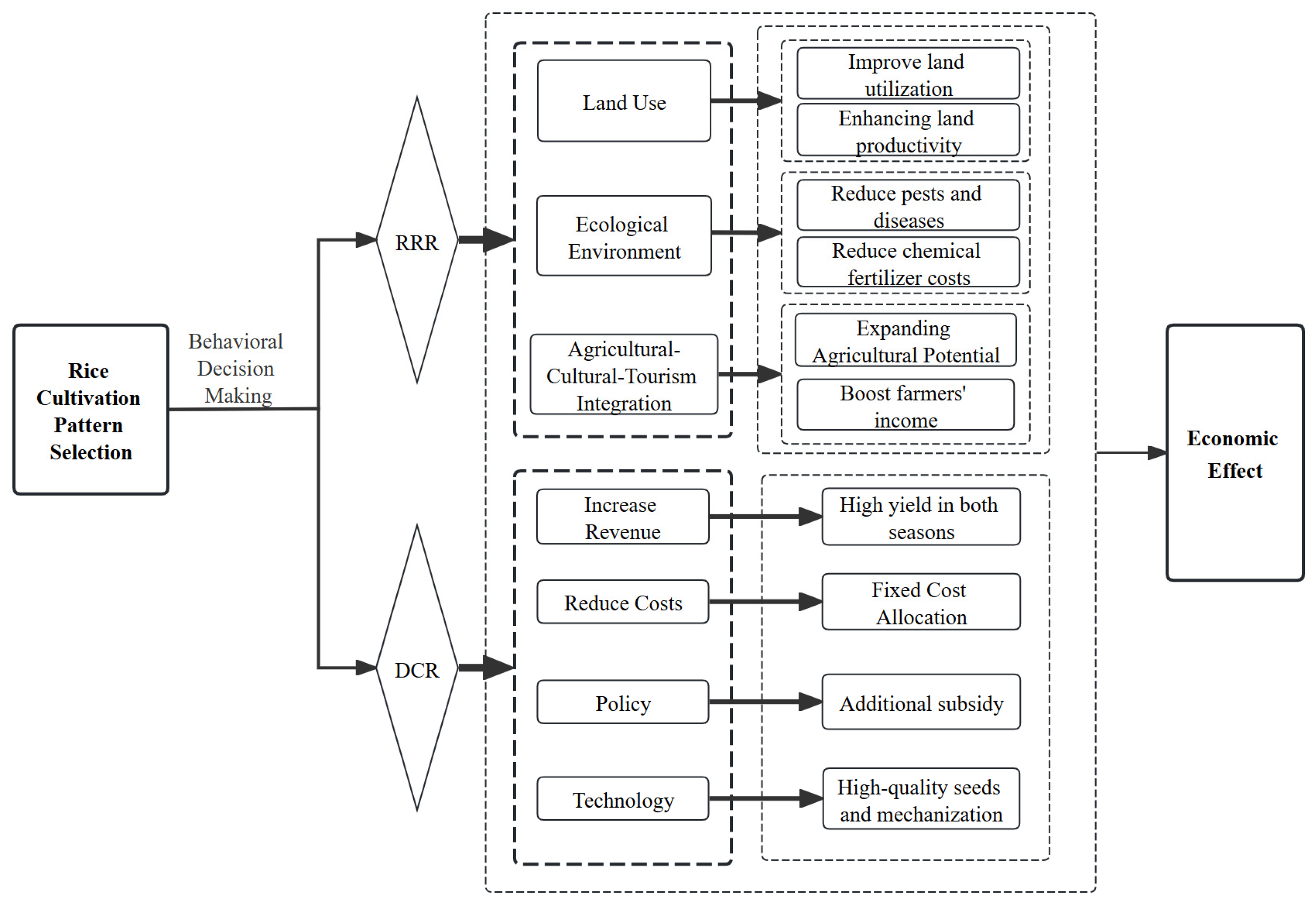
As rational economic agents, farmers primarily make cropping pattern decisions to maximize household income. This study examines the potential economic impacts of the RRR model from three perspectives: optimizing land use, enhancing the ecological environment, and promoting the integration of agriculture with cultural and tourism industries.
First, the RRR system significantly improves land use efficiency and agricultural productivity. Winter rapeseed is grown during the land’s otherwise idle period from late autumn to early spring; it is sown in the fall and harvested from late May to early June of the following year, thereby maximizing the utilization of land resources [15]. From an economic standpoint, higher land use efficiency can increase revenue per unit area by raising total output over the annual cropping calendar. In addition, the high-quality, efficient, and ecologically secure rice–rapeseed multiple-cropping system can both exploit yield potential and improve nutrient-use efficiency. In particular, improved nutrient-use efficiency may raise net returns by increasing yields and reducing fertilizer requirements, thereby improving land output performance and supporting the optimization of cropping systems and agricultural upgrading.
Second, the RRR system may improve the soil ecological environment and reduce the incidence of pests and diseases. Both short- and long-term rice–rapeseed rotations have been shown to substantially increase soil microbial biomass carbon and nitrogen, thereby promoting the abundance and diversity of soil microbial communities [16]. Moreover, because crops differ in their resistance to pests and diseases, rotation can narrow the host range available to pests and pathogens and reduce outbreak risks. This mechanism can simultaneously lower the likelihood of extreme yield losses and reduce pesticide application intensity, thereby decreasing variable production costs. As a result, the RRR system can enhance production stability while delivering both economic and ecological benefits [17].
Third, the RRR model facilitates the integration of agriculture, culture, and tourism, extends the agricultural value chain, and enhances farmers’ incomes. In the context of China’s national strategy for rural revitalization and the strong promotion of agri-cultural-tourism integration, this rotation system not only boosts income through higher yields but also diversifies agricultural functions. With their vibrant colors and prolonged blooming period, rapeseed flowers provide a foundation for the creation of scenic farmland landscapes, innovative advertising imagery, and digital marketing content. These elements support the development of leisure tourism projects that combine local agritourism with regional cultural traditions, thereby stimulating growth in related sectors such as food services, accommodation, and specialty product retailing [18].The extension of the value chain may also encourage part-time or diversified livelihood strategies among farm households, contributing to income growth.
As the control group, compared with the rice–rapeseed rotation (RRR) system, the double-cropping rice (DCR) pattern achieves two harvests within a single year through a “two-crops-a-year” schedule, thereby substantially increasing annual total output per unit area. Thus, even if the yield of early and late rice in each single season may be slightly lower, the combined income from two seasons is often more considerable. Meanwhile, fixed costs—such as land rent and investments in on-farm infrastructure—can be shared across the two rice seasons, which helps reduce production costs per unit of output. Building on this, policy support under the grain-security objective—such as targeted subsidies and the minimum purchase price program—together with advances in modern agricultural technologies (e.g., improved varieties and mechanized operations) jointly constitute key foundations for the relatively strong economic performance of the DCR system.
Accordingly, the following research hypothesis is proposed:
Hypothesis 1.
Compared to the traditional DCR model, the RRR cropping system significantly improves economic performance.

2.2. Analysis of Farmers’ Decision-Making Behavior in Cropping Pattern Selection

The formation of rice cultivation patterns is influenced by a range of natural conditions—such as temperature, light availability, water resources, and soil types—under which farmers gradually develop and consolidate planting habits and strategic combinations through the practical adoption of modern production techniques. These techniques include tillage methods, cultivation practices, water and fertilizer management, and straw treatment approaches [19]. Scientifically selecting cropping patterns and rationally planning production zones are crucial for ensuring farmers’ economic returns and promoting sustainable agricultural development. Within this context, the choice of rice cultivation pattern constitutes a core component of farmers’ production decision-making. Rational farmers seek to optimize the allocation of household labor and land resources to maximize the efficiency of production inputs and, ultimately, household income [20,21]. This study begins by investigating the determinants of rice cultivation pattern choices among rice farmers, focusing on three key factors: household labor force size, intergenerational differences, and cultivated land area.
First, the study by Wang [22] indicates that household labor force size and non-agricultural income significantly influence farmers’ choice of rice cultivation patterns. This finding offers an important perspective for further examining farmers’ cropping behavior. However, with the acceleration of urbanization, a substantial number of young and middle-aged rural laborers have migrated to urban areas, resulting in an aging agricultural labor force. This demographic shift imposes dual constraints on agricultural production: a reduction in labor supply and a decline in labor quality [23]. Second, farmers’ educational backgrounds play a crucial role in planting decisions. More educated farmers typically demonstrate stronger market sensitivity and risk awareness, enabling them to better anticipate market trends and adjust their cropping structures to enhance economic returns. However, when farmers invest substantial time and effort in a specific agricultural domain and acquire specialized knowledge and skills, such expertise may lead to path dependence. In the face of significant market risks, their accumulated knowledge may hinder adaptation of management strategies and production orientation [24]. Finally, land comparative advantage constitutes the foundational basis for farmers’ planting decisions [25]. Changes in crop planting areas reflect not only shifting comparative benefits among different rice cultivation models but also the responsiveness of agricultural production to evolving market demand [26].
Accordingly, the following research hypotheses are proposed:
Hypothesis 2a.
Greater availability of labor resources is associated with higher economic returns from RRR.
Hypothesis 2b.
Older-generation farmers derive greater economic benefits from RRR compared to younger-generation farmers.
Hypothesis 2c.
While RRR can lead to higher economic returns, there exists a threshold effect related to operational scale.
Based on the above analysis, the theoretical mechanism diagram of this study is presented below (Figure 1).

3. Data Sources, Variable Selection, and Model Specification

3.1. Data Sources

The sample data used in this study were obtained from a micro-level survey of rice farmers conducted in Jiangxi Province between November 2022 and August 2023. The selection of both the survey sample and study region was based on the following considerations. In recent years, the Chinese government has implemented a series of policies aimed at increasing national grain production capacity by 100 billion jin. As a traditional agricultural province, Jiangxi accounts for only 2.3% of the country’s arable land but contributes 3.25% of total national grain output. The proportion of DCR in the province remains above 72%, the highest among all provinces in China. However, by 2022, the sown areas for early-season and late-season rice had declined by 12.3% and 19.6%, respectively, compared to 2015, indicating a significant issue of implicit land abandonment [27]. Additionally, Jiangxi is located within the main winter rapeseed production zone along the Yangtze River Basin. The 2023 No. 1 Central Document of the Jiangxi Provincial Committee emphasized “fully tapping the potential of idle winter fields to expand rapeseed cultivation,” with an increase of more than 6600 hectares in sowing area. This policy has laid a strong foundation for promoting the high-quality and efficient RRR model in the province. Therefore, this study focuses on rice farmers in Jiangxi Province to examine the differences between the traditional DCR model and the emerging RRR system. The objective is to analyze the economic impacts of choosing between these two cultivation models, drawing on robust empirical data with strong policy and practical relevance.
To ensure the scientific rigor and representativeness of the survey areas and sample selection, the research team undertook expert reviews and a pilot surver, and ultimately employed a per capita GDP cluster analysis method to categorize the 100 counties (cities/districts) of Jiangxi Province into three economic development tiers: high, medium, and low. The distribution across these tiers was as follows: the high per capita GDP group comprised 30 counties (30%), the medium group 40 counties (40%), and the low-level group 30 counties (30%). This classification served as the foundational framework for the subsequent sampling and survey. A stratified random sampling method was then used to randomly select 10 counties from each group. Within each selected county, two townships were randomly sampled, followed by the random selection of two villages from each township. Finally, 5 to 15 rice-farming households were randomly chosen from each village. Face-to-face interviews were conducted by trained surveyors. A total of 1500 questionnaires were distributed, and 1410 were returned, yielding an effective response rate of 94%. After excluding responses with invalid or missing indicators in accordance with the study’s criteria, a final sample of 1014 valid observations was retained for analysis. Importantly, during the sample selection and data-cleaning process, we also addressed cases in which households simultaneously adopted both DCR and RRR. In such situations, we designated the cropping pattern with the larger cultivated area as the representative production method and excluded the smaller-area pattern from the analytical dataset. This approach ensures that each household’s production behavior is aligned with its primary rice-farming strategy and that the comparison between DCR and RRR remains clear, consistent, and analytically meaningful.

3.2. Model Construction

Farmers’ choices of rice cultivation patterns are not random but reflect self-selection behavior. Specifically, the decision to adopt either the DCR model or the RRR model is influenced by both observable factors—such as age, education level, and household labor force size—and unobservable factors, including soil fertility and access to green production technologies. Consequently, applying ordinary least squares (OLS) for parameter estimation may lead to biased results. To address this issue, this study employs an endogenous switching regression model to address self-selection biases arising from both observable and unobservable factors, effectively capturing the influence of unobserved confounders through the correlation structure of the error terms. The “adoption rate of rice-rapeseed rotation among other farmers in the same township” was selected as the instrumental variable (IV) to satisfy the exclusion restriction condition. This model estimates outcome equations for farmers who adopt either the DCR model or the RRR model, along with their respective counterfactuals, thereby allowing for a more accurate identification of the causal relationship between rice cultivation pattern choices and their influencing variables.
The core concept of the endogenous switching model lies in its two-stage estimation process. In the first stage, a selection equation is estimated to identify the factors influencing a farmer’s decision to adopt the RRR model. In the second stage, outcome equations—specifically, profit equations for both groups (those adopting the DCR model and those adopting the RRR model)—are estimated to assess differences in profitability under varying scenarios.
The behavioral decision model for farmers is specified as follows:
S i = γ j + Z i j + ν i
In this context, S * i represents the latent variable corresponding to the binary variable S i . When S * i > 0, then S i = 1; when S * i ≤ 0, then S i = 0. Z i j denotes the set of variables influencing farmers’ decision-making behavior. The explanatory variables in Z i j may overlap with those in X i j ; however, to ensure model identification, Z i j must include at least one variable not contained in X i j —that is, an instrumental variable. This variable should directly influence the farmer’s choice of rice cultivation pattern but must not directly affect their agricultural profits. In this study, the proportion of other farmers in the same township who adopt the RRR model is selected as the instrumental variable for cultivation pattern choice. Empirical tests confirm that this variable significantly affects farmers’ selection behavior without directly influencing their rice production profits. Accordingly, the farmer’s profit determination equation can be specified as follows:
Y 1 i = j = 1 n β 1 j X 1 i j + ε 1 i ;   where   S i = 1
Y 0 i = j = 1 n β 0 j X 0 i j + ε 0 i ;   where   S i = 0
The conditional expectations of farmer income under the two adopted cultivation patterns are:
E ( Y 1 i | S = 1 ) = β 1 j X 1 i j + δ μ 1 v ϑ 1 i
E ( Y 0 i | S = 0 ) = β 1 j X 0 i j + δ μ 0 v ϑ 0 i
The “counterfactual” scenarios—i.e., the income farmers who chose RRR would have earned had they chosen DCR instead, and vice versa—are unobserved. Based on the endogenous switching model, these counterfactual incomes can be estimated as follows:
E ( Y 0 i | S i = 1 ) = β 0 j X 1 i j + δ μ 0 v ϑ 1 i
E ( Y 1 i | S i = 0 ) = β 1 j X 0 i j + δ μ 1 v ϑ 0 i
The Average Treatment Effect on the Treated (ATT)—i.e., the average effect of adopting the RRR for those who actually adopted it—is given by the difference between (6) and (4):
A T T = E ( Y 1 i | S i = 1 ) E ( Y 0 i | S i = 1 ) = ( β 1 j β 0 j ) X 1 i j + ( δ μ 1 v δ μ 0 v ) ϑ 1 i
Similarly, the Average Treatment Effect on the Untreated (ATU)—i.e., the average effect of adopting the RRR for those who instead adopted the double-cropping model—is given by the difference between (7) and (5):
A T U = E ( Y 1 i | S i = 0 ) E ( Y 0 i | S i = 0 ) = ( β 1 j β 0 j ) X 0 i j + ( δ μ 1 v δ μ 0 v ) ϑ 0 i br - to - break   A T U = E ( Y 1 i | S i = 0 ) E ( Y 0 i | S i = 0 ) = ( β 1 j β 0 j ) X 0 i j + ( δ μ 1 v δ μ 0 v ) ϑ 0 i

3.3. Variable Selection

Dependent Variable: Economic Effect. Following the method of Xu et al. [28], this study measures economic performance using profit per hectare per rice-growing season (in RMB/hectare). To address heteroscedasticity and enhance the interpretability of the effect of cultivation pattern choice on profitability, profit per unit area is log-transformed.
Key Explanatory Variable: Rice Cultivation Pattern Choice. The primary explanatory variable in this study is the farmer’s choice of rice cultivation pattern. The DCR model is coded as 0, while the RRR model is coded as 1.
Instrumental Variable: Following the approach of Zhang et al. [29], this study uses the proportion of other farmers within the same township who adopted the RRR in 2022 as an instrumental variable to identify individual farmers’ cultivation pattern choices.
Control Variables: To reduce estimation bias from omitted variables and drawing on the framework of Zhang et al. [30], this study incorporates control variables across three dimensions: characteristics of the household head, household endowments, and operational characteristics. Household head characteristics include the age, education level, and health status of the individual responsible for rice cultivation decisions. Household endowments cover the number of laborers in the household and whether the household participates in off-farm employment. Operational characteristics include the adoption of green production technologies, cooperative membership, number of plots managed, landholding size, soil fertility, and participation in rice crop insurance. Descriptions and descriptive statistics for these variables are provided in Table 1.
The survey questionnaire in this study covers seven key dimensions: household characteristics, industrial prosperity, ecological livability, rural civility, effective governance, affluent living, and non-cognitive abilities, comprising a total of 311 items. Data were collected using different formats: closed-ended questions for individual characteristics and management decisions, open-ended entries for continuous variables such as land size and input-output data, and a 5-point Likert scale for subjective assessments like self-evaluated soil fertility. As shown in Table 1, individual characteristic variables and household endowment variables are derived from the “household characteristics” section of the questionnaire, while management characteristic variables originate from the “industrial prosperity” section. According to the descriptive statistics in Table 1, the standard deviations of rice profit, land size, and number of plots exhibit significant variability, genuinely reflecting substantial heterogeneity in resource endowments and operational performance among smallholder farmers in China. Specifically, only 15.5% of the sampled farmers adopted the rice-rapeseed rotation system, consistent with the early stage of this technology’s adoption. The average age of household heads reached 58.1 years, with an average formal education of fewer than three years, highlighting the typical characteristics of an aging agricultural labor force and low human capital accumulation. Moreover, the average landholding size of 3.14 hectares corresponds to a high fragmentation of 17.4 plots, visually illustrating the prevalence of land fragmentation in agricultural operations. The findings in Table 1 validate the practical challenges in agricultural management and provide a rationale for subsequent methodological choices: we applied logarithmic transformation to rice profit and employed robust standard errors in regressions to ensure the validity of statistical inferences in the presence of significant heteroskedasticity.

4. Empirical Results and Analysis

4.1. Analysis Based on the Estimation Results of the Endogenous Switching Regression Model

This study utilizes production and operation data from 1014 rice-growing households, comprising 857 DCR households and 157 RRR households. The observed imbalance in sample structure objectively reflects differential adoption patterns between the two cropping systems in practice. The smaller sample size for RRR substantiates its stricter requirements for skilled labor, intensive management capabilities, and moderately scaled operations. These factors collectively constrain its widespread adoption, leading to natural divergence when competing with the more labor-intensive DCR system. To accurately identify the impact of farmers’ cropping system choices on economic outcomes, this study employs an endogenous switching regression model for empirical examination. The estimation results are presented in Table 2. The likelihood ratio (LR) test rejects the null hypothesis of independence between the selection and outcome equations at the 5% significance level, confirming the presence of an endogenous relationship between cultivation pattern choice and economic performance. This finding supports the necessity of correcting for selection bias using the ESRM approach [27]. The coefficient of the instrumental variable is 0.662 and statistically significant at the 1% level, satisfying both the exclusion restriction and relevance conditions, thereby affirming the model’s validity.
In the selection equation—that is, the decision model for choosing a rice cultivation pattern based on per-hectare profit—the number of agricultural laborers, landholding size, and soil fertility all pass significance tests. This may be attributed to the fact that an increase in agricultural labor within households could lead to rising organizational and coordination costs, resulting in diminishing marginal returns. Meanwhile, the expansion of land management scale facilitates a transition toward scaled, intensive, and modernized operational models. Additionally, improved soil fertility directly enhances crop quality by optimizing nutrient supply. These findings collectively indicate that household endowments and agricultural management characteristics serve as an important foundation for increasing profit per unit area. In terms of the outcome equations, off-farm employment, land size, and soil fertility all exhibit significant effects in the double-cropping rice group. By engaging in non-agricultural work, farmers gain additional income, which alleviates financial constraints and enables greater investment in seeds, fertilizers, and technology, thereby enhancing rice production efficiency. Notably, in the rice-rapeseed rotation group, the regression coefficient for soil fertility is significantly higher than that in the double-cropping rice system. This result confirms the agronomic characteristic that rice-rapeseed rotation is more dependent on baseline soil fertility and, from an economic perspective, reveals the adaptability and profitability of this system under different soil conditions.
To evaluate the impact of farmers’ rice cultivation pattern choices on per-hectare profit, this study calculates the expected values of per-hectare profit for the two cultivation models—corrected for sample selection bias—based on Equations (4) and (5). It then derives the counterfactual per-hectare profits for both scenarios: farmers adopting the RRR model switching to DCR, and vice versa, using Equations (6) and (7). Finally, the treatment effects of cultivation pattern choices on per-hectare profit are estimated, represented by the Average Treatment Effect on the Treated (ATT) and the Average Treatment Effect on the Untreated (ATU), as derived from Equations (8) and (9).
Table 3 presents the average treatment effects of farmers’ cultivation pattern choices on per-hectare profit. The results show that the Average Treatment Effect on the Treated (ATT) is 0.784, indicating that if farmers currently practicing RRR were to switch to DCR, their per-hectare profit from rice production would decline. Conversely, the Average Treatment Effect on the Untreated (ATU) is 6.010, suggesting that farmers currently using the DCR model would experience an increase in per-hectare rice production profit if they adopted the RRR model.
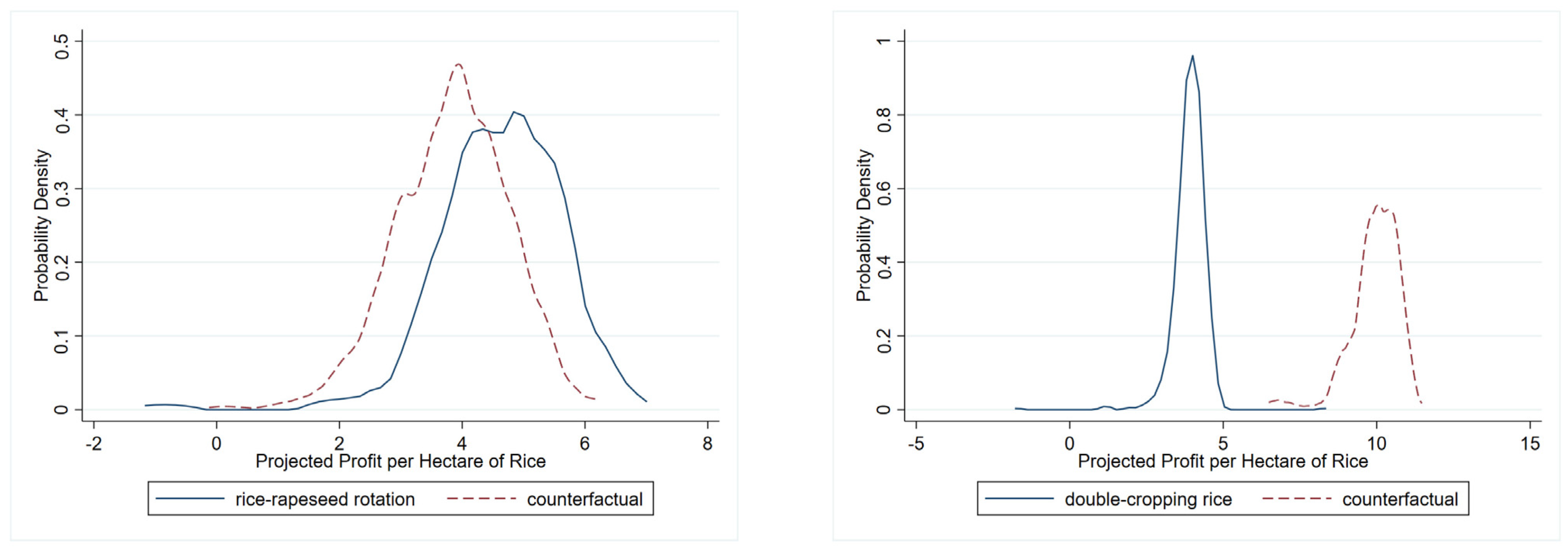
To more clearly illustrate the economic effects of farmers’ cultivation pattern choices, this study presents probability density distribution graphs of per-hectare profit under both the RRR and DCR models. As shown in Figure 2 (left), when farmers who have adopted the RRR are placed in the counterfactual scenario of selecting the DCR model, the probability density function (PDF) of their per-hectare rice profit shifts noticeably leftward. This reflects a significant decrease of 16.95% in per-hectare profit under the counterfactual. In contrast, Figure 2 (right) presents the ATU scenario, demonstrating that if farmers currently using the DCR model were to switch to the RRR model, the probability density curve shifts rightward, indicating a substantial increase in per-hectare profit by 153.20% under the counterfactual scenario. These results indicate that adopting the RRR model can improve farmers’ per-hectare profits within a range of 16.95% to 153.20%. Based on this analysis, Research Hypothesis H1 is supported.

4.2. Robustness Check

4.2.1. Alternative Estimation Method

To ensure the reliability of the above conclusions, a robustness check is conducted by altering the model specification. Specifically, an Ordinary Least Squares (OLS) model is applied to estimate potential selection bias within the sample. The results are presented in Table 4. In the OLS regression, the coefficient for the RRR variable is 0.763, indicating that farmers adopting the RRR model achieve higher economic returns. The direction and significance levels of the control variables are generally consistent with those obtained from the endogenous switching regression model, thereby confirming the robustness of the core findings.

4.2.2. Winsorization of Variables

This study employs the Winsorization method to reduce the influence of extreme values on parameter estimation by trimming continuous variables at the 1% and 5% levels, respectively. The adjusted dataset is then re-estimated using an Ordinary Least Squares (OLS) model, with the regression results presented in Table 5. The empirical findings indicate that the RRR model has a significantly positive effect on per-hectare rice profit, with statistical significance at the 1% level. The coefficient estimates for the key explanatory and control variables remain highly consistent with the baseline regression results, further confirming the robustness of the main findings.

4.3. Heterogeneity Analysis

4.3.1. Heterogeneity in Labor Force Size

Table 6 reports the results of a subgroup regression analysis to examine the moderating effect of labor endowment on the economic impact of adopting the RRR model. Using the DCR model as the reference category, households are divided into two subgroups based on the average number of agricultural laborers: a low-labor group (<=3 laborers) and a high-labor group (>3 laborers). The objective is to assess whether the economic benefits of rice cultivation patterns differ according to labor resource availability. The results indicate that the economic impact of RRR varies significantly with labor endowment. While adopting the RRR model significantly increases economic returns for both low- and high-labor households, the effect is notably stronger for those with higher labor endowment. A plausible explanation is that households with more labor are better positioned to optimize resource allocation through specialization and flexible labor deployment [31]. In contrast, households constrained by labor shortages—due in part to rural outmigration and off-farm employment—face greater challenges in surpassing productivity thresholds under the DCR [32]. These findings support Hypothesis H2a proposed in this study.

4.3.2. Heterogeneity in Farming Generations

As China’s economy and society continue to evolve, the composition of its farming population is undergoing significant transformation, with a growing trend of intergenerational differentiation in agricultural labor [33]. This study divides the sample into two groups: older-generation farmers (born before 1980) and younger-generation farmers (born in or after 1980), to examine how the economic effects of rice cultivation pattern choices vary by age group. The results in Table 7 reveal a clear intergenerational divergence in the economic returns from the RRR model. Specifically, adoption of this model significantly improves economic outcomes for older-generation farmers but shows no statistically significant effect for younger-generation farmers. One possible explanation is that older farmers, drawing on traditional farming experience, are better equipped to coordinate the planting schedules of rice and rapeseed [34]. Additionally, due to lower interest in off-farm employment, older-generation farmers can allocate more household labor to the intensive management required by the RRR model. In contrast, younger farmers—who tend to rely more on smart agricultural machinery and have greater access to off-farm employment—may experience diminished economic gains from adopting the rotation system.

4.3.3. Heterogeneity in Rice Cultivation Scale

Previous studies have suggested that cultivation scale is a key factor influencing the relative advantages of different rice planting models [35]. Accordingly, this study investigates how the economic profitability of rice cultivation patterns varies across different levels of operational scale. Based on the distribution characteristics of the sample and actual production conditions in the surveyed regions, cultivation scale is divided into three continuous intervals: (0, 0.2] hectares, (0.2, 0.7] hectares, and (0.7, 166.67] hectares, representing 35.60%, 69.92%, and 100% of the total sample, respectively. This classification ensures a balanced distribution and satisfies statistical validity requirements for subgroup analysis. The grouped regression results in Table 8 show that for small-scale operations (<=0.2 hectares) and medium-scale operations (0.2–0.7 hectares), the coefficients for RRR are significantly positive. This reflects the advantages of intensive management among smallholders and the potential for rising costs among medium-scale farmers due to delays in mechanization. In contrast, the coefficient for the large-scale group (>=0.7 hectares) is not statistically significant, suggesting a possible mismatch between scale and technical efficiency. These findings align with the research by Foster [36], which identifies a threshold effect in paddy field scale: once a certain scale is exceeded, issues such as labor shortages, increased management complexity, and rising marginal costs may arise.

5. Conclusions and Policy Recommendations

5.1. Research Conclusions

This study examines the strategic significance of promoting the RRR model in China. Using micro-level survey data from 1014 rice-farming households in Jiangxi Province, it constructs an endogenous switching regression model to analyze the economic effects of different rice cultivation patterns. Based on robustness checks, the study further conducts heterogeneity analyses across cultivation scale, intergenerational differences, and household labor size to explore the mechanisms through which cultivation pattern choices influence economic outcomes. The empirical findings are as follows. First, the RRR model generates higher per-hectare profits than the traditional DCR model. Specifically, compared to households practicing DCR, those adopting the RRR model achieve per-hectare profit increases ranging from 16.95% to 153.20%. This result remains robust after controlling for endogeneity and conducting sensitivity tests. It is consistent with Rosenberg et al. [14], who report that diversified rotation systems deliver higher economic returns than monoculture rice production. Second, the heterogeneity analysis reveals that the positive economic effects of the RRR model are more pronounced among households with greater labor endowments, older-generation farmers, and farms below a certain scale threshold—indicating the presence of a scale barrier to maximizing returns. The result that greater household labor availability is associated with higher economic performance aligns with Wang [22], who similarly shows that labor resources amplify the economic benefits derived from farmers’ cropping pattern selection, but on this basis, this paper further discusses the differences in economic effects of farming mode choice brought about by farmers of different age groups.
Compared to existing research, this study advances understanding in three key areas. First, it constructs a multidimensional analytical framework that incorporates operational scale heterogeneity, generational technology preferences, and labor allocation, thereby uncovering individual-level patterns in the economic effects of cultivation models and providing a scientific basis for differentiated policy design. Second, it confirms the non-linear nature of diminishing returns to agricultural scale, offering quantitative evidence to inform policies on “appropriately scaled operations.” Third, it enhances empirical modeling by integrating micro-level farmer behavior with structural economic models.
Nonetheless, this study faces two main limitations. First, the data are limited to a single ecological region (Jiangxi Province) and are cross-sectional in nature, which may constrain the generalizability of the findings due to region-specific factor endowments and institutional contexts. Validation across diverse regions should be pursued using multi-regional, longitudinal datasets. Second, the analytical framework does not account for the environmental impacts of cultivation model choices. Externalities such as soil organic matter depletion and biodiversity loss resulting from long-term changes in cropping patterns are not yet considered. Future research could address these gaps by integrating dynamic panel models with ecosystem service valuation methods to assess the eco-economic synergies of rice cultivation model transitions. Future studies could refine the survey instrument to better capture relevant indicators, allowing for a more rigorous examination of potential mechanisms as well as other potentially important omitted variables. In addition, the survey was conducted in a specific period and across heterogeneous farms/locations, so seasonal conditions and between-farm differences may not be fully captured by the current dataset.

5.2. Policy Recommendations

Based on the above findings, the following policy recommendations are proposed: (1) Recognize the multifaceted benefits of the RRR model. This model serves not only as a strategic measure to ensure national food and oil security but also as a key pathway for promoting agricultural modernization and advancing rural revitalization. The government should utilize diverse communication channels to raise public awareness and increase farmers’ motivation to adopt the RRR, thereby stabilizing grain and oil production capacity. To support this effort, the government should establish a “Gold Medal Rice Farmer” award program, build a performance-oriented incentive and accountability mechanism, and implement a system of rewards and penalties to foster a strong sense of social identity and professional pride in rice farming. In addition, a dedicated subsidy scheme for the RRR model should be implemented to secure farmers’ production returns and enhance their economic resilience. (2) Provide targeted financial support for large-scale farms. In practice, large-scale operators often face greater financial pressures and exhibit stronger demand for policies such as interest-subsidized loans. The government should expand financial support for these entities and fully leverage their leadership role in the broader process of agricultural modernization. (3) Enhance support tailored to different farmer generations. Given that the economic gains from adopting the rice–rapeseed rotation (RRR) system are significantly greater among older-generation farmers than among younger farmers, the government should provide differentiated, generation-adapted support. Specifically, for younger farmers, policies should aim to leverage their comparative advantages and improve production efficiency by offering digital agricultural extension services, shared access to smart agricultural machinery, and training on contract farming and market linkage. For older farmers, support should prioritize the provision of low-threshold, easy-to-adopt, and labor-substituting technologies and services, including the active demonstration and dissemination of new practices and age-friendly courses (e.g., UAV/drone operation) to reduce production costs. In addition, policy implementation should be accompanied by continuous monitoring and evaluation to avoid decisions driven by extreme or short-term estimates and to ensure robust and sustained outcomes. (4) Strengthen planning and resource allocation for low-labor households. Since the economic gains from RRR are significantly lower for households with limited labor, the government should formulate targeted development plans, optimize labor allocation strategies, and guide such households in deploying household labor more effectively. At the same time, policies should promote technological upgrading and encourage professional specialization to enhance production efficiency among labor-constrained farmers.

Author Contributions

W.W., L.Z. and M.Z. contributed equally to the conceptualization, methodology, data analysis, and manuscript preparation of this study. All authors have read and agreed to the published version of the manuscript.

Funding

National Natural Science Foundation of China, Grant: 72503227; Zhejiang Provincial Natural Science Foundation Project, Grant: LQN25G030014. The Special Project for Research and Interpretation of the Spirit of the Third Plenary Session of the 20th CPC Central Committee and the Fifth Plenary Session of the 15th Provincial Party Committee, under the Provincial Social Science Planning Fund.

Institutional Review Board Statement

Ethical approval was not required as the study used only secondary data from publicly available, de-identified sources.

Data Availability Statement

The data that has been used are confidential.

Conflicts of Interest

The authors declare that they have no known competing financial interests or personal relationships that could have appeared to influence the work reported in this paper.

References

  1. Mishra, A.; Bruno, E.; Zilberman, D. Compound natural and human disasters: Managing drought and COVID-19 to sustain global agriculture and food sectors. Sci. Total Environ. 2021, 754, 142210. [Google Scholar] [CrossRef]
  2. Guo, A.; Yue, W.; Yang, J.; Xue, B.; Xiao, W.; Li, M.; He, T.; Zhang, M.; Zhou, Q. Cropland abandonment in China: Patterns, drivers, and implications for food security. J. Clean. Prod. 2023, 418, 138154. [Google Scholar] [CrossRef]
  3. Weissteiner, C.J.; Boschetti, M.; Böttcher, K.; Carrara, P.; Bordogna, G.; Brivio, P.A. Spatial explicit assessment of rural land abandonment in the Mediterranean area. Glob. Planet. Change 2011, 79, 20–36. [Google Scholar] [CrossRef]
  4. Ye, T.; Zong, S.; Kleidon, A.; Yuan, W.; Wang, Y.; Shi, P. Impacts of climate warming, cultivar shifts, and phenological dates on rice growth period length in China after correction for seasonal shift effects. Clim. Change 2019, 155, 127–143. [Google Scholar] [CrossRef]
  5. Kansanga, M.; Andersen, P.; Kpienbaareh, D.; Mason-Renton, S.; Atuoye, K.; Sano, Y.; Antabe, R.; Luginaah, I. Traditional agriculture in transition: Examining the impacts of agricultural modernization on smallholder farming in Ghana under the new Green Revolution. Int. J. Sustain. Dev. World Ecol. 2019, 26, 11–24. [Google Scholar] [CrossRef]
  6. Bowman, M.S.; Zilberman, D. Economic factors affecting diversified farming systems. Ecol. Soc. 2013, 18, 33. [Google Scholar] [CrossRef]
  7. McMillan, M.; Rodrik, D.; Verduzco-Gallo, Í. Globalization, structural change, and productivity growth, with an update on Africa. World Dev. 2014, 63, 11–32. [Google Scholar] [CrossRef]
  8. Laube, W.; Schraven, B.; Awo, M. Smallholder adaptation to climate change: Dynamics and limits in Northern Ghana. Clim. Change 2012, 111, 753–774. [Google Scholar] [CrossRef]
  9. White, M.; Heros, E.; Graterol, E.; Chirinda, N.; Pittelkow, C.M. Balancing Economic and Environmental Performance for Small-Scale Rice Farmers in Peru. Front. Sustain. Food Syst. 2020, 4, 564418. [Google Scholar] [CrossRef]
  10. Neumann, K.; Verburg, P.H.; Stehfest, E.; Müller, C. The yield gap of global grain production: A spatial analysis. Agric. Syst. 2010, 103, 316–326. [Google Scholar] [CrossRef]
  11. Verburg, P.H.; Veldkamp, A. The role of spatially explicit models in land-use change research: A case study for cropping patterns in China. Agric. Ecosyst. Environ. 2001, 85, 177–190. [Google Scholar] [CrossRef]
  12. Yang, R.; Shen, Y.; Kong, X.; Ge, B.; Sun, X.; Cao, M. Effects of Diverse Crop Rotation Sequences on Rice Growth, Yield, and Soil Properties: A Field Study in Gewu Station. Plants 2024, 13, 3273. [Google Scholar] [CrossRef]
  13. He, D.-C.; Ma, Y.-L.; Li, Z.-Z.; Zhong, C.-S.; Cheng, Z.-B.; Zhan, J. Crop Rotation Enhances Agricultural Sustainability: From an Empirical Evaluation of Eco-Economic Benefits in Rice Production. Agriculture 2021, 11, 91. [Google Scholar] [CrossRef]
  14. Rosenberg, S.; Brim-DeForest, W.; Linquist, B.; Leinfelder-Miles, M.M.; Espino, L.; Pittelkow, C.M.; Al-Khatib, K. Addressing economic barriers to crop diversification in rice-based cropping systems. NPJ Sustain. Agric. 2025, 3, 62. [Google Scholar] [CrossRef]
  15. Yousaf, M.; Li, J.; Lu, J.; Ren, T.; Cong, R.; Fahad, S.; Li, X. Effects of fertilization on crop production and nutrient-supplying capacity under rice-oilseed rape rotation system. Sci. Rep. 2017, 7, 1270. [Google Scholar] [CrossRef]
  16. Bu, R.; Ren, T.; Lei, M.; Liu, B.; Li, X.; Cong, R.; Zhang, Y.; Lu, J. Tillage and straw-returning practices effect on soil dissolved organic matter, aggregate fraction and bacteria community under rice-rice-rapeseed rotation system. Agric. Ecosyst. Environ. 2020, 287, 106681. [Google Scholar] [CrossRef]
  17. Popp, J.; Pető, K.; Nagy, J. Pesticide productivity and food security. A review. Agron. Sustain. Dev. 2013, 33, 243–255. [Google Scholar] [CrossRef]
  18. Sidali, K.L.; Kastenholz, E.; Bianchi, R. Food tourism, niche markets and products in rural tourism: Combining the intimacy model and the experience economy as a rural development strategy. J. Sustain. Tour. 2015, 23, 1179–1197. [Google Scholar] [CrossRef]
  19. Wang, X.; Dai, K.; Zhang, D.; Zhang, X.; Wang, Y.; Zhao, Q.; Cai, D.; Hoogmoed, W.B.; Oenema, O. Dryland maize yields and water use efficiency in response to tillage/crop stubble and nutrient management practices in China. Field Crops Res. 2011, 120, 47–57. [Google Scholar] [CrossRef]
  20. Wang, J.; Cramer, G.L.; Wailes, E.J. Production efficiency of Chinese agriculture: Evidence from rural household survey data. Agric. Econ. 1996, 15, 17–28. [Google Scholar] [CrossRef]
  21. Yang, D.T. Education and allocative efficiency: Household income growth during rural reforms in China. J. Dev. Econ. 2004, 74, 137–162. [Google Scholar] [CrossRef]
  22. Wang, J.; Xin, L.; Wang, Y. How farmers’ non-agricultural employment affects rural land circulation in China? J. Geogr. Sci. 2020, 30, 378–400. [Google Scholar] [CrossRef]
  23. Ji, Y.; Hu, X.; Zhu, J.; Zhong, F. Demographic change and its impact on farmers’ field production decisions. China Econ. Rev. 2017, 43, 64–71. [Google Scholar] [CrossRef]
  24. Saebi, T.; Lien, L.; Foss, N.J. What drives business model adaptation? The impact of opportunities, threats and strategic orientation. Long Range Plan. 2017, 50, 567–581. [Google Scholar] [CrossRef]
  25. Githinji, M.; Van Noordwijk, M.; Muthuri, C.; Speelman, E.N.; Hofstede, G.J. Farmer land-use decision-making from an instrumental and relational perspective. Curr. Opin. Environ. Sustain. 2023, 63, 101303. [Google Scholar] [CrossRef]
  26. Hussain, S.; Huang, J.; Huang, J.; Ahmad, S.; Nanda, S.; Anwar, S.; Shakoor, A.; Zhu, C.; Zhu, L.; Cao, X.; et al. Rice production under climate change: Adaptations and mitigating strategies. In Environment, Climate, Plant and Vegetation Growth; Springer International Publishing: Cham, Switzerland, 2020; pp. 659–686. [Google Scholar] [CrossRef]
  27. Hackworth, J. The limits to market-based strategies for addressing land abandonment in shrinking American cities. Prog. Plan. 2014, 90, 1–37. [Google Scholar] [CrossRef]
  28. Xu, Y.; Liang, L.; Wang, B.; Xiang, J.; Gao, M.; Fu, Z.; Long, P.; Luo, H.; Huang, C. Conversion from double-season rice to ratoon rice paddy fields reduces carbon footprint and enhances net ecosystem economic benefit. Sci. Total Environ. 2022, 813, 152550. [Google Scholar] [CrossRef]
  29. Zhang, M.; Zhou, L.; Zhang, Y.; Zhou, W. Economic and Environmental Effects of Farmers’ Green Production Behaviors: Evidence from Major Rice-Producing Areas in Jiangxi Province, China. Land 2024, 13, 1668. [Google Scholar] [CrossRef]
  30. Zhang, H.; Zhuang, T.; Zeng, W. Impact of household endowments on response capacity of farming households to natural disasters. Int. J. Disaster Risk Sci. 2012, 3, 218–226. [Google Scholar] [CrossRef]
  31. Terry, W.C. Geographic limits to global labor market flexibility: The human resources paradox of the cruise industry. Geoforum 2011, 42, 660–670. [Google Scholar] [CrossRef]
  32. Crowley, E.L.; Carter, S.E. Agrarian change and the changing relationships between toil and soil in Maragoli, Western Kenya (1900–1994). Hum. Ecol. 2000, 28, 383–414. [Google Scholar] [CrossRef]
  33. Liu, J.; Fang, Y.; Wang, G.; Liu, B.; Wang, R. The aging of farmers and its challenges for labor-intensive agriculture in China: A perspective on farmland transfer plans for farmers’ retirement. J. Rural Stud. 2023, 100, 103013. [Google Scholar] [CrossRef]
  34. Johansen, C.; Haque, M.E.; Bell, R.W.; Thierfelder, C.; Esdaile, R.J. Conservation agriculture for small holder rainfed farming: Opportunities and constraints of new mechanized seeding systems. Field Crops Res. 2012, 132, 18–32. [Google Scholar] [CrossRef]
  35. Wassmann, R.; Jagadish, S.V.K.; Heuer, S.; Ismail, A.; Redona, E.; Serraj, R.; Singh, R.K.; Howell, G.; Pathak, H.; Sumfleth, K. Climate change affecting rice production: The physiological and agronomic basis for possible adaptation strategies. Adv. Agron. 2009, 101, 59–122. [Google Scholar] [CrossRef]
  36. Foster, A.D.; Rosenzweig, M.R. Are there too many farms in the world? Labor market transaction costs, machine capacities, and optimal farm size. J. Polit. Econ. 2022, 130, 636–680. [Google Scholar] [CrossRef]
Figure 1. Theoretical Mechanism Diagram.
Agriculture 16 00129 g001
Figure 2. Probability Density of Farmers’ Per-Hectare Rice Profit Under Two Scenarios.
Agriculture 16 00129 g002
Table 1. Variable Definitions, Measurements, and Descriptive Statistics.
Variable NameDefinition and CodingMeanStandard Deviation
Dependent VariableRice ProfitRice profit per unit area (RMB/hectare)5170.7458,762.18
Key Explanatory VariableRice Cultivation Pattern0 = DCR; 1 = RRR0.1550.362
Instrumental VariableAdoption of Rice–RapeseedProportion of other farmers in the same township adopting RRR0.1580.214
Control Variables
Individual CharacteristicsAgeActual age of household head in 2022 (years)58.14510.857
Education LevelYears of formal education received by household head2.8430.95
Health Status1 = Very poor; 2 = Poor; 3 = Average; 4 = Good; 5 = Excellent3.8650.973
Household EndowmentsNumber of LaborersNumber of agricultural laborers in the household3.0561.824
Off-farm EmploymentNumber of household members engaged in both farm and non-farm work0.7261.433
Operational CharacteristicsAdoption of Green Technology1 = Yes; 0 = No0.3930.489
Cooperative Membership1 = Yes; 0 = No0.2510.434
Number of PlotsNumber of rice production plots managed by household in 202217.36687.313
Landholding SizeActual cultivated area for rice in 2022 (hectares)3.14211.131
Soil Fertility1 = Very poor; 2 = Poor; 3 = Average; 4 = Good; 5 = Excellent3.3860.823
Rice Insurance Purchase1 = Yes; 0 = No0.5020.5
Table 2. Estimation Results from the Endogenous Switching Regression Model.
Selection EquationOutcome Equation (Log Rice Profit)
VariablesCultivation PatternDCRRRR
(1)(2)(3)
Age0.0030.0020.002
(0.004)(0.012)(0.028)
Education Level−0.010−0.1280.067
(0.049)(0.138)(0.314)
Health Status−0.0290.049−0.037
(0.045)(0.125)(0.259)
Number of Off-farm Workers−0.168 **−0.0090.026
(0.085)(0.065)(0.125)
Number of Off-farm Workers−0.1260.142 *−0.078
(0.099)(0.082)(0.240)
Green Technology Adoption0.003−0.0490.509
(0.022)(0.239)(0.541)
Cooperative Membership−0.002−0.304−0.498
(0.033)(0.277)(0.700)
Number of Plots0.0000.003−0.001
(0.001)(0.002)(0.002)
Landholding Size0.001 *−0.002 *−0.001
(0.000)(0.001)(0.001)
Soil Fertility0.175 ***0.487 ***0.913 **
(0.051)(0.142)(0.357)
Rice Insurance Purchase0.1070.376−0.562
(0.085)(0.240)(0.510)
Constant−1.729 ***3.230 ***0.991
(0.423)(1.193)(3.735)
Adoption of Rotation0.662 ***
(0.119)
lns 1.278 ***1.031 ***
(0.026)(0.075)
LR Test chi2(2) =22.16
Prob > chi2 = 0.023
N1014857157
Note: Standard errors are shown in parentheses. *, **, and *** indicate significance at the 10%, 5%, and 1% levels, respectively.
Table 3. Average Treatment Effects of Farmers’ Cultivation Pattern Choices (Profit).
Farmer GroupRRRDCRATTATU
RRR4.6253.8410.784 ***
DCR9.9333.923 6.010 ***
Note: Standard errors are shown in parentheses. *, **, and *** indicate significance at the 10%, 5%, and 1% levels, respectively.
Table 4. OLS Regression Results of Rice Cultivation Pattern on Economic Effect (Using the DCR cultivation system as a reference).
VariableEconomic Effect
(OLS)
RRR0.763 ***
(0.266)
Control VariablesControlled
Constant Term3.114
(0.980)
R2/Pseudo R20.051
Sample Size1014
Note: Standard errors are shown in parentheses. *, **, and *** indicate significance at the 10%, 5%, and 1% levels, respectively.
Table 5. Results After Winsorization of Variables.
Dependent Variable: Log of Rice Profit(1) Economic Effect(2) Economic Effect
1%5%
Rice Cultivation Pattern0.779 ***
(0.258)
0.861 ***
(0.251)
Control VariablesControlledControlled
Prob > F0.0000.000
R-squared0.0530.075
Sample Size10141014
Note: Standard errors are shown in parentheses. *, **, and *** indicate significance at the 10%, 5%, and 1% levels, respectively.
Table 6. Labor Endowment Heterogeneity Test (Using the DCR cultivation system as a reference).
VariableEconomic Effect
<=3>3
RRR0.593 *
(0.349)
0.980 **
(0.421)
Control VariablesControlledControlled
Prob > F0.0180.001
R-squared0.0410.079
Sample Size590424
Note: Standard errors are shown in parentheses. *, **, and *** indicate significance at the 10%, 5%, and 1% levels, respectively.
Table 7. Intergenerational Differences Test (Using the DCR cultivation system as a reference).
VariableEconomic Effect
Born <= 1980Born > 1980
RRR0.718 ***
(0.276)
1.454
(1.094)
Control VariablesControlledControlled
Prob > F0.0000.717
R-squared0.0520.107
Sample Size92886
Note: Standard errors are shown in parentheses. *, **, and *** indicate significance at the 10%, 5%, and 1% levels, respectively.
Table 8. Cultivation Scale Heterogeneity Test (Using the DCR cultivation system as a reference).
VariableEconomic Effect
<=0.2 Hectare0.2–0.7 Hectare>=0.7 Hectare
RRR1.489 ***
(0.469)
0.812 *
(0.487)
0.288
(0.439)
Control VariablesControlledControlledControlled
Prob > F0.0010.0020.269
R-squared0.0860.0870.048
Sample Size361347306
Note: Standard errors are shown in parentheses. *, **, and *** indicate significance at the 10%, 5%, and 1% levels, respectively.
Disclaimer/Publisher’s Note: The statements, opinions and data contained in all publications are solely those of the individual author(s) and contributor(s) and not of MDPI and/or the editor(s). MDPI and/or the editor(s) disclaim responsibility for any injury to people or property resulting from any ideas, methods, instructions or products referred to in the content.