Four Agricultural GHG Emission Mitigation Pathways in Morocco: Roadmaps from 2024 CCPI High-Performers

Abstract
1. Introduction
2. Review Methodology
2.1. Country Selection and Analytical Framework
2.2. Evidence Collection and Sources
2.3. Inclusion and Exclusion Criteria
2.4. Data Extraction and Comparative Analysis
2.5. Transferability Assessment
2.6. Study Limitations
3. Analysis of the Agricultural Mitigation Landscape: Current State and International Innovations
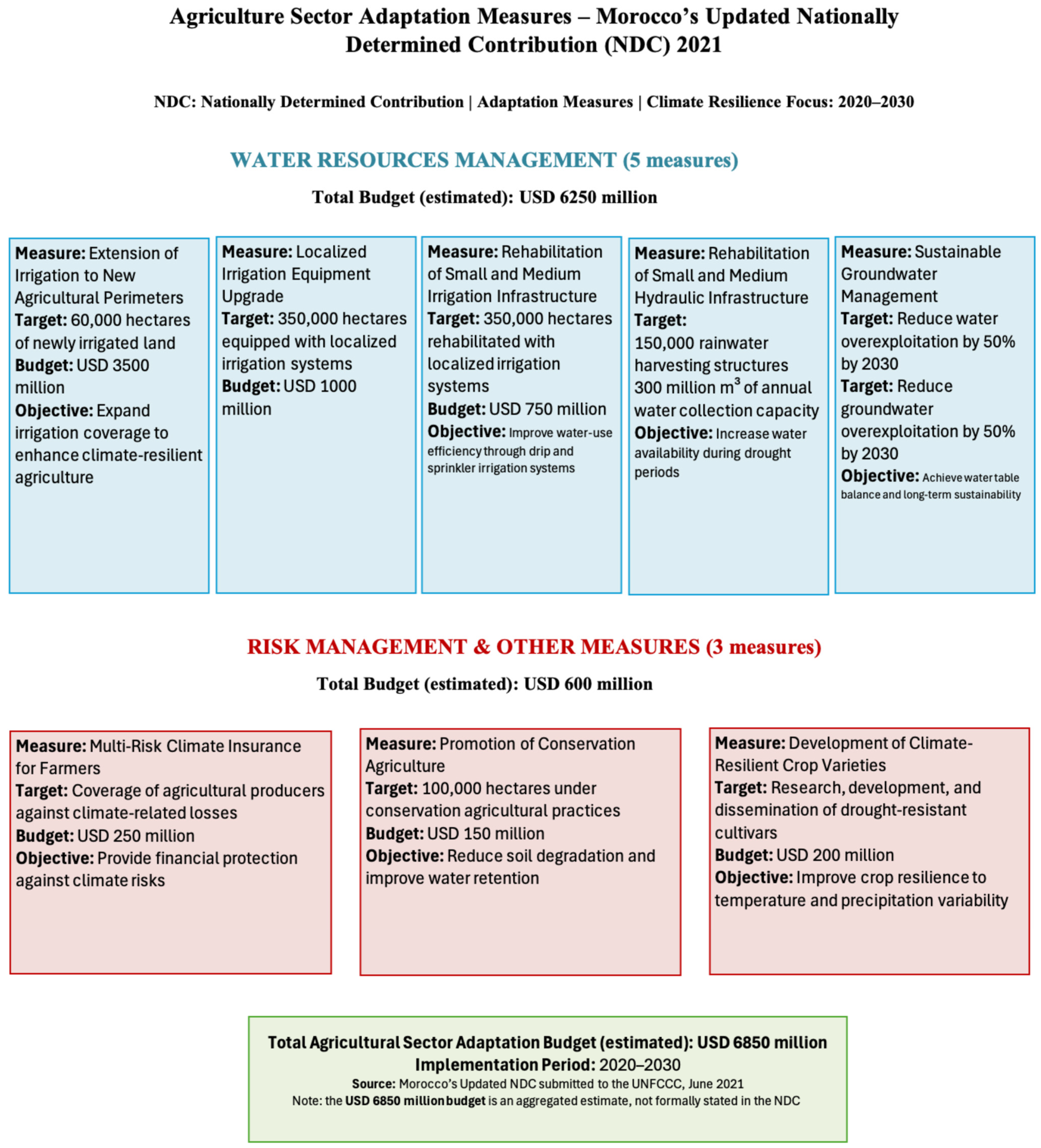
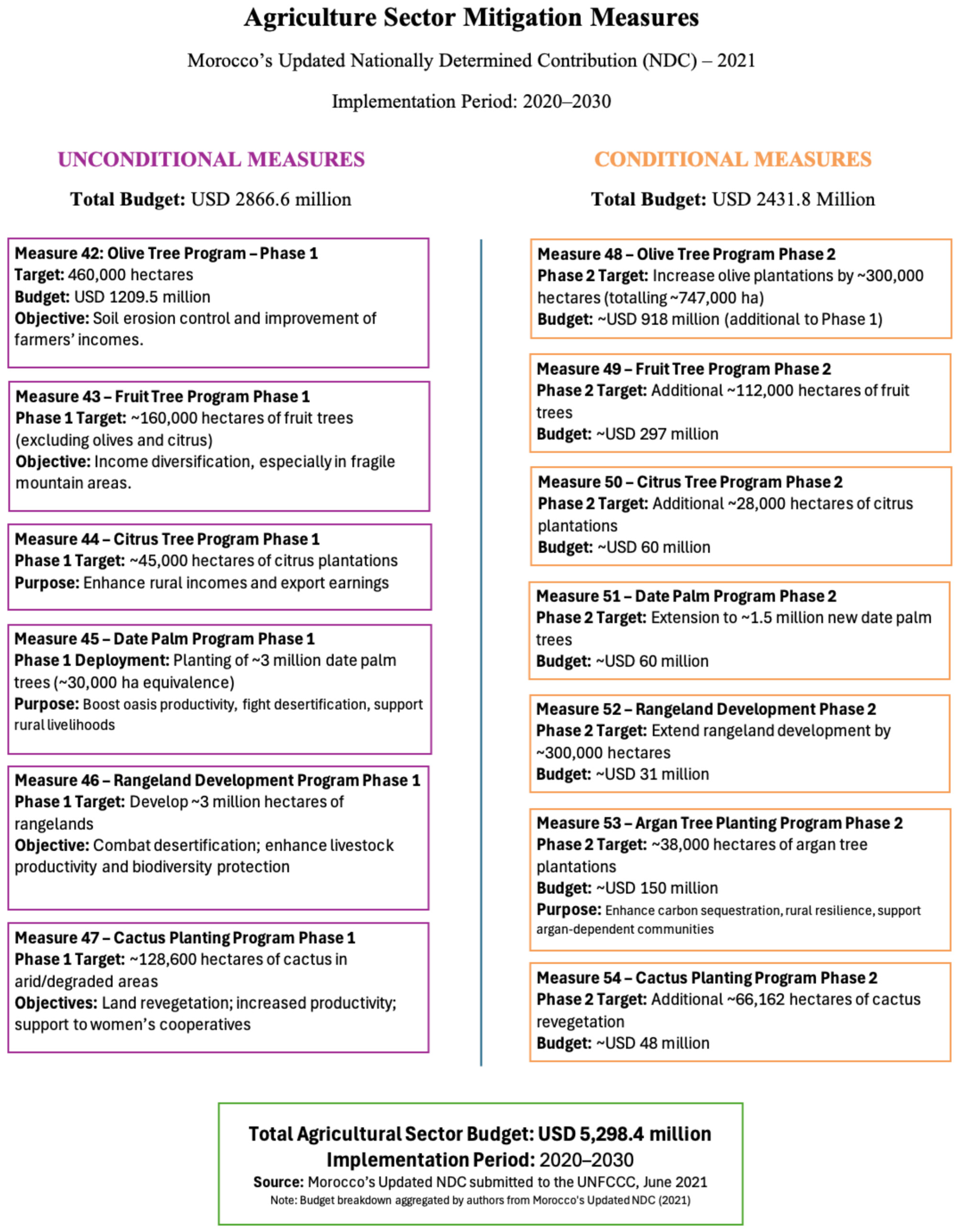
3.1. Greenhouse Gas Profile and Mitigation Pathways for Morocco’s Agricultural Sector
3.2. Assessment of Morocco’s Climate Performance
3.3. International Agricultural Mitigation Innovations
3.3.1. Pillar 1: Advanced Livestock Methane Mitigation
3.3.2. Pillar 2: Systematic Soil Carbon Monitoring
3.3.3. Pillar 3: Precision Nitrogen Management
3.3.4. Pillar 4: Integrated Renewable Energy Systems
4. Discussion
4.1. Transferability of Advanced Livestock Methane Mitigation and Roadmap (Table A1)
4.1.1. Morocco’s Livestock Context and Constraints
4.1.2. Implementation Roadmap Structure
- Phase 1 prioritizes technical feasibility: 3-NOP trials on local breeds and baseline emissions quantification.
- Phase 2 develops regulatory frameworks by amending Law No. 28-07 and aligning with EU protocols under the ONSSA administration.
- Phase 3 implements pilots through “Climate Bonus” per-liter milk payments, “Climate Milk” labeling, Crédit Agricole loans at 2% interest, and tiered subsidies.
- Phase 4 consolidates monitoring for 50,000 farmers and 500,000 cattle, targeting a 15–30% sectoral methane reduction.
4.1.3. Risk Assessment for Table A1
- First, regulatory uncertainty poses temporal risk. Law No. 28-07 amendments require 18–24 months of parliamentary approval [35]. This timeline may delay the Phase 2 activities and disrupt the financing schedules.
- Second, financial access constraints threaten equity. Only 6% of Moroccan farmers have access to formal credit [5]. Without tailored low-collateral financing through Crédit Agricole du Maroc, the benefits may be concentrated among larger producers. This undermines the smallholder-focused objectives of Generation Green [17].
- Third, social acceptance barriers represent the risks of implementation. Traditional livestock keepers may resist using novel feed additives. A transparent demonstration of productivity gains and animal welfare co-benefits is essential [33].
- Fourth, technical performance uncertainty remains. 3-NOP trials on local Moroccan cattle breeds may yield lower methane reductions than the 27% observed in Danish Holstein cattle [16]. Adaptive management protocols are required during Phase 1.
4.1.4. Integration Note on Gender and Traditional Farming
4.2. Transferability of Systematic Soil Carbon Monitoring and Roadmap (Table A2)
4.2.1. International Models and Performance Metrics
4.2.2. Morocco’s Monitoring Capacity Gaps
4.2.3. Implementation Framework: Programme National de Protection des Sols (PNPS)
- Phase 1 develops technical infrastructure, including laboratory upgrades, near-infrared spectroscopy, CaCl2 extraction transfer, national soil GIS, and training for scientists and technicians.
- Phase 2 establishes the regulatory and policy framework. Actions include alignment with EU soil protection, stakeholder consultations, and funding mechanisms under Generation Green and the NDC.
- Phase 3 implements pilots involving approximately 500 farmers and cooperatives. Public–private partnerships and carbon credit mechanism testing are central components.
- Phase 4 integrates systems with a full BISQ rollout, real-time satellite and in situ data collection, 200 monitoring technicians and 500 farmer data collectors.
- Phase 5 addresses evaluation and knowledge transfer through the use of international advisory panels. This includes scientific publications, regional training centers, and South-South cooperation [39].
- Phase 6 operationalizes national scaling and carbon finance integration (2034–2035), sustaining monitoring across 12 agroecological zones with 200 technicians, integrating satellite monitoring for soil carbon validation, and leveraging carbon credit revenues for long-term sustainability.
4.2.4. Equity Considerations in Program Design
4.2.5. Risk Assessment for Table A2
- First, institutional capacity deficits pose critical risks. Currently, Morocco operates only three laboratories equipped for advanced soil carbon analysis [37]. Phase 1 investments of $15.6 million and training programs for 50 soil scientists and 15 technicians represent substantial capacity expansion. Recruitment and retention challenges are expected in a context where the extension agent-to-farmer ratio is constrained to 1:1250 [5].
- Second, inter-institutional coordination barriers threaten the coherence of implementation. The PNPS requires seamless collaboration among INRA Morocco, the Ministry of Agriculture, regional extension services, and international partners [42]. Administrative silos documented in Morocco’s Fourth National Communication may fragment data flows and delay decision making [40].
- Third, geographic equity risks emerge in pilot implementation: concentrating Phase 3 monitoring in better-resourced regions with existing agricultural infrastructure would exclude smallholders in erosion-prone, degraded zones. These are precisely the areas that deliver the highest adaptation-mitigation co-benefits [36].
- Fourth, financial sustainability uncertainty persists beyond 2035. The PNPS operational model requires ongoing funding for 200 monitoring technicians, 500 farmer data collectors, and satellite data subscriptions (Table A2, Phase 4). These costs must be integrated into Morocco’s long-term budgets. Alternatively, they must be linked to carbon credit revenues to ensure programmatic continuity [14].
4.2.6. Integration Note on Gender and Traditional Farming
4.3. Transferability of Precision Nitrogen Management and Roadmap (Table A3)
4.3.1. International Evidence: Diverse Regulatory and Technical Approaches
4.3.2. Morocco’s Baseline and Constraints
4.3.3. Sustainable Nitrogen Management Program (SNMP) Structure
- Phase 1: Foundation Building (2030) includes amending Law 53-18 [44], drafting fertilizer taxation legislation, mapping Nitrate Vulnerable Zones, designing Soil Health Card tools, and planning IoT networks.
- Phase 2: Pilot Testing (2031–2032) implements regional regulations, fertilizer tax trials, deployment of handheld optical sensors (e.g., GreenSeeker) and chlorophyll meters (e.g., SPAD), and organic fertilizer promotion.
- Phase 3: National Rollout (2033–2034) establishes nationwide fertilizer taxation, mandatory plans, nitrogen ceilings, and SSNM scaling, targeting 18% N2O reduction.
4.3.4. Risk Assessment for Table A3
- First, political economy barriers pose significant risks to implementation. Smallholder resistance documented in similar contexts may derail fertilizer taxation in Phase 3. Unless tax revenues are transparently redistributed into extension services, Soil Health Card programs, or direct subsidies, implementation will fail. Denmark’s successful taxation model demonstrates this redistributive necessity [28].
- Second, the risk of digital exclusion threatens equity. Precision nitrogen tools (GreenSeeker sensors, SPAD meters, IoT networks) require rural broadband coverage, which is currently available in only 35% of Morocco’s agricultural areas [40]. Without inclusive digital strategies, such as SMS-based decision support tools or cooperative-level intermediaries, the roadmap may exacerbate the documented digital divide [45].
- Third, extension service capacity constraints are a critical bottleneck. Morocco’s 1:1250 agent-to-farmer ratio is far below the levels needed for individualized Soil Health Card training and national fertilizer plan enforcement [5]. This capacity gap risks undermining the 90% farmer participation target without substantial investment in extension infrastructure.
- Fifth, monitoring and enforcement challenges persist in the industry. Nitrogen ceiling enforcement and mandatory fertilizer plan compliance require robust systems that current institutions may struggle to operationalize. This is particularly acute in remote smallholder regions [14].
4.3.5. Integration Note on Political Economy and Gender
4.4. Transferability of Integrated Renewable Energy Systems and Roadmap (Table A4)
4.4.1. International Models: Diverse Technology and Policy Approaches
4.4.2. Morocco’s Renewable Energy Gap and Agricultural Energy Demands
4.4.3. Renewable Energy Implementation Framework
- Agrivoltaics: 50 pilots (2025–2027) scaling to 10,000 installations (2034–2035)
- Agricultural biogas: Pilot plants in Gharb and Casablanca scaling to 1000 installations
- Wind-powered irrigation: 20 remote-area pilots scaling to national integration
- Solar cold storage: 30 pilots expanding to national network
- Smart energy management: 100 pilot sites to national digital platform
4.4.4. Risks and Barriers
4.4.5. Risk Assessment for Table A4
- First, land-use equity risks emerge from agrivoltaic deployment. Capital-intensive photovoltaic installations (estimated $25 M national + $60 M private investment) may concentrate adoption among larger commercial farms. This replicates the inequities observed in other capital-intensive agricultural technologies [5,32]. Without tiered subsidies or cooperative ownership models, Phase 1 pilots risk validating systems that are inaccessible to target beneficiaries.
- Second, regulatory uncertainty constrains biogas and smart-energy initiatives. Morocco currently lacks clear feed-in tariff structures for biogas-to-grid integration (BGI). Data governance protocols for smart energy platforms are absent [40]. These regulatory gaps must be resolved with energy sector authorities to enable Phase 2 scaling (2028–2030).
- Fourth, technical performance risks persist owing to climate differences. Morocco’s semi-arid agroclimatic conditions differ substantially from the Netherlands’ temperate zones, where agrivoltaic systems were validated [32]. Phase 1 pilots must rigorously assess the effects of crop-panel shading on water-use efficiency and yield stability. This avoids technological maladaptation under Moroccan conditions [46].
- Fifth, grid integration challenges constrain biogas and agrivoltaic scaling capabilities. Morocco’s current electricity grid infrastructure may require upgrades to accommodate decentralized renewable generation [4]. This coordination challenge requires inter-ministerial alignment between agricultural and energy authorities through the mechanisms listed in Table A5.
4.4.6. Integration Note on Equity and Access
4.5. Cross-Cutting Synergies, Trade-Offs, and Implementation Coordination (Table A5)
4.5.1. Interconnected Benefits Across Pillars
4.5.2. Systemic Risks and Implementation Constraints
4.5.3. Implementation Coordination Framework: Table A5
- First, inter-ministerial coordination (alignment of agriculture, energy, and interior, 2025–2027) is required to harmonize regulatory reforms across Table A1, Table A2, Table A3 and Table A4 and prevent policy fragmentation. Livestock feed additive regulations (Table A1), soil protection frameworks (Table A2), fertilizer taxation (Table A3), and renewable energy feed-in tariffs (Table A4) advance coherently under the unified Generation Green oversight [4]. This coordination directly addresses the administrative silos documented by Adeli et al. (2024) [40]. These silos fragment climate policy implementation.
- Second, international partnerships (2025–2027) leverage technical cooperation. BISQ partners include the Wageningen University in the Netherlands. SSNM expertise comes from the Soil Health Card program in India. Renewable energy innovators include Sweden’s biogas networks and the Philippines’ microgrids. These collaborations accelerate knowledge transfer and reduce Morocco’s learning curve [17,19]. These partnerships facilitate access to multilateral financing (GCF (Green Climate Fund), GEF (Global Environment Facility), and the World Bank). Table A1, Table A2, Table A3 and Table A4 aggregate an estimated $200+ million in external support for the roadmap implementation [5].
- Third, the monitoring and evaluation frameworks (2025–2030) integrate GHG measurement protocols. Baseline establishment, performance indicator definition, and data collection systems will begin in 2025–2027. Progress tracking, impact assessment, and adaptive management will continue through 2028–2030. These enable unified Measurement, Reporting, and Verification (MRV) systems supporting Morocco’s NDC reporting and unlocking carbon finance mechanisms [15].
4.5.4. Phased Implementation and Capacity Management
4.5.5. Risk Assessment for Table A5: Meta-Level Implementation Challenges
- First, inter-ministerial coordination failures remain possible despite formal alignment structures (2025–2027). Moroccan ministries have historically operated with distinct budgetary cycles, procurement procedures, and political priorities [4]. These differences may fragment the unified implementation. This risk requires a high-level political commitment. A dedicated Prime Ministerial coordination unit anchored in Generation Green governance provides the necessary institutional support.
- Second, international partnerships introduce vulnerabilities. Roadmap timelines rely on sustained technical cooperation and financial flows from the Netherlands (BISQ), India (SSNM), Sweden (biogas), and multilateral funds (GCF, GEF, and the World Bank) (Table A2, Table A3 and Table A4). Disruptions from shifting donor priorities or geopolitical factors can delay capacity building and technology transfer. Contingency partnerships with additional high CCPI performers or regional institutions provide mitigation pathways.
- Third, the complexity of monitoring and evaluation systems poses challenges for data governance. Integrating MRV protocols across the four pillars requires harmonizing disparate data streams (livestock emissions, soil carbon stocks, nitrogen balances, and energy consumption) managed by different institutions (ONSSA, INRA Morocco, and the Ministry of Energy). This technical and institutional challenge risks the production of fragmented and incompatible datasets. Unless Table A5 monitoring frameworks mandate standardized protocols, unified data platforms, and clear institutional data-sharing agreements from the 2025 baseline establishment, implementation will fail [40].
4.5.6. Integration Note on Gender, Traditional Farming, and Political Economy
4.6. Limitations and Future Research Directions
5. Conclusions
Author Contributions
Funding
Institutional Review Board Statement
Data Availability Statement
Acknowledgments
Conflicts of Interest
Abbreviations and Acronyms
| 3-NOP | 3-Nitrooxypropanol |
| BISQ | Biological Indicators of Soil Quality |
| CCPI | Climate Change Performance Index |
| CH4 | Methane |
| CO2 | Carbon Dioxide |
| CO2-eq | Carbon Dioxide Equivalent |
| COP | Conference of the Parties |
| EBI | Evidence-Based Intervention |
| EBIs | Evidence-Based Interventions |
| EU | European Union |
| FAO | Food and Agriculture Organization of the United Nations |
| FSSC | Food Safety System Certification |
| GCF | Green Climate Fund |
| GEF | Global Environment Facility |
| GDP | Gross Domestic Product |
| GHG | Greenhouse Gas |
| Gg | Gigagram (unit of mass; 1 Gg = 1000 tons) |
| ICT | Information and Communication Technology |
| INRA | Institut National de la Recherche Agronomique (Morocco) |
| MRV | Measurement, Reporting, and Verification |
| N2O | Nitrous Oxide |
| NDC | Nationally Determined Contribution |
| ONSSA | Office National de Sécurité Sanitaire des Produits Alimentaires |
| PNPS | Programme National de Protection des Sols (National Soil Protection Program) |
| RIVM | Rijksinstituut voor Volksgezondheid en Milieu (National Institute for Public Health and the Environment, Netherlands) |
| SNMP | Sustainable Nitrogen Management Program |
| SSNM | Site-Specific Nutrient Management |
| UNFCCC | United Nations Framework Convention on Climate Change |
| USD | United States Dollar |
Appendix A

| Phase | Duration | Key Activities | Institutional Partnerships | Financial Mechanisms | Expected Outcomes |
|---|---|---|---|---|---|
| Phase 1: Technical Feasibility and Regulatory Preparation | 2025–2027 |
|
|
|
|
| Phase 2: Regulatory Framework Development | 2027–2029 |
|
|
|
|
| Phase 3: Pilot Implementation and Scale-Up | 2029–2032 |
|
|
|
|
| Phase 4: Monitoring and Expansion | 2032–2035 |
|
|
|
|
| Phase | Duration | Core Objectives | Technology Transfer Components | Capacity Building Requirements | Investment Needs (USD Million) |
|---|---|---|---|---|---|
| Phase 1: Technical Infrastructure Development | 2025–2027 |
|
|
|
|
| Phase 2: Regulatory and Policy Framework | 2027–2028 |
|
|
|
|
| Phase 3: Pilot Implementation | 2028–2030 |
|
|
|
|
| Phase 4: System Integration and Monitoring | 2030–2032 |
|
|
|
|
| Phase 5: Evaluation and Knowledge Transfer | 2032–2034 |
|
|
|
|
| Phase 6: National Scaling and Carbon Finance Integration | 2034–2035 |
|
|
|
|
| Implementation Phase | Timeline | Regulatory Actions | Technology Deployment | Stakeholder Engagement | Performance Indicators |
|---|---|---|---|---|---|
| Phase I: Foundation Building | Year 1 (2030) |
|
|
|
|
| Phase II: Pilot Testing and Refinement | Years 2–3 (2031–2032) |
|
|
|
|
| Phase III: National Rollout | Years 4–5 (2033–2034) |
|
|
|
|
| Phase IV: Optimization and Expansion | Year 6+ (2035 onwards) |
|
|
|
|
| Technology Initiative | Phase 1 (2025–2027) | Phase 2 (2028–2030) | Phase 3 (2031–2033) | Phase 4 (2034–2035) | Feasibility Assessment | Financing Strategy |
|---|---|---|---|---|---|---|
| Agrivoltaic Systems Integration |
|
|
|
|
|
|
| Agricultural Biogas Development |
|
|
|
|
|
|
| Wind-Powered Irrigation Systems |
|
|
|
|
|
|
| Solar Cold Storage Networks |
|
|
|
|
|
|
| Smart Energy Management Systems |
|
|
|
|
|
|
| Cross-Cutting Elements | 2025–2027 | 2028–2030 | 2031–2033 | 2034–2035 |
|---|---|---|---|---|
| Inter-Ministerial Coordination |
|
|
|
|
| International Partnerships |
|
|
|
|
| Monitoring and Evaluation |
|
|
|
|
References
- Food and Agriculture Organization (FAO). Global GHG Emissions from Agrifood Systems; FAO Statistical Yearbook; FAO: Rome, Italy, 2022. [Google Scholar]
- Li, L.; Liu, X.; Huang, Q.; Li, Z.; Zhang, Y.; Wang, S.; Xu, L.; Pan, G. Global greenhouse gas emissions from agriculture: Synthesis and projection. Global Change Biol. 2024, 30, e17080. [Google Scholar] [CrossRef]
- Acharya, P.; Ghimire, R.; Sainju, U.M.; Acosta-Martinez, V.; Sitaula, B. Net greenhouse gas balance with cover crops in semi-arid irrigated cropping systems. Sci. Rep. 2022, 12, 12173. [Google Scholar] [CrossRef]
- Government of Morocco. Fourth National Communication of Morocco to the United Nations Framework Convention on Climate Change; UNFCCC: Rabat, Morocco, 2021. [Google Scholar]
- World Bank. Morocco Green Generation Program-for-Results Project; World Bank: Washington, DC, USA, 2020; Available online: https://documents1.worldbank.org/curated/en/245801608346893390/pdf/Morocco-Green-Generation-Program-for-Results-Project.pdf (accessed on 5 November 2024).
- Lkammarte, F.Z.; Eddoughri, F.; Karmaoui, A. Analysis of the vulnerability of agriculture to climate and anthropogenic change in Marrakech Safi region, Morocco. Appl. Ecol. Environ. Res. 2023, 21, 519–544. [Google Scholar] [CrossRef]
- Morocco. Third Biennial Update Report of Morocco Under the UNFCCC (BUR3); Ministry of Energy Transition and Sustainable Development, Department of Sustainable Development: Rabat, Morocco, 2022. [Google Scholar]
- Hellsten, S.; Dalgaard, T.; Rankinen, K.; Tørseth, K.; Bakken, L.; Bechmann, M.; Kulmala, A.; Moldan, F.; Olofsson, S.; Piil, K.; et al. Abating N in Nordic agriculture-Policy, measures and way forward. J. Environ. Manag. 2019, 236, 674–686. [Google Scholar] [CrossRef]
- Van Grinsven, H.J.M.; Tiktak, A.; Rougoor, C.W. Evaluation of the Dutch implementation of the nitrates directive, the water framework directive, and the national emission ceilings directive. NJAS-Wagening. J. Life Sci. 2016, 78, 69–84. [Google Scholar] [CrossRef]
- Liu, S.; Lin, F.; Wu, S.; Ji, C.; Sun, Y.; Jin, Y.; Li, S.; Li, Z.; Zou, J. A meta-analysis of fertilizer-induced soil NO and combined NO+N2O emissions. Glob. Change Biol. 2017, 23, 2520–2532. [Google Scholar] [CrossRef]
- Sapkota, T.B.; Aryal, J.P.; Khatri-Chhetri, A.; Shirsath, P.B.; Arumugam, P.; Stirling, C.M. Identifying high-yield low-emission pathways for cereal production in South Asia. Mitig. Adapt. Strateg. Glob. Change 2018, 23, 621–641. [Google Scholar] [CrossRef] [PubMed]
- Ariva, J.; Viira, A.H. Greenhouse gas emissions from agriculture and LULUCF sectors in Estonia: Current situation and mitigation scenarios. Land Use Policy 2023, 125, 106481. [Google Scholar] [CrossRef]
- Kraus, D.; Werner, C.; Janz, B.; Klatt, S.; Sander, B.O.; Wassmann, R.; Kiese, R.; Butterbach-Bahl, K. Greenhouse gas mitigation potential of alternate wetting and drying for rice production at national scale—A modeling case study for the Philippines. J. Geophys. Res. Biogeosci. 2022, 127, e2022JG006848. [Google Scholar] [CrossRef]
- El Hafdaoui, H.; El Alaoui, H.; Mahidat, S.; El Harmouzi, Z.; Khallaayoun, A. Long-term low-carbon strategy of Morocco: A review of future scenarios and energy measures. Results Eng. 2023, 18, 101112. [Google Scholar] [CrossRef]
- Government of Morocco. Morocco-Nationally Determined Contribution Under the Paris Agreement: Updated Submission; UNFCCC: Rabat, Morocco, 2021. [Google Scholar]
- Burck, J.; Uhlich, T.; Bals, C.; Höhne, N.; Nascimento, L.; Kumar, C.H.; Bosse, J.; Riebandt, M.; Pradipta, G. Climate Change Performance Index 2024: Results; Germanwatch e.V.: Bonn, Germany, 2023. [Google Scholar]
- Kingdom of Morocco. Generation Green Strategy 2020–2030; Ministry of Agriculture, Maritime Fisheries, Rural Development, Water and Forests: Rabat, Morocco, 2020. [Google Scholar]
- Ministry of Environment Estonia. Estonia’s Eighth National Communication Under the United Nations Framework Convention on Climate Change; UNFCCC: Tallinn, Estonia, 2023. [Google Scholar]
- Sweden. Sweden’s Eighth National Communication on Climate Change Under the United Nations Framework Convention on Climate Change; Ministry of Climate and Enterprise: Stockholm, Sweden, 2023.
- Netherlands. Netherlands’ Eighth National Communication and Fifth Biennial Report Under the United Nations Framework Convention on Climate Change; Ministry of Economic Affairs and Climate Policy: The Hague, The Netherlands, 2022.
- Helfenstein, A.; Mulder, V.L.; Heuvelink, G.B.M.; Okx, J.P. BIS-4D: Mapping soil properties and their uncertainties at 25 m resolution in the Netherlands. Earth Syst. Sci. Data 2024, 16, 2941–2956. [Google Scholar] [CrossRef]
- RIVM. Soil Ecology: The Dutch Monitoring Programme; RIVM: Bilthoven, The Netherlands, 2018. [Google Scholar]
- RIVM. Soil Ecosystem Profiling in the Netherlands with Ten Years of Monitoring of the Biological Indicator for Soil Quality (BISQ); RIVM: Bilthoven, The Netherlands, 2007. [Google Scholar]
- Rutgers, M.; Schouten, A.J.; Bloem, J.; Van Eekeren, N.; De Goede, R.G.M.; Jagersop Akkerhuis, G.A.J.M.; Van der Werf, A.; Wijnen, B.; Zondag, J.; Breure, A.M. Biological measurements in a nationwide soil monitoring network. Eur. J. Soil Sci. 2009, 60, 820–832. [Google Scholar] [CrossRef]
- Ministry of Environment, Forest and Climate Change (MoEFCC). India: Third National Communication to the United Nations Framework Convention on Climate Change; Government of India: New Delhi, India, 2023.
- Geng, Y.; Yuan, Y.; Hénault, C.; Revellin, C. Decreased nitrous oxide emissions associated with functional microbial genes under bio-organic fertilizer application in vegetable fields. J. Environ. Manag. 2021, 278, 111516. [Google Scholar] [CrossRef]
- Verma, P.; Chauhan, A.; Ladon, T. Site-specific nutrient management: A review. J. Pharmacogn. Phytochem. 2020, 9, 233–236. [Google Scholar]
- Dalgaard, T.; Hansen, B.; Hasler, B.; Hertel, O.; Hutchings, N.J.; Jacobsen, B.H.; Jensen, L.S.; Kronvang, B.; Olesen, J.E.; Schjørring, J.K.; et al. Policies for agricultural nitrogen management—Trends, challenges and prospects for improved efficiency in Denmark. Environ. Res. Lett. 2014, 9, 115002. [Google Scholar] [CrossRef]
- Denmark. Denmark’s Eighth National Communication and Fifth Biennial Report Under the United Nations Framework Convention on Climate Change; Danish Ministry of Climate, Energy and Utilities: Copenhagen, Denmark, 2023. [Google Scholar]
- Rees, R.; Maire, J.; Florence, A.; Cowan, N.; Skiba, U.; van der Weerden, T.; Ju, X. Mitigating nitrous oxide emissions from agricultural soils by precision management. Front. Agric. Sci. Eng. 2020, 7, 75–80. [Google Scholar] [CrossRef]
- Philippines. Philippines’ Second National Communication to the United Nations Framework Convention on Climate Change; Climate Change Commission, Government of the Philippines: Manila, Philippines, 2014.
- AgroRES Project. Renewable Energy for Sustainable Agriculture; Interreg Europe: Brussels, Belgium, 2023; Available online: https://www.interregeurope.eu/find-policy-solutions/stories/renewable-energy-sustainable-agriculture (accessed on 15 December 2024).
- Food and Agriculture Organization (FAO). Morocco Agricultural Statistics and Profile; FAO: Rome, Italy, 2020. [Google Scholar]
- Kingdom of Morocco. Law No. 28-07 on Animal Health and Veterinary Inspection; Official Bulletin: Rabat, Morocco, 2007. [Google Scholar]
- Kingdom of Morocco. Parliamentary Procedures Manual; Parliament of Morocco: Rabat, Morocco, 2011. [Google Scholar]
- Salhi, A.; Benabdelouahab, T.; Martin-Vide, J.; Okacha, A.; El Hasnaoui, Y.; El Mousaoui, M.; El Morabit, A.; Himi, M.; Benabdelouahab, S.; Lebrini, Y.; et al. Bridging the perception gap is the only way to align soil protection actions. Sci. Total Environ. 2021, 718, 137421. [Google Scholar] [CrossRef]
- Institut National de la Recherche Agronomique (INRA Morocco). Soil Analysis Laboratory Capacity Assessment; INRA: Rabat, Morocco, 2023. [Google Scholar]
- Food and Agriculture Organization (FAO). Soil Salinity Assessment and Mapping in Morocco; FAO: Rome, Italy, 2022. [Google Scholar]
- Ait-El-Mokhtar, M.; Ben-Laouane, R.; Anli, M.; Boutasknit, A.; Wahbi, S.; Meddich, A. Potential of mycorrhizal fungi and plant growth-promoting rhizobacteria as a sustainable solution to mitigate salt stress in date palm (Phoenix dactylifera L.). Plants 2021, 10, 1377. [Google Scholar] [CrossRef]
- Adeli, M.; Korchi, A.; El Khoury, P.; Zahra, A.; Mansouri, K. Hydrogen production from renewable sources in Morocco: Potential, challenges, and prospects. Int. J. Hydrogen Energy 2024, 51, 545–560. [Google Scholar] [CrossRef]
- Chakhchar, A.; Haworth, M.; El Modafar, C.; Lauteri, M.; Mattioni, C.; Wahbi, S.; Centritto, M. An overview of the responses of the endemic argan tree (Argania spinosa (L.) Skeels) to climate change: Ecophysiological adjustments and biotechnological applications. Plants 2022, 11, 354. [Google Scholar] [CrossRef]
- Wageningen University & Research. Dutch Soil Information System (SIS); Wageningen University & Research: Wageningen, The Netherlands, 2017; Available online: https://www.wur.nl/en/research-results/research-institutes/environmental-research/facilities-tools/dutch-soil-information-system-sis.htm (accessed on 10 November 2024).
- Zayani, K.; Abadie, L.; Karray, B.; Ben-Hammouda, M. Soil organic carbon storage in olive orchards under different management systems in northern Morocco. Agronomy 2023, 13, 889. [Google Scholar] [CrossRef]
- Morocco. Law No. 53 18 on Fertilizing Materials and Growing Media, Promulgated by Dahir No. 1 21 68 of 3 Dhu al Hijjah 1442 (14 July 2021); No. 7054; Official Bulletin of the Kingdom of Morocco: Rabat, Morocco, 2022.
- Bhusal, D.; Thakur, D.P. Precision nitrogen management on crop production: A review. Arch. Agric. Environ. Sci. 2022, 7, 267–271. [Google Scholar] [CrossRef]
- Eddoughri, F.; Lkammarte, F.Z.; Ait-El-Mokhtar, M.; Baali, A.; Farssi, A.; Arjdal, Y.; Ait-Errouhi, S.; El-Mouhri, A. Analysis of the vulnerability of agriculture to climate and anthropogenic impacts in the Beni Mellal-Khénifra region, Morocco. Sustainability 2022, 14, 13166. [Google Scholar] [CrossRef]
- Moussadek, R.; Mrabet, R.; Zouahri, A.; Laghrour, M.; Oueld Lhaj, M.; Dahan, R.; El Mourid, M. Conservation agriculture in Morocco: Review and analysis for the resilience of the cereal system on 1 million hectares by 2030. Afr. Mediterr. Agric. J. 2024, 143, 263–279. [Google Scholar] [CrossRef]


Disclaimer/Publisher’s Note: The statements, opinions and data contained in all publications are solely those of the individual author(s) and contributor(s) and not of MDPI and/or the editor(s). MDPI and/or the editor(s) disclaim responsibility for any injury to people or property resulting from any ideas, methods, instructions or products referred to in the content. |
© 2026 by the authors. Licensee MDPI, Basel, Switzerland. This article is an open access article distributed under the terms and conditions of the Creative Commons Attribution (CC BY) license.
Share and Cite
Hajib, A.; Naimi, M.; Chikhaoui, M. Four Agricultural GHG Emission Mitigation Pathways in Morocco: Roadmaps from 2024 CCPI High-Performers. Agriculture 2026, 16, 124. https://doi.org/10.3390/agriculture16010124
Hajib A, Naimi M, Chikhaoui M. Four Agricultural GHG Emission Mitigation Pathways in Morocco: Roadmaps from 2024 CCPI High-Performers. Agriculture. 2026; 16(1):124. https://doi.org/10.3390/agriculture16010124
Chicago/Turabian StyleHajib, Asmaâ, Mustapha Naimi, and Mohamed Chikhaoui. 2026. "Four Agricultural GHG Emission Mitigation Pathways in Morocco: Roadmaps from 2024 CCPI High-Performers" Agriculture 16, no. 1: 124. https://doi.org/10.3390/agriculture16010124
APA StyleHajib, A., Naimi, M., & Chikhaoui, M. (2026). Four Agricultural GHG Emission Mitigation Pathways in Morocco: Roadmaps from 2024 CCPI High-Performers. Agriculture, 16(1), 124. https://doi.org/10.3390/agriculture16010124