Article

Preparation and Evaluation of an Organic Value-Added Suspension Fertilizer Using Liquid Waste

Engineering Research Centre of Comprehensive Utilization and Clean Processing of Phosphorus Resources of Ministry of Education, School of Chemical Engineering, Sichuan University, No. 24 Section 1, 1st Ring Road, Chengdu 610065, China
*
Author to whom correspondence should be addressed.
Agriculture 2025, 15(24), 2568; https://doi.org/10.3390/agriculture15242568
Submission received: 3 November 2025 / Revised: 27 November 2025 / Accepted: 10 December 2025 / Published: 11 December 2025
(This article belongs to the Section Agricultural Technology)

Abstract

Suspension fertilizers offer high concentration, excellent fluidity, an eco-friendly production process, and ease of precise and even application, making them ideal for modern fertigation systems. However, stability remains a significant challenge. This study aims to develop an organic value-added suspension fertilizer (VSuF) based on the filtrate of acid–base-treated soybean residue, which can ensure stability during transportation and storage while promoting efficient nutrient utilization in agriculture. The stabilizers were optimized by comparing the effects of various types and dosages on particle size, zeta potential, viscosity, and thixotropy of the suspension fertilizer. Meanwhile, the stability and agricultural effects of the fertilizer were evaluated. Results showed that with 0.40% sodium lignosulfonate, 0.40% xanthan gum, and 0.20% organic silicon defoamer, VSuF remained stable during centrifugation (2000 r·min−1, 30 min) and storage at 0 °C and 50 °C for 14 days. Additionally, agricultural evaluation indicated that VSuF significantly increased the dry weight and phosphorus uptake of crop shoots by 17.40% and 21.00%, respectively, relative to the solid fertilizer without the value-added compound. Meanwhile, VSuF enhanced the fresh weight, length, and surface area of crop roots by 83.10%, 74.47%, and 69.34%, respectively, along with shoots’ phosphorus uptake by 19.80%, compared to the glucose value-added solid fertilizers.

1. Introduction

Applying chemical fertilizers is vital for promoting crop yields and ensuring food security [1]. However, the low use efficiency of traditional fertilizers leads to nutrient surpluses and environmental pollution in many parts of the world [2,3]. The advancement in fertilizer products has become a new paradigm to enhance plant nutrient uptake, promote soil health, and reduce production costs [4]. The synergistic effect between fertilizers and value-added compounds (such as carbohydrates, humic acid, amino acids, and proteins) can effectively reduce nutrient fixation and improve soil health, thereby promoting root development and increasing crop yield [5,6,7,8,9,10,11,12]. Therefore, in recent years, the production and application of value-added fertilizers (i.e., fertilizers with value-added compounds) have been increasing, which has also raised new requirements for fertilizer production technology.
Suspension fertilizer can be defined as a liquid fertilizer that utilizes the stabilizing agents to enable its nutrients to exceed their solubility [13]. It consists of a continuous phase of saturated aqueous nutrient solution and a dispersed phase of undissolved solid fertilizer particles, thus combining the advantages of both liquid and solid fertilizers [14]. This dispersed system has a highly chemical composition homogeneity, which is beneficial for the precise addition of micronutrients and value-added compounds. Additionally, it can achieve nutrient concentrations comparable to solid fertilizers and more than twice those of clear liquid fertilizers [14]. Compared to granulated fertilizers, the production of suspension fertilizers has lower requirements for raw material purity and solubility [14] and does not involve energy-intensive steps such as granulation, drying, and sifting [15]. This simplified production process reduces both manufacturing costs and emissions associated with thermal processing. These characteristics make suspension fertilizers especially advantageous for producing value-added fertilizer products.
However, the main pain point of suspension fertilizer is its short-period storage due to limited stability, which limits its application scope [16]. This limited stability is due to the aggregation growth of fertilizer particles and the effect of gravity, causing the solid fertilizer particles in the dispersion to slowly settle [14]. Adding stabilizing agents to a suspended system is an effective strategy to improve the stability of suspension fertilizer. Suitable stabilizing agents could effectively improve the gel strength of suspension fertilizer by enhancing the dispersion quality of suspension fertilizer, decreasing the suspended particle size, and improving suspended crystal size and shape [14]. Dispersants and thickeners are the key stabilizing agents. Dispersants function by diminishing interparticle attraction through electrostatic stabilization, lowering interfacial tension, and modifying wettability [17,18], thereby preventing particle aggregation and ensuring uniform dispersion [19]. Additionally, thickeners contribute to stability by increasing the system’s viscosity, providing steric hindrance, and forming network structures that effectively resist sedimentation [20]. According to their different mechanisms of action, dispersants include surfactants, polymeric dispersants, and electrolytes, while thickeners include hydrocolloids, synthetic polymers, and inorganic clays. Substances such as sodium dodecyl sulfate (SDS), sodium lignosulfonate (SLF), carboxymethyl cellulose, and xanthan gum (XG) are widely used in the energy, chemical, and materials industries due to their high efficiency, low cost, and environmental friendliness. Studies showed that non-ionic polyethylene glycol can be used as a dispersant to improve the stability of titanium carbide suspensions [21]. Changhong Gao believed that carboxymethyl cellulose can increase the viscosity of the slurry system [22]. Sainan Xiang et al. indicated that the addition of bentonite (BT), XG, and other stabilizing agents at different dosages can influence the stability of the suspension fertilizers [23]. It can be seen that the efficacy and optimal dosage of dispersants and thickeners vary across different systems. Therefore, determining the appropriate types and quantities of dispersants and thickeners for different suspension systems is the key to ensuring the stability of the suspension. Meanwhile, depending on the system’s characteristics, it is also necessary to consider the use of additives such as defoamers, preservatives, and antifreeze agents.
Additionally, in the traditional production process of suspension fertilizers, solid fertilizers are usually required to provide sufficient nutrients. Meanwhile, to enhance product performance, the additional incorporation of value-added compounds is essential [14]. However, the preparation and precise addition of these value-added compounds further increase production costs and complicate the process, thereby undermining the original economic advantages of the suspension fertilizer system [14,24]. In contrast, liquid wastes from industrial and agricultural sources containing organic synergistic substances offer a more promising alternative for suspension fertilizer production [25,26,27]. Various organic substances in such wastes not only supply part of the nutrients but also act as value-added compounds to improve fertilizer performance [28,29]. Some studies also indicated that fertilizers containing multiple value-added compounds have greater potential in agricultural applications than those containing a single value-added compound [30,31]. It can be seen that producing organic value-added suspension fertilizers from liquid wastes rich in diverse organic matter not only enhances fertilizer performance but also achieves effective nutrient cycling and resource recovery [26,27].
Thus, this study aimed to prepare an organic value-added suspension fertilizer (VSuF) using the liquid waste of acid–base-treated soybean residue, which is inherently rich in phosphorus (P) and potassium (K) as well as value-added compounds including sugars, polypeptides, and amino acids. Specifically, the appropriate types and dosages of dispersants, thickeners, and defoamers were determined. The growth, root morphology, and P uptake of crops affected by organic VSuF were compared to solid fertilizers containing essential nutrients with or without glucose as the value-added compound.

2. Materials and Methods

2.1. Materials

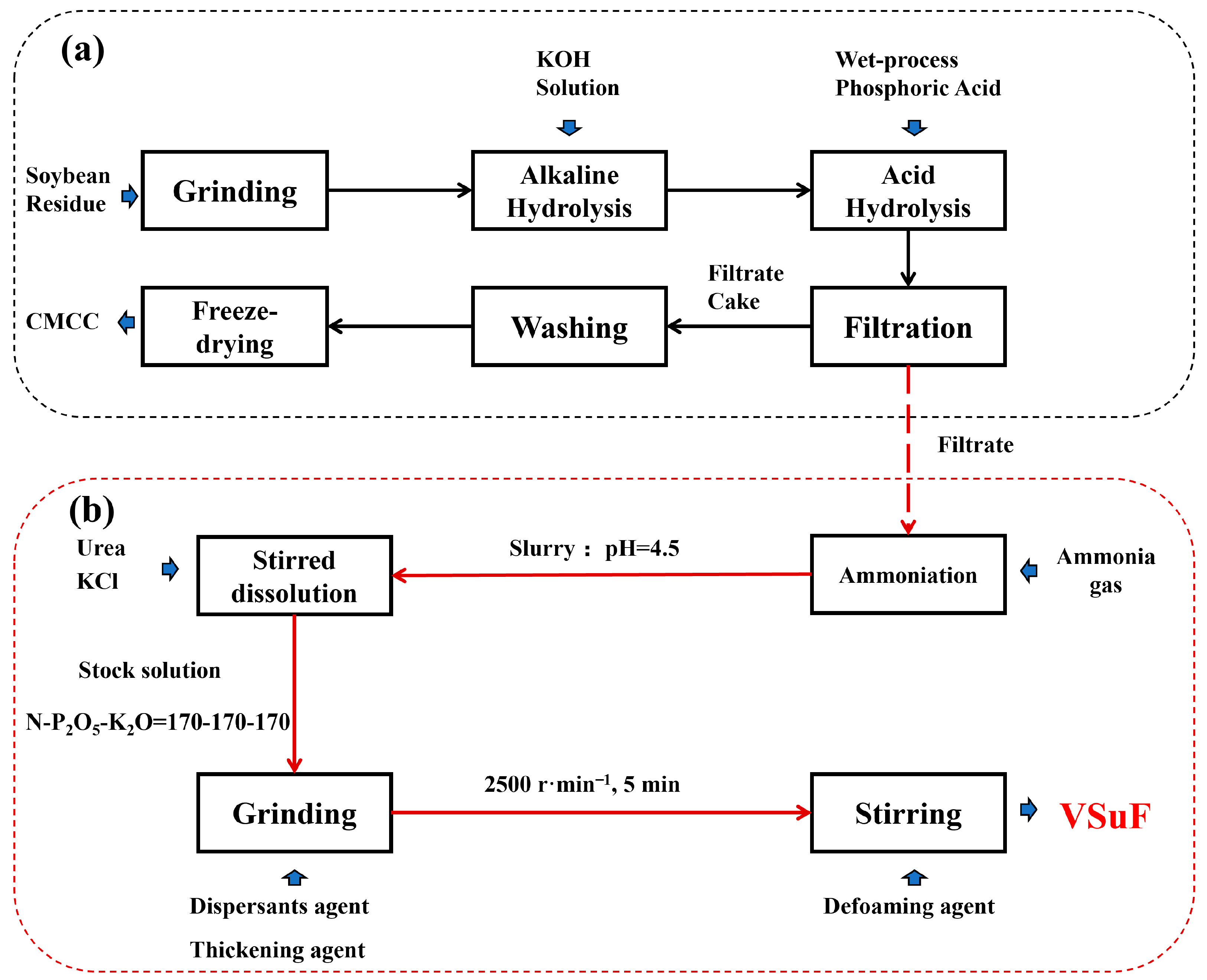
The main raw material for suspension fertilizer comes from the filtrate produced during coarse microcrystalline cellulose (CMCC) preparation by treating soybean residue with potassium hydroxide and wet-process phosphoric acid (Figure 1a) [32]. The concentrations of various components in the filtrate were as follows: P at 71.79 mg·mL−1, K at 18.03 mg·mL−1, total sugar at 94.27 mg·mL−1, polypeptides at 6.84 mg·mL−1 and amino acids at 0.61 mg·mL−1 (Table 1). Brown soil was used to investigate the agricultural effects of the fertilizers. The soil properties are presented in Table S1. In addition, the details of other experimental materials (Table S2) and equipment (Table S3) are shown in the Supplementary Materials.

2.2. Preparation of Organic Value-Added Suspension Fertilizer

2.2.1. Preparation Processes

Figure 1b outlines the preparation process of VSuF. First, ammonia gas was introduced into 100 g of filtrate from the CMCC preparation process at a rate of 1–2 bubbles per second through a polyvinyl chloride pipe (5 mm inner diameter) until the pH reached 4.5. Next, urea and potassium chloride were added to the ammonified filtrate to obtain a suspension fertilizer stock solution with an N-P2O5-K2O of 170-170-170. Then, dispersants and thickeners were incorporated into the stock solution, which was ground at 2500 r·min−1 for 5 min using a sand mill. Finally, defoamers were added to reduce product volume.

2.2.2. Optimization of Stabilizing Agents

The stabilizing agents were optimized, including the types and dosage of the dispersant, thickeners and defoamers. Firstly, five dispersants (details in Table S4), including polyethylene glycol-6000 (PEG-6000), SLF, sodium dodecyl benzene sulfonate (SDBS), SDS, and potassium pyrophosphate (PP), were selected to investigate their dispersion effect in the studied system. The optimal dispersant was determined by comparing the particle size of the samples after adding different dispersants at a concentration of 0.50%. Then, the appropriate dosage of the optimal dispersant was determined by comparing the Zeta potential of the samples with different dosages (i.e., 0.10%, 0.20%, 0.30%, 0.40% and 0.50%). Based on using optimal type and dosage of dispersant, four thickeners (details in Table S4), including XG, sodium carboxymethyl cellulose (CMC-Na), BT, and gum arabic (GA), were investigated. The optimal thickener was determined by comparing the characteristic particle size, Zeta potential and thixotropy of the samples after adding different selected thickeners at a concentration of 0.50%. Then, the appropriate dosage of the optimal thickener was determined by comparing the characteristic particle size, Zeta potential, viscosity, and thixotropy of the samples with different dosages (i.e., 0.10%, 0.20%, 0.30%, 0.40% and 0.50%). DP161, a type of organic silicon defoamer, was selected for the studied system. Five 80 mL samples of ground suspension fertilizer with the optimal dispersant and thickener were placed in separate 100 mL glass cylinders. DP161 was added at 0.10%, 0.20%, 0.30%, 0.40%, and 0.50% concentrations, respectively. The mixture was stirred thoroughly and allowed to stand for 5 min, during which the volume change in the suspension fertilizer was recorded. Additionally, the Zeta potential, viscosity, and thixotropy were measured.

2.2.3. Stability Analysis

Centrifugal Stability
38 g of the test fertilizer was transferred into a 50 mL centrifuge tube and spun at 2000 r·min−1 for 30 min. After centrifugation, the supernatant was carefully poured out and its volume was recorded. The equation for water separation rate was as follows:
w = Vb/Va × 100%
where w was the water separation rate, Vb was the supernatant volume, and Va was the total volume.
Cold and Hot Storage
45 mL of the test fertilizer was withdrawn into a 50 mL centrifuge tube, and it was stored either in a refrigerator at 0 °C or in a constant-temperature incubator at 50 °C for 14 days. After 14 days, the water separation rate and the particle size distribution were determined.

2.2.4. Characterization Test

Particle Size and Zeta Potential
The particle size distribution of the samples was measured using a Malvern particle size analyzer (Mastersizer 3000E, Malvern Panaco, Malvern, UK). Ethanol served as the dispersant medium, and a stirring rate of 3500 r·min−1 was maintained during 3 min of ultrasonic processing. After conducting 3 tests, the mean was calculated. The Zeta potential was measured using a Zeta potentiometer (DT-300, Quantachrome DT, Boynton, FL, USA). Before testing, the instrument’s Zeta potential was calibrated to −38.00 mV, and measurements were taken based on the D50 particle size from the Malvern particle size analyzer.
Viscosity and Thixotropy
A rheometer (HAAKE MARS iQ Air, Thermo Scientific, Waltham, MA, USA) was used to assess changes in viscosity and thixotropy. The viscosity measurements were conducted at a constant temperature of 25 °C, with the shear rate increased linearly and uniformly from 0.1 s−1 to 500 s−1. The thixotropy test was also conducted at 25 °C, during which the shear rate was increased linearly and uniformly from 0.1 s−1 to 100 s−1 over a period of 150 s. The maximum shear was maintained for 30 s, after which it was decreased linearly and uniformly from 0.1 s−1 to 100 s−1 in 150 s.

2.3. Agronomic Evaluation of Organic Value-Added Suspension Fertilizer

2.3.1. Pot Experimental Design

A pot experiment was conducted to evaluate the agricultural efficacy of the prepared VSuF. Since total sugar was the primary value-added compound, solid fertilizers containing essential nutrients (N, P, K) with and without glucose as the value-added compound were selected for comparison. Thus, the experiments included 3 treatments: (1) solid fertilizer without value-added compound (SoF); (2) glucose value-added solid fertilizer (VSoF); (3) VSuF. The treatment was administered with 3 replicates arranged in a randomized blocked design. Each fertilizer treatment had the same nutrients input, consisting of 100 mg N, 100 mg P2O5 and 100 mg K2O per kilogram of soil. All fertilizers were dissolved in water and thoroughly mixed with the soil before planting to ensure uniform nutrient distribution. The diameter and height of experiment pot are 13.5 cm and 15 cm, respectively.
The growth cabinet maintained a 20 °C temperature and 60% humidity on an 8:16 h light: dark cycle. Each pot contained 1 kg of air-dried soil sieved through a 2 mm nylon mesh. Seeds were surface-sterilized using 0.15% potassium permanganate for 20 min, and then three bok choy (Brassica rapa subsp. chinensis) seeds were sown at a depth of 5 mm, with an interval of about 5 cm between each seed. Watering occurred every 2 days to maintain soil moisture within 65–80% of field capacity during seeding. The plants were grown until germination, and thinned to one per pot. Throughout the cultivation period, soil moisture was maintained within 60–65% of field capacity, requiring watering by weight every 1–2 days to avoid waterlogging or dehydration of plants. After 35 days of sowing, all treatments were harvested and analyzed.

2.3.2. Sample Test

The chlorophyll content of the plants was determined by SPAD analyzer (SPAD-502PLUS, Konica Minolta, Tokyo, Japan) before harvest. The plants were harvested by cutting them at the stem base with scissors and then carefully removing the complete root systems. Immediately after harvesting, the plant shoots were weighed, placed in paper bags, and dried at 65 °C for 48 h. The washed roots were spread out in a tray to ensure no overlapping, and then were scanned using an image scanner (Expression 13000XL, Epson, Nagano, Japan) to record root architecture. The scanner settings were 8-bit grayscale at 600 dpi, with the width and height set to 391.9 mm and 281.7 mm, respectively. Root images were processed with RhizoVisionExplorer-2.0.3-windows-x64 to determine root total length, surface area, and average diameter. After root scanning, the roots were collected, and the surface moisture was absorbed with paper. They were then placed in paper bags and dried at 65 °C for 72 h. The dried plant shoots were ground until through a 2 mm sieve, and 0.20 g was taken for the analysis of P uptake in the shoot. The plant samples were digested in 4.00% nitric acid solution by microwave digestion. Then, the volume was adjusted to 50 mL, and the P content was measured by inductively coupled plasma emission spectrometry (5800 ICP-OES, Optima, 7000DV, PerkinElmer, Waltham, MA, USA) [33].

2.4. Analytical Methods

Statistical analysis was performed using one-way ANOVA with Duncan’s post hoc test to determine significance levels (IBM SPSS Statistics 27). Differences were considered significant at p < 0.05. Microsoft Excel collected and analyzed all data, and all Figures were completed using Origin 2024.

3. Results and Discussion

3.1. Optimal Stabilizing Agents

3.1.1. Dispersants

The stability of colloidal suspensions is governed by particle size and interparticle interactions [34,35]. Variations in solubility among differently sized particles drive Ostwald ripening, a process in which smaller crystals dissolve and redeposit onto larger ones, promoting crystal growth [13]. Concurrently, Stokes’ law establishes that settling velocity increases with particle size [36]. Thus, in suspension fertilizer production, a narrow particle size distribution combined with reduced particle size can mitigate Ostwald ripening and enhance dispersion uniformity. The use of dispersants offers an effective stabilization strategy by adsorbing to particle surfaces and inducing electrostatic or steric repulsion to prevent aggregation [19,37,38]. In this study, the characteristic particle sizes of the suspension fertilizer prepared by adding different dispersants are shown in Table 2. SLF produced the smallest D10, D50, and D90 values among all tested dispersants (SDBS, SDS, PEG-6000, and PP), highlighting its superior dispersion performance. This is attributed to SLF’s anionic polymer structure: its negatively charged hydrophilic groups adsorb onto the similarly charged particle surfaces, increasing surface charge density and electrostatic repulsion to inhibit agglomeration. Additionally, these groups form a hydration layer that provides steric hindrance, together ensuring effective dispersion stability. Meanwhile, compared with the CK (i.e., no dispersant addition), the addition of SLF reduced the D50 particle size (Table 2). This indicated that SLF altered the particle fragmentation behavior, resulting in an increased proportion of particles within the D50 range. In contrast, the addition of the other four dispersants at the same concentration caused particle agglomeration or flocculation, which significantly increased the D90 particle size (Table 2). Therefore, we chose SLF as the dispersant for the studied system and further determined its suitable dosage.
The effect of SLF dosage on the zeta potential of the suspension fertilizer is shown in Figure S1. The absolute value of the Zeta potential initially increased and then decreased as the SLF concentration rose. This trend was closely related to the amount of dispersant adsorbed onto the particle surfaces [39]. Konduri and Fatehi [40] indicated that charged dispersants adsorb onto particles in aqueous suspensions, altering their surface charge density and inducing electrostatic or steric repulsion between particles. At lower to moderate SLF concentrations, increased adsorption enhances the surface charge, leading to a higher absolute zeta potential. However, once the adsorption reaches saturation, excess cations introduced by the dispersant can neutralize the negative charges on the particle surfaces, causing the zeta potential to decline. The suspension fertilizer containing 0.40% SLF exhibited the highest absolute zeta potential value (17.29 mV) (Figure S1), indicating maximal electrostatic repulsion at this dosage. This strong repulsion effectively counteracts Van der Waals forces, reducing particle agglomeration and ultimately improving the dispersion stability of the suspension [38].

3.1.2. Thickeners

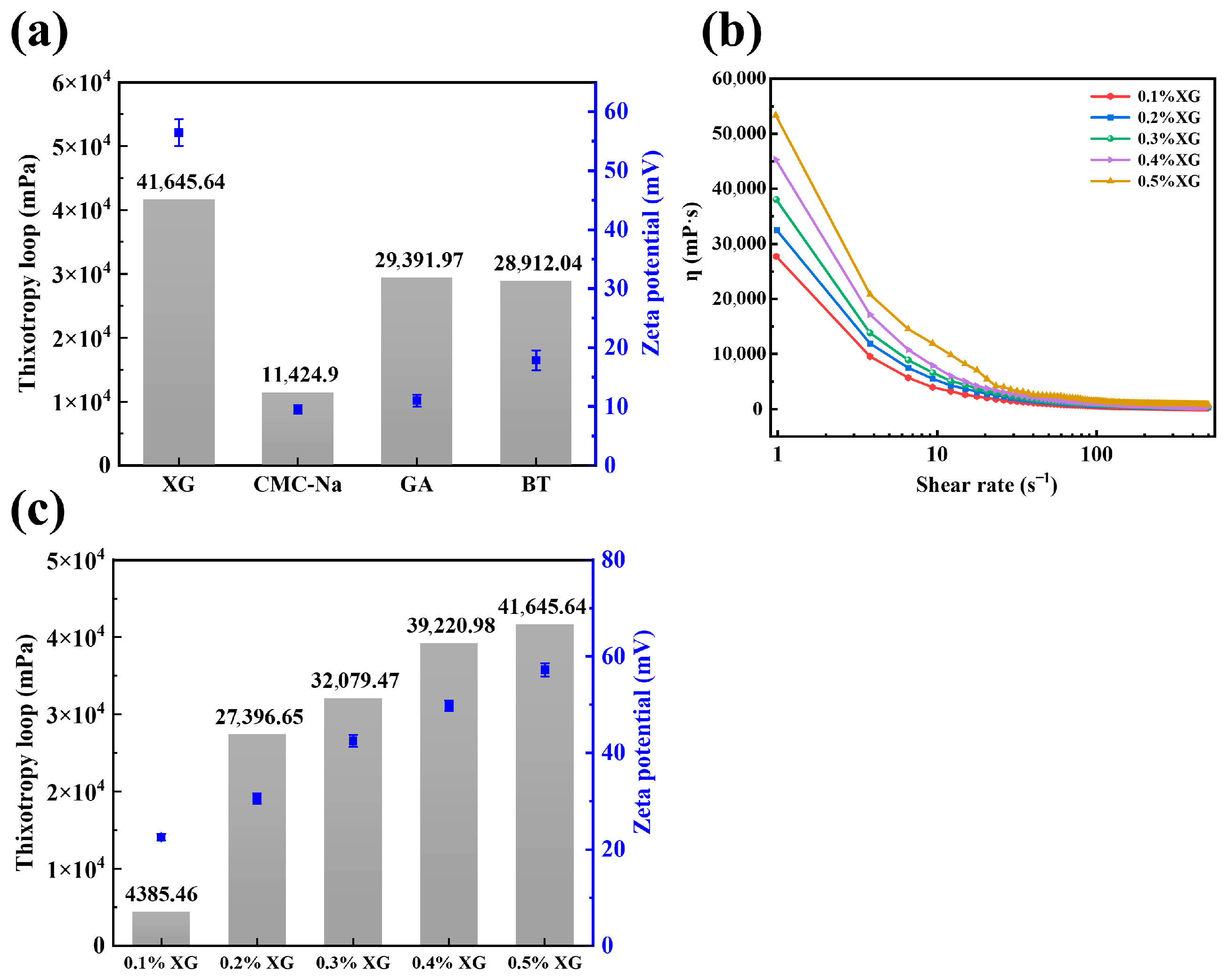
Based on using 0.4% SLF as the dispersant, we investigated the effects of different thickeners at the same dosage on the stability of the suspension fertilizer. The results showed that the D50 particle size varied with thickener type in the order XG > CMC-Na > BT > GA (Table 3). This trend reflects differences in thickening capacity, as higher viscosity reduces system fluidity and limits particle size reduction during grinding. However, according to Stokes’ law, increased viscosity also slows particle settling, thereby enhancing stability [36]. Notably, the formulation with XG as the thickener exhibited the highest absolute zeta potential (56.45 mV, Figure 2a) and the largest thixotropic loop area (41,645.64 mPa, Figure 2 and Figure S2), demonstrating strong electrostatic repulsion and structural recovery ability [41,42,43]. Meanwhile, static stability tests (Table S5) showed that only the system containing XG had a water separation rate below 5% after 72 h, meeting the stability criteria for suspension systems [44,45]. It was evident that the stability of the suspension fertilizer was jointly influenced by particle size, system viscosity, and zeta potential. Therefore, XG was selected as the thickener for this suspension fertilizer.
As shown in Table 3, both D10 and D50 particle sizes increased with higher XG content, confirming that elevated viscosity hinders grinding efficiency and limits further particle size reduction. Figure 2b illustrates that the viscosity of the suspension fertilizer was enhanced with the increase in the amount of XG when there was no/low shear rate. Meanwhile, the viscosity of all the suspension fertilizers decreased sharply with the increase in shear rate, exhibiting a significant shear thinning phenomenon [46]. Bogusz et al. [14] indicated that the decrease in viscosity under high shear rates benefits the formation of drops during the fertilizer application. Figure 2c and Figure S3 showed that the thixotropic loop of the suspension fertilizer gradually expanded with increasing XG dosage. However, the growth rate of the thixotropic loop first increased and then decreased, reaching a peak at an XG dosage of 0.20%. Meanwhile, as the XG dosage increased, the absolute value of the zeta potential also showed a gradual upward trend (Figure 2c). When the addition reached 0.30% or higher, the system achieved electrostatic stability (40 mV). According to the static stability test results (Table S5), to effectively maintain product stability, the XG dosage should not be less than 0.30%. Considering all factors comprehensively, the XG dosage should be maintained at 0.30% or above to ensure system stability.

3.1.3. Defoamers

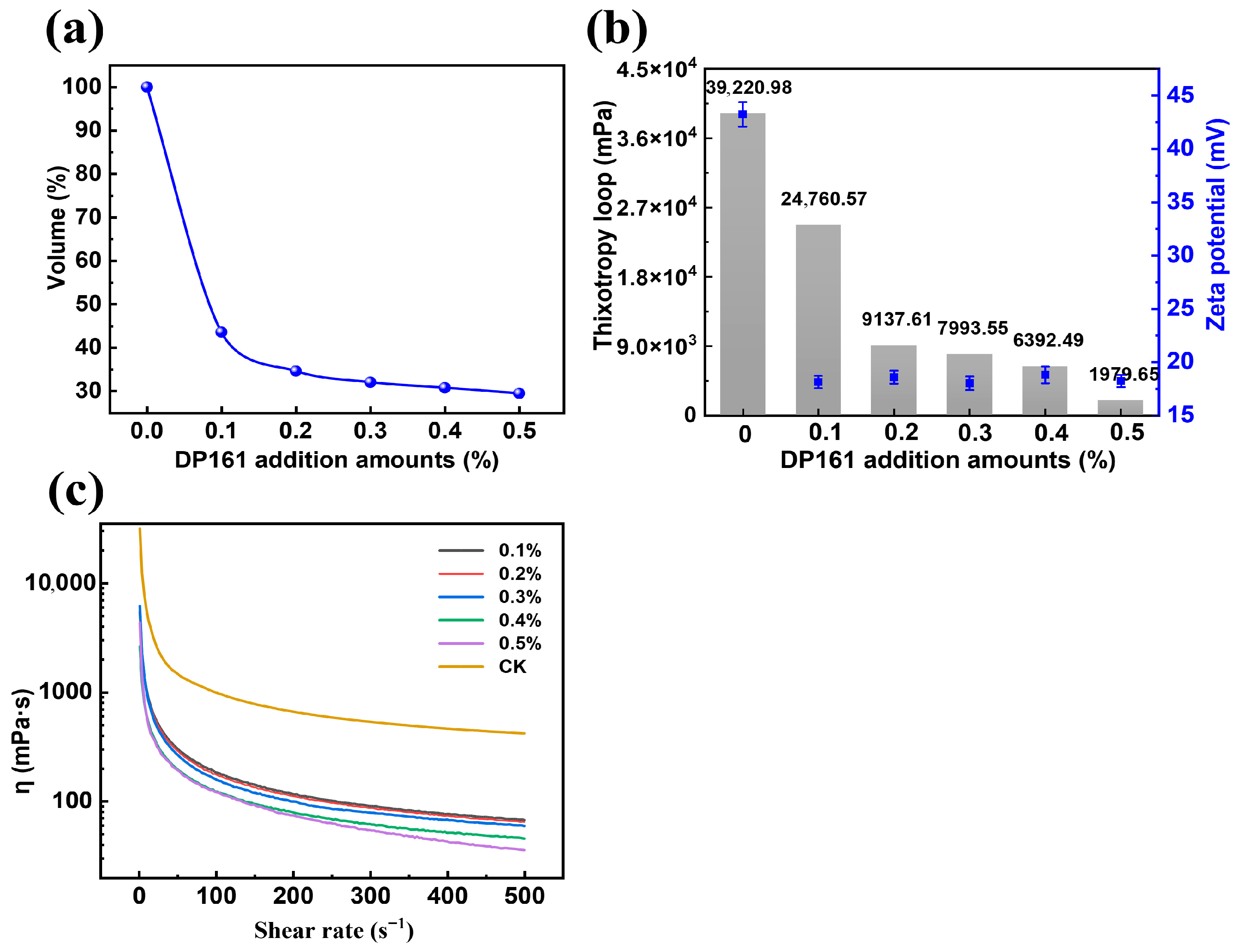
The grinding process increased the volume of the suspension fertilizer by two to threefold, significantly reducing nutrient content per unit volume and potentially compromising product standards while raising transportation costs. The introduction of defoamers can enable rapid foam suppression or elimination. Among commonly used types, silicone-based defoamers offer superior applicability [47]. Thus, this study selected DP161, a type of organic silicon defoamer, for the suspension fertilizer system. As shown in Figure 3a, the volume of the suspension fertilizer decreased sharply by over 55% at a DP161 dosage of 0.10%, with no significant further reduction beyond 0.20%. The incorporation of DP161 also lowered the absolute Zeta potential to below 30 mV (Figure 3b), suggesting a potential decline in long-term storage stability due to weakened electrostatic repulsion [48]. However, the Zeta potential remained stable at approximately 18 mV with increasing defoamer content, indicating no further destabilization at higher dosages. Figure 3c shows that DP161 significantly reduced product viscosity, attributed to the adsorption of defoamer molecules on particle surfaces, which increases the contact angle and impairs wettability [47]. Under high-shear conditions, viscosity continued to decline with rising DP161 content, potentially influencing application fluidity. The thixotropic loop also decreased markedly with defoamer addition (Figure 3b and Figure S4), as DP161 reduces interfacial tension, disrupting bubble structure and persistence. Therefore, considering the impact of defoamer on stability and defoaming effect, a dosage of 0.20% should be a balanced choice.
To assess the impact of 0.20% DP161 on system stability, a centrifugation test was performed. As shown in Table S6, the sample containing the defoamer exhibited a water separation rate of 2.33%, which was 1.28% higher than the control but remained well below the 5.00% threshold, indicating acceptable stability retention. Furthermore, compared with the suspension fertilizer without DP161, the product with DP161 had significant advantages regarding nutrient content and transportation costs. Thus, the defoamer dosage was determined to be 0.20% in this suspension fertilizer system.

3.2. Storage Stability

Based on the above research, we can determine that SLF, XG, and DP161 were the optimal dispersant, thickener, and defoamer in the studied system, respectively. Meanwhile, the SLF, XG, and DP161 at dosages of 0.40%, 0.30% and 0.20%, respectively, could be a good choice. Therefore, we further investigated the storage stability of suspension fertilizer under this condition. In addition, the addition of DP161 can reduce the stability of the system but enhance its fluidity while the addition of XG has the opposite effect. Hence, a slight increase in the content of XG might be able to counteract the negative impact that DP161 has on the stability of the system. Thus, we also investigated the storage stability of samples with 0.4% XG.

3.2.1. Cold Storage

Cold storage test simulated low-temperature storage conditions to observe whether there were any phenomena such as water separation in the samples. Table 4 shows that none of the samples had water separation under the cold storage condition (0 °C, 14 days). Interestingly, adding the defoamer increased the particle size in the 0.30% XG system (Table 5 and Figure S5a) but reduced the product’s particle size in the 0.40% XG system (Table 5 and Figure S5a). Meanwhile, in the 0.20% DP161 system, compared to the sample with 0.30% XG, the sample with 0.40% XG increased the D10 and D50 particle sizes, but decreased the D90 particle size (Table 5 and Figure S5a). This narrower and more uniform distribution tends to bring about better stability. Hence, it is possible to increase the dosage of the thickener to counteract the destabilizing effect of the defoamer.

3.2.2. Hot Storage

The hot storage test (50 °C, 14 days) simulated high-temperature storage conditions to observe whether any phenomena such as gas expansion, water separation, or precipitation occurred in the samples. In our study, we did not observe any signs of gas expansion or precipitation, but the suspension fertilizer exhibited varying degrees of water separation (Table 4). The water separation rate increased in the 0.30% XG system but remained unchanged in the 0.40% XG system (Table 4) after the addition of the defoamer. Furthermore, in the 0.20% DP161 system, compared to the sample with 0.30% XG, the sample with 0.40% XG decreased by 4.45% water separation rate (Table 4). This indicated that if the product maintains its storage stability in a high-temperature environment, the XG dosage should not be lower than 0.40%.
On the other hand, incorporating 0.20% DP161 into the 0.30% XG system led to an increase in particle size (Table 5) and a noticeable shift in particle size distribution toward larger diameters (Figure S5b). This suggests that the defoamer promotes particle growth, likely by accelerating Ostwald ripening, which consequently reduces product stability [49,50]. This result explained the increase in water separation rate (Table 4). However, adding the 0.20% DP161 reduced the D50 and D90 particle size in the 0.40% XG system while slightly increasing the D10 particle size (Table 5 and Figure S5b). This indicated that increasing XG dosage will narrow the particle size distribution of the product, which not only reduces the volume of the product but also enhances its suspension stability.
Overall, the results demonstrated that a formulation containing 0.40% SLF as dispersant, 0.40% XG as thickener, and 0.20% DP161 as defoamer most effectively enhanced the stability of the suspension fertilizer. It should be noted, however, that the chemical composition of the liquid waste may vary across production batches, which can influence stabilizer interactions and overall suspension stability. In particular, changes in organic matter content may influence adsorption and electrostatic interactions critical for colloidal stability [51,52]. Nevertheless, SLF and XG both possess significant stabilizing advantages in electrostatic repulsion, steric hindrance [53,54], and viscosity, which should enhance the formulation’s tolerance to raw material variability.

3.3. Agricultural Effects of Suspension Fertilizer

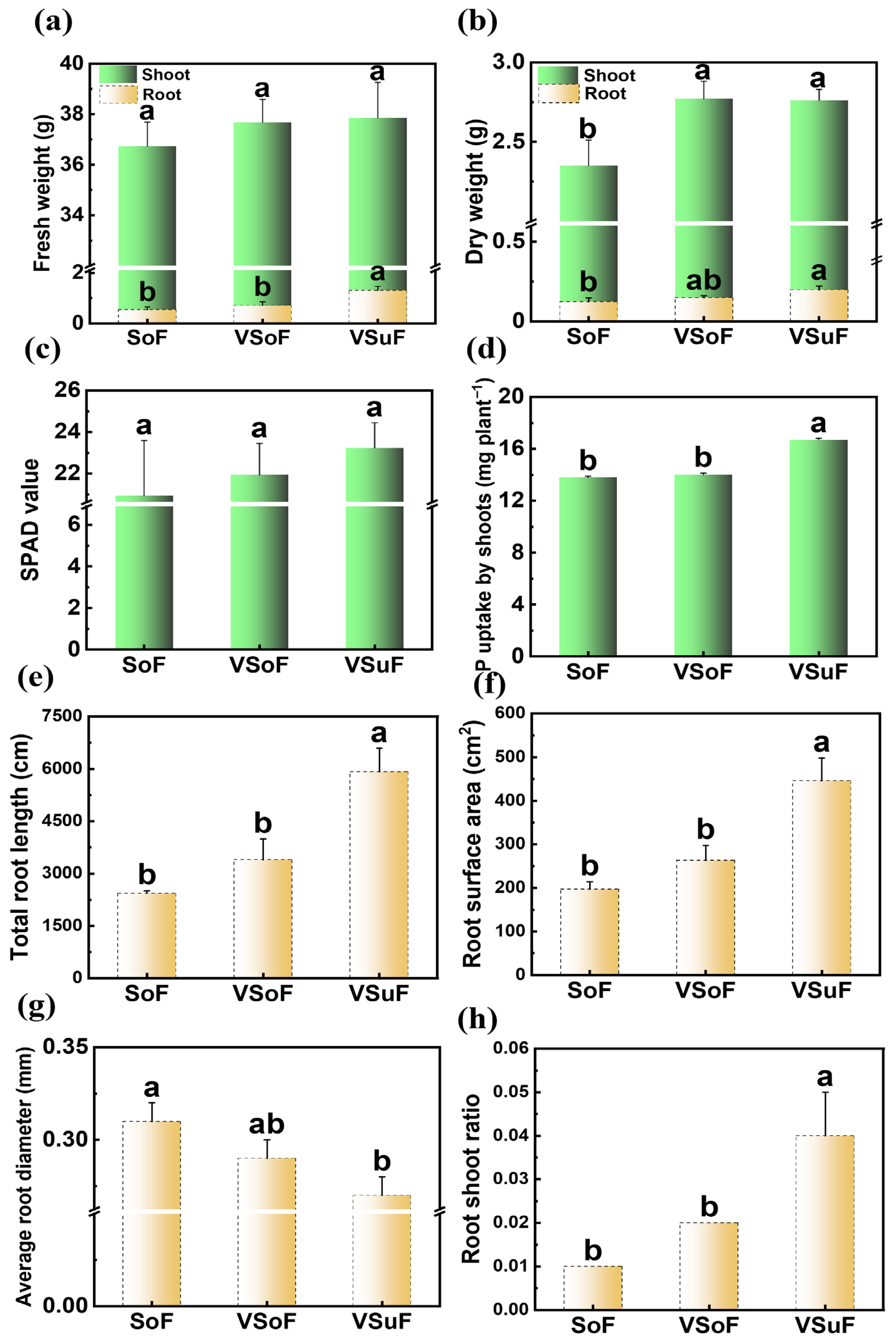
The effects of different fertilizers on the growth of bok choy are shown in Figure 4. Compared to SoF, both VSoF and VSuF treatments led to a slight increase in fresh weight (Figure 4a) and a significant increase (approximately 18%) in shoot dry weight (Figure 4b). These results suggested that value-added compounds in soybean residue, such as glucose and other organic components, positively influenced bok choy growth. Previous studies had indicated that glucose and similar compounds [12] could affect plants throughout their life cycle, largely through interactions between sugars and phytohormone signaling pathways, including abscisic acid, auxin, and cytokinin, which might further modulate plant metabolic pathways [8,9,10]. This mechanism might have accounted for the observed increase in chlorophyll content following application of value-added fertilizers (Figure 4c).
Compared to SoF, VSuF significantly increased root fresh weight and P uptake in shoots (Figure 4a,d), indicating its potential to enhance nutrient acquisition through alterations in root growth. This effect may be attributed to the ability of organic components in the filtrate, such as glucose, amino acids, and peptides, to form complexes or chelates with soil nutrients (e.g., P, iron, and magnesium), thereby increasing their solubility, bioavailability, and uptake by roots [55,56]. Moreover, organic components could improve soil physicochemical properties by enhancing soil structure and water retention while reducing compaction, thereby facilitating root growth and nutrient diffusion, which indirectly supports nutrient uptake [57,58]. In contrast, VSoF only significantly increased root length and surface area compared to SoF (Figure 4e,f), indicating limited stimulatory effects on root development when glucose was supplied as the sole value-added compound during short-term cultivation. Notably, compared to VSoF, VSuF treatment significantly enhanced root length, root surface area and the root–shoot ratio by 74.47%, 69.34%, and 80.56%, respectively (Figure 4e,f,h). These indicated that the growth-promoting effect of VSuF arises not only from sugars as a carbon source but also from the synergistic action of value-added compounds such as amino acids and peptides, enhancing its biostimulatory impact [59]. Concurrently, VSuF led to a reduction in average root diameter relative to VSoF (Figure 4g). This result was consistent with the root economics spectrum theory proposed by Bergmann et al. [60], which posited a negative correlation between specific root length and average root diameter. These morphological shifts toward finer roots aligned with plant strategies associated with rapid nutrient acquisition [61,62], further corroborating the observed physiological responses. In summary, VSuF had significant advantages over VSoF in promoting bok choy’s root development and P uptake.

4. Conclusions

This study developed an organic value-added suspension fertilizer using liquid waste. When 0.40% SLF was used as a dispersant, 0.40% XG as a thickener, and 0.20% DP161 as a defoamer, the suspension fertilizer exhibited almost no water separation after 14 days of storage at 0 °C, and only a 1.11% water separation rate after 14 days at 50 °C, demonstrating excellent stability. Meanwhile, VSuF significantly promoted crop root development, thereby resulting in P uptake increases of 19.80% compared to VSoF, demonstrating the potential to reduce environmental pollution. This study holds important value for the resource utilization of organic waste and the development of efficient fertilizers. Future work should focus on field-scale validation and investigation across a wider range of crops to gain a deeper understanding of the synergistic mechanisms of organic components and the long-term stability of fertilizers.

Supplementary Materials

The following supporting information can be downloaded at: https://www.mdpi.com/article/10.3390/agriculture15242568/s1, Table S1: Soil properties; Table S2: Main experimental materials; Table S3: Main experimental equipment and instruments; Table S4: Specific classifications of dispersants and thickeners; Figure S1: Effect of sodium lignosulfonate (SLF) addition on Zeta potential of the suspension fertilizer; Figure S2: Effect of thickener types on the thixotropic loop of suspension fertilizers; Table S5: Effect of different thickeners on the static stability of suspension fertilizer; Figure S3: Effect of xanthan gum (XG) dosage on the thixotropic curve of suspension fertilizers; Table S6: Centrifugal stability of suspension fertilizer products; Figure S4: Effect of defoamer (DP161) dosage on the thixotropic curve of suspension fertilizers; Figure S5: Effect of cold and hot storage on particle size distribution of suspension fertilizer. XG, xanthan gum; DP161, a type of organic silicon defoamer.

Author Contributions

Conceptualization, Z.Y. and X.W.; methodology, L.X.; software, Y.S. and Y.L.; validation, Y.S., Y.L. and L.X.; formal analysis, Y.S., Y.L. and L.X.; investigation, L.X.; resources, Z.Y. and X.W.; data curation, Y.S., Y.L. and L.X.; writing—original draft preparation, Y.S., Y.L.; writing—review and editing, Z.Y., D.X. and X.W.; visualization, Y.S. and Y.L.; supervision, Z.Y., D.X. and X.W.; project administration, Z.Y. and X.W.; funding acquisition, Z.Y. and X.W. All authors have read and agreed to the published version of the manuscript.

Funding

This research was funded by the National Key Research and Development Program of China (No. 2023YFD1700204) and the Fundamental Research Funds for the Central Universities (SCU2025D009).

Data Availability Statement

The data presented in this study are available on request from the corresponding author.

Acknowledgments

We thanks to the financial support from the National Key Research and Development Program of China (No. 2023YFD1700204) and the Fundamental Research Funds for the Central Universities (SCU2025D009).

Conflicts of Interest

The authors declare no competing financial.

References

  1. McArthur, J.W.; McCord, G.C. Fertilizing growth: Agricultural inputs and their effects in economic development. J. Dev. Econ. 2017, 127, 133–152. [Google Scholar] [CrossRef]
  2. Wang, W.S.; Yang, S.Q.; Liu, H.Y.; Yang, Z.L.; Zhang, A.P. A novel multifunctional fertilizer derived from wasted straw: Synthesis, characteristics and agriculture applications. Ind. Crops Prod. 2022, 176, 114308. [Google Scholar] [CrossRef]
  3. Yu, X.; Keitel, C.; Dijkstra, F.A. Global analysis of phosphorus fertilizer use efficiency in cereal crops. Glob. Food Secur. 2021, 29, 100545. [Google Scholar] [CrossRef]
  4. Dobermann, A.; Bruulsema, T.; Cakmak, I.; Gerard, B.; Majumdar, K.; McLaughlin, M.; Reidsma, P.; Vanlauwe, B.; Wollenberg, L.; Zhang, F.S.; et al. Responsible plant nutrition: A new paradigm to support food system transformation. Glob. Food Secur. 2022, 33, 100636. [Google Scholar] [CrossRef]
  5. Maaz, T.M.; Dobermann, A.; Lyons, S.E.; Thomson, A.M. Review of research and innovation on novel fertilizers for crop nutrition. Npj Sustain. Agric. 2025, 3, 25. [Google Scholar] [CrossRef]
  6. Chu, X.L.; Peng, X.Y.; Sun, Z.Y.; Xie, C.Y.; Tang, Y.Q. Converting kitchen waste into value-added fertilizer using thermophilic semi-continuous composting-biofiltration two-stage process with minimized NH3 emission. Bioresour. Technol. 2024, 406, 130955. [Google Scholar] [CrossRef] [PubMed]
  7. Ali, Z.; Akram, M.; Ali, M.A.; Shoaib, M.; Khurshid, M.Y.; Iqbal, J.; Shah, S.S.H.; Khan, A.; Mehboob, A. Value added fertilizers ameliorate grain yield and nutritional quality of maize crop. Paki. J. Sci. 2023, 75, 51–58. [Google Scholar] [CrossRef]
  8. Rolland, F.; Baena-Gonzalez, E.; Sheen, J. Sugar sensing and signaling in plants: Conserved and novel mechanisms. Annu. Rev. Plant. Biol. 2006, 57, 675–709. [Google Scholar] [CrossRef] [PubMed]
  9. León, P.; Sheen, J. Sugar and hormone connections. Trends Plant Sci. 2003, 8, 110–116. [Google Scholar] [CrossRef]
  10. Kushwah, S.; Laxmi, A. The interaction between glucose and cytokinin signaling in controlling Arabidopsis thaliana seedling root growth and development. Plant Signal. Behav. 2017, 12, e1312241. [Google Scholar] [CrossRef]
  11. Yuan, T.T.; Xu, H.H.; Zhang, K.X.; Guo, T.T.; Lu, Y.T. Glucose inhibits root meristem growth via ABA INSENSITIVE 5, which represses PIN1 accumulation and auxin activity in Arabidopsis. Plant Cell Environ. 2014, 37, 1338–1350. [Google Scholar] [CrossRef] [PubMed]
  12. Mishra, B.S.; Singh, M.; Aggrawal, P.; Laxmi, A. Glucose and auxin signaling interaction in controlling arabidopsis thaliana seedlings root growth and development. PLoS ONE 2009, 4, e4502. [Google Scholar] [CrossRef] [PubMed]
  13. Luckham, P.F. The physical stability of suspension concentrates with particular reference to pharmaceutical and pesticide formulations. Pest Manag. Sci. 1989, 25, 25–34. [Google Scholar] [CrossRef]
  14. Bogusz, P.; Rusek, P.; Brodowska, M.S. Suspension fertilizers: How to reconcile sustainable fertilization and environmental protection. Agriculture 2021, 11, 1008. [Google Scholar] [CrossRef]
  15. Gorazda, K.; Kominko, H.; Nowak, A.K.; Wiśniak, A. Suspension fertilisers based on alternative raw materials—The key to sustainability and closed nutrient cycles. Arch. Environ. Prot. 2023, 49, 38–49. [Google Scholar]
  16. Bogusz, P.; Rusek, P.; Brodowska, M.S. Suspension fertilizers based on waste phosphates from the production of polyols. Molecules 2022, 27, 7916. [Google Scholar] [CrossRef]
  17. Ibrahim, H.; Boukerrou, A.; Hammiche, D. Effect of dispersant agent content on the properties of composites based on poly (Lactic Acid) and alfa fiber. Macromol. Symp. 2021, 395, 2000266. [Google Scholar] [CrossRef]
  18. Soleimani-Gorgani, A.; Bakhshandeh, E.; Najafi, F. Effect of dispersant agents on morphology and optical–electrical properties of nano indium tin oxide ink-jet ink. J. Eur. Ceram. Soc. 2014, 34, 2959–2966. [Google Scholar] [CrossRef]
  19. Hashmi, S.M.; Quintiliano, L.A.; Firoozabadi, A. Polymeric dispersants delay sedimentation in colloidal asphaltene suspensions. Langmuir 2010, 26, 8021–8029. [Google Scholar] [CrossRef]
  20. Cong, L.; Zou, B.; Palacios, A.; Navarro, M.E.; Qiao, G.; Ding, Y. Thickening and gelling agents for formulation of thermal energy storage materials—A critical review. Renew. Sustain. Energy Rev. 2022, 155, 111906. [Google Scholar] [CrossRef]
  21. Foratirad, H.; Baharvandi, H.R.; Maragheh, M.G. Effects of dispersants on dispersibility of titanium carbide aqueous suspension. Int. J. Refract. Met. Hard Mater. 2016, 56, 96–103. [Google Scholar] [CrossRef]
  22. Gao, C. Potential of welan gum as mud thickener. J. Petrol. Explor. Prod. Technol. 2015, 5, 109–112. [Google Scholar] [CrossRef]
  23. Xiang, S.; Li, B.; Lyu, Y. Suspension fertilizers based on waste organic matter from peanut oil extraction by-products. Agronomy 2025, 15, 1885. [Google Scholar] [CrossRef]
  24. Farías, R.; Martínez García, C.; Cotes Palomino, T.; Martínez Arellano, M. Effects of wastes from the brewing industry in lightweight aggregates manufactured with clay for green roofs. Materials 2017, 10, 527. [Google Scholar] [CrossRef] [PubMed]
  25. Kominko, H.; Gorazda, K.; Wzorek, Z. Formulation and evaluation of organo-mineral fertilizers based on sewage sludge optimized for maize and sunflower crops. Waste Manag. 2021, 136, 57–66. [Google Scholar] [CrossRef]
  26. Riya, S.; Zhou, S.; Kobara, Y.; Sagehashi, M.; Terada, A.; Hosomi, M. Effects of N loading rate on CH4 and N2O emissions during cultivation and fallow periods from forage rice fields fertilized with liquid cattle waste. J. Environ. Manag. 2015, 161, 124–130. [Google Scholar] [CrossRef] [PubMed]
  27. Sniatala, B.; Kurniawan, T.A.; Sobotka, D.; Makinia, J.; Othman, M.H.D. Macro-nutrients recovery from liquid waste as a sustainable resource for production of recovered mineral fertilizer: Uncovering alternative options to sustain global food security cost-effectively. Sci. Total Environ. 2023, 856, 159283. [Google Scholar] [CrossRef]
  28. Crusciol, C.A.C.; Campos, M.d.; Martello, J.M.; Alves, C.J.; Nascimento, C.A.C.; Pereira, J.C.d.R.; Cantarella, H. Organomineral fertilizer as source of P and K for sugarcane. Sci. Rep. 2020, 10, 5398. [Google Scholar] [CrossRef]
  29. Chang, M.-Y.; Huang, W.-J. Hydrothermal biorefinery of spent agricultural biomass into value-added bio-nutrient solution: Comparison between greenhouse and field cropping data. Ind. Crops Prod. 2018, 126, 186–189. [Google Scholar] [CrossRef]
  30. Alfosea-Simón, M.; Simón-Grao, S.; Zavala-Gonzalez, E.A.; Cámara-Zapata, J.M.; Simón, I.; Martínez-Nicolás, J.J.; Lidón, V.; García-Sánchez, F. Physiological, nutritional and metabolomic responses of tomato plants after the foliar application of amino acids aspartic acid, glutamic acid and alanine. Front. Plant Sci. 2021, 11, 581234. [Google Scholar] [CrossRef]
  31. Shahrajabian, M.H.; Chaski, C.; Polyzos, N.; Petropoulos, S.A. Biostimulants application: A low input cropping management tool for sustainable farming of vegetables. Biomolecules 2021, 11, 698. [Google Scholar] [CrossRef]
  32. Xu, L.; Sun, C.Q.; Xu, D.H.; Yan, Z.J.; Li, X.; Zhong, B.H.; Wang, X.L. Optimizing of preparing crude microcrystalline cellulose from okara by response surface methods. J. Ind. Eng. Chem. 2025, 42, 1–8. [Google Scholar]
  33. Kumar, A.; Shahbaz, M.; Koirala, M.; Blagodatskaya, E.; Seidel, S.J.; Kuzyakov, Y.; Pausch, J. Root trait plasticity and plant nutrient acquisition in phosphorus limited soil. J. Soil Sci. Plant Nutr. 2019, 182, 945–952. [Google Scholar] [CrossRef]
  34. Marco, P.; Llorens, J. Adsorption of some linear copolymers onto kaolin particles in concentrated suspensions: Liquids and MesoScience. Colloid. Surf. A 2005, 270–271, 291–295. [Google Scholar] [CrossRef]
  35. Gołębiowski, A.; Buszewski, B. Characterization of colloidal particles of a biological and metallic nature. Microchem. J. 2023, 191, 108864. [Google Scholar] [CrossRef]
  36. Idema, T. Stokes flow with Oseen tensors: Stokes’ law, force fields, and flow near a wall. Eur. J. Phys. 2025, 46, 35802. [Google Scholar] [CrossRef]
  37. Boisvert, J.P.; Persello, J.; Castaing, J.C.; Cabane, B. Dispersion of alumina-coated TiO2 particles by adsorption of sodium polyacrylate. Colloid. Surf. A 2001, 178, 187–198. [Google Scholar] [CrossRef]
  38. Shakrani, S.A.; Ayob, A.; Ab Rahim, M.A.; Alias, S. Stability of kaolin particles subjected to elevated temperatures using various dispersing agents. J. Phys. Conf. Ser. 2020, 1529, 42099. [Google Scholar] [CrossRef]
  39. Yang, D.J.; Qiu, X.Q.; Zhou, M.S.; Lou, H.M. Properties of sodium lignosulfonate as dispersant of coal water slurry. Energy Convers. Manag. 2007, 48, 2433–2438. [Google Scholar] [CrossRef]
  40. Konduri, M.K.R.; Fatehi, P. Designing anionic lignin based dispersant for kaolin suspensions. Colloid. Surf. A 2018, 538, 639–650. [Google Scholar] [CrossRef]
  41. Barick, P.; Prasad Saha, B.; Mitra, R.; Joshi, S.V. Effect of concentration and molecular weight of polyethylenimine on zeta potential, isoelectric point of nanocrystalline silicon carbide in aqueous and ethanol medium. Ceram. Int. 2015, 41, 4289–4293. [Google Scholar] [CrossRef]
  42. Pochapski, D.J.; Carvalho dos Santos, C.; Leite, G.W.; Pulcinelli, S.H.; Santilli, C.V. Zeta potential and colloidal stability predictions for inorganic nanoparticle dispersions: Effects of experimental conditions and electrokinetic models on the interpretation of results. Langmuir 2021, 37, 13379–13389. [Google Scholar] [CrossRef] [PubMed]
  43. Xie, Z.P.; Ma, J.T.; Xu, Q.; Huang, Y.; Cheng, Y.B. Effects of dispersants and soluble counter-ions on aqueous dispersibility of nano-sized zirconia powder. Ceram. Int. 2004, 30, 219–224. [Google Scholar] [CrossRef]
  44. Liu, S.; Sun, J.; Zhang, J.; Xie, Z.; Yu, Z. Effect of graphene oxide on the mechanical property and microstructure of clay-cement slurry. Materials 2023, 16, 4294. [Google Scholar] [CrossRef]
  45. Yu, Z.; Liu, S.; Zhang, J.; He, W.; Tian, Q.; Tian, L.; Sun, J. Experimental study on the effect of polycarboxylate superplasticizer on the performance of cement-based grouting materials. Materials 2024, 17, 3620. [Google Scholar] [CrossRef]
  46. Rylant, W.K.; Moore, O.E.; Lee, R.G. Suspension quality and grade from commercial MAP. Fert. Res. 1991, 28, 115–122. [Google Scholar] [CrossRef]
  47. Yang, P.J.; Li, L.; Qin, S.; Wu, D.; Peng, Y.; Liu, H.Y.; Peng, X.Y. Effects and mechanisms of foam suppression in food waste anaerobic digester using defoaming agents. Fuel 2023, 342, 127920. [Google Scholar] [CrossRef]
  48. Mao, J.X.; Chen, T.; Guo, L.; Yang, S.Z.; Xu, X.; Ma, J.; Hu, J.Q. Effect of additives on the foam behavior of aviation coolants: Tendency, stability, and defoaming. ACS Omega 2020, 5, 17686–17691. [Google Scholar] [CrossRef]
  49. Liu, Q.W.; Fang, Y.L.; Xiong, X.H.; Xu, W.M.; Cui, J.X. Ostwald ripening for designing time—Dependent crystal hydrogels. Angew. Chem. Int. Ed. Engl. 2024, 63, e202320095. [Google Scholar] [CrossRef]
  50. Zhou, L.; Zhang, J.; Wu, Y.Q.; Wang, W.X.; Ming, H.; Sun, Q.J.; Wang, L.M.; Ming, J.; Alshareef, H.N. Understanding ostwald ripening and surface charging effects in solvothermally—Prepared metal oxide–carbon anodes for high performance rechargeable batteries. Adv. Energy Mater. 2019, 9, 1902194. [Google Scholar] [CrossRef]
  51. Rose, D.L.G.; Hudson, M.D.; Bray, S.; Gaca, P. Assessment of the estuarine shoreline microplastics and mesoplastics of the River Itchen, Southampton (UK) for contaminants and for their interaction with invertebrate fauna. Environ. Sci. Pollut. Res. 2024, 31, 6437–6459. [Google Scholar] [CrossRef] [PubMed]
  52. Xu, Y.; Ou, Q.; Li, X.; Wang, X.; van der Hoek, J.P.; Liu, G. Combined effects of photoaging and natural organic matter on the colloidal stability of nanoplastics in aquatic environments. Water Res. 2022, 226, 119313. [Google Scholar] [CrossRef] [PubMed]
  53. Hong, S.J.; Shin, G.H.; Kim, J.T. Fabrication and application of turmeric extract-incorporated oleogels structured with xanthan gum and soy lecithin by emulsion template. Gels 2024, 10, 84. [Google Scholar] [CrossRef]
  54. Huang, C.; Ma, J.; Zhang, W.; Huang, G.; Yong, Q. Preparation of lignosulfonates from biorefinery lignins by sulfomethylation and their application as a water reducer for concrete. Polymers 2018, 10, 841. [Google Scholar] [CrossRef] [PubMed]
  55. Olbrycht, M.; Kołodziej, M.; Bochenek, R.; Przywara, M.; Balawejder, M.; Matłok, N.; Antos, P.; Piątkowski, W.; Antos, D. Mechanism of nutrition activity of a microgranule fertilizer fortified with proteins. BMC Plant Biol. 2020, 20, 126. [Google Scholar] [CrossRef]
  56. Saldanha, L.L.; Allard, P.M.; Afzan, A.; de Melo, F.P.d.S.R.; Marcourt, L.; Queiroz, E.F.; Vilegas, W.; Furlan, C.M.; Dokkedal, A.L.; Wolfender, J.-L. Metabolomics of myrcia bella populations in brazilian savanna reveals strong influence of environmental factors on its specialized metabolism. Molecules 2020, 25, 2954. [Google Scholar] [CrossRef]
  57. Jin, X.; Zhu, J.; Wei, X.; Xiao, Q.R.; Xiao, J.Y.; Jiang, L.; Xu, D.W.; Shen, C.X.; Liu, J.F.; He, Z.S. Adaptation strategies of seedling root response to nitrogen and phosphorus addition. Plants 2024, 13, 536. [Google Scholar] [CrossRef]
  58. Gaurav, S.; Diptanu, B.; Mehta, C.M.; Prasann, K.; Nishihara, E.; Inubushi, K.; Sudo, S.; Hayashida, S.; Patra, P.K.; Minkina, T.; et al. Effects of biochar amendment at various soil depths on maize roots and growth indices. Sci. Rep. 2025, 15, 26310–26316. [Google Scholar] [CrossRef]
  59. Staykov, N.S.; Angelov, M.; Petrov, V.; Minkov, P.; Kanojia, A.; Guinan, K.J.; Alseekh, S.; Fernie, A.R.; Sujeeth, N.; Gechev, T.S. An ascophyllum nodosum-derived biostimulant protects model and crop plants from oxidative stress. Metabolites 2020, 11, 24. [Google Scholar] [CrossRef]
  60. Bergmann, J.; Weigelt, A.; van der Plas, F.; Laughlin, D.C.; Kuyper, T.W.; Guerrero-Ramirez, N.; Valverde-Barrantes, O.J.; Bruelheide, H.; Freschet, G.T.; Iversen, C.M.; et al. The fungal collaboration gradient dominates the root economics space in plants. Sci. Adv. 2020, 6, eaba3756. [Google Scholar] [CrossRef]
  61. Freschet, G.T.; Cornelissen, J.H.C.; van Logtestijn, R.S.P.; Aerts, R. Evidence of the ‘plant economics spectrum’ in a subarctic flora. J. Ecol. 2010, 98, 362–373. [Google Scholar] [CrossRef]
  62. Reich, P.B. The world-wide ‘fast–slow’ plant economics spectrum: A traits manifesto. J. Ecol. 2014, 102, 275–301. [Google Scholar] [CrossRef]
Figure 1. The production processes of coarse microcrystalline cellulose (CMCC) (a) and organic value-added suspension fertilizer (VSuF) (b).
Agriculture 15 02568 g001
Figure 2. Effects of the four different thickeners on thixotropy loop and Zeta potential values of suspension fertilizer (a); effect of XG dosage on viscosity (b), thixotropy loop and Zeta potential values (c) of suspension fertilizer. XG, xanthan gum; CMC-Na, sodium carboxymethyl cellulose; GA, gum arabic; BT, bentonite.
Agriculture 15 02568 g002
Figure 3. Effect of an organic silicon defoamer (DP161) dosage on volume (a), Zeta potential, thixotropy loop (b), and viscosity (c) of suspension fertilizer.
Agriculture 15 02568 g003
Figure 4. Effect of suspension fertilizer on fresh weight (a), dry weight (b), SPAD value (c), plant phosphorus (P) uptake in shoots (d), total root length (e), root surface area (f), average root diameter (g), root–shoot ratio (h) of bok choy. Error bars represent the standard deviation for three replicates. Means denoted by identical letters have no significant difference (p < 0.05) based on the LSD test.
Agriculture 15 02568 g004
Table 1. Main components of the liquid waste.
P (mg·mL−1)K (mg·mL−1)Total Sugar (mg·mL−1)Polypeptides (mg·mL−1)Amino Acids (mg·mL−1)
71.7918.0394.276.840.61
Table 2. Effect of different dispersants on the characteristic particle size of suspension fertilizer.
Dispersants aDosage (%)D10 b (μm)D50 c (μm)D90 d (μm)
CK01.0814.5854.77
SLF0.501.768.4761.70
SDBS0.502.0816.80160.00
SDS0.5023.60713.00971.00
PEG-60000.5049.00155.18377.66
PP0.501.8310.20534.00
a CK, no dispersants addition; SLF, sodium lignosulfonate; SDBS, sodium dodecyl benzene sulfonate; SDS, sodium dodecyl sulfate; PEG-6000, polyethylene glycol-6000; PP, potassium pyrophosphate. b D10, the particle size corresponding to the cumulative distribution percentage of 10%. c D50, the particle size corresponding to the cumulative distribution percentage of 50%. d D90, the particle size corresponding to the cumulative distribution percentage of 90%.
Table 3. Effects of xanthan gum on the characteristic particle size of suspension fertilizer.
Thickeners aDosage (%)D10 b (μm)D50 c (μm)D90 d (μm)
CK01.068.4761.70
XG0.507.4524.7158.24
CMC-Na0.507.5619.2250.74
GA0.503.217.3463.90
BT0.503.568.5737.55
XG0.103.239.5656.99
XG0.204.2815.1357.38
XG0.306.8918.3558.32
XG0.407.2320.1257.35
a CK, no thickener addition; XG, xanthan gum; CMC-Na, sodium carboxymethyl cellulose; GA, gum arabic; BT, bentonite. b D10, the particle size corresponding to the cumulative distribution percentage of 10%. c D50, the particle size corresponding to the cumulative distribution percentage of 50%. d D90, the particle size corresponding to the cumulative distribution percentage of 90%.
Table 4. Effect of cold (0 °C) and hot (50 °C) storage on water separation rate of suspension fertilizer.
Storage ConditionTime (d)SLF a (%)XG b (%)DP161 c (%)Water Separation Rate (%)
Cold140.400.3000
Cold140.400.300.200
Cold140.400.4000
Cold140.400.400.200
Hot140.400.3003.33
Hot140.400.300.205.56
Hot140.400.4001.11
Hot140.400.400.201.11
a SLF, sodium lignosulfonat. b XG, xanthan gum. c DP161, a type of organic silicon defoamer.
Table 5. Characteristic particle size of suspension fertilizer after 14 d cold (0 °C) and hot (50 °C) storage.
Storage ConditionSLF a (%)XG b (%)DP161 c (%)D10 d (μm)D50 e (μm)D90 f (μm)
Cold0.400.3003.7521.9066.78
Cold0.400.300.204.3525.49133.97
Cold0.400.4004.9630.57126.07
Cold0.400.400.204.5428.71110.55
Hot0.400.3004.2623.12101.12
Hot0.400.300.2021.7199.34264.88
Hot0.400.4003.3721.3799.41
Hot0.400.400.203.6519.7769.72
a SLF, sodium lignosulfonat. b XG, xanthan gum. c DP161, a type of organic silicon defoamer. d D10, the particle size corresponding to the cumulative distribution percentage of 10%. e D50, the particle size corresponding to the cumulative distribution percentage of 50%. f D90, the particle size corresponding to the cumulative distribution percentage of 90%.
Disclaimer/Publisher’s Note: The statements, opinions and data contained in all publications are solely those of the individual author(s) and contributor(s) and not of MDPI and/or the editor(s). MDPI and/or the editor(s) disclaim responsibility for any injury to people or property resulting from any ideas, methods, instructions or products referred to in the content.