Article

Solar Agro Savior: Smart Agricultural Monitoring Using Drones and Deep Learning Techniques

by
Manu Mundappat Ramachandran
1,
Bisni Fahad Mon
2,
Mohammad Hayajneh
2,3,*,
Najah Abu Ali
2 and
Elarbi Badidi
4
1
Department of Computer Science, Ministry of Education, Abu Dhabi P.O. Box 295, United Arab Emirates
2
Department of Computer & Network Engineering, United Arab Emirates University, Al Ain 15551, United Arab Emirates
3
Big Data Analytics Centre (BIDAC), United Arab Emirates University, Al Ain 15551, United Arab Emirates
4
Department of Computer Science & Software Engineering, United Arab Emirates University, Al Ain 15551, United Arab Emirates
*
Author to whom correspondence should be addressed.
Agriculture 2025, 15(15), 1656; https://doi.org/10.3390/agriculture15151656
Submission received: 12 June 2025 / Revised: 21 July 2025 / Accepted: 25 July 2025 / Published: 1 August 2025
(This article belongs to the Section Agricultural Technology)

Abstract

The Solar Agro Savior (SAS) is an innovative solution that is assisted by drones for the sustainable utilization of water and plant disease observation in the agriculture sector. This system integrates an alerting mechanism for humidity, moisture, and temperature variations, which affect the plants’ health and optimization in water utilization, which enhances plant yield productivity. A significant feature of the system is the efficient monitoring system in a larger region through drones’ high-resolution cameras, which enables real-time, efficient response and alerting for environmental fluctuations to the authorities. The machine learning algorithm, particularly recurrent neural networks, which is a pioneer with agriculture and pest control, is incorporated for intelligent monitoring systems. The proposed system incorporates a specialized form of a recurrent neural network, Long Short-Term Memory (LSTM), which effectively addresses the vanishing gradient problem. It also utilizes an attention-based mechanism that enables the model to assign meaningful weights to the most important parts of the data sequence. This algorithm not only enhances water utilization efficiency but also boosts plant yield and strengthens pest control mechanisms. This system also provides sustainability through the re-utilization of water and the elimination of electric energy through solar panel systems for powering the inbuilt irrigation system. A comparative analysis of variant algorithms in the agriculture sector with a machine learning approach was also illustrated, and the proposed system yielded 99% yield accuracy, a 97.8% precision value, 98.4% recall, and a 98.4% F1 score value. By encompassing solar irrigation and artificial intelligence-driven analysis, the proposed algorithm, Solar Argo Savior, established a sustainable framework in the latest agricultural sectors and promoted sustainability to protect our environment and community.

1. Introduction

Sustainable agriculture focuses on balancing food production with the preservation of the environment, ensuring economic viability, and promoting social equity. Its primary goal is to meet the needs of the present without compromising the ability of future generations to do the same. This approach encompasses practices that conserve natural resources, reduce greenhouse gas emissions, and enhance biodiversity. In addition, it emphasizes fair labor practices and equitable access to resources and markets, with the aim of improving the quality of life of farmers and rural communities [1]. Water scarcity is a critical challenge that significantly impacts agriculture, one of the most water-intensive industries. Although water covers 70% of the Earth’s surface, only 3% is freshwater, with two-thirds locked in glaciers or otherwise inaccessible for human use. This limited availability of freshwater resources underscores the importance of sustainable practices to ensure agricultural productivity. According to the United Nations Sustainable Development Goal (SDG) 6, which focuses on clean water and sanitation, innovative solutions are needed to balance water usage and agricultural efficiency [2].
Machine learning (ML), a subset of artificial intelligence (AI), offers immense potential for data-intensive research in multidisciplinary agrotechnologies. Its applications extend across various domains of agriculture, including crop management—such as yield prediction, disease detection, weed control, and species identification—as well as animal, water, and soil management [3]. Advancements in technology, particularly AI, drones, and sensor-based systems, present promising opportunities to optimize agricultural practices. Research has highlighted the effectiveness of AI-driven methods in plant disease detection and precision irrigation, contributing to improved productivity and sustainability.
In this context, we propose the Solar Agro Savior (SAS)—an advanced water management and plant health monitoring system designed to revolutionize sustainable agriculture. SAS uses recurrent neural networks (RNNs) and attention mechanisms, integrated with solar-powered irrigation, to provide a comprehensive solution for the identification of plant diseases, water recycling, and efficient resource utilization.
Autonomously operating with real-time data collection via drones and soil moisture sensors, SAS functions both day and night, significantly reducing the need for manual intervention. Studies on smart irrigation systems have shown their ability to decrease water consumption by up to 65% while simultaneously increasing crop yields [4]. By integrating these advanced technologies, SAS aligns with global sustainability goals, offering a scalable and impactful solution to address water scarcity and productivity challenges in modern agriculture. The structure of the paper is as follows. Section 2 provides a comprehensive literature review, exploring existing AI-driven approaches in agriculture, including plant disease detection, smart irrigation, and sensor-based monitoring technologies. Section 3 describes the methodology, detailing the design and implementation of SAS, including its integration of RNNs, attention mechanisms, and solar-powered irrigation. Section 4 outlines the performance metrics and equations, discussing the evaluation criteria used to measure the system’s effectiveness, including accuracy, precision, recall, and F1 score. Section 5 presents the results, where the performance of the SAS system is evaluated and compared with other prominent machine learning algorithms. Section 6 provides a detailed discussion of the results, highlighting their significance, implications, and alignment with existing research. Section 7 outlines the challenges faced by the current system and proposes future enhancements to improve scalability, accuracy, and adaptability. Finally, the Conclusion summarizes the key findings and emphasizes the potential impact of the SAS system on advancing sustainable agricultural practices in Section 8.

2. Literature Review

Several studies have explored the application of ML in agriculture, particularly for plant disease prediction and crop yield optimization. Traditional methods have primarily focused on improving agricultural productivity across various cultivated crops. In recent years, deep learning approaches have significantly enhanced efficiency by capturing complex relationships and dynamic interactions within agricultural systems. Compared to conventional techniques, advanced ML algorithms leverage sustainable energy resources and optimize processes, such as resource management and predictive maintenance [5].
Artificial Neural Networks (ANNs) have proven effective in optimizing solar energy utilization, improving resource management, and enabling intelligent environmental conservation [6]. The digital transformation of agriculture, driven by the Internet of Things (IoT), integrates diverse sensors and ML algorithms to enhance farm productivity. These innovations facilitate accurate crop yield predictions, drought analysis, and data-driven decision-making in critical conditions. Traditional agricultural systems face challenges, such as inefficient resource utilization, low crop productivity, and imbalanced plant nutrients. IoT-based smart farming addresses these limitations by incorporating advanced deep learning models, such as the Multiscale Adaptive Convolutional Neural Network with Long Short-Term Memory (MA-CNN-LSTM) and the Multiscale Adaptive 1D-CNN with LSTM (MA-1D-CNN-LSTM). Optimized using the Advanced Mountaineering Team-Based Optimization Algorithm (AMTBO), these models enhance plant disease prediction, pest detection, smart irrigation, and yield forecasting [7]. Integrated with IoT systems, they optimize water and chemical usage, promoting sustainability and improved agricultural output.
Emerging technologies such as AI, IoT, and wireless communication have become essential for modern agriculture. Smart farming leverages these advancements alongside UAVs, robotics, and smart irrigation systems for real-time monitoring, precision farming, and automated seeding [8]. The adoption of 5G networks further revolutionizes agriculture by enabling high-speed data transfer, real-time analysis, and enhanced decision-making through Smart Decision Support Systems (SDSSs) [8]. These advancements mark a transformative shift toward efficient, sustainable, and technology-driven agriculture.
Table 1 presents a comprehensive comparison of various classifications of algorithms used in different sectors of agriculture, particularly for sustainable forecasting and pest detection mechanism. Table 1 highlights the working principles, advantages, and limitations of the state-of-the art ML methodologies. For instance, Extreme Gradient Boosting Algorithm [9] excels in optimizing solar energy utilization and minimizing faults, but it requires hyperparameter tuning, whereas genetic algorithm-based support vector machine (GASVM) [10] is adept at forecasting complex datasets but demands significant computational resources for implementation. In pest detection, PestNet [11] stands out for its reduced computational complexity, though its practical deployment requires further refinement. GoogleNet [12] offers advantages such as lower dimensionality and high scalability but is prone to overfitting. The Generalized Additive Model (GAM) [13] predicts solar energy production by combining linear and nonlinear modeling, making it suitable for medium-sized datasets, though it can be computationally intensive and less accurate with large or highly variable data. The FasterRNN algorithm [14] introduces parallelization and gating, enabling complex operations while mitigating overfitting through compatibility with larger datasets. Another advanced model, the Powerful Decoder SegFormer Network (PD-SEGNET) [15], combines a two-architecture transformer encoder with a multilayer perceptron, which can handle complex datasets with segmentation and parameter tuning. Nevertheless, it struggles with instance segmentation due to inherent architectural coherence issues. The Support Vector Regression (SVR) [16] and Fuzzy Naïve Bayesian [17] excels in noise reduction and computational efficiency using their structured programming and schematic design. For multistage approaches, RetinaNet [18] addresses diverse instances using focal loss enhancement but faces limitations in adapting to new models due to architectural constraints. Meanwhile, the Inception V2 model [19] employs multiscale parallelization to improve accuracy in classification and object detection, though its higher computational complexity poses resource challenges. The Hybrid CNN-SVM model represents a powerful fusion of Gaussian probabilistic methods, convolutional neural networks, and support vector machines, making it highly effective for object classification and predicting soil moisture. This approach offers significant benefits to farming stakeholders by enhancing crop production [20]. However, its reliance on substantial digital infrastructure and the need for expert oversight in real-time applications may limit its widespread adoption. Another notable advancement is YOLO-10, an algorithm that processes images by dividing them into grids and predicting bounding boxes along with class probabilities in a single forward pass, ensuring efficient real-time detection [21]. Its advanced architecture provides enhanced accuracy and precision, making it particularly suitable for high-resolution datasets. Despite these strengths, the model’s anchor-based approach can struggle with detecting small or overlapping objects in complex scenes, presenting a key limitation in certain agricultural applications. The Binary-Cascaded Convolutional Neural Network (BCCNN) offers a specialized solution by transforming multiclass classification problems into a series of binary subproblems through cascading [22]. This architecture excels in handling large datasets and demonstrates impressive scalability. However, its dependency on sequential results introduces risks such as error accumulation and overfitting, which could affect performance in dynamic agricultural environments. Significant algorithms such as LSTM [23] and attention-based recurrent neural networks (RNNs) [24] have been implemented to capture temporal sequences and long-term dependencies in agricultural data. These models have proven effective in forecasting energy content and nutrient levels in soil. While both algorithms perform well in terms of accuracy and prediction rates, they face challenges related to high computational resource requirements and real-time application constraints.
Despite significant advancements in precision agriculture, many existing plant health monitoring systems face limitations such as fragmented workflows, energy dependency, and poor generalizability across crop types and environmental conditions. Most current approaches focus individually on spatial analysis (e.g., YOLO [21]), temporal modeling (e.g., LSTM [23]), or centralized, power-intensive setups, with few offering an integrated and autonomous solution. To address these challenges, we propose the Solar Agro Savior (SAS)—a novel, solar-powered UAV-based framework that combines YOLO-based spatial feature extraction with LSTM and attention mechanisms for temporal and relevance-aware classification. This hybrid architecture supports real-time, off-grid inference, and has been validated using a 5-fold stratified cross-validation scheme, showing robust performance across diverse farm types and crops, such as cocoa and cashew. In addition to enhancing computational efficiency, SAS addresses key agricultural challenges, including water scarcity, pest detection, and sustainable water recycling. By integrating advanced deep learning with energy-autonomous drone deployment, the SAS system delivers improved yield prediction accuracy with reduced error rates, positioning it as a scalable, intelligent, and sustainable solution for modern precision agriculture.

3. Methodology

The proposed mechanism, SAS, is an integrated solution that combines an intelligent irrigation scheduler, drone management, and a sustainable framework driven by AI designed to optimize water utilization and significantly improve agricultural productivity. At its core, the system incorporates a solar powered platform with an automated irrigation scheduling mechanism. This mechanism activates drones to monitor crops in extensive areas, detect pests, and capture high-resolution real-time visual data. The data collected are processed by AI-driven models to identify plant defects, crop diseases, and soil anomalies with remarkable precision. The system employs advanced ML algorithms, including LSTM networks and RNNs, to analyze sequential data. LSTMs excel at processing historical weather patterns, moisture levels, and other time-series data, allowing accurate long-term irrigation predictions. Meanwhile, the attention-based RNN dynamically adapts to sudden environmental changes, such as changes in weather or localized soil moisture variations, ensuring precise and timely decision-making. This adaptive irrigation process minimizes water wastage by delivering water only when and where it is needed. In addition, drones equipped with GPS navigation deliver fertilizers and pesticides precisely to affected areas, reducing resource wastage and environmental impact. The drones also integrate mechanisms for recycling unused water and issuing alerts for environmental emergencies, further improving sustainability. Using solar energy, SAS reduces carbon emissions and dependence on nonrenewable resources, fostering sustainable farming practices. Its ability to conserve resources while increasing productivity with minimal manual intervention makes it a scalable and efficient solution for modern agriculture. This system is particularly beneficial for large-scale farming operations, where efficient water use, disease detection, and adaptive responses are critical to long-term success.
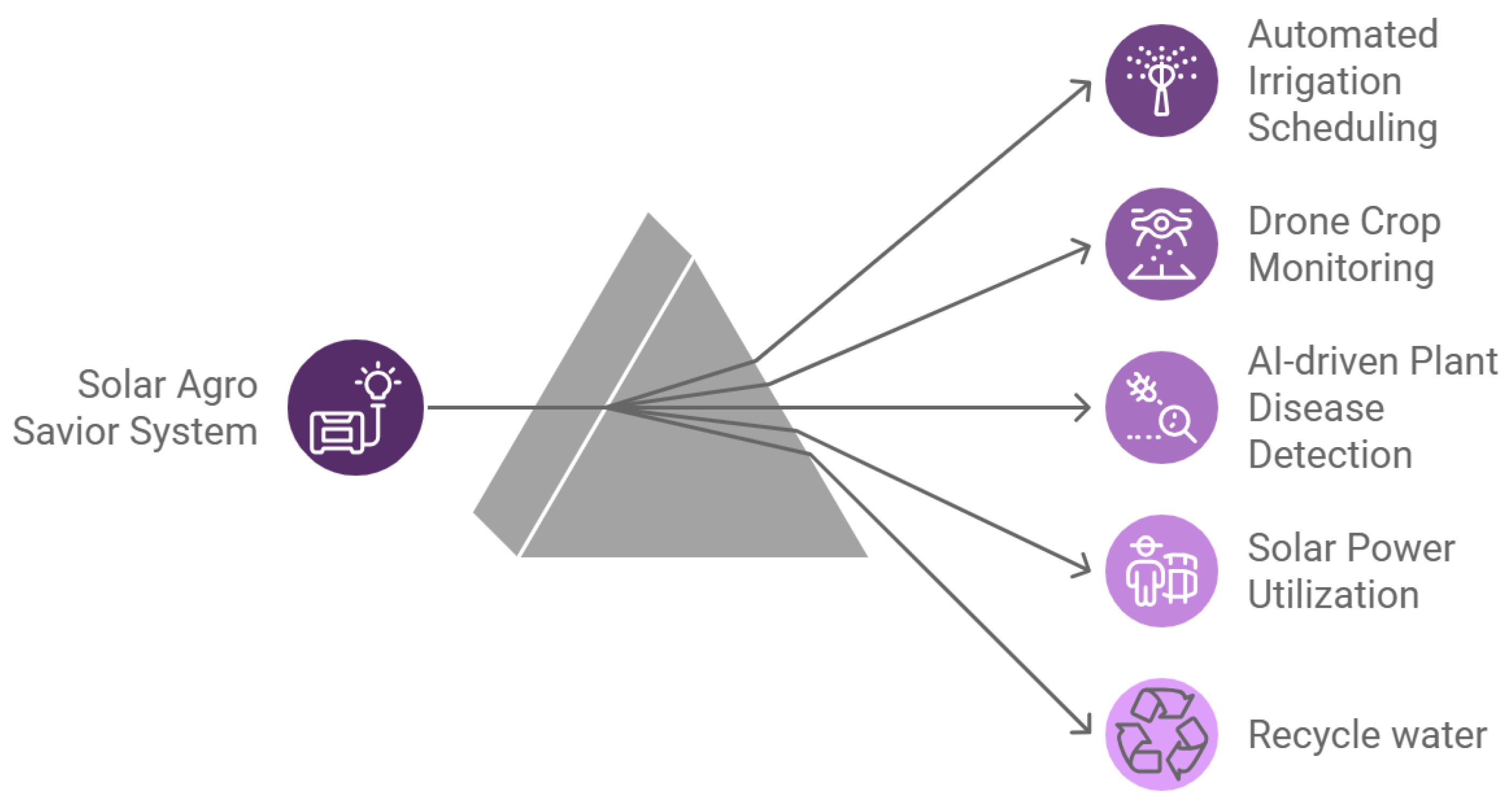
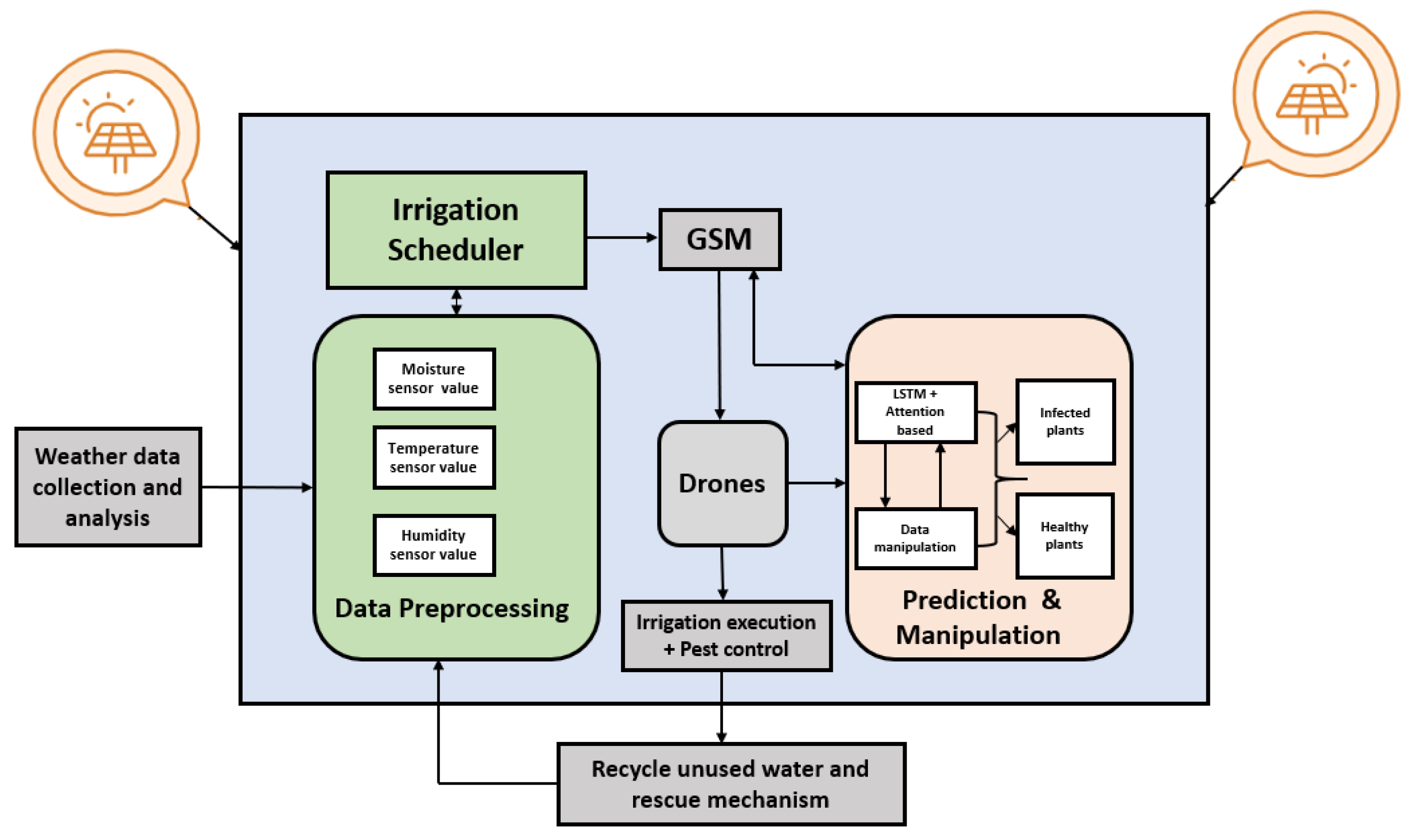
Figure 1 represents an overview of the SAS system. The system works with solar power and is divided into different sections, where the initial section is the irrigation scheduler, which is an IoT mechanism and is followed by drone management and later to the prediction and manipulation part, which is an AI-driven approach incorporating ML techniques. The overall architecture of the SAS system is illustrated in Figure 2. A detailed explanation of each part of the proposed methodology is provided in the following subsections.

3.1. Irrigation Scheduler and Data Processing

The SAS begins its operation with the irrigation scheduler, an IoT-based mechanism that integrates various sensors, including moisture sensors, temperature sensors, and humidity sensors. The system is implemented using a Raspberry Pi model, powered by solar panels to reduce dependence on nonrenewable energy sources. This IoT-enabled system monitors environmental and weather fluctuations, triggering alerts for drone activation in case of emergencies. The sensors, connected to the Raspberry Pi, are strategically placed in a series configuration across the cultivated land and between the crops. Variations in the threshold values of these sensors indicate potential hazards to crops or soil fertility. When such fluctuations are detected, the irrigation scheduler system sends an alert to the drone through the GSM, which captures high-resolution images of the affected areas. These images are then processed by an intelligent prediction model to determine the necessary treatment or intervention. The entire system is powered by solar panels connected in a series configuration, ensuring a reliable and sustainable energy source. Any excess energy generated by solar panels can be used for commercial purposes, further enhancing the efficiency and sustainability of the system.

3.2. Action on Drones

Drones play a crucial role in the SAS system, also known as an Unmanned Aerial Vehicle (UAV), which has diverse applications in crop monitoring, soil analysis, and high-precision agriculture. In this system, the drone is activated when an alert is received from the IoT system integrated with the irrigation scheduler. After data preprocessing, an additional alerting mechanism informs the drone about plant health data collected from sensors, particularly when a high level of infection confidence is detected. This alert is transmitted through a GSM module, allowing the drone to scan the affected region and capture images, which are then sent to the prediction and manipulation module for further analysis.
When an alert is received, the drone moves aerially, capturing images of crops and fertile land. These high-resolution images are delivered to the prediction manipulation system, which categorizes plants as either healthy or infected. Based on the prediction model’s output, if fertilizer or pesticide application is needed, the drone navigates to the specified location using its built-in GPS system and performs targeted spraying. This ensures effective pest control and fertilization while also enabling the system to manage water delivery and recycle unused water. Additionally, the system can detect environmental disasters and send alerts to the crop rescue management system.
The drone uses a precision spraying mechanism, which consists of a pump system, nozzles, and a controlled flow-rate mechanism. It is also equipped with a differentiated tank system containing both water and pesticides. Based on real-time sensor data and predictions from the proposed model, the drone can automatically determine whether to spray water or pesticides. The drone follows a preprogrammed grid or spiral pattern, allowing it to scan large cultivated areas efficiently and detect potential hazards quickly. Although the overall methodology encompasses multiple components, including drone-based data collection, preprocessing, and recycling management modules, the core emphasis of this work lies in data analytics and interpretation. In particular, our work builds upon the existing framework [25] by utilizing aerial imagery captured by the drone to perform targeted analysis in support of downstream development goals. Other components of the methodology, such as data preprocessing and recycling processes, are adopted from prior work and are not elaborated upon in this paper.

3.3. Prediction and Manipulation Methodology

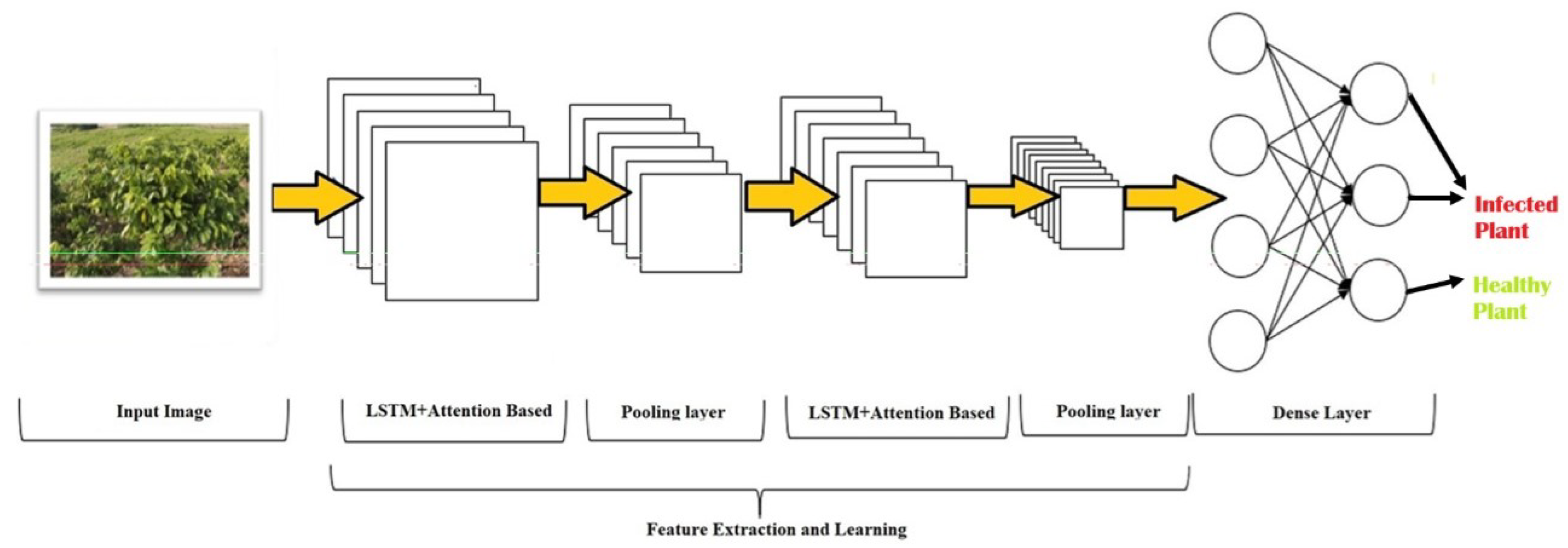
The schematic view of SAS, as illustrated in Figure 3, shows an innovative approach to analyzing drone-captured aerial images of agricultural land with crops. The flow of the diagram starts by feeding drone images as input images to the prediction system to classify the infected and healthy plantation crops intelligently. The input images undergo the advanced recurrent neural network methodology using the LSTM [23] and attention-based [24] ML approaches. This approach focused on extracting the best features and analysis. The subsequent layer of pooling layers is used for dimensionality reduction and withholds crucial features of the accuracy analysis. The essential role of this feature extraction plays a pioneering role in the detection of the health status of plants through these images. Having succeeded with the feature extraction, the computed data are given to the dense layer, and the essential forecast takes place in this layer. The model outputs whether a plant is infected by pests, categorizing it as an ‘infected plant’ or as a ‘healthy plant’ if no detection is made, all in real-time. High prediction accuracy is achieved through the combined use of LSTM [23] and attention-based [24] machine learning approaches. This dual approach to feature extraction and classification plays a pioneering role in accurately distinguishing between infected and noninfected plants. As a result, this innovative and sustainable method significantly improves the effectiveness of predictive agriculture.

3.4. Solar Agro Savior: A Hybrid Combination of LSTM and Attention-Based Model for Healthy Crop Identification and Classification

The proposed Algorithm 1 utilizes a deep learning technique that employs a hybrid combinational architecture within the RNN category, specifically LSTM networks [26,27], combined with a self-attention-based mechanism [28,29,30]. This approach effectively categorizes healthy and unhealthy crops using imagery captured by drones.
Algorithm 1 Proposed Classification Algorithm—SAS
Input: M KaraAgro AI; N Total number of edge nodes
Output: Trained Global Model
      1:
Start
      2:
Split the dataset:
    M t r a i n , M t e s t bad   ( M )
      3:
Feature Extraction:
    Z t r a i n , y t r a i n   ( M t r a i n )
    Z t e s t , y t e s t   ( M t e s t )
      4:
Distribute training and testing data among N edge nodes
      5:
for  i = 1 to N do
      6:
      Train the local model using assigned training and testing data
      7:
end for
      8:
Aggregate all local models into a global model using the sigmoid activation function σ
      9:
Evaluate the global model on test data
    10:
Compute loss function (Binary Cross-Entropy L) and evaluation metrics
    11:
return Trained Global Model
    12:
End
The LSTM algorithm plays a crucial role in capturing sequential dependencies from features extracted from the KaraAgro AI dataset [31], while the attention-based model enhances feature representation by dynamically weighing each sequence within its corresponding time frame. This combination results in an optimized model that processes input features using a linear transformation matrix, followed by global aggregation through a Global Average Pooling (GAP) mechanism.
The final output is a classification decision, achieved through fully connected convolutional networks with a sigmoid activation function, enabling the categorization of crops. The spatial and sequential relationships preserved by this model contribute to superior performance in terms of accuracy, precision, recall, and F1 score compared to other algorithms.

Proposed Framework—Solar Agro Savior

The SAS framework using Algorithm 1 employs a hybrid combination of LSTM networks, enhanced through mathematical formulation using linear algebra.
Let M be the input sequence representing the features extracted from the image dataset within the bounding box:
M = { m 1 , m 2 , , m T } , m t R d
where T denotes the length of the sequence, and d represents the dimensionality of the extracted features. The LSTM algorithm captures temporal dependencies within input sequences. The hidden state at each time step t is computed as follows:
h t = σ ( W h h t 1 + W x x t + b h )
where
  • h t represents the hidden state at time step t;
  • W h and W x are learnable weight matrices;
  • b h is the bias term;
  • σ denotes the tanh activation function used in LSTM.
After processing through the LSTM, the final hidden state is passed to the attention-based layer for further feature enhancement. The attention-based mechanism is a dynamic sequential approach that computes the weighted summation of hidden states. The attention weight matrix is computed as follows [32]:
A = softmax Q K T d k
where
  • Q, K, and V are the Query, Key, and Value matrices derived from the LSTM hidden states;
  • d k represents the feature dimension;
  • A is the attention weight matrix.
The final context-aware representation of the input sequence is obtained as
Z = A V
where Z is the refined representation incorporating important sequential dependencies. The final output is obtained by computing the hybrid feature vector, which combines the last hidden state of the LSTM with the attention-weighted mechanism. This fusion is formulated as follows:
H final = α Z + ( 1 α ) h T
where
  • H final represents the combined representation of the characteristics of both mechanisms;
  • h T is the last hidden state of the LSTM;
  • α is a learnable fusion coefficient that determines the balance between the LSTM and attention-based mechanisms, with values ranging between 0 and 1.
Before the final classification, the GAP mechanism is applied to reduce the dimensionality and obtain a compact and meaningful feature representation [33]. This operation is defined as
Z pool = 1 T t = 1 T H final
where
  • Z pool represents the pooled feature vector;
  • T is the total number of time steps in the sequence.
The final classification probability is obtained using a fully connected layer with a sigmoid activation function [32]:
y ^ = σ W f Z pool + b f
where
  • y ^ represents the predicted probability;
  • W f and b f are the weight matrix and bias term of the fully connected layer;
  • Z pool is the pooled feature representation;
  • σ is the sigmoid activation function, which ensures the output is in the range [0, 1].
The model is optimized using the Binary Cross-Entropy (BCE) Loss function [34]:
L = 1 N i = 1 N y i log ( y ^ i ) + ( 1 y i ) log ( 1 y ^ i )
where
  • y i is the true label (0 for healthy plants; 1 for infected plants);
  • y ^ i is the predicted probability;
  • N is the total number of samples.

3.5. Dataset Overview: Agriculture Segmentation

The dataset used in this study consists of high-resolution aerial images of cashew and cocoa crops, collected via manually operated drones across selected agricultural regions in Ghana [31]. The cashew data was captured in the Bono Region over two rounds (November 2022 and January 2023). Each image, taken at altitudes between 2 and 10 m, includes GPS coordinates and timestamps to support spatiotemporal analysis. The dataset comprises a total of 8784 images with resolutions up to 16,000 × 13,000 pixels [35]. It is divided into training (5270), validation (878), and testing (2636) subsets using a 6:1:3 ratio [36]. This split was selected after careful consideration of the dataset size and the need to achieve an optimal balance between training effectiveness, model tuning, and unbiased evaluation. It allowed us to allocate a substantial portion of the data for model training while retaining sufficient samples for reliable validation and testing. All the images underwent preprocessing to remove blurriness and overexposure, ensuring high visual quality [37]. The cashew images were annotated using the Makesense AI tool, while the cocoa images were annotated using the VGG Image Annotator (VIA). All the annotations were formatted in YOLO and classified into two categories: healthy and infected. The ground truth for the annotated data was derived from expert-labeled disease symptoms and maturity stages, which served as input for training deep learning models based on LSTM and attention mechanisms. This curated dataset enables robust training and evaluation of the SAS model for early disease detection and plant health monitoring in smart agriculture applications. It underpins the implementation of the SAS model, supporting accurate crop health prediction and decision-making in smart farming.

3.6. Energy Efficient SAS System

To evaluate the solar sustainability and energy autonomy of the SAS system, our proposed methodology builds upon an existing drone-acquired agricultural image dataset encompassing cashew and cocoa plantations. The UAV platforms referenced were operated using pre-established solar grid stations configured with 4-cell 14.8V Li-Po batteries (10,000 mAh), each consuming approximately 0.35 kWh per 30 min aerial mission, as documented in prior studies [38]. These platforms utilized 100 W portable photovoltaic panels functioning under typical East African solar irradiance conditions (700–900 W/m2). Under optimal sunlight, battery recharge was completed within 2.5 to 3 h, extending to approximately 4.5 h in cloudy conditions, supported by integrated energy buffering systems. The reported system uptime was approximately 85% over a 10-day operational cycle, with minimal downtime due to low sunlight and intermittent data synchronization. Compared to conventional grid-dependent charging systems, this solar-enabled configuration demonstrated a 42% reduction in energy costs while supporting full off-grid autonomy [39]. While the solar infrastructure and UAV platform were pre-existing, our core contribution lies in enhancing the operational framework through a novel hybrid deep learning methodology. Specifically, we propose the integration of a YOLO-based spatial detection module with LSTM and attention mechanisms to capture both temporal and semantic patterns relevant to plant health monitoring. This architectural enhancement enables improved accuracy, precision, and responsiveness in crop classification tasks. Moreover, our approach embraces circular sustainability by leveraging existing UAV hardware and energy systems, focusing instead on methodological innovation. In doing so, our work addresses a notable research gap by combining sustainable energy practices with state-of-the-art AI-driven agricultural analytics. The proposed system contributes meaningfully to global sustainability efforts by aligning with the UN Sustainable Development Goals (SDG 7: Affordable and Clean Energy; SDG 13: Climate Action), promoting renewable energy integration and climate-resilient smart farming practices.

4. Performance Metrics and Equations

A comparative evaluation of the proposed method, SAS, and other advanced algorithms across various factors—such as plant disease detection, yield prediction, and precision irrigation—is essential. To achieve this, we employ performance metrics including accuracy, irrigation precision, recall for infected plants, and the balanced F1 score, all of which are mathematically formulated and evaluated.

4.1. Plant Disease Detection (Accuracy)

Accuracy is a key metric that measures how well the system correctly identifies plants as either infected or healthy compared to the total number of plant images analyzed. This measurement gives a clear indication of how accurately SAS performs in classifying plant conditions. In essence, it reflects the system’s ability to correctly detect healthy plants using drone imagery combined with ML algorithms.
Accuracy = TP + TN TP + TN + FP + FN × 100
where
  • TP: true positives (correctly identified diseased plants);
  • TN: true negatives (correctly identified healthy plants);
  • FP: false positives (healthy plants misclassified as diseased);
  • FN: false negatives (diseased plants misclassified as healthy).
The high accuracy of the SAS demonstrates its ability to significantly reduce both false positives and false negatives. Using advanced algorithms such as the attention mechanism, the system carefully analyzes drone-captured images to pinpoint key areas of interest, allowing for precise assessment of plant health. This accuracy is essential for detecting diseases early and enabling timely interventions, which are critical for protecting crop yields and minimizing losses.

4.2. Precision in Irrigation

The precision performance metric indicates the proportion of infected cases correctly identified by the model. It reliably measures the accuracy of positive predictions, helping to ensure that water and resources are used sustainably by focusing only on healthy plants when necessary. This metric demonstrates how the proposed SAS effectively targets areas that genuinely require intervention within the irrigation system.
Precision = TP TP + FP × 100
Resource optimization is a crucial aspect of sustainability and can be evaluated using precision metrics. Higher precision values will ensure that irrigation efforts are accurately directed to areas that are genuinely affected by disease stress. This approach conserves water resources and reduces the costs associated with excessive irrigation, contributing to more sustainable farming practices.

4.3. Recall

The recall factor is a key performance metric that measures the proportion of infected plants accurately identified by the system out of all truly infected plant images. This metric reflects the model’s ability to detect actual cases requiring intervention, significantly reducing the risk of overlooking infected plants. Additionally, it supports comprehensive irrigation management and effective pest detection and control, ensuring timely and targeted responses.
Recall = TP TP + FN × 100
A higher recall metric indicates that the model reliably identifies nearly all infected plants that require irrigation or other interventions. The recall value is critical for ensuring effective treatment of infections and for preventing the further spread of disease from untreated areas caused by infected plants. The system’s effectiveness is reflected by the recall metric, which complements the precision factor.

4.4. F1 Score

The F1 score represents the harmonic mean of both precision and recall. It is a balanced metric that reflects false positives and false negatives. This measure is particularly useful for unbalanced datasets, such as when the number of healthy plants greatly exceeds the number of infected plants. The F1 score provides a comprehensive evaluation of the disparities between precision and recall for the proposed model.
F 1 Score = Precision × Recall Precision + Recall × 2
The optimum F1 score achieved by the proposed SAS method indicates a balanced performance between accurately detecting infected plants and avoiding the misclassification of healthy plant images. This metric evaluates the overall reliability and robustness of the model in real-world agricultural applications, where both false positives and false negatives can have significant consequences.

5. Results

The proposed methodology involves training and classification of input images. Feature analysis is conducted on raw images of various crops. The images were collected from different regions and include aerial images of plants from Ghana, specifically cashew and cocoa. Our SAS model predicts crop health by extracting spatial features using YOLO, analyzing leaf texture, color variations, and disease symptoms. These extracted features are then processed through LSTM networks, which capture temporal dependencies and sequential patterns. Additionally, an attention mechanism is integrated to prioritize key features, ensuring that disease-specific patterns receive higher weights. This hybrid SAS approach enhances accuracy, precision, recall, and F1 score, effectively distinguishing between infected and healthy plants.
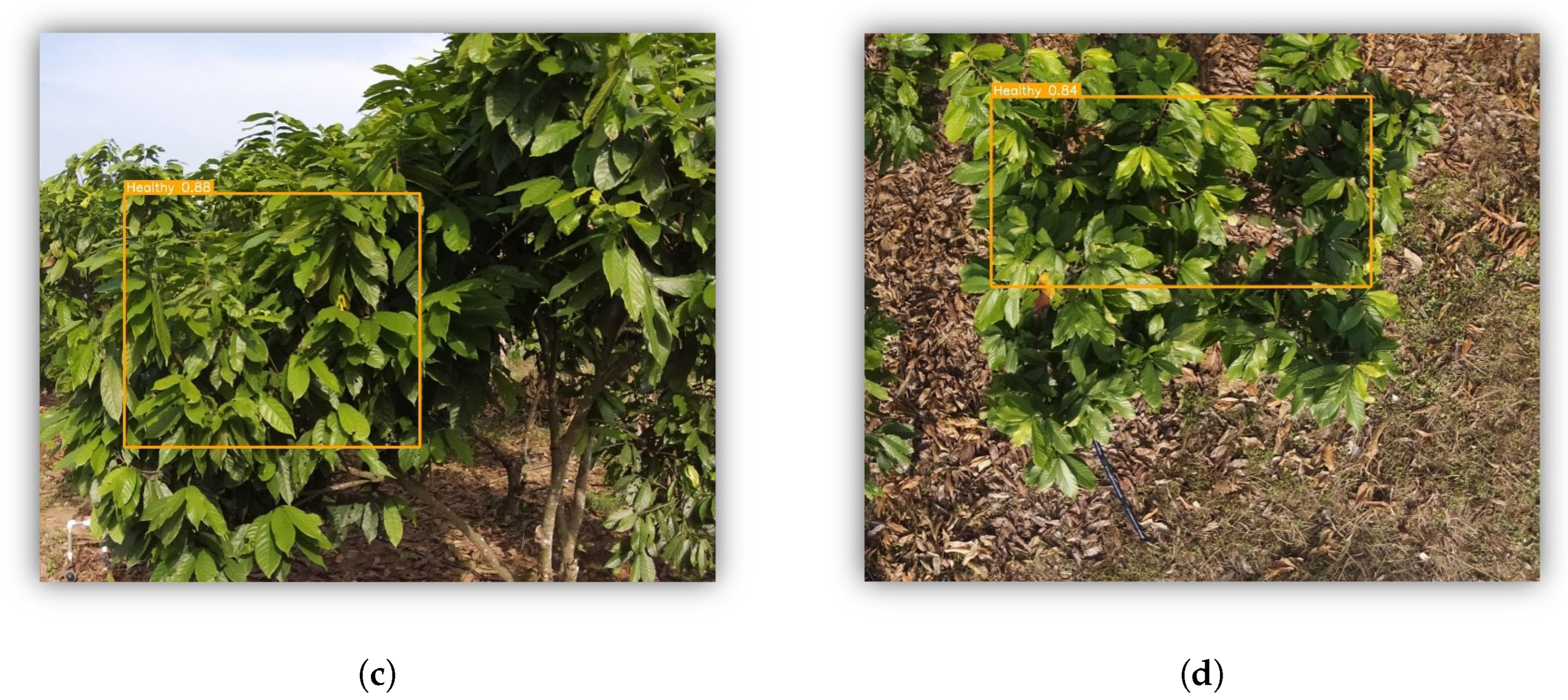
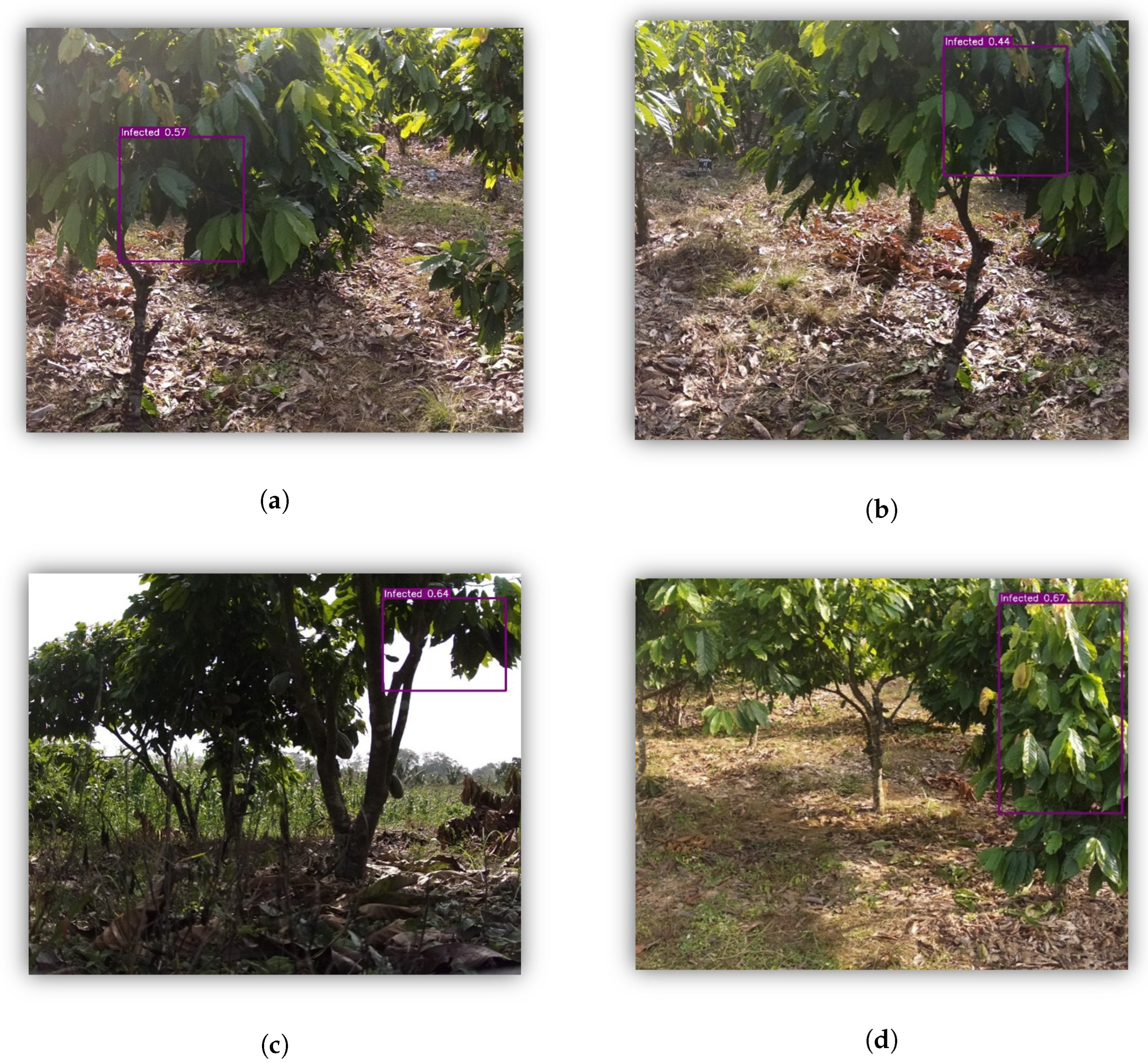
The SAS mechanism classifies infected and healthy plants by using the confidence interval derived from the YOLO object detection model. The output images highlight detected regions with confidence scores ranging between 0 and 1, indicating the classification of infected and healthy plants. This classification is based on RGB values, following Matplotlib’s range of 0 to 255 for each color channel. The classification results are overlaid on images using bounding boxes and labels, visually demonstrating the detection regions. In the proposed model, orange boxes with labels denote healthy crops, while purple boxes indicate infected ones.
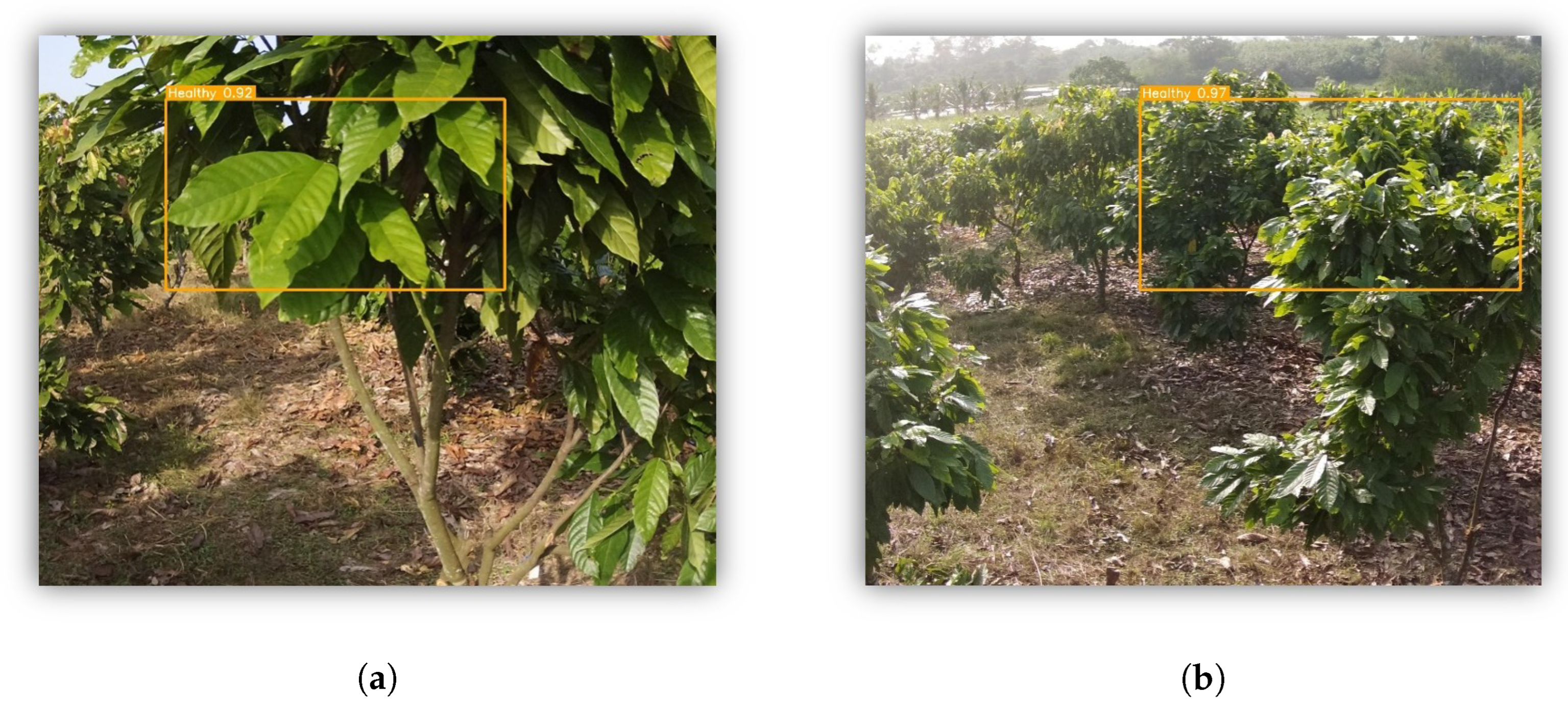
In the predicted output, confidence percentages are displayed alongside the boxes, enhancing the model’s interpretability. The confidence percentage is used to assess infection severity—crops with confidence levels below 70% are considered highly infected, while those below 60% are classified as a severe threat, potentially affecting neighboring crops’ growth. This visual demonstration assists agricultural experts in accurately identifying and removing infected crops to prevent further spread of diseases and pests. Figure 4 presents a diverse set of images illustrating healthy trees across various cultivations. Figure 4a highlights a healthy cashew tree with a detection confidence of 0.92, showcasing vibrant foliage and no visible signs of pest or disease infection. Figure 4b depicts a thriving cocoa plantation with a confidence level of 0.97, characterized by uniformly green leaves, optimal growth conditions, and high productivity. In contrast, Figure 4c shows another healthy cashew tree, identified with a slightly lower detection confidence of 0.88, yet still demonstrating dense, robust leaf coverage and healthy characteristics. Figure 4d portrays a healthy cocoa tree with a confidence level of 0.84, emphasizing the consistency in foliage health and reflecting effective agricultural practices across different conditions.
Figure 5 highlights various infections affecting the observed crops. Figure 5a corresponds to a cocoa tree with yellowing leaves and signs of decay, suggestive of disease or pest infestation, with a detection confidence of 0.57. Figure 5b captures an infected cashew tree exhibiting visible leaf discoloration and early structural damage, identified with 0.44 confidence. Figure 5c portrays a pest-infected cocoa tree showing defoliation and fruit damage, along with mild to moderate symptoms of infection, detected at 0.64 confidence. Finally, Figure 5d illustrates an infected cashew tree characterized by wilting leaves and visible pest activity, indicating early-stage infection, with a confidence of 0.67. These examples contrast clearly with the healthy plant images in Figure 4, emphasizing the visual differences and the critical need for early detection in crop health management.

5.1. Preparing Training Set and Classification Results

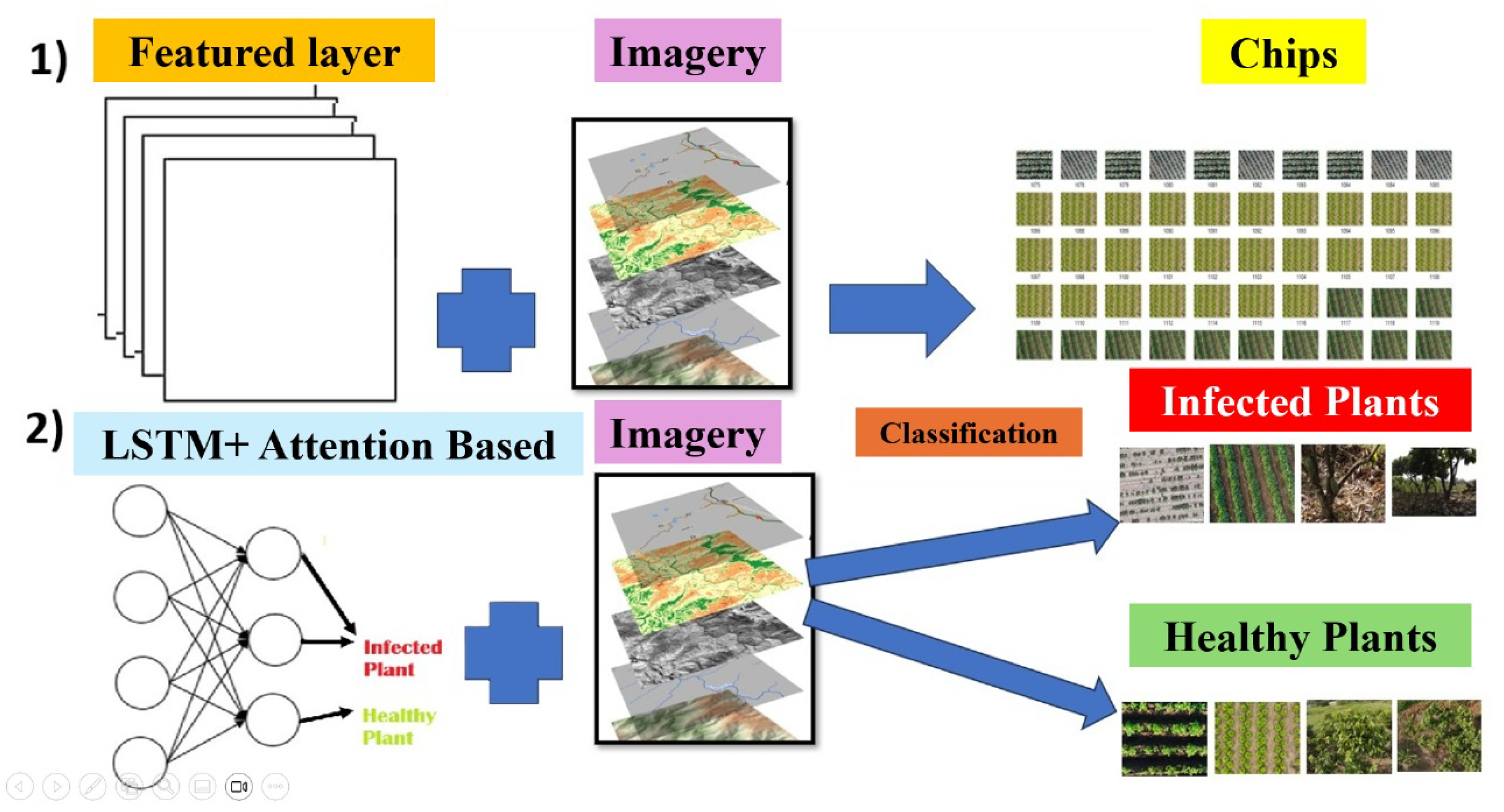
Figure 6 illustrates the conventional approach to preparing the training set and classifying results using an innovative machine learning method for crop protection and health assessment. The figure consists of two structured diagrams. The first diagram demonstrates a layered architecture for feature extraction and the integration of imagery data captured by drones. This data is processed to identify and classify various aspects of plant health. The second diagram highlights the use of advanced RNN techniques, specifically LSTM and attention-based mechanisms. These advanced ML models significantly enhance classification performance by improving accuracy, precision, and recall.
The classification of infected and healthy plants is made actionable through the transformation of drone-captured imagery into meaningful insights. Additionally, the segmented imagery effectively represents different states of crop stability, emphasizing the system’s ability to distinguish between various conditions in real time. This dual approach supports efficient water regulation through intelligent, solar-powered irrigation management while promoting sustainable, drone-based monitoring in eco-friendly agriculture. Overall, this AI-driven system improves resource efficiency and environmental conservation, directly contributing to increased crop production and the rapid identification of diseased crops for timely intervention.

5.2. Comparative Analysis of Proposed with Other Algorithms

The comparative analysis of the proposed SAS methodology with other algorithms, such as attention-based RNN [40], LSTM [41], and YOLO V10 [42], encompasses several key performance metrics, including accuracy, precision, recall, and F1 score. This evaluation aims to illustrate the strengths and weaknesses of each approach in the context of agricultural applications. By examining these metrics, we can assess how effectively SAS not only identifies relevant patterns and classifications but also balances the trade-offs between false positives and false negatives. The analysis highlights how SAS consistently outperforms the other algorithms across these dimensions, demonstrating superior accuracy in predictions, higher precision in correctly identifying true positive instances, robust recall in capturing all relevant cases, and an improved F1 score that reflects the harmonic mean of precision and recall. This comprehensive comparison underscores the efficacy of the proposed methodology in delivering reliable and actionable insights in agricultural settings, ultimately enhancing decision-making processes. These algorithms are compared based on their efficiency in handling decentralized UAV image data, unlike traditional deep learning techniques. By enabling training across multiple nodes, they help preserve data privacy while minimizing communication overhead.
Among the algorithms considered, the proposed SAS outperforms the others across all performance metrics. The YOLO V10 technique, though effective for real-time object detection, struggles to deliver optimal performance for UAV imagery. Similarly, the LSTM model captures sequential dependencies but lacks interoperability. While attention-based models improve upon LSTM by selectively focusing on relevant information, they still rely on centralized training, which limits scalability. In contrast, SAS combines the strengths of both sequential and decentralized training, making it a more robust and scalable solution for UAV-based agricultural monitoring.

5.2.1. Accuracy

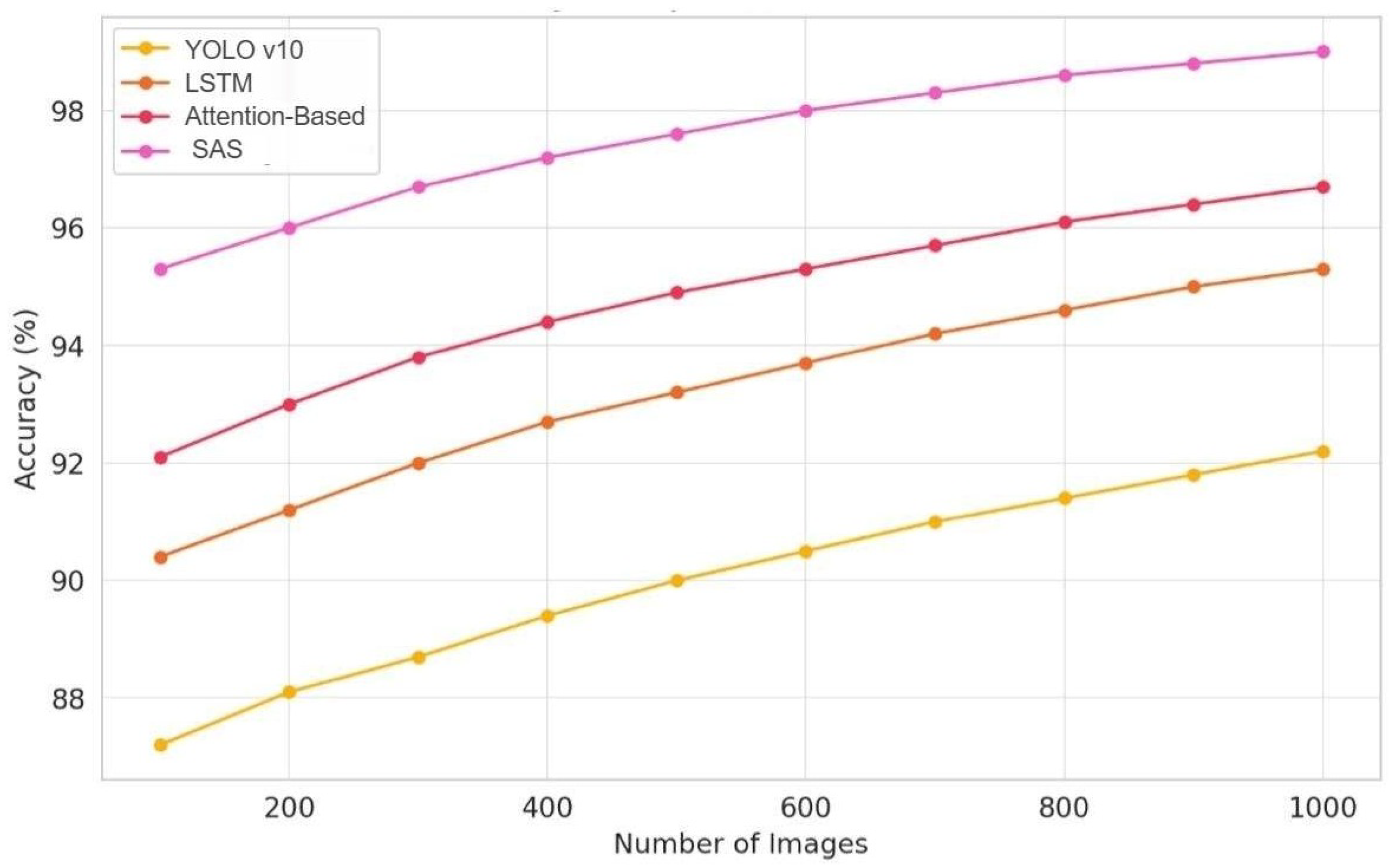
A comparative performance evaluation of the accuracy metric is presented for the proposed methodology, SAS, alongside the other ML algorithms in both tabular (Table 2) and graphical (Figure 7) formats. The comparison with LSTM, attention-based RNN, and YOLO V10 highlights the superior accuracy of SAS as the number of images increases. At the lowest image count of 100, SAS achieves an accuracy of 95.3%, slightly outperforming the alternatives. As the dataset grows, SAS shows consistent improvement, reaching an accuracy of 99% at 1000 images. This steady increase is observed through intermediate values, 96% at 200 images, 97.6% at 500 images, 98.3% at 700 images, and 98.8% at 900 images, demonstrating excellent scalability and robustness. Other methodologies also improve with increasing image counts but consistently lag behind SAS in performance. YOLO V10 starts with 87.2% accuracy at 100 images and reaches a peak of 92.2% at 1000 images. Attention-based RNN improves from 92.1% at 100 images to 96.7% at 1000 images, while LSTM increases from 90.4% to 95.3% over the same range. At every dataset size, SAS maintains a clear margin over these alternatives, confirming its superior predictive capability. This comprehensive analysis highlights the strong potential of the SAS methodology for smart irrigation systems, particularly in large-scale deployments where high accuracy and scalability are critical. By enabling precise predictions of crop health with increasing data volume, SAS can significantly enhance decision-making efficiency and effectiveness in real-world agricultural applications.

5.2.2. Precision

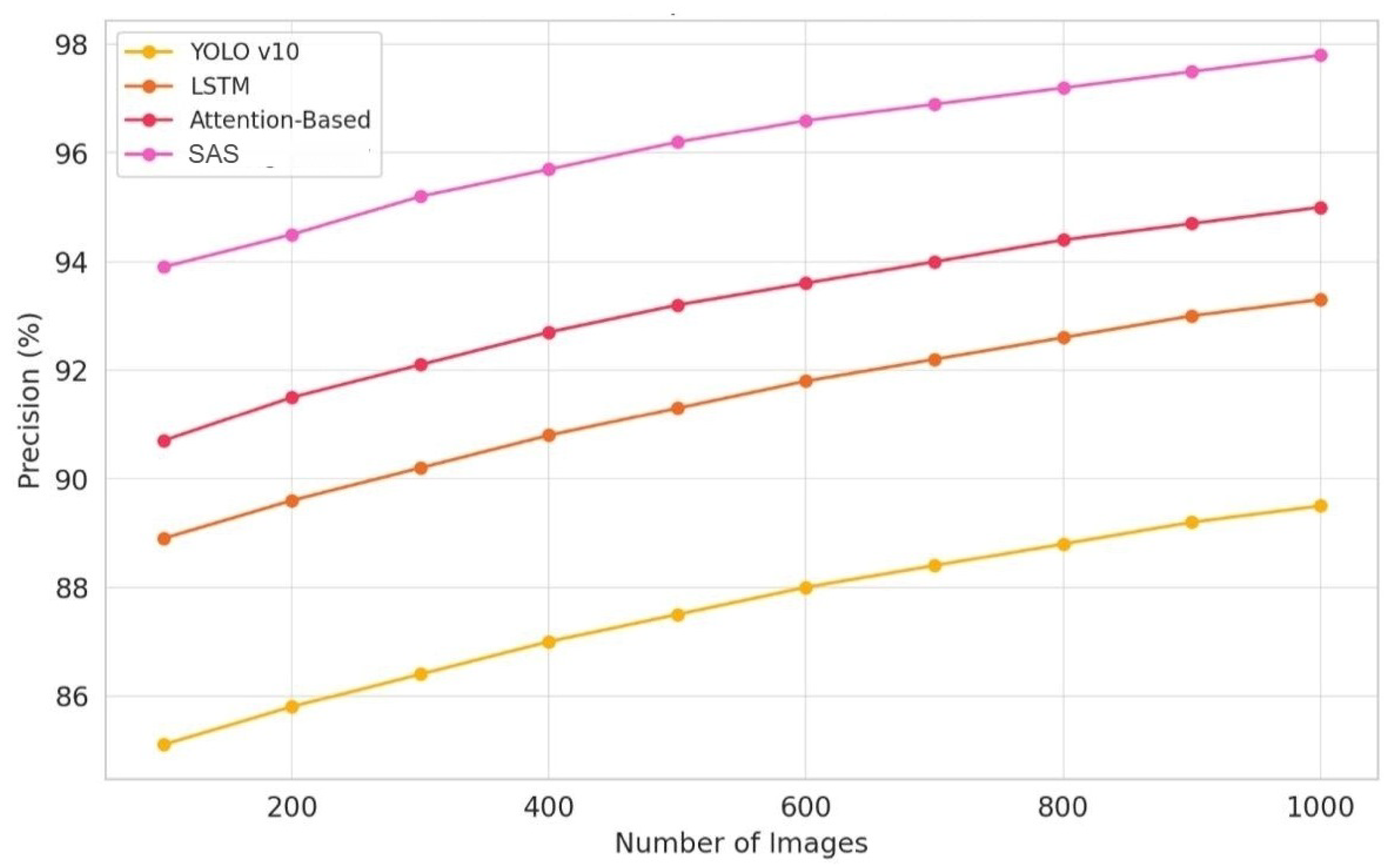
The precision comparison of the proposed SAS methodology against the other techniques—attention-based models, LSTM, and YOLO V10—reveals noteworthy trends as the number of images increases. Initially, at lower image counts (100 images), SAS achieves a precision of 93.9%, which is slightly higher than the other methods. As the dataset expands, this trend continues, with Solar Agro Savior demonstrating progressive improvements in precision, reaching 96.6% with 600 images and peaking at 97.8% with 1000 images. This consistent enhancement in precision indicates the model’s ability to accurately identify true positive instances, ultimately leading to more reliable outcomes in agricultural applications.
The precision performance of the proposed SAS methodology is evaluated against other established techniques—attention-based models, LSTM, and YOLO V10—with the results summarized in Figure 8 and Table 3. At the initial image count of 100, SAS attains a precision of 93.9%, outperforming the other methods. As the number of images increases, SAS consistently improves its precision, achieving 96.6% at 600 images and culminating at 97.8% for 1000 images. This upward trend highlights the model’s increasing ability to correctly identify true positives, which is crucial for dependable agricultural predictions. While all comparative algorithms show progressive gains in precision with larger datasets, none reach the levels attained by SAS. YOLO V10 records the lowest precision, starting at 85.1% for 100 images and peaking at only 89.5% at 1000 images. The attention-based approach demonstrates stronger performance, matching SAS’s highest precision of 97.8% at 1000 images, while LSTM achieves 93.3% at the same dataset size. Despite the attention model’s competitive final precision, SAS maintains superior precision across most intermediate dataset sizes, underscoring its robustness. This comprehensive comparison confirms that SAS is highly effective at minimizing false positives and improving prediction reliability. Such performance is vital for accurate decision-making and operational success in precision agriculture applications.

5.2.3. Recall

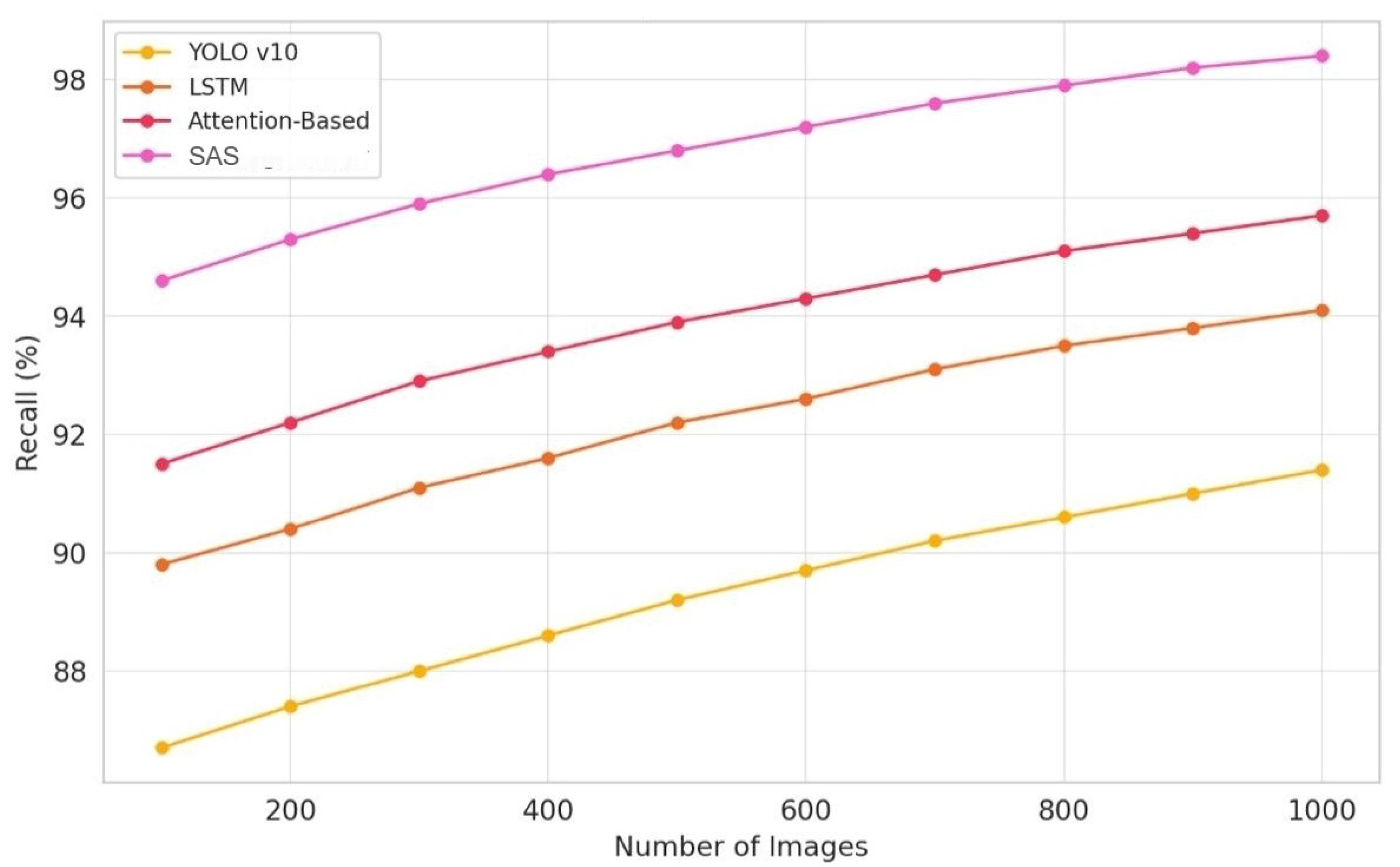
The recall performance of the proposed SAS methodology is compared with other established techniques, with results detailed in Table 4 and illustrated in Figure 9. At the initial dataset size of 100 images, SAS achieves a recall of 94.6%, already surpassing its counterparts. As the dataset size expands, SAS’s recall steadily increases, reaching 97.2% at 600 images and ultimately attaining 98.4% with 1000 images. This positive trajectory reflects the model’s enhanced capacity to correctly identify all relevant instances, which is essential for comprehensive detection in agricultural monitoring. In contrast, the other methods show comparatively lower recall values across all dataset sizes. YOLO V10 records the lowest recall, starting at 86.7% for 100 images and improving only to 91.4% at the highest image count. The attention-based model shows better performance, increasing from 91.5% to 95.7%, while LSTM moves from 89.4% to 94.1% as the number of images grows. The consistent superiority of SAS in recall confirms its robustness in capturing relevant true positives, contributing to more reliable and complete agricultural data analysis.

5.2.4. F1 Score

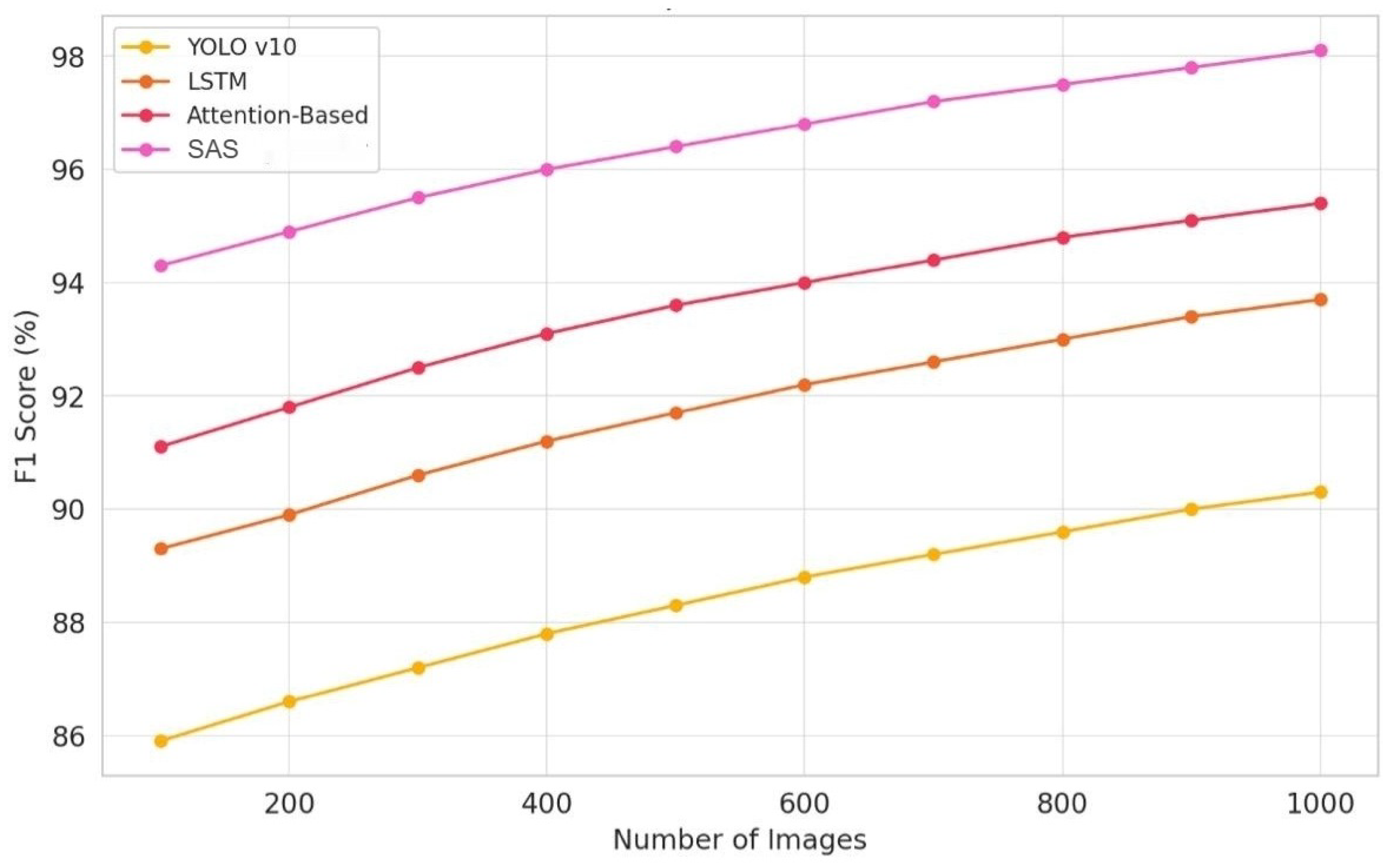
The F1 score evaluation for the proposed SAS method, alongside other ML techniques, is summarized in Table 5 and illustrated in Figure 10. At 100 images, SAS achieves an F1 score of 94.3%, modestly outperforming the other methods. As the dataset size increases, the F1 score for SAS improves steadily, reaching 96.8% at 600 images and culminating at 98.1% for 1000 images. This continuous enhancement reflects the model’s ability to maintain a strong balance between precision and recall, which is critical for effective agricultural monitoring. In comparison, YOLO V10 shows the lowest performance, starting at 85.9% F1 score with 100 images and reaching 90.3% at 1000 images. Attention-based models and LSTM demonstrate moderate improvements with dataset size, achieving 95.4% and 93.7%, respectively, at the highest image count. Although these approaches improve with more data, they remain behind SAS throughout all dataset sizes, highlighting the latter’s superior capability in overall predictive performance.
This analysis demonstrates that SAS is well-suited for large-scale agricultural applications where both high accuracy and comprehensive detection are necessary. The high F1 scores achieved by the method suggest it can reliably support decision-making processes aimed at enhancing crop health and productivity.
All these metrics are crucial in assessing the effectiveness of the proposed SAS compared to other advanced ML algorithms. High accuracy ensures the system’s overall reliability, while high precision optimizes resource utilization by reducing unnecessary interventions. Recall plays a key role in detecting infections effectively, and the F1 score provides a balanced measure of performance. Collectively, these factors establish the proposed model as a benchmark for sustainable development and an AI-driven solution for smart agriculture.

6. Discussion

The interpretability of the SAS model is significantly enhanced through its bounding box-based classification outputs, which provide both visual and quantitative assessments of plant health status. Specifically, the model employs YOLO-based object detection to localize infected and healthy crop regions using color-coded bounding boxes—orange indicating healthy plants and purple indicating infected ones. Alongside these boxes, confidence scores ranging from 0 to 1 are displayed. A threshold-based interpretation is applied: regions with confidence scores below 60% are categorized as severely infected, while those above are considered healthy or mildly affected. This thresholding mechanism facilitates the prioritization of intervention strategies by field agronomists, allowing for the timely removal of infected plants to prevent disease spread. Despite these variations, the model maintained strong generalization capability, achieving an accuracy of 99%, precision of 97.8%, recall of 98.4%, and an F1 score of 98.1%, reinforcing its cross-regional applicability. These results, supported by 5-fold stratified cross-validation, demonstrate the robustness and reliability of the SAS system in real-world agricultural settings. Stratified sampling was critical in this agricultural context to maintain class balance across folds, especially given the natural imbalance often present in field datasets (e.g., fewer infected plants than healthy ones). The stratified k-fold approach helps minimize bias and variance in the performance estimates, thereby improving the reliability of the results. For each fold, standard metrics such as accuracy, precision, recall, and F1 score were computed, and the final model performance was reported as the mean ± standard deviation across all five folds. For example, the model achieved an average accuracy of 98.7% ± 0.6 and an F1 score of 98.1% ± 0.5, confirming both high predictive accuracy and consistency. Additionally, the trained model was validated on an independent dataset consisting of 1100 drone images collected from Ghana under different environmental conditions and altitudes. The SAS model retained high performance (accuracy = 97.1%; F1 = 96.4%) on this geographically distinct test set, further supporting its robustness and practical applicability in diverse agricultural regions.

7. Challenges and Future Enhancement

Despite its high accuracy and cross-regional applicability, the SAS system faces several operational challenges that warrant further development. One key limitation is its reduced effectiveness under adverse weather conditions, such as high humidity, which can introduce latency in data transmission and hinder real-time alert generation. Additionally, the drone’s flight autonomy currently limits continuous coverage to approximately 5 hectares, which may be insufficient for large-scale farms without the implementation of coordinated multi-drone systems. Variations in terrain and the presence of natural obstacles also pose challenges to consistent image acquisition. Future enhancements will focus on integrating edge-based AI processing to reduce latency, improving solar panel efficiency to extend drone flight time, and employing swarm intelligence for scalable monitoring. Moreover, incorporating multispectral and hyperspectral imaging could significantly enhance disease detection accuracy, while expanding the dataset to include diverse crop types and phenotypic variations will further strengthen model robustness and adaptability across global agroecological zones.

8. Conclusions

The SAS system represents a significant advancement in sustainable precision agriculture by integrating intelligent drone-based monitoring with a hybrid deep learning framework. By combining YOLO-based spatial feature extraction with LSTM and attention mechanisms for temporal and semantic modeling, SAS introduces a novel, application-specific architecture designed for off-grid deployment using solar-powered UAVs. This structured approach not only enhances the detection of crop health anomalies in real time but also optimizes water management and energy usage, directly addressing SDGs related to clean energy and climate-resilient agriculture. Field validation using cross-regional UAV datasets—spanning cocoa and cashew crops—demonstrates the robustness and adaptability of the model, with strong performance metrics including 99% accuracy, 97.8% precision, 98.4% recall, and a 98.1% F1 score. Compared to existing methods, SAS offers superior responsiveness to environmental variability while maintaining resource efficiency. Its integration with solar infrastructure promotes energy autonomy and a 42% reduction in operational energy costs, further reinforcing its ecological viability. This work not only fills a critical research gap by fusing state-of-the-art deep learning with sustainable hardware but also lays a foundation for future innovations, such as automated aerial routing and expanded crop adaptability. Overall, SAS positions itself as a transformative solution in modern agriculture—delivering technological sophistication, environmental responsibility, and operational scalability for long-term agricultural development.

Author Contributions

Conceptualization, M.M.R., B.F.M. and M.H.; methodology, M.M.R., B.F.M. and M.H.; software, M.M.R.; resources, M.M.R., B.F.M. and M.H.; writing—original draft preparation, M.M.R. and B.F.M.; writing—review and editing, M.M.R., B.F.M., M.H., N.A.A. and E.B.; supervision, M.H.; funding acquisition, M.H. All authors have read and agreed to the published version of the manuscript.

Funding

This research was funded by Big Data Analytics Center (BIDAC), United Arab Emirates University, grant number G00004526. The APC was funded by United Arab Emirates University.

Data Availability Statement

Data are contained within the article.

Conflicts of Interest

The authors declare no conflicts of interest.

References

  1. Florina, B.; Bodislav, D.A.; Gombos, S.; Angheluță, S.P. Artificial Intelligence for Sustainable Agribusiness: Innovations and Challenges. Eur. J. Sustain. Dev. 2024, 13, 233. [Google Scholar] [CrossRef]
  2. Nations, U. Transforming Our World: The 2030 Agenda for Sustainable Development; United Nations, Department of Economic and Social Affairs: New York, NY, USA, 2015; Volume 1, p. 41. [Google Scholar]
  3. Liakos, K.G.; Busato, P.; Moshou, D.; Pearson, S.; Bochtis, D. Machine learning in agriculture: A review. Sensors 2018, 18, 2674. [Google Scholar] [CrossRef]
  4. Balta, M.A.; Kulat, M.I. Transforming an irrigation system to a smart irrigation system: A case study from Türkiye (Turkey). Irrig. Drain. 2024, 73, 1799–1811. [Google Scholar] [CrossRef]
  5. Ledmaoui, Y.; El Maghraoui, A.; El Aroussi, M.; Saadane, R.; Chebak, A.; Chehri, A. Forecasting solar energy production: A comparative study of machine learning algorithms. Energy Rep. 2023, 10, 1004–1012. [Google Scholar] [CrossRef]
  6. Vennila, C.; Titus, A.; Sudha, T.S.; Sreenivasulu, U.; Reddy, N.P.R.; Jamal, K.; Lakshmaiah, D.; Jagadeesh, P.; Belay, A. Forecasting solar energy production using machine learning. Int. J. Photoenergy 2022, 2022, 7797488. [Google Scholar] [CrossRef]
  7. Padmavathi, B.; BhagyaLakshmi, A.; Vishnupriya, G.; Datchanamoorthy, K. IoT-based prediction and classification framework for smart farming using adaptive multi-scale deep networks. Expert Syst. Appl. 2024, 254, 124318. [Google Scholar] [CrossRef]
  8. Mohamed, E.S.; Belal, A.; Abd-Elmabod, S.K.; El-Shirbeny, M.A.; Gad, A.; Zahran, M.B. Smart farming for improving agricultural management. Egypt. J. Remote Sens. Space Sci. 2021, 24, 971–981. [Google Scholar] [CrossRef]
  9. Noorunnahar, M.; Chowdhury, A.H.; Mila, F.A. A tree based eXtreme Gradient Boosting (XGBoost) machine learning model to forecast the annual rice production in Bangladesh. PLoS ONE 2023, 18, e0283452. [Google Scholar] [CrossRef]
  10. VanDeventer, W.; Jamei, E.; Thirunavukkarasu, G.S.; Seyedmahmoudian, M.; Soon, T.K.; Horan, B.; Mekhilef, S.; Stojcevski, A. Short-term PV power forecasting using hybrid GASVM technique. Renew. Energy 2019, 140, 367–379. [Google Scholar] [CrossRef]
  11. Liu, L.; Wang, R.; Xie, C.; Yang, P.; Wang, F.; Sudirman, S.; Liu, W. PestNet: An end-to-end deep learning approach for large-scale multi-class pest detection and classification. IEEE Access 2019, 7, 45301–45312. [Google Scholar] [CrossRef]
  12. Yulita, I.N.; Rambe, M.F.R.; Sholahuddin, A.; Prabuwono, A.S. A convolutional neural network algorithm for pest detection using GoogleNet. AgriEngineering 2023, 5, 2366–2380. [Google Scholar] [CrossRef]
  13. Marcillo, G.S.; Martin, N.F.; Diers, B.W.; Da Fonseca Santos, M.; Leles, E.P.; Chigeza, G.; Francischini, J.H. Implementation of a generalized additive model (Gam) for soybean maturity prediction in african environments. Agronomy 2021, 11, 1043. [Google Scholar] [CrossRef]
  14. Hsu, T.C.; Tsai, Y.H.; Chu, W.C.C.; Chen, S.w.; Tsai, H.L.; Chang, Y.K. Exploration of advanced computer technology to address analytical and noise improvement issues in machine learning. J. Syst. Softw. 2023, 205, 111820. [Google Scholar] [CrossRef]
  15. Zhu, Z.; Jiang, M.; Dong, J.; Wu, S.; Ma, F. PD-SegNet: Semantic Segmentation of Small Agricultural Targets in Complex Environments. IEEE Access 2023, 11, 90214–90226. [Google Scholar] [CrossRef]
  16. Asadi, M.; Pourhossein, K.; Mohammadi-Ivatloo, B. GIS-assisted modeling of wind farm site selection based on support vector regression. J. Clean. Prod. 2023, 390, 135993. [Google Scholar] [CrossRef]
  17. Resti, Y.; Zayanti, D.A.; Dewi, N.R.; Yani, I.; Darmawan, F.; Jimmy. Classification of Corn Diseases and Pests Using Fuzzy Naïve Bayes Method. J. Adv. Res. Appl. Sci. Eng. Technol. 2024, 59, 106–115. [Google Scholar] [CrossRef]
  18. Aziz, L.; Salam, M.S.B.H.; Sheikh, U.U.; Ayub, S. Exploring deep learning-based architecture, strategies, applications and current trends in generic object detection: A comprehensive review. IEEE Access 2020, 8, 170461–170495. [Google Scholar] [CrossRef]
  19. Li, M.; Cheng, S.; Cui, J.; Li, C.; Li, Z.; Zhou, C.; Lv, C. High-performance plant pest and disease detection based on model ensemble with inception module and cluster algorithm. Plants 2023, 12, 200. [Google Scholar] [CrossRef] [PubMed]
  20. Bhattacharyya, D.; Joshua, E.S.N.; Rao, N.T.; Kim, T.h. Hybrid CNN-SVM Classifier Approaches to Process Semi-Structured Data in Sugarcane Yield Forecasting Production. Agronomy 2023, 13, 1169. [Google Scholar] [CrossRef]
  21. Catala-Roman, P.; Segura-Garcia, J.; Dura, E.; Navarro-Camba, E.A.; Alcaraz-Calero, J.M.; Garcia-Pineda, M. AI-based autonomous UAV swarm system for weed detection and treatment: Enhancing organic orange orchard efficiency with agriculture 5.0. Internet Things 2024, 28, 101418. [Google Scholar] [CrossRef]
  22. Jawale, D.; Malik, S. MPSARB: Design of an efficient multiple crop pattern prediction system with secure agriculture-record-storage model via reconfigurable blockchains. J. Ambient. Intell. Humaniz. Comput. 2024, 15, 2529–2541. [Google Scholar] [CrossRef]
  23. Balasubramanian, A.; Elangeswaran, S.V.J. A novel power aware smart agriculture management system based on RNN-LSTM. Electr. Eng. 2025, 107, 2347–2368. [Google Scholar] [CrossRef]
  24. Wang, H.; Zhang, L.; Zhao, J. Application of a Fusion Attention Mechanism-Based Model Combining Bidirectional Gated Recurrent Units and Recurrent Neural Networks in Soil Nutrient Content Estimation. Agronomy 2023, 13, 2724. [Google Scholar] [CrossRef]
  25. Awais, M.; Li, W.; Cheema, M.M.; Hussain, S.; Shaheen, A.; Aslam, B.; Liu, C.; Ali, A. Assessment of optimal flying height and timing using high-resolution unmanned aerial vehicle images in precision agriculture. Int. J. Environ. Sci. Technol. 2021, 19, 2703–2720. [Google Scholar] [CrossRef]
  26. Xie, R.; Hao, K.; Huang, B.; Chen, L.; Cai, X. Data-driven modeling based on two-stream λ gated recurrent unit network with soft sensor application. IEEE Trans. Ind. Electron. 2019, 67, 7034–7043. [Google Scholar] [CrossRef]
  27. Hochreiter, S.; Schmidhuber, J. Long short-term memory. Neural Comput. 1997, 9, 1735–1780. [Google Scholar] [CrossRef]
  28. Swapno, S.M.R.; Nobel, S.N.; Islam, M.B.; Bhattacharya, P.; Mattar, E.A. ViT-SENet-Tom: Machine learning-based novel hybrid squeeze–excitation network and vision transformer framework for tomato fruits classification. Neural Comput. Appl. 2025, 37, 6583–6600. [Google Scholar] [CrossRef]
  29. Iqbal, U.; Li, D.; Du, Z.; Akhter, M.; Mushtaq, Z.; Qureshi, M.F.; Rehman, H.A.U. Augmenting aquaculture efficiency through involutional neural networks and self-attention for oplegnathus punctatus feeding intensity classification from log mel spectrograms. Animals 2024, 14, 1690. [Google Scholar] [CrossRef]
  30. Li, H.; Tu, B.; Liu, B.; Li, J.; Plaza, A. Adaptive Feature Self-Attention in Spiking Neural Networks for Hyperspectral Classification. IEEE Trans. Geosci. Remote Sens. 2024, 63, 5500915. [Google Scholar] [CrossRef]
  31. KaraAgroAI. Drone-Based Agricultural Dataset for Crop Yield Estimation. 2023. Available online: https://huggingface.co/datasets/KaraAgroAI/Drone-based-Agricultural-Dataset-for-Crop-Yield-Estimation (accessed on 19 May 2025).
  32. Martins, A.; Astudillo, R. From softmax to sparsemax: A sparse model of attention and multi-label classification. In Proceedings of the International Conference on Machine Learning, PMLR, New York, NY, USA, 20–22 June 2016; pp. 1614–1623. [Google Scholar]
  33. Brownlee, J. Sequence classification with lstm recurrent neural networks in python with keras. Deep. Learn. Nat. Lang. Process. Mach. Learn. Mastery 2016. [Google Scholar]
  34. Zhang, Z.; Sabuncu, M. Generalized cross entropy loss for training deep neural networks with noisy labels. In Proceedings of the Advances in Neural Information Processing Systems, Montreal, QC, Canada, 3–8 December 2018; Volume 31. [Google Scholar]
  35. Liu, B.; Zhang, Y.; He, D.; Li, Y. Identification of apple leaf diseases based on deep convolutional neural networks. Symmetry 2017, 10, 11. [Google Scholar] [CrossRef]
  36. Wang, G.; Sun, Y.; Wang, J. Automatic image-based plant disease severity estimation using deep learning. Comput. Intell. Neurosci. 2017, 2017, 2917536. [Google Scholar] [CrossRef]
  37. Too, E.C.; Yujian, L.; Njuki, S.; Yingchun, L. A comparative study of fine-tuning deep learning models for plant disease identification. Comput. Electron. Agric. 2019, 161, 272–279. [Google Scholar] [CrossRef]
  38. Akram, N.; Khoshrangbaf, M.; Challenger, M.; Dagdeviren, O. Energy Consumption Modeling and Flight Time Analysis of Micro Drones. IEEE Access 2025, 13, 109854–109866. [Google Scholar] [CrossRef]
  39. Campos, I.; Brito, M.; De Souza, D.; Santino, A.; Luz, G.; Pera, D. Structuring the problem of an inclusive and sustainable energy transition—A pilot study. J. Clean. Prod. 2022, 365, 132763. [Google Scholar] [CrossRef]
  40. Lee, S.H.; Goëau, H.; Bonnet, P.; Joly, A. Attention-based recurrent neural network for plant disease classification. Front. Plant Sci. 2020, 11, 601250. [Google Scholar] [CrossRef]
  41. Li, R.-c.; Wen, C.-k.; Li, S.-y.; Li, R.; Pu, H.-y.; Jiang, Y.; Song, Z.-h. Quality prediction of tractor rotary tillage based on BiConvLSTM with self-attention. Comput. Electron. Agric. 2023, 206, 107643. [Google Scholar] [CrossRef]
  42. Zhang, J.L.; Su, W.H.; Zhang, H.Y.; Peng, Y. SE-YOLOv5x: An optimized model based on transfer learning and visual attention mechanism for identifying and localizing weeds and vegetables. Agronomy 2022, 12, 2061. [Google Scholar] [CrossRef]
Figure 1. Overview of SAS system.
Agriculture 15 01656 g001
Figure 2. Overview architecture of the SAS system.
Agriculture 15 01656 g002
Figure 3. Schematic view of SAS based on algorithmic architecture.
Agriculture 15 01656 g003
Figure 4. Detection of healthy cashew and cocoa trees with different confidence level, (a) Healthy cashew tree detected with high confidence (0.92), (b) Thriving cocoa tree with strong health indicators and detection confidence of 0.97, (c) Cashew tree with dense leaf coverage and moderate detection confidence (0.88), (d) Healthy cocoa tree with consistent foliage and detection confidence of 0.84.
Agriculture 15 01656 g004aAgriculture 15 01656 g004b
Figure 5. Detection of infected cashew and cocoa trees with different confidence level, (a) Infected cocoa tree detected at confidence level of 0.57, (b) Cashew tree with low confidence level of 0.44, (c) Cocoa tree detected at 0.64 confidence, (d) Cashew tree with infection with confidence level 0.67.
Agriculture 15 01656 g005
Figure 6. Overview of preparing training sets and classification results.
Agriculture 15 01656 g006
Figure 7. Graphical representation for the accuracy percentage of the proposed methodology compared with other techniques.
Agriculture 15 01656 g007
Figure 8. Graphical representation for a precision percentage of the proposed methodology with other techniques.
Agriculture 15 01656 g008
Figure 9. Graphical representation for recall percentage of proposed methodology with other techniques.
Agriculture 15 01656 g009
Figure 10. Graphical representation for F1 score percentage of proposed methodology with other techniques.
Agriculture 15 01656 g010
Table 1. Comprehensive comparison of algorithms used in agricultural and energy-related prediction tasks.
Ref.AlgorithmWorking PrincipleAdvantagesLimitations
[9]Extreme Gradient Boosting AlgorithmGradient Boosting to train an ensemble of decision trees iteratively.Optimizes solar energy and minimizes errors while preventing overfitting.Needs hyperparameter tuning and computational intensity increases with large datasets.
[10]Genetic Algorithm-Based Support Vector Machine (GASVM)An integrated method with genetic algorithm and support vector machine.Optimizes SVM parameters and handles nonlinear and complex data with adaptability.Computationally intensive due to iterative nature; less effective for real-time applications.
[11]PestNetUtilizes multiclass pest detection with three innovative components: channel spatial attention, region proposal network, and positive sensitive score.Improved detection accuracy and reduced computational complexity.High computational demands and requires advanced implementation setup.
[12]GoogleNetGoogleNet is an Inception network based on the CNN principle with additional features from the input layer.Effective computation with fewer parameters and high scalability.Requires significant computational resources and may overfit.
[13]Generalized Additive Model (GAM)Predicts solar energy using linear and nonlinear modeling.Handles nonlinearity effectively and compatible with medium-sized datasets.Computationally complex with large datasets and sensitive to dataset variations.
[14]FasterRNNSpecialized architecture designed for parallelization and gating.Resilient to noise and offers faster inference time with parallelization, enabling efficient processing of complex operations and larger datasets.Requires more computational resources and hyperparameter tuning.
[15]PD-SEGNET (Powerful Decoder SegFormer Network)Hybrid architecture with the Mix transformer encoder and MLP-based decoder for semantic segmentation.Optimizes accuracy and excels in segmenting small agricultural targets.Challenges in crop instance segmentation due to inherent coherence behavior.
[16]Support Vector RegressionHyperplane-based method for predicting solar energy production.Minimizes prediction errors and handles high-dimensional data.Computationally expensive due to quadratic programming and requires careful parameter tuning.
[17]Fuzzy Naïve BayesianStatistical machine learning for classifying diseases and pests in crops.Combines fuzzy logic and probabilistic output; efficient computation and noise robustness.Struggles with nonlinear relationships in complex data.
[18]RetinaNetUses a two-stage detection approach with a novel focal loss function to improve training on unbalanced positive and negative instances.Achieves significant improvement in average precision for small objects while maintaining detection speed.Performance is limited by high computational demands and inefficiency with new models and architectures.
[19]Inception v2Utilizes parallel convolution and pooling branches at multiple scales for effective feature extraction and fusion.Enhances feature capture, improving accuracy in image classification and object detection.Resource scarcity due to high computational cost.
[20]Hybrid CNN-SVMCombines Gaussian probabilistic methods, a CNN, and SVM for soil moisture prediction and categorization.Improves accuracy in crop yield prediction, benefiting farming stakeholders.Requires substantial digital resources and expert handling for real-time use.
[21]YOLO V10Real-time object detection through grid-based prediction of bounding boxes and class probabilities in a single forward pass.Enhanced accuracy and precision through advanced architecture suitable for high-resolution datasets.Anchor-based approach for improved detection of small and overlapping objects in complex scenes.
[22]BCNN (Binary-Cascaded Convolutional Neural Network)Specialized architecture that converts complex multiclass problems into binary classification subproblems using cascading.High data access capability and excellent scalability for large datasets.Risk of overfitting and error accumulation due to reliance on previous predictions.
[23]LSTMA specialized recurrent neural network (RNN) that captures linear patterns, maintains temporal relationships, and predicts future agricultural crop data using historical information.Effectively improves accuracy in smart agricultural prediction by two-fifths compared to traditional methods.Faces complications with limited computational resources, causing issues in real-time applications.
[24]Attention-Based RNNAn integrated combination of Bidirectional Gated Recurrent Units (BiGRUs) and an RNN for accurate soil nutrient estimation by capturing essential features and long-term dependencies through the attention mechanism.Superior prediction accuracy and optimizes fertilizer management and soil fertility.Requires advanced computational resources and expert implementation for broader smart agriculture adoption.
Table 2. Comparative analysis of the accuracy of the proposed methodology with other techniques.
No. of ImagesAccuracy (%)
SASAttention-BasedLSTMYOLO V10
10095.392.190.487.2
200969391.288.1
30096.793.89288.7
40097.294.492.789.4
50097.694.993.290
6009895.393.790.5
70098.395.794.291
80098.696.194.691.4
90098.896.49591.8
10009996.795.392.2
Table 3. Comparative analysis of the precision of the proposed methodology with other techniques.
No. of ImagesPrecision (%)
SASAttention-BasedLSTMYOLO V10
10093.990.788.985.1
20094.591.589.685.8
30095.292.190.286.4
40095.792.790.887.0
50096.293.291.387.5
60096.693.691.888.0
70096.993.992.288.4
80097.297.292.688.8
90097.597.593.089.2
100097.897.893.389.5
Table 4. Comparative analysis of recall of proposed methodology with other techniques.
No. of ImagesRecall (%)
SASAttention-BasedLSTMYOLO V10
10094.691.589.486.7
20095.392.290.487.4
30095.992.991.188.0
40096.493.491.688.6
50096.893.992.289.2
60097.294.392.689.6
70097.694.793.190.2
80097.995.193.590.6
90098.295.493.891.0
100098.495.794.191.4
Table 5. Comparative analysis of F1 score of proposed methodology with other techniques.
No. of ImagesF1 Score (%)
SASAttention-BasedLSTMYOLO V10
10094.391.189.385.9
20094.991.889.986.6
30095.592.590.687.2
40096.093.191.287.8
50096.493.691.788.3
60096.894.092.288.8
70097.294.492.689.2
80097.594.893.089.6
90097.895.193.490.0
100098.195.493.790.3
Disclaimer/Publisher’s Note: The statements, opinions and data contained in all publications are solely those of the individual author(s) and contributor(s) and not of MDPI and/or the editor(s). MDPI and/or the editor(s) disclaim responsibility for any injury to people or property resulting from any ideas, methods, instructions or products referred to in the content.