Sleep Disorders and Obesity in Saudi Populations Across the Lifespan: A Systematic Review

Abstract
1. Introduction
2. Methodology
2.1. Search Strategy
2.2. Selection Criteria
2.3. Data Extraction
2.4. Strategy for Data Synthesis
2.5. Risk of Bias Assessment
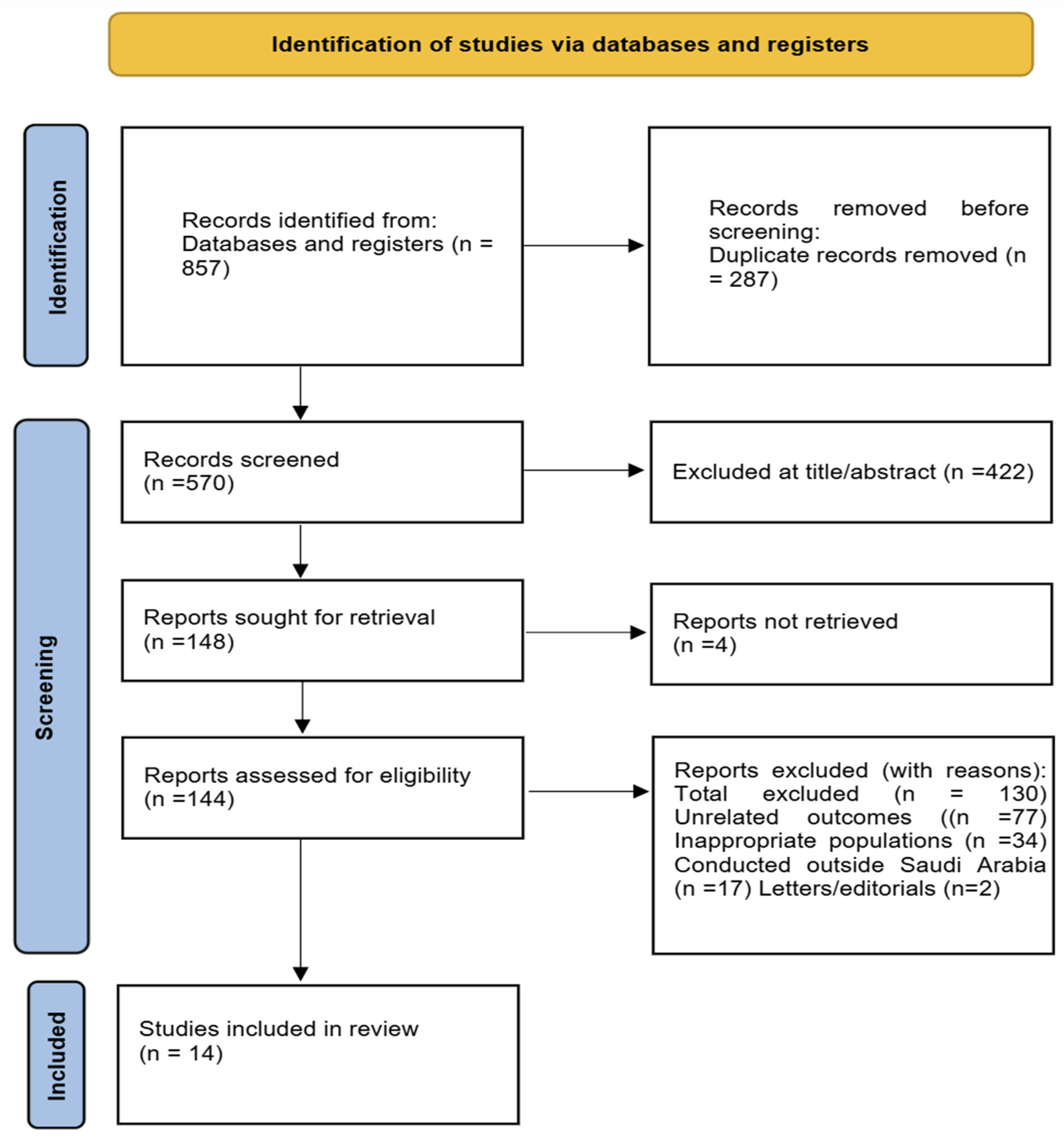
3. Results
4. Discussion
4.1. Physiological Evidence and Mechanisms
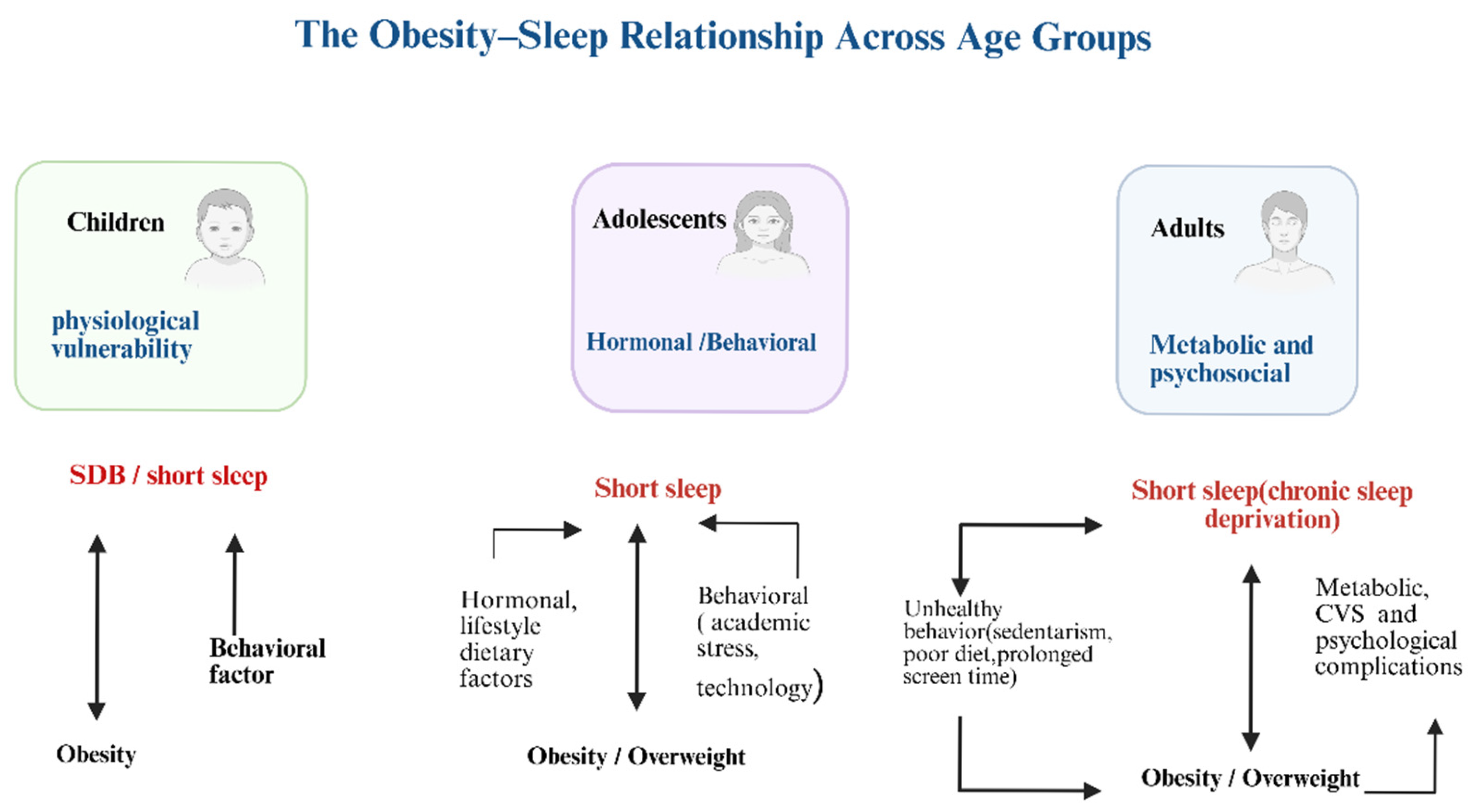
4.2. Age-Specific Comparisons
5. Limitation
6. Implications
7. Conclusions
Supplementary Materials
Author Contributions
Funding
Institutional Review Board Statement
Data Availability Statement
Conflicts of Interest
References
- Hruby, A.; Hu, F.B. The epidemiology of obesity: A big picture. Pharmacoeconomics 2015, 33, 673–689. [Google Scholar] [CrossRef] [PubMed]
- Ng, M.; Fleming, T.; Robinson, M.; Thomson, B.; Graetz, N.; Margono, C.; Mullany, E.C.; Biryukov, S.; Abbafati, C.; Abera, S.F.; et al. Global, regional, and national prevalence of overweight and obesity in children and adults during 1980–2013: A systematic analysis for the Global Burden of Disease Study 2013. Lancet 2014, 384, 766–781. [Google Scholar] [CrossRef] [PubMed]
- Barrea, L.; Altieri, B.; Muscogiuri, G.; Laudisio, D.; Annunziata, G.; Colao, A.; Faggiano, A.; Savastano, S. Impact of nutritional status on gastroenteropancreatic neuroendocrine tumors (GEP-NET) aggressiveness. Nutrients 2018, 10, 1854. [Google Scholar] [CrossRef] [PubMed]
- Barrea, L.; Gallo, M.; Ruggeri, R.M.; Giacinto, P.D.; Sesti, F.; Prinzi, N.; Adinolfi, V.; Barucca, V.; Renzelli, V.; Muscogiuri, G.; et al. Nutritional status and follicular-derived thyroid cancer: An update. Crit. Rev. Food Sci. Nutr. 2020, 30, 25–59. [Google Scholar] [CrossRef]
- Laudisio, D.; Muscogiuri, G.; Barrea, L.; Savastano, S.; Colao, A. Obesity and breast cancer in premenopausal women: Current evidence and future perspectives. Eur. J. Obs. Gynecol. Reprod. Biol. 2018, 230, 217–221. [Google Scholar] [CrossRef]
- Wang, Y.C.; McPherson, K.; Marsh, T.; Gortmaker, S.L.; Brown, M. Health and economic burden of the projected obesity trends in the USA and the UK. Lancet 2011, 378, 815–825. [Google Scholar] [CrossRef]
- Chooi, Y.C.; Ding, C.; Magkos, F. The epidemiology of obesity. Metabolism 2019, 92, 6–10. [Google Scholar] [CrossRef]
- Schoenborn, C.A.; Adams, P.F. Sleep Duration as a Correlate of Smoking, Alcohol Use, Leisure-Time Physical Inactivity, and Obesity Among Adults: United States, 2004–2006. 2008. Available online: https://www.cdc.gov/nchs/data/hestat/sleep04-06/sleep04-06.htm (accessed on 31 October 2025).
- Born, J.; Fehm, H.L. The neuroendocrine recovery function of sleep. Noise Health 2000, 2, 25–38. [Google Scholar]
- Godos, J.; Ferri, R.; Caraci, F.; Cosentino, F.; Castellano, S.; Galvano, F.; Grosso, G. Adherence to the Mediterranean diet is associated with better sleep quality in Italian adults. Nutrients 2019, 11, 976. [Google Scholar] [CrossRef]
- Hirshkowitz, M.; Whiton, K.; Albert, S.M.; Alessi, C.; Bruni, O.; DonCarlos, L.; Hazen, N.; Herman, J.; Katz, E.S.; KheirandishGozal, L.; et al. National Sleep Foundation’s sleep time duration recommendations: Methodology and results summary. Sleep Health 2015, 1, 40–43. [Google Scholar] [CrossRef]
- Sperry, S.D.; Scully, I.D.; Gramzow, R.H.; Jorgensen, R.S. Sleep duration and waist circumference in adults: A metaanalysis. Sleep 2015, 38, 1269–1276. [Google Scholar] [CrossRef] [PubMed]
- Cappuccio, F.P.; Taggart, F.M.; Kandala, N.B.; Currie, A.; Peile, E.; Stranges, S.; Miller, M.A. Meta-analysis of short sleep duration and obesity in children and adults. Sleep 2008, 31, 619–626. [Google Scholar] [CrossRef] [PubMed]
- Peuhkuri, K.; Sihvola, N.; Korpela, R. Diet promotes sleep duration and quality. Nutr. Res. 2012, 32, 309–319. [Google Scholar] [CrossRef] [PubMed]
- Arble, D.M.; Bass, J.; Behn, C.D.; Butler, M.P.; Challet, E.; Czeisler, C.; Depner, C.M.; Elmquist, J.; Franken, P.; Grandner, M.A.; et al. Impact of sleep and circadian disruption on energy balance and diabetes: A summary of workshop discussions. Sleep 2015, 38, 1849. [Google Scholar] [CrossRef]
- Muscogiuri, G.; Barrea, L.; Aprano, S.; Framondi, L.; Di Matteo, R.; Laudisio, D.; Pugliese, G.; Savastano, S.; Colao, A., on behalf of the OPERA PREVENTION Project. Sleep Quality in Obesity: Does Adherence to the Mediterranean Diet Matter? Nutrients 2020, 12, 1364. [Google Scholar] [CrossRef] [PubMed] [PubMed Central]
- Page, M.J.; McKenzie, J.E.; Bossuyt, P.M.; Boutron, I.; Hoffmann, T.C.; Mulrow, C.D.; Shamseer, L.; Tetzlaff, J.M.; Akl, E.A.; Brennan, S.E.; et al. The PRISMA 2020 statement: An updated guideline for reporting systematic reviews. Int. J. Surg. 2021, 88, 105906. [Google Scholar] [CrossRef]
- Ouzzani, M.; Hammady, H.; Fedorowicz, Z.; Elmagarmid, A. Rayyan—A web and mobile app for systematic reviews. Syst. Rev. 2016, 5, 210. [Google Scholar] [CrossRef]
- Jüni, P.; Loke, Y.; Pigott, T.; Ramsay, C.; Regidor, D.; Rothstein, H.; Shea, B. Risk of bias in non-randomized studies of interventions (ROBINS-I): Detailed guidance. Br. Med. J. 2016, 355, i4919. [Google Scholar]
- Alhusseini, N.; Elaasser, B.; Alshaar, B.; Alyousof, S.; Boukhet, S.; Omair, A. Obesity, Quality of Sleep and Anxiety in Saudi Arabia. J. Contemp. Med. Sci. 2021, 7, 235–241. [Google Scholar] [CrossRef]
- Alshehri, K.A.; Bashamakh, L.F.; Alshamrani, H.M.; Alghamdi, I.O.; Mahin, B.A.; Alharbi, A.A.; Alqulyti, W.M.; Alshehri, H.Z.; Alghamdi, M.T.; Alhejaili, F.F. Pattern and severity of sleep apnea in a Saudi sleep center: The impact of obesity. J. Fam. Community Med. 2019, 26, 127. [Google Scholar] [CrossRef]
- Abedelmalek, S.; Adam, H.; Alardan, S.; Yassin, S.; Chtourou, H.; Souissi, N. Physical Activity, Sleep Patterns and Diet Habits as Well as the Prevalence of Obesity among Adolescents: A Cross Sectional Study from Ha’il City in Saudi Arabia. Int. J. Environ. Res. Public Health 2022, 19, 16174. [Google Scholar] [CrossRef] [PubMed]
- Alodhayani, A.A.; Alshaikh, O.M.; Ghomraoui, F.A.; AlShaibani, T.J.; Algadheeb, A.S.; Bendahmash, A.W.; Baqays, A.A. Correlation between obesity and sleep disturbance in Saudi medical students. J. Phys. Ther. Sci. 2017, 29, 181–186. [Google Scholar] [CrossRef] [PubMed][Green Version]
- Al-Hazzaa, H.M.; Alhussain, M.H.; Alhowikan, A.M.; Obeid, O.A. Insufficient sleep duration and its association with breakfast intake, overweight/obesity, socio-demographics and selected lifestyle behaviors among Saudi school children. Nat. Sci. Sleep 2019, 11, 253–263. [Google Scholar] [CrossRef] [PubMed]
- Hassan, R. Prevalence of sleep-disordered breathing and its association with obesity among Saudi schoolchildren. J. Contemp. Dent. Pract. 2021, 21, 1022–1026. [Google Scholar]
- Al-Hazzaa, H.M.; Musaiger, A.O.; Abahussain, N.A.; Al-Sobayel, H.I.; Qahwaji, D.M. Prevalence of short sleep duration and its association with obesity among adolescents 15-to 19-year olds: A cross-sectional study from three major cities in Saudi Arabia. Ann. Thorac. Med. 2012, 7, 133. [Google Scholar] [CrossRef]
- Kabel, A.M.; Al Thumali, A.M.; Aldowiala, K.A.; Habib, R.D.; Aljuaid, S.S. Sleep disorders in a sample of students in Taif University, Saudi Arabia: The role of obesity, insulin resistance, anemia and high altitude. Diabetes Metab. Syndr. Clin. Res. Rev. 2018, 12, 549–554. [Google Scholar] [CrossRef]
- AL-Otaibi, H.H. Associations between sleep quality and different measures of obesity in Saudi Adults. Glob. J. Health Sci. 2016, 9, 1. [Google Scholar] [CrossRef]
- Rafique, N. Short sleep duration is a novel independent risk factor for overweight and obesity. Saudi Med. J. 2023, 44, 1160. [Google Scholar] [CrossRef]
- Mohieldein, A.H. Association between Obesity and Sleep Duration in Young Adult Saudis: A Cross-Sectional Study. Nternational J. Med. Res. Health Sci. 2020, 9, 8–14. [Google Scholar]
- Dabbour, M.A. The Relationship between Sleep Disordered Breathing and Obesity in a Tertiary Care Centre, Saudi Arabia. EC Pulmonol. Respir. Med. 2020, 9, 10–13. [Google Scholar]
- BaHammam, A.S. Prevalence, clinical characteristics, and predictors of obesity hypoventilation syndrome in a large sample of Saudi patients with obstructive sleep apnea. Saudi Med. J. 2015, 36, 181. [Google Scholar] [CrossRef] [PubMed]
- Alsulami, S.; Althagafi, N.; Hazazi, E.; Alsayed, R.; Alghamdi, M.; Almohammadi, T.; Almurashi, S.; Baig, M. Obesity and its associations with gender, smoking, consumption of sugary drinks, and hour of sleep among King Abdulaziz University Students in Saudi Arabia. Diabetes Metab. Syndr. Obes. 2023, 16, 925–934. [Google Scholar] [CrossRef] [PubMed]
- Bacaro, V.; Ballesio, A.; Cerolini, S.; Vacca, M.; Poggiogalle, E.; Donini, L.M.; Lucidi, F.; Lombardo, C. Sleep duration and obesity in adulthood: An updated systematic review and meta-analysis. Obes. Res. Clin. Pract. 2020, 14, 301–309. [Google Scholar] [CrossRef] [PubMed]
- Fatima, Y.; Doi, S.A.R.; Mamun, A. A Longitudinal impact of sleep on overweight and obesity in children and adolescents: A systematic review and bias-adjusted meta-analysis. Obes. Rev. 2015, 16, 137–149. [Google Scholar] [CrossRef]
- Norton, M.C.; Eleuteri, S.; Cerolini, S.; Ballesio, A.; Conte, S.C.; Falaschi, P.; Lucidi, F. Is poor sleep associated with obesity in older adults? A narrative review of the literature. Eat. Weight Disord. Stud. Anorex. Bulim. Obes. 2018, 23, 23–38. [Google Scholar] [CrossRef]
- St-Onge, M.P.; Roberts, A.L.; Chen, J.; Kelleman, M.; O’Keeffe, M.; RoyChoudhury, A.; Jones, P.J. Short sleep duration increases energy intakes but does not change energy expenditure in normal-weight individuals. Am. J. Clin. Nutr. 2011, 94, 410–416. [Google Scholar] [CrossRef]
- Capers, P.L.; Fobian, A.D.; Kaiser, K.A.; Borah, R.; Allison, D.B. A systematic review and meta-analysis of randomized controlled trials of the impact of sleep duration on adiposity and components of energy balance. Obes. Rev. 2015, 16, 771–782. [Google Scholar] [CrossRef]
- Patel, S.R. Reduced sleep as an obesity risk factor. Obes. Rev. 2009, 10, 61–68. [Google Scholar] [CrossRef]
- Nedeltcheva, A.V.; Kilkus, J.M.; Imperial, J.; Kasza, K.; Schoeller, D.A.; Penev, P.D. Sleep curtailment is accompanied by increased intake of calories from snacks. Am. J. Clin. Nutr. 2008, 89, 126–133. [Google Scholar]
- Patel, S.R.; Malhotra, A.; White, D.P.; Gottlieb, D.J.; Hu, F.B. Association between reduced sleep and weight gain in women. Am. J. Epidemiol. 2006, 164, 947–954. [Google Scholar] [CrossRef]
- Xiao, Q.; Arem, H.; Moore, S.C.; Hollenbeck, A.R.; Matthews, C.E. A large prospective investigation of sleep duration, weight change, and obesity in the NIH-AARP Diet and Health Study cohort. Am. J. Epidemiol. 2013, 178, 1600–1610. [Google Scholar] [CrossRef] [PubMed]
- Chen, X.; Beydoun, M.A.; Wang, Y. Is sleep duration associated with childhood obesity? A systematic review and meta-analysis. Obesity 2008, 16, 265. [Google Scholar] [CrossRef] [PubMed]
- Ogilvie, R.P.; Patel, S.R. The epidemiology of sleep and obesity. Sleep Health 2017, 3, 383–388. [Google Scholar] [CrossRef] [PubMed]
- Tuomilehto, H.; Seppä, J.; Uusitupa, M. Obesity and obstructive sleep apnea–clinical significance of weight loss. Sleep Med. Rev. 2013, 17, 321–329. [Google Scholar] [CrossRef]
- Resta, O.; Foschino Barbaro, M.P.; Bonfitto, P.; Giliberti, T.; Depalo, A.; Pannacciulli, N.; De Pergola, G. Low sleep quality and daytime sleepiness in obese patients without obstructive sleep apnoea syndrome. J. Intern. Med. 2003, 253, 536–543. [Google Scholar] [CrossRef]
- Xu, Q.; Lin, Z.; Chen, Y.; Huang, M. Association between sleep duration and patterns and obesity: A cross-sectional study of the 2007–2018 national health and nutrition examination survey. BMC Public Health 2025, 25, 1460. [Google Scholar] [CrossRef]



| Study | Design | City | Participants (n) | Mean Age (Years) | Age Group | Males n (%) |
|---|---|---|---|---|---|---|
| Alhusseini et al., 2021 [20] | Cross-sectional | Riyadh | 1113 | 18–45 | Adults | 327 (29.4) |
| Alshehri et al., 2019 [21] | Cross-sectional | Jeddah | 803 | 44.9 ± 15.9 | Adults | 454 (56.3) |
| Abedelmalek et al., 2022 [22] | Cross-sectional | Hail | 1598 | 12–15 | Children | 935 (55.8) |
| Alodhayani et al., 2017 [23] | Cross-sectional | Riyadh | 408 | 20.7 ± 2.3 | Young Adults | 224 (54.9) |
| Dabbour, 2020 [31] | Retrospective | Riyadh | 51 | 10.3 ± 2.3 | Children | 26 (51.0) |
| Al-Hazzaa et al., 2019 [24] | Cross-sectional | Riyadh | 1051 | 9.2 ± 1.7 | Children | 523 (49.8) |
| Alsulami et al., 2023 [33] | Cross-sectional | Jeddah | 659 | 18–30 | Young Adults | 313 (47.4) |
| Hassan et al., 2021 [25] | Cross-sectional | Madinah | 1528 | 9.7 ± 1.4 | Children | 842 (53.3) |
| BaHammam, 2015 [32] | Retrospective | Riyadh | 1693 | 47.7 ± 14.0 | Adults | 1076 (63.6) |
| Al-Hazzaa et al., 2012 [26] | Cross-sectional | Al-Khobar, Jeddah, Riyadh | 2868 | 16.6 ± 1.1 | Adolescents | 1379 (48.1) |
| Kabel et al., 2018 [27] | Cross-sectional | Taif | 1066 | 18–25 | Adolescents and young adults | 487 (45.7) |
| Al-Otaibi, 2016 [28] | Cross-sectional | Al-Hasa | 233 | 22.4 ± 9.6 | Young Adults | 0 |
| Rafique, 2023 [29] | Cross-sectional | Dammam | 1724 | 16–22 | Adolescents/Young Adults | 768 (44.5) |
| Mohieldein, 2020 [30] | Cross-sectional | Qassim | 81 | 18–46 | Adults | 59 (72.8) |
| Study | Population | Sleep Assessment | Key Outcomes | Evidence Strength * | ROBINS-I Bias Rating * |
|---|---|---|---|---|---|
| Alhusseini et al., 2021 [20] | General population | ** PSQI (Subjective) | Obesity, insomnia, and anxiety interrelate, worsening sleep and promoting emotional eating; poor sleep linked to obesity. | Moderate | Moderate |
| Alshehri et al., 2019 [21] | General population | PSG (Objective) | Obese individuals, especially men, show higher prevalence and severity of OSA; Class III obesity linked to severe OSA. | High | Low |
| Abedelmalek et al., 2022 [22] | Adolescents | ATLS (Subjective) | High obesity and overweight rates associated with diet, sleep, and activity; lifestyle modification recommended. | Moderate | Moderate |
| Alodhayani et al., 2017 [23] | Medical students | ESS (Subjective) | Sleep disruption associated with weight gain; sedentary reading and lying down post-lunch increase obesity risk. | Moderate | Moderate |
| Dabbour, 2020 [31] | Children | PSG (Objective) | Obesity is a risk factor for SDB; hypopnea most common, followed by OSA; BMI not correlated with OSA severity. | Moderate | Moderate |
| Al-Hazzaa et al., 2019 [24] | Children (6–13 yrs) | ATLS (Subjective) | Short sleep linked to male sex, low paternal education, infrequent breakfast, and long screen time; obesity not significant after adjustment. | High | Low |
| Alsulami et al., 2023 [33] | University students | ATLS (Subjective) | Obesity more prevalent in males (24%); predictors include male sex, short sleep, smoking, sugary drinks. | High | Low |
| Hassan et al., 2021 [25] | Children | PSQ (Subjective) | ~23% at risk for SDB; strong correlation between obesity/overweight and SDB risk. | Moderate | Moderate |
| BaHammam, 2015 [32] | General population | PSG (Objective) | OSA co-occurs with obesity hypoventilation syndrome; predictors include bicarbonate levels and oxygen saturation time. | High | Low |
| Al-Hazzaa et al., 2012 [26] | Adolescents (15–19 yrs) | ATLS (Subjective) | Short sleep duration is associated with overweight and obesity among teenagers. | Moderate | Moderate |
| Kabel et al., 2018 [27] | University students | ESS (Subjective) | Sleep disturbances and EDS are linked to anemia, obesity, glucose intolerance, and high altitude. | Moderate | Moderate |
| Al-Otaibi, 2016 [28] | General population | PSQI (Subjective) | Poor sleep associated with physical inactivity, high waist circumference, and obesity. | Moderate | Moderate |
| Rafique, 2023 [29] | General population | Online questionnaire (Subjective) | Short sleep duration is linked to higher BMI; sleep deprivation is an independent risk factor for obesity (OR 1.47). | High | Low |
| Mohieldein, 2020 [30] | General population | Self-reported (Subjective) | 7–8 h of sleep may reduce obesity risk; healthy sleep promotes better lifestyle choices. | Moderate | Moderate |
| Category | Children | Adolescents | Adults |
|---|---|---|---|
| Main Focus | Physiological effects of obesity on sleep, especially sleep-disordered breathing (SDB) | Behavioral and hormonal influences on sleep duration and weight status | Lifestyle, psychological stress, and chronic health outcomes linked to sleep and obesity |
| Common Sleep Problems | SDB, habitual snoring, short sleep duration | Irregular sleep schedules, poor sleep hygiene, delayed sleep phase | Insomnia, poor sleep quality, obstructive sleep apnea (OSA), obesity hypoventilation syndrome (OHS) |
| Relationship to Obesity | Obesity increases SDB risk, but not always directly tied to short sleep | Short sleep duration strongly associated with overweight and obesity | Strong bidirectional association; poor sleep predicts higher BMI, weight gain, and metabolic dysfunction |
| Contributing Factors | High screen time, inconsistent sleep routines, family habits | Hormonal fluctuations, late-night device use, academic and social pressures | Sedentary behavior, stress, caffeine intake, unhealthy diet, long work hours, prolonged screen use |
| Gender Differences | Boys more prone to SDB | Males exhibit higher obesity rates and shorter sleep | Women more affected by OHS; stress and lifestyle contribute across genders |
| Health Implications | Respiratory issues, fatigue, reduced cognitive performance | Weight gain, mood disturbances, and decreased academic achievement | Hypertension, diabetes, metabolic syndrome, and depression |
| Recommended Interventions | Parental oversight, screen-time regulation, early SDB screening | Sleep education, stress reduction, promoting consistent routines | Workplace wellness programs, stress management, sleep hygiene promotion |
| Overall Insight | Sleep–obesity link primarily driven by physiological mechanisms | Behavioral and hormonal disruptions reinforce obesity risk | Complex metabolic and psychosocial feedback loops sustain obesity and poor sleep |
Disclaimer/Publisher’s Note: The statements, opinions and data contained in all publications are solely those of the individual author(s) and contributor(s) and not of MDPI and/or the editor(s). MDPI and/or the editor(s) disclaim responsibility for any injury to people or property resulting from any ideas, methods, instructions or products referred to in the content. |
© 2025 by the authors. Licensee MDPI, Basel, Switzerland. This article is an open access article distributed under the terms and conditions of the Creative Commons Attribution (CC BY) license (https://creativecommons.org/licenses/by/4.0/).
Share and Cite
Aljohani, A.H.; Aljohani, A.H.; Alshammari, K.M. Sleep Disorders and Obesity in Saudi Populations Across the Lifespan: A Systematic Review. J. Clin. Med. 2025, 14, 8709. https://doi.org/10.3390/jcm14248709
Aljohani AH, Aljohani AH, Alshammari KM. Sleep Disorders and Obesity in Saudi Populations Across the Lifespan: A Systematic Review. Journal of Clinical Medicine. 2025; 14(24):8709. https://doi.org/10.3390/jcm14248709
Chicago/Turabian StyleAljohani, Amal H., Abdullah Heliel Aljohani, and Khalid Mohammed Alshammari. 2025. "Sleep Disorders and Obesity in Saudi Populations Across the Lifespan: A Systematic Review" Journal of Clinical Medicine 14, no. 24: 8709. https://doi.org/10.3390/jcm14248709
APA StyleAljohani, A. H., Aljohani, A. H., & Alshammari, K. M. (2025). Sleep Disorders and Obesity in Saudi Populations Across the Lifespan: A Systematic Review. Journal of Clinical Medicine, 14(24), 8709. https://doi.org/10.3390/jcm14248709