Impaired Attention Functioning in Children and Adolescents with Obesity: Preliminary Results Based on the Computerized Continuous Performance Test

 , , , , and
Abstract
1. Introduction
2. Materials and Methods
2.1. Subjects
2.2. Inclusion and Exclusion Criteria
2.3. Clinical Evaluation
2.4. Continuous Performance Test
2.5. Statistical Analysis
3. Results
4. Discussion
5. Conclusions
Author Contributions
Funding
Institutional Review Board Statement
Informed Consent Statement
Data Availability Statement
Acknowledgments
Conflicts of Interest
Abbreviations
| CPT | Continuous performance test |
| BMI | Body mass index |
| ADHD | Attention deficit hyperactivity disorder |
| TSH | Thyrotropin |
| FT4 | Free thyroxine |
| ALT | Alanine aminotransferase |
| AST | Aspartate aminotransferase |
| SD | Standard deviation |
References
- Kolk, S.M.; Rakic, P. Development of prefrontal cortex. Neuropsychopharmacology 2022, 47, 41–57. [Google Scholar] [CrossRef]
- Friedman, N.P.; Robbins, T.W. The role of prefrontal cortex in cognitive control and executive function. Neuropsychopharmacology 2022, 47, 72–89. [Google Scholar] [CrossRef]
- Buitelaar, J.; Bölte, S.; Brandeis, D.; Caye, A.; Christmann, N.; Cortese, S.; Coghill, D.; Faraone, S.V.; Franke, B.; Gleitz, M.; et al. Toward Precision Medicine in ADHD. Front. Behav. Neurosci. 2022, 16, 900981. [Google Scholar] [CrossRef]
- Goharinejad, S.; Goharinejad, S.; Hajesmaeel-Gohari, S.; Bahaadinbeig, K. The usefulness of virtual, augmented, and mixed reality technologies in the diagnosis and treatment of attention deficit hyperactivity disorder in children: An overview of relevant studies. BMC Psychiatry 2022, 22, 4. [Google Scholar] [CrossRef]
- Kielar-Turska, M.; Kosno, M. Nature, neurophysiological mechanisms and developmental changes of executive functions. Psychologia. Rozwojowa. 2013, 18, 9–27. [Google Scholar] [CrossRef]
- Klenberg, L.; Korkman, M.; Lahti-Nuuttila, P. Differential development of attention and executive functions in 3- to 12-year-old Finnish children. Dev. Neuropsychol. 2001, 20, 407–428. [Google Scholar] [CrossRef] [PubMed]
- Liang, J.; Matheson, B.E.; Kaye, W.H.; Boutelle, K.N. Neurocognitive correlates of obesity and obesity-related behaviors in children and adolescents. Int. J. Obes. 2014, 38, 494–506. [Google Scholar] [CrossRef] [PubMed]
- Diamond, A. Executive functions. Annu. Rev. Psychol. 2013, 64, 135–168. [Google Scholar] [CrossRef] [PubMed]
- Huang, H.; Li, R.; Zhang, J. A review of visual sustained attention: Neural mechanisms and computational models. PeerJ 2023, 11, e15351. [Google Scholar] [CrossRef] [PubMed]
- Al-Suhaimi, E.A.; AlRubaish, A.A.; Aldossary, H.A.; Homeida, M.A.; Shehzad, A.; Homeida, A.M. Obesity and Cognitive Function: Leptin Role Through Blood-Brain Barrier and Hippocampus. Mol. Neurobiol. 2025, 62, 16280–16301. [Google Scholar] [CrossRef]
- Wasiluk, A.; Saczuk, J. Secular Trends in Height, Body Mass, and BMI Among Polish Boys in Eastern Regions from 1986 to 2021: Cross-Decade Analysis of Nutritional Status. J. Clin. Med. 2025, 14, 5767. [Google Scholar] [CrossRef]
- Kryst, Ł.; Żegleń, M.; Woronkowicz, A.; Kowal, M. Body height, weight, and Body Mass Index-magnitude and pace of secular changes in children and adolescents from Kraków (Poland) between 1983 and 2020. Am. J. Hum. Biol. 2022, 34, e23779. [Google Scholar] [CrossRef]
- Mo, Y.Y.; Han, Y.X.; Xu, S.N.; Jiang, H.L.; Wu, H.X.; Cai, J.M.; Li, L.; Bu, Y.H.; Xiao, F.; Liang, H.D.; et al. Adipose Tissue Plasticity: A Comprehensive Definition and Multidimensional Insight. Biomolecules 2024, 14, 1223. [Google Scholar] [CrossRef]
- Sakers, A.; De Siqueira, M.K.; Seale, P.; Villanueva, C.J. Adipose-tissue plasticity in health and disease. Cell 2022, 185, 419–446. [Google Scholar] [CrossRef]
- Majewska, K.A.; Majewski, D.; Skowrońska, B.; Fichna, P. Serum resistin concentrations in children with type 1 diabetes mellitus-negative relation to body fat mass. Endokrynol. Pol. 2014, 65, 342–347. [Google Scholar] [CrossRef]
- Oliveras-Cañellas, N.; Castells-Nobau, A.; de la Vega-Correa, L.; Latorre-Luque, J.; Motger-Albertí, A.; Arnoriaga-Rodriguez, M.; Garre-Olmo, J.; Zapata-Tona, C.; Coll-Martínez, C.; Ramió-Torrentà, L.; et al. Adipose tissue coregulates cognitive function. Sci. Adv. 2023, 9, eadg4017. [Google Scholar] [CrossRef]
- Schmidt, R.; Sebert, C.; Kösling, C.; Grunwald, M.; Hilbert, A.; Hübner, C.; Schäfer, L. Neuropsychological and Neurophysiological Indicators of General and Food-Specific Impulsivity in Children with Overweight and Obesity: A Pilot Study. Nutrients 2018, 10, 1983. [Google Scholar] [CrossRef]
- Harvey, P.D. Clinical applications of neuropsychological assessment. Dialogues Clin. Neurosci. 2012, 14, 91–99. [Google Scholar] [CrossRef] [PubMed]
- Slagter, H.A.; Bouwer, F.L. Qualitative Versus Quantitative Individual Differences in Cognitive Neuroscience. J. Cogn. 2021, 4, 49. [Google Scholar] [CrossRef] [PubMed]
- Arrondo, G.; Mulraney, M.; Iturmendi-Sabater, I.; Musullulu, H.; Gambra, L.; Niculcea, T.; Banaschewski, T.; Simonoff, E.; Döpfner, M.; Hinshaw, S.P.; et al. Systematic Review and Meta-Analysis: Clinical Utility of Continuous Performance Tests for the Identification of Attention-Deficit/Hyperactivity Disorder. J. Am. Acad. Child Adolesc. Psychiatry 2024, 63, 154–171. [Google Scholar] [CrossRef] [PubMed]
- Cole, T.J. The LMS method for constructing normalized growth standards. Eur. J. Clin. Nutr. 1990, 44, 45–60. [Google Scholar]
- Budzulak, J.; Majewska, K.A.; Kędzia, A. BMI z-score as a prognostic factor for height velocity in children treated with recombinant human growth hormone due to idiopathic growth hormone deficiency. Endocrine 2024, 86, 782–789. [Google Scholar] [CrossRef]
- Budzulak, J.; Majewska, K.A.; Kędzia, A. Nutritional Counseling in Children with Growth Hormone Deficiency Treated with Recombinant Human Growth Hormone: Analysis of Growth Response Parameters. Biomedicines 2025, 13, 2165. [Google Scholar] [CrossRef] [PubMed]
- Kułaga, Z.; Grajda, A.; Gurzkowska, B.; Góźdź, M.; Wojtyło, M.; Świąder, A.; Różdżyńska-Świątkowska, A.; Litwin, M. Polish 2012 growth references for preschool children. Eur. J. Pediatr. 2013, 172, 753–761. [Google Scholar] [CrossRef]
- Kułaga, Z.; Litwin, M.; Tkaczyk, M.; Palczewska, I.; Zajączkowska, M.; Zwolińska, D.; Krynicki, T.; Wasilewska, A.; Moczulska, A.; Morawiec-Knysak, A.; et al. Polish 2010 growth references for school-aged children and adolescents. Eur. J. Pediatr. 2011, 170, 599–609. [Google Scholar] [CrossRef] [PubMed]
- Lancrei, H.M.; Yeshayahu, Y.; Grossman, E.S.; Berger, I. Sweet but sour: Impaired attention functioning in children with type 1 diabetes mellitus. Front. Hum. Neurosci. 2022, 16, 895835. [Google Scholar] [CrossRef] [PubMed]
- Berger, I.; Slobodin, O.; Aboud, M.; Melamed, J.; Cassuto, H. Maturational delay in ADHD: Evidence from CPT. Front. Hum. Neurosci. 2013, 7, 691. [Google Scholar] [CrossRef]
- Booth, C.; Spronk, D.; Grol, M.; Fox, E. Uncontrolled eating in adolescents: The role of impulsivity and automatic approach bias for food. Appetite 2018, 120, 636–643. [Google Scholar] [CrossRef]
- Higgs, S. Is there a role for higher cognitive processes in the development of obesity in humans? Philos. Trans. R. Soc. Lond. B Biol. Sci. 2023, 378, 20220208. [Google Scholar] [CrossRef]
- Thamotharan, S.; Lange, K.; Zale, E.L.; Huffhines, L.; Fields, S. The role of impulsivity in pediatric obesity and weight status: A meta-analytic review. Clin. Psychol. Rev. 2013, 33, 253–262. [Google Scholar] [CrossRef]
- Lokken, K.L.; Boeka, A.G.; Austin, H.M.; Gunstad, J.; Harmon, C.M. Evidence of executive dysfunction in extremely obese adolescents: A pilot study. Surg. Obes. Relat. Dis. 2009, 5, 547–552. [Google Scholar] [CrossRef] [PubMed]
- Nederkoorn, C.; Coelho, J.S.; Guerrieri, R.; Houben, K.; Jansen, A. Specificity of the failure to inhibit responses in overweight children. Appetite 2012, 59, 409–413. [Google Scholar] [CrossRef]
- Nederkoorn, C.; Braet, C.; Van Eijs, Y.; Tanghe, A.; Jansen, A. Why obese children cannot resist food: The role of impulsivity. Eat. Behav. 2006, 7, 315–322. [Google Scholar] [CrossRef]
- Delgado-Rico, E.; Río-Valle, J.S.; Albein-Urios, N.; Caracuel, A.; González-Jiménez, E.; Piqueras, M.J.; Brandi, P.; Ruiz-López, I.M.; García-Rodríguez, I.; Martín-Matillas, M.; et al. Effects of a multicomponent behavioral intervention on impulsivity and cognitive deficits in adolescents with excess weight. Behav. Pharmacol. 2012, 23, 609–615. [Google Scholar] [CrossRef]
- Guerrieri, R.; Nederkoorn, C.; Jansen, A. The interaction between impulsivity and a varied food environment: Its influence on food intake and overweight. Int. J. Obes. 2008, 32, 708–714. [Google Scholar] [CrossRef]
- Maayan, L.; Hoogendoorn, C.; Sweat, V.; Convit, A. Disinhibited eating in obese adolescents is associated with orbitofrontal volume reductions and executive dysfunction. Obesity 2011, 19, 1382–1387. [Google Scholar] [CrossRef] [PubMed]
- Davis, C.L.; Cooper, S. Fitness, fatness, cognition, behavior, and academic achievement among overweight children: Do cross-sectional associations correspond to exercise trial outcomes? Prev. Med. 2011, 52 (Suppl. S1), S65–S69. [Google Scholar] [CrossRef]
- Verdejo-García, A.; Pérez-Expósito, M.; Schmidt-Río-Valle, J.; Fernández-Serrano, M.J.; Cruz, F.; Pérez-García, M.; López-Belmonte, G.; Martín-Matillas, M.; Martín-Lagos, J.A.; Marcos, A.; et al. Selective alterations within executive functions in adolescents with excess weight. Obesity 2010, 18, 1572–1578. [Google Scholar] [CrossRef]
- Shah, B.; Tombeau Cost, K.; Fuller, A.; Birken, C.S.; Anderson, L.N. Sex and gender differences in childhood obesity: Contributing to the research agenda. BMJ Nutr. Prev. Health 2020, 3, 387–390. [Google Scholar] [CrossRef] [PubMed]
- Bianchi, D.; Schinelli, A.; Fatta, L.M.; Lonigro, A.; Lucidi, F.; Laghi, F. Body image impact on quality of life and adolescents’ binge eating: The indirect role of body image coping strategies. Eat. Weight Disord. 2023, 28, 75. [Google Scholar] [CrossRef]
- Twenge, J.M.; Martin, G.N. Gender differences in associations between digital media use and psychological well-being: Evidence from three large datasets. J. Adolesc. 2020, 79, 91–102. [Google Scholar] [CrossRef]
- Tamnes, C.K.; Herting, M.M.; Goddings, A.L.; Meuwese, R.; Blakemore, S.J.; Dahl, R.E.; Güroğlu, B.; Raznahan, A.; Sowell, E.R.; Crone, E.A.; et al. Development of the Cerebral Cortex across Adolescence: A Multisample Study of Inter-Related Longitudinal Changes in Cortical Volume, Surface Area, and Thickness. J. Neurosci. 2017, 37, 3402–3412. [Google Scholar] [CrossRef] [PubMed]
- Somerville, L.H.; Jones, R.M.; Casey, B.J. A time of change: Behavioral and neural correlates of adolescent sensitivity to appetitive and aversive environmental cues. Brain Cogn. 2010, 72, 124–133. [Google Scholar] [CrossRef] [PubMed]
- Pearce, A.L.; Hallisky, K.; Rolls, B.J.; Wilson, S.J.; Rose, E.; Geier, C.F.; Garavan, H.; Keller, K.L. Children at high familial risk for obesity show executive functioning deficits prior to development of excess weight status. Obesity 2023, 31, 2998–3007. [Google Scholar] [CrossRef] [PubMed]
- Sadler, J.R.; Thapaliya, G.; Ranganath, K.; Gabay, A.; Chen, L.; Smith, K.R.; Osorio, R.S.; Convit, A.; Carnell, S. Paediatric obesity and metabolic syndrome associations with cognition and the brain in youth: Current evidence and future directions. Pediatr. Obes. 2023, 18, e13042. [Google Scholar] [CrossRef]
- Redel, J.M.; Dolan, L.M.; DiFrancesco, M.; Vannest, J.; Shah, A.S. Youth-Onset Type 2 Diabetes and the Developing Brain. Curr. Diab. Rep. 2019, 19, 3. [Google Scholar] [CrossRef]
- Ahmed, A.; Ali, Z.; Abid, M.; Niaz, H.; Ali, U. Neurocognitive and Behavioral Outcomes in Patients With Insulin Resistance and Type 2 Diabetes: A Systematic Review of Recent Evidence. Cureus 2025, 17, e92867. [Google Scholar] [CrossRef]


| Variable | Study Group Children with Obesity (n = 23) | Control Group Healthy Children (n = 48) |
|---|---|---|
| Age [years] | ||
| Mean ± SD | 11.27 ± 3.02 | 11.39 ± 2.67 |
| Min./Max. | 6.60/16.90 | 6.50/17.50 |
| BMI [kg/m2] | ||
| Mean ± SD | 30.90 ± 6.05 | 17.29 ± 2.33 |
| Min./Max. | 22.38/44.58 | 14.0/22.80 |
| BMI z-score | ||
| Mean ± SD | 2.42 ± 0.40 | −0.29 ± 0.63 |
| Min./Max. | 2.01/3.24 | −1.00/0.97 |
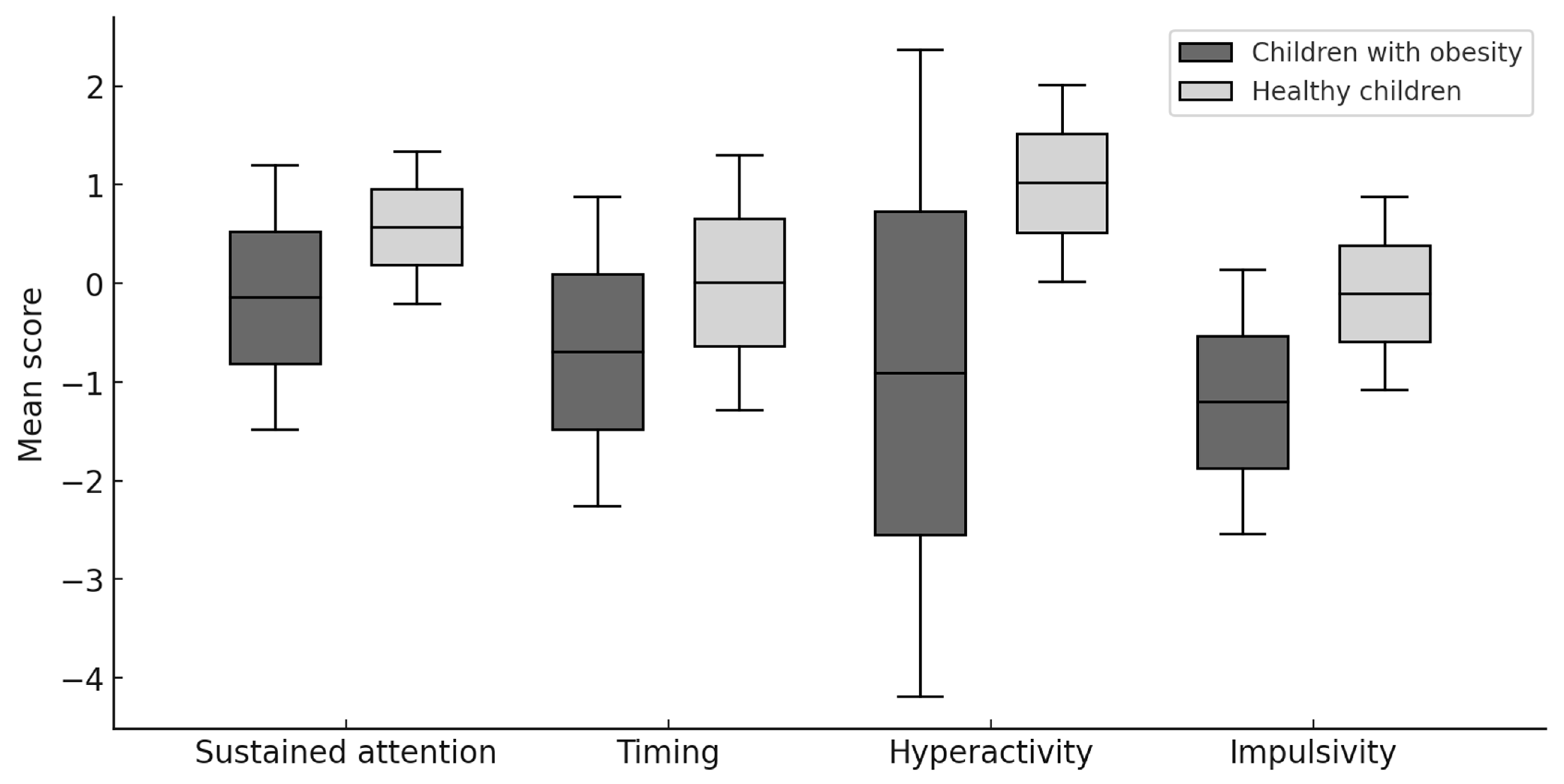
| Indicator of Attention | Children with Obesity (n = 23) | Healthy Children (n = 48) | Statistical Values | |||
|---|---|---|---|---|---|---|
| Mean Value | SD | Mean Value | SD | p | rc | |
| Sustained attention | −0.14 | 1.34 | 0.57 | 0.77 | 0.074 | - |
| Timing | −0.69 | 1.57 | 0.01 | 1.29 | 0.024 | 0.33 |
| Hyperactivity | −0.91 | 3.28 | 1.02 | 1.00 | 0.001 | 0.48 |
| Impulsivity | −1.20 | 1.34 | −0.10 | 0.98 | <0.001 | 0.50 |
| Girls | Boys | Statistical Values | ||||
|---|---|---|---|---|---|---|
| Mean Value | SD | Mean Value | SD | |||
| Children with obesity | n = 12 | n = 11 | p | rc | ||
| Sustained attention | −0.13 | 1.22 | −0.16 | 1.52 | 0.695 | - |
| Timing | −0.88 | 1.66 | −0.48 | 1.52 | 0.260 | - |
| Hyperactivity | −1.38 | 3.86 | −0.40 | 2.60 | 0.413 | - |
| Impulsivity | −1.87 | 1.19 | −0.48 | 1.13 | 0.013 | 0.60 |
| Healthy children | n = 20 | n = 28 | p | rc | ||
| Sustained attention | 0.65 | 0.68 | 0.51 | 0.84 | 0.268 | - |
| Timing | 0.13 | 1.66 | −0.08 | 0.98 | 0.188 | - |
| Hyperactivity | 1.07 | 1.26 | 0.98 | 0.80 | 0.369 | - |
| Impulsivity | −0.16 | 0.90 | −0.06 | 1.04 | 0.530 | - |
| Children with Obesity | Healthy Children | Statistical Values | ||||
|---|---|---|---|---|---|---|
| Mean Value | SD | Mean Value | SD | |||
| Girls | n = 12 | n = 20 | p | rc | ||
| Sustained attention | −0.13 | 1.22 | 0.65 | 0.68 | 0.035 | 0.45 |
| Timing | −0.88 | 1.66 | 0.13 | 1.86 | 0.024 | 0.48 |
| Hyperactivity | −0.49 | 2.47 | 1.07 | 1.26 | 0.012 | 0.53 |
| Impulsivity | −1.87 | 1.19 | −0.16 | 0.90 | <0.001 | 0.75 |
| Boys | n = 11 | n = 28 | p | rc | ||
| Sustained attention | −0.16 | 1.52 | 0.51 | 0.84 | 0.463 | - |
| Timing | −0.48 | 1.52 | −0.08 | 0.98 | 0.512 | - |
| Hyperactivity | −0.40 | 2.60 | 0.98 | 0.80 | 0.105 | - |
| Impulsivity | −0.48 | 1.13 | −0.06 | 1.04 | 0.268 | - |
| Age Below 11 Years | Age Above 11 Years | Statistical Value | |||
|---|---|---|---|---|---|
| Mean Value | SD | Mean Value | SD | ||
| Children with obesity | n = 12 | n = 11 | p | ||
| Sustained attention | −0.22 | 1.56 | −0.05 | 1.12 | 0.786 |
| Timing | −0.44 | 1.88 | −0.97 | 1.17 | 0.525 |
| Hyperactivity | −1.36 | 4.01 | −0.42 | 2.35 | 0.608 |
| Impulsivity | −1.26 | 1.64 | −1.14 | 0.98 | 0.928 |
| Healthy children | n = 26 | n = 22 | p | ||
| Sustained attention | 0.60 | 0.69 | 0.53 | 0.88 | 0.591 |
| Timing | 0.25 | 1.13 | −0.28 | 1.43 | 0.420 |
| Hyperactivity | 1.08 | 0.94 | 0.94 | 1.09 | 0.901 |
| Impulsivity | 0.09 | 0.97 | −0.33 | 0.96 | 0.131 |
Disclaimer/Publisher’s Note: The statements, opinions and data contained in all publications are solely those of the individual author(s) and contributor(s) and not of MDPI and/or the editor(s). MDPI and/or the editor(s) disclaim responsibility for any injury to people or property resulting from any ideas, methods, instructions or products referred to in the content. |
© 2025 by the authors. Licensee MDPI, Basel, Switzerland. This article is an open access article distributed under the terms and conditions of the Creative Commons Attribution (CC BY) license (https://creativecommons.org/licenses/by/4.0/).
Share and Cite
Majewska, K.A.; Stanisławska-Kubiak, M.; Wais, P.; Budzulak, J.; Mojs, E.; Kędzia, A. Impaired Attention Functioning in Children and Adolescents with Obesity: Preliminary Results Based on the Computerized Continuous Performance Test. J. Clin. Med. 2025, 14, 8656. https://doi.org/10.3390/jcm14248656
Majewska KA, Stanisławska-Kubiak M, Wais P, Budzulak J, Mojs E, Kędzia A. Impaired Attention Functioning in Children and Adolescents with Obesity: Preliminary Results Based on the Computerized Continuous Performance Test. Journal of Clinical Medicine. 2025; 14(24):8656. https://doi.org/10.3390/jcm14248656
Chicago/Turabian StyleMajewska, Katarzyna Anna, Maia Stanisławska-Kubiak, Paulina Wais, Joanna Budzulak, Ewa Mojs, and Andrzej Kędzia. 2025. "Impaired Attention Functioning in Children and Adolescents with Obesity: Preliminary Results Based on the Computerized Continuous Performance Test" Journal of Clinical Medicine 14, no. 24: 8656. https://doi.org/10.3390/jcm14248656
APA StyleMajewska, K. A., Stanisławska-Kubiak, M., Wais, P., Budzulak, J., Mojs, E., & Kędzia, A. (2025). Impaired Attention Functioning in Children and Adolescents with Obesity: Preliminary Results Based on the Computerized Continuous Performance Test. Journal of Clinical Medicine, 14(24), 8656. https://doi.org/10.3390/jcm14248656