Regression of Post-Essential Thrombocythaemia Myelofibrosis with Intermittent Hydroxyurea Therapy: A Case Report


Abstract
1. Introduction
2. Case Report
3. Discussion
Author Contributions
Funding
Institutional Review Board Statement
Informed Consent Statement
Data Availability Statement
Conflicts of Interest
References
- Thiele, J.; Kvasnicka, H.M.; Orazi, A.; Gianelli, U.; Gangat, N.; Vannucchi, A.M.; Barbui, T.; Arber, D.A.; Tefferi, A. The International Consensus Classification of Myeloid Neoplasms and Acute Leukemia: Myeloproliferative Neoplasms. Am. J. Hematol. 2023, 98, 166–179. [Google Scholar] [CrossRef] [Scilit]
- Tefferi, A. Myeloproliferative Neoplasms: A Decade of Discoveries and Treatment Advances. Am. J. Hematol. 2016, 92, 50–58. [Google Scholar] [CrossRef] [Scilit]
- Tefferi, A.; Vannucchi, A.M.; Barbui, T. Essential Thrombocythemia: 2024 Update on Diagnosis, Risk Stratification and Management. Am. J. Hematol. 2024, 99, 697–718. [Google Scholar] [CrossRef] [Scilit]
- Tefferi, A.; Wassie, E.A.; Lasho, T.L.; Finke, C.; A Belachew, A.; Ketterling, R.P.; A Hanson, C.; Pardanani, A.; Gangat, N.; Wolanskyj, A.P. Calreticulin Mutations and Long-term Survival in Essential Thrombocythemia. Leukemia 2014, 28, 2300–2303. [Google Scholar] [CrossRef] [Scilit]
- Barbui, T.; Thiele, J.; Passamonti, F.; Rumi, E.; Boveri, E.; Ruggeri, M.; Rodeghiero, F.; D’Amore, E.S.; Randi, M.L.; Bertozzi, I.; et al. Survival and Disease Progression in Essential Thrombocythemia Are Significantly Influenced by Accurate Morphologic Diagnosis.: An International Study. J. Clin. Oncol. 2011, 29, 3179–3184. [Google Scholar] [CrossRef] [Scilit] [PubMed]
- Al Assaf, C.; Van Olbergh, F.; Billiet, J.; Lierman, E.; Devos, T.; Graux, C.; Hervent, A.-S.; Emmerechts, J.; Tousseyn, T.; De Paepe, P.; et al. Analysis of Phenotype and Outcome in Essential Thrombocythemia with CALR or JAK2 Mutations. Haematologica 2015, 100, 893–897. [Google Scholar] [CrossRef] [Scilit] [PubMed]
- Erdos, K.; Lee, N.; Lebbe, A.; Bouhali, I.; Khalid, M.; Abu-Zeinah, G.; Silver, R.T.; Scandura, J.M. Low Thrombosis Risk with CALR Mutation Confer Higher Risk of ET Progression. Blood 2023, 142, 1819. [Google Scholar] [CrossRef] [Scilit]
- Santaliestra, M.; Garrote, M.; Noya, M.S.; Pérez-Encinas, M.; Senín, A.; Pérez-López, R.; Ferrer-Marín, F.; Carreño-Tarragona, G.; Caballero, G.; Magro, E.; et al. Prognostic Value of Response to IPSET Stratification in Essential Thrombocythemia. Leukemia 2024, 38, 2636–2643. [Google Scholar] [CrossRef] [Scilit]
- Barosi, G.; Mesa, R.A.; Thiele, J.; Cervantes, F.; Campbell, P.J.; Verstovsek, S.; Dupriez, B.; Levine, R.L.; Passamonti, F.; Gotlib, J.; et al. Proposed Criteria for the Diagnosis of Post-Polycythemia Vera and Post-essential Thrombocythemia Myelofibrosis: A consensus Statement from the International Working Group for Myelofibrosis Research and Treatment. Leukemia 2008, 22, 437–438. [Google Scholar] [CrossRef] [Scilit]
- Gangat, N.; Caramazza, D.; Vaidya, R.; George, G.; Begna, K.; Schwager, S.; Van Dyke, D.; Hanson, C.; Wu, W.; Pardanani, A.; et al. DIPSS plus: A Refined Dynamic International Prognostic Scoring System for Primary Myelofibrosis that Incorporates Prognostic Information from Karyotype, Platelet Count and Transfusion Status. J. Clin. Oncol. 2011, 29, 392–397. [Google Scholar] [CrossRef] [Scilit]
- Passamonti, F.; Mora, B. Myelofibrosis. Blood 2023, 141, 1954–1970. [Google Scholar] [CrossRef] [Scilit]
- Puglianini, O.C.; Peker, D.; Zhang, L.; Papadantonakis, N. Essential Thrombocythemia and Post-essential Thrombocythemia Myelofibrosis: Updates on Diagnosis, Clinical Aspects and Management. Lab. Med. 2023, 54, 13–22. [Google Scholar] [CrossRef] [Scilit]
- Manoharan, A. Management of Myelofibrosis with Intermittent Hydroxyurea. Br. J. Haematol. 1991, 77, 252–254. [Google Scholar] [CrossRef] [Scilit]
- Thiele, J.; Krosnicka, H.M.; Facchetti, F.; Franco, V.; Van Der Walt, J.; Orazi, A. European Consensus on Grading of Bone Marrow Fibrosis and Assessment of Cellularity. Haematologica 2005, 90, 1128–1132. [Google Scholar] [PubMed]
- Manoharan, A.; Gemmel, R.; Cavanaugh, L.; Shadood, N. Thrombosis in Myeloproliferative Neoplasms: A Single Center Experience of Using Whole Blood Platelet Aggregation Studies for Risk Assessment and Thromboprophylaxis. Clin. Appl. Thromb./Hemost. 2022, 28, 1076029622111. [Google Scholar] [CrossRef] [Scilit]
- Schag, C.C.; Heinrich, R.L.; Gang, P.A. Karnofsky Performance Status Revisited: Reliability, Validity and Guidelines. J. Clin. Oncol. 1984, 2, 187–193. [Google Scholar] [CrossRef] [Scilit] [PubMed]
- Mesa, R.A.; Miller, C.B.; Thyne, M.; Mangan, J.; Goldberger, S.; Fazal, S.; Ma, X.; Wilson, W.; Paranagama, D.C.; Dubinski, D.G.; et al. Differences in Treatment Goal and Perception of Symptoms Burden between Patients with Myeloproliferative Neoplasms (MPNs) and Hematologist/Oncologists in the United States. Findings from the MPN Landmark Survey. Cancer 2017, 123, 449–458. [Google Scholar] [CrossRef] [Scilit] [PubMed]
- Barbui, T.; Vannucchi, A.M.; Buxhofer-Ausch, V.; De Stefano, V.; Betti, S.; Rambaldi, A.; Rumi, E.; Ruggeri, M.; Rodeghiero, F.; Randi, M.L.; et al. Practice-relevant revision of IPSET-thrombosis Based on 1019 Patients with WHO-Defined Essential Thrombocythemia. Blood Cancer J. 2015, 5, e369. [Google Scholar] [CrossRef] [Scilit] [PubMed]
- Haider, M.; Gangat, N.; Lasho, T.; Hussein, A.K.A.; Elala, Y.C.; Hanson, C.; Tefferi, A. Validation of the Revised International Prognostic Score of Thrombosis for Essential Thrombocythemia (IPSET-thrombosis) in 585 Mayo Clinic Patients. Am. J. Hematol. 2016, 91, 390–394. [Google Scholar] [CrossRef] [Scilit]
- Barbui, T.; Vannucchi, A.; Finazzi, G.; Finazzi, M.C.; Masciulli, A.; Carobbio, A.; Ghirardi, A.; Tognoni, G. A Reappraisal of the Benefit-Risk Profile of Hydroxyurea in Polycythemia Vera: A Propensity-matched Study. Am. J. Hematol. 2017, 92, 1131–1136. [Google Scholar] [CrossRef] [Scilit]
- Martinez-Trillos, A.; Gaya, A.; Maffioli, M.; Arellano-Rodrigo, E.; Calvo, X.; Díaz-Beyá, M.; Cervantes, F. Efficacy and Tolerability of Hydroxyurea in the Treatment of Hyperproliferative Manifestations of Myelofibrosis: Results in 40 Patients. Ann. Hematol. 2010, 89, 1233–1237. [Google Scholar] [CrossRef] [Scilit] [PubMed]
- Buyukasik, Y.; Ali, R.; Turgut, M.; Saydam, G.; Yavuz, S.; Ünal, A.; Ar, M.C.; Ayyıldız, O.; Altuntaş, F.; Okay, M.; et al. Patterns of Hydroxyurea Prescription and Use in Routine Clinical Management of Polycythemia Vera: A Multicentre Chart Review Study. Turkish J. Hematol. 2020, 37, 177. [Google Scholar]
- Grunwald, M.; Kutes, D.J.; Altomare, I.; Burke, J.M.; Gerds, A.T.; Walshauser, M.A.; Savona, M.R.; Stein, B.; Oh, S.T.; Colucci, P.; et al. Treatment Patterns and Blood Counts in Patients with Polycythemia Vera Treated with Hydroxyurea in the United States: An Analysis from the REVEAL Study. Clin. Lymphoma Myeloma Leuk. 2020, 20, 219–225. [Google Scholar] [CrossRef] [Scilit]
- Ferrer-Marin, F.; Hernandez-Boluda, J.C.; Alvarez-Larran, A. Essential Thrombocythemia: A Contemporary Approach with New Drugs on the Horizon. Br. J. Haematol. 2024, 204, 1605–1616. [Google Scholar] [CrossRef] [Scilit]
- Kuykendall, A.T. Treatment of Hydroxyurea-Resistant/Intolerant Polycythemia Vera: A Discussion of Best Practices. Ann. Hematol. 2023, 102, 985–993. [Google Scholar] [CrossRef] [Scilit] [PubMed]
- Nejadnik, B.; Mascarenhas, J.; Rappaport, K.M.; Lu, B.; Gagnon, B.M.; Verstovsek, S. Treatment of Essential Thrombocythemia Patients Intolerant/Resistant to Hydroxyurea. J. Clin. Oncol. 2017, 35 (Suppl. S15), e18565. [Google Scholar] [CrossRef] [Scilit]
- Manoharan, A.; Enggist, S.I. Hydroxyurea: An Old Drug in Need of New Clinical Trials in Myeloproliferative Neoplasms? Int. Internal. Med. J. 2024, 2, 1–6. [Google Scholar]
- Tracewell, W.G.; Trump, D.L.; Vaughan, W.P.; Smith, D.C.; Gwilt, P.R. Population Pharmacokinetics of Hydroxyurea in Cancer Patients. Cancer Chemother. Pharmacol. 1995, 35, 417–422. [Google Scholar] [CrossRef] [Scilit]
- Gwilt, P.R.; Tracewell, W.G. Pharmacokinetics and Pharmacodynamics of Hydroxyurea. Clin. Pharmacokinet. 1998, 34, 347–358. [Google Scholar] [CrossRef] [Scilit] [PubMed]
- Passamonti, F.; Giorgino, T.; Mora, B.; Guglielmelli, P.; Rumi, E.; Maffioli, M.; Rambaldi, A.; Caramella, M.; Komrokji, R.; Gotlib, J.; et al. A Clinical-Molecular Prognostic Model to Predict Survival in Patients with Post Polycythemia Vera and Post Essential Thrombocythemia Myelofibrosis. Leukemia 2017, 31, 2726–2731. [Google Scholar] [CrossRef] [Scilit]
- Hernandez-Boluda, J.-C.C.; Pereira, A.; Correa, J.-G.G.; Alvarez-Larrán, A.; Ferrer-Marín, F.; Raya, J.-M.; Martínez-López, J.; Pérez-Encinas, M.; Estrada, N.; Velez, P.; et al. Performance of the Myelofibrosis Secondary to PV and ET-Prognostic Model (MYSEC-PM) in A Series of 262 Patients from the Spanish Registry of Myelofibrosis. Leukemia 2018, 32, 553–555. [Google Scholar] [CrossRef] [Scilit]
- Martino, M.; Pitea, M.; Sgarlata, A.; Delfino, I.M.; Cogliandro, F.; Scopelliti, A.; Marafioti, V.; Polimeni, S.; Porto, G.; Policastro, G.; et al. Treatment Strategies Used in Treating Myelofibrosis: State of the Art. Hematol. Rep. 2024, 16, 698–713. [Google Scholar] [CrossRef] [Scilit]
- Thaw, K.; Harrison, C.N.; Srikandarajah, P. JAK Inhibitors for Myelofibrosis: Strengths and Limitations. Curr. Hematol. Malig. Rep. 2024, 19, 264–275. [Google Scholar] [CrossRef] [Scilit] [PubMed]
- Jacobson, R.J.; Salo, A.; Fialkow, P.J. Agnogenic Myeloid Metaplasia: A Clonal Proliferation of Hemopoietic Stem Cells with Secondary Myelofibrosis. Blood 1978, 51, 189–194. [Google Scholar] [CrossRef] [Scilit] [PubMed]
- Zahr, A.A.; Salama, M.E.; Correau, N.; Tremblay, D.; Verstovsek, S.; Mesa, R.; Hoffman, R.; Mascarenhas, J. Bone Marrow Fibrosis in Myelofibrosis: Pathogenesis, Prognosis and Targeted Strategies. Haematologica 2016, 101, 660–671. [Google Scholar] [CrossRef] [Scilit]
- Manoharan, A.; Pitney, W.R. Chemotherapy Resolves Symptoms and Reverses Marrow Fibrosis in Myelofibrosis. Scand. J. Haematol. 1984, 33, 453–459. [Google Scholar] [CrossRef] [Scilit] [PubMed]
- Editorial. Reversible Myelofibrosis? Lancet 1985, 325, 497–498. [Google Scholar] [CrossRef] [Scilit]
- Manoharan, A.; Chen, C.F.; Wilson, L.S.; Griffiths, K.A.; Robinson, D.E. Ultrasonic Characterization of Splenic Tissue in Myelofibrosis: Further Evidence for Reversal of Fibrosis with Chemotherapy. Eur. J. Haematol. 1988, 40, 149–154. [Google Scholar] [CrossRef] [Scilit]
- Lofvenberg, E.; Wahlin, A.; Roos, G.; Öst, Å. Reversal of Myelofibrosis by Hydroxyurea. Eur. J. Haematol. 1990, 44, 33–38. [Google Scholar] [CrossRef] [Scilit]



| Haematological Parameters | Pre-Treatment * | Post-Treatment (30 Months) ** | Current *** |
|---|---|---|---|
| Blood Counts | |||
| Hb (g/L) | 104 | 121 | 121 |
| WBC (109 L) | 9.10 | 3.30 | 2.40 |
| Neutrophils (109 L) | 6.10 | 1.62 | 1.00 |
| Lymphocytes (109 L) | 2.00 | 1.55 | 1.27 |
| Platelets (109 L) | 921 | 636 | 540 |
| Bone Marrow | |||
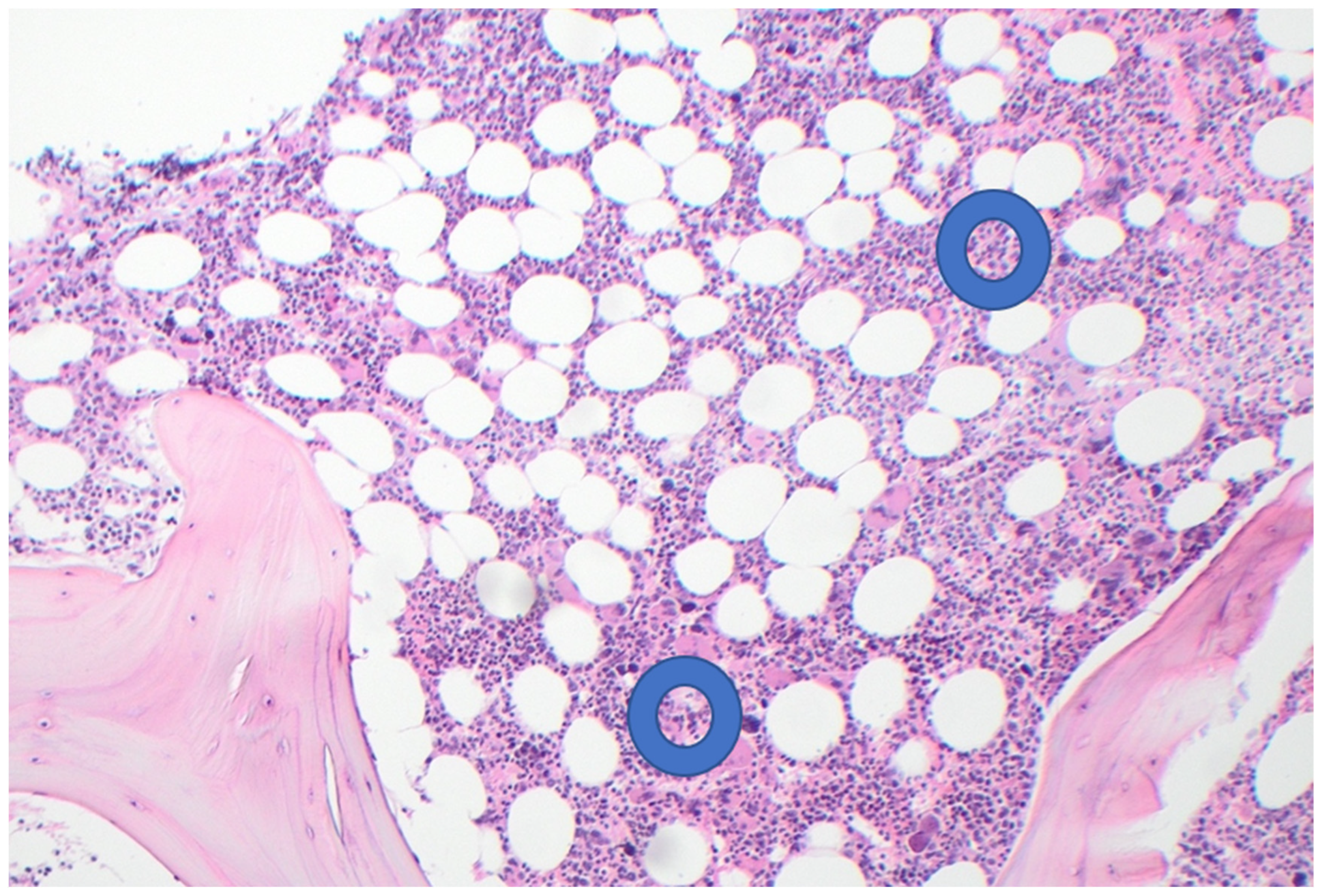
| Cellularity | Markedly Hyper-cellular | Mildly Hyper-cellular | |
| Erythropoiesis | Reduced | Adequate | |
| Myelopoiesis | Increased | Adequate | |
| Megakaryocytes | Markedly Increased | Increased | |
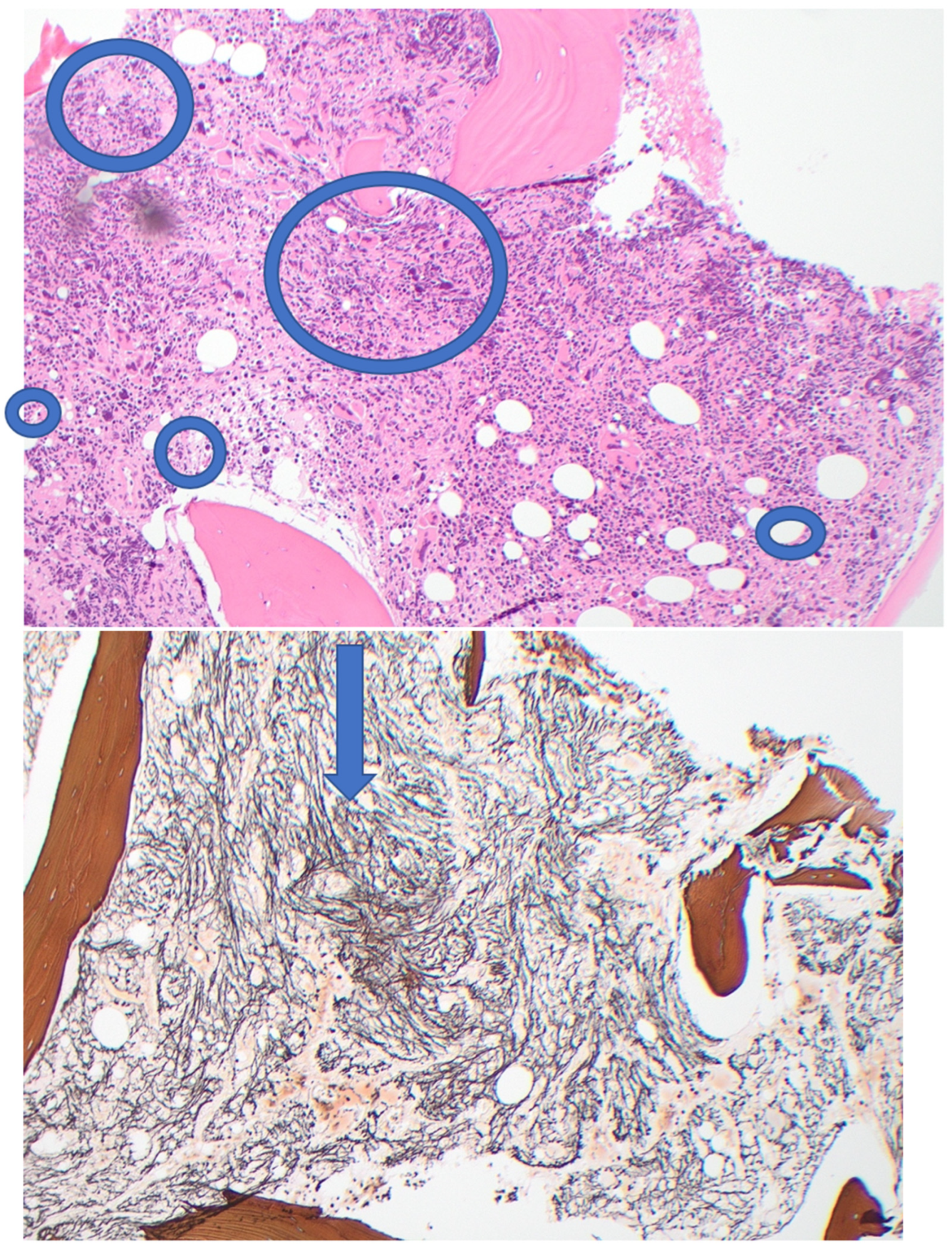
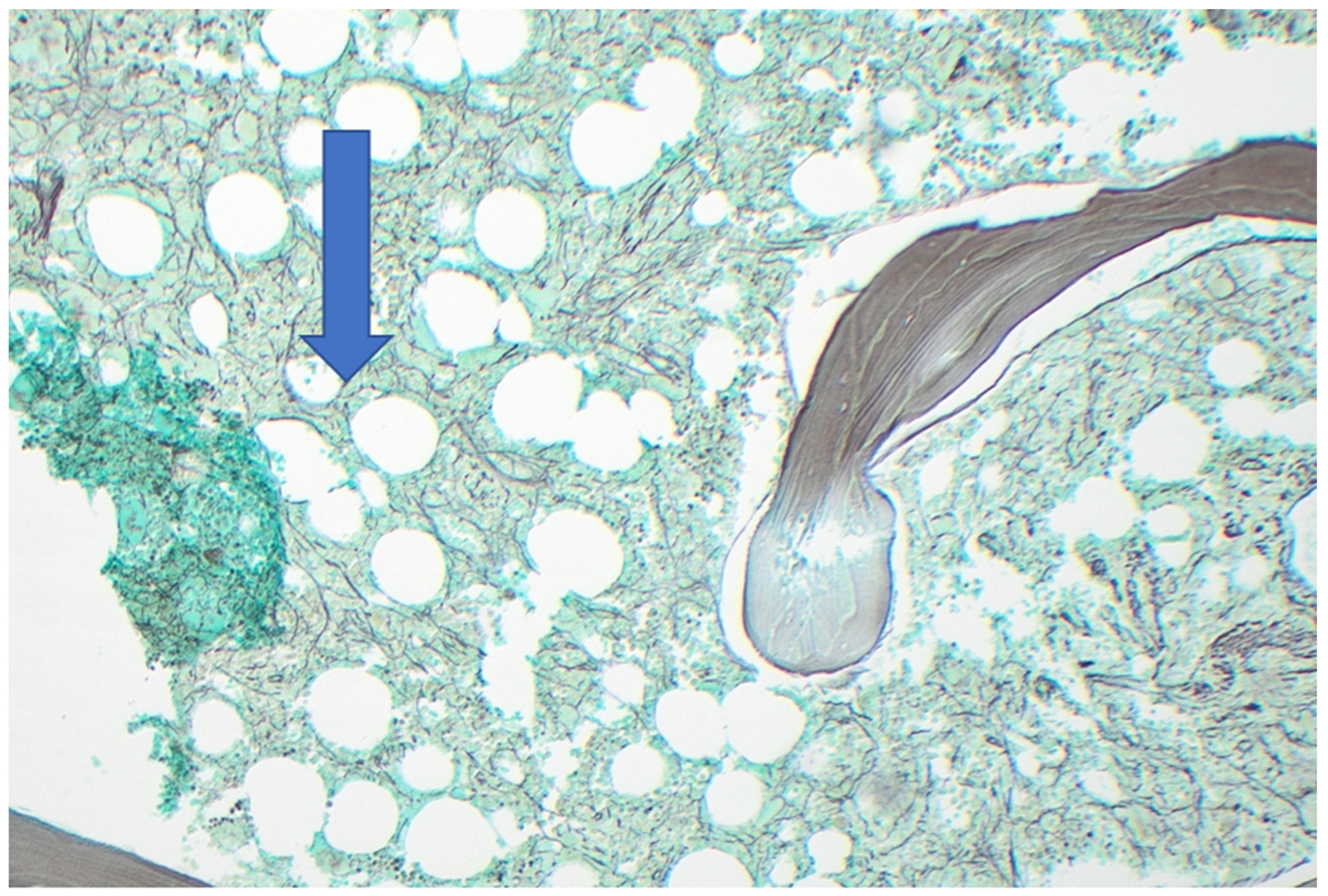
| Fibrosis | Grade 3 | Grade 1 |
Disclaimer/Publisher’s Note: The statements, opinions and data contained in all publications are solely those of the individual author(s) and contributor(s) and not of MDPI and/or the editor(s). MDPI and/or the editor(s) disclaim responsibility for any injury to people or property resulting from any ideas, methods, instructions or products referred to in the content. |
© 2025 by the authors. Licensee MDPI, Basel, Switzerland. This article is an open access article distributed under the terms and conditions of the Creative Commons Attribution (CC BY) license (https://creativecommons.org/licenses/by/4.0/).
Share and Cite
Manoharan, A.; Tang, I. Regression of Post-Essential Thrombocythaemia Myelofibrosis with Intermittent Hydroxyurea Therapy: A Case Report. J. Clin. Med. 2025, 14, 8641. https://doi.org/10.3390/jcm14248641
Manoharan A, Tang I. Regression of Post-Essential Thrombocythaemia Myelofibrosis with Intermittent Hydroxyurea Therapy: A Case Report. Journal of Clinical Medicine. 2025; 14(24):8641. https://doi.org/10.3390/jcm14248641
Chicago/Turabian StyleManoharan, Arumugam, and Ian Tang. 2025. "Regression of Post-Essential Thrombocythaemia Myelofibrosis with Intermittent Hydroxyurea Therapy: A Case Report" Journal of Clinical Medicine 14, no. 24: 8641. https://doi.org/10.3390/jcm14248641
APA StyleManoharan, A., & Tang, I. (2025). Regression of Post-Essential Thrombocythaemia Myelofibrosis with Intermittent Hydroxyurea Therapy: A Case Report. Journal of Clinical Medicine, 14(24), 8641. https://doi.org/10.3390/jcm14248641